Full	
  Stack	
  Clojure	
  
Michiel	
  Borkent	
  	
  
@borkdude	
  
HAN	
  University	
  of	
  Applied	
  Sciences	
  
October	
  1st	
  2015	
  
Agenda	
  
●  Part	
  1:	
  Why	
  Clojure	
  
●  Part	
  2:	
  Some	
  basic	
  Clojure	
  
●  Part	
  3:	
  Full	
  stack	
  Clojure	
  
Part	
  1:	
  Why	
  Clojure	
  
Clojure	
  
•  Designed	
  by	
  Rich	
  Hickey	
  in	
  2007	
  
•  FrustraNon	
  with	
  Java,	
  C++	
  
•  Deliver	
  the	
  same	
  funcNonality	
  faster	
  
•  Without	
  giving	
  up	
  operaNonal	
  requirements	
  	
  
Non-­‐goals	
  
•  Easy	
  to	
  learn	
  by	
  Java	
  etc.	
  developers	
  
•  Experiment	
  in	
  language	
  design	
  
Programs	
  are	
  (mostly)	
  about	
  data	
  
•  Language	
  should	
  not	
  get	
  in	
  the	
  way	
  of	
  data	
  
•  Good	
  support	
  for	
  data	
  literals	
  
•  Data	
  transformaNons	
  
•  Data	
  is	
  immutable	
  
•  OO	
  is	
  not	
  great	
  for	
  working	
  with	
  data	
  
•  Big	
  part	
  of	
  program	
  can	
  be	
  built	
  using	
  plain	
  data	


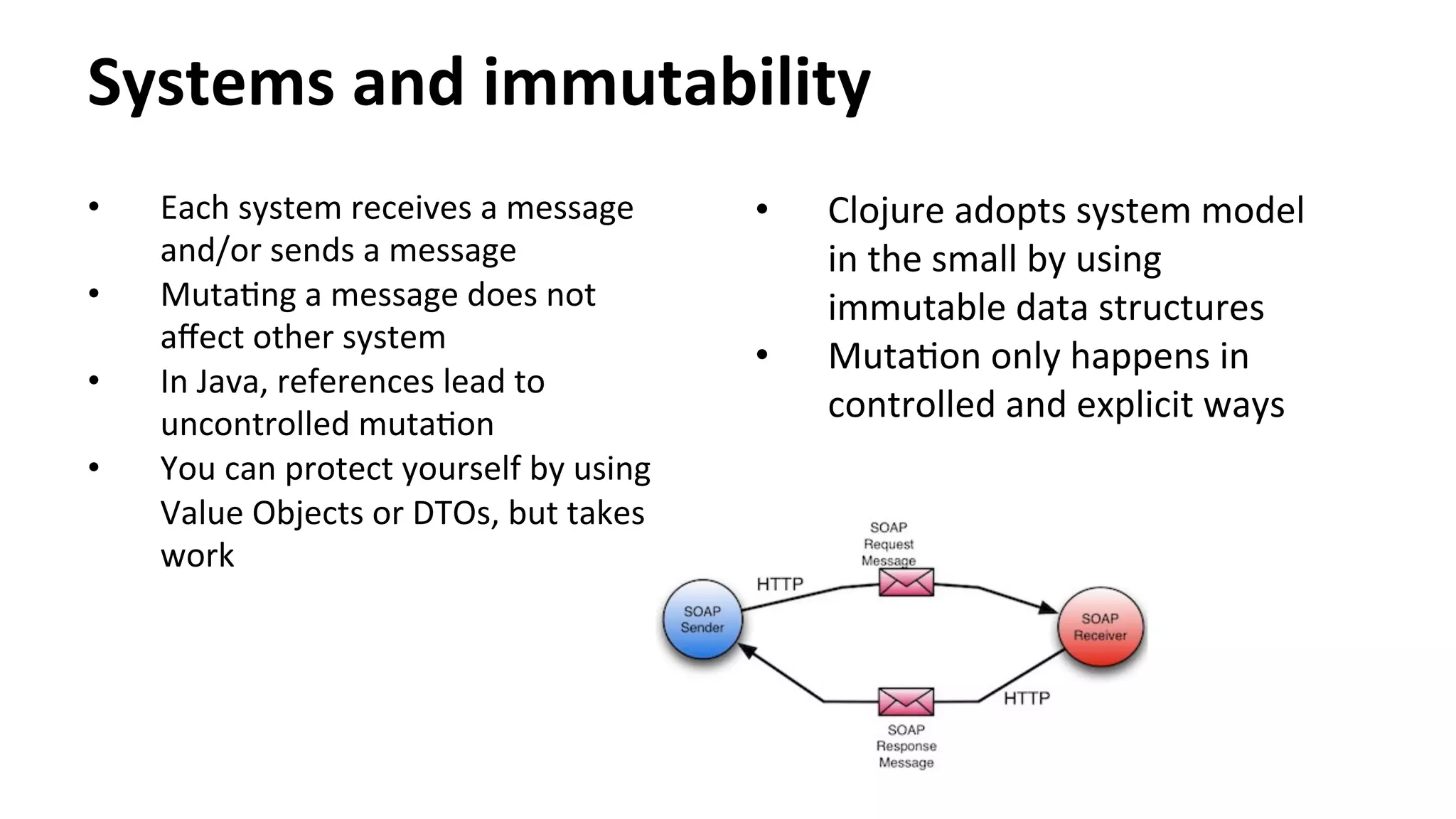
Systems	
  and	
  immutability	
  
•  Each	
  system	
  receives	
  a	
  message	
  
and/or	
  sends	
  a	
  message	
  
•  MutaNng	
  a	
  message	
  does	
  not	
  
affect	
  other	
  system	
  
•  In	
  Java,	
  references	
  lead	
  to	
  
uncontrolled	
  mutaNon	
  
•  You	
  can	
  protect	
  yourself	
  by	
  using	
  
Value	
  Objects	
  or	
  DTOs,	
  but	
  takes	
  
work	
  
•  Clojure	
  adopts	
  system	
  model	
  
in	
  the	
  small	
  by	
  using	
  
immutable	
  data	
  structures	
  
•  MutaNon	
  only	
  happens	
  in	
  
controlled	
  and	
  explicit	
  ways	
  
Clojure	
  
•  dynamic	
  language	
  
•  lisp	
  
•  funcNonal	
  programming	
  
•  immutable	
  data	
  structures	
  
•  strong	
  concurrency	
  support	
  
•  embraces	
  host	
  pla_orm	
  (JVM,	
  js)	
  
•  EDN	
  
Choosing	
  a	
  language	
  is	
  all	
  about	
  trade	
  offs!	


Clojure	
  in	
  industry	
  
hcps://www.youtube.com/watch?v=av9Xi6CNqq4	


http://dev.clojure.org/display/community/Clojure+Success+Stories
http://clojure.org/Companies
Part	
  2:	
  Basic	
  Clojure	
  
Data	
  literals	
  
Keyword:	


  :a	
  
Vector:	


  [1	
  2	
  3	
  4]	
  
Hash	
  map:	
  	
  	
  {:a	
  1,	
  :b	
  2}	
  
Set:	


  #{1	
  2	
  3	
  4}	
  
List:	


  '(1	
  2	
  3	
  4)	
  
Extensible	
  Data	
  NotaFon	
  
{:key1"Bar"	
  
	
  :key2	
  [1	
  2	
  3]	
  
	
  "key3",	
  #{1.0	
  2.0	
  c}	
  
	
  :key4,{:foo	
  {:bar	
  {:baz	
  'hello}}}}	


(pr-­‐str	
  {:foo	
  "bar"})	
  
(read-­‐string	
  "{:foo	
  "bar"}")	


f(x)	
  -­‐>	
  (f	
  x)	


Syntax	
  
Syntax	
  
if	
  (...)	
  {	


  ...	
  
}	
  else	
  {	


  -­‐>	


  ...	
  	
  
}	


(if	
  ...	


  ...	


  ...)	
  
Syntax	
  
var	
  foo	
  =	
  "bar";	


(def	
  foo	
  "bar")	
  
JavaScript	
  -­‐	
  ClojureScript	
  
if	
  (bugs.length	
  >	
  0)	
  {	


  return	
  'Not	
  ready	
  for	
  release';	
  
}	
  else	
  {	


  return	
  'Ready	
  for	
  release';	
  
}	


(if	
  (pos?	
  (count	
  bugs))	


  "Not	
  ready	
  for	
  release"	


  "Ready	
  for	
  release")	
  
source:	
  hcp://himera.herokuapp.com/synonym.html	
  
JavaScript	
  -­‐	
  ClojureScript	
  
var	
  foo	
  =	
  {bar:	
  "baz"};	
  
foo.bar	
  =	
  "baz";	
  
foo["abc"]	
  =	
  17;	


alert('foo')	
  
new	
  Date().getTime()	
  
new	
  
Date().getTime().toString()	


(def	
  foo	
  (js-­‐obj	
  "bar"	
  "baz"))	
  
(set!	
  (.-­‐bar	
  foo)	
  "baz")	
  
(aset	
  foo	
  "abc"	
  17)	


(js/alert	
  "foo")	
  
(.getTime	
  (js/Date.))	
  
(..	
  (js/Date.)	
  (getTime)	
  
(toString))	
  
source:	
  hcp://himera.herokuapp.com/synonym.html	
  
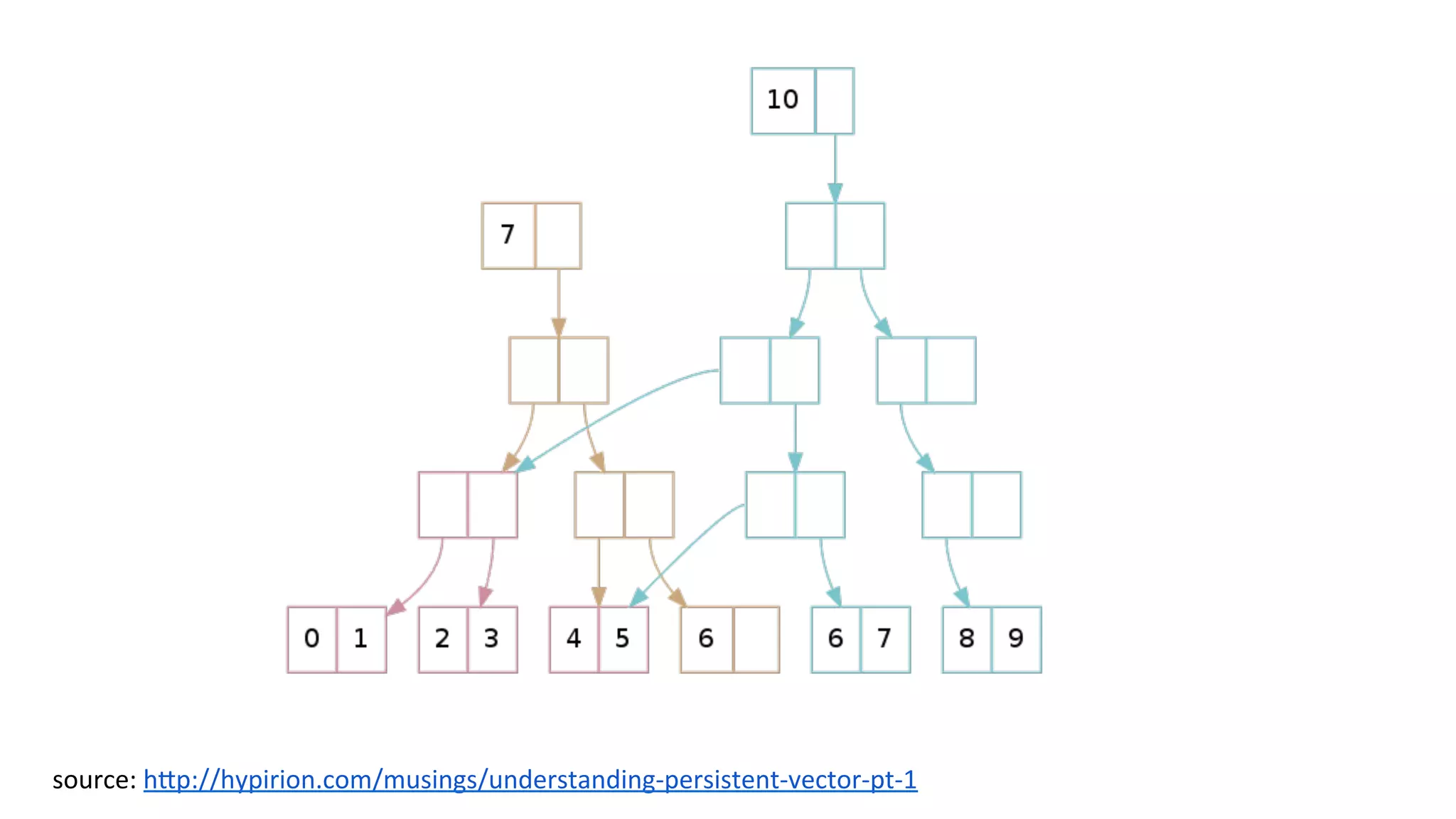
Persistent	
  data	
  structures	
  
(def	
  v	
  [1	
  2	
  3])	
  
(conj	
  v	
  4)	
  ;;	
  =>	
  [1	
  2	
  3	
  4]	
  
(get	
  v	
  0)	
  ;;	
  =>	
  1	
  
(v	
  0)	
  ;;	
  =>	
  1	


source:	
  hcp://hypirion.com/musings/understanding-­‐persistent-­‐vector-­‐pt-­‐1	
  	
  
Persistent	
  data	
  structures	
  
(def	
  m	
  {:foo	
  1	
  :bar	
  2})	
  
(assoc	
  m	
  :foo	
  2)	
  ;;	
  =>	
  {:foo	
  2	
  :bar	
  2}	
  
(get	
  m	
  :foo)	
  ;;=>	
  1	
  
(m	
  :foo)	
  ;;=>	
  1	
  
(:foo	
  m)	
  ;;=>	
  1	
  
(dissoc	
  m	
  :foo)	
  ;;=>	
  {:bar	
  2}	
  
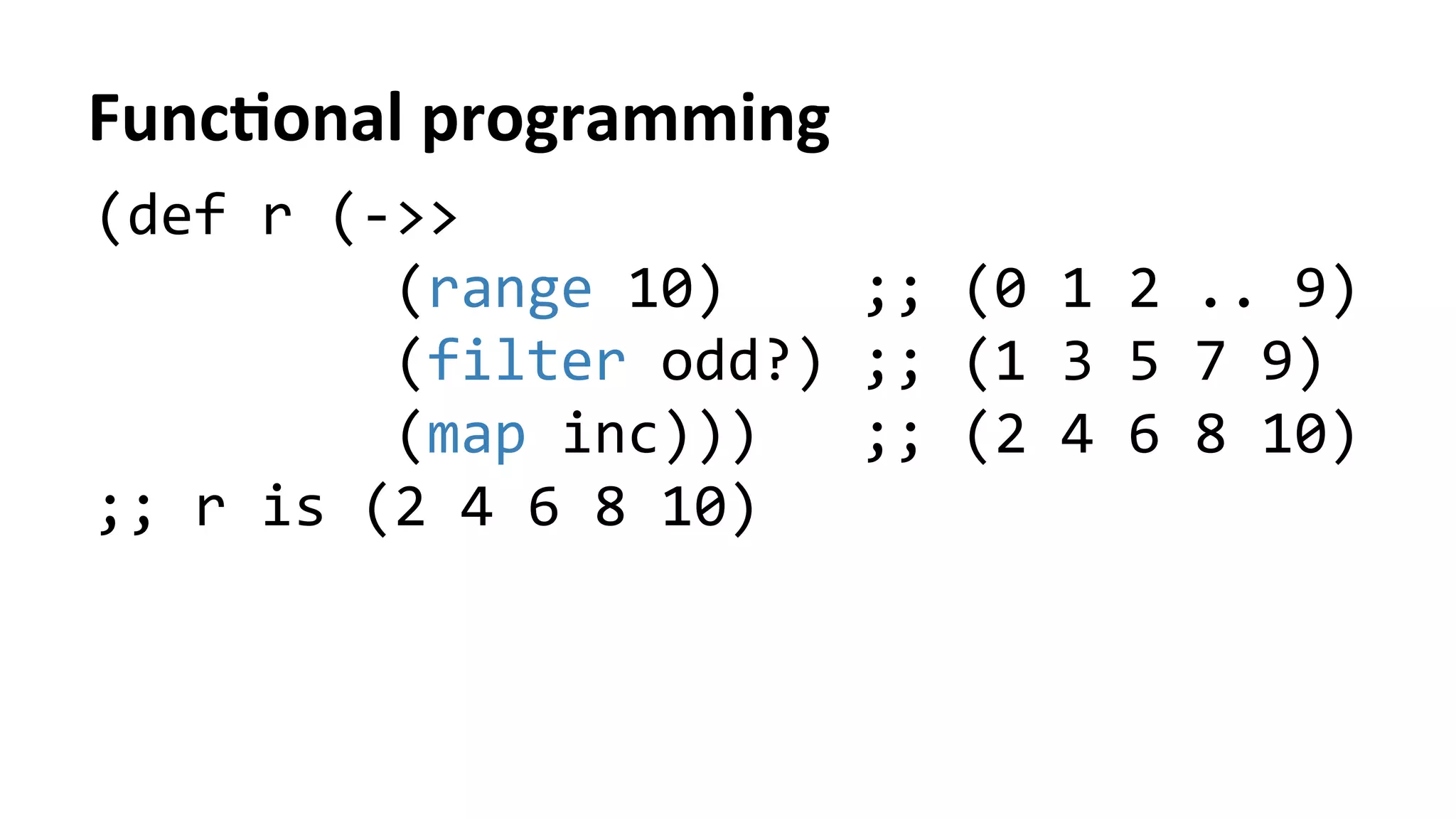
FuncFonal	
  programming	
  
(def	
  r	
  (-­‐>>	


  (range	
  10)	


  ;;	
  (0	
  1	
  2	
  ..	
  9)	


  (filter	
  odd?)	
  ;;	
  (1	
  3	
  5	
  7	
  9)	


  (map	
  inc)))	
  	
  	
  ;;	
  (2	
  4	
  6	
  8	
  10)	
  	
  
;;	
  r	
  is	
  (2	
  4	
  6	
  8	
  10)	


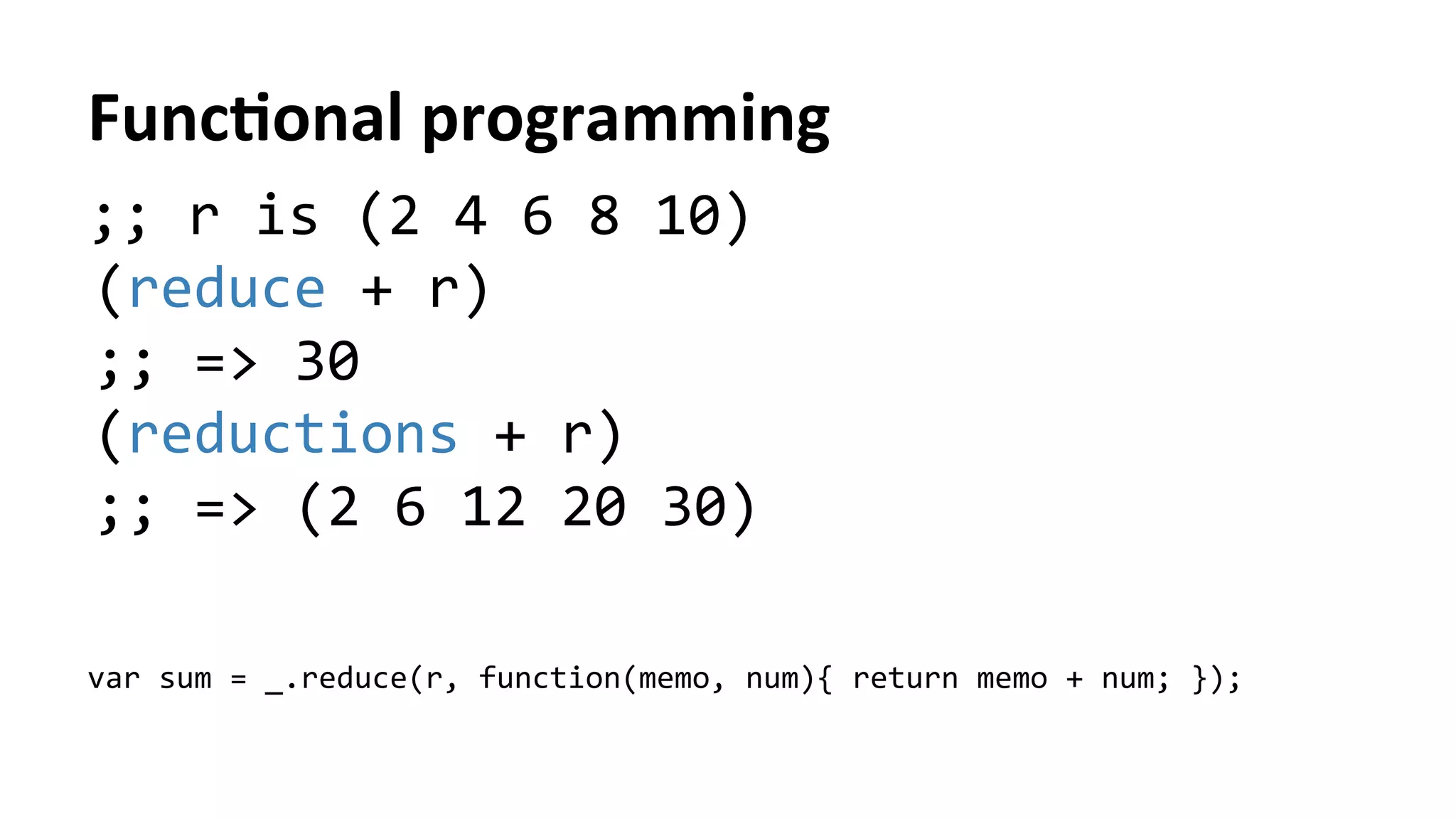
FuncFonal	
  programming	
  
;;	
  r	
  is	
  (2	
  4	
  6	
  8	
  10)	
  
(reduce	
  +	
  r)	
  	
  
;;	
  =>	
  30	
  
(reductions	
  +	
  r)	
  
;;	
  =>	
  (2	
  6	
  12	
  20	
  30)	


var	
  sum	
  =	
  _.reduce(r,	
  function(memo,	
  num){	
  return	
  memo	
  +	
  num;	
  });	
  
Sequence	
  abstracFon	
  
Data	
  structures	
  as	
  seqs	
  
(first	
  [1	
  2	
  3])	
  ;;=>	
  1	
  
(rest	
  [1	
  2	
  3])	
  ;;=>	
  (2	
  3)	
  
General	
  seq	
  funcNons:	
  map,	
  reduce,	
  filter,	
  ...	
  
(distinct	
  [1	
  1	
  2	
  3])	
  ;;=>	
  (1	
  2	
  3)	
  
(take	
  2	
  (range	
  10))	
  ;;=>	
  (0	
  1)	


See	
  hcp://clojure.org/cheatsheet	
  for	
  more	
  	
  
Sequence	
  abstracFon	
  
Most	
  seq	
  funcNons	
  return	
  lazy	
  sequences:	


(take	
  2	
  (map	


  (fn	
  [n]	
  (js/alert	
  n)	
  n)	


  (range)))	
  
	
   infinite	
  lazy	
  sequence	
  of	
  numbers	
  
side	
  effect	
  
Mutable	
  state:	
  atoms	
  
(def	
  my-­‐atom	
  (atom	
  0))	
  
@my-­‐atom	
  ;;	
  0	
  
(reset!	
  my-­‐atom	
  1)	
  
(reset!	
  my-­‐atom	
  (inc	
  @my-­‐atom))	
  ;;	
  bad	
  idiom	
  
(swap!	
  my-­‐atom	
  (fn	
  [old-­‐value]	


  (inc	
  old-­‐value)))	
  
(swap!	
  my-­‐atom	
  inc)	
  ;;	
  same	
  
@my-­‐atom	
  ;;	
  4	


Lisp:	
  macros	
  
(map	
  inc	


  (filter	
  odd?	


  (range	
  10)))	


(-­‐>>	


  (range	
  10)	


  (filter	
  odd?)	


  (map	
  inc))	
  
thread	
  last	
  macro	
  
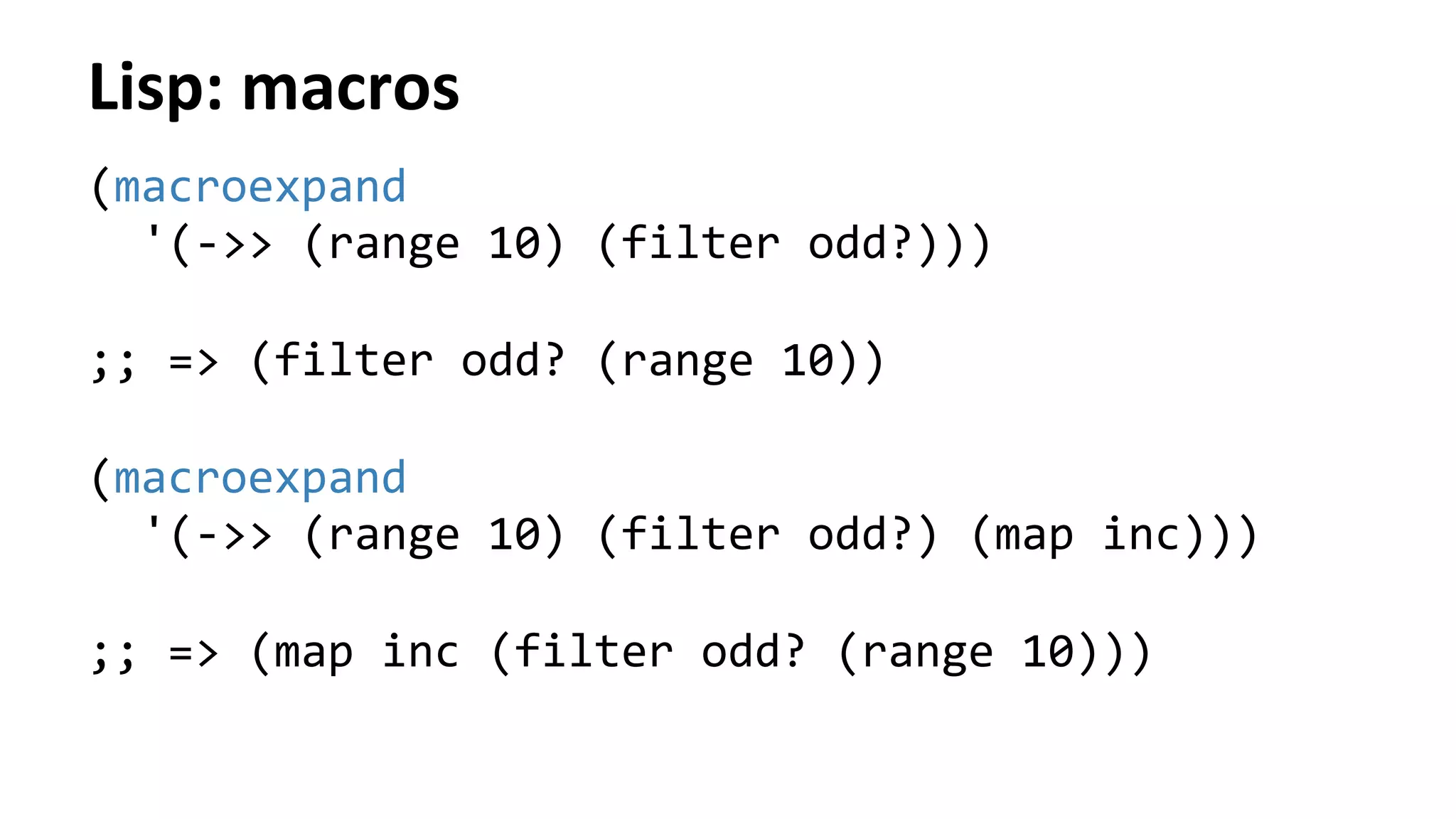
Lisp:	
  macros	
  
(macroexpand	


  '(-­‐>>	
  (range	
  10)	
  (filter	
  odd?)))	


;;	
  =>	
  (filter	
  odd?	
  (range	
  10))	


(macroexpand	


  '(-­‐>>	
  (range	
  10)	
  (filter	
  odd?)	
  (map	
  inc)))	


;;	
  =>	
  (map	
  inc	
  (filter	
  odd?	
  (range	
  10)))	


Lisp:	
  macros	
  
JVM	
  Clojure:	


(defmacro	
  defonce	
  [x	
  init]	
  
	
  `(when-­‐not	
  (exists?	
  ~x)	


  (def	
  ~x	
  ~init)))	


ClojureScript:	


(defonce	
  foo	
  1)	
  
(defonce	
  foo	
  2)	
  ;;	
  no	
  effect	
  
notes:	
  	
  
●  macros	
  must	
  be	
  wricen	
  in	
  JVM	
  Clojure	
  
●  are	
  expanded	
  at	
  compile	
  Nme	
  
●  generated	
  code	
  gets	
  executes	
  in	
  ClojureScript	
  
Part	
  3:	
  Full	
  Stack	
  Clojure	
  
Full	
  Stack	
  Clojure 	
  	
  
Front-end (js)
ClojureScript
reagent + react
secretary
cljs-http
figwheel
REPL
leiningen
core.async
Prismatic/Schema
timbre
Server side (JVM)
Clojure
ring
compojure
liberator
environ
hiccup
Framework: Pedestal
Persistence RDBMS (via JDBC, e.g. PostgresQL, MySQL, H2, etc)
clojure.java.jdbc
YesQL
Datomic
Show	
  me	
  the	
  code!	
  
https://github.com/borkdude/full-stack-clojure-han-okt-2015
Get	
  started	
  with	
  Clojure(Script)	
  
•  Read	
  a	
  Clojure(Script)	
  book	
  
•  Do	
  the	
  4clojure	
  exercises	
  
•  Start	
  hacking	
  on	
  your	
  own	
  project	
  
•  Pick	
  an	
  online	
  Clojure	
  course 	
  	
  
•  Join	
  the	
  AMSCLJ	
  meetup	
  
•  Join	
  the	
  Slack	
  community	


Full Stack Clojure

  • 1.
    Full  Stack  Clojure   Michiel  Borkent     @borkdude   HAN  University  of  Applied  Sciences   October  1st  2015  
  • 2.
    Agenda   ●  Part  1:  Why  Clojure   ●  Part  2:  Some  basic  Clojure   ●  Part  3:  Full  stack  Clojure  
  • 3.
    Part  1:  Why  Clojure  
  • 4.
    Clojure   •  Designed  by  Rich  Hickey  in  2007   •  FrustraNon  with  Java,  C++   •  Deliver  the  same  funcNonality  faster   •  Without  giving  up  operaNonal  requirements    
  • 5.
    Non-­‐goals   •  Easy  to  learn  by  Java  etc.  developers   •  Experiment  in  language  design  
  • 6.
    Programs  are  (mostly)  about  data   •  Language  should  not  get  in  the  way  of  data   •  Good  support  for  data  literals   •  Data  transformaNons   •  Data  is  immutable   •  OO  is  not  great  for  working  with  data   •  Big  part  of  program  can  be  built  using  plain  data    
  • 7.
    Systems  and  immutability   •  Each  system  receives  a  message   and/or  sends  a  message   •  MutaNng  a  message  does  not   affect  other  system   •  In  Java,  references  lead  to   uncontrolled  mutaNon   •  You  can  protect  yourself  by  using   Value  Objects  or  DTOs,  but  takes   work   •  Clojure  adopts  system  model   in  the  small  by  using   immutable  data  structures   •  MutaNon  only  happens  in   controlled  and  explicit  ways  
  • 8.
    Clojure   •  dynamic  language   •  lisp   •  funcNonal  programming   •  immutable  data  structures   •  strong  concurrency  support   •  embraces  host  pla_orm  (JVM,  js)   •  EDN  
  • 9.
    Choosing  a  language  is  all  about  trade  offs!    
  • 10.
    Clojure  in  industry   hcps://www.youtube.com/watch?v=av9Xi6CNqq4     http://dev.clojure.org/display/community/Clojure+Success+Stories http://clojure.org/Companies
  • 11.
    Part  2:  Basic  Clojure  
  • 12.
    Data  literals   Keyword:          :a   Vector:          [1  2  3  4]   Hash  map:      {:a  1,  :b  2}   Set:                #{1  2  3  4}   List:              '(1  2  3  4)  
  • 13.
    Extensible  Data  NotaFon   {:key1"Bar"    :key2  [1  2  3]    "key3",  #{1.0  2.0  c}    :key4,{:foo  {:bar  {:baz  'hello}}}}       (pr-­‐str  {:foo  "bar"})   (read-­‐string  "{:foo  "bar"}")    
  • 14.
    f(x)  -­‐>  (f  x)     Syntax  
  • 15.
    Syntax   if  (...)  {      ...   }  else  {              -­‐>      ...     }     (if  ...          ...          ...)  
  • 16.
    Syntax   var  foo  =  "bar";       (def  foo  "bar")  
  • 17.
    JavaScript  -­‐  ClojureScript   if  (bugs.length  >  0)  {      return  'Not  ready  for  release';   }  else  {      return  'Ready  for  release';   }     (if  (pos?  (count  bugs))      "Not  ready  for  release"      "Ready  for  release")   source:  hcp://himera.herokuapp.com/synonym.html  
  • 18.
    JavaScript  -­‐  ClojureScript   var  foo  =  {bar:  "baz"};   foo.bar  =  "baz";   foo["abc"]  =  17;     alert('foo')   new  Date().getTime()   new   Date().getTime().toString()       (def  foo  (js-­‐obj  "bar"  "baz"))   (set!  (.-­‐bar  foo)  "baz")   (aset  foo  "abc"  17)     (js/alert  "foo")   (.getTime  (js/Date.))   (..  (js/Date.)  (getTime)   (toString))   source:  hcp://himera.herokuapp.com/synonym.html  
  • 19.
    Persistent  data  structures   (def  v  [1  2  3])   (conj  v  4)  ;;  =>  [1  2  3  4]   (get  v  0)  ;;  =>  1   (v  0)  ;;  =>  1    
  • 20.
  • 21.
    Persistent  data  structures   (def  m  {:foo  1  :bar  2})   (assoc  m  :foo  2)  ;;  =>  {:foo  2  :bar  2}   (get  m  :foo)  ;;=>  1   (m  :foo)  ;;=>  1   (:foo  m)  ;;=>  1   (dissoc  m  :foo)  ;;=>  {:bar  2}  
  • 22.
    FuncFonal  programming   (def  r  (-­‐>>                      (range  10)        ;;  (0  1  2  ..  9)                    (filter  odd?)  ;;  (1  3  5  7  9)                    (map  inc)))      ;;  (2  4  6  8  10)     ;;  r  is  (2  4  6  8  10)    
  • 23.
    FuncFonal  programming   ;;  r  is  (2  4  6  8  10)   (reduce  +  r)     ;;  =>  30   (reductions  +  r)   ;;  =>  (2  6  12  20  30)         var  sum  =  _.reduce(r,  function(memo,  num){  return  memo  +  num;  });  
  • 24.
    Sequence  abstracFon   Data  structures  as  seqs   (first  [1  2  3])  ;;=>  1   (rest  [1  2  3])  ;;=>  (2  3)   General  seq  funcNons:  map,  reduce,  filter,  ...   (distinct  [1  1  2  3])  ;;=>  (1  2  3)   (take  2  (range  10))  ;;=>  (0  1)     See  hcp://clojure.org/cheatsheet  for  more    
  • 25.
    Sequence  abstracFon   Most  seq  funcNons  return  lazy  sequences:     (take  2  (map                        (fn  [n]  (js/alert  n)  n)                            (range)))     infinite  lazy  sequence  of  numbers   side  effect  
  • 26.
    Mutable  state:  atoms   (def  my-­‐atom  (atom  0))   @my-­‐atom  ;;  0   (reset!  my-­‐atom  1)   (reset!  my-­‐atom  (inc  @my-­‐atom))  ;;  bad  idiom   (swap!  my-­‐atom  (fn  [old-­‐value]                                      (inc  old-­‐value)))   (swap!  my-­‐atom  inc)  ;;  same   @my-­‐atom  ;;  4    
  • 27.
    Lisp:  macros   (map  inc        (filter  odd?            (range  10)))     (-­‐>>        (range  10)      (filter  odd?)      (map  inc))   thread  last  macro  
  • 28.
    Lisp:  macros   (macroexpand        '(-­‐>>  (range  10)  (filter  odd?)))     ;;  =>  (filter  odd?  (range  10))     (macroexpand        '(-­‐>>  (range  10)  (filter  odd?)  (map  inc)))     ;;  =>  (map  inc  (filter  odd?  (range  10)))    
  • 29.
    Lisp:  macros   JVM  Clojure:     (defmacro  defonce  [x  init]    `(when-­‐not  (exists?  ~x)          (def  ~x  ~init)))       ClojureScript:     (defonce  foo  1)   (defonce  foo  2)  ;;  no  effect   notes:     ●  macros  must  be  wricen  in  JVM  Clojure   ●  are  expanded  at  compile  Nme   ●  generated  code  gets  executes  in  ClojureScript  
  • 30.
    Part  3:  Full  Stack  Clojure  
  • 31.
    Full  Stack  Clojure     Front-end (js) ClojureScript reagent + react secretary cljs-http figwheel REPL leiningen core.async Prismatic/Schema timbre Server side (JVM) Clojure ring compojure liberator environ hiccup Framework: Pedestal Persistence RDBMS (via JDBC, e.g. PostgresQL, MySQL, H2, etc) clojure.java.jdbc YesQL Datomic
  • 32.
    Show  me  the  code!   https://github.com/borkdude/full-stack-clojure-han-okt-2015
  • 33.
    Get  started  with  Clojure(Script)   •  Read  a  Clojure(Script)  book   •  Do  the  4clojure  exercises   •  Start  hacking  on  your  own  project   •  Pick  an  online  Clojure  course     •  Join  the  AMSCLJ  meetup   •  Join  the  Slack  community