Faster Column-Oriented Indexes

                        Daniel Lemire

  http://www.professeurs.uqam.ca/pages/lemire.daniel.htm
            blog: http://www.daniel-lemire.com/

Joint work with Owen Kaser (UNB) and Kamel Aouiche (post-doc).


                    February 10, 2010


                   Daniel Lemire   Faster Column-Oriented Indexes
Some trends in business intelligence (BI)


                                Low-latency BI, Complex Event
                                Processing [Hyde, 2010]
                                Commotization, open source software:
                                Pentaho, LucidDB
                                (http://www.luciddb.org/)
                                Column-oriented databases ←
source: gooddata.com


                       Daniel Lemire   Faster Column-Oriented Indexes
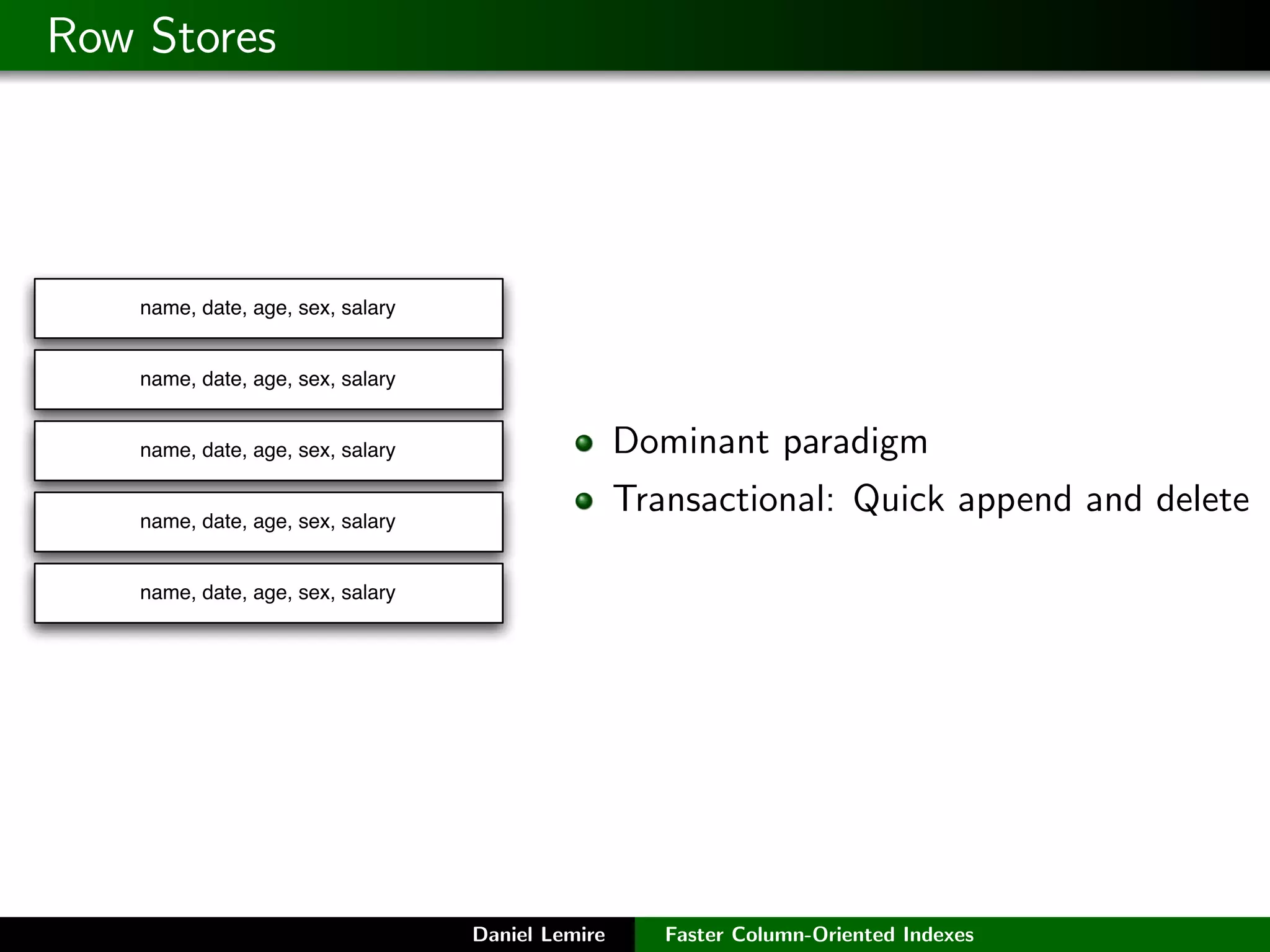
Row Stores


    name, date, age, sex, salary


    name, date, age, sex, salary


    name, date, age, sex, salary                   Dominant paradigm
    name, date, age, sex, salary
                                                   Transactional: Quick append and delete

    name, date, age, sex, salary


                                   Daniel Lemire      Faster Column-Oriented Indexes
Column Stores


                                             Goes back to StatCan in the
                                             seventies [Turner et al., 1979]
                                             Made fashionable again in Data
name   date   age   sex   salary
                                             Warehousing by
                                             Stonebraker [Stonebraker et al., 2005]
                                             New: Oracle Exadata hybrid columnar
                                             compression


                             Daniel Lemire      Faster Column-Oriented Indexes
Vectorization


                                       Modern superscalar CPUs support
const i n t N = 2048;                  vectorization (SSE)
i n t a [N] , b [N ] ;                 This code is four times faster with
i n t i =0;                            -ftree-vectorize (GNU GCC)
f o r ( ; i <N ; i ++)                 Need long streams, same data type, and
    a [ i ] += b [ i ] ;               no branching.
                                       Columns are good candidates!


                       Daniel Lemire      Faster Column-Oriented Indexes
Main column-oriented indexes


     (1) Bitmap indexes [O’Neil, 1989]
     (2) Projection indexes [O’Neil and Quass, 1997]
     Both are compressible.


                       Daniel Lemire   Faster Column-Oriented Indexes
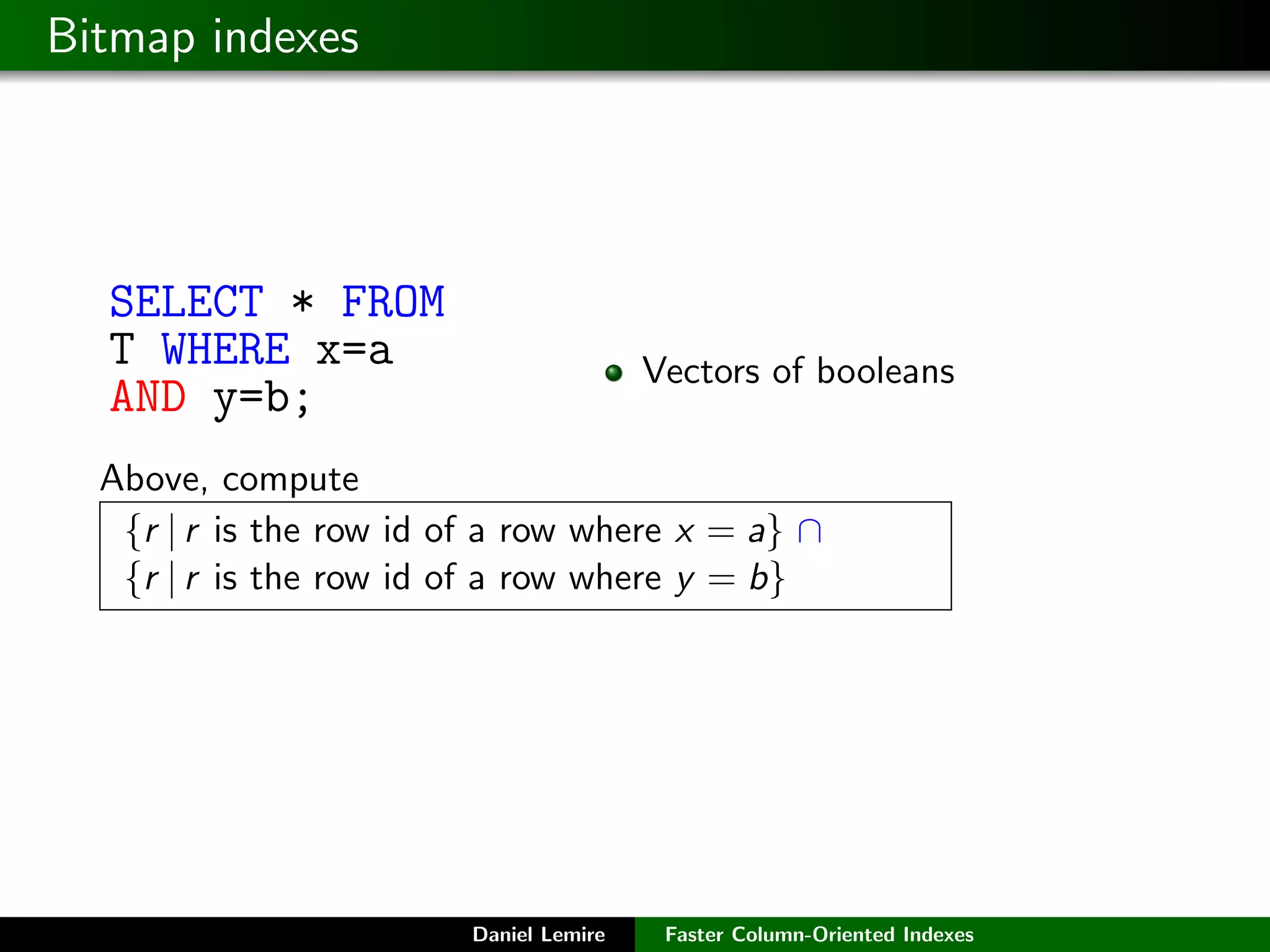
Bitmap indexes


  SELECT * FROM
  T WHERE x=a                            Vectors of booleans
  AND y=b;
  Above, compute
   {r | r is the row id of a row where x = a} ∩
   {r | r is the row id of a row where y = b}


                         Daniel Lemire    Faster Column-Oriented Indexes
Other applications of the bitmaps/bitsets


      The Java language has had a bitmap class since the
      beginning: java.util.BitSet. (Sun’s implementation is based
      on 64-bit words.)
      Search engines use bitmaps to filter queries, e.g. Apache
      Lucene: org.apache.lucene.util.OpenBitSet.java.


                        Daniel Lemire   Faster Column-Oriented Indexes
Bitmaps and fast AND/OR operations


     Computing the union of two sets of integers between 1 and 64
     (eg row ids, trivial table). . .
     E.g., {1, 5, 8} ∪ {1, 3, 5}?
     Can be done in one operation by a CPU:
     BitwiseOR( 10001001, 10101000)
     Extend to sets from 1..N using N/64 operations.
     To compute [a0 , . . . , aN−1 ] ∨ [b0 , b1 , . . . , bN−1 ] :
     a0 , . . . , a63 BitwiseOR b0 , . . . , b63 ;
     a64 , . . . , a127 BitwiseOR b64 , . . . , b127 ;
     a128 , . . . , a192 BitwiseOR b128 , . . . , b192 ;
     ...
     It is a form of vectorization.


                            Daniel Lemire   Faster Column-Oriented Indexes
What are bitmap indexes for?


     Myth: bitmap indexes are for low cardinality columns (e.g.,
     SEX).
              the Bitmap index is the conclusive choice for data
              warehouse design for columns with high or low
              cardinality [Zaker et al., 2008].


                       Daniel Lemire   Faster Column-Oriented Indexes
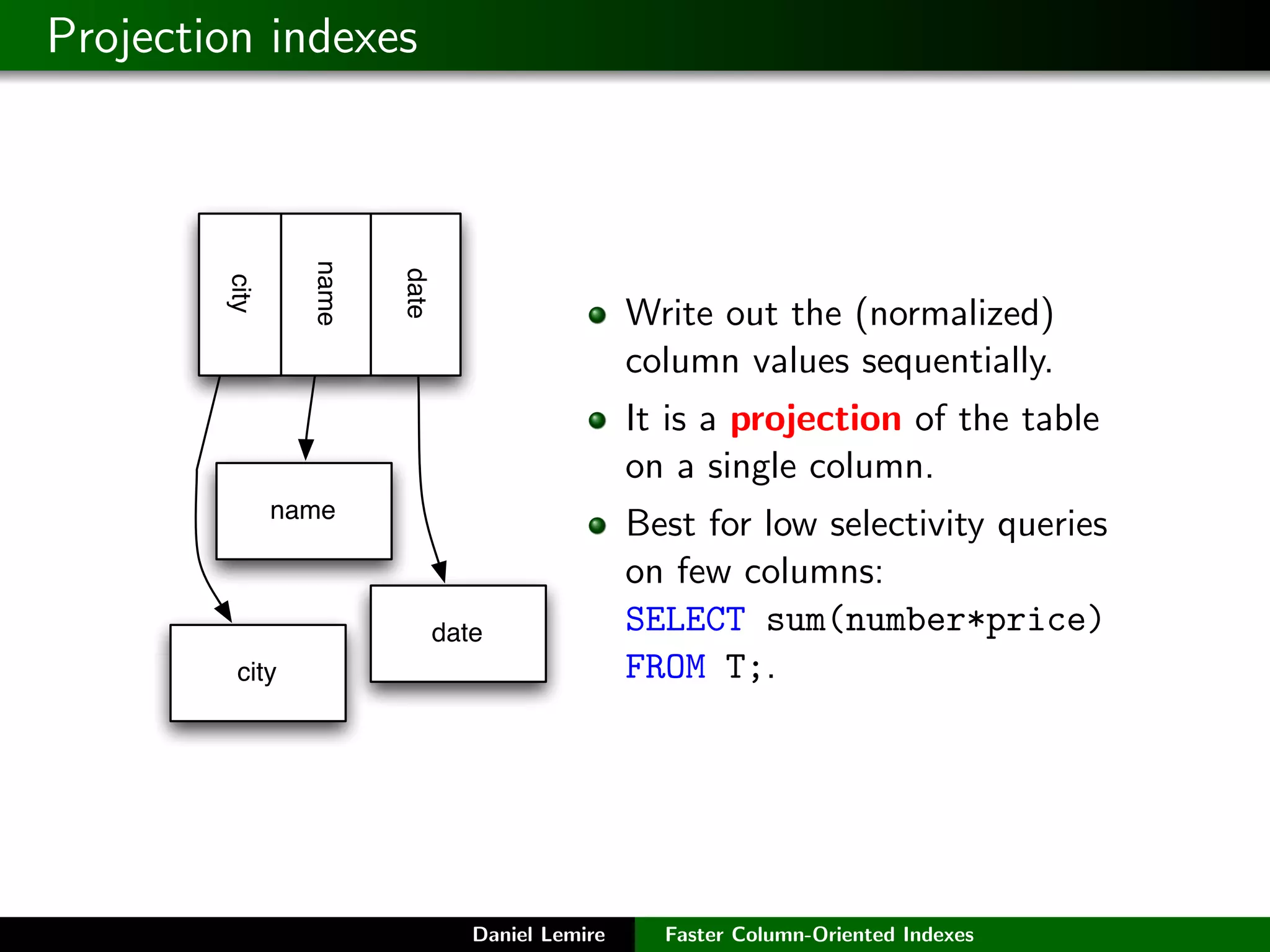
Projection indexes


                 name


                        date
        city


                                                  Write out the (normalized)
                                                  column values sequentially.
                                                  It is a projection of the table
                                                  on a single column.
               name
                                                  Best for low selectivity queries
                                                  on few columns:
                               date               SELECT sum(number*price)
         city                                     FROM T;.


                                  Daniel Lemire     Faster Column-Oriented Indexes
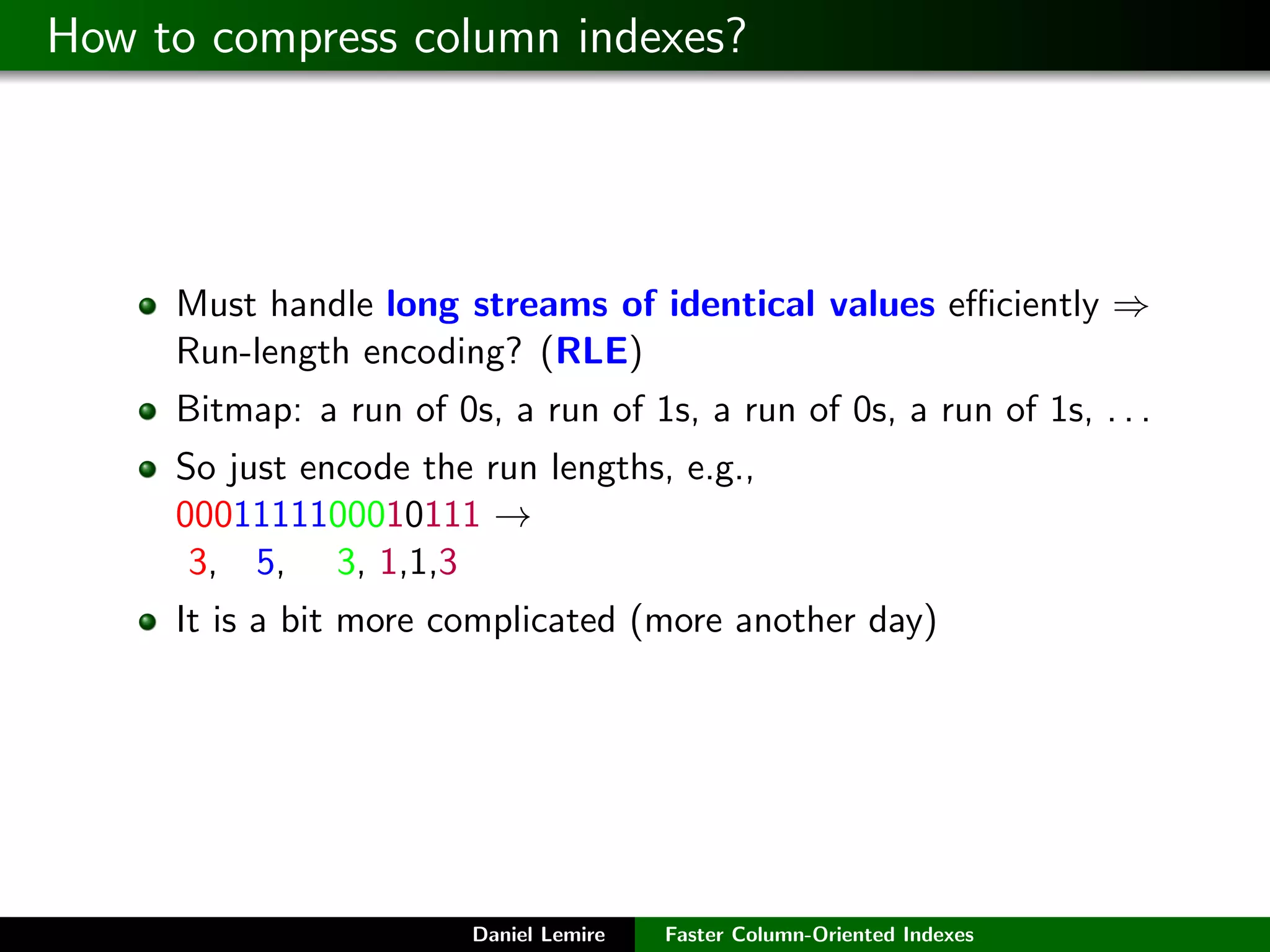
How to compress column indexes?


     Must handle long streams of identical values efficiently ⇒
     Run-length encoding? (RLE)
     Bitmap: a run of 0s, a run of 1s, a run of 0s, a run of 1s, . . .
     So just encode the run lengths, e.g.,
     0001111100010111 →
      3, 5, 3, 1,1,3
     It is a bit more complicated (more another day)


                        Daniel Lemire   Faster Column-Oriented Indexes
What about other compression types?


     With RLE, we can often process the data in compressed form
     Hence, with RLE, compression saves both storage and
     CPU cycles!!!!
     Not always true with other techniques such as Huffman,
     LZ77, Arithmetic Coding, . . .


                      Daniel Lemire   Faster Column-Oriented Indexes
How do we improve performance?


     Smaller indexes are faster.
     In data warehousing: data is often updated in batches.
     So spend time at construction time optimizing the index.


                        Daniel Lemire   Faster Column-Oriented Indexes
Modelling the size of an index


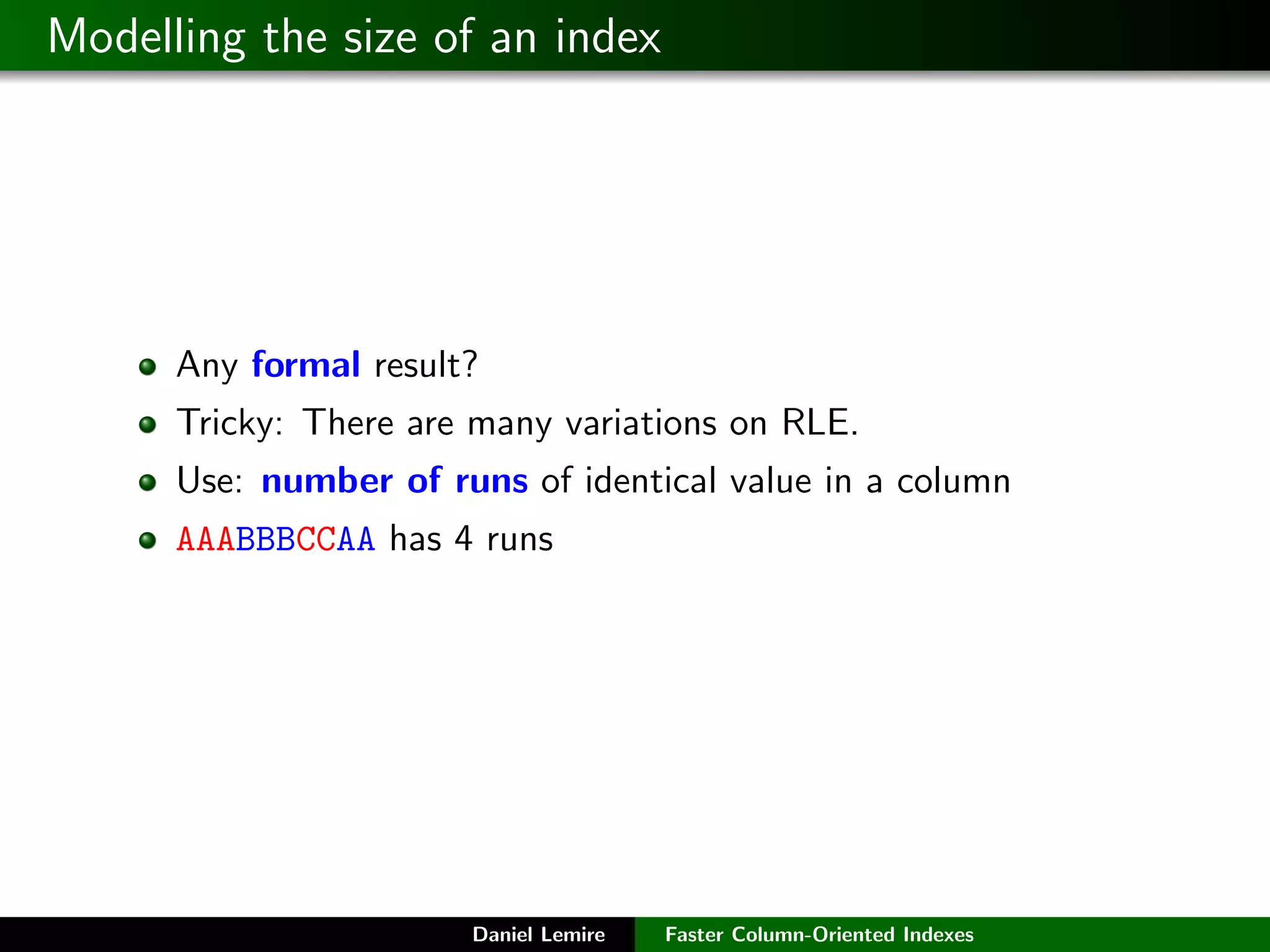
      Any formal result?
      Tricky: There are many variations on RLE.
      Use: number of runs of identical value in a column
      AAABBBCCAA has 4 runs


                       Daniel Lemire   Faster Column-Oriented Indexes
Improving compression by reordering the rows


      RLE is order-sensitive:
      they compress sorted tables better;
      But finding the best row ordering is
      NP-hard [Lemire et al., 2010].
      Actually an instance of the Traveling Salesman Problem
      (TSP)
      So we use heuristics:
          lexicographically
          Gray codes
          Hilbert, . . .


                         Daniel Lemire   Faster Column-Oriented Indexes
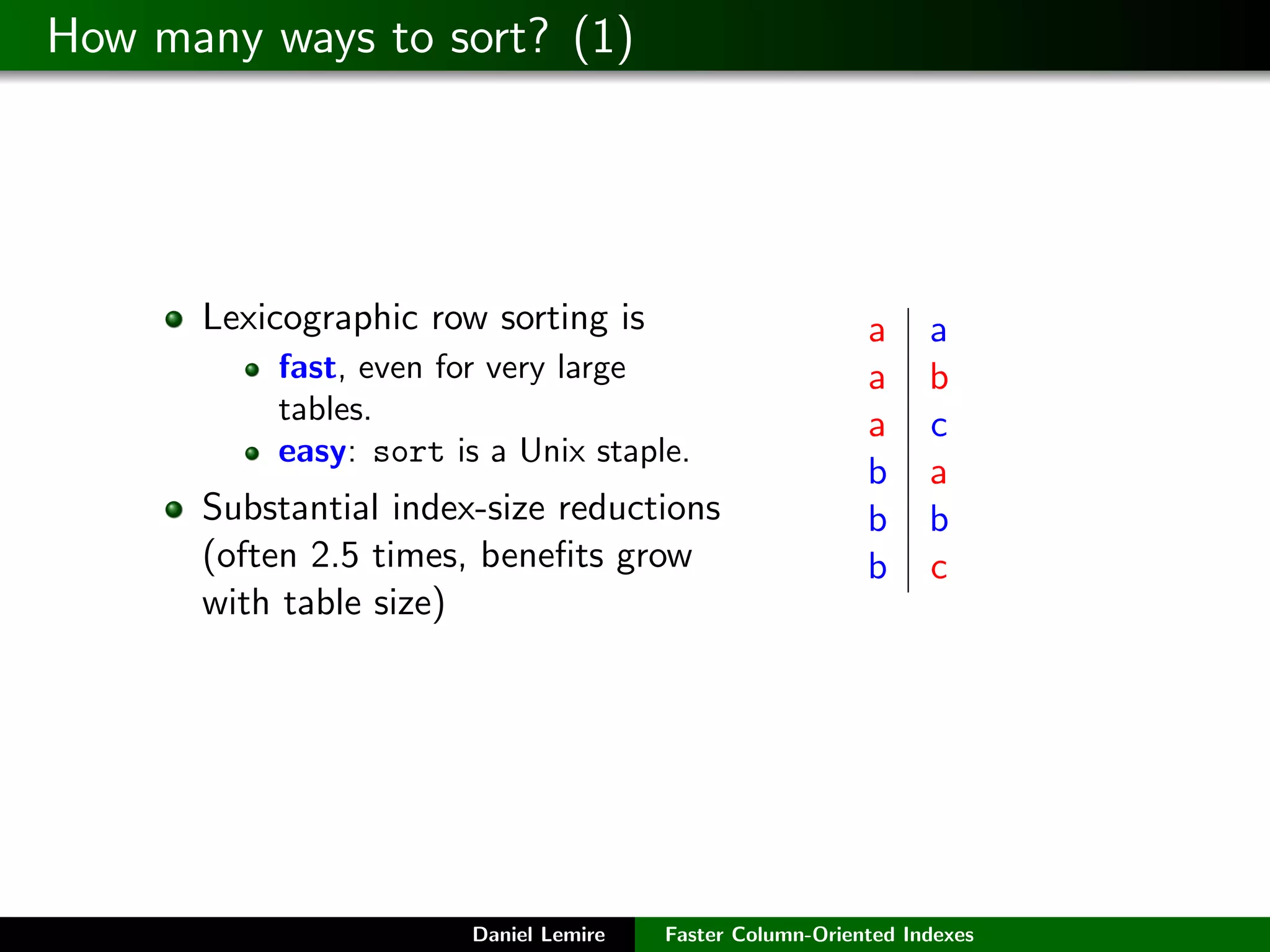
How many ways to sort? (1)


      Lexicographic row sorting is                        a     a
          fast, even for very large                       a     b
          tables.                                         a     c
          easy: sort is a Unix staple.
                                                          b     a
      Substantial index-size reductions                   b     b
      (often 2.5 times, benefits grow                      b     c
      with table size)


                       Daniel Lemire   Faster Column-Oriented Indexes
How many ways to sort? (2)


      Gray Codes are list of tuples                       a     a
      with successive (Hamming)                           a     b
      distance of 1 [Knuth, 2005].                        a     c
                                                          b     c
      Reflected Gray Code order is
                                                          b     b
          sometimes slightly better
          than lexicographical. . .                       b     a


                       Daniel Lemire   Faster Column-Oriented Indexes
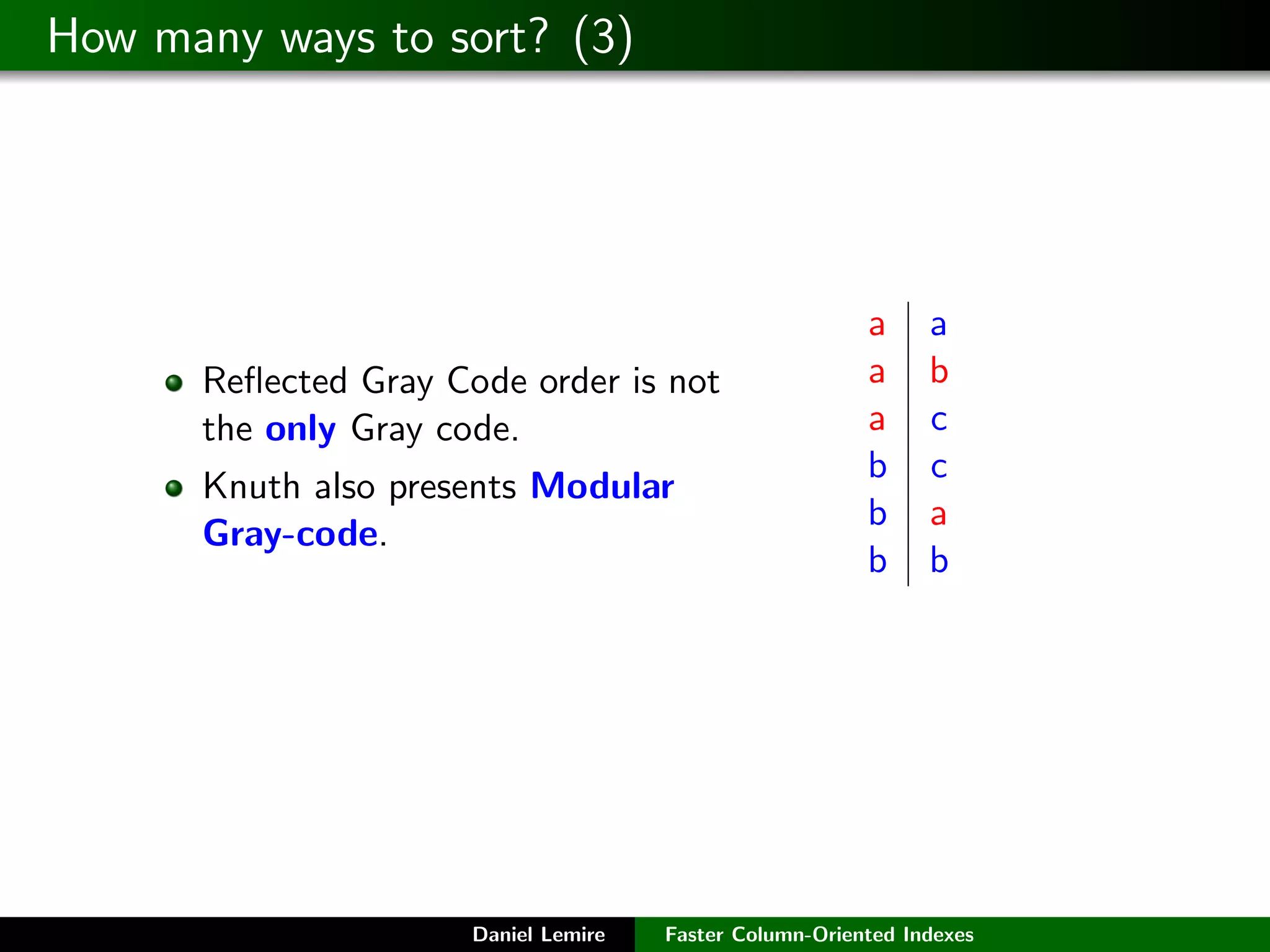
How many ways to sort? (3)


                                                         a     a
      Reflected Gray Code order is not                    a     b
      the only Gray code.                                a     c
                                                         b     c
      Knuth also presents Modular
                                                         b     a
      Gray-code.
                                                         b     b


                      Daniel Lemire   Faster Column-Oriented Indexes
How many ways to sort? (4)


                                       Hilbert Index
                                       [Hamilton and Rau-Chaplin, 2007].
                                       Also a Gray code
                                       (conditionnally)
                                       Gives very bad results for
                                       column-oriented indexes.


                  Daniel Lemire   Faster Column-Oriented Indexes
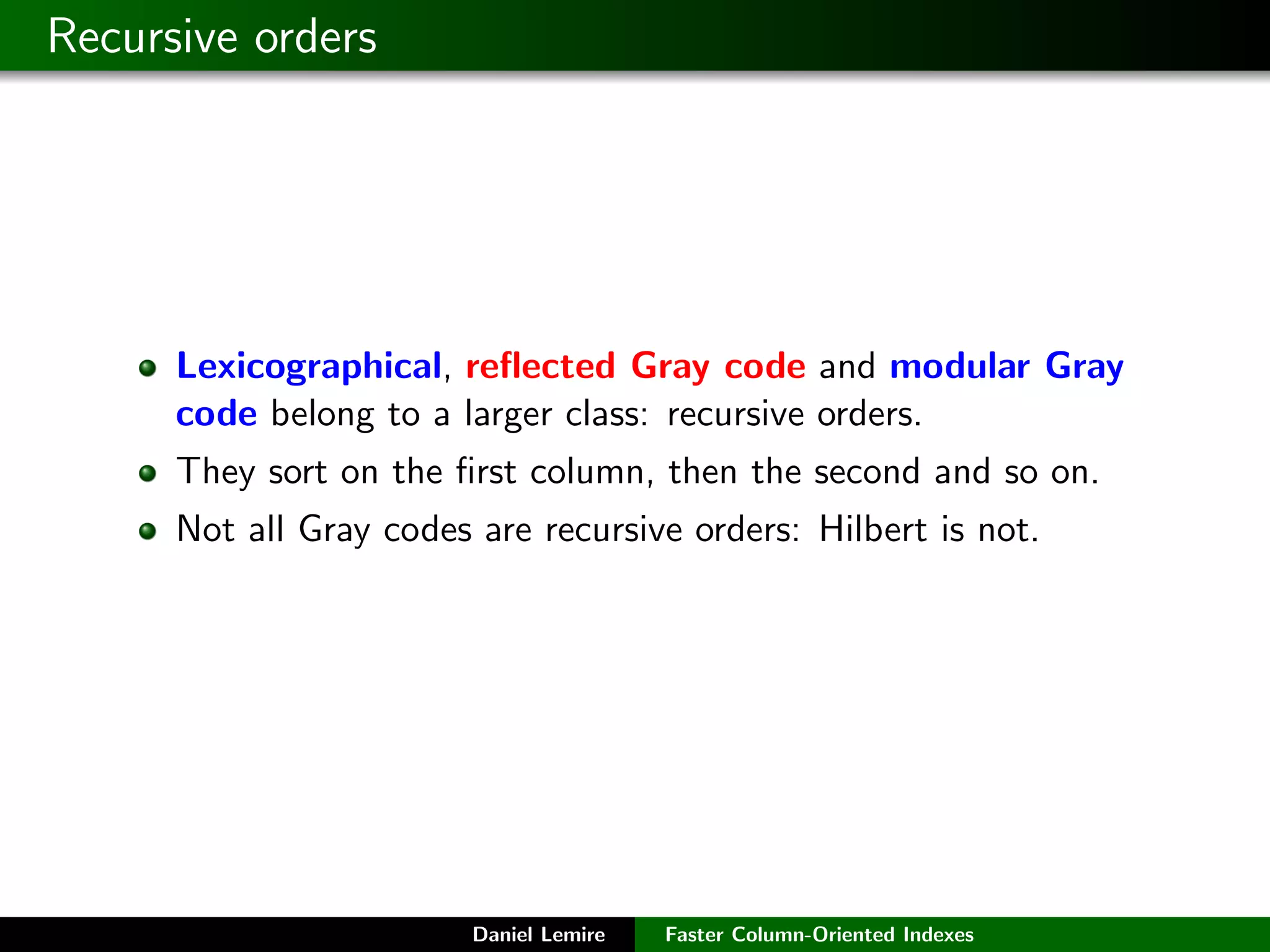
Recursive orders


      Lexicographical, reflected Gray code and modular Gray
      code belong to a larger class: recursive orders.
      They sort on the first column, then the second and so on.
      Not all Gray codes are recursive orders: Hilbert is not.


                         Daniel Lemire   Faster Column-Oriented Indexes
Best column order?


  Column order is important for recursive orders.
  We almost have this result [Lemire and Kaser, 2009]:
      any recursive order
      order the columns by increasing cardinality (small to
      LARGE)

  Proposition

  The expected number of runs is minimized (among all possible
  column orders).


                        Daniel Lemire   Faster Column-Oriented Indexes
How do you know when the lexicographical order is good
enough?


     Even though row reordering is NP-hard, we find it hard to
     improve over recursive orders.
     Sometimes, fancier alternatives (to be discussed another day)
     work better, but not always.


                       Daniel Lemire   Faster Column-Oriented Indexes
Thankfully, we can detect cases where recursive orders are
good enough


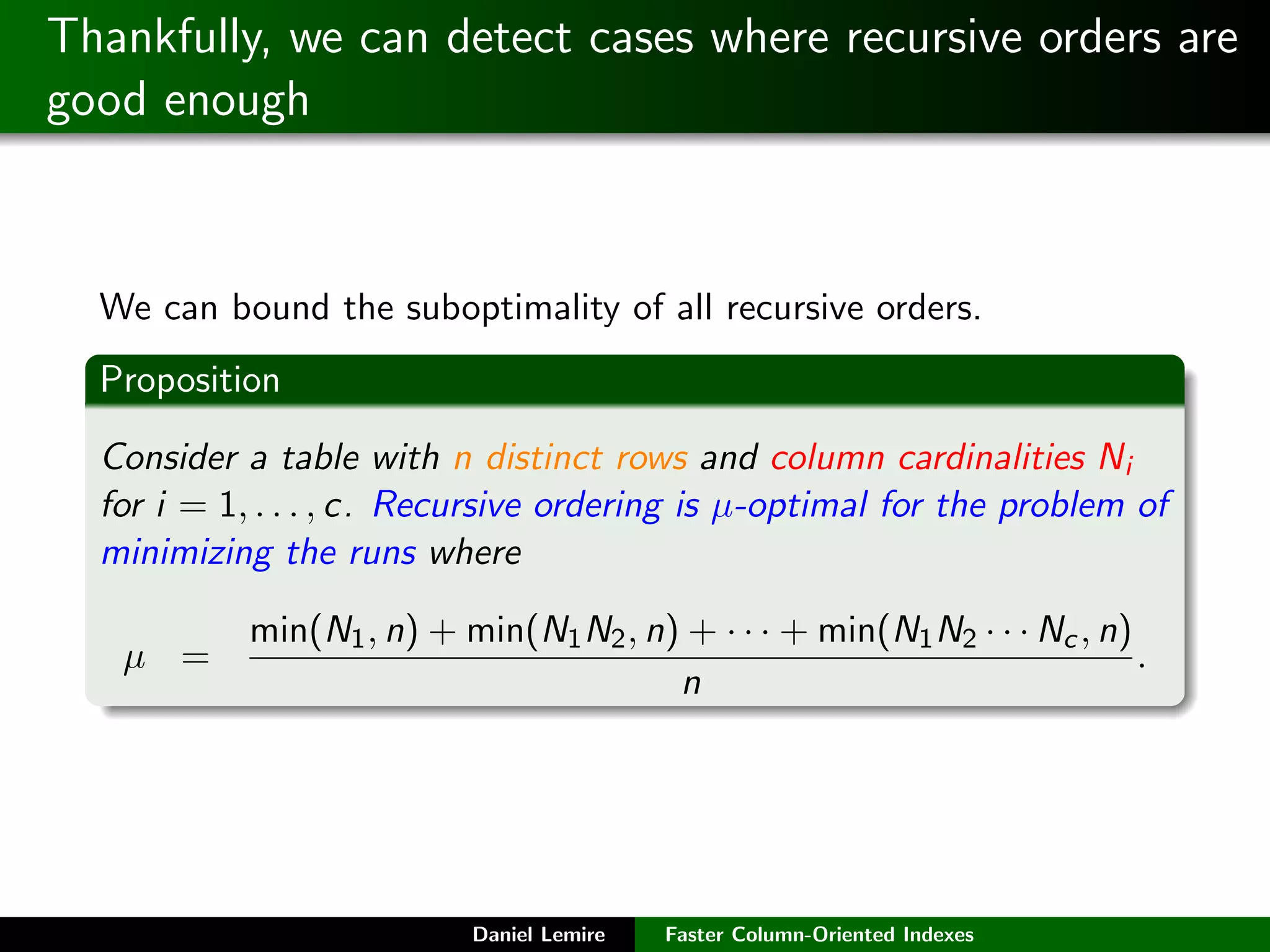
  We can bound the suboptimality of all recursive orders.
  Proposition

  Consider a table with n distinct rows and column cardinalities Ni
  for i = 1, . . . , c. Recursive ordering is µ-optimal for the problem of
  minimizing the runs where

            min(N1 , n) + min(N1 N2 , n) + · · · + min(N1 N2 · · · Nc , n)
   µ =                                                                     .
                                        n


                           Daniel Lemire   Faster Column-Oriented Indexes
Bounding the optimality of sorting: the computation


      How do you compute µ very fast so you know lexicographical
      sort is good enough?
      Trick is to determine n, the number of distinct rows without
      sorting the table.
      Thankfully: n can be estimated quickly with probabilistic
      methods [Aouiche and Lemire, 2007].


                        Daniel Lemire   Faster Column-Oriented Indexes
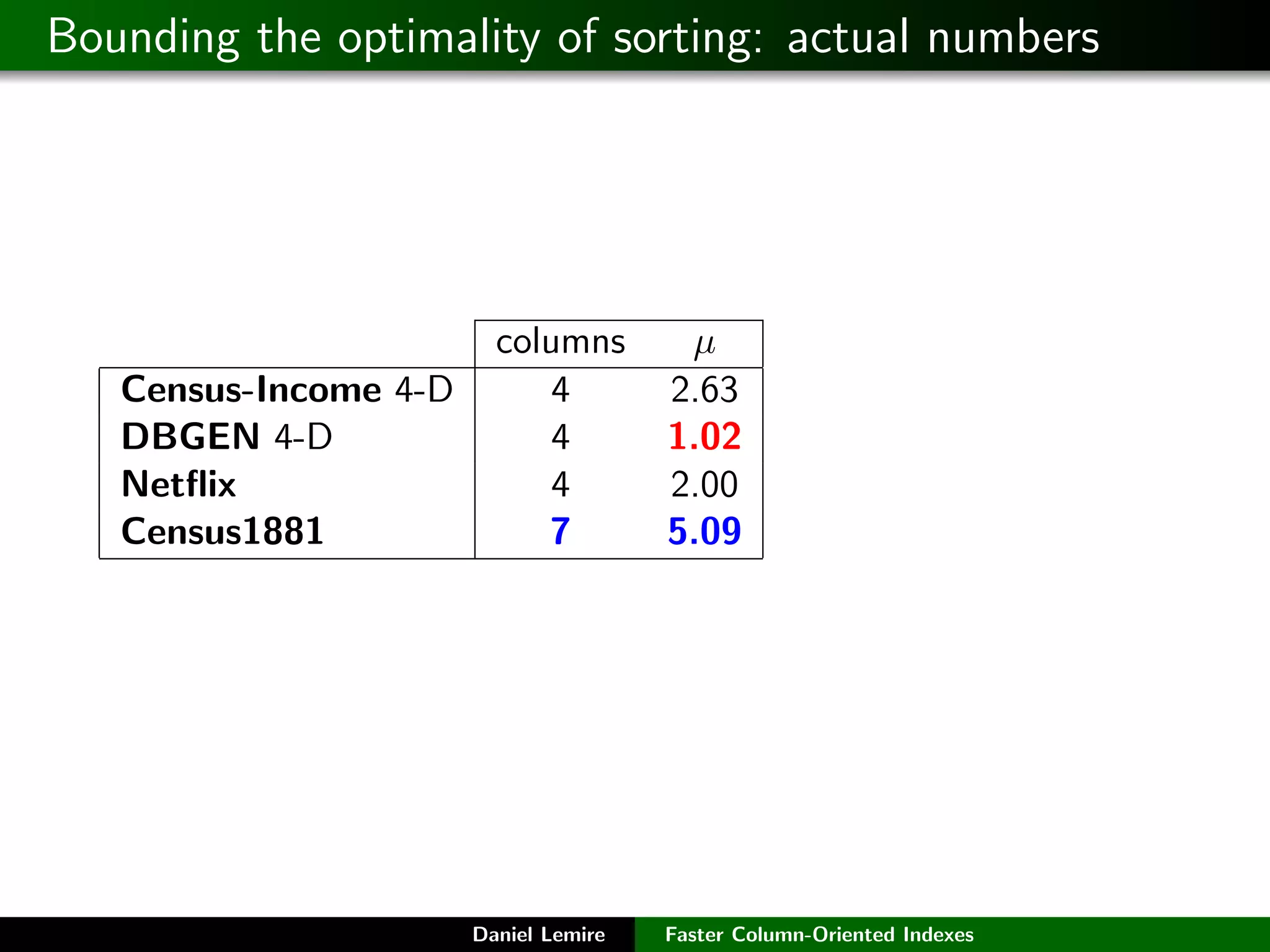
Bounding the optimality of sorting: actual numbers


                         columns        µ
   Census-Income 4-D         4         2.63
   DBGEN 4-D                 4         1.02
   Netflix                    4         2.00
   Census1881               7          5.09


                       Daniel Lemire   Faster Column-Oriented Indexes
Take away message


     Column stores are good because of vectorization and
     RLE/sorting
     Sorting is sometimes nearly optimal, but not always but we
     can sometimes tell when sorting is optimal


                      Daniel Lemire   Faster Column-Oriented Indexes
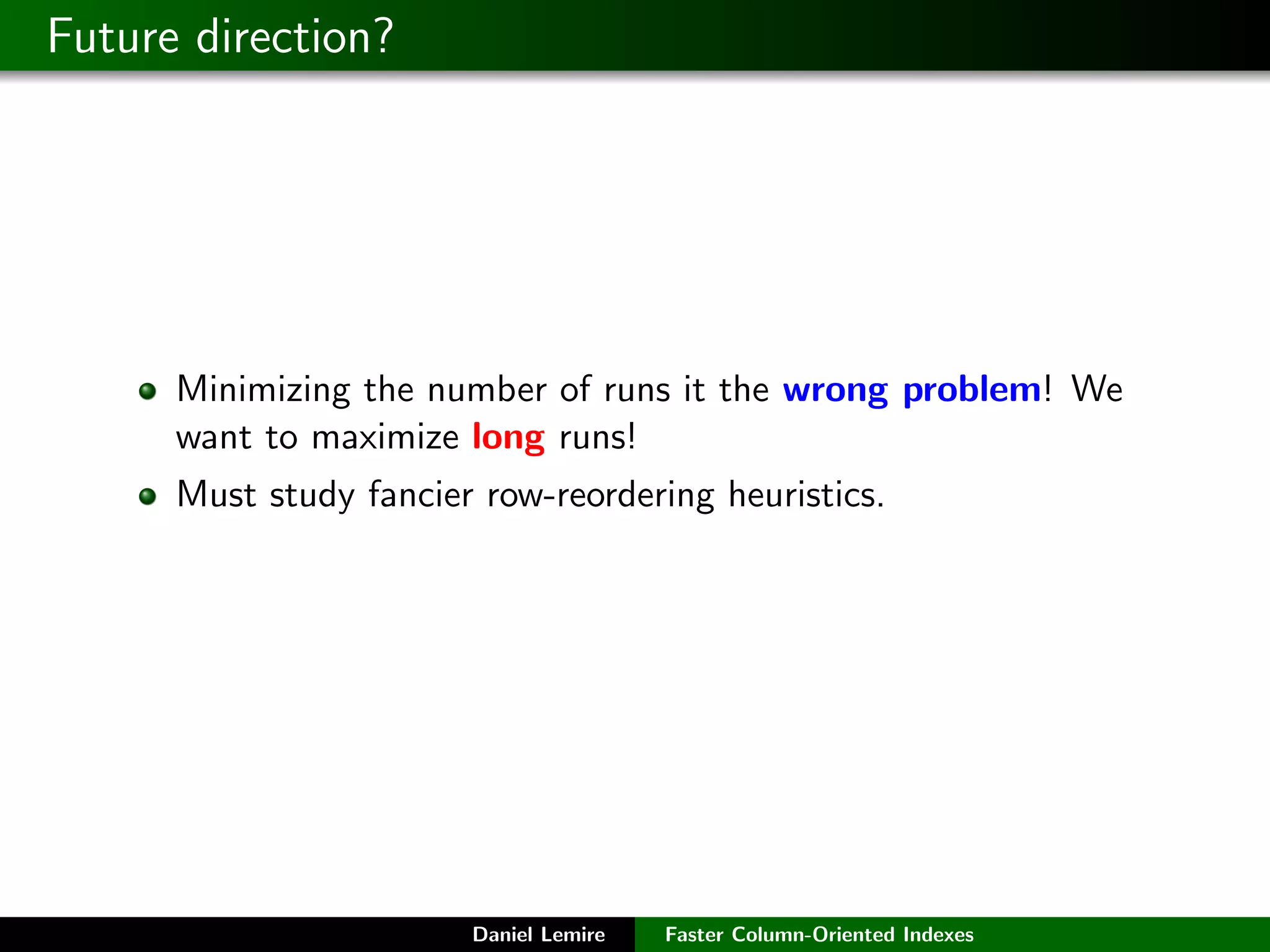
Future direction?


      Minimizing the number of runs it the wrong problem! We
      want to maximize long runs!
      Must study fancier row-reordering heuristics.


                        Daniel Lemire   Faster Column-Oriented Indexes
Questions?


                             ?


             Daniel Lemire       Faster Column-Oriented Indexes
Aouiche, K. and Lemire, D. (2007).
A comparison of five probabilistic view-size estimation
techniques in OLAP.
In DOLAP’07, pages 17–24.
Hamilton, C. H. and Rau-Chaplin, A. (2007).
Compact Hilbert indices: Space-filling curves for domains with
unequal side lengths.
Information Processing Letters, 105(5):155–163.
Hyde, J. (2010).
Data in flight.
Commun. ACM, 53(1):48–52.
Knuth, D. E. (2005).
The Art of Computer Programming, volume 4, chapter fascicle
2.
Addison Wesley.
Lemire, D. and Kaser, O. (2009).

                   Daniel Lemire   Faster Column-Oriented Indexes
Reordering columns for smaller indexes.
in preparation, available from
http://arxiv.org/abs/0909.1346.
Lemire, D., Kaser, O., and Aouiche, K. (2010).
Sorting improves word-aligned bitmap indexes.
Data & Knowledge Engineering, 69(1):3–28.
O’Neil, P. and Quass, D. (1997).
Improved query performance with variant indexes.
In SIGMOD ’97, pages 38–49.
O’Neil, P. E. (1989).
Model 204 architecture and performance.
In 2nd International Workshop on High Performance
Transaction Systems, pages 40–59.
Stonebraker, M., Abadi, D. J., Batkin, A., Chen, X.,
Cherniack, M., Ferreira, M., Lau, E., Lin, A., Madden, S.,
O’Neil, E., O’Neil, P., Rasin, A., Tran, N., and Zdonik, S.
(2005).
                   Daniel Lemire   Faster Column-Oriented Indexes
C-store: a column-oriented DBMS.
In VLDB’05, pages 553–564.
Turner, M. J., Hammond, R., and Cotton, P. (1979).
A DBMS for large statistical databases.
In VLDB’79, pages 319–327.
Zaker, M., Phon-Amnuaisuk, S., and Haw, S. (2008).
An adequate design for large data warehouse systems: Bitmap
index versus B-Tree index.
IJCC, 2(2).


                  Daniel Lemire   Faster Column-Oriented Indexes

Faster Column-Oriented Indexes

  • 1.
    Faster Column-Oriented Indexes Daniel Lemire http://www.professeurs.uqam.ca/pages/lemire.daniel.htm blog: http://www.daniel-lemire.com/ Joint work with Owen Kaser (UNB) and Kamel Aouiche (post-doc). February 10, 2010 Daniel Lemire Faster Column-Oriented Indexes
  • 2.
    Some trends inbusiness intelligence (BI) Low-latency BI, Complex Event Processing [Hyde, 2010] Commotization, open source software: Pentaho, LucidDB (http://www.luciddb.org/) Column-oriented databases ← source: gooddata.com Daniel Lemire Faster Column-Oriented Indexes
  • 3.
    Row Stores name, date, age, sex, salary name, date, age, sex, salary name, date, age, sex, salary Dominant paradigm name, date, age, sex, salary Transactional: Quick append and delete name, date, age, sex, salary Daniel Lemire Faster Column-Oriented Indexes
  • 4.
    Column Stores Goes back to StatCan in the seventies [Turner et al., 1979] Made fashionable again in Data name date age sex salary Warehousing by Stonebraker [Stonebraker et al., 2005] New: Oracle Exadata hybrid columnar compression Daniel Lemire Faster Column-Oriented Indexes
  • 5.
    Vectorization Modern superscalar CPUs support const i n t N = 2048; vectorization (SSE) i n t a [N] , b [N ] ; This code is four times faster with i n t i =0; -ftree-vectorize (GNU GCC) f o r ( ; i <N ; i ++) Need long streams, same data type, and a [ i ] += b [ i ] ; no branching. Columns are good candidates! Daniel Lemire Faster Column-Oriented Indexes
  • 6.
    Main column-oriented indexes (1) Bitmap indexes [O’Neil, 1989] (2) Projection indexes [O’Neil and Quass, 1997] Both are compressible. Daniel Lemire Faster Column-Oriented Indexes
  • 7.
    Bitmap indexes SELECT * FROM T WHERE x=a Vectors of booleans AND y=b; Above, compute {r | r is the row id of a row where x = a} ∩ {r | r is the row id of a row where y = b} Daniel Lemire Faster Column-Oriented Indexes
  • 8.
    Other applications ofthe bitmaps/bitsets The Java language has had a bitmap class since the beginning: java.util.BitSet. (Sun’s implementation is based on 64-bit words.) Search engines use bitmaps to filter queries, e.g. Apache Lucene: org.apache.lucene.util.OpenBitSet.java. Daniel Lemire Faster Column-Oriented Indexes
  • 9.
    Bitmaps and fastAND/OR operations Computing the union of two sets of integers between 1 and 64 (eg row ids, trivial table). . . E.g., {1, 5, 8} ∪ {1, 3, 5}? Can be done in one operation by a CPU: BitwiseOR( 10001001, 10101000) Extend to sets from 1..N using N/64 operations. To compute [a0 , . . . , aN−1 ] ∨ [b0 , b1 , . . . , bN−1 ] : a0 , . . . , a63 BitwiseOR b0 , . . . , b63 ; a64 , . . . , a127 BitwiseOR b64 , . . . , b127 ; a128 , . . . , a192 BitwiseOR b128 , . . . , b192 ; ... It is a form of vectorization. Daniel Lemire Faster Column-Oriented Indexes
  • 10.
    What are bitmapindexes for? Myth: bitmap indexes are for low cardinality columns (e.g., SEX). the Bitmap index is the conclusive choice for data warehouse design for columns with high or low cardinality [Zaker et al., 2008]. Daniel Lemire Faster Column-Oriented Indexes
  • 11.
    Projection indexes name date city Write out the (normalized) column values sequentially. It is a projection of the table on a single column. name Best for low selectivity queries on few columns: date SELECT sum(number*price) city FROM T;. Daniel Lemire Faster Column-Oriented Indexes
  • 12.
    How to compresscolumn indexes? Must handle long streams of identical values efficiently ⇒ Run-length encoding? (RLE) Bitmap: a run of 0s, a run of 1s, a run of 0s, a run of 1s, . . . So just encode the run lengths, e.g., 0001111100010111 → 3, 5, 3, 1,1,3 It is a bit more complicated (more another day) Daniel Lemire Faster Column-Oriented Indexes
  • 13.
    What about othercompression types? With RLE, we can often process the data in compressed form Hence, with RLE, compression saves both storage and CPU cycles!!!! Not always true with other techniques such as Huffman, LZ77, Arithmetic Coding, . . . Daniel Lemire Faster Column-Oriented Indexes
  • 14.
    How do weimprove performance? Smaller indexes are faster. In data warehousing: data is often updated in batches. So spend time at construction time optimizing the index. Daniel Lemire Faster Column-Oriented Indexes
  • 15.
    Modelling the sizeof an index Any formal result? Tricky: There are many variations on RLE. Use: number of runs of identical value in a column AAABBBCCAA has 4 runs Daniel Lemire Faster Column-Oriented Indexes
  • 16.
    Improving compression byreordering the rows RLE is order-sensitive: they compress sorted tables better; But finding the best row ordering is NP-hard [Lemire et al., 2010]. Actually an instance of the Traveling Salesman Problem (TSP) So we use heuristics: lexicographically Gray codes Hilbert, . . . Daniel Lemire Faster Column-Oriented Indexes
  • 17.
    How many waysto sort? (1) Lexicographic row sorting is a a fast, even for very large a b tables. a c easy: sort is a Unix staple. b a Substantial index-size reductions b b (often 2.5 times, benefits grow b c with table size) Daniel Lemire Faster Column-Oriented Indexes
  • 18.
    How many waysto sort? (2) Gray Codes are list of tuples a a with successive (Hamming) a b distance of 1 [Knuth, 2005]. a c b c Reflected Gray Code order is b b sometimes slightly better than lexicographical. . . b a Daniel Lemire Faster Column-Oriented Indexes
  • 19.
    How many waysto sort? (3) a a Reflected Gray Code order is not a b the only Gray code. a c b c Knuth also presents Modular b a Gray-code. b b Daniel Lemire Faster Column-Oriented Indexes
  • 20.
    How many waysto sort? (4) Hilbert Index [Hamilton and Rau-Chaplin, 2007]. Also a Gray code (conditionnally) Gives very bad results for column-oriented indexes. Daniel Lemire Faster Column-Oriented Indexes
  • 21.
    Recursive orders Lexicographical, reflected Gray code and modular Gray code belong to a larger class: recursive orders. They sort on the first column, then the second and so on. Not all Gray codes are recursive orders: Hilbert is not. Daniel Lemire Faster Column-Oriented Indexes
  • 22.
    Best column order? Column order is important for recursive orders. We almost have this result [Lemire and Kaser, 2009]: any recursive order order the columns by increasing cardinality (small to LARGE) Proposition The expected number of runs is minimized (among all possible column orders). Daniel Lemire Faster Column-Oriented Indexes
  • 23.
    How do youknow when the lexicographical order is good enough? Even though row reordering is NP-hard, we find it hard to improve over recursive orders. Sometimes, fancier alternatives (to be discussed another day) work better, but not always. Daniel Lemire Faster Column-Oriented Indexes
  • 24.
    Thankfully, we candetect cases where recursive orders are good enough We can bound the suboptimality of all recursive orders. Proposition Consider a table with n distinct rows and column cardinalities Ni for i = 1, . . . , c. Recursive ordering is µ-optimal for the problem of minimizing the runs where min(N1 , n) + min(N1 N2 , n) + · · · + min(N1 N2 · · · Nc , n) µ = . n Daniel Lemire Faster Column-Oriented Indexes
  • 25.
    Bounding the optimalityof sorting: the computation How do you compute µ very fast so you know lexicographical sort is good enough? Trick is to determine n, the number of distinct rows without sorting the table. Thankfully: n can be estimated quickly with probabilistic methods [Aouiche and Lemire, 2007]. Daniel Lemire Faster Column-Oriented Indexes
  • 26.
    Bounding the optimalityof sorting: actual numbers columns µ Census-Income 4-D 4 2.63 DBGEN 4-D 4 1.02 Netflix 4 2.00 Census1881 7 5.09 Daniel Lemire Faster Column-Oriented Indexes
  • 27.
    Take away message Column stores are good because of vectorization and RLE/sorting Sorting is sometimes nearly optimal, but not always but we can sometimes tell when sorting is optimal Daniel Lemire Faster Column-Oriented Indexes
  • 28.
    Future direction? Minimizing the number of runs it the wrong problem! We want to maximize long runs! Must study fancier row-reordering heuristics. Daniel Lemire Faster Column-Oriented Indexes
  • 29.
    Questions? ? Daniel Lemire Faster Column-Oriented Indexes
  • 30.
    Aouiche, K. andLemire, D. (2007). A comparison of five probabilistic view-size estimation techniques in OLAP. In DOLAP’07, pages 17–24. Hamilton, C. H. and Rau-Chaplin, A. (2007). Compact Hilbert indices: Space-filling curves for domains with unequal side lengths. Information Processing Letters, 105(5):155–163. Hyde, J. (2010). Data in flight. Commun. ACM, 53(1):48–52. Knuth, D. E. (2005). The Art of Computer Programming, volume 4, chapter fascicle 2. Addison Wesley. Lemire, D. and Kaser, O. (2009). Daniel Lemire Faster Column-Oriented Indexes
  • 31.
    Reordering columns forsmaller indexes. in preparation, available from http://arxiv.org/abs/0909.1346. Lemire, D., Kaser, O., and Aouiche, K. (2010). Sorting improves word-aligned bitmap indexes. Data & Knowledge Engineering, 69(1):3–28. O’Neil, P. and Quass, D. (1997). Improved query performance with variant indexes. In SIGMOD ’97, pages 38–49. O’Neil, P. E. (1989). Model 204 architecture and performance. In 2nd International Workshop on High Performance Transaction Systems, pages 40–59. Stonebraker, M., Abadi, D. J., Batkin, A., Chen, X., Cherniack, M., Ferreira, M., Lau, E., Lin, A., Madden, S., O’Neil, E., O’Neil, P., Rasin, A., Tran, N., and Zdonik, S. (2005). Daniel Lemire Faster Column-Oriented Indexes
  • 32.
    C-store: a column-orientedDBMS. In VLDB’05, pages 553–564. Turner, M. J., Hammond, R., and Cotton, P. (1979). A DBMS for large statistical databases. In VLDB’79, pages 319–327. Zaker, M., Phon-Amnuaisuk, S., and Haw, S. (2008). An adequate design for large data warehouse systems: Bitmap index versus B-Tree index. IJCC, 2(2). Daniel Lemire Faster Column-Oriented Indexes