Extending Node.js
Using C++
Kenneth Geisshirt
Open Source Days 2013
About me
● Education
– B.Sc. in computer science (Univ. of Copenhagen)
– M.Sc. in chemistry (Univ. of Copenhagen)
– Ph.D. in soft material science (Roskilde Univ.)
● Freelance writer and tech review
● Senior software developer at TightDB, Inc.
– Documentation and benchmarking
– Implementing language bindings
Agenda
● What is Node.js and V8?
● C++ classes
● Wrapping classes
– Setters, getters, deleters, enumerators
– Anonymous functions
– Exceptions
– Instantiate objects
● Building extensions
Codeexamples
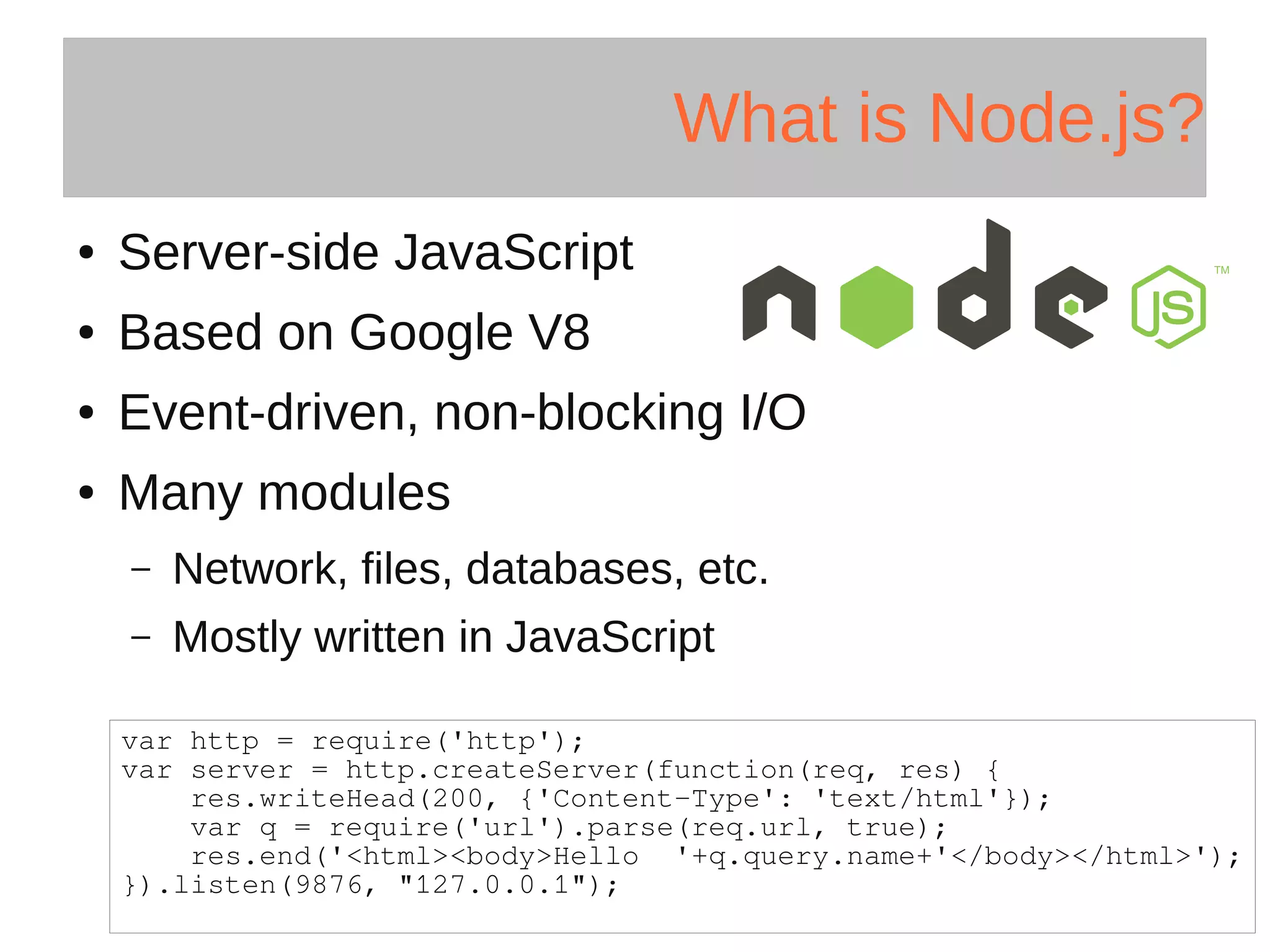
What is Node.js?
● Server-side JavaScript
● Based on Google V8
● Event-driven, non-blocking I/O
● Many modules
– Network, files, databases, etc.
– Mostly written in JavaScript
var http = require('http');
var server = http.createServer(function(req, res) {
res.writeHead(200, {'Content-Type': 'text/html'});
var q = require('url').parse(req.url, true);
res.end('<html><body>Hello '+q.query.name+'</body></html>');
}).listen(9876, "127.0.0.1");
Google V8
● High performance JavaScript
engine
– Written in C++
– Incremental garbage collector
– Just-in-Time compilation (ARM, IA-32,
x86_64, MIPS)
– Used in Chrome and Chromium
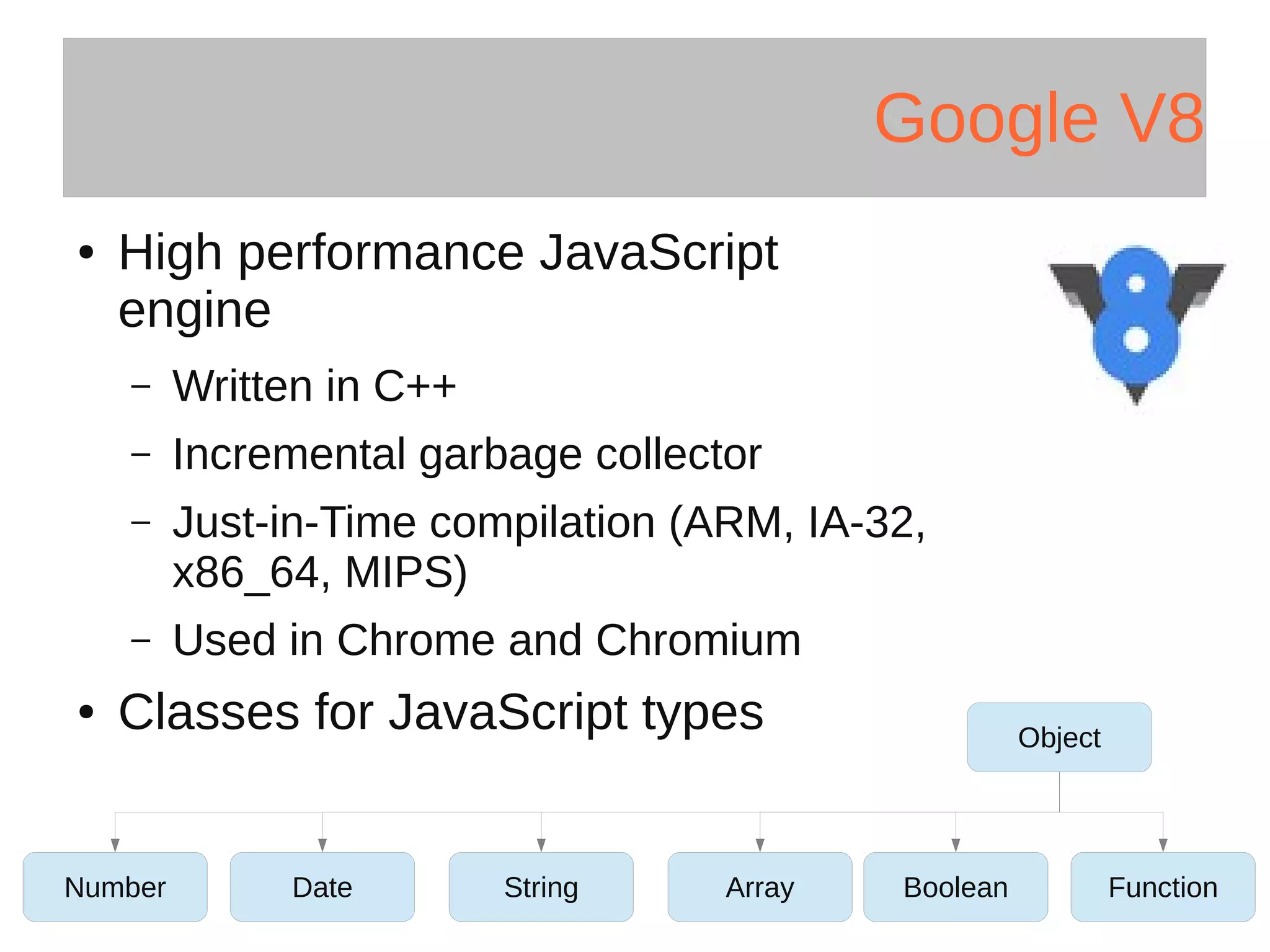
● Classes for JavaScript types Object
Array Boolean FunctionStringDateNumber
C++ classes
● Person
– firstname
– lastname
– birthday
– to_str
● Book
– add
– lookup
– operator []
– remove
– size
Files:
book.hpp, book.cpp
person.hpp, person.cpp
main.cpp
Makefile
Wrapper classes
● Inherit from ObjectWrap
● Declaring friendships can be an advantage
● Common (static) methods:
– Method Init adds class to runtime
– Method New instantiates an object
● Remember that JavaScript has “funny” scope
rules
● Special exception class
● Validate arguments as JavaScript isn't strongly
typed
Wrapper classes
● Inherit from ObjectWrap
● Declaring friendships can be an advantage
● Common (static) methods:
– Method Init adds class to runtime
– Method New instantiates an object
● Remember that JavaScript has “funny” scope
rules
● Special exception class
● Validate arguments as JavaScript isn't strongly
typed
Initialize
● Method Init
– Sets the class name
– Sets the number of internal fields
– Adds methods to runtime
● NODE_SET_PROTOTYPE_METHOD macro
– Adds getter/setter/deleter/enumerator
– Create a constructor (function object)
Example: PersonWrap::Init and BookWrap::Init
Arguments
● Class Arguments are in methods
– An array of V8 objects
● Variable number of arguments
– Length method is useful
● Typical a lot of input validation
– IsString, IsArray, IsNumber, etc.
● The This() method returns the current object
– You must unwrap it to get your object
Example: BookWeap::Lookup
Scope
● Methods need access to the JavaScript stack
● A HandleScope object can help you
– Methods begin by creating the object
– Stack allocation (local variable)
● Exit methods by closing scope
– Returns a variable to the previous scope
– Scope cannot be used
– Garbage collector will eventually deallocate it
● Local<T> is for local (stack allocated) variables
Photo by Hertje Brodersen
Example: BookWrap::Length
(V8) Exceptions
● In JavaScript, you can throw any object
● V8 implements it as a C++ class
● Five different:
– RangeError, ReferenceError, SyntaxError,
TypeError, Error
● You throw by returning an exception object
– And it can be caught in you JavaScript program
Example: BookWrap::Add
New instance
● JavaScript programs can create new objects
– Or instances of you class
● The New method is called when a new object
is created
– Create a wrapper object
– Probably you must create a wrapped object, too
– Wrap this and return it
● The constructor can easily take arguments
Example: BookWrap::New
New instance from C++
● You can create JavaScript objects from C++
– Useful when a method returns a wrapped object
● Overload the New method
– Or use another name
● The constructor (of the wrapper class) has a
NewInstance method
● Pointer to wrapped object is added as internal
field
● Friendship between wrapper classes is very useful
Example: PersonWrap::New ×3
Getter and setter
● JavaScript has to index operators
– [] for array-like access (indexed)
– . for attributes (named)
● No negative index (uint32_t)
Examples: BookWrap::Getter and PersonWrap::Setter
Deleter and Enumerator
● JavaScript's delete operator is supported by
implementing a Deleter
– Must return either true or false
● An enumerator makes it possible to do
for ... in
Example: BookWrap::Deleter and BookWrap::Enumerator
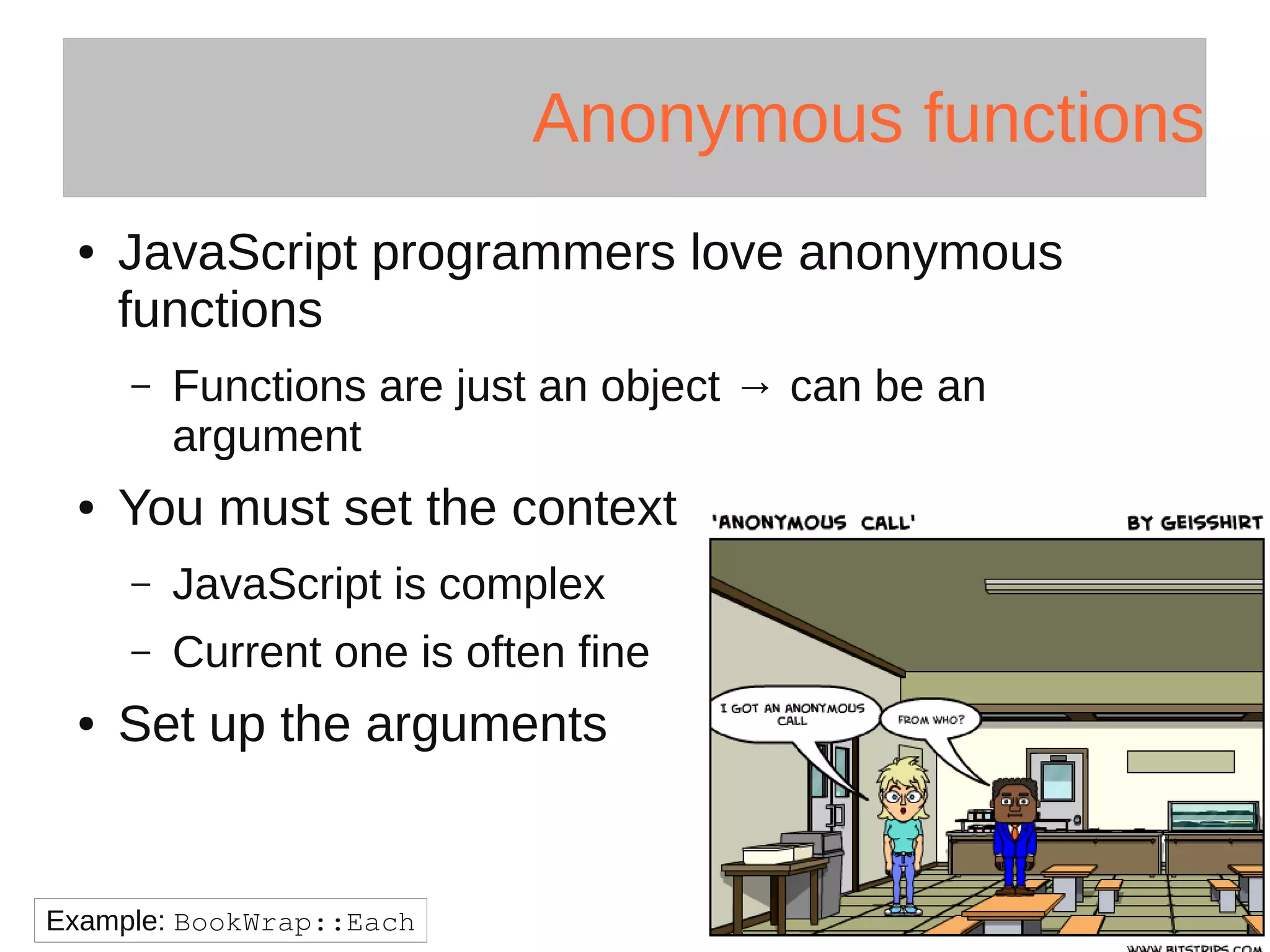
Anonymous functions
● JavaScript programmers love anonymous
functions
– Functions are just an object → can be an
argument
● You must set the context
– JavaScript is complex
– Current one is often fine
● Set up the arguments
Example: BookWrap::Each
Catching Exceptions
● JavaScript functions can throw exceptions
– And you can catch them in C++
– The TryCatch class implement a handler
● Complication:
– JavaScript might return an object if successful
– But an exception is also an object
– (the V8 tutorial is probably wrong)
● You can rethrow exceptions
Example: BookWrap::Apply
Build
● Initialize classes from init
– File: funstuff_node.cpp
● Using old-school node-waf
– Write a wscript file
● Newer extensions use gyp
Where to go?
● Get my demo extension:
https://github.com/kneth/FunStuff
● Node.js: http://nodejs.org/
● JavaScript Unit Testing by Hazam Salah
● V8 classes:
http://bespin.cz/~ondras/html/hierarchy.html
Observations
● Extensions do not have to be a one-to-one
mapping
● A lot of code to do input validation
– JavaScript is not strongly typed!
● C++ has classes – JavaScript doesn't
– Awkward for JavaScript programmers
● Node.js extension can (relative) easily be
ported to Chrome
● Nodeunit is nice for unit testing

Extending Node.js using C++

  • 1.
    Extending Node.js Using C++ KennethGeisshirt Open Source Days 2013
  • 2.
    About me ● Education –B.Sc. in computer science (Univ. of Copenhagen) – M.Sc. in chemistry (Univ. of Copenhagen) – Ph.D. in soft material science (Roskilde Univ.) ● Freelance writer and tech review ● Senior software developer at TightDB, Inc. – Documentation and benchmarking – Implementing language bindings
  • 3.
    Agenda ● What isNode.js and V8? ● C++ classes ● Wrapping classes – Setters, getters, deleters, enumerators – Anonymous functions – Exceptions – Instantiate objects ● Building extensions Codeexamples
  • 4.
    What is Node.js? ●Server-side JavaScript ● Based on Google V8 ● Event-driven, non-blocking I/O ● Many modules – Network, files, databases, etc. – Mostly written in JavaScript var http = require('http'); var server = http.createServer(function(req, res) { res.writeHead(200, {'Content-Type': 'text/html'}); var q = require('url').parse(req.url, true); res.end('<html><body>Hello '+q.query.name+'</body></html>'); }).listen(9876, "127.0.0.1");
  • 5.
    Google V8 ● Highperformance JavaScript engine – Written in C++ – Incremental garbage collector – Just-in-Time compilation (ARM, IA-32, x86_64, MIPS) – Used in Chrome and Chromium ● Classes for JavaScript types Object Array Boolean FunctionStringDateNumber
  • 6.
    C++ classes ● Person –firstname – lastname – birthday – to_str ● Book – add – lookup – operator [] – remove – size Files: book.hpp, book.cpp person.hpp, person.cpp main.cpp Makefile
  • 7.
    Wrapper classes ● Inheritfrom ObjectWrap ● Declaring friendships can be an advantage ● Common (static) methods: – Method Init adds class to runtime – Method New instantiates an object ● Remember that JavaScript has “funny” scope rules ● Special exception class ● Validate arguments as JavaScript isn't strongly typed
  • 8.
    Wrapper classes ● Inheritfrom ObjectWrap ● Declaring friendships can be an advantage ● Common (static) methods: – Method Init adds class to runtime – Method New instantiates an object ● Remember that JavaScript has “funny” scope rules ● Special exception class ● Validate arguments as JavaScript isn't strongly typed
  • 9.
    Initialize ● Method Init –Sets the class name – Sets the number of internal fields – Adds methods to runtime ● NODE_SET_PROTOTYPE_METHOD macro – Adds getter/setter/deleter/enumerator – Create a constructor (function object) Example: PersonWrap::Init and BookWrap::Init
  • 10.
    Arguments ● Class Argumentsare in methods – An array of V8 objects ● Variable number of arguments – Length method is useful ● Typical a lot of input validation – IsString, IsArray, IsNumber, etc. ● The This() method returns the current object – You must unwrap it to get your object Example: BookWeap::Lookup
  • 11.
    Scope ● Methods needaccess to the JavaScript stack ● A HandleScope object can help you – Methods begin by creating the object – Stack allocation (local variable) ● Exit methods by closing scope – Returns a variable to the previous scope – Scope cannot be used – Garbage collector will eventually deallocate it ● Local<T> is for local (stack allocated) variables Photo by Hertje Brodersen Example: BookWrap::Length
  • 12.
    (V8) Exceptions ● InJavaScript, you can throw any object ● V8 implements it as a C++ class ● Five different: – RangeError, ReferenceError, SyntaxError, TypeError, Error ● You throw by returning an exception object – And it can be caught in you JavaScript program Example: BookWrap::Add
  • 13.
    New instance ● JavaScriptprograms can create new objects – Or instances of you class ● The New method is called when a new object is created – Create a wrapper object – Probably you must create a wrapped object, too – Wrap this and return it ● The constructor can easily take arguments Example: BookWrap::New
  • 14.
    New instance fromC++ ● You can create JavaScript objects from C++ – Useful when a method returns a wrapped object ● Overload the New method – Or use another name ● The constructor (of the wrapper class) has a NewInstance method ● Pointer to wrapped object is added as internal field ● Friendship between wrapper classes is very useful Example: PersonWrap::New ×3
  • 15.
    Getter and setter ●JavaScript has to index operators – [] for array-like access (indexed) – . for attributes (named) ● No negative index (uint32_t) Examples: BookWrap::Getter and PersonWrap::Setter
  • 16.
    Deleter and Enumerator ●JavaScript's delete operator is supported by implementing a Deleter – Must return either true or false ● An enumerator makes it possible to do for ... in Example: BookWrap::Deleter and BookWrap::Enumerator
  • 17.
    Anonymous functions ● JavaScriptprogrammers love anonymous functions – Functions are just an object → can be an argument ● You must set the context – JavaScript is complex – Current one is often fine ● Set up the arguments Example: BookWrap::Each
  • 18.
    Catching Exceptions ● JavaScriptfunctions can throw exceptions – And you can catch them in C++ – The TryCatch class implement a handler ● Complication: – JavaScript might return an object if successful – But an exception is also an object – (the V8 tutorial is probably wrong) ● You can rethrow exceptions Example: BookWrap::Apply
  • 19.
    Build ● Initialize classesfrom init – File: funstuff_node.cpp ● Using old-school node-waf – Write a wscript file ● Newer extensions use gyp
  • 20.
    Where to go? ●Get my demo extension: https://github.com/kneth/FunStuff ● Node.js: http://nodejs.org/ ● JavaScript Unit Testing by Hazam Salah ● V8 classes: http://bespin.cz/~ondras/html/hierarchy.html
  • 21.
    Observations ● Extensions donot have to be a one-to-one mapping ● A lot of code to do input validation – JavaScript is not strongly typed! ● C++ has classes – JavaScript doesn't – Awkward for JavaScript programmers ● Node.js extension can (relative) easily be ported to Chrome ● Nodeunit is nice for unit testing