
<Carmen Alcivar>
NORTHEASTERN UNIVERSITY 360 Huntington Ave, Boston, MA.
LAB ASSIGNMENT 6 – FOUNDATIONS
OF INFORMATION ASSURANCE (IA5010)
Contents
Lab #15: Attacking a Vulnerable Web Application and Database ................................................2
a. Assessment Sheet........................................................................................................................2
b. Challenge Question.....................................................................................................................3
c. Screenshots: ................................................................................................................................3
Lab #15: Attacking a Vulnerable Web Application and Database
a. Assessment Sheet
Course Name and Number: Foundations of Information Assurance – IA5010
Student Name: <Carmen Alcivar>
Instructor Name: Derek Brodeur
Lab Due Date: <2/21/16>
Lab Assessment Questions & Answers
1. Why is it critical to perform a penetration test on a Web application and a
Web server prior to production implementation?
Performing penetration tests on a Web application and a Web server prior to
production implementation is a critical step in ensuring the confidentiality,
integrity, and availability (CIA) of the Web application or service. It is imperative
to perform penetration test in order to protect customer’s private information that
will be entered via the Web application. There are also laws regulating the
confidentiality of customer’s data.
2. What is a cross-site scripting attack? Explain in your own words?
A cross-site scripting attack is the type of attack that exploit a cross-site scripting
(XSS) vulnerability in a Website. It is subject to a SQL injection attack on the
Web application's SQL database. XSS is the malicious insertion of scripting code
to extract data or modify a Web site’s code, application, or content.
3. What is a reflective cross-site scripting attack?
The reflective cross-site scripting attack is a non-persistent attack in which all
input shows output on the user’s/attacker’s screen and does not modify data stored
on the server.
4. Based on the tests you performed in this lab, which Web application attack is
more likely to extract privacy data elements out of a database?
The reflective cross-site scripting attack is the type of attacks that allows you to
extract privacy data elements out of a database.
5. If you can monitor when SQL injections are performed on an SQL database,
what would you recommend as a security countermeasure to monitor your
production SQL databases?
I would recommend the use of Simple Network Management Protocol (SNMP)
alerts which allows Database administrators to monitor their SQL databases for
unauthorized or abnormal SQL injections and write scripts for alarming as well as.
Encrypting the data elements that reside in long-term storage of the SQL database
is another option.
6. Given that Apache and Internet Information Services (IIS) are the two most
popular Web application servers for Linux and Microsoft® Windows
platforms, what would you do to identify known software vulnerabilities and
exploits?
I could search the CVE listing using the keyword Apache to find all known
Apache vulnerabilities and exploits. This allows to include all software patches
and security patches on the production Web servers to remediate critical and
major software vulnerabilities before the application is released.
7. What can you do to ensure that your organization incorporates penetration
testing and Web application testing as part of its implementation
procedures?
Penetration testing should be part of the policy. The organization's security policy
should dictate that no production Web application can be implemented without
proper penetration testing and security hardening.
8. What is the purpose of setting the DVWA security level to “low” before
beginning the remaining lab steps
The low setting mimics a vulnerable Web application. Only a vulnerable system
can be attacked.
9. As an ethical hacker, once you’ve determined that a database is injectable,
what should you do with that information?
As an ethical hacker, I should recommend specific countermeasures for
remediating the vulnerabilities and eliminating the exploits. Once I have
determined that a database is injectable
b. Challenge Question
c. Screenshots:
Part 2:
[Deliverable Lab Step 5] screen shot showing the exposed vulnerability
1. [Deliverable Lab Step 8] screen shot showing cross-site scripting attacks in the High
setting. It does not go through.
Part 3:
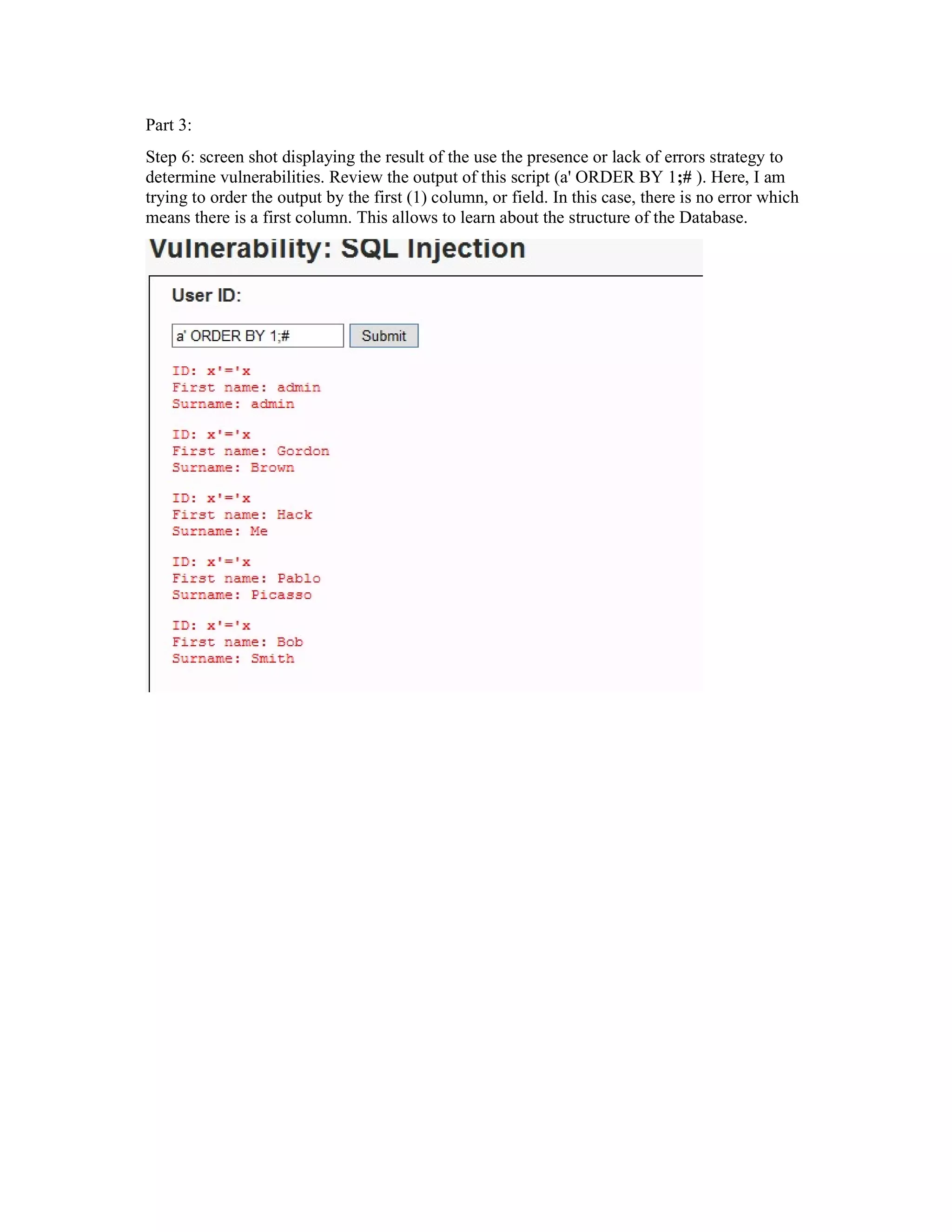
Step 6: screen shot displaying the result of the use the presence or lack of errors strategy to
determine vulnerabilities. Review the output of this script (a' ORDER BY 1;# ). Here, I am
trying to order the output by the first (1) column, or field. In this case, there is no error which
means there is a first column. This allows to learn about the structure of the Database.
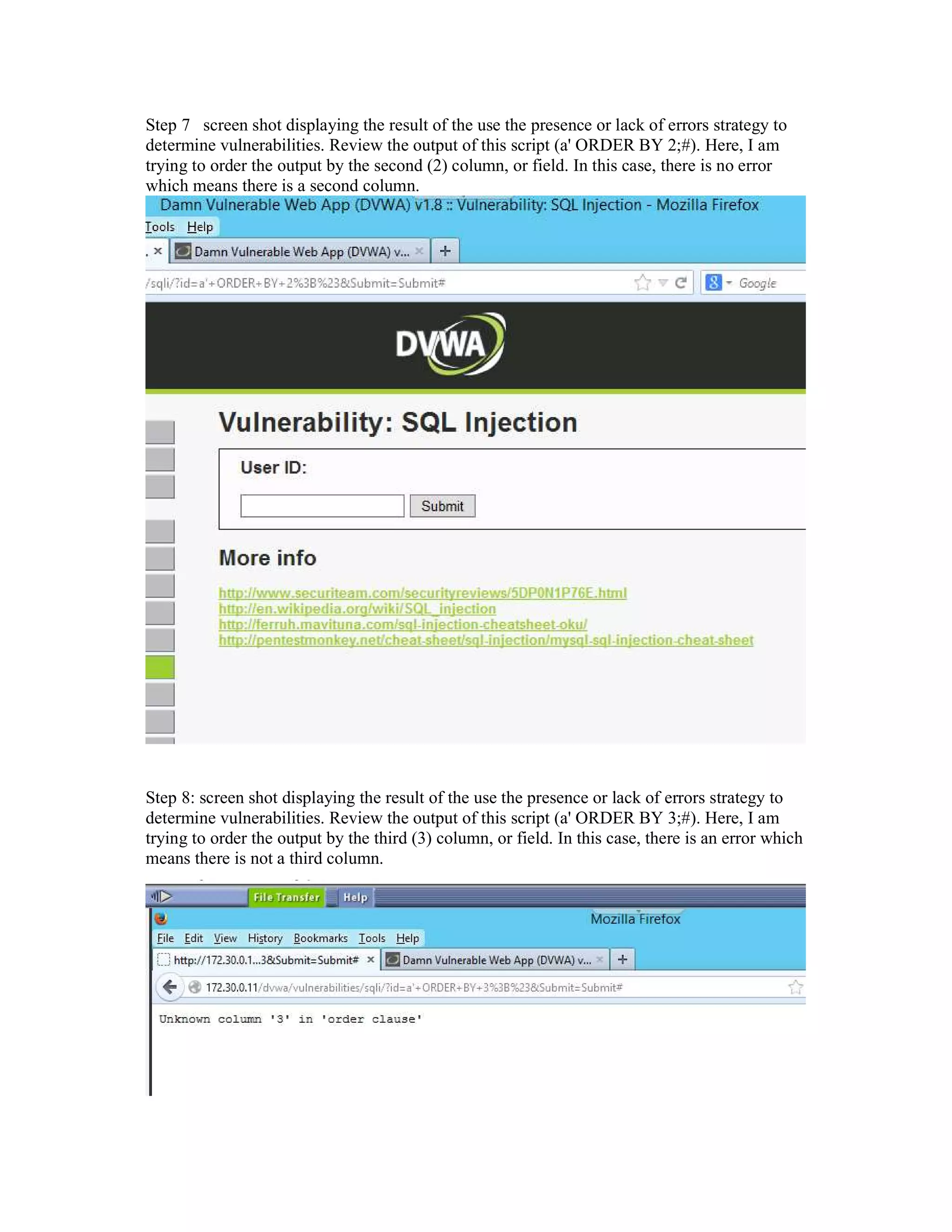
Step 7 screen shot displaying the result of the use the presence or lack of errors strategy to
determine vulnerabilities. Review the output of this script (a' ORDER BY 2;#). Here, I am
trying to order the output by the second (2) column, or field. In this case, there is no error
which means there is a second column.
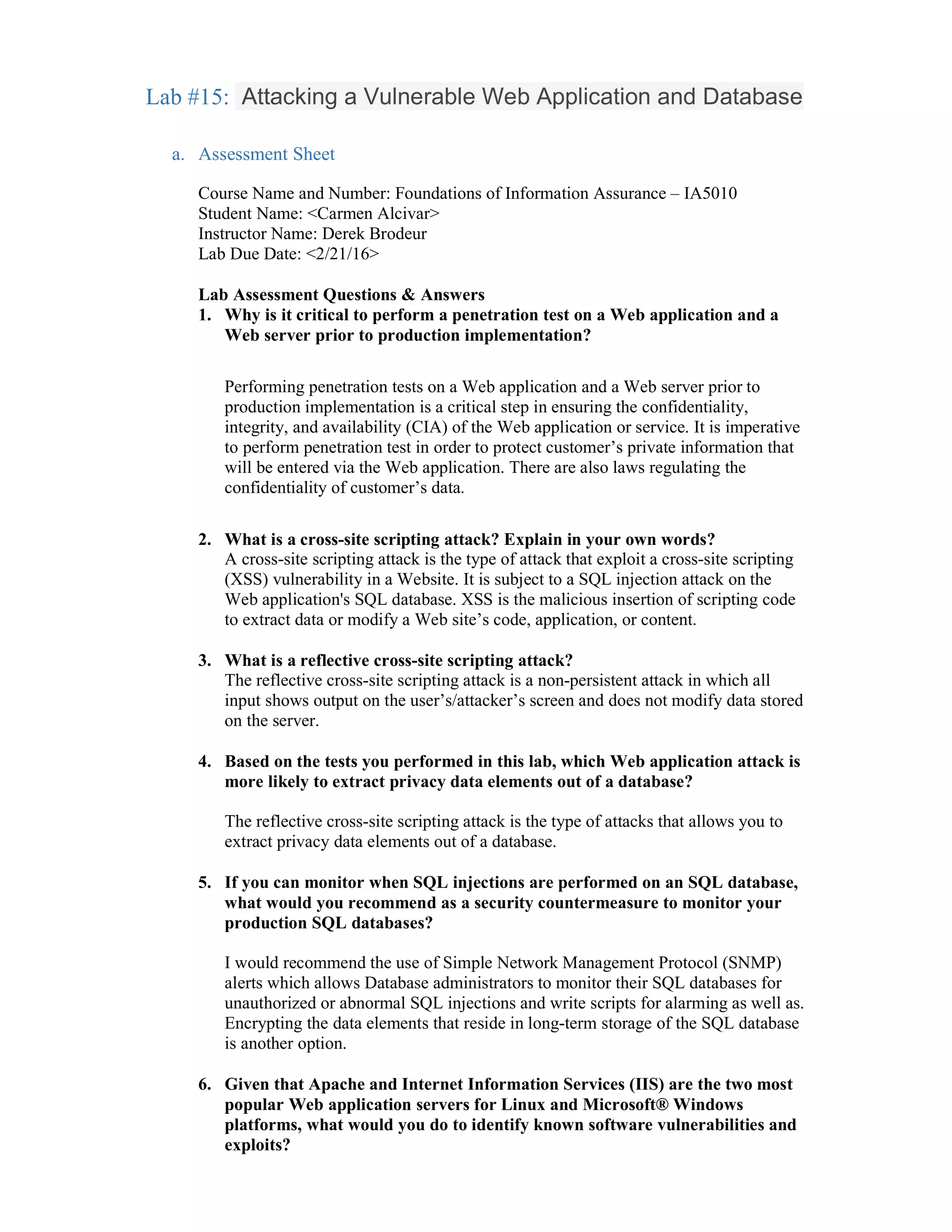
Step 8: screen shot displaying the result of the use the presence or lack of errors strategy to
determine vulnerabilities. Review the output of this script (a' ORDER BY 3;#). Here, I am
trying to order the output by the third (3) column, or field. In this case, there is an error which
means there is not a third column.
[Deliverable Lab Step 18]: a screen capture showing the user information for the user
name that is currently being used to make queries on the server.
[Deliverable Lab Step 20 ] a screen capture showing hash for the user to the backend
database. Hashing in a database allows the creation of an index number. This facilitates the
search of a record later on. http://www.webopedia.com/TERM/H/hashing.html
Part 4:
[Deliverable Lab Step 8] screen capture showing the contents of the testing1.txt file

example of sql injection

  • 1.
    <Carmen Alcivar> NORTHEASTERN UNIVERSITY360 Huntington Ave, Boston, MA. LAB ASSIGNMENT 6 – FOUNDATIONS OF INFORMATION ASSURANCE (IA5010)
  • 2.
    Contents Lab #15: Attackinga Vulnerable Web Application and Database ................................................2 a. Assessment Sheet........................................................................................................................2 b. Challenge Question.....................................................................................................................3 c. Screenshots: ................................................................................................................................3
  • 3.
    Lab #15: Attackinga Vulnerable Web Application and Database a. Assessment Sheet Course Name and Number: Foundations of Information Assurance – IA5010 Student Name: <Carmen Alcivar> Instructor Name: Derek Brodeur Lab Due Date: <2/21/16> Lab Assessment Questions & Answers 1. Why is it critical to perform a penetration test on a Web application and a Web server prior to production implementation? Performing penetration tests on a Web application and a Web server prior to production implementation is a critical step in ensuring the confidentiality, integrity, and availability (CIA) of the Web application or service. It is imperative to perform penetration test in order to protect customer’s private information that will be entered via the Web application. There are also laws regulating the confidentiality of customer’s data. 2. What is a cross-site scripting attack? Explain in your own words? A cross-site scripting attack is the type of attack that exploit a cross-site scripting (XSS) vulnerability in a Website. It is subject to a SQL injection attack on the Web application's SQL database. XSS is the malicious insertion of scripting code to extract data or modify a Web site’s code, application, or content. 3. What is a reflective cross-site scripting attack? The reflective cross-site scripting attack is a non-persistent attack in which all input shows output on the user’s/attacker’s screen and does not modify data stored on the server. 4. Based on the tests you performed in this lab, which Web application attack is more likely to extract privacy data elements out of a database? The reflective cross-site scripting attack is the type of attacks that allows you to extract privacy data elements out of a database. 5. If you can monitor when SQL injections are performed on an SQL database, what would you recommend as a security countermeasure to monitor your production SQL databases? I would recommend the use of Simple Network Management Protocol (SNMP) alerts which allows Database administrators to monitor their SQL databases for unauthorized or abnormal SQL injections and write scripts for alarming as well as. Encrypting the data elements that reside in long-term storage of the SQL database is another option. 6. Given that Apache and Internet Information Services (IIS) are the two most popular Web application servers for Linux and Microsoft® Windows platforms, what would you do to identify known software vulnerabilities and exploits?
  • 4.
    I could searchthe CVE listing using the keyword Apache to find all known Apache vulnerabilities and exploits. This allows to include all software patches and security patches on the production Web servers to remediate critical and major software vulnerabilities before the application is released. 7. What can you do to ensure that your organization incorporates penetration testing and Web application testing as part of its implementation procedures? Penetration testing should be part of the policy. The organization's security policy should dictate that no production Web application can be implemented without proper penetration testing and security hardening. 8. What is the purpose of setting the DVWA security level to “low” before beginning the remaining lab steps The low setting mimics a vulnerable Web application. Only a vulnerable system can be attacked. 9. As an ethical hacker, once you’ve determined that a database is injectable, what should you do with that information? As an ethical hacker, I should recommend specific countermeasures for remediating the vulnerabilities and eliminating the exploits. Once I have determined that a database is injectable b. Challenge Question c. Screenshots: Part 2: [Deliverable Lab Step 5] screen shot showing the exposed vulnerability
  • 5.
    1. [Deliverable LabStep 8] screen shot showing cross-site scripting attacks in the High setting. It does not go through.
  • 6.
    Part 3: Step 6:screen shot displaying the result of the use the presence or lack of errors strategy to determine vulnerabilities. Review the output of this script (a' ORDER BY 1;# ). Here, I am trying to order the output by the first (1) column, or field. In this case, there is no error which means there is a first column. This allows to learn about the structure of the Database.
  • 7.
    Step 7 screenshot displaying the result of the use the presence or lack of errors strategy to determine vulnerabilities. Review the output of this script (a' ORDER BY 2;#). Here, I am trying to order the output by the second (2) column, or field. In this case, there is no error which means there is a second column. Step 8: screen shot displaying the result of the use the presence or lack of errors strategy to determine vulnerabilities. Review the output of this script (a' ORDER BY 3;#). Here, I am trying to order the output by the third (3) column, or field. In this case, there is an error which means there is not a third column.
  • 8.
    [Deliverable Lab Step18]: a screen capture showing the user information for the user name that is currently being used to make queries on the server. [Deliverable Lab Step 20 ] a screen capture showing hash for the user to the backend database. Hashing in a database allows the creation of an index number. This facilitates the search of a record later on. http://www.webopedia.com/TERM/H/hashing.html
  • 9.
    Part 4: [Deliverable LabStep 8] screen capture showing the contents of the testing1.txt file