Evolutionary
Algorithms
1
Evolutionary Algorithms
 Evolutionary algorithms (EAs) are a type of metaheuristic
algorithm that are inspired by the process of natural evolution.
They are used to find optimal solutions to problems that are
difficult to solve using traditional methods.
 EAs work by creating a population of solutions, and then
iteratively improving those solutions over time. Each solution in
the population is represented as a chromosome, which is a string
of genes. The genes in the chromosome represent the different
parameters of the solution.
EAs have been used to solve a wide
variety of problems, including:
* Optimization problems
* Machine learning problems
* Engineering design problems
* Financial planning problems
* Natural language processing problems
* Computer vision problems
Optimization
4
Optimization
 Optimization is the process of finding
the best solution out of all feasible
solutions.
 The aim of optimization is to find an
algorithm which solves a given class of
problems.
 There exists no specific method which
solves effectively all optimization
problems (No free launch theorems).
5
Classification of optimization
problems
1. Depending on the nature of equations involved in the
objective function and constraints:
 Linear optimization problem
 Non-linear optimization problem
6
Linear optimization problem
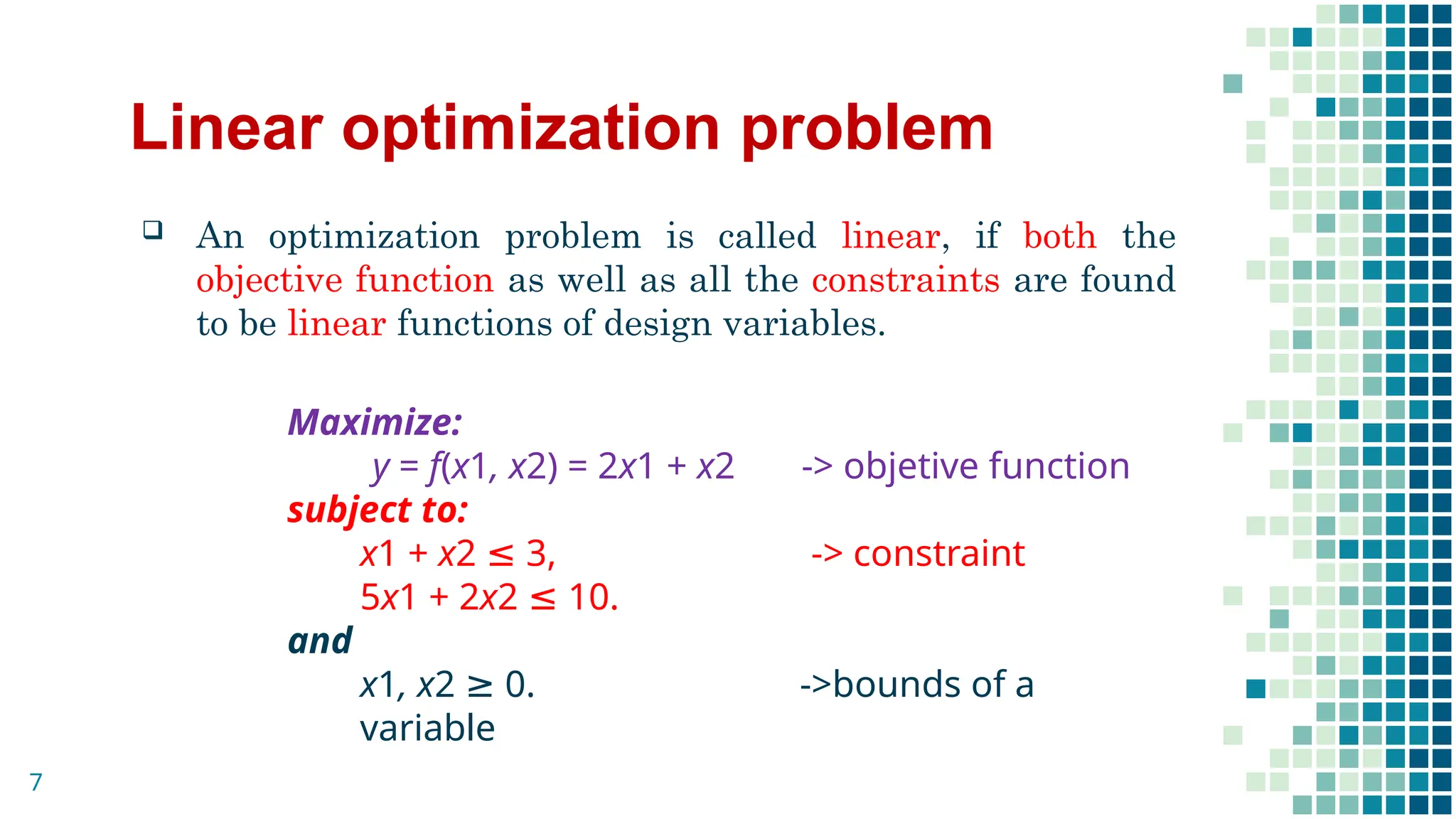
 An optimization problem is called linear, if both the
objective function as well as all the constraints are found
to be linear functions of design variables.
Maximize:
y = f(x1, x2) = 2x1 + x2 -> objetive function
subject to:
x1 + x2 ≤ 3, -> constraint
5x1 + 2x2 ≤ 10.
and
x1, x2 ≥ 0. ->bounds of a
variable
7
Non-linear optimization problem
 An optimization problem is called non-linear, if any one or
both of the objective function and the constraints are
found to be non-linear functions of design variables.
Maximize:
y = f(x1, x2) =+
subject to:
+ ≤ 629,
+ ≤ 133,
and
x1, x2 ≥ 0.
8
Classification of optimization problems
(cont.)
2. Based on the existence of any functional constraint:
 Un constrained optimization problem.
 Constrained optimization problem.
9
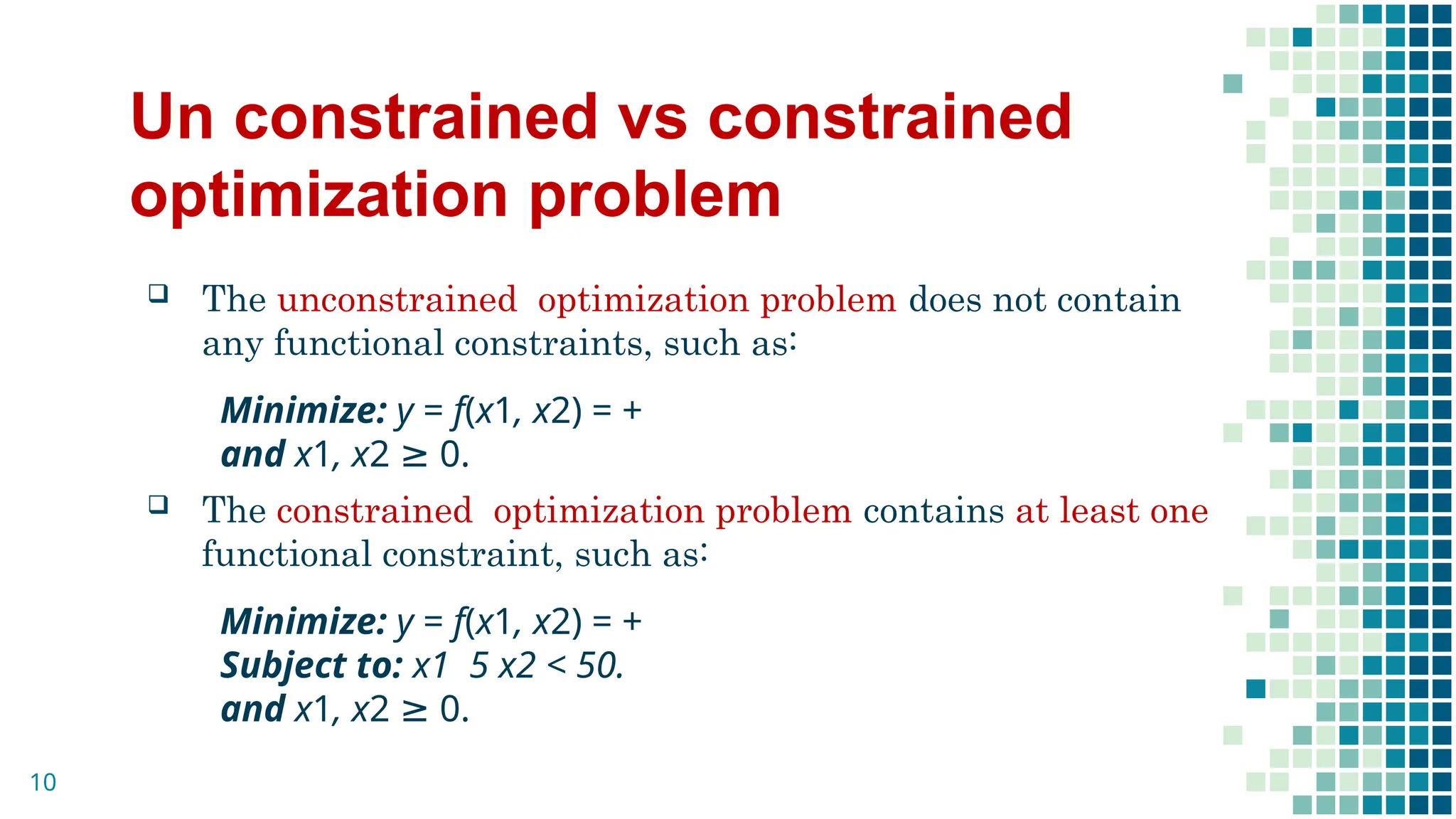
Un constrained vs constrained
optimization problem
 The unconstrained optimization problem does not contain
any functional constraints, such as:
Minimize: y = f(x1, x2) = +
and x1, x2 ≥ 0.
 The constrained optimization problem contains at least one
functional constraint, such as:
Minimize: y = f(x1, x2) = +
Subject to: x1 5 x2 < 50.
and x1, x2 ≥ 0.
10
Classification of optimization problems
(cont.)
3. Depending on the type of design variables:
 Integer programming optimization problem.
 Real-valued programming optimization problem.
 Mixed integer programming optimization problem.
11
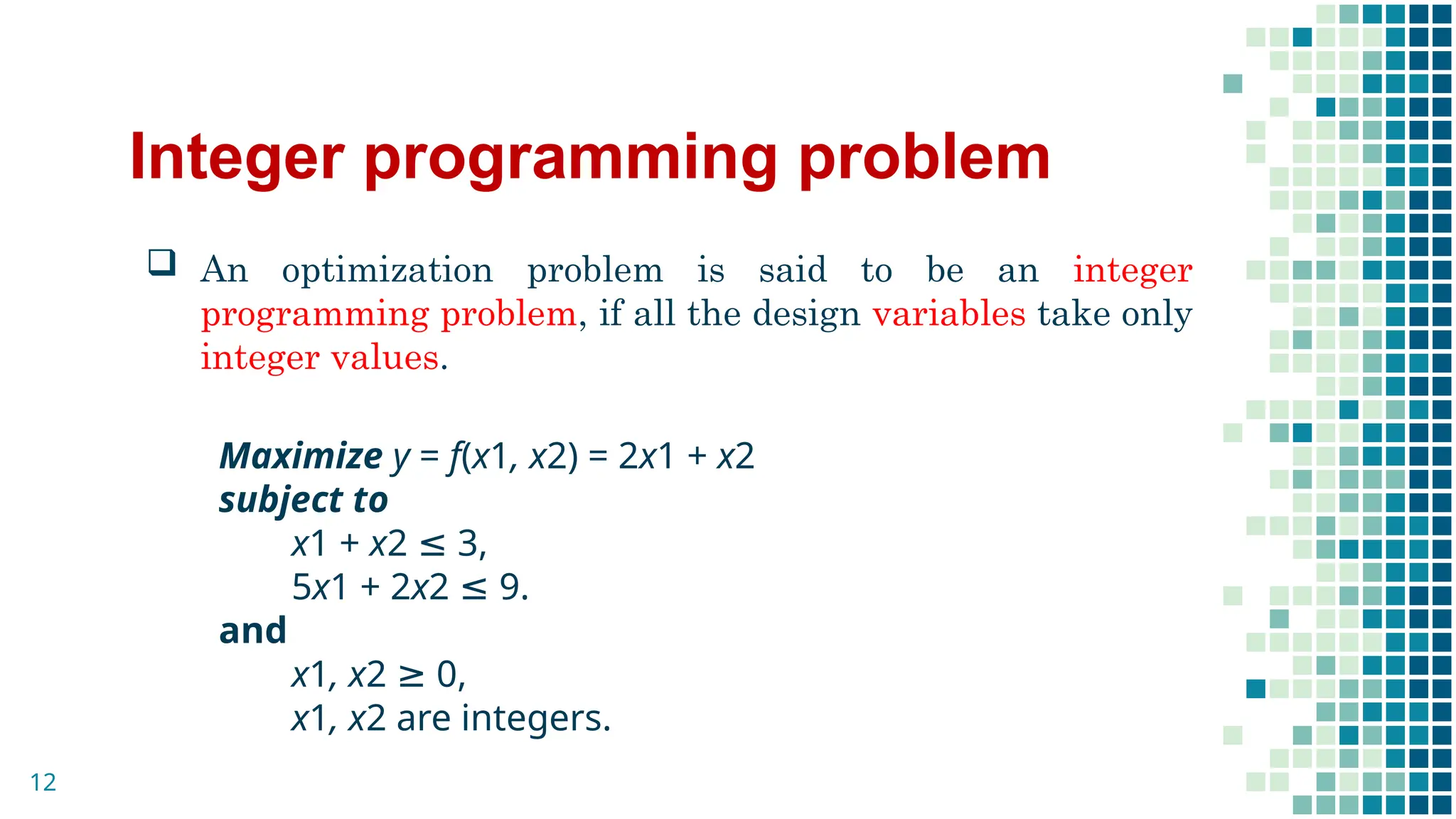
Integer programming problem
 An optimization problem is said to be an integer
programming problem, if all the design variables take only
integer values.
Maximize y = f(x1, x2) = 2x1 + x2
subject to
x1 + x2 ≤ 3,
5x1 + 2x2 ≤ 9.
and
x1, x2 ≥ 0,
x1, x2 are integers.
12
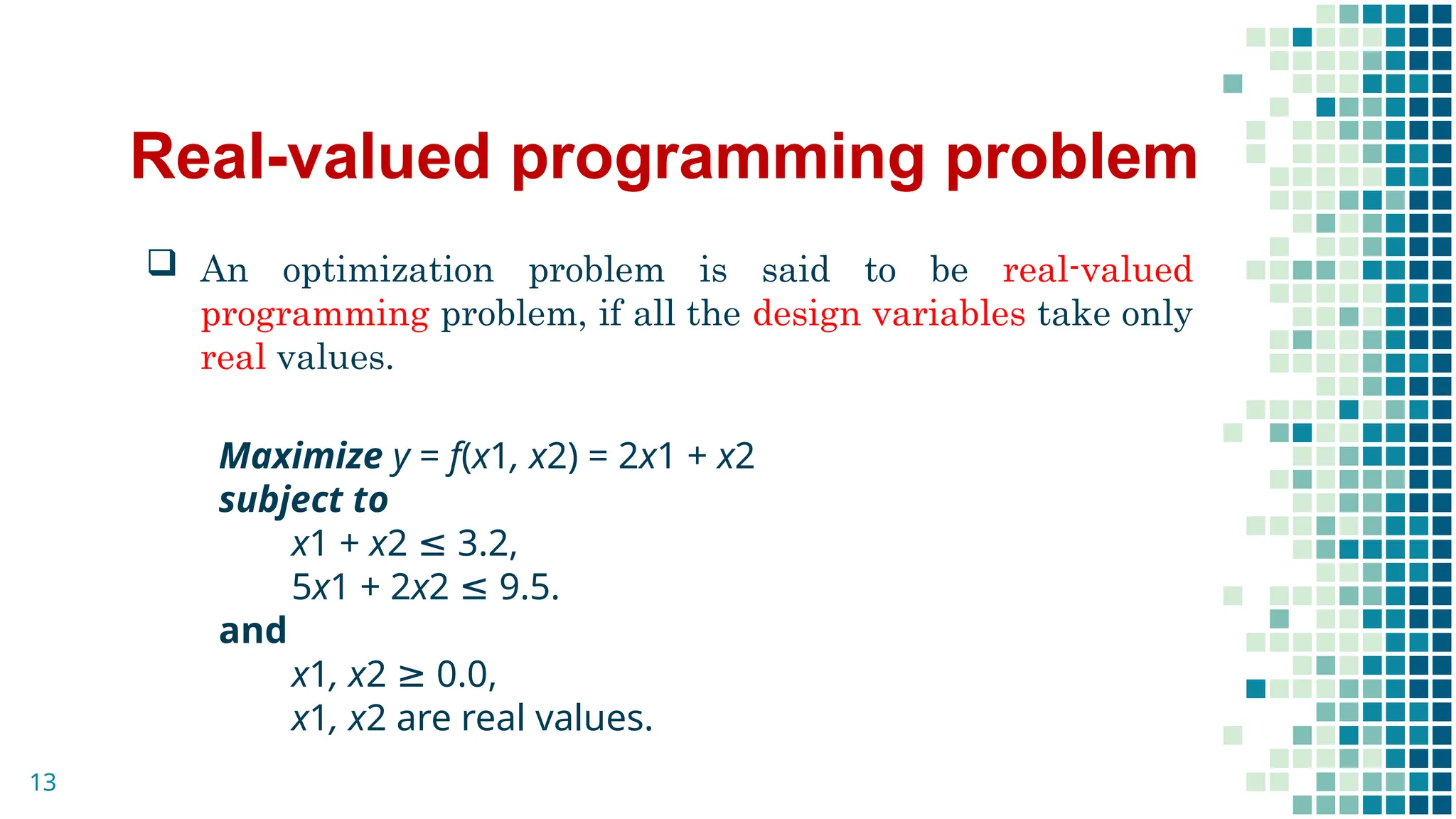
Real-valued programming problem
 An optimization problem is said to be real-valued
programming problem, if all the design variables take only
real values.
Maximize y = f(x1, x2) = 2x1 + x2
subject to
x1 + x2 ≤ 3.2,
5x1 + 2x2 ≤ 9.5.
and
x1, x2 ≥ 0.0,
x1, x2 are real values.
13
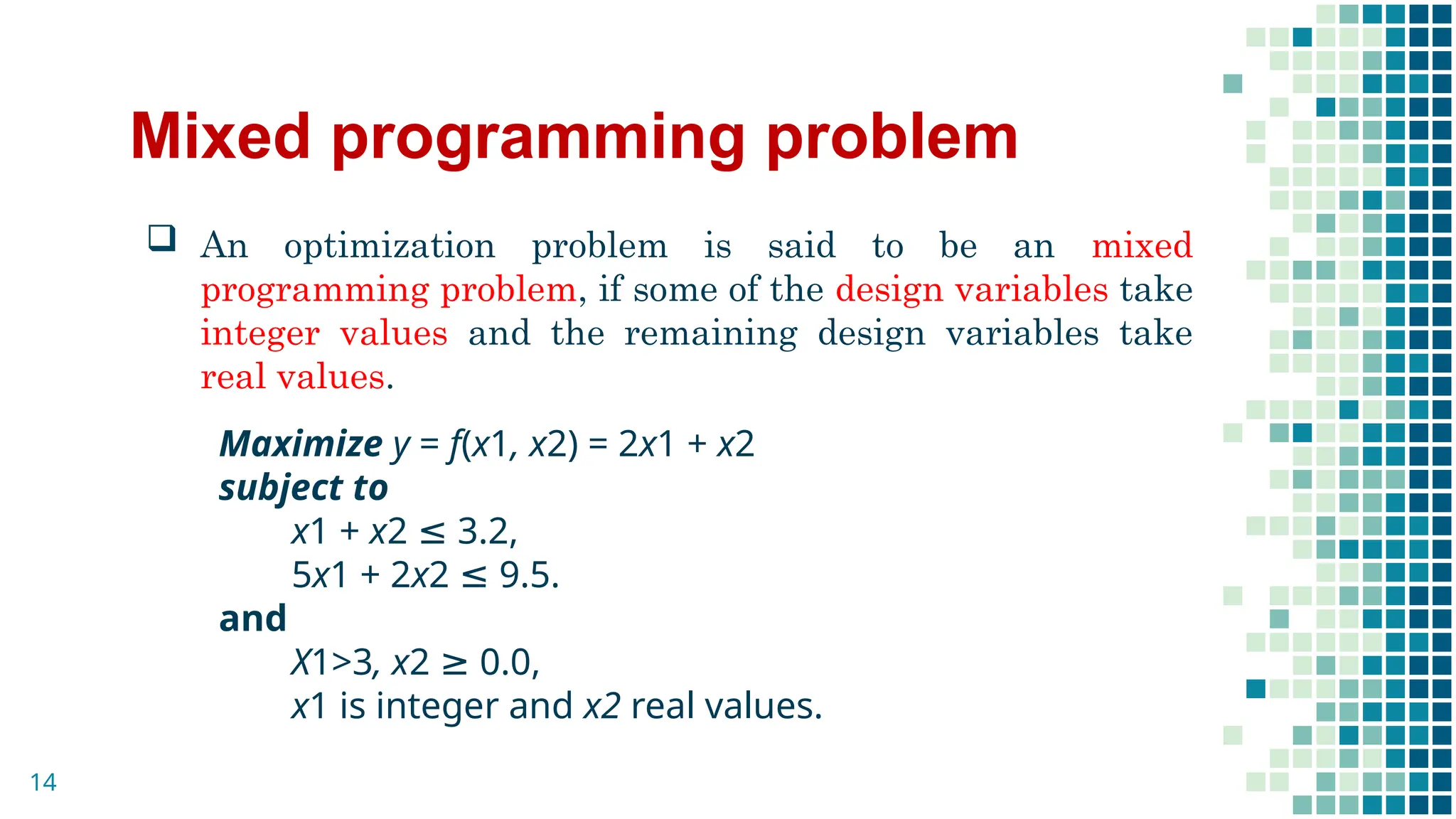
Mixed programming problem
 An optimization problem is said to be an mixed
programming problem, if some of the design variables take
integer values and the remaining design variables take
real values.
Maximize y = f(x1, x2) = 2x1 + x2
subject to
x1 + x2 ≤ 3.2,
5x1 + 2x2 ≤ 9.5.
and
X1>3, x2 ≥ 0.0,
x1 is integer and x2 real values.
14
Single objective vs multi-objective
optimization problem
4. Depending on the number of objective functions:
 Single optimization problem.
 Multi-objective optimization problem.
 Single optimization problem is a problem that contains only
one objective function to be optimized (maximized or
minimized).
 Multi-objective optimization problem is a problem that has
a set or vector of conflicting objective functions to be
optimized.
15
Combinatorial vs continuous
optimization problem
▪ Combinatorial or discrete optimization problem is an
optimization problem in which its design variables takes
discrete values.
▪ Continuous optimization problem is an optimization
problem in which its design variables takes continuous
values.
16
Optimization methods
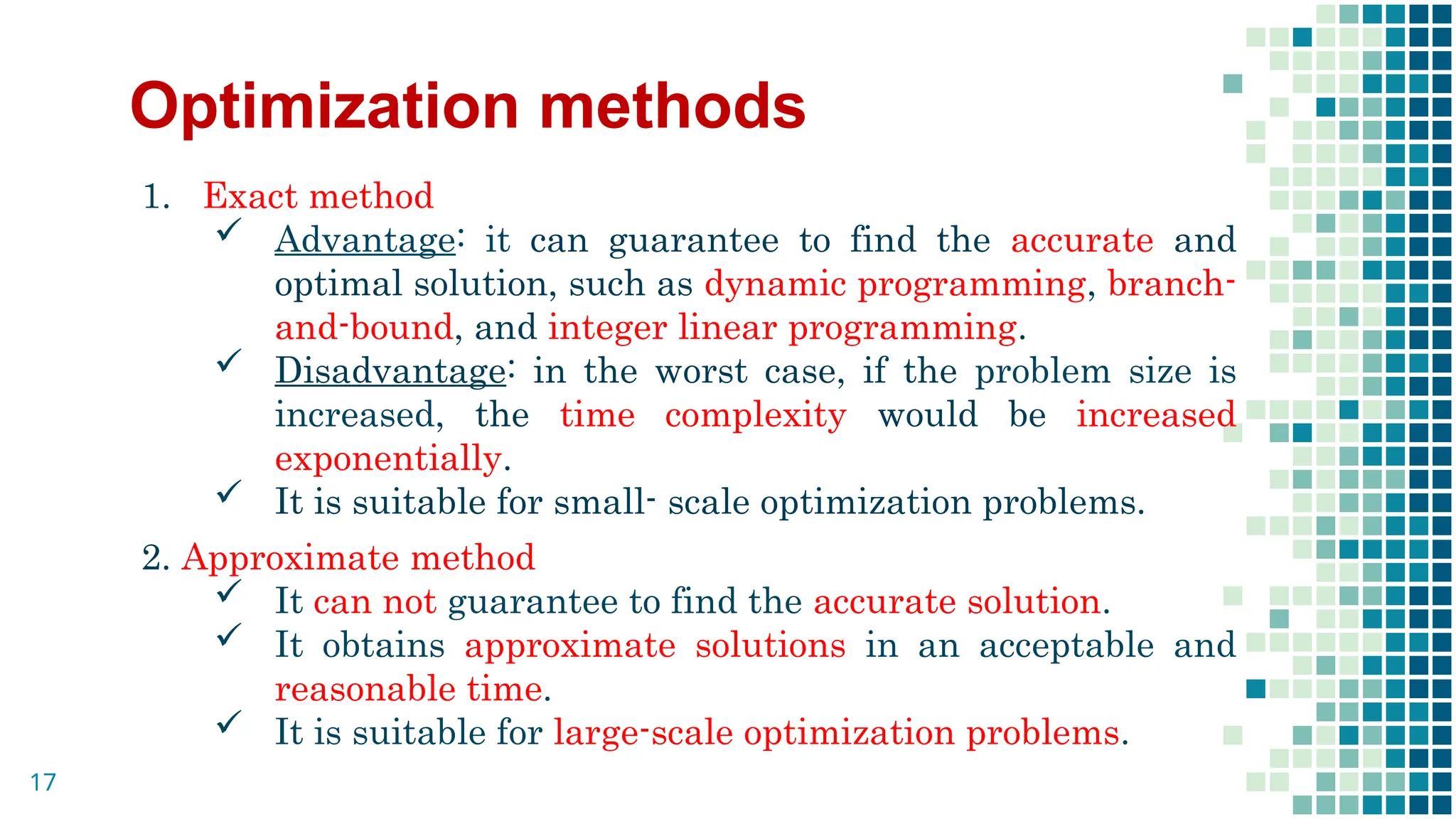
1. Exact method
 Advantage: it can guarantee to find the accurate and
optimal solution, such as dynamic programming, branch-
and-bound, and integer linear programming.
 Disadvantage: in the worst case, if the problem size is
increased, the time complexity would be increased
exponentially.
 It is suitable for small- scale optimization problems.
2. Approximate method
 It can not guarantee to find the accurate solution.
 It obtains approximate solutions in an acceptable and
reasonable time.
 It is suitable for large-scale optimization problems.
17
Heuristic method
 It is an approximate method designed to solve quickly the
problem, while scarifying the exact solution.
 They are often problem-dependent, that is, you define a
heuristic for a given problem.
 The quality of solution depends on the initial starting
points.
18
Metaheuristic algorithm
 Metaheuristics are approximate methods that can not
guarantee the exact and optimal solutions.
 They are problem-independent techniques that can be
applied to a broad range of problems.
 For example, genetic algorithm and particle swarm
algorithms are metaheuristic algorithms.
19
20
Evolutionary computation
 Evolutionary computation is a soft
computing direction that starts by
transferring the ideas of biological
evolutionary theory into computer science
to solve problems.
 Charles Darwin has formulated the
fundamental principle of natural
selection as the main evolutionary tool.
 Combination of Darwin’s and Mendel’s
ideas lead to the modern evolutionary
theory.
21
Darwinian’s principle
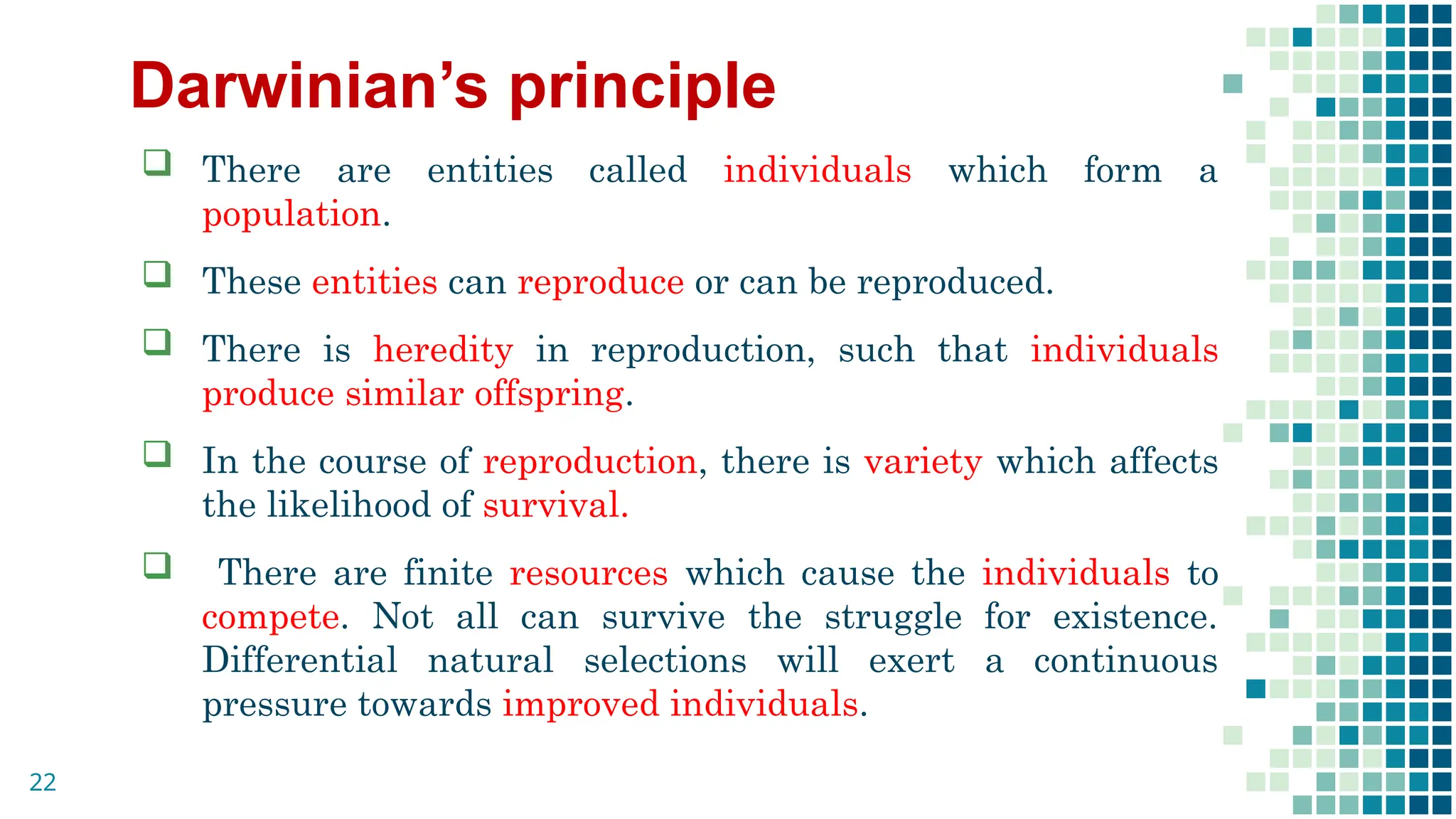
 There are entities called individuals which form a
population.
 These entities can reproduce or can be reproduced.
 There is heredity in reproduction, such that individuals
produce similar offspring.
 In the course of reproduction, there is variety which affects
the likelihood of survival.
 There are finite resources which cause the individuals to
compete. Not all can survive the struggle for existence.
Differential natural selections will exert a continuous
pressure towards improved individuals.
22
Evolutionary computation (cont.)
 The main paradigms serving as the basis of the
evolutionary computation:
 Genetic Algorithm (GA) by Holland in 1975.
 Genetic Programming (GP) by Koza in 1992-1994.
 Evolutionary Strategies (ES) by Recheuberg in1973.
 Evolutionary Programming (EP) by Forgelet al. in
1966.
 These paradigms use mechanisms that are based in
biological evolution, such as reproduction and mutation.
 The basic differences between the paradigms lie in the
nature of the representation schemes, the reproduction
operators and selection methods.
 They are population-based heuristic optimization
algorithms.
23
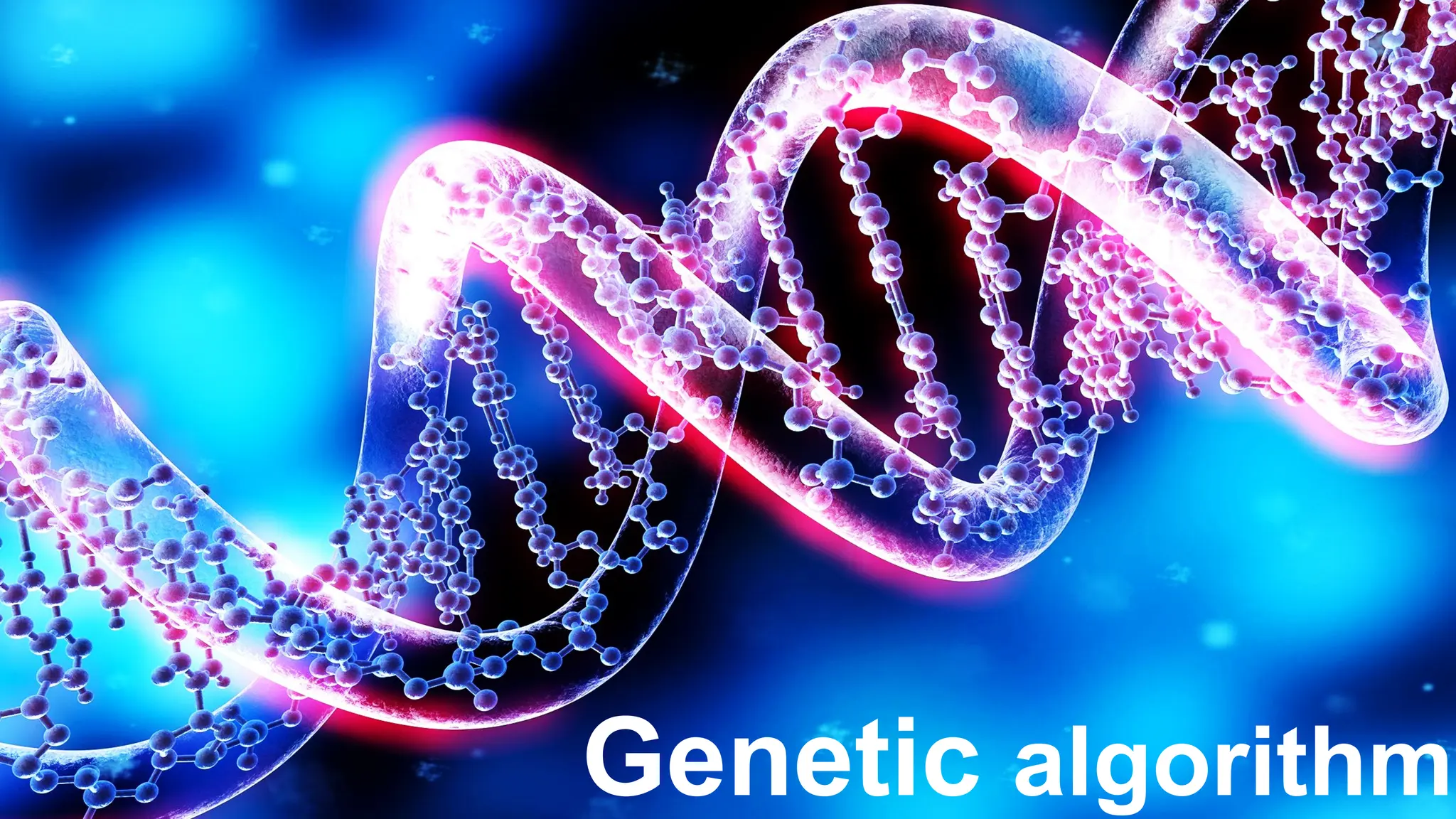
24 Genetic algorithm
Outlines
 Biological background
 Genetic algorithm
 Advantages of GA
 Search space
 Fitness function
 Representation schemes
 Initialization
 Termination criteria of GA
 Fitness function
 Selection operators: random
selection, roulette wheel
selection, tournament selection,
elitism selection
 Genetic operators
 Crossover operations: one-point
crossover, two-point crossover,
uniform crossover
 Mutation operation: bit-flip,
scramble, inversion, swap
 Solved example using GA step
by step.
25
Biological background
 The cell is the smallest structure
and functional unit of the
organism.
 In the center of the cell, we have
nucleus which contains genome
containing 23 pair of
chromosomes.
 The chromosome is made of DNA.
DNA is made of many genes. a
gene is a short section of DNA.
 DNA has a twisted structure in
the shape of a double helix.
26
Biological background
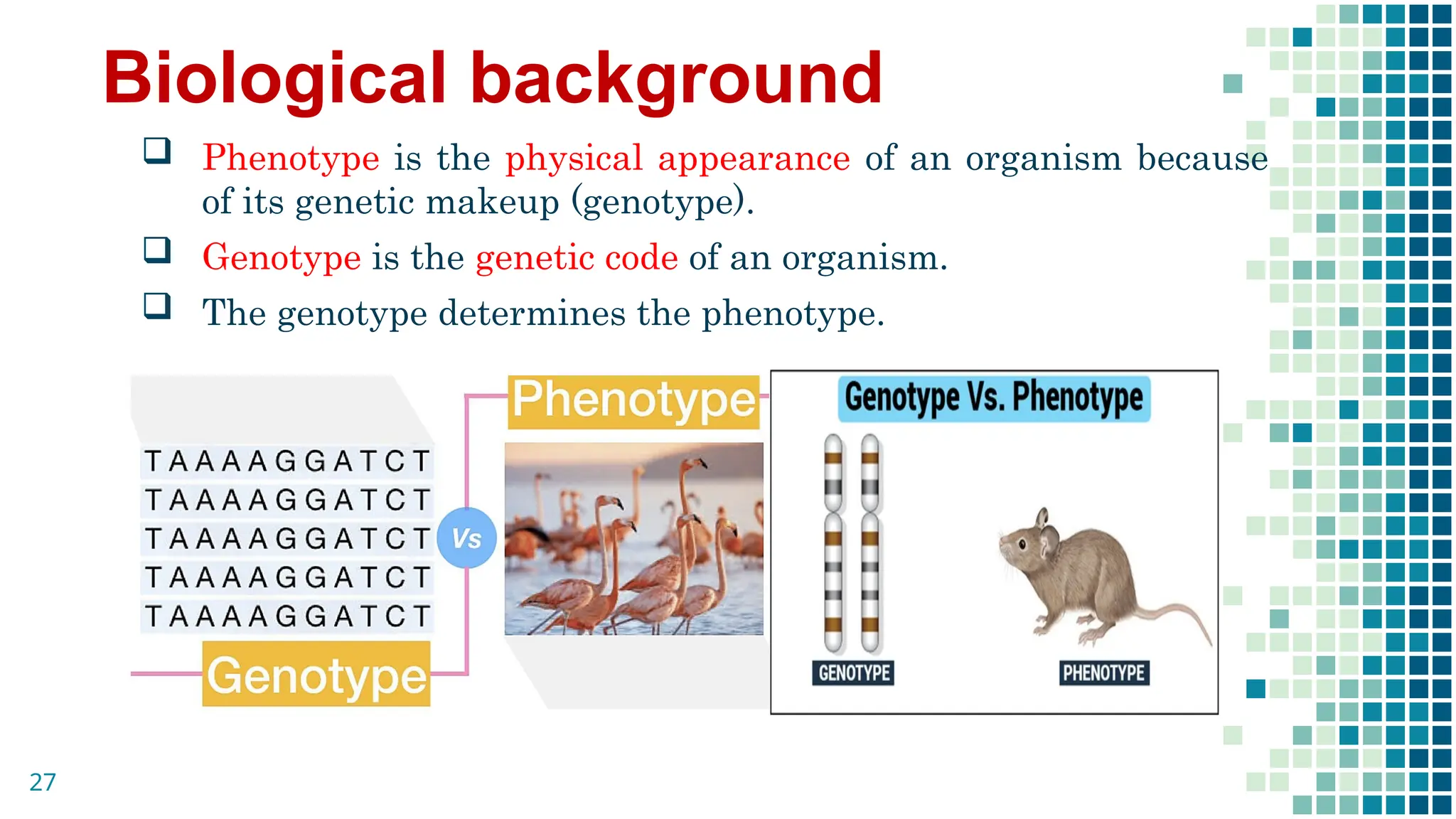
 Phenotype is the physical appearance of an organism because
of its genetic makeup (genotype).
 Genotype is the genetic code of an organism.
 The genotype determines the phenotype.
27
Genetic algorithm
 Genetic algorithm (GA) is a population-based probabilistic
search and optimization technique, which works based on
the mechanism of genetics and Darwin’s principle of
natural selection.
 The GA was introduced by Prof. John Holland of the
University of Michigan, in 1965, although his seminal book
was published in 1975.
28
Genetic algorithm(cont.)
29
Nature Genetic algorithm
Environment Optimization problem
Individual living in this
environment
Feasible solutions
Individual degree of adaption to its
surrounding environment
Solution quality (fitness function)
A population of organisms A set of feasible solutions
Selection, recombination, mutation
in nature’s evolutionary process
Selection methods, crossover operator,
mutation operator
Evolution of populations to suit
their environment
Iteratively applying a set of genetic
operators on a set of feasible solutions
Genetic algorithm
 Initialize a population with a random candidate chromosomes.
 Repeat until termination criteria
 Evaluate all chromosomes with a fitness function.
 Select parents using one of selection methods.
 Perform crossover operation with a probability Pc.
 Perform mutation operation with a probability pm.
 Replace the new population with the current population.
 End termination criteria.
 Return the best individual in the population.
30
Pseudocode of GA
Advantages of GA
 It is easy to understand.
 It deals with complex real-world problems that the hard
computing techniques failed to solve.
 It is modular, separate from application.
 It is good for imprecise and noisy environments.
 It supports multi-objective optimization.
 It is easily distributed and parallelized.
31
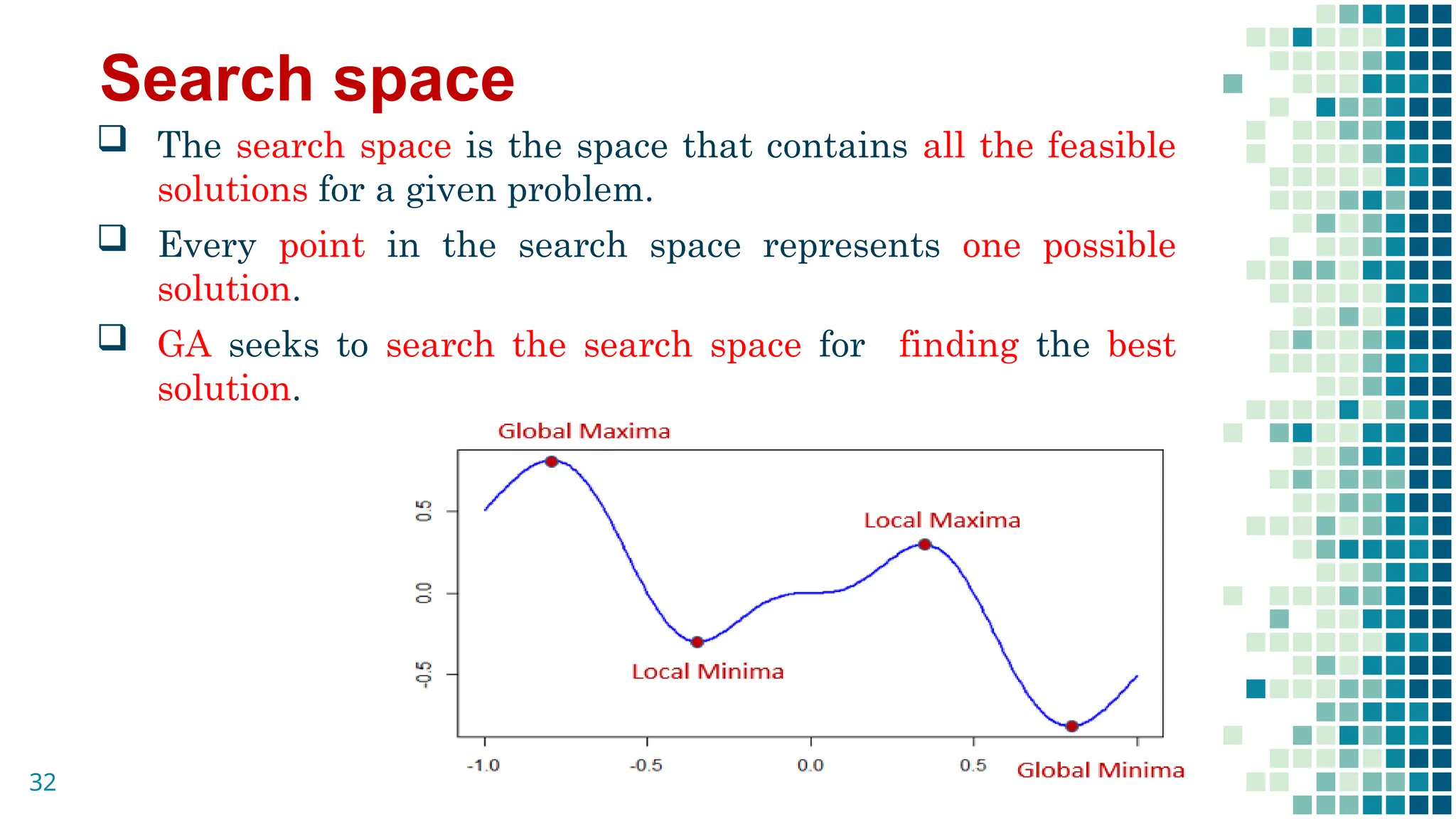
Search space
 The search space is the space that contains all the feasible
solutions for a given problem.
 Every point in the search space represents one possible
solution.
 GA seeks to search the search space for finding the best
solution.
32
Representation schemes
 Parameters of the solution (genes) are concatenated to form
a string (chromosome).
 Encoding is a data structure for representing candidate
solutions.
 Good encoding scheme may affect the performance of a GA.
 Some genetic encoding schemes are:
 Binary-encoding Simple GA or binary-coded GA
 Real-valued encoding  real-valued GA
 Permutation encoding
33
Permutation encoding
Binary encoding Real-valued encoding
1 0 1 1 1.2 0.8 6.7 1.9 1 4 3 2
Initialization
 In this step, a population of N random individuals/
chromosomes are generated. N is the population size
(here, N=6).
G1 G2 G3 G4
Chromosome 1
Chromosome 2
Chromosome 3
Chromosome 4
Chromosome 5
Chromosome 6
34
Termination criteria of GA
 The termination criteria can be:
 Specified number of generations.
 Specified number of fitness evaluations.
 A minimum threshold reached.
 No improvement in the best solutions for a specified
number of generations.
 Memory/time constraints.
 Combinations of above
35
Fitness function
 A fitness function is function which takes the solution as
input and produces the suitability of the solution as the
output.
 It measures how good is a solution.
 In some cases, the fitness function and the objective
function may be the same, while in others it might be
different based on the problem.
36
Selection operators
 All the candidate solutions or individuals contained in the
population may not be equally good in terms of their fitness
values calculated.
 Selection operators are used to select the good ones from the
population of strings based on their fitness information.
 Several selection operators have been developed:
 Random selection
 Proportionate selection/Roulette-wheel selection
 Tournament selection
 Elitism selection.
37
Selective pressure
 Each selection operator is characterized by its selective
pressure.
 A selection operator with a high selective pressure
decreases the diversity in population more rapidly than
a selection operator with a low selective pressure.
 High selective pressure limits the exploration abilities
of the population.
38
Random selection
 Random selection is the simplest selection operator.
 Each individual has the same probability of 1/N to be
selected. N is the population size.
 No fitness information is used, which means that the best
and the worst have exactly the same probability of
surviving to the next generations.
 It has the lowest selective pressure among the selection
operators.
39
Roulette-wheel selection
 In this operator, the probability of a chromosome for
being selected is proportional to its fitness.
 It is implemented with the help of roulette wheel.
 I works as follows:
1. Calculate fitness of each chromosome ( ).
2. Divide the individual fitness by the whole population
fitness as follows:
,
3. N is the population size. is the proportional
fitness of an individual i.
4. Compute the cumulative proportional fitness of each
individual ( ).
40
1
( )
( )
( )
i
i N
i
i
f x
pf x
f x



1,...,
i N

( )
i
pf x
( )
i
f x
( )
i
cpf x
Roulette-wheel selection (cont.)
5. Generate a random number (r) belonging to [0,1].
6. If , then select the i individual.
41
( )
i
cpf x
 Because this selection is
directly proportional to its
fitness, it is possible that
strong individuals may
dominate in producing
offspring, thereby limiting the
diversity of the population.
 In other words, it has a high
selective pressure.
42
Roulette-wheel selection (cont.)
Elitism selection
 Elitism refers to the process of ensuring that the best
individuals of the current population survive to the next
generation.
 The best individuals are copied to the new population.
 The more individuals that survive to the next generation,
the less the diversity of the new population.
43
Tournament selection
 It selects randomly k individuals, where k is the size of
tournament group.
 Then, the best individual is selected among the selected k
individuals.
44
Genetic operators
 Crossover operation
1. One-point crossover operation
2. Two-point crossover operation.
3. Uniform crossover operation.
 Mutation operation
1. Bit-flip mutation
2. Swap mutation.
3. Inversion mutation
4. Scramble mutation
45
Crossover operation
 In biology, the most common form of recombination is
crossover.
 Crossover is a process in which two parent
solutions/chromosomes are used to produce two new
offspring by replacing genes between the two parents.
 The GA has a crossover probability that determines if
crossover will happen.
46
one-point crossover
 In one-point crossover, a crossover point (p=2) is selected
and the tails of its two parents are swapped to generate
new offspring.
47
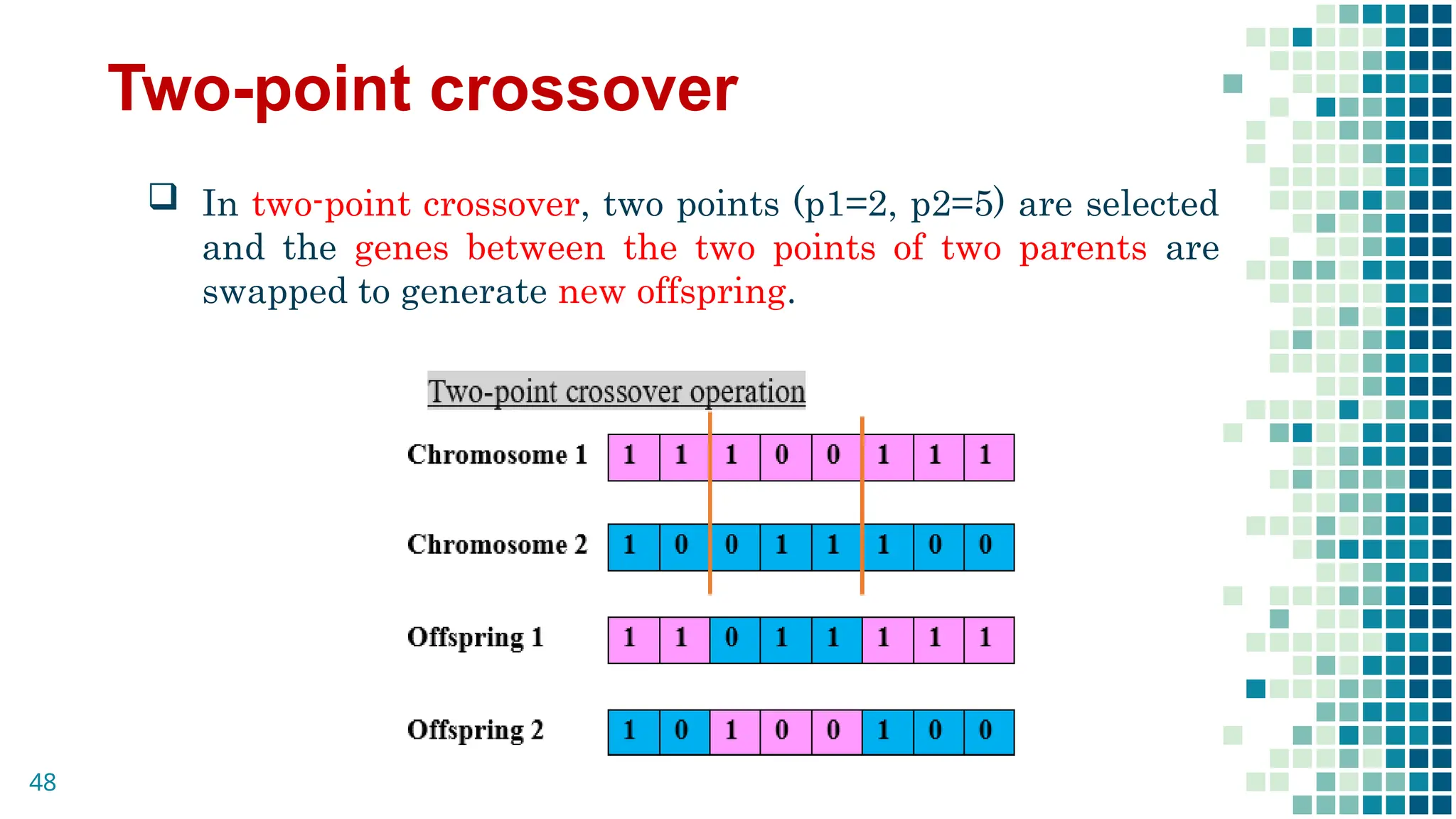
Two-point crossover
 In two-point crossover, two points (p1=2, p2=5) are selected
and the genes between the two points of two parents are
swapped to generate new offspring.
48
Uniform crossover
 In a uniform crossover, if a random number (r) is less than a
uniform probability (0.5), The new offspring is generated by
taking the genes from the first parent, otherwise, the genes
are taken from the second parent.
49
Mutation operation
 Mutation is a process in which the genes of one
chromosome are modified to generate a new chromosome.
 The GA has a mutation probability that determines if
mutation will happen.
 In bit-flip mutation one or more random bits are selected
to be flipped (01 or 10). This is used for binary
encoded GAs.
 In swap mutation, we select two positions on the
chromosome at random, and interchange the values. This
is common in permutation encoding.
50
Mutation operation
 Scramble mutation is also popular with permutation
representations. From the entire chromosome, a subset of
genes is chosen, and their values are scrambled or shuffled
randomly.
 In inversion mutation, we select a subset of genes like in
scramble mutation, but instead of shuffling the subset, we
invert the subset.
51
Genetic algorithm
52
53
Genetic algorithm (cont.)
Example
▪ Use GA to optimize the value of x:
54
Using single-point crossover (Pc = 0.8) and a bit-flip mutation
(Pm = 0.03). Population size(N)=6.
1. Generate a population of N random chromosomes. Each
chromosome has a length of 6.
‫قيمة‬ ‫اكبر‬ ‫معرفة‬ ‫هي‬ ‫بت؟‬ ‫كم‬ ‫في‬ ‫العدد‬ ‫تمثيل‬ ‫الختيار‬ ‫طريقة‬ ‫افضل‬
‫وهنا‬ ‫للعدد‬ ‫ممكنة‬
١٦
١٦
‫بت‬ ‫خمسة‬ ‫في‬ ‫فعليا‬ ‫تمثل‬ .
‫كيفية‬ ‫تعلم‬ ‫بهدف‬ ‫المتغير‬ ‫قيمة‬ ‫لتمثيل‬ ‫بت‬ ‫ستة‬ ‫استخدام‬ ‫تم‬ ‫هنا‬ ‫ولكن‬
‫تتخطي‬ ‫والتي‬ ‫المتغير‬ ‫قيم‬ ‫مع‬ ‫التعامل‬
١٦ .
‫البحث‬ ‫منطقة‬ ‫حجم‬ ‫سيزداد‬ ‫فبالتالي‬ ‫للمتغير‬ ‫الممثلة‬ ‫البتات‬ ‫عدد‬ ‫زاد‬ ‫اذا‬
‫الحل‬ ‫عن‬.
55
No. Initial
populat
ion
1 100101
2 011010
3 010110
4 111010
5 101100
6 001101
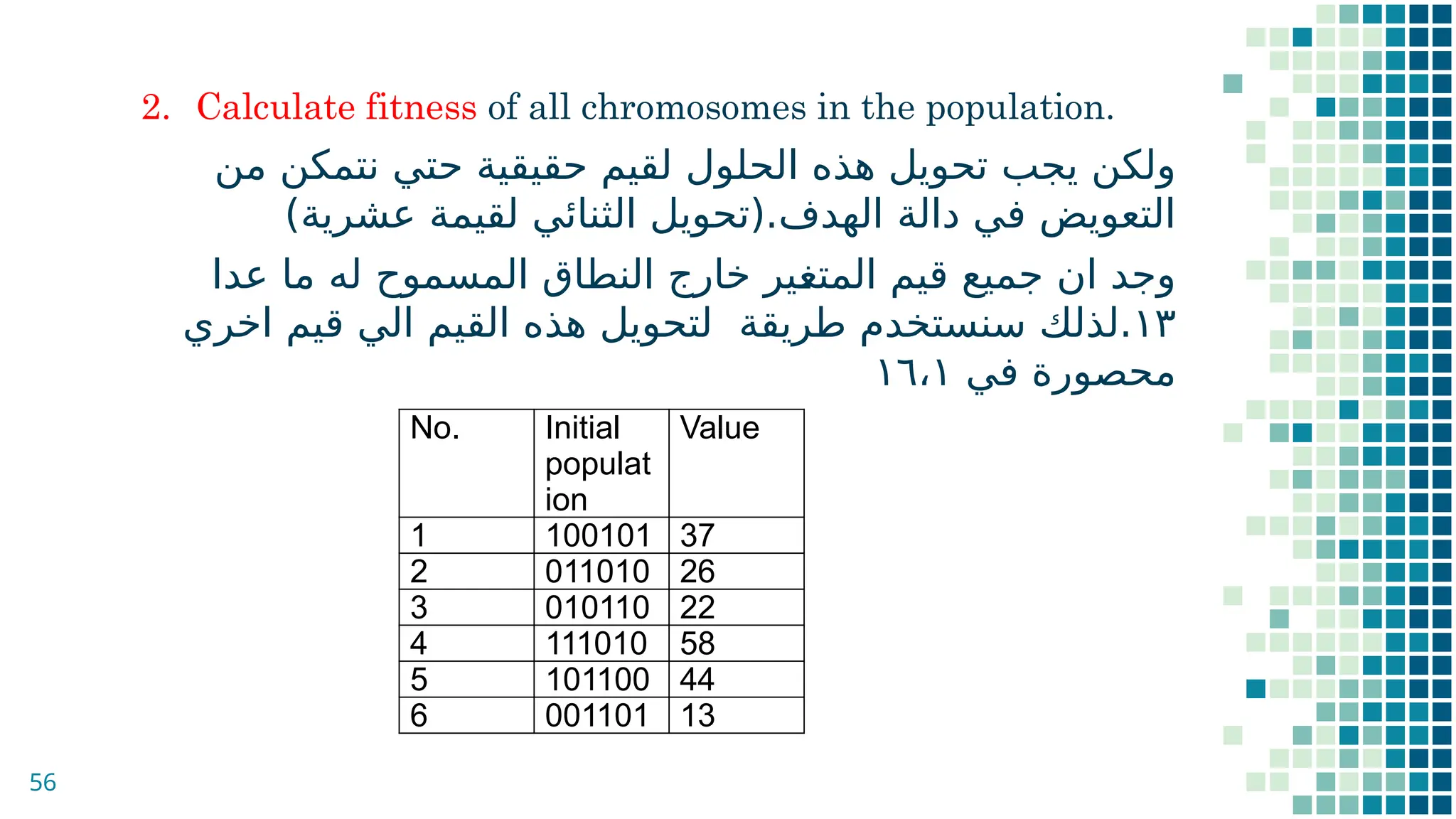
2. Calculate fitness of all chromosomes in the population.
‫من‬ ‫نتمكن‬ ‫حتي‬ ‫حقيقية‬ ‫لقيم‬ ‫الحلول‬ ‫هذه‬ ‫تحويل‬ ‫يجب‬ ‫ولكن‬
)‫عشرية‬ ‫لقيمة‬ ‫الثنائي‬ ‫(تحويل‬.‫الهدف‬ ‫دالة‬ ‫في‬ ‫التعويض‬
‫عدا‬ ‫ما‬ ‫له‬ ‫المسموح‬ ‫النطاق‬ ‫خارج‬ ‫ير‬M
‫غ‬‫المت‬ ‫قيم‬ ‫جميع‬ ‫ان‬ ‫وجد‬
١٣
‫اخري‬ ‫قيم‬ ‫الي‬ ‫القيم‬ ‫هذه‬ ‫لتحويل‬ ‫طريقة‬ ‫سنستخدم‬ ‫لذلك‬.
‫في‬ ‫محصورة‬
١٦،١
56
No. Initial
populat
ion
Value
1 100101 37
2 011010 26
3 010110 22
4 111010 58
5 101100 44
6 001101 13
▪ Mapping the real-valued numbers into real-valued in
range [1-16] using the linear mapping rule:
▪ L is number of bits
▪ D is the decoded value.
▪ 6
Then
▪ x1=1+=9.81
▪ x2=1+=7.19
57
58
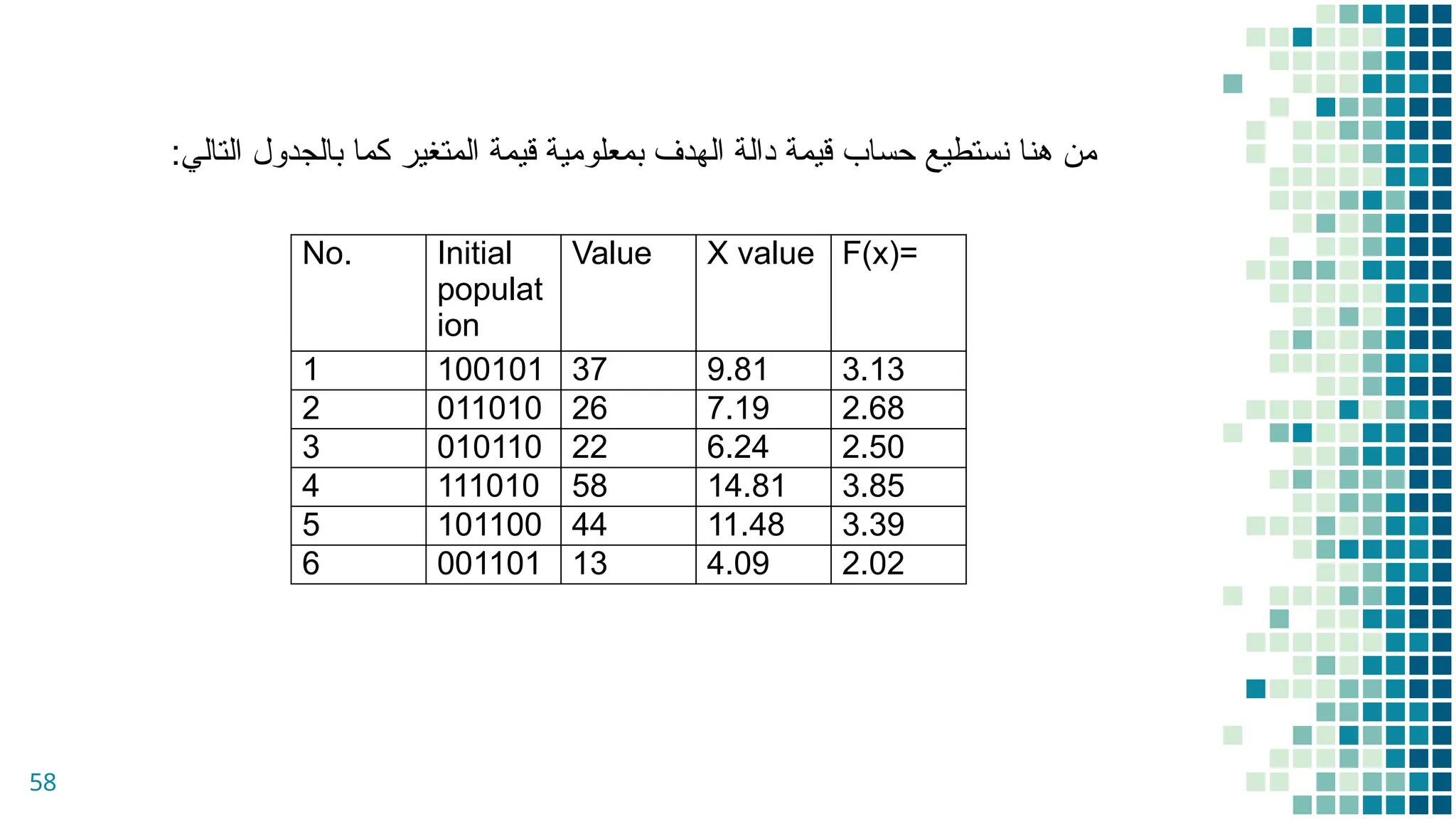
:‫التالي‬ ‫بالجدول‬ ‫كما‬ ‫المتغير‬ ‫قيمة‬ ‫بمعلومية‬ ‫الهدف‬ ‫دالة‬ ‫قيمة‬ ‫حساب‬ ‫نستطيع‬ ‫هنا‬ ‫من‬
No. Initial
populat
ion
Value X value F(x)=
1 100101 37 9.81 3.13
2 011010 26 7.19 2.68
3 010110 22 6.24 2.50
4 111010 58 14.81 3.85
5 101100 44 11.48 3.39
6 001101 13 4.09 2.02
59
3
.
Use a selection operator (Roulette wheel selection) to select the
parents for crossover
-‫للعينة‬ ‫العينة‬ ‫آلفراد‬ ‫للفتنيس‬ ‫الكلي‬ ‫المجموع‬ ‫علي‬ ‫مقسوما‬ ‫الفتنيس‬ ‫قيمة‬ ‫بحساب‬ ‫أوال‬ ‫نبدآ‬.
- ‫التراكمي‬ ‫االحتماالت‬ ‫مجموع‬ ‫نحسب‬.
No. Initial
populat
ion
Value X value F(x)= pf Cpf
1 100101 37 9.81 3.13 0.18 0.18
2 011010 26 7.19 2.68 0.15 0.33
3 010110 22 6.24 2.50 0.14 0.47
4 111010 58 14.81 3.85 0.22 0.69
5 101100 44 11.48 3.39 0.19 0.88
6 001101 13 4.09 2.02 0.12 1
Sum=1
7.57
Sum=1
60
3
.
Use a selection operator (Roulette wheel selection) to select the
parents for crossover
-‫للعينة‬ ‫العينة‬ ‫آلفراد‬ ‫للفتنيس‬ ‫الكلي‬ ‫المجموع‬ ‫علي‬ ‫مقسوما‬ ‫الفتنيس‬ ‫قيمة‬ ‫بحساب‬ ‫أوال‬ ‫نبدآ‬.
- ‫التراكمي‬ ‫االحتماالت‬ ‫مجموع‬ ‫نحسب‬.
No. Initial
populat
ion
Value X value F(x)= pf Cpf
1 100101 37 9.81 3.13 0.18 0.18
2 011010 26 7.19 2.68 0.15 0.33
3 010110 22 6.24 2.50 0.14 0.47
4 111010 58 14.81 3.85 0.22 0.69
5 101100 44 11.48 3.39 0.19 0.88
6 001101 13 4.09 2.02 0.12 1
Sum=1
7.57
Sum=1
61
No. Initial
population
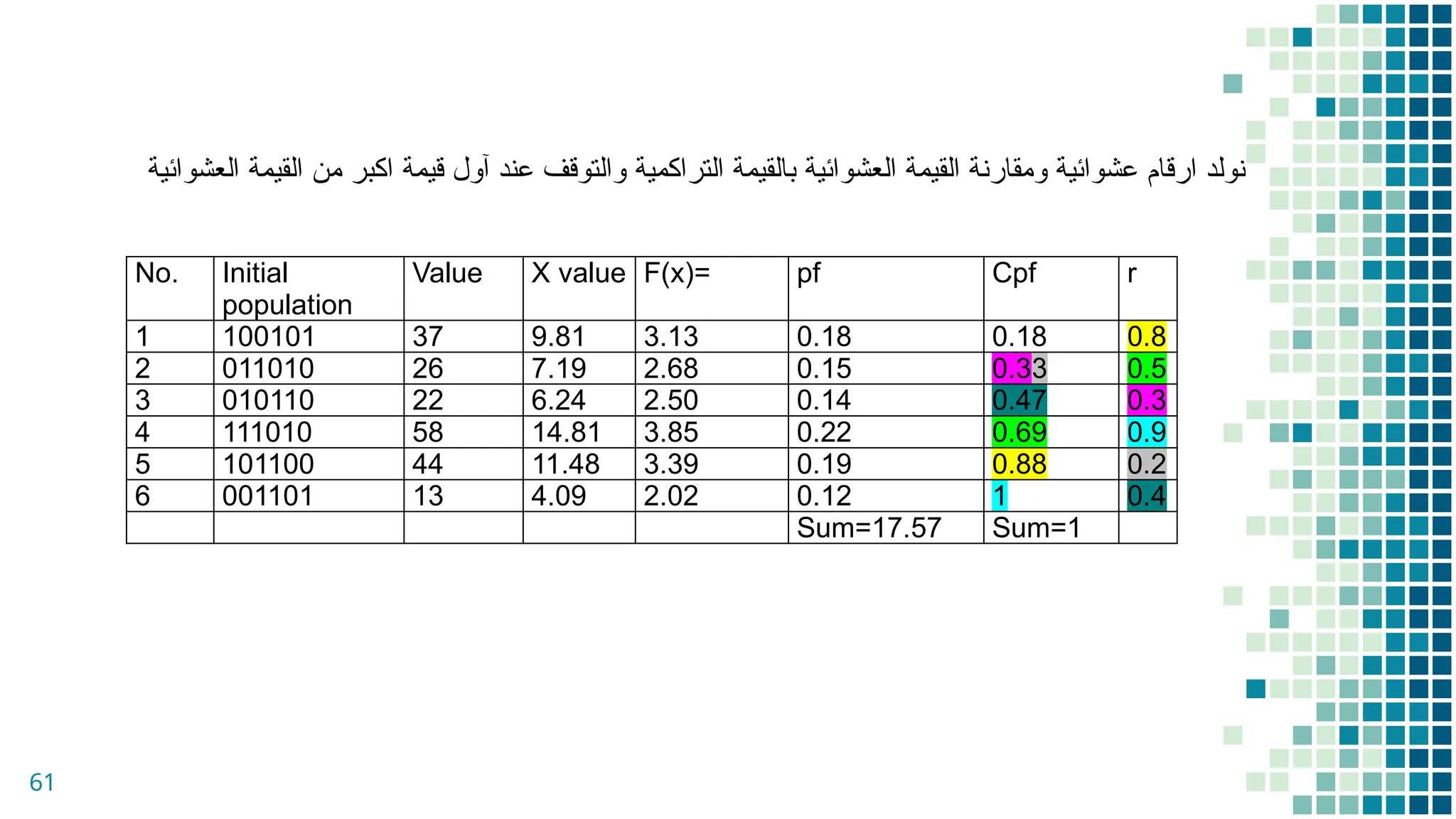
Value X value F(x)= pf Cpf r
1 100101 37 9.81 3.13 0.18 0.18 0.8
2 011010 26 7.19 2.68 0.15 0.33 0.5
3 010110 22 6.24 2.50 0.14 0.47 0.3
4 111010 58 14.81 3.85 0.22 0.69 0.9
5 101100 44 11.48 3.39 0.19 0.88 0.2
6 001101 13 4.09 2.02 0.12 1 0.4
Sum=17.57 Sum=1
‫العشوائية‬ ‫القيمة‬ ‫من‬ ‫اكبر‬ ‫قيمة‬ ‫آول‬ ‫عند‬ ‫والتوقف‬ ‫التراكمية‬ ‫بالقيمة‬ ‫العشوائية‬ ‫القيمة‬ ‫ومقارنة‬ ‫عشوائية‬ ‫ارقام‬ ‫نولد‬
62
One point crossover and bit-flip mutation will be performed on
No. Parents r(<pc)? Perform
crossover
Perform
mutatio
n
r<pm? First generation
5 10|1100 0.4 yes 101010 101010 0.023
yes
101010
4 11|1010 111100 111100 111100
2 011|010 0.8 no 011010 010010 011010
1 100|101 100101 100101 100101
2 0|11010 0.2yes 010110 010110 010110
3 0|10110 011010 011010 011010

EVOLUTION ALGORITHM ) Optimization .pptx

  • 1.
  • 2.
    Evolutionary Algorithms  Evolutionaryalgorithms (EAs) are a type of metaheuristic algorithm that are inspired by the process of natural evolution. They are used to find optimal solutions to problems that are difficult to solve using traditional methods.  EAs work by creating a population of solutions, and then iteratively improving those solutions over time. Each solution in the population is represented as a chromosome, which is a string of genes. The genes in the chromosome represent the different parameters of the solution.
  • 3.
    EAs have beenused to solve a wide variety of problems, including: * Optimization problems * Machine learning problems * Engineering design problems * Financial planning problems * Natural language processing problems * Computer vision problems
  • 4.
  • 5.
    Optimization  Optimization isthe process of finding the best solution out of all feasible solutions.  The aim of optimization is to find an algorithm which solves a given class of problems.  There exists no specific method which solves effectively all optimization problems (No free launch theorems). 5
  • 6.
    Classification of optimization problems 1.Depending on the nature of equations involved in the objective function and constraints:  Linear optimization problem  Non-linear optimization problem 6
  • 7.
    Linear optimization problem An optimization problem is called linear, if both the objective function as well as all the constraints are found to be linear functions of design variables. Maximize: y = f(x1, x2) = 2x1 + x2 -> objetive function subject to: x1 + x2 ≤ 3, -> constraint 5x1 + 2x2 ≤ 10. and x1, x2 ≥ 0. ->bounds of a variable 7
  • 8.
    Non-linear optimization problem An optimization problem is called non-linear, if any one or both of the objective function and the constraints are found to be non-linear functions of design variables. Maximize: y = f(x1, x2) =+ subject to: + ≤ 629, + ≤ 133, and x1, x2 ≥ 0. 8
  • 9.
    Classification of optimizationproblems (cont.) 2. Based on the existence of any functional constraint:  Un constrained optimization problem.  Constrained optimization problem. 9
  • 10.
    Un constrained vsconstrained optimization problem  The unconstrained optimization problem does not contain any functional constraints, such as: Minimize: y = f(x1, x2) = + and x1, x2 ≥ 0.  The constrained optimization problem contains at least one functional constraint, such as: Minimize: y = f(x1, x2) = + Subject to: x1 5 x2 < 50. and x1, x2 ≥ 0. 10
  • 11.
    Classification of optimizationproblems (cont.) 3. Depending on the type of design variables:  Integer programming optimization problem.  Real-valued programming optimization problem.  Mixed integer programming optimization problem. 11
  • 12.
    Integer programming problem An optimization problem is said to be an integer programming problem, if all the design variables take only integer values. Maximize y = f(x1, x2) = 2x1 + x2 subject to x1 + x2 ≤ 3, 5x1 + 2x2 ≤ 9. and x1, x2 ≥ 0, x1, x2 are integers. 12
  • 13.
    Real-valued programming problem An optimization problem is said to be real-valued programming problem, if all the design variables take only real values. Maximize y = f(x1, x2) = 2x1 + x2 subject to x1 + x2 ≤ 3.2, 5x1 + 2x2 ≤ 9.5. and x1, x2 ≥ 0.0, x1, x2 are real values. 13
  • 14.
    Mixed programming problem An optimization problem is said to be an mixed programming problem, if some of the design variables take integer values and the remaining design variables take real values. Maximize y = f(x1, x2) = 2x1 + x2 subject to x1 + x2 ≤ 3.2, 5x1 + 2x2 ≤ 9.5. and X1>3, x2 ≥ 0.0, x1 is integer and x2 real values. 14
  • 15.
    Single objective vsmulti-objective optimization problem 4. Depending on the number of objective functions:  Single optimization problem.  Multi-objective optimization problem.  Single optimization problem is a problem that contains only one objective function to be optimized (maximized or minimized).  Multi-objective optimization problem is a problem that has a set or vector of conflicting objective functions to be optimized. 15
  • 16.
    Combinatorial vs continuous optimizationproblem ▪ Combinatorial or discrete optimization problem is an optimization problem in which its design variables takes discrete values. ▪ Continuous optimization problem is an optimization problem in which its design variables takes continuous values. 16
  • 17.
    Optimization methods 1. Exactmethod  Advantage: it can guarantee to find the accurate and optimal solution, such as dynamic programming, branch- and-bound, and integer linear programming.  Disadvantage: in the worst case, if the problem size is increased, the time complexity would be increased exponentially.  It is suitable for small- scale optimization problems. 2. Approximate method  It can not guarantee to find the accurate solution.  It obtains approximate solutions in an acceptable and reasonable time.  It is suitable for large-scale optimization problems. 17
  • 18.
    Heuristic method  Itis an approximate method designed to solve quickly the problem, while scarifying the exact solution.  They are often problem-dependent, that is, you define a heuristic for a given problem.  The quality of solution depends on the initial starting points. 18
  • 19.
    Metaheuristic algorithm  Metaheuristicsare approximate methods that can not guarantee the exact and optimal solutions.  They are problem-independent techniques that can be applied to a broad range of problems.  For example, genetic algorithm and particle swarm algorithms are metaheuristic algorithms. 19
  • 20.
  • 21.
    Evolutionary computation  Evolutionarycomputation is a soft computing direction that starts by transferring the ideas of biological evolutionary theory into computer science to solve problems.  Charles Darwin has formulated the fundamental principle of natural selection as the main evolutionary tool.  Combination of Darwin’s and Mendel’s ideas lead to the modern evolutionary theory. 21
  • 22.
    Darwinian’s principle  Thereare entities called individuals which form a population.  These entities can reproduce or can be reproduced.  There is heredity in reproduction, such that individuals produce similar offspring.  In the course of reproduction, there is variety which affects the likelihood of survival.  There are finite resources which cause the individuals to compete. Not all can survive the struggle for existence. Differential natural selections will exert a continuous pressure towards improved individuals. 22
  • 23.
    Evolutionary computation (cont.) The main paradigms serving as the basis of the evolutionary computation:  Genetic Algorithm (GA) by Holland in 1975.  Genetic Programming (GP) by Koza in 1992-1994.  Evolutionary Strategies (ES) by Recheuberg in1973.  Evolutionary Programming (EP) by Forgelet al. in 1966.  These paradigms use mechanisms that are based in biological evolution, such as reproduction and mutation.  The basic differences between the paradigms lie in the nature of the representation schemes, the reproduction operators and selection methods.  They are population-based heuristic optimization algorithms. 23
  • 24.
  • 25.
    Outlines  Biological background Genetic algorithm  Advantages of GA  Search space  Fitness function  Representation schemes  Initialization  Termination criteria of GA  Fitness function  Selection operators: random selection, roulette wheel selection, tournament selection, elitism selection  Genetic operators  Crossover operations: one-point crossover, two-point crossover, uniform crossover  Mutation operation: bit-flip, scramble, inversion, swap  Solved example using GA step by step. 25
  • 26.
    Biological background  Thecell is the smallest structure and functional unit of the organism.  In the center of the cell, we have nucleus which contains genome containing 23 pair of chromosomes.  The chromosome is made of DNA. DNA is made of many genes. a gene is a short section of DNA.  DNA has a twisted structure in the shape of a double helix. 26
  • 27.
    Biological background  Phenotypeis the physical appearance of an organism because of its genetic makeup (genotype).  Genotype is the genetic code of an organism.  The genotype determines the phenotype. 27
  • 28.
    Genetic algorithm  Geneticalgorithm (GA) is a population-based probabilistic search and optimization technique, which works based on the mechanism of genetics and Darwin’s principle of natural selection.  The GA was introduced by Prof. John Holland of the University of Michigan, in 1965, although his seminal book was published in 1975. 28
  • 29.
    Genetic algorithm(cont.) 29 Nature Geneticalgorithm Environment Optimization problem Individual living in this environment Feasible solutions Individual degree of adaption to its surrounding environment Solution quality (fitness function) A population of organisms A set of feasible solutions Selection, recombination, mutation in nature’s evolutionary process Selection methods, crossover operator, mutation operator Evolution of populations to suit their environment Iteratively applying a set of genetic operators on a set of feasible solutions
  • 30.
    Genetic algorithm  Initializea population with a random candidate chromosomes.  Repeat until termination criteria  Evaluate all chromosomes with a fitness function.  Select parents using one of selection methods.  Perform crossover operation with a probability Pc.  Perform mutation operation with a probability pm.  Replace the new population with the current population.  End termination criteria.  Return the best individual in the population. 30 Pseudocode of GA
  • 31.
    Advantages of GA It is easy to understand.  It deals with complex real-world problems that the hard computing techniques failed to solve.  It is modular, separate from application.  It is good for imprecise and noisy environments.  It supports multi-objective optimization.  It is easily distributed and parallelized. 31
  • 32.
    Search space  Thesearch space is the space that contains all the feasible solutions for a given problem.  Every point in the search space represents one possible solution.  GA seeks to search the search space for finding the best solution. 32
  • 33.
    Representation schemes  Parametersof the solution (genes) are concatenated to form a string (chromosome).  Encoding is a data structure for representing candidate solutions.  Good encoding scheme may affect the performance of a GA.  Some genetic encoding schemes are:  Binary-encoding Simple GA or binary-coded GA  Real-valued encoding  real-valued GA  Permutation encoding 33 Permutation encoding Binary encoding Real-valued encoding 1 0 1 1 1.2 0.8 6.7 1.9 1 4 3 2
  • 34.
    Initialization  In thisstep, a population of N random individuals/ chromosomes are generated. N is the population size (here, N=6). G1 G2 G3 G4 Chromosome 1 Chromosome 2 Chromosome 3 Chromosome 4 Chromosome 5 Chromosome 6 34
  • 35.
    Termination criteria ofGA  The termination criteria can be:  Specified number of generations.  Specified number of fitness evaluations.  A minimum threshold reached.  No improvement in the best solutions for a specified number of generations.  Memory/time constraints.  Combinations of above 35
  • 36.
    Fitness function  Afitness function is function which takes the solution as input and produces the suitability of the solution as the output.  It measures how good is a solution.  In some cases, the fitness function and the objective function may be the same, while in others it might be different based on the problem. 36
  • 37.
    Selection operators  Allthe candidate solutions or individuals contained in the population may not be equally good in terms of their fitness values calculated.  Selection operators are used to select the good ones from the population of strings based on their fitness information.  Several selection operators have been developed:  Random selection  Proportionate selection/Roulette-wheel selection  Tournament selection  Elitism selection. 37
  • 38.
    Selective pressure  Eachselection operator is characterized by its selective pressure.  A selection operator with a high selective pressure decreases the diversity in population more rapidly than a selection operator with a low selective pressure.  High selective pressure limits the exploration abilities of the population. 38
  • 39.
    Random selection  Randomselection is the simplest selection operator.  Each individual has the same probability of 1/N to be selected. N is the population size.  No fitness information is used, which means that the best and the worst have exactly the same probability of surviving to the next generations.  It has the lowest selective pressure among the selection operators. 39
  • 40.
    Roulette-wheel selection  Inthis operator, the probability of a chromosome for being selected is proportional to its fitness.  It is implemented with the help of roulette wheel.  I works as follows: 1. Calculate fitness of each chromosome ( ). 2. Divide the individual fitness by the whole population fitness as follows: , 3. N is the population size. is the proportional fitness of an individual i. 4. Compute the cumulative proportional fitness of each individual ( ). 40 1 ( ) ( ) ( ) i i N i i f x pf x f x    1,..., i N  ( ) i pf x ( ) i f x ( ) i cpf x
  • 41.
    Roulette-wheel selection (cont.) 5.Generate a random number (r) belonging to [0,1]. 6. If , then select the i individual. 41 ( ) i cpf x  Because this selection is directly proportional to its fitness, it is possible that strong individuals may dominate in producing offspring, thereby limiting the diversity of the population.  In other words, it has a high selective pressure.
  • 42.
  • 43.
    Elitism selection  Elitismrefers to the process of ensuring that the best individuals of the current population survive to the next generation.  The best individuals are copied to the new population.  The more individuals that survive to the next generation, the less the diversity of the new population. 43
  • 44.
    Tournament selection  Itselects randomly k individuals, where k is the size of tournament group.  Then, the best individual is selected among the selected k individuals. 44
  • 45.
    Genetic operators  Crossoveroperation 1. One-point crossover operation 2. Two-point crossover operation. 3. Uniform crossover operation.  Mutation operation 1. Bit-flip mutation 2. Swap mutation. 3. Inversion mutation 4. Scramble mutation 45
  • 46.
    Crossover operation  Inbiology, the most common form of recombination is crossover.  Crossover is a process in which two parent solutions/chromosomes are used to produce two new offspring by replacing genes between the two parents.  The GA has a crossover probability that determines if crossover will happen. 46
  • 47.
    one-point crossover  Inone-point crossover, a crossover point (p=2) is selected and the tails of its two parents are swapped to generate new offspring. 47
  • 48.
    Two-point crossover  Intwo-point crossover, two points (p1=2, p2=5) are selected and the genes between the two points of two parents are swapped to generate new offspring. 48
  • 49.
    Uniform crossover  Ina uniform crossover, if a random number (r) is less than a uniform probability (0.5), The new offspring is generated by taking the genes from the first parent, otherwise, the genes are taken from the second parent. 49
  • 50.
    Mutation operation  Mutationis a process in which the genes of one chromosome are modified to generate a new chromosome.  The GA has a mutation probability that determines if mutation will happen.  In bit-flip mutation one or more random bits are selected to be flipped (01 or 10). This is used for binary encoded GAs.  In swap mutation, we select two positions on the chromosome at random, and interchange the values. This is common in permutation encoding. 50
  • 51.
    Mutation operation  Scramblemutation is also popular with permutation representations. From the entire chromosome, a subset of genes is chosen, and their values are scrambled or shuffled randomly.  In inversion mutation, we select a subset of genes like in scramble mutation, but instead of shuffling the subset, we invert the subset. 51
  • 52.
  • 53.
  • 54.
    Example ▪ Use GAto optimize the value of x: 54 Using single-point crossover (Pc = 0.8) and a bit-flip mutation (Pm = 0.03). Population size(N)=6.
  • 55.
    1. Generate apopulation of N random chromosomes. Each chromosome has a length of 6. ‫قيمة‬ ‫اكبر‬ ‫معرفة‬ ‫هي‬ ‫بت؟‬ ‫كم‬ ‫في‬ ‫العدد‬ ‫تمثيل‬ ‫الختيار‬ ‫طريقة‬ ‫افضل‬ ‫وهنا‬ ‫للعدد‬ ‫ممكنة‬ ١٦ ١٦ ‫بت‬ ‫خمسة‬ ‫في‬ ‫فعليا‬ ‫تمثل‬ . ‫كيفية‬ ‫تعلم‬ ‫بهدف‬ ‫المتغير‬ ‫قيمة‬ ‫لتمثيل‬ ‫بت‬ ‫ستة‬ ‫استخدام‬ ‫تم‬ ‫هنا‬ ‫ولكن‬ ‫تتخطي‬ ‫والتي‬ ‫المتغير‬ ‫قيم‬ ‫مع‬ ‫التعامل‬ ١٦ . ‫البحث‬ ‫منطقة‬ ‫حجم‬ ‫سيزداد‬ ‫فبالتالي‬ ‫للمتغير‬ ‫الممثلة‬ ‫البتات‬ ‫عدد‬ ‫زاد‬ ‫اذا‬ ‫الحل‬ ‫عن‬. 55 No. Initial populat ion 1 100101 2 011010 3 010110 4 111010 5 101100 6 001101
  • 56.
    2. Calculate fitnessof all chromosomes in the population. ‫من‬ ‫نتمكن‬ ‫حتي‬ ‫حقيقية‬ ‫لقيم‬ ‫الحلول‬ ‫هذه‬ ‫تحويل‬ ‫يجب‬ ‫ولكن‬ )‫عشرية‬ ‫لقيمة‬ ‫الثنائي‬ ‫(تحويل‬.‫الهدف‬ ‫دالة‬ ‫في‬ ‫التعويض‬ ‫عدا‬ ‫ما‬ ‫له‬ ‫المسموح‬ ‫النطاق‬ ‫خارج‬ ‫ير‬M ‫غ‬‫المت‬ ‫قيم‬ ‫جميع‬ ‫ان‬ ‫وجد‬ ١٣ ‫اخري‬ ‫قيم‬ ‫الي‬ ‫القيم‬ ‫هذه‬ ‫لتحويل‬ ‫طريقة‬ ‫سنستخدم‬ ‫لذلك‬. ‫في‬ ‫محصورة‬ ١٦،١ 56 No. Initial populat ion Value 1 100101 37 2 011010 26 3 010110 22 4 111010 58 5 101100 44 6 001101 13
  • 57.
    ▪ Mapping thereal-valued numbers into real-valued in range [1-16] using the linear mapping rule: ▪ L is number of bits ▪ D is the decoded value. ▪ 6 Then ▪ x1=1+=9.81 ▪ x2=1+=7.19 57
  • 58.
    58 :‫التالي‬ ‫بالجدول‬ ‫كما‬‫المتغير‬ ‫قيمة‬ ‫بمعلومية‬ ‫الهدف‬ ‫دالة‬ ‫قيمة‬ ‫حساب‬ ‫نستطيع‬ ‫هنا‬ ‫من‬ No. Initial populat ion Value X value F(x)= 1 100101 37 9.81 3.13 2 011010 26 7.19 2.68 3 010110 22 6.24 2.50 4 111010 58 14.81 3.85 5 101100 44 11.48 3.39 6 001101 13 4.09 2.02
  • 59.
    59 3 . Use a selectionoperator (Roulette wheel selection) to select the parents for crossover -‫للعينة‬ ‫العينة‬ ‫آلفراد‬ ‫للفتنيس‬ ‫الكلي‬ ‫المجموع‬ ‫علي‬ ‫مقسوما‬ ‫الفتنيس‬ ‫قيمة‬ ‫بحساب‬ ‫أوال‬ ‫نبدآ‬. - ‫التراكمي‬ ‫االحتماالت‬ ‫مجموع‬ ‫نحسب‬. No. Initial populat ion Value X value F(x)= pf Cpf 1 100101 37 9.81 3.13 0.18 0.18 2 011010 26 7.19 2.68 0.15 0.33 3 010110 22 6.24 2.50 0.14 0.47 4 111010 58 14.81 3.85 0.22 0.69 5 101100 44 11.48 3.39 0.19 0.88 6 001101 13 4.09 2.02 0.12 1 Sum=1 7.57 Sum=1
  • 60.
    60 3 . Use a selectionoperator (Roulette wheel selection) to select the parents for crossover -‫للعينة‬ ‫العينة‬ ‫آلفراد‬ ‫للفتنيس‬ ‫الكلي‬ ‫المجموع‬ ‫علي‬ ‫مقسوما‬ ‫الفتنيس‬ ‫قيمة‬ ‫بحساب‬ ‫أوال‬ ‫نبدآ‬. - ‫التراكمي‬ ‫االحتماالت‬ ‫مجموع‬ ‫نحسب‬. No. Initial populat ion Value X value F(x)= pf Cpf 1 100101 37 9.81 3.13 0.18 0.18 2 011010 26 7.19 2.68 0.15 0.33 3 010110 22 6.24 2.50 0.14 0.47 4 111010 58 14.81 3.85 0.22 0.69 5 101100 44 11.48 3.39 0.19 0.88 6 001101 13 4.09 2.02 0.12 1 Sum=1 7.57 Sum=1
  • 61.
    61 No. Initial population Value Xvalue F(x)= pf Cpf r 1 100101 37 9.81 3.13 0.18 0.18 0.8 2 011010 26 7.19 2.68 0.15 0.33 0.5 3 010110 22 6.24 2.50 0.14 0.47 0.3 4 111010 58 14.81 3.85 0.22 0.69 0.9 5 101100 44 11.48 3.39 0.19 0.88 0.2 6 001101 13 4.09 2.02 0.12 1 0.4 Sum=17.57 Sum=1 ‫العشوائية‬ ‫القيمة‬ ‫من‬ ‫اكبر‬ ‫قيمة‬ ‫آول‬ ‫عند‬ ‫والتوقف‬ ‫التراكمية‬ ‫بالقيمة‬ ‫العشوائية‬ ‫القيمة‬ ‫ومقارنة‬ ‫عشوائية‬ ‫ارقام‬ ‫نولد‬
  • 62.
    62 One point crossoverand bit-flip mutation will be performed on No. Parents r(<pc)? Perform crossover Perform mutatio n r<pm? First generation 5 10|1100 0.4 yes 101010 101010 0.023 yes 101010 4 11|1010 111100 111100 111100 2 011|010 0.8 no 011010 010010 011010 1 100|101 100101 100101 100101 2 0|11010 0.2yes 010110 010110 010110 3 0|10110 011010 011010 011010