Error Detection and Correction
Coding:
Redundancy

is achieved through various
coding Scheme.
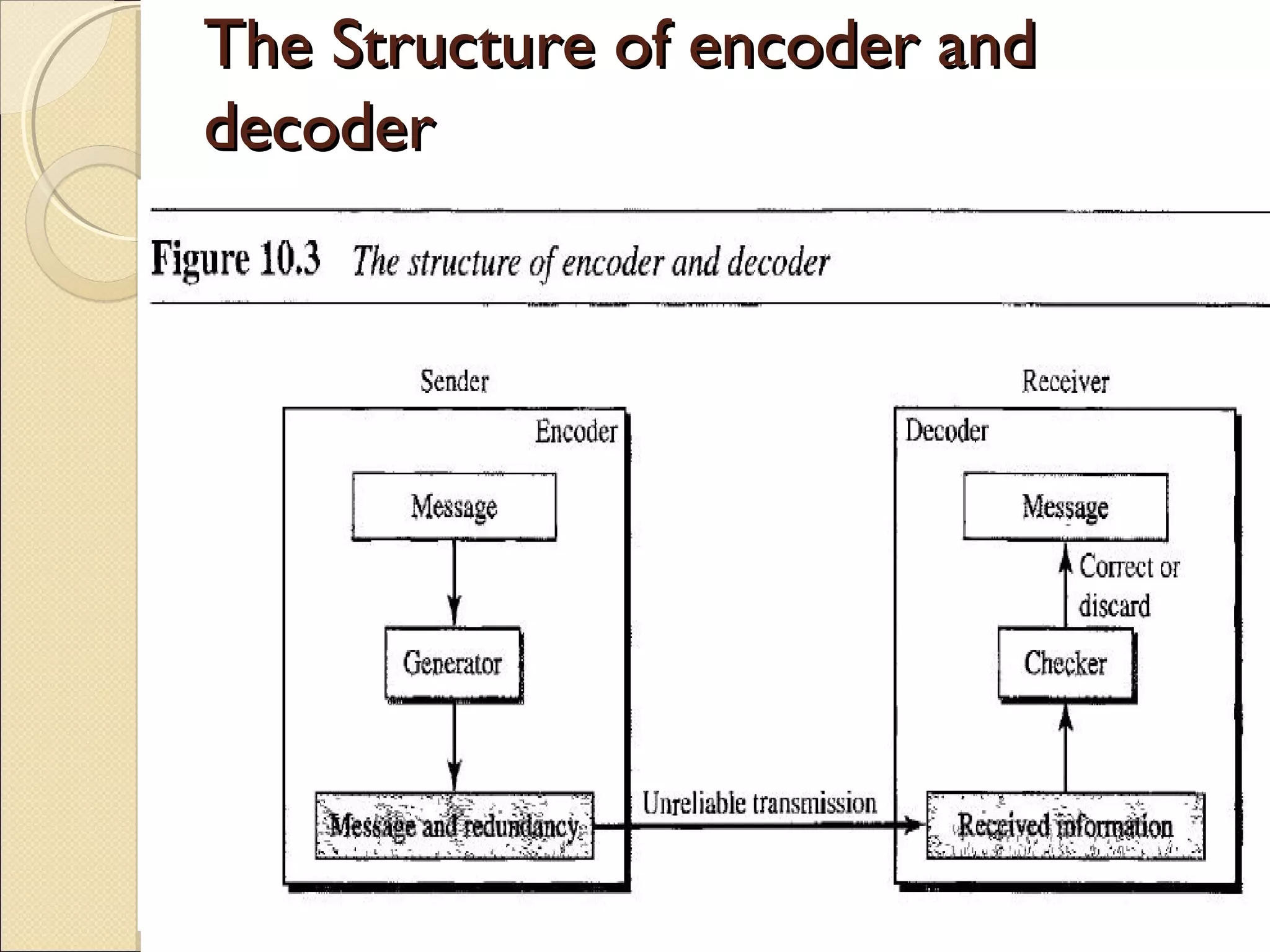
The sender adds the redundancy bit to
the original message and create
relationship.
The receiver checks the relationship b/w
two sets of bits to detect (or) correct the
errors.
Robustness of the process are important
factors in any coding scheme.
The Structure of encoder and
decoder
2 categories
Block coding
2. Convolution coding-more complex(less
use)
1.
Modular Arithmetic
Use

only limited range of integers.
We, define upper limit, called a ,modulus
N.
Then use only the integers 0 to N-1.
This is modulo-N arithmetic.
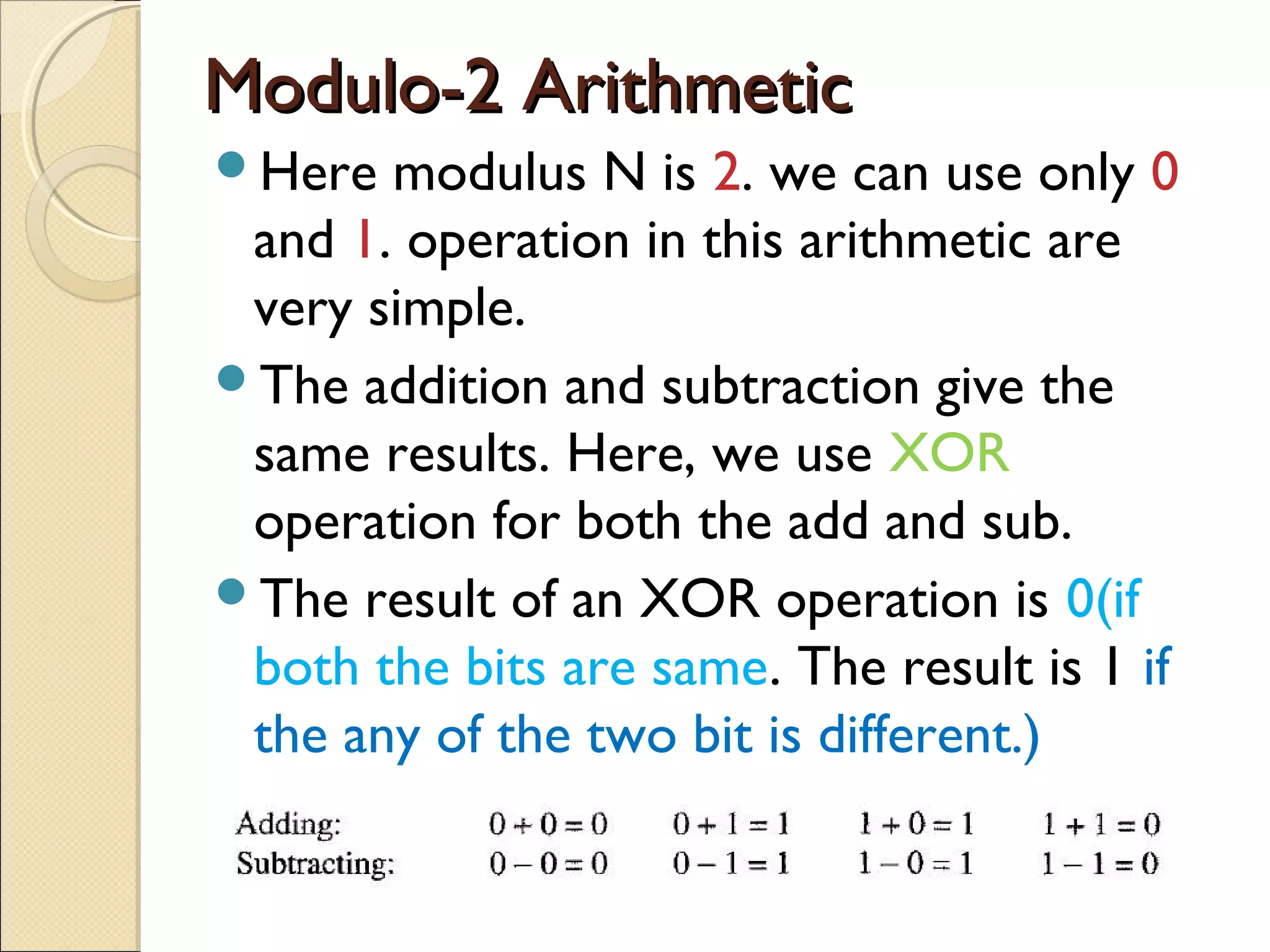
Modulo-2 Arithmetic
Here

modulus N is 2. we can use only 0
and 1. operation in this arithmetic are
very simple.
The addition and subtraction give the
same results. Here, we use XOR
operation for both the add and sub.
The result of an XOR operation is 0(if
both the bits are same. The result is 1 if
the any of the two bit is different.)
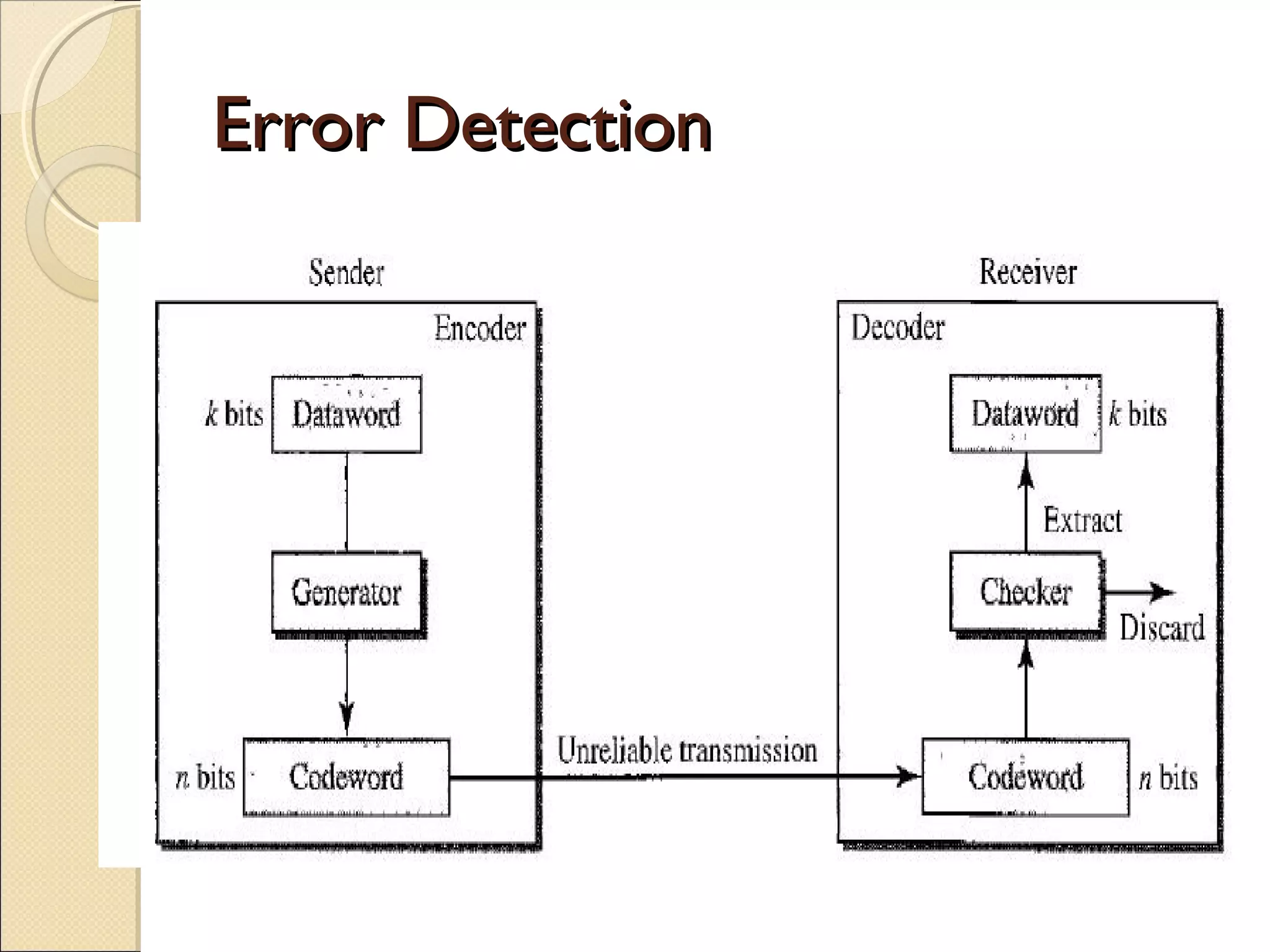
Block coding
Divide

the message into blocks, each of k
bits, called datawords. Then add r
redundant bit to make length n=k+r
The resulting n-bit blocks are called
codewords.
Error Detection
The

receiver can detect a change in the
original codeword. by
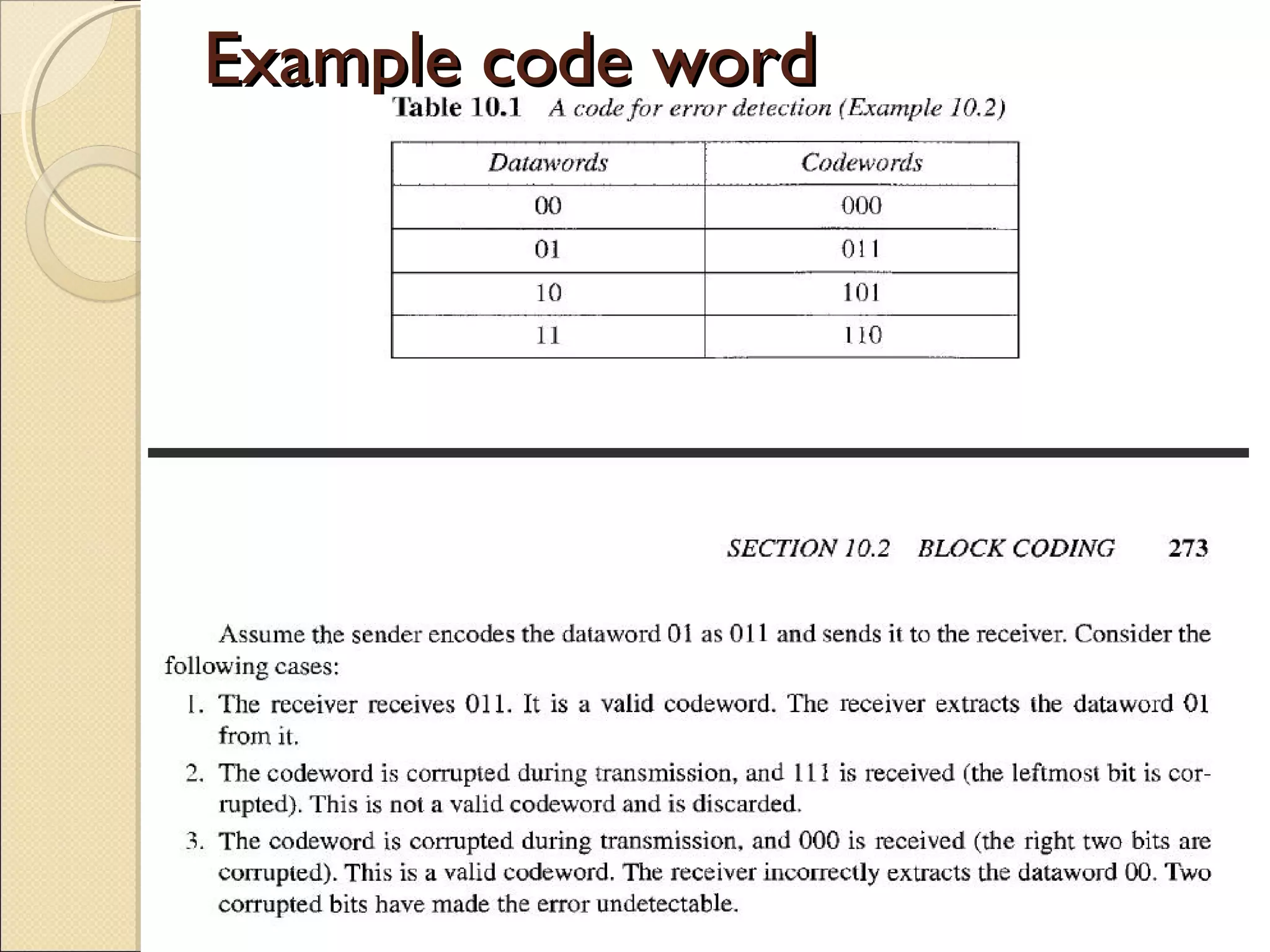
1. The receiver has a list of valid codewords.
2. The original codeword has changed to an
invalid one.
Error Detection
Example code word
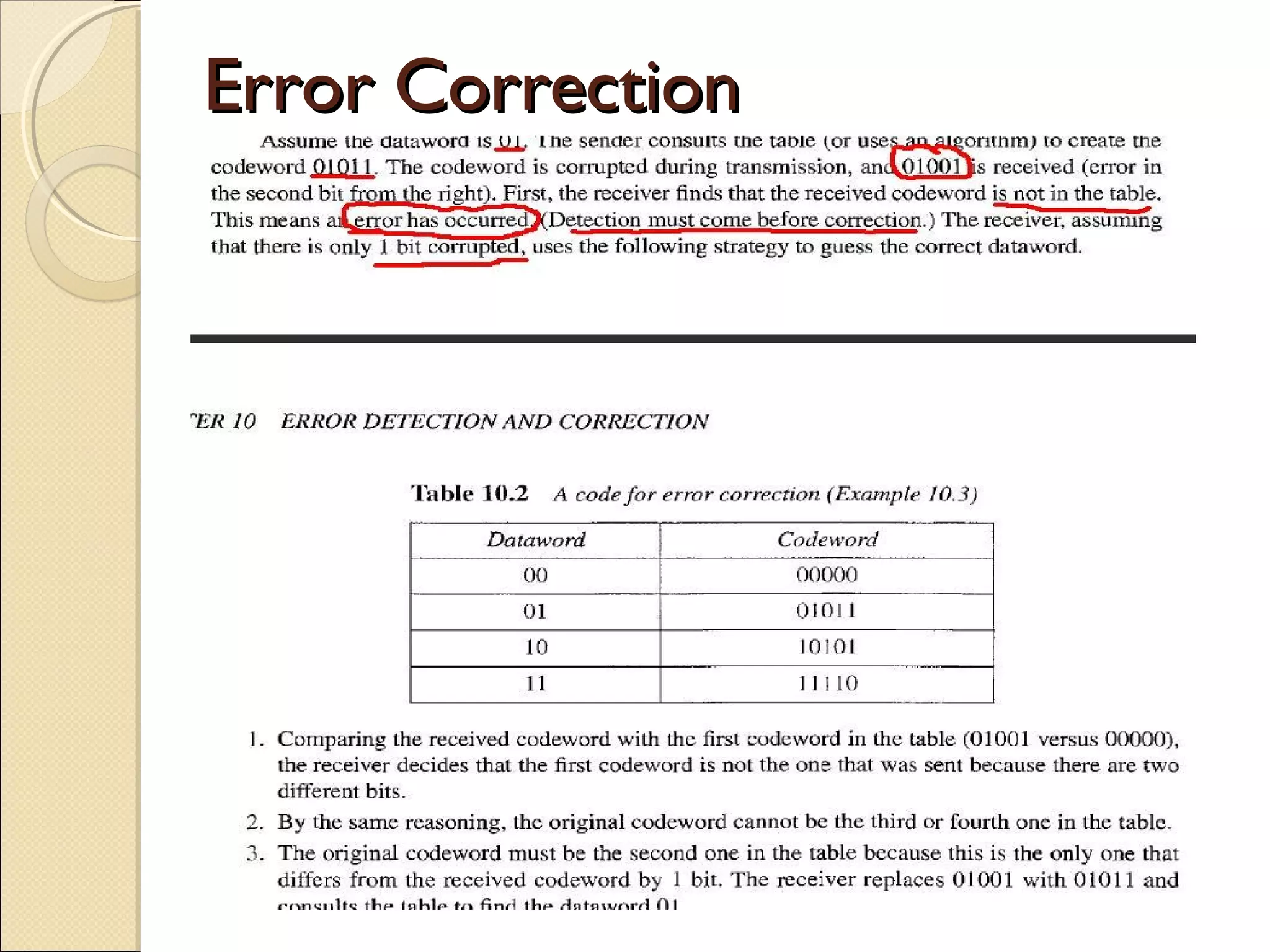
Error Correction

Error detection and correction