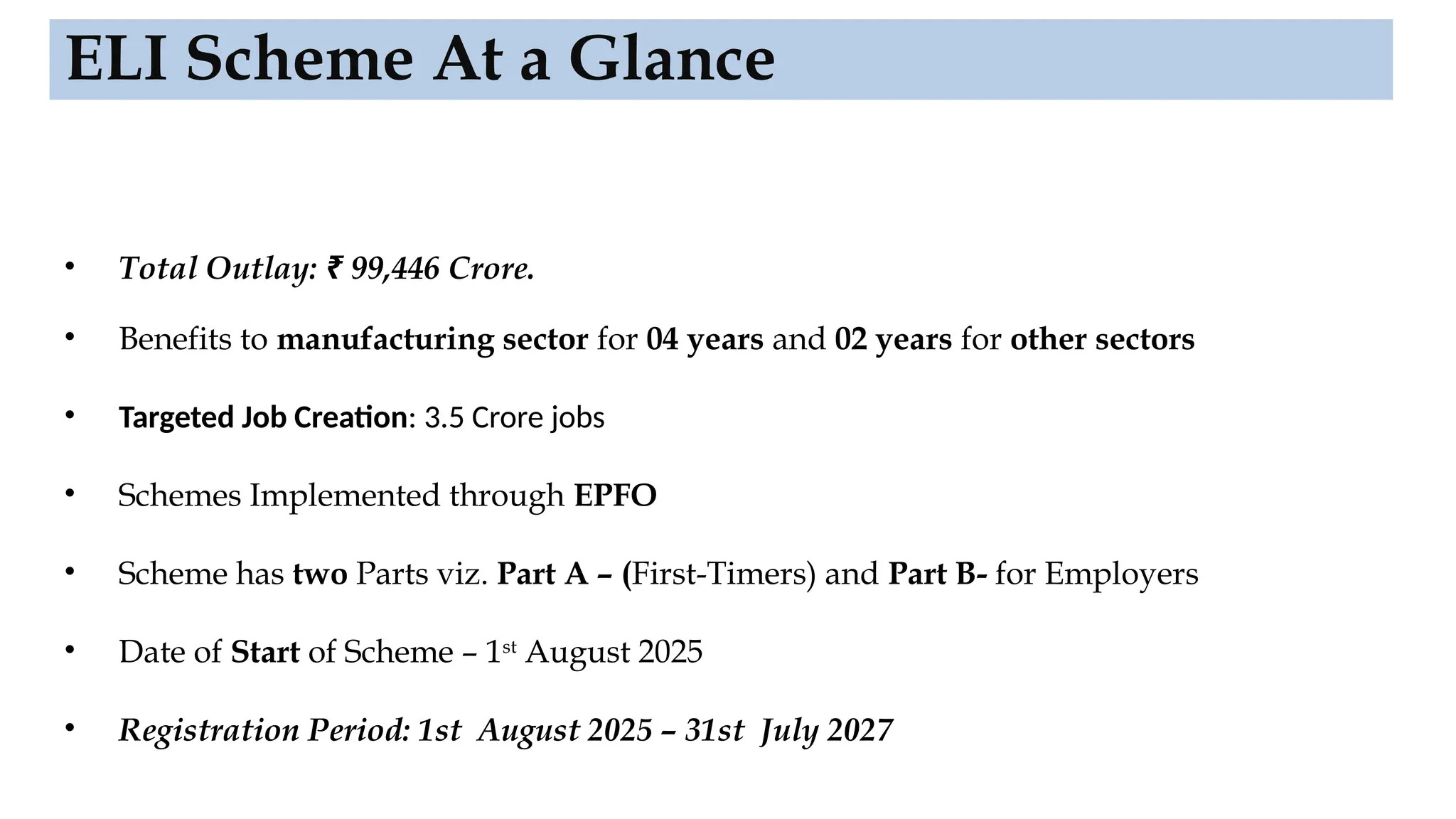
ELI Scheme Ata Glance
• Total Outlay: 99,446 Crore.
₹
• Benefits to manufacturing sector for 04 years and 02 years for other sectors
• Targeted Job Creation: 3.5 Crore jobs
• Schemes Implemented through EPFO
• Scheme has two Parts viz. Part A – (First-Timers) and Part B- for Employers
• Date of Start of Scheme – 1st
August 2025
• Registration Period: 1st August 2025 – 31st July 2027
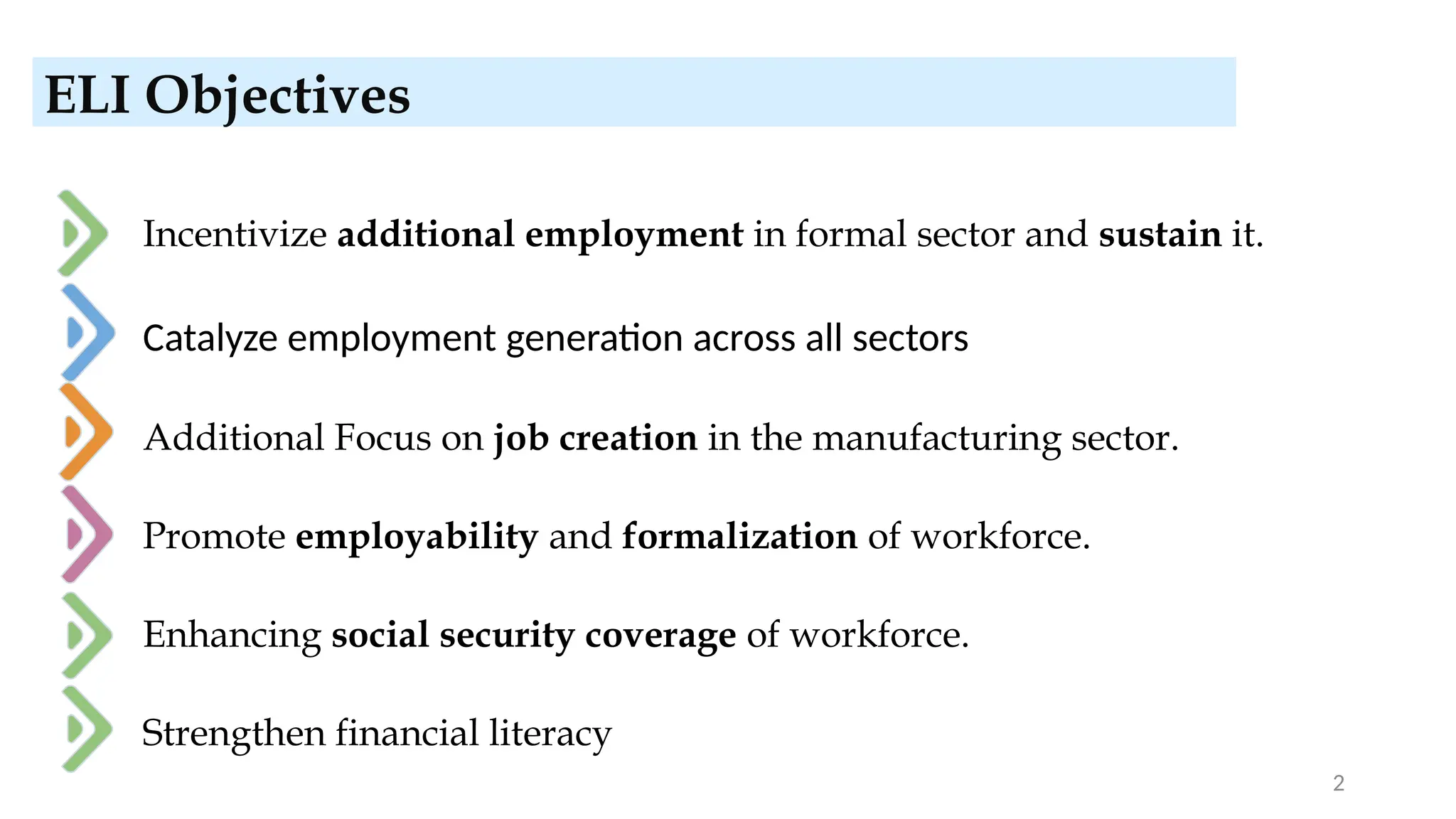
2.
Incentivize additional employmentin formal sector and sustain it.
Catalyze employment generation across all sectors
Additional Focus on job creation in the manufacturing sector.
Promote employability and formalization of workforce.
Enhancing social security coverage of workforce.
Strengthen financial literacy
2
ELI Objectives
3.
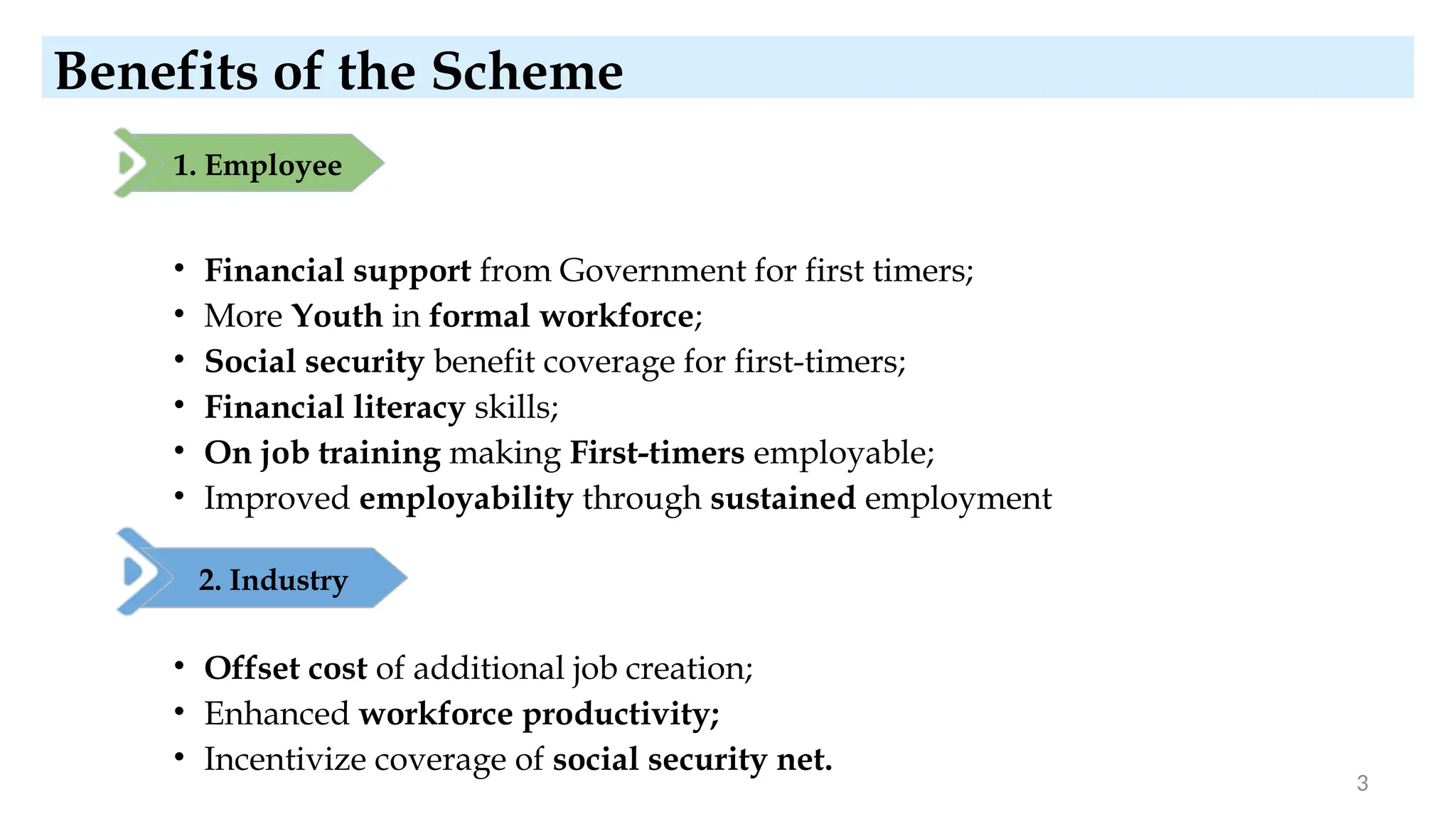
3
• Financial supportfrom Government for first timers;
• More Youth in formal workforce;
• Social security benefit coverage for first-timers;
• Financial literacy skills;
• On job training making First-timers employable;
• Improved employability through sustained employment
1. Employee
2. Industry
• Offset cost of additional job creation;
• Enhanced workforce productivity;
• Incentivize coverage of social security net.
Benefits of the Scheme
4.
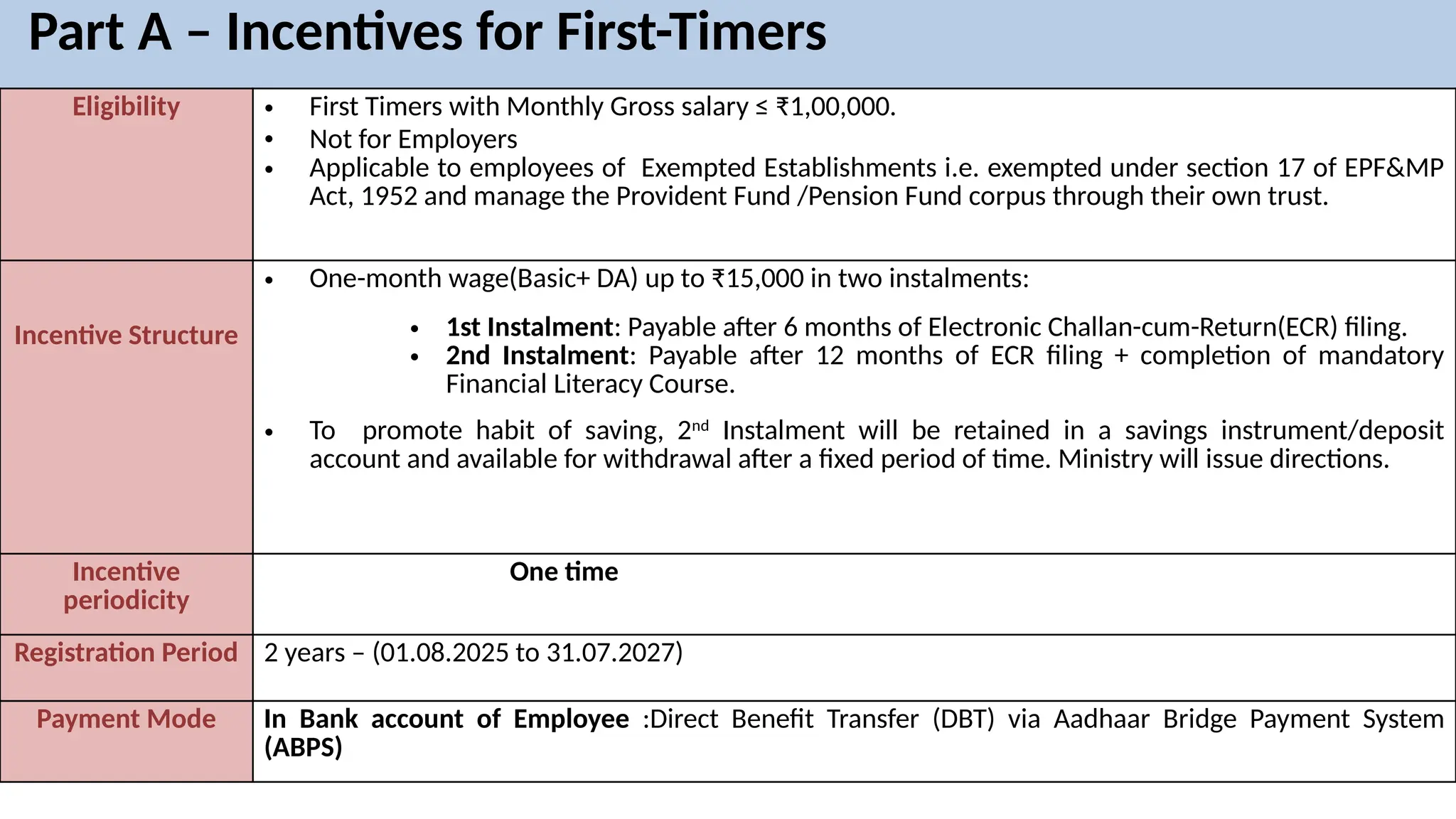
Part A –Incentives for First-Timers
Eligibility • First Timers with Monthly Gross salary ≤ ₹1,00,000.
• Not for Employers
• Applicable to employees of Exempted Establishments i.e. exempted under section 17 of EPF&MP
Act, 1952 and manage the Provident Fund /Pension Fund corpus through their own trust.
Incentive Structure
• One-month wage(Basic+ DA) up to ₹15,000 in two instalments:
• 1st Instalment: Payable after 6 months of Electronic Challan-cum-Return(ECR) filing.
• 2nd Instalment: Payable after 12 months of ECR filing + completion of mandatory
Financial Literacy Course.
• To promote habit of saving, 2nd
Instalment will be retained in a savings instrument/deposit
account and available for withdrawal after a fixed period of time. Ministry will issue directions.
Incentive
periodicity
One time
Registration Period 2 years – (01.08.2025 to 31.07.2027)
Payment Mode In Bank account of Employee :Direct Benefit Transfer (DBT) via Aadhaar Bridge Payment System
(ABPS)
5.
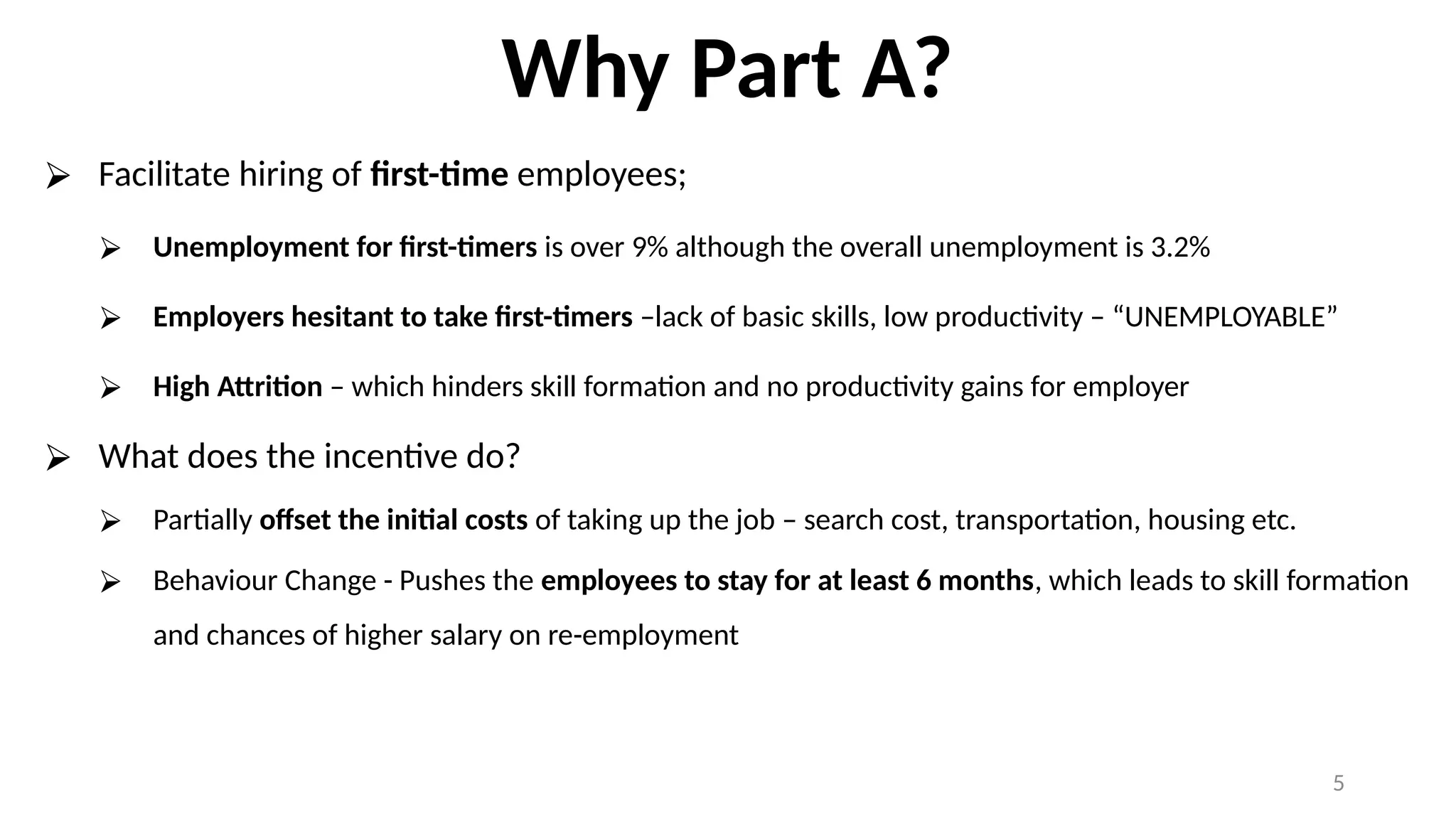
Why Part A?
⮚Facilitate hiring of first-time employees;
⮚ Unemployment for first-timers is over 9% although the overall unemployment is 3.2%
⮚ Employers hesitant to take first-timers –lack of basic skills, low productivity – “UNEMPLOYABLE”
⮚ High Attrition – which hinders skill formation and no productivity gains for employer
⮚ What does the incentive do?
⮚ Partially offset the initial costs of taking up the job – search cost, transportation, housing etc.
⮚ Behaviour Change - Pushes the employees to stay for at least 6 months, which leads to skill formation
and chances of higher salary on re-employment
5
6.
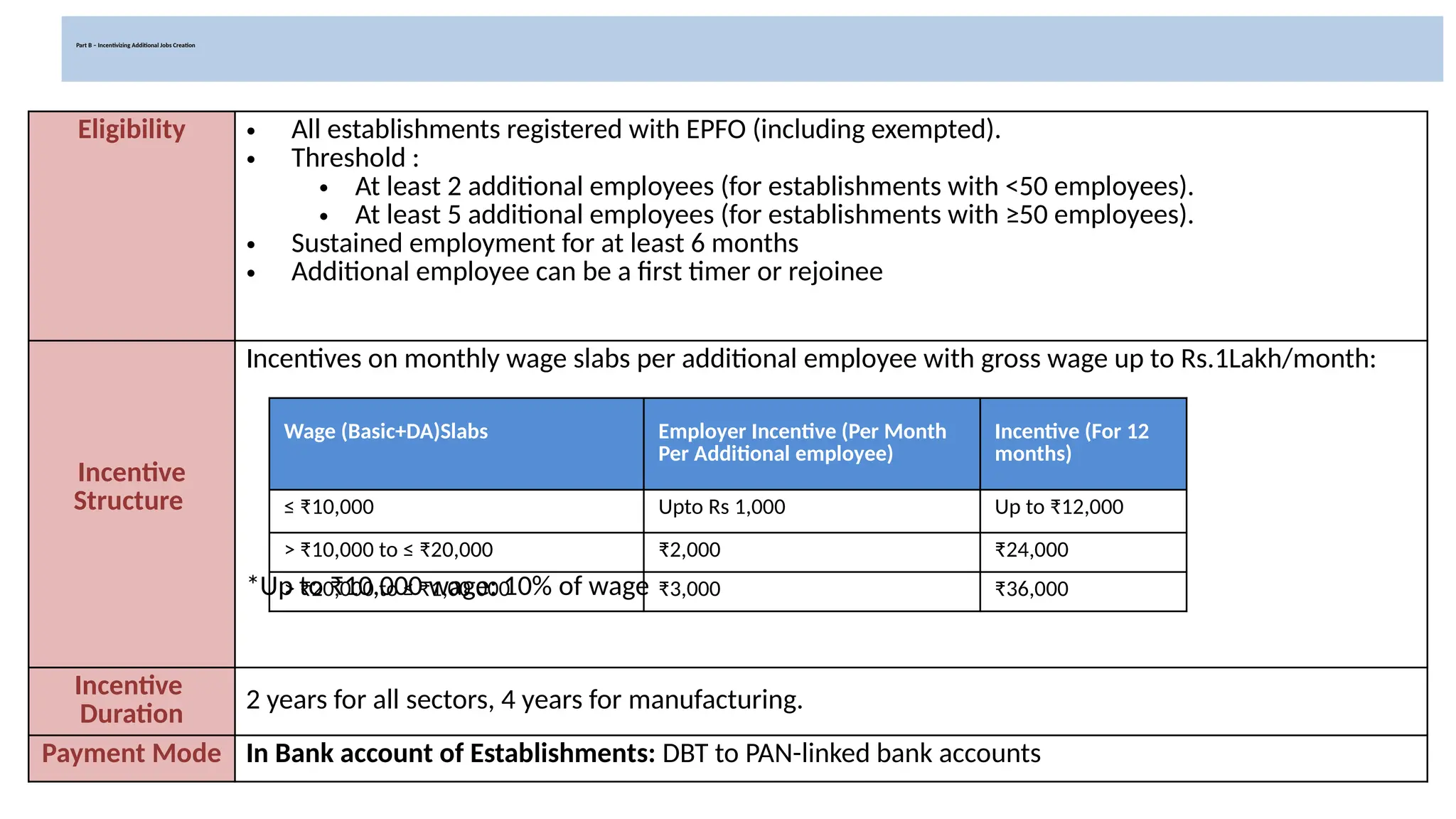
Part B –Incentivizing Additional Jobs Creation
Eligibility • All establishments registered with EPFO (including exempted).
• Threshold :
• At least 2 additional employees (for establishments with <50 employees).
• At least 5 additional employees (for establishments with ≥50 employees).
• Sustained employment for at least 6 months
• Additional employee can be a first timer or rejoinee
Incentive
Structure
Incentives on monthly wage slabs per additional employee with gross wage up to Rs.1Lakh/month:
*Up to ₹10,000 wage: 10% of wage
Incentive
Duration 2 years for all sectors, 4 years for manufacturing.
Payment Mode In Bank account of Establishments: DBT to PAN-linked bank accounts
Wage (Basic+DA)Slabs Employer Incentive (Per Month
Per Additional employee)
Incentive (For 12
months)
≤ ₹10,000 Upto Rs 1,000 Up to ₹12,000
> ₹10,000 to ≤ ₹20,000 ₹2,000 ₹24,000
> ₹20,000 to ≤ ₹1,00,000 ₹3,000 ₹36,000
7.
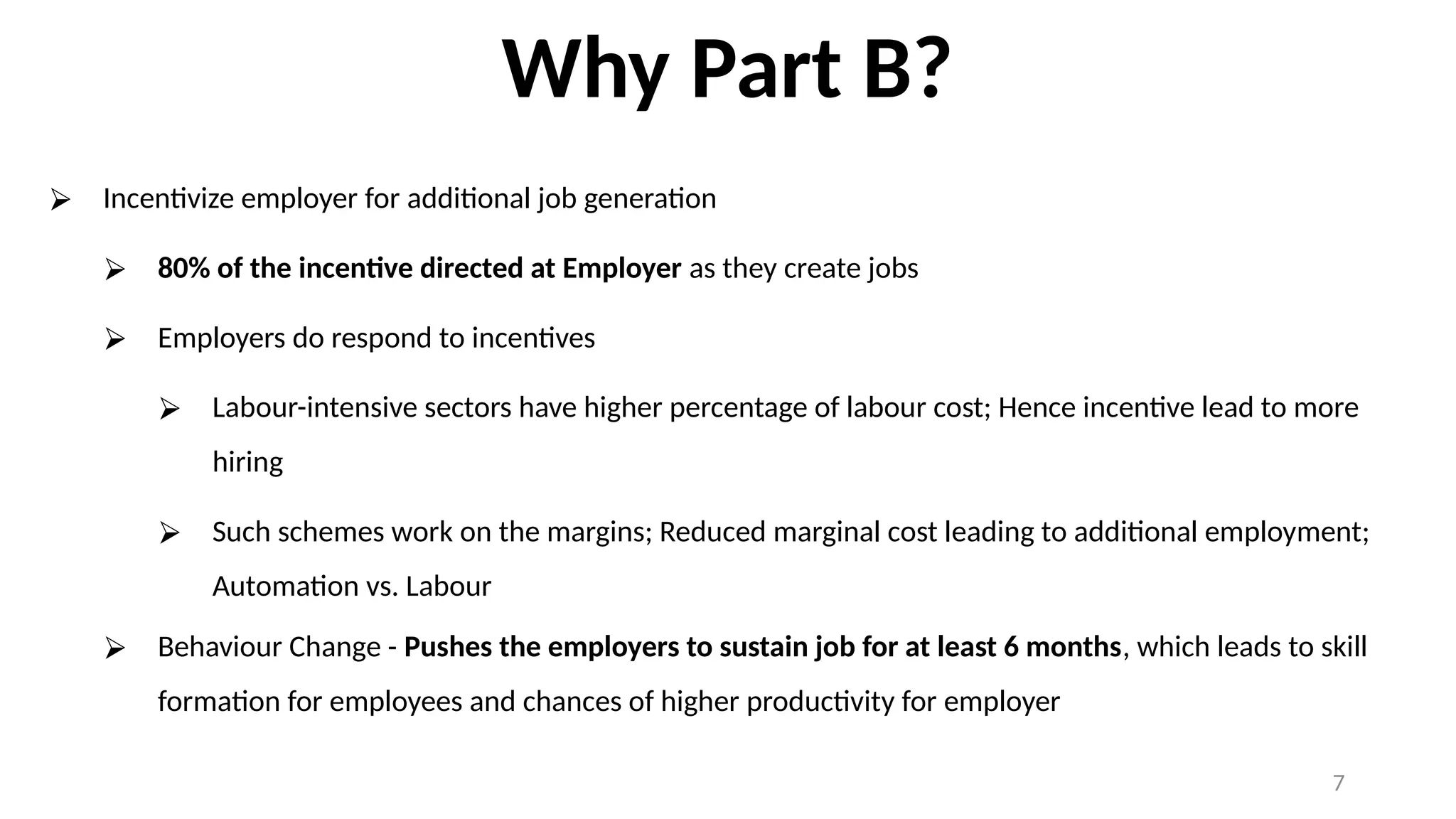
Why Part B?
⮚Incentivize employer for additional job generation
⮚ 80% of the incentive directed at Employer as they create jobs
⮚ Employers do respond to incentives
⮚ Labour-intensive sectors have higher percentage of labour cost; Hence incentive lead to more
hiring
⮚ Such schemes work on the margins; Reduced marginal cost leading to additional employment;
Automation vs. Labour
⮚ Behaviour Change - Pushes the employers to sustain job for at least 6 months, which leads to skill
formation for employees and chances of higher productivity for employer
7
8.
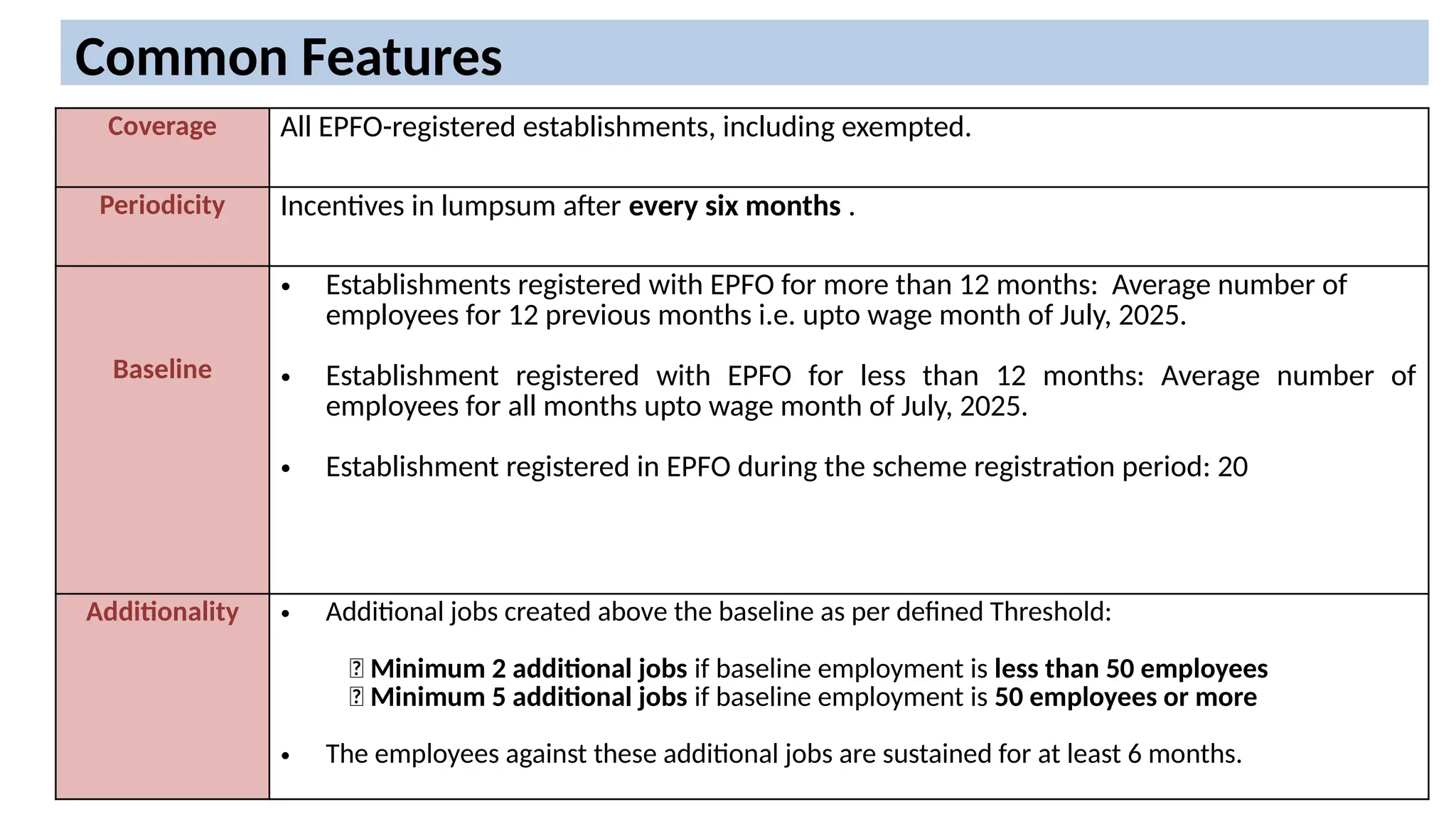
Common Features
Coverage AllEPFO-registered establishments, including exempted.
Periodicity Incentives in lumpsum after every six months .
Baseline
• Establishments registered with EPFO for more than 12 months: Average number of
employees for 12 previous months i.e. upto wage month of July, 2025.
• Establishment registered with EPFO for less than 12 months: Average number of
employees for all months upto wage month of July, 2025.
• Establishment registered in EPFO during the scheme registration period: 20
Additionality • Additional jobs created above the baseline as per defined Threshold:
✅ Minimum 2 additional jobs if baseline employment is less than 50 employees
✅ Minimum 5 additional jobs if baseline employment is 50 employees or more
• The employees against these additional jobs are sustained for at least 6 months.
9.
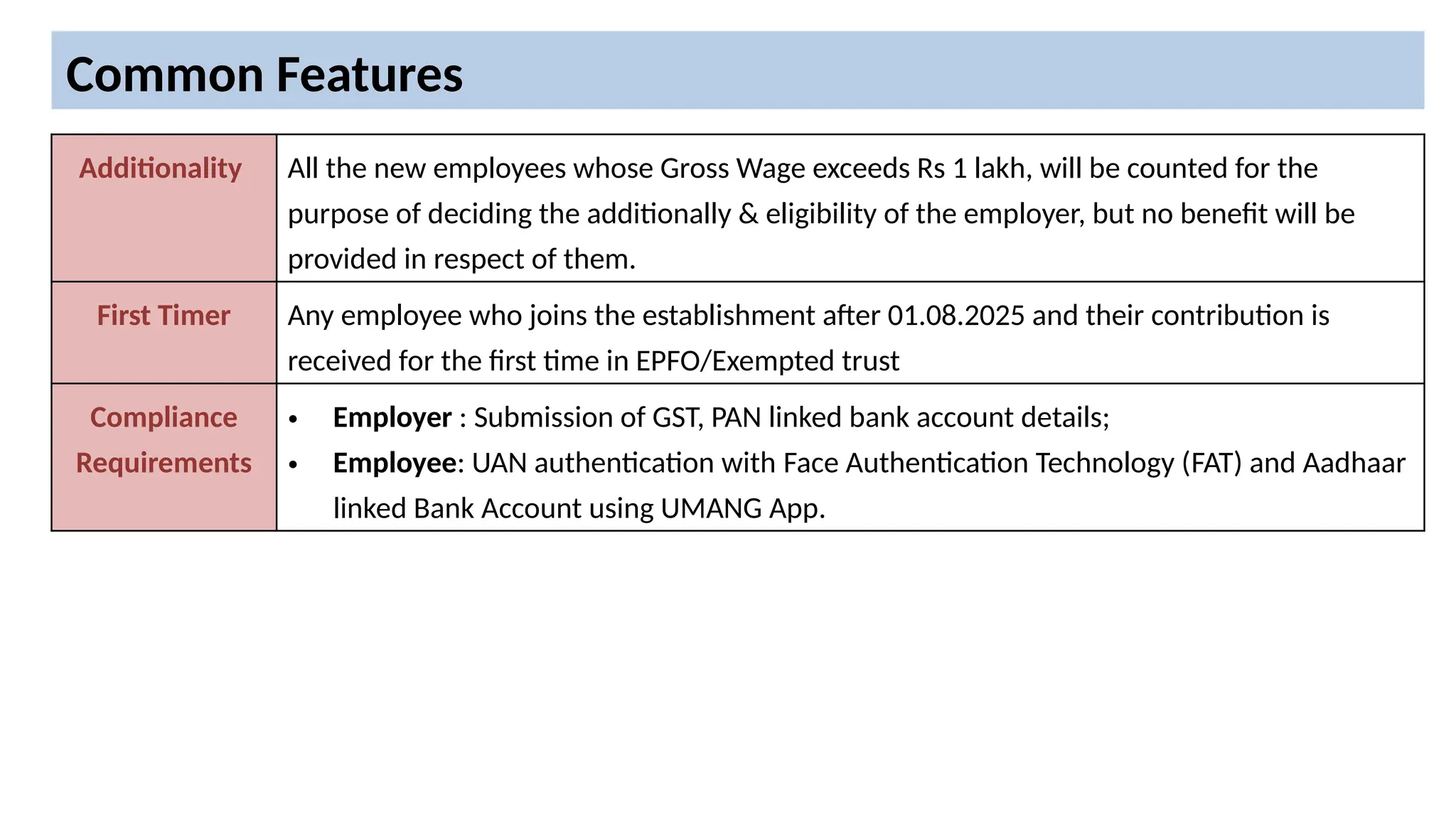
Common Features
Additionality Allthe new employees whose Gross Wage exceeds Rs 1 lakh, will be counted for the
purpose of deciding the additionally & eligibility of the employer, but no benefit will be
provided in respect of them.
First Timer Any employee who joins the establishment after 01.08.2025 and their contribution is
received for the first time in EPFO/Exempted trust
Compliance
Requirements
• Employer : Submission of GST, PAN linked bank account details;
• Employee: UAN authentication with Face Authentication Technology (FAT) and Aadhaar
linked Bank Account using UMANG App.
10.
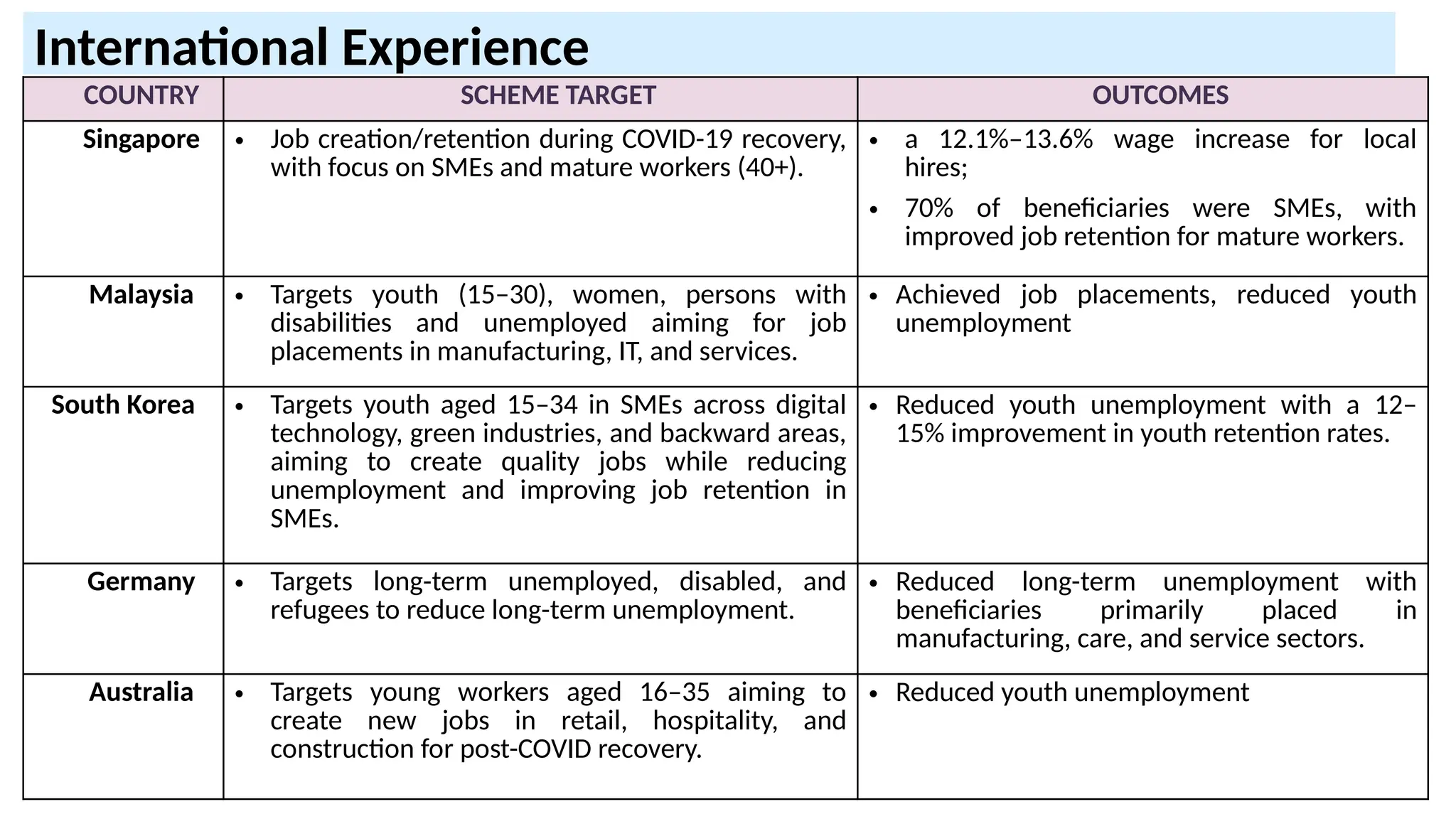
COUNTRY SCHEME TARGETOUTCOMES
Singapore • Job creation/retention during COVID-19 recovery,
with focus on SMEs and mature workers (40+).
• a 12.1%–13.6% wage increase for local
hires;
• 70% of beneficiaries were SMEs, with
improved job retention for mature workers.
Malaysia • Targets youth (15–30), women, persons with
disabilities and unemployed aiming for job
placements in manufacturing, IT, and services.
• Achieved job placements, reduced youth
unemployment
South Korea • Targets youth aged 15–34 in SMEs across digital
technology, green industries, and backward areas,
aiming to create quality jobs while reducing
unemployment and improving job retention in
SMEs.
• Reduced youth unemployment with a 12–
15% improvement in youth retention rates.
Germany • Targets long-term unemployed, disabled, and
refugees to reduce long-term unemployment.
• Reduced long-term unemployment with
beneficiaries primarily placed in
manufacturing, care, and service sectors.
Australia • Targets young workers aged 16–35 aiming to
create new jobs in retail, hospitality, and
construction for post-COVID recovery.
• Reduced youth unemployment
International Experience
11.
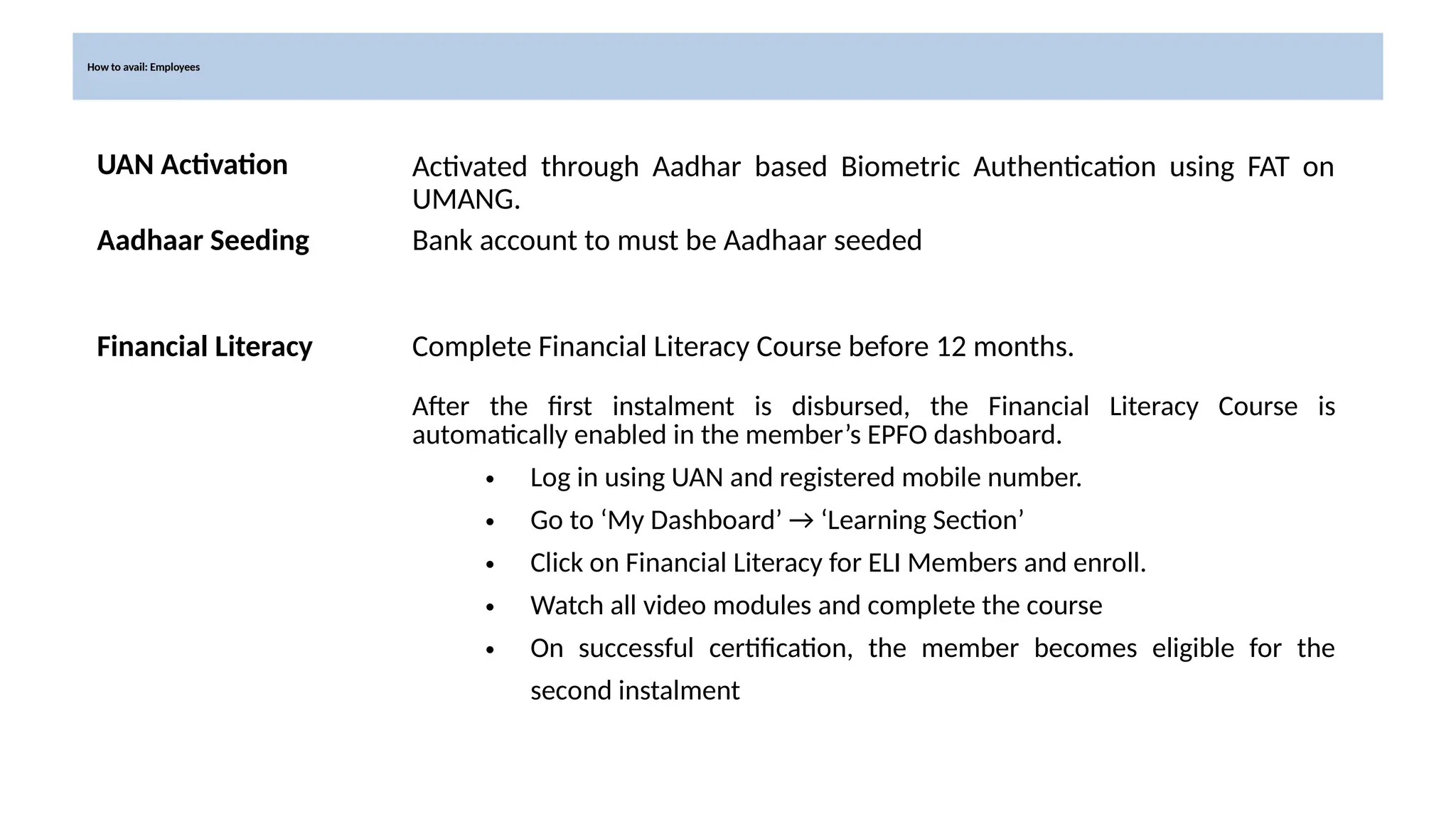
How to avail:Employees
UAN Activation Activated through Aadhar based Biometric Authentication using FAT on
UMANG.
Aadhaar Seeding Bank account to must be Aadhaar seeded
Financial Literacy Complete Financial Literacy Course before 12 months.
After the first instalment is disbursed, the Financial Literacy Course is
automatically enabled in the member’s EPFO dashboard.
• Log in using UAN and registered mobile number.
• Go to ‘My Dashboard’ → ‘Learning Section’
• Click on Financial Literacy for ELI Members and enroll.
• Watch all video modules and complete the course
• On successful certification, the member becomes eligible for the
second instalment
12.
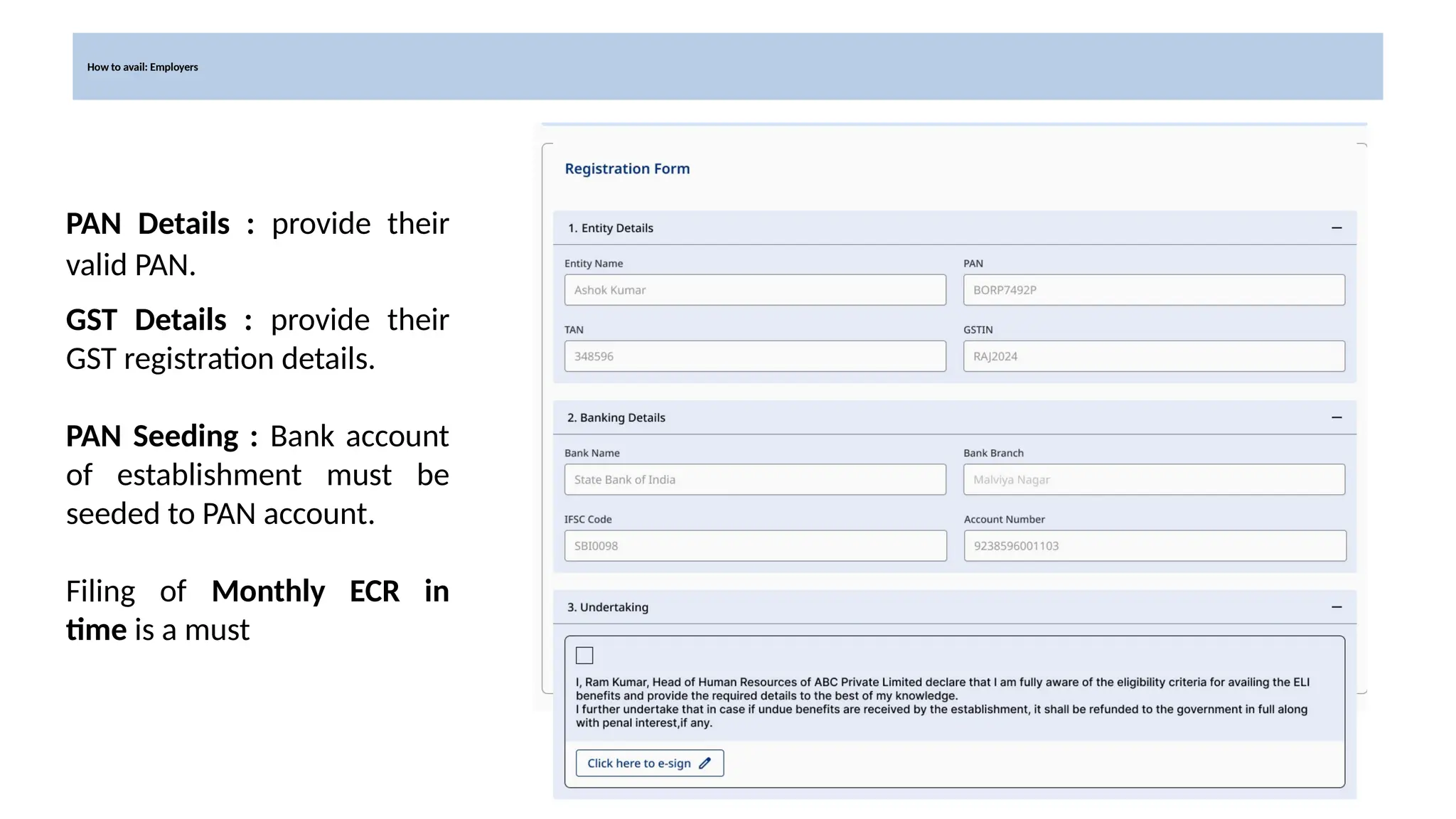
How to avail:Employers
PAN Details : provide their
valid PAN.
GST Details : provide their
GST registration details.
PAN Seeding : Bank account
of establishment must be
seeded to PAN account.
Filing of Monthly ECR in
time is a must
13.
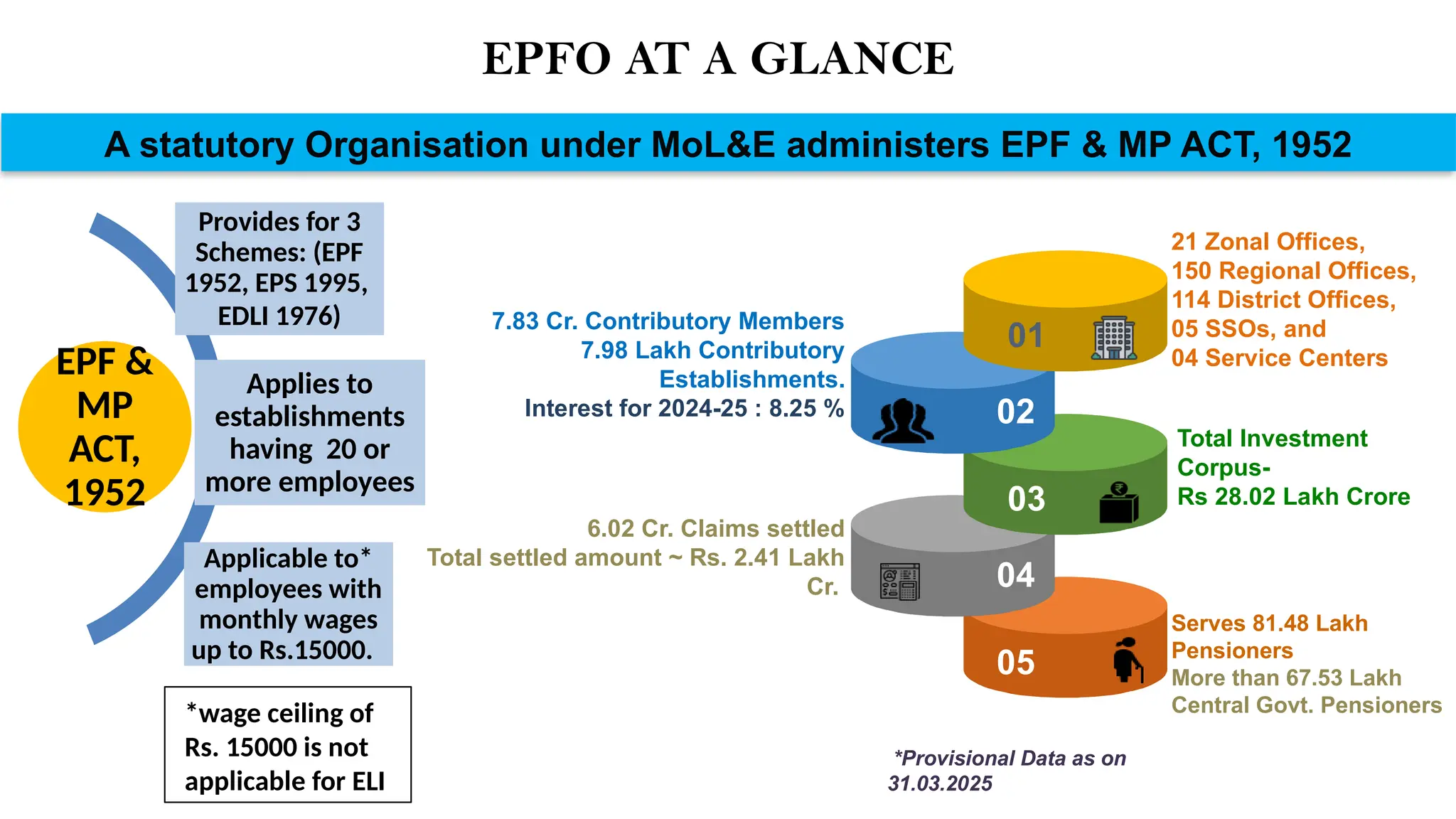
Total Investment
Corpus-
Rs 28.02Lakh Crore
6.02 Cr. Claims settled
Total settled amount ~ Rs. 2.41 Lakh
Cr.
Serves 81.48 Lakh
Pensioners
More than 67.53 Lakh
Central Govt. Pensioners
21 Zonal Offices,
150 Regional Offices,
114 District Offices,
05 SSOs, and
04 Service Centers
01
02
03
04
05
A statutory Organisation under MoL&E administers EPF & MP ACT, 1952
*Provisional Data as on
31.03.2025
EPFO AT A GLANCE
EPF &
MP
ACT,
1952
Applies to
establishments
having 20 or
more employees
Applicable to*
employees with
monthly wages
up to Rs.15000.
Provides for 3
Schemes: (EPF
1952, EPS 1995,
EDLI 1976) 7.83 Cr. Contributory Members
7.98 Lakh Contributory
Establishments.
Interest for 2024-25 : 8.25 %
*wage ceiling of
Rs. 15000 is not
applicable for ELI


![Salient features on all labour codes ppt [compatibility mode]](https://cdn.slidesharecdn.com/ss_thumbnails/salientfeaturesonalllabourcodes-pptcompatibilitymode-200108112830-thumbnail.jpg?width=640&height=640&fit=bounds)


![Emotional intelligence [compatibility mode] [repaired]](https://cdn.slidesharecdn.com/ss_thumbnails/emotionalintelligencecompatibilitymoderepaired-160229050542-thumbnail.jpg?width=640&height=640&fit=bounds)

