ECAP444 - OBJECT ORIENTED PROGRAMMING USING C++ 1.pptx
1.
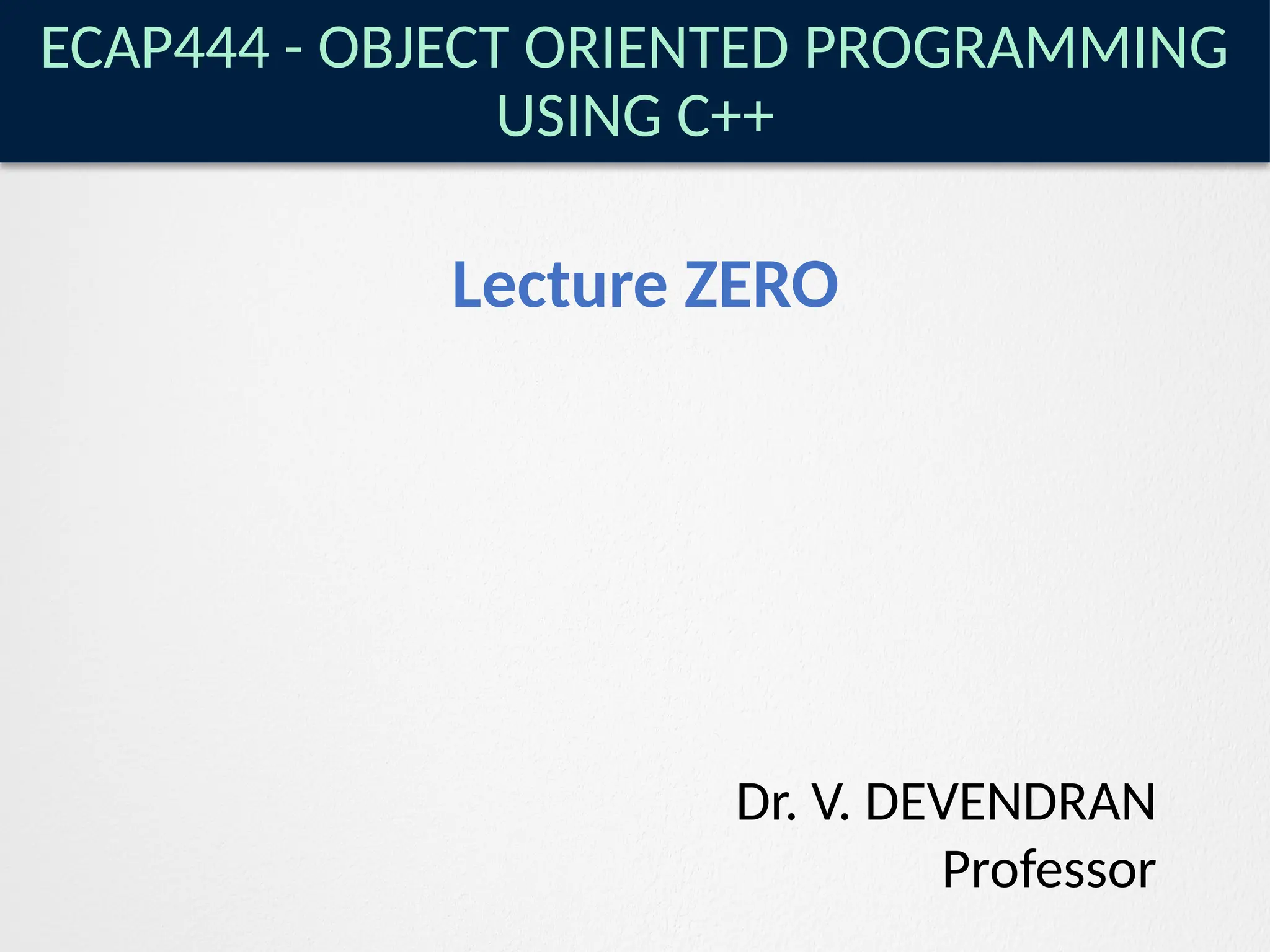
ECAP444 - OBJECTORIENTED PROGRAMMING
USING C++
Lecture ZERO
Dr. V. DEVENDRAN
Professor
2.
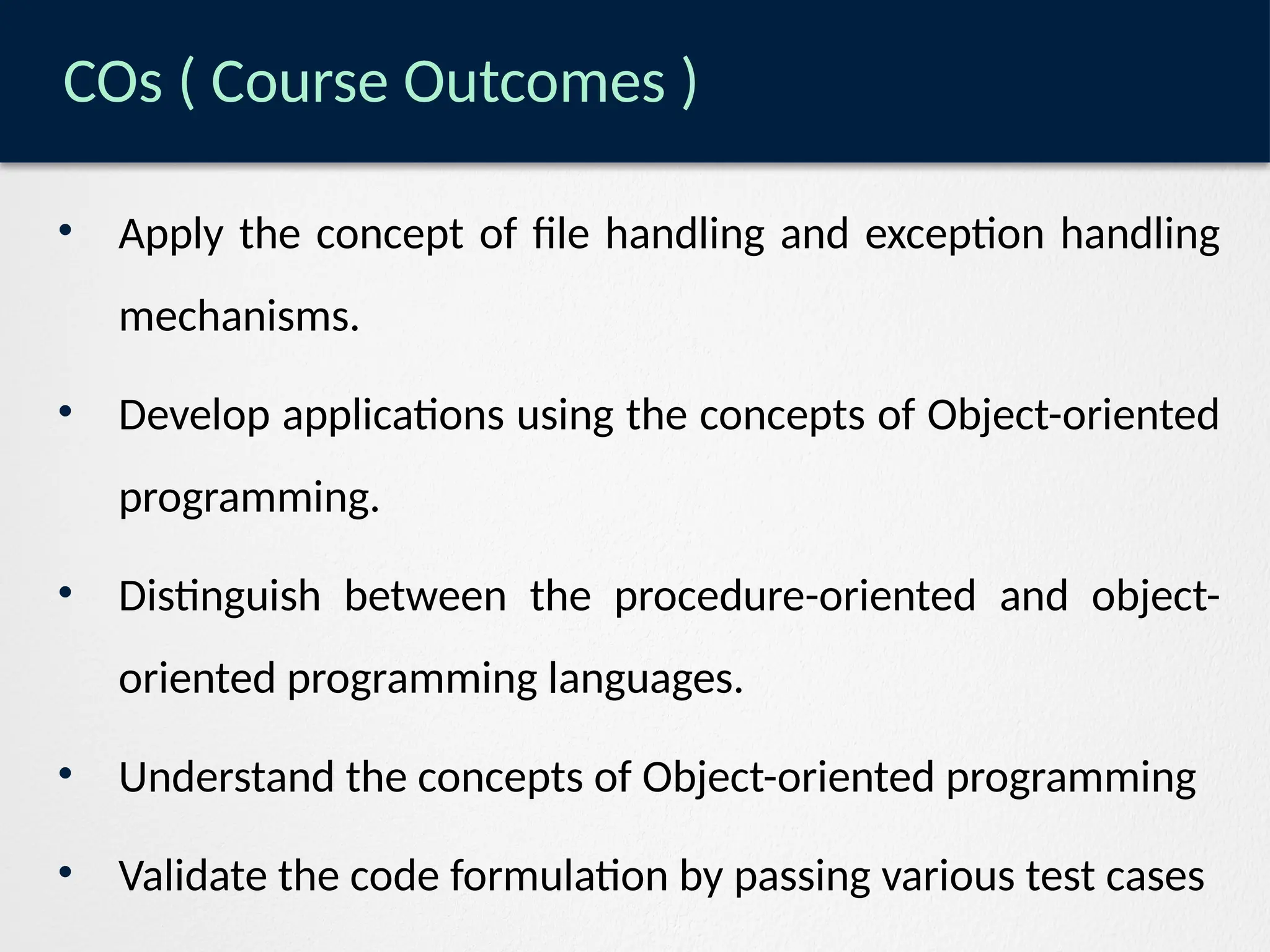
COs ( CourseOutcomes )
• Apply the concept of file handling and exception handling
mechanisms.
• Develop applications using the concepts of Object-oriented
programming.
• Distinguish between the procedure-oriented and object-
oriented programming languages.
• Understand the concepts of Object-oriented programming
• Validate the code formulation by passing various test cases
3.
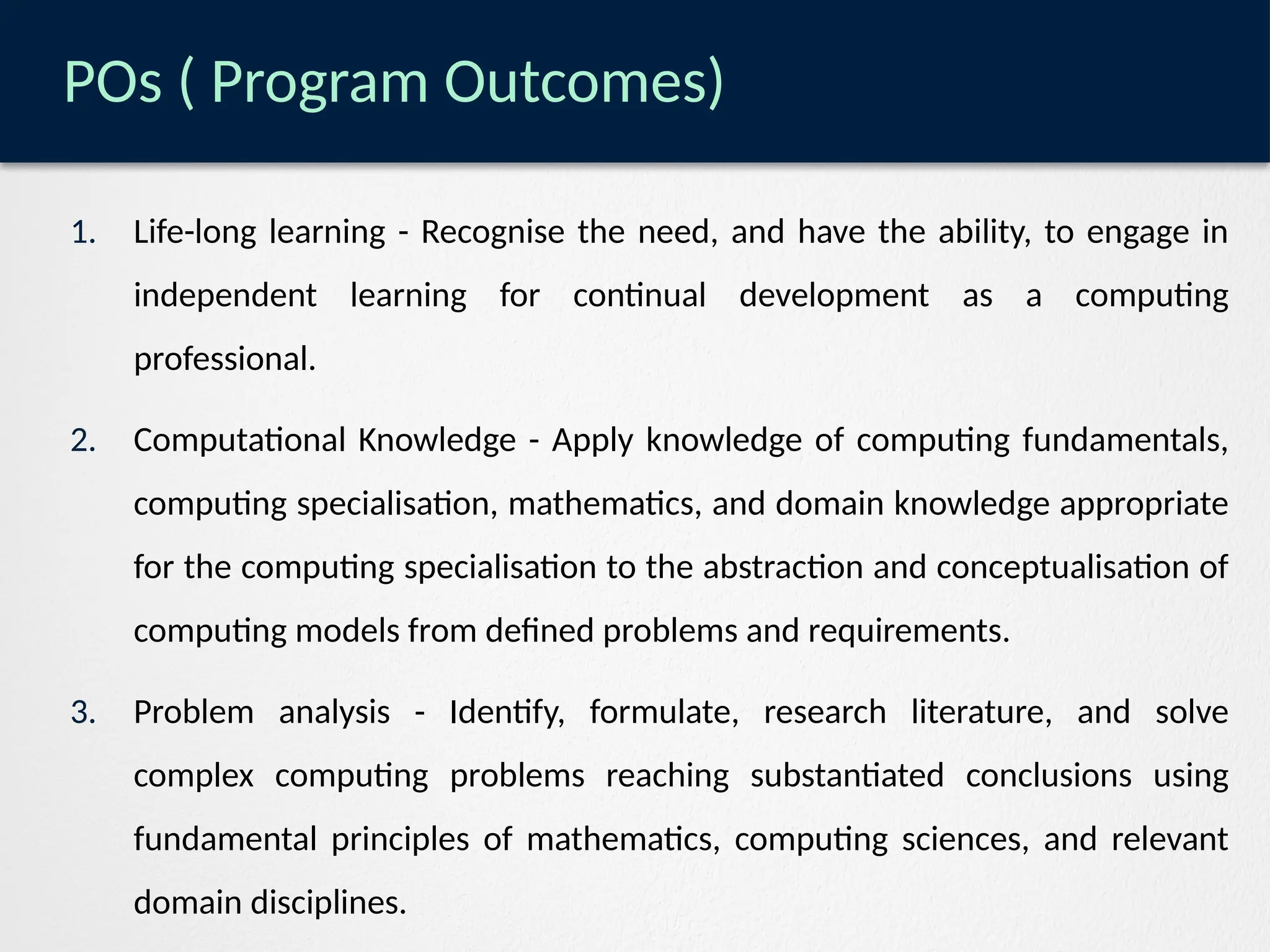
POs ( ProgramOutcomes)
1. Life-long learning - Recognise the need, and have the ability, to engage in
independent learning for continual development as a computing
professional.
2. Computational Knowledge - Apply knowledge of computing fundamentals,
computing specialisation, mathematics, and domain knowledge appropriate
for the computing specialisation to the abstraction and conceptualisation of
computing models from defined problems and requirements.
3. Problem analysis - Identify, formulate, research literature, and solve
complex computing problems reaching substantiated conclusions using
fundamental principles of mathematics, computing sciences, and relevant
domain disciplines.
4.
POs ( ProgramOutcomes) Contd.
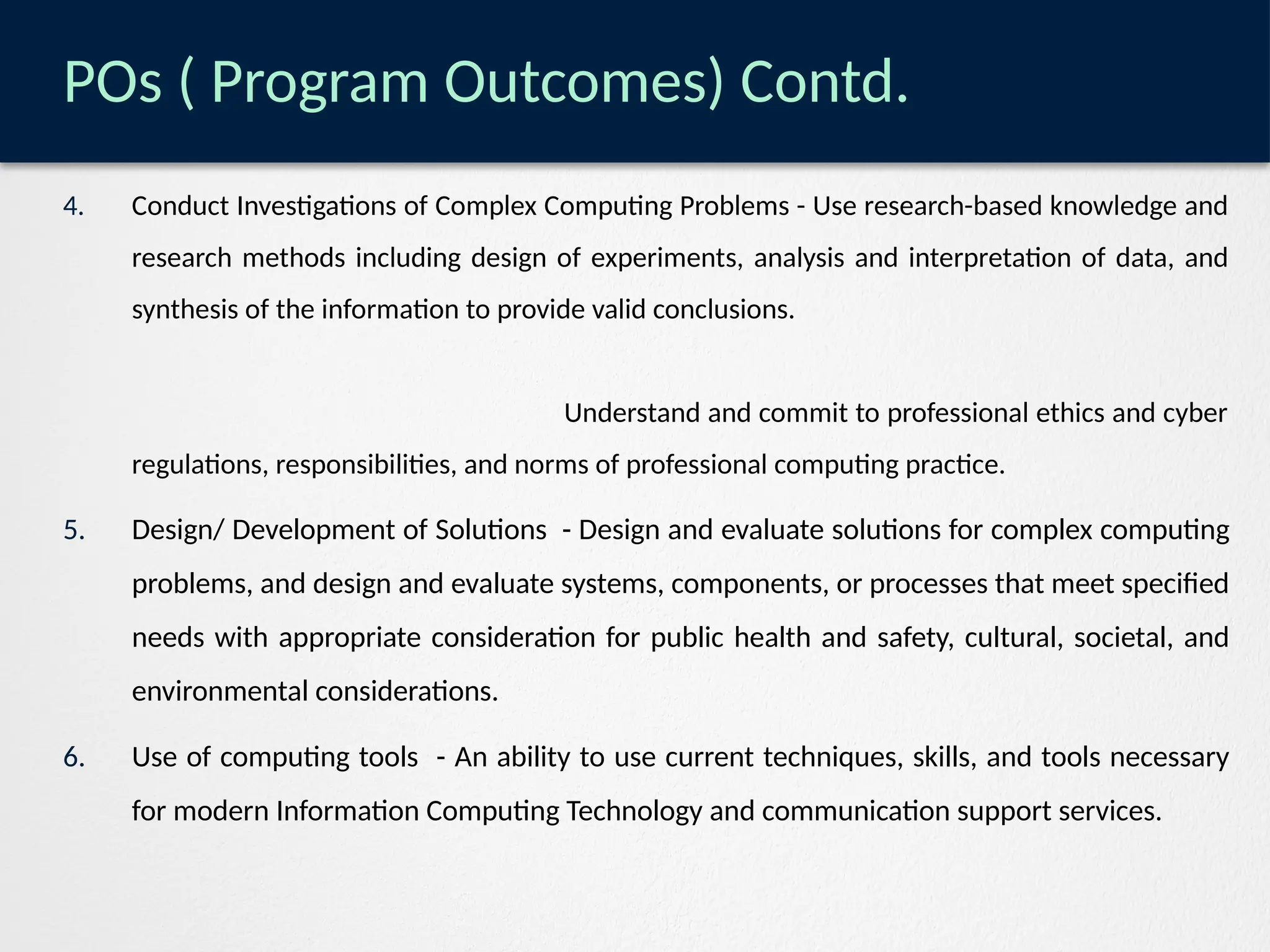
4. Conduct Investigations of Complex Computing Problems - Use research-based knowledge and
research methods including design of experiments, analysis and interpretation of data, and
synthesis of the information to provide valid conclusions.
Understand and commit to professional ethics and cyber
regulations, responsibilities, and norms of professional computing practice.
5. Design/ Development of Solutions - Design and evaluate solutions for complex computing
problems, and design and evaluate systems, components, or processes that meet specified
needs with appropriate consideration for public health and safety, cultural, societal, and
environmental considerations.
6. Use of computing tools - An ability to use current techniques, skills, and tools necessary
for modern Information Computing Technology and communication support services.
5.
POs ( ProgramOutcomes) Contd.
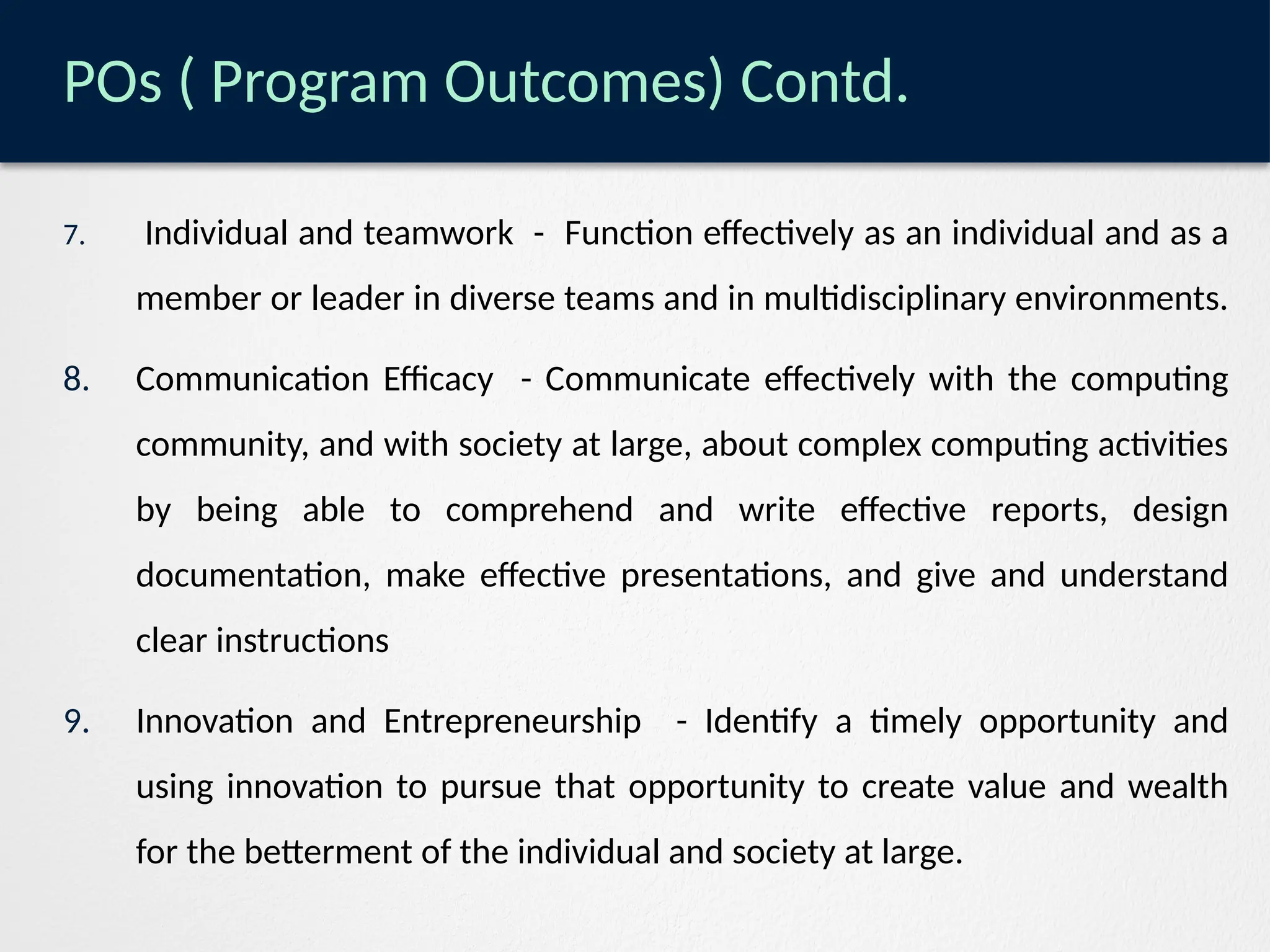
7. Individual and teamwork - Function effectively as an individual and as a
member or leader in diverse teams and in multidisciplinary environments.
8. Communication Efficacy - Communicate effectively with the computing
community, and with society at large, about complex computing activities
by being able to comprehend and write effective reports, design
documentation, make effective presentations, and give and understand
clear instructions
9. Innovation and Entrepreneurship - Identify a timely opportunity and
using innovation to pursue that opportunity to create value and wealth
for the betterment of the individual and society at large.
6.
POs ( ProgramOutcomes) Contd.
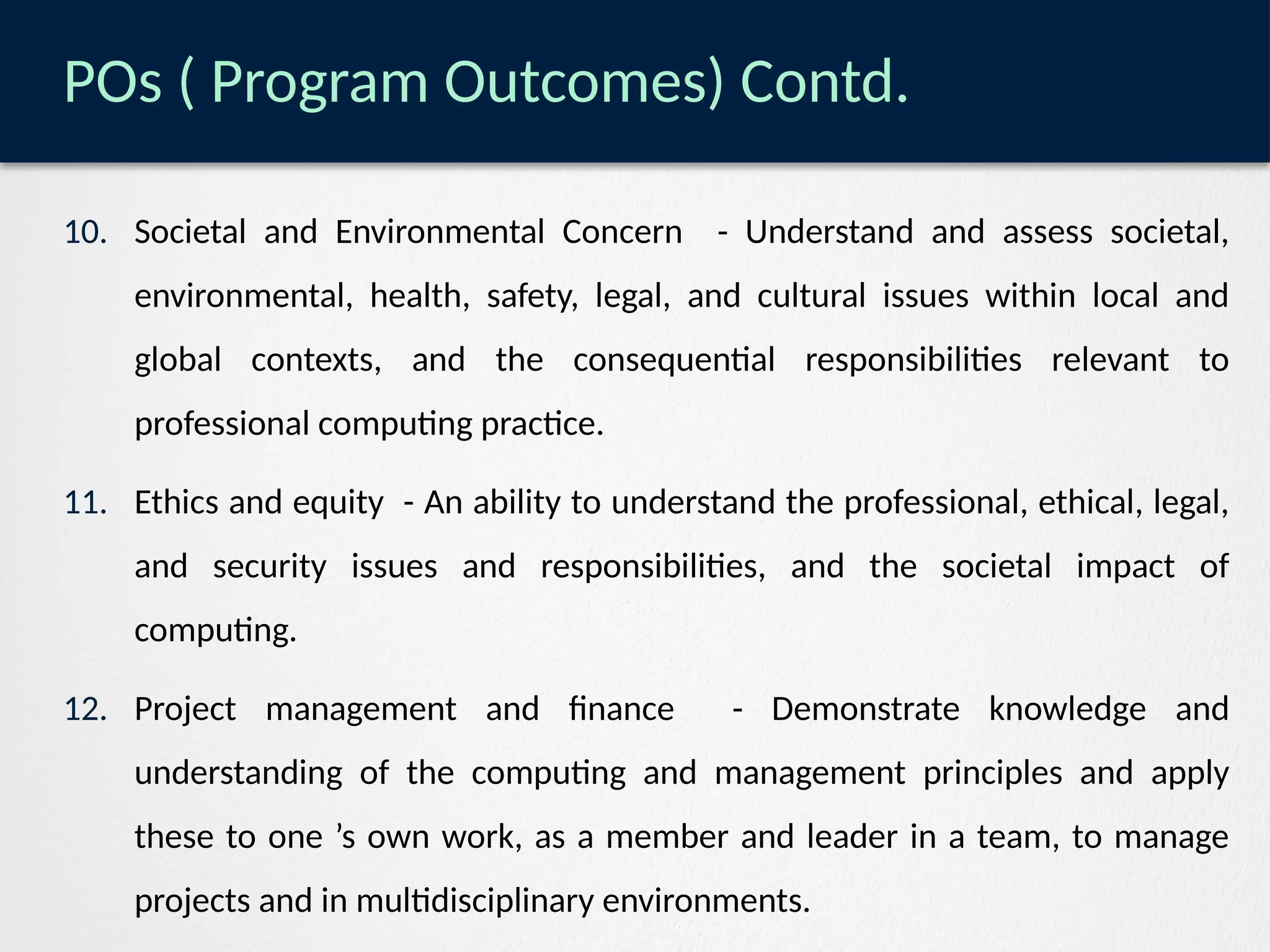
10. Societal and Environmental Concern - Understand and assess societal,
environmental, health, safety, legal, and cultural issues within local and
global contexts, and the consequential responsibilities relevant to
professional computing practice.
11. Ethics and equity - An ability to understand the professional, ethical, legal,
and security issues and responsibilities, and the societal impact of
computing.
12. Project management and finance - Demonstrate knowledge and
understanding of the computing and management principles and apply
these to one ’s own work, as a member and leader in a team, to manage
projects and in multidisciplinary environments.
7.
PSOs ( ProgramSpecific Outcomes)
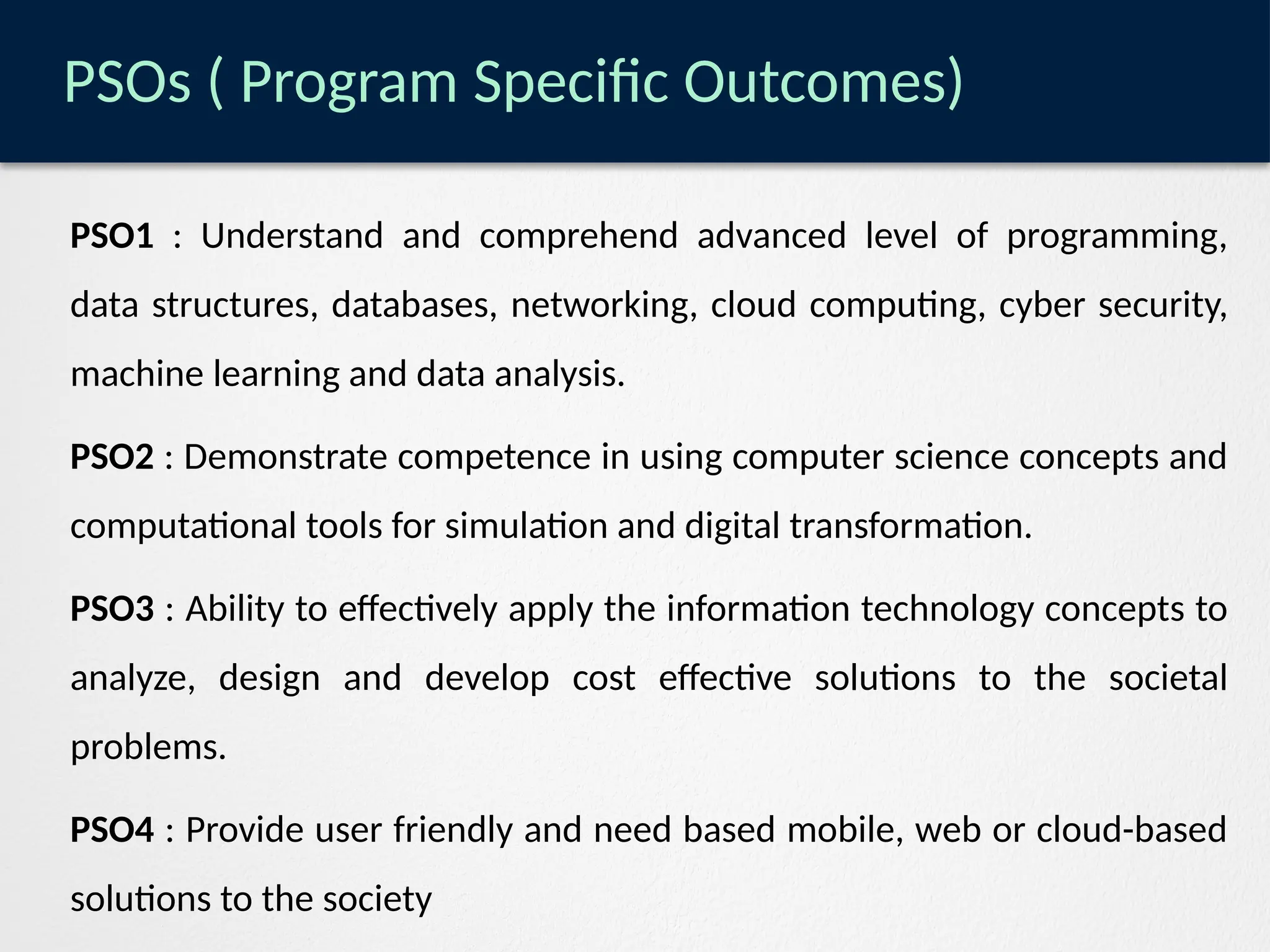
PSO1 : Understand and comprehend advanced level of programming,
data structures, databases, networking, cloud computing, cyber security,
machine learning and data analysis.
PSO2 : Demonstrate competence in using computer science concepts and
computational tools for simulation and digital transformation.
PSO3 : Ability to effectively apply the information technology concepts to
analyze, design and develop cost effective solutions to the societal
problems.
PSO4 : Provide user friendly and need based mobile, web or cloud-based
solutions to the society
8.
PEOs ( ProgramEducational Objectives)
• Graduates will acquire and apply outcome-based education
related to core areas of Computer Applications.
• Graduates will develop innovative solutions for real-life
problems through IT concepts.
• To nurture graduates as entrepreneurs and leaders who can
create solutions for society and industry.
• To promote graduates for professional advancement and
lifelong learning by bridging the gap between industry and
academia.
9.
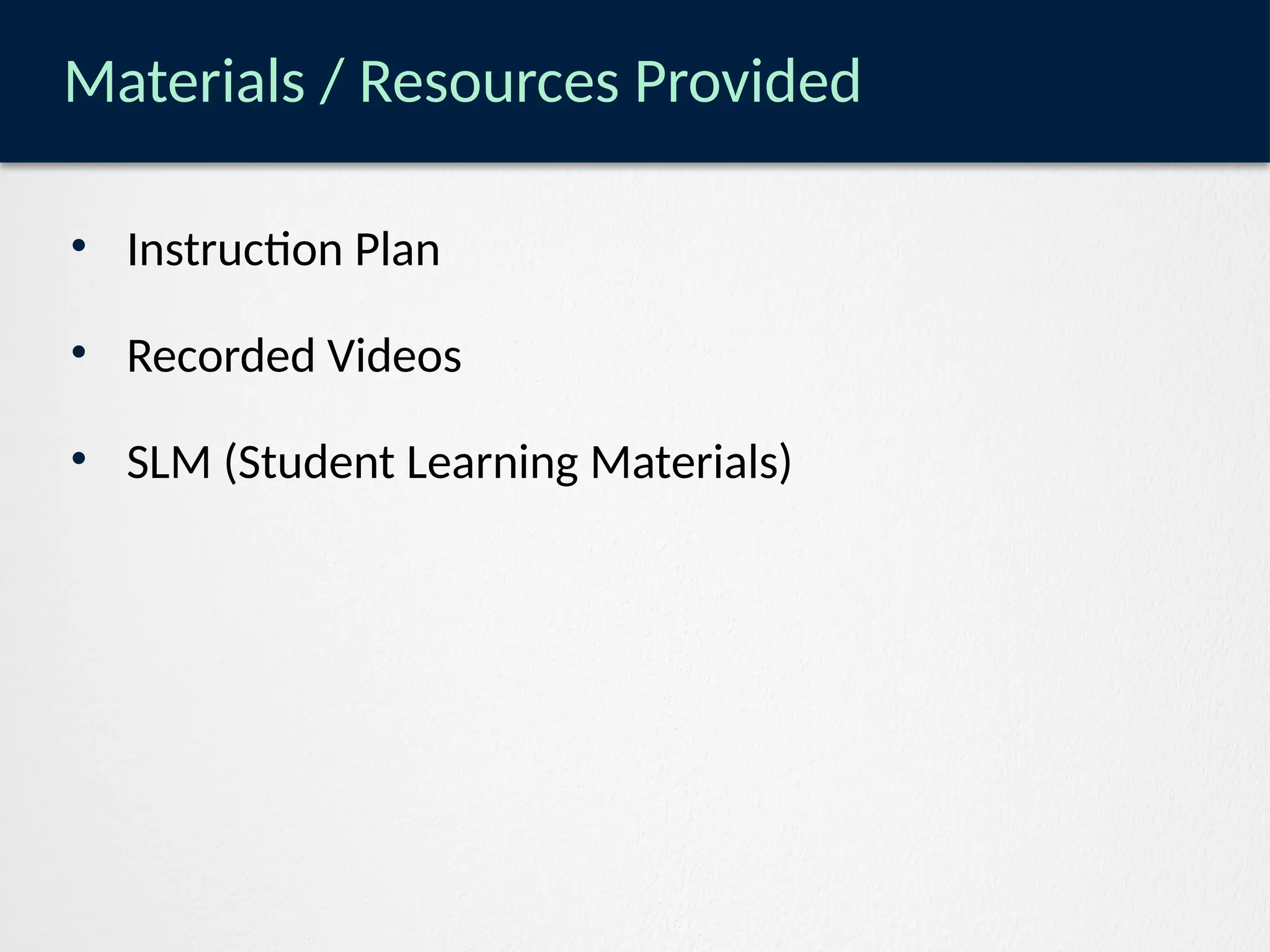
Materials / ResourcesProvided
• Instruction Plan
• Recorded Videos
• SLM (Student Learning Materials)
10.
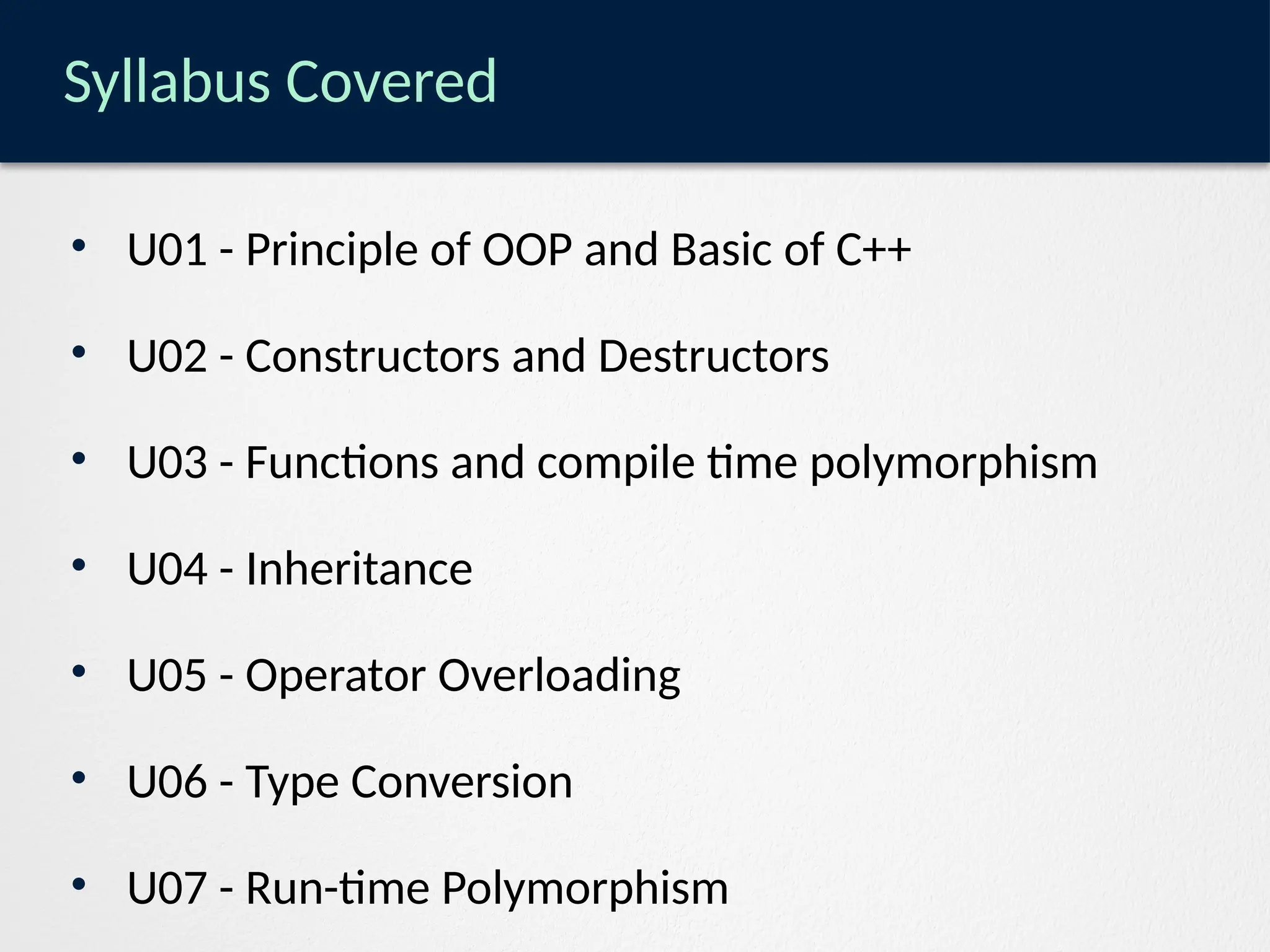
Syllabus Covered
• U01- Principle of OOP and Basic of C++
• U02 - Constructors and Destructors
• U03 - Functions and compile time polymorphism
• U04 - Inheritance
• U05 - Operator Overloading
• U06 - Type Conversion
• U07 - Run-time Polymorphism
11.
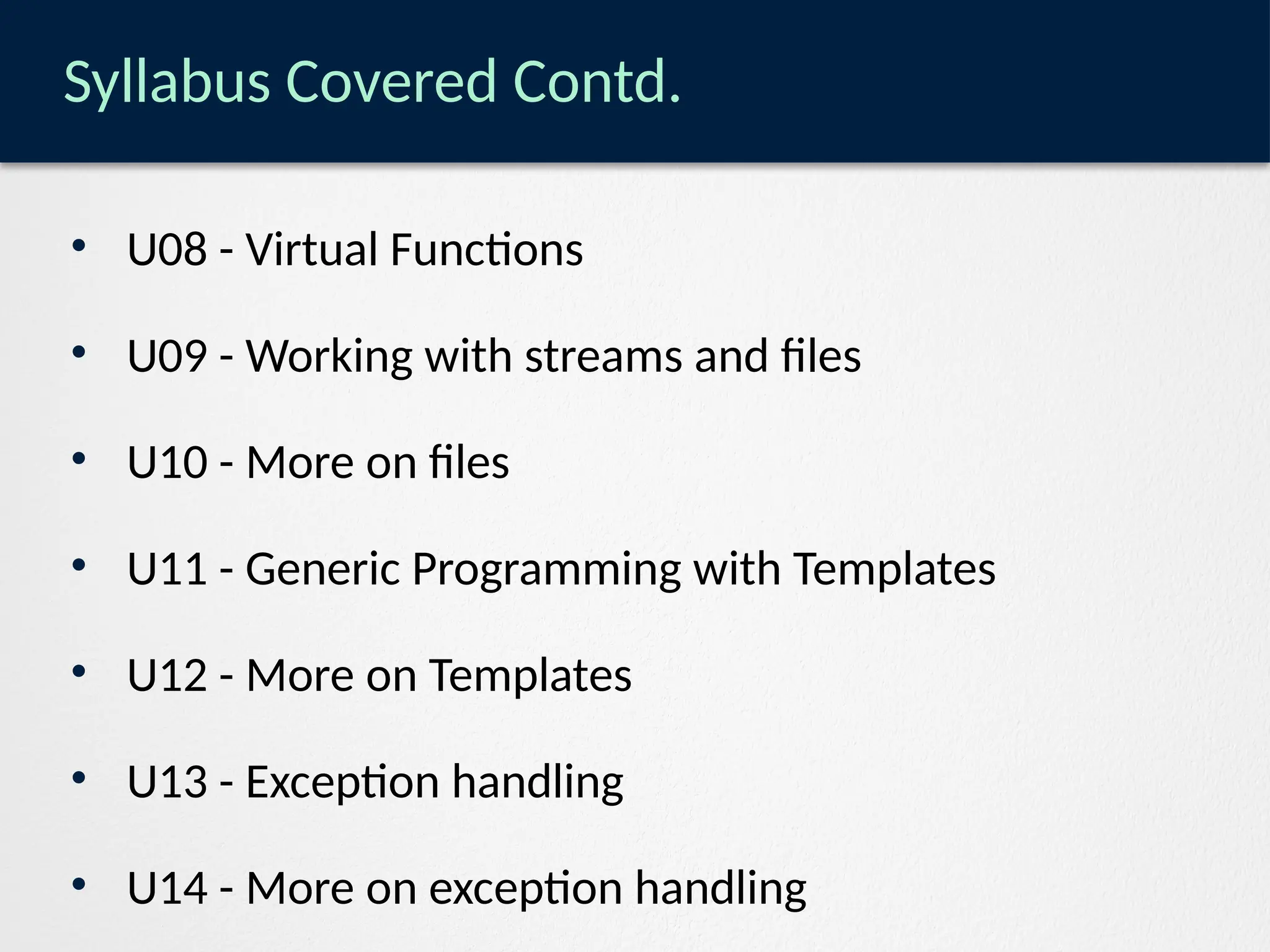
Syllabus Covered Contd.
•U08 - Virtual Functions
• U09 - Working with streams and files
• U10 - More on files
• U11 - Generic Programming with Templates
• U12 - More on Templates
• U13 - Exception handling
• U14 - More on exception handling
12.
Continuous Assessment
• TwoAssignments.
• Subjective.
• Maximum 20 Marks each. Total 40 Marks.
• Final : 70 Marks [ 20 x 2 = 40 ; 3 x 10 = 30 ]
13.
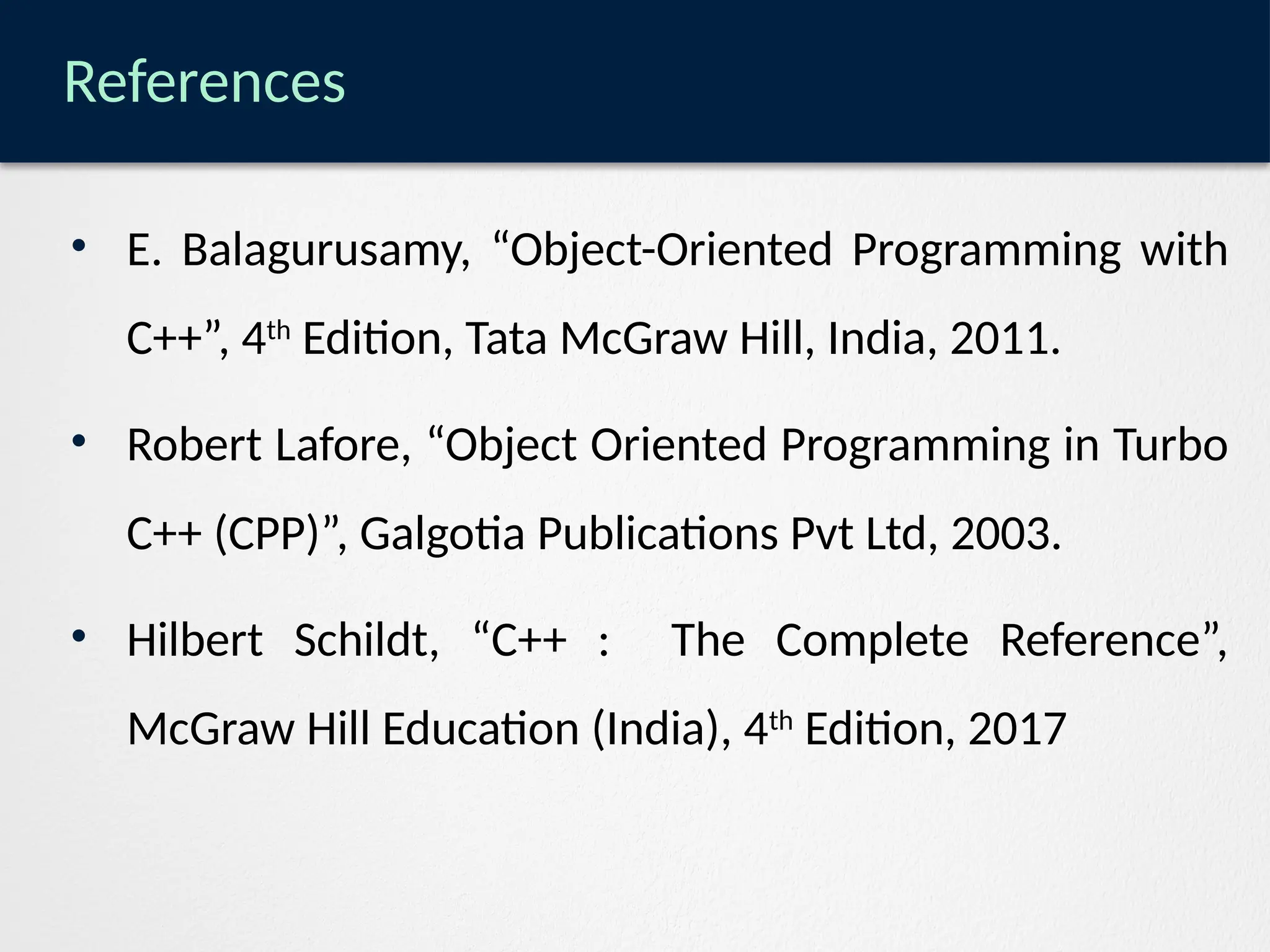
References
• E. Balagurusamy,“Object-Oriented Programming with
C++”, 4th
Edition, Tata McGraw Hill, India, 2011.
• Robert Lafore, “Object Oriented Programming in Turbo
C++ (CPP)”, Galgotia Publications Pvt Ltd, 2003.
• Hilbert Schildt, “C++ : The Complete Reference”,
McGraw Hill Education (India), 4th
Edition, 2017

![Continuous Assessment
• Two Assignments.
• Subjective.
• Maximum 20 Marks each. Total 40 Marks.
• Final : 70 Marks [ 20 x 2 = 40 ; 3 x 10 = 30 ]](https://image.slidesharecdn.com/ecap444-objectorientedprogrammingusingc1-250605172447-ef969bc2/75/ECAP444-OBJECT-ORIENTED-PROGRAMMING-USING-C-1-pptx-12-2048.jpg)