http://ecomputernotes.com
Restricting and Sorting Data  http://ecomputernotes.com
Objectives  After completing this lesson, you should be able to  do the following:  "  Limit the rows retrieved by a query  "S ort the rows retrieved by a query  http://ecomputernotes.com
 
Limiting the Rows Selected  "  Restrict the rows returned by using the   WHERE  clause.  SELECT  *|{[DISTINCT]   column|expression  [ alias ],...}  FRO M  table  [WHERE  condition(s) ];  "  The   WHERE   clause follows the   FROM   clause.  http://ecomputernotes.com
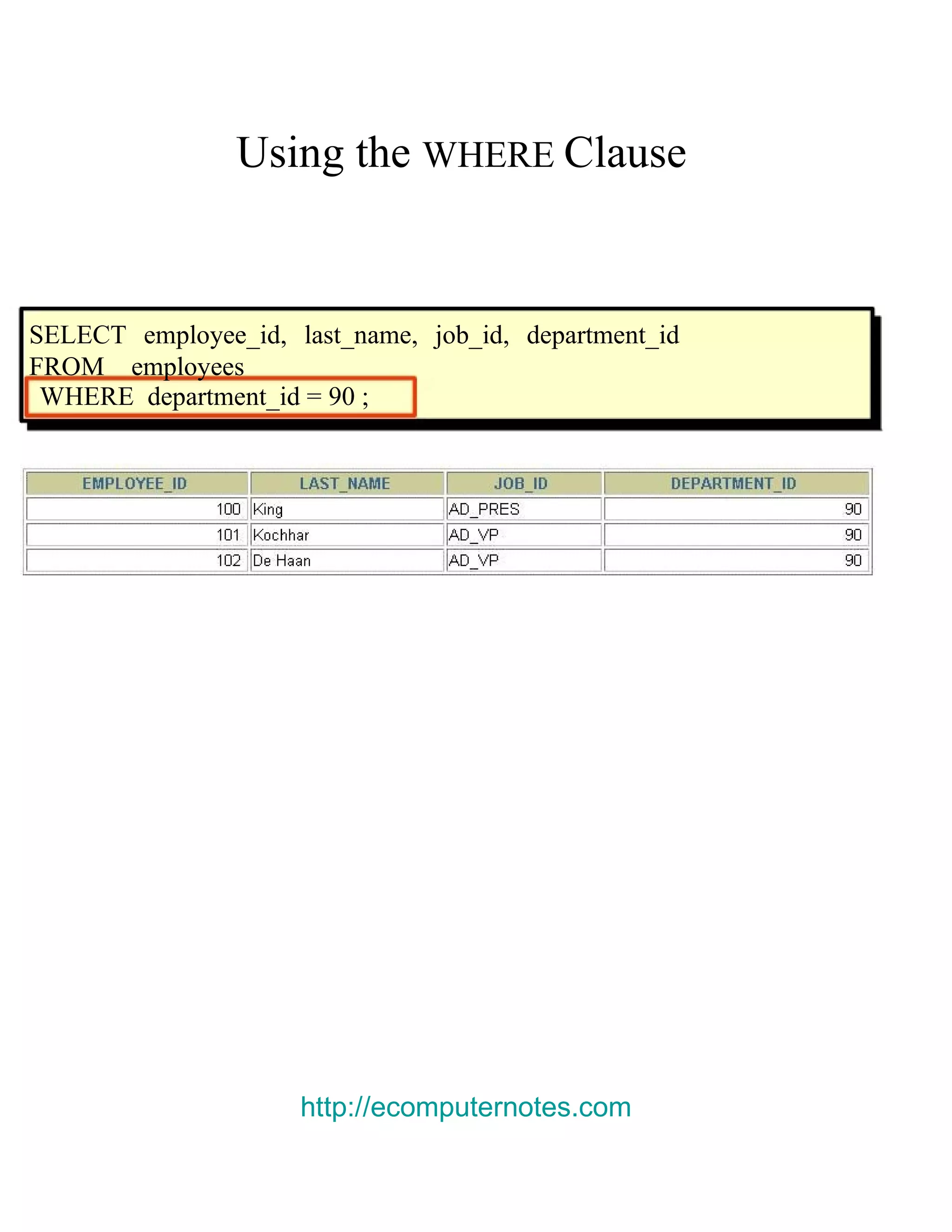
Using the   WHERE   Clause  SELECT employee_id, last_name, job_id, department_id FROM  employees  WHERE  department_id = 90 ;  http://ecomputernotes.com
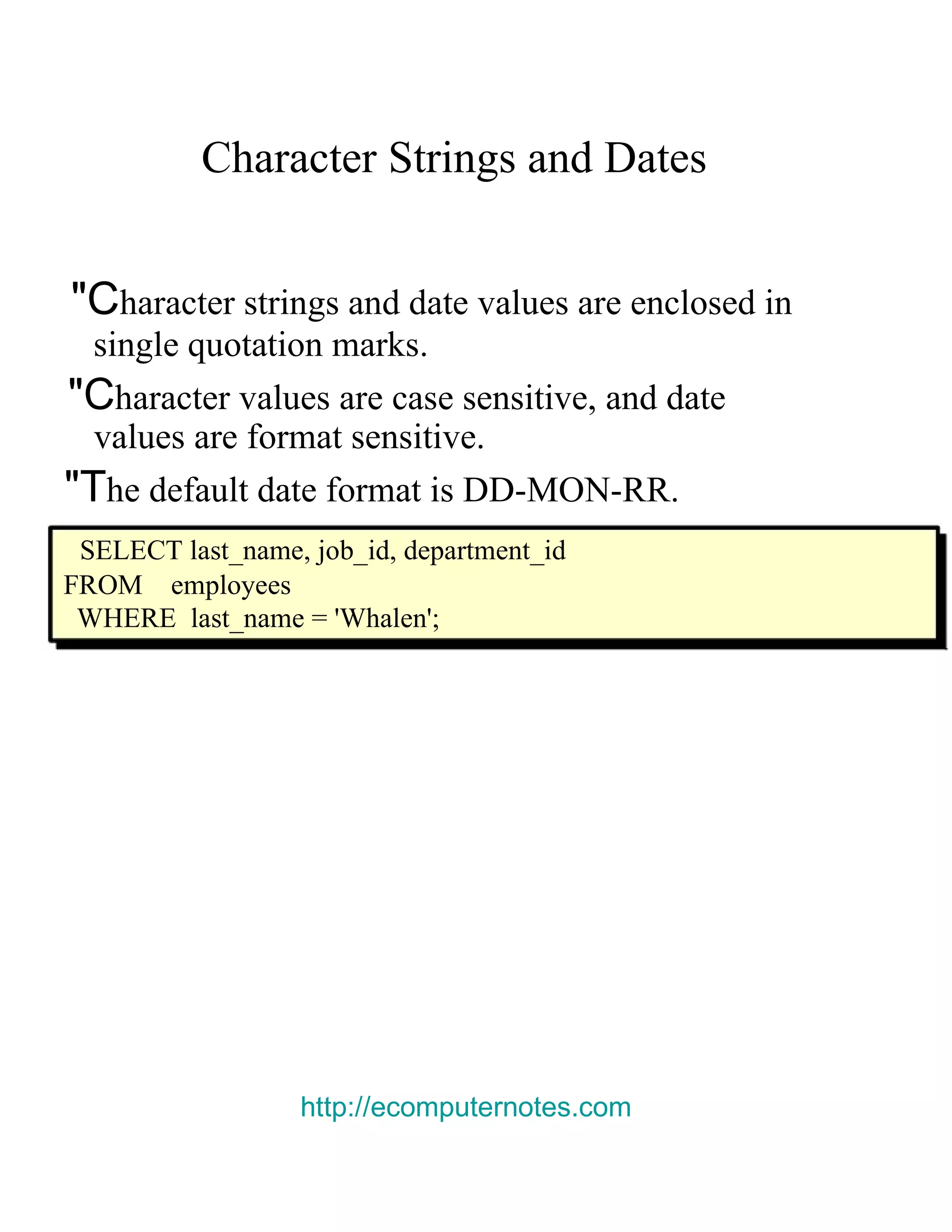
Character Strings and Dates  "C haracter strings and date values are enclosed in  single quotation marks.  "C haracter values are case sensitive, and date  values are format sensitive.  "T he default date format is DD-MON-RR.  SELECT last_name, job_id, department_id  FROM  employees  WHERE  last_name = 'Whalen';  http://ecomputernotes.com
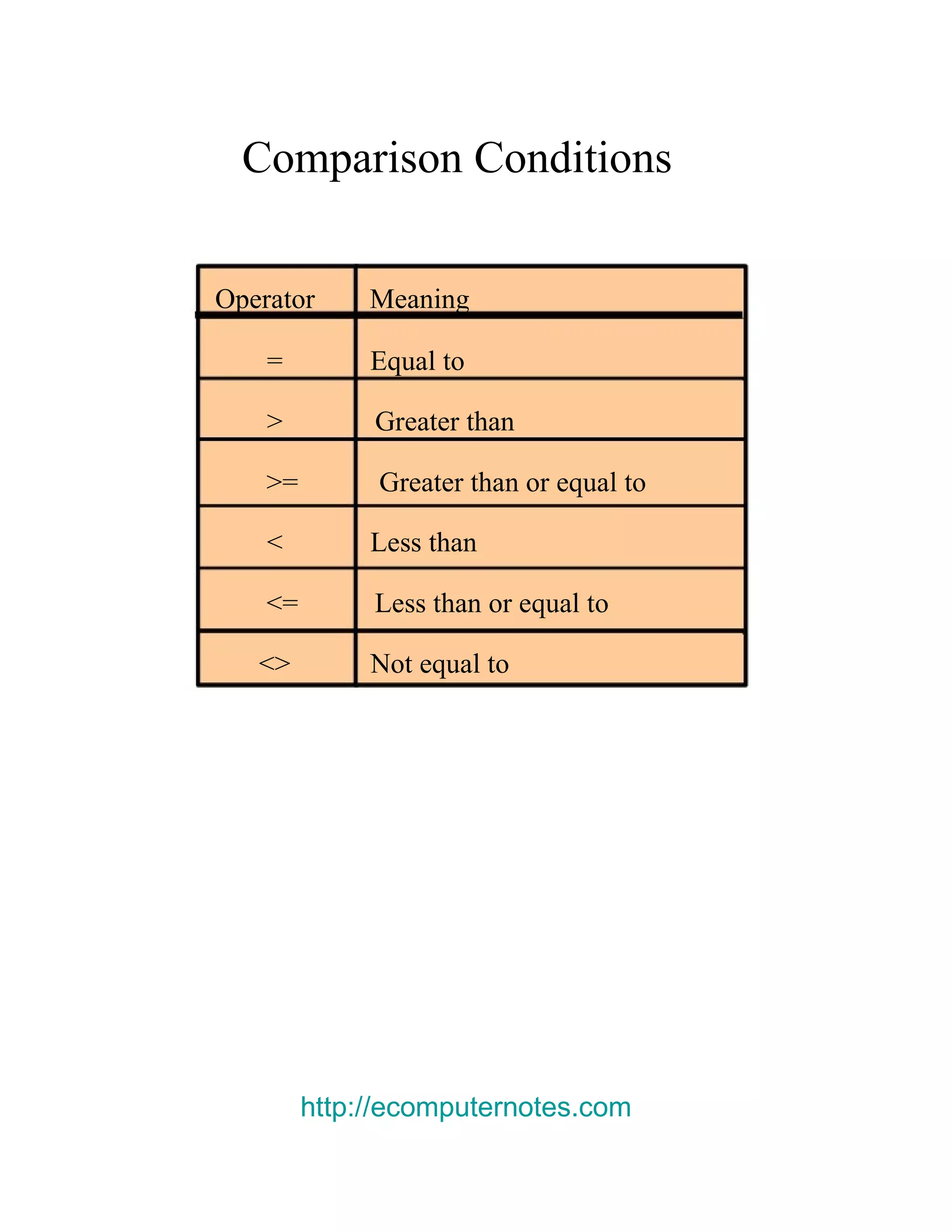
Comparison Conditions  Operator  Meaning  =  Equal to  >  Greater than  >=  Greater than or equal to  <  Less than  <=  Less than or equal to  <>  Not equal to  http://ecomputernotes.com
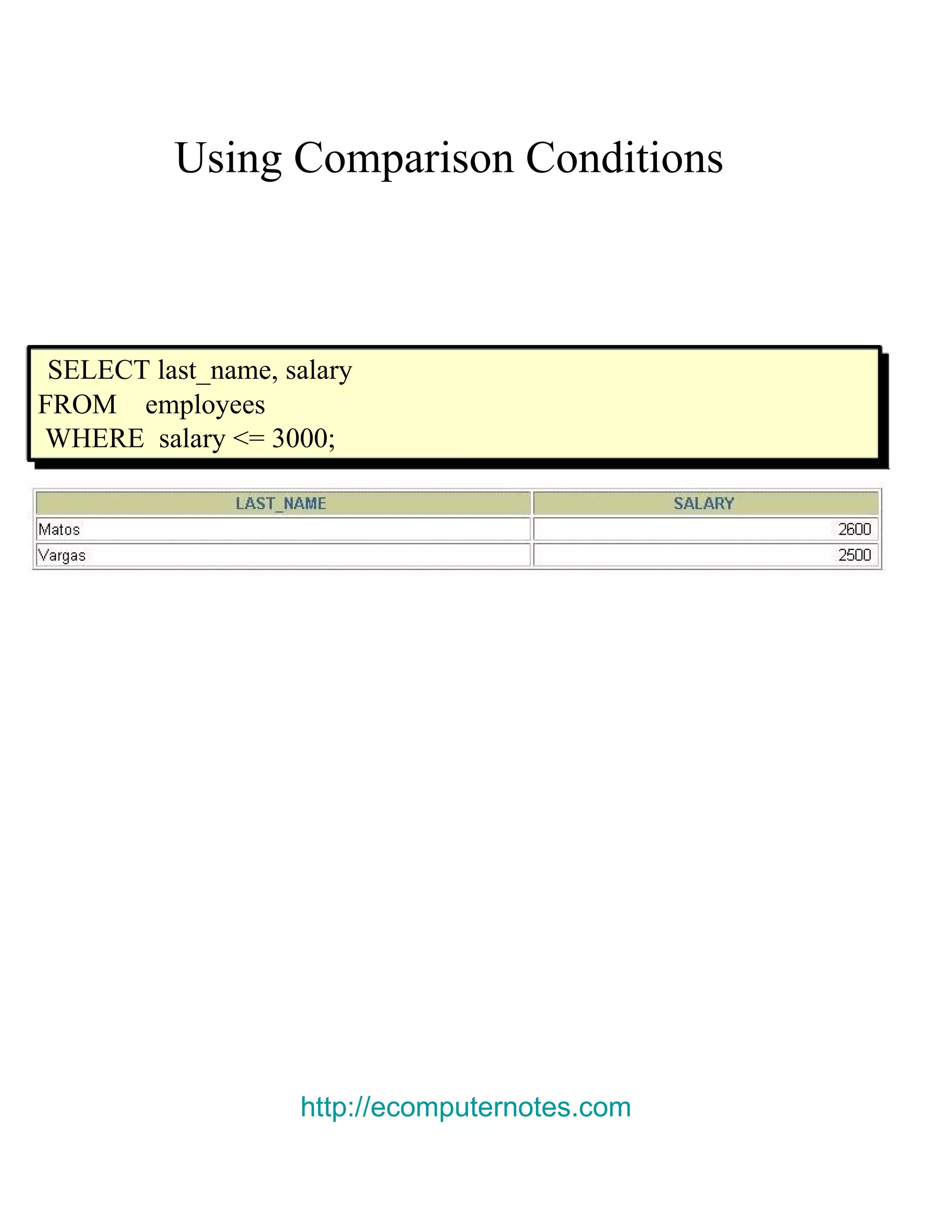
Using Comparison Conditions  SELECT last_name, salary  FROM  employees  WHERE  salary <= 3000;  http://ecomputernotes.com
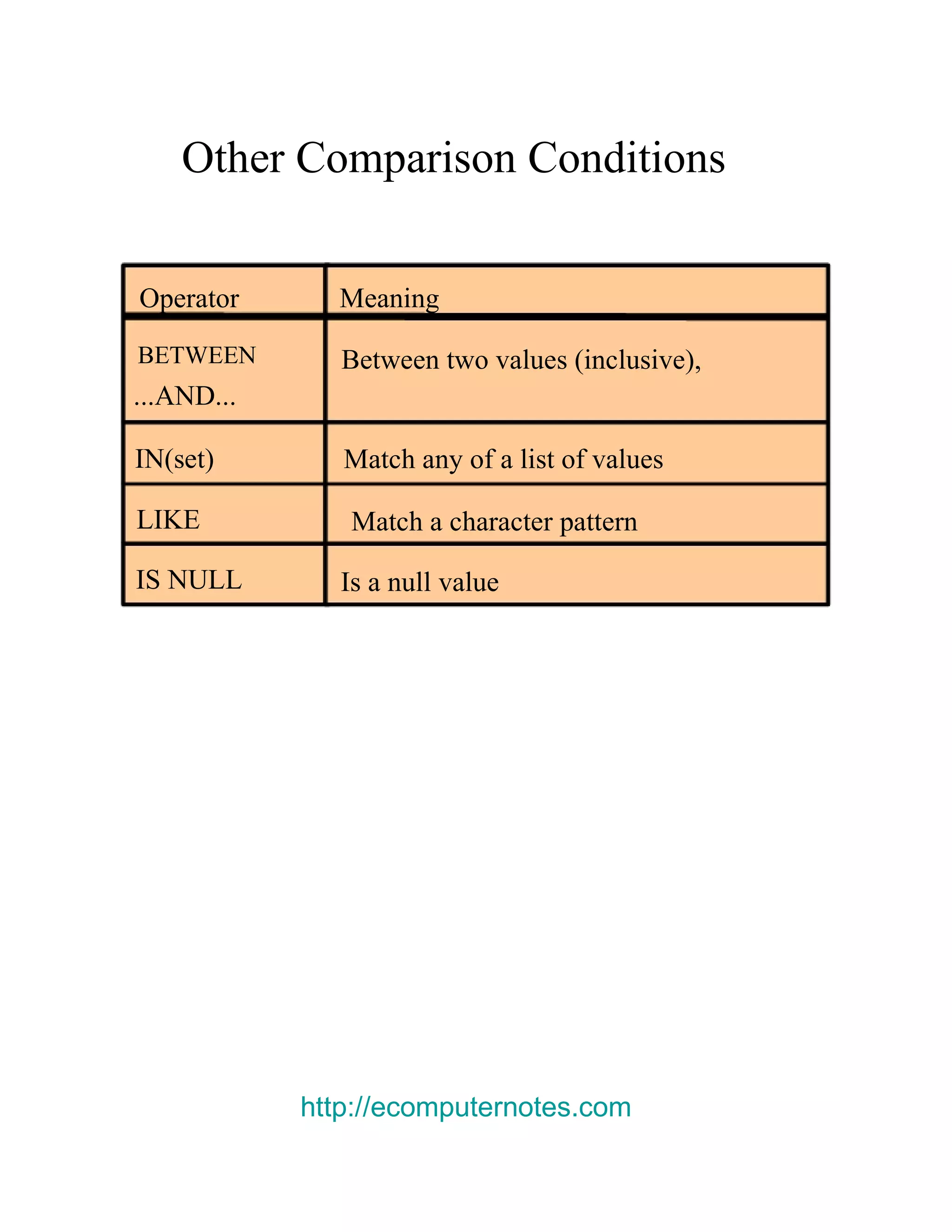
Other Comparison Conditions  Operator  Meaning  BETWEEN  Between two values (inclusive),  ...AND...  IN(set)  Match any of a list of values  LIKE  Match a character pattern  IS NULL  Is a null value  http://ecomputernotes.com
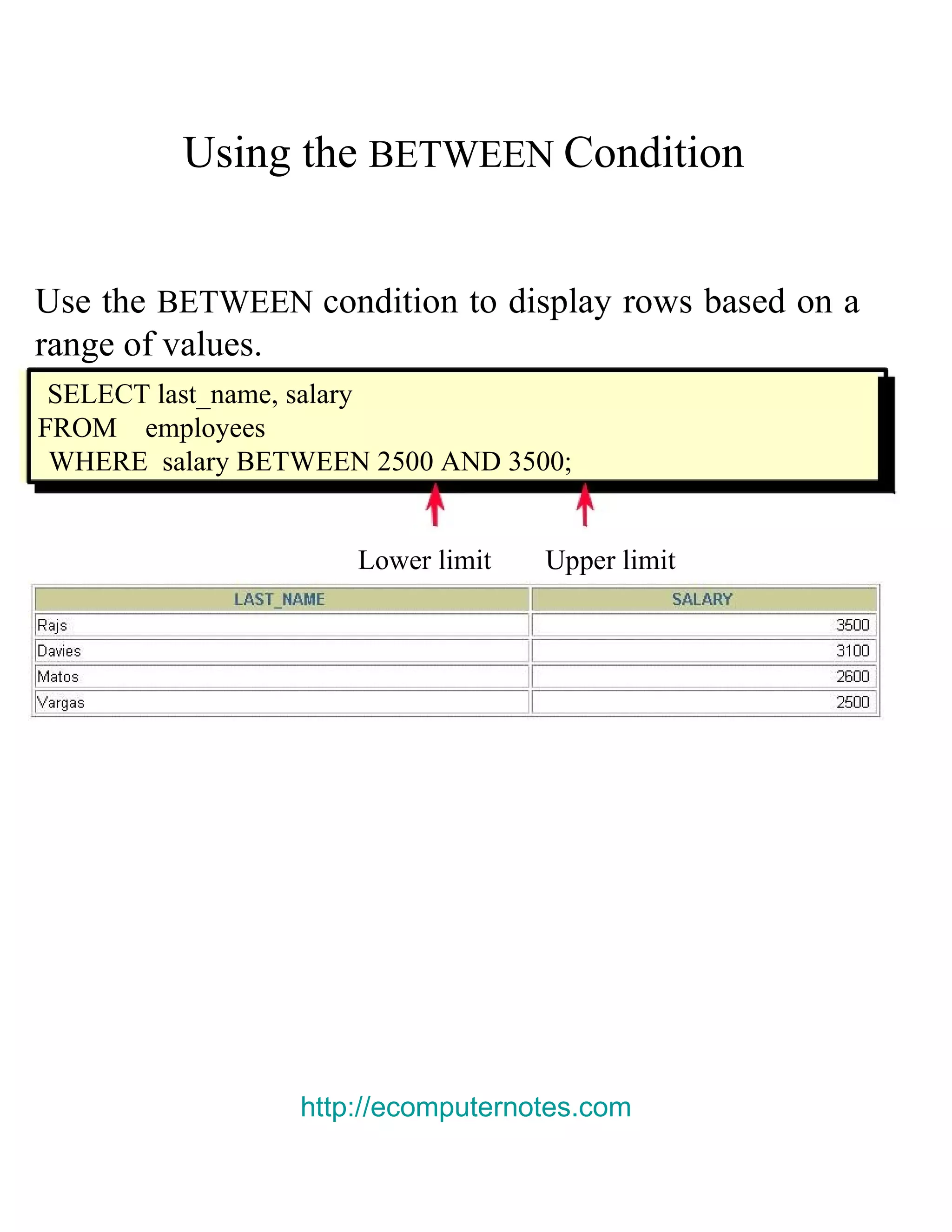
Using the   BETWEEN   Condition  Use the   BETWEEN   condition to display rows based on a range of values.  SELECT last_name, salary  FROM  employees  WHERE  salary BETWEEN 2500 AND 3500;  Lower limit  Upper limit  http://ecomputernotes.com
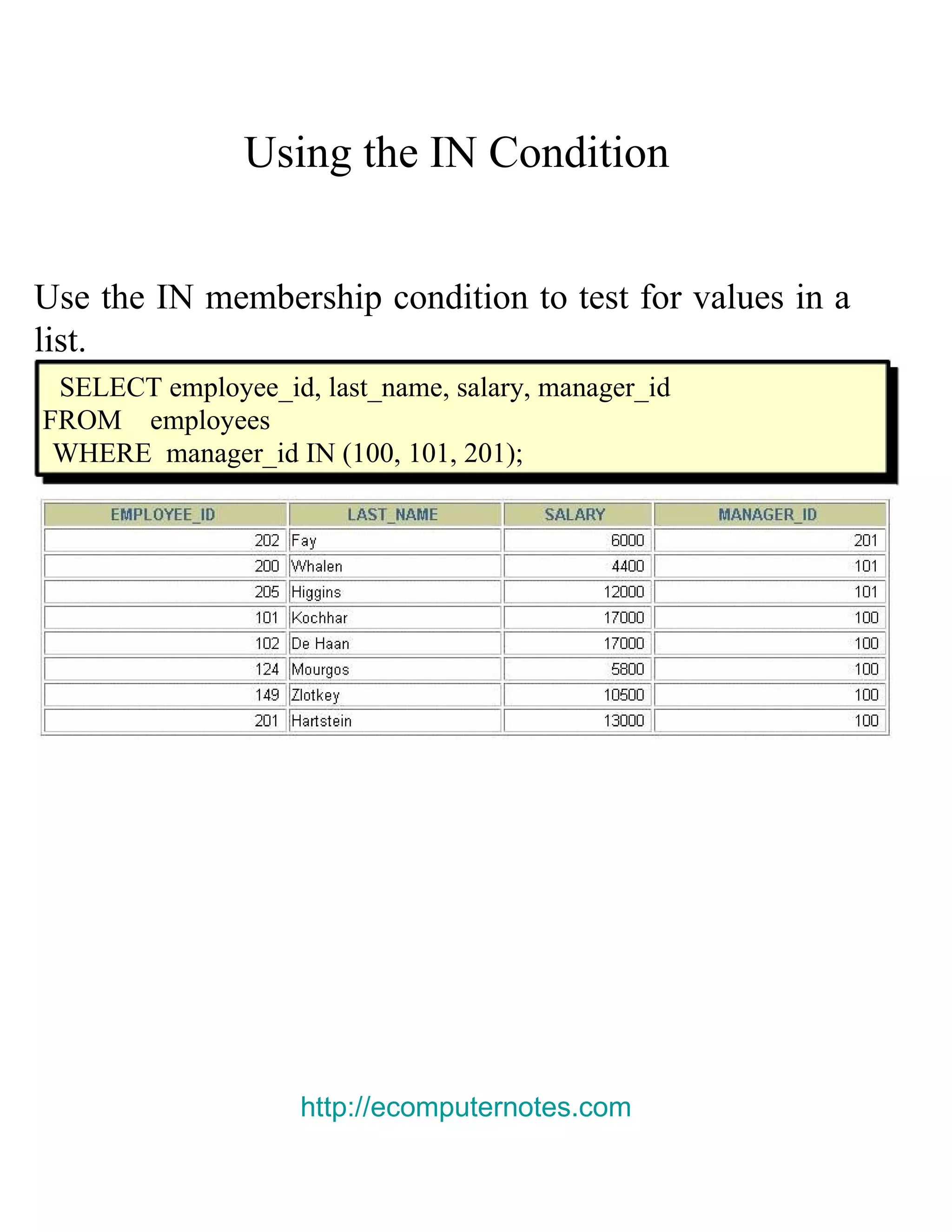
Using the   IN   Condition  Use the   IN   membership condition to test for values in a list.  SELECT employee_id, last_name, salary, manager_id  FROM  employees  WHERE  manager_id IN (100, 101, 201);  http://ecomputernotes.com
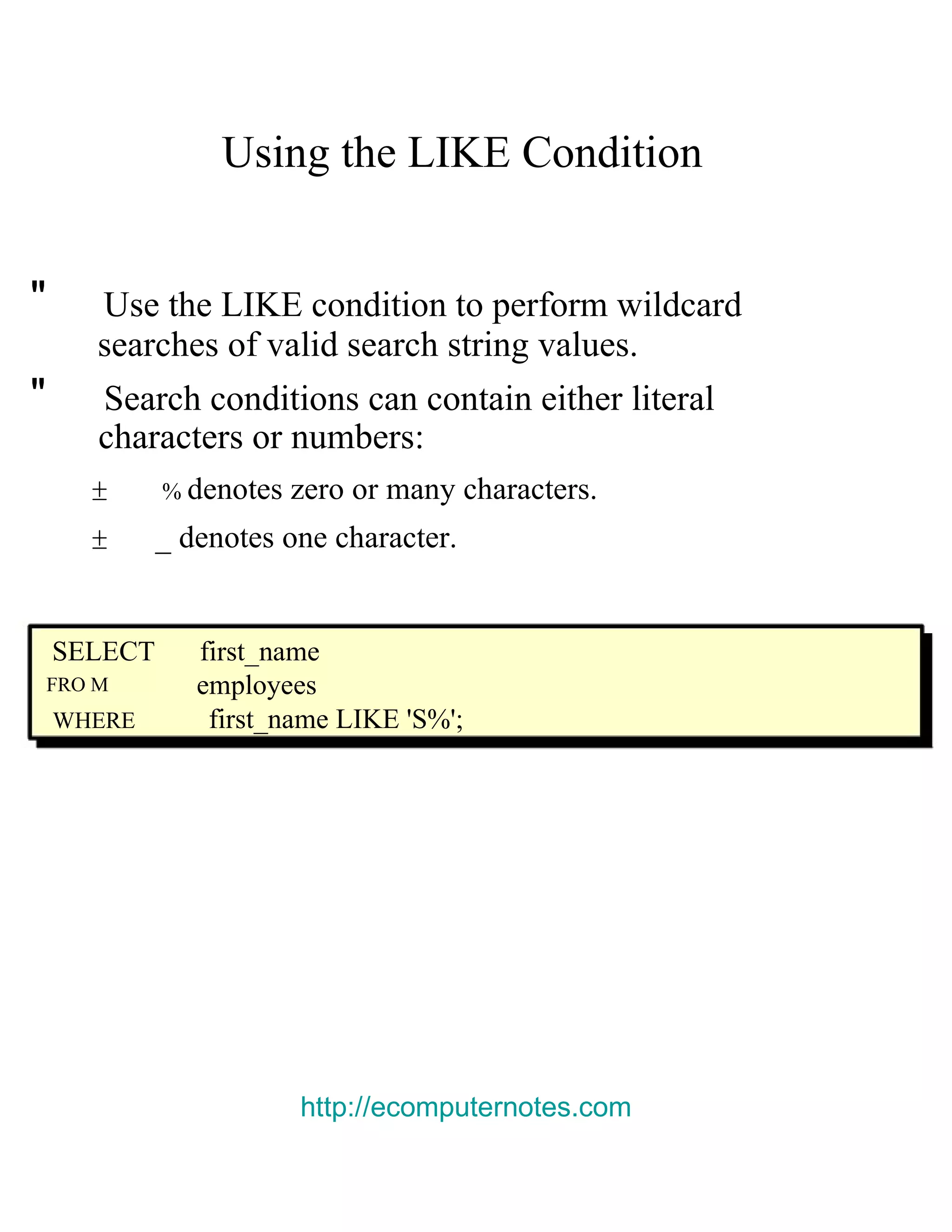
Using the   LIKE   Condition  &quot;  Use the   LIKE   condition to perform wildcard  searches of valid search string values.  &quot;  Search conditions can contain either literal  characters or numbers:  ±  %   denotes zero or many characters.  ±  _ denotes one character.  SELECT  first_name  FRO M  employees  WHERE  first_name LIKE 'S%';  http://ecomputernotes.com
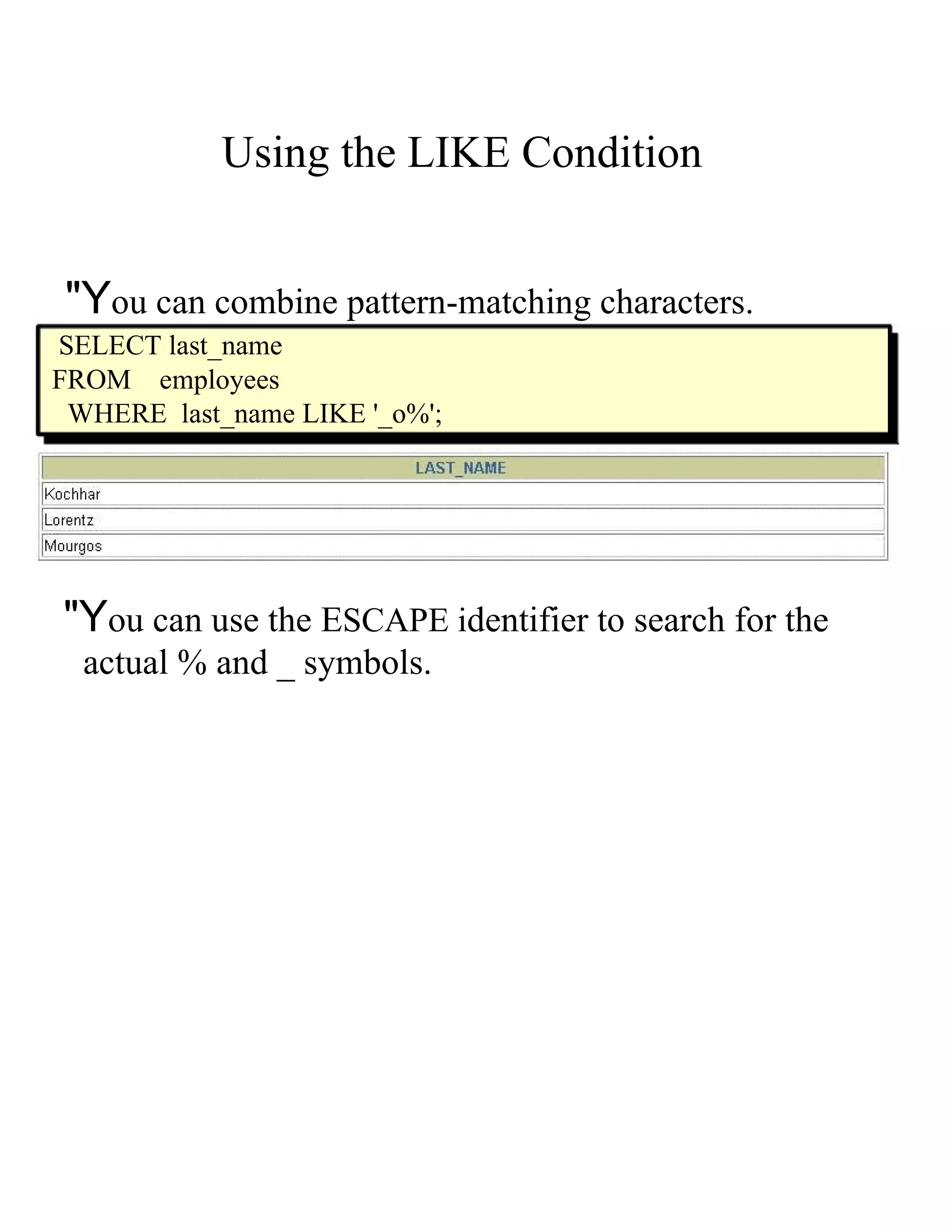
Using the   LIKE   Condition  &quot;Y ou can combine pattern-matching characters.  SELECT last_name  FROM  employees  WHERE  last_name LIKE '_o%';  &quot;Y ou can use the  E SCAPE  i dentifier to search for the  actual   %   and   _   symbols.
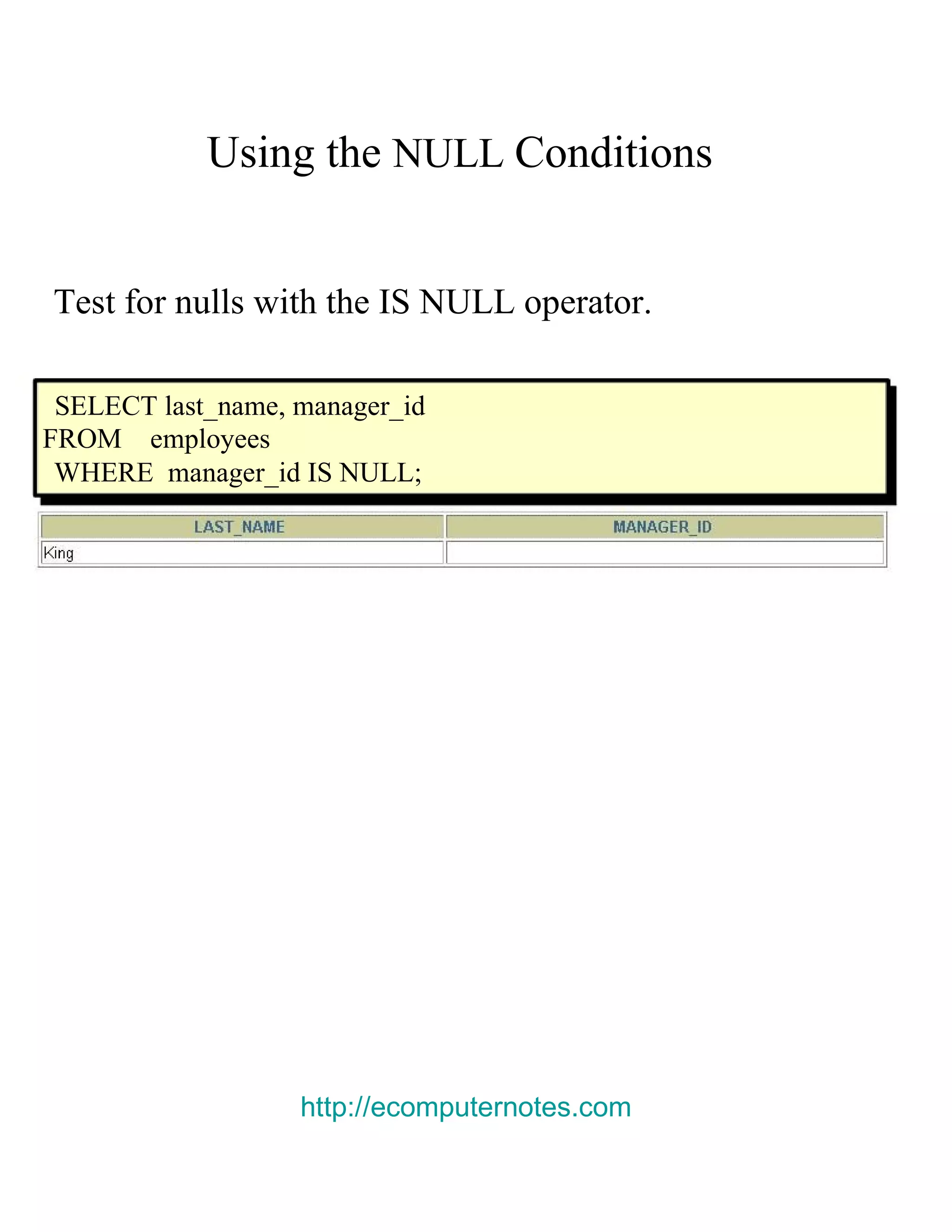
Using the   NULL   Conditions  Test for nulls with the   IS NULL   operator.  SELECT last_name, manager_id  FROM  employees  WHERE  manager_id IS NULL;  http://ecomputernotes.com
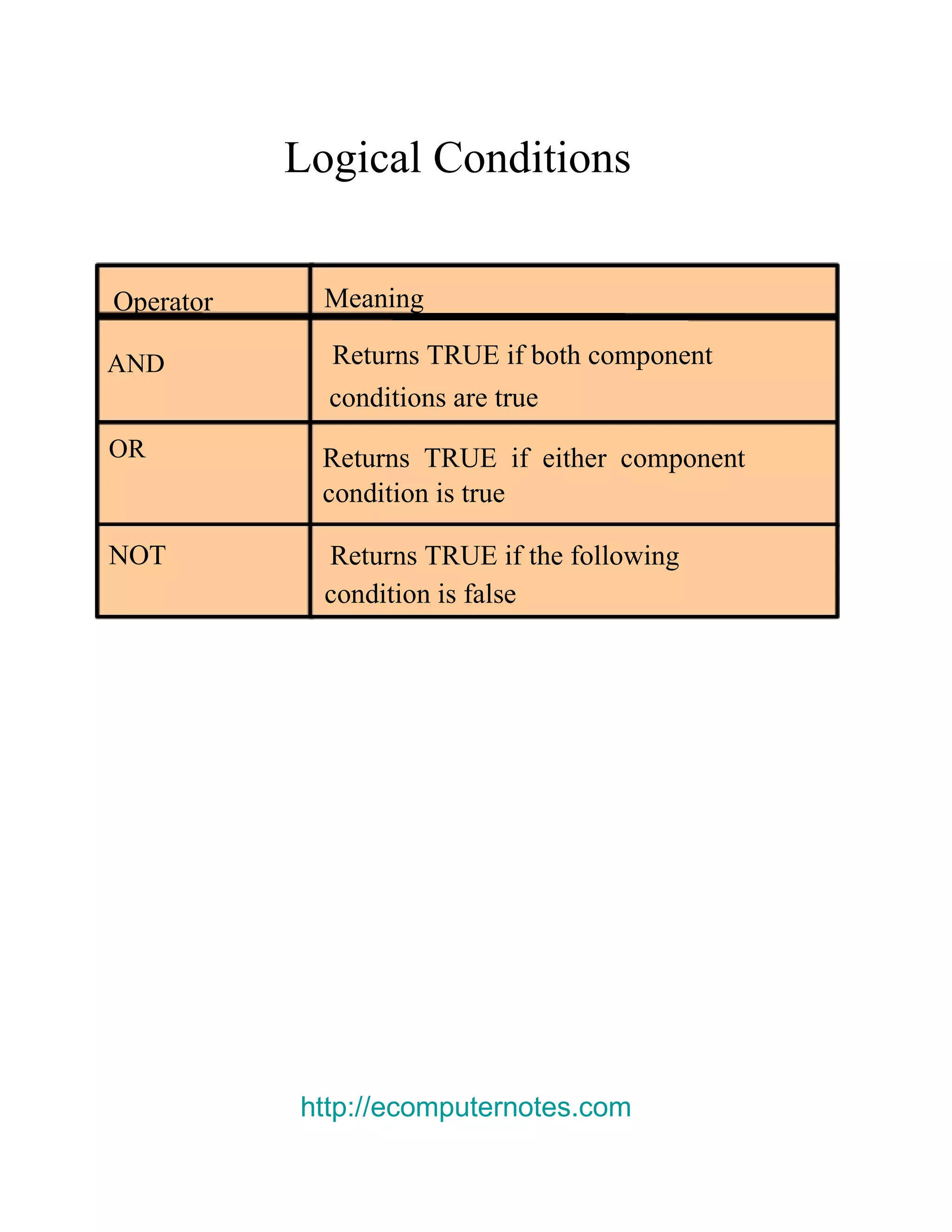
Logical Conditions  Meaning  Operator  Returns   TRUE   if   both   component  AND  conditions are true  OR  Returns   TRUE   if   either   component condition is true  NOT  Returns   TRUE   if the following  condition is false  http://ecomputernotes.com
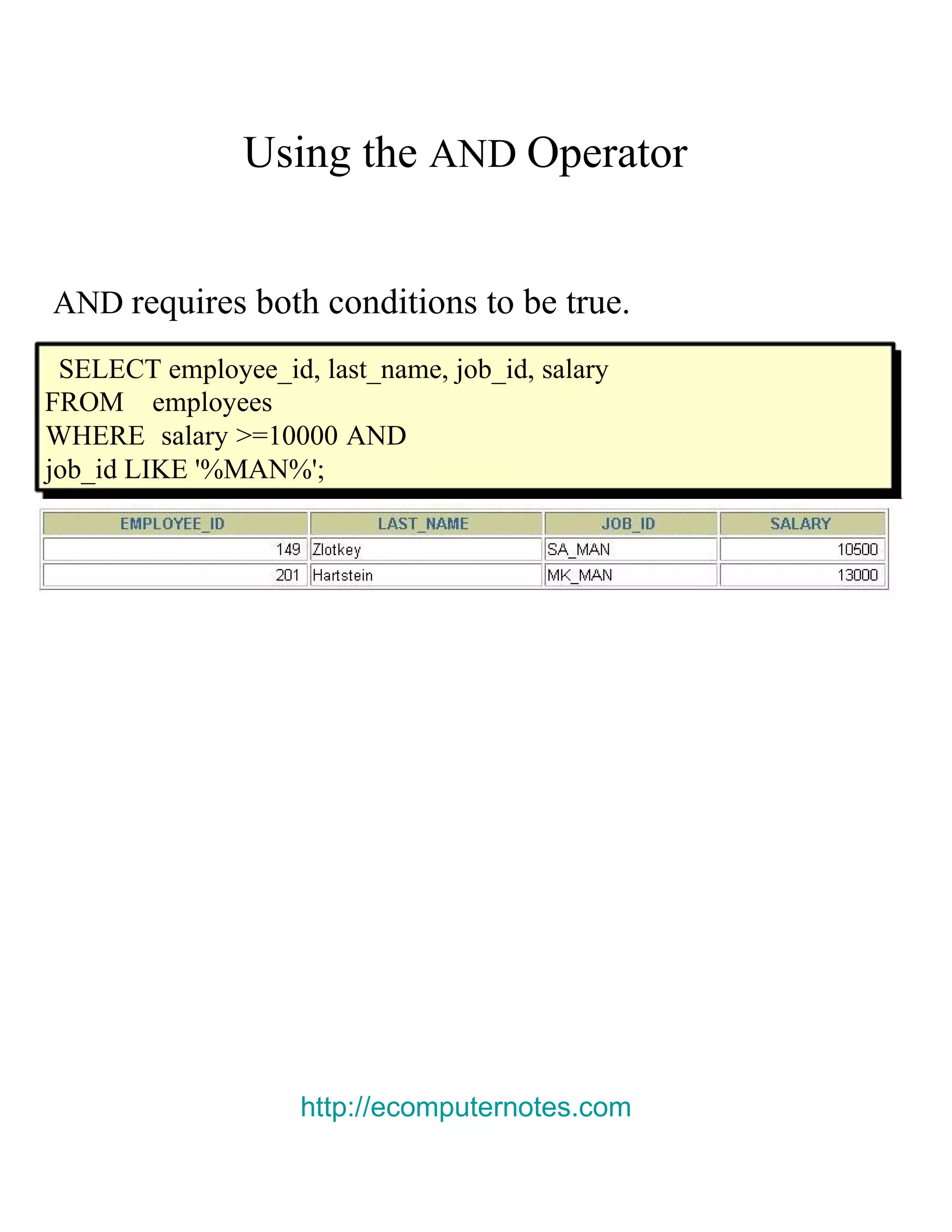
Using the   AND   Operator  AND   requires both conditions to be true.  SELECT employee_id, last_name, job_id, salary  FROM  employees  WHERE  salary >=10000 AND  job_id LIKE '%MAN%';  http://ecomputernotes.com
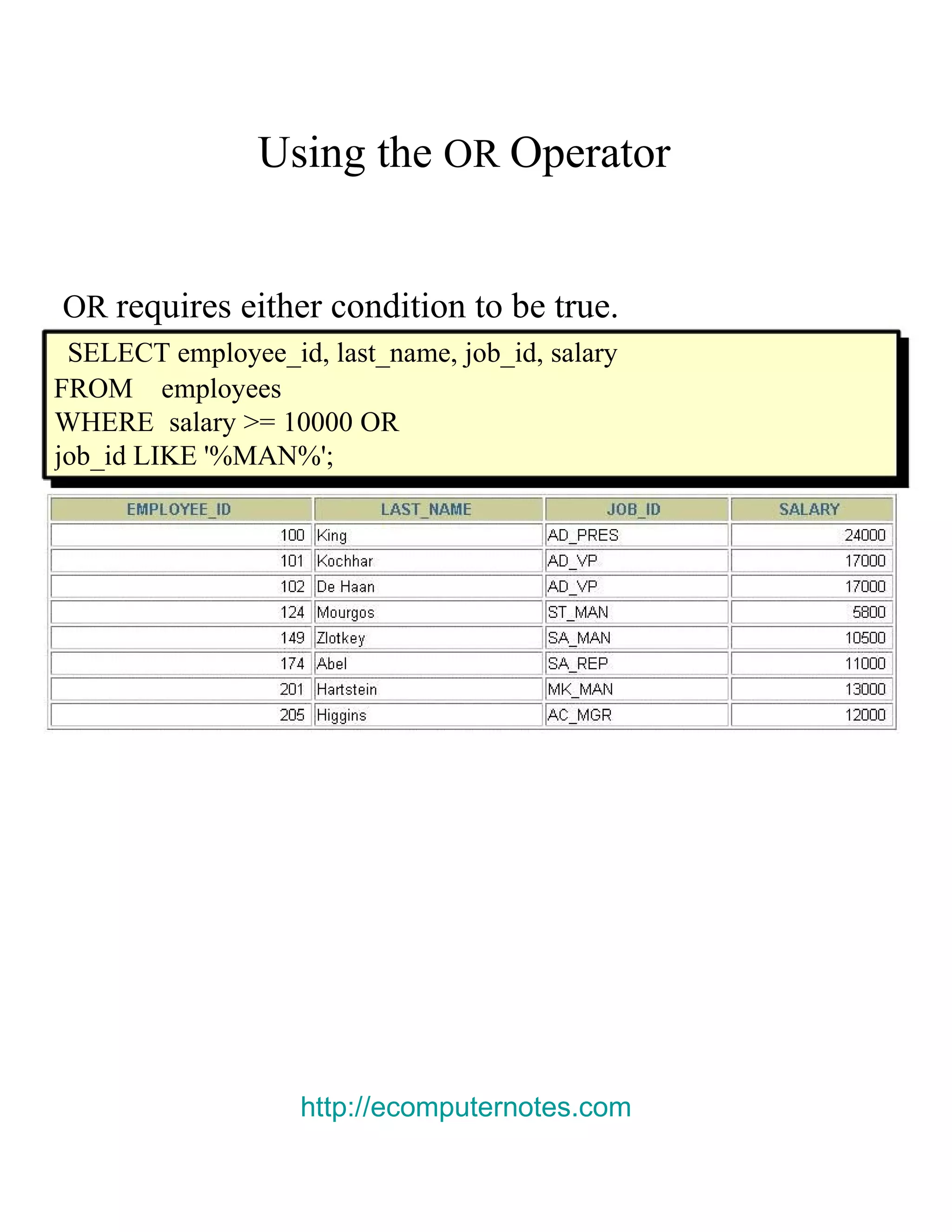
Using the   OR   Operator  OR   requires either condition to be true.  SELECT employee_id, last_name, job_id, salary  FROM  employees  WHERE  salary >= 10000 OR  job_id LIKE '%MAN%';  http://ecomputernotes.com
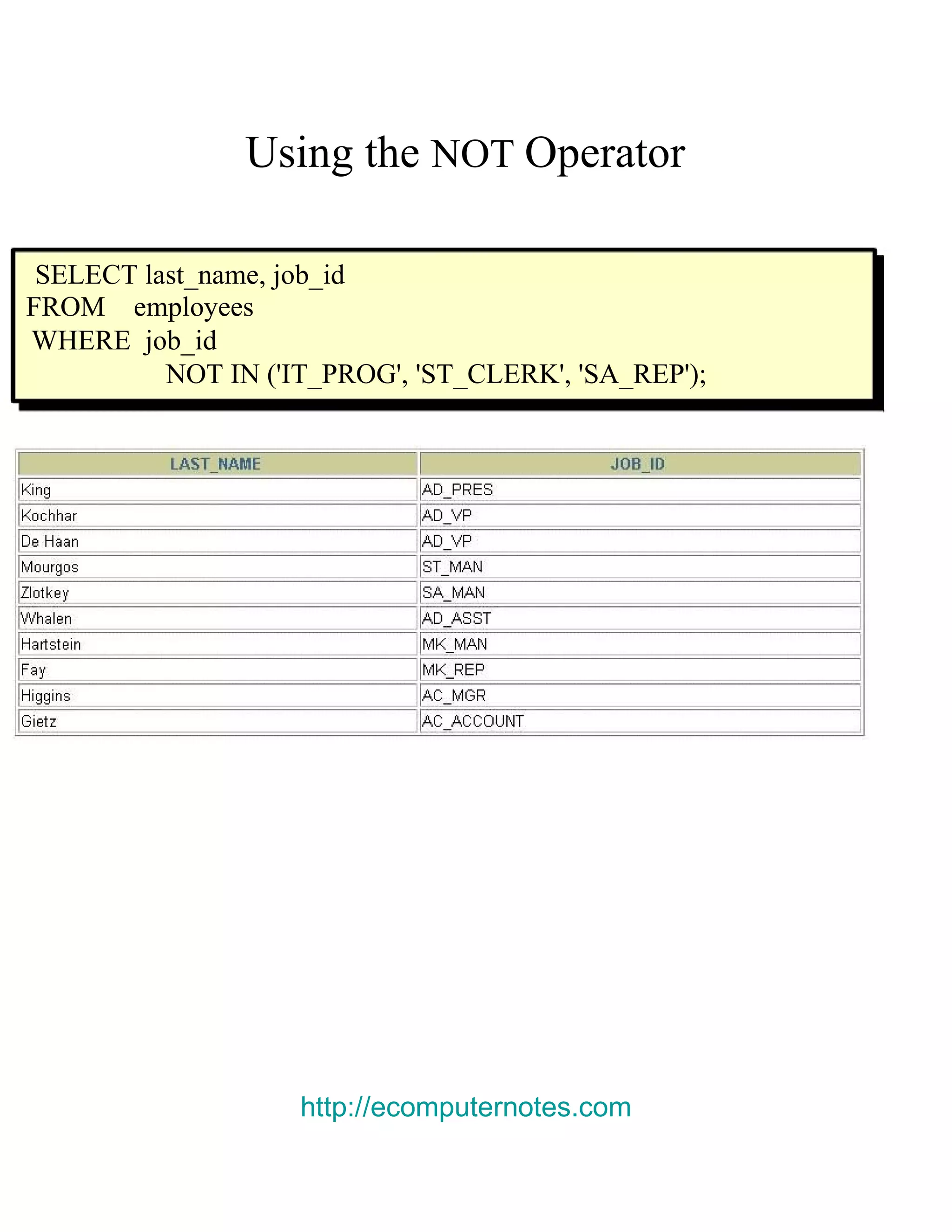
Using the   NOT   Operator  SELECT last_name, job_id  FROM  employees  WHERE  job_id  NOT IN ('IT_PROG', 'ST_CLERK', 'SA_REP');  http://ecomputernotes.com
Rules of Precedence  Order Evaluated  Operator  1  Arithmetic operators  2  Concatenation operator  3  Comparison conditions  4  IS [NOT] NULL,   LIKE,   [NOT] IN  5  [NOT] BETWEEN  6  NOT   logical condition  7  AND   logical condition  8  OR   logical condition  Override rules of precedence by using parentheses.  http://ecomputernotes.com
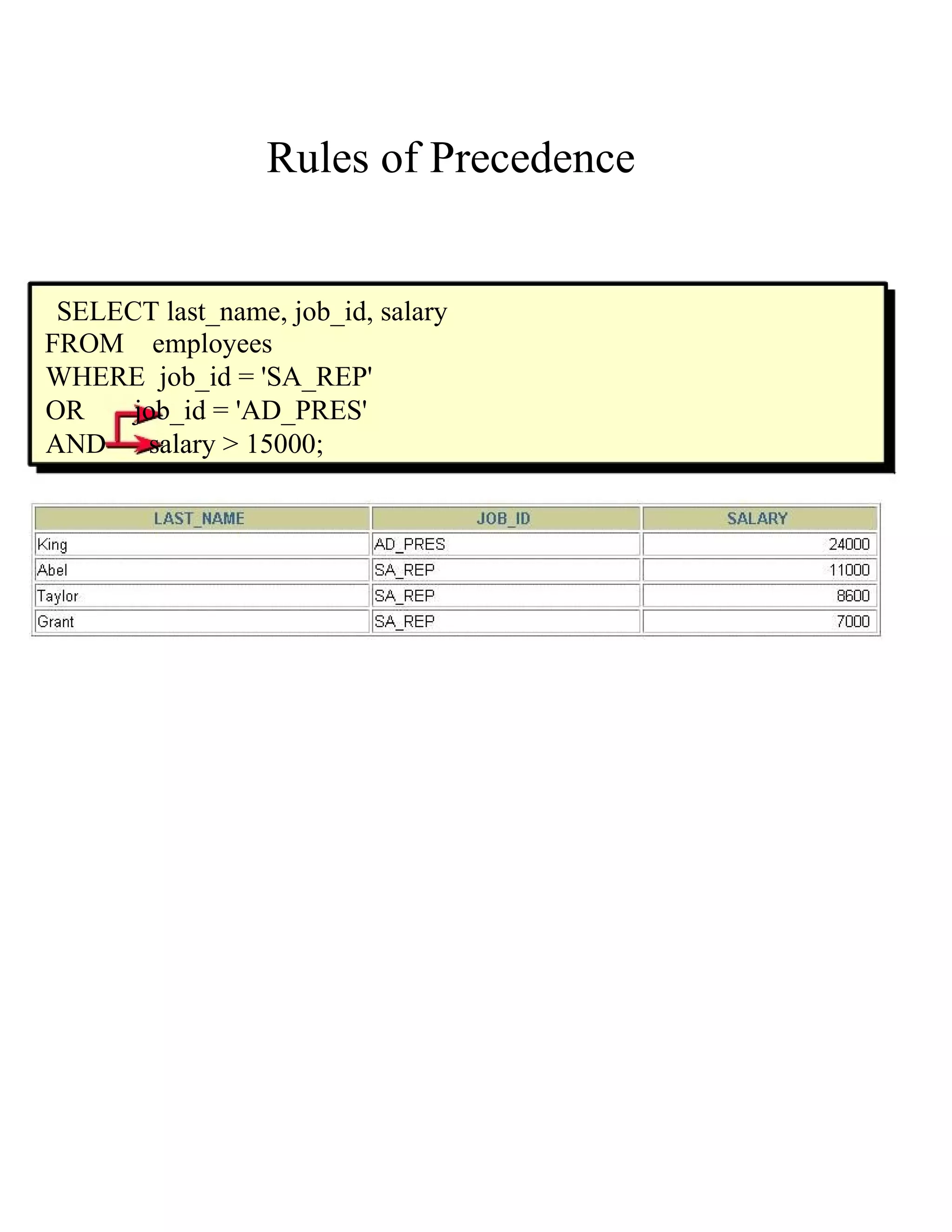
Rules of Precedence  SELECT last_name, job_id, salary  FROM  employees  WHERE  job_id = 'SA_REP' OR  job_id = 'AD_PRES' AND  salary > 15000;
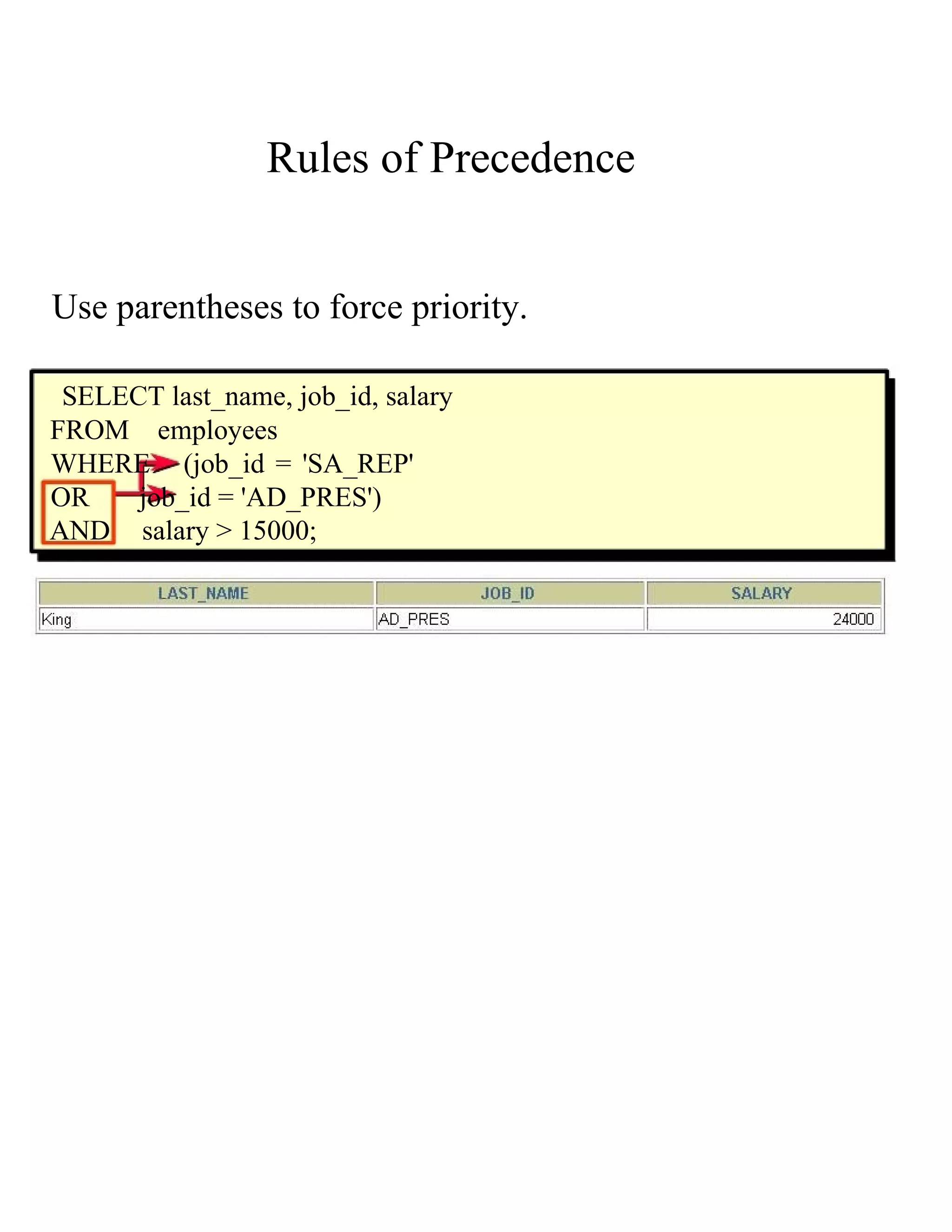
Rules of Precedence  Use parentheses to force priority.  SELECT last_name, job_id, salary  FROM  employees  WHERE  (job_id = 'SA_REP' OR  job_id = 'AD_PRES')  AND  salary > 15000;
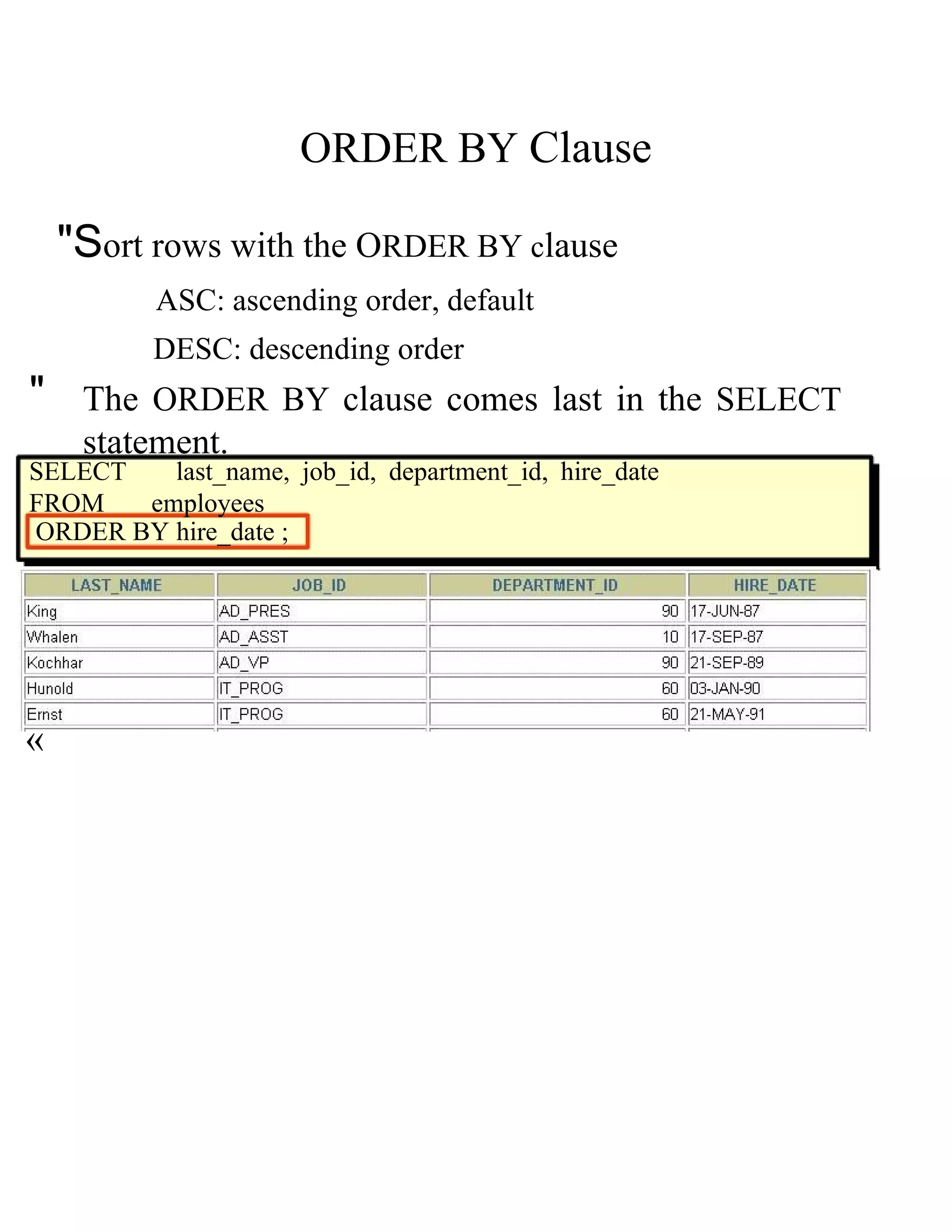
ORDER BY   Clause  &quot;S ort rows with the  O RDER BY  c lause  ASC: ascending order, default  DESC: descending order  &quot;  The   ORDER BY   clause comes last in the   SELECT  statement.  SELECT  last_name, job_id, department_id, hire_date FROM  employees  ORDER BY hire_date ;  «
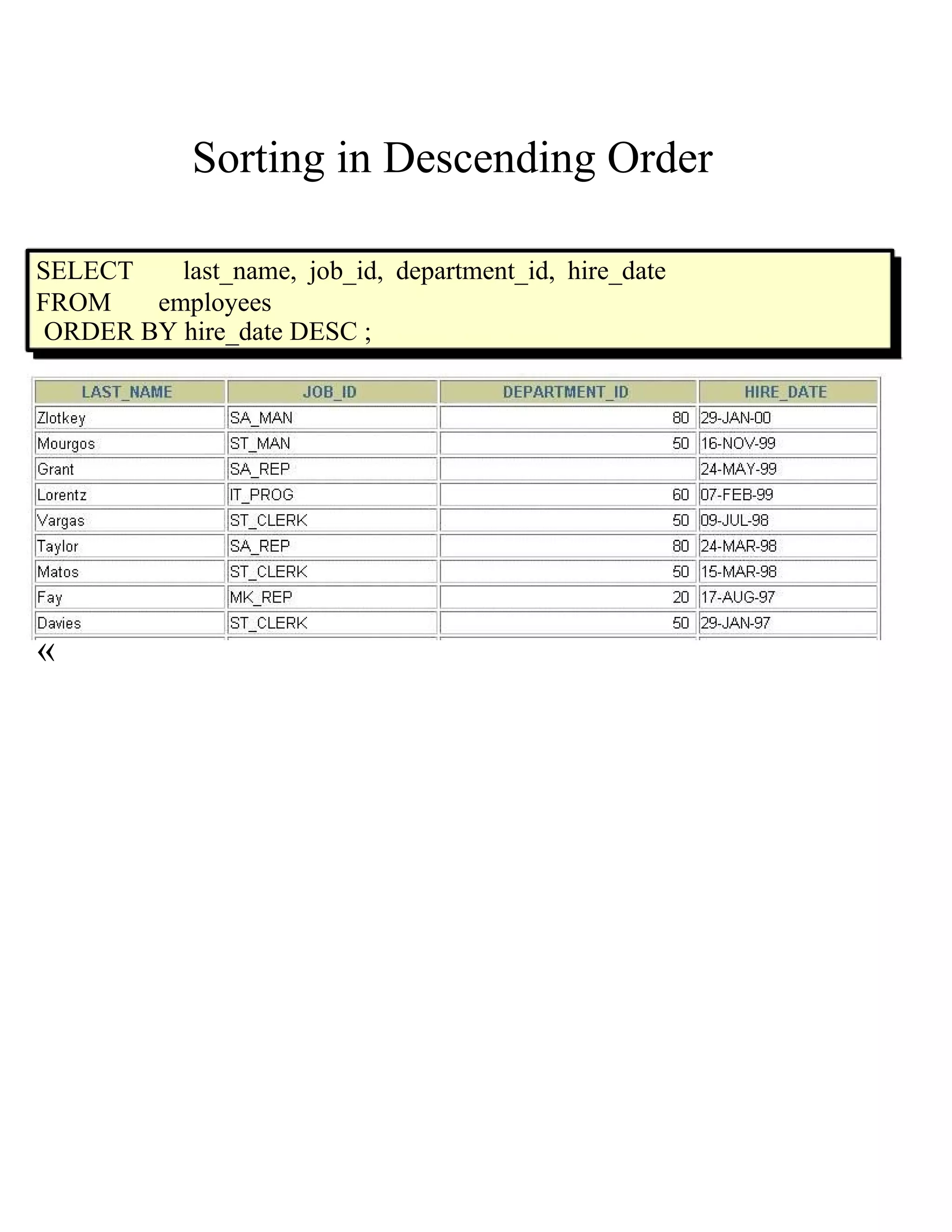
Sorting in Descending Order  SELECT  last_name, job_id, department_id, hire_date FROM  employees  ORDER BY hire_date DESC ;  «
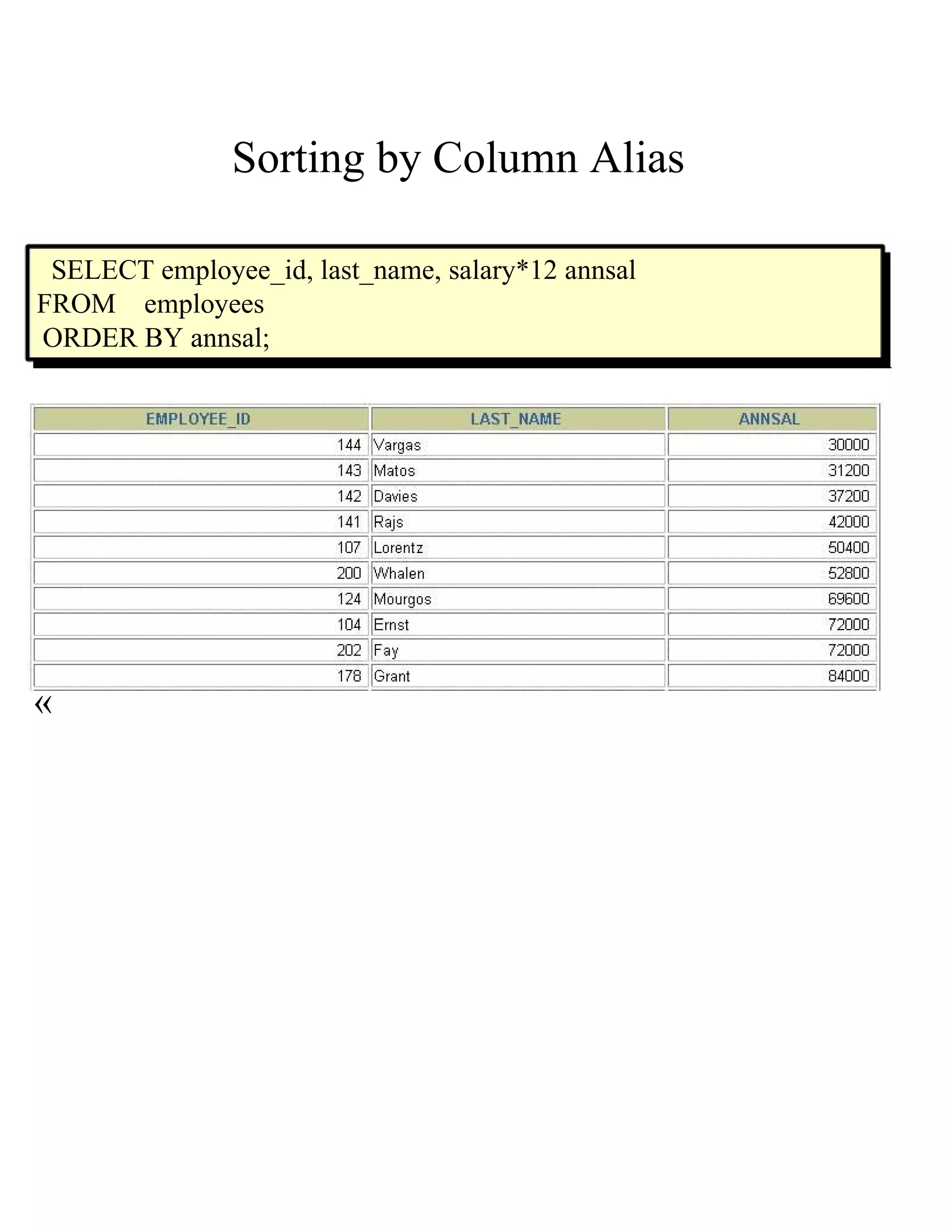
Sorting by Column Alias  SELECT employee_id, last_name, salary*12 annsal  FROM  employees  ORDER BY annsal;  «
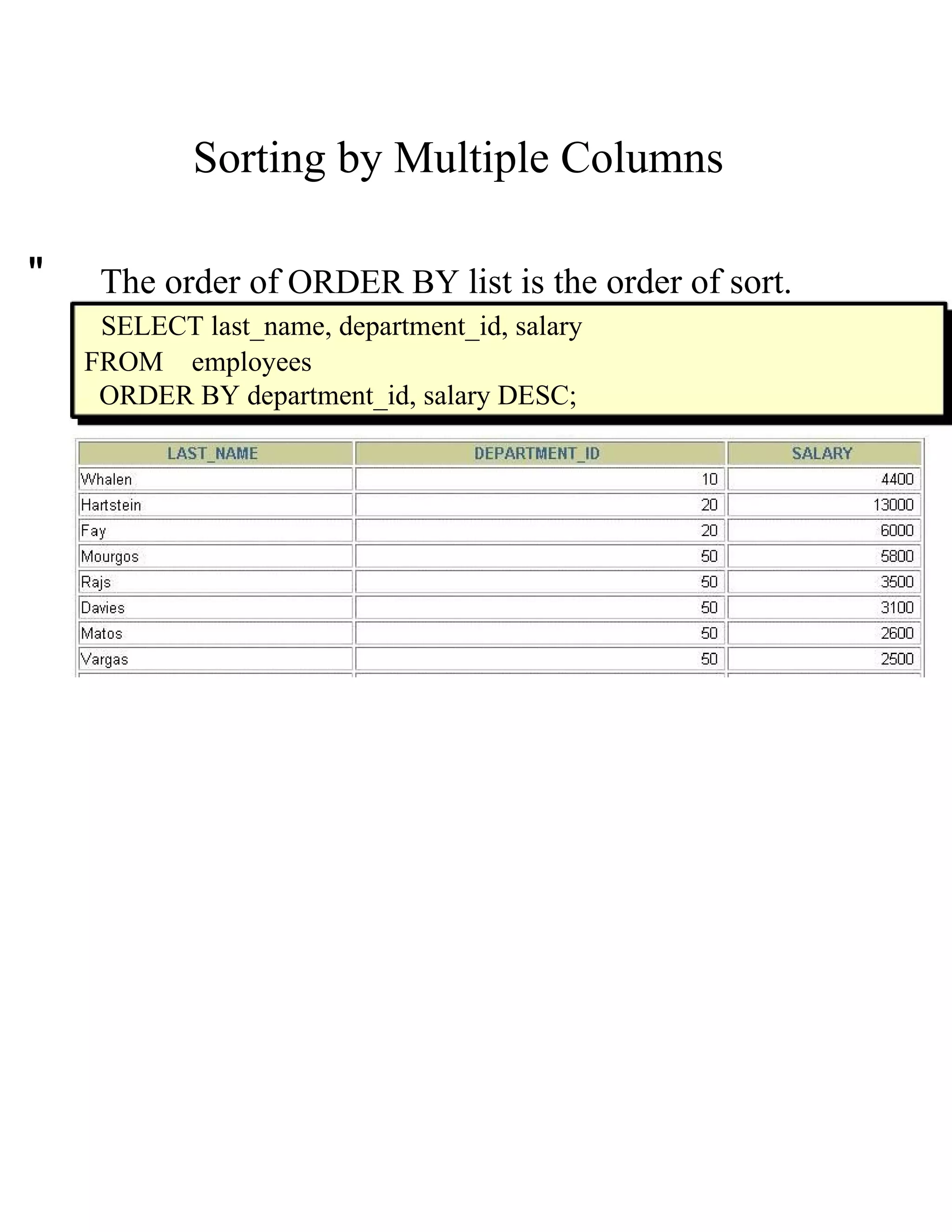
Sorting by Multiple Columns  &quot;  The order of   ORDER BY   list is the order of sort.  SELECT last_name, department_id, salary  FROM  employees  ORDER BY department_id, salary DESC;
 

e computer notes - Restricting and sorting data

  • 1.
  • 2.
    Restricting and SortingData http://ecomputernotes.com
  • 3.
    Objectives Aftercompleting this lesson, you should be able to do the following: &quot; Limit the rows retrieved by a query &quot;S ort the rows retrieved by a query http://ecomputernotes.com
  • 4.
  • 5.
    Limiting the RowsSelected &quot; Restrict the rows returned by using the WHERE clause. SELECT *|{[DISTINCT] column|expression [ alias ],...} FRO M table [WHERE condition(s) ]; &quot; The WHERE clause follows the FROM clause. http://ecomputernotes.com
  • 6.
    Using the WHERE Clause SELECT employee_id, last_name, job_id, department_id FROM employees WHERE department_id = 90 ; http://ecomputernotes.com
  • 7.
    Character Strings andDates &quot;C haracter strings and date values are enclosed in single quotation marks. &quot;C haracter values are case sensitive, and date values are format sensitive. &quot;T he default date format is DD-MON-RR. SELECT last_name, job_id, department_id FROM employees WHERE last_name = 'Whalen'; http://ecomputernotes.com
  • 8.
    Comparison Conditions Operator Meaning = Equal to > Greater than >= Greater than or equal to < Less than <= Less than or equal to <> Not equal to http://ecomputernotes.com
  • 9.
    Using Comparison Conditions SELECT last_name, salary FROM employees WHERE salary <= 3000; http://ecomputernotes.com
  • 10.
    Other Comparison Conditions Operator Meaning BETWEEN Between two values (inclusive), ...AND... IN(set) Match any of a list of values LIKE Match a character pattern IS NULL Is a null value http://ecomputernotes.com
  • 11.
    Using the BETWEEN Condition Use the BETWEEN condition to display rows based on a range of values. SELECT last_name, salary FROM employees WHERE salary BETWEEN 2500 AND 3500; Lower limit Upper limit http://ecomputernotes.com
  • 12.
    Using the IN Condition Use the IN membership condition to test for values in a list. SELECT employee_id, last_name, salary, manager_id FROM employees WHERE manager_id IN (100, 101, 201); http://ecomputernotes.com
  • 13.
    Using the LIKE Condition &quot; Use the LIKE condition to perform wildcard searches of valid search string values. &quot; Search conditions can contain either literal characters or numbers: ± % denotes zero or many characters. ± _ denotes one character. SELECT first_name FRO M employees WHERE first_name LIKE 'S%'; http://ecomputernotes.com
  • 14.
    Using the LIKE Condition &quot;Y ou can combine pattern-matching characters. SELECT last_name FROM employees WHERE last_name LIKE '_o%'; &quot;Y ou can use the E SCAPE i dentifier to search for the actual % and _ symbols.
  • 15.
    Using the NULL Conditions Test for nulls with the IS NULL operator. SELECT last_name, manager_id FROM employees WHERE manager_id IS NULL; http://ecomputernotes.com
  • 16.
    Logical Conditions Meaning Operator Returns TRUE if both component AND conditions are true OR Returns TRUE if either component condition is true NOT Returns TRUE if the following condition is false http://ecomputernotes.com
  • 17.
    Using the AND Operator AND requires both conditions to be true. SELECT employee_id, last_name, job_id, salary FROM employees WHERE salary >=10000 AND job_id LIKE '%MAN%'; http://ecomputernotes.com
  • 18.
    Using the OR Operator OR requires either condition to be true. SELECT employee_id, last_name, job_id, salary FROM employees WHERE salary >= 10000 OR job_id LIKE '%MAN%'; http://ecomputernotes.com
  • 19.
    Using the NOT Operator SELECT last_name, job_id FROM employees WHERE job_id NOT IN ('IT_PROG', 'ST_CLERK', 'SA_REP'); http://ecomputernotes.com
  • 20.
    Rules of Precedence Order Evaluated Operator 1 Arithmetic operators 2 Concatenation operator 3 Comparison conditions 4 IS [NOT] NULL, LIKE, [NOT] IN 5 [NOT] BETWEEN 6 NOT logical condition 7 AND logical condition 8 OR logical condition Override rules of precedence by using parentheses. http://ecomputernotes.com
  • 21.
    Rules of Precedence SELECT last_name, job_id, salary FROM employees WHERE job_id = 'SA_REP' OR job_id = 'AD_PRES' AND salary > 15000;
  • 22.
    Rules of Precedence Use parentheses to force priority. SELECT last_name, job_id, salary FROM employees WHERE (job_id = 'SA_REP' OR job_id = 'AD_PRES') AND salary > 15000;
  • 23.
    ORDER BY Clause &quot;S ort rows with the O RDER BY c lause ASC: ascending order, default DESC: descending order &quot; The ORDER BY clause comes last in the SELECT statement. SELECT last_name, job_id, department_id, hire_date FROM employees ORDER BY hire_date ; «
  • 24.
    Sorting in DescendingOrder SELECT last_name, job_id, department_id, hire_date FROM employees ORDER BY hire_date DESC ; «
  • 25.
    Sorting by ColumnAlias SELECT employee_id, last_name, salary*12 annsal FROM employees ORDER BY annsal; «
  • 26.
    Sorting by MultipleColumns &quot; The order of ORDER BY list is the order of sort. SELECT last_name, department_id, salary FROM employees ORDER BY department_id, salary DESC;
  • 27.