Dispatch in Clojure                             Carlo Sciolla, Product Lead @ Backbase


DISPATCH IN CLOJURE | August 8, 2012 | @skuro
(ns aot
  (:gen-class))

(defn -main [& args]
  (dorun
   (map println (seq args))))


 javap -c aot.class

 A quick journey in function calling
 We all learn to divide our code in functions, and invoke them when it’s
 their time on the stage of data processing. We define units of
 computations, ready to be executed.
 DISPATCH IN CLOJURE | August 8, 2012 | @skuro
public static void main(java.lang.String[]);
[..]
   4:! invokevirtual!#66;
[..]
   26:!invokestatic!
                   #104;
   29:!invokeinterface! #108, 2;
[..]
   44:!invokespecial!#115;    (defn -main [& args]
[..]                            (dorun
                                 (map println (seq args))))

 The JVM executes our code
 We’ll leave it to the JVM to figure out which code to actually run upon
 function call. It’s not always a straightforward job, and there are several
 ways to get to the code.
 DISPATCH IN CLOJURE | August 8, 2012 | @skuro
public static void main(java.lang.String[]);
[..]
   4:! invokevirtual!#66;
[..]
   26:!invokestatic!
                   #104;
   29:!invokeinterface! #108, 2;
[..]
   44:!invokespecial!#115;
[..]

 [clojure.lang.RT] static public ISeq seq(Object coll)

 Static dispatch
 When there’s nothing to choose from, the compiler emits a static
 dispatch bytecode. All calls will always result in the same code being
 executed.
 DISPATCH IN CLOJURE | August 8, 2012 | @skuro
public static void main(java.lang.String[]);
[..]
   4:! invokevirtual!#66;
[..]
   26:!invokestatic!
                   #104;
   29:!invokeinterface! #108, 2;
[..]
   44:!invokespecial!#115;
[..]


 Dynamic dispatch
 Most often the compiler can’t figure out the proper method
 implementation to call, and the runtime will get its chance to
 dynamically dispatch the call.
 DISPATCH IN CLOJURE | August 8, 2012 | @skuro
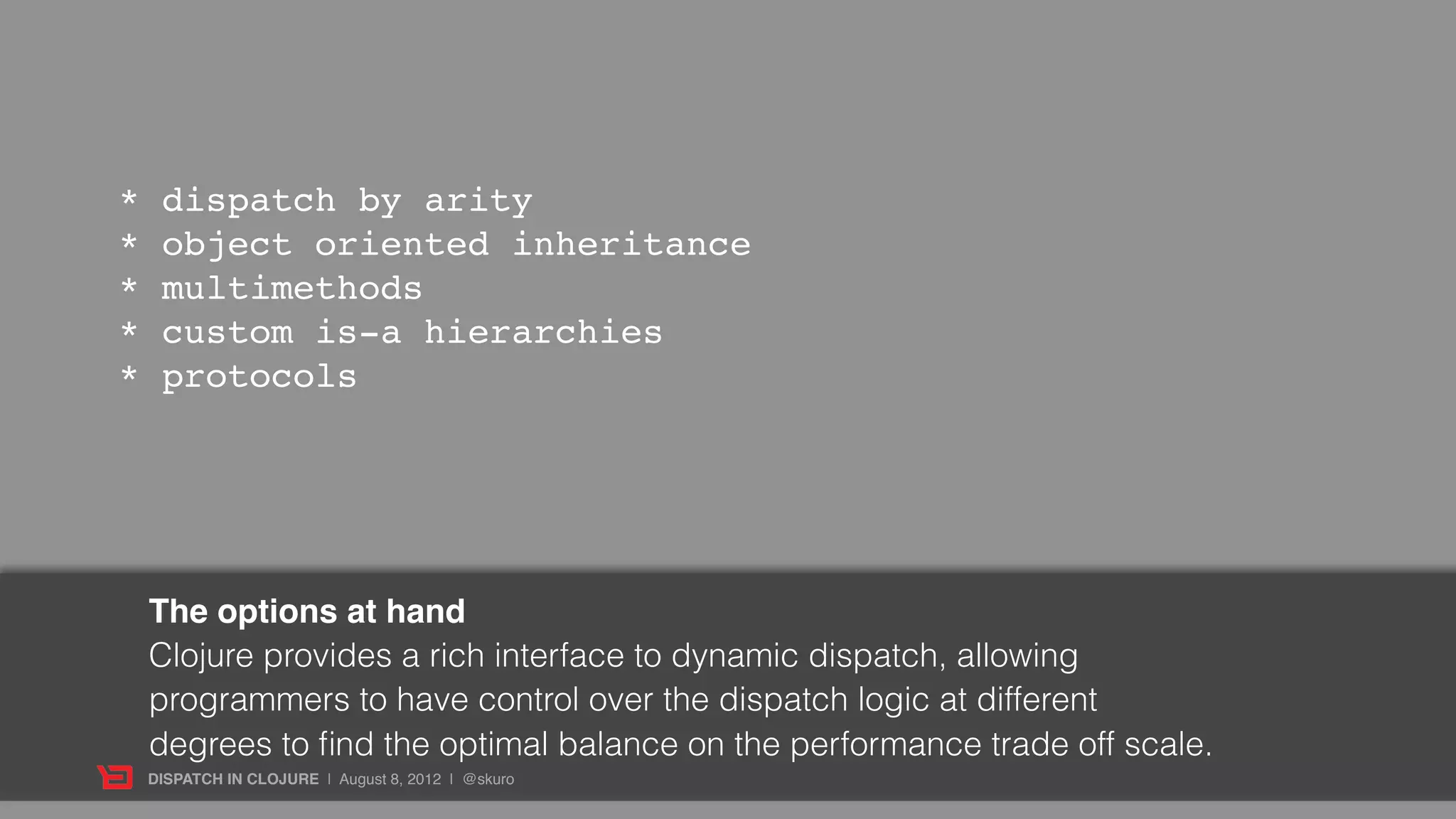
*    dispatch by arity
*    object oriented inheritance
*    multimethods
*    custom is-a hierarchies
*    protocols


    The options at hand
    Clojure provides a rich interface to dynamic dispatch, allowing
    programmers to have control over the dispatch logic at different
    degrees to find the optimal balance on the performance trade off scale.
    DISPATCH IN CLOJURE | August 8, 2012 | @skuro
*    dispatch by arity
*    object oriented inheritance (defn sum-them
*    multimethods                  ([x y] (+ x y))
*    custom is-a hierarchies       ([x y z] (+ x y z)))
*    protocols


    The good old arity
    Being a dynamically typed language, Clojure only checks on the
    number of arguments provided in the function call to find the right
    implementation to call.
    DISPATCH IN CLOJURE | August 8, 2012 | @skuro
*    dispatch by arity           (defn stringify [x]
*    object oriented inheritance   (.toString x))
*    multimethods
*    custom is-a hierarchies     (stringify (HashMap.)) ; “{}”
*    protocols                   (stringify (HashSet.)) ; “[]”


    More than Java™
    Thanks to Clojure intimacy with Java, object inheritance is easily
    achieved. Thanks to Clojure dynamic typing, it also allows functions to
    traverse multiple inheritance trees.
    DISPATCH IN CLOJURE | August 8, 2012 | @skuro
(defn stringify*
                                                      [^HashMap x]
                                                      (.toString x))
*    dispatch by arity
*    object oriented inheritance
                                 (stringify* (HashMap.))
*    multimethods
                                 => “{}”
*    custom is-a hierarchies
                                 (stringify* (TreeMap.))
*    protocols
                                 => “{}”
                                 (stringify* (HashSet.))
                                 => ClassCastException


    Forcing virtual dispatch to improve performance
    Being a dynamic language has a number of benefits, but performance
    isn’t one of them. To avoid reflection calls needed by default by the
    dynamic dispatch you can use type hints.
    DISPATCH IN CLOJURE | August 8, 2012 | @skuro
(defn dispatch-fn
                                                      [{:keys [version]}]
*    dispatch by arity
                                                      version)
*    object oriented inheritance
*    multimethods
                                 (defmulti multi-call
*    custom is-a hierarchies
                                   dispatch-fn)
*    protocols
                                                    http://bit.ly/multi-tests


    Full power
    Multimethods allow you to define your own dispatch strategy as a plain
    Clojure function. Their limit is the sky: they perform quite bad, and your
    dispatch fn can’t be changed or extended in user code.
    DISPATCH IN CLOJURE | August 8, 2012 | @skuro
(defmethod
                                                      multi-call ::custom-type
*    dispatch by arity
                                                      [x] [...])
*    object oriented inheritance
*    multimethods
                                 (derive java.util.HashSet
*    custom is-a hierarchies
                                   ::custom-type)
*    protocols
                                                    http://bit.ly/multi-tests


    Inheritance à la carte
    Java types hierarchies defined outside your code can be “altered” by
    custom is-a? relationships created as needed. You can either use the
    default hierarchy or use make-hierarchy to restrict its scope.
    DISPATCH IN CLOJURE | August 8, 2012 | @skuro
(defprotocol Registered
                                                      (register [this]))
*    dispatch by arity
*    object oriented inheritance
                                 (extend-type String
*    multimethods
                                   Registered
*    custom is-a hierarchies
                                   (register [this] [...]))
*    protocols
                                                    http://bit.ly/proto-tests


    Inheritance à la carte
    Java types hierarchies defined outside your code can be “altered” by
    custom is-a? relationships created as needed. You can either use the
    default hierarchy or use make-hierarchy to restrict its scope.
    DISPATCH IN CLOJURE | August 8, 2012 | @skuro
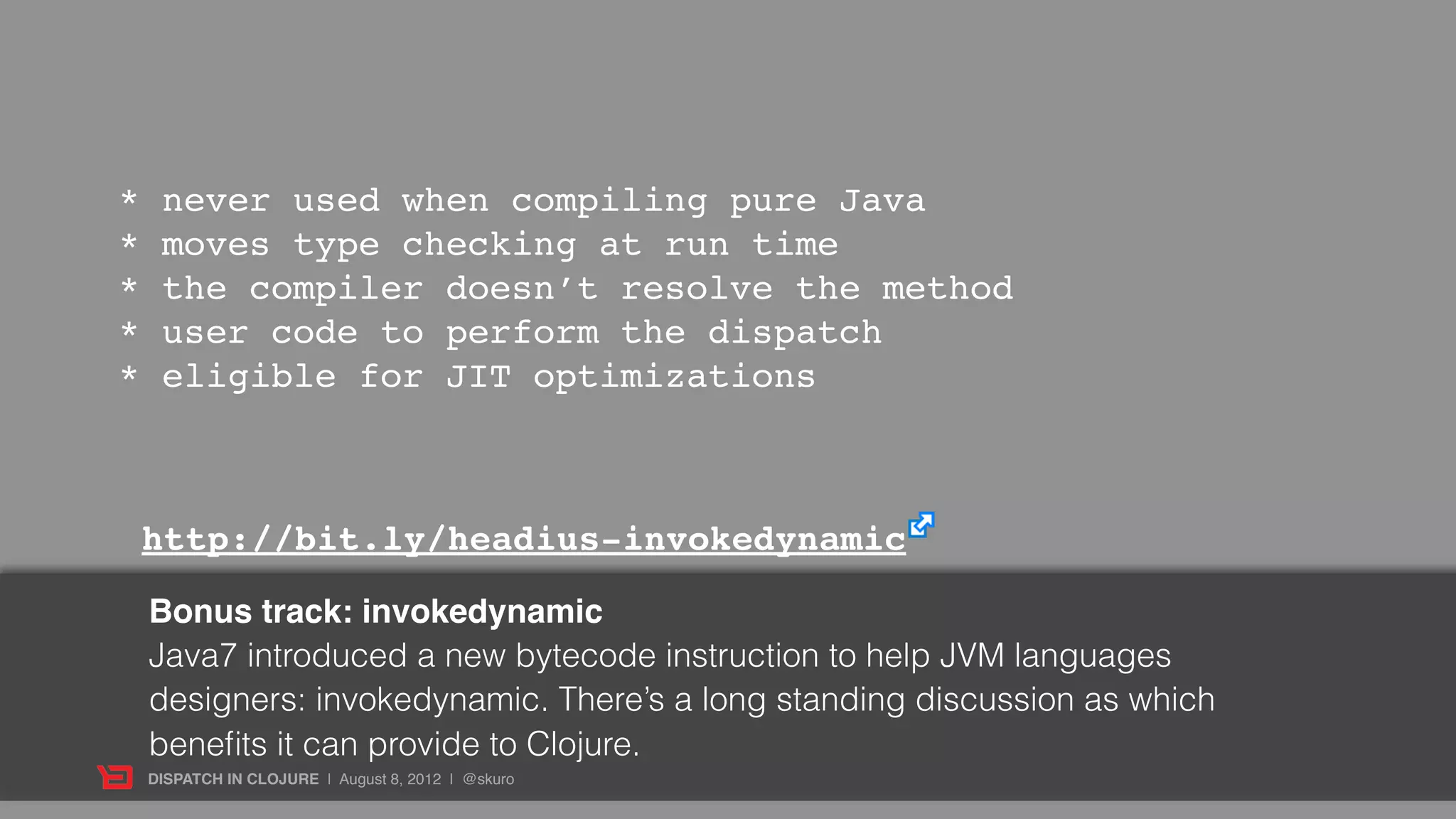
*    never used when compiling pure Java
*    moves type checking at run time
*    the compiler doesn’t resolve the method
*    user code to perform the dispatch
*    eligible for JIT optimizations


    http://bit.ly/headius-invokedynamic

    Bonus track: invokedynamic
    Java7 introduced a new bytecode instruction to help JVM languages
    designers: invokedynamic. There’s a long standing discussion as which
    benefits it can provide to Clojure.
    DISPATCH IN CLOJURE | August 8, 2012 | @skuro
Q/A

DISPATCH IN CLOJURE | August 8, 2012 | @skuro
Thanks!
                                                  Amsterdam Clojurians
                Carlo Sciolla
                Product Lead


             http://skuro.tk
            @skuro
                                                http://bit.ly/amsclojure


DISPATCH IN CLOJURE | August 8, 2012 | @skuro

Dispatch in Clojure

  • 1.
    Dispatch in Clojure Carlo Sciolla, Product Lead @ Backbase DISPATCH IN CLOJURE | August 8, 2012 | @skuro
  • 2.
    (ns aot (:gen-class)) (defn -main [& args] (dorun (map println (seq args)))) javap -c aot.class A quick journey in function calling We all learn to divide our code in functions, and invoke them when it’s their time on the stage of data processing. We define units of computations, ready to be executed. DISPATCH IN CLOJURE | August 8, 2012 | @skuro
  • 3.
    public static voidmain(java.lang.String[]); [..] 4:! invokevirtual!#66; [..] 26:!invokestatic! #104; 29:!invokeinterface! #108, 2; [..] 44:!invokespecial!#115; (defn -main [& args] [..] (dorun (map println (seq args)))) The JVM executes our code We’ll leave it to the JVM to figure out which code to actually run upon function call. It’s not always a straightforward job, and there are several ways to get to the code. DISPATCH IN CLOJURE | August 8, 2012 | @skuro
  • 4.
    public static voidmain(java.lang.String[]); [..] 4:! invokevirtual!#66; [..] 26:!invokestatic! #104; 29:!invokeinterface! #108, 2; [..] 44:!invokespecial!#115; [..] [clojure.lang.RT] static public ISeq seq(Object coll) Static dispatch When there’s nothing to choose from, the compiler emits a static dispatch bytecode. All calls will always result in the same code being executed. DISPATCH IN CLOJURE | August 8, 2012 | @skuro
  • 5.
    public static voidmain(java.lang.String[]); [..] 4:! invokevirtual!#66; [..] 26:!invokestatic! #104; 29:!invokeinterface! #108, 2; [..] 44:!invokespecial!#115; [..] Dynamic dispatch Most often the compiler can’t figure out the proper method implementation to call, and the runtime will get its chance to dynamically dispatch the call. DISPATCH IN CLOJURE | August 8, 2012 | @skuro
  • 6.
    * dispatch by arity * object oriented inheritance * multimethods * custom is-a hierarchies * protocols The options at hand Clojure provides a rich interface to dynamic dispatch, allowing programmers to have control over the dispatch logic at different degrees to find the optimal balance on the performance trade off scale. DISPATCH IN CLOJURE | August 8, 2012 | @skuro
  • 7.
    * dispatch by arity * object oriented inheritance (defn sum-them * multimethods ([x y] (+ x y)) * custom is-a hierarchies ([x y z] (+ x y z))) * protocols The good old arity Being a dynamically typed language, Clojure only checks on the number of arguments provided in the function call to find the right implementation to call. DISPATCH IN CLOJURE | August 8, 2012 | @skuro
  • 8.
    * dispatch by arity (defn stringify [x] * object oriented inheritance (.toString x)) * multimethods * custom is-a hierarchies (stringify (HashMap.)) ; “{}” * protocols (stringify (HashSet.)) ; “[]” More than Java™ Thanks to Clojure intimacy with Java, object inheritance is easily achieved. Thanks to Clojure dynamic typing, it also allows functions to traverse multiple inheritance trees. DISPATCH IN CLOJURE | August 8, 2012 | @skuro
  • 9.
    (defn stringify* [^HashMap x] (.toString x)) * dispatch by arity * object oriented inheritance (stringify* (HashMap.)) * multimethods => “{}” * custom is-a hierarchies (stringify* (TreeMap.)) * protocols => “{}” (stringify* (HashSet.)) => ClassCastException Forcing virtual dispatch to improve performance Being a dynamic language has a number of benefits, but performance isn’t one of them. To avoid reflection calls needed by default by the dynamic dispatch you can use type hints. DISPATCH IN CLOJURE | August 8, 2012 | @skuro
  • 10.
    (defn dispatch-fn [{:keys [version]}] * dispatch by arity version) * object oriented inheritance * multimethods (defmulti multi-call * custom is-a hierarchies dispatch-fn) * protocols http://bit.ly/multi-tests Full power Multimethods allow you to define your own dispatch strategy as a plain Clojure function. Their limit is the sky: they perform quite bad, and your dispatch fn can’t be changed or extended in user code. DISPATCH IN CLOJURE | August 8, 2012 | @skuro
  • 11.
    (defmethod multi-call ::custom-type * dispatch by arity [x] [...]) * object oriented inheritance * multimethods (derive java.util.HashSet * custom is-a hierarchies ::custom-type) * protocols http://bit.ly/multi-tests Inheritance à la carte Java types hierarchies defined outside your code can be “altered” by custom is-a? relationships created as needed. You can either use the default hierarchy or use make-hierarchy to restrict its scope. DISPATCH IN CLOJURE | August 8, 2012 | @skuro
  • 12.
    (defprotocol Registered (register [this])) * dispatch by arity * object oriented inheritance (extend-type String * multimethods Registered * custom is-a hierarchies (register [this] [...])) * protocols http://bit.ly/proto-tests Inheritance à la carte Java types hierarchies defined outside your code can be “altered” by custom is-a? relationships created as needed. You can either use the default hierarchy or use make-hierarchy to restrict its scope. DISPATCH IN CLOJURE | August 8, 2012 | @skuro
  • 13.
    * never used when compiling pure Java * moves type checking at run time * the compiler doesn’t resolve the method * user code to perform the dispatch * eligible for JIT optimizations http://bit.ly/headius-invokedynamic Bonus track: invokedynamic Java7 introduced a new bytecode instruction to help JVM languages designers: invokedynamic. There’s a long standing discussion as which benefits it can provide to Clojure. DISPATCH IN CLOJURE | August 8, 2012 | @skuro
  • 14.
    Q/A DISPATCH IN CLOJURE| August 8, 2012 | @skuro
  • 15.
    Thanks! Amsterdam Clojurians Carlo Sciolla Product Lead http://skuro.tk @skuro http://bit.ly/amsclojure DISPATCH IN CLOJURE | August 8, 2012 | @skuro