2023-03-07
1
META_SLIDE!
loige
loige.link/iterate
2
String[] transactions = {
"paid 20",
"received 10",
"paid 5",
"received 15",
"paid 10",
"received 12"
};
var total = Stream.of(transactions).mapToInt(transaction -> {
var parts = transaction.split(" ");
int amount = Integer.decode(parts[1]);
if (Objects.equals(parts[0], "paid")) {
amount = -amount;
}
return amount;
}).sum();
if (total >= 0) {
System.out.println("Life is good :)");
} else {
System.out.println("You are broke :(");
}
1
2
3
4
5
6
7
8
9
10
11
12
13
14
15
16
17
18
19
20
21
22
23
24
loige
replit.com/@lmammino/r-u-broke-java
3
String[] transactions = {
"paid 20",
"received 10",
"paid 5",
"received 15",
"paid 10",
"received 12"
};
1
2
3
4
5
6
7
8
9
var total = Stream.of(transactions).mapToInt(transaction -> {
10
var parts = transaction.split(" ");
11
int amount = Integer.decode(parts[1]);
12
if (Objects.equals(parts[0], "paid")) {
13
amount = -amount;
14
}
15
16
return amount;
17
}).sum();
18
19
if (total >= 0) {
20
System.out.println("Life is good :)");
21
} else {
22
System.out.println("You are broke :(");
23
}
24
var total = Stream.of(transactions).mapToInt(transaction -> {
String[] transactions = {
1
"paid 20",
2
"received 10",
3
"paid 5",
4
"received 15",
5
"paid 10",
6
"received 12"
7
};
8
9
10
var parts = transaction.split(" ");
11
int amount = Integer.decode(parts[1]);
12
if (Objects.equals(parts[0], "paid")) {
13
amount = -amount;
14
}
15
16
return amount;
17
}).sum();
18
19
if (total >= 0) {
20
System.out.println("Life is good :)");
21
} else {
22
System.out.println("You are broke :(");
23
}
24
var parts = transaction.split(" ");
int amount = Integer.decode(parts[1]);
if (Objects.equals(parts[0], "paid")) {
amount = -amount;
}
return amount;
String[] transactions = {
1
"paid 20",
2
"received 10",
3
"paid 5",
4
"received 15",
5
"paid 10",
6
"received 12"
7
};
8
9
var total = Stream.of(transactions).mapToInt(transaction -> {
10
11
12
13
14
15
16
17
}).sum();
18
19
if (total >= 0) {
20
System.out.println("Life is good :)");
21
} else {
22
System.out.println("You are broke :(");
23
}
24
}).sum();
String[] transactions = {
1
"paid 20",
2
"received 10",
3
"paid 5",
4
"received 15",
5
"paid 10",
6
"received 12"
7
};
8
9
var total = Stream.of(transactions).mapToInt(transaction -> {
10
var parts = transaction.split(" ");
11
int amount = Integer.decode(parts[1]);
12
if (Objects.equals(parts[0], "paid")) {
13
amount = -amount;
14
}
15
16
return amount;
17
18
19
if (total >= 0) {
20
System.out.println("Life is good :)");
21
} else {
22
System.out.println("You are broke :(");
23
}
24
if (total >= 0) {
System.out.println("Life is good :)");
} else {
System.out.println("You are broke :(");
}
String[] transactions = {
1
"paid 20",
2
"received 10",
3
"paid 5",
4
"received 15",
5
"paid 10",
6
"received 12"
7
};
8
9
var total = Stream.of(transactions).mapToInt(transaction -> {
10
var parts = transaction.split(" ");
11
int amount = Integer.decode(parts[1]);
12
if (Objects.equals(parts[0], "paid")) {
13
amount = -amount;
14
}
15
16
return amount;
17
}).sum();
18
19
20
21
22
23
24
String[] transactions = {
"paid 20",
"received 10",
"paid 5",
"received 15",
"paid 10",
"received 12"
};
var total = Stream.of(transactions).mapToInt(transaction -> {
var parts = transaction.split(" ");
int amount = Integer.decode(parts[1]);
if (Objects.equals(parts[0], "paid")) {
amount = -amount;
}
return amount;
}).sum();
if (total >= 0) {
System.out.println("Life is good :)");
} else {
System.out.println("You are broke :(");
}
1
2
3
4
5
6
7
8
9
10
11
12
13
14
15
16
17
18
19
20
21
22
23
24
loige
replit.com/@lmammino/r-u-broke-java
4
transactions = [
"paid 20",
"received 10",
"paid 5",
"received 15",
"paid 10",
"received 12"
];
def get_amount(transaction):
type, amount = transaction.split(' ')
amount = int(amount)
if type == 'paid':
return -amount
return amount
*_, total = accumulate(
map(get_amount, transactions)
)
if total >= 0:
print("Life is good :)")
else:
print("You are broke :(")
1
2
3
4
5
6
7
8
9
10
11
12
13
14
15
16
17
18
19
20
21
22
23
24
loige
replit.com/@lmammino/r-u-broke-py
5
let transactions = [
"paid 20",
"received 10",
"paid 5",
"received 15",
"paid 10",
"received 12",
];
let total: i32 = transactions
.iter()
.map(|transaction| {
let (action, amount) = transaction.split_once(' ').unwrap();
let amount = amount.parse::<i32>().unwrap();
if action == "paid" {
-amount
} else {
amount
}
})
.sum();
if total >= 0 {
println!("Life is good :)");
} else {
println!("You are broke :(");
}
1
2
3
4
5
6
7
8
9
10
11
12
13
14
15
16
17
18
19
20
21
22
23
24
25
26
27
loige
replit.com/@lmammino/r-u-broke-rust
6
const transactions = [
"paid 20",
"received 10",
"paid 5",
"received 15",
"paid 10",
"received 12"
]
const total = Iterator.from(transactions)
.map(transaction => {
let [action, amount] = transaction.split(" ")
amount = Number.parseInt(amount)
if (action === "paid") {
return -amount
} else {
return amount
}
})
.reduce((acc,curr) => acc + curr)
if (total >= 0) {
console.log("Life is good :)")
} else {
console.log("You are broke :(");
}
1
2
3
4
5
6
7
8
9
10
11
12
13
14
15
16
17
18
19
20
21
22
23
24
25
26
loige
replit.com/@lmammino/r-u-broke-js
7
const transactions = [
"paid 20",
"received 10",
"paid 5",
"received 15",
"paid 10",
"received 12"
]
const total = Iterator.from(transactions)
.map(transaction => {
let [action, amount] = transaction.split(" ")
amount = Number.parseInt(amount)
if (action === "paid") {
return -amount
} else {
return amount
}
})
.reduce((acc,curr) => acc + curr)
if (total >= 0) {
console.log("Life is good :)")
} else {
console.log("You are broke :(");
}
1
2
3
4
5
6
7
8
9
10
11
12
13
14
15
16
17
18
19
20
21
22
23
24
25
26
const total = Iterator.from(transactions)
const transactions = [
1
"paid 20",
2
"received 10",
3
"paid 5",
4
"received 15",
5
"paid 10",
6
"received 12"
7
]
8
9
10
.map(transaction => {
11
let [action, amount] = transaction.split(" ")
12
amount = Number.parseInt(amount)
13
if (action === "paid") {
14
return -amount
15
} else {
16
return amount
17
}
18
})
19
.reduce((acc,curr) => acc + curr)
20
21
if (total >= 0) {
22
console.log("Life is good :)")
23
} else {
24
console.log("You are broke :(");
25
}
26
.map(transaction => {
const transactions = [
1
"paid 20",
2
"received 10",
3
"paid 5",
4
"received 15",
5
"paid 10",
6
"received 12"
7
]
8
9
const total = Iterator.from(transactions)
10
11
let [action, amount] = transaction.split(" ")
12
amount = Number.parseInt(amount)
13
if (action === "paid") {
14
return -amount
15
} else {
16
return amount
17
}
18
})
19
.reduce((acc,curr) => acc + curr)
20
21
if (total >= 0) {
22
console.log("Life is good :)")
23
} else {
24
console.log("You are broke :(");
25
}
26
.reduce((acc,curr) => acc + curr)
const transactions = [
1
"paid 20",
2
"received 10",
3
"paid 5",
4
"received 15",
5
"paid 10",
6
"received 12"
7
]
8
9
const total = Iterator.from(transactions)
10
.map(transaction => {
11
let [action, amount] = transaction.split(" ")
12
amount = Number.parseInt(amount)
13
if (action === "paid") {
14
return -amount
15
} else {
16
return amount
17
}
18
})
19
20
21
if (total >= 0) {
22
console.log("Life is good :)")
23
} else {
24
console.log("You are broke :(");
25
}
26
const transactions = [
"paid 20",
"received 10",
"paid 5",
"received 15",
"paid 10",
"received 12"
]
const total = Iterator.from(transactions)
.map(transaction => {
let [action, amount] = transaction.split(" ")
amount = Number.parseInt(amount)
if (action === "paid") {
return -amount
} else {
return amount
}
})
.reduce((acc,curr) => acc + curr)
if (total >= 0) {
console.log("Life is good :)")
} else {
console.log("You are broke :(");
}
1
2
3
4
5
6
7
8
9
10
11
12
13
14
15
16
17
18
19
20
21
22
23
24
25
26
loige
replit.com/@lmammino/r-u-broke-js
8
const transactions = [
"paid 20",
"received 10",
"paid 5",
"received 15",
"paid 10",
"received 12"
]
const total = Iterator.from(transactions)
.map(transaction => {
let [action, amount] = transaction.split(" ")
amount = Number.parseInt(amount)
if (action === "paid") {
return -amount
} else {
return amount
}
})
.reduce((acc,curr) => acc + curr)
if (total >= 0) {
console.log("Life is good :)")
} else {
console.log("You are broke :(");
}
1
2
3
4
5
6
7
8
9
10
11
12
13
14
15
16
17
18
19
20
21
22
23
24
25
26
loige
replit.com/@lmammino/r-u-broke-js
This is not JavaScript, it's FutureJavaScript™
github.com/tc39/proposal-iterator-helpers
9
import Iterator from 'core-js-pure/actual/iterator/index.js'
1
2
const transactions = [
3
"paid 20",
4
"received 10",
5
"paid 5",
6
"received 15",
7
"paid 10",
8
"received 12"
9
]
10
11
const total = Iterator.from(transactions)
12
.map(transaction => {
13
let [action, amount] = transaction.split(" ")
14
amount = Number.parseInt(amount)
15
if (action === "paid") {
16
return -amount
17
} else {
18
return amount
19
}
20
})
21
.reduce((acc,curr) => acc + curr)
22
23
if (total >= 0) {
24
console.log("Life is good :)")
25
} else {
26
console.log("You are broke :(");
27 loige
But if you want the future, today...
npm i --save core-js-pure
10
loige
WHY?
11
loige
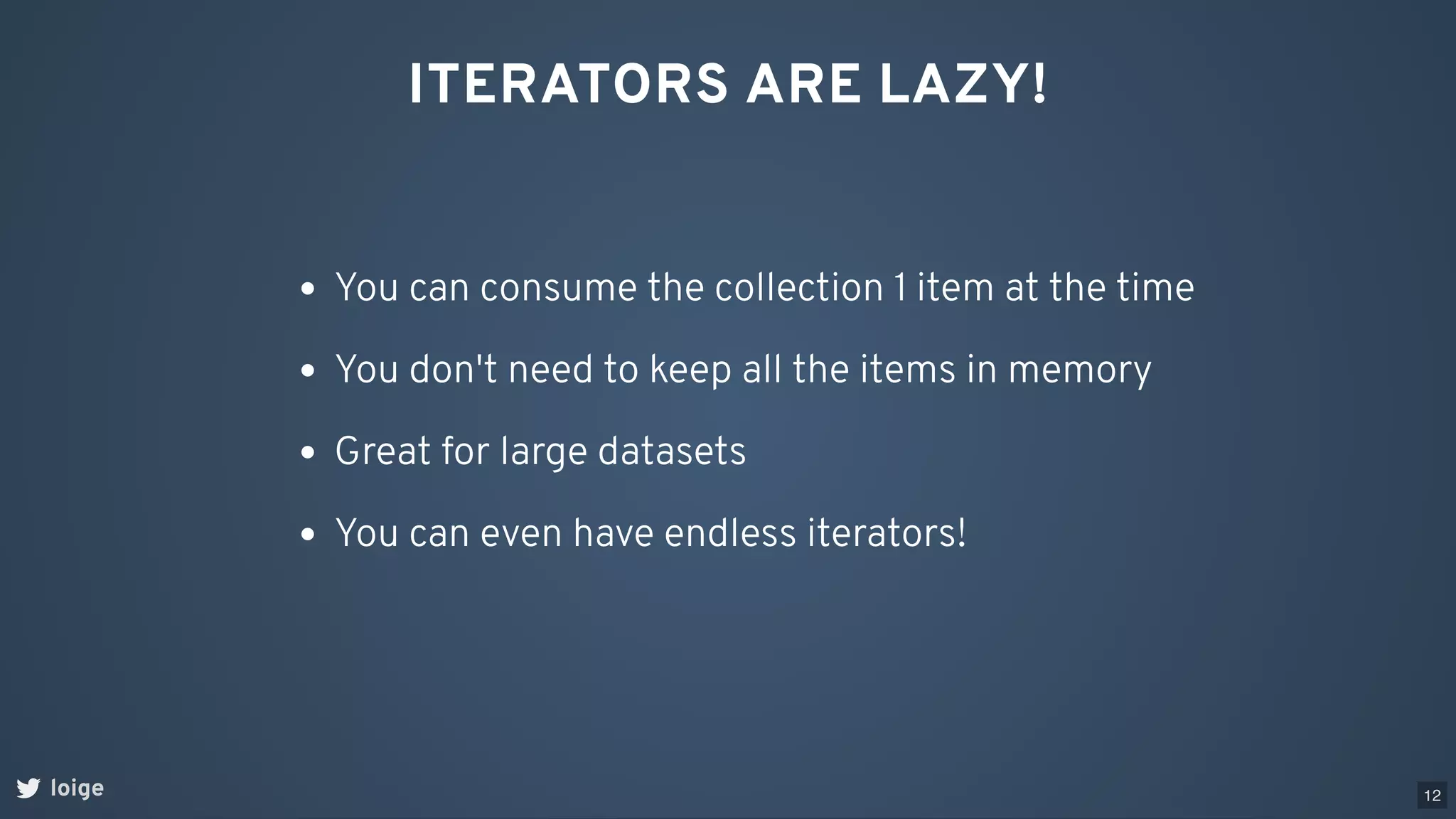
ITERATORS ARE LAZY!
You can consume the collection 1 item at the time
You don't need to keep all the items in memory
Great for large datasets
You can even have endless iterators!
12
loige
The concept of Iterators exists already in JavaScript...
🗞GOOD NEWS FROM THE WORLD...
... since ES2015!
13
WAIT, WHO THE HECK IS THIS GUY !? 🤷
👋I'm Luciano ( 🍕🍝 )
Senior Architect @ fourTheorem (Dublin )
nodejsdp.link
📔Co-Author of Node.js Design Patterns 👉
Let's connect!
(blog)
(twitter)
(twitch)
(github)
loige.co
@loige
loige
lmammino
14
ALWAYS RE-IMAGINING
WE ARE A PIONEERING TECHNOLOGY CONSULTANCY FOCUSED
ON CLOUD, AWS & SERVERLESS
loige
😇We are always looking for talent: fth.link/careers
We can help with:
Cloud Migrations
Training & Cloud enablement
Building serverless applications
Cutting cloud costs
15
loige
podcast
awsbites.com
IF YOU LIKE AWS...
16
loige
🥤
LET'S HAVE A QUICK REFRESHER
ON SOME JS "ITERATION" CONCEPTS...
17
const array = ['foo', 'bar', 'baz']
for (const item of array) {
console.log(item)
}
loige
Output:
foo
bar
baz
18
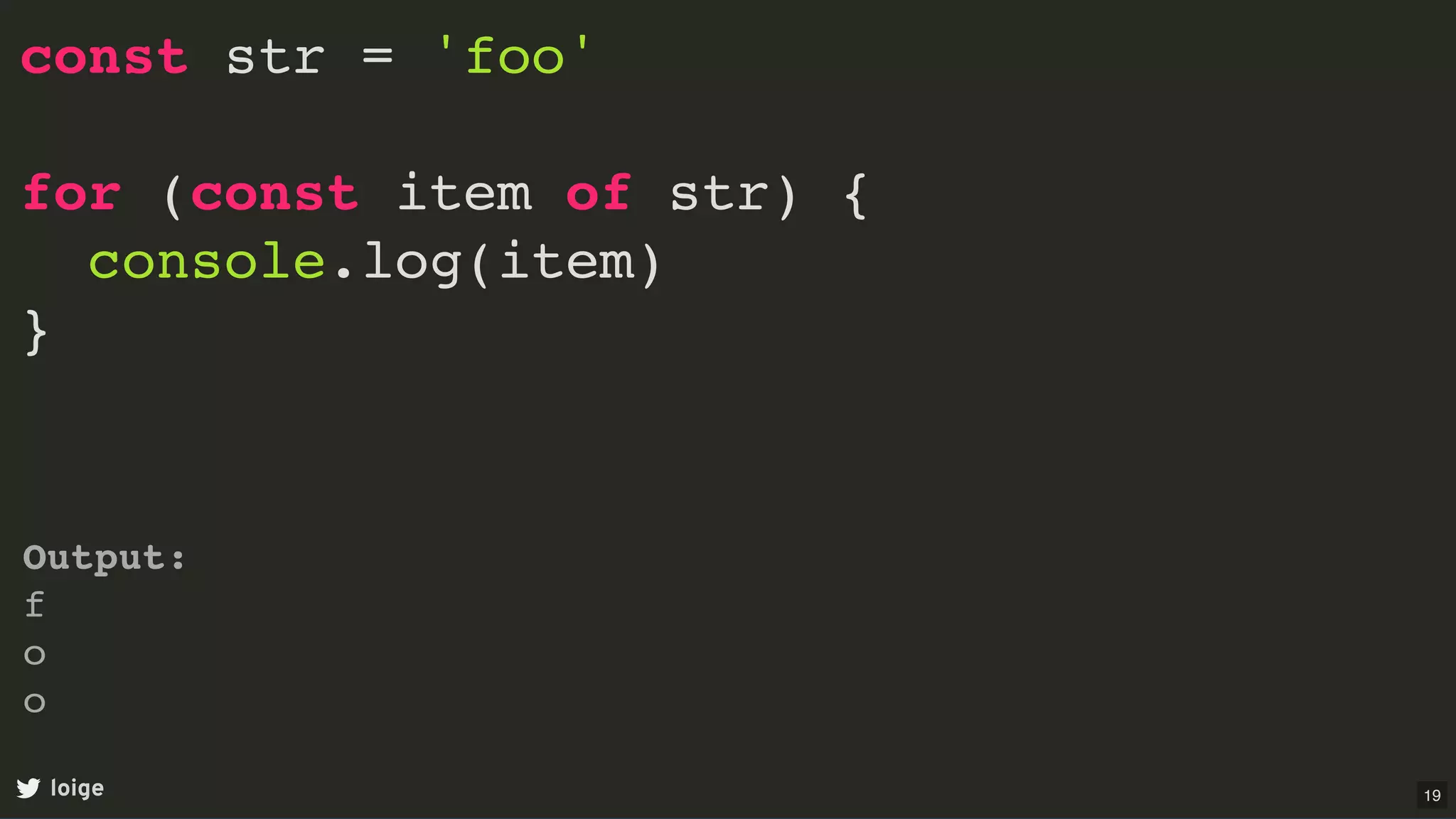
const str = 'foo'
for (const item of str) {
console.log(item)
}
loige
Output:
f
o
o
19
const set = new Set(['foo', 'bar', 'baz'])
for (const item of set) {
console.log(item)
}
loige
Output:
foo
bar
baz
20
const map = new Map([
['foo', 'bar'], ['baz', 'qux']
])
for (const item of map) {
console.log(item)
}
loige
Output:
[ 'foo', 'bar' ]
[ 'baz', 'qux' ]
21
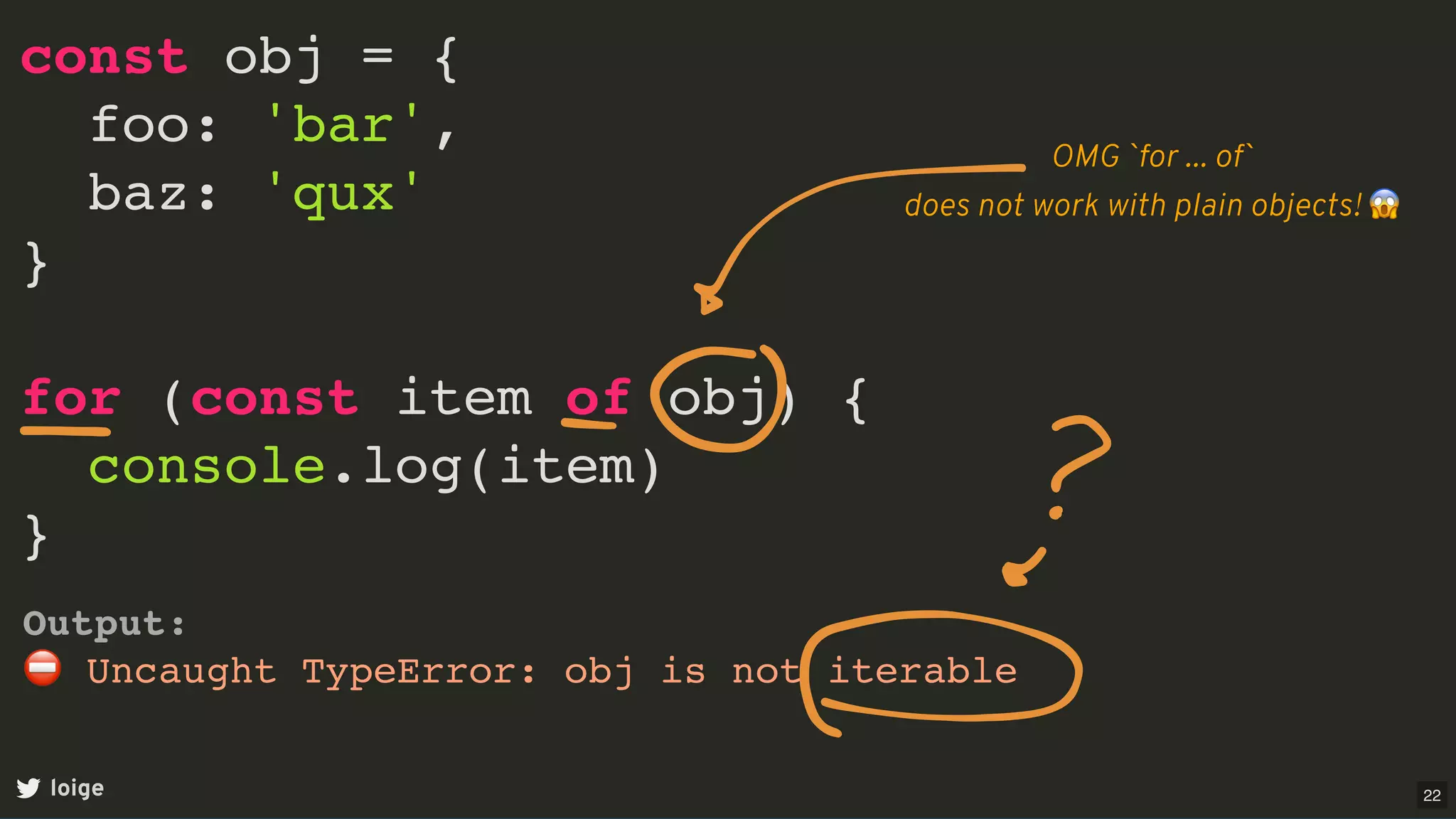
const obj = {
foo: 'bar',
baz: 'qux'
}
for (const item of obj) {
console.log(item)
}
loige
Output:
⛔ Uncaught TypeError: obj is not iterable
OMG `for ... of`
does not work with plain objects! 😱
22
const obj = {
foo: 'bar',
baz: 'qux'
}
for (const item of Object.entries(obj)) {
console.log(item)
}
loige
Output:
[ 'foo', 'bar' ]
[ 'baz', 'qux' ]
23
loige 24
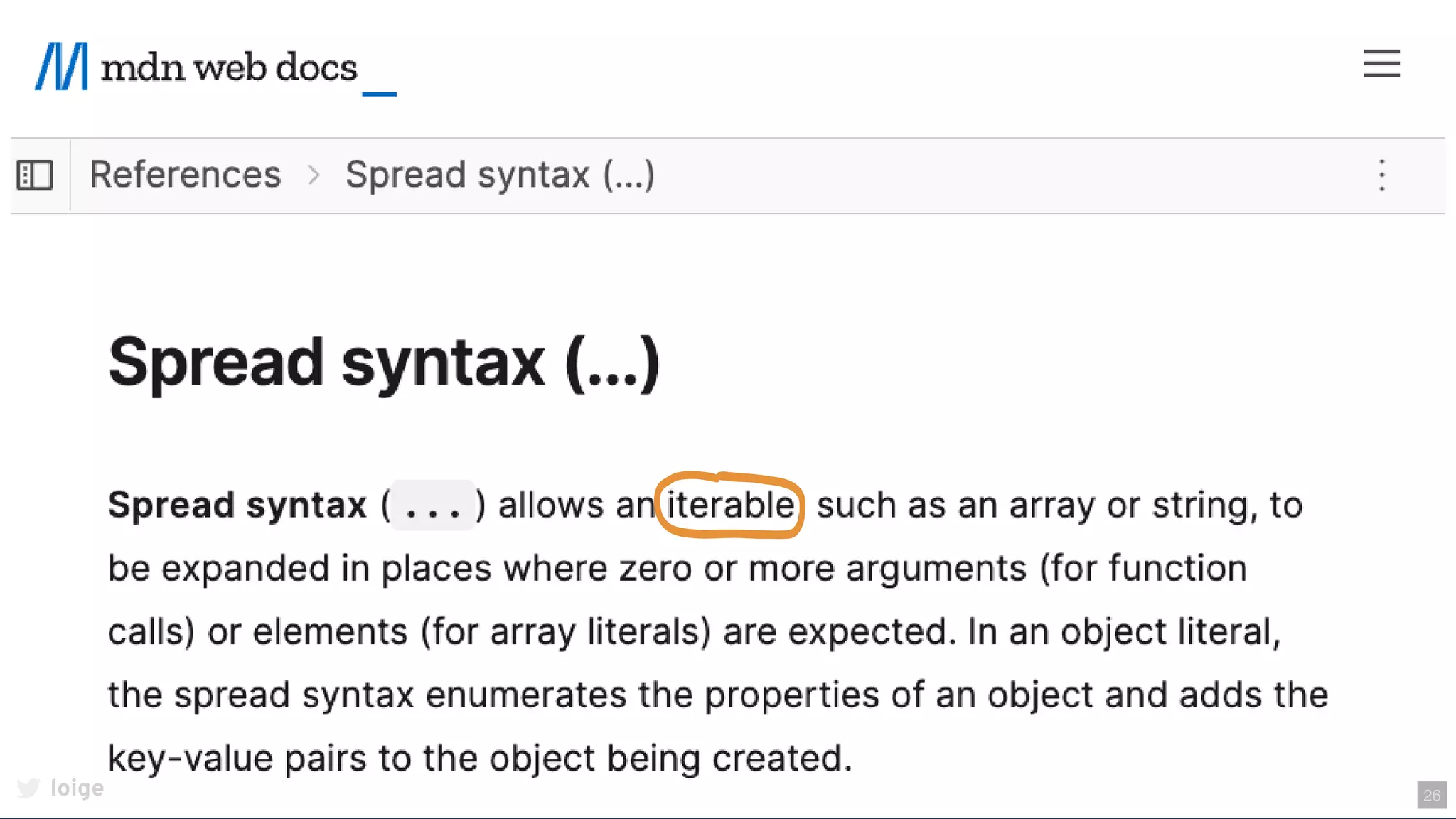
const array = ['foo', 'bar', 'baz']
console.log(...array)
loige
Output:
foo bar baz
spread syntax!
25
loige 26
loige 27
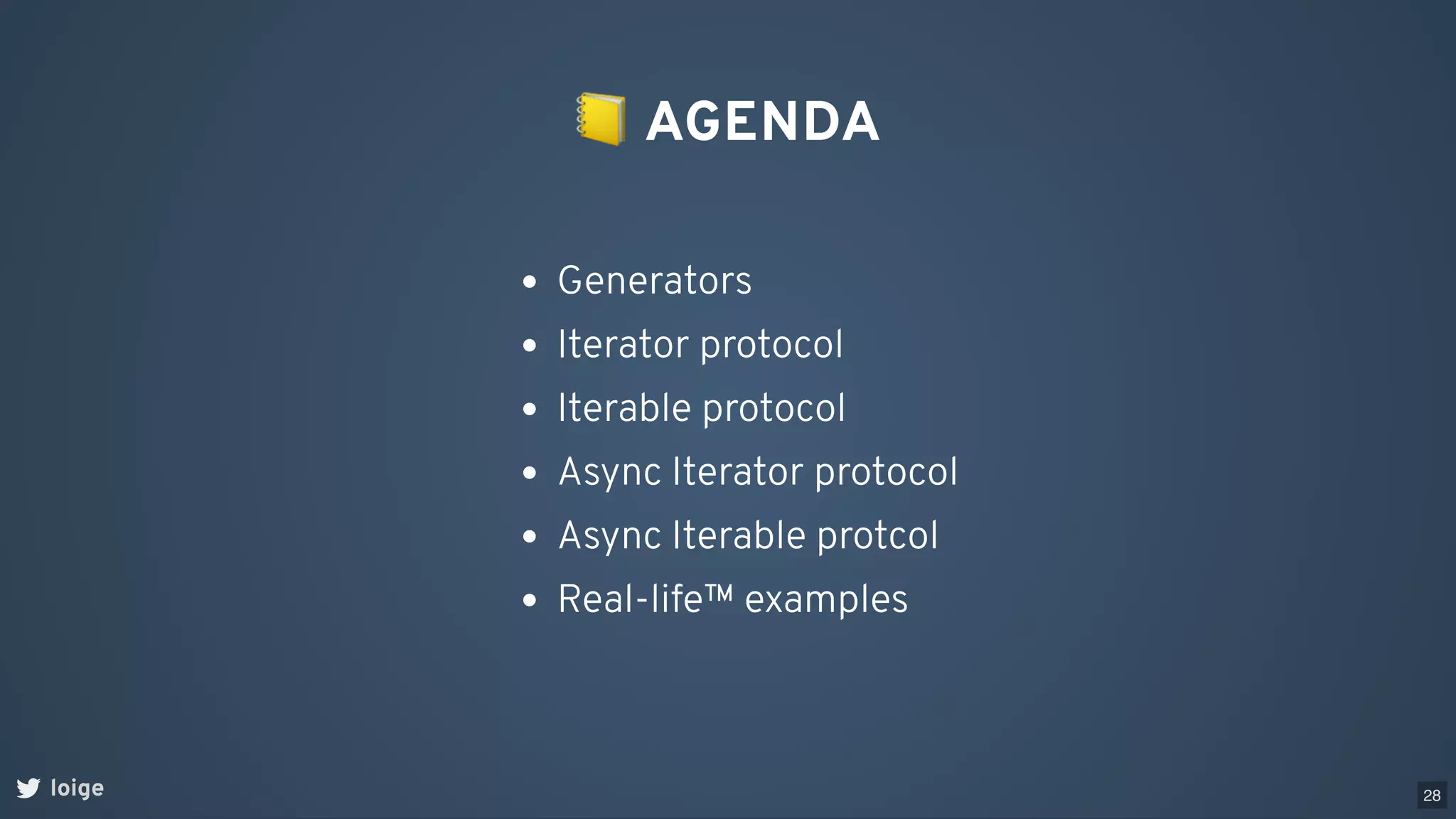
📒AGENDA
Generators
Iterator protocol
Iterable protocol
Async Iterator protocol
Async Iterable protcol
Real-life™ examples
loige 28
➡GENERATORS
loige 29
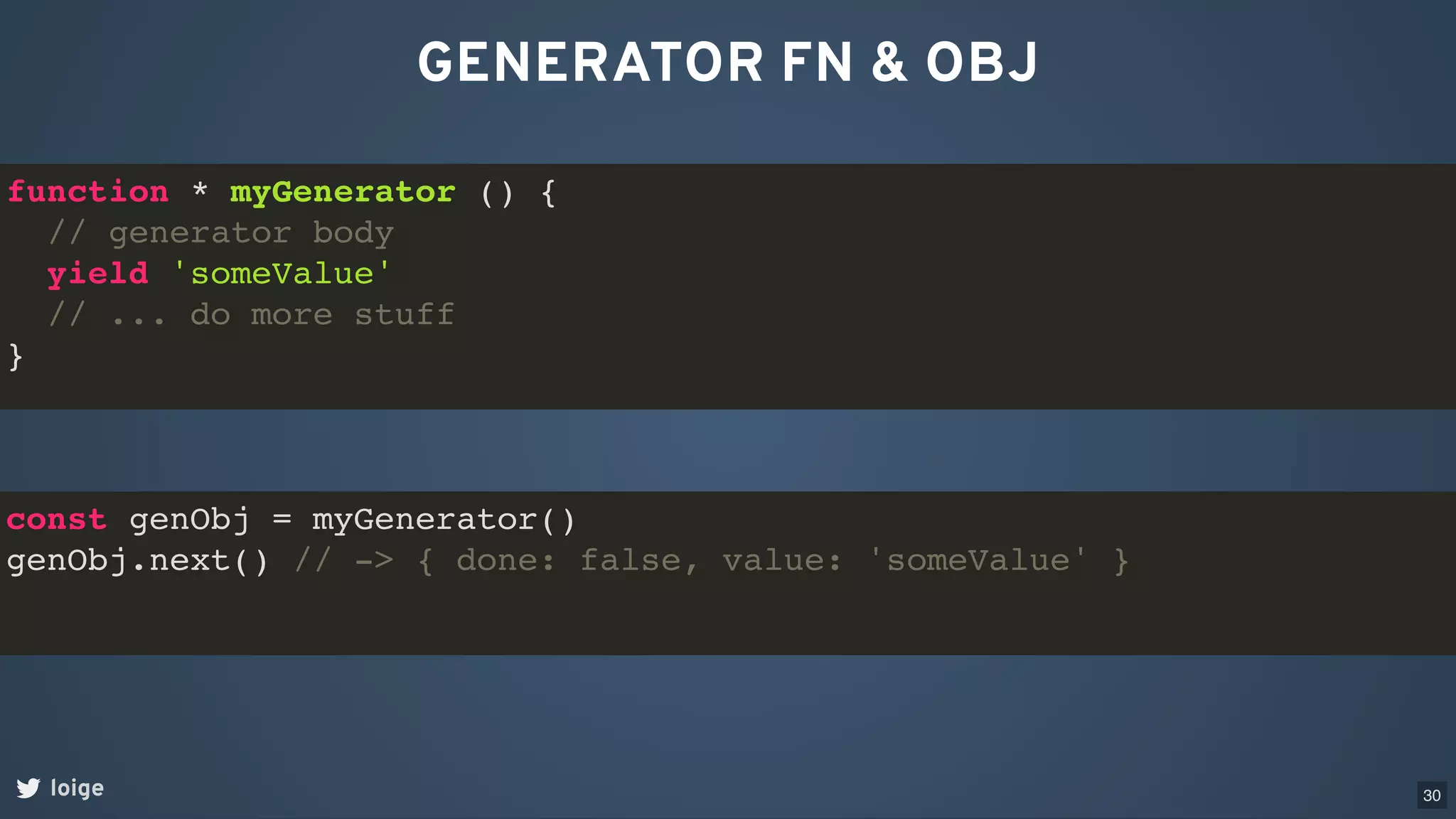
GENERATOR FN & OBJ
loige
function * myGenerator () {
// generator body
yield 'someValue'
// ... do more stuff
}
const genObj = myGenerator()
genObj.next() // -> { done: false, value: 'someValue' }
30
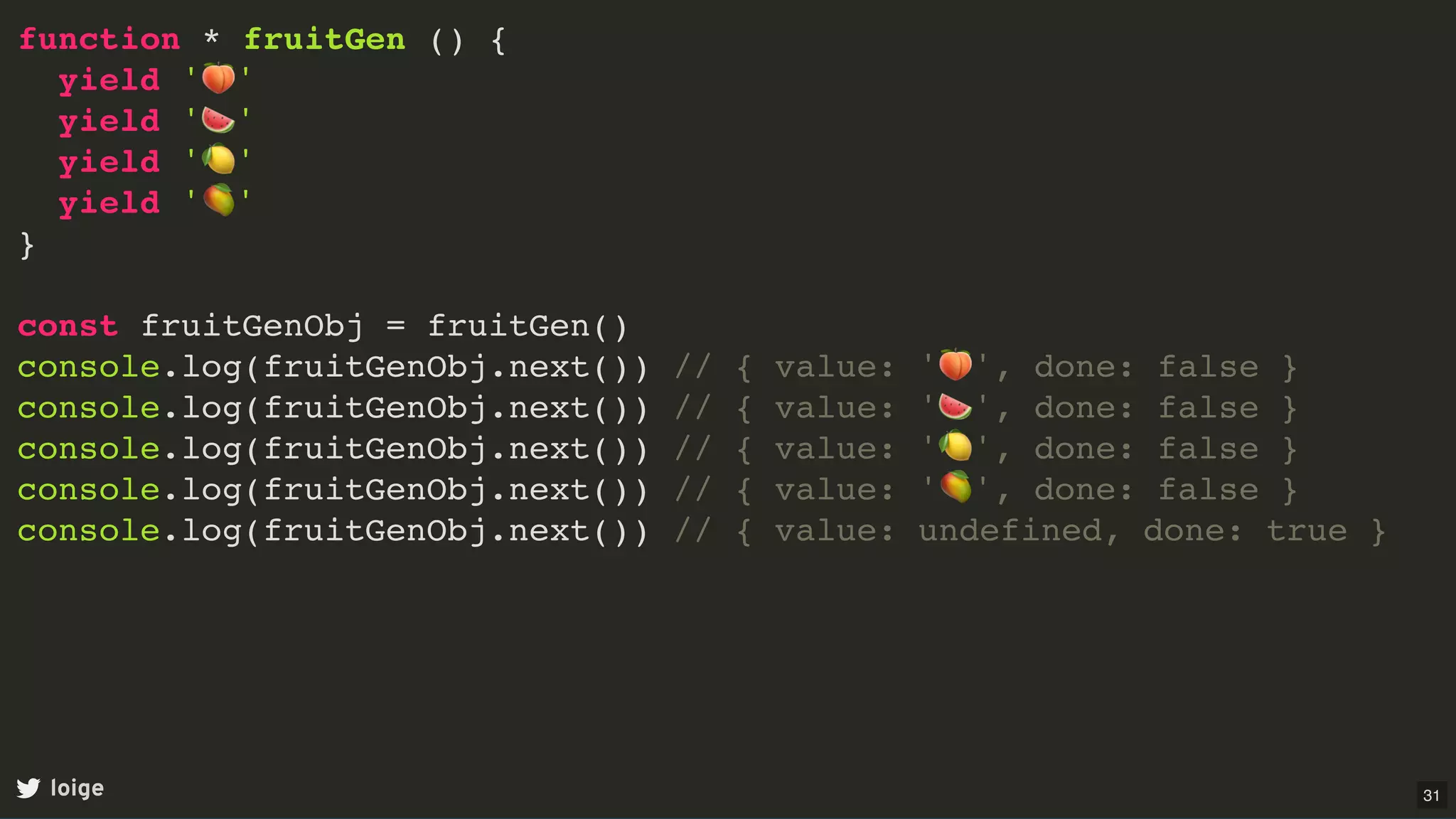
function * fruitGen () {
yield '🍑'
yield '🍉'
yield '🍋'
yield '🥭'
}
const fruitGenObj = fruitGen()
console.log(fruitGenObj.next()) // { value: '🍑', done: false }
console.log(fruitGenObj.next()) // { value: '🍉', done: false }
console.log(fruitGenObj.next()) // { value: '🍋', done: false }
console.log(fruitGenObj.next()) // { value: '🥭', done: false }
console.log(fruitGenObj.next()) // { value: undefined, done: true }
loige 31
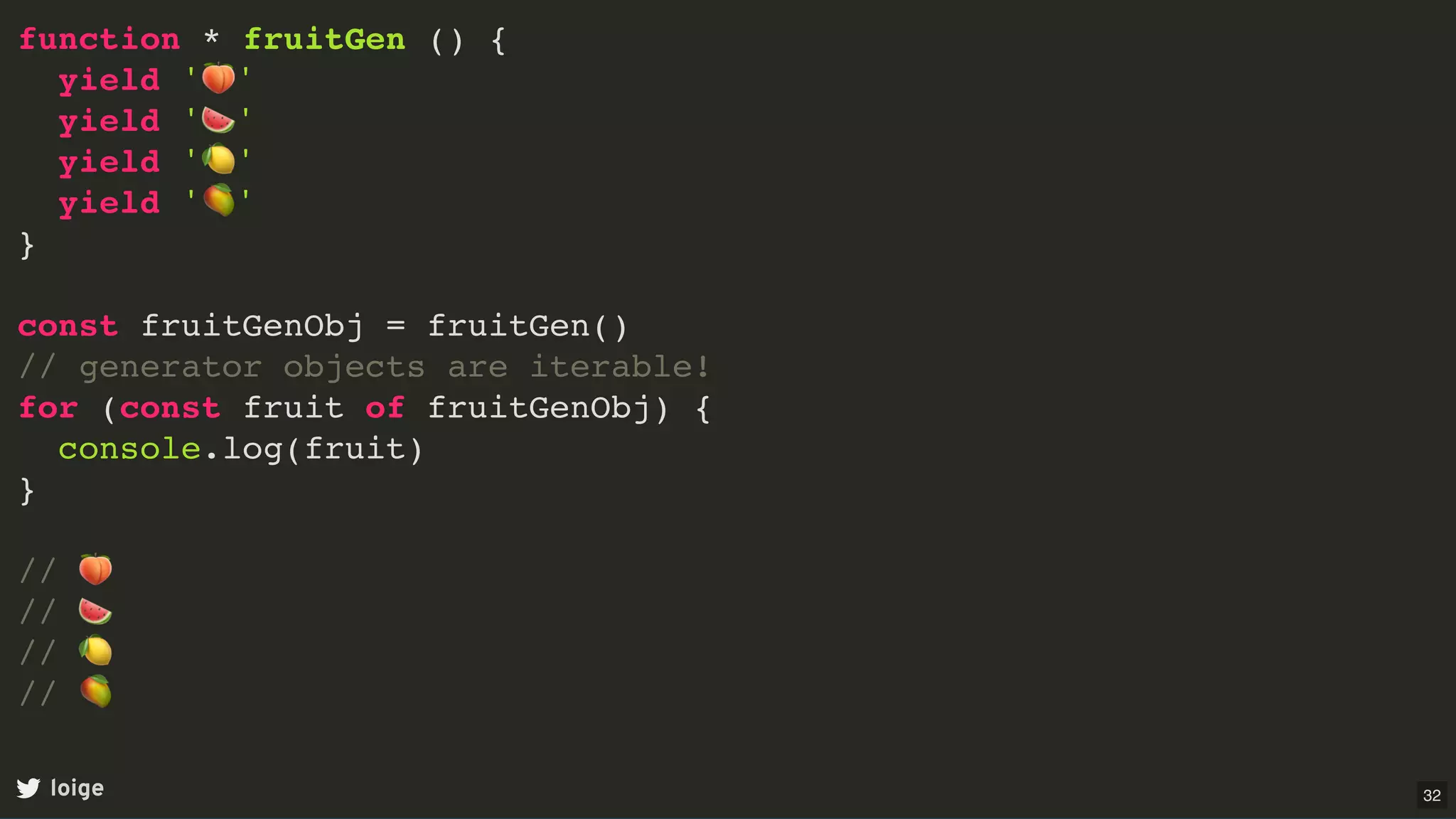
function * fruitGen () {
yield '🍑'
yield '🍉'
yield '🍋'
yield '🥭'
}
const fruitGenObj = fruitGen()
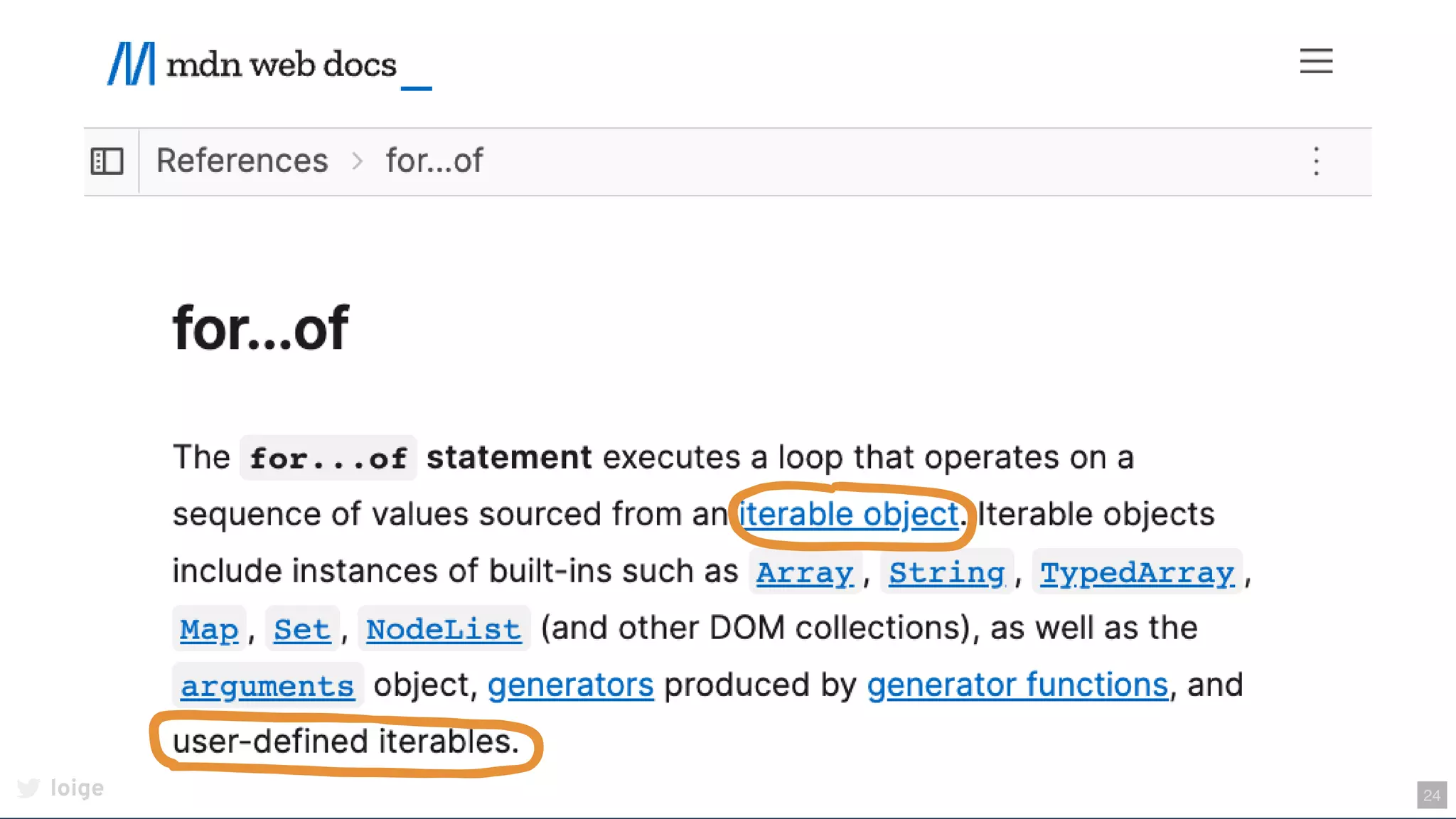
// generator objects are iterable!
for (const fruit of fruitGenObj) {
console.log(fruit)
}
// 🍑
// 🍉
// 🍋
// 🥭
loige 32
function * range (start, end) {
for (let i = start; i < end; i++) {
yield i
}
}
// generators are lazy!
for (const i of range(0, Number.MAX_VALUE)) {
console.log(i)
}
const zeroToTen = [...range(0, 11)]
loige 33
// generators can be "endless"
function * cycle (values) {
let current = 0
while (true) {
yield values[current]
current = (current + 1) % values.length
}
}
for (const value of cycle(['even', 'odd'])) {
console.log(value)
}
// even
// odd
// even
// ...
loige 34
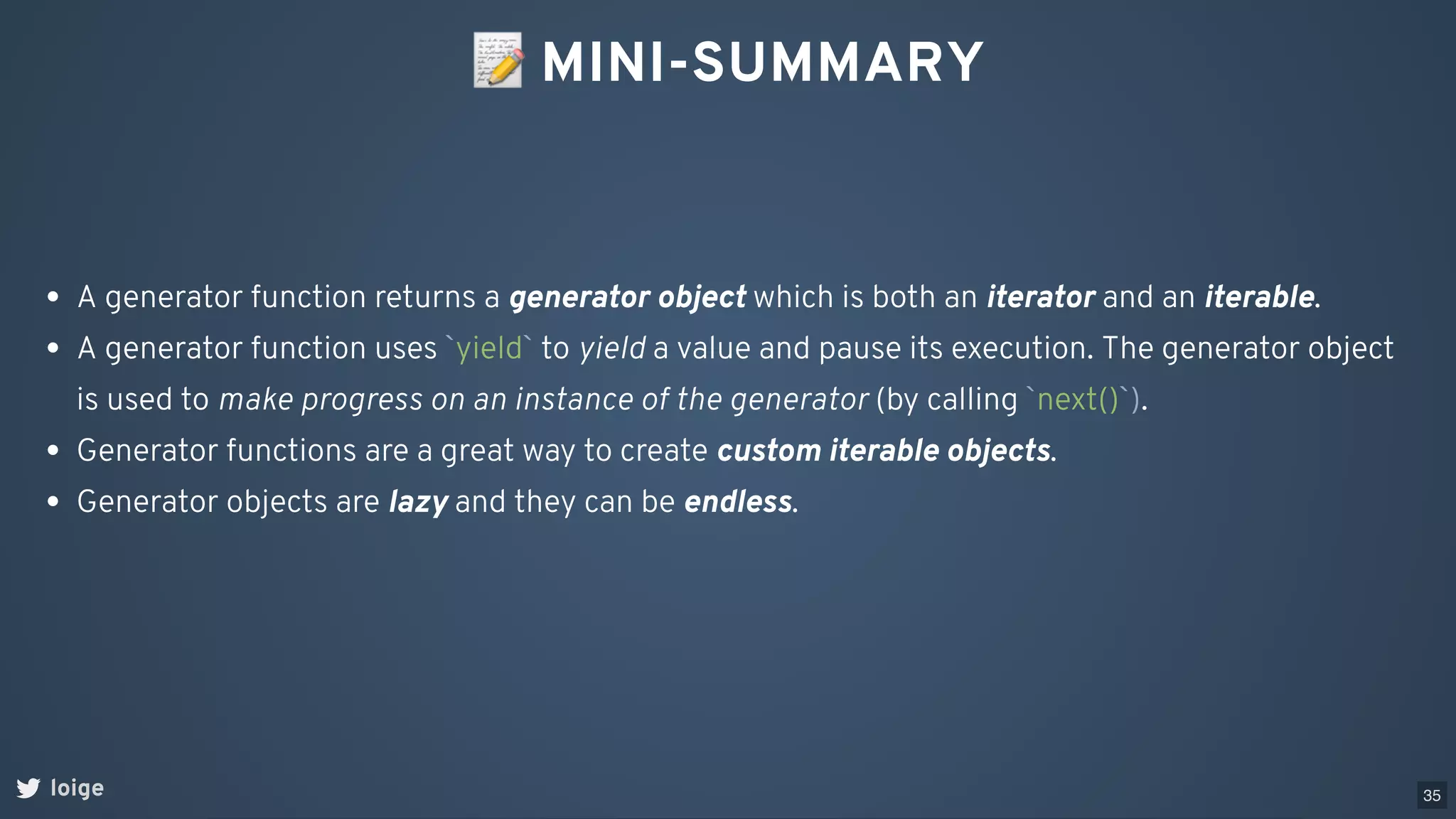
📝MINI-SUMMARY
loige
A generator function returns a generator object which is both an iterator and an iterable.
A generator function uses `yield` to yield a value and pause its execution. The generator object
is used to make progress on an instance of the generator (by calling `next()`).
Generator functions are a great way to create custom iterable objects.
Generator objects are lazy and they can be endless.
35
➡ITERATORS & ITERABLES
loige 36
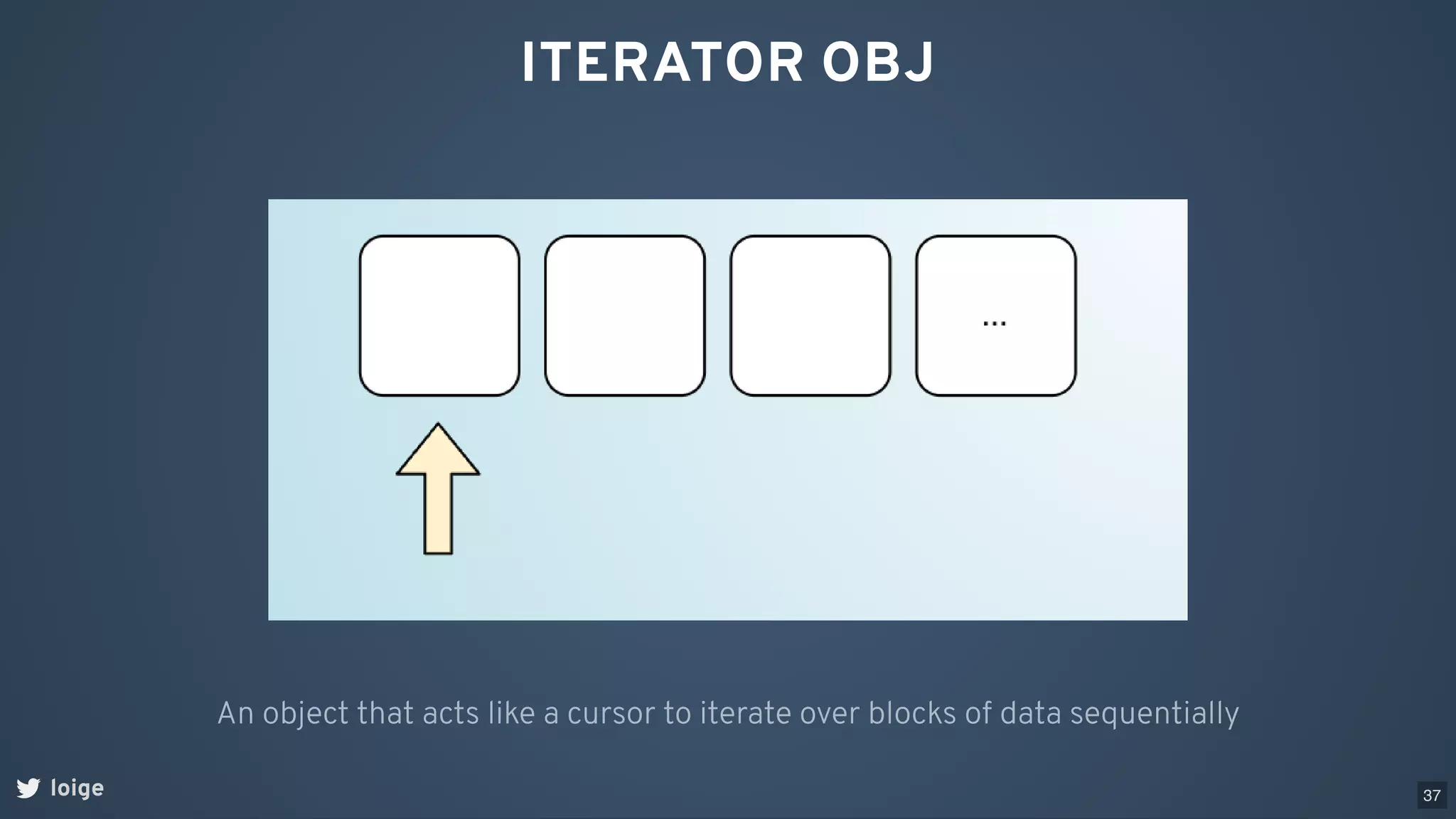
ITERATOR OBJ
loige
An object that acts like a cursor to iterate over blocks of data sequentially
37
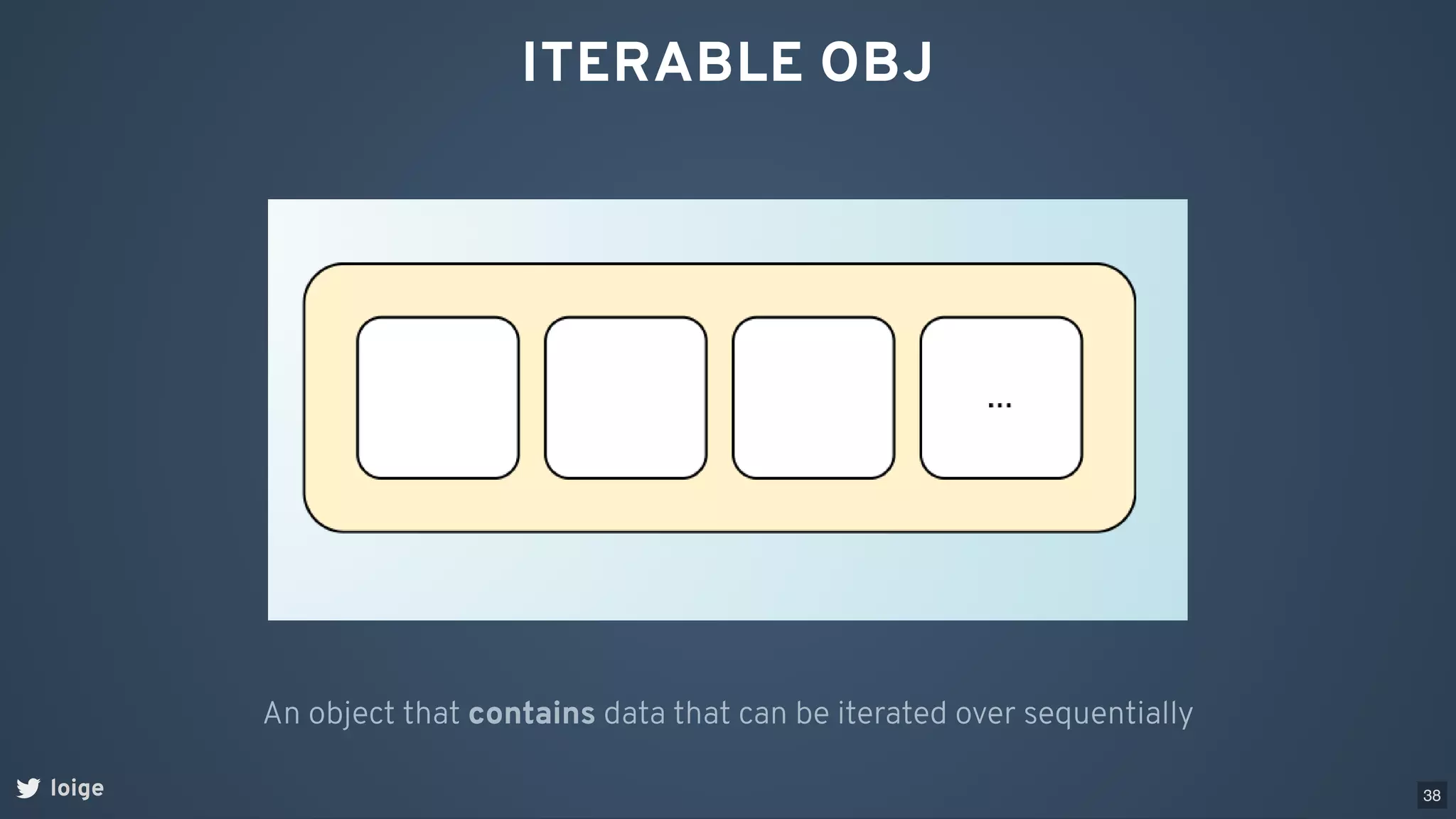
ITERABLE OBJ
loige
An object that contains data that can be iterated over sequentially
38
THE ITERATOR PROTOCOL
An object is an iterator if it has a next() method.
Every time you call it, it returns an object with the keys
done (boolean) and value.
loige 39
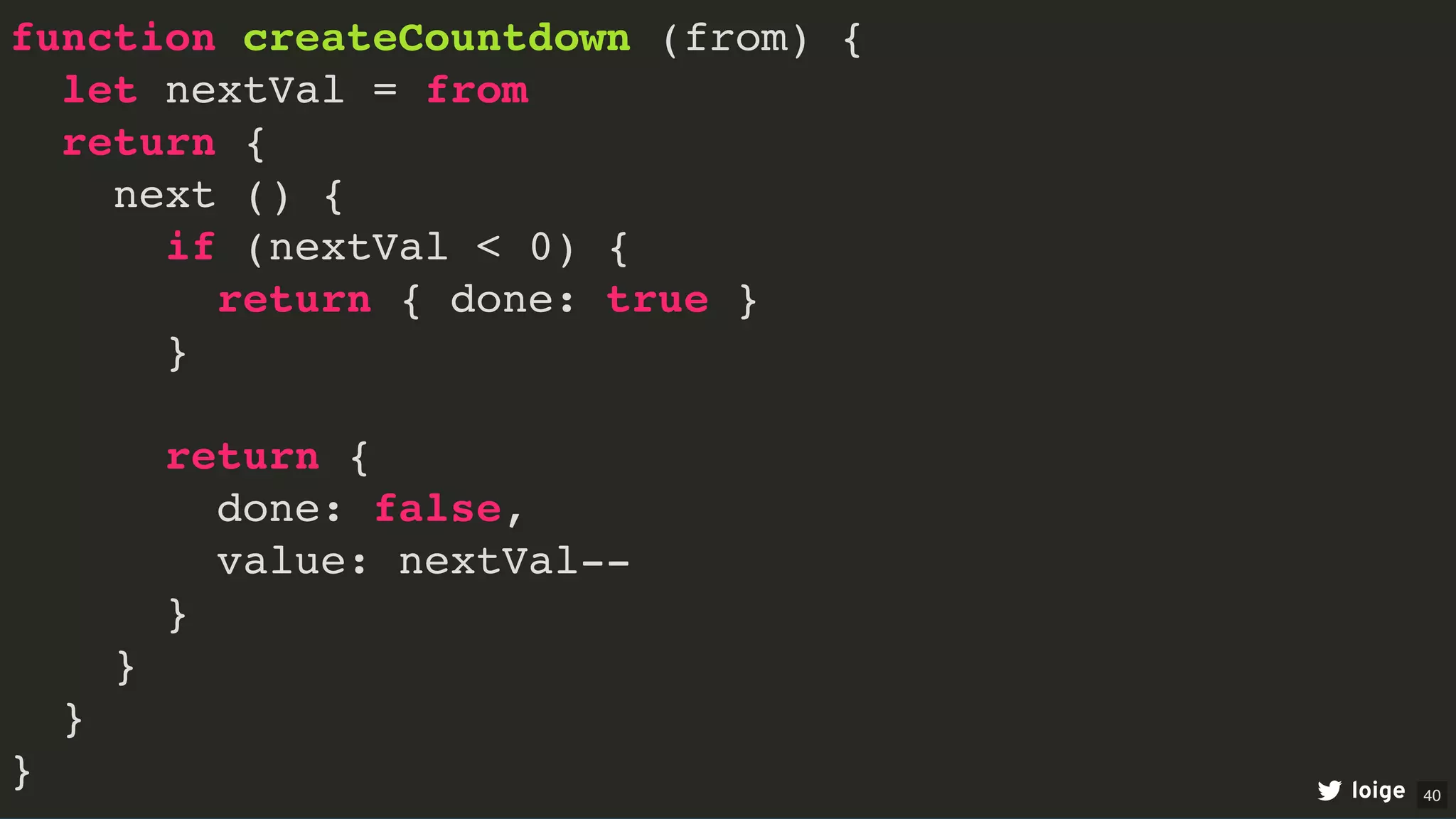
function createCountdown (from) {
let nextVal = from
return {
next () {
if (nextVal < 0) {
return { done: true }
}
return {
done: false,
value: nextVal--
}
}
}
} loige 40
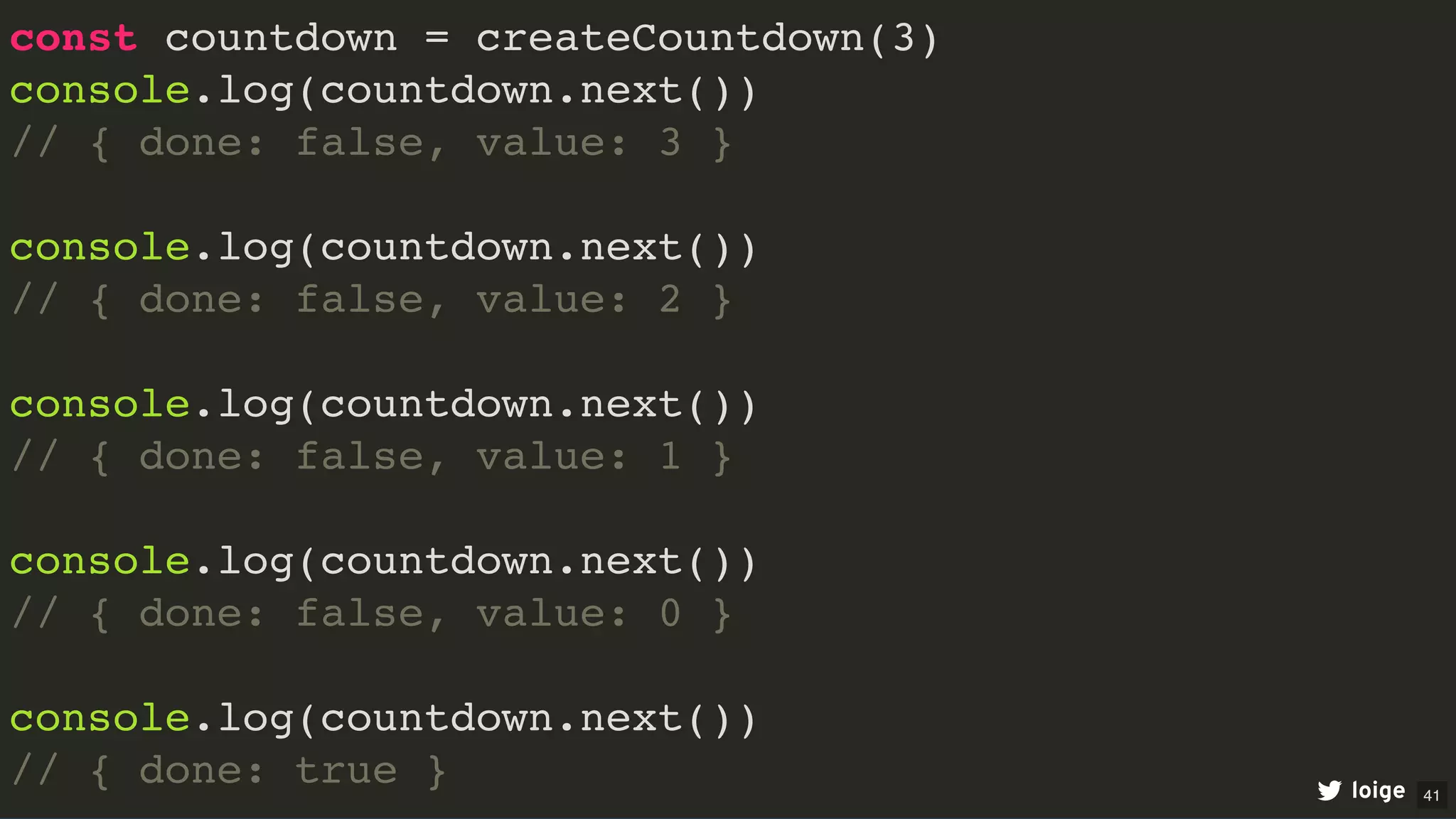
const countdown = createCountdown(3)
console.log(countdown.next())
// { done: false, value: 3 }
console.log(countdown.next())
// { done: false, value: 2 }
console.log(countdown.next())
// { done: false, value: 1 }
console.log(countdown.next())
// { done: false, value: 0 }
console.log(countdown.next())
// { done: true } loige 41
🔥
Generator Objects are iterators (and iterables)!
loige 42
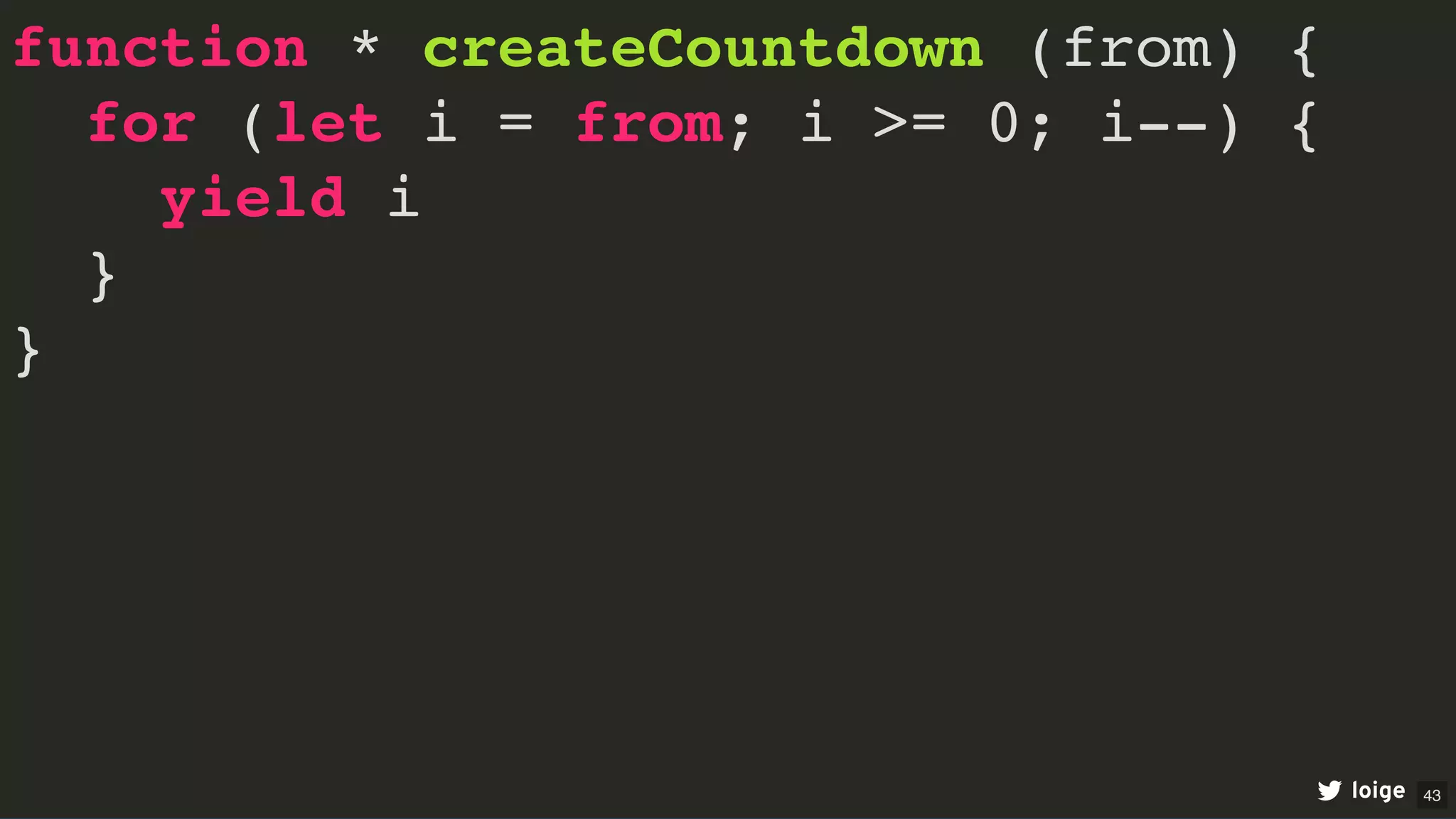
function * createCountdown (from) {
for (let i = from; i >= 0; i--) {
yield i
}
}
loige 43
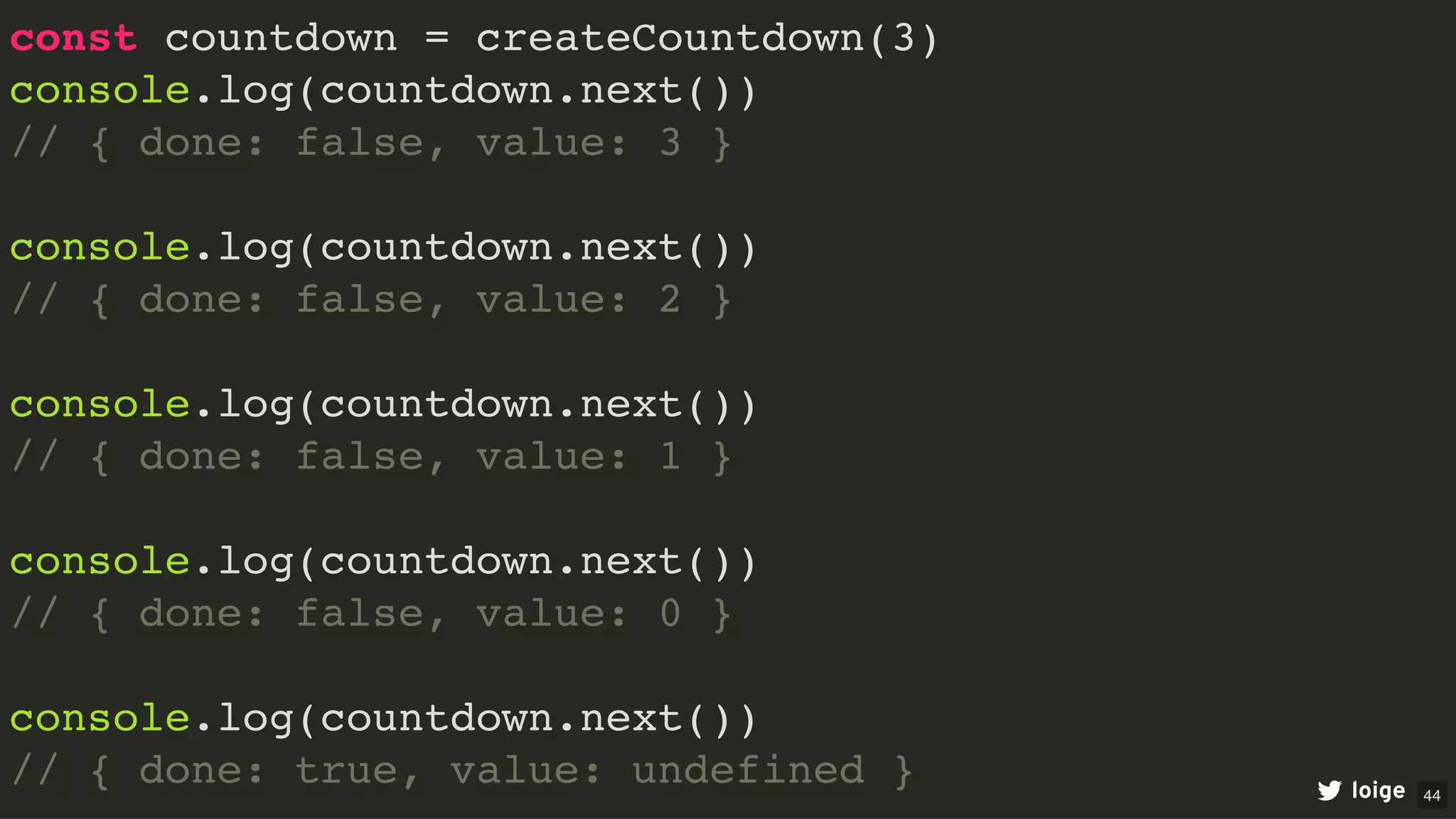
const countdown = createCountdown(3)
console.log(countdown.next())
// { done: false, value: 3 }
console.log(countdown.next())
// { done: false, value: 2 }
console.log(countdown.next())
// { done: false, value: 1 }
console.log(countdown.next())
// { done: false, value: 0 }
console.log(countdown.next())
// { done: true, value: undefined } loige 44
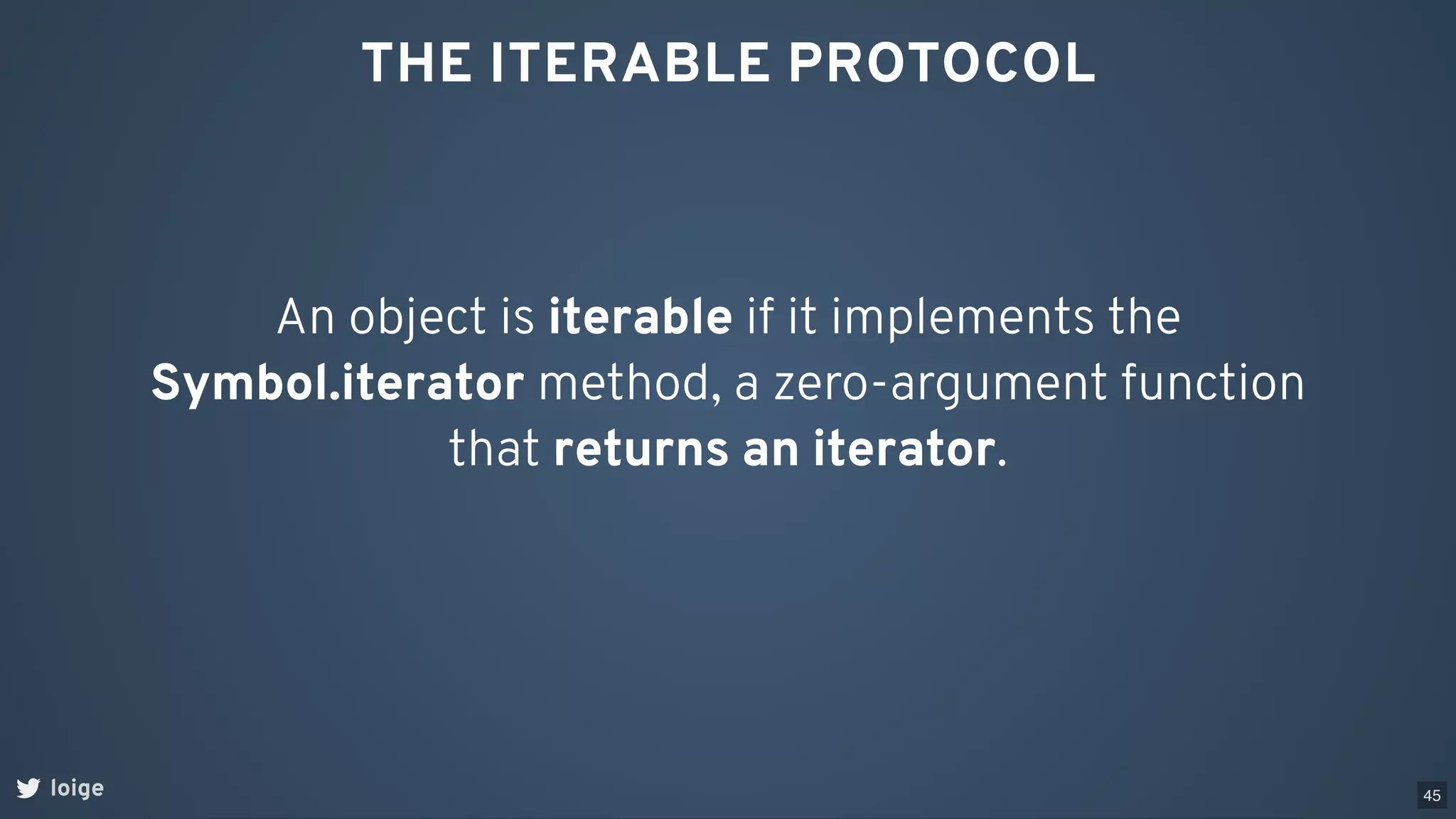
THE ITERABLE PROTOCOL
An object is iterable if it implements the
Symbol.iterator method, a zero-argument function
that returns an iterator.
loige 45
function createCountdown (from) {
let nextVal = from
return {
[Symbol.iterator]: () => ({
next () {
if (nextVal < 0) {
return { done: true }
}
return { done: false, value: nextVal-- }
}
})
}
}
loige 46
function createCountdown (from) {
return {
[Symbol.iterator]: function * () {
for (let i = from; i >= 0; i--) {
yield i
}
}
}
}
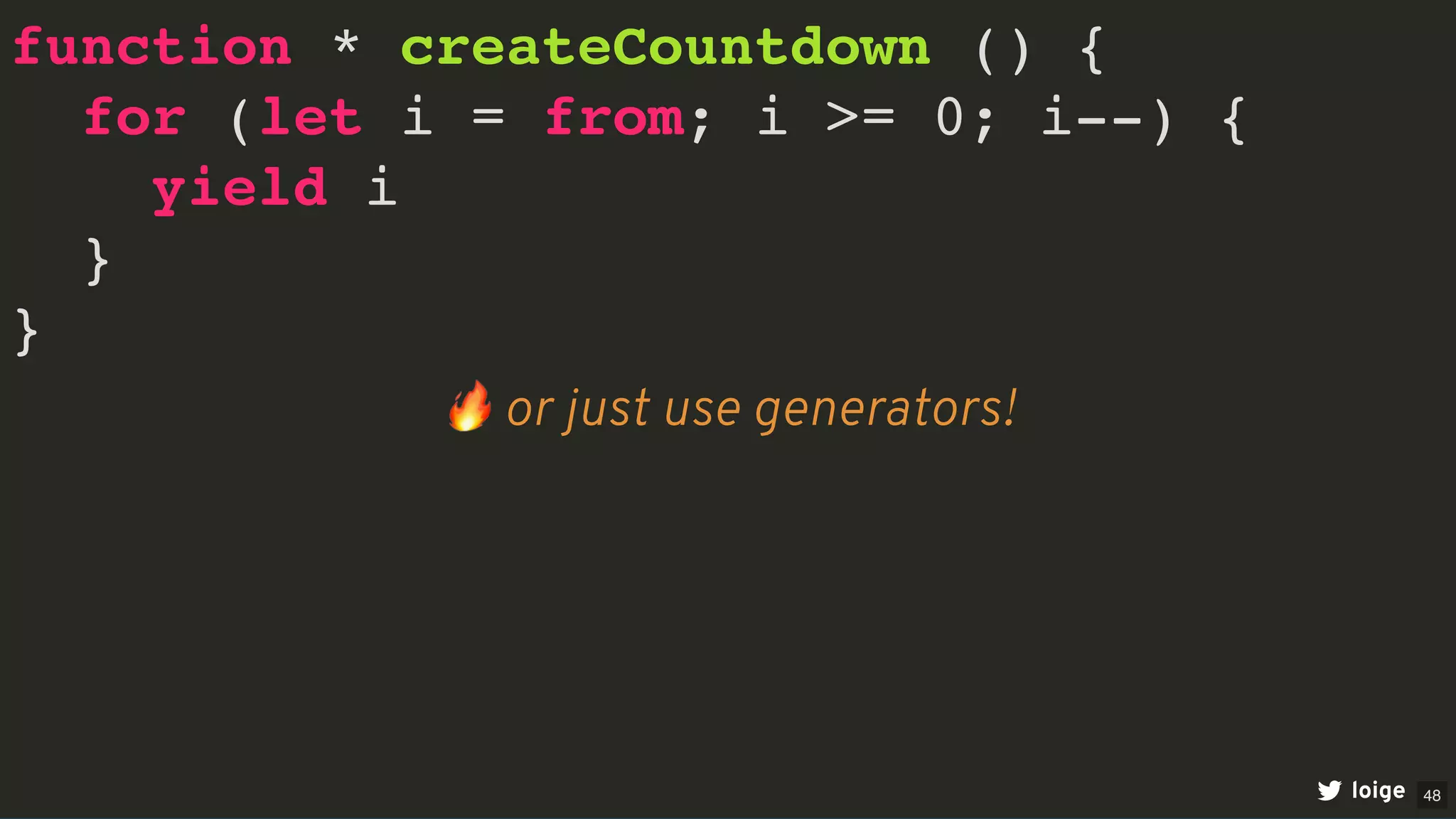
loige 47
function * createCountdown () {
for (let i = from; i >= 0; i--) {
yield i
}
}
loige
🔥or just use generators!
48
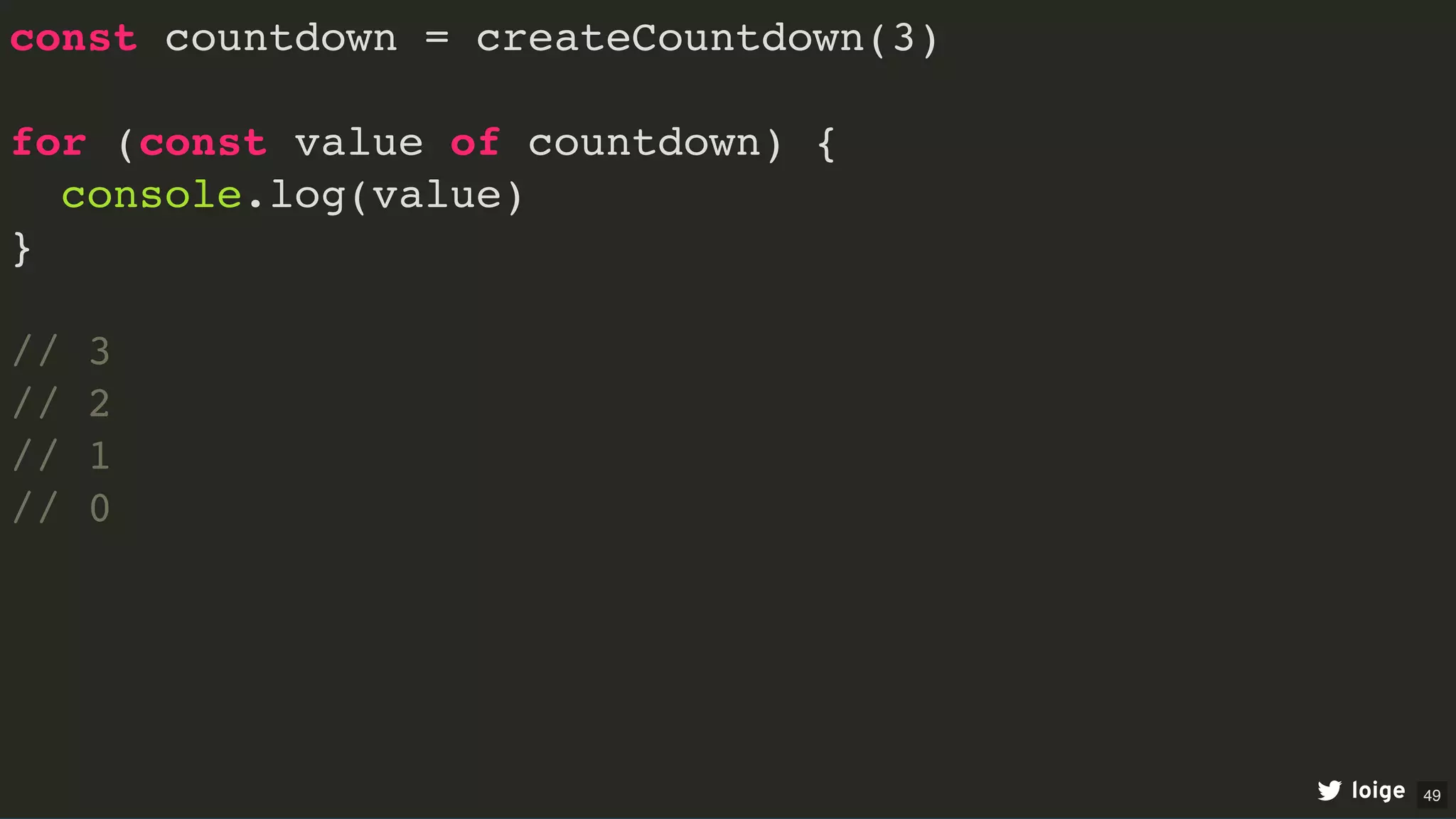
const countdown = createCountdown(3)
for (const value of countdown) {
console.log(value)
}
// 3
// 2
// 1
// 0
loige 49
const iterableIterator = {
next () {
return { done: false, value: 'hello' }
},
[Symbol.iterator] () {
return this
}
}
An object can be an iterable and an iterator at the same time!
loige 50
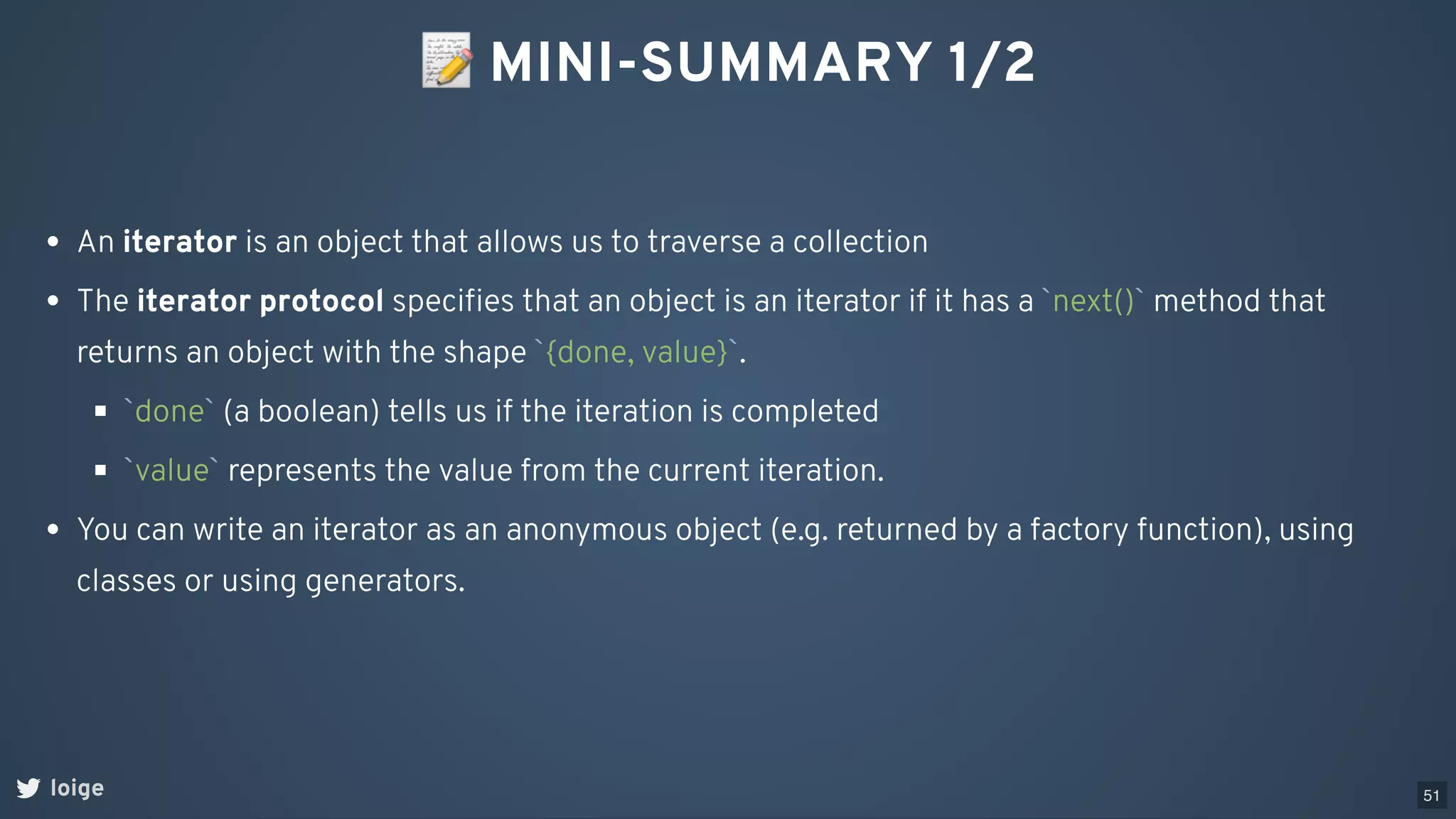
📝MINI-SUMMARY 1/2
loige
An iterator is an object that allows us to traverse a collection
The iterator protocol specifies that an object is an iterator if it has a `next()` method that
returns an object with the shape `{done, value}`.
`done` (a boolean) tells us if the iteration is completed
`value` represents the value from the current iteration.
You can write an iterator as an anonymous object (e.g. returned by a factory function), using
classes or using generators.
51
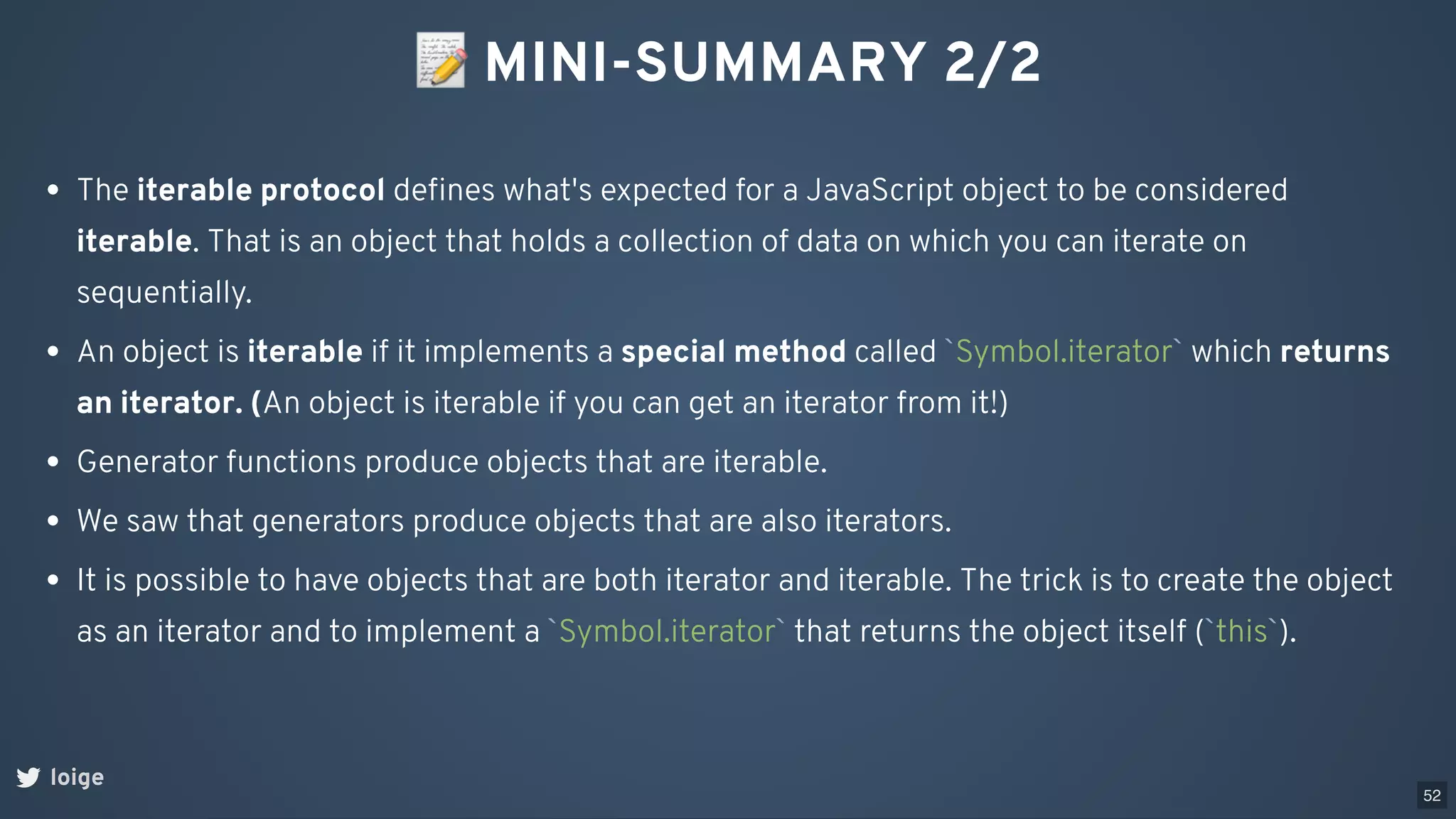
📝MINI-SUMMARY 2/2
loige
The iterable protocol defines what's expected for a JavaScript object to be considered
iterable. That is an object that holds a collection of data on which you can iterate on
sequentially.
An object is iterable if it implements a special method called `Symbol.iterator` which returns
an iterator. (An object is iterable if you can get an iterator from it!)
Generator functions produce objects that are iterable.
We saw that generators produce objects that are also iterators.
It is possible to have objects that are both iterator and iterable. The trick is to create the object
as an iterator and to implement a `Symbol.iterator` that returns the object itself (`this`).
52
OK, very cool!
But, so far this is all synchronous iteration.
What about async? 🙄
loige 53
➡ASYNC ITERATORS & ITERABLES
loige 54
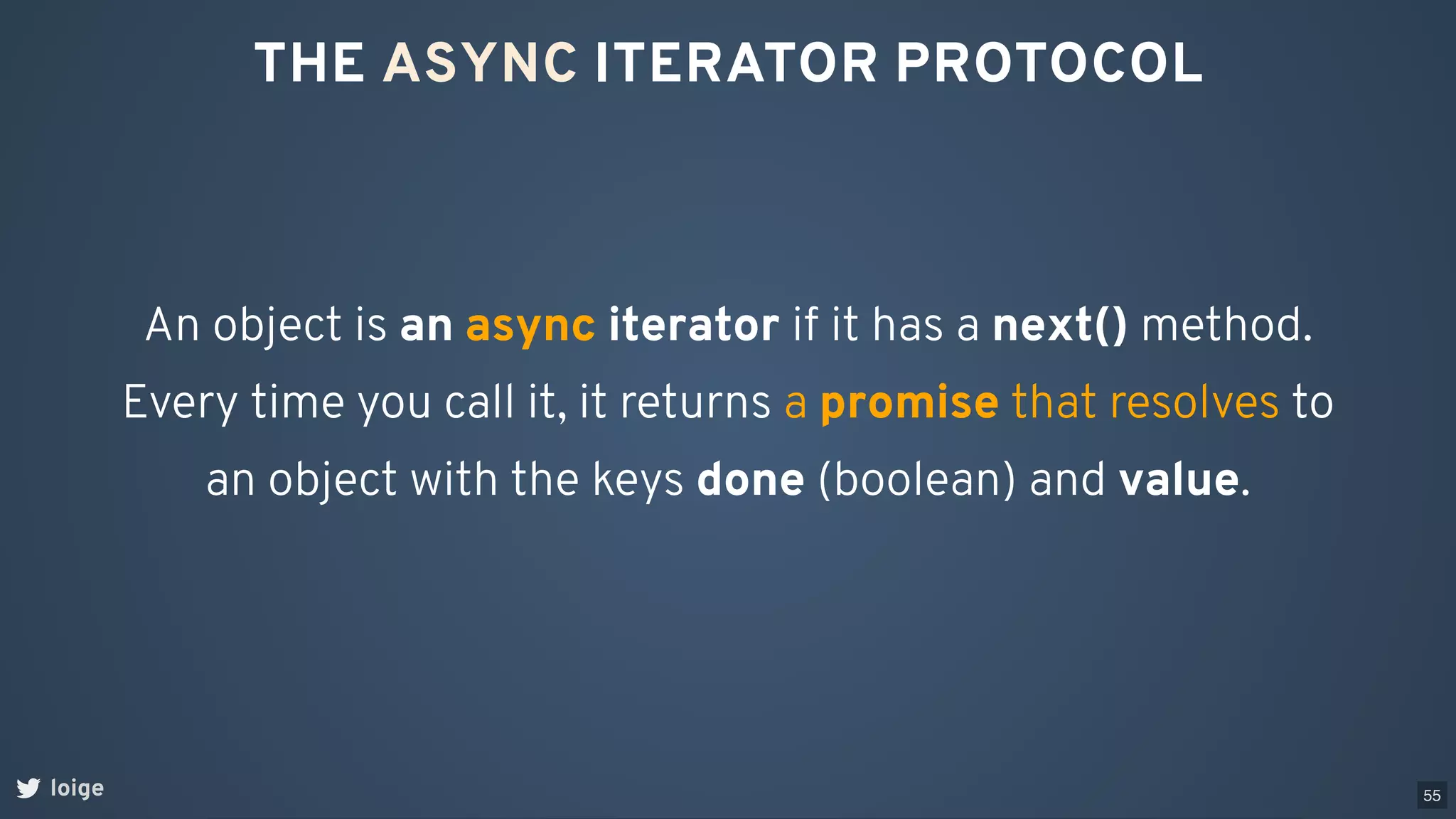
THE ASYNC ITERATOR PROTOCOL
An object is an async iterator if it has a next() method.
Every time you call it, it returns a promise that resolves to
an object with the keys done (boolean) and value.
loige 55
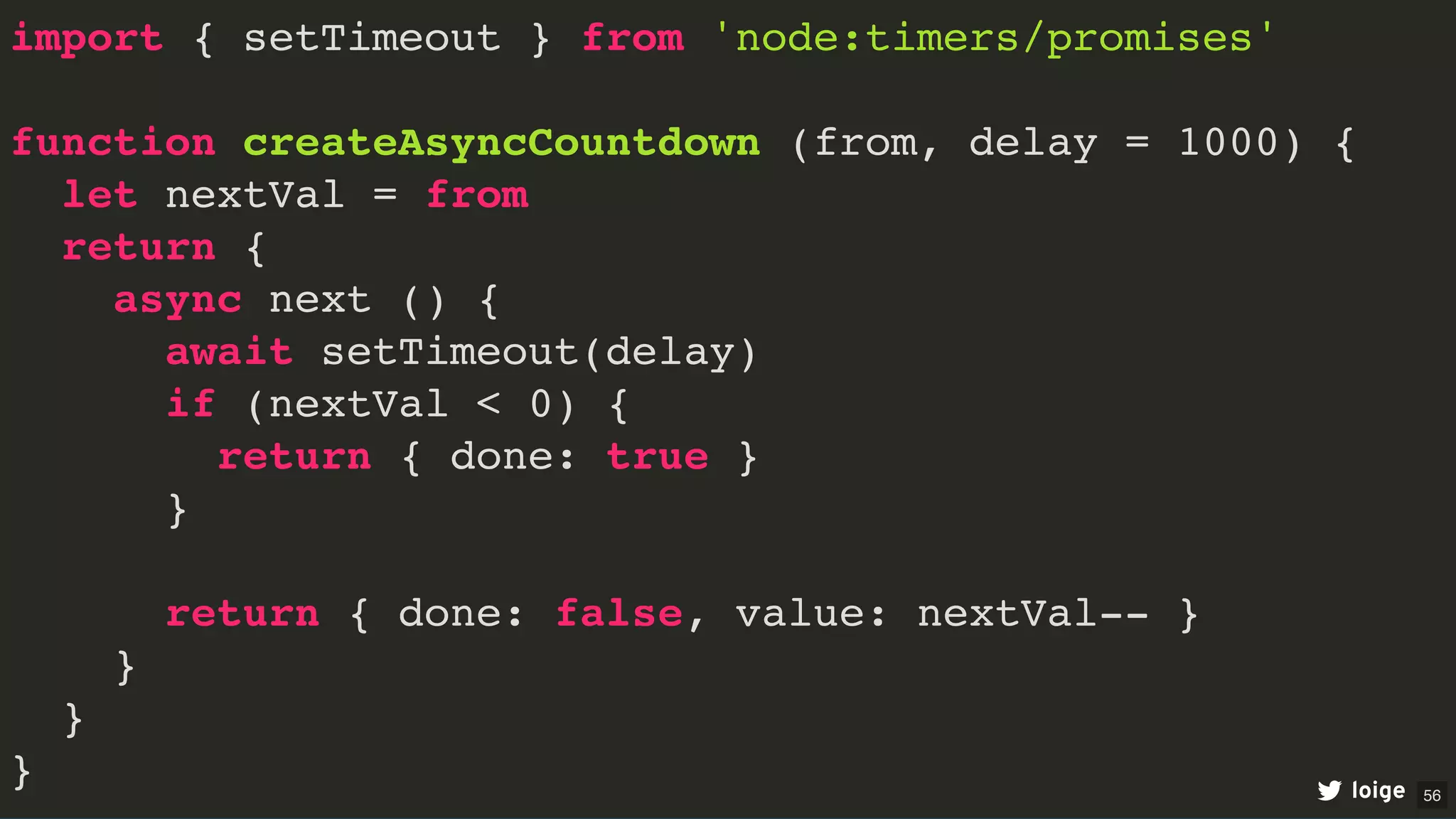
import { setTimeout } from 'node:timers/promises'
function createAsyncCountdown (from, delay = 1000) {
let nextVal = from
return {
async next () {
await setTimeout(delay)
if (nextVal < 0) {
return { done: true }
}
return { done: false, value: nextVal-- }
}
}
} loige 56
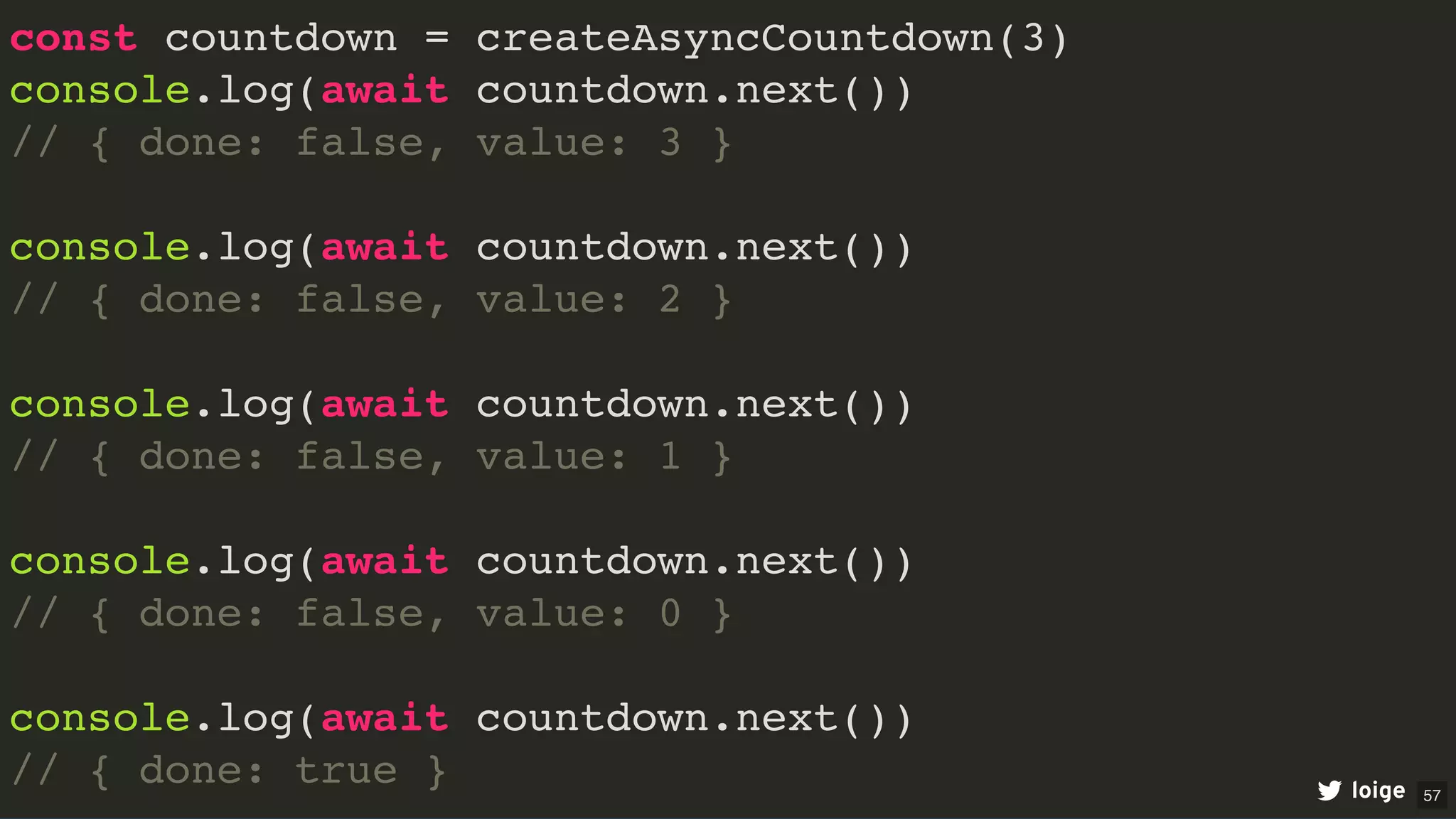
const countdown = createAsyncCountdown(3)
console.log(await countdown.next())
// { done: false, value: 3 }
console.log(await countdown.next())
// { done: false, value: 2 }
console.log(await countdown.next())
// { done: false, value: 1 }
console.log(await countdown.next())
// { done: false, value: 0 }
console.log(await countdown.next())
// { done: true } loige 57
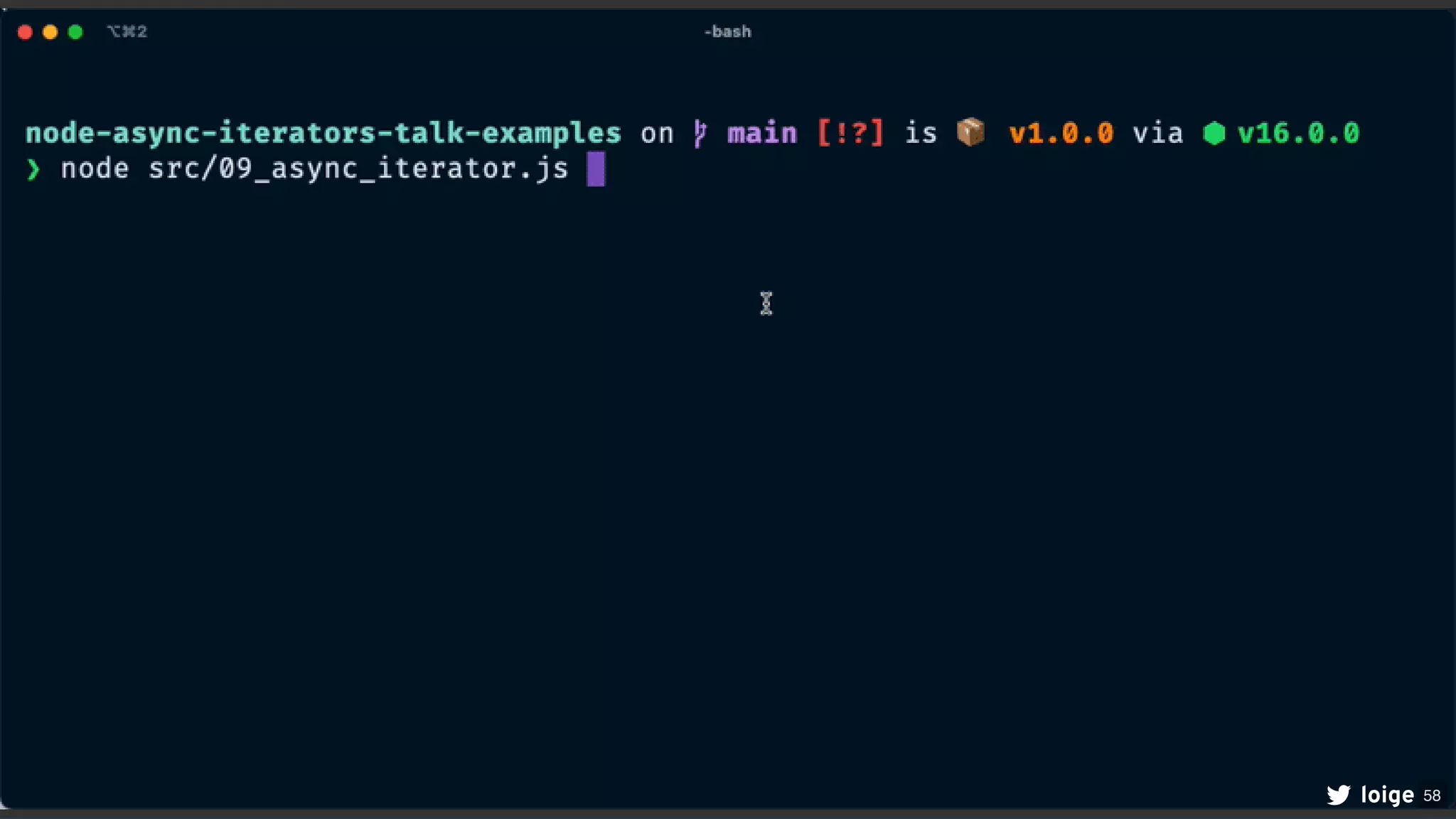
loige 58
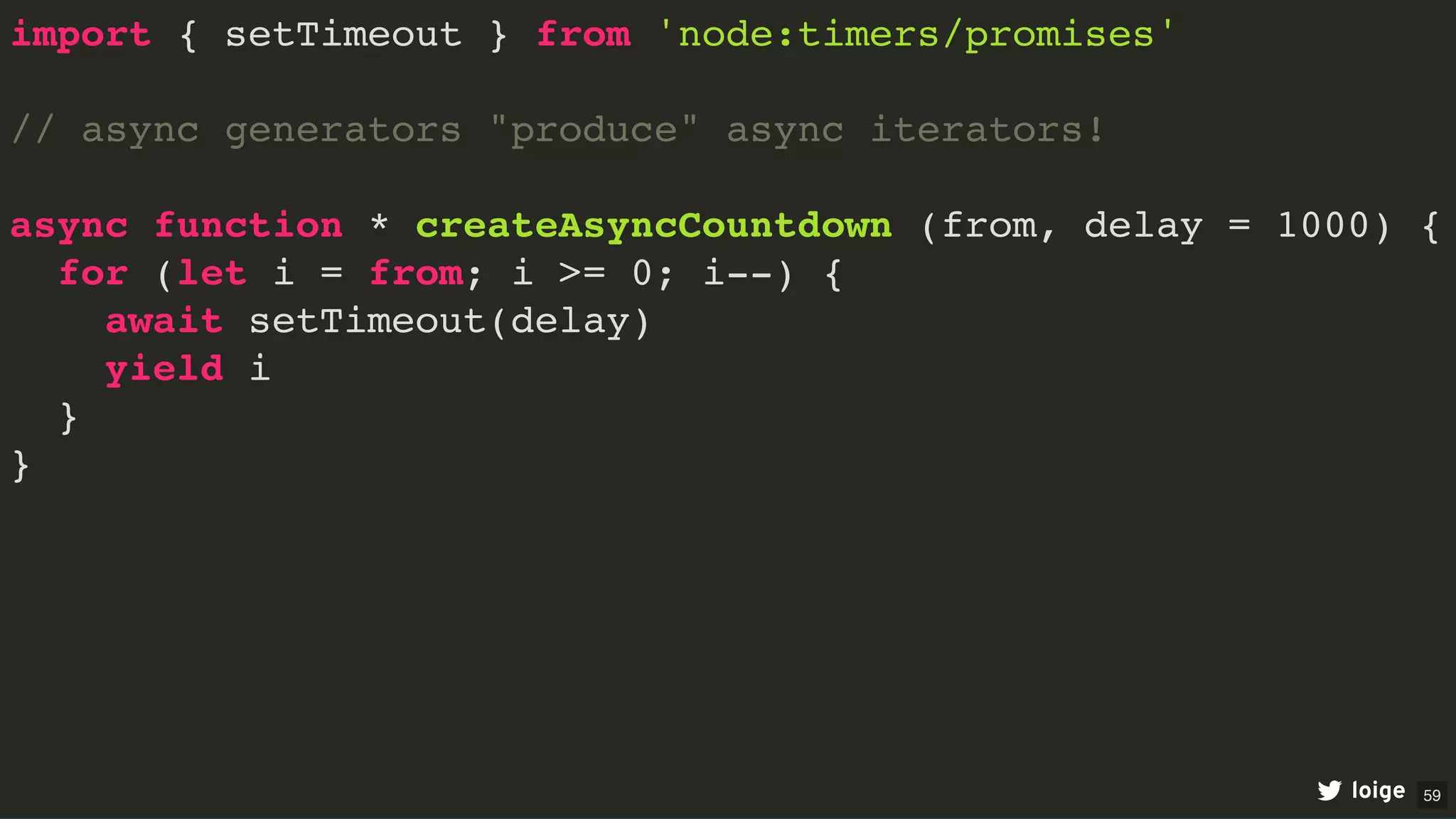
import { setTimeout } from 'node:timers/promises'
// async generators "produce" async iterators!
async function * createAsyncCountdown (from, delay = 1000) {
for (let i = from; i >= 0; i--) {
await setTimeout(delay)
yield i
}
}
loige 59
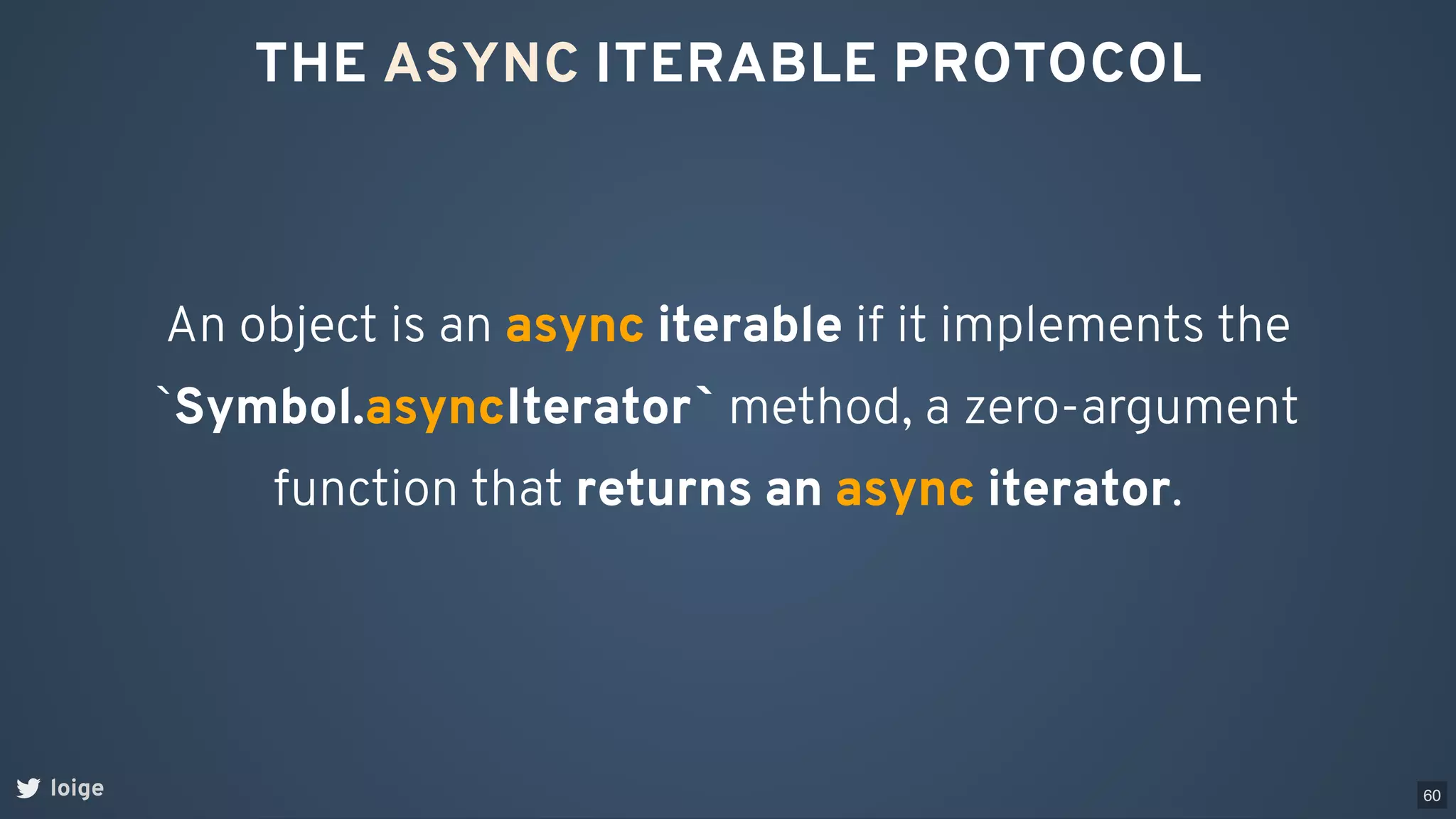
THE ASYNC ITERABLE PROTOCOL
An object is an async iterable if it implements the
`Symbol.asyncIterator` method, a zero-argument
function that returns an async iterator.
loige 60
import { setTimeout } from 'node:timers/promises'
function createAsyncCountdown (from, delay = 1000) {
return {
[Symbol.asyncIterator]: async function * () {
for (let i = from; i >= 0; i--) {
await setTimeout(delay)
yield i
}
}
}
}
loige 61
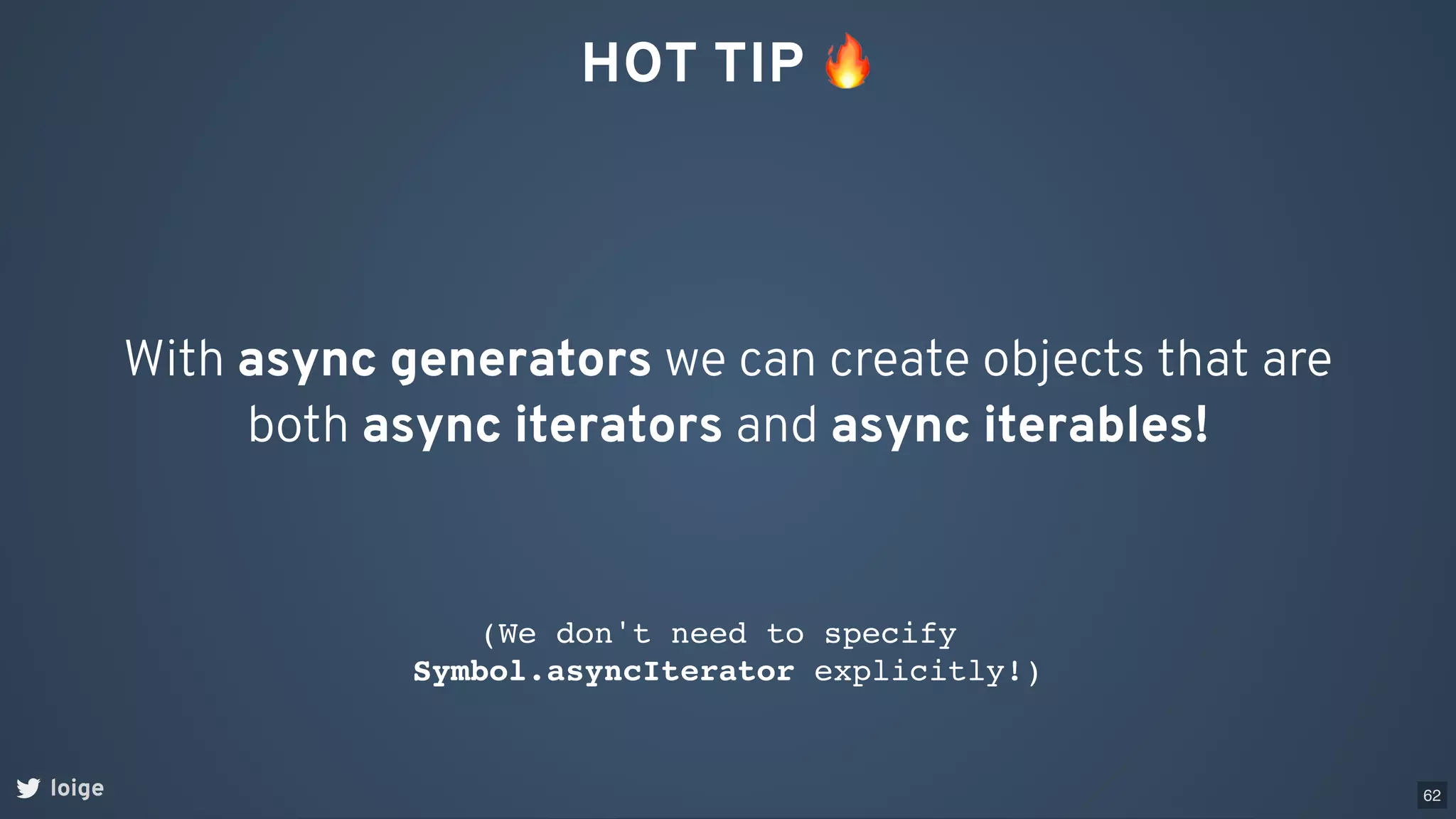
HOT TIP 🔥
With async generators we can create objects that are
both async iterators and async iterables!
(We don't need to specify
Symbol.asyncIterator explicitly!)
loige 62
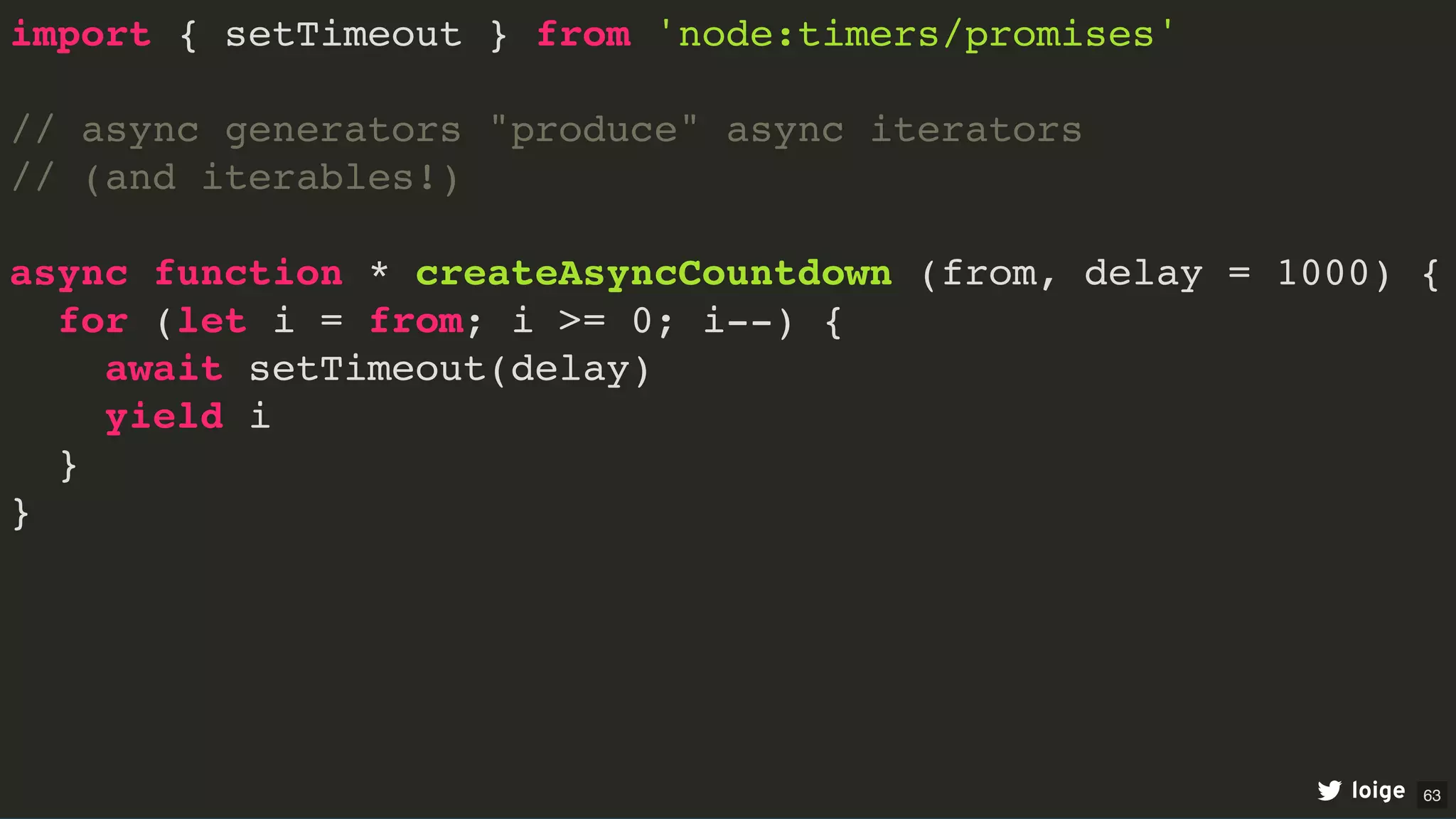
import { setTimeout } from 'node:timers/promises'
// async generators "produce" async iterators
// (and iterables!)
async function * createAsyncCountdown (from, delay = 1000) {
for (let i = from; i >= 0; i--) {
await setTimeout(delay)
yield i
}
}
loige 63
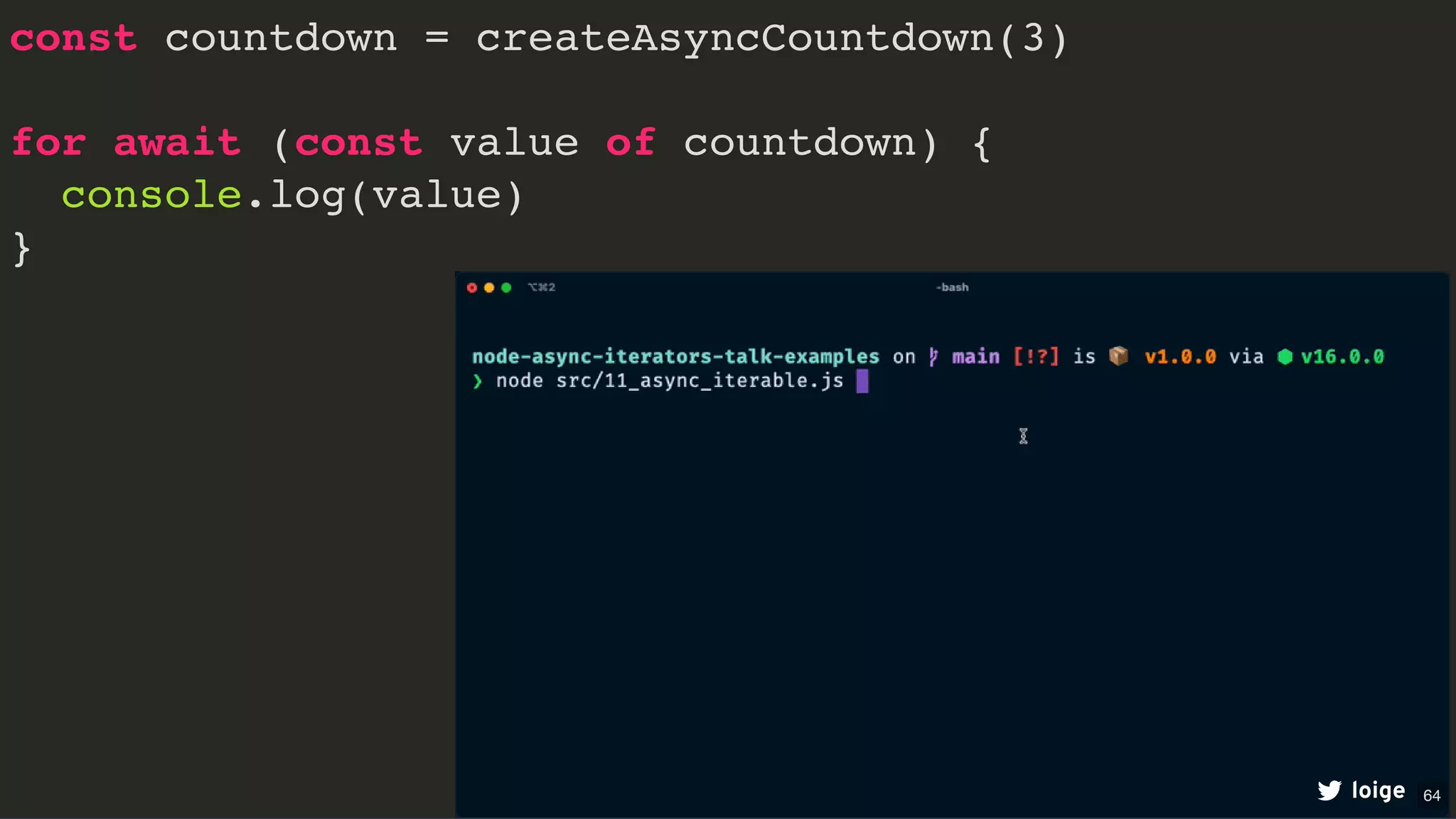
const countdown = createAsyncCountdown(3)
for await (const value of countdown) {
console.log(value)
}
loige 64
📝MINI-SUMMARY 1/2
loige
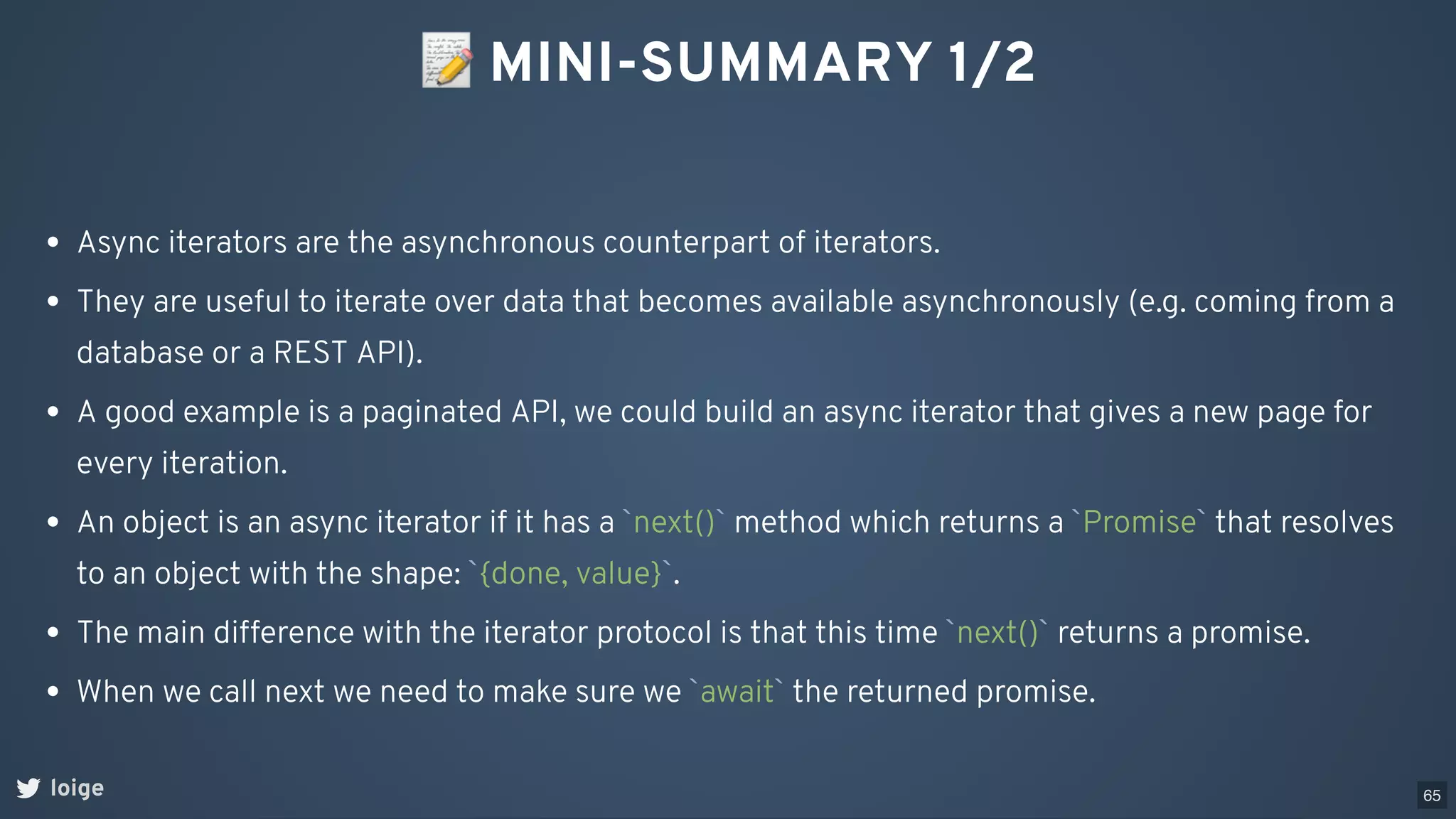
Async iterators are the asynchronous counterpart of iterators.
They are useful to iterate over data that becomes available asynchronously (e.g. coming from a
database or a REST API).
A good example is a paginated API, we could build an async iterator that gives a new page for
every iteration.
An object is an async iterator if it has a `next()` method which returns a `Promise` that resolves
to an object with the shape: `{done, value}`.
The main difference with the iterator protocol is that this time `next()` returns a promise.
When we call next we need to make sure we `await` the returned promise.
65
📝MINI-SUMMARY 2/2
loige
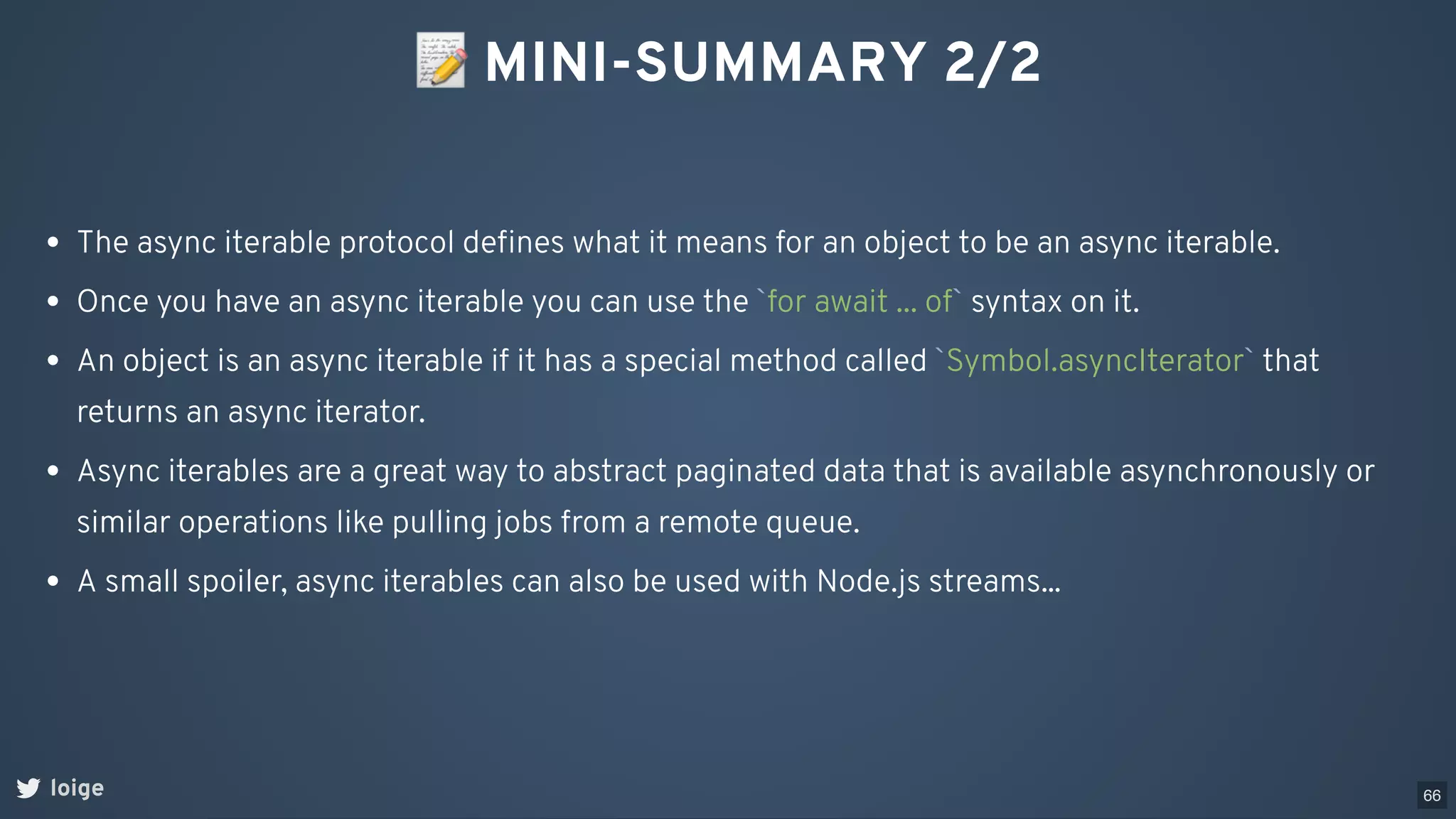
The async iterable protocol defines what it means for an object to be an async iterable.
Once you have an async iterable you can use the `for await ... of` syntax on it.
An object is an async iterable if it has a special method called `Symbol.asyncIterator` that
returns an async iterator.
Async iterables are a great way to abstract paginated data that is available asynchronously or
similar operations like pulling jobs from a remote queue.
A small spoiler, async iterables can also be used with Node.js streams...
66
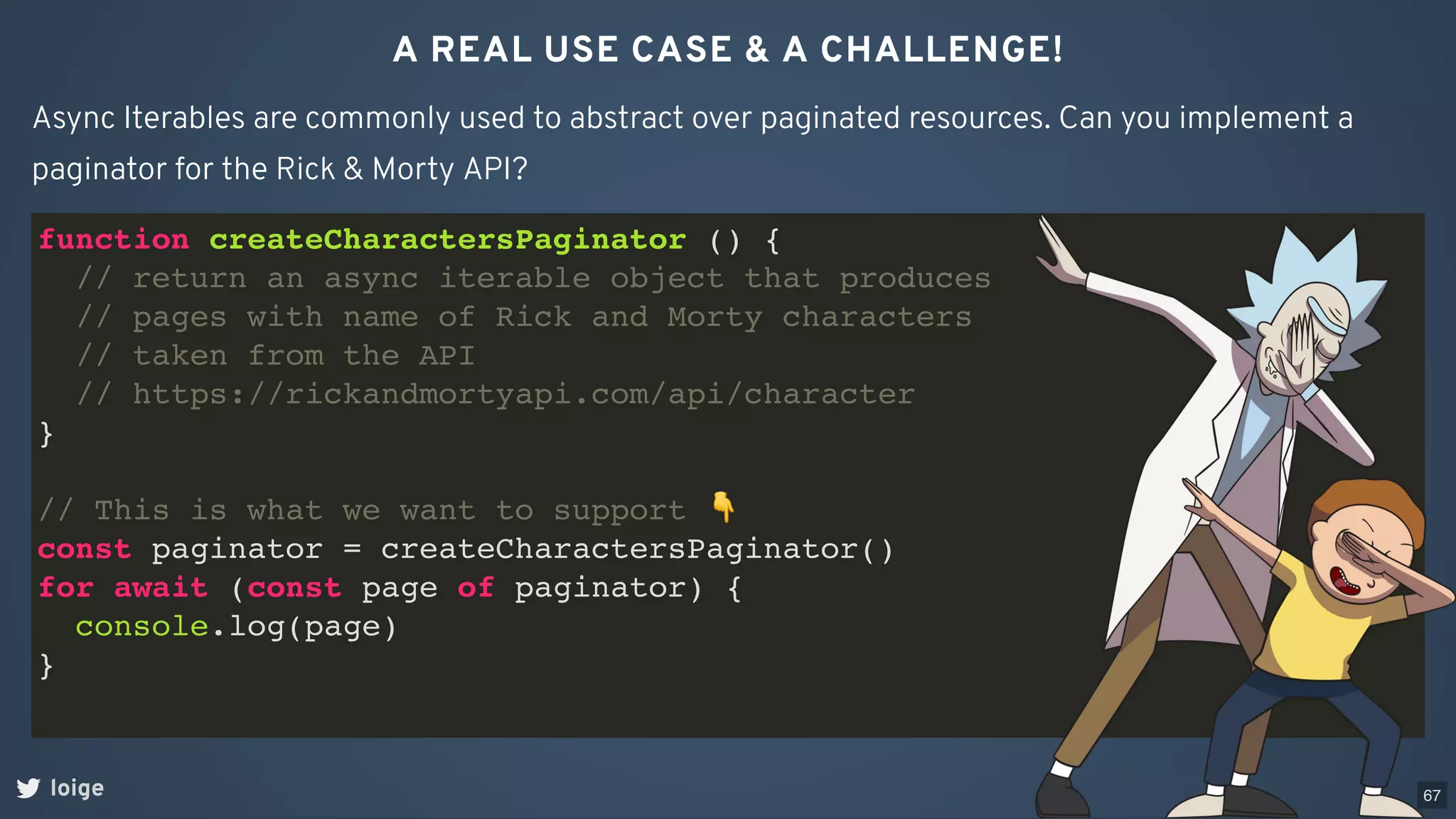
A REAL USE CASE & A CHALLENGE!
loige
Async Iterables are commonly used to abstract over paginated resources. Can you implement a
paginator for the Rick & Morty API?
function createCharactersPaginator () {
// return an async iterable object that produces
// pages with name of Rick and Morty characters
// taken from the API
// https://rickandmortyapi.com/api/character
}
// This is what we want to support 👇
const paginator = createCharactersPaginator()
for await (const page of paginator) {
console.log(page)
}
67
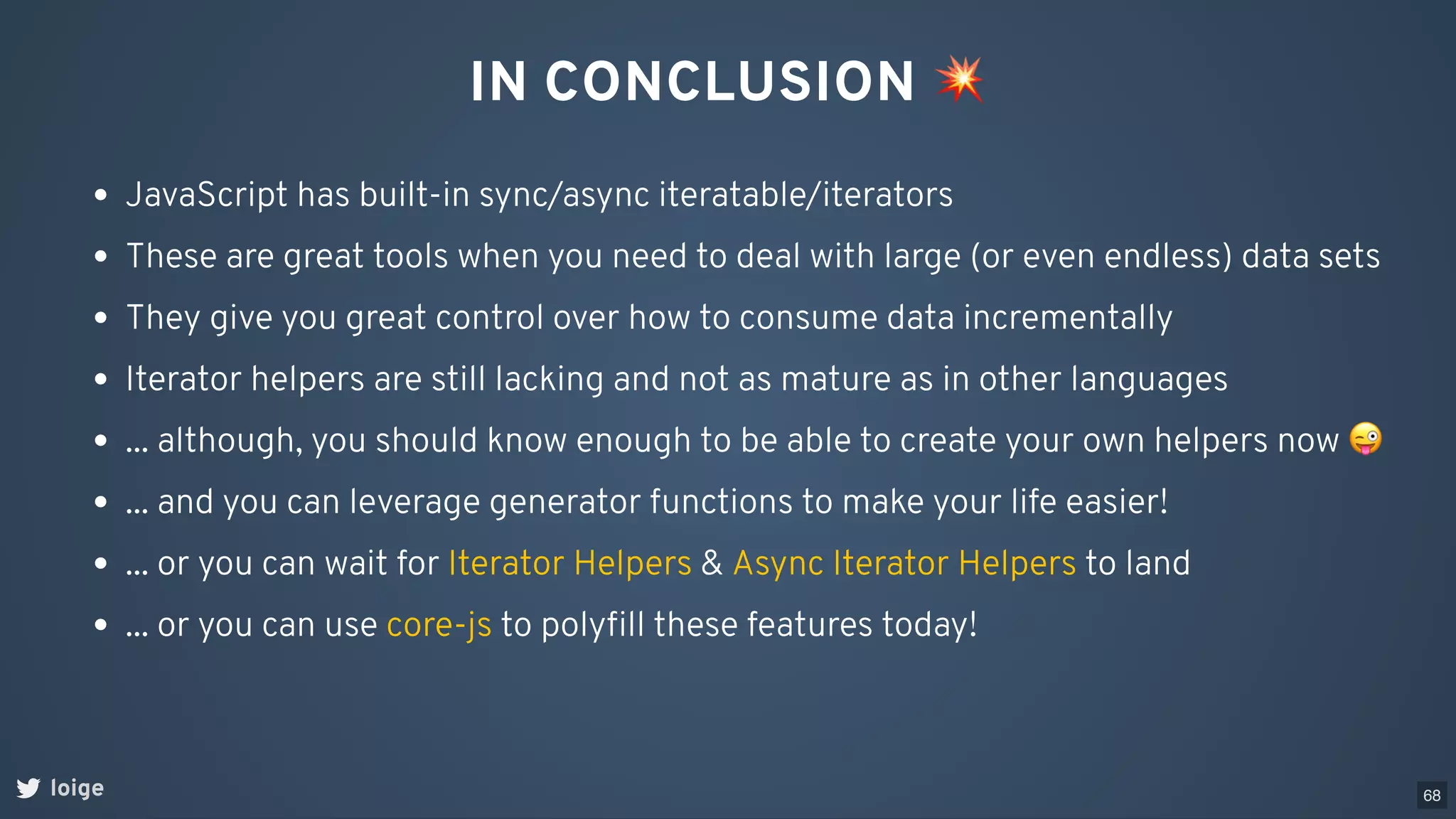
IN CONCLUSION 💥
loige
JavaScript has built-in sync/async iteratable/iterators
These are great tools when you need to deal with large (or even endless) data sets
They give you great control over how to consume data incrementally
Iterator helpers are still lacking and not as mature as in other languages
... although, you should know enough to be able to create your own helpers now 😜
... and you can leverage generator functions to make your life easier!
... or you can wait for & to land
Iterator Helpers Async Iterator Helpers
... or you can use to polyfill these features today!
core-js
68
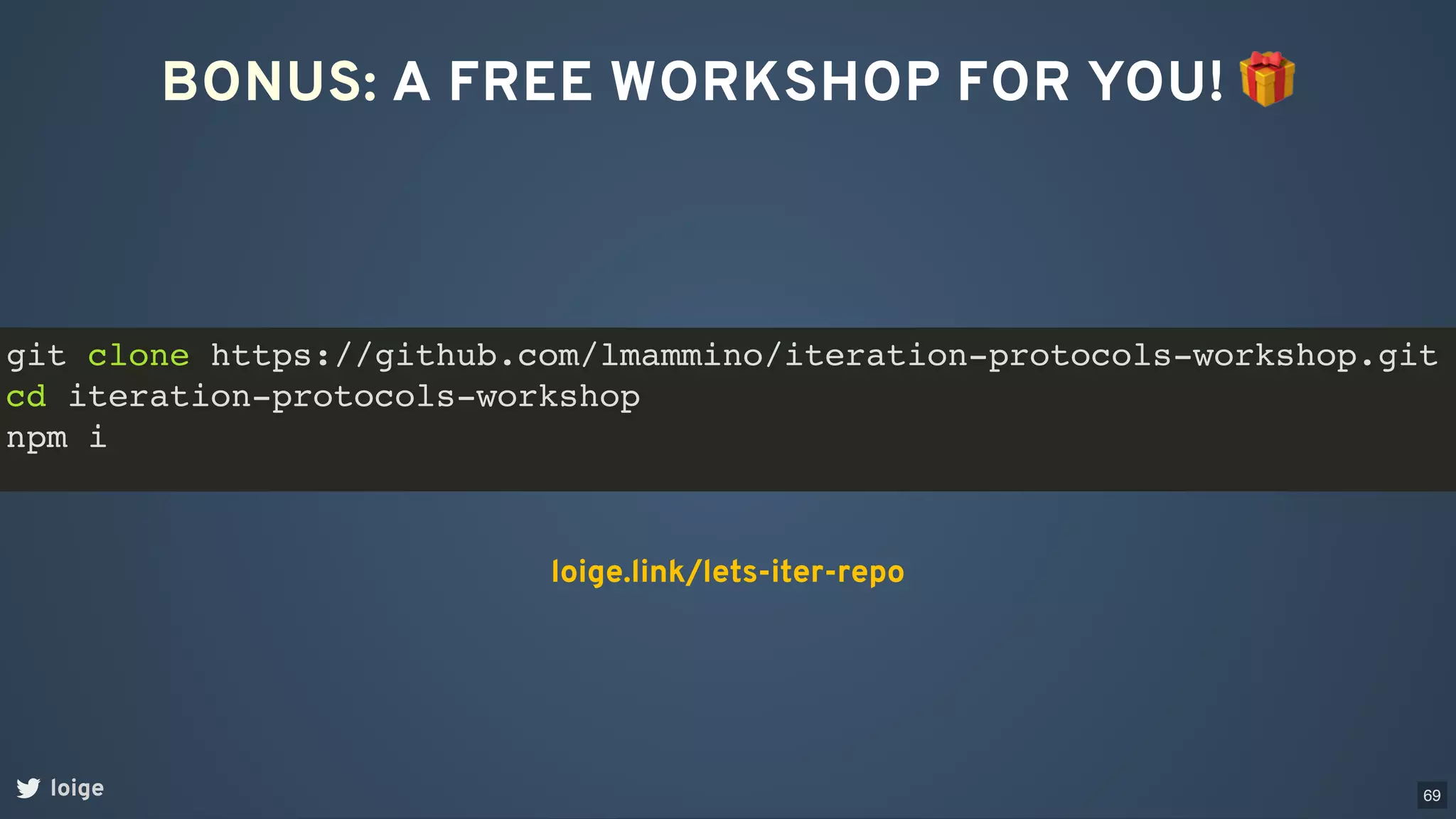
BONUS: A FREE WORKSHOP FOR YOU! 🎁
loige
loige.link/lets-iter-repo
git clone https://github.com/lmammino/iteration-protocols-workshop.git
cd iteration-protocols-workshop
npm i
69
Front cover Photo by on
Back cover photo by on
Sam Barber Unsplash
photonblast Unsplash
fourtheorem.com
THANKS! 🙌
loige
nodejsdp.link
70

Did you know JavaScript has iterators? DublinJS

  • 1.
  • 2.
  • 3.
    String[] transactions ={ "paid 20", "received 10", "paid 5", "received 15", "paid 10", "received 12" }; var total = Stream.of(transactions).mapToInt(transaction -> { var parts = transaction.split(" "); int amount = Integer.decode(parts[1]); if (Objects.equals(parts[0], "paid")) { amount = -amount; } return amount; }).sum(); if (total >= 0) { System.out.println("Life is good :)"); } else { System.out.println("You are broke :("); } 1 2 3 4 5 6 7 8 9 10 11 12 13 14 15 16 17 18 19 20 21 22 23 24 loige replit.com/@lmammino/r-u-broke-java 3
  • 4.
    String[] transactions ={ "paid 20", "received 10", "paid 5", "received 15", "paid 10", "received 12" }; 1 2 3 4 5 6 7 8 9 var total = Stream.of(transactions).mapToInt(transaction -> { 10 var parts = transaction.split(" "); 11 int amount = Integer.decode(parts[1]); 12 if (Objects.equals(parts[0], "paid")) { 13 amount = -amount; 14 } 15 16 return amount; 17 }).sum(); 18 19 if (total >= 0) { 20 System.out.println("Life is good :)"); 21 } else { 22 System.out.println("You are broke :("); 23 } 24 var total = Stream.of(transactions).mapToInt(transaction -> { String[] transactions = { 1 "paid 20", 2 "received 10", 3 "paid 5", 4 "received 15", 5 "paid 10", 6 "received 12" 7 }; 8 9 10 var parts = transaction.split(" "); 11 int amount = Integer.decode(parts[1]); 12 if (Objects.equals(parts[0], "paid")) { 13 amount = -amount; 14 } 15 16 return amount; 17 }).sum(); 18 19 if (total >= 0) { 20 System.out.println("Life is good :)"); 21 } else { 22 System.out.println("You are broke :("); 23 } 24 var parts = transaction.split(" "); int amount = Integer.decode(parts[1]); if (Objects.equals(parts[0], "paid")) { amount = -amount; } return amount; String[] transactions = { 1 "paid 20", 2 "received 10", 3 "paid 5", 4 "received 15", 5 "paid 10", 6 "received 12" 7 }; 8 9 var total = Stream.of(transactions).mapToInt(transaction -> { 10 11 12 13 14 15 16 17 }).sum(); 18 19 if (total >= 0) { 20 System.out.println("Life is good :)"); 21 } else { 22 System.out.println("You are broke :("); 23 } 24 }).sum(); String[] transactions = { 1 "paid 20", 2 "received 10", 3 "paid 5", 4 "received 15", 5 "paid 10", 6 "received 12" 7 }; 8 9 var total = Stream.of(transactions).mapToInt(transaction -> { 10 var parts = transaction.split(" "); 11 int amount = Integer.decode(parts[1]); 12 if (Objects.equals(parts[0], "paid")) { 13 amount = -amount; 14 } 15 16 return amount; 17 18 19 if (total >= 0) { 20 System.out.println("Life is good :)"); 21 } else { 22 System.out.println("You are broke :("); 23 } 24 if (total >= 0) { System.out.println("Life is good :)"); } else { System.out.println("You are broke :("); } String[] transactions = { 1 "paid 20", 2 "received 10", 3 "paid 5", 4 "received 15", 5 "paid 10", 6 "received 12" 7 }; 8 9 var total = Stream.of(transactions).mapToInt(transaction -> { 10 var parts = transaction.split(" "); 11 int amount = Integer.decode(parts[1]); 12 if (Objects.equals(parts[0], "paid")) { 13 amount = -amount; 14 } 15 16 return amount; 17 }).sum(); 18 19 20 21 22 23 24 String[] transactions = { "paid 20", "received 10", "paid 5", "received 15", "paid 10", "received 12" }; var total = Stream.of(transactions).mapToInt(transaction -> { var parts = transaction.split(" "); int amount = Integer.decode(parts[1]); if (Objects.equals(parts[0], "paid")) { amount = -amount; } return amount; }).sum(); if (total >= 0) { System.out.println("Life is good :)"); } else { System.out.println("You are broke :("); } 1 2 3 4 5 6 7 8 9 10 11 12 13 14 15 16 17 18 19 20 21 22 23 24 loige replit.com/@lmammino/r-u-broke-java 4
  • 5.
    transactions = [ "paid20", "received 10", "paid 5", "received 15", "paid 10", "received 12" ]; def get_amount(transaction): type, amount = transaction.split(' ') amount = int(amount) if type == 'paid': return -amount return amount *_, total = accumulate( map(get_amount, transactions) ) if total >= 0: print("Life is good :)") else: print("You are broke :(") 1 2 3 4 5 6 7 8 9 10 11 12 13 14 15 16 17 18 19 20 21 22 23 24 loige replit.com/@lmammino/r-u-broke-py 5
  • 6.
    let transactions =[ "paid 20", "received 10", "paid 5", "received 15", "paid 10", "received 12", ]; let total: i32 = transactions .iter() .map(|transaction| { let (action, amount) = transaction.split_once(' ').unwrap(); let amount = amount.parse::<i32>().unwrap(); if action == "paid" { -amount } else { amount } }) .sum(); if total >= 0 { println!("Life is good :)"); } else { println!("You are broke :("); } 1 2 3 4 5 6 7 8 9 10 11 12 13 14 15 16 17 18 19 20 21 22 23 24 25 26 27 loige replit.com/@lmammino/r-u-broke-rust 6
  • 7.
    const transactions =[ "paid 20", "received 10", "paid 5", "received 15", "paid 10", "received 12" ] const total = Iterator.from(transactions) .map(transaction => { let [action, amount] = transaction.split(" ") amount = Number.parseInt(amount) if (action === "paid") { return -amount } else { return amount } }) .reduce((acc,curr) => acc + curr) if (total >= 0) { console.log("Life is good :)") } else { console.log("You are broke :("); } 1 2 3 4 5 6 7 8 9 10 11 12 13 14 15 16 17 18 19 20 21 22 23 24 25 26 loige replit.com/@lmammino/r-u-broke-js 7
  • 8.
    const transactions =[ "paid 20", "received 10", "paid 5", "received 15", "paid 10", "received 12" ] const total = Iterator.from(transactions) .map(transaction => { let [action, amount] = transaction.split(" ") amount = Number.parseInt(amount) if (action === "paid") { return -amount } else { return amount } }) .reduce((acc,curr) => acc + curr) if (total >= 0) { console.log("Life is good :)") } else { console.log("You are broke :("); } 1 2 3 4 5 6 7 8 9 10 11 12 13 14 15 16 17 18 19 20 21 22 23 24 25 26 const total = Iterator.from(transactions) const transactions = [ 1 "paid 20", 2 "received 10", 3 "paid 5", 4 "received 15", 5 "paid 10", 6 "received 12" 7 ] 8 9 10 .map(transaction => { 11 let [action, amount] = transaction.split(" ") 12 amount = Number.parseInt(amount) 13 if (action === "paid") { 14 return -amount 15 } else { 16 return amount 17 } 18 }) 19 .reduce((acc,curr) => acc + curr) 20 21 if (total >= 0) { 22 console.log("Life is good :)") 23 } else { 24 console.log("You are broke :("); 25 } 26 .map(transaction => { const transactions = [ 1 "paid 20", 2 "received 10", 3 "paid 5", 4 "received 15", 5 "paid 10", 6 "received 12" 7 ] 8 9 const total = Iterator.from(transactions) 10 11 let [action, amount] = transaction.split(" ") 12 amount = Number.parseInt(amount) 13 if (action === "paid") { 14 return -amount 15 } else { 16 return amount 17 } 18 }) 19 .reduce((acc,curr) => acc + curr) 20 21 if (total >= 0) { 22 console.log("Life is good :)") 23 } else { 24 console.log("You are broke :("); 25 } 26 .reduce((acc,curr) => acc + curr) const transactions = [ 1 "paid 20", 2 "received 10", 3 "paid 5", 4 "received 15", 5 "paid 10", 6 "received 12" 7 ] 8 9 const total = Iterator.from(transactions) 10 .map(transaction => { 11 let [action, amount] = transaction.split(" ") 12 amount = Number.parseInt(amount) 13 if (action === "paid") { 14 return -amount 15 } else { 16 return amount 17 } 18 }) 19 20 21 if (total >= 0) { 22 console.log("Life is good :)") 23 } else { 24 console.log("You are broke :("); 25 } 26 const transactions = [ "paid 20", "received 10", "paid 5", "received 15", "paid 10", "received 12" ] const total = Iterator.from(transactions) .map(transaction => { let [action, amount] = transaction.split(" ") amount = Number.parseInt(amount) if (action === "paid") { return -amount } else { return amount } }) .reduce((acc,curr) => acc + curr) if (total >= 0) { console.log("Life is good :)") } else { console.log("You are broke :("); } 1 2 3 4 5 6 7 8 9 10 11 12 13 14 15 16 17 18 19 20 21 22 23 24 25 26 loige replit.com/@lmammino/r-u-broke-js 8
  • 9.
    const transactions =[ "paid 20", "received 10", "paid 5", "received 15", "paid 10", "received 12" ] const total = Iterator.from(transactions) .map(transaction => { let [action, amount] = transaction.split(" ") amount = Number.parseInt(amount) if (action === "paid") { return -amount } else { return amount } }) .reduce((acc,curr) => acc + curr) if (total >= 0) { console.log("Life is good :)") } else { console.log("You are broke :("); } 1 2 3 4 5 6 7 8 9 10 11 12 13 14 15 16 17 18 19 20 21 22 23 24 25 26 loige replit.com/@lmammino/r-u-broke-js This is not JavaScript, it's FutureJavaScript™ github.com/tc39/proposal-iterator-helpers 9
  • 10.
    import Iterator from'core-js-pure/actual/iterator/index.js' 1 2 const transactions = [ 3 "paid 20", 4 "received 10", 5 "paid 5", 6 "received 15", 7 "paid 10", 8 "received 12" 9 ] 10 11 const total = Iterator.from(transactions) 12 .map(transaction => { 13 let [action, amount] = transaction.split(" ") 14 amount = Number.parseInt(amount) 15 if (action === "paid") { 16 return -amount 17 } else { 18 return amount 19 } 20 }) 21 .reduce((acc,curr) => acc + curr) 22 23 if (total >= 0) { 24 console.log("Life is good :)") 25 } else { 26 console.log("You are broke :("); 27 loige But if you want the future, today... npm i --save core-js-pure 10
  • 11.
  • 12.
    loige ITERATORS ARE LAZY! Youcan consume the collection 1 item at the time You don't need to keep all the items in memory Great for large datasets You can even have endless iterators! 12
  • 13.
    loige The concept ofIterators exists already in JavaScript... 🗞GOOD NEWS FROM THE WORLD... ... since ES2015! 13
  • 14.
    WAIT, WHO THEHECK IS THIS GUY !? 🤷 👋I'm Luciano ( 🍕🍝 ) Senior Architect @ fourTheorem (Dublin ) nodejsdp.link 📔Co-Author of Node.js Design Patterns 👉 Let's connect! (blog) (twitter) (twitch) (github) loige.co @loige loige lmammino 14
  • 15.
    ALWAYS RE-IMAGINING WE AREA PIONEERING TECHNOLOGY CONSULTANCY FOCUSED ON CLOUD, AWS & SERVERLESS loige 😇We are always looking for talent: fth.link/careers We can help with: Cloud Migrations Training & Cloud enablement Building serverless applications Cutting cloud costs 15
  • 16.
  • 17.
    loige 🥤 LET'S HAVE AQUICK REFRESHER ON SOME JS "ITERATION" CONCEPTS... 17
  • 18.
    const array =['foo', 'bar', 'baz'] for (const item of array) { console.log(item) } loige Output: foo bar baz 18
  • 19.
    const str ='foo' for (const item of str) { console.log(item) } loige Output: f o o 19
  • 20.
    const set =new Set(['foo', 'bar', 'baz']) for (const item of set) { console.log(item) } loige Output: foo bar baz 20
  • 21.
    const map =new Map([ ['foo', 'bar'], ['baz', 'qux'] ]) for (const item of map) { console.log(item) } loige Output: [ 'foo', 'bar' ] [ 'baz', 'qux' ] 21
  • 22.
    const obj ={ foo: 'bar', baz: 'qux' } for (const item of obj) { console.log(item) } loige Output: ⛔ Uncaught TypeError: obj is not iterable OMG `for ... of` does not work with plain objects! 😱 22
  • 23.
    const obj ={ foo: 'bar', baz: 'qux' } for (const item of Object.entries(obj)) { console.log(item) } loige Output: [ 'foo', 'bar' ] [ 'baz', 'qux' ] 23
  • 24.
  • 25.
    const array =['foo', 'bar', 'baz'] console.log(...array) loige Output: foo bar baz spread syntax! 25
  • 26.
  • 27.
  • 28.
    📒AGENDA Generators Iterator protocol Iterable protocol AsyncIterator protocol Async Iterable protcol Real-life™ examples loige 28
  • 29.
  • 30.
    GENERATOR FN &OBJ loige function * myGenerator () { // generator body yield 'someValue' // ... do more stuff } const genObj = myGenerator() genObj.next() // -> { done: false, value: 'someValue' } 30
  • 31.
    function * fruitGen() { yield '🍑' yield '🍉' yield '🍋' yield '🥭' } const fruitGenObj = fruitGen() console.log(fruitGenObj.next()) // { value: '🍑', done: false } console.log(fruitGenObj.next()) // { value: '🍉', done: false } console.log(fruitGenObj.next()) // { value: '🍋', done: false } console.log(fruitGenObj.next()) // { value: '🥭', done: false } console.log(fruitGenObj.next()) // { value: undefined, done: true } loige 31
  • 32.
    function * fruitGen() { yield '🍑' yield '🍉' yield '🍋' yield '🥭' } const fruitGenObj = fruitGen() // generator objects are iterable! for (const fruit of fruitGenObj) { console.log(fruit) } // 🍑 // 🍉 // 🍋 // 🥭 loige 32
  • 33.
    function * range(start, end) { for (let i = start; i < end; i++) { yield i } } // generators are lazy! for (const i of range(0, Number.MAX_VALUE)) { console.log(i) } const zeroToTen = [...range(0, 11)] loige 33
  • 34.
    // generators canbe "endless" function * cycle (values) { let current = 0 while (true) { yield values[current] current = (current + 1) % values.length } } for (const value of cycle(['even', 'odd'])) { console.log(value) } // even // odd // even // ... loige 34
  • 35.
    📝MINI-SUMMARY loige A generator functionreturns a generator object which is both an iterator and an iterable. A generator function uses `yield` to yield a value and pause its execution. The generator object is used to make progress on an instance of the generator (by calling `next()`). Generator functions are a great way to create custom iterable objects. Generator objects are lazy and they can be endless. 35
  • 36.
  • 37.
    ITERATOR OBJ loige An objectthat acts like a cursor to iterate over blocks of data sequentially 37
  • 38.
    ITERABLE OBJ loige An objectthat contains data that can be iterated over sequentially 38
  • 39.
    THE ITERATOR PROTOCOL Anobject is an iterator if it has a next() method. Every time you call it, it returns an object with the keys done (boolean) and value. loige 39
  • 40.
    function createCountdown (from){ let nextVal = from return { next () { if (nextVal < 0) { return { done: true } } return { done: false, value: nextVal-- } } } } loige 40
  • 41.
    const countdown =createCountdown(3) console.log(countdown.next()) // { done: false, value: 3 } console.log(countdown.next()) // { done: false, value: 2 } console.log(countdown.next()) // { done: false, value: 1 } console.log(countdown.next()) // { done: false, value: 0 } console.log(countdown.next()) // { done: true } loige 41
  • 42.
    🔥 Generator Objects areiterators (and iterables)! loige 42
  • 43.
    function * createCountdown(from) { for (let i = from; i >= 0; i--) { yield i } } loige 43
  • 44.
    const countdown =createCountdown(3) console.log(countdown.next()) // { done: false, value: 3 } console.log(countdown.next()) // { done: false, value: 2 } console.log(countdown.next()) // { done: false, value: 1 } console.log(countdown.next()) // { done: false, value: 0 } console.log(countdown.next()) // { done: true, value: undefined } loige 44
  • 45.
    THE ITERABLE PROTOCOL Anobject is iterable if it implements the Symbol.iterator method, a zero-argument function that returns an iterator. loige 45
  • 46.
    function createCountdown (from){ let nextVal = from return { [Symbol.iterator]: () => ({ next () { if (nextVal < 0) { return { done: true } } return { done: false, value: nextVal-- } } }) } } loige 46
  • 47.
    function createCountdown (from){ return { [Symbol.iterator]: function * () { for (let i = from; i >= 0; i--) { yield i } } } } loige 47
  • 48.
    function * createCountdown() { for (let i = from; i >= 0; i--) { yield i } } loige 🔥or just use generators! 48
  • 49.
    const countdown =createCountdown(3) for (const value of countdown) { console.log(value) } // 3 // 2 // 1 // 0 loige 49
  • 50.
    const iterableIterator ={ next () { return { done: false, value: 'hello' } }, [Symbol.iterator] () { return this } } An object can be an iterable and an iterator at the same time! loige 50
  • 51.
    📝MINI-SUMMARY 1/2 loige An iteratoris an object that allows us to traverse a collection The iterator protocol specifies that an object is an iterator if it has a `next()` method that returns an object with the shape `{done, value}`. `done` (a boolean) tells us if the iteration is completed `value` represents the value from the current iteration. You can write an iterator as an anonymous object (e.g. returned by a factory function), using classes or using generators. 51
  • 52.
    📝MINI-SUMMARY 2/2 loige The iterableprotocol defines what's expected for a JavaScript object to be considered iterable. That is an object that holds a collection of data on which you can iterate on sequentially. An object is iterable if it implements a special method called `Symbol.iterator` which returns an iterator. (An object is iterable if you can get an iterator from it!) Generator functions produce objects that are iterable. We saw that generators produce objects that are also iterators. It is possible to have objects that are both iterator and iterable. The trick is to create the object as an iterator and to implement a `Symbol.iterator` that returns the object itself (`this`). 52
  • 53.
    OK, very cool! But,so far this is all synchronous iteration. What about async? 🙄 loige 53
  • 54.
    ➡ASYNC ITERATORS &ITERABLES loige 54
  • 55.
    THE ASYNC ITERATORPROTOCOL An object is an async iterator if it has a next() method. Every time you call it, it returns a promise that resolves to an object with the keys done (boolean) and value. loige 55
  • 56.
    import { setTimeout} from 'node:timers/promises' function createAsyncCountdown (from, delay = 1000) { let nextVal = from return { async next () { await setTimeout(delay) if (nextVal < 0) { return { done: true } } return { done: false, value: nextVal-- } } } } loige 56
  • 57.
    const countdown =createAsyncCountdown(3) console.log(await countdown.next()) // { done: false, value: 3 } console.log(await countdown.next()) // { done: false, value: 2 } console.log(await countdown.next()) // { done: false, value: 1 } console.log(await countdown.next()) // { done: false, value: 0 } console.log(await countdown.next()) // { done: true } loige 57
  • 58.
  • 59.
    import { setTimeout} from 'node:timers/promises' // async generators "produce" async iterators! async function * createAsyncCountdown (from, delay = 1000) { for (let i = from; i >= 0; i--) { await setTimeout(delay) yield i } } loige 59
  • 60.
    THE ASYNC ITERABLEPROTOCOL An object is an async iterable if it implements the `Symbol.asyncIterator` method, a zero-argument function that returns an async iterator. loige 60
  • 61.
    import { setTimeout} from 'node:timers/promises' function createAsyncCountdown (from, delay = 1000) { return { [Symbol.asyncIterator]: async function * () { for (let i = from; i >= 0; i--) { await setTimeout(delay) yield i } } } } loige 61
  • 62.
    HOT TIP 🔥 Withasync generators we can create objects that are both async iterators and async iterables! (We don't need to specify Symbol.asyncIterator explicitly!) loige 62
  • 63.
    import { setTimeout} from 'node:timers/promises' // async generators "produce" async iterators // (and iterables!) async function * createAsyncCountdown (from, delay = 1000) { for (let i = from; i >= 0; i--) { await setTimeout(delay) yield i } } loige 63
  • 64.
    const countdown =createAsyncCountdown(3) for await (const value of countdown) { console.log(value) } loige 64
  • 65.
    📝MINI-SUMMARY 1/2 loige Async iteratorsare the asynchronous counterpart of iterators. They are useful to iterate over data that becomes available asynchronously (e.g. coming from a database or a REST API). A good example is a paginated API, we could build an async iterator that gives a new page for every iteration. An object is an async iterator if it has a `next()` method which returns a `Promise` that resolves to an object with the shape: `{done, value}`. The main difference with the iterator protocol is that this time `next()` returns a promise. When we call next we need to make sure we `await` the returned promise. 65
  • 66.
    📝MINI-SUMMARY 2/2 loige The asynciterable protocol defines what it means for an object to be an async iterable. Once you have an async iterable you can use the `for await ... of` syntax on it. An object is an async iterable if it has a special method called `Symbol.asyncIterator` that returns an async iterator. Async iterables are a great way to abstract paginated data that is available asynchronously or similar operations like pulling jobs from a remote queue. A small spoiler, async iterables can also be used with Node.js streams... 66
  • 67.
    A REAL USECASE & A CHALLENGE! loige Async Iterables are commonly used to abstract over paginated resources. Can you implement a paginator for the Rick & Morty API? function createCharactersPaginator () { // return an async iterable object that produces // pages with name of Rick and Morty characters // taken from the API // https://rickandmortyapi.com/api/character } // This is what we want to support 👇 const paginator = createCharactersPaginator() for await (const page of paginator) { console.log(page) } 67
  • 68.
    IN CONCLUSION 💥 loige JavaScripthas built-in sync/async iteratable/iterators These are great tools when you need to deal with large (or even endless) data sets They give you great control over how to consume data incrementally Iterator helpers are still lacking and not as mature as in other languages ... although, you should know enough to be able to create your own helpers now 😜 ... and you can leverage generator functions to make your life easier! ... or you can wait for & to land Iterator Helpers Async Iterator Helpers ... or you can use to polyfill these features today! core-js 68
  • 69.
    BONUS: A FREEWORKSHOP FOR YOU! 🎁 loige loige.link/lets-iter-repo git clone https://github.com/lmammino/iteration-protocols-workshop.git cd iteration-protocols-workshop npm i 69
  • 70.
    Front cover Photoby on Back cover photo by on Sam Barber Unsplash photonblast Unsplash fourtheorem.com THANKS! 🙌 loige nodejsdp.link 70