Dependency Injection in
Apache Spark Applications
Sandeep Prabhakar & Shu Das
Overview
● Signals overview
● How we use Spark in the Signals team at Salesforce
● An example of a simple Spark application
● Injecting dependencies to a Spark application
● Pitfalls of Dependency Injection in Spark and how to overcome them
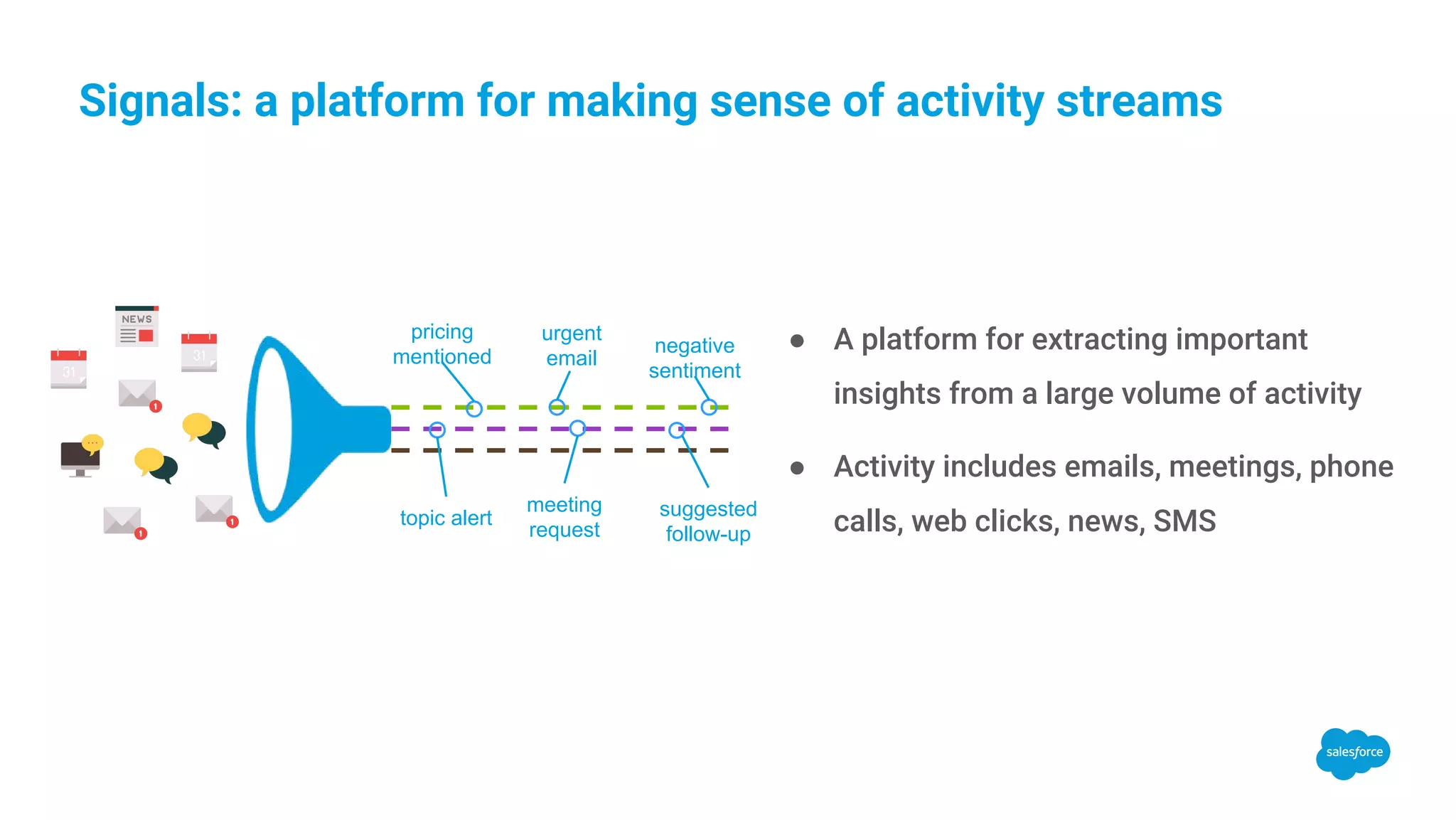
Signals: a platform for making sense of activity streams
● A platform for extracting important
insights from a large volume of activity
● Activity includes emails, meetings, phone
calls, web clicks, news, SMS
urgent
email
suggested
follow-up
topic alert
pricing
mentioned
meeting
request
negative
sentiment
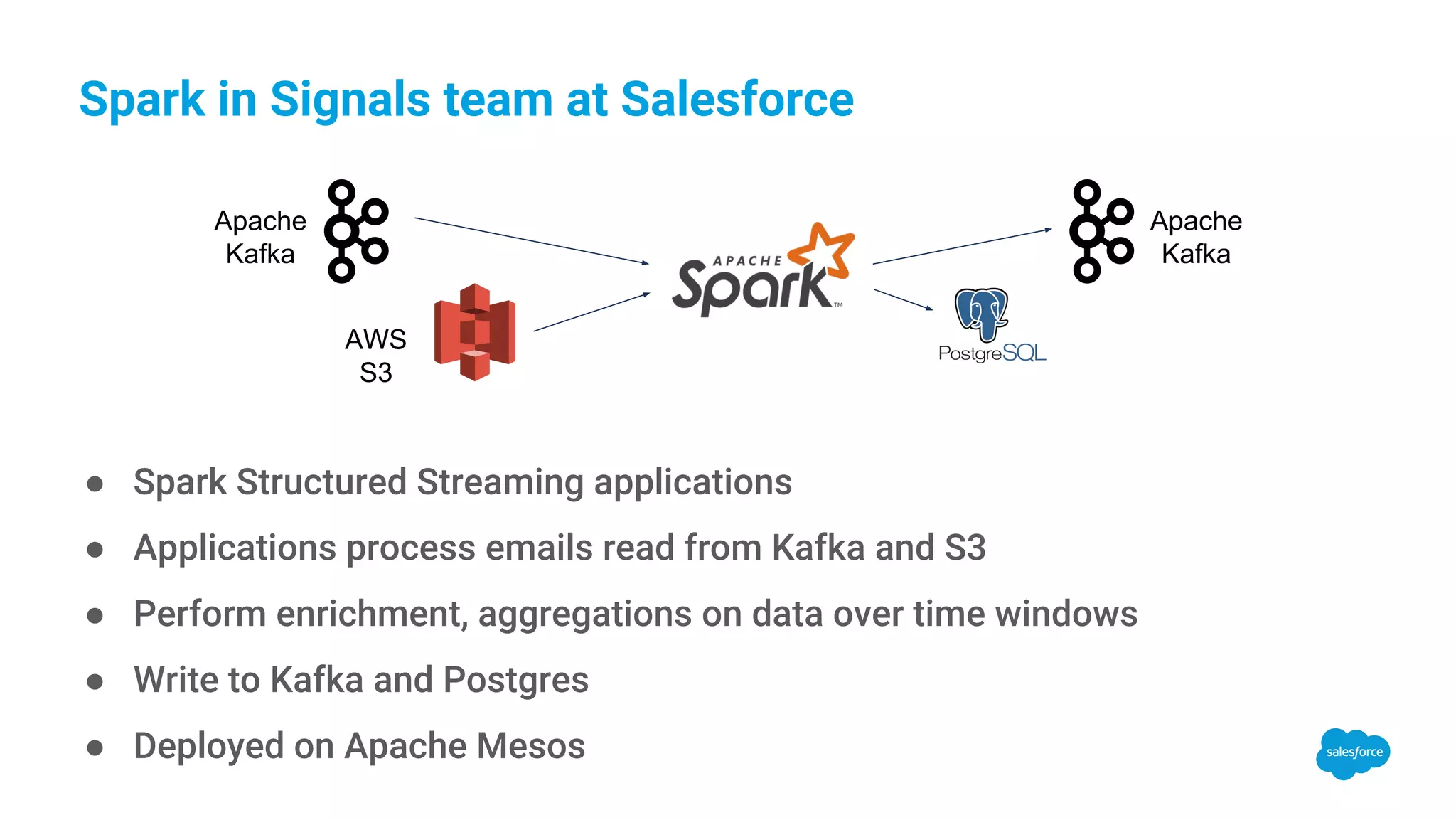
Spark in Signals team at Salesforce
● Spark Structured Streaming applications
● Applications process emails read from Kafka and S3
● Perform enrichment, aggregations on data over time windows
● Write to Kafka and Postgres
● Deployed on Apache Mesos
Apache
Kafka
AWS
S3
Apache
Kafka
Simple Spark application
val spark = SparkSession.builder.appName("Example").master("local").getOrCreate()
import spark.implicits._
// Create DataFrame representing the stream of input lines
val lines = spark.readStream
.format("socket")
.option("host", "localhost")
.option("port", 9999)
.load()
// Split the lines into words
val words = lines.as[String].flatMap(_.split(" "))
// Generate running word count
val wordCounts = words.groupBy("value").count()
// Start running the query that saves word counts to redis
val query = wordCounts.writeStream
.foreach(new BasicRedisWriter)
.outputMode("update")
.start()
query.awaitTermination()
Desired functionalities
● Easily testable
● Components with single responsibility (separation of concerns)
● Ability to compose and reuse dependencies
● Ability to use different implementations of dependencies
● Configurable between dev, test, and prod environments
Using Guice to inject dependencies
Dependency Injection
● Technique where one object supplies the dependencies of another object
● A dependency is an object that can be used (a service)
● An injection is the passing of a dependency to a dependent object (a client)
that would use it
Summarized from Wikipedia: https://en.wikipedia.org/wiki/Dependency_injection
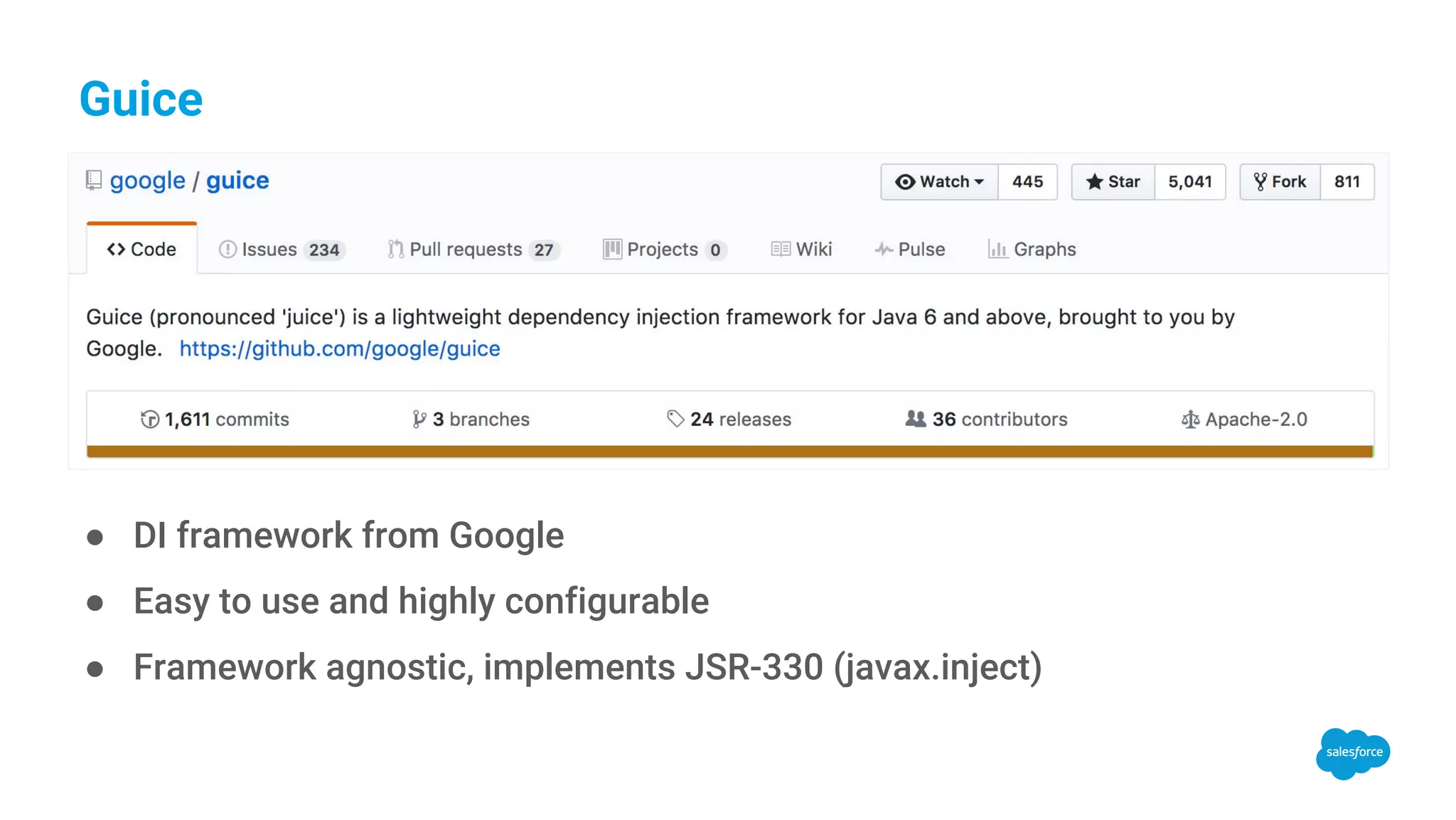
Guice
● DI framework from Google
● Easy to use and highly configurable
● Framework agnostic, implements JSR-330 (javax.inject)
Using Guice to inject dependencies
// Inject RedisClient
class GuiceRedisWriter @Inject()(redisClient: RedisClient) extends ForeachWriter[Row] {
...
}
// Inject the abstract ForeachWriter[Row]. Guice module will set the proper implementation
class GuiceExample @Inject()(writer: ForeachWriter[Row]) {
def countWords(spark: SparkSession, lines: DataFrame): StreamingQuery = { ... }
}
// Guice Module that provides implementations for dependencies
class GuiceExampleModule extends AbstractModule with ScalaModule {
@Provides @Singleton
def provideRedisClient(): RedisClient = new RedisClient("localhost", 6379)
@Provides @Singleton
def provideForeachWriter(redis: RedisClient): ForeachWriter[Row] = new GuiceRedisWriter(redis)
}
def main(args: Array[String]): Unit = {
// Create the injector and get instance of class
val injector = Guice.createInjector(new GuiceExampleModule)
val wordCounter = injector.getInstance(classOf[GuiceExample])
// Create Spark Session and Stream. Then call countWords of GuiceExample instance
}
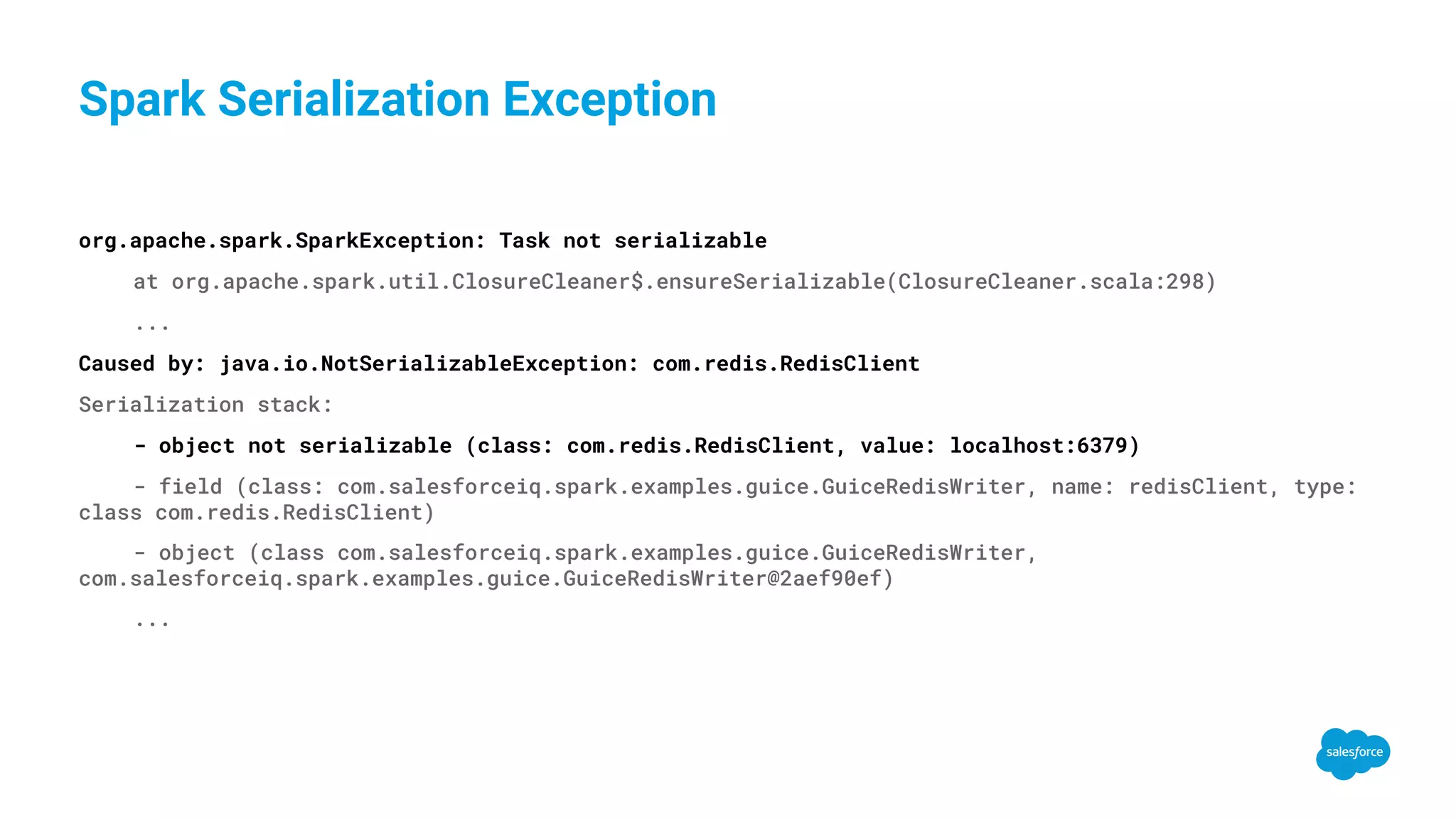
Spark Serialization Exception
org.apache.spark.SparkException: Task not serializable
at org.apache.spark.util.ClosureCleaner$.ensureSerializable(ClosureCleaner.scala:298)
...
Caused by: java.io.NotSerializableException: com.redis.RedisClient
Serialization stack:
- object not serializable (class: com.redis.RedisClient, value: localhost:6379)
- field (class: com.salesforceiq.spark.examples.guice.GuiceRedisWriter, name: redisClient, type:
class com.redis.RedisClient)
- object (class com.salesforceiq.spark.examples.guice.GuiceRedisWriter,
com.salesforceiq.spark.examples.guice.GuiceRedisWriter@2aef90ef)
...
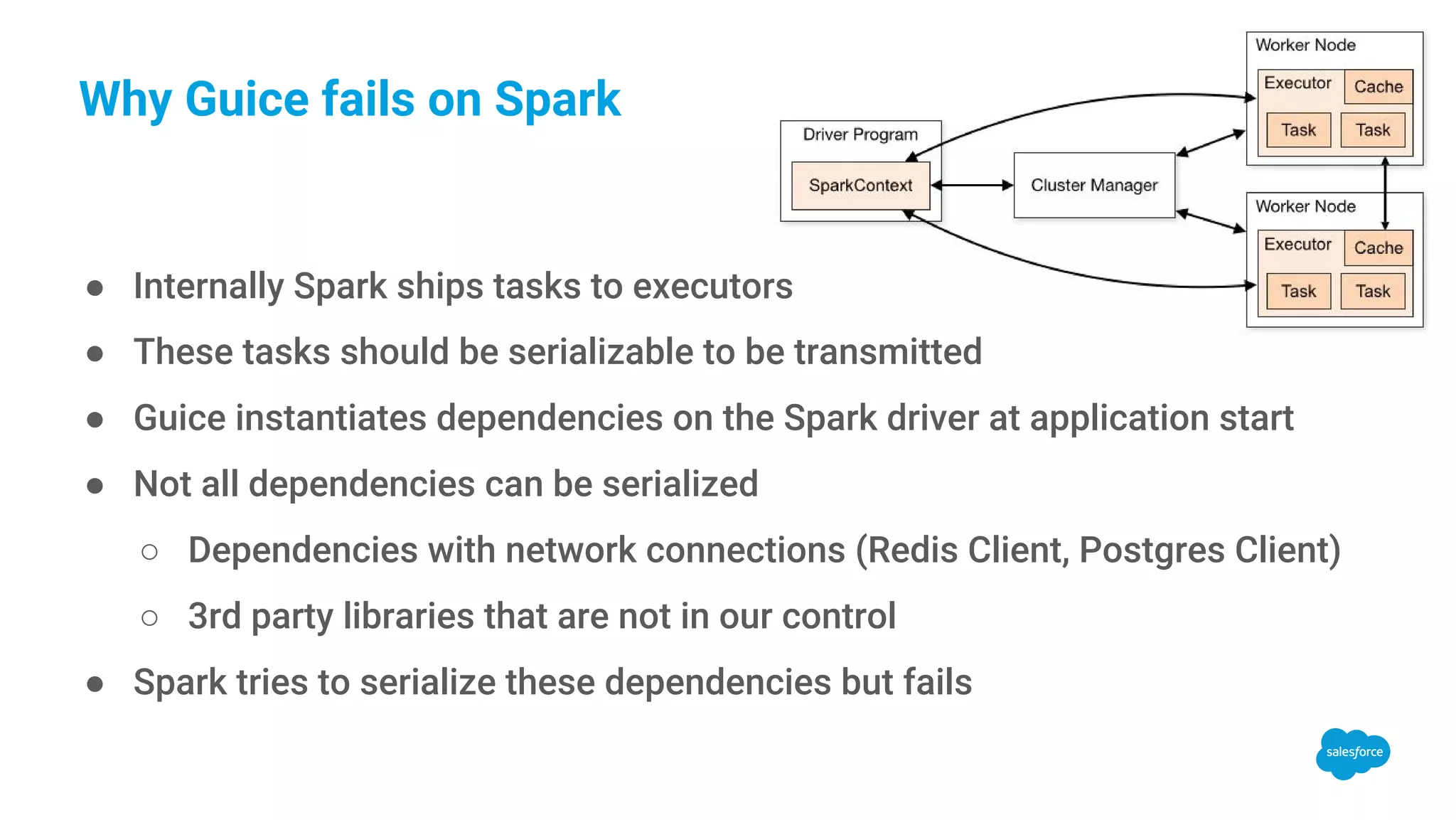
Why Guice fails on Spark
● Internally Spark ships tasks to executors
● These tasks should be serializable to be transmitted
● Guice instantiates dependencies on the Spark driver at application start
● Not all dependencies can be serialized
○ Dependencies with network connections (Redis Client, Postgres Client)
○ 3rd party libraries that are not in our control
● Spark tries to serialize these dependencies but fails
How to solve this
● Need to serialize non-serializable dependencies?!?!
How to solve this
● Need to serialize non-serializable dependencies?!?!
● Serialize the configuration for a dependency (aka Guice providers)
● Construct the instances of the dependencies on the executors
How to solve this
● Need to serialize non-serializable dependencies?!?!
● Serialize the configuration for a dependency (aka Guice providers)
● Construct the instances of the dependencies on the executors
● Basically, serialize the injector and inject dependencies on the executors
Injector Provider
Injector Provider
● An internal library written at SalesforceIQ (soon to be open sourced)
● A wrapper on Guice that creates a serializable injector
● Creates an injector that can lazily load modules and dependencies
Spark with Injector Provider
● Spark ships the serialized injector along with the task to the executors
● On task deserialization
○ The injector is deserialized
○ All the dependencies are injected
Using Injector Provider
class InjectorProviderExampleModule extends AbstractModule {
@Provides @Singleton
def provideForeachWriter(stub: ProvidedInjectorStub, redisClient: RedisClient): ForeachWriter[Row] = {
new InjectorProviderRedisWriter(stub, redisClient)
}
}
class InjectorProviderRedisWriter @Inject()(stub: ProvidedInjectorStub, _redisClient: RedisClient) extends
ForeachWriter[Row] {
// Make the RedisClient transient and Injectable so it does not get serialized by the JVM
@Inject @transient
private val redisClient = _redisClient
// Deserialize this object and then use stub to inject all members
private def readObject(in: ObjectInputStream): Unit = {
in.defaultReadObject()
stub.injectMembers(this)
}
...
}
// Extend abstract class which internally injects all @Inject annotated objects
class InjectorProviderExample @Inject() (writer: ForeachWriter[Row]) extends ProvidedInjector { /* Same */ }
def main(args: Array[String]): Unit = {
// Create the injector and get instance
val injector = InjectorProvider.builder().addBootstrapModuleTypes(classOf[InjectorProviderModule]).build()
val wordCounter = injector.getInstance(classOf[InjectorProviderExample])
// Create Spark Session and Stream. Then call countWords of GuiceExample instance
}
Tradeoffs of Injector Provider
● Not straightforward
● Tied to Guice as your DI framework
Conclusions
● Creating modular Spark jobs is not easy
● Dependency injection (DI) in Spark isn’t straightforward
● Spark tasks must be serializable
● Plain old Guice does not work on Spark
● Using an injector that is serializable makes DI possible in Spark
● Injector Provider (soon to be open sourced) gives the ability to build
serializable injectors

Dependency Injection in Apache Spark Applications

  • 1.
    Dependency Injection in ApacheSpark Applications Sandeep Prabhakar & Shu Das
  • 2.
    Overview ● Signals overview ●How we use Spark in the Signals team at Salesforce ● An example of a simple Spark application ● Injecting dependencies to a Spark application ● Pitfalls of Dependency Injection in Spark and how to overcome them
  • 3.
    Signals: a platformfor making sense of activity streams ● A platform for extracting important insights from a large volume of activity ● Activity includes emails, meetings, phone calls, web clicks, news, SMS urgent email suggested follow-up topic alert pricing mentioned meeting request negative sentiment
  • 4.
    Spark in Signalsteam at Salesforce ● Spark Structured Streaming applications ● Applications process emails read from Kafka and S3 ● Perform enrichment, aggregations on data over time windows ● Write to Kafka and Postgres ● Deployed on Apache Mesos Apache Kafka AWS S3 Apache Kafka
  • 5.
  • 6.
    Simple Spark application valspark = SparkSession.builder.appName("Example").master("local").getOrCreate() import spark.implicits._ // Create DataFrame representing the stream of input lines val lines = spark.readStream .format("socket") .option("host", "localhost") .option("port", 9999) .load() // Split the lines into words val words = lines.as[String].flatMap(_.split(" ")) // Generate running word count val wordCounts = words.groupBy("value").count() // Start running the query that saves word counts to redis val query = wordCounts.writeStream .foreach(new BasicRedisWriter) .outputMode("update") .start() query.awaitTermination()
  • 7.
    Desired functionalities ● Easilytestable ● Components with single responsibility (separation of concerns) ● Ability to compose and reuse dependencies ● Ability to use different implementations of dependencies ● Configurable between dev, test, and prod environments
  • 8.
    Using Guice toinject dependencies
  • 9.
    Dependency Injection ● Techniquewhere one object supplies the dependencies of another object ● A dependency is an object that can be used (a service) ● An injection is the passing of a dependency to a dependent object (a client) that would use it Summarized from Wikipedia: https://en.wikipedia.org/wiki/Dependency_injection
  • 10.
    Guice ● DI frameworkfrom Google ● Easy to use and highly configurable ● Framework agnostic, implements JSR-330 (javax.inject)
  • 11.
    Using Guice toinject dependencies // Inject RedisClient class GuiceRedisWriter @Inject()(redisClient: RedisClient) extends ForeachWriter[Row] { ... } // Inject the abstract ForeachWriter[Row]. Guice module will set the proper implementation class GuiceExample @Inject()(writer: ForeachWriter[Row]) { def countWords(spark: SparkSession, lines: DataFrame): StreamingQuery = { ... } } // Guice Module that provides implementations for dependencies class GuiceExampleModule extends AbstractModule with ScalaModule { @Provides @Singleton def provideRedisClient(): RedisClient = new RedisClient("localhost", 6379) @Provides @Singleton def provideForeachWriter(redis: RedisClient): ForeachWriter[Row] = new GuiceRedisWriter(redis) } def main(args: Array[String]): Unit = { // Create the injector and get instance of class val injector = Guice.createInjector(new GuiceExampleModule) val wordCounter = injector.getInstance(classOf[GuiceExample]) // Create Spark Session and Stream. Then call countWords of GuiceExample instance }
  • 12.
    Spark Serialization Exception org.apache.spark.SparkException:Task not serializable at org.apache.spark.util.ClosureCleaner$.ensureSerializable(ClosureCleaner.scala:298) ... Caused by: java.io.NotSerializableException: com.redis.RedisClient Serialization stack: - object not serializable (class: com.redis.RedisClient, value: localhost:6379) - field (class: com.salesforceiq.spark.examples.guice.GuiceRedisWriter, name: redisClient, type: class com.redis.RedisClient) - object (class com.salesforceiq.spark.examples.guice.GuiceRedisWriter, com.salesforceiq.spark.examples.guice.GuiceRedisWriter@2aef90ef) ...
  • 13.
    Why Guice failson Spark ● Internally Spark ships tasks to executors ● These tasks should be serializable to be transmitted ● Guice instantiates dependencies on the Spark driver at application start ● Not all dependencies can be serialized ○ Dependencies with network connections (Redis Client, Postgres Client) ○ 3rd party libraries that are not in our control ● Spark tries to serialize these dependencies but fails
  • 14.
    How to solvethis ● Need to serialize non-serializable dependencies?!?!
  • 15.
    How to solvethis ● Need to serialize non-serializable dependencies?!?! ● Serialize the configuration for a dependency (aka Guice providers) ● Construct the instances of the dependencies on the executors
  • 16.
    How to solvethis ● Need to serialize non-serializable dependencies?!?! ● Serialize the configuration for a dependency (aka Guice providers) ● Construct the instances of the dependencies on the executors ● Basically, serialize the injector and inject dependencies on the executors
  • 17.
  • 18.
    Injector Provider ● Aninternal library written at SalesforceIQ (soon to be open sourced) ● A wrapper on Guice that creates a serializable injector ● Creates an injector that can lazily load modules and dependencies
  • 19.
    Spark with InjectorProvider ● Spark ships the serialized injector along with the task to the executors ● On task deserialization ○ The injector is deserialized ○ All the dependencies are injected
  • 20.
    Using Injector Provider classInjectorProviderExampleModule extends AbstractModule { @Provides @Singleton def provideForeachWriter(stub: ProvidedInjectorStub, redisClient: RedisClient): ForeachWriter[Row] = { new InjectorProviderRedisWriter(stub, redisClient) } } class InjectorProviderRedisWriter @Inject()(stub: ProvidedInjectorStub, _redisClient: RedisClient) extends ForeachWriter[Row] { // Make the RedisClient transient and Injectable so it does not get serialized by the JVM @Inject @transient private val redisClient = _redisClient // Deserialize this object and then use stub to inject all members private def readObject(in: ObjectInputStream): Unit = { in.defaultReadObject() stub.injectMembers(this) } ... } // Extend abstract class which internally injects all @Inject annotated objects class InjectorProviderExample @Inject() (writer: ForeachWriter[Row]) extends ProvidedInjector { /* Same */ } def main(args: Array[String]): Unit = { // Create the injector and get instance val injector = InjectorProvider.builder().addBootstrapModuleTypes(classOf[InjectorProviderModule]).build() val wordCounter = injector.getInstance(classOf[InjectorProviderExample]) // Create Spark Session and Stream. Then call countWords of GuiceExample instance }
  • 21.
    Tradeoffs of InjectorProvider ● Not straightforward ● Tied to Guice as your DI framework
  • 22.
    Conclusions ● Creating modularSpark jobs is not easy ● Dependency injection (DI) in Spark isn’t straightforward ● Spark tasks must be serializable ● Plain old Guice does not work on Spark ● Using an injector that is serializable makes DI possible in Spark ● Injector Provider (soon to be open sourced) gives the ability to build serializable injectors