Dependency Injection for PHP
Mike Toppa
Boston PHP Meetup
September 9, 2015
@mtoppapokayoke.design
About me
@mtoppapokayoke.design
* I’ve been developing for the web since the days of HTML 1.0, when web pages were first painted on cave walls.
* I’ve been developing with PHP since 2004.
* Over the years I’ve worked at Ask Jeeves, E-Trade, Stanford, Georgetown, and I was the Director of the Web Applications Team at the U Penn School of
Medicine.
* Most of my work has been as a developer, but I’ve also done a good deal of project management and team management, and I’m a big believer in
Agile and Lean practices.
My new house near Boston…
@mtoppapokayoke.design
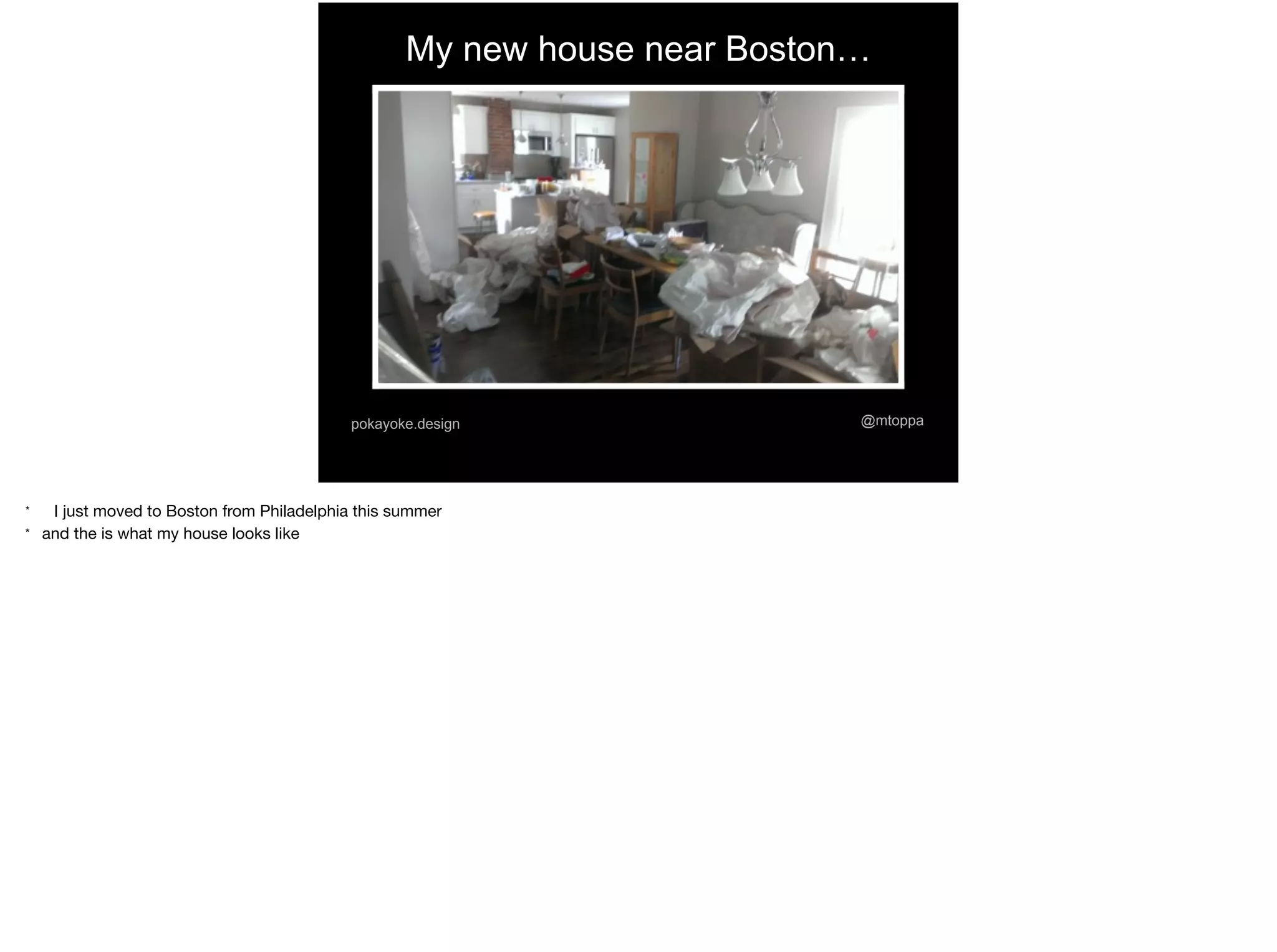
* I just moved to Boston from Philadelphia this summer

* and the is what my house looks like
@mtoppapokayoke.design
* My wife has a new job here in Boston, and I have a new job now too. I’m co-founder and CTO of Poka Yoke Design. Our primary development platforms are
WordPress and Ruby on Rails.

* I was an active member of the PHP, WordPress, and Ruby communities in Philly, and I look forward to becoming part of the communities here in Boston.

* We are not hiring currently, but we are looking for projects!
Overview
1. Crash course in classes and objects in PHP
2. The SOLID principles
• Single Responsibility Principle
• Dependency Inversion Principle
3. Class autoloading in PHP
4. Dependency injection
• DI containers
• Advanced dependency injection techniques
@mtoppapokayoke.design
1. Crash course in classes and
objects in PHP
@mtoppapokayoke.design
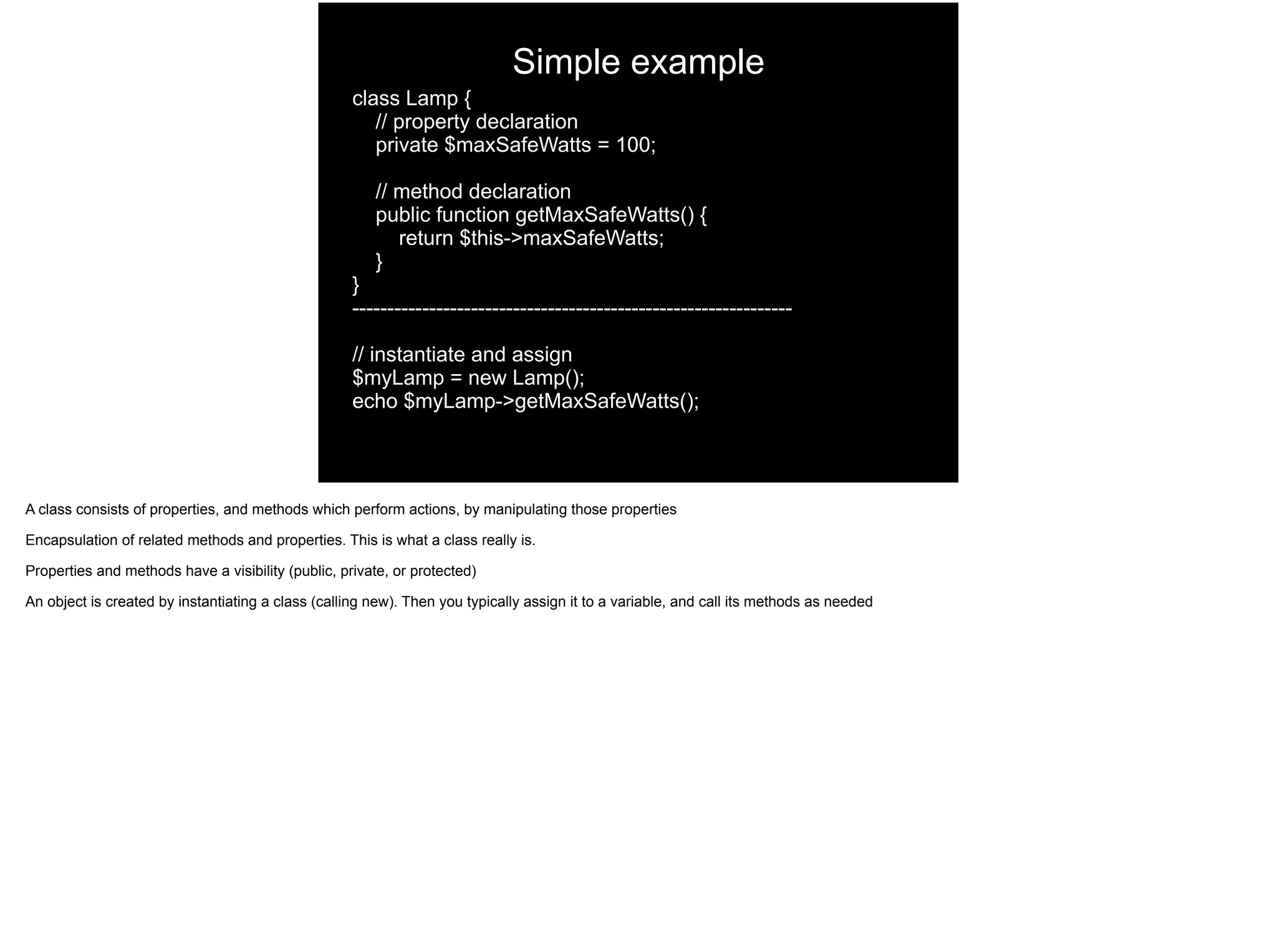
Simple example
class Lamp {
// property declaration
private $maxSafeWatts = 100;
// method declaration
public function getMaxSafeWatts() {
return $this->maxSafeWatts;
}
}
---------------------------------------------------------------
// instantiate and assign
$myLamp = new Lamp();
echo $myLamp->getMaxSafeWatts();
A class consists of properties, and methods which perform actions, by manipulating those properties
Encapsulation of related methods and properties. This is what a class really is.
Properties and methods have a visibility (public, private, or protected)
An object is created by instantiating a class (calling new). Then you typically assign it to a variable, and call its methods as needed
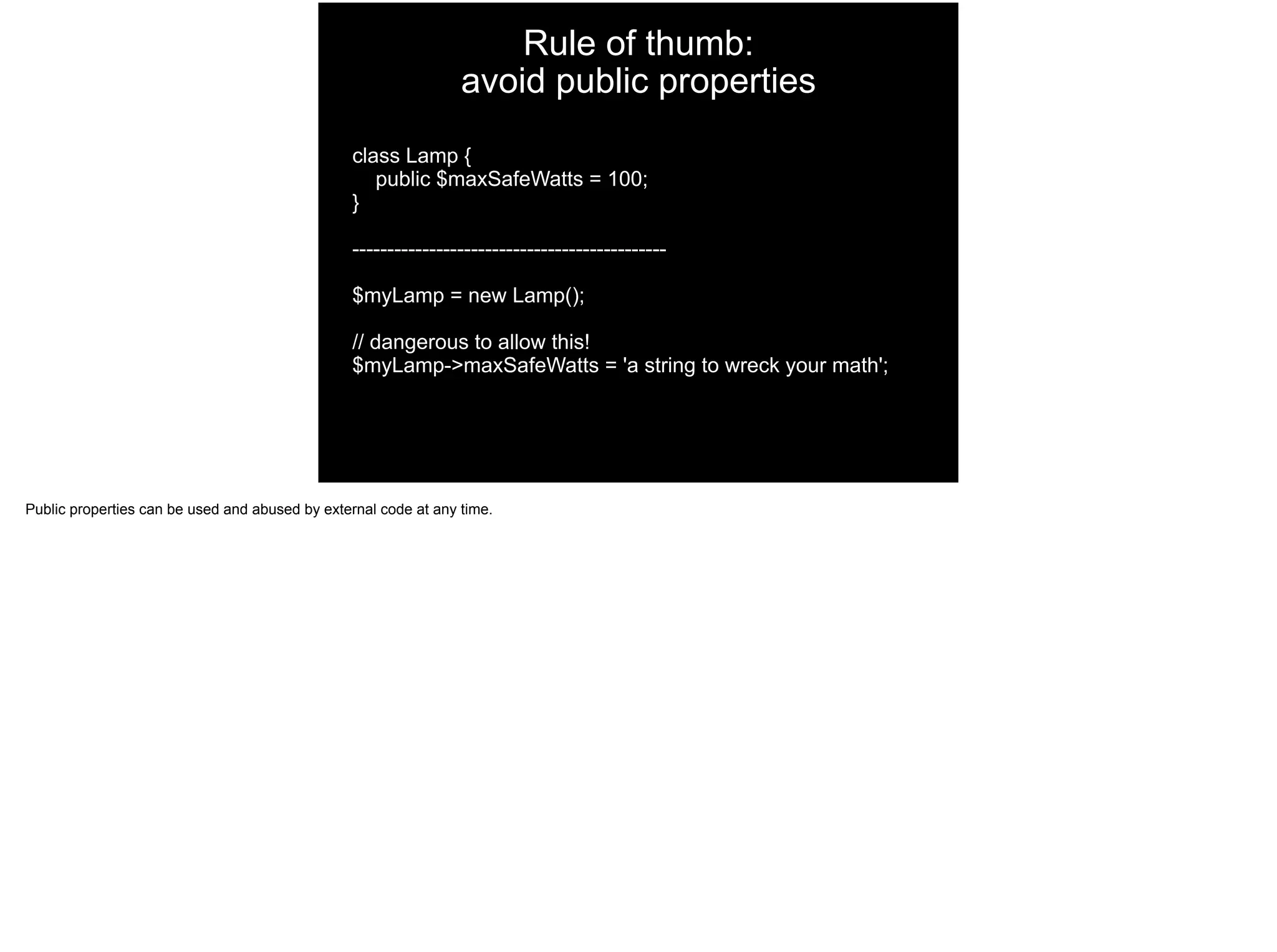
Rule of thumb:

avoid public properties
class Lamp {
public $maxSafeWatts = 100;
}
---------------------------------------------
$myLamp = new Lamp();
// dangerous to allow this!
$myLamp->maxSafeWatts = 'a string to wreck your math';
Public properties can be used and abused by external code at any time.
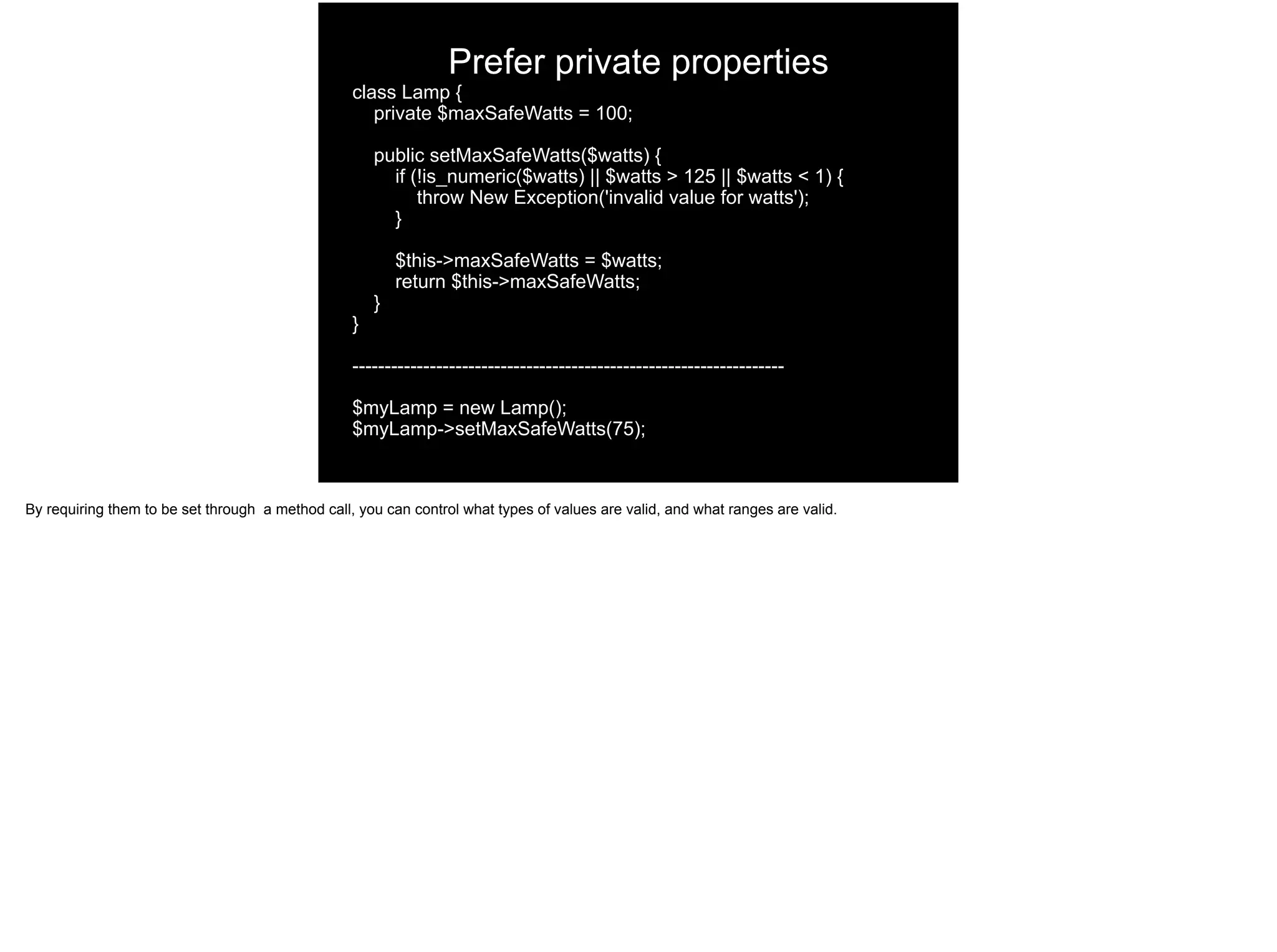
Prefer private properties
class Lamp {
private $maxSafeWatts = 100;
public setMaxSafeWatts($watts) {
if (!is_numeric($watts) || $watts > 125 || $watts < 1) {
throw New Exception('invalid value for watts');
}
$this->maxSafeWatts = $watts;
return $this->maxSafeWatts;
}
}
-------------------------------------------------------------------
$myLamp = new Lamp();
$myLamp->setMaxSafeWatts(75);
By requiring them to be set through a method call, you can control what types of values are valid, and what ranges are valid.
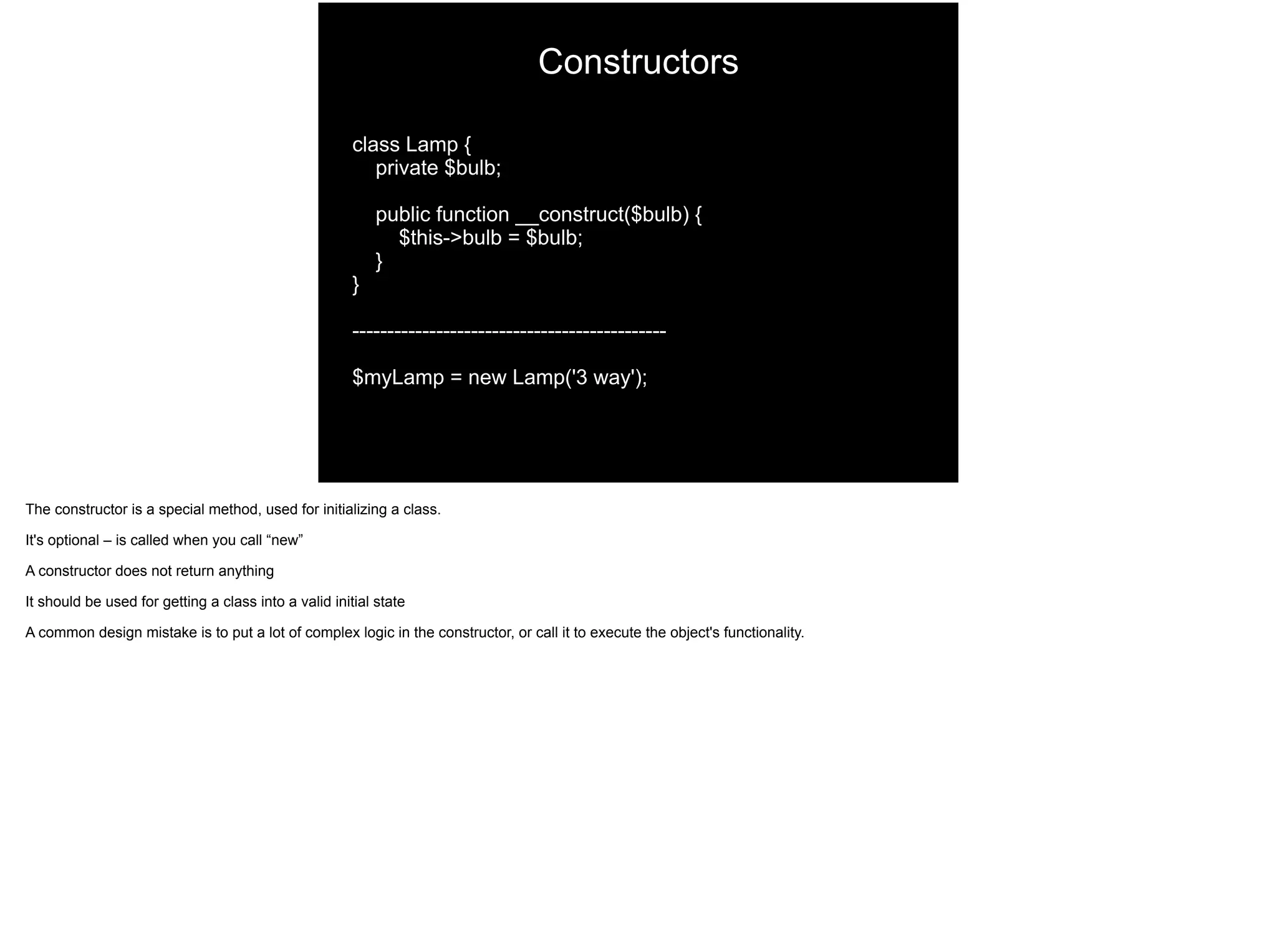
Constructors
class Lamp {
private $bulb;
public function __construct($bulb) {
$this->bulb = $bulb;
}
}
---------------------------------------------
$myLamp = new Lamp('3 way');
The constructor is a special method, used for initializing a class.
It's optional – is called when you call “new”
A constructor does not return anything
It should be used for getting a class into a valid initial state
A common design mistake is to put a lot of complex logic in the constructor, or call it to execute the object's functionality.
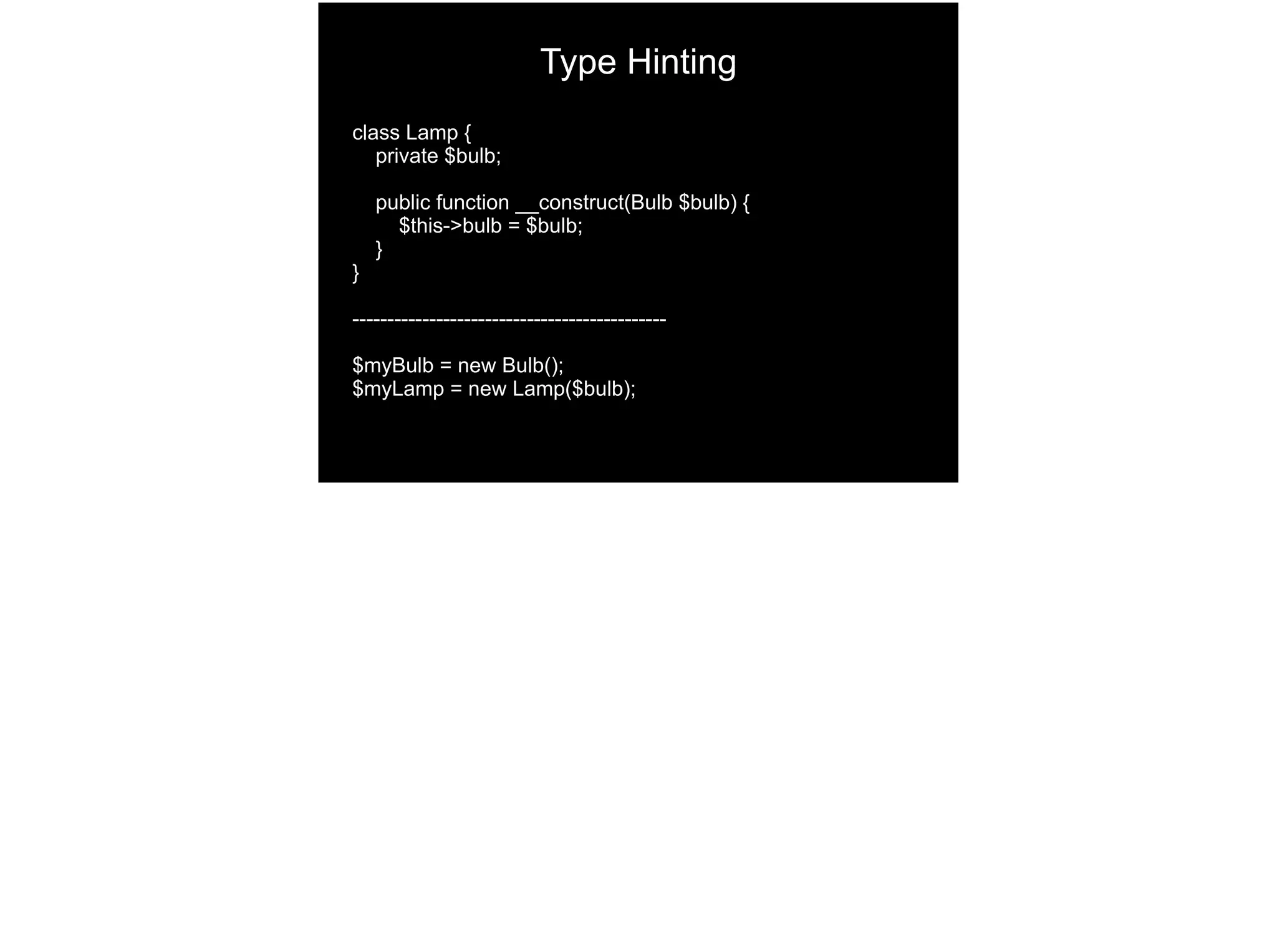
Type Hinting
class Lamp {
private $bulb;
public function __construct(Bulb $bulb) {
$this->bulb = $bulb;
}
}
---------------------------------------------
$myBulb = new Bulb();
$myLamp = new Lamp($bulb);
Organizing your classes
One class per file, and the file name should match the class name
Give the class a meaningful name and its methods meaningful names
Class names and property names should be nouns or noun phrases
Method names should be verbs or verb phrases
Use an IDE that autocompletes variable names and method names
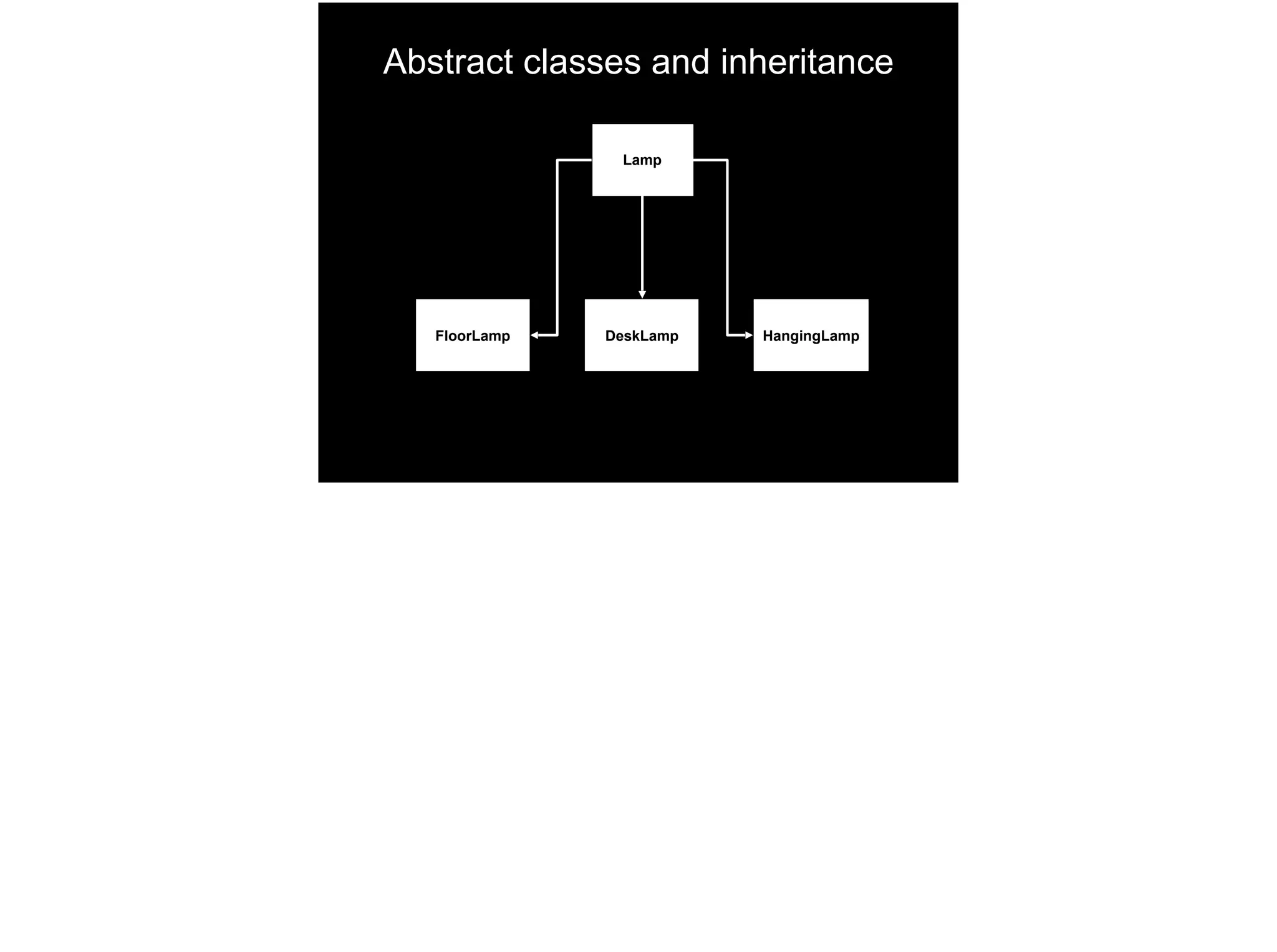
Abstract classes and inheritance
Lamp
DeskLampFloorLamp HangingLamp
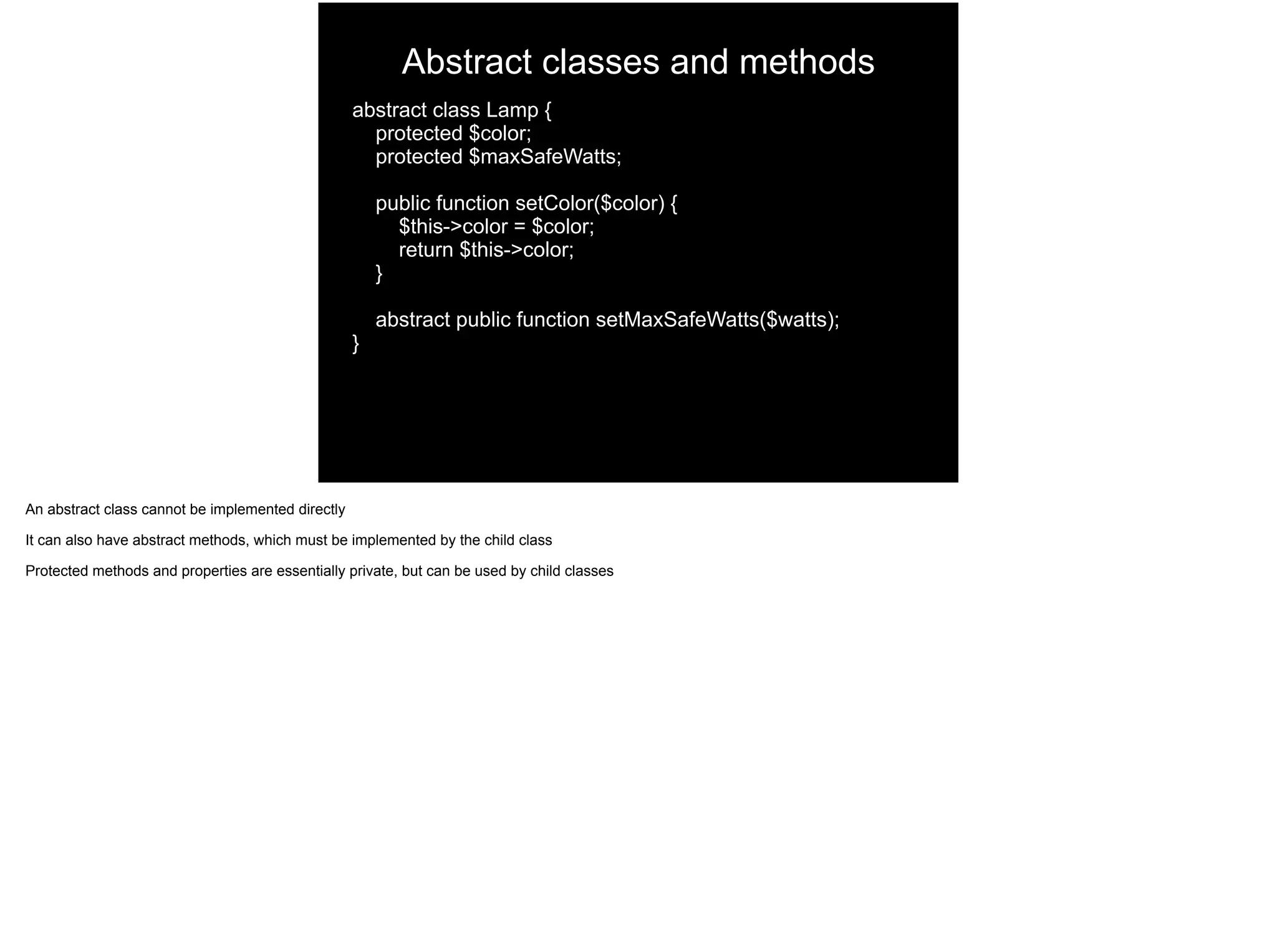
Abstract classes and methods
abstract class Lamp {
protected $color;
protected $maxSafeWatts;
public function setColor($color) {
$this->color = $color;
return $this->color;
}
abstract public function setMaxSafeWatts($watts);
}
An abstract class cannot be implemented directly
It can also have abstract methods, which must be implemented by the child class
Protected methods and properties are essentially private, but can be used by child classes
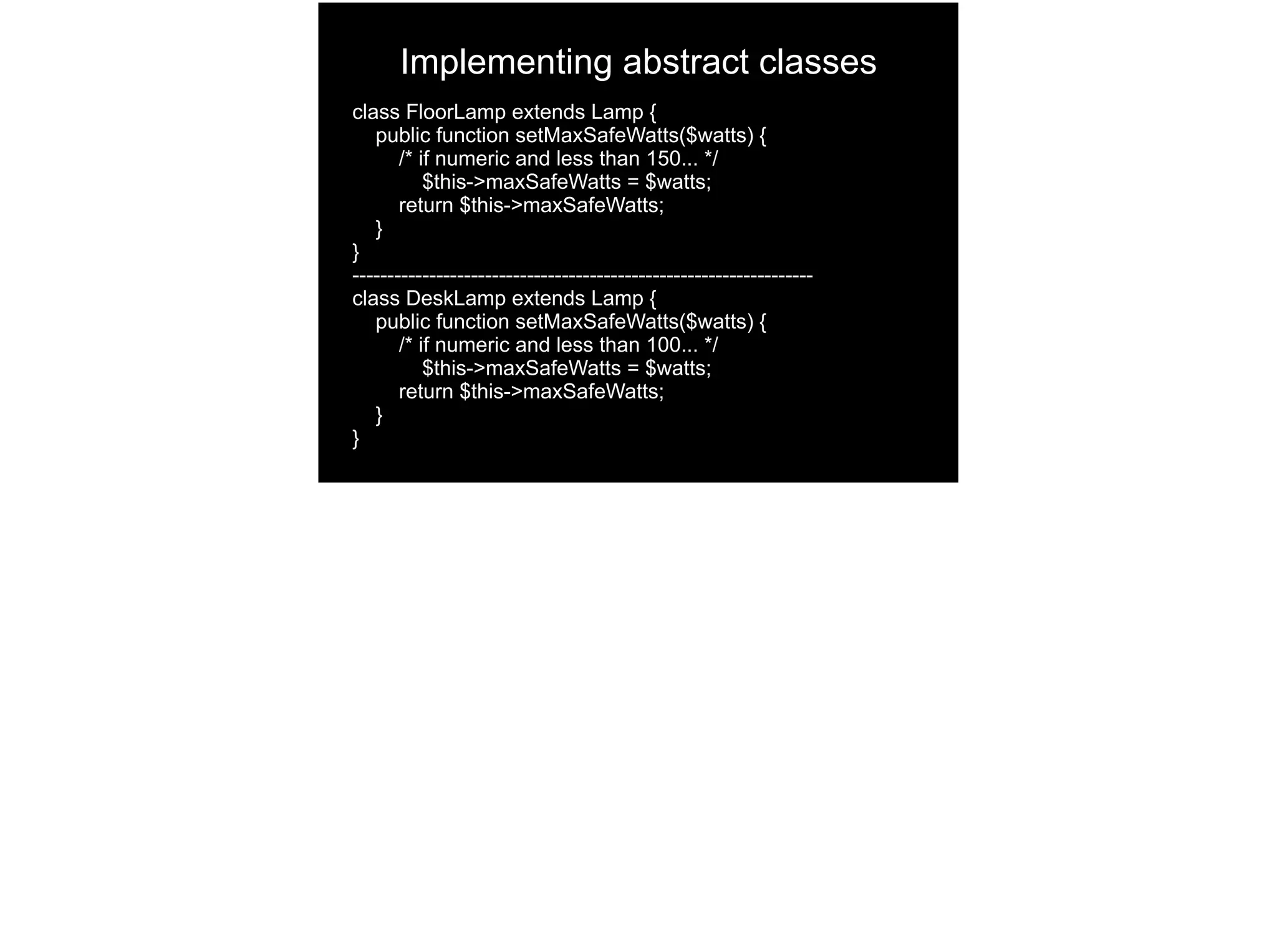
Implementing abstract classes
class FloorLamp extends Lamp {
public function setMaxSafeWatts($watts) {
/* if numeric and less than 150... */
$this->maxSafeWatts = $watts;
return $this->maxSafeWatts;
}
}
------------------------------------------------------------------
class DeskLamp extends Lamp {
public function setMaxSafeWatts($watts) {
/* if numeric and less than 100... */
$this->maxSafeWatts = $watts;
return $this->maxSafeWatts;
}
}
Interfaces
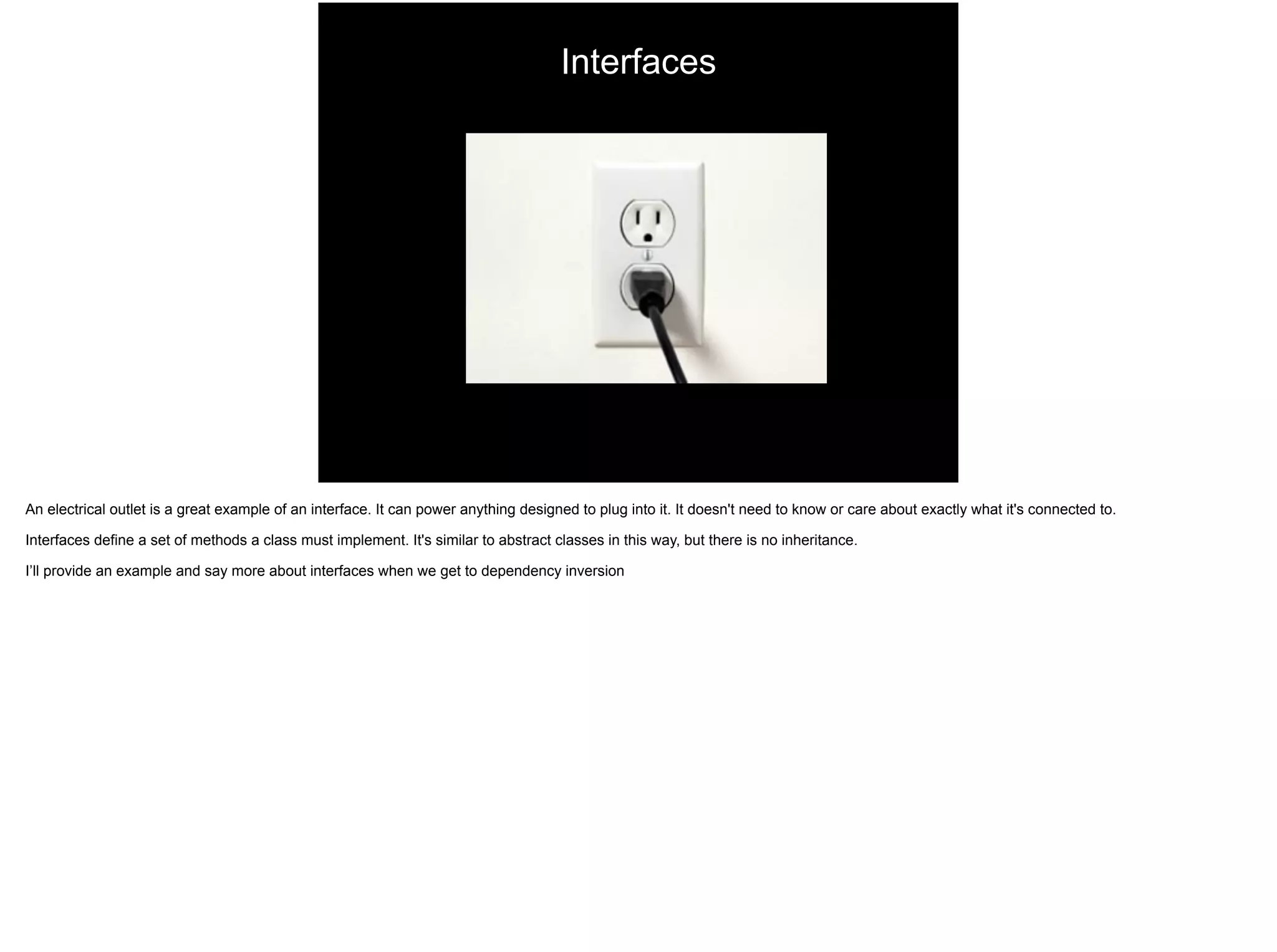
An electrical outlet is a great example of an interface. It can power anything designed to plug into it. It doesn't need to know or care about exactly what it's connected to.
Interfaces define a set of methods a class must implement. It's similar to abstract classes in this way, but there is no inheritance.
I’ll provide an example and say more about interfaces when we get to dependency inversion
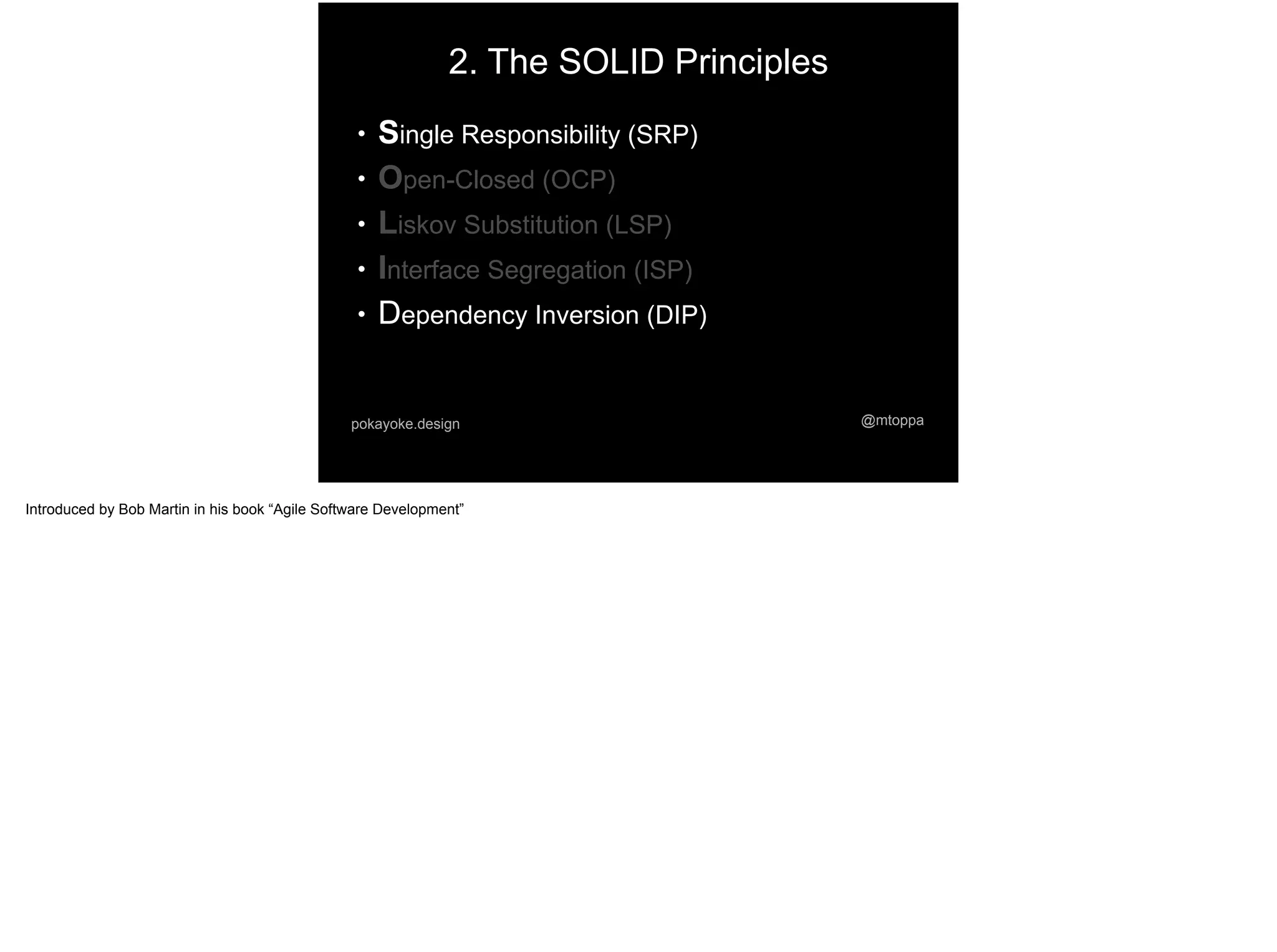
2. The SOLID Principles
● Single Responsibility (SRP)
● Open-Closed (OCP)
● Liskov Substitution (LSP)
● Interface Segregation (ISP)
● Dependency Inversion (DIP)
@mtoppapokayoke.design
Introduced by Bob Martin in his book “Agile Software Development”
From LosTechies.com
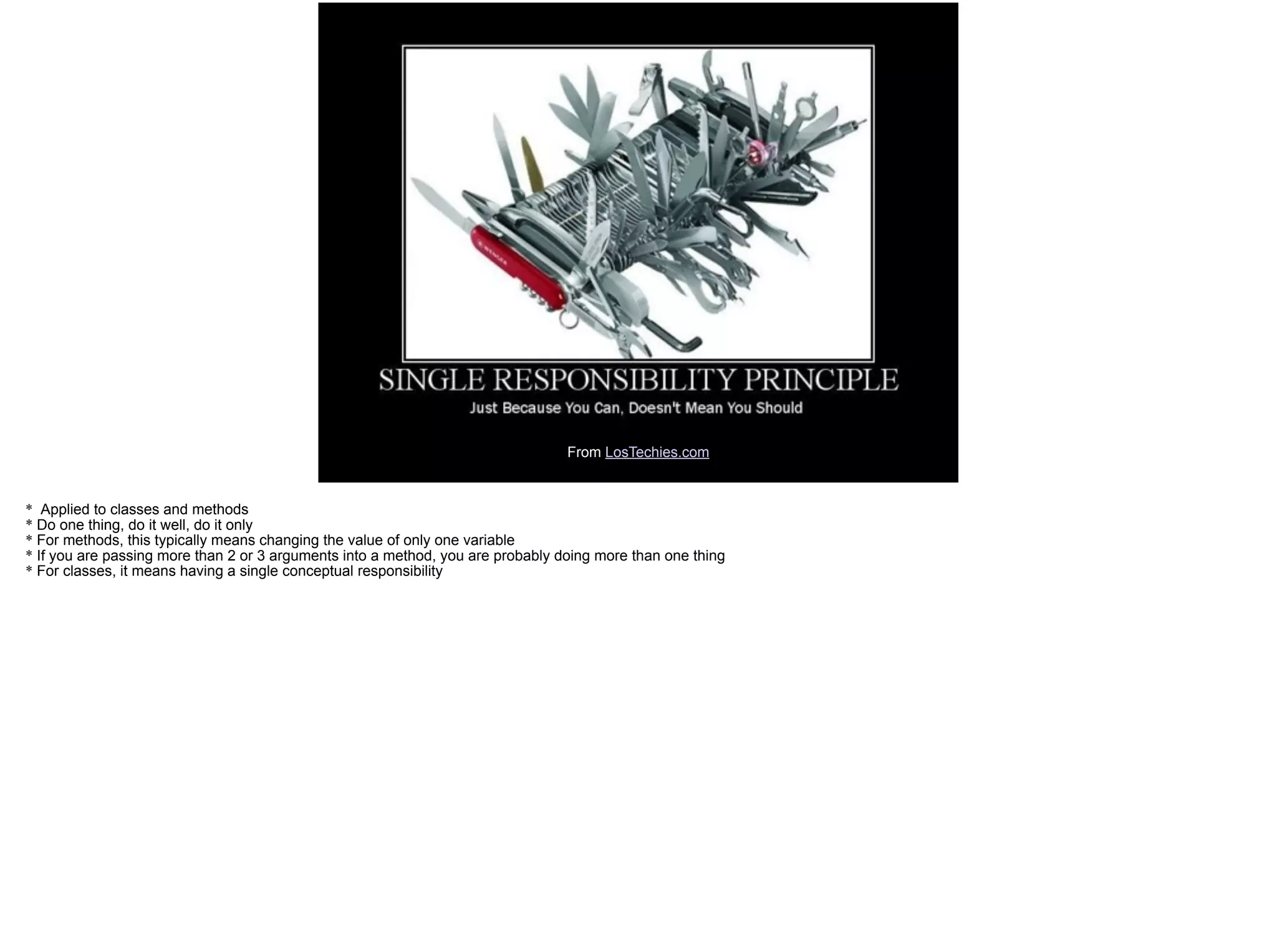
* Applied to classes and methods
* Do one thing, do it well, do it only
* For methods, this typically means changing the value of only one variable
* If you are passing more than 2 or 3 arguments into a method, you are probably doing more than one thing
* For classes, it means having a single conceptual responsibility
The purpose is to reduce the
complexity and fragility
of a class
@mtoppapokayoke.design
We want code that is flexible and easy to understand, not brittle and mind-numbing to read
When a method is manipulating multiple properties and invoking lots of other methods, it can be very hard to test, debug, and change. This is a common reason why developers feel fear
when making a change – they don't know what might break
When a class has many methods and multiple responsibilities, it can be hard to understand and difficult to refactor
But what does it mean to do “one thing”?
@mtoppapokayoke.design
Only one reason to change
@mtoppapokayoke.design
If you have a class that compiles and prints a report, it has 2 responsibilities, and 2 reasons to change. The content of the report could change, or the format of the report could change.
This class should be split into two classes.
Cohesion
@mtoppapokayoke.design
Uncle Bob says:

* “Classes should have a small number of instance variables. Each of the methods of a class should manipulate one or more of those variables. In general the more
variables a method manipulates the more cohesive that method is to its class.”

* “When cohesion is high, it means that the methods and variables of the class are co-dependent and hang together as a logical whole.”
SRP violation example
@mtoppapokayoke.design
Shashin
@mtoppapokayoke.design
My WordPress plugin for displaying albums,
photos, and videos from Picasa, Twitpic, and
YouTube
I'm going to show SRP and DIP examples of code from Shashin
Clean code books and articles all use other languages as examples – I wanted to try applying them to PHP and WordPress
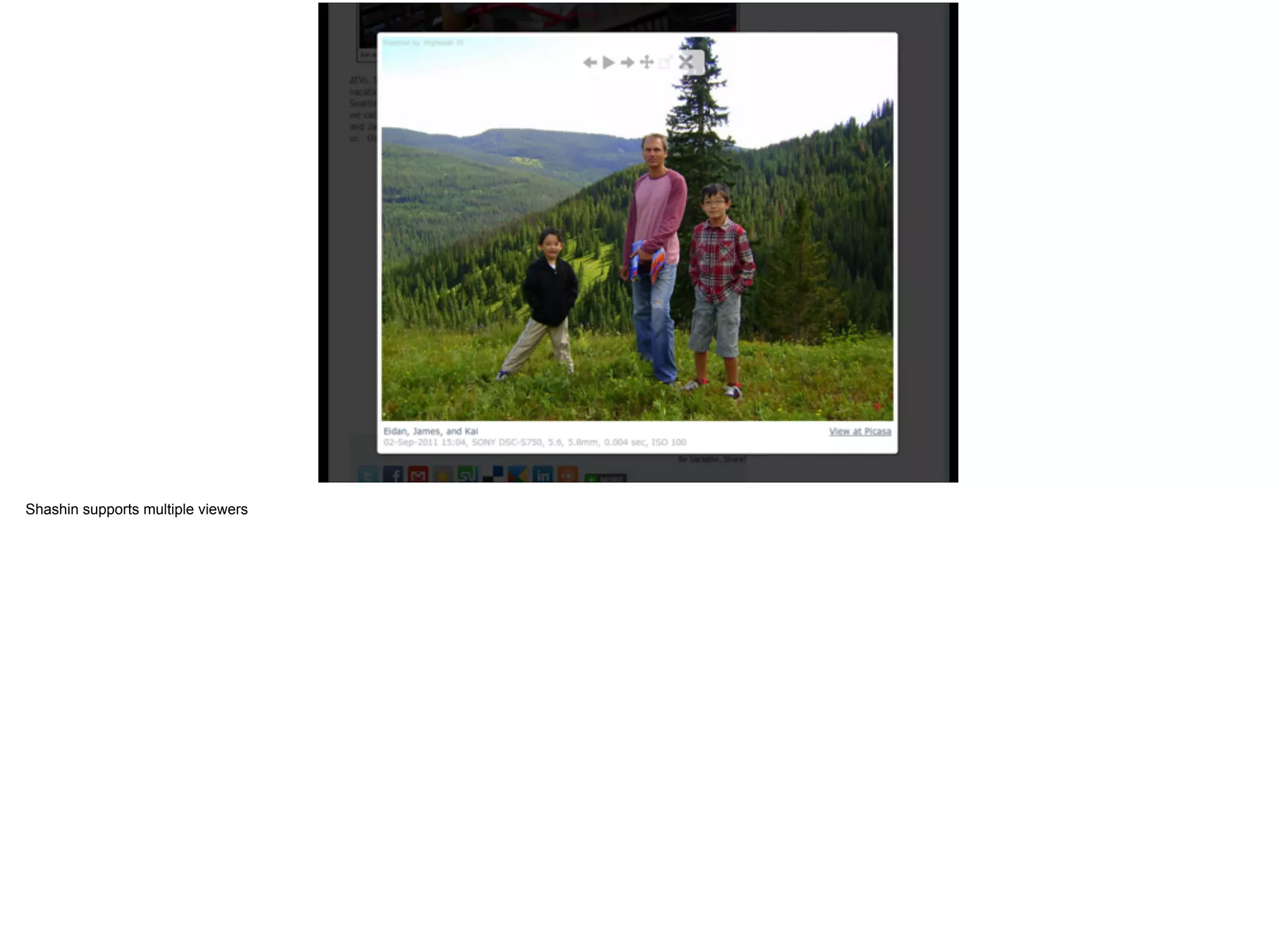
Shashin supports multiple viewers
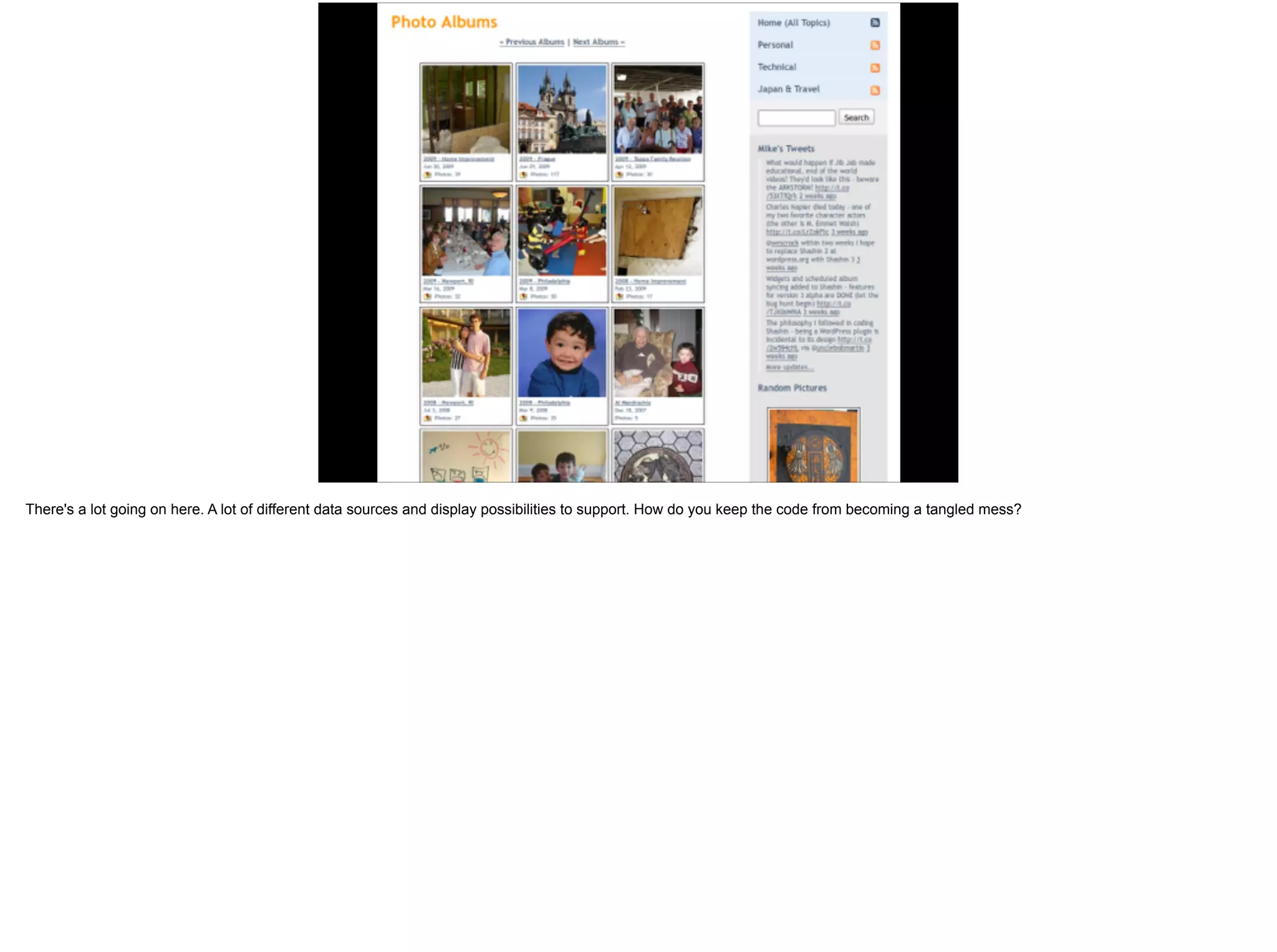
There's a lot going on here. A lot of different data sources and display possibilities to support. How do you keep the code from becoming a tangled mess?
@mtoppapokayoke.design
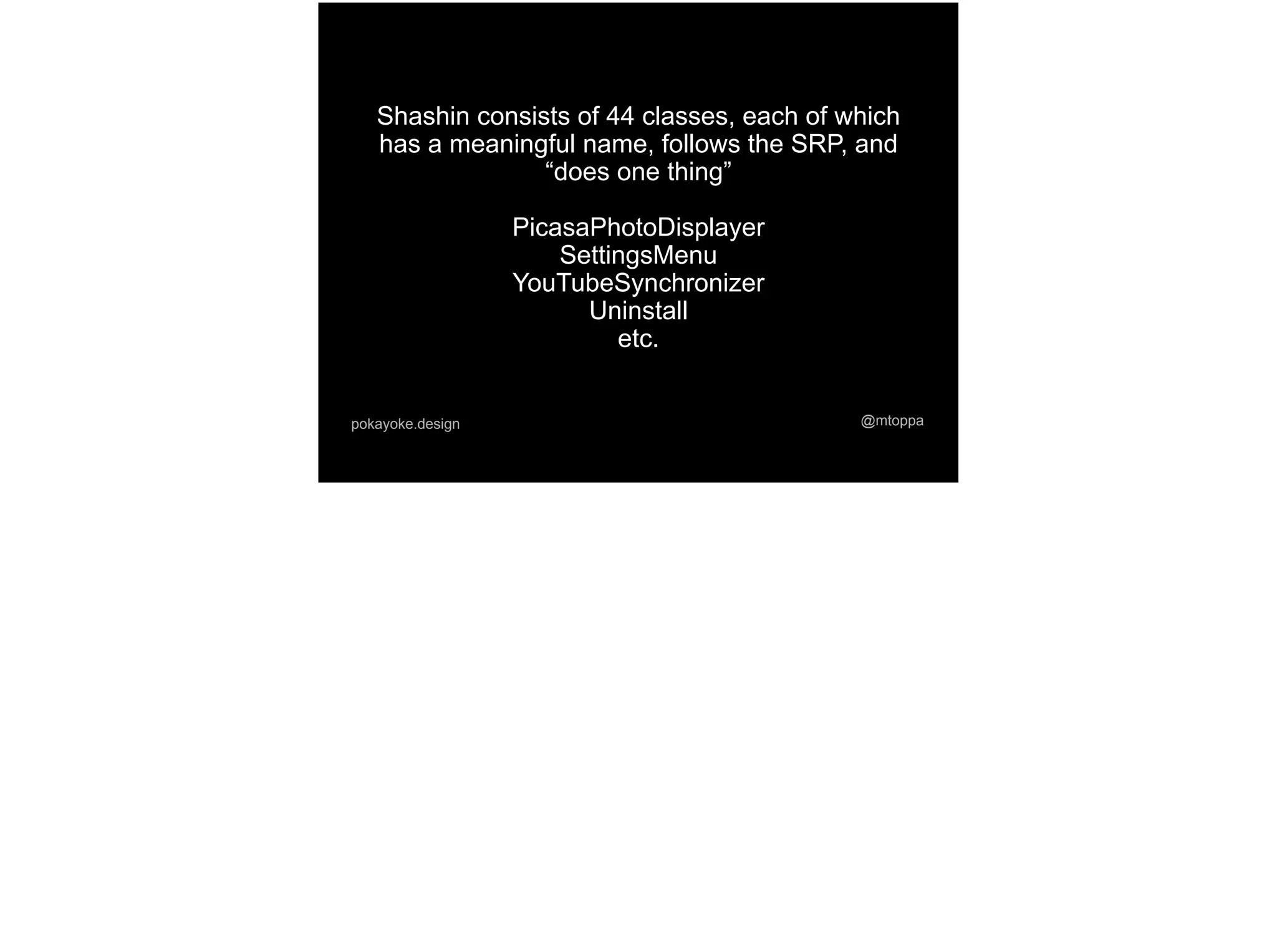
Shashin consists of 44 classes, each of which
has a meaningful name, follows the SRP, and
“does one thing”
PicasaPhotoDisplayer
SettingsMenu
YouTubeSynchronizer
Uninstall
etc.
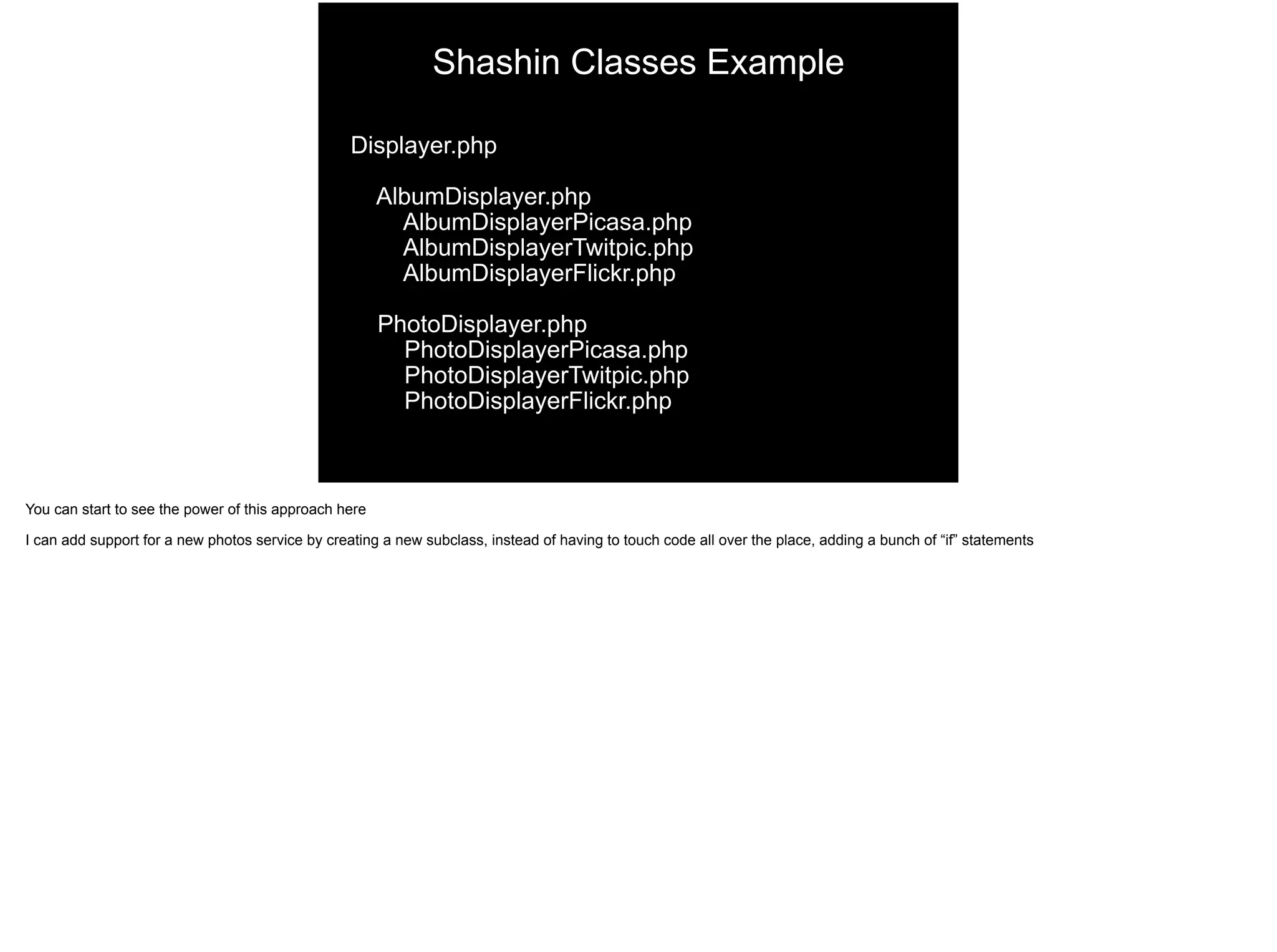
Displayer.php
AlbumDisplayer.php
AlbumDisplayerPicasa.php
AlbumDisplayerTwitpic.php
AlbumDisplayerFlickr.php
PhotoDisplayer.php
PhotoDisplayerPicasa.php
PhotoDisplayerTwitpic.php
PhotoDisplayerFlickr.php
Shashin Classes Example
You can start to see the power of this approach here
I can add support for a new photos service by creating a new subclass, instead of having to touch code all over the place, adding a bunch of “if” statements
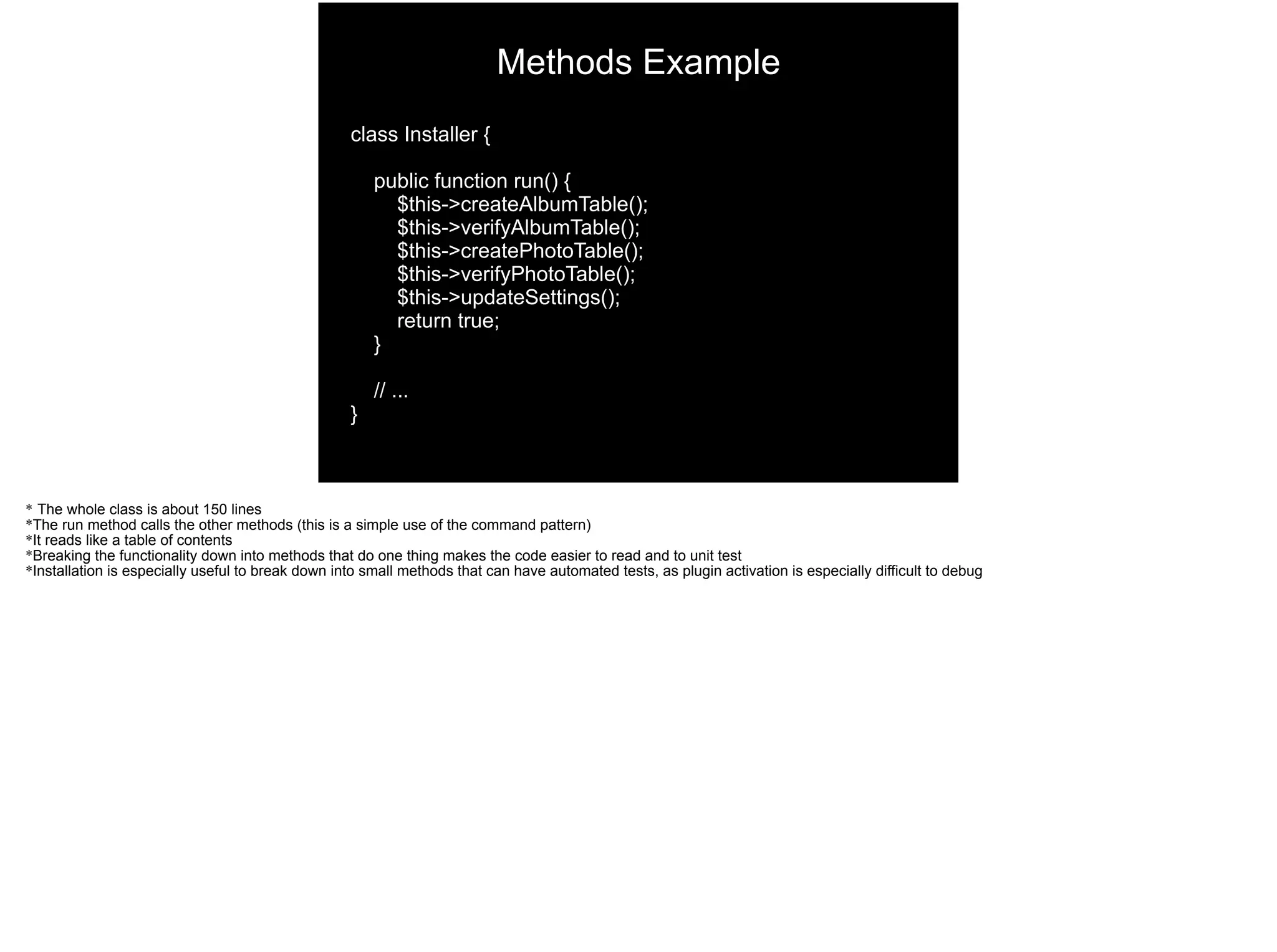
class Installer {
public function run() {
$this->createAlbumTable();
$this->verifyAlbumTable();
$this->createPhotoTable();
$this->verifyPhotoTable();
$this->updateSettings();
return true;
}
// ...
}
Methods Example
* The whole class is about 150 lines
*The run method calls the other methods (this is a simple use of the command pattern)
*It reads like a table of contents
*Breaking the functionality down into methods that do one thing makes the code easier to read and to unit test
*Installation is especially useful to break down into small methods that can have automated tests, as plugin activation is especially difficult to debug
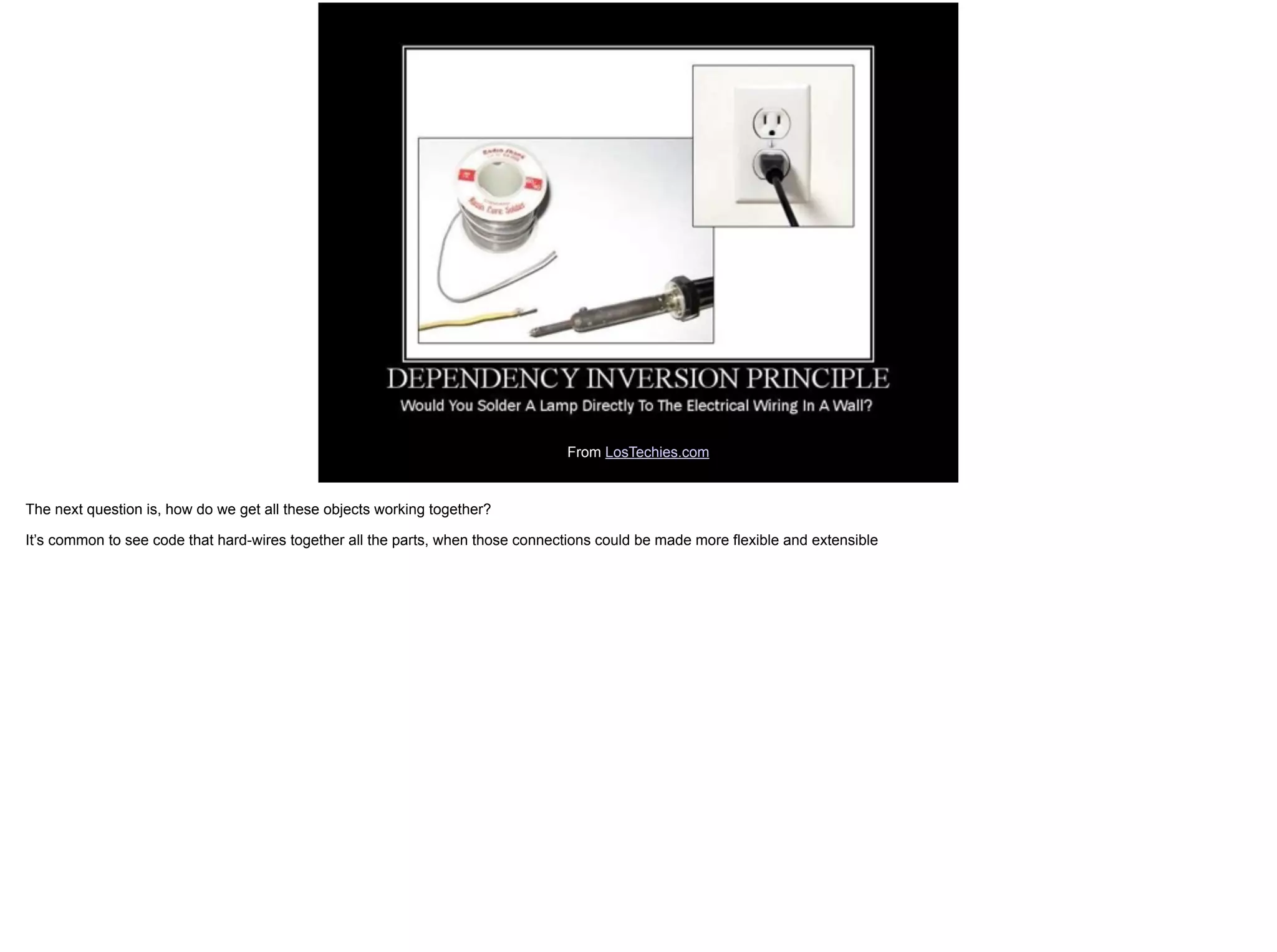
From LosTechies.com
The next question is, how do we get all these objects working together?
It’s common to see code that hard-wires together all the parts, when those connections could be made more flexible and extensible
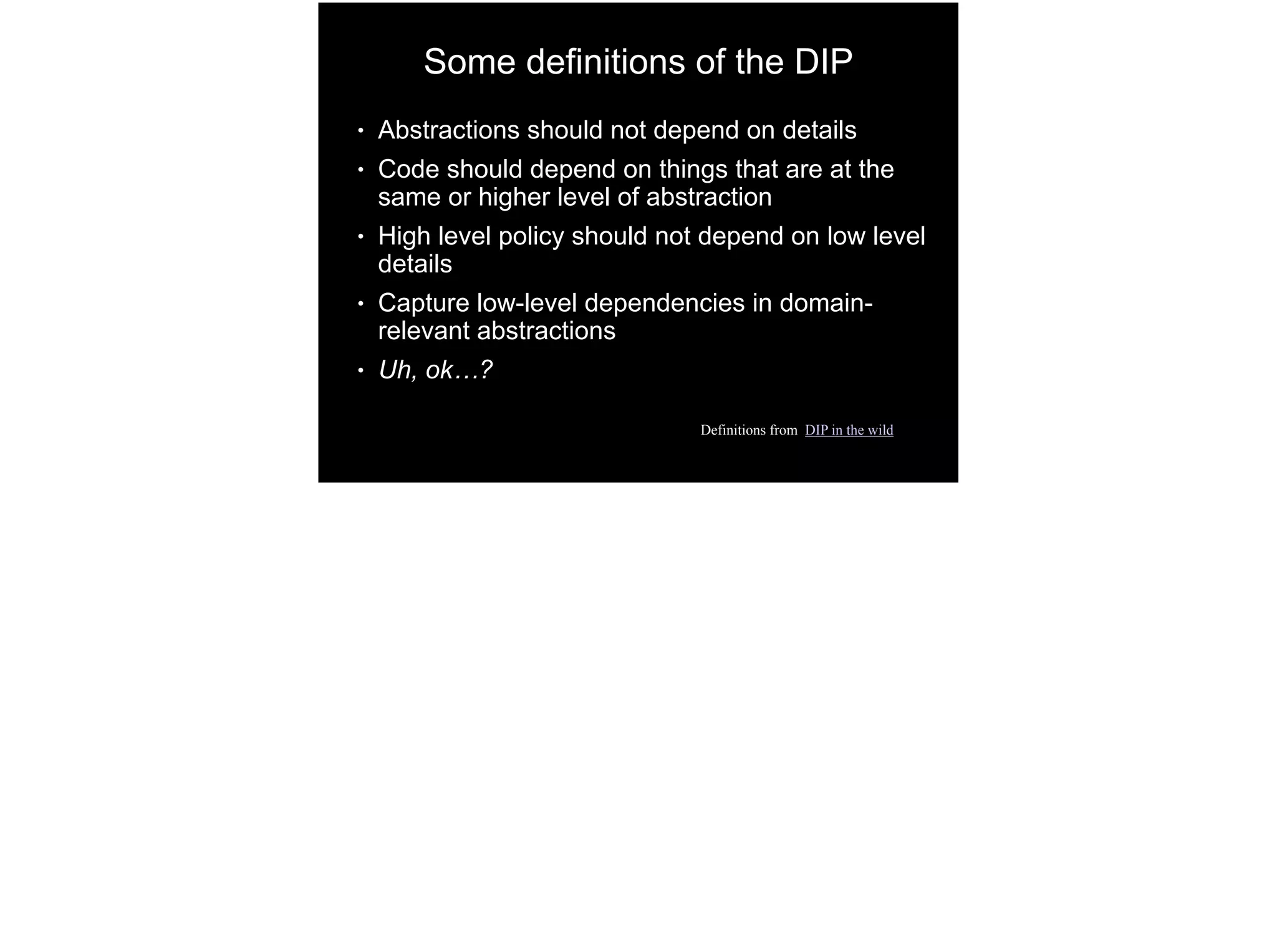
Some definitions of the DIP
● Abstractions should not depend on details
● Code should depend on things that are at the
same or higher level of abstraction
● High level policy should not depend on low level
details
● Capture low-level dependencies in domain-
relevant abstractions
● Uh, ok…?
Definitions from DIP in the wild
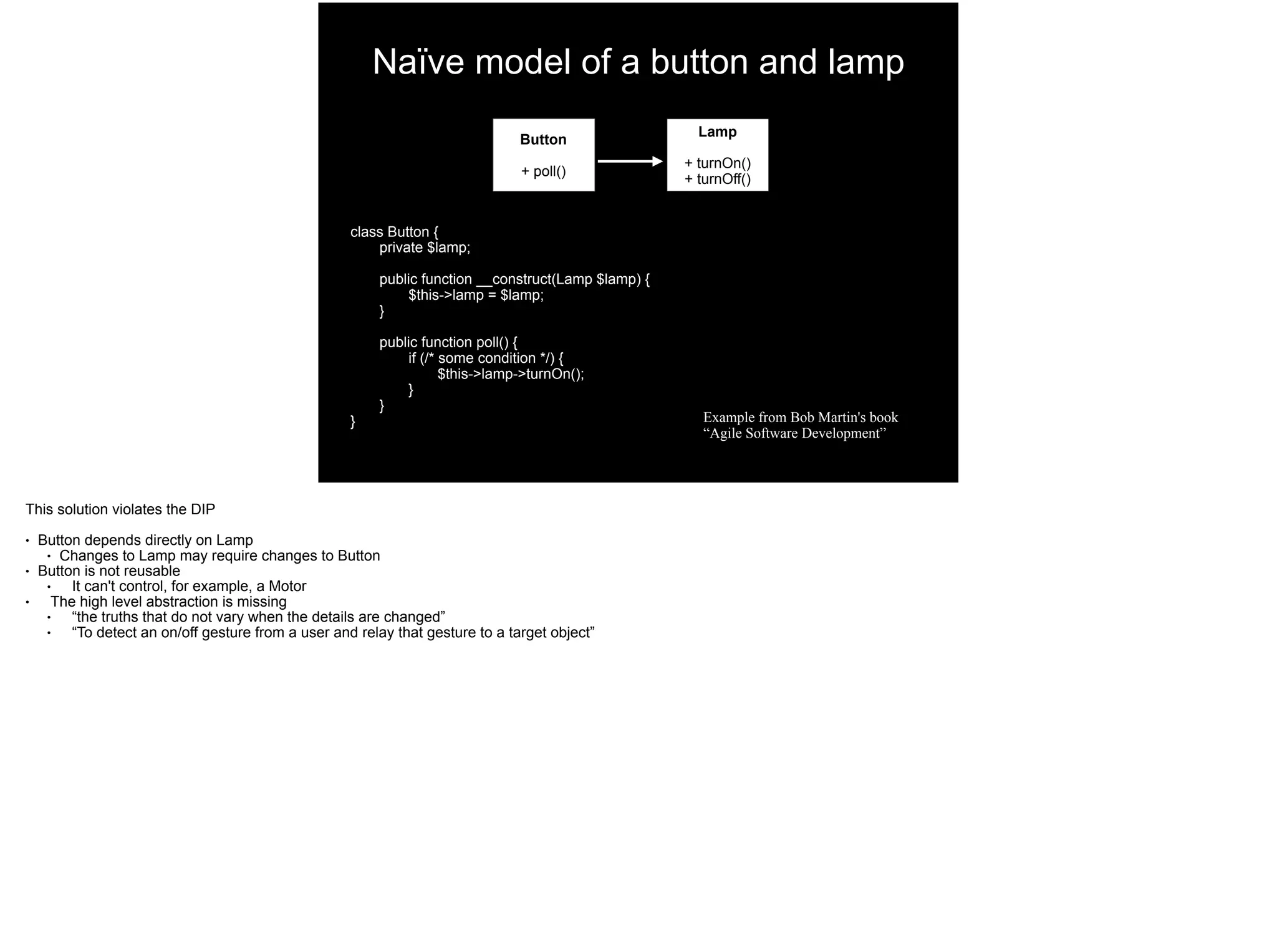
Naïve model of a button and lamp
Button
+ poll()
Lamp
+ turnOn()
+ turnOff()
class Button {
private $lamp;
public function __construct(Lamp $lamp) {
$this->lamp = $lamp;
}
public function poll() {
if (/* some condition */) {
$this->lamp->turnOn();
}
}
} Example from Bob Martin's book
“Agile Software Development”
This solution violates the DIP
● Button depends directly on Lamp
● Changes to Lamp may require changes to Button
● Button is not reusable
● It can't control, for example, a Motor
● The high level abstraction is missing
● “the truths that do not vary when the details are changed”
● “To detect an on/off gesture from a user and relay that gesture to a target object”
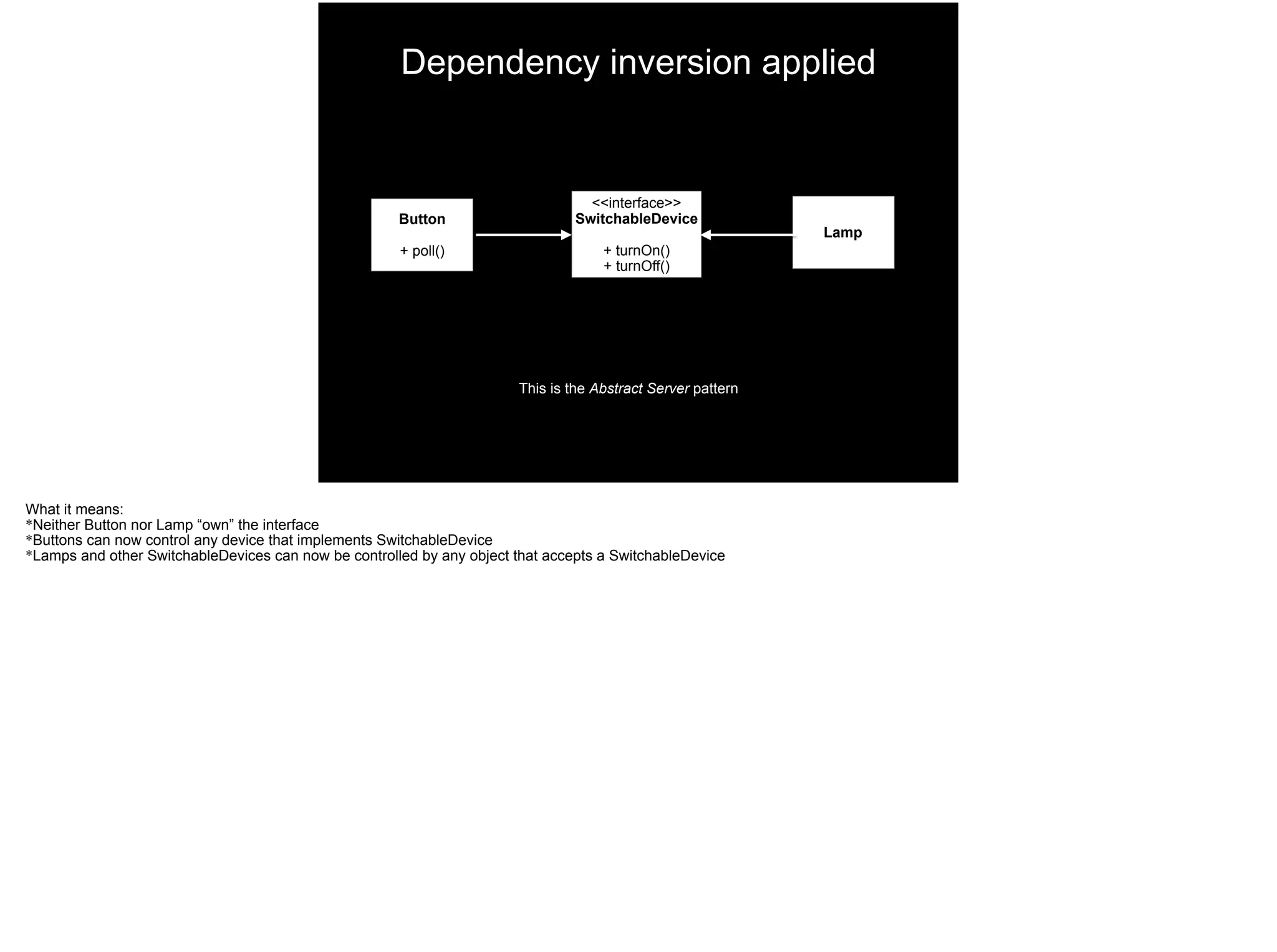
Dependency inversion applied
Button
+ poll()
<<interface>>
SwitchableDevice
+ turnOn()
+ turnOff()
Lamp
This is the Abstract Server pattern
What it means:
*Neither Button nor Lamp “own” the interface
*Buttons can now control any device that implements SwitchableDevice
*Lamps and other SwitchableDevices can now be controlled by any object that accepts a SwitchableDevice
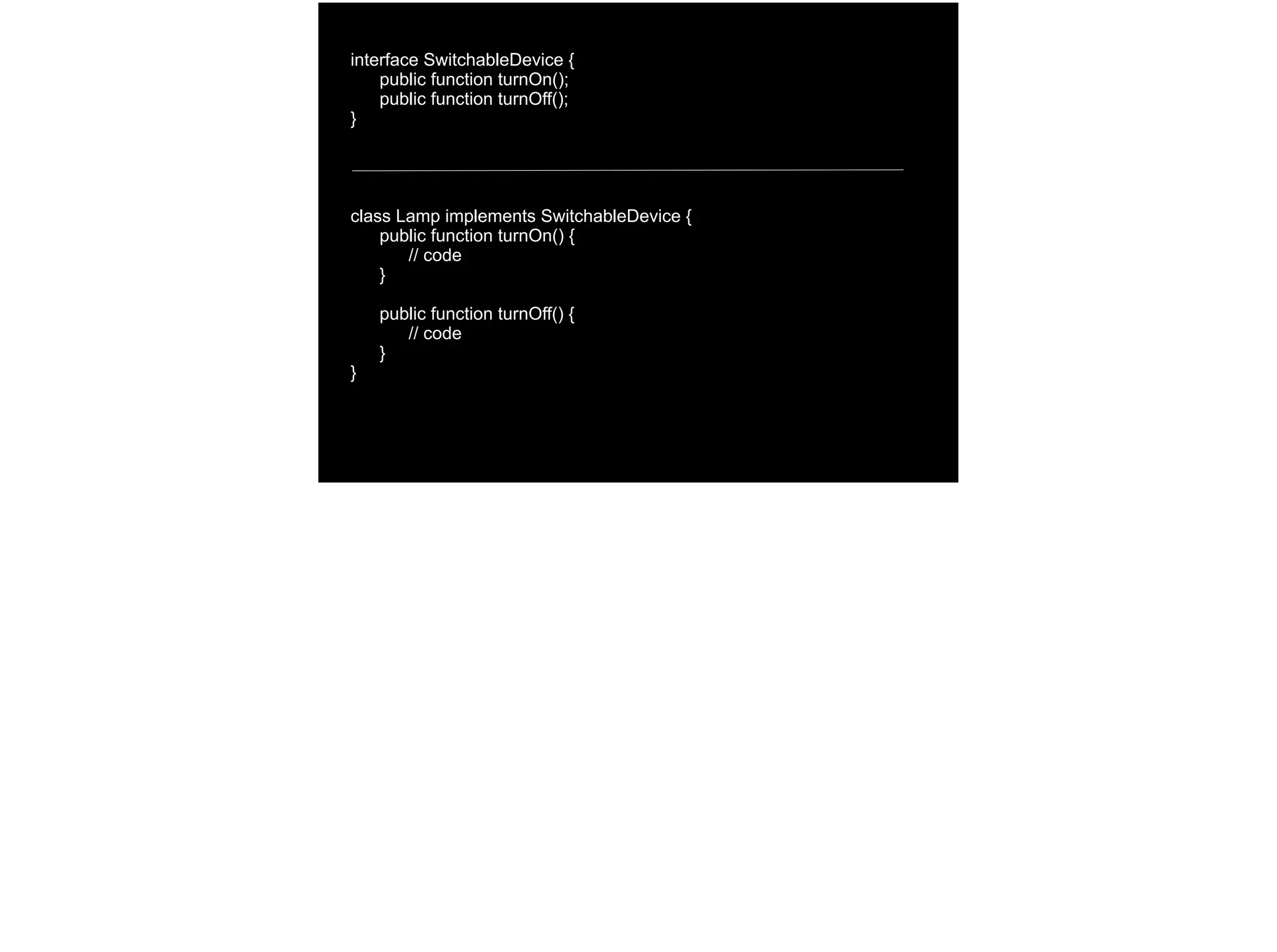
interface SwitchableDevice {
public function turnOn();
public function turnOff();
}
class Lamp implements SwitchableDevice {
public function turnOn() {
// code
}
public function turnOff() {
// code
}
}
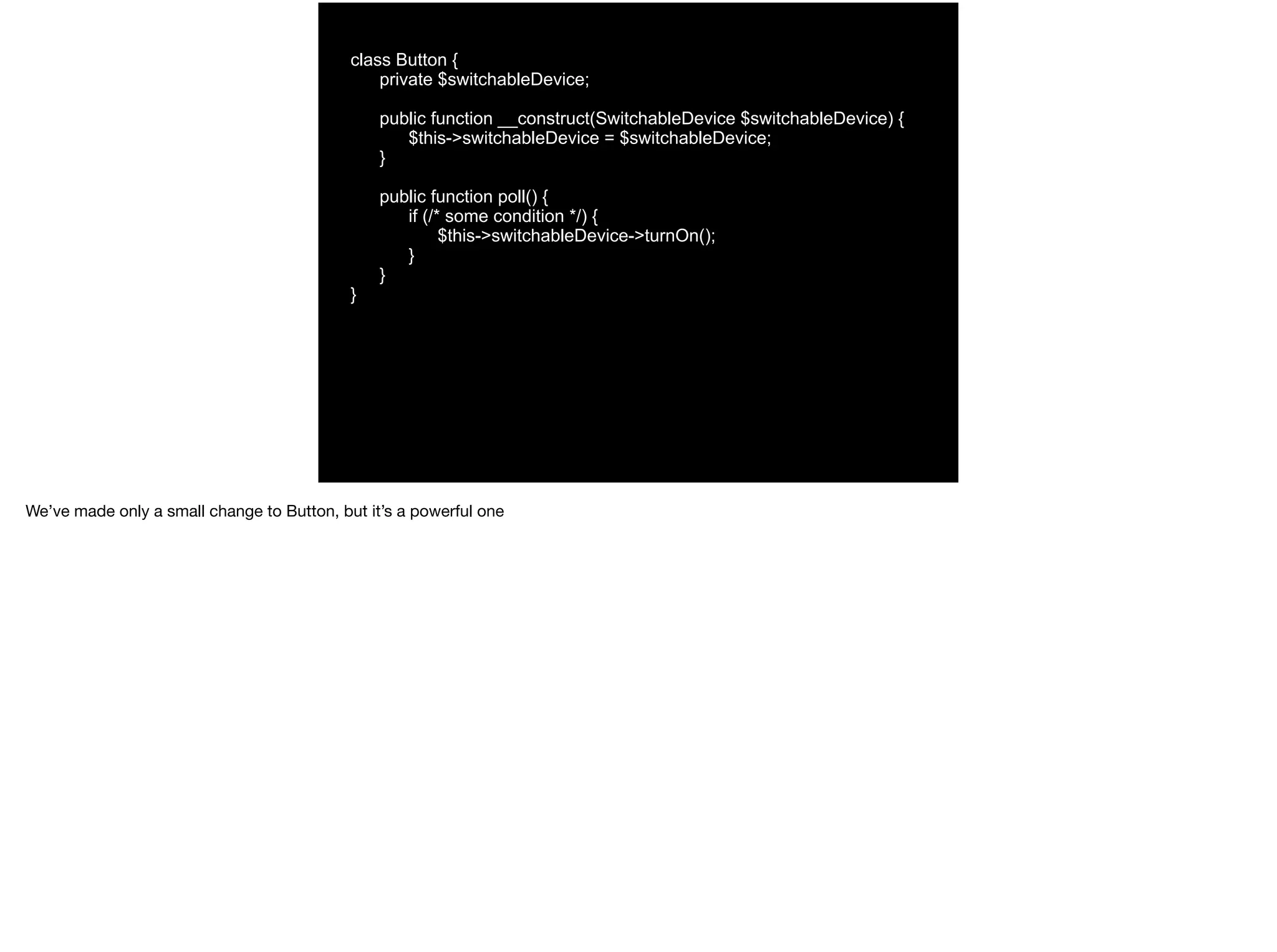
class Button {
private $switchableDevice;
public function __construct(SwitchableDevice $switchableDevice) {
$this->switchableDevice = $switchableDevice;
}
public function poll() {
if (/* some condition */) {
$this->switchableDevice->turnOn();
}
}
}
We’ve made only a small change to Button, but it’s a powerful one
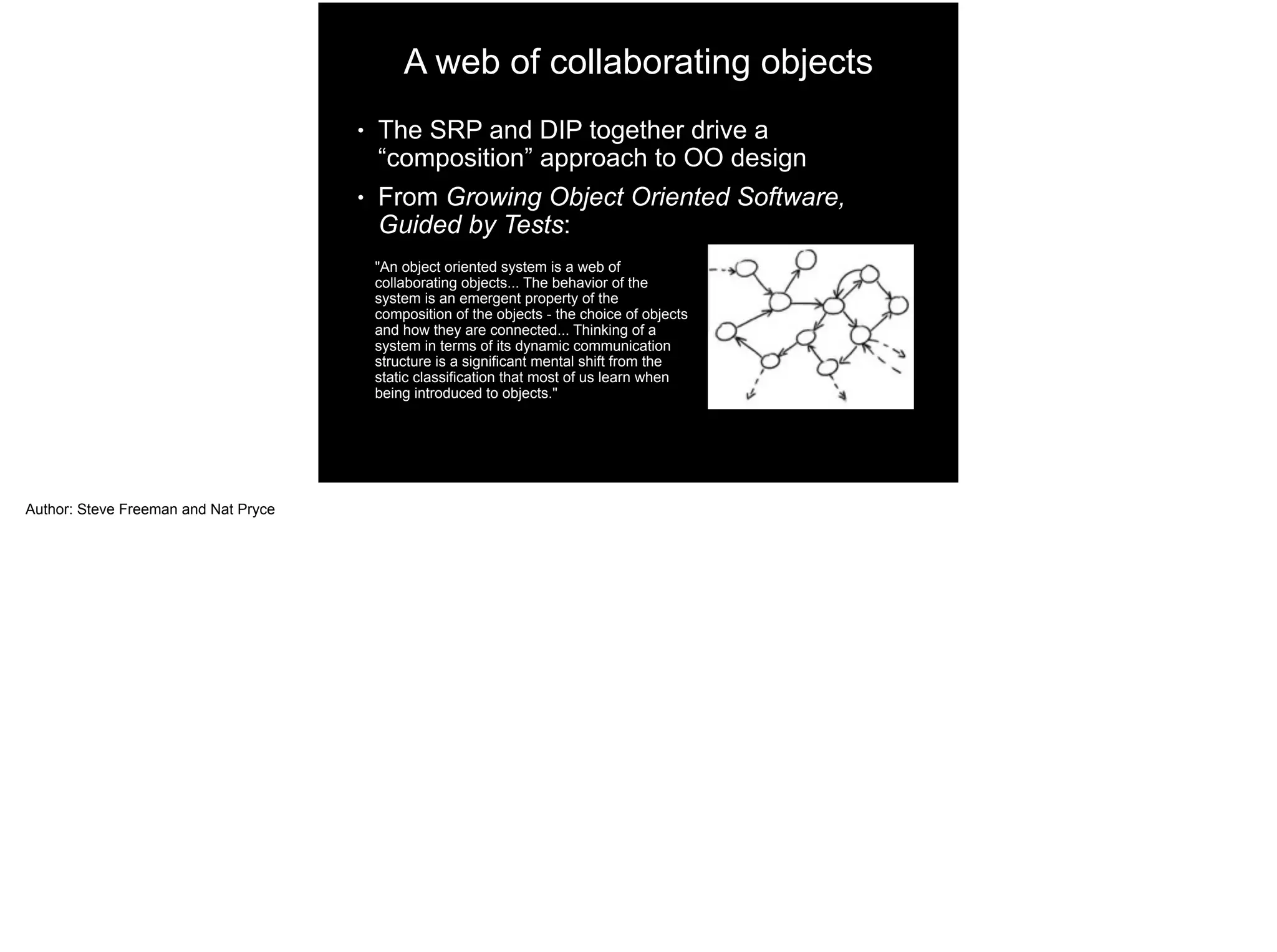
A web of collaborating objects
● The SRP and DIP together drive a
“composition” approach to OO design
● From Growing Object Oriented Software,
Guided by Tests:
"An object oriented system is a web of
collaborating objects... The behavior of the
system is an emergent property of the
composition of the objects - the choice of objects
and how they are connected... Thinking of a
system in terms of its dynamic communication
structure is a significant mental shift from the
static classification that most of us learn when
being introduced to objects."
Author: Steve Freeman and Nat Pryce
@mtoppapokayoke.design
Composition
(“Has a...”)
vs.
Inheritance
(“Is a...”)
@mtoppapokayoke.design
The SRP is about objects that do one thing
The DIP is about how to wire them together
to create working, flexible software
@mtoppapokayoke.design
3. Class autoloading: the problem
● How do we include the class files we’ll need in our
project?
● PHP lacks an equivalent statement to “import” or “use”
for classes
● Having to hardcode a bunch of file paths for loading
classes is extra work, and makes code harder to
change
@mtoppapokayoke.design
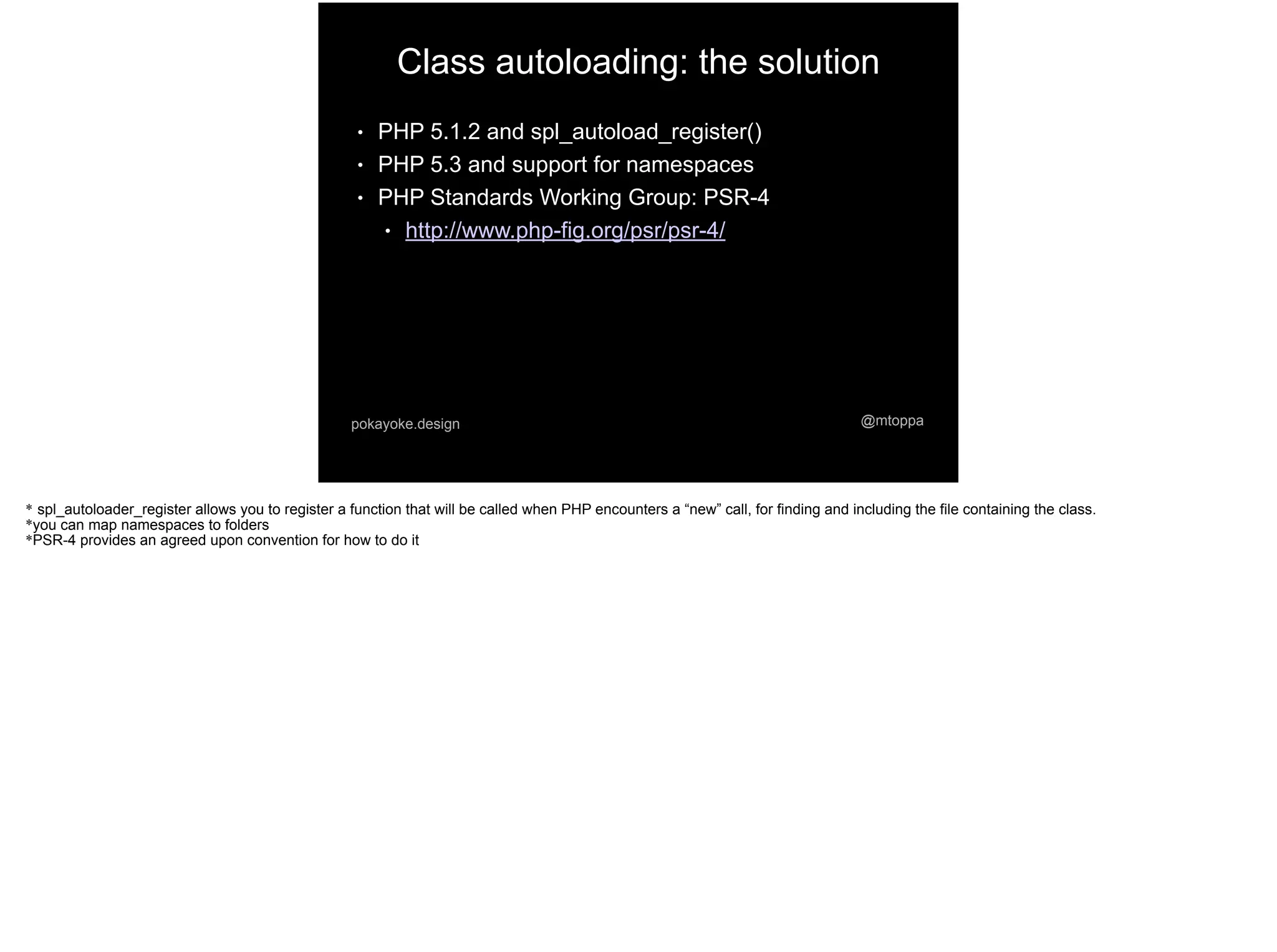
Class autoloading: the solution
● PHP 5.1.2 and spl_autoload_register()
● PHP 5.3 and support for namespaces
● PHP Standards Working Group: PSR-4
● http://www.php-fig.org/psr/psr-4/
* spl_autoloader_register allows you to register a function that will be called when PHP encounters a “new” call, for finding and including the file containing the class.
*you can map namespaces to folders
*PSR-4 provides an agreed upon convention for how to do it
@mtoppapokayoke.design
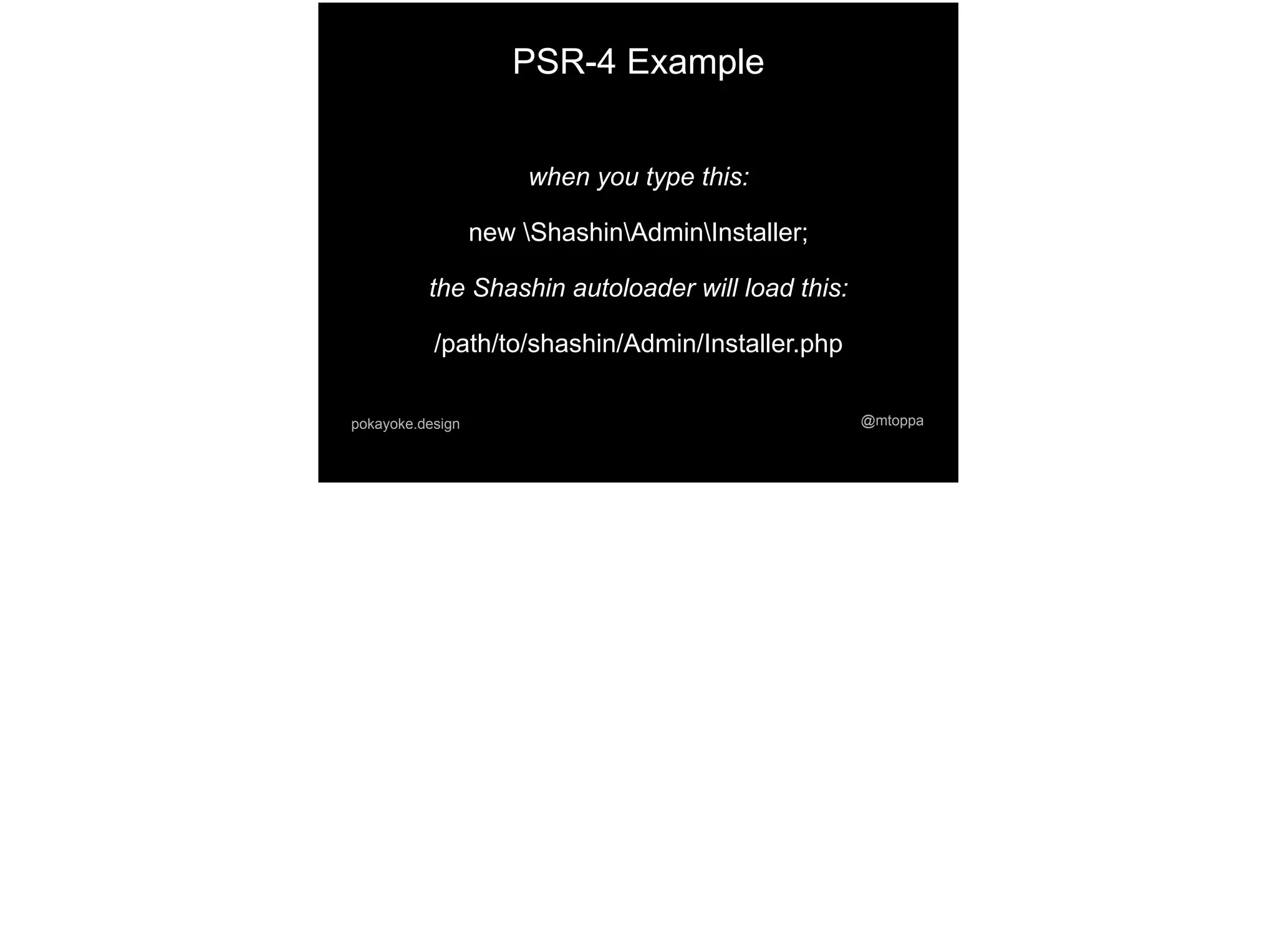
when you type this:
new ShashinAdminInstaller;
the Shashin autoloader will load this:
/path/to/shashin/Admin/Installer.php
PSR-4 Example
@mtoppapokayoke.design
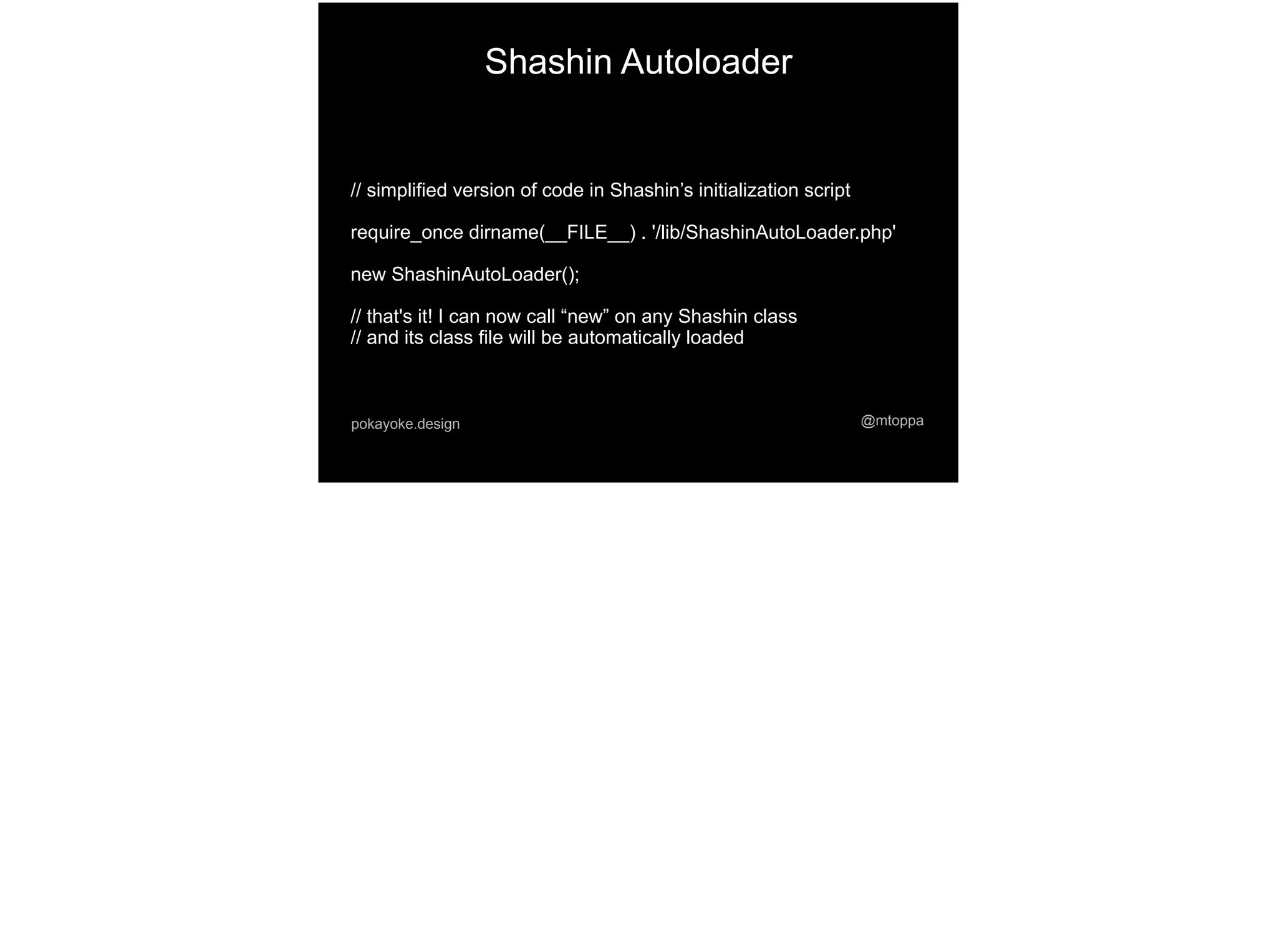
// simplified version of code in Shashin’s initialization script
require_once dirname(__FILE__) . '/lib/ShashinAutoLoader.php'
new ShashinAutoLoader();
// that's it! I can now call “new” on any Shashin class
// and its class file will be automatically loaded
Shashin Autoloader
@mtoppapokayoke.design
Dependency injection…
Dependency inversion…
What’s the difference?
4. Dependency Injection
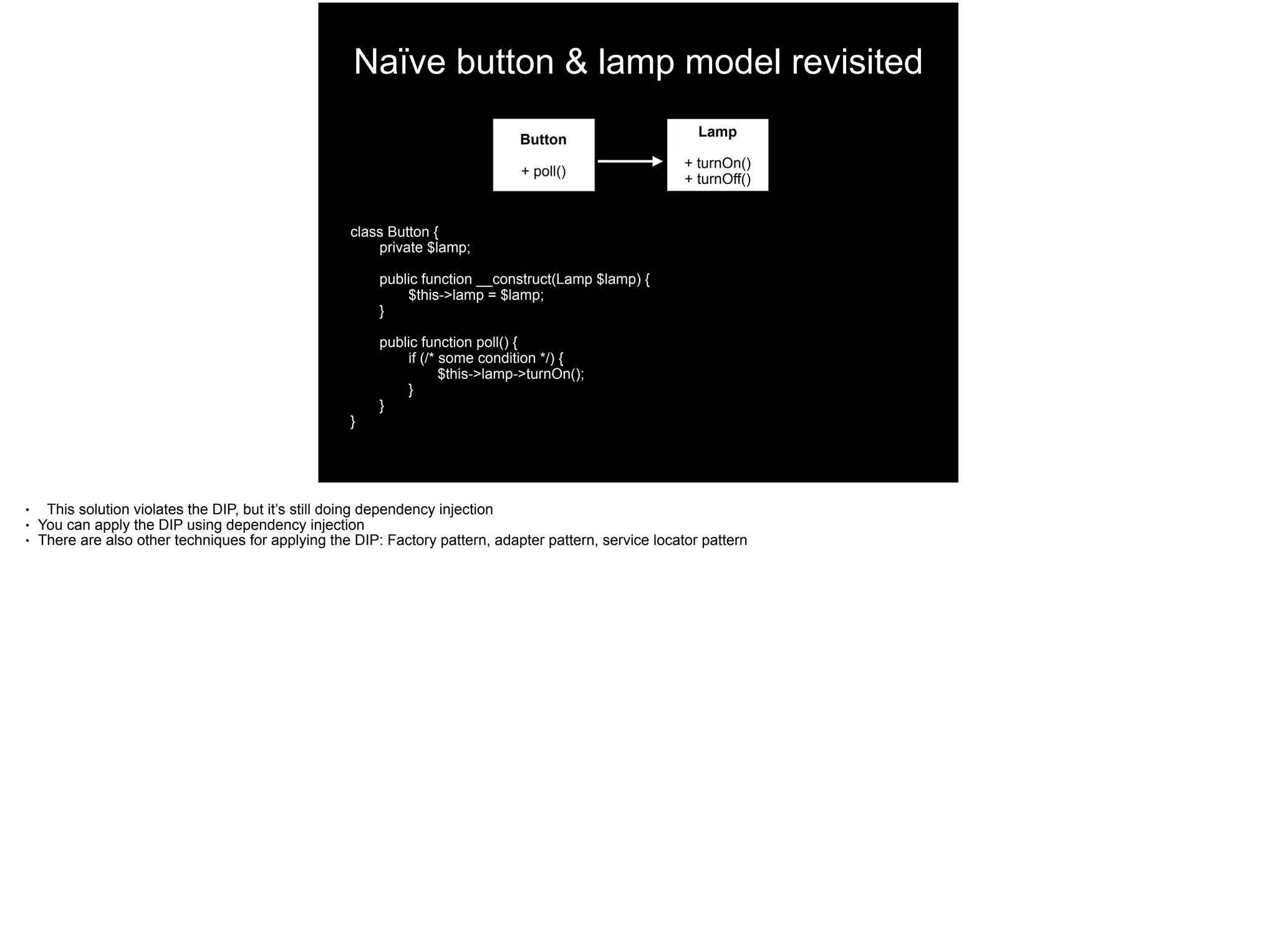
Naïve button & lamp model revisited
Button
+ poll()
Lamp
+ turnOn()
+ turnOff()
class Button {
private $lamp;
public function __construct(Lamp $lamp) {
$this->lamp = $lamp;
}
public function poll() {
if (/* some condition */) {
$this->lamp->turnOn();
}
}
}
● This solution violates the DIP, but it’s still doing dependency injection
● You can apply the DIP using dependency injection
● There are also other techniques for applying the DIP: Factory pattern, adapter pattern, service locator pattern
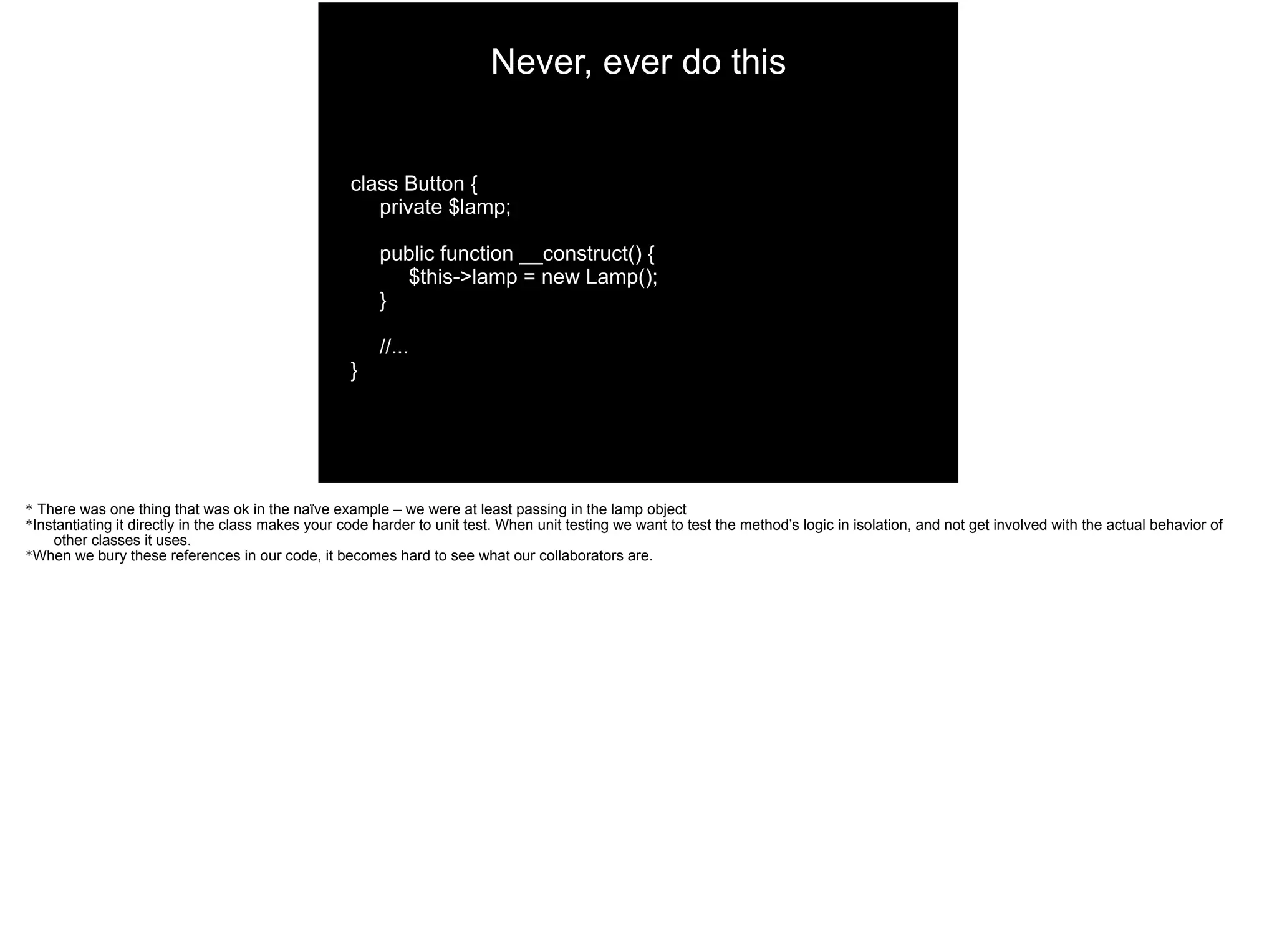
class Button {
private $lamp;
public function __construct() {
$this->lamp = new Lamp();
}
//...
}
Never, ever do this
* There was one thing that was ok in the naïve example – we were at least passing in the lamp object
*Instantiating it directly in the class makes your code harder to unit test. When unit testing we want to test the method’s logic in isolation, and not get involved with the actual behavior of
other classes it uses.
*When we bury these references in our code, it becomes hard to see what our collaborators are.
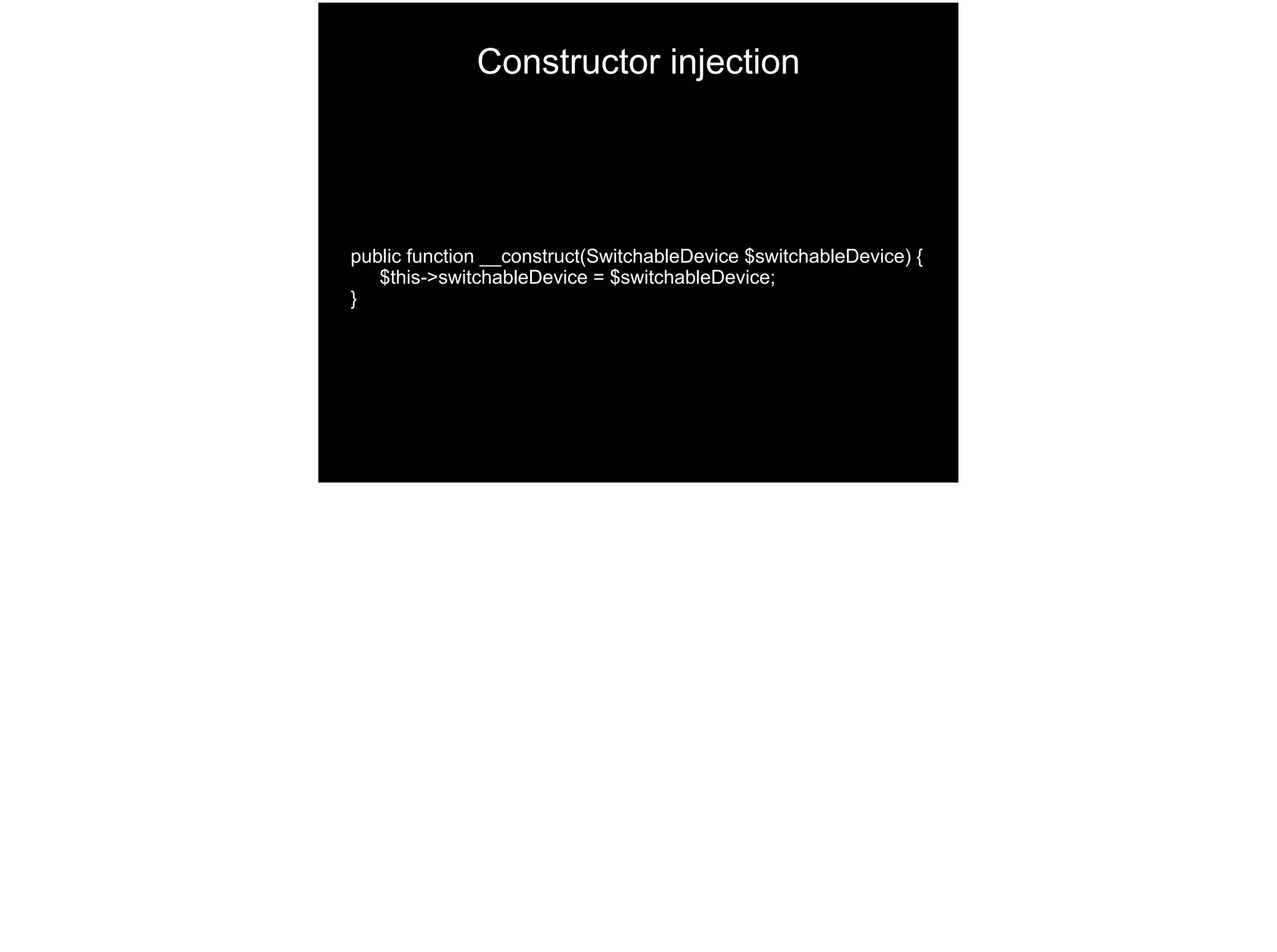
public function __construct(SwitchableDevice $switchableDevice) {
$this->switchableDevice = $switchableDevice;
}
Constructor injection
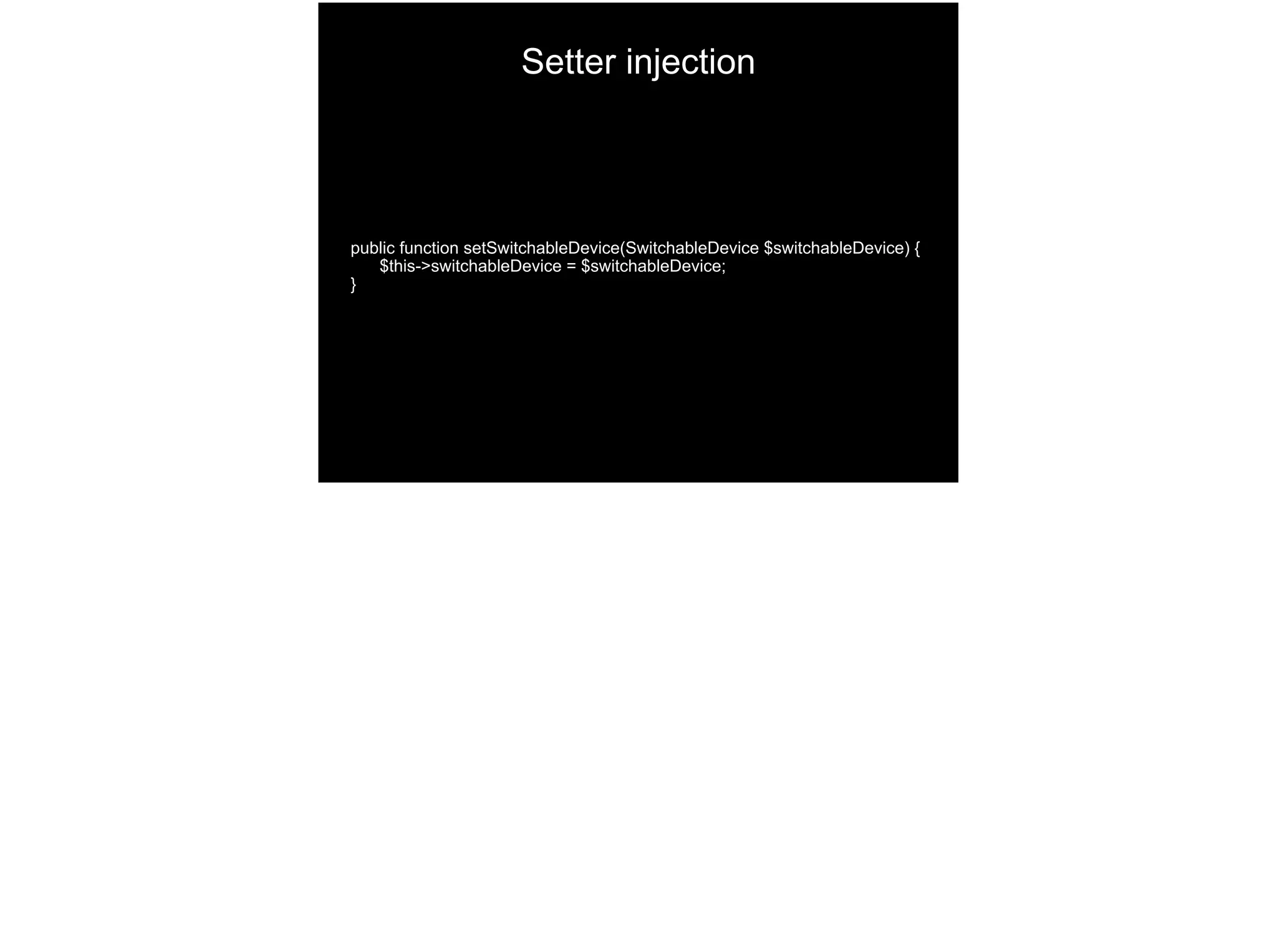
public function setSwitchableDevice(SwitchableDevice $switchableDevice) {
$this->switchableDevice = $switchableDevice;
}
Setter injection
@mtoppapokayoke.design
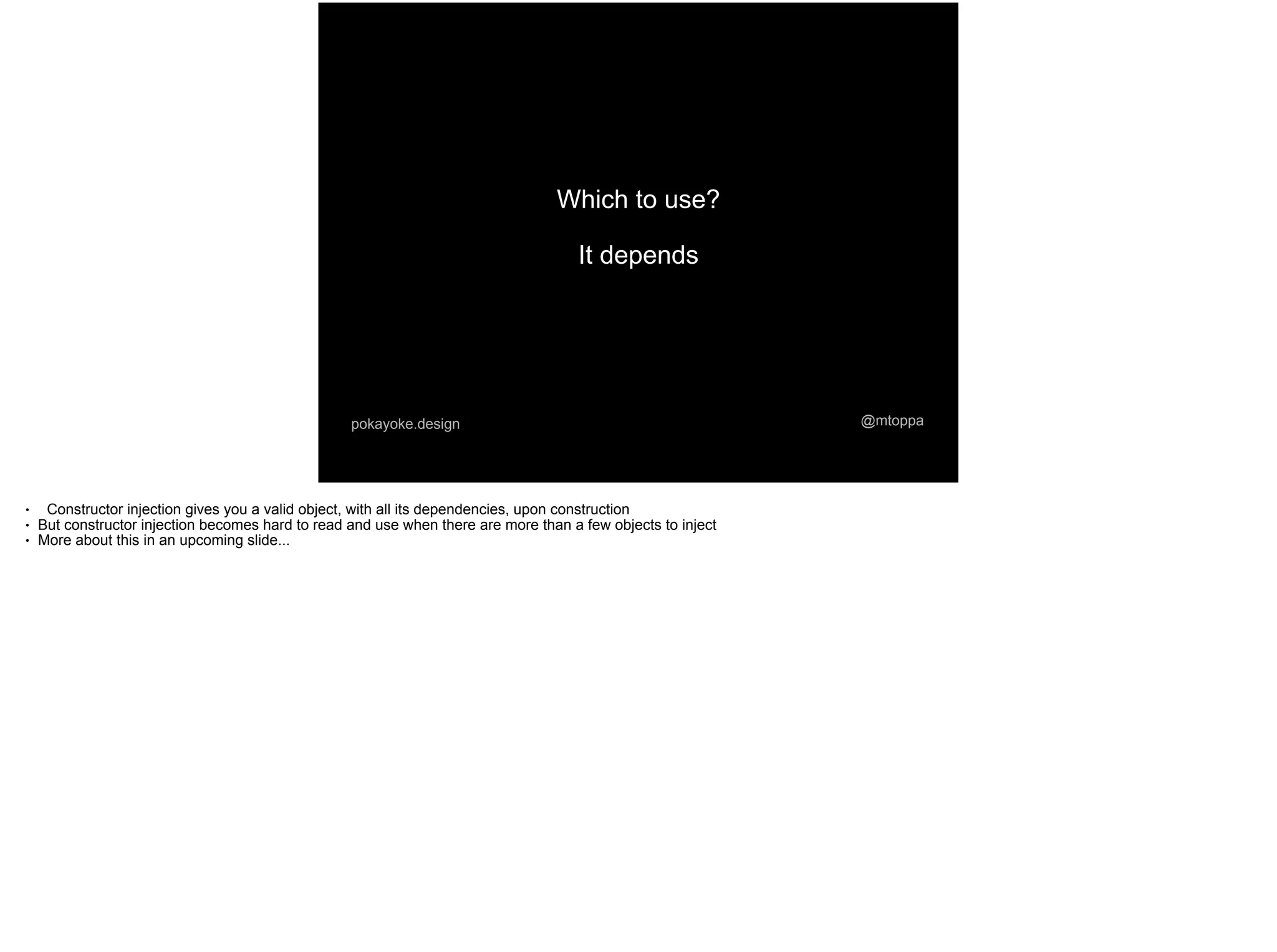
Which to use?
It depends
● Constructor injection gives you a valid object, with all its dependencies, upon construction
● But constructor injection becomes hard to read and use when there are more than a few objects to inject
● More about this in an upcoming slide...
@mtoppapokayoke.design
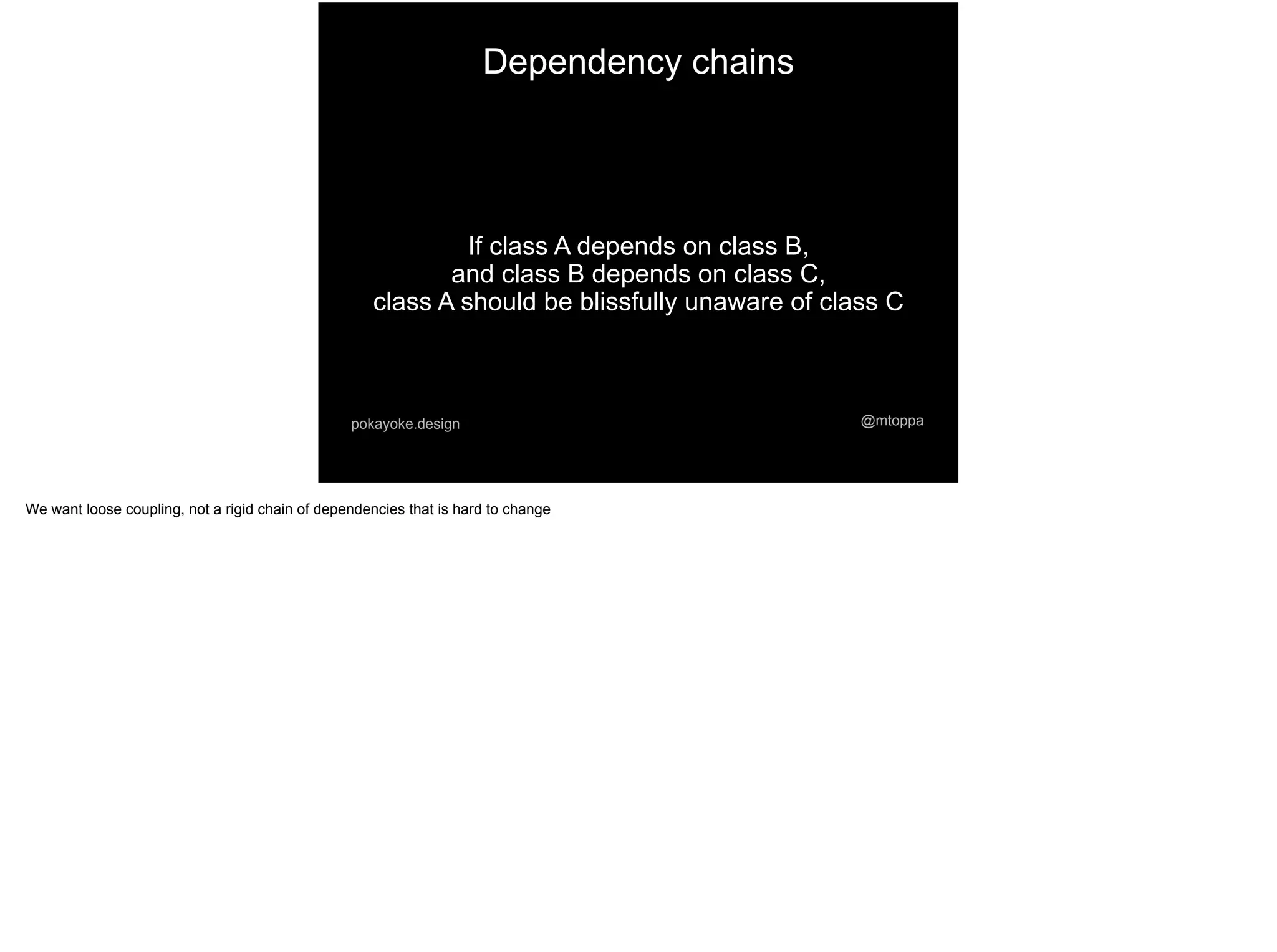
If class A depends on class B,
and class B depends on class C,
class A should be blissfully unaware of class C
Dependency chains
We want loose coupling, not a rigid chain of dependencies that is hard to change
@mtoppapokayoke.design
To do this without going insane,
you need an injection container
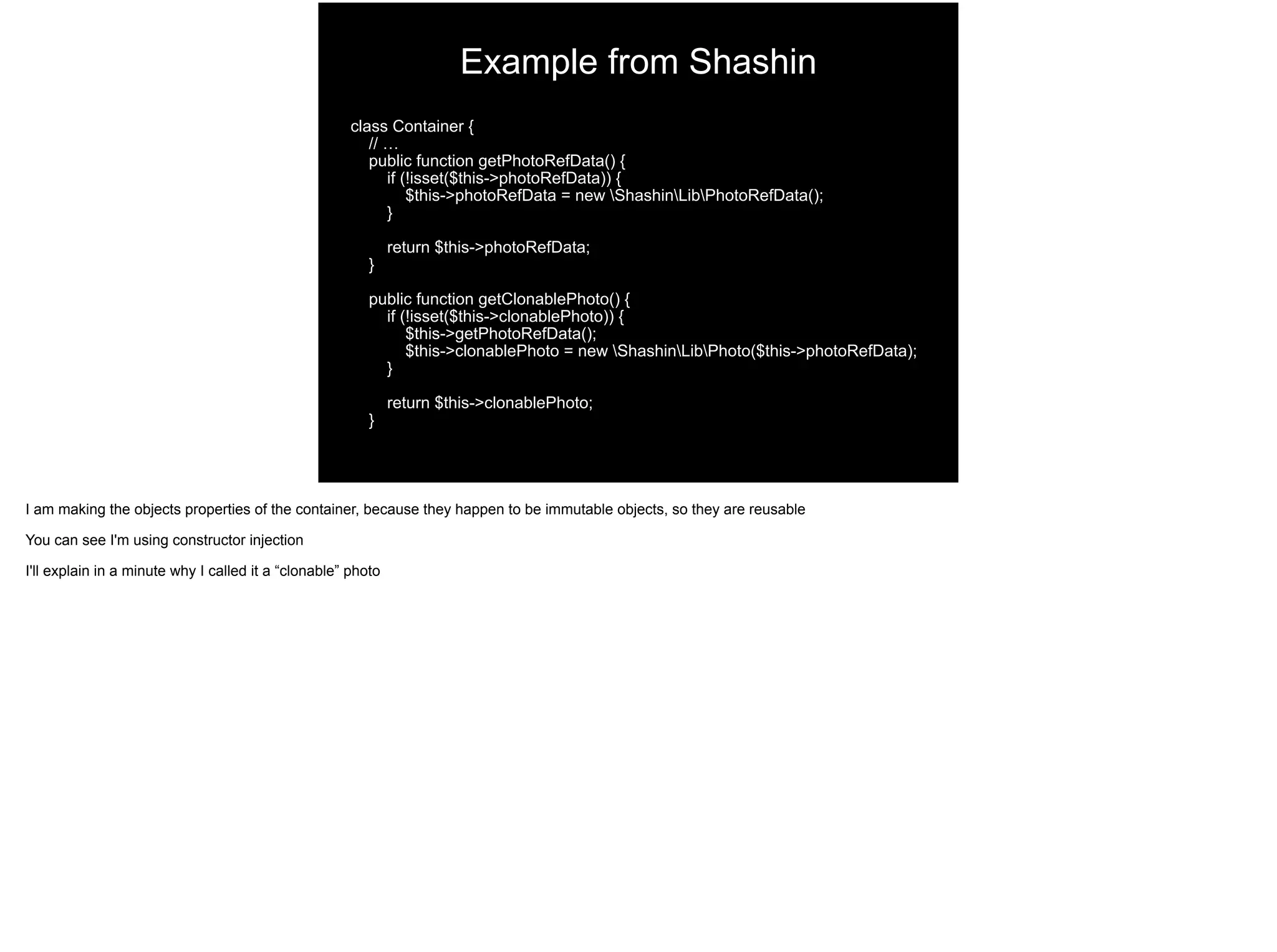
class Container {
// …
public function getPhotoRefData() {
if (!isset($this->photoRefData)) {
$this->photoRefData = new ShashinLibPhotoRefData();
}
return $this->photoRefData;
}
public function getClonablePhoto() {
if (!isset($this->clonablePhoto)) {
$this->getPhotoRefData();
$this->clonablePhoto = new ShashinLibPhoto($this->photoRefData);
}
return $this->clonablePhoto;
}
Example from Shashin
I am making the objects properties of the container, because they happen to be immutable objects, so they are reusable
You can see I'm using constructor injection
I'll explain in a minute why I called it a “clonable” photo
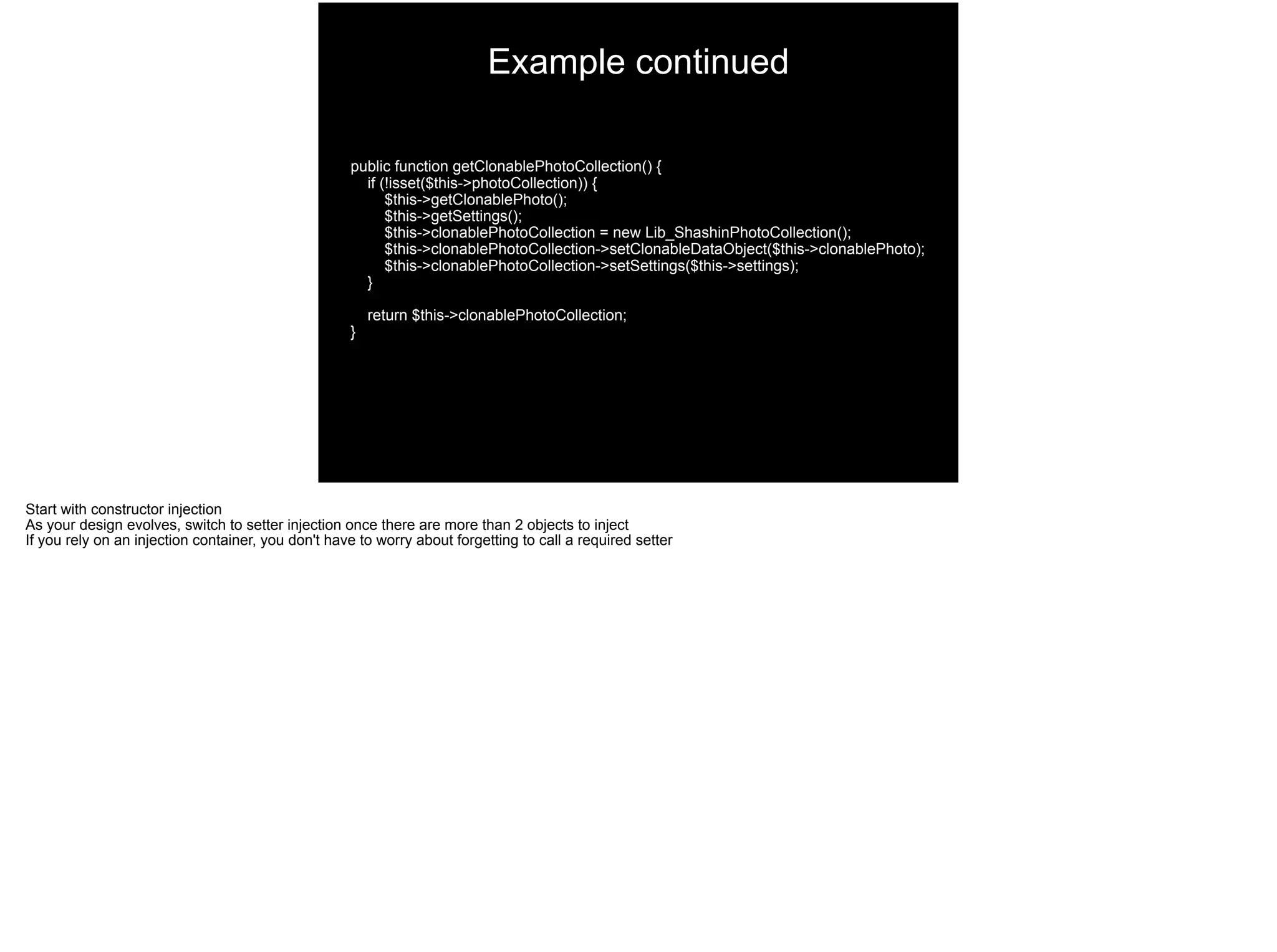
public function getClonablePhotoCollection() {
if (!isset($this->photoCollection)) {
$this->getClonablePhoto();
$this->getSettings();
$this->clonablePhotoCollection = new Lib_ShashinPhotoCollection();
$this->clonablePhotoCollection->setClonableDataObject($this->clonablePhoto);
$this->clonablePhotoCollection->setSettings($this->settings);
}
return $this->clonablePhotoCollection;
}
Example continued
Start with constructor injection
As your design evolves, switch to setter injection once there are more than 2 objects to inject
If you rely on an injection container, you don't have to worry about forgetting to call a required setter
@mtoppapokayoke.design
Beyond the textbook examples
@mtoppapokayoke.design
What to do when you need
a new object inside a loop
One solution is cloning
class SynchronizerPicasa extends Synchronizer {
// setClonablePhoto method…
public function syncAlbumPhotos(array $decodedAlbumData) {
// …
foreach ($decodedAlbumData['feed']['entry'] as $entry) {
$photoData = $this->extractFieldsFromDecodedData(
$entry, $photoRefData, ‘picasa'
);
// ...
$photo = clone $this->clonablePhoto;
$photo->set($photoData);
$photo->flush();
}
Shashin Example
@mtoppapokayoke.design
What if you need a new object inside a loop,
but can't know the subtype you'll need
ahead of time?
Let the injection container figure it out
This was an interesting problem for me with Shashin. It supports multiple media sources (Picasa, etc), multiple viewers (Fancybox, etc), and we could be displaying a photo or an album
cover, each of which has different behaviors
class LayoutManager {
// setContainer method…
public function setTableBody() {
// …
for ($i = 0; $i < count($this->collection); $i++) {
// ...
$dataObjectDisplayer = $this->container->getDataObjectDisplayer(
$this->shortcode,
$this->collection[$i]
);
$this->tableBody .= $dataObjectDisplayer->run();
// ...
}
Shashin Example
Regardless of the type, the layout rules for the thumbnails is always the same
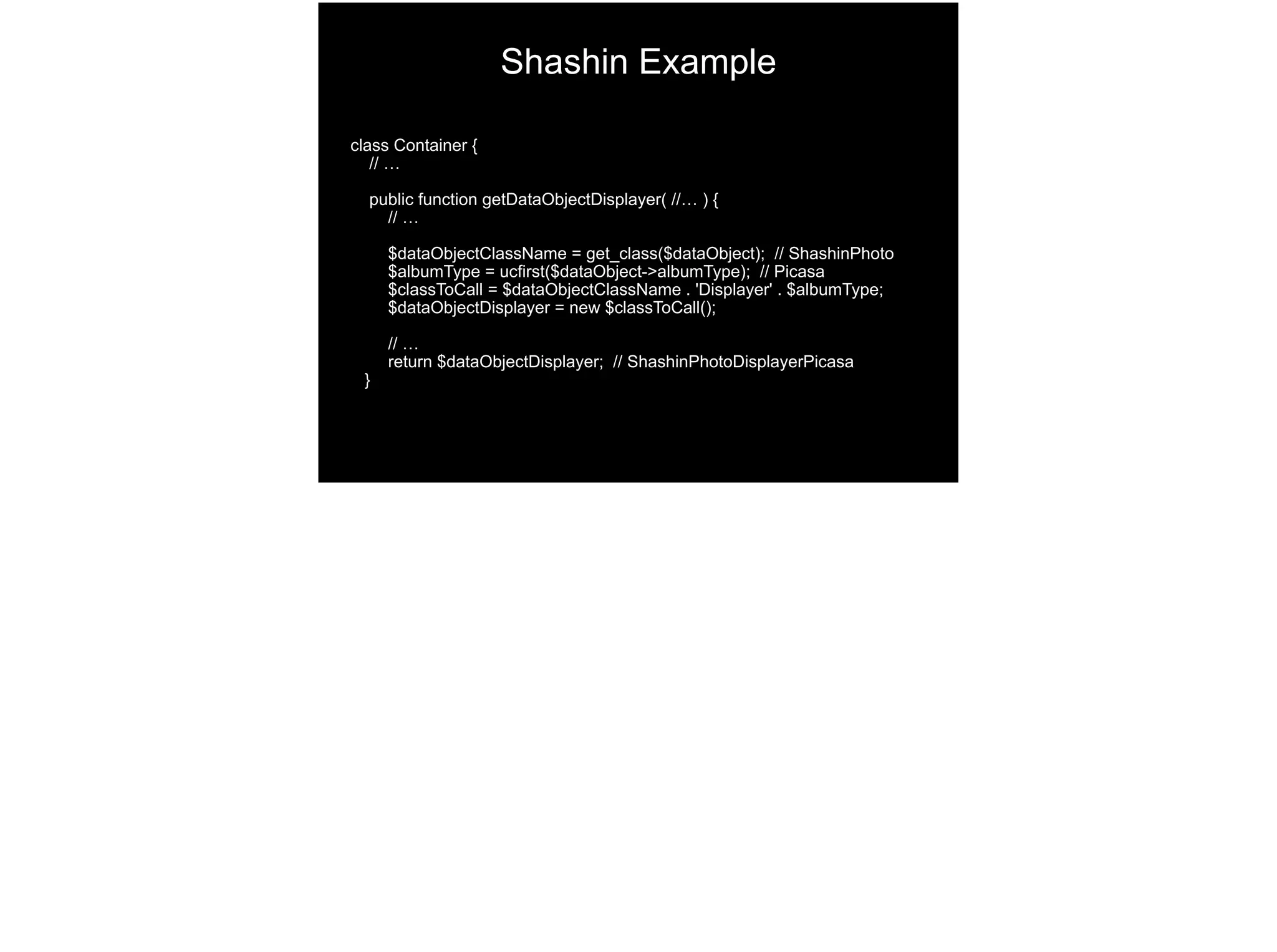
So here I've injected the container itself
getDataObjectDisplayer() uses the passed in
arguments to determine which subtype of
DataObjectDisplayer to return
class Container {
// …
public function getDataObjectDisplayer( //… ) {
// …
$dataObjectClassName = get_class($dataObject); // ShashinPhoto

$albumType = ucfirst($dataObject->albumType); // Picasa

$classToCall = $dataObjectClassName . 'Displayer' . $albumType;

$dataObjectDisplayer = new $classToCall();
// …
return $dataObjectDisplayer; // ShashinPhotoDisplayerPicasa

}
Shashin Example
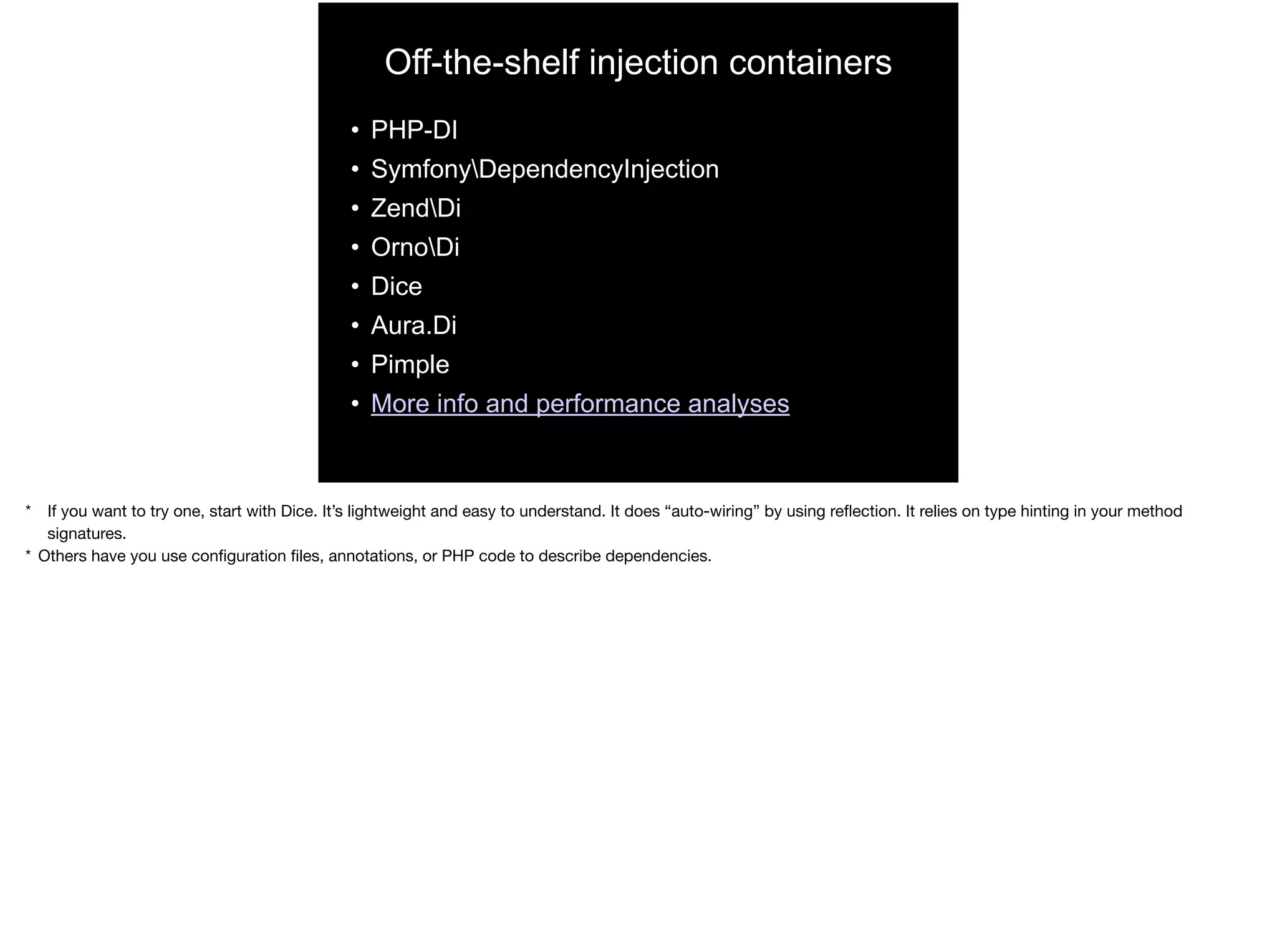
Off-the-shelf injection containers
• PHP-DI
• SymfonyDependencyInjection
• ZendDi
• OrnoDi
• Dice
• Aura.Di
• Pimple
• More info and performance analyses
* If you want to try one, start with Dice. It’s lightweight and easy to understand. It does “auto-wiring” by using reflection. It relies on type hinting in your method
signatures.

* Others have you use configuration files, annotations, or PHP code to describe dependencies.
@mtoppapokayoke.design
Off-the-shelf or roll your own?
* Using reflection is great for simple cases

* Using configurations, you can end up with as much code as simply writing your own

* I prefer writing my own. It’s not hard, and I can customize the behavior however I like without having to fight against the conventions of a pre-built container (like the
getDataObjectDisplayer method)
@mtoppapokayoke.design
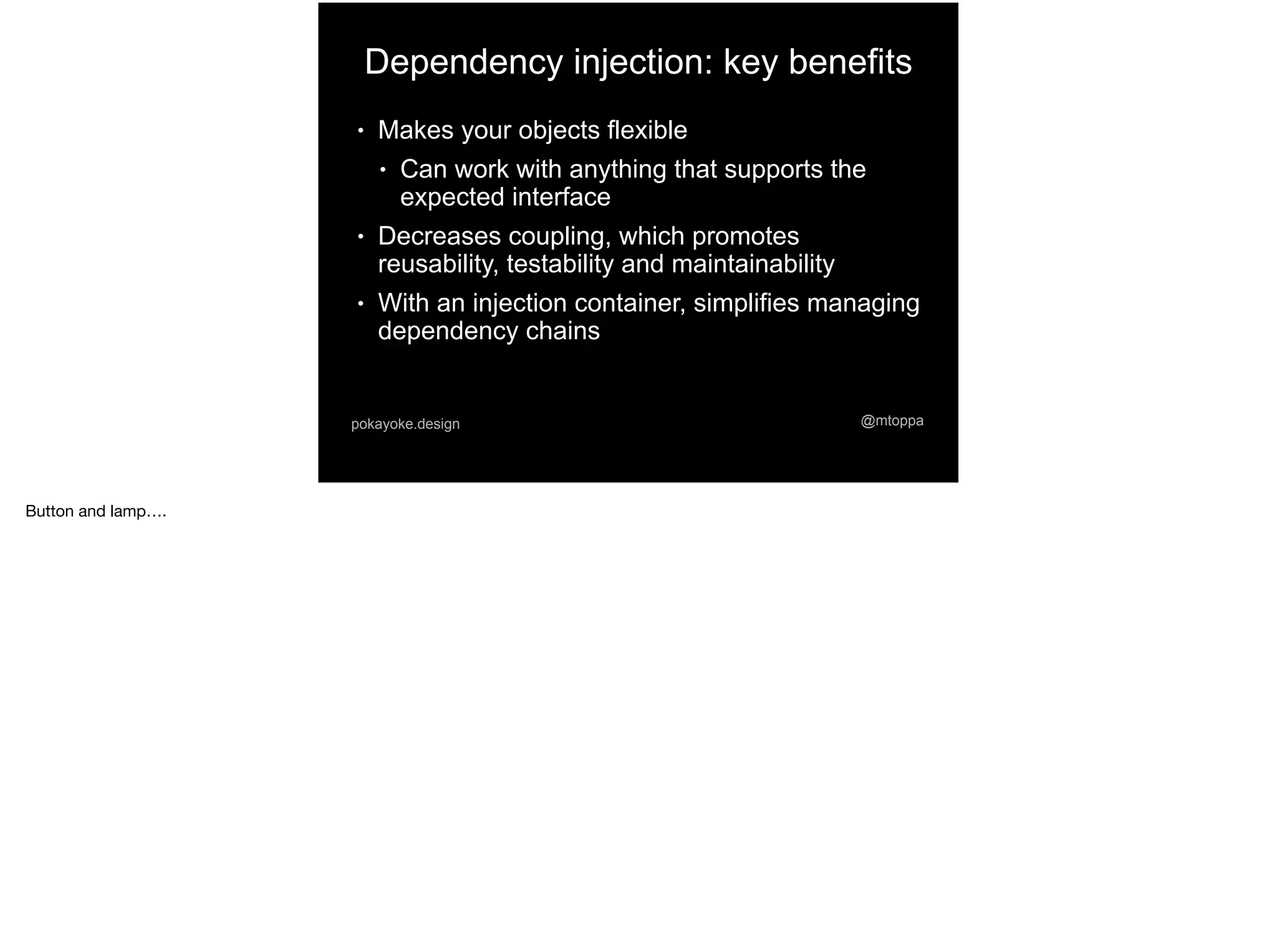
Dependency injection: key benefits
● Makes your objects flexible
● Can work with anything that supports the
expected interface
● Decreases coupling, which promotes
reusability, testability and maintainability
● With an injection container, simplifies managing
dependency chains
Button and lamp….
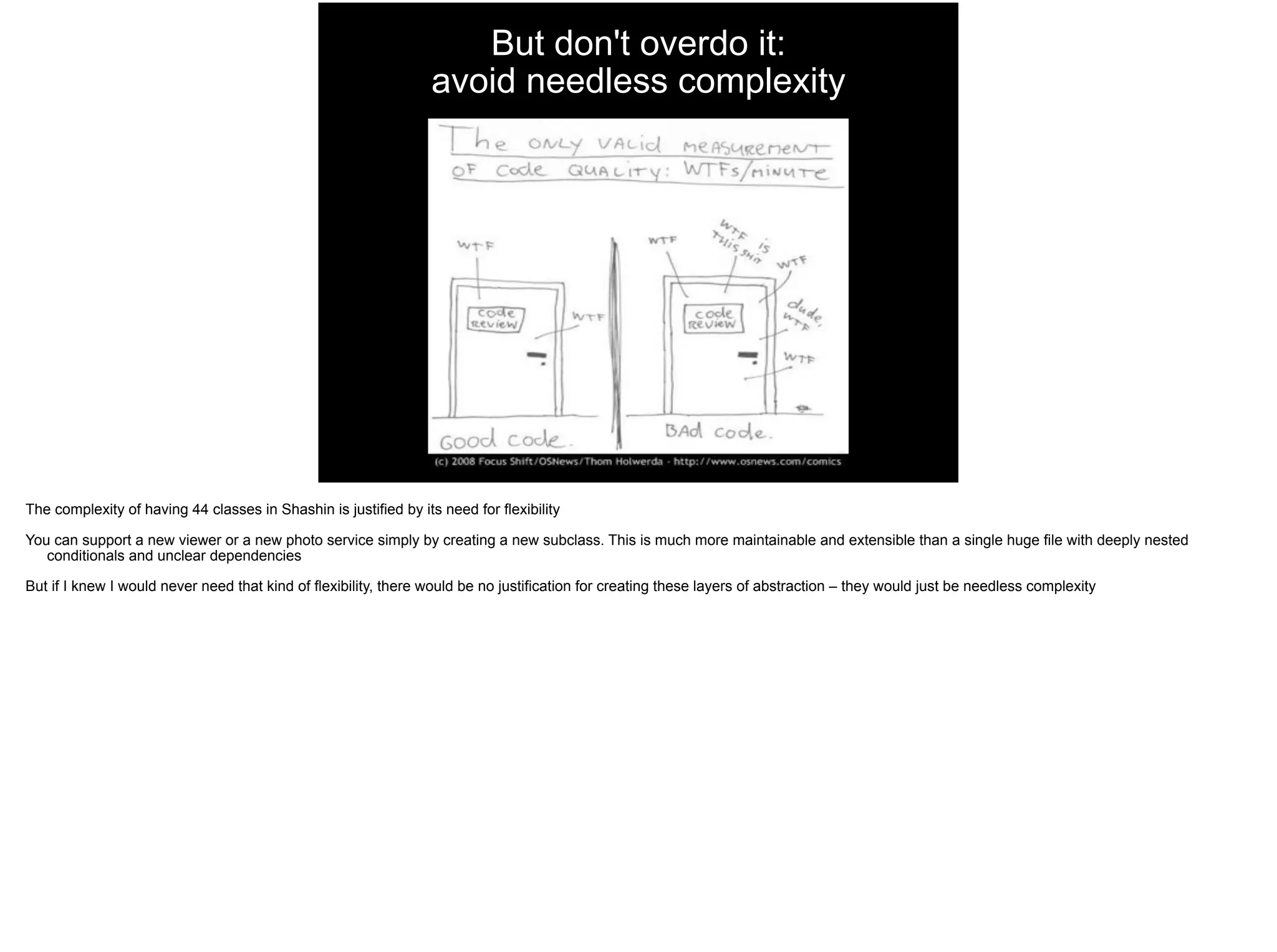
But don't overdo it:

avoid needless complexity
The complexity of having 44 classes in Shashin is justified by its need for flexibility
You can support a new viewer or a new photo service simply by creating a new subclass. This is much more maintainable and extensible than a single huge file with deeply nested
conditionals and unclear dependencies
But if I knew I would never need that kind of flexibility, there would be no justification for creating these layers of abstraction – they would just be needless complexity
Questions?

Dependency Injection for PHP

  • 1.
    Dependency Injection forPHP Mike Toppa Boston PHP Meetup September 9, 2015 @mtoppapokayoke.design
  • 2.
    About me @mtoppapokayoke.design * I’vebeen developing for the web since the days of HTML 1.0, when web pages were first painted on cave walls. * I’ve been developing with PHP since 2004. * Over the years I’ve worked at Ask Jeeves, E-Trade, Stanford, Georgetown, and I was the Director of the Web Applications Team at the U Penn School of Medicine. * Most of my work has been as a developer, but I’ve also done a good deal of project management and team management, and I’m a big believer in Agile and Lean practices.
  • 3.
    My new housenear Boston… @mtoppapokayoke.design * I just moved to Boston from Philadelphia this summer * and the is what my house looks like
  • 4.
    @mtoppapokayoke.design * My wifehas a new job here in Boston, and I have a new job now too. I’m co-founder and CTO of Poka Yoke Design. Our primary development platforms are WordPress and Ruby on Rails. * I was an active member of the PHP, WordPress, and Ruby communities in Philly, and I look forward to becoming part of the communities here in Boston. * We are not hiring currently, but we are looking for projects!
  • 5.
    Overview 1. Crash coursein classes and objects in PHP 2. The SOLID principles • Single Responsibility Principle • Dependency Inversion Principle 3. Class autoloading in PHP 4. Dependency injection • DI containers • Advanced dependency injection techniques @mtoppapokayoke.design
  • 6.
    1. Crash coursein classes and objects in PHP @mtoppapokayoke.design
  • 7.
  • 8.
    Simple example class Lamp{ // property declaration private $maxSafeWatts = 100; // method declaration public function getMaxSafeWatts() { return $this->maxSafeWatts; } } --------------------------------------------------------------- // instantiate and assign $myLamp = new Lamp(); echo $myLamp->getMaxSafeWatts(); A class consists of properties, and methods which perform actions, by manipulating those properties Encapsulation of related methods and properties. This is what a class really is. Properties and methods have a visibility (public, private, or protected) An object is created by instantiating a class (calling new). Then you typically assign it to a variable, and call its methods as needed
  • 9.
    Rule of thumb:
 avoidpublic properties class Lamp { public $maxSafeWatts = 100; } --------------------------------------------- $myLamp = new Lamp(); // dangerous to allow this! $myLamp->maxSafeWatts = 'a string to wreck your math'; Public properties can be used and abused by external code at any time.
  • 10.
    Prefer private properties classLamp { private $maxSafeWatts = 100; public setMaxSafeWatts($watts) { if (!is_numeric($watts) || $watts > 125 || $watts < 1) { throw New Exception('invalid value for watts'); } $this->maxSafeWatts = $watts; return $this->maxSafeWatts; } } ------------------------------------------------------------------- $myLamp = new Lamp(); $myLamp->setMaxSafeWatts(75); By requiring them to be set through a method call, you can control what types of values are valid, and what ranges are valid.
  • 11.
    Constructors class Lamp { private$bulb; public function __construct($bulb) { $this->bulb = $bulb; } } --------------------------------------------- $myLamp = new Lamp('3 way'); The constructor is a special method, used for initializing a class. It's optional – is called when you call “new” A constructor does not return anything It should be used for getting a class into a valid initial state A common design mistake is to put a lot of complex logic in the constructor, or call it to execute the object's functionality.
  • 12.
    Type Hinting class Lamp{ private $bulb; public function __construct(Bulb $bulb) { $this->bulb = $bulb; } } --------------------------------------------- $myBulb = new Bulb(); $myLamp = new Lamp($bulb);
  • 13.
    Organizing your classes Oneclass per file, and the file name should match the class name Give the class a meaningful name and its methods meaningful names Class names and property names should be nouns or noun phrases Method names should be verbs or verb phrases Use an IDE that autocompletes variable names and method names
  • 14.
    Abstract classes andinheritance Lamp DeskLampFloorLamp HangingLamp
  • 15.
    Abstract classes andmethods abstract class Lamp { protected $color; protected $maxSafeWatts; public function setColor($color) { $this->color = $color; return $this->color; } abstract public function setMaxSafeWatts($watts); } An abstract class cannot be implemented directly It can also have abstract methods, which must be implemented by the child class Protected methods and properties are essentially private, but can be used by child classes
  • 16.
    Implementing abstract classes classFloorLamp extends Lamp { public function setMaxSafeWatts($watts) { /* if numeric and less than 150... */ $this->maxSafeWatts = $watts; return $this->maxSafeWatts; } } ------------------------------------------------------------------ class DeskLamp extends Lamp { public function setMaxSafeWatts($watts) { /* if numeric and less than 100... */ $this->maxSafeWatts = $watts; return $this->maxSafeWatts; } }
  • 17.
    Interfaces An electrical outletis a great example of an interface. It can power anything designed to plug into it. It doesn't need to know or care about exactly what it's connected to. Interfaces define a set of methods a class must implement. It's similar to abstract classes in this way, but there is no inheritance. I’ll provide an example and say more about interfaces when we get to dependency inversion
  • 18.
    2. The SOLIDPrinciples ● Single Responsibility (SRP) ● Open-Closed (OCP) ● Liskov Substitution (LSP) ● Interface Segregation (ISP) ● Dependency Inversion (DIP) @mtoppapokayoke.design Introduced by Bob Martin in his book “Agile Software Development”
  • 19.
    From LosTechies.com * Appliedto classes and methods * Do one thing, do it well, do it only * For methods, this typically means changing the value of only one variable * If you are passing more than 2 or 3 arguments into a method, you are probably doing more than one thing * For classes, it means having a single conceptual responsibility
  • 20.
    The purpose isto reduce the complexity and fragility of a class @mtoppapokayoke.design We want code that is flexible and easy to understand, not brittle and mind-numbing to read When a method is manipulating multiple properties and invoking lots of other methods, it can be very hard to test, debug, and change. This is a common reason why developers feel fear when making a change – they don't know what might break When a class has many methods and multiple responsibilities, it can be hard to understand and difficult to refactor
  • 21.
    But what doesit mean to do “one thing”? @mtoppapokayoke.design
  • 22.
    Only one reasonto change @mtoppapokayoke.design If you have a class that compiles and prints a report, it has 2 responsibilities, and 2 reasons to change. The content of the report could change, or the format of the report could change. This class should be split into two classes.
  • 23.
    Cohesion @mtoppapokayoke.design Uncle Bob says: *“Classes should have a small number of instance variables. Each of the methods of a class should manipulate one or more of those variables. In general the more variables a method manipulates the more cohesive that method is to its class.” * “When cohesion is high, it means that the methods and variables of the class are co-dependent and hang together as a logical whole.”
  • 24.
  • 30.
    Shashin @mtoppapokayoke.design My WordPress pluginfor displaying albums, photos, and videos from Picasa, Twitpic, and YouTube I'm going to show SRP and DIP examples of code from Shashin Clean code books and articles all use other languages as examples – I wanted to try applying them to PHP and WordPress
  • 33.
  • 34.
    There's a lotgoing on here. A lot of different data sources and display possibilities to support. How do you keep the code from becoming a tangled mess?
  • 35.
    @mtoppapokayoke.design Shashin consists of44 classes, each of which has a meaningful name, follows the SRP, and “does one thing” PicasaPhotoDisplayer SettingsMenu YouTubeSynchronizer Uninstall etc.
  • 36.
    Displayer.php AlbumDisplayer.php AlbumDisplayerPicasa.php AlbumDisplayerTwitpic.php AlbumDisplayerFlickr.php PhotoDisplayer.php PhotoDisplayerPicasa.php PhotoDisplayerTwitpic.php PhotoDisplayerFlickr.php Shashin Classes Example Youcan start to see the power of this approach here I can add support for a new photos service by creating a new subclass, instead of having to touch code all over the place, adding a bunch of “if” statements
  • 37.
    class Installer { publicfunction run() { $this->createAlbumTable(); $this->verifyAlbumTable(); $this->createPhotoTable(); $this->verifyPhotoTable(); $this->updateSettings(); return true; } // ... } Methods Example * The whole class is about 150 lines *The run method calls the other methods (this is a simple use of the command pattern) *It reads like a table of contents *Breaking the functionality down into methods that do one thing makes the code easier to read and to unit test *Installation is especially useful to break down into small methods that can have automated tests, as plugin activation is especially difficult to debug
  • 38.
    From LosTechies.com The nextquestion is, how do we get all these objects working together? It’s common to see code that hard-wires together all the parts, when those connections could be made more flexible and extensible
  • 39.
    Some definitions ofthe DIP ● Abstractions should not depend on details ● Code should depend on things that are at the same or higher level of abstraction ● High level policy should not depend on low level details ● Capture low-level dependencies in domain- relevant abstractions ● Uh, ok…? Definitions from DIP in the wild
  • 40.
    Naïve model ofa button and lamp Button + poll() Lamp + turnOn() + turnOff() class Button { private $lamp; public function __construct(Lamp $lamp) { $this->lamp = $lamp; } public function poll() { if (/* some condition */) { $this->lamp->turnOn(); } } } Example from Bob Martin's book “Agile Software Development” This solution violates the DIP ● Button depends directly on Lamp ● Changes to Lamp may require changes to Button ● Button is not reusable ● It can't control, for example, a Motor ● The high level abstraction is missing ● “the truths that do not vary when the details are changed” ● “To detect an on/off gesture from a user and relay that gesture to a target object”
  • 41.
    Dependency inversion applied Button +poll() <<interface>> SwitchableDevice + turnOn() + turnOff() Lamp This is the Abstract Server pattern What it means: *Neither Button nor Lamp “own” the interface *Buttons can now control any device that implements SwitchableDevice *Lamps and other SwitchableDevices can now be controlled by any object that accepts a SwitchableDevice
  • 42.
    interface SwitchableDevice { publicfunction turnOn(); public function turnOff(); } class Lamp implements SwitchableDevice { public function turnOn() { // code } public function turnOff() { // code } }
  • 43.
    class Button { private$switchableDevice; public function __construct(SwitchableDevice $switchableDevice) { $this->switchableDevice = $switchableDevice; } public function poll() { if (/* some condition */) { $this->switchableDevice->turnOn(); } } } We’ve made only a small change to Button, but it’s a powerful one
  • 44.
    A web ofcollaborating objects ● The SRP and DIP together drive a “composition” approach to OO design ● From Growing Object Oriented Software, Guided by Tests: "An object oriented system is a web of collaborating objects... The behavior of the system is an emergent property of the composition of the objects - the choice of objects and how they are connected... Thinking of a system in terms of its dynamic communication structure is a significant mental shift from the static classification that most of us learn when being introduced to objects." Author: Steve Freeman and Nat Pryce
  • 45.
  • 46.
    @mtoppapokayoke.design The SRP isabout objects that do one thing The DIP is about how to wire them together to create working, flexible software
  • 47.
    @mtoppapokayoke.design 3. Class autoloading:the problem ● How do we include the class files we’ll need in our project? ● PHP lacks an equivalent statement to “import” or “use” for classes ● Having to hardcode a bunch of file paths for loading classes is extra work, and makes code harder to change
  • 48.
    @mtoppapokayoke.design Class autoloading: thesolution ● PHP 5.1.2 and spl_autoload_register() ● PHP 5.3 and support for namespaces ● PHP Standards Working Group: PSR-4 ● http://www.php-fig.org/psr/psr-4/ * spl_autoloader_register allows you to register a function that will be called when PHP encounters a “new” call, for finding and including the file containing the class. *you can map namespaces to folders *PSR-4 provides an agreed upon convention for how to do it
  • 49.
    @mtoppapokayoke.design when you typethis: new ShashinAdminInstaller; the Shashin autoloader will load this: /path/to/shashin/Admin/Installer.php PSR-4 Example
  • 50.
    @mtoppapokayoke.design // simplified versionof code in Shashin’s initialization script require_once dirname(__FILE__) . '/lib/ShashinAutoLoader.php' new ShashinAutoLoader(); // that's it! I can now call “new” on any Shashin class // and its class file will be automatically loaded Shashin Autoloader
  • 51.
  • 52.
    Naïve button &lamp model revisited Button + poll() Lamp + turnOn() + turnOff() class Button { private $lamp; public function __construct(Lamp $lamp) { $this->lamp = $lamp; } public function poll() { if (/* some condition */) { $this->lamp->turnOn(); } } } ● This solution violates the DIP, but it’s still doing dependency injection ● You can apply the DIP using dependency injection ● There are also other techniques for applying the DIP: Factory pattern, adapter pattern, service locator pattern
  • 53.
    class Button { private$lamp; public function __construct() { $this->lamp = new Lamp(); } //... } Never, ever do this * There was one thing that was ok in the naïve example – we were at least passing in the lamp object *Instantiating it directly in the class makes your code harder to unit test. When unit testing we want to test the method’s logic in isolation, and not get involved with the actual behavior of other classes it uses. *When we bury these references in our code, it becomes hard to see what our collaborators are.
  • 54.
    public function __construct(SwitchableDevice$switchableDevice) { $this->switchableDevice = $switchableDevice; } Constructor injection
  • 55.
    public function setSwitchableDevice(SwitchableDevice$switchableDevice) { $this->switchableDevice = $switchableDevice; } Setter injection
  • 56.
    @mtoppapokayoke.design Which to use? Itdepends ● Constructor injection gives you a valid object, with all its dependencies, upon construction ● But constructor injection becomes hard to read and use when there are more than a few objects to inject ● More about this in an upcoming slide...
  • 57.
    @mtoppapokayoke.design If class Adepends on class B, and class B depends on class C, class A should be blissfully unaware of class C Dependency chains We want loose coupling, not a rigid chain of dependencies that is hard to change
  • 58.
    @mtoppapokayoke.design To do thiswithout going insane, you need an injection container
  • 59.
    class Container { //… public function getPhotoRefData() { if (!isset($this->photoRefData)) { $this->photoRefData = new ShashinLibPhotoRefData(); } return $this->photoRefData; } public function getClonablePhoto() { if (!isset($this->clonablePhoto)) { $this->getPhotoRefData(); $this->clonablePhoto = new ShashinLibPhoto($this->photoRefData); } return $this->clonablePhoto; } Example from Shashin I am making the objects properties of the container, because they happen to be immutable objects, so they are reusable You can see I'm using constructor injection I'll explain in a minute why I called it a “clonable” photo
  • 60.
    public function getClonablePhotoCollection(){ if (!isset($this->photoCollection)) { $this->getClonablePhoto(); $this->getSettings(); $this->clonablePhotoCollection = new Lib_ShashinPhotoCollection(); $this->clonablePhotoCollection->setClonableDataObject($this->clonablePhoto); $this->clonablePhotoCollection->setSettings($this->settings); } return $this->clonablePhotoCollection; } Example continued Start with constructor injection As your design evolves, switch to setter injection once there are more than 2 objects to inject If you rely on an injection container, you don't have to worry about forgetting to call a required setter
  • 61.
  • 62.
    @mtoppapokayoke.design What to dowhen you need a new object inside a loop One solution is cloning
  • 63.
    class SynchronizerPicasa extendsSynchronizer { // setClonablePhoto method… public function syncAlbumPhotos(array $decodedAlbumData) { // … foreach ($decodedAlbumData['feed']['entry'] as $entry) { $photoData = $this->extractFieldsFromDecodedData( $entry, $photoRefData, ‘picasa' ); // ... $photo = clone $this->clonablePhoto; $photo->set($photoData); $photo->flush(); } Shashin Example
  • 64.
    @mtoppapokayoke.design What if youneed a new object inside a loop, but can't know the subtype you'll need ahead of time? Let the injection container figure it out This was an interesting problem for me with Shashin. It supports multiple media sources (Picasa, etc), multiple viewers (Fancybox, etc), and we could be displaying a photo or an album cover, each of which has different behaviors
  • 65.
    class LayoutManager { //setContainer method… public function setTableBody() { // … for ($i = 0; $i < count($this->collection); $i++) { // ... $dataObjectDisplayer = $this->container->getDataObjectDisplayer( $this->shortcode, $this->collection[$i] ); $this->tableBody .= $dataObjectDisplayer->run(); // ... } Shashin Example Regardless of the type, the layout rules for the thumbnails is always the same So here I've injected the container itself getDataObjectDisplayer() uses the passed in arguments to determine which subtype of DataObjectDisplayer to return
  • 66.
    class Container { //… public function getDataObjectDisplayer( //… ) { // … $dataObjectClassName = get_class($dataObject); // ShashinPhoto
 $albumType = ucfirst($dataObject->albumType); // Picasa
 $classToCall = $dataObjectClassName . 'Displayer' . $albumType;
 $dataObjectDisplayer = new $classToCall(); // … return $dataObjectDisplayer; // ShashinPhotoDisplayerPicasa
 } Shashin Example
  • 67.
    Off-the-shelf injection containers •PHP-DI • SymfonyDependencyInjection • ZendDi • OrnoDi • Dice • Aura.Di • Pimple • More info and performance analyses * If you want to try one, start with Dice. It’s lightweight and easy to understand. It does “auto-wiring” by using reflection. It relies on type hinting in your method signatures. * Others have you use configuration files, annotations, or PHP code to describe dependencies.
  • 68.
    @mtoppapokayoke.design Off-the-shelf or rollyour own? * Using reflection is great for simple cases * Using configurations, you can end up with as much code as simply writing your own * I prefer writing my own. It’s not hard, and I can customize the behavior however I like without having to fight against the conventions of a pre-built container (like the getDataObjectDisplayer method)
  • 69.
    @mtoppapokayoke.design Dependency injection: keybenefits ● Makes your objects flexible ● Can work with anything that supports the expected interface ● Decreases coupling, which promotes reusability, testability and maintainability ● With an injection container, simplifies managing dependency chains Button and lamp….
  • 70.
    But don't overdoit:
 avoid needless complexity The complexity of having 44 classes in Shashin is justified by its need for flexibility You can support a new viewer or a new photo service simply by creating a new subclass. This is much more maintainable and extensible than a single huge file with deeply nested conditionals and unclear dependencies But if I knew I would never need that kind of flexibility, there would be no justification for creating these layers of abstraction – they would just be needless complexity
  • 71.