DATABASE MANAGEMENT SYSTEM
ORACLE SQL AND PL/SQL
PART I : Basic Concepts & Oracle SQL
Teaching Aid Material
(www.phindia.com/gupta)

Authors invite your valuable feedback and suggestions on the book
pkdasgupta@gmail.com
RadhaKrishna_P@infosys.com
DATABASE MANAGEMENT SYSTEM
ORACLE SQL AND PL/SQL
PART I : Basic Concepts & Oracle SQL
CHAPTER 1
Database Basics
System Analysis & Design
Data Flow Diagram
Entity Relationship Model
CHAPTER 1
Database Basics
1 of 3

A database is a collection of interrelated data
stored together without harmful or unnecessary
redundancy
ADVANTAGES OF DATABASE

Centralized management

Sharing of Database

Security
DISADVANTAGES OF DATABASE

Implementation Cost

Maintenance Cost
Page reference in the book: 3-5
CHAPTER 1
Database Basics
2 of 3

CHARACTERISTICS OF DBMS
 Data Representation
 Performance
 Integrity
 Minimal Redundancy
 Privacy
 Security

Page reference in the book: 5
CHAPTER 1
Database Basics
3 of 3

DBMS ARCHITECTURE




Internal Level
Conceptual Level
External Level

DBMS MODELS
 Record-Based Model [ Ex. Network, Hierarchical & Relational]
 Object-based Database Model
 Physical Data Model

Page reference in the book: 6-7
CHAPTER 1
Software Development Life Cycle
1 of 2

SDLC MODELS





Waterfall
Iterative Waterfall
Prototype
Evolutionary

Page reference in the book: 7-10
CHAPTER 1
Software Development Life Cycle
2 of 2

SDLC PHASES

Feasibility study

System Analysis

System Design

Coding

Testing

Implementation

Maintenance

Page reference in the book: 7-10
CHAPTER 1
Data Flow Diagram
1 of 4

Pictorial way of showing the flow of data into,
around and out of a system
MAJOR COMPONENTS

Process

Data Flow

External Entity

Data Stores

Page reference in the book: 10-12
CHAPTER 1
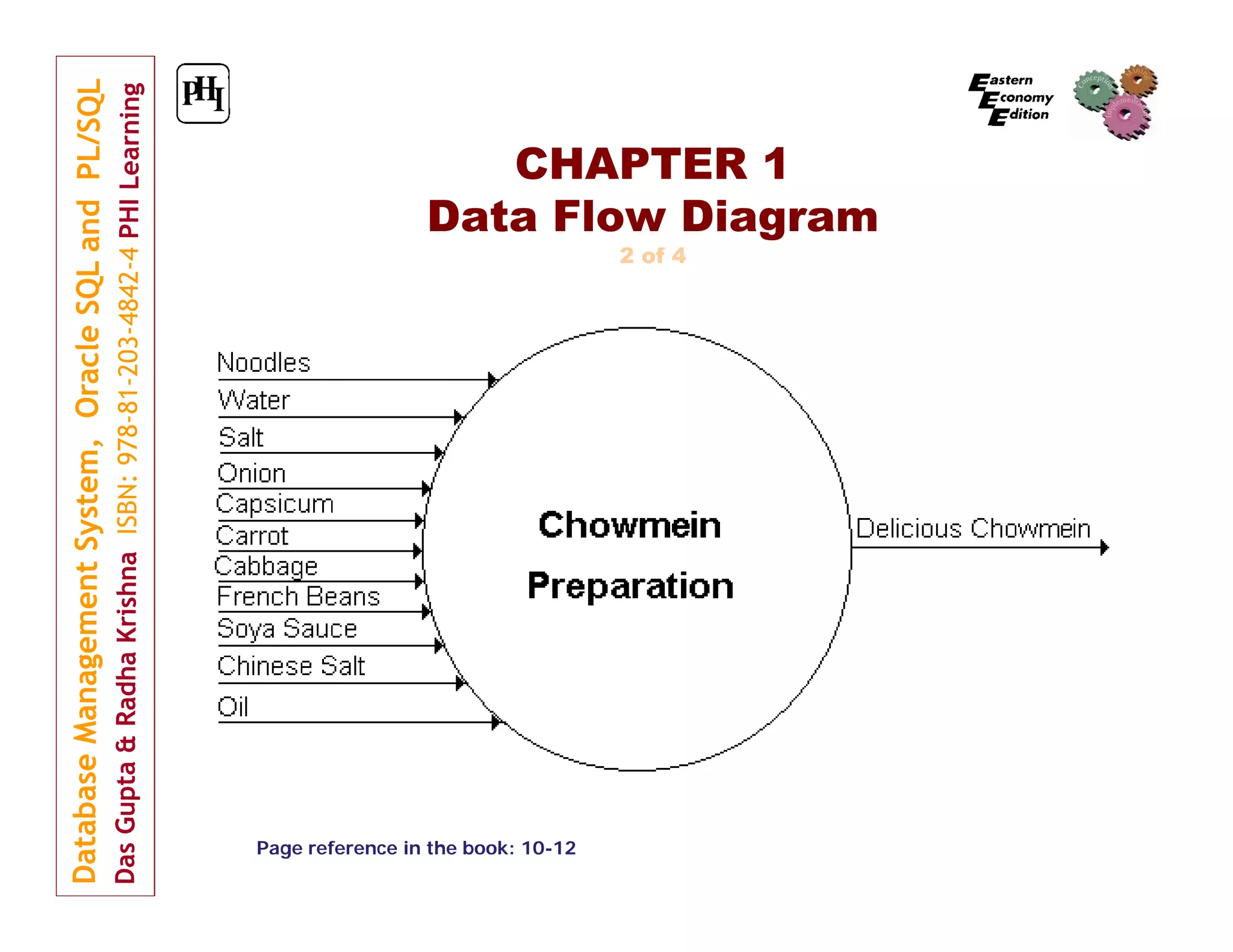
Data Flow Diagram
2 of 4

Page reference in the book: 10-12
CHAPTER 1
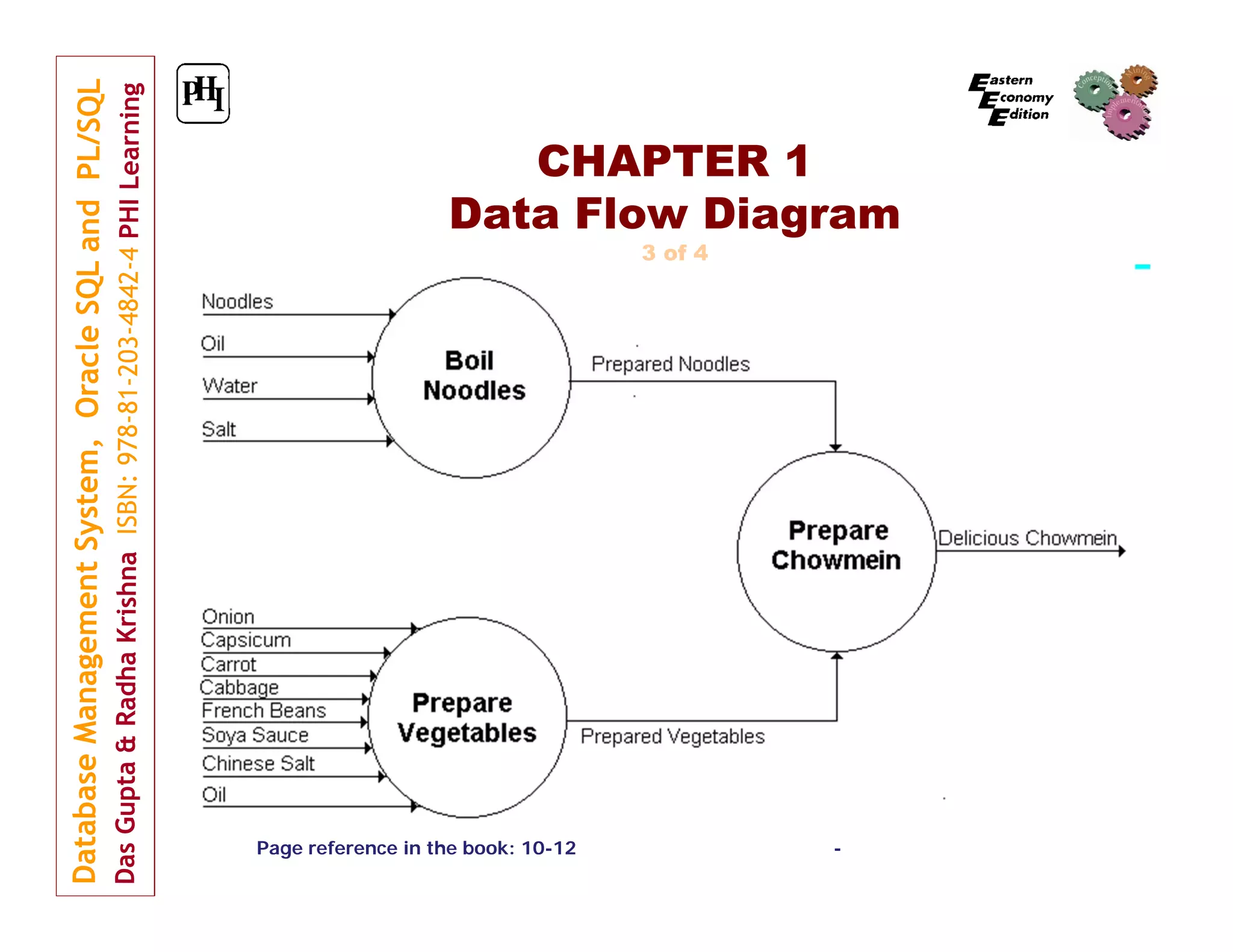
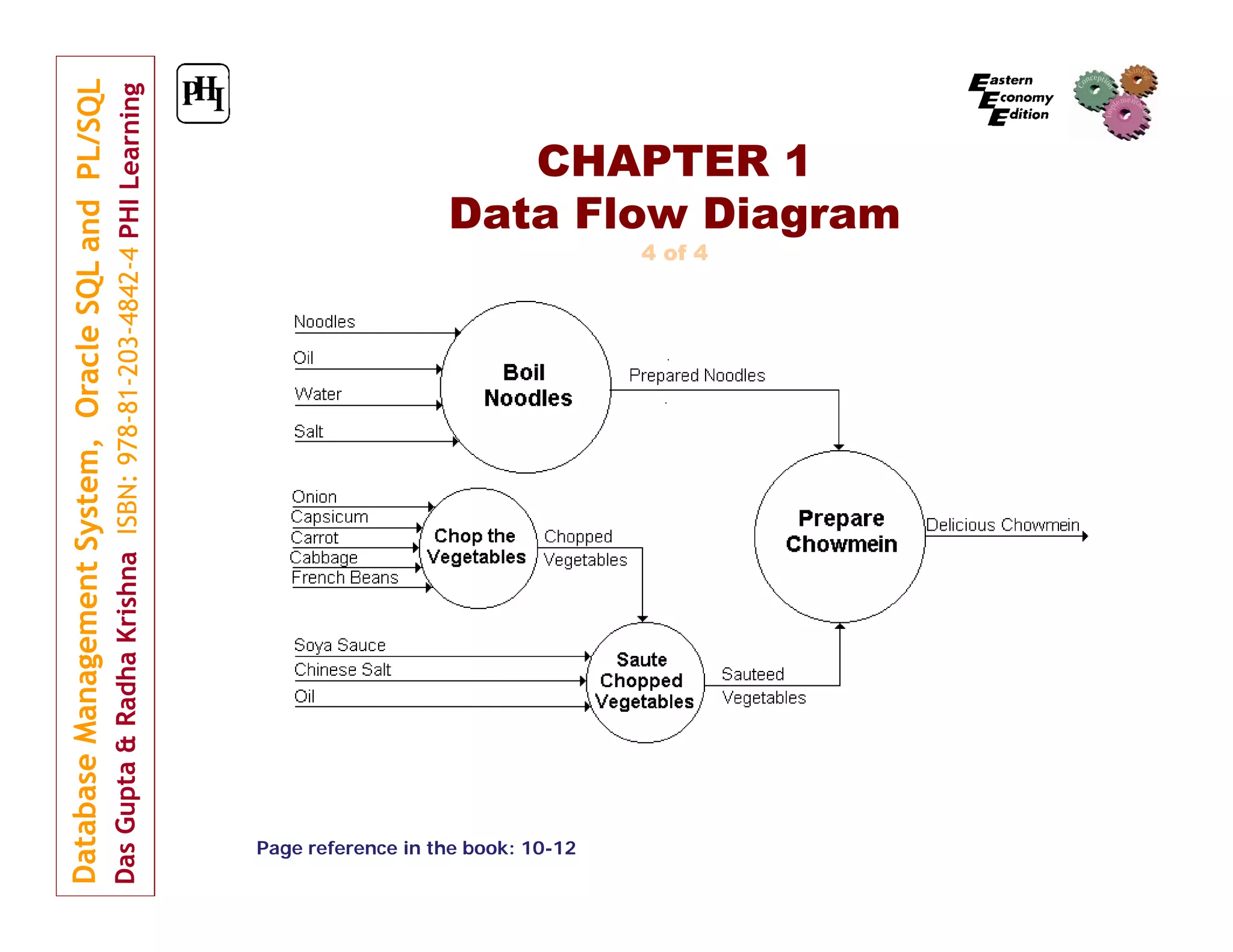
Data Flow Diagram
3 of 4

Page reference in the book: 10-12

-
CHAPTER 1
Data Flow Diagram
4 of 4

Page reference in the book: 10-12
CHAPTER 1
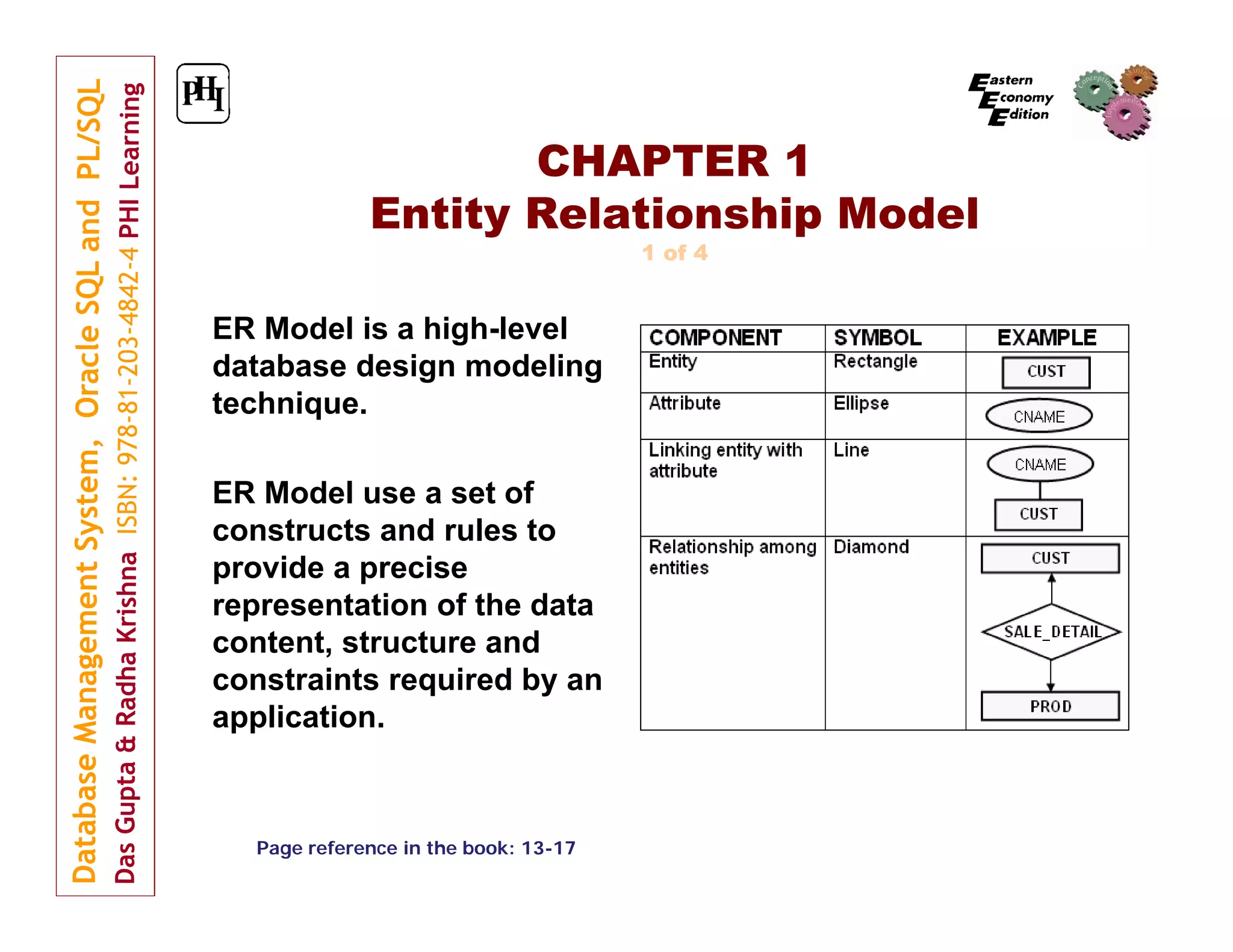
Entity Relationship Model
1 of 4

ER Model is a high-level
database design modeling
technique.
ER Model use a set of
constructs and rules to
provide a precise
representation of the data
content, structure and
constraints required by an
application.

Page reference in the book: 13-17
CHAPTER 1
Entity Relationship Model
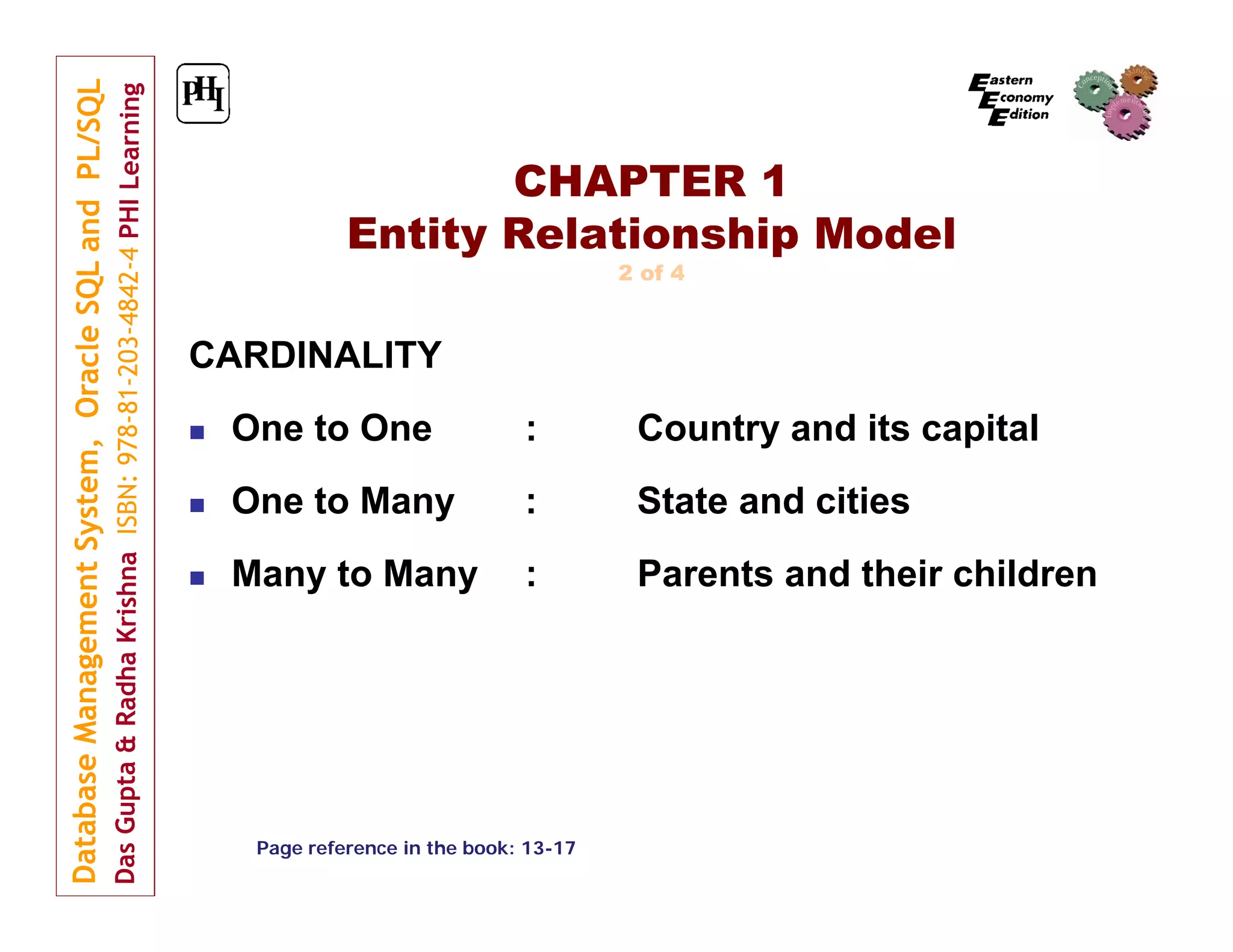
2 of 4

CARDINALITY


One to One

:

Country and its capital



One to Many

:

State and cities



Many to Many

:

Parents and their children

Page reference in the book: 13-17
CHAPTER 1
Entity Relationship Model
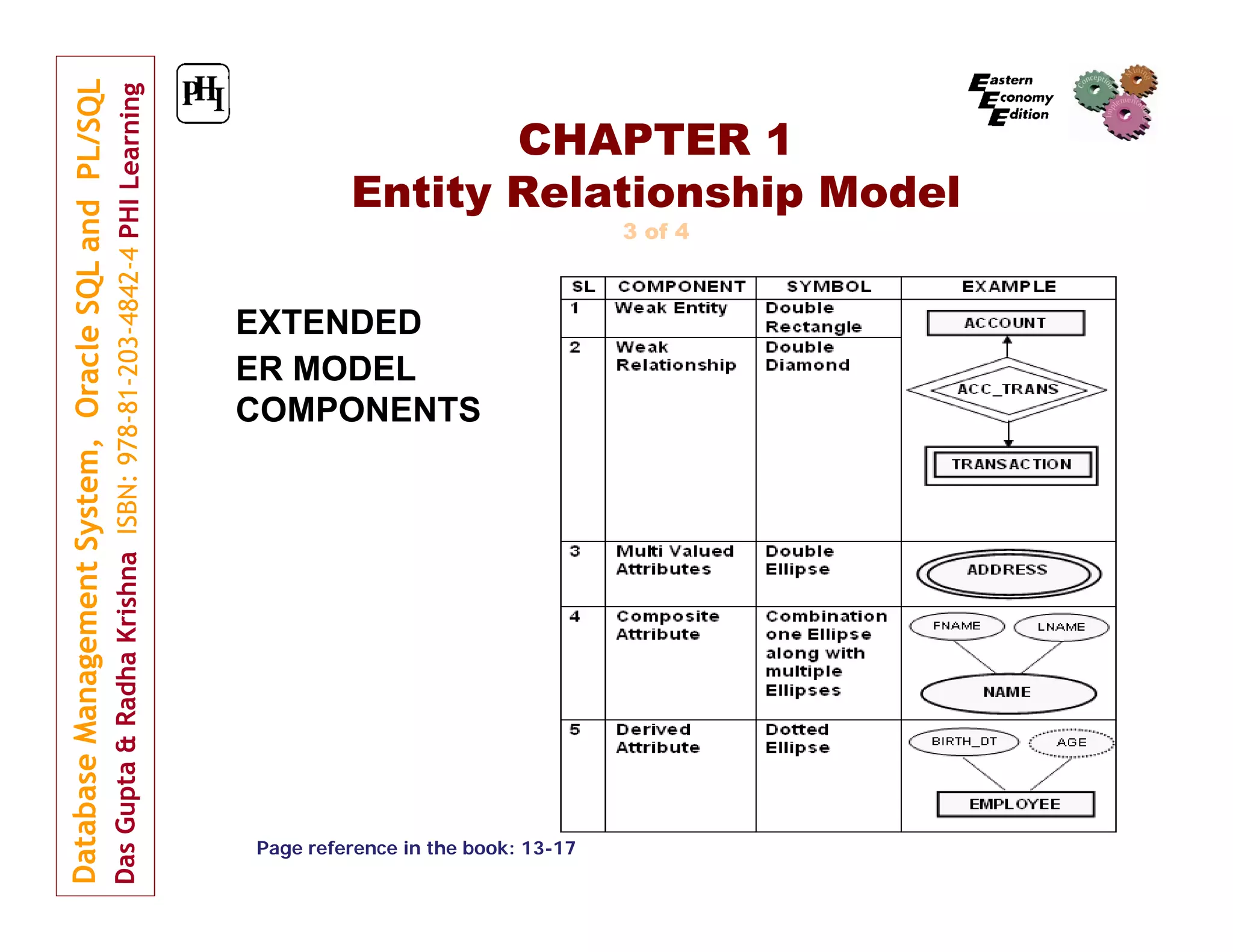
3 of 4

EXTENDED
ER MODEL
COMPONENTS

Page reference in the book: 13-17
CHAPTER 1
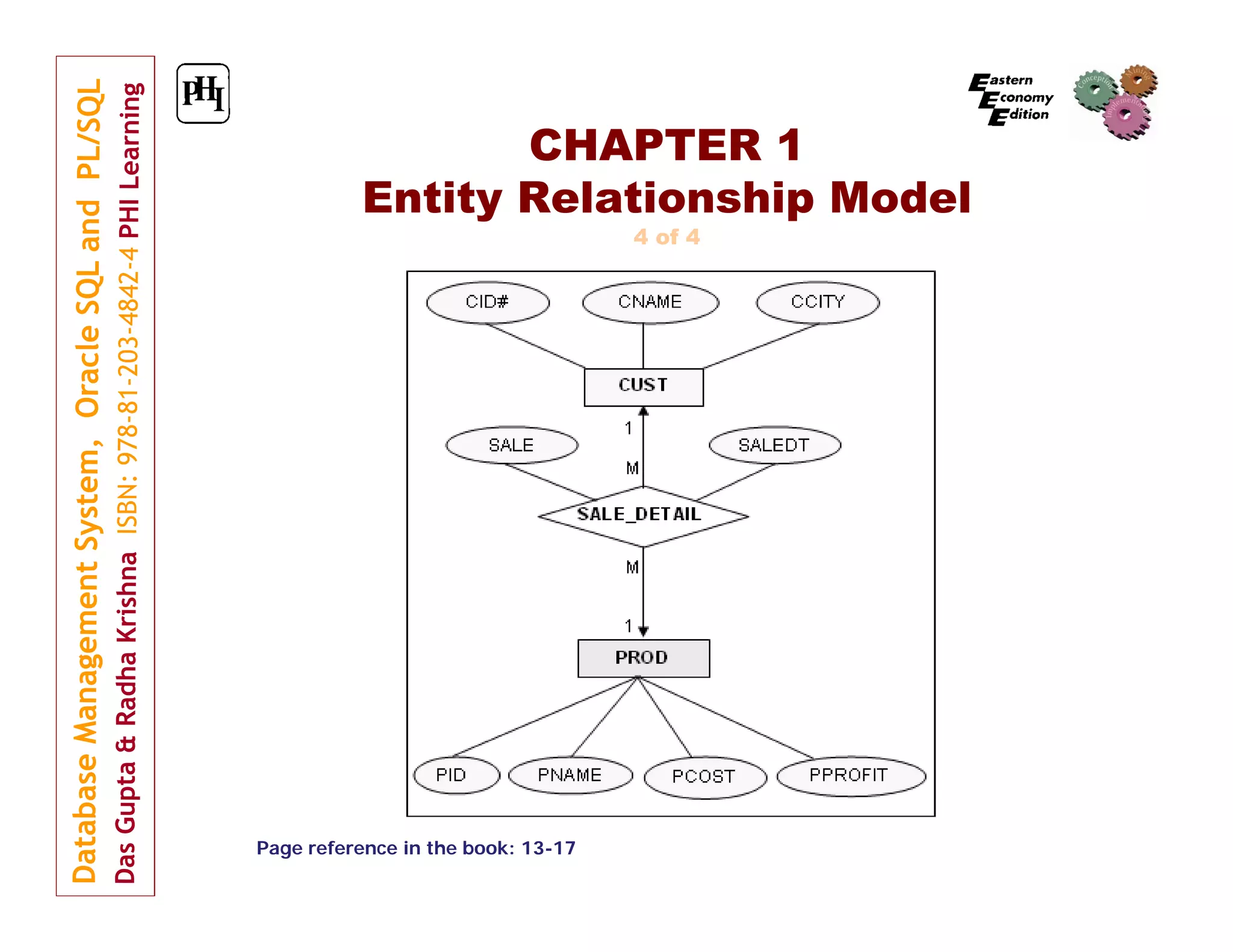
Entity Relationship Model
4 of 4

Page reference in the book: 13-17
CHAPTER 1
Short/Objective Type Questions
1 of 5

Q1. What is the role of ‘security’ in DBMS?
Q2. What do you mean by ‘maintenance’ of a database?
Q3. Briefly describe various types of database models.
Q4. Mention name of two customer friendly SDLC modules.
Q5. Which phase of SDLC generates the maximum revenue in the software
industry?
Q6. Describe black box, white box, alpha and beta level test strategies.
Q7. Describe four major components of data flow diagram.
Q8. Elaborate the terms aggregation, generalization and specializations in
ER model.
Q9. How module is ER represented in the tabular form?
CHAPTER 1
Short/Objective Type Questions
2 of 5

Q10.
(a)
(b)
(c)
(d)

The DFD of an application mainly shows
Processing requirements and the flow of data
Decision and control information
Communication network structure
Entity relationship model

Q11.
(a)
(b)
(c)
(d)

In an ER diagram, ellipse represents
Entity set
Attributes
Generalization
Specialization

Q12.
(a)
(b)
(c)
(d)

ER modeling technique is a
Bottom-up approach
Black-box approach
Top-down approach
White-box approach
CHAPTER 1
Short/Objective Type Questions
3 of 5

Q13. Primary job of database administration is/are
a. Backup
b. Recovery
c. Fine-tuning
d. None of the above
Q14. Low-level data representation deals with
a. Number of records
b. Physical storage of data
c. Logical representation of data
d. None of the above
Q15. Match the following w.r.t.
a. Internal level
b. External level
c. Conceptual level

DBMS.
a. View level
b. Physical level
c. Logical level
CHAPTER 1
Short/Objective Type Questions
4 of 5

Q16.
(a)
(b)
(c)
(d)

Record based model(s) is/are
ER model
Network model
Hierarchical model
Physical data model

Q17. The number of phases in SDLC is
a. 5
b. 6
c. 7
d. 8
Q18.
(a)
(b)
(c)
(d)

In SDLC, DFD and ER models are part of
Feasibility study
System analysis
System design
System study
CHAPTER 1
Short/Objective Type Questions
5 of 5

Q19. In ER model, derived attribute is represented by
a. Double rectangle
b. Double diamond
c. Dotted ellipse
d. Dotted rectangle
Q20. In ER model, degree of relationship is based on
a. Number of attributes
b. Number of entities
c. Number of relations
d. None of the above
CHAPTER 1
Home Assignment
WORKOUT SECTION
DATABASE MANAGEMENT SYSTEM
ORACLE SQL AND PL/SQL
PART I : Basic Concepts & Oracle SQL
Periods Proposed - 10
Chapter 1
Database Basics, System Analysis & Design, Data Flow Diagram & ER Model

2 Periods [Theory]

Chapter 2
Relational Algebra and Normal Forms

2 Periods [Theory]

Chapter 3
SQL Basics, Functions, Sub query & Joins

1 Period [Theory]
2 Period [Practical]

Chapter 4
Data Manipulation Language, Objects, Constraints and Security in Oracle

1 Period [Theory]
2 Period [Practical]
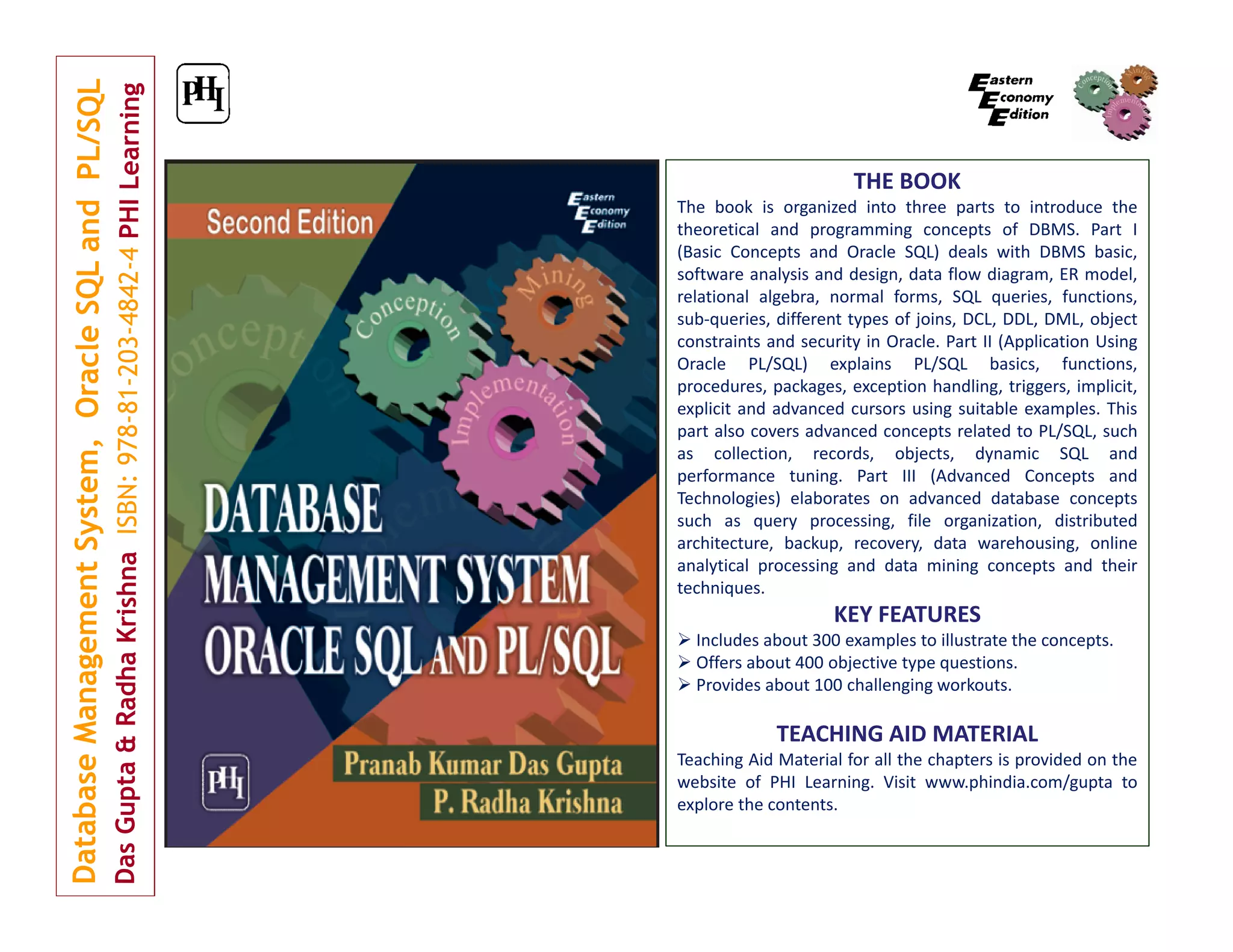
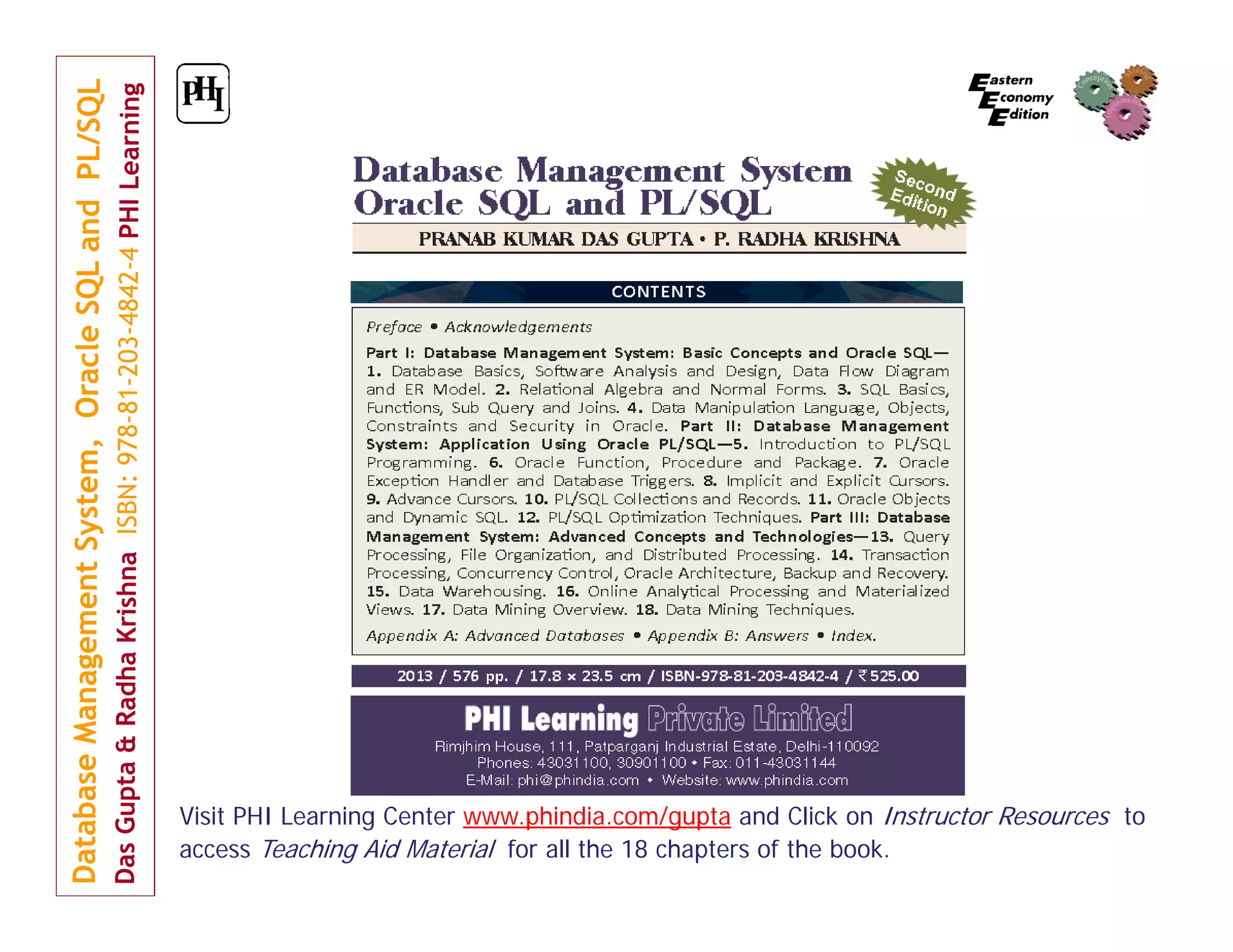
THE BOOK
The book is organized into three parts to introduce the
theoretical and programming concepts of DBMS. Part I
(Basic Concepts and Oracle SQL) deals with DBMS basic,
software analysis and design, data flow diagram, ER model,
relational algebra, normal forms, SQL queries, functions,
sub‐queries, different types of joins, DCL, DDL, DML, object
constraints and security in Oracle. Part II (Application Using
Oracle PL/SQL) explains PL/SQL basics, functions,
procedures, packages, exception handling, triggers, implicit,
explicit and advanced cursors using suitable examples. This
part also covers advanced concepts related to PL/SQL, such
as collection, records, objects, dynamic SQL and
performance tuning. Part III (Advanced Concepts and
Technologies) elaborates on advanced database concepts
such as query processing, file organization, distributed
architecture, backup, recovery, data warehousing, online
analytical processing and data mining concepts and their
techniques.

KEY FEATURES
 Includes about 300 examples to illustrate the concepts.
 Offers about 400 objective type questions.
 Provides about 100 challenging workouts.

TEACHING AID MATERIAL
Teaching Aid Material for all the chapters is provided on the
website of PHI Learning. Visit www.phindia.com/gupta to
explore the contents.
Visit PHI Learning Center www.phindia.com/gupta and Click on Instructor Resources to
access Teaching Aid Material for all the 18 chapters of the book.

Database management system chapter1

  • 1.
    DATABASE MANAGEMENT SYSTEM ORACLESQL AND PL/SQL PART I : Basic Concepts & Oracle SQL Teaching Aid Material (www.phindia.com/gupta) Authors invite your valuable feedback and suggestions on the book pkdasgupta@gmail.com RadhaKrishna_P@infosys.com
  • 2.
    DATABASE MANAGEMENT SYSTEM ORACLESQL AND PL/SQL PART I : Basic Concepts & Oracle SQL CHAPTER 1 Database Basics System Analysis & Design Data Flow Diagram Entity Relationship Model
  • 3.
    CHAPTER 1 Database Basics 1of 3 A database is a collection of interrelated data stored together without harmful or unnecessary redundancy ADVANTAGES OF DATABASE  Centralized management  Sharing of Database  Security DISADVANTAGES OF DATABASE  Implementation Cost  Maintenance Cost Page reference in the book: 3-5
  • 4.
    CHAPTER 1 Database Basics 2of 3 CHARACTERISTICS OF DBMS  Data Representation  Performance  Integrity  Minimal Redundancy  Privacy  Security Page reference in the book: 5
  • 5.
    CHAPTER 1 Database Basics 3of 3 DBMS ARCHITECTURE    Internal Level Conceptual Level External Level DBMS MODELS  Record-Based Model [ Ex. Network, Hierarchical & Relational]  Object-based Database Model  Physical Data Model Page reference in the book: 6-7
  • 6.
    CHAPTER 1 Software DevelopmentLife Cycle 1 of 2 SDLC MODELS     Waterfall Iterative Waterfall Prototype Evolutionary Page reference in the book: 7-10
  • 7.
    CHAPTER 1 Software DevelopmentLife Cycle 2 of 2 SDLC PHASES  Feasibility study  System Analysis  System Design  Coding  Testing  Implementation  Maintenance Page reference in the book: 7-10
  • 8.
    CHAPTER 1 Data FlowDiagram 1 of 4 Pictorial way of showing the flow of data into, around and out of a system MAJOR COMPONENTS  Process  Data Flow  External Entity  Data Stores Page reference in the book: 10-12
  • 9.
    CHAPTER 1 Data FlowDiagram 2 of 4 Page reference in the book: 10-12
  • 10.
    CHAPTER 1 Data FlowDiagram 3 of 4 Page reference in the book: 10-12 -
  • 11.
    CHAPTER 1 Data FlowDiagram 4 of 4 Page reference in the book: 10-12
  • 12.
    CHAPTER 1 Entity RelationshipModel 1 of 4 ER Model is a high-level database design modeling technique. ER Model use a set of constructs and rules to provide a precise representation of the data content, structure and constraints required by an application. Page reference in the book: 13-17
  • 13.
    CHAPTER 1 Entity RelationshipModel 2 of 4 CARDINALITY  One to One : Country and its capital  One to Many : State and cities  Many to Many : Parents and their children Page reference in the book: 13-17
  • 14.
    CHAPTER 1 Entity RelationshipModel 3 of 4 EXTENDED ER MODEL COMPONENTS Page reference in the book: 13-17
  • 15.
    CHAPTER 1 Entity RelationshipModel 4 of 4 Page reference in the book: 13-17
  • 16.
    CHAPTER 1 Short/Objective TypeQuestions 1 of 5 Q1. What is the role of ‘security’ in DBMS? Q2. What do you mean by ‘maintenance’ of a database? Q3. Briefly describe various types of database models. Q4. Mention name of two customer friendly SDLC modules. Q5. Which phase of SDLC generates the maximum revenue in the software industry? Q6. Describe black box, white box, alpha and beta level test strategies. Q7. Describe four major components of data flow diagram. Q8. Elaborate the terms aggregation, generalization and specializations in ER model. Q9. How module is ER represented in the tabular form?
  • 17.
    CHAPTER 1 Short/Objective TypeQuestions 2 of 5 Q10. (a) (b) (c) (d) The DFD of an application mainly shows Processing requirements and the flow of data Decision and control information Communication network structure Entity relationship model Q11. (a) (b) (c) (d) In an ER diagram, ellipse represents Entity set Attributes Generalization Specialization Q12. (a) (b) (c) (d) ER modeling technique is a Bottom-up approach Black-box approach Top-down approach White-box approach
  • 18.
    CHAPTER 1 Short/Objective TypeQuestions 3 of 5 Q13. Primary job of database administration is/are a. Backup b. Recovery c. Fine-tuning d. None of the above Q14. Low-level data representation deals with a. Number of records b. Physical storage of data c. Logical representation of data d. None of the above Q15. Match the following w.r.t. a. Internal level b. External level c. Conceptual level DBMS. a. View level b. Physical level c. Logical level
  • 19.
    CHAPTER 1 Short/Objective TypeQuestions 4 of 5 Q16. (a) (b) (c) (d) Record based model(s) is/are ER model Network model Hierarchical model Physical data model Q17. The number of phases in SDLC is a. 5 b. 6 c. 7 d. 8 Q18. (a) (b) (c) (d) In SDLC, DFD and ER models are part of Feasibility study System analysis System design System study
  • 20.
    CHAPTER 1 Short/Objective TypeQuestions 5 of 5 Q19. In ER model, derived attribute is represented by a. Double rectangle b. Double diamond c. Dotted ellipse d. Dotted rectangle Q20. In ER model, degree of relationship is based on a. Number of attributes b. Number of entities c. Number of relations d. None of the above
  • 21.
  • 22.
    DATABASE MANAGEMENT SYSTEM ORACLESQL AND PL/SQL PART I : Basic Concepts & Oracle SQL Periods Proposed - 10 Chapter 1 Database Basics, System Analysis & Design, Data Flow Diagram & ER Model 2 Periods [Theory] Chapter 2 Relational Algebra and Normal Forms 2 Periods [Theory] Chapter 3 SQL Basics, Functions, Sub query & Joins 1 Period [Theory] 2 Period [Practical] Chapter 4 Data Manipulation Language, Objects, Constraints and Security in Oracle 1 Period [Theory] 2 Period [Practical]
  • 23.
    THE BOOK The book isorganized into three parts to introduce the theoretical and programming concepts of DBMS. Part I (Basic Concepts and Oracle SQL) deals with DBMS basic, software analysis and design, data flow diagram, ER model, relational algebra, normal forms, SQL queries, functions, sub‐queries, different types of joins, DCL, DDL, DML, object constraints and security in Oracle. Part II (Application Using Oracle PL/SQL) explains PL/SQL basics, functions, procedures, packages, exception handling, triggers, implicit, explicit and advanced cursors using suitable examples. This part also covers advanced concepts related to PL/SQL, such as collection, records, objects, dynamic SQL and performance tuning. Part III (Advanced Concepts and Technologies) elaborates on advanced database concepts such as query processing, file organization, distributed architecture, backup, recovery, data warehousing, online analytical processing and data mining concepts and their techniques. KEY FEATURES  Includes about 300 examples to illustrate the concepts.  Offers about 400 objective type questions.  Provides about 100 challenging workouts. TEACHING AID MATERIAL Teaching Aid Material for all the chapters is provided on the website of PHI Learning. Visit www.phindia.com/gupta to explore the contents.
  • 24.
    Visit PHI LearningCenter www.phindia.com/gupta and Click on Instructor Resources to access Teaching Aid Material for all the 18 chapters of the book.