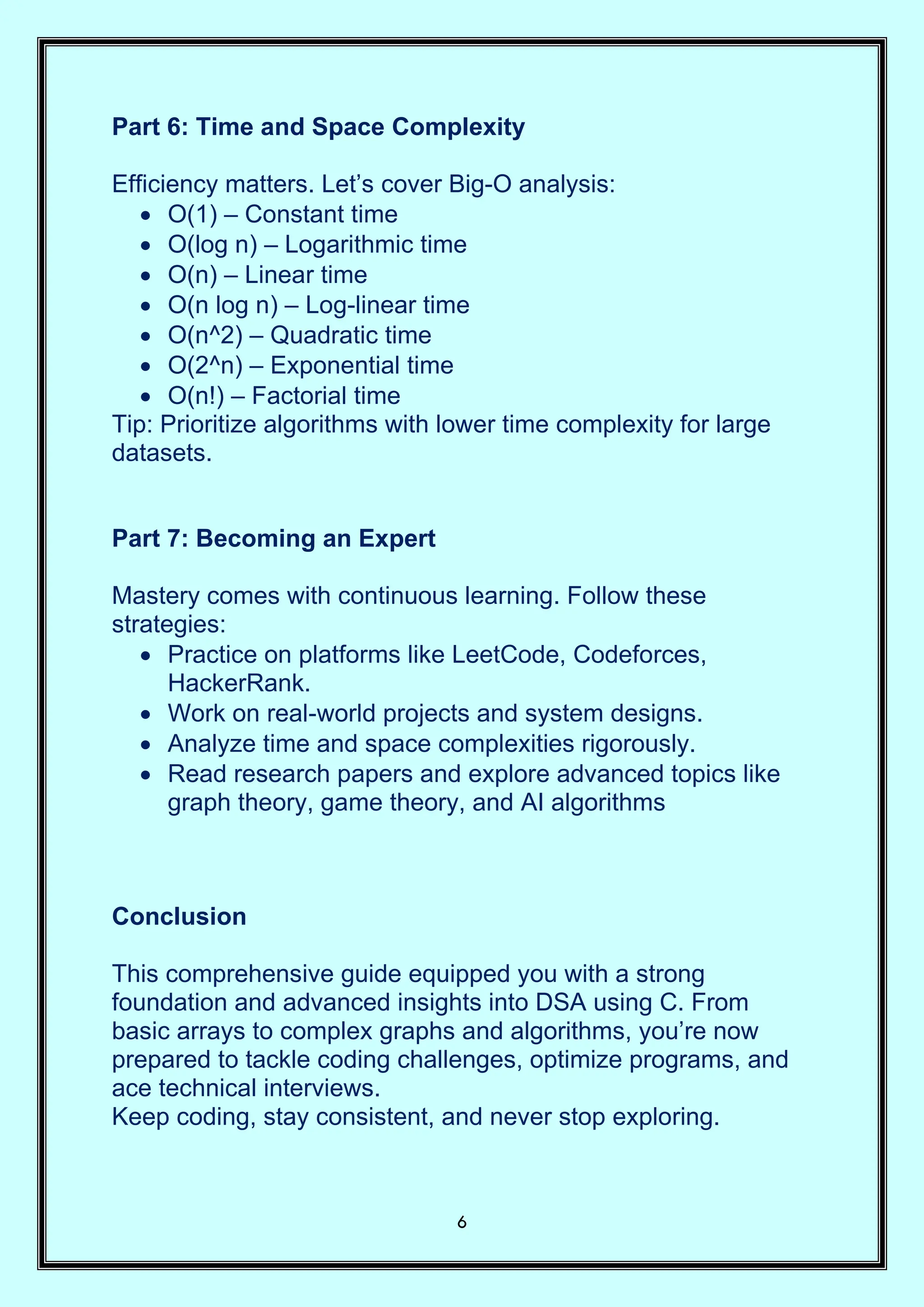
Data Structures and
Algorithms (DSA) in C: From
Beginner to Advanced
Mastering the art of
problem-solving with C
programming — from the
basics to expert-level
strategies
By: Nabajyoti Banik
Date: March 2025
2
Data Structures and Algorithms (DSA)
in C: From Beginner to Advanced
Introduction
Data Structures and Algorithms (DSA) are essential for writing
efficient, scalable, and optimized code. Mastering DSA not only
improves problem-solving skills but also prepares you for
coding interviews and competitive programming. This article
takes you on a comprehensive journey from beginner to expert
level using the C programming language.
Part 1: C Programming Essentials
Before tackling DSA, a strong foundation in C is crucial. Ensure
you understand:
• Variables and Data Types
• Control Flow (if-else, loops)
• Functions and Recursion
• Pointers and Memory Management
• Arrays, Strings, and Structures
Example:
#include <stdio.h>
int main() {
int a = 5, b = 10;
printf("Sum: %dn", a + b);
return 0;
}
Part 2: Introduction to Data Structures
Data structures organize data efficiently. Here is a breakdown:
• Arrays – Fixed-size, contiguous memory.
3
• Linked Lists – Dynamic memory, nodes connected by
pointers.
• Stacks – LIFO structure (push, pop).
• Queues – FIFO structure (enqueue, dequeue).
• Trees – Hierarchical structures.
• Graphs – Nodes connected by edges.
• Hash Tables – Key-value pairs for fast lookup
Example: Basic array implementation:
#include <stdio.h>
int main() {
int arr[] = {1, 2, 3, 4, 5};
for (int i = 0; i < 5; i++) {
printf("%d ", arr[i]);
}
return 0;
}
Part 3: Core Algorithms
Algorithms are step-by-step procedures to solve problems.
Let’s dive into key algorithms:
• Searching Algorithms
• Linear Search – Check elements one by one.
• Binary Search – Divide and conquer on sorted data.
• Sorting Algorithms
• Bubble Sort – Repeated swapping.
• Selection Sort – Find the smallest and place it.
• Insertion Sort – Build sorted array gradually.
• Merge Sort – Divide and merge recursively.
• Quick Sort – Pivot-based partitioning.
Example: Binary Search in C
#include <stdio.h>
int binarySearch(int arr[], int left, int right, int x) {
4
while (left <= right) {
int mid = left + (right - left) / 2;
if (arr[mid] == x)
return mid;
else if (arr[mid] < x)
left = mid + 1;
else
right = mid - 1;
}
return -1;
}
int main() {
int arr[] = {2, 3, 4, 10, 40};
int n = sizeof(arr) / sizeof(arr[0]);
int x = 10;
int result = binarySearch(arr, 0, n - 1, x);
(result == -1) ? printf("Element not foundn") :
printf("Element found at index %dn", result);
return 0;
}
Part 4: Advanced Data Structures
Let’s move to complex, powerful structures:
• Heaps – Priority queues.
• Tries – Efficient string searching.
• AVL Trees – Self-balancing binary search trees.
• Graphs – BFS, DFS, Dijkstra’s algorithm.
• Segment Trees – Range queries and updates.
Example: Depth First Search (DFS):
#include <stdio.h>
#define V 4
int graph[V][V] = {{0, 1, 1, 0}, {1, 0, 0, 1}, {1, 0, 0, 1}, {0, 1, 1, 0}};
int visited[V];
5
void DFS(int node) {
visited[node] = 1;
printf("%d ", node);
for (int i = 0; i < V; i++) {
if (graph[node][i] && !visited[i]) DFS(i);
}
}
int main() {
for (int i = 0; i < V; i++) visited[i] = 0;
DFS(0);
return 0;
}
Part 5: Advanced Algorithms
These techniques help solve more complex problems:
• Greedy Algorithms – Make local optimal choices.
• Divide and Conquer – Break into sub-problems.
• Dynamic Programming – Cache results to avoid
recomputation.
• Backtracking – Explore all possibilities.
• Bit Manipulation – Efficient binary operations.
Example: Fibonacci with Dynamic Programming
#include <stdio.h>
int fib(int n) {
int f[n + 2];
f[0] = 0;
f[1] = 1;
for (int i = 2; i <= n; i++) f[i] = f[i - 1] + f[i - 2];
return f[n];
}
int main() {
printf("%d", fib(10));
return 0; }
6
Part 6: Time and Space Complexity
Efficiency matters. Let’s cover Big-O analysis:
• O(1) – Constant time
• O(log n) – Logarithmic time
• O(n) – Linear time
• O(n log n) – Log-linear time
• O(n^2) – Quadratic time
• O(2^n) – Exponential time
• O(n!) – Factorial time
Tip: Prioritize algorithms with lower time complexity for large
datasets.
Part 7: Becoming an Expert
Mastery comes with continuous learning. Follow these
strategies:
• Practice on platforms like LeetCode, Codeforces,
HackerRank.
• Work on real-world projects and system designs.
• Analyze time and space complexities rigorously.
• Read research papers and explore advanced topics like
graph theory, game theory, and AI algorithms
Conclusion
This comprehensive guide equipped you with a strong
foundation and advanced insights into DSA using C. From
basic arrays to complex graphs and algorithms, you’re now
prepared to tackle coding challenges, optimize programs, and
ace technical interviews.
Keep coding, stay consistent, and never stop exploring.

Data Structures and Algorithms (DSA) in C

  • 1.
    Data Structures and Algorithms(DSA) in C: From Beginner to Advanced Mastering the art of problem-solving with C programming — from the basics to expert-level strategies By: Nabajyoti Banik Date: March 2025
  • 2.
    2 Data Structures andAlgorithms (DSA) in C: From Beginner to Advanced Introduction Data Structures and Algorithms (DSA) are essential for writing efficient, scalable, and optimized code. Mastering DSA not only improves problem-solving skills but also prepares you for coding interviews and competitive programming. This article takes you on a comprehensive journey from beginner to expert level using the C programming language. Part 1: C Programming Essentials Before tackling DSA, a strong foundation in C is crucial. Ensure you understand: • Variables and Data Types • Control Flow (if-else, loops) • Functions and Recursion • Pointers and Memory Management • Arrays, Strings, and Structures Example: #include <stdio.h> int main() { int a = 5, b = 10; printf("Sum: %dn", a + b); return 0; } Part 2: Introduction to Data Structures Data structures organize data efficiently. Here is a breakdown: • Arrays – Fixed-size, contiguous memory.
  • 3.
    3 • Linked Lists– Dynamic memory, nodes connected by pointers. • Stacks – LIFO structure (push, pop). • Queues – FIFO structure (enqueue, dequeue). • Trees – Hierarchical structures. • Graphs – Nodes connected by edges. • Hash Tables – Key-value pairs for fast lookup Example: Basic array implementation: #include <stdio.h> int main() { int arr[] = {1, 2, 3, 4, 5}; for (int i = 0; i < 5; i++) { printf("%d ", arr[i]); } return 0; } Part 3: Core Algorithms Algorithms are step-by-step procedures to solve problems. Let’s dive into key algorithms: • Searching Algorithms • Linear Search – Check elements one by one. • Binary Search – Divide and conquer on sorted data. • Sorting Algorithms • Bubble Sort – Repeated swapping. • Selection Sort – Find the smallest and place it. • Insertion Sort – Build sorted array gradually. • Merge Sort – Divide and merge recursively. • Quick Sort – Pivot-based partitioning. Example: Binary Search in C #include <stdio.h> int binarySearch(int arr[], int left, int right, int x) {
  • 4.
    4 while (left <=right) { int mid = left + (right - left) / 2; if (arr[mid] == x) return mid; else if (arr[mid] < x) left = mid + 1; else right = mid - 1; } return -1; } int main() { int arr[] = {2, 3, 4, 10, 40}; int n = sizeof(arr) / sizeof(arr[0]); int x = 10; int result = binarySearch(arr, 0, n - 1, x); (result == -1) ? printf("Element not foundn") : printf("Element found at index %dn", result); return 0; } Part 4: Advanced Data Structures Let’s move to complex, powerful structures: • Heaps – Priority queues. • Tries – Efficient string searching. • AVL Trees – Self-balancing binary search trees. • Graphs – BFS, DFS, Dijkstra’s algorithm. • Segment Trees – Range queries and updates. Example: Depth First Search (DFS): #include <stdio.h> #define V 4 int graph[V][V] = {{0, 1, 1, 0}, {1, 0, 0, 1}, {1, 0, 0, 1}, {0, 1, 1, 0}}; int visited[V];
  • 5.
    5 void DFS(int node){ visited[node] = 1; printf("%d ", node); for (int i = 0; i < V; i++) { if (graph[node][i] && !visited[i]) DFS(i); } } int main() { for (int i = 0; i < V; i++) visited[i] = 0; DFS(0); return 0; } Part 5: Advanced Algorithms These techniques help solve more complex problems: • Greedy Algorithms – Make local optimal choices. • Divide and Conquer – Break into sub-problems. • Dynamic Programming – Cache results to avoid recomputation. • Backtracking – Explore all possibilities. • Bit Manipulation – Efficient binary operations. Example: Fibonacci with Dynamic Programming #include <stdio.h> int fib(int n) { int f[n + 2]; f[0] = 0; f[1] = 1; for (int i = 2; i <= n; i++) f[i] = f[i - 1] + f[i - 2]; return f[n]; } int main() { printf("%d", fib(10)); return 0; }
  • 6.
    6 Part 6: Timeand Space Complexity Efficiency matters. Let’s cover Big-O analysis: • O(1) – Constant time • O(log n) – Logarithmic time • O(n) – Linear time • O(n log n) – Log-linear time • O(n^2) – Quadratic time • O(2^n) – Exponential time • O(n!) – Factorial time Tip: Prioritize algorithms with lower time complexity for large datasets. Part 7: Becoming an Expert Mastery comes with continuous learning. Follow these strategies: • Practice on platforms like LeetCode, Codeforces, HackerRank. • Work on real-world projects and system designs. • Analyze time and space complexities rigorously. • Read research papers and explore advanced topics like graph theory, game theory, and AI algorithms Conclusion This comprehensive guide equipped you with a strong foundation and advanced insights into DSA using C. From basic arrays to complex graphs and algorithms, you’re now prepared to tackle coding challenges, optimize programs, and ace technical interviews. Keep coding, stay consistent, and never stop exploring.