Data Communication Tutorial - 1
Overview:
2
◦Introduction
◦Data Communication Principle
◦Effectiveness of Data Communication
◦Transmission Medium
◦Data Representation
◦Protocols
◦Data Flow
◦Communication Architecture
Introduction:
3
 Why Data Communication???
As the region prepares for e-governance, e-commerce
there is a need for reliable & secure data communication
networks.
In a corporate networks where information and data are a
serious asset, the need for a highly qualified Network and
System Administrators cannot be ignored.
Software development is one area that could lead to ICT
private sector growth but it must meet international
standards.
The data Communications course has been designed to
respond to the above challenges by creating a critical
mass of the professionals in Data Communications and
Software Engineering.
Data Communication:
4
What is Data Communication?
Exchange of digital information between two
digital devices is Called data communication.
• Sending an email is an example of data communication
Requirements of Data Communication:
At least two devices ready to communicate.
Transmission Medium
Data Representation.
A set of rules & procedure (Protocols)
Effectiveness of Data
Communication:
5
 Delivery: The system must deliver data to the correct destination. Data
must be received by the intended device or user and only by that device
or user.
 Accuracy: The system must deliver the data accurately. Data that have
been altered in transmission and left uncorrected are unusable.
 Timeliness: The system must deliver data in a timely manner. Data
delivered late are useless.
 Jitter: Jitter refers to the variation in the packet arrival time. It is the
uneven delay in the delivery of audio or video packets.
Transmission Medium:
Transmission from transmitter to receiver goes over some transmission
medium using electromagnetic waves. Such as:
Guided Media: Waves are guided along a physical path; twisted
pair, optical fiber, coaxial cable.
Unguided Media: Waves that are not guided; Such as air waves
& radio waves.
Direct Link: Signal goes from transmitter to receiver without
intermediate devices, other than amplifiers and repeaters.
Point-to-Point Link: Guided media with direct link between two
devices.
Multipoint Guided Configuration: More than two devices can
share the same medium.
6
Data Representation:
Text: text is represented as a bit pattern, a sequence of bits
(Os or 1s). Different sets of bit patterns have been designed to
represent text symbols. Each set is called a code, and the
process of representing symbols is called coding.
Numbers: Numbers are also represented by bit patterns.
However, a code such as ASCII is not used to represent
numbers; the number is directly converted to a binary
number to simplify mathematical operations.
Images: Images are also represented by bit patterns. In its
simplest form, an image is composed of a matrix of pixels
(picture elements), where each pixel is a small dot. After an
image is divided into pixels, each pixel is assigned a bit
pattern.
7
Data Representation:
Audio: Audio refers to the recording or broadcasting of sound or music.
Audio is by nature different from text, numbers, or images. It is
continuous, not discrete.
Video: Video refers to the recording or broadcasting of a picture or
movie. Video can either be produced as a continuous entity (e.g., by a
TV camera), or it can be a combination of images as a discrete entity.
8
Protocols:
A protocol is a set of rules that govern data
communications. A protocol defines what is
communicated, how it is communicated, and when it is
communicated. The key elements of a protocol are
syntax, semantics, and timing.
Syntax: The term syntax refers to the structure or
format of the data, meaning the order in which they
are presented. For example, a simple protocol might
expect the first 8 bits of data to be the address of the
sender, the second 8 bits to be the address of the
receiver, and the rest of the stream to be the message
itself.
9
Protocols:
Semantics: The word semantics refers to the meaning of each section of
bits. How is a particular pattern to be interpreted, and what action is to
be taken based on that interpretation. For example, does an address
identify the route to be taken or the final destination of the message?
Timing: The term timing refers to two characteristics: when data should
be sent and how fast they can be sent. For example, if a sender
produces data at 100 Mbps but the receiver can process data at only 1
Mbps, the transmission will overload the receiver and some data will be
lost.
10
Data Flow:
11
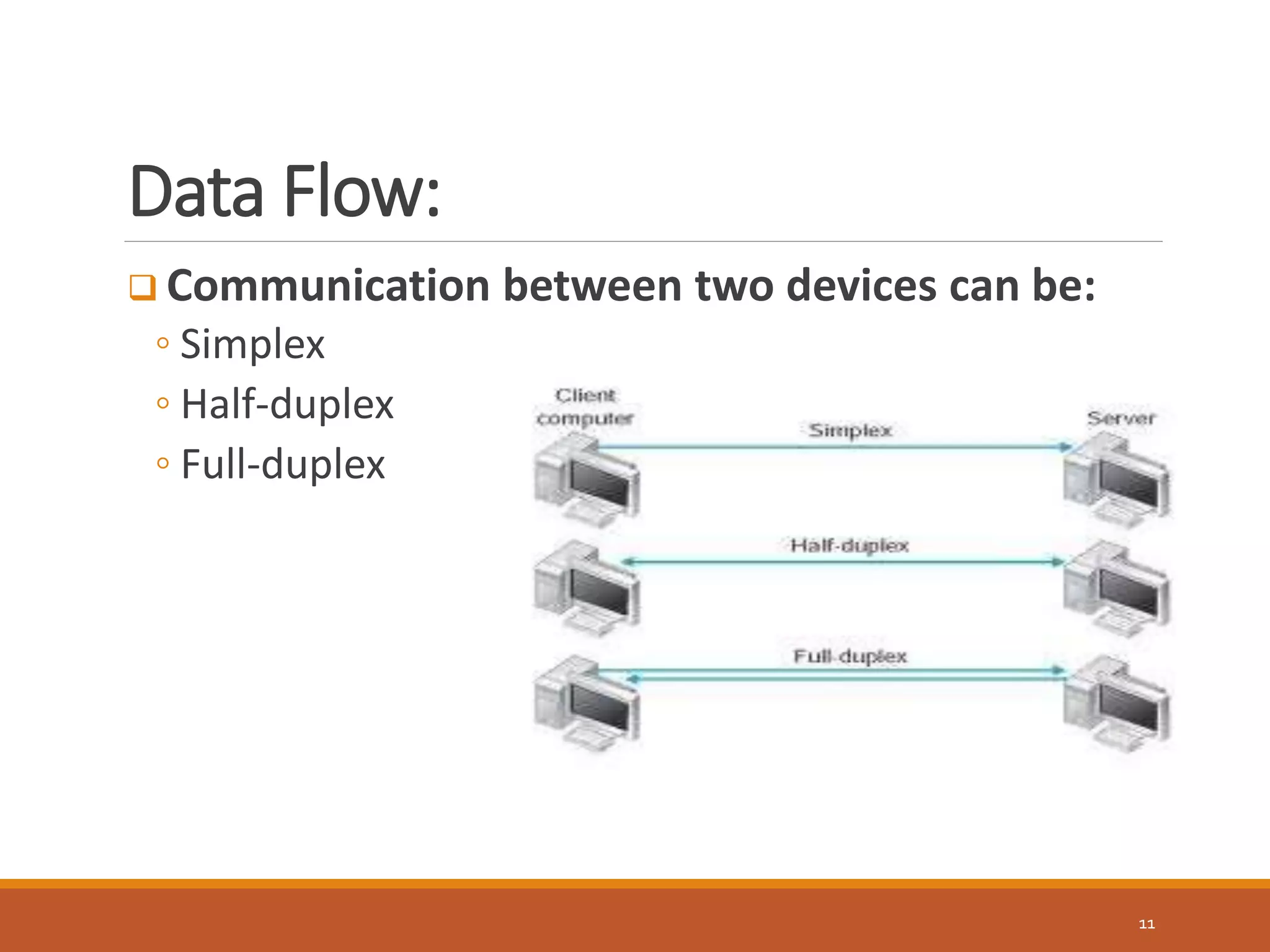
 Communication between two devices can be:
◦ Simplex
◦ Half-duplex
◦ Full-duplex
Data Flow:
12
Simplex:
The communication is unidirectional like one way traffic.
Only one of the two devices on a link can transmit; the other can only
receive.
Simplex mode can use the entire capacity of the channel to send data in
one direction.
Keyboard and traditional monitors are example of simplex.
Data Flow:
13
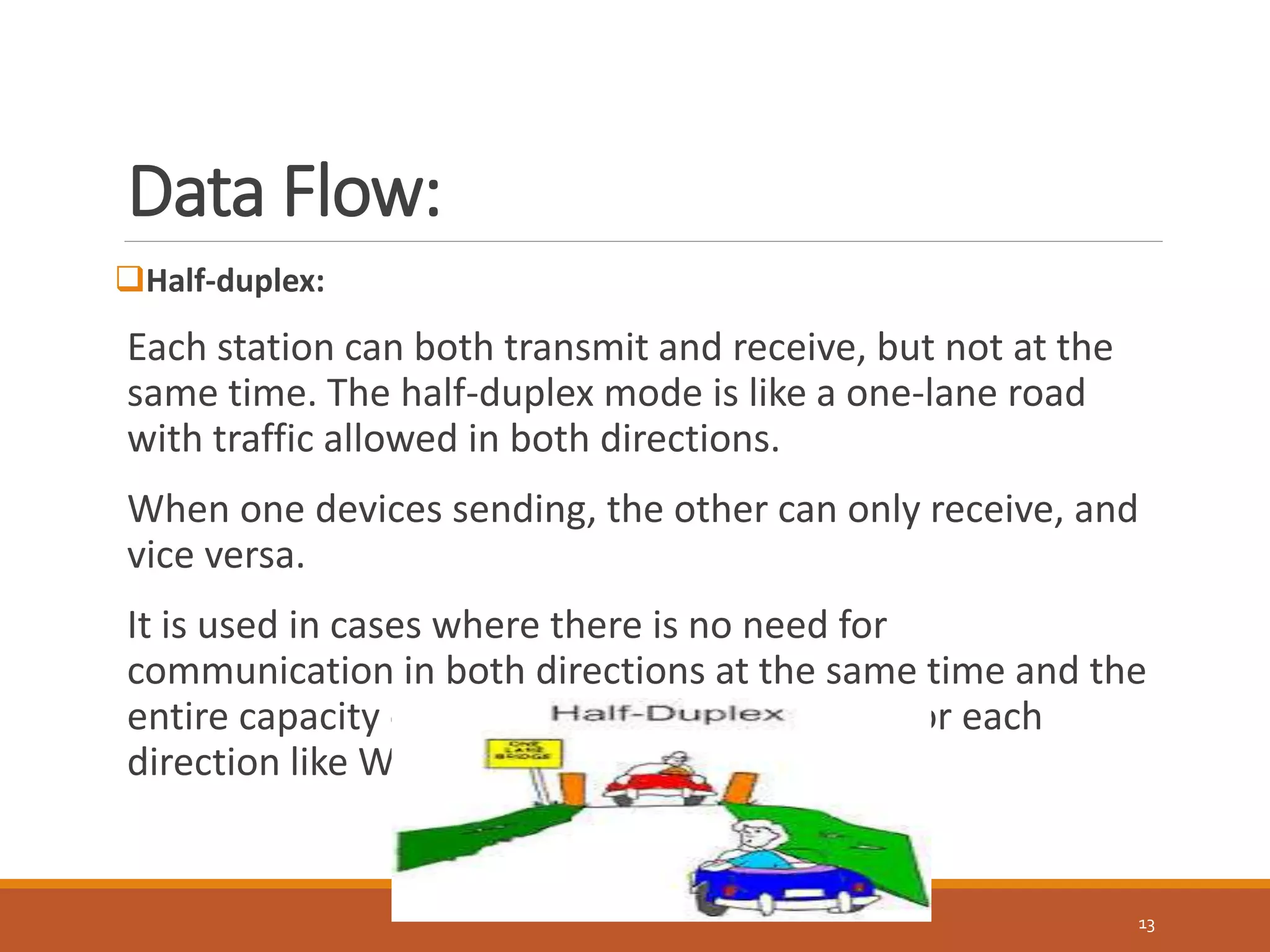
Half-duplex:
Each station can both transmit and receive, but not at the
same time. The half-duplex mode is like a one-lane road
with traffic allowed in both directions.
When one devices sending, the other can only receive, and
vice versa.
It is used in cases where there is no need for
communication in both directions at the same time and the
entire capacity of the channel can be utilized for each
direction like Walkie-talkies.
Data Flow:
14
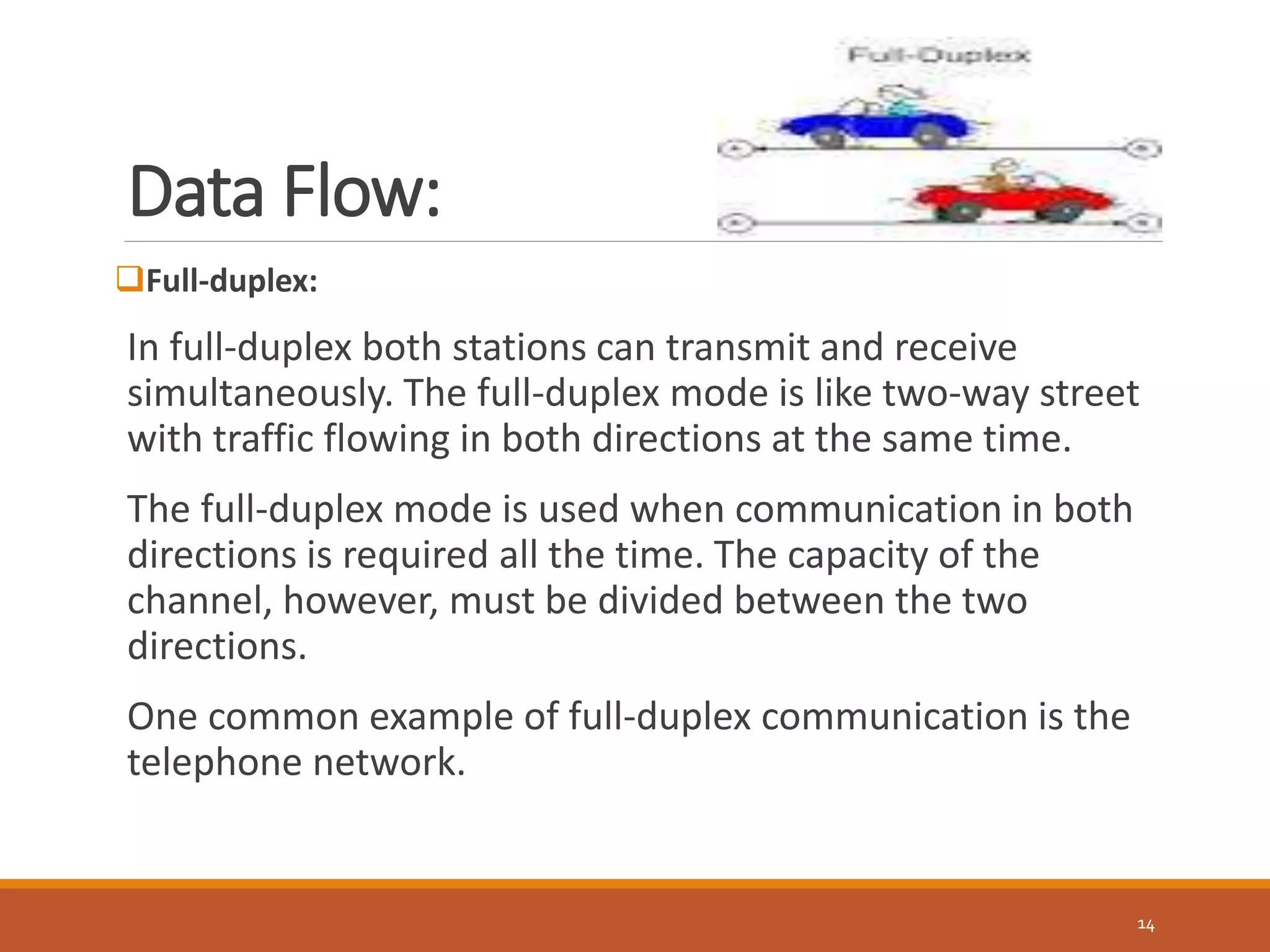
Full-duplex:
In full-duplex both stations can transmit and receive
simultaneously. The full-duplex mode is like two-way street
with traffic flowing in both directions at the same time.
The full-duplex mode is used when communication in both
directions is required all the time. The capacity of the
channel, however, must be divided between the two
directions.
One common example of full-duplex communication is the
telephone network.
Communication Architecture:
15
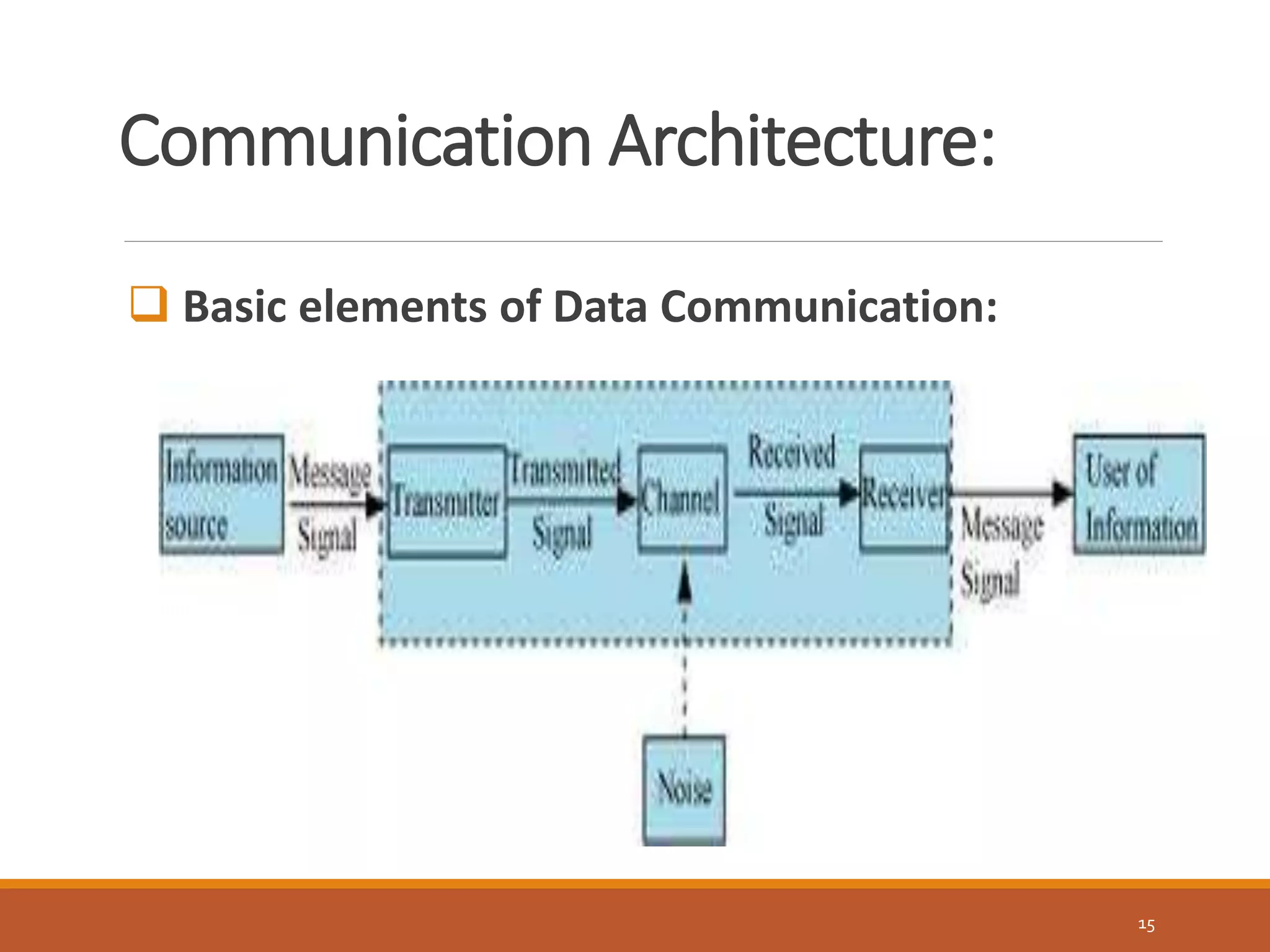
 Basic elements of Data Communication:
Communication Architecture:
16
 Basic elements of Data Communication:
Message: The message is the information (data) to be communicated.
Text, numbers, pictures, audio and video.
Source: Entity that generates data.
A person who speaks into the phone, or a computer sending data to the
modem.
Transmitter: A device to transform/encode the signal generated by the
source.
A modem transforms digital data to analog signal that can be handled by the
telephone network.
Communication Architecture:
17
Basic elements of Data Communication:
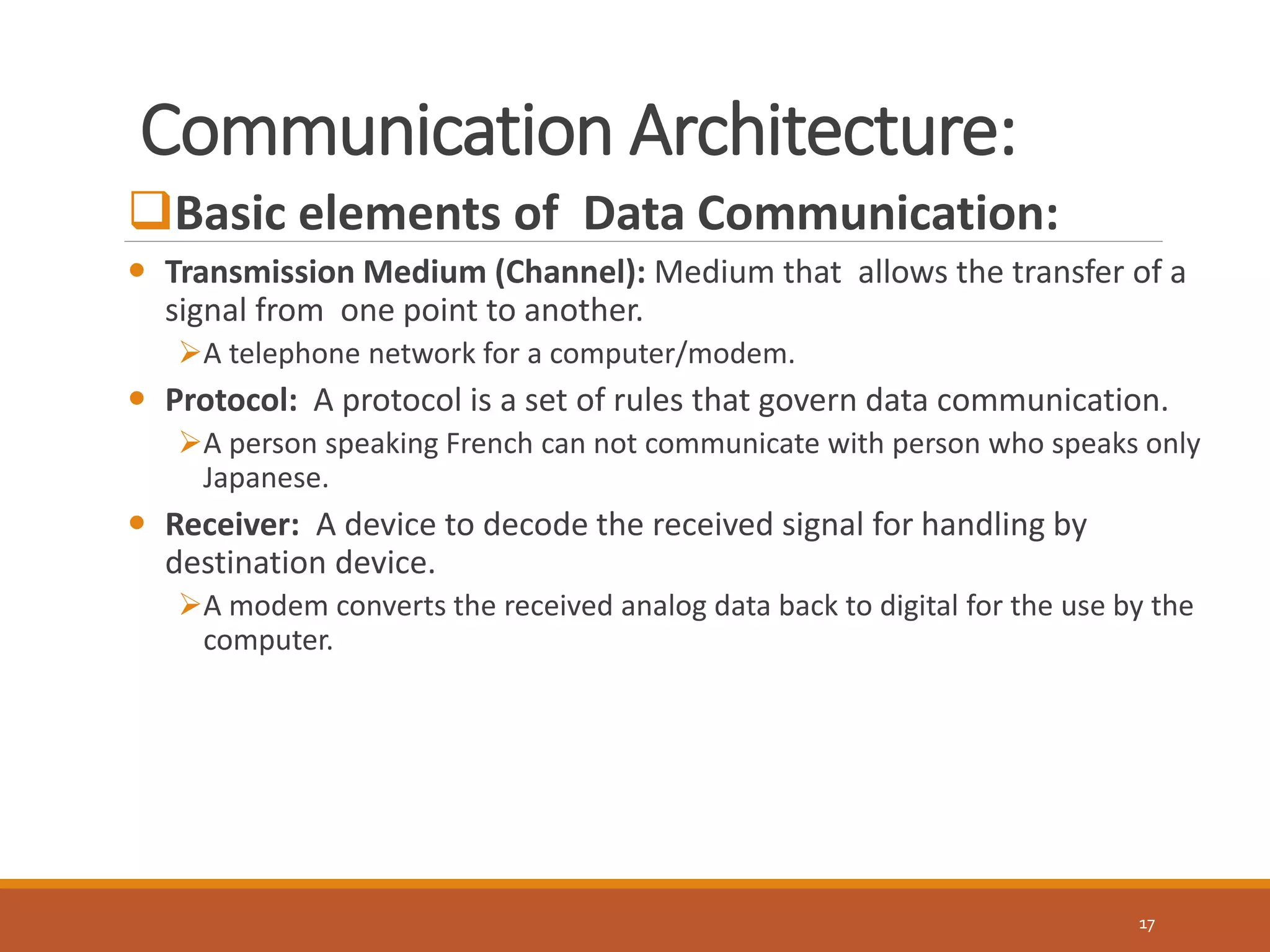
 Transmission Medium (Channel): Medium that allows the transfer of a
signal from one point to another.
A telephone network for a computer/modem.
 Protocol: A protocol is a set of rules that govern data communication.
A person speaking French can not communicate with person who speaks only
Japanese.
 Receiver: A device to decode the received signal for handling by
destination device.
A modem converts the received analog data back to digital for the use by the
computer.
End
 We are KaziSilo
Web: https://www.kazisilo.com/
18

Data Communication Tutorial - 1

  • 1.
  • 2.
    Overview: 2 ◦Introduction ◦Data Communication Principle ◦Effectivenessof Data Communication ◦Transmission Medium ◦Data Representation ◦Protocols ◦Data Flow ◦Communication Architecture
  • 3.
    Introduction: 3  Why DataCommunication??? As the region prepares for e-governance, e-commerce there is a need for reliable & secure data communication networks. In a corporate networks where information and data are a serious asset, the need for a highly qualified Network and System Administrators cannot be ignored. Software development is one area that could lead to ICT private sector growth but it must meet international standards. The data Communications course has been designed to respond to the above challenges by creating a critical mass of the professionals in Data Communications and Software Engineering.
  • 4.
    Data Communication: 4 What isData Communication? Exchange of digital information between two digital devices is Called data communication. • Sending an email is an example of data communication Requirements of Data Communication: At least two devices ready to communicate. Transmission Medium Data Representation. A set of rules & procedure (Protocols)
  • 5.
    Effectiveness of Data Communication: 5 Delivery: The system must deliver data to the correct destination. Data must be received by the intended device or user and only by that device or user.  Accuracy: The system must deliver the data accurately. Data that have been altered in transmission and left uncorrected are unusable.  Timeliness: The system must deliver data in a timely manner. Data delivered late are useless.  Jitter: Jitter refers to the variation in the packet arrival time. It is the uneven delay in the delivery of audio or video packets.
  • 6.
    Transmission Medium: Transmission fromtransmitter to receiver goes over some transmission medium using electromagnetic waves. Such as: Guided Media: Waves are guided along a physical path; twisted pair, optical fiber, coaxial cable. Unguided Media: Waves that are not guided; Such as air waves & radio waves. Direct Link: Signal goes from transmitter to receiver without intermediate devices, other than amplifiers and repeaters. Point-to-Point Link: Guided media with direct link between two devices. Multipoint Guided Configuration: More than two devices can share the same medium. 6
  • 7.
    Data Representation: Text: textis represented as a bit pattern, a sequence of bits (Os or 1s). Different sets of bit patterns have been designed to represent text symbols. Each set is called a code, and the process of representing symbols is called coding. Numbers: Numbers are also represented by bit patterns. However, a code such as ASCII is not used to represent numbers; the number is directly converted to a binary number to simplify mathematical operations. Images: Images are also represented by bit patterns. In its simplest form, an image is composed of a matrix of pixels (picture elements), where each pixel is a small dot. After an image is divided into pixels, each pixel is assigned a bit pattern. 7
  • 8.
    Data Representation: Audio: Audiorefers to the recording or broadcasting of sound or music. Audio is by nature different from text, numbers, or images. It is continuous, not discrete. Video: Video refers to the recording or broadcasting of a picture or movie. Video can either be produced as a continuous entity (e.g., by a TV camera), or it can be a combination of images as a discrete entity. 8
  • 9.
    Protocols: A protocol isa set of rules that govern data communications. A protocol defines what is communicated, how it is communicated, and when it is communicated. The key elements of a protocol are syntax, semantics, and timing. Syntax: The term syntax refers to the structure or format of the data, meaning the order in which they are presented. For example, a simple protocol might expect the first 8 bits of data to be the address of the sender, the second 8 bits to be the address of the receiver, and the rest of the stream to be the message itself. 9
  • 10.
    Protocols: Semantics: The wordsemantics refers to the meaning of each section of bits. How is a particular pattern to be interpreted, and what action is to be taken based on that interpretation. For example, does an address identify the route to be taken or the final destination of the message? Timing: The term timing refers to two characteristics: when data should be sent and how fast they can be sent. For example, if a sender produces data at 100 Mbps but the receiver can process data at only 1 Mbps, the transmission will overload the receiver and some data will be lost. 10
  • 11.
    Data Flow: 11  Communicationbetween two devices can be: ◦ Simplex ◦ Half-duplex ◦ Full-duplex
  • 12.
    Data Flow: 12 Simplex: The communicationis unidirectional like one way traffic. Only one of the two devices on a link can transmit; the other can only receive. Simplex mode can use the entire capacity of the channel to send data in one direction. Keyboard and traditional monitors are example of simplex.
  • 13.
    Data Flow: 13 Half-duplex: Each stationcan both transmit and receive, but not at the same time. The half-duplex mode is like a one-lane road with traffic allowed in both directions. When one devices sending, the other can only receive, and vice versa. It is used in cases where there is no need for communication in both directions at the same time and the entire capacity of the channel can be utilized for each direction like Walkie-talkies.
  • 14.
    Data Flow: 14 Full-duplex: In full-duplexboth stations can transmit and receive simultaneously. The full-duplex mode is like two-way street with traffic flowing in both directions at the same time. The full-duplex mode is used when communication in both directions is required all the time. The capacity of the channel, however, must be divided between the two directions. One common example of full-duplex communication is the telephone network.
  • 15.
    Communication Architecture: 15  Basicelements of Data Communication:
  • 16.
    Communication Architecture: 16  Basicelements of Data Communication: Message: The message is the information (data) to be communicated. Text, numbers, pictures, audio and video. Source: Entity that generates data. A person who speaks into the phone, or a computer sending data to the modem. Transmitter: A device to transform/encode the signal generated by the source. A modem transforms digital data to analog signal that can be handled by the telephone network.
  • 17.
    Communication Architecture: 17 Basic elementsof Data Communication:  Transmission Medium (Channel): Medium that allows the transfer of a signal from one point to another. A telephone network for a computer/modem.  Protocol: A protocol is a set of rules that govern data communication. A person speaking French can not communicate with person who speaks only Japanese.  Receiver: A device to decode the received signal for handling by destination device. A modem converts the received analog data back to digital for the use by the computer.
  • 18.
    End  We areKaziSilo Web: https://www.kazisilo.com/ 18