Data Communication
Overview
Data Communication
• Transferring data over a transmission medium between two or more
devices, systems, or places is known as data communication. Data
communication in computer networks refers to the exchange of data
between devices through a network. It is a fundamental concept in
networking, enabling devices like computers, servers, and routers to
share information efficiently. Nowadays, computing and
telecommunications depend heavily on this data transmission, which
makes a variety of applications conceivable, including email, video
chatting, the Internet, and many more things.
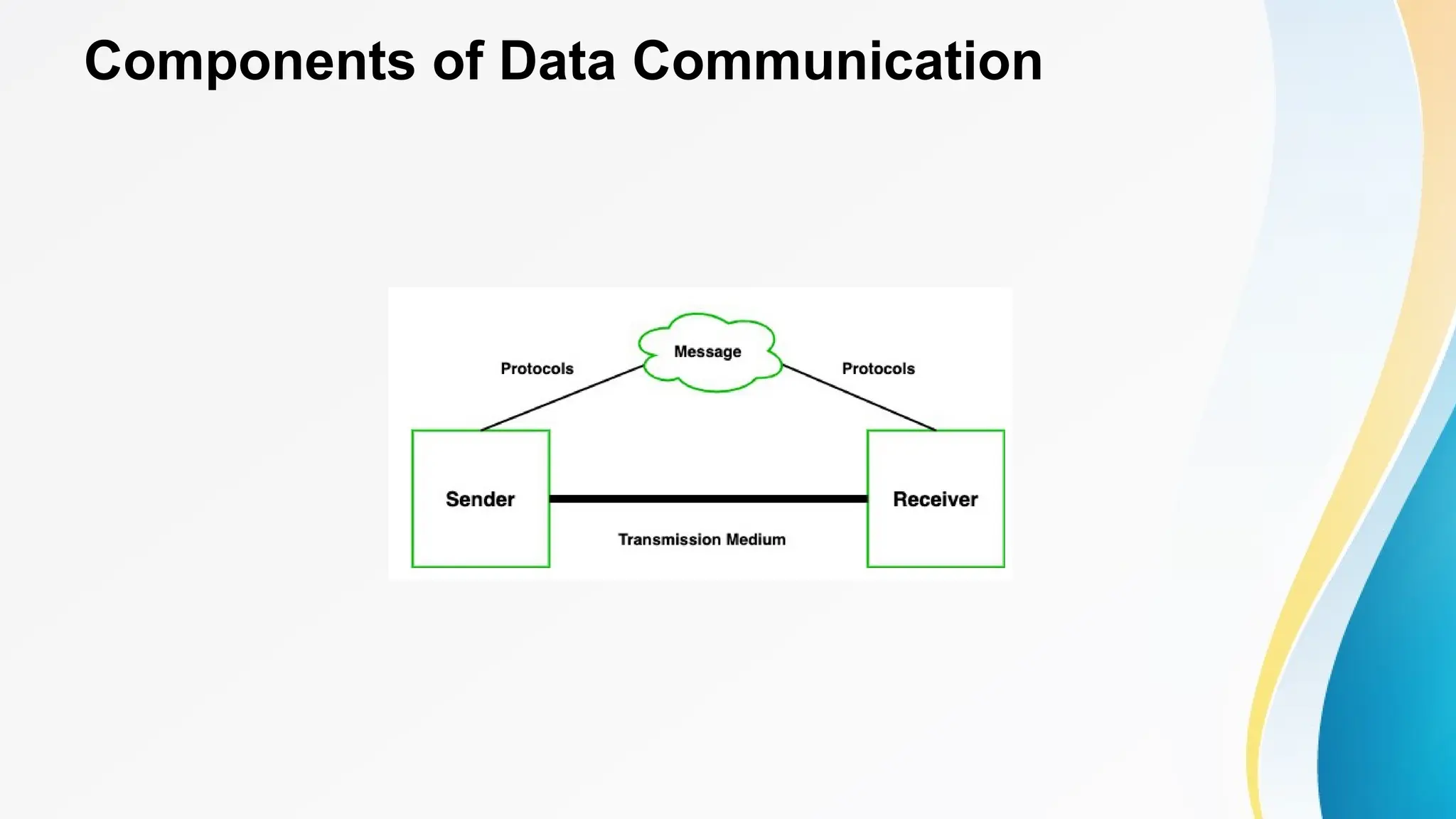
Components of Data Communication
• A communication system is made up of the following components:
• Message: A message is a piece of information that is to be transmitted from
one person to another. It could be a text file, an audio file, a video file, etc.
• Sender: It is simply a device that sends data messages. It can be a
computer, mobile, telephone, laptop, video camera, or workstation, etc.
• Receiver: It is a device that receives messages. It can be a computer,
telephone mobile, workstation, etc.
• Transmission Medium / Communication Channels: Communication
channels are the medium that connect two or more workstations.
Workstations can be connected by either wired media or wireless media.
• Set of rules (Protocol): When someone sends the data (The sender), it
should be understandable to the receiver also otherwise it is meaningless.
For example, Sonali sends a message to Chetan. If Sonali writes in Hindi
and Chetan cannot understand Hindi, it is a meaningless conversation.
Data Transmission Techniques:
• Synchronous Transmission: Data is sent in a continuous stream
with synchronization between the sender and receiver using clock
signals. It’s efficient for large volumes of data (e.g., streaming
video).
• Asynchronous Transmission: Data is sent one byte at a time with
start and stop bits to signify the beginning and end of each byte.
It’s commonly used for low-speed communication (e.g., RS-232).
Data Transmission Modes:
• Simplex: Communication is unidirectional, meaning data flows in
only one direction (e.g., a keyboard sending data to a computer).
• Half-Duplex: Data can flow in both directions, but not
simultaneously. Each device can either send or receive data at a
time (e.g., walkie-talkies).
• Full-Duplex: Data flows in both directions simultaneously. Devices
can send and receive data at the same time (e.g., a telephone
conversation).
Data Transmission Media:
• Guided Media: Includes twisted pair cables, coaxial cables, and
fiber optic cables, suitable for both short and long-distance
communication with varying levels of bandwidth and interference
protection.
• Unguided Media: Includes radio waves, microwaves, infrared, and
satellite communication, offering flexibility and mobility for data
transmission, especially over long distances or in areas without
physical infrastructure.
Data Transmission Methods:
• Serial Transmission: Data is transmitted bit by bit in a sequential
manner over a single channel. It’s slower but ideal for long
distances (e.g., USB connections).
• Parallel Transmission: Multiple bits are transmitted simultaneously
over multiple channels. It’s faster but typically used for short
distances (e.g., connecting a computer to a printer).
Network Topologies:
• Bus Topology: All devices share a single communication line or cable.
• Star Topology: Devices are connected to a central hub or switch. Data
passes through the hub to reach its destination.
• Ring Topology: Devices are connected in a circular fashion where each
device has exactly two neighbors.
• Mesh Topology: Devices are interconnected, allowing multiple paths for
data to travel.
• Hybrid Topology: A combination of two or more different topologies.
• Tree Topology:Combines characteristics of both star and bus
topologies.
Error Detection and Correction:
• Error Detection: Techniques like parity checks, checksums, and
cyclic redundancy checks (CRC) are used to detect errors in
transmitted data.
• Error Correction: Once errors are detected, methods like
automatic repeat requests (ARQ) or forward error correction
(FEC) are used to correct them.
Protocols and Standards:
• TCP/IP (Transmission Control Protocol/Internet Protocol): The
fundamental protocol suite for internet and local area networks.
• HTTP (Hypertext Transfer Protocol): Used for transferring web
pages over the internet.
• FTP (File Transfer Protocol): Used for transferring files between
computers.
• Ethernet: A standard for wired local area networks (LANs).
Security in Data Communication:
• Encryption: Data is encoded to prevent unauthorized access.
• Firewalls: Protect networks by filtering incoming and outgoing
traffic based on predefined security rules.
• VPN (Virtual Private Network): Creates a secure tunnel over a
public network, ensuring privacy and data protection.
Applications of Data Communication:
• Internet: Global communication and information exchange
platform.
• Email: Sending and receiving messages electronically.
• VoIP (Voice over IP): Transmitting voice data over the internet.
• Cloud Services: Accessing and storing data remotely over the
internet.
Challenges in Data Communication:
• Latency: Delay in data transmission.
• Bandwidth: The capacity of the transmission medium to carry
data.
• Interference: External signals disrupting data transmission.
• Security Threats: Risks such as hacking, data breaches, and
unauthorized access.
Thankyou
Made By Sukanya Rakshit

Data Communication in Computer Networking

  • 1.
  • 2.
    Data Communication • Transferringdata over a transmission medium between two or more devices, systems, or places is known as data communication. Data communication in computer networks refers to the exchange of data between devices through a network. It is a fundamental concept in networking, enabling devices like computers, servers, and routers to share information efficiently. Nowadays, computing and telecommunications depend heavily on this data transmission, which makes a variety of applications conceivable, including email, video chatting, the Internet, and many more things.
  • 3.
    Components of DataCommunication
  • 4.
    • A communicationsystem is made up of the following components: • Message: A message is a piece of information that is to be transmitted from one person to another. It could be a text file, an audio file, a video file, etc. • Sender: It is simply a device that sends data messages. It can be a computer, mobile, telephone, laptop, video camera, or workstation, etc. • Receiver: It is a device that receives messages. It can be a computer, telephone mobile, workstation, etc. • Transmission Medium / Communication Channels: Communication channels are the medium that connect two or more workstations. Workstations can be connected by either wired media or wireless media. • Set of rules (Protocol): When someone sends the data (The sender), it should be understandable to the receiver also otherwise it is meaningless. For example, Sonali sends a message to Chetan. If Sonali writes in Hindi and Chetan cannot understand Hindi, it is a meaningless conversation.
  • 5.
    Data Transmission Techniques: •Synchronous Transmission: Data is sent in a continuous stream with synchronization between the sender and receiver using clock signals. It’s efficient for large volumes of data (e.g., streaming video). • Asynchronous Transmission: Data is sent one byte at a time with start and stop bits to signify the beginning and end of each byte. It’s commonly used for low-speed communication (e.g., RS-232).
  • 6.
    Data Transmission Modes: •Simplex: Communication is unidirectional, meaning data flows in only one direction (e.g., a keyboard sending data to a computer). • Half-Duplex: Data can flow in both directions, but not simultaneously. Each device can either send or receive data at a time (e.g., walkie-talkies). • Full-Duplex: Data flows in both directions simultaneously. Devices can send and receive data at the same time (e.g., a telephone conversation).
  • 7.
    Data Transmission Media: •Guided Media: Includes twisted pair cables, coaxial cables, and fiber optic cables, suitable for both short and long-distance communication with varying levels of bandwidth and interference protection. • Unguided Media: Includes radio waves, microwaves, infrared, and satellite communication, offering flexibility and mobility for data transmission, especially over long distances or in areas without physical infrastructure.
  • 8.
    Data Transmission Methods: •Serial Transmission: Data is transmitted bit by bit in a sequential manner over a single channel. It’s slower but ideal for long distances (e.g., USB connections). • Parallel Transmission: Multiple bits are transmitted simultaneously over multiple channels. It’s faster but typically used for short distances (e.g., connecting a computer to a printer).
  • 9.
    Network Topologies: • BusTopology: All devices share a single communication line or cable. • Star Topology: Devices are connected to a central hub or switch. Data passes through the hub to reach its destination. • Ring Topology: Devices are connected in a circular fashion where each device has exactly two neighbors. • Mesh Topology: Devices are interconnected, allowing multiple paths for data to travel. • Hybrid Topology: A combination of two or more different topologies. • Tree Topology:Combines characteristics of both star and bus topologies.
  • 10.
    Error Detection andCorrection: • Error Detection: Techniques like parity checks, checksums, and cyclic redundancy checks (CRC) are used to detect errors in transmitted data. • Error Correction: Once errors are detected, methods like automatic repeat requests (ARQ) or forward error correction (FEC) are used to correct them.
  • 11.
    Protocols and Standards: •TCP/IP (Transmission Control Protocol/Internet Protocol): The fundamental protocol suite for internet and local area networks. • HTTP (Hypertext Transfer Protocol): Used for transferring web pages over the internet. • FTP (File Transfer Protocol): Used for transferring files between computers. • Ethernet: A standard for wired local area networks (LANs).
  • 12.
    Security in DataCommunication: • Encryption: Data is encoded to prevent unauthorized access. • Firewalls: Protect networks by filtering incoming and outgoing traffic based on predefined security rules. • VPN (Virtual Private Network): Creates a secure tunnel over a public network, ensuring privacy and data protection.
  • 13.
    Applications of DataCommunication: • Internet: Global communication and information exchange platform. • Email: Sending and receiving messages electronically. • VoIP (Voice over IP): Transmitting voice data over the internet. • Cloud Services: Accessing and storing data remotely over the internet.
  • 14.
    Challenges in DataCommunication: • Latency: Delay in data transmission. • Bandwidth: The capacity of the transmission medium to carry data. • Interference: External signals disrupting data transmission. • Security Threats: Risks such as hacking, data breaches, and unauthorized access.
  • 15.