Advanced Entrepreneurship:
Customer Development and the Lean Startup


           Introduction to the Course

                    Steve Blank & Eric Ries


         sblank@kandsranch.com   eric@theleanstartup.com

         www.steveblank.com      www.startuplessonslearned.com/
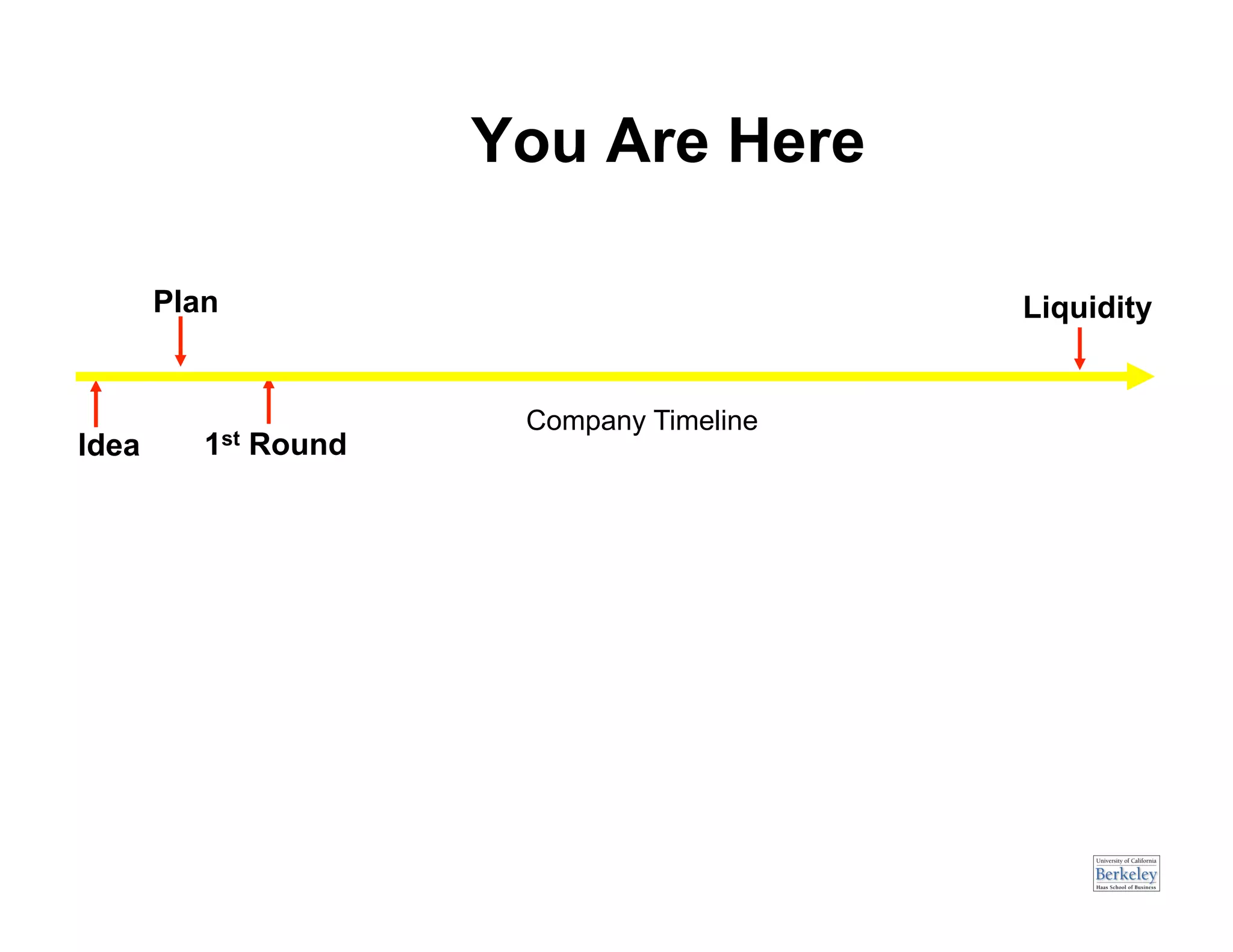
You Are Here

       Plan                                 Liquidity


                         Company Timeline
Idea      1st   Round
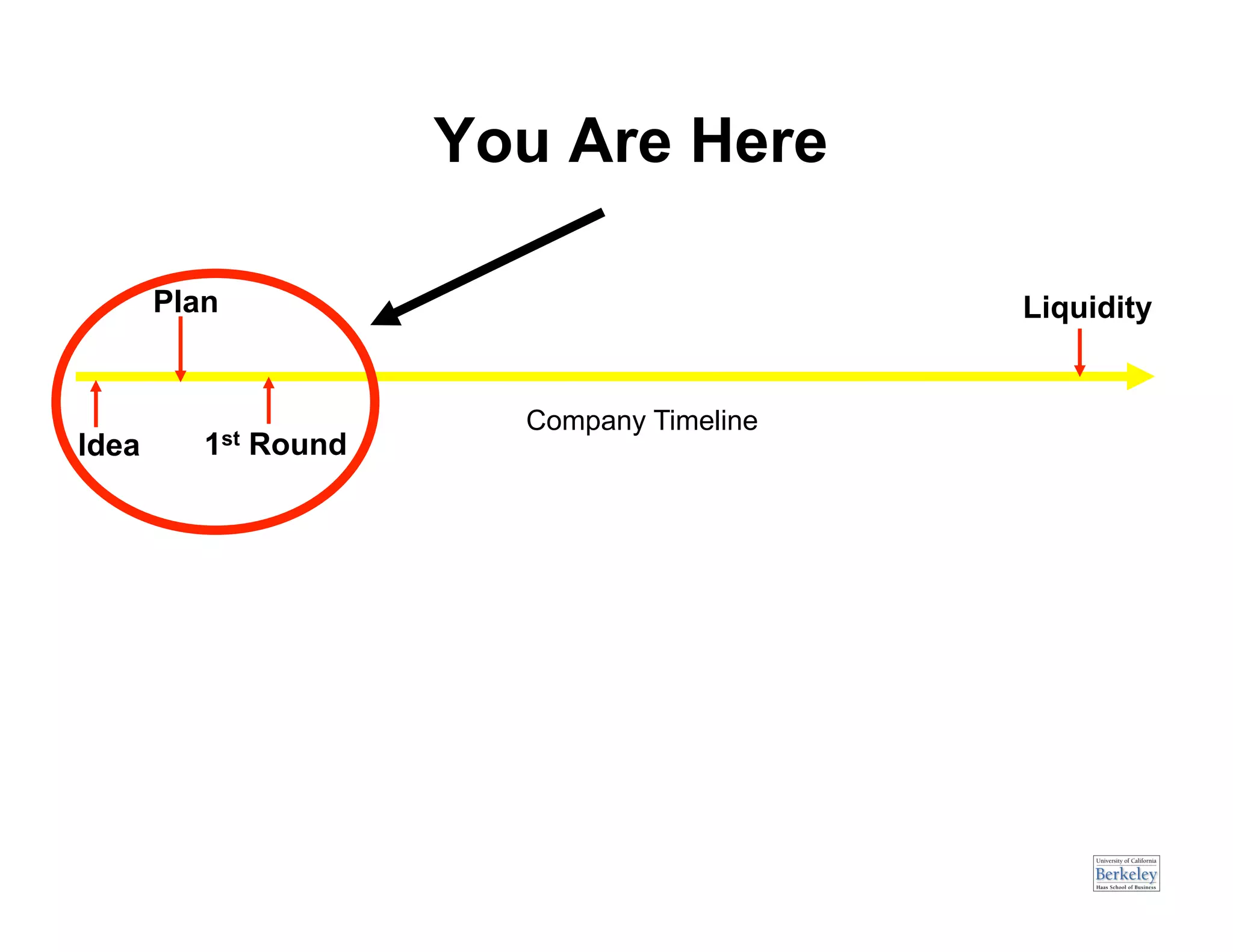
You Are Here

       Plan                                  Liquidity


                          Company Timeline
Idea      1st   Round
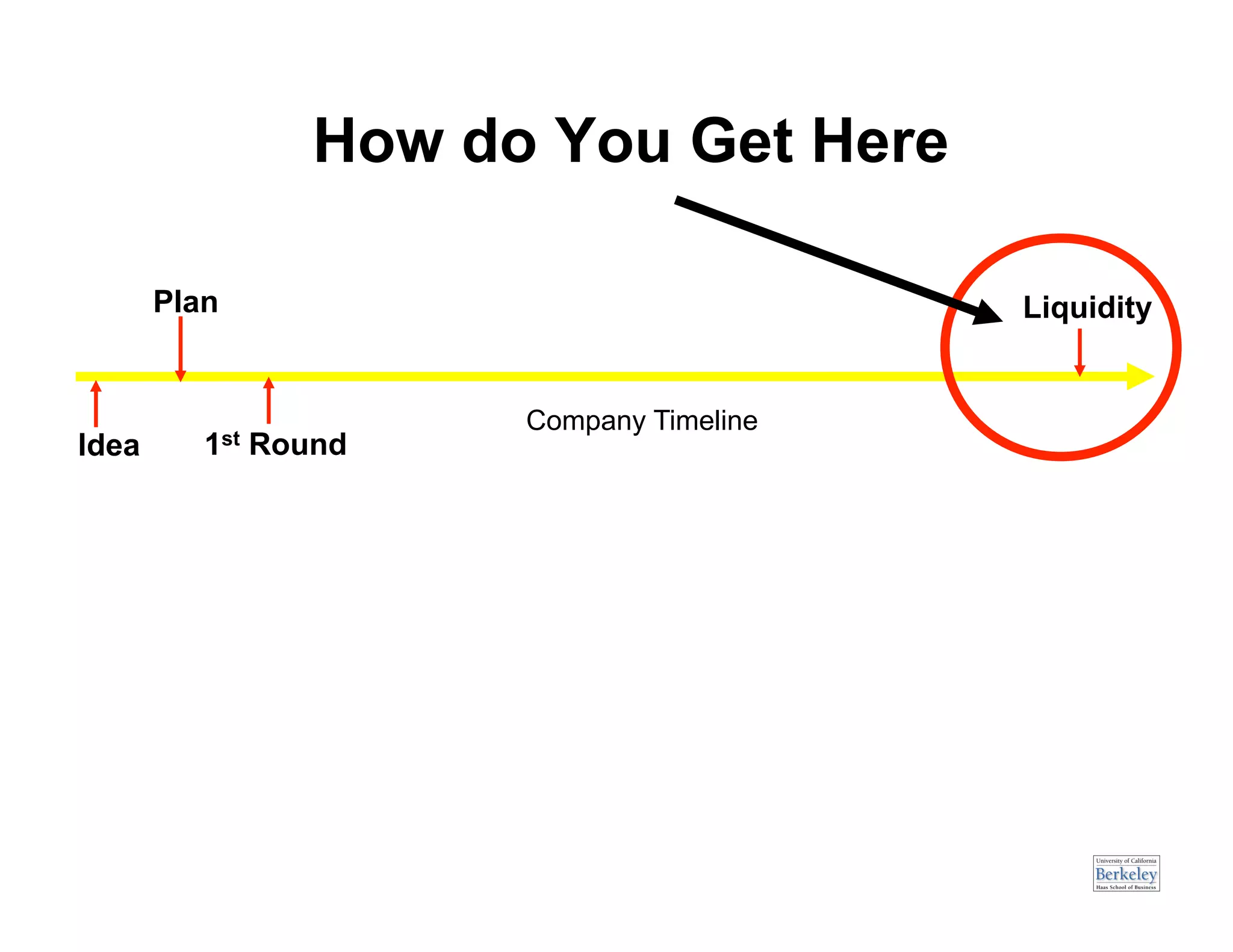
How do You Get Here

       Plan                                 Liquidity


                         Company Timeline
Idea      1st   Round
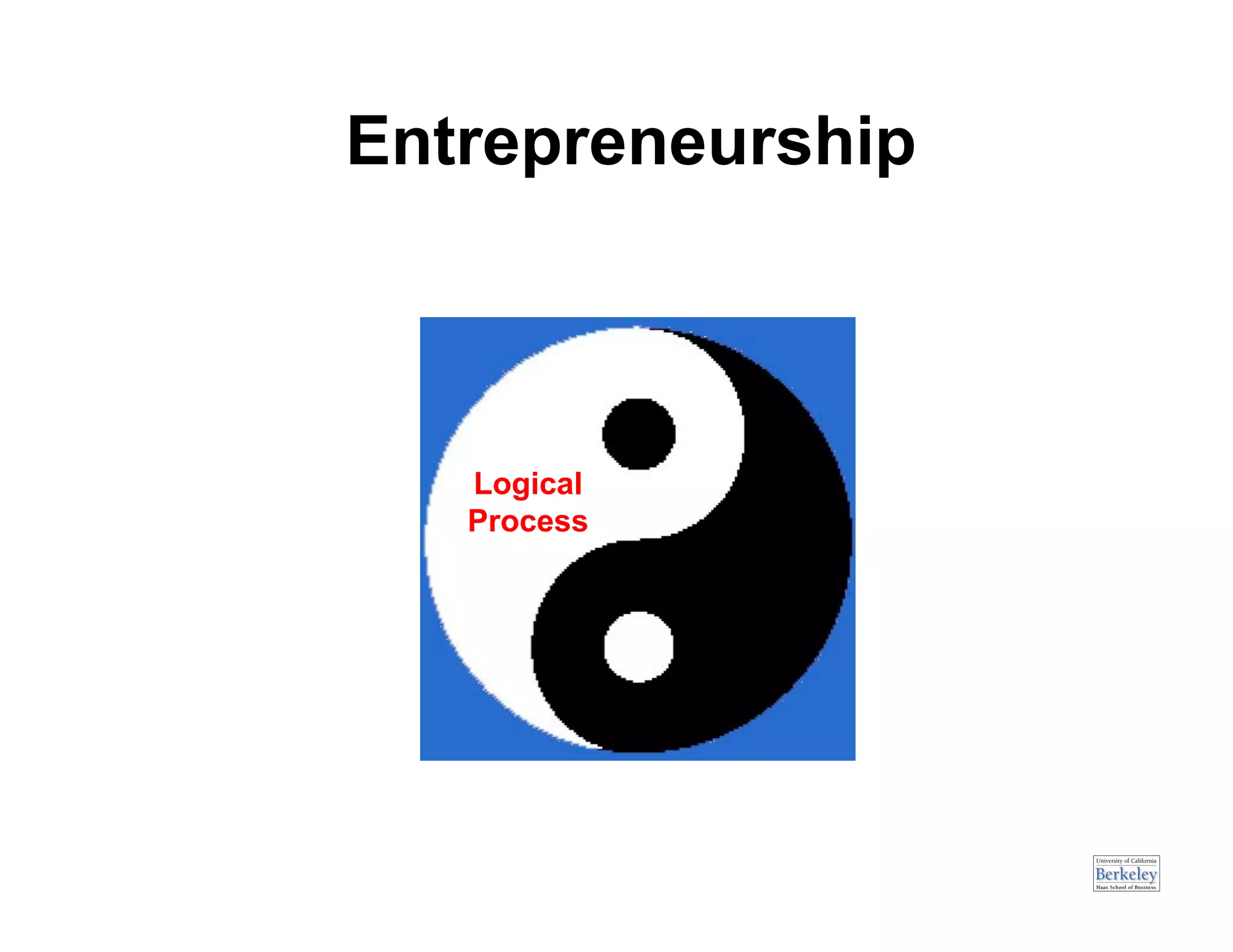
Entrepreneurship


   Logical
   Process
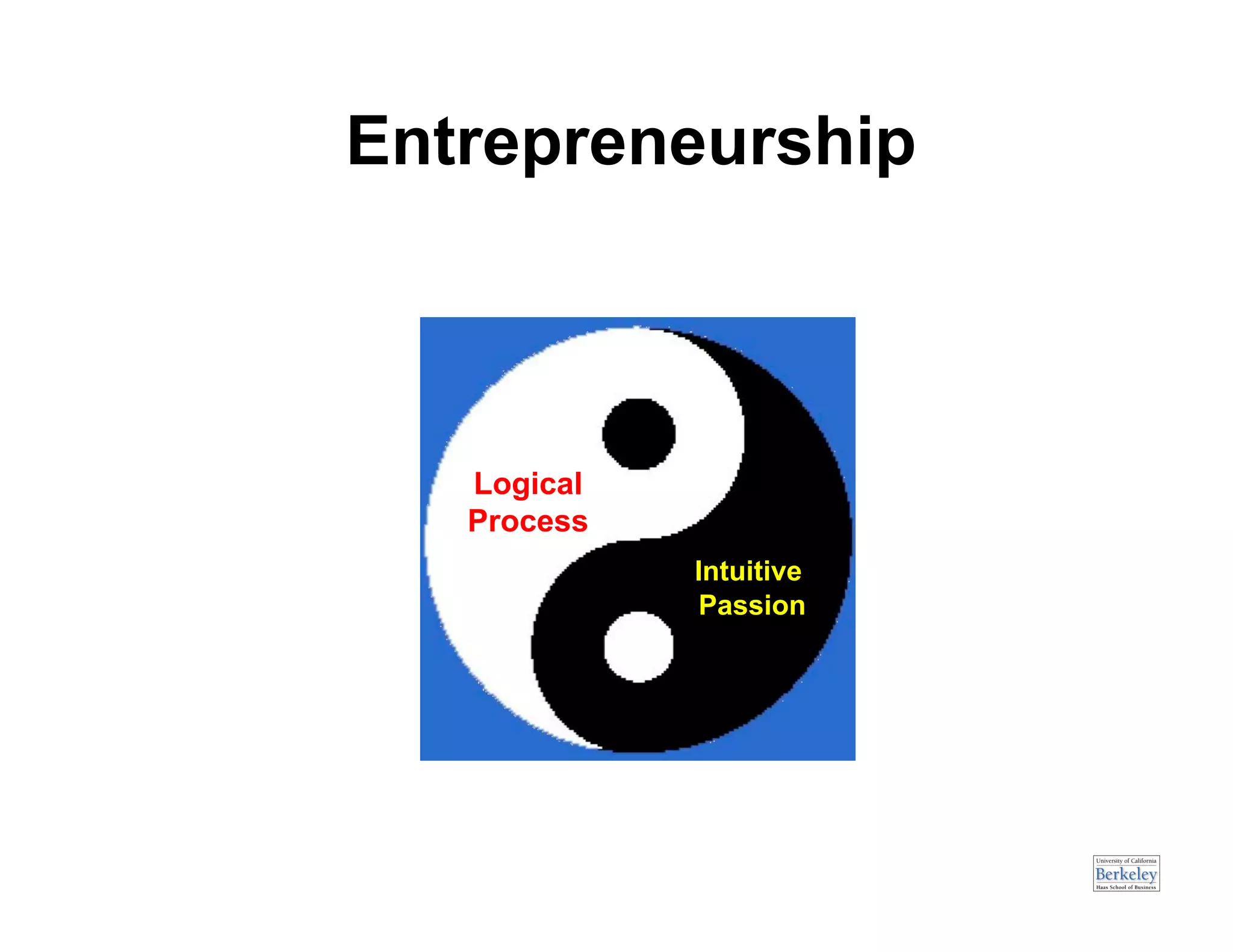
Entrepreneurship


   Logical
   Process
             Intuitive
             Passion
Today


Part 1: Introduction to the Course


Part 2: Key Concepts
Course Introduction
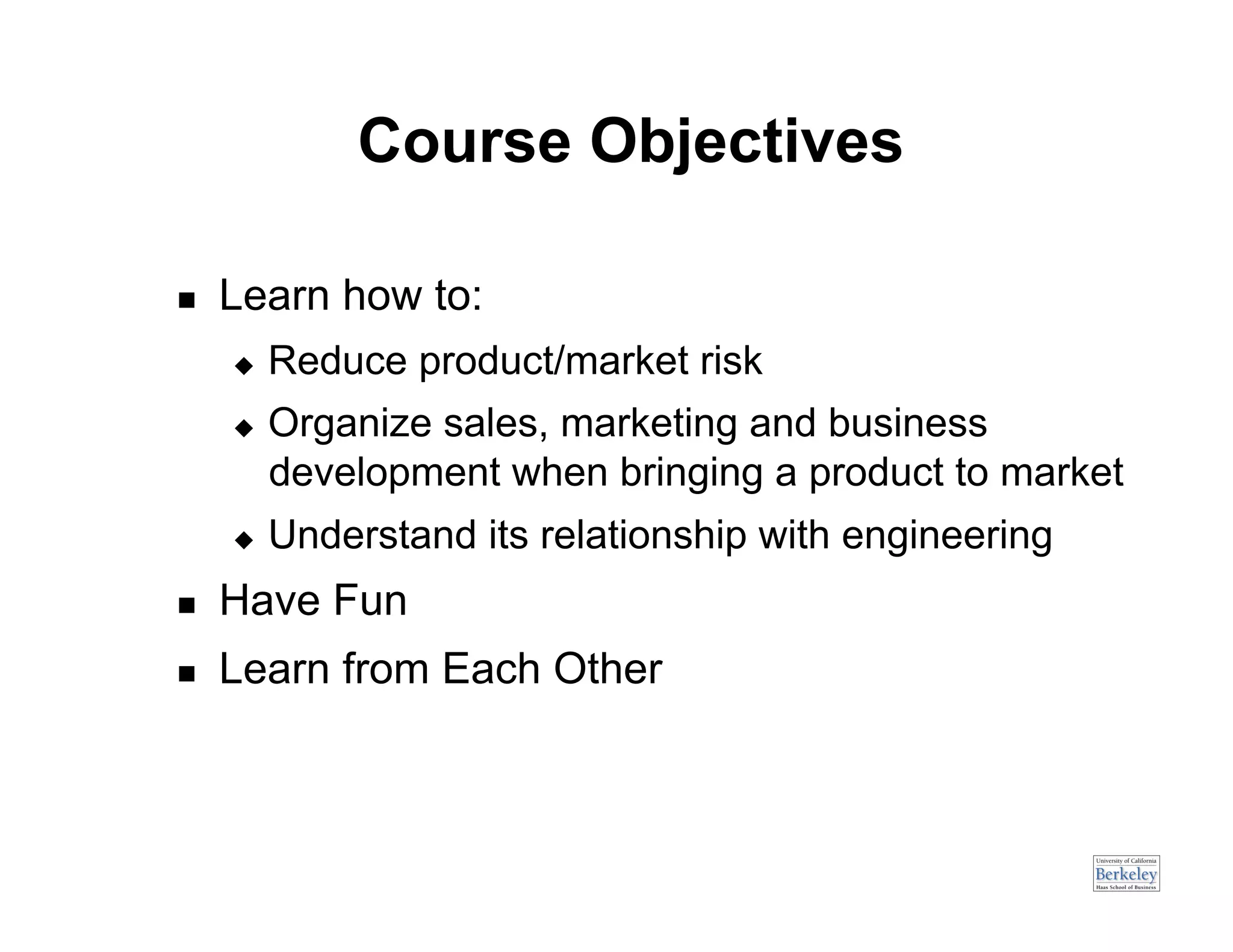
    Course Objectives
    Intro and Backgrounds
    How the Class Works
    Customer Development
Course Objectives

    Learn how to:
         Reduce product/market risk
         Organize sales, marketing and business
          development when bringing a product to market
         Understand its relationship with engineering
    Have Fun
    Learn from Each Other
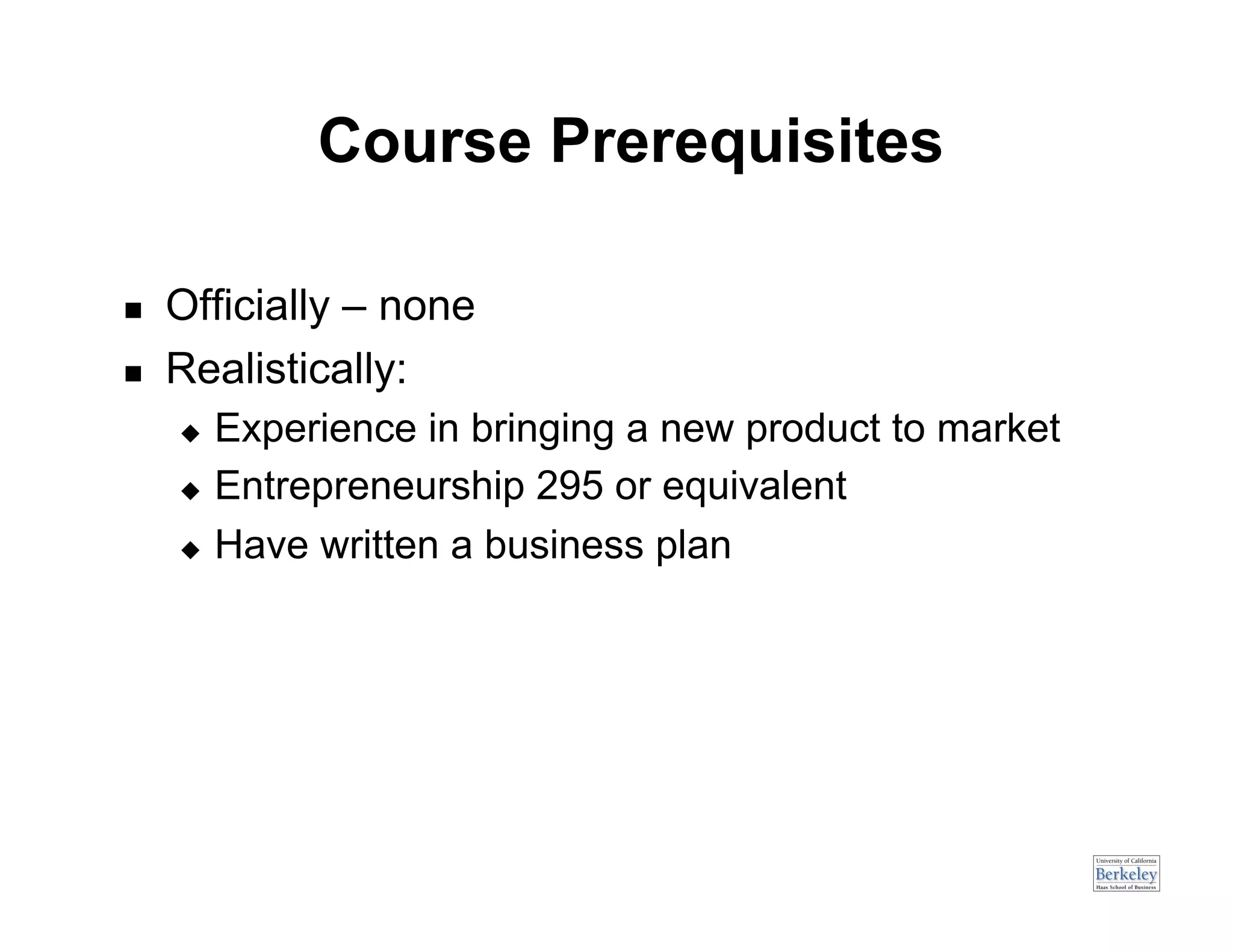
Course Prerequisites

    Officially – none
    Realistically:
       Experience in bringing a new product to market
       Entrepreneurship 295 or equivalent

       Have written a business plan
Introduction and Backgrounds
    Steve Blank
    Eric Ries
    Guest Speakers
    Class
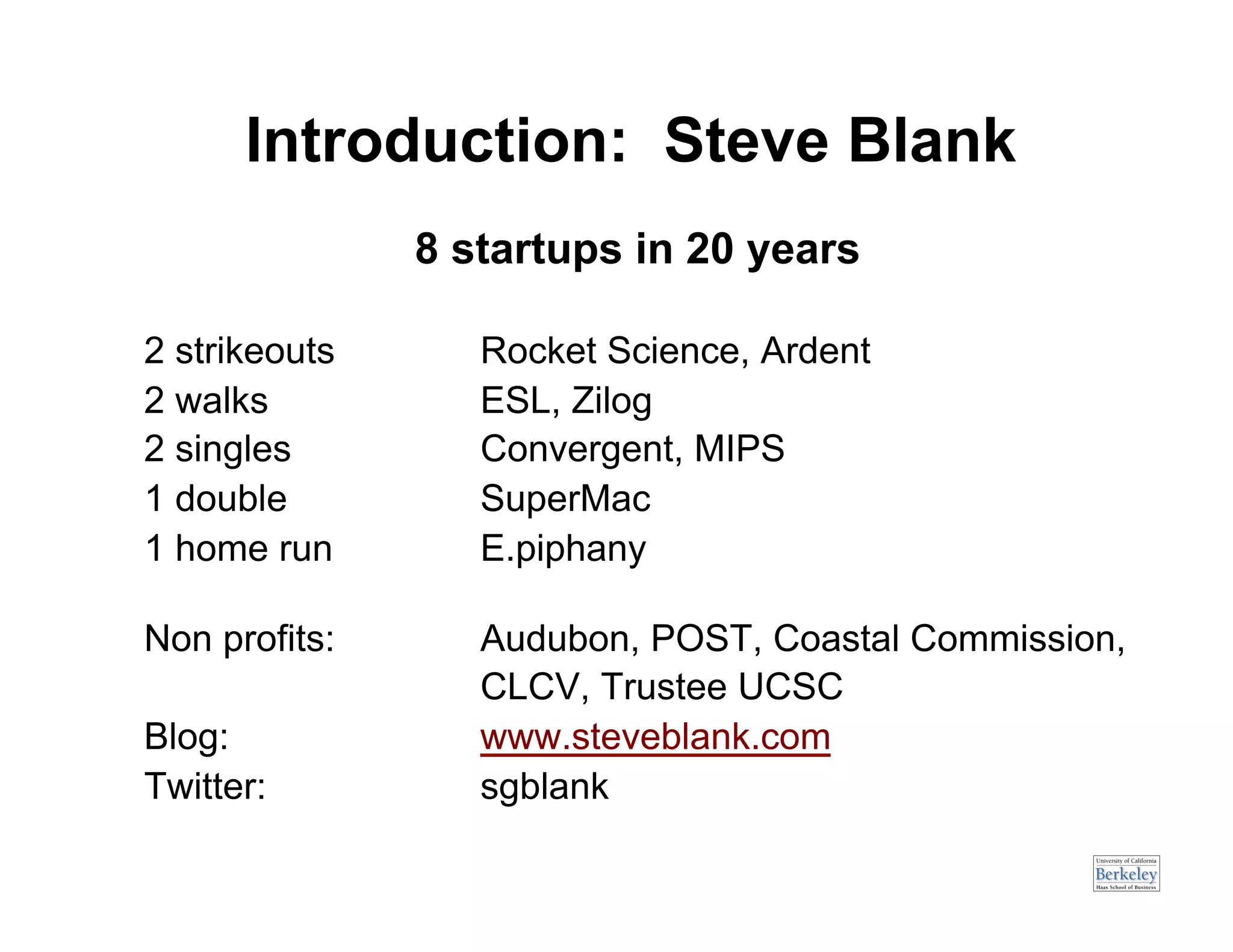
Introduction: Steve Blank
               8 startups in 20 years

2 strikeouts      Rocket Science, Ardent
2 walks           ESL, Zilog
2 singles         Convergent, MIPS
1 double          SuperMac
1 home run        E.piphany

Non profits:      Audubon, POST, Coastal Commission,
                  CLCV, Trustee UCSC
Blog:             www.steveblank.com
Twitter:          sgblank
Introduction: Eric Ries


Author:    Lean Startup, co/author Black Art of Java
  Game Programming

Company:      Co-founder/CTO IMVU
              There.com
              Co-founder Catalyst Recruiting

Blog:         www.startuplessonslearned.com
Twitter:      ericries
Introduction: Class
Why are you taking the class?

    How many of you have:
         Been in start-ups?
         Been in a startup that failed?
         Raised or tried to raise money?

    How many are:
         Sales, marketing or business development?
         Engineers?
How the Class Works
    Syllabus

    3 Application Exercises

    Research Project

    Grading
       Research Project (50%)

       Application Exercises (25%)

       Class Participation (25%)
Class Issues
    Tech-heavy
    Enterprise-heavy
    For-profit versus non-profit
    Startups versus existing companies
    Methodology focused on product/customer
     risk reduction
         Doesn’t work for technology risks (i.e Biotech)
    Doesn’t match your experience or opinion
Logistics

      Steve Blank and Eric Ries
sblank@kandsranch.com   eric@theleanstartup.com
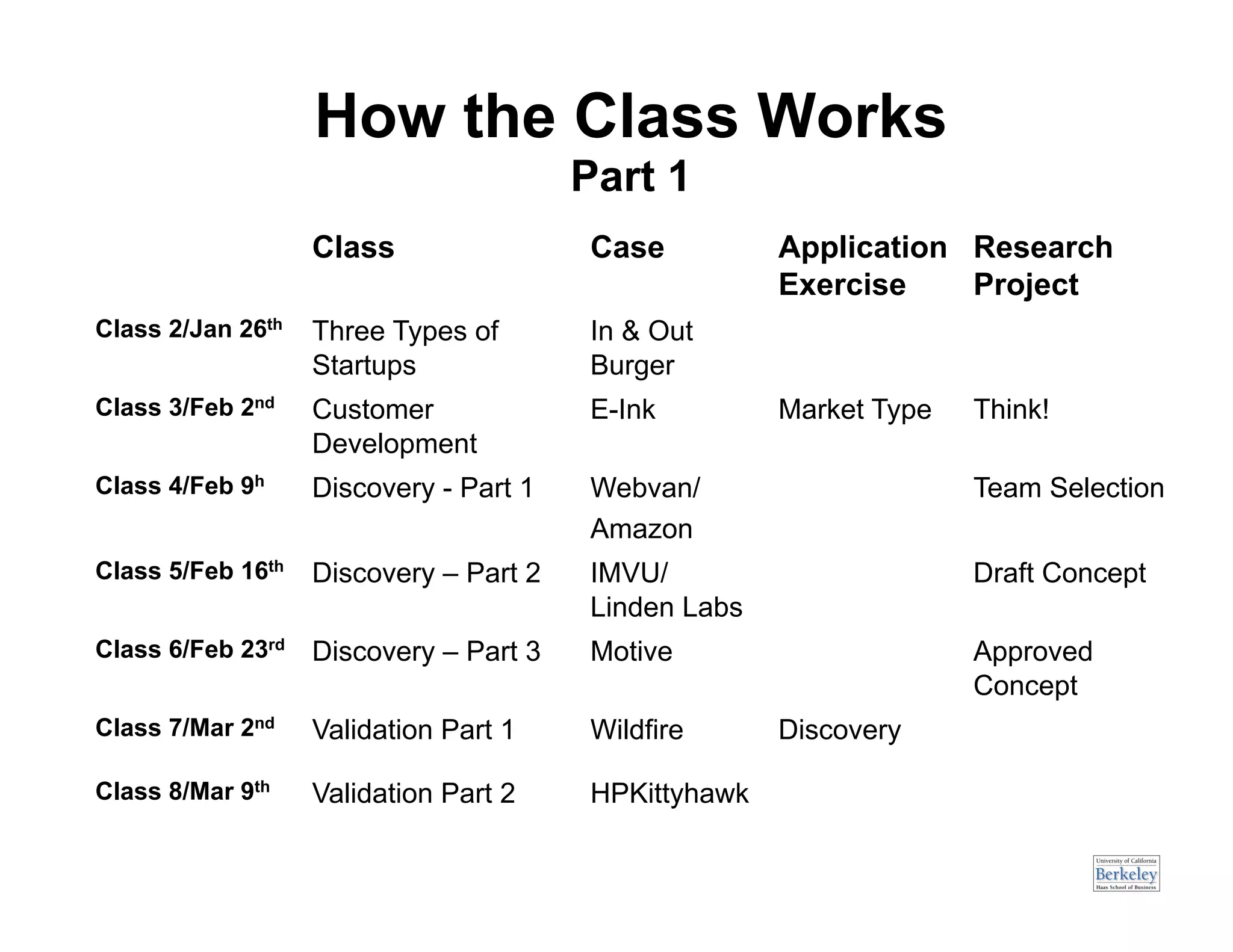
How the Class Works
                                        Part 1
                   Class                Case          Application Research
                                                      Exercise    Project
Class 2/Jan 26th   Three Types of       In & Out
                   Startups             Burger
Class 3/Feb 2nd    Customer             E-Ink         Market Type   Think!
                   Development
Class 4/Feb 9h     Discovery - Part 1   Webvan/                     Team Selection
                                        Amazon
Class 5/Feb 16th   Discovery – Part 2   IMVU/                       Draft Concept
                                        Linden Labs
Class 6/Feb 23rd   Discovery – Part 3   Motive                      Approved
                                                                    Concept
Class 7/Mar 2nd    Validation Part 1    Wildfire      Discovery

Class 8/Mar 9th    Validation Part 2    HPKittyhawk
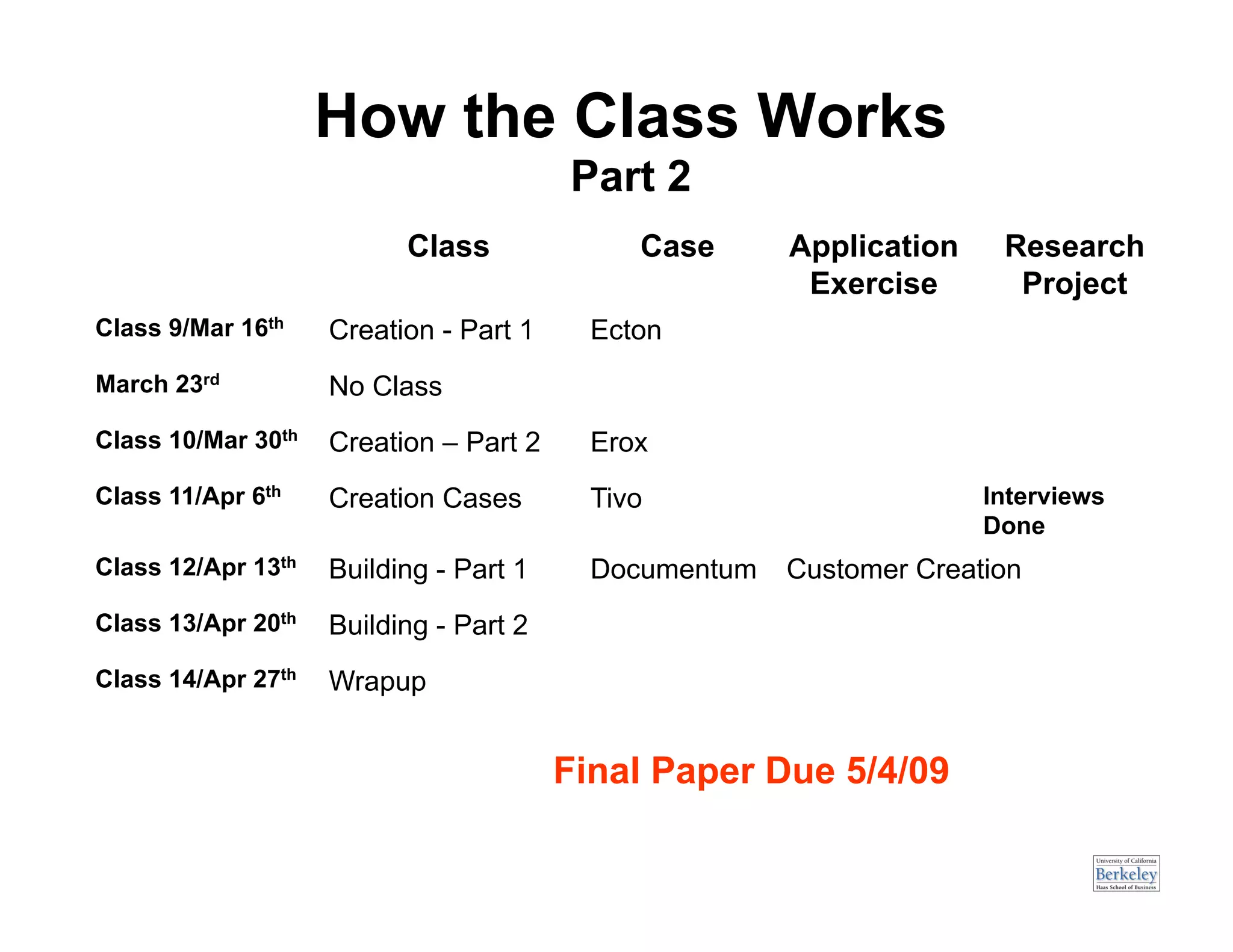
How the Class Works
                                        Part 2
                          Class              Case      Application    Research
                                                        Exercise       Project
Class 9/Mar 16th    Creation - Part 1     Ecton
March 23rd          No Class
Class 10/Mar 30th   Creation – Part 2     Erox
Class 11/Apr 6th    Creation Cases        Tivo                       Interviews
                                                                     Done
Class 12/Apr 13th   Building - Part 1     Documentum   Customer Creation
Class 13/Apr 20th   Building - Part 2
Class 14/Apr 27th   Wrapup


                                        Final Paper Due 5/4/09
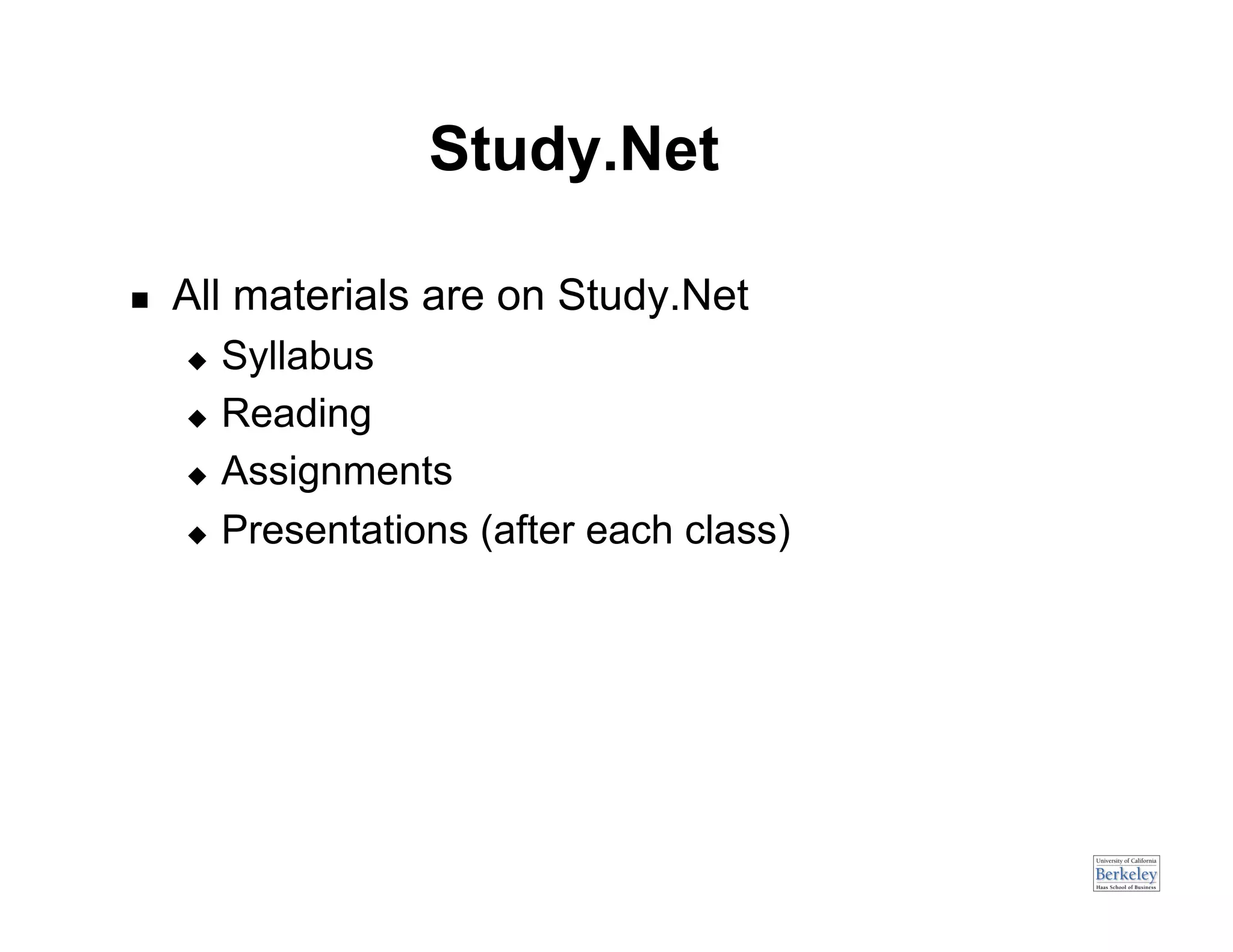
Study.Net

    All materials are on Study.Net
       Syllabus
       Reading

       Assignments

       Presentations (after each class)
Reading

Class Text:       Four Steps to the Epiphany
Assigned Reading: In Reader
Blogs:            www.steveblank.com
                      http://startuplessonslearned.com/
Presentations:        www.slideshare.net/
Google Group:         http://groups.google.com/group/lean-startup-circle
Twitter:              sgblank
                      ericries

                 watch http://www.youtube.com/watch?v=R2lE3fgj7QA for what you could be in store for
The Course

      Steve Blank and Eric Ries
sblank@kandsranch.com   eric@theleanstartup.com
Customer Development
    Business Plans
    The Value of “Models” for an Entrepreneur
    Key Concepts
         Market versus Technology Risks
         Vertical Markets
         Three Types of Startups
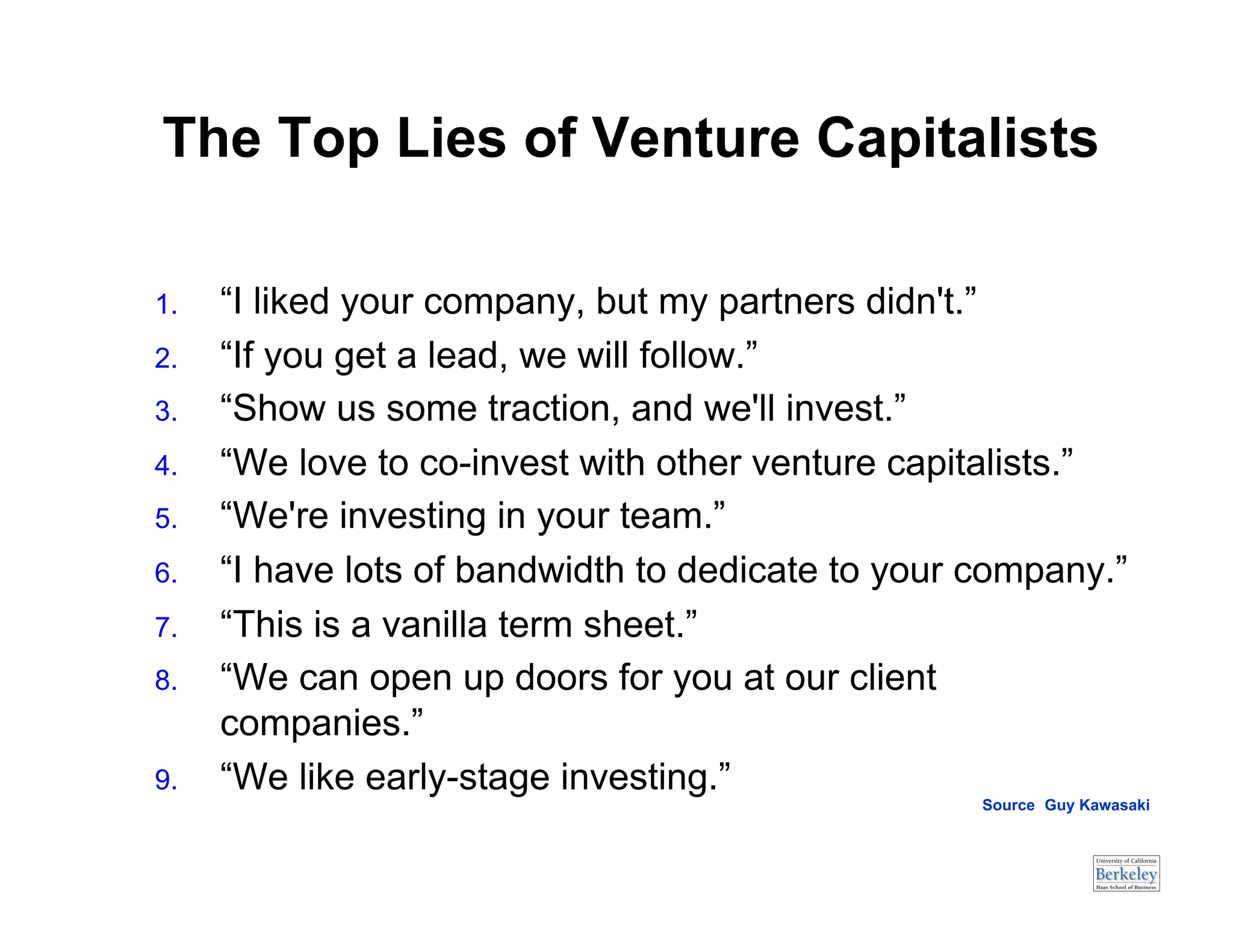
The Top Lies of Venture Capitalists

1.    “I liked your company, but my partners didn't.”
2.    “If you get a lead, we will follow.”
3.    “Show us some traction, and we'll invest.”
4.    “We love to co-invest with other venture capitalists.”
5.    “We're investing in your team.”
6.    “I have lots of bandwidth to dedicate to your company.”
7.    “This is a vanilla term sheet.”
8.    “We can open up doors for you at our client
      companies.”
9.    “We like early-stage investing.”
                                                    Source: Guy Kawasaki
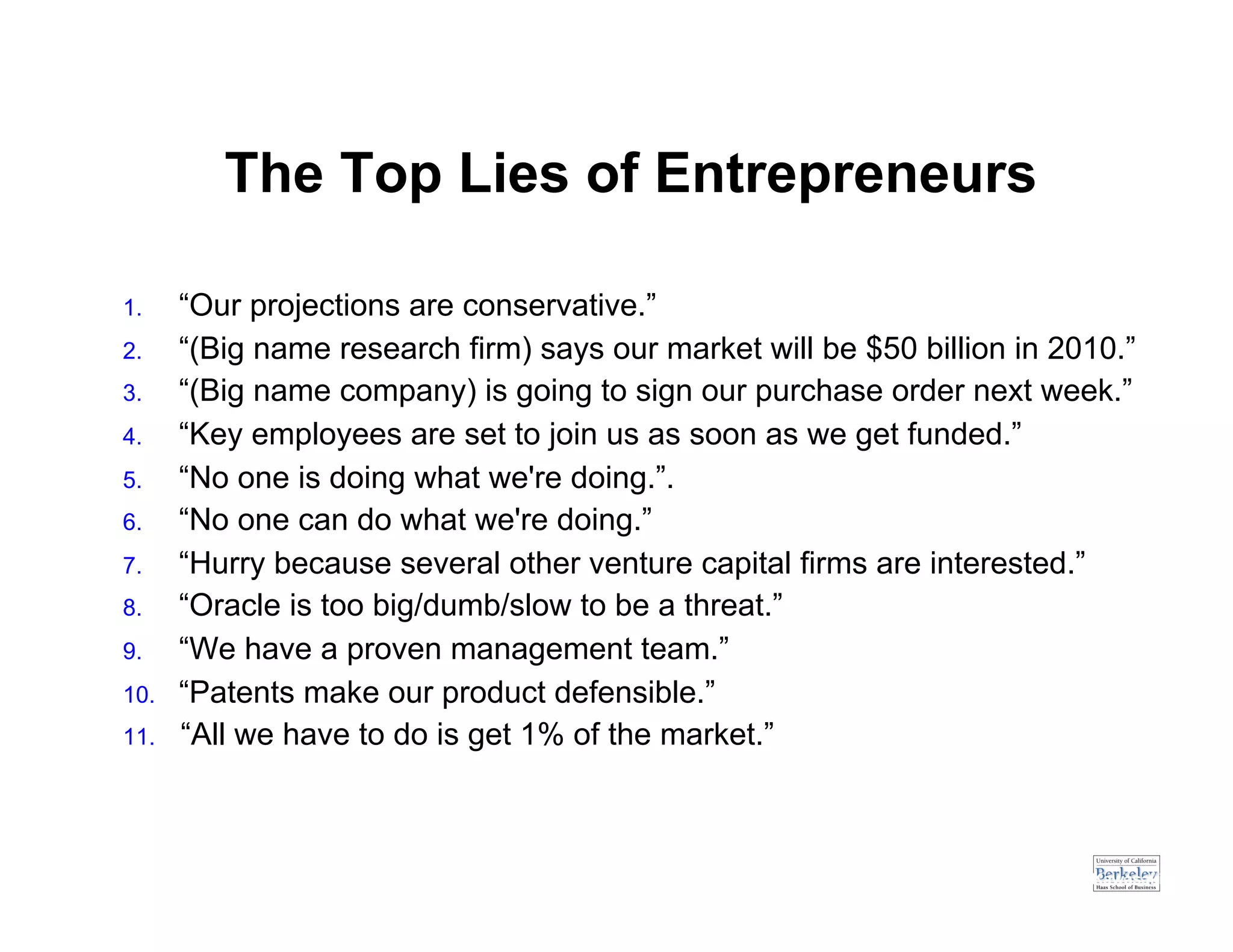
The Top Lies of Entrepreneurs

1.     “Our projections are conservative.”
2.     “(Big name research firm) says our market will be $50 billion in 2010.”
3.     “(Big name company) is going to sign our purchase order next week.”
4.     “Key employees are set to join us as soon as we get funded.”
5.     “No one is doing what we're doing.”.
6.     “No one can do what we're doing.”
7.     “Hurry because several other venture capital firms are interested.”
8.     “Oracle is too big/dumb/slow to be a threat.”
9.     “We have a proven management team.”
10.    “Patents make our product defensible.”
11.    “All we have to do is get 1% of the market.”


                                                                   Source: Guy Kawasaki
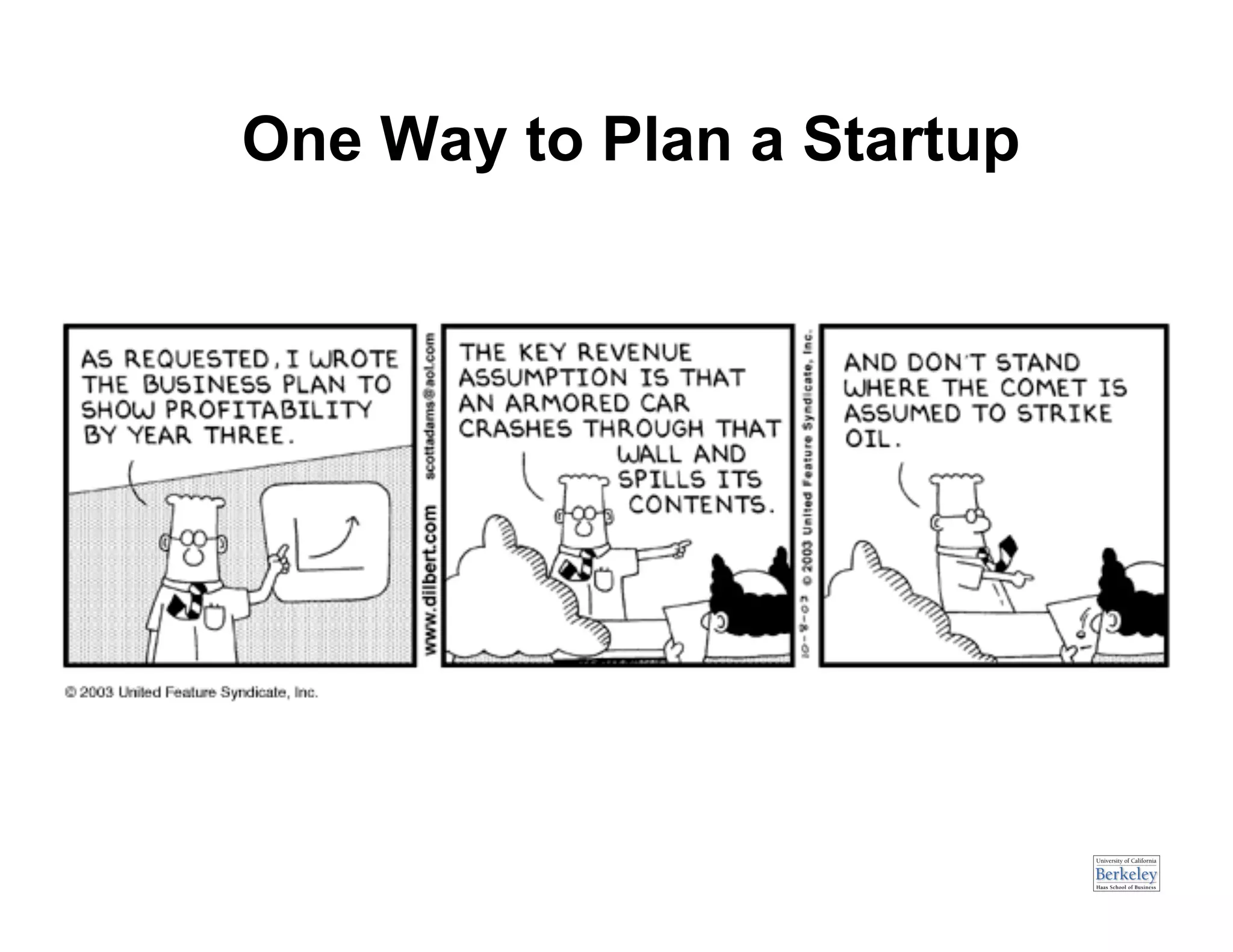
One Way to Plan a Startup
Business Plans – Why?

    Why write a plan?
       VC’s require it
       Planning (Strategic/Financial/Ops)

       Articulate Bus Model/Assumptions

    What’s wrong with a plan?
       Static
       Execution Oriented
The Value of “Models”

    Model = shorthand for complicated idea

    This class teaches a “model” for product
     introduction

    How to reduce risk for customer/market fit

    Side effect is rethinking timing in Sales,
     Marketing & Business Development
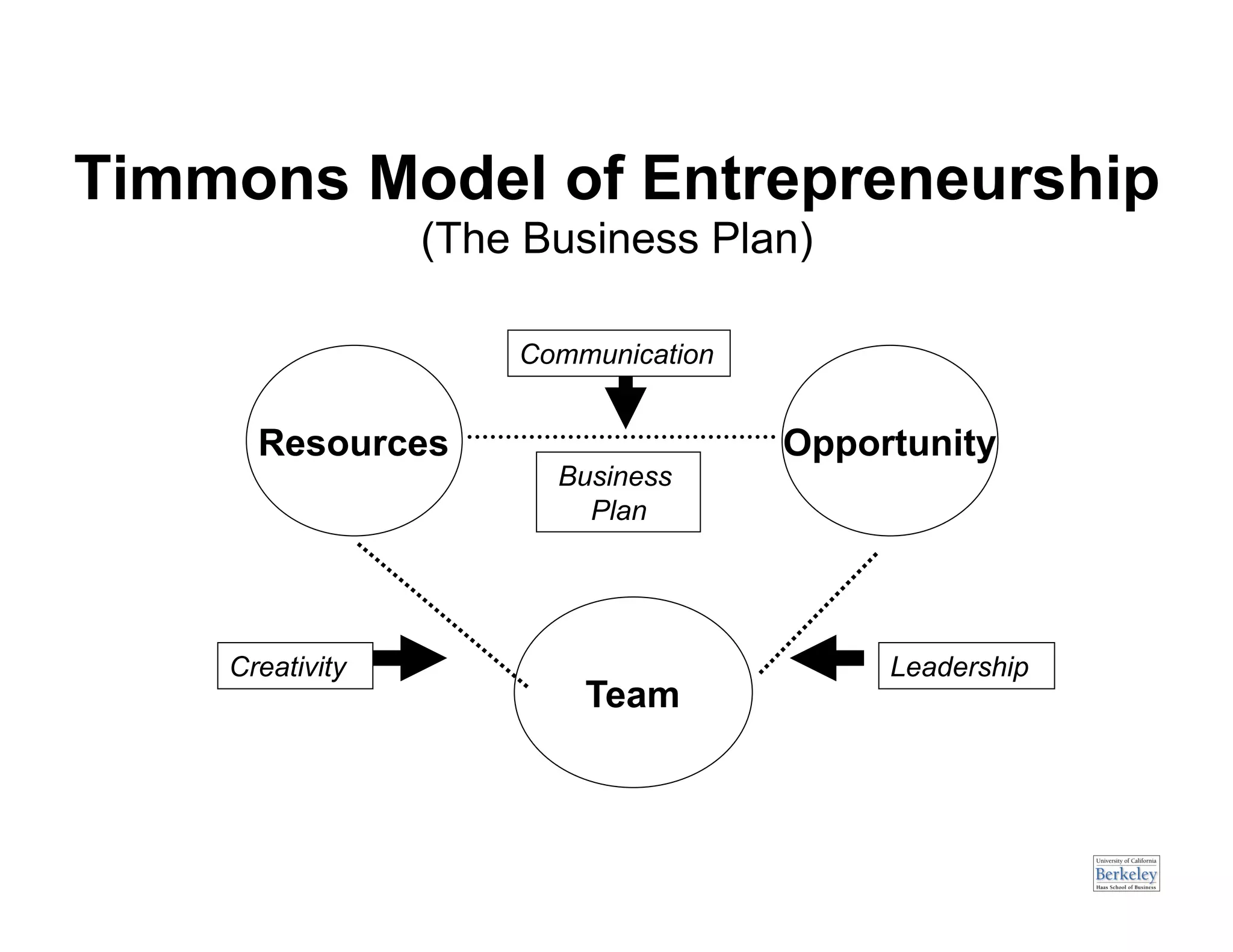
Timmons Model of Entrepreneurship
                 (The Business Plan)

                     Communication


      Resources                      Opportunity
                       Business
                         Plan


    Creativity                            Leadership
                         Team
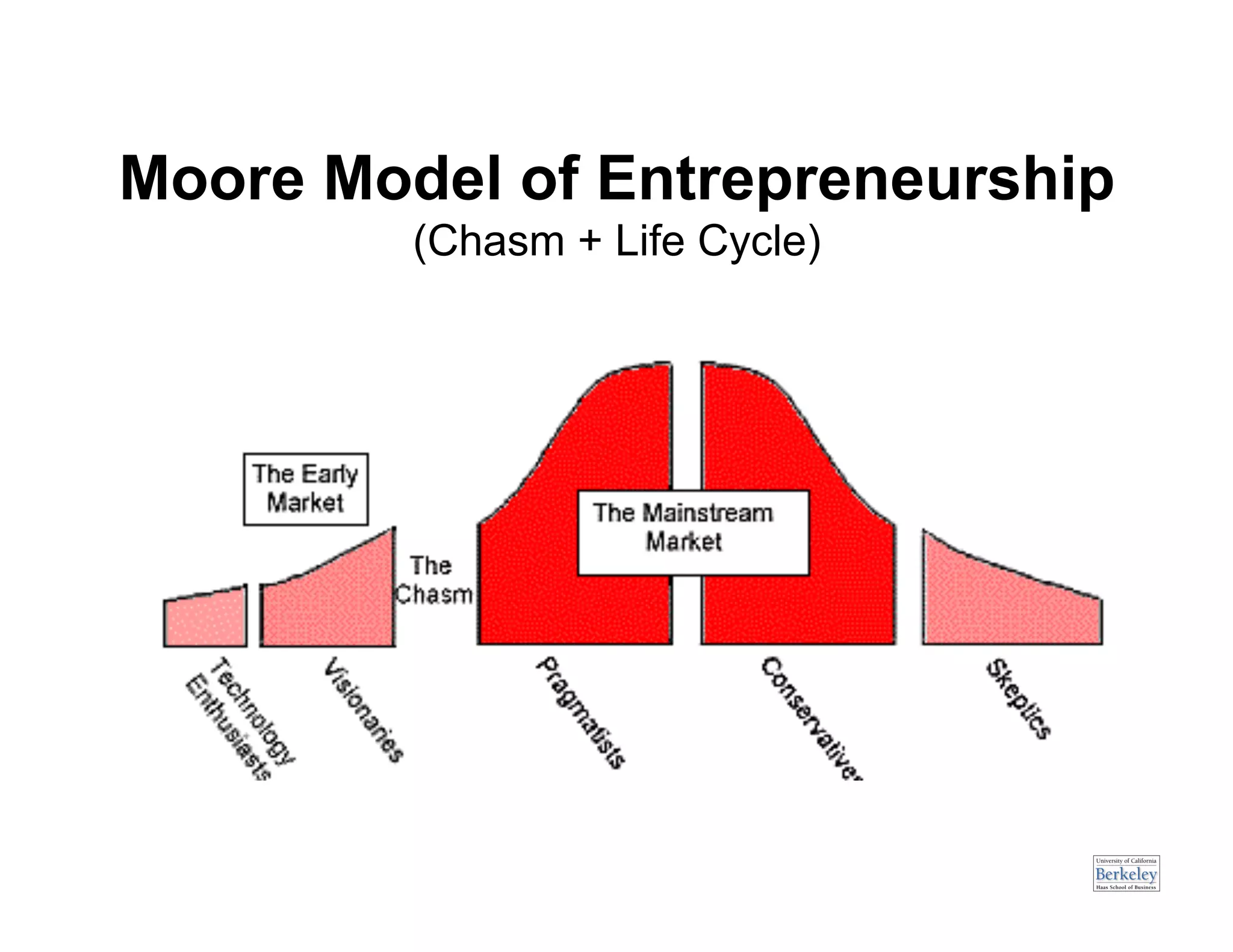
Moore Model of Entrepreneurship
         (Chasm + Life Cycle)
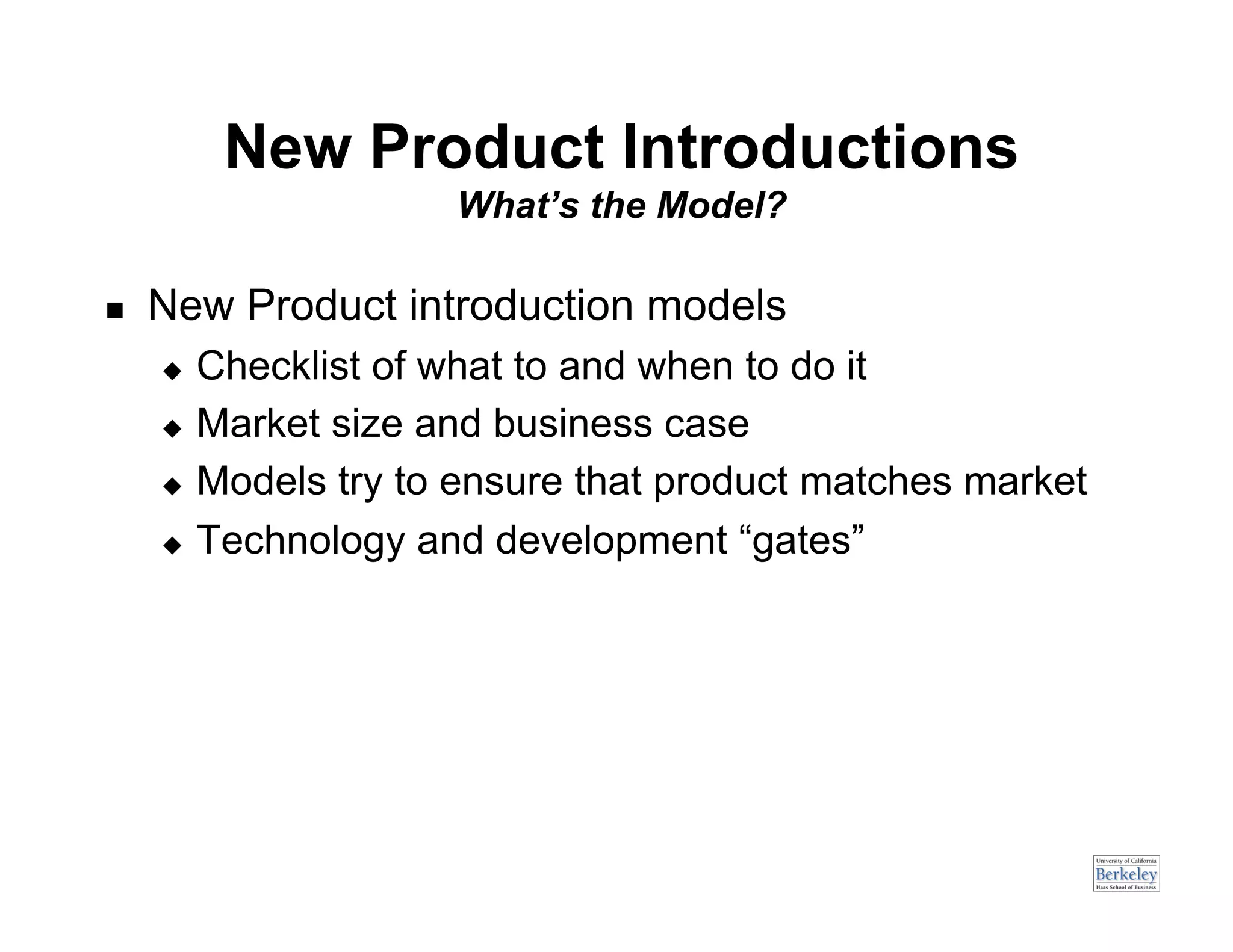
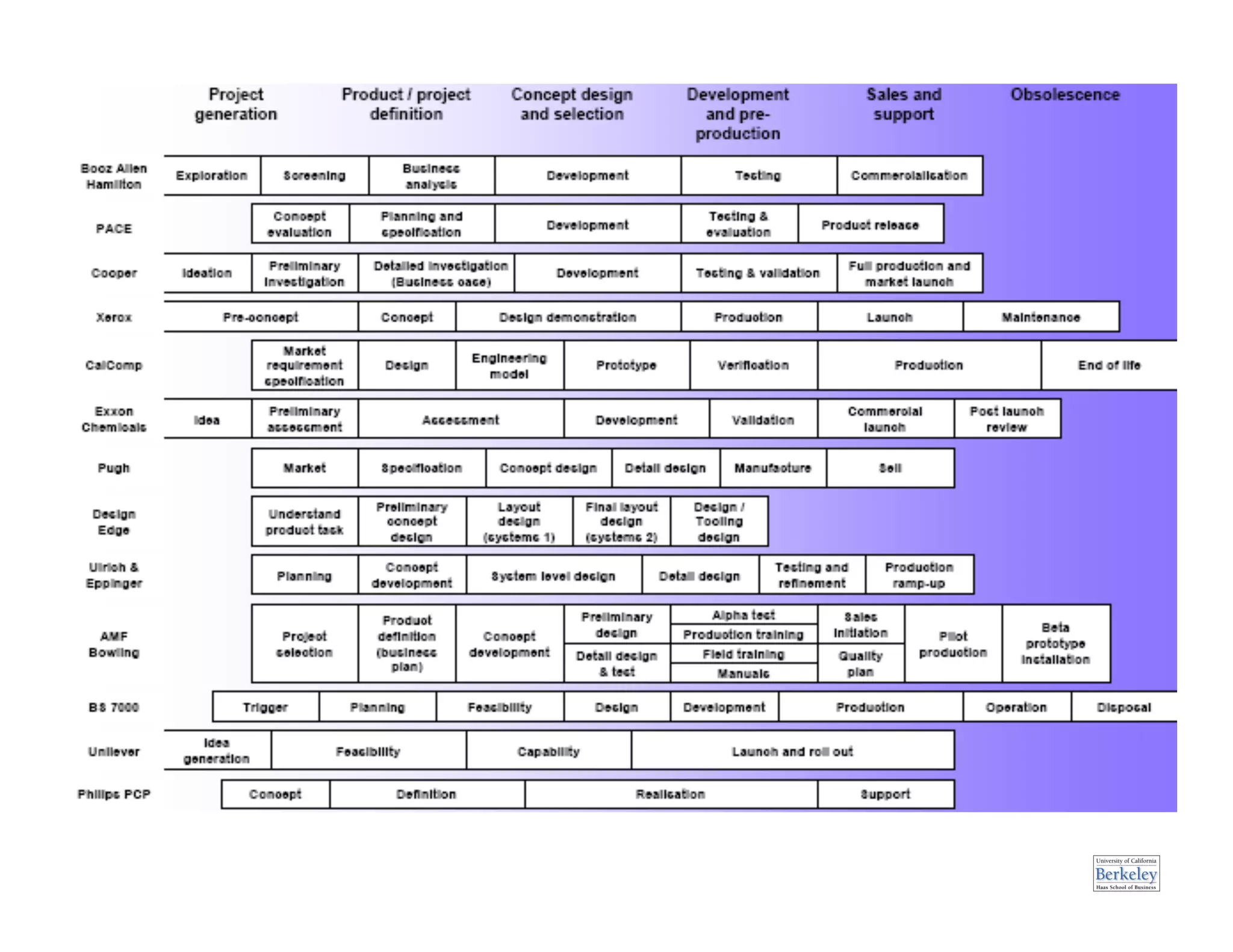
New Product Introductions
                     What’s the Model?

    New Product introduction models
       Checklist of what to and when to do it
       Market size and business case

       Models try to ensure that product matches market

       Technology and development “gates”
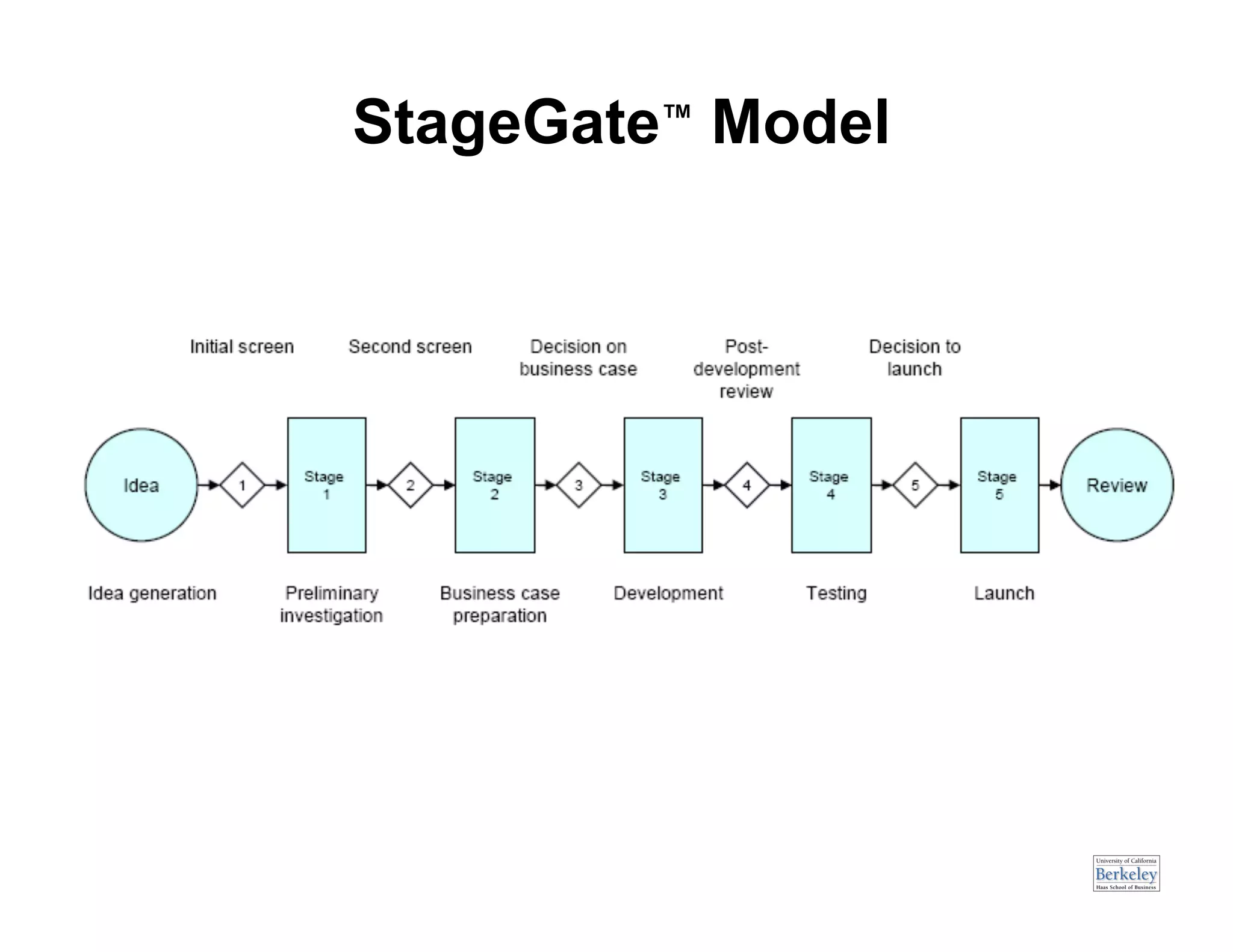
StageGate™ Model
(New Product Introduction)
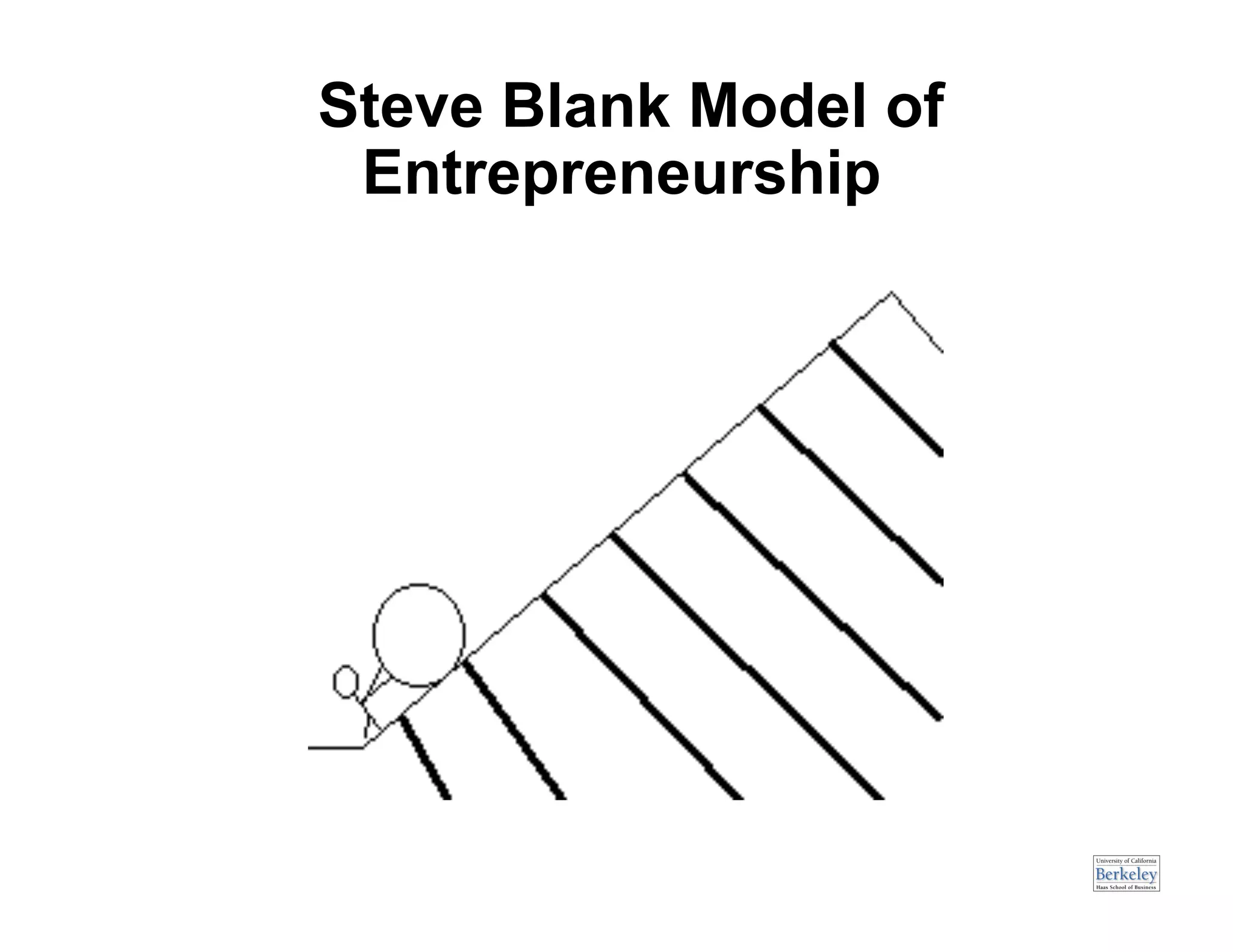
Steve Blank Model of
 Entrepreneurship)
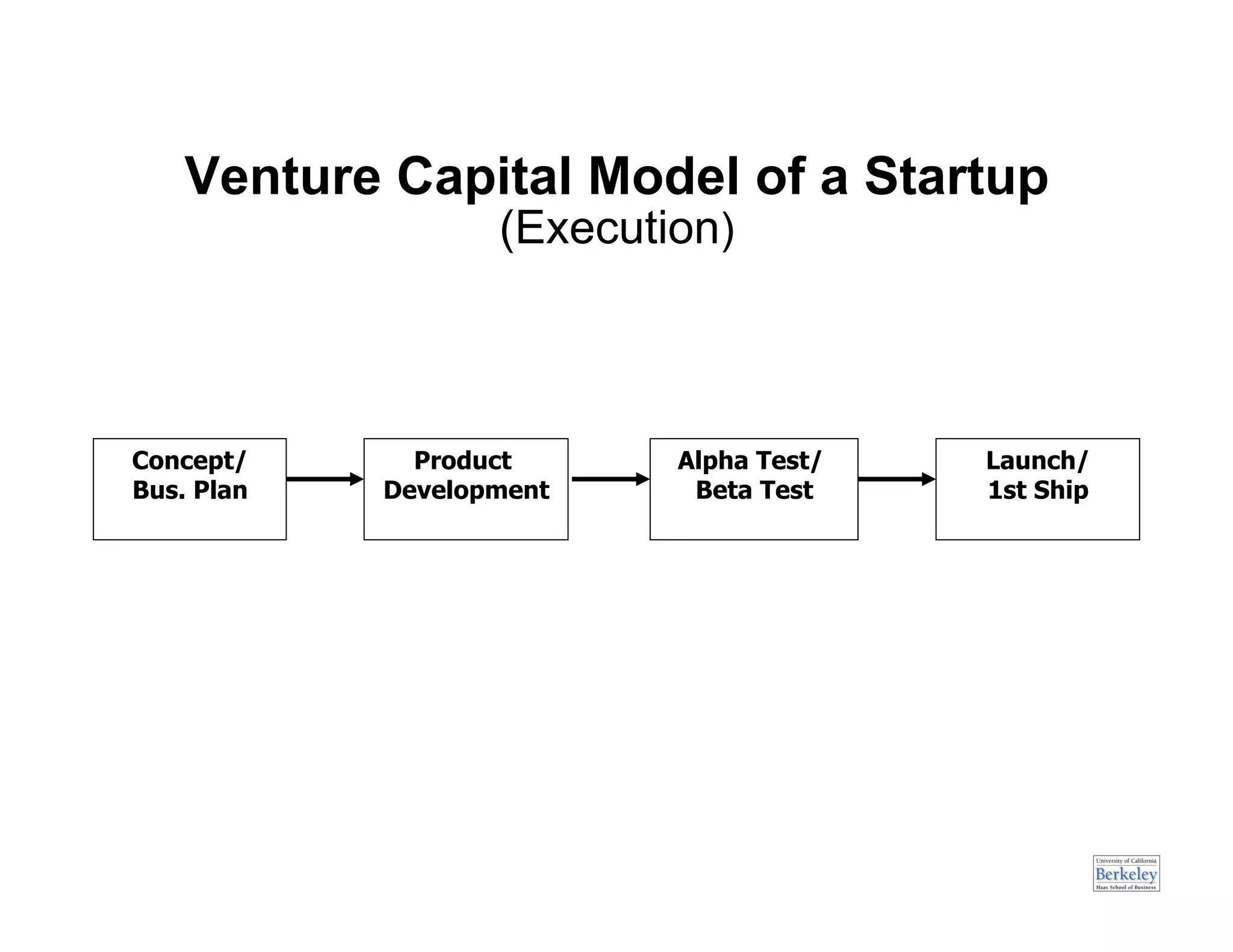
Venture Capital Model of a Startup
                   (Execution)


Concept/      Product      Alpha Test/   Launch/
Bus. Plan   Development     Beta Test    1st Ship
New Product Introduction
                 It Doesn’t Always Work


    New Product Development Process
       Works great for some new products, fails

        miserably for others
       Products usually are late, over cost

       Typically fails to understand and satisfy

        customer needs
    Why?
Issues in New Product Intros

    Current models:
        Confuse product development process with
         customer needs
        Treat all startups as the same

    We need a New Product Intro Process
        Reduces Market RiskSimple, understood by all
        Founders commitment

        Cross function organization

        Solid homework
What is a startup?

    A startup is a human institution designed to
     deliver a new product or service under conditions
     of extreme uncertainty.


    Nothing to do with size of company, sector of the
     economy, or industry
Entrepreneurship is management

    Our goal is to create an institution, not just a
     product
    Traditional management practices fail
         “general management” as taught to MBAs
    Need practices and principles geared to the
     startup context of extreme uncertainty
Value vs. Waste

    In a lean transformation, question #1 is – which
     activities are value-creating and which are waste?
    In traditional business, value is created by
     delivering products or services to customers
    In a startup, the product and customer are
     unknowns
    We need a new definition of value for startups
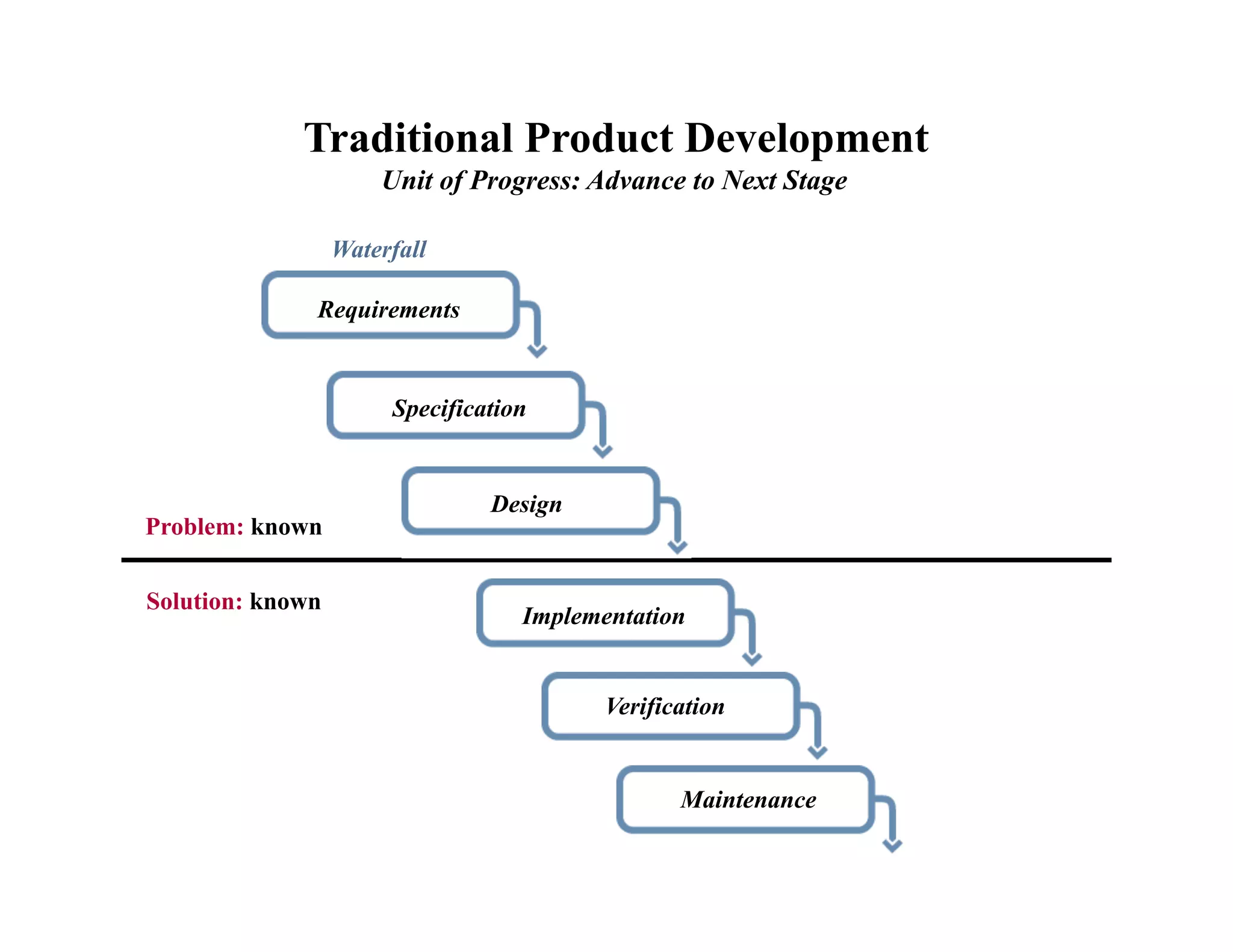
Traditional Product Development
                      Unit of Progress: Advance to Next Stage

                  Waterfall

              Requirements


                       Specification


                                Design
Problem: known


Solution: known
                                   Implementation


                                          Verification


                                                 Maintenance
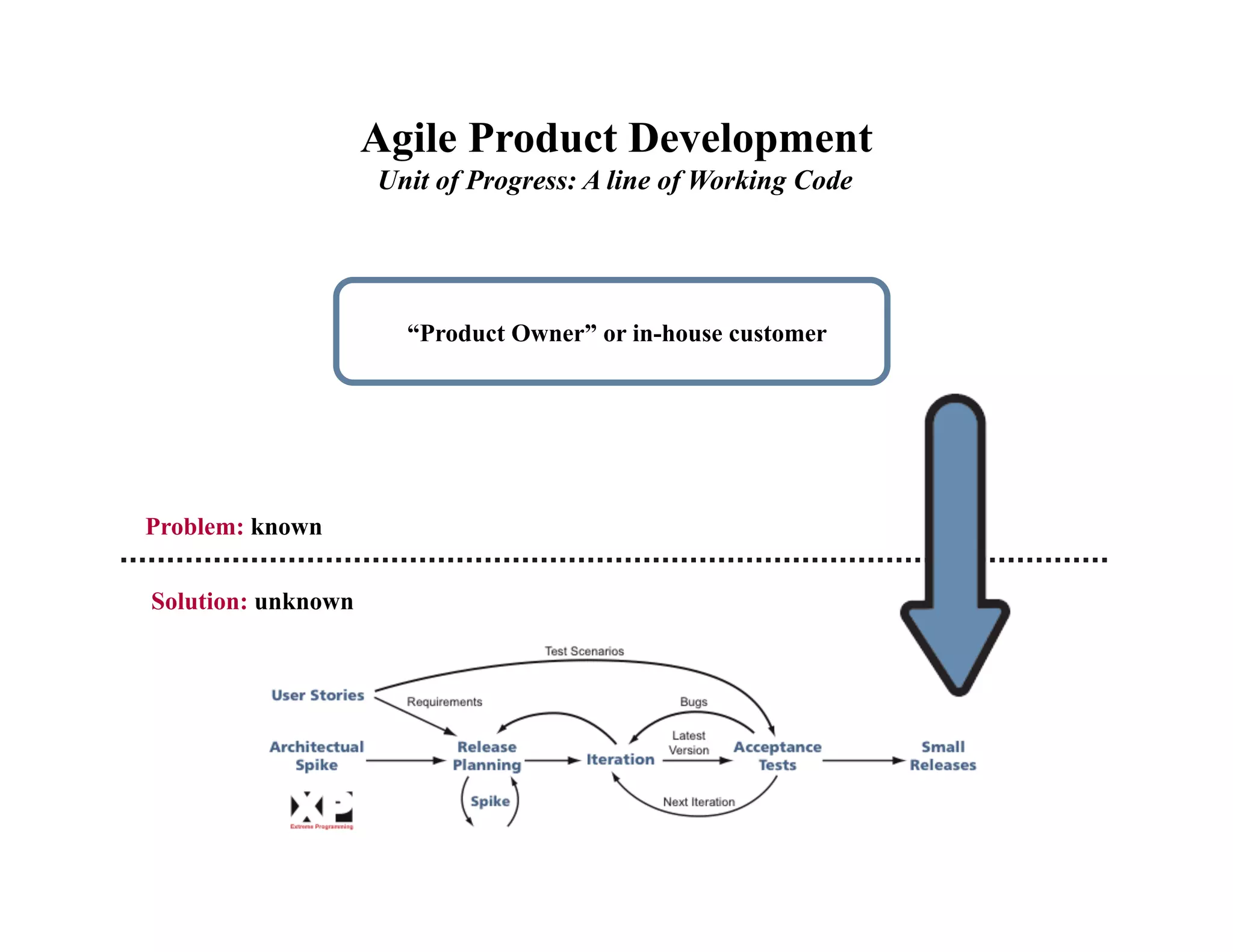
Agile Product Development
                    Unit of Progress: A line of Working Code


                      “Product Owner” or in-house customer


Problem: known


Solution: unknown
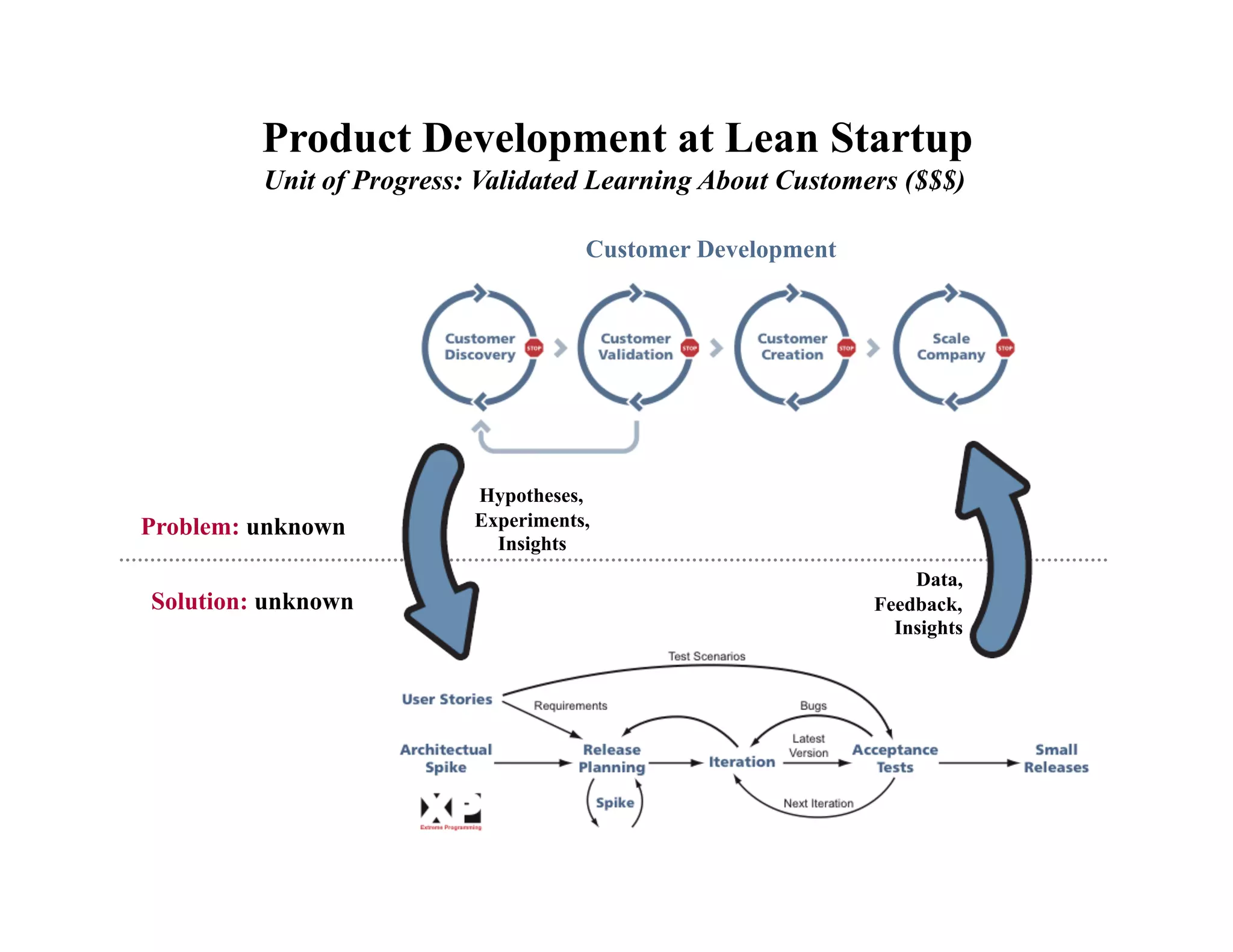
Product Development at Lean Startup
         Unit of Progress: Validated Learning About Customers ($$$)

                                     Customer Development


                          Hypotheses,
Problem: unknown          Experiments,
                            Insights
                                                                Data,
Solution: unknown                                           Feedback,
                                                              Insights
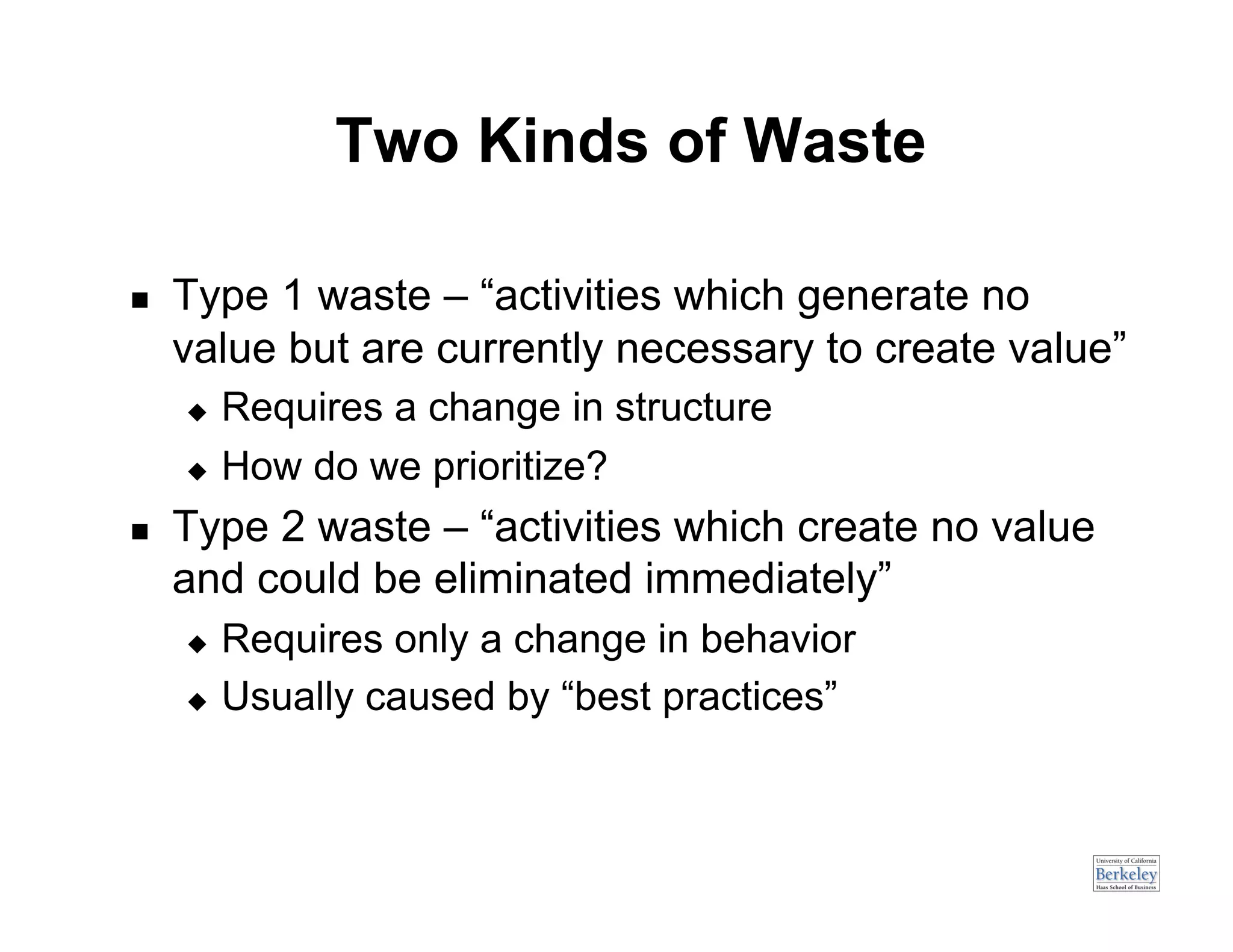
Two Kinds of Waste

    Type 1 waste – “activities which generate no
     value but are currently necessary to create value”
       Requires a change in structure
       How do we prioritize?

    Type 2 waste – “activities which create no value
     and could be eliminated immediately”
       Requires only a change in behavior
       Usually caused by “best practices”
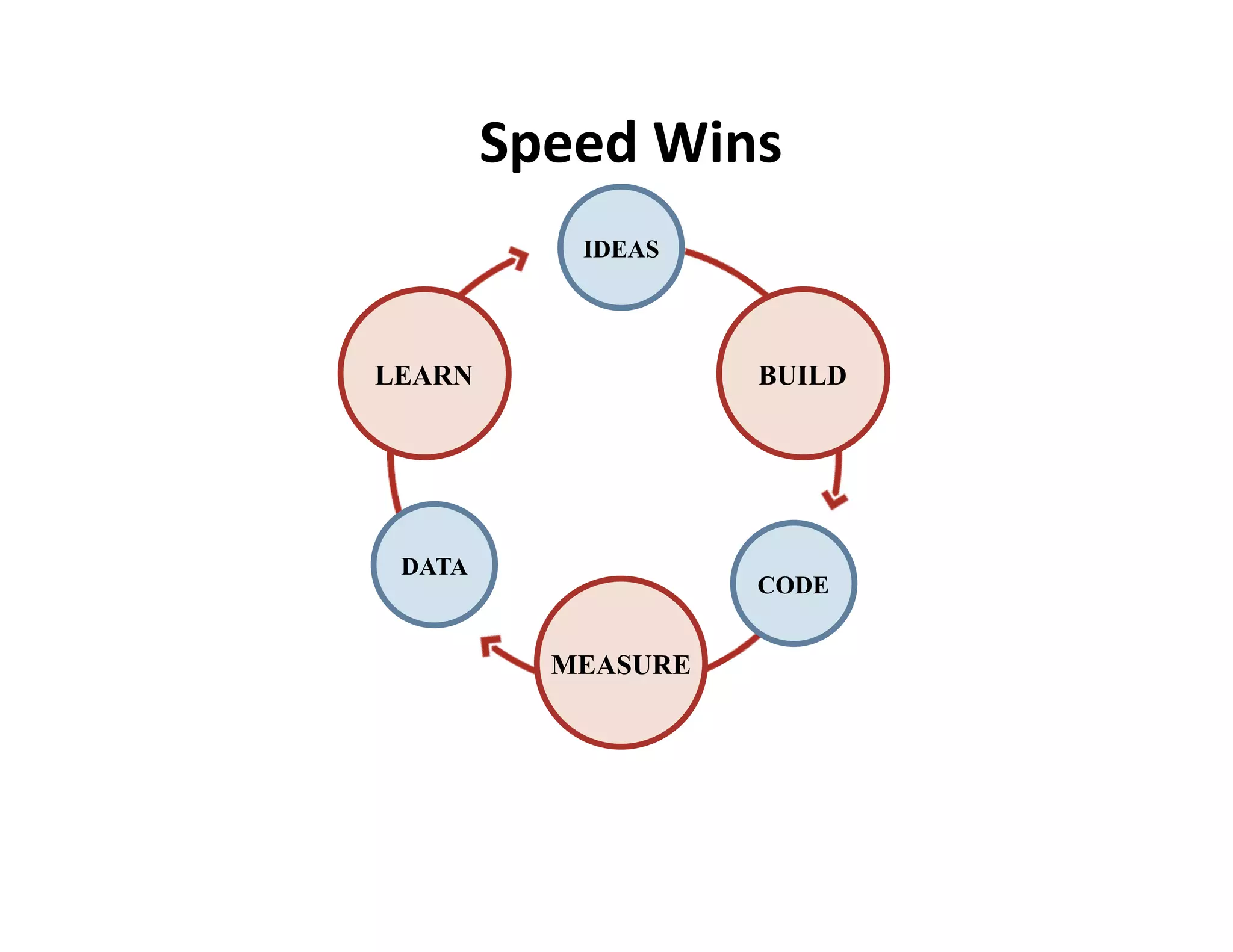
Speed	
  Wins
                    	
  
             IDEAS


LEARN                 BUILD


 DATA
                      CODE


           MEASURE
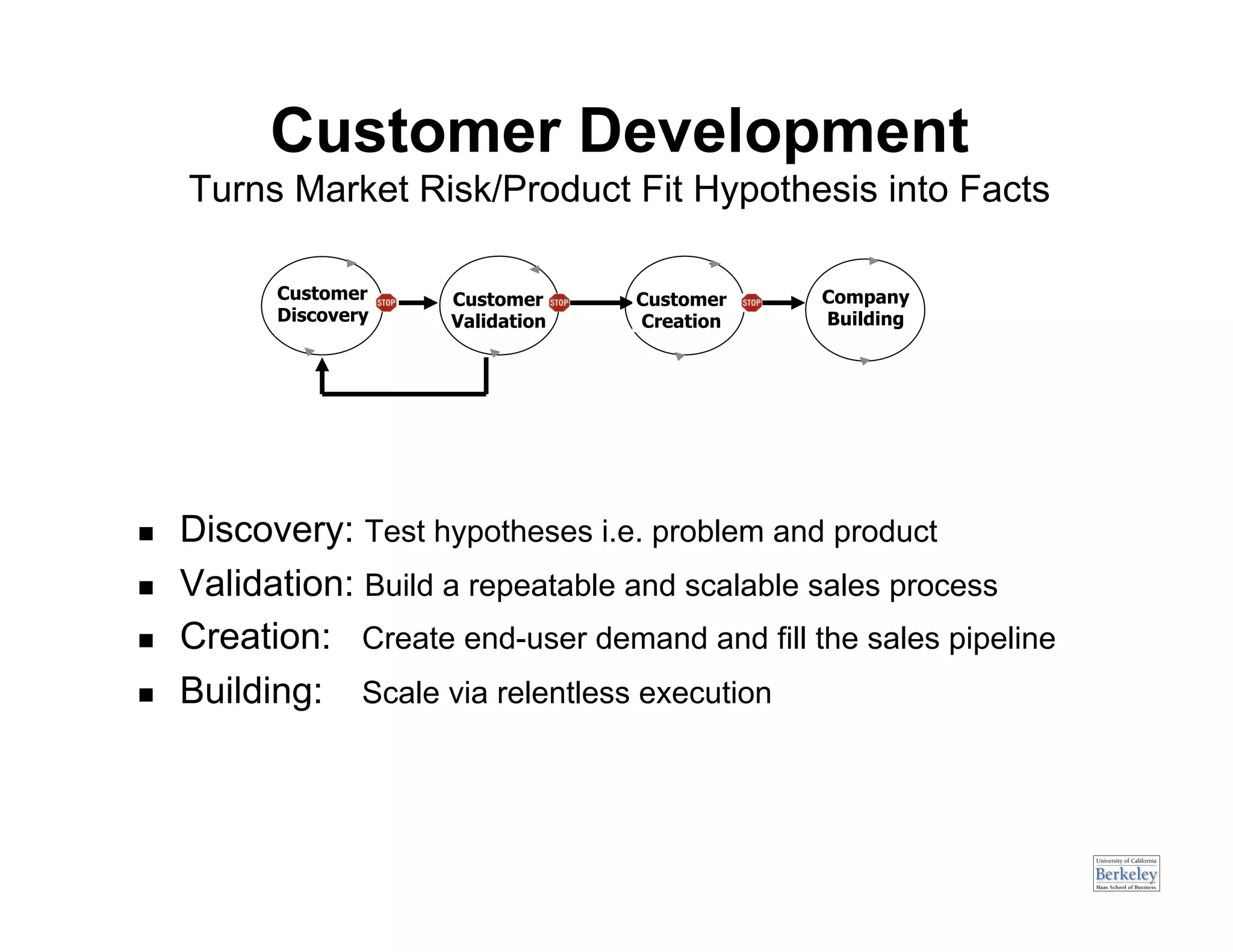
Customer Development
     Turns Market Risk/Product Fit Hypothesis into Facts

           Customer    Customer     Customer    Company
           Discovery   Validation   Creation    Building


    Discovery: Test hypotheses i.e. problem and product
    Validation: Build a repeatable and scalable sales process
    Creation: Create end-user demand and fill the sales pipeline
    Building: Scale via relentless execution
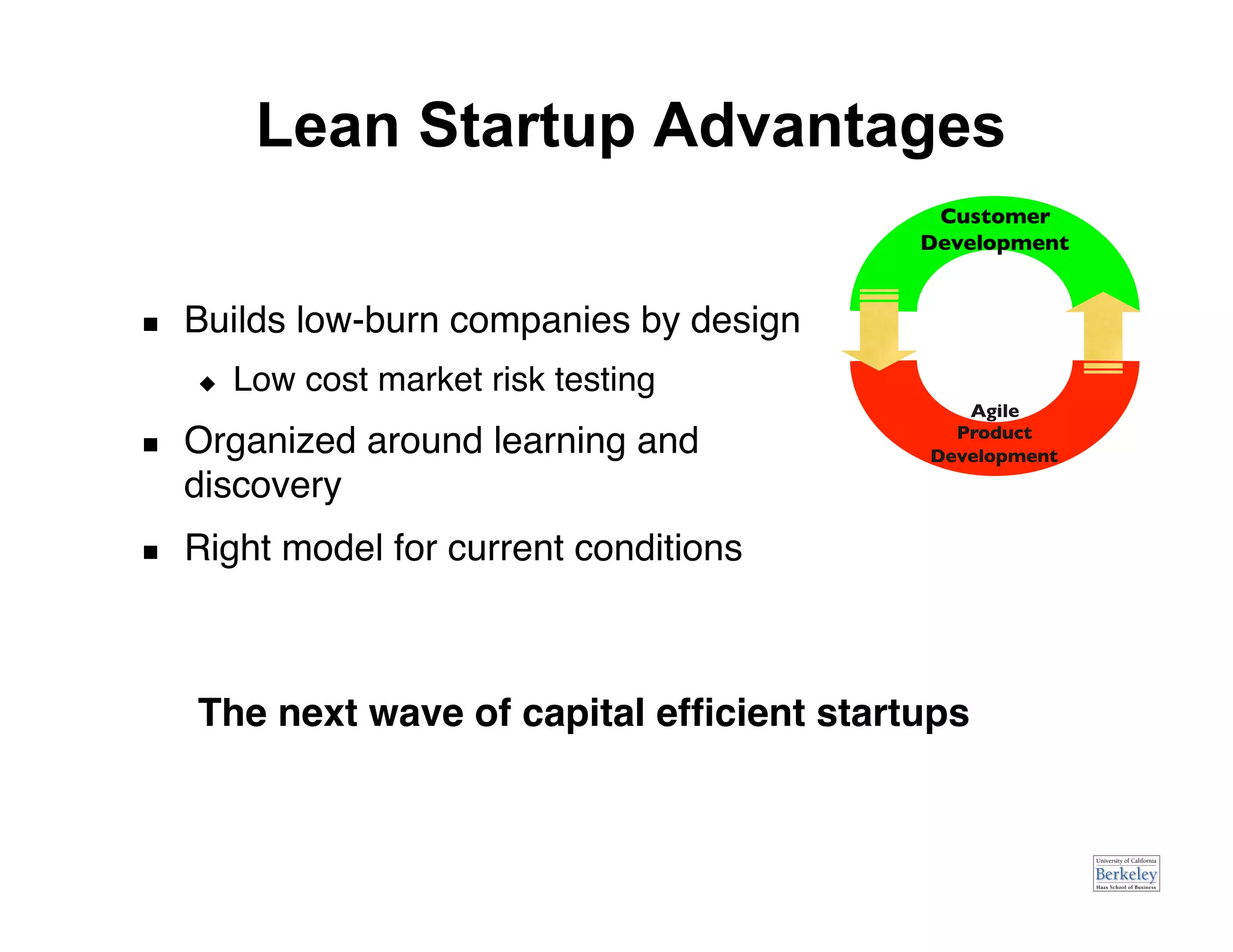
Lean Startup Advantages
                                              Customer	

                                             Development	


    Builds low-burn companies by design "
         Low cost market risk testing"
                                                Agile 	

                                               Product 	

    Organized around learning and           Development	

     discovery"
    Right model for current conditions"


     The next wave of capital efficient startups!
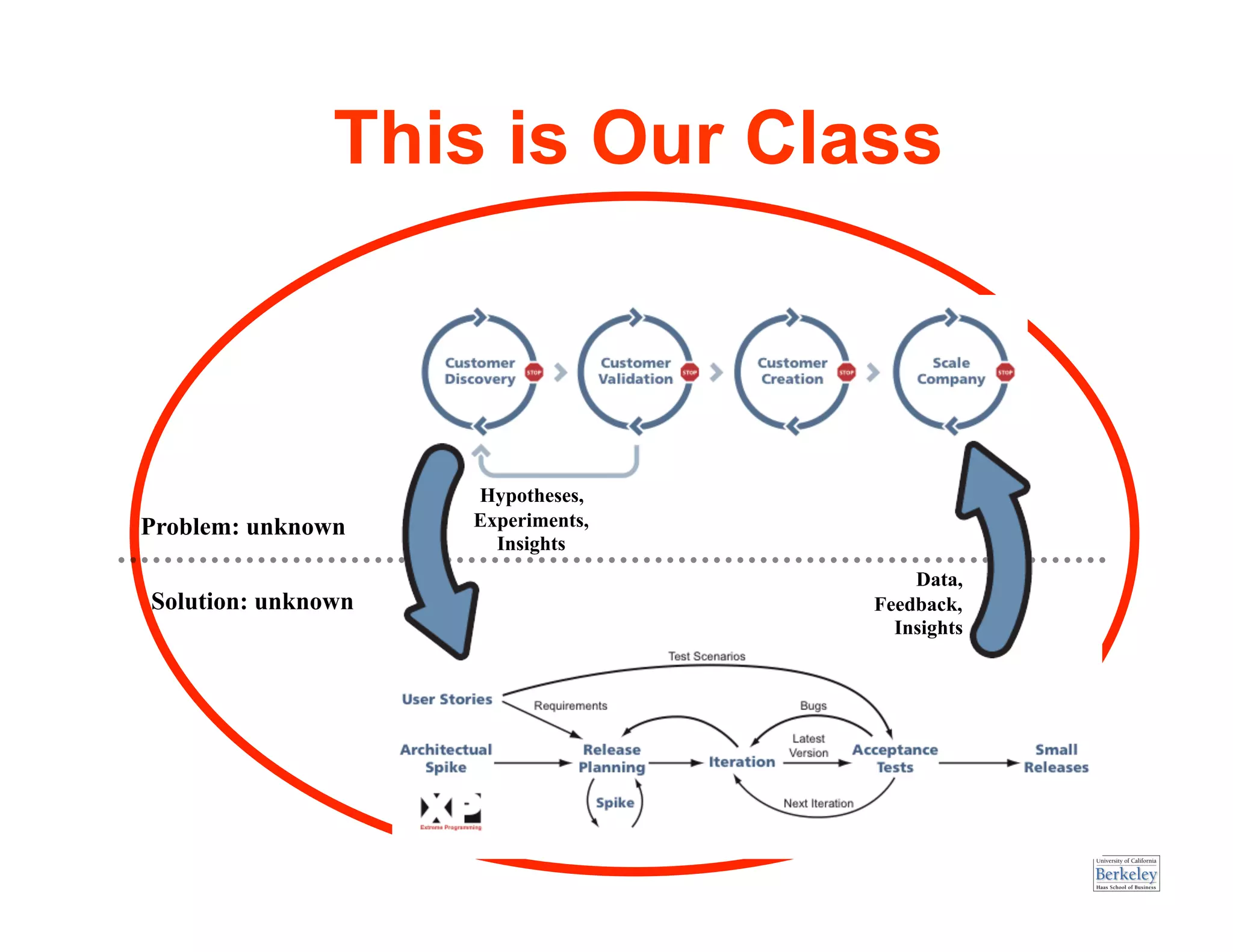
This is Our Class


                    Hypotheses,
Problem: unknown    Experiments,
                      Insights
                                       Data,
Solution: unknown                  Feedback,
                                     Insights

Customer Development/Lean Startup 011910 Class 1

  • 1.
    Advanced Entrepreneurship: Customer Developmentand the Lean Startup Introduction to the Course Steve Blank & Eric Ries sblank@kandsranch.com eric@theleanstartup.com www.steveblank.com www.startuplessonslearned.com/
  • 2.
    You Are Here Plan Liquidity Company Timeline Idea 1st Round
  • 3.
    You Are Here Plan Liquidity Company Timeline Idea 1st Round
  • 4.
    How do YouGet Here Plan Liquidity Company Timeline Idea 1st Round
  • 5.
    Entrepreneurship Logical Process
  • 6.
    Entrepreneurship Logical Process Intuitive Passion
  • 7.
    Today Part 1: Introductionto the Course Part 2: Key Concepts
  • 8.
    Course Introduction   Course Objectives   Intro and Backgrounds   How the Class Works   Customer Development
  • 9.
    Course Objectives   Learn how to:   Reduce product/market risk   Organize sales, marketing and business development when bringing a product to market   Understand its relationship with engineering   Have Fun   Learn from Each Other
  • 10.
    Course Prerequisites   Officially – none   Realistically:   Experience in bringing a new product to market   Entrepreneurship 295 or equivalent   Have written a business plan
  • 11.
    Introduction and Backgrounds   Steve Blank   Eric Ries   Guest Speakers   Class
  • 12.
    Introduction: Steve Blank 8 startups in 20 years 2 strikeouts Rocket Science, Ardent 2 walks ESL, Zilog 2 singles Convergent, MIPS 1 double SuperMac 1 home run E.piphany Non profits: Audubon, POST, Coastal Commission, CLCV, Trustee UCSC Blog: www.steveblank.com Twitter: sgblank
  • 13.
    Introduction: Eric Ries Author: Lean Startup, co/author Black Art of Java Game Programming Company: Co-founder/CTO IMVU There.com Co-founder Catalyst Recruiting Blog: www.startuplessonslearned.com Twitter: ericries
  • 14.
    Introduction: Class Why areyou taking the class?   How many of you have:   Been in start-ups?   Been in a startup that failed?   Raised or tried to raise money?   How many are:   Sales, marketing or business development?   Engineers?
  • 15.
    How the ClassWorks   Syllabus   3 Application Exercises   Research Project   Grading   Research Project (50%)   Application Exercises (25%)   Class Participation (25%)
  • 16.
    Class Issues   Tech-heavy   Enterprise-heavy   For-profit versus non-profit   Startups versus existing companies   Methodology focused on product/customer risk reduction   Doesn’t work for technology risks (i.e Biotech)   Doesn’t match your experience or opinion
  • 17.
    Logistics Steve Blank and Eric Ries sblank@kandsranch.com eric@theleanstartup.com
  • 18.
    How the ClassWorks Part 1 Class Case Application Research Exercise Project Class 2/Jan 26th Three Types of In & Out Startups Burger Class 3/Feb 2nd Customer E-Ink Market Type Think! Development Class 4/Feb 9h Discovery - Part 1 Webvan/ Team Selection Amazon Class 5/Feb 16th Discovery – Part 2 IMVU/ Draft Concept Linden Labs Class 6/Feb 23rd Discovery – Part 3 Motive Approved Concept Class 7/Mar 2nd Validation Part 1 Wildfire Discovery Class 8/Mar 9th Validation Part 2 HPKittyhawk
  • 19.
    How the ClassWorks Part 2 Class Case Application Research Exercise Project Class 9/Mar 16th Creation - Part 1 Ecton March 23rd No Class Class 10/Mar 30th Creation – Part 2 Erox Class 11/Apr 6th Creation Cases Tivo Interviews Done Class 12/Apr 13th Building - Part 1 Documentum Customer Creation Class 13/Apr 20th Building - Part 2 Class 14/Apr 27th Wrapup Final Paper Due 5/4/09
  • 20.
    Study.Net   All materials are on Study.Net   Syllabus   Reading   Assignments   Presentations (after each class)
  • 21.
    Reading Class Text: Four Steps to the Epiphany Assigned Reading: In Reader Blogs: www.steveblank.com http://startuplessonslearned.com/ Presentations: www.slideshare.net/ Google Group: http://groups.google.com/group/lean-startup-circle Twitter: sgblank ericries watch http://www.youtube.com/watch?v=R2lE3fgj7QA for what you could be in store for
  • 22.
    The Course Steve Blank and Eric Ries sblank@kandsranch.com eric@theleanstartup.com
  • 23.
    Customer Development   Business Plans   The Value of “Models” for an Entrepreneur   Key Concepts   Market versus Technology Risks   Vertical Markets   Three Types of Startups
  • 24.
    The Top Liesof Venture Capitalists 1.  “I liked your company, but my partners didn't.” 2.  “If you get a lead, we will follow.” 3.  “Show us some traction, and we'll invest.” 4.  “We love to co-invest with other venture capitalists.” 5.  “We're investing in your team.” 6.  “I have lots of bandwidth to dedicate to your company.” 7.  “This is a vanilla term sheet.” 8.  “We can open up doors for you at our client companies.” 9.  “We like early-stage investing.” Source: Guy Kawasaki
  • 25.
    The Top Liesof Entrepreneurs 1.  “Our projections are conservative.” 2.  “(Big name research firm) says our market will be $50 billion in 2010.” 3.  “(Big name company) is going to sign our purchase order next week.” 4.  “Key employees are set to join us as soon as we get funded.” 5.  “No one is doing what we're doing.”. 6.  “No one can do what we're doing.” 7.  “Hurry because several other venture capital firms are interested.” 8.  “Oracle is too big/dumb/slow to be a threat.” 9.  “We have a proven management team.” 10.  “Patents make our product defensible.” 11.  “All we have to do is get 1% of the market.” Source: Guy Kawasaki
  • 26.
    One Way toPlan a Startup
  • 27.
    Business Plans –Why?   Why write a plan?   VC’s require it   Planning (Strategic/Financial/Ops)   Articulate Bus Model/Assumptions   What’s wrong with a plan?   Static   Execution Oriented
  • 28.
    The Value of“Models”   Model = shorthand for complicated idea   This class teaches a “model” for product introduction   How to reduce risk for customer/market fit   Side effect is rethinking timing in Sales, Marketing & Business Development
  • 29.
    Timmons Model ofEntrepreneurship (The Business Plan) Communication Resources Opportunity Business Plan Creativity Leadership Team
  • 30.
    Moore Model ofEntrepreneurship (Chasm + Life Cycle)
  • 31.
    New Product Introductions What’s the Model?   New Product introduction models   Checklist of what to and when to do it   Market size and business case   Models try to ensure that product matches market   Technology and development “gates”
  • 32.
  • 34.
    Steve Blank Modelof Entrepreneurship)
  • 35.
    Venture Capital Modelof a Startup (Execution) Concept/ Product Alpha Test/ Launch/ Bus. Plan Development Beta Test 1st Ship
  • 36.
    New Product Introduction It Doesn’t Always Work   New Product Development Process   Works great for some new products, fails miserably for others   Products usually are late, over cost   Typically fails to understand and satisfy customer needs   Why?
  • 37.
    Issues in NewProduct Intros   Current models:   Confuse product development process with customer needs   Treat all startups as the same   We need a New Product Intro Process   Reduces Market RiskSimple, understood by all   Founders commitment   Cross function organization   Solid homework
  • 38.
    What is astartup?   A startup is a human institution designed to deliver a new product or service under conditions of extreme uncertainty.   Nothing to do with size of company, sector of the economy, or industry
  • 39.
    Entrepreneurship is management   Our goal is to create an institution, not just a product   Traditional management practices fail   “general management” as taught to MBAs   Need practices and principles geared to the startup context of extreme uncertainty
  • 40.
    Value vs. Waste   In a lean transformation, question #1 is – which activities are value-creating and which are waste?   In traditional business, value is created by delivering products or services to customers   In a startup, the product and customer are unknowns   We need a new definition of value for startups
  • 41.
    Traditional Product Development Unit of Progress: Advance to Next Stage Waterfall Requirements Specification Design Problem: known Solution: known Implementation Verification Maintenance
  • 42.
    Agile Product Development Unit of Progress: A line of Working Code “Product Owner” or in-house customer Problem: known Solution: unknown
  • 43.
    Product Development atLean Startup Unit of Progress: Validated Learning About Customers ($$$) Customer Development Hypotheses, Problem: unknown Experiments, Insights Data, Solution: unknown Feedback, Insights
  • 44.
    Two Kinds ofWaste   Type 1 waste – “activities which generate no value but are currently necessary to create value”   Requires a change in structure   How do we prioritize?   Type 2 waste – “activities which create no value and could be eliminated immediately”   Requires only a change in behavior   Usually caused by “best practices”
  • 45.
    Speed  Wins   IDEAS LEARN BUILD DATA CODE MEASURE
  • 46.
    Customer Development Turns Market Risk/Product Fit Hypothesis into Facts Customer Customer Customer Company Discovery Validation Creation Building   Discovery: Test hypotheses i.e. problem and product   Validation: Build a repeatable and scalable sales process   Creation: Create end-user demand and fill the sales pipeline   Building: Scale via relentless execution
  • 47.
    Lean Startup Advantages Customer Development   Builds low-burn companies by design "   Low cost market risk testing" Agile Product   Organized around learning and Development discovery"   Right model for current conditions" The next wave of capital efficient startups!
  • 48.
    This is OurClass Hypotheses, Problem: unknown Experiments, Insights Data, Solution: unknown Feedback, Insights