CONCURRENCY
CONCEPTS IN JAVA
DOUGLAS Q. HAWKINS
LEAD JIT DEVELOPER
AZUL SYSTEMS
@dougqh
dougqh@gmail.com
TOPICS
NOT ABOUT
PARALLEL FORK JOIN
AKKA
EXECUTORS & FUTURES
…
CORE MEMORY MODEL
ATOMICITY
ORDERING
VISIBILITY
HISTORY & FUTURE OF THE MEMORY MODEL
TOPICS
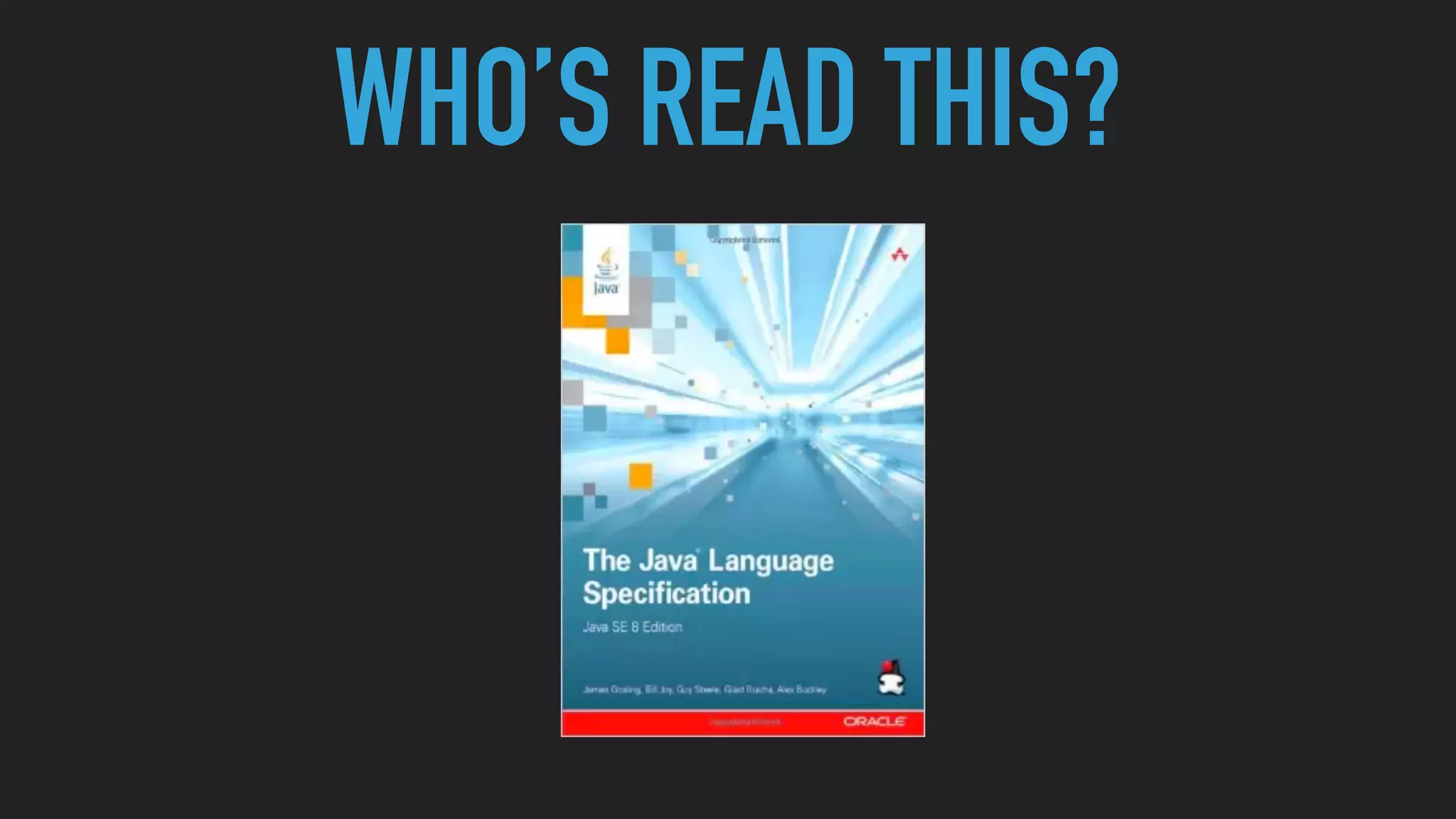
WHO’S READ THIS?
YOU SHOULD READ THE FINE PRINT.
TLDR: “AS IF”
AS IF THERE’S ONE THREAD,
UNLESS YOU SAY OTHERWISE.
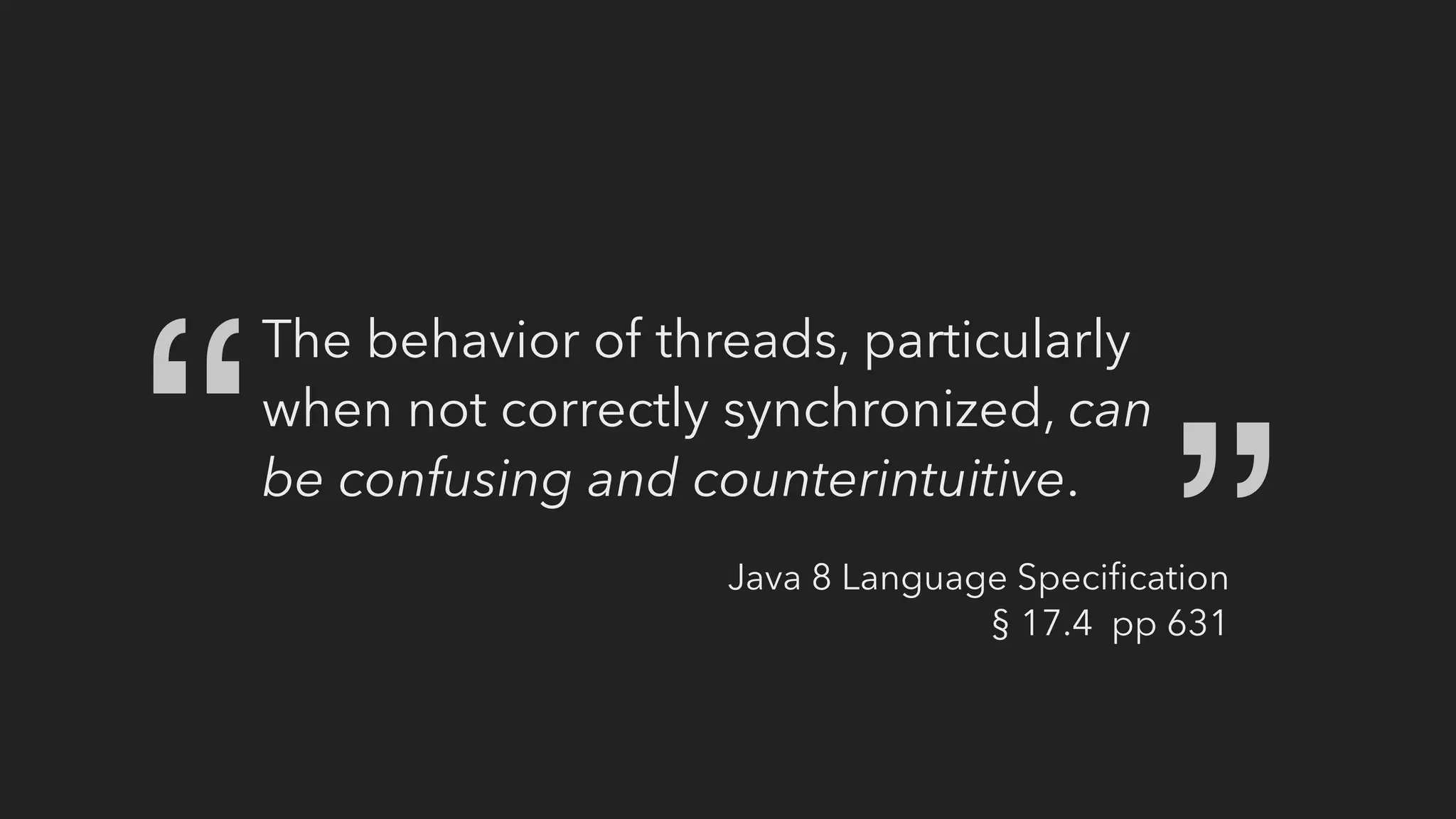
The behavior of threads, particularly
when not correctly synchronized, can
be confusing and counterintuitive.
“
“
Java 8 Language Specification
§ 17.4 pp 631
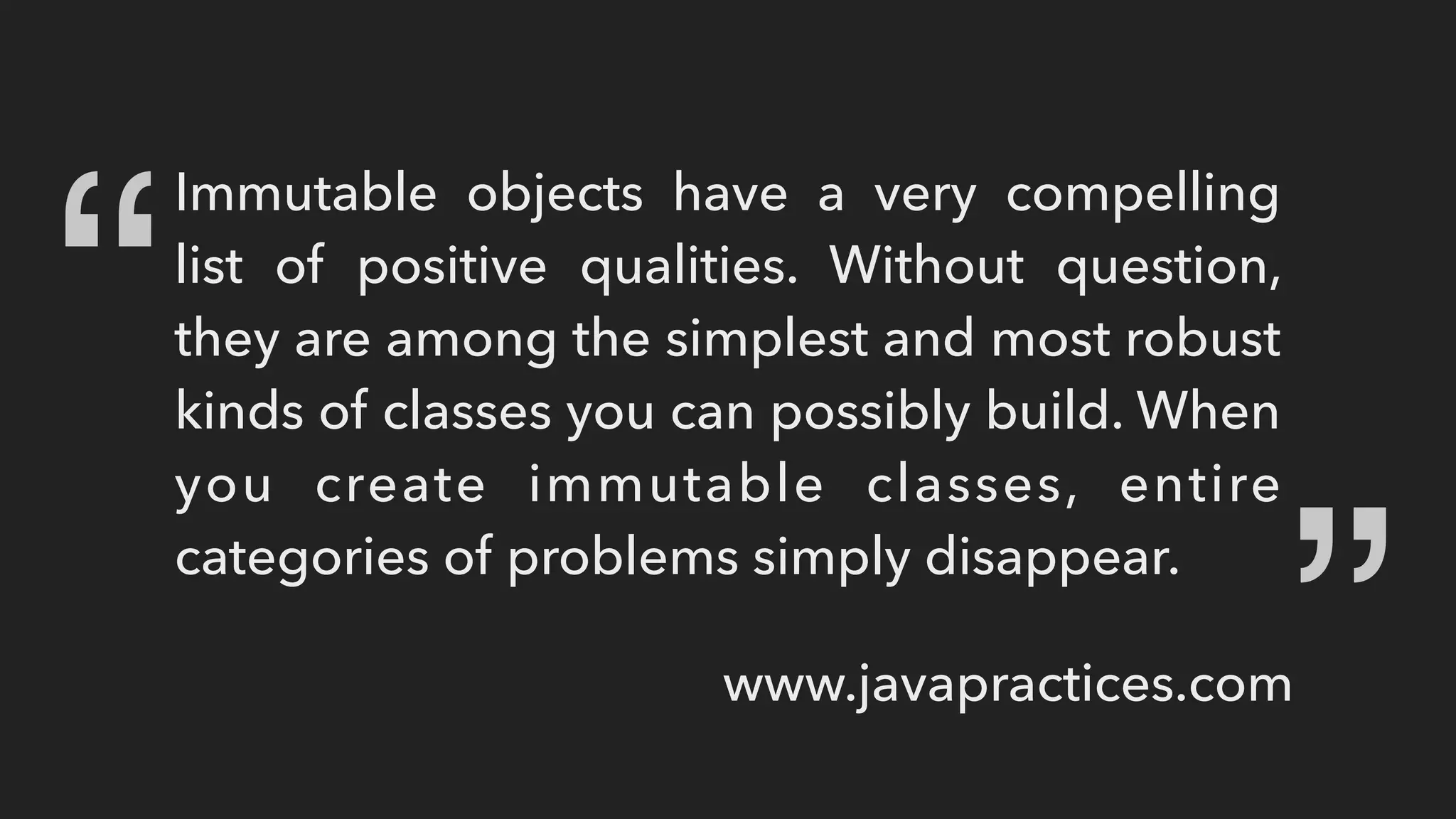
Immutable objects have a very compelling
list of positive qualities. Without question,
they are among the simplest and most robust
kinds of classes you can possibly build. When
you create immutable classes, entire
categories of problems simply disappear.
“ “
www.javapractices.com
ATOMICITYWHAT OPERATIONS ARE INDIVISIBLE?
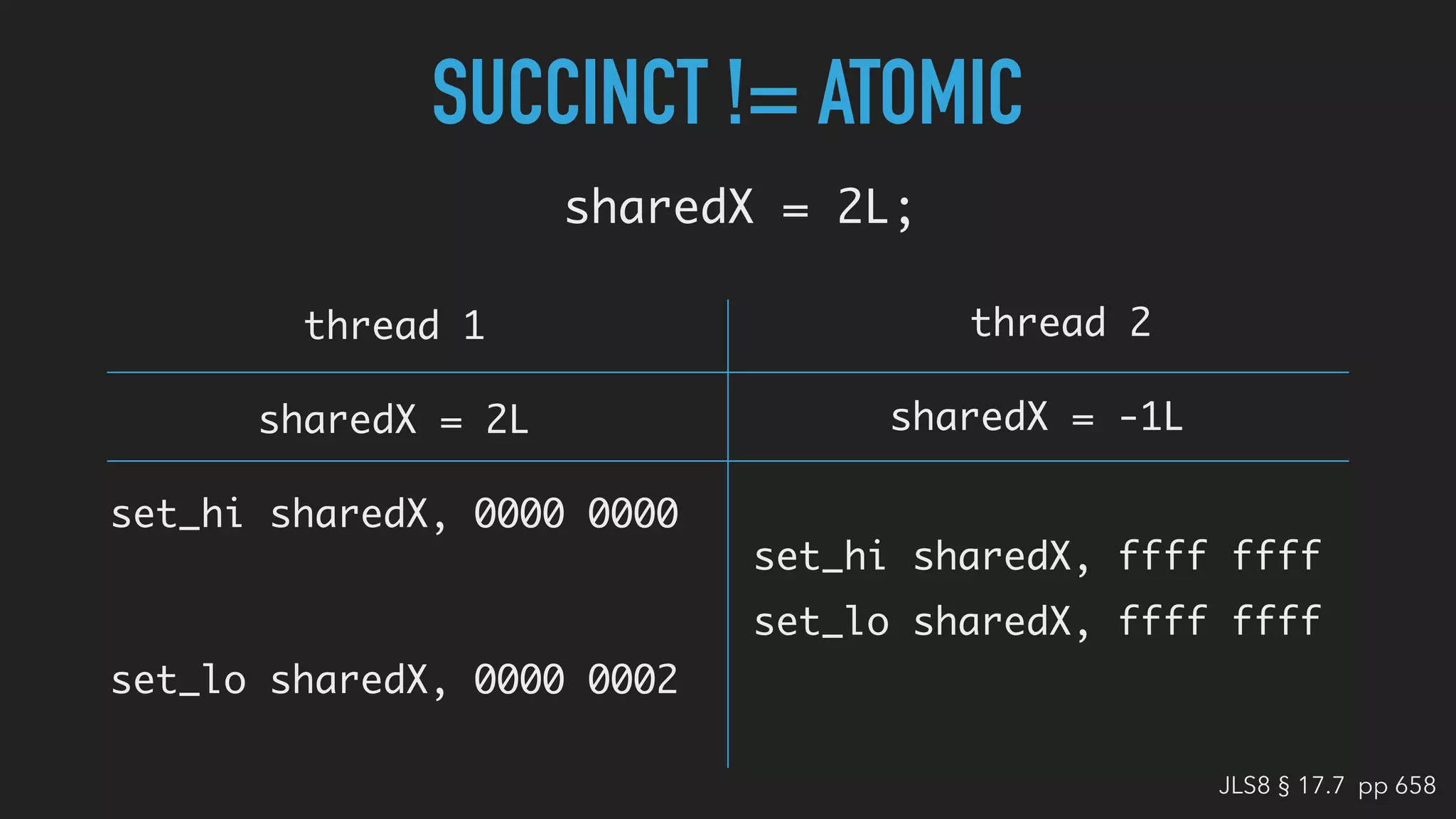
SUCCINCT != ATOMIC
sharedX = 2L;
sharedX = 2L sharedX = -1L
set_hi sharedX, 0000 0000
set_lo sharedX, 0000 0002
set_hi sharedX, ffff ffff
set_lo sharedX, ffff ffff
thread 1 thread 2
JLS8 § 17.7 pp 658
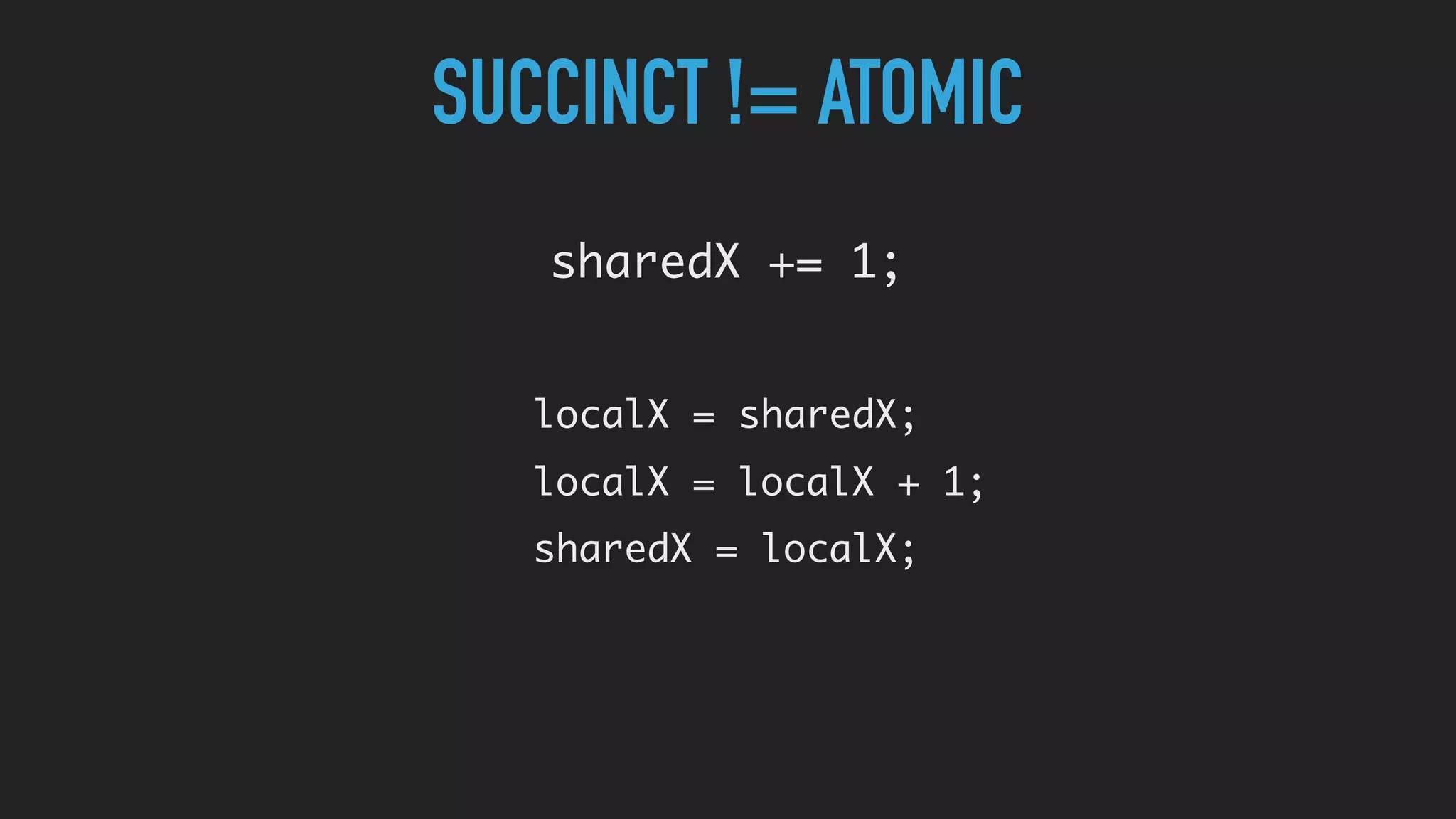
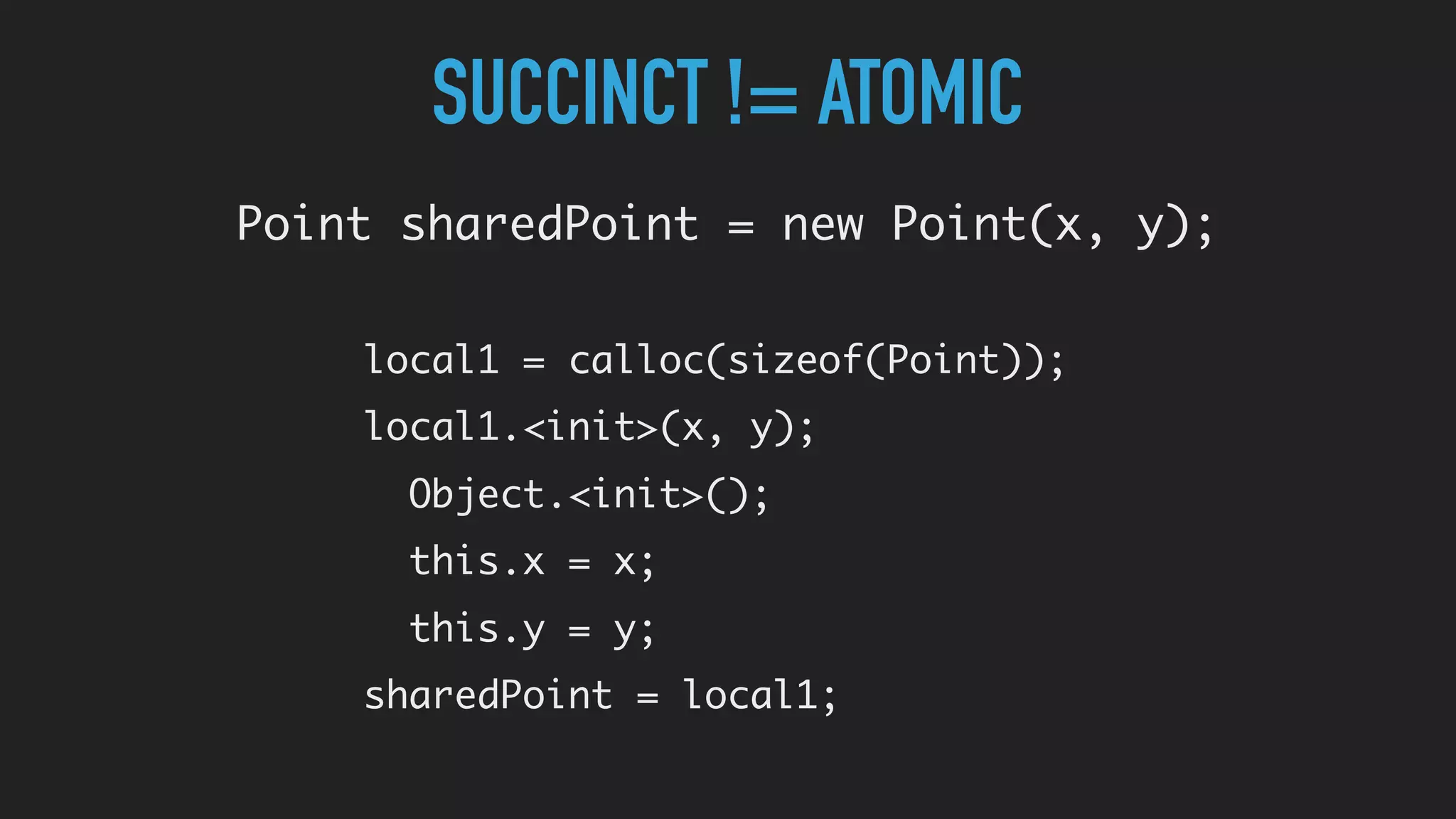
SUCCINCT != ATOMIC
sharedX += 1;
localX = sharedX;
localX = localX + 1;
sharedX = localX;
SUCCINCT != ATOMIC
Point sharedPoint = new Point(x, y);
local1 = calloc(sizeof(Point));
local1.<init>(x, y);
Object.<init>();
this.x = x;
this.y = y;
sharedPoint = local1;
VISIBILITYWHAT CAN OTHER THREADS SEE?
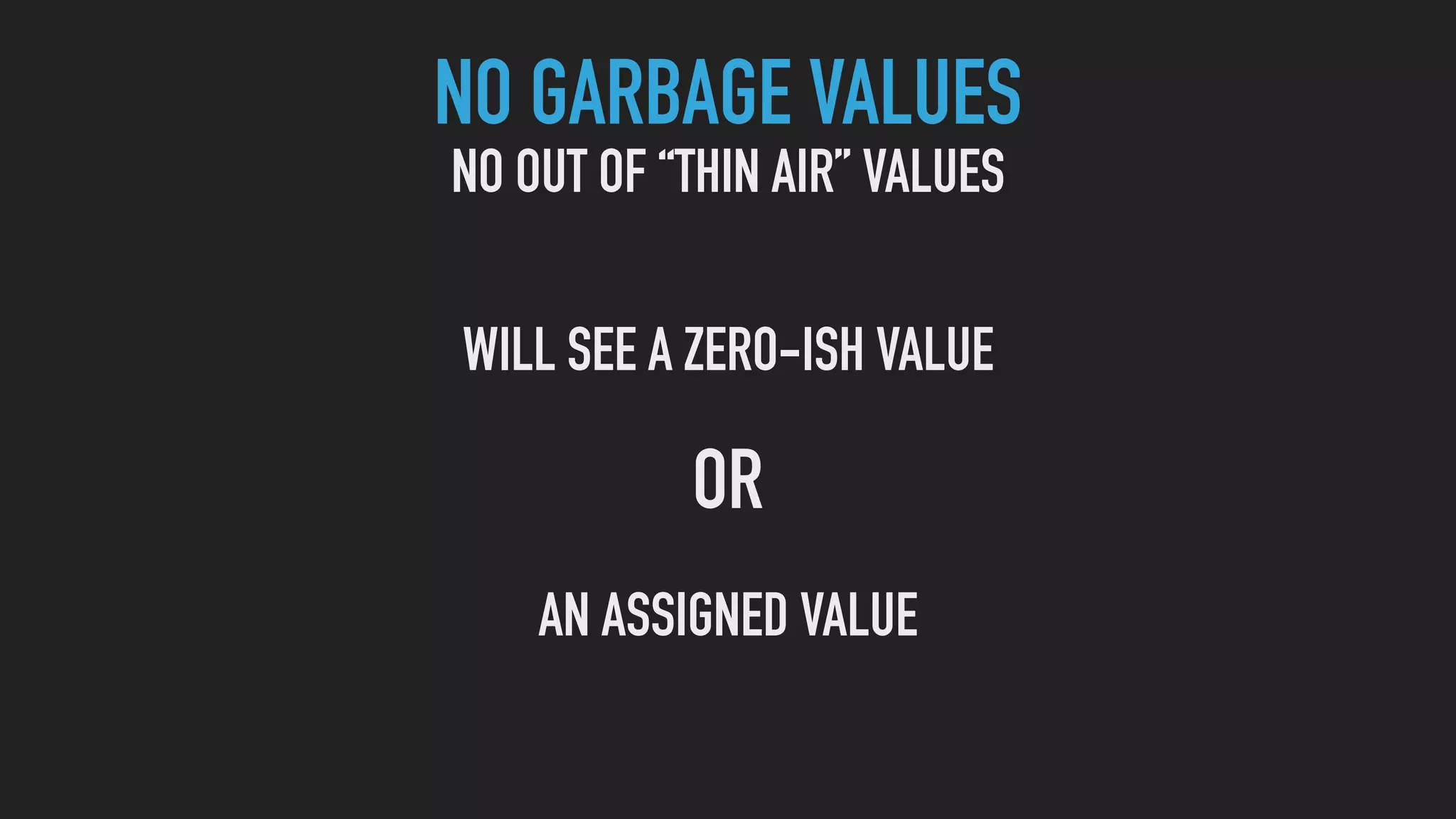
NO GARBAGE VALUES
NO OUT OF “THIN AIR” VALUES
WILL SEE A ZERO-ISH VALUE
OR
AN ASSIGNED VALUE
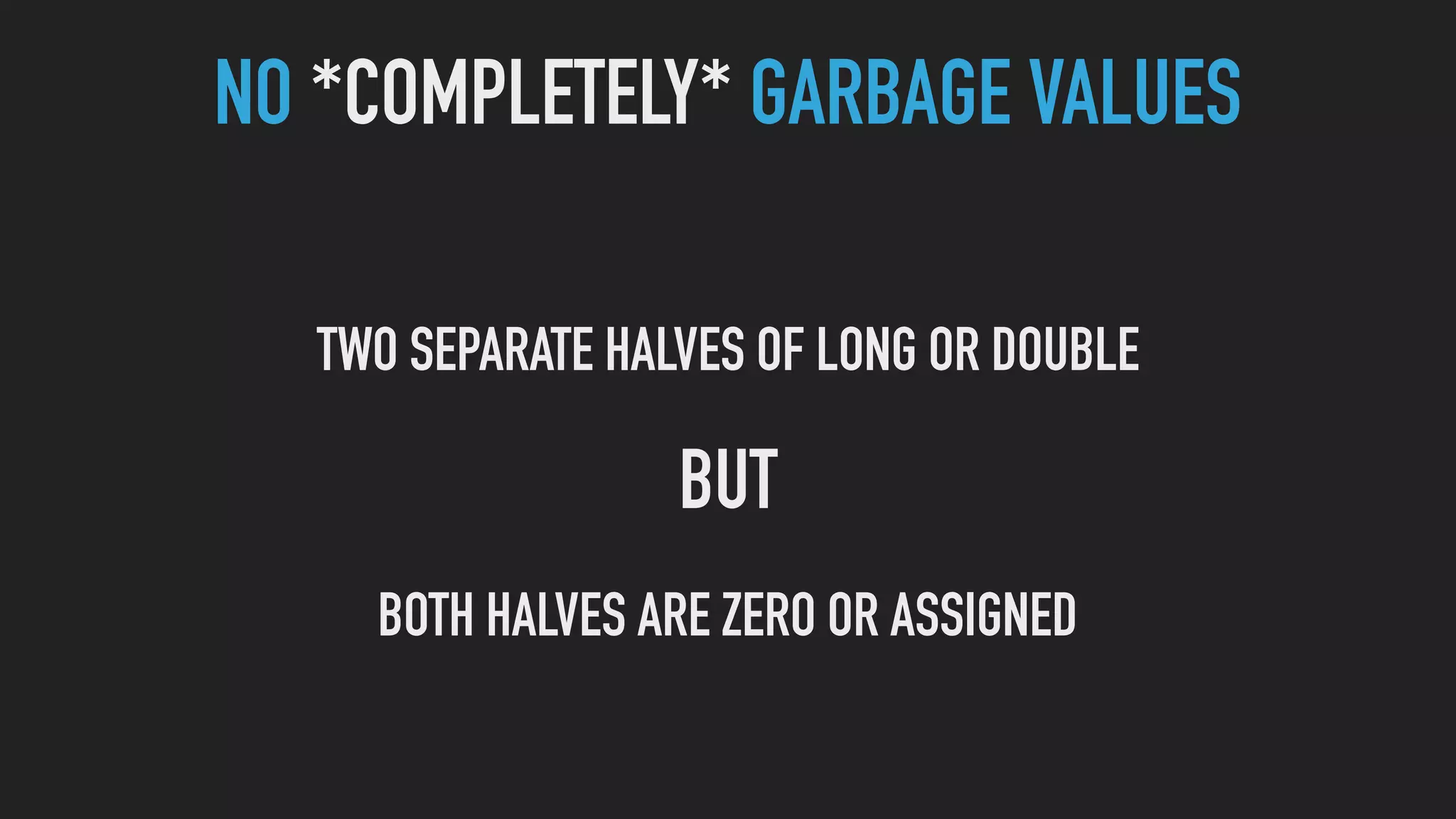
NO *COMPLETELY* GARBAGE VALUES
TWO SEPARATE HALVES OF LONG OR DOUBLE
BUT
BOTH HALVES ARE ZERO OR ASSIGNED
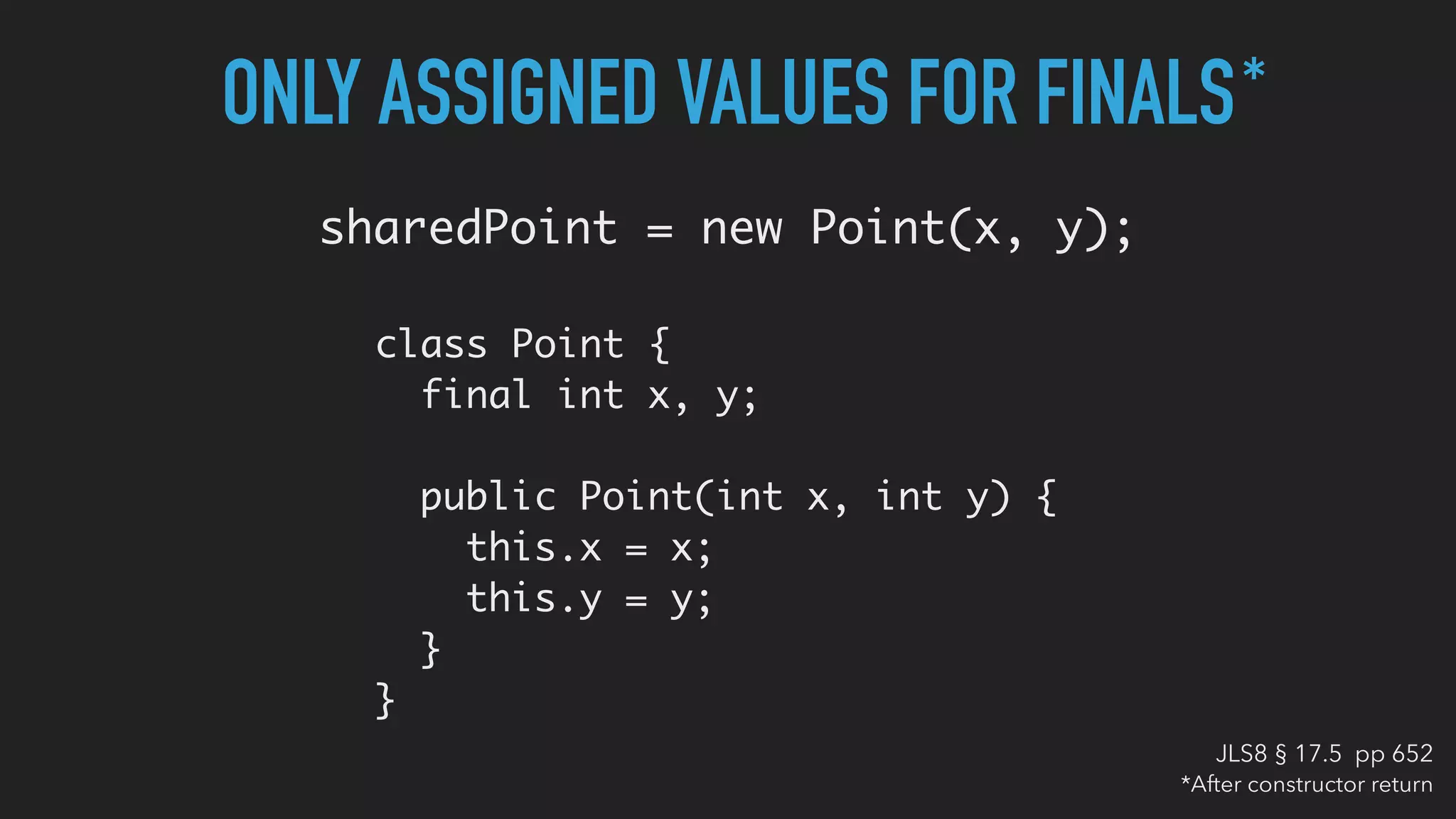
ONLY ASSIGNED VALUES FOR FINALS
sharedPoint = new Point(x, y);
class Point {
final int x, y;
public Point(int x, int y) {
this.x = x;
this.y = y;
}
}
*
*After constructor return
JLS8 § 17.5 pp 652
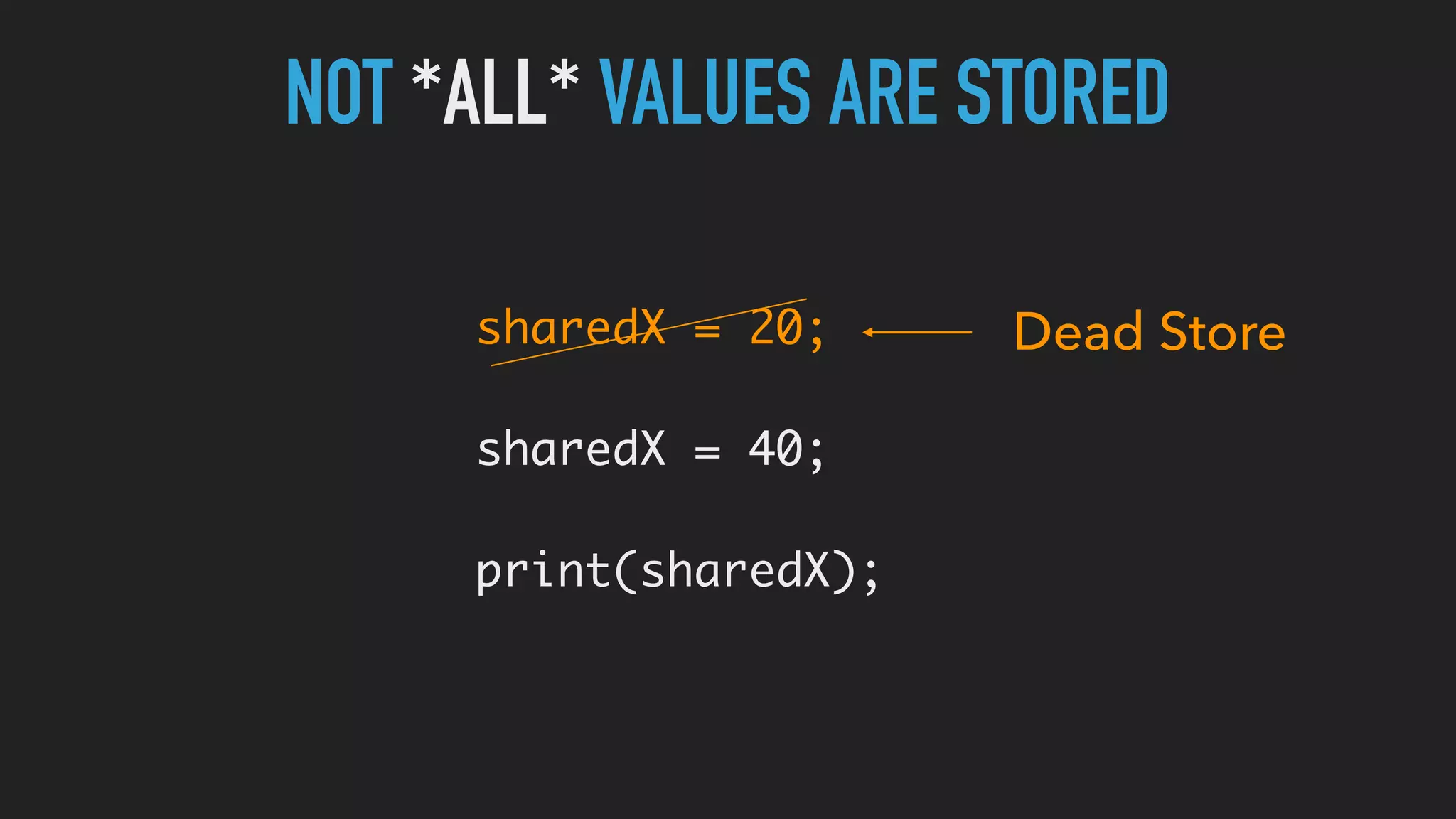
NOT *ALL* VALUES ARE STORED
sharedX = 20;
sharedX = 40;
print(sharedX);
Dead Store
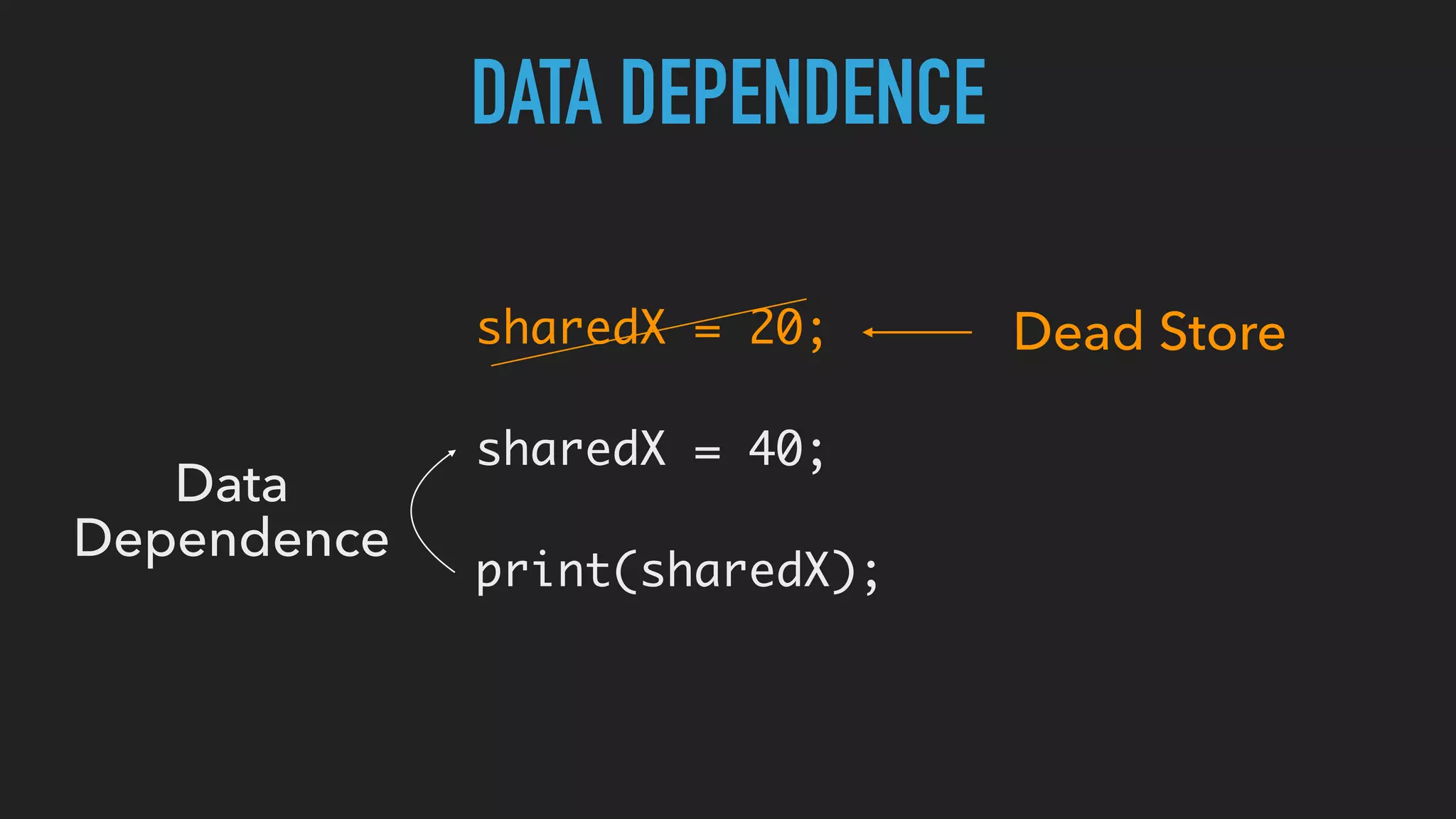
DATA DEPENDENCE
sharedX = 20;
sharedX = 40;
print(sharedX);
Dead Store
Data
Dependence
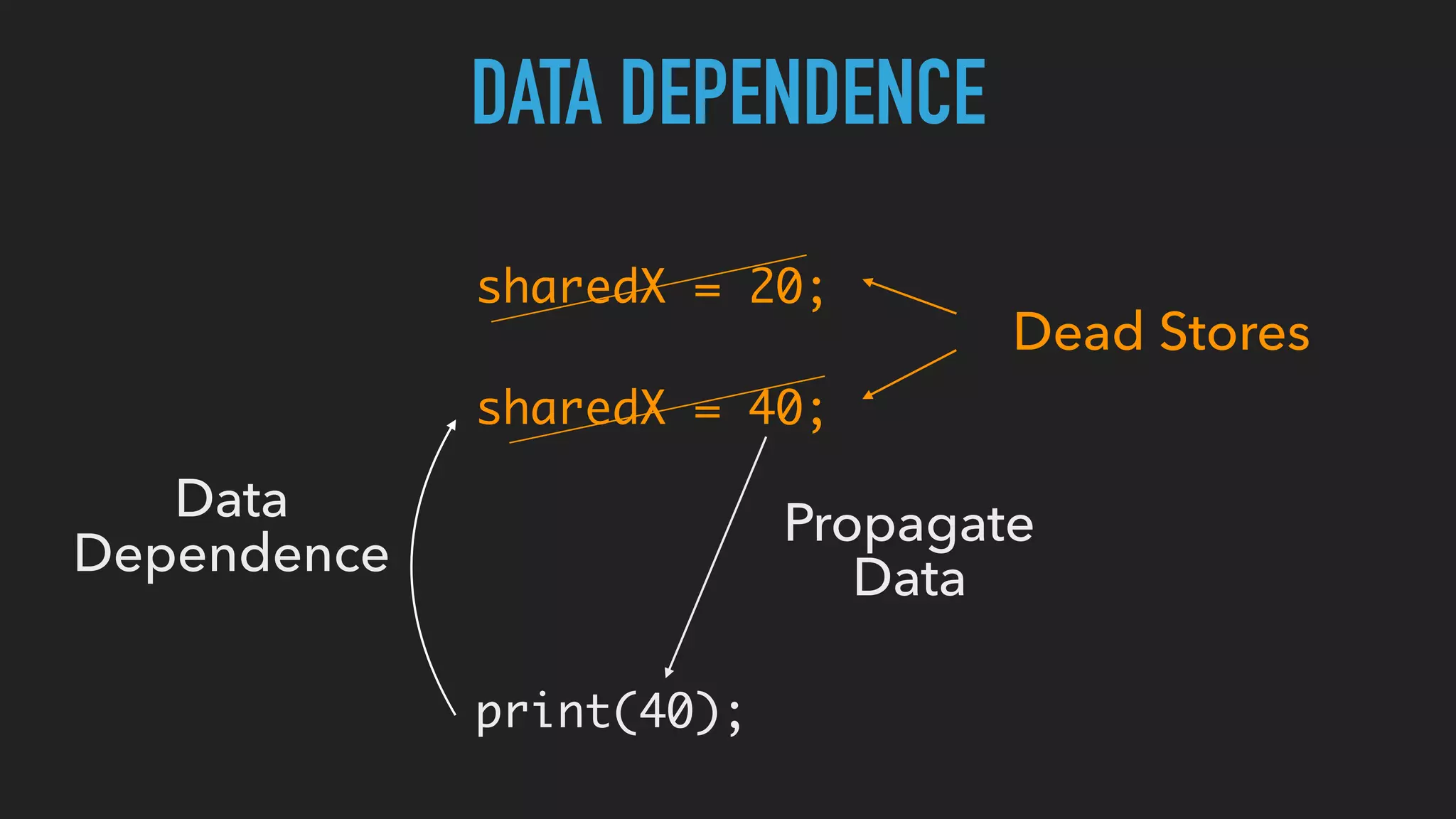
DATA DEPENDENCE
sharedX = 20;
sharedX = 40;
print(40);
Data
Dependence
Propagate
Data
Dead Stores
OKAY.
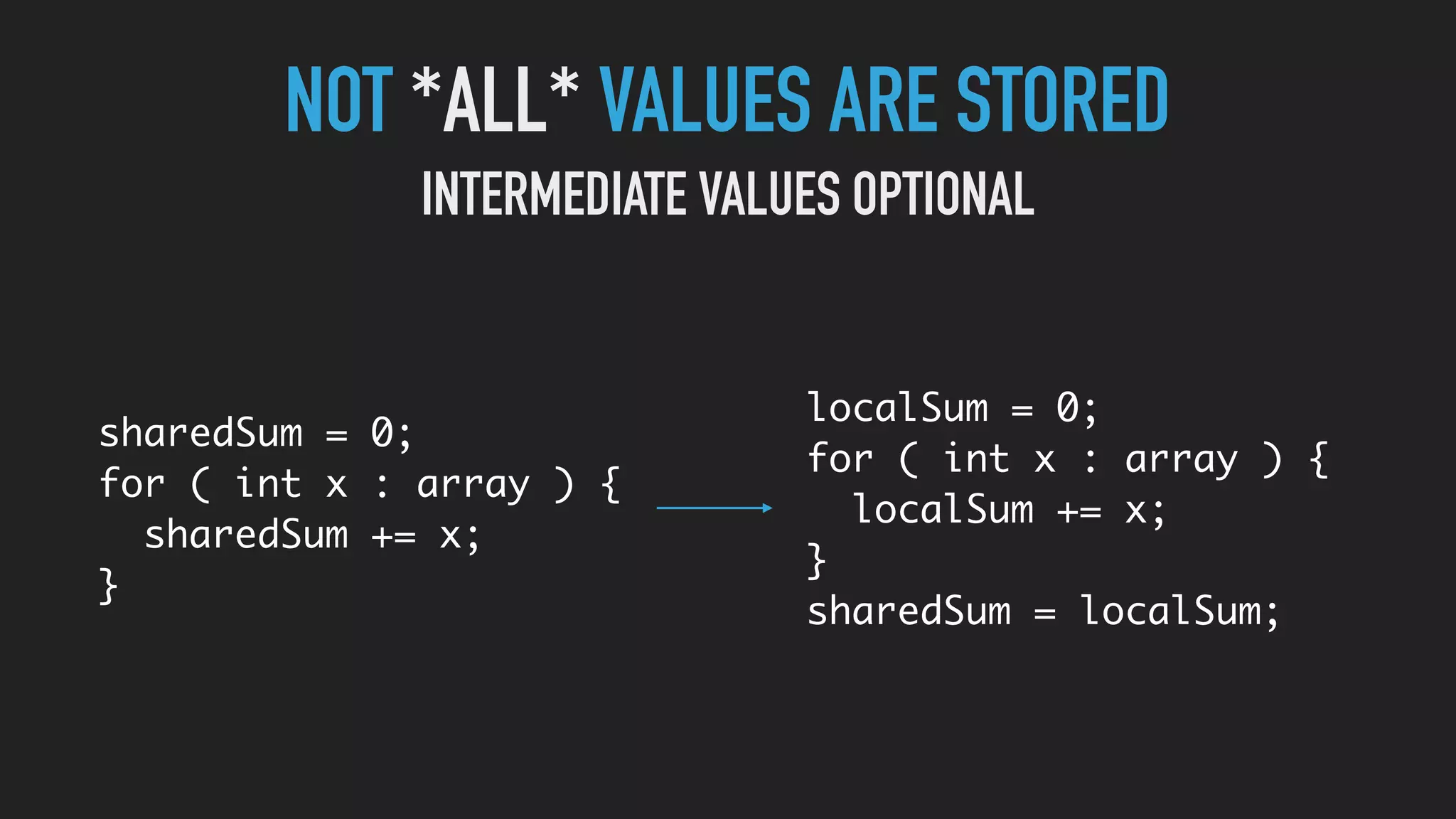
NOT *ALL* VALUES ARE STORED
sharedSum = 0;
for ( int x : array ) {
sharedSum += x;
}
INTERMEDIATE VALUES OPTIONAL
localSum = 0;
for ( int x : array ) {
localSum += x;
}
sharedSum = localSum;
WHAT?
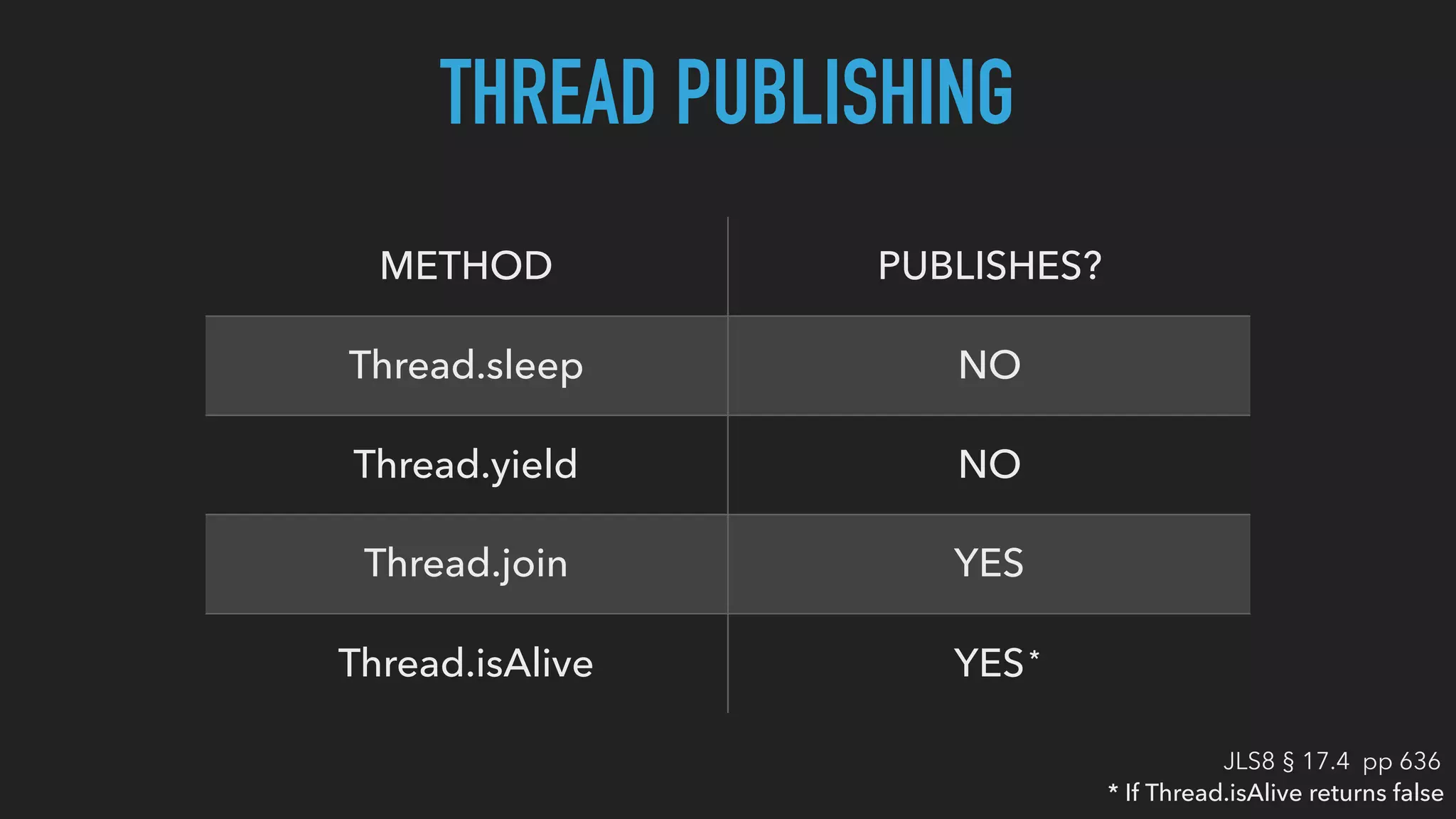
THREAD PUBLISHING
METHOD PUBLISHES?
Thread.sleep NO
Thread.yield NO
Thread.join YES
Thread.isAlive YES*
* If Thread.isAlive returns false
JLS8 § 17.4 pp 636
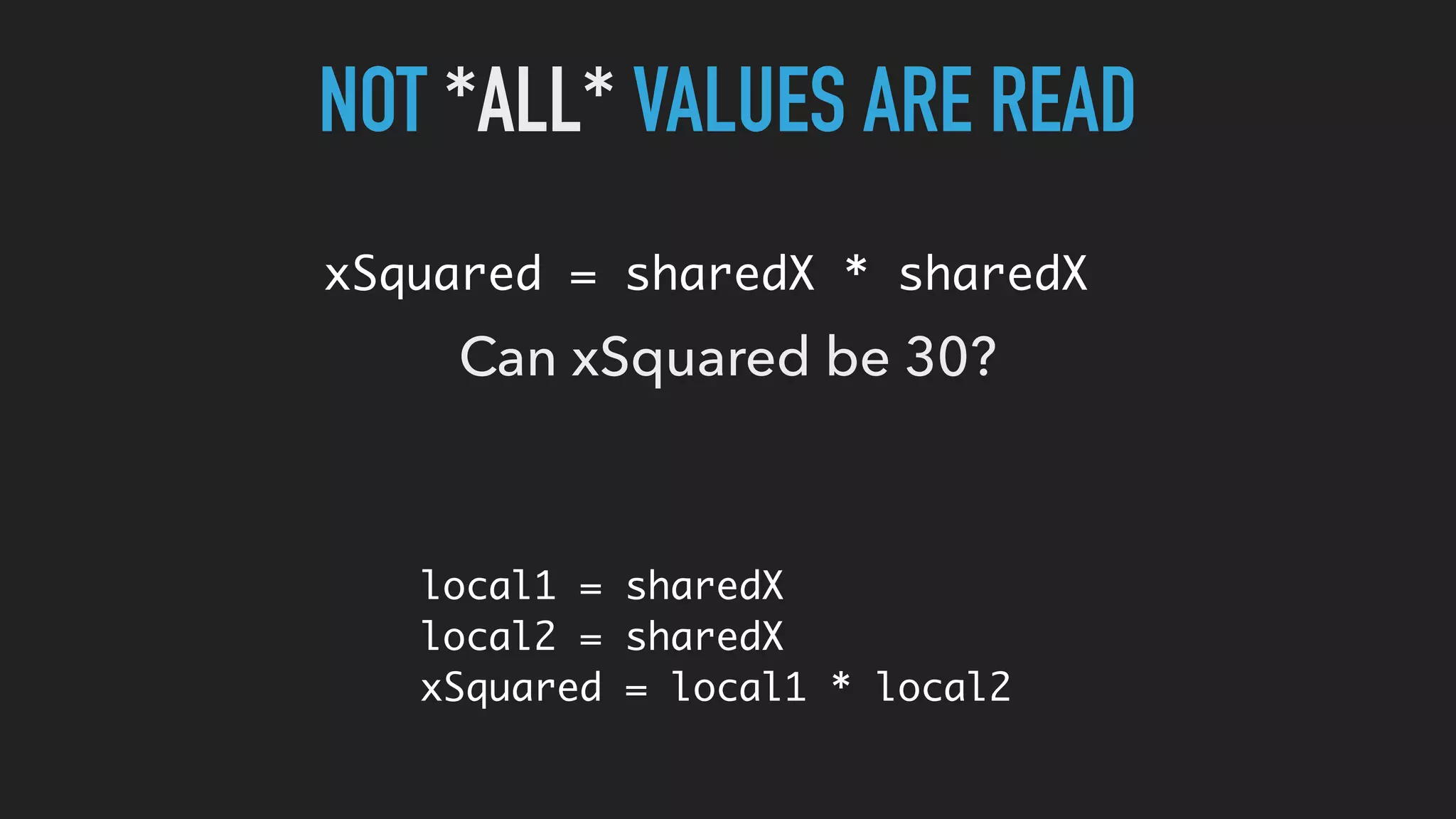
NOT *ALL* VALUES ARE READ
xSquared = sharedX * sharedX
Can xSquared be 30?
local1 = sharedX
local2 = sharedX
xSquared = local1 * local2
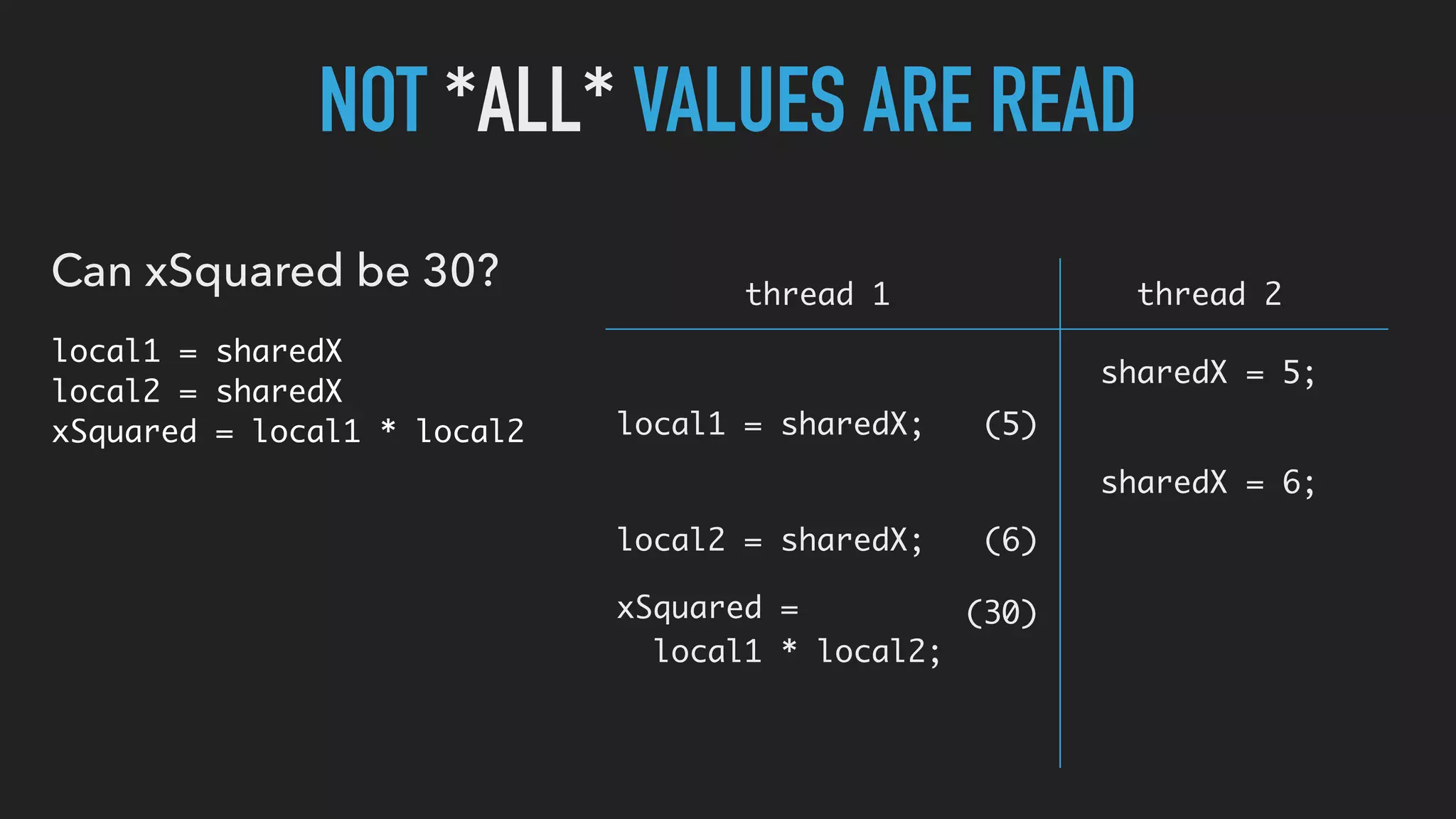
NOT *ALL* VALUES ARE READ
Can xSquared be 30?
local1 = sharedX
local2 = sharedX
xSquared = local1 * local2
thread 1 thread 2
sharedX = 5;
local1 = sharedX; (5)
sharedX = 6;
local2 = sharedX; (6)
xSquared =
local1 * local2;
(30)
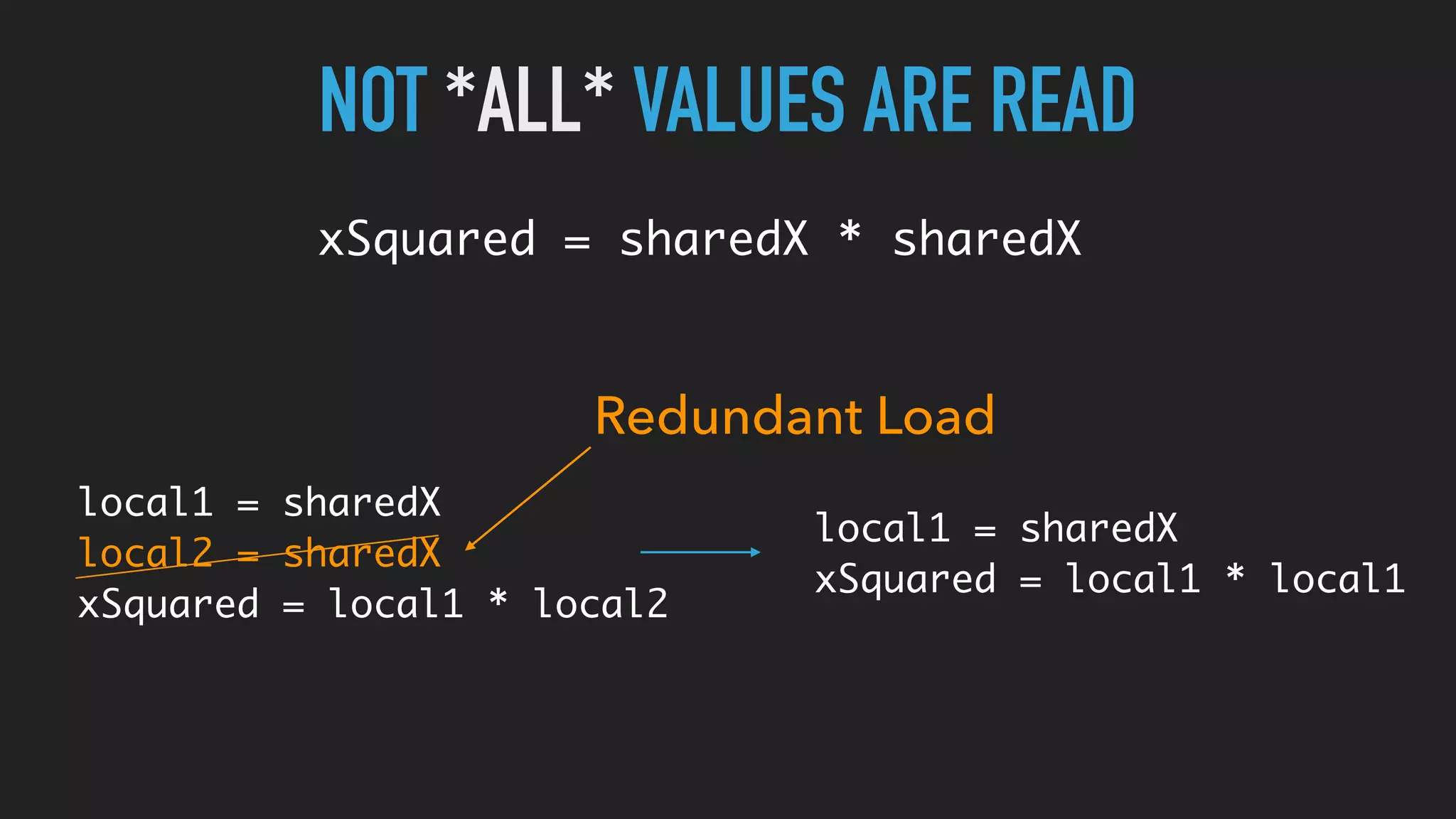
NOT *ALL* VALUES ARE READ
xSquared = sharedX * sharedX
local1 = sharedX
local2 = sharedX
xSquared = local1 * local2
local1 = sharedX
xSquared = local1 * local1
Redundant Load
GREAT!
IMPORTANT OPTIMIZATION
for ( int x: array ) {
… x …
}
for ( int i = 0; i < this.array.length; ++i ) {
… this.array[i] …
}
Object[] local = this.array;
for ( int i = 0; i < local.length; ++i ) {
… local[i] …
}
EXCELLENT!20+% FASTER
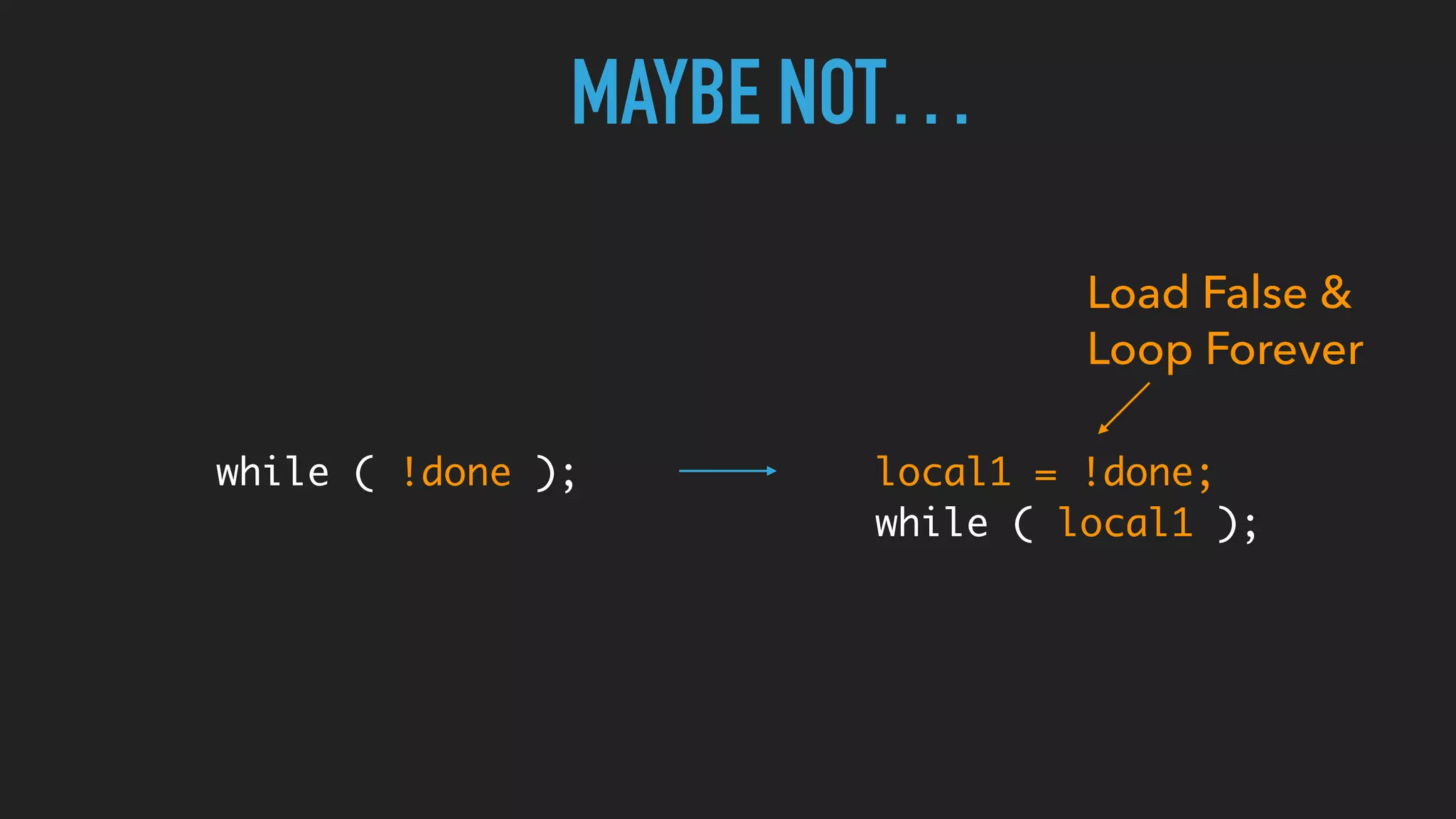
MAYBE NOT…
while ( !done ); local1 = !done;
while ( local1 );
Load False &
Loop Forever
To some programmers, this behavior
may seem broken. However, it should
be noted that this code is improperly
synchronized.
“
“
Java 8 Language Specification
§ 17.4 pp 638
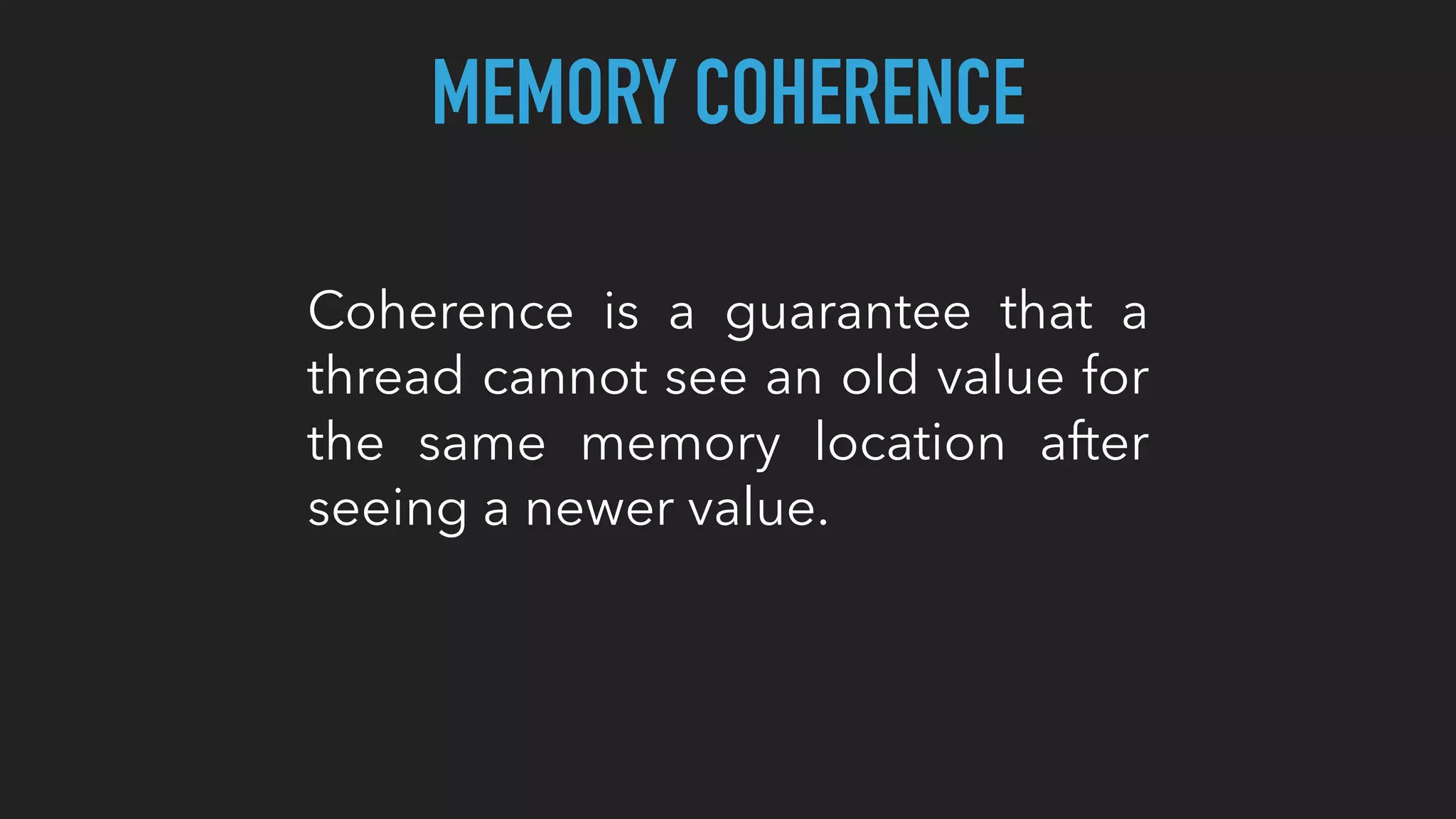
MEMORY COHERENCE
Coherence is a guarantee that a
thread cannot see an old value for
the same memory location after
seeing a newer value.
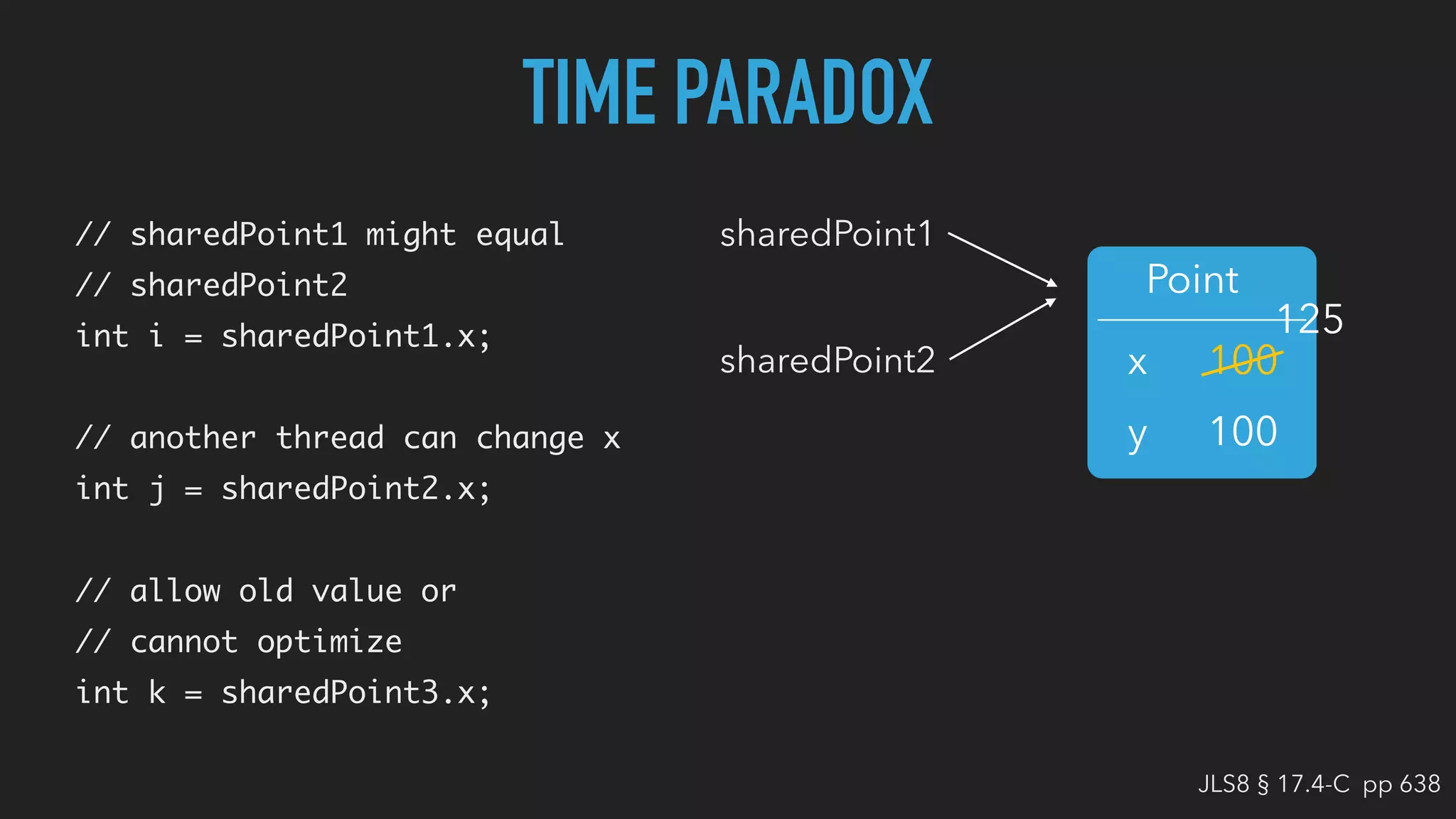
TIME PARADOX
// sharedPoint1 might equal
// sharedPoint2
int i = sharedPoint1.x;
// another thread can change x
int j = sharedPoint2.x;
// allow old value or
// cannot optimize
int k = sharedPoint3.x;
Point
x
y
100
100
125
sharedPoint1
sharedPoint2
JLS8 § 17.4-C pp 638
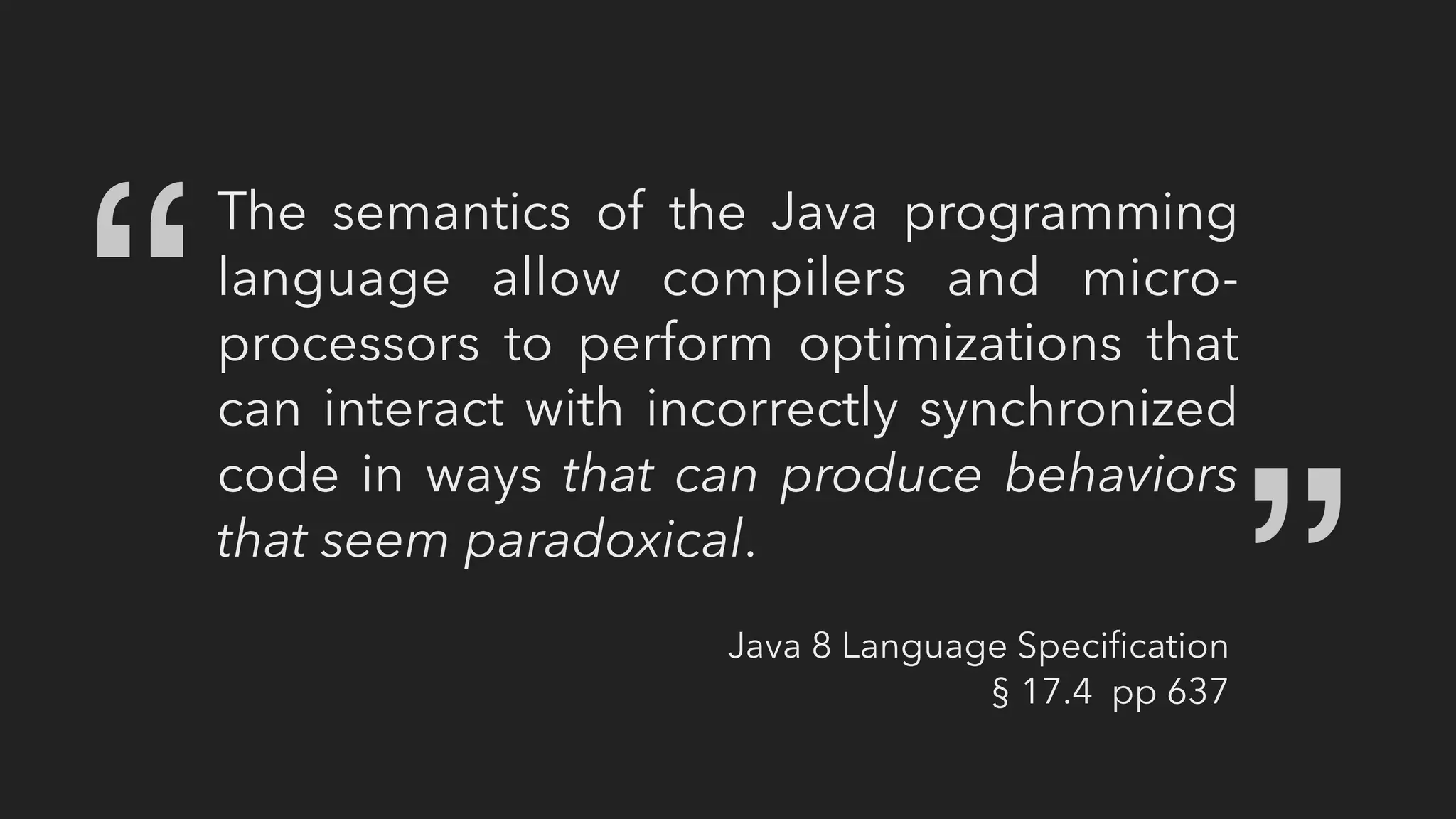
The semantics of the Java programming
language allow compilers and micro-
processors to perform optimizations that
can interact with incorrectly synchronized
code in ways that can produce behaviors
that seem paradoxical.
“ “
Java 8 Language Specification
§ 17.4 pp 637
ORDERINGWHAT ORDER DOES IT RUN IN?
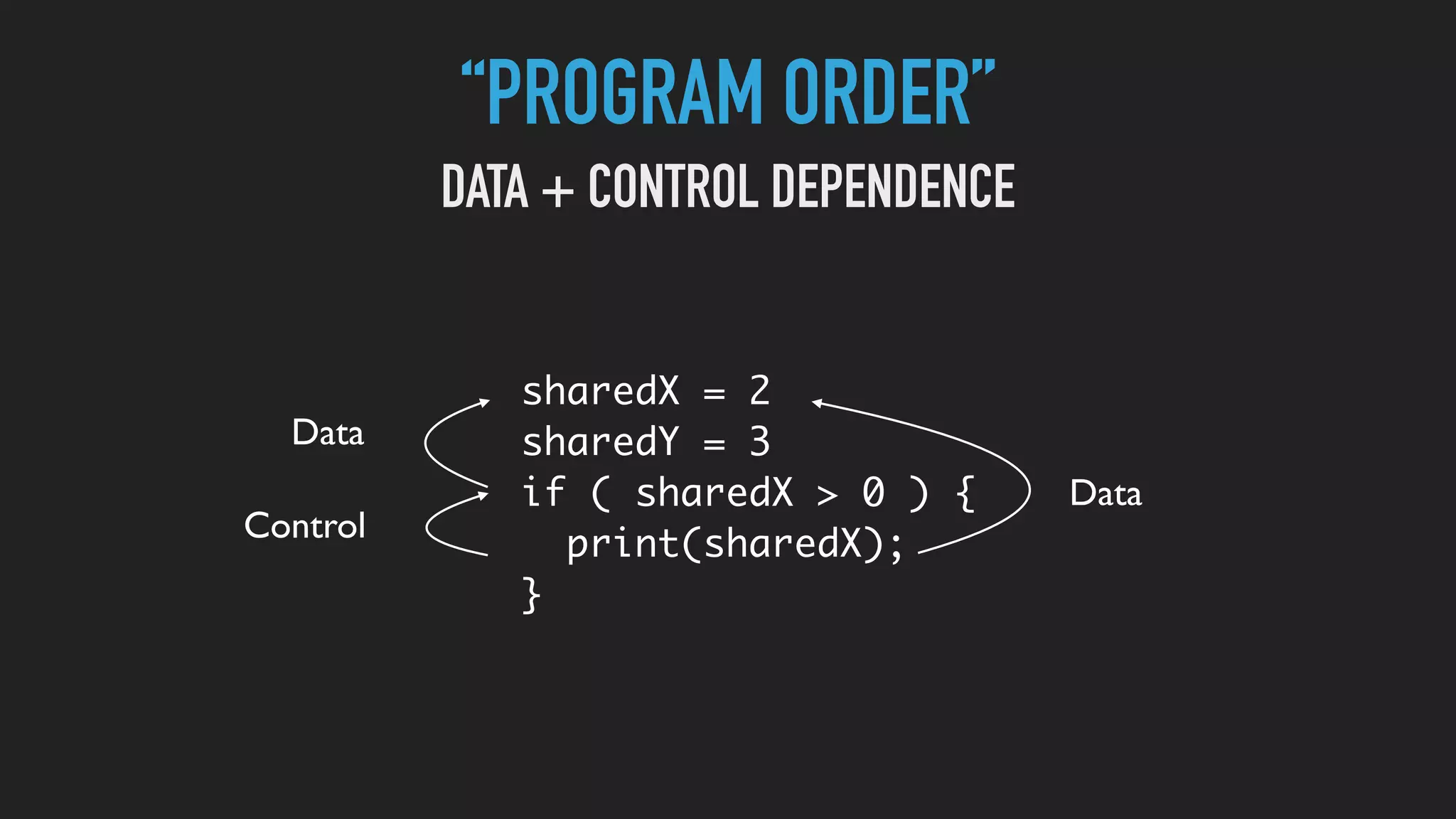
“PROGRAM ORDER”
sharedX = 2
sharedY = 3
if ( sharedX > 0 ) {
print(sharedX);
}
Control
Data
Data
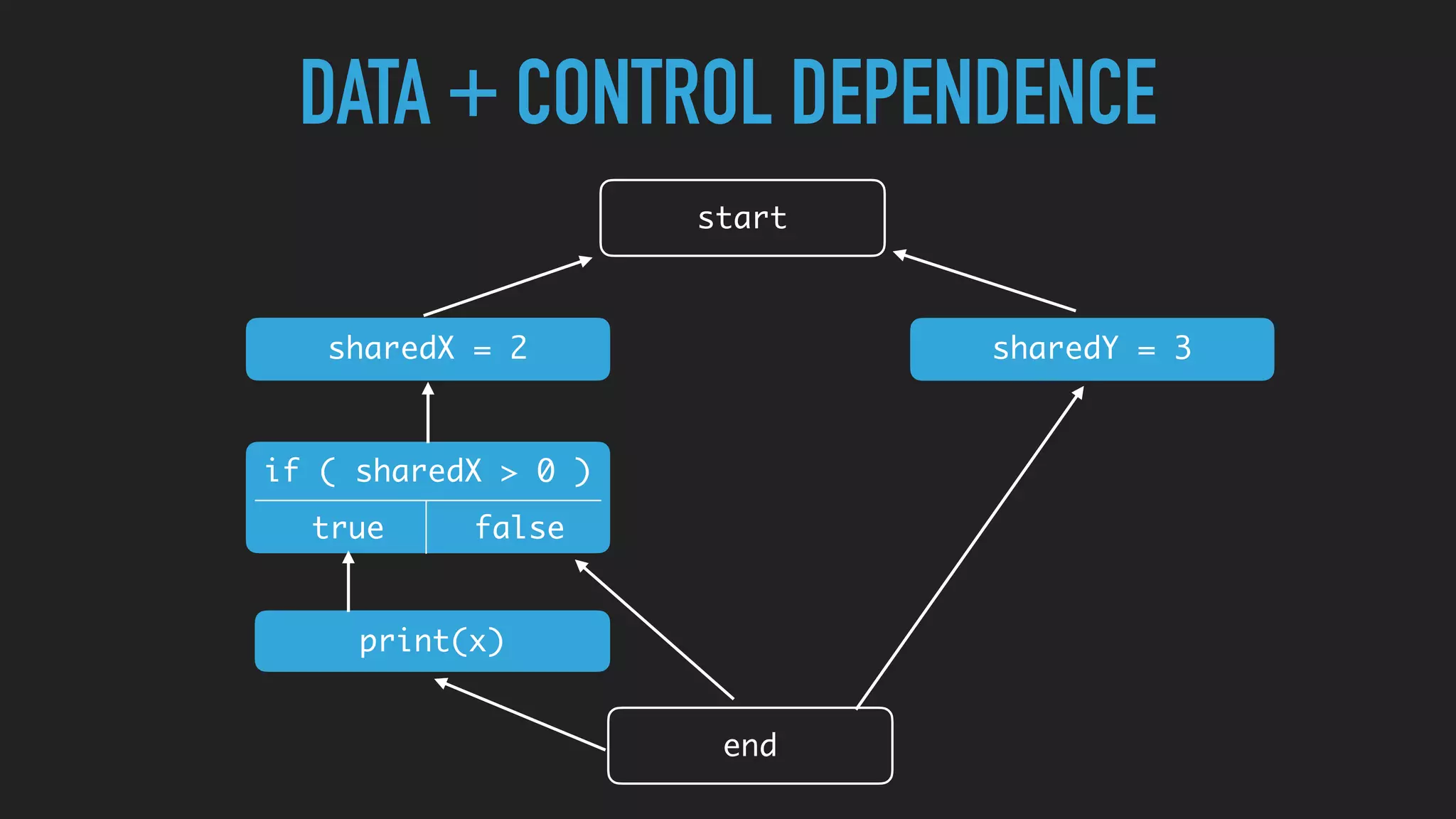
DATA + CONTROL DEPENDENCE
DATA CONTROL DEPENDENCE+
sharedX = 2
start
end
print(x)
if ( sharedX > 0 )
true false
sharedY = 3
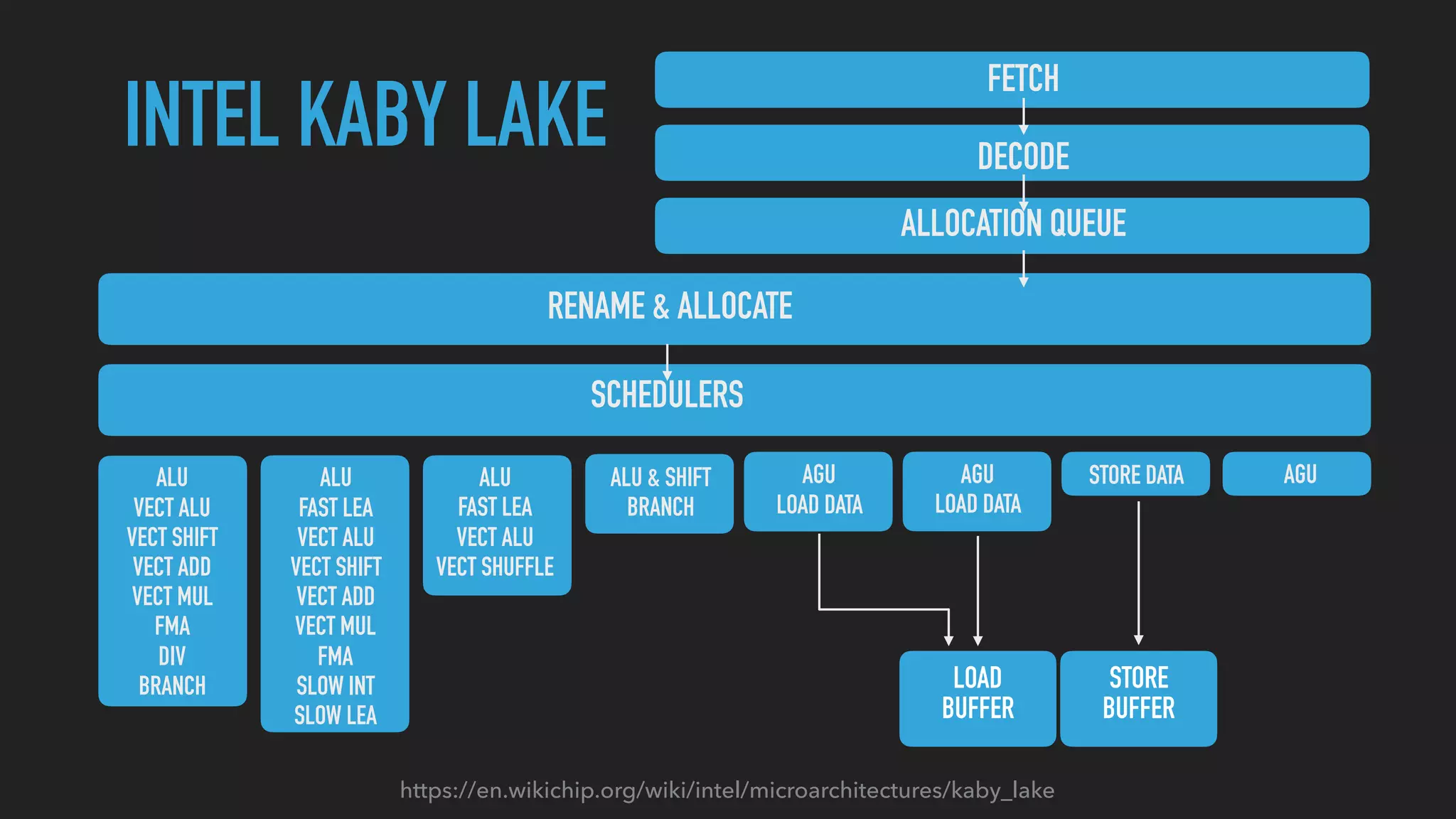
https://en.wikichip.org/wiki/intel/microarchitectures/kaby_lake
FETCH
RENAME & ALLOCATE
DECODE
ALLOCATION QUEUE
SCHEDULERS
ALU
VECT ALU
VECT SHIFT
VECT ADD
VECT MUL
FMA
DIV
BRANCH
ALU
FAST LEA
VECT ALU
VECT SHIFT
VECT ADD
VECT MUL
FMA
SLOW INT
SLOW LEA
ALU
FAST LEA
VECT ALU
VECT SHUFFLE
ALU & SHIFT
BRANCH
AGU
LOAD DATA
AGU
LOAD DATA
STORE DATA AGU
INTEL KABY LAKE
LOAD
BUFFER
STORE
BUFFER
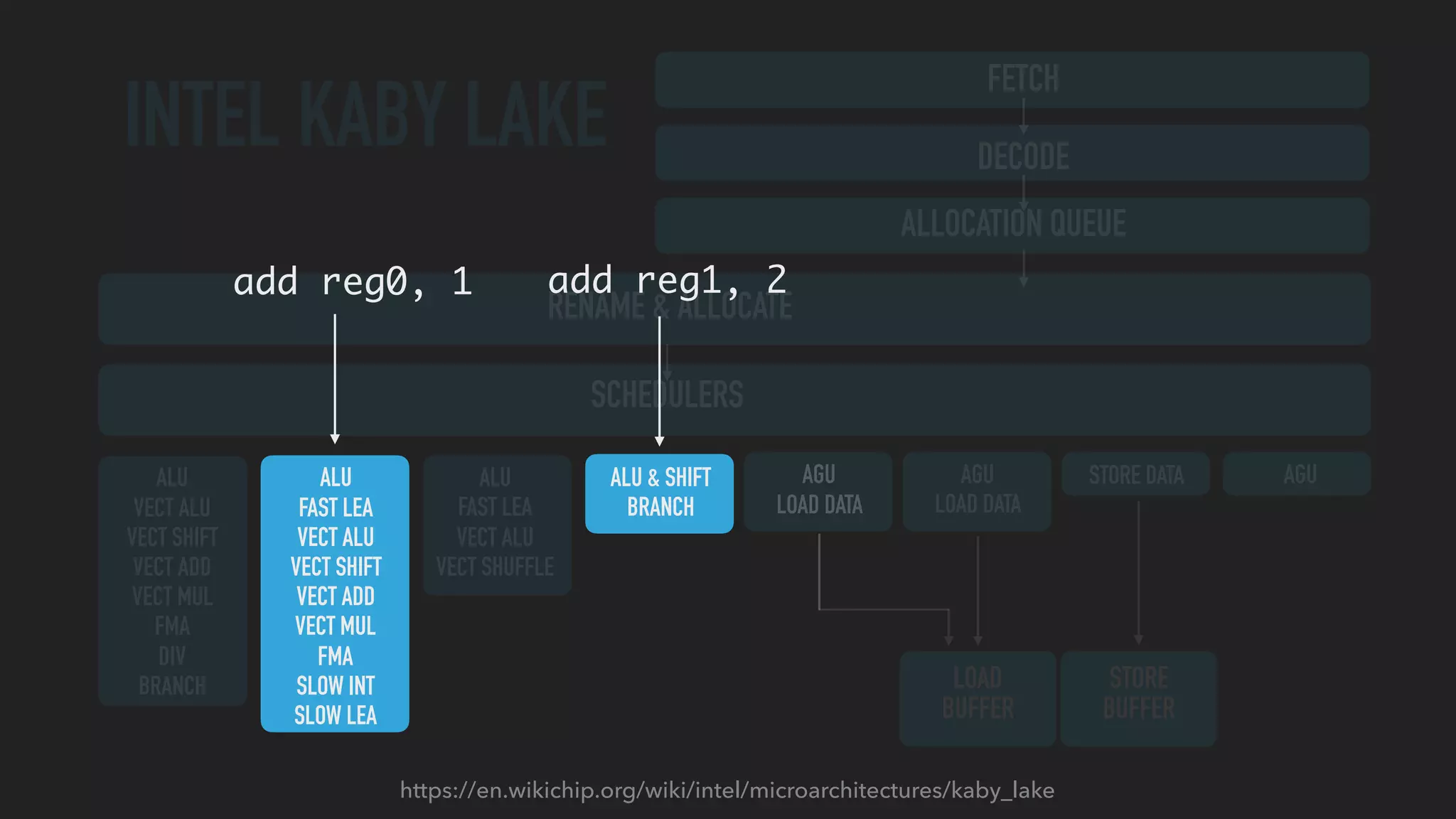
INTEL KABY LAKE
https://en.wikichip.org/wiki/intel/microarchitectures/kaby_lake
FETCH
RENAME & ALLOCATE
DECODE
ALLOCATION QUEUE
SCHEDULERS
ALU
VECT ALU
VECT SHIFT
VECT ADD
VECT MUL
FMA
DIV
BRANCH
ALU
FAST LEA
VECT ALU
VECT SHIFT
VECT ADD
VECT MUL
FMA
SLOW INT
SLOW LEA
ALU
FAST LEA
VECT ALU
VECT SHUFFLE
ALU & SHIFT
BRANCH
AGU
LOAD DATA
AGU
LOAD DATA
STORE DATA AGU
LOAD
BUFFER
STORE
BUFFER
add reg0, 1 add reg1, 2
COOL.
BUT COMPLICATES
EVERYTHING.
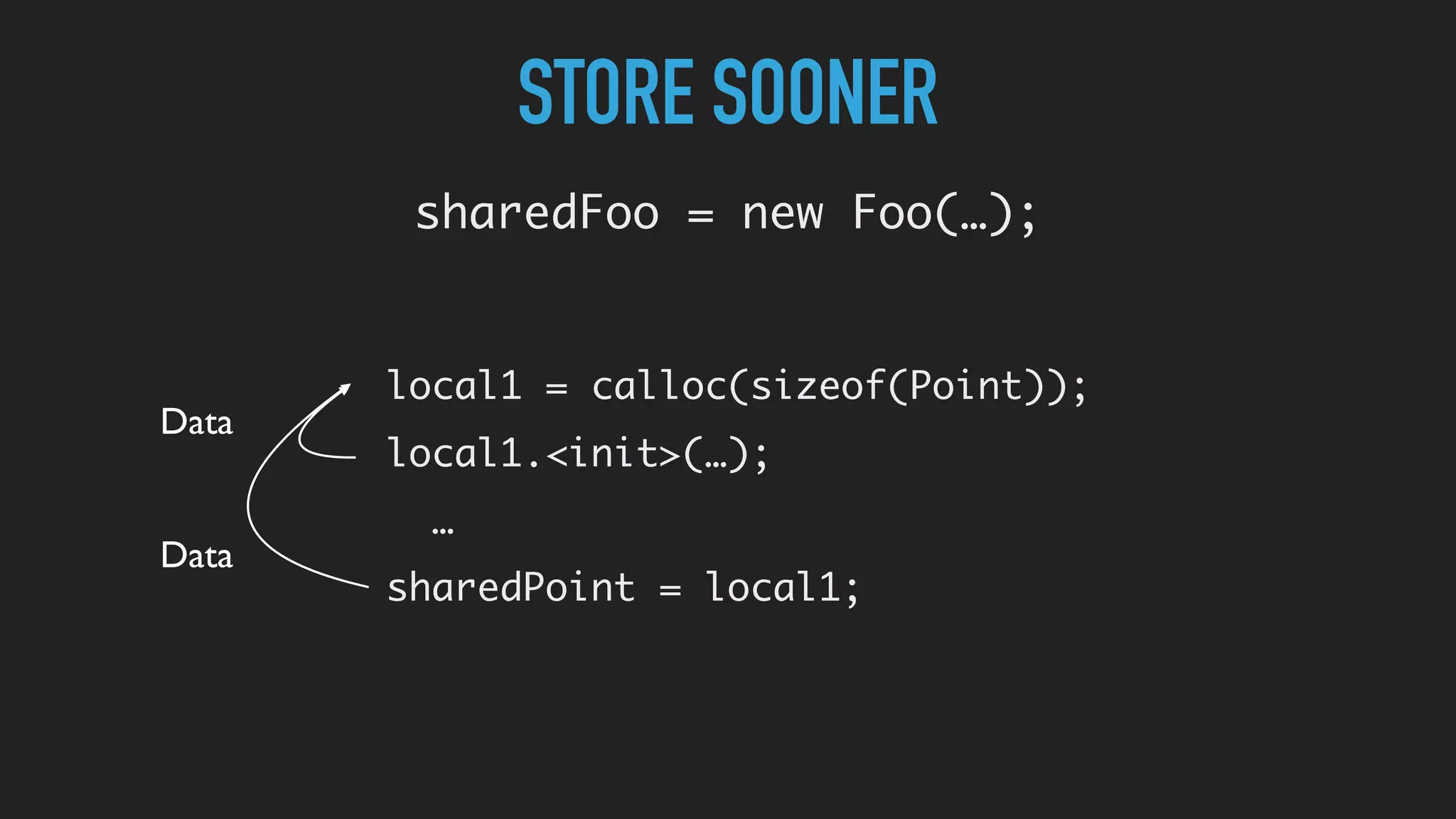
STORE SOONER
local1 = calloc(sizeof(Point));
local1.<init>(…);
…
sharedPoint = local1;
sharedFoo = new Foo(…);
Data
Data
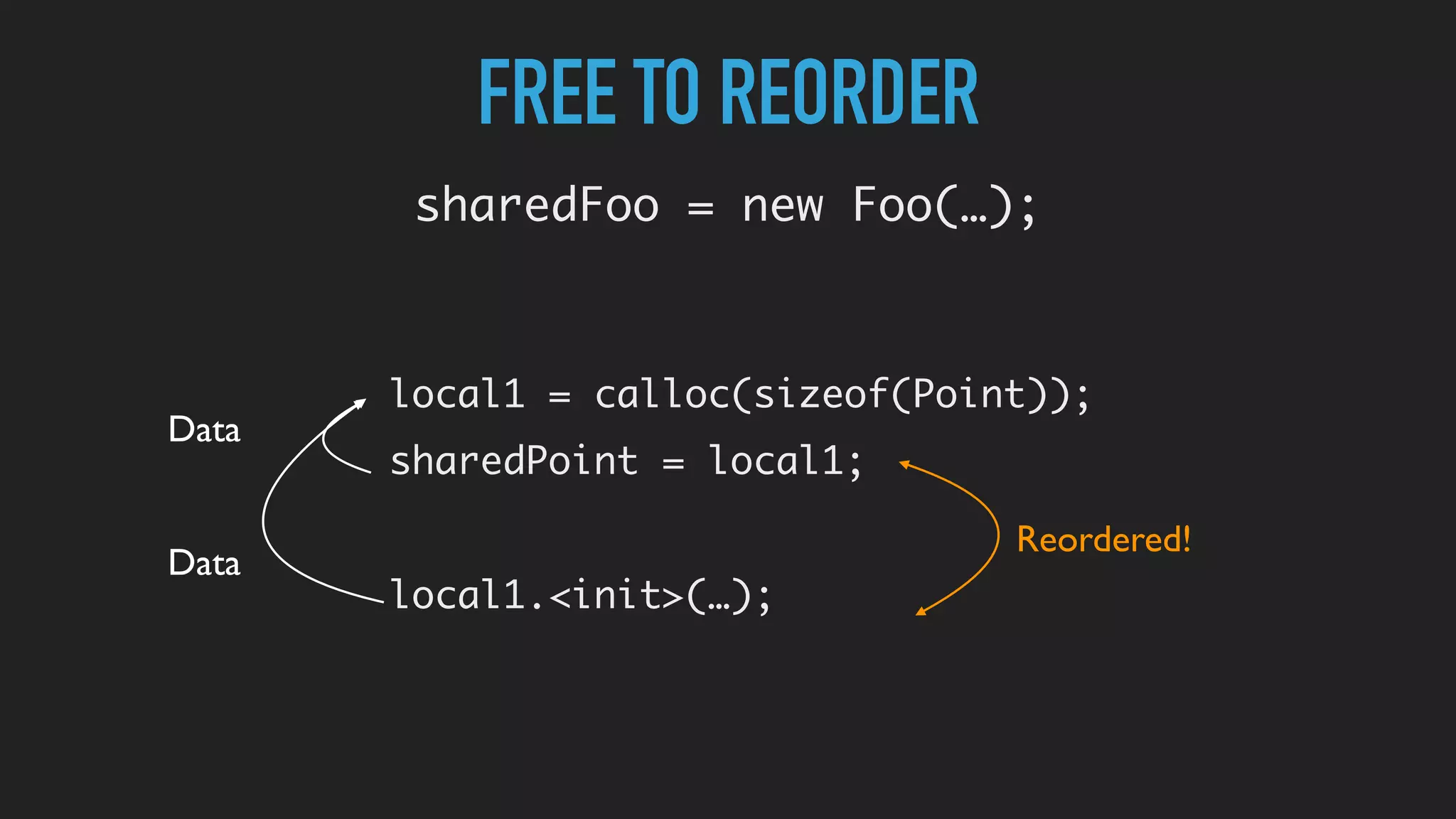
FREE TO REORDER
local1 = calloc(sizeof(Point));
sharedPoint = local1;
local1.<init>(…);
sharedFoo = new Foo(…);
Data
Data
Reordered!
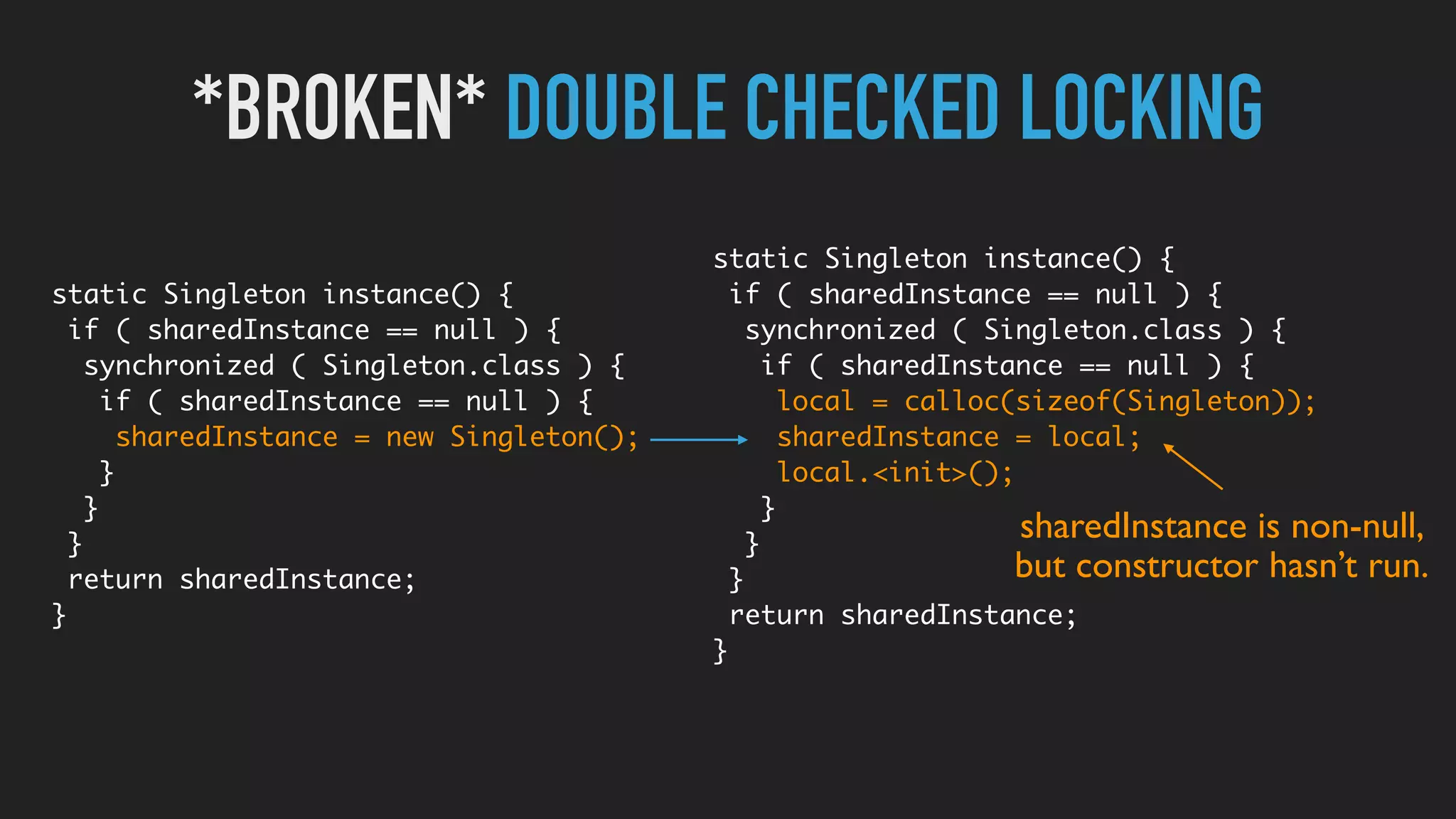
*BROKEN* DOUBLE CHECKED LOCKING
static Singleton instance() {
if ( sharedInstance == null ) {
synchronized ( Singleton.class ) {
if ( sharedInstance == null ) {
sharedInstance = new Singleton();
}
}
}
return sharedInstance;
}
static Singleton instance() {
if ( sharedInstance == null ) {
synchronized ( Singleton.class ) {
if ( sharedInstance == null ) {
local = calloc(sizeof(Singleton));
sharedInstance = local;
local.<init>();
}
}
}
return sharedInstance;
}
sharedInstance is non-null,
but constructor hasn’t run.
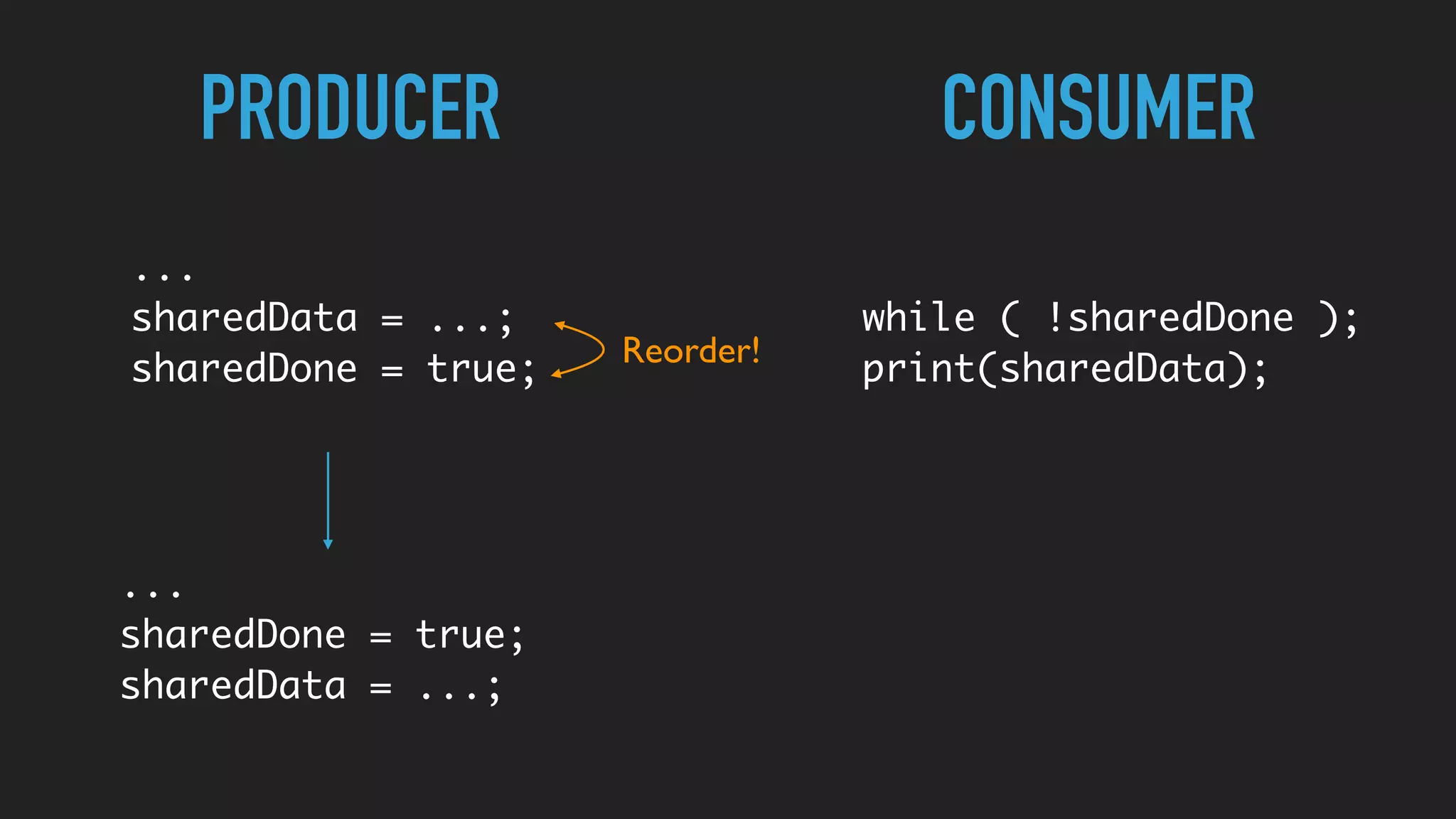
PRODUCER CONSUMER
...
sharedData = ...;
sharedDone = true;
...
sharedDone = true;
sharedData = ...;
while ( !sharedDone );
print(sharedData);
Reorder!
AGAIN BLAME
HARDWARE.
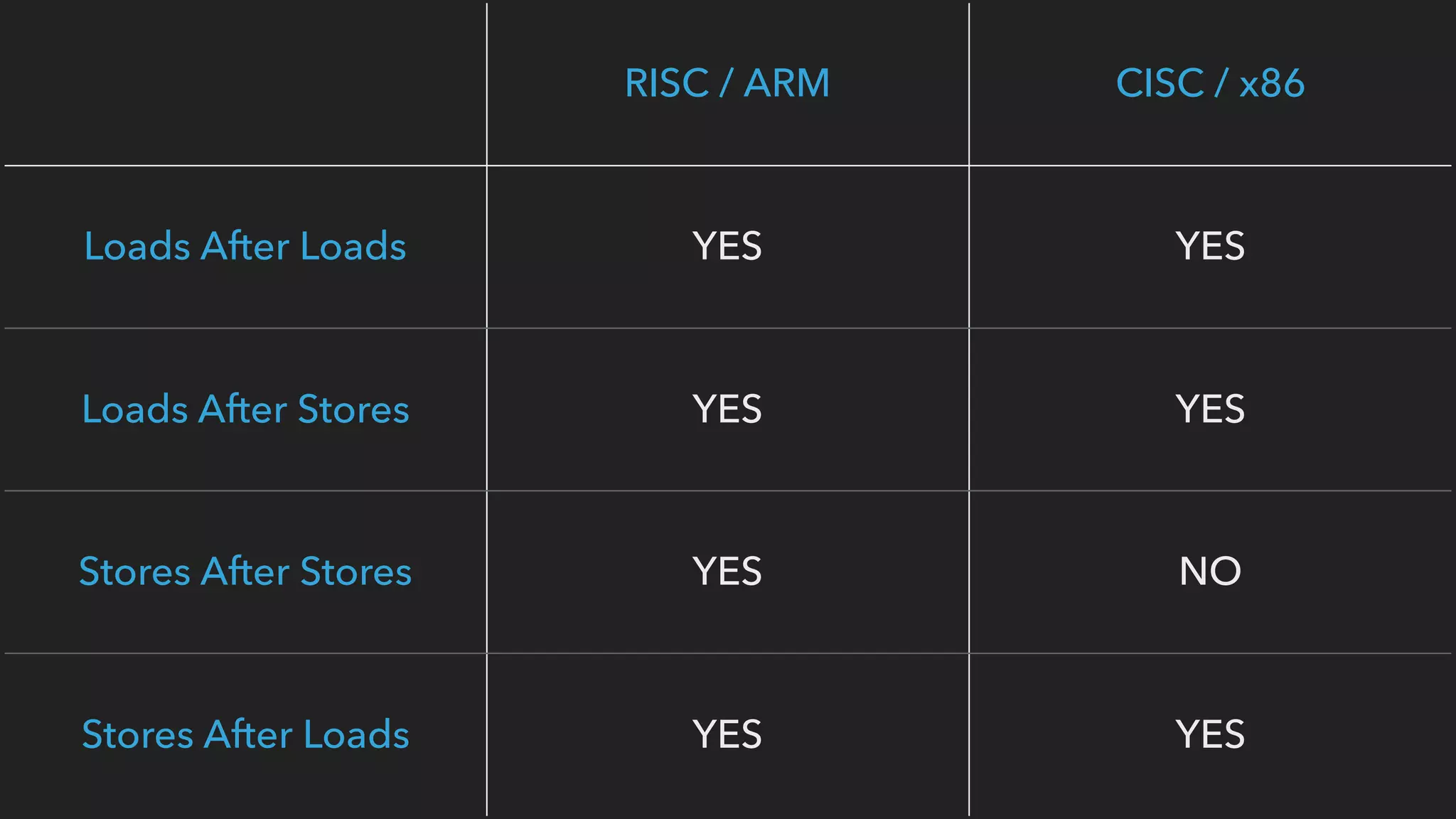
RISC / ARM CISC / x86
Loads After Loads YES YES
Loads After Stores YES YES
Stores After Stores YES NO
Stores After Loads YES YES
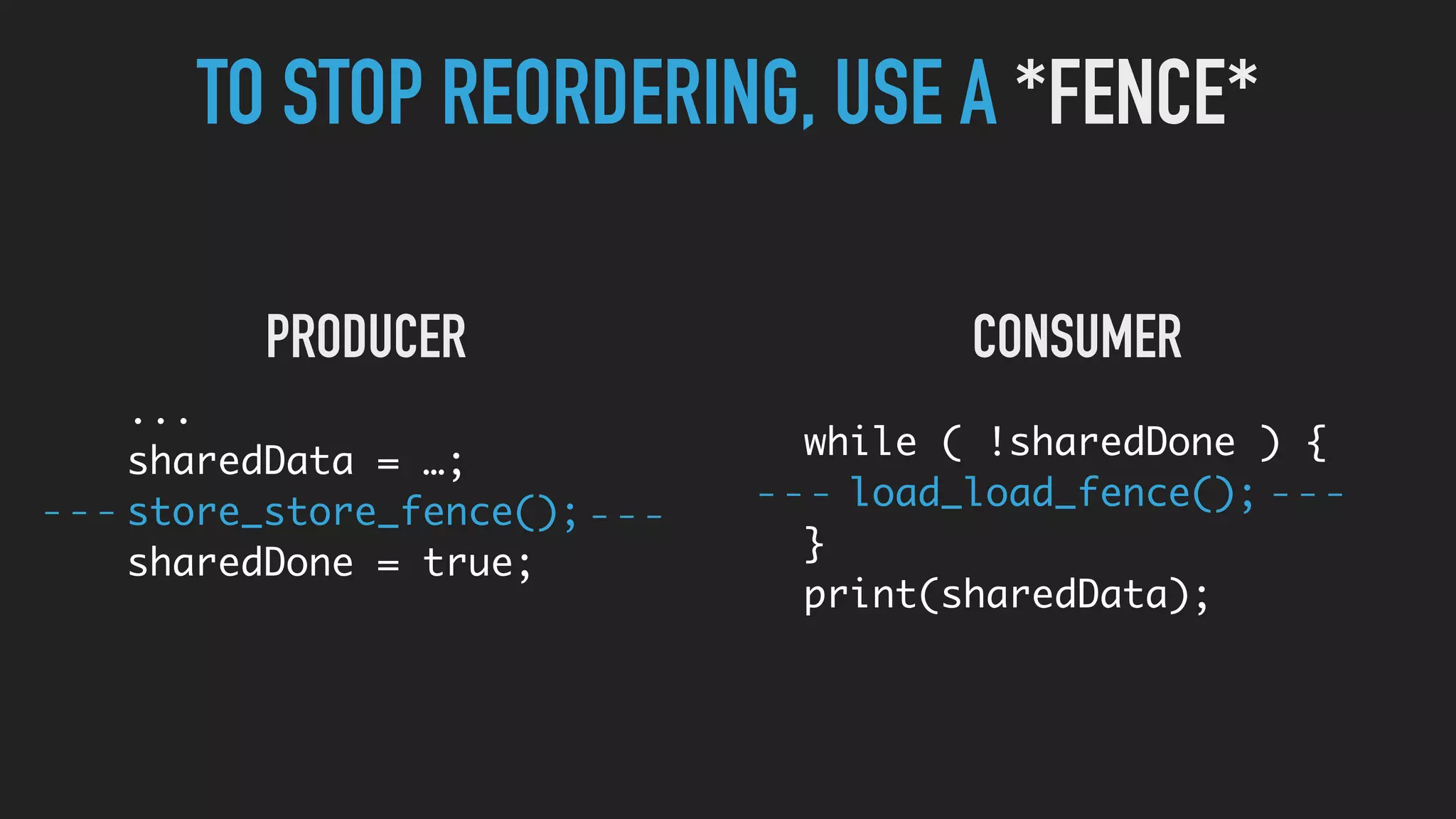
...
sharedData = …;
store_store_fence();
sharedDone = true;
while ( !sharedDone ) {
load_load_fence();
}
print(sharedData);
TO STOP REORDERING, USE A *FENCE*
PRODUCER CONSUMER
BLAME JAVA,
TOO.
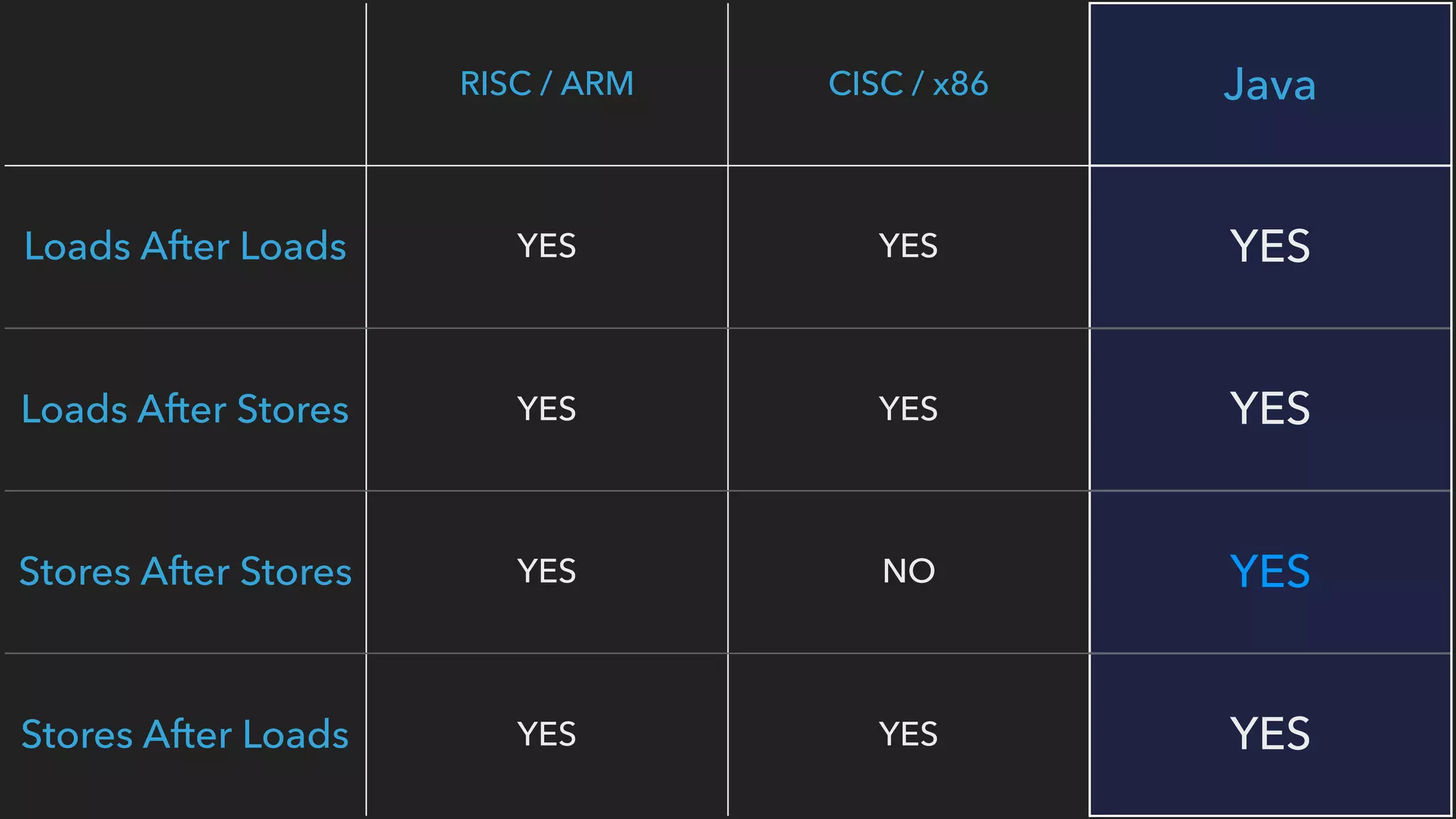
RISC / ARM CISC / x86 Java
Loads After Loads YES YES YES
Loads After Stores YES YES YES
Stores After Stores YES NO YES
Stores After Loads YES YES YES
HOW DO YOU TELL
JAVA TO NOT REORDER?
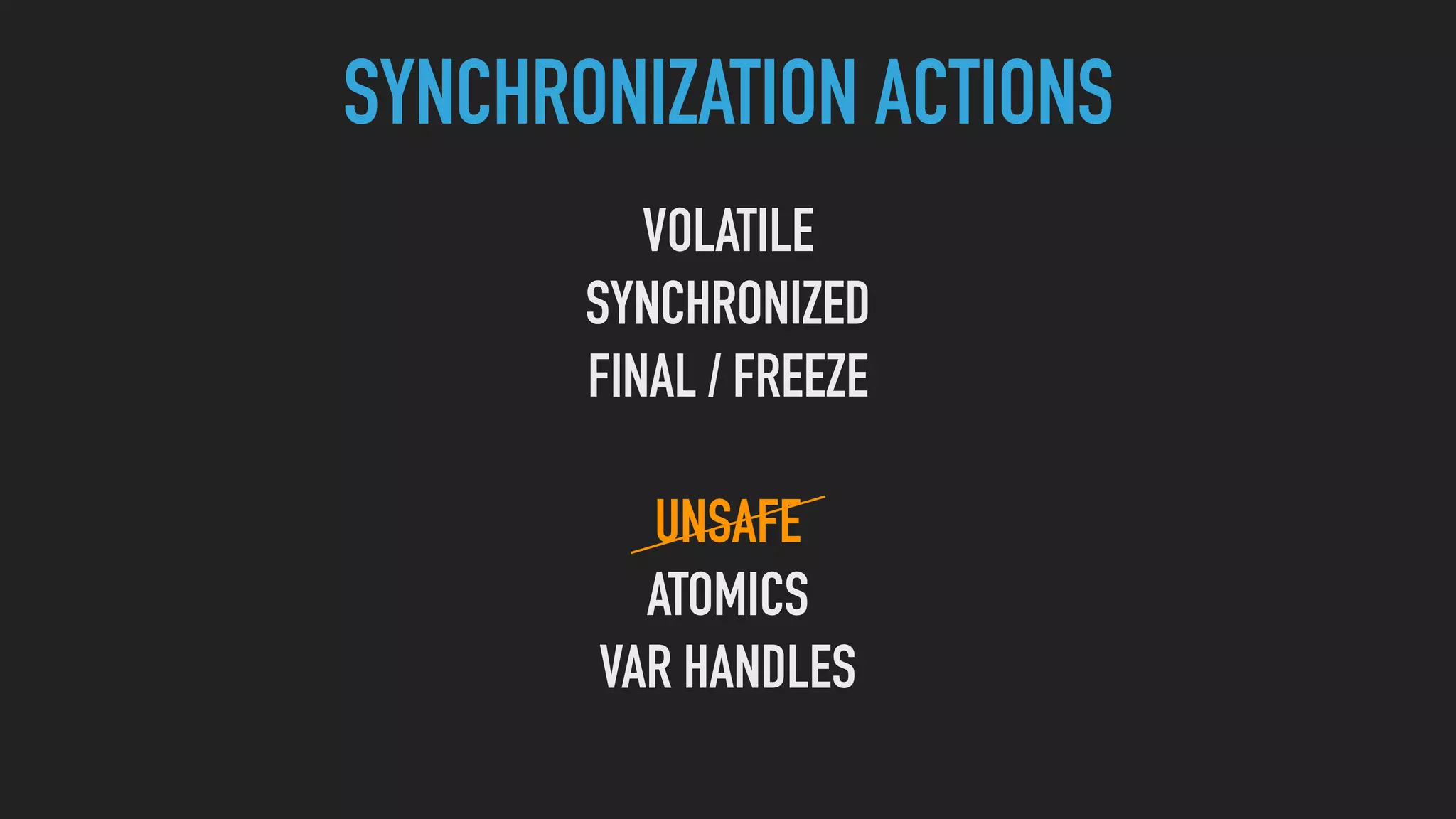
SYNCHRONIZATION ACTIONS
VOLATILE
SYNCHRONIZED
FINAL / FREEZE
UNSAFE
ATOMICS
VAR HANDLES
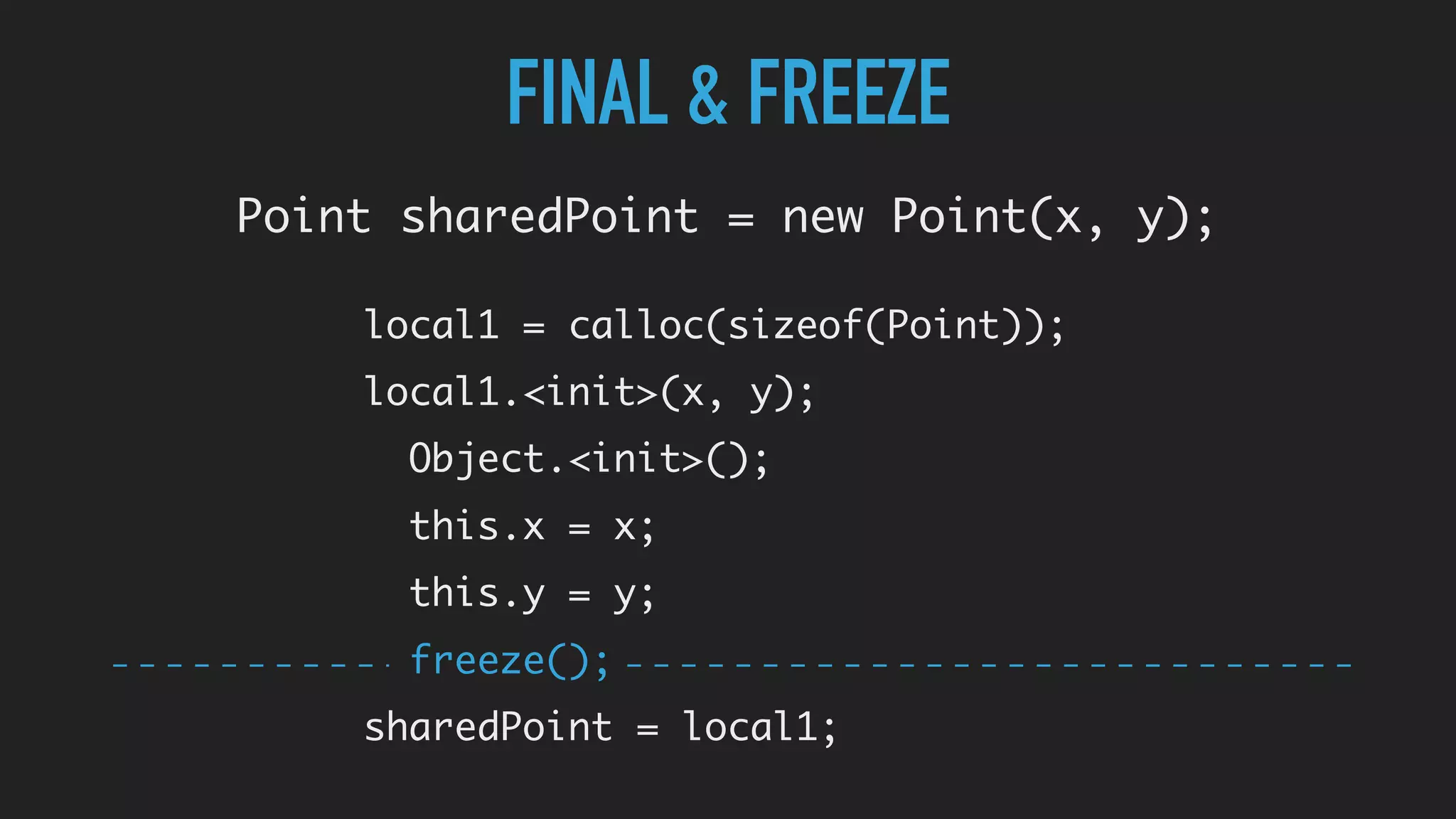
FINAL & FREEZE
local1 = calloc(sizeof(Point));
local1.<init>(x, y);
Object.<init>();
this.x = x;
this.y = y;
freeze();
sharedPoint = local1;
Point sharedPoint = new Point(x, y);
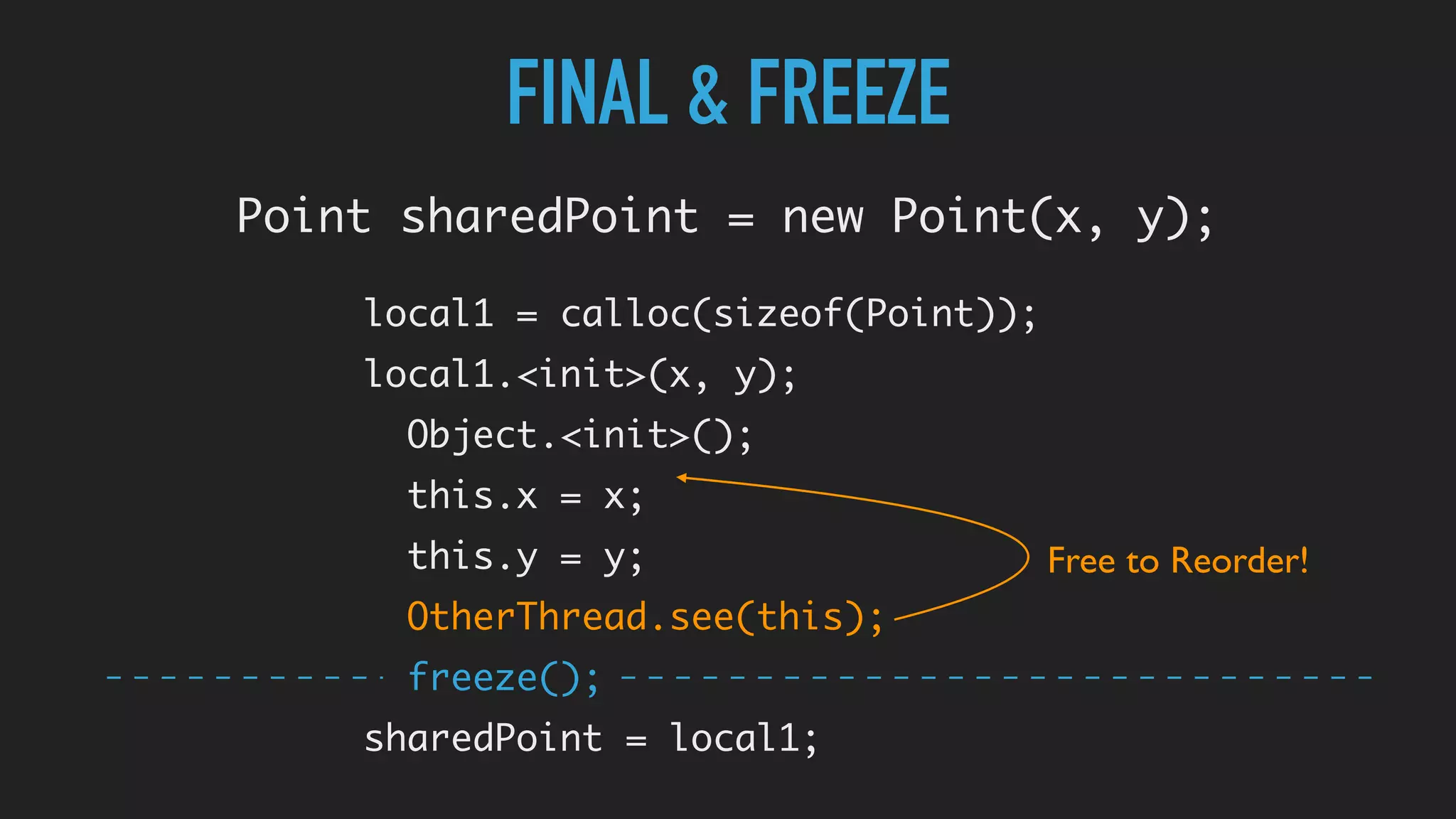
FINAL & FREEZE
local1 = calloc(sizeof(Point));
local1.<init>(x, y);
Object.<init>();
this.x = x;
this.y = y;
OtherThread.see(this);
freeze();
sharedPoint = local1;
Point sharedPoint = new Point(x, y);
Free to Reorder!
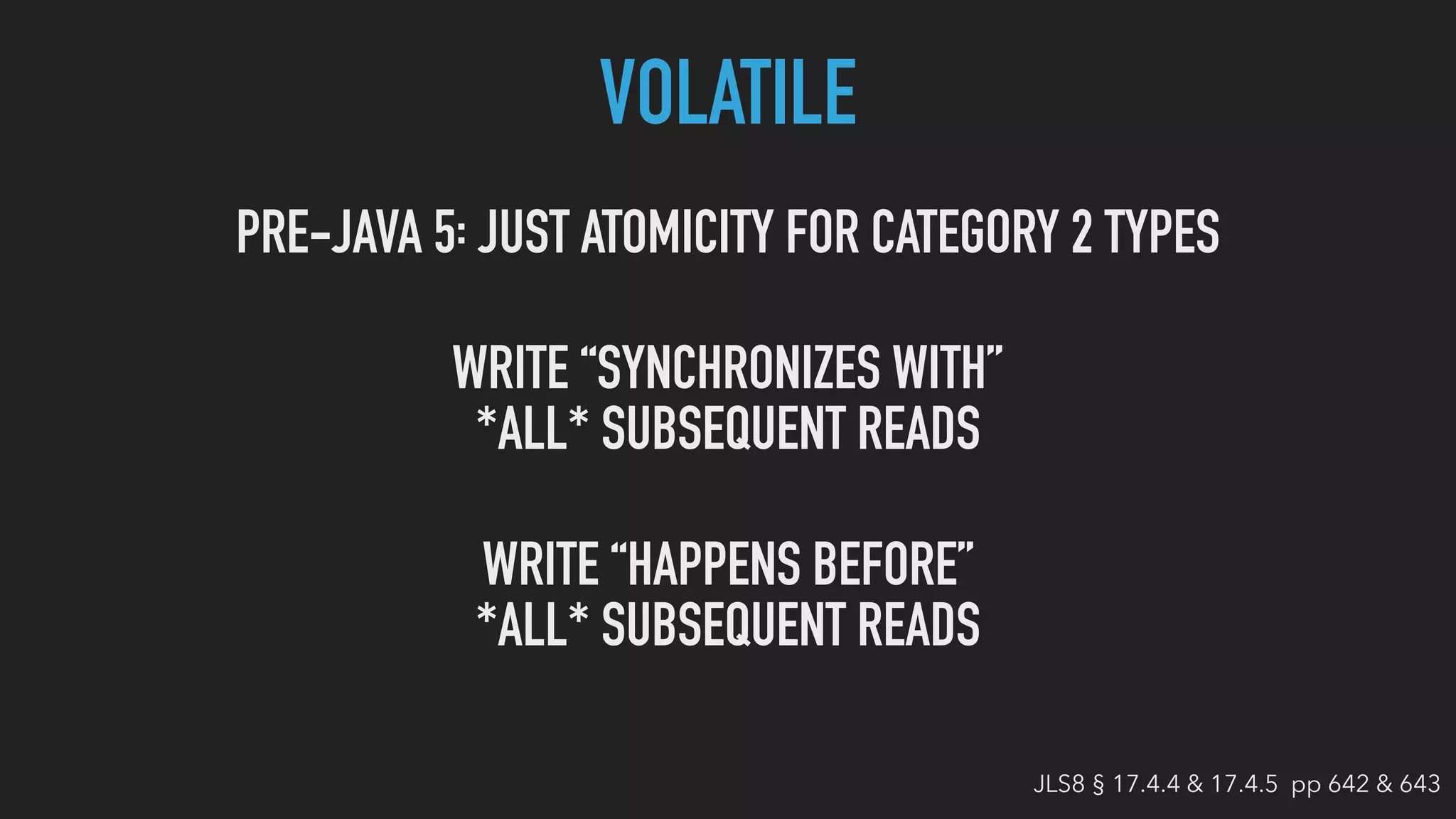
VOLATILE
PRE-JAVA 5 JUST ATOMICITY FOR CATEGORY 2 TYPES:
WRITE “SYNCHRONIZES WITH”
*ALL* SUBSEQUENT READS
WRITE “HAPPENS BEFORE”
*ALL* SUBSEQUENT READS
JLS8 § 17.4.4 & 17.4.5 pp 642 & 643
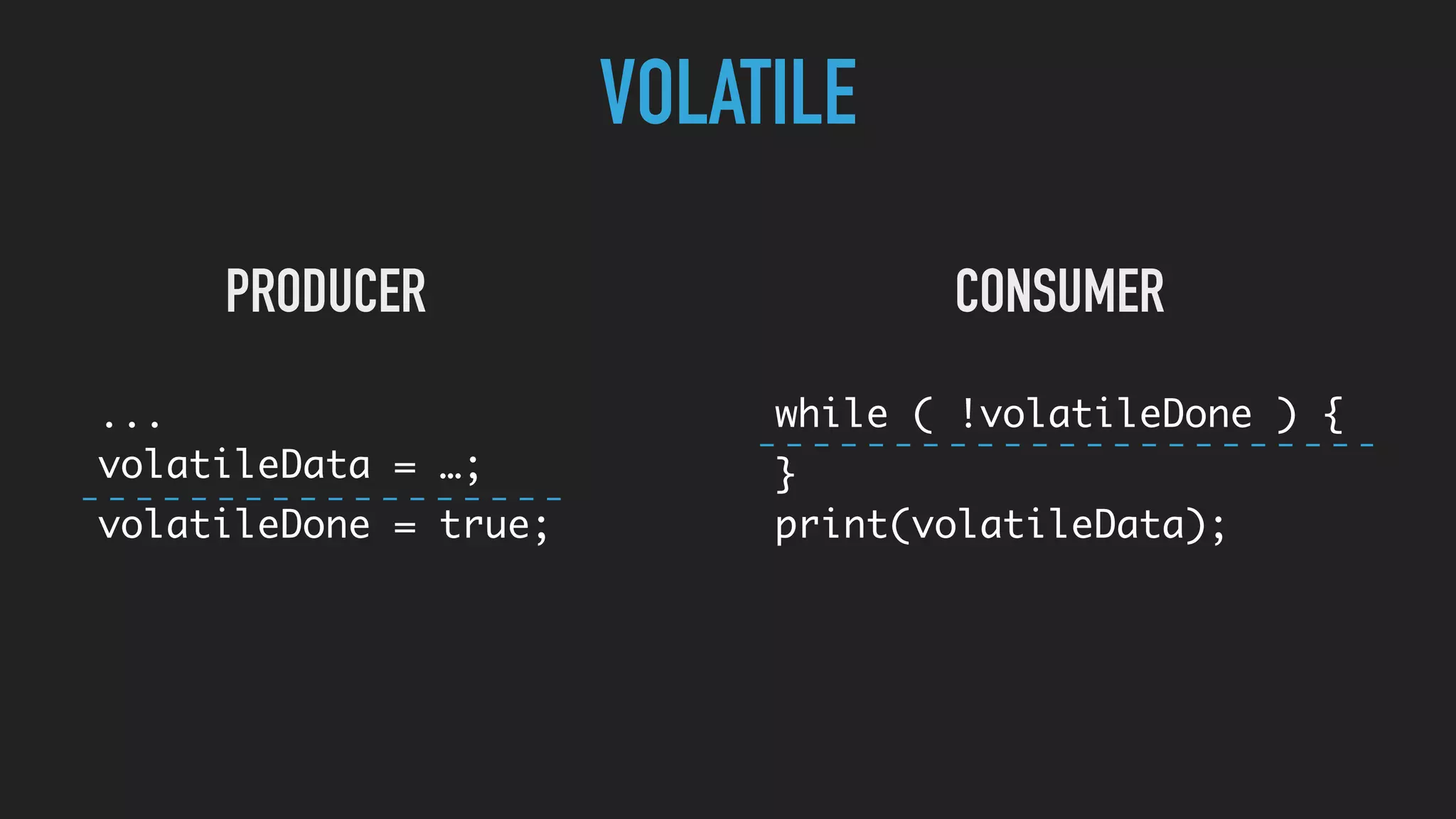
VOLATILE
...
volatileData = …;
volatileDone = true;
while ( !volatileDone ) {
}
print(volatileData);
PRODUCER CONSUMER
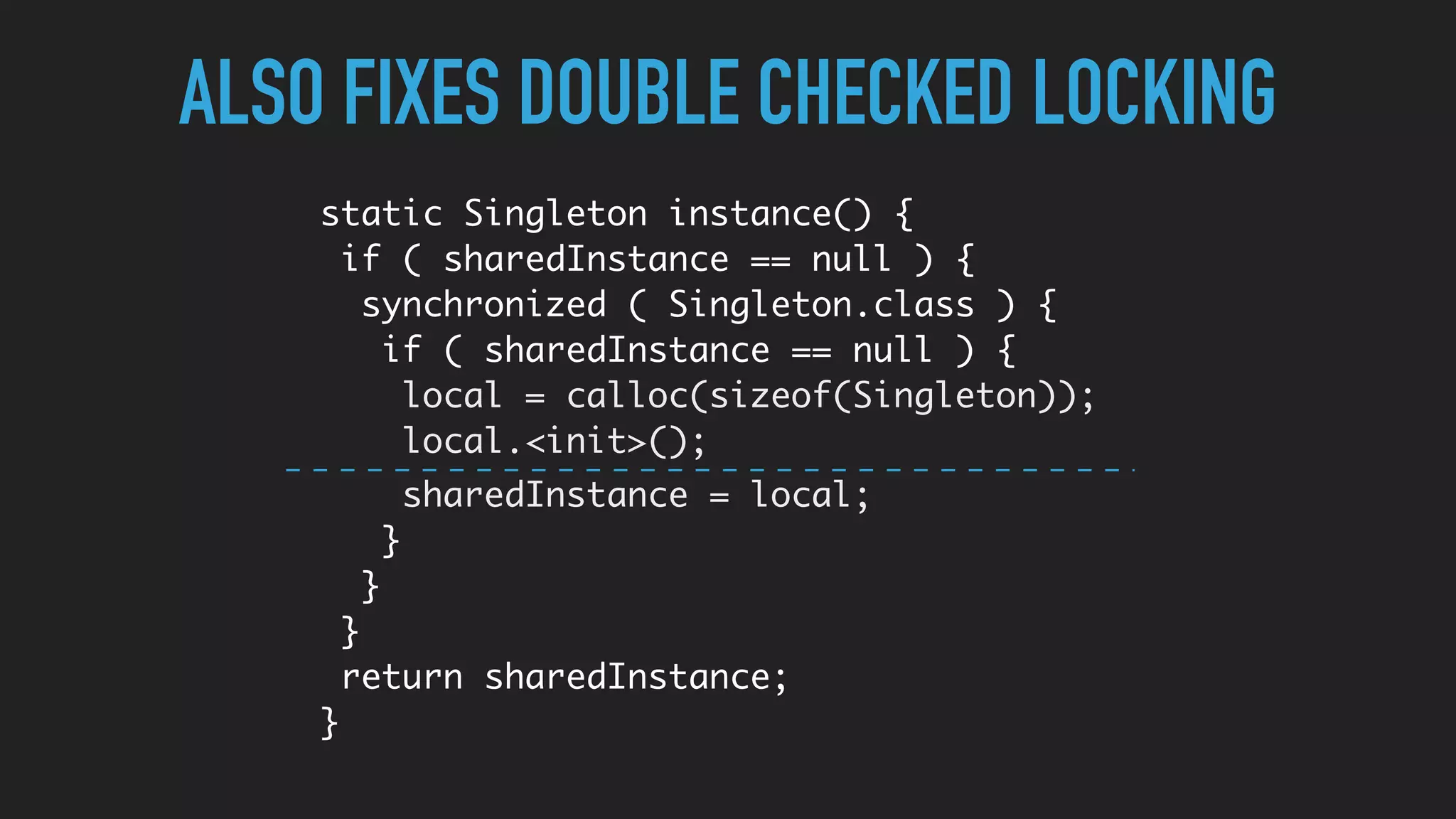
ALSO FIXES DOUBLE CHECKED LOCKING
static Singleton instance() {
if ( sharedInstance == null ) {
synchronized ( Singleton.class ) {
if ( sharedInstance == null ) {
local = calloc(sizeof(Singleton));
local.<init>();
sharedInstance = local;
}
}
}
return sharedInstance;
}
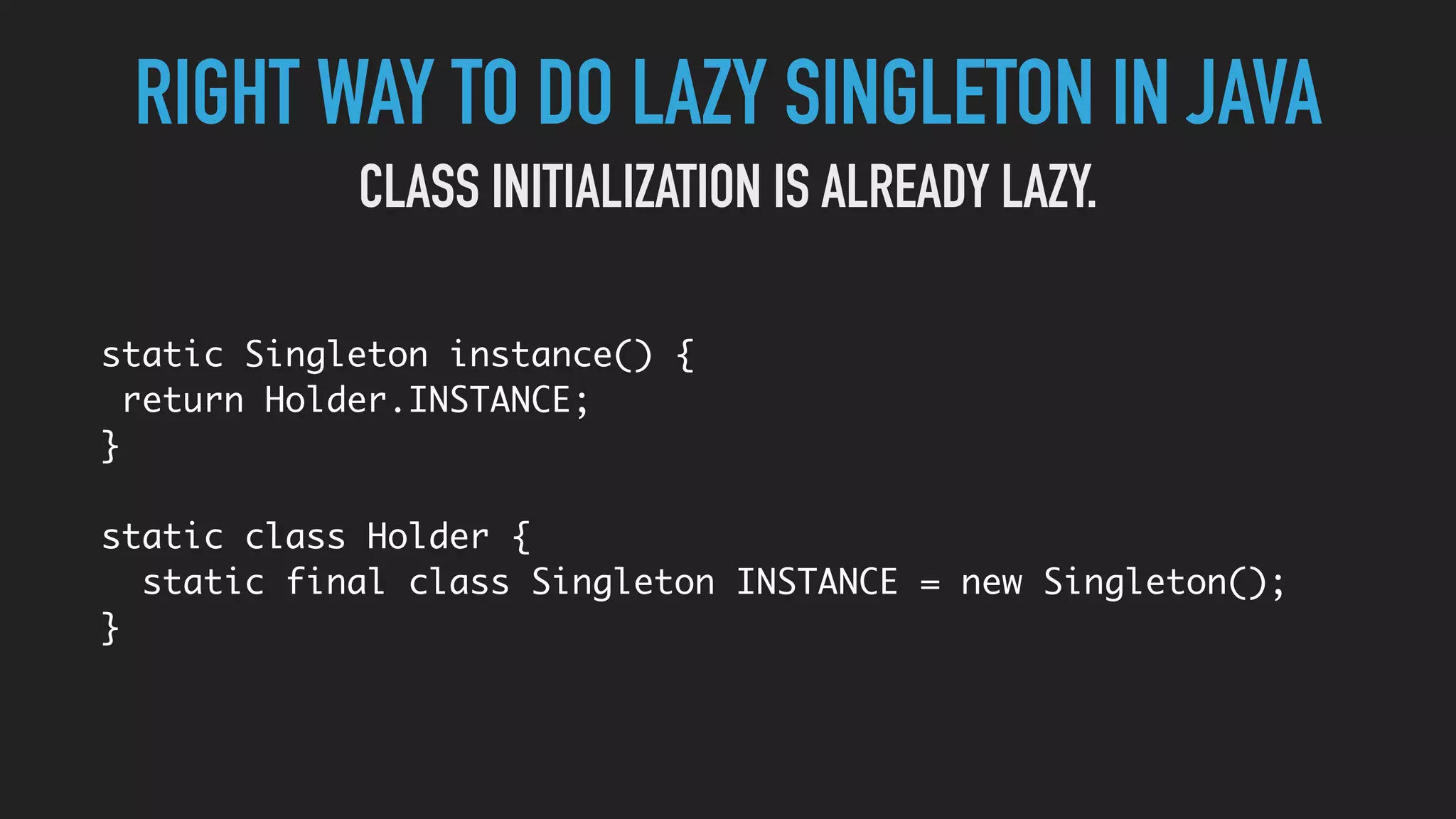
RIGHT WAY TO DO LAZY SINGLETON IN JAVA
static Singleton instance() {
return Holder.INSTANCE;
}
static class Holder {
static final class Singleton INSTANCE = new Singleton();
}
CLASS INITIALIZATION IS ALREADY LAZY.
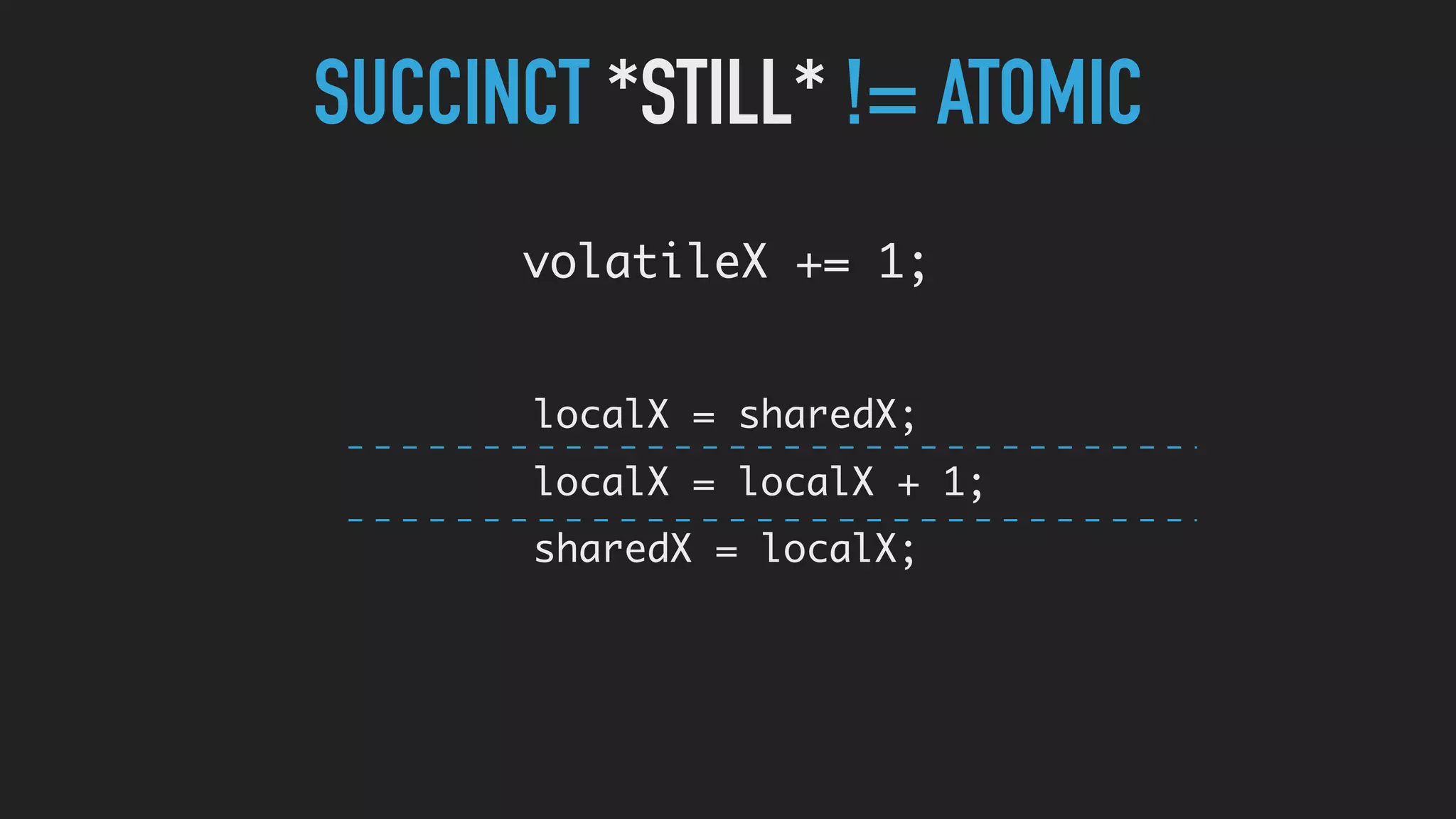
SUCCINCT *STILL* != ATOMIC
volatileX += 1;
localX = sharedX;
localX = localX + 1;
sharedX = localX;
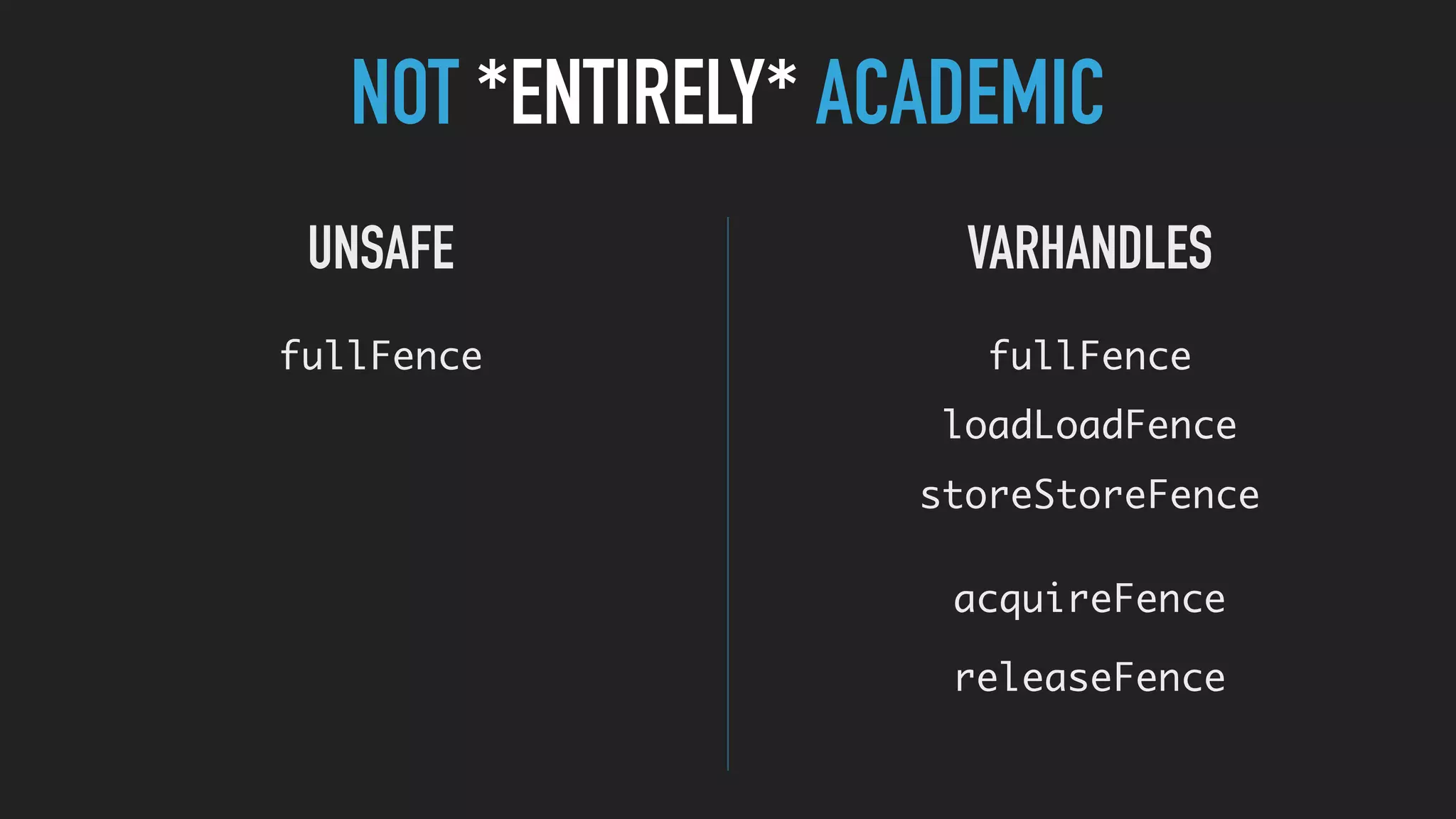
fullFence fullFence
loadLoadFence
storeStoreFence
acquireFence
releaseFence
NOT *ENTIRELY* ACADEMIC
UNSAFE VARHANDLES
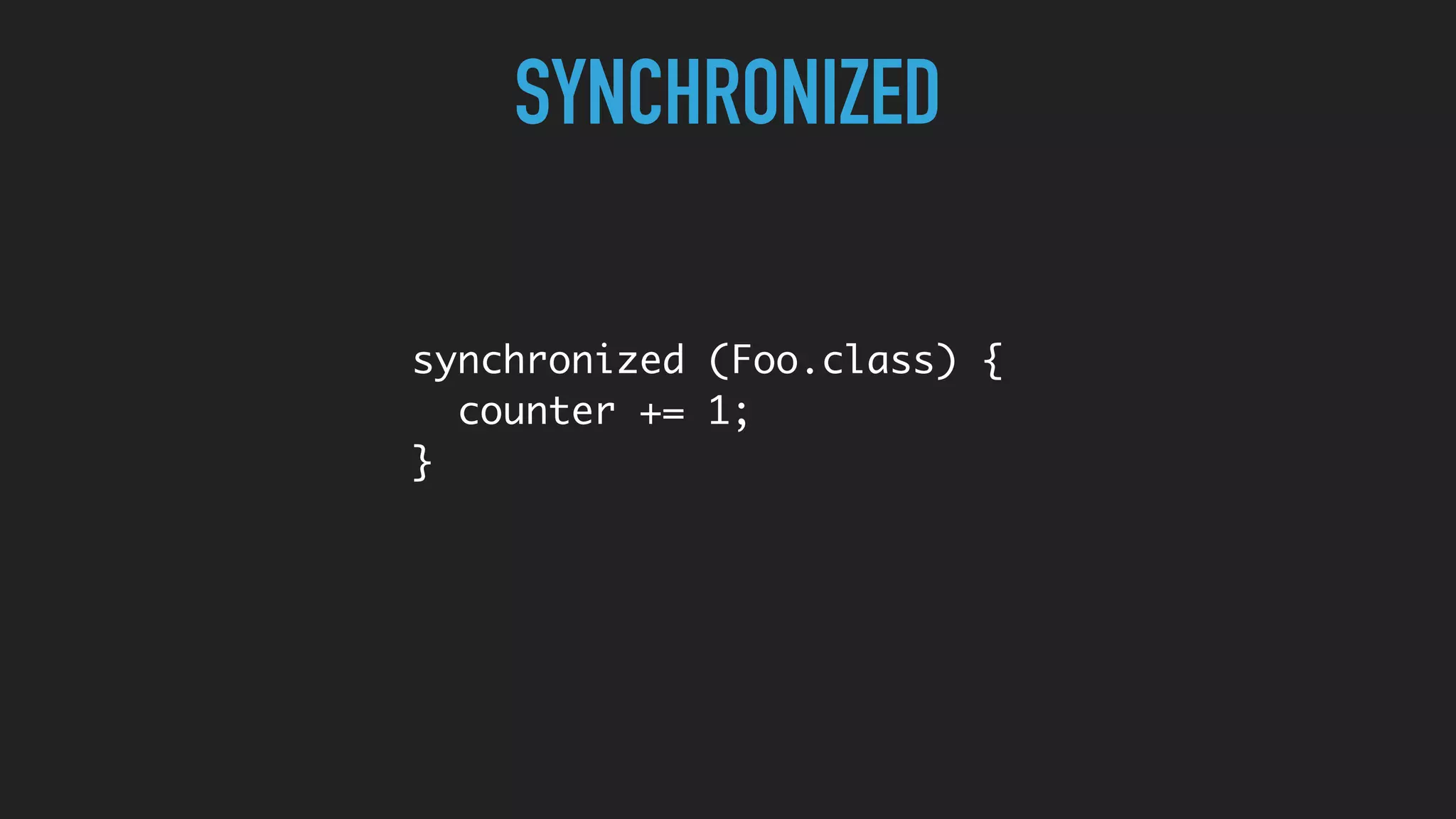
SYNCHRONIZED
synchronized (Foo.class) {
counter += 1;
}
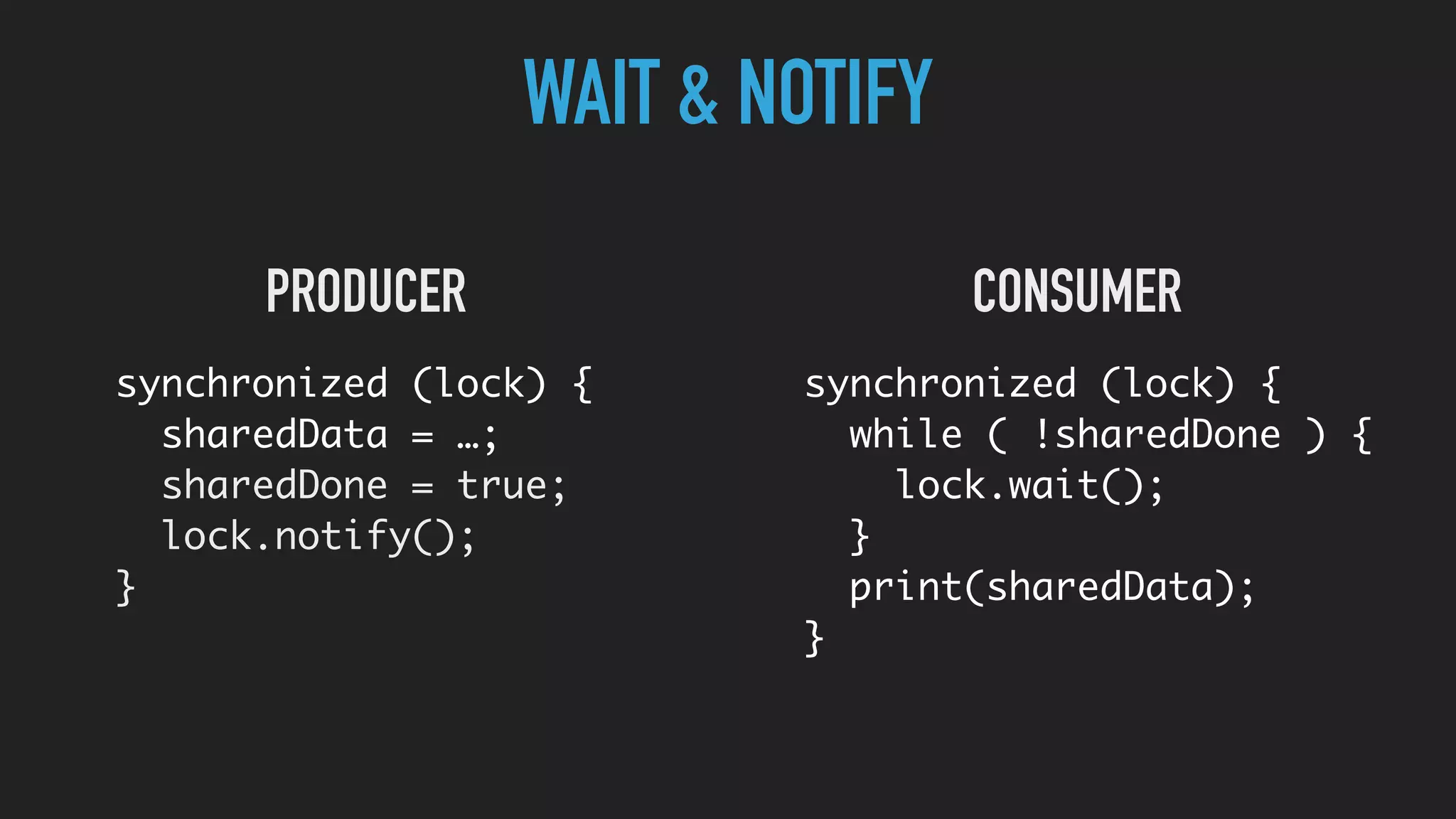
WAIT & NOTIFY
synchronized (lock) {
sharedData = …;
sharedDone = true;
lock.notify();
}
synchronized (lock) {
while ( !sharedDone ) {
lock.wait();
}
print(sharedData);
}
PRODUCER CONSUMER
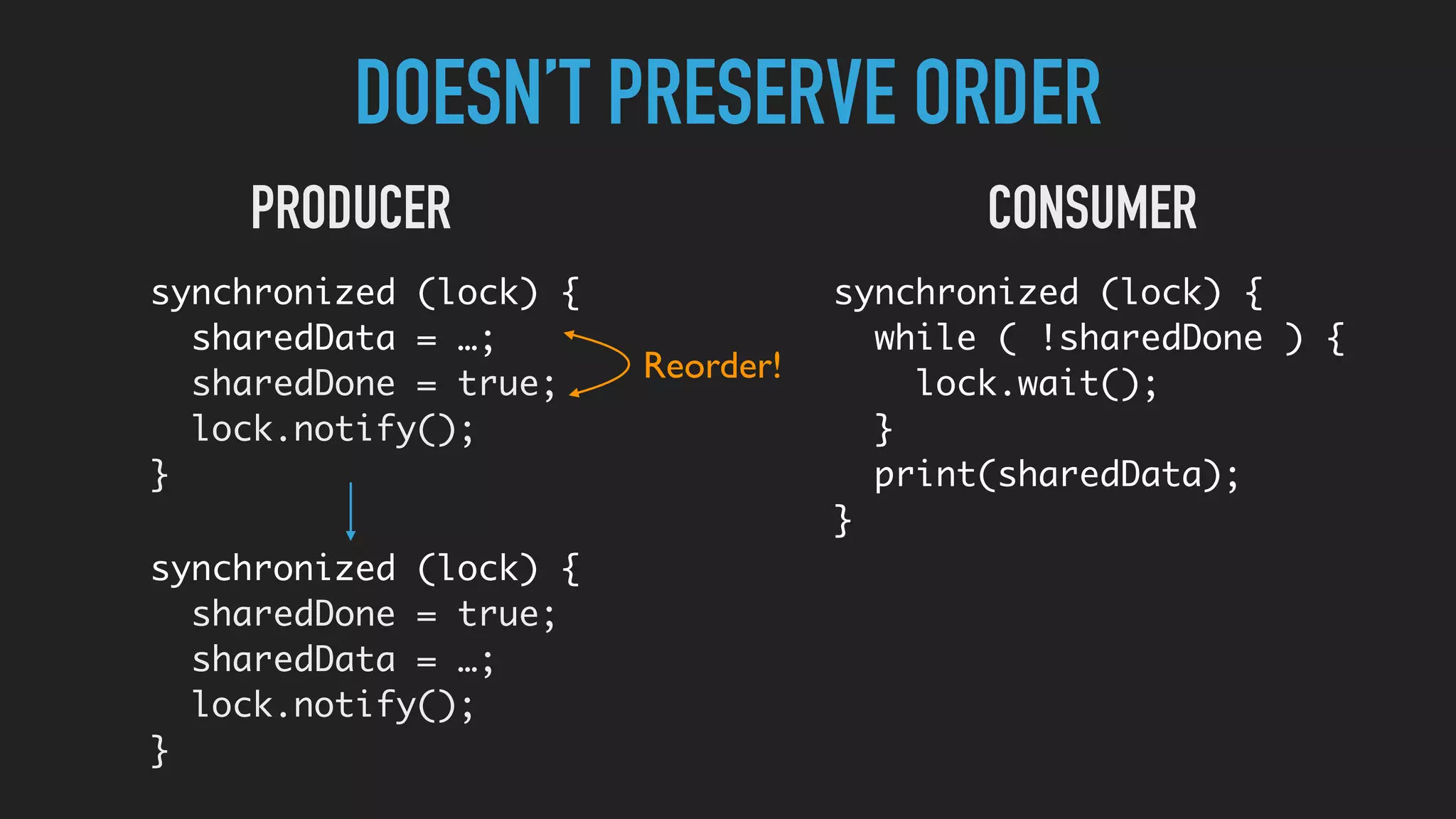
DOESN’T PRESERVE ORDER
synchronized (lock) {
sharedData = …;
sharedDone = true;
lock.notify();
}
synchronized (lock) {
while ( !sharedDone ) {
lock.wait();
}
print(sharedData);
}
PRODUCER CONSUMER
synchronized (lock) {
sharedDone = true;
sharedData = …;
lock.notify();
}
Reorder!
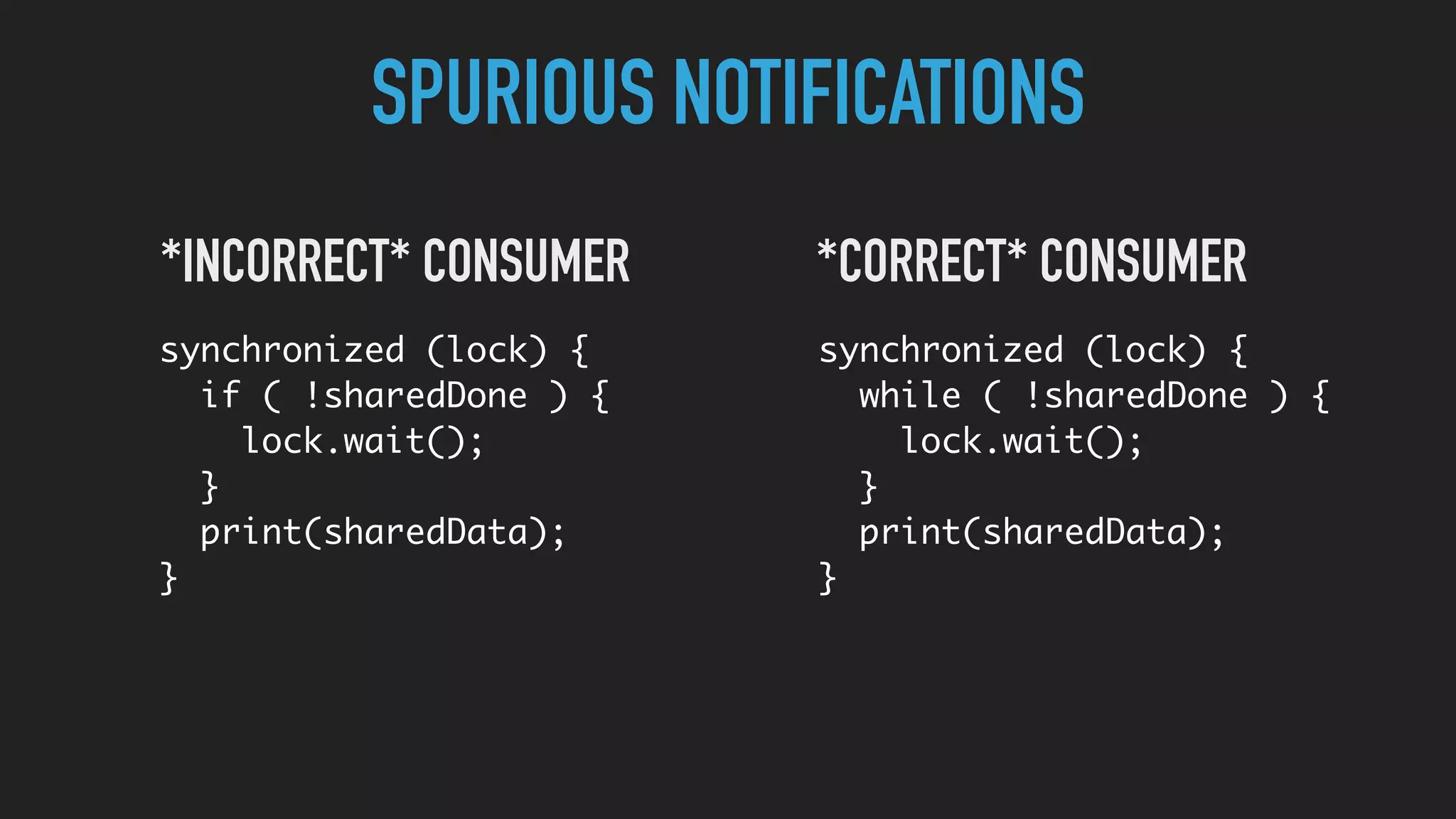
SPURIOUS NOTIFICATIONS
synchronized (lock) {
while ( !sharedDone ) {
lock.wait();
}
print(sharedData);
}
*CORRECT* CONSUMER
synchronized (lock) {
if ( !sharedDone ) {
lock.wait();
}
print(sharedData);
}
*INCORRECT* CONSUMER
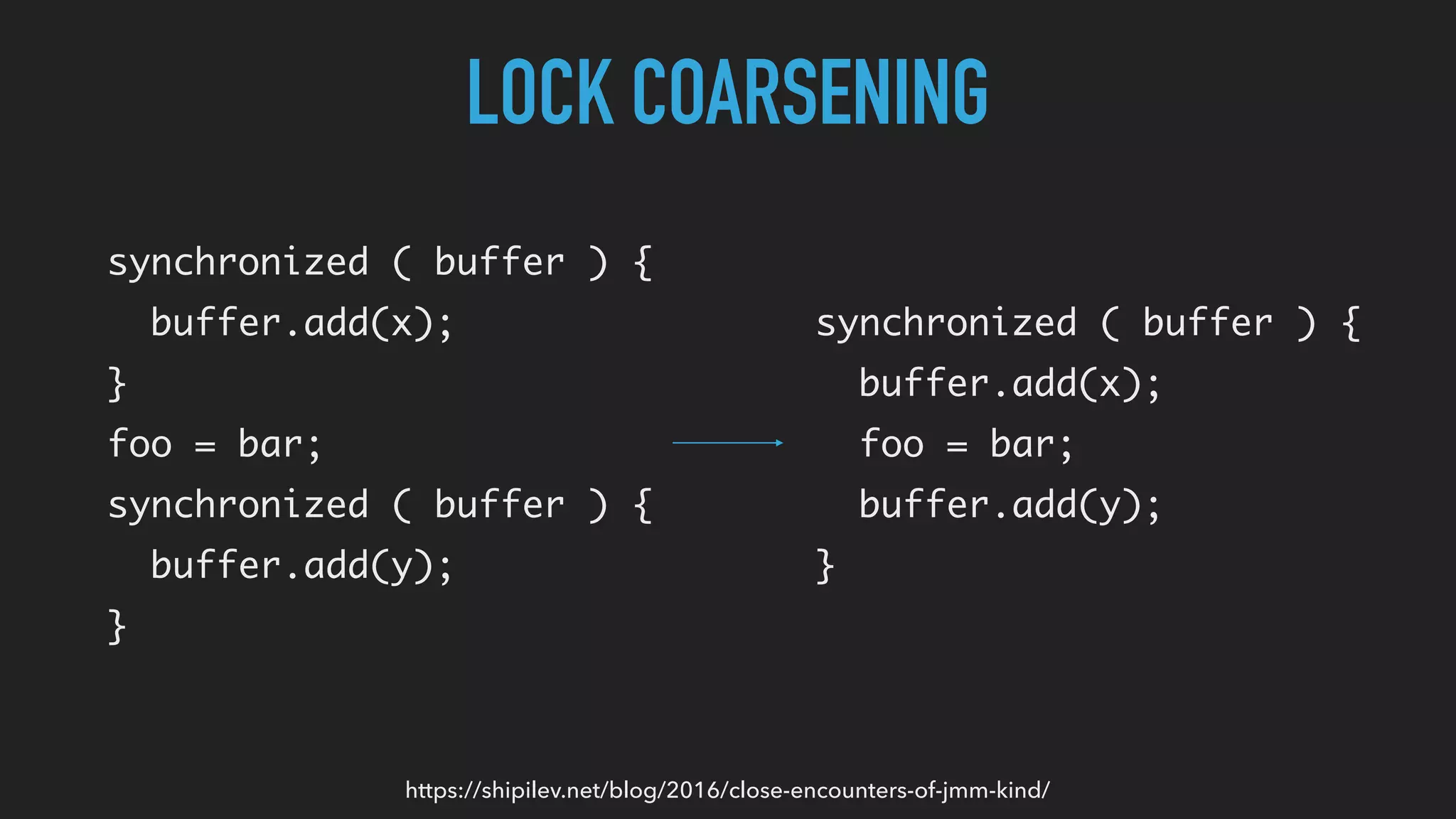
LOCK COARSENING
synchronized ( buffer ) {
buffer.add(x);
}
foo = bar;
synchronized ( buffer ) {
buffer.add(y);
}
https://shipilev.net/blog/2016/close-encounters-of-jmm-kind/
synchronized ( buffer ) {
buffer.add(x);
foo = bar;
buffer.add(y);
}
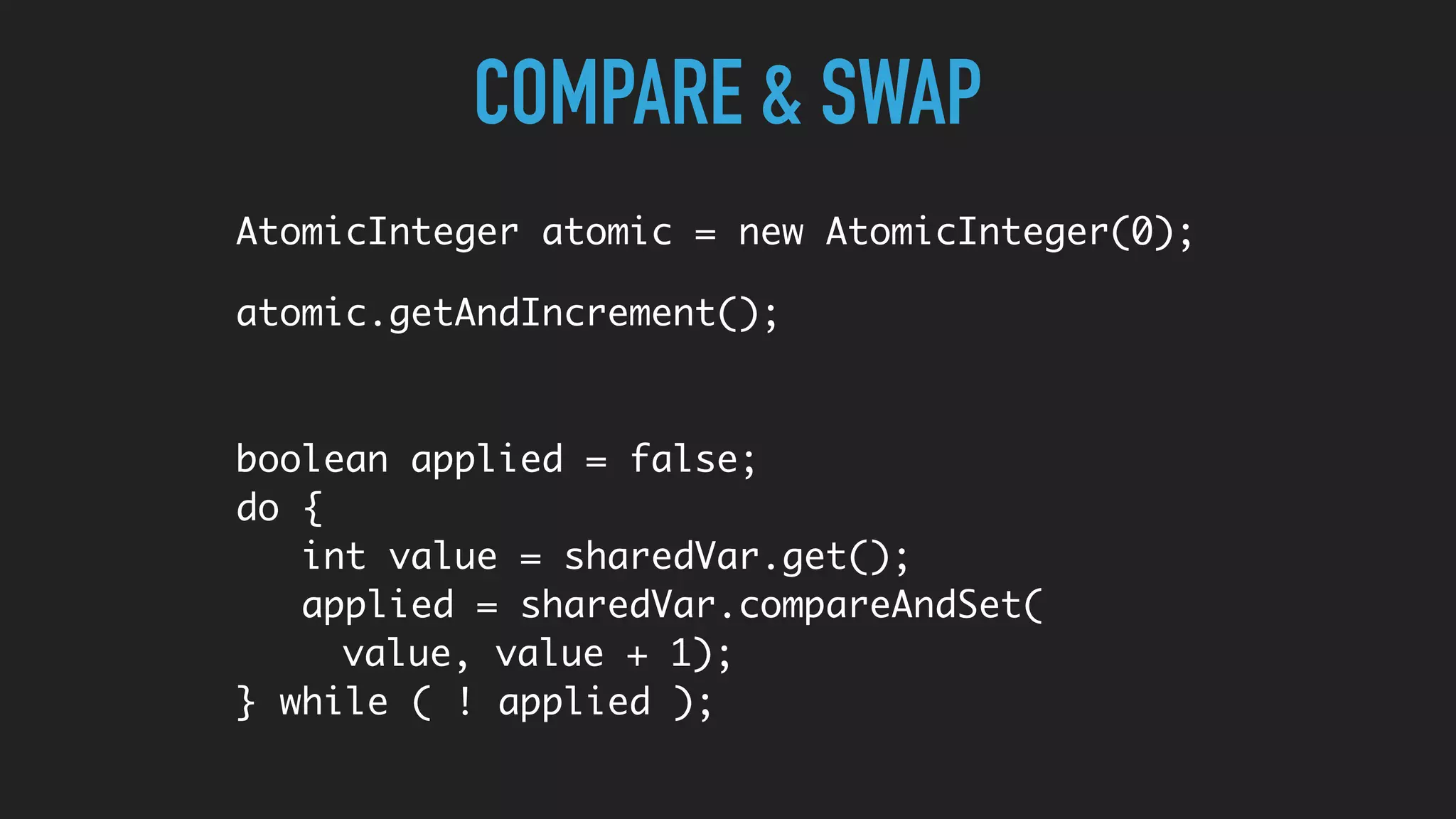
COMPARE & SWAP
AtomicInteger atomic = new AtomicInteger(0);
atomic.getAndIncrement();
boolean applied = false;
do {
int value = sharedVar.get();
applied = sharedVar.compareAndSet(
value, value + 1);
} while ( ! applied );
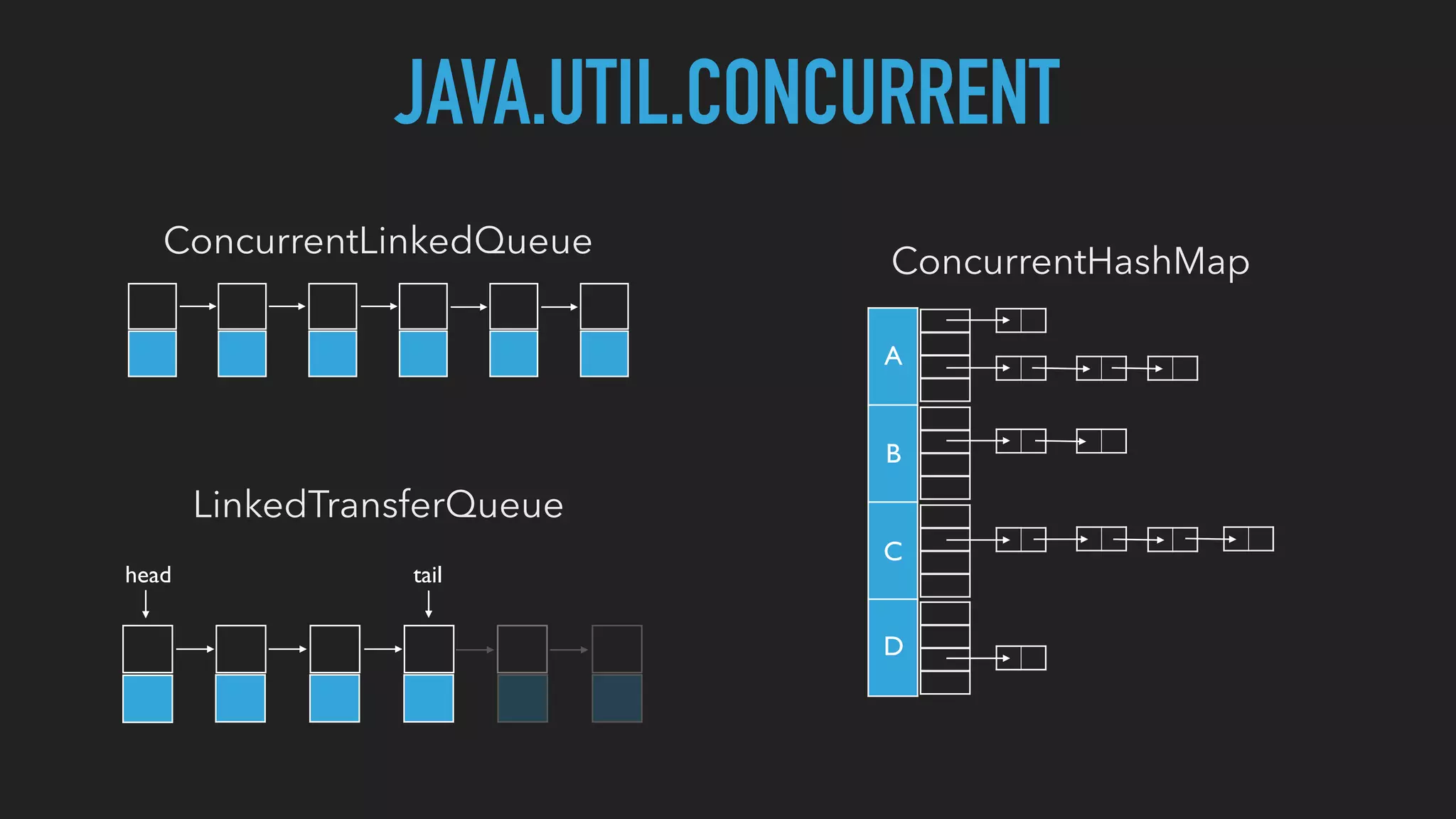
JAVA.UTIL.CONCURRENT
ConcurrentLinkedQueue
ConcurrentHashMap
A
B
C
D
LinkedTransferQueue
head tail
CONCURRENCY CAN SEEM...
BROKEN
COUNTERINTUITIVE
PARADOXICAL
DESPITE THE RULES
Immutable objects have a very compelling
list of positive qualities. Without question,
they are among the simplest and most robust
kinds of classes you can possibly build. When
you create immutable classes, entire
categories of problems simply disappear.
“ “
www.javapractices.com
REFERENCES
JAVA CURRENCY IN PRACTICE
Brian Goetz et al
JAVA MEMORY MODEL PRAGMATICS
Aleksey Shipilëv
http://virtualjug.com/java-memory-model-pragmatics/
CLOSE ENCOUNTERS OF THE JMM KIND
Aleksey Shipilëv
https://shipilev.net/blog/2016/close-encounters-of-jmm-kind/
HISTORY
JAVA’S MEMORY MODEL IS FATALLY FLAWED
Bill Pugh
http://www.cs.umd.edu/~pugh/java/broken.pdf
Bill Pugh
FIXING JAVA’S MEMORY MODEL
http://www.cs.umd.edu/~pugh/jmm.pdf
AND OF COURSE

Concurrency Concepts in Java

  • 1.
    CONCURRENCY CONCEPTS IN JAVA DOUGLASQ. HAWKINS LEAD JIT DEVELOPER AZUL SYSTEMS @dougqh dougqh@gmail.com
  • 2.
    TOPICS NOT ABOUT PARALLEL FORKJOIN AKKA EXECUTORS & FUTURES …
  • 3.
  • 4.
  • 5.
    YOU SHOULD READTHE FINE PRINT. TLDR: “AS IF” AS IF THERE’S ONE THREAD, UNLESS YOU SAY OTHERWISE.
  • 6.
    The behavior ofthreads, particularly when not correctly synchronized, can be confusing and counterintuitive. “ “ Java 8 Language Specification § 17.4 pp 631
  • 7.
    Immutable objects havea very compelling list of positive qualities. Without question, they are among the simplest and most robust kinds of classes you can possibly build. When you create immutable classes, entire categories of problems simply disappear. “ “ www.javapractices.com
  • 8.
  • 9.
    SUCCINCT != ATOMIC sharedX= 2L; sharedX = 2L sharedX = -1L set_hi sharedX, 0000 0000 set_lo sharedX, 0000 0002 set_hi sharedX, ffff ffff set_lo sharedX, ffff ffff thread 1 thread 2 JLS8 § 17.7 pp 658
  • 10.
    SUCCINCT != ATOMIC sharedX+= 1; localX = sharedX; localX = localX + 1; sharedX = localX;
  • 11.
    SUCCINCT != ATOMIC PointsharedPoint = new Point(x, y); local1 = calloc(sizeof(Point)); local1.<init>(x, y); Object.<init>(); this.x = x; this.y = y; sharedPoint = local1;
  • 12.
  • 13.
    NO GARBAGE VALUES NOOUT OF “THIN AIR” VALUES WILL SEE A ZERO-ISH VALUE OR AN ASSIGNED VALUE
  • 14.
    NO *COMPLETELY* GARBAGEVALUES TWO SEPARATE HALVES OF LONG OR DOUBLE BUT BOTH HALVES ARE ZERO OR ASSIGNED
  • 15.
    ONLY ASSIGNED VALUESFOR FINALS sharedPoint = new Point(x, y); class Point { final int x, y; public Point(int x, int y) { this.x = x; this.y = y; } } * *After constructor return JLS8 § 17.5 pp 652
  • 16.
    NOT *ALL* VALUESARE STORED sharedX = 20; sharedX = 40; print(sharedX); Dead Store
  • 17.
    DATA DEPENDENCE sharedX =20; sharedX = 40; print(sharedX); Dead Store Data Dependence
  • 18.
    DATA DEPENDENCE sharedX =20; sharedX = 40; print(40); Data Dependence Propagate Data Dead Stores
  • 19.
  • 20.
    NOT *ALL* VALUESARE STORED sharedSum = 0; for ( int x : array ) { sharedSum += x; } INTERMEDIATE VALUES OPTIONAL localSum = 0; for ( int x : array ) { localSum += x; } sharedSum = localSum;
  • 21.
  • 22.
    THREAD PUBLISHING METHOD PUBLISHES? Thread.sleepNO Thread.yield NO Thread.join YES Thread.isAlive YES* * If Thread.isAlive returns false JLS8 § 17.4 pp 636
  • 23.
    NOT *ALL* VALUESARE READ xSquared = sharedX * sharedX Can xSquared be 30? local1 = sharedX local2 = sharedX xSquared = local1 * local2
  • 24.
    NOT *ALL* VALUESARE READ Can xSquared be 30? local1 = sharedX local2 = sharedX xSquared = local1 * local2 thread 1 thread 2 sharedX = 5; local1 = sharedX; (5) sharedX = 6; local2 = sharedX; (6) xSquared = local1 * local2; (30)
  • 25.
    NOT *ALL* VALUESARE READ xSquared = sharedX * sharedX local1 = sharedX local2 = sharedX xSquared = local1 * local2 local1 = sharedX xSquared = local1 * local1 Redundant Load
  • 26.
  • 27.
    IMPORTANT OPTIMIZATION for (int x: array ) { … x … } for ( int i = 0; i < this.array.length; ++i ) { … this.array[i] … } Object[] local = this.array; for ( int i = 0; i < local.length; ++i ) { … local[i] … }
  • 28.
  • 29.
    MAYBE NOT… while (!done ); local1 = !done; while ( local1 ); Load False & Loop Forever
  • 30.
    To some programmers,this behavior may seem broken. However, it should be noted that this code is improperly synchronized. “ “ Java 8 Language Specification § 17.4 pp 638
  • 31.
    MEMORY COHERENCE Coherence isa guarantee that a thread cannot see an old value for the same memory location after seeing a newer value.
  • 32.
    TIME PARADOX // sharedPoint1might equal // sharedPoint2 int i = sharedPoint1.x; // another thread can change x int j = sharedPoint2.x; // allow old value or // cannot optimize int k = sharedPoint3.x; Point x y 100 100 125 sharedPoint1 sharedPoint2 JLS8 § 17.4-C pp 638
  • 33.
    The semantics ofthe Java programming language allow compilers and micro- processors to perform optimizations that can interact with incorrectly synchronized code in ways that can produce behaviors that seem paradoxical. “ “ Java 8 Language Specification § 17.4 pp 637
  • 34.
  • 35.
    “PROGRAM ORDER” sharedX =2 sharedY = 3 if ( sharedX > 0 ) { print(sharedX); } Control Data Data DATA + CONTROL DEPENDENCE
  • 36.
    DATA CONTROL DEPENDENCE+ sharedX= 2 start end print(x) if ( sharedX > 0 ) true false sharedY = 3
  • 37.
    https://en.wikichip.org/wiki/intel/microarchitectures/kaby_lake FETCH RENAME & ALLOCATE DECODE ALLOCATIONQUEUE SCHEDULERS ALU VECT ALU VECT SHIFT VECT ADD VECT MUL FMA DIV BRANCH ALU FAST LEA VECT ALU VECT SHIFT VECT ADD VECT MUL FMA SLOW INT SLOW LEA ALU FAST LEA VECT ALU VECT SHUFFLE ALU & SHIFT BRANCH AGU LOAD DATA AGU LOAD DATA STORE DATA AGU INTEL KABY LAKE LOAD BUFFER STORE BUFFER
  • 38.
    INTEL KABY LAKE https://en.wikichip.org/wiki/intel/microarchitectures/kaby_lake FETCH RENAME& ALLOCATE DECODE ALLOCATION QUEUE SCHEDULERS ALU VECT ALU VECT SHIFT VECT ADD VECT MUL FMA DIV BRANCH ALU FAST LEA VECT ALU VECT SHIFT VECT ADD VECT MUL FMA SLOW INT SLOW LEA ALU FAST LEA VECT ALU VECT SHUFFLE ALU & SHIFT BRANCH AGU LOAD DATA AGU LOAD DATA STORE DATA AGU LOAD BUFFER STORE BUFFER add reg0, 1 add reg1, 2
  • 39.
  • 40.
  • 41.
    STORE SOONER local1 =calloc(sizeof(Point)); local1.<init>(…); … sharedPoint = local1; sharedFoo = new Foo(…); Data Data
  • 42.
    FREE TO REORDER local1= calloc(sizeof(Point)); sharedPoint = local1; local1.<init>(…); sharedFoo = new Foo(…); Data Data Reordered!
  • 43.
    *BROKEN* DOUBLE CHECKEDLOCKING static Singleton instance() { if ( sharedInstance == null ) { synchronized ( Singleton.class ) { if ( sharedInstance == null ) { sharedInstance = new Singleton(); } } } return sharedInstance; } static Singleton instance() { if ( sharedInstance == null ) { synchronized ( Singleton.class ) { if ( sharedInstance == null ) { local = calloc(sizeof(Singleton)); sharedInstance = local; local.<init>(); } } } return sharedInstance; } sharedInstance is non-null, but constructor hasn’t run.
  • 44.
    PRODUCER CONSUMER ... sharedData =...; sharedDone = true; ... sharedDone = true; sharedData = ...; while ( !sharedDone ); print(sharedData); Reorder!
  • 45.
  • 46.
    RISC / ARMCISC / x86 Loads After Loads YES YES Loads After Stores YES YES Stores After Stores YES NO Stores After Loads YES YES
  • 47.
    ... sharedData = …; store_store_fence(); sharedDone= true; while ( !sharedDone ) { load_load_fence(); } print(sharedData); TO STOP REORDERING, USE A *FENCE* PRODUCER CONSUMER
  • 48.
  • 49.
    RISC / ARMCISC / x86 Java Loads After Loads YES YES YES Loads After Stores YES YES YES Stores After Stores YES NO YES Stores After Loads YES YES YES
  • 50.
    HOW DO YOUTELL JAVA TO NOT REORDER?
  • 51.
  • 52.
    FINAL & FREEZE local1= calloc(sizeof(Point)); local1.<init>(x, y); Object.<init>(); this.x = x; this.y = y; freeze(); sharedPoint = local1; Point sharedPoint = new Point(x, y);
  • 53.
    FINAL & FREEZE local1= calloc(sizeof(Point)); local1.<init>(x, y); Object.<init>(); this.x = x; this.y = y; OtherThread.see(this); freeze(); sharedPoint = local1; Point sharedPoint = new Point(x, y); Free to Reorder!
  • 54.
    VOLATILE PRE-JAVA 5 JUSTATOMICITY FOR CATEGORY 2 TYPES: WRITE “SYNCHRONIZES WITH” *ALL* SUBSEQUENT READS WRITE “HAPPENS BEFORE” *ALL* SUBSEQUENT READS JLS8 § 17.4.4 & 17.4.5 pp 642 & 643
  • 55.
    VOLATILE ... volatileData = …; volatileDone= true; while ( !volatileDone ) { } print(volatileData); PRODUCER CONSUMER
  • 56.
    ALSO FIXES DOUBLECHECKED LOCKING static Singleton instance() { if ( sharedInstance == null ) { synchronized ( Singleton.class ) { if ( sharedInstance == null ) { local = calloc(sizeof(Singleton)); local.<init>(); sharedInstance = local; } } } return sharedInstance; }
  • 57.
    RIGHT WAY TODO LAZY SINGLETON IN JAVA static Singleton instance() { return Holder.INSTANCE; } static class Holder { static final class Singleton INSTANCE = new Singleton(); } CLASS INITIALIZATION IS ALREADY LAZY.
  • 58.
    SUCCINCT *STILL* !=ATOMIC volatileX += 1; localX = sharedX; localX = localX + 1; sharedX = localX;
  • 59.
  • 60.
  • 61.
    WAIT & NOTIFY synchronized(lock) { sharedData = …; sharedDone = true; lock.notify(); } synchronized (lock) { while ( !sharedDone ) { lock.wait(); } print(sharedData); } PRODUCER CONSUMER
  • 62.
    DOESN’T PRESERVE ORDER synchronized(lock) { sharedData = …; sharedDone = true; lock.notify(); } synchronized (lock) { while ( !sharedDone ) { lock.wait(); } print(sharedData); } PRODUCER CONSUMER synchronized (lock) { sharedDone = true; sharedData = …; lock.notify(); } Reorder!
  • 63.
    SPURIOUS NOTIFICATIONS synchronized (lock){ while ( !sharedDone ) { lock.wait(); } print(sharedData); } *CORRECT* CONSUMER synchronized (lock) { if ( !sharedDone ) { lock.wait(); } print(sharedData); } *INCORRECT* CONSUMER
  • 64.
    LOCK COARSENING synchronized (buffer ) { buffer.add(x); } foo = bar; synchronized ( buffer ) { buffer.add(y); } https://shipilev.net/blog/2016/close-encounters-of-jmm-kind/ synchronized ( buffer ) { buffer.add(x); foo = bar; buffer.add(y); }
  • 65.
    COMPARE & SWAP AtomicIntegeratomic = new AtomicInteger(0); atomic.getAndIncrement(); boolean applied = false; do { int value = sharedVar.get(); applied = sharedVar.compareAndSet( value, value + 1); } while ( ! applied );
  • 66.
  • 67.
  • 68.
    Immutable objects havea very compelling list of positive qualities. Without question, they are among the simplest and most robust kinds of classes you can possibly build. When you create immutable classes, entire categories of problems simply disappear. “ “ www.javapractices.com
  • 69.
    REFERENCES JAVA CURRENCY INPRACTICE Brian Goetz et al JAVA MEMORY MODEL PRAGMATICS Aleksey Shipilëv http://virtualjug.com/java-memory-model-pragmatics/ CLOSE ENCOUNTERS OF THE JMM KIND Aleksey Shipilëv https://shipilev.net/blog/2016/close-encounters-of-jmm-kind/
  • 70.
    HISTORY JAVA’S MEMORY MODELIS FATALLY FLAWED Bill Pugh http://www.cs.umd.edu/~pugh/java/broken.pdf Bill Pugh FIXING JAVA’S MEMORY MODEL http://www.cs.umd.edu/~pugh/jmm.pdf
  • 71.