B.Tech IV Sem CSE ‘C’; Scheme 2017; AY: 2020_21
COMPUTER NETWORKS
Dr. C. Sreedhar
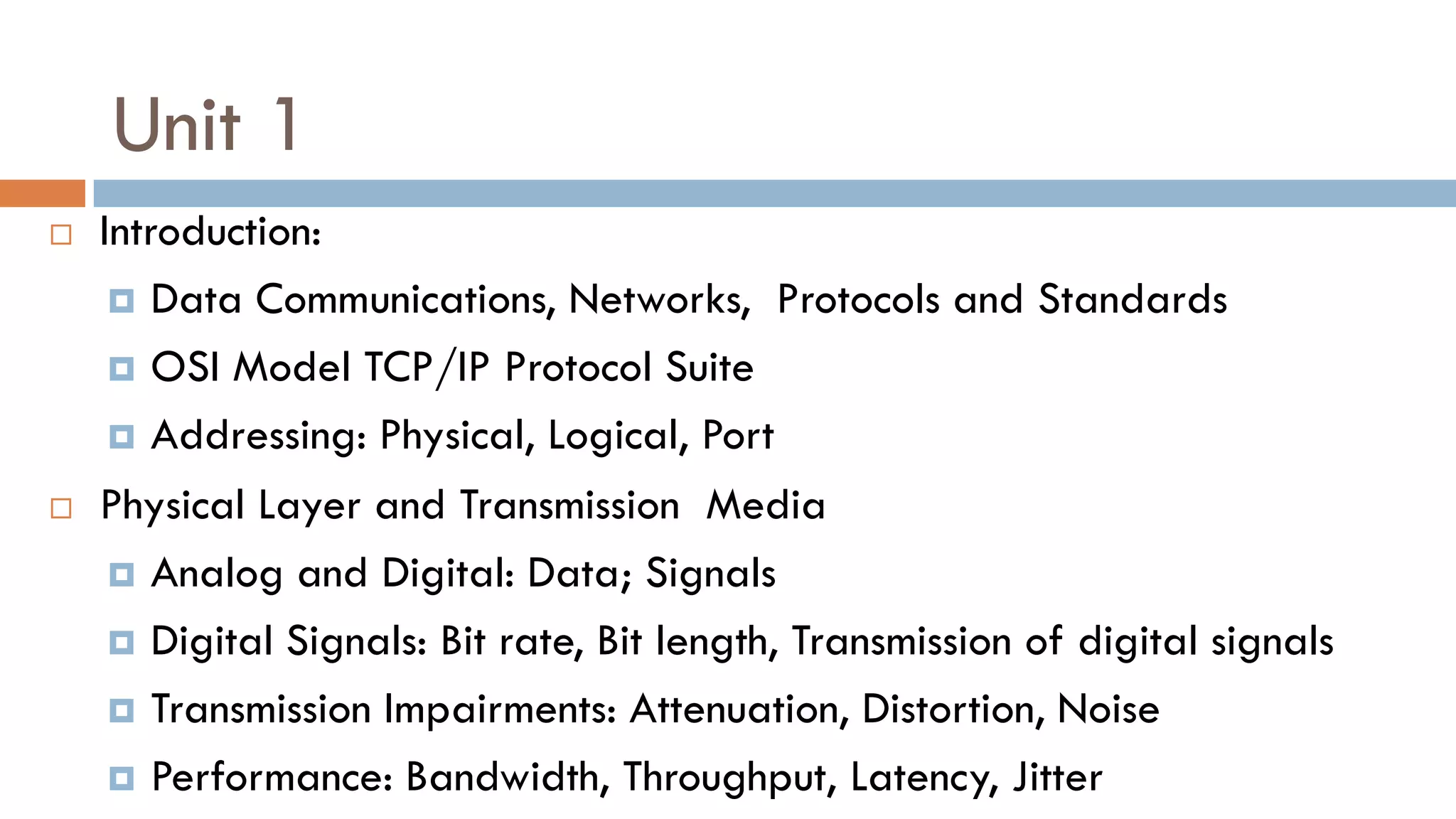
Unit 1
 Introduction:
 Data Communications, Networks, Protocols and Standards
 OSI Model TCP/IP Protocol Suite
 Addressing: Physical, Logical, Port
 Physical Layer and Transmission Media
 Analog and Digital: Data; Signals
 Digital Signals: Bit rate, Bit length, Transmission of digital signals
 Transmission Impairments: Attenuation, Distortion, Noise
 Performance: Bandwidth, Throughput, Latency, Jitter
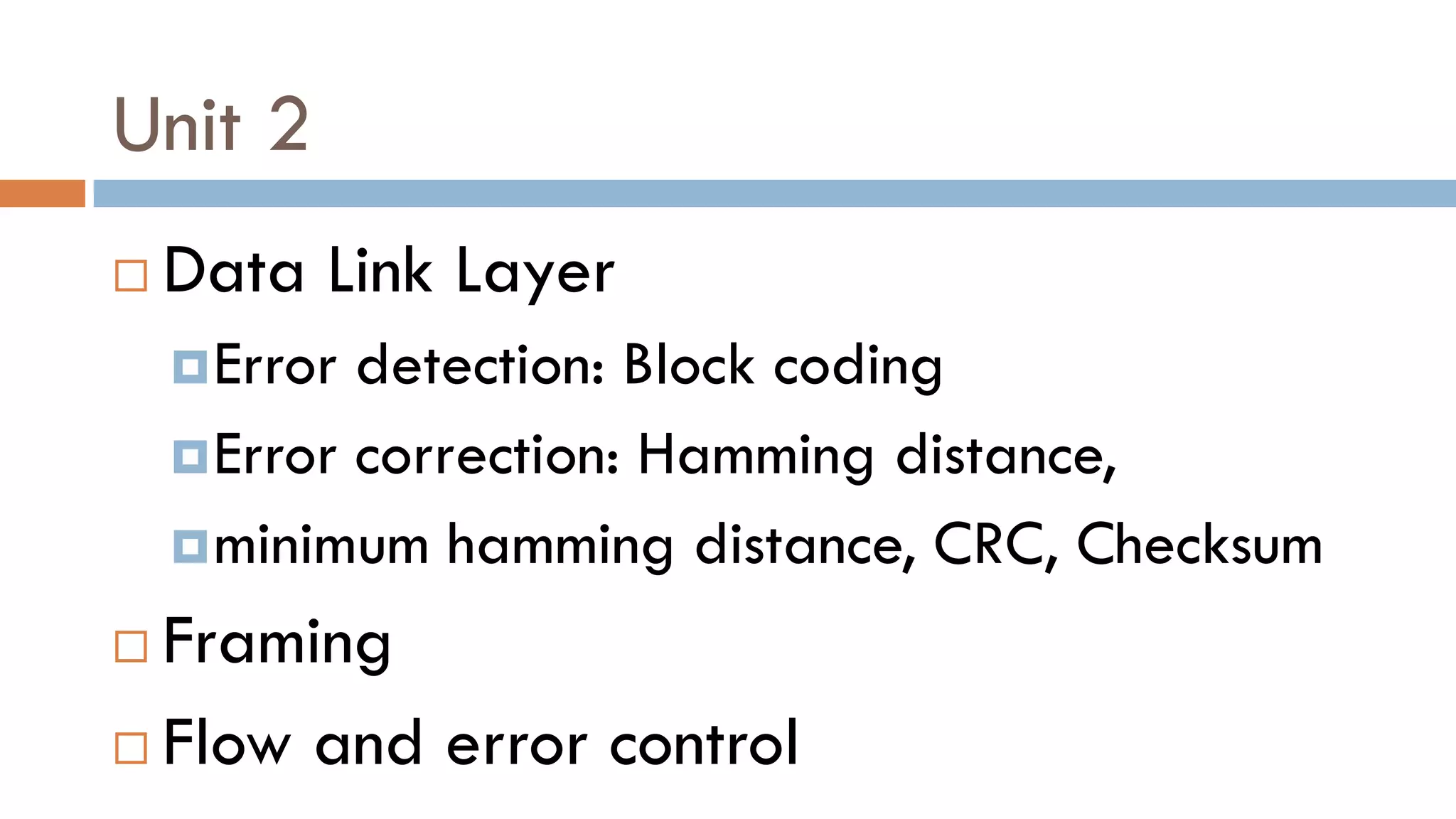
Unit 2
 Data Link Layer
Error detection: Block coding
Error correction: Hamming distance,
minimum hamming distance, CRC, Checksum
 Framing
 Flow and error control
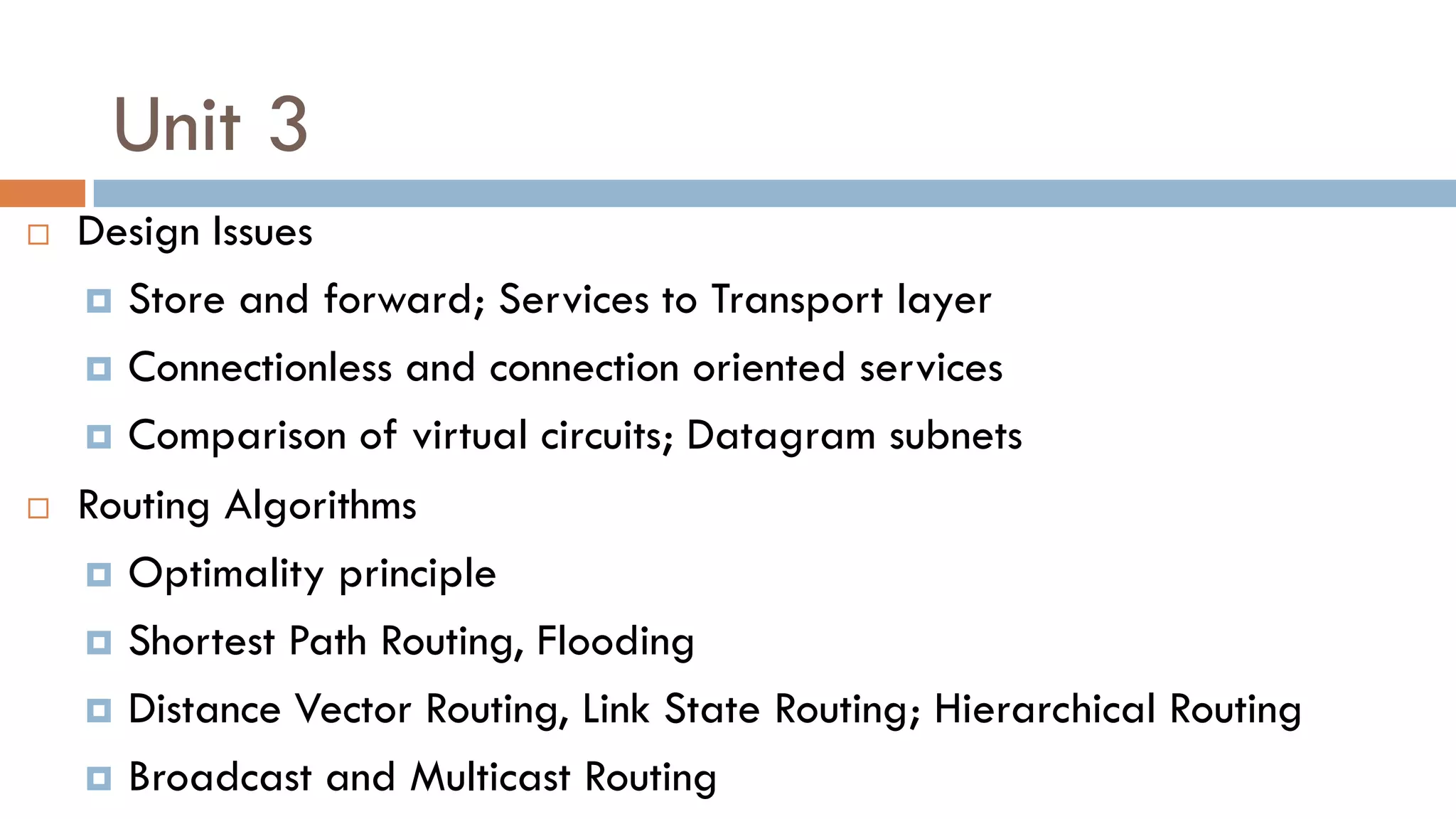
Unit 3
 Design Issues
 Store and forward; Services to Transport layer
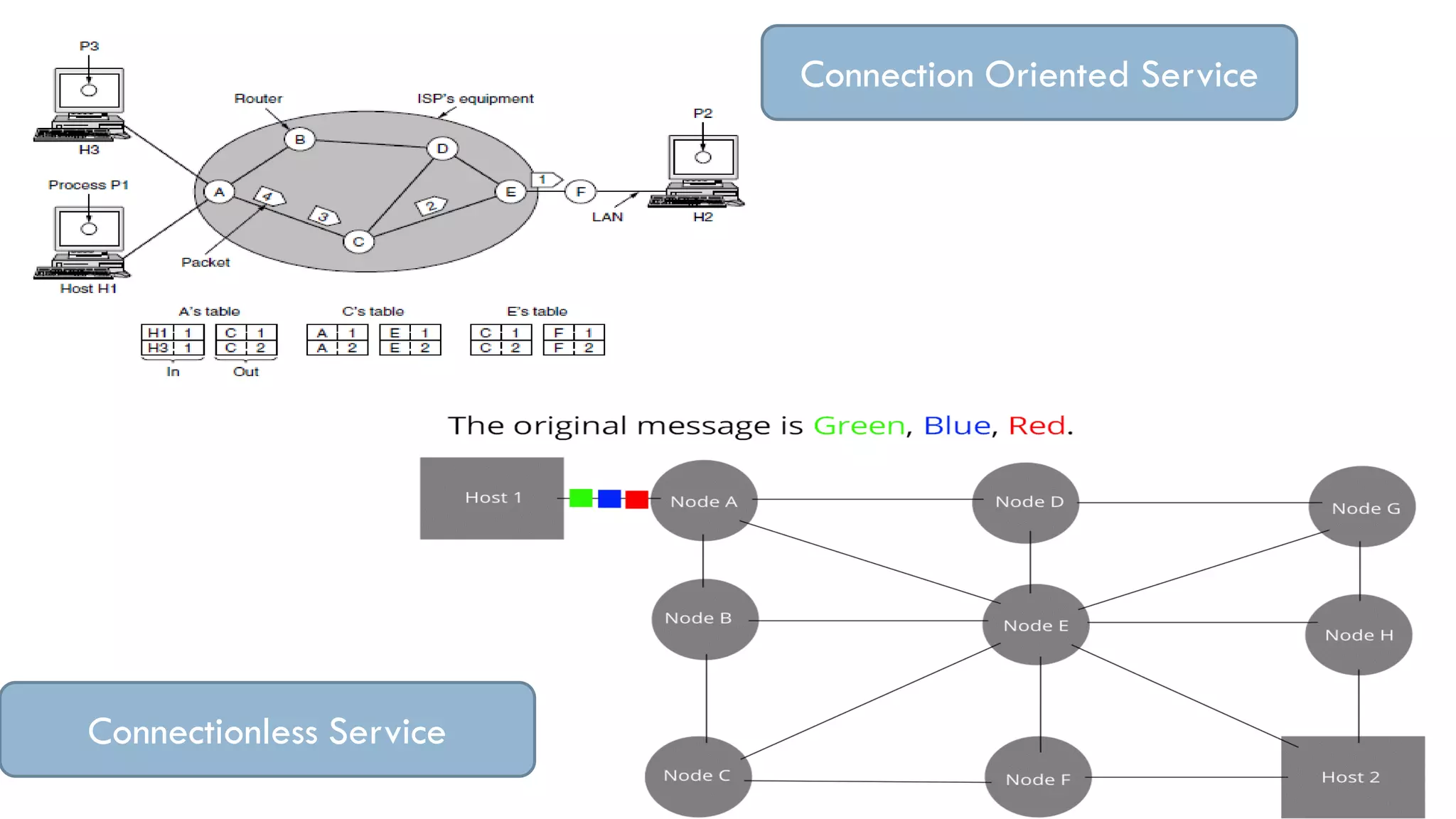
 Connectionless and connection oriented services
 Comparison of virtual circuits; Datagram subnets
 Routing Algorithms
 Optimality principle
 Shortest Path Routing, Flooding
 Distance Vector Routing, Link State Routing; Hierarchical Routing
 Broadcast and Multicast Routing
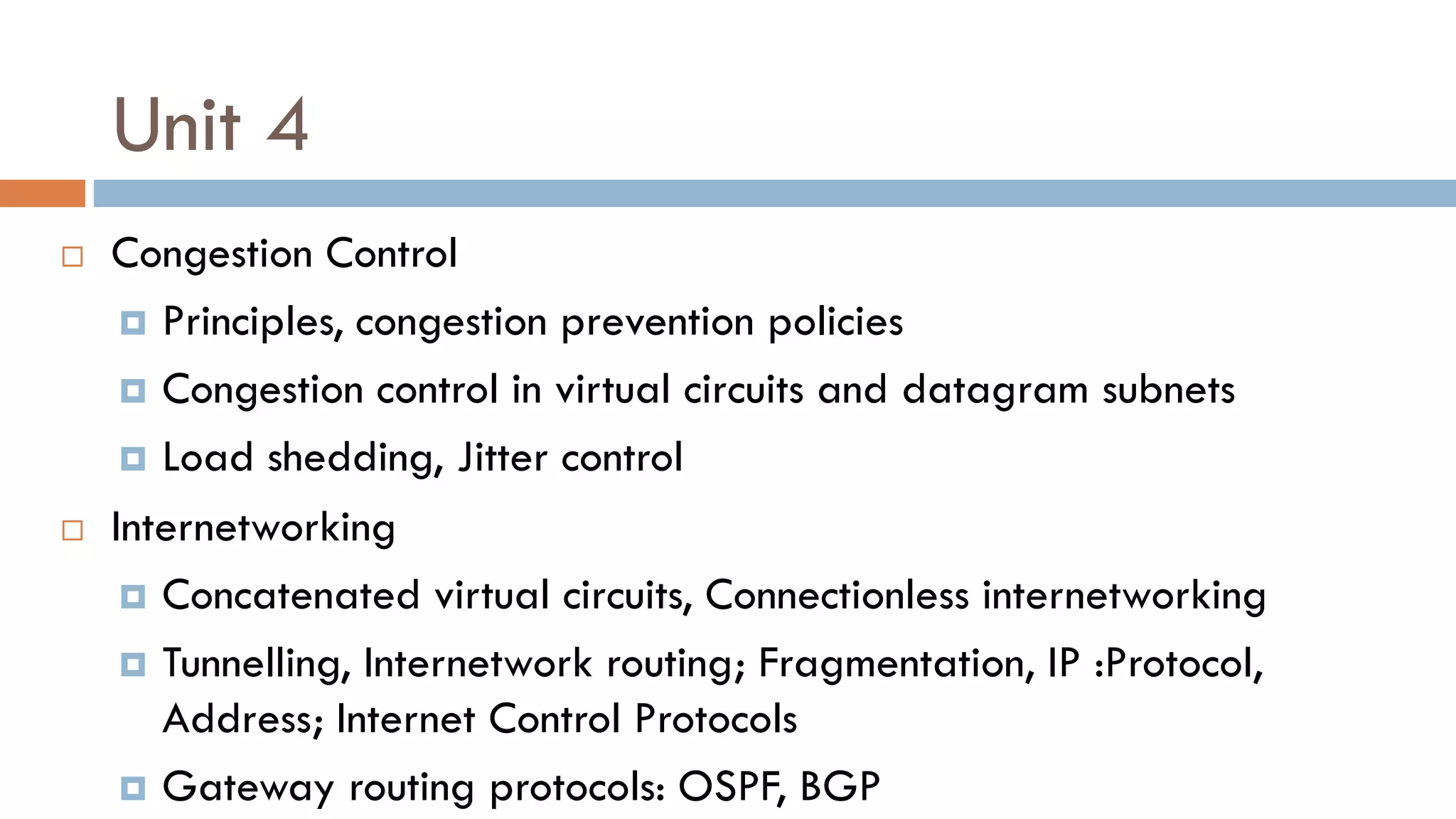
Unit 4
 Congestion Control
 Principles, congestion prevention policies
 Congestion control in virtual circuits and datagram subnets
 Load shedding, Jitter control
 Internetworking
 Concatenated virtual circuits, Connectionless internetworking
 Tunnelling, Internetwork routing; Fragmentation, IP :Protocol,
Address; Internet Control Protocols
 Gateway routing protocols: OSPF, BGP
Unit 5
 UDP;
 TCP:
 Service model, protocol, segment header,
 connection management; Transmission policy
 Congestion control and timer management
 Application Layer
 DNS Namespace; Resource Records
 Name Servers
Unit 1
 Data Communications
 Definition
 Components of DC
 Data representation
 Data flow
 Networks
 Network criteria
 Types of connections
 Categories of topology
 Network Models
 Protocols and
Standards
 Definition
 Standards
Data Communication: Definition
 Data communications are the exchange of data
between two devices via some form of transmission
medium such as a wire cable.
Data Communication
 The effectiveness of a data communications system
depends on four fundamental characteristics:
 Delivery: deliver data to the correct destination
 accuracy: system must deliver the data accurately
 Timeliness: system must deliver data in a timely manner
 Jitter: refers to the variation in the packet arrival time
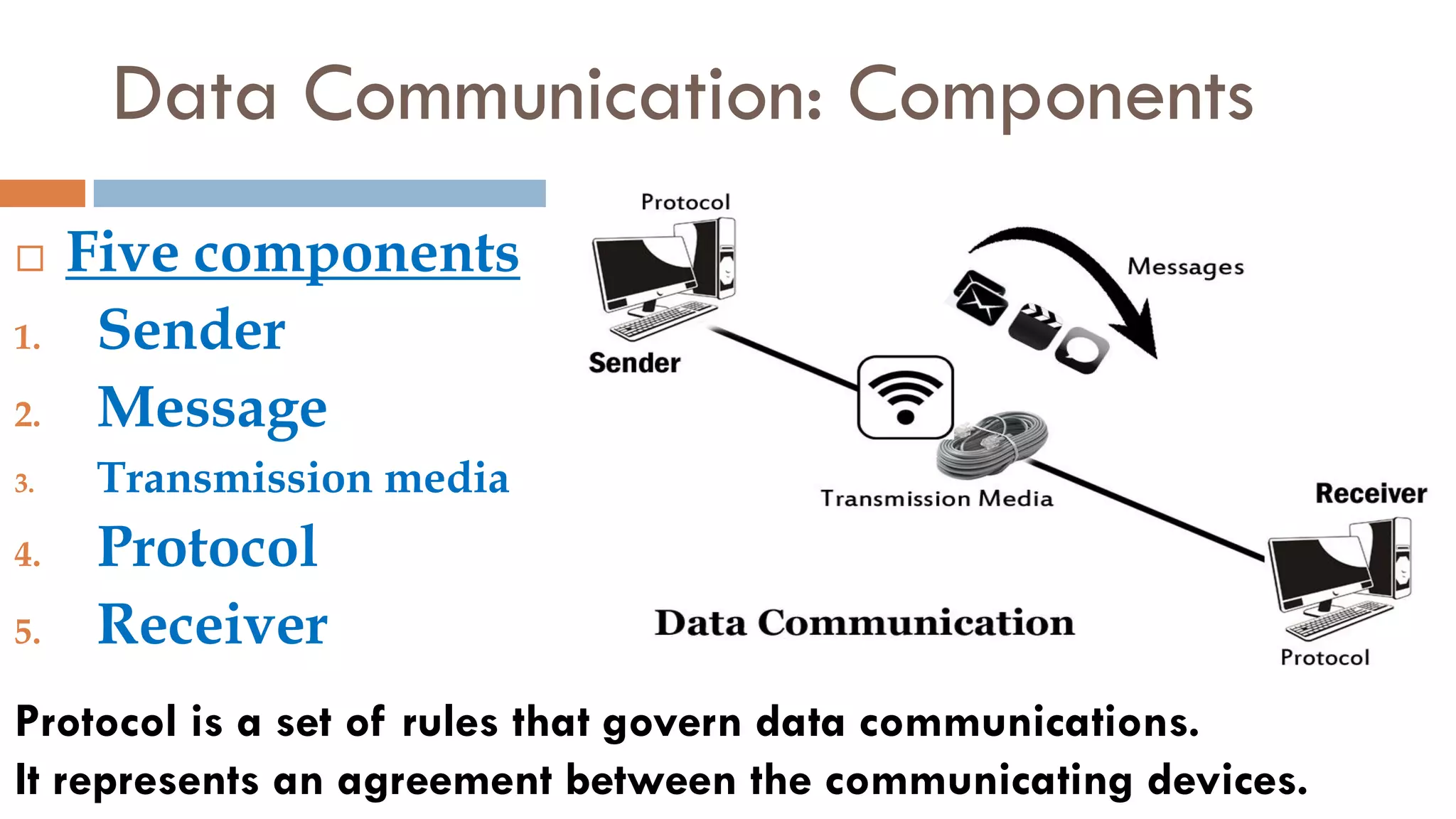
Data Communication: Components
 Five components
1. Sender
2. Message
3. Transmission media
4. Protocol
5. Receiver
Protocol is a set of rules that govern data communications.
It represents an agreement between the communicating devices.
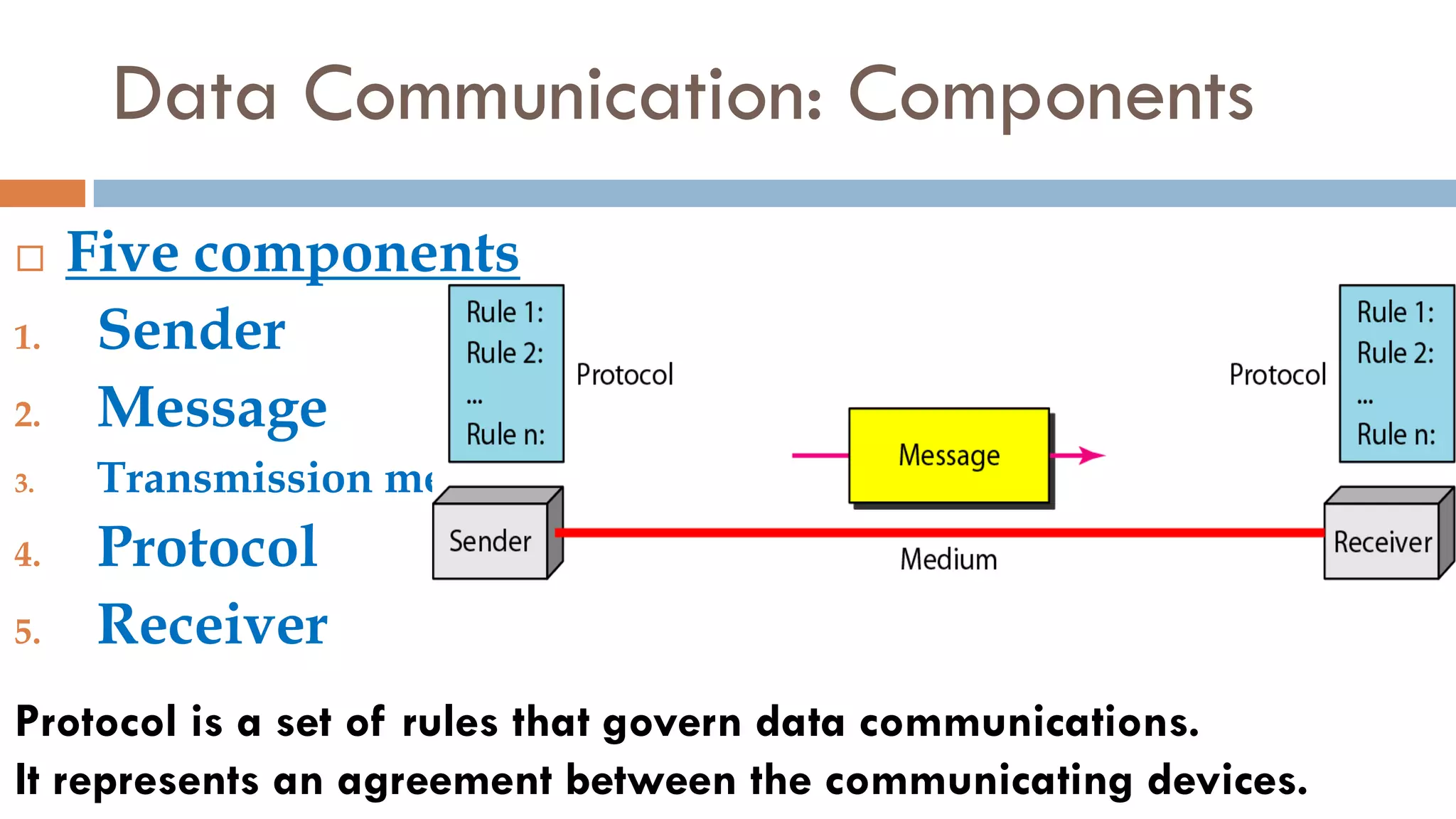
Data Communication: Components
 Five components
1. Sender
2. Message
3. Transmission media
4. Protocol
5. Receiver
Protocol is a set of rules that govern data communications.
It represents an agreement between the communicating devices.
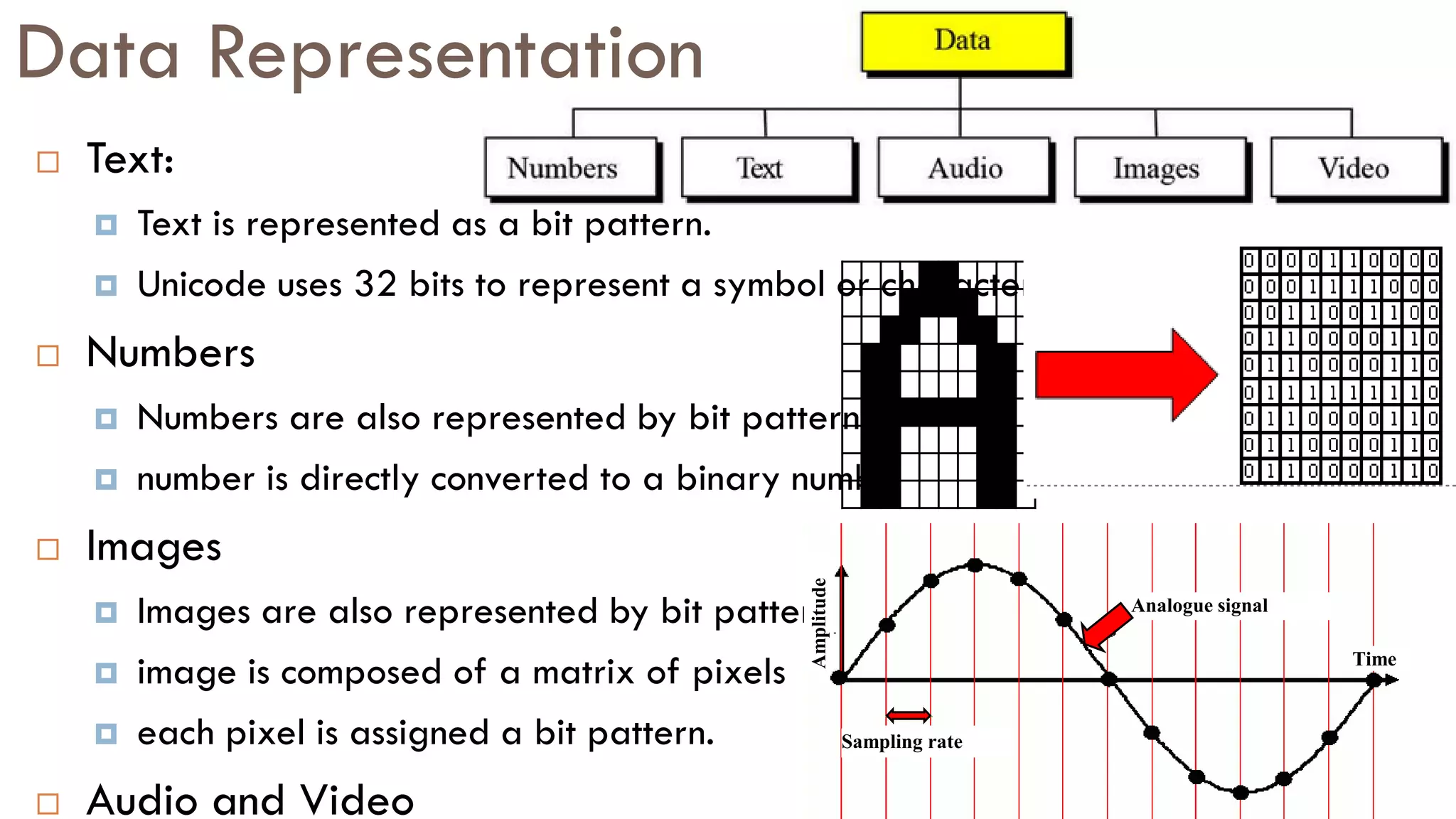
Data Representation
 Text:
 Text is represented as a bit pattern.
 Unicode uses 32 bits to represent a symbol or character
 Numbers
 Numbers are also represented by bit patterns.
 number is directly converted to a binary number
 Images
 Images are also represented by bit patterns.
 image is composed of a matrix of pixels
 each pixel is assigned a bit pattern.
 Audio and Video
Sampling rate
Analogue signal
Time
Amplitude
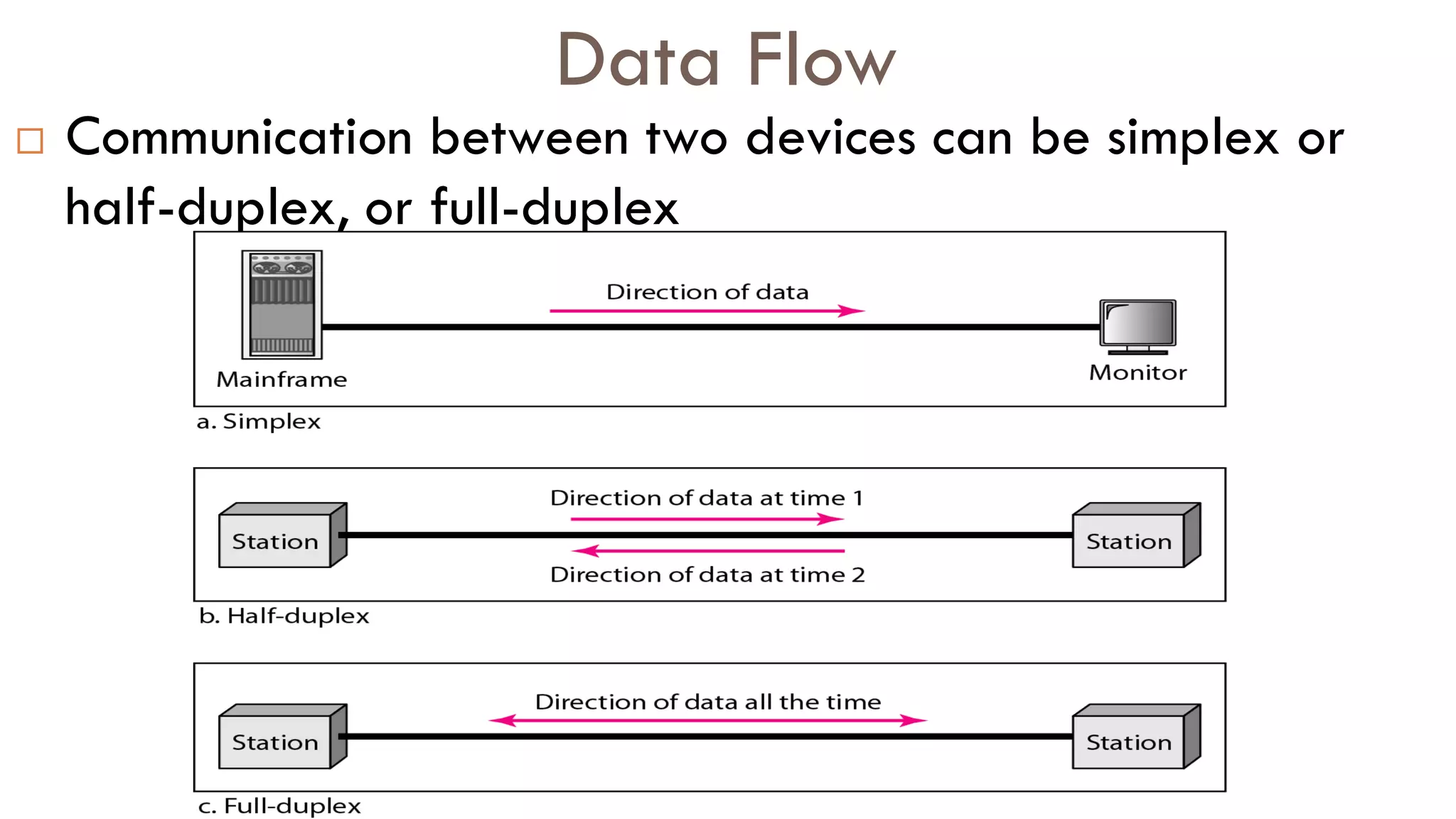
Data Flow
 Communication between two devices can be simplex or
half-duplex, or full-duplex
Network
 A network is a set of devices (nodes) connected by
communication links.
 A node can be a computer, printer, or any other
device capable of sending and/or receiving data
generated by other nodes on the network.
 A link can be a cable, air, optical fiber, or any
medium which can transport a signal carrying
information.
Network Criteria
 Performance:
 Measured: transit time and response time
 Transit time: time required for a message to travel from AB
 Response time: elapsed time between inquiry and response
 Evaluated using two metrics:
 throughput and delay (more throughput and less delay).
 Reliability:
 measured by the frequency of failure
 Security
 Network security issues include protecting data from unauthorized access
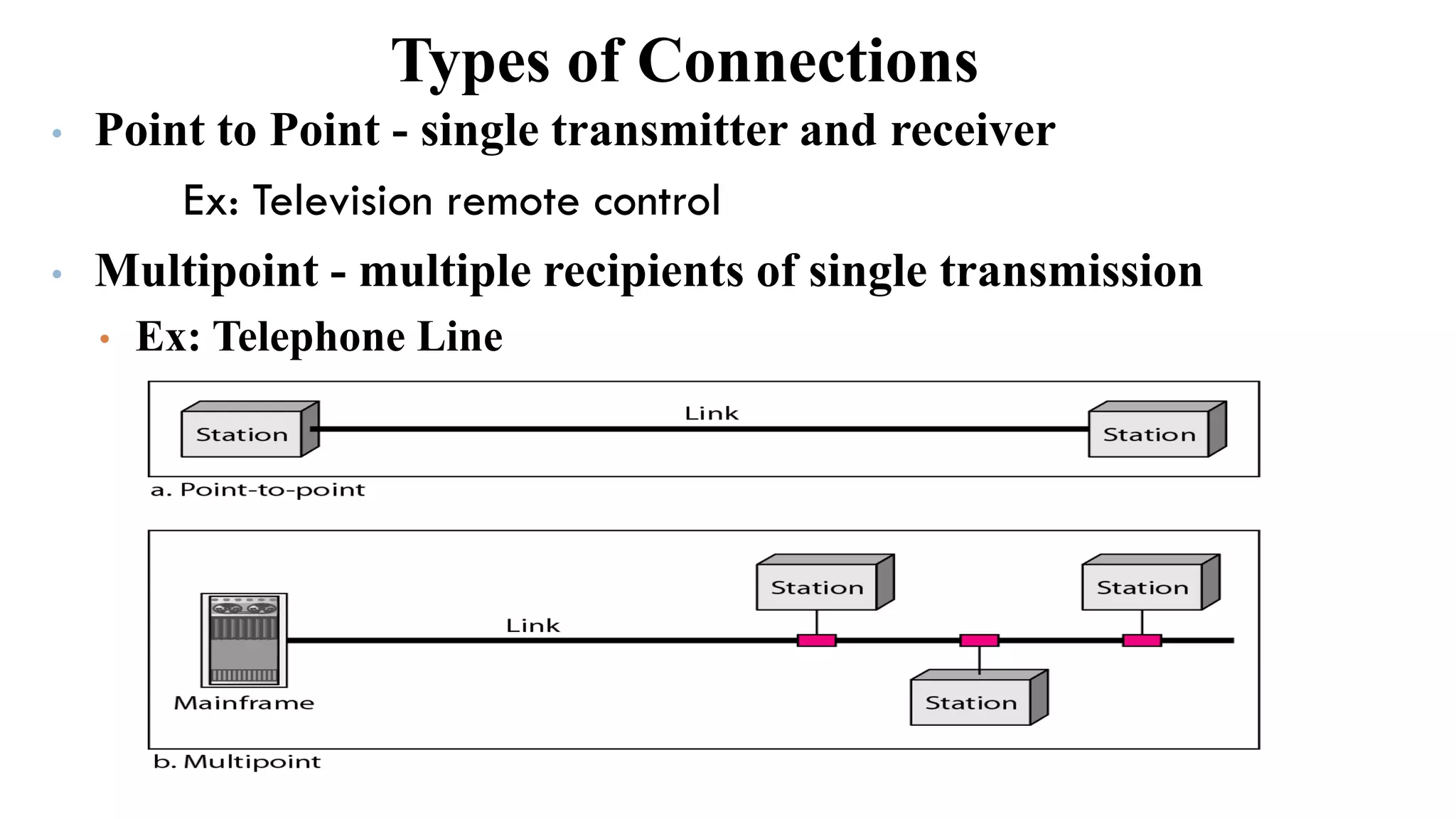
• Point to Point - single transmitter and receiver
Ex: Television remote control
• Multipoint - multiple recipients of single transmission
• Ex: Telephone Line
Types of Connections
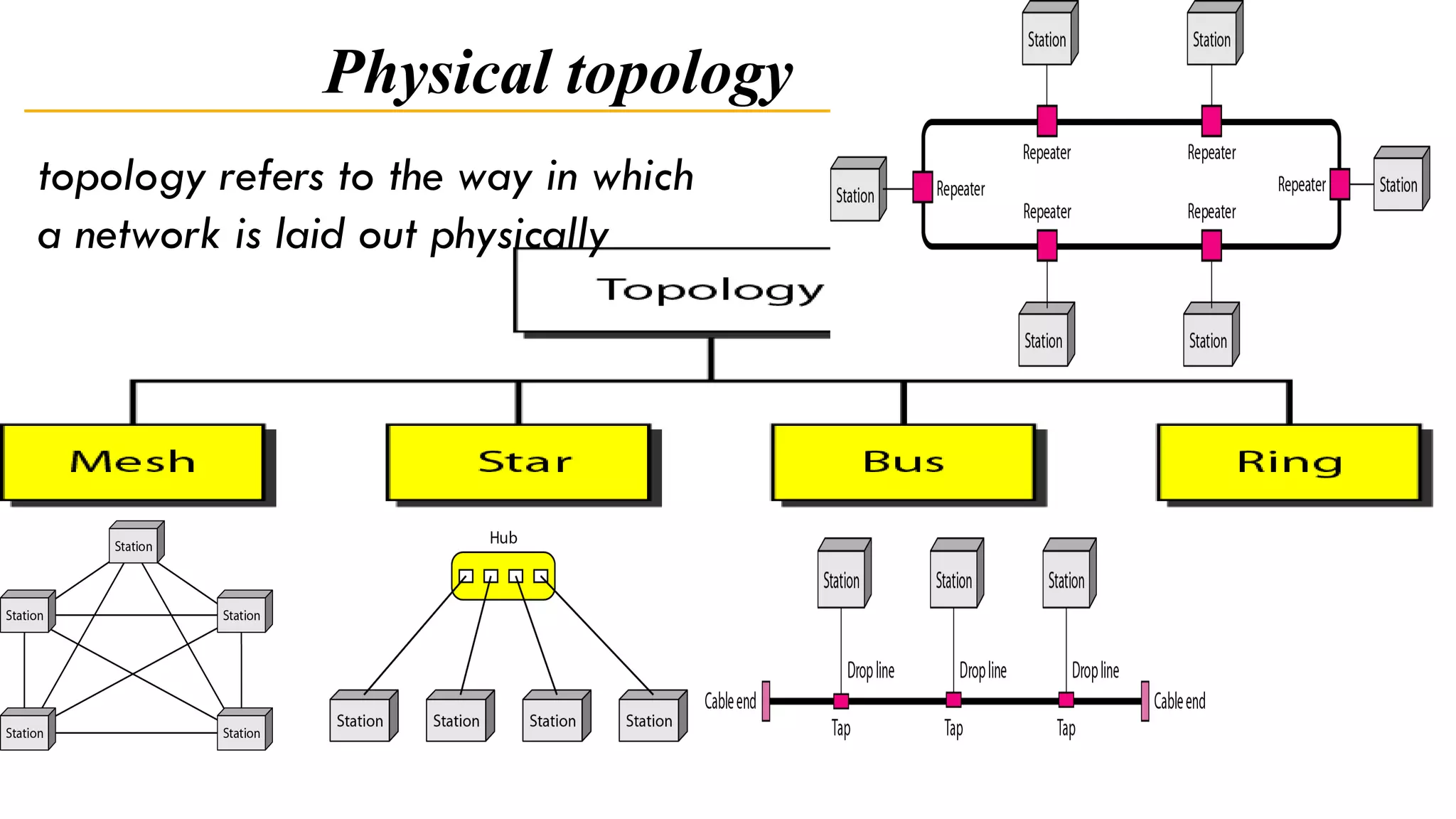
Physical topology
topology refers to the way in which
a network is laid out physically
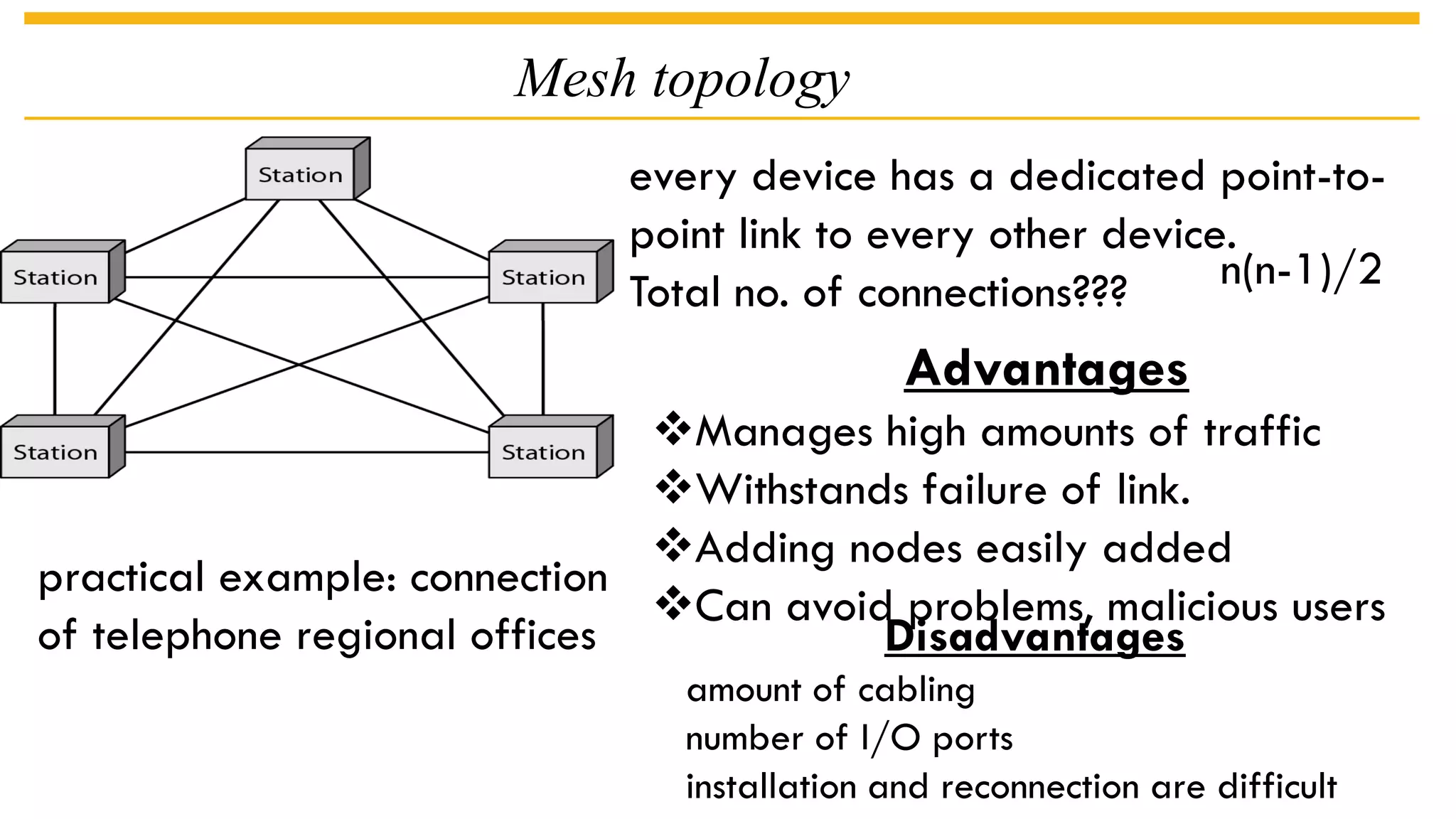
Mesh topology
every device has a dedicated point-to-
point link to every other device.
Total no. of connections??? n(n-1)/2
Advantages
Manages high amounts of traffic
Withstands failure of link.
Adding nodes easily added
Can avoid problems, malicious users
Disadvantages
amount of cabling
number of I/O ports
installation and reconnection are difficult
practical example: connection
of telephone regional offices
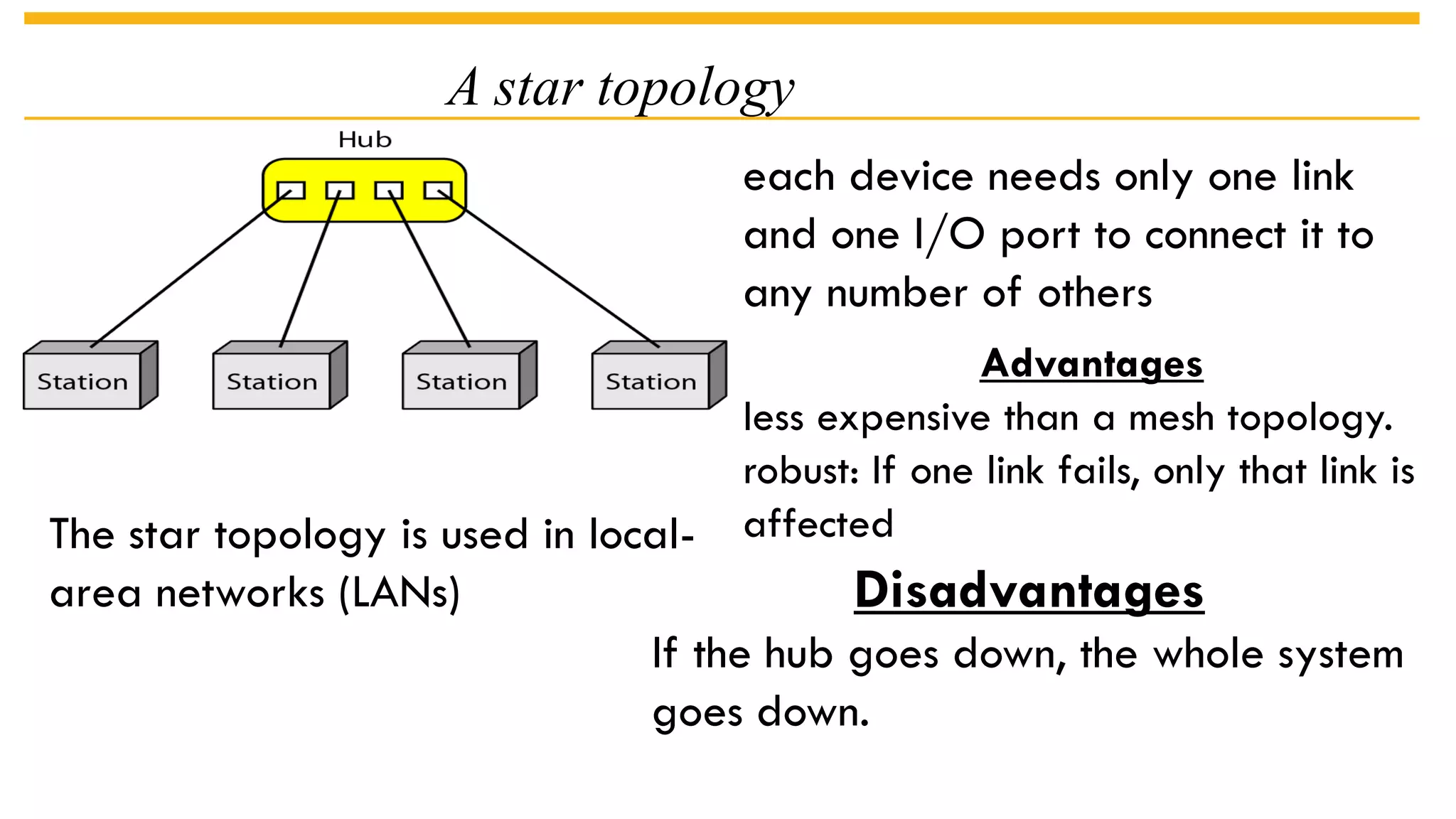
A star topology
each device needs only one link
and one I/O port to connect it to
any number of others
Advantages
less expensive than a mesh topology.
robust: If one link fails, only that link is
affected
Disadvantages
If the hub goes down, the whole system
goes down.
The star topology is used in local-
area networks (LANs)
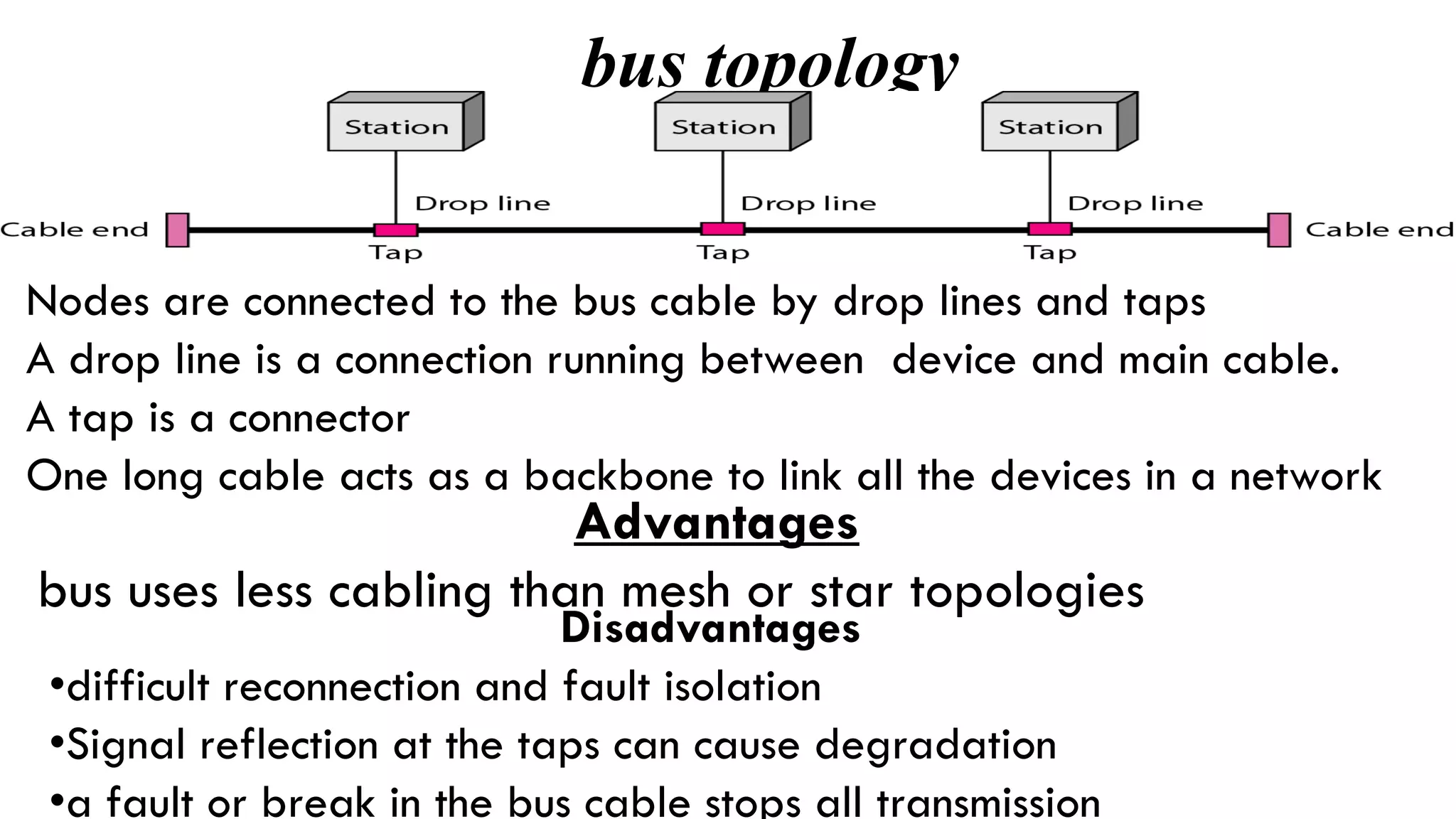
bus topology
Nodes are connected to the bus cable by drop lines and taps
A drop line is a connection running between device and main cable.
A tap is a connector
One long cable acts as a backbone to link all the devices in a network
Advantages
bus uses less cabling than mesh or star topologies
Disadvantages
•difficult reconnection and fault isolation
•Signal reflection at the taps can cause degradation
•a fault or break in the bus cable stops all transmission
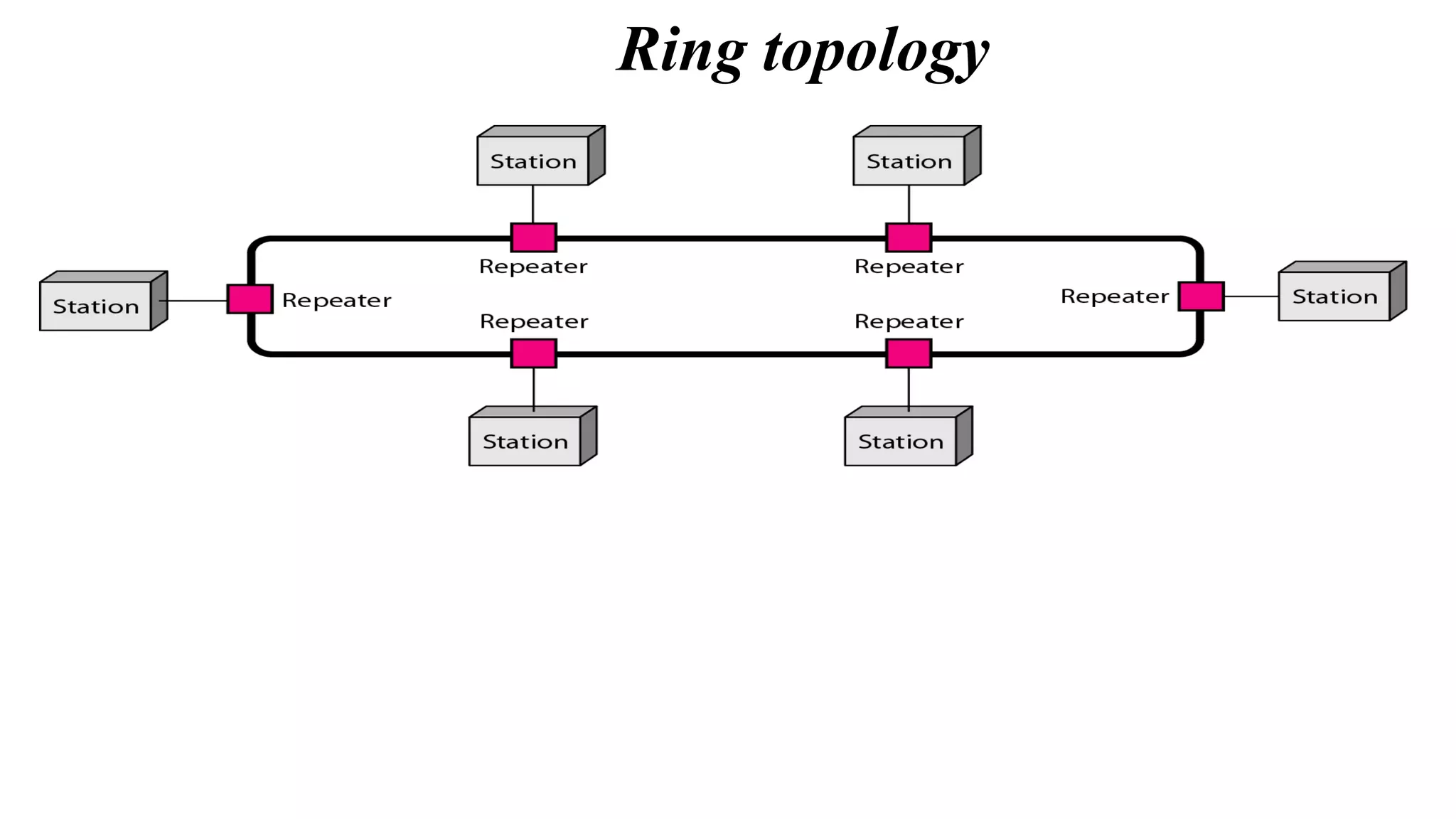
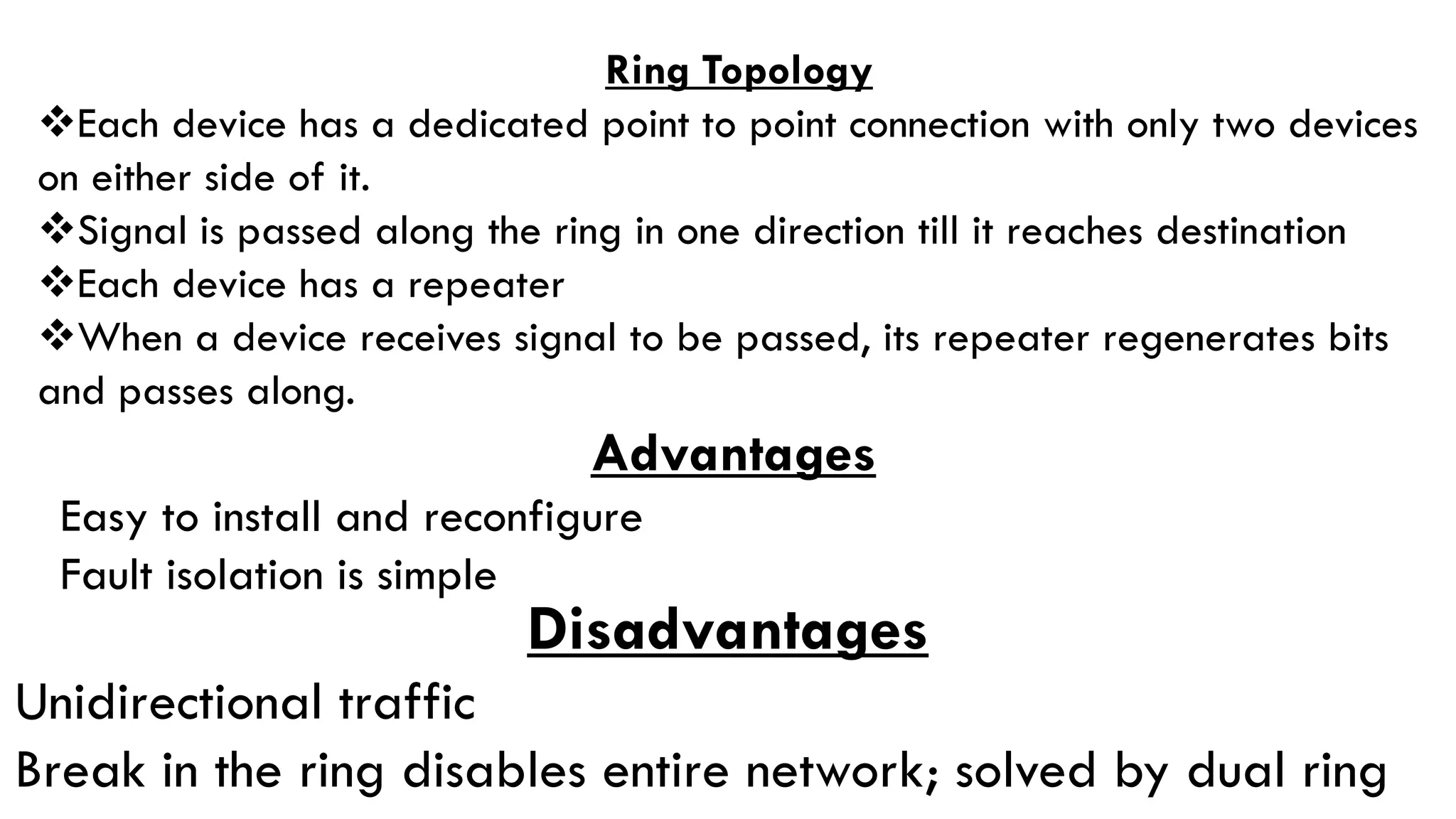
Ring topology
Ring Topology
Each device has a dedicated point to point connection with only two devices
on either side of it.
Signal is passed along the ring in one direction till it reaches destination
Each device has a repeater
When a device receives signal to be passed, its repeater regenerates bits
and passes along.
Advantages
Easy to install and reconfigure
Fault isolation is simple
Disadvantages
Unidirectional traffic
Break in the ring disables entire network; solved by dual ring
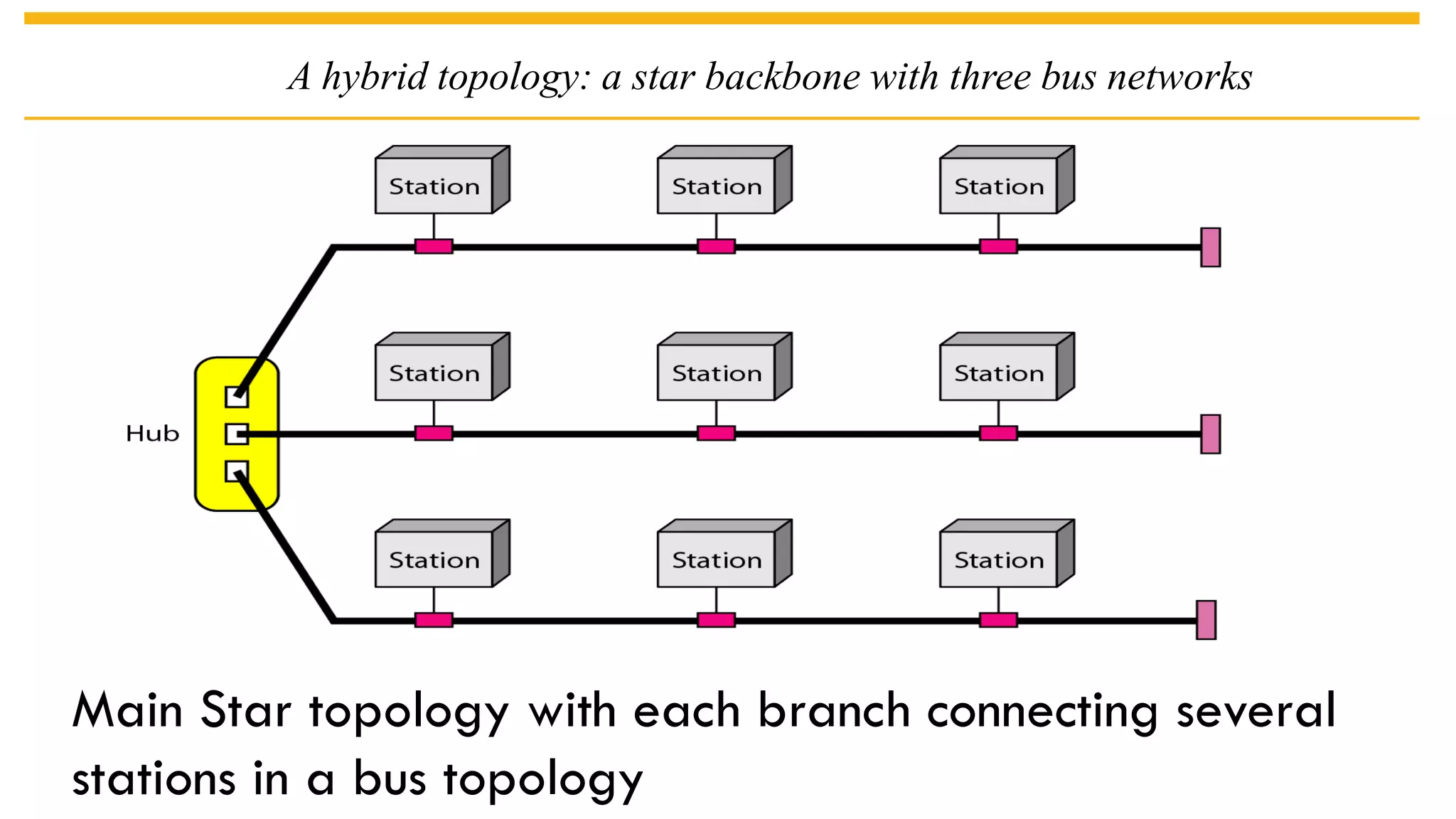
A hybrid topology: a star backbone with three bus networks
Main Star topology with each branch connecting several
stations in a bus topology
Standards
 Set of rules for data communication that are needed for exchange
of information guaranteeing national and international
interoperability of data.
 Two standards:
 De facto:
 By fact or by convention
 Ex: Google, IBM
 De Jure:
 By law or by regulations
 Ex: ANSI, ISO, IEEE
Standard Committees
 International Standards Organization (ISO):
 Ex: ISO 9000 family: Quality Management; ISO 6: Camera film speed
 International Telecommunications Union (ITU)
 Ex: ISDN, WDM, DSL
 American National Standards Institute (ANSI)
 ANSI C; ANSI Z1.4: Sampling Plan
 Institute of Electrical and Electronics Engineers (IEEE)
 IEEE 802.11: WLAN; IEEE 802.8: Fiber optic; IEEE 802.3: Ethernet
 Internet Engineering Task Force (IETF)
 RFC; IPR
Protocol
 Protocol is a set of rules that govern all aspect of
data communication between computers on a
network.
 regulate the following characteristics of a network:
access method, allowed physical topologies, types of
cabling, and speed of data transfer.
 Ex: HTTP, FTP, IP, UDP, PPP, TCP, ARP, RARP
Protocol
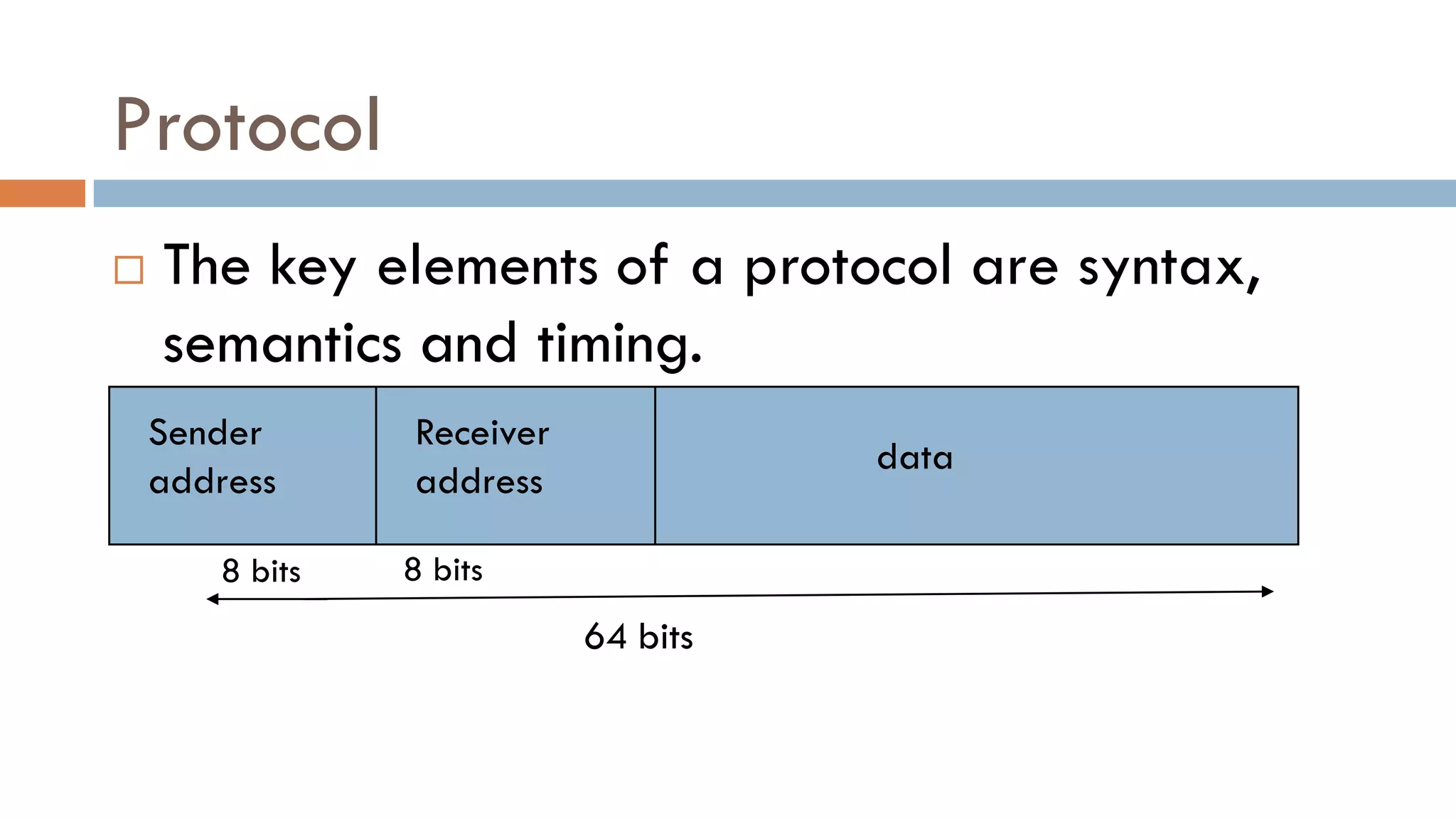
 The key elements of a protocol are syntax,
semantics and timing.
64 bits
8 bits 8 bits
Sender
address
Receiver
address
data
Network Models
 OSI Model
 TCP/IP Model
 OSI Model:
 The Open Systems Interconnection reference model.
 Introduced in 1984 by International Standards Organization (ISO).
 TCP/IP
 Transmission Control Protocol/Internet Protocol
 Developed in the year 1970s, adopted as protocol standard for
ARPANET (predecessor of internet) in 1983
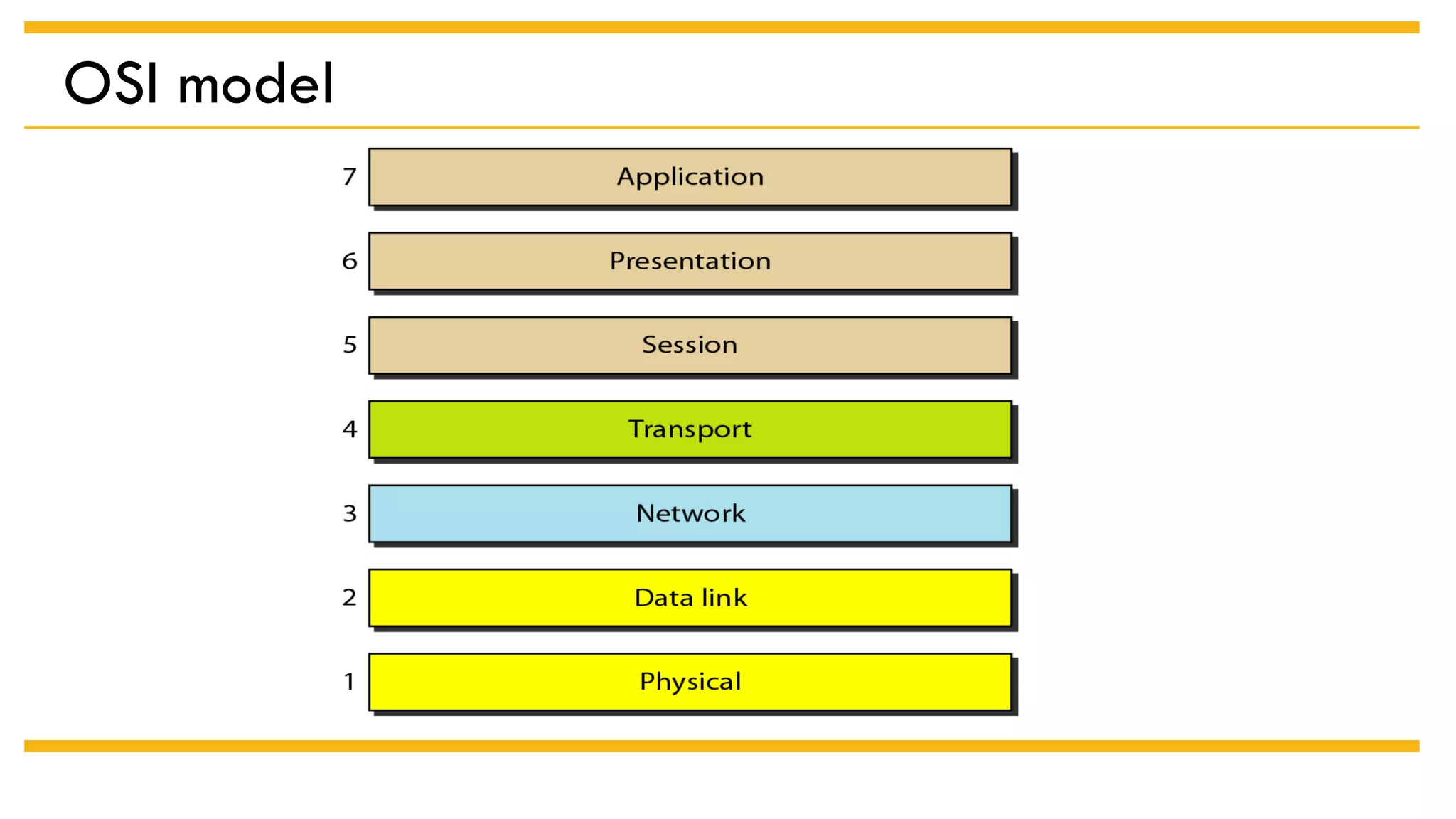
OSI model
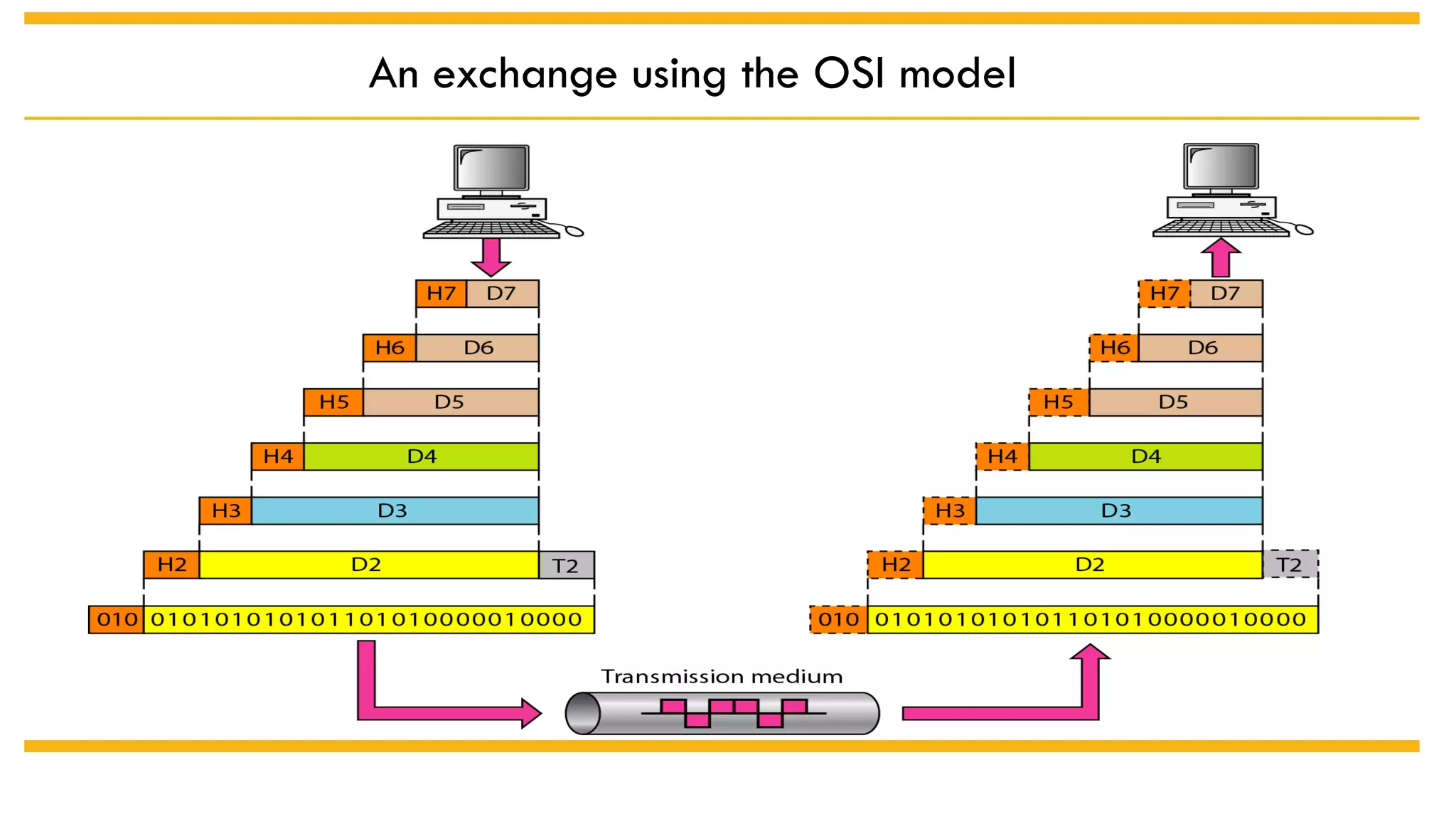
An exchange using the OSI model
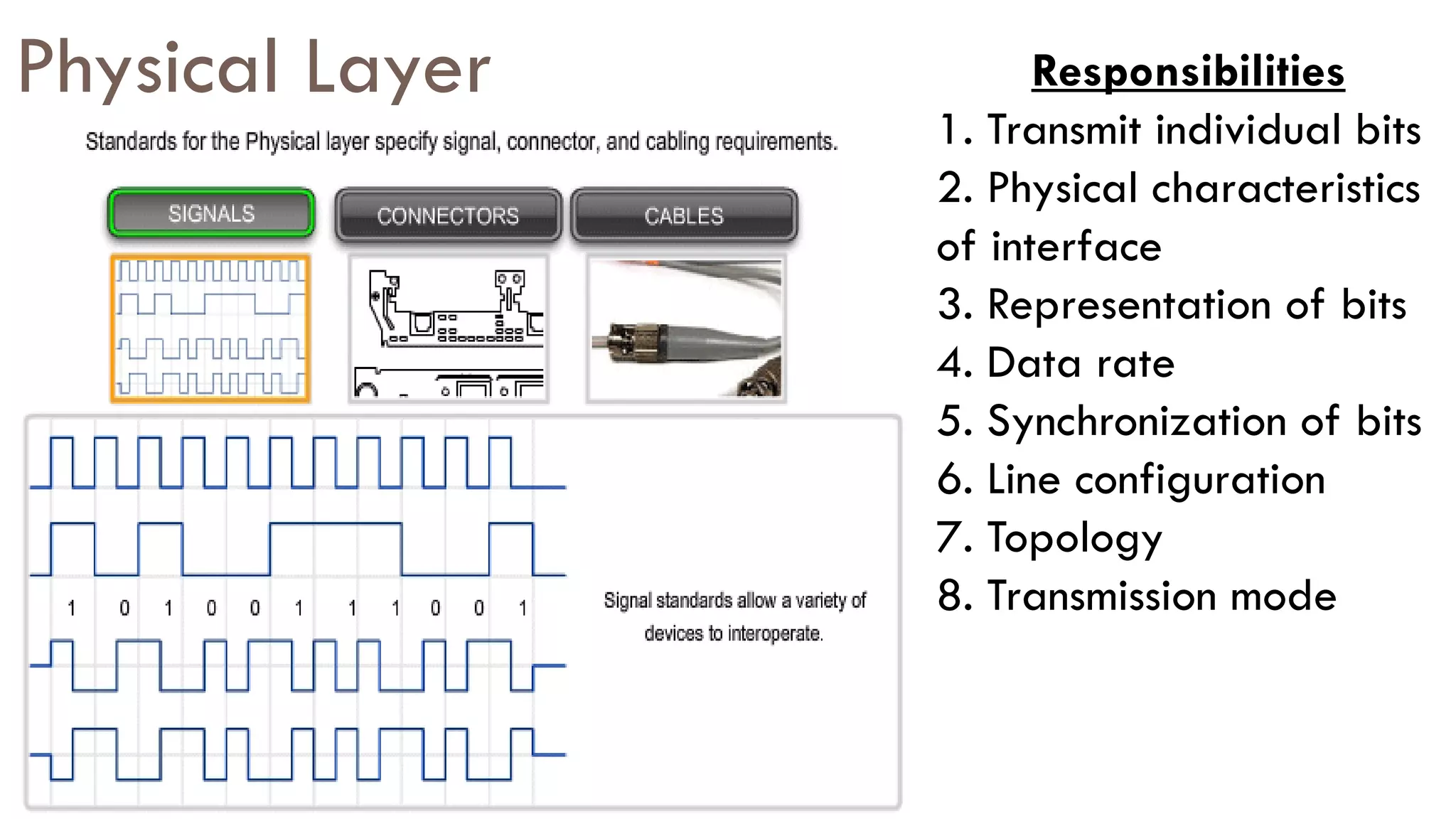
Physical Layer Responsibilities
1. Transmit individual bits
2. Physical characteristics
of interface
3. Representation of bits
4. Data rate
5. Synchronization of bits
6. Line configuration
7. Topology
8. Transmission mode
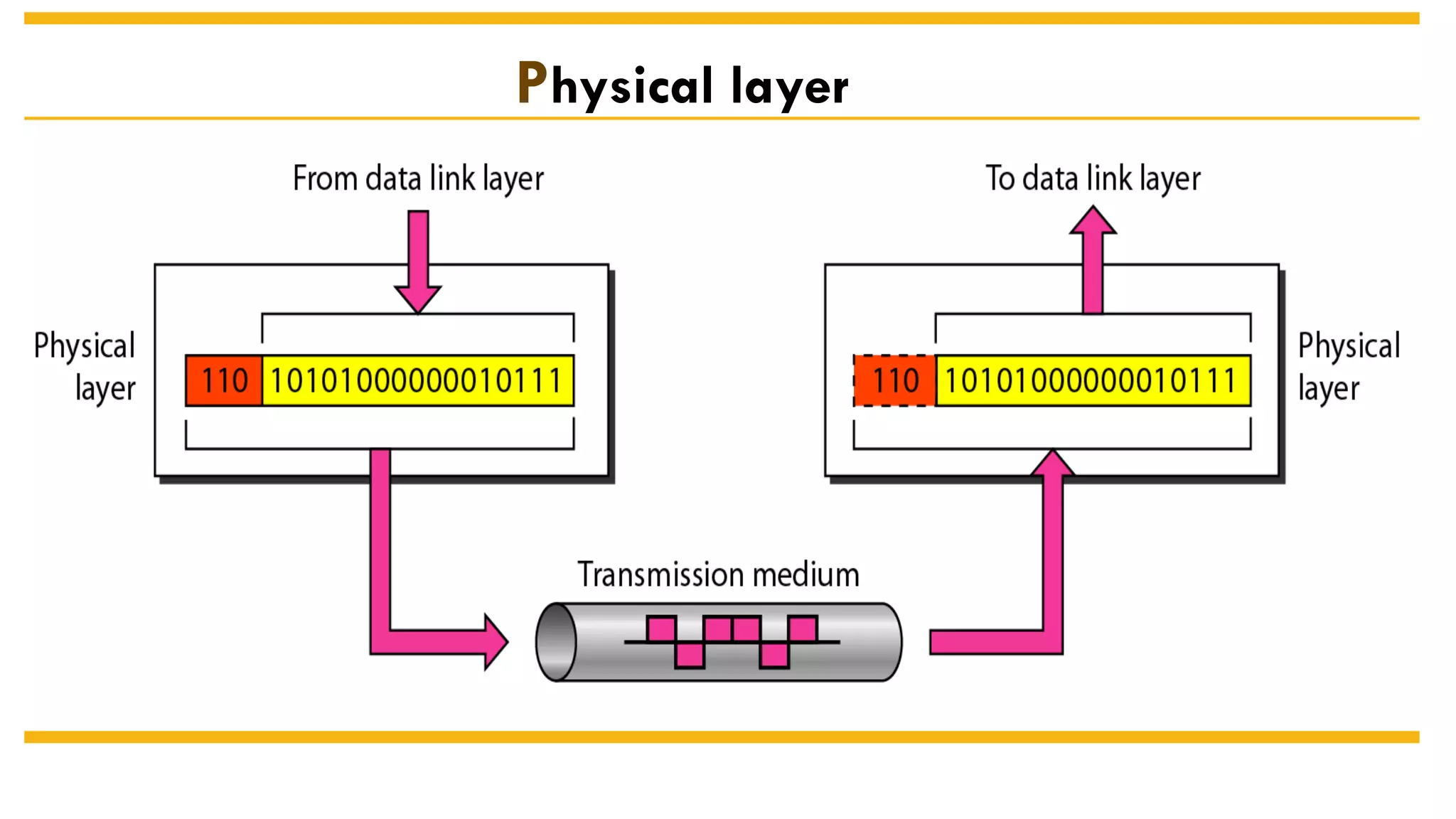
Physical layer
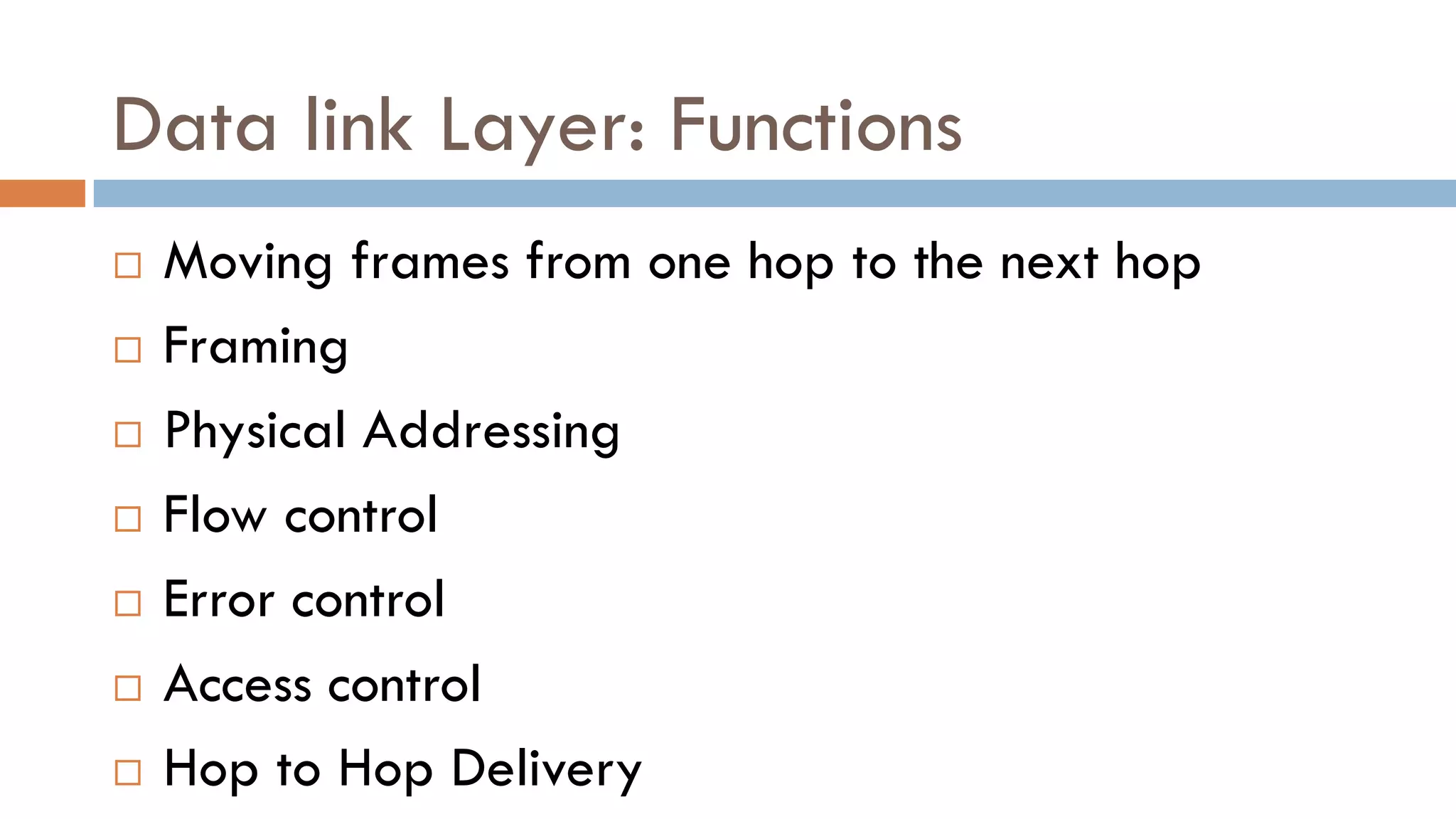
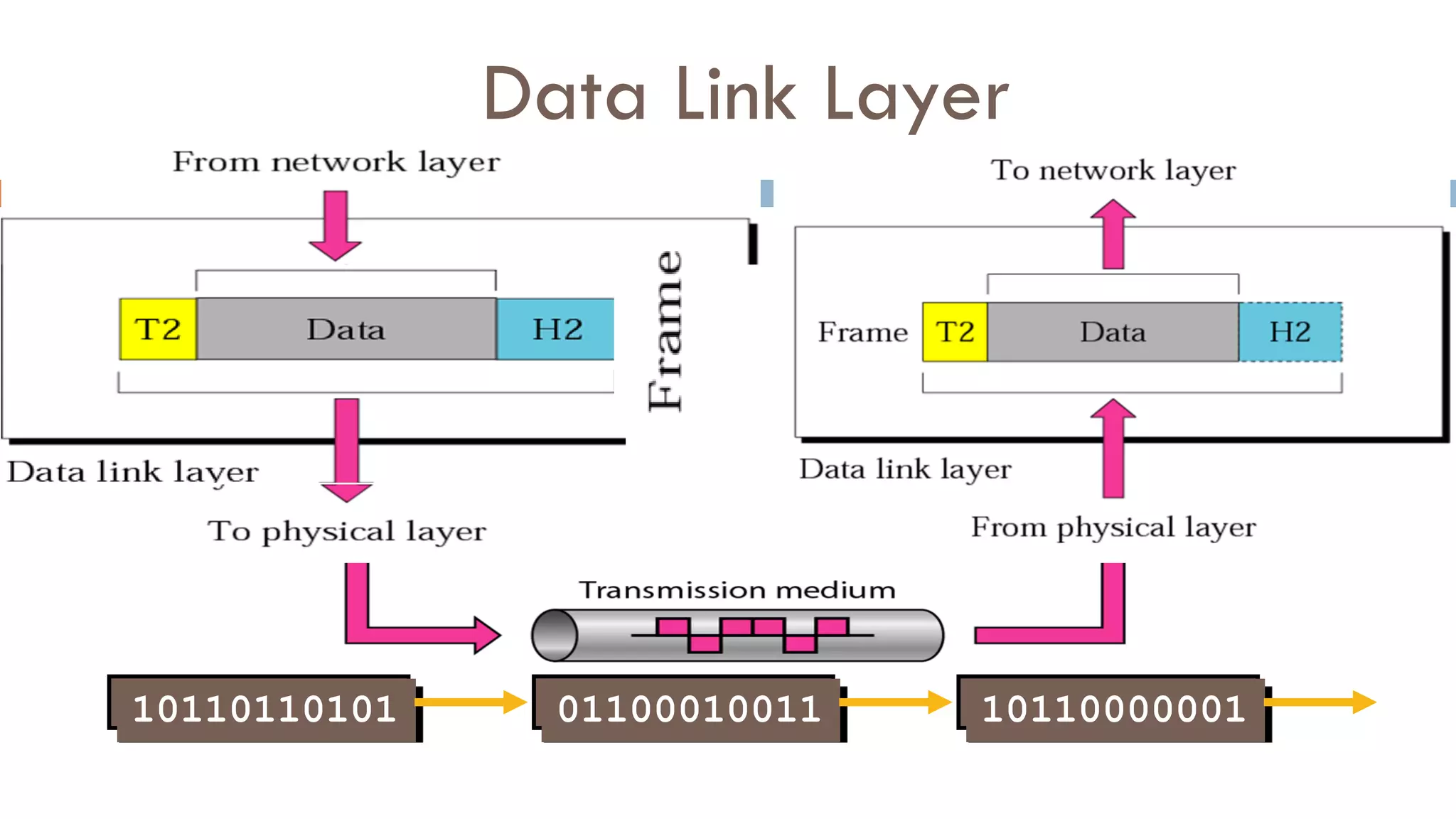
Data link Layer: Functions
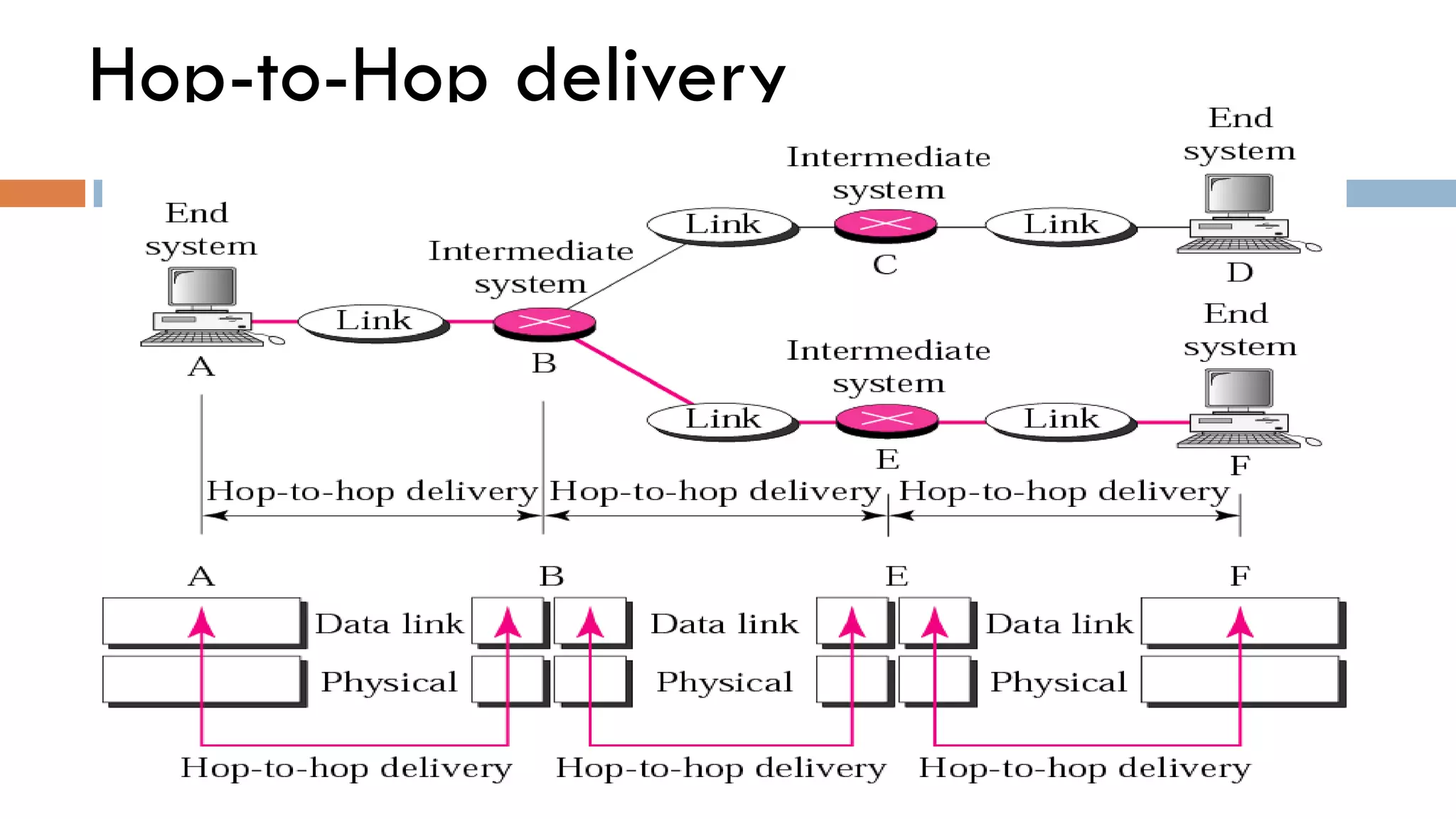
 Moving frames from one hop to the next hop
 Framing
 Physical Addressing
 Flow control
 Error control
 Access control
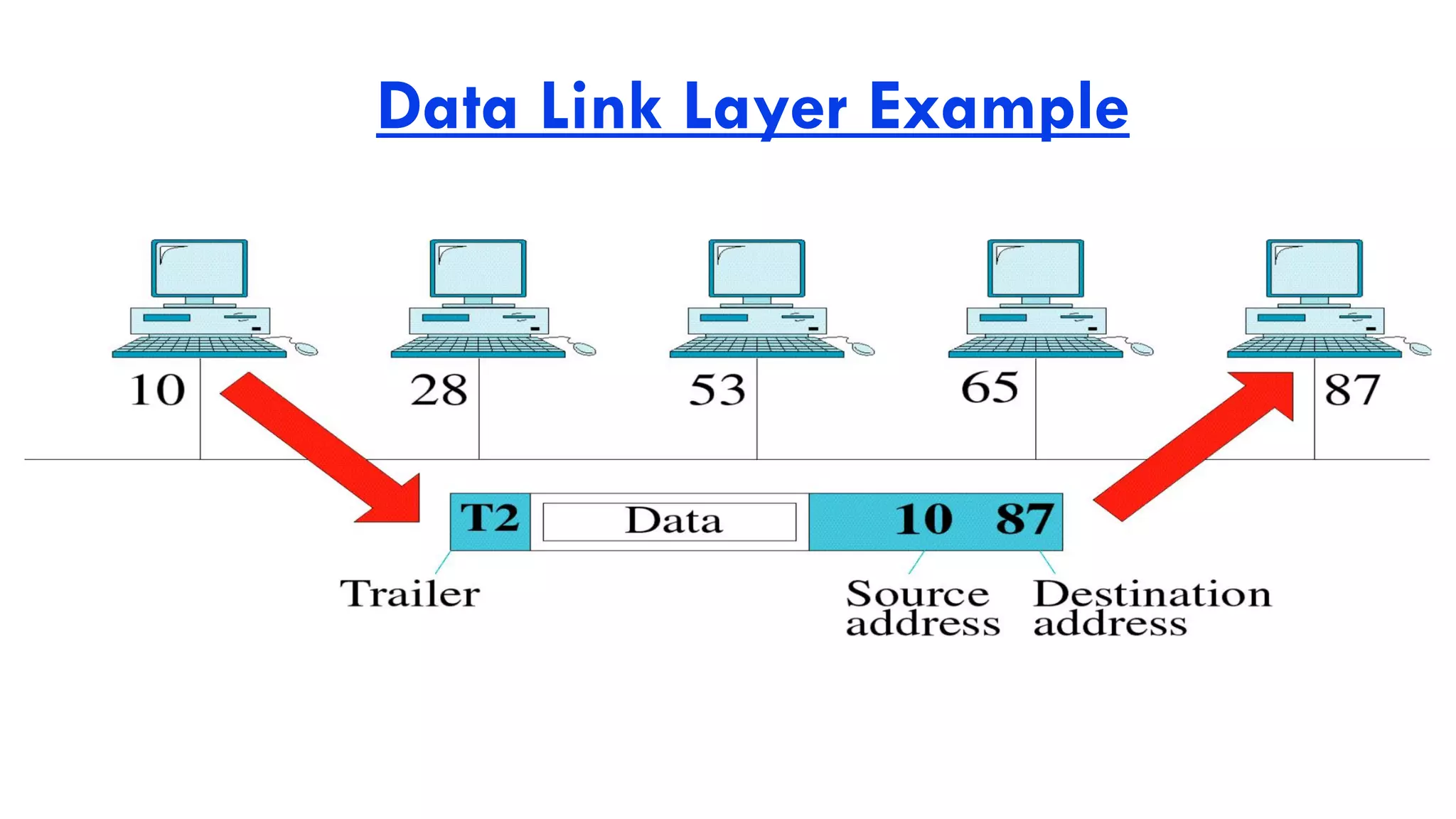
 Hop to Hop Delivery
Data Link Layer
10110110101 01100010011 10110000001
Hop-to-Hop delivery
Data Link Layer Example
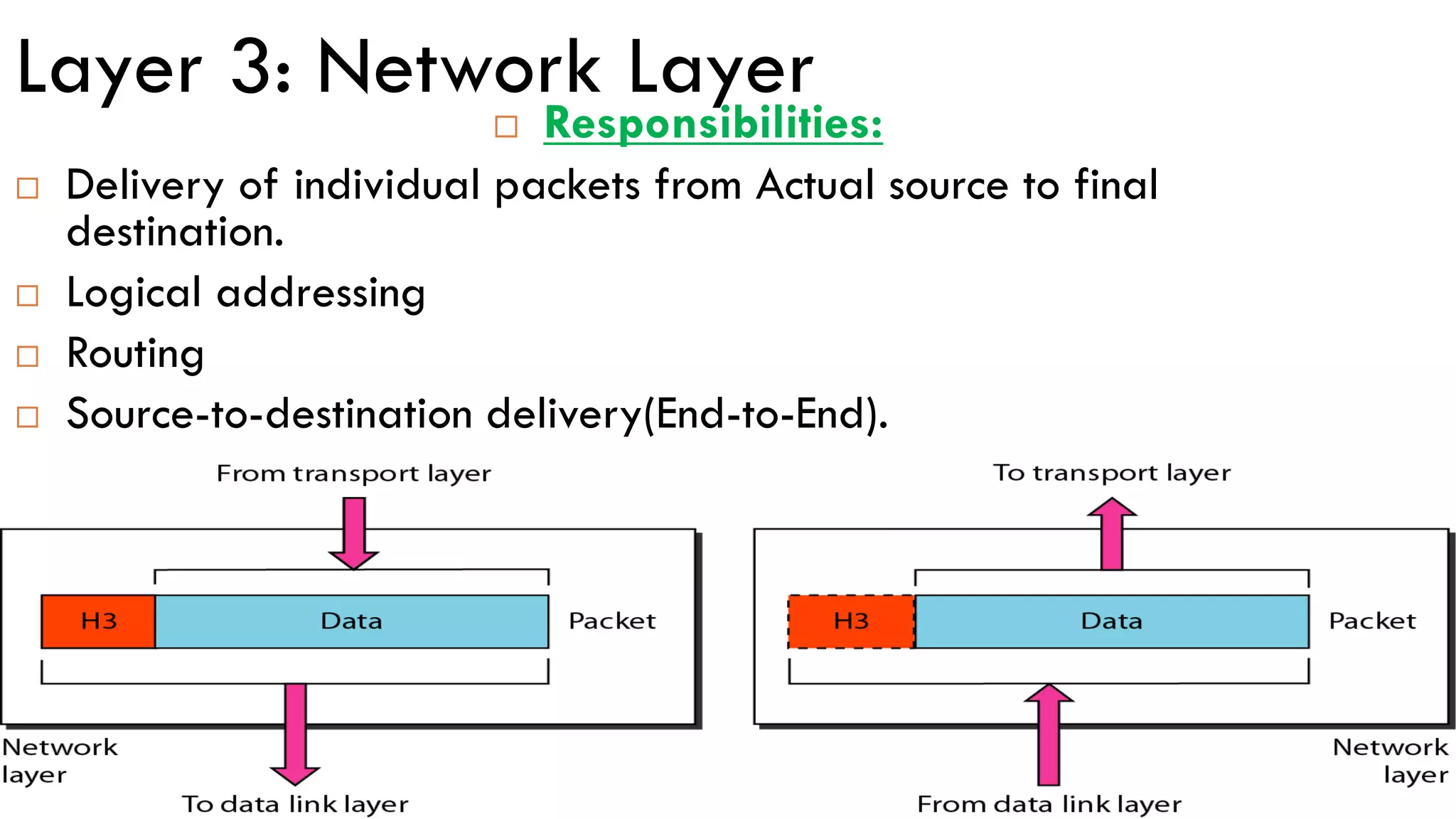
Layer 3: Network Layer
 Responsibilities:
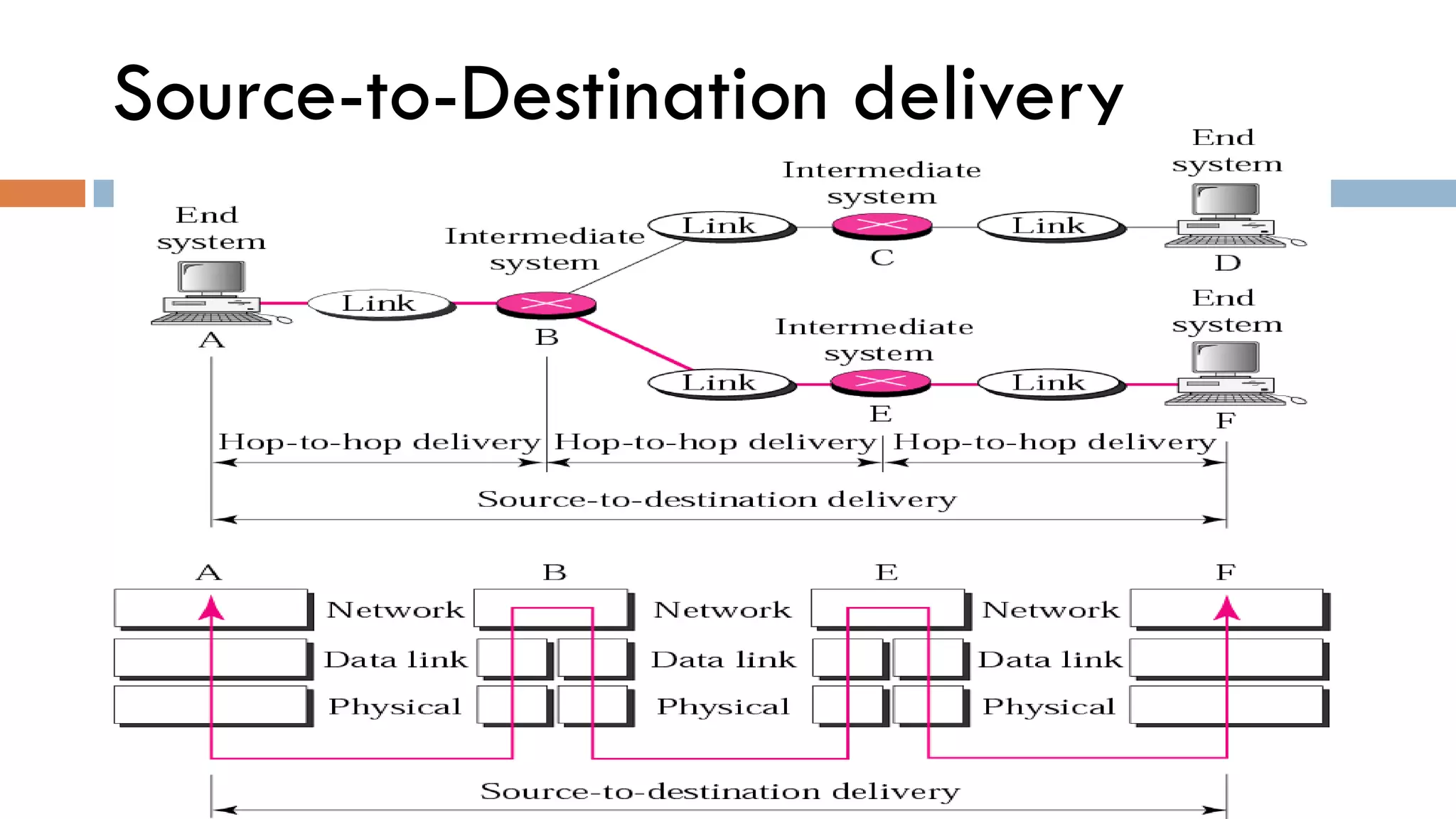
 Delivery of individual packets from Actual source to final
destination.
 Logical addressing
 Routing
 Source-to-destination delivery(End-to-End).
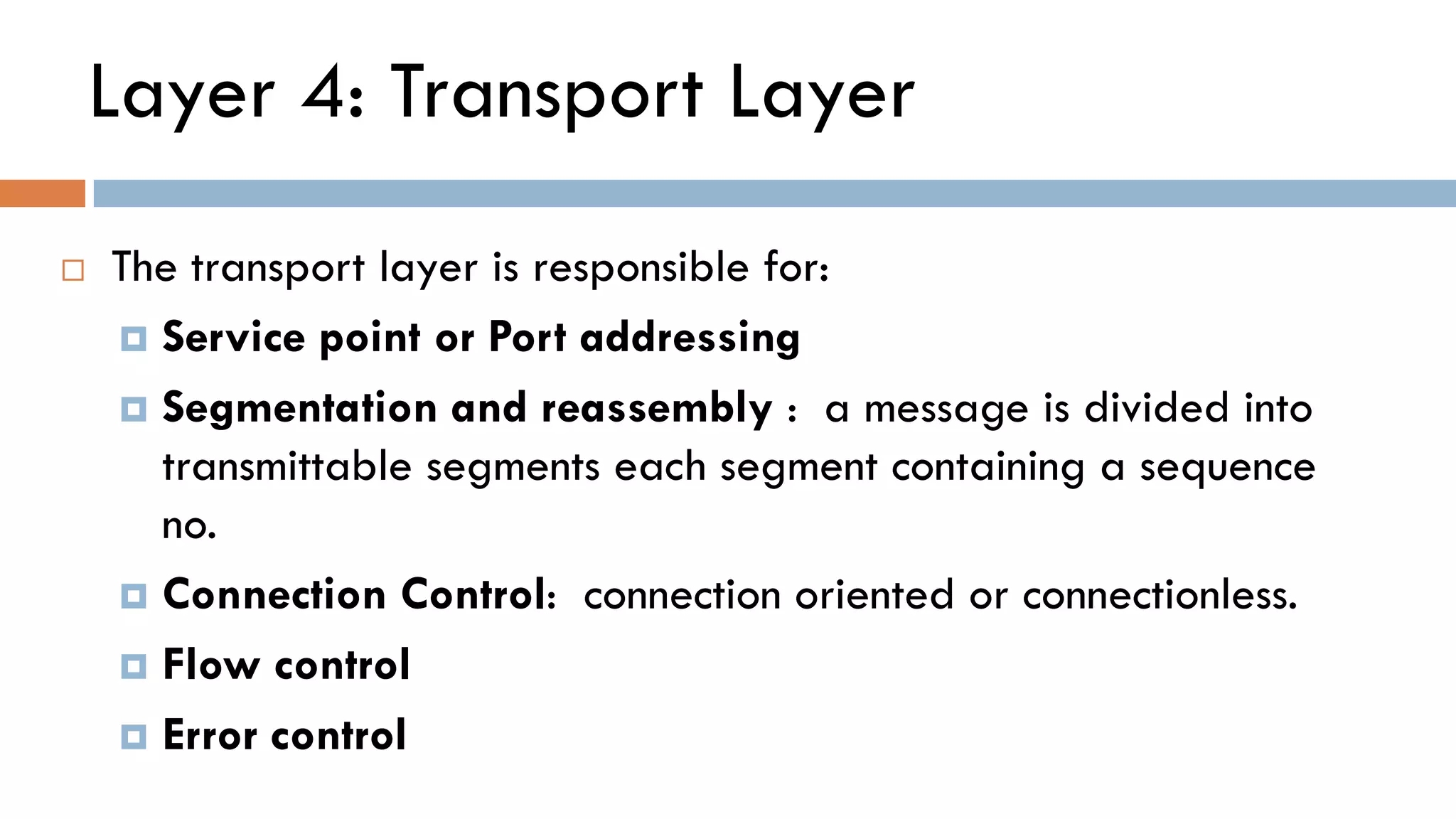
Layer 4: Transport Layer
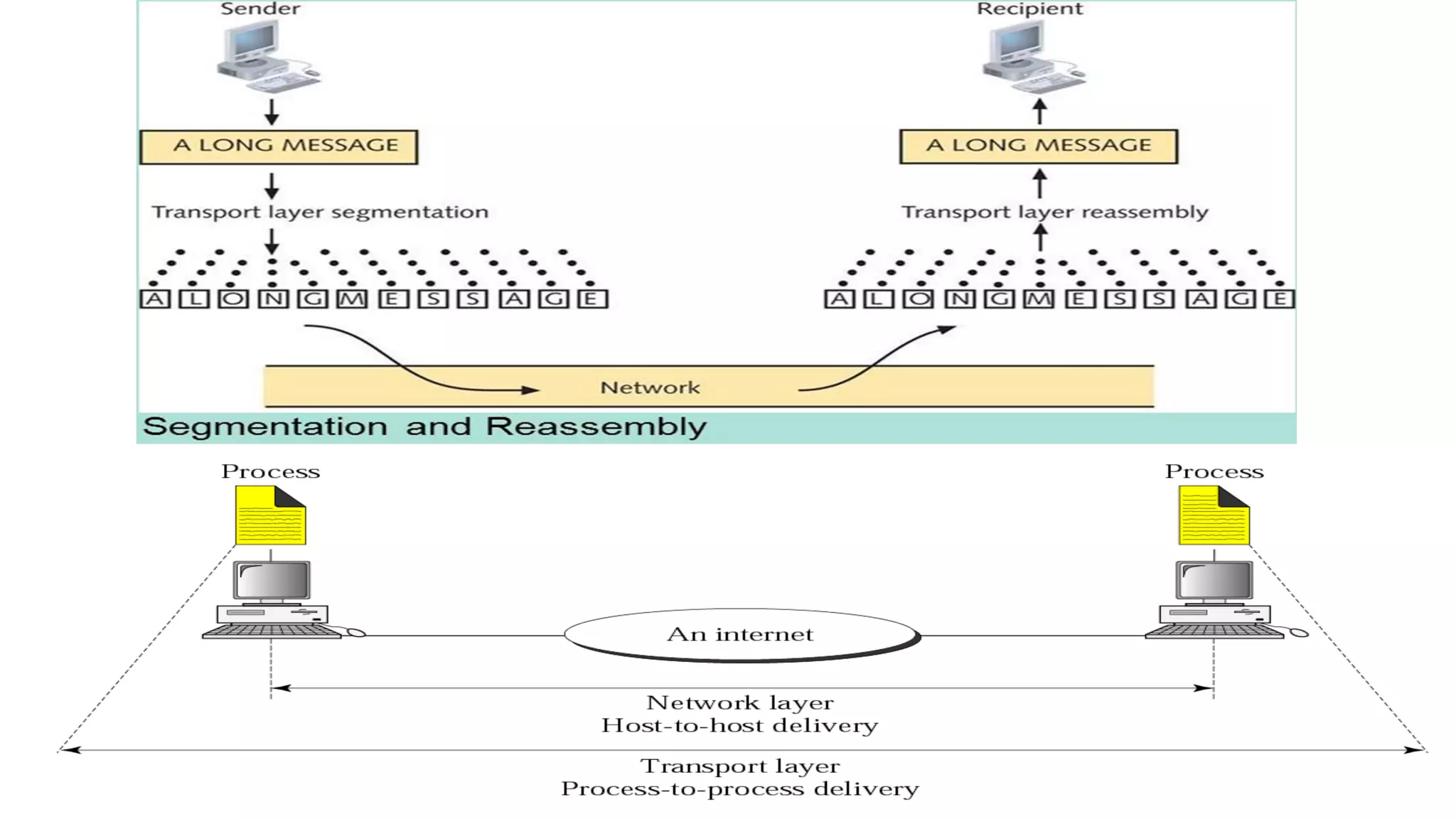
 The transport layer is responsible for:
 Service point or Port addressing
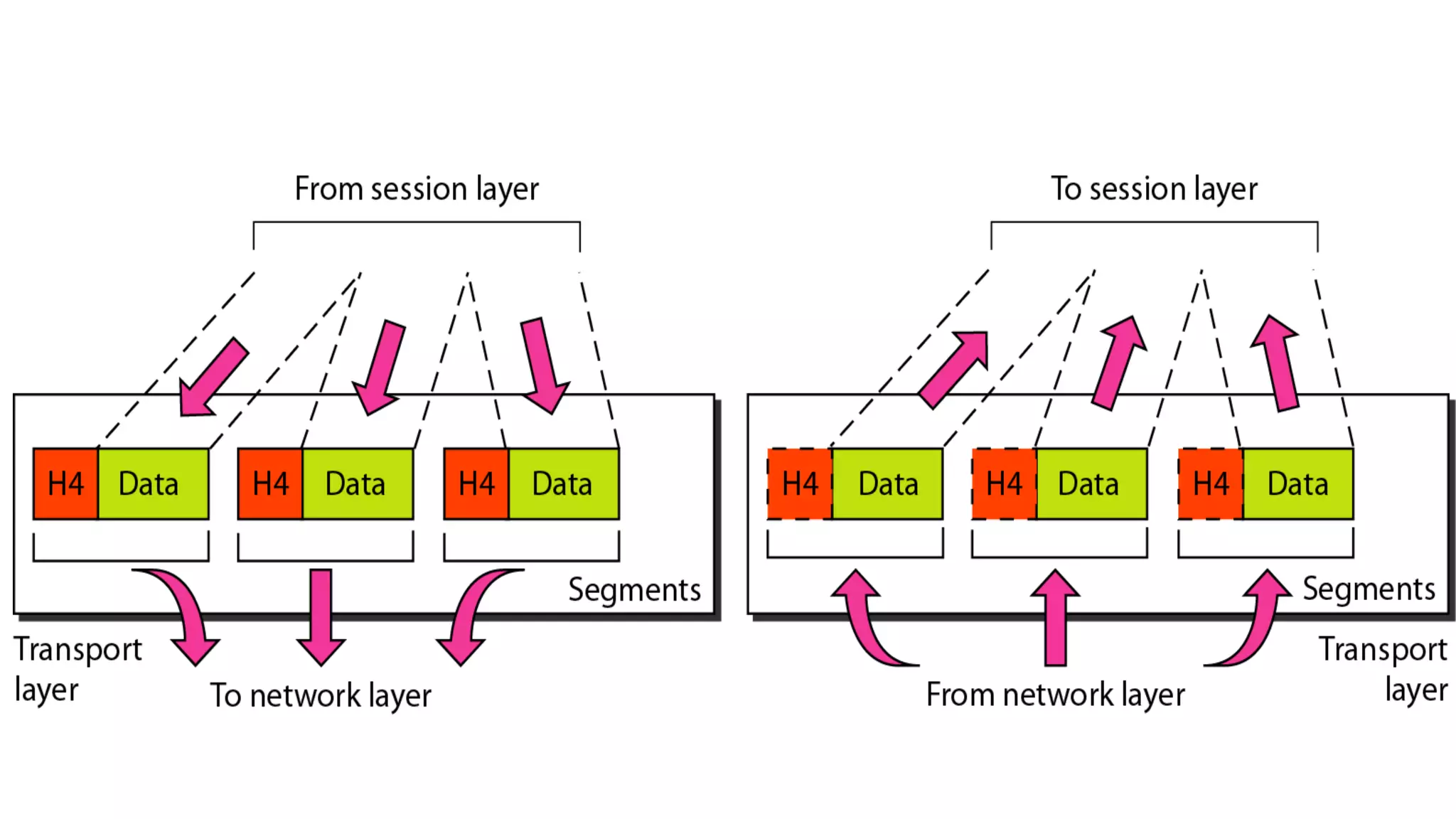
 Segmentation and reassembly : a message is divided into
transmittable segments each segment containing a sequence
no.
 Connection Control: connection oriented or connectionless.
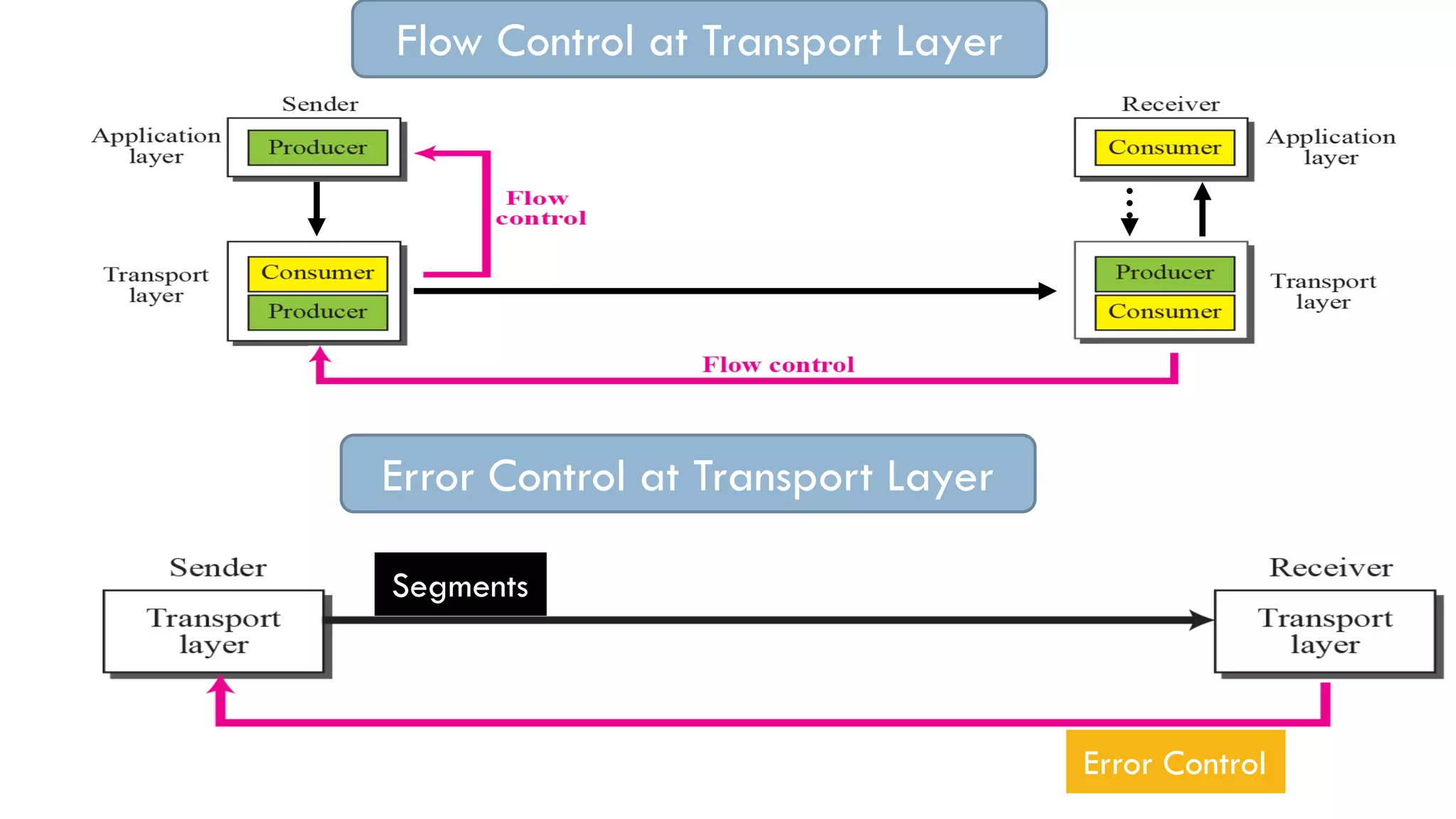
 Flow control
 Error control
Source-to-Destination delivery
Connection Oriented Service
Connectionless Service
Flow Control at Transport Layer
Segments
Error Control
Error Control at Transport Layer
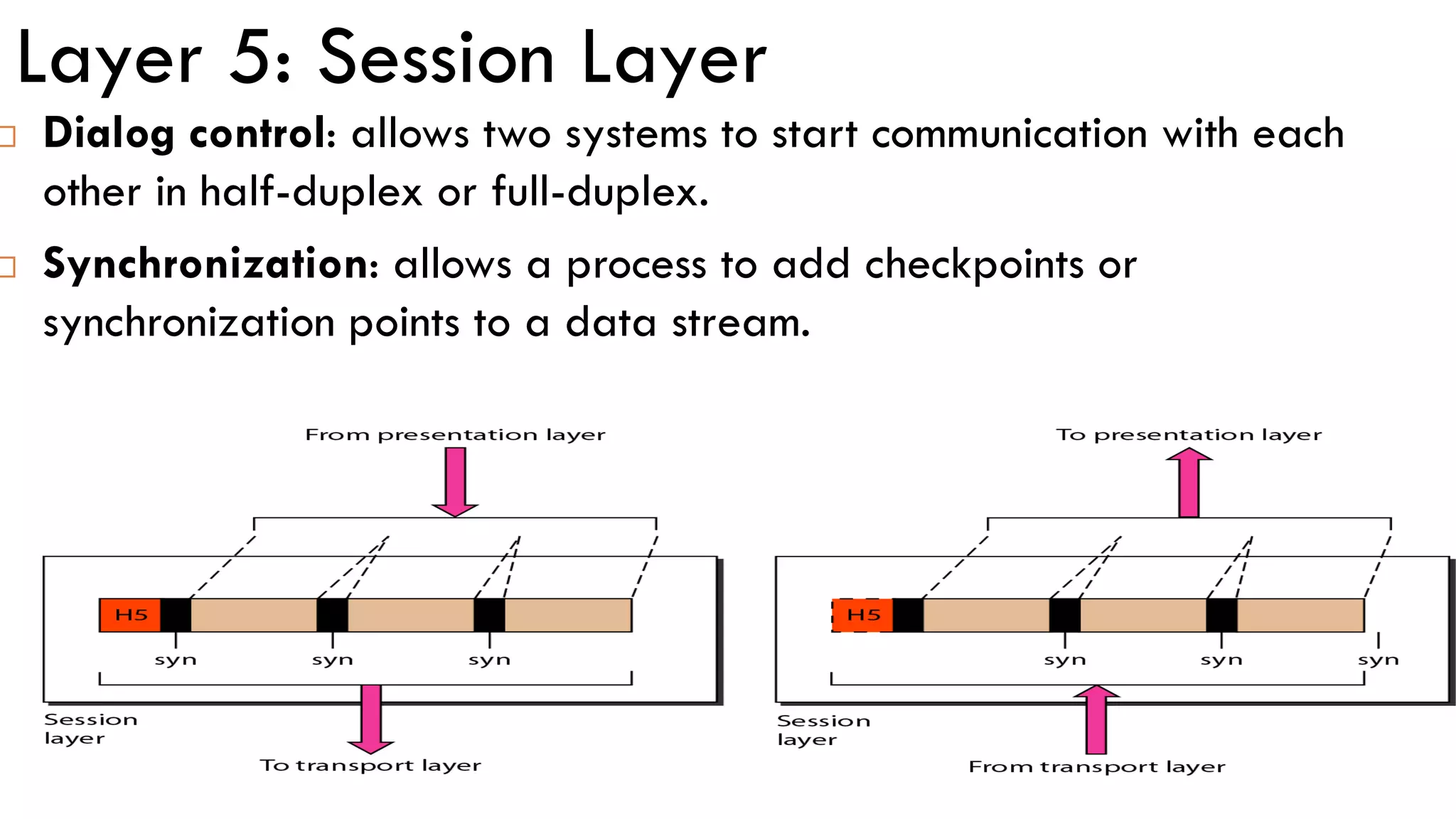
Layer 5: Session Layer
 Dialog control: allows two systems to start communication with each
other in half-duplex or full-duplex.
 Synchronization: allows a process to add checkpoints or
synchronization points to a data stream.
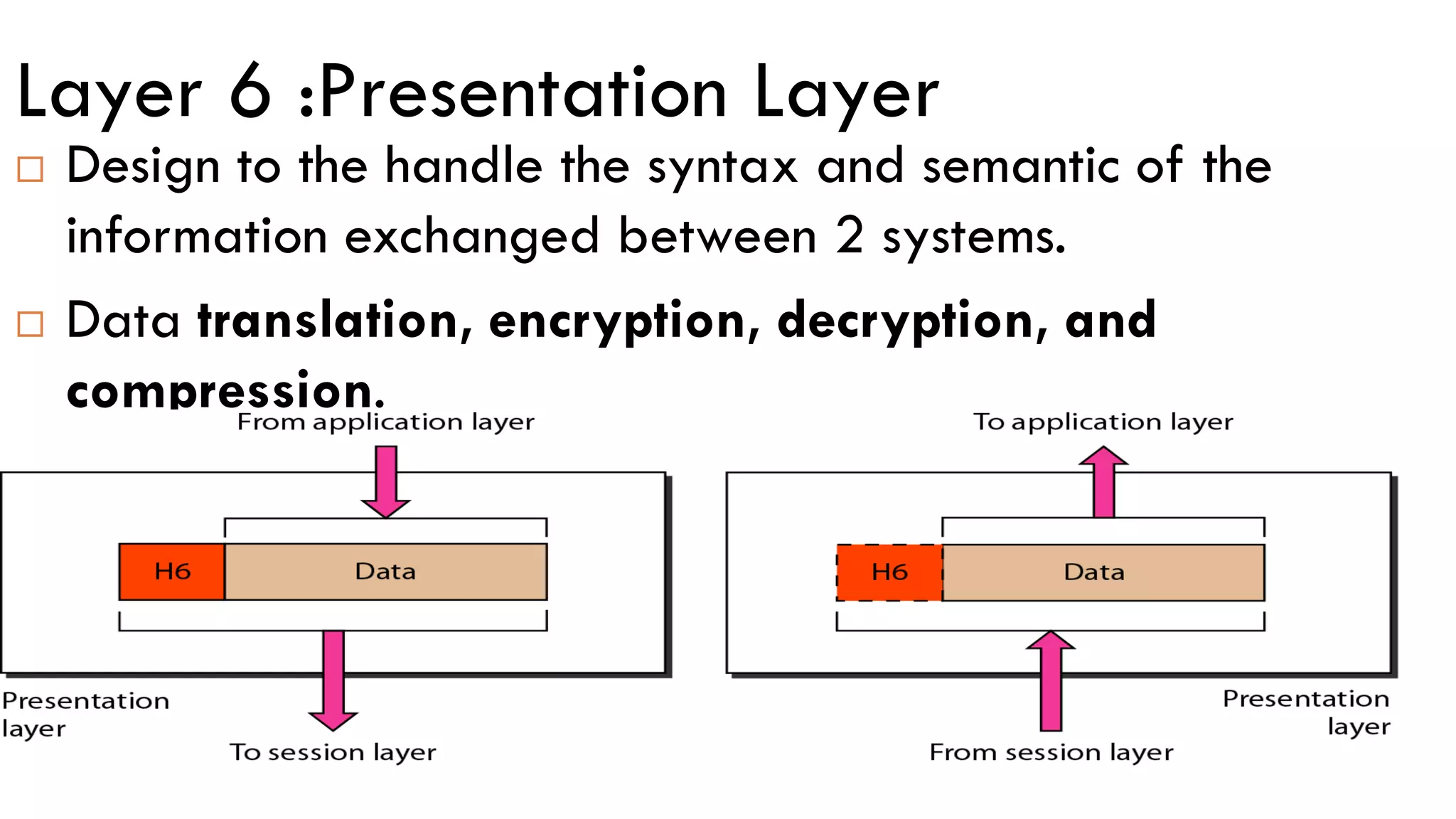
Layer 6 :Presentation Layer
 Design to the handle the syntax and semantic of the
information exchanged between 2 systems.
 Data translation, encryption, decryption, and
compression.
Layer 7: Application Layer
 The application layer is responsible for providing
services to the user.
 Mail services
 File transfer, access and management
 Remote log-in or network virtual terminal
 Accessing the World Wide Web
 Directory service
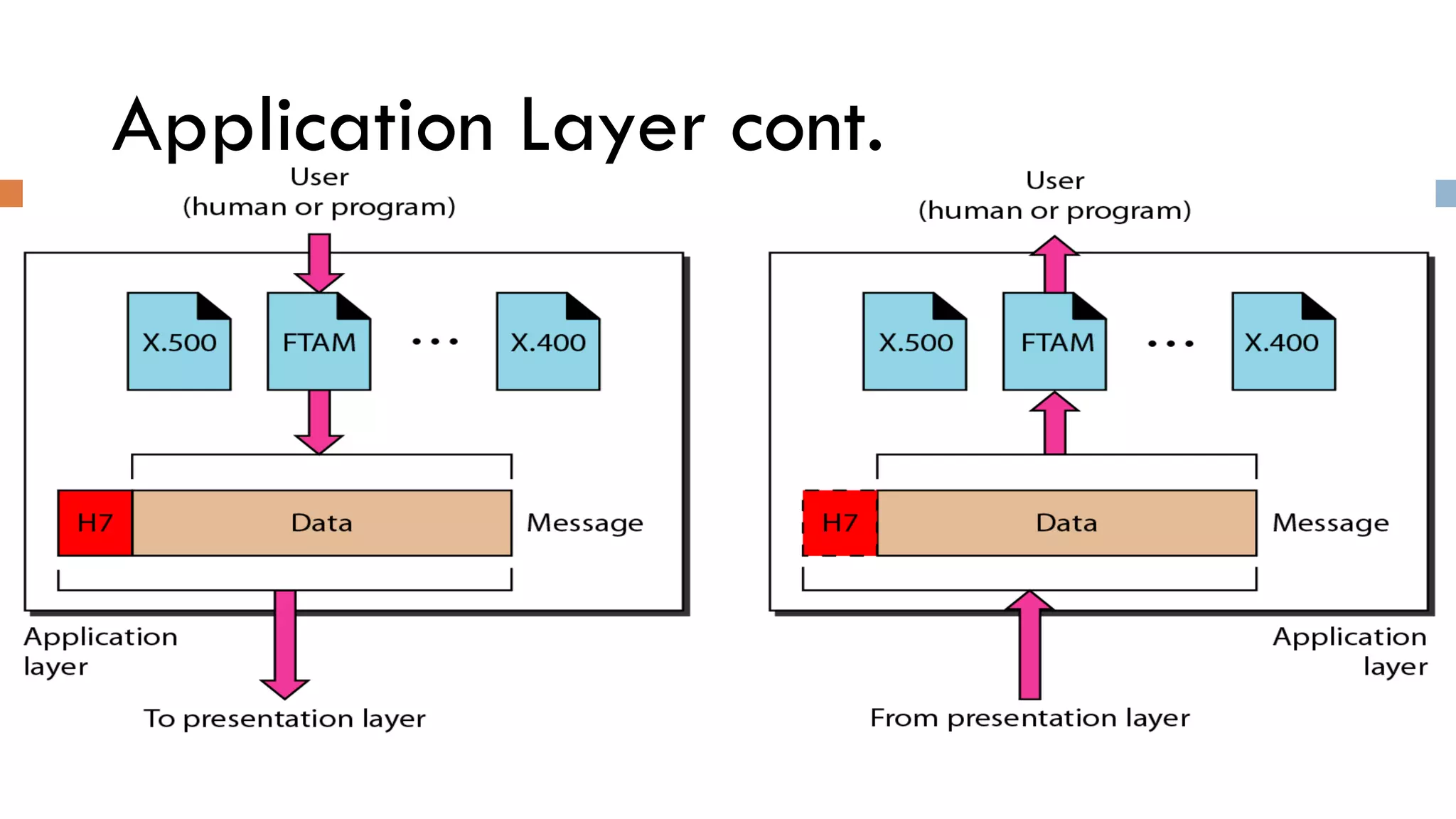
Application Layer cont.
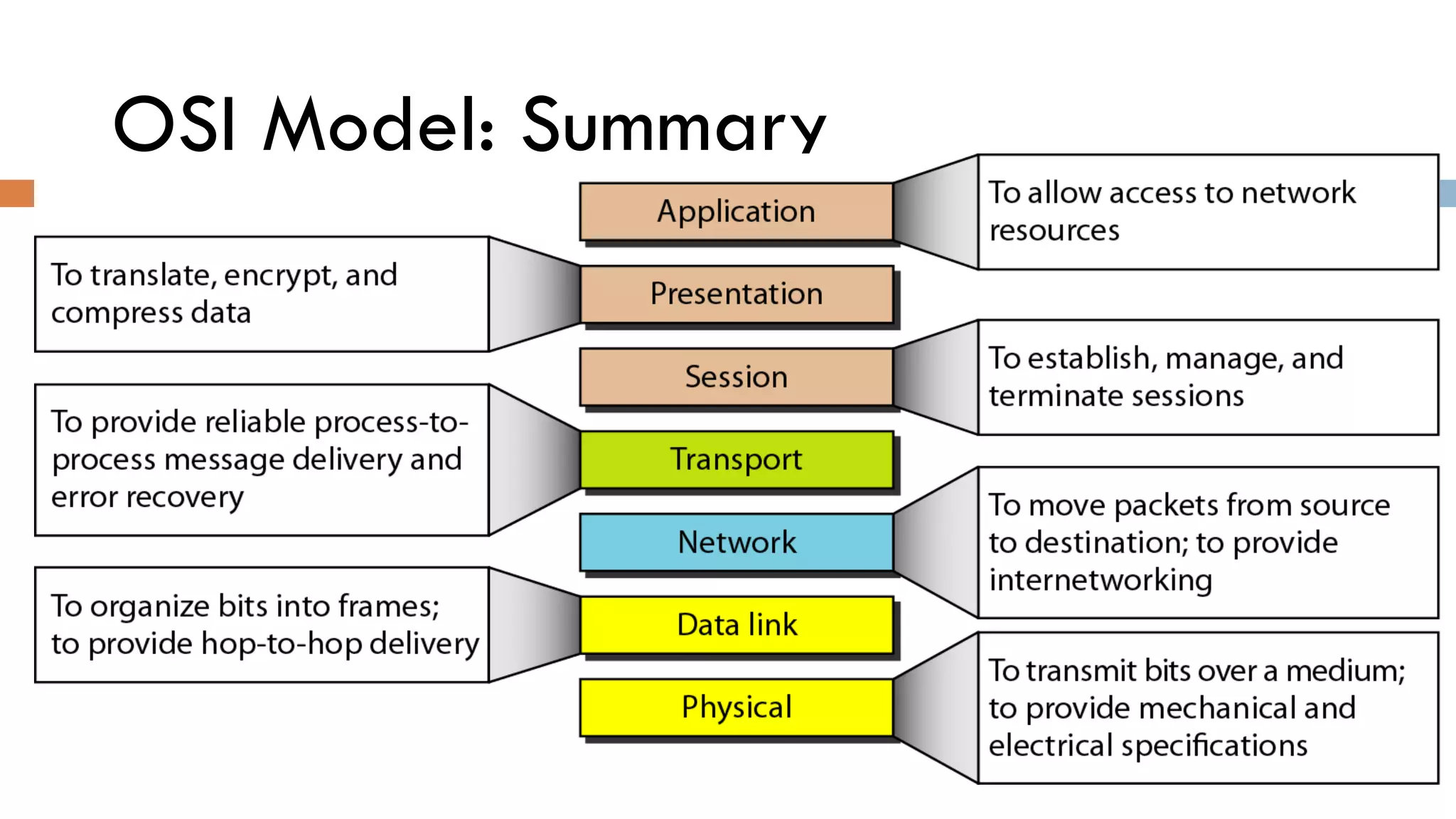
OSI Model: Summary

Computer Networks Lecture Notes 01

  • 1.
    B.Tech IV SemCSE ‘C’; Scheme 2017; AY: 2020_21 COMPUTER NETWORKS Dr. C. Sreedhar
  • 2.
    Unit 1  Introduction: Data Communications, Networks, Protocols and Standards  OSI Model TCP/IP Protocol Suite  Addressing: Physical, Logical, Port  Physical Layer and Transmission Media  Analog and Digital: Data; Signals  Digital Signals: Bit rate, Bit length, Transmission of digital signals  Transmission Impairments: Attenuation, Distortion, Noise  Performance: Bandwidth, Throughput, Latency, Jitter
  • 3.
    Unit 2  DataLink Layer Error detection: Block coding Error correction: Hamming distance, minimum hamming distance, CRC, Checksum  Framing  Flow and error control
  • 4.
    Unit 3  DesignIssues  Store and forward; Services to Transport layer  Connectionless and connection oriented services  Comparison of virtual circuits; Datagram subnets  Routing Algorithms  Optimality principle  Shortest Path Routing, Flooding  Distance Vector Routing, Link State Routing; Hierarchical Routing  Broadcast and Multicast Routing
  • 5.
    Unit 4  CongestionControl  Principles, congestion prevention policies  Congestion control in virtual circuits and datagram subnets  Load shedding, Jitter control  Internetworking  Concatenated virtual circuits, Connectionless internetworking  Tunnelling, Internetwork routing; Fragmentation, IP :Protocol, Address; Internet Control Protocols  Gateway routing protocols: OSPF, BGP
  • 6.
    Unit 5  UDP; TCP:  Service model, protocol, segment header,  connection management; Transmission policy  Congestion control and timer management  Application Layer  DNS Namespace; Resource Records  Name Servers
  • 7.
    Unit 1  DataCommunications  Definition  Components of DC  Data representation  Data flow  Networks  Network criteria  Types of connections  Categories of topology  Network Models  Protocols and Standards  Definition  Standards
  • 8.
    Data Communication: Definition Data communications are the exchange of data between two devices via some form of transmission medium such as a wire cable.
  • 9.
    Data Communication  Theeffectiveness of a data communications system depends on four fundamental characteristics:  Delivery: deliver data to the correct destination  accuracy: system must deliver the data accurately  Timeliness: system must deliver data in a timely manner  Jitter: refers to the variation in the packet arrival time
  • 10.
    Data Communication: Components Five components 1. Sender 2. Message 3. Transmission media 4. Protocol 5. Receiver Protocol is a set of rules that govern data communications. It represents an agreement between the communicating devices.
  • 11.
    Data Communication: Components Five components 1. Sender 2. Message 3. Transmission media 4. Protocol 5. Receiver Protocol is a set of rules that govern data communications. It represents an agreement between the communicating devices.
  • 12.
    Data Representation  Text: Text is represented as a bit pattern.  Unicode uses 32 bits to represent a symbol or character  Numbers  Numbers are also represented by bit patterns.  number is directly converted to a binary number  Images  Images are also represented by bit patterns.  image is composed of a matrix of pixels  each pixel is assigned a bit pattern.  Audio and Video Sampling rate Analogue signal Time Amplitude
  • 13.
    Data Flow  Communicationbetween two devices can be simplex or half-duplex, or full-duplex
  • 14.
    Network  A networkis a set of devices (nodes) connected by communication links.  A node can be a computer, printer, or any other device capable of sending and/or receiving data generated by other nodes on the network.  A link can be a cable, air, optical fiber, or any medium which can transport a signal carrying information.
  • 15.
    Network Criteria  Performance: Measured: transit time and response time  Transit time: time required for a message to travel from AB  Response time: elapsed time between inquiry and response  Evaluated using two metrics:  throughput and delay (more throughput and less delay).  Reliability:  measured by the frequency of failure  Security  Network security issues include protecting data from unauthorized access
  • 16.
    • Point toPoint - single transmitter and receiver Ex: Television remote control • Multipoint - multiple recipients of single transmission • Ex: Telephone Line Types of Connections
  • 17.
    Physical topology topology refersto the way in which a network is laid out physically
  • 18.
    Mesh topology every devicehas a dedicated point-to- point link to every other device. Total no. of connections??? n(n-1)/2 Advantages Manages high amounts of traffic Withstands failure of link. Adding nodes easily added Can avoid problems, malicious users Disadvantages amount of cabling number of I/O ports installation and reconnection are difficult practical example: connection of telephone regional offices
  • 19.
    A star topology eachdevice needs only one link and one I/O port to connect it to any number of others Advantages less expensive than a mesh topology. robust: If one link fails, only that link is affected Disadvantages If the hub goes down, the whole system goes down. The star topology is used in local- area networks (LANs)
  • 20.
    bus topology Nodes areconnected to the bus cable by drop lines and taps A drop line is a connection running between device and main cable. A tap is a connector One long cable acts as a backbone to link all the devices in a network Advantages bus uses less cabling than mesh or star topologies Disadvantages •difficult reconnection and fault isolation •Signal reflection at the taps can cause degradation •a fault or break in the bus cable stops all transmission
  • 21.
  • 22.
    Ring Topology Each devicehas a dedicated point to point connection with only two devices on either side of it. Signal is passed along the ring in one direction till it reaches destination Each device has a repeater When a device receives signal to be passed, its repeater regenerates bits and passes along. Advantages Easy to install and reconfigure Fault isolation is simple Disadvantages Unidirectional traffic Break in the ring disables entire network; solved by dual ring
  • 23.
    A hybrid topology:a star backbone with three bus networks Main Star topology with each branch connecting several stations in a bus topology
  • 24.
    Standards  Set ofrules for data communication that are needed for exchange of information guaranteeing national and international interoperability of data.  Two standards:  De facto:  By fact or by convention  Ex: Google, IBM  De Jure:  By law or by regulations  Ex: ANSI, ISO, IEEE
  • 25.
    Standard Committees  InternationalStandards Organization (ISO):  Ex: ISO 9000 family: Quality Management; ISO 6: Camera film speed  International Telecommunications Union (ITU)  Ex: ISDN, WDM, DSL  American National Standards Institute (ANSI)  ANSI C; ANSI Z1.4: Sampling Plan  Institute of Electrical and Electronics Engineers (IEEE)  IEEE 802.11: WLAN; IEEE 802.8: Fiber optic; IEEE 802.3: Ethernet  Internet Engineering Task Force (IETF)  RFC; IPR
  • 26.
    Protocol  Protocol isa set of rules that govern all aspect of data communication between computers on a network.  regulate the following characteristics of a network: access method, allowed physical topologies, types of cabling, and speed of data transfer.  Ex: HTTP, FTP, IP, UDP, PPP, TCP, ARP, RARP
  • 27.
    Protocol  The keyelements of a protocol are syntax, semantics and timing. 64 bits 8 bits 8 bits Sender address Receiver address data
  • 28.
    Network Models  OSIModel  TCP/IP Model  OSI Model:  The Open Systems Interconnection reference model.  Introduced in 1984 by International Standards Organization (ISO).  TCP/IP  Transmission Control Protocol/Internet Protocol  Developed in the year 1970s, adopted as protocol standard for ARPANET (predecessor of internet) in 1983
  • 29.
  • 30.
    An exchange usingthe OSI model
  • 31.
    Physical Layer Responsibilities 1.Transmit individual bits 2. Physical characteristics of interface 3. Representation of bits 4. Data rate 5. Synchronization of bits 6. Line configuration 7. Topology 8. Transmission mode
  • 32.
  • 33.
    Data link Layer:Functions  Moving frames from one hop to the next hop  Framing  Physical Addressing  Flow control  Error control  Access control  Hop to Hop Delivery
  • 34.
    Data Link Layer 1011011010101100010011 10110000001
  • 35.
  • 36.
  • 37.
    Layer 3: NetworkLayer  Responsibilities:  Delivery of individual packets from Actual source to final destination.  Logical addressing  Routing  Source-to-destination delivery(End-to-End).
  • 38.
    Layer 4: TransportLayer  The transport layer is responsible for:  Service point or Port addressing  Segmentation and reassembly : a message is divided into transmittable segments each segment containing a sequence no.  Connection Control: connection oriented or connectionless.  Flow control  Error control
  • 40.
  • 42.
  • 43.
    Flow Control atTransport Layer Segments Error Control Error Control at Transport Layer
  • 44.
    Layer 5: SessionLayer  Dialog control: allows two systems to start communication with each other in half-duplex or full-duplex.  Synchronization: allows a process to add checkpoints or synchronization points to a data stream.
  • 45.
    Layer 6 :PresentationLayer  Design to the handle the syntax and semantic of the information exchanged between 2 systems.  Data translation, encryption, decryption, and compression.
  • 46.
    Layer 7: ApplicationLayer  The application layer is responsible for providing services to the user.  Mail services  File transfer, access and management  Remote log-in or network virtual terminal  Accessing the World Wide Web  Directory service
  • 47.
  • 48.