Computer Communications
     and Networks

     Email: vj2713@gmail.com
Introduction
 Practical matters
 Module goals, structure and contents
 Initial introduction to some key ideas and
  issues
Lectures
   Tuesday 17:00 in LT3
   Friday 13:00 in LT2
Related modules
  G53ACC - Advanced Computer
   Communications
  G5BIAW - The Internet and the World
   Wide Web
Objectives
   To understand the basic principles of data
    communications and computer networks.
   To appreciate the complex trade-offs that are
    inherent in the design of networks.
   To provide a guided tour of network technologies
    from the lowest levels of data transmission up to
    network applications.
   To learn about current networking technologies,
    especially Internet protocols.
Assessment
   Two hour written examination
   The style of question will be based upon those
    from previous years. Their content will of course
    be different.
   Last year’s exam paper is on sale in the bookshop
    and previous papers are in the library.
   No coursework
Text books and notes
   Notes are available at:
       http://www.cs.nott.ac.uk/~mvr/ccn
   The core recommended course text is:
       Computer Networks and Internets, Douglas E.
        Comer, Prentice Hall
   Supplementary texts are:
      Tannenbaum, Computer Networks, Prentice Hall

      Halsall, Data and Computer Communications,

       Macmillan
What is a computer network?
   An interconnection of autonomous
    computers (as opposed to communication
    between separate but interdependent parts
    of a single computer)
Some goals of computer networks
   Access to remote resources
   Human communication
   Mobile computing
   Computing power through parallelism
   Optimising resources - load balancing
   Incremental growth of computer systems (reduced
    cost and risk)
   Increased robustness through graceful degradation
Uses of computer networks
   Email, World Wide Web, Video
    Conferencing, File Transfer, Collaborative
    Virtual Environments, Remote control of
    robots and machines, Dial up databases,
    Webcasting, Distributed Programs,
    Hacking, Banking, Internet telephone
Classifying networks
   By size
     Local area networks (LANs) versus Wide area

      networks (WANs)
   By connectivity
     Point to point versus broadcast networks

   By communication medium
   By mobility
     Fixed versus mobile
Size - differences between local
and wide area networks
 ‘Speed’ - bandwidth and latency
 Management
 Security
 Reliability
 Billing
 Heterogeneity (and standards)
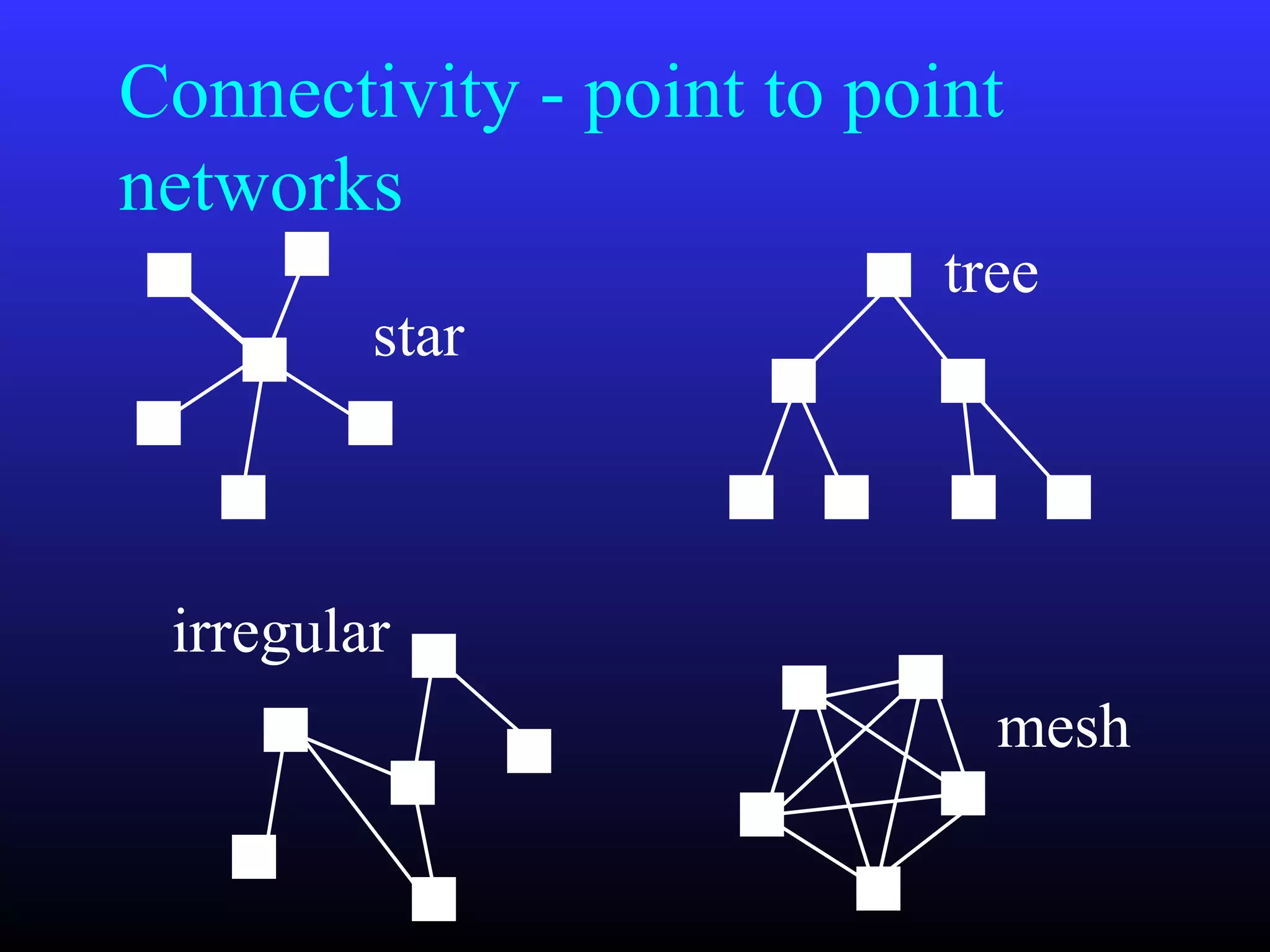
Connectivity - point to point
networks
                           tree
         star


 irregular
                             mesh
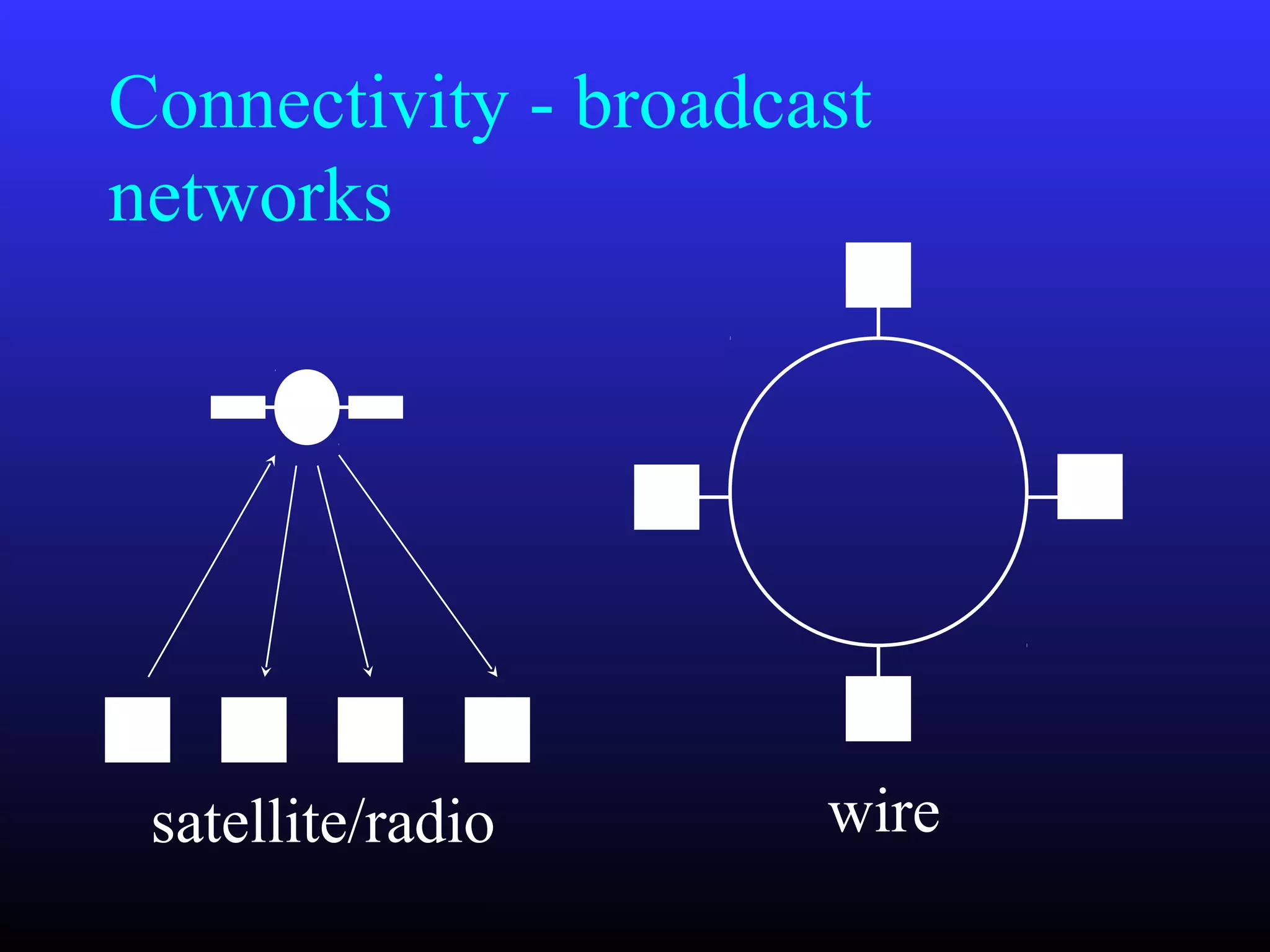
Connectivity - broadcast
networks


 satellite/radio      wire
Medium - differences between
communication media
  ‘Speed’ - bandwidth and latency
  Range
  Sharing
  Topology
  Installation and maintenance costs
  Reliability
Mobility - issues arising in
mobile networks
   Mobile networking has emerged in the last
    decade. Introduces new issues of:
      energy efficiency

      location and tracking

      semi-persistent connections

      complex administration and billing as

       devices and users move around the
       network
Common issues in networking
 Addressing
 Routing
 Framing and encoding
 Error detection and correction
 Flow and congestion
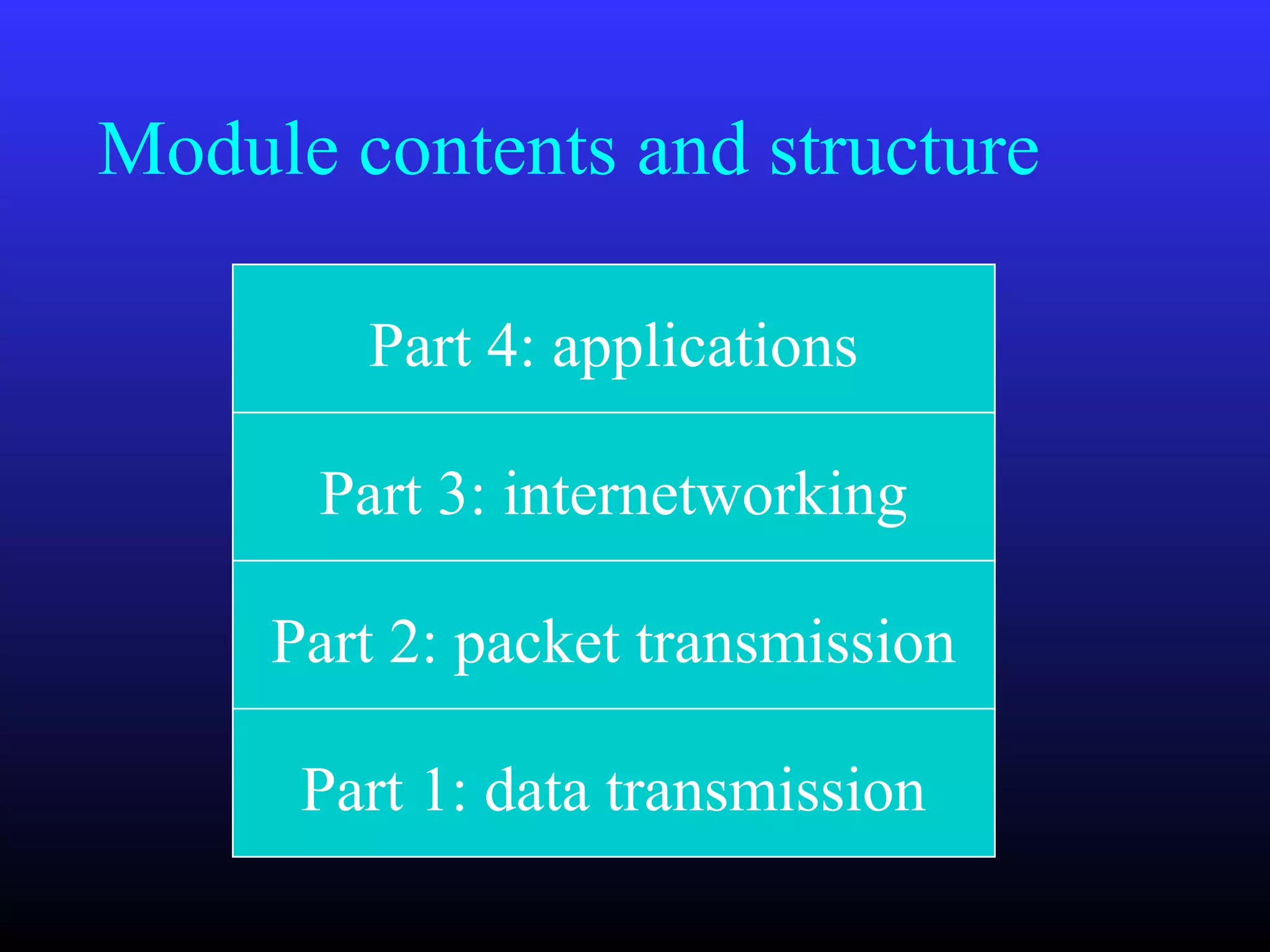
Module contents and structure

        Part 4: applications

      Part 3: internetworking

     Part 2: packet transmission

      Part 1: data transmission
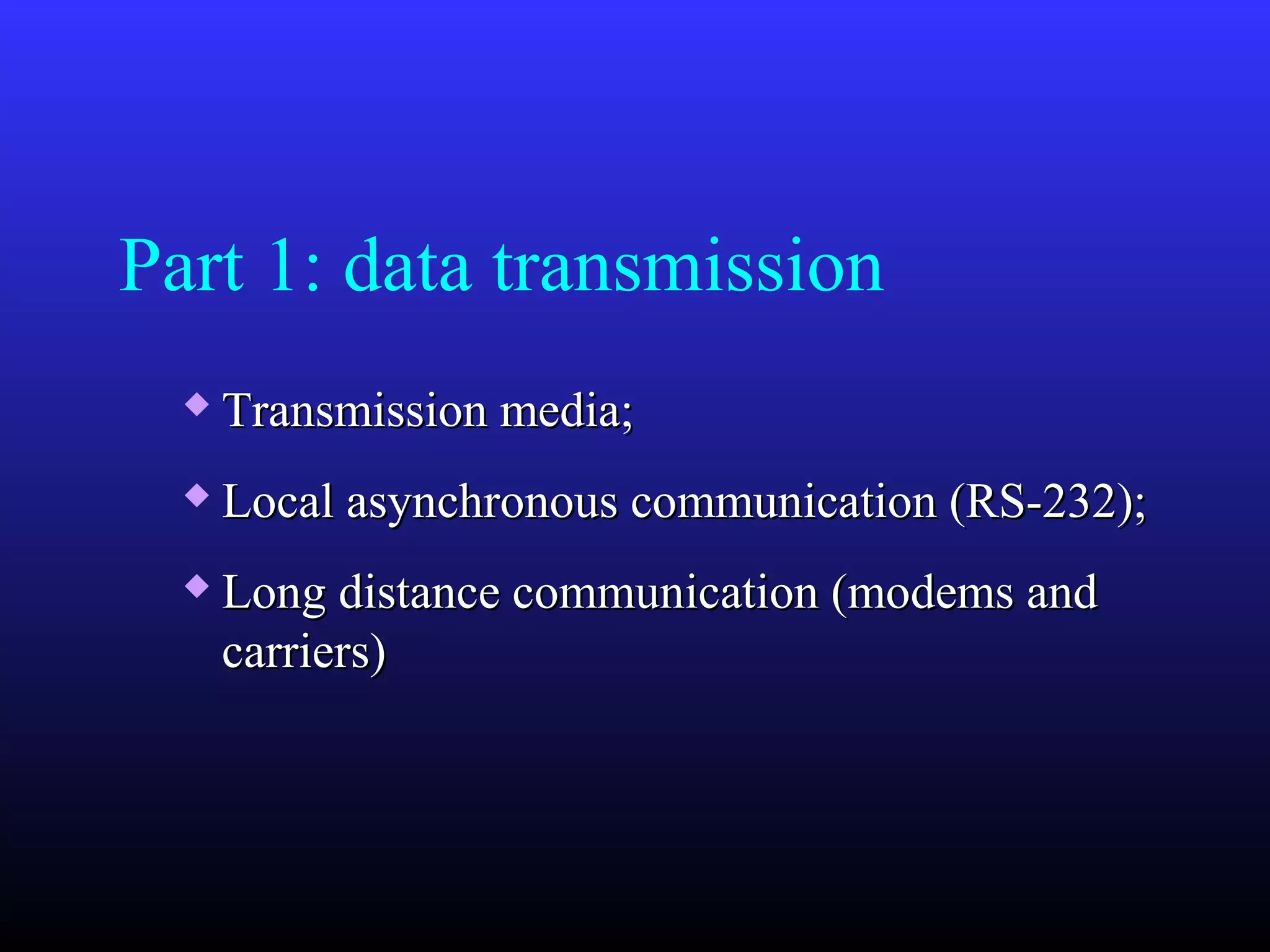
Part 1: data transmission
     Transmission media;
     Local asynchronous communication (RS-232);
     Long distance communication (modems and
      carriers)
Part 2: packet transmission
   Packets, frames and error detection
   Local area networks (LANs)

   Hardware addressing

   LAN wiring and physical topology

   Extending LANS: Fiber Modems, repeaters,

    bridges and switches;
   WAN Technologies and routing

   Network ownership and service paradigm

   Protocols and layering
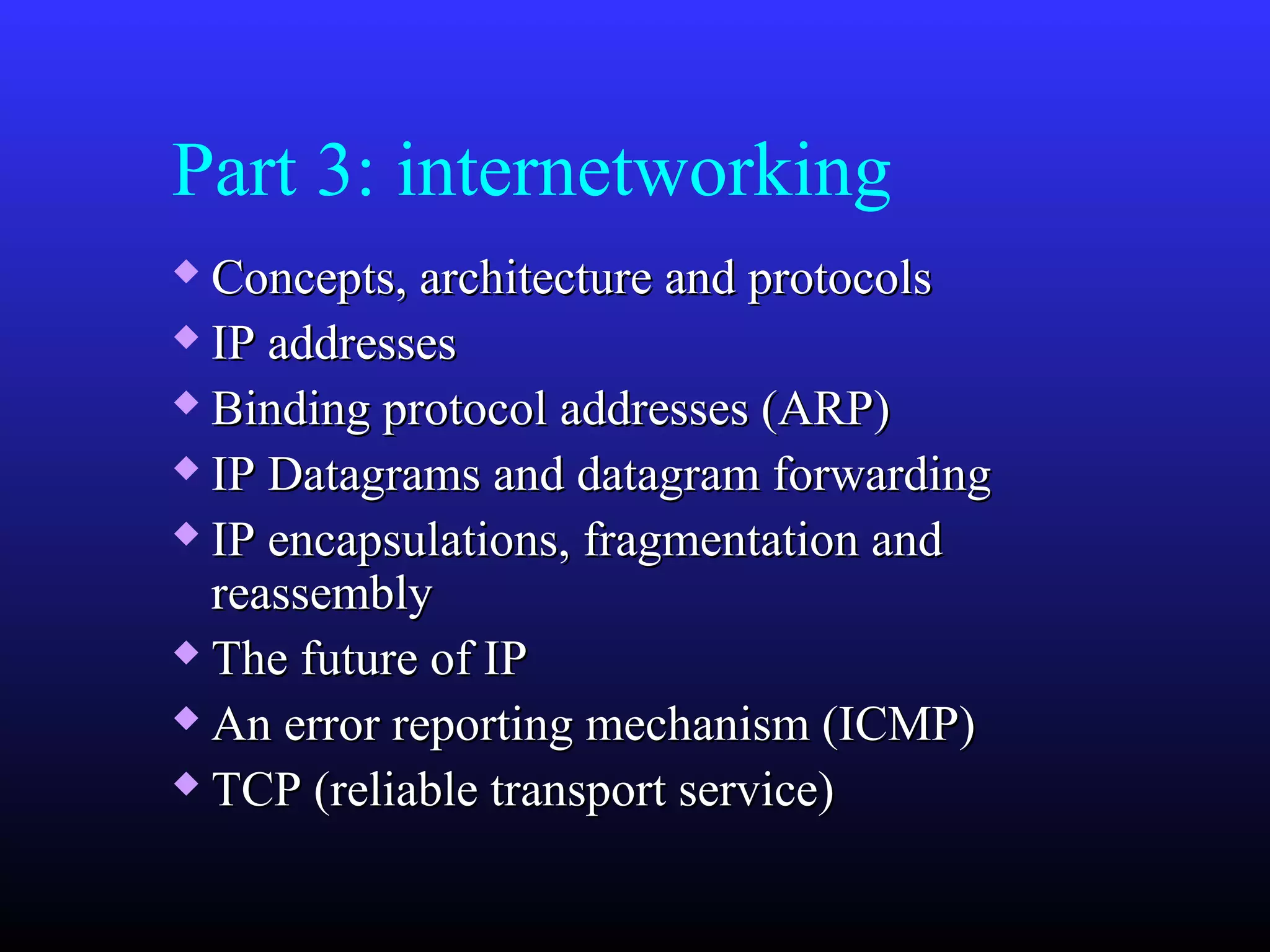
Part 3: internetworking
 Concepts, architecture and protocols
 IP addresses

 Binding protocol addresses (ARP)

 IP Datagrams and datagram forwarding

 IP encapsulations, fragmentation and

  reassembly
 The future of IP

 An error reporting mechanism (ICMP)

 TCP (reliable transport service)
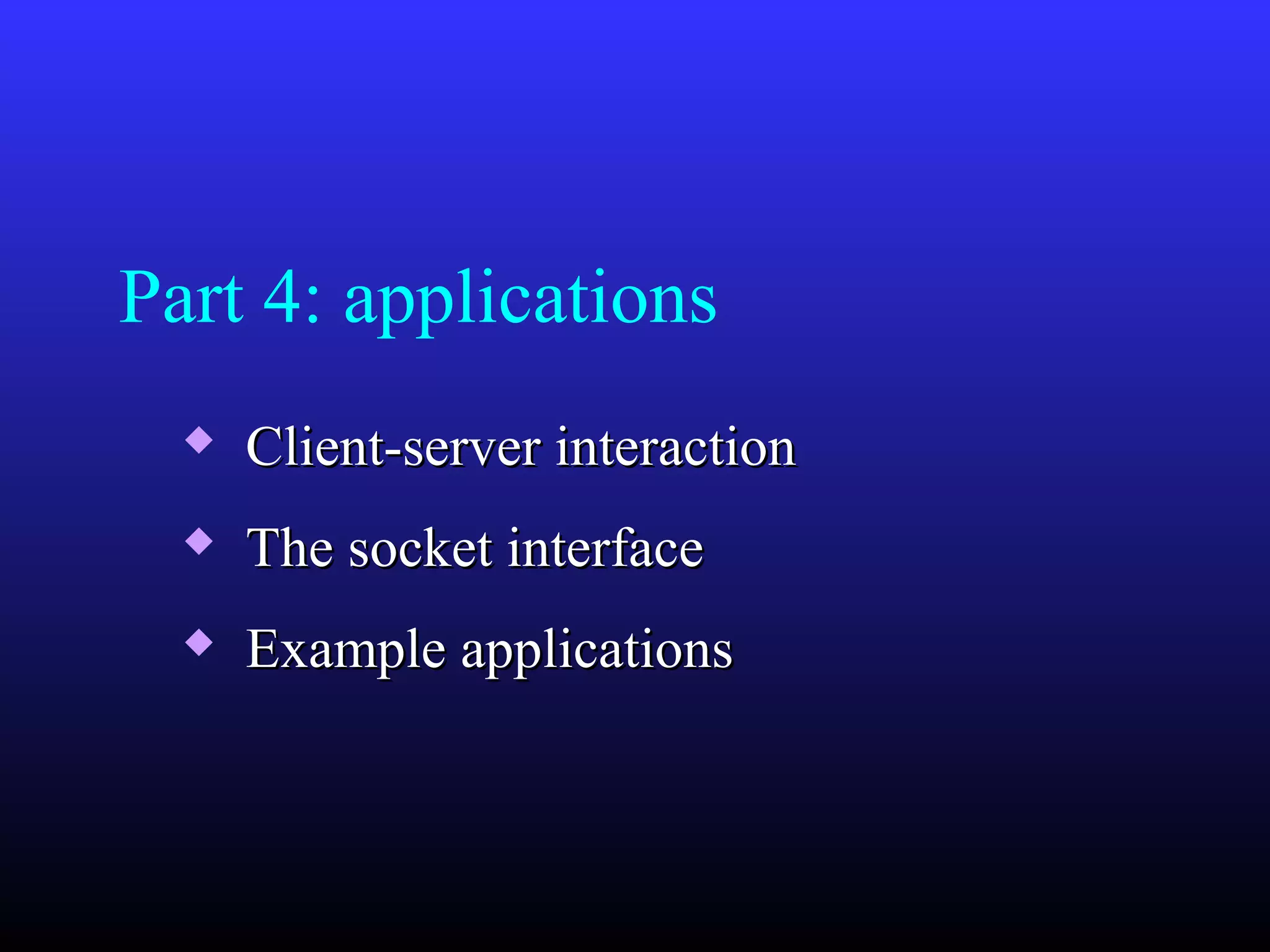
Part 4: applications
     Client-server interaction
     The socket interface
     Example applications

Computer communications and networks

  • 1.
    Computer Communications and Networks Email: vj2713@gmail.com
  • 2.
    Introduction  Practical matters Module goals, structure and contents  Initial introduction to some key ideas and issues
  • 3.
    Lectures Tuesday 17:00 in LT3  Friday 13:00 in LT2
  • 4.
    Related modules G53ACC - Advanced Computer Communications  G5BIAW - The Internet and the World Wide Web
  • 5.
    Objectives  To understand the basic principles of data communications and computer networks.  To appreciate the complex trade-offs that are inherent in the design of networks.  To provide a guided tour of network technologies from the lowest levels of data transmission up to network applications.  To learn about current networking technologies, especially Internet protocols.
  • 6.
    Assessment  Two hour written examination  The style of question will be based upon those from previous years. Their content will of course be different.  Last year’s exam paper is on sale in the bookshop and previous papers are in the library.  No coursework
  • 7.
    Text books andnotes  Notes are available at:  http://www.cs.nott.ac.uk/~mvr/ccn  The core recommended course text is:  Computer Networks and Internets, Douglas E. Comer, Prentice Hall  Supplementary texts are:  Tannenbaum, Computer Networks, Prentice Hall  Halsall, Data and Computer Communications, Macmillan
  • 8.
    What is acomputer network?  An interconnection of autonomous computers (as opposed to communication between separate but interdependent parts of a single computer)
  • 9.
    Some goals ofcomputer networks  Access to remote resources  Human communication  Mobile computing  Computing power through parallelism  Optimising resources - load balancing  Incremental growth of computer systems (reduced cost and risk)  Increased robustness through graceful degradation
  • 10.
    Uses of computernetworks  Email, World Wide Web, Video Conferencing, File Transfer, Collaborative Virtual Environments, Remote control of robots and machines, Dial up databases, Webcasting, Distributed Programs, Hacking, Banking, Internet telephone
  • 11.
    Classifying networks  By size  Local area networks (LANs) versus Wide area networks (WANs)  By connectivity  Point to point versus broadcast networks  By communication medium  By mobility  Fixed versus mobile
  • 12.
    Size - differencesbetween local and wide area networks  ‘Speed’ - bandwidth and latency  Management  Security  Reliability  Billing  Heterogeneity (and standards)
  • 13.
    Connectivity - pointto point networks tree star irregular mesh
  • 14.
  • 15.
    Medium - differencesbetween communication media  ‘Speed’ - bandwidth and latency  Range  Sharing  Topology  Installation and maintenance costs  Reliability
  • 16.
    Mobility - issuesarising in mobile networks  Mobile networking has emerged in the last decade. Introduces new issues of:  energy efficiency  location and tracking  semi-persistent connections  complex administration and billing as devices and users move around the network
  • 17.
    Common issues innetworking  Addressing  Routing  Framing and encoding  Error detection and correction  Flow and congestion
  • 18.
    Module contents andstructure Part 4: applications Part 3: internetworking Part 2: packet transmission Part 1: data transmission
  • 19.
    Part 1: datatransmission  Transmission media;  Local asynchronous communication (RS-232);  Long distance communication (modems and carriers)
  • 20.
    Part 2: packettransmission  Packets, frames and error detection  Local area networks (LANs)  Hardware addressing  LAN wiring and physical topology  Extending LANS: Fiber Modems, repeaters, bridges and switches;  WAN Technologies and routing  Network ownership and service paradigm  Protocols and layering
  • 21.
    Part 3: internetworking Concepts, architecture and protocols  IP addresses  Binding protocol addresses (ARP)  IP Datagrams and datagram forwarding  IP encapsulations, fragmentation and reassembly  The future of IP  An error reporting mechanism (ICMP)  TCP (reliable transport service)
  • 22.
    Part 4: applications  Client-server interaction  The socket interface  Example applications