Compressing column-oriented indexes

                        Daniel Lemire

  http://www.professeurs.uqam.ca/pages/lemire.daniel.htm
            blog: http://www.daniel-lemire.com/

Joint work with Owen Kaser (UNB) and Kamel Aouiche (post-doc).


                   November 19, 2009


                   Daniel Lemire   Compressing column-oriented indexes
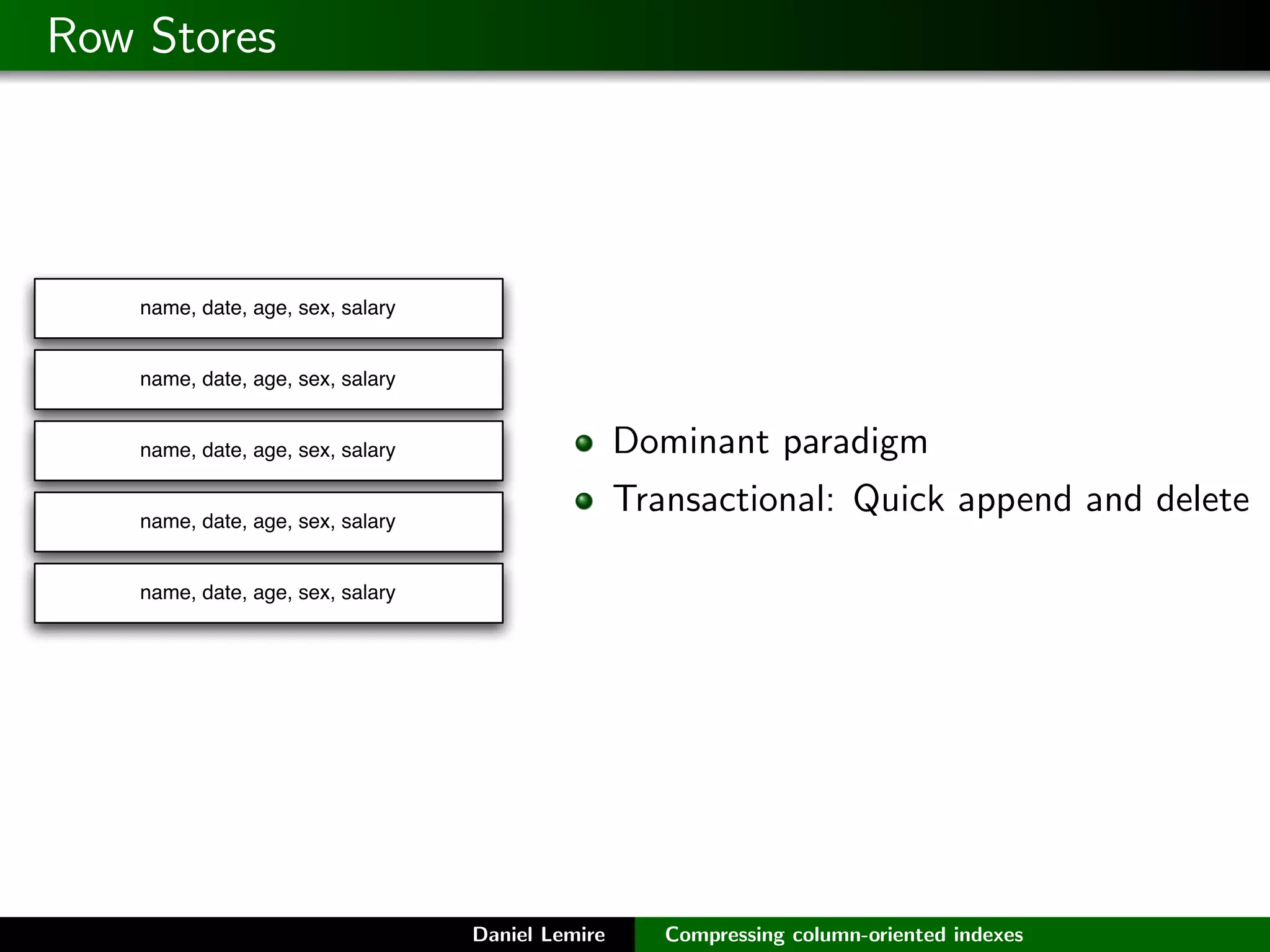
Row Stores


    name, date, age, sex, salary


    name, date, age, sex, salary


    name, date, age, sex, salary                   Dominant paradigm
    name, date, age, sex, salary
                                                   Transactional: Quick append and delete

    name, date, age, sex, salary


                                   Daniel Lemire      Compressing column-oriented indexes
Column Stores


                                             Goes back to StatCan in the
                                             seventies [Turner et al., 1979]
                                             Made fashionable again in Data
name   date   age   sex   salary             Warehousing by
                                             Stonebraker [Stonebraker et al., 2005]
                                             New: Oracle Exadata hybrid columnar
                                             compression
                                             Favors run-length encoding (compression)


                             Daniel Lemire      Compressing column-oriented indexes
Main column-oriented indexes


     (1) Bitmap indexes [O’Neil, 1989]
     (2) Projection indexes [O’Neil and Quass, 1997]
     Both are compressible.


                       Daniel Lemire   Compressing column-oriented indexes
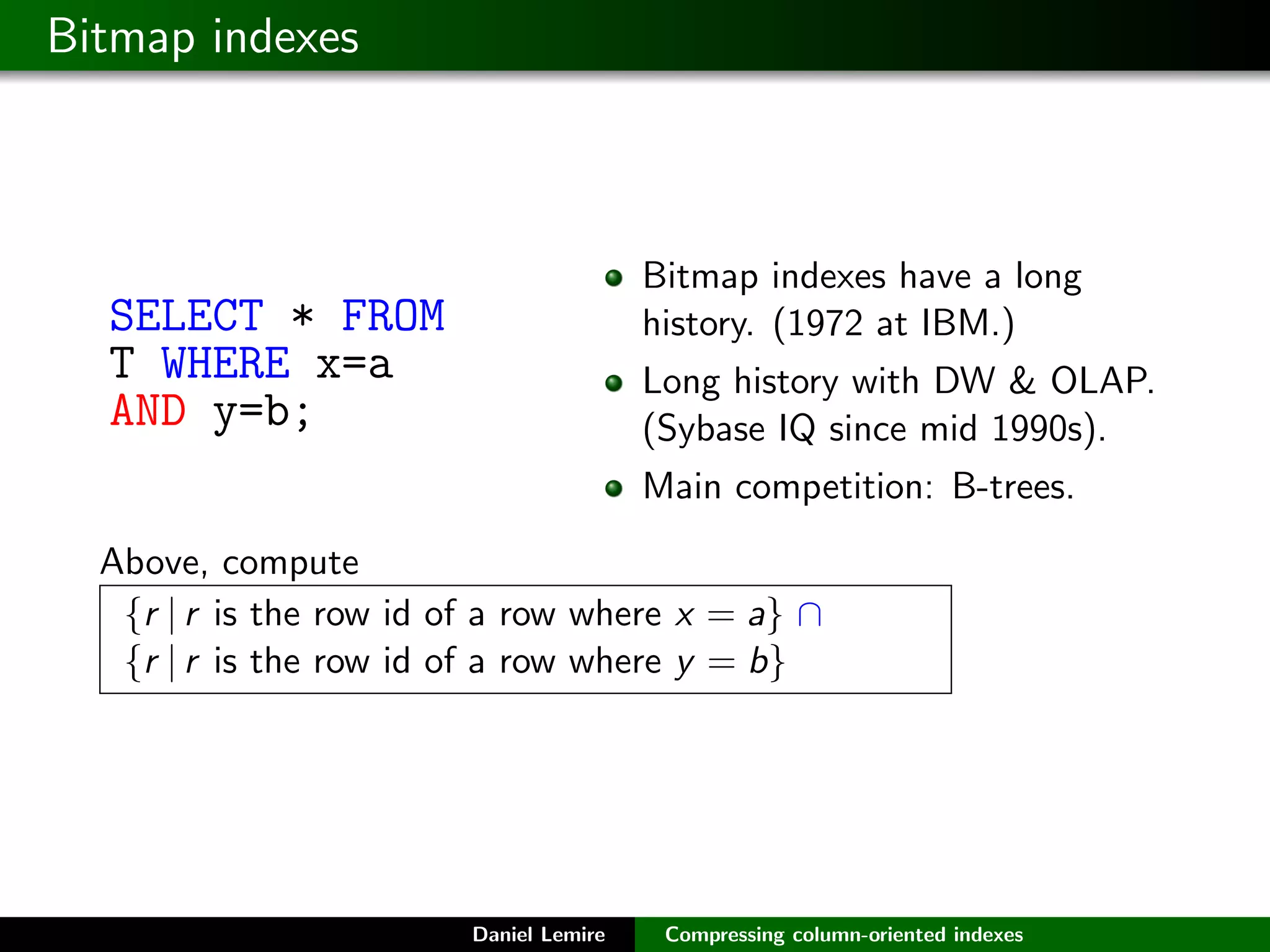
Bitmap indexes


                                         Bitmap indexes have a long
  SELECT * FROM                          history. (1972 at IBM.)
  T WHERE x=a                            Long history with DW & OLAP.
  AND y=b;                               (Sybase IQ since mid 1990s).
                                         Main competition: B-trees.
  Above, compute
   {r | r is the row id of a row where x = a} ∩
   {r | r is the row id of a row where y = b}


                         Daniel Lemire    Compressing column-oriented indexes
Bitmaps and fast AND/OR operations


     Computing the union of two sets of integers between 1 and 64
     (eg row ids, trivial table). . .
     E.g., {1, 5, 8} ∪ {1, 3, 5}?
     Can be done in one operation by a CPU:
     BitwiseOR( 10001001, 10101000)
     Extend to sets from 1..N using N/64 operations.
     To compute [a0 , . . . , aN−1 ] ∨ [b0 , b1 , . . . , bN−1 ] :
     a0 , . . . , a63 BitwiseOR b0 , . . . , b63 ;
     a64 , . . . , a127 BitwiseOR b64 , . . . , b127 ;
     a128 , . . . , a192 BitwiseOR b128 , . . . , b192 ;
     ...
     It is a form of vectorization.


                            Daniel Lemire   Compressing column-oriented indexes
Common applications of the bitmaps


     The Java language has had a bitmap class since the
     beginning: java.util.BitSet. (Sun’s implementation is based
     on 64-bit words.)
     Search engines use bitmaps to filter queries, e.g. Apache
     Lucene


                       Daniel Lemire   Compressing column-oriented indexes
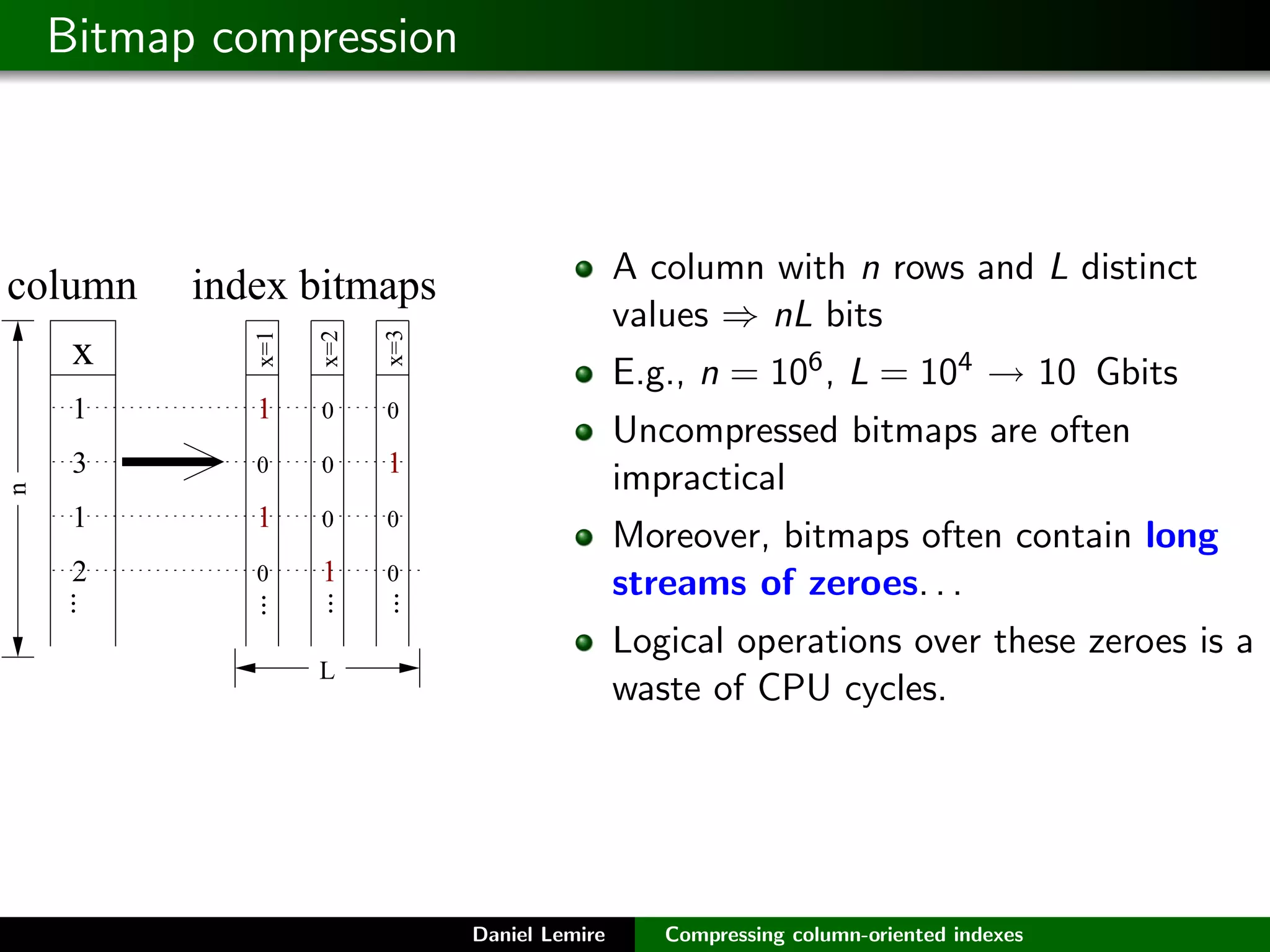
Bitmap compression


                                               A column with n rows and L distinct
column    index bitmaps
                                               values ⇒ nL bits
                         x=3
             x=1

                   x=2
    x                                          E.g., n = 106 , L = 104 → 10 Gbits
     1       1     0     0
                                               Uncompressed bitmaps are often
     3       0     0     1
                                               impractical
n


     1       1     0     0
                                               Moreover, bitmaps often contain long
     2       0     1     0
                                               streams of zeroes. . .
    ...


                   ...

                         ...
             ...


                                               Logical operations over these zeroes is a
                   L
                                               waste of CPU cycles.


                               Daniel Lemire      Compressing column-oriented indexes
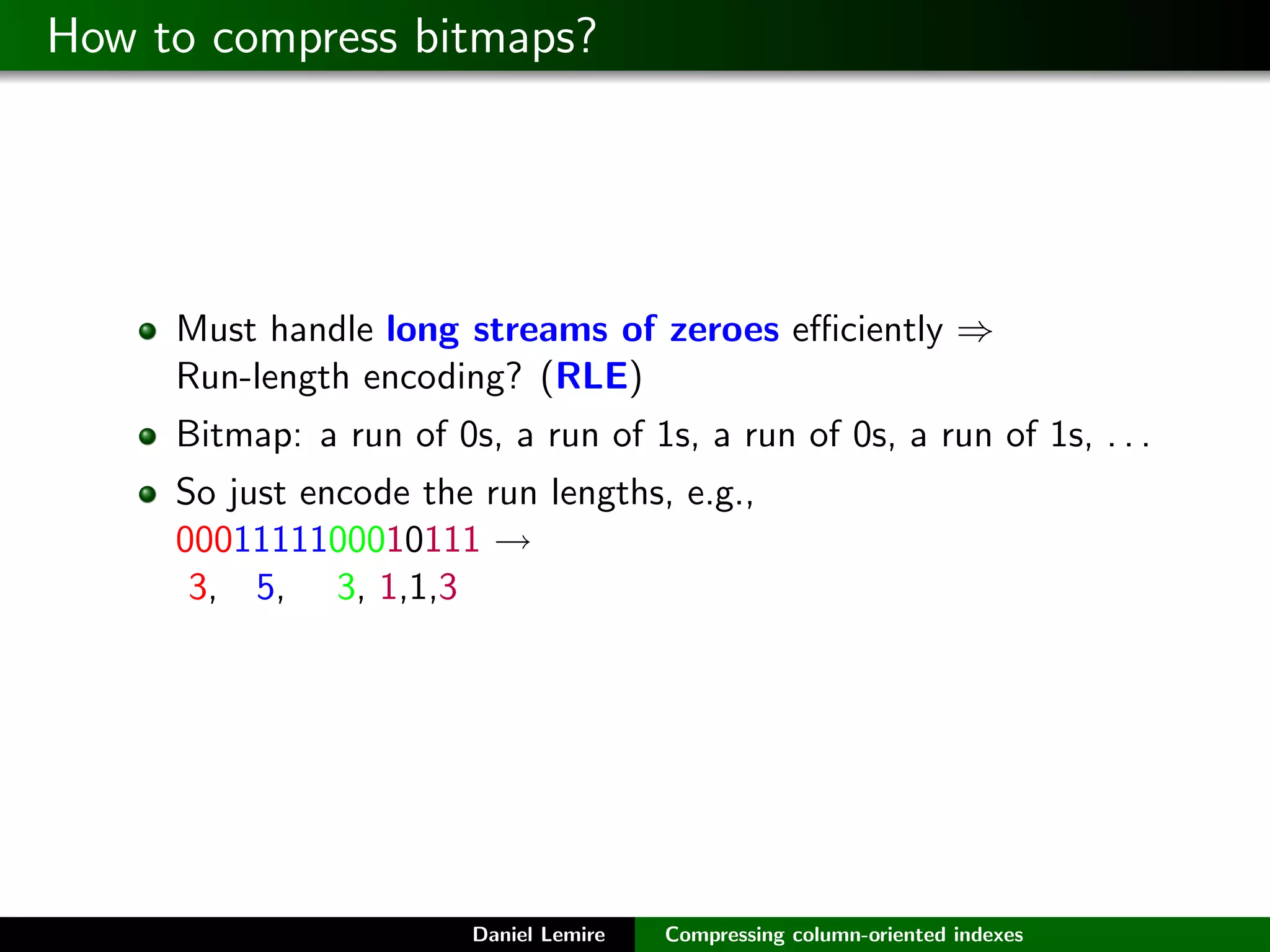
How to compress bitmaps?


     Must handle long streams of zeroes efficiently ⇒
     Run-length encoding? (RLE)
     Bitmap: a run of 0s, a run of 1s, a run of 0s, a run of 1s, . . .
     So just encode the run lengths, e.g.,
     0001111100010111 →
      3, 5, 3, 1,1,3


                        Daniel Lemire   Compressing column-oriented indexes
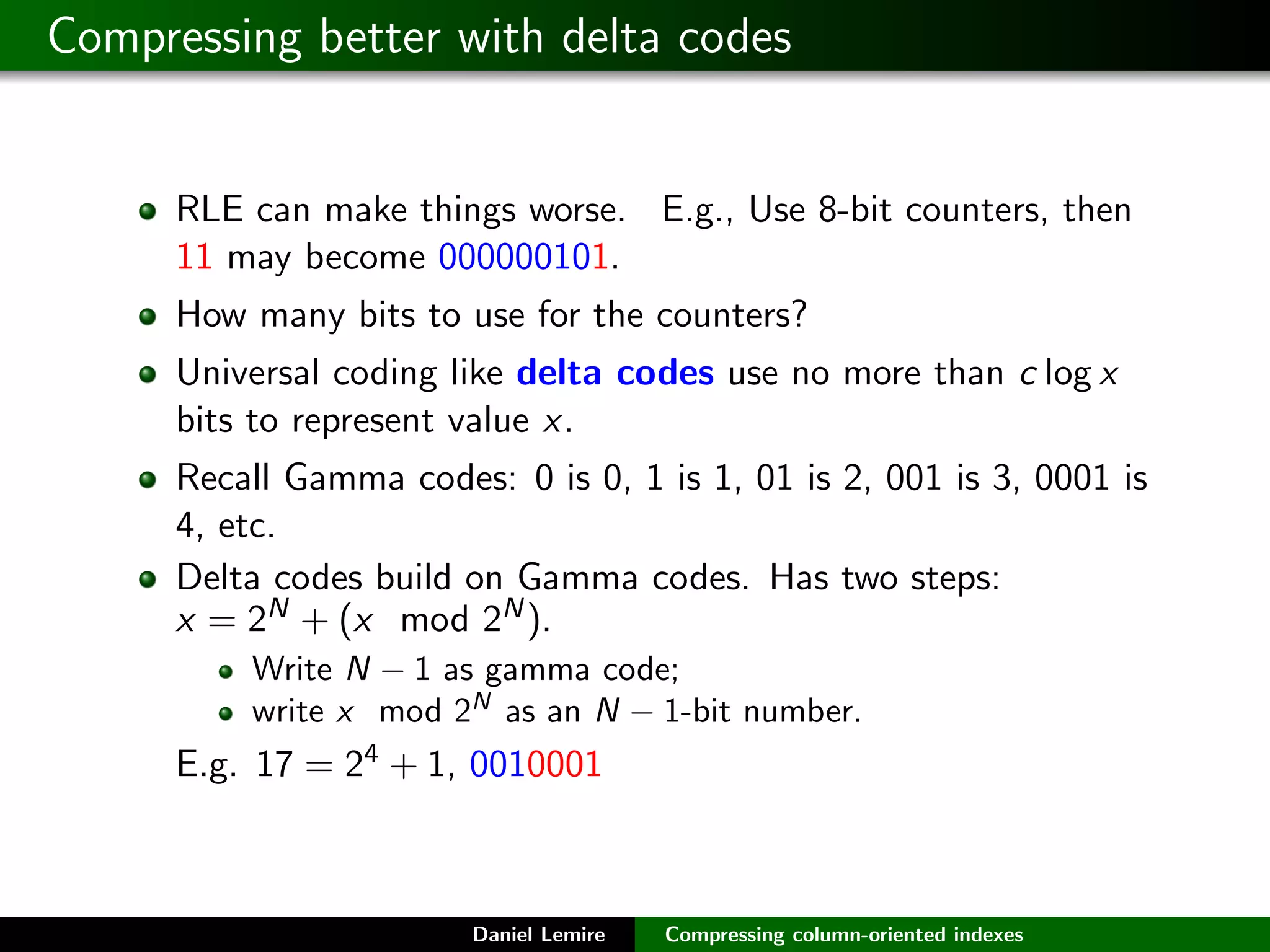
Compressing better with delta codes


      RLE can make things worse. E.g., Use 8-bit counters, then
      11 may become 000000101.
      How many bits to use for the counters?
      Universal coding like delta codes use no more than c log x
      bits to represent value x.
      Recall Gamma codes: 0 is 0, 1 is 1, 01 is 2, 001 is 3, 0001 is
      4, etc.
      Delta codes build on Gamma codes. Has two steps:
      x = 2N + (x mod 2N ).
          Write N − 1 as gamma code;
          write x mod 2N as an N − 1-bit number.
      E.g. 17 = 24 + 1, 0010001


                        Daniel Lemire   Compressing column-oriented indexes
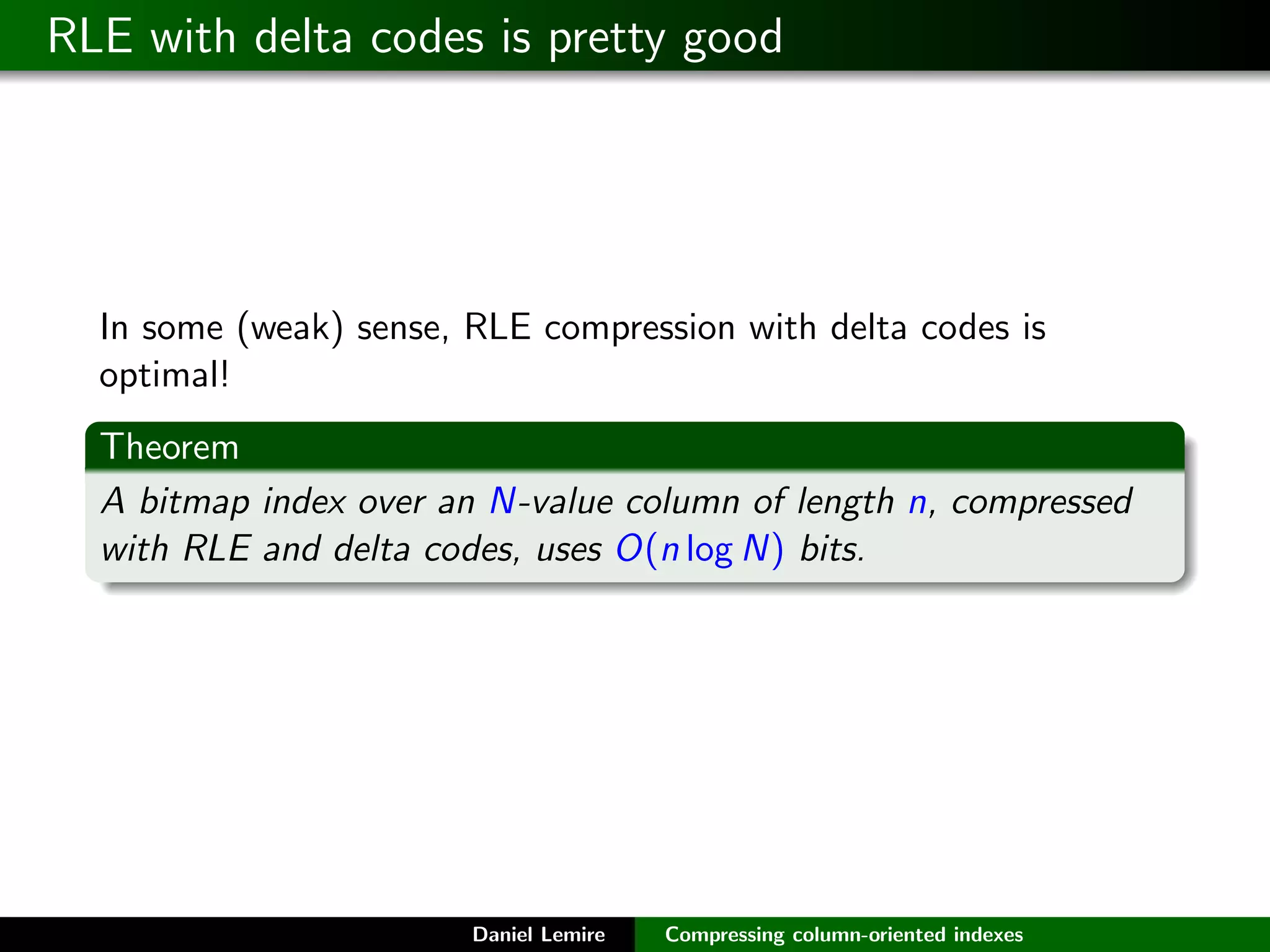
RLE with delta codes is pretty good


  In some (weak) sense, RLE compression with delta codes is
  optimal!
  Theorem
  A bitmap index over an N-value column of length n, compressed
  with RLE and delta codes, uses O(n log N) bits.


                        Daniel Lemire   Compressing column-oriented indexes
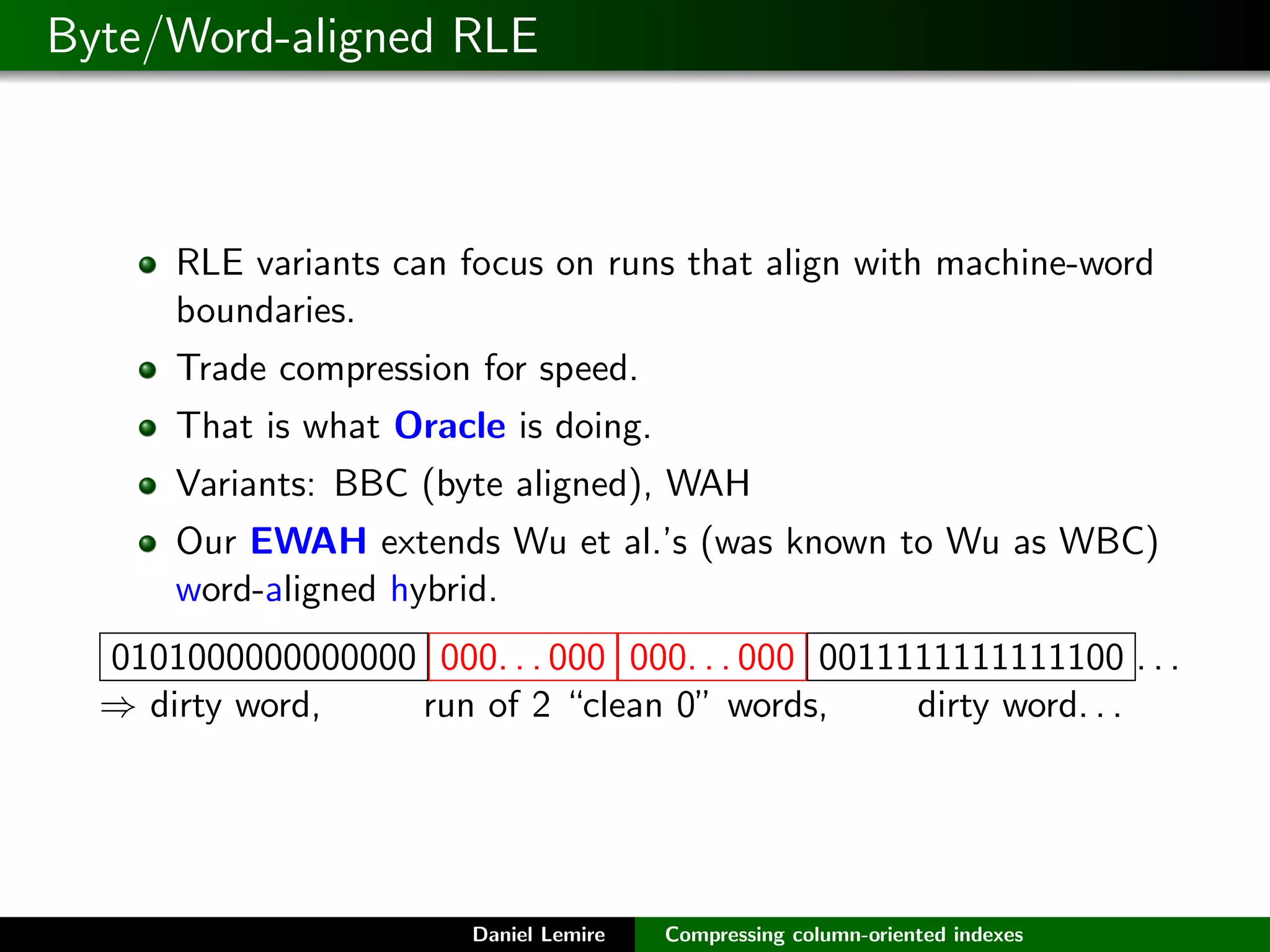
Byte/Word-aligned RLE


      RLE variants can focus on runs that align with machine-word
      boundaries.
      Trade compression for speed.
      That is what Oracle is doing.
      Variants: BBC (byte aligned), WAH
      Our EWAH extends Wu et al.’s (was known to Wu as WBC)
      word-aligned hybrid.
  0101000000000000 000. . . 000 000. . . 000 0011111111111100 . . .
  ⇒ dirty word,   run of 2 “clean 0” words,       dirty word. . .


                        Daniel Lemire   Compressing column-oriented indexes
What are bitmap indexes for?


     Construction time is proportional to index size. (Data is
     written sequentially on disk.)
     Implementation scales to millions of bitmaps.
     Myth: bitmap indexes are for low cardinality columns.
              the Bitmap index is the conclusive choice for data
              warehouse design for columns with high or low
              cardinality [Zaker et al., 2008].


                       Daniel Lemire   Compressing column-oriented indexes
What about other compression types?


     With RLE-like compression we have B1 ∨ B2 or B1 ∧ B2 in
     time O(|B1 | + |B2 |).
     Hence, with RLE, compress saves both storage and CPU
     cycles!!!!
     Not always true with other techniques such as Huffman,
     LZ77, Arithmetic Coding, . . .


                      Daniel Lemire   Compressing column-oriented indexes
What happens when you have many bitmaps?


     Consider B1 ∨ B2 ∨ . . . ∨ BN .
     First compute the first two : B1 ∨ B2 in time O(|B1 | + |B2 |).
     |B3 ∨ B4 | is in O(|B3 | + |B4 |).
     Thus (B1 ∨ B2 ) ∨ (B3 ∨ B4 ) takes O(2                i   |Bi |). . .
     Total is in O( N |Bi | log N), can be
                     i=1
     generalized [Lemire et al., 2009].


                         Daniel Lemire    Compressing column-oriented indexes
How do 64-bit words compare to 32-bit words?


     We implemented EWAH using 16-bit, 32-bit and 64-bit words;
     Only 32-bit and 64-bit are efficient;
     64-bit indexes are nearly twice as large;
     64-bit indexes are between 5%-40% faster (despite higher
     I/O costs).


                       Daniel Lemire   Compressing column-oriented indexes
Open Source Software?


     Lemur Bitmap Index C++ Library:
     http://code.google.com/p/lemurbitmapindex/.
     JavaEWAH: A compressed alternative to the Java BitSet class
     http://code.google.com/p/javaewah/.


                      Daniel Lemire   Compressing column-oriented indexes
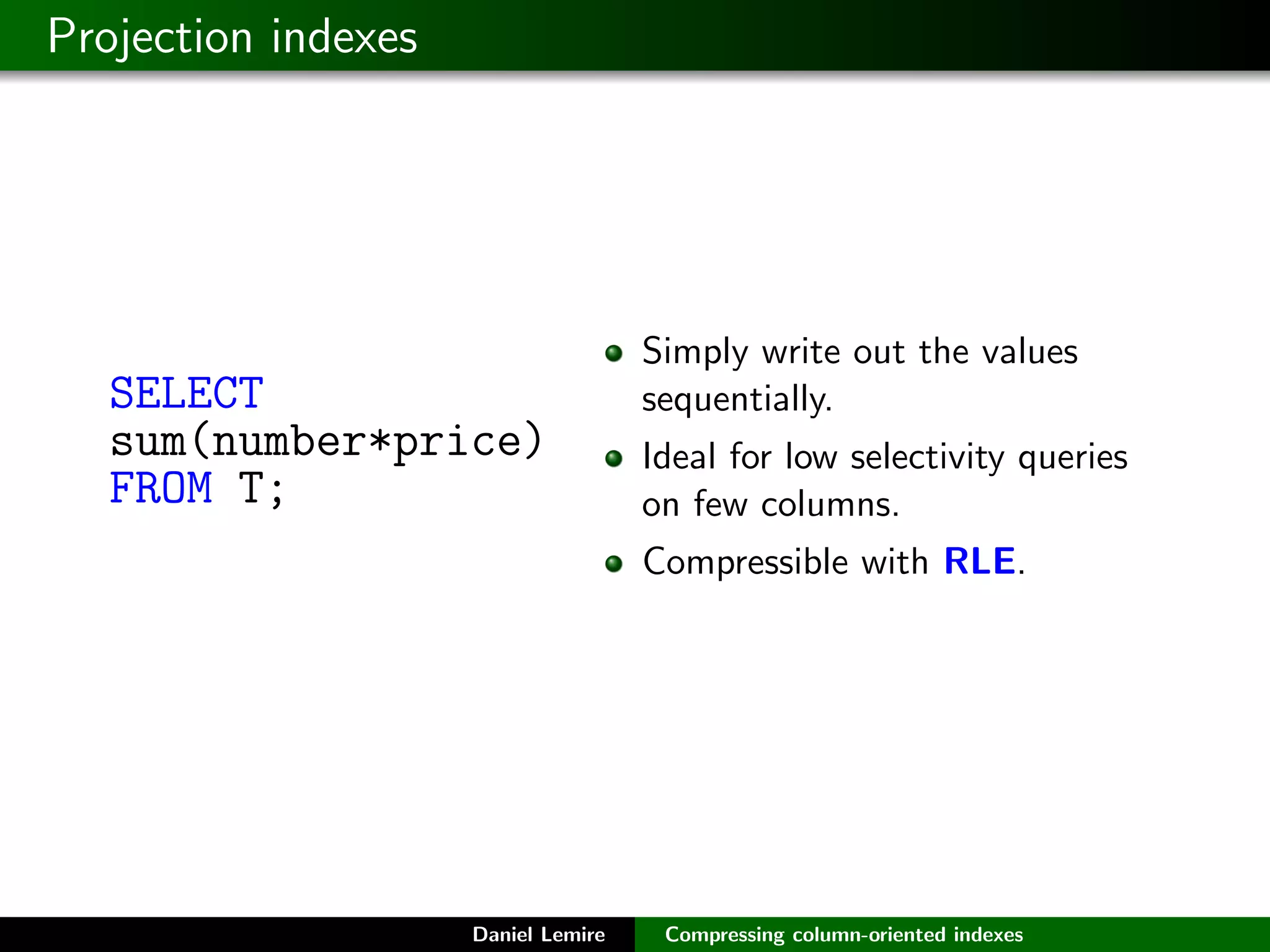
Projection indexes


                                     Simply write out the values
   SELECT                            sequentially.
   sum(number*price)                 Ideal for low selectivity queries
   FROM T;                           on few columns.
                                     Compressible with RLE.


                     Daniel Lemire    Compressing column-oriented indexes
Improving compression by sorting the table


      RLE are order-sensitive:
      they compress sorted tables better;
      But finding the best row ordering is
      NP-hard [Lemire et al., 2009].
      So we sort:
          lexicographically
          with Gray codes
          Hilbert, . . .


                         Daniel Lemire   Compressing column-oriented indexes
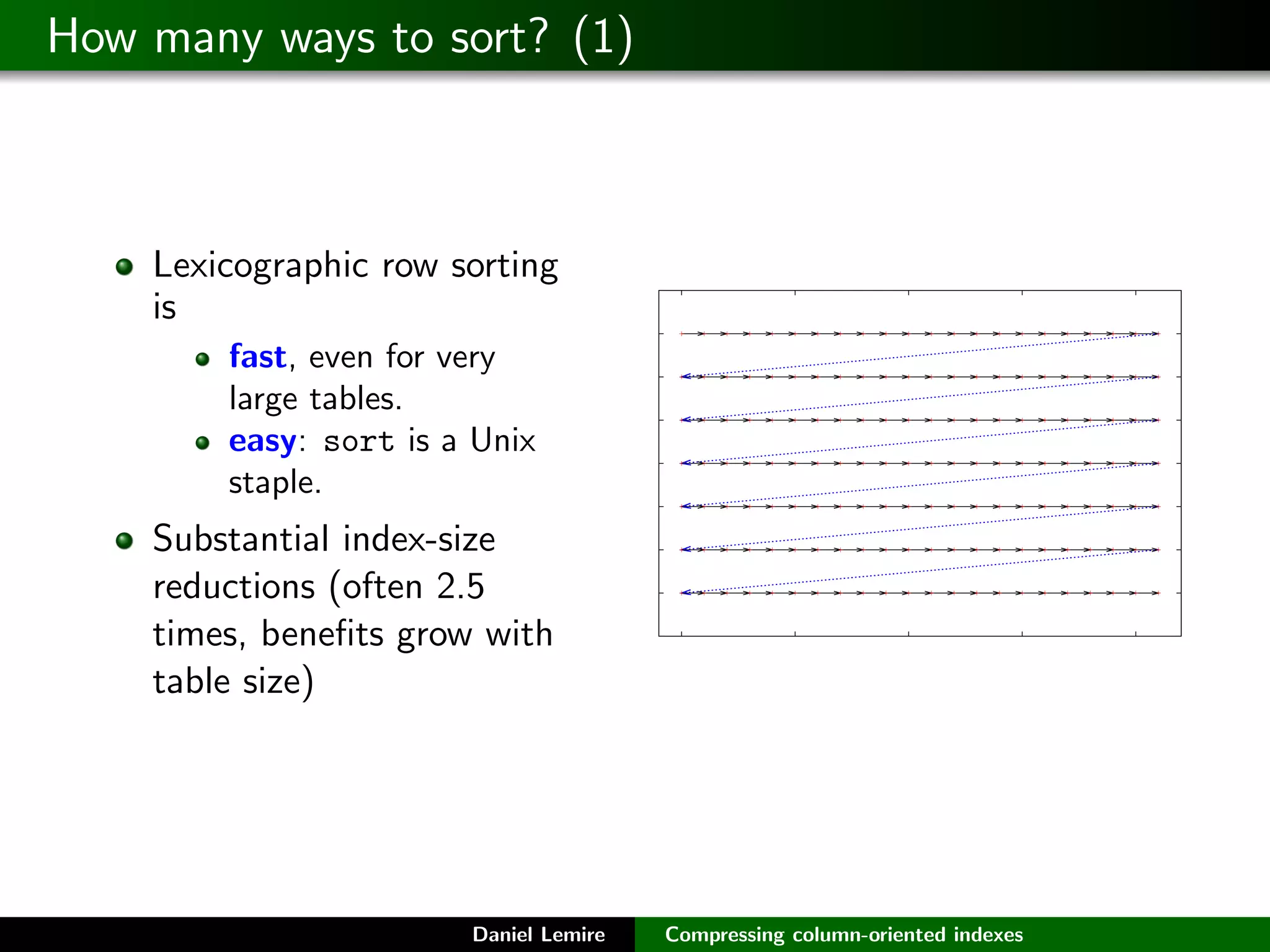
How many ways to sort? (1)


    Lexicographic row sorting
    is
        fast, even for very
        large tables.
        easy: sort is a Unix
        staple.
    Substantial index-size
    reductions (often 2.5
    times, benefits grow with
    table size)


                       Daniel Lemire   Compressing column-oriented indexes
How many ways to sort? (2)

    Gray Codes are list of
    tuples with successive
    (Hamming) distance of
    1 [Knuth, 2005,
    § 7.2.1.1].
    Reflected Gray Code order
    is
        sometimes slightly
        better than
        lexicographical. . .
        . . . but benefit goes as
        ≈ 1/N with column
        cardinality N
        poorly supported by
        existing software.


                          Daniel Lemire   Compressing column-oriented indexes
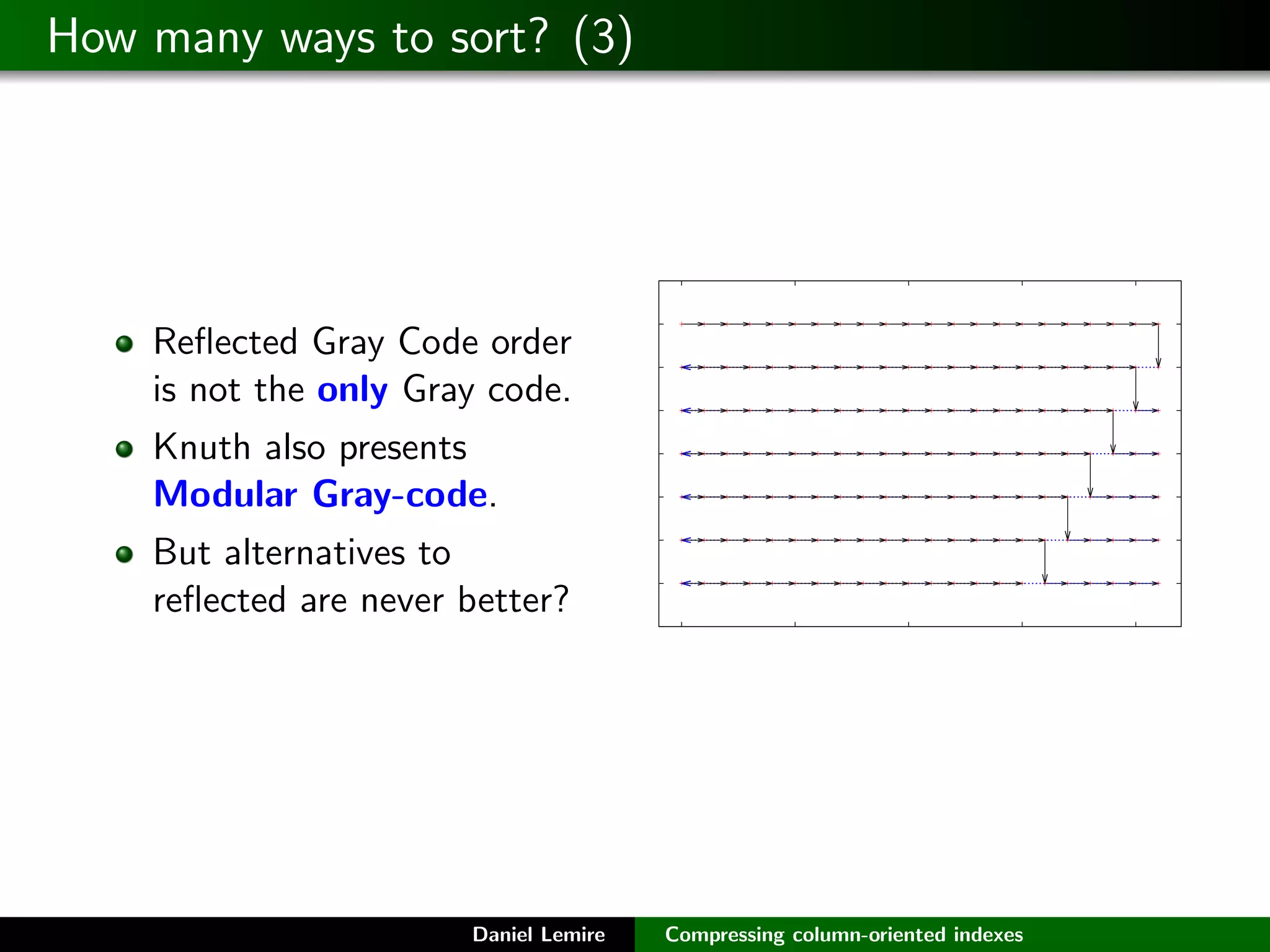
How many ways to sort? (3)


    Reflected Gray Code order
    is not the only Gray code.
    Knuth also presents
    Modular Gray-code.
    But alternatives to
    reflected are never better?


                       Daniel Lemire   Compressing column-oriented indexes
How many ways to sort? (4)


                                            Can also try esoteric
                                            orders.
                                            Hilbert Index
                                            [Hamilton and Rau-Chaplin, 2007]
                                            Gives very bad results for
                                            column-oriented indexes.


                  Daniel Lemire   Compressing column-oriented indexes
Modelling the size of an index


      Any formal result?
      Tricky: There are many variations on RLE.
      Use: number of runs of identical value in a column


                       Daniel Lemire   Compressing column-oriented indexes
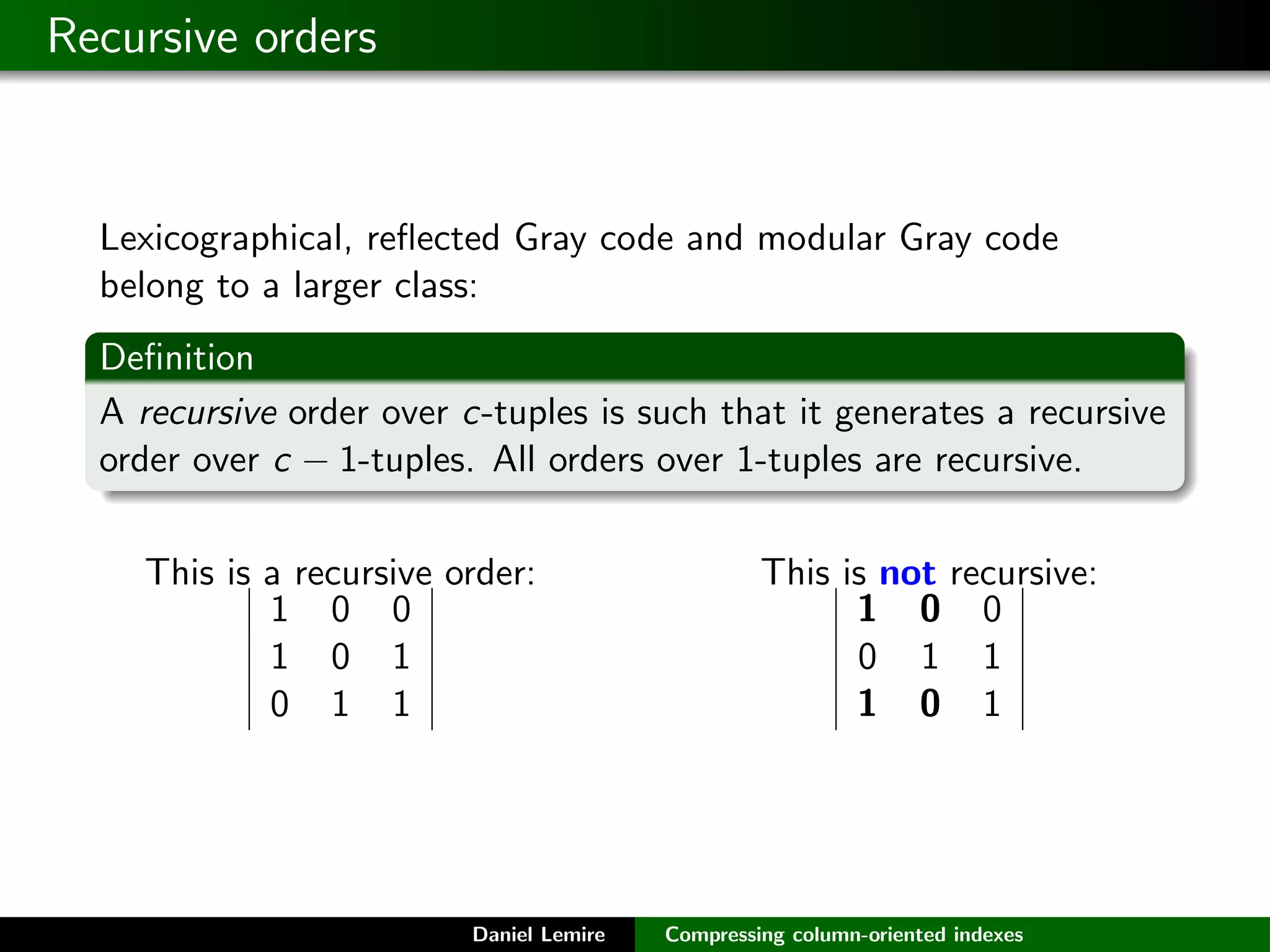
Recursive orders


  Lexicographical, reflected Gray code and modular Gray code
  belong to a larger class:
  Definition
  A recursive order over c-tuples is such that it generates a recursive
  order over c − 1-tuples. All orders over 1-tuples are recursive.

    This is a recursive order:                     This is not recursive:
            1 0 0                                        1 0 0
            1 0 1                                        0 1 1
            0 1 1                                        1 0 1


                          Daniel Lemire   Compressing column-oriented indexes
When sorting, column order matters


  Question
  Given a phone directory, to minimize the number of runs, should
  sort by first or last names?


                        Daniel Lemire   Compressing column-oriented indexes
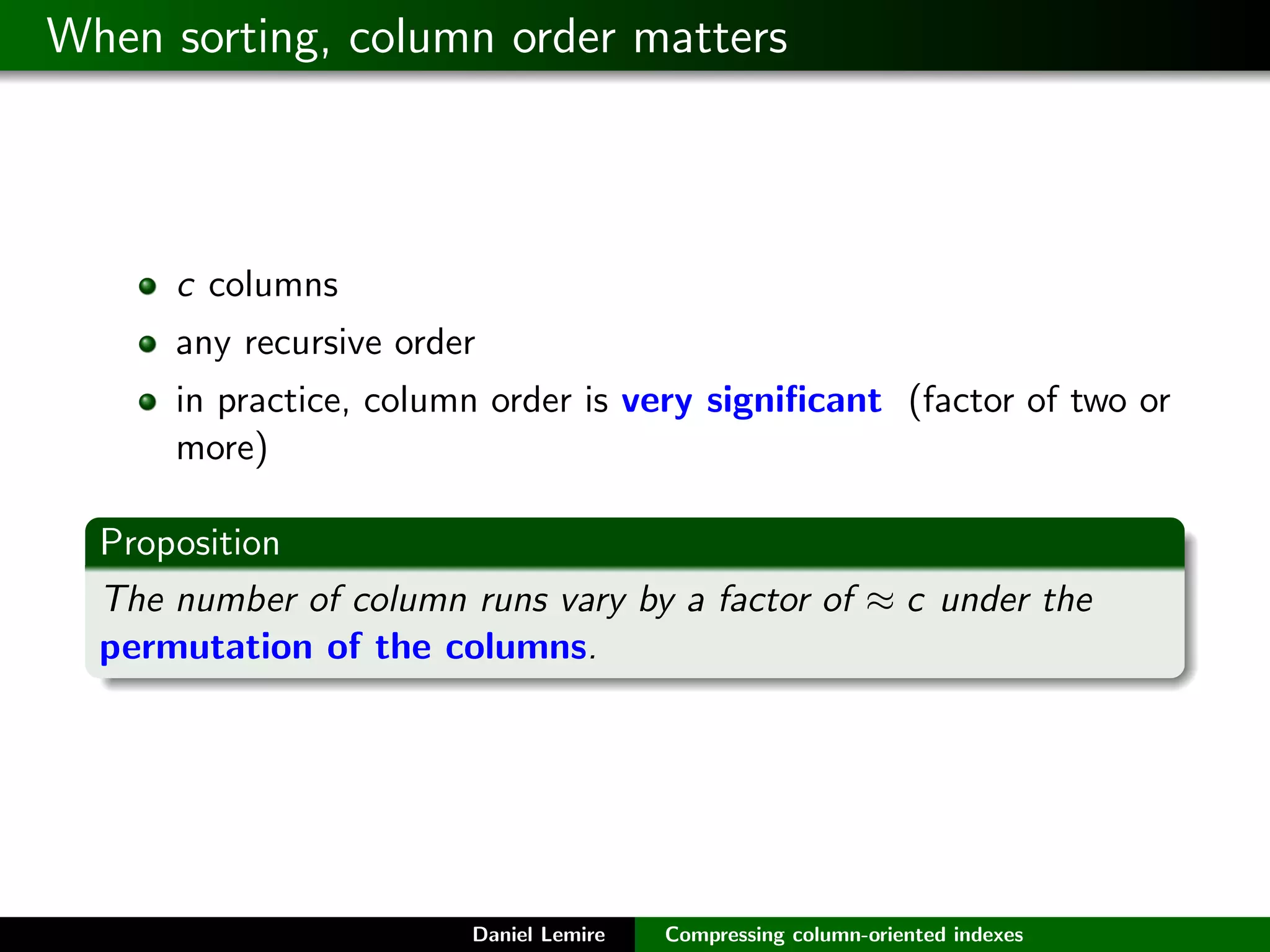
When sorting, column order matters


      c columns
      any recursive order
      in practice, column order is very significant (factor of two or
      more)

  Proposition
  The number of column runs vary by a factor of ≈ c under the
  permutation of the columns.


                        Daniel Lemire   Compressing column-oriented indexes
But column reordering fails to buy optimality


  From some tables. . .
  Lemma
  No recursive order minimizes the number of runs—even after
  reordering the columns.

      Open problem: how far from optimality?


                          Daniel Lemire   Compressing column-oriented indexes
Best column order?


  We almost have this result [Lemire and Kaser, ]:
      any recursive order
      order the columns by increasing cardinality (small to
      LARGE)

  Proposition

  The expected number of runs is minimized.

      Truth is complicated.
      Assume uniformly distributed tables.


                        Daniel Lemire   Compressing column-oriented indexes
What about non-uniform or dependent columns?


     Real columns have skewed distributions [Missaoui et al., 2007]
     and they are statistically dependent.
     It can impact column ordering in unpredictable ways.


                       Daniel Lemire   Compressing column-oriented indexes
Take away messages


     Column stores are good because of RLE and sorting;
     Lexicographical sort with right column order is good;
     More exotic sorting (such as Hilbert) might be bad.


                       Daniel Lemire   Compressing column-oriented indexes
Future direction?


      Need better mathematical modelling of skewed and
      dependent columns;
      New column-oriented indexes?
      Better ways to sort?


                        Daniel Lemire   Compressing column-oriented indexes
Questions?


                             ?


             Daniel Lemire       Compressing column-oriented indexes
Hamilton, C. H. and Rau-Chaplin, A. (2007).
Compact Hilbert indices: Space-filling curves for domains with
unequal side lengths.
Information Processing Letters, 105(5):155–163.
Knuth, D. E. (2005).
The Art of Computer Programming, volume 4, chapter fascicle
2.
Addison Wesley.
Lemire, D. and Kaser, O.
Reordering columns for smaller indexes.
in preparation, available from
http://arxiv.org/abs/0909.1346.
Lemire, D., Kaser, O., and Aouiche, K. (2009).
Sorting improves word-aligned bitmap indexes.
to appear in Data & Knowledge Engineering, preprint available
from http://arxiv.org/abs/0901.3751.

                  Daniel Lemire   Compressing column-oriented indexes
Missaoui, R., Goutte, C., Choupo, A. K., and Boujenoui, A.
(2007).
A probabilistic model for data cube compression and query
approximation.
In DOLAP, pages 33–40.
O’Neil, P. and Quass, D. (1997).
Improved query performance with variant indexes.
In SIGMOD ’97, pages 38–49.
O’Neil, P. E. (1989).
Model 204 architecture and performance.
In 2nd International Workshop on High Performance
Transaction Systems, pages 40–59.
Stonebraker, M., Abadi, D. J., Batkin, A., Chen, X.,
Cherniack, M., Ferreira, M., Lau, E., Lin, A., Madden, S.,
O’Neil, E., O’Neil, P., Rasin, A., Tran, N., and Zdonik, S.
(2005).
C-store: a column-oriented DBMS.
                   Daniel Lemire   Compressing column-oriented indexes
In VLDB’05, pages 553–564.
Turner, M. J., Hammond, R., and Cotton, P. (1979).
A DBMS for large statistical databases.
In VLDB’79, pages 319–327.
Wu, K., Otoo, E. J., and Shoshani, A. (2006).
Optimizing bitmap indices with efficient compression.
ACM Transactions on Database Systems, 31(1):1–38.
Zaker, M., Phon-Amnuaisuk, S., and Haw, S. (2008).
An adequate design for large data warehouse systems: Bitmap
index versus b-tree index.
IJCC, 2(2).


                  Daniel Lemire   Compressing column-oriented indexes

Compressing column-oriented indexes

  • 1.
    Compressing column-oriented indexes Daniel Lemire http://www.professeurs.uqam.ca/pages/lemire.daniel.htm blog: http://www.daniel-lemire.com/ Joint work with Owen Kaser (UNB) and Kamel Aouiche (post-doc). November 19, 2009 Daniel Lemire Compressing column-oriented indexes
  • 2.
    Row Stores name, date, age, sex, salary name, date, age, sex, salary name, date, age, sex, salary Dominant paradigm name, date, age, sex, salary Transactional: Quick append and delete name, date, age, sex, salary Daniel Lemire Compressing column-oriented indexes
  • 3.
    Column Stores Goes back to StatCan in the seventies [Turner et al., 1979] Made fashionable again in Data name date age sex salary Warehousing by Stonebraker [Stonebraker et al., 2005] New: Oracle Exadata hybrid columnar compression Favors run-length encoding (compression) Daniel Lemire Compressing column-oriented indexes
  • 4.
    Main column-oriented indexes (1) Bitmap indexes [O’Neil, 1989] (2) Projection indexes [O’Neil and Quass, 1997] Both are compressible. Daniel Lemire Compressing column-oriented indexes
  • 5.
    Bitmap indexes Bitmap indexes have a long SELECT * FROM history. (1972 at IBM.) T WHERE x=a Long history with DW & OLAP. AND y=b; (Sybase IQ since mid 1990s). Main competition: B-trees. Above, compute {r | r is the row id of a row where x = a} ∩ {r | r is the row id of a row where y = b} Daniel Lemire Compressing column-oriented indexes
  • 6.
    Bitmaps and fastAND/OR operations Computing the union of two sets of integers between 1 and 64 (eg row ids, trivial table). . . E.g., {1, 5, 8} ∪ {1, 3, 5}? Can be done in one operation by a CPU: BitwiseOR( 10001001, 10101000) Extend to sets from 1..N using N/64 operations. To compute [a0 , . . . , aN−1 ] ∨ [b0 , b1 , . . . , bN−1 ] : a0 , . . . , a63 BitwiseOR b0 , . . . , b63 ; a64 , . . . , a127 BitwiseOR b64 , . . . , b127 ; a128 , . . . , a192 BitwiseOR b128 , . . . , b192 ; ... It is a form of vectorization. Daniel Lemire Compressing column-oriented indexes
  • 7.
    Common applications ofthe bitmaps The Java language has had a bitmap class since the beginning: java.util.BitSet. (Sun’s implementation is based on 64-bit words.) Search engines use bitmaps to filter queries, e.g. Apache Lucene Daniel Lemire Compressing column-oriented indexes
  • 8.
    Bitmap compression A column with n rows and L distinct column index bitmaps values ⇒ nL bits x=3 x=1 x=2 x E.g., n = 106 , L = 104 → 10 Gbits 1 1 0 0 Uncompressed bitmaps are often 3 0 0 1 impractical n 1 1 0 0 Moreover, bitmaps often contain long 2 0 1 0 streams of zeroes. . . ... ... ... ... Logical operations over these zeroes is a L waste of CPU cycles. Daniel Lemire Compressing column-oriented indexes
  • 9.
    How to compressbitmaps? Must handle long streams of zeroes efficiently ⇒ Run-length encoding? (RLE) Bitmap: a run of 0s, a run of 1s, a run of 0s, a run of 1s, . . . So just encode the run lengths, e.g., 0001111100010111 → 3, 5, 3, 1,1,3 Daniel Lemire Compressing column-oriented indexes
  • 10.
    Compressing better withdelta codes RLE can make things worse. E.g., Use 8-bit counters, then 11 may become 000000101. How many bits to use for the counters? Universal coding like delta codes use no more than c log x bits to represent value x. Recall Gamma codes: 0 is 0, 1 is 1, 01 is 2, 001 is 3, 0001 is 4, etc. Delta codes build on Gamma codes. Has two steps: x = 2N + (x mod 2N ). Write N − 1 as gamma code; write x mod 2N as an N − 1-bit number. E.g. 17 = 24 + 1, 0010001 Daniel Lemire Compressing column-oriented indexes
  • 11.
    RLE with deltacodes is pretty good In some (weak) sense, RLE compression with delta codes is optimal! Theorem A bitmap index over an N-value column of length n, compressed with RLE and delta codes, uses O(n log N) bits. Daniel Lemire Compressing column-oriented indexes
  • 12.
    Byte/Word-aligned RLE RLE variants can focus on runs that align with machine-word boundaries. Trade compression for speed. That is what Oracle is doing. Variants: BBC (byte aligned), WAH Our EWAH extends Wu et al.’s (was known to Wu as WBC) word-aligned hybrid. 0101000000000000 000. . . 000 000. . . 000 0011111111111100 . . . ⇒ dirty word, run of 2 “clean 0” words, dirty word. . . Daniel Lemire Compressing column-oriented indexes
  • 13.
    What are bitmapindexes for? Construction time is proportional to index size. (Data is written sequentially on disk.) Implementation scales to millions of bitmaps. Myth: bitmap indexes are for low cardinality columns. the Bitmap index is the conclusive choice for data warehouse design for columns with high or low cardinality [Zaker et al., 2008]. Daniel Lemire Compressing column-oriented indexes
  • 14.
    What about othercompression types? With RLE-like compression we have B1 ∨ B2 or B1 ∧ B2 in time O(|B1 | + |B2 |). Hence, with RLE, compress saves both storage and CPU cycles!!!! Not always true with other techniques such as Huffman, LZ77, Arithmetic Coding, . . . Daniel Lemire Compressing column-oriented indexes
  • 15.
    What happens whenyou have many bitmaps? Consider B1 ∨ B2 ∨ . . . ∨ BN . First compute the first two : B1 ∨ B2 in time O(|B1 | + |B2 |). |B3 ∨ B4 | is in O(|B3 | + |B4 |). Thus (B1 ∨ B2 ) ∨ (B3 ∨ B4 ) takes O(2 i |Bi |). . . Total is in O( N |Bi | log N), can be i=1 generalized [Lemire et al., 2009]. Daniel Lemire Compressing column-oriented indexes
  • 16.
    How do 64-bitwords compare to 32-bit words? We implemented EWAH using 16-bit, 32-bit and 64-bit words; Only 32-bit and 64-bit are efficient; 64-bit indexes are nearly twice as large; 64-bit indexes are between 5%-40% faster (despite higher I/O costs). Daniel Lemire Compressing column-oriented indexes
  • 17.
    Open Source Software? Lemur Bitmap Index C++ Library: http://code.google.com/p/lemurbitmapindex/. JavaEWAH: A compressed alternative to the Java BitSet class http://code.google.com/p/javaewah/. Daniel Lemire Compressing column-oriented indexes
  • 18.
    Projection indexes Simply write out the values SELECT sequentially. sum(number*price) Ideal for low selectivity queries FROM T; on few columns. Compressible with RLE. Daniel Lemire Compressing column-oriented indexes
  • 19.
    Improving compression bysorting the table RLE are order-sensitive: they compress sorted tables better; But finding the best row ordering is NP-hard [Lemire et al., 2009]. So we sort: lexicographically with Gray codes Hilbert, . . . Daniel Lemire Compressing column-oriented indexes
  • 20.
    How many waysto sort? (1) Lexicographic row sorting is fast, even for very large tables. easy: sort is a Unix staple. Substantial index-size reductions (often 2.5 times, benefits grow with table size) Daniel Lemire Compressing column-oriented indexes
  • 21.
    How many waysto sort? (2) Gray Codes are list of tuples with successive (Hamming) distance of 1 [Knuth, 2005, § 7.2.1.1]. Reflected Gray Code order is sometimes slightly better than lexicographical. . . . . . but benefit goes as ≈ 1/N with column cardinality N poorly supported by existing software. Daniel Lemire Compressing column-oriented indexes
  • 22.
    How many waysto sort? (3) Reflected Gray Code order is not the only Gray code. Knuth also presents Modular Gray-code. But alternatives to reflected are never better? Daniel Lemire Compressing column-oriented indexes
  • 23.
    How many waysto sort? (4) Can also try esoteric orders. Hilbert Index [Hamilton and Rau-Chaplin, 2007] Gives very bad results for column-oriented indexes. Daniel Lemire Compressing column-oriented indexes
  • 24.
    Modelling the sizeof an index Any formal result? Tricky: There are many variations on RLE. Use: number of runs of identical value in a column Daniel Lemire Compressing column-oriented indexes
  • 25.
    Recursive orders Lexicographical, reflected Gray code and modular Gray code belong to a larger class: Definition A recursive order over c-tuples is such that it generates a recursive order over c − 1-tuples. All orders over 1-tuples are recursive. This is a recursive order: This is not recursive: 1 0 0 1 0 0 1 0 1 0 1 1 0 1 1 1 0 1 Daniel Lemire Compressing column-oriented indexes
  • 26.
    When sorting, columnorder matters Question Given a phone directory, to minimize the number of runs, should sort by first or last names? Daniel Lemire Compressing column-oriented indexes
  • 27.
    When sorting, columnorder matters c columns any recursive order in practice, column order is very significant (factor of two or more) Proposition The number of column runs vary by a factor of ≈ c under the permutation of the columns. Daniel Lemire Compressing column-oriented indexes
  • 28.
    But column reorderingfails to buy optimality From some tables. . . Lemma No recursive order minimizes the number of runs—even after reordering the columns. Open problem: how far from optimality? Daniel Lemire Compressing column-oriented indexes
  • 29.
    Best column order? We almost have this result [Lemire and Kaser, ]: any recursive order order the columns by increasing cardinality (small to LARGE) Proposition The expected number of runs is minimized. Truth is complicated. Assume uniformly distributed tables. Daniel Lemire Compressing column-oriented indexes
  • 30.
    What about non-uniformor dependent columns? Real columns have skewed distributions [Missaoui et al., 2007] and they are statistically dependent. It can impact column ordering in unpredictable ways. Daniel Lemire Compressing column-oriented indexes
  • 31.
    Take away messages Column stores are good because of RLE and sorting; Lexicographical sort with right column order is good; More exotic sorting (such as Hilbert) might be bad. Daniel Lemire Compressing column-oriented indexes
  • 32.
    Future direction? Need better mathematical modelling of skewed and dependent columns; New column-oriented indexes? Better ways to sort? Daniel Lemire Compressing column-oriented indexes
  • 33.
    Questions? ? Daniel Lemire Compressing column-oriented indexes
  • 34.
    Hamilton, C. H.and Rau-Chaplin, A. (2007). Compact Hilbert indices: Space-filling curves for domains with unequal side lengths. Information Processing Letters, 105(5):155–163. Knuth, D. E. (2005). The Art of Computer Programming, volume 4, chapter fascicle 2. Addison Wesley. Lemire, D. and Kaser, O. Reordering columns for smaller indexes. in preparation, available from http://arxiv.org/abs/0909.1346. Lemire, D., Kaser, O., and Aouiche, K. (2009). Sorting improves word-aligned bitmap indexes. to appear in Data & Knowledge Engineering, preprint available from http://arxiv.org/abs/0901.3751. Daniel Lemire Compressing column-oriented indexes
  • 35.
    Missaoui, R., Goutte,C., Choupo, A. K., and Boujenoui, A. (2007). A probabilistic model for data cube compression and query approximation. In DOLAP, pages 33–40. O’Neil, P. and Quass, D. (1997). Improved query performance with variant indexes. In SIGMOD ’97, pages 38–49. O’Neil, P. E. (1989). Model 204 architecture and performance. In 2nd International Workshop on High Performance Transaction Systems, pages 40–59. Stonebraker, M., Abadi, D. J., Batkin, A., Chen, X., Cherniack, M., Ferreira, M., Lau, E., Lin, A., Madden, S., O’Neil, E., O’Neil, P., Rasin, A., Tran, N., and Zdonik, S. (2005). C-store: a column-oriented DBMS. Daniel Lemire Compressing column-oriented indexes
  • 36.
    In VLDB’05, pages553–564. Turner, M. J., Hammond, R., and Cotton, P. (1979). A DBMS for large statistical databases. In VLDB’79, pages 319–327. Wu, K., Otoo, E. J., and Shoshani, A. (2006). Optimizing bitmap indices with efficient compression. ACM Transactions on Database Systems, 31(1):1–38. Zaker, M., Phon-Amnuaisuk, S., and Haw, S. (2008). An adequate design for large data warehouse systems: Bitmap index versus b-tree index. IJCC, 2(2). Daniel Lemire Compressing column-oriented indexes