SEMESTER- IV
ZOOACOR10T : Immunology
Topics to be discussed
 History of Complement
 Introduction to different Complement proteins
 General Properties
 Components of Complement System
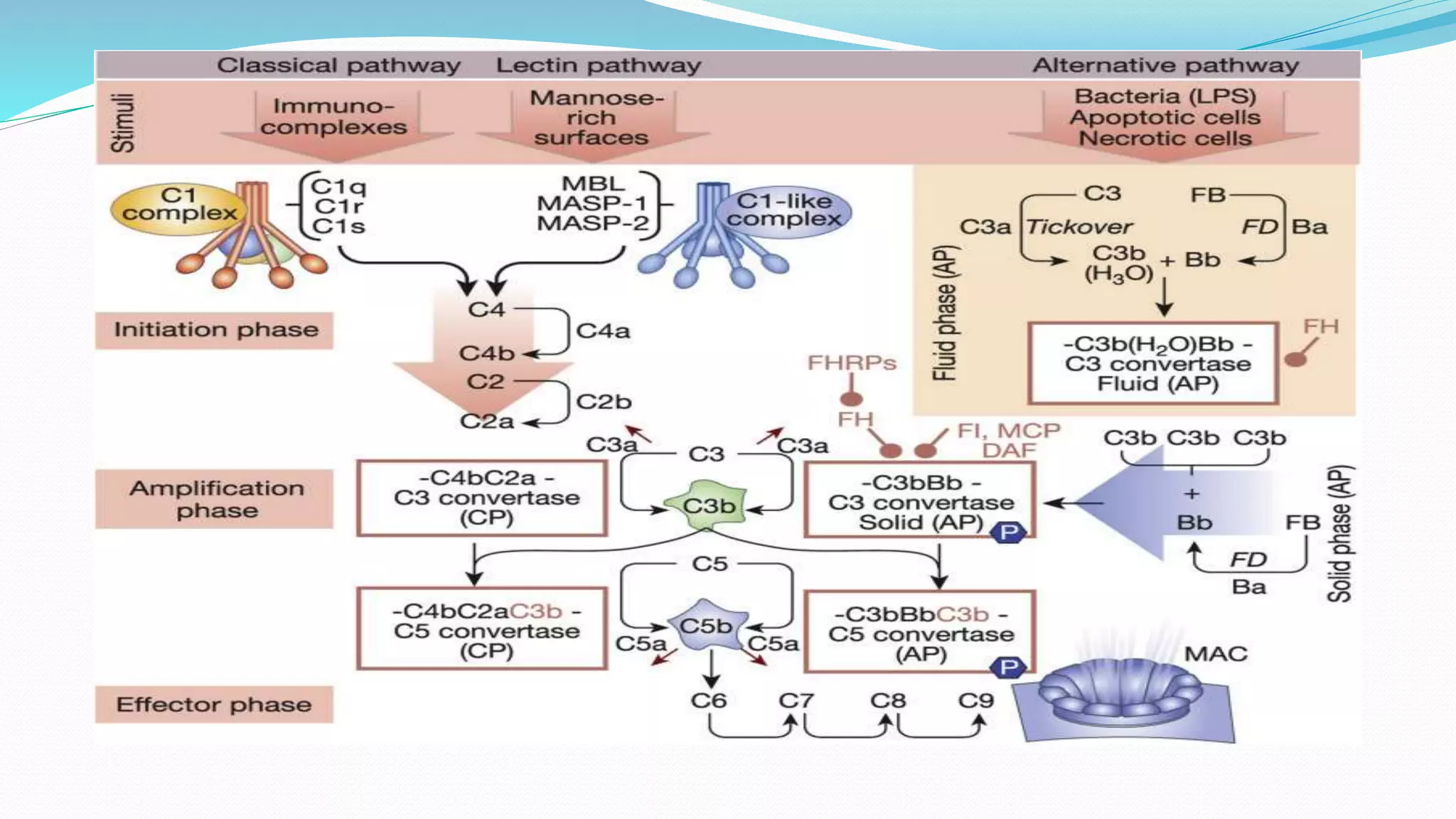
 Pathways of activation of Complement System
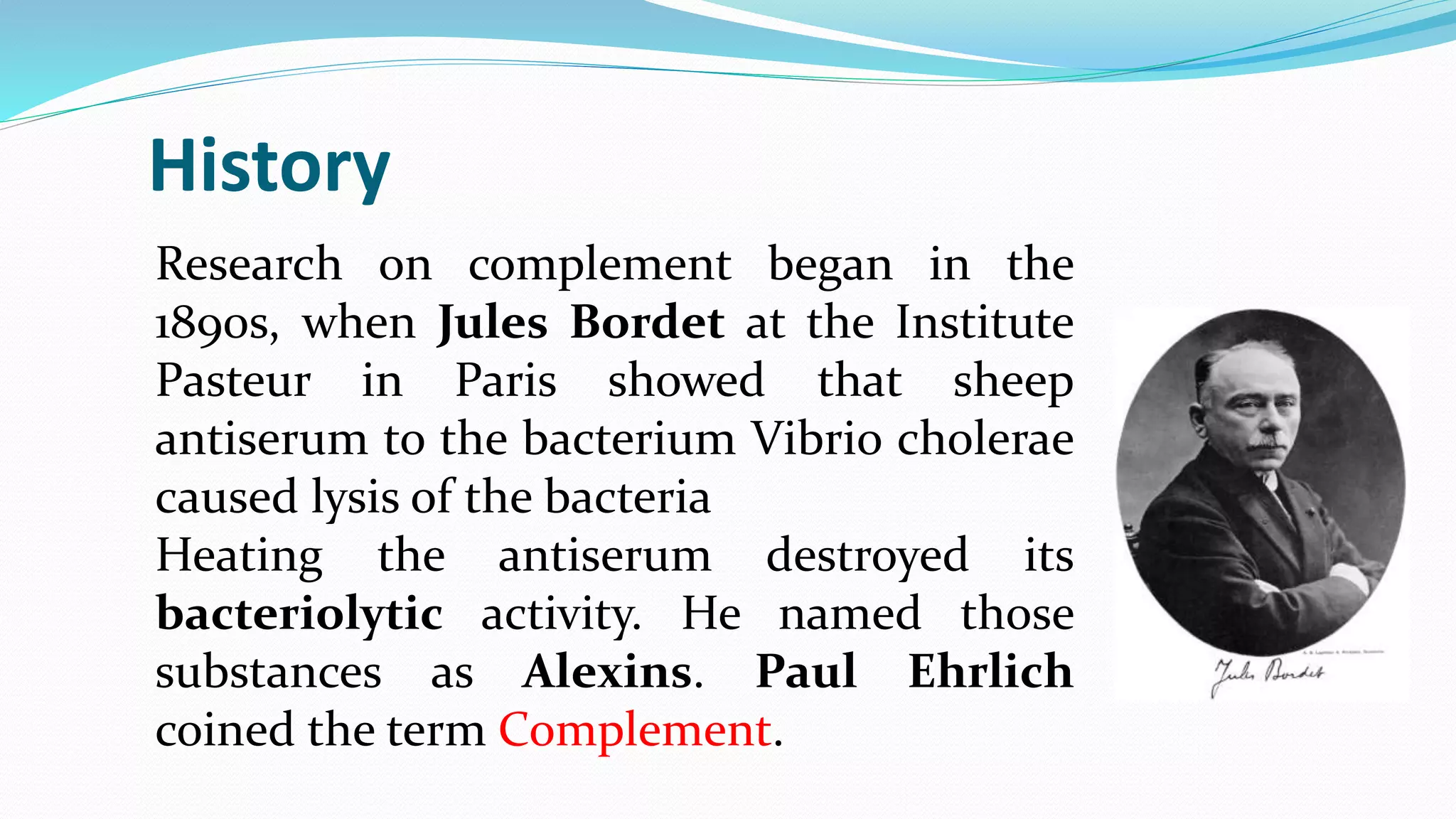
Research on complement began in the
1890s, when Jules Bordet at the Institute
Pasteur in Paris showed that sheep
antiserum to the bacterium Vibrio cholerae
caused lysis of the bacteria
Heating the antiserum destroyed its
bacteriolytic activity. He named those
substances as Alexins. Paul Ehrlich
coined the term Complement.
History
• Named as “complement system” because it was first identified
as a heat-labile component of serum that “complemented or
augment” antibodies in the killing of bacteria.
• Consists of serum and cell surface proteins involved in defense
against pathogens and tissue damage mediated by antibodies.
• Major effector of cellular and humoral branch of immune
system.
• Plays major role in both innate and adaptive immunity.
• Represents a group of about 30 proteins which augment or
complement the immune response.
• Serum or cell surfaces proteins
Introduction
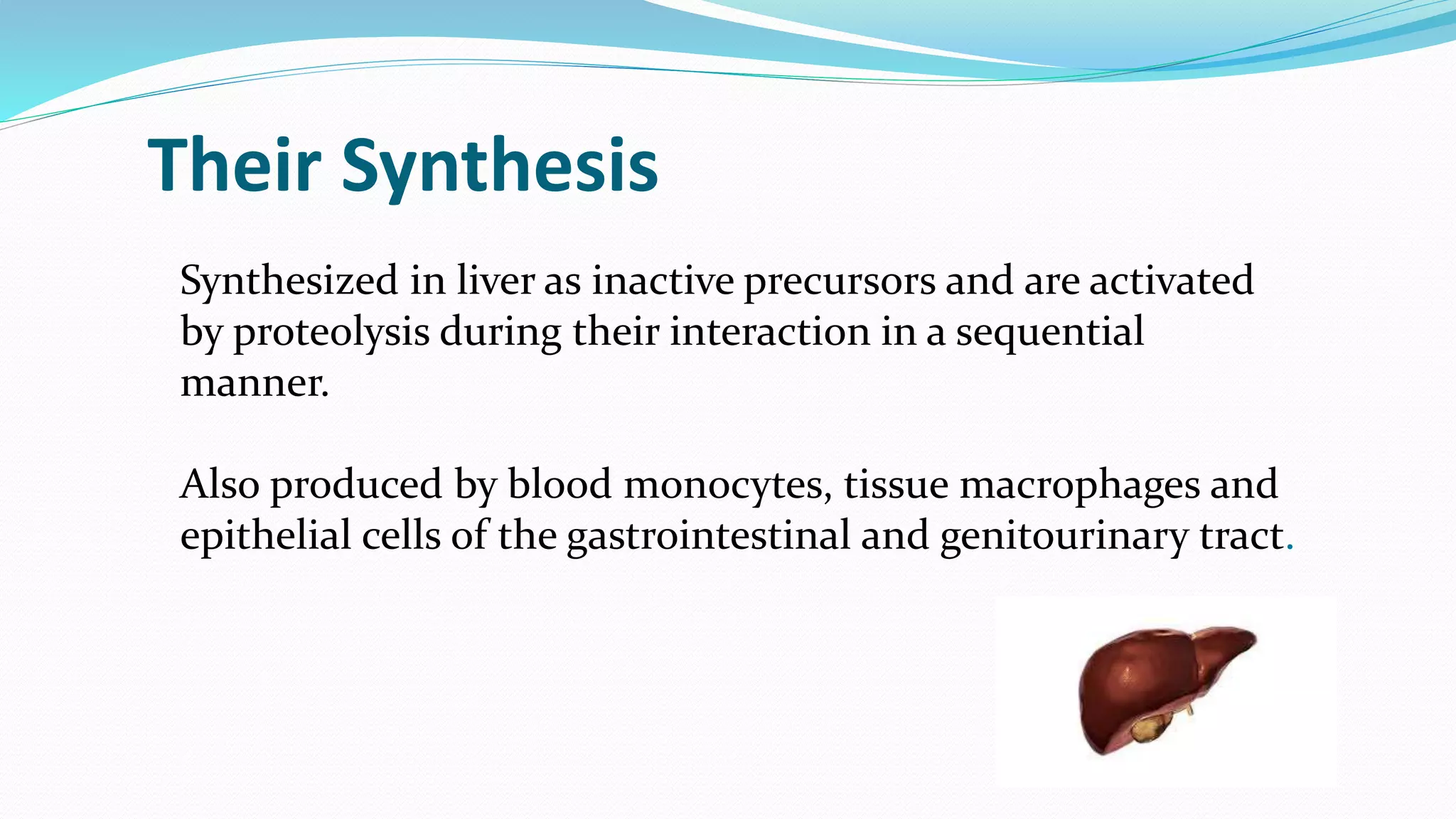
Synthesized in liver as inactive precursors and are activated
by proteolysis during their interaction in a sequential
manner.
Also produced by blood monocytes, tissue macrophages and
epithelial cells of the gastrointestinal and genitourinary tract.
Their Synthesis
o Present in serum of all animals
o Complement of one species are able to react with antibodies of
other species but not to the same extent.
o Constitute about 5% of normal serum protein, glycoproteins
o Are synthesized rapidly in inflammatory responses –hence are
called acute phase proteins.
o Heat labile and loses activity at 56⁰ C when heated for 30 mins
and inactivated.
o Immunoglobulins are not inactivated at this temperature.
o Binds with Fc potion of immunoglobulins.
General Properties
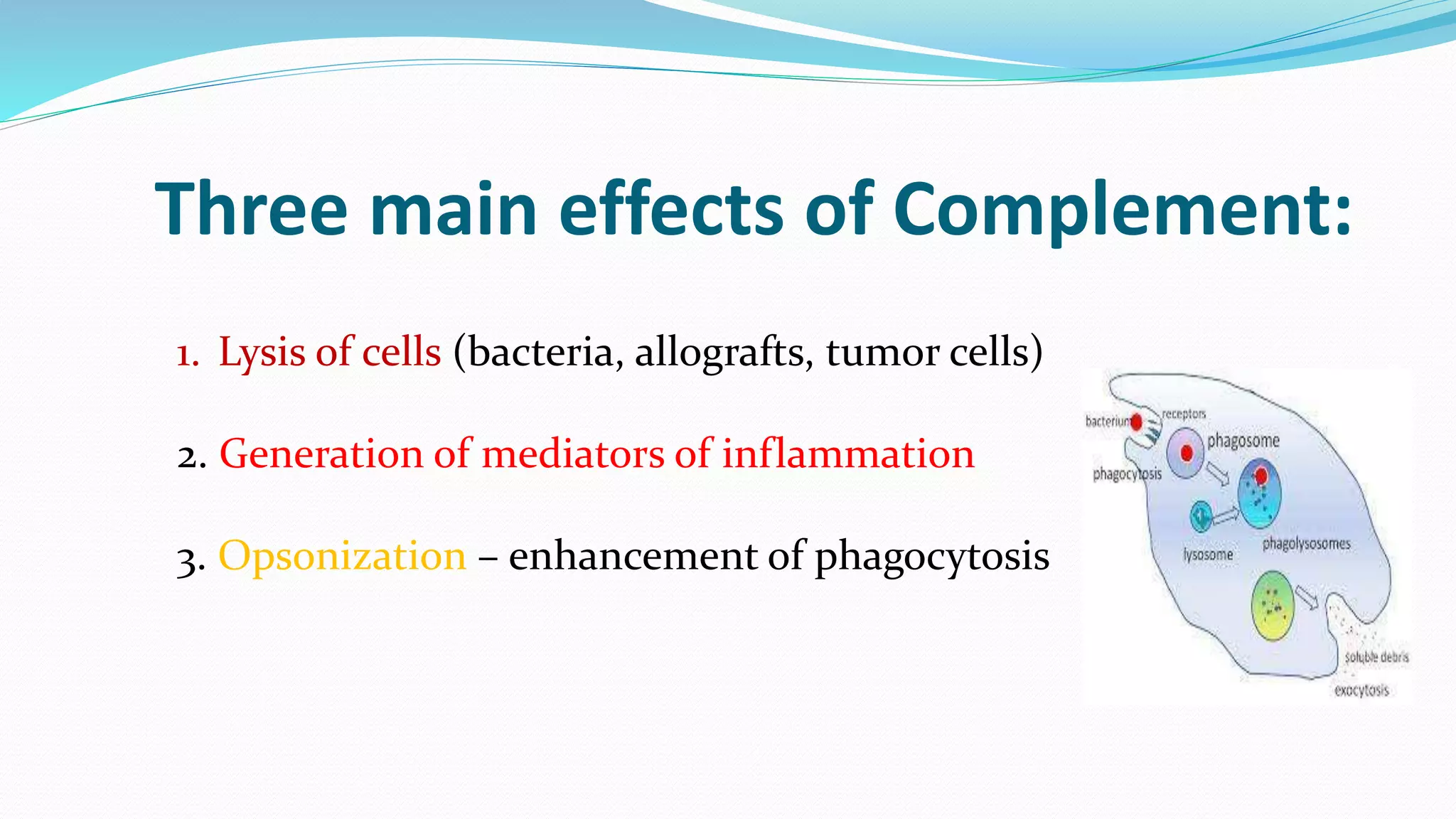
1. Lysis of cells (bacteria, allografts, tumor cells)
2. Generation of mediators of inflammation
3. Opsonization – enhancement of phagocytosis
Three main effects of Complement:
 Over 30 serum and cell surface proteins:
 Components are designated by numbers (E.g. ; C1 – C9) or letters (E.g. :
Factor D) (in serum inactive, activated sequentially as a cascade)
 Complement receptors (cell surface, recognize activated components)
 Regulatory proteins of complement (both in serum and cell surface, inhibit
activated components) Complement proteins: are proenzymes - activation
by cleavage.
 Example: C4 (C4a broken down to C4a and C4b where a = smaller
fragment moves out through diffusion and b= larger fragment -remains
bound to microbe )
 Exception: C2: C2a = large fragment C2b = small fragment
Components of these System:
1. Classical Pathway:- Is antibody dependent pathway and triggered by
formation of soluble antigen-antibody complex or by binding of the antibody
to the antigen present on the target cell surface.
2.Alternative Pathway:- Is antibody independent pathway stimulated by
antigen directly.
e.g. Bacterial cell surface components.
3.Lectin Pathway:- Also antibody independent but resembles classical
pathway.
Three pathway of Complement
activation:
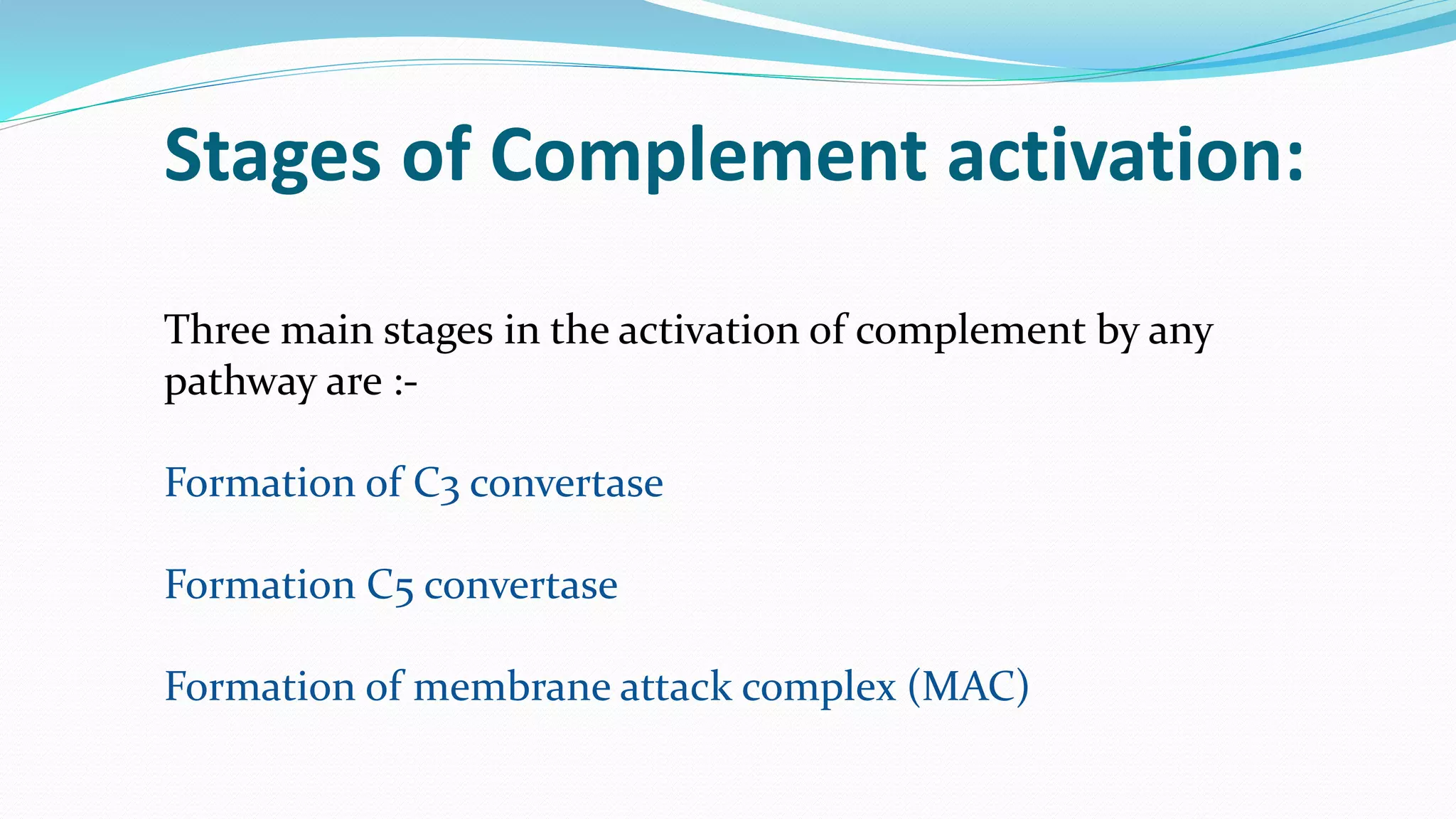
Stages of Complement activation:
Three main stages in the activation of complement by any
pathway are :-
Formation of C3 convertase
Formation C5 convertase
Formation of membrane attack complex (MAC)
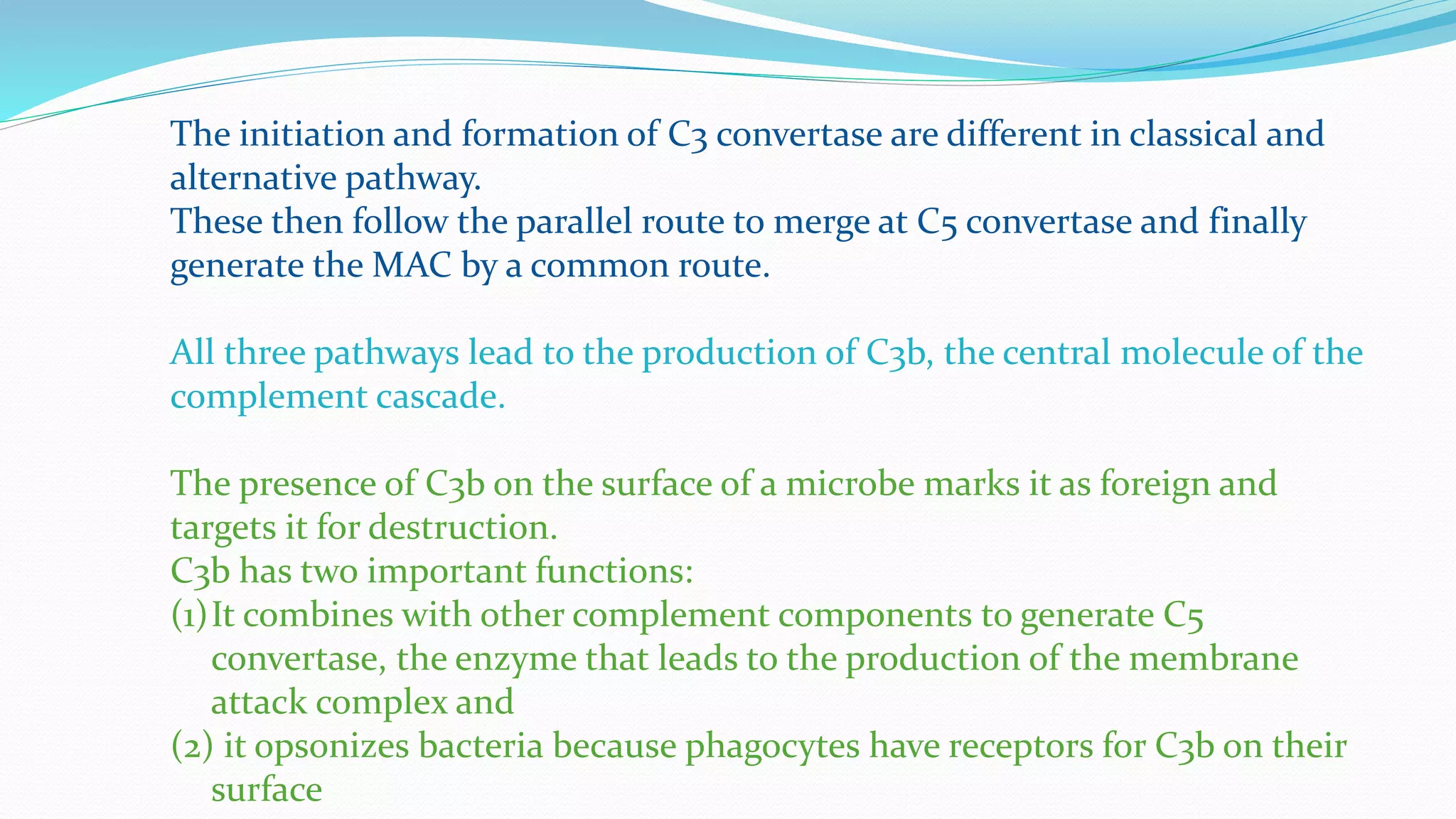
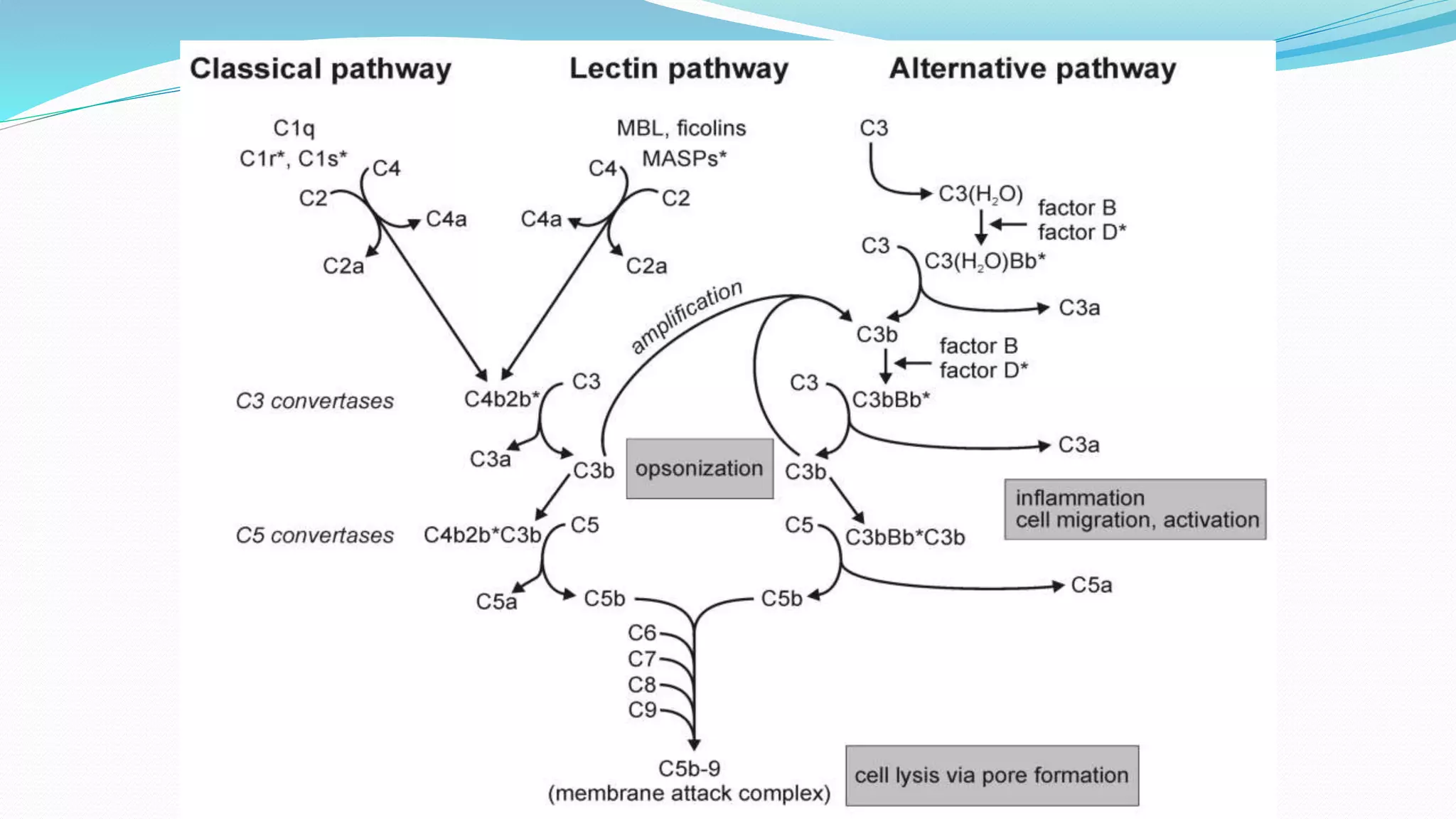
The initiation and formation of C3 convertase are different in classical and
alternative pathway.
These then follow the parallel route to merge at C5 convertase and finally
generate the MAC by a common route.
All three pathways lead to the production of C3b, the central molecule of the
complement cascade.
The presence of C3b on the surface of a microbe marks it as foreign and
targets it for destruction.
C3b has two important functions:
(1)It combines with other complement components to generate C5
convertase, the enzyme that leads to the production of the membrane
attack complex and
(2) it opsonizes bacteria because phagocytes have receptors for C3b on their
surface
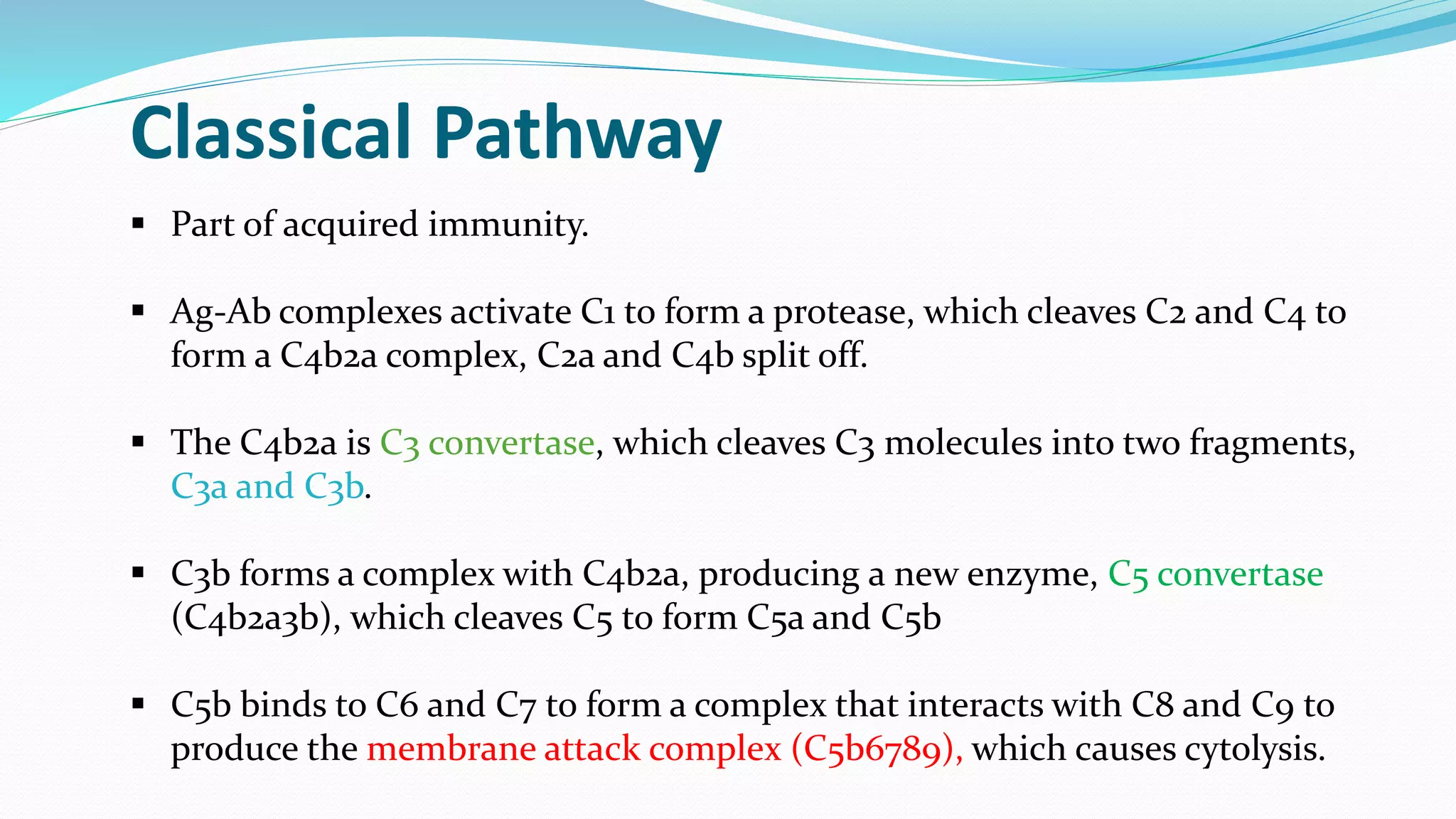
 Part of acquired immunity.
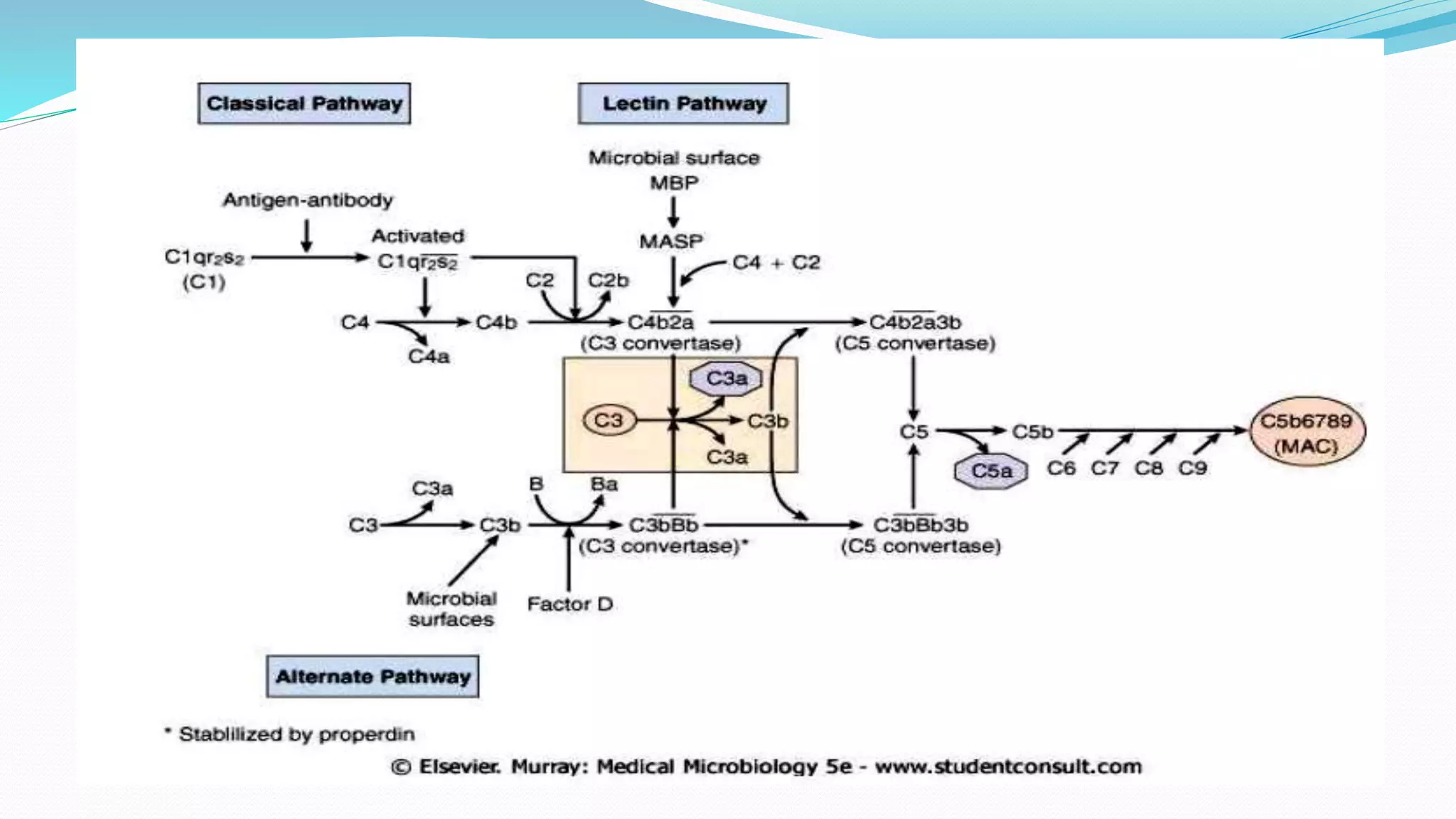
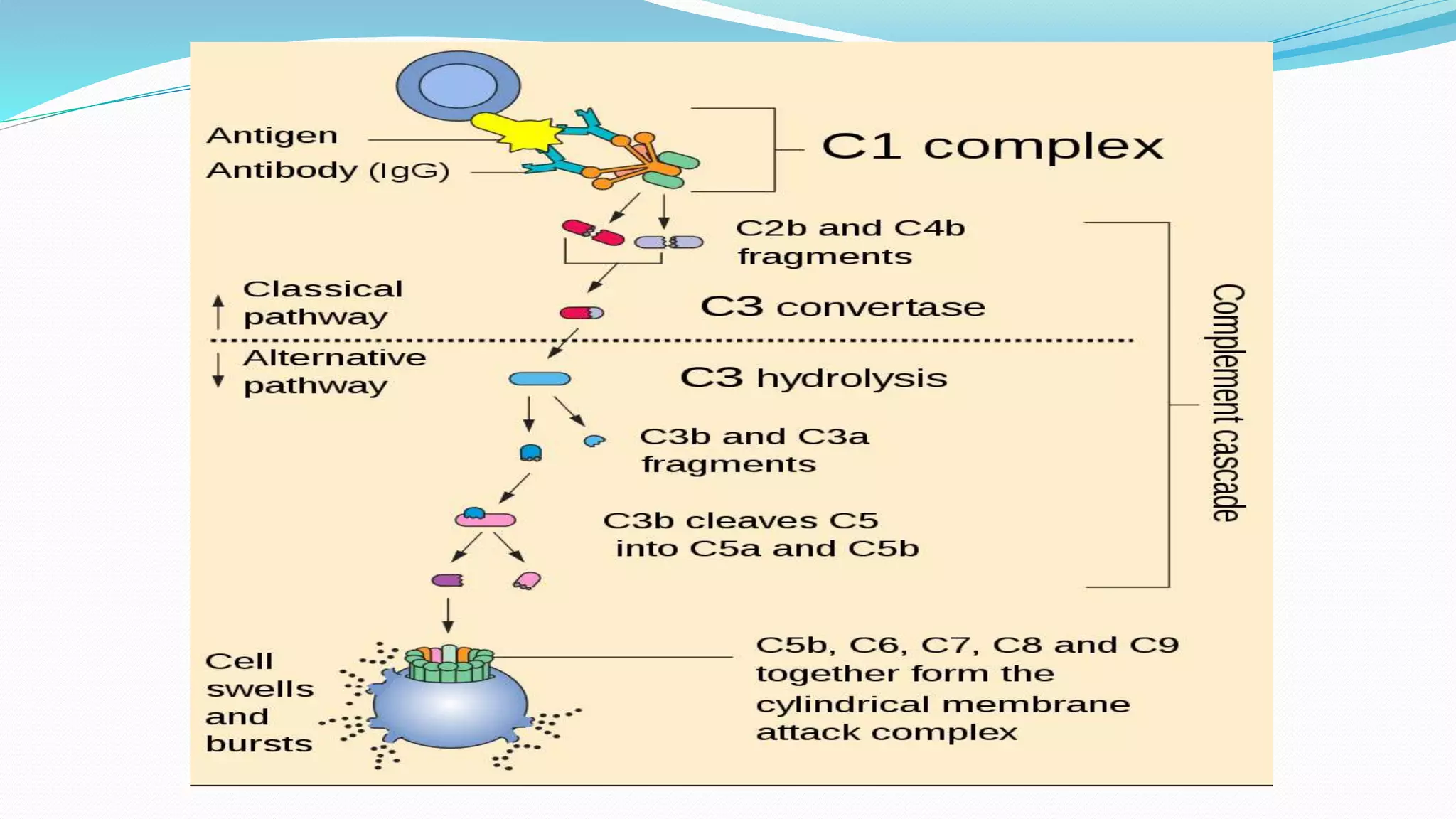
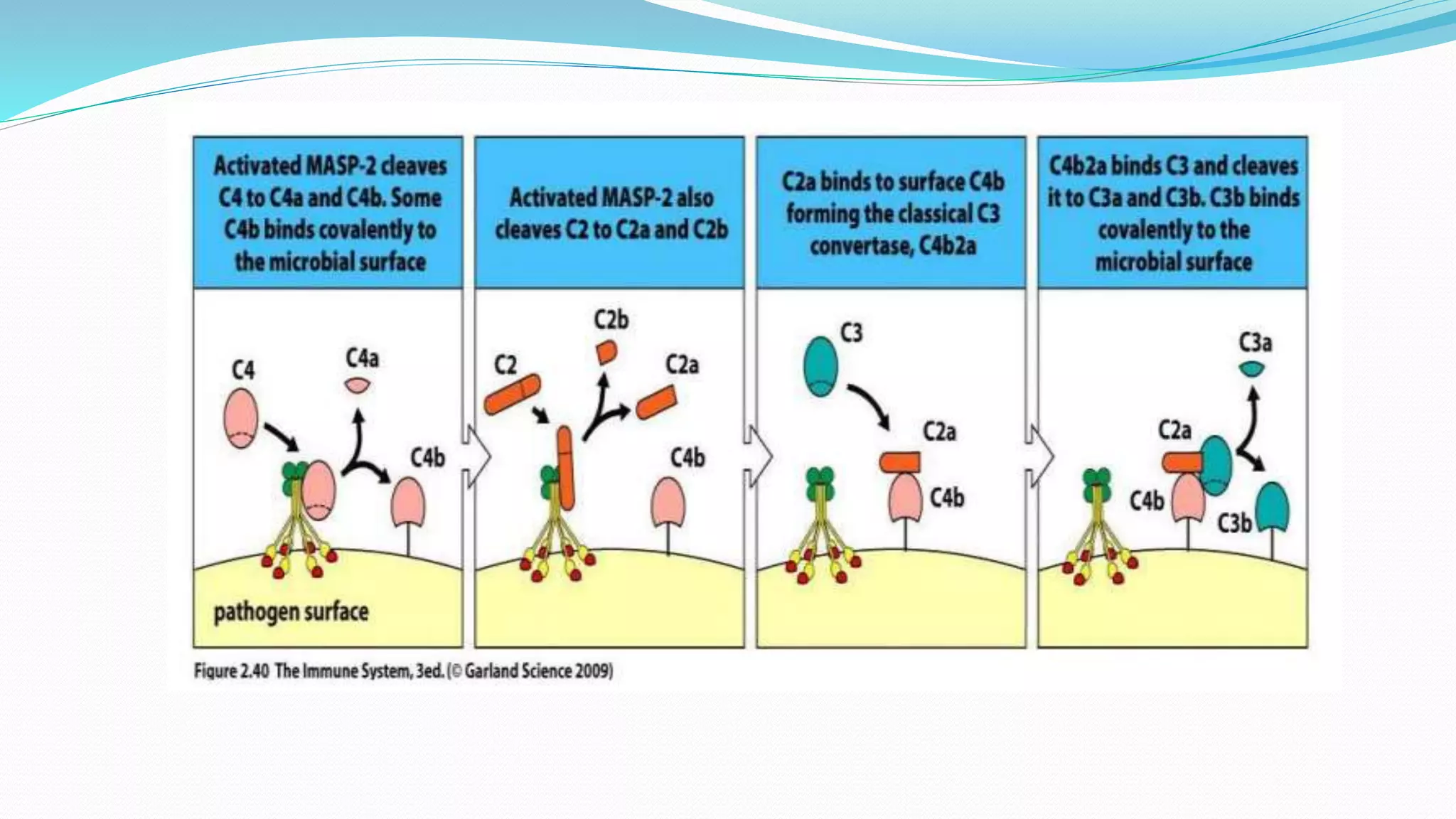
 Ag-Ab complexes activate C1 to form a protease, which cleaves C2 and C4 to
form a C4b2a complex, C2a and C4b split off.
 The C4b2a is C3 convertase, which cleaves C3 molecules into two fragments,
C3a and C3b.
 C3b forms a complex with C4b2a, producing a new enzyme, C5 convertase
(C4b2a3b), which cleaves C5 to form C5a and C5b
 C5b binds to C6 and C7 to form a complex that interacts with C8 and C9 to
produce the membrane attack complex (C5b6789), which causes cytolysis.
Classical Pathway
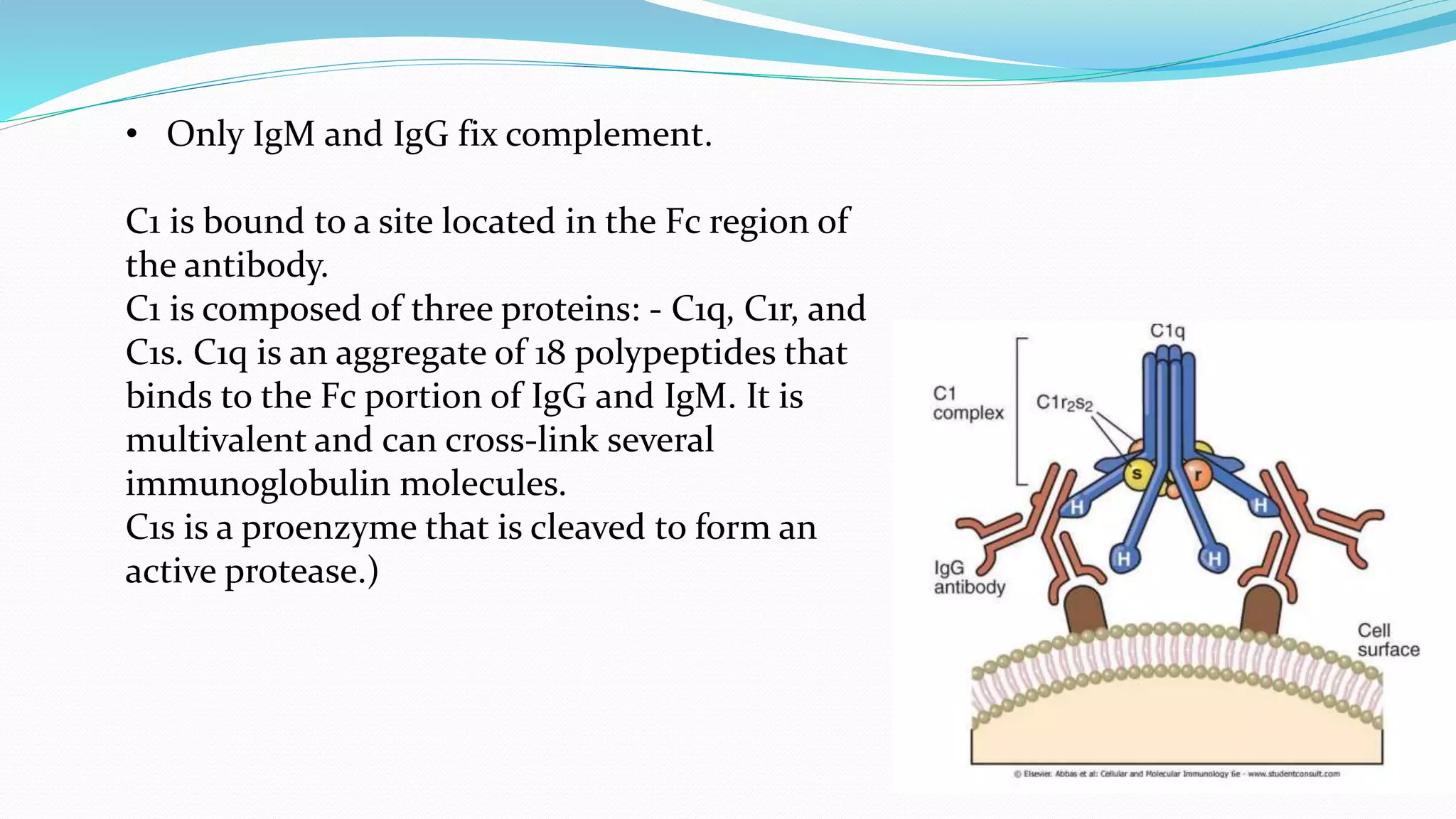
• Only IgM and IgG fix complement.
C1 is bound to a site located in the Fc region of
the antibody.
C1 is composed of three proteins: - C1q, C1r, and
C1s. C1q is an aggregate of 18 polypeptides that
binds to the Fc portion of IgG and IgM. It is
multivalent and can cross-link several
immunoglobulin molecules.
C1s is a proenzyme that is cleaved to form an
active protease.)
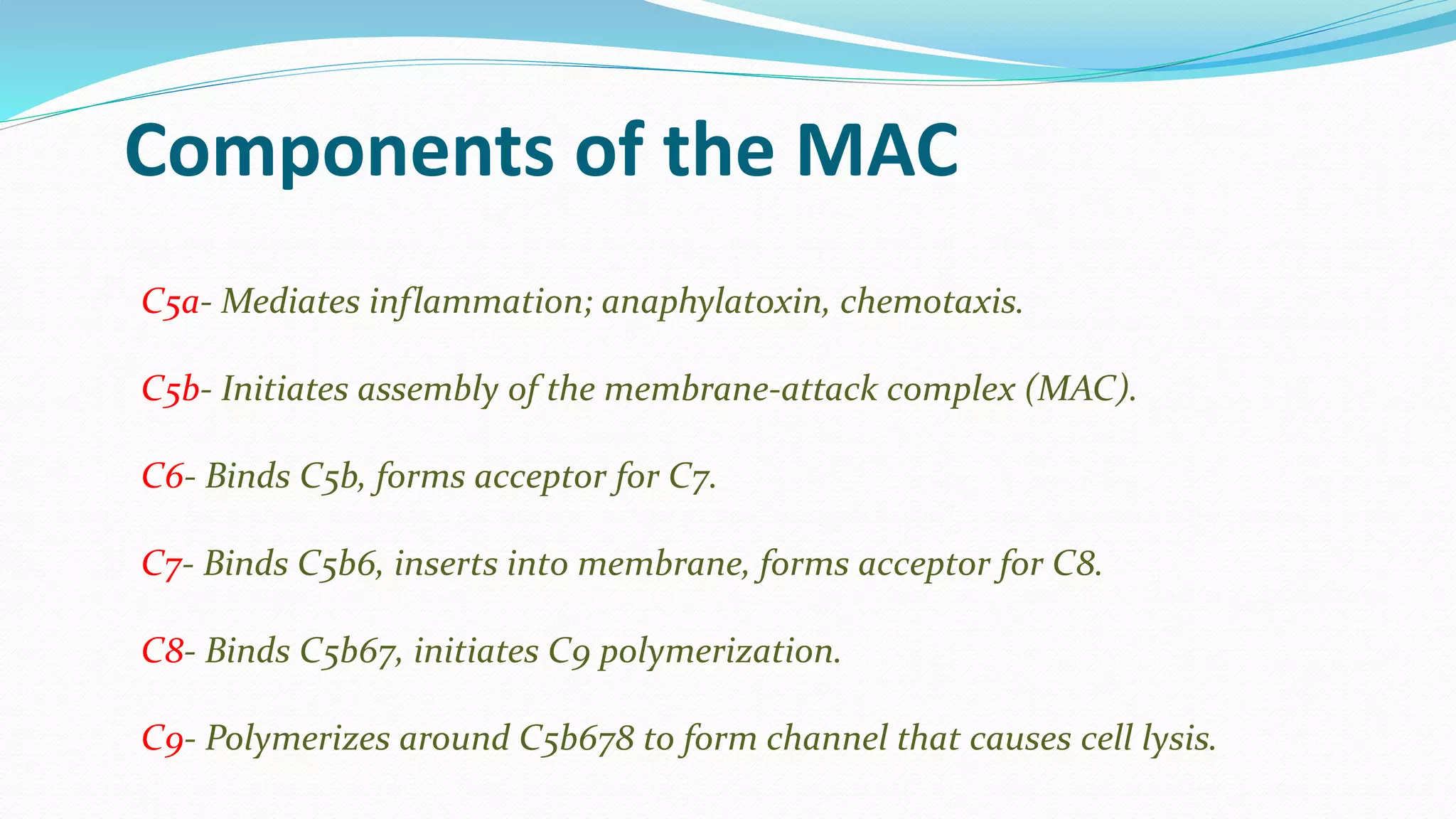
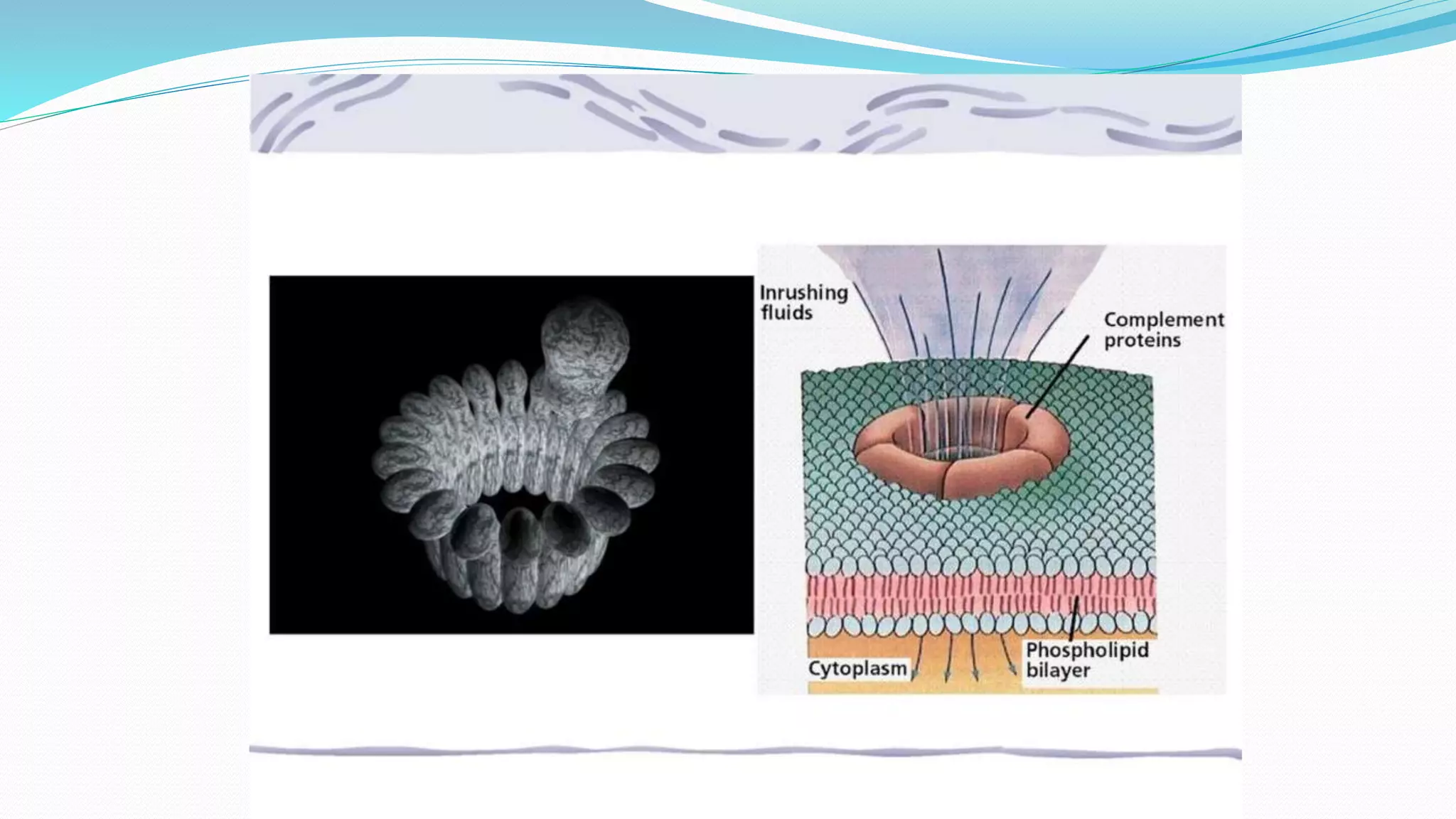
C5a- Mediates inflammation; anaphylatoxin, chemotaxis.
C5b- Initiates assembly of the membrane-attack complex (MAC).
C6- Binds C5b, forms acceptor for C7.
C7- Binds C5b6, inserts into membrane, forms acceptor for C8.
C8- Binds C5b67, initiates C9 polymerization.
C9- Polymerizes around C5b678 to form channel that causes cell lysis.
Components of the MAC
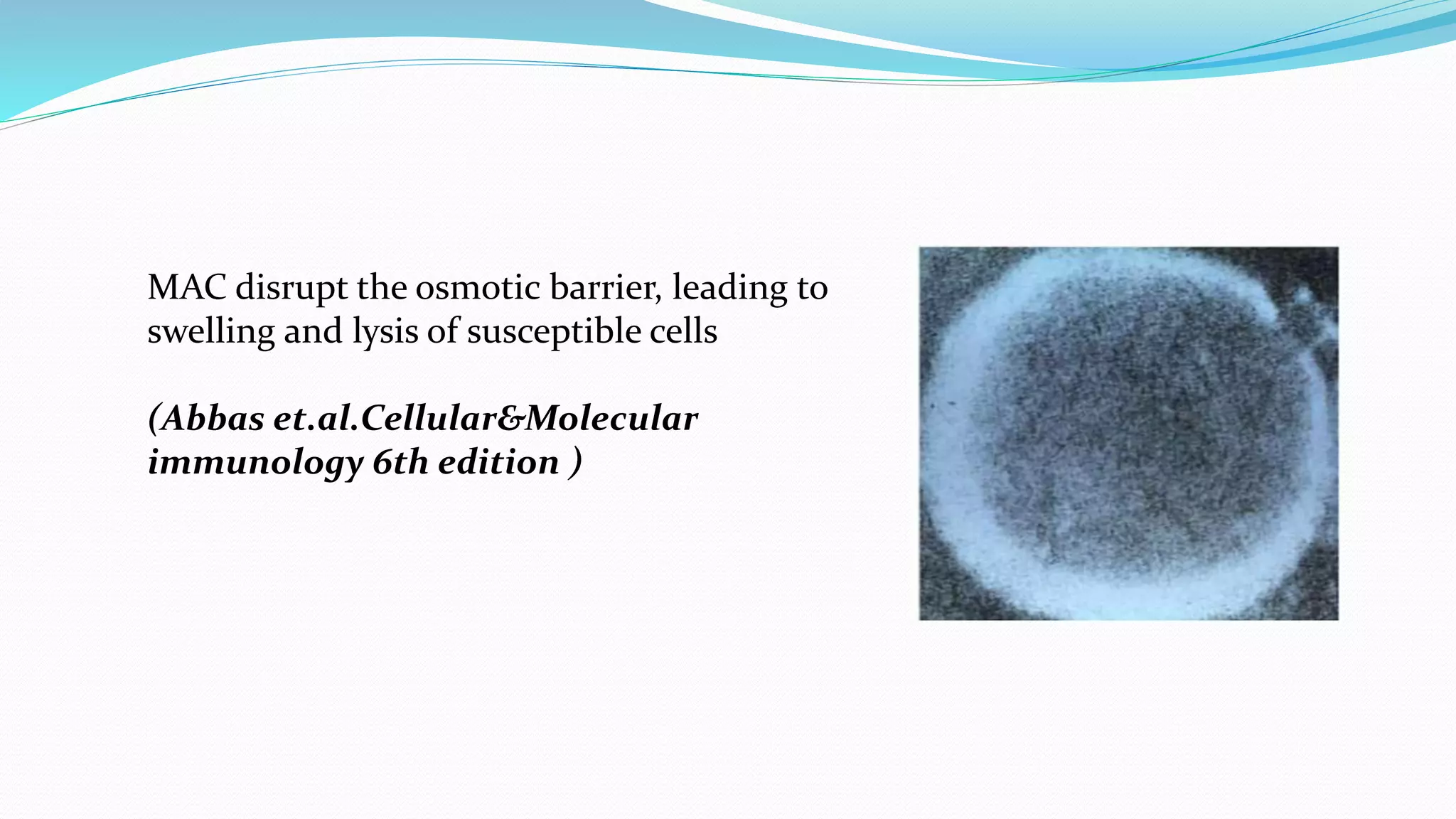
MAC disrupt the osmotic barrier, leading to
swelling and lysis of susceptible cells
(Abbas et.al.Cellular&Molecular
immunology 6th edition )
Ab independent pathway.
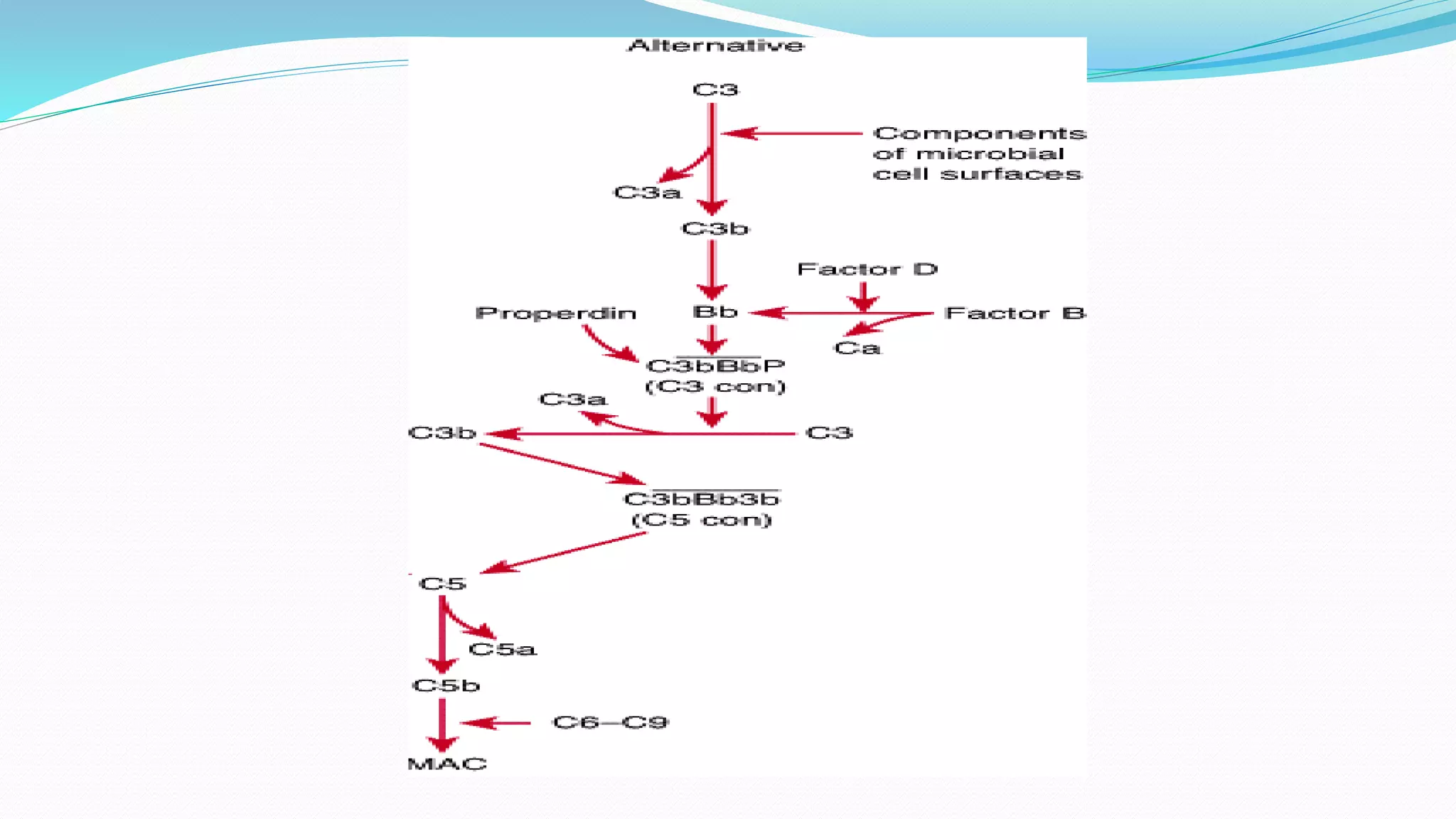
Many unrelated cell surface substances, e.g., bacterial
lipopolysaccharides (endotoxin), fungal cell walls, and viral envelopes,
can initiate the process by binding C3 and factor B.
This complex is cleaved by a protease, factor D, to produce C3bBb.
This acts as a C3 convertase to generate more C3b.
Alternative pathways are more important.
Alternative Pathway
The first time we are infected by a microorganism, the antibody required to
trigger the classic pathway is not present.
Usually activated by products of microorganisms like endotoxin
• Other activators include:
1. Complexes containing IgA
2. Some virus-infected cells (e.g. EBV)
3. Many gram negative and gram positive organisms
4. Parasites – Trypanosomes, Leishmania
5. Erythrocytes
6. Carbohydrates (agarose)
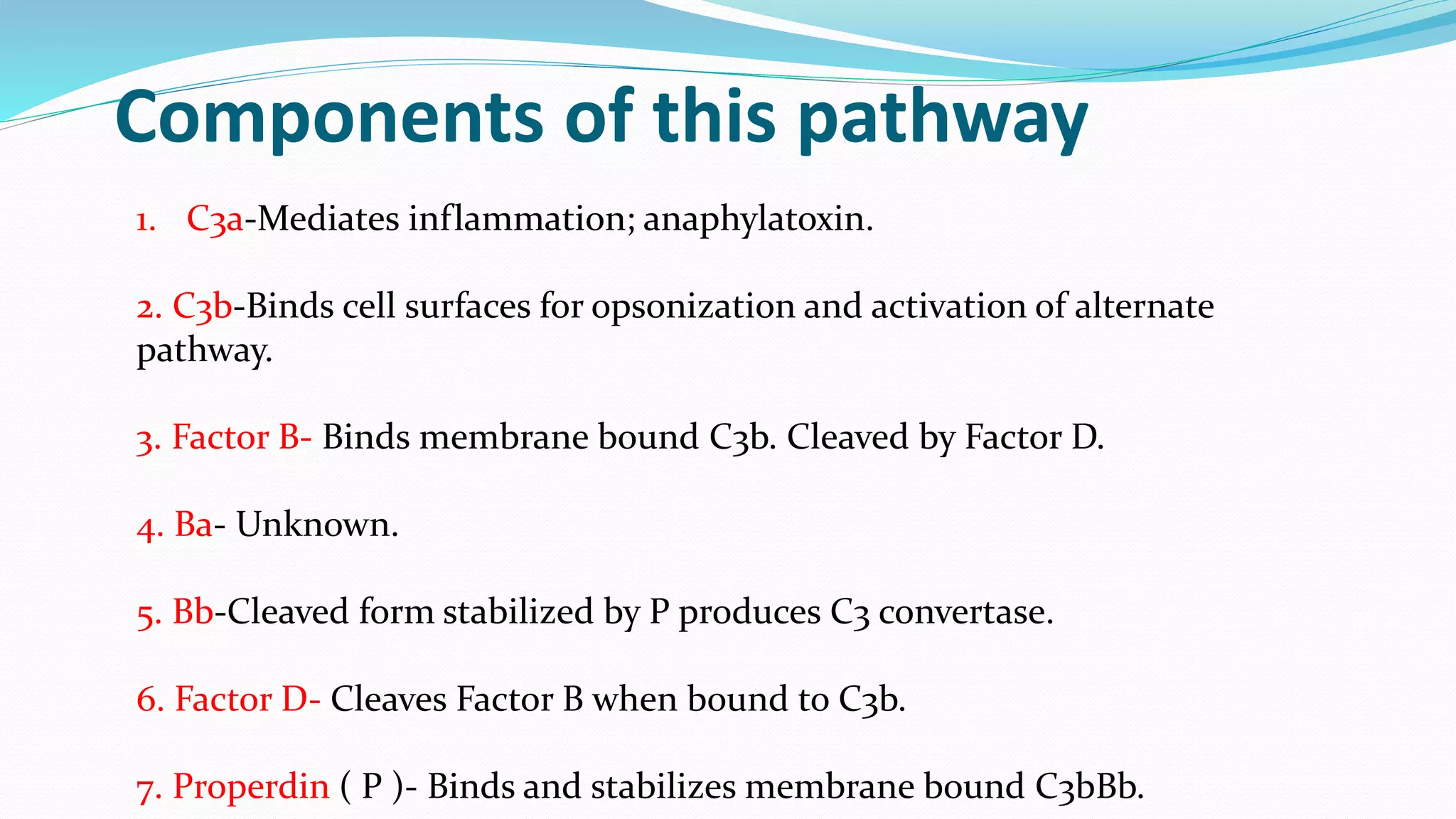
1. C3a-Mediates inflammation; anaphylatoxin.
2. C3b-Binds cell surfaces for opsonization and activation of alternate
pathway.
3. Factor B- Binds membrane bound C3b. Cleaved by Factor D.
4. Ba- Unknown.
5. Bb-Cleaved form stabilized by P produces C3 convertase.
6. Factor D- Cleaves Factor B when bound to C3b.
7. Properdin ( P )- Binds and stabilizes membrane bound C3bBb.
Components of this pathway
Also known as the MBL Pathway
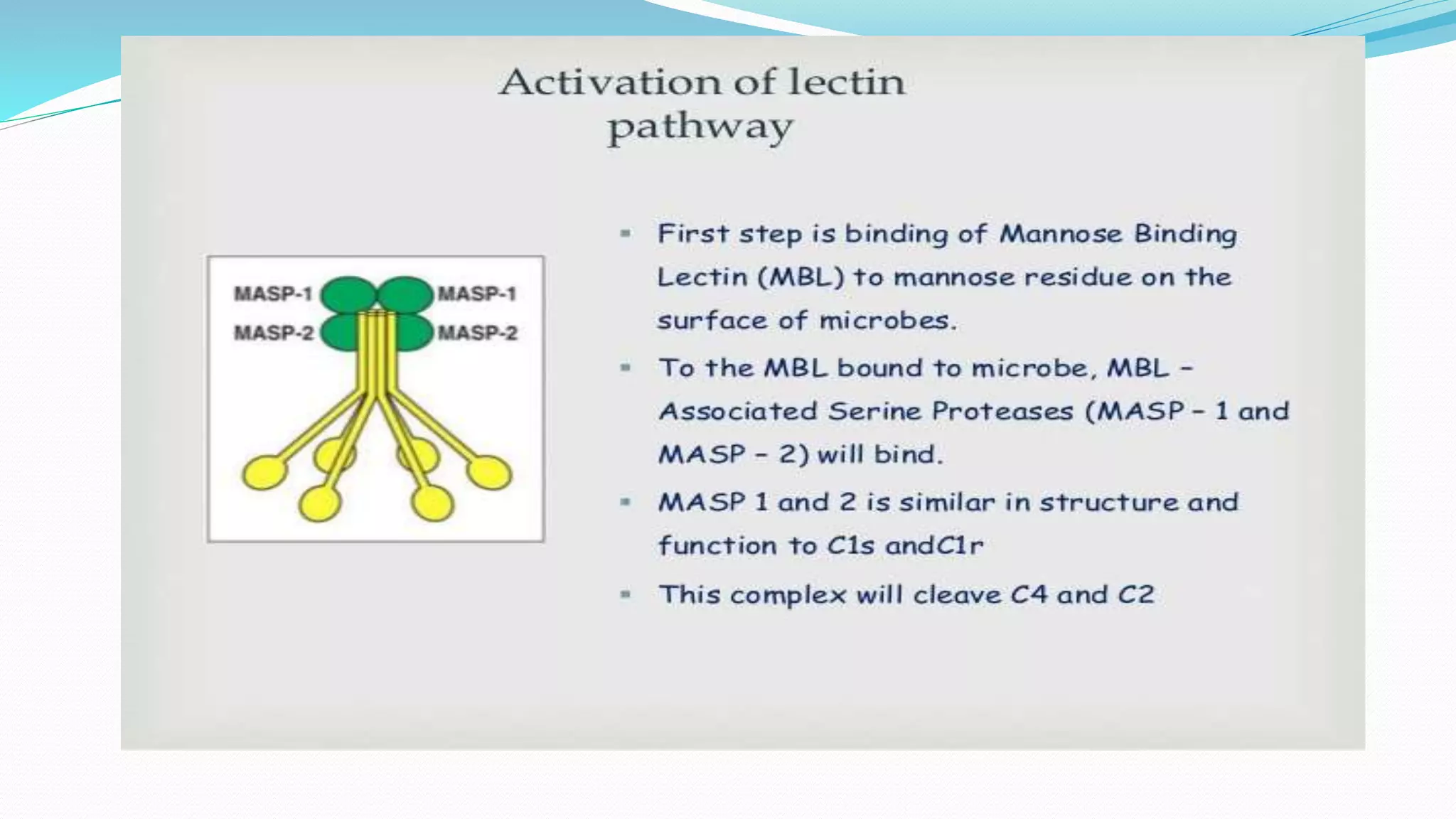
• In the lectin pathway, Mannan-binding lectin (MBL)(also known as
mannose-binding protein) binds to the surface of microbes bearing
mannan (a polymer of the sugar, mannose).
• Binding causes activation of MASP (MBP- associated serine proteases)
cleave C2 and C4 and activate the classic pathway.
Note
This process bypasses the antibody-requiring step and so is protective early
in infection before antibody is formed.
Lectin Pathway
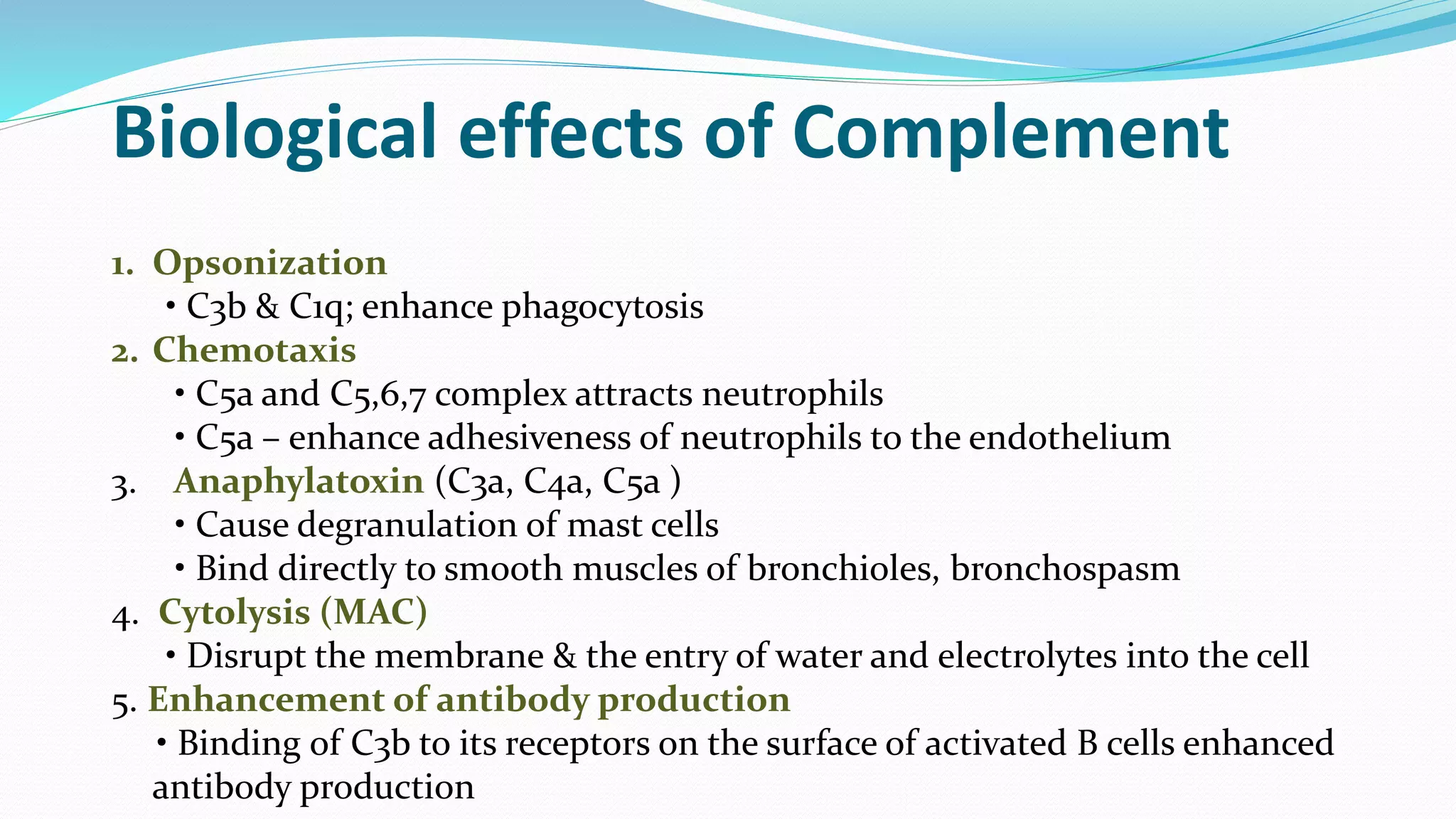
1. Opsonization
• C3b & C1q; enhance phagocytosis
2. Chemotaxis
• C5a and C5,6,7 complex attracts neutrophils
• C5a – enhance adhesiveness of neutrophils to the endothelium
3. Anaphylatoxin (C3a, C4a, C5a )
• Cause degranulation of mast cells
• Bind directly to smooth muscles of bronchioles, bronchospasm
4. Cytolysis (MAC)
• Disrupt the membrane & the entry of water and electrolytes into the cell
5. Enhancement of antibody production
• Binding of C3b to its receptors on the surface of activated B cells enhanced
antibody production
Biological effects of Complement
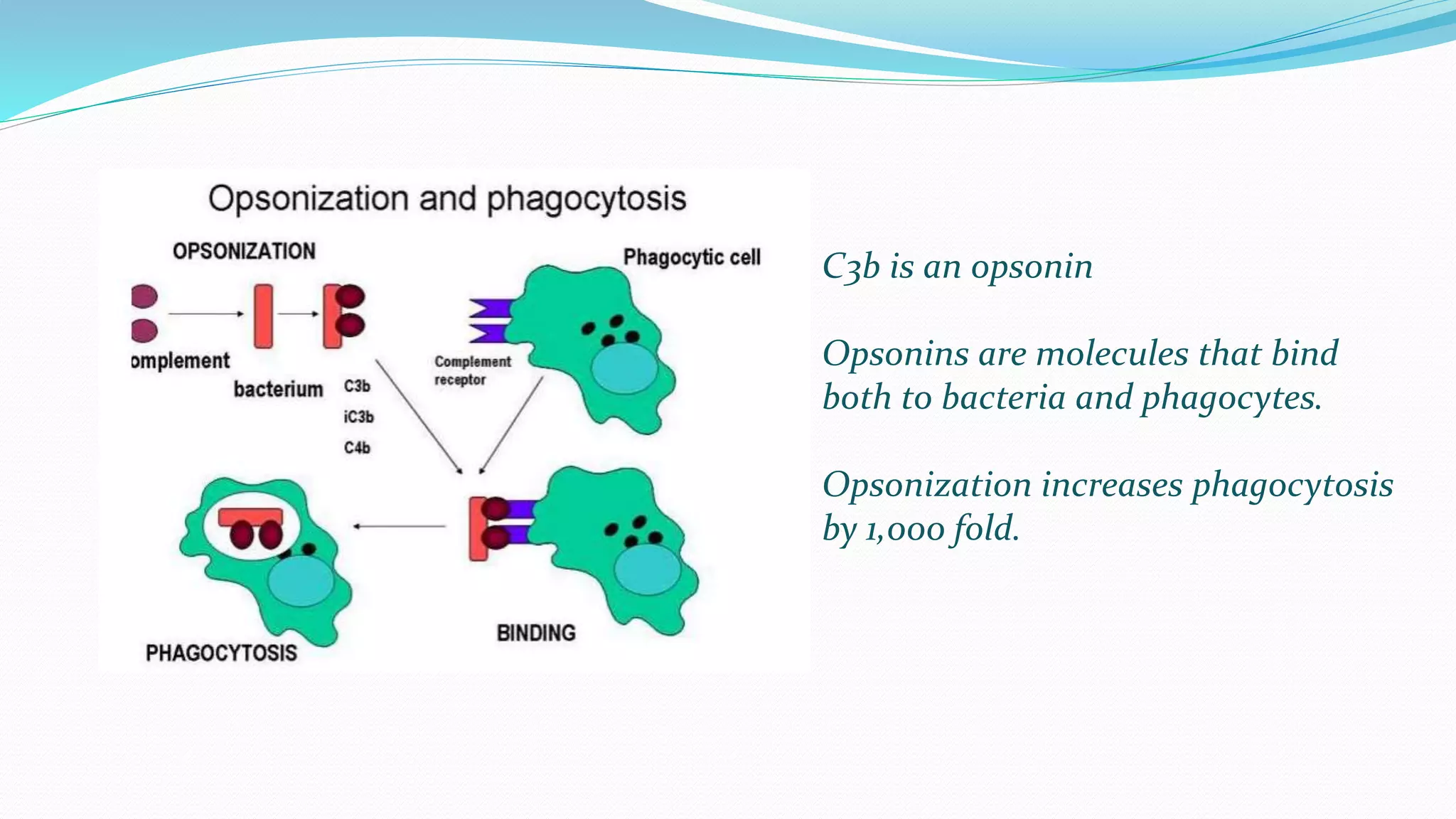
C3b is an opsonin
Opsonins are molecules that bind
both to bacteria and phagocytes.
Opsonization increases phagocytosis
by 1,000 fold.
Complement System © 2023 by Moumita Mitra is licensed under CC BY-NC-SA 4.0

Complement system.pptx

  • 1.
  • 2.
    Topics to bediscussed  History of Complement  Introduction to different Complement proteins  General Properties  Components of Complement System  Pathways of activation of Complement System
  • 3.
    Research on complementbegan in the 1890s, when Jules Bordet at the Institute Pasteur in Paris showed that sheep antiserum to the bacterium Vibrio cholerae caused lysis of the bacteria Heating the antiserum destroyed its bacteriolytic activity. He named those substances as Alexins. Paul Ehrlich coined the term Complement. History
  • 4.
    • Named as“complement system” because it was first identified as a heat-labile component of serum that “complemented or augment” antibodies in the killing of bacteria. • Consists of serum and cell surface proteins involved in defense against pathogens and tissue damage mediated by antibodies. • Major effector of cellular and humoral branch of immune system. • Plays major role in both innate and adaptive immunity. • Represents a group of about 30 proteins which augment or complement the immune response. • Serum or cell surfaces proteins Introduction
  • 5.
    Synthesized in liveras inactive precursors and are activated by proteolysis during their interaction in a sequential manner. Also produced by blood monocytes, tissue macrophages and epithelial cells of the gastrointestinal and genitourinary tract. Their Synthesis
  • 6.
    o Present inserum of all animals o Complement of one species are able to react with antibodies of other species but not to the same extent. o Constitute about 5% of normal serum protein, glycoproteins o Are synthesized rapidly in inflammatory responses –hence are called acute phase proteins. o Heat labile and loses activity at 56⁰ C when heated for 30 mins and inactivated. o Immunoglobulins are not inactivated at this temperature. o Binds with Fc potion of immunoglobulins. General Properties
  • 7.
    1. Lysis ofcells (bacteria, allografts, tumor cells) 2. Generation of mediators of inflammation 3. Opsonization – enhancement of phagocytosis Three main effects of Complement:
  • 8.
     Over 30serum and cell surface proteins:  Components are designated by numbers (E.g. ; C1 – C9) or letters (E.g. : Factor D) (in serum inactive, activated sequentially as a cascade)  Complement receptors (cell surface, recognize activated components)  Regulatory proteins of complement (both in serum and cell surface, inhibit activated components) Complement proteins: are proenzymes - activation by cleavage.  Example: C4 (C4a broken down to C4a and C4b where a = smaller fragment moves out through diffusion and b= larger fragment -remains bound to microbe )  Exception: C2: C2a = large fragment C2b = small fragment Components of these System:
  • 9.
    1. Classical Pathway:-Is antibody dependent pathway and triggered by formation of soluble antigen-antibody complex or by binding of the antibody to the antigen present on the target cell surface. 2.Alternative Pathway:- Is antibody independent pathway stimulated by antigen directly. e.g. Bacterial cell surface components. 3.Lectin Pathway:- Also antibody independent but resembles classical pathway. Three pathway of Complement activation:
  • 10.
    Stages of Complementactivation: Three main stages in the activation of complement by any pathway are :- Formation of C3 convertase Formation C5 convertase Formation of membrane attack complex (MAC)
  • 11.
    The initiation andformation of C3 convertase are different in classical and alternative pathway. These then follow the parallel route to merge at C5 convertase and finally generate the MAC by a common route. All three pathways lead to the production of C3b, the central molecule of the complement cascade. The presence of C3b on the surface of a microbe marks it as foreign and targets it for destruction. C3b has two important functions: (1)It combines with other complement components to generate C5 convertase, the enzyme that leads to the production of the membrane attack complex and (2) it opsonizes bacteria because phagocytes have receptors for C3b on their surface
  • 12.
     Part ofacquired immunity.  Ag-Ab complexes activate C1 to form a protease, which cleaves C2 and C4 to form a C4b2a complex, C2a and C4b split off.  The C4b2a is C3 convertase, which cleaves C3 molecules into two fragments, C3a and C3b.  C3b forms a complex with C4b2a, producing a new enzyme, C5 convertase (C4b2a3b), which cleaves C5 to form C5a and C5b  C5b binds to C6 and C7 to form a complex that interacts with C8 and C9 to produce the membrane attack complex (C5b6789), which causes cytolysis. Classical Pathway
  • 13.
    • Only IgMand IgG fix complement. C1 is bound to a site located in the Fc region of the antibody. C1 is composed of three proteins: - C1q, C1r, and C1s. C1q is an aggregate of 18 polypeptides that binds to the Fc portion of IgG and IgM. It is multivalent and can cross-link several immunoglobulin molecules. C1s is a proenzyme that is cleaved to form an active protease.)
  • 16.
    C5a- Mediates inflammation;anaphylatoxin, chemotaxis. C5b- Initiates assembly of the membrane-attack complex (MAC). C6- Binds C5b, forms acceptor for C7. C7- Binds C5b6, inserts into membrane, forms acceptor for C8. C8- Binds C5b67, initiates C9 polymerization. C9- Polymerizes around C5b678 to form channel that causes cell lysis. Components of the MAC
  • 17.
    MAC disrupt theosmotic barrier, leading to swelling and lysis of susceptible cells (Abbas et.al.Cellular&Molecular immunology 6th edition )
  • 19.
    Ab independent pathway. Manyunrelated cell surface substances, e.g., bacterial lipopolysaccharides (endotoxin), fungal cell walls, and viral envelopes, can initiate the process by binding C3 and factor B. This complex is cleaved by a protease, factor D, to produce C3bBb. This acts as a C3 convertase to generate more C3b. Alternative pathways are more important. Alternative Pathway
  • 20.
    The first timewe are infected by a microorganism, the antibody required to trigger the classic pathway is not present. Usually activated by products of microorganisms like endotoxin • Other activators include: 1. Complexes containing IgA 2. Some virus-infected cells (e.g. EBV) 3. Many gram negative and gram positive organisms 4. Parasites – Trypanosomes, Leishmania 5. Erythrocytes 6. Carbohydrates (agarose)
  • 21.
    1. C3a-Mediates inflammation;anaphylatoxin. 2. C3b-Binds cell surfaces for opsonization and activation of alternate pathway. 3. Factor B- Binds membrane bound C3b. Cleaved by Factor D. 4. Ba- Unknown. 5. Bb-Cleaved form stabilized by P produces C3 convertase. 6. Factor D- Cleaves Factor B when bound to C3b. 7. Properdin ( P )- Binds and stabilizes membrane bound C3bBb. Components of this pathway
  • 24.
    Also known asthe MBL Pathway • In the lectin pathway, Mannan-binding lectin (MBL)(also known as mannose-binding protein) binds to the surface of microbes bearing mannan (a polymer of the sugar, mannose). • Binding causes activation of MASP (MBP- associated serine proteases) cleave C2 and C4 and activate the classic pathway. Note This process bypasses the antibody-requiring step and so is protective early in infection before antibody is formed. Lectin Pathway
  • 27.
    1. Opsonization • C3b& C1q; enhance phagocytosis 2. Chemotaxis • C5a and C5,6,7 complex attracts neutrophils • C5a – enhance adhesiveness of neutrophils to the endothelium 3. Anaphylatoxin (C3a, C4a, C5a ) • Cause degranulation of mast cells • Bind directly to smooth muscles of bronchioles, bronchospasm 4. Cytolysis (MAC) • Disrupt the membrane & the entry of water and electrolytes into the cell 5. Enhancement of antibody production • Binding of C3b to its receptors on the surface of activated B cells enhanced antibody production Biological effects of Complement
  • 28.
    C3b is anopsonin Opsonins are molecules that bind both to bacteria and phagocytes. Opsonization increases phagocytosis by 1,000 fold.
  • 30.
    Complement System ©2023 by Moumita Mitra is licensed under CC BY-NC-SA 4.0