The complement system
• The complement system is a multi-component system that
functions to eliminate microbes.
• The Complement is composed of more than 25 different
proteins produced by different tissues and cells including
hepatocytes, macrophages and gut epithelial cells
– C1(qrs), C2, C3, C4, C5, C6, C7, C8, C9
– factors B, D, H and I, properdin (P)
– mannose binding lectin (MBL), MBL associated serine
proteases (MASP-1 MASP-2)
– C1 inhibitor (C1-INH, serpin), C4-binding protein (C4-
BP), decay accelerating factor (DAF), Complement
receptor 1 (CR1), protein-S (vitronectin)
Functions of Complement
1. Direct Lysis of bacteria, some viruses and cells.
2. Opsonization and enhanced phagocytosis.
3. Triggers cellular functions that contribute to inflammation.
- Chemokine, histamine release due to complement
products called anaphylatoxins
4. Facilitates removal of immune complexes in liver and
spleen.
• Activation of complement involves the sequential proteolysis
of proteins
• Peptide fragments by activation of a component are denoted
by small letters
• Letter “b” is usually added to the larger, membrane-binding,
peptide and “a” to the smaller peptide (e.g., C3b/C3a,
C4b/C4a, C5b/C5a), EXCEPT C2 (the larger, membrane-
binding moiety is C2a; the smaller one is C2b)
• The smaller fragments usually diffuse away and may bind to
cell surface receptors to trigger localized inflammatory
response= anaphylatoxins.
• The larger fragment usually remains bound to target cells
and facilitate lysis.
• Those complexes that have enzymatic activity are
designated by a bar over the number or symbol (e.g.,
C4b2a, C3bBb)
• Once activated a proteolytic cascade is initiated that
ultimately results in complement activation
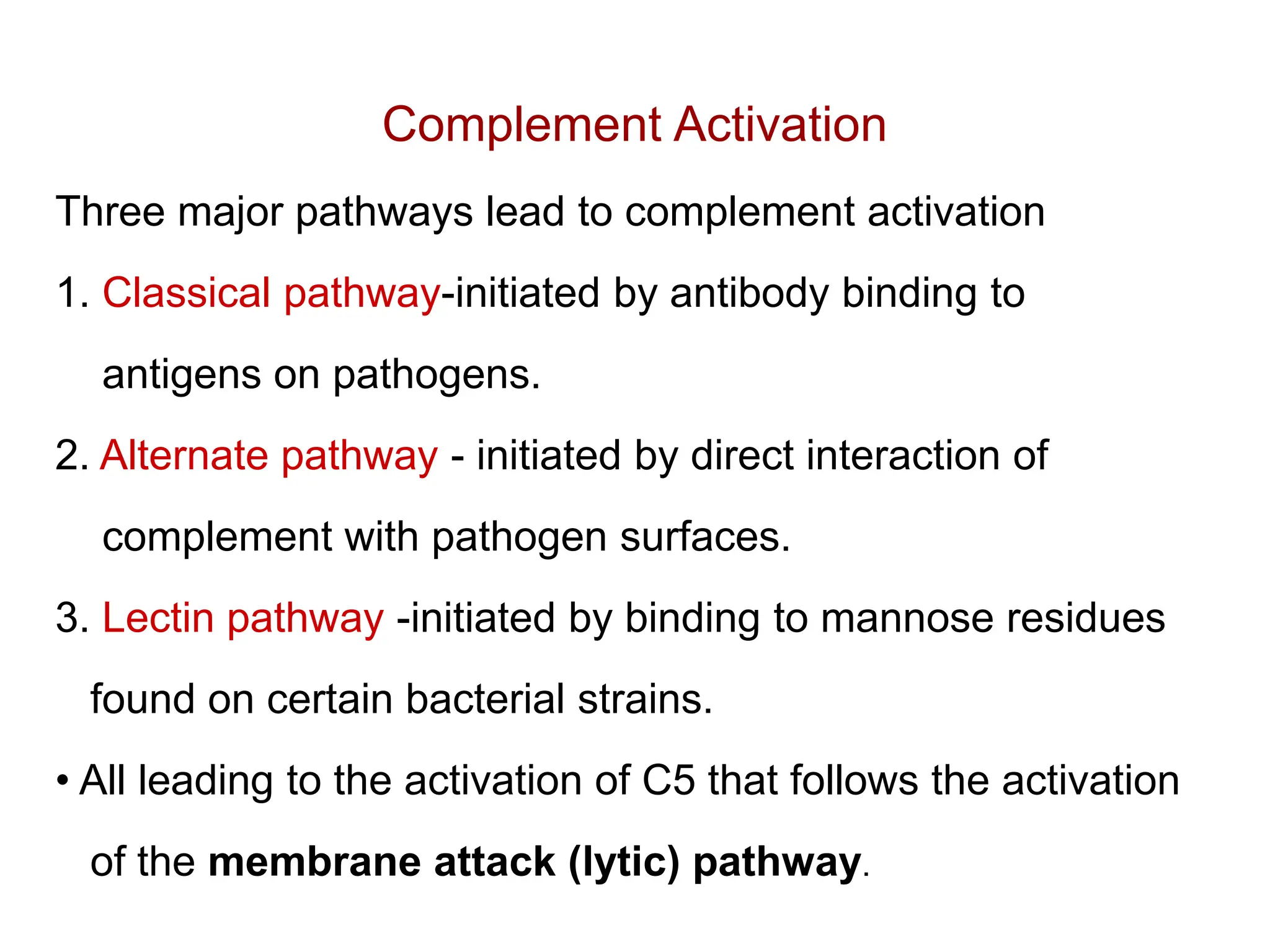
Complement Activation
Three major pathways lead to complement activation
1. Classical pathway-initiated by antibody binding to
antigens on pathogens.
2. Alternate pathway - initiated by direct interaction of
complement with pathogen surfaces.
3. Lectin pathway -initiated by binding to mannose residues
found on certain bacterial strains.
• All leading to the activation of C5 that follows the activation
of the membrane attack (lytic) pathway.
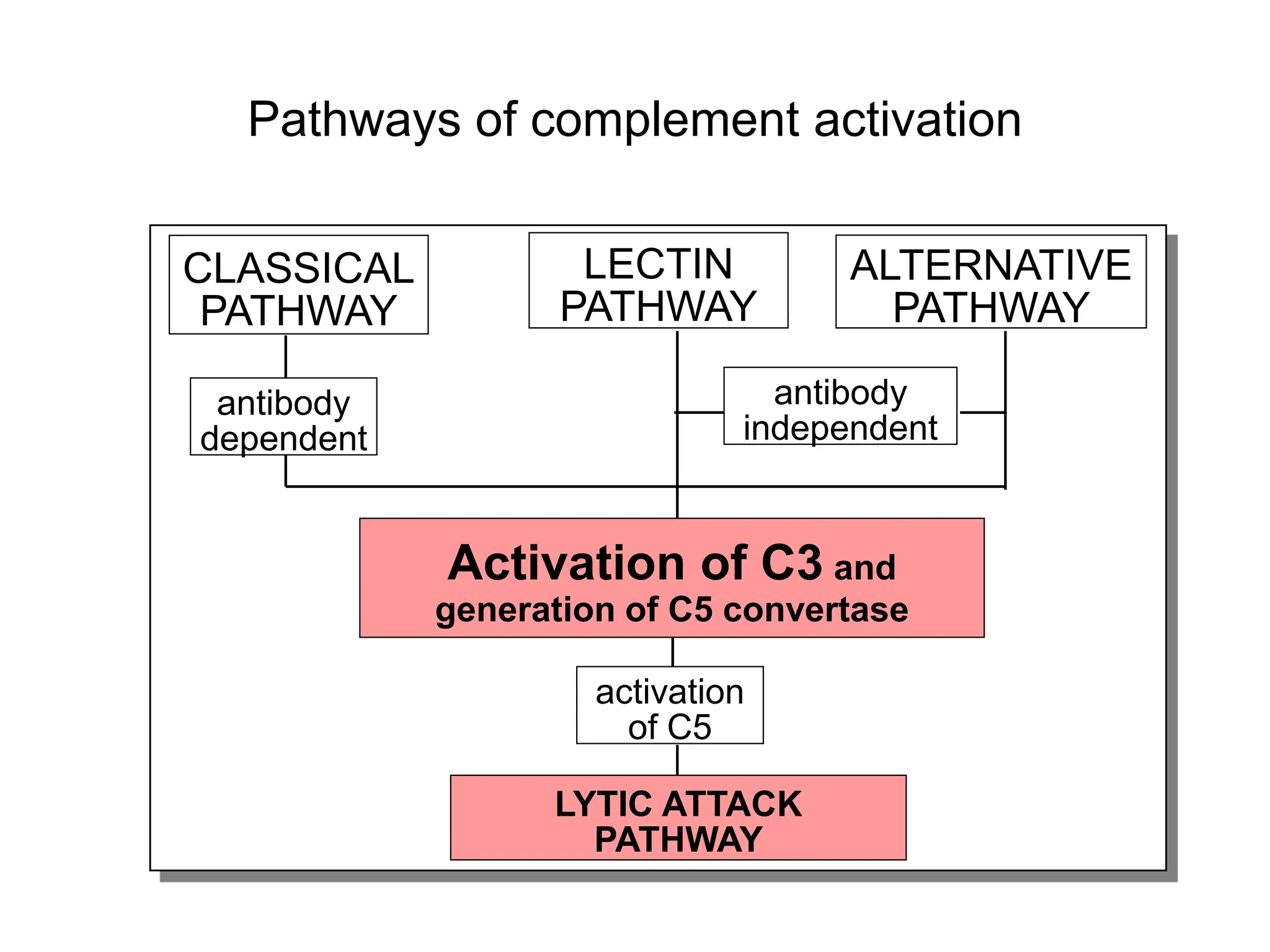
Pathways of complement activation
CLASSICAL
PATHWAY
ALTERNATIVE
PATHWAY
activation
of C5
LYTIC ATTACK
PATHWAY
antibody
dependent
LECTIN
PATHWAY
antibody
independent
Activation of C3 and
generation of C5 convertase
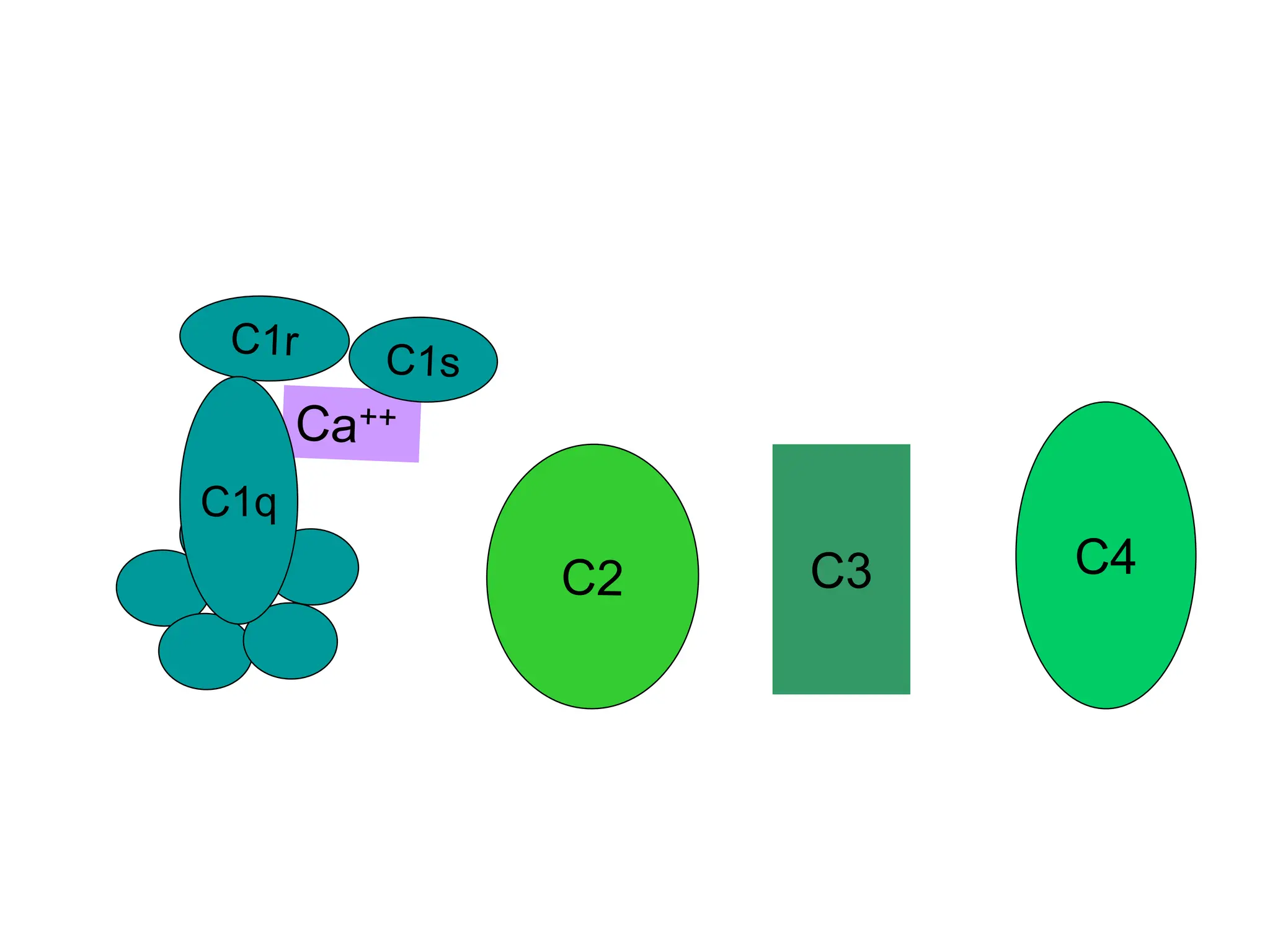
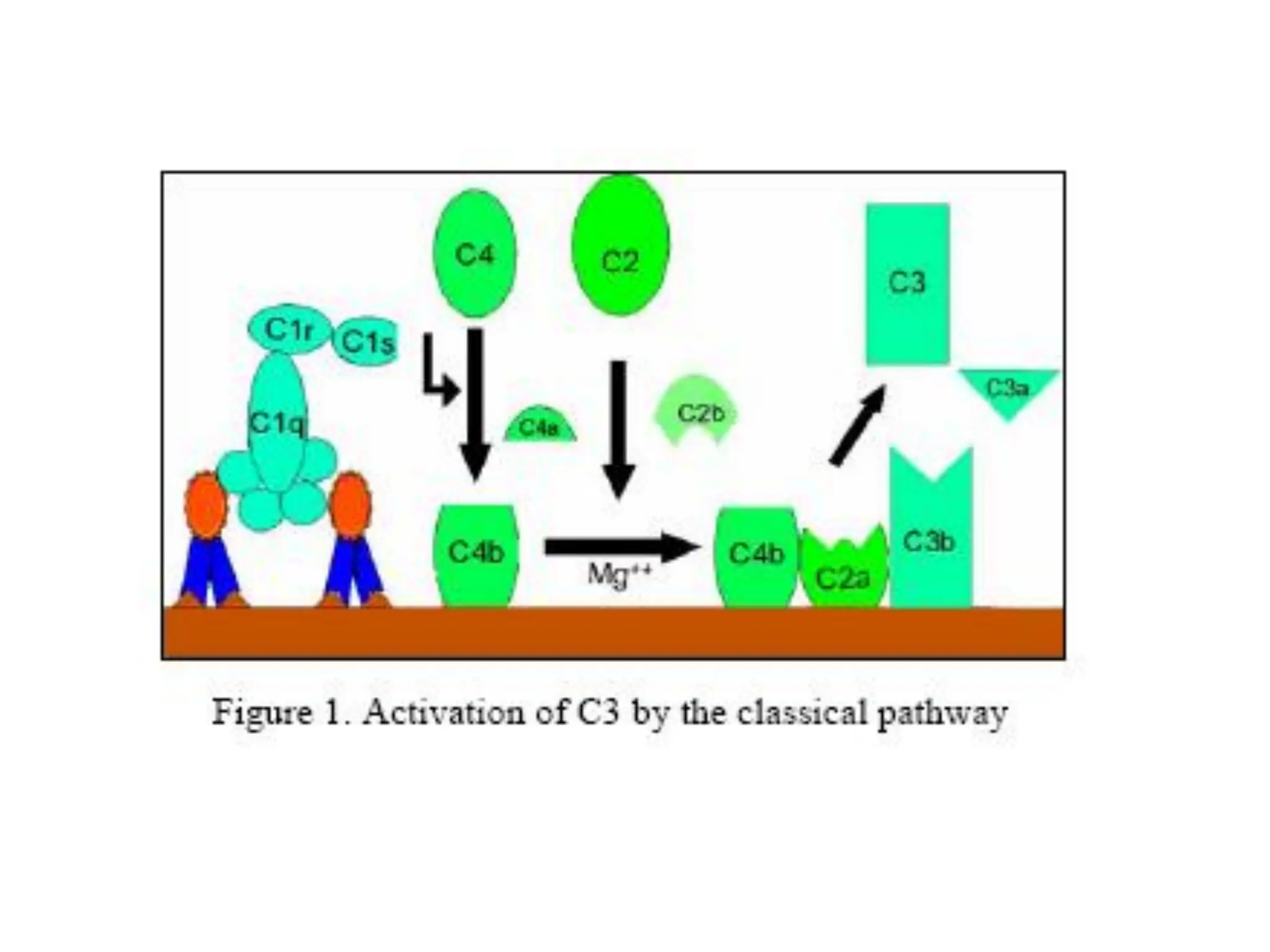
• C1 a multi-subunit protein containing three different proteins
C1q, C1r and C1s, binds to the Fc region of IgG and IgM
antibody molecules that have interacted with antigen.
• C1 binding does not occur to antibodies that have not
complexed with antigen and binding requires calcium and
magnesium ions.
• In some cases C1 can bind to aggregated immunoglobulin
[e.g. aggregated IgG] or to certain pathogen surfaces in the
absence of antibody).
C4
C3
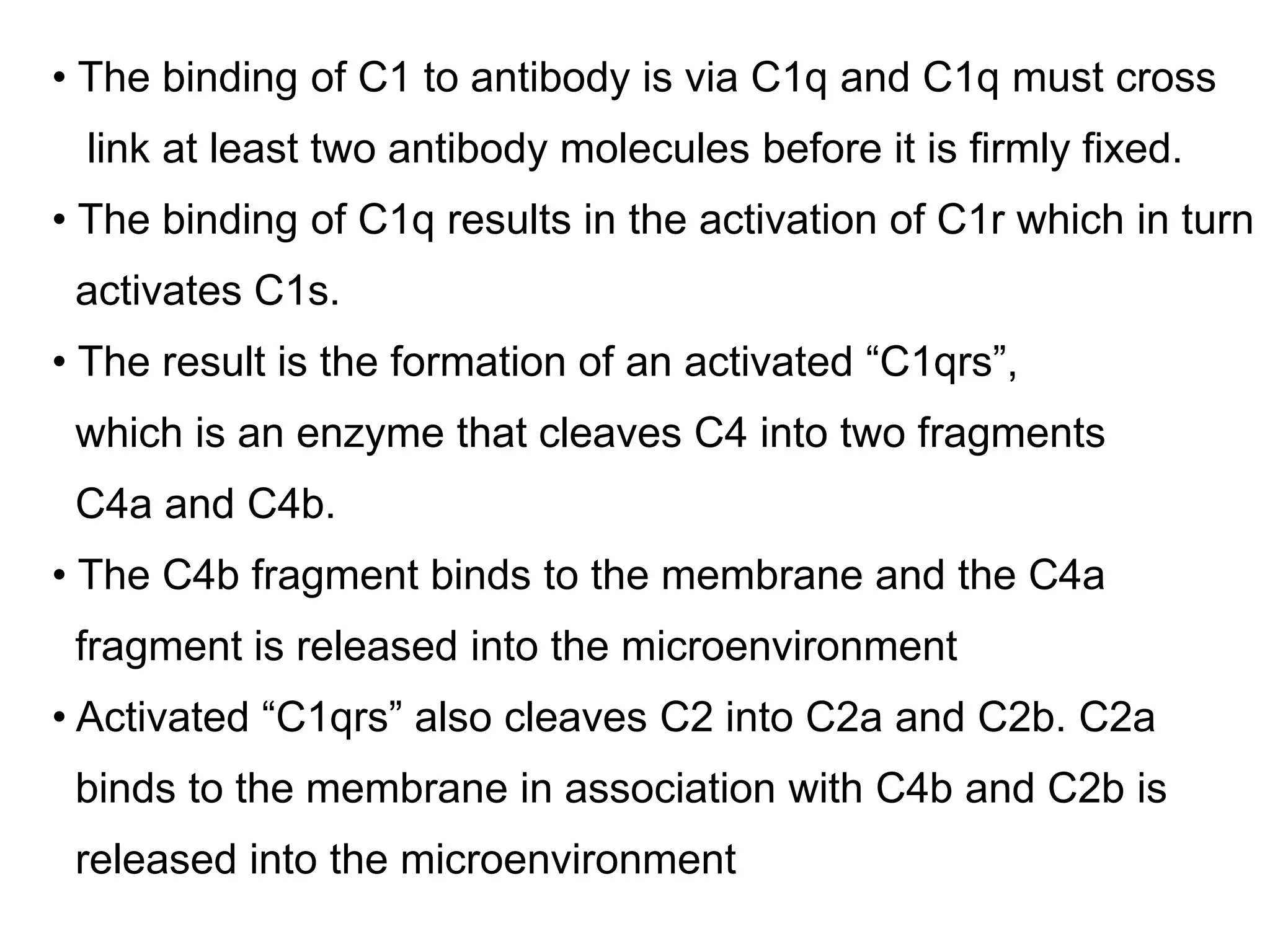
• The binding of C1 to antibody is via C1q and C1q must cross
link at least two antibody molecules before it is firmly fixed.
• The binding of C1q results in the activation of C1r which in turn
activates C1s.
• The result is the formation of an activated “C1qrs”,
which is an enzyme that cleaves C4 into two fragments
C4a and C4b.
• The C4b fragment binds to the membrane and the C4a
fragment is released into the microenvironment
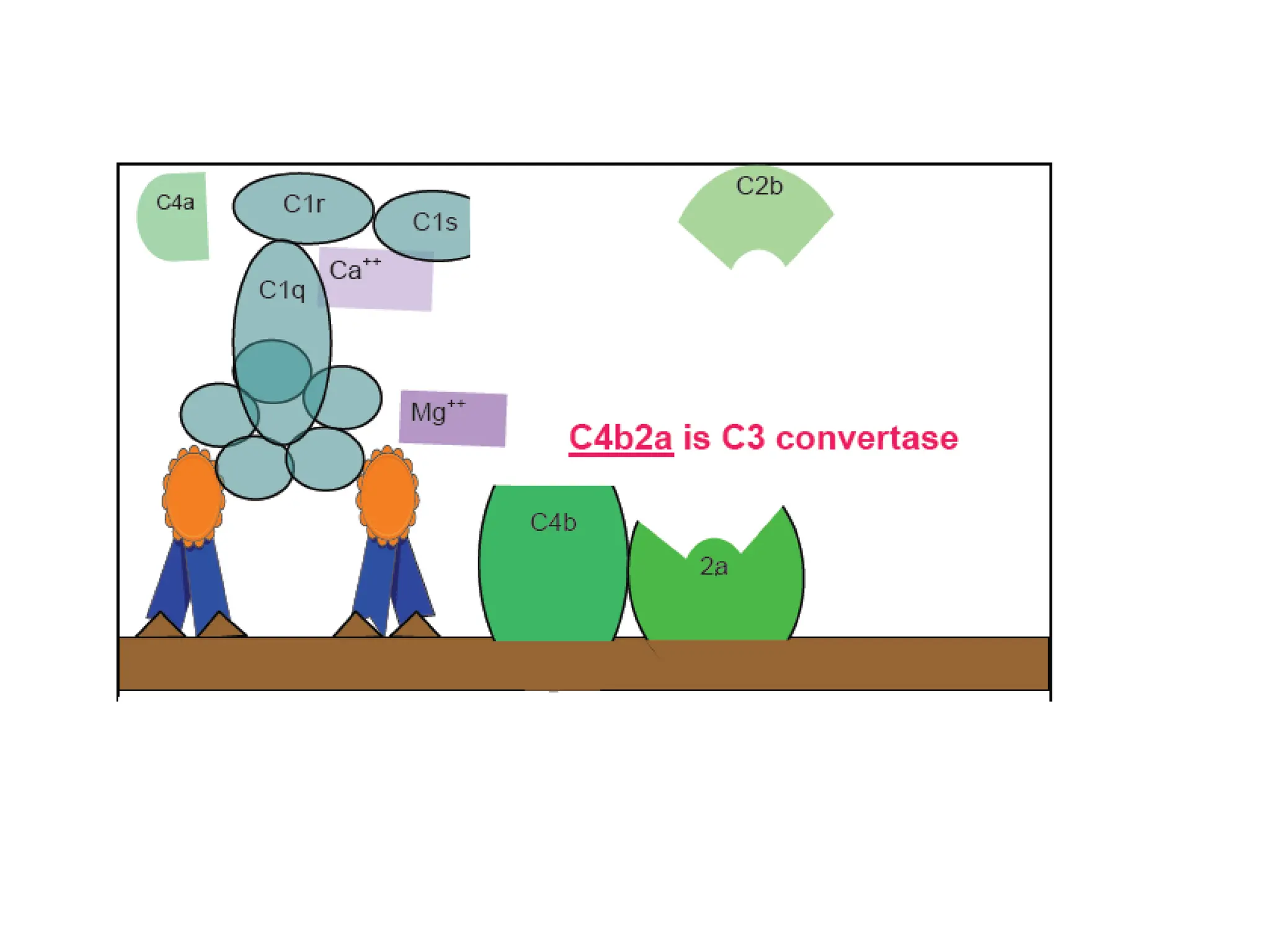
• Activated “C1qrs” also cleaves C2 into C2a and C2b. C2a
binds to the membrane in association with C4b and C2b is
released into the microenvironment
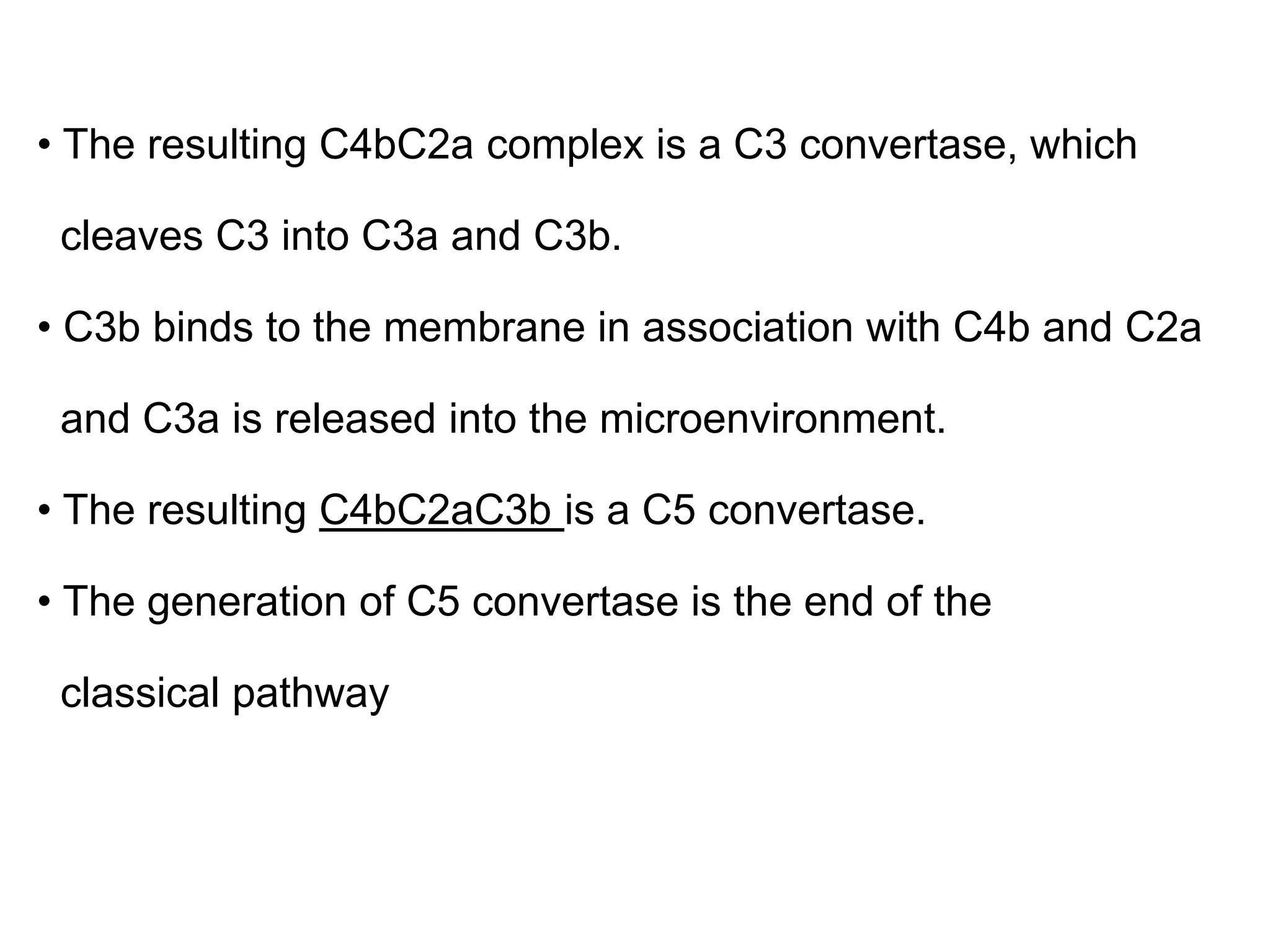
• The resulting C4bC2a complex is a C3 convertase, which
cleaves C3 into C3a and C3b.
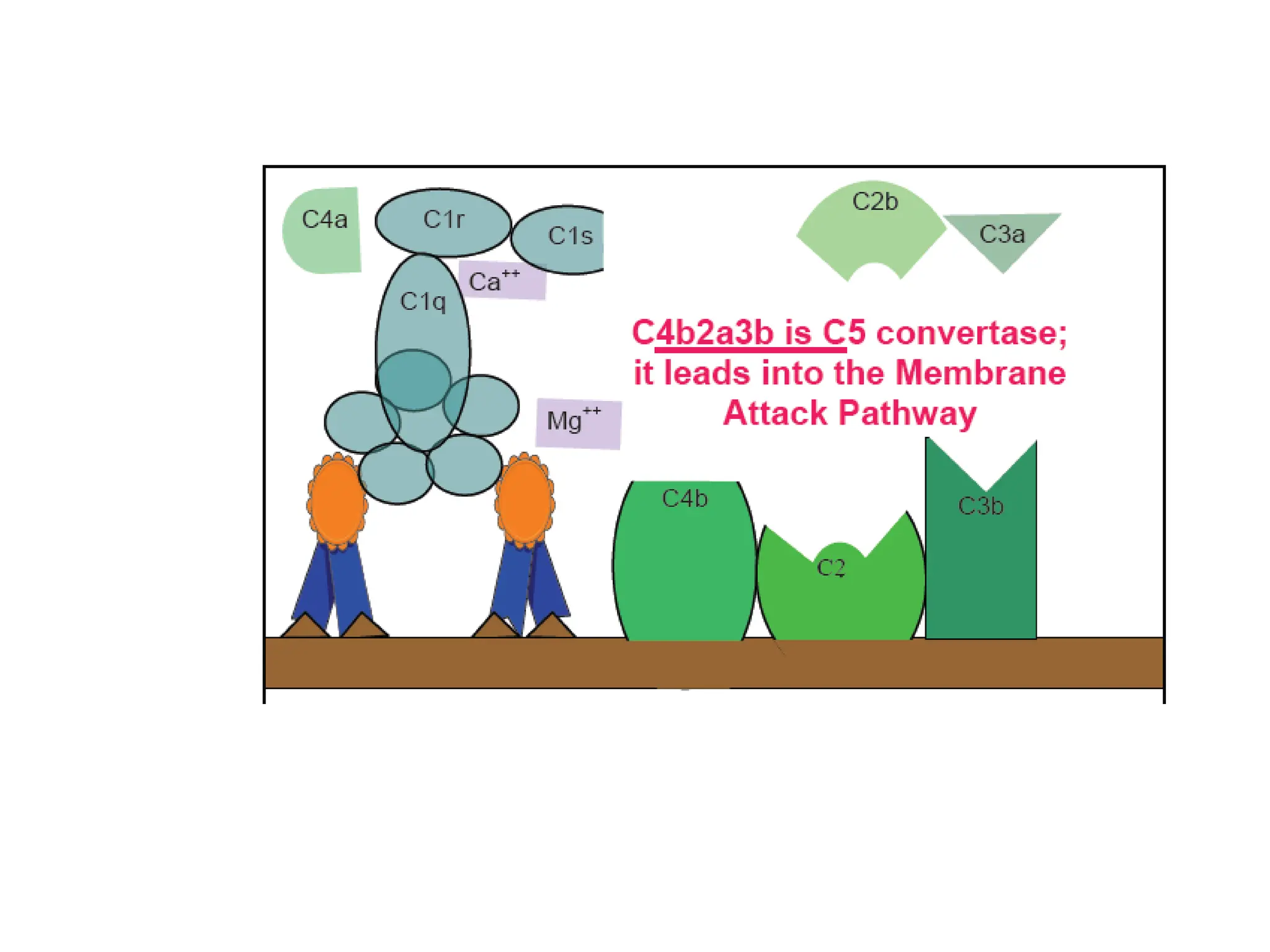
• C3b binds to the membrane in association with C4b and C2a
and C3a is released into the microenvironment.
• The resulting C4bC2aC3b is a C5 convertase.
• The generation of C5 convertase is the end of the
classical pathway
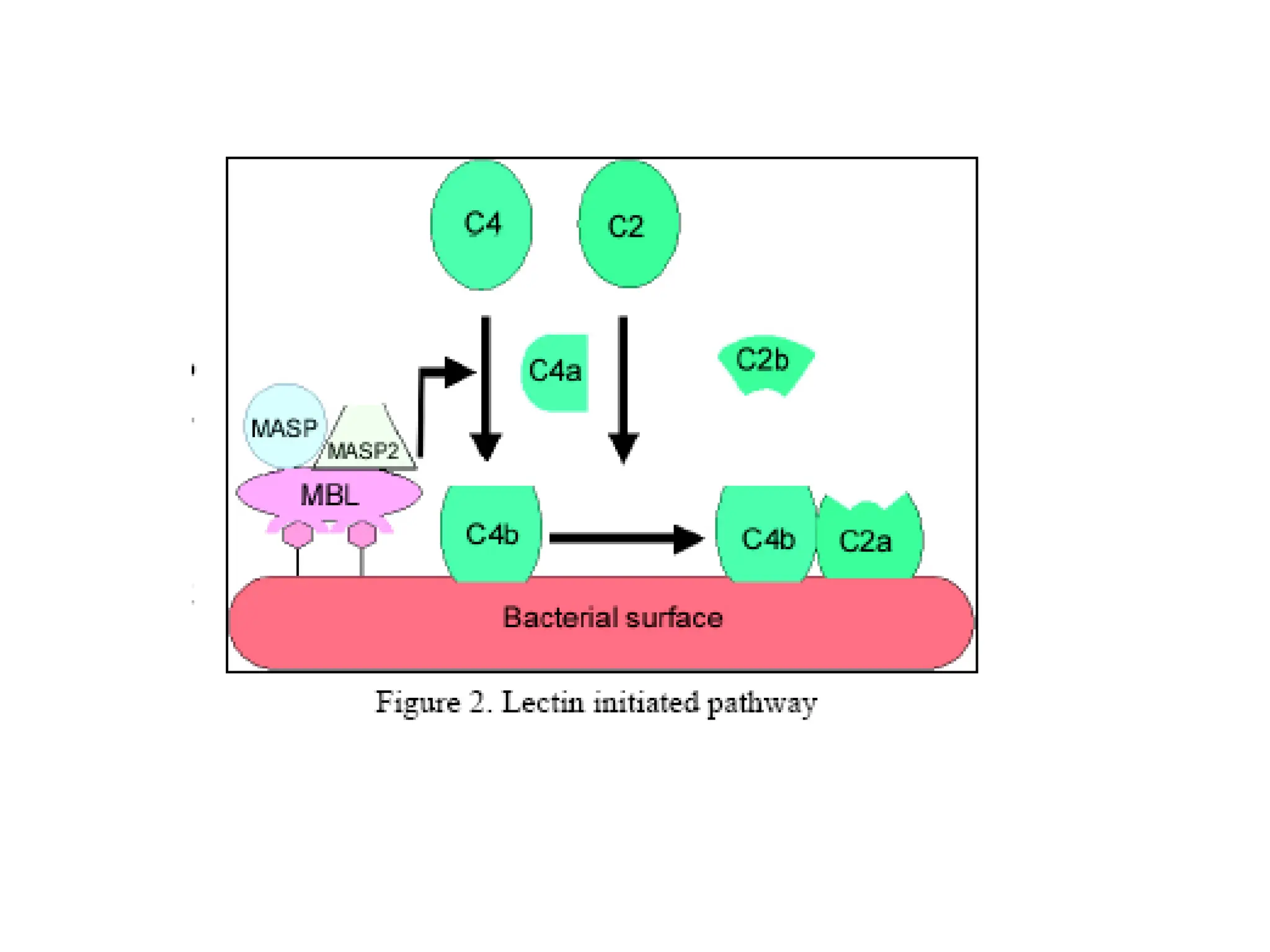
Lectin pathway:
• The lectin pathway is very similar to the classical pathway.
• It is initiated by the binding of mannose binding lectin (MBL)
to bacterial surfaces with mannose-containing polysaccharides.
• Binding of MBL to a pathogen results in the association of two
serine proteases, MASP-1 and MASP-2 (MBL-associated serine
proteases). MASP-1 and MASP-2 are similar to C1r and C1s,
respectively and MBL is similar to C1q.
• Formation of the MBL/MASP-1/MASP-2 tri-molecular complex
results in the activation of the MASPs and subsequent cleavage
of C4 into C4a and C4b.
• The C4b fragment binds to the membrane and the C4a
fragment is released into the microenvironment.
• Activated MASPs also cleave C2 into C2a and C2b.
• C2a binds to the membrane in association with C4b and
C2b is released into the microenvironment.
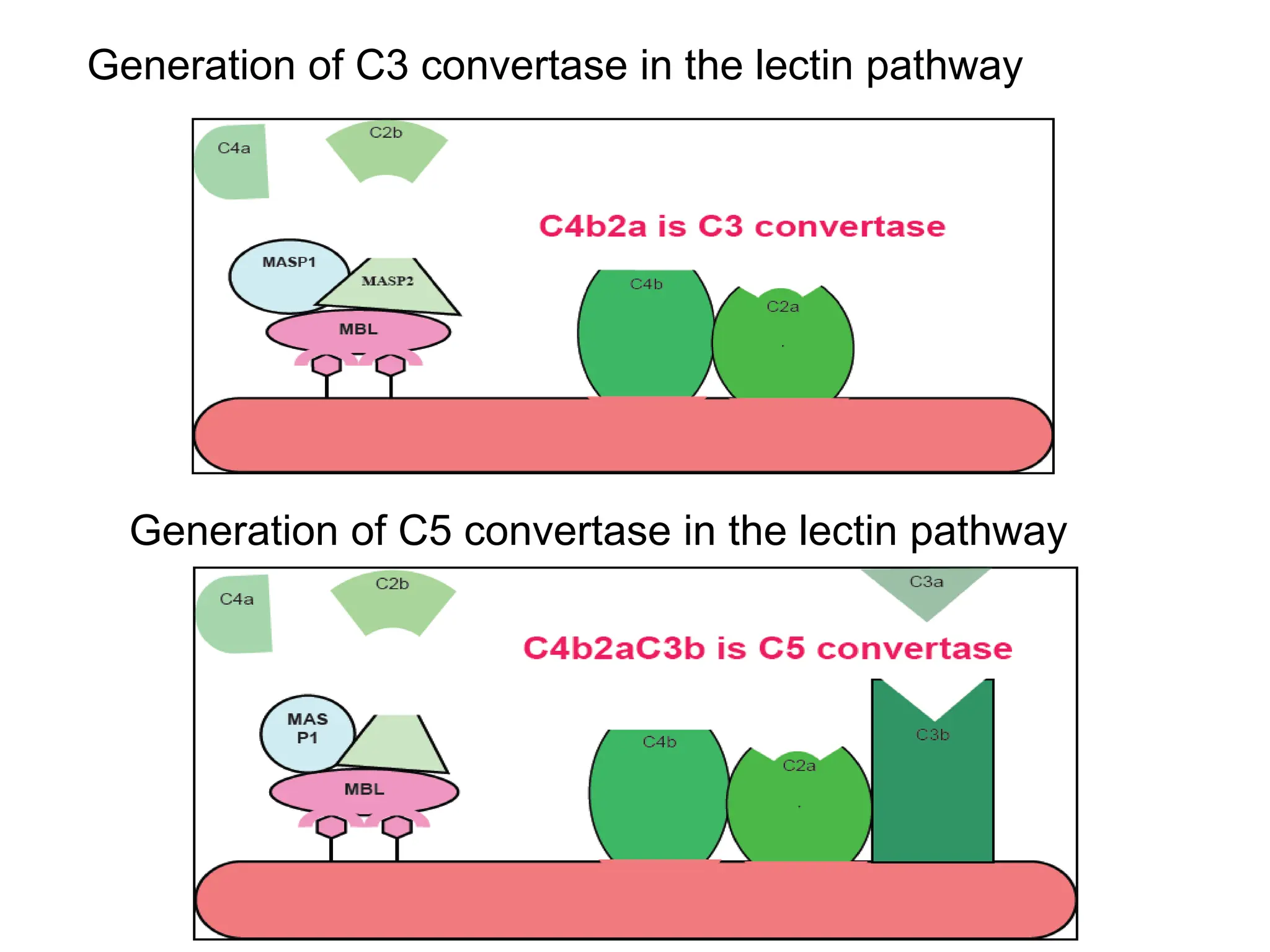
• The resulting C4bC2a complex is a C3 convertase, which
cleaves C3 into C3a and C3b. C3b binds to the membrane
in association with C4b and C2a and C3a is released into
the microenvironment.
•The resulting C4bC2aC3b is a C5 convertase. The
generation of C5 convertase is the end of the lectin pathway.
•.
Generation of C3 convertase in the lectin pathway
Generation of C5 convertase in the lectin pathway
Alternative Pathway:
• This major pathway of complement activation involves four
serum proteins: C3, factor B, factor D, and properdin
• The alternative pathway is initiated in most cases by cell-
surface constituents that are foreign to the host
• In the alternative pathway, serum C3, which contains an
unstable thioester bond, is subject to slow spontaneous
hydrolysis to yield C3a and C3b.
• The C3b present on the surface of the foreign cells can bind
another serum protein called factor B to form a complex
• Once C3b is formed, Factor B will bind to it and becomes
susceptible to cleavage by Factor D.
• Factor D cleaves the C3b-bound factor B, releasing a small
fragment (Ba) that diffuses away and generating C3bBb.
• The resulting C3bBb complex is a C3 convertase that will
continue to generate more C3b, thus amplifying C3b
production
• The C3 convertase activity of C3bBb has a half-life of only 5
minutes unless the serum protein properdin binds to it,
stabilizing it and extending the half-life of this convertase
activity to 30 minutes.
• The C3bBb generated in the alternative pathway can
activate unhydrolyzed C3 to generate more C3b
autocatalytically.
• The C3 convertase activity of C3bBb generates the
C3bBb3b complex, which exhibits C5 convertase activity,
analogous to the C4b2a3b complex in the classical pathway
Membrane attack pathway
• The terminal sequence of complement activation involves
C5b, C6, C7, C8, and C9, which interact sequentially to form
a macromolecular structure called the membrane-attack
complex (MAC).
• This complex forms a large channel through the membrane of
the target cell, enabling ions and small molecules to diffuse
freely across the membrane
• C5 convertase from the classical (C4b2a3b), lectin
(C4b2a3b) or alternative (C3bBb3b) pathway cleaves C5 into
C5a and C5b.
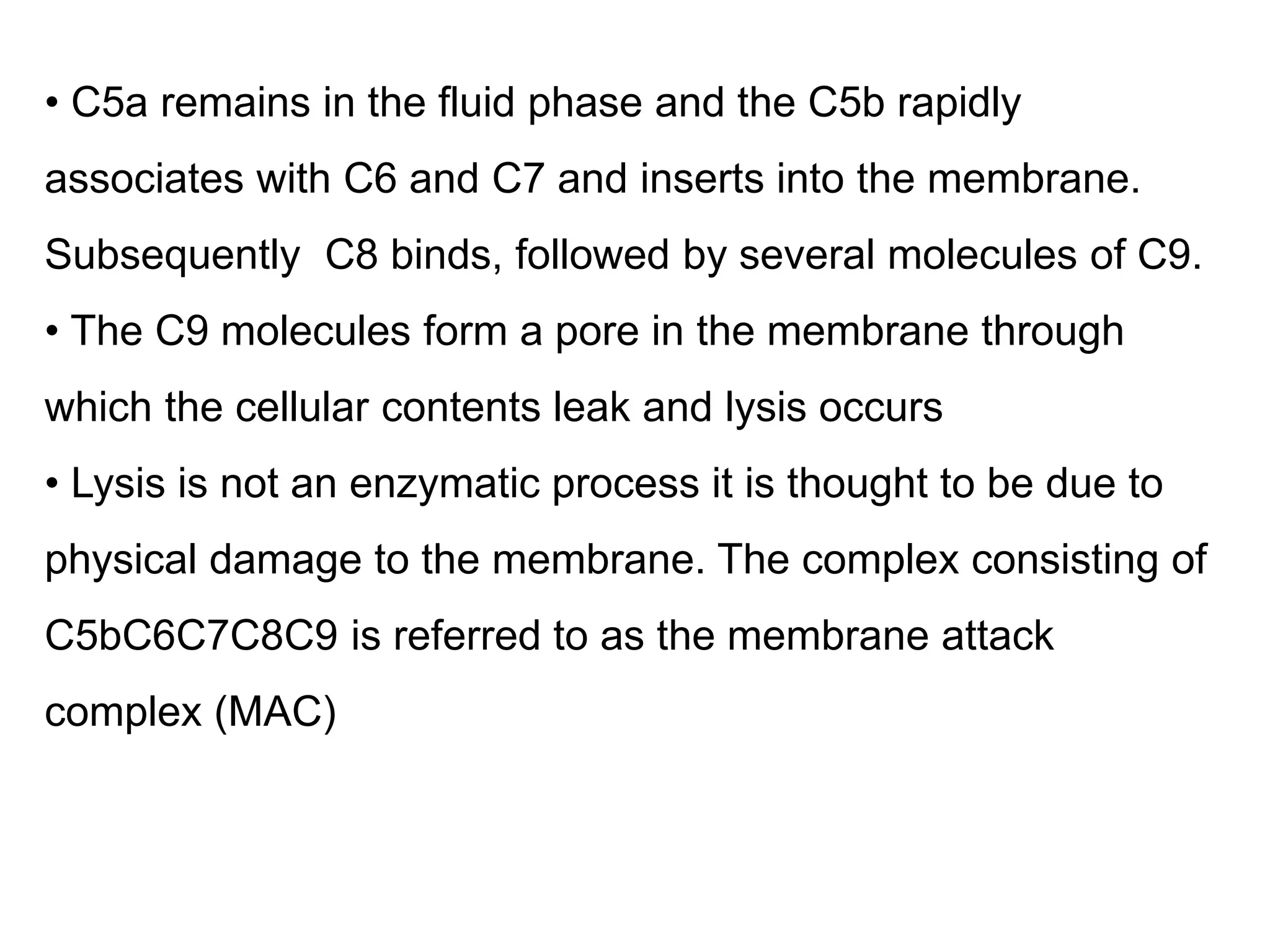
• C5a remains in the fluid phase and the C5b rapidly
associates with C6 and C7 and inserts into the membrane.
Subsequently C8 binds, followed by several molecules of C9.
• The C9 molecules form a pore in the membrane through
which the cellular contents leak and lysis occurs
• Lysis is not an enzymatic process it is thought to be due to
physical damage to the membrane. The complex consisting of
C5bC6C7C8C9 is referred to as the membrane attack
complex (MAC)
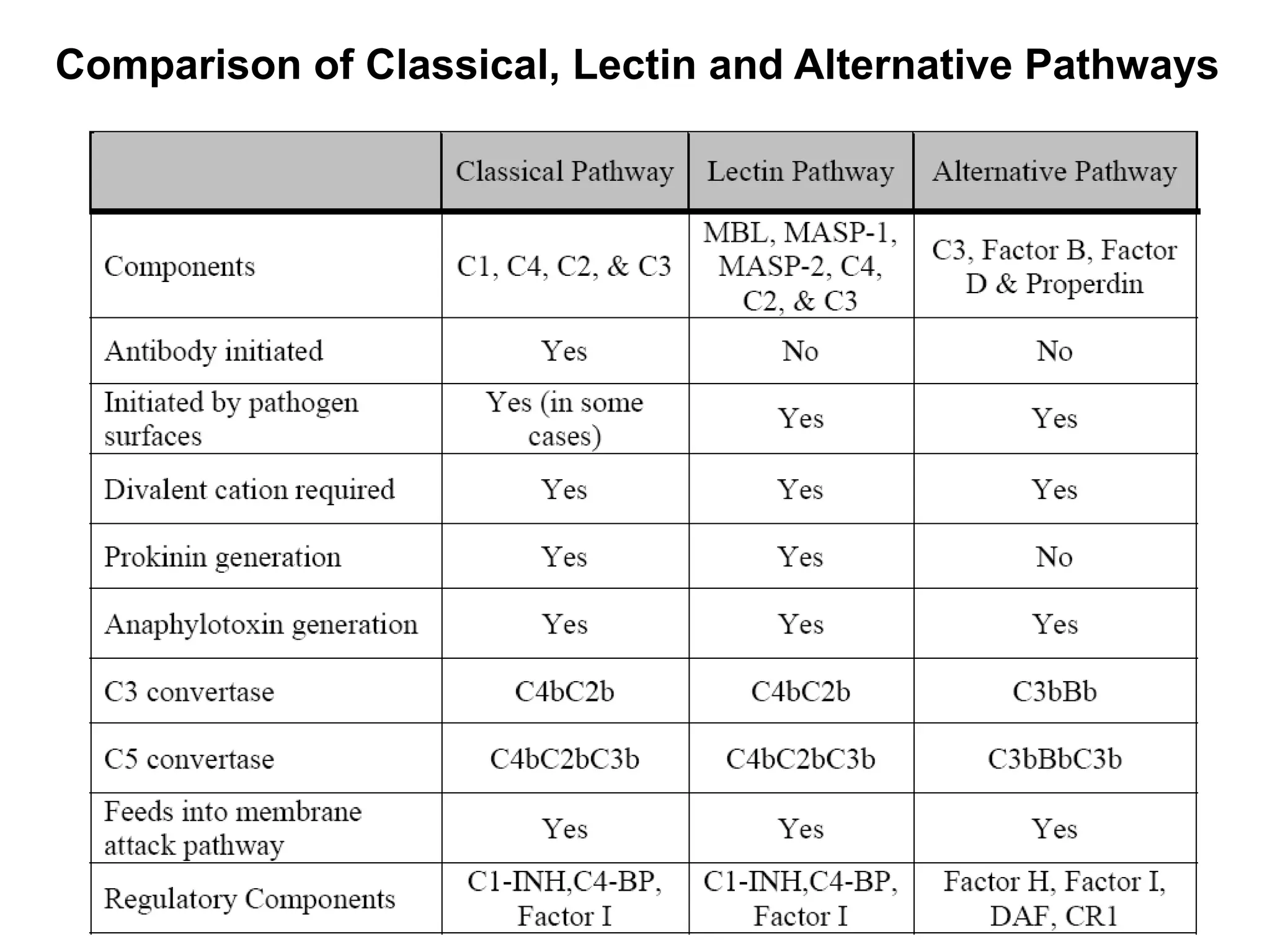
Comparison of Classical, Lectin and Alternative Pathways
Reading Assignment
 Regulation of the Complement System
.

Complement System and its activation pathways

  • 1.
  • 2.
    • The complementsystem is a multi-component system that functions to eliminate microbes. • The Complement is composed of more than 25 different proteins produced by different tissues and cells including hepatocytes, macrophages and gut epithelial cells – C1(qrs), C2, C3, C4, C5, C6, C7, C8, C9 – factors B, D, H and I, properdin (P) – mannose binding lectin (MBL), MBL associated serine proteases (MASP-1 MASP-2) – C1 inhibitor (C1-INH, serpin), C4-binding protein (C4- BP), decay accelerating factor (DAF), Complement receptor 1 (CR1), protein-S (vitronectin)
  • 3.
    Functions of Complement 1.Direct Lysis of bacteria, some viruses and cells. 2. Opsonization and enhanced phagocytosis. 3. Triggers cellular functions that contribute to inflammation. - Chemokine, histamine release due to complement products called anaphylatoxins 4. Facilitates removal of immune complexes in liver and spleen.
  • 4.
    • Activation ofcomplement involves the sequential proteolysis of proteins • Peptide fragments by activation of a component are denoted by small letters • Letter “b” is usually added to the larger, membrane-binding, peptide and “a” to the smaller peptide (e.g., C3b/C3a, C4b/C4a, C5b/C5a), EXCEPT C2 (the larger, membrane- binding moiety is C2a; the smaller one is C2b)
  • 5.
    • The smallerfragments usually diffuse away and may bind to cell surface receptors to trigger localized inflammatory response= anaphylatoxins. • The larger fragment usually remains bound to target cells and facilitate lysis. • Those complexes that have enzymatic activity are designated by a bar over the number or symbol (e.g., C4b2a, C3bBb) • Once activated a proteolytic cascade is initiated that ultimately results in complement activation
  • 6.
    Complement Activation Three majorpathways lead to complement activation 1. Classical pathway-initiated by antibody binding to antigens on pathogens. 2. Alternate pathway - initiated by direct interaction of complement with pathogen surfaces. 3. Lectin pathway -initiated by binding to mannose residues found on certain bacterial strains. • All leading to the activation of C5 that follows the activation of the membrane attack (lytic) pathway.
  • 7.
    Pathways of complementactivation CLASSICAL PATHWAY ALTERNATIVE PATHWAY activation of C5 LYTIC ATTACK PATHWAY antibody dependent LECTIN PATHWAY antibody independent Activation of C3 and generation of C5 convertase
  • 8.
    • C1 amulti-subunit protein containing three different proteins C1q, C1r and C1s, binds to the Fc region of IgG and IgM antibody molecules that have interacted with antigen. • C1 binding does not occur to antibodies that have not complexed with antigen and binding requires calcium and magnesium ions. • In some cases C1 can bind to aggregated immunoglobulin [e.g. aggregated IgG] or to certain pathogen surfaces in the absence of antibody).
  • 9.
  • 10.
    • The bindingof C1 to antibody is via C1q and C1q must cross link at least two antibody molecules before it is firmly fixed. • The binding of C1q results in the activation of C1r which in turn activates C1s. • The result is the formation of an activated “C1qrs”, which is an enzyme that cleaves C4 into two fragments C4a and C4b. • The C4b fragment binds to the membrane and the C4a fragment is released into the microenvironment • Activated “C1qrs” also cleaves C2 into C2a and C2b. C2a binds to the membrane in association with C4b and C2b is released into the microenvironment
  • 12.
    • The resultingC4bC2a complex is a C3 convertase, which cleaves C3 into C3a and C3b. • C3b binds to the membrane in association with C4b and C2a and C3a is released into the microenvironment. • The resulting C4bC2aC3b is a C5 convertase. • The generation of C5 convertase is the end of the classical pathway
  • 15.
    Lectin pathway: • Thelectin pathway is very similar to the classical pathway. • It is initiated by the binding of mannose binding lectin (MBL) to bacterial surfaces with mannose-containing polysaccharides. • Binding of MBL to a pathogen results in the association of two serine proteases, MASP-1 and MASP-2 (MBL-associated serine proteases). MASP-1 and MASP-2 are similar to C1r and C1s, respectively and MBL is similar to C1q. • Formation of the MBL/MASP-1/MASP-2 tri-molecular complex results in the activation of the MASPs and subsequent cleavage of C4 into C4a and C4b.
  • 16.
    • The C4bfragment binds to the membrane and the C4a fragment is released into the microenvironment. • Activated MASPs also cleave C2 into C2a and C2b. • C2a binds to the membrane in association with C4b and C2b is released into the microenvironment. • The resulting C4bC2a complex is a C3 convertase, which cleaves C3 into C3a and C3b. C3b binds to the membrane in association with C4b and C2a and C3a is released into the microenvironment. •The resulting C4bC2aC3b is a C5 convertase. The generation of C5 convertase is the end of the lectin pathway. •.
  • 17.
    Generation of C3convertase in the lectin pathway Generation of C5 convertase in the lectin pathway
  • 19.
    Alternative Pathway: • Thismajor pathway of complement activation involves four serum proteins: C3, factor B, factor D, and properdin • The alternative pathway is initiated in most cases by cell- surface constituents that are foreign to the host • In the alternative pathway, serum C3, which contains an unstable thioester bond, is subject to slow spontaneous hydrolysis to yield C3a and C3b. • The C3b present on the surface of the foreign cells can bind another serum protein called factor B to form a complex
  • 20.
    • Once C3bis formed, Factor B will bind to it and becomes susceptible to cleavage by Factor D. • Factor D cleaves the C3b-bound factor B, releasing a small fragment (Ba) that diffuses away and generating C3bBb. • The resulting C3bBb complex is a C3 convertase that will continue to generate more C3b, thus amplifying C3b production • The C3 convertase activity of C3bBb has a half-life of only 5 minutes unless the serum protein properdin binds to it, stabilizing it and extending the half-life of this convertase activity to 30 minutes.
  • 21.
    • The C3bBbgenerated in the alternative pathway can activate unhydrolyzed C3 to generate more C3b autocatalytically. • The C3 convertase activity of C3bBb generates the C3bBb3b complex, which exhibits C5 convertase activity, analogous to the C4b2a3b complex in the classical pathway
  • 22.
    Membrane attack pathway •The terminal sequence of complement activation involves C5b, C6, C7, C8, and C9, which interact sequentially to form a macromolecular structure called the membrane-attack complex (MAC). • This complex forms a large channel through the membrane of the target cell, enabling ions and small molecules to diffuse freely across the membrane • C5 convertase from the classical (C4b2a3b), lectin (C4b2a3b) or alternative (C3bBb3b) pathway cleaves C5 into C5a and C5b.
  • 23.
    • C5a remainsin the fluid phase and the C5b rapidly associates with C6 and C7 and inserts into the membrane. Subsequently C8 binds, followed by several molecules of C9. • The C9 molecules form a pore in the membrane through which the cellular contents leak and lysis occurs • Lysis is not an enzymatic process it is thought to be due to physical damage to the membrane. The complex consisting of C5bC6C7C8C9 is referred to as the membrane attack complex (MAC)
  • 26.
    Comparison of Classical,Lectin and Alternative Pathways
  • 27.
    Reading Assignment  Regulationof the Complement System .