CommonJS via     BETA
PINF JavaScript Loader
  github.com/pinf/loader-js (MIT Licensed)


              Introduction

  Boston JavaScript - October 14, 2011
             by Christoph Dorn

       Copyright (c) 2011 Christoph Dorn <christoph@christophdorn.com>
      License: Creative Commons Attribution-NonCommercial-ShareAlike 3.0
            Various names and trademarks copyright respective parties.
About Christoph
About Christoph
• 15+ years experience (web apps & business)
About Christoph
• 15+ years experience (web apps & business)
• Self taught developer
About Christoph
• 15+ years experience (web apps & business)
• Self taught developer
• Independent
About Christoph
• 15+ years experience (web apps & business)
• Self taught developer
• Independent
• Playing with and integrating toolchains for years
About Christoph
•   15+ years experience (web apps & business)
•   Self taught developer
•   Independent
•   Playing with and integrating toolchains for years
•   Firebug Working Group (3 years)
About Christoph
•   15+ years experience (web apps & business)
•   Self taught developer
•   Independent
•   Playing with and integrating toolchains for years
•   Firebug Working Group (3 years)
    • Extensions
About Christoph
•   15+ years experience (web apps & business)
•   Self taught developer
•   Independent
•   Playing with and integrating toolchains for years
•   Firebug Working Group (3 years)
    • Extensions
• CommonJS List (2 years)
About Christoph
•   15+ years experience (web apps & business)
•   Self taught developer
•   Independent
•   Playing with and integrating toolchains for years
•   Firebug Working Group (3 years)
    • Extensions
• CommonJS List (2 years)
  • Packages & dependency management
About Christoph
•   15+ years experience (web apps & business)
•   Self taught developer
•   Independent
•   Playing with and integrating toolchains for years
•   Firebug Working Group (3 years)
    • Extensions
• CommonJS List (2 years)
  • Packages & dependency management

Focus: Toolchain Design & Efficient Workflows
What drives me?
What drives me?
   I believe a major factor constraining software evolution is
the lack of refactorability as a core design goal of toolchains.
What drives me?
   I believe a major factor constraining software evolution is
the lack of refactorability as a core design goal of toolchains.

 If we can easily change our software in every way we can
     focus on figuring out what actually works the best!
What drives me?
   I believe a major factor constraining software evolution is
the lack of refactorability as a core design goal of toolchains.

 If we can easily change our software in every way we can
     focus on figuring out what actually works the best!

    Building a JavaScript based Toolchain Platform!
What drives me?
   I believe a major factor constraining software evolution is
the lack of refactorability as a core design goal of toolchains.

 If we can easily change our software in every way we can
     focus on figuring out what actually works the best!

    Building a JavaScript based Toolchain Platform!
                  github.com/pinf (MIT Licensed)
What drives me?
   I believe a major factor constraining software evolution is
the lack of refactorability as a core design goal of toolchains.

 If we can easily change our software in every way we can
     focus on figuring out what actually works the best!

     Building a JavaScript based Toolchain Platform!
                    github.com/pinf (MIT Licensed)


JavaScript: Very expressive and easy to refactor; everyone will know it
What drives me?
   I believe a major factor constraining software evolution is
the lack of refactorability as a core design goal of toolchains.

 If we can easily change our software in every way we can
     focus on figuring out what actually works the best!

     Building a JavaScript based Toolchain Platform!
                    github.com/pinf (MIT Licensed)


JavaScript: Very expressive and easy to refactor; everyone will know it

CommonJS: Developers seeking to build a JavaScript Ecosystem
 which allows for:
What drives me?
   I believe a major factor constraining software evolution is
the lack of refactorability as a core design goal of toolchains.

 If we can easily change our software in every way we can
     focus on figuring out what actually works the best!

     Building a JavaScript based Toolchain Platform!
                    github.com/pinf (MIT Licensed)


JavaScript: Very expressive and easy to refactor; everyone will know it

CommonJS: Developers seeking to build a JavaScript Ecosystem
 which allows for:
  • Code-sharing, interoperable libraries and portable applications
What drives me?
   I believe a major factor constraining software evolution is
the lack of refactorability as a core design goal of toolchains.

 If we can easily change our software in every way we can
     focus on figuring out what actually works the best!

     Building a JavaScript based Toolchain Platform!
                    github.com/pinf (MIT Licensed)


JavaScript: Very expressive and easy to refactor; everyone will know it

CommonJS: Developers seeking to build a JavaScript Ecosystem
 which allows for:
  • Code-sharing, interoperable libraries and portable applications
  • Transferring the power of JavaScript to various parts of a system
What drives me?
   I believe a major factor constraining software evolution is
the lack of refactorability as a core design goal of toolchains.

 If we can easily change our software in every way we can
     focus on figuring out what actually works the best!

     Building a JavaScript based Toolchain Platform!
                    github.com/pinf (MIT Licensed)


JavaScript: Very expressive and easy to refactor; everyone will know it

CommonJS: Developers seeking to build a JavaScript Ecosystem
 which allows for:
  • Code-sharing, interoperable libraries and portable applications
  • Transferring the power of JavaScript to various parts of a system
  • Seamless refactoring and re-composition of programs
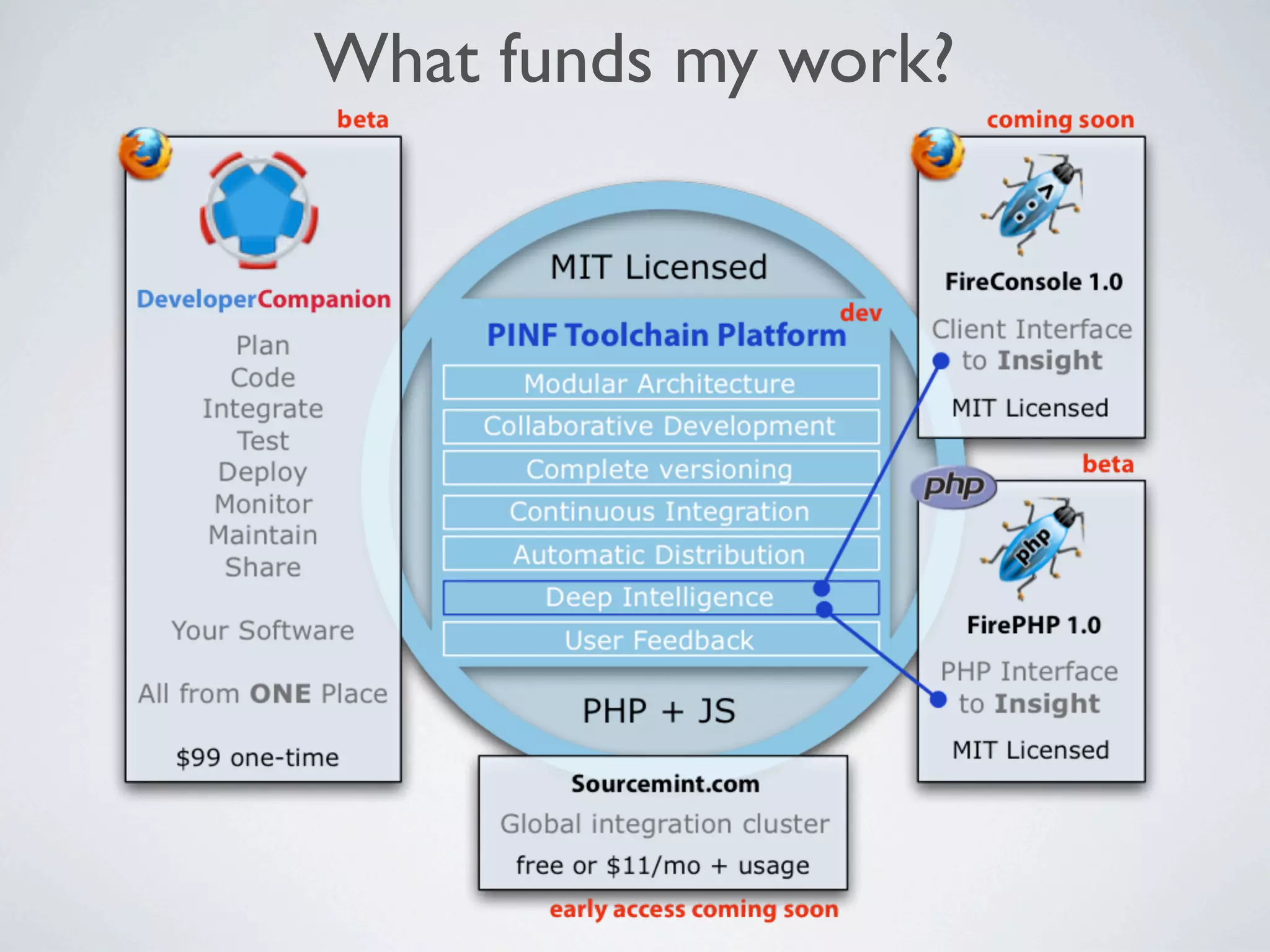
What funds my work?
What funds my work?
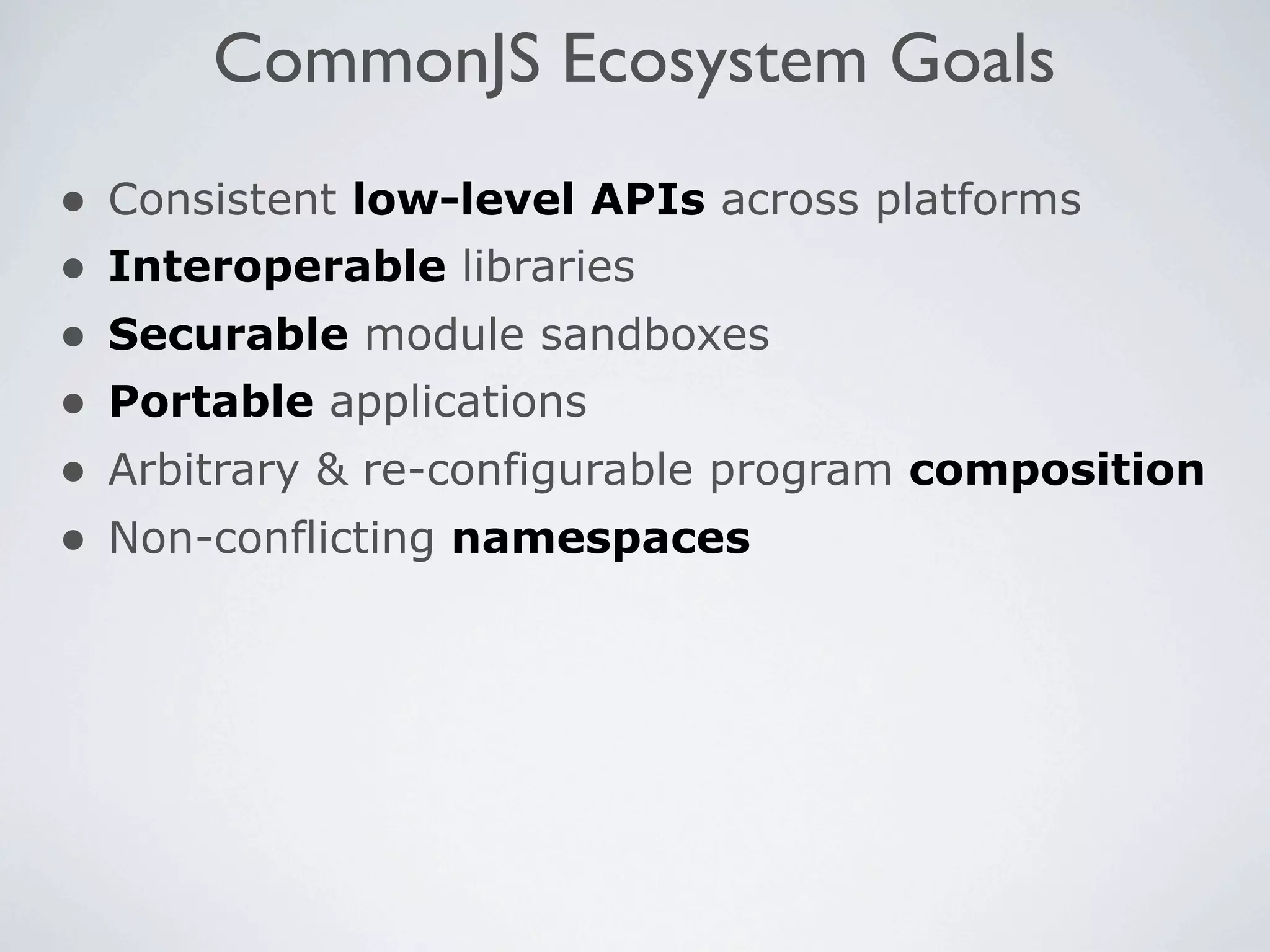
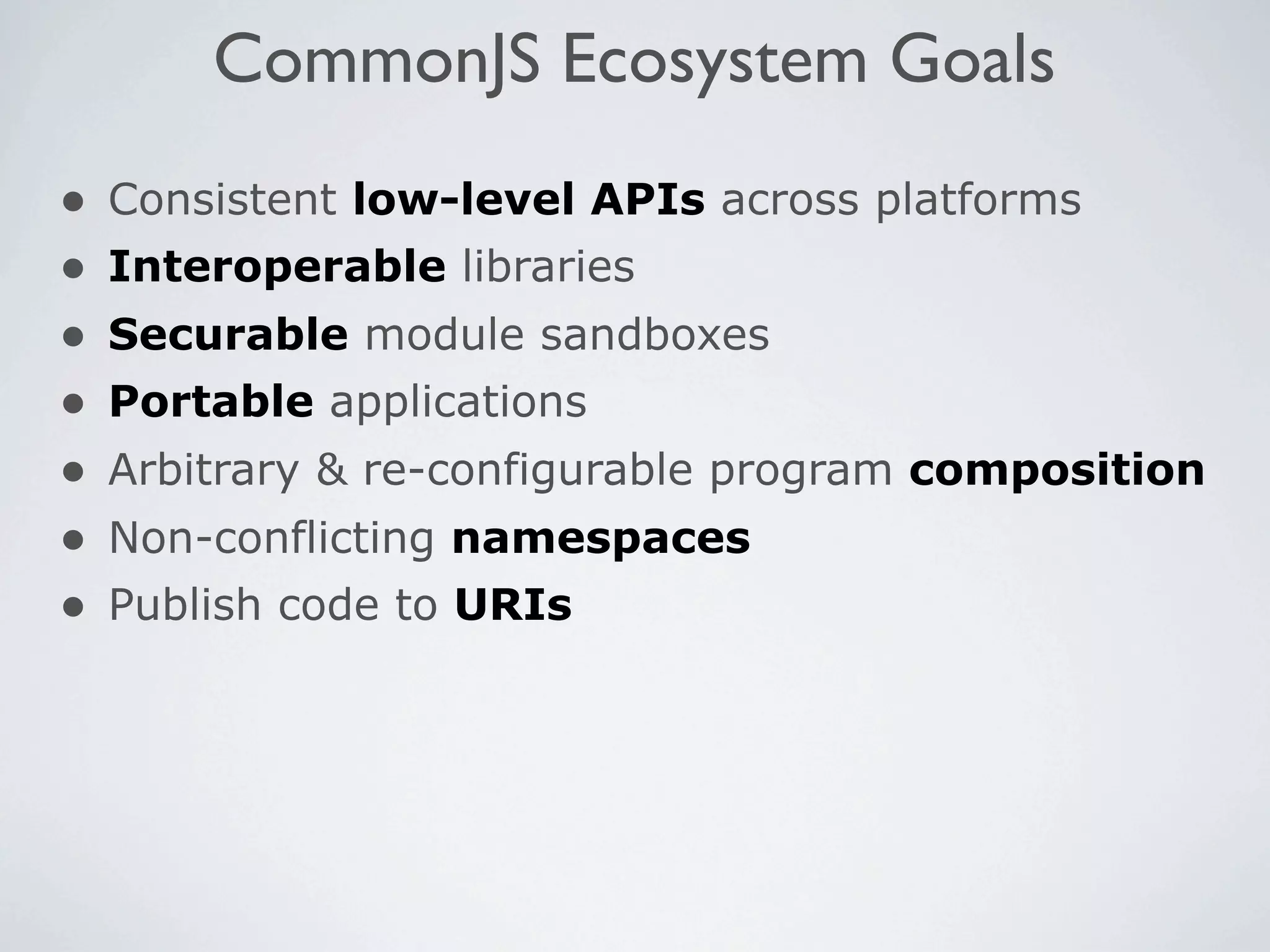
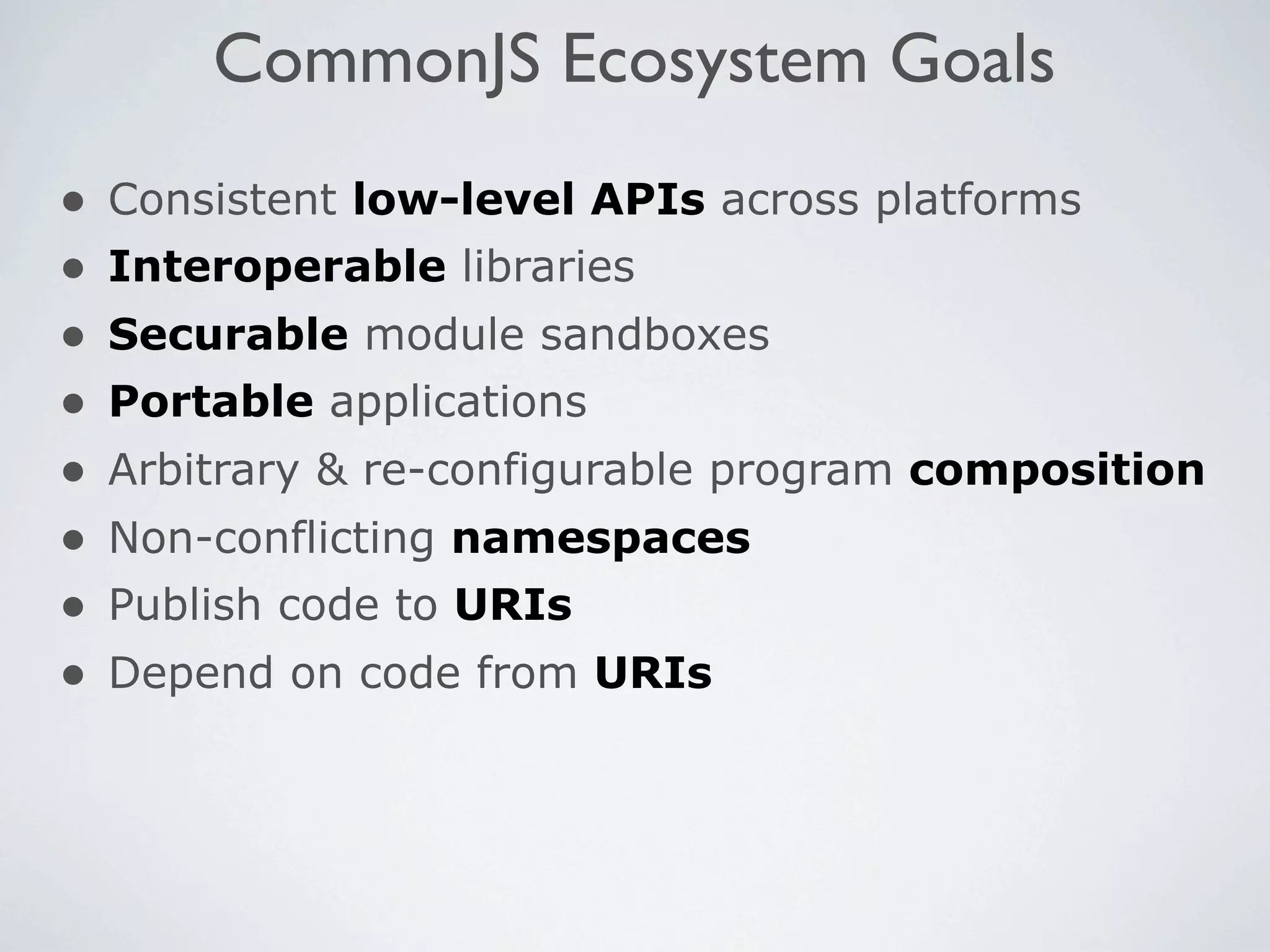
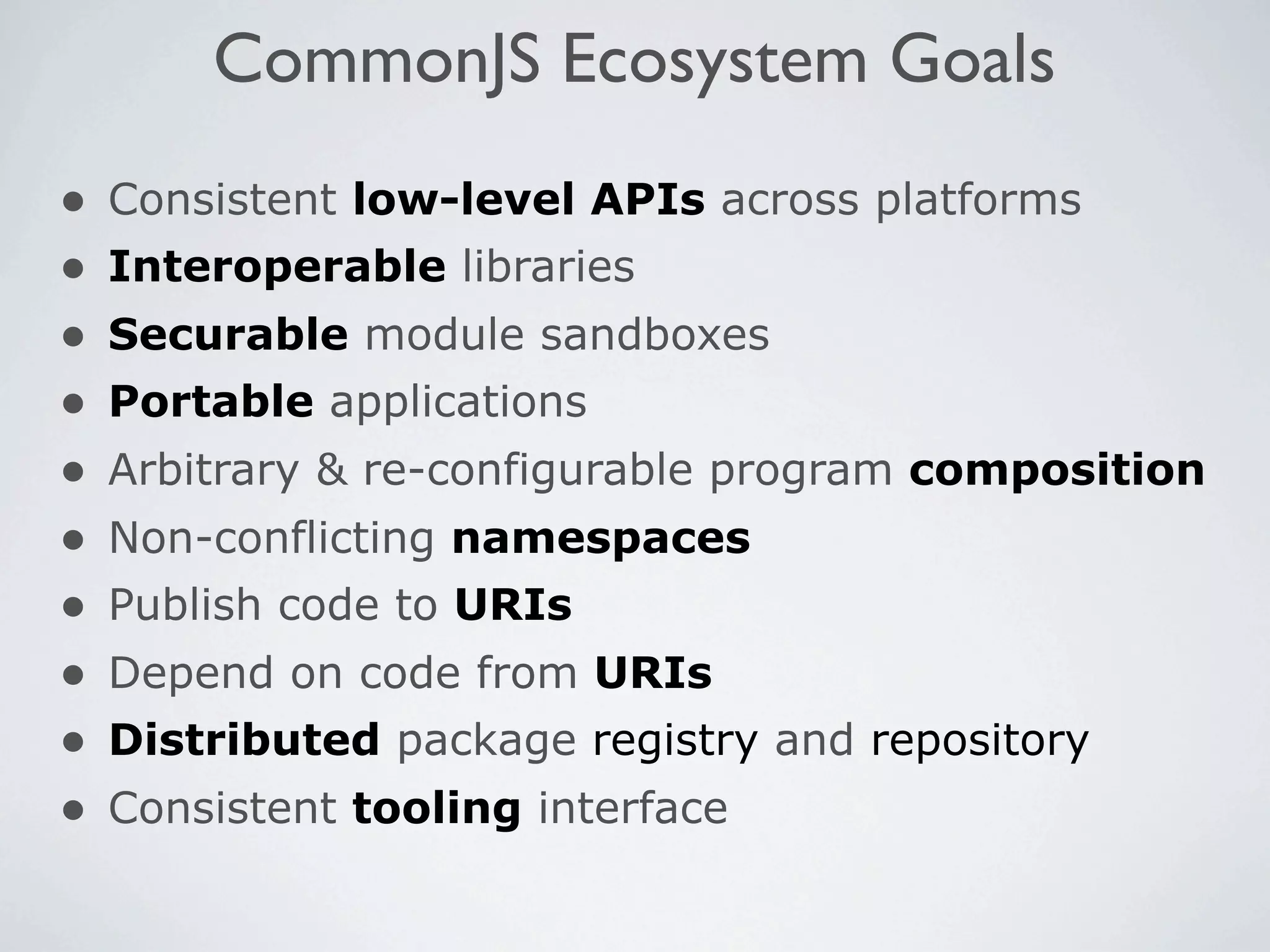
CommonJS Ecosystem Goals
• Consistent low-level APIs across platforms
CommonJS Ecosystem Goals
• Consistent low-level APIs across platforms
• Interoperable libraries
CommonJS Ecosystem Goals
• Consistent low-level APIs across platforms
• Interoperable libraries
• Securable module sandboxes
CommonJS Ecosystem Goals
•   Consistent low-level APIs across platforms
•   Interoperable libraries
•   Securable module sandboxes
•   Portable applications
CommonJS Ecosystem Goals
•   Consistent low-level APIs across platforms
•   Interoperable libraries
•   Securable module sandboxes
•   Portable applications
•   Arbitrary & re-configurable program composition
CommonJS Ecosystem Goals
•   Consistent low-level APIs across platforms
•   Interoperable libraries
•   Securable module sandboxes
•   Portable applications
•   Arbitrary & re-configurable program composition
•   Non-conflicting namespaces
CommonJS Ecosystem Goals
•   Consistent low-level APIs across platforms
•   Interoperable libraries
•   Securable module sandboxes
•   Portable applications
•   Arbitrary & re-configurable program composition
•   Non-conflicting namespaces
•   Publish code to URIs
CommonJS Ecosystem Goals
•   Consistent low-level APIs across platforms
•   Interoperable libraries
•   Securable module sandboxes
•   Portable applications
•   Arbitrary & re-configurable program composition
•   Non-conflicting namespaces
•   Publish code to URIs
•   Depend on code from URIs
CommonJS Ecosystem Goals
•   Consistent low-level APIs across platforms
•   Interoperable libraries
•   Securable module sandboxes
•   Portable applications
•   Arbitrary & re-configurable program composition
•   Non-conflicting namespaces
•   Publish code to URIs
•   Depend on code from URIs
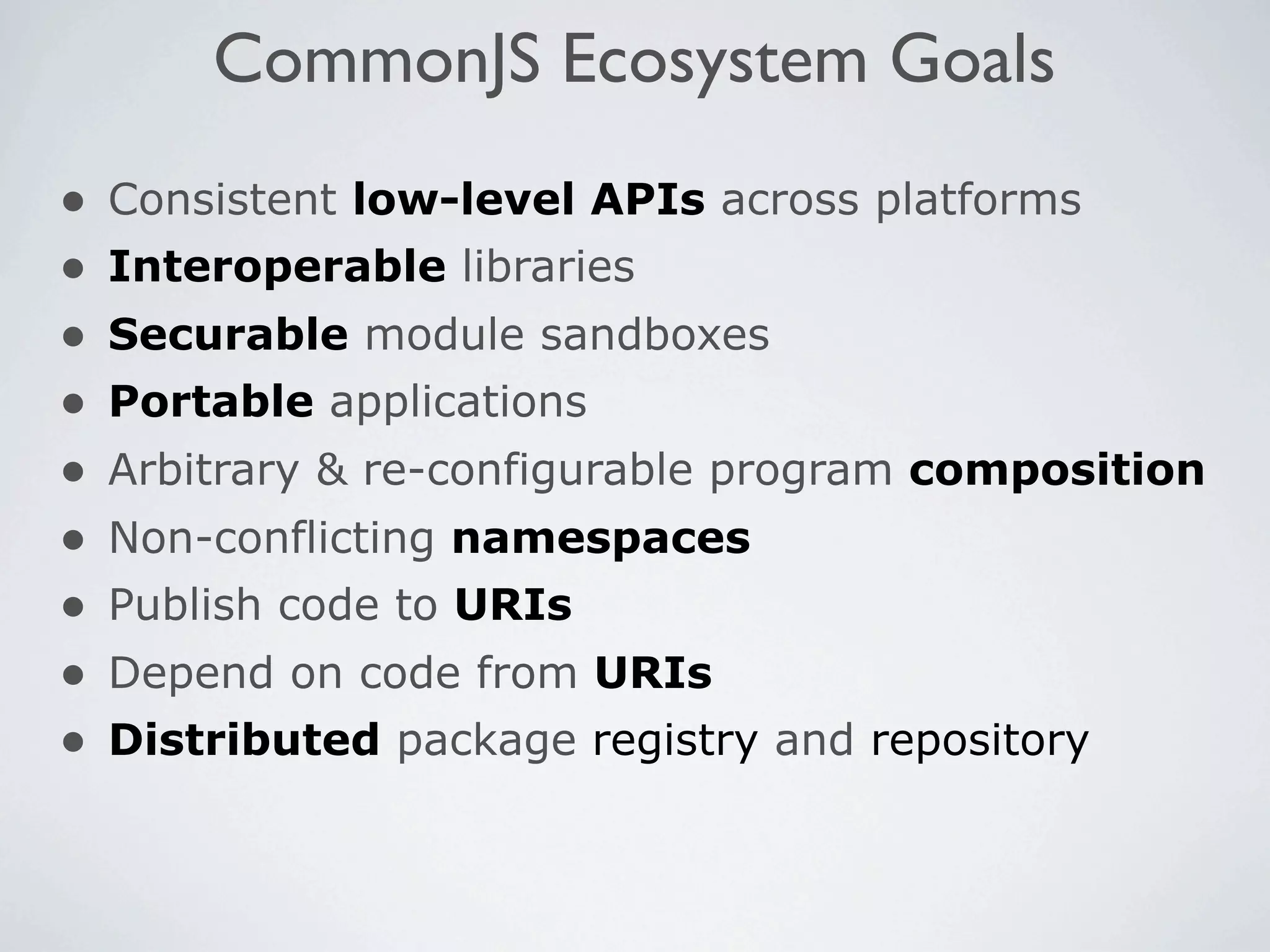
•   Distributed package registry and repository
CommonJS Ecosystem Goals
•   Consistent low-level APIs across platforms
•   Interoperable libraries
•   Securable module sandboxes
•   Portable applications
•   Arbitrary & re-configurable program composition
•   Non-conflicting namespaces
•   Publish code to URIs
•   Depend on code from URIs
•   Distributed package registry and repository
•   Consistent tooling interface
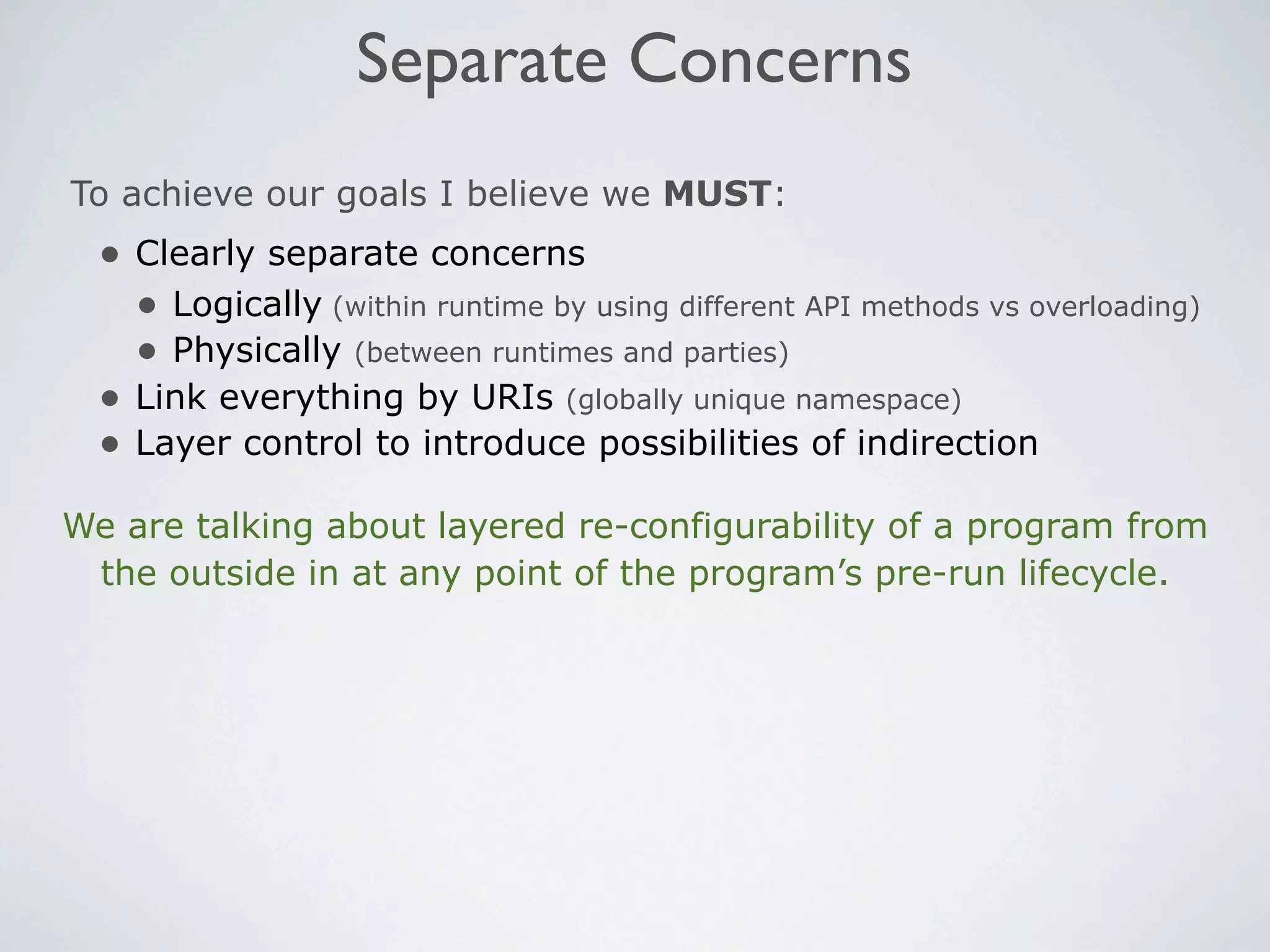
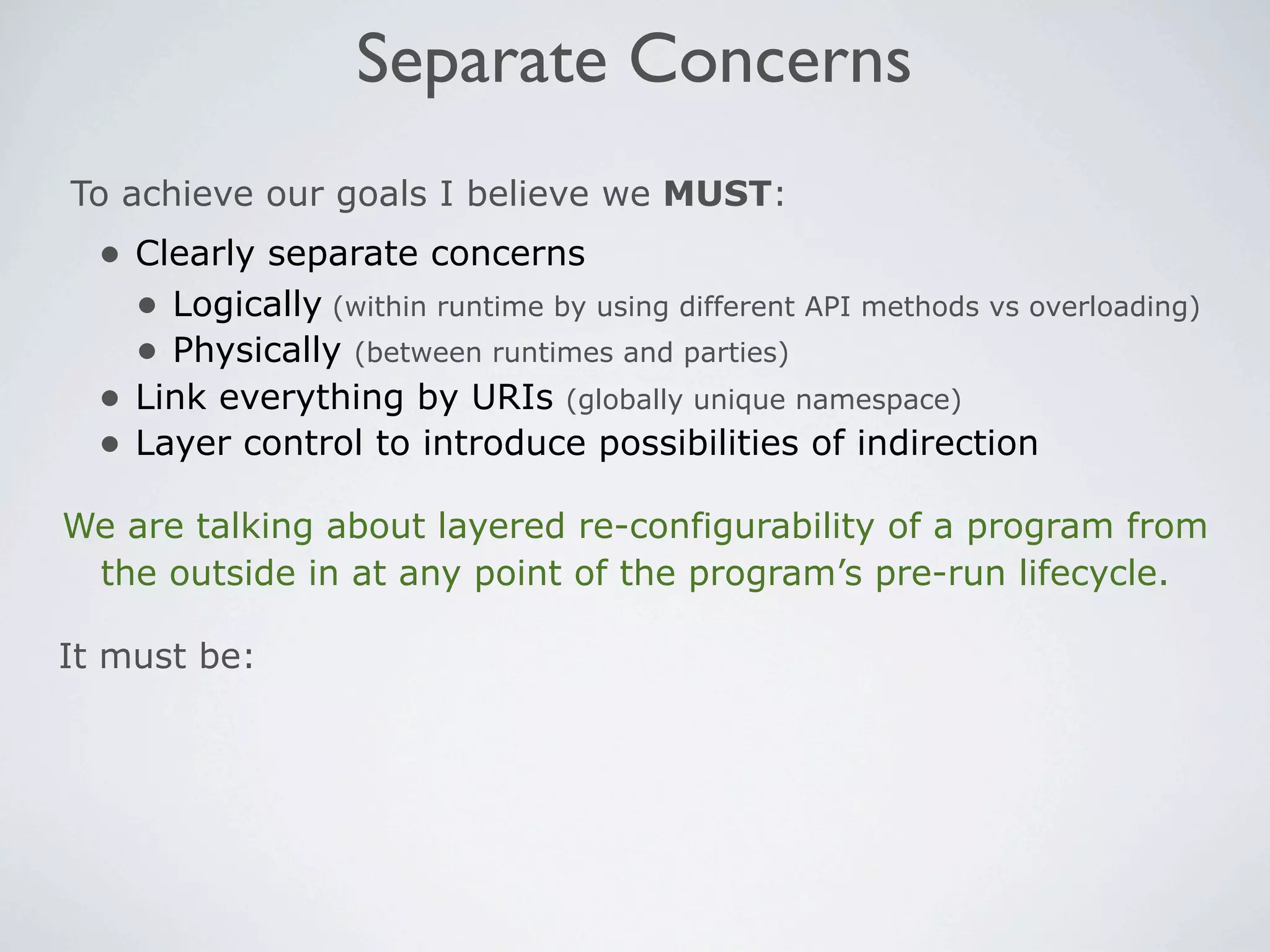
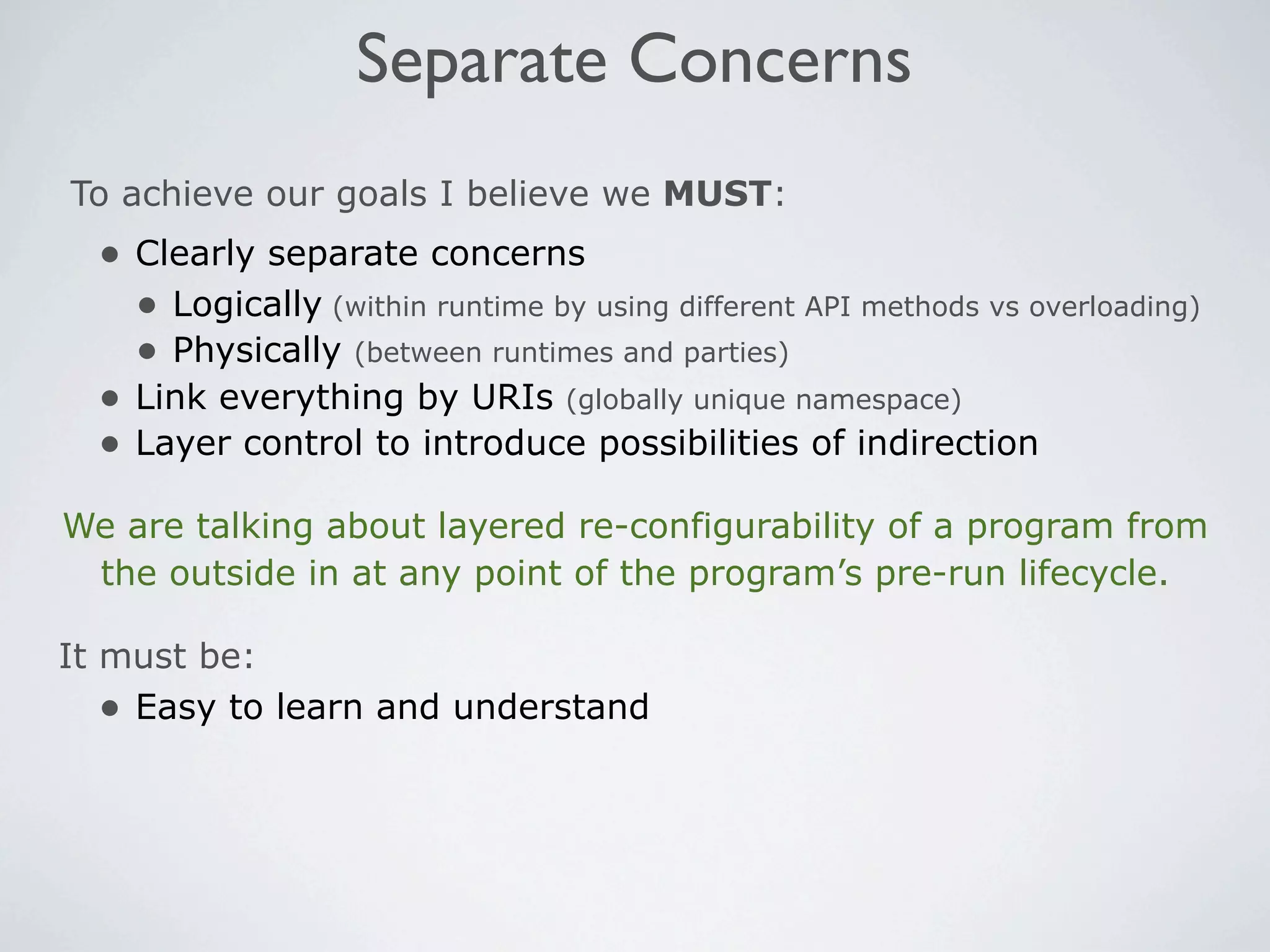
Separate Concerns
Separate Concerns
To achieve our goals I believe we MUST:
Separate Concerns
To achieve our goals I believe we MUST:
 • Clearly separate concerns
Separate Concerns
To achieve our goals I believe we MUST:
 • Clearly separate concerns
   • Logically (within runtime by using different API methods vs overloading)
Separate Concerns
To achieve our goals I believe we MUST:
 • Clearly separate concerns
   • Logically (within runtime by using different API methods vs overloading)
   • Physically (between runtimes and parties)
Separate Concerns
To achieve our goals I believe we MUST:
 • Clearly separate concerns
   • Logically (within runtime by using different API methods vs overloading)
   • Physically (between runtimes and parties)
 • Link everything by URIs (globally unique namespace)
Separate Concerns
To achieve our goals I believe we MUST:
 • Clearly separate concerns
   • Logically (within runtime by using different API methods vs overloading)
   • Physically (between runtimes and parties)
 • Link everything by URIs (globally unique namespace)
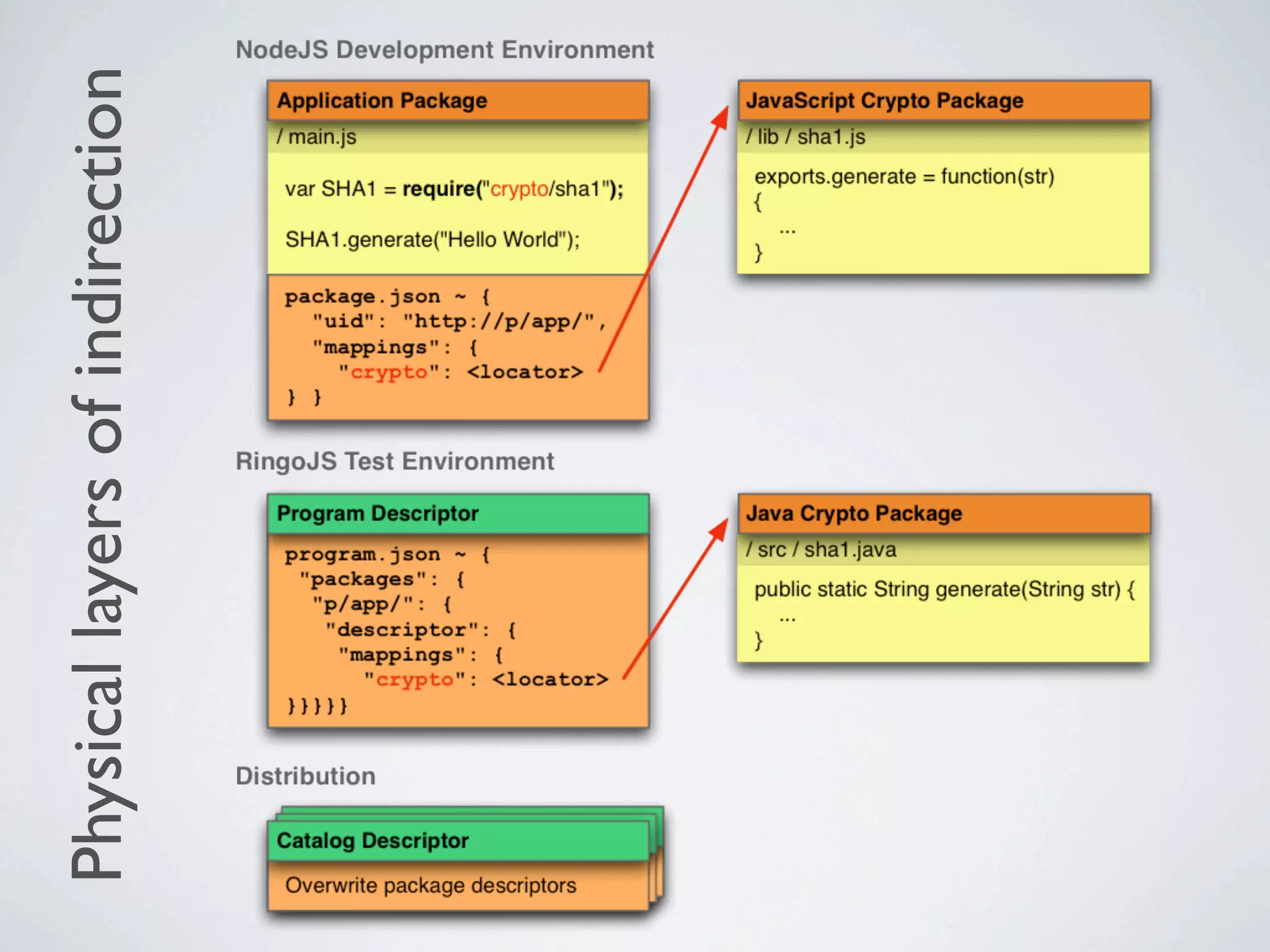
 • Layer control to introduce possibilities of indirection
Separate Concerns
To achieve our goals I believe we MUST:
  • Clearly separate concerns
    • Logically (within runtime by using different API methods vs overloading)
    • Physically (between runtimes and parties)
  • Link everything by URIs (globally unique namespace)
  • Layer control to introduce possibilities of indirection
We are talking about layered re-configurability of a program from
 the outside in at any point of the program’s pre-run lifecycle.
Separate Concerns
To achieve our goals I believe we MUST:
  • Clearly separate concerns
    • Logically (within runtime by using different API methods vs overloading)
    • Physically (between runtimes and parties)
  • Link everything by URIs (globally unique namespace)
  • Layer control to introduce possibilities of indirection
We are talking about layered re-configurability of a program from
 the outside in at any point of the program’s pre-run lifecycle.

It must be:
Separate Concerns
To achieve our goals I believe we MUST:
  • Clearly separate concerns
    • Logically (within runtime by using different API methods vs overloading)
    • Physically (between runtimes and parties)
  • Link everything by URIs (globally unique namespace)
  • Layer control to introduce possibilities of indirection
We are talking about layered re-configurability of a program from
 the outside in at any point of the program’s pre-run lifecycle.

It must be:
   • Easy to learn and understand
Separate Concerns
To achieve our goals I believe we MUST:
  • Clearly separate concerns
    • Logically (within runtime by using different API methods vs overloading)
    • Physically (between runtimes and parties)
  • Link everything by URIs (globally unique namespace)
  • Layer control to introduce possibilities of indirection
We are talking about layered re-configurability of a program from
 the outside in at any point of the program’s pre-run lifecycle.

It must be:
   • Easy to learn and understand
   • Restrict only where absolutely necessary
Separate Concerns
To achieve our goals I believe we MUST:
  • Clearly separate concerns
    • Logically (within runtime by using different API methods vs overloading)
    • Physically (between runtimes and parties)
  • Link everything by URIs (globally unique namespace)
  • Layer control to introduce possibilities of indirection
We are talking about layered re-configurability of a program from
 the outside in at any point of the program’s pre-run lifecycle.

It must be:
   • Easy to learn and understand
   • Restrict only where absolutely necessary
   • Lightweight and easily implemented
Separate Concerns
To achieve our goals I believe we MUST:
  • Clearly separate concerns
    • Logically (within runtime by using different API methods vs overloading)
    • Physically (between runtimes and parties)
  • Link everything by URIs (globally unique namespace)
  • Layer control to introduce possibilities of indirection
We are talking about layered re-configurability of a program from
 the outside in at any point of the program’s pre-run lifecycle.

It must be:
   • Easy to learn and understand
   • Restrict only where absolutely necessary
   • Lightweight and easily implemented
A/The Solution
A/The Solution
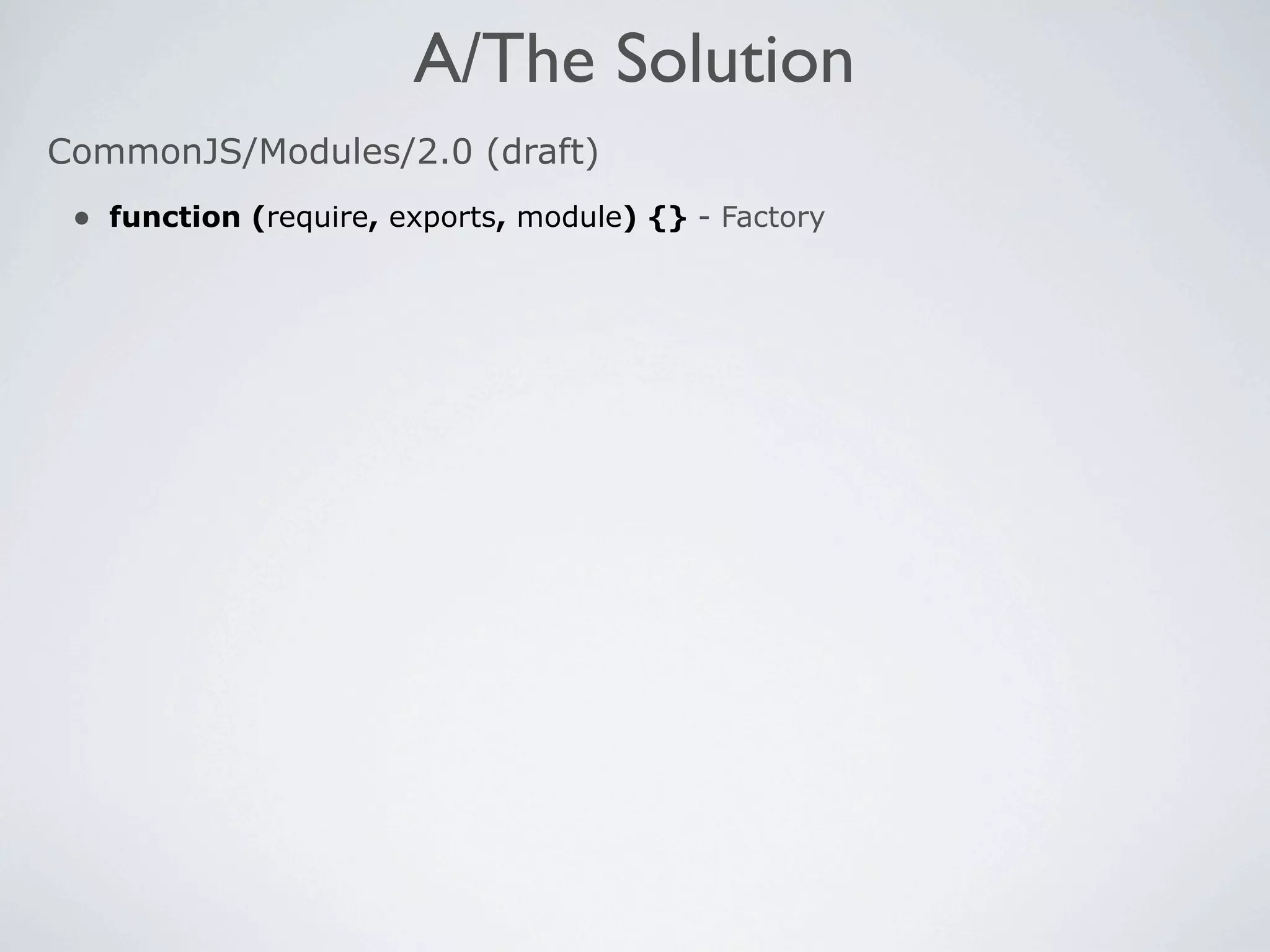
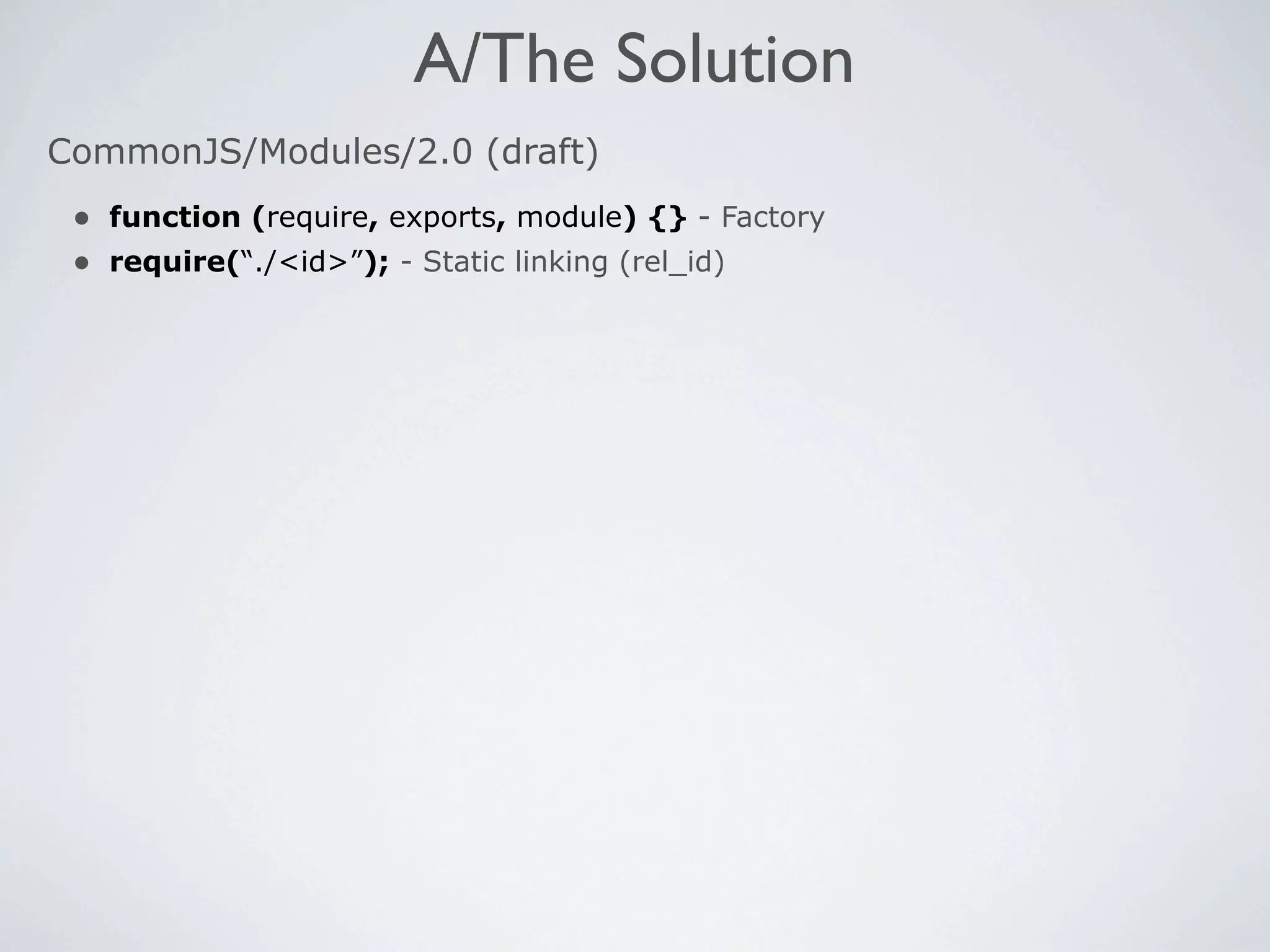
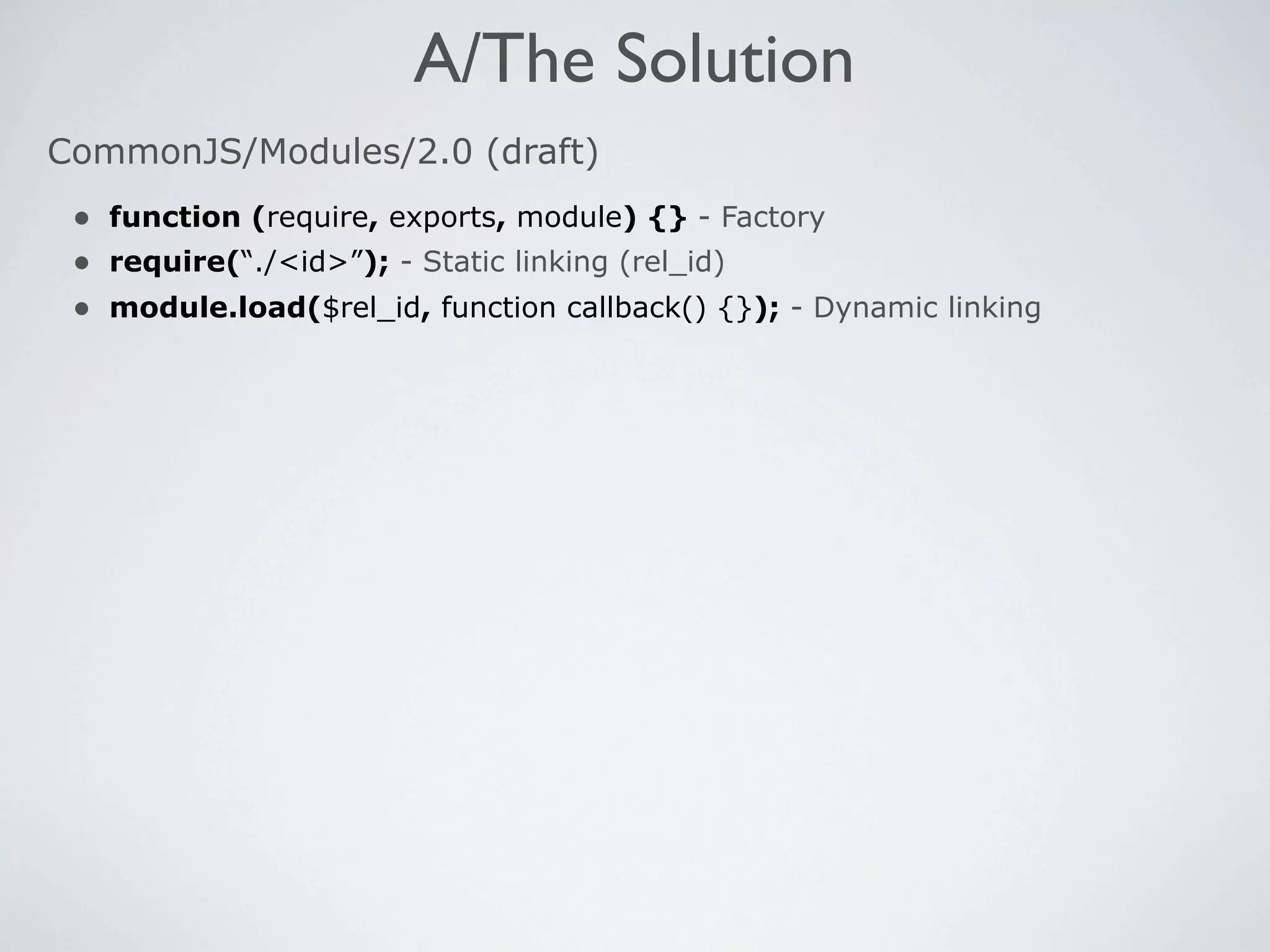
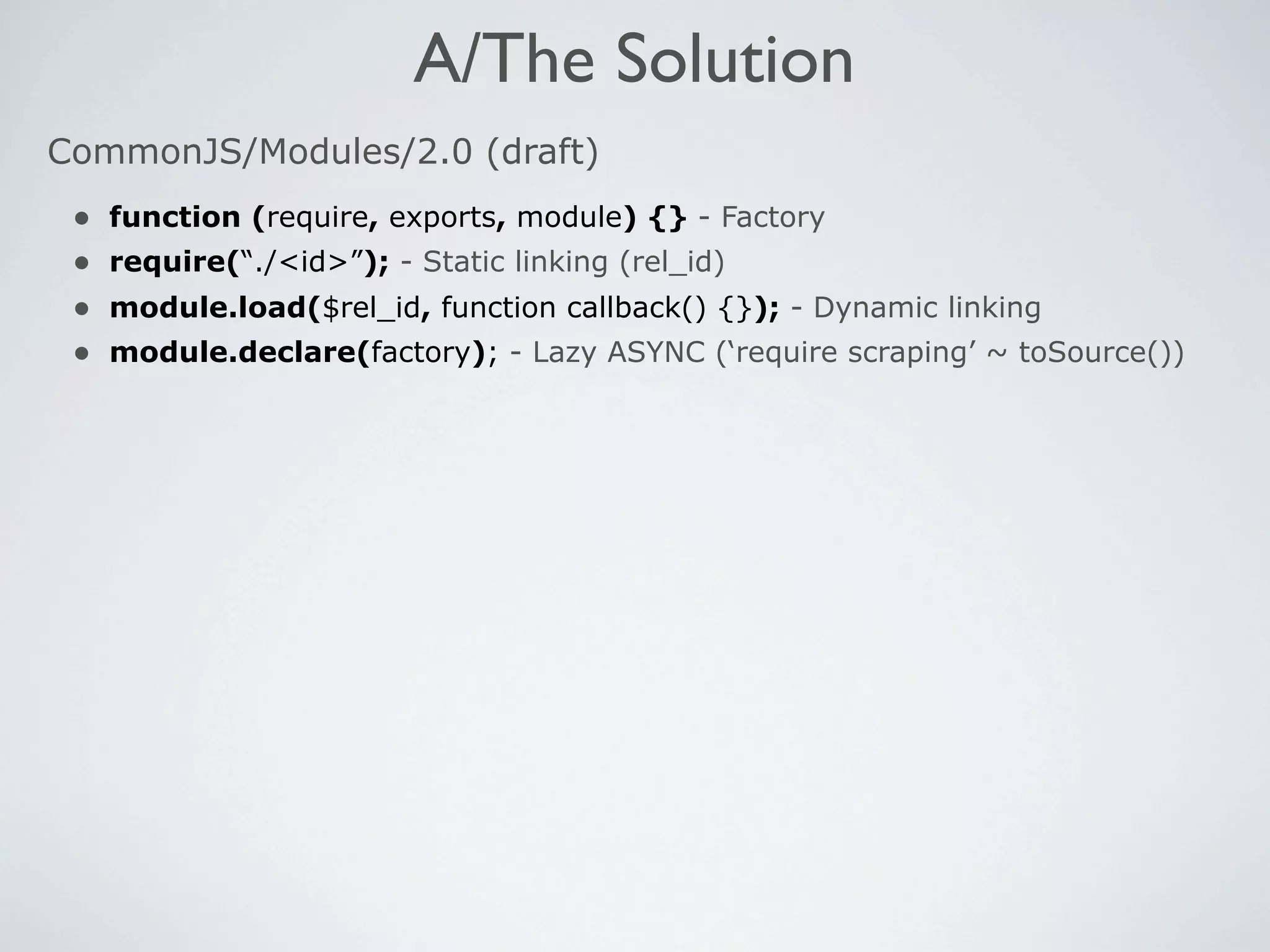
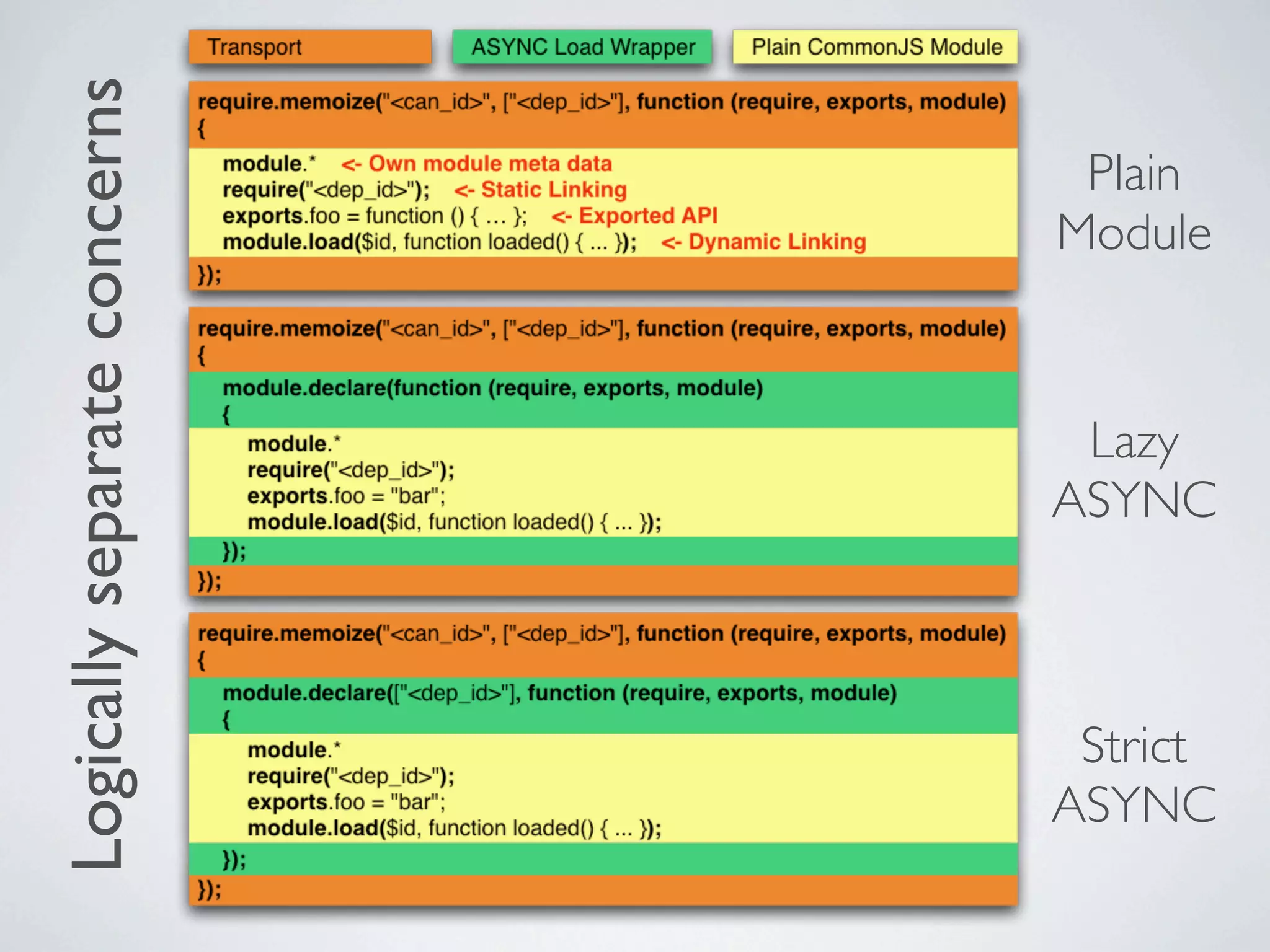
CommonJS/Modules/2.0 (draft)
A/The Solution
CommonJS/Modules/2.0 (draft)
 • function (require, exports, module) {} - Factory
A/The Solution
CommonJS/Modules/2.0 (draft)
 • function (require, exports, module) {} - Factory
 • require(“./<id>”); - Static linking (rel_id)
A/The Solution
CommonJS/Modules/2.0 (draft)
 • function (require, exports, module) {} - Factory
 • require(“./<id>”); - Static linking (rel_id)
 • module.load($rel_id, function callback() {}); - Dynamic linking
A/The Solution
CommonJS/Modules/2.0 (draft)
 •   function (require, exports, module) {} - Factory
 •   require(“./<id>”); - Static linking (rel_id)
 •   module.load($rel_id, function callback() {}); - Dynamic linking
 •   module.declare(factory); - Lazy ASYNC (‘require scraping’ ~ toSource())
A/The Solution
CommonJS/Modules/2.0 (draft)
 •   function (require, exports, module) {} - Factory
 •   require(“./<id>”); - Static linking (rel_id)
 •   module.load($rel_id, function callback() {}); - Dynamic linking
 •   module.declare(factory); - Lazy ASYNC (‘require scraping’ ~ toSource())
 •   module.declare([“<dep_rel_id>”], factory); - Strict ASYNC
A/The Solution
CommonJS/Modules/2.0 (draft)
 •   function (require, exports, module) {} - Factory
 •   require(“./<id>”); - Static linking (rel_id)
 •   module.load($rel_id, function callback() {}); - Dynamic linking
 •   module.declare(factory); - Lazy ASYNC (‘require scraping’ ~ toSource())
 •   module.declare([“<dep_rel_id>”], factory); - Strict ASYNC
 •   require.memoize(“<can_id>”, [“<dep_rel_id>”], factory); - Transport
A/The Solution
CommonJS/Modules/2.0 (draft)
 •   function (require, exports, module) {} - Factory
 •   require(“./<id>”); - Static linking (rel_id)
 •   module.load($rel_id, function callback() {}); - Dynamic linking
 •   module.declare(factory); - Lazy ASYNC (‘require scraping’ ~ toSource())
 •   module.declare([“<dep_rel_id>”], factory); - Strict ASYNC
 •   require.memoize(“<can_id>”, [“<dep_rel_id>”], factory); - Transport

CommonJS/Package/Mappings/C (proposal; amendment required)
A/The Solution
CommonJS/Modules/2.0 (draft)
 •   function (require, exports, module) {} - Factory
 •   require(“./<id>”); - Static linking (rel_id)
 •   module.load($rel_id, function callback() {}); - Dynamic linking
 •   module.declare(factory); - Lazy ASYNC (‘require scraping’ ~ toSource())
 •   module.declare([“<dep_rel_id>”], factory); - Strict ASYNC
 •   require.memoize(“<can_id>”, [“<dep_rel_id>”], factory); - Transport

CommonJS/Package/Mappings/C (proposal; amendment required)
 • {“archive”:”<url>”}, {“location”:”<path>”}, ... - Locators
A/The Solution
CommonJS/Modules/2.0 (draft)
 •   function (require, exports, module) {} - Factory
 •   require(“./<id>”); - Static linking (rel_id)
 •   module.load($rel_id, function callback() {}); - Dynamic linking
 •   module.declare(factory); - Lazy ASYNC (‘require scraping’ ~ toSource())
 •   module.declare([“<dep_rel_id>”], factory); - Strict ASYNC
 •   require.memoize(“<can_id>”, [“<dep_rel_id>”], factory); - Transport

CommonJS/Package/Mappings/C (proposal; amendment required)
 • {“archive”:”<url>”}, {“location”:”<path>”}, ... - Locators
 • package.json ~ {“mappings”: {“<alias>”:<locator>}} - Pkg. Descriptor
A/The Solution
CommonJS/Modules/2.0 (draft)
 •   function (require, exports, module) {} - Factory
 •   require(“./<id>”); - Static linking (rel_id)
 •   module.load($rel_id, function callback() {}); - Dynamic linking
 •   module.declare(factory); - Lazy ASYNC (‘require scraping’ ~ toSource())
 •   module.declare([“<dep_rel_id>”], factory); - Strict ASYNC
 •   require.memoize(“<can_id>”, [“<dep_rel_id>”], factory); - Transport

CommonJS/Package/Mappings/C (proposal; amendment required)
 • {“archive”:”<url>”}, {“location”:”<path>”}, ... - Locators
 • package.json ~ {“mappings”: {“<alias>”:<locator>}} - Pkg. Descriptor
 • require(“<alias>/<id>”); - Static linking (alias_id)
A/The Solution
CommonJS/Modules/2.0 (draft)
 •   function (require, exports, module) {} - Factory
 •   require(“./<id>”); - Static linking (rel_id)
 •   module.load($rel_id, function callback() {}); - Dynamic linking
 •   module.declare(factory); - Lazy ASYNC (‘require scraping’ ~ toSource())
 •   module.declare([“<dep_rel_id>”], factory); - Strict ASYNC
 •   require.memoize(“<can_id>”, [“<dep_rel_id>”], factory); - Transport

CommonJS/Package/Mappings/C (proposal; amendment required)
 •   {“archive”:”<url>”}, {“location”:”<path>”}, ... - Locators
 •   package.json ~ {“mappings”: {“<alias>”:<locator>}} - Pkg. Descriptor
 •   require(“<alias>/<id>”); - Static linking (alias_id)
 •   module.load($alias_id, function callback() {}); - Dynamic linking
A/The Solution
CommonJS/Modules/2.0 (draft)
 •   function (require, exports, module) {} - Factory
 •   require(“./<id>”); - Static linking (rel_id)
 •   module.load($rel_id, function callback() {}); - Dynamic linking
 •   module.declare(factory); - Lazy ASYNC (‘require scraping’ ~ toSource())
 •   module.declare([“<dep_rel_id>”], factory); - Strict ASYNC
 •   require.memoize(“<can_id>”, [“<dep_rel_id>”], factory); - Transport

CommonJS/Package/Mappings/C (proposal; amendment required)
 •   {“archive”:”<url>”}, {“location”:”<path>”}, ... - Locators
 •   package.json ~ {“mappings”: {“<alias>”:<locator>}} - Pkg. Descriptor
 •   require(“<alias>/<id>”); - Static linking (alias_id)
 •   module.load($alias_id, function callback() {}); - Dynamic linking
 •   module.declare([“<dep_alias_id>”], factory); - Strict ASYNC
A/The Solution
CommonJS/Modules/2.0 (draft)
 •   function (require, exports, module) {} - Factory
 •   require(“./<id>”); - Static linking (rel_id)
 •   module.load($rel_id, function callback() {}); - Dynamic linking
 •   module.declare(factory); - Lazy ASYNC (‘require scraping’ ~ toSource())
 •   module.declare([“<dep_rel_id>”], factory); - Strict ASYNC
 •   require.memoize(“<can_id>”, [“<dep_rel_id>”], factory); - Transport

CommonJS/Package/Mappings/C (proposal; amendment required)
 •   {“archive”:”<url>”}, {“location”:”<path>”}, ... - Locators
 •   package.json ~ {“mappings”: {“<alias>”:<locator>}} - Pkg. Descriptor
 •   require(“<alias>/<id>”); - Static linking (alias_id)
 •   module.load($alias_id, function callback() {}); - Dynamic linking
 •   module.declare([“<dep_alias_id>”], factory); - Strict ASYNC
 •   require.memoize(“<can_id>”, [“<dep_alias_id>”], factory); - Transport
A/The Solution
CommonJS/Modules/2.0 (draft)
 •   function (require, exports, module) {} - Factory
 •   require(“./<id>”); - Static linking (rel_id)
 •   module.load($rel_id, function callback() {}); - Dynamic linking
 •   module.declare(factory); - Lazy ASYNC (‘require scraping’ ~ toSource())
 •   module.declare([“<dep_rel_id>”], factory); - Strict ASYNC
 •   require.memoize(“<can_id>”, [“<dep_rel_id>”], factory); - Transport

CommonJS/Package/Mappings/C (proposal; amendment required)
 •   {“archive”:”<url>”}, {“location”:”<path>”}, ... - Locators
 •   package.json ~ {“mappings”: {“<alias>”:<locator>}} - Pkg. Descriptor
 •   require(“<alias>/<id>”); - Static linking (alias_id)
 •   module.load($alias_id, function callback() {}); - Dynamic linking
 •   module.declare([“<dep_alias_id>”], factory); - Strict ASYNC
 •   require.memoize(“<can_id>”, [“<dep_alias_id>”], factory); - Transport
 •   /<packages>/<uri_no_protocol>/<revision>@/<lib>/<id> - Canonical ID
Logically separate concerns
                               Plain
                              Module


                               Lazy
                              ASYNC


                               Strict
                              ASYNC
Physical layers of indirection
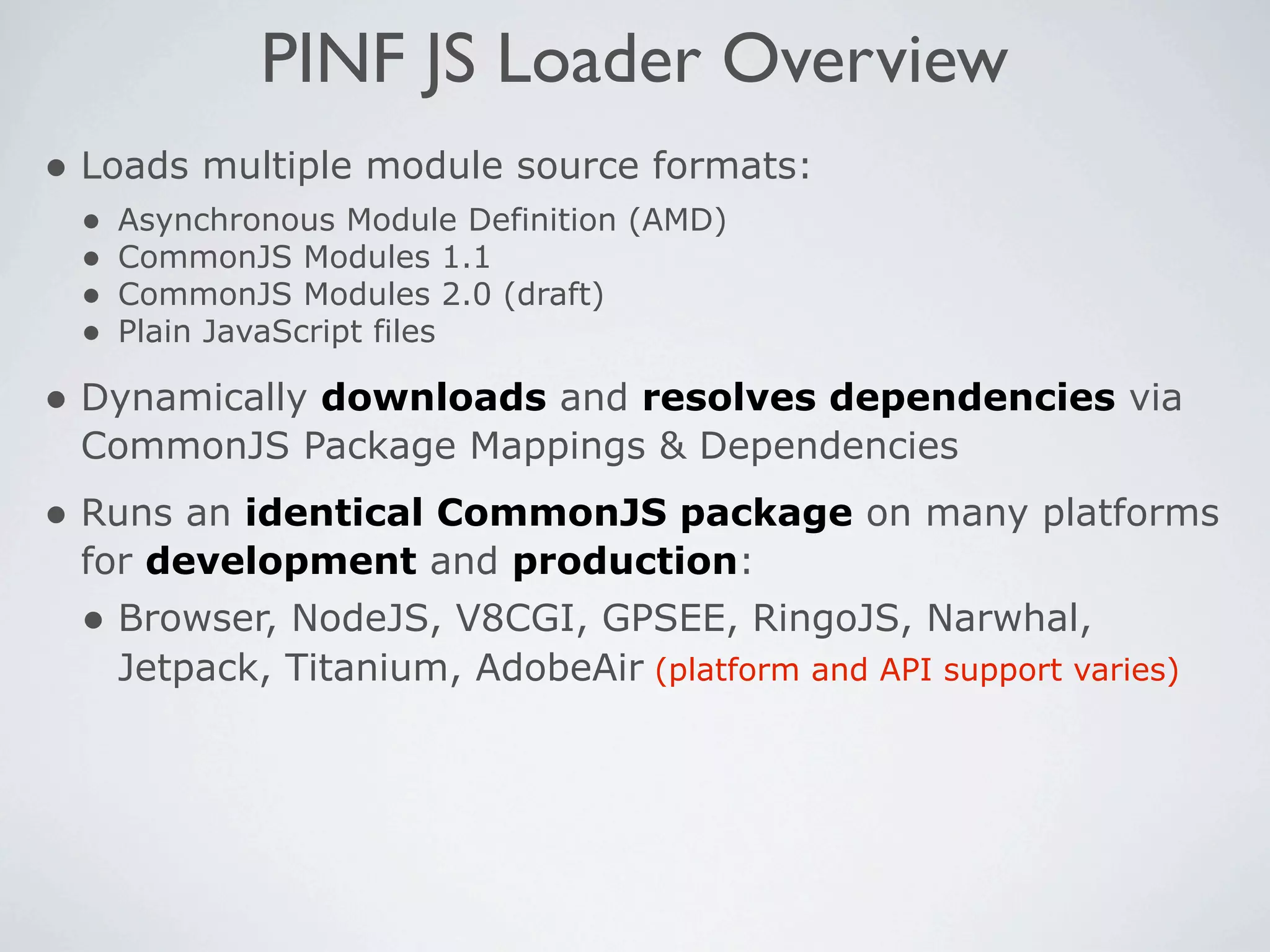
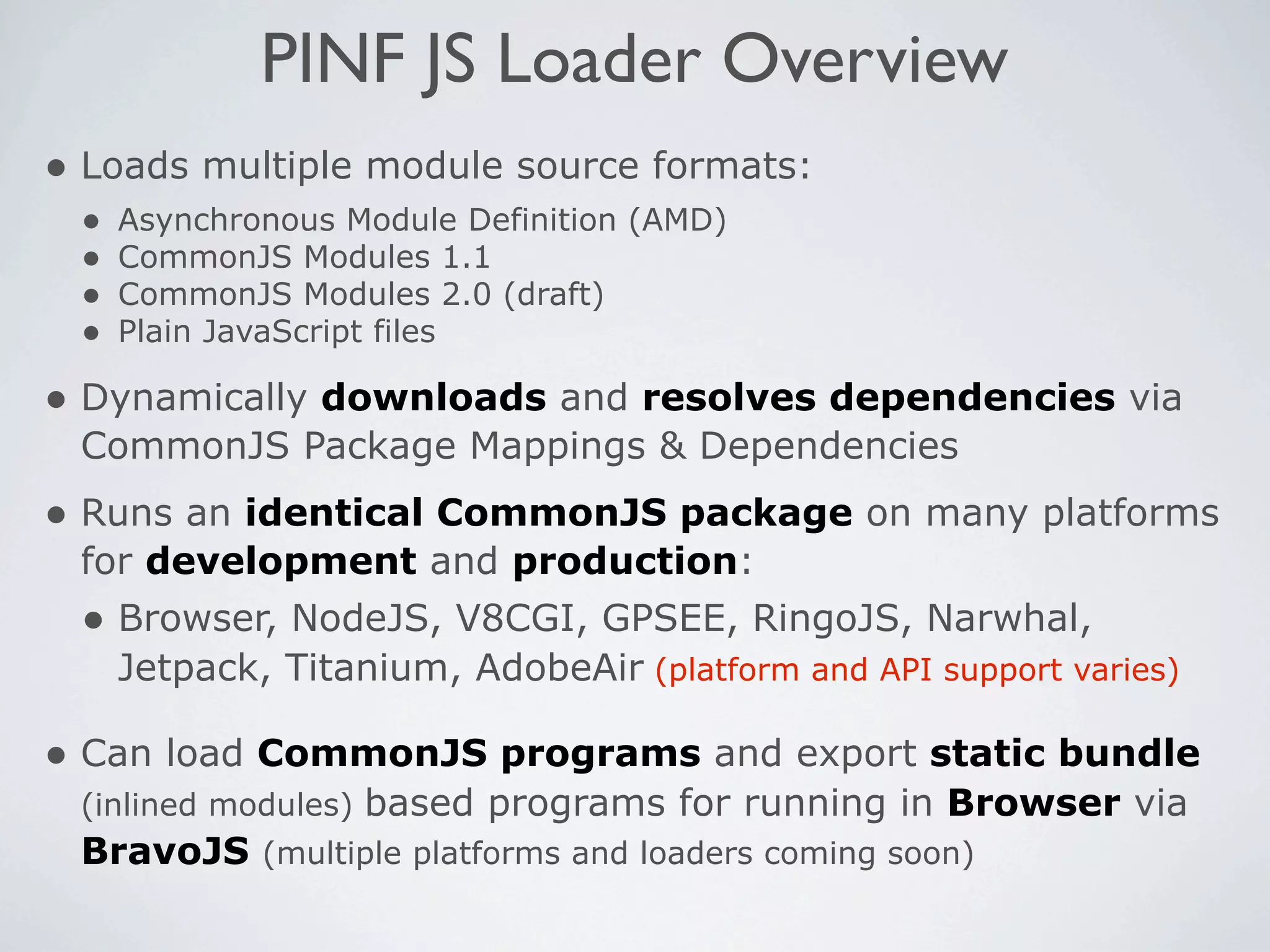
PINF JS Loader Overview
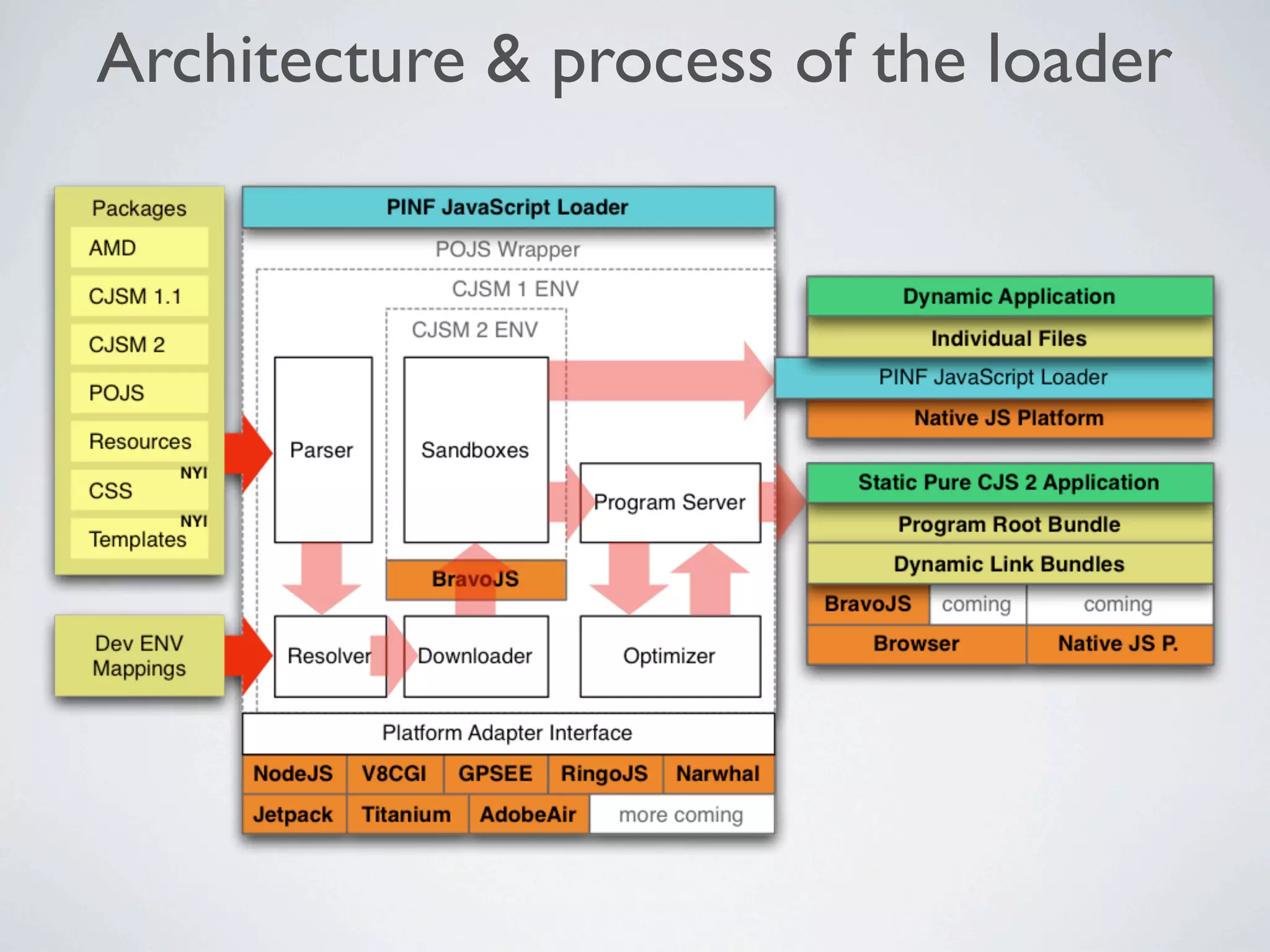
• Loads multiple module source formats:
PINF JS Loader Overview
• Loads multiple module source formats:
 • Asynchronous Module Definition (AMD)
PINF JS Loader Overview
• Loads multiple module source formats:
 • Asynchronous Module Definition (AMD)
 • CommonJS Modules 1.1
PINF JS Loader Overview
• Loads multiple module source formats:
 • Asynchronous Module Definition (AMD)
 • CommonJS Modules 1.1
 • CommonJS Modules 2.0 (draft)
PINF JS Loader Overview
• Loads multiple module source formats:
 •   Asynchronous Module Definition (AMD)
 •   CommonJS Modules 1.1
 •   CommonJS Modules 2.0 (draft)
 •   Plain JavaScript files
PINF JS Loader Overview
• Loads multiple module source formats:
 •   Asynchronous Module Definition (AMD)
 •   CommonJS Modules 1.1
 •   CommonJS Modules 2.0 (draft)
 •   Plain JavaScript files

• Dynamically downloads and resolves dependencies via
 CommonJS Package Mappings & Dependencies
PINF JS Loader Overview
• Loads multiple module source formats:
 •   Asynchronous Module Definition (AMD)
 •   CommonJS Modules 1.1
 •   CommonJS Modules 2.0 (draft)
 •   Plain JavaScript files

• Dynamically downloads and resolves dependencies via
 CommonJS Package Mappings & Dependencies
• Runs an identical CommonJS package on many platforms
 for development and production:
PINF JS Loader Overview
• Loads multiple module source formats:
 •   Asynchronous Module Definition (AMD)
 •   CommonJS Modules 1.1
 •   CommonJS Modules 2.0 (draft)
 •   Plain JavaScript files

• Dynamically downloads and resolves dependencies via
 CommonJS Package Mappings & Dependencies
• Runs an identical CommonJS package on many platforms
 for development and production:
 • Browser, NodeJS, V8CGI, GPSEE, RingoJS, Narwhal,
     Jetpack, Titanium, AdobeAir (platform and API support varies)
PINF JS Loader Overview
• Loads multiple module source formats:
 •   Asynchronous Module Definition (AMD)
 •   CommonJS Modules 1.1
 •   CommonJS Modules 2.0 (draft)
 •   Plain JavaScript files

• Dynamically downloads and resolves dependencies via
 CommonJS Package Mappings & Dependencies
• Runs an identical CommonJS package on many platforms
 for development and production:
 • Browser, NodeJS, V8CGI, GPSEE, RingoJS, Narwhal,
     Jetpack, Titanium, AdobeAir (platform and API support varies)

• Can load CommonJS programs and export static bundle
 (inlined modules) based programs for running in Browser via
 BravoJS (multiple platforms and loaders coming soon)
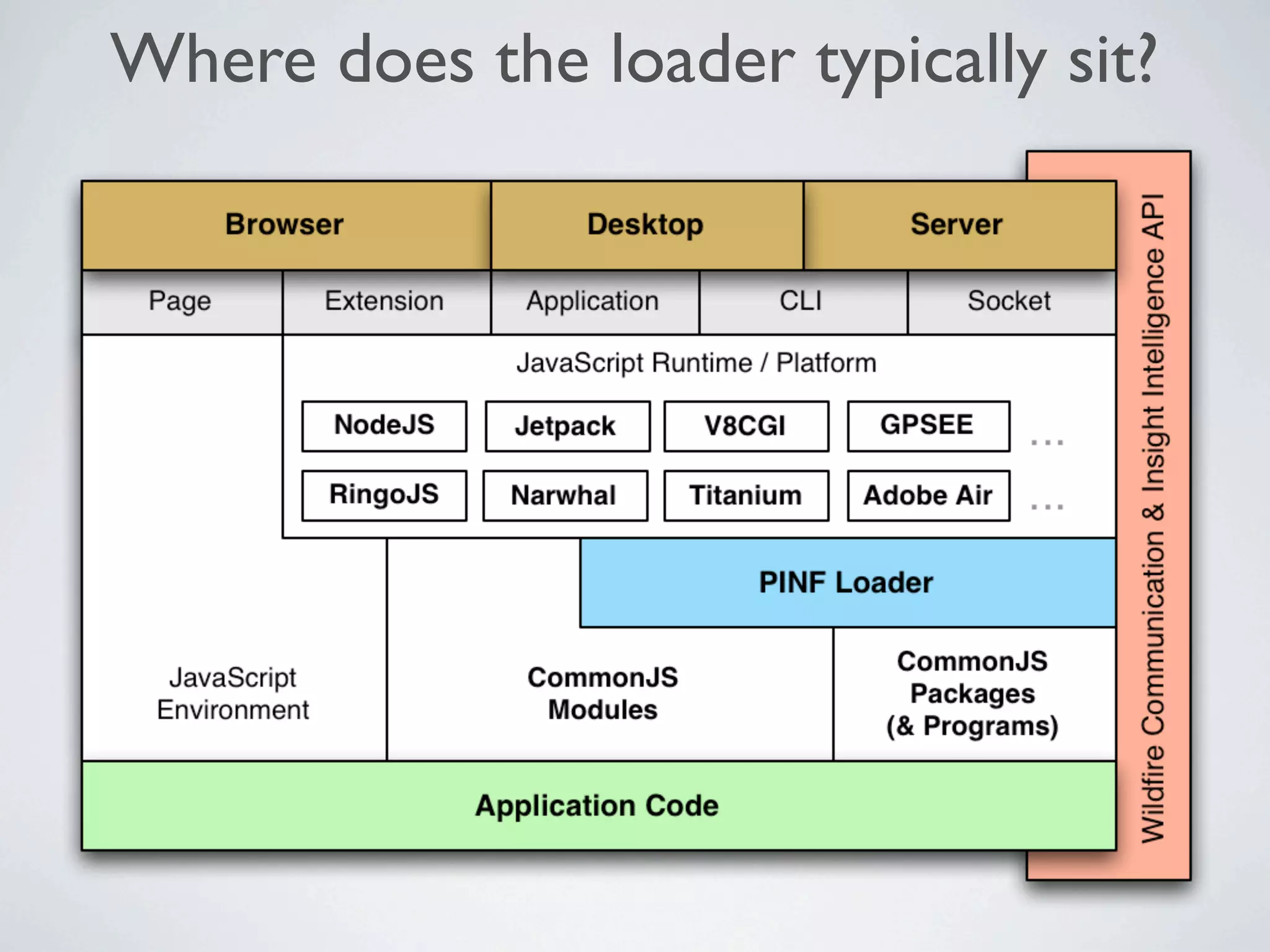
Where does the loader typically sit?
Architecture & process of the loader
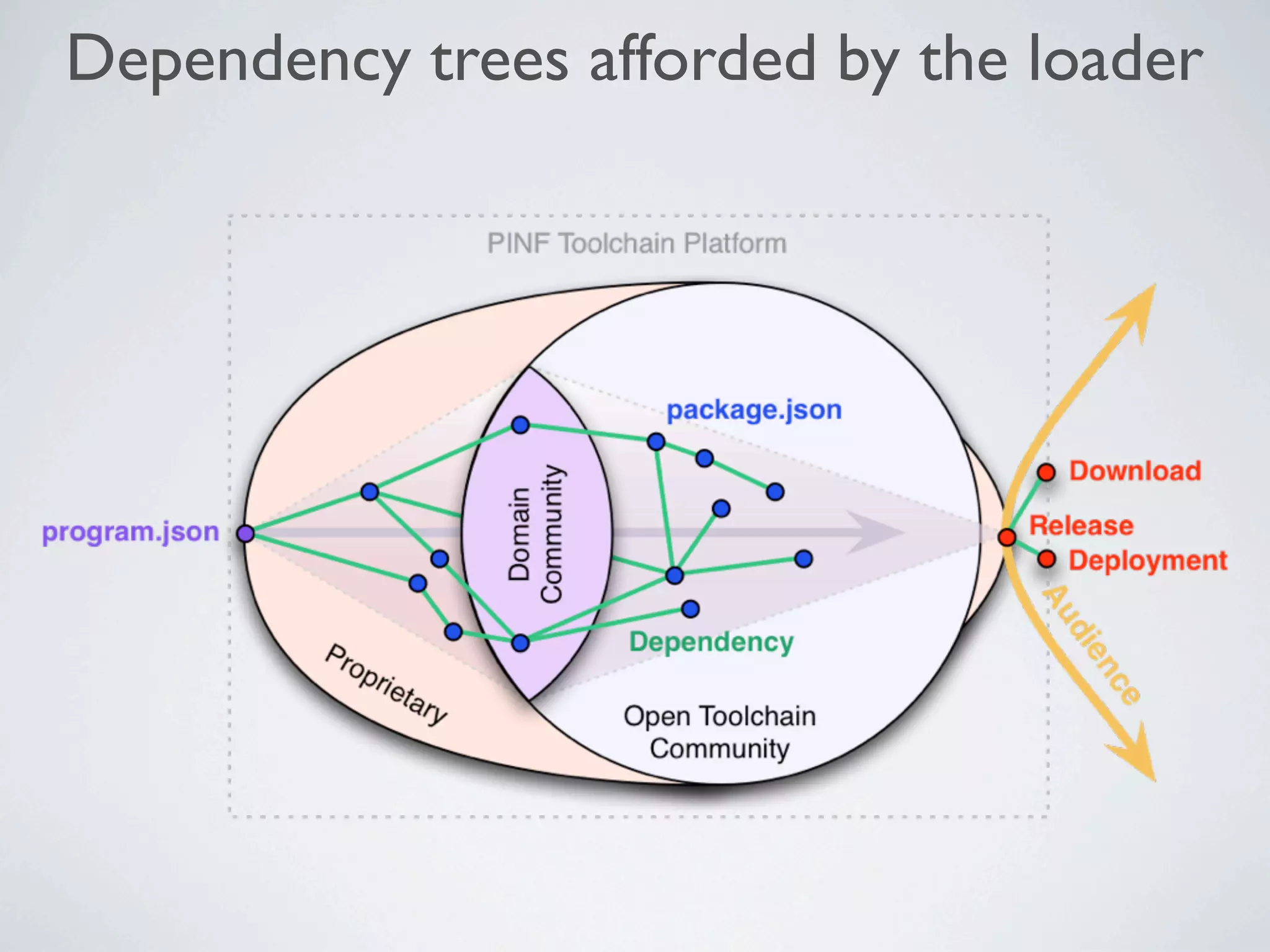
Dependency trees afforded by the loader
Demo Time!


  github.com/cadorn/ace-extjs


github.com/pinf/test-programs-js
Thank you!


Slides and links will be made available at:

github.com/pinf/loader-js/wiki

CommonJS via PINF JavaScript Loader - Introduction

  • 1.
    CommonJS via BETA PINF JavaScript Loader github.com/pinf/loader-js (MIT Licensed) Introduction Boston JavaScript - October 14, 2011 by Christoph Dorn Copyright (c) 2011 Christoph Dorn <christoph@christophdorn.com> License: Creative Commons Attribution-NonCommercial-ShareAlike 3.0 Various names and trademarks copyright respective parties.
  • 2.
  • 3.
    About Christoph • 15+years experience (web apps & business)
  • 4.
    About Christoph • 15+years experience (web apps & business) • Self taught developer
  • 5.
    About Christoph • 15+years experience (web apps & business) • Self taught developer • Independent
  • 6.
    About Christoph • 15+years experience (web apps & business) • Self taught developer • Independent • Playing with and integrating toolchains for years
  • 7.
    About Christoph • 15+ years experience (web apps & business) • Self taught developer • Independent • Playing with and integrating toolchains for years • Firebug Working Group (3 years)
  • 8.
    About Christoph • 15+ years experience (web apps & business) • Self taught developer • Independent • Playing with and integrating toolchains for years • Firebug Working Group (3 years) • Extensions
  • 9.
    About Christoph • 15+ years experience (web apps & business) • Self taught developer • Independent • Playing with and integrating toolchains for years • Firebug Working Group (3 years) • Extensions • CommonJS List (2 years)
  • 10.
    About Christoph • 15+ years experience (web apps & business) • Self taught developer • Independent • Playing with and integrating toolchains for years • Firebug Working Group (3 years) • Extensions • CommonJS List (2 years) • Packages & dependency management
  • 11.
    About Christoph • 15+ years experience (web apps & business) • Self taught developer • Independent • Playing with and integrating toolchains for years • Firebug Working Group (3 years) • Extensions • CommonJS List (2 years) • Packages & dependency management Focus: Toolchain Design & Efficient Workflows
  • 12.
  • 13.
    What drives me? I believe a major factor constraining software evolution is the lack of refactorability as a core design goal of toolchains.
  • 14.
    What drives me? I believe a major factor constraining software evolution is the lack of refactorability as a core design goal of toolchains. If we can easily change our software in every way we can focus on figuring out what actually works the best!
  • 15.
    What drives me? I believe a major factor constraining software evolution is the lack of refactorability as a core design goal of toolchains. If we can easily change our software in every way we can focus on figuring out what actually works the best! Building a JavaScript based Toolchain Platform!
  • 16.
    What drives me? I believe a major factor constraining software evolution is the lack of refactorability as a core design goal of toolchains. If we can easily change our software in every way we can focus on figuring out what actually works the best! Building a JavaScript based Toolchain Platform! github.com/pinf (MIT Licensed)
  • 17.
    What drives me? I believe a major factor constraining software evolution is the lack of refactorability as a core design goal of toolchains. If we can easily change our software in every way we can focus on figuring out what actually works the best! Building a JavaScript based Toolchain Platform! github.com/pinf (MIT Licensed) JavaScript: Very expressive and easy to refactor; everyone will know it
  • 18.
    What drives me? I believe a major factor constraining software evolution is the lack of refactorability as a core design goal of toolchains. If we can easily change our software in every way we can focus on figuring out what actually works the best! Building a JavaScript based Toolchain Platform! github.com/pinf (MIT Licensed) JavaScript: Very expressive and easy to refactor; everyone will know it CommonJS: Developers seeking to build a JavaScript Ecosystem which allows for:
  • 19.
    What drives me? I believe a major factor constraining software evolution is the lack of refactorability as a core design goal of toolchains. If we can easily change our software in every way we can focus on figuring out what actually works the best! Building a JavaScript based Toolchain Platform! github.com/pinf (MIT Licensed) JavaScript: Very expressive and easy to refactor; everyone will know it CommonJS: Developers seeking to build a JavaScript Ecosystem which allows for: • Code-sharing, interoperable libraries and portable applications
  • 20.
    What drives me? I believe a major factor constraining software evolution is the lack of refactorability as a core design goal of toolchains. If we can easily change our software in every way we can focus on figuring out what actually works the best! Building a JavaScript based Toolchain Platform! github.com/pinf (MIT Licensed) JavaScript: Very expressive and easy to refactor; everyone will know it CommonJS: Developers seeking to build a JavaScript Ecosystem which allows for: • Code-sharing, interoperable libraries and portable applications • Transferring the power of JavaScript to various parts of a system
  • 21.
    What drives me? I believe a major factor constraining software evolution is the lack of refactorability as a core design goal of toolchains. If we can easily change our software in every way we can focus on figuring out what actually works the best! Building a JavaScript based Toolchain Platform! github.com/pinf (MIT Licensed) JavaScript: Very expressive and easy to refactor; everyone will know it CommonJS: Developers seeking to build a JavaScript Ecosystem which allows for: • Code-sharing, interoperable libraries and portable applications • Transferring the power of JavaScript to various parts of a system • Seamless refactoring and re-composition of programs
  • 22.
  • 23.
  • 24.
  • 25.
    CommonJS Ecosystem Goals •Consistent low-level APIs across platforms
  • 26.
    CommonJS Ecosystem Goals •Consistent low-level APIs across platforms • Interoperable libraries
  • 27.
    CommonJS Ecosystem Goals •Consistent low-level APIs across platforms • Interoperable libraries • Securable module sandboxes
  • 28.
    CommonJS Ecosystem Goals • Consistent low-level APIs across platforms • Interoperable libraries • Securable module sandboxes • Portable applications
  • 29.
    CommonJS Ecosystem Goals • Consistent low-level APIs across platforms • Interoperable libraries • Securable module sandboxes • Portable applications • Arbitrary & re-configurable program composition
  • 30.
    CommonJS Ecosystem Goals • Consistent low-level APIs across platforms • Interoperable libraries • Securable module sandboxes • Portable applications • Arbitrary & re-configurable program composition • Non-conflicting namespaces
  • 31.
    CommonJS Ecosystem Goals • Consistent low-level APIs across platforms • Interoperable libraries • Securable module sandboxes • Portable applications • Arbitrary & re-configurable program composition • Non-conflicting namespaces • Publish code to URIs
  • 32.
    CommonJS Ecosystem Goals • Consistent low-level APIs across platforms • Interoperable libraries • Securable module sandboxes • Portable applications • Arbitrary & re-configurable program composition • Non-conflicting namespaces • Publish code to URIs • Depend on code from URIs
  • 33.
    CommonJS Ecosystem Goals • Consistent low-level APIs across platforms • Interoperable libraries • Securable module sandboxes • Portable applications • Arbitrary & re-configurable program composition • Non-conflicting namespaces • Publish code to URIs • Depend on code from URIs • Distributed package registry and repository
  • 34.
    CommonJS Ecosystem Goals • Consistent low-level APIs across platforms • Interoperable libraries • Securable module sandboxes • Portable applications • Arbitrary & re-configurable program composition • Non-conflicting namespaces • Publish code to URIs • Depend on code from URIs • Distributed package registry and repository • Consistent tooling interface
  • 35.
  • 36.
    Separate Concerns To achieveour goals I believe we MUST:
  • 37.
    Separate Concerns To achieveour goals I believe we MUST: • Clearly separate concerns
  • 38.
    Separate Concerns To achieveour goals I believe we MUST: • Clearly separate concerns • Logically (within runtime by using different API methods vs overloading)
  • 39.
    Separate Concerns To achieveour goals I believe we MUST: • Clearly separate concerns • Logically (within runtime by using different API methods vs overloading) • Physically (between runtimes and parties)
  • 40.
    Separate Concerns To achieveour goals I believe we MUST: • Clearly separate concerns • Logically (within runtime by using different API methods vs overloading) • Physically (between runtimes and parties) • Link everything by URIs (globally unique namespace)
  • 41.
    Separate Concerns To achieveour goals I believe we MUST: • Clearly separate concerns • Logically (within runtime by using different API methods vs overloading) • Physically (between runtimes and parties) • Link everything by URIs (globally unique namespace) • Layer control to introduce possibilities of indirection
  • 42.
    Separate Concerns To achieveour goals I believe we MUST: • Clearly separate concerns • Logically (within runtime by using different API methods vs overloading) • Physically (between runtimes and parties) • Link everything by URIs (globally unique namespace) • Layer control to introduce possibilities of indirection We are talking about layered re-configurability of a program from the outside in at any point of the program’s pre-run lifecycle.
  • 43.
    Separate Concerns To achieveour goals I believe we MUST: • Clearly separate concerns • Logically (within runtime by using different API methods vs overloading) • Physically (between runtimes and parties) • Link everything by URIs (globally unique namespace) • Layer control to introduce possibilities of indirection We are talking about layered re-configurability of a program from the outside in at any point of the program’s pre-run lifecycle. It must be:
  • 44.
    Separate Concerns To achieveour goals I believe we MUST: • Clearly separate concerns • Logically (within runtime by using different API methods vs overloading) • Physically (between runtimes and parties) • Link everything by URIs (globally unique namespace) • Layer control to introduce possibilities of indirection We are talking about layered re-configurability of a program from the outside in at any point of the program’s pre-run lifecycle. It must be: • Easy to learn and understand
  • 45.
    Separate Concerns To achieveour goals I believe we MUST: • Clearly separate concerns • Logically (within runtime by using different API methods vs overloading) • Physically (between runtimes and parties) • Link everything by URIs (globally unique namespace) • Layer control to introduce possibilities of indirection We are talking about layered re-configurability of a program from the outside in at any point of the program’s pre-run lifecycle. It must be: • Easy to learn and understand • Restrict only where absolutely necessary
  • 46.
    Separate Concerns To achieveour goals I believe we MUST: • Clearly separate concerns • Logically (within runtime by using different API methods vs overloading) • Physically (between runtimes and parties) • Link everything by URIs (globally unique namespace) • Layer control to introduce possibilities of indirection We are talking about layered re-configurability of a program from the outside in at any point of the program’s pre-run lifecycle. It must be: • Easy to learn and understand • Restrict only where absolutely necessary • Lightweight and easily implemented
  • 47.
    Separate Concerns To achieveour goals I believe we MUST: • Clearly separate concerns • Logically (within runtime by using different API methods vs overloading) • Physically (between runtimes and parties) • Link everything by URIs (globally unique namespace) • Layer control to introduce possibilities of indirection We are talking about layered re-configurability of a program from the outside in at any point of the program’s pre-run lifecycle. It must be: • Easy to learn and understand • Restrict only where absolutely necessary • Lightweight and easily implemented
  • 48.
  • 49.
  • 50.
    A/The Solution CommonJS/Modules/2.0 (draft) • function (require, exports, module) {} - Factory
  • 51.
    A/The Solution CommonJS/Modules/2.0 (draft) • function (require, exports, module) {} - Factory • require(“./<id>”); - Static linking (rel_id)
  • 52.
    A/The Solution CommonJS/Modules/2.0 (draft) • function (require, exports, module) {} - Factory • require(“./<id>”); - Static linking (rel_id) • module.load($rel_id, function callback() {}); - Dynamic linking
  • 53.
    A/The Solution CommonJS/Modules/2.0 (draft) • function (require, exports, module) {} - Factory • require(“./<id>”); - Static linking (rel_id) • module.load($rel_id, function callback() {}); - Dynamic linking • module.declare(factory); - Lazy ASYNC (‘require scraping’ ~ toSource())
  • 54.
    A/The Solution CommonJS/Modules/2.0 (draft) • function (require, exports, module) {} - Factory • require(“./<id>”); - Static linking (rel_id) • module.load($rel_id, function callback() {}); - Dynamic linking • module.declare(factory); - Lazy ASYNC (‘require scraping’ ~ toSource()) • module.declare([“<dep_rel_id>”], factory); - Strict ASYNC
  • 55.
    A/The Solution CommonJS/Modules/2.0 (draft) • function (require, exports, module) {} - Factory • require(“./<id>”); - Static linking (rel_id) • module.load($rel_id, function callback() {}); - Dynamic linking • module.declare(factory); - Lazy ASYNC (‘require scraping’ ~ toSource()) • module.declare([“<dep_rel_id>”], factory); - Strict ASYNC • require.memoize(“<can_id>”, [“<dep_rel_id>”], factory); - Transport
  • 56.
    A/The Solution CommonJS/Modules/2.0 (draft) • function (require, exports, module) {} - Factory • require(“./<id>”); - Static linking (rel_id) • module.load($rel_id, function callback() {}); - Dynamic linking • module.declare(factory); - Lazy ASYNC (‘require scraping’ ~ toSource()) • module.declare([“<dep_rel_id>”], factory); - Strict ASYNC • require.memoize(“<can_id>”, [“<dep_rel_id>”], factory); - Transport CommonJS/Package/Mappings/C (proposal; amendment required)
  • 57.
    A/The Solution CommonJS/Modules/2.0 (draft) • function (require, exports, module) {} - Factory • require(“./<id>”); - Static linking (rel_id) • module.load($rel_id, function callback() {}); - Dynamic linking • module.declare(factory); - Lazy ASYNC (‘require scraping’ ~ toSource()) • module.declare([“<dep_rel_id>”], factory); - Strict ASYNC • require.memoize(“<can_id>”, [“<dep_rel_id>”], factory); - Transport CommonJS/Package/Mappings/C (proposal; amendment required) • {“archive”:”<url>”}, {“location”:”<path>”}, ... - Locators
  • 58.
    A/The Solution CommonJS/Modules/2.0 (draft) • function (require, exports, module) {} - Factory • require(“./<id>”); - Static linking (rel_id) • module.load($rel_id, function callback() {}); - Dynamic linking • module.declare(factory); - Lazy ASYNC (‘require scraping’ ~ toSource()) • module.declare([“<dep_rel_id>”], factory); - Strict ASYNC • require.memoize(“<can_id>”, [“<dep_rel_id>”], factory); - Transport CommonJS/Package/Mappings/C (proposal; amendment required) • {“archive”:”<url>”}, {“location”:”<path>”}, ... - Locators • package.json ~ {“mappings”: {“<alias>”:<locator>}} - Pkg. Descriptor
  • 59.
    A/The Solution CommonJS/Modules/2.0 (draft) • function (require, exports, module) {} - Factory • require(“./<id>”); - Static linking (rel_id) • module.load($rel_id, function callback() {}); - Dynamic linking • module.declare(factory); - Lazy ASYNC (‘require scraping’ ~ toSource()) • module.declare([“<dep_rel_id>”], factory); - Strict ASYNC • require.memoize(“<can_id>”, [“<dep_rel_id>”], factory); - Transport CommonJS/Package/Mappings/C (proposal; amendment required) • {“archive”:”<url>”}, {“location”:”<path>”}, ... - Locators • package.json ~ {“mappings”: {“<alias>”:<locator>}} - Pkg. Descriptor • require(“<alias>/<id>”); - Static linking (alias_id)
  • 60.
    A/The Solution CommonJS/Modules/2.0 (draft) • function (require, exports, module) {} - Factory • require(“./<id>”); - Static linking (rel_id) • module.load($rel_id, function callback() {}); - Dynamic linking • module.declare(factory); - Lazy ASYNC (‘require scraping’ ~ toSource()) • module.declare([“<dep_rel_id>”], factory); - Strict ASYNC • require.memoize(“<can_id>”, [“<dep_rel_id>”], factory); - Transport CommonJS/Package/Mappings/C (proposal; amendment required) • {“archive”:”<url>”}, {“location”:”<path>”}, ... - Locators • package.json ~ {“mappings”: {“<alias>”:<locator>}} - Pkg. Descriptor • require(“<alias>/<id>”); - Static linking (alias_id) • module.load($alias_id, function callback() {}); - Dynamic linking
  • 61.
    A/The Solution CommonJS/Modules/2.0 (draft) • function (require, exports, module) {} - Factory • require(“./<id>”); - Static linking (rel_id) • module.load($rel_id, function callback() {}); - Dynamic linking • module.declare(factory); - Lazy ASYNC (‘require scraping’ ~ toSource()) • module.declare([“<dep_rel_id>”], factory); - Strict ASYNC • require.memoize(“<can_id>”, [“<dep_rel_id>”], factory); - Transport CommonJS/Package/Mappings/C (proposal; amendment required) • {“archive”:”<url>”}, {“location”:”<path>”}, ... - Locators • package.json ~ {“mappings”: {“<alias>”:<locator>}} - Pkg. Descriptor • require(“<alias>/<id>”); - Static linking (alias_id) • module.load($alias_id, function callback() {}); - Dynamic linking • module.declare([“<dep_alias_id>”], factory); - Strict ASYNC
  • 62.
    A/The Solution CommonJS/Modules/2.0 (draft) • function (require, exports, module) {} - Factory • require(“./<id>”); - Static linking (rel_id) • module.load($rel_id, function callback() {}); - Dynamic linking • module.declare(factory); - Lazy ASYNC (‘require scraping’ ~ toSource()) • module.declare([“<dep_rel_id>”], factory); - Strict ASYNC • require.memoize(“<can_id>”, [“<dep_rel_id>”], factory); - Transport CommonJS/Package/Mappings/C (proposal; amendment required) • {“archive”:”<url>”}, {“location”:”<path>”}, ... - Locators • package.json ~ {“mappings”: {“<alias>”:<locator>}} - Pkg. Descriptor • require(“<alias>/<id>”); - Static linking (alias_id) • module.load($alias_id, function callback() {}); - Dynamic linking • module.declare([“<dep_alias_id>”], factory); - Strict ASYNC • require.memoize(“<can_id>”, [“<dep_alias_id>”], factory); - Transport
  • 63.
    A/The Solution CommonJS/Modules/2.0 (draft) • function (require, exports, module) {} - Factory • require(“./<id>”); - Static linking (rel_id) • module.load($rel_id, function callback() {}); - Dynamic linking • module.declare(factory); - Lazy ASYNC (‘require scraping’ ~ toSource()) • module.declare([“<dep_rel_id>”], factory); - Strict ASYNC • require.memoize(“<can_id>”, [“<dep_rel_id>”], factory); - Transport CommonJS/Package/Mappings/C (proposal; amendment required) • {“archive”:”<url>”}, {“location”:”<path>”}, ... - Locators • package.json ~ {“mappings”: {“<alias>”:<locator>}} - Pkg. Descriptor • require(“<alias>/<id>”); - Static linking (alias_id) • module.load($alias_id, function callback() {}); - Dynamic linking • module.declare([“<dep_alias_id>”], factory); - Strict ASYNC • require.memoize(“<can_id>”, [“<dep_alias_id>”], factory); - Transport • /<packages>/<uri_no_protocol>/<revision>@/<lib>/<id> - Canonical ID
  • 64.
    Logically separate concerns Plain Module Lazy ASYNC Strict ASYNC
  • 65.
    Physical layers ofindirection
  • 66.
  • 67.
    PINF JS LoaderOverview • Loads multiple module source formats:
  • 68.
    PINF JS LoaderOverview • Loads multiple module source formats: • Asynchronous Module Definition (AMD)
  • 69.
    PINF JS LoaderOverview • Loads multiple module source formats: • Asynchronous Module Definition (AMD) • CommonJS Modules 1.1
  • 70.
    PINF JS LoaderOverview • Loads multiple module source formats: • Asynchronous Module Definition (AMD) • CommonJS Modules 1.1 • CommonJS Modules 2.0 (draft)
  • 71.
    PINF JS LoaderOverview • Loads multiple module source formats: • Asynchronous Module Definition (AMD) • CommonJS Modules 1.1 • CommonJS Modules 2.0 (draft) • Plain JavaScript files
  • 72.
    PINF JS LoaderOverview • Loads multiple module source formats: • Asynchronous Module Definition (AMD) • CommonJS Modules 1.1 • CommonJS Modules 2.0 (draft) • Plain JavaScript files • Dynamically downloads and resolves dependencies via CommonJS Package Mappings & Dependencies
  • 73.
    PINF JS LoaderOverview • Loads multiple module source formats: • Asynchronous Module Definition (AMD) • CommonJS Modules 1.1 • CommonJS Modules 2.0 (draft) • Plain JavaScript files • Dynamically downloads and resolves dependencies via CommonJS Package Mappings & Dependencies • Runs an identical CommonJS package on many platforms for development and production:
  • 74.
    PINF JS LoaderOverview • Loads multiple module source formats: • Asynchronous Module Definition (AMD) • CommonJS Modules 1.1 • CommonJS Modules 2.0 (draft) • Plain JavaScript files • Dynamically downloads and resolves dependencies via CommonJS Package Mappings & Dependencies • Runs an identical CommonJS package on many platforms for development and production: • Browser, NodeJS, V8CGI, GPSEE, RingoJS, Narwhal, Jetpack, Titanium, AdobeAir (platform and API support varies)
  • 75.
    PINF JS LoaderOverview • Loads multiple module source formats: • Asynchronous Module Definition (AMD) • CommonJS Modules 1.1 • CommonJS Modules 2.0 (draft) • Plain JavaScript files • Dynamically downloads and resolves dependencies via CommonJS Package Mappings & Dependencies • Runs an identical CommonJS package on many platforms for development and production: • Browser, NodeJS, V8CGI, GPSEE, RingoJS, Narwhal, Jetpack, Titanium, AdobeAir (platform and API support varies) • Can load CommonJS programs and export static bundle (inlined modules) based programs for running in Browser via BravoJS (multiple platforms and loaders coming soon)
  • 76.
    Where does theloader typically sit?
  • 77.
  • 78.
  • 79.
  • 80.
    Demo Time! github.com/cadorn/ace-extjs github.com/pinf/test-programs-js
  • 81.
    Thank you! Slides andlinks will be made available at: github.com/pinf/loader-js/wiki