Cocoa Design Patterns 
in Swift 
@MicheleTitolo
• New language features 
• Functional patterns 
• Patterns in Swift 
• Anti-patterns 
What we’ll cover
New language features
Tuples
Tuples group multiple values 
into a single compound value.
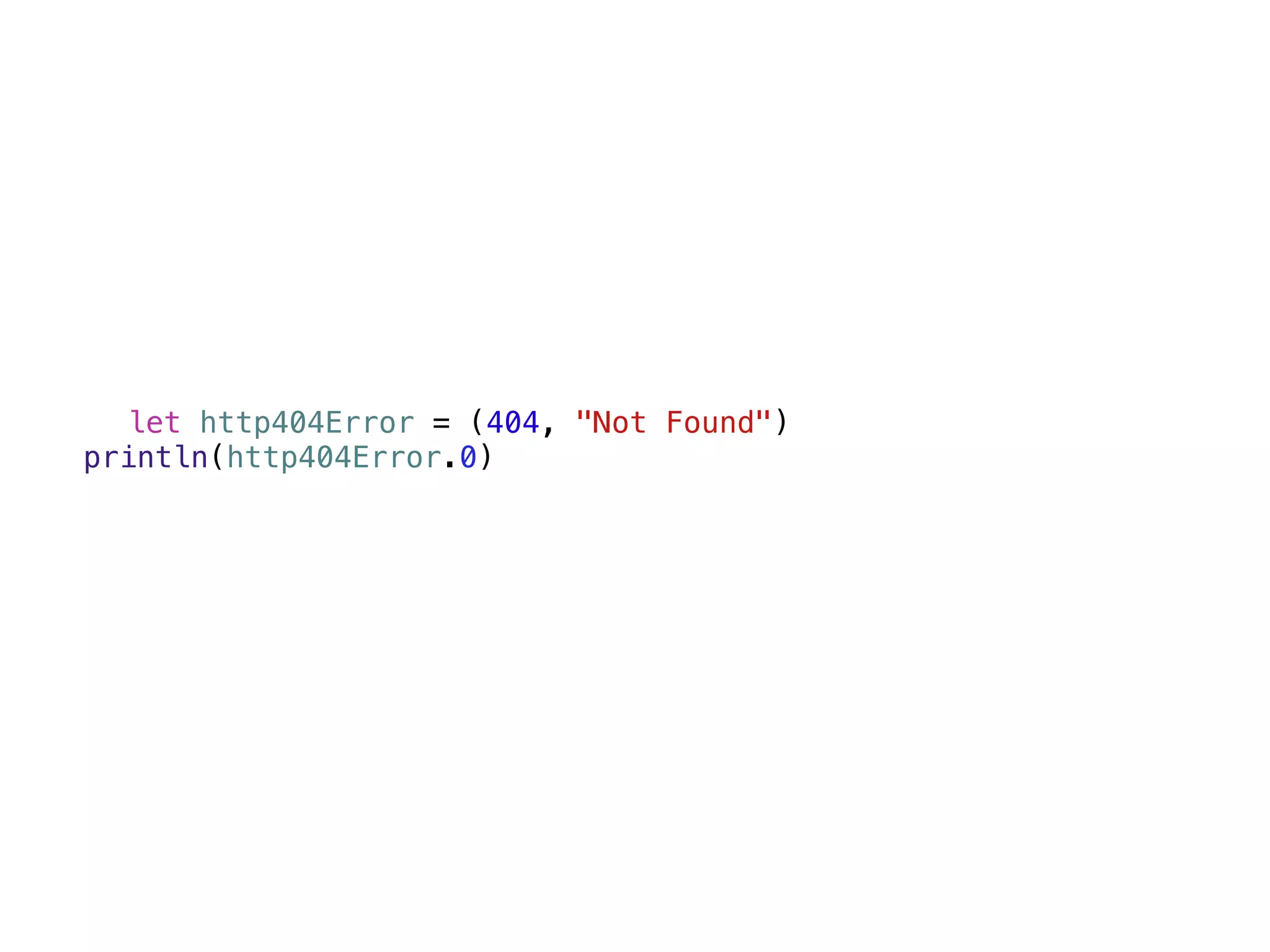
let http404Error = (404, "Not Found") 
println(http404Error.0)
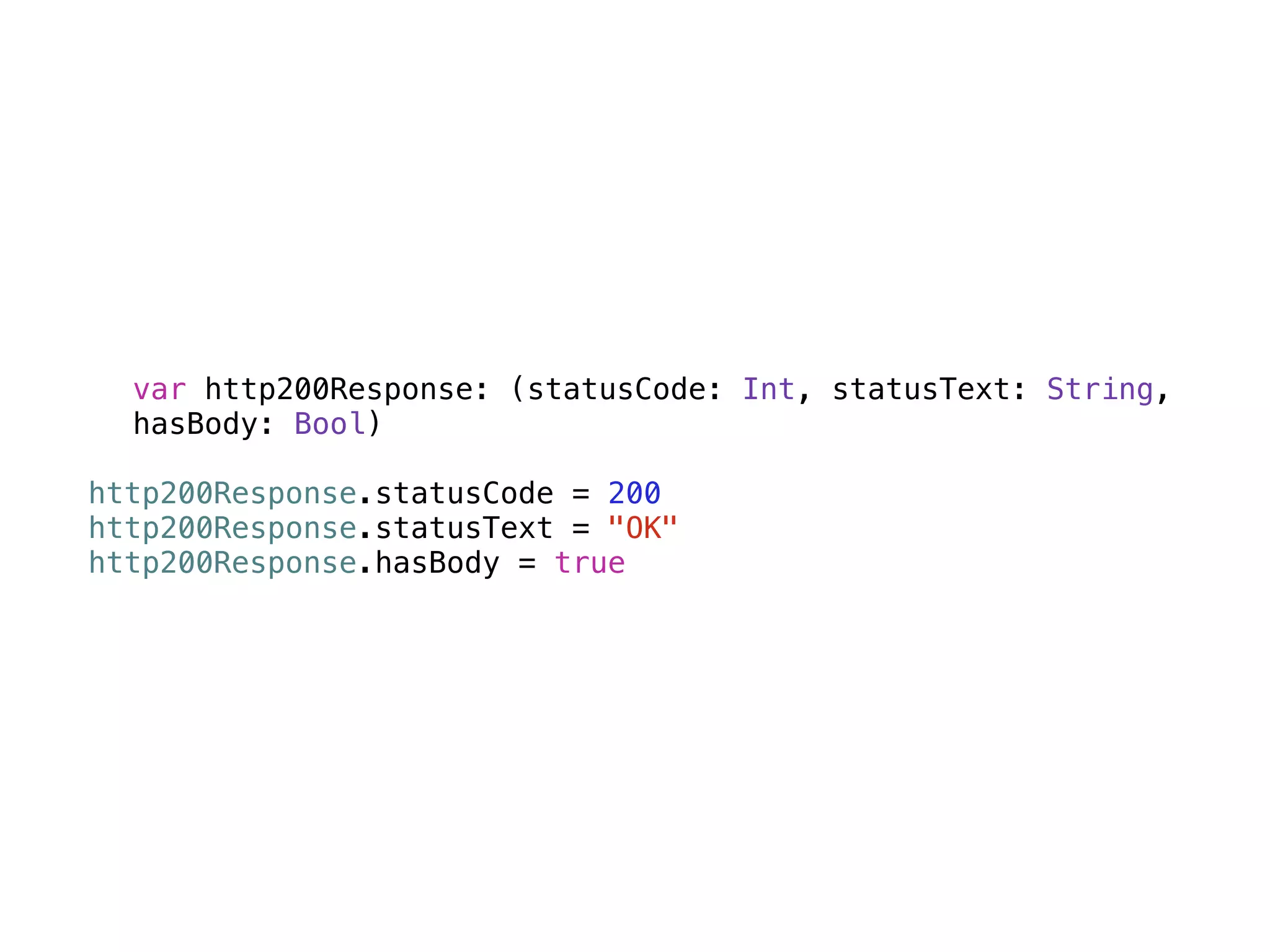
var http200Response: (statusCode: Int, statusText: String, 
hasBody: Bool) 
http200Response.statusCode = 200 
http200Response.statusText = "OK" 
http200Response.hasBody = true
You can put any kind 
of object in a tuple
Generics
<T>
More than just an id
Abstraction
Create functions without 
declaring type
struct Stack<T> { 
var items = [T]() 
mutating func push(item: T) { 
items.append(item) 
} 
mutating func pop() -> T { 
return items.removeLast() 
} 
}
<T: Equitable>
AnyObject
...used a lot more like id
Closures
“Closures are behaviors 
with attached state” 
- Peter Norvig
Like blocks, but better!
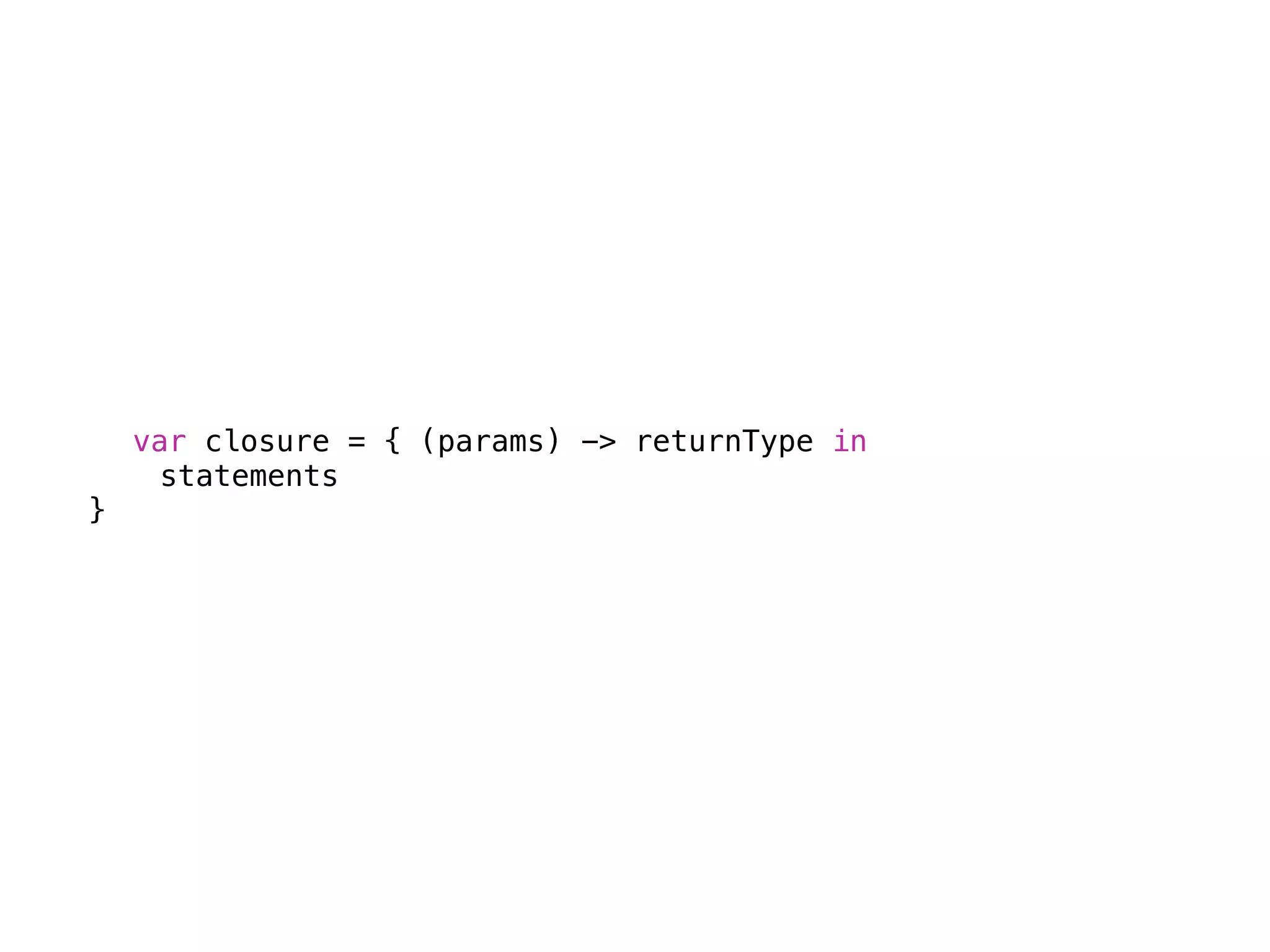
var closure = { (params) -> returnType in 
statements 
}
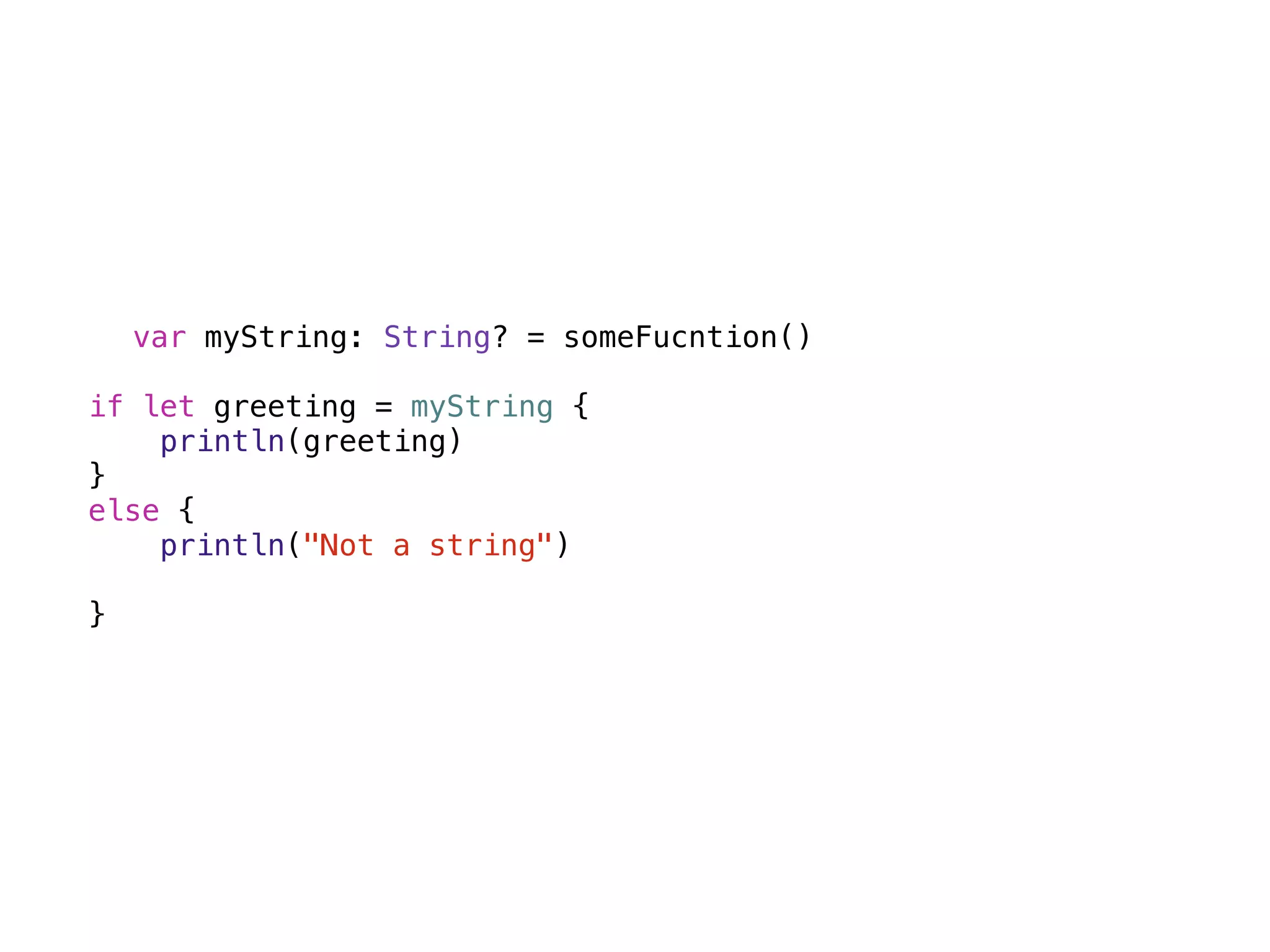
let
Immutable variable
var myString: String? = someFucntion() 
if let greeting = myString { 
println(greeting) 
} 
else { 
println("Not a string") 

}
Structs + Enums
Structs: 
Pass-by-value
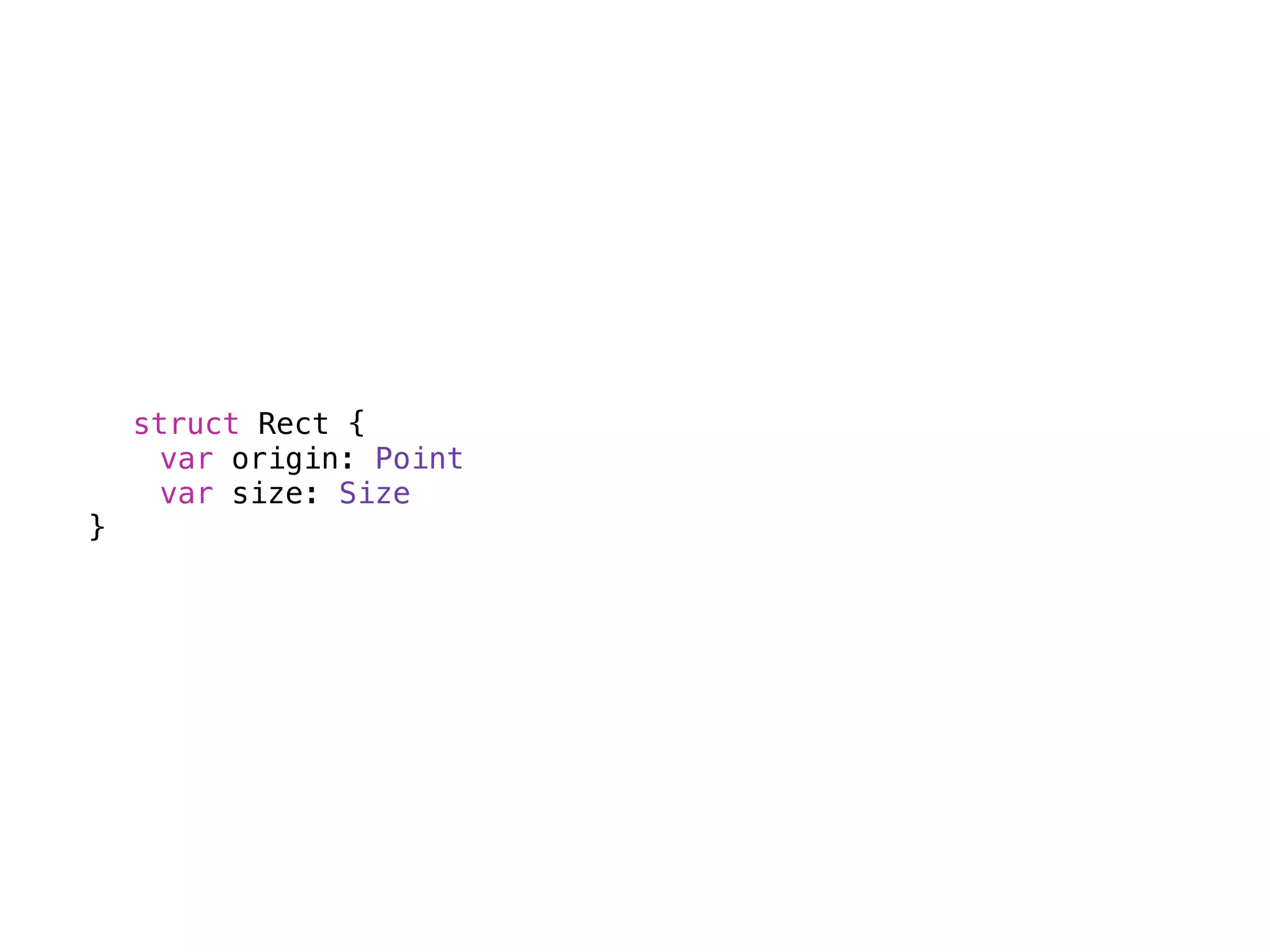
struct Rect { 
var origin: Point 
var size: Size 
}
Structs can have methods, and 
conform to protocols
Enums: 
also pass-by-value
Also can conform 
to protocols and have methods
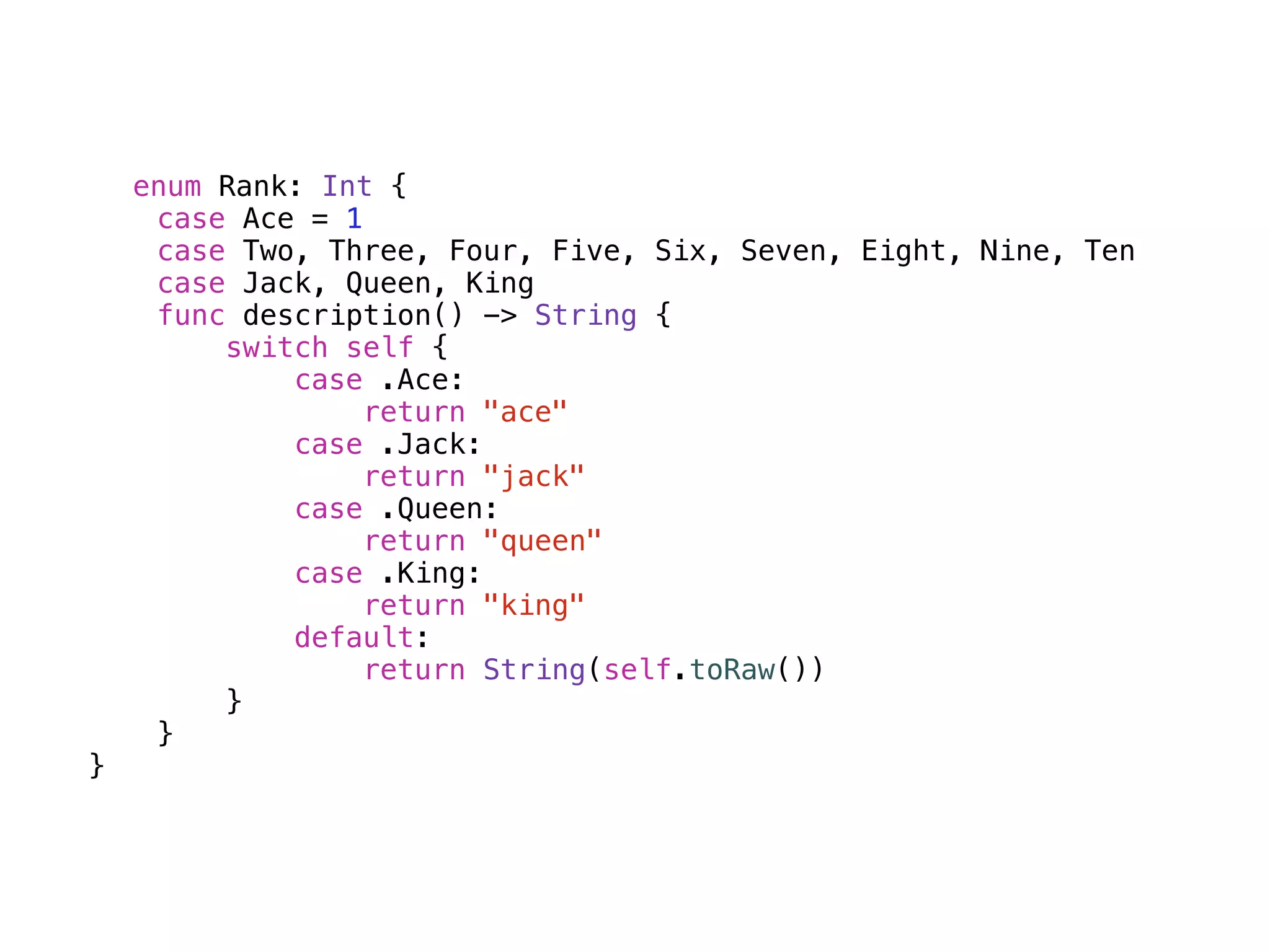
enum Rank: Int { 
case Ace = 1 
case Two, Three, Four, Five, Six, Seven, Eight, Nine, Ten 
case Jack, Queen, King 
func description() -> String { 
switch self { 
case .Ace: 
return "ace" 
case .Jack: 
return "jack" 
case .Queen: 
return "queen" 
case .King: 
return "king" 
default: 
return String(self.toRaw()) 
} 
} 
}
Functional Patterns
Function Passing
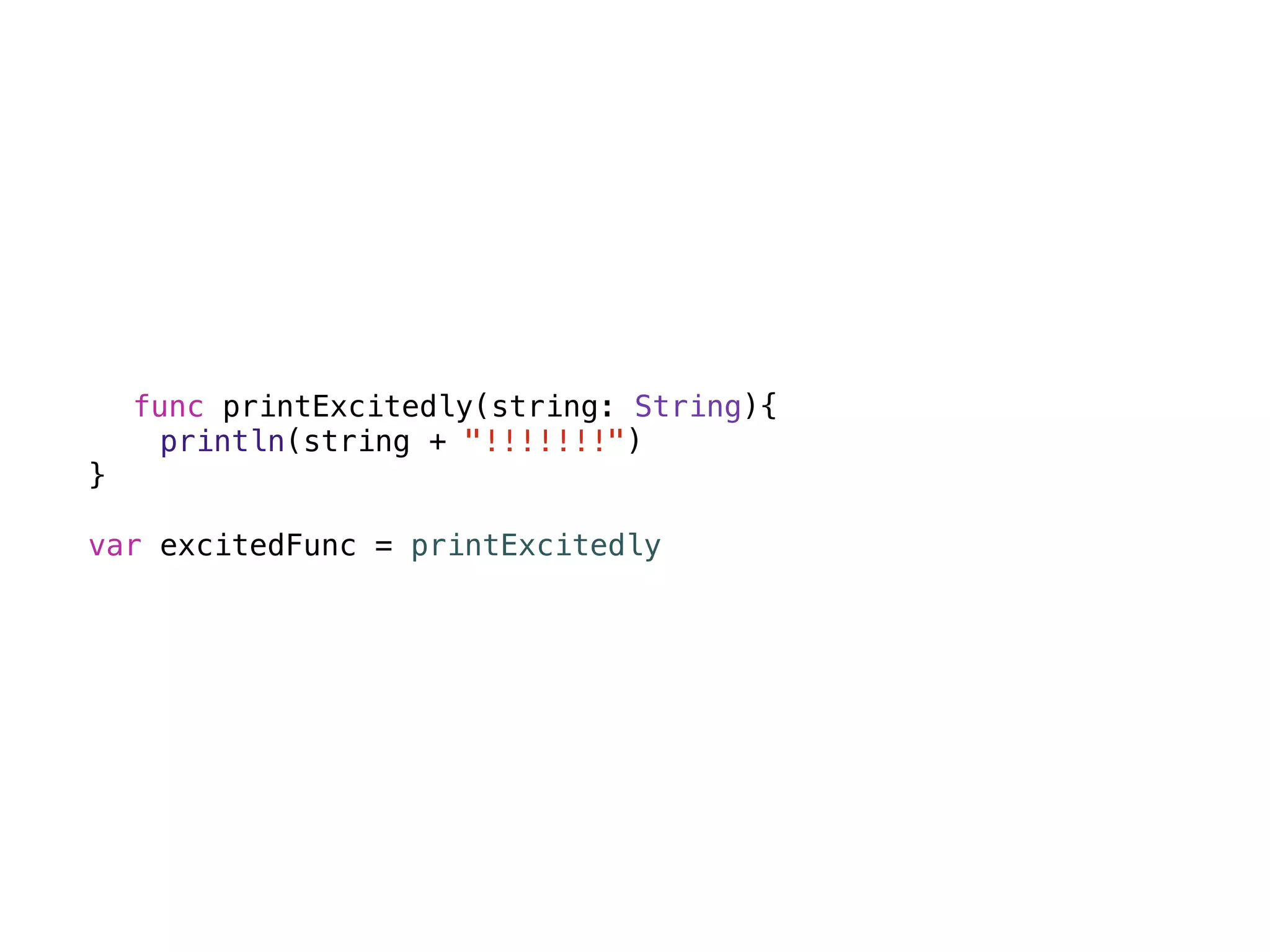
func printExcitedly(string: String){ 
println(string + "!!!!!!!") 
} 
var excitedFunc = printExcitedly
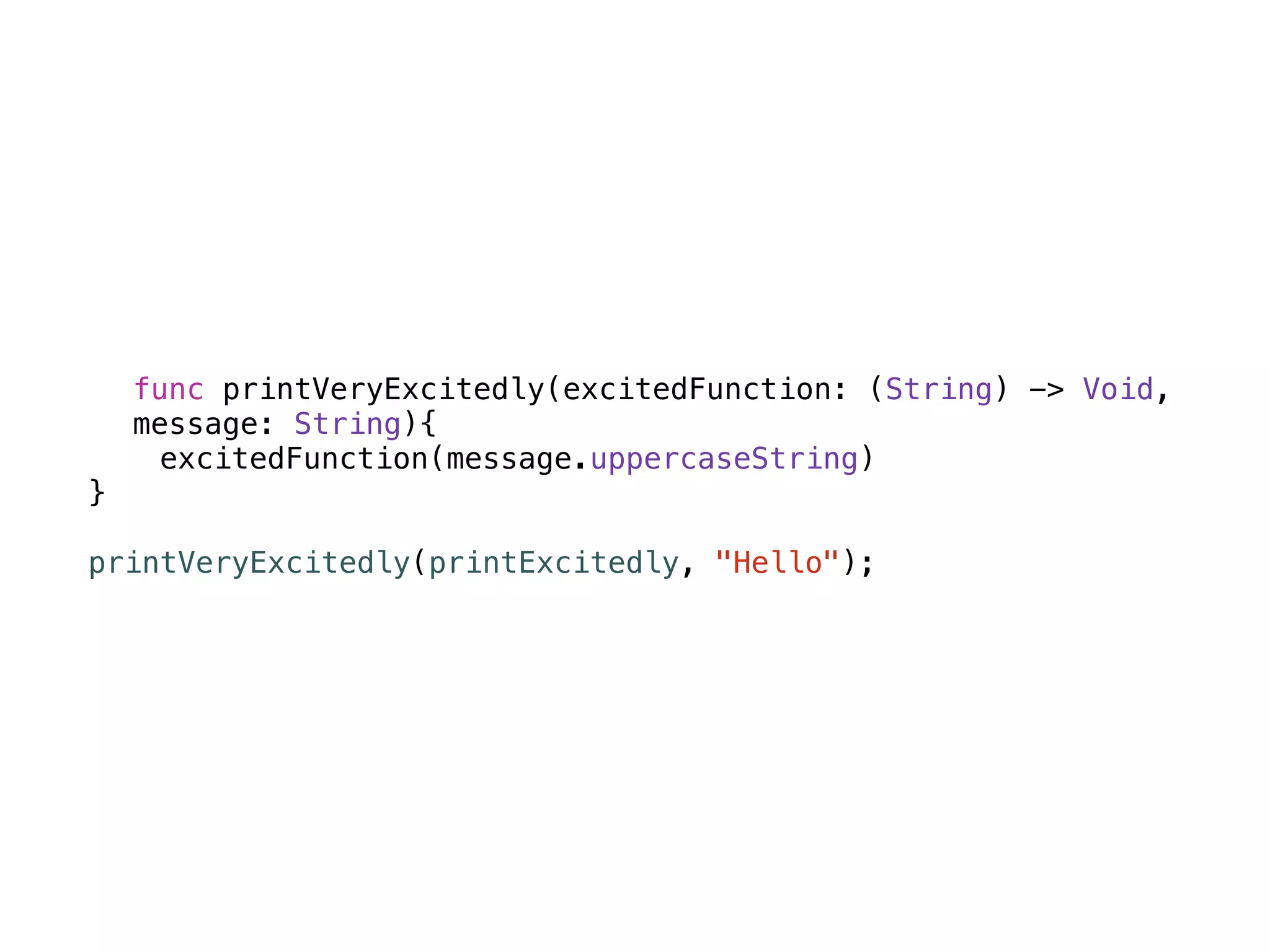
Pass functions into functions
func printVeryExcitedly(excitedFunction: (String) -> Void, 
message: String){ 
excitedFunction(message.uppercaseString) 
} 
printVeryExcitedly(printExcitedly, "Hello");
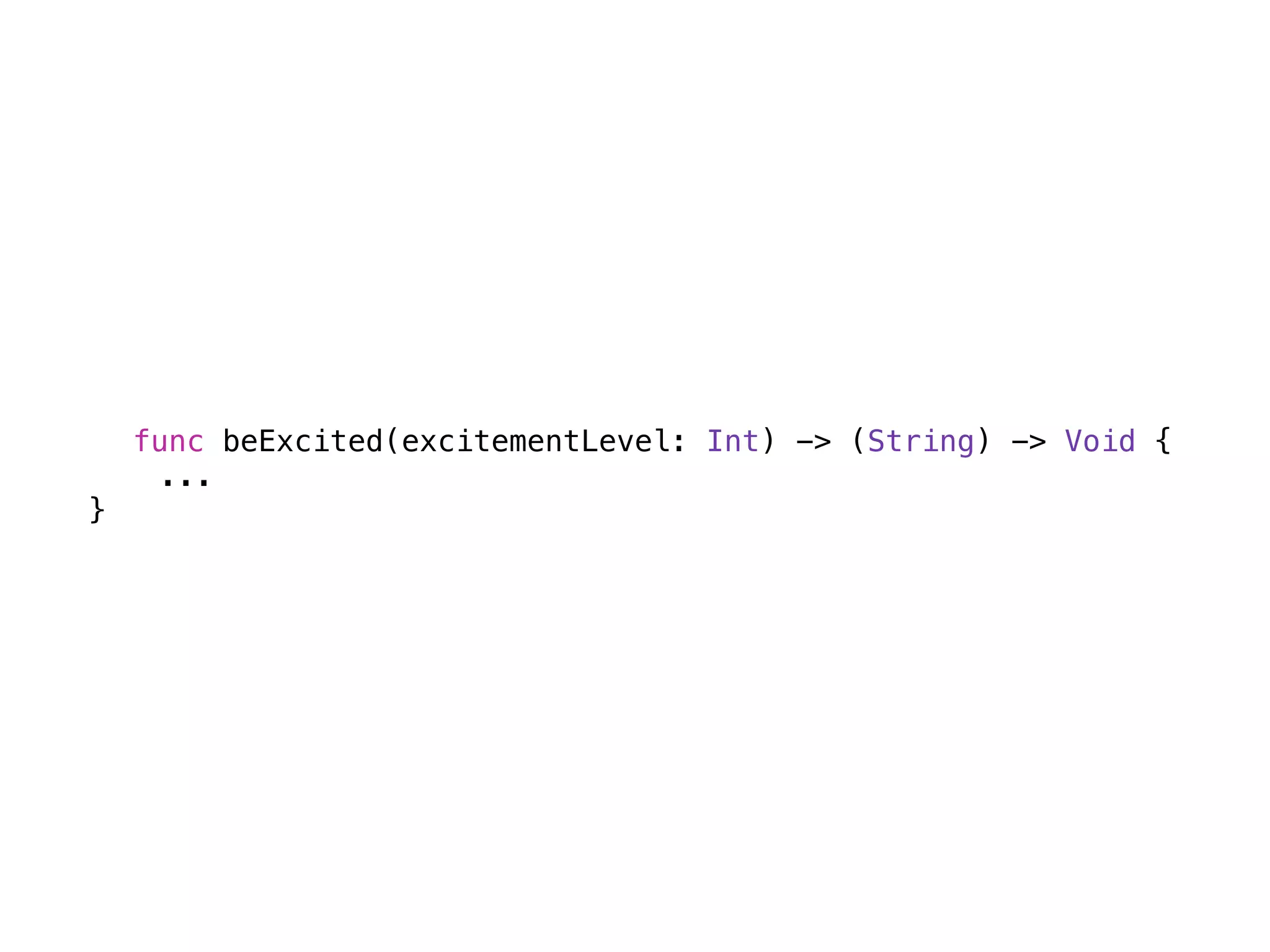
Return functions 
from functions
func beExcited(excitementLevel: Int) -> (String) -> Void { 
... 
}
Patterns
Composition
...because we can pass 
functions!
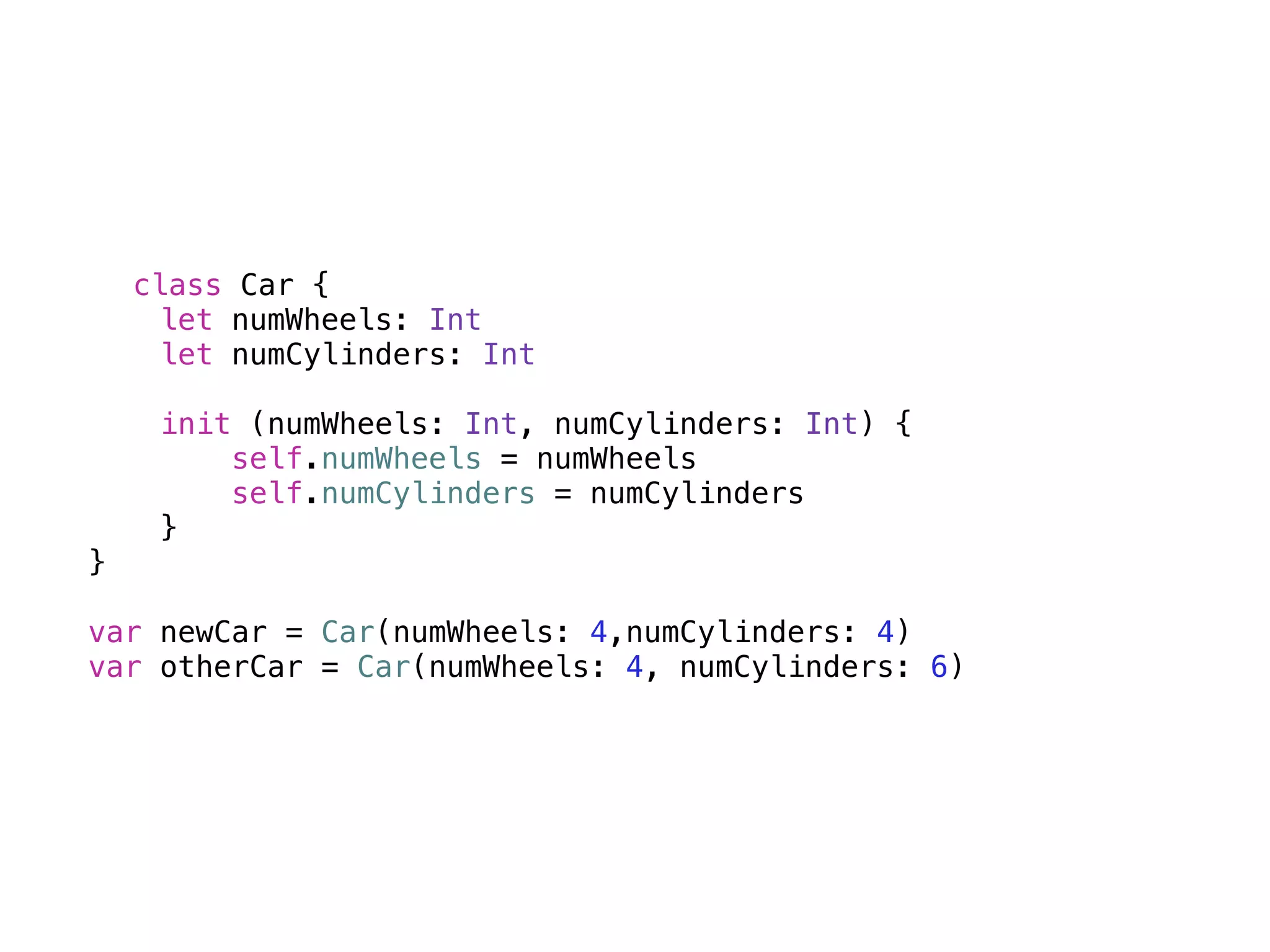
The OO way
class Car { 
let numWheels: Int 
let numCylinders: Int 
init (numWheels: Int, numCylinders: Int) { 
self.numWheels = numWheels 
self.numCylinders = numCylinders 
} 
} 
var newCar = Car(numWheels: 4,numCylinders: 4) 
var otherCar = Car(numWheels: 4, numCylinders: 6)
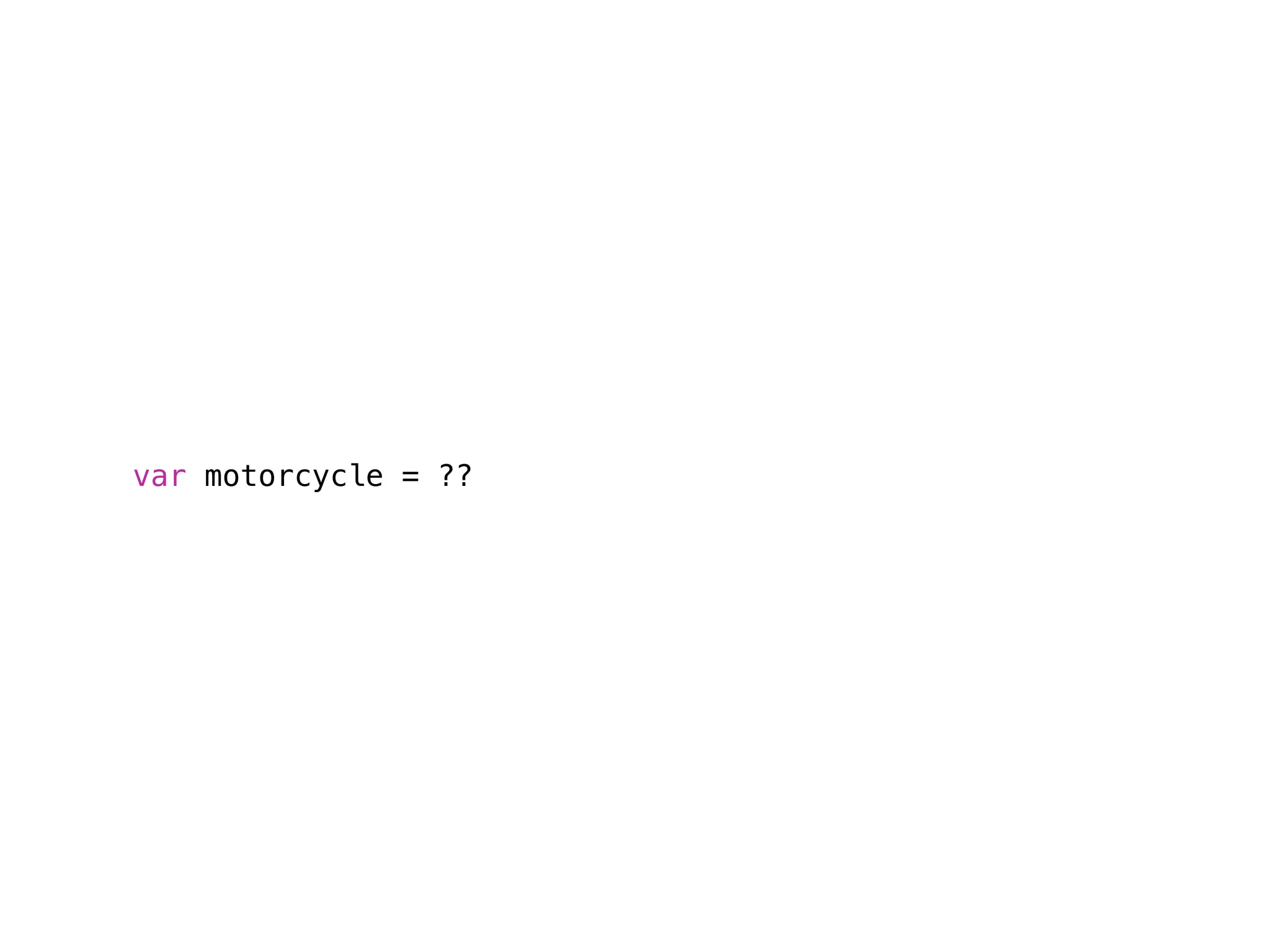
var motorcycle = ??
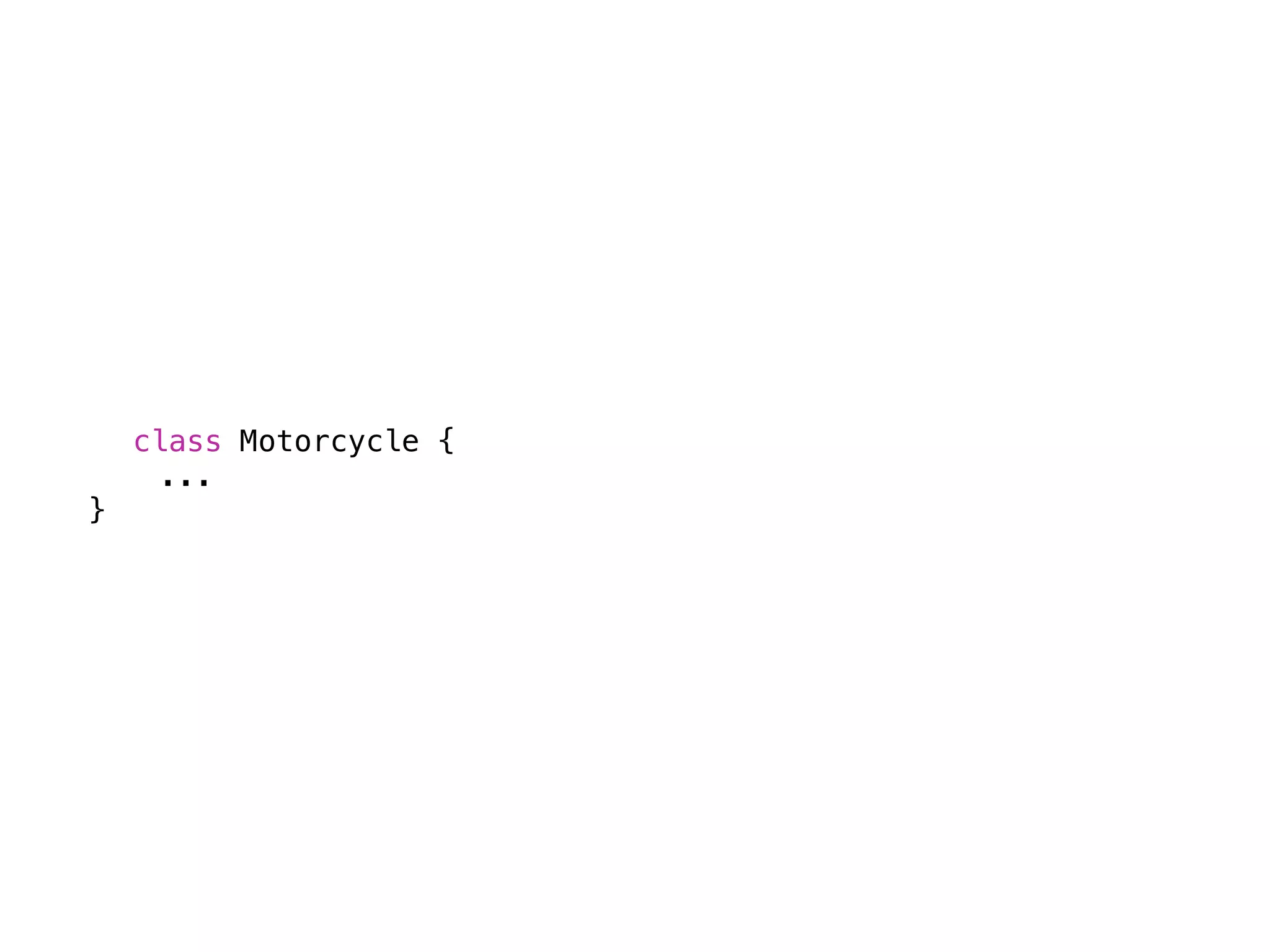
class Motorcycle { 
... 
}
This is not ideal
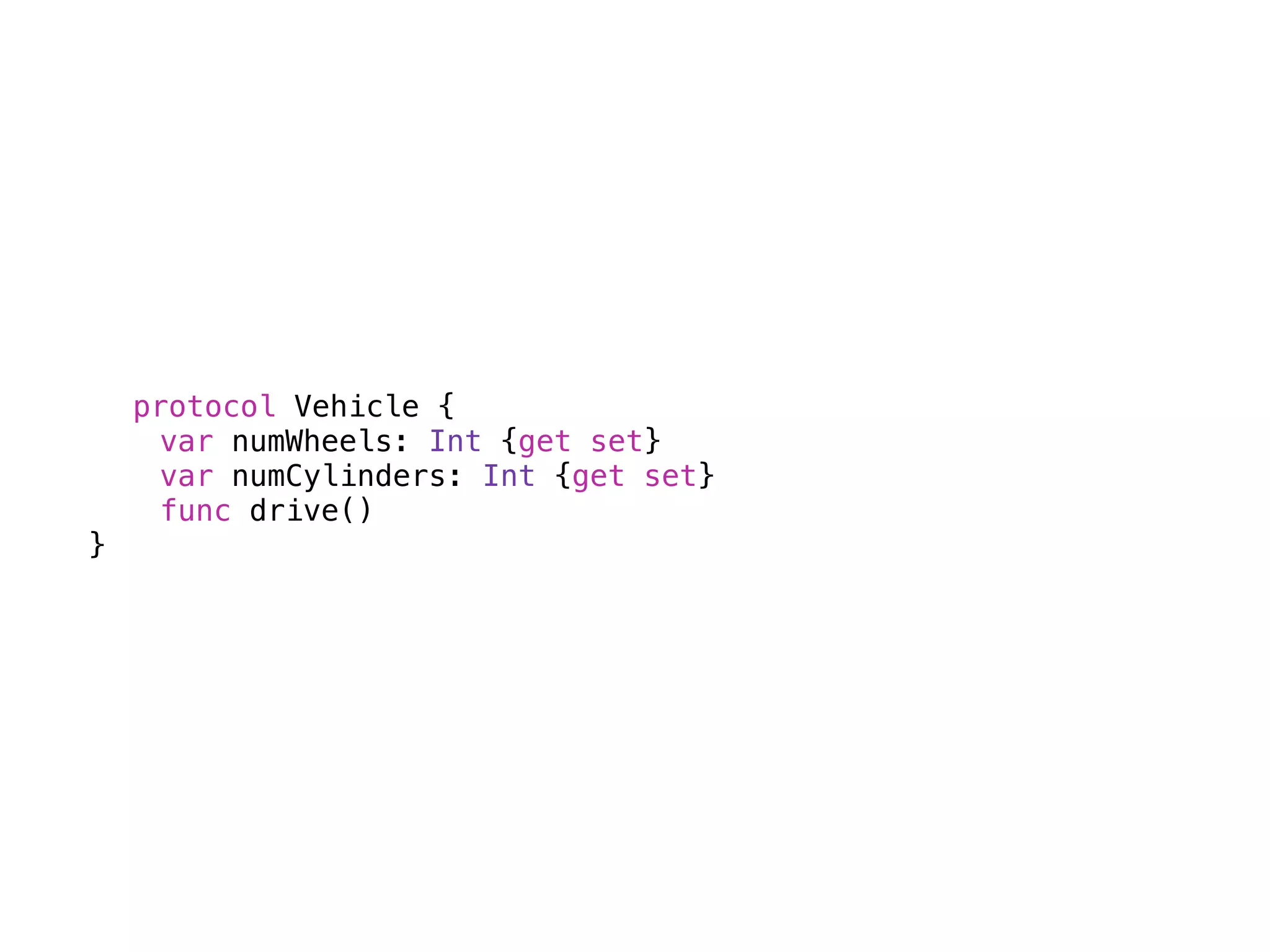
protocol Vehicle { 
var numWheels: Int {get set} 
var numCylinders: Int {get set} 
func drive() 
}
Better
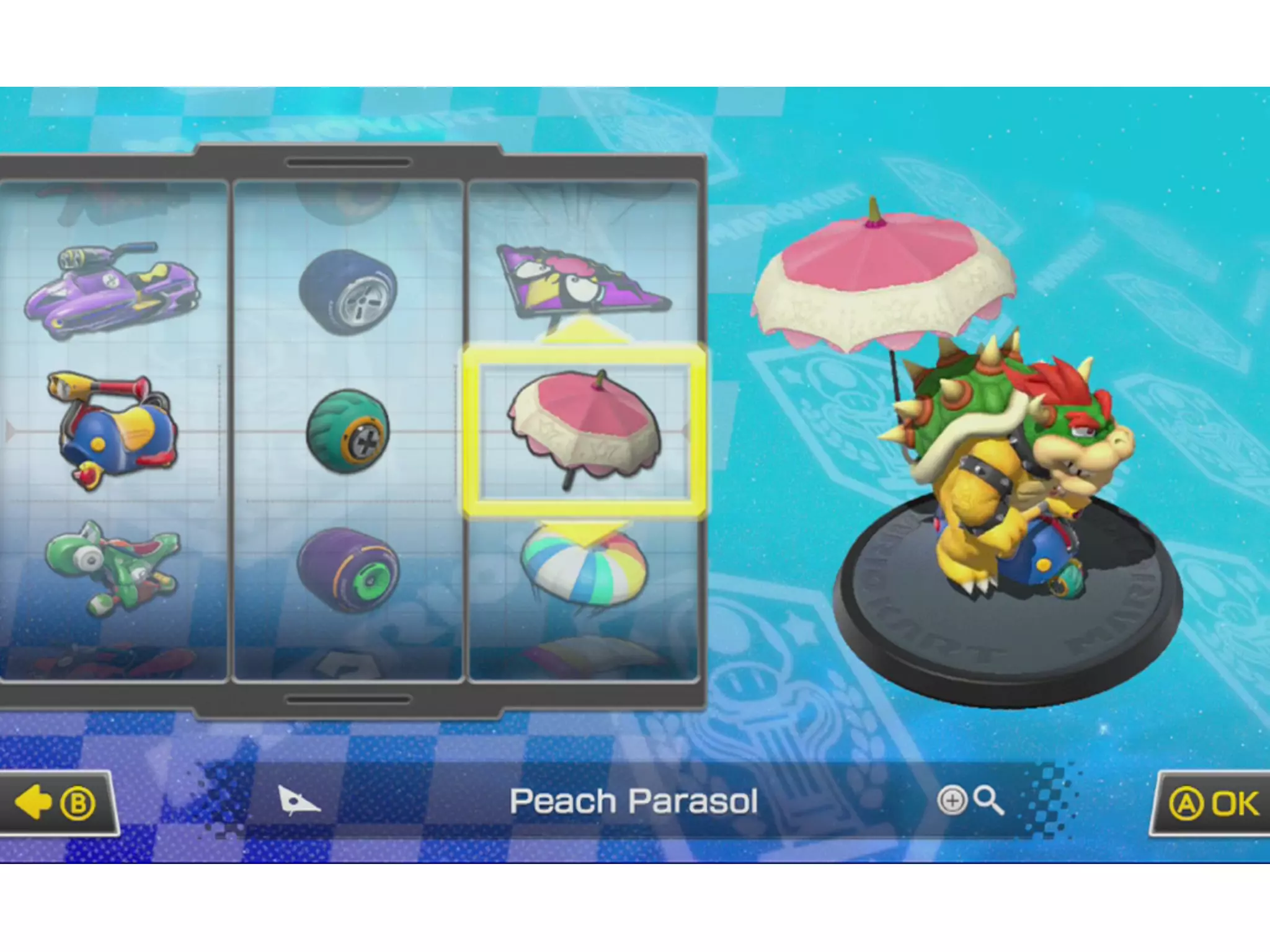
How do we handle this at 
scale?
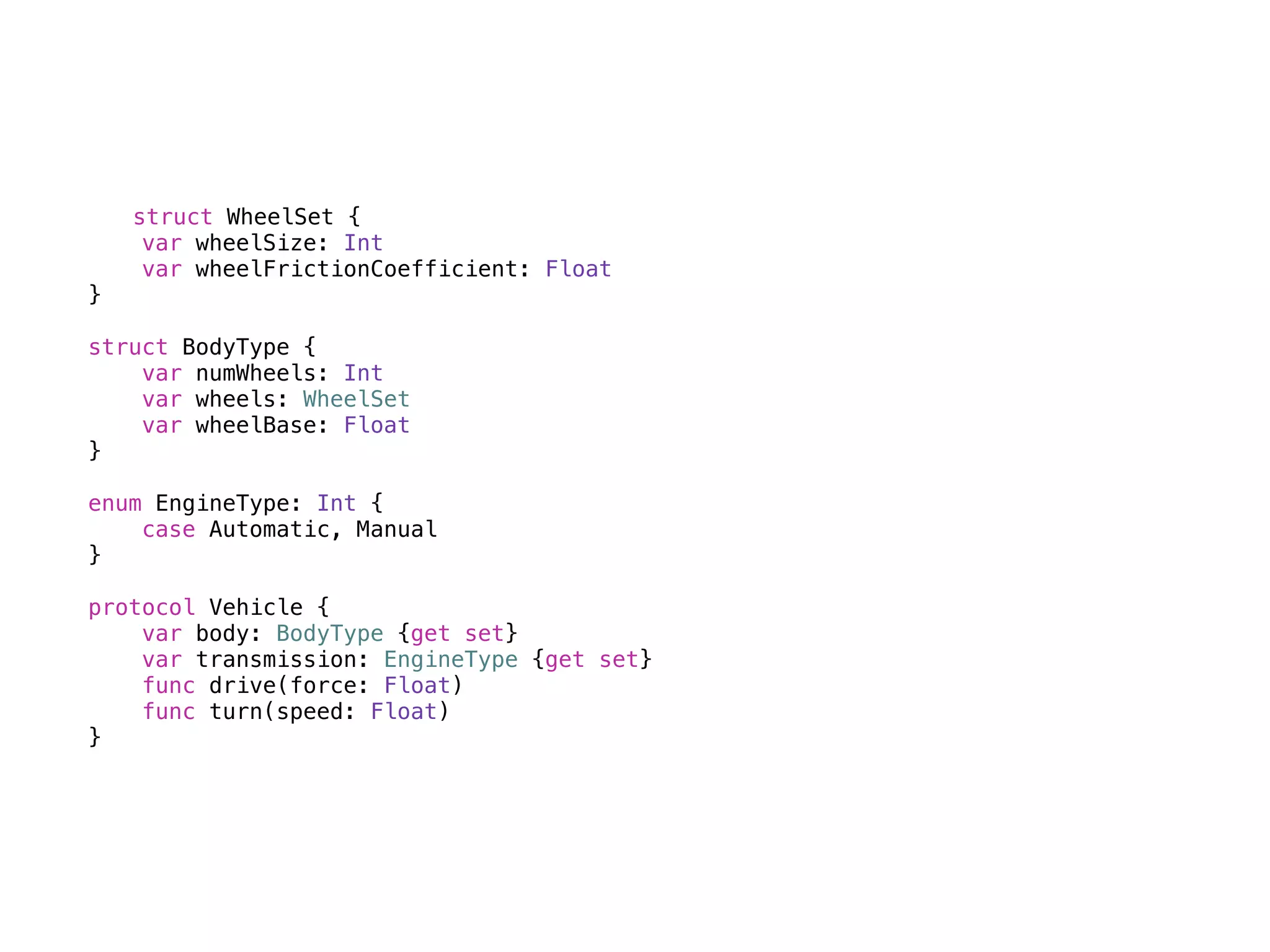
struct WheelSet { 
var wheelSize: Int 
var wheelFrictionCoefficient: Float 
} 
struct BodyType { 
var numWheels: Int 
var wheels: WheelSet 
var wheelBase: Float 
} 
enum EngineType: Int { 
case Automatic, Manual 
} 
protocol Vehicle { 
var body: BodyType {get set} 
var transmission: EngineType {get set} 
func drive(force: Float) 
func turn(speed: Float) 
}
Better
...but we can still improve
Factories
Abstract away object 
creation and composition
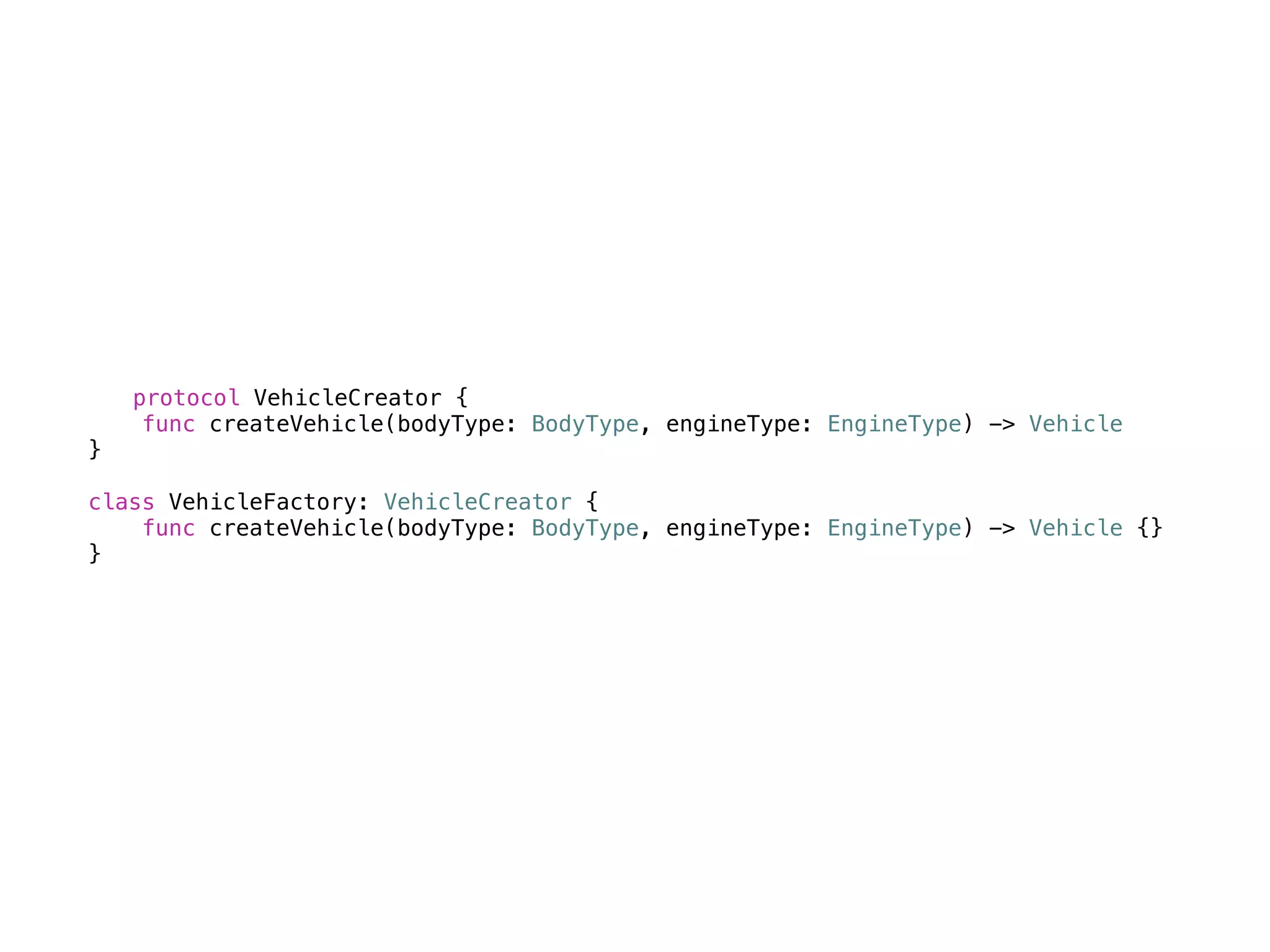
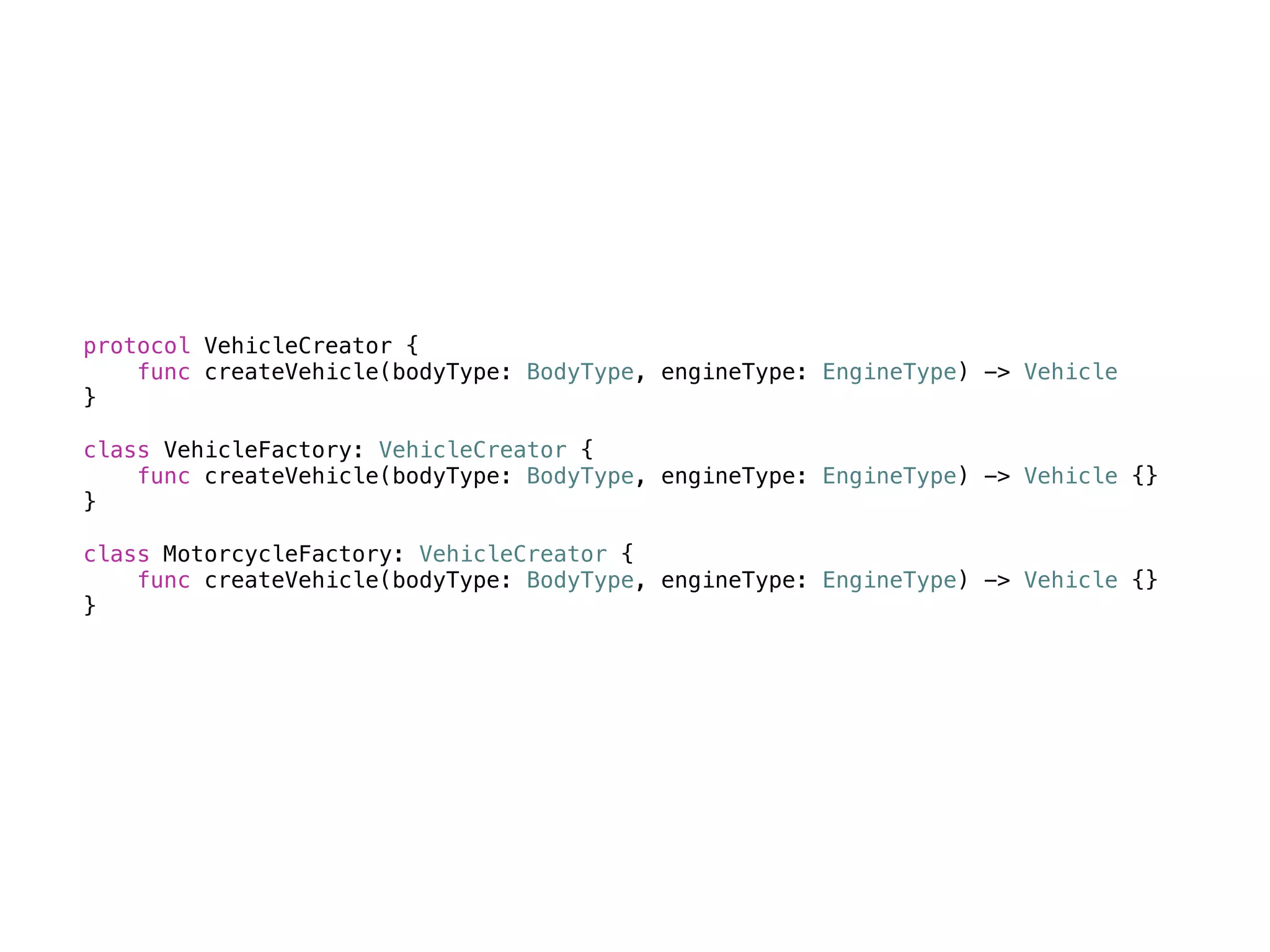
protocol VehicleCreator { 
func createVehicle(bodyType: BodyType, engineType: EngineType) -> Vehicle 
} 
class VehicleFactory: VehicleCreator { 
func createVehicle(bodyType: BodyType, engineType: EngineType) -> Vehicle {} 
}
protocol VehicleCreator { 
func createVehicle(bodyType: BodyType, engineType: EngineType) -> Vehicle 
} 
class VehicleFactory: VehicleCreator { 
func createVehicle(bodyType: BodyType, engineType: EngineType) -> Vehicle {} 
} 
class MotorcycleFactory: VehicleCreator { 
func createVehicle(bodyType: BodyType, engineType: EngineType) -> Vehicle {} 
}
This still looks very OO
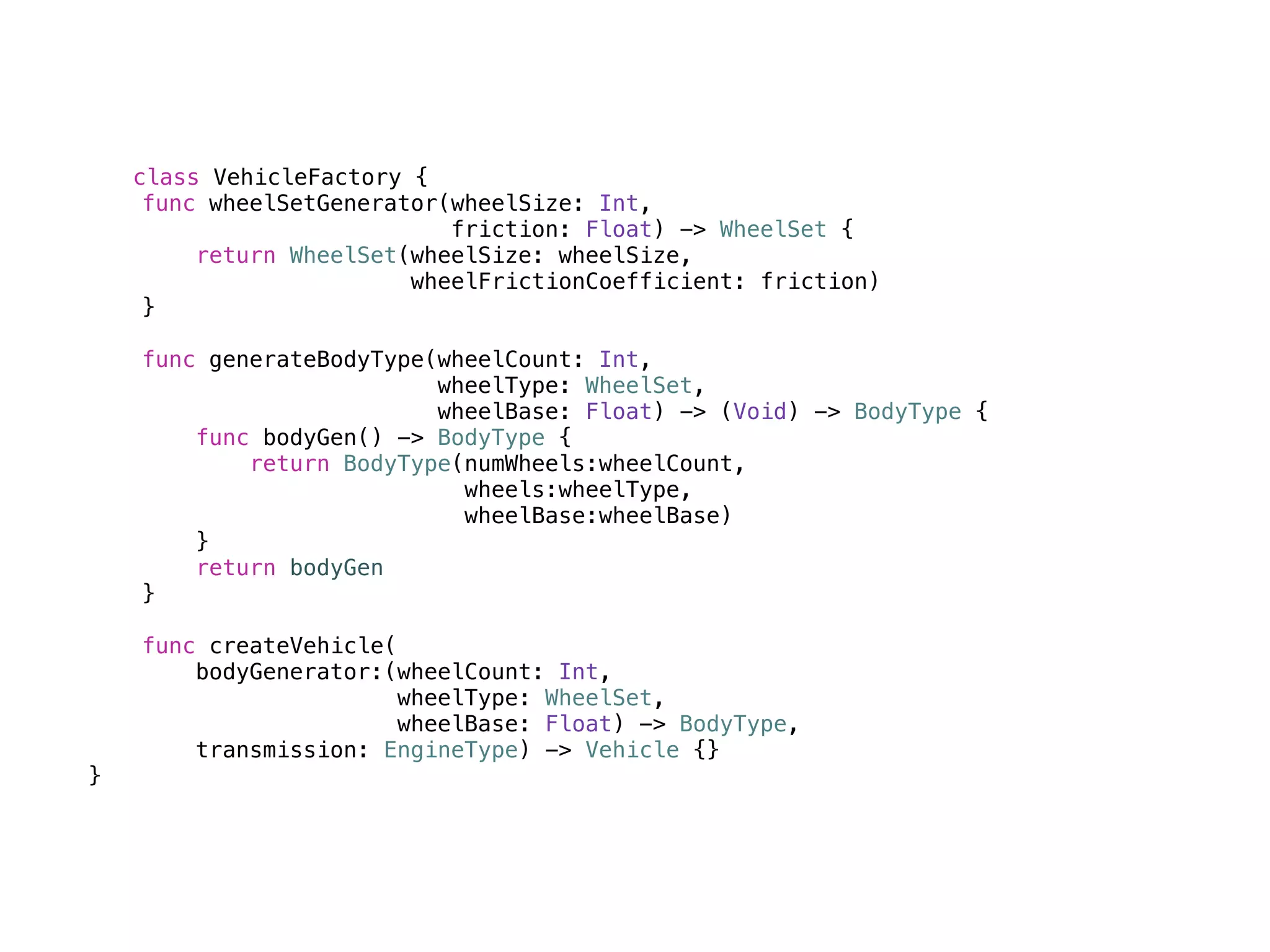
class VehicleFactory { 
func wheelSetGenerator(wheelSize: Int, 
friction: Float) -> WheelSet { 
return WheelSet(wheelSize: wheelSize, 
wheelFrictionCoefficient: friction) 
} 
func generateBodyType(wheelCount: Int, 
wheelType: WheelSet, 
wheelBase: Float) -> (Void) -> BodyType { 
func bodyGen() -> BodyType { 
return BodyType(numWheels:wheelCount, 
wheels:wheelType, 
wheelBase:wheelBase) 
} 
return bodyGen 
} 
func createVehicle( 
bodyGenerator:(wheelCount: Int, 
wheelType: WheelSet, 
wheelBase: Float) -> BodyType, 
transmission: EngineType) -> Vehicle {} 
}
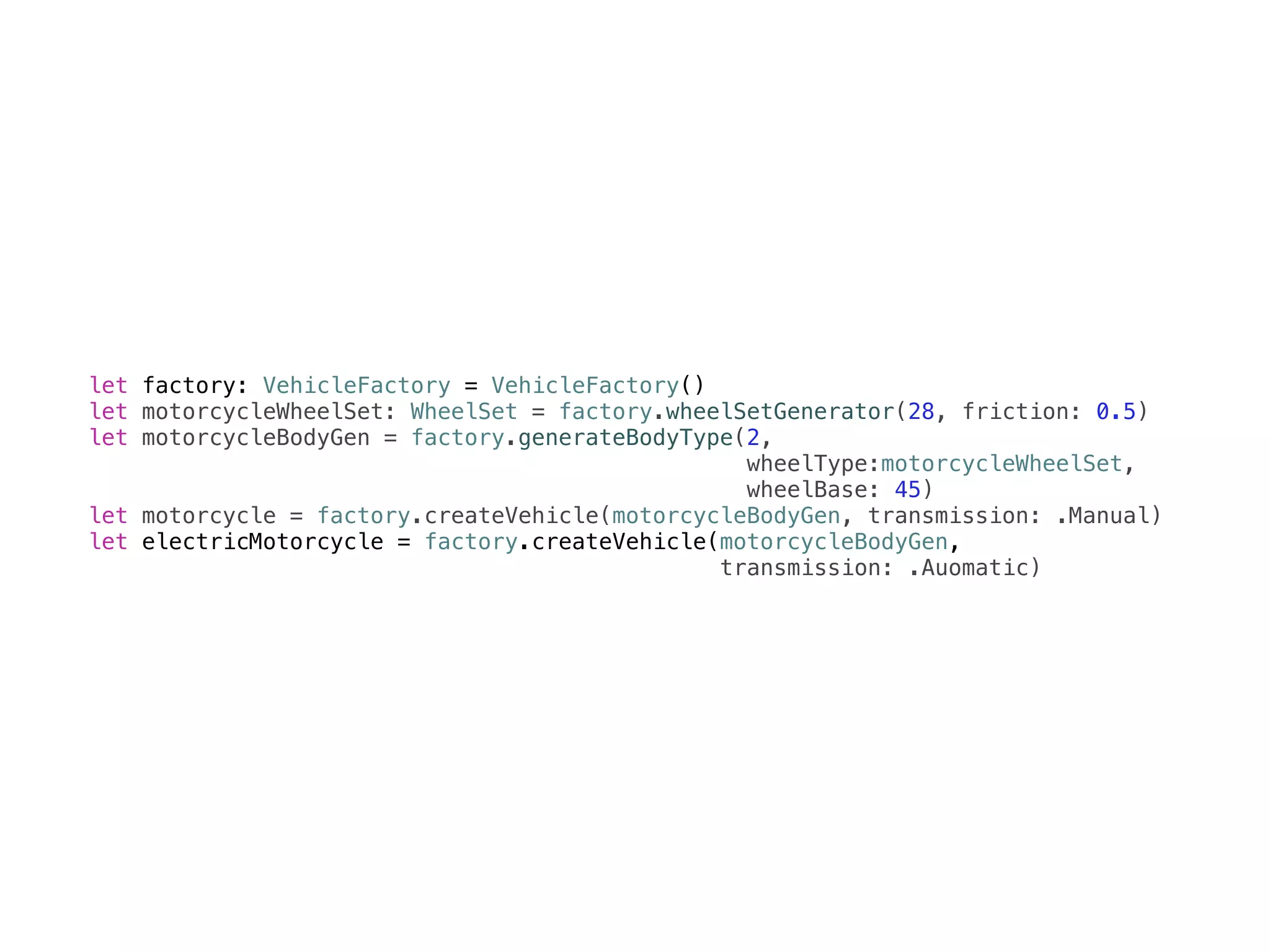
let factory: VehicleFactory = VehicleFactory() 
let motorcycleWheelSet: WheelSet = factory.wheelSetGenerator(28, friction: 0.5) 
let motorcycleBodyGen = factory.generateBodyType(2, 
wheelType:motorcycleWheelSet, 
wheelBase: 45) 
let motorcycle = factory.createVehicle(motorcycleBodyGen, transmission: .Manual) 
let electricMotorcycle = factory.createVehicle(motorcycleBodyGen, 
transmission: .Auomatic)
Factories in Swift can be 
incredibly flexible
Command
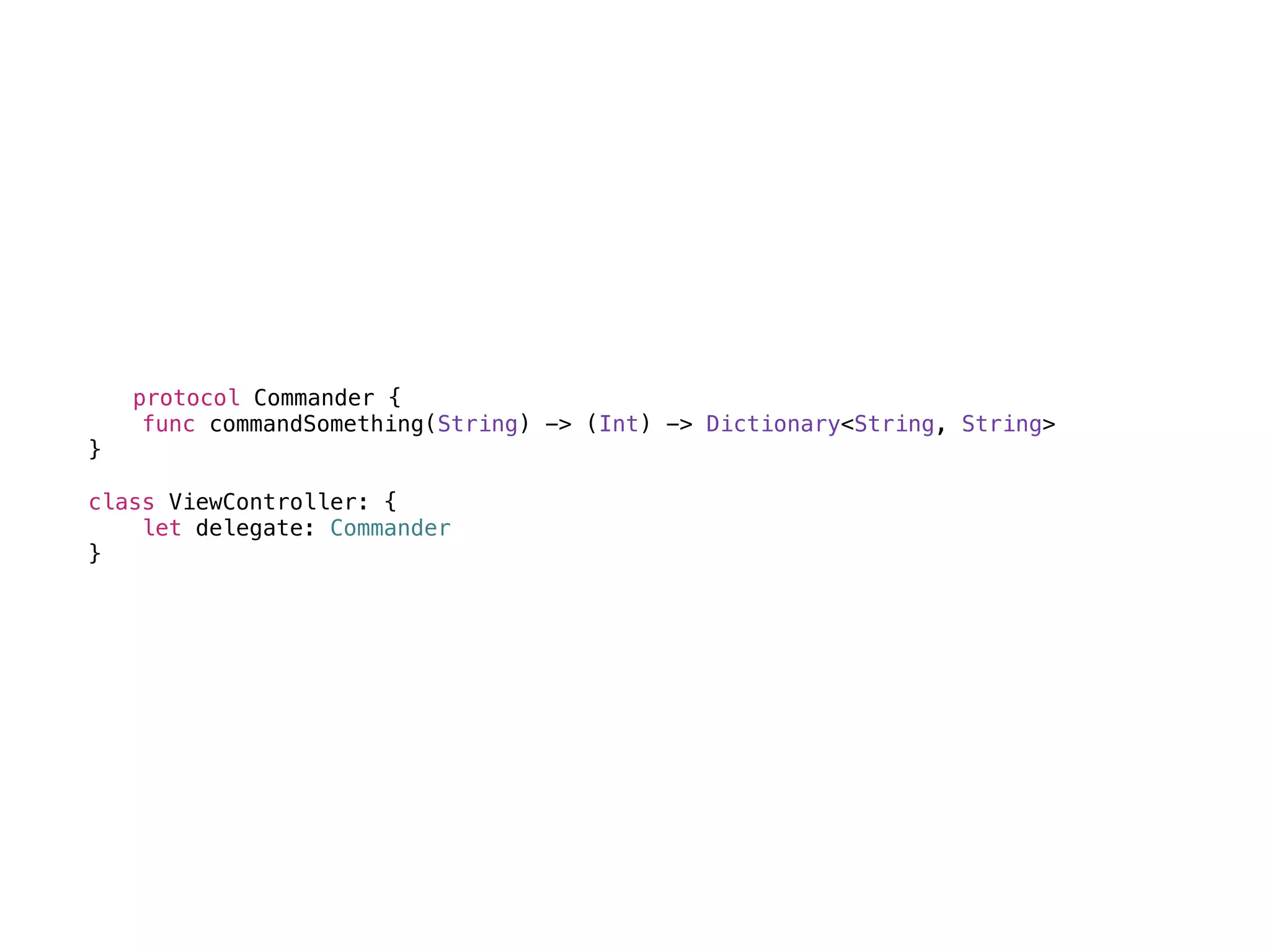
A delegate chain 
that returns a function
protocol Commander { 
func commandSomething(String) -> (Int) -> Dictionary<String, String> 
} 
class ViewController: { 
let delegate: Commander 
}
Why is this better 
than closures?
It’s more explicit
It’s more flexible
Enumeration
Not the type enum!
We have new ways of 
transforming collections
[1,2,3,4].map { 
(var number) -> Int in 
return number * number 
}
var array = [3, 2, 5, 1, 4] 
array.sort { $0 < $1 }
let array = [1, 2, 3, 4, 5] 
let reversedArray = array.reverse() 
// reversedArray = [5, 4, 3, 2, 1]
And of course, this is useful for 
more than just math
var vehicles = [suv, motorcycle, electricMotorcycle, car, truck] 
var manualVehicles = vehicles.filter { 
(var vehicle: Vehicle) -> Vehicle in 
return (vehicle.transmission == .Manual) 
} 
// manualVehicles = [motorcycle, truck]
Encapsulate better
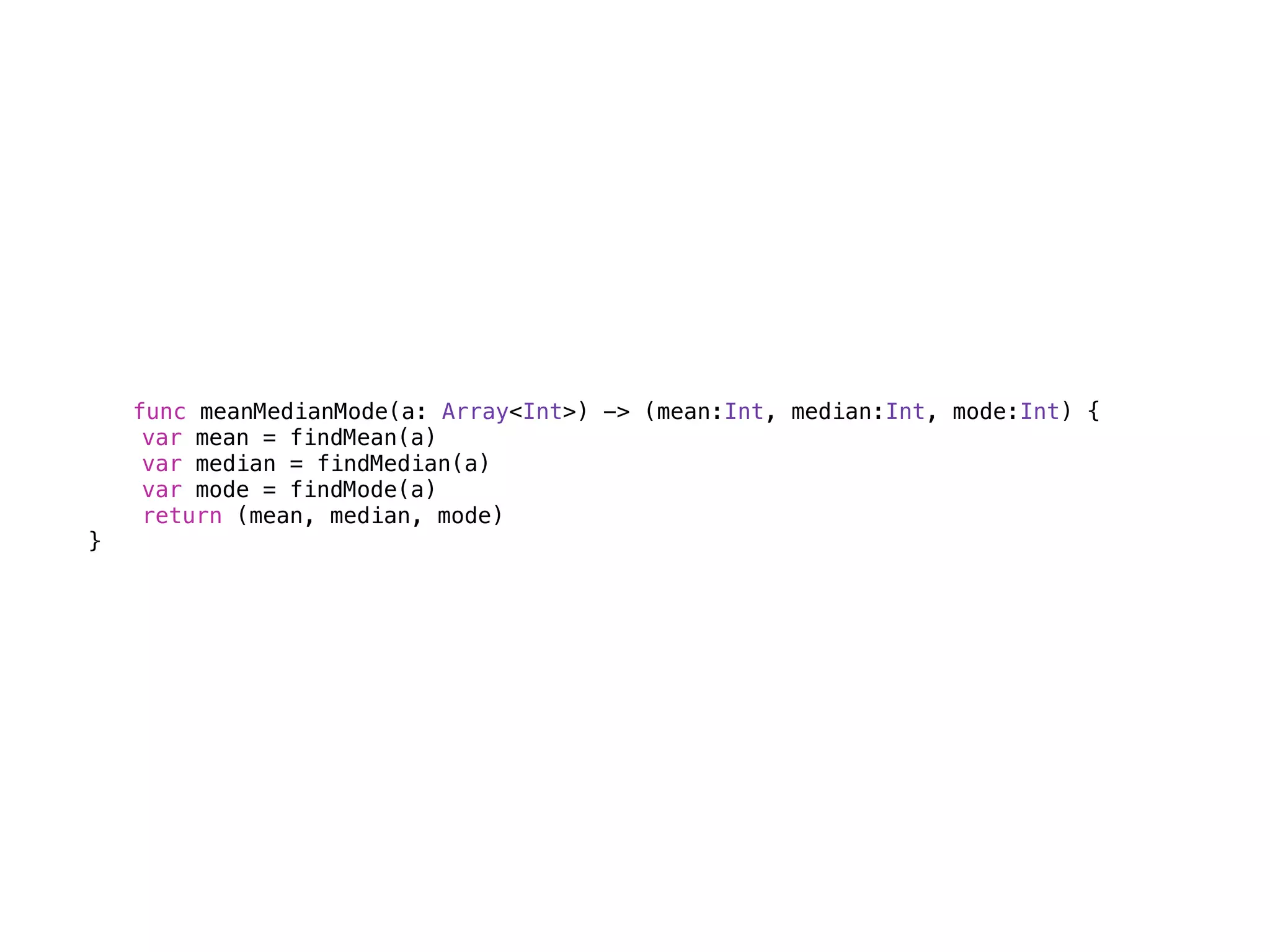
func meanMedianMode(a: Array<Int>) -> (mean:Int, median:Int, mode:Int) { 
var mean = findMean(a) 
var median = findMedian(a) 
var mode = findMode(a) 
return (mean, median, mode) 
}
Tuples with names are 
incredibly useful
Anti-Patterns
No changes to 
handling protocols
This is the slide I was hoping 
to put something magical on
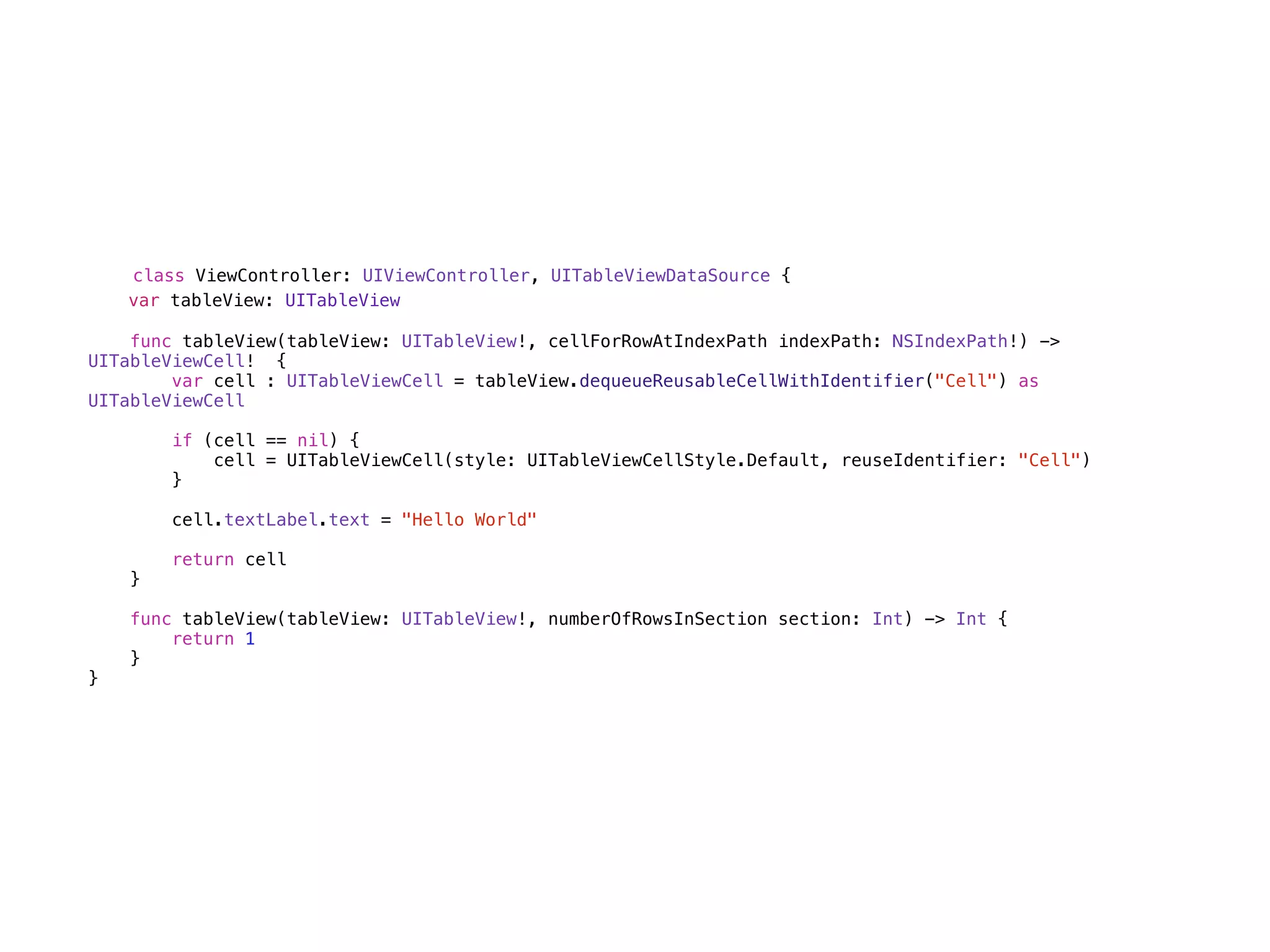
class ViewController: UIViewController, UITableViewDataSource { 
var tableView: UITableView 
func tableView(tableView: UITableView!, cellForRowAtIndexPath indexPath: NSIndexPath!) -> 
UITableViewCell! { 
var cell : UITableViewCell = tableView.dequeueReusableCellWithIdentifier("Cell") as 
UITableViewCell 
if (cell == nil) { 
cell = UITableViewCell(style: UITableViewCellStyle.Default, reuseIdentifier: "Cell") 
} 
cell.textLabel.text = "Hello World" 
return cell 
} 
func tableView(tableView: UITableView!, numberOfRowsInSection section: Int) -> Int { 
return 1 
} 
}
Protocols are first class citizens 
in Swift, just like in Obj-c
Tuples all the way down
Yes, you can put a tuple in a 
tuple
These are temporary data 
structures
We have better OO 
tools available
Operator overloading
Don’t overload default 
operators
func decode(json: JSON) -> User? { 
return _JSONObject(json) >>> { d in 
User.create <^> 
d["id"] >>> _JSONInt <*> 
d["name"] >>> _JSONString <*> 
d["email"] >>> _JSONString 
} 
}
Operators make code 
harder to read
Type is still important
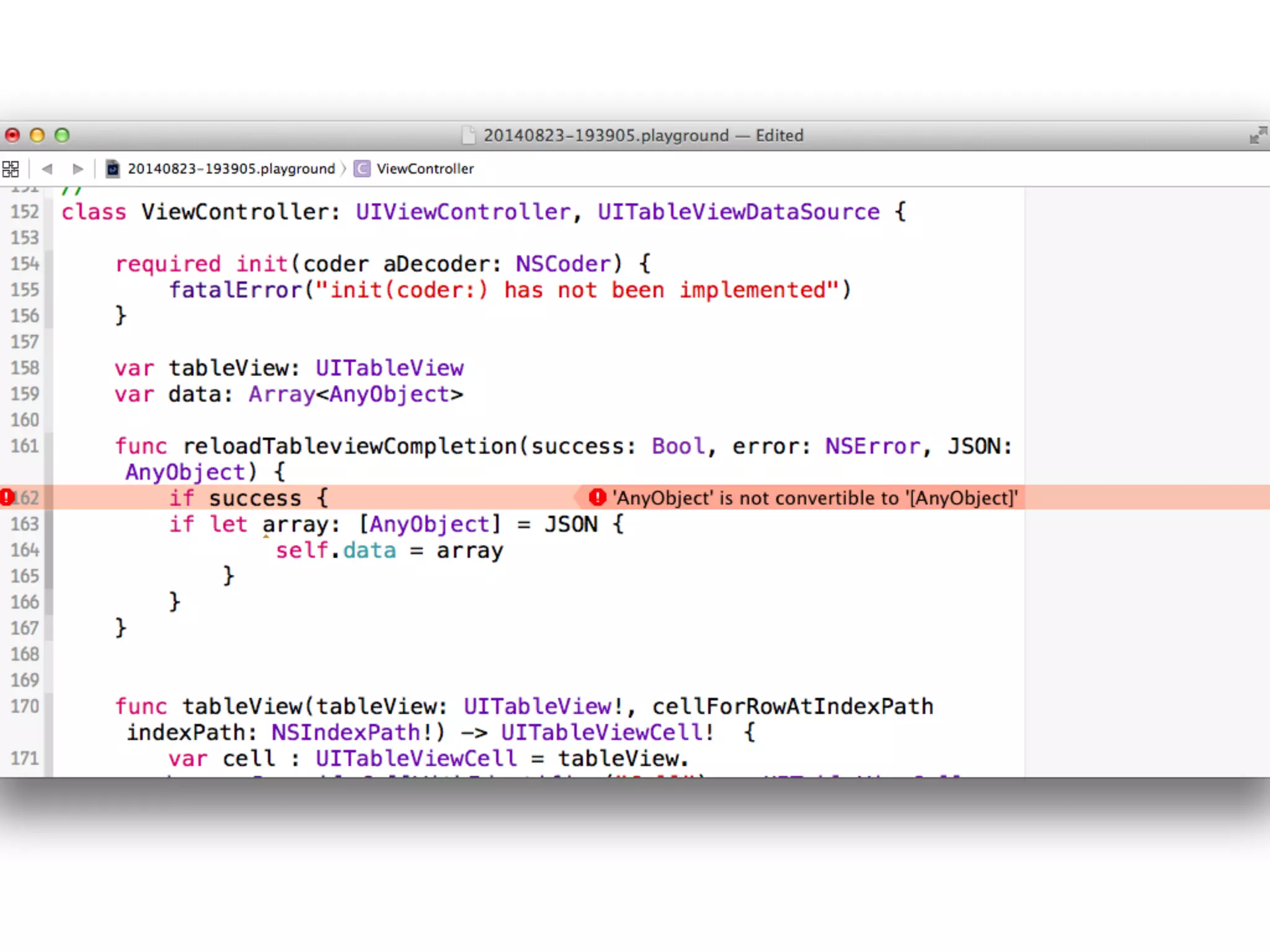
Getting classes from 
AnyObject are kind of a pain
Still be explicit when you can
var music: [String: String] = ["AC/DC": "Hells Bells", 
"Red Hot Chili Peppers": "Californication"]
In Summary
Swift gives us new tools
But Objective-C, and its 
patterns, aren’t going away 
anytime soon
More Swift! 
• Today 11:30am 
Interoperating Swift with Lower Level Code 
by Stephan Tramer in Terrace 
• Tomorrow 1:45pm 
Functional Programming in Swift 
by Chris Eidhof in Vail
Resources 
• Swift Programming Guide from Apple 
• Design Patterns in Dynamic Programming by Peter 
Norvig 
• Erica Sadun’s many blog posts on Swift 
• Functional Programming in Swift, ebook by Objc.io 
founders (See Chris’ talk tomorrow!) 
• Instance Methods and Curried Functions in Swift by Ole 
Begemann
Thanks! 
@MicheleTitolo

Cocoa Design Patterns in Swift