Downloaded 14 times

![JavaScript - ClojureScript
no implementation (ns my.library
(:require [other.library :as other]))
var foo = "bar"; (def foo "bar")
// In JavaScript
// locals are mutable
function foo(x) {
x = "bar";
}
;; this will issue an error
(defn foo [x]
(set! x "bar"))
source: http://himera.herokuapp.com/synonym.html](https://image.slidesharecdn.com/clojurescriptfortheweb-151004105617-lva1-app6892/75/ClojureScript-for-the-web-12-2048.jpg)
![JavaScript - ClojureScript
if (bugs.length > 0) {
return 'Not ready for release';
} else {
return 'Ready for release';
}
(if (pos? (count bugs))
"Not ready for release"
"Ready for release")
var foo = {bar: "baz"};
foo.bar = "baz";
foo["abc"] = 17;
(def foo (js-obj "bar" "baz"))
(set! (.-bar foo) "baz")
(aset foo "abc" 17)
source: http://himera.herokuapp.com/synonym.html](https://image.slidesharecdn.com/clojurescriptfortheweb-151004105617-lva1-app6892/75/ClojureScript-for-the-web-13-2048.jpg)
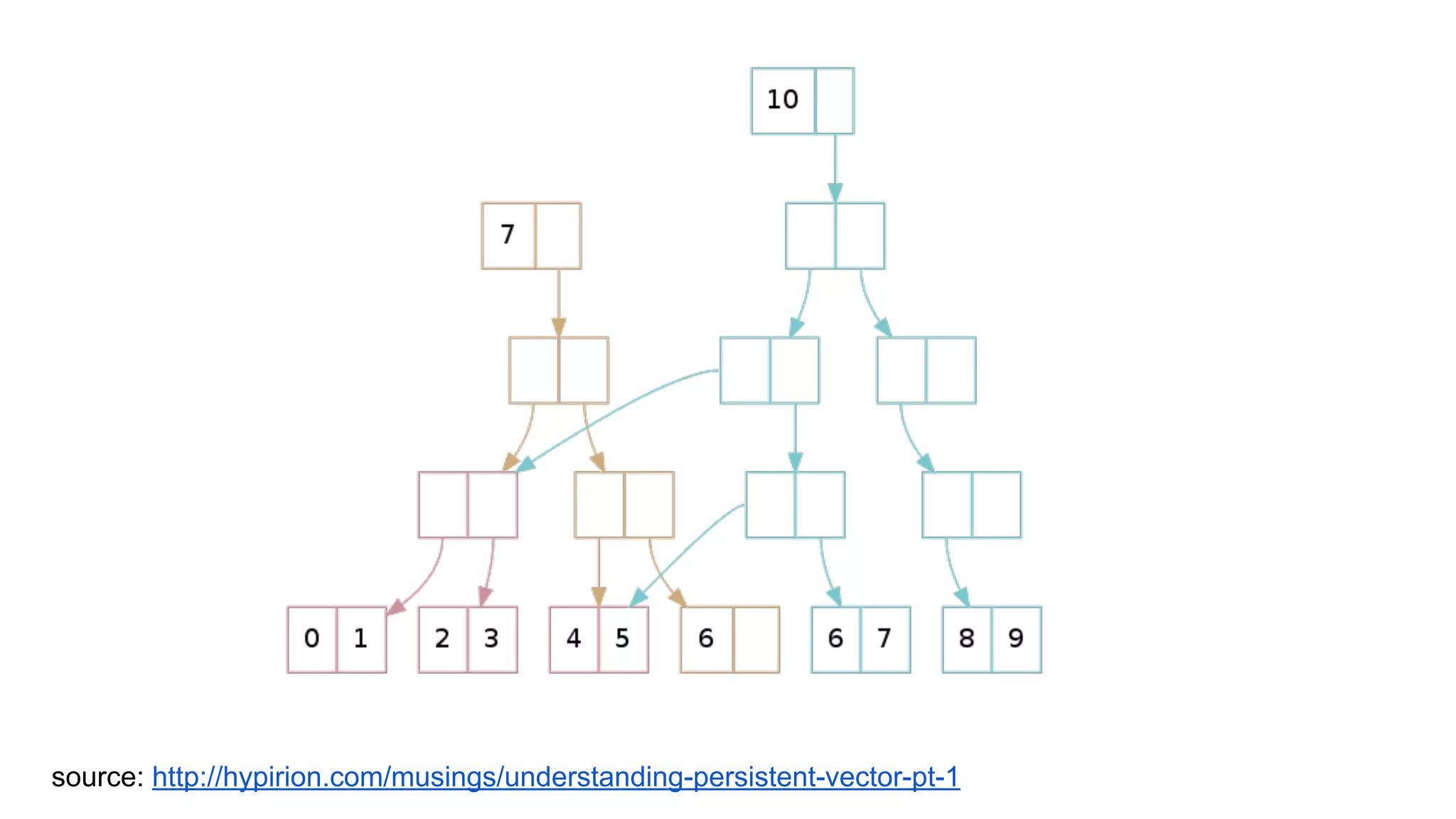
![Persistent data structures
(def v (vector))
(def v [])
(def v [1 2 3])
(conj v 4) ;; => [1 2 3 4]
(get v 0) ;; => 1
(v 0) ;; => 1](https://image.slidesharecdn.com/clojurescriptfortheweb-151004105617-lva1-app6892/75/ClojureScript-for-the-web-15-2048.jpg)
![Persistent data structures
(def m (hash-map))
(def m {})
(def m {:foo 1 :bar 2})
(conj m [:baz 3])
;; => {:foo 1 :bar 2 :baz 3}
(assoc m :foo 2) ;; => {:foo 2 :bar 2}
(get m :foo) ;;= > 2
(m :foo) ;;= > 2
(dissoc m :foo) ;;=> {:bar 2}](https://image.slidesharecdn.com/clojurescriptfortheweb-151004105617-lva1-app6892/75/ClojureScript-for-the-web-17-2048.jpg)
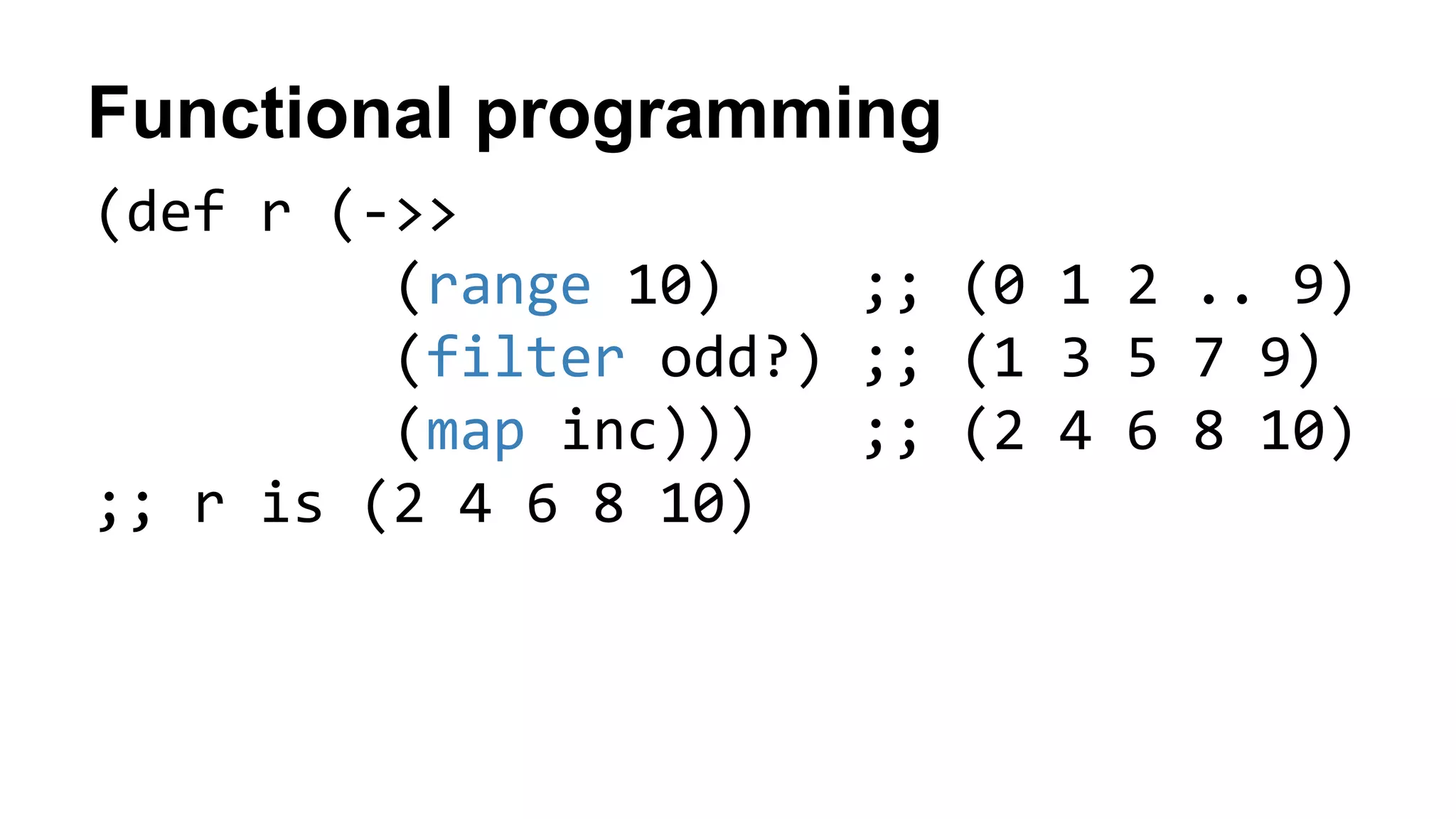
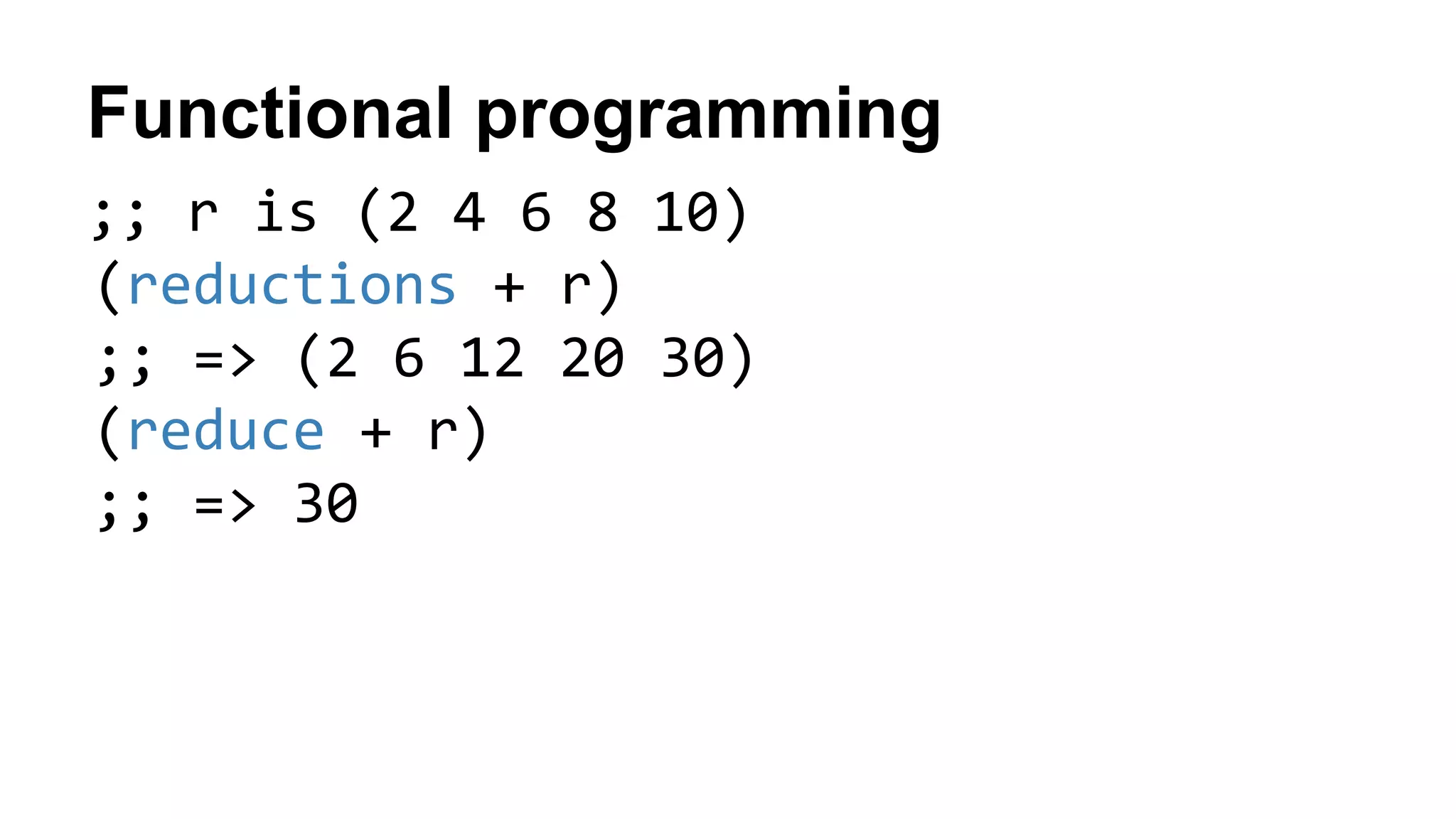
![Sequence abstraction
Data structures as seqs
(first [1 2 3]) ;;=> 1
(rest [1 2 3]) ;;=> (2 3)
General seq functions: map, reduce, filter, ...
(distinct [1 1 2 3]) ;;=> (1 2 3)
(take 2 (range 10)) ;;=> (0 1)
See http://clojure.org/cheatsheet for more](https://image.slidesharecdn.com/clojurescriptfortheweb-151004105617-lva1-app6892/75/ClojureScript-for-the-web-20-2048.jpg)
![Sequence abstraction
Most seq functions return lazy sequences:
(take 2 (map
(fn [n] (js/alert n) n)
(range))) infinite lazy sequence of numbers
side effect](https://image.slidesharecdn.com/clojurescriptfortheweb-151004105617-lva1-app6892/75/ClojureScript-for-the-web-21-2048.jpg)
![Isolation of state
adapted from: https://github.com/dfuenzalida/todo-cljs
one of possible
pre-React
patterns
function called
from event
handler
(def app-state (atom []))
(declare rerender)
(add-watch app-state ::rerender
(fn [k a o n]
(rerender o n)))
(defn add-todo [text]
(let [tt (.trim text)]
(if (seq tt)
(swap! app-state conj
{:id (get-uuid)
:title tt
:completed false}))))
new todo](https://image.slidesharecdn.com/clojurescriptfortheweb-151004105617-lva1-app6892/75/ClojureScript-for-the-web-22-2048.jpg)
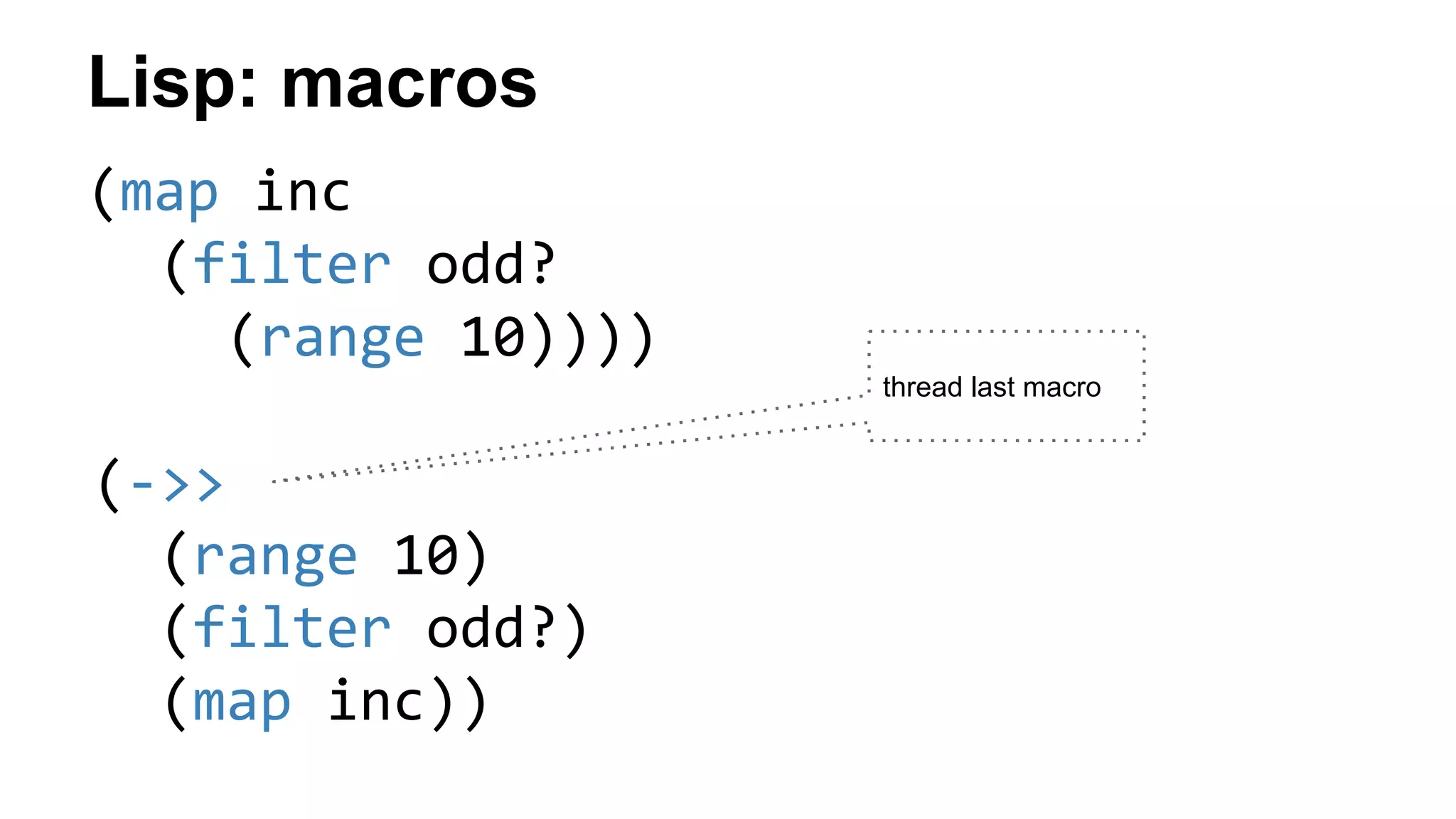
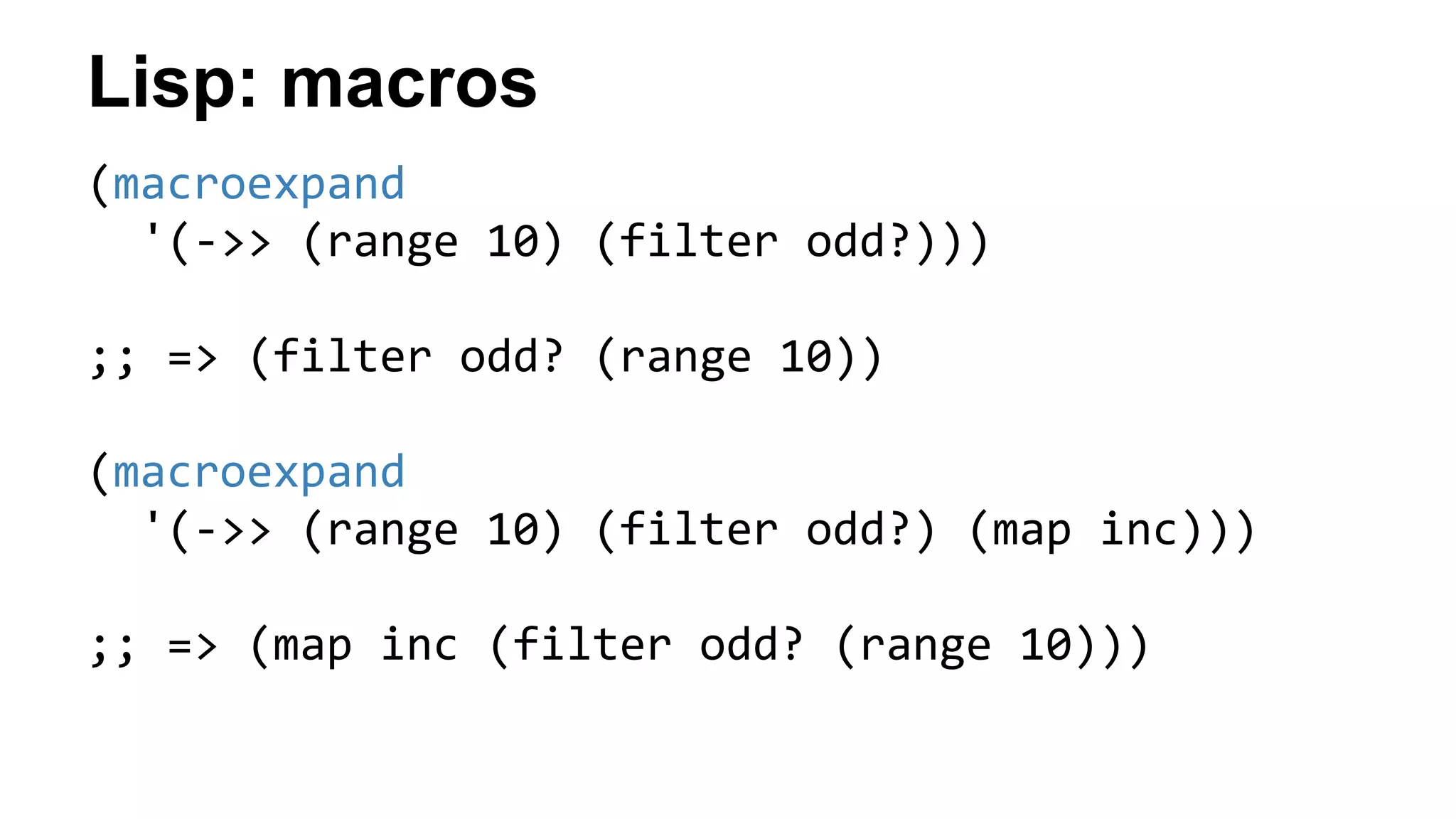
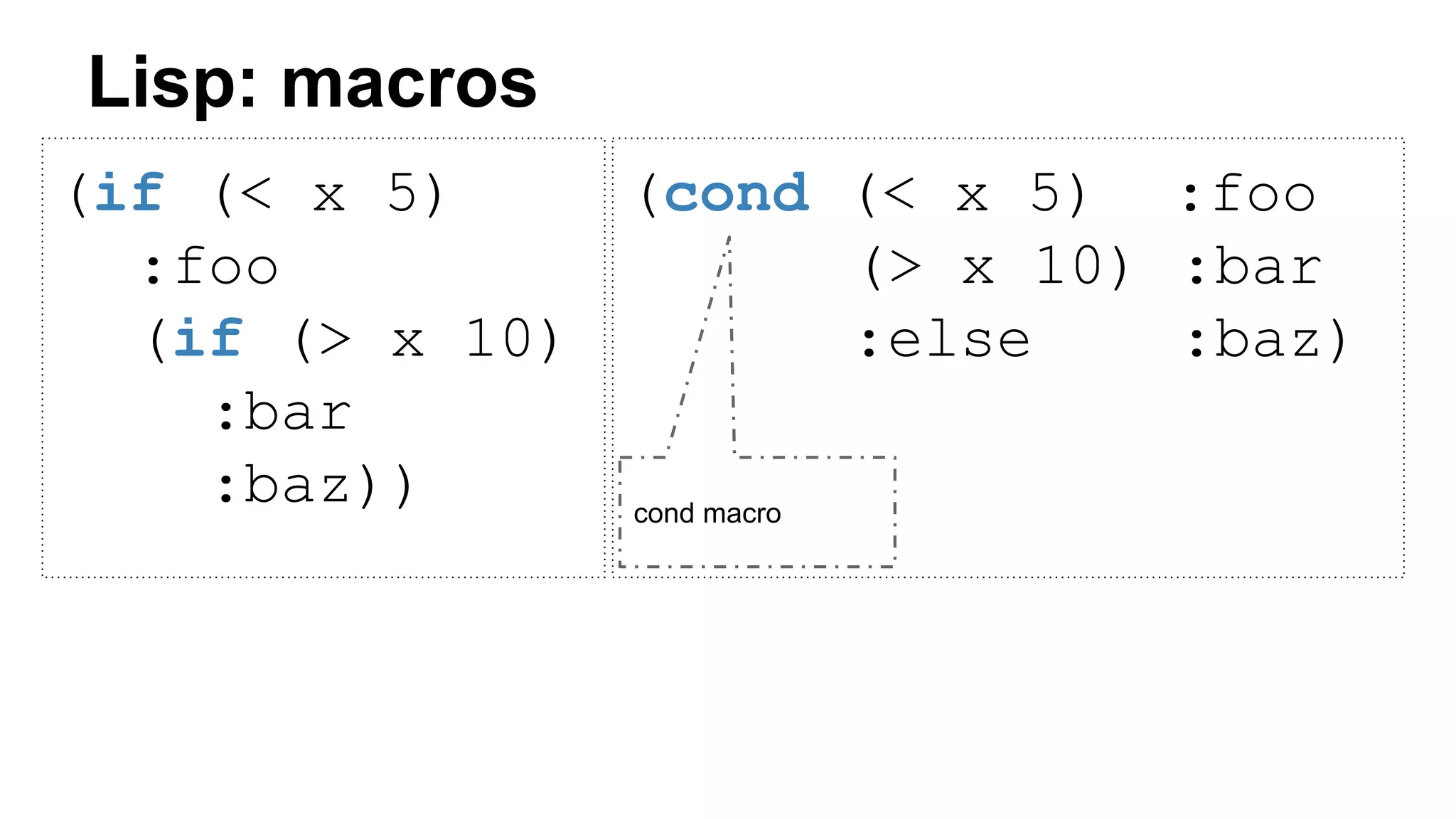
![Lisp: macros
JVM Clojure:
(defmacro defonce [x init]
`(when-not (exists? ~x)
(def ~x ~init)))
ClojureScript:
(defonce foo 1)
(defonce foo 2) ;; no effect
notes:
● macros must be written in JVM Clojure
● are expanded at compile time
● generated code gets executes in ClojureScript](https://image.slidesharecdn.com/clojurescriptfortheweb-151004105617-lva1-app6892/75/ClojureScript-for-the-web-25-2048.jpg)
![core.async
(def ch (chan))
(go (loop []
(if-let [msg (<! ch)]
(do
(.log js/console msg)
(recur))
(println "terminating loop..."))))
(events/listen (by-id "button1") EventType.CLICK
#(put! ch "hello world!"))
(events/listen (by-id "button2") EventType.CLICK
#(close! ch))](https://image.slidesharecdn.com/clojurescriptfortheweb-151004105617-lva1-app6892/75/ClojureScript-for-the-web-27-2048.jpg)
![(defproject example "0.1.0-SNAPSHOT"
:description "FIXME: write this!"
:url "http://example.com/FIXME"
:dependencies [[org.clojure/clojure "1.6.0"]
[org.clojure/clojurescript "0.0-2311"]]
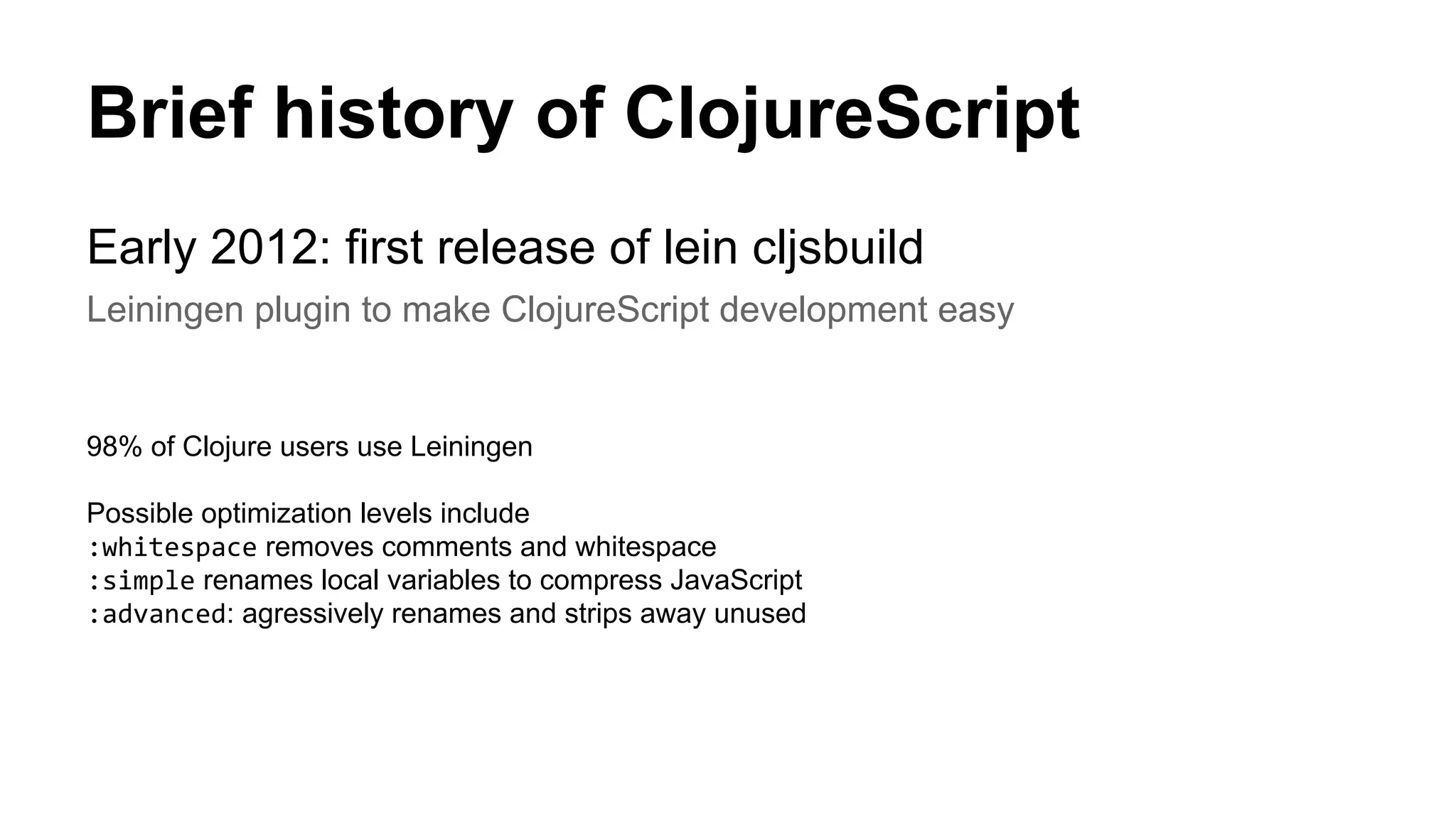
:plugins [[lein-cljsbuild "1.0.4-SNAPSHOT"]]
:source-paths ["src"]
:cljsbuild {:builds [{:id "example"
:source-paths ["src"]
:compiler {
:output-to "example.js"
:output-dir "out"
:optimizations :none
:source-map true}}]})](https://image.slidesharecdn.com/clojurescriptfortheweb-151004105617-lva1-app6892/75/ClojureScript-for-the-web-31-2048.jpg)
![cljs.core.typed
(ns foo)
(ann parse-int [string -> number])
(defn parse-int [s]
(js/parseInt s))
(parse-int 3)
Function foo/parse-int could not be
applied to arguments:
Domains:
string
Arguments:
(clojure.core.typed/Val 3)
Ranges:
number
in: (foo/parse-int 3)](https://image.slidesharecdn.com/clojurescriptfortheweb-151004105617-lva1-app6892/75/ClojureScript-for-the-web-34-2048.jpg)
![(defn timer-component []
(let [seconds-elapsed (atom 0)]
(fn []
(js/setTimeout #(swap! seconds-elapsed inc) 1000)
[:div
"Seconds Elapsed: " @seconds-elapsed])))](https://image.slidesharecdn.com/clojurescriptfortheweb-151004105617-lva1-app6892/75/ClojureScript-for-the-web-36-2048.jpg)


![Transducers
(->>
(range 10)
(filter odd?)
(map inc))
(def xform
(comp
(filter odd?)
(map inc)))
;; lazy
(sequence xform
(range 10))
;; strict
(into [] xform (range 10))](https://image.slidesharecdn.com/clojurescriptfortheweb-151004105617-lva1-app6892/75/ClojureScript-for-the-web-48-2048.jpg)
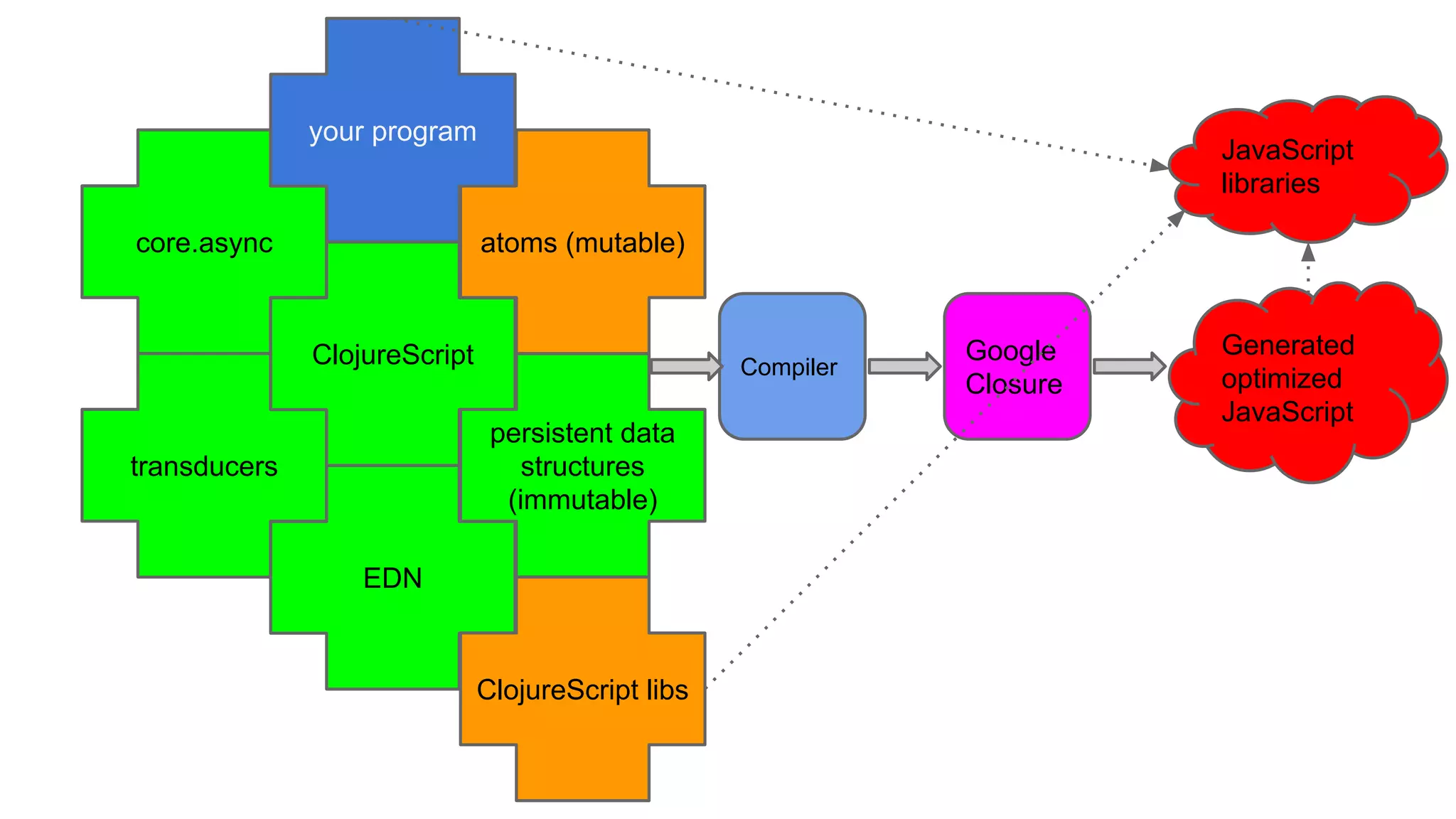

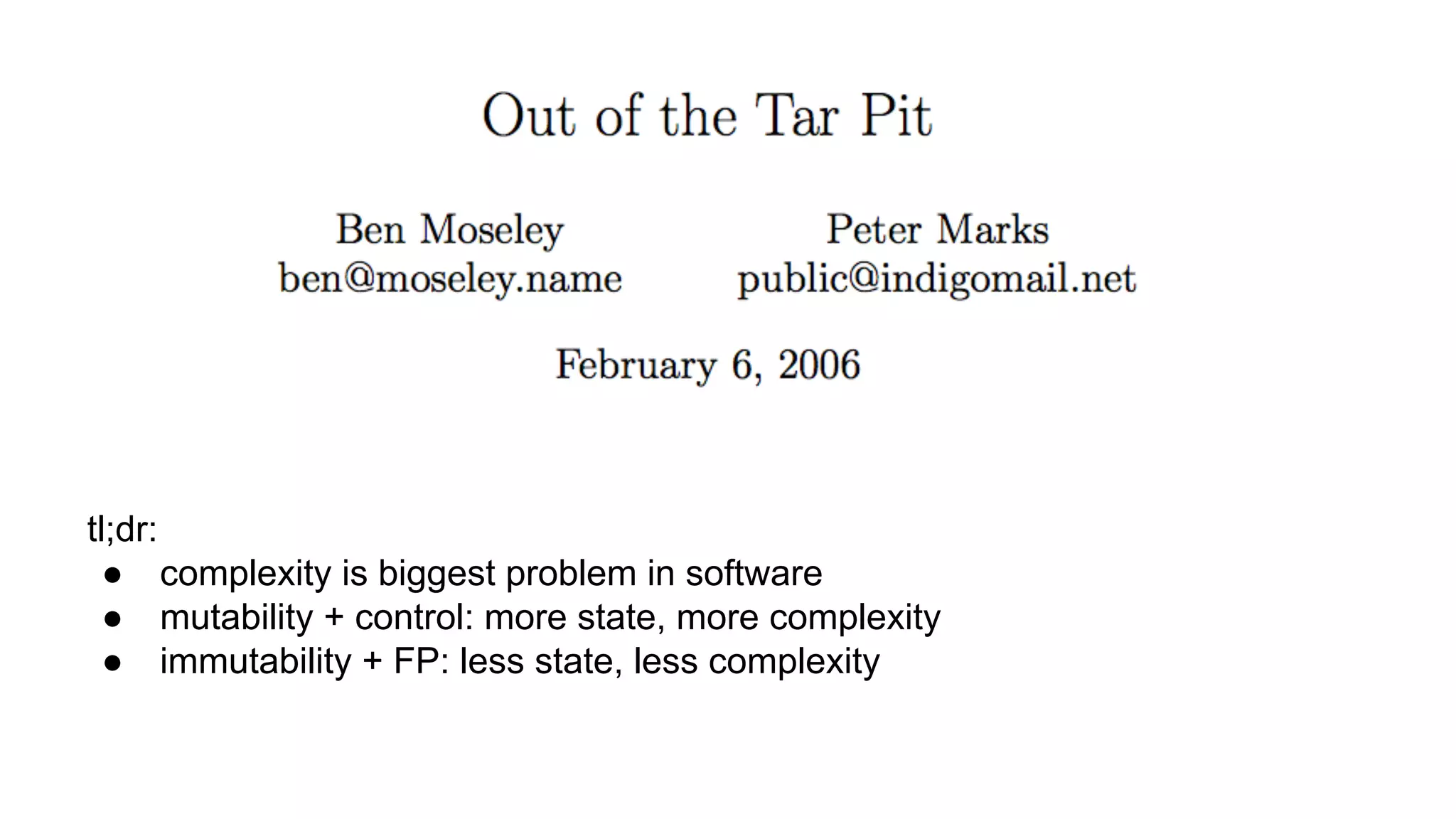
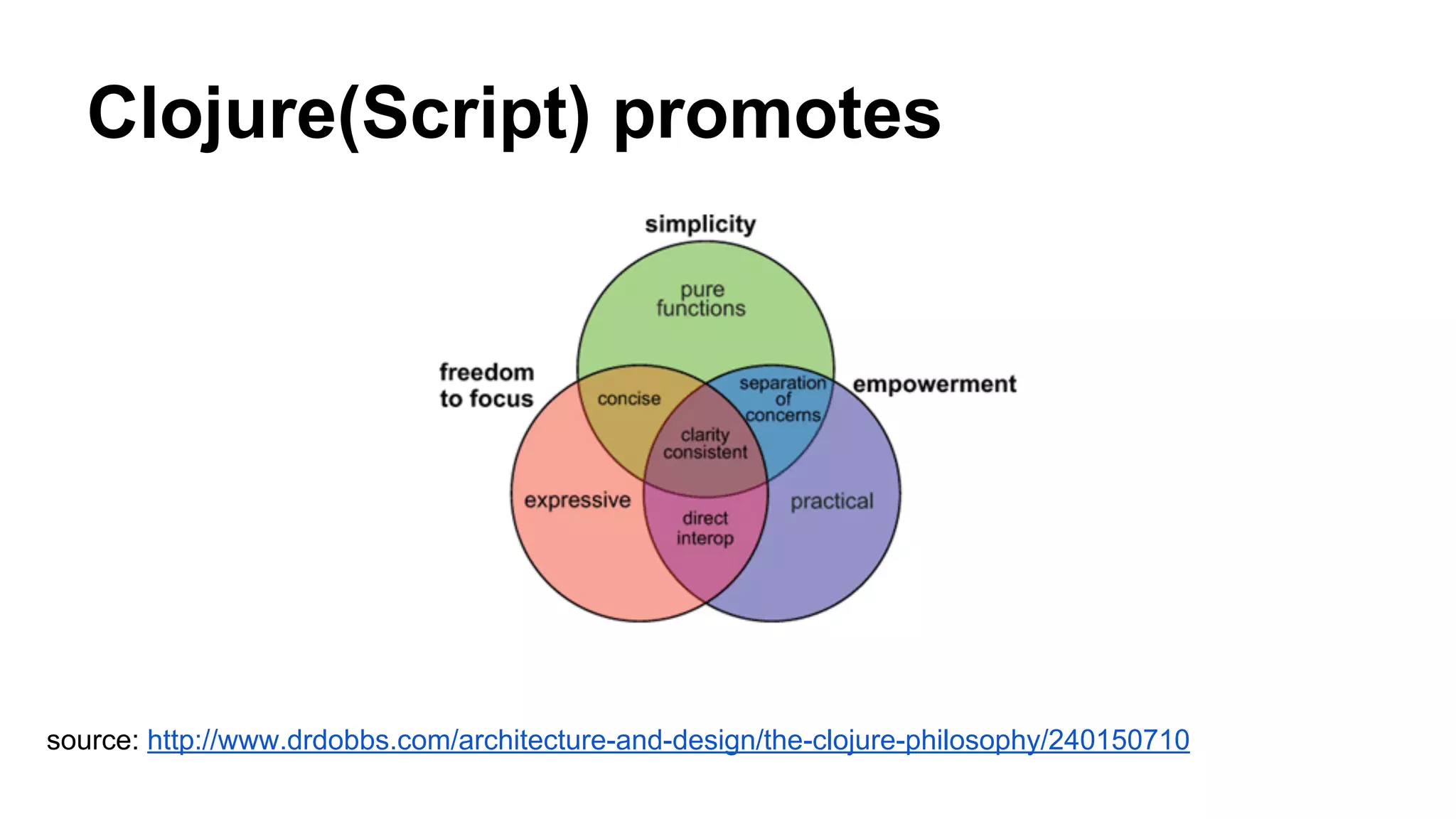
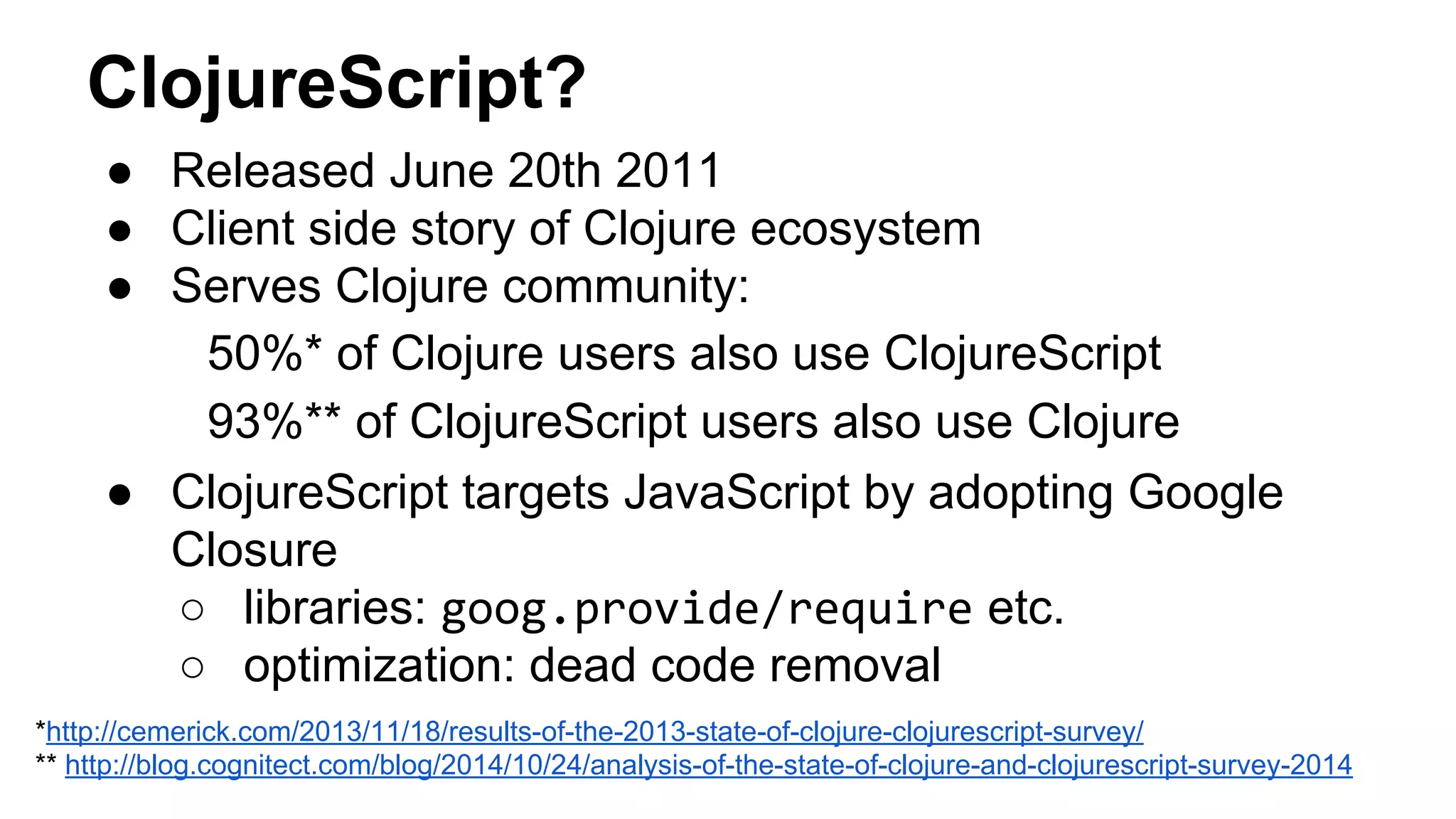
The document presents an overview of ClojureScript, a language designed for web development that compiles to JavaScript, highlighting its benefits over JavaScript, especially regarding immutability and functional programming. It discusses the features of ClojureScript, its ecosystem, and the tools available for development, such as Leiningen and debugging source maps. Additionally, it touches on the community resources and libraries that enhance the ClojureScript experience.


