(do “Concurrency in Clojure”) (by (and  “Alex” “Nithya”))
Agenda Introduction Features Concurrency, Locks, Shared state STM Vars, Atoms, Refs, Agents Stock picker example Q&A
Introduction What is clojure? Lisp style Runs on JVM/CLR Why Clojure? Immutable Persistent Data structures FP aspects Concurrency Open Source Short and sweet Java Libraries JVM Evaluator Clojure/Repl Byte code public class  StringUtils  { public static boolean  isBlank (String str) { int strLen; if (str == null || (strLen = str.length()) == 0) { return true; } for (int i = 0; i < strLen; i++) { if ((Character.isWhitespace(str.charAt(i)) == false)) { return false; } } return true; } } ( defn  blank? [s]  ( every?  # ( Character/isWhitespace  % )  s ) ) Fn name parameters body
Immutable data structures Functions as first class objects, closures Java Interop Tail Recursion Features (def vector [1 2 3]) (def list '(1 2 3)) (def map {:A “A”}) (def set #{“A”})  (defn add [x] ( fn [y] + x y) )
Lazy evaluation - abstract sequences + library “ cons cell”  - (cons 4 '(1 2 3)) Features Ins to generate the next component seq Item First Rest ( defn  lazy-counter-iterate [base increment] (  iterate   ( fn  [n]  ( +  n increment ) )  base ) ) user=>  ( def  iterate-counter  ( lazy-counter-iterate  2   3 ) ) user=>  ( nth  iterate-counter  1000000 ) user=>  ( nth   ( lazy-counter-iterate  2   3 )   1000000 ) 3000002
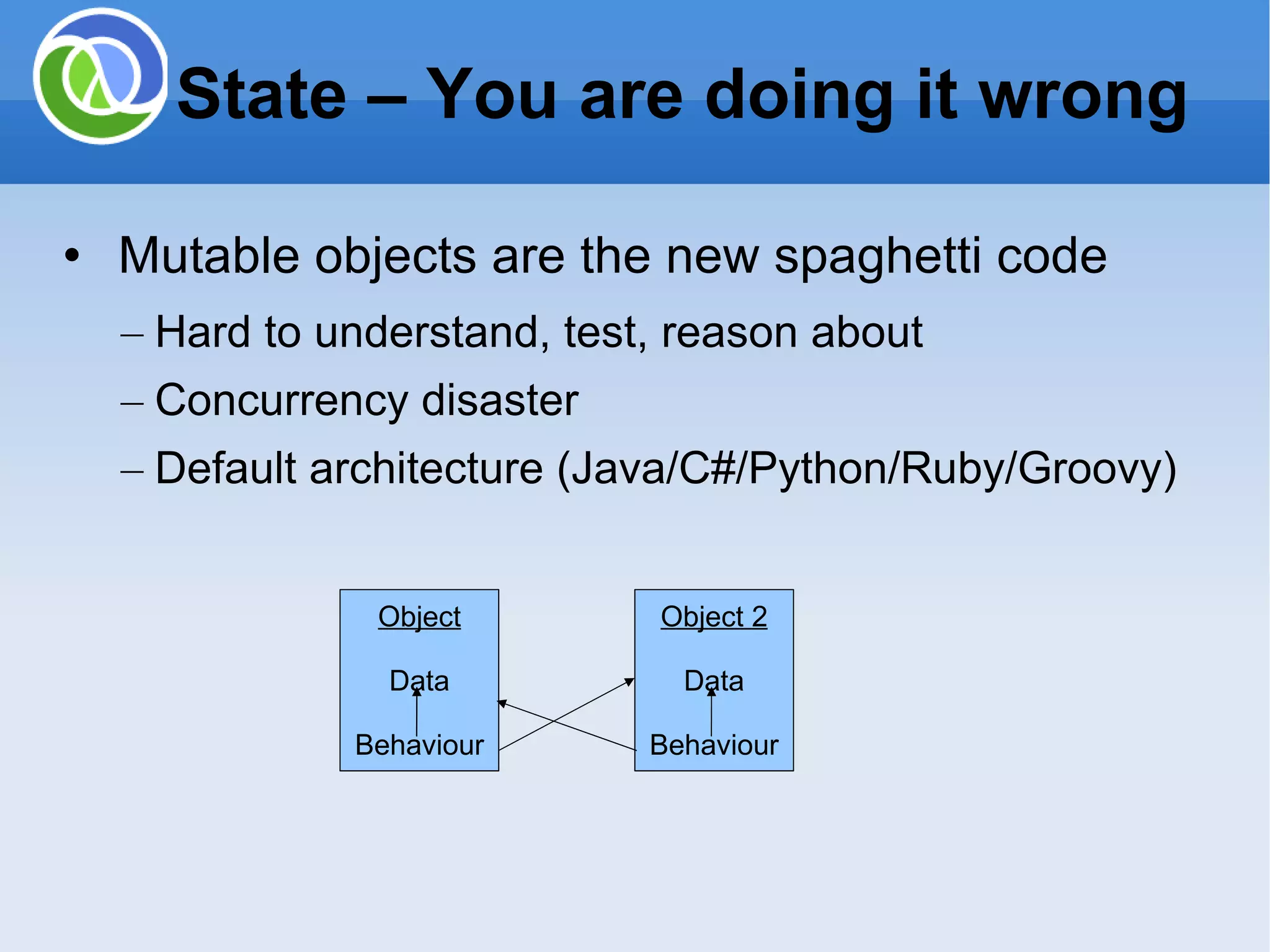
Mutable objects are the new spaghetti code Hard to understand, test, reason about Concurrency disaster Default architecture (Java/C#/Python/Ruby/Groovy) State – You are doing it wrong Object Data Behaviour Object 2 Data Behaviour
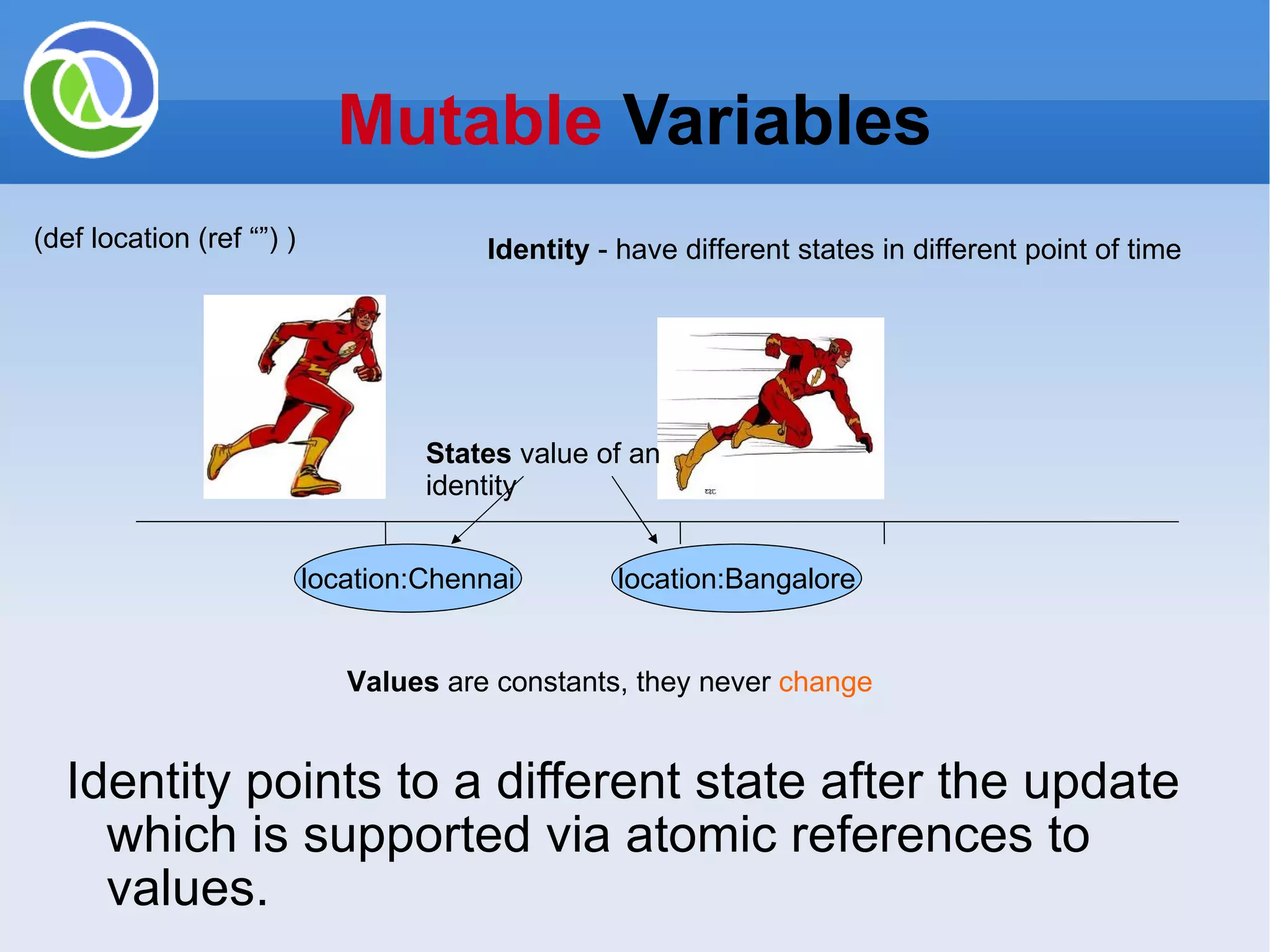
Mutable  Variables Identity points to a different state after the update which is supported via atomic references to values.  location:Chennai location:Bangalore Values  are constants, they never  change (def location (ref “”) ) Identity  - have different states in different point of time States  value of an identity
Interleaving / parallel coordinated execution Usual Issues  Deadlock Livelock Race condition UI should be functional with tasks running Techniques - Locking, CAS, TM, Actors Concurrency
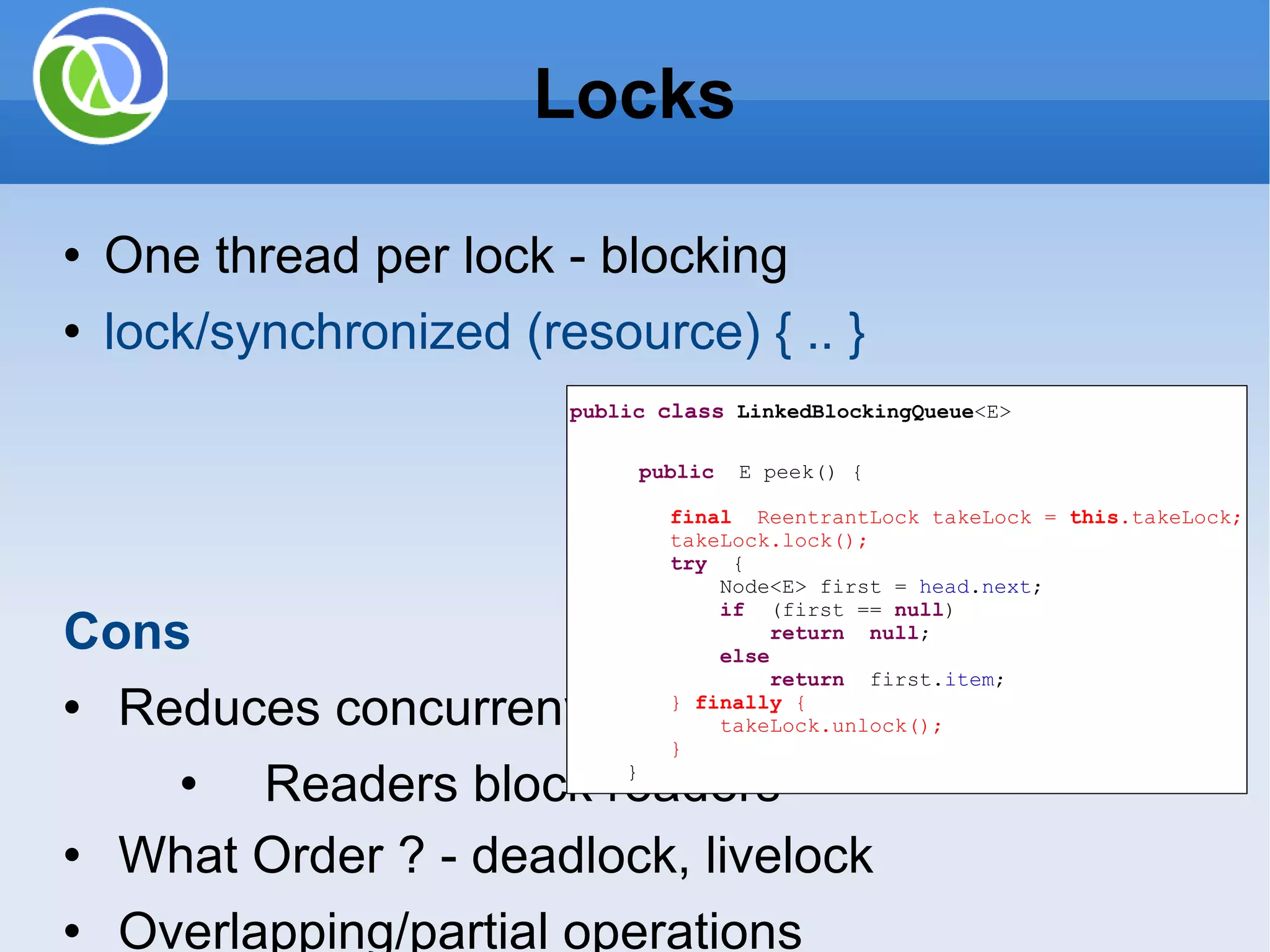
One thread per lock - blocking  lock/synchronized (resource) { .. } Cons   Reduces concurreny Readers block readers What Order ? - deadlock, livelock Overlapping/partial operations Priority inversion public   class   LinkedBlockingQueue <E>  public   E peek() { final   ReentrantLock takeLock =  this .takeLock; takeLock.lock(); try   { Node<E> first =  head . next ; if   (first ==  null ) return   null ; else return   first. item ; }  finally  { takeLock.unlock(); } } Locks
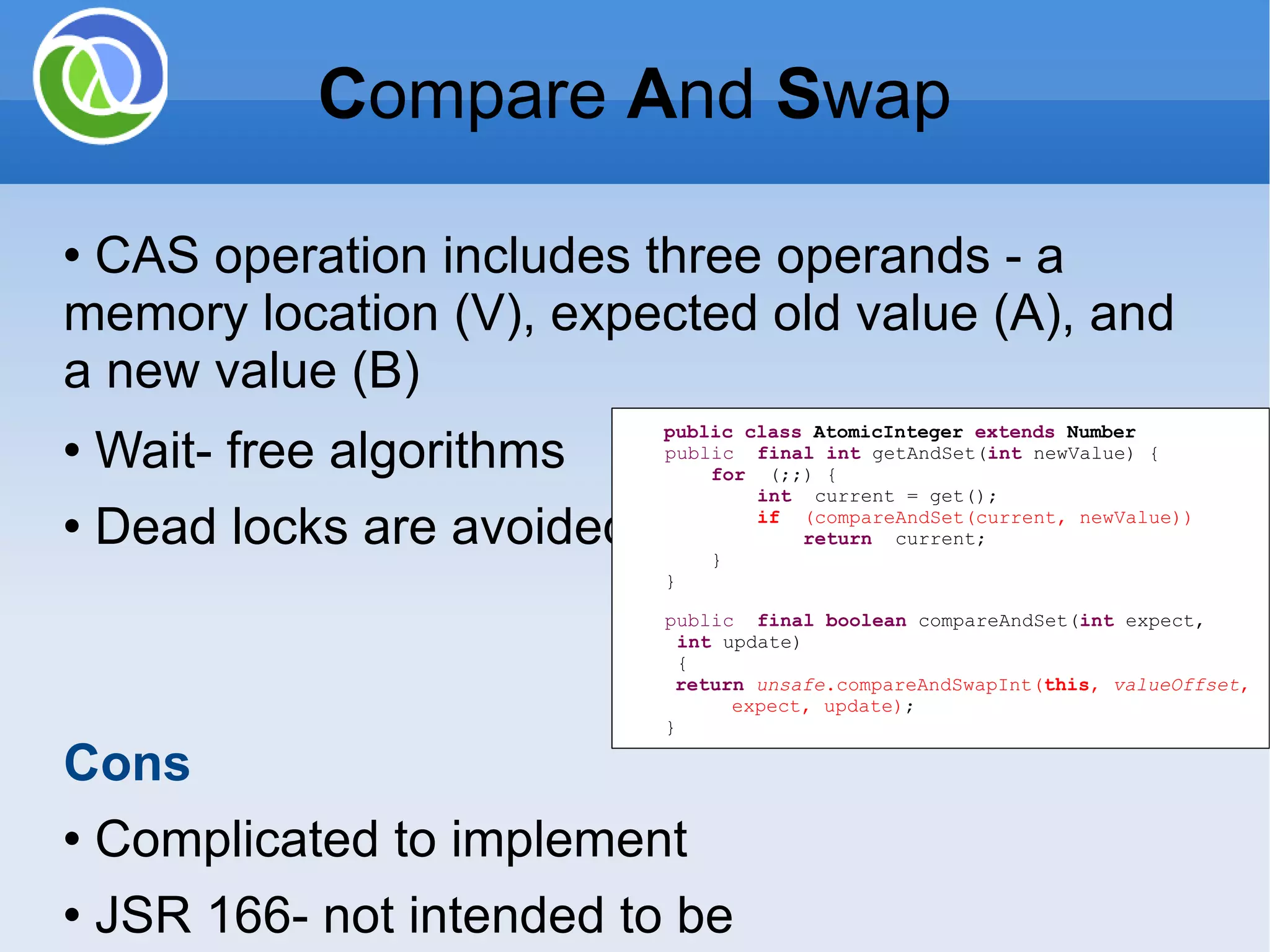
CAS operation includes three operands - a memory location (V), expected old value (A), and a new value (B)  Wait- free algorithms Dead locks are avoided Cons Complicated to implement JSR 166- not intended to be  used directly by most developers public   class  AtomicInteger  extends  Number  public   final   int  getAndSet( int  newValue) { for   (;;) { int   current = get(); if   (compareAndSet(current, newValue)) return   current; } } public   final   boolean  compareAndSet( int  expect,  int  update)  { return   unsafe .compareAndSwapInt( this ,  valueOffset ,  expect, update) ; } C ompare  A nd  S wap
Enhancing Read Parallelism Multi-reader/Single -writer locks Readers don't block each others Writers wait for readers CopyOnWrite Collections Read snapshot Copy & Atomic writes Expensive Multi-step writes still  require locks public   boolean  add(E e) { final  ReentrantLock lock =  this . lock ; lock.lock(); try  {   Object[] elements = getArray();   int  len = elements. length ;   Object[] newElements = Arrays. copyOf (elements,  len + 1);   newElements[len] = e;   setArray(newElements);   return   true ; }  finally  {   lock.unlock(); }  }
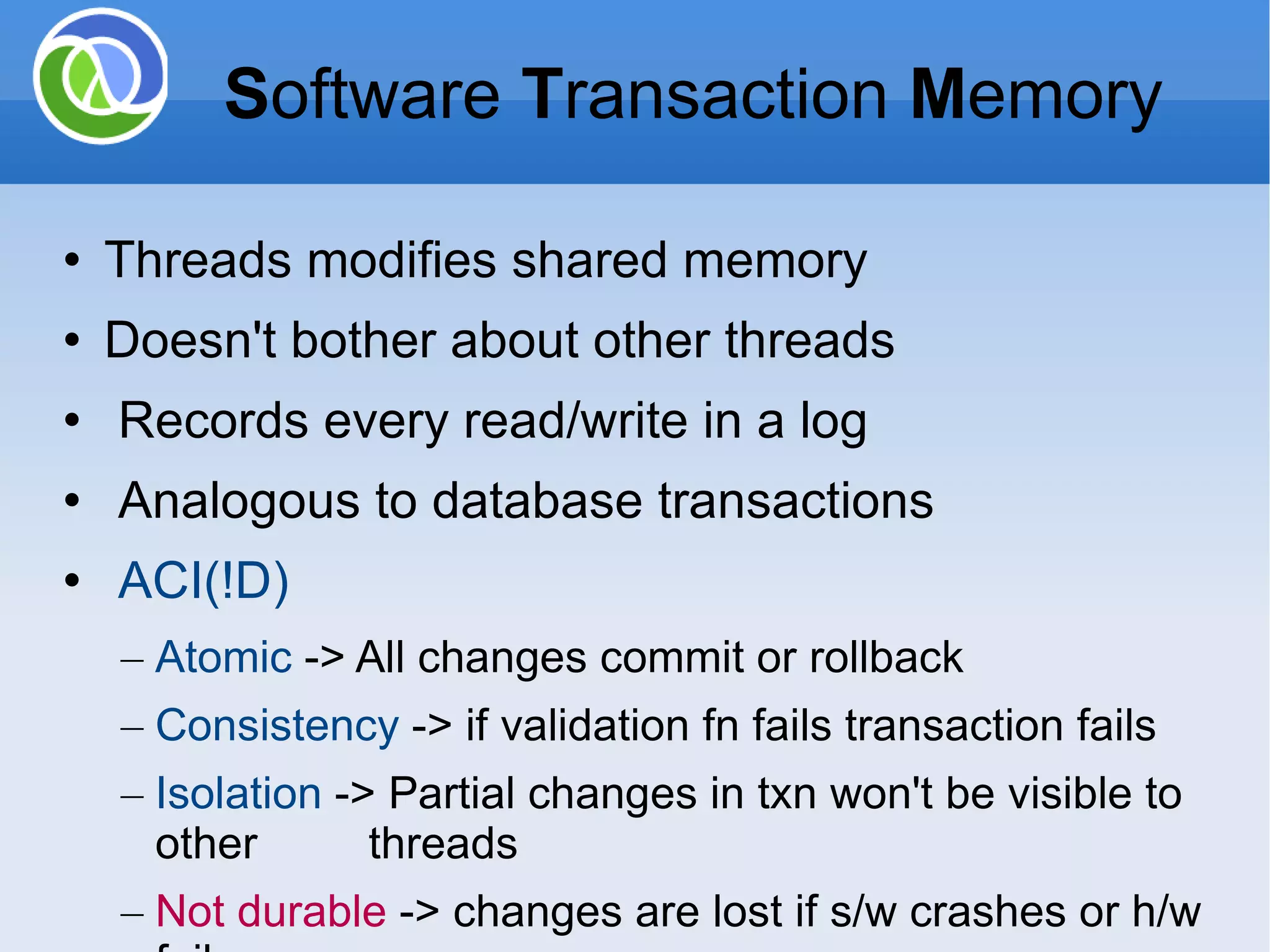
Threads modifies shared memory Doesn't bother about other threads Records every read/write in a log Analogous to database transactions ACI(!D) Atomic  -> All changes commit or rollback Consistency  -> if validation fn fails transaction fails Isolation  -> Partial changes in txn won't be visible to other    threads Not durable  -> changes are lost if s/w crashes or h/w fails S oftware  T ransaction  M emory
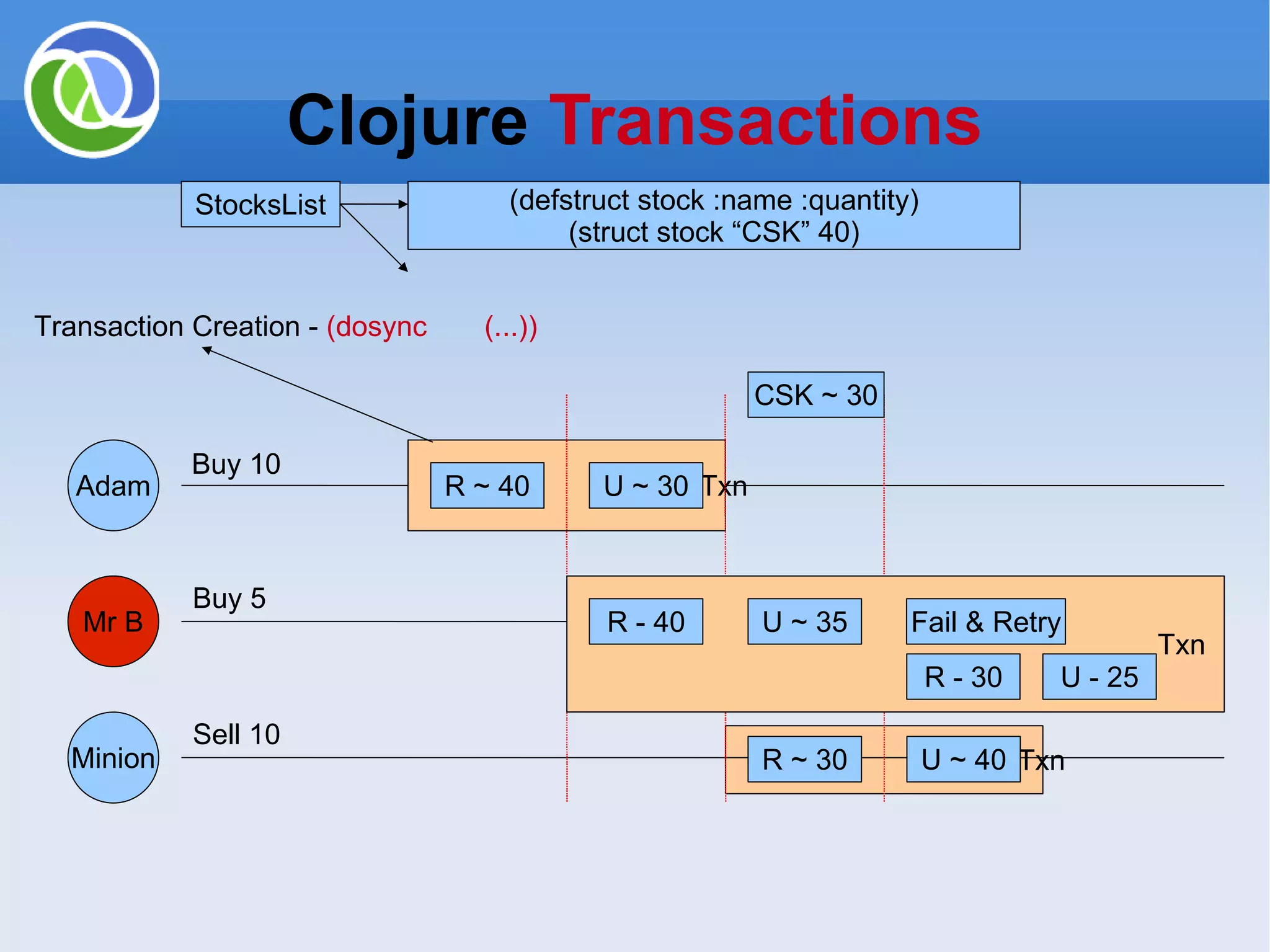
Clojure  Transactions Txn Txn Adam Mr B Minion R ~ 40 U ~ 30 (defstruct stock :name :quantity) (struct stock “CSK” 40) StocksList R ~ 30 Buy 10 Buy 5 Sell 10 CSK ~ 30 Txn Fail & Retry R - 40 U ~ 35 R - 30 U - 25 U ~ 40 Transaction Creation -  (dosync  (...))
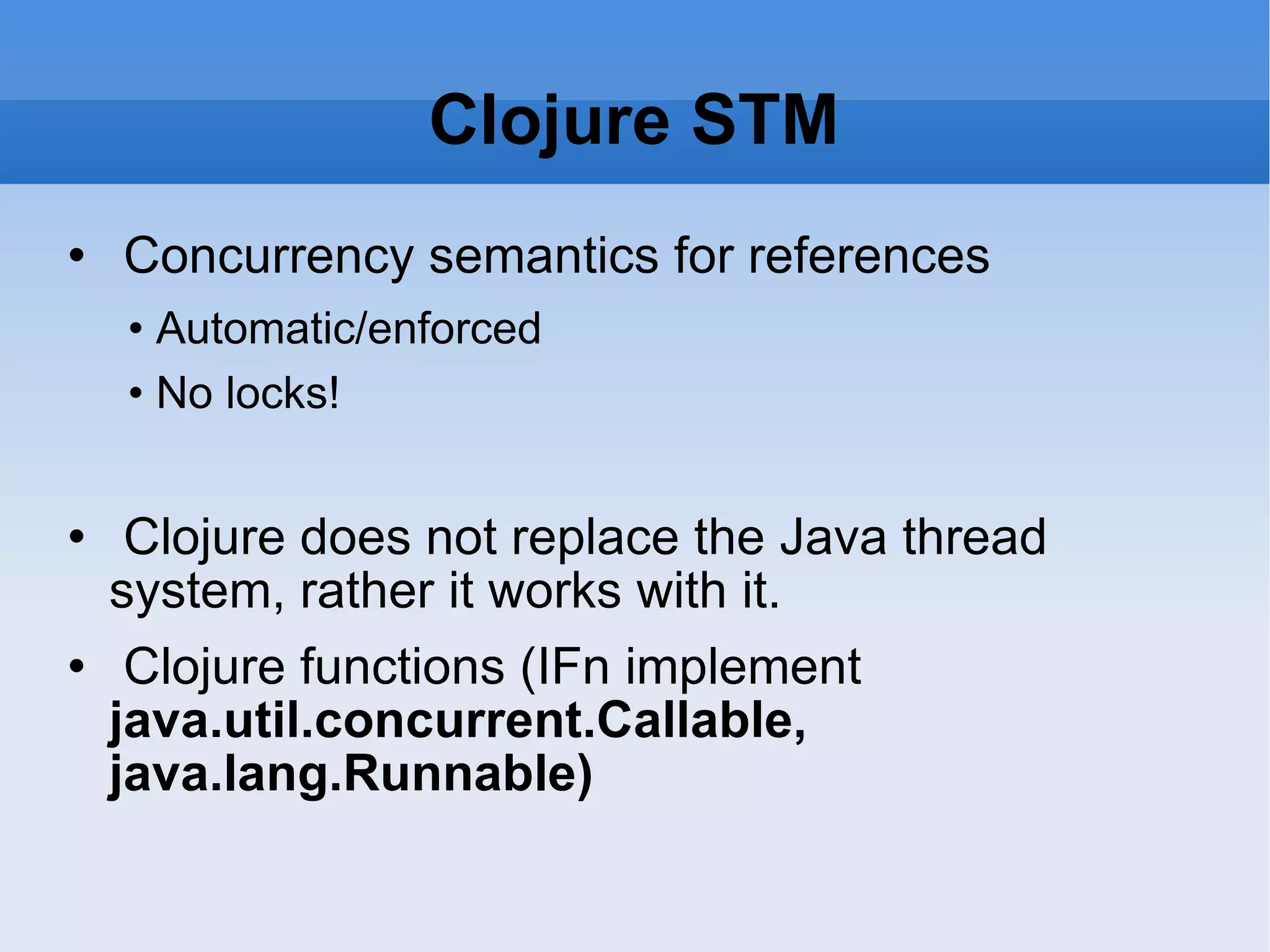
Clojure STM Concurrency semantics for references •  Automatic/enforced •  No locks! Clojure does not replace the Java thread system, rather it works with it.  Clojure functions (IFn implement  java.util.concurrent.Callable, java.lang.Runnable)
STM Pros Optimistic, increased concurrency - no thread waiting Deadlock/Livelock is prevented/handled by Transaction manager Data is consistent Simplifies conceptual understanding – less effort Cons Overhead of transaction retrying Performance hit (<4 processor)  on maintaining committed, storing in-transaction values and  locks  for commiting transactions Cannot perform any operation that cannot be undone, including most I/O Solved using queues  (Agents in Clojure)
Persistent Data Structures Immutable + maintain old versions Structure sharing – not full copies Thread/Iteration safe Clojure data structures are persistent Hash map and vector  – array mapped hash tries (bagwell) Sorted map  – red black tree MVCC – Multi-version concurrency control Support sequencing, meta-data Pretty fast: Near constant time read access for maps and vectors ( actually O(log32n) )
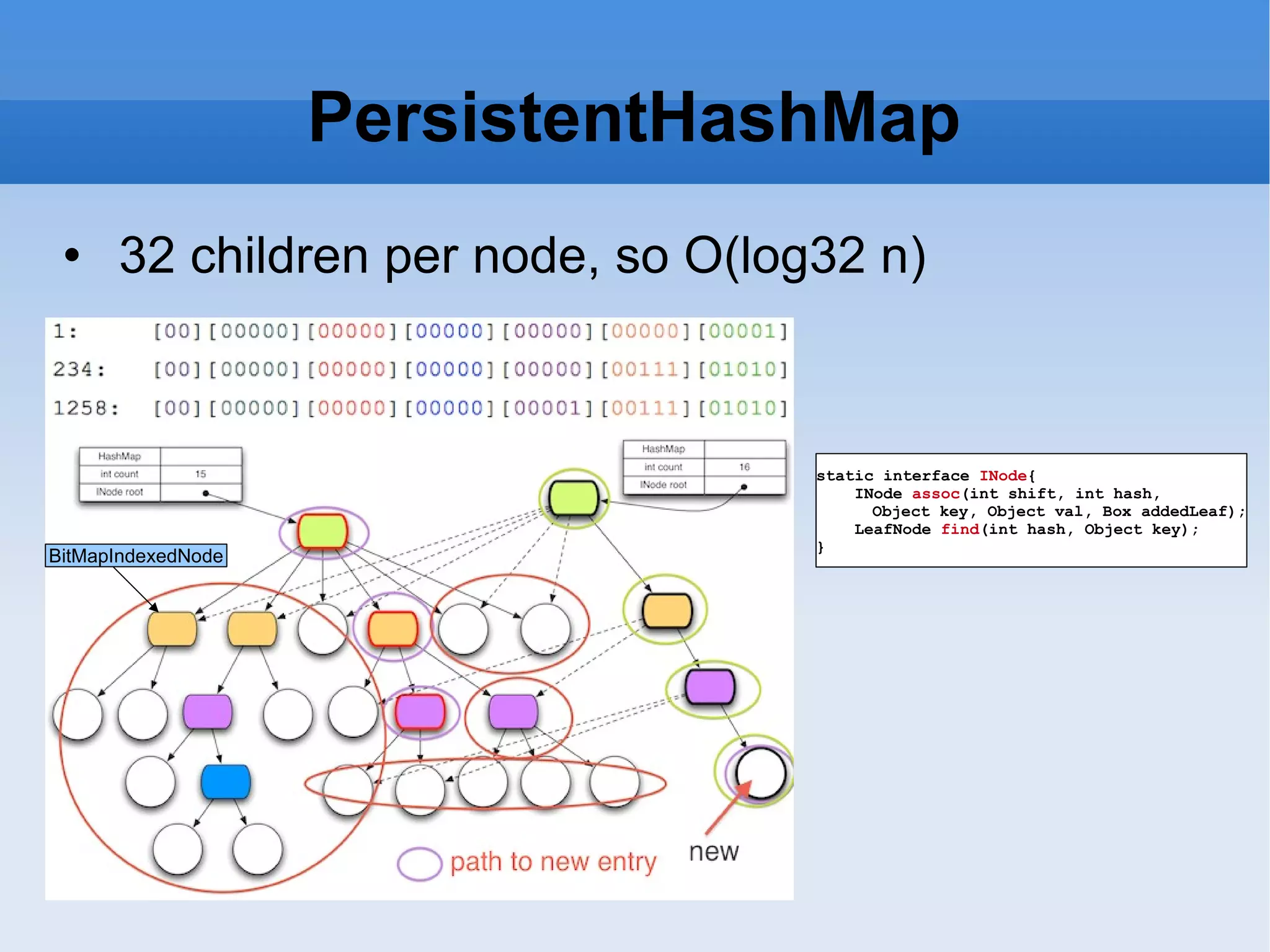
PersistentHashMap 32 children per node, so O(log32 n) static interface  INode { INode  assoc (int shift, int hash,  Object key, Object val, Box addedLeaf); LeafNode  find (int hash, Object key); } BitMapIndexedNode
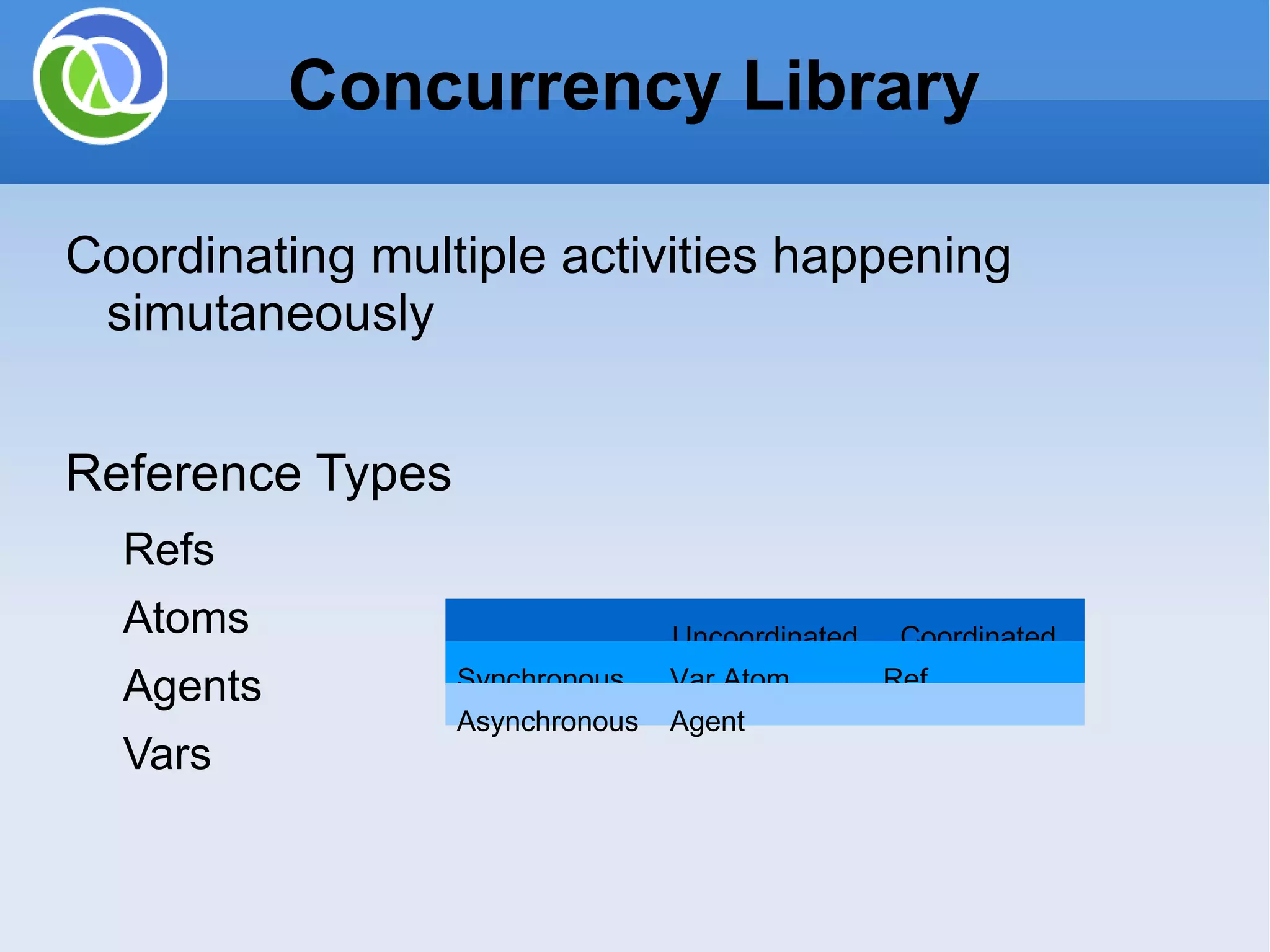
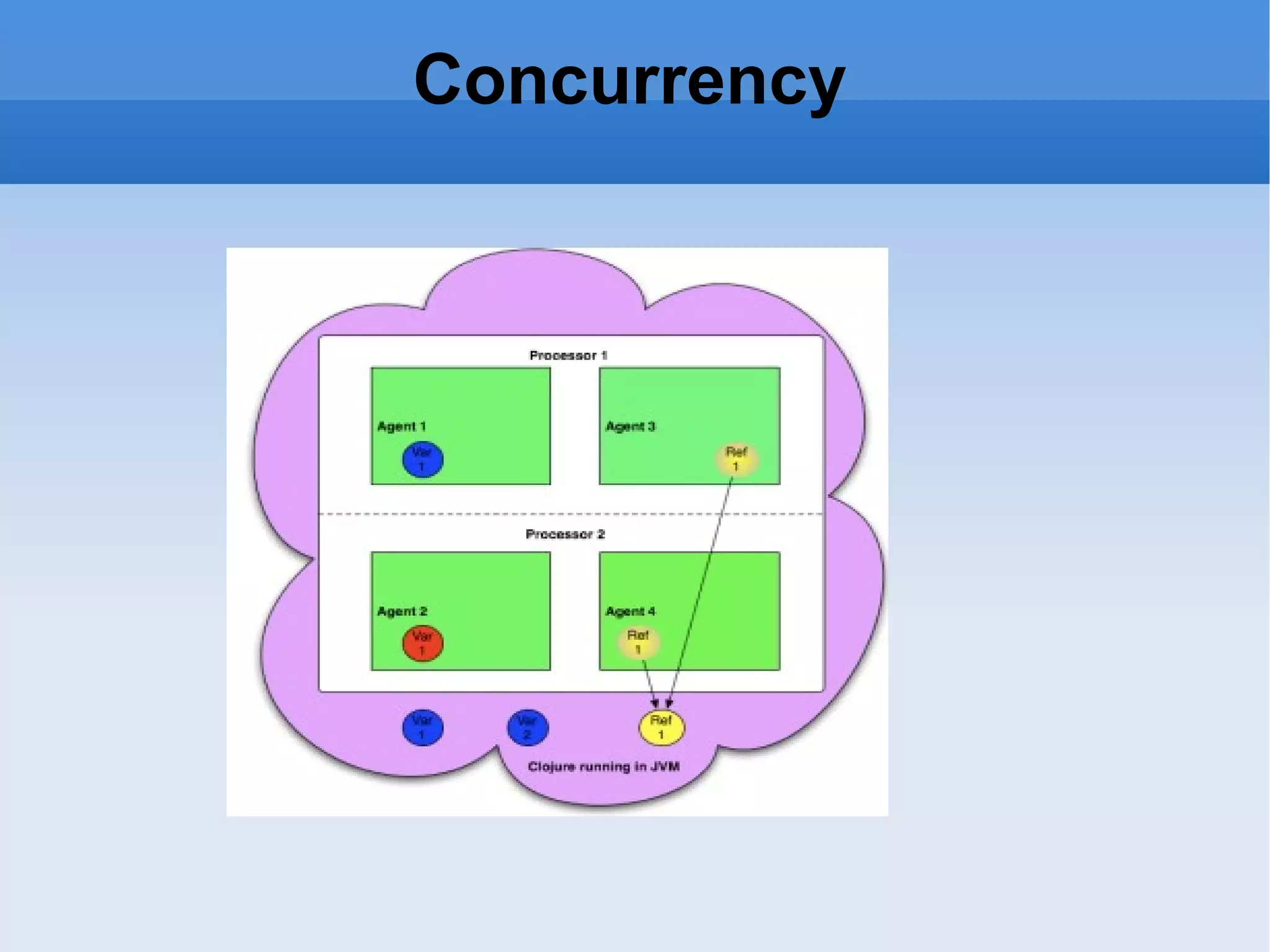
Concurrency Library Coordinating multiple activities happening simutaneously Reference Types Refs Atoms Agents  Vars Uncoordinated Coordinated Synchronous Var Atom Ref Asynchronous Agent
Vars Vars  - per-thread mutables, atomic read/write  (def)  is shared root binding – can be unbound (binding)  to set up a per-thread override Bindings can only be used when  def  is defined  at the top level   (set!)  if per-thread binding T1 T2 (def x 10)  ; Global object (defn get-val [] (+ x y)) (defn fn []  (println x) (binding [x 2] (get-val)) Can’t see the binded value
Vars Safe use mutable storage location via thread isolation Thread specific Values Setting thread local dynamic binding Scenarios: Used for constants and configuration variables such as  *in*,  *out*, *err* Manually changing a program while running (def max-users 10) Functions defined with  defn  are stored in Vars enables re-definition  of functions – AOP like enabling logging user=>  ( def  variable  1 ) #'user/variable user=>  ( . start  ( Thread.  ( fn  []  ( println  variable ) ) ) ) nil user=>  1 user=> (def variable 1) #'user/variable user=>(defn print [] (println variable)) user=> (.start (Thread. (fn [] (binding [variable 42] (print))))) nil user=> 1 (set! var-symbol value) (defn say-hello [] (println &quot;Hello&quot;))  (binding [say-hello #(println &quot;Goodbye&quot;)]  (say-hello))
Vars... Augmenting the behavior Memoization – to wrap functions Has great power Should be used sparsely Not pure functions ( ns  test-memoization ) ( defn  triple[n] ( Thread/sleep  100 ) ( *  n  3 ) ) ( defn  invoke_triple []   (  map  triple [  1   2   3   4   4   3   2   1 ] ) ) ( time   ( dorun   ( invoke_triple ) ) )   ->   &quot;Elapsed time: 801.084578 msecs&quot; ;(time (dorun (binding [triple (memoize triple)]  (invoke_triple)))) -> &quot;Elapsed time: 401.87119 msecs&quot;
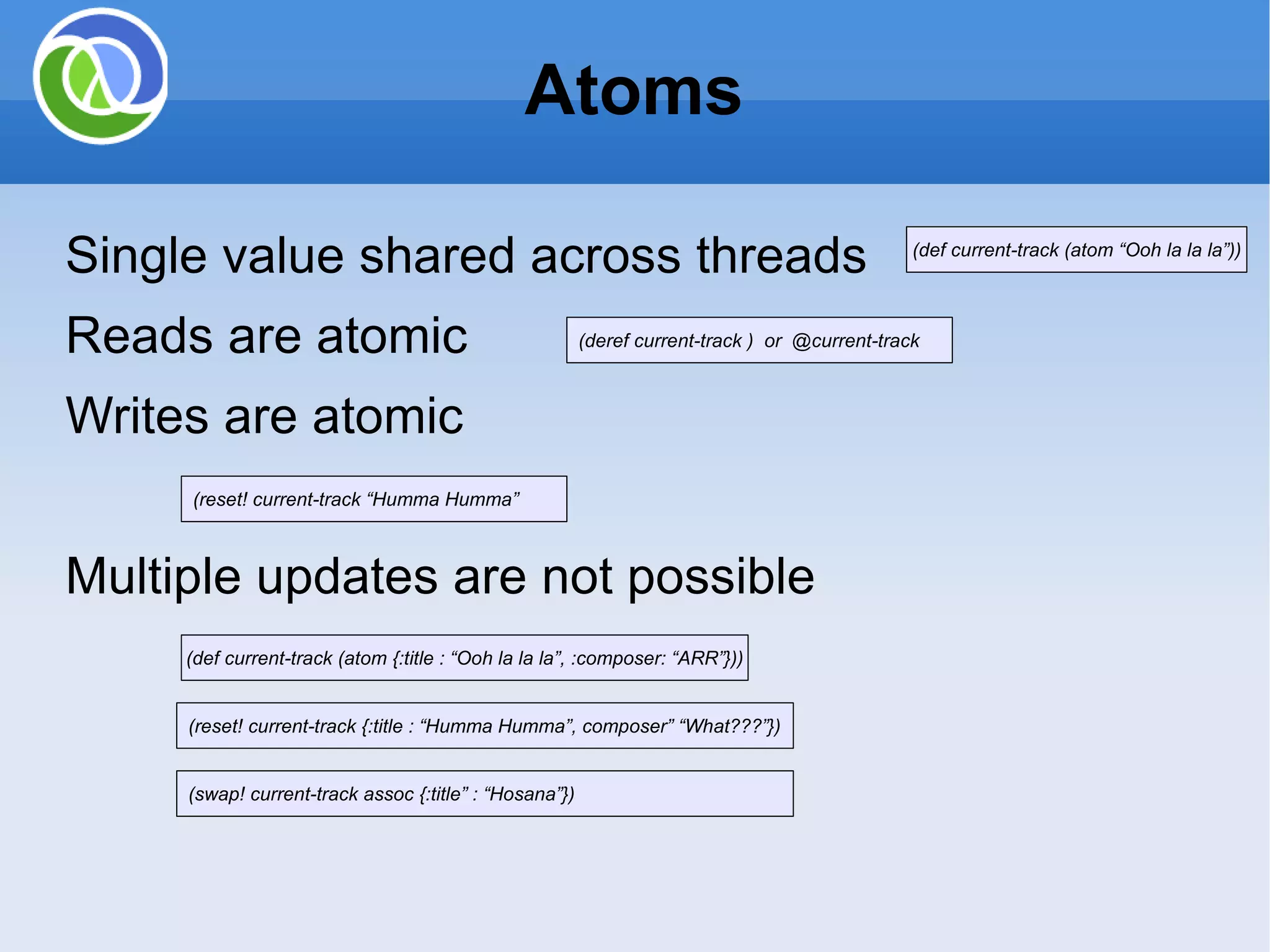
Atoms Single value shared across threads Reads are atomic Writes are atomic Multiple updates are not possible (def current-track (atom “Ooh la la la”)) (deref current-track )  or  @current-track (reset! current-track “Humma Humma” (reset! current-track {:title : “Humma Humma”, composer” “What???”}) (def current-track (atom {:title : “Ooh la la la”, :composer: “ARR”})) (swap! current-track assoc {:title” : “Hosana”})
Refs Mutable reference to a immutable state Shared use of mutable storage location via STM ACI and retry properties Reads are atomic Writes inside an STM txn
Refs in Txn •  Maintained by each txn •  Only visible to code running in the txn •  Committed at end of txn if successful •  Cleared after each txn try •  Committed values •  Maintained by each Ref in a circular linked-list (tvals field) •  Each has a commit “timestamp” (point field in TVal objects)
Changing Ref Txn retry (  ref-set   ref  new-value ) (  alter   ref  function arg* ) Commute  (  commute   ref  function arg* ) Order of changes doesn't matter Another txn change will not invoke retry Commit -> all commute fns invoked using latest commit values Example: Adding objects to collection ( def  account1  ( ref   1000 ) ) ( def  account2  ( ref   2000 ) ) ( defn  transfer &quot;transfers amount of money from a to b&quot; [a b amount] ( dosync (  alter  a  -  amount ) (  alter  b  +  amount ) ) ) ( transfer account1 account2  300 ) ( transfer account2 account1  50 ) ;@account1  -> 750 ;@account2  -> 2250
Validators Validators: Invoked when the transaction is to commit When fails -> IllegalStateException is thrown (  ref  initial-value  :validator  validator-fn ) user=>  ( def  my-ref  ( ref   5 ) ) #'user/my-ref user=>  ( set-validator!  my-ref  ( fn  [x]  ( <   0  x ) ) ) Nil user=>  ( dosync   ( alter  my-ref –   10 ) ) #<CompilerException  java.lang.IllegalStateException:  Invalid Reference State> user=>  ( dosync   ( alter  my-ref –   10 )   ( alter  my-ref  +   15 ) ) 10 user=> @my-ref 5
Watches Called when state changes Called on an identity Example: (  add-watch   identity   key   watch-function ) ( defn  function-name [ key   identity  old-val  new-val] expressions ) ( remove-watch   identity   key ) user=>  ( defn  my-watch [ key   identity  old-val new-val] (  println   ( str   &quot;Old: &quot;  old-val ) ) (  println   ( str   &quot;New: &quot;  new-val ) ) ) #'user/my-watch user=>  ( def  my-ref  ( ref   5 ) ) #'user/my-ref user=>  ( add-watch  my-ref  &quot;watch1&quot;  my-watch ) #<Ref  5 > user=>  ( dosync   ( alter  my-ref  inc ) ) Old:  5
Other features... Write Skew  Ensure Doesn't change the state of ref Forces a txn retry if ref changes Ensures that ref is not changed during the txn
Agents Agents share asynchronous independent changes between threads State changes through actions (functions) Actions are sent through send, send-off Agents run in thread pools  -  send  fn is tuned to no of processors -  send-off  for intensive operations, pre-emptive
Agents Only one agent per action happens at a time Actions of all Agents get interleaved amongst threads in a thread pool Agents are reactive - no imperative message loop and no blocking receive
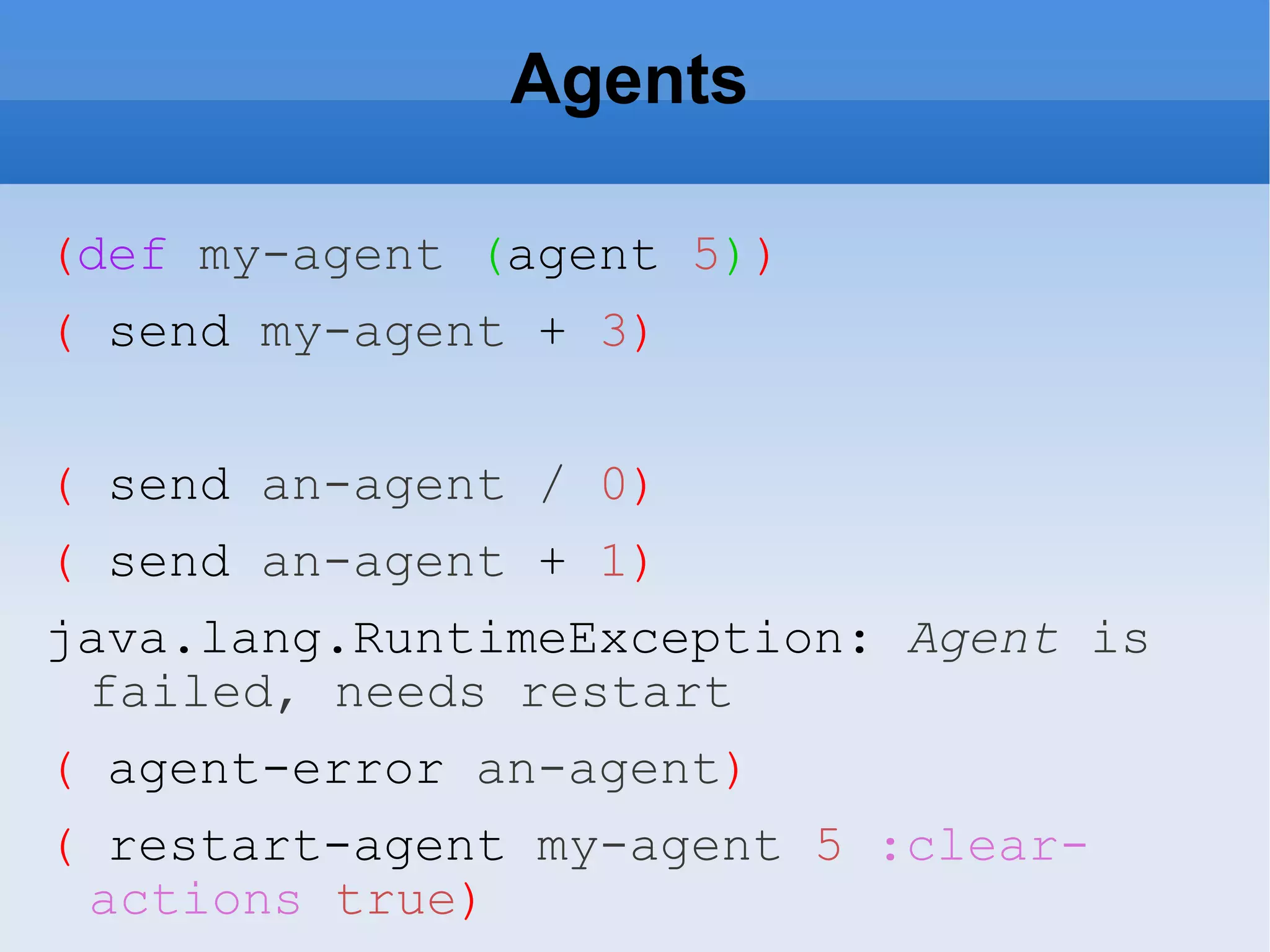
Agents ( def  my-agent  ( agent   5 ) ) (  send  my-agent  +   3 ) (  send  an-agent /  0 ) (  send  an-agent  +   1 ) java.lang.RuntimeException:  Agent  is failed, needs restart (  agent-error  an-agent ) (  restart-agent  my-agent  5   :clear-actions   true )
Concurrency
Parallel Programming (defn heavy [f]  (fn [& args]  (Thread/sleep 1000) (apply f args))) (time (+ 5 5)) ;>>> &quot;Elapsed time: 0.035009 msecs&quot; (time ((heavy +) 5 5)) ;>>> &quot;Elapsed time: 1000.691607 msecs&quot; pmap (time (doall (map (heavy inc) [1 2 3 4 5]))) ;>>> &quot;Elapsed time: 5001.055055 msecs&quot; (time (doall (pmap (heavy inc) [1 2 3 4 5]))) ;>>> &quot;Elapsed time: 1004.219896 msecs&quot; ( pvalues  (+ 5 5) (- 5 3) (* 2 4)) ( pcalls  #(+ 5 2) #(* 2 5))
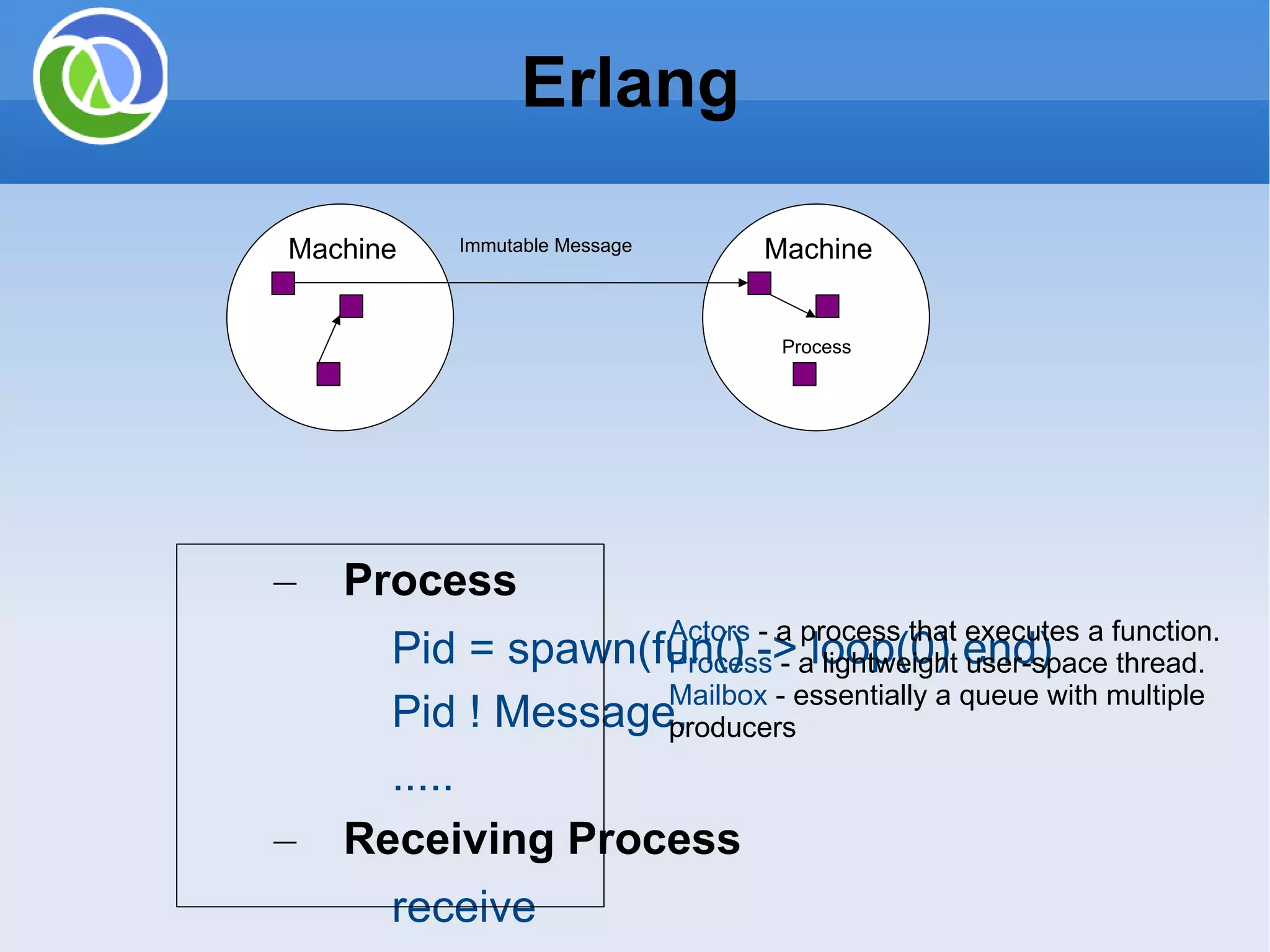
Process Pid = spawn(fun() -> loop(0) end) Pid ! Message, ..... Receiving Process receive Message1 -> Actions1; Message2 -> Actions2; ... after Time -> TimeOutActions end Erlang Immutable Message Machine Machine Process Actors  - a process that executes a function.  Process  - a lightweight user-space thread. Mailbox  - essentially a queue with multiple producers
Actor Model In an actor model, state is encapsulated in an  actor (identity)  and can only be affected/seen via the passing of  messages (values) .  In an asynchronous system like Erlang’s, reading some aspect of an actor’s state requires  sending a request message, waiting for a response , and the actor sending a response. Principles * No shared state * Lightweight processes * Asynchronous message-passing * Mailboxes to buffer incoming messages * Mailbox processing with pattern matching
Actor Model Advantages Lots of computers (= fault tolerant scalable ...) No locks Location Transparency Not for Clojure Actor model was designed for distributed programs – location transparency Complex programming model involving 2 message conversation for simple reads Potential for deadlock since blocking messages Copy structures to be sent Coordinating between multiple actors is difficult
References http://clojure.org/concurrent_programming http://www.cis.upenn.edu/~matuszek/cis554-2010/Pages/clojure-cheat-sheet.txt http://blip.tv/file/812787

Clojure concurrency

  • 1.
    (do “Concurrency inClojure”) (by (and “Alex” “Nithya”))
  • 2.
    Agenda Introduction FeaturesConcurrency, Locks, Shared state STM Vars, Atoms, Refs, Agents Stock picker example Q&A
  • 3.
    Introduction What isclojure? Lisp style Runs on JVM/CLR Why Clojure? Immutable Persistent Data structures FP aspects Concurrency Open Source Short and sweet Java Libraries JVM Evaluator Clojure/Repl Byte code public class StringUtils { public static boolean isBlank (String str) { int strLen; if (str == null || (strLen = str.length()) == 0) { return true; } for (int i = 0; i < strLen; i++) { if ((Character.isWhitespace(str.charAt(i)) == false)) { return false; } } return true; } } ( defn blank? [s] ( every? # ( Character/isWhitespace % ) s ) ) Fn name parameters body
  • 4.
    Immutable data structuresFunctions as first class objects, closures Java Interop Tail Recursion Features (def vector [1 2 3]) (def list '(1 2 3)) (def map {:A “A”}) (def set #{“A”}) (defn add [x] ( fn [y] + x y) )
  • 5.
    Lazy evaluation -abstract sequences + library “ cons cell” - (cons 4 '(1 2 3)) Features Ins to generate the next component seq Item First Rest ( defn lazy-counter-iterate [base increment] ( iterate ( fn [n] ( + n increment ) ) base ) ) user=> ( def iterate-counter ( lazy-counter-iterate 2 3 ) ) user=> ( nth iterate-counter 1000000 ) user=> ( nth ( lazy-counter-iterate 2 3 ) 1000000 ) 3000002
  • 6.
    Mutable objects arethe new spaghetti code Hard to understand, test, reason about Concurrency disaster Default architecture (Java/C#/Python/Ruby/Groovy) State – You are doing it wrong Object Data Behaviour Object 2 Data Behaviour
  • 7.
    Mutable VariablesIdentity points to a different state after the update which is supported via atomic references to values. location:Chennai location:Bangalore Values are constants, they never change (def location (ref “”) ) Identity - have different states in different point of time States value of an identity
  • 8.
    Interleaving / parallelcoordinated execution Usual Issues Deadlock Livelock Race condition UI should be functional with tasks running Techniques - Locking, CAS, TM, Actors Concurrency
  • 9.
    One thread perlock - blocking lock/synchronized (resource) { .. } Cons Reduces concurreny Readers block readers What Order ? - deadlock, livelock Overlapping/partial operations Priority inversion public class LinkedBlockingQueue <E> public E peek() { final ReentrantLock takeLock = this .takeLock; takeLock.lock(); try { Node<E> first = head . next ; if (first == null ) return null ; else return first. item ; } finally { takeLock.unlock(); } } Locks
  • 10.
    CAS operation includesthree operands - a memory location (V), expected old value (A), and a new value (B) Wait- free algorithms Dead locks are avoided Cons Complicated to implement JSR 166- not intended to be used directly by most developers public class AtomicInteger extends Number public final int getAndSet( int newValue) { for (;;) { int current = get(); if (compareAndSet(current, newValue)) return current; } } public final boolean compareAndSet( int expect, int update) { return unsafe .compareAndSwapInt( this , valueOffset , expect, update) ; } C ompare A nd S wap
  • 11.
    Enhancing Read ParallelismMulti-reader/Single -writer locks Readers don't block each others Writers wait for readers CopyOnWrite Collections Read snapshot Copy & Atomic writes Expensive Multi-step writes still require locks public boolean add(E e) { final ReentrantLock lock = this . lock ; lock.lock(); try { Object[] elements = getArray(); int len = elements. length ; Object[] newElements = Arrays. copyOf (elements, len + 1); newElements[len] = e; setArray(newElements); return true ; } finally { lock.unlock(); } }
  • 12.
    Threads modifies sharedmemory Doesn't bother about other threads Records every read/write in a log Analogous to database transactions ACI(!D) Atomic -> All changes commit or rollback Consistency -> if validation fn fails transaction fails Isolation -> Partial changes in txn won't be visible to other threads Not durable -> changes are lost if s/w crashes or h/w fails S oftware T ransaction M emory
  • 13.
    Clojure TransactionsTxn Txn Adam Mr B Minion R ~ 40 U ~ 30 (defstruct stock :name :quantity) (struct stock “CSK” 40) StocksList R ~ 30 Buy 10 Buy 5 Sell 10 CSK ~ 30 Txn Fail & Retry R - 40 U ~ 35 R - 30 U - 25 U ~ 40 Transaction Creation - (dosync (...))
  • 14.
    Clojure STM Concurrencysemantics for references • Automatic/enforced • No locks! Clojure does not replace the Java thread system, rather it works with it. Clojure functions (IFn implement java.util.concurrent.Callable, java.lang.Runnable)
  • 15.
    STM Pros Optimistic,increased concurrency - no thread waiting Deadlock/Livelock is prevented/handled by Transaction manager Data is consistent Simplifies conceptual understanding – less effort Cons Overhead of transaction retrying Performance hit (<4 processor) on maintaining committed, storing in-transaction values and locks for commiting transactions Cannot perform any operation that cannot be undone, including most I/O Solved using queues (Agents in Clojure)
  • 16.
    Persistent Data StructuresImmutable + maintain old versions Structure sharing – not full copies Thread/Iteration safe Clojure data structures are persistent Hash map and vector – array mapped hash tries (bagwell) Sorted map – red black tree MVCC – Multi-version concurrency control Support sequencing, meta-data Pretty fast: Near constant time read access for maps and vectors ( actually O(log32n) )
  • 17.
    PersistentHashMap 32 childrenper node, so O(log32 n) static interface INode { INode assoc (int shift, int hash, Object key, Object val, Box addedLeaf); LeafNode find (int hash, Object key); } BitMapIndexedNode
  • 18.
    Concurrency Library Coordinatingmultiple activities happening simutaneously Reference Types Refs Atoms Agents Vars Uncoordinated Coordinated Synchronous Var Atom Ref Asynchronous Agent
  • 19.
    Vars Vars - per-thread mutables, atomic read/write (def) is shared root binding – can be unbound (binding) to set up a per-thread override Bindings can only be used when def is defined at the top level (set!) if per-thread binding T1 T2 (def x 10) ; Global object (defn get-val [] (+ x y)) (defn fn [] (println x) (binding [x 2] (get-val)) Can’t see the binded value
  • 20.
    Vars Safe usemutable storage location via thread isolation Thread specific Values Setting thread local dynamic binding Scenarios: Used for constants and configuration variables such as *in*, *out*, *err* Manually changing a program while running (def max-users 10) Functions defined with defn are stored in Vars enables re-definition of functions – AOP like enabling logging user=> ( def variable 1 ) #'user/variable user=> ( . start ( Thread. ( fn [] ( println variable ) ) ) ) nil user=> 1 user=> (def variable 1) #'user/variable user=>(defn print [] (println variable)) user=> (.start (Thread. (fn [] (binding [variable 42] (print))))) nil user=> 1 (set! var-symbol value) (defn say-hello [] (println &quot;Hello&quot;)) (binding [say-hello #(println &quot;Goodbye&quot;)] (say-hello))
  • 21.
    Vars... Augmenting thebehavior Memoization – to wrap functions Has great power Should be used sparsely Not pure functions ( ns test-memoization ) ( defn triple[n] ( Thread/sleep 100 ) ( * n 3 ) ) ( defn invoke_triple [] ( map triple [ 1 2 3 4 4 3 2 1 ] ) ) ( time ( dorun ( invoke_triple ) ) ) -> &quot;Elapsed time: 801.084578 msecs&quot; ;(time (dorun (binding [triple (memoize triple)] (invoke_triple)))) -> &quot;Elapsed time: 401.87119 msecs&quot;
  • 22.
    Atoms Single valueshared across threads Reads are atomic Writes are atomic Multiple updates are not possible (def current-track (atom “Ooh la la la”)) (deref current-track ) or @current-track (reset! current-track “Humma Humma” (reset! current-track {:title : “Humma Humma”, composer” “What???”}) (def current-track (atom {:title : “Ooh la la la”, :composer: “ARR”})) (swap! current-track assoc {:title” : “Hosana”})
  • 23.
    Refs Mutable referenceto a immutable state Shared use of mutable storage location via STM ACI and retry properties Reads are atomic Writes inside an STM txn
  • 24.
    Refs in Txn• Maintained by each txn • Only visible to code running in the txn • Committed at end of txn if successful • Cleared after each txn try • Committed values • Maintained by each Ref in a circular linked-list (tvals field) • Each has a commit “timestamp” (point field in TVal objects)
  • 25.
    Changing Ref Txnretry ( ref-set ref new-value ) ( alter ref function arg* ) Commute ( commute ref function arg* ) Order of changes doesn't matter Another txn change will not invoke retry Commit -> all commute fns invoked using latest commit values Example: Adding objects to collection ( def account1 ( ref 1000 ) ) ( def account2 ( ref 2000 ) ) ( defn transfer &quot;transfers amount of money from a to b&quot; [a b amount] ( dosync ( alter a - amount ) ( alter b + amount ) ) ) ( transfer account1 account2 300 ) ( transfer account2 account1 50 ) ;@account1 -> 750 ;@account2 -> 2250
  • 26.
    Validators Validators: Invokedwhen the transaction is to commit When fails -> IllegalStateException is thrown ( ref initial-value :validator validator-fn ) user=> ( def my-ref ( ref 5 ) ) #'user/my-ref user=> ( set-validator! my-ref ( fn [x] ( < 0 x ) ) ) Nil user=> ( dosync ( alter my-ref – 10 ) ) #<CompilerException java.lang.IllegalStateException: Invalid Reference State> user=> ( dosync ( alter my-ref – 10 ) ( alter my-ref + 15 ) ) 10 user=> @my-ref 5
  • 27.
    Watches Called whenstate changes Called on an identity Example: ( add-watch identity key watch-function ) ( defn function-name [ key identity old-val new-val] expressions ) ( remove-watch identity key ) user=> ( defn my-watch [ key identity old-val new-val] ( println ( str &quot;Old: &quot; old-val ) ) ( println ( str &quot;New: &quot; new-val ) ) ) #'user/my-watch user=> ( def my-ref ( ref 5 ) ) #'user/my-ref user=> ( add-watch my-ref &quot;watch1&quot; my-watch ) #<Ref 5 > user=> ( dosync ( alter my-ref inc ) ) Old: 5
  • 28.
    Other features... WriteSkew Ensure Doesn't change the state of ref Forces a txn retry if ref changes Ensures that ref is not changed during the txn
  • 29.
    Agents Agents shareasynchronous independent changes between threads State changes through actions (functions) Actions are sent through send, send-off Agents run in thread pools - send fn is tuned to no of processors - send-off for intensive operations, pre-emptive
  • 30.
    Agents Only oneagent per action happens at a time Actions of all Agents get interleaved amongst threads in a thread pool Agents are reactive - no imperative message loop and no blocking receive
  • 31.
    Agents ( def my-agent ( agent 5 ) ) ( send my-agent + 3 ) ( send an-agent / 0 ) ( send an-agent + 1 ) java.lang.RuntimeException: Agent is failed, needs restart ( agent-error an-agent ) ( restart-agent my-agent 5 :clear-actions true )
  • 32.
  • 33.
    Parallel Programming (defnheavy [f] (fn [& args] (Thread/sleep 1000) (apply f args))) (time (+ 5 5)) ;>>> &quot;Elapsed time: 0.035009 msecs&quot; (time ((heavy +) 5 5)) ;>>> &quot;Elapsed time: 1000.691607 msecs&quot; pmap (time (doall (map (heavy inc) [1 2 3 4 5]))) ;>>> &quot;Elapsed time: 5001.055055 msecs&quot; (time (doall (pmap (heavy inc) [1 2 3 4 5]))) ;>>> &quot;Elapsed time: 1004.219896 msecs&quot; ( pvalues (+ 5 5) (- 5 3) (* 2 4)) ( pcalls #(+ 5 2) #(* 2 5))
  • 34.
    Process Pid =spawn(fun() -> loop(0) end) Pid ! Message, ..... Receiving Process receive Message1 -> Actions1; Message2 -> Actions2; ... after Time -> TimeOutActions end Erlang Immutable Message Machine Machine Process Actors - a process that executes a function. Process - a lightweight user-space thread. Mailbox - essentially a queue with multiple producers
  • 35.
    Actor Model Inan actor model, state is encapsulated in an actor (identity) and can only be affected/seen via the passing of messages (values) . In an asynchronous system like Erlang’s, reading some aspect of an actor’s state requires sending a request message, waiting for a response , and the actor sending a response. Principles * No shared state * Lightweight processes * Asynchronous message-passing * Mailboxes to buffer incoming messages * Mailbox processing with pattern matching
  • 36.
    Actor Model AdvantagesLots of computers (= fault tolerant scalable ...) No locks Location Transparency Not for Clojure Actor model was designed for distributed programs – location transparency Complex programming model involving 2 message conversation for simple reads Potential for deadlock since blocking messages Copy structures to be sent Coordinating between multiple actors is difficult
  • 37.

Editor's Notes

  • #4 homoiconicity is a property of some programming languages, in which the primary representation of programs is also a data structure in a primitive type of the language itself, from the Greek words homo meaning the same and icon meaning representation. This makes metaprogramming easier than in a language without this property Each file generates a loader class of the same name with &amp;quot;__init&amp;quot; appended.