1-1
Data Communications
Data Communications and Networking
by
Behrouz A. Forouzan, 5th
Edition
1-2
Chapter 1. Introduction
1. Data communications
2. Networks
3. The Internet
4. Protocols and standards
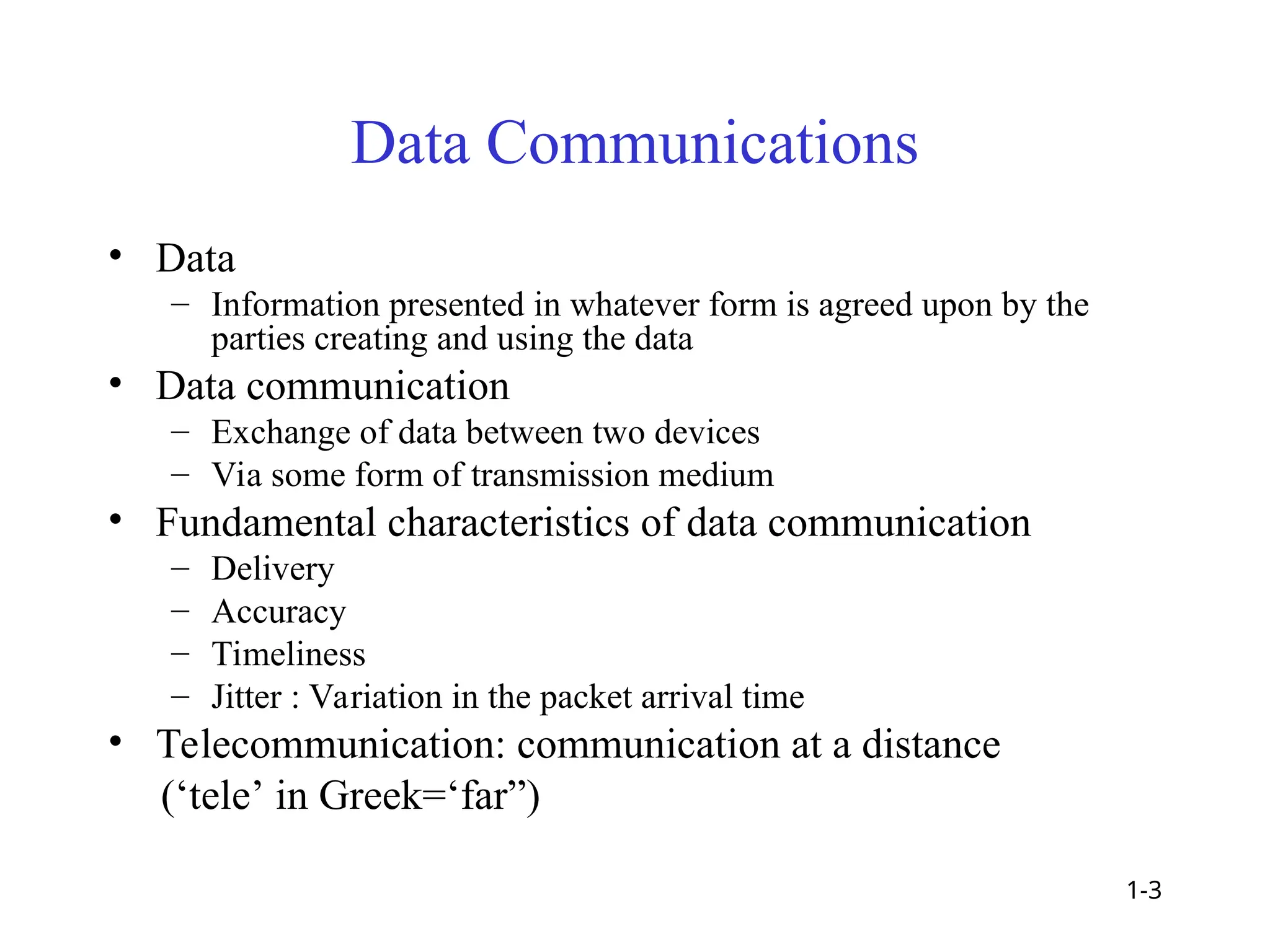
1-3
Data Communications
• Data
– Information presented in whatever form is agreed upon by the
parties creating and using the data
• Data communication
– Exchange of data between two devices
– Via some form of transmission medium
• Fundamental characteristics of data communication
– Delivery
– Accuracy
– Timeliness
– Jitter : Variation in the packet arrival time
• Telecommunication: communication at a distance
(‘tele’ in Greek=‘far”)
1-4
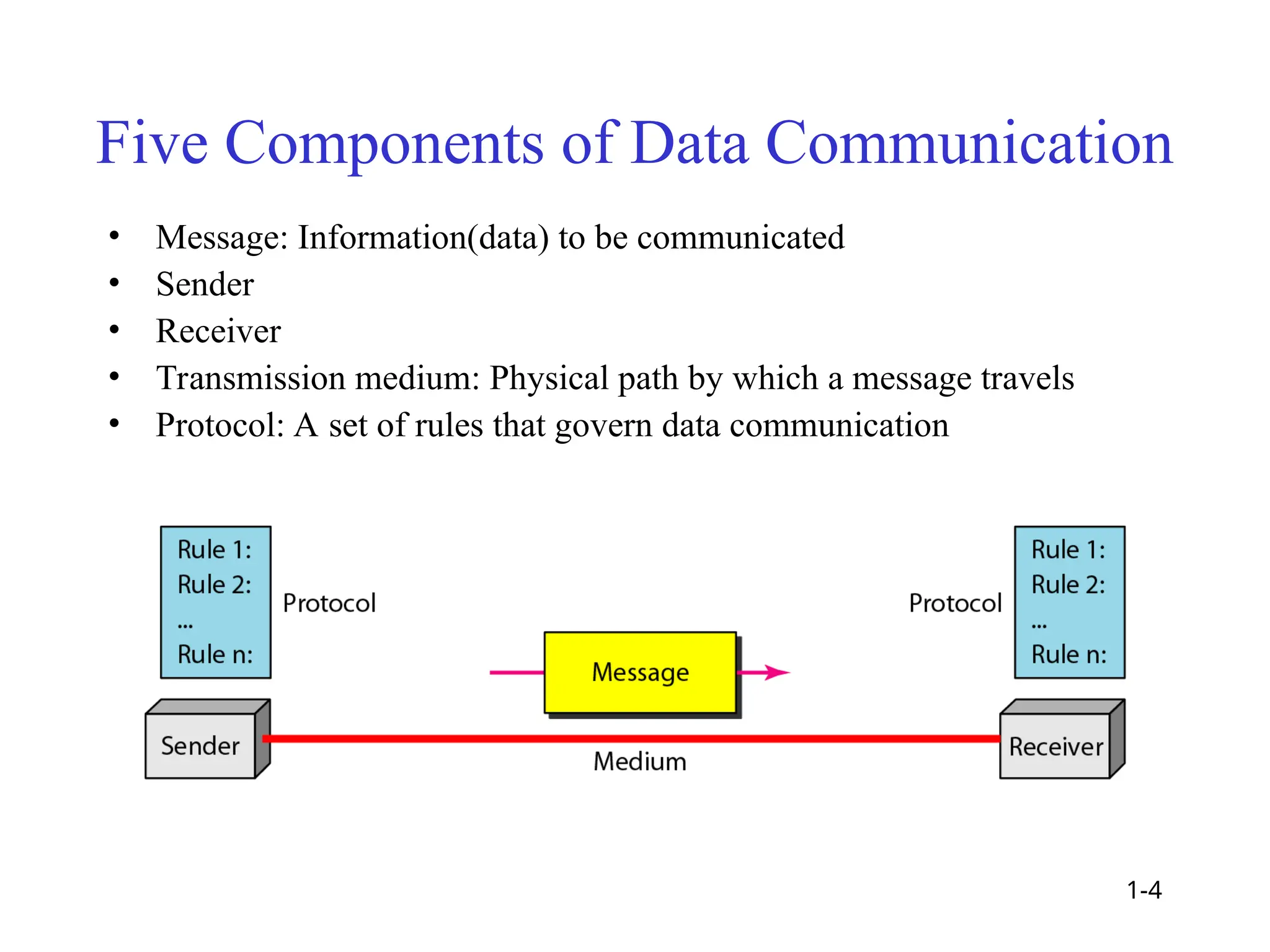
Five Components of Data Communication
• Message: Information(data) to be communicated
• Sender
• Receiver
• Transmission medium: Physical path by which a message travels
• Protocol: A set of rules that govern data communication
1-5
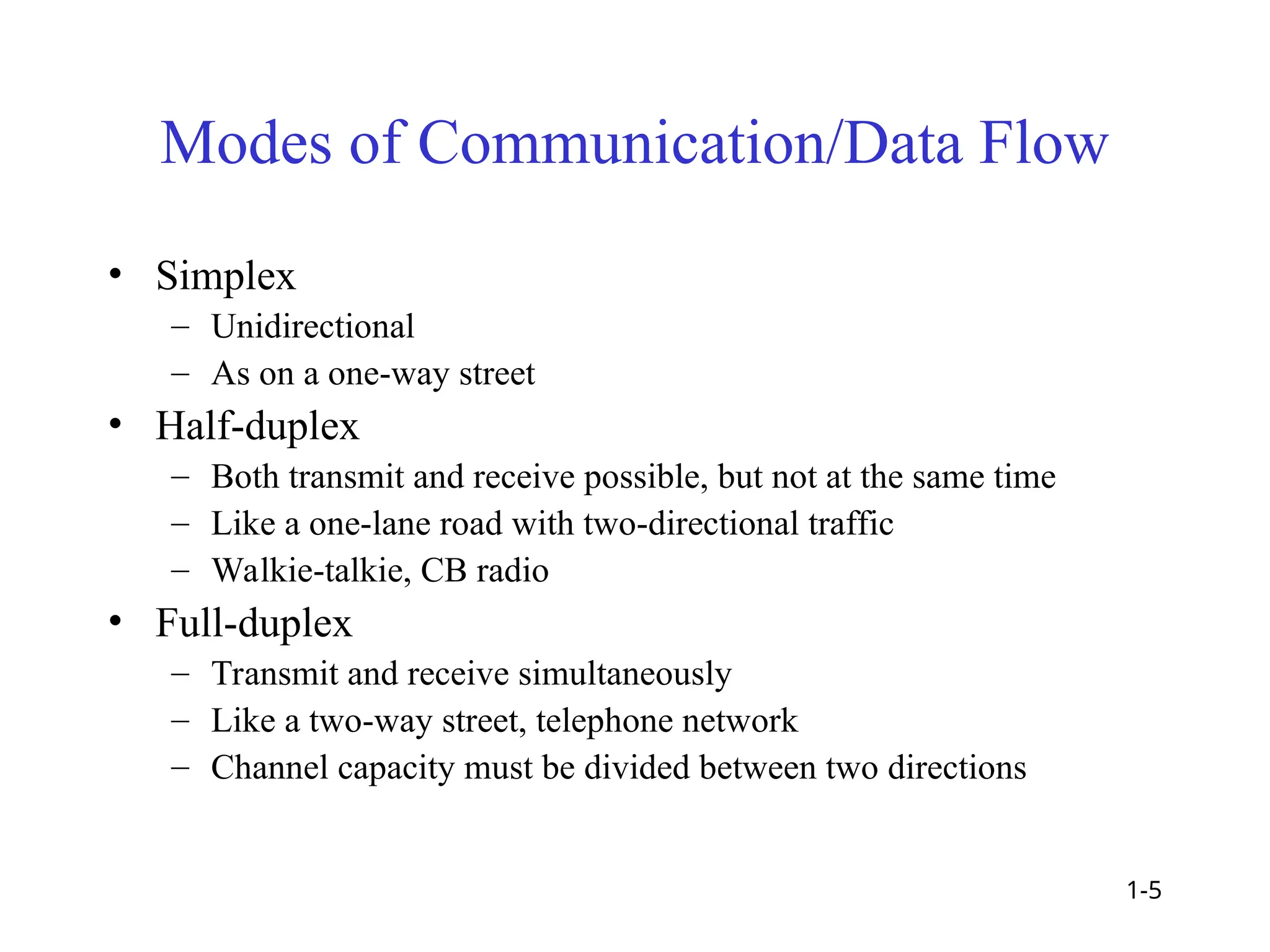
Modes of Communication/Data Flow
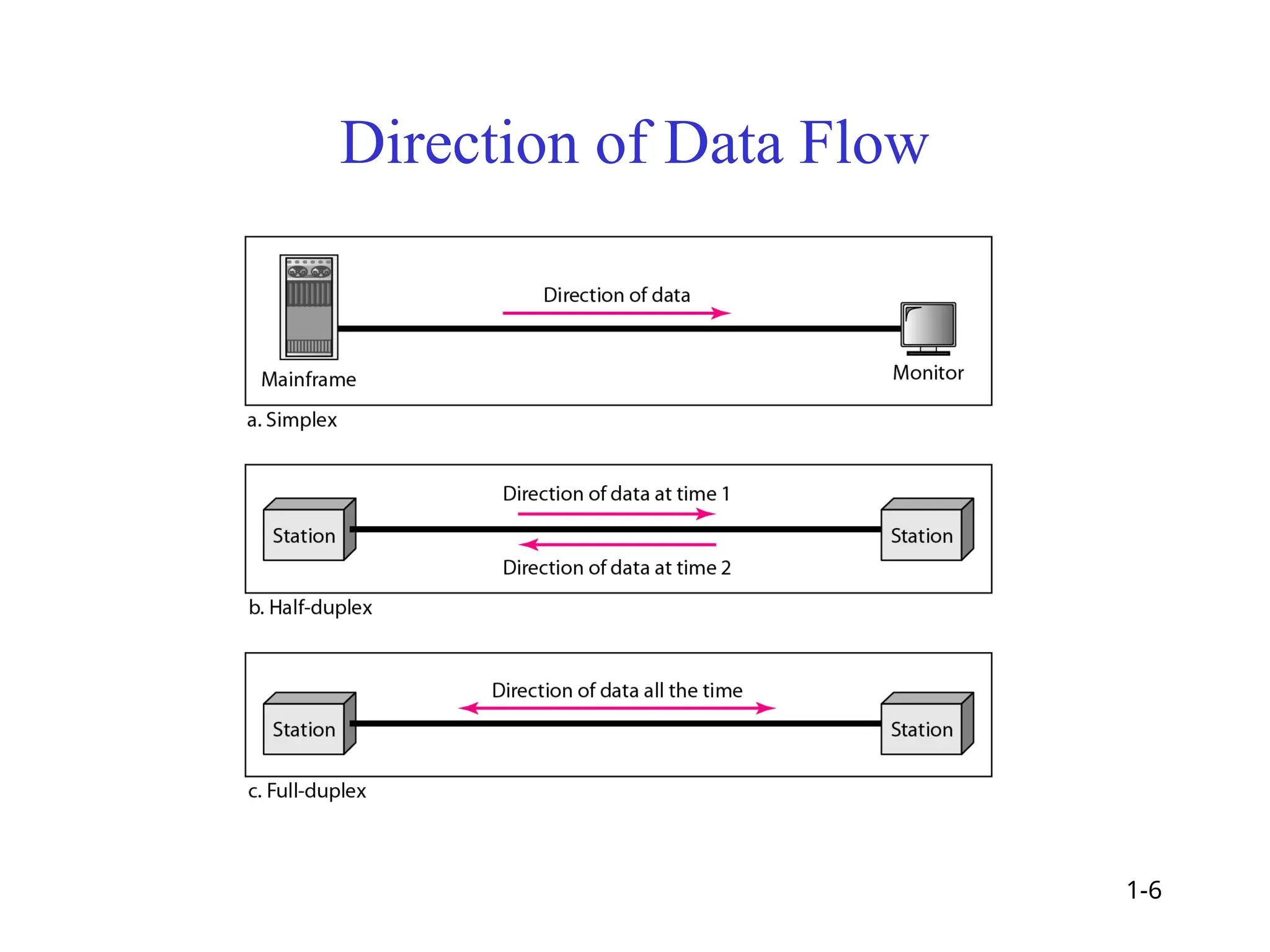
• Simplex
– Unidirectional
– As on a one-way street
• Half-duplex
– Both transmit and receive possible, but not at the same time
– Like a one-lane road with two-directional traffic
– Walkie-talkie, CB radio
• Full-duplex
– Transmit and receive simultaneously
– Like a two-way street, telephone network
– Channel capacity must be divided between two directions
1-6
Direction of Data Flow
1-7
Network
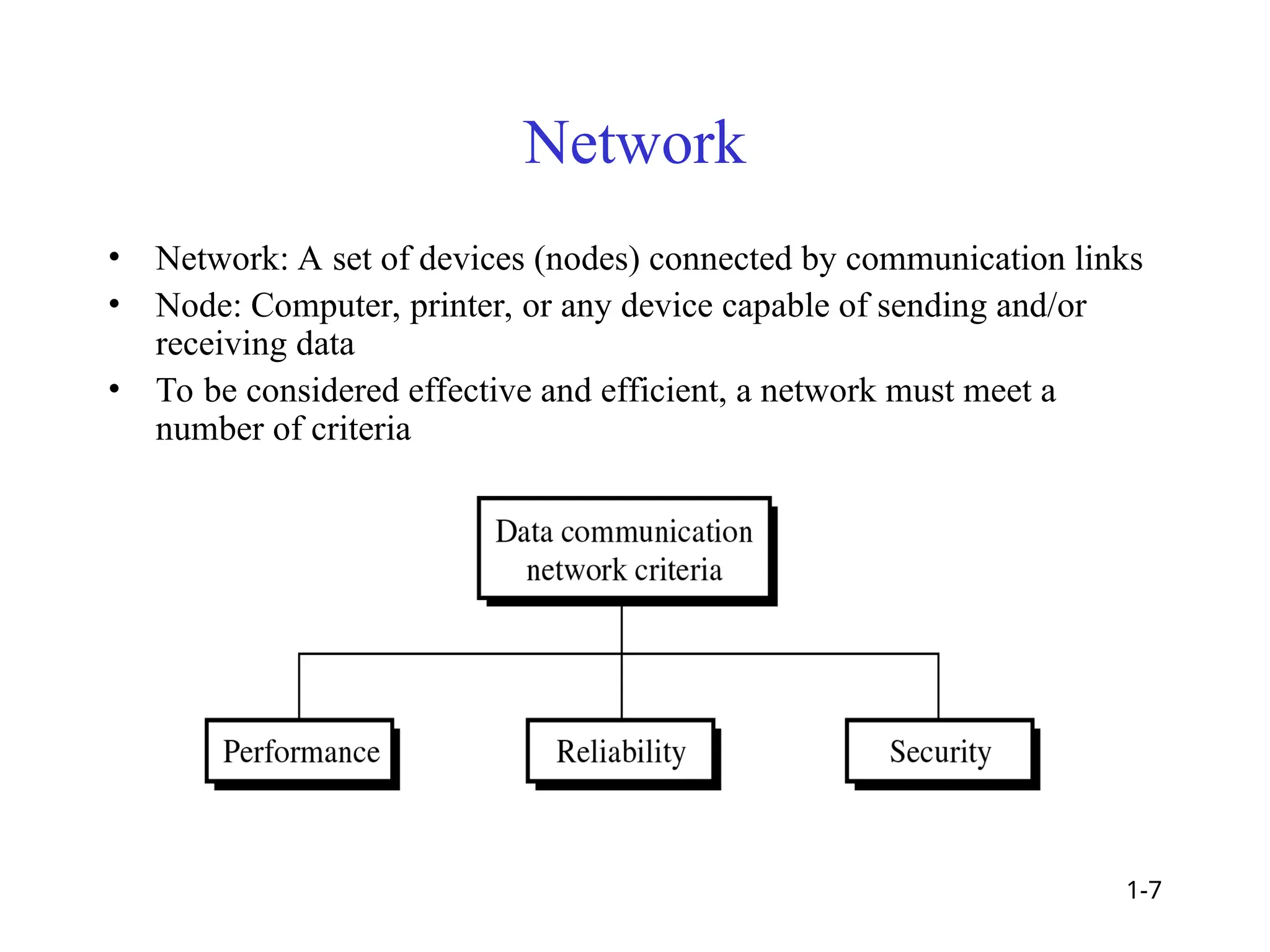
• Network: A set of devices (nodes) connected by communication links
• Node: Computer, printer, or any device capable of sending and/or
receiving data
• To be considered effective and efficient, a network must meet a
number of criteria
1-8
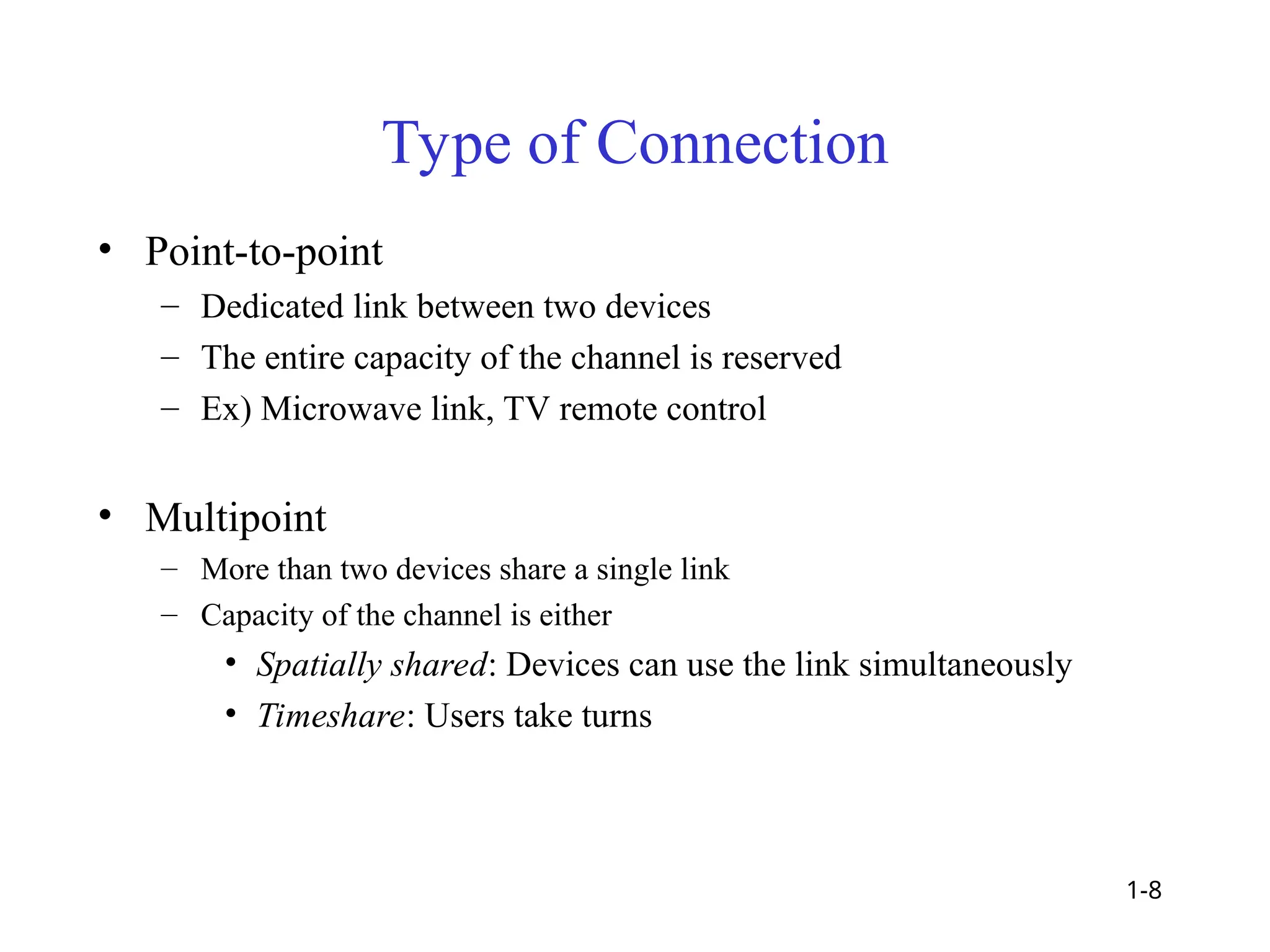
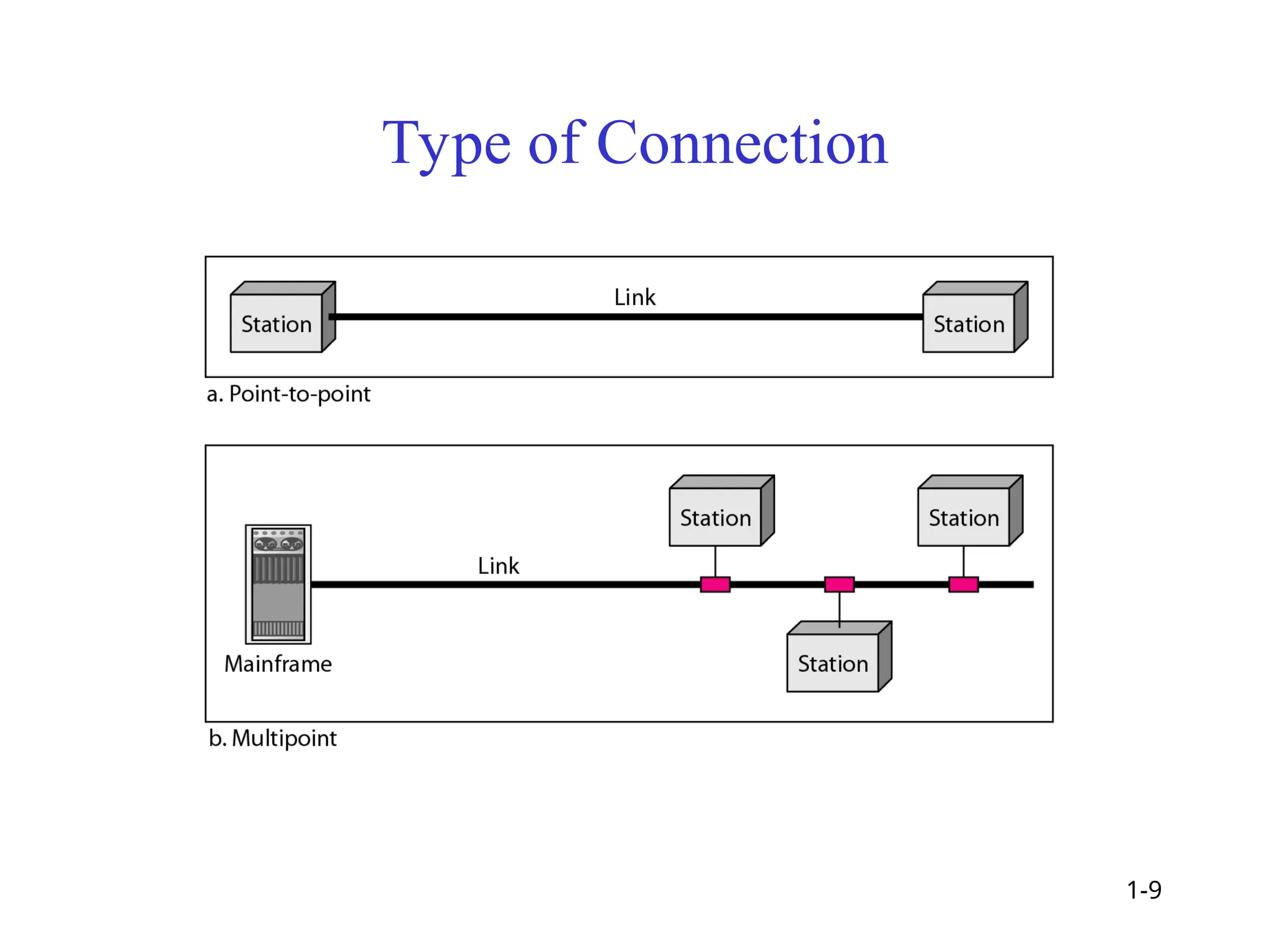
Type of Connection
• Point-to-point
– Dedicated link between two devices
– The entire capacity of the channel is reserved
– Ex) Microwave link, TV remote control
• Multipoint
– More than two devices share a single link
– Capacity of the channel is either
• Spatially shared: Devices can use the link simultaneously
• Timeshare: Users take turns
1-9
Type of Connection
1-10
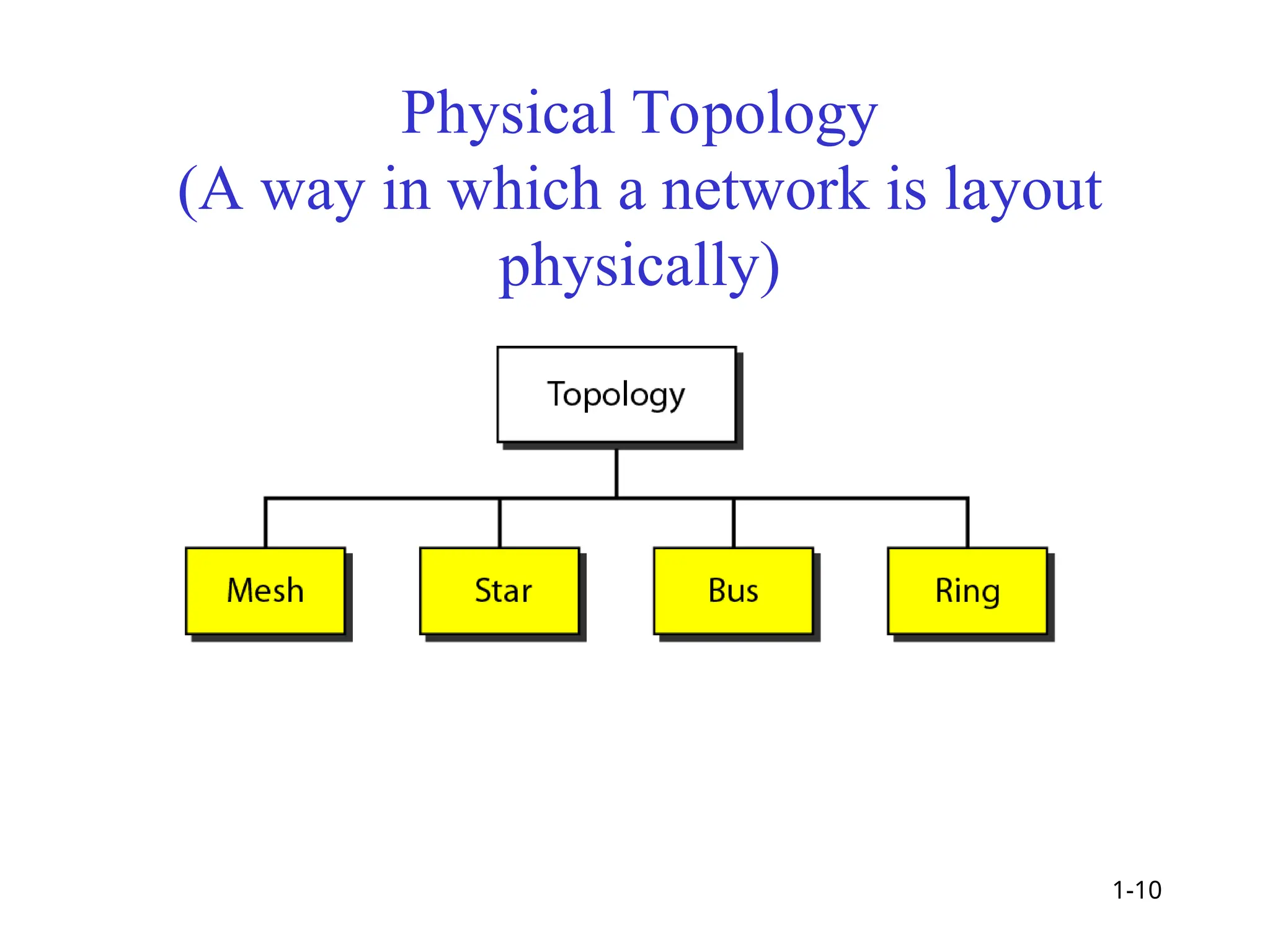
Physical Topology
(A way in which a network is layout
physically)
1-11
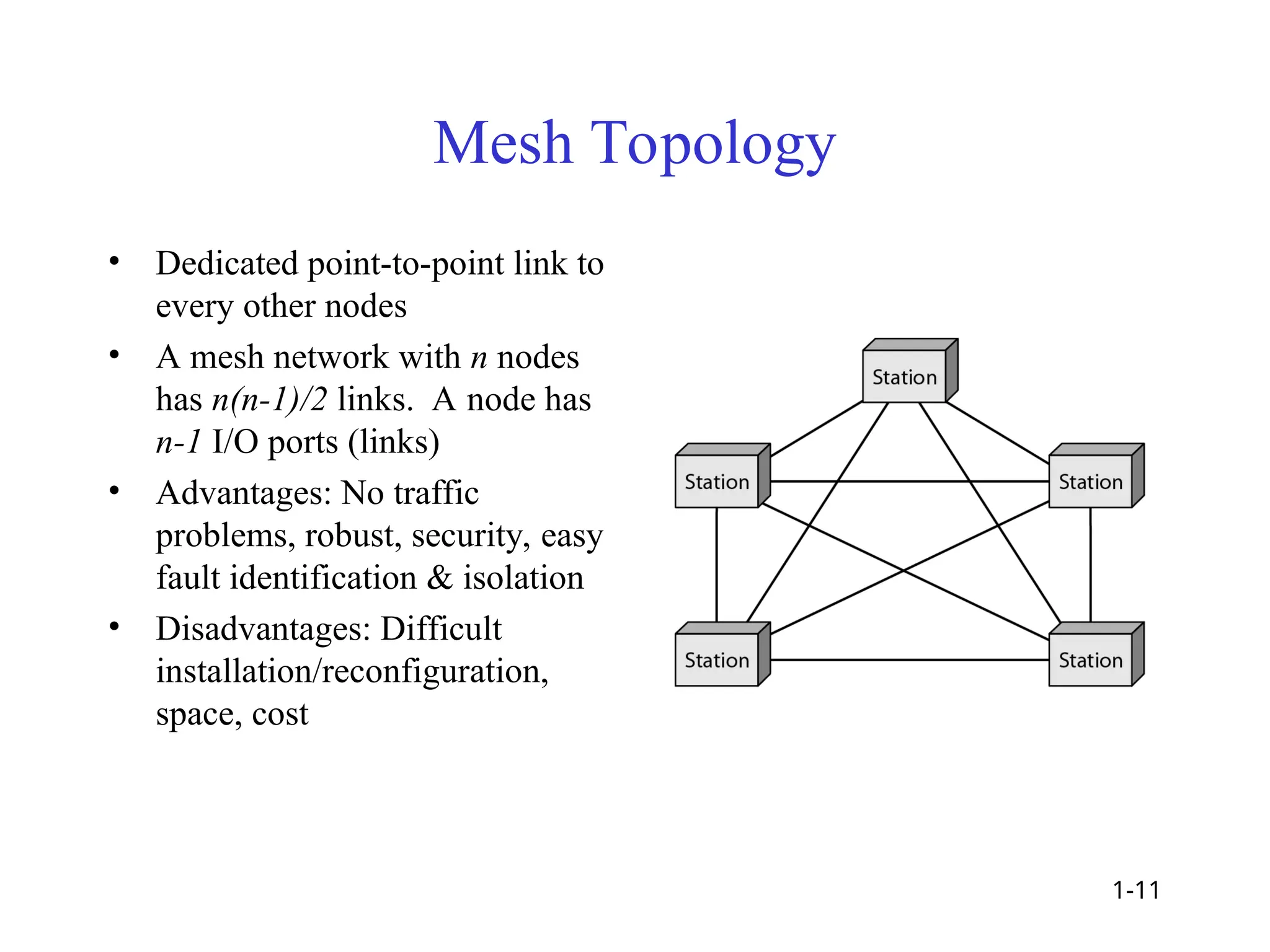
Mesh Topology
• Dedicated point-to-point link to
every other nodes
• A mesh network with n nodes
has n(n-1)/2 links. A node has
n-1 I/O ports (links)
• Advantages: No traffic
problems, robust, security, easy
fault identification & isolation
• Disadvantages: Difficult
installation/reconfiguration,
space, cost
1-12
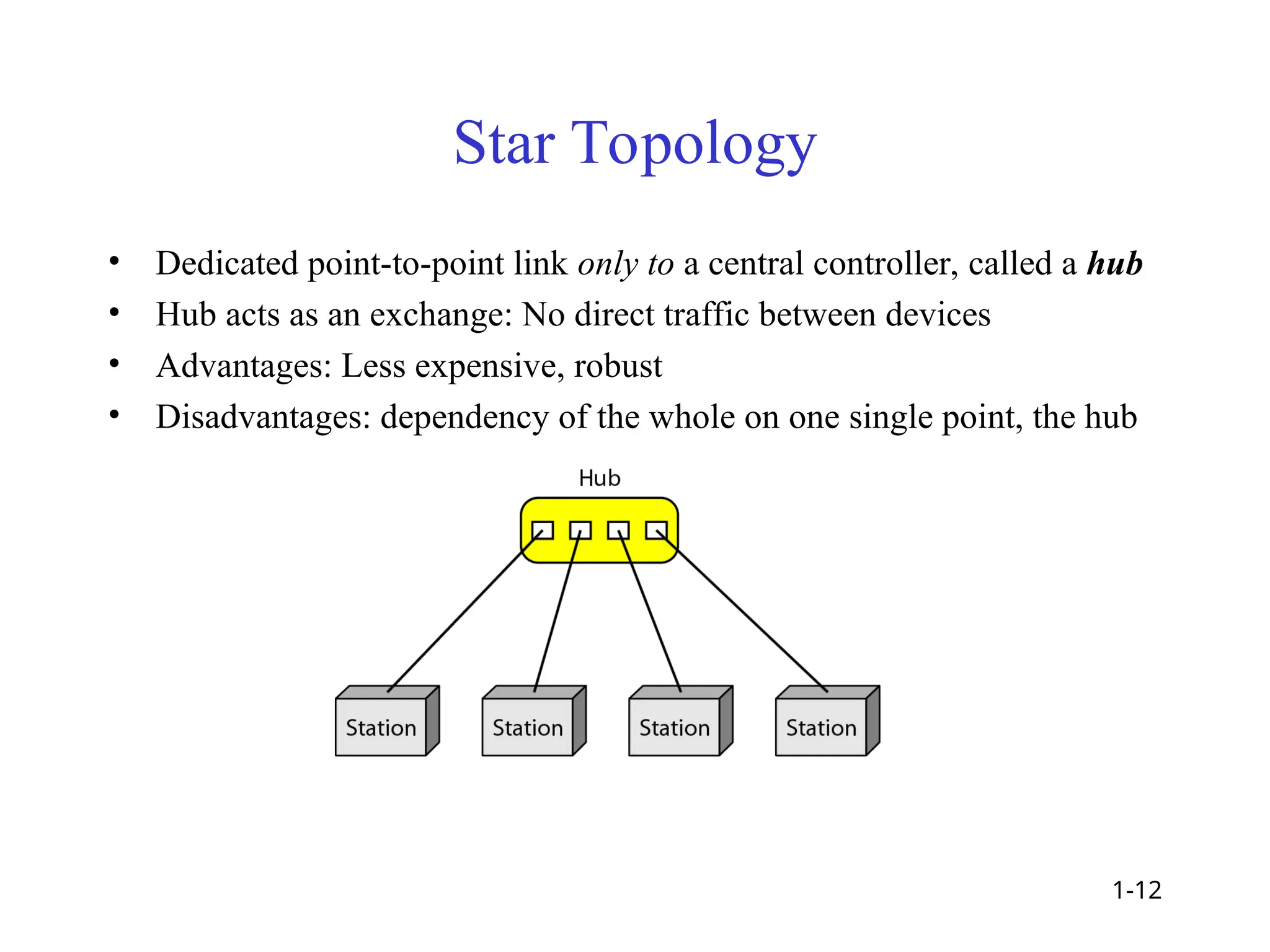
Star Topology
• Dedicated point-to-point link only to a central controller, called a hub
• Hub acts as an exchange: No direct traffic between devices
• Advantages: Less expensive, robust
• Disadvantages: dependency of the whole on one single point, the hub
1-13
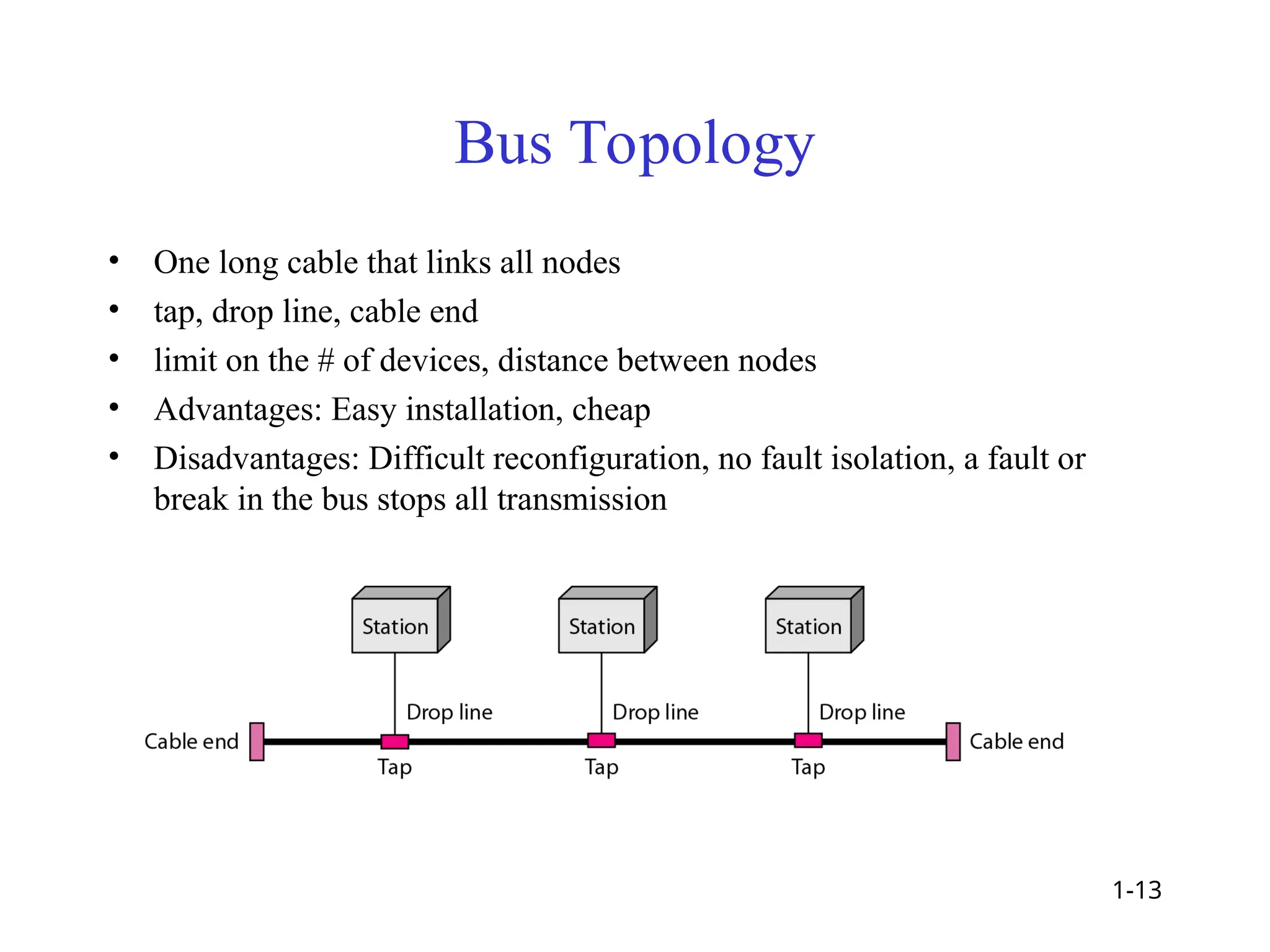
Bus Topology
• One long cable that links all nodes
• tap, drop line, cable end
• limit on the # of devices, distance between nodes
• Advantages: Easy installation, cheap
• Disadvantages: Difficult reconfiguration, no fault isolation, a fault or
break in the bus stops all transmission
1-14
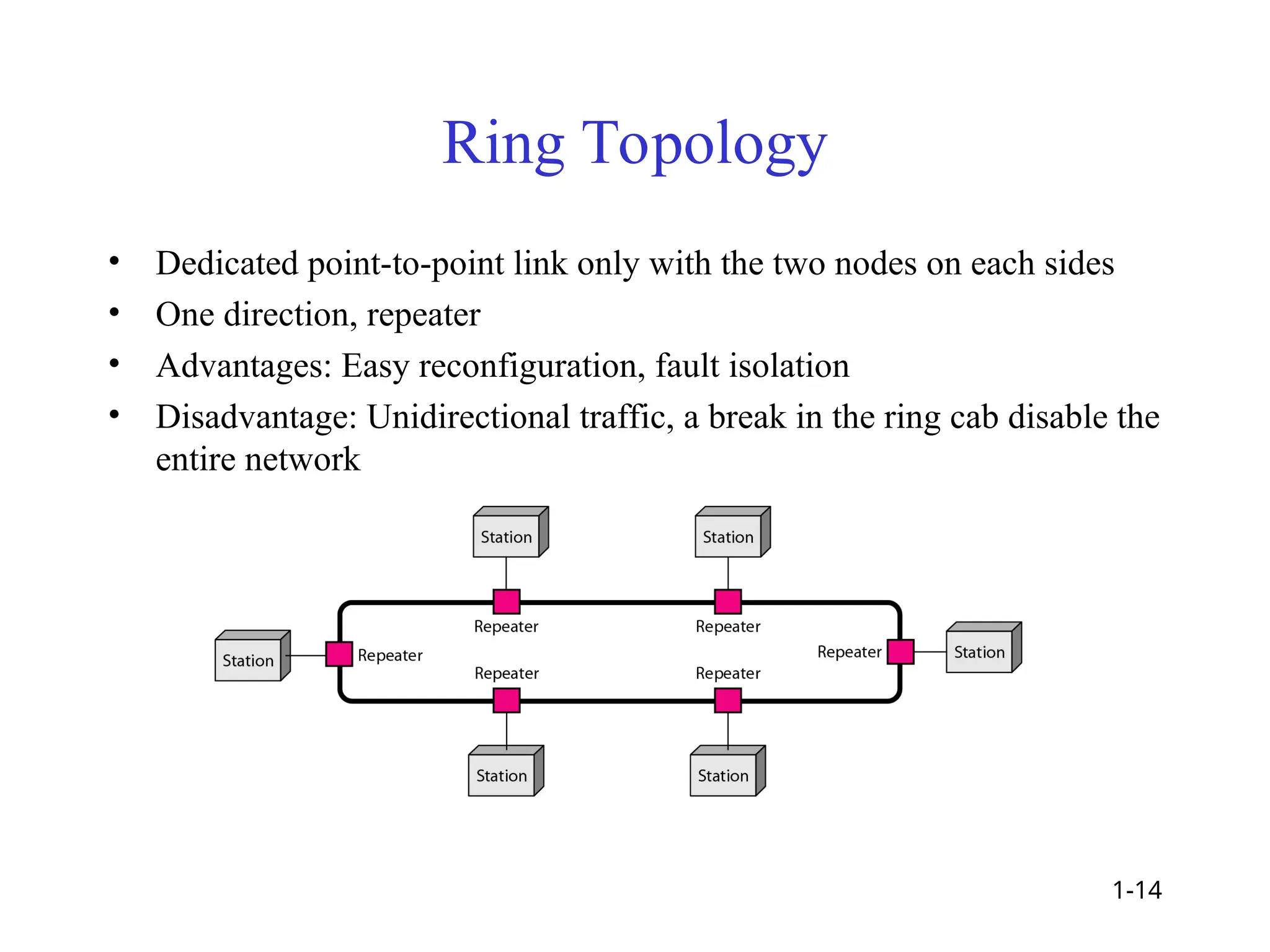
Ring Topology
• Dedicated point-to-point link only with the two nodes on each sides
• One direction, repeater
• Advantages: Easy reconfiguration, fault isolation
• Disadvantage: Unidirectional traffic, a break in the ring cab disable the
entire network
1-15
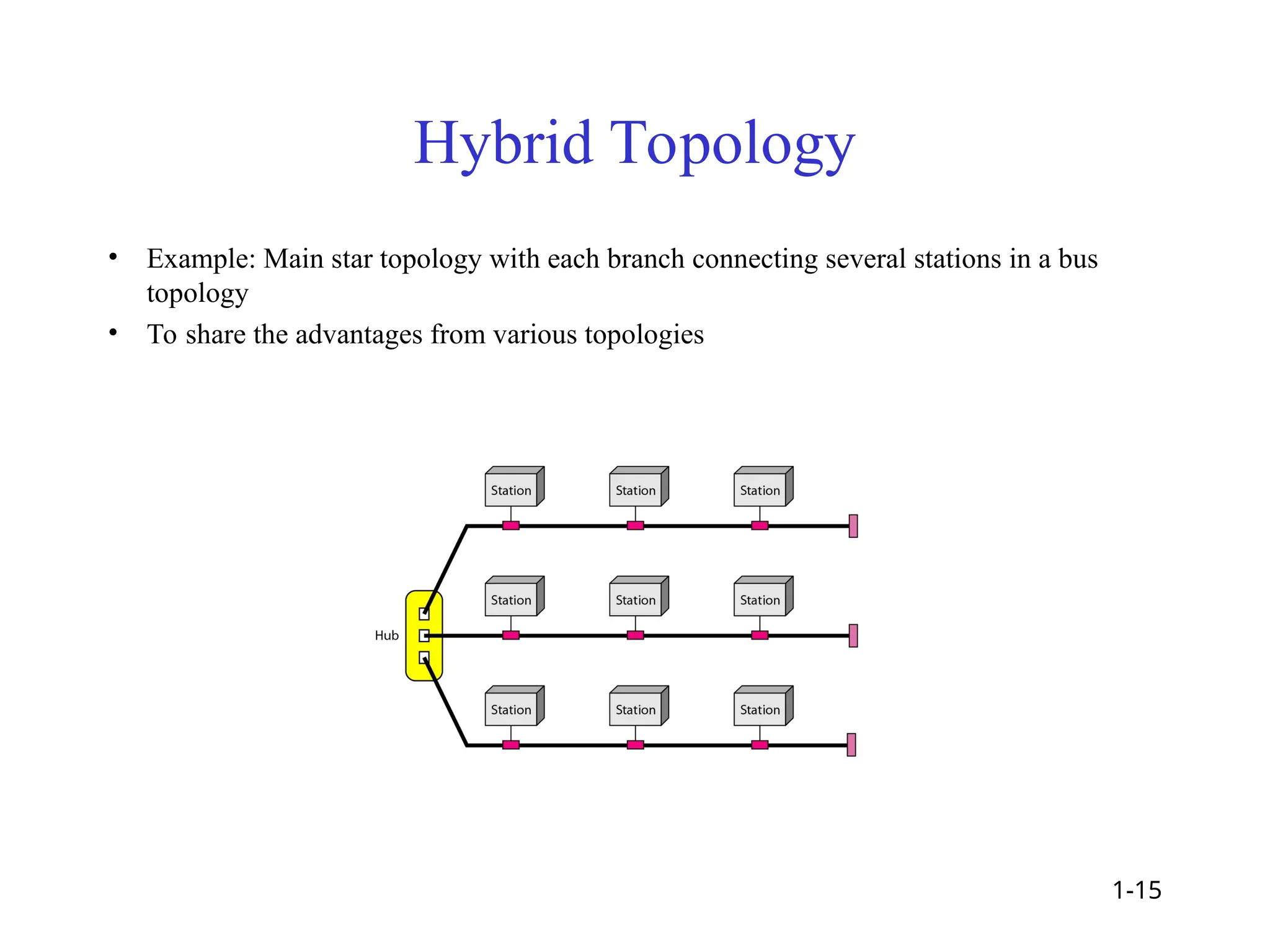
Hybrid Topology
• Example: Main star topology with each branch connecting several stations in a bus
topology
• To share the advantages from various topologies
1-16
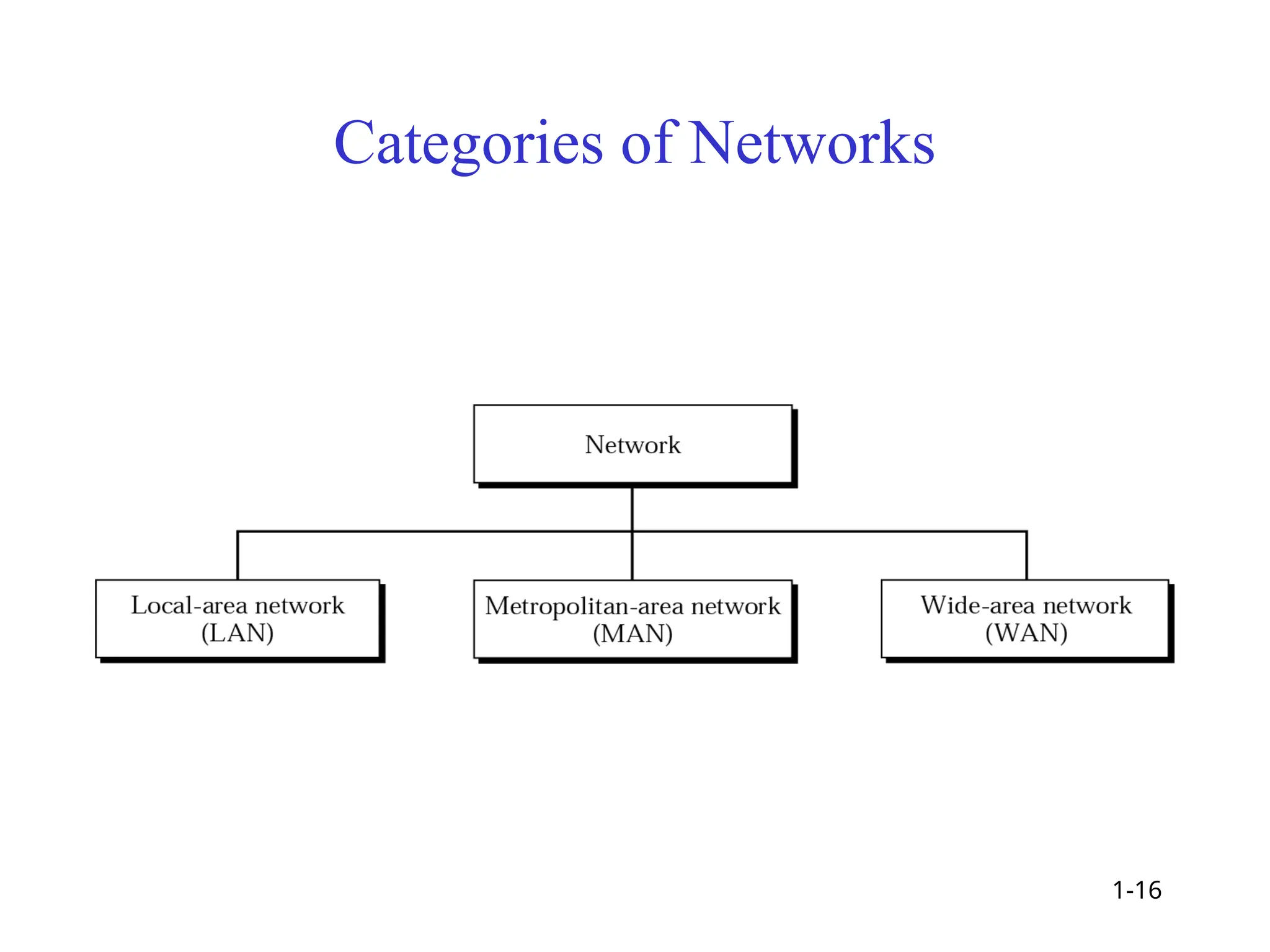
Categories of Networks
1-17
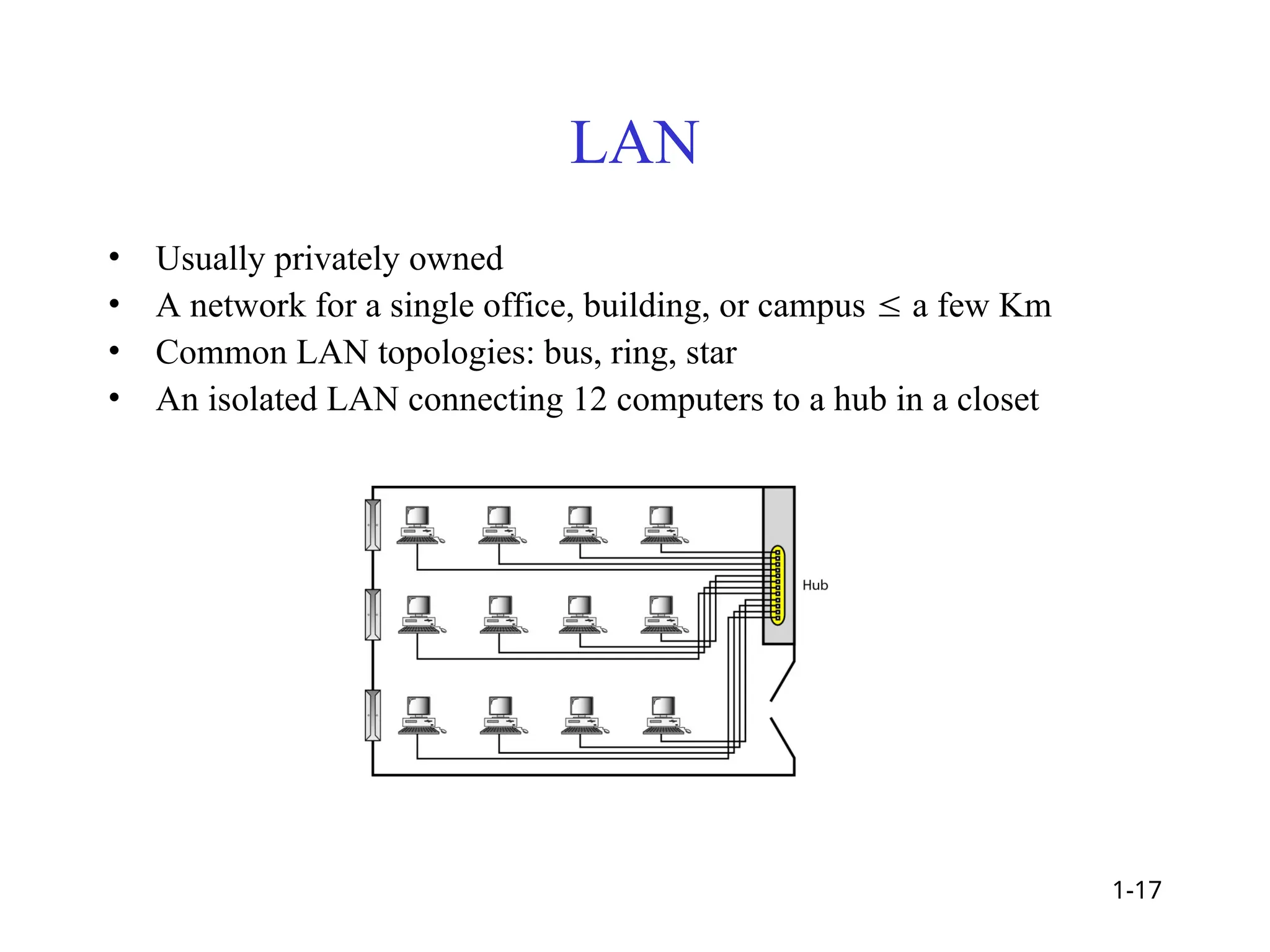
LAN
• Usually privately owned
• A network for a single office, building, or campus  a few Km
• Common LAN topologies: bus, ring, star
• An isolated LAN connecting 12 computers to a hub in a closet
1-18
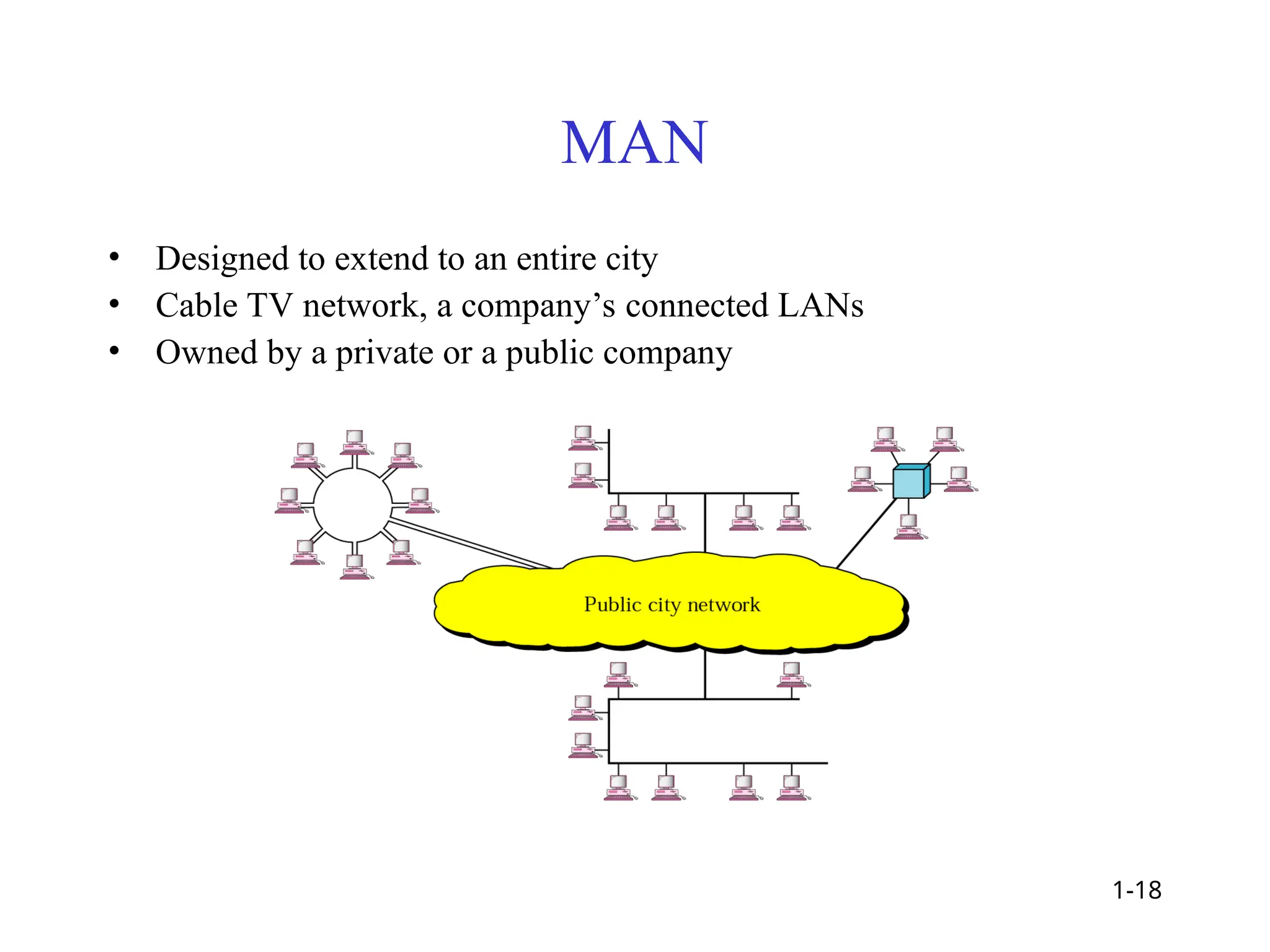
MAN
• Designed to extend to an entire city
• Cable TV network, a company’s connected LANs
• Owned by a private or a public company
1-19
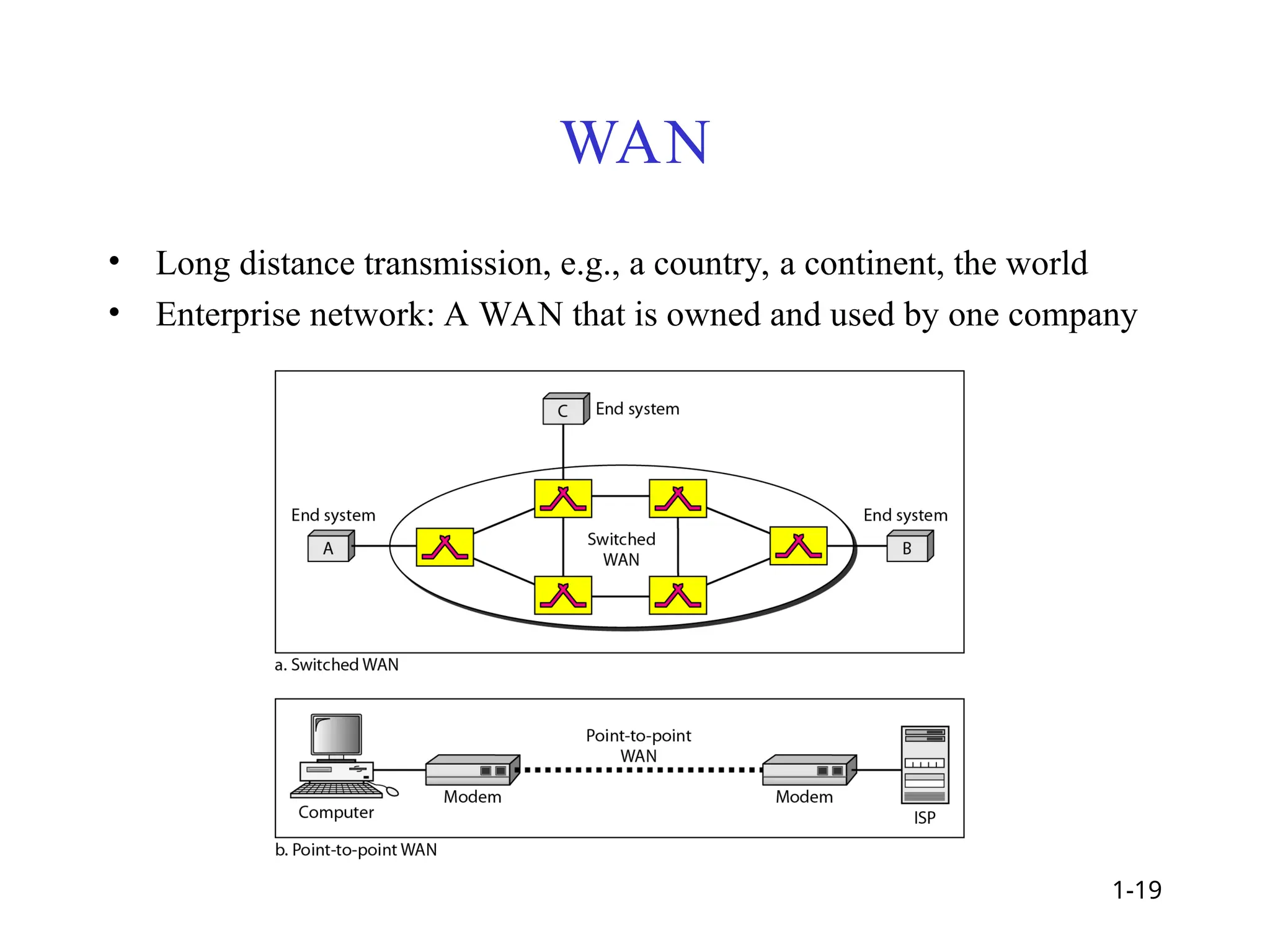
WAN
• Long distance transmission, e.g., a country, a continent, the world
• Enterprise network: A WAN that is owned and used by one company
1-20
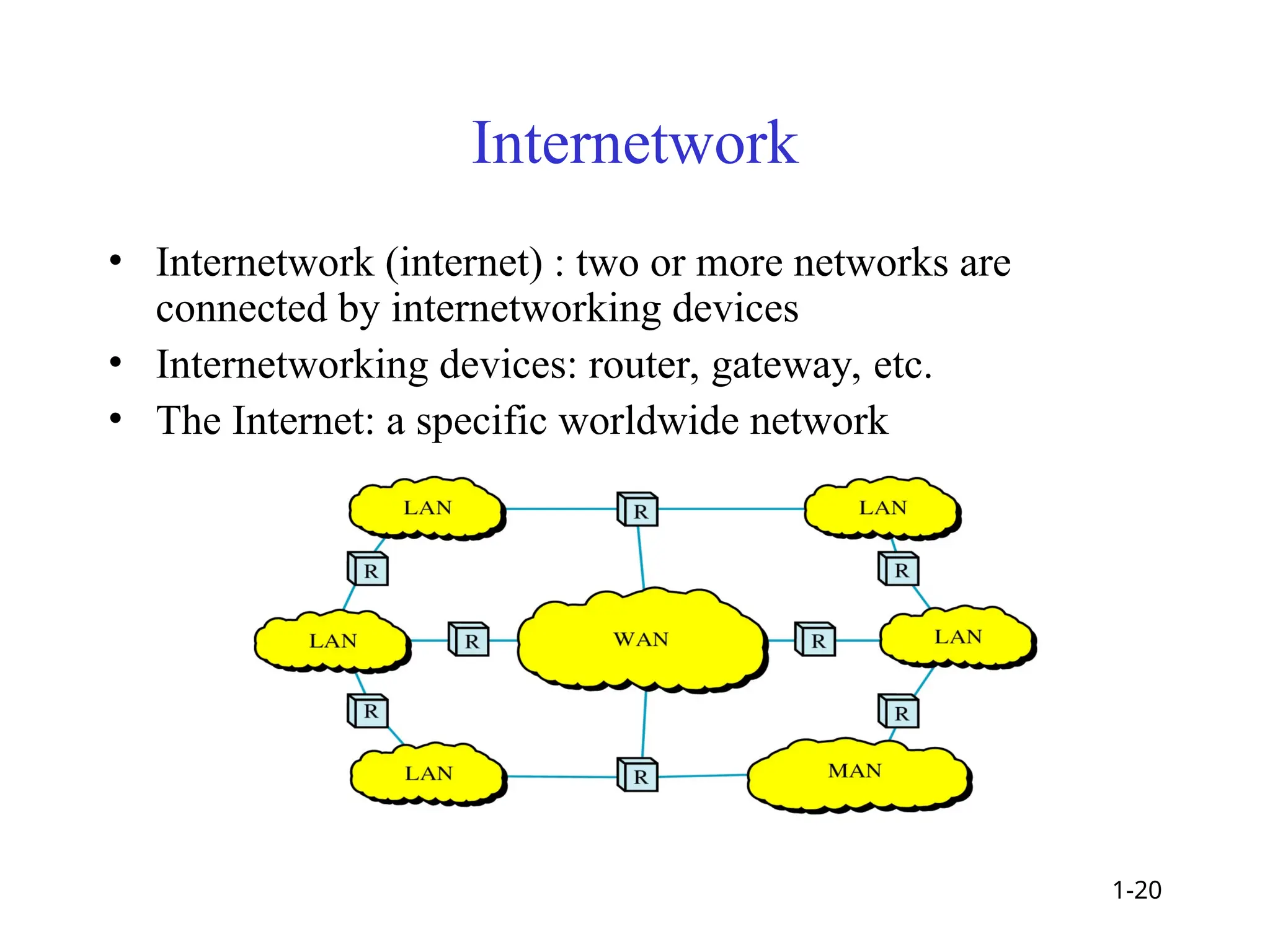
Internetwork
• Internetwork (internet) : two or more networks are
connected by internetworking devices
• Internetworking devices: router, gateway, etc.
• The Internet: a specific worldwide network
1-21
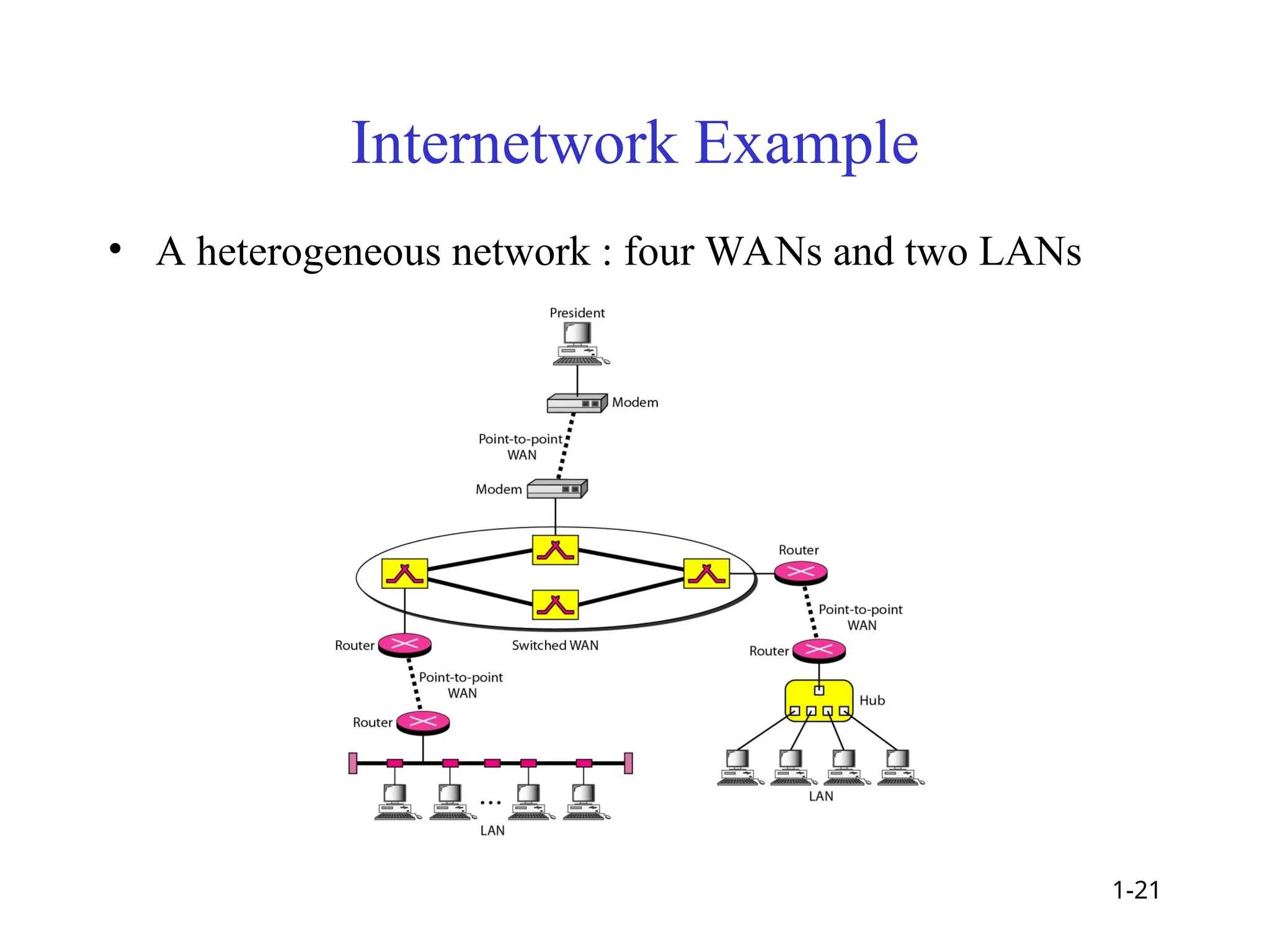
Internetwork Example
• A heterogeneous network : four WANs and two LANs
1-22
The Internet
• The Internet has revolutionized many aspects of our
daily lives. It has affected the way we do business as well
as the way we spend our leisure time. The Internet is a
communication system that has brought a wealth of
information to our fingertips and organized it for our
use.
• 1967: ARPANET proposed by DoD’s ARPA(Advanced Research
Project Agency)
• 1969: ARPANET in a reality: UCLA, UCSB, SRI, U. of Utah
• 1973: Vint Cerf and Bob Kahn propose TCP,
• To split TCP into two protocols TCP and IP
1-23
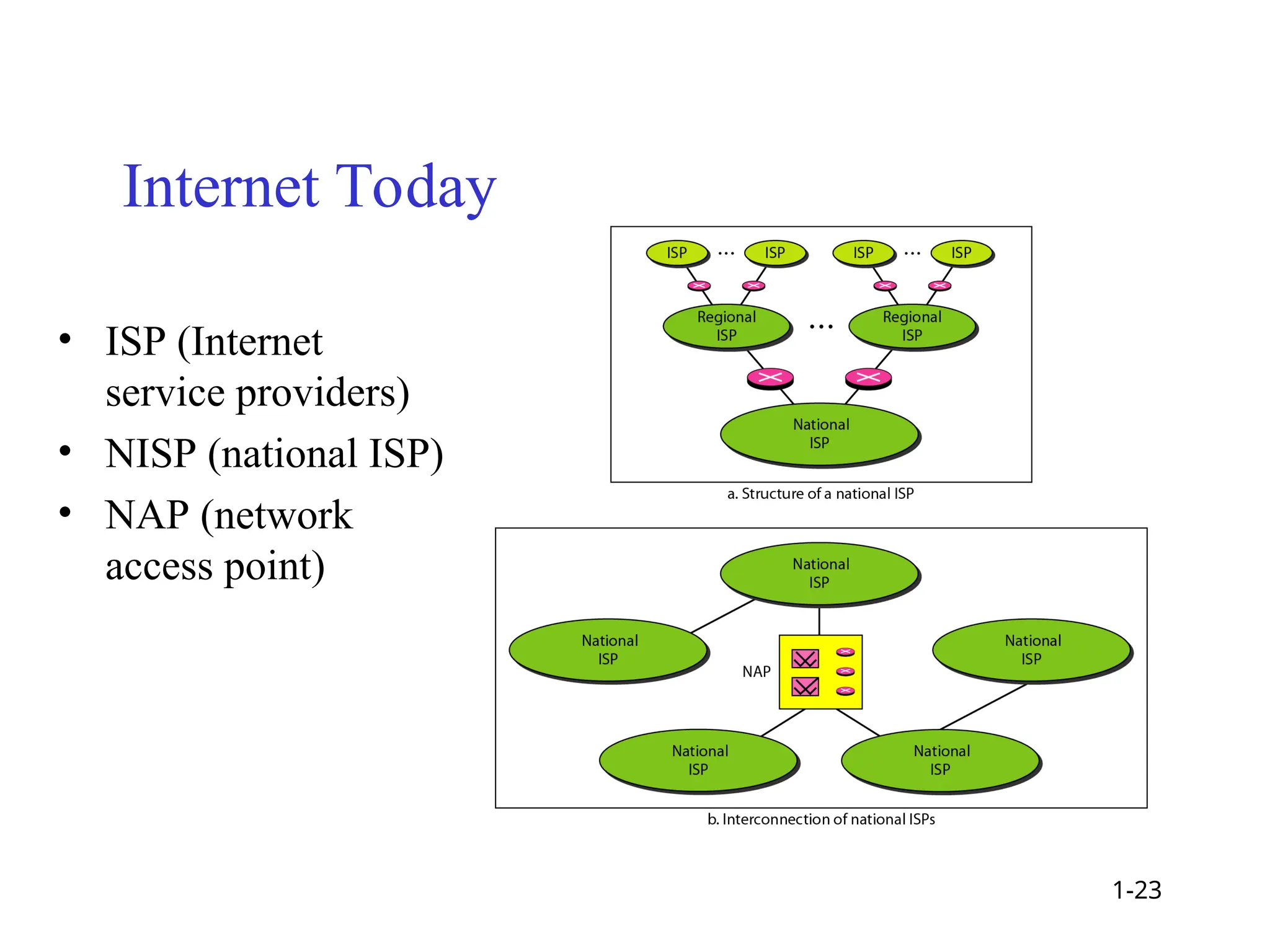
Internet Today
• ISP (Internet
service providers)
• NISP (national ISP)
• NAP (network
access point)
1-24
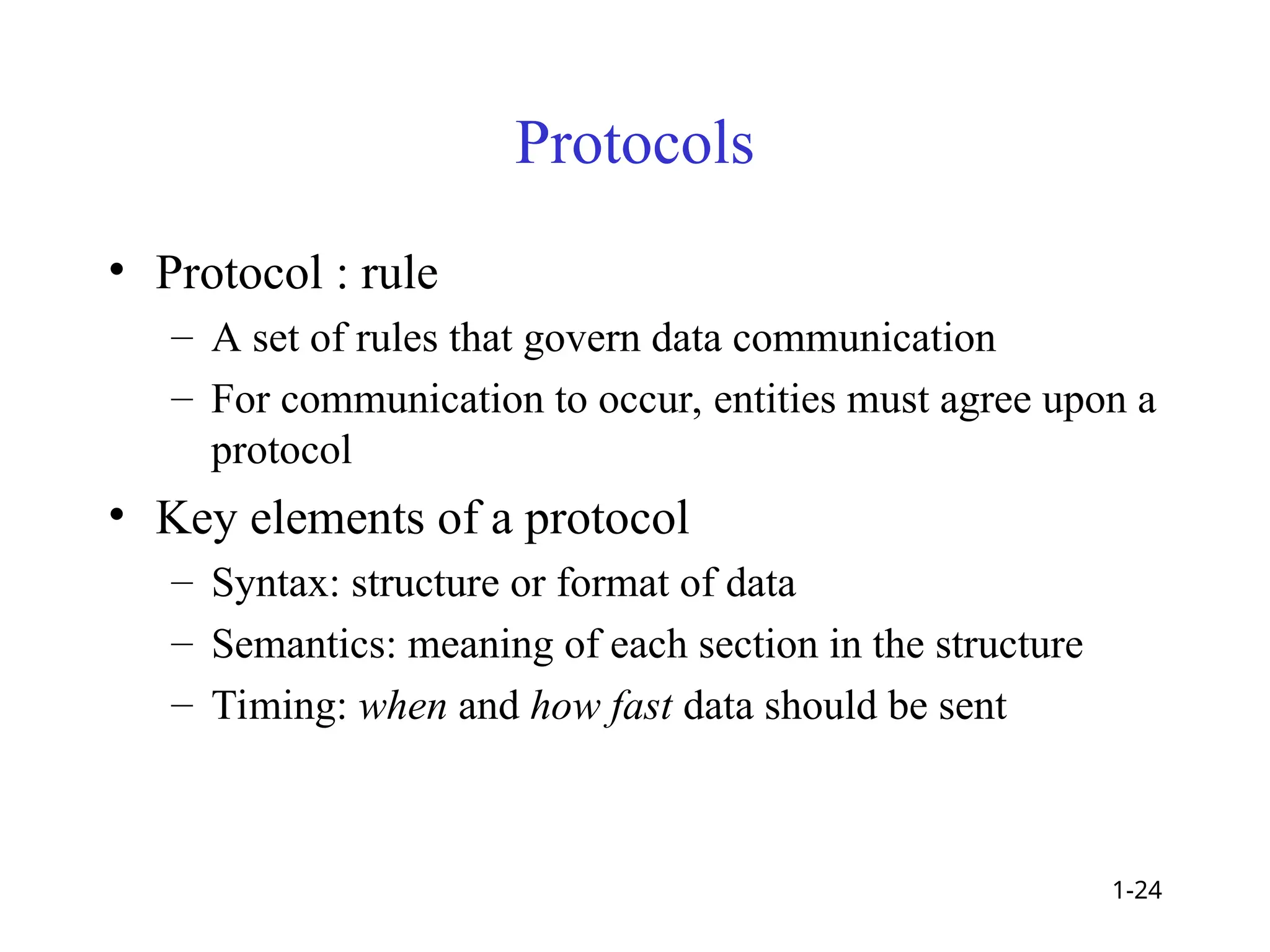
Protocols
• Protocol : rule
– A set of rules that govern data communication
– For communication to occur, entities must agree upon a
protocol
• Key elements of a protocol
– Syntax: structure or format of data
– Semantics: meaning of each section in the structure
– Timing: when and how fast data should be sent
1-25
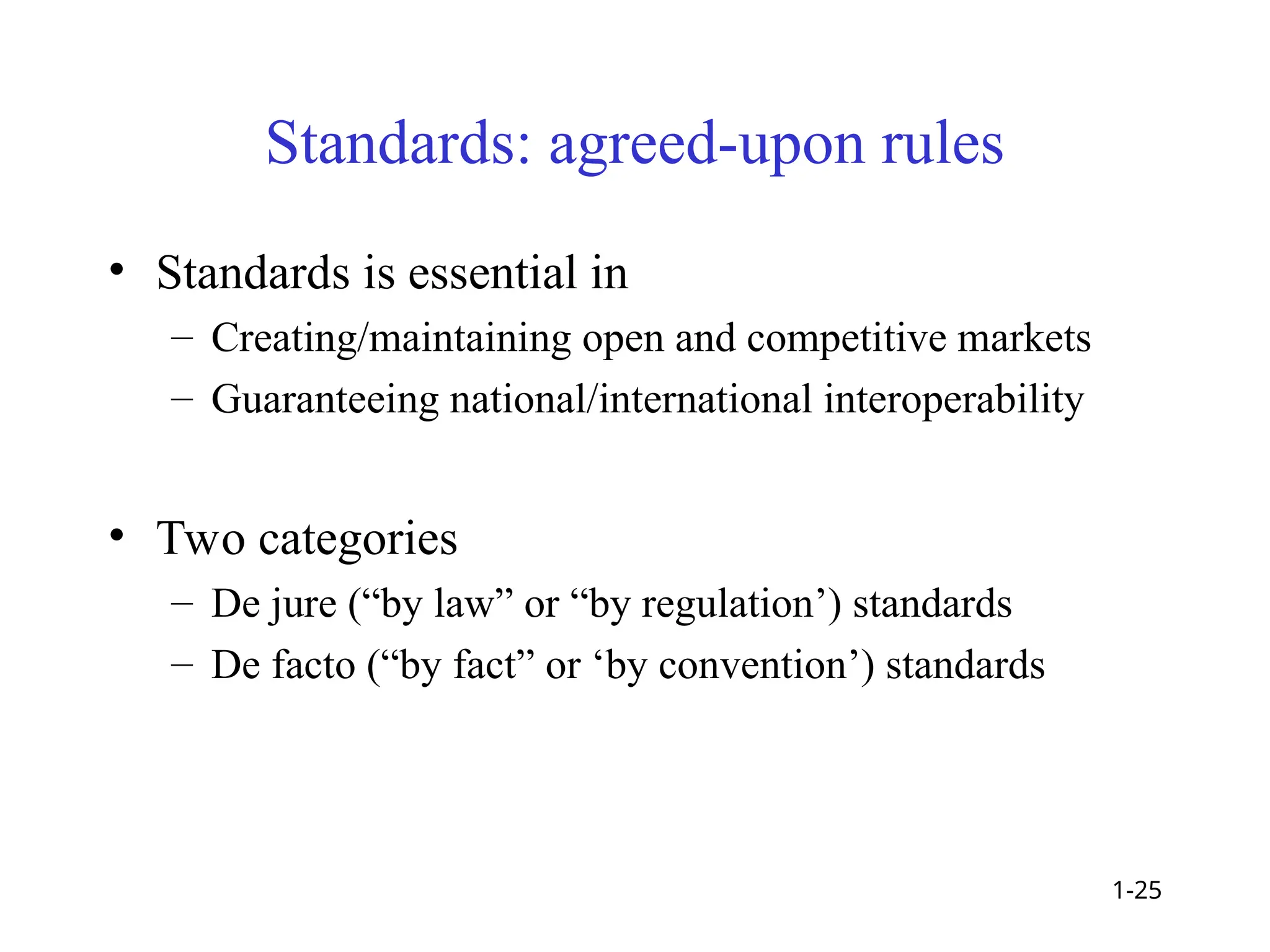
Standards: agreed-upon rules
• Standards is essential in
– Creating/maintaining open and competitive markets
– Guaranteeing national/international interoperability
• Two categories
– De jure (“by law” or “by regulation’) standards
– De facto (“by fact” or ‘by convention’) standards
1-26
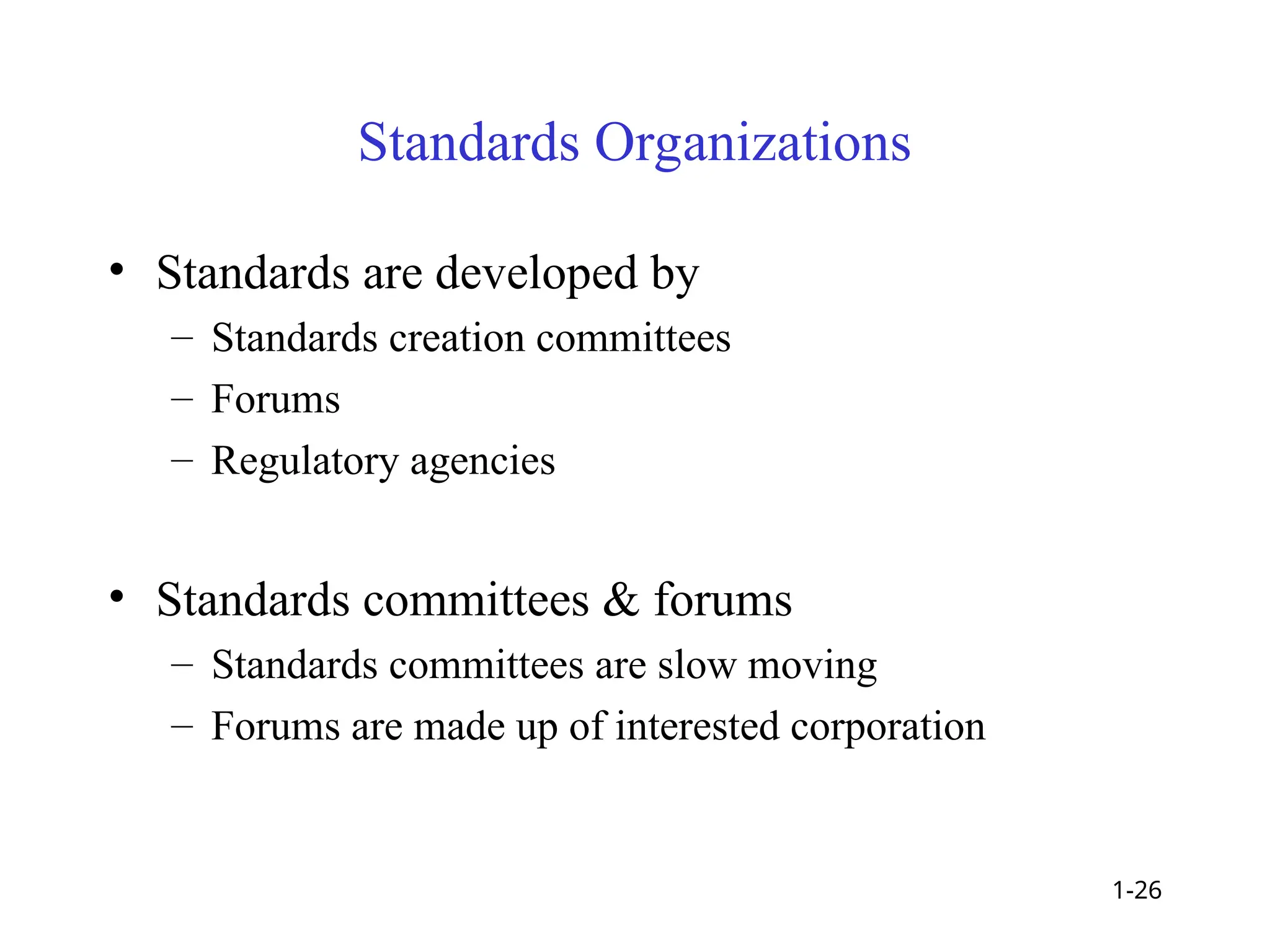
Standards Organizations
• Standards are developed by
– Standards creation committees
– Forums
– Regulatory agencies
• Standards committees & forums
– Standards committees are slow moving
– Forums are made up of interested corporation
1-27
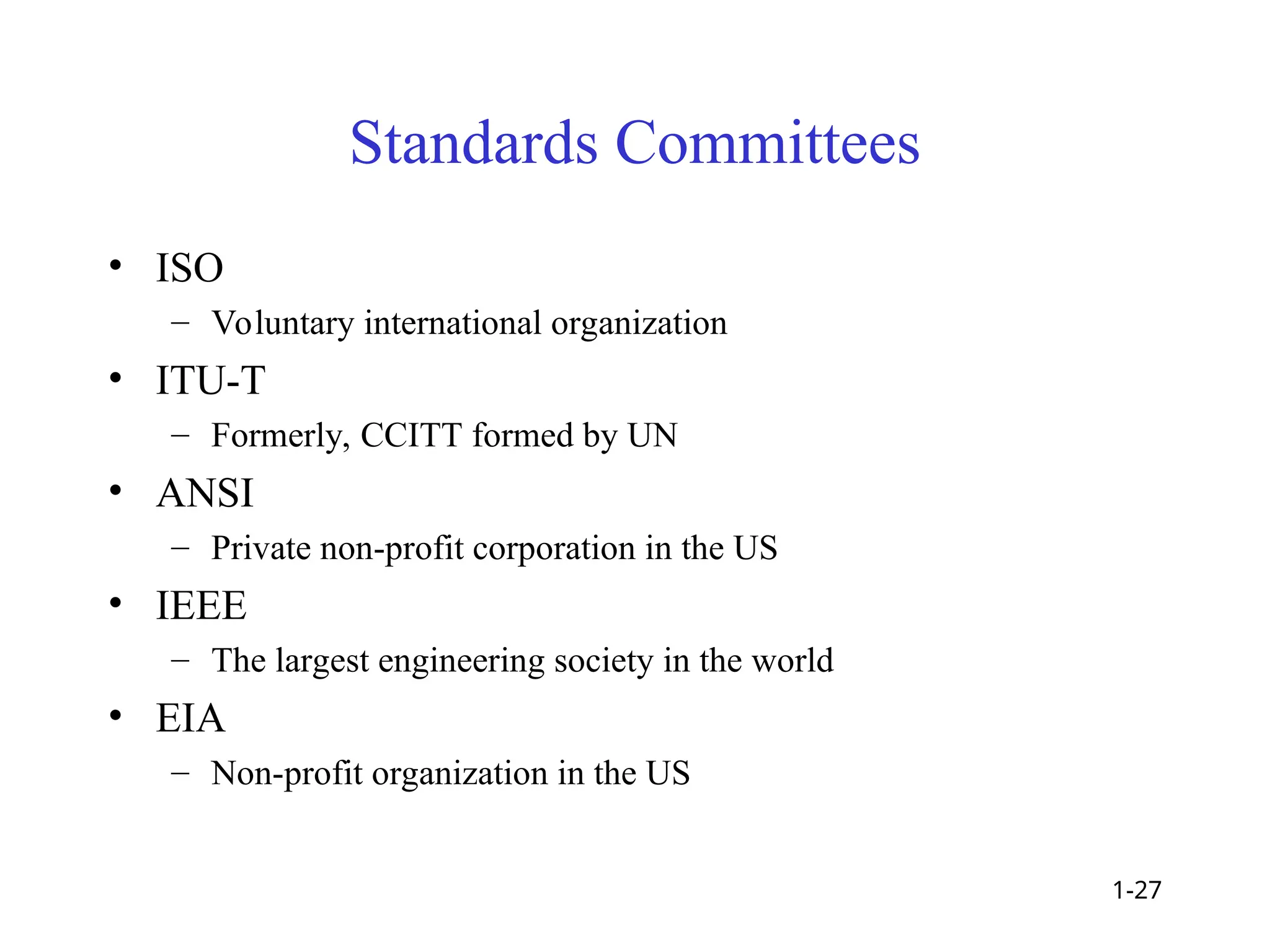
Standards Committees
• ISO
– Voluntary international organization
• ITU-T
– Formerly, CCITT formed by UN
• ANSI
– Private non-profit corporation in the US
• IEEE
– The largest engineering society in the world
• EIA
– Non-profit organization in the US
1-28
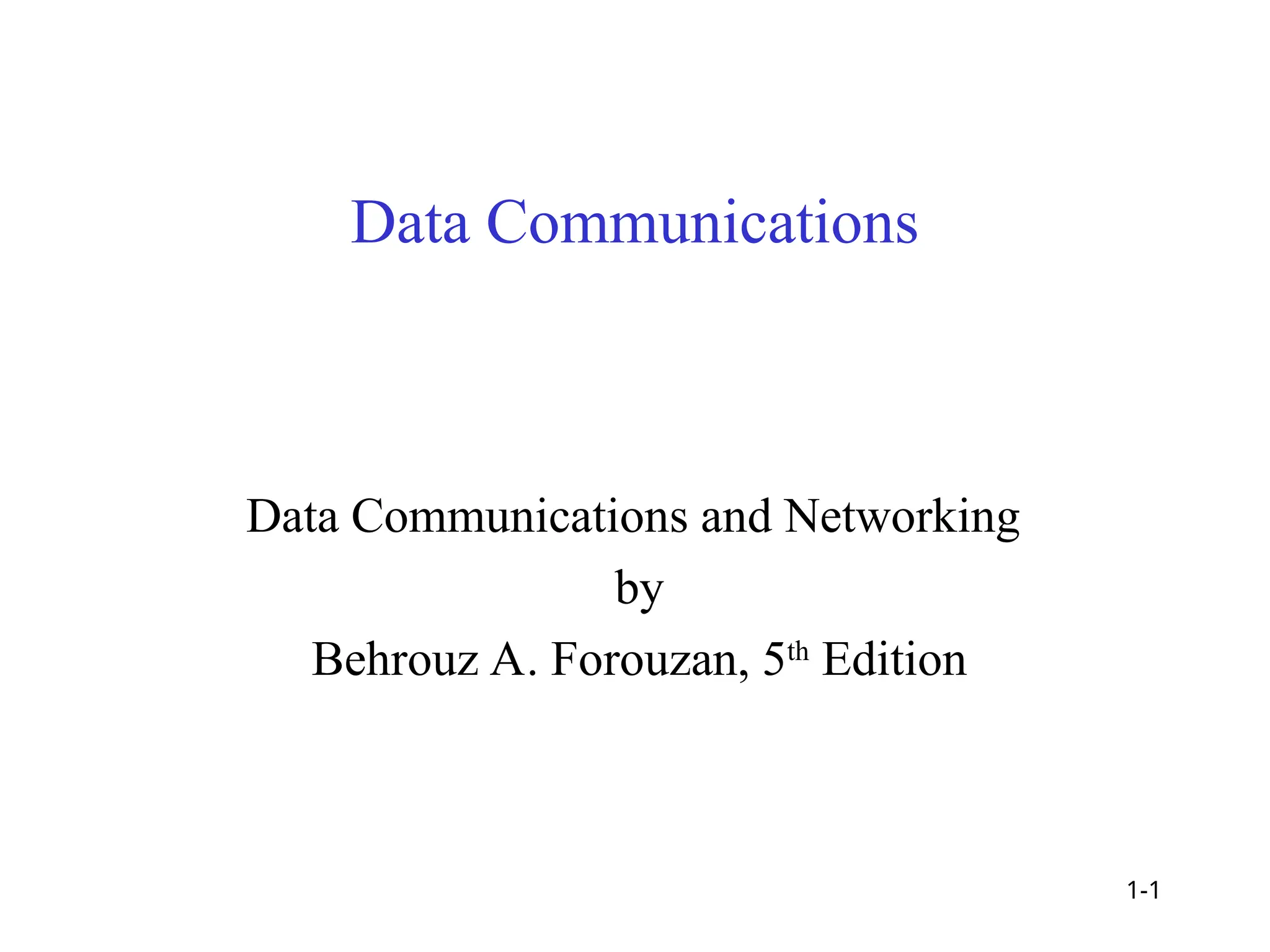
Internet Standards
• IETF (Internet Engineering Task Force)
• Internet Draft
– working document with no official status
– with a 6-month lifetime
• RFC (Request for Comment)
– Edited, assigned a number, and made available to all
interested parties
chapter one 1 DATA COMMUNICATION AND NETWORKING.ppt

  • 1.
    1-1 Data Communications Data Communicationsand Networking by Behrouz A. Forouzan, 5th Edition
  • 2.
    1-2 Chapter 1. Introduction 1.Data communications 2. Networks 3. The Internet 4. Protocols and standards
  • 3.
    1-3 Data Communications • Data –Information presented in whatever form is agreed upon by the parties creating and using the data • Data communication – Exchange of data between two devices – Via some form of transmission medium • Fundamental characteristics of data communication – Delivery – Accuracy – Timeliness – Jitter : Variation in the packet arrival time • Telecommunication: communication at a distance (‘tele’ in Greek=‘far”)
  • 4.
    1-4 Five Components ofData Communication • Message: Information(data) to be communicated • Sender • Receiver • Transmission medium: Physical path by which a message travels • Protocol: A set of rules that govern data communication
  • 5.
    1-5 Modes of Communication/DataFlow • Simplex – Unidirectional – As on a one-way street • Half-duplex – Both transmit and receive possible, but not at the same time – Like a one-lane road with two-directional traffic – Walkie-talkie, CB radio • Full-duplex – Transmit and receive simultaneously – Like a two-way street, telephone network – Channel capacity must be divided between two directions
  • 6.
  • 7.
    1-7 Network • Network: Aset of devices (nodes) connected by communication links • Node: Computer, printer, or any device capable of sending and/or receiving data • To be considered effective and efficient, a network must meet a number of criteria
  • 8.
    1-8 Type of Connection •Point-to-point – Dedicated link between two devices – The entire capacity of the channel is reserved – Ex) Microwave link, TV remote control • Multipoint – More than two devices share a single link – Capacity of the channel is either • Spatially shared: Devices can use the link simultaneously • Timeshare: Users take turns
  • 9.
  • 10.
    1-10 Physical Topology (A wayin which a network is layout physically)
  • 11.
    1-11 Mesh Topology • Dedicatedpoint-to-point link to every other nodes • A mesh network with n nodes has n(n-1)/2 links. A node has n-1 I/O ports (links) • Advantages: No traffic problems, robust, security, easy fault identification & isolation • Disadvantages: Difficult installation/reconfiguration, space, cost
  • 12.
    1-12 Star Topology • Dedicatedpoint-to-point link only to a central controller, called a hub • Hub acts as an exchange: No direct traffic between devices • Advantages: Less expensive, robust • Disadvantages: dependency of the whole on one single point, the hub
  • 13.
    1-13 Bus Topology • Onelong cable that links all nodes • tap, drop line, cable end • limit on the # of devices, distance between nodes • Advantages: Easy installation, cheap • Disadvantages: Difficult reconfiguration, no fault isolation, a fault or break in the bus stops all transmission
  • 14.
    1-14 Ring Topology • Dedicatedpoint-to-point link only with the two nodes on each sides • One direction, repeater • Advantages: Easy reconfiguration, fault isolation • Disadvantage: Unidirectional traffic, a break in the ring cab disable the entire network
  • 15.
    1-15 Hybrid Topology • Example:Main star topology with each branch connecting several stations in a bus topology • To share the advantages from various topologies
  • 16.
  • 17.
    1-17 LAN • Usually privatelyowned • A network for a single office, building, or campus  a few Km • Common LAN topologies: bus, ring, star • An isolated LAN connecting 12 computers to a hub in a closet
  • 18.
    1-18 MAN • Designed toextend to an entire city • Cable TV network, a company’s connected LANs • Owned by a private or a public company
  • 19.
    1-19 WAN • Long distancetransmission, e.g., a country, a continent, the world • Enterprise network: A WAN that is owned and used by one company
  • 20.
    1-20 Internetwork • Internetwork (internet): two or more networks are connected by internetworking devices • Internetworking devices: router, gateway, etc. • The Internet: a specific worldwide network
  • 21.
    1-21 Internetwork Example • Aheterogeneous network : four WANs and two LANs
  • 22.
    1-22 The Internet • TheInternet has revolutionized many aspects of our daily lives. It has affected the way we do business as well as the way we spend our leisure time. The Internet is a communication system that has brought a wealth of information to our fingertips and organized it for our use. • 1967: ARPANET proposed by DoD’s ARPA(Advanced Research Project Agency) • 1969: ARPANET in a reality: UCLA, UCSB, SRI, U. of Utah • 1973: Vint Cerf and Bob Kahn propose TCP, • To split TCP into two protocols TCP and IP
  • 23.
    1-23 Internet Today • ISP(Internet service providers) • NISP (national ISP) • NAP (network access point)
  • 24.
    1-24 Protocols • Protocol :rule – A set of rules that govern data communication – For communication to occur, entities must agree upon a protocol • Key elements of a protocol – Syntax: structure or format of data – Semantics: meaning of each section in the structure – Timing: when and how fast data should be sent
  • 25.
    1-25 Standards: agreed-upon rules •Standards is essential in – Creating/maintaining open and competitive markets – Guaranteeing national/international interoperability • Two categories – De jure (“by law” or “by regulation’) standards – De facto (“by fact” or ‘by convention’) standards
  • 26.
    1-26 Standards Organizations • Standardsare developed by – Standards creation committees – Forums – Regulatory agencies • Standards committees & forums – Standards committees are slow moving – Forums are made up of interested corporation
  • 27.
    1-27 Standards Committees • ISO –Voluntary international organization • ITU-T – Formerly, CCITT formed by UN • ANSI – Private non-profit corporation in the US • IEEE – The largest engineering society in the world • EIA – Non-profit organization in the US
  • 28.
    1-28 Internet Standards • IETF(Internet Engineering Task Force) • Internet Draft – working document with no official status – with a 6-month lifetime • RFC (Request for Comment) – Edited, assigned a number, and made available to all interested parties
Editor's Notes