Chapter 2 Arrays and Structures
Instructors:
C. Y. Tang and J. S. Roger Jang
All the material are integrated from the textbook "Fundamentals of Data Structures
in C" and some supplement from the slides of Prof. Hsin-Hsi Chen (NTU).
Outline
 The array as an abstract data type
 Structures and unions
 The polynomial abstract data type
 The sparse matrix abstract data type
 Representation of multidimensional arrays
 The string abstract data type
Outline
 The array as an abstract data type
 Structures and unions
 The polynomial abstract data type
 The sparse matrix abstract data type
 Representation of multidimensional arrays
 The string abstract data type
Arrays
Array: a set of index and value
data structure
For each index, there is a value associated with
that index.
representation (possible)
implemented by using consecutive memory.
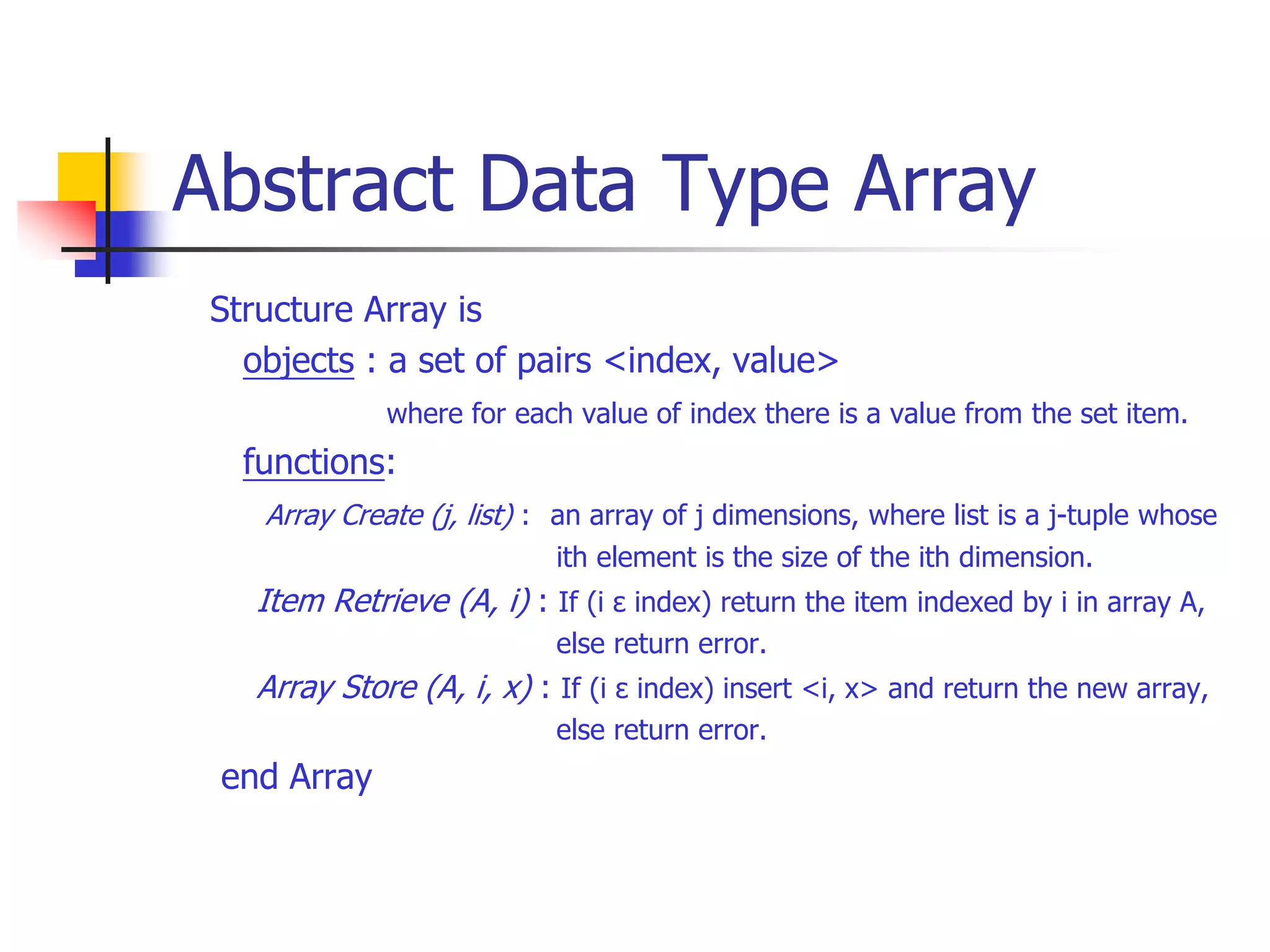
Abstract Data Type Array
Structure Array is
objects : a set of pairs <index, value>
where for each value of index there is a value from the set item.
functions:
Array Create (j, list) : an array of j dimensions, where list is a j-tuple whose
ith element is the size of the ith dimension.
Item Retrieve (A, i) : If (i ε index) return the item indexed by i in array A,
else return error.
Array Store (A, i, x) : If (i ε index) insert <i, x> and return the new array,
else return error.
end Array
Implementation in C
 int list[5], *plist[5];
Variable Memory Address
list[0] base address = α
list[1] α + sizeof(int)
list[2] α + 2*sizeof(int)
list[3] α + 3*sizeof(int)
list[4] α + 4*sizeof(int)
The names of
the five array
elements
Assume the memory address α = 1414, list[0] = 6, list[2] = 8, plist[3] = list = 1414
printf(“%d”, list); // 1414, the variable “list” is the pointer to an int
printf(“%d”, &list[0]) // 1414, return the address using “&”
printf(“%d”, list[0]); // 6, the value stored in the address “&list[0]”
printf(“%d”, (list + 2)); // 1414 + 2*sizeof(int), “(list +2)” is a pointer
printf(“%d”, *(list + 2)); // 8
printf(“%d”, plist[3]); // 1414, the value of a pointer is an address
printf(“%d”, *plist[3]); // 6
Example: One-dimensional
array accessed by address
call print1(&one[0], 5)
void print1(int *ptr, int rows)
{
/* print out a one-dimensional array using a pointer */
int i;
printf(“Address Contentsn”);
for (i=0; i < rows; i++)
printf(“%8u%5dn”, ptr+i, *(ptr+i));
printf(“n”);
}
int one[] = {0, 1, 2, 3, 4};
Goal: print out address and value
Example: Array program
#define MAX_SIZE 100
float sum(float [], int);
float input[MAX_SIZE], answer;
int i;
void main (void)
{
for (i = 0; i < MAX_SIZE; i++)
input[i] = i;
answer = sum(input, MAX_SIZE);
printf("The sum is: %fn", answer);
}
float sum(float list[], int n)
{
int i;
float tempsum = 0;
for (i = 0; i < n; i++)
tempsum += list[i];
return tempsum;
}
Result :
The sum is: 4950.000000
Outline
 The array as an abstract data type
 Structures and unions
 The polynomial abstract data type
 The sparse matrix abstract data type
 Representation of multidimensional arrays
 The string abstract data type
Structures (Records)
struct {
char name[10]; // a name that is a character array
int age; // an integer value representing the age of the person
float salary; // a float value representing the salary of the individual
} person;
strcpy(person.name, “james”);
person.age=10;
person.salary=35000;
 An alternate way of grouping data that permits the
data to vary in type.
 Example:
Create structure data type
typedef struct human_being {
char name[10];
int age;
float salary;
};
or
typedef struct {
char name[10];
int age;
float salary
} human_being;
human_being person1, person2;
Example: Embed a structure
within a structure
typedef struct {
int month;
int day;
int year;
} date;
typedef struct human_being {
char name[10];
int age;
float salary;
date dob;
};
person1.dob.month = 2;
person1.dob.day = 11;
person1.dob.year = 1944;
Unions
Similar to struct, but only one field is active.
Example: Add fields for male and female.
typedef struct sex_type {
enum tag_field {female, male} sex;
union {
int children;
boolean beard;
} u;
};
typedef struct human_being {
char name[10];
int age;
float salary;
date dob;
sex_type sex_info;
}
human_being person1, person2;
person1.sex_info.sex = male;
person1.sex_info.u.beard = FALSE;
person2.sex_info.sex = female;
person2.sex_info.u.children = 4;
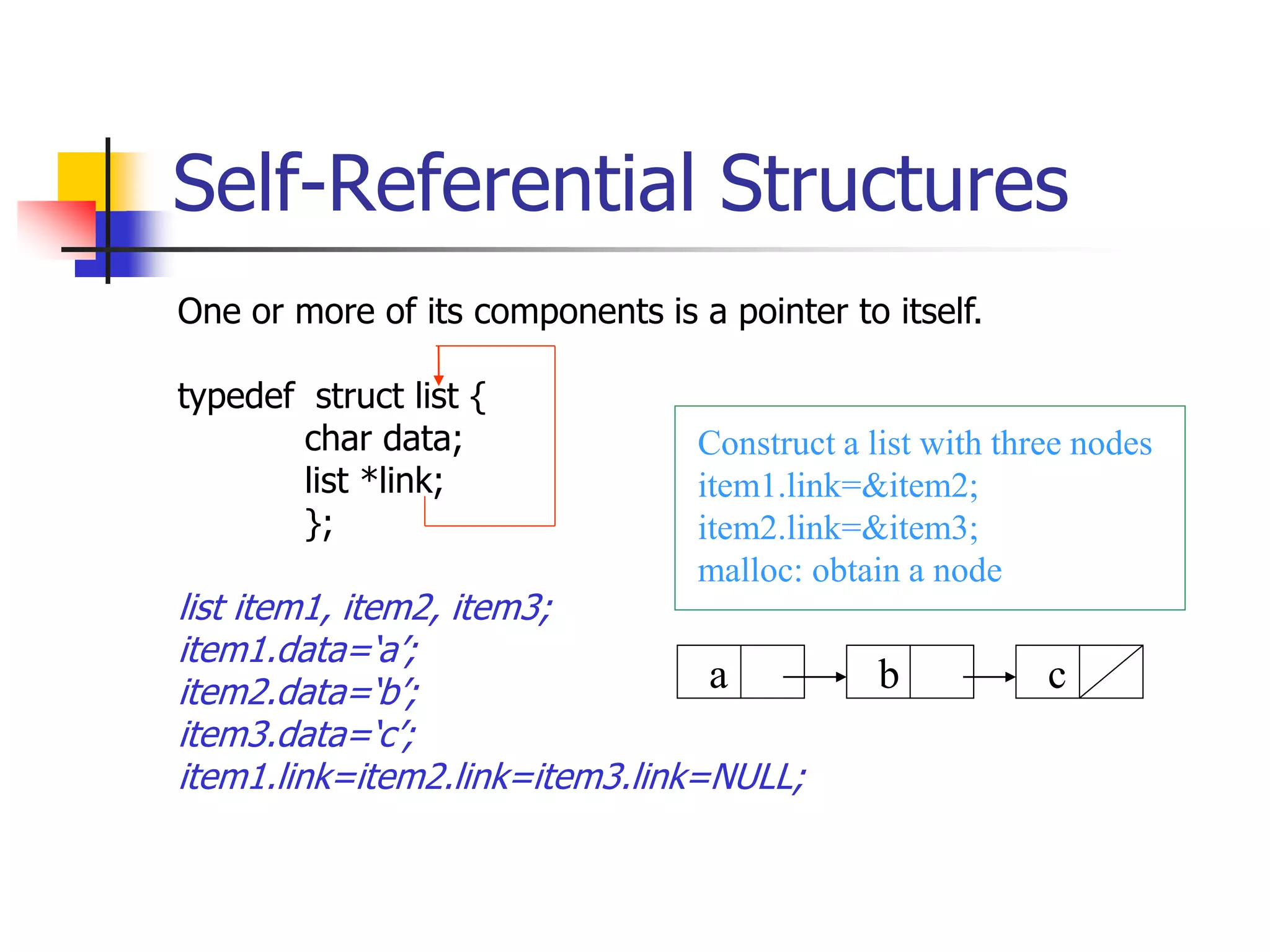
Self-Referential Structures
One or more of its components is a pointer to itself.
typedef struct list {
char data;
list *link;
};
list item1, item2, item3;
item1.data=‘a’;
item2.data=‘b’;
item3.data=‘c’;
item1.link=item2.link=item3.link=NULL;
a b c
Construct a list with three nodes
item1.link=&item2;
item2.link=&item3;
malloc: obtain a node
Outline
 The array as an abstract data type
 Structures and unions
 The polynomial abstract data type
 The sparse matrix abstract data type
 Representation of multidimensional arrays
 The string abstract data type
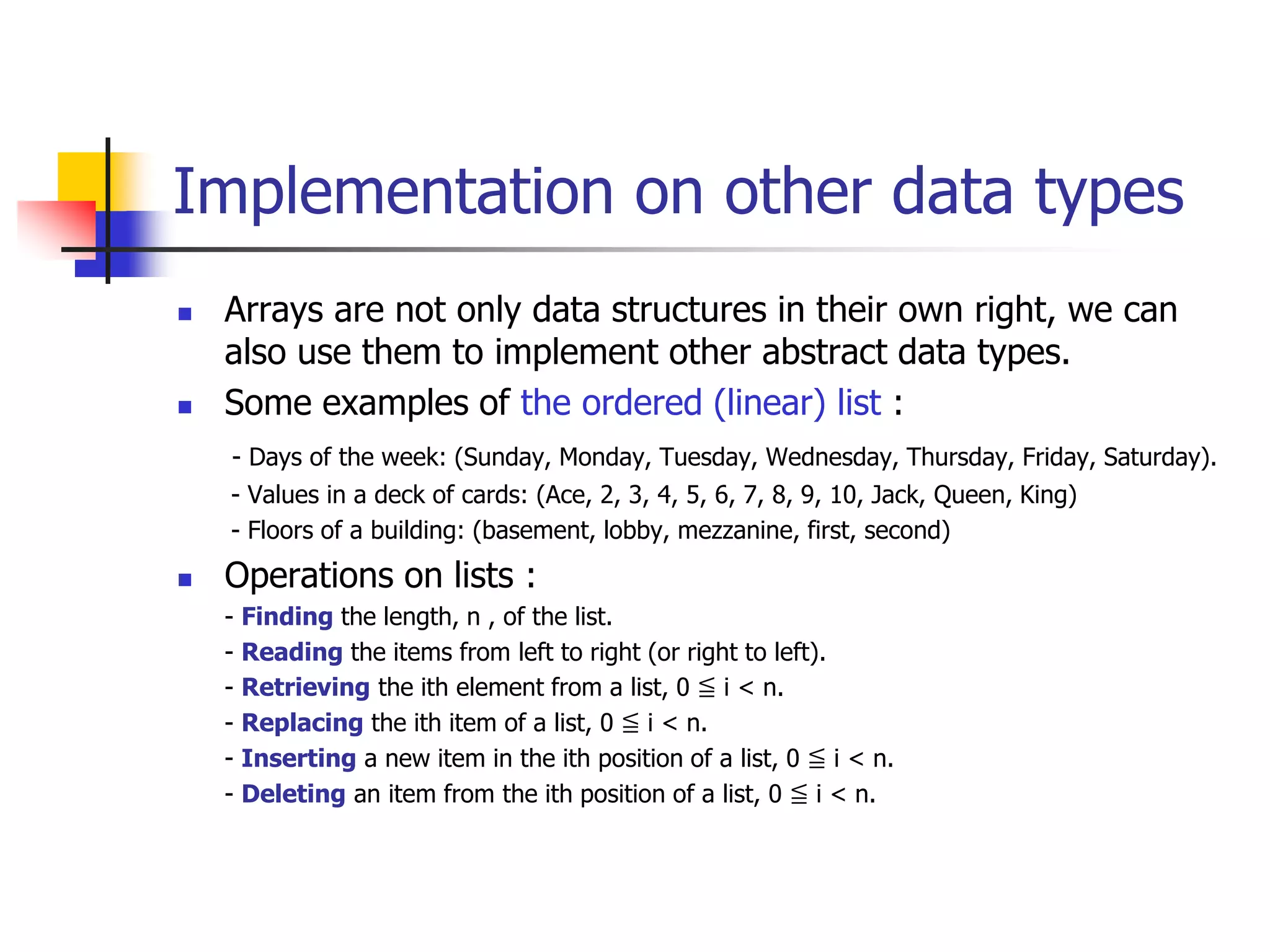
Implementation on other data types
 Arrays are not only data structures in their own right, we can
also use them to implement other abstract data types.
 Some examples of the ordered (linear) list :
- Days of the week: (Sunday, Monday, Tuesday, Wednesday, Thursday, Friday, Saturday).
- Values in a deck of cards: (Ace, 2, 3, 4, 5, 6, 7, 8, 9, 10, Jack, Queen, King)
- Floors of a building: (basement, lobby, mezzanine, first, second)
 Operations on lists :
- Finding the length, n , of the list.
- Reading the items from left to right (or right to left).
- Retrieving the ith element from a list, 0 ≦ i < n.
- Replacing the ith item of a list, 0 ≦ i < n.
- Inserting a new item in the ith position of a list, 0 ≦ i < n.
- Deleting an item from the ith position of a list, 0 ≦ i < n.
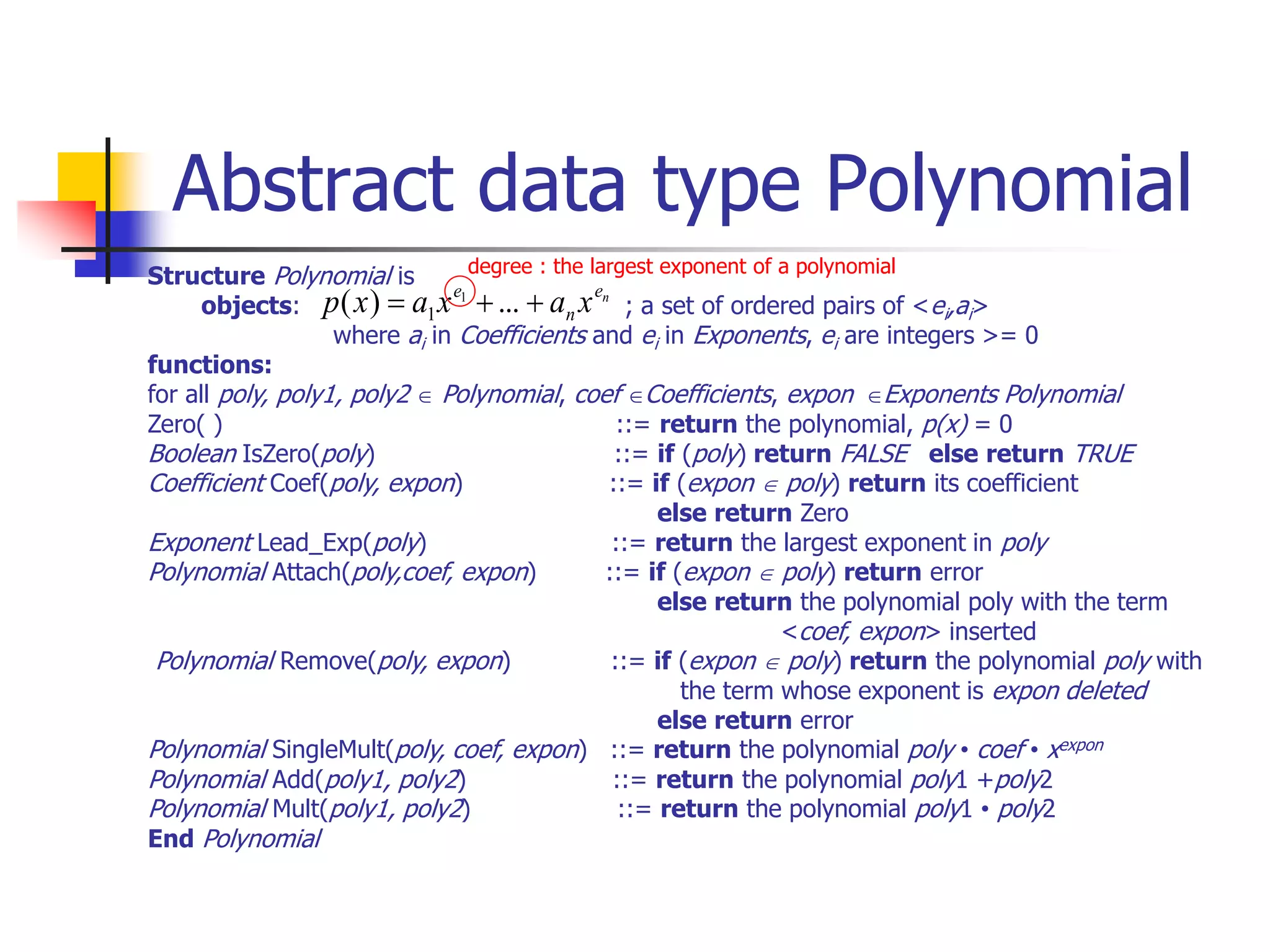
Abstract data type Polynomial
Structure Polynomial is
objects: ; a set of ordered pairs of <ei,ai>
where ai in Coefficients and ei in Exponents, ei are integers >= 0
functions:
for all poly, poly1, poly2  Polynomial, coef Coefficients, expon Exponents Polynomial
Zero( ) ::= return the polynomial, p(x) = 0
Boolean IsZero(poly) ::= if (poly) return FALSE else return TRUE
Coefficient Coef(poly, expon) ::= if (expon  poly) return its coefficient
else return Zero
Exponent Lead_Exp(poly) ::= return the largest exponent in poly
Polynomial Attach(poly,coef, expon) ::= if (expon  poly) return error
else return the polynomial poly with the term
<coef, expon> inserted
Polynomial Remove(poly, expon) ::= if (expon  poly) return the polynomial poly with
the term whose exponent is expon deleted
else return error
Polynomial SingleMult(poly, coef, expon) ::= return the polynomial poly • coef • xexpon
Polynomial Add(poly1, poly2) ::= return the polynomial poly1 +poly2
Polynomial Mult(poly1, poly2) ::= return the polynomial poly1 • poly2
End Polynomial
n
e
n
e
x
a
x
a
x
p 

 ...
)
( 1
1
degree : the largest exponent of a polynomial
Two types of Implementation for the
polynomial ADT
Type I :
#define MAX_DEGREE 1001
typedef struct {
int degree;
float coef[MAX_DEGREE];
} polynomial;
polynomial a;
a.degree = n
a. coef[i] = an-i , 0 ≦ i ≦ n.
Type II :
MAX_TERMS 1001 /* size of terms array */
typedef struct {
float coef;
int expon;
} polynomial;
polynomial terms[MAX_TERMS];
int avail = 0; /* recording the available space*/
starta finisha startb finishb avail
coef 2 1 1 10 3 1
exp 1000 0 4 3 2 0
0 1 2 3 4 5 6
advantage: easy implementation
disadvantage: waste space when sparse
storage requirements: start, finish, 2*(finish-start+1)
nonparse: twice as much as Type I
when all the items are nonzero
PA=2x1000+1
PB=x4+10x3+3x2+1
Poly A
coef 1 … 0 0 2
exp (index) 0 … 998 999 1000
Poly B
coef 1 0 3 10 1 … 0
exp (index) 0 1 2 3 4 … 1000
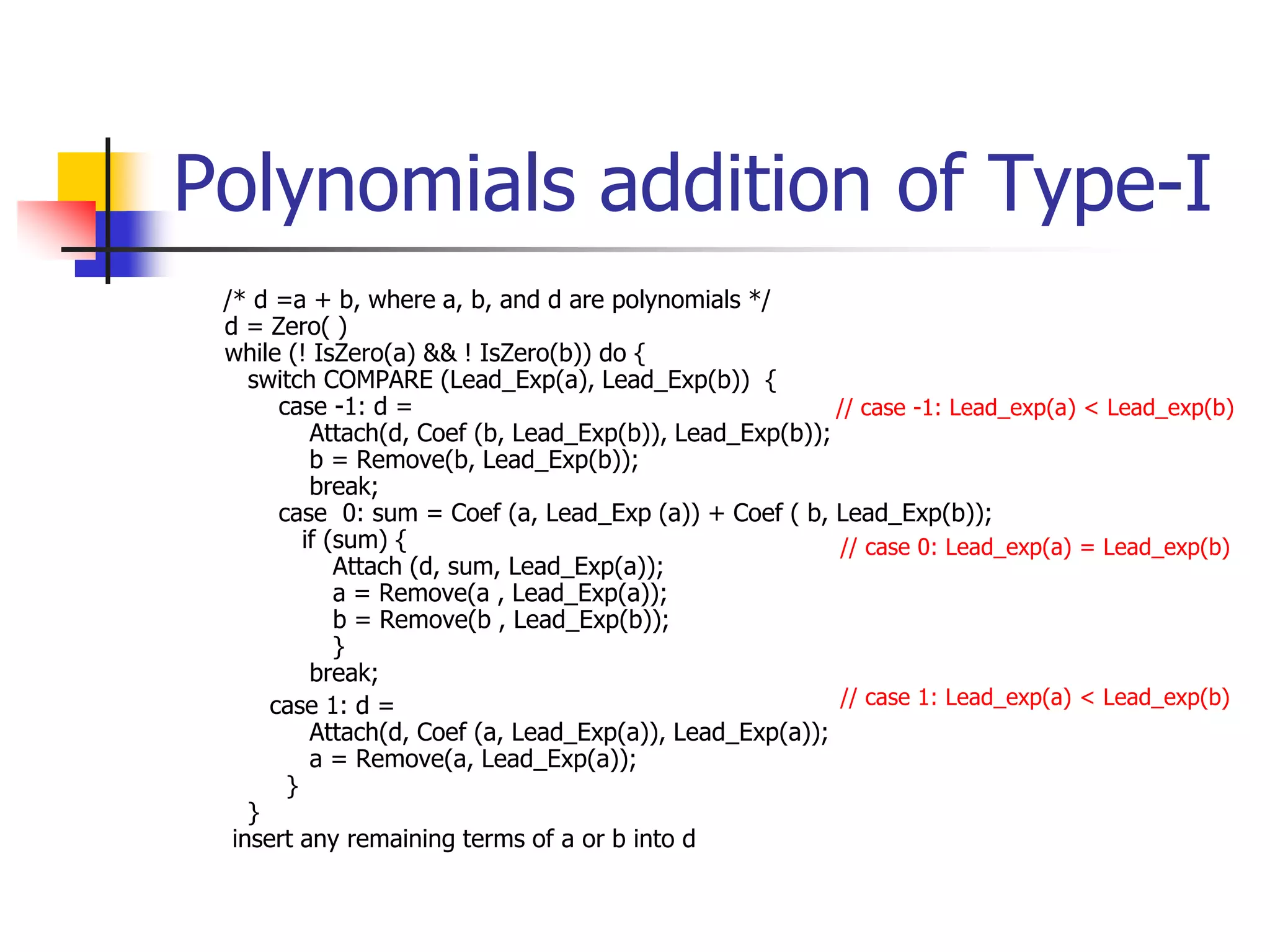
Polynomials addition of Type-I
/* d =a + b, where a, b, and d are polynomials */
d = Zero( )
while (! IsZero(a) && ! IsZero(b)) do {
switch COMPARE (Lead_Exp(a), Lead_Exp(b)) {
case -1: d =
Attach(d, Coef (b, Lead_Exp(b)), Lead_Exp(b));
b = Remove(b, Lead_Exp(b));
break;
case 0: sum = Coef (a, Lead_Exp (a)) + Coef ( b, Lead_Exp(b));
if (sum) {
Attach (d, sum, Lead_Exp(a));
a = Remove(a , Lead_Exp(a));
b = Remove(b , Lead_Exp(b));
}
break;
case 1: d =
Attach(d, Coef (a, Lead_Exp(a)), Lead_Exp(a));
a = Remove(a, Lead_Exp(a));
}
}
insert any remaining terms of a or b into d
// case -1: Lead_exp(a) < Lead_exp(b)
// case 0: Lead_exp(a) = Lead_exp(b)
// case 1: Lead_exp(a) < Lead_exp(b)
Polynomials adding of Type I
// A utility function to return maximum of two
integers
int max(int m, int n) { return (m > n)? m: n; }
// A[] represents coefficients of first polynomial
// B[] represents coefficients of second polynomial
// m and n are sizes of A[] and B[] respectively
int *add(int A[], int B[], int m, int n)
{
int size = max(m, n);
int *sum = new int[size];
// Initialize the porduct polynomial
for (int i = 0; i<m; i++)
sum[i] = A[i];
// Take ever term of first polynomial
for (int i=0; i<n; i++)
sum[i] += B[i];
return sum;
}
// Driver program to test above functions
int main()
{
// The following array represents polynomial 5 + 10x^2 +
6x^3
int A[] = {5, 0, 10, 6};
// The following array represents polynomial 1 + 2x + 4x^2
int B[] = {1, 2, 4};
int m = sizeof(A)/sizeof(A[0]);
int n = sizeof(B)/sizeof(B[0]);
printf("First polynomial is n“);
printPoly(A, m);
printf("nSecond polynomial is n“);
printPoly(B, n);
int *sum = add(A, B, m, n);
int size = max(m, n);
printf("nsum polynomial is n“) ;
printPoly(sum, size);
return 0;
}
void printPoly(int poly[], int n)
{
for (int i=0; i<n; i++)
{
cout << poly[i];
if (i != 0)
cout << "x^" << i ;
if (i != n-1)
cout << " + ";
}
}
Polynomial Multiplication
// A[] represents coefficients of first polynomial
// B[] represents coefficients of second polynomial
// m and n are sizes of A[] and B[] respectively
int *multiply(int A[], int B[], int m, int n)
{ int *prod = new int[m+n-1];
// Initialize the porduct polynomial
for (int i = 0; i<m+n-1; i++)
prod[i] = 0;
// Multiply two polynomials term by term
// Take ever term of first polynomial
for (int i=0; i<m; i++)
{ // Multiply the current term of first polynomial
// with every term of second polynomial.
for (int j=0; j<n; j++)
prod[i+j] += A[i]*B[j];
}
return prod;
}
// Driver program to test above functions
int main()
{
// The following array represents polynomial 5 + 10x^2
+ 6x^3
int A[] = {5, 0, 10, 6};
// The following array represents polynomial 1 + 2x +
4x^2
int B[] = {1, 2, 4};
int m = sizeof(A)/sizeof(A[0]);
int n = sizeof(B)/sizeof(B[0]);
cout << "First polynomial is n";
printPoly(A, m);
cout << "nSecond polynomial is n";
printPoly(B, n);
int *prod = multiply(A, B, m, n);
cout << "nProduct polynomial is n";
printPoly(prod, m+n-1);
return 0;
}
Outline
 The array as an abstract data type
 Structures and unions
 The polynomial abstract data type
 The sparse matrix abstract data type
 Representation of multidimensional arrays
 The string abstract data type
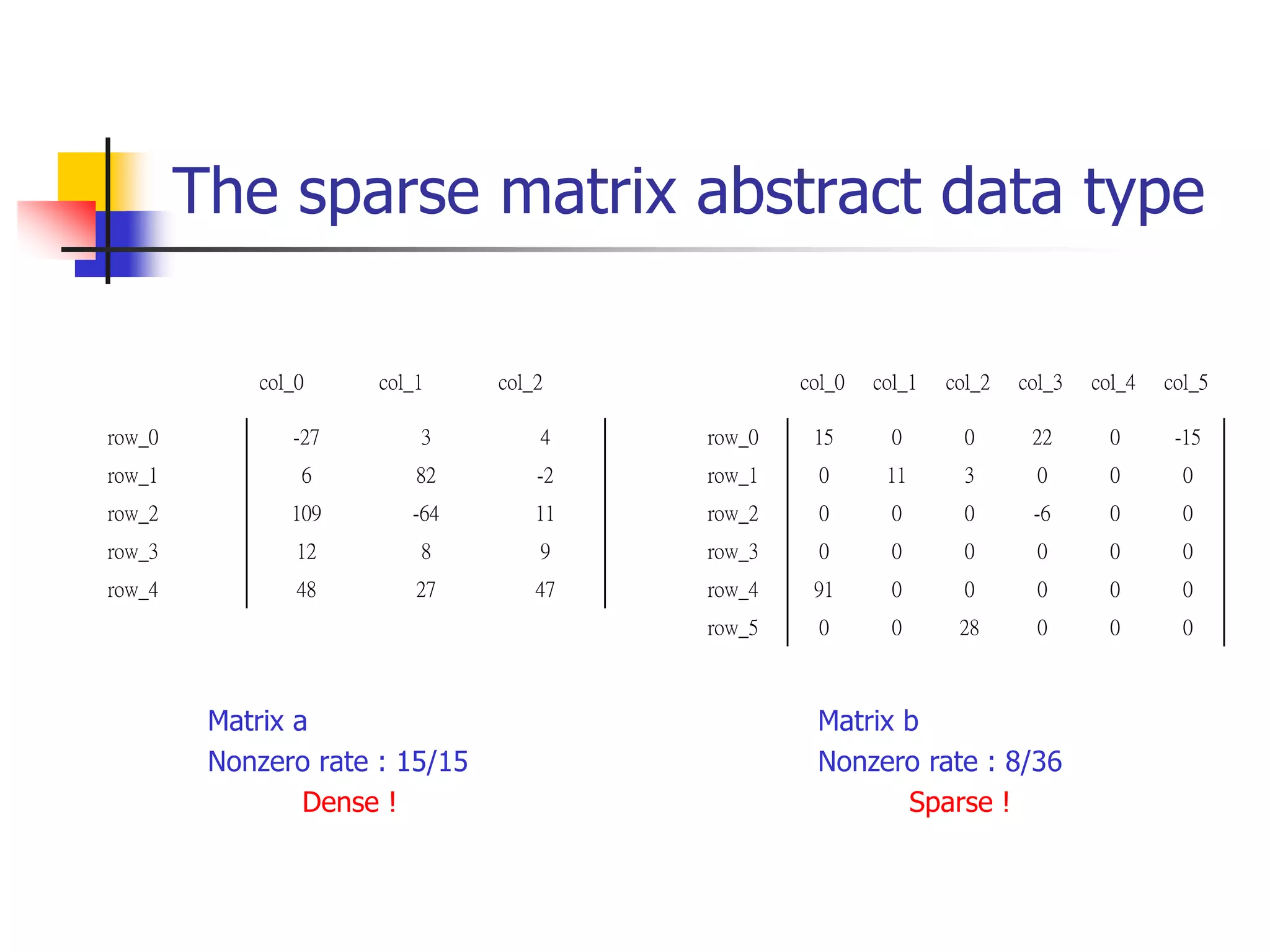
The sparse matrix abstract data type
Matrix a
Nonzero rate : 15/15
Dense !
col_0 col_1 col_2
row_0 -27 3 4
row_1 6 82 -2
row_2 109 -64 11
row_3 12 8 9
row_4 48 27 47
col_0 col_1 col_2 col_3 col_4 col_5
row_0 15 0 0 22 0 -15
row_1 0 11 3 0 0 0
row_2 0 0 0 -6 0 0
row_3 0 0 0 0 0 0
row_4 91 0 0 0 0 0
row_5 0 0 28 0 0 0
Matrix b
Nonzero rate : 8/36
Sparse !
Abstract data type Sparse_Matrix
Structure Sparse_Matrix is
objects: a set of triples, <row, column, value>, where row and column are integers and form a
unique combination, and value comes from the set item.
functions:
for all a, b  Sparse_Matrix, x  item, i, j, max_col, max_row  index
Sparse_Marix Create(max_row, max_col) ::=
return a Sparse_matrix that can hold up to max_items = max _row 
max_col and whose maximum row size is max_row and whose maximum
column size is max_col.
Sparse_Matrix Transpose(a) ::=
return the matrix produced by interchanging the row and column value of
every triple.
Sparse_Matrix Add(a, b) ::=
if the dimensions of a and b are the same
return the matrix produced by adding corresponding items, namely those
with identical row and column values.
else return error
Sparse_Matrix Multiply(a, b) ::=
if number of columns in a equals number of rows in b
return the matrix d produced by multiplying a by b according to the formula:
d [i] [j] = (a[i][k]•b[k][j]) where d (i, j) is the (i,j)th element
else return error.
Sparse_Matrix Create and transpose
 #define MAX_TERMS 101 /* maximum number of terms +1*/
typedef struct {
int col;
int row;
int value;
} term;
term a[MAX_TERMS]
 for each row i (or column j)
take element <i, j, value> and
store it in element <j, i, value>
of the transpose.
row col value
a[0] 6 6 8
[1] 0 0 15
[2] 0 3 22
[3] 0 5 -15
[4] 1 1 11
[5] 1 2 3
[6] 2 3 -6
[7] 4 0 91
[8] 5 2 28
row col value
b[0] 6 6 8
[1] 0 0 15
[2] 0 4 91
[3] 1 1 11
[4] 2 1 3
[5] 2 5 28
[6] 3 0 22
[7] 3 2 -6
[8] 5 0 -15
Sparse matrix and its transpose stored as triples
#(rows)
#(columns)
#(nonzero entries)
any element within a matrix using the triple <row, col, value>
Difficulty:
what position to put <j, i, value> ?
Transpose of a sparse matrix in
O(columns*elements)
void transpose (term a[], term b[])
/* b is set to the transpose of a */
{
int n, i, j, currentb;
n = a[0].value; /* total number of elements */
b[0].row = a[0].col; /* rows in b = columns in a */
b[0].col = a[0].row; /*columns in b = rows in a */
b[0].value = n;
if (n > 0) { /*non zero matrix */
currentb = 1;
for (i = 0; i < a[0].col; i++)
/* transpose by columns in a */
for( j = 1; j <= n; j++)
/* find elements from the current column */
if (a[j].col == i) {
/* element is in current column, add it to b */
b[currentb].row = a[j].col;
b[currentb].col = a[j].row;
b[currentb].value = a[j].value;
currentb++
}
}
}
Scan the array “columns” times.
The array has “elements” elements.
==> O(columns*elements)
Analysis and improvement
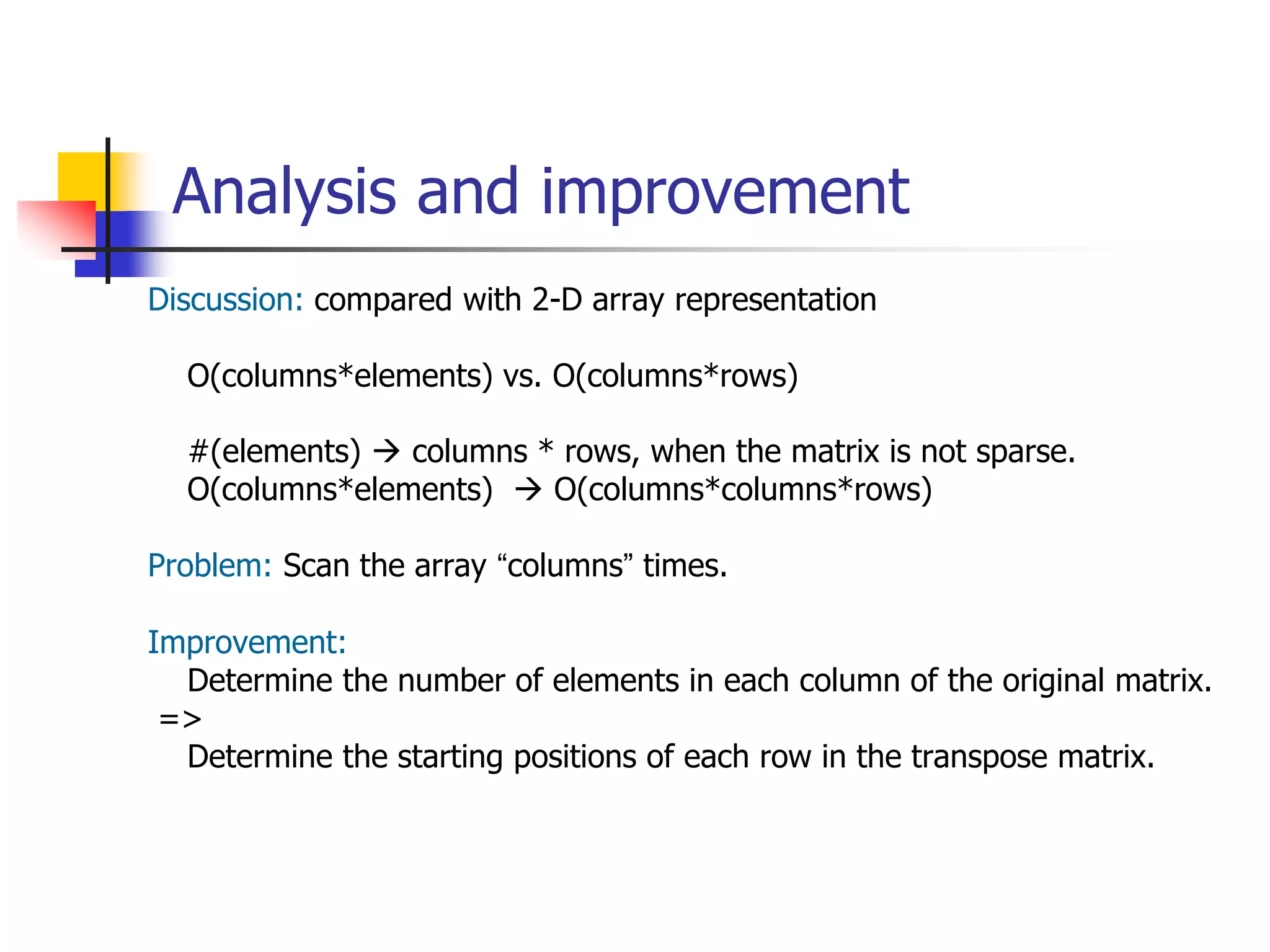
Discussion: compared with 2-D array representation
O(columns*elements) vs. O(columns*rows)
#(elements)  columns * rows, when the matrix is not sparse.
O(columns*elements)  O(columns*columns*rows)
Problem: Scan the array “columns” times.
Improvement:
Determine the number of elements in each column of the original matrix.
=>
Determine the starting positions of each row in the transpose matrix.
Transpose of a sparse matrix in
O(columns + elements)
void fast_transpose(term a[ ], term b[ ])
{
/* the transpose of a is placed in b */
int row_terms[MAX_COL], starting_pos[MAX_COL];
int i, j, num_cols = a[0].col, num_terms = a[0].value;
b[0].row = num_cols; b[0].col = a[0].row;
b[0].value = num_terms;
if (num_terms > 0){ /*nonzero matrix*/
for (i = 0; i < num_cols; i++)
row_terms[i] = 0;
for (i = 1; i <= num_terms; i++)
row_terms[a[i].col]++
starting_pos[0] = 1;
for (i =1; i < num_cols; i++)
starting_pos[i]=starting_pos[i-1] +row_terms [i-1];
for (i=1; i <= num_terms, i++) {
j = starting_pos[a[i].col]++;
b[j].row = a[i].col;
b[j].col = a[i].row;
b[j].value = a[i].value;
}
}
}
O(num_cols)
O(num_terms)
O(num_cols-1)
O(num_terms)
O(columns + elements)
Sparse matrix multiplication
void mmult (term a[ ], term b[ ], term d[ ] )
/* multiply two sparse matrices */
{
int i, j, column, totalb = b[].value, totald = 0;
int rows_a = a[0].row, cols_a = a[0].col,
totala = a[0].value; int cols_b = b[0].col,
int row_begin = 1, row = a[1].row, sum =0;
int new_b[MAX_TERMS][3];
if (cols_a != b[0].row){
fprintf (stderr, “Incompatible matricesn”);
exit (1);
}
fast_transpose(b, new_b);
/* set boundary condition */
a[totala+1].row = rows_a;
new_b[totalb+1].row = cols_b;
new_b[totalb+1].col = 0;
for (i = 1; i <= totala; ) {
column = new_b[1].row;
for (j = 1; j <= totalb+1;) {
/* mutiply row of a by column of b */
if (a[i].row != row) {
storesum(d, &totald, row, column, &sum);
i = row_begin;
for (; new_b[j].row == column; j++)
;
column =new_b[j].row
}
else if (new_b[j].row != column){
storesum(d, &totald, row, column, &sum);
i = row_begin;
column = new_b[j].row;
}
else switch (COMPARE (a[i].col, new_b[j].col)) {
case -1: /* go to next term in a */
i++; break;
case 0: /* add terms, go to next term in a and b */
sum += (a[i++].value * new_b[j++].value);
break;
case 1: /* advance to next term in b*/
j++
}
} /* end of for j <= totalb+1 */
for (; a[i].row == row; i++)
;
row_begin = i; row = a[i].row;
} /* end of for i <=totala */
d[0].row = rows_a;
d[0].col = cols_b; d[0].value = totald;
}
storesum function
void storesum(term d[ ], int *totald, int row, int column, int *sum)
{
/* if *sum != 0, then it along with its row and column
position is stored as the *totald+1 entry in d */
if (*sum)
if (*totald < MAX_TERMS) {
d[++*totald].row = row;
d[*totald].col = column;
d[*totald].value = *sum;
}
else {
fprintf(stderr, ”Numbers of terms in product exceed %dn”, MAX_TERMS);
exit(1);
}
}
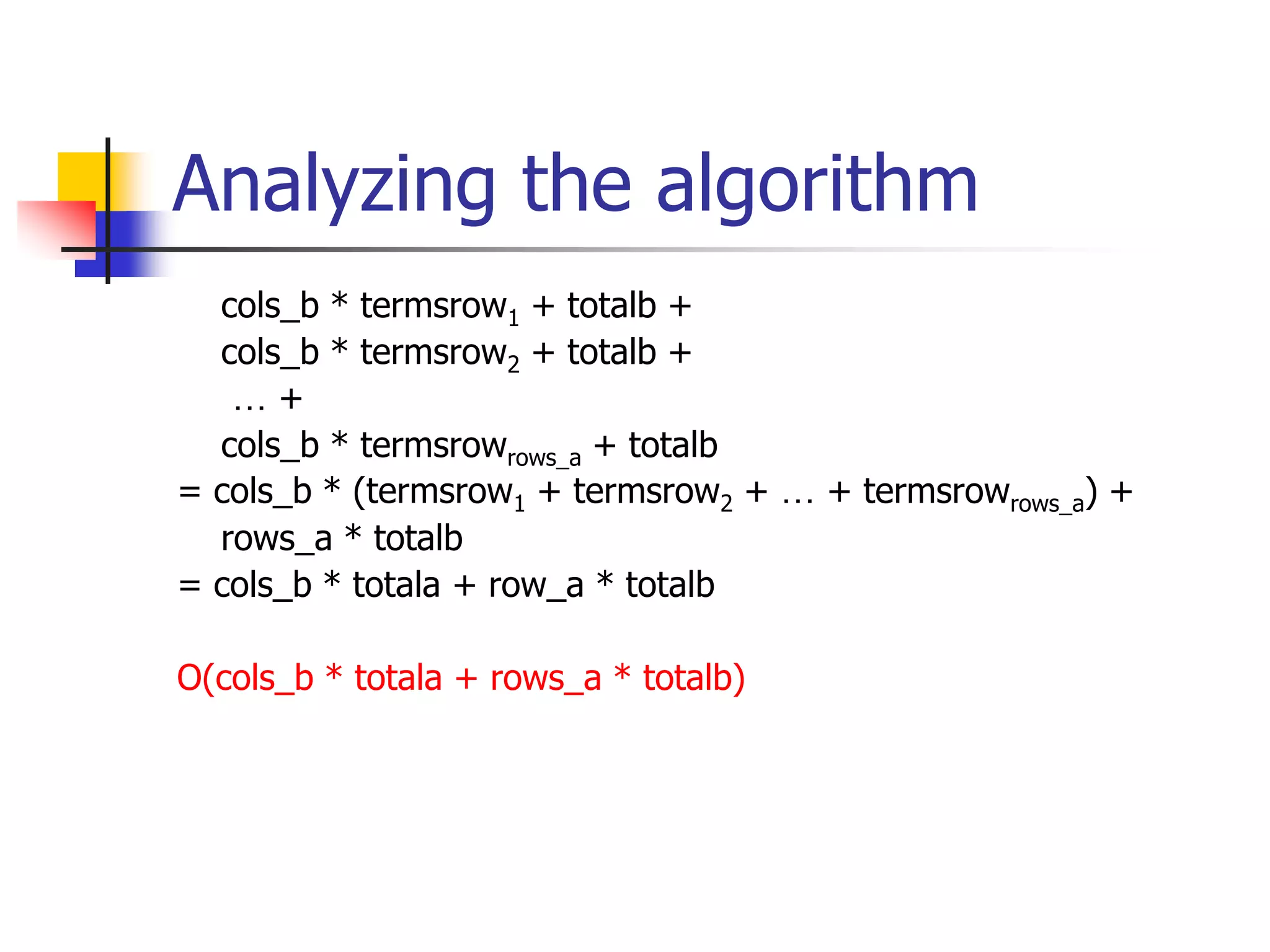
Analyzing the algorithm
cols_b * termsrow1 + totalb +
cols_b * termsrow2 + totalb +
… +
cols_b * termsrowrows_a + totalb
= cols_b * (termsrow1 + termsrow2 + … + termsrowrows_a) +
rows_a * totalb
= cols_b * totala + row_a * totalb
O(cols_b * totala + rows_a * totalb)
Compared with classic multiplication
algorithm
for (i =0; i < rows_a; i++)
for (j=0; j < cols_b; j++) {
sum =0;
for (k=0; k < cols_a; k++)
sum += (a[i][k] *b[k][j]);
d[i][j] =sum;
}
O(rows_a * cols_a * cols_b)
mmult vs. classic
O(cols_b * totala + rows_a * totalb) vs. O(rows_a * cols_a * cols_b)
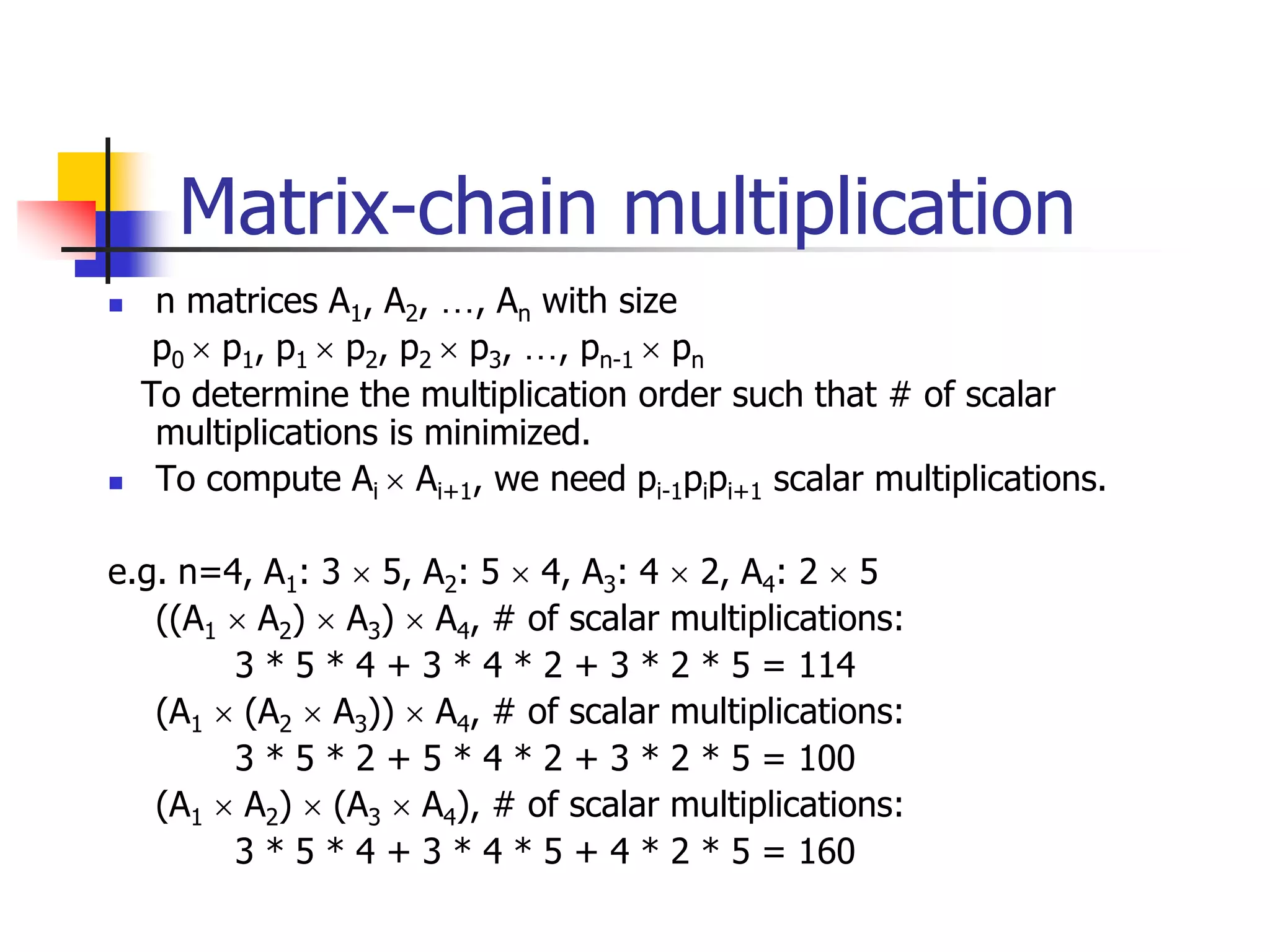
Matrix-chain multiplication
 n matrices A1, A2, …, An with size
p0  p1, p1  p2, p2  p3, …, pn-1  pn
To determine the multiplication order such that # of scalar
multiplications is minimized.
 To compute Ai  Ai+1, we need pi-1pipi+1 scalar multiplications.
e.g. n=4, A1: 3  5, A2: 5  4, A3: 4  2, A4: 2  5
((A1  A2)  A3)  A4, # of scalar multiplications:
3 * 5 * 4 + 3 * 4 * 2 + 3 * 2 * 5 = 114
(A1  (A2  A3))  A4, # of scalar multiplications:
3 * 5 * 2 + 5 * 4 * 2 + 3 * 2 * 5 = 100
(A1  A2)  (A3  A4), # of scalar multiplications:
3 * 5 * 4 + 3 * 4 * 5 + 4 * 2 * 5 = 160
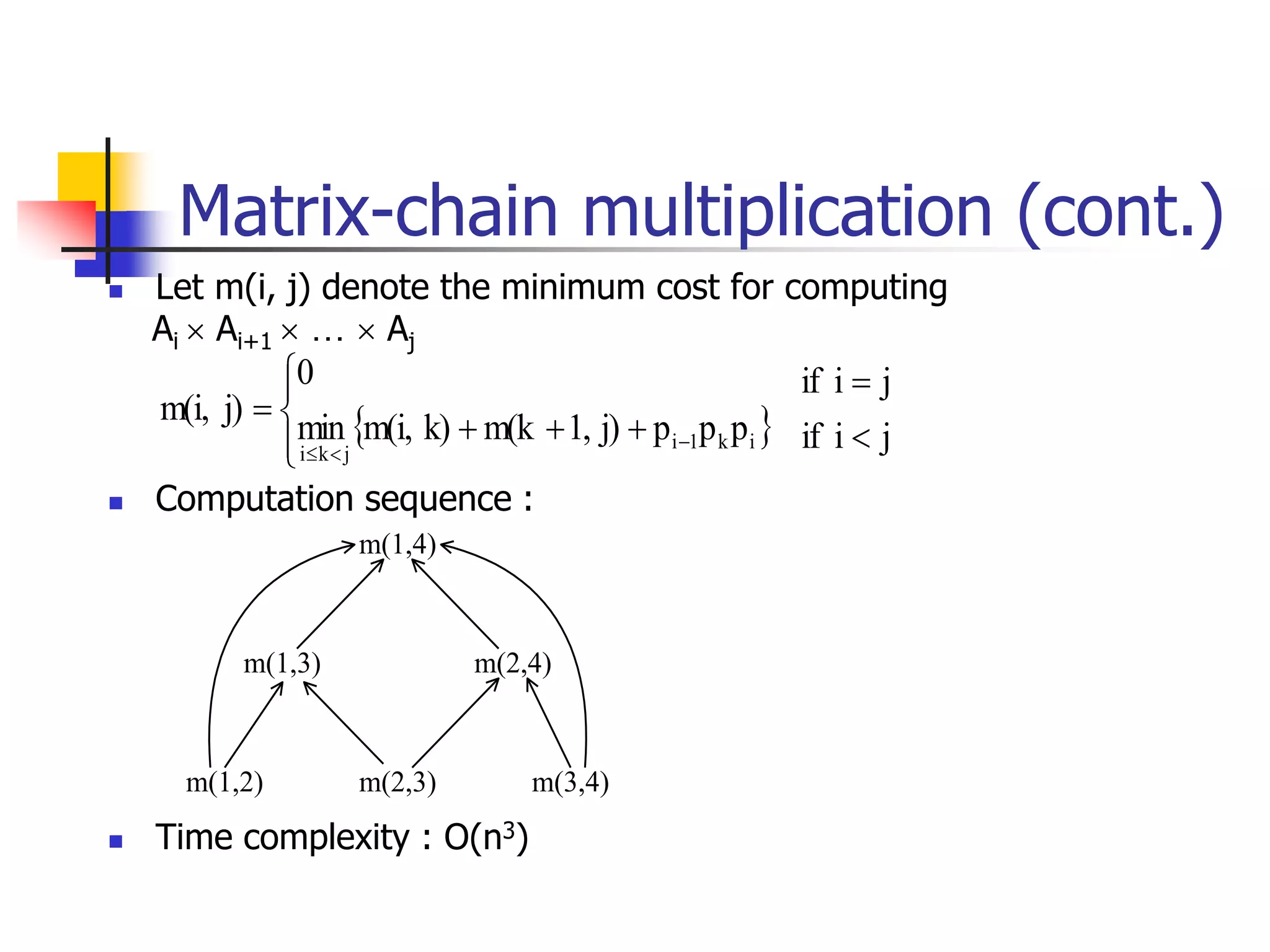
 Let m(i, j) denote the minimum cost for computing
Ai  Ai+1  …  Aj
 Computation sequence :
 Time complexity : O(n3)
m(1,4)
m(1,3) m(2,4)
m(1,2) m(2,3) m(3,4)
  j
i
if
j
i
if
p
p
p
j)
1,
m(k
k)
m(i,
min
0
j)
m(i,
i
k
1
i
j
k
i














Matrix-chain multiplication (cont.)
Outline
 The array as an abstract data type
 Structures and unions
 The polynomial abstract data type
 The sparse matrix abstract data type
 Representation of multidimensional arrays
 The string abstract data type
Representation of multidimensional arrays
 The internal representation of multidimensional arrays requires more
complex addressing formulas.
 a[upper0] [upper1]…[uppern-1]
=> #(elements of a) =
 There are two ways to represent multidimensional arrays:
row major order and column major order.
(row major order stores multidimensional arrays by rows)
Ex. A[upper0][upper1] : upper0 rows (row0, row1,… ,rowupper0-1),
each row containing upper1 elements
Assume that α is the address of A[0][0]
 the address of A[i][0] : α+ i *upper1
 A[i][j] : α+ i *upper1+j



1
0
n
i
i
upper
row major :
1 2 3 4
5 6 7 8
9 10 11 12
column major :
1 4 7 10
2 5 8 11
3 6 9 12
Representation of Multidimensional Arrays
(cont.)
 n dimensional array addressing formula for A[i0][i1]…[in-1] :
Assume that the address of A[0][0]…[0] is α.
 the address of A[i0][0][0]…[0] : α + i0*upper1*upper2*…*uppern-1
 A[i0][i1][0]…[0] : α + i0*upper1*upper2*…*uppern-1
+ i1*upper2*upper3*…*uppern-1
 A[i0][i1][i2]…[in-1] : α + i0*upper1*upper2*…*uppern-1
+ i1*upper2*upper3*…*uppern-1
+ i2*upper3*upper4*…*uppern-1
﹕
+ in-2*uppern-1
+ in-1
 


















1
0
1
1
1
1
1
0
,
:
,
n
i
n
n
j
k
k
j
j
j
a
n
j
upper
a
where
a
i

Outline
 The array as an abstract data type
 Structures and unions
 The polynomial abstract data type
 The sparse matrix abstract data type
 Representation of multidimensional arrays
 The string abstract data type
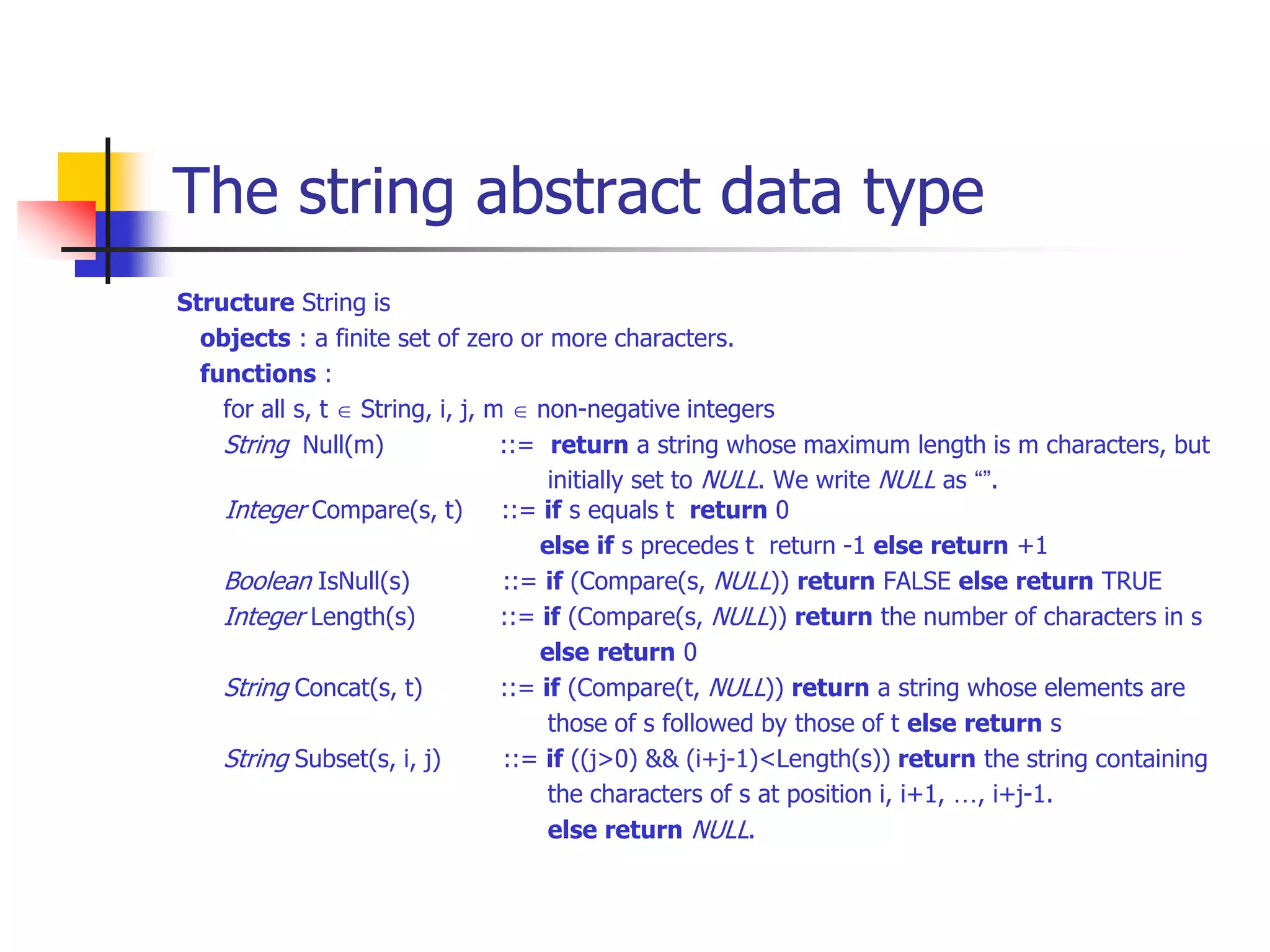
The string abstract data type
Structure String is
objects : a finite set of zero or more characters.
functions :
for all s, t  String, i, j, m  non-negative integers
String Null(m) ::= return a string whose maximum length is m characters, but
initially set to NULL. We write NULL as “”.
Integer Compare(s, t) ::= if s equals t return 0
else if s precedes t return -1 else return +1
Boolean IsNull(s) ::= if (Compare(s, NULL)) return FALSE else return TRUE
Integer Length(s) ::= if (Compare(s, NULL)) return the number of characters in s
else return 0
String Concat(s, t) ::= if (Compare(t, NULL)) return a string whose elements are
those of s followed by those of t else return s
String Subset(s, i, j) ::= if ((j>0) && (i+j-1)<Length(s)) return the string containing
the characters of s at position i, i+1, …, i+j-1.
else return NULL.
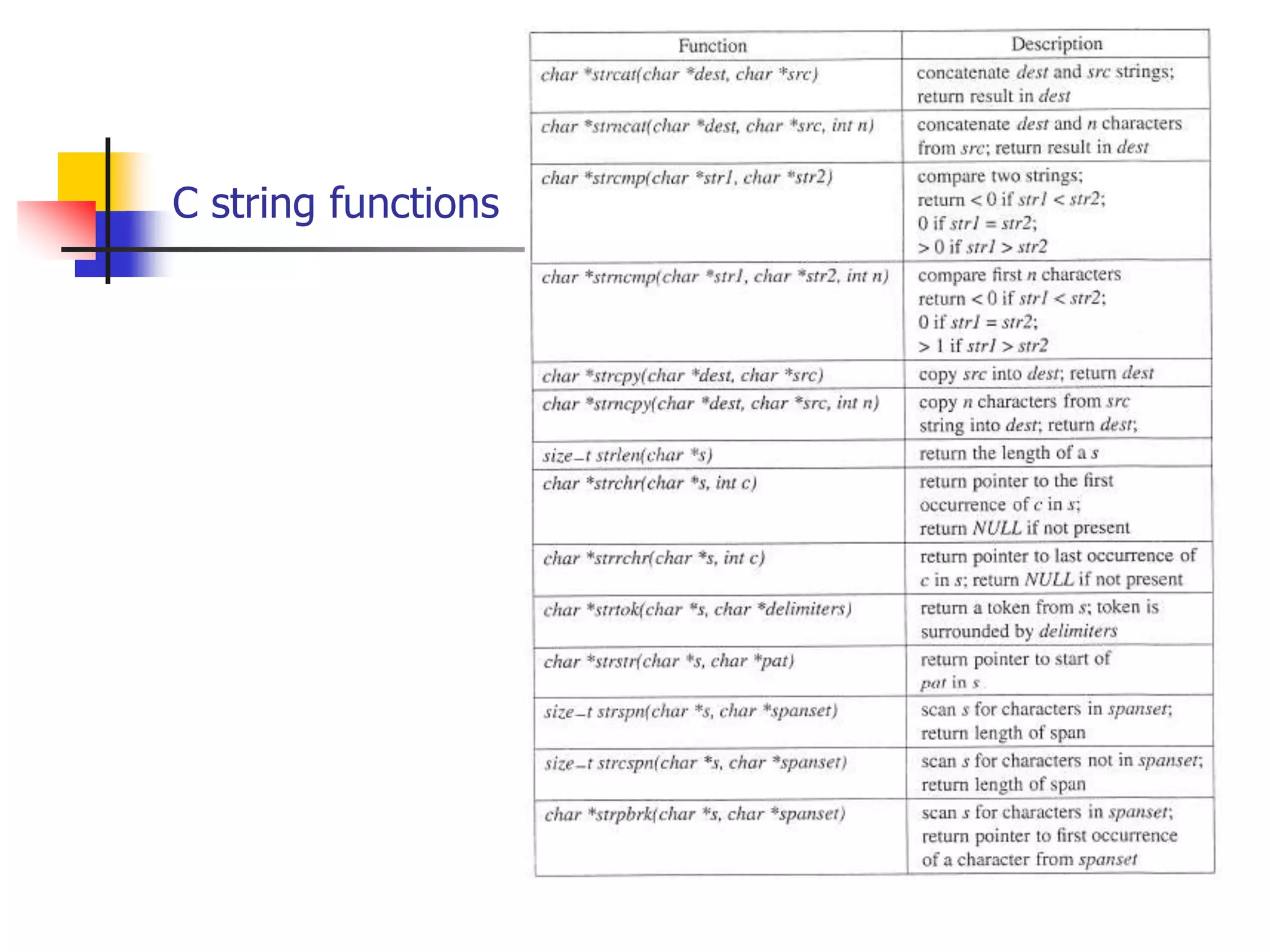
C string functions
String insertion function
void strnins(char *s, char *t, int i)
{
/* insert string t into string s at position i */
char string[MAX_SIZE], *temp = string;
if (i < 0 && i > strlen(s)) {
fprintf(stderr, ”Position is out of bounds n” );
exist(1);
}
if (!strlen(s))
strcpy(s, t);
else if (strlen(t)) {
strncpy(temp, s, i);
strcat(temp, t);
strcat(temp, (s+i));
strcpy(s, temp);
}
}
s → a m o b i l e 0
t → u t o 0
temp → 0
initially
temp → a 0
(a) after strncpy (temp, s, i)
temp → a u t o 0
(b) after strcat (temp, t)
temp → a u t o m o b i l e 0
(c) after strcat (temp, (s+i))
Example:
Never be used in practice, since it’s wasteful in use of time and space !
Pattern matching algorithm
(checking end indices first)
int nfind(char *string, char *pat)
{
/* match the lat character of pattern first, and then match from the beginning */
int i, j, start = 0;
int lasts = strlen(string) – 1;
int lastp = strlen(pat) – 1;
int endmatch = lastp;
for (i = 0; endmatch <= lasts; endmatch++, start++){
if (string[endmatch] == pat[lastp])
for (j = 0, i = start; j < lastp && string[i] == pat[j]; i++, j++)
;
if (j == lastp)
return start; /* successful */
}
return -1;
}
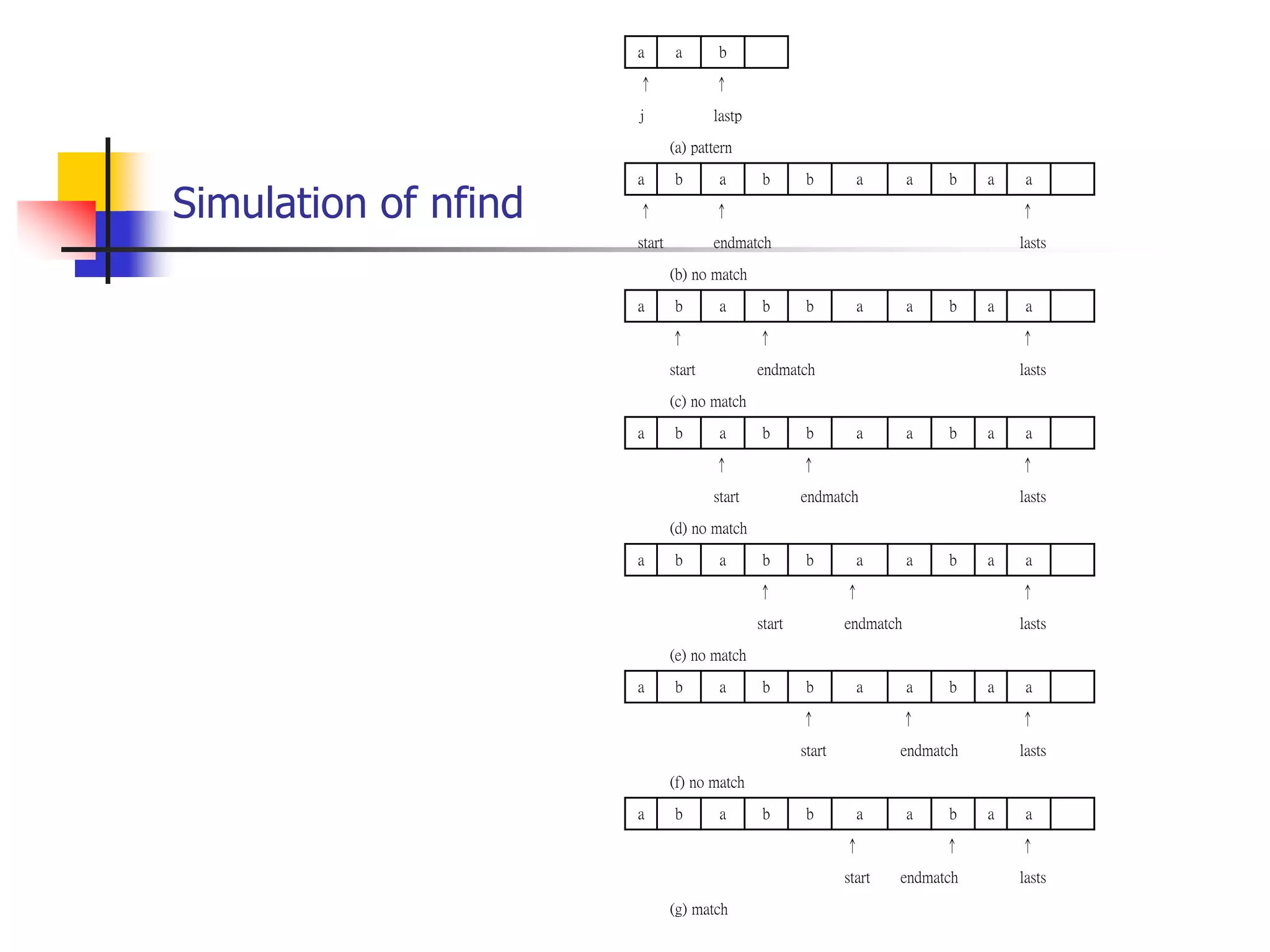
Simulation of nfind
a a b
↑ ↑
j lastp
(a) pattern
a b a b b a a b a a
↑ ↑ ↑
start endmatch lasts
(b) no match
a b a b b a a b a a
↑ ↑ ↑
start endmatch lasts
(c) no match
a b a b b a a b a a
↑ ↑ ↑
start endmatch lasts
(d) no match
a b a b b a a b a a
↑ ↑ ↑
start endmatch lasts
(e) no match
a b a b b a a b a a
↑ ↑ ↑
start endmatch lasts
(f) no match
a b a b b a a b a a
↑ ↑ ↑
start endmatch lasts
(g) match
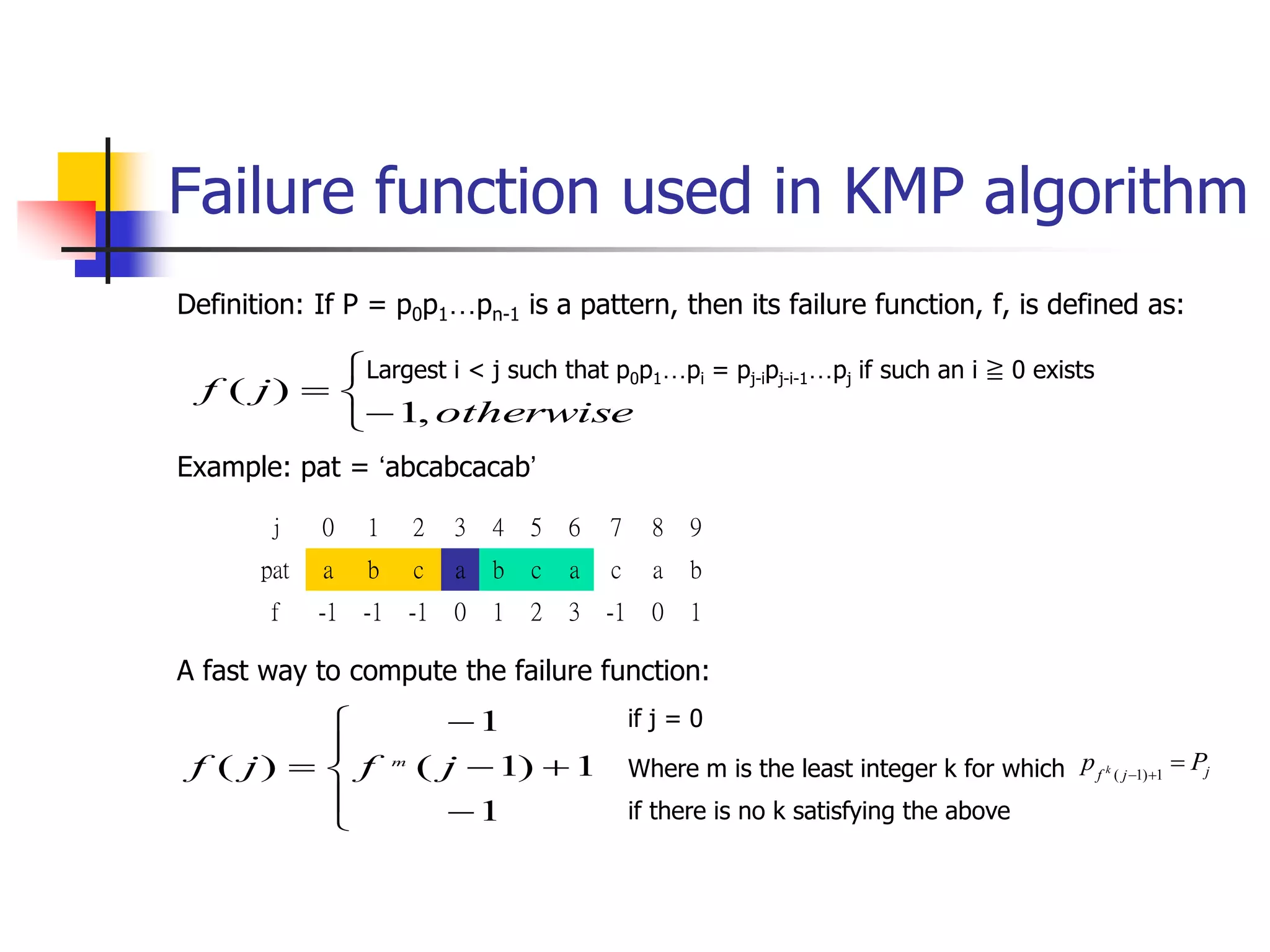
Failure function used in KMP algorithm
Definition: If P = p0p1…pn-1 is a pattern, then its failure function, f, is defined as:
Example: pat = ‘abcabcacab’
A fast way to compute the failure function:





otherwise
j
f
,
1
)
(
Largest i < j such that p0p1…pi = pj-ipj-i-1…pj if such an i ≧ 0 exists










1
1
)
1
(
1
)
( j
f
j
f m
if j = 0
Where m is the least integer k for which
if there is no k satisfying the above
j
j
f
P
p k 

 1
)
1
(
j 0 1 2 3 4 5 6 7 8 9
pat a b c a b c a c a b
f -1 -1 -1 0 1 2 3 -1 0 1
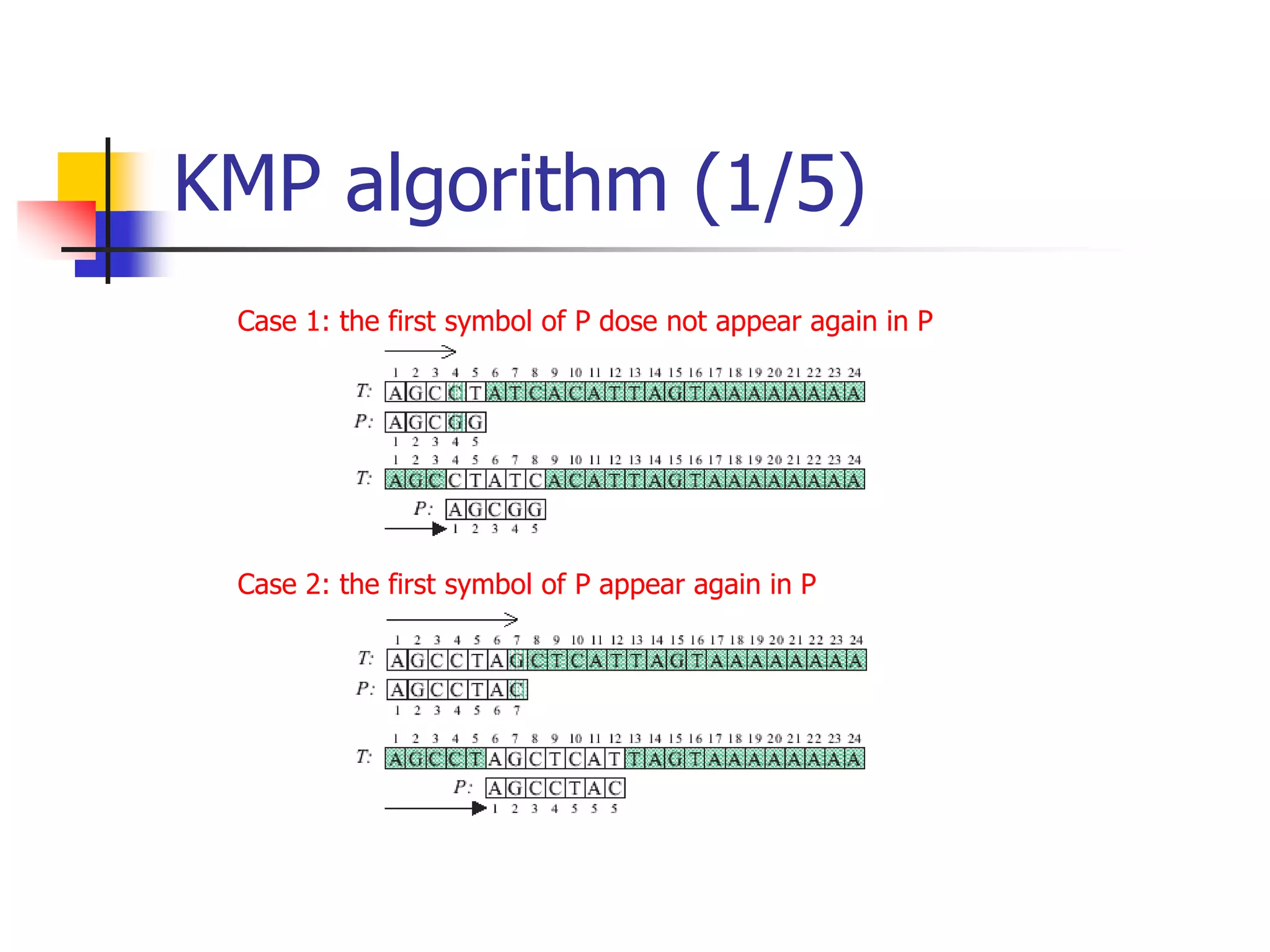
KMP algorithm (1/5)
Case 1: the first symbol of P dose not appear again in P
Case 2: the first symbol of P appear again in P
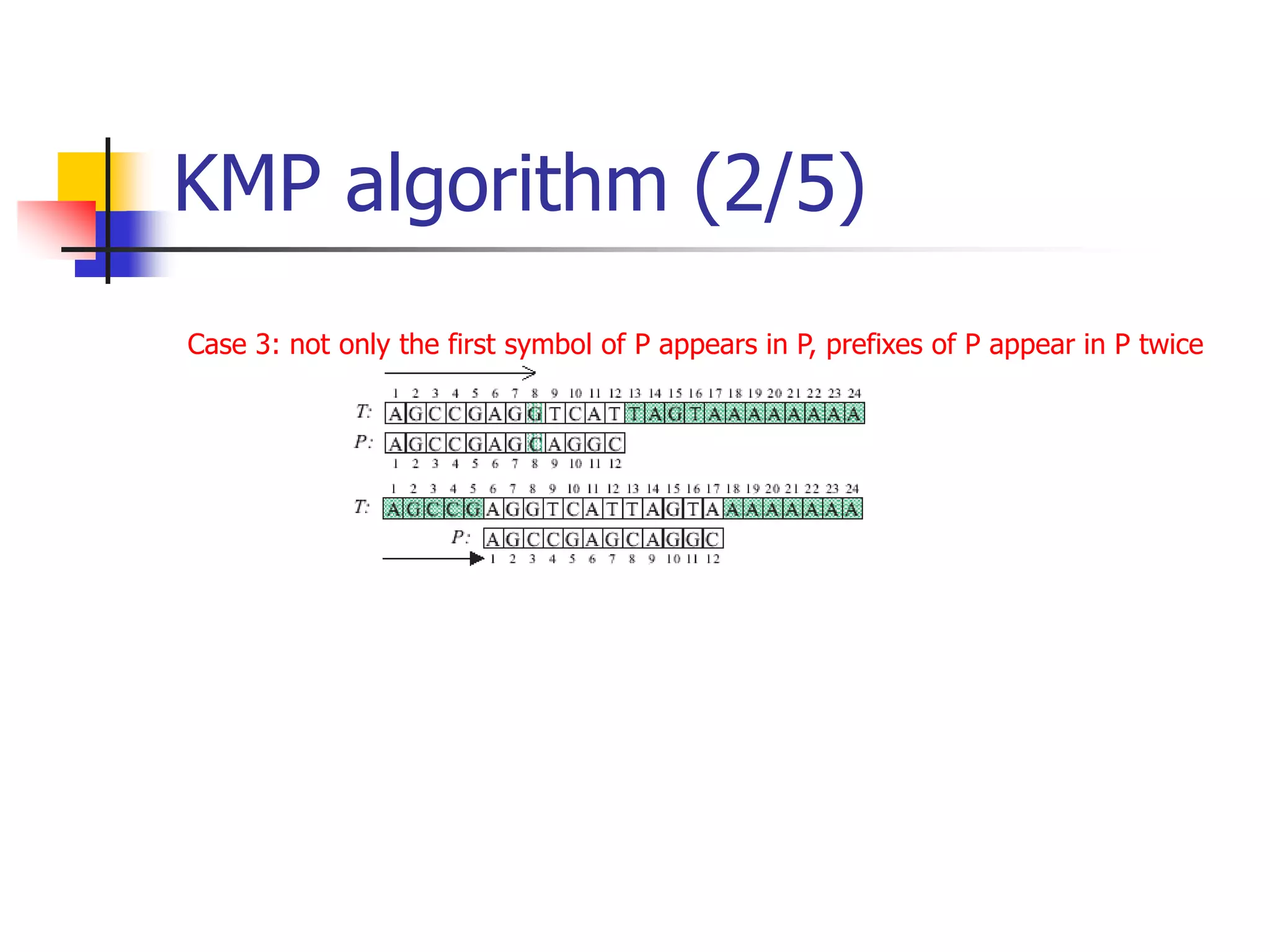
KMP algorithm (2/5)
Case 3: not only the first symbol of P appears in P, prefixes of P appear in P twice
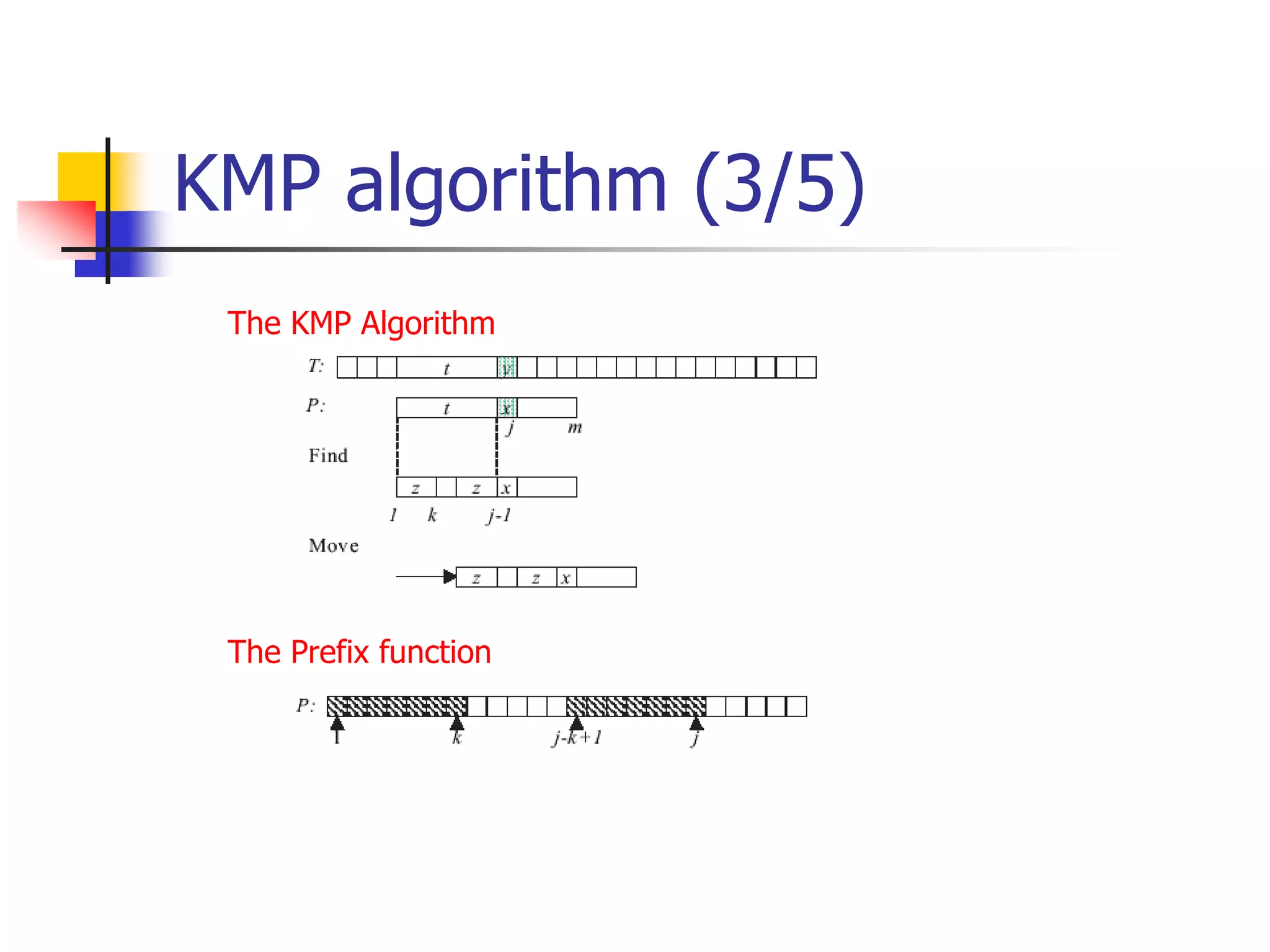
KMP algorithm (3/5)
The KMP Algorithm
The Prefix function
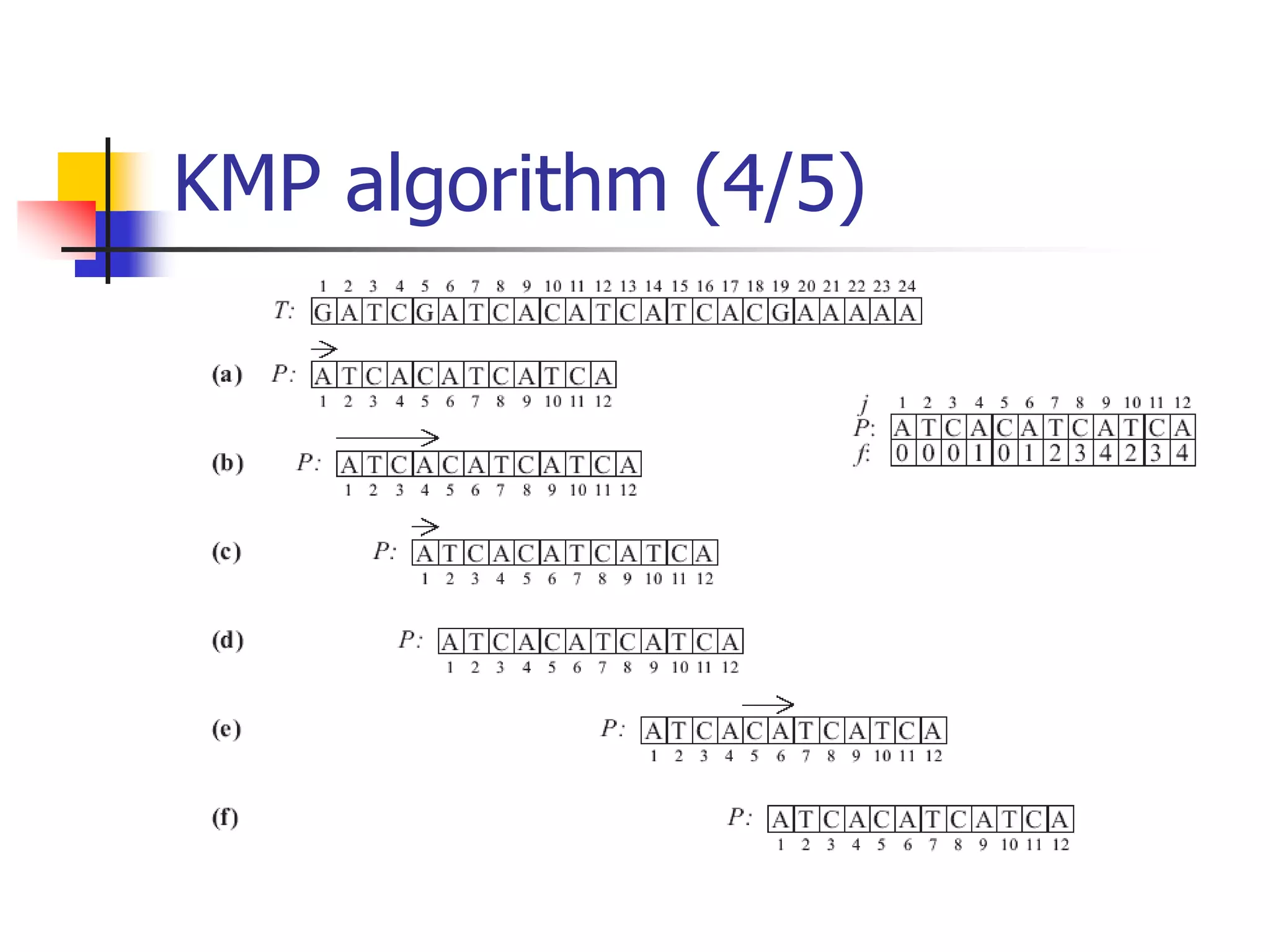
KMP algorithm (4/5)
KMP algorithm (5/5)
#include <stdio.h>
#include <string.h>
#define max_string_size 100
#define max_pattern_size 100
int pmatch();
void fail();
int failure[max_pattern_size];
char string[max_string_size];
char pat[max_pattern_size];
int pmatch (char *string, char *pat)
{
/* Knuth, Morris, Pratt string matching algorithm */
int i = 0, j =0;
int lens = strlen(string);
int lenp = strlen(pat);
while (i < lens && j < lenp) {
if (string[i] == pat[j]) { i++; j++; }
else if (j == 0) i++;
else j = failure[j-1] + 1;
}
return ( (j == lenp) ? (i-lenp) : -1);
}
void fail (char *pat)
{
/* compute the pattern’s failure function */
int n = strlen(pat);
failure[0] = -1;
for (j = 1; j < n; j++) {
i = failure[j-1];
while ((pat[j] != pat[i+1]) && (I >= 0))
i = failure[i];
if (pat[j] == pat[i+1])
failure[j] = i + 1;
else failure[j] = -1;
}
}
O(strlen(stirng))
O(strlen(pattern))
O(strlen(stirng)+strlen(pat))
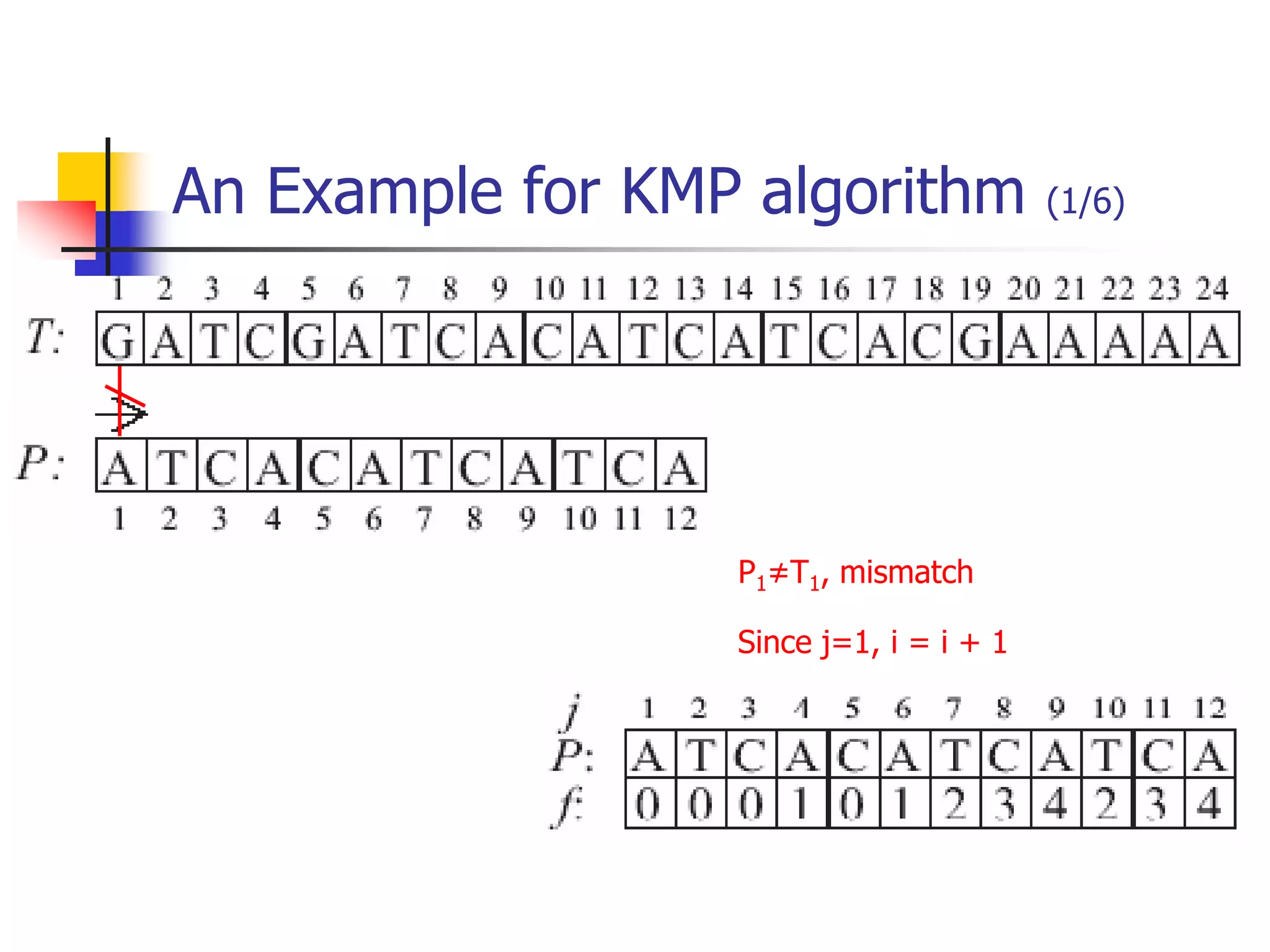
An Example for KMP algorithm (1/6)
P1≠T1, mismatch
Since j=1, i = i + 1
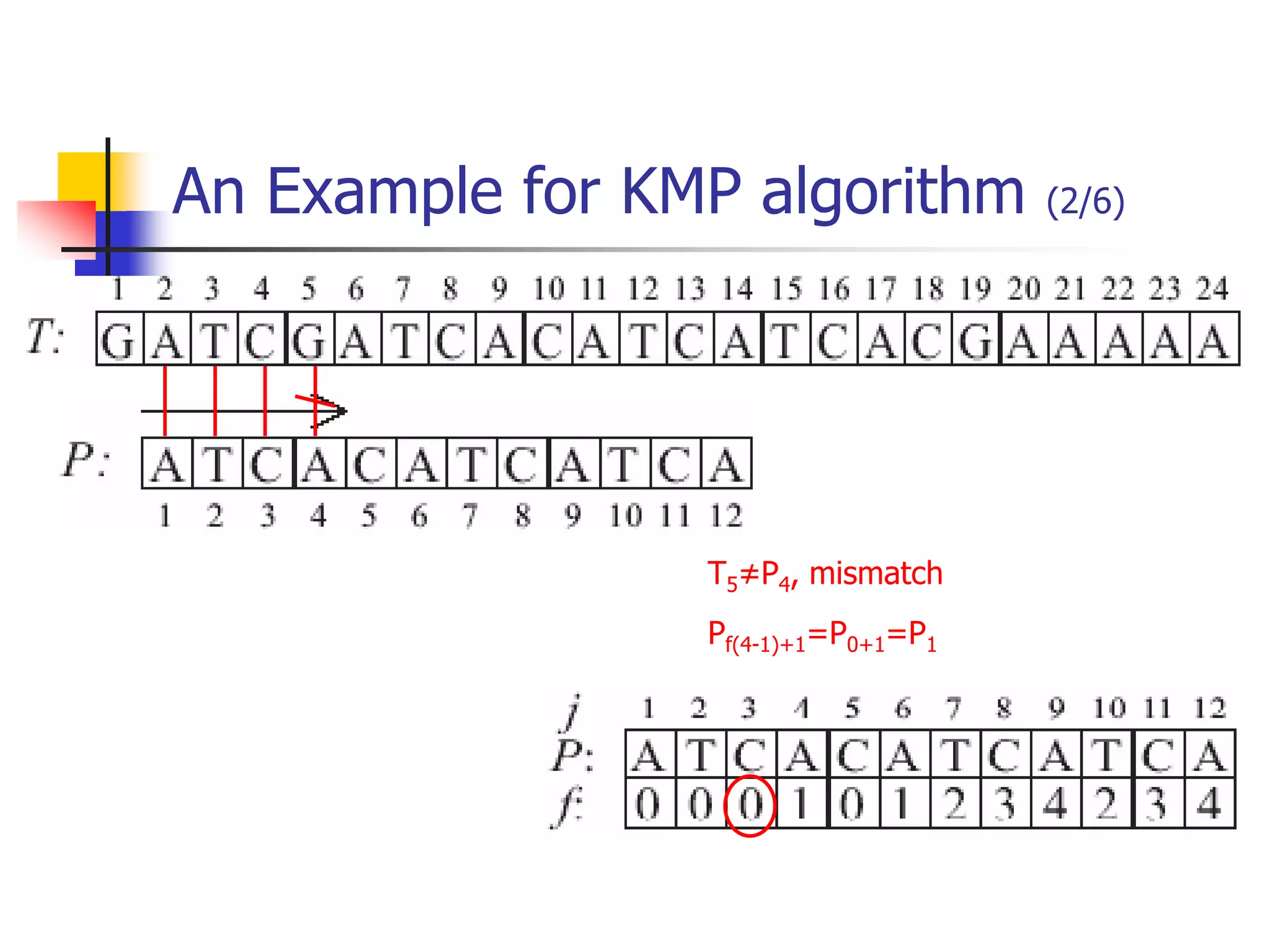
An Example for KMP algorithm (2/6)
T5≠P4, mismatch
Pf(4-1)+1=P0+1=P1
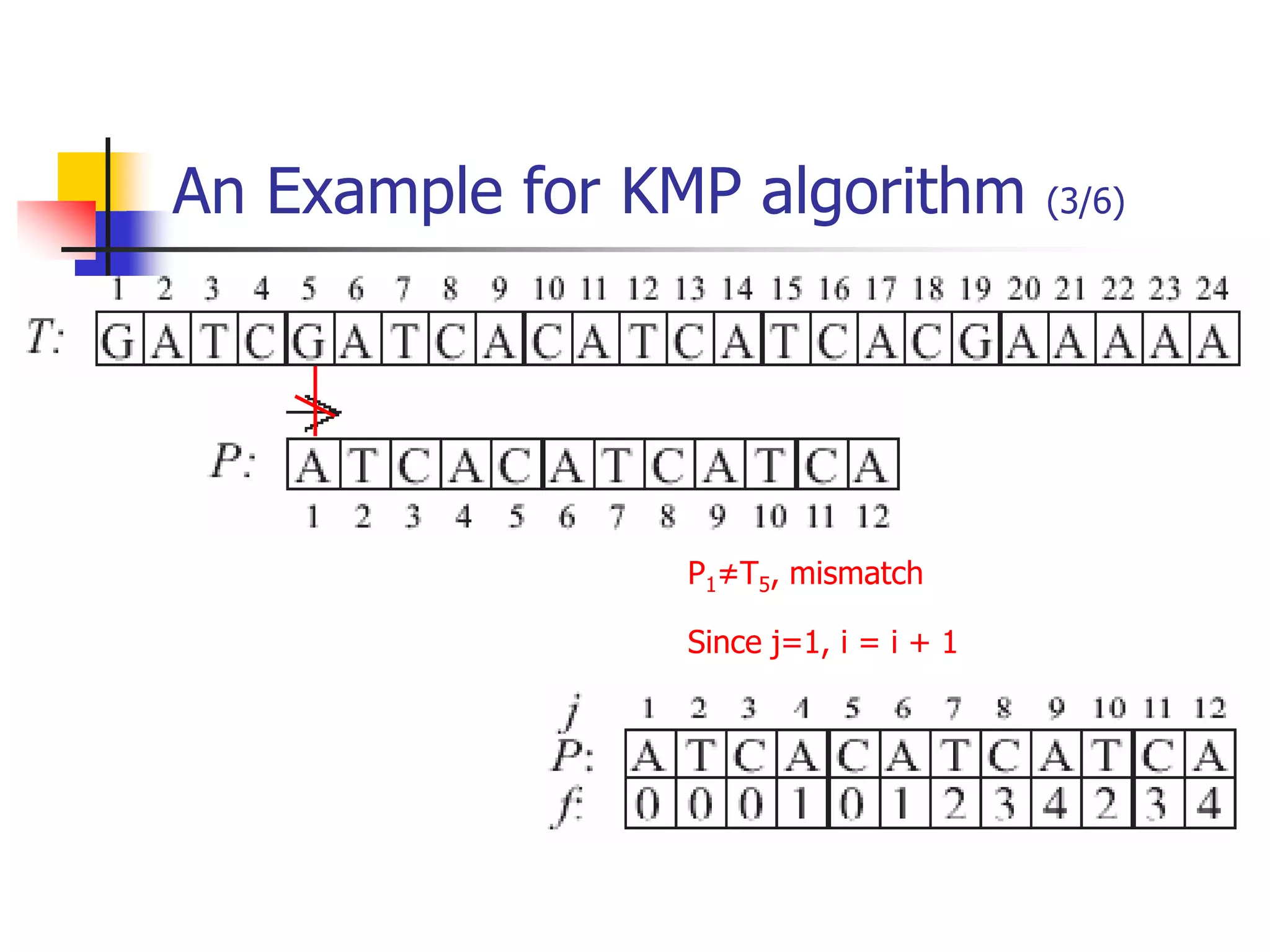
An Example for KMP algorithm (3/6)
P1≠T5, mismatch
Since j=1, i = i + 1
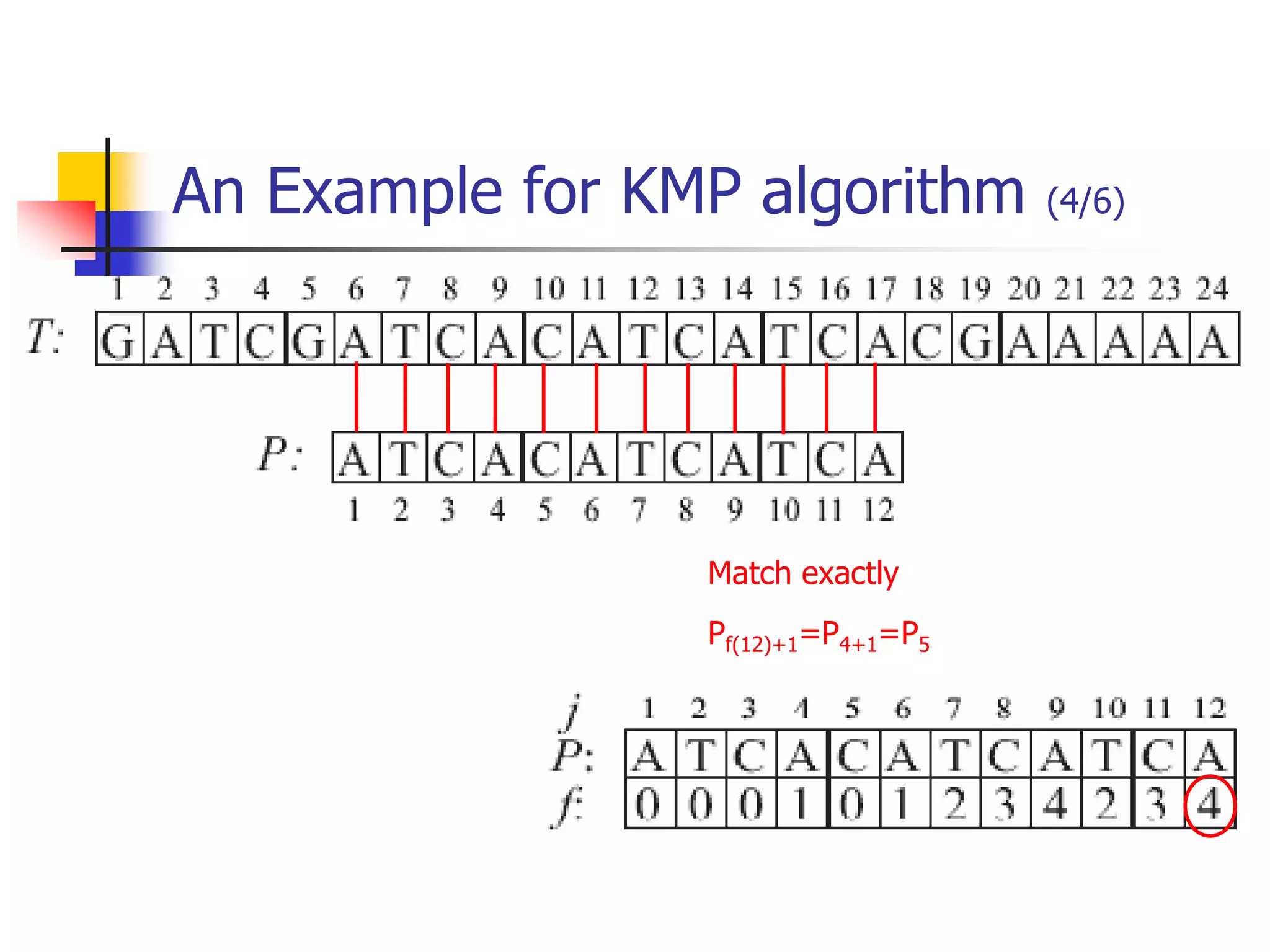
An Example for KMP algorithm (4/6)
Match exactly
Pf(12)+1=P4+1=P5
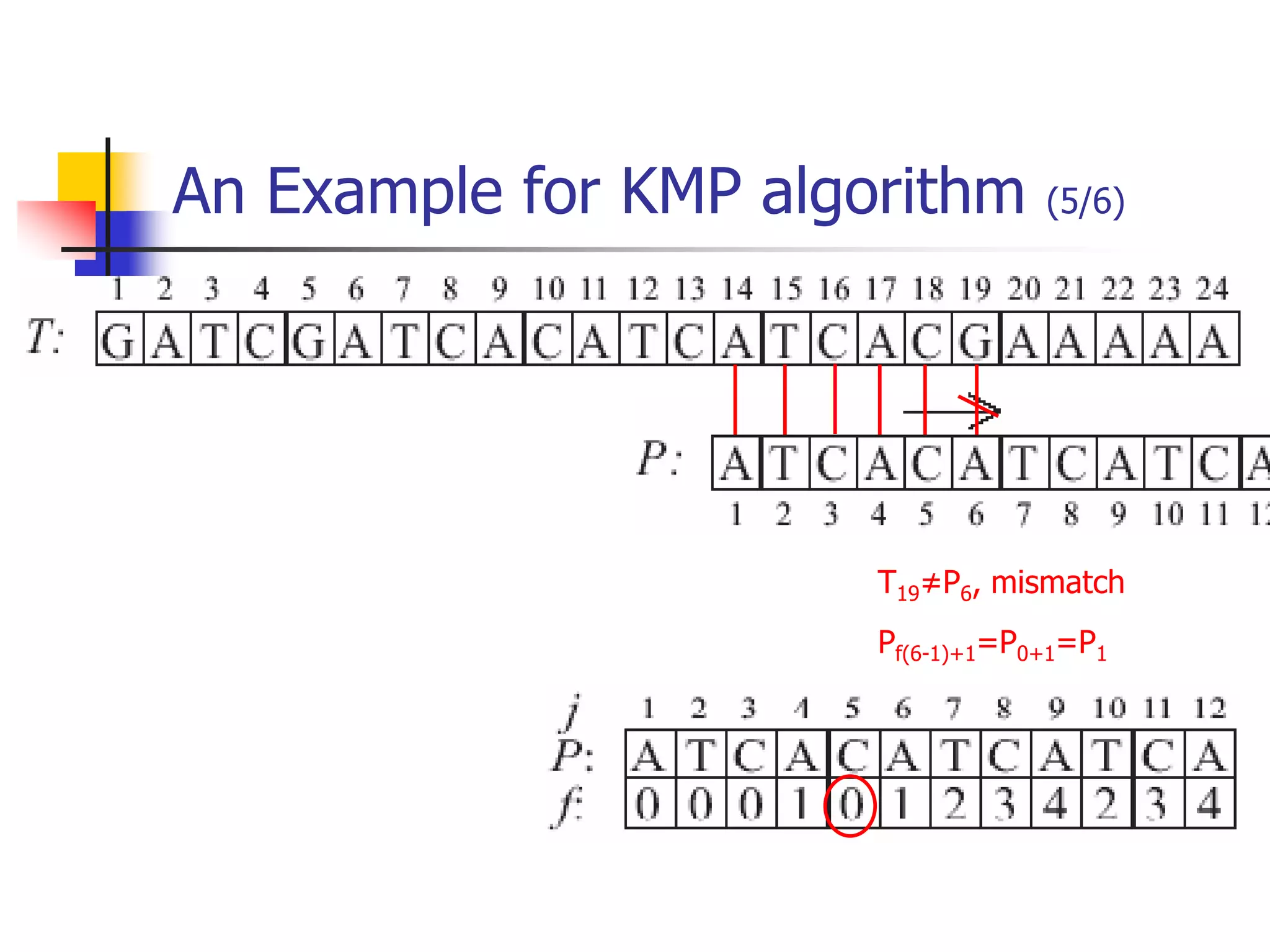
An Example for KMP algorithm (5/6)
T19≠P6, mismatch
Pf(6-1)+1=P0+1=P1
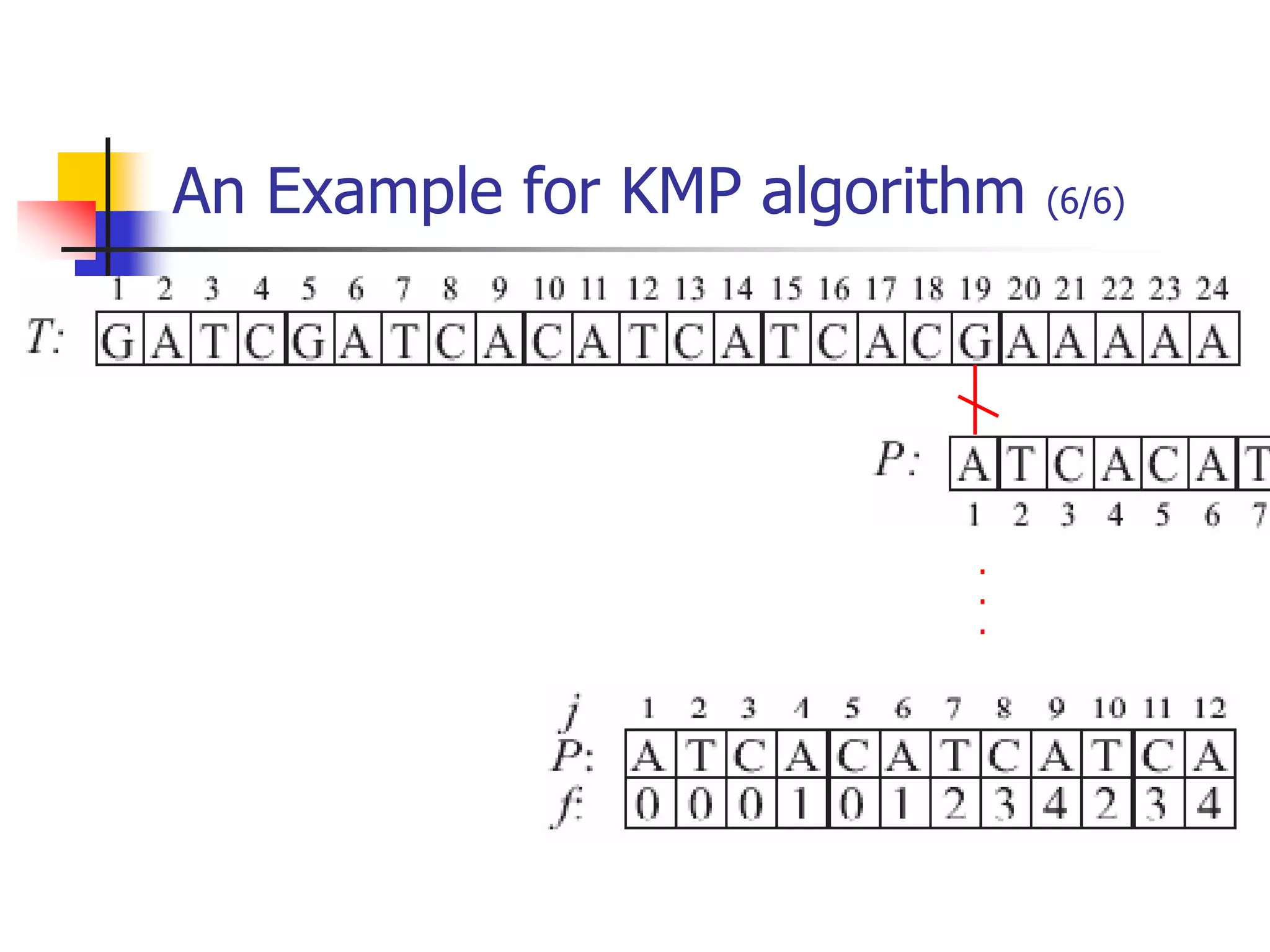
An Example for KMP algorithm (6/6)
.
.
.

Chap 2 Arrays and Structures.pptx

  • 1.
    Chapter 2 Arraysand Structures Instructors: C. Y. Tang and J. S. Roger Jang All the material are integrated from the textbook "Fundamentals of Data Structures in C" and some supplement from the slides of Prof. Hsin-Hsi Chen (NTU).
  • 2.
    Outline  The arrayas an abstract data type  Structures and unions  The polynomial abstract data type  The sparse matrix abstract data type  Representation of multidimensional arrays  The string abstract data type
  • 3.
    Outline  The arrayas an abstract data type  Structures and unions  The polynomial abstract data type  The sparse matrix abstract data type  Representation of multidimensional arrays  The string abstract data type
  • 4.
    Arrays Array: a setof index and value data structure For each index, there is a value associated with that index. representation (possible) implemented by using consecutive memory.
  • 5.
    Abstract Data TypeArray Structure Array is objects : a set of pairs <index, value> where for each value of index there is a value from the set item. functions: Array Create (j, list) : an array of j dimensions, where list is a j-tuple whose ith element is the size of the ith dimension. Item Retrieve (A, i) : If (i ε index) return the item indexed by i in array A, else return error. Array Store (A, i, x) : If (i ε index) insert <i, x> and return the new array, else return error. end Array
  • 6.
    Implementation in C int list[5], *plist[5]; Variable Memory Address list[0] base address = α list[1] α + sizeof(int) list[2] α + 2*sizeof(int) list[3] α + 3*sizeof(int) list[4] α + 4*sizeof(int) The names of the five array elements Assume the memory address α = 1414, list[0] = 6, list[2] = 8, plist[3] = list = 1414 printf(“%d”, list); // 1414, the variable “list” is the pointer to an int printf(“%d”, &list[0]) // 1414, return the address using “&” printf(“%d”, list[0]); // 6, the value stored in the address “&list[0]” printf(“%d”, (list + 2)); // 1414 + 2*sizeof(int), “(list +2)” is a pointer printf(“%d”, *(list + 2)); // 8 printf(“%d”, plist[3]); // 1414, the value of a pointer is an address printf(“%d”, *plist[3]); // 6
  • 7.
    Example: One-dimensional array accessedby address call print1(&one[0], 5) void print1(int *ptr, int rows) { /* print out a one-dimensional array using a pointer */ int i; printf(“Address Contentsn”); for (i=0; i < rows; i++) printf(“%8u%5dn”, ptr+i, *(ptr+i)); printf(“n”); } int one[] = {0, 1, 2, 3, 4}; Goal: print out address and value
  • 8.
    Example: Array program #defineMAX_SIZE 100 float sum(float [], int); float input[MAX_SIZE], answer; int i; void main (void) { for (i = 0; i < MAX_SIZE; i++) input[i] = i; answer = sum(input, MAX_SIZE); printf("The sum is: %fn", answer); } float sum(float list[], int n) { int i; float tempsum = 0; for (i = 0; i < n; i++) tempsum += list[i]; return tempsum; } Result : The sum is: 4950.000000
  • 9.
    Outline  The arrayas an abstract data type  Structures and unions  The polynomial abstract data type  The sparse matrix abstract data type  Representation of multidimensional arrays  The string abstract data type
  • 10.
    Structures (Records) struct { charname[10]; // a name that is a character array int age; // an integer value representing the age of the person float salary; // a float value representing the salary of the individual } person; strcpy(person.name, “james”); person.age=10; person.salary=35000;  An alternate way of grouping data that permits the data to vary in type.  Example:
  • 11.
    Create structure datatype typedef struct human_being { char name[10]; int age; float salary; }; or typedef struct { char name[10]; int age; float salary } human_being; human_being person1, person2;
  • 12.
    Example: Embed astructure within a structure typedef struct { int month; int day; int year; } date; typedef struct human_being { char name[10]; int age; float salary; date dob; }; person1.dob.month = 2; person1.dob.day = 11; person1.dob.year = 1944;
  • 13.
    Unions Similar to struct,but only one field is active. Example: Add fields for male and female. typedef struct sex_type { enum tag_field {female, male} sex; union { int children; boolean beard; } u; }; typedef struct human_being { char name[10]; int age; float salary; date dob; sex_type sex_info; } human_being person1, person2; person1.sex_info.sex = male; person1.sex_info.u.beard = FALSE; person2.sex_info.sex = female; person2.sex_info.u.children = 4;
  • 14.
    Self-Referential Structures One ormore of its components is a pointer to itself. typedef struct list { char data; list *link; }; list item1, item2, item3; item1.data=‘a’; item2.data=‘b’; item3.data=‘c’; item1.link=item2.link=item3.link=NULL; a b c Construct a list with three nodes item1.link=&item2; item2.link=&item3; malloc: obtain a node
  • 15.
    Outline  The arrayas an abstract data type  Structures and unions  The polynomial abstract data type  The sparse matrix abstract data type  Representation of multidimensional arrays  The string abstract data type
  • 16.
    Implementation on otherdata types  Arrays are not only data structures in their own right, we can also use them to implement other abstract data types.  Some examples of the ordered (linear) list : - Days of the week: (Sunday, Monday, Tuesday, Wednesday, Thursday, Friday, Saturday). - Values in a deck of cards: (Ace, 2, 3, 4, 5, 6, 7, 8, 9, 10, Jack, Queen, King) - Floors of a building: (basement, lobby, mezzanine, first, second)  Operations on lists : - Finding the length, n , of the list. - Reading the items from left to right (or right to left). - Retrieving the ith element from a list, 0 ≦ i < n. - Replacing the ith item of a list, 0 ≦ i < n. - Inserting a new item in the ith position of a list, 0 ≦ i < n. - Deleting an item from the ith position of a list, 0 ≦ i < n.
  • 17.
    Abstract data typePolynomial Structure Polynomial is objects: ; a set of ordered pairs of <ei,ai> where ai in Coefficients and ei in Exponents, ei are integers >= 0 functions: for all poly, poly1, poly2  Polynomial, coef Coefficients, expon Exponents Polynomial Zero( ) ::= return the polynomial, p(x) = 0 Boolean IsZero(poly) ::= if (poly) return FALSE else return TRUE Coefficient Coef(poly, expon) ::= if (expon  poly) return its coefficient else return Zero Exponent Lead_Exp(poly) ::= return the largest exponent in poly Polynomial Attach(poly,coef, expon) ::= if (expon  poly) return error else return the polynomial poly with the term <coef, expon> inserted Polynomial Remove(poly, expon) ::= if (expon  poly) return the polynomial poly with the term whose exponent is expon deleted else return error Polynomial SingleMult(poly, coef, expon) ::= return the polynomial poly • coef • xexpon Polynomial Add(poly1, poly2) ::= return the polynomial poly1 +poly2 Polynomial Mult(poly1, poly2) ::= return the polynomial poly1 • poly2 End Polynomial n e n e x a x a x p    ... ) ( 1 1 degree : the largest exponent of a polynomial
  • 18.
    Two types ofImplementation for the polynomial ADT Type I : #define MAX_DEGREE 1001 typedef struct { int degree; float coef[MAX_DEGREE]; } polynomial; polynomial a; a.degree = n a. coef[i] = an-i , 0 ≦ i ≦ n. Type II : MAX_TERMS 1001 /* size of terms array */ typedef struct { float coef; int expon; } polynomial; polynomial terms[MAX_TERMS]; int avail = 0; /* recording the available space*/ starta finisha startb finishb avail coef 2 1 1 10 3 1 exp 1000 0 4 3 2 0 0 1 2 3 4 5 6 advantage: easy implementation disadvantage: waste space when sparse storage requirements: start, finish, 2*(finish-start+1) nonparse: twice as much as Type I when all the items are nonzero PA=2x1000+1 PB=x4+10x3+3x2+1 Poly A coef 1 … 0 0 2 exp (index) 0 … 998 999 1000 Poly B coef 1 0 3 10 1 … 0 exp (index) 0 1 2 3 4 … 1000
  • 19.
    Polynomials addition ofType-I /* d =a + b, where a, b, and d are polynomials */ d = Zero( ) while (! IsZero(a) && ! IsZero(b)) do { switch COMPARE (Lead_Exp(a), Lead_Exp(b)) { case -1: d = Attach(d, Coef (b, Lead_Exp(b)), Lead_Exp(b)); b = Remove(b, Lead_Exp(b)); break; case 0: sum = Coef (a, Lead_Exp (a)) + Coef ( b, Lead_Exp(b)); if (sum) { Attach (d, sum, Lead_Exp(a)); a = Remove(a , Lead_Exp(a)); b = Remove(b , Lead_Exp(b)); } break; case 1: d = Attach(d, Coef (a, Lead_Exp(a)), Lead_Exp(a)); a = Remove(a, Lead_Exp(a)); } } insert any remaining terms of a or b into d // case -1: Lead_exp(a) < Lead_exp(b) // case 0: Lead_exp(a) = Lead_exp(b) // case 1: Lead_exp(a) < Lead_exp(b)
  • 20.
    Polynomials adding ofType I // A utility function to return maximum of two integers int max(int m, int n) { return (m > n)? m: n; } // A[] represents coefficients of first polynomial // B[] represents coefficients of second polynomial // m and n are sizes of A[] and B[] respectively int *add(int A[], int B[], int m, int n) { int size = max(m, n); int *sum = new int[size]; // Initialize the porduct polynomial for (int i = 0; i<m; i++) sum[i] = A[i]; // Take ever term of first polynomial for (int i=0; i<n; i++) sum[i] += B[i]; return sum; } // Driver program to test above functions int main() { // The following array represents polynomial 5 + 10x^2 + 6x^3 int A[] = {5, 0, 10, 6}; // The following array represents polynomial 1 + 2x + 4x^2 int B[] = {1, 2, 4}; int m = sizeof(A)/sizeof(A[0]); int n = sizeof(B)/sizeof(B[0]); printf("First polynomial is n“); printPoly(A, m); printf("nSecond polynomial is n“); printPoly(B, n); int *sum = add(A, B, m, n); int size = max(m, n); printf("nsum polynomial is n“) ; printPoly(sum, size); return 0; } void printPoly(int poly[], int n) { for (int i=0; i<n; i++) { cout << poly[i]; if (i != 0) cout << "x^" << i ; if (i != n-1) cout << " + "; } }
  • 21.
    Polynomial Multiplication // A[]represents coefficients of first polynomial // B[] represents coefficients of second polynomial // m and n are sizes of A[] and B[] respectively int *multiply(int A[], int B[], int m, int n) { int *prod = new int[m+n-1]; // Initialize the porduct polynomial for (int i = 0; i<m+n-1; i++) prod[i] = 0; // Multiply two polynomials term by term // Take ever term of first polynomial for (int i=0; i<m; i++) { // Multiply the current term of first polynomial // with every term of second polynomial. for (int j=0; j<n; j++) prod[i+j] += A[i]*B[j]; } return prod; } // Driver program to test above functions int main() { // The following array represents polynomial 5 + 10x^2 + 6x^3 int A[] = {5, 0, 10, 6}; // The following array represents polynomial 1 + 2x + 4x^2 int B[] = {1, 2, 4}; int m = sizeof(A)/sizeof(A[0]); int n = sizeof(B)/sizeof(B[0]); cout << "First polynomial is n"; printPoly(A, m); cout << "nSecond polynomial is n"; printPoly(B, n); int *prod = multiply(A, B, m, n); cout << "nProduct polynomial is n"; printPoly(prod, m+n-1); return 0; }
  • 22.
    Outline  The arrayas an abstract data type  Structures and unions  The polynomial abstract data type  The sparse matrix abstract data type  Representation of multidimensional arrays  The string abstract data type
  • 23.
    The sparse matrixabstract data type Matrix a Nonzero rate : 15/15 Dense ! col_0 col_1 col_2 row_0 -27 3 4 row_1 6 82 -2 row_2 109 -64 11 row_3 12 8 9 row_4 48 27 47 col_0 col_1 col_2 col_3 col_4 col_5 row_0 15 0 0 22 0 -15 row_1 0 11 3 0 0 0 row_2 0 0 0 -6 0 0 row_3 0 0 0 0 0 0 row_4 91 0 0 0 0 0 row_5 0 0 28 0 0 0 Matrix b Nonzero rate : 8/36 Sparse !
  • 24.
    Abstract data typeSparse_Matrix Structure Sparse_Matrix is objects: a set of triples, <row, column, value>, where row and column are integers and form a unique combination, and value comes from the set item. functions: for all a, b  Sparse_Matrix, x  item, i, j, max_col, max_row  index Sparse_Marix Create(max_row, max_col) ::= return a Sparse_matrix that can hold up to max_items = max _row  max_col and whose maximum row size is max_row and whose maximum column size is max_col. Sparse_Matrix Transpose(a) ::= return the matrix produced by interchanging the row and column value of every triple. Sparse_Matrix Add(a, b) ::= if the dimensions of a and b are the same return the matrix produced by adding corresponding items, namely those with identical row and column values. else return error Sparse_Matrix Multiply(a, b) ::= if number of columns in a equals number of rows in b return the matrix d produced by multiplying a by b according to the formula: d [i] [j] = (a[i][k]•b[k][j]) where d (i, j) is the (i,j)th element else return error.
  • 25.
    Sparse_Matrix Create andtranspose  #define MAX_TERMS 101 /* maximum number of terms +1*/ typedef struct { int col; int row; int value; } term; term a[MAX_TERMS]  for each row i (or column j) take element <i, j, value> and store it in element <j, i, value> of the transpose. row col value a[0] 6 6 8 [1] 0 0 15 [2] 0 3 22 [3] 0 5 -15 [4] 1 1 11 [5] 1 2 3 [6] 2 3 -6 [7] 4 0 91 [8] 5 2 28 row col value b[0] 6 6 8 [1] 0 0 15 [2] 0 4 91 [3] 1 1 11 [4] 2 1 3 [5] 2 5 28 [6] 3 0 22 [7] 3 2 -6 [8] 5 0 -15 Sparse matrix and its transpose stored as triples #(rows) #(columns) #(nonzero entries) any element within a matrix using the triple <row, col, value> Difficulty: what position to put <j, i, value> ?
  • 26.
    Transpose of asparse matrix in O(columns*elements) void transpose (term a[], term b[]) /* b is set to the transpose of a */ { int n, i, j, currentb; n = a[0].value; /* total number of elements */ b[0].row = a[0].col; /* rows in b = columns in a */ b[0].col = a[0].row; /*columns in b = rows in a */ b[0].value = n; if (n > 0) { /*non zero matrix */ currentb = 1; for (i = 0; i < a[0].col; i++) /* transpose by columns in a */ for( j = 1; j <= n; j++) /* find elements from the current column */ if (a[j].col == i) { /* element is in current column, add it to b */ b[currentb].row = a[j].col; b[currentb].col = a[j].row; b[currentb].value = a[j].value; currentb++ } } } Scan the array “columns” times. The array has “elements” elements. ==> O(columns*elements)
  • 27.
    Analysis and improvement Discussion:compared with 2-D array representation O(columns*elements) vs. O(columns*rows) #(elements)  columns * rows, when the matrix is not sparse. O(columns*elements)  O(columns*columns*rows) Problem: Scan the array “columns” times. Improvement: Determine the number of elements in each column of the original matrix. => Determine the starting positions of each row in the transpose matrix.
  • 28.
    Transpose of asparse matrix in O(columns + elements) void fast_transpose(term a[ ], term b[ ]) { /* the transpose of a is placed in b */ int row_terms[MAX_COL], starting_pos[MAX_COL]; int i, j, num_cols = a[0].col, num_terms = a[0].value; b[0].row = num_cols; b[0].col = a[0].row; b[0].value = num_terms; if (num_terms > 0){ /*nonzero matrix*/ for (i = 0; i < num_cols; i++) row_terms[i] = 0; for (i = 1; i <= num_terms; i++) row_terms[a[i].col]++ starting_pos[0] = 1; for (i =1; i < num_cols; i++) starting_pos[i]=starting_pos[i-1] +row_terms [i-1]; for (i=1; i <= num_terms, i++) { j = starting_pos[a[i].col]++; b[j].row = a[i].col; b[j].col = a[i].row; b[j].value = a[i].value; } } } O(num_cols) O(num_terms) O(num_cols-1) O(num_terms) O(columns + elements)
  • 29.
    Sparse matrix multiplication voidmmult (term a[ ], term b[ ], term d[ ] ) /* multiply two sparse matrices */ { int i, j, column, totalb = b[].value, totald = 0; int rows_a = a[0].row, cols_a = a[0].col, totala = a[0].value; int cols_b = b[0].col, int row_begin = 1, row = a[1].row, sum =0; int new_b[MAX_TERMS][3]; if (cols_a != b[0].row){ fprintf (stderr, “Incompatible matricesn”); exit (1); } fast_transpose(b, new_b); /* set boundary condition */ a[totala+1].row = rows_a; new_b[totalb+1].row = cols_b; new_b[totalb+1].col = 0; for (i = 1; i <= totala; ) { column = new_b[1].row; for (j = 1; j <= totalb+1;) { /* mutiply row of a by column of b */ if (a[i].row != row) { storesum(d, &totald, row, column, &sum); i = row_begin; for (; new_b[j].row == column; j++) ; column =new_b[j].row } else if (new_b[j].row != column){ storesum(d, &totald, row, column, &sum); i = row_begin; column = new_b[j].row; } else switch (COMPARE (a[i].col, new_b[j].col)) { case -1: /* go to next term in a */ i++; break; case 0: /* add terms, go to next term in a and b */ sum += (a[i++].value * new_b[j++].value); break; case 1: /* advance to next term in b*/ j++ } } /* end of for j <= totalb+1 */ for (; a[i].row == row; i++) ; row_begin = i; row = a[i].row; } /* end of for i <=totala */ d[0].row = rows_a; d[0].col = cols_b; d[0].value = totald; }
  • 30.
    storesum function void storesum(termd[ ], int *totald, int row, int column, int *sum) { /* if *sum != 0, then it along with its row and column position is stored as the *totald+1 entry in d */ if (*sum) if (*totald < MAX_TERMS) { d[++*totald].row = row; d[*totald].col = column; d[*totald].value = *sum; } else { fprintf(stderr, ”Numbers of terms in product exceed %dn”, MAX_TERMS); exit(1); } }
  • 31.
    Analyzing the algorithm cols_b* termsrow1 + totalb + cols_b * termsrow2 + totalb + … + cols_b * termsrowrows_a + totalb = cols_b * (termsrow1 + termsrow2 + … + termsrowrows_a) + rows_a * totalb = cols_b * totala + row_a * totalb O(cols_b * totala + rows_a * totalb)
  • 32.
    Compared with classicmultiplication algorithm for (i =0; i < rows_a; i++) for (j=0; j < cols_b; j++) { sum =0; for (k=0; k < cols_a; k++) sum += (a[i][k] *b[k][j]); d[i][j] =sum; } O(rows_a * cols_a * cols_b) mmult vs. classic O(cols_b * totala + rows_a * totalb) vs. O(rows_a * cols_a * cols_b)
  • 33.
    Matrix-chain multiplication  nmatrices A1, A2, …, An with size p0  p1, p1  p2, p2  p3, …, pn-1  pn To determine the multiplication order such that # of scalar multiplications is minimized.  To compute Ai  Ai+1, we need pi-1pipi+1 scalar multiplications. e.g. n=4, A1: 3  5, A2: 5  4, A3: 4  2, A4: 2  5 ((A1  A2)  A3)  A4, # of scalar multiplications: 3 * 5 * 4 + 3 * 4 * 2 + 3 * 2 * 5 = 114 (A1  (A2  A3))  A4, # of scalar multiplications: 3 * 5 * 2 + 5 * 4 * 2 + 3 * 2 * 5 = 100 (A1  A2)  (A3  A4), # of scalar multiplications: 3 * 5 * 4 + 3 * 4 * 5 + 4 * 2 * 5 = 160
  • 34.
     Let m(i,j) denote the minimum cost for computing Ai  Ai+1  …  Aj  Computation sequence :  Time complexity : O(n3) m(1,4) m(1,3) m(2,4) m(1,2) m(2,3) m(3,4)   j i if j i if p p p j) 1, m(k k) m(i, min 0 j) m(i, i k 1 i j k i               Matrix-chain multiplication (cont.)
  • 35.
    Outline  The arrayas an abstract data type  Structures and unions  The polynomial abstract data type  The sparse matrix abstract data type  Representation of multidimensional arrays  The string abstract data type
  • 36.
    Representation of multidimensionalarrays  The internal representation of multidimensional arrays requires more complex addressing formulas.  a[upper0] [upper1]…[uppern-1] => #(elements of a) =  There are two ways to represent multidimensional arrays: row major order and column major order. (row major order stores multidimensional arrays by rows) Ex. A[upper0][upper1] : upper0 rows (row0, row1,… ,rowupper0-1), each row containing upper1 elements Assume that α is the address of A[0][0]  the address of A[i][0] : α+ i *upper1  A[i][j] : α+ i *upper1+j    1 0 n i i upper row major : 1 2 3 4 5 6 7 8 9 10 11 12 column major : 1 4 7 10 2 5 8 11 3 6 9 12
  • 37.
    Representation of MultidimensionalArrays (cont.)  n dimensional array addressing formula for A[i0][i1]…[in-1] : Assume that the address of A[0][0]…[0] is α.  the address of A[i0][0][0]…[0] : α + i0*upper1*upper2*…*uppern-1  A[i0][i1][0]…[0] : α + i0*upper1*upper2*…*uppern-1 + i1*upper2*upper3*…*uppern-1  A[i0][i1][i2]…[in-1] : α + i0*upper1*upper2*…*uppern-1 + i1*upper2*upper3*…*uppern-1 + i2*upper3*upper4*…*uppern-1 ﹕ + in-2*uppern-1 + in-1                     1 0 1 1 1 1 1 0 , : , n i n n j k k j j j a n j upper a where a i 
  • 38.
    Outline  The arrayas an abstract data type  Structures and unions  The polynomial abstract data type  The sparse matrix abstract data type  Representation of multidimensional arrays  The string abstract data type
  • 39.
    The string abstractdata type Structure String is objects : a finite set of zero or more characters. functions : for all s, t  String, i, j, m  non-negative integers String Null(m) ::= return a string whose maximum length is m characters, but initially set to NULL. We write NULL as “”. Integer Compare(s, t) ::= if s equals t return 0 else if s precedes t return -1 else return +1 Boolean IsNull(s) ::= if (Compare(s, NULL)) return FALSE else return TRUE Integer Length(s) ::= if (Compare(s, NULL)) return the number of characters in s else return 0 String Concat(s, t) ::= if (Compare(t, NULL)) return a string whose elements are those of s followed by those of t else return s String Subset(s, i, j) ::= if ((j>0) && (i+j-1)<Length(s)) return the string containing the characters of s at position i, i+1, …, i+j-1. else return NULL.
  • 40.
  • 41.
    String insertion function voidstrnins(char *s, char *t, int i) { /* insert string t into string s at position i */ char string[MAX_SIZE], *temp = string; if (i < 0 && i > strlen(s)) { fprintf(stderr, ”Position is out of bounds n” ); exist(1); } if (!strlen(s)) strcpy(s, t); else if (strlen(t)) { strncpy(temp, s, i); strcat(temp, t); strcat(temp, (s+i)); strcpy(s, temp); } } s → a m o b i l e 0 t → u t o 0 temp → 0 initially temp → a 0 (a) after strncpy (temp, s, i) temp → a u t o 0 (b) after strcat (temp, t) temp → a u t o m o b i l e 0 (c) after strcat (temp, (s+i)) Example: Never be used in practice, since it’s wasteful in use of time and space !
  • 42.
    Pattern matching algorithm (checkingend indices first) int nfind(char *string, char *pat) { /* match the lat character of pattern first, and then match from the beginning */ int i, j, start = 0; int lasts = strlen(string) – 1; int lastp = strlen(pat) – 1; int endmatch = lastp; for (i = 0; endmatch <= lasts; endmatch++, start++){ if (string[endmatch] == pat[lastp]) for (j = 0, i = start; j < lastp && string[i] == pat[j]; i++, j++) ; if (j == lastp) return start; /* successful */ } return -1; }
  • 43.
    Simulation of nfind aa b ↑ ↑ j lastp (a) pattern a b a b b a a b a a ↑ ↑ ↑ start endmatch lasts (b) no match a b a b b a a b a a ↑ ↑ ↑ start endmatch lasts (c) no match a b a b b a a b a a ↑ ↑ ↑ start endmatch lasts (d) no match a b a b b a a b a a ↑ ↑ ↑ start endmatch lasts (e) no match a b a b b a a b a a ↑ ↑ ↑ start endmatch lasts (f) no match a b a b b a a b a a ↑ ↑ ↑ start endmatch lasts (g) match
  • 44.
    Failure function usedin KMP algorithm Definition: If P = p0p1…pn-1 is a pattern, then its failure function, f, is defined as: Example: pat = ‘abcabcacab’ A fast way to compute the failure function:      otherwise j f , 1 ) ( Largest i < j such that p0p1…pi = pj-ipj-i-1…pj if such an i ≧ 0 exists           1 1 ) 1 ( 1 ) ( j f j f m if j = 0 Where m is the least integer k for which if there is no k satisfying the above j j f P p k    1 ) 1 ( j 0 1 2 3 4 5 6 7 8 9 pat a b c a b c a c a b f -1 -1 -1 0 1 2 3 -1 0 1
  • 45.
    KMP algorithm (1/5) Case1: the first symbol of P dose not appear again in P Case 2: the first symbol of P appear again in P
  • 46.
    KMP algorithm (2/5) Case3: not only the first symbol of P appears in P, prefixes of P appear in P twice
  • 47.
    KMP algorithm (3/5) TheKMP Algorithm The Prefix function
  • 48.
  • 49.
    KMP algorithm (5/5) #include<stdio.h> #include <string.h> #define max_string_size 100 #define max_pattern_size 100 int pmatch(); void fail(); int failure[max_pattern_size]; char string[max_string_size]; char pat[max_pattern_size]; int pmatch (char *string, char *pat) { /* Knuth, Morris, Pratt string matching algorithm */ int i = 0, j =0; int lens = strlen(string); int lenp = strlen(pat); while (i < lens && j < lenp) { if (string[i] == pat[j]) { i++; j++; } else if (j == 0) i++; else j = failure[j-1] + 1; } return ( (j == lenp) ? (i-lenp) : -1); } void fail (char *pat) { /* compute the pattern’s failure function */ int n = strlen(pat); failure[0] = -1; for (j = 1; j < n; j++) { i = failure[j-1]; while ((pat[j] != pat[i+1]) && (I >= 0)) i = failure[i]; if (pat[j] == pat[i+1]) failure[j] = i + 1; else failure[j] = -1; } } O(strlen(stirng)) O(strlen(pattern)) O(strlen(stirng)+strlen(pat))
  • 50.
    An Example forKMP algorithm (1/6) P1≠T1, mismatch Since j=1, i = i + 1
  • 51.
    An Example forKMP algorithm (2/6) T5≠P4, mismatch Pf(4-1)+1=P0+1=P1
  • 52.
    An Example forKMP algorithm (3/6) P1≠T5, mismatch Since j=1, i = i + 1
  • 53.
    An Example forKMP algorithm (4/6) Match exactly Pf(12)+1=P4+1=P5
  • 54.
    An Example forKMP algorithm (5/6) T19≠P6, mismatch Pf(6-1)+1=P0+1=P1
  • 55.
    An Example forKMP algorithm (6/6) . . .