Chapter 5 – System Modeling
Lecture 1
1
Chapter 5 System modeling
Topics covered
 Context models
 Interaction models
 Structural models
 Behavioral models
 Model-driven engineering
2
Chapter 5 System modeling
System modeling
 System modeling is the process of developing abstract
models of a system, with each model presenting a
different view or perspective of that system.
 System modeling has now come to mean representing a
system using some kind of graphical notation, which is
now almost always based on notations in the Unified
Modeling Language (UML).
 System modelling helps the analyst to understand the
functionality of the system and models are used to
communicate with customers.
3
Chapter 5 System modeling
Existing and planned system models
 Models of the existing system are used during requirements
engineering. They help clarify what the existing system does
and can be used as a basis for discussing its strengths and
weaknesses. These then lead to requirements for the new
system.
 Models of the new system are used during requirements
engineering to help explain the proposed requirements to
other system stakeholders. Engineers use these models to
discuss design proposals and to document the system for
implementation.
 In a model-driven engineering process, it is possible to
generate a complete or partial system implementation from
the system model.
4
Chapter 5 System modeling
System perspectives
 An external perspective, where you model the context or
environment of the system.
 An interaction perspective, where you model the
interactions between a system and its environment, or
between the components of a system.
 A structural perspective, where you model the
organization of a system or the structure of the data that
is processed by the system.
 A behavioral perspective, where you model the dynamic
behavior of the system and how it responds to events.
5
Chapter 5 System modeling
UML diagram types
 Activity diagrams, which show the activities involved in a
process or in data processing .
 Use case diagrams, which show the interactions
between a system and its environment.
 Sequence diagrams, which show interactions between
actors and the system and between system components.
 Class diagrams, which show the object classes in the
system and the associations between these classes.
 State diagrams, which show how the system reacts to
internal and external events.
6
Chapter 5 System modeling
Use of graphical models
 As a means of facilitating discussion about an existing or
proposed system
 Incomplete and incorrect models are OK as their role is to
support discussion.
 As a way of documenting an existing system
 Models should be an accurate representation of the system but
need not be complete.
 As a detailed system description that can be used to
generate a system implementation
 Models have to be both correct and complete.
7
Chapter 5 System modeling
Context models
8
Chapter 5 System modeling
Interaction models
 Modeling user interaction is important as it helps to
identify user requirements.
 Modeling system-to-system interaction highlights the
communication problems that may arise.
 Modeling component interaction helps us understand if a
proposed system structure is likely to deliver the required
system performance and dependability.
 Use case diagrams and sequence diagrams may be
used for interaction modeling.
9
Chapter 5 System modeling
Use case modeling
 Use cases were developed originally to support
requirements elicitation and now incorporated into the
UML.
 Each use case represents a discrete task that involves
external interaction with a system.
 Actors in a use case may be people or other systems.
 Represented diagramatically to provide an overview of
the use case and in a more detailed textual form.
10
Chapter 5 System modeling
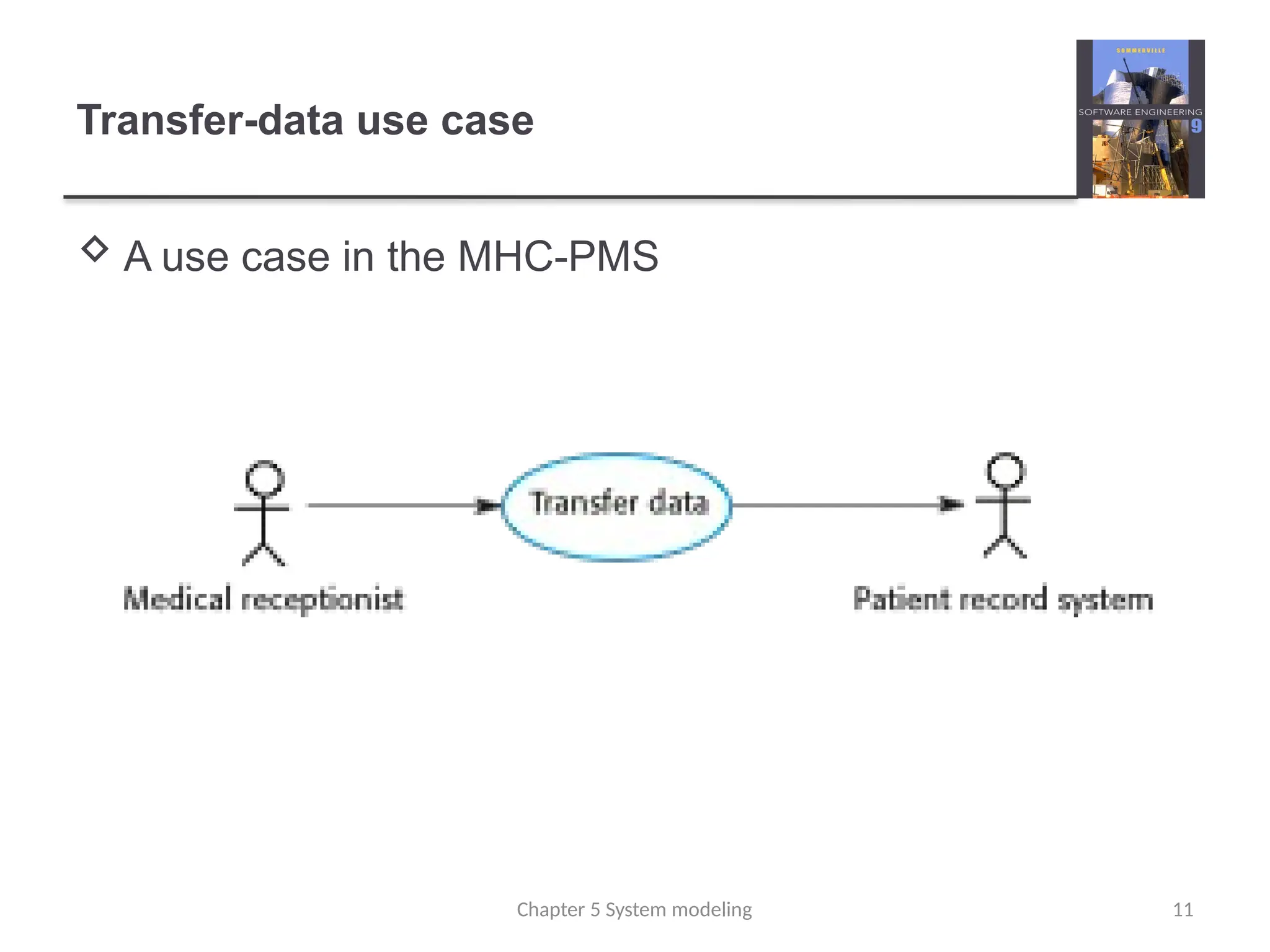
Transfer-data use case
 A use case in the MHC-PMS
11
Chapter 5 System modeling
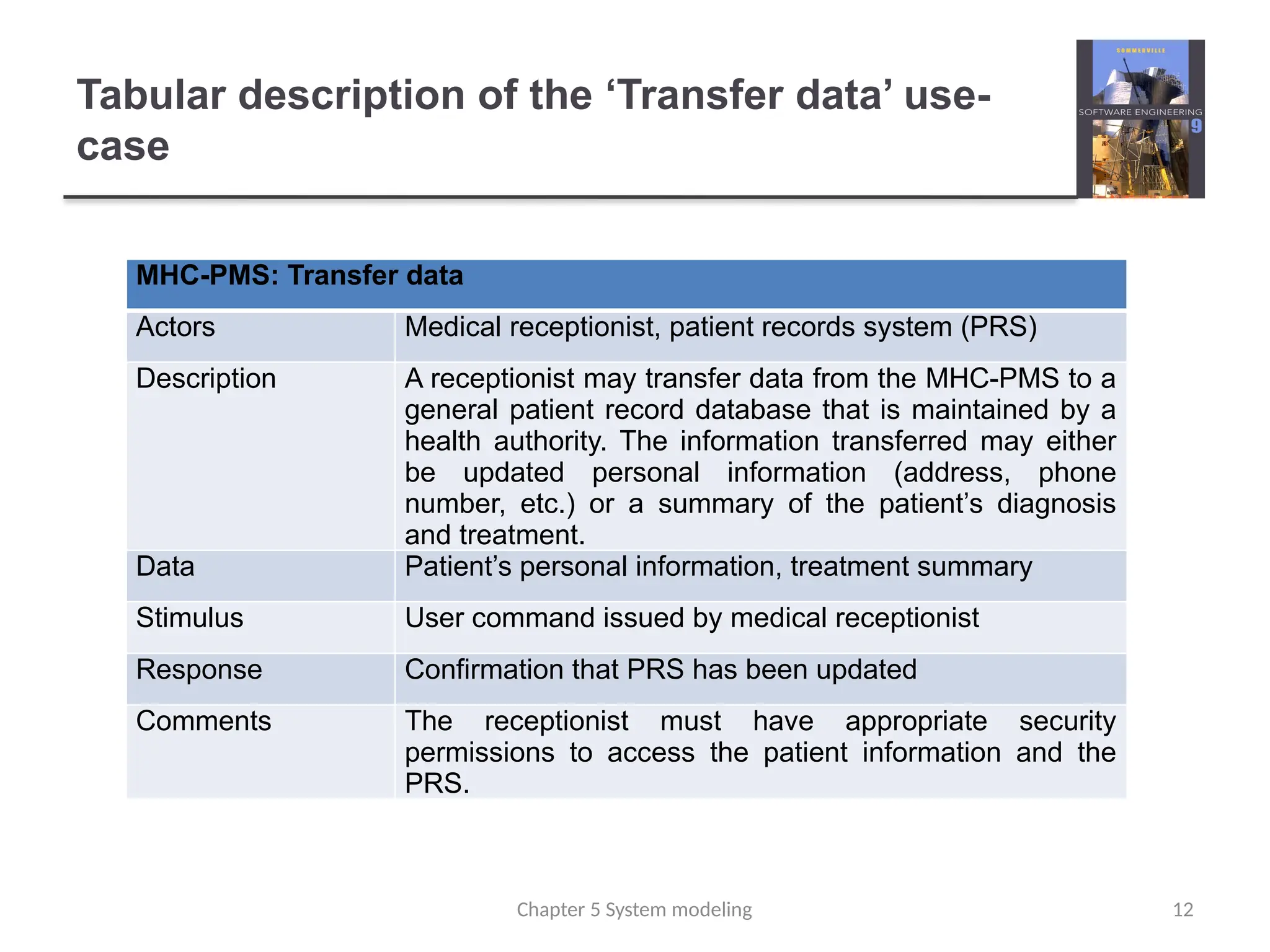
Tabular description of the ‘Transfer data’ use-
case
MHC-PMS: Transfer data
Actors Medical receptionist, patient records system (PRS)
Description A receptionist may transfer data from the MHC-PMS to a
general patient record database that is maintained by a
health authority. The information transferred may either
be updated personal information (address, phone
number, etc.) or a summary of the patient’s diagnosis
and treatment.
Data Patient’s personal information, treatment summary
Stimulus User command issued by medical receptionist
Response Confirmation that PRS has been updated
Comments The receptionist must have appropriate security
permissions to access the patient information and the
PRS.
12
Chapter 5 System modeling
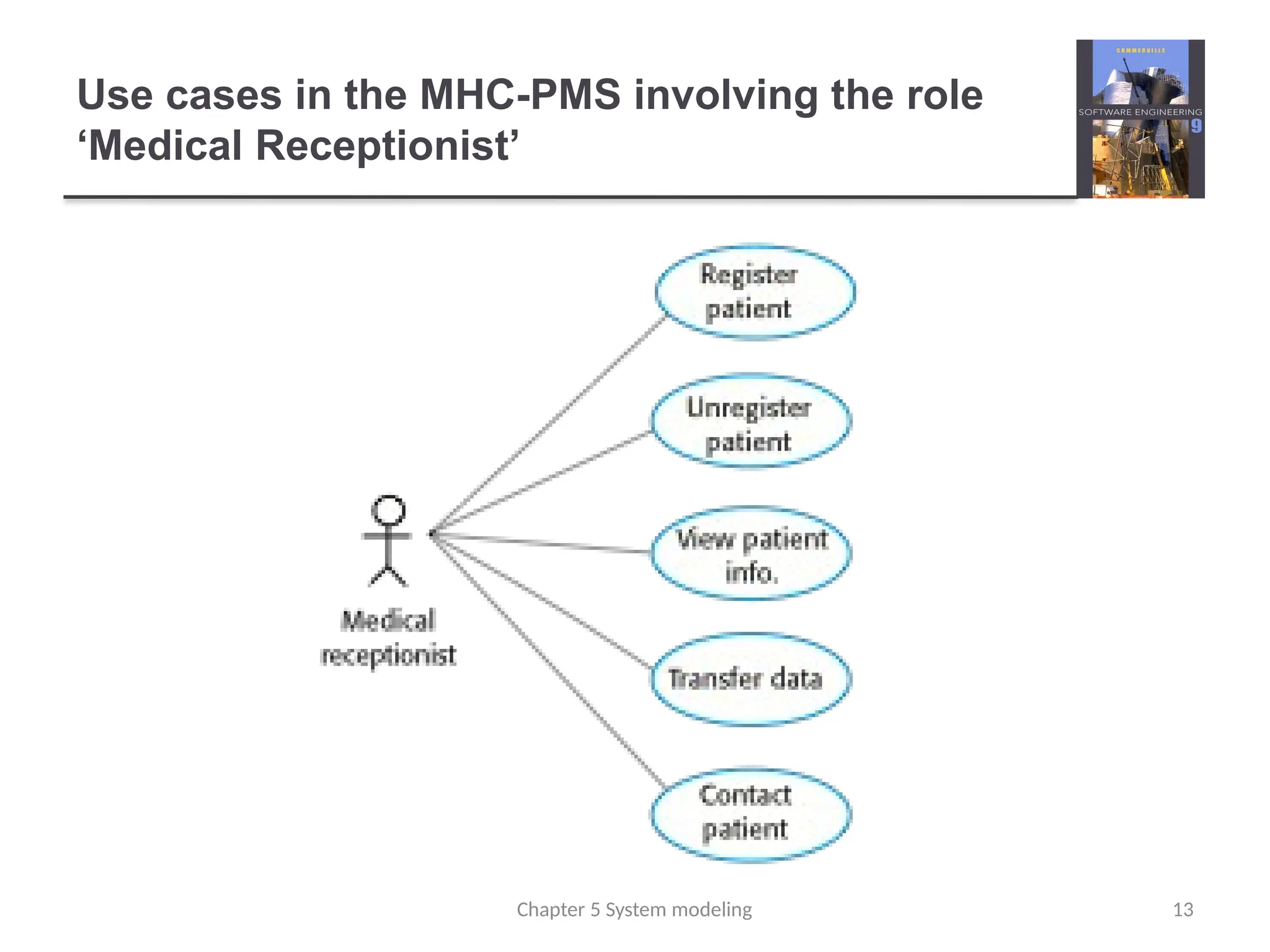
Use cases in the MHC-PMS involving the role
‘Medical Receptionist’
13
Chapter 5 System modeling
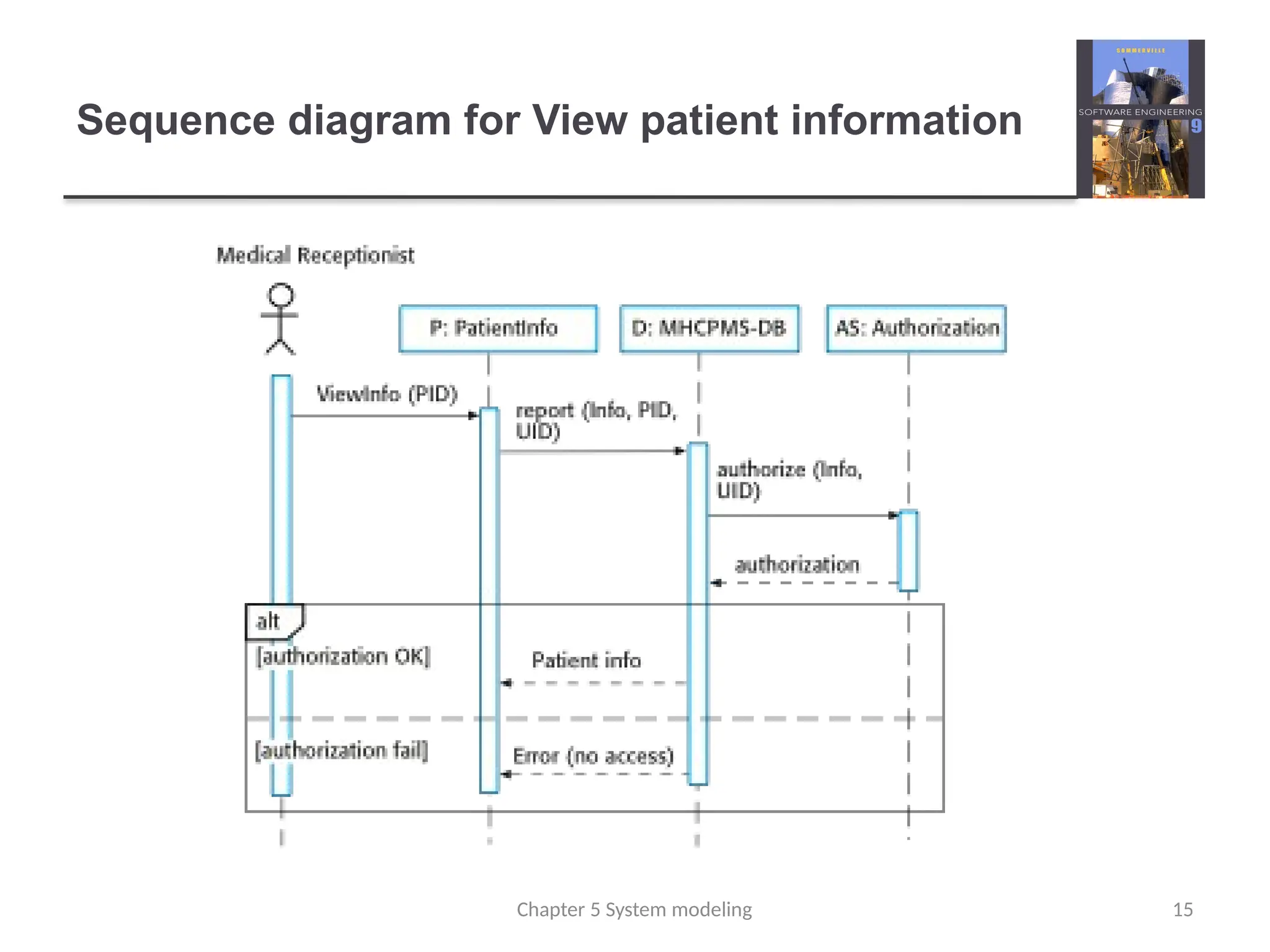
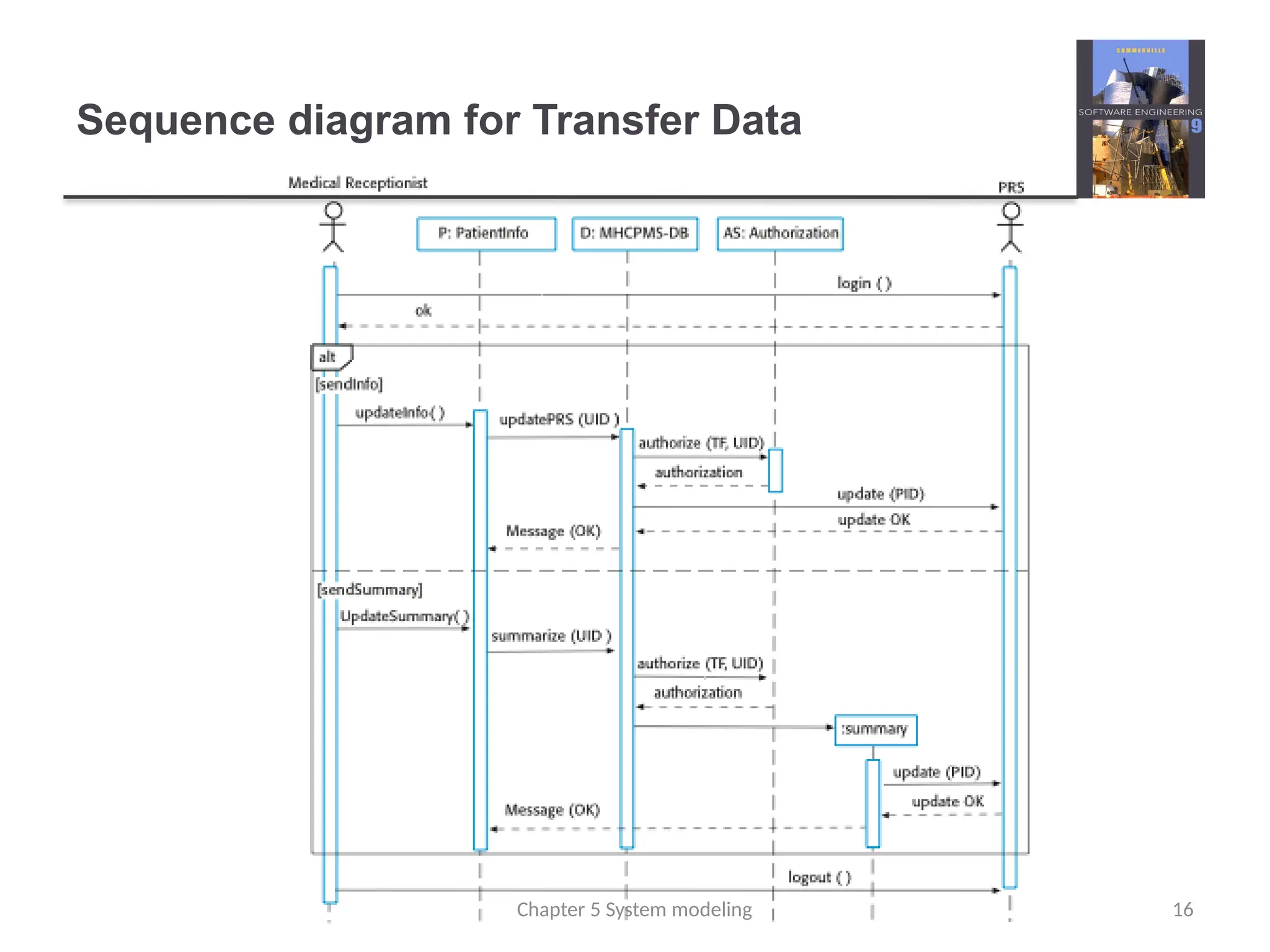
Sequence diagrams
 Sequence diagrams are part of the UML and are used to
model the interactions between the actors and the
objects within a system.
 A sequence diagram shows the sequence of interactions
that take place during a particular use case or use case
instance.
 The objects and actors involved are listed along the top
of the diagram, with a dotted line drawn vertically from
these.
 Interactions between objects are indicated by annotated
arrows.
14
Chapter 5 System modeling
Sequence diagram for View patient information
15
Chapter 5 System modeling
Sequence diagram for Transfer Data
16
Chapter 5 System modeling
Structural models
 Structural models of software display the organization of
a system in terms of the components that make up that
system and their relationships.
 Structural models may be static models, which show the
structure of the system design, or dynamic models,
which show the organization of the system when it is
executing.
 You create structural models of a system when you are
discussing and designing the system architecture.
17
Chapter 5 System modeling
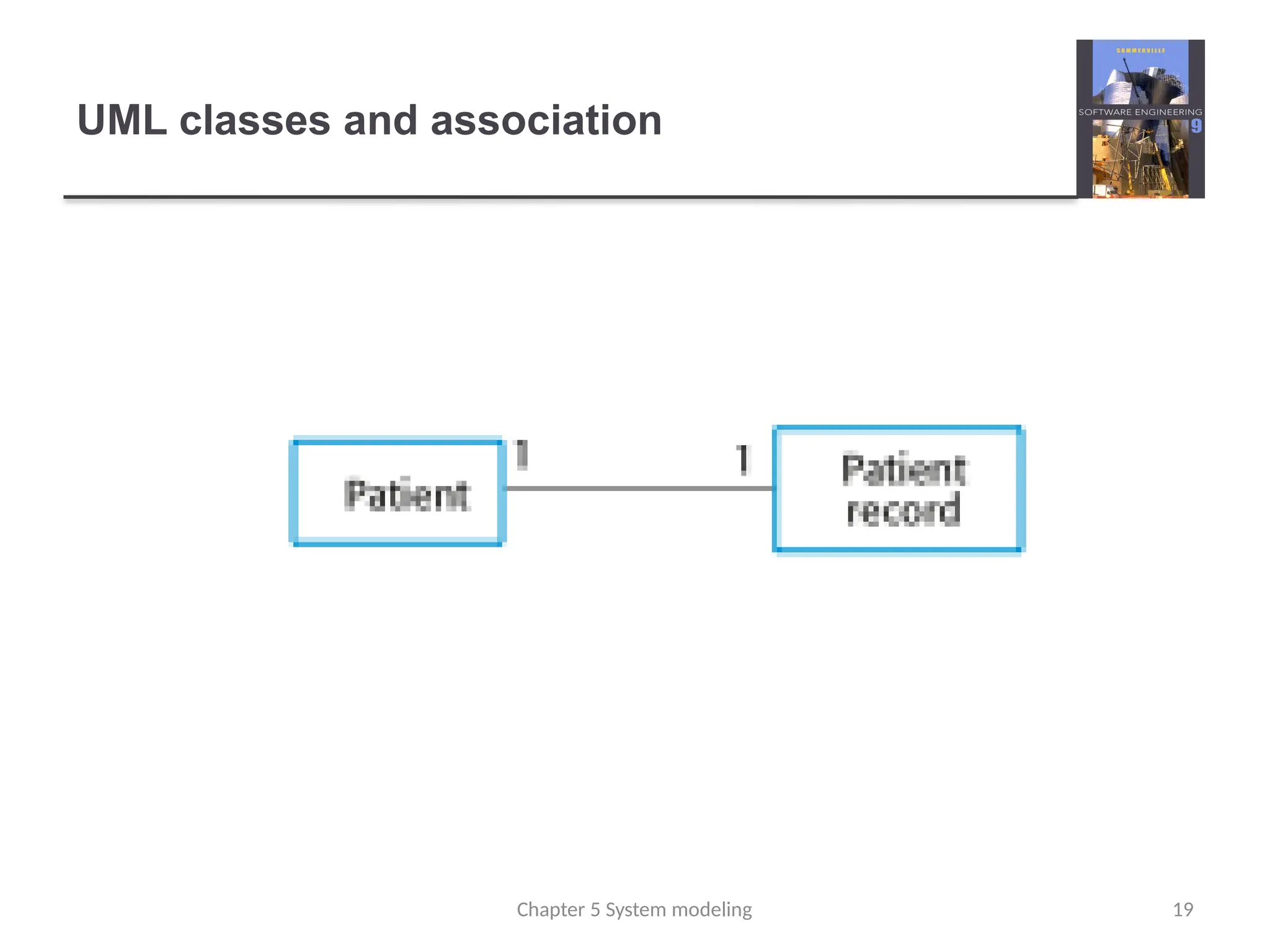
Class diagrams
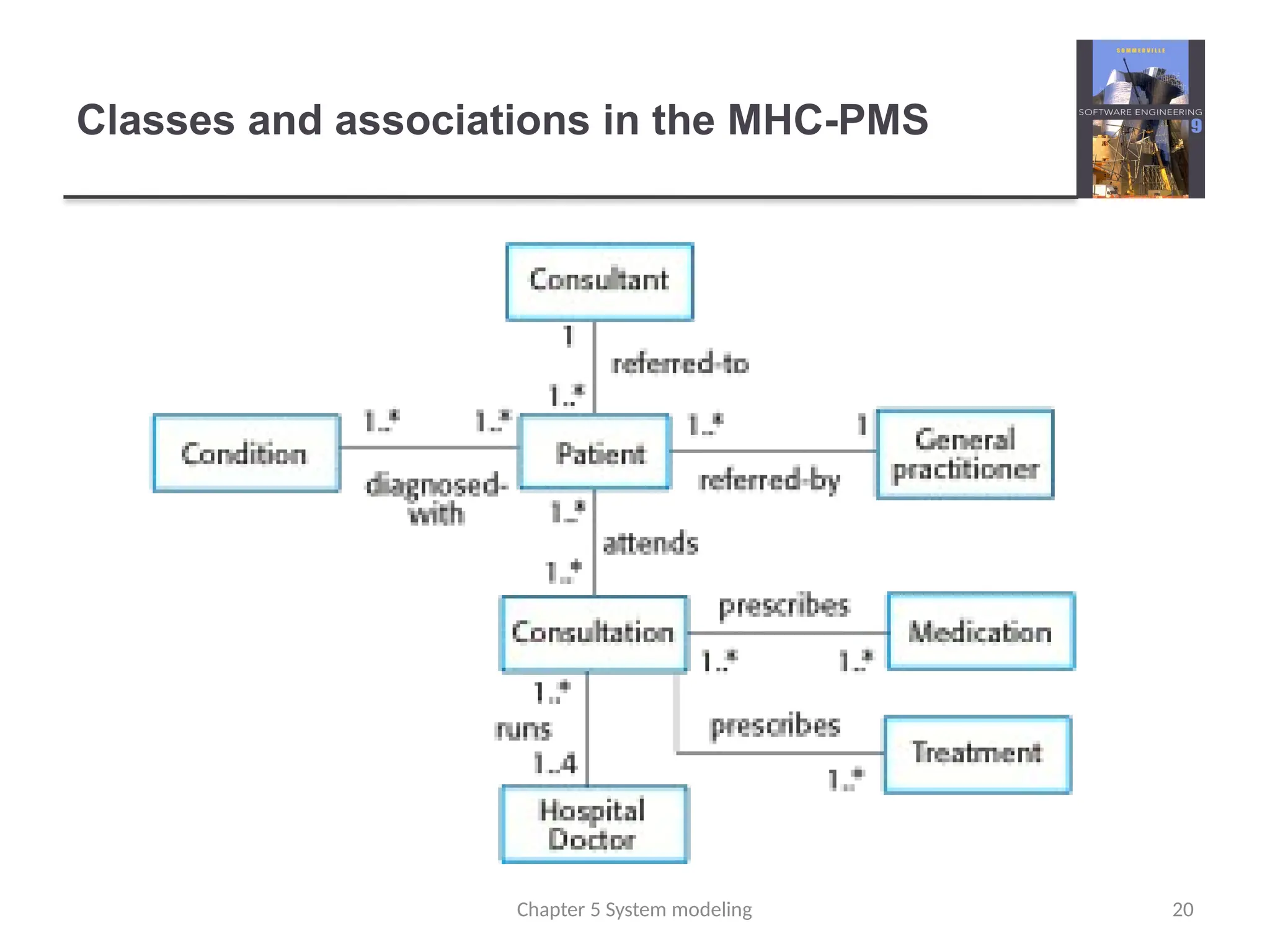
 Class diagrams are used when developing an object-
oriented system model to show the classes in a system
and the associations between these classes.
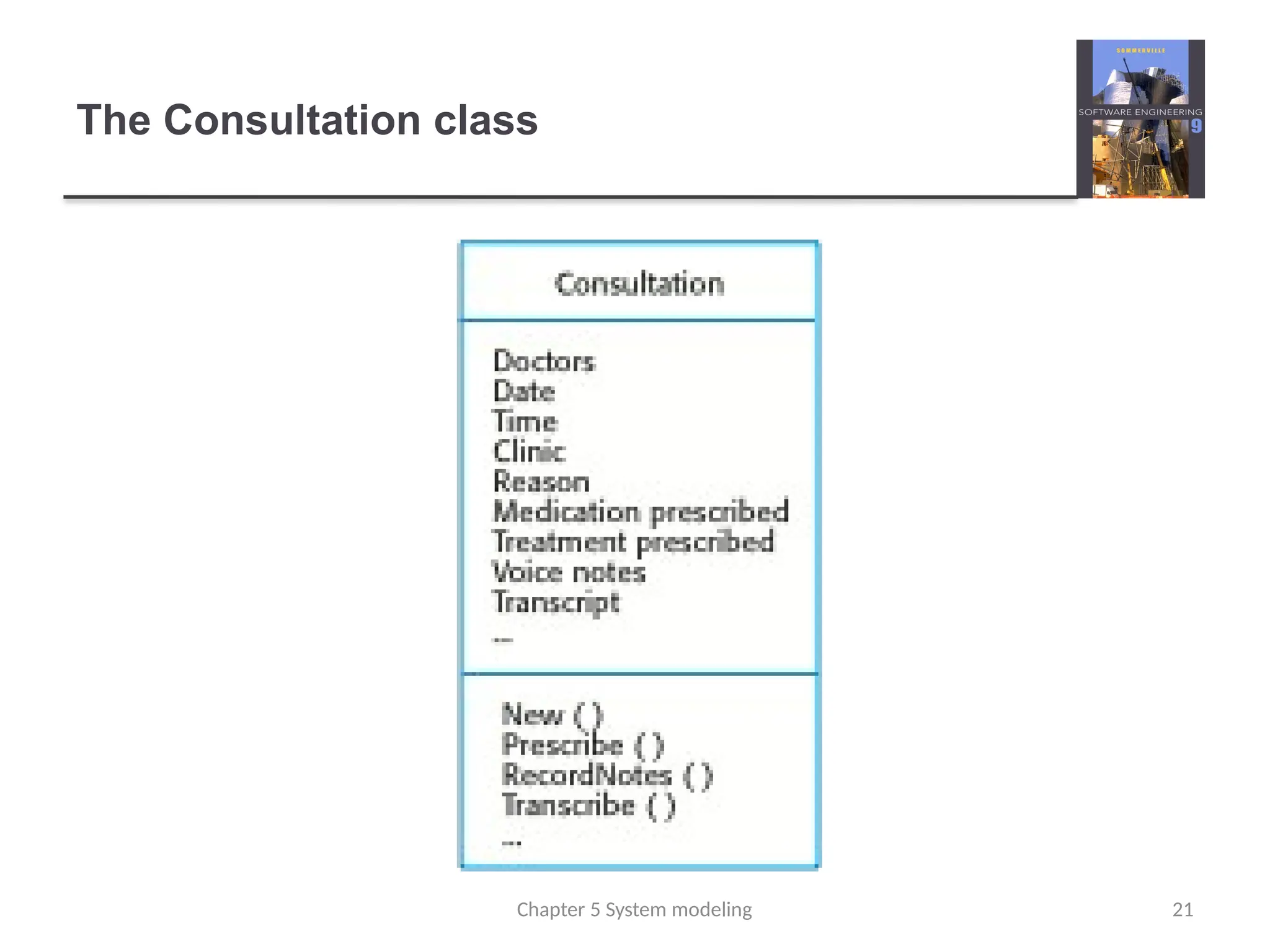
 An object class can be thought of as a general definition
of one kind of system object.
 An association is a link between classes that indicates
that there is some relationship between these classes.
 When you are developing models during the early stages
of the software engineering process, objects represent
something in the real world, such as a patient, a
prescription, doctor, etc.
18
Chapter 5 System modeling
UML classes and association
19
Chapter 5 System modeling
Classes and associations in the MHC-PMS
20
Chapter 5 System modeling
The Consultation class
21
Chapter 5 System modeling
Key points
 A model is an abstract view of a system that ignores system details.
Complementary system models can be developed to show the
system’s context, interactions, structure and behavior.
 Context models show how a system that is being modeled is
positioned in an environment with other systems and processes.
 Use case diagrams and sequence diagrams are used to describe
the interactions between users and systems in the system being
designed. Use cases describe interactions between a system and
external actors; sequence diagrams add more information to these
by showing interactions between system objects.
 Structural models show the organization and architecture of a
system. Class diagrams are used to define the static structure of
classes in a system and their associations.
Chapter 5 System modeling 22
Chapter 5 – System Modeling
Lecture 2
23
Chapter 5 System modeling
Generalization
 Generalization is an everyday technique that we use to
manage complexity.
 Rather than learn the detailed characteristics of every
entity that we experience, we place these entities in
more general classes (animals, cars, houses, etc.) and
learn the characteristics of these classes.
 This allows us to infer that different members of these
classes have some common characteristics e.g.
squirrels and rats are rodents.
Chapter 5 System modeling 24
Generalization
 In modeling systems, it is often useful to examine the classes in
a system to see if there is scope for generalization. If changes
are proposed, then you do not have to look at all classes in the
system to see if they are affected by the change.
 In object-oriented languages, such as Java, generalization is
implemented using the class inheritance mechanisms built into
the language.
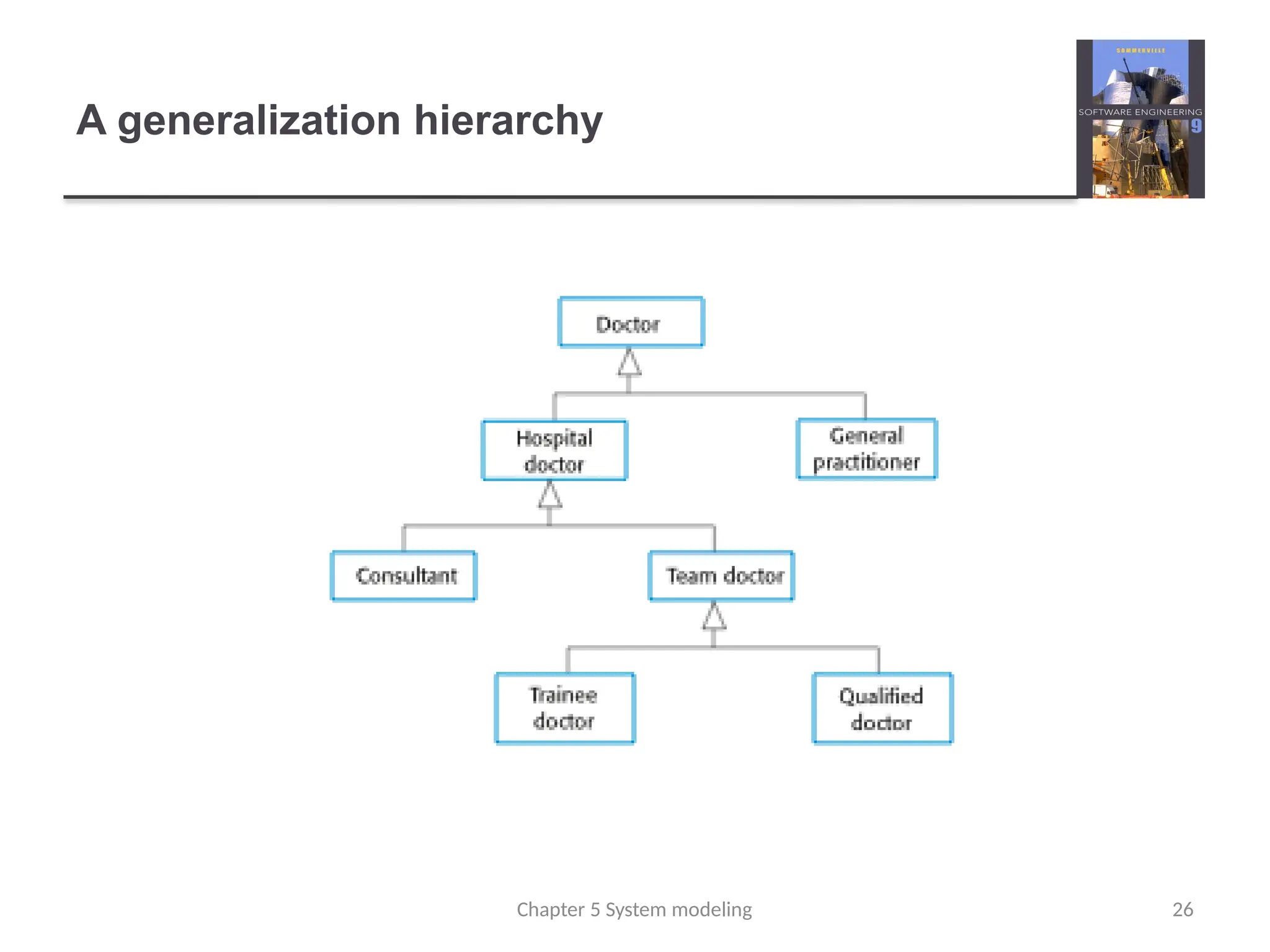
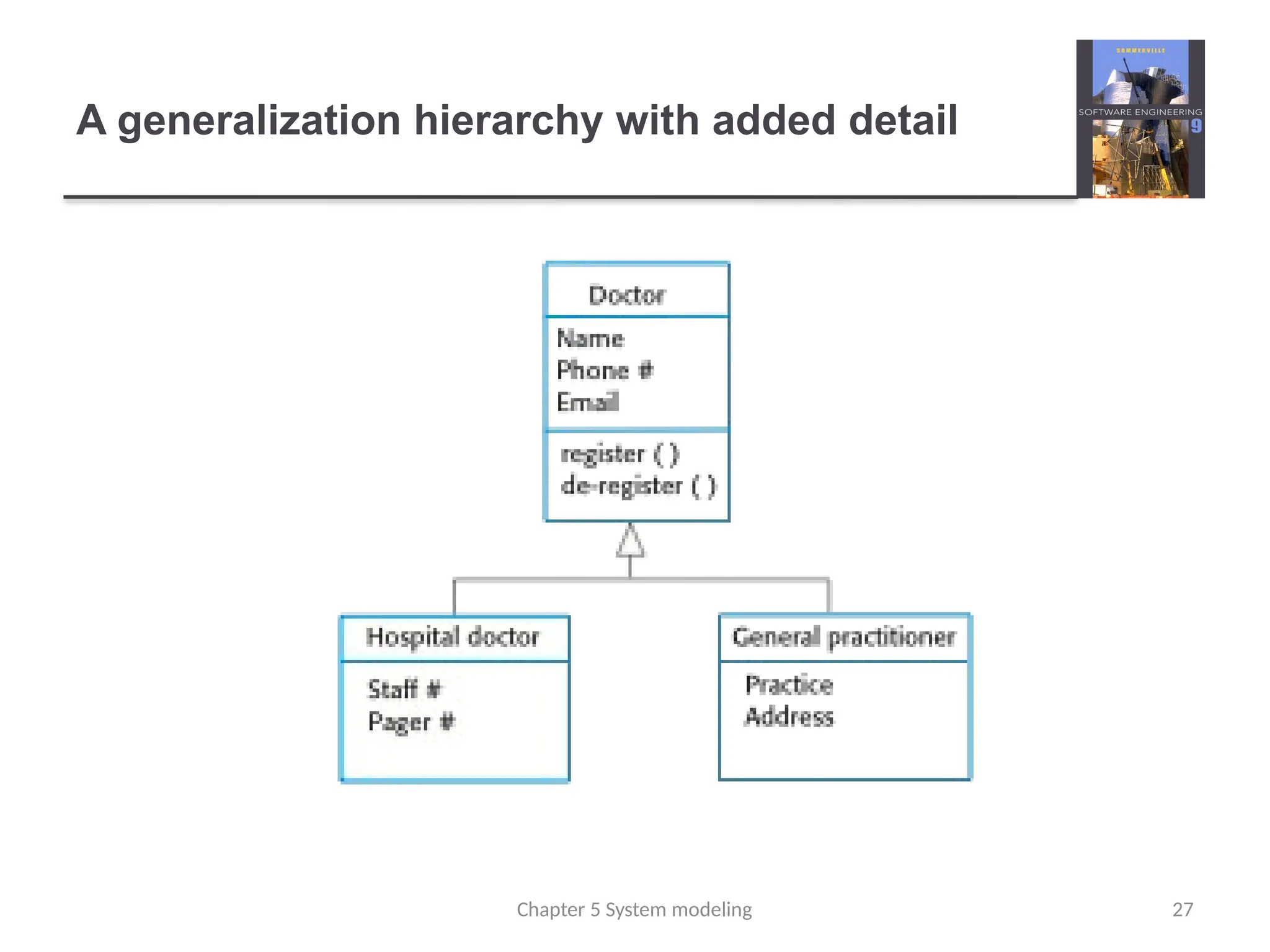
 In a generalization, the attributes and operations associated with
higher-level classes are also associated with the lower-level
classes.
 The lower-level classes are subclasses inherit the attributes and
operations from their superclasses. These lower-level classes
then add more specific attributes and operations.
Chapter 5 System modeling 25
A generalization hierarchy
26
Chapter 5 System modeling
A generalization hierarchy with added detail
27
Chapter 5 System modeling
Object class aggregation models
28
Chapter 5 System modeling
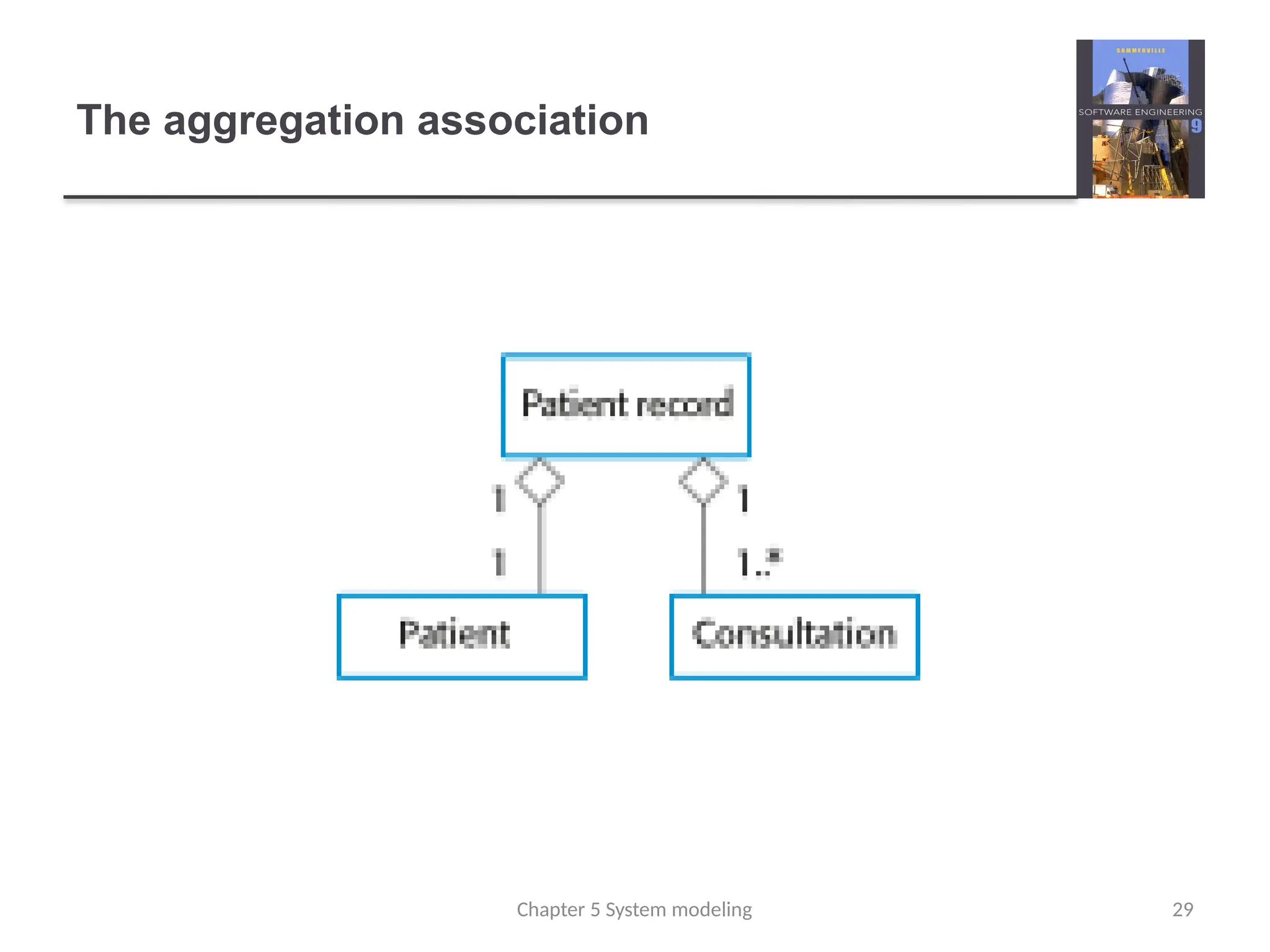
The aggregation association
29
Chapter 5 System modeling
Behavioral models
 Behavioral models are models of the dynamic behavior
of a system as it is executing. They show what happens
or what is supposed to happen when a system responds
to a stimulus from its environment.
 You can think of these stimuli as being of two types:
 Data Some data arrives that has to be processed by the system.
 Events Some event happens that triggers system processing.
Events may have associated data, although this is not always
the case.
30
Chapter 5 System modeling
Data-driven modeling
 Many business systems are data-processing systems
that are primarily driven by data. They are controlled by
the data input to the system, with relatively little external
event processing.
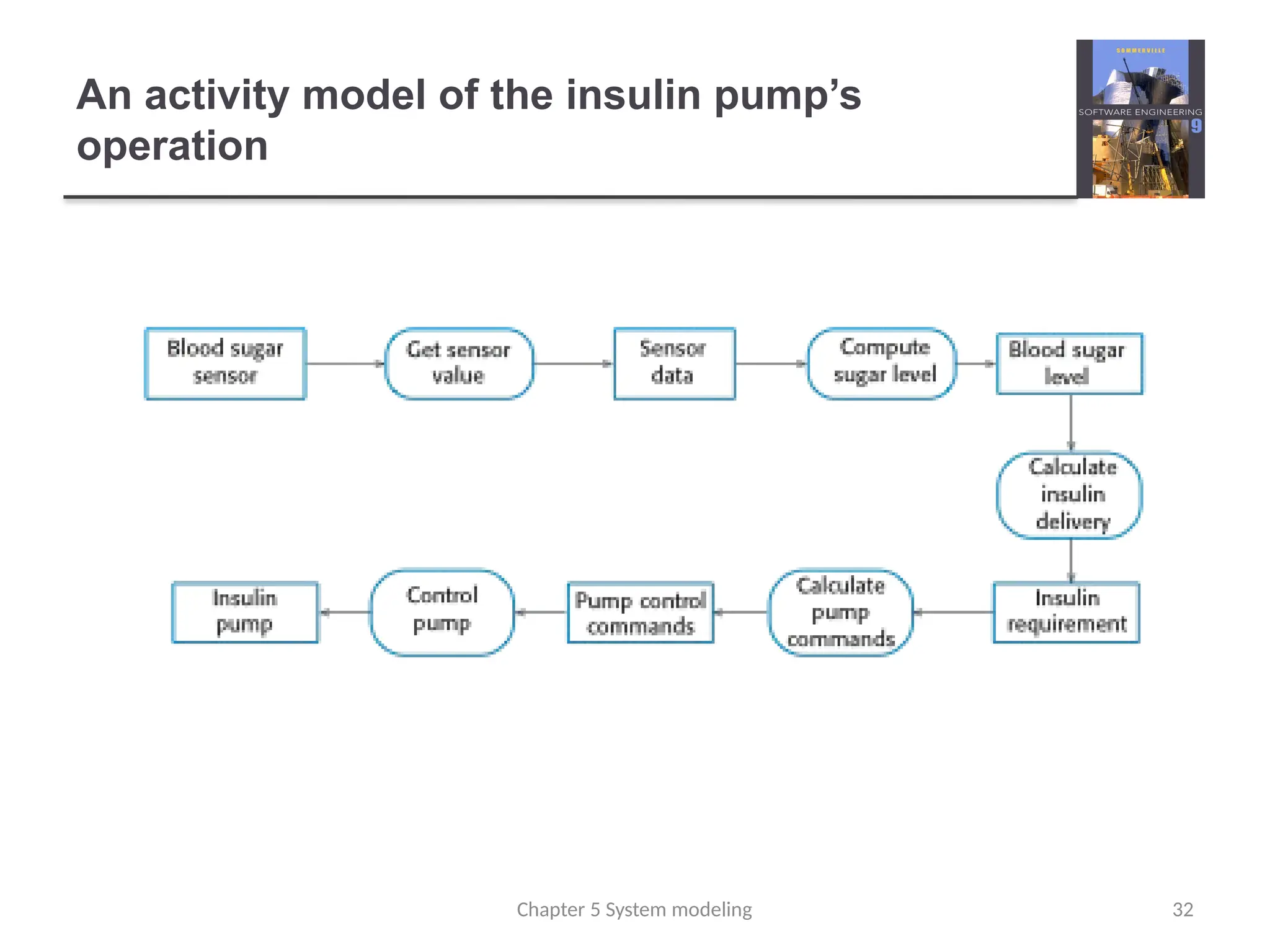
 Data-driven models show the sequence of actions
involved in processing input data and generating an
associated output.
 They are particularly useful during the analysis of
requirements as they can be used to show end-to-end
processing in a system.
31
Chapter 5 System modeling
An activity model of the insulin pump’s
operation
32
Chapter 5 System modeling
Event-driven modeling
 Real-time systems are often event-driven, with minimal
data processing. For example, a landline phone
switching system responds to events such as ‘receiver
off hook’ by generating a dial tone.
 Event-driven modeling shows how a system responds to
external and internal events.
 It is based on the assumption that a system has a finite
number of states and that events (stimuli) may cause a
transition from one state to another.
Chapter 5 System modeling 33
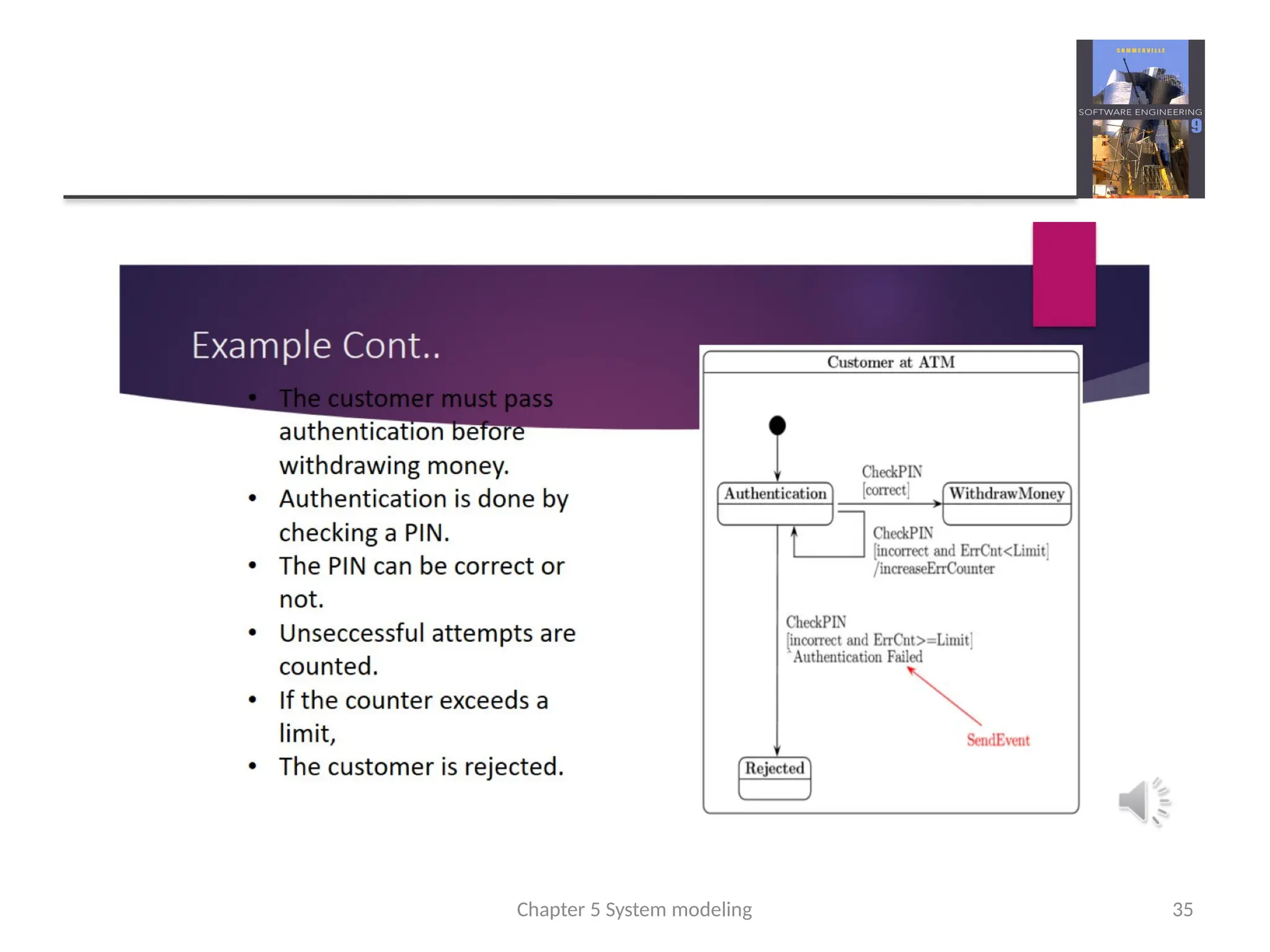
State machine models
 These model the behaviour of the system in response to
external and internal events.
 They show the system’s responses to stimuli so are
often used for modelling real-time systems.
 State machine models show system states as nodes and
events as arcs between these nodes. When an event
occurs, the system moves from one state to another.
 Statecharts are an integral part of the UML and are used
to represent state machine models.
34
Chapter 5 System modeling
Chapter 5 System modeling 35
Model-driven engineering
 Model-driven engineering (MDE) is an approach to
software development where models rather than
programs are the principal outputs of the development
process.
 The programs that execute on a hardware/software
platform are then generated automatically from the
models.
 Proponents of MDE argue that this raises the level of
abstraction in software engineering so that engineers no
longer have to be concerned with programming language
details or the specifics of execution platforms.
Chapter 5 System modeling 36
Usage of model-driven engineering
 Model-driven engineering is still at an early stage of
development, and it is unclear whether or not it will have
a significant effect on software engineering practice.
 Pros
 Allows systems to be considered at higher levels of abstraction
 Generating code automatically means that it is cheaper to adapt
systems to new platforms.
 Cons
 Models for abstraction and not necessarily right for
implementation.
 Savings from generating code may be outweighed by the costs
of developing translators for new platforms.
Chapter 5 System modeling 37
Model driven architecture
 Model-driven architecture (MDA) was the precursor of
more general model-driven engineering
 MDA is a model-focused approach to software design
and implementation that uses a subset of UML models to
describe a system.
 Models at different levels of abstraction are created.
From a high-level, platform independent model, it is
possible, in principle, to generate a working program
without manual intervention.
Chapter 5 System modeling 38
Key points
 Behavioral models are used to describe the dynamic behavior
of an executing system. This behavior can be modeled from
the perspective of the data processed by the system, or by
the events that stimulate responses from a system.
 Activity diagrams may be used to model the processing of
data, where each activity represents one process step.
 State diagrams are used to model a system’s behavior in
response to internal or external events.
 Model-driven engineering is an approach to software
development in which a system is represented as a set of
models that can be automatically transformed to executable
code.
Chapter 5 System modeling 39
Ch5.pptx introduction to software engineering

  • 1.
    Chapter 5 –System Modeling Lecture 1 1 Chapter 5 System modeling
  • 2.
    Topics covered  Contextmodels  Interaction models  Structural models  Behavioral models  Model-driven engineering 2 Chapter 5 System modeling
  • 3.
    System modeling  Systemmodeling is the process of developing abstract models of a system, with each model presenting a different view or perspective of that system.  System modeling has now come to mean representing a system using some kind of graphical notation, which is now almost always based on notations in the Unified Modeling Language (UML).  System modelling helps the analyst to understand the functionality of the system and models are used to communicate with customers. 3 Chapter 5 System modeling
  • 4.
    Existing and plannedsystem models  Models of the existing system are used during requirements engineering. They help clarify what the existing system does and can be used as a basis for discussing its strengths and weaknesses. These then lead to requirements for the new system.  Models of the new system are used during requirements engineering to help explain the proposed requirements to other system stakeholders. Engineers use these models to discuss design proposals and to document the system for implementation.  In a model-driven engineering process, it is possible to generate a complete or partial system implementation from the system model. 4 Chapter 5 System modeling
  • 5.
    System perspectives  Anexternal perspective, where you model the context or environment of the system.  An interaction perspective, where you model the interactions between a system and its environment, or between the components of a system.  A structural perspective, where you model the organization of a system or the structure of the data that is processed by the system.  A behavioral perspective, where you model the dynamic behavior of the system and how it responds to events. 5 Chapter 5 System modeling
  • 6.
    UML diagram types Activity diagrams, which show the activities involved in a process or in data processing .  Use case diagrams, which show the interactions between a system and its environment.  Sequence diagrams, which show interactions between actors and the system and between system components.  Class diagrams, which show the object classes in the system and the associations between these classes.  State diagrams, which show how the system reacts to internal and external events. 6 Chapter 5 System modeling
  • 7.
    Use of graphicalmodels  As a means of facilitating discussion about an existing or proposed system  Incomplete and incorrect models are OK as their role is to support discussion.  As a way of documenting an existing system  Models should be an accurate representation of the system but need not be complete.  As a detailed system description that can be used to generate a system implementation  Models have to be both correct and complete. 7 Chapter 5 System modeling
  • 8.
  • 9.
    Interaction models  Modelinguser interaction is important as it helps to identify user requirements.  Modeling system-to-system interaction highlights the communication problems that may arise.  Modeling component interaction helps us understand if a proposed system structure is likely to deliver the required system performance and dependability.  Use case diagrams and sequence diagrams may be used for interaction modeling. 9 Chapter 5 System modeling
  • 10.
    Use case modeling Use cases were developed originally to support requirements elicitation and now incorporated into the UML.  Each use case represents a discrete task that involves external interaction with a system.  Actors in a use case may be people or other systems.  Represented diagramatically to provide an overview of the use case and in a more detailed textual form. 10 Chapter 5 System modeling
  • 11.
    Transfer-data use case A use case in the MHC-PMS 11 Chapter 5 System modeling
  • 12.
    Tabular description ofthe ‘Transfer data’ use- case MHC-PMS: Transfer data Actors Medical receptionist, patient records system (PRS) Description A receptionist may transfer data from the MHC-PMS to a general patient record database that is maintained by a health authority. The information transferred may either be updated personal information (address, phone number, etc.) or a summary of the patient’s diagnosis and treatment. Data Patient’s personal information, treatment summary Stimulus User command issued by medical receptionist Response Confirmation that PRS has been updated Comments The receptionist must have appropriate security permissions to access the patient information and the PRS. 12 Chapter 5 System modeling
  • 13.
    Use cases inthe MHC-PMS involving the role ‘Medical Receptionist’ 13 Chapter 5 System modeling
  • 14.
    Sequence diagrams  Sequencediagrams are part of the UML and are used to model the interactions between the actors and the objects within a system.  A sequence diagram shows the sequence of interactions that take place during a particular use case or use case instance.  The objects and actors involved are listed along the top of the diagram, with a dotted line drawn vertically from these.  Interactions between objects are indicated by annotated arrows. 14 Chapter 5 System modeling
  • 15.
    Sequence diagram forView patient information 15 Chapter 5 System modeling
  • 16.
    Sequence diagram forTransfer Data 16 Chapter 5 System modeling
  • 17.
    Structural models  Structuralmodels of software display the organization of a system in terms of the components that make up that system and their relationships.  Structural models may be static models, which show the structure of the system design, or dynamic models, which show the organization of the system when it is executing.  You create structural models of a system when you are discussing and designing the system architecture. 17 Chapter 5 System modeling
  • 18.
    Class diagrams  Classdiagrams are used when developing an object- oriented system model to show the classes in a system and the associations between these classes.  An object class can be thought of as a general definition of one kind of system object.  An association is a link between classes that indicates that there is some relationship between these classes.  When you are developing models during the early stages of the software engineering process, objects represent something in the real world, such as a patient, a prescription, doctor, etc. 18 Chapter 5 System modeling
  • 19.
    UML classes andassociation 19 Chapter 5 System modeling
  • 20.
    Classes and associationsin the MHC-PMS 20 Chapter 5 System modeling
  • 21.
  • 22.
    Key points  Amodel is an abstract view of a system that ignores system details. Complementary system models can be developed to show the system’s context, interactions, structure and behavior.  Context models show how a system that is being modeled is positioned in an environment with other systems and processes.  Use case diagrams and sequence diagrams are used to describe the interactions between users and systems in the system being designed. Use cases describe interactions between a system and external actors; sequence diagrams add more information to these by showing interactions between system objects.  Structural models show the organization and architecture of a system. Class diagrams are used to define the static structure of classes in a system and their associations. Chapter 5 System modeling 22
  • 23.
    Chapter 5 –System Modeling Lecture 2 23 Chapter 5 System modeling
  • 24.
    Generalization  Generalization isan everyday technique that we use to manage complexity.  Rather than learn the detailed characteristics of every entity that we experience, we place these entities in more general classes (animals, cars, houses, etc.) and learn the characteristics of these classes.  This allows us to infer that different members of these classes have some common characteristics e.g. squirrels and rats are rodents. Chapter 5 System modeling 24
  • 25.
    Generalization  In modelingsystems, it is often useful to examine the classes in a system to see if there is scope for generalization. If changes are proposed, then you do not have to look at all classes in the system to see if they are affected by the change.  In object-oriented languages, such as Java, generalization is implemented using the class inheritance mechanisms built into the language.  In a generalization, the attributes and operations associated with higher-level classes are also associated with the lower-level classes.  The lower-level classes are subclasses inherit the attributes and operations from their superclasses. These lower-level classes then add more specific attributes and operations. Chapter 5 System modeling 25
  • 26.
  • 27.
    A generalization hierarchywith added detail 27 Chapter 5 System modeling
  • 28.
    Object class aggregationmodels 28 Chapter 5 System modeling
  • 29.
  • 30.
    Behavioral models  Behavioralmodels are models of the dynamic behavior of a system as it is executing. They show what happens or what is supposed to happen when a system responds to a stimulus from its environment.  You can think of these stimuli as being of two types:  Data Some data arrives that has to be processed by the system.  Events Some event happens that triggers system processing. Events may have associated data, although this is not always the case. 30 Chapter 5 System modeling
  • 31.
    Data-driven modeling  Manybusiness systems are data-processing systems that are primarily driven by data. They are controlled by the data input to the system, with relatively little external event processing.  Data-driven models show the sequence of actions involved in processing input data and generating an associated output.  They are particularly useful during the analysis of requirements as they can be used to show end-to-end processing in a system. 31 Chapter 5 System modeling
  • 32.
    An activity modelof the insulin pump’s operation 32 Chapter 5 System modeling
  • 33.
    Event-driven modeling  Real-timesystems are often event-driven, with minimal data processing. For example, a landline phone switching system responds to events such as ‘receiver off hook’ by generating a dial tone.  Event-driven modeling shows how a system responds to external and internal events.  It is based on the assumption that a system has a finite number of states and that events (stimuli) may cause a transition from one state to another. Chapter 5 System modeling 33
  • 34.
    State machine models These model the behaviour of the system in response to external and internal events.  They show the system’s responses to stimuli so are often used for modelling real-time systems.  State machine models show system states as nodes and events as arcs between these nodes. When an event occurs, the system moves from one state to another.  Statecharts are an integral part of the UML and are used to represent state machine models. 34 Chapter 5 System modeling
  • 35.
    Chapter 5 Systemmodeling 35
  • 36.
    Model-driven engineering  Model-drivenengineering (MDE) is an approach to software development where models rather than programs are the principal outputs of the development process.  The programs that execute on a hardware/software platform are then generated automatically from the models.  Proponents of MDE argue that this raises the level of abstraction in software engineering so that engineers no longer have to be concerned with programming language details or the specifics of execution platforms. Chapter 5 System modeling 36
  • 37.
    Usage of model-drivenengineering  Model-driven engineering is still at an early stage of development, and it is unclear whether or not it will have a significant effect on software engineering practice.  Pros  Allows systems to be considered at higher levels of abstraction  Generating code automatically means that it is cheaper to adapt systems to new platforms.  Cons  Models for abstraction and not necessarily right for implementation.  Savings from generating code may be outweighed by the costs of developing translators for new platforms. Chapter 5 System modeling 37
  • 38.
    Model driven architecture Model-driven architecture (MDA) was the precursor of more general model-driven engineering  MDA is a model-focused approach to software design and implementation that uses a subset of UML models to describe a system.  Models at different levels of abstraction are created. From a high-level, platform independent model, it is possible, in principle, to generate a working program without manual intervention. Chapter 5 System modeling 38
  • 39.
    Key points  Behavioralmodels are used to describe the dynamic behavior of an executing system. This behavior can be modeled from the perspective of the data processed by the system, or by the events that stimulate responses from a system.  Activity diagrams may be used to model the processing of data, where each activity represents one process step.  State diagrams are used to model a system’s behavior in response to internal or external events.  Model-driven engineering is an approach to software development in which a system is represented as a set of models that can be automatically transformed to executable code. Chapter 5 System modeling 39