3.1
Chapter 3
Data and Signals
1.2
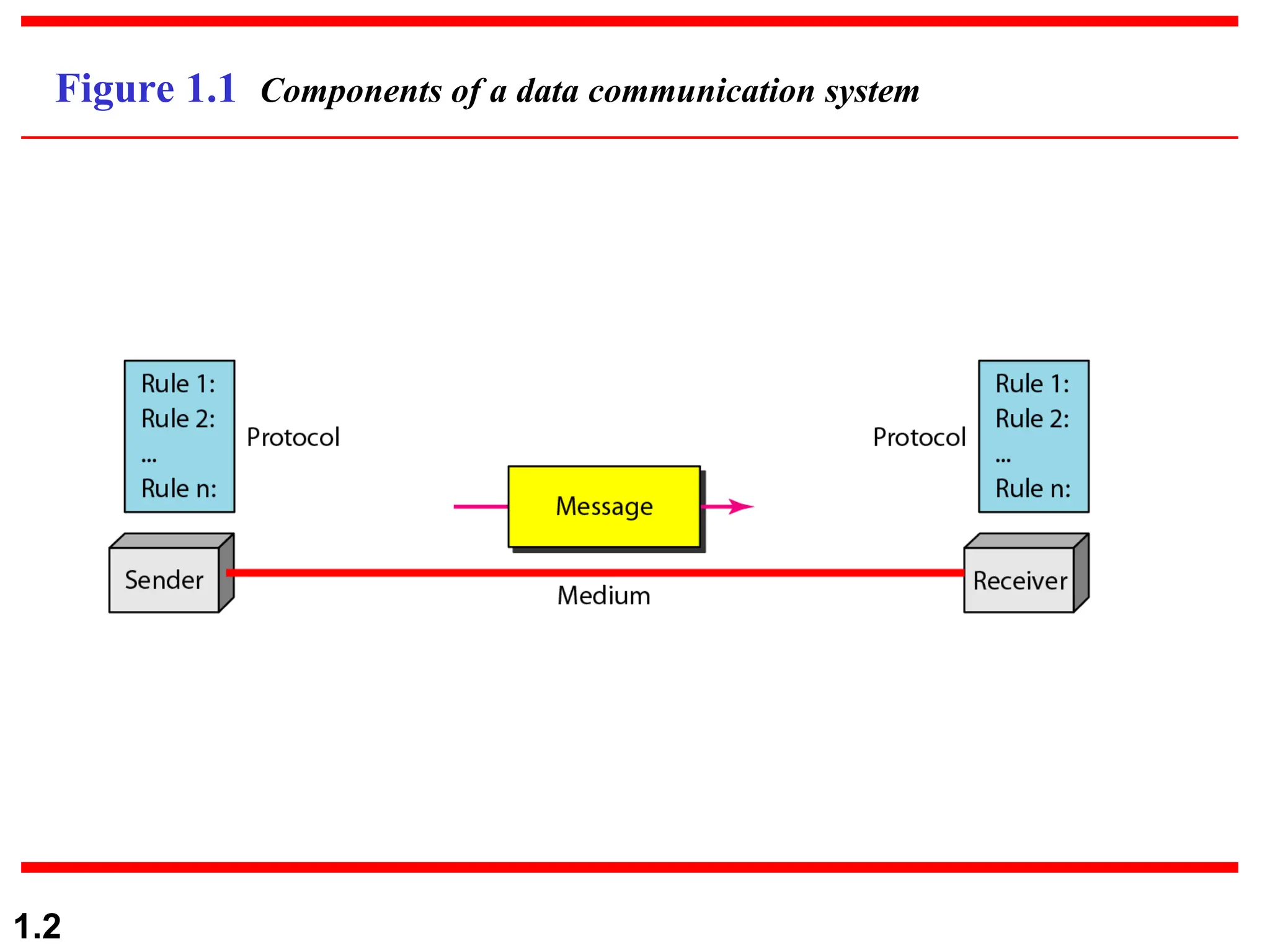
Figure 1.1 Components of a data communication system
1.3
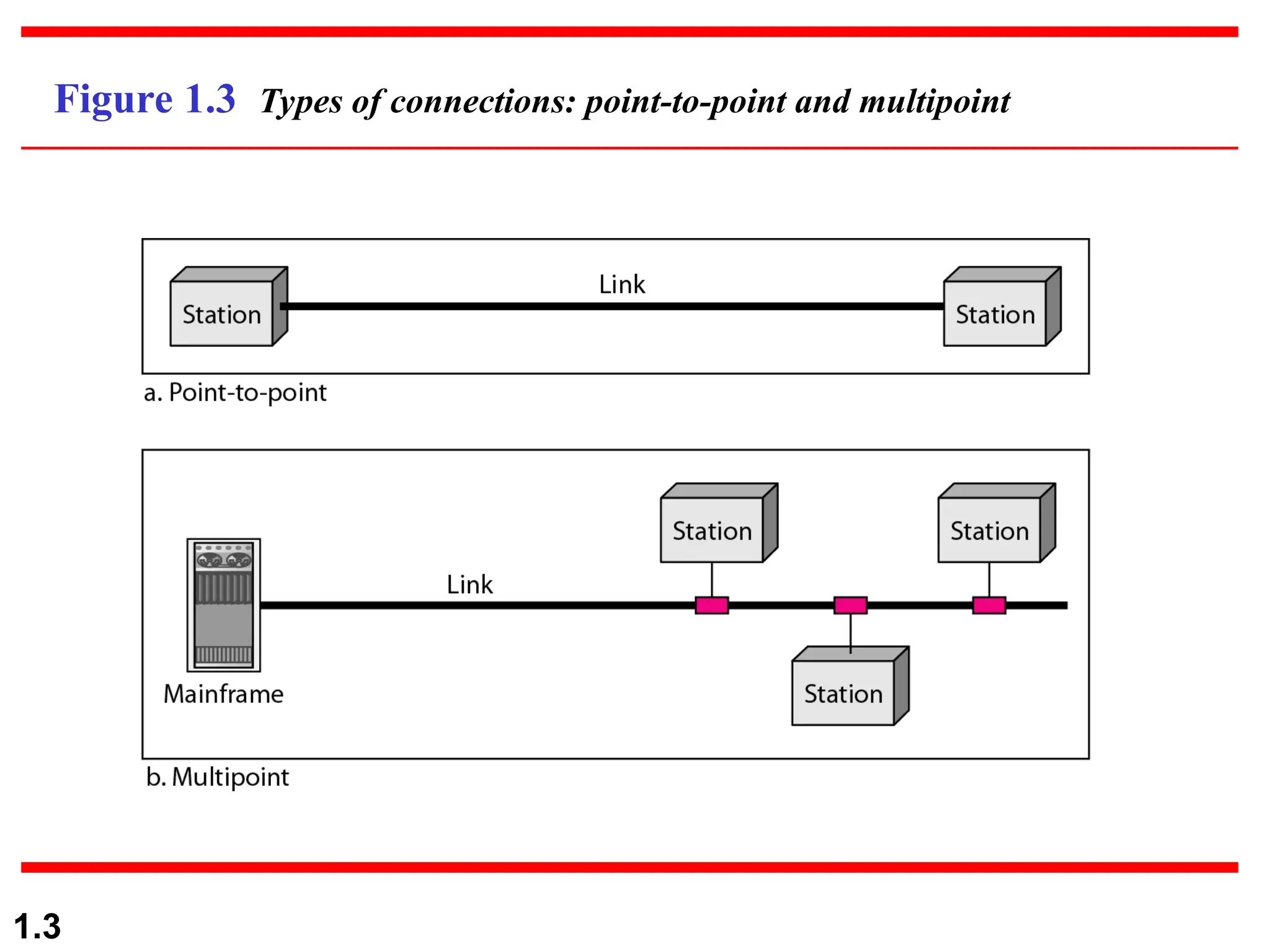
Figure 1.3 Types of connections: point-to-point and multipoint
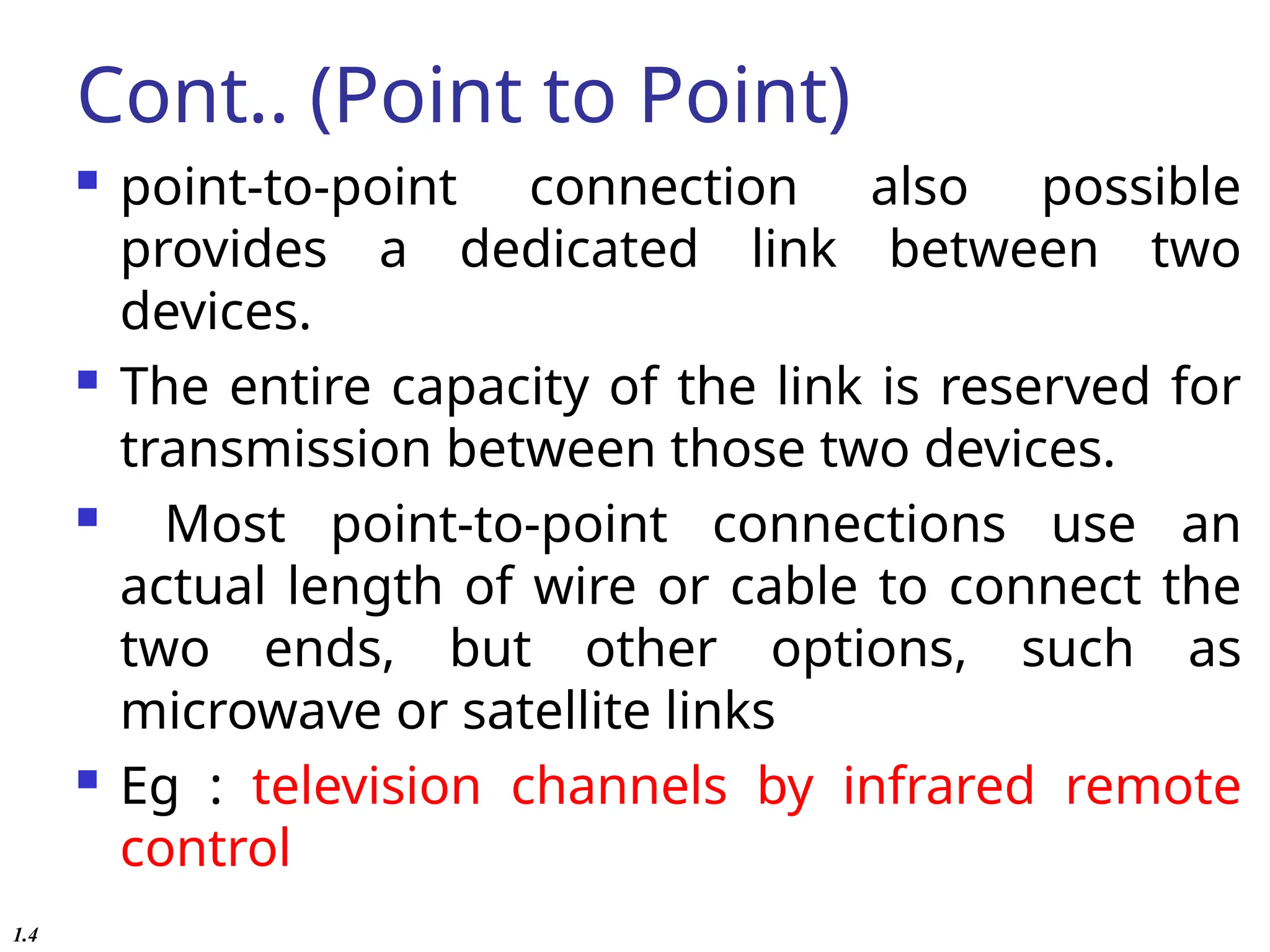
Cont.. (Point to Point)
 point-to-point connection also possible
provides a dedicated link between two
devices.
 The entire capacity of the link is reserved for
transmission between those two devices.
 Most point-to-point connections use an
actual length of wire or cable to connect the
two ends, but other options, such as
microwave or satellite links
 Eg : television channels by infrared remote
control
1.4
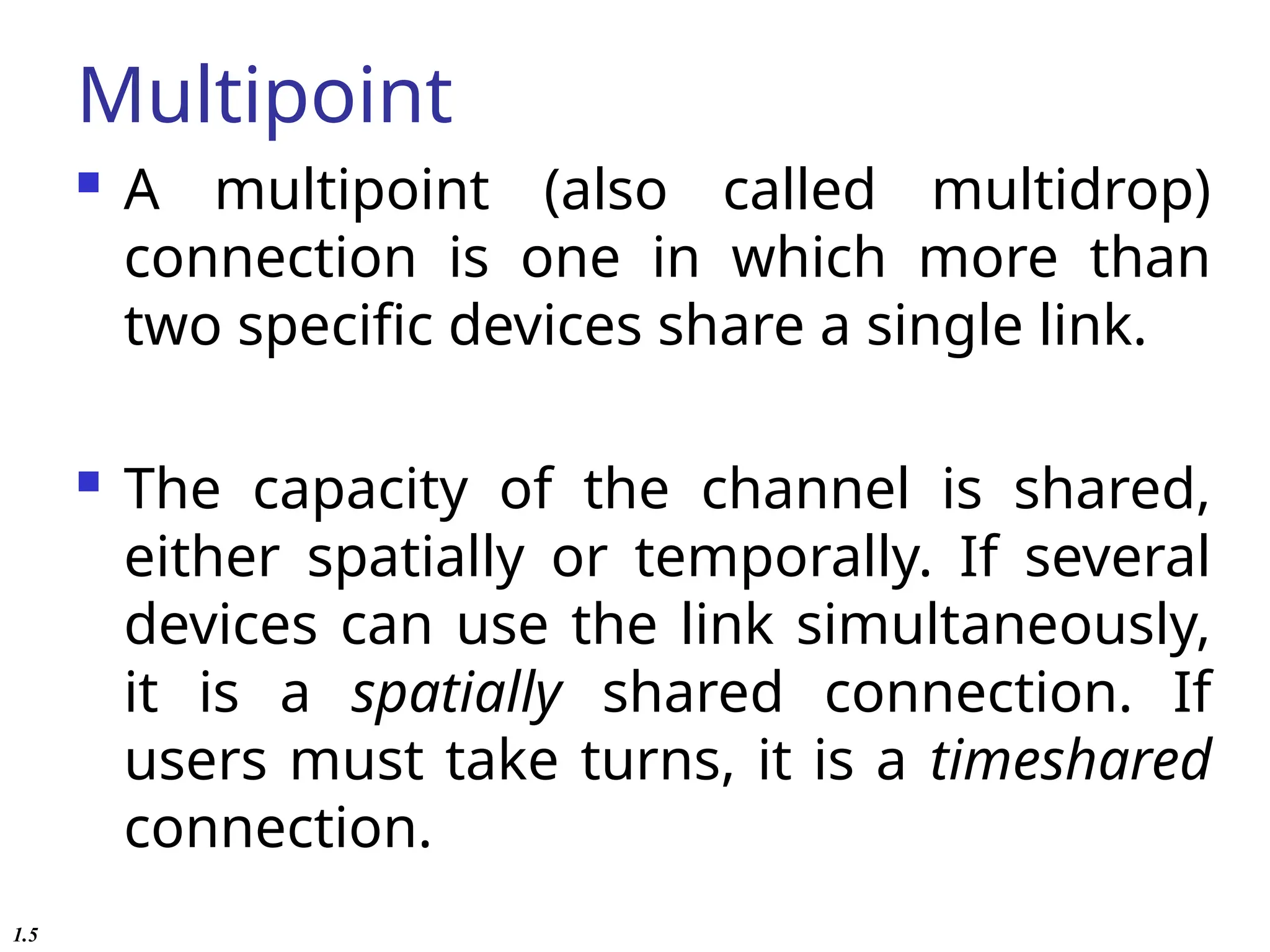
Multipoint
 A multipoint (also called multidrop)
connection is one in which more than
two specific devices share a single link.
 The capacity of the channel is shared,
either spatially or temporally. If several
devices can use the link simultaneously,
it is a spatially shared connection. If
users must take turns, it is a timeshared
connection.
1.5
1.6
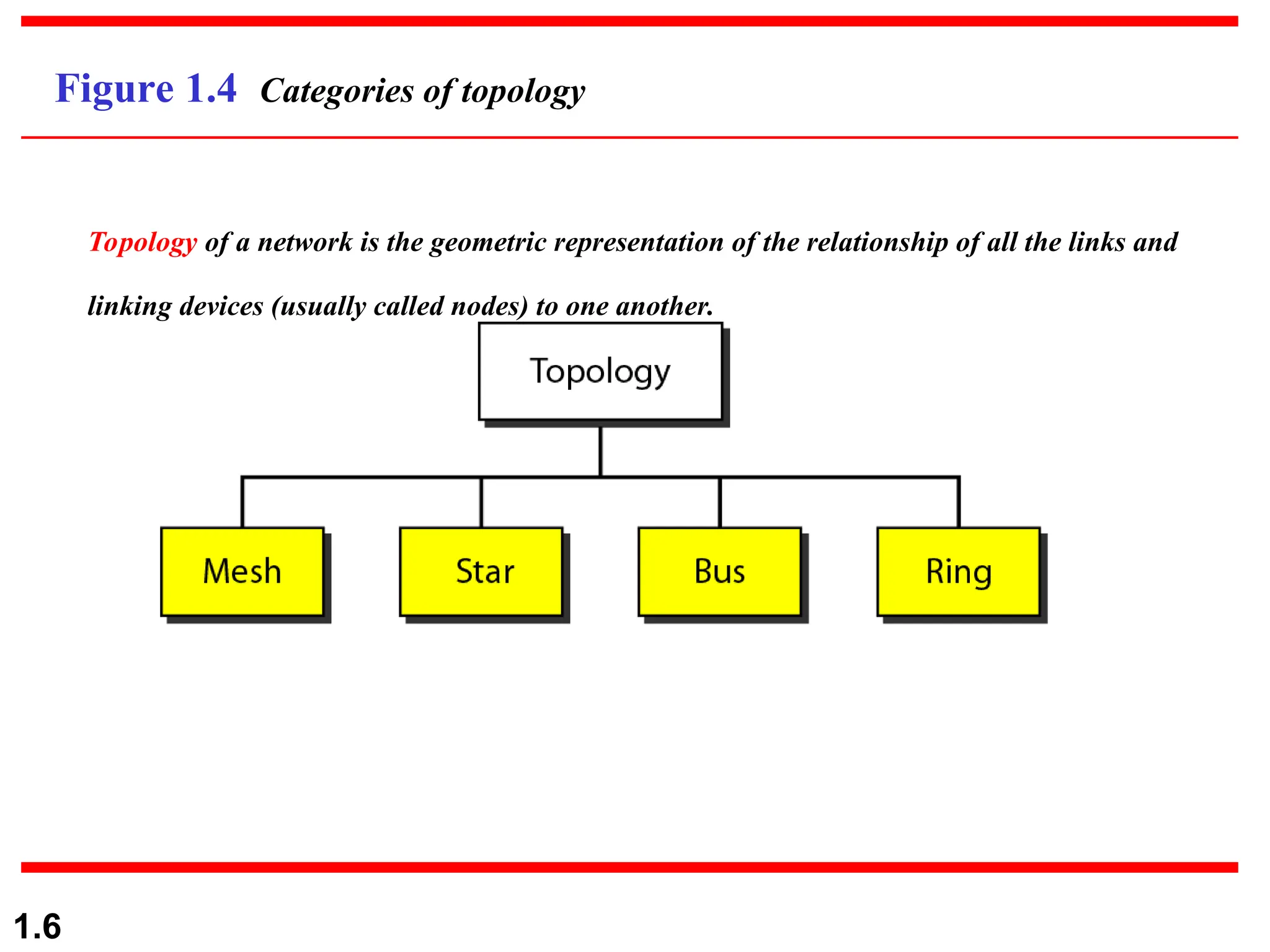
Figure 1.4 Categories of topology
Topology of a network is the geometric representation of the relationship of all the links and
linking devices (usually called nodes) to one another.
1.7
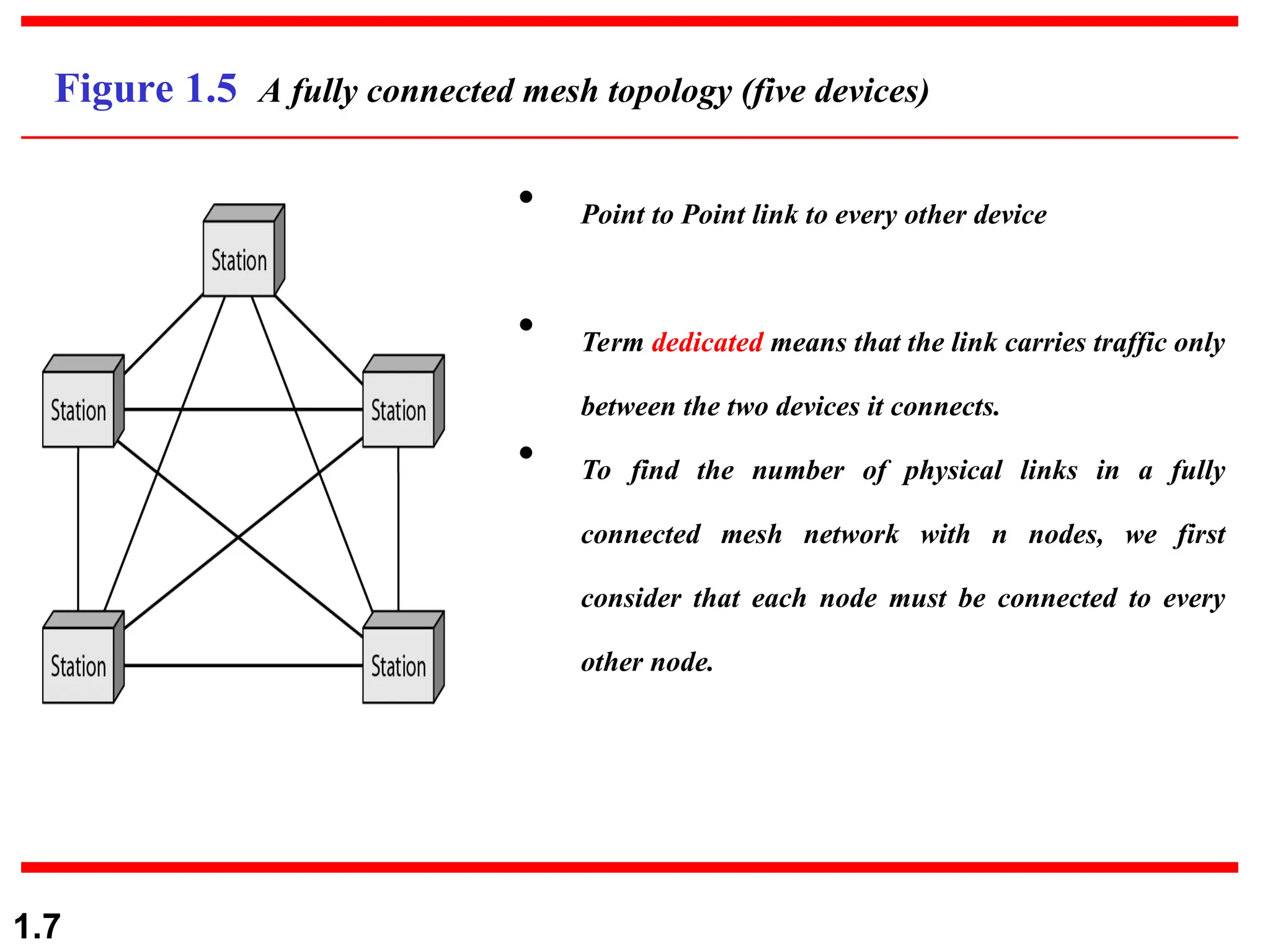
Figure 1.5 A fully connected mesh topology (five devices)
• Point to Point link to every other device
• Term dedicated means that the link carries traffic only
between the two devices it connects.
• To find the number of physical links in a fully
connected mesh network with n nodes, we first
consider that each node must be connected to every
other node.
1.8
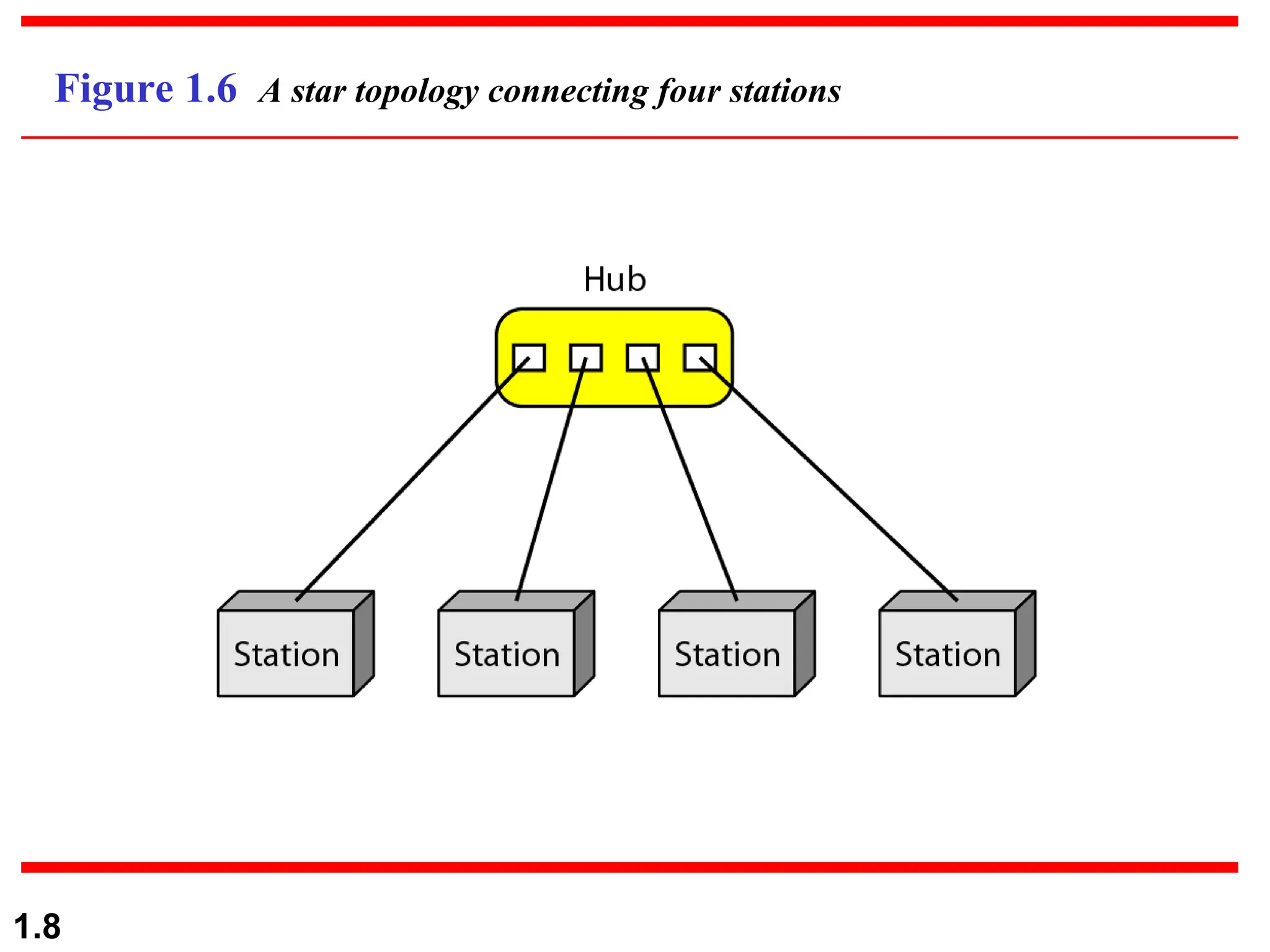
Figure 1.6 A star topology connecting four stations
1.9
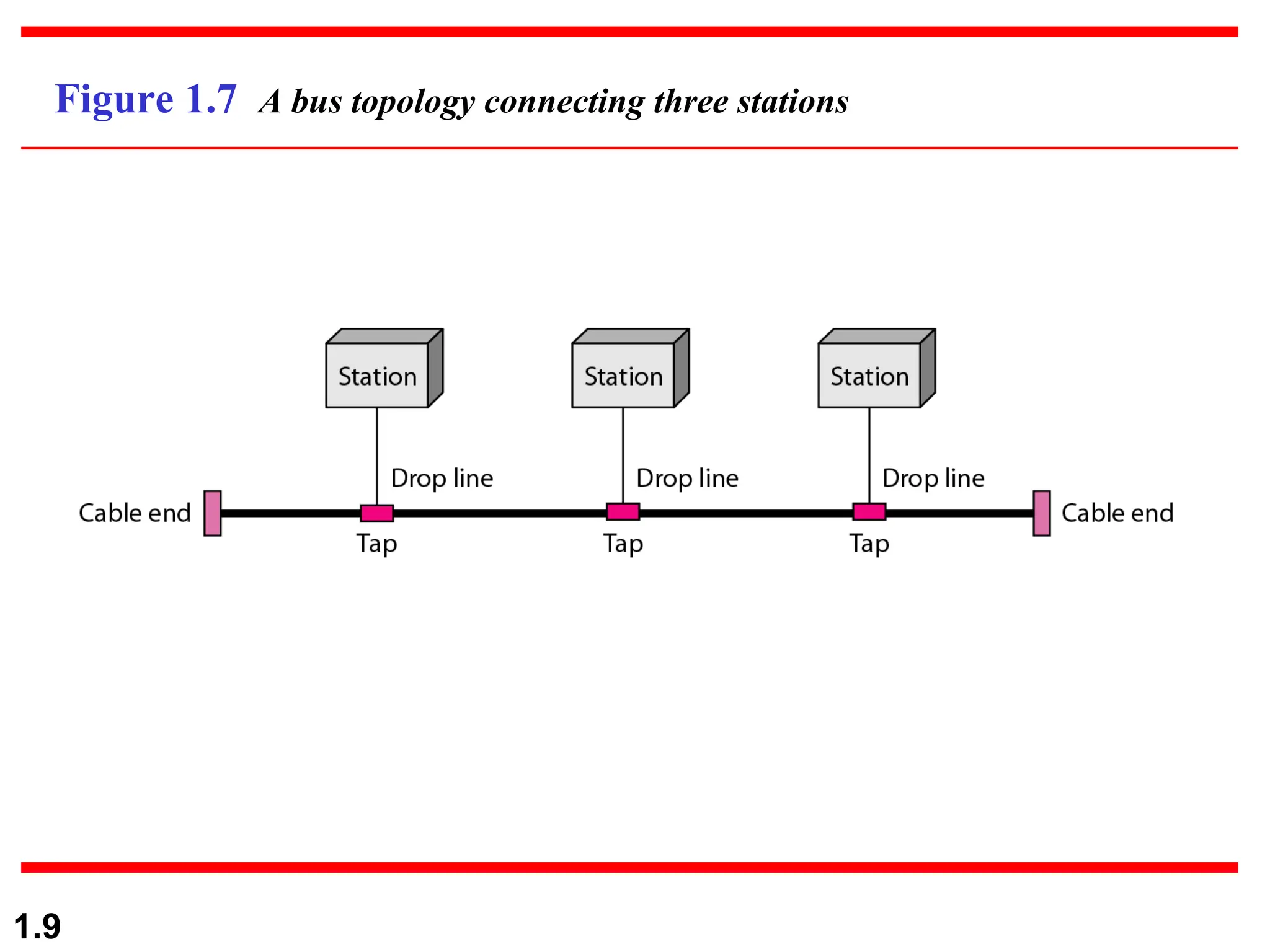
Figure 1.7 A bus topology connecting three stations
1.10
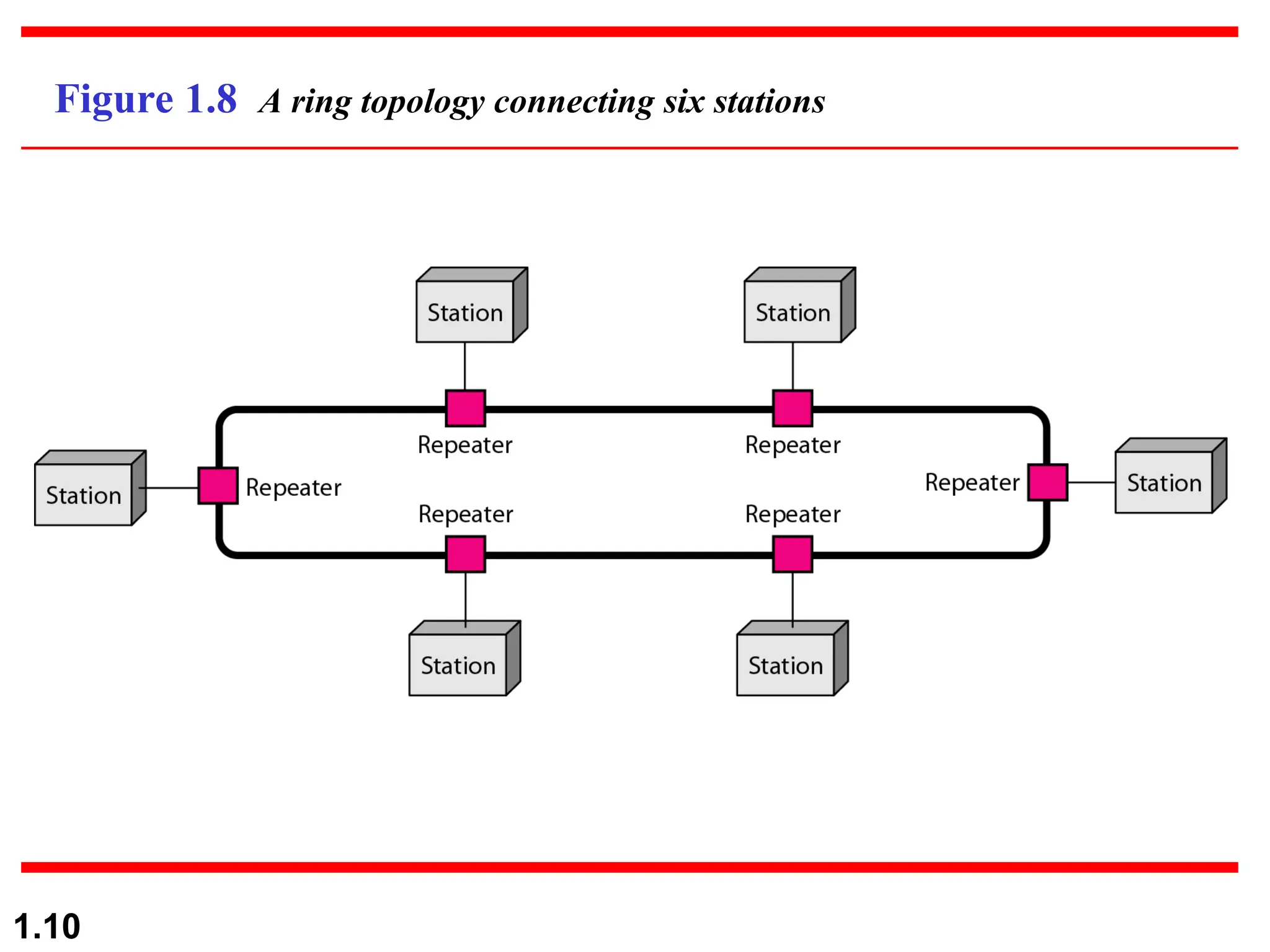
Figure 1.8 A ring topology connecting six stations
1.11
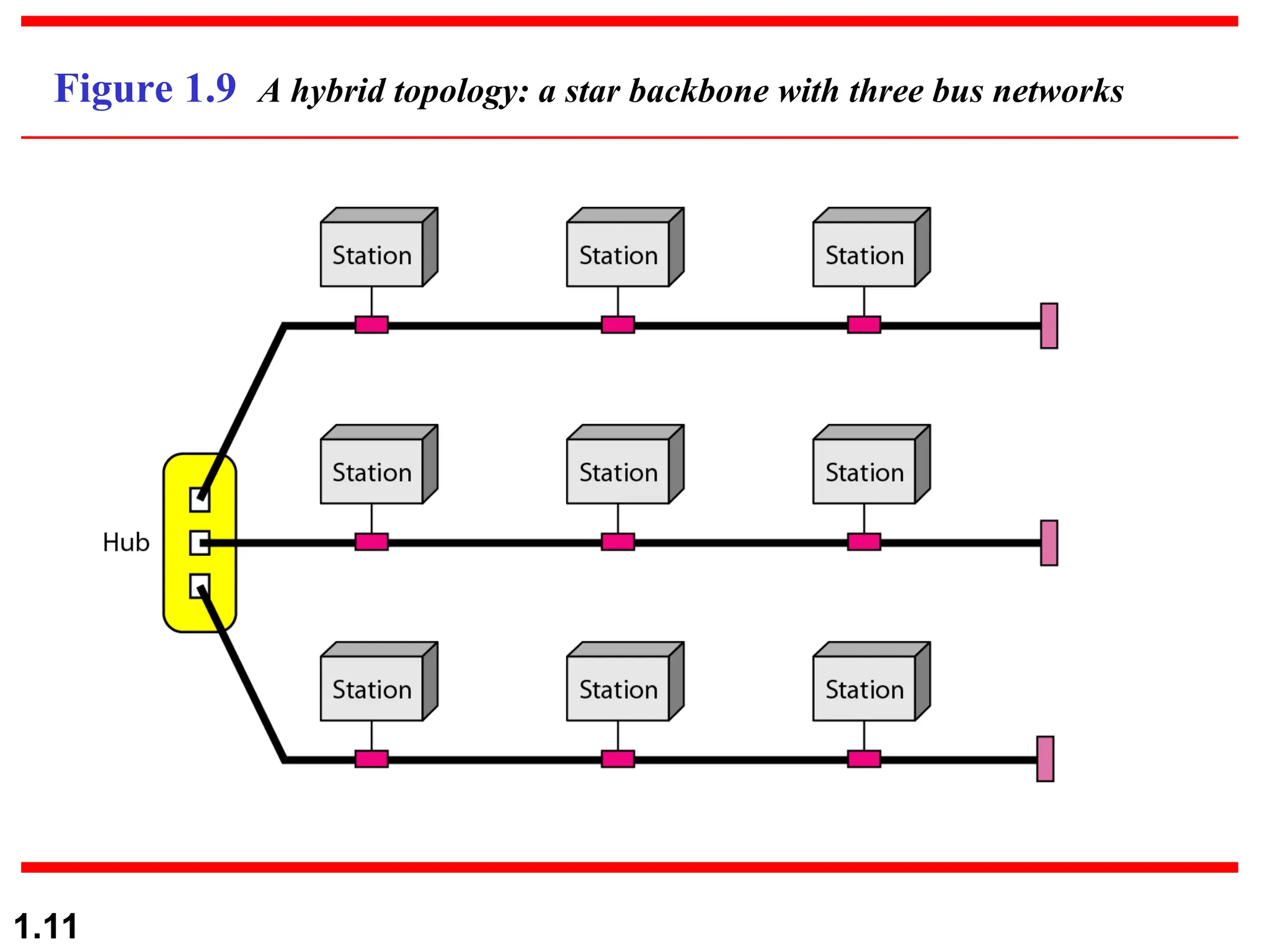
Figure 1.9 A hybrid topology: a star backbone with three bus networks
1.12
1-4 PROTOCOLS
1-4 PROTOCOLS
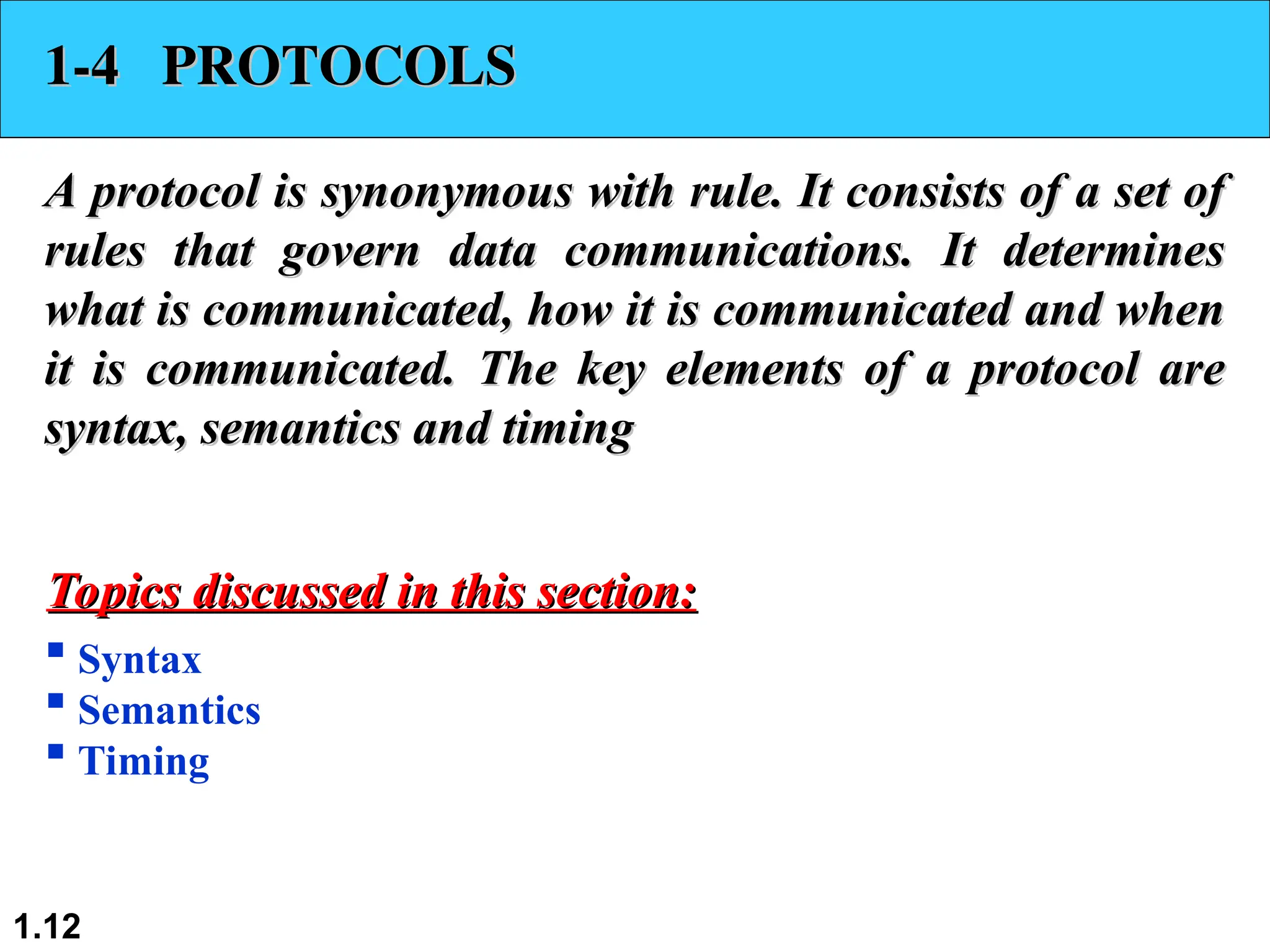
A protocol is synonymous with rule. It consists of a set of
rules that govern data communications. It determines
what is communicated, how it is communicated and when
it is communicated. The key elements of a protocol are
syntax, semantics and timing
 Syntax
 Semantics
 Timing
Topics discussed in this section:
1.13
Elements of a Protocol
 Syntax
 Structure or format of the data
 Indicates how to read the bits - field delineation
 Semantics
 Interprets the meaning of the bits
 Knows which fields define what action
 Timing
 When data should be sent and what
 Speed at which data should be sent or speed at which it is
being received.
3.14
To be transmitted, data must be
transformed to electromagnetic signals.
Note
3.15
3-1 ANALOG AND DIGITAL
Data can be
Data can be analog
analog or
or digital
digital. The term
. The term analog data
analog data refers
refers
to information that is continuous;
to information that is continuous; digital data
digital data refers to
refers to
information that has discrete states. Analog data take on
continuous values. Digital data take on discrete values.
 Analog and Digital Data
 Analog and Digital Signals
 Periodic and Nonperiodic Signals
Topics discussed in this section:
 Data can be analog or digital. The term analog data refers
to information that is continuous;
 digital data refers to information that has discrete states.
For example, an analog
 clock that has hour, minute, and second hands gives
information in a continuous form;
 the movements of the hands are continuous. On the other
hand, a digital clock that
 reports the hours and the minutes will change suddenly
from 8:05 to 8:06.
3.16
3.17
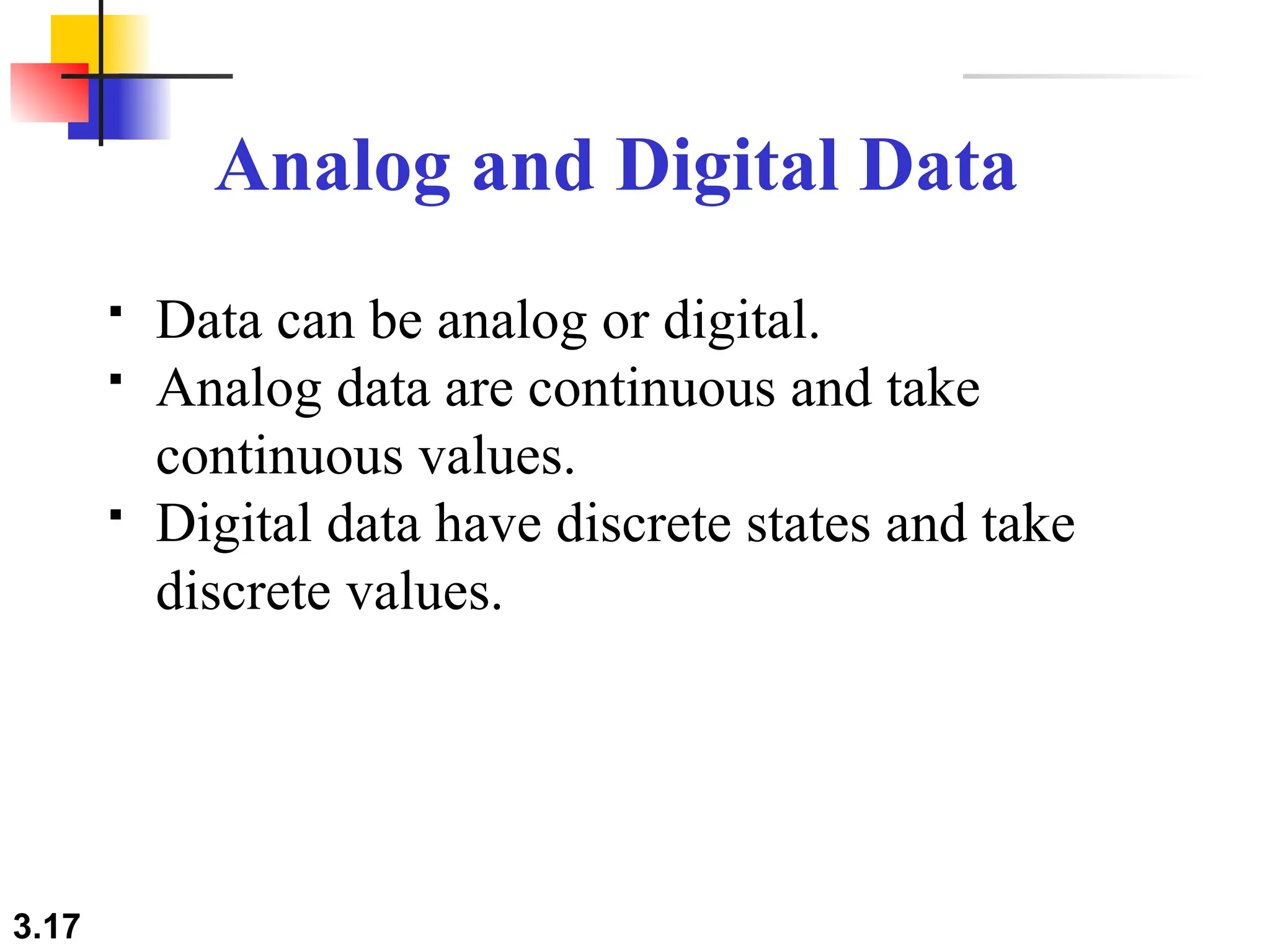
Analog and Digital Data
 Data can be analog or digital.
 Analog data are continuous and take
continuous values.
 Digital data have discrete states and take
discrete values.
3.18
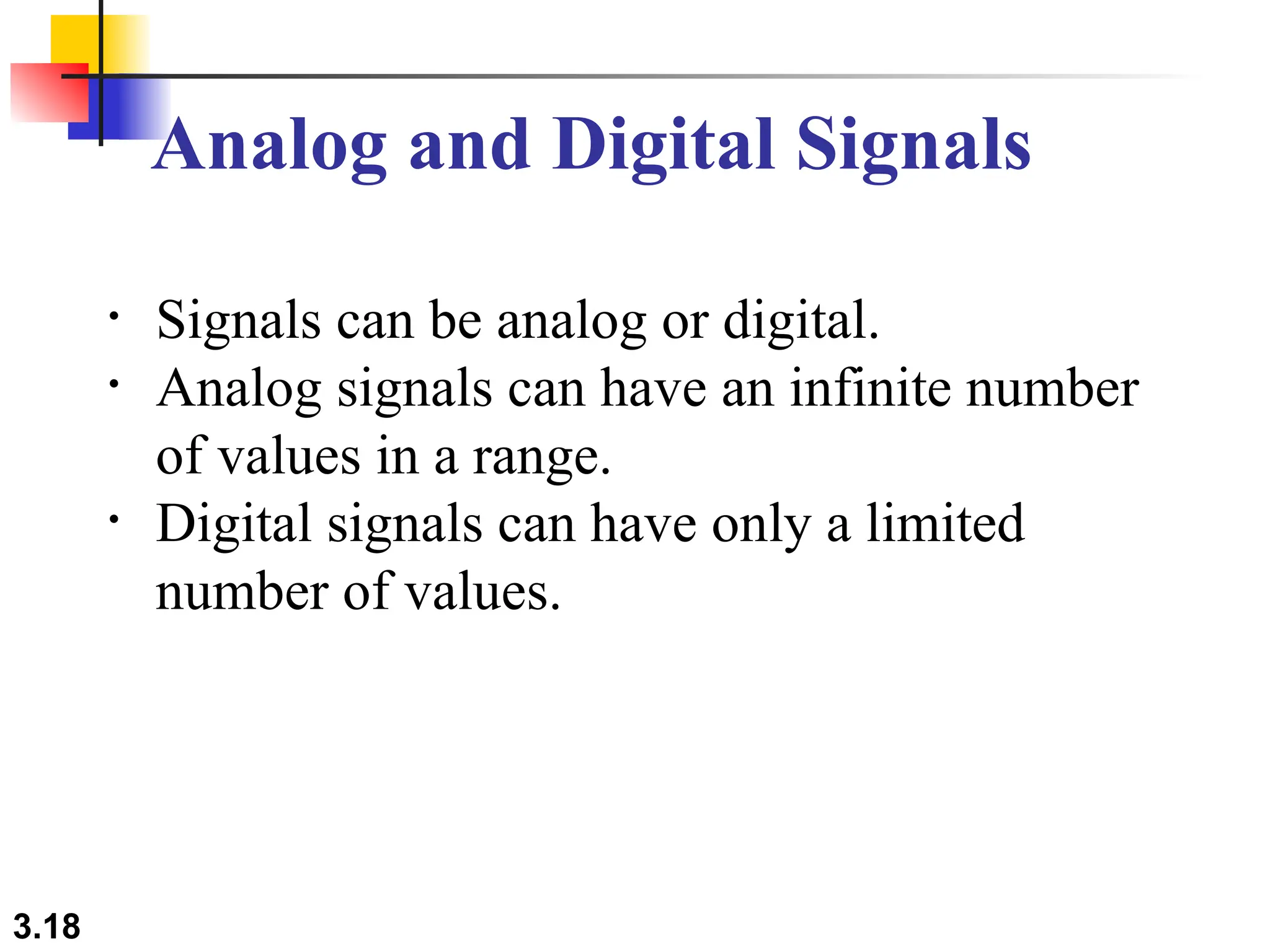
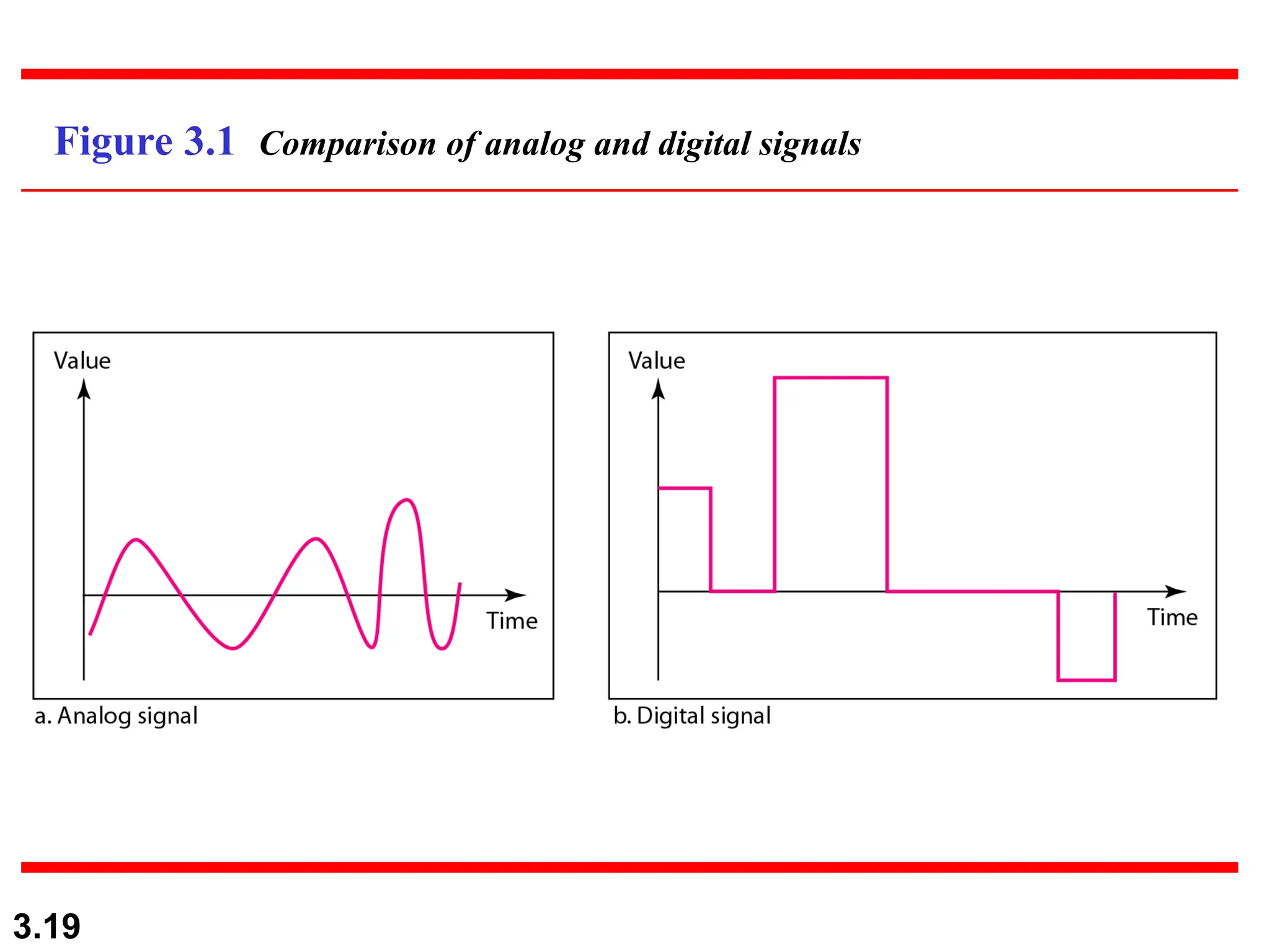
Analog and Digital Signals
• Signals can be analog or digital.
• Analog signals can have an infinite number
of values in a range.
• Digital signals can have only a limited
number of values.
3.19
Figure 3.1 Comparison of analog and digital signals
3.20
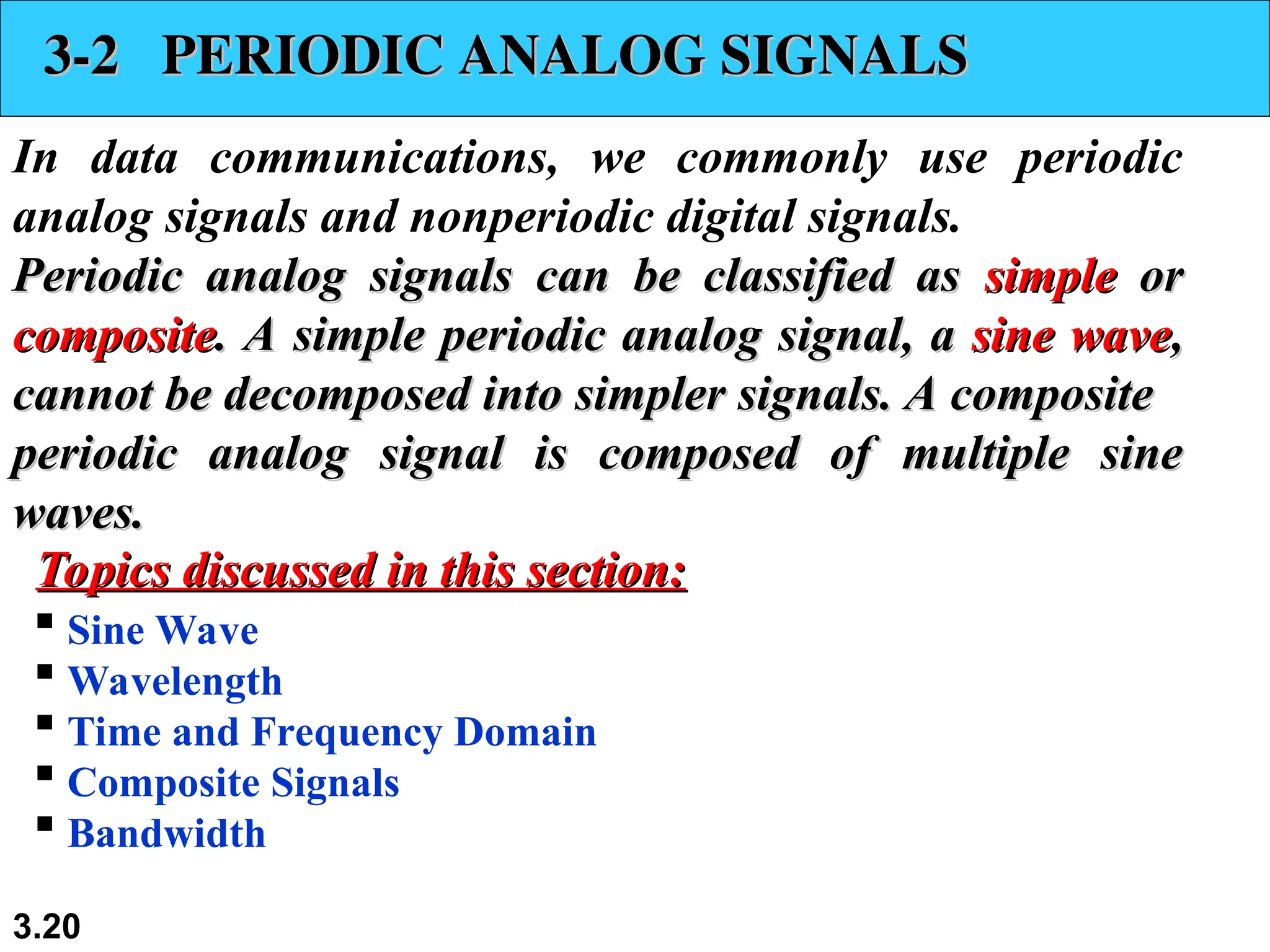
3-2 PERIODIC ANALOG SIGNALS
In data communications, we commonly use periodic
analog signals and nonperiodic digital signals.
Periodic analog signals can be classified as
Periodic analog signals can be classified as simple
simple or
or
composite
composite. A simple periodic analog signal, a
. A simple periodic analog signal, a sine wave
sine wave,
,
cannot be decomposed into simpler signals. A composite
periodic analog signal is composed of multiple sine
waves.
waves.
 Sine Wave
 Wavelength
 Time and Frequency Domain
 Composite Signals
 Bandwidth
Topics discussed in this section:
3.21
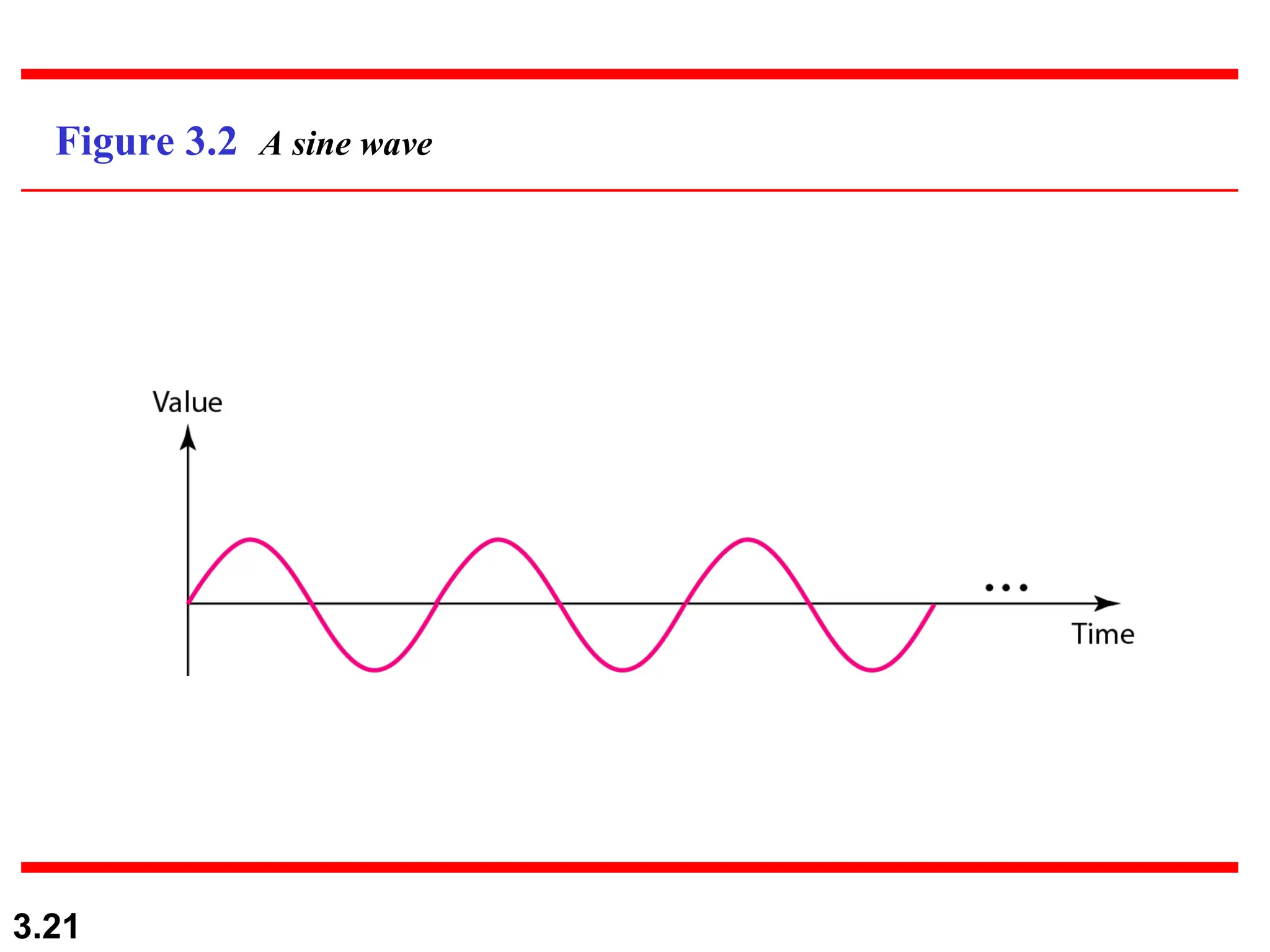
Figure 3.2 A sine wave
3.22
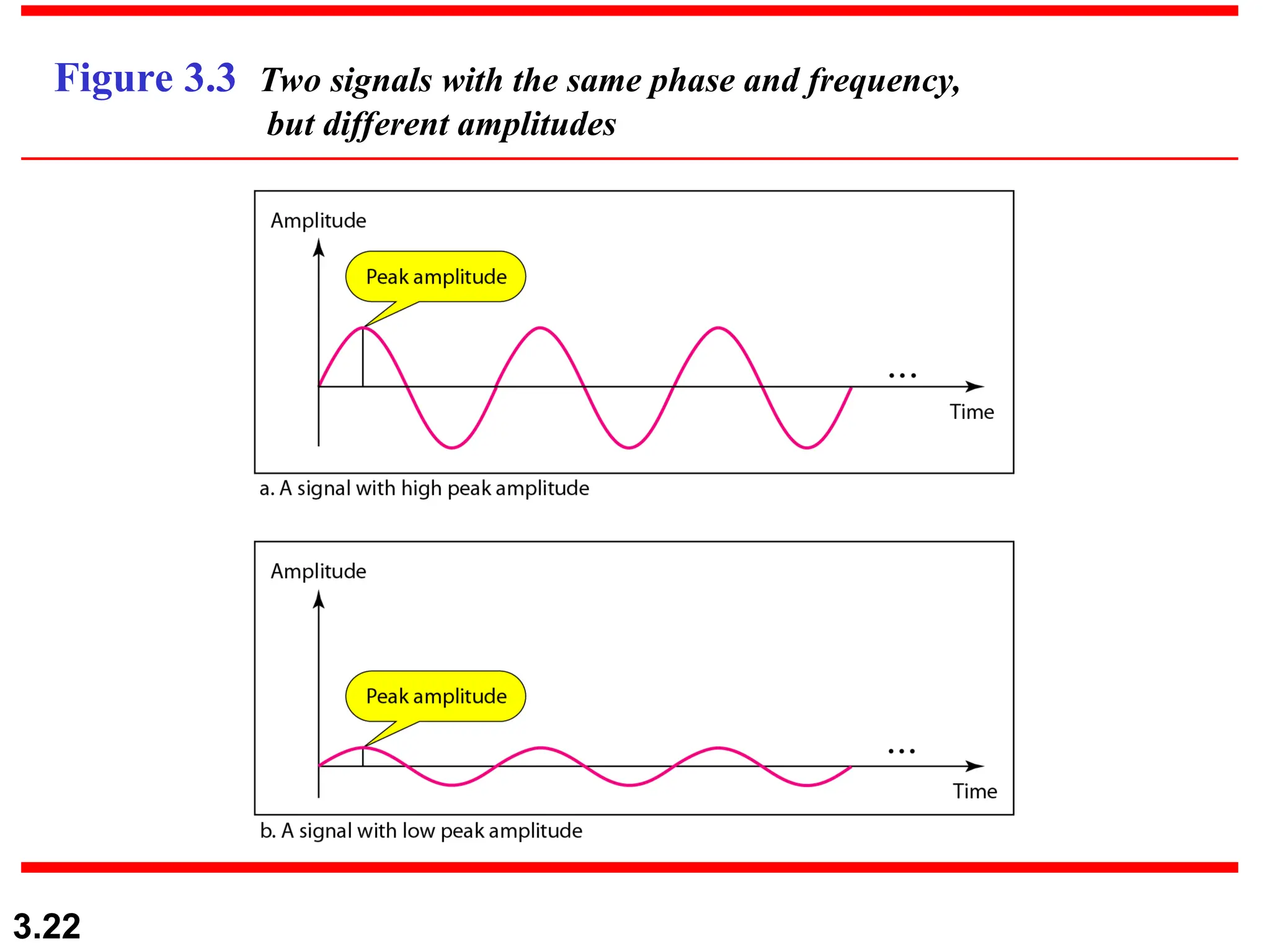
Figure 3.3 Two signals with the same phase and frequency,
but different amplitudes
3.23
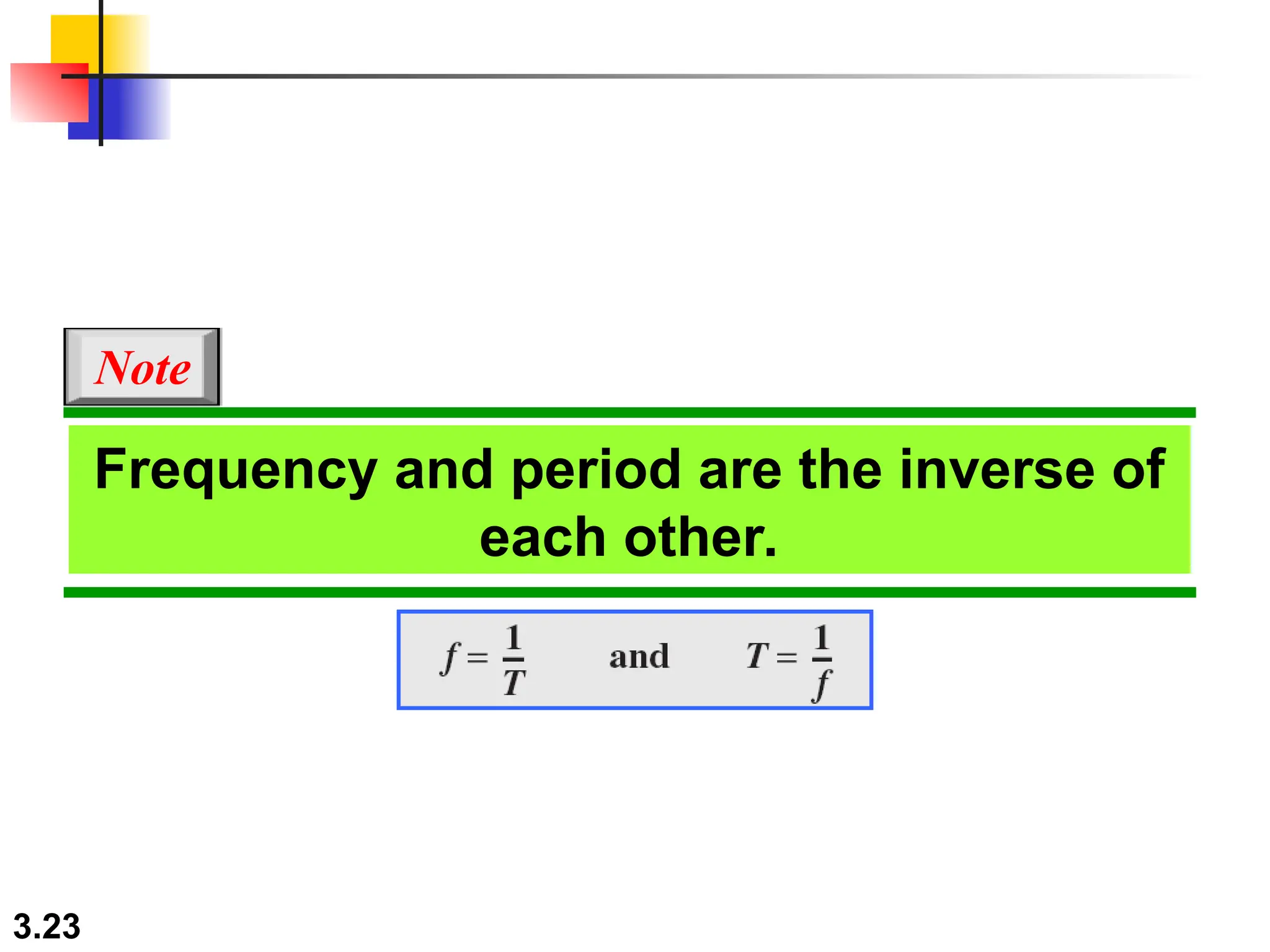
Frequency and period are the inverse of
each other.
Note
3.24
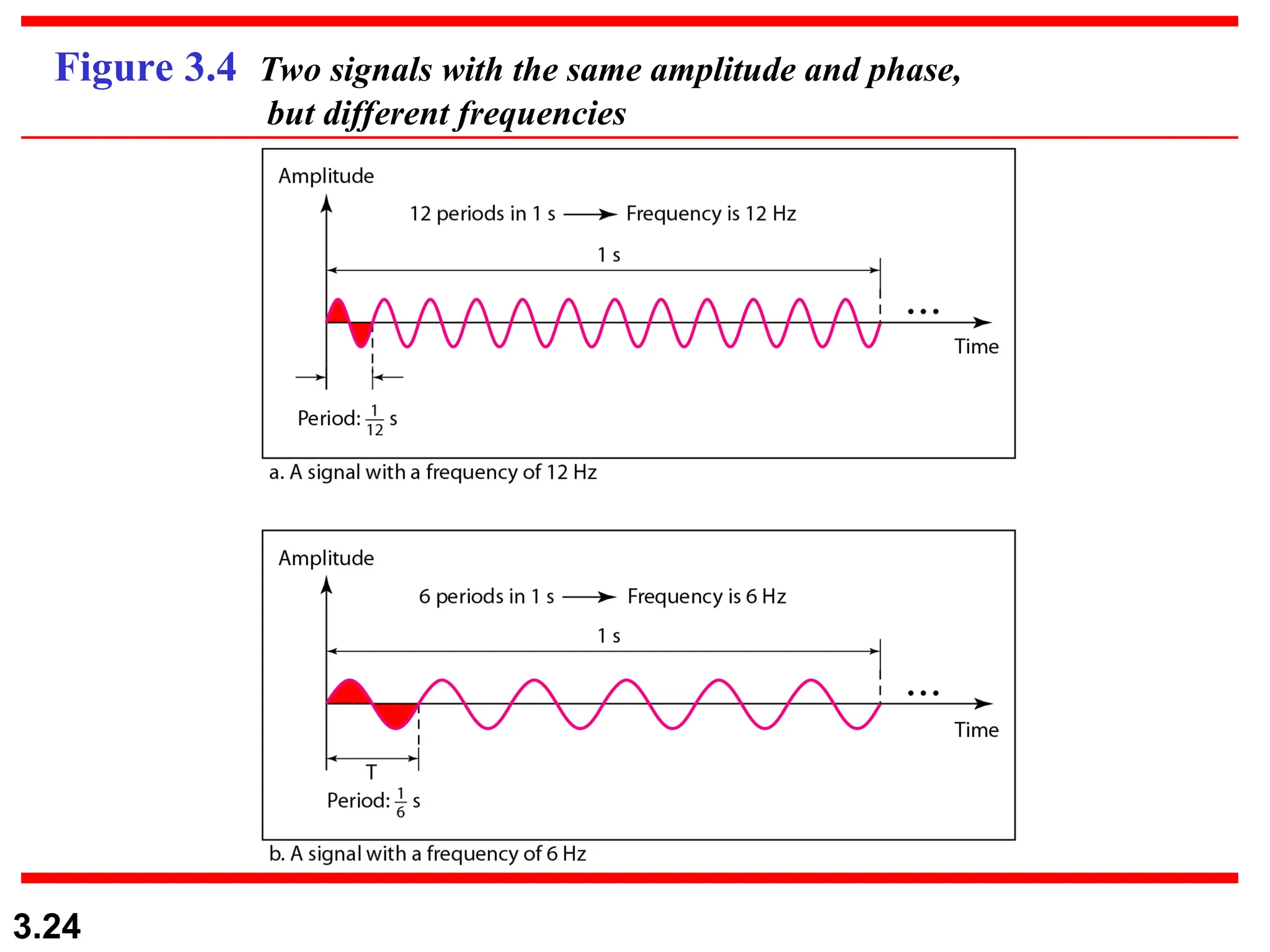
Figure 3.4 Two signals with the same amplitude and phase,
but different frequencies
3.25
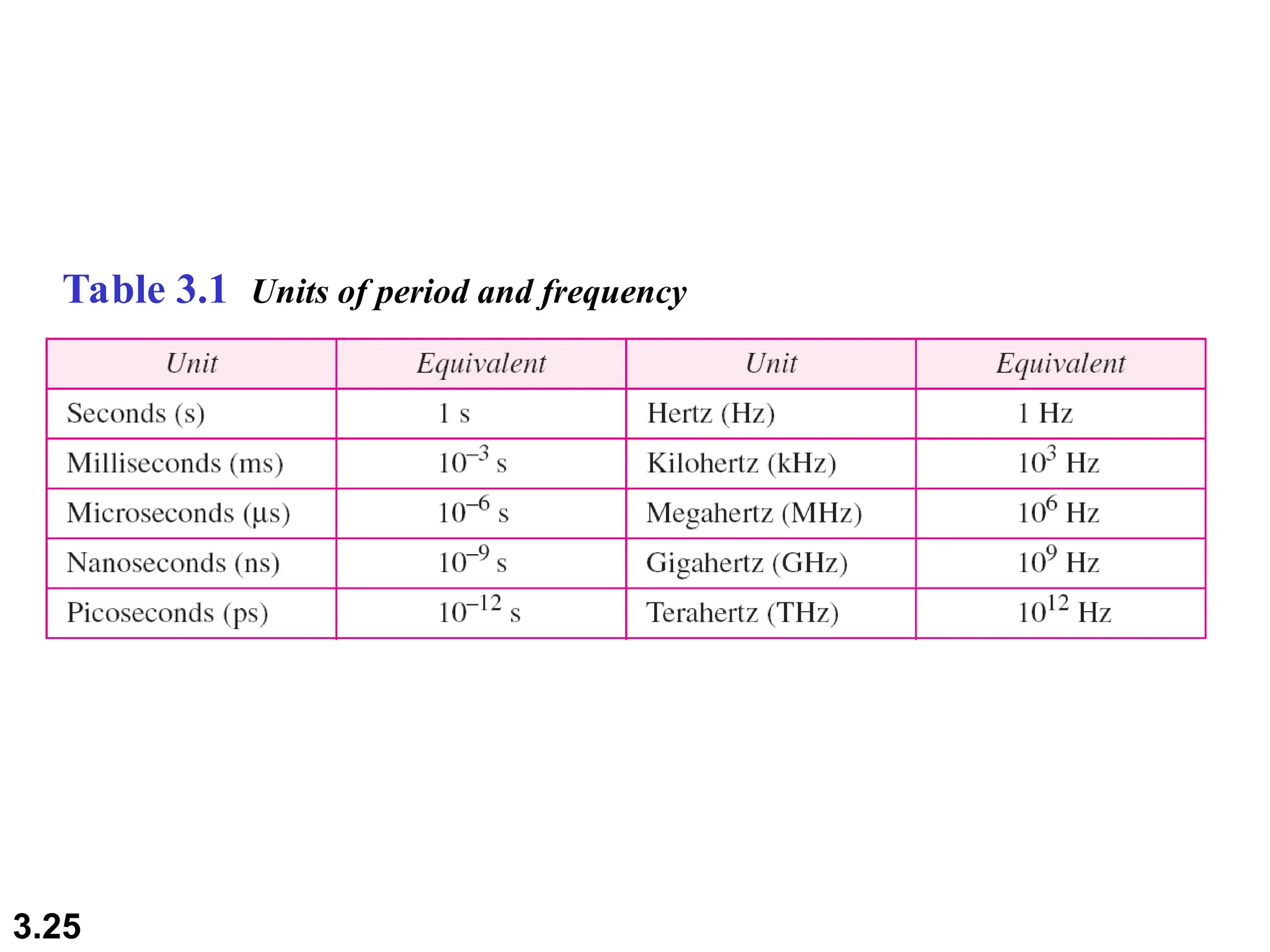
Table 3.1 Units of period and frequency
3.26
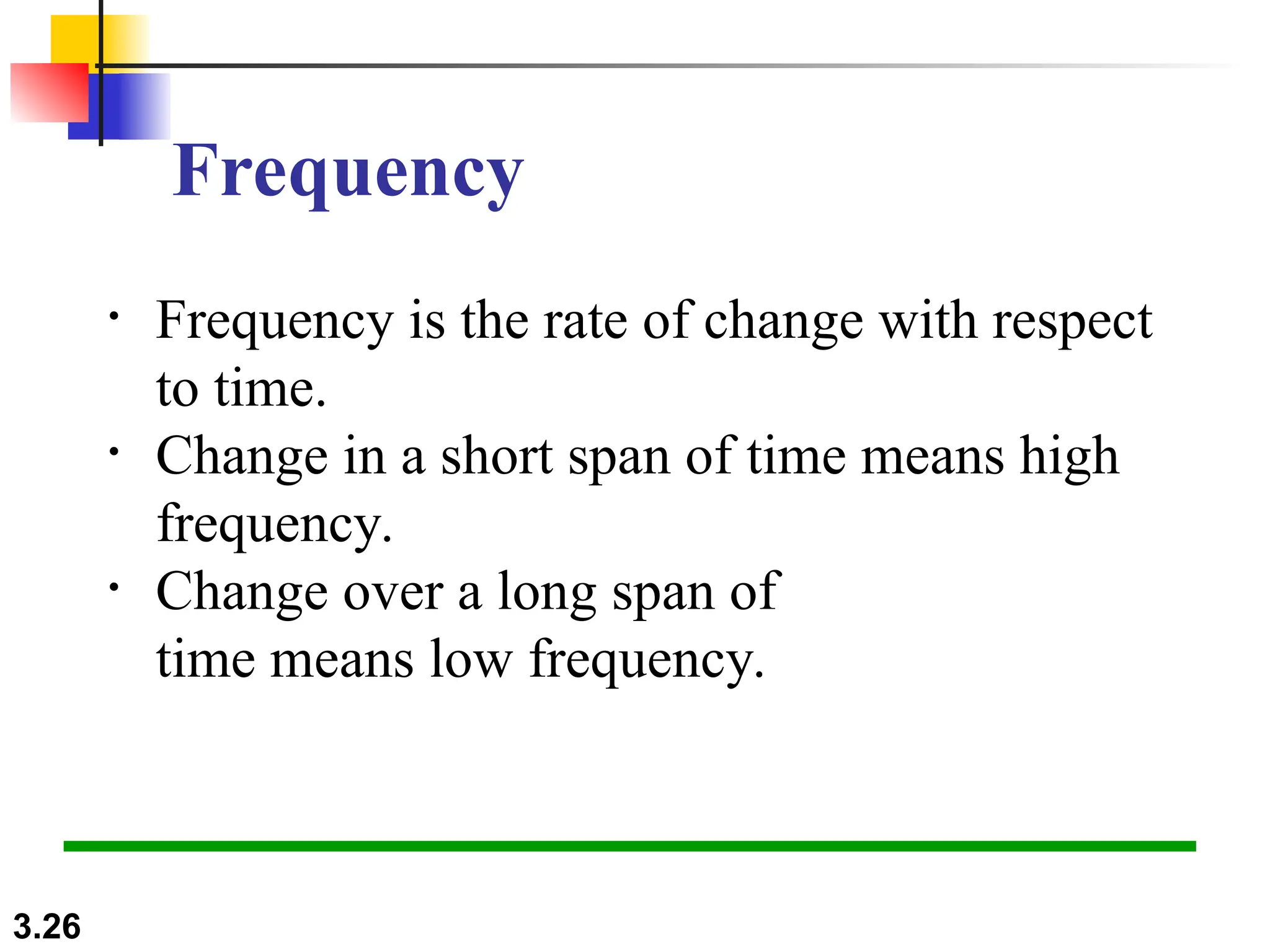
Frequency
• Frequency is the rate of change with respect
to time.
• Change in a short span of time means high
frequency.
• Change over a long span of
time means low frequency.
3.27
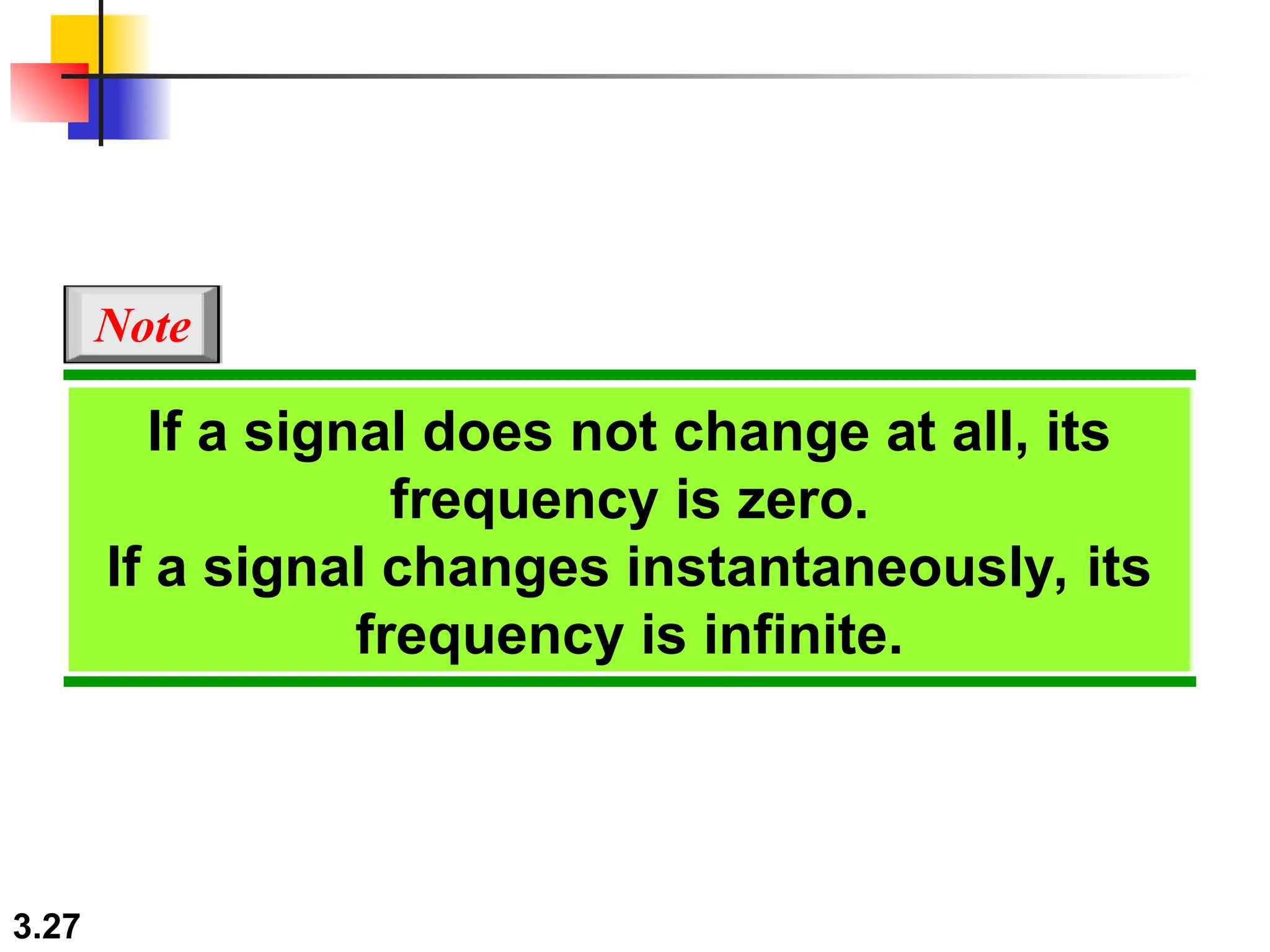
If a signal does not change at all, its
frequency is zero.
If a signal changes instantaneously, its
frequency is infinite.
Note
3.28
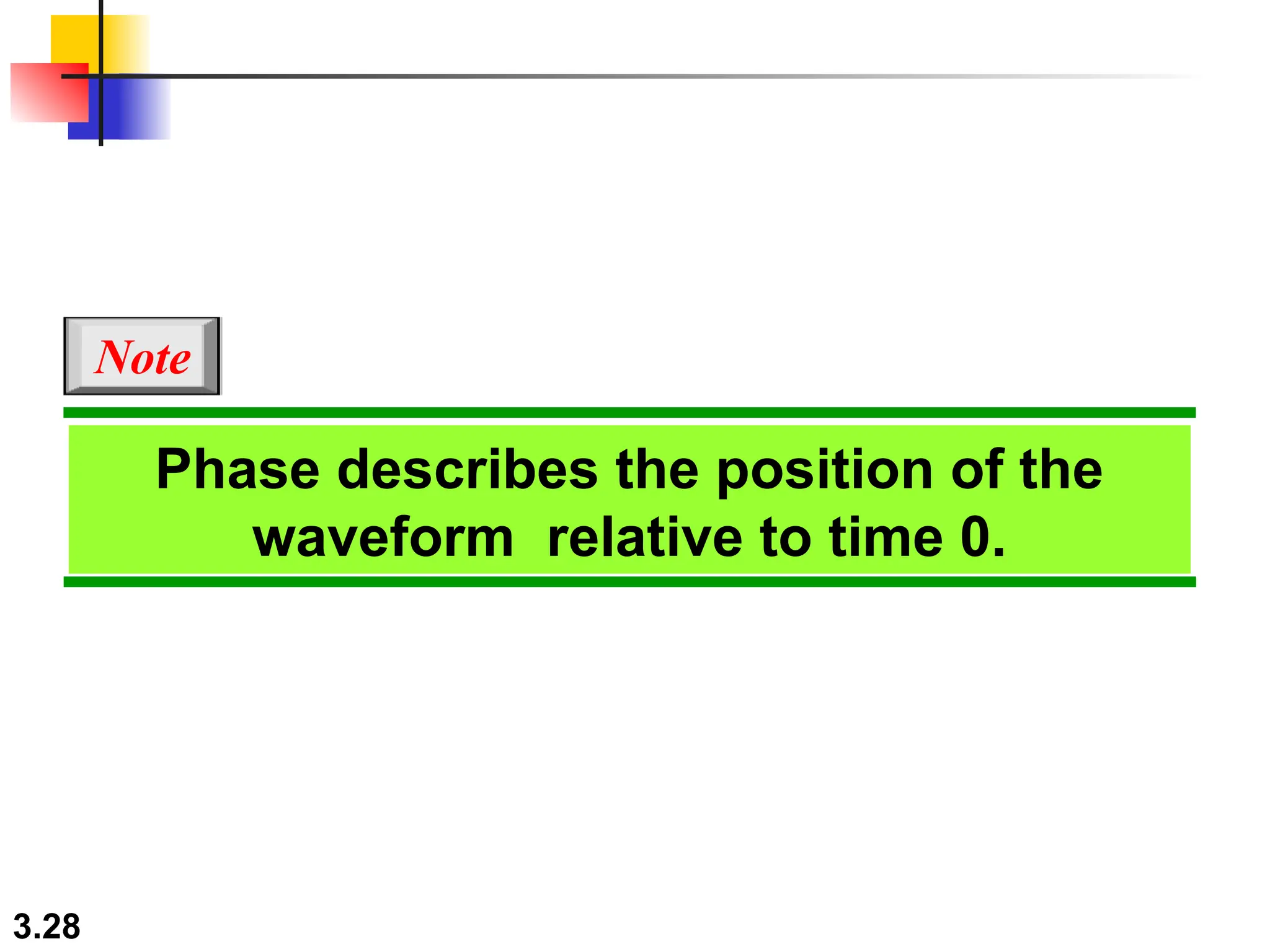
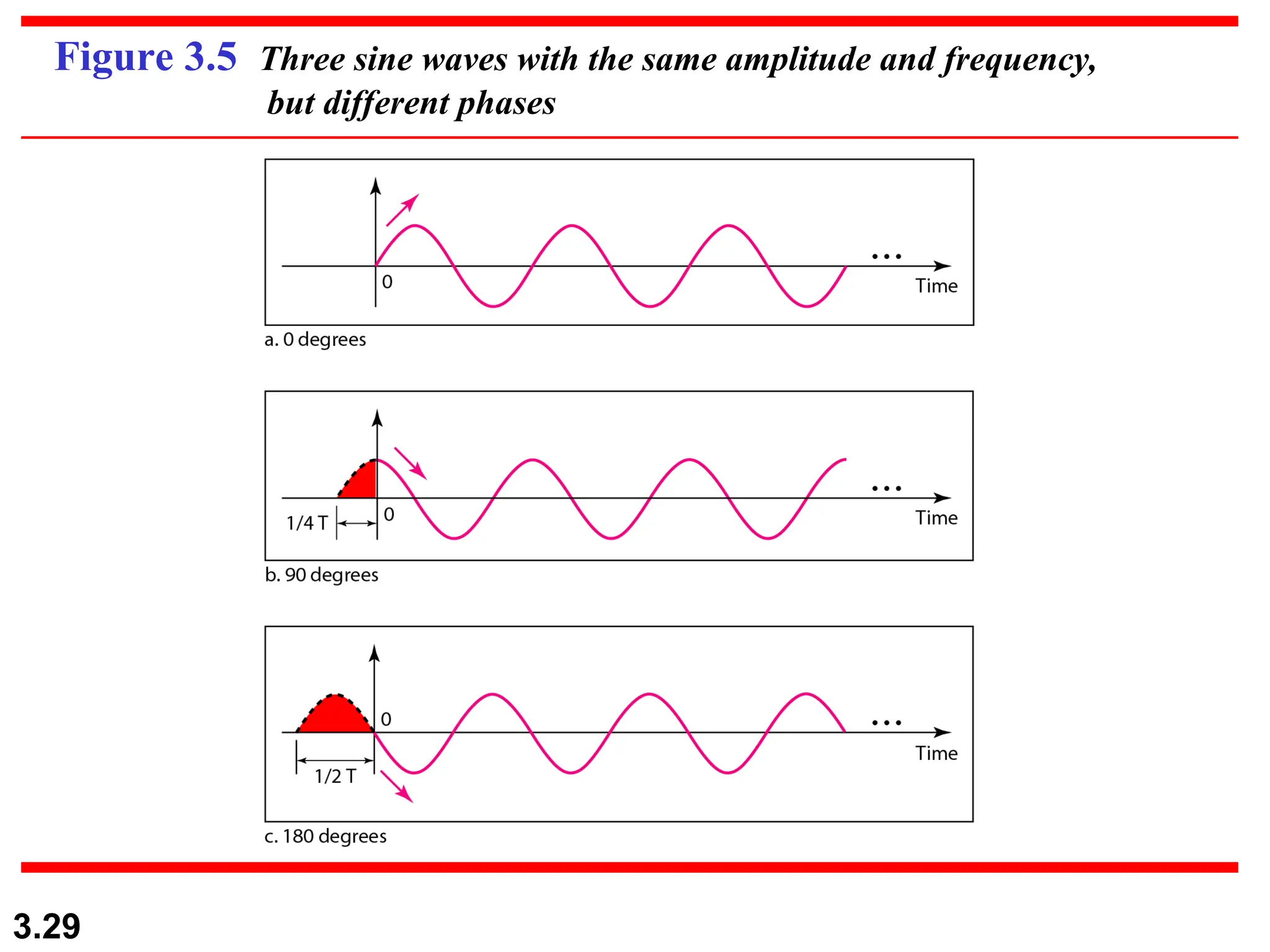
Phase describes the position of the
waveform relative to time 0.
Note
3.29
Figure 3.5 Three sine waves with the same amplitude and frequency,
but different phases
3.30
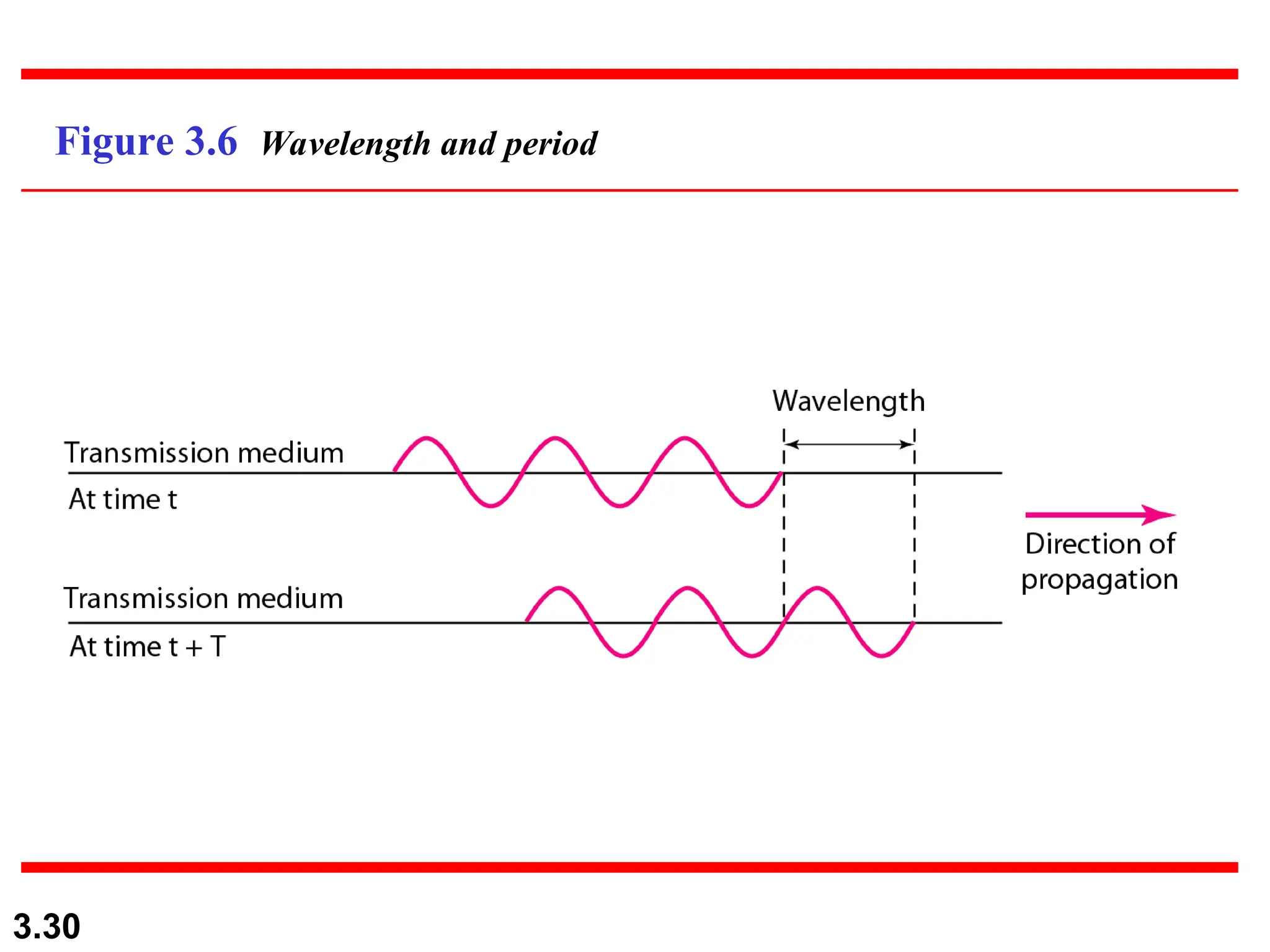
Figure 3.6 Wavelength and period
3.31
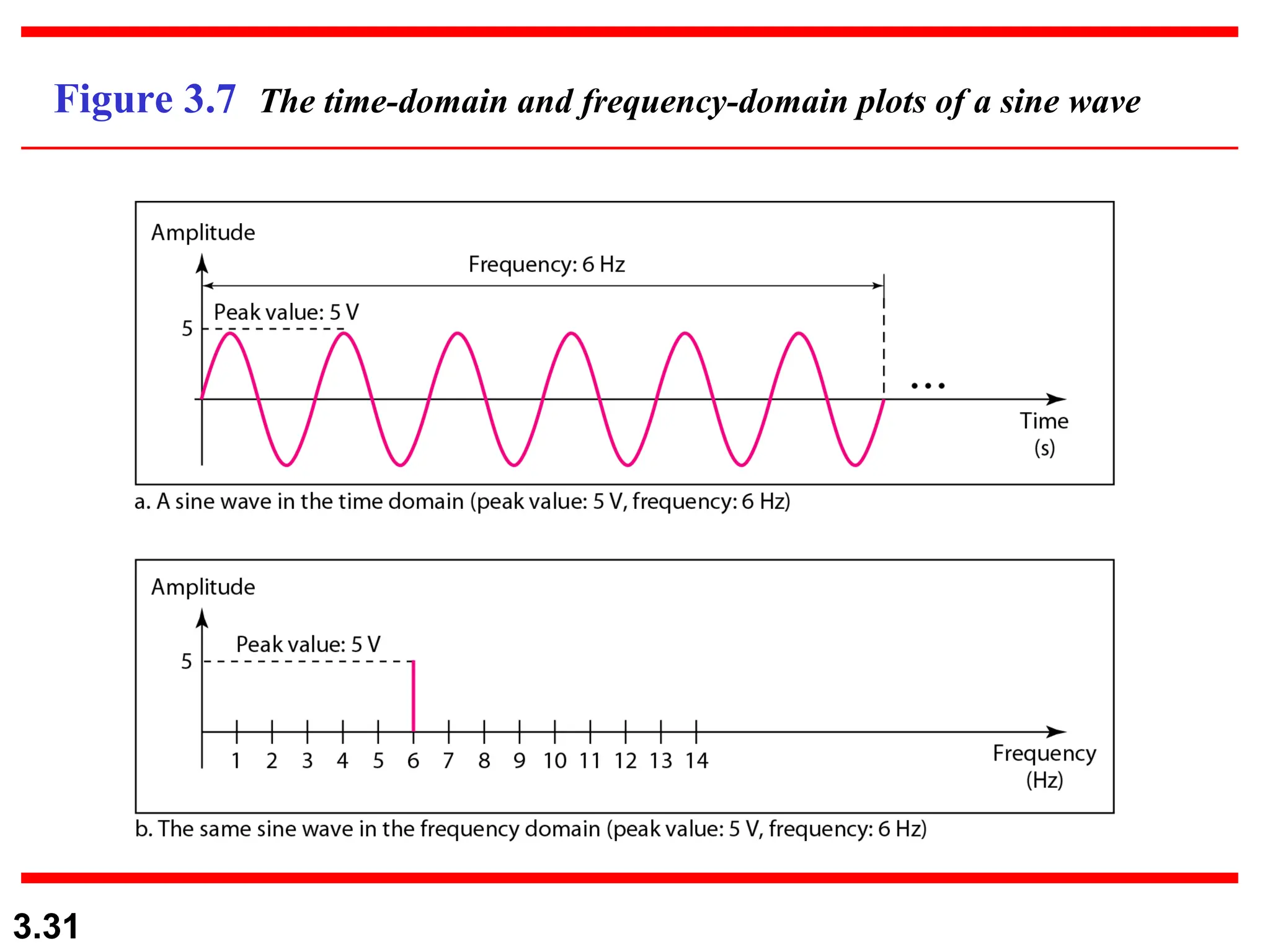
Figure 3.7 The time-domain and frequency-domain plots of a sine wave
3.32
A complete sine wave in the time
domain can be represented by one
single spike in the frequency domain.
Note
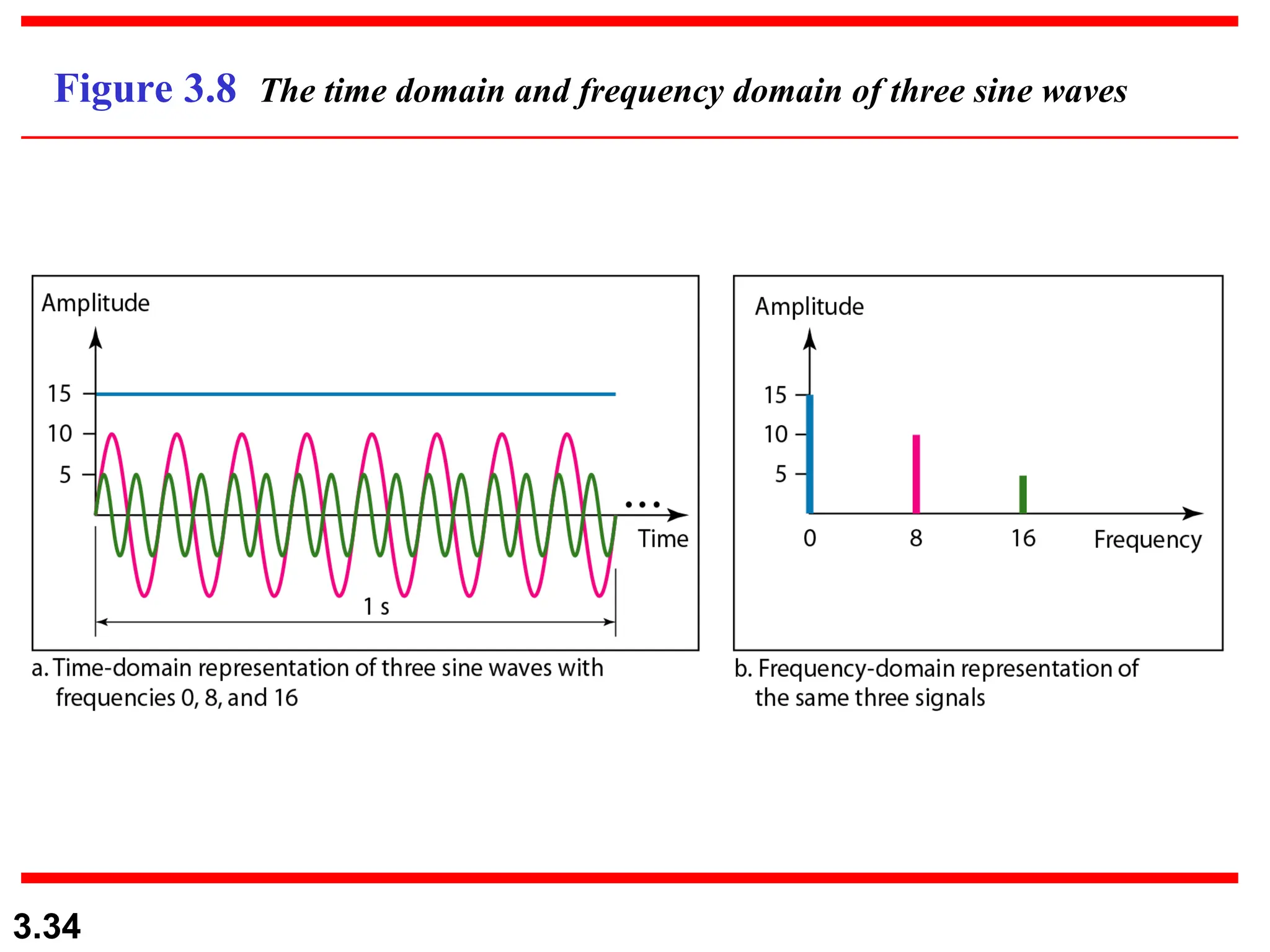
3.33
The frequency domain is more compact and
useful when we are dealing with more than one
sine wave. For example, Figure 3.8 shows three
sine waves, each with different amplitude and
frequency. All can be represented by three
spikes in the frequency domain.
Example 3.7
3.34
Figure 3.8 The time domain and frequency domain of three sine waves
3.35
Signals and Communication
 A single-frequency sine wave is not
useful in data communications
 We need to send a composite signal, a
signal made of many simple sine waves.
 According to Fourier analysis, any
composite signal is a combination of
simple sine waves with different
frequencies, amplitudes, and phases.
3.36
Composite Signals and
Periodicity
 If the composite signal is periodic, the
decomposition gives a series of signals
with discrete frequencies.
 If the composite signal is nonperiodic, the
decomposition gives a combination of
sine waves with continuous frequencies.
3.37
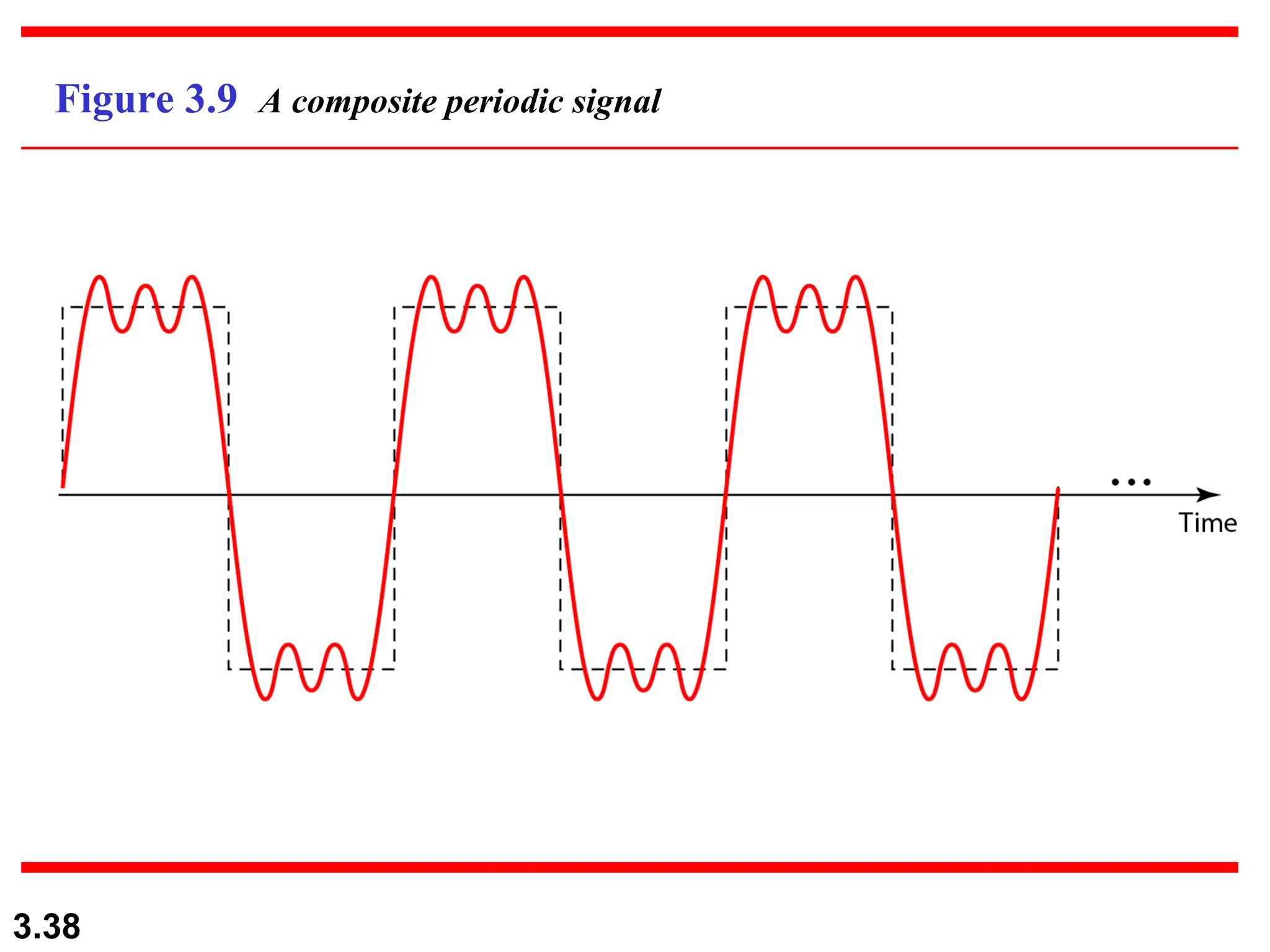
Figure 3.9 shows a periodic composite signal with
frequency f. This type of signal is not typical of those
found in data communications. We can consider it to be
three alarm systems, each with a different frequency.
The analysis of this signal can give us a good
understanding of how to decompose signals.
Example 3.4
3.38
Figure 3.9 A composite periodic signal
3.39
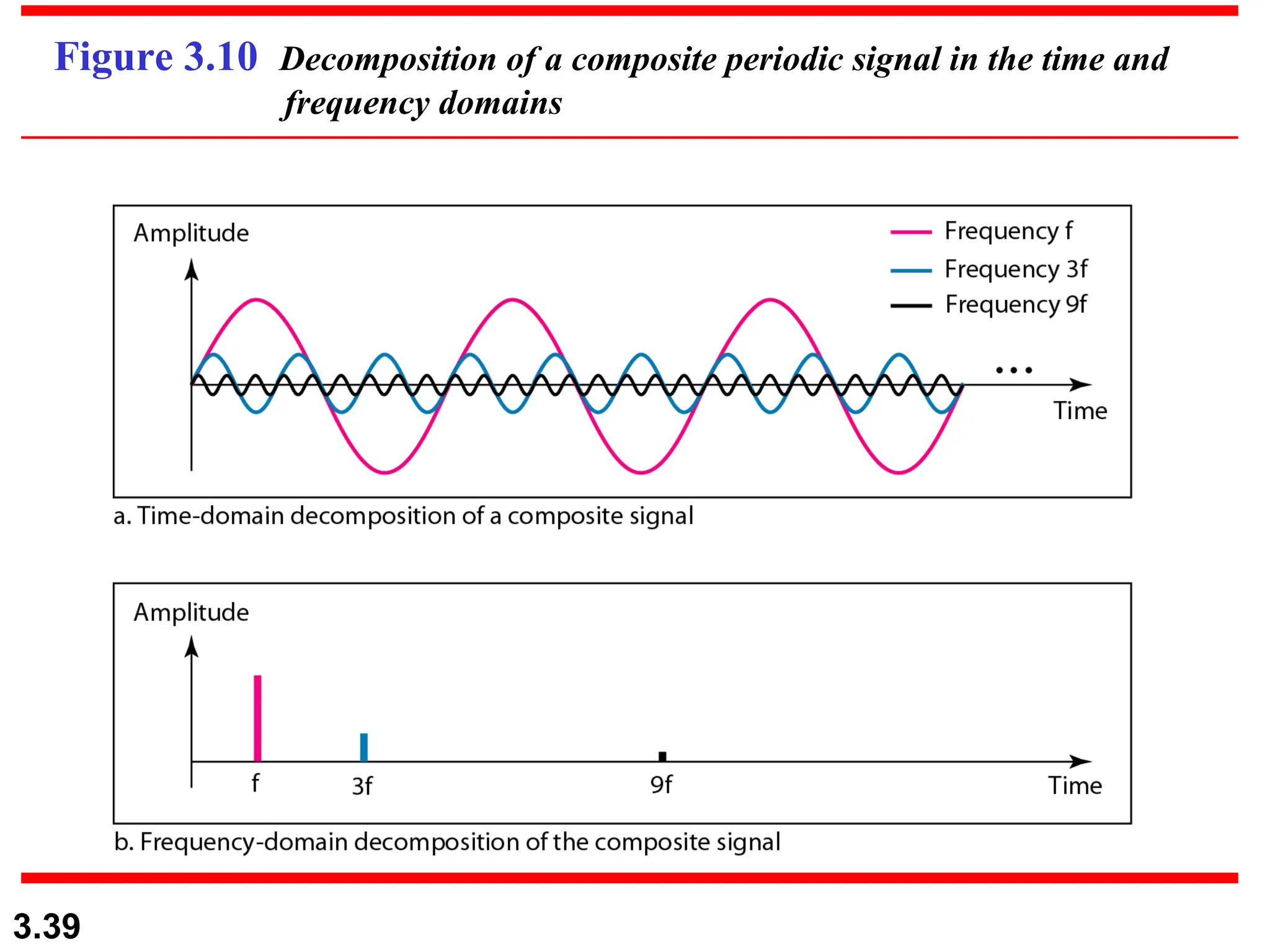
Figure 3.10 Decomposition of a composite periodic signal in the time and
frequency domains
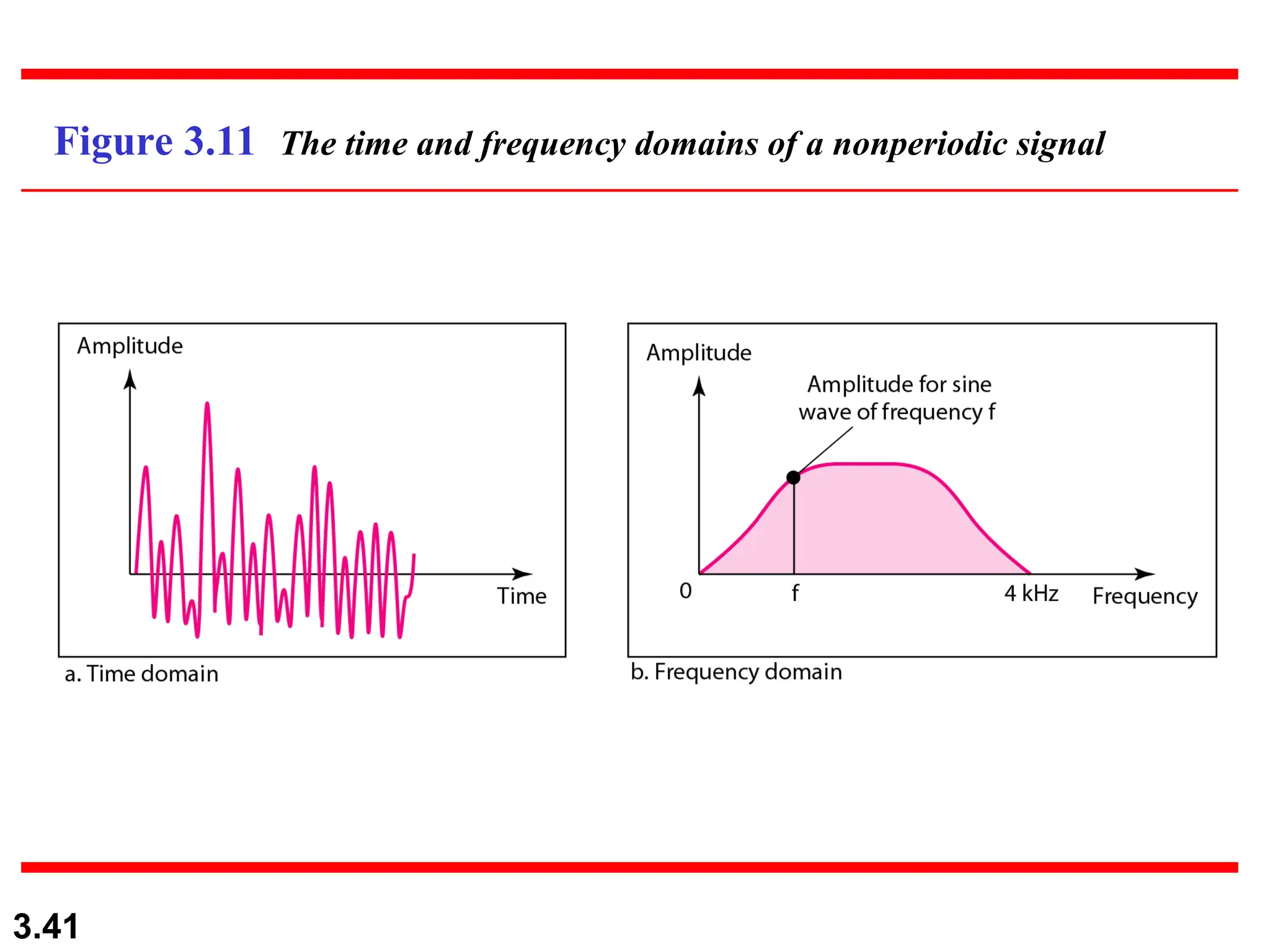
3.40
Figure 3.11 shows a nonperiodic composite signal. It
can be the signal created by a microphone or a telephone
set when a word or two is pronounced. In this case, the
composite signal cannot be periodic, because that
implies that we are repeating the same word or words
with exactly the same tone.
Example 3.5
3.41
Figure 3.11 The time and frequency domains of a nonperiodic signal
3.42
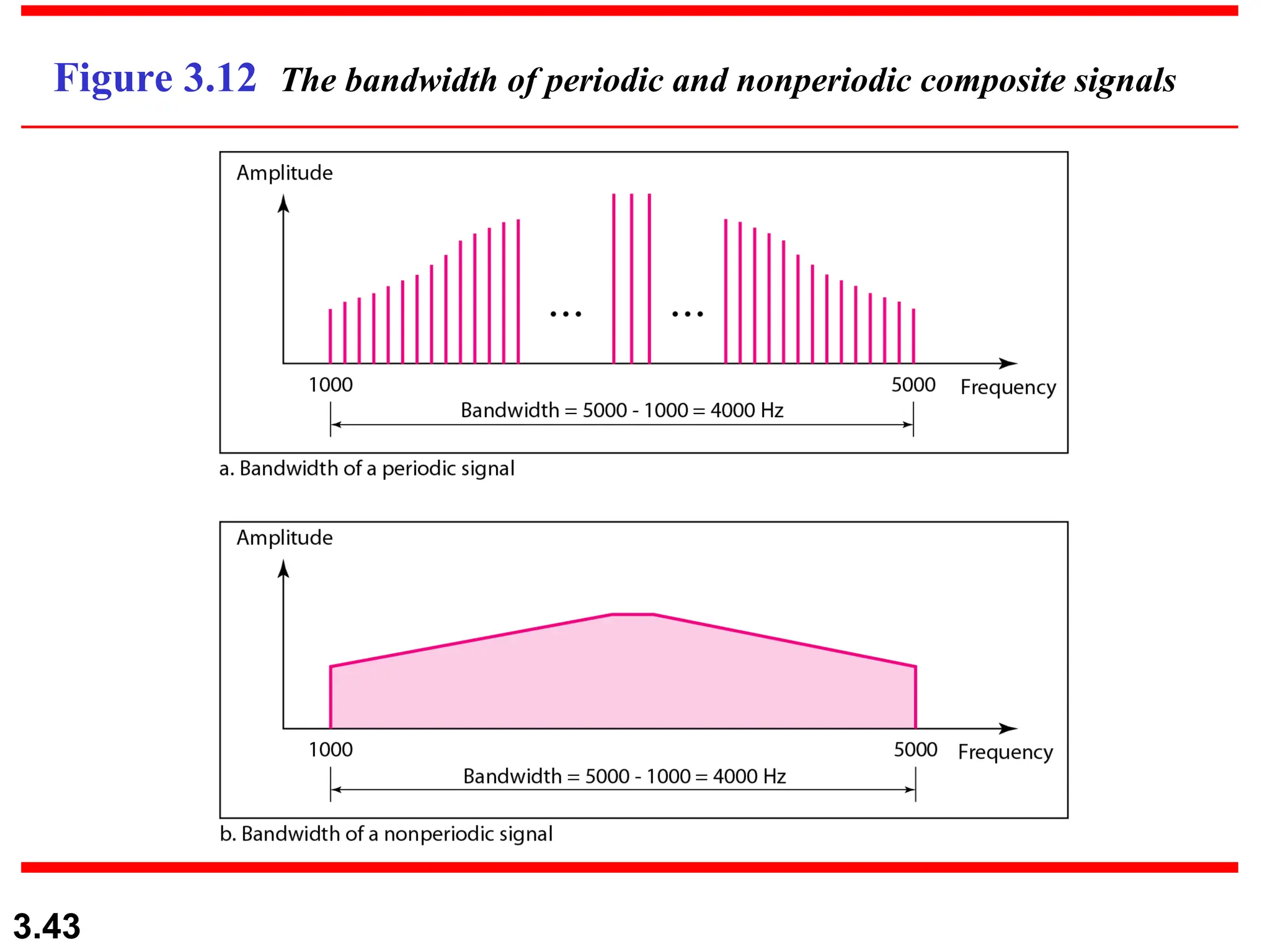
Bandwidth and Signal
Frequency
 The bandwidth of a composite signal is
the difference between the highest and
the lowest frequencies contained in that
signal.
3.43
Figure 3.12 The bandwidth of periodic and nonperiodic composite signals
3.44
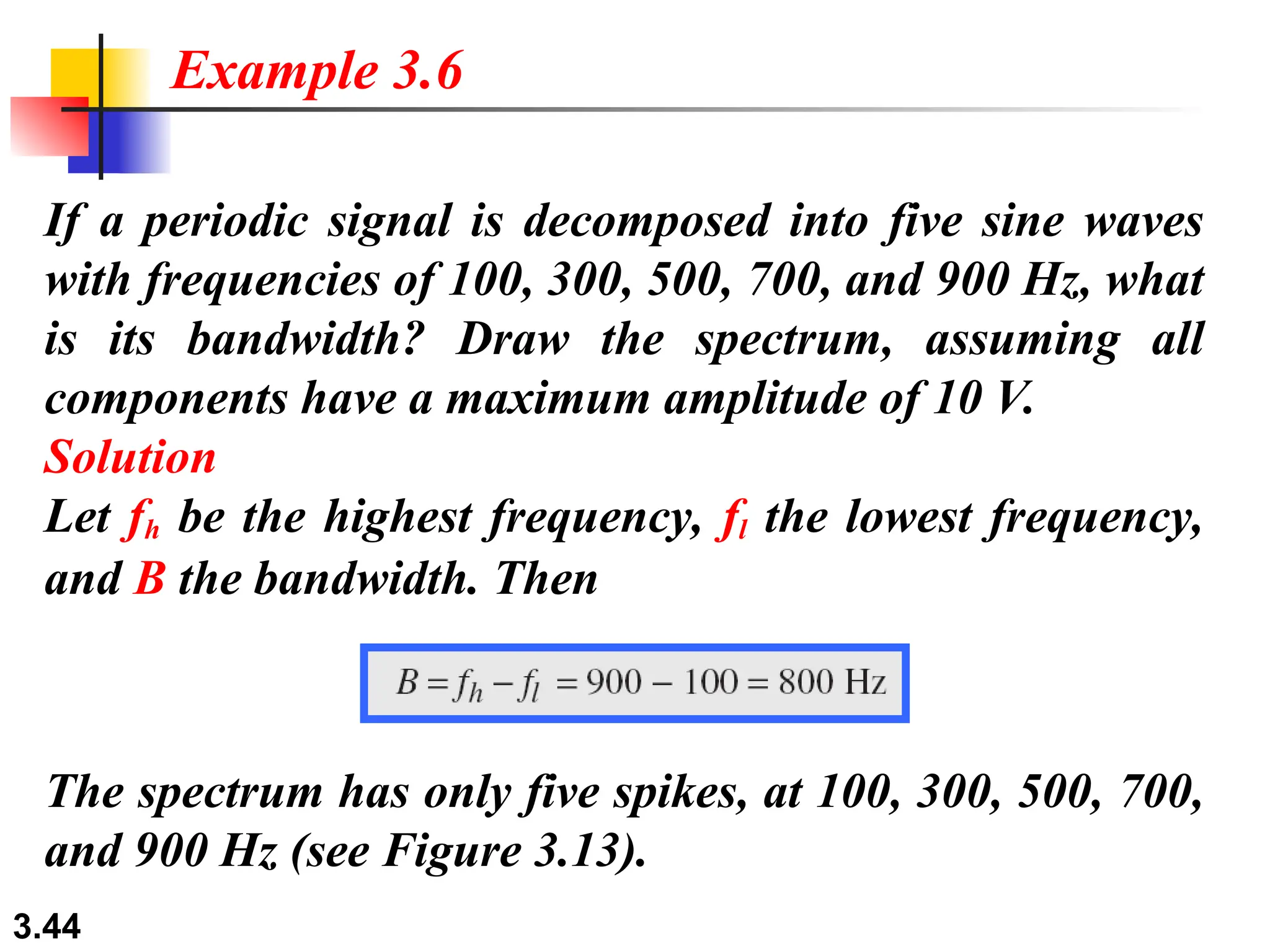
If a periodic signal is decomposed into five sine waves
with frequencies of 100, 300, 500, 700, and 900 Hz, what
is its bandwidth? Draw the spectrum, assuming all
components have a maximum amplitude of 10 V.
Solution
Let fh be the highest frequency, fl the lowest frequency,
and B the bandwidth. Then
Example 3.6
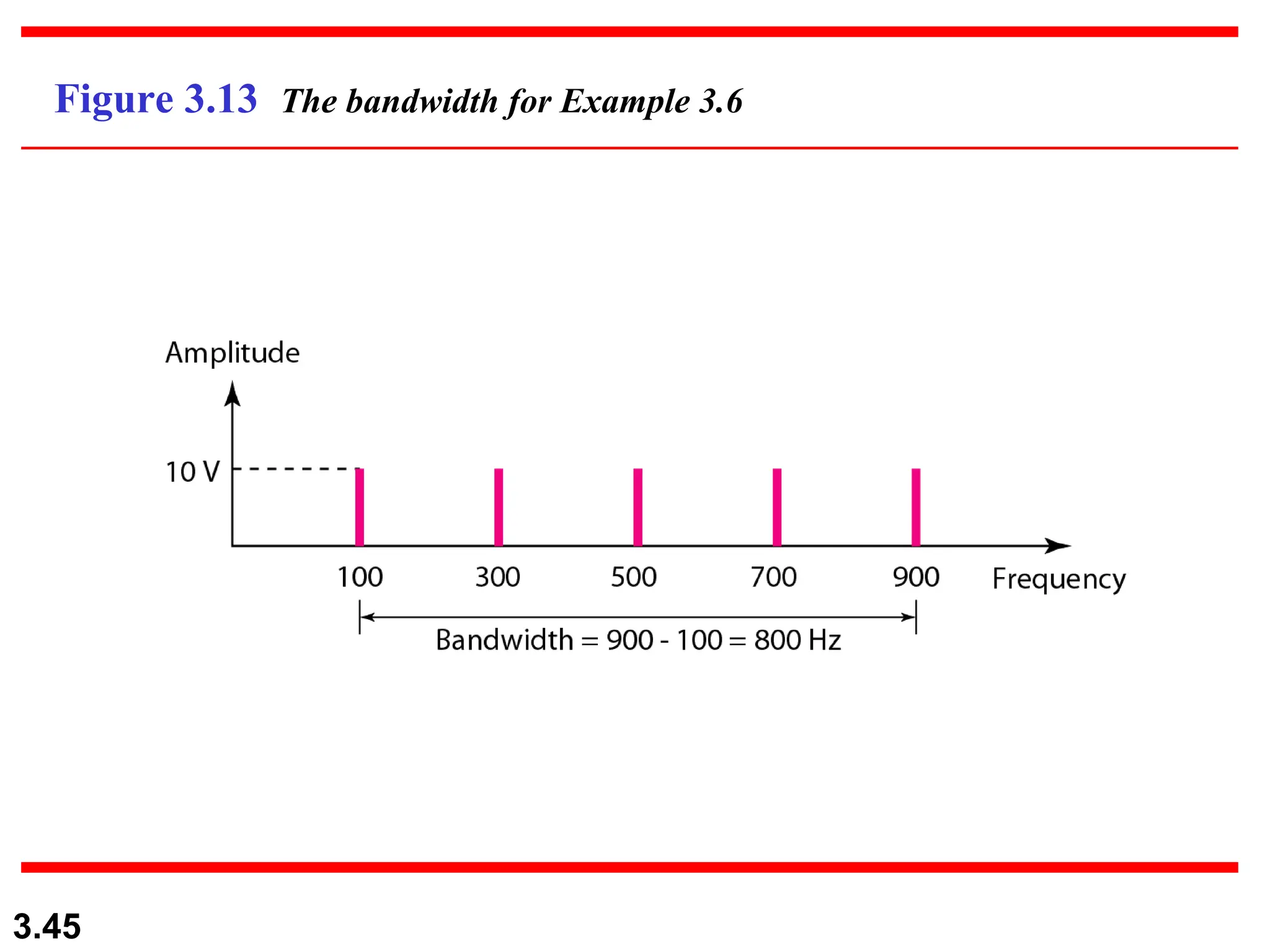
The spectrum has only five spikes, at 100, 300, 500, 700,
and 900 Hz (see Figure 3.13).
3.45
Figure 3.13 The bandwidth for Example 3.6
3.46
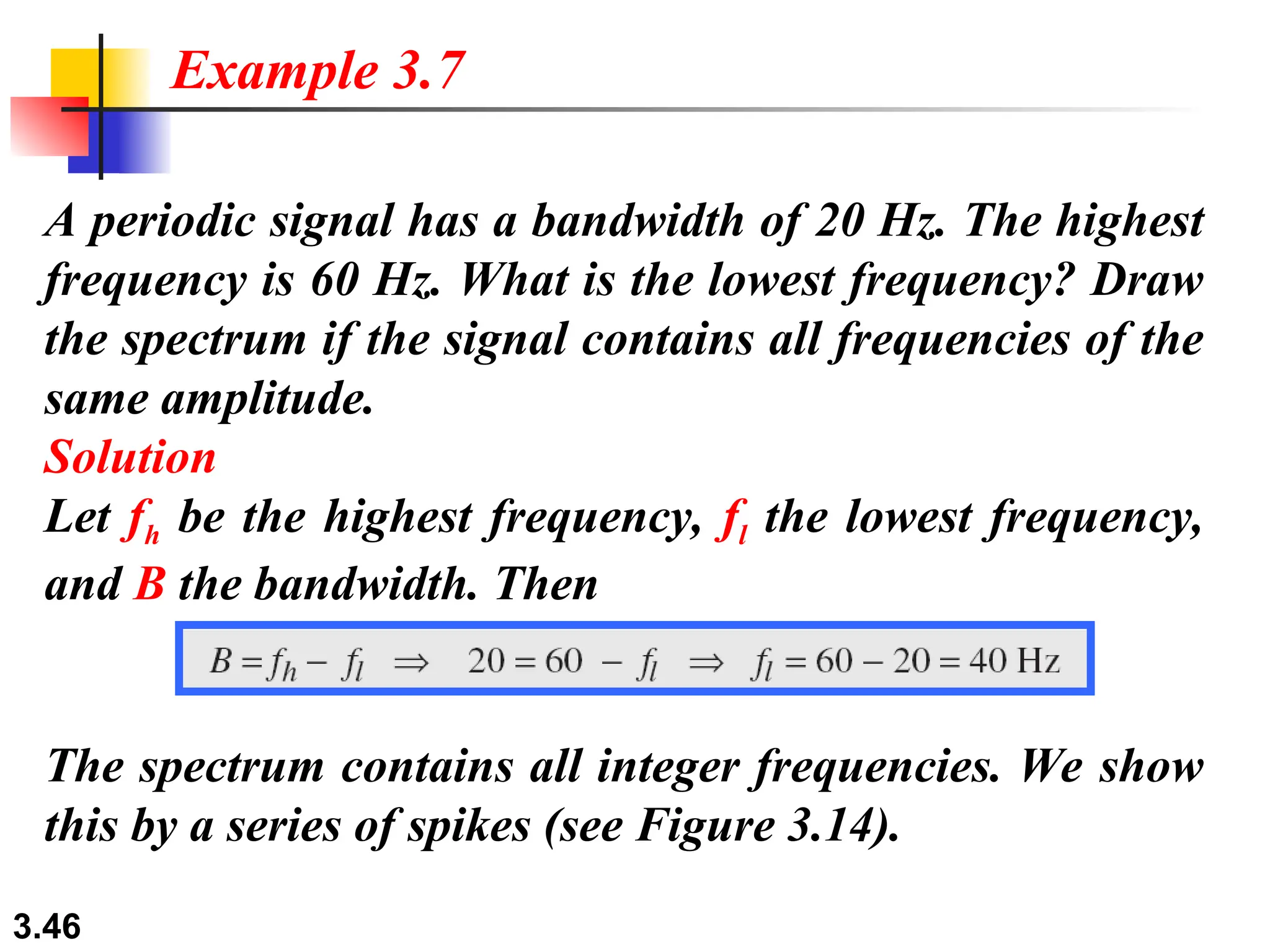
A periodic signal has a bandwidth of 20 Hz. The highest
frequency is 60 Hz. What is the lowest frequency? Draw
the spectrum if the signal contains all frequencies of the
same amplitude.
Solution
Let fh be the highest frequency, fl the lowest frequency,
and B the bandwidth. Then
Example 3.7
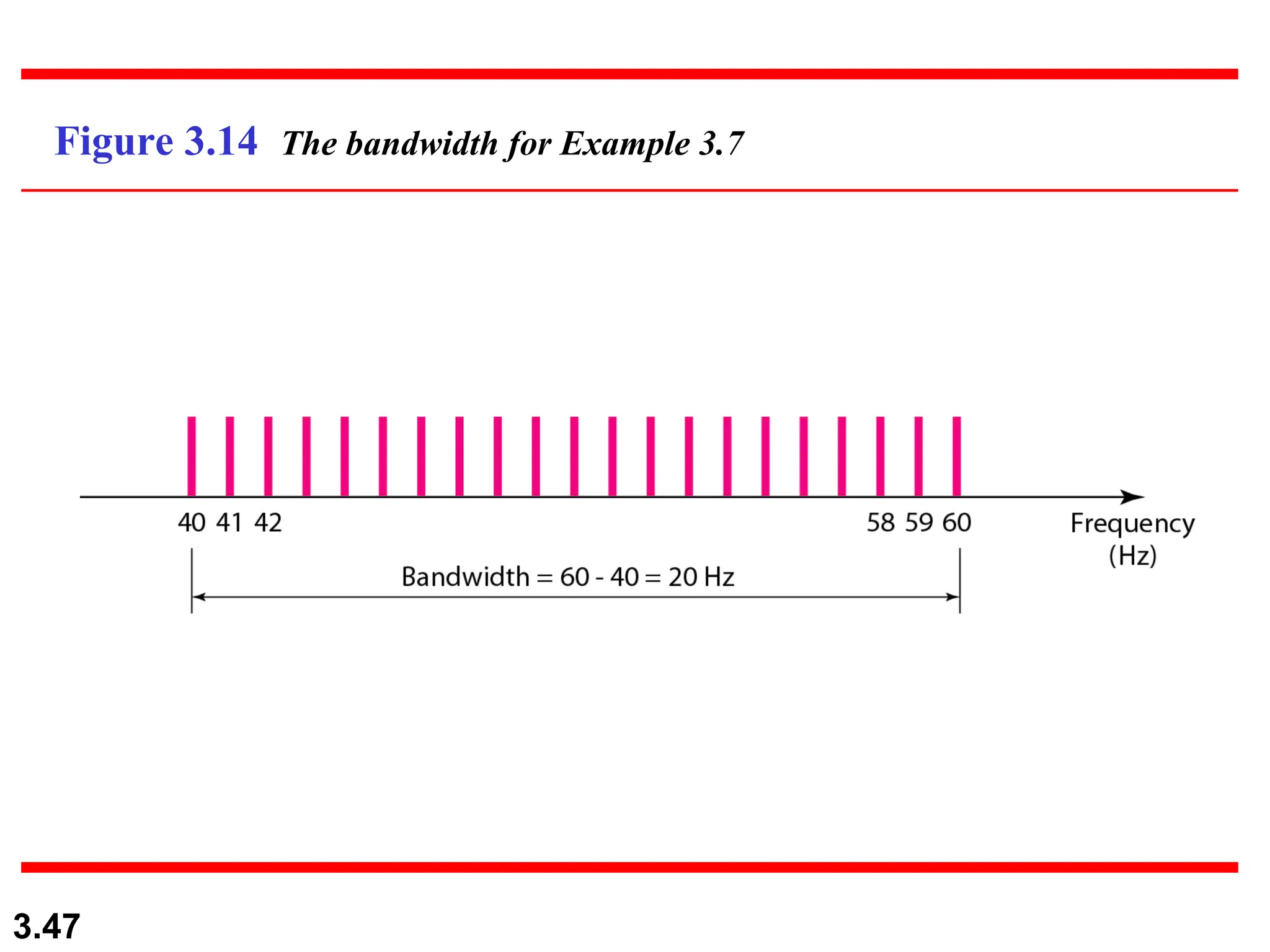
The spectrum contains all integer frequencies. We show
this by a series of spikes (see Figure 3.14).
3.47
Figure 3.14 The bandwidth for Example 3.7
3.48
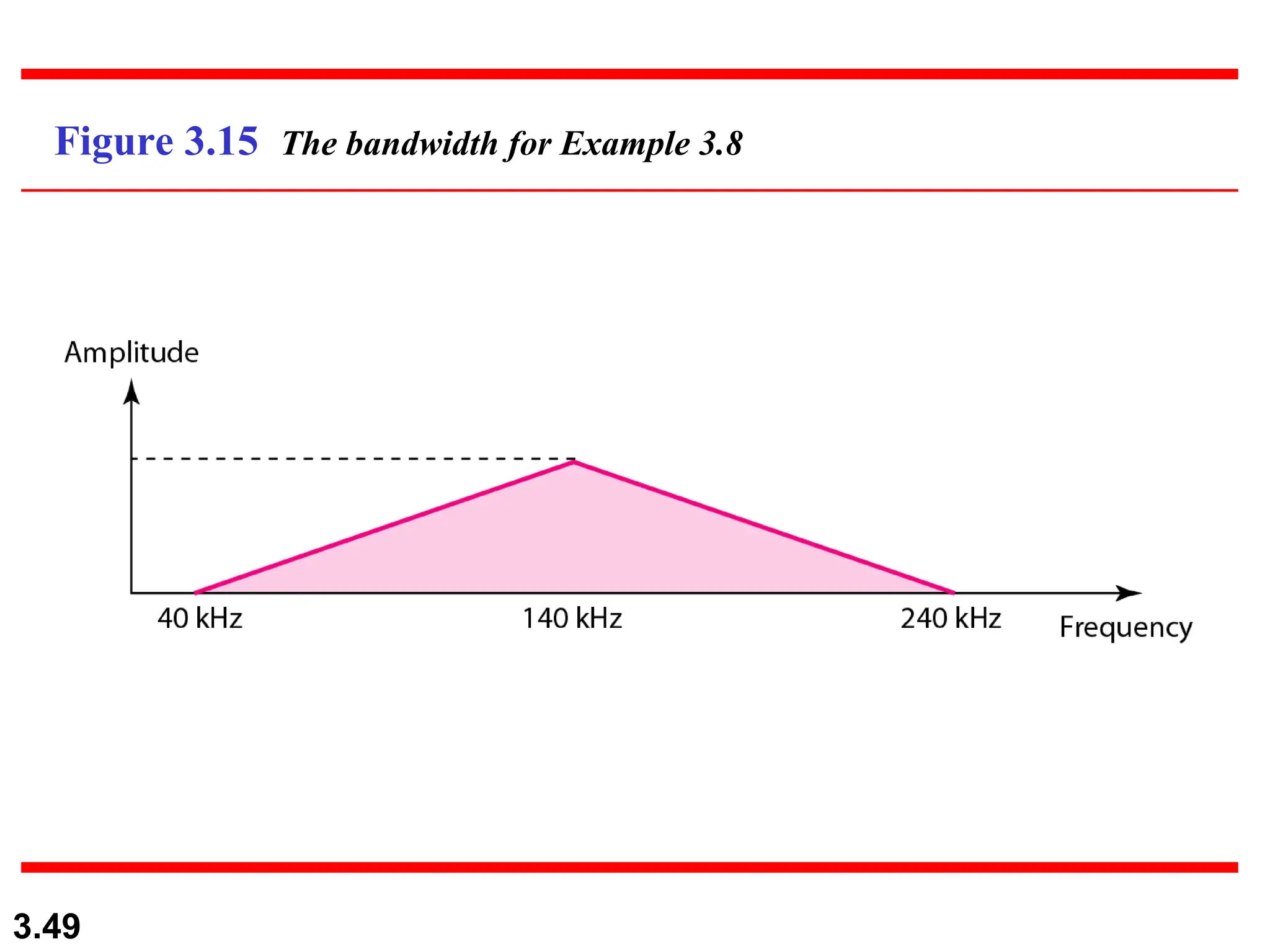
A nonperiodic composite signal has a bandwidth of 200
kHz, with a middle frequency of 140 kHz and peak
amplitude of 20 V. The two extreme frequencies have an
amplitude of 0. Draw the frequency domain of the
signal.
Solution
The lowest frequency must be at 40 kHz and the highest
at 240 kHz. Figure 3.15 shows the frequency domain
and the bandwidth.
Example 3.8
3.49
Figure 3.15 The bandwidth for Example 3.8

ch3_1_v1.ppt data and signal from compute r net

  • 1.
  • 2.
    1.2 Figure 1.1 Componentsof a data communication system
  • 3.
    1.3 Figure 1.3 Typesof connections: point-to-point and multipoint
  • 4.
    Cont.. (Point toPoint)  point-to-point connection also possible provides a dedicated link between two devices.  The entire capacity of the link is reserved for transmission between those two devices.  Most point-to-point connections use an actual length of wire or cable to connect the two ends, but other options, such as microwave or satellite links  Eg : television channels by infrared remote control 1.4
  • 5.
    Multipoint  A multipoint(also called multidrop) connection is one in which more than two specific devices share a single link.  The capacity of the channel is shared, either spatially or temporally. If several devices can use the link simultaneously, it is a spatially shared connection. If users must take turns, it is a timeshared connection. 1.5
  • 6.
    1.6 Figure 1.4 Categoriesof topology Topology of a network is the geometric representation of the relationship of all the links and linking devices (usually called nodes) to one another.
  • 7.
    1.7 Figure 1.5 Afully connected mesh topology (five devices) • Point to Point link to every other device • Term dedicated means that the link carries traffic only between the two devices it connects. • To find the number of physical links in a fully connected mesh network with n nodes, we first consider that each node must be connected to every other node.
  • 8.
    1.8 Figure 1.6 Astar topology connecting four stations
  • 9.
    1.9 Figure 1.7 Abus topology connecting three stations
  • 10.
    1.10 Figure 1.8 Aring topology connecting six stations
  • 11.
    1.11 Figure 1.9 Ahybrid topology: a star backbone with three bus networks
  • 12.
    1.12 1-4 PROTOCOLS 1-4 PROTOCOLS Aprotocol is synonymous with rule. It consists of a set of A protocol is synonymous with rule. It consists of a set of rules that govern data communications. It determines rules that govern data communications. It determines what is communicated, how it is communicated and when what is communicated, how it is communicated and when it is communicated. The key elements of a protocol are it is communicated. The key elements of a protocol are syntax, semantics and timing syntax, semantics and timing  Syntax  Semantics  Timing Topics discussed in this section: Topics discussed in this section:
  • 13.
    1.13 Elements of aProtocol  Syntax  Structure or format of the data  Indicates how to read the bits - field delineation  Semantics  Interprets the meaning of the bits  Knows which fields define what action  Timing  When data should be sent and what  Speed at which data should be sent or speed at which it is being received.
  • 14.
    3.14 To be transmitted,data must be transformed to electromagnetic signals. Note
  • 15.
    3.15 3-1 ANALOG ANDDIGITAL 3-1 ANALOG AND DIGITAL Data can be Data can be analog analog or or digital digital. The term . The term analog data analog data refers refers to information that is continuous; to information that is continuous; digital data digital data refers to refers to information that has discrete states. Analog data take on information that has discrete states. Analog data take on continuous values. Digital data take on discrete values. continuous values. Digital data take on discrete values.  Analog and Digital Data  Analog and Digital Signals  Periodic and Nonperiodic Signals Topics discussed in this section: Topics discussed in this section:
  • 16.
     Data canbe analog or digital. The term analog data refers to information that is continuous;  digital data refers to information that has discrete states. For example, an analog  clock that has hour, minute, and second hands gives information in a continuous form;  the movements of the hands are continuous. On the other hand, a digital clock that  reports the hours and the minutes will change suddenly from 8:05 to 8:06. 3.16
  • 17.
    3.17 Analog and DigitalData  Data can be analog or digital.  Analog data are continuous and take continuous values.  Digital data have discrete states and take discrete values.
  • 18.
    3.18 Analog and DigitalSignals • Signals can be analog or digital. • Analog signals can have an infinite number of values in a range. • Digital signals can have only a limited number of values.
  • 19.
    3.19 Figure 3.1 Comparisonof analog and digital signals
  • 20.
    3.20 3-2 PERIODIC ANALOGSIGNALS 3-2 PERIODIC ANALOG SIGNALS In data communications, we commonly use periodic analog signals and nonperiodic digital signals. Periodic analog signals can be classified as Periodic analog signals can be classified as simple simple or or composite composite. A simple periodic analog signal, a . A simple periodic analog signal, a sine wave sine wave, , cannot be decomposed into simpler signals. A composite cannot be decomposed into simpler signals. A composite periodic analog signal is composed of multiple sine periodic analog signal is composed of multiple sine waves. waves.  Sine Wave  Wavelength  Time and Frequency Domain  Composite Signals  Bandwidth Topics discussed in this section: Topics discussed in this section:
  • 21.
  • 22.
    3.22 Figure 3.3 Twosignals with the same phase and frequency, but different amplitudes
  • 23.
    3.23 Frequency and periodare the inverse of each other. Note
  • 24.
    3.24 Figure 3.4 Twosignals with the same amplitude and phase, but different frequencies
  • 25.
    3.25 Table 3.1 Unitsof period and frequency
  • 26.
    3.26 Frequency • Frequency isthe rate of change with respect to time. • Change in a short span of time means high frequency. • Change over a long span of time means low frequency.
  • 27.
    3.27 If a signaldoes not change at all, its frequency is zero. If a signal changes instantaneously, its frequency is infinite. Note
  • 28.
    3.28 Phase describes theposition of the waveform relative to time 0. Note
  • 29.
    3.29 Figure 3.5 Threesine waves with the same amplitude and frequency, but different phases
  • 30.
  • 31.
    3.31 Figure 3.7 Thetime-domain and frequency-domain plots of a sine wave
  • 32.
    3.32 A complete sinewave in the time domain can be represented by one single spike in the frequency domain. Note
  • 33.
    3.33 The frequency domainis more compact and useful when we are dealing with more than one sine wave. For example, Figure 3.8 shows three sine waves, each with different amplitude and frequency. All can be represented by three spikes in the frequency domain. Example 3.7
  • 34.
    3.34 Figure 3.8 Thetime domain and frequency domain of three sine waves
  • 35.
    3.35 Signals and Communication A single-frequency sine wave is not useful in data communications  We need to send a composite signal, a signal made of many simple sine waves.  According to Fourier analysis, any composite signal is a combination of simple sine waves with different frequencies, amplitudes, and phases.
  • 36.
    3.36 Composite Signals and Periodicity If the composite signal is periodic, the decomposition gives a series of signals with discrete frequencies.  If the composite signal is nonperiodic, the decomposition gives a combination of sine waves with continuous frequencies.
  • 37.
    3.37 Figure 3.9 showsa periodic composite signal with frequency f. This type of signal is not typical of those found in data communications. We can consider it to be three alarm systems, each with a different frequency. The analysis of this signal can give us a good understanding of how to decompose signals. Example 3.4
  • 38.
    3.38 Figure 3.9 Acomposite periodic signal
  • 39.
    3.39 Figure 3.10 Decompositionof a composite periodic signal in the time and frequency domains
  • 40.
    3.40 Figure 3.11 showsa nonperiodic composite signal. It can be the signal created by a microphone or a telephone set when a word or two is pronounced. In this case, the composite signal cannot be periodic, because that implies that we are repeating the same word or words with exactly the same tone. Example 3.5
  • 41.
    3.41 Figure 3.11 Thetime and frequency domains of a nonperiodic signal
  • 42.
    3.42 Bandwidth and Signal Frequency The bandwidth of a composite signal is the difference between the highest and the lowest frequencies contained in that signal.
  • 43.
    3.43 Figure 3.12 Thebandwidth of periodic and nonperiodic composite signals
  • 44.
    3.44 If a periodicsignal is decomposed into five sine waves with frequencies of 100, 300, 500, 700, and 900 Hz, what is its bandwidth? Draw the spectrum, assuming all components have a maximum amplitude of 10 V. Solution Let fh be the highest frequency, fl the lowest frequency, and B the bandwidth. Then Example 3.6 The spectrum has only five spikes, at 100, 300, 500, 700, and 900 Hz (see Figure 3.13).
  • 45.
    3.45 Figure 3.13 Thebandwidth for Example 3.6
  • 46.
    3.46 A periodic signalhas a bandwidth of 20 Hz. The highest frequency is 60 Hz. What is the lowest frequency? Draw the spectrum if the signal contains all frequencies of the same amplitude. Solution Let fh be the highest frequency, fl the lowest frequency, and B the bandwidth. Then Example 3.7 The spectrum contains all integer frequencies. We show this by a series of spikes (see Figure 3.14).
  • 47.
    3.47 Figure 3.14 Thebandwidth for Example 3.7
  • 48.
    3.48 A nonperiodic compositesignal has a bandwidth of 200 kHz, with a middle frequency of 140 kHz and peak amplitude of 20 V. The two extreme frequencies have an amplitude of 0. Draw the frequency domain of the signal. Solution The lowest frequency must be at 40 kHz and the highest at 240 kHz. Figure 3.15 shows the frequency domain and the bandwidth. Example 3.8
  • 49.
    3.49 Figure 3.15 Thebandwidth for Example 3.8