Chapter 1: 
Exploring the Network 
Introduction to Networks 
© 2008 Cisco Systems, Inc. All Presentation_ID rights reserved. Cisco Confidential 1
Chapter 1: Objectives 
After completing this chapter, students will be able to: 
 Explain how multiple networks are used in everyday life. 
 Explain the topologies and devices used in a small- to medium-sized 
business network. 
 Explain the basic characteristics of a network that supports 
communication in a small- to medium-sized business. 
 Explain trends in networking that will affect the use of networks in 
small to medium-sized businesses. 
Presentation_ID © 2008 Cisco Systems, Inc. All rights reserved. Cisco Confidential 2
Chapter 1 
1.1 Globally Connected 
1.2 LANs, WANs, and the Internet 
1.3 The Network as a Platform 
1.4 The Changing Network Environment 
1.5 Summary 
Presentation_ID © 2008 Cisco Systems, Inc. All rights reserved. Cisco Confidential 3
1.1 Globally Connected 
© 2008 Cisco Systems, Inc. All Presentation_ID rights reserved. Cisco Confidential 4
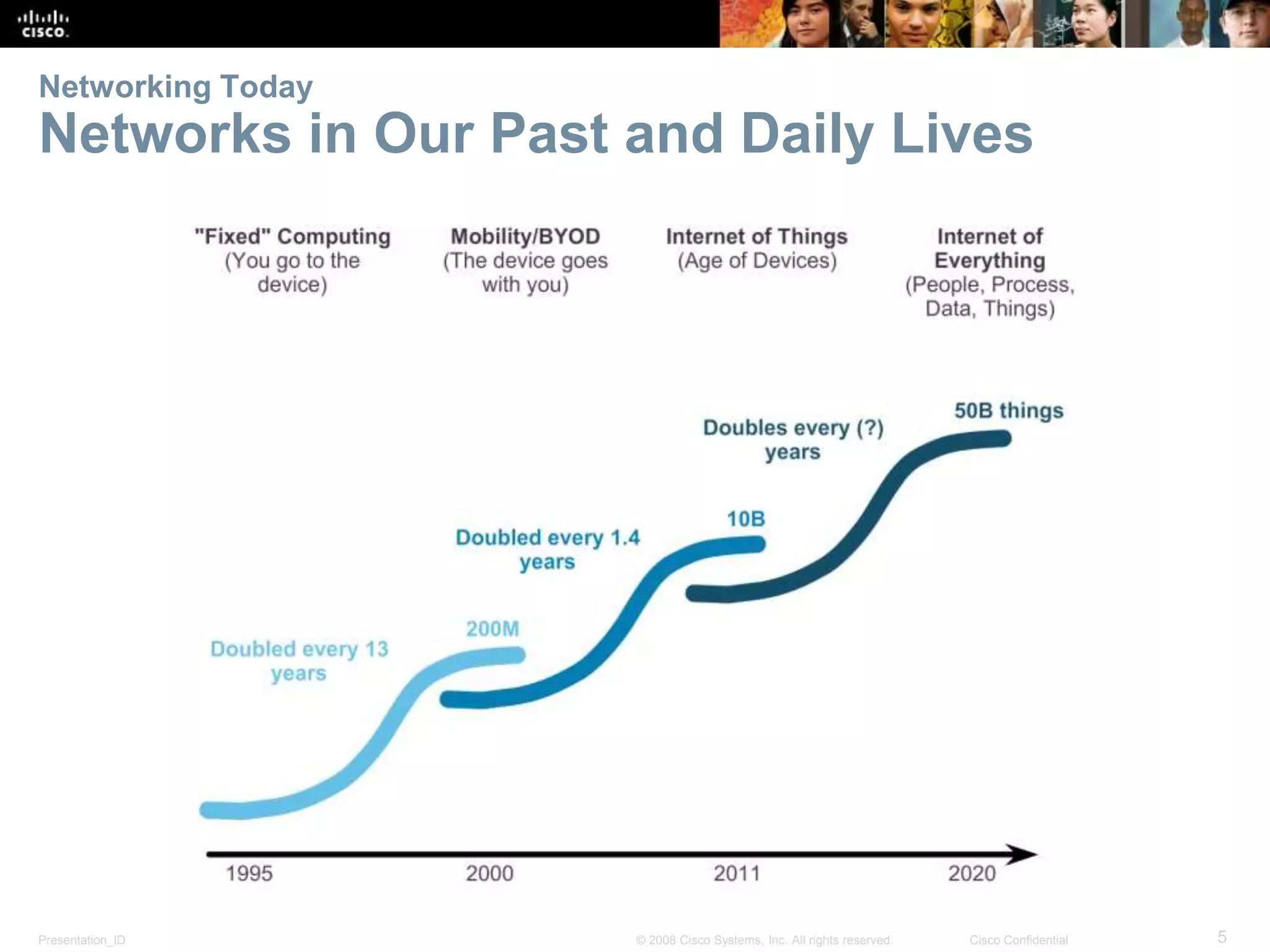
Networking Today 
Networks in Our Past and Daily Lives 
Presentation_ID © 2008 Cisco Systems, Inc. All rights reserved. Cisco Confidential 5
Networking Today 
The Global Community 
Presentation_ID © 2008 Cisco Systems, Inc. All rights reserved. Cisco Confidential 6
Interconnecting Our Lives 
Networking Impacts in Our Daily Lives 
 Networks support the way we learn. 
 Networks support the way we communicate. 
 Networks support the way we work. 
 Networks support the way we play. 
Presentation_ID © 2008 Cisco Systems, Inc. All rights reserved. Cisco Confidential 7
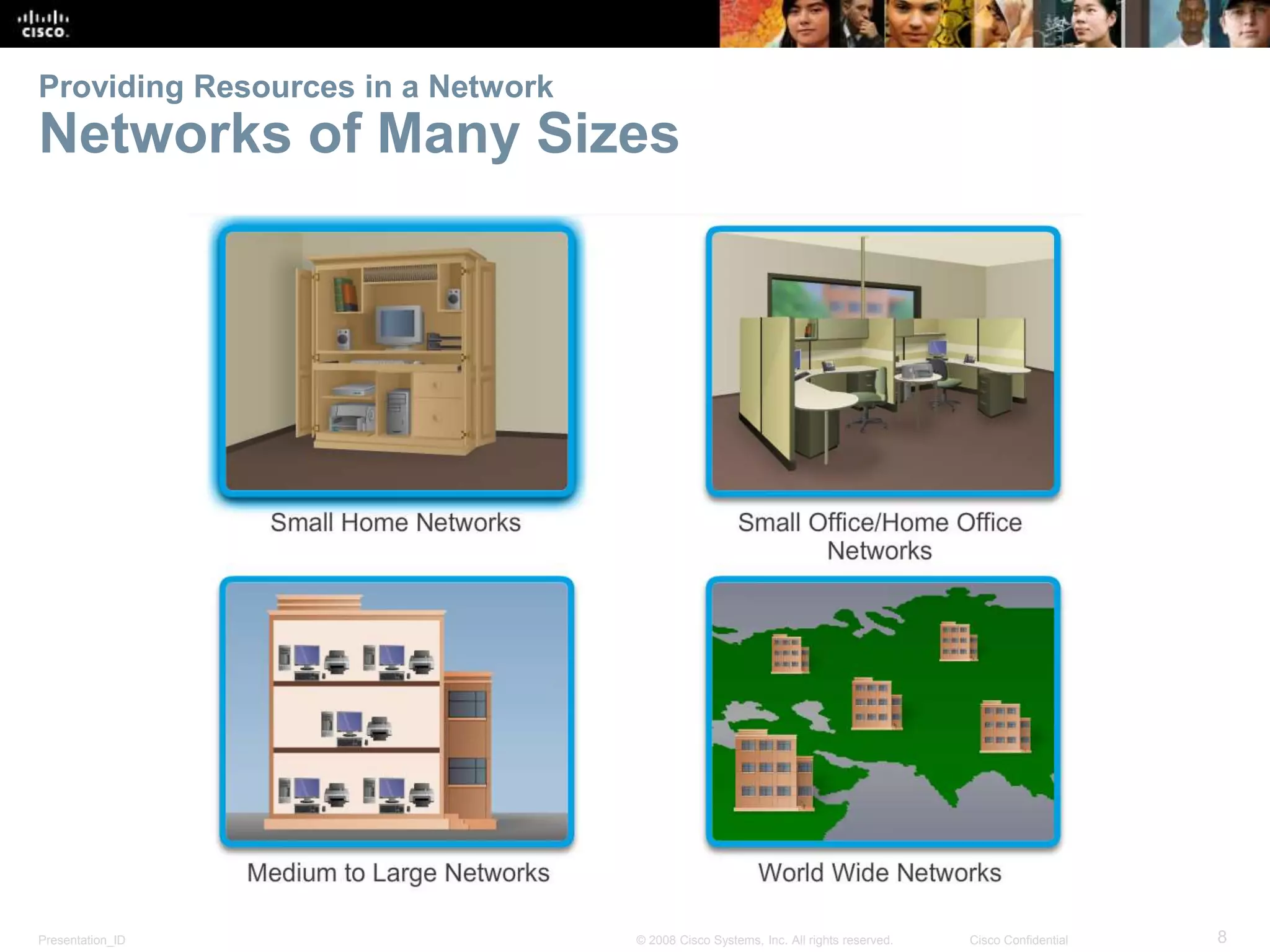
Providing Resources in a Network 
Networks of Many Sizes 
Presentation_ID © 2008 Cisco Systems, Inc. All rights reserved. Cisco Confidential 8
Providing Resources in a Network 
Clients and Servers 
Presentation_ID © 2008 Cisco Systems, Inc. All rights reserved. Cisco Confidential 9
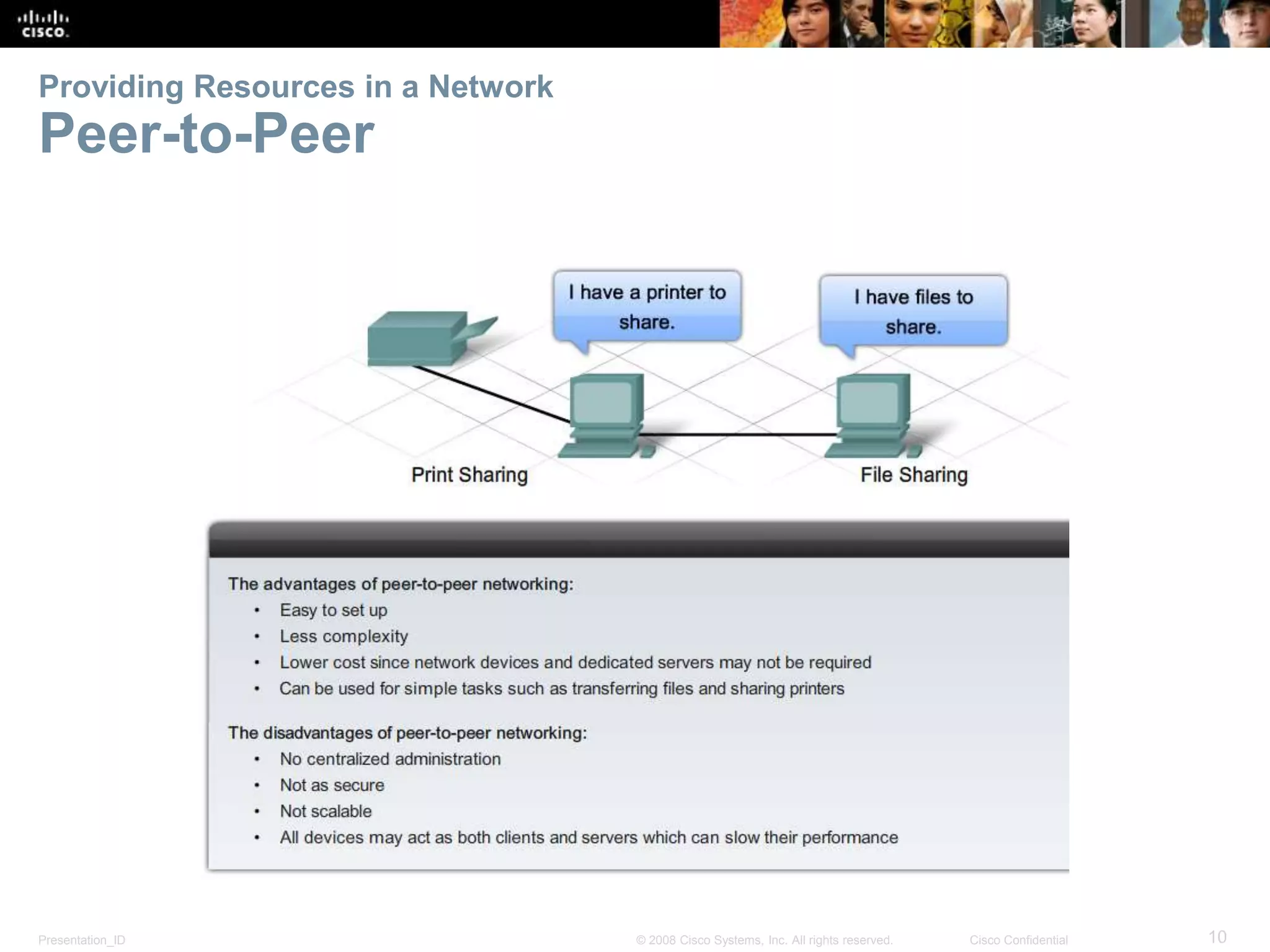
Providing Resources in a Network 
Peer-to-Peer 
Presentation_ID © 2008 Cisco Systems, Inc. All rights reserved. Cisco Confidential 10
1.2 LANs, WANs, and the Internet 
© 2008 Cisco Systems, Inc. All Presentation_ID rights reserved. Cisco Confidential 11
LANs, WANs, and Internets 
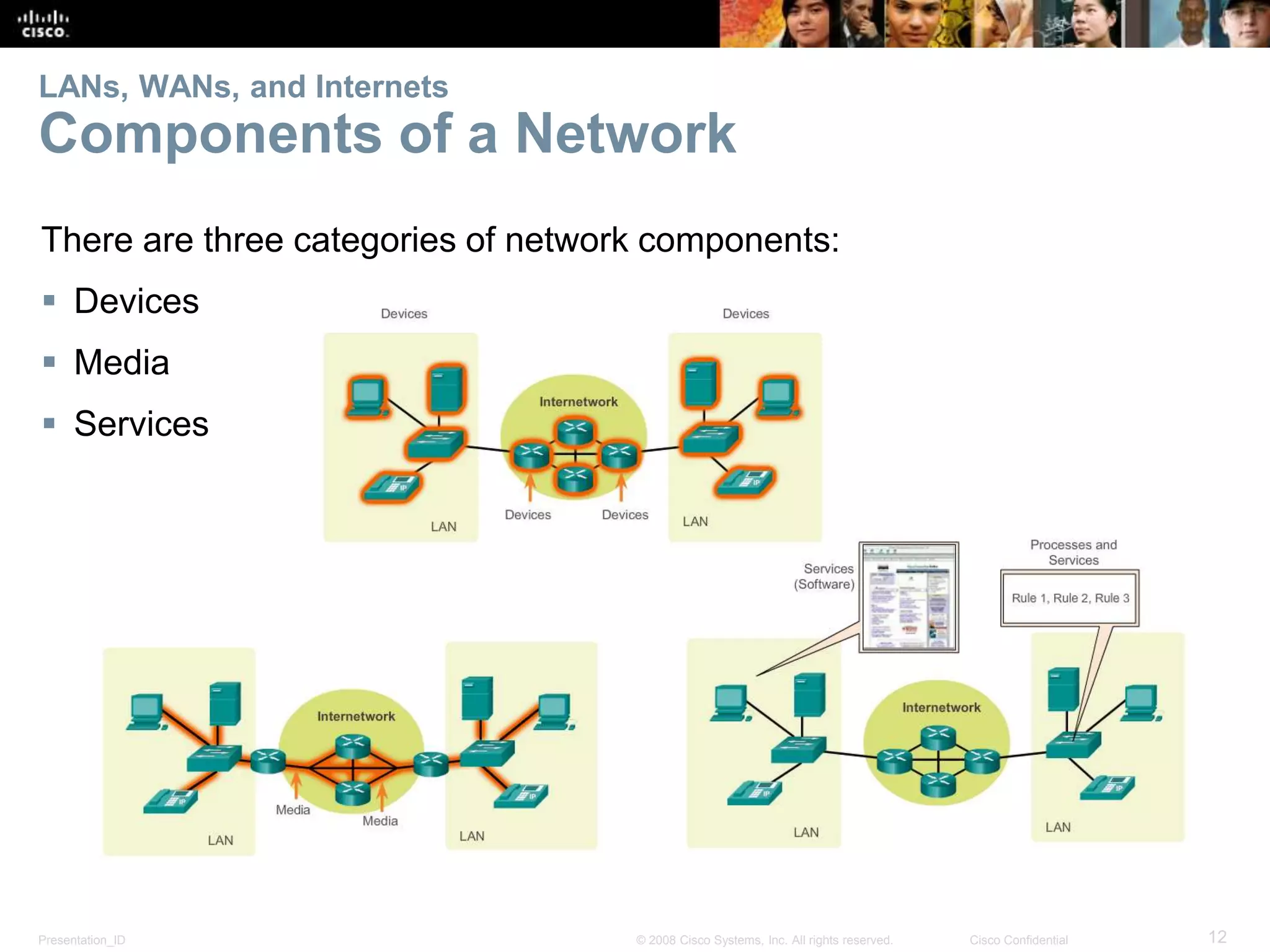
Components of a Network 
There are three categories of network components: 
 Devices 
 Media 
 Services 
Presentation_ID © 2008 Cisco Systems, Inc. All rights reserved. Cisco Confidential 12
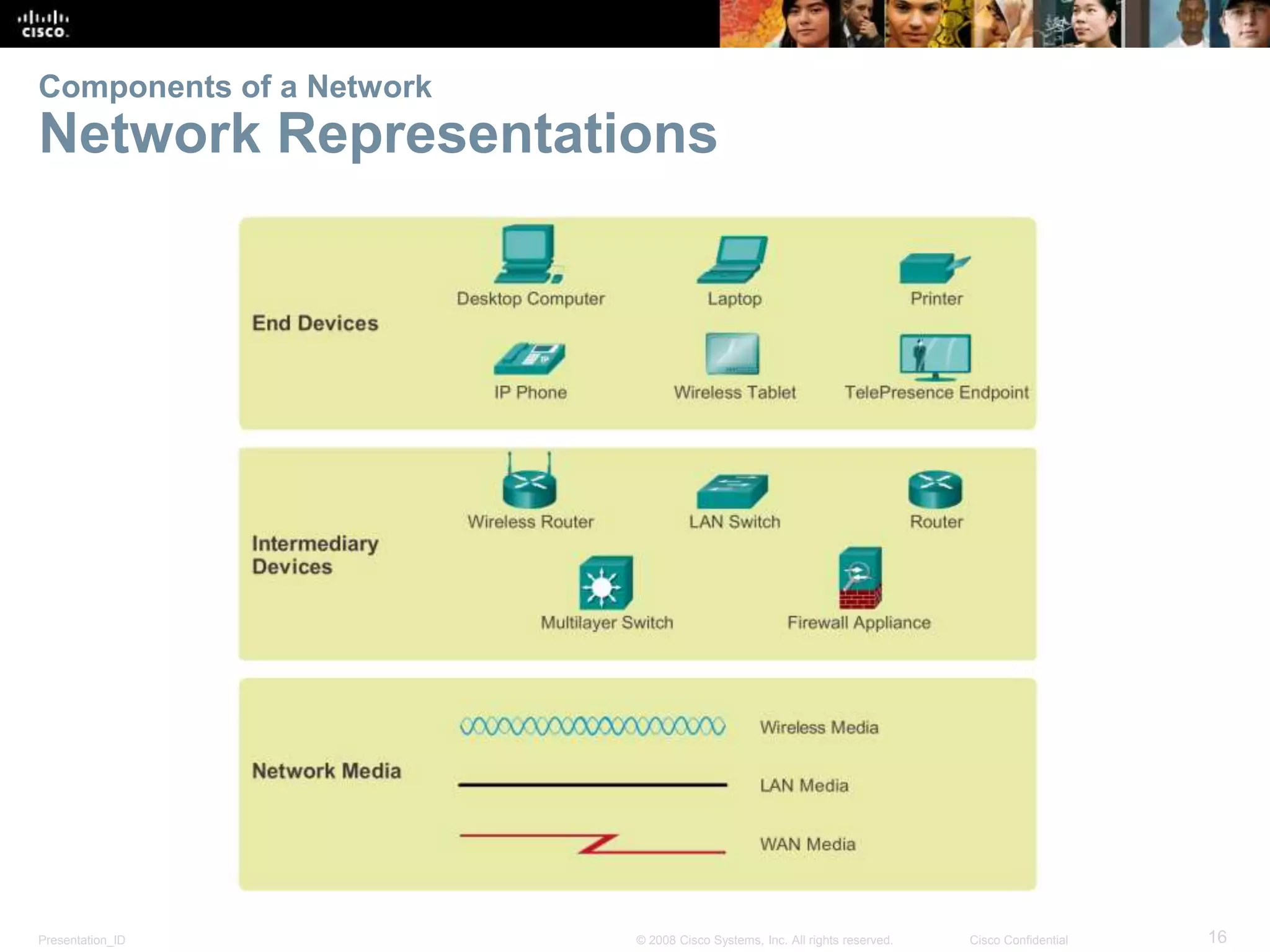
Components of a Network 
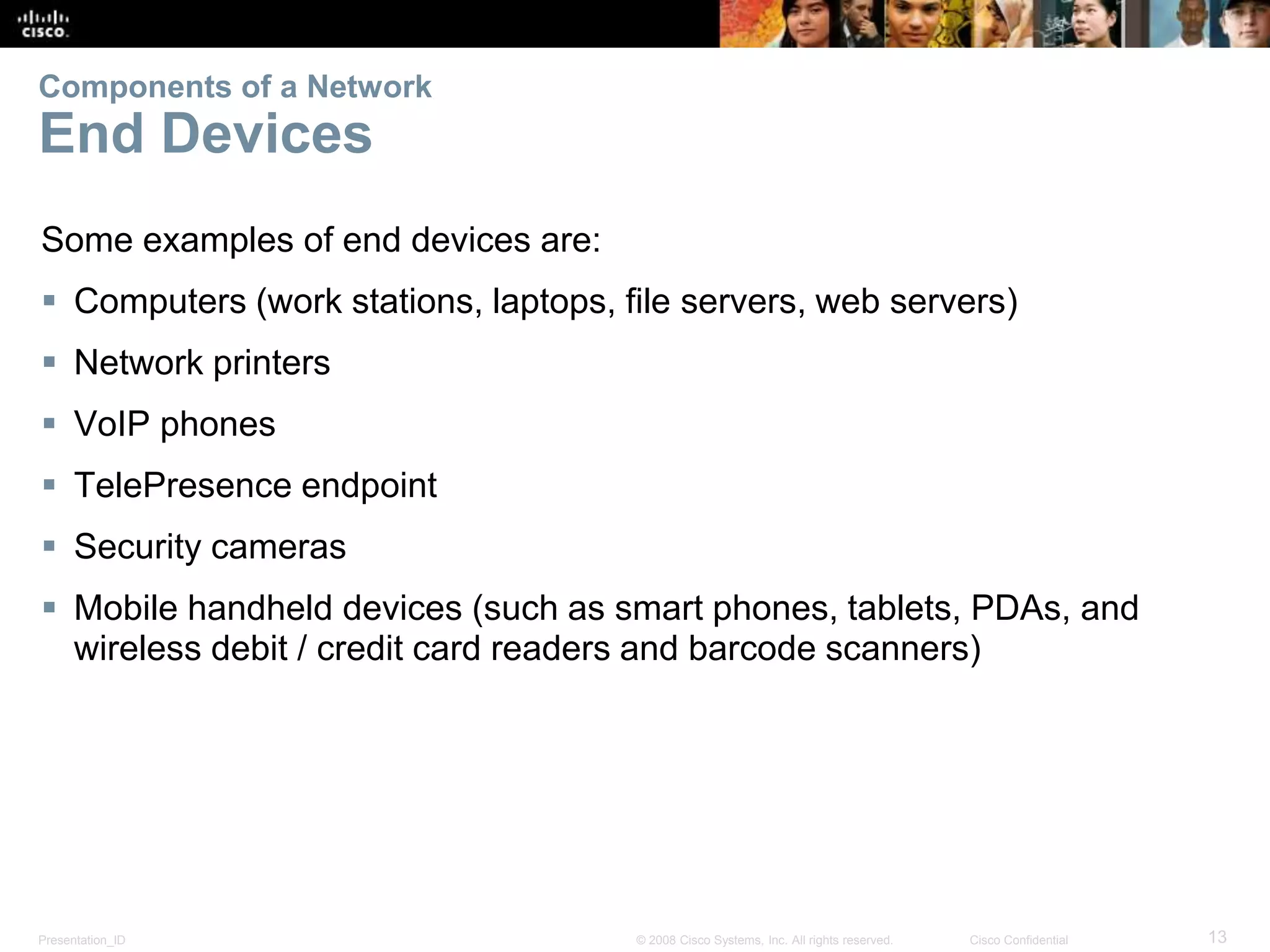
End Devices 
Some examples of end devices are: 
 Computers (work stations, laptops, file servers, web servers) 
 Network printers 
 VoIP phones 
 TelePresence endpoint 
 Security cameras 
 Mobile handheld devices (such as smart phones, tablets, PDAs, and 
wireless debit / credit card readers and barcode scanners) 
Presentation_ID © 2008 Cisco Systems, Inc. All rights reserved. Cisco Confidential 13
Components of a Network 
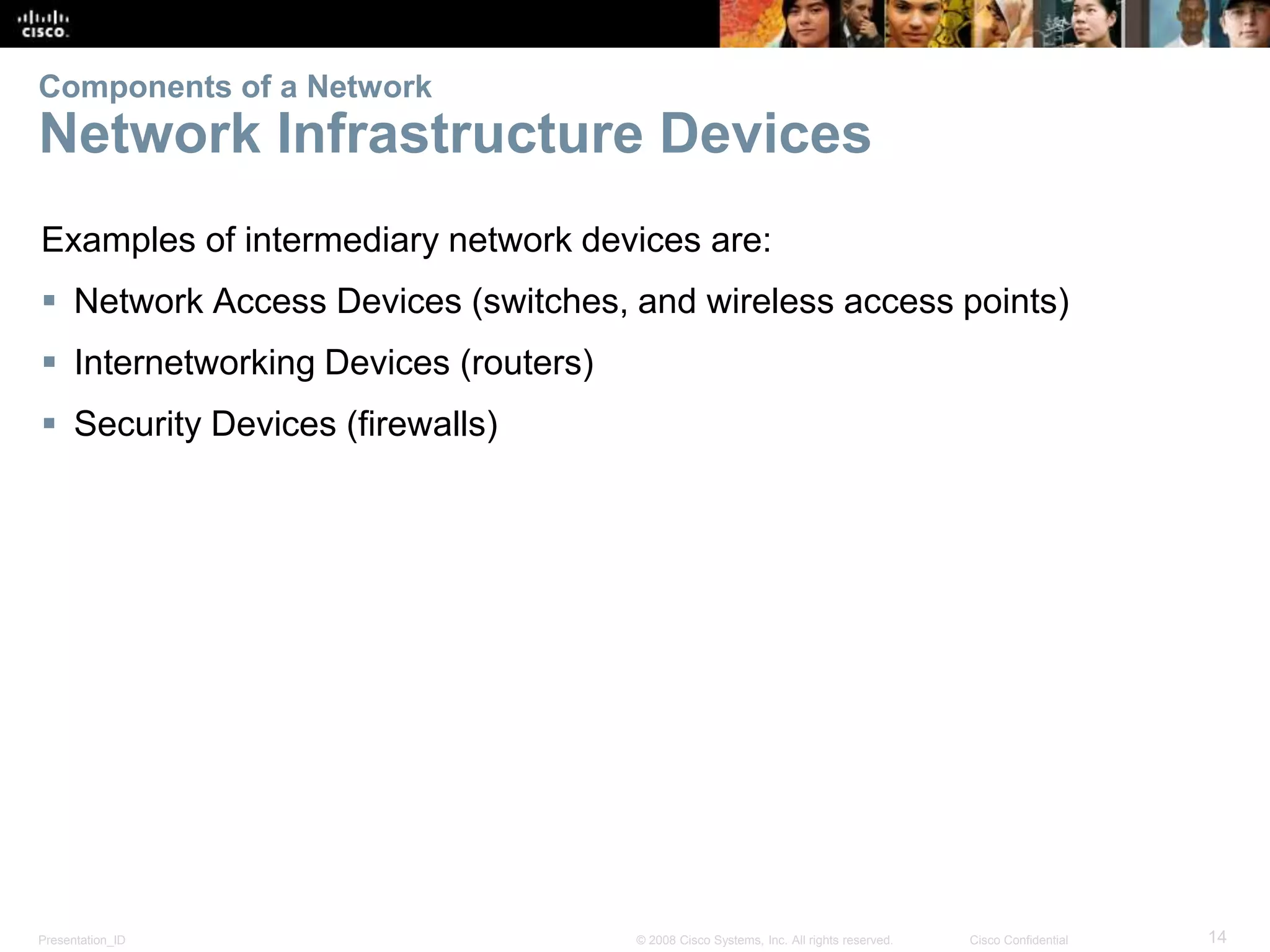
Network Infrastructure Devices 
Examples of intermediary network devices are: 
 Network Access Devices (switches, and wireless access points) 
 Internetworking Devices (routers) 
 Security Devices (firewalls) 
Presentation_ID © 2008 Cisco Systems, Inc. All rights reserved. Cisco Confidential 14
Components of a Network 
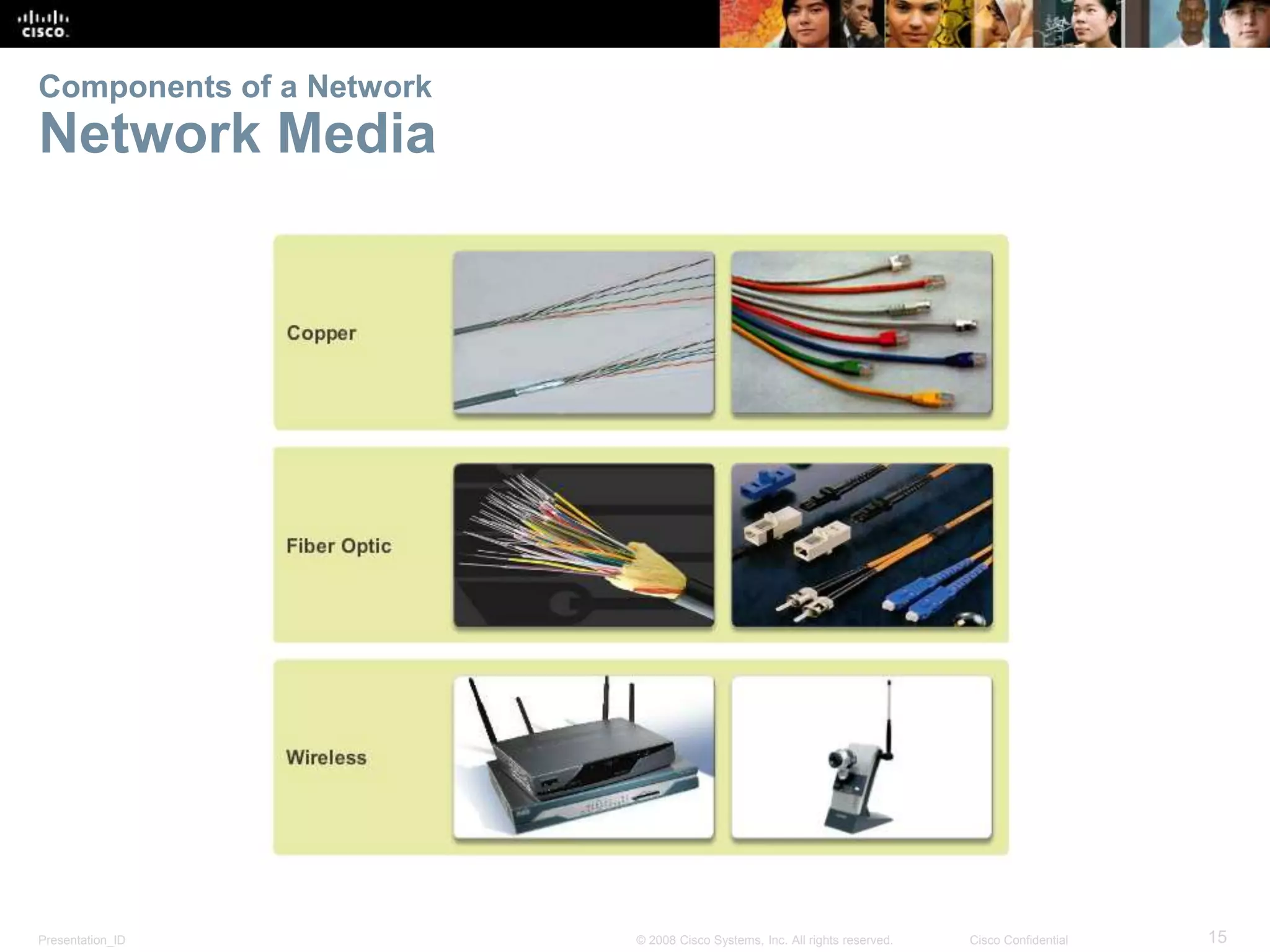
Network Media 
Presentation_ID © 2008 Cisco Systems, Inc. All rights reserved. Cisco Confidential 15
Components of a Network 
Network Representations 
Presentation_ID © 2008 Cisco Systems, Inc. All rights reserved. Cisco Confidential 16
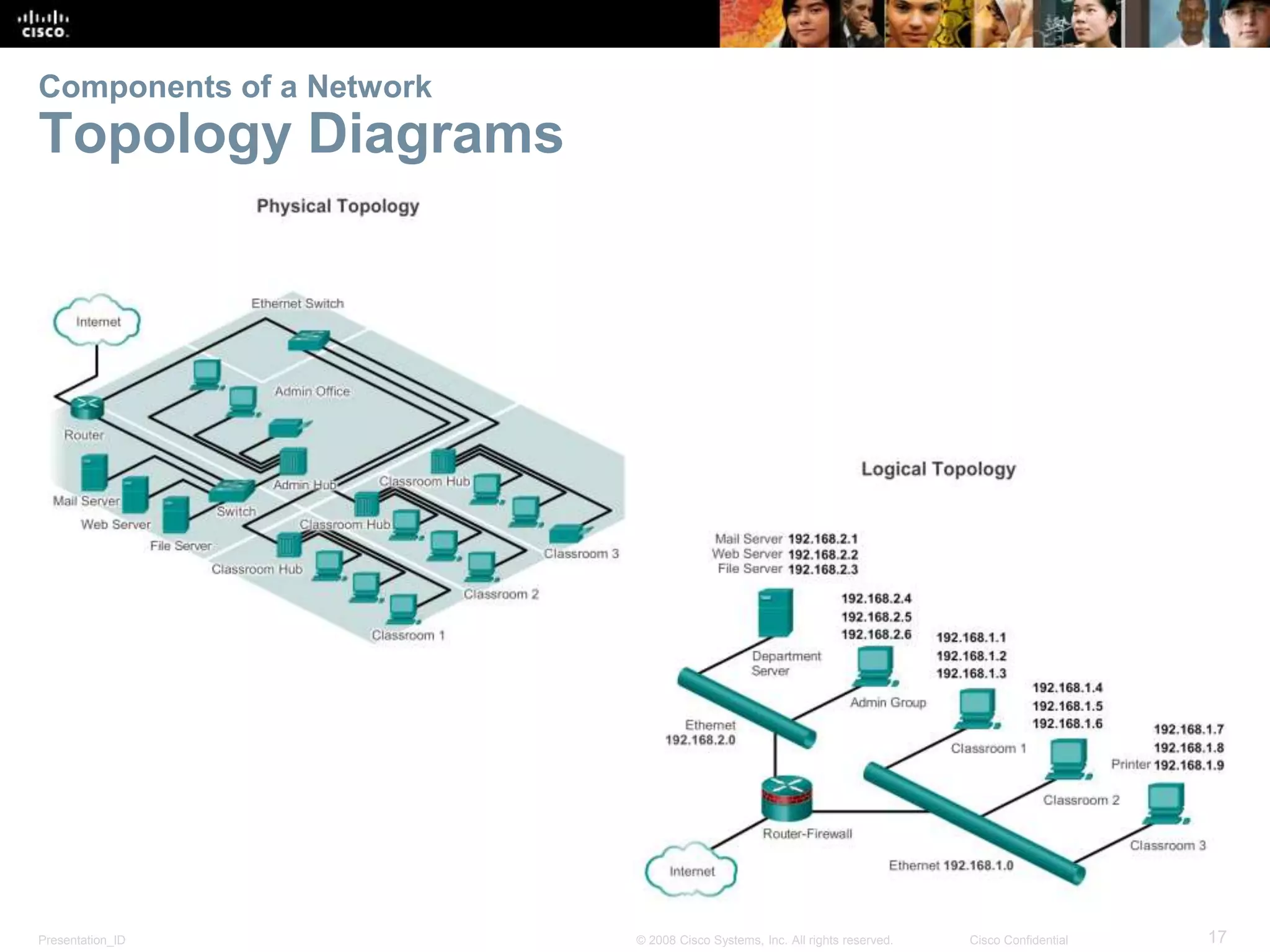
Components of a Network 
Topology Diagrams 
Presentation_ID © 2008 Cisco Systems, Inc. All rights reserved. Cisco Confidential 17
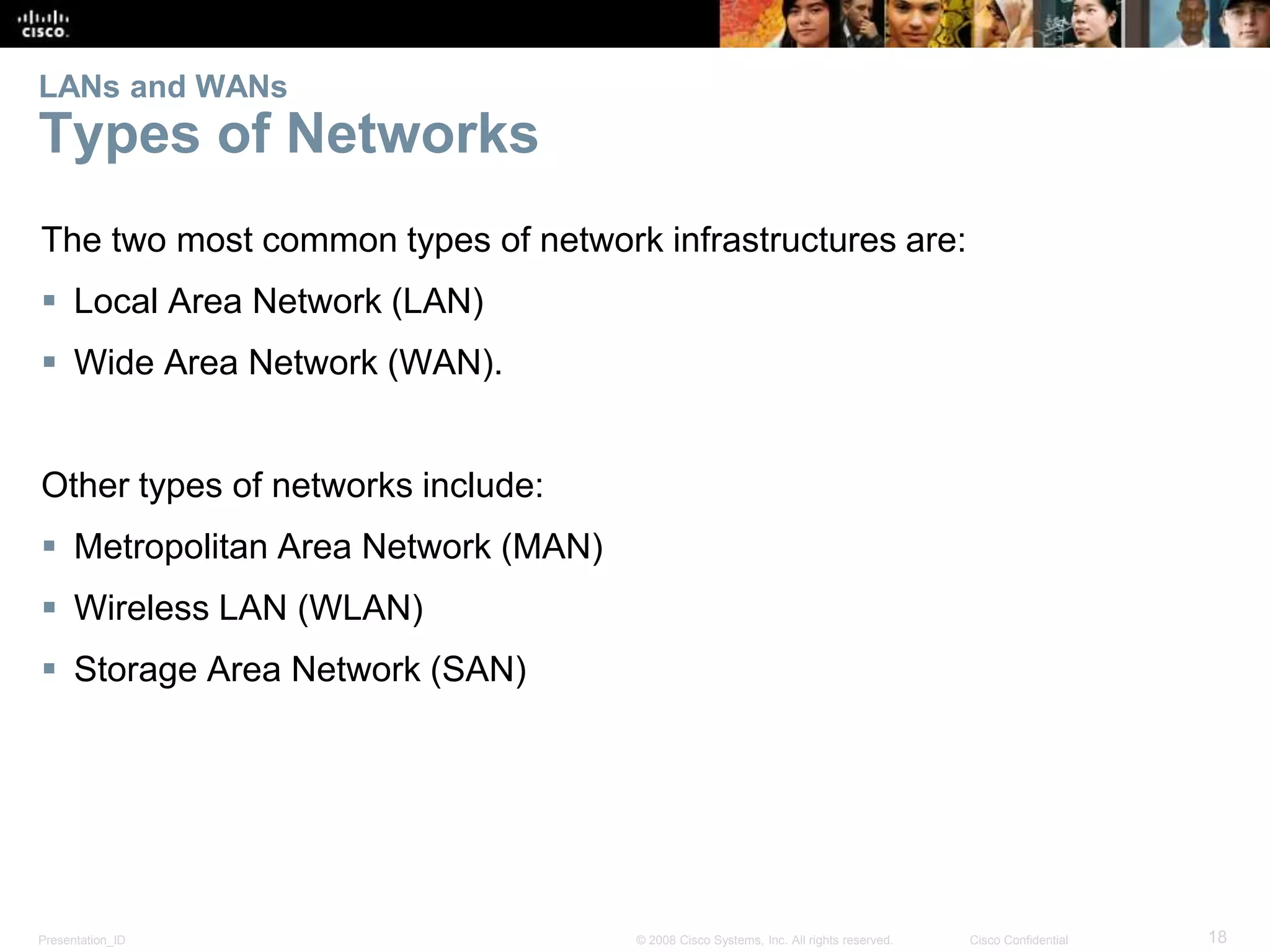
LANs and WANs 
Types of Networks 
The two most common types of network infrastructures are: 
 Local Area Network (LAN) 
 Wide Area Network (WAN). 
Other types of networks include: 
 Metropolitan Area Network (MAN) 
 Wireless LAN (WLAN) 
 Storage Area Network (SAN) 
Presentation_ID © 2008 Cisco Systems, Inc. All rights reserved. Cisco Confidential 18
LANs and WANs 
Local Area Networks (LAN) 
Presentation_ID © 2008 Cisco Systems, Inc. All rights reserved. Cisco Confidential 19
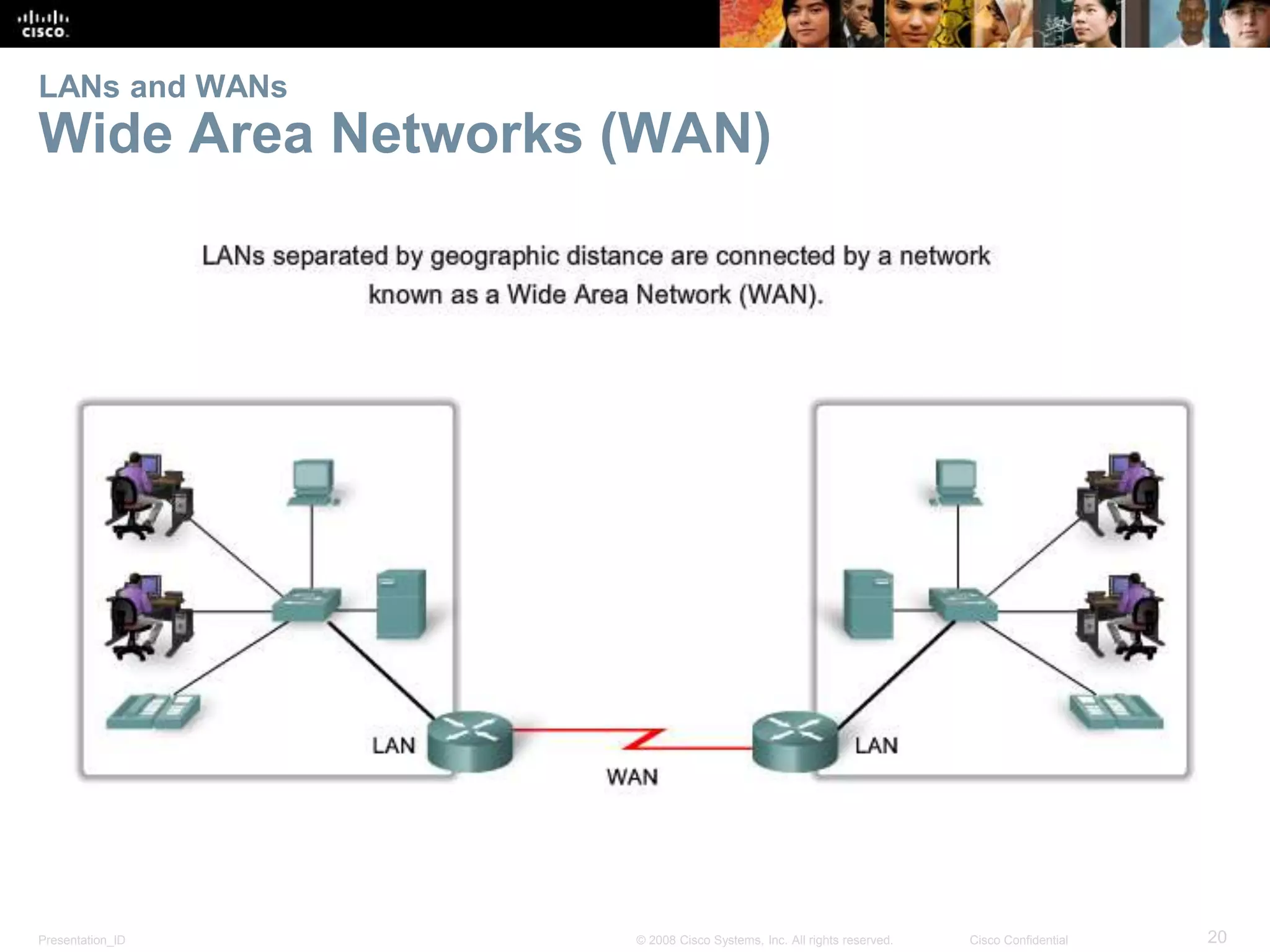
LANs and WANs 
Wide Area Networks (WAN) 
Presentation_ID © 2008 Cisco Systems, Inc. All rights reserved. Cisco Confidential 20
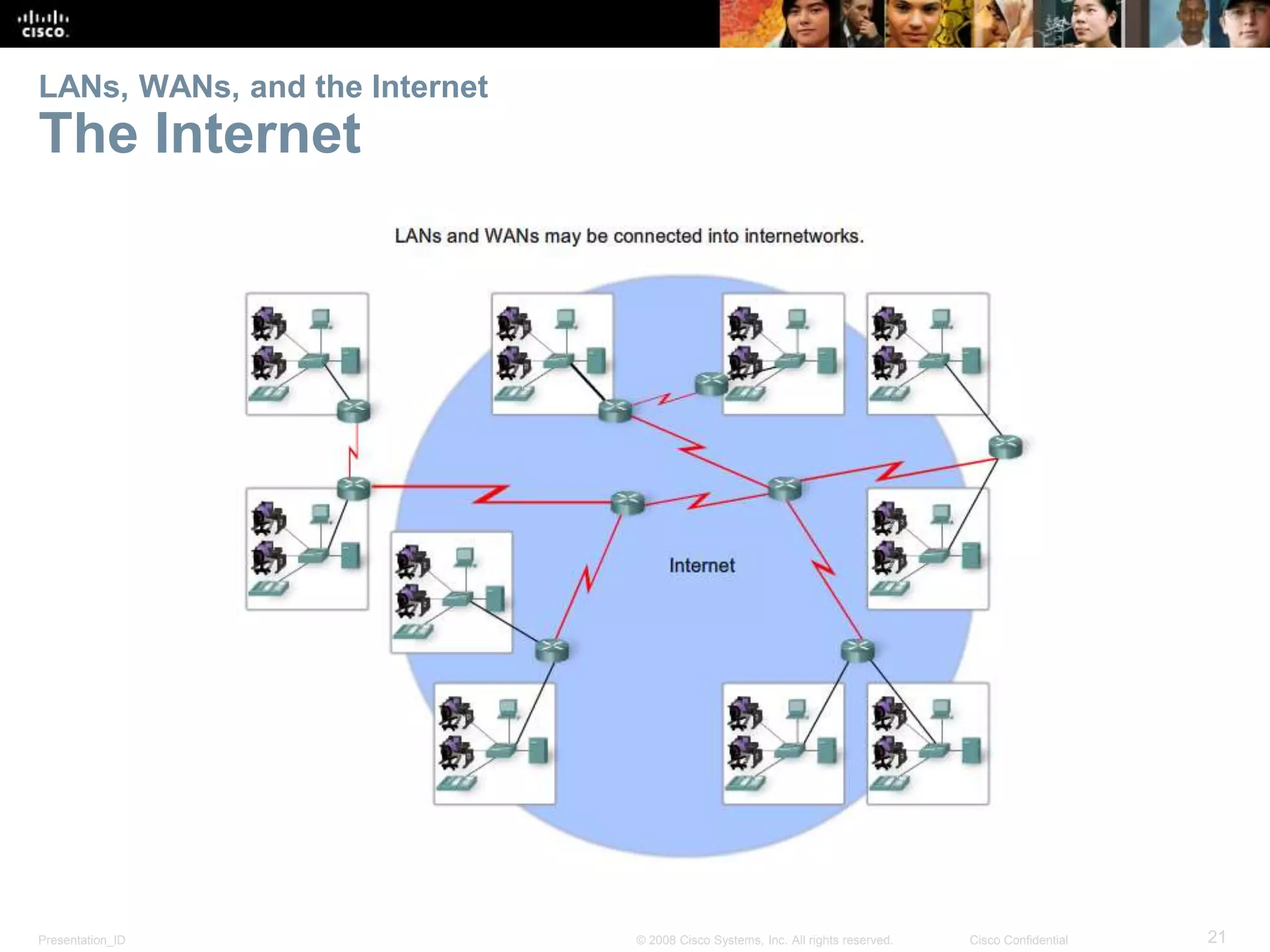
LANs, WANs, and the Internet 
The Internet 
Presentation_ID © 2008 Cisco Systems, Inc. All rights reserved. Cisco Confidential 21
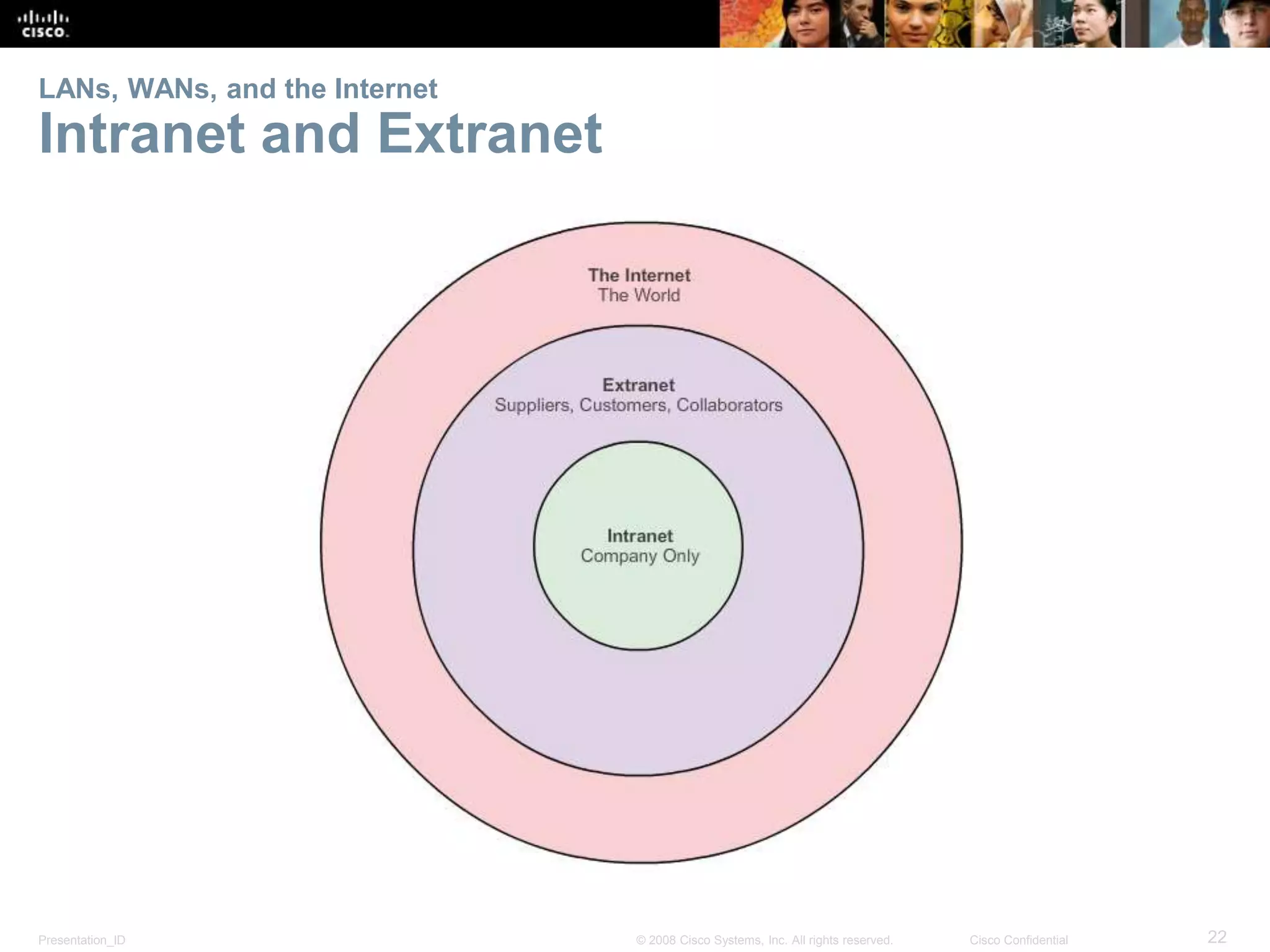
LANs, WANs, and the Internet 
Intranet and Extranet 
Presentation_ID © 2008 Cisco Systems, Inc. All rights reserved. Cisco Confidential 22
Connecting to the Internet 
Connecting Remote Users to the Internet 
Presentation_ID © 2008 Cisco Systems, Inc. All rights reserved. Cisco Confidential 23
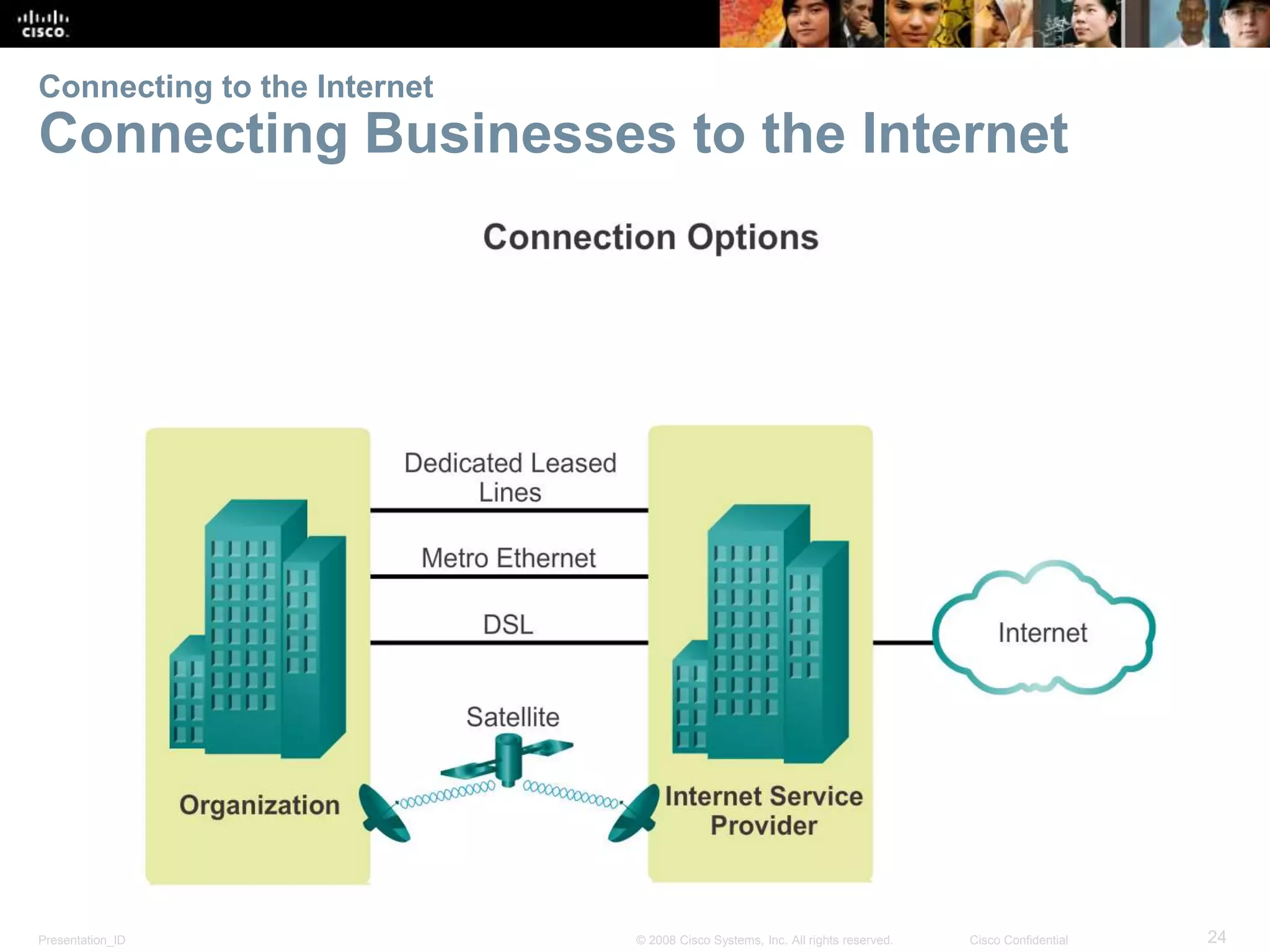
Connecting to the Internet 
Connecting Businesses to the Internet 
Presentation_ID © 2008 Cisco Systems, Inc. All rights reserved. Cisco Confidential 24
1.3 The Network as a Platform 
© 2008 Cisco Systems, Inc. All Presentation_ID rights reserved. Cisco Confidential 25
Converged Networks 
The Converging Network 
Presentation_ID © 2008 Cisco Systems, Inc. All rights reserved. Cisco Confidential 26
Converged Networks 
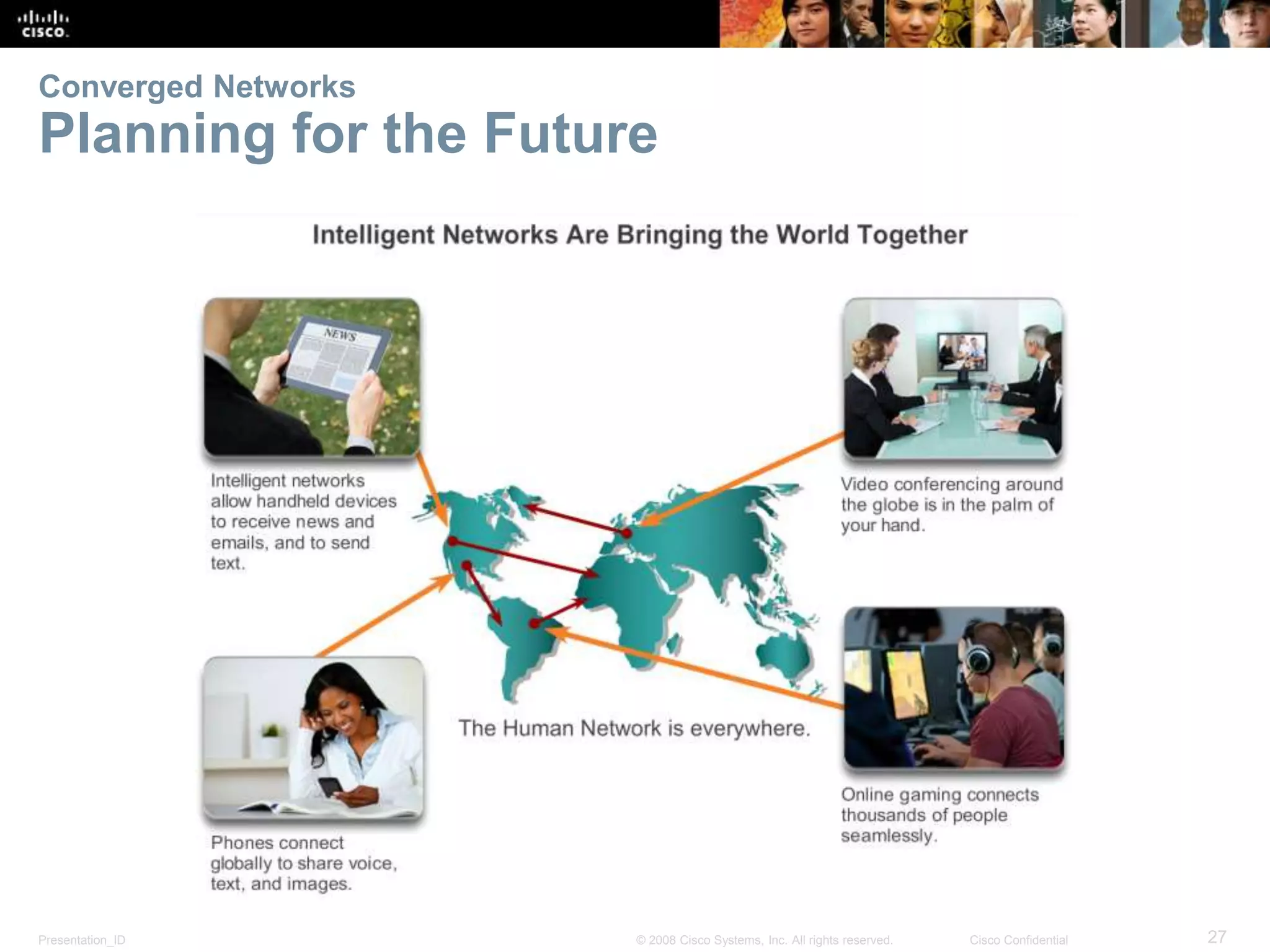
Planning for the Future 
Presentation_ID © 2008 Cisco Systems, Inc. All rights reserved. Cisco Confidential 27
Reliable Network 
Supporting Network Architecture 
As networks evolve, we are discovering that there are four basic 
characteristics that the underlying architectures need to address in order to 
meet user expectations: 
 Fault Tolerance 
 Scalability 
 Quality of Service (QoS) 
 Security 
Presentation_ID © 2008 Cisco Systems, Inc. All rights reserved. Cisco Confidential 28
Reliable Network 
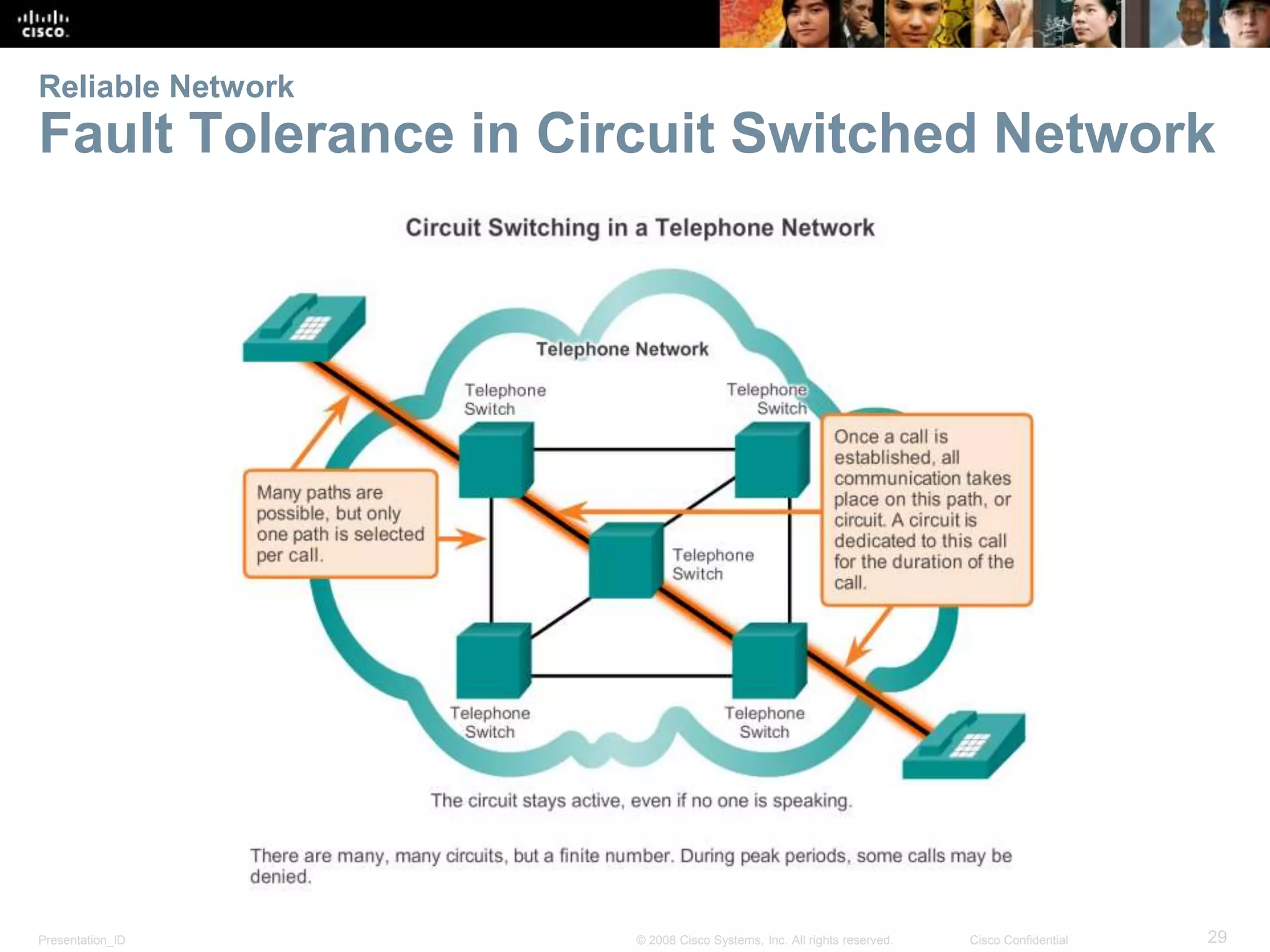
Fault Tolerance in Circuit Switched Network 
Presentation_ID © 2008 Cisco Systems, Inc. All rights reserved. Cisco Confidential 29
Reliable Network 
Packet-Switched Networks 
Presentation_ID © 2008 Cisco Systems, Inc. All rights reserved. Cisco Confidential 30
Reliable Network 
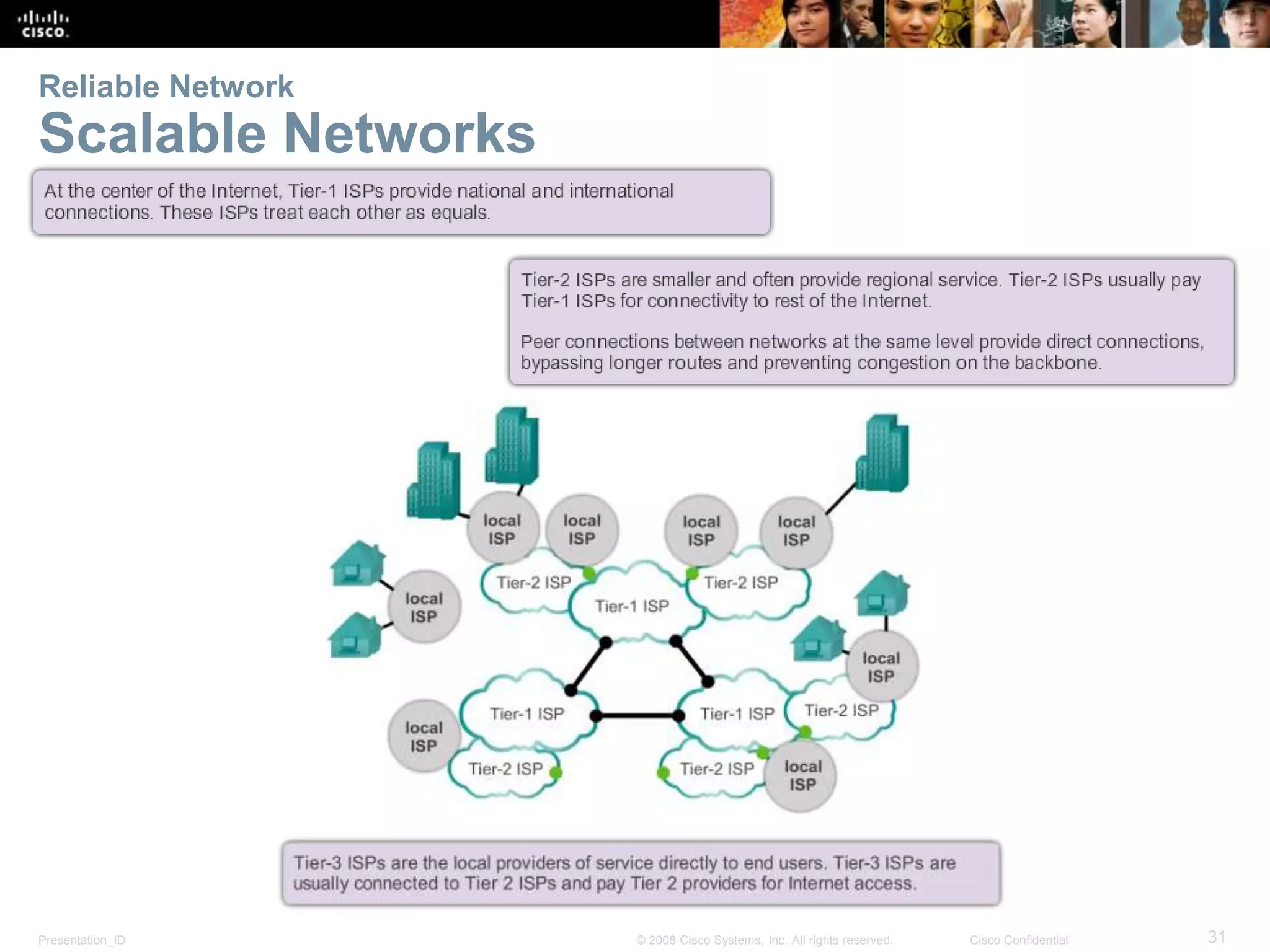
Scalable Networks 
Presentation_ID © 2008 Cisco Systems, Inc. All rights reserved. Cisco Confidential 31
Reliable Network 
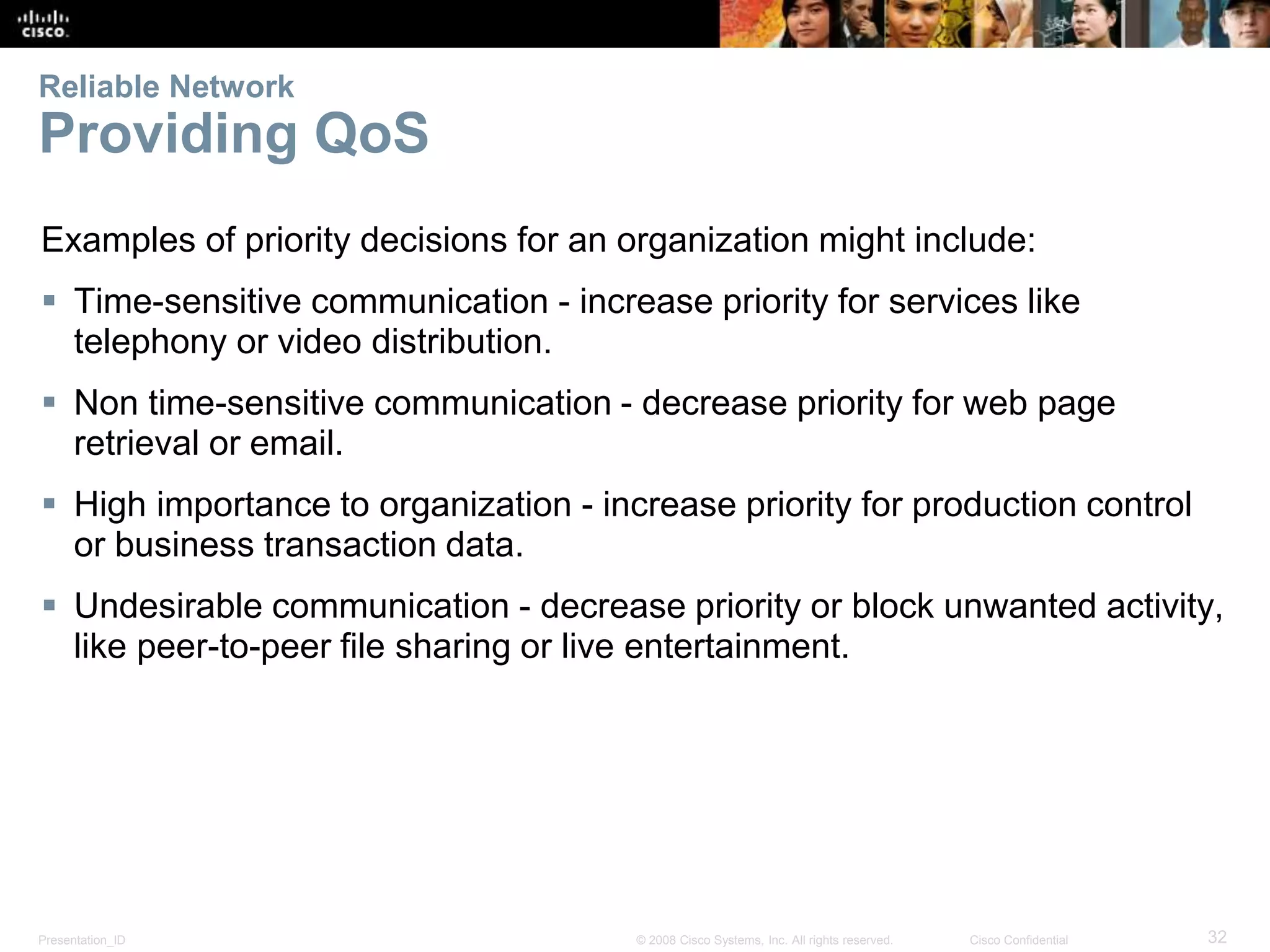
Providing QoS 
Examples of priority decisions for an organization might include: 
 Time-sensitive communication - increase priority for services like 
telephony or video distribution. 
 Non time-sensitive communication - decrease priority for web page 
retrieval or email. 
 High importance to organization - increase priority for production control 
or business transaction data. 
 Undesirable communication - decrease priority or block unwanted activity, 
like peer-to-peer file sharing or live entertainment. 
Presentation_ID © 2008 Cisco Systems, Inc. All rights reserved. Cisco Confidential 32
Reliable Network 
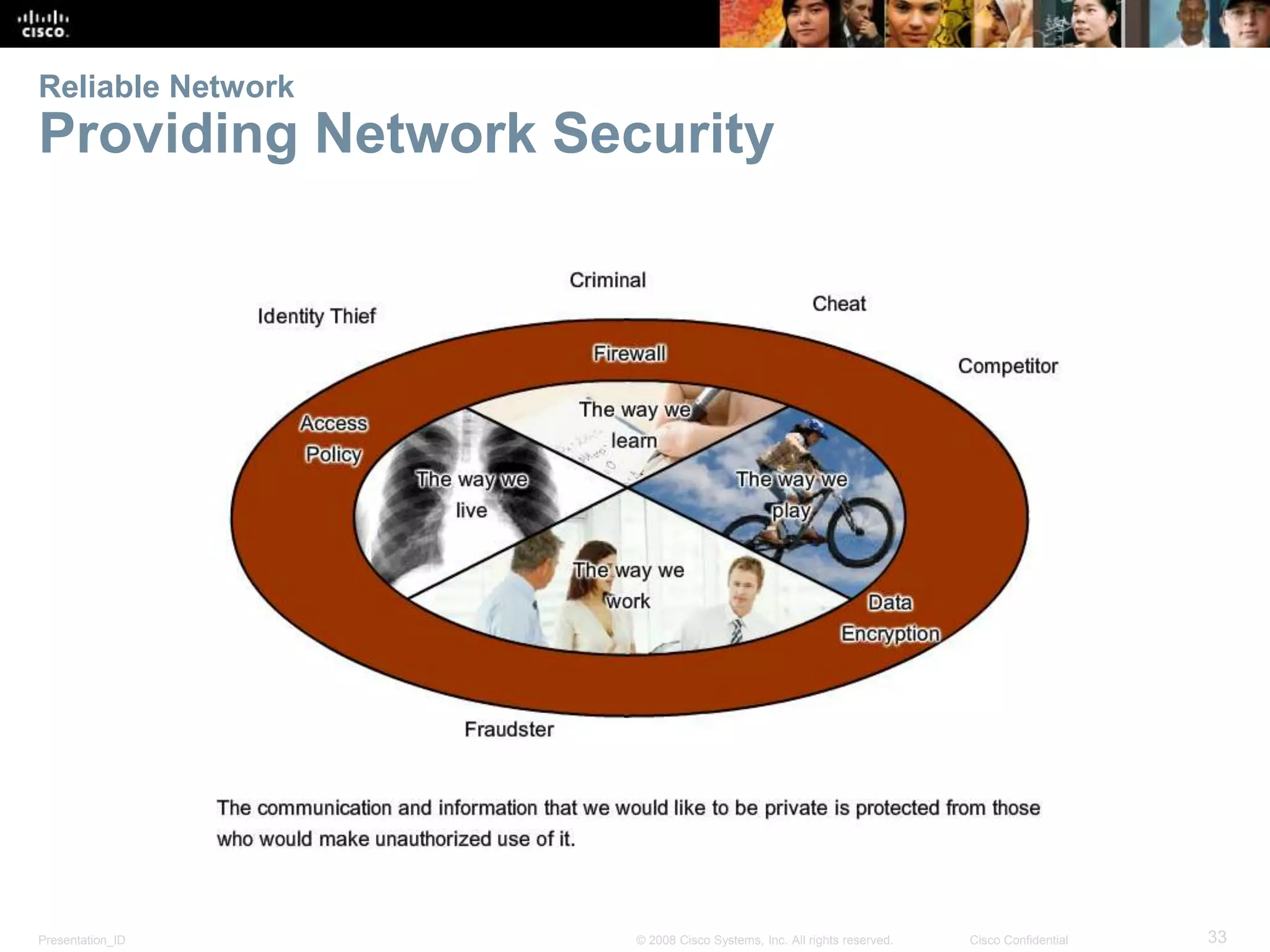
Providing Network Security 
Presentation_ID © 2008 Cisco Systems, Inc. All rights reserved. Cisco Confidential 33
1.4 The Changing Network Environment 
© 2008 Cisco Systems, Inc. All Presentation_ID rights reserved. Cisco Confidential 34
Network Trends 
New trends 
Some of the top trends include: 
 Bring Your Own Device (BYOD) 
 Online collaboration 
 Video 
 Cloud computing 
Presentation_ID © 2008 Cisco Systems, Inc. All rights reserved. Cisco Confidential 35
Network Trends 
Bring Your Own Device (BYOD) 
The concept of any device, to any content, in anyway is a major global 
trend that requires significant changes to the way devices are used. 
This trend is known as Bring Your Own Device (BYOD). 
Presentation_ID © 2008 Cisco Systems, Inc. All rights reserved. Cisco Confidential 36
Network Trends 
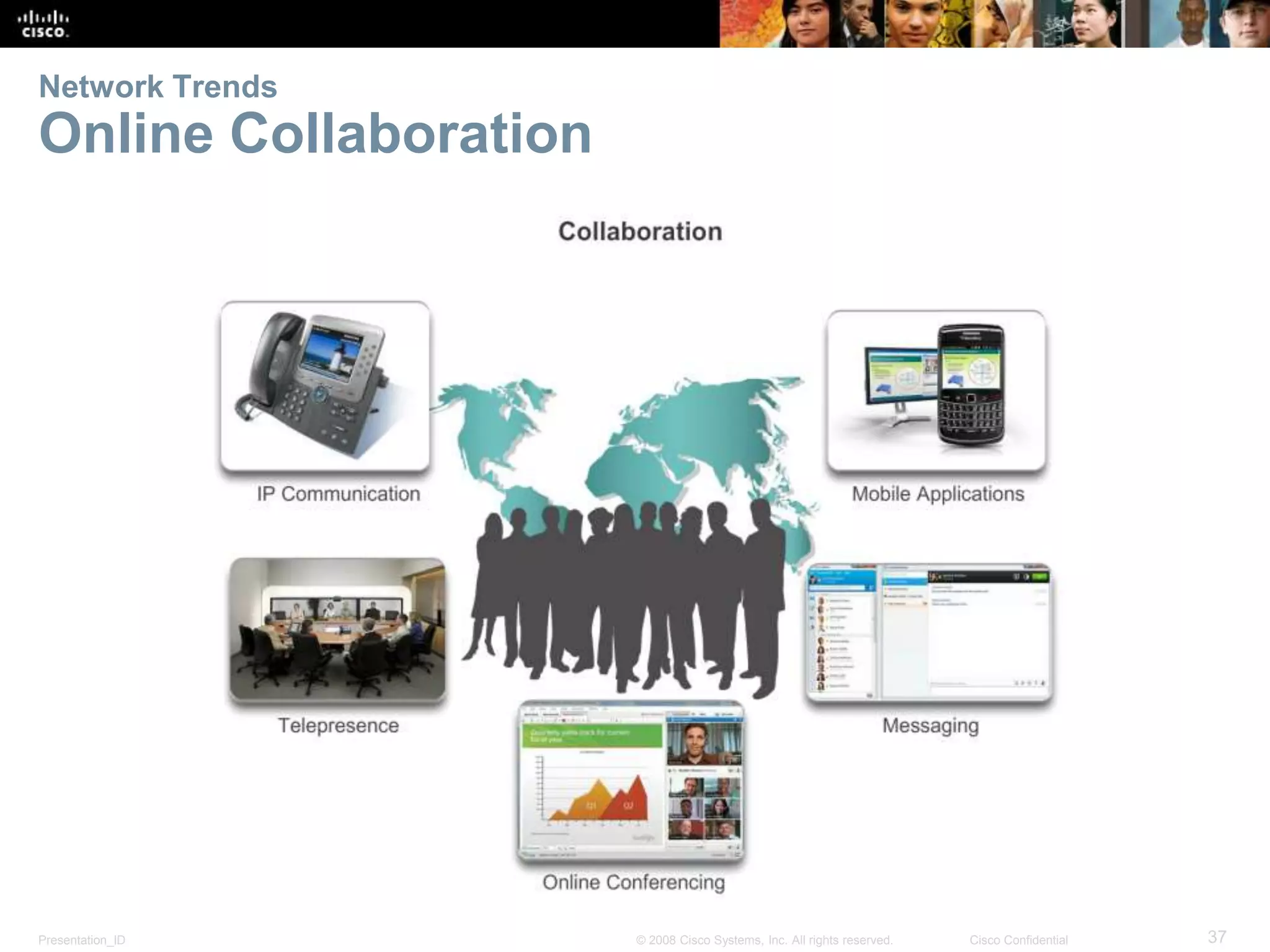
Online Collaboration 
Presentation_ID © 2008 Cisco Systems, Inc. All rights reserved. Cisco Confidential 37
Network Trends 
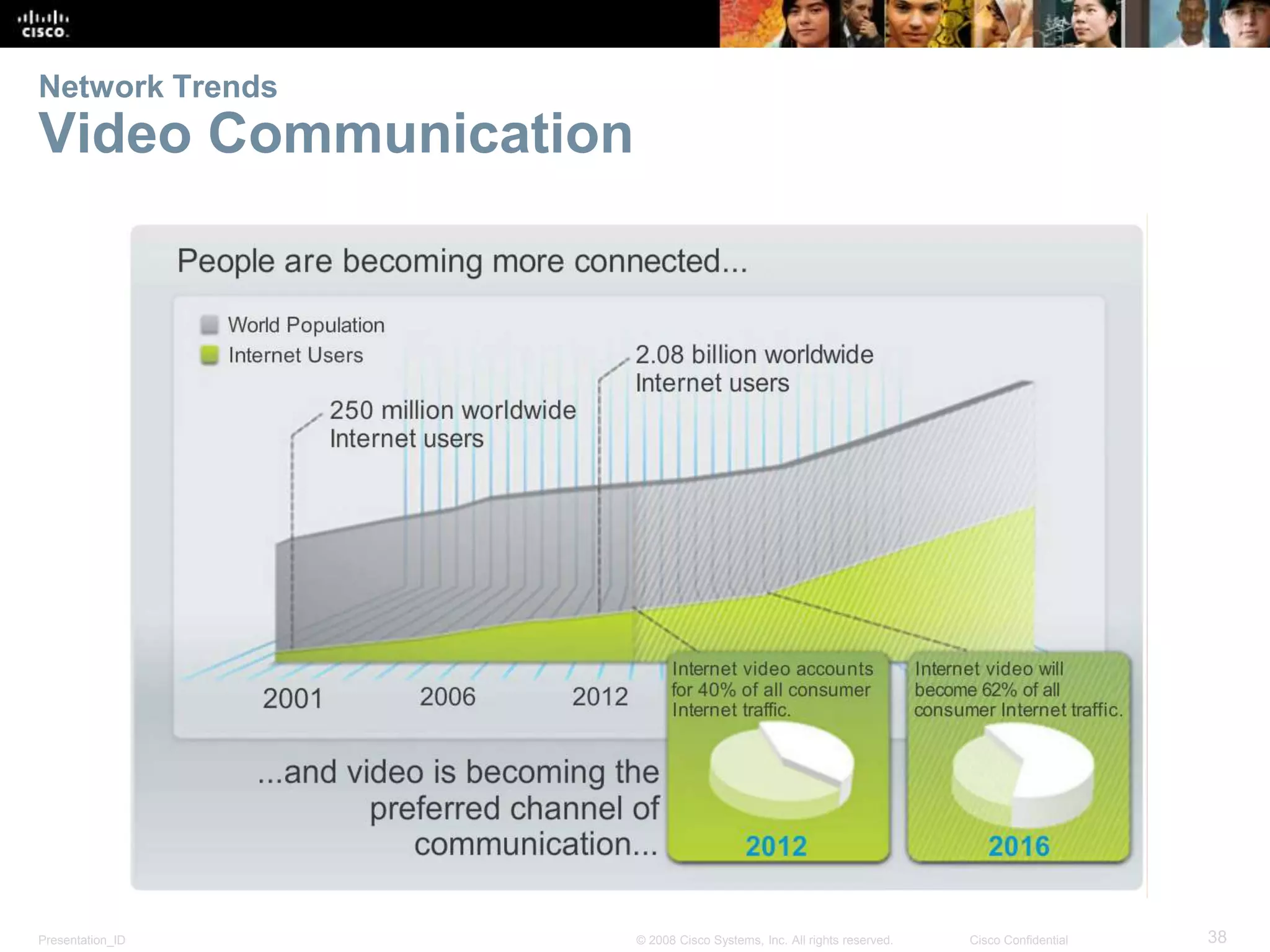
Video Communication 
Presentation_ID © 2008 Cisco Systems, Inc. All rights reserved. Cisco Confidential 38
Network Trends 
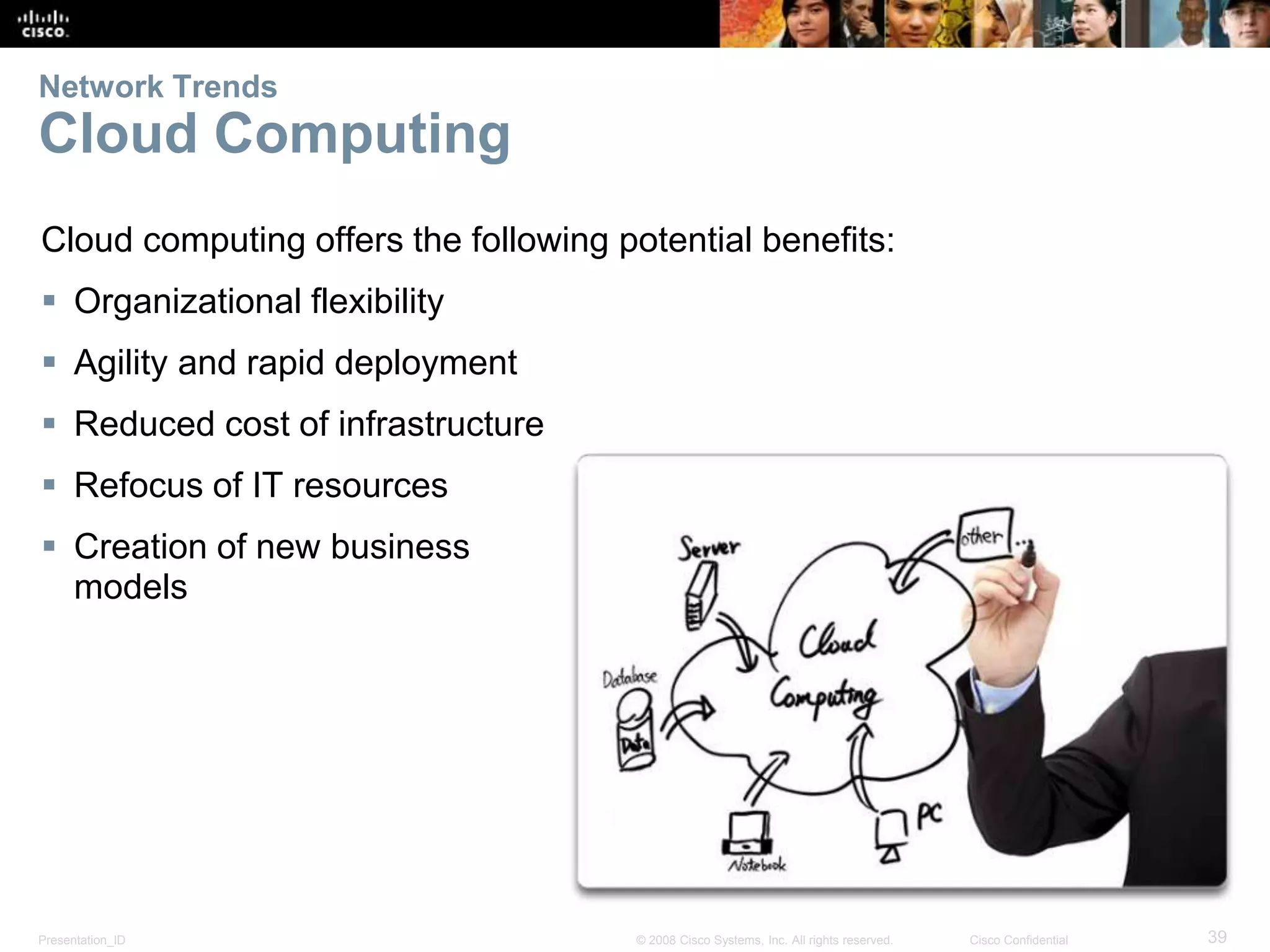
Cloud Computing 
Cloud computing offers the following potential benefits: 
 Organizational flexibility 
 Agility and rapid deployment 
 Reduced cost of infrastructure 
 Refocus of IT resources 
 Creation of new business 
models 
Presentation_ID © 2008 Cisco Systems, Inc. All rights reserved. Cisco Confidential 39
Network Trends 
Data Centers 
A data center is a facility used to house computer systems and associated 
components including: 
 Redundant data communications connections 
 High-speed virtual servers (sometimes referred to as server farms or 
server clusters) 
 Redundant storage systems (typically uses SAN technology) 
 Redundant or backup power supplies 
 Environmental controls (e.g., air conditioning, fire suppression) 
 Security devices 
Presentation_ID © 2008 Cisco Systems, Inc. All rights reserved. Cisco Confidential 40
Networking Technologies for the Home 
Technology Trends in the Home 
Presentation_ID © 2008 Cisco Systems, Inc. All rights reserved. Cisco Confidential 41
Networking Technologies for the Home 
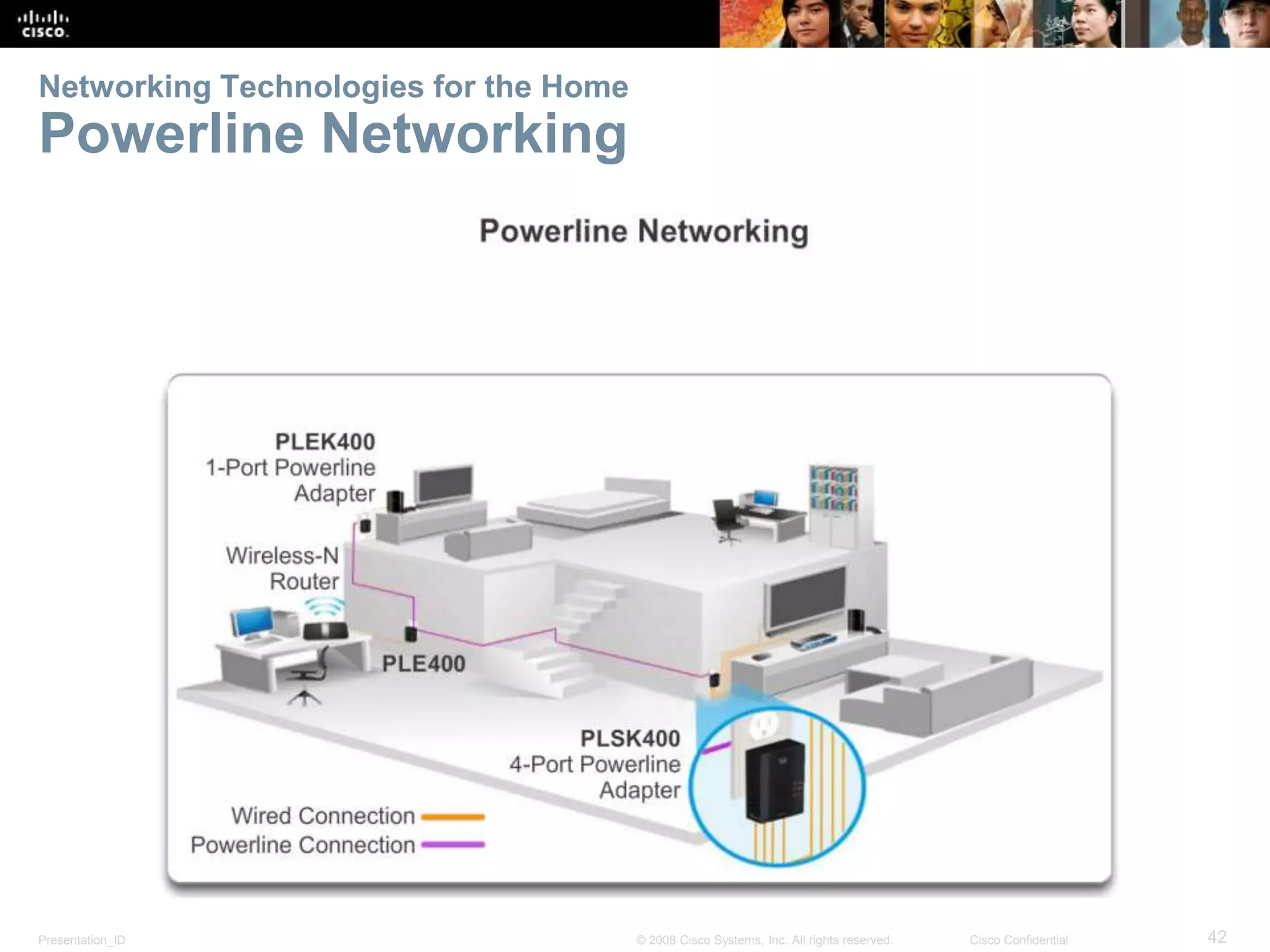
Powerline Networking 
Presentation_ID © 2008 Cisco Systems, Inc. All rights reserved. Cisco Confidential 42
Networking Technologies for the Home 
Wireless Broadband 
Presentation_ID © 2008 Cisco Systems, Inc. All rights reserved. Cisco Confidential 43
Future of Networking 
Network Security 
Presentation_ID © 2008 Cisco Systems, Inc. All rights reserved. Cisco Confidential 44
Network Security 
Security Threats 
The most common external threats to networks include: 
 Viruses, worms, and Trojan horses 
 Spyware and adware 
 Zero-day attacks, also called zero-hour attacks 
 Hacker attacks 
 Denial of service (DoS) attacks 
 Data interception and theft 
 Identity theft 
Presentation_ID © 2008 Cisco Systems, Inc. All rights reserved. Cisco Confidential 45
Network Security 
Security Solutions 
Network security components often include: 
 Antivirus and antispyware 
 Firewall filtering 
 Dedicated firewall systems 
 Access control lists (ACL) 
 Intrusion prevention systems (IPS) 
 Virtual Private Networks (VPNs) 
Presentation_ID © 2008 Cisco Systems, Inc. All rights reserved. Cisco Confidential 46
Network Architectures 
Cisco Network Architectures 
Presentation_ID © 2008 Cisco Systems, Inc. All rights reserved. Cisco Confidential 47
Network Architectures 
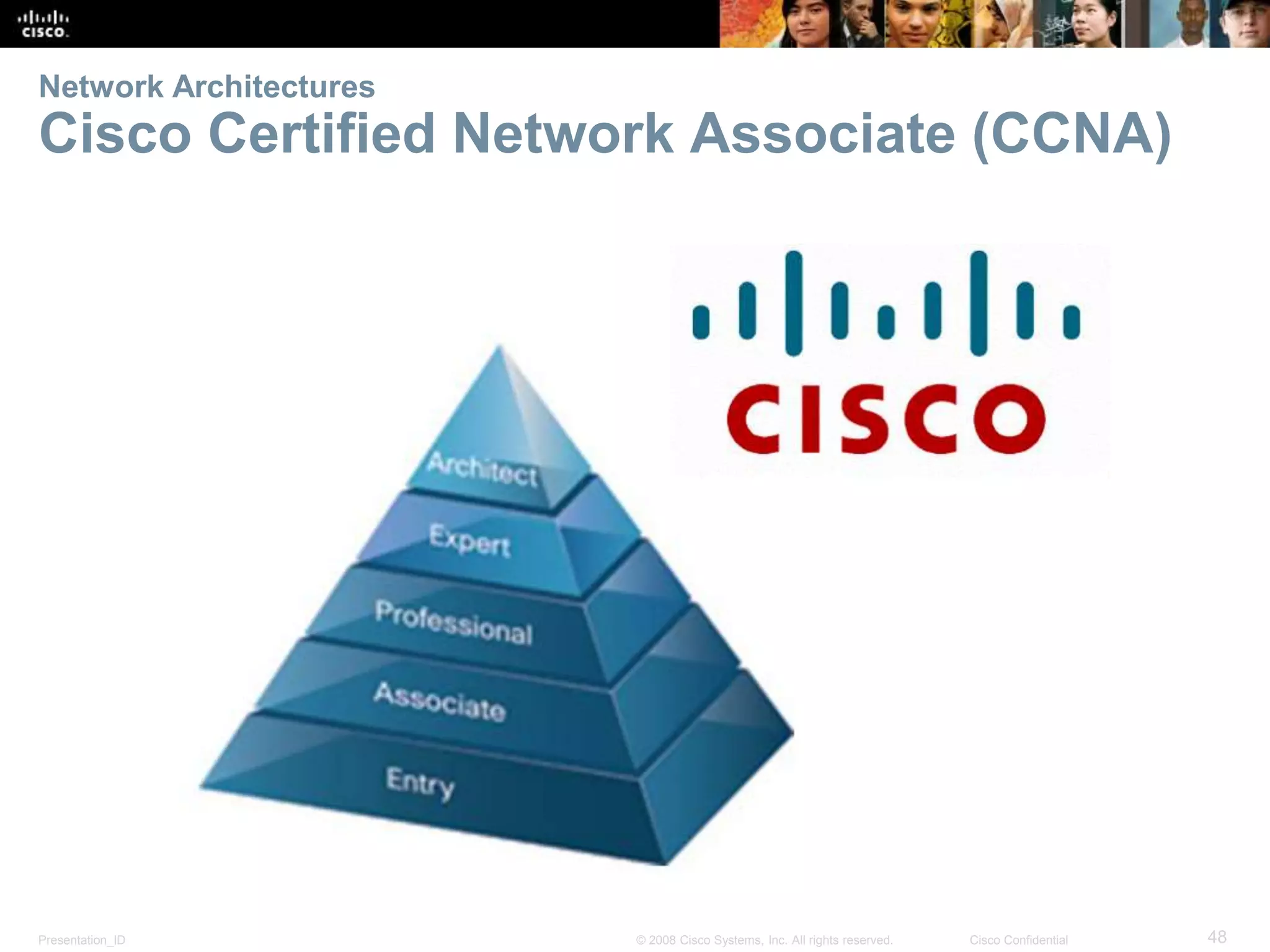
Cisco Certified Network Associate (CCNA) 
Presentation_ID © 2008 Cisco Systems, Inc. All rights reserved. Cisco Confidential 48
Exploring the Networking 
Summary 
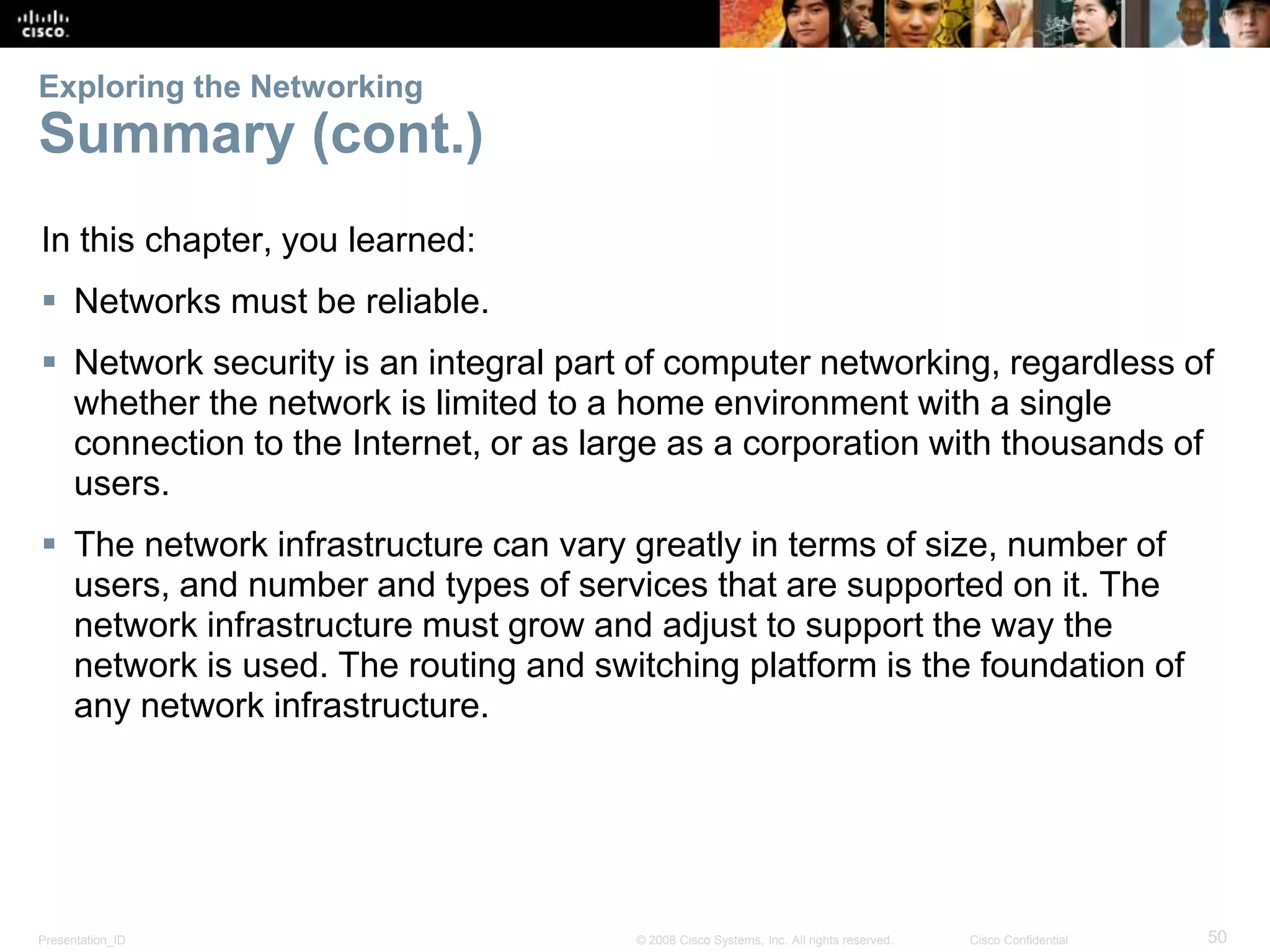
In this chapter, you learned: 
 Networks and the Internet have changed the way we communicate, learn, 
work, and even play. 
 Networks come in all sizes. They can range from simple networks 
consisting of two computers, to networks connecting millions of devices. 
 The Internet is the largest network in existence. In fact, the term Internet 
means a ‘network of networks. The Internet provides the services that 
enable us to connect and communicate with our families, friends, work, 
and interests. 
 The network infrastructure is the platform that supports the network. It 
provides the stable and reliable channel over which communication can 
occur. It is made up of network components including end devices, 
intermediate devices, and network media. 
Presentation_ID © 2008 Cisco Systems, Inc. All rights reserved. Cisco Confidential 49
Exploring the Networking 
Summary (cont.) 
In this chapter, you learned: 
 Networks must be reliable. 
 Network security is an integral part of computer networking, regardless of 
whether the network is limited to a home environment with a single 
connection to the Internet, or as large as a corporation with thousands of 
users. 
 The network infrastructure can vary greatly in terms of size, number of 
users, and number and types of services that are supported on it. The 
network infrastructure must grow and adjust to support the way the 
network is used. The routing and switching platform is the foundation of 
any network infrastructure. 
Presentation_ID © 2008 Cisco Systems, Inc. All rights reserved. Cisco Confidential 50
Presentation_ID © 2008 Cisco Systems, Inc. All rights reserved. Cisco Confidential 51

CCNA 1 Routing and Switching v5.0 Chapter 1

  • 1.
    Chapter 1: Exploringthe Network Introduction to Networks © 2008 Cisco Systems, Inc. All Presentation_ID rights reserved. Cisco Confidential 1
  • 2.
    Chapter 1: Objectives After completing this chapter, students will be able to:  Explain how multiple networks are used in everyday life.  Explain the topologies and devices used in a small- to medium-sized business network.  Explain the basic characteristics of a network that supports communication in a small- to medium-sized business.  Explain trends in networking that will affect the use of networks in small to medium-sized businesses. Presentation_ID © 2008 Cisco Systems, Inc. All rights reserved. Cisco Confidential 2
  • 3.
    Chapter 1 1.1Globally Connected 1.2 LANs, WANs, and the Internet 1.3 The Network as a Platform 1.4 The Changing Network Environment 1.5 Summary Presentation_ID © 2008 Cisco Systems, Inc. All rights reserved. Cisco Confidential 3
  • 4.
    1.1 Globally Connected © 2008 Cisco Systems, Inc. All Presentation_ID rights reserved. Cisco Confidential 4
  • 5.
    Networking Today Networksin Our Past and Daily Lives Presentation_ID © 2008 Cisco Systems, Inc. All rights reserved. Cisco Confidential 5
  • 6.
    Networking Today TheGlobal Community Presentation_ID © 2008 Cisco Systems, Inc. All rights reserved. Cisco Confidential 6
  • 7.
    Interconnecting Our Lives Networking Impacts in Our Daily Lives  Networks support the way we learn.  Networks support the way we communicate.  Networks support the way we work.  Networks support the way we play. Presentation_ID © 2008 Cisco Systems, Inc. All rights reserved. Cisco Confidential 7
  • 8.
    Providing Resources ina Network Networks of Many Sizes Presentation_ID © 2008 Cisco Systems, Inc. All rights reserved. Cisco Confidential 8
  • 9.
    Providing Resources ina Network Clients and Servers Presentation_ID © 2008 Cisco Systems, Inc. All rights reserved. Cisco Confidential 9
  • 10.
    Providing Resources ina Network Peer-to-Peer Presentation_ID © 2008 Cisco Systems, Inc. All rights reserved. Cisco Confidential 10
  • 11.
    1.2 LANs, WANs,and the Internet © 2008 Cisco Systems, Inc. All Presentation_ID rights reserved. Cisco Confidential 11
  • 12.
    LANs, WANs, andInternets Components of a Network There are three categories of network components:  Devices  Media  Services Presentation_ID © 2008 Cisco Systems, Inc. All rights reserved. Cisco Confidential 12
  • 13.
    Components of aNetwork End Devices Some examples of end devices are:  Computers (work stations, laptops, file servers, web servers)  Network printers  VoIP phones  TelePresence endpoint  Security cameras  Mobile handheld devices (such as smart phones, tablets, PDAs, and wireless debit / credit card readers and barcode scanners) Presentation_ID © 2008 Cisco Systems, Inc. All rights reserved. Cisco Confidential 13
  • 14.
    Components of aNetwork Network Infrastructure Devices Examples of intermediary network devices are:  Network Access Devices (switches, and wireless access points)  Internetworking Devices (routers)  Security Devices (firewalls) Presentation_ID © 2008 Cisco Systems, Inc. All rights reserved. Cisco Confidential 14
  • 15.
    Components of aNetwork Network Media Presentation_ID © 2008 Cisco Systems, Inc. All rights reserved. Cisco Confidential 15
  • 16.
    Components of aNetwork Network Representations Presentation_ID © 2008 Cisco Systems, Inc. All rights reserved. Cisco Confidential 16
  • 17.
    Components of aNetwork Topology Diagrams Presentation_ID © 2008 Cisco Systems, Inc. All rights reserved. Cisco Confidential 17
  • 18.
    LANs and WANs Types of Networks The two most common types of network infrastructures are:  Local Area Network (LAN)  Wide Area Network (WAN). Other types of networks include:  Metropolitan Area Network (MAN)  Wireless LAN (WLAN)  Storage Area Network (SAN) Presentation_ID © 2008 Cisco Systems, Inc. All rights reserved. Cisco Confidential 18
  • 19.
    LANs and WANs Local Area Networks (LAN) Presentation_ID © 2008 Cisco Systems, Inc. All rights reserved. Cisco Confidential 19
  • 20.
    LANs and WANs Wide Area Networks (WAN) Presentation_ID © 2008 Cisco Systems, Inc. All rights reserved. Cisco Confidential 20
  • 21.
    LANs, WANs, andthe Internet The Internet Presentation_ID © 2008 Cisco Systems, Inc. All rights reserved. Cisco Confidential 21
  • 22.
    LANs, WANs, andthe Internet Intranet and Extranet Presentation_ID © 2008 Cisco Systems, Inc. All rights reserved. Cisco Confidential 22
  • 23.
    Connecting to theInternet Connecting Remote Users to the Internet Presentation_ID © 2008 Cisco Systems, Inc. All rights reserved. Cisco Confidential 23
  • 24.
    Connecting to theInternet Connecting Businesses to the Internet Presentation_ID © 2008 Cisco Systems, Inc. All rights reserved. Cisco Confidential 24
  • 25.
    1.3 The Networkas a Platform © 2008 Cisco Systems, Inc. All Presentation_ID rights reserved. Cisco Confidential 25
  • 26.
    Converged Networks TheConverging Network Presentation_ID © 2008 Cisco Systems, Inc. All rights reserved. Cisco Confidential 26
  • 27.
    Converged Networks Planningfor the Future Presentation_ID © 2008 Cisco Systems, Inc. All rights reserved. Cisco Confidential 27
  • 28.
    Reliable Network SupportingNetwork Architecture As networks evolve, we are discovering that there are four basic characteristics that the underlying architectures need to address in order to meet user expectations:  Fault Tolerance  Scalability  Quality of Service (QoS)  Security Presentation_ID © 2008 Cisco Systems, Inc. All rights reserved. Cisco Confidential 28
  • 29.
    Reliable Network FaultTolerance in Circuit Switched Network Presentation_ID © 2008 Cisco Systems, Inc. All rights reserved. Cisco Confidential 29
  • 30.
    Reliable Network Packet-SwitchedNetworks Presentation_ID © 2008 Cisco Systems, Inc. All rights reserved. Cisco Confidential 30
  • 31.
    Reliable Network ScalableNetworks Presentation_ID © 2008 Cisco Systems, Inc. All rights reserved. Cisco Confidential 31
  • 32.
    Reliable Network ProvidingQoS Examples of priority decisions for an organization might include:  Time-sensitive communication - increase priority for services like telephony or video distribution.  Non time-sensitive communication - decrease priority for web page retrieval or email.  High importance to organization - increase priority for production control or business transaction data.  Undesirable communication - decrease priority or block unwanted activity, like peer-to-peer file sharing or live entertainment. Presentation_ID © 2008 Cisco Systems, Inc. All rights reserved. Cisco Confidential 32
  • 33.
    Reliable Network ProvidingNetwork Security Presentation_ID © 2008 Cisco Systems, Inc. All rights reserved. Cisco Confidential 33
  • 34.
    1.4 The ChangingNetwork Environment © 2008 Cisco Systems, Inc. All Presentation_ID rights reserved. Cisco Confidential 34
  • 35.
    Network Trends Newtrends Some of the top trends include:  Bring Your Own Device (BYOD)  Online collaboration  Video  Cloud computing Presentation_ID © 2008 Cisco Systems, Inc. All rights reserved. Cisco Confidential 35
  • 36.
    Network Trends BringYour Own Device (BYOD) The concept of any device, to any content, in anyway is a major global trend that requires significant changes to the way devices are used. This trend is known as Bring Your Own Device (BYOD). Presentation_ID © 2008 Cisco Systems, Inc. All rights reserved. Cisco Confidential 36
  • 37.
    Network Trends OnlineCollaboration Presentation_ID © 2008 Cisco Systems, Inc. All rights reserved. Cisco Confidential 37
  • 38.
    Network Trends VideoCommunication Presentation_ID © 2008 Cisco Systems, Inc. All rights reserved. Cisco Confidential 38
  • 39.
    Network Trends CloudComputing Cloud computing offers the following potential benefits:  Organizational flexibility  Agility and rapid deployment  Reduced cost of infrastructure  Refocus of IT resources  Creation of new business models Presentation_ID © 2008 Cisco Systems, Inc. All rights reserved. Cisco Confidential 39
  • 40.
    Network Trends DataCenters A data center is a facility used to house computer systems and associated components including:  Redundant data communications connections  High-speed virtual servers (sometimes referred to as server farms or server clusters)  Redundant storage systems (typically uses SAN technology)  Redundant or backup power supplies  Environmental controls (e.g., air conditioning, fire suppression)  Security devices Presentation_ID © 2008 Cisco Systems, Inc. All rights reserved. Cisco Confidential 40
  • 41.
    Networking Technologies forthe Home Technology Trends in the Home Presentation_ID © 2008 Cisco Systems, Inc. All rights reserved. Cisco Confidential 41
  • 42.
    Networking Technologies forthe Home Powerline Networking Presentation_ID © 2008 Cisco Systems, Inc. All rights reserved. Cisco Confidential 42
  • 43.
    Networking Technologies forthe Home Wireless Broadband Presentation_ID © 2008 Cisco Systems, Inc. All rights reserved. Cisco Confidential 43
  • 44.
    Future of Networking Network Security Presentation_ID © 2008 Cisco Systems, Inc. All rights reserved. Cisco Confidential 44
  • 45.
    Network Security SecurityThreats The most common external threats to networks include:  Viruses, worms, and Trojan horses  Spyware and adware  Zero-day attacks, also called zero-hour attacks  Hacker attacks  Denial of service (DoS) attacks  Data interception and theft  Identity theft Presentation_ID © 2008 Cisco Systems, Inc. All rights reserved. Cisco Confidential 45
  • 46.
    Network Security SecuritySolutions Network security components often include:  Antivirus and antispyware  Firewall filtering  Dedicated firewall systems  Access control lists (ACL)  Intrusion prevention systems (IPS)  Virtual Private Networks (VPNs) Presentation_ID © 2008 Cisco Systems, Inc. All rights reserved. Cisco Confidential 46
  • 47.
    Network Architectures CiscoNetwork Architectures Presentation_ID © 2008 Cisco Systems, Inc. All rights reserved. Cisco Confidential 47
  • 48.
    Network Architectures CiscoCertified Network Associate (CCNA) Presentation_ID © 2008 Cisco Systems, Inc. All rights reserved. Cisco Confidential 48
  • 49.
    Exploring the Networking Summary In this chapter, you learned:  Networks and the Internet have changed the way we communicate, learn, work, and even play.  Networks come in all sizes. They can range from simple networks consisting of two computers, to networks connecting millions of devices.  The Internet is the largest network in existence. In fact, the term Internet means a ‘network of networks. The Internet provides the services that enable us to connect and communicate with our families, friends, work, and interests.  The network infrastructure is the platform that supports the network. It provides the stable and reliable channel over which communication can occur. It is made up of network components including end devices, intermediate devices, and network media. Presentation_ID © 2008 Cisco Systems, Inc. All rights reserved. Cisco Confidential 49
  • 50.
    Exploring the Networking Summary (cont.) In this chapter, you learned:  Networks must be reliable.  Network security is an integral part of computer networking, regardless of whether the network is limited to a home environment with a single connection to the Internet, or as large as a corporation with thousands of users.  The network infrastructure can vary greatly in terms of size, number of users, and number and types of services that are supported on it. The network infrastructure must grow and adjust to support the way the network is used. The routing and switching platform is the foundation of any network infrastructure. Presentation_ID © 2008 Cisco Systems, Inc. All rights reserved. Cisco Confidential 50
  • 51.
    Presentation_ID © 2008Cisco Systems, Inc. All rights reserved. Cisco Confidential 51