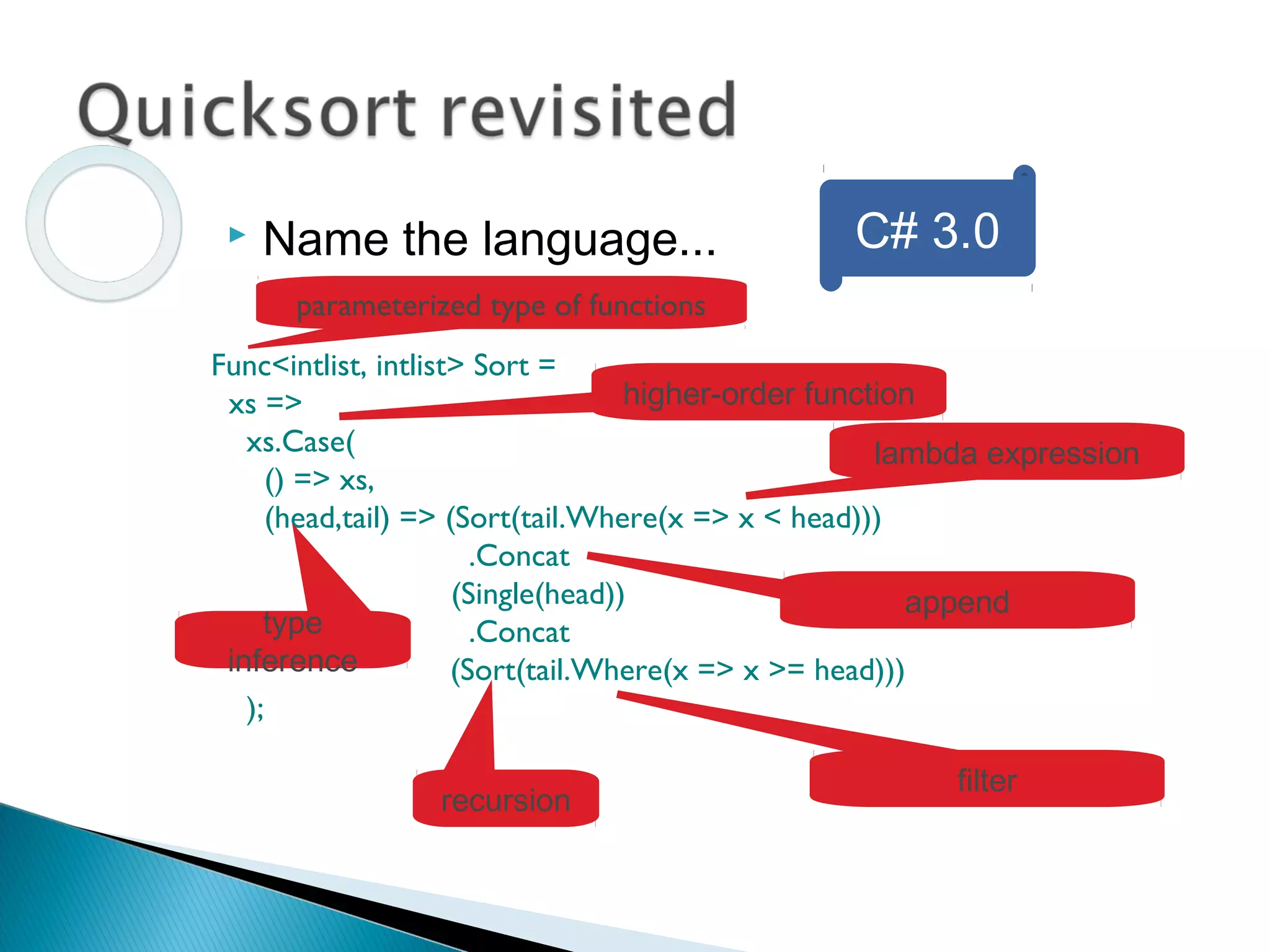
 Name the language...
Func<intlist, intlist> Sort =
xs =>
xs.Case(
() => xs,
(head,tail) => (Sort(tail.Where(x => x < head)))
.Concat
(Single(head))
.Concat
(Sort(tail.Where(x => x >= head)))
);
C# 3.0
type
inference
append
higher-order function
parameterized type of functions
recursion
filter
lambda expression
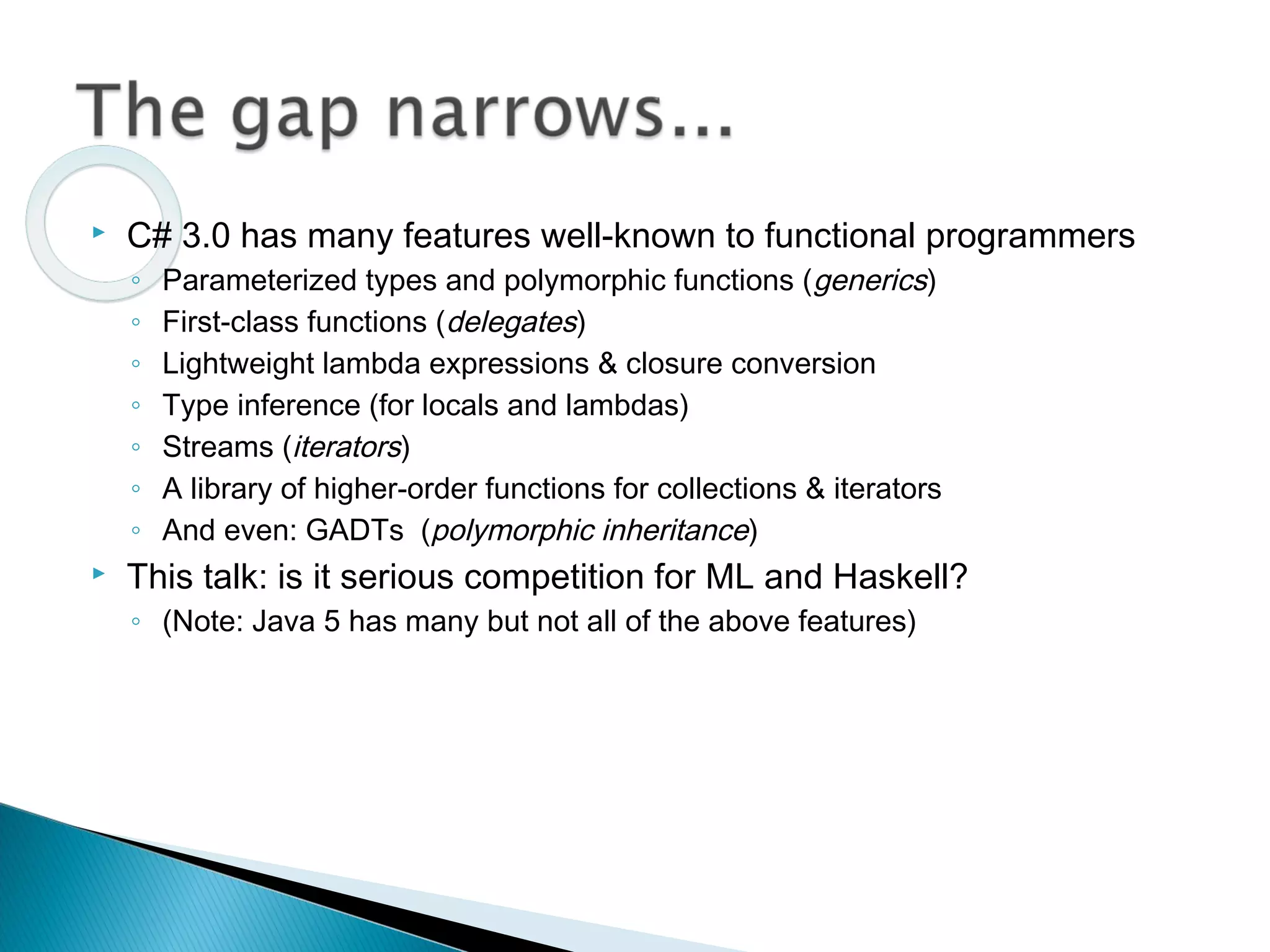
 C# 3.0 has many features well-known to functional programmers
◦ Parameterized types and polymorphic functions (generics)
◦ First-class functions (delegates)
◦ Lightweight lambda expressions & closure conversion
◦ Type inference (for locals and lambdas)
◦ Streams (iterators)
◦ A library of higher-order functions for collections & iterators
◦ And even: GADTs (polymorphic inheritance)
 This talk: is it serious competition for ML and Haskell?
◦ (Note: Java 5 has many but not all of the above features)
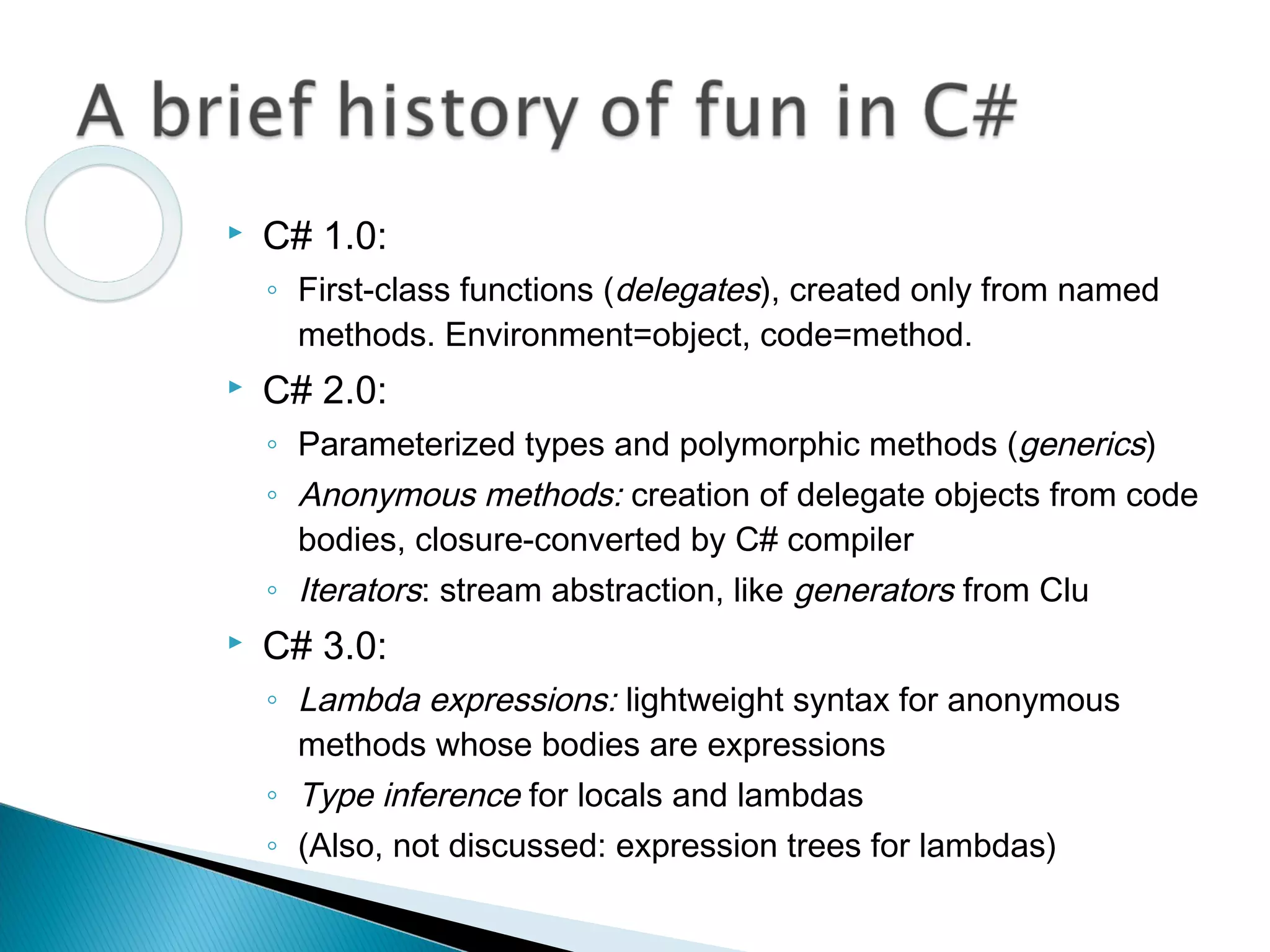
 C# 1.0:
◦ First-class functions (delegates), created only from named
methods. Environment=object, code=method.
 C# 2.0:
◦ Parameterized types and polymorphic methods (generics)
◦ Anonymous methods: creation of delegate objects from code
bodies, closure-converted by C# compiler
◦ Iterators: stream abstraction, like generators from Clu
 C# 3.0:
◦ Lambda expressions: lightweight syntax for anonymous
methods whose bodies are expressions
◦ Type inference for locals and lambdas
◦ (Also, not discussed: expression trees for lambdas)
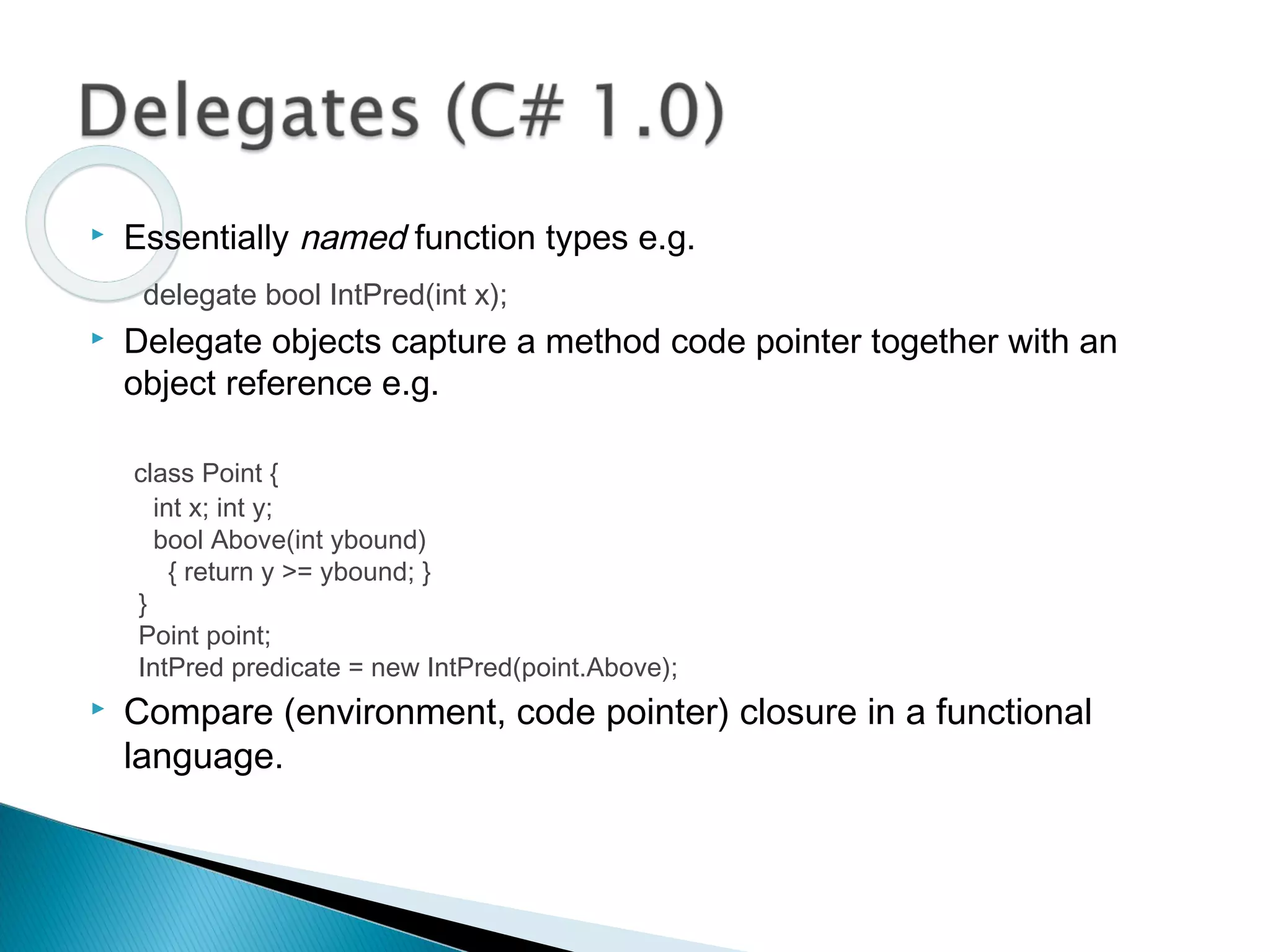
 Essentially named function types e.g.
delegate bool IntPred(int x);
 Delegate objects capture a method code pointer together with an
object reference e.g.
class Point {
int x; int y;
bool Above(int ybound)
{ return y >= ybound; }
}
Point point;
IntPred predicate = new IntPred(point.Above);
 Compare (environment, code pointer) closure in a functional
language.
 Types (classes, interfaces, structs and delegates) can be
parameterized on other types e.g.
delegate R Func<A,R>(A arg);
class List<T> { ... }
class Dict<K,D> { ... }
 Methods (instance and static) can be parameterized on types e.g.
static void Sort<T>(T[] arr);
static void Swap<T>(ref T x, ref T y);
class List<T> {
List<Pair<T,U>> Zip<U>(List<U> other) ..
 Very few restrictions:
◦ Parameterization over primitive types, reference types, structs
◦ Types preserved at runtime, in spirit of the .NET object model
1. Polymorphic recursion e.g.
static void Foo<T>(List<T> xs) {
…Foo<List<List<T>>>(…)… }
2. First-class polymorphism (System F) e.g.
interface Sorter { void Sort<T>(T[] arr); }
class QuickSort : Sorter { … }
class MergeSort : Sorter { … }
3. GADTs e.g.
abstract class Expr<T> { T Eval(); }
class Lit : Expr<int> { int Eval() { … } }
class PairExpr<A,B> : Expr<Pair<A,B>>
{ Expr<A> e1; Expr<B> e2; Pair<A,B> Eval() { … } }
Also possible
in Java 5
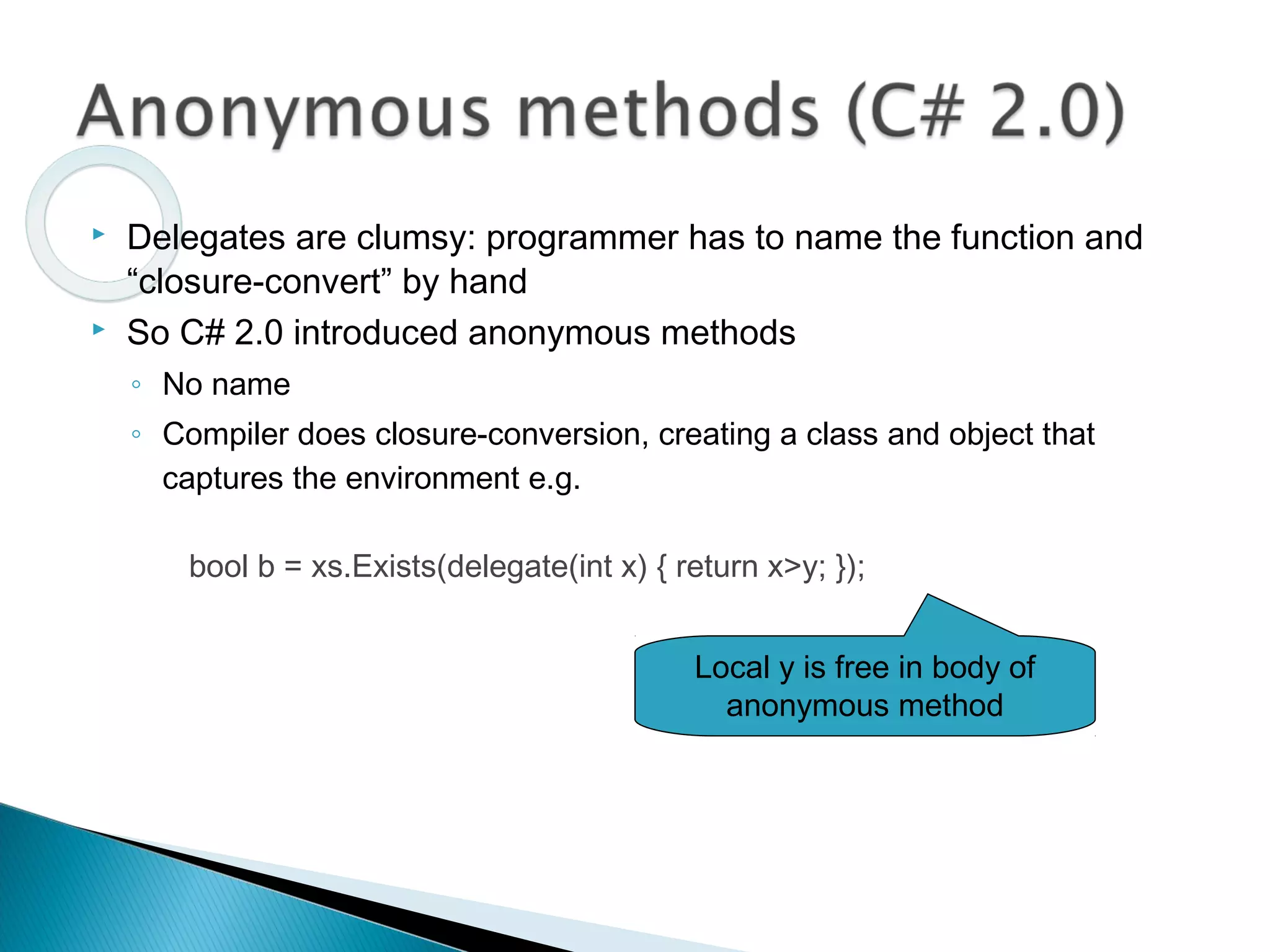
 Delegates are clumsy: programmer has to name the function and
“closure-convert” by hand
 So C# 2.0 introduced anonymous methods
◦ No name
◦ Compiler does closure-conversion, creating a class and object that
captures the environment e.g.
bool b = xs.Exists(delegate(int x) { return x>y; });
Local y is free in body of
anonymous method
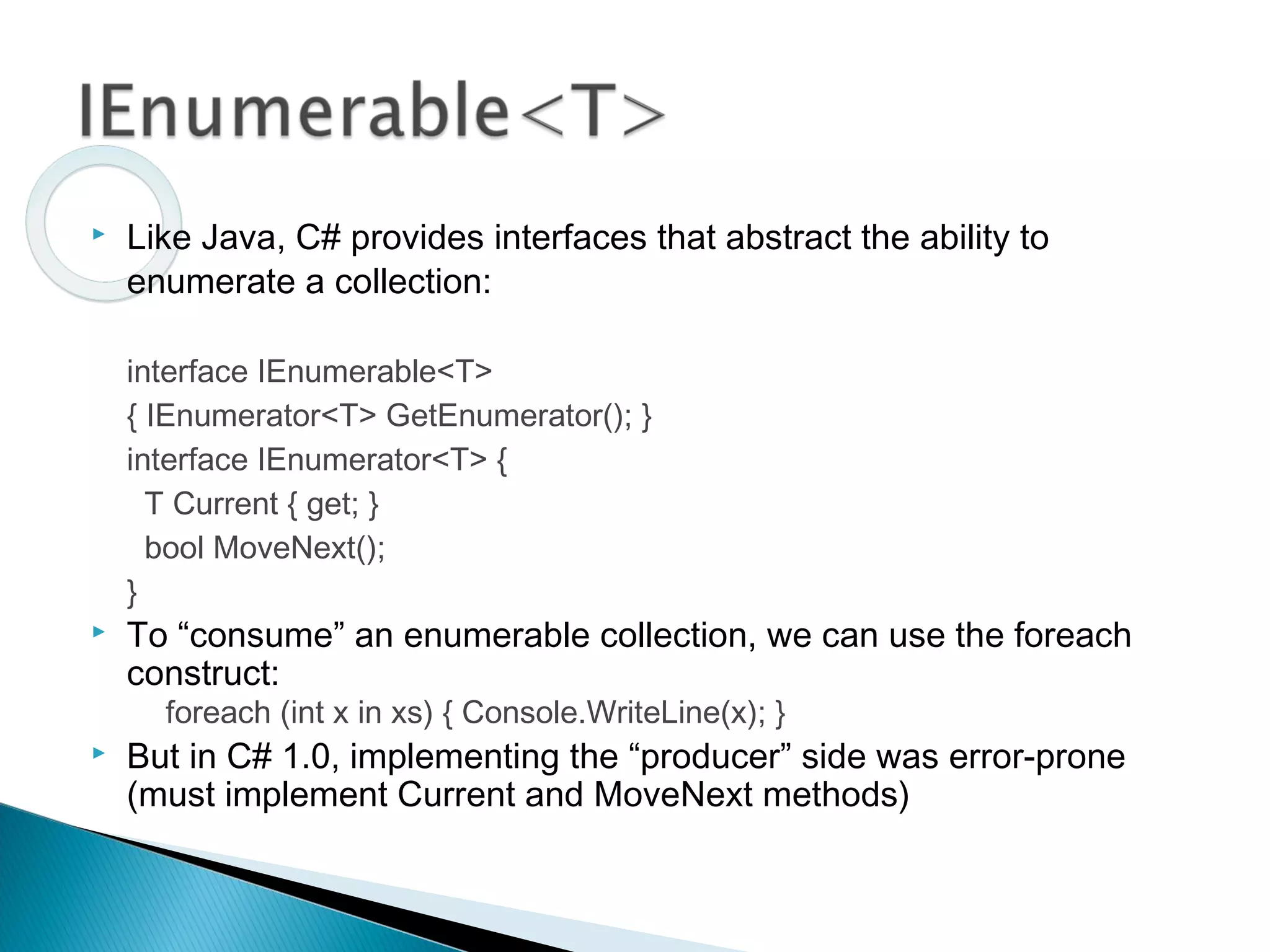
 Like Java, C# provides interfaces that abstract the ability to
enumerate a collection:
interface IEnumerable<T>
{ IEnumerator<T> GetEnumerator(); }
interface IEnumerator<T> {
T Current { get; }
bool MoveNext();
}
 To “consume” an enumerable collection, we can use the foreach
construct:
foreach (int x in xs) { Console.WriteLine(x); }
 But in C# 1.0, implementing the “producer” side was error-prone
(must implement Current and MoveNext methods)
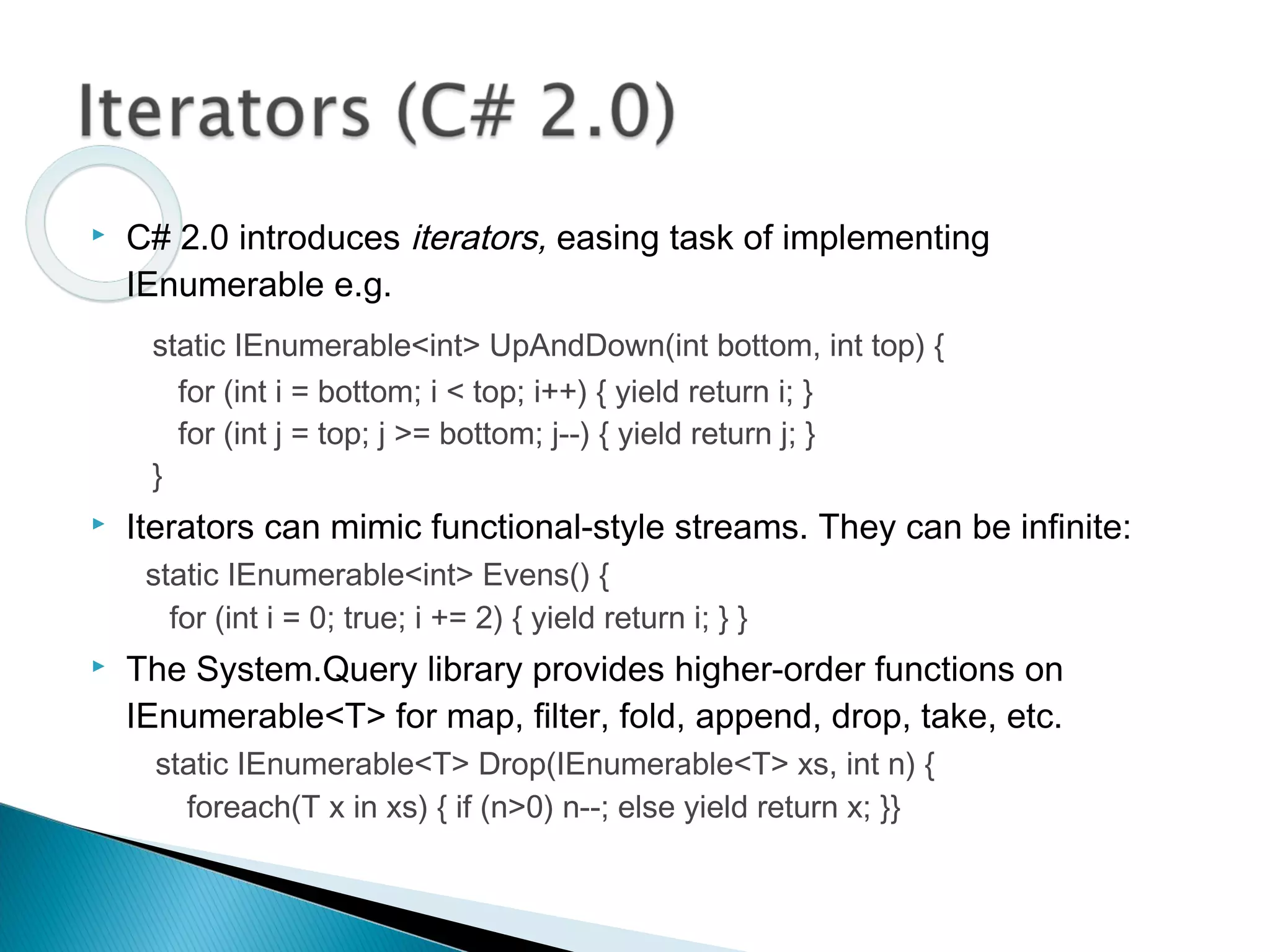
 C# 2.0 introduces iterators, easing task of implementing
IEnumerable e.g.
static IEnumerable<int> UpAndDown(int bottom, int top) {
for (int i = bottom; i < top; i++) { yield return i; }
for (int j = top; j >= bottom; j--) { yield return j; }
}
 Iterators can mimic functional-style streams. They can be infinite:
static IEnumerable<int> Evens() {
for (int i = 0; true; i += 2) { yield return i; } }
 The System.Query library provides higher-order functions on
IEnumerable<T> for map, filter, fold, append, drop, take, etc.
static IEnumerable<T> Drop(IEnumerable<T> xs, int n) {
foreach(T x in xs) { if (n>0) n--; else yield return x; }}
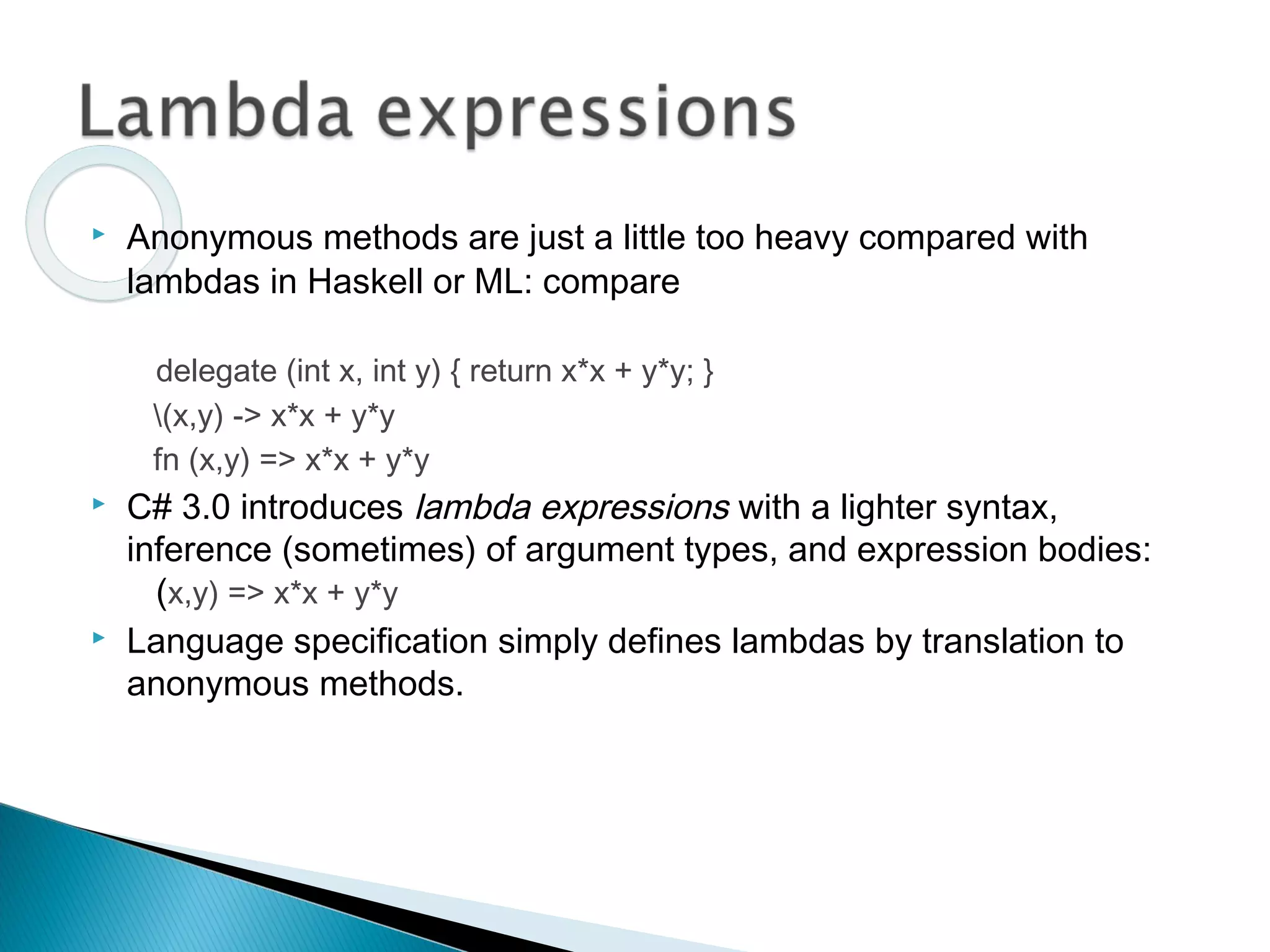
 Anonymous methods are just a little too heavy compared with
lambdas in Haskell or ML: compare
delegate (int x, int y) { return x*x + y*y; }
(x,y) -> x*x + y*y
fn (x,y) => x*x + y*y
 C# 3.0 introduces lambda expressions with a lighter syntax,
inference (sometimes) of argument types, and expression bodies:
(x,y) => x*x + y*y
 Language specification simply defines lambdas by translation to
anonymous methods.
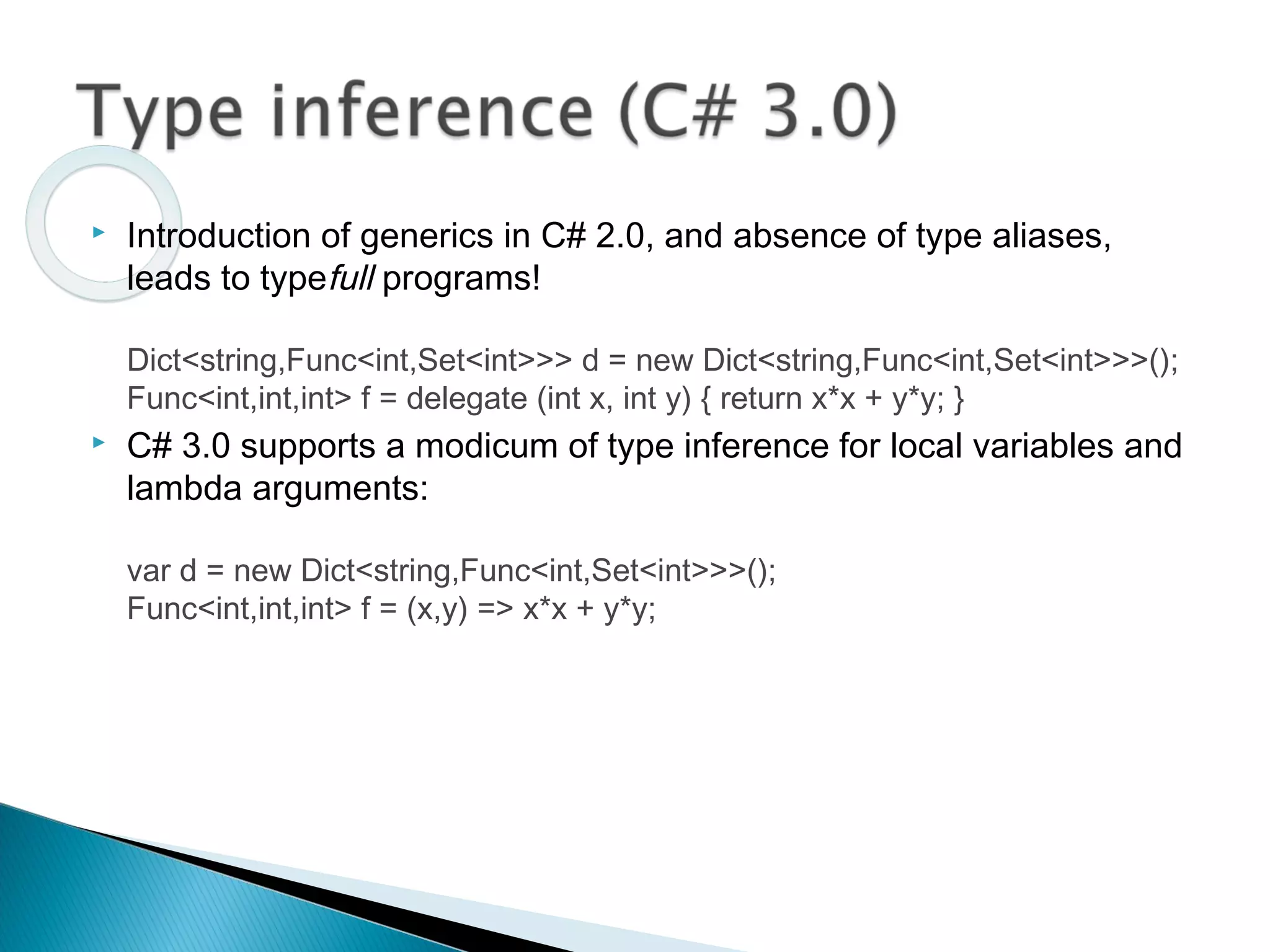
 Introduction of generics in C# 2.0, and absence of type aliases,
leads to typefull programs!
Dict<string,Func<int,Set<int>>> d = new Dict<string,Func<int,Set<int>>>();
Func<int,int,int> f = delegate (int x, int y) { return x*x + y*y; }
 C# 3.0 supports a modicum of type inference for local variables and
lambda arguments:
var d = new Dict<string,Func<int,Set<int>>>();
Func<int,int,int> f = (x,y) => x*x + y*y;
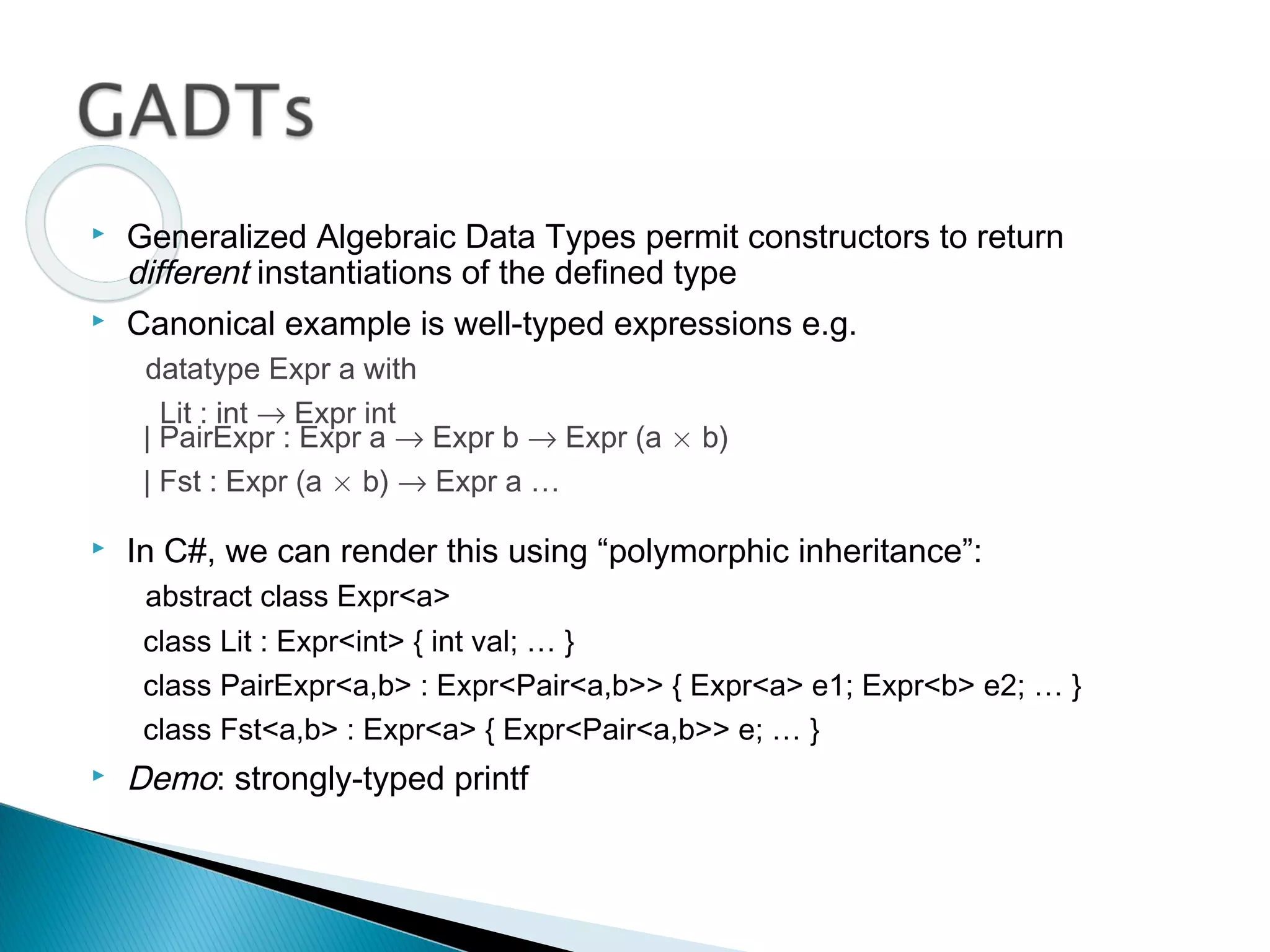
 Generalized Algebraic Data Types permit constructors to return
different instantiations of the defined type
 Canonical example is well-typed expressions e.g.
datatype Expr a with
Lit : int → Expr int
| PairExpr : Expr a → Expr b → Expr (a £ b)
| Fst : Expr (a £ b) → Expr a …
 In C#, we can render this using “polymorphic inheritance”:
abstract class Expr<a>
class Lit : Expr<int> { int val; … }
class PairExpr<a,b> : Expr<Pair<a,b>> { Expr<a> e1; Expr<b> e2; … }
class Fst<a,b> : Expr<a> { Expr<Pair<a,b>> e; … }
 Demo: strongly-typed printf
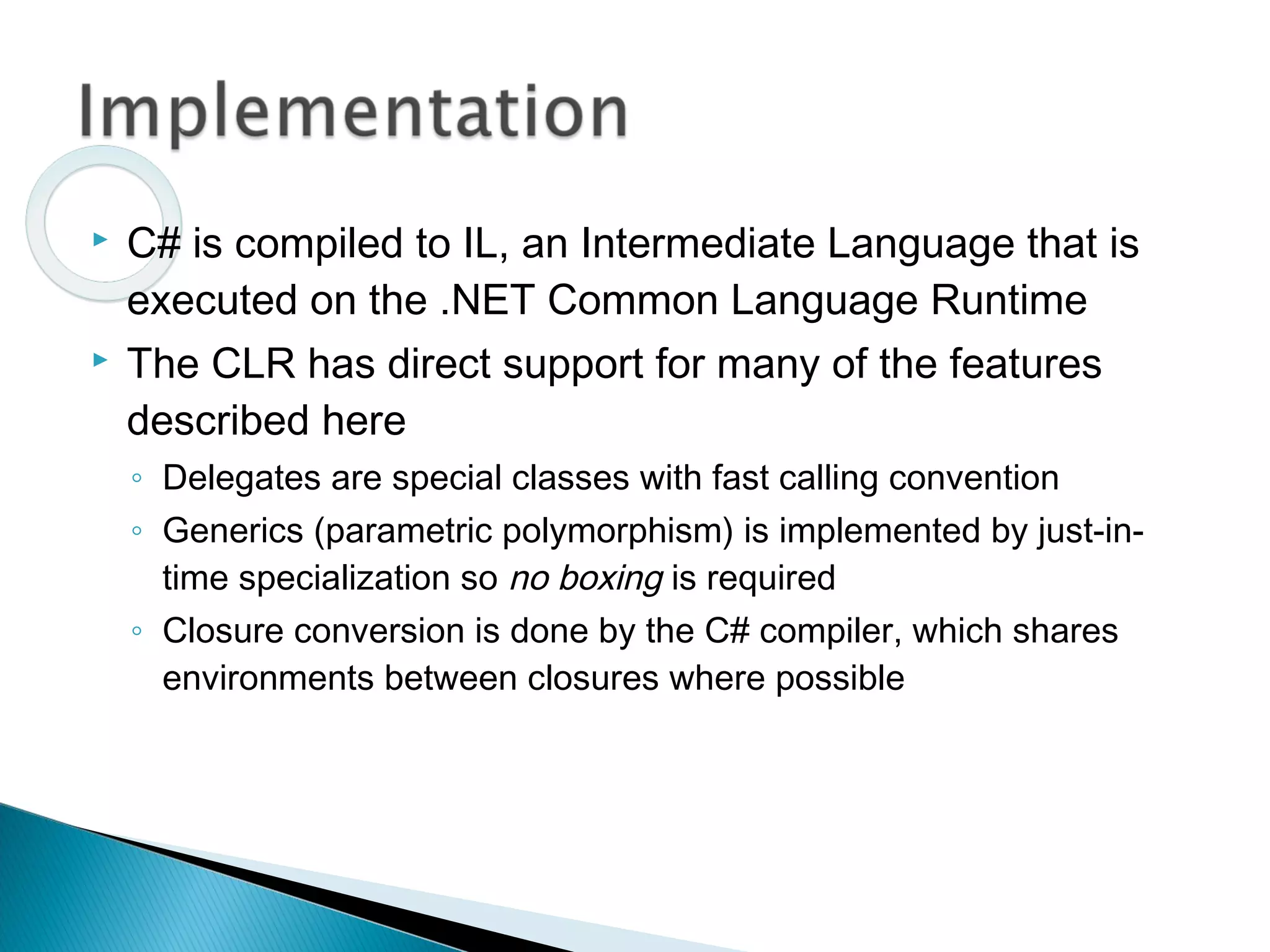
 C# is compiled to IL, an Intermediate Language that is
executed on the .NET Common Language Runtime
 The CLR has direct support for many of the features
described here
◦ Delegates are special classes with fast calling convention
◦ Generics (parametric polymorphism) is implemented by just-in-
time specialization so no boxing is required
◦ Closure conversion is done by the C# compiler, which shares
environments between closures where possible
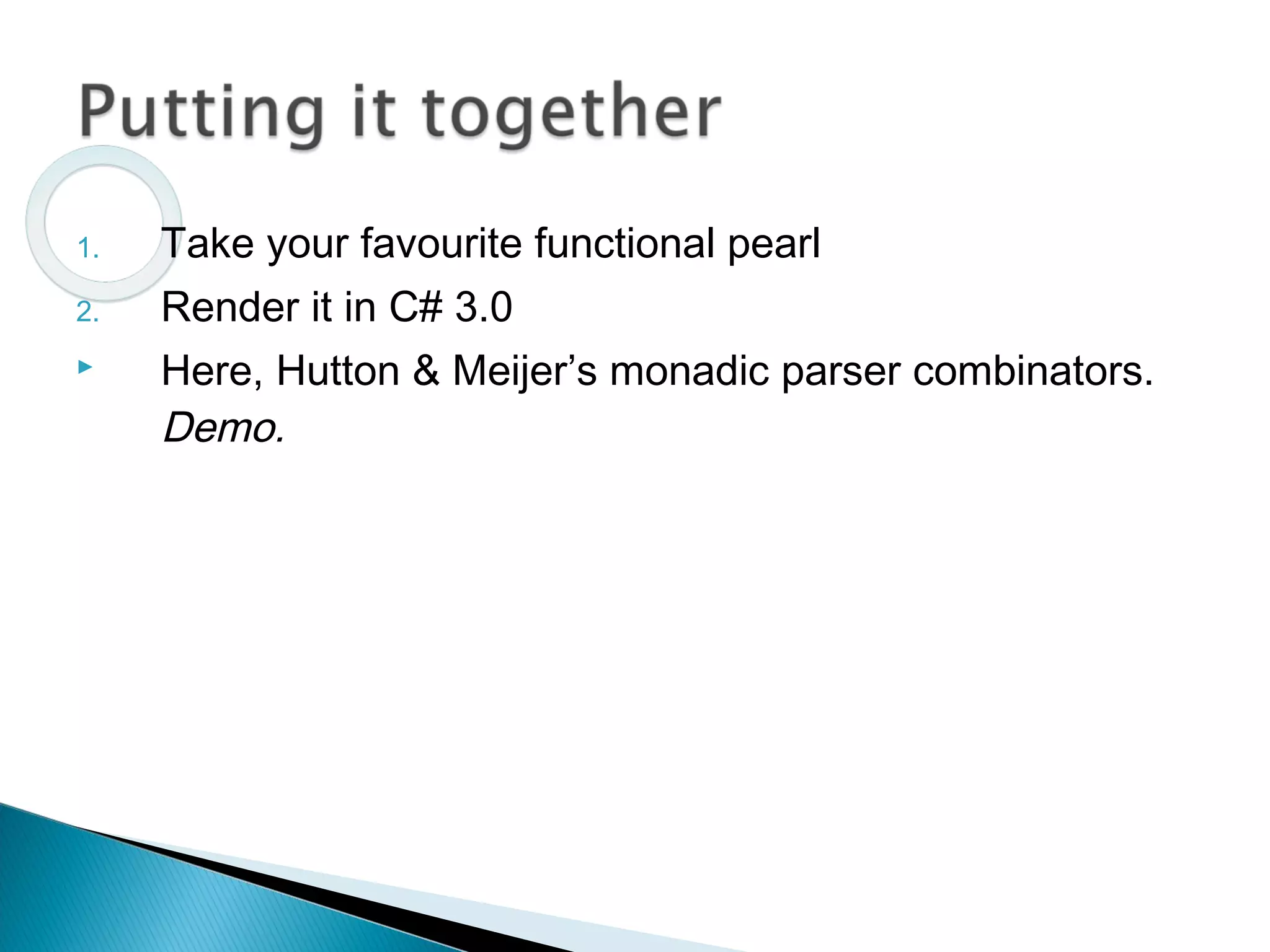
1. Take your favourite functional pearl
2. Render it in C# 3.0
 Here, Hutton & Meijer’s monadic parser combinators.
Demo.
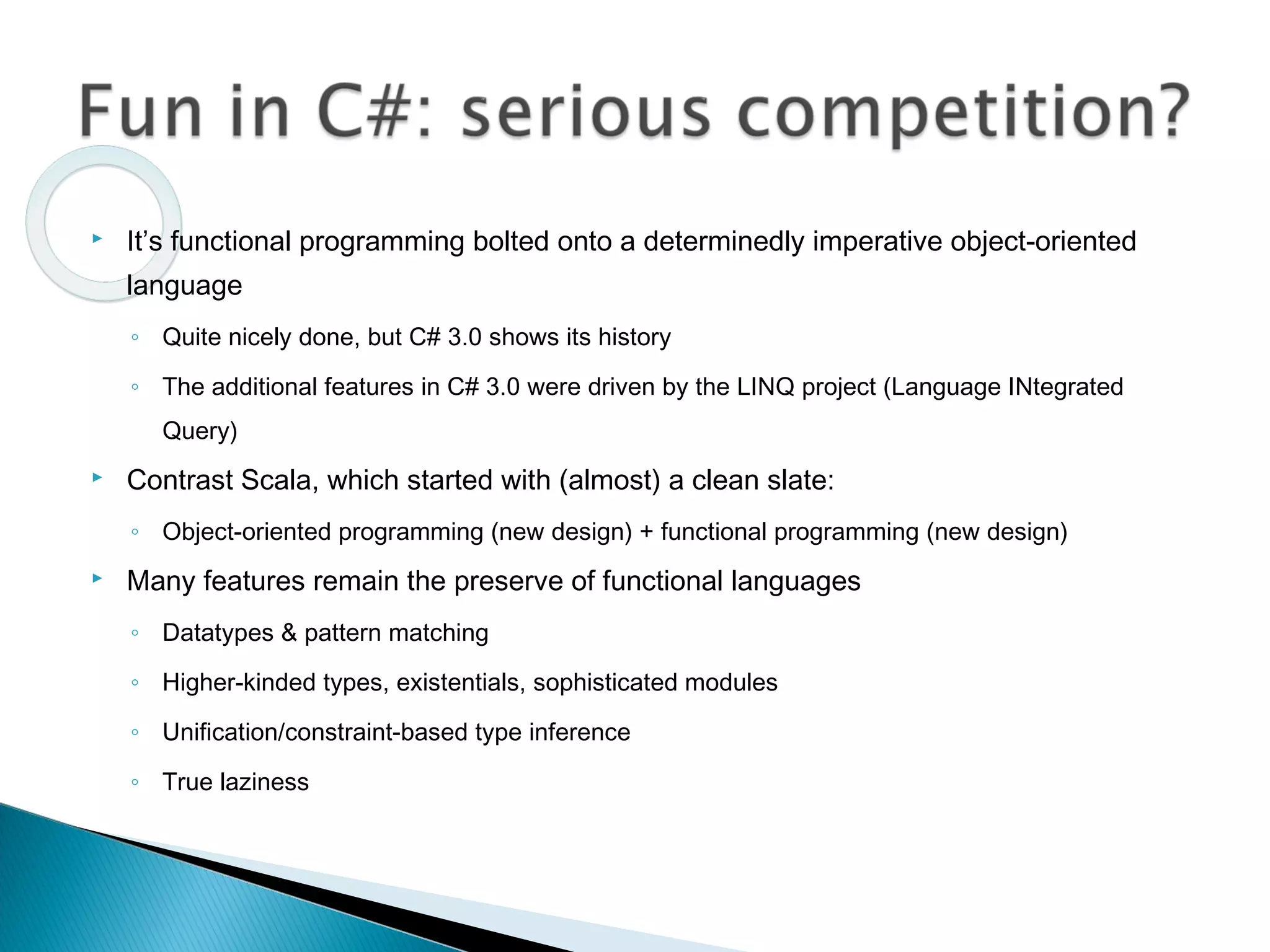
 It’s functional programming bolted onto a determinedly imperative object-oriented
language
◦ Quite nicely done, but C# 3.0 shows its history
◦ The additional features in C# 3.0 were driven by the LINQ project (Language INtegrated
Query)
 Contrast Scala, which started with (almost) a clean slate:
◦ Object-oriented programming (new design) + functional programming (new design)
 Many features remain the preserve of functional languages
◦ Datatypes & pattern matching
◦ Higher-kinded types, existentials, sophisticated modules
◦ Unification/constraint-based type inference
◦ True laziness
 Why? Clue: r-values vs l-values. Arguably, the right design:
static void While(VoidFunc<bool> condition, VoidFunc action) { … }
int x = 1; While(() => x < 10, () => { x=2*x; });
var funs = new Func<int,int>[5]; // Array of functions of type int→int
for (int i = 0; i<5; i++)
{
funs[i] = j => i+j; // To position index i, assign λj. i+j
}
Console.WriteLine(funs[1](2));
 Guess the output
Result is “7”!
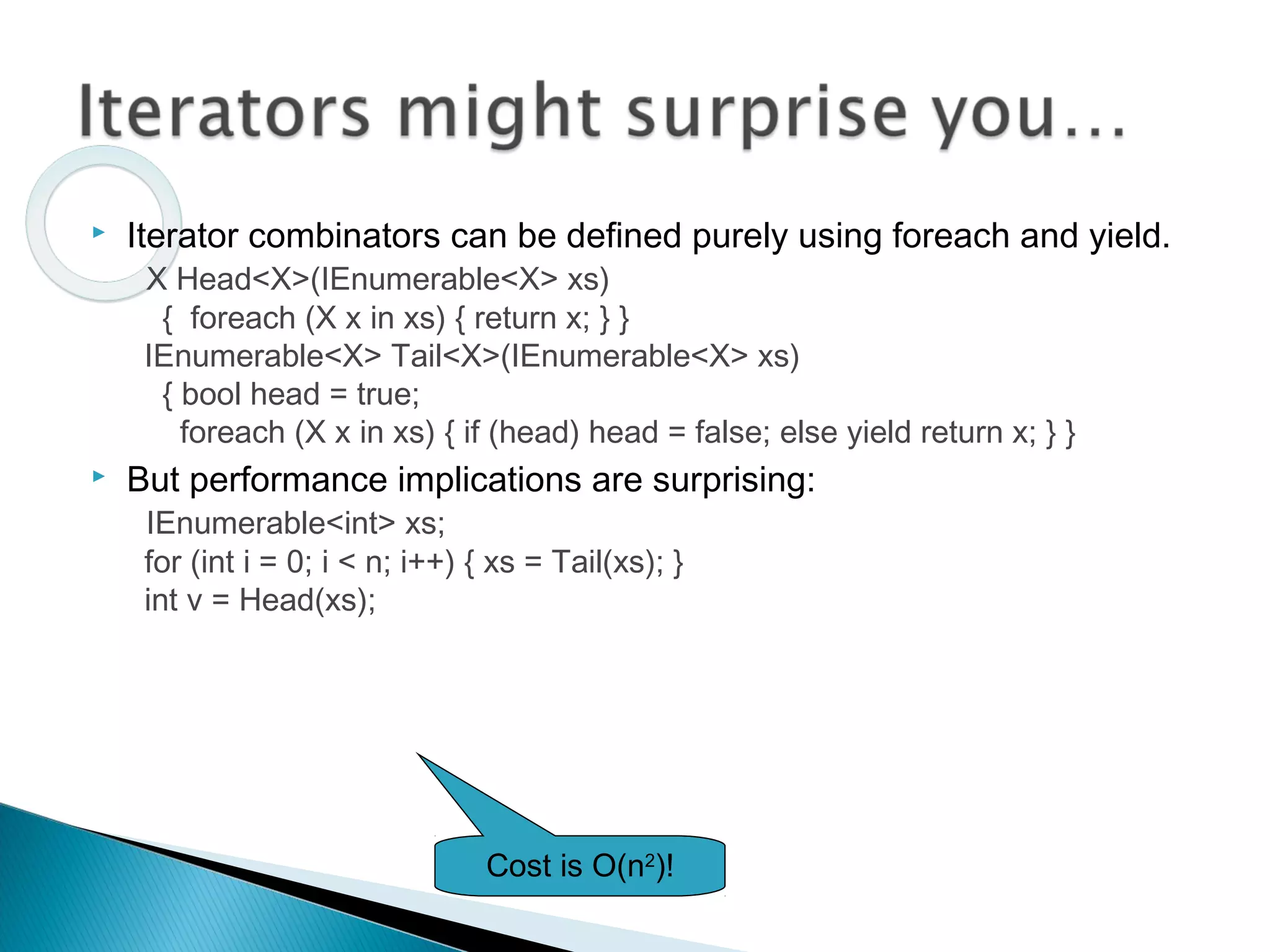
 Iterator combinators can be defined purely using foreach and yield.
X Head<X>(IEnumerable<X> xs)
{ foreach (X x in xs) { return x; } }
IEnumerable<X> Tail<X>(IEnumerable<X> xs)
{ bool head = true;
foreach (X x in xs) { if (head) head = false; else yield return x; } }
 But performance implications are surprising:
IEnumerable<int> xs;
for (int i = 0; i < n; i++) { xs = Tail(xs); }
int v = Head(xs);
Cost is O(n2
)!
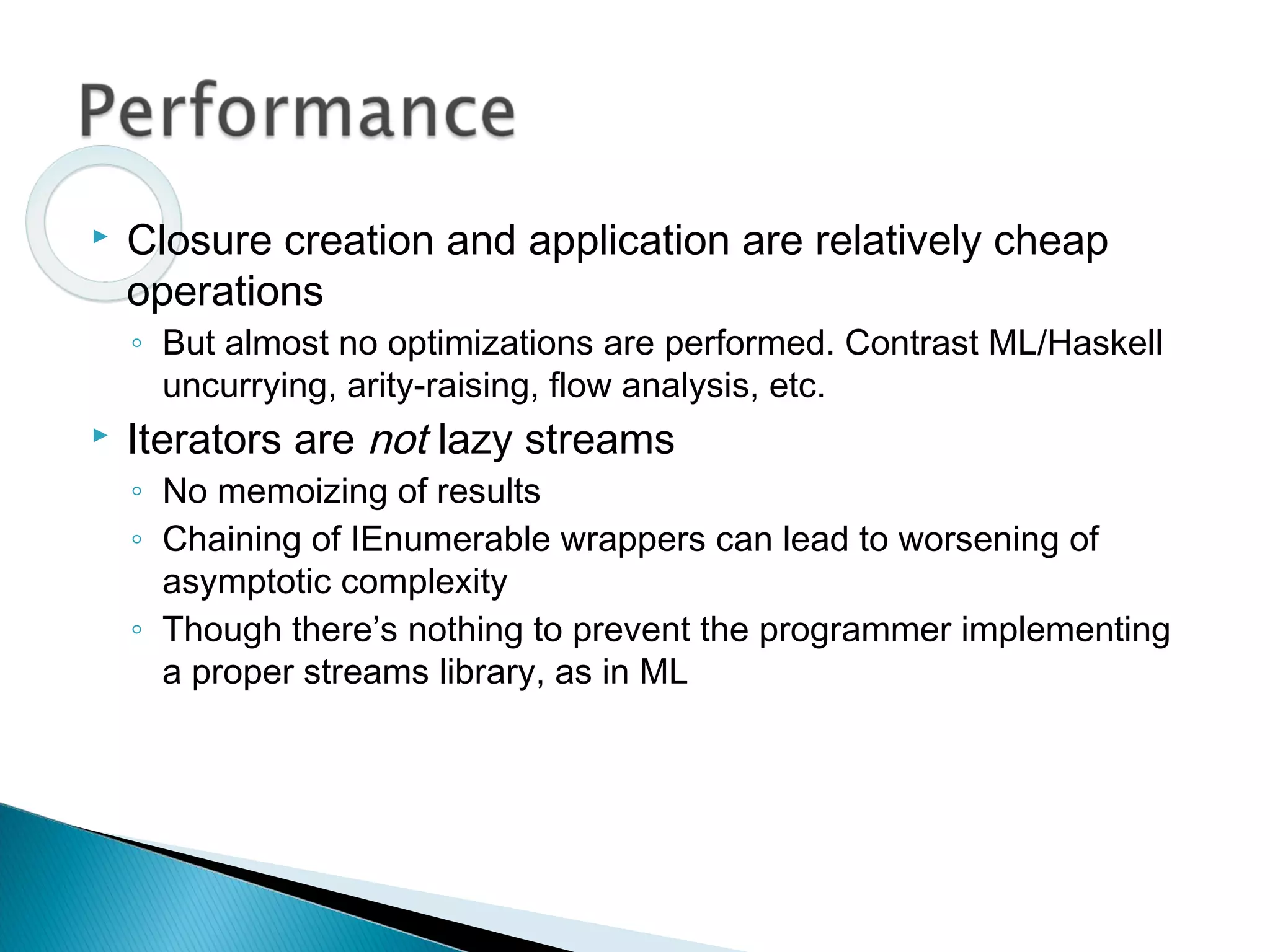
 Closure creation and application are relatively cheap
operations
◦ But almost no optimizations are performed. Contrast ML/Haskell
uncurrying, arity-raising, flow analysis, etc.
 Iterators are not lazy streams
◦ No memoizing of results
◦ Chaining of IEnumerable wrappers can lead to worsening of
asymptotic complexity
◦ Though there’s nothing to prevent the programmer implementing
a proper streams library, as in ML

C# programming

  • 2.
     Name thelanguage... Func<intlist, intlist> Sort = xs => xs.Case( () => xs, (head,tail) => (Sort(tail.Where(x => x < head))) .Concat (Single(head)) .Concat (Sort(tail.Where(x => x >= head))) ); C# 3.0 type inference append higher-order function parameterized type of functions recursion filter lambda expression
  • 3.
     C# 3.0has many features well-known to functional programmers ◦ Parameterized types and polymorphic functions (generics) ◦ First-class functions (delegates) ◦ Lightweight lambda expressions & closure conversion ◦ Type inference (for locals and lambdas) ◦ Streams (iterators) ◦ A library of higher-order functions for collections & iterators ◦ And even: GADTs (polymorphic inheritance)  This talk: is it serious competition for ML and Haskell? ◦ (Note: Java 5 has many but not all of the above features)
  • 4.
     C# 1.0: ◦First-class functions (delegates), created only from named methods. Environment=object, code=method.  C# 2.0: ◦ Parameterized types and polymorphic methods (generics) ◦ Anonymous methods: creation of delegate objects from code bodies, closure-converted by C# compiler ◦ Iterators: stream abstraction, like generators from Clu  C# 3.0: ◦ Lambda expressions: lightweight syntax for anonymous methods whose bodies are expressions ◦ Type inference for locals and lambdas ◦ (Also, not discussed: expression trees for lambdas)
  • 5.
     Essentially namedfunction types e.g. delegate bool IntPred(int x);  Delegate objects capture a method code pointer together with an object reference e.g. class Point { int x; int y; bool Above(int ybound) { return y >= ybound; } } Point point; IntPred predicate = new IntPred(point.Above);  Compare (environment, code pointer) closure in a functional language.
  • 6.
     Types (classes,interfaces, structs and delegates) can be parameterized on other types e.g. delegate R Func<A,R>(A arg); class List<T> { ... } class Dict<K,D> { ... }  Methods (instance and static) can be parameterized on types e.g. static void Sort<T>(T[] arr); static void Swap<T>(ref T x, ref T y); class List<T> { List<Pair<T,U>> Zip<U>(List<U> other) ..  Very few restrictions: ◦ Parameterization over primitive types, reference types, structs ◦ Types preserved at runtime, in spirit of the .NET object model
  • 7.
    1. Polymorphic recursione.g. static void Foo<T>(List<T> xs) { …Foo<List<List<T>>>(…)… } 2. First-class polymorphism (System F) e.g. interface Sorter { void Sort<T>(T[] arr); } class QuickSort : Sorter { … } class MergeSort : Sorter { … } 3. GADTs e.g. abstract class Expr<T> { T Eval(); } class Lit : Expr<int> { int Eval() { … } } class PairExpr<A,B> : Expr<Pair<A,B>> { Expr<A> e1; Expr<B> e2; Pair<A,B> Eval() { … } } Also possible in Java 5
  • 8.
     Delegates areclumsy: programmer has to name the function and “closure-convert” by hand  So C# 2.0 introduced anonymous methods ◦ No name ◦ Compiler does closure-conversion, creating a class and object that captures the environment e.g. bool b = xs.Exists(delegate(int x) { return x>y; }); Local y is free in body of anonymous method
  • 9.
     Like Java,C# provides interfaces that abstract the ability to enumerate a collection: interface IEnumerable<T> { IEnumerator<T> GetEnumerator(); } interface IEnumerator<T> { T Current { get; } bool MoveNext(); }  To “consume” an enumerable collection, we can use the foreach construct: foreach (int x in xs) { Console.WriteLine(x); }  But in C# 1.0, implementing the “producer” side was error-prone (must implement Current and MoveNext methods)
  • 10.
     C# 2.0introduces iterators, easing task of implementing IEnumerable e.g. static IEnumerable<int> UpAndDown(int bottom, int top) { for (int i = bottom; i < top; i++) { yield return i; } for (int j = top; j >= bottom; j--) { yield return j; } }  Iterators can mimic functional-style streams. They can be infinite: static IEnumerable<int> Evens() { for (int i = 0; true; i += 2) { yield return i; } }  The System.Query library provides higher-order functions on IEnumerable<T> for map, filter, fold, append, drop, take, etc. static IEnumerable<T> Drop(IEnumerable<T> xs, int n) { foreach(T x in xs) { if (n>0) n--; else yield return x; }}
  • 11.
     Anonymous methodsare just a little too heavy compared with lambdas in Haskell or ML: compare delegate (int x, int y) { return x*x + y*y; } (x,y) -> x*x + y*y fn (x,y) => x*x + y*y  C# 3.0 introduces lambda expressions with a lighter syntax, inference (sometimes) of argument types, and expression bodies: (x,y) => x*x + y*y  Language specification simply defines lambdas by translation to anonymous methods.
  • 12.
     Introduction ofgenerics in C# 2.0, and absence of type aliases, leads to typefull programs! Dict<string,Func<int,Set<int>>> d = new Dict<string,Func<int,Set<int>>>(); Func<int,int,int> f = delegate (int x, int y) { return x*x + y*y; }  C# 3.0 supports a modicum of type inference for local variables and lambda arguments: var d = new Dict<string,Func<int,Set<int>>>(); Func<int,int,int> f = (x,y) => x*x + y*y;
  • 13.
     Generalized AlgebraicData Types permit constructors to return different instantiations of the defined type  Canonical example is well-typed expressions e.g. datatype Expr a with Lit : int → Expr int | PairExpr : Expr a → Expr b → Expr (a £ b) | Fst : Expr (a £ b) → Expr a …  In C#, we can render this using “polymorphic inheritance”: abstract class Expr<a> class Lit : Expr<int> { int val; … } class PairExpr<a,b> : Expr<Pair<a,b>> { Expr<a> e1; Expr<b> e2; … } class Fst<a,b> : Expr<a> { Expr<Pair<a,b>> e; … }  Demo: strongly-typed printf
  • 14.
     C# iscompiled to IL, an Intermediate Language that is executed on the .NET Common Language Runtime  The CLR has direct support for many of the features described here ◦ Delegates are special classes with fast calling convention ◦ Generics (parametric polymorphism) is implemented by just-in- time specialization so no boxing is required ◦ Closure conversion is done by the C# compiler, which shares environments between closures where possible
  • 15.
    1. Take yourfavourite functional pearl 2. Render it in C# 3.0  Here, Hutton & Meijer’s monadic parser combinators. Demo.
  • 16.
     It’s functionalprogramming bolted onto a determinedly imperative object-oriented language ◦ Quite nicely done, but C# 3.0 shows its history ◦ The additional features in C# 3.0 were driven by the LINQ project (Language INtegrated Query)  Contrast Scala, which started with (almost) a clean slate: ◦ Object-oriented programming (new design) + functional programming (new design)  Many features remain the preserve of functional languages ◦ Datatypes & pattern matching ◦ Higher-kinded types, existentials, sophisticated modules ◦ Unification/constraint-based type inference ◦ True laziness
  • 17.
     Why? Clue:r-values vs l-values. Arguably, the right design: static void While(VoidFunc<bool> condition, VoidFunc action) { … } int x = 1; While(() => x < 10, () => { x=2*x; }); var funs = new Func<int,int>[5]; // Array of functions of type int→int for (int i = 0; i<5; i++) { funs[i] = j => i+j; // To position index i, assign λj. i+j } Console.WriteLine(funs[1](2));  Guess the output Result is “7”!
  • 18.
     Iterator combinatorscan be defined purely using foreach and yield. X Head<X>(IEnumerable<X> xs) { foreach (X x in xs) { return x; } } IEnumerable<X> Tail<X>(IEnumerable<X> xs) { bool head = true; foreach (X x in xs) { if (head) head = false; else yield return x; } }  But performance implications are surprising: IEnumerable<int> xs; for (int i = 0; i < n; i++) { xs = Tail(xs); } int v = Head(xs); Cost is O(n2 )!
  • 19.
     Closure creationand application are relatively cheap operations ◦ But almost no optimizations are performed. Contrast ML/Haskell uncurrying, arity-raising, flow analysis, etc.  Iterators are not lazy streams ◦ No memoizing of results ◦ Chaining of IEnumerable wrappers can lead to worsening of asymptotic complexity ◦ Though there’s nothing to prevent the programmer implementing a proper streams library, as in ML