C Programming
Lecture 14
Arrays
What is an Array?
• An array is a sequence of data items that are:
– all of the same type
• a sequence of integers, or a sequence of characters, or a sequence
of floats, etc.
– indexible
• you can indicate or select the first element or second element
or ...
– stored contiguously in memory
• each element of the sequence is stored in memory immediately
after the previous element
One-Dimensional Arrays
• Declaration of a one-dimensional array.
– int grade[3];
• Provides space in memory to store three grades (as in grades on
three of your quizzes)
• Example of Assignments
grade[0] = 95; /* 1st element index is 0 */
grade[1] = 88; /* 2nd element index is 1 */
grade[2] = 97; /* 3rd element index is 2 */
Accessing Array Elements
• The following code segment will print the three grades stored
in the array on the previous slide (assume i has been declared
as an int variable):
for (i = 0; i < 3; ++i)
printf(“Grade %d is %dn”, i, grade[i]);
• Output
Grade 0 is 95
Grade 1 is 88
Grade 2 is 97
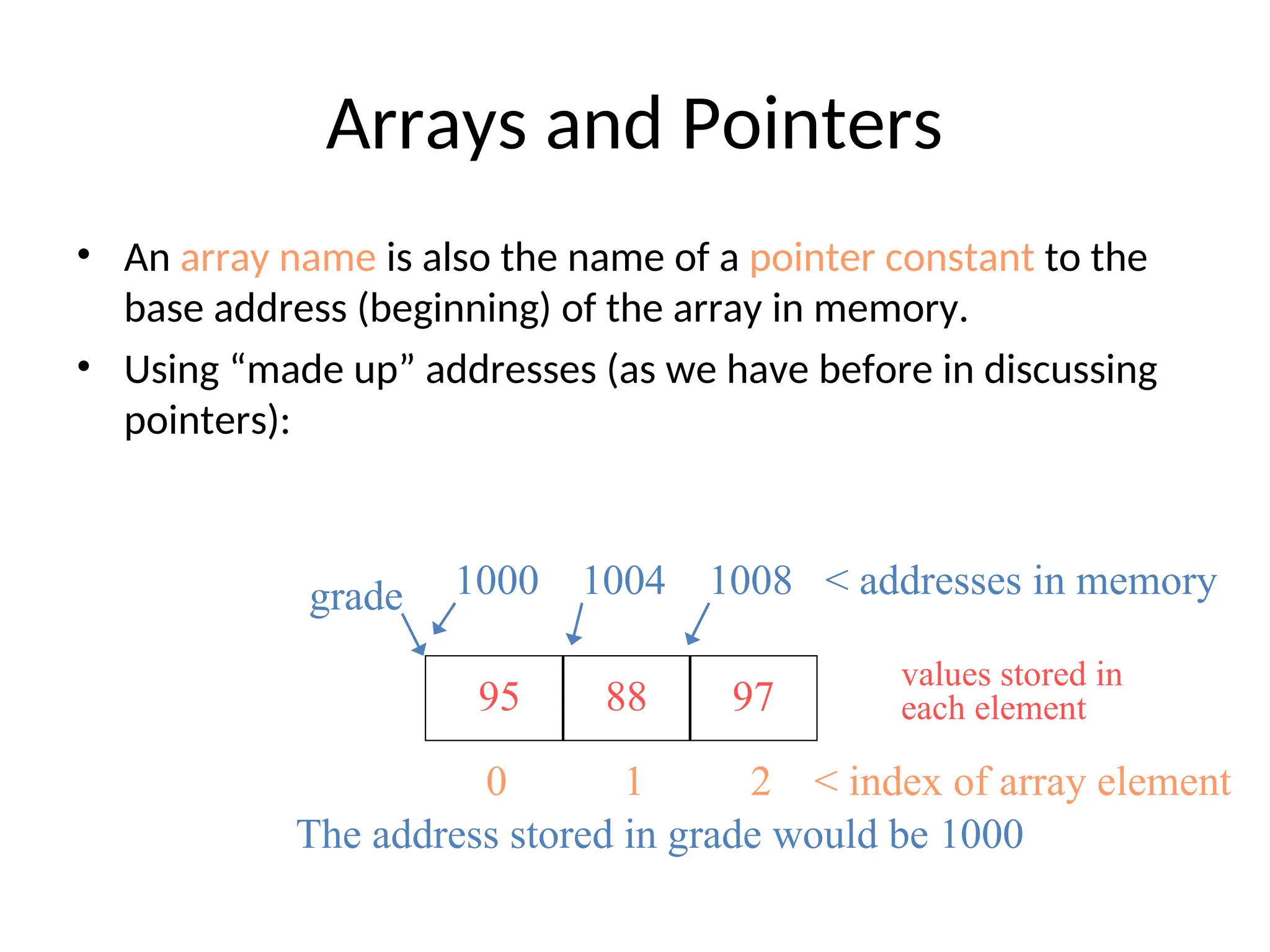
Arrays and Pointers
• An array name is also the name of a pointer constant to the
base address (beginning) of the array in memory.
• Using “made up” addresses (as we have before in discussing
pointers):
95 88 97
grade 1000 1004 1008 < addresses in memory
0 1 2 < index of array element
values stored in
each element
The address stored in grade would be 1000
Using a Symbolic Constant
as the Size of the Array
• It is considered good programming practice to define
the size of an array as a symbolic constant:
– In the next example, if the size of a class changes then the
symbolic constant at the top of the program is easily
changed.
– The program would then be recompiled so it can be used
with the larger array of grades.
Example of Entering Values into an Array, then Displaying the Values
#include <stdio.h>
#define N 20 /* Number of students in class */
int main(void)
{
int grade[N]; /* declare array with N elements */
int i;
/* Enter the grades for a quiz */
for (i = 0; i < N; ++i) {
printf(“Enter quiz grade %d: “, i + 1);
scanf(“%d”, &grade[i]);
}
/* display the grades that were entered */
printf(“Here are the grades that were enteredn”);
for (i = 0; i < N; ++i)
printf(“Grade %d is %d”, i + 1, grade[i]);
}
Note that the user is shown grades starting with grade 1,
but what the user thinks of as grade 1 is stored in
grade[0] in the array.
Initialization of Arrays
As with simple variables, arrays can be initialized within a
declaration.
– An array initializer is a sequence of initializing values written as a
brace-enclosed, comma-separated list.
float x[4] = {-1.1, 0.2, 33.0, 4.4};
x[0] is initialized to -1.1
x[1] is initialized to 0.2
etc.
More on Initialization of Arrays
• If a list of initializers is shorter than the number of array
elements, the remaining elements are initialized to zero.
• If an external or static array is not initialized, then the system
automatically initializes all elements to zero.
• Uninitialized automatic and constant arrays start with
garbage values -- whatever happens to be in memory when
the array is allocated.
Declaring and Initializing
an Array Without a Size
• If an array is declared without a size and is initialized to a
series of values, it is implicitly given the size of the number of
initializers.
int a[] = {3, 4, 5, 6};
is equivalent to
int a[4] = {3, 4, 5, 6};
Range of Values
Allowed for a Subscript
• Assume a declaration:
int i, a[size];
• To access an element of the array, we can write
a[expr], where expr is an integral expression.
• expr is called a subscript and the value of the
subscript must lie in the range 0 to size - 1.
“Subscript Out of Bounds”
• If a subscript from the previous example lies outside
the range 0 to size - 1 then:
– A run-time error occurs.
– The system will stop executing your program and display a
message such as “subscript out of bounds”.
– Sometimes no error message is displayed, but your
program will begin to produce unexpected results.
Relationship Between
Arrays and Pointers
• An array name represents the address of the beginning of the
array in memory.
– When an array is declared, the compiler must allocate a base address
and a sufficient amount of storage (RAM) to contain all the elements
of the array.
– The base address of the array is the initial location in memory where
the array is stored.
• It is the address of the first element (index 0) of the array.
Passing Arrays to Functions
• In a function definition, a formal parameter that is
declared as an array is actually a pointer.
– When an array is passed, its base address is passed call-by-
value.
– The array elements themselves are not copied.
– As a notational convenience, the compiler allows array
bracket notation to be used in declaring pointers as
parameters.
Example of Passing an Array to a Function
int sum(int a[], int n) /* n is size of the array */
{
int i, s = 0;
for (i = 0; i < n; ++i)
s += a[i];
return s;
}
alternative function definition:
int sum(int *a, int n) /* n is size of the array */
{
int i, s = 0;
for (i = 0; i < n; ++i)
s += a[i];
return s;
}
Notice -- no size here. That
was provided in the original
declaration of the array.
Equivalence of int a[]; and int *a;
• As part of the header of a function definition the
declaration
int a[]; is equivalent to int *a;
• Within the body of a function, these are not
equivalent.
– The first will create a constant pointer (and no storage
for an array).
– The second will create a pointer variable.

C array and Initialisation and declaration

  • 1.
  • 2.
    What is anArray? • An array is a sequence of data items that are: – all of the same type • a sequence of integers, or a sequence of characters, or a sequence of floats, etc. – indexible • you can indicate or select the first element or second element or ... – stored contiguously in memory • each element of the sequence is stored in memory immediately after the previous element
  • 3.
    One-Dimensional Arrays • Declarationof a one-dimensional array. – int grade[3]; • Provides space in memory to store three grades (as in grades on three of your quizzes) • Example of Assignments grade[0] = 95; /* 1st element index is 0 */ grade[1] = 88; /* 2nd element index is 1 */ grade[2] = 97; /* 3rd element index is 2 */
  • 4.
    Accessing Array Elements •The following code segment will print the three grades stored in the array on the previous slide (assume i has been declared as an int variable): for (i = 0; i < 3; ++i) printf(“Grade %d is %dn”, i, grade[i]); • Output Grade 0 is 95 Grade 1 is 88 Grade 2 is 97
  • 5.
    Arrays and Pointers •An array name is also the name of a pointer constant to the base address (beginning) of the array in memory. • Using “made up” addresses (as we have before in discussing pointers): 95 88 97 grade 1000 1004 1008 < addresses in memory 0 1 2 < index of array element values stored in each element The address stored in grade would be 1000
  • 6.
    Using a SymbolicConstant as the Size of the Array • It is considered good programming practice to define the size of an array as a symbolic constant: – In the next example, if the size of a class changes then the symbolic constant at the top of the program is easily changed. – The program would then be recompiled so it can be used with the larger array of grades.
  • 7.
    Example of EnteringValues into an Array, then Displaying the Values #include <stdio.h> #define N 20 /* Number of students in class */ int main(void) { int grade[N]; /* declare array with N elements */ int i; /* Enter the grades for a quiz */ for (i = 0; i < N; ++i) { printf(“Enter quiz grade %d: “, i + 1); scanf(“%d”, &grade[i]); } /* display the grades that were entered */ printf(“Here are the grades that were enteredn”); for (i = 0; i < N; ++i) printf(“Grade %d is %d”, i + 1, grade[i]); } Note that the user is shown grades starting with grade 1, but what the user thinks of as grade 1 is stored in grade[0] in the array.
  • 8.
    Initialization of Arrays Aswith simple variables, arrays can be initialized within a declaration. – An array initializer is a sequence of initializing values written as a brace-enclosed, comma-separated list. float x[4] = {-1.1, 0.2, 33.0, 4.4}; x[0] is initialized to -1.1 x[1] is initialized to 0.2 etc.
  • 9.
    More on Initializationof Arrays • If a list of initializers is shorter than the number of array elements, the remaining elements are initialized to zero. • If an external or static array is not initialized, then the system automatically initializes all elements to zero. • Uninitialized automatic and constant arrays start with garbage values -- whatever happens to be in memory when the array is allocated.
  • 10.
    Declaring and Initializing anArray Without a Size • If an array is declared without a size and is initialized to a series of values, it is implicitly given the size of the number of initializers. int a[] = {3, 4, 5, 6}; is equivalent to int a[4] = {3, 4, 5, 6};
  • 11.
    Range of Values Allowedfor a Subscript • Assume a declaration: int i, a[size]; • To access an element of the array, we can write a[expr], where expr is an integral expression. • expr is called a subscript and the value of the subscript must lie in the range 0 to size - 1.
  • 12.
    “Subscript Out ofBounds” • If a subscript from the previous example lies outside the range 0 to size - 1 then: – A run-time error occurs. – The system will stop executing your program and display a message such as “subscript out of bounds”. – Sometimes no error message is displayed, but your program will begin to produce unexpected results.
  • 13.
    Relationship Between Arrays andPointers • An array name represents the address of the beginning of the array in memory. – When an array is declared, the compiler must allocate a base address and a sufficient amount of storage (RAM) to contain all the elements of the array. – The base address of the array is the initial location in memory where the array is stored. • It is the address of the first element (index 0) of the array.
  • 14.
    Passing Arrays toFunctions • In a function definition, a formal parameter that is declared as an array is actually a pointer. – When an array is passed, its base address is passed call-by- value. – The array elements themselves are not copied. – As a notational convenience, the compiler allows array bracket notation to be used in declaring pointers as parameters.
  • 15.
    Example of Passingan Array to a Function int sum(int a[], int n) /* n is size of the array */ { int i, s = 0; for (i = 0; i < n; ++i) s += a[i]; return s; } alternative function definition: int sum(int *a, int n) /* n is size of the array */ { int i, s = 0; for (i = 0; i < n; ++i) s += a[i]; return s; } Notice -- no size here. That was provided in the original declaration of the array.
  • 16.
    Equivalence of inta[]; and int *a; • As part of the header of a function definition the declaration int a[]; is equivalent to int *a; • Within the body of a function, these are not equivalent. – The first will create a constant pointer (and no storage for an array). – The second will create a pointer variable.