BUILT-IN
FUNCTION
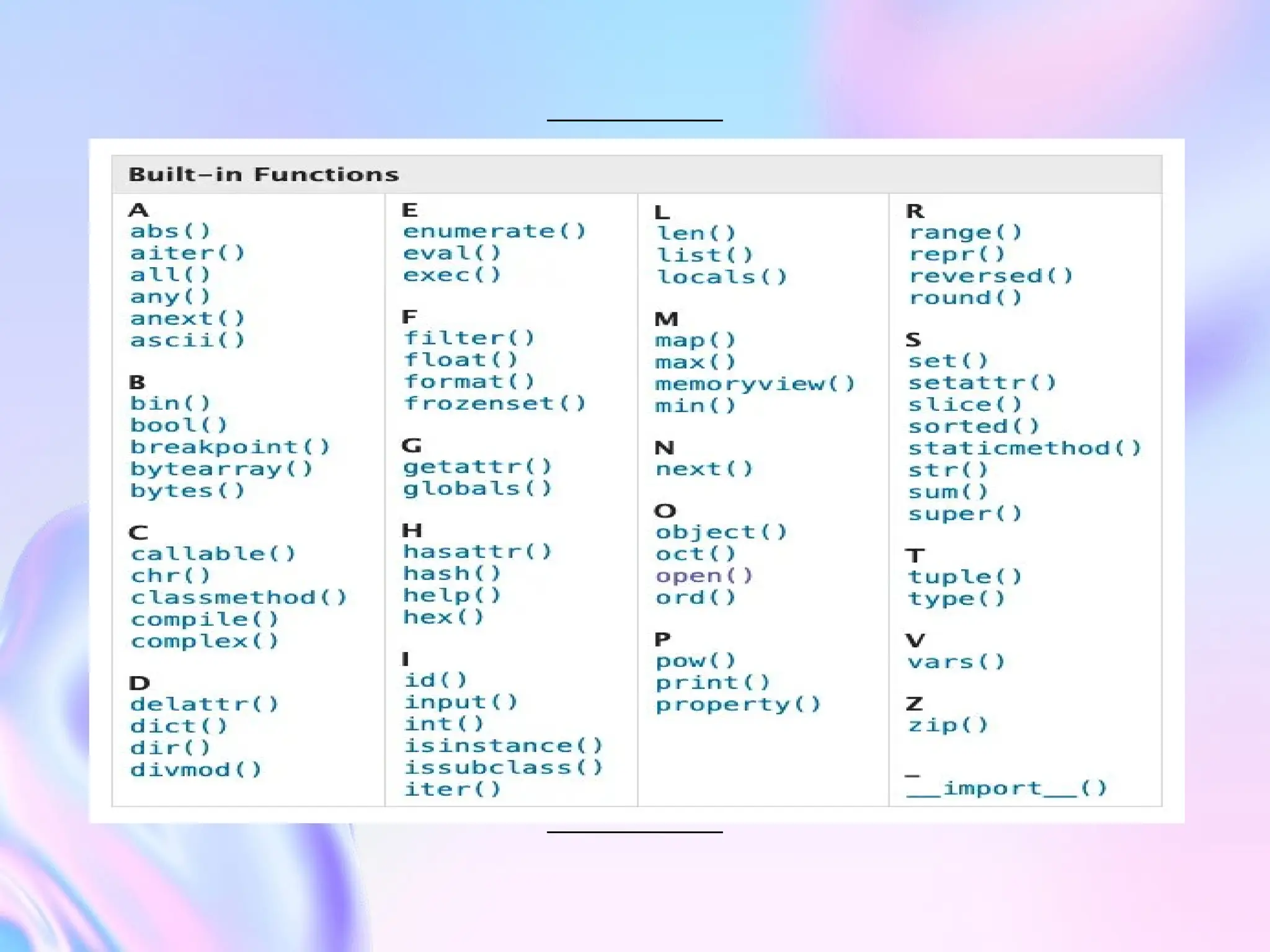
The built-in function
arepre defined
functions, there are
68 Library function in
python, these
function perform a
Specific tasks and
can be used in
program.
4.
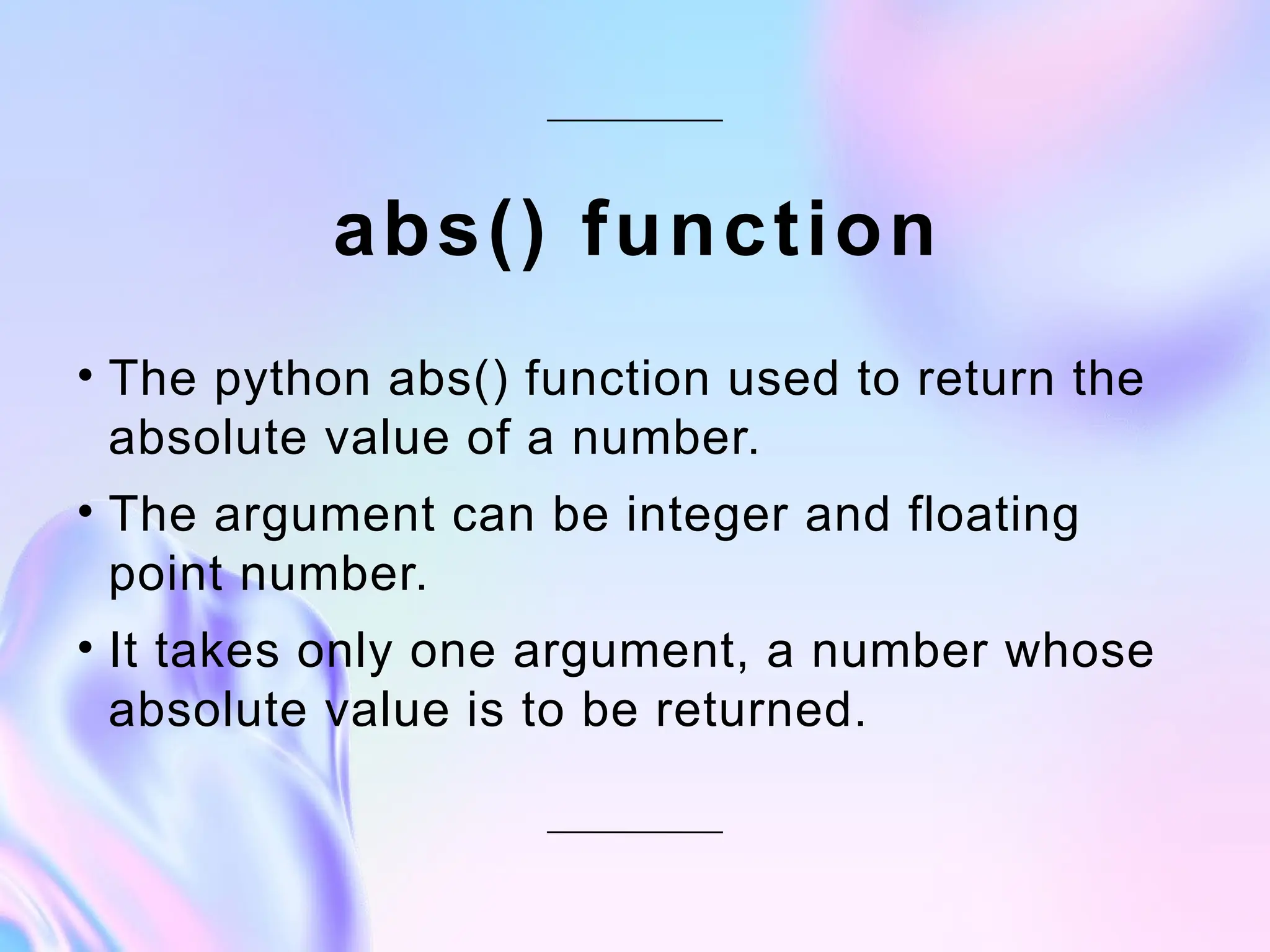
abs() function
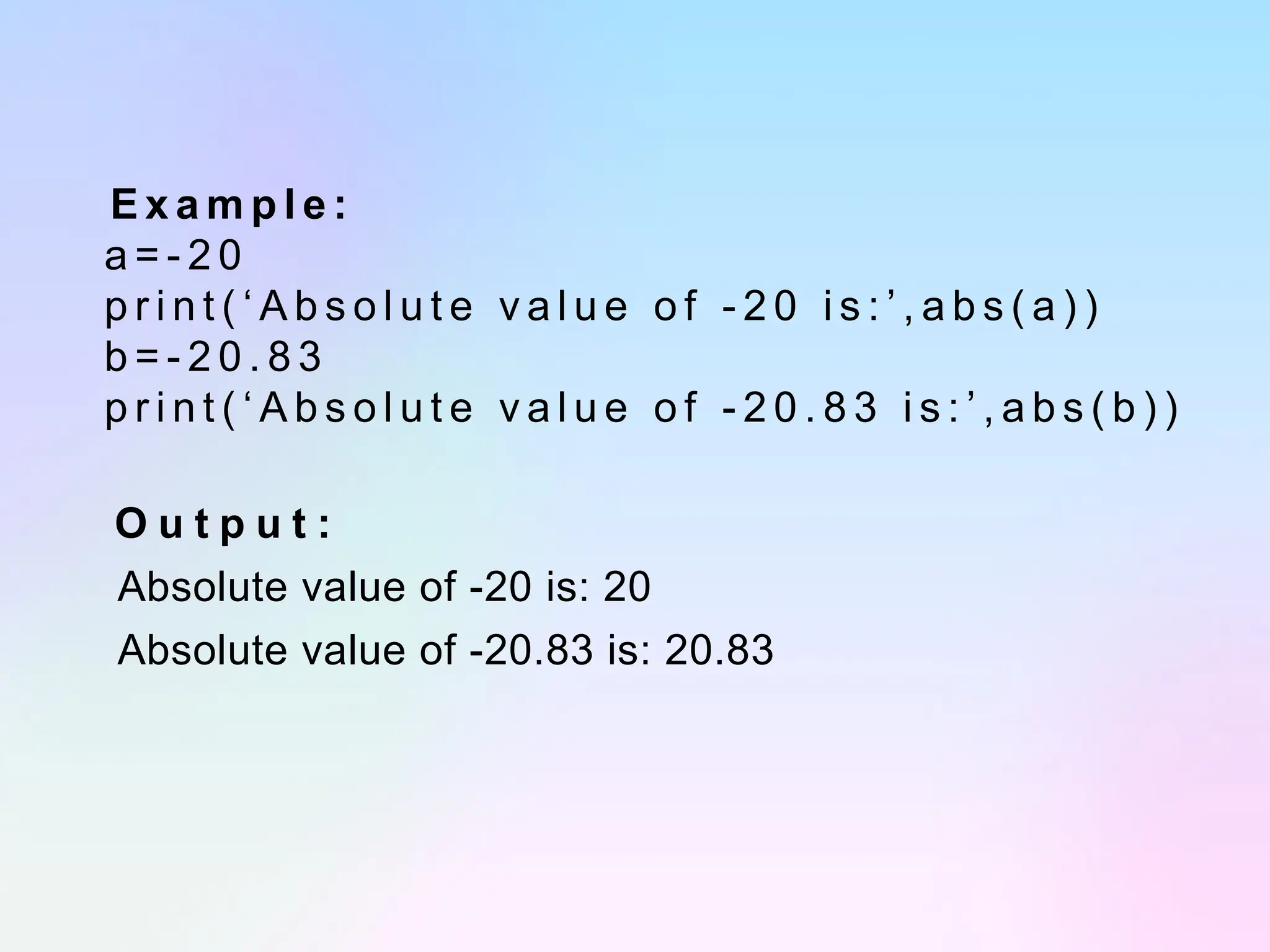
• Thepython abs() function used to return the
absolute value of a number.
• The argument can be integer and floating
point number.
• It takes only one argument, a number whose
absolute value is to be returned.
5.
E x am p l e :
a = - 2 0
p r i n t ( ‘ A b s o l u t e v a l u e o f - 2 0 i s : ’ , a b s ( a ) )
b = - 2 0 . 8 3
p r i n t ( ‘ A b s o l u t e v a l u e o f - 2 0 . 8 3 i s : ’ , a b s ( b ) )
O u t p u t :
Absolute value of -20 is: 20
Absolute value of -20.83 is: 20.83
6.
bin() function
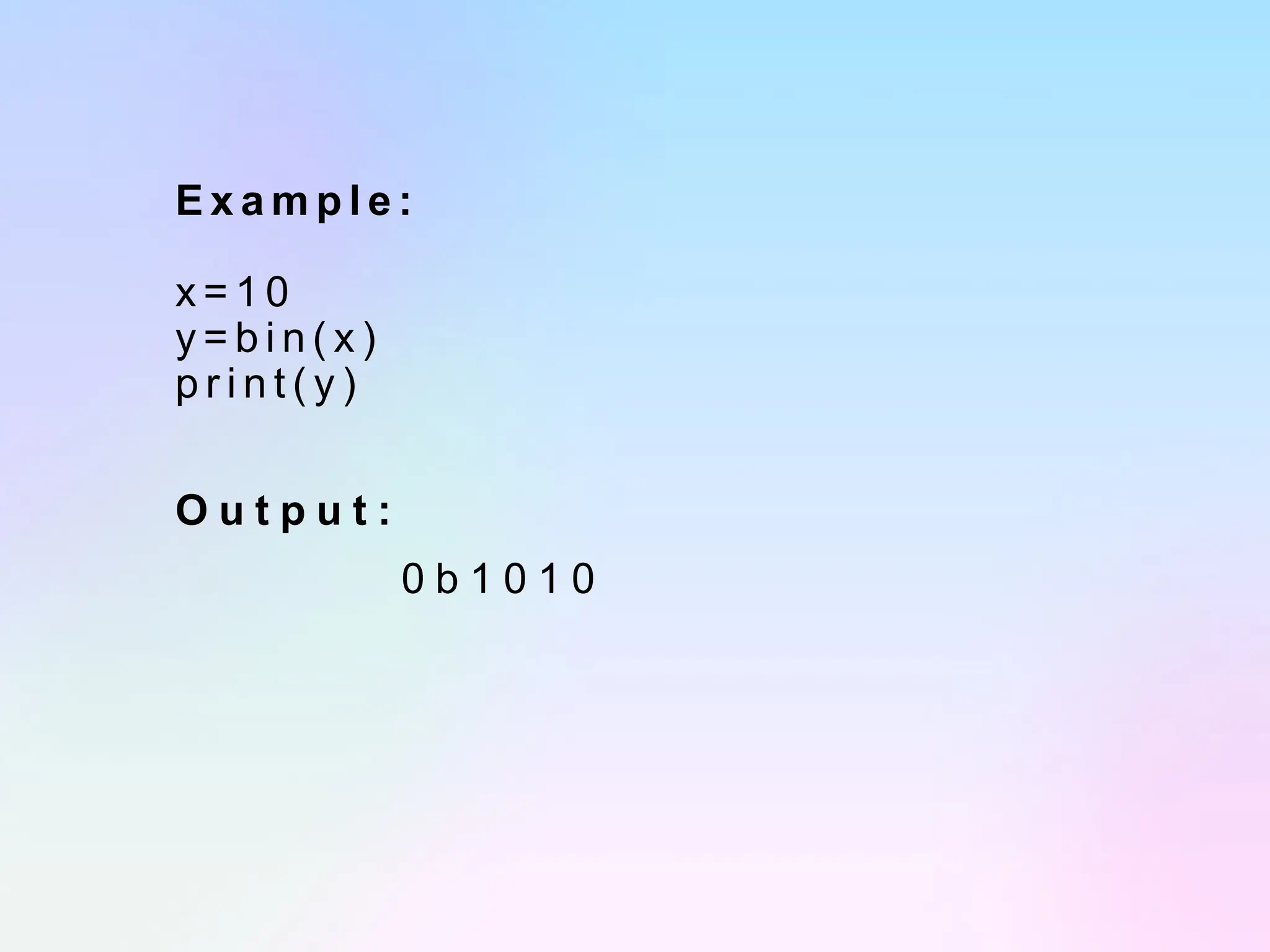
The pythonbin() function is used to return the
binary representation of a specific integer. A
result always starts with the prefix 0b.
7.
E x am p l e :
x = 1 0
y = b i n ( x )
p r i n t ( y )
O u t p u t :
0 b 1 0 1 0
8.
bool() function
The pythonbool() converts a value to
Boolean (true or false) using the standard truth
Testing procedure.
9.
E x am p l e :
t e s t 1 = [ ]
p r i n t ( t e s t 1 , ’ i s ’ , b o o l ( t e s t 1 ) )
t e s t 2 = [ 1 ]
p r i n t ( t e s t 2 , ’ i s ’ , b o o l ( t e s t 2 ) )
O u t p u t :
[ ] i s f a l s e
[ 1 ] i s t r u e
10.
sum() function
As thename says, python sum() function is
used to get the sum of numbers of an iterable.
11.
E x am p l e :
s = s u m ( [ 1 , 2 , 3 ] )
p r i n t ( s )
s 1 = s u m ( [ s ] , 1 0 )
p r i n t ( s 1 )
O u t p u t :
6
1 6
12.
help() function
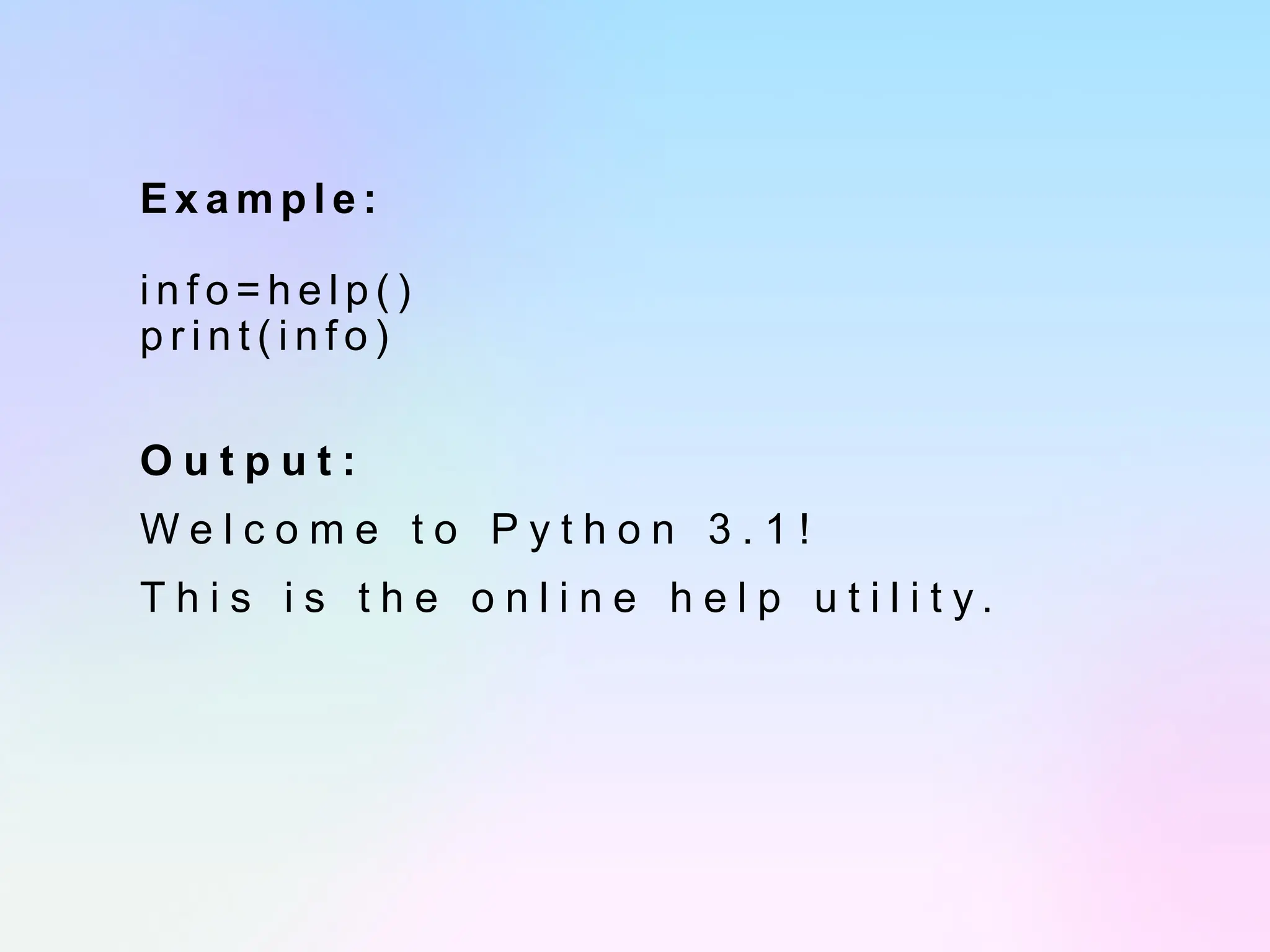
• Pythonhelp()function is used to get help
Related to the object passed during the call.
• It takes an optional parameter and returns
help information.
• It shows the python help console.It internally
calls python’s help function.
13.
E x am p l e :
i n f o = h e l p ( )
p r i n t ( i n f o )
O u t p u t :
W e l c o m e t o P y t h o n 3 . 1 !
T h i s i s t h e o n l i n e h e l p u t i l i t y .
14.
len() function
The pythonlen() function is used to return the
length (the number of items) of an object
15.
E x am p l e :
s t r A = ‘ P y t h o n ’
p r i n t ( l e n ( s t r A ) )
O u t p u t :
6
16.
min() function
• Pythonmin() function is used to get the
smallest element from the collection.
• This function takes two arguments, first is a
collection of elements and second is key, and
returns the smallest element from the collect.
17.
E x am p l e :
s m a l l = m i n ( 1 8 , 0 7 , 4 5 , 1 7 )
s m a l l 1 = m i n ( 1 8 . 2 5 , 1 8 . 2 4 , 1 8 . 2 3 )
O u t p u t :
0 7
1 8 . 2 3
18.
pow() function
• Thepython pow() function is used to compute
the power of a number. It returns x to the
power of y.
• If the third arguments(z) is given, it returns x
to the power of y modules z.
19.
E x am p l e :
p r i n t ( p o w ( 2 , 3 ) )
p r i n t ( p o w ( - 2 , 3 ) )
p r i n t ( p o w ( 2 , - 3 ) )
p r i n t ( p o w ( - 2 , - 3 ) )
O u t p u t :
8
- 8
0 . 1 2 5
- 0 . 1 2 5
20.
print() function
The pythonprint() function prints the given
object to the screen or other standard output
devices.
21.
E x am p l e :
x , y, z = " a p p l e " , " b a n a n a " , " C h e r r y "
p r i n t ( x , y, z , s e p = ‘ , ’ , e n d = ‘ . ’ )
a = b = c = " a p p l e "
p r i n t ( a , b , c , s e p = ‘ , ’ , e n d = ‘ . ’ )
O u t p u t :
a p p l e , b a n a n a , C h e r r y .
a p p l e , a p p l e , a p p l e .
22.
range() function
• Thepython range() function return as
immutable sequence of numbers starting from
0 by default.
• Increments by 1(by default) and ends at a
specified number.
23.
E x am p l e :
p r i n t ( l i s t ( r a n g e ( 0 ) ) )
p r i n t ( l i s t ( r a n g e ( 4 ) ) )
p r i n t ( l i s t ( r a n g e ( 1 , 7 ) ) )
O u t p u t :
[ ]
[ 0 , 1 , 2 , 3 ]
[ 1 , 2 , 3 , 4 , 5 , 6 ]
24.
round() function
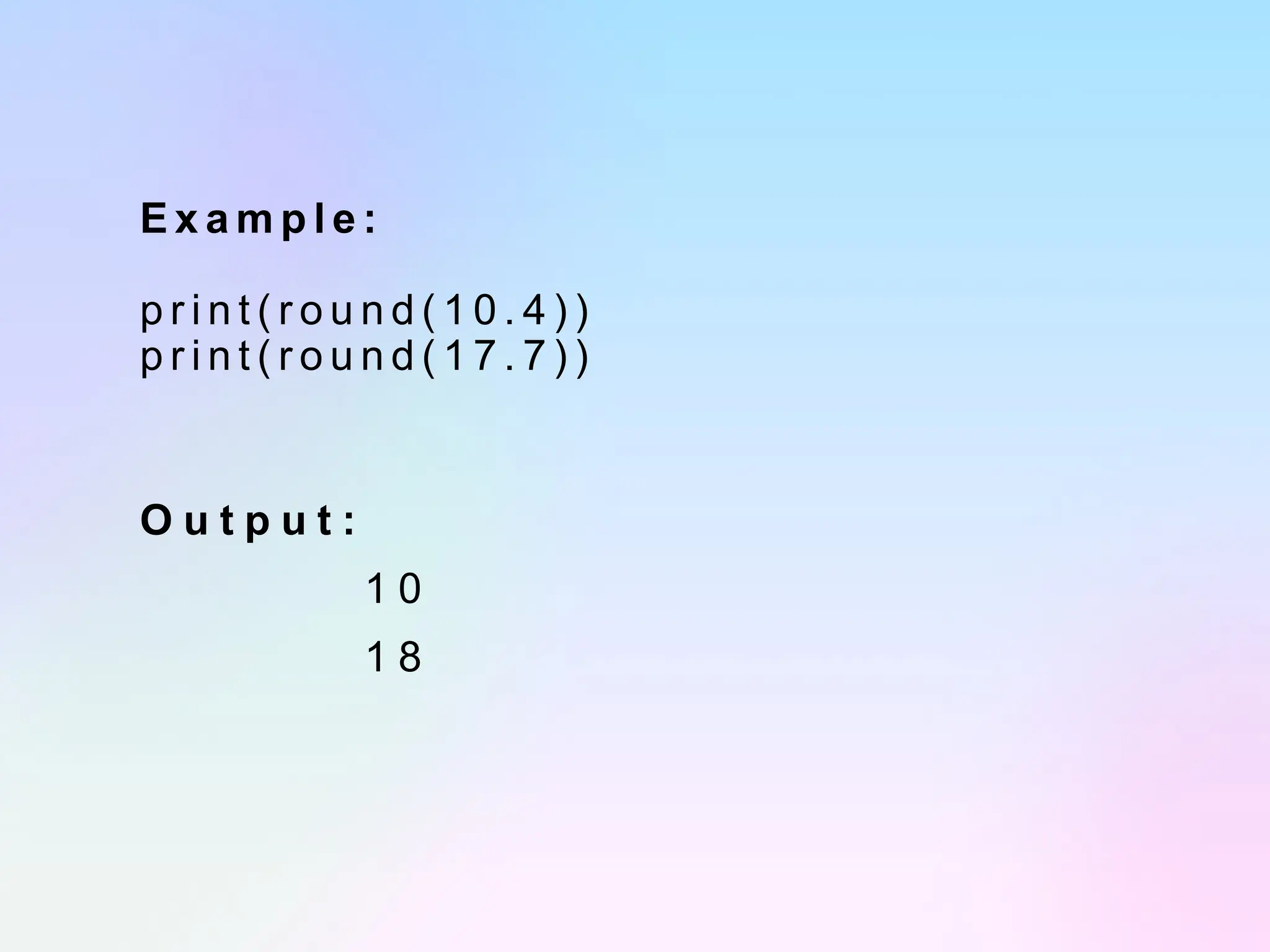
The pythonround() function rounds off the
digits of a number and returns the floating
point numbers.
25.
E x am p l e :
p r i n t ( r o u n d ( 1 0 . 4 ) )
p r i n t ( r o u n d ( 1 7 . 7 ) )
O u t p u t :
1 0
1 8
26.
type() function
The pythontype() returns the type of the
specified object if a single argument is
passed to the type() built in function.
27.
E x am p l e :
l i s t 1 = [ 4 , 5 ]
p r i n t ( t y p e ( l i s t 1 ) )
d i c t 1 = { 4 : ’ f o u r ’ , 5 : ’ f i v e ’ }
p r i n t ( t y p e ( d i c t 1 ) )
O u t p u t :
< c l a s s ‘ l i s t ’ >
< c l a s s ‘ d i c t ’ >

![E x a m p l e :
t e s t 1 = [ ]
p r i n t ( t e s t 1 , ’ i s ’ , b o o l ( t e s t 1 ) )
t e s t 2 = [ 1 ]
p r i n t ( t e s t 2 , ’ i s ’ , b o o l ( t e s t 2 ) )
O u t p u t :
[ ] i s f a l s e
[ 1 ] i s t r u e](https://image.slidesharecdn.com/built-in-functionpython-250503095533-4d16500d/75/Built-In-function-python-basics-pre-defined-function-9-2048.jpg)
![E x a m p l e :
s = s u m ( [ 1 , 2 , 3 ] )
p r i n t ( s )
s 1 = s u m ( [ s ] , 1 0 )
p r i n t ( s 1 )
O u t p u t :
6
1 6](https://image.slidesharecdn.com/built-in-functionpython-250503095533-4d16500d/75/Built-In-function-python-basics-pre-defined-function-11-2048.jpg)



![E x a m p l e :
p r i n t ( l i s t ( r a n g e ( 0 ) ) )
p r i n t ( l i s t ( r a n g e ( 4 ) ) )
p r i n t ( l i s t ( r a n g e ( 1 , 7 ) ) )
O u t p u t :
[ ]
[ 0 , 1 , 2 , 3 ]
[ 1 , 2 , 3 , 4 , 5 , 6 ]](https://image.slidesharecdn.com/built-in-functionpython-250503095533-4d16500d/75/Built-In-function-python-basics-pre-defined-function-23-2048.jpg)

![E x a m p l e :
l i s t 1 = [ 4 , 5 ]
p r i n t ( t y p e ( l i s t 1 ) )
d i c t 1 = { 4 : ’ f o u r ’ , 5 : ’ f i v e ’ }
p r i n t ( t y p e ( d i c t 1 ) )
O u t p u t :
< c l a s s ‘ l i s t ’ >
< c l a s s ‘ d i c t ’ >](https://image.slidesharecdn.com/built-in-functionpython-250503095533-4d16500d/75/Built-In-function-python-basics-pre-defined-function-27-2048.jpg)


