Developing your
Talents & Skills
• It is quite common to hear that
some people are born with
certain special talents or skills.
• And we consider them LUCKY!
• But what about us - simple
mortals?
Developing your talents & skills
Introduction
• Success and special skills are not
a matter of luck, opportunity or
myth.
• It is important to bear in mind
that SUCCESS and SKILLS are
all about putting efforts and
energy to improve ourselves and
to achieve our goals.
Developing your talents & skills
Success & Skills
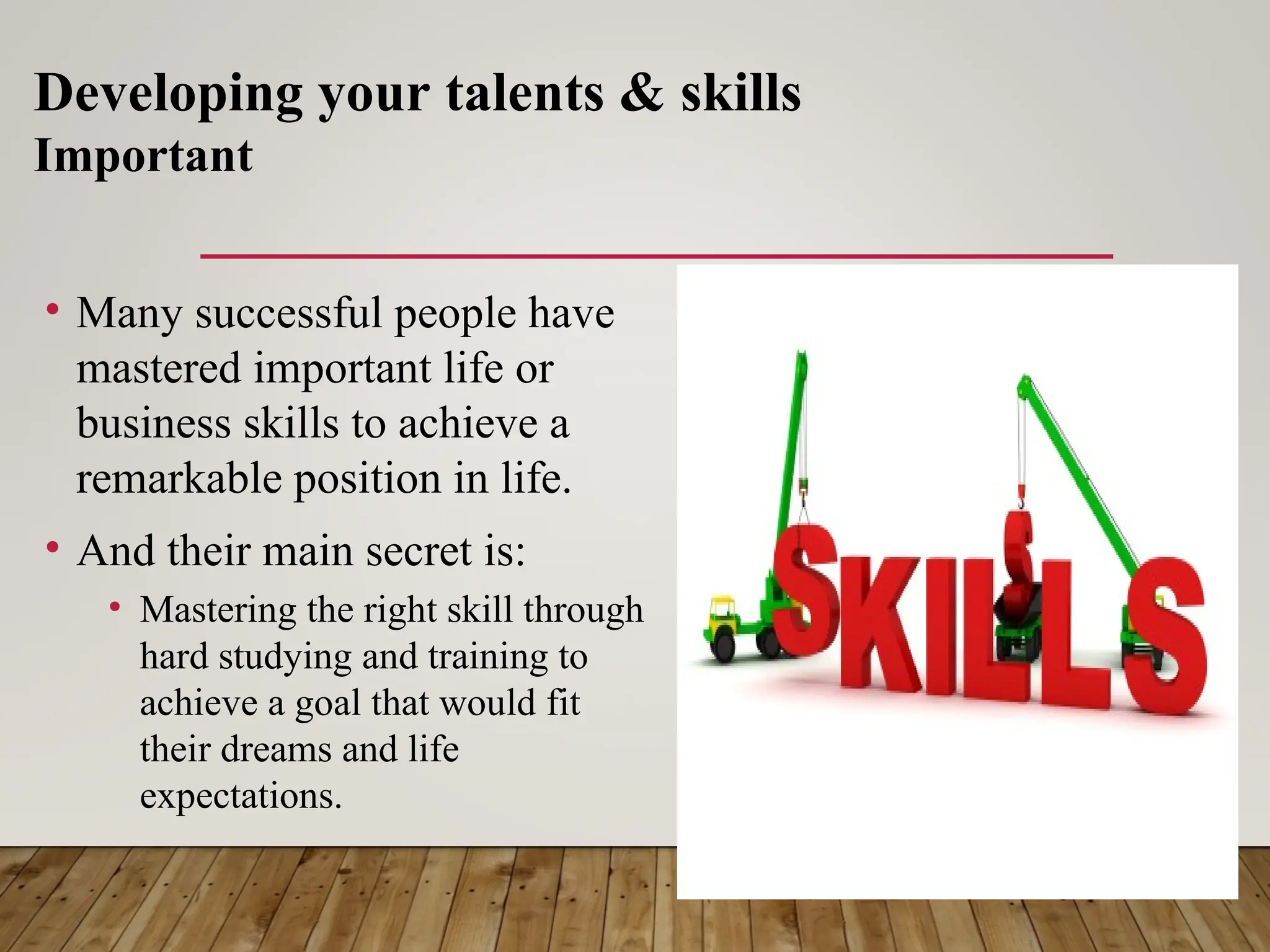
• Many successful people have
mastered important life or
business skills to achieve a
remarkable position in life.
• And their main secret is:
• Mastering the right skill through
hard studying and training to
achieve a goal that would fit
their dreams and life
expectations.
Developing your talents & skills
Important
TALENT
• Refers to an individual’s intelligence, abilities, and
skills.
• Should be developed and used well.
TREASURE
• Refers to the things one values the most.
TIME MANAGEMENT
• Refers to how one uses time productively.
• “It’s not the years in your life that count. It’s the
life in your years.”
SKILLS AND ABILITIES
• Skills can be developed; talents are natural qualities.
• Examples of talents: singing, painting, playing instruments,
drawing, athletic skills.
• Skills are needed in daily life and the 21st century job market.
‑
• Skills and abilities improve through education, training, and
experience.
• Enhancing skills helps in deciding a career path.
THERE ARE TWO KINDS OF
SKILLS
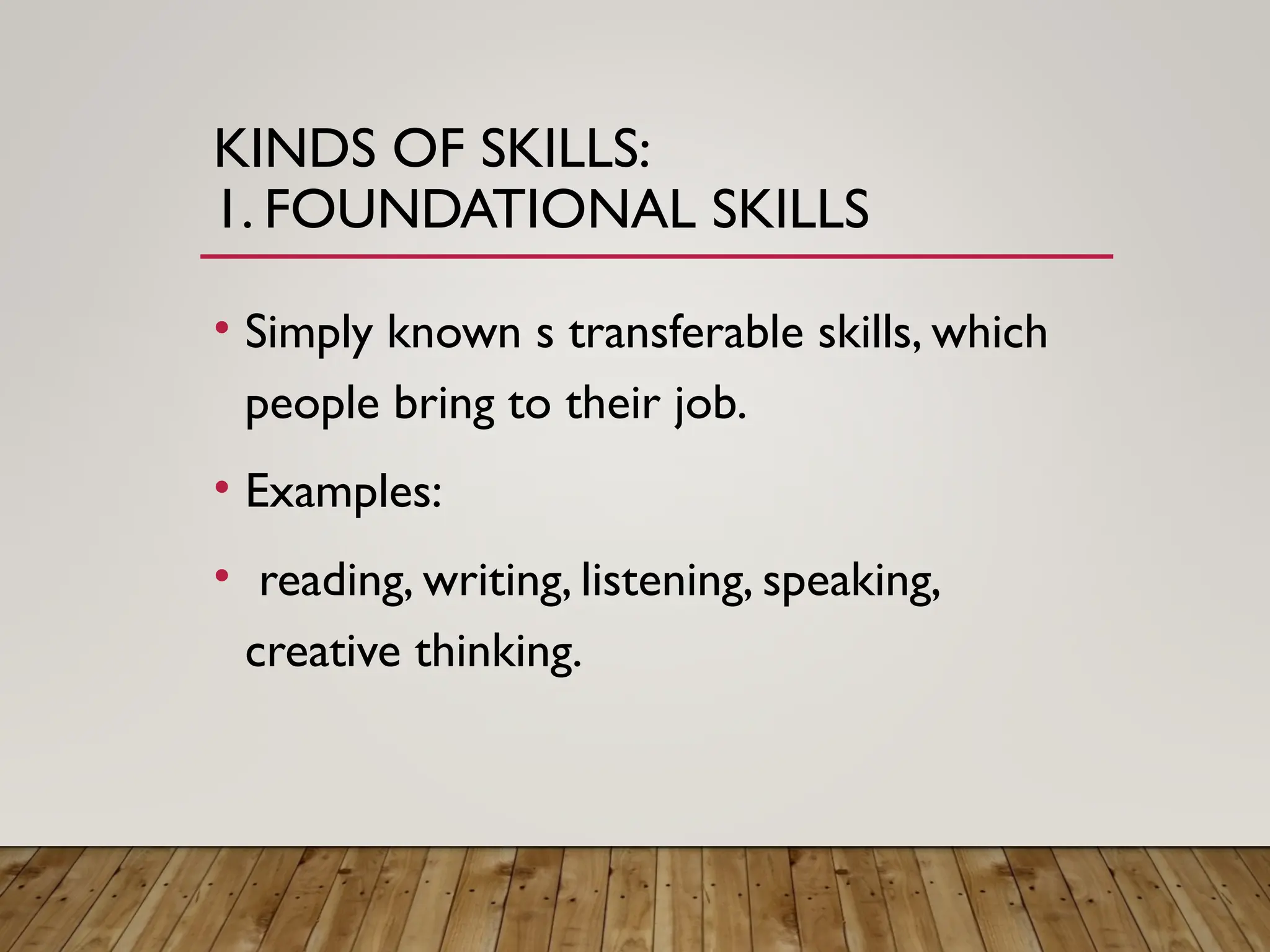
KINDS OF SKILLS:
1. FOUNDATIONAL SKILLS
• Simply known s transferable skills, which
people bring to their job.
• Examples:
• reading, writing, listening, speaking,
creative thinking.
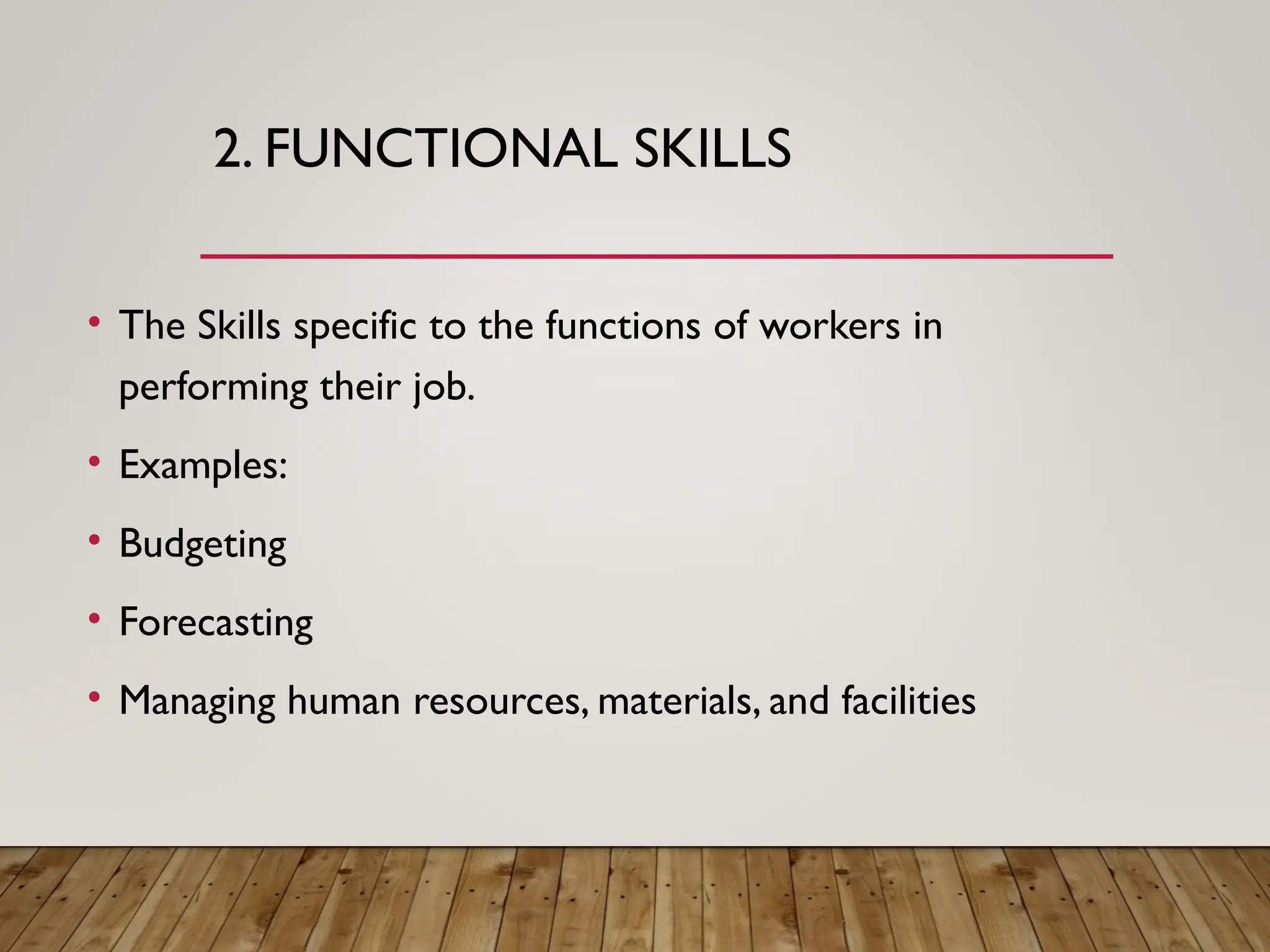
2. FUNCTIONAL SKILLS
• The Skills specific to the functions of workers in
performing their job.
• Examples:
• Budgeting
• Forecasting
• Managing human resources, materials, and facilities
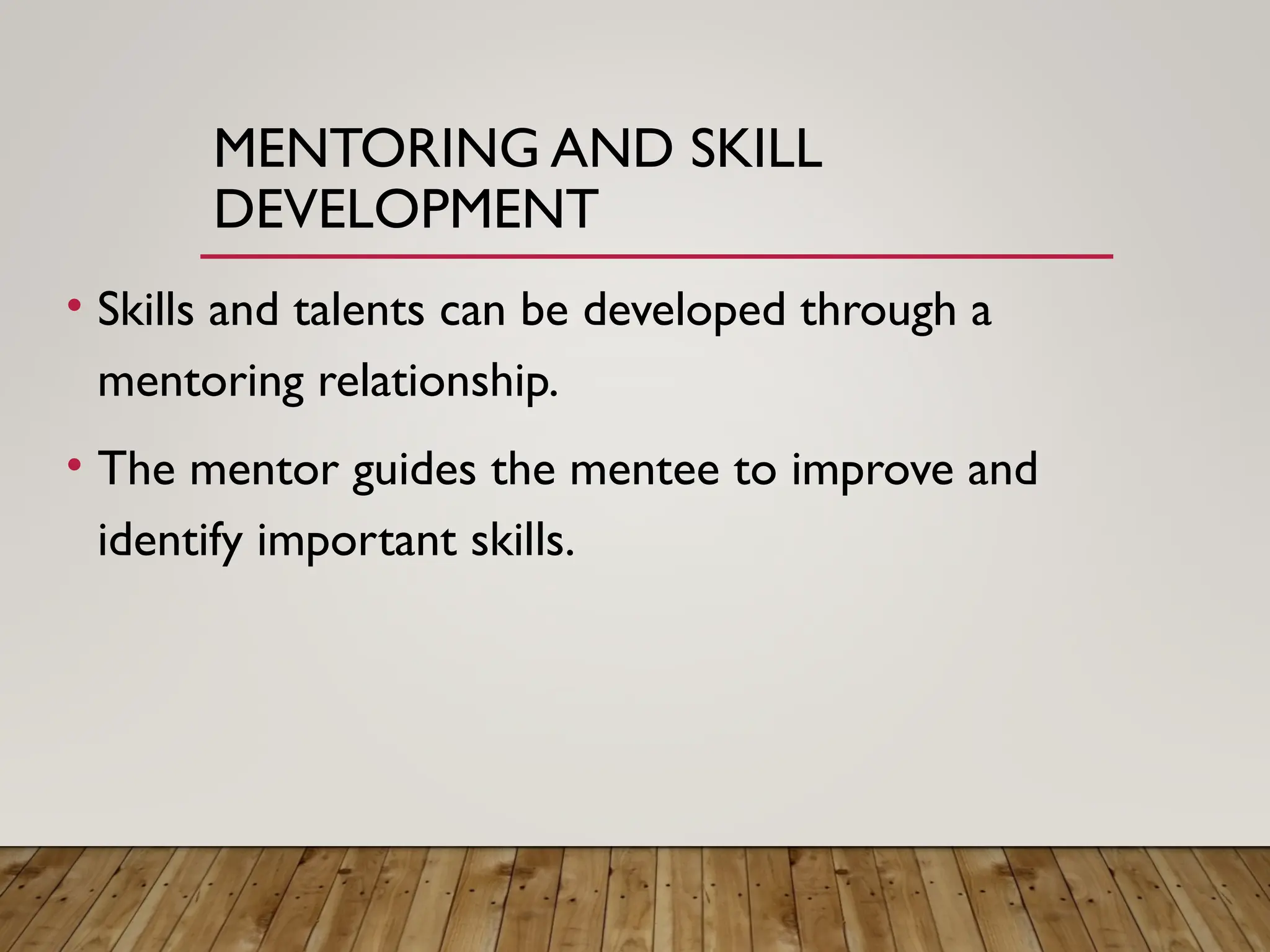
MENTORING AND SKILL
DEVELOPMENT
• Skills and talents can be developed through a
mentoring relationship.
• The mentor guides the mentee to improve and
identify important skills.
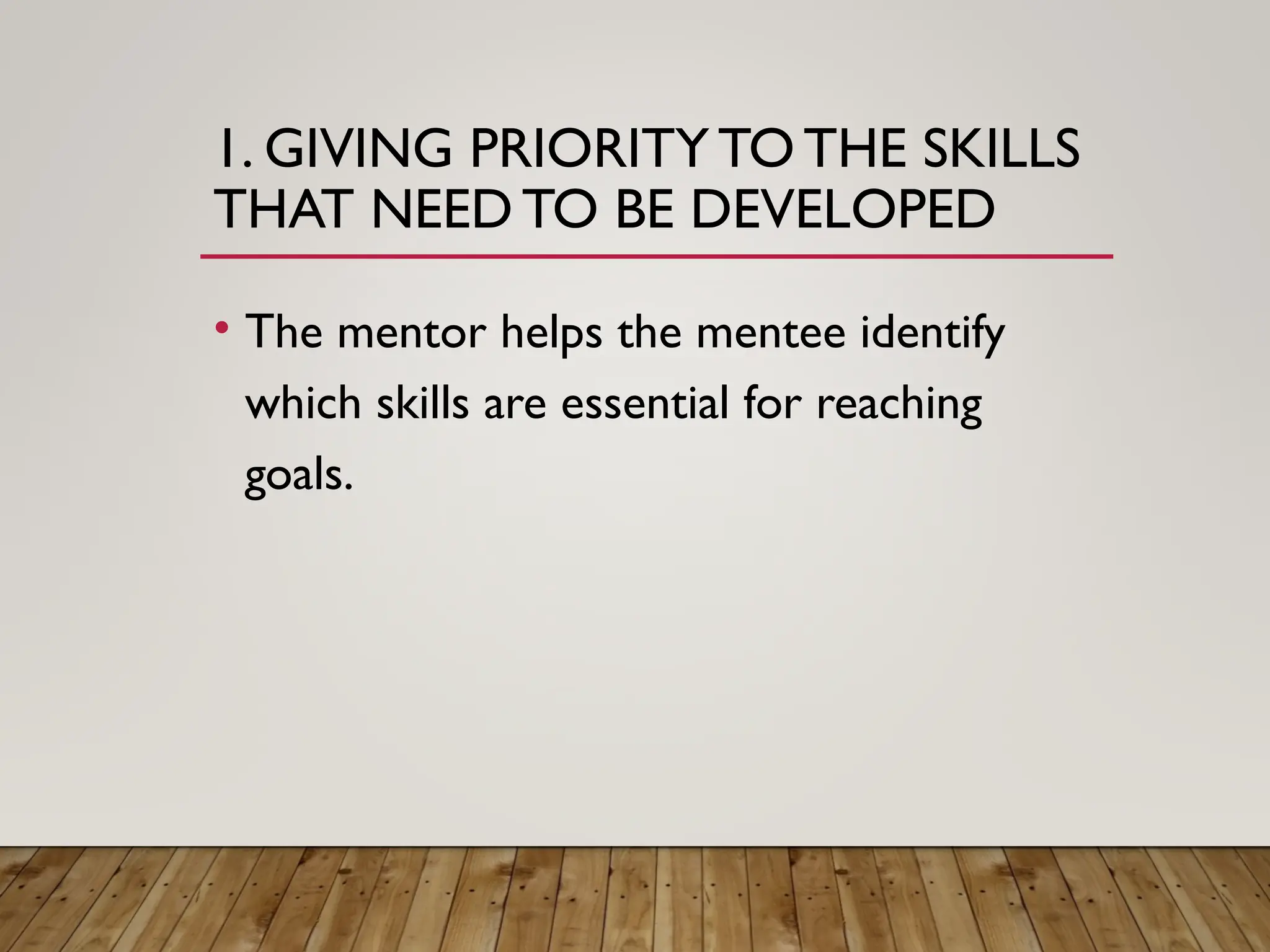
1. GIVING PRIORITYTOTHE SKILLS
THAT NEED TO BE DEVELOPED
• The mentor helps the mentee identify
which skills are essential for reaching
goals.
2. DETERMINING COMPLEX SKILLS
• Mentors help identify more complex
intellectual or motor skills that need focus.
• Examples:
• Writing information or ideas
• Public speaking
• Mentors help identify strengths through
activities, education, and experience.
DISCOVERED OR UNDISCOVERED
DEVELOPING TALENTS
HIDDEN TALENTS
• Some people feel they don’t have talent.
• Mentors assess areas for development to
build confidence and reveal hidden abilities.
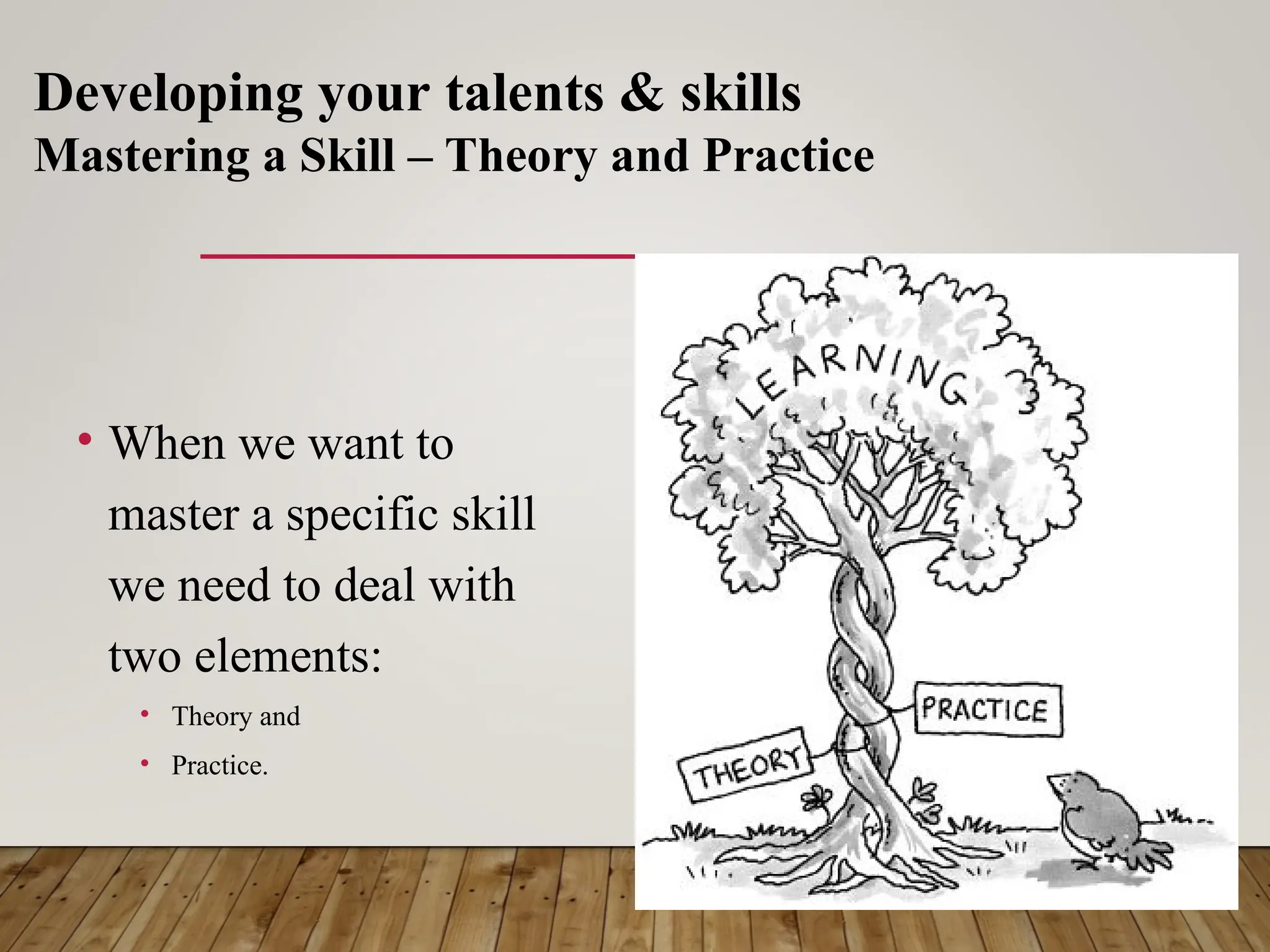
• When we want to
master a specific skill
we need to deal with
two elements:
• Theory and
• Practice.
Developing your talents & skills
Mastering a Skill – Theory and Practice
• It is a set of principles or a system
of ideas intended to explain
something.
• Theory is important because it is
based on concepts and experience
that were tried before.
• It helps us to avoid wasting our
time doing what is wrong.
Developing your talents & skills
Theory – Definition & Features
• It is the application or use of
an idea, belief or method.
• When practicing we are
implementing all the acquired
knowledge from Theory.
• And it is the only way to verify
if we really know what we
have learned.
Developing your talents & skills
Practice - Definition & Features
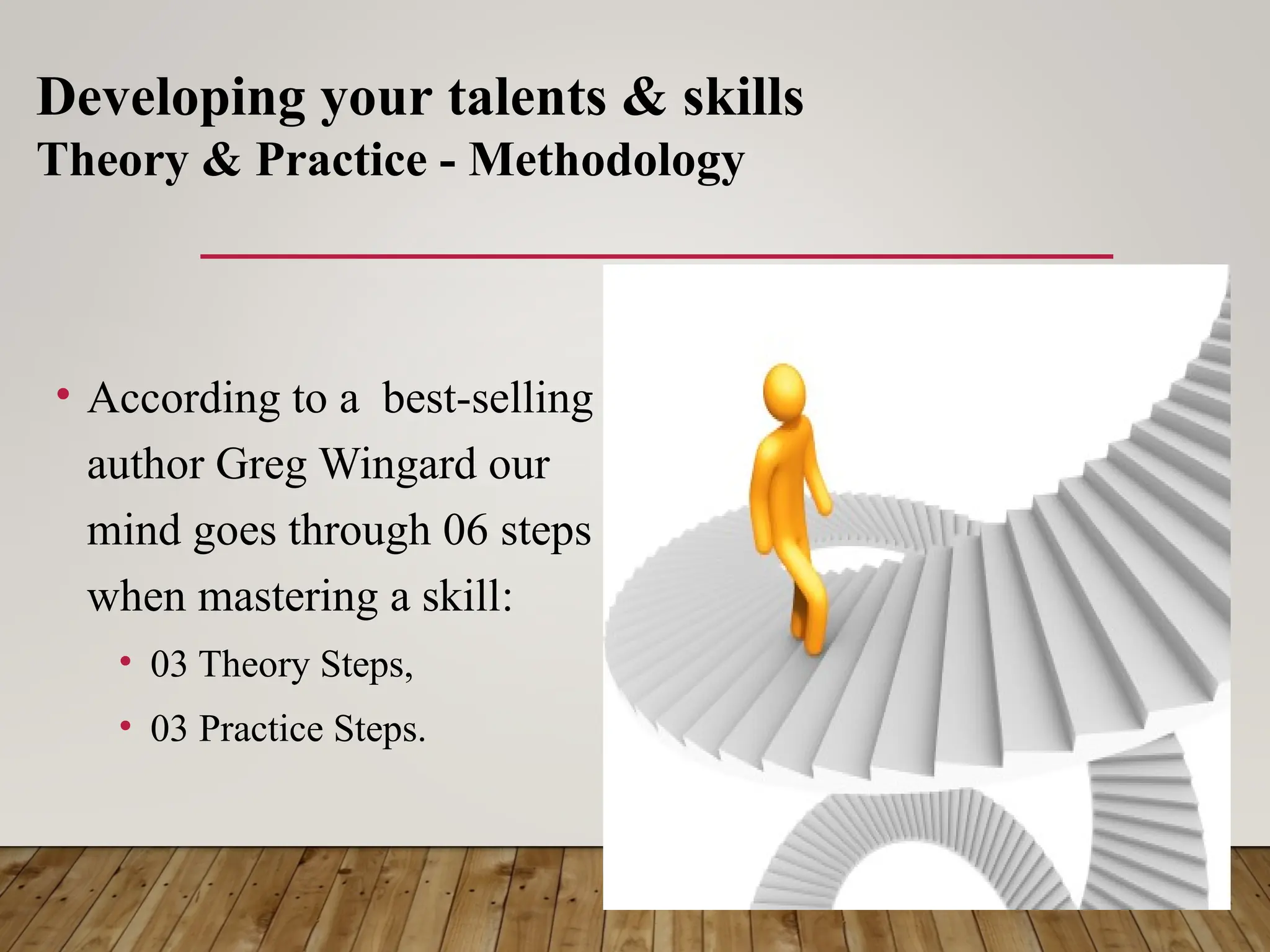
• According to a best-selling
author Greg Wingard our
mind goes through 06 steps
when mastering a skill:
• 03 Theory Steps,
• 03 Practice Steps.
Developing your talents & skills
Theory & Practice - Methodology
Developing your talents & skills
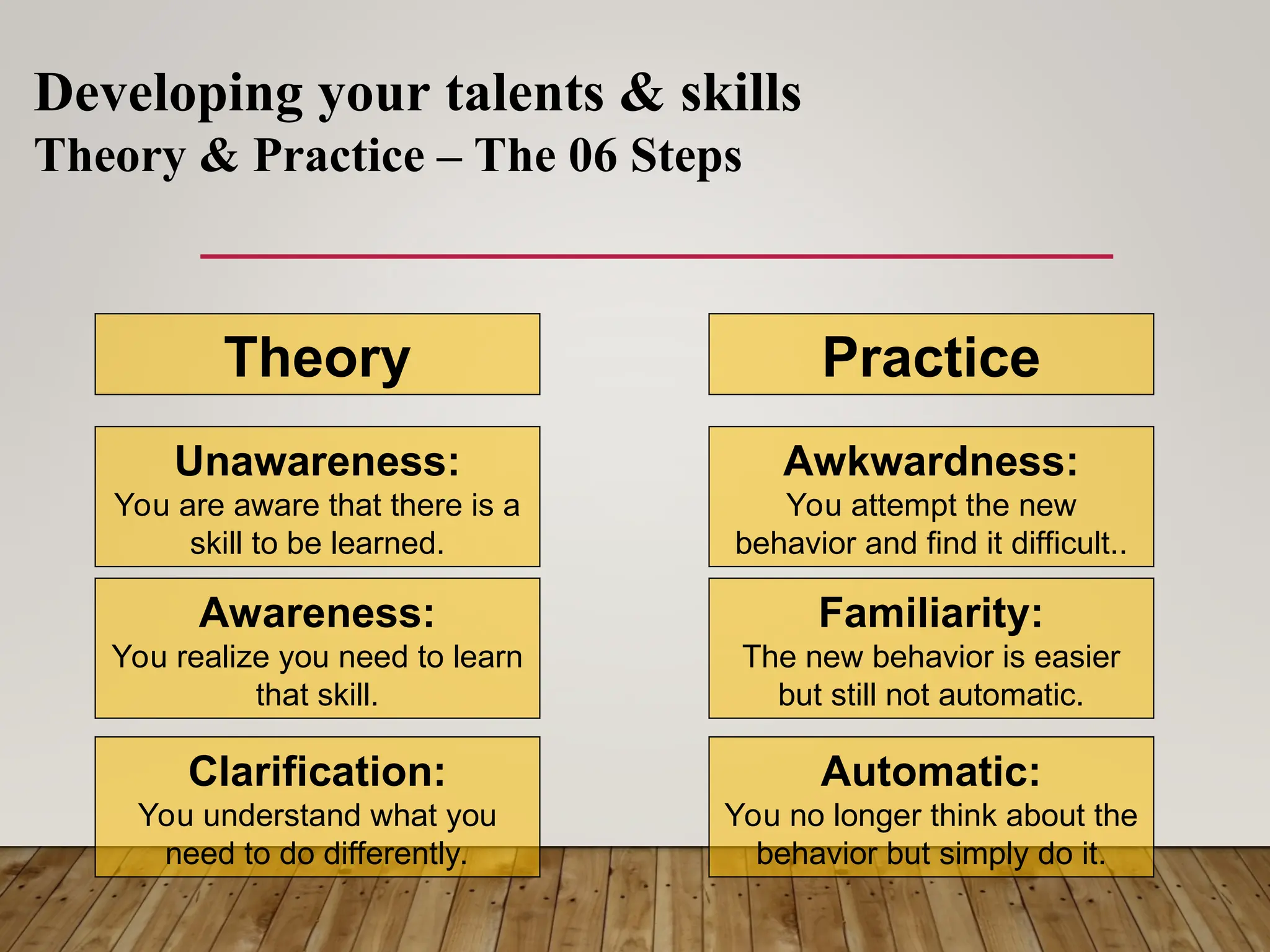
Theory & Practice – The 06 Steps
Theory
Unawareness:
You are aware that there is a
skill to be learned.
Awareness:
You realize you need to learn
that skill.
Clarification:
You understand what you
need to do differently.
Practice
Awkwardness:
You attempt the new
behavior and find it difficult..
Familiarity:
The new behavior is easier
but still not automatic.
Automatic:
You no longer think about the
behavior but simply do it.
Developing your talents & skills
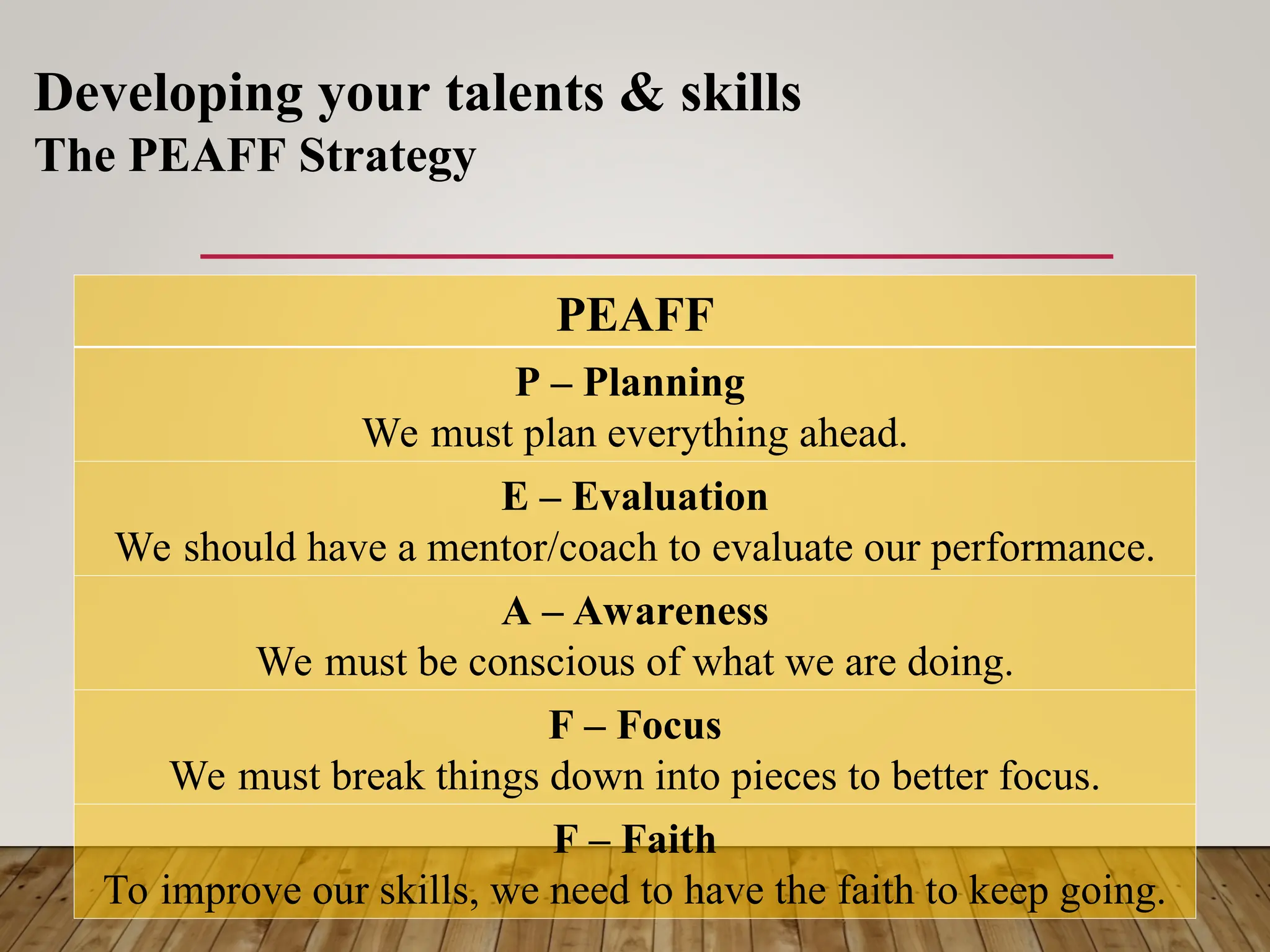
The PEAFF Strategy
PEAFF
P – Planning
We must plan everything ahead.
E – Evaluation
We should have a mentor/coach to evaluate our performance.
A – Awareness
We must be conscious of what we are doing.
F – Focus
We must break things down into pieces to better focus.
F – Faith
To improve our skills, we need to have the faith to keep going.
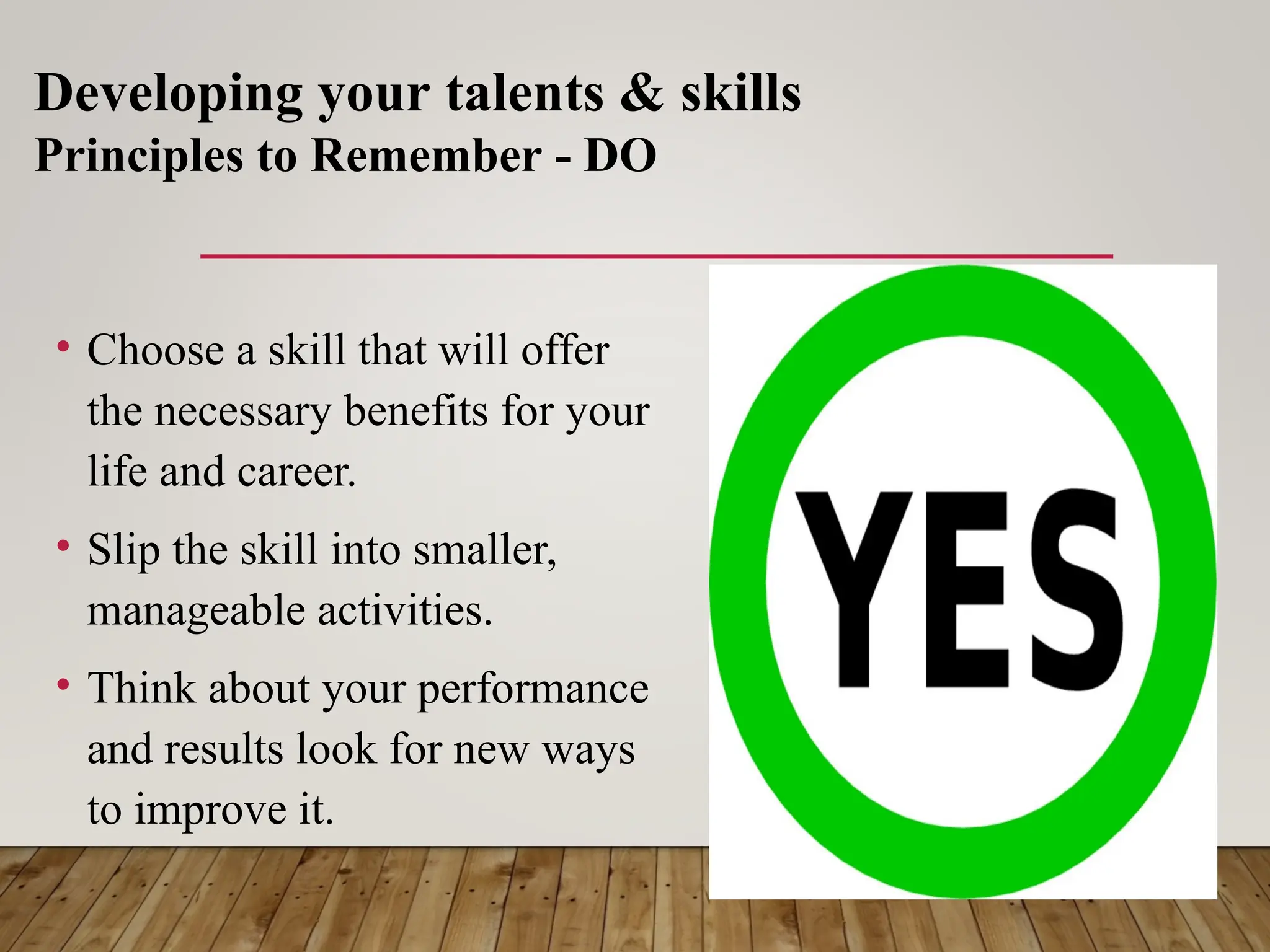
• Choose a skill that will offer
the necessary benefits for your
life and career.
• Slip the skill into smaller,
manageable activities.
• Think about your performance
and results look for new ways
to improve it.
Developing your talents & skills
Principles to Remember - DO
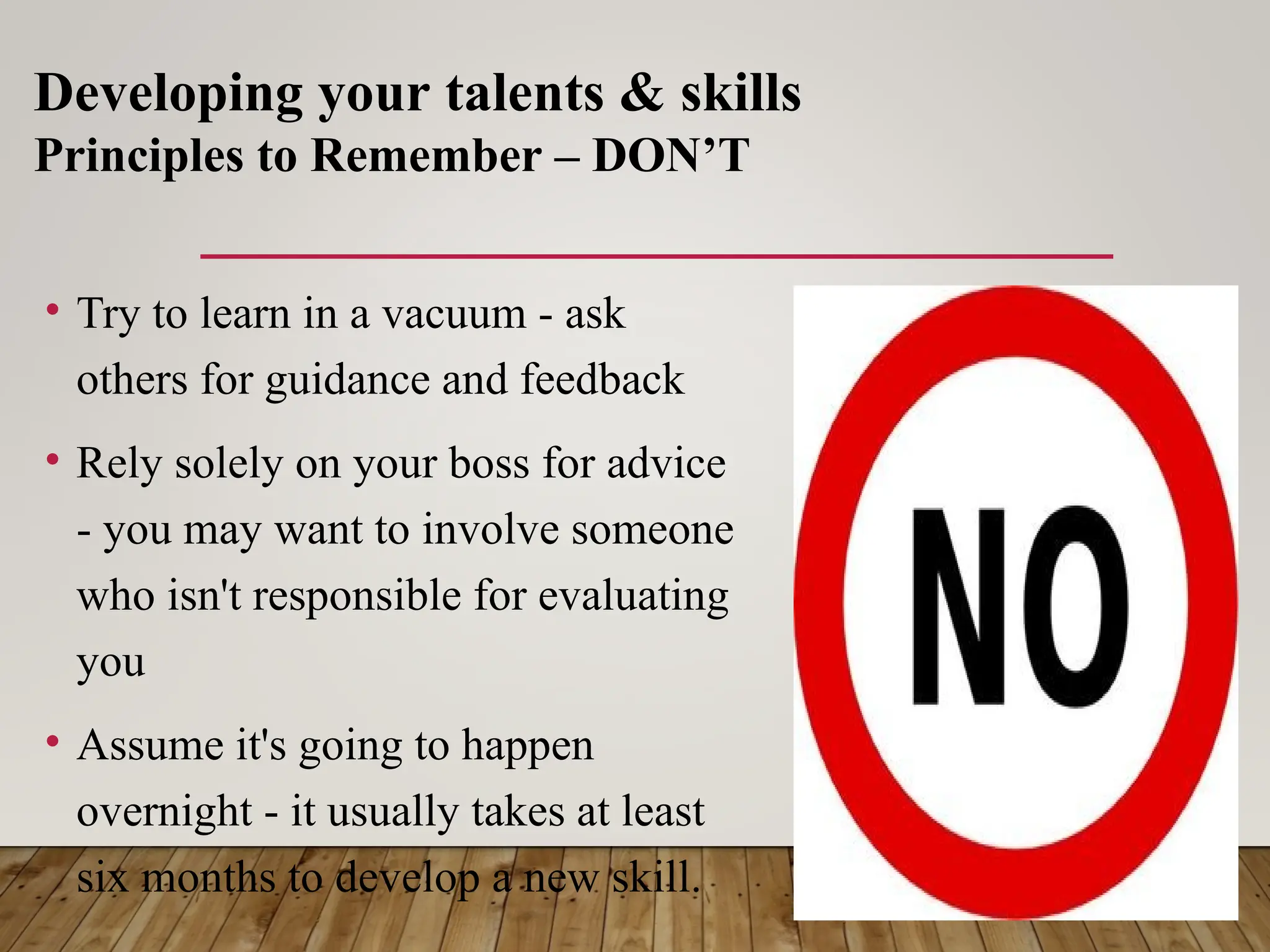
• Try to learn in a vacuum - ask
others for guidance and feedback
• Rely solely on your boss for advice
- you may want to involve someone
who isn't responsible for evaluating
you
• Assume it's going to happen
overnight - it usually takes at least
six months to develop a new skill.
Developing your talents & skills
Principles to Remember – DON’T
• We have the capacity to learn and to
implement new skills in our life.
• But we need to be reasonable and analyse
what kind of demands such skills will request
from us.
• Developing a skill is all a matter of being
aware of its benefits, level of compromise
and investment.
• And don’t forget that our value in the
business world is directly tied to the number
of skills we have been able to master.
Developing your talents & skills
Conclusion
•Write and essay with
the title : Talents and
skills; Weapon for
success.

Blooket Hacks with Updated Codes 2025 Free

  • 1.
  • 2.
    • It isquite common to hear that some people are born with certain special talents or skills. • And we consider them LUCKY! • But what about us - simple mortals? Developing your talents & skills Introduction
  • 3.
    • Success andspecial skills are not a matter of luck, opportunity or myth. • It is important to bear in mind that SUCCESS and SKILLS are all about putting efforts and energy to improve ourselves and to achieve our goals. Developing your talents & skills Success & Skills
  • 4.
    • Many successfulpeople have mastered important life or business skills to achieve a remarkable position in life. • And their main secret is: • Mastering the right skill through hard studying and training to achieve a goal that would fit their dreams and life expectations. Developing your talents & skills Important
  • 5.
    TALENT • Refers toan individual’s intelligence, abilities, and skills. • Should be developed and used well.
  • 6.
    TREASURE • Refers tothe things one values the most.
  • 7.
    TIME MANAGEMENT • Refersto how one uses time productively. • “It’s not the years in your life that count. It’s the life in your years.”
  • 8.
    SKILLS AND ABILITIES •Skills can be developed; talents are natural qualities. • Examples of talents: singing, painting, playing instruments, drawing, athletic skills. • Skills are needed in daily life and the 21st century job market. ‑ • Skills and abilities improve through education, training, and experience. • Enhancing skills helps in deciding a career path.
  • 9.
    THERE ARE TWOKINDS OF SKILLS
  • 10.
    KINDS OF SKILLS: 1.FOUNDATIONAL SKILLS • Simply known s transferable skills, which people bring to their job. • Examples: • reading, writing, listening, speaking, creative thinking.
  • 11.
    2. FUNCTIONAL SKILLS •The Skills specific to the functions of workers in performing their job. • Examples: • Budgeting • Forecasting • Managing human resources, materials, and facilities
  • 12.
    MENTORING AND SKILL DEVELOPMENT •Skills and talents can be developed through a mentoring relationship. • The mentor guides the mentee to improve and identify important skills.
  • 13.
    1. GIVING PRIORITYTOTHESKILLS THAT NEED TO BE DEVELOPED • The mentor helps the mentee identify which skills are essential for reaching goals.
  • 14.
    2. DETERMINING COMPLEXSKILLS • Mentors help identify more complex intellectual or motor skills that need focus. • Examples: • Writing information or ideas • Public speaking
  • 15.
    • Mentors helpidentify strengths through activities, education, and experience. DISCOVERED OR UNDISCOVERED
  • 16.
  • 17.
    HIDDEN TALENTS • Somepeople feel they don’t have talent. • Mentors assess areas for development to build confidence and reveal hidden abilities.
  • 18.
    • When wewant to master a specific skill we need to deal with two elements: • Theory and • Practice. Developing your talents & skills Mastering a Skill – Theory and Practice
  • 19.
    • It isa set of principles or a system of ideas intended to explain something. • Theory is important because it is based on concepts and experience that were tried before. • It helps us to avoid wasting our time doing what is wrong. Developing your talents & skills Theory – Definition & Features
  • 20.
    • It isthe application or use of an idea, belief or method. • When practicing we are implementing all the acquired knowledge from Theory. • And it is the only way to verify if we really know what we have learned. Developing your talents & skills Practice - Definition & Features
  • 21.
    • According toa best-selling author Greg Wingard our mind goes through 06 steps when mastering a skill: • 03 Theory Steps, • 03 Practice Steps. Developing your talents & skills Theory & Practice - Methodology
  • 22.
    Developing your talents& skills Theory & Practice – The 06 Steps Theory Unawareness: You are aware that there is a skill to be learned. Awareness: You realize you need to learn that skill. Clarification: You understand what you need to do differently. Practice Awkwardness: You attempt the new behavior and find it difficult.. Familiarity: The new behavior is easier but still not automatic. Automatic: You no longer think about the behavior but simply do it.
  • 23.
    Developing your talents& skills The PEAFF Strategy PEAFF P – Planning We must plan everything ahead. E – Evaluation We should have a mentor/coach to evaluate our performance. A – Awareness We must be conscious of what we are doing. F – Focus We must break things down into pieces to better focus. F – Faith To improve our skills, we need to have the faith to keep going.
  • 24.
    • Choose askill that will offer the necessary benefits for your life and career. • Slip the skill into smaller, manageable activities. • Think about your performance and results look for new ways to improve it. Developing your talents & skills Principles to Remember - DO
  • 25.
    • Try tolearn in a vacuum - ask others for guidance and feedback • Rely solely on your boss for advice - you may want to involve someone who isn't responsible for evaluating you • Assume it's going to happen overnight - it usually takes at least six months to develop a new skill. Developing your talents & skills Principles to Remember – DON’T
  • 26.
    • We havethe capacity to learn and to implement new skills in our life. • But we need to be reasonable and analyse what kind of demands such skills will request from us. • Developing a skill is all a matter of being aware of its benefits, level of compromise and investment. • And don’t forget that our value in the business world is directly tied to the number of skills we have been able to master. Developing your talents & skills Conclusion
  • 27.
    •Write and essaywith the title : Talents and skills; Weapon for success.