3
November 20, 2025
Datatype Declaration
Data type Declaration
• Use the correct data type.
• %Type and %ROWTYPE attributes while defining data type.
• Always prefix Global and Local variables uniformly.
Advantages:
Advantages:
• There will be a reduction in the time taken for implicit conversion.
• Avoidance of the necessary code change when schema structure changes.
• There will be clear understanding of the nature and use of the variable.
4.
4
November 20, 2025
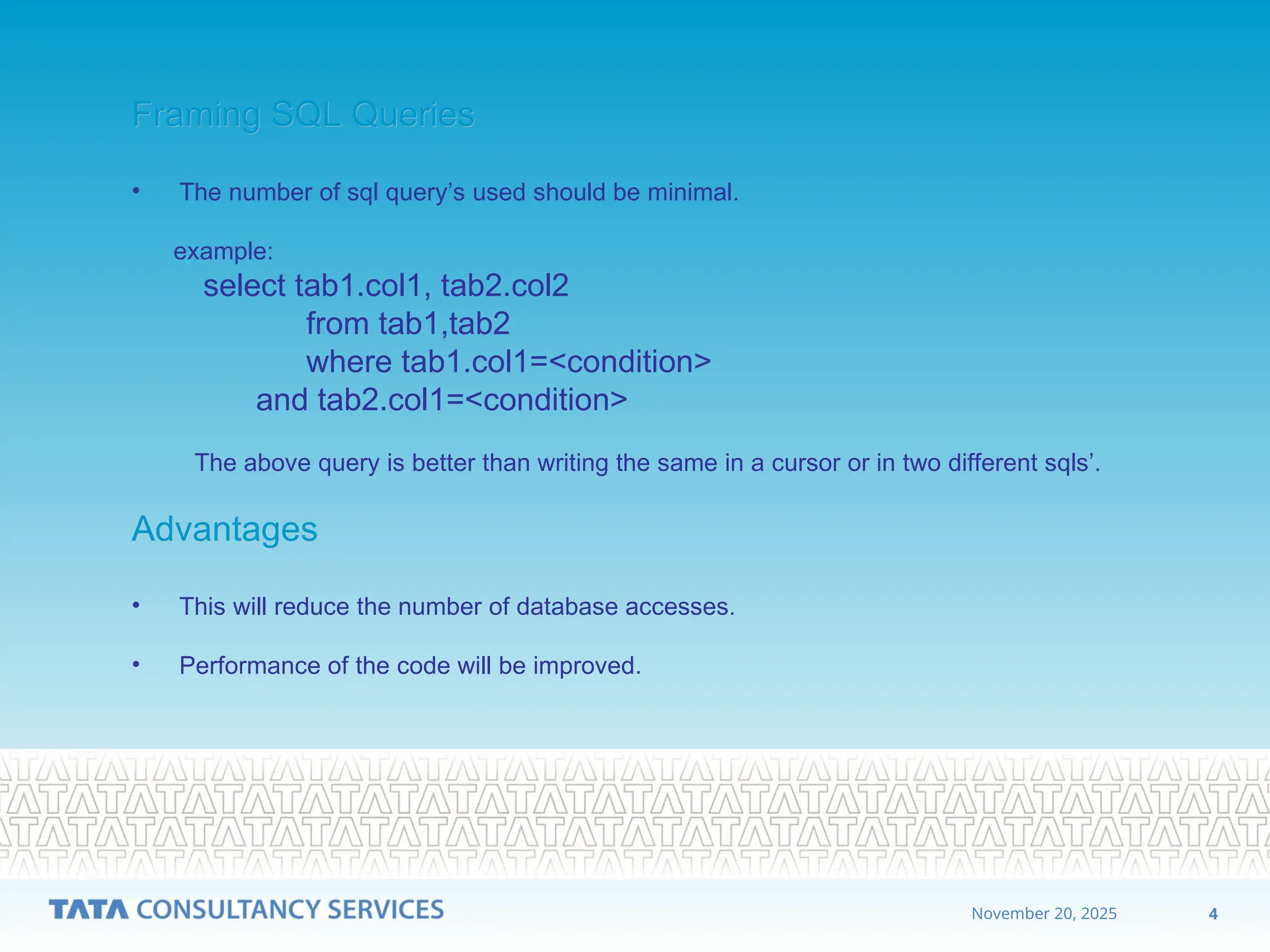
FramingSQL Queries
Framing SQL Queries
• The number of sql query’s used should be minimal.
example:
select tab1.col1, tab2.col2
from tab1,tab2
where tab1.col1=<condition>
and tab2.col1=<condition>
The above query is better than writing the same in a cursor or in two different sqls’.
Advantages
Advantages
• This will reduce the number of database accesses.
• Performance of the code will be improved.
5.
5
November 20, 2025
Selectionof driving table
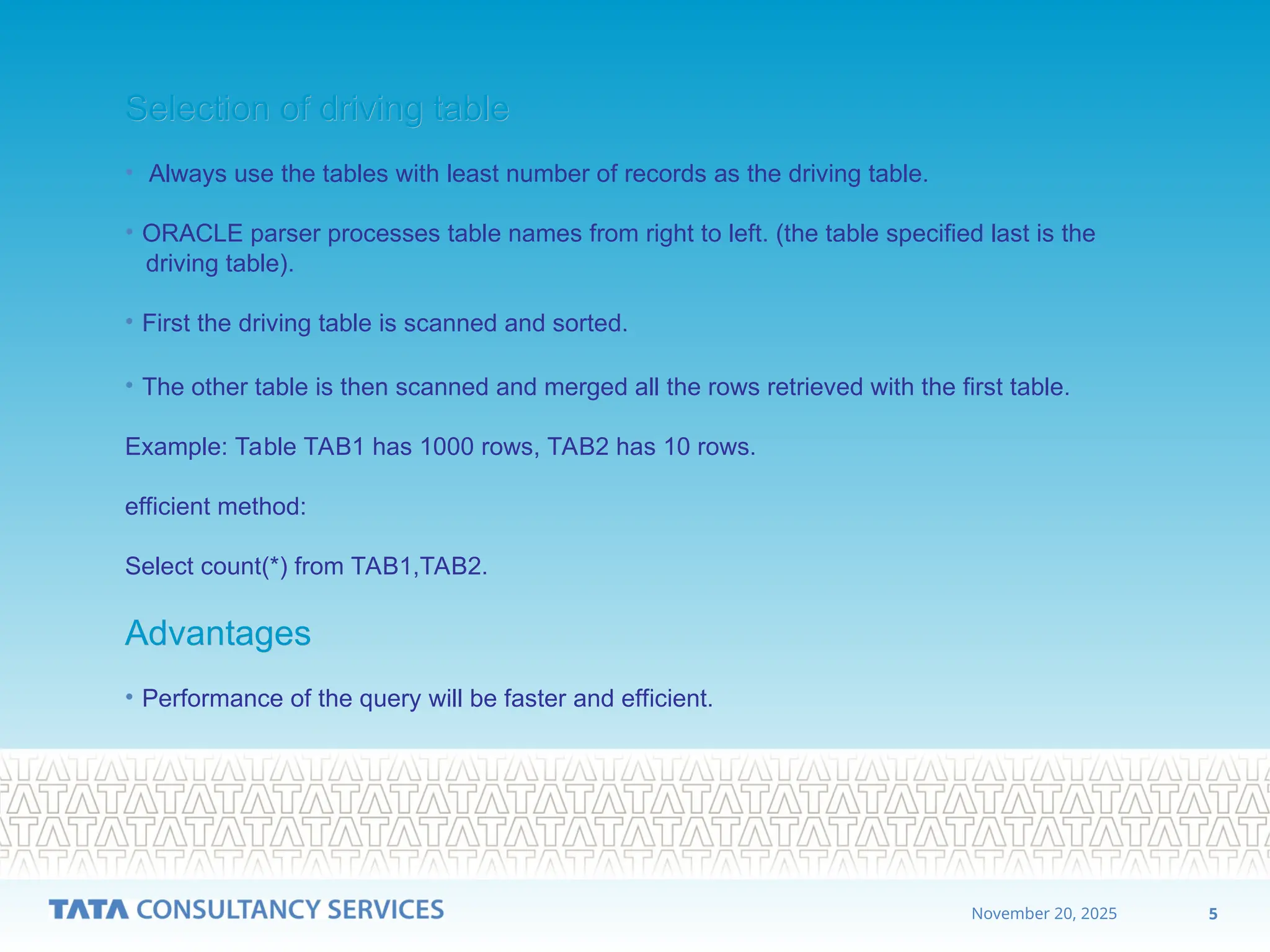
Selection of driving table
• Always use the tables with least number of records as the driving table.
• ORACLE parser processes table names from right to left. (the table specified last is the
driving table).
• First the driving table is scanned and sorted.
• The other table is then scanned and merged all the rows retrieved with the first table.
Example: Table TAB1 has 1000 rows, TAB2 has 10 rows.
efficient method:
Select count(*) from TAB1,TAB2.
Advantages
Advantages
• Performance of the query will be faster and efficient.
6.
6
November 20, 2025
AvoidUsing ‘*’ in SELECT clause
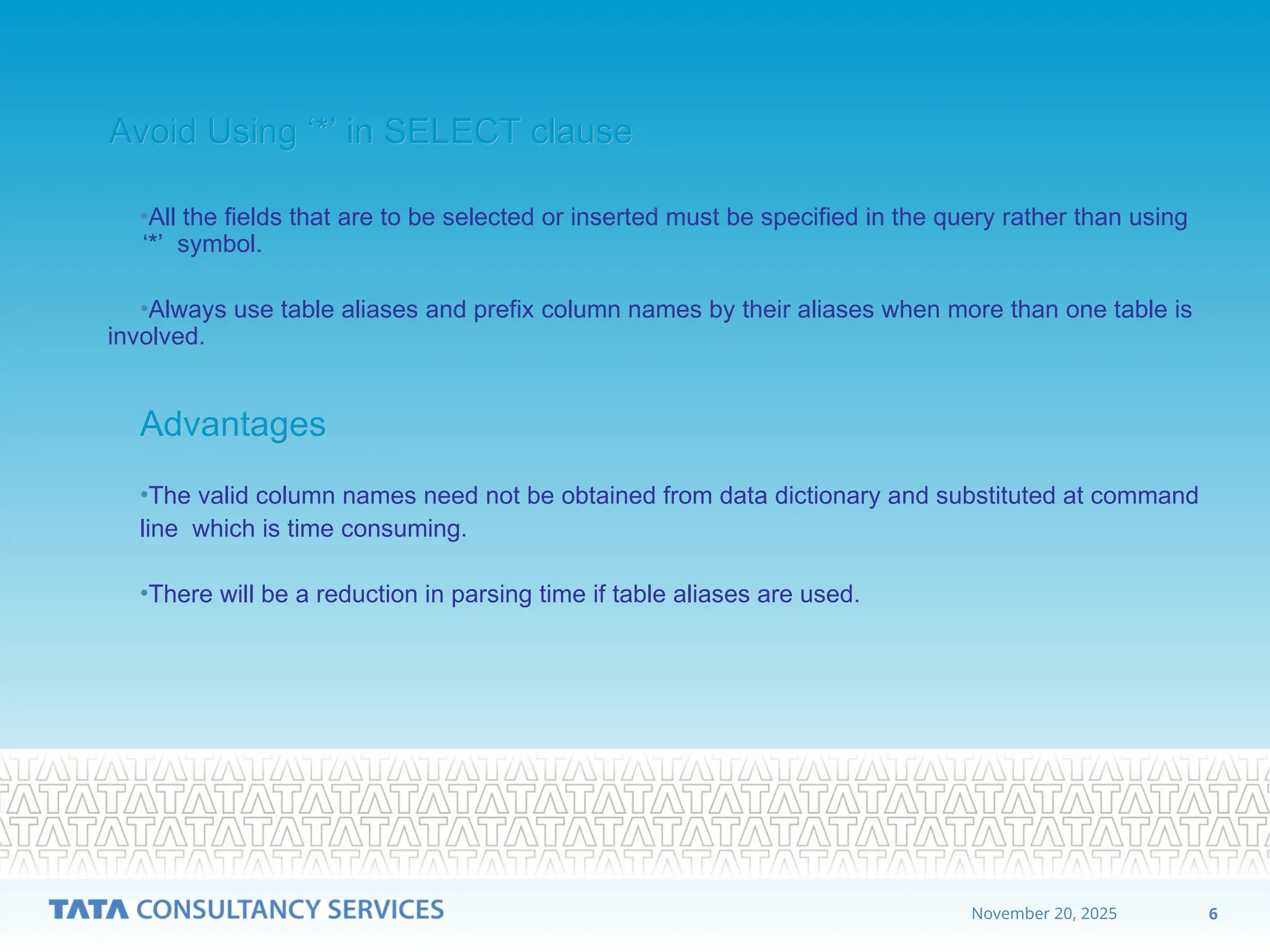
Avoid Using ‘*’ in SELECT clause
•All the fields that are to be selected or inserted must be specified in the query rather than using
‘*’ symbol.
•Always use table aliases and prefix column names by their aliases when more than one table is
involved.
Advantages
Advantages
•The valid column names need not be obtained from data dictionary and substituted at command
line which is time consuming.
•There will be a reduction in parsing time if table aliases are used.
7.
7
November 20, 2025
UseEXISTS instead of IN Clause
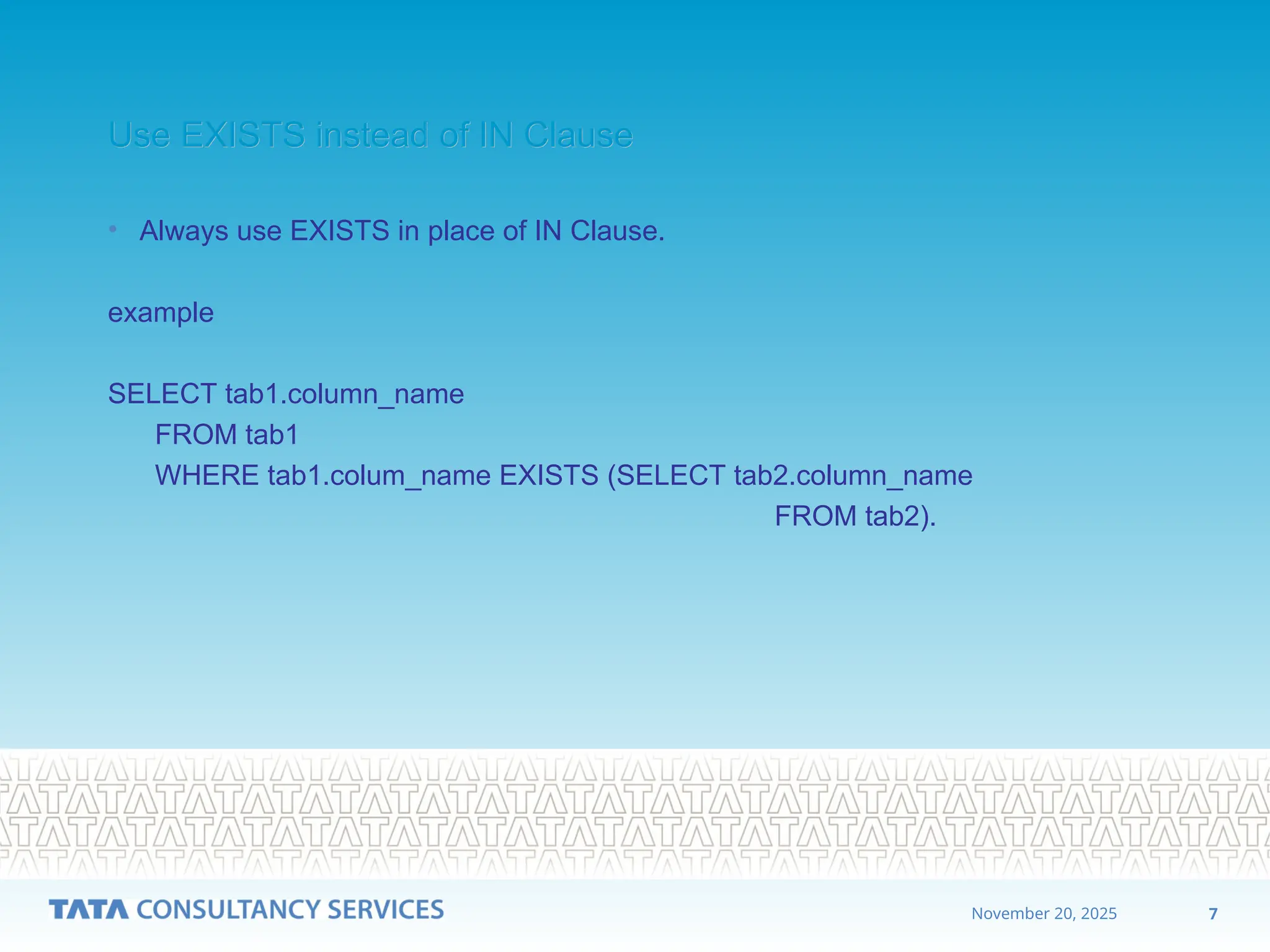
Use EXISTS instead of IN Clause
• Always use EXISTS in place of IN Clause.
example
SELECT tab1.column_name
FROM tab1
WHERE tab1.colum_name EXISTS (SELECT tab2.column_name
FROM tab2).
8.
8
November 20, 2025
UseNOT EXISTS instead of NOT IN Clause
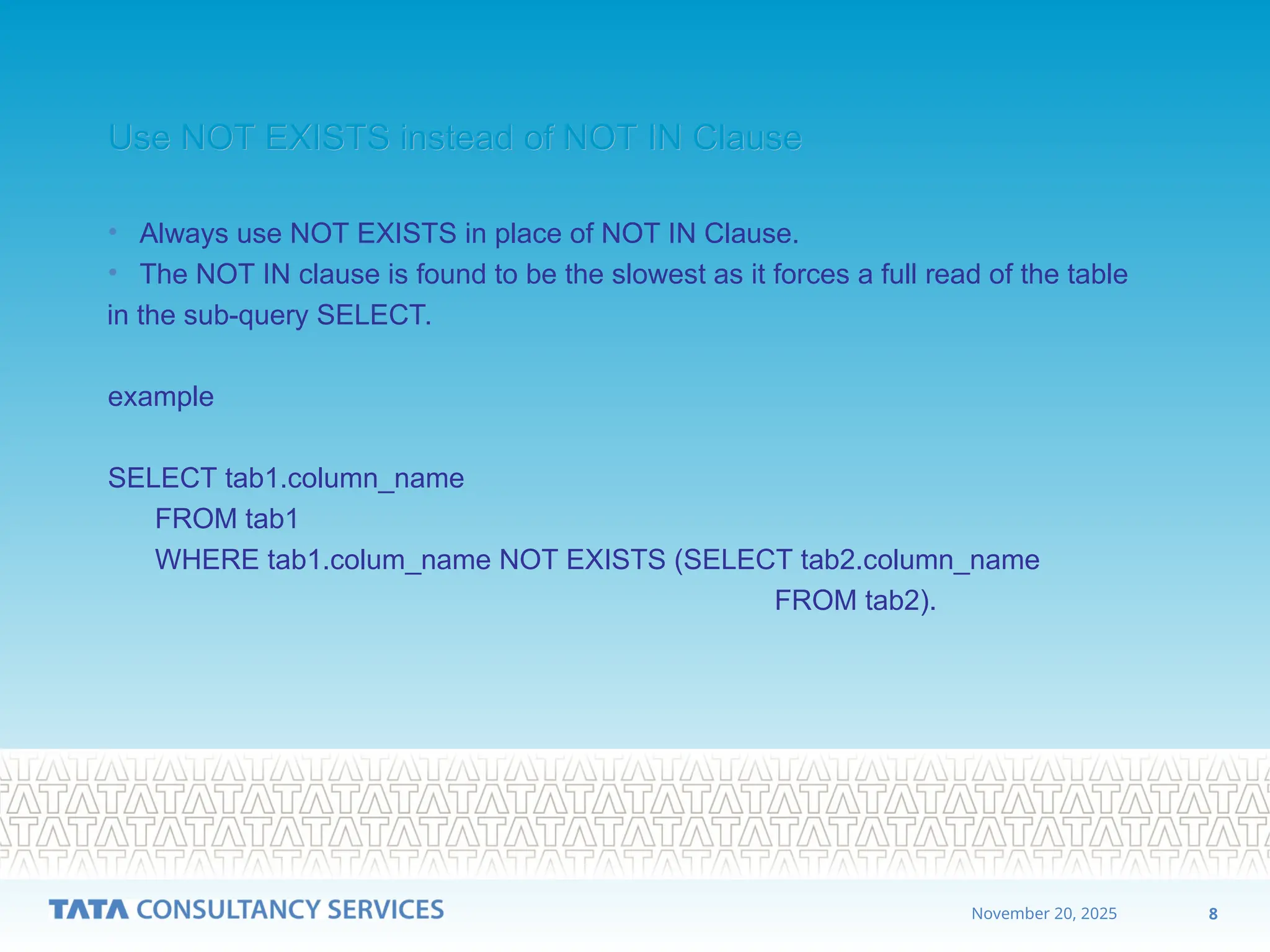
Use NOT EXISTS instead of NOT IN Clause
• Always use NOT EXISTS in place of NOT IN Clause.
• The NOT IN clause is found to be the slowest as it forces a full read of the table
in the sub-query SELECT.
example
SELECT tab1.column_name
FROM tab1
WHERE tab1.colum_name NOT EXISTS (SELECT tab2.column_name
FROM tab2).
9.
9
November 20, 2025
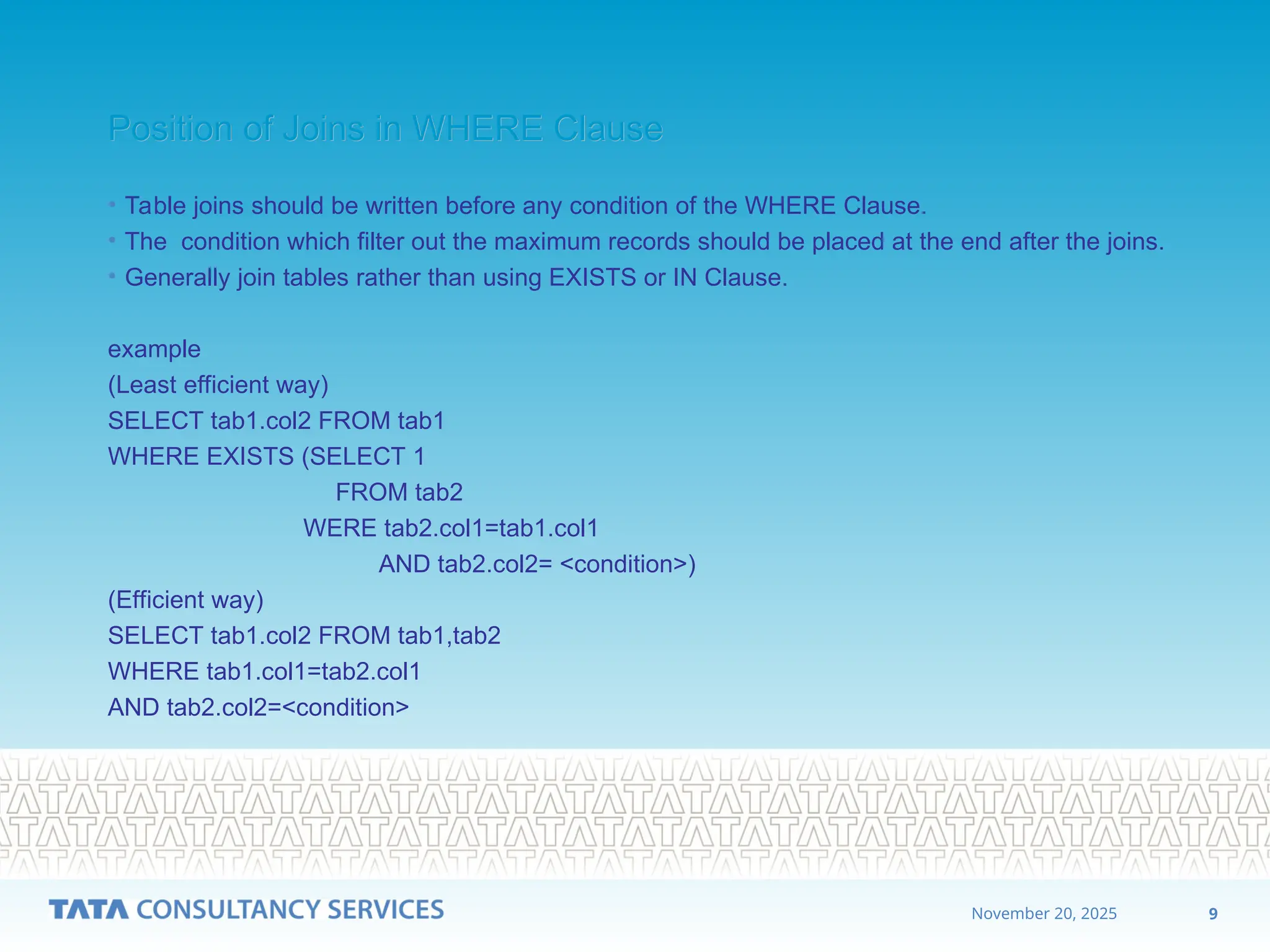
Positionof Joins in WHERE Clause
Position of Joins in WHERE Clause
• Table joins should be written before any condition of the WHERE Clause.
• The condition which filter out the maximum records should be placed at the end after the joins.
• Generally join tables rather than using EXISTS or IN Clause.
example
(Least efficient way)
SELECT tab1.col2 FROM tab1
WHERE EXISTS (SELECT 1
FROM tab2
WERE tab2.col1=tab1.col1
AND tab2.col2= <condition>)
(Efficient way)
SELECT tab1.col2 FROM tab1,tab2
WHERE tab1.col1=tab2.col1
AND tab2.col2=<condition>
10.
10
November 20, 2025
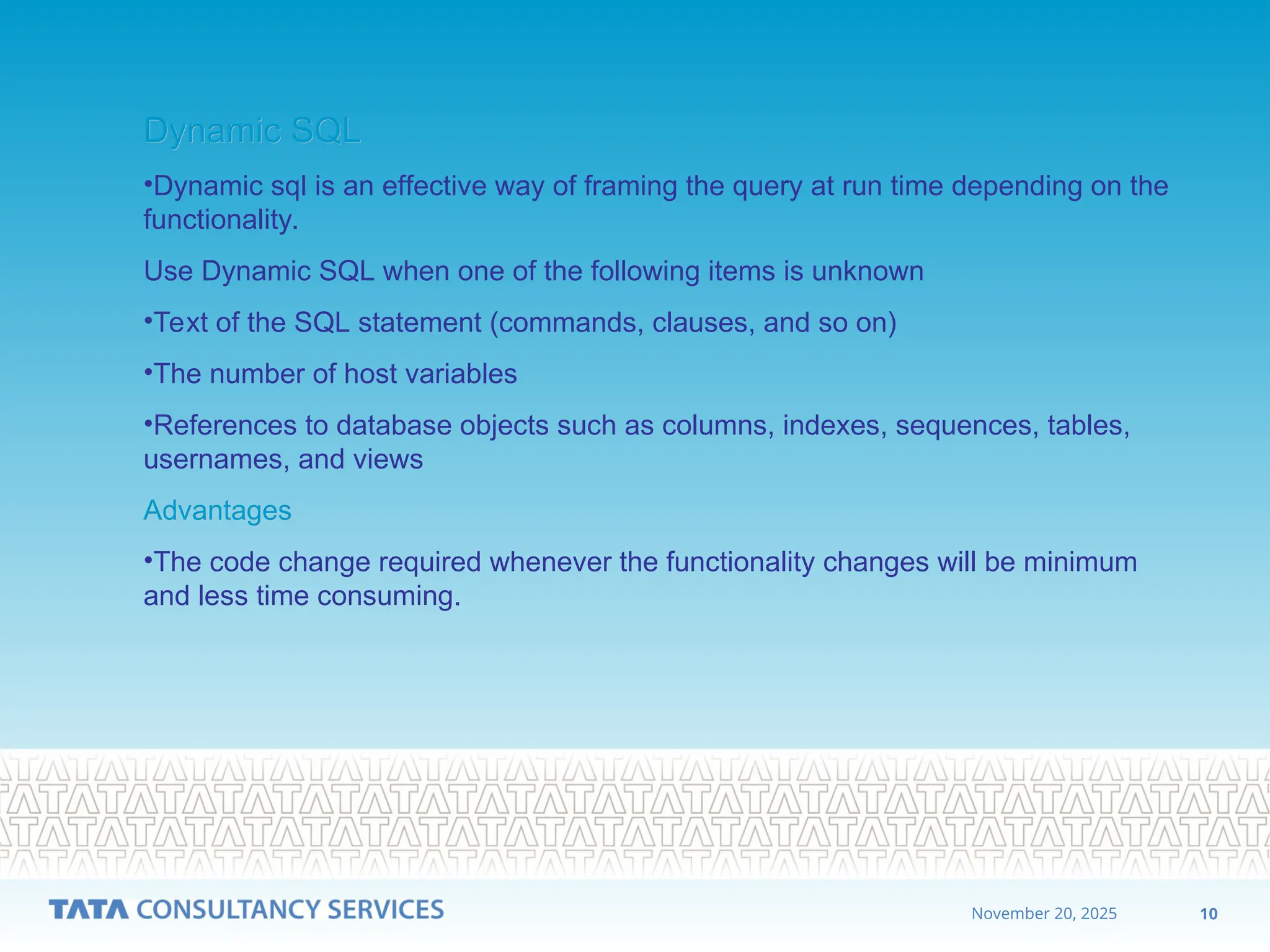
DynamicSQL
Dynamic SQL
•Dynamic sql is an effective way of framing the query at run time depending on the
functionality.
Use Dynamic SQL when one of the following items is unknown
•Text of the SQL statement (commands, clauses, and so on)
•The number of host variables
•References to database objects such as columns, indexes, sequences, tables,
usernames, and views
Advantages
Advantages
•The code change required whenever the functionality changes will be minimum
and less time consuming.
11.
11
November 20, 2025
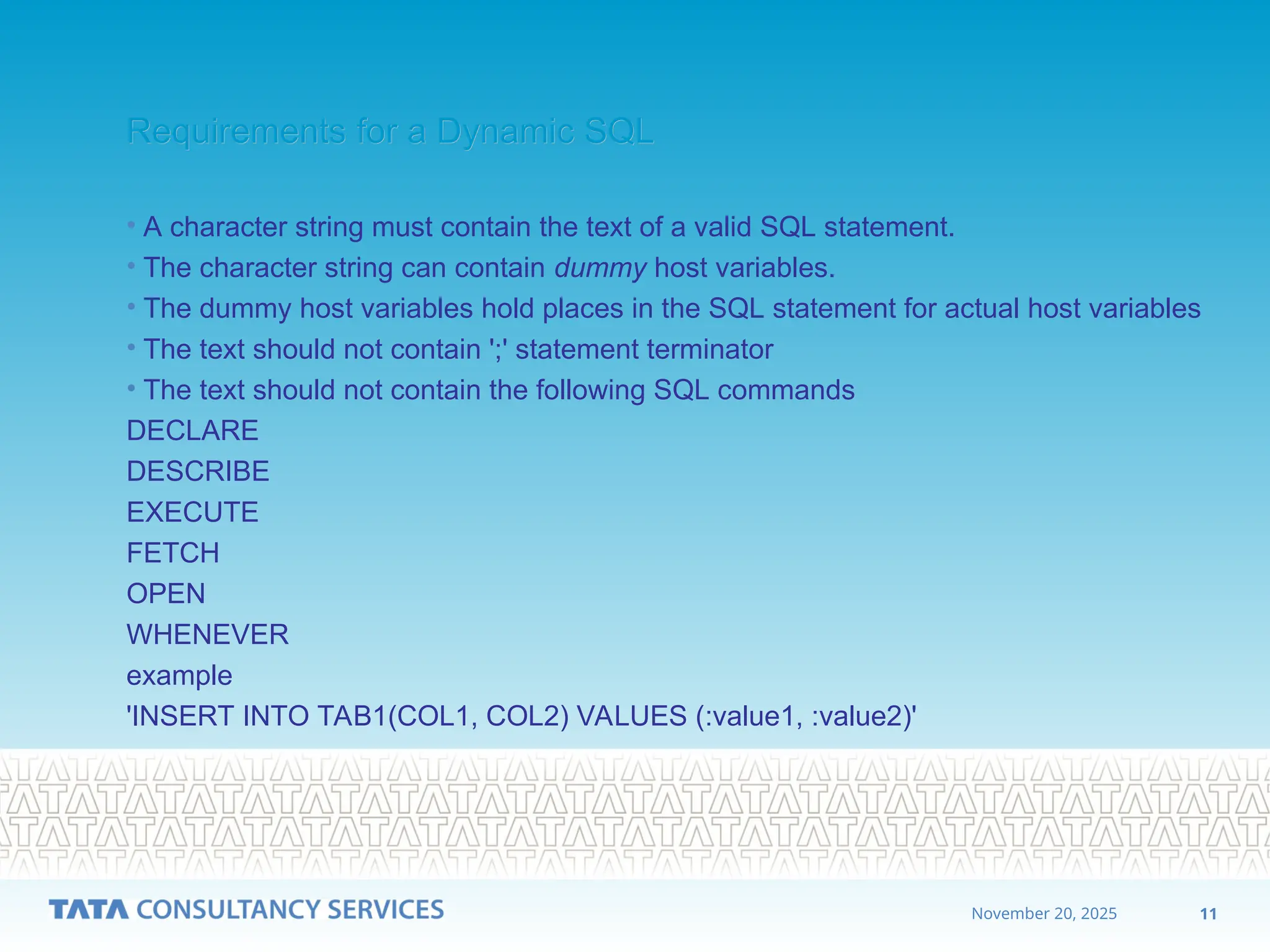
Requirementsfor a Dynamic SQL
Requirements for a Dynamic SQL
• A character string must contain the text of a valid SQL statement.
• The character string can contain dummy host variables.
• The dummy host variables hold places in the SQL statement for actual host variables
• The text should not contain ';' statement terminator
• The text should not contain the following SQL commands
DECLARE
DESCRIBE
EXECUTE
FETCH
OPEN
WHENEVER
example
'INSERT INTO TAB1(COL1, COL2) VALUES (:value1, :value2)'
12.
12
November 20, 2025
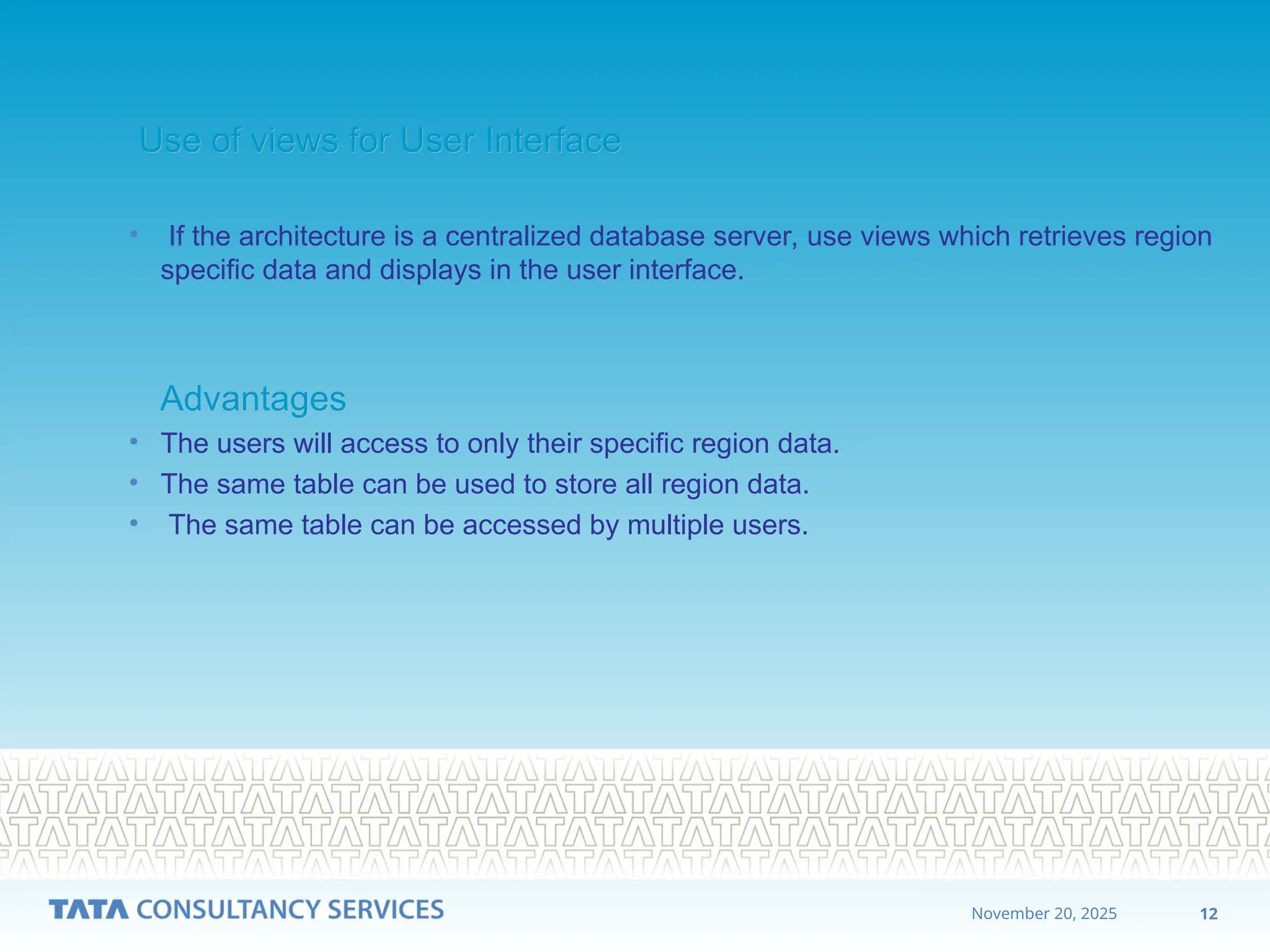
Useof views for User Interface
Use of views for User Interface
• If the architecture is a centralized database server, use views which retrieves region
specific data and displays in the user interface.
Advantages
Advantages
• The users will access to only their specific region data.
• The same table can be used to store all region data.
• The same table can be accessed by multiple users.
13.
13
November 20, 2025
Triggers
Triggers
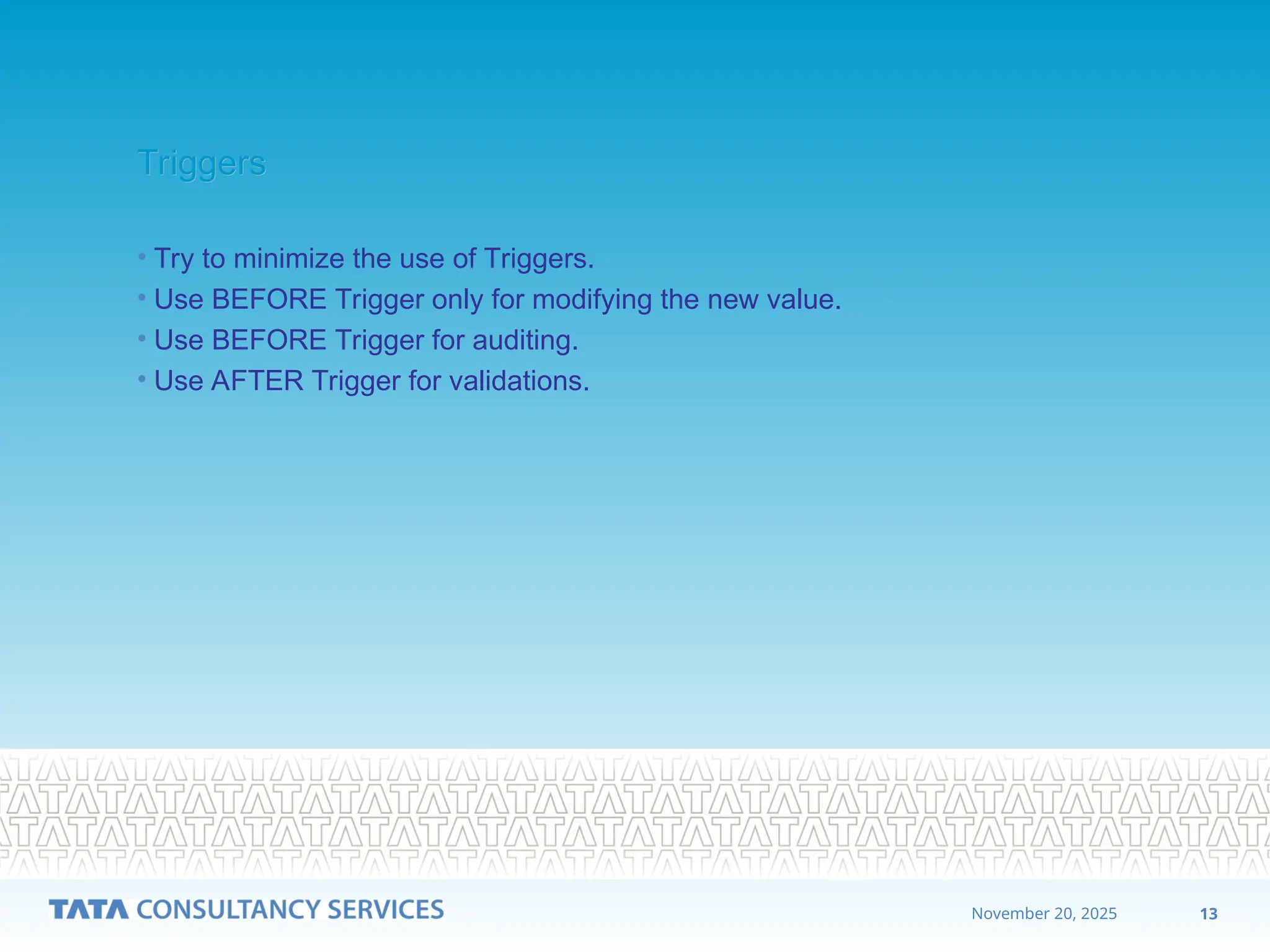
•Try to minimize the use of Triggers.
• Use BEFORE Trigger only for modifying the new value.
• Use BEFORE Trigger for auditing.
• Use AFTER Trigger for validations.
14.
14
November 20, 2025
Whythis is a Best Practice
Why this is a Best Practice
Advantages
Advantages
• Easy to understand and edit.
• Reduction in maintenance cost.
• Improvement in Performance of the code.
Contact Info
Contact Info
Sriram Vanchi Nathan
Sriram Vanchi Nathan
sriram.vanchinathan@tcs.com
sriram.vanchinathan@tcs.com
#1 Welcome to this internet seminar on Achieving Excellence in Dairy Industry.
I am Namrata and I head the industry solutions in Oracle Practice at Tata Consultancy Services .
In the next few minutes I will discuss how TCS can enable you to achieve excellence in your operations using Oracle E-Business Suite coupled with TCS’ Cow to Cash Integration solution.
#4 Solution Area –
Oracle EBS, GDW (Global Data Warehouse), Hyperion, EDI / Oracle Interconnect / TIBCO, ALOCA Direct (B2B, B2C Portal), EHS (Environment Health & Safety – Dot Net Application), MyAloca.com (Intranet Portal), Alcoa Technical Center (AICIT) – Microsoft Applications used for Engineering Design
------------------------------------------------------------------------------------------------------------------------
There are 3 service teams covering various technology service types which support ALCOA from the Global delivery center in India are as below -
ADM Team: Service includes - RICE, Integration Services, Portals, ATC IT, Hyperion, Non EBS applications
OPEX / IS Team: Services include Maintenance of Windows, UNIX administration, DBA services, Patch/clone services
R & D Team: Product Engineering, Cement from Spent Pot Lining, New Product Development
Total Team Size – 377 with an offshore leverage of ~ 70%
Team composition –
Java technology support– 14
Microsoft Applications support – 22
Integration Services – 24
Infrastructure Support – 86
EIS – 7
BI – 41
DBA – 46
Oracle Technical – 134
#10 Solution Area –
Oracle EBS, GDW (Global Data Warehouse), Hyperion, EDI / Oracle Interconnect / TIBCO, ALOCA Direct (B2B, B2C Portal), EHS (Environment Health & Safety – Dot Net Application), MyAloca.com (Intranet Portal), Alcoa Technical Center (AICIT) – Microsoft Applications used for Engineering Design
------------------------------------------------------------------------------------------------------------------------
There are 3 service teams covering various technology service types which support ALCOA from the Global delivery center in India are as below -
ADM Team: Service includes - RICE, Integration Services, Portals, ATC IT, Hyperion, Non EBS applications
OPEX / IS Team: Services include Maintenance of Windows, UNIX administration, DBA services, Patch/clone services
R & D Team: Product Engineering, Cement from Spent Pot Lining, New Product Development
Total Team Size – 377 with an offshore leverage of ~ 70%
Team composition –
Java technology support– 14
Microsoft Applications support – 22
Integration Services – 24
Infrastructure Support – 86
EIS – 7
BI – 41
DBA – 46
Oracle Technical – 134
-----------------------------------------------------------------------------------------------------------------
The geography wise service utilization details are given below –
TCS provides the following services to the North America Sites of Alcoa –
Business Units –
NAPM – North America Primary Metal (Manufacture Bauxite to Aluminum Ingots),
NAMP – North America Mill Products (Rolling Mill),
AWA – Alcoa World Alumina (Manufacture Bauxite to Alumina),
CSI – Closure System International (manufacture Plastic bottle caps),
GEP – Global Extrusion Products (Aluminum Channels etc),
AMM – Alcoa Material Management
Services provided -
ADM : RICE, GDW, IS, Alcoa Direct, Hyperion, EHS
OPEX / IS : Unix, Windows, Remedy, DBA Support, Level2 (SLA based) & Level3 Support
Engineering : CSI Product Design, New Product Development
---------------------------------------------------------------------------------------------------------------------------------
TCS provides the following services to the Europe Sites of Alcoa –
Business Units –
EMP – Europe Mill Products,
BCS – Building and Construction Products,
CSI – Closure System International,
AWA – Alcoa World Alumina
Services provided -
ADM : RICE, IS
OPEX / IS : Unix administration, Windows, Packaging, DBA Support, Level2 (SLA based)
------------------------------------------------------------------------------------------------------------
TCS provides the following services to the China Site of Alcoa –
Business Units –
Bohai – Rolling mill in China near Hangzhou
Services provided -
RICE & DBA Support
-----------------------------------------------------------------------------------------------------------------
TCS provides the following services to the Australia Site of Alcoa –
Business Units –
AWA – Alcoa World Alumina
Services provided -
ADM : RICE, Hyperion Support, Non EBS Appl Support, eAM & Oracle Project
OPEX / IS : Unix, Windows, DBA Support
------------------------------------------------------------------------------------------------------------------
TCS provides the following services to the Latin America Site of Alcoa –
Business Units –
AWA – Alcoa World Alumina
Services provided -
OPEX / IS : Unix, Windows, DBA Support


![[PHPUGPH] PHP Roadshow - MySQL](https://cdn.slidesharecdn.com/ss_thumbnails/phpugphmysqlv3-110121124746-phpapp01-thumbnail.jpg?width=640&height=640&fit=bounds)


