Bending the Graphics Pipeline Johan Andersson DICE
Overview Give a taste of a few rendering techniques we are using & experimenting with how they interact, or would like to interact, with the graphics pipeline Tile-based Deferred Shading Morphological Antialiasing Analytical Ambient Occlusion 08/01/10 Beyond Programmable Shading, SIGGRAPH 2010
TILE-BASED DEFERRED SHADING
Tile-based deferred shading Tile-based culling & lighting Cull lights per screen-space tile Lighting kernel runs per tile Minimizes bandwidth/setup cost DX11: GPU compute shader  Covered in the course last year  [Andersson09] PS3: SPU jobs GPU renders gbuffer SPU does light culling & full lighting evaluation for each pixel 08/01/10 Beyond Programmable Shading, SIGGRAPH 2010
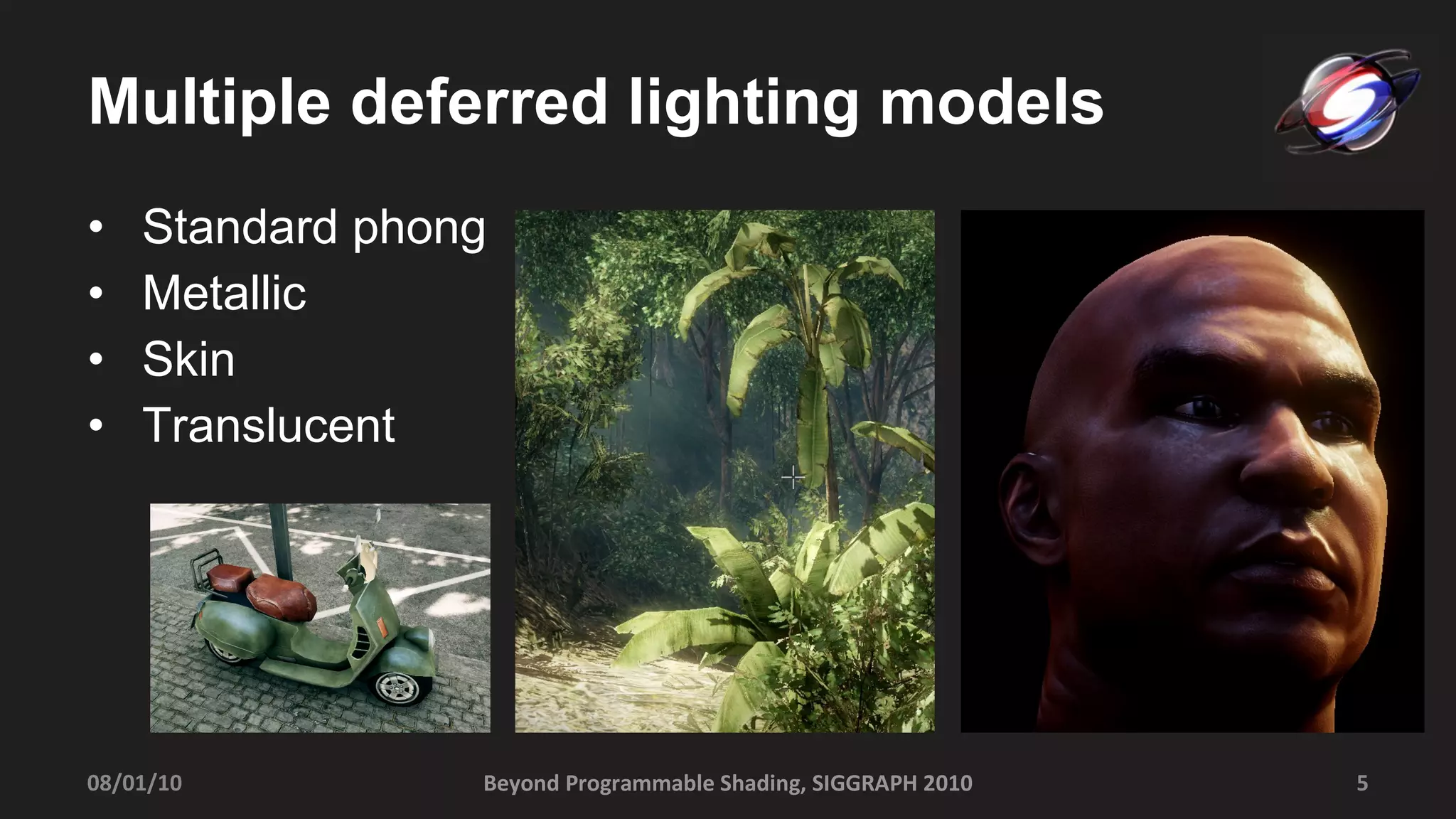
Standard phong Metallic Skin Translucent Multiple deferred lighting models Beyond Programmable Shading, SIGGRAPH 2010 08/01/10
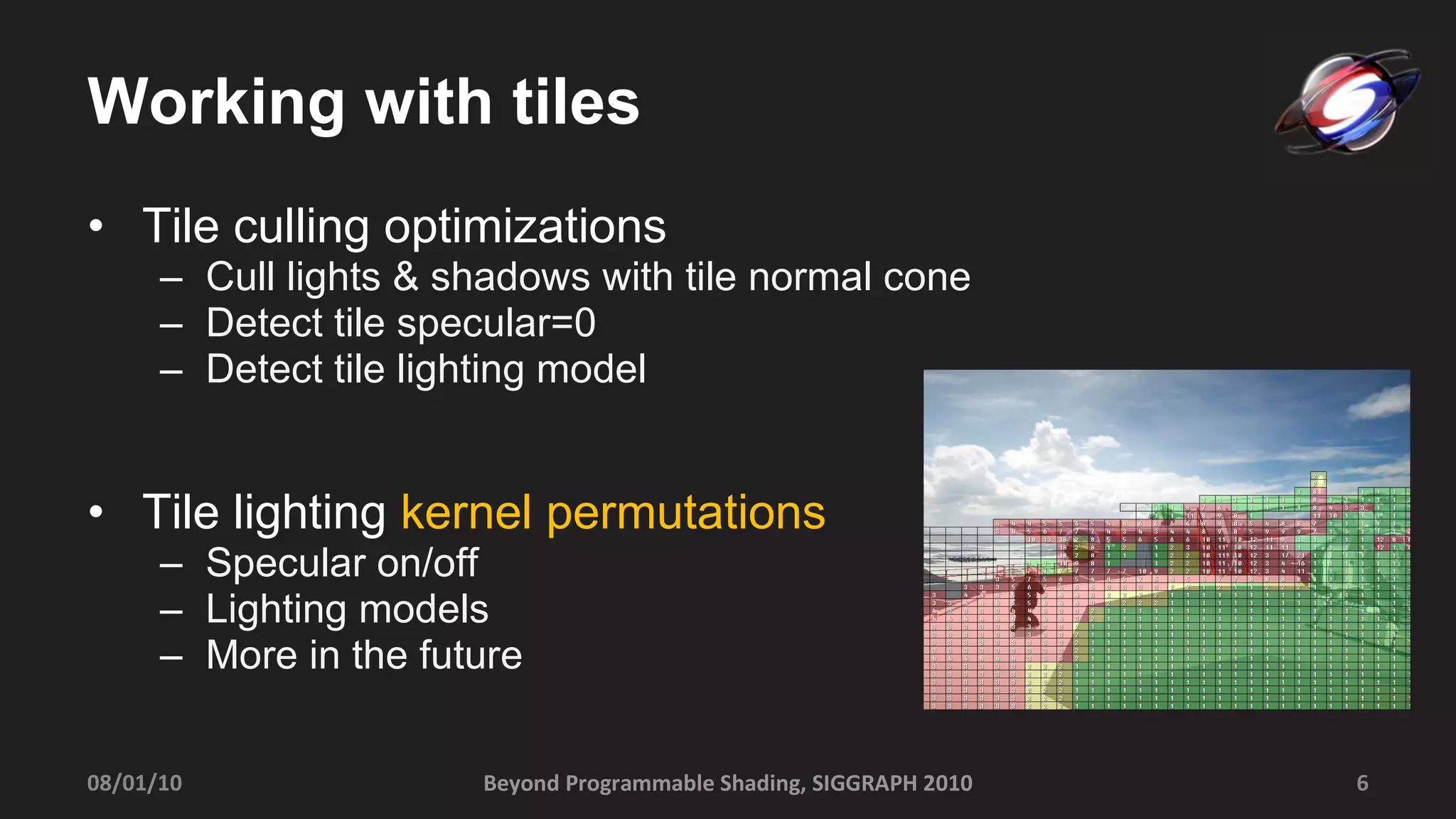
Working with tiles Tile culling optimizations Cull lights & shadows with tile normal cone Detect tile specular=0 Detect tile lighting model Tile lighting  kernel permutations Specular on/off Lighting models More in the future Beyond Programmable Shading, SIGGRAPH 2010 08/01/10
SPU-based Deferred Shading Ported DX11 compute shader to SPU job Offloads PS3 GPU SPU processing in parallel with GPU rendering 32x16 pixel tiles Explicit SoA vectorization instead of implicit C/C++ on SPU - HLSL on GPU Not a problem for such a relative small kernel But not ideal data-parallel programming model Beyond Programmable Shading, SIGGRAPH 2010 08/01/10
SPU vs GPU architecture 6 execution contexts vs 1+ million (each pixel) Explicit SIMD vs implicit SIMD C/C++ vs HLSL Explicit async DMA vs implicit latency hiding What can we learn? Beyond Programmable Shading, SIGGRAPH 2010 08/01/10
Issues & challenges going forward More  lighting models SIMD & branching efficiency Transparent decal  surfaces & volumes Fixed function blending doesn’t work well with deferred Higher-quality  antialiasing Beyond Programmable Shading, SIGGRAPH 2010 08/01/10
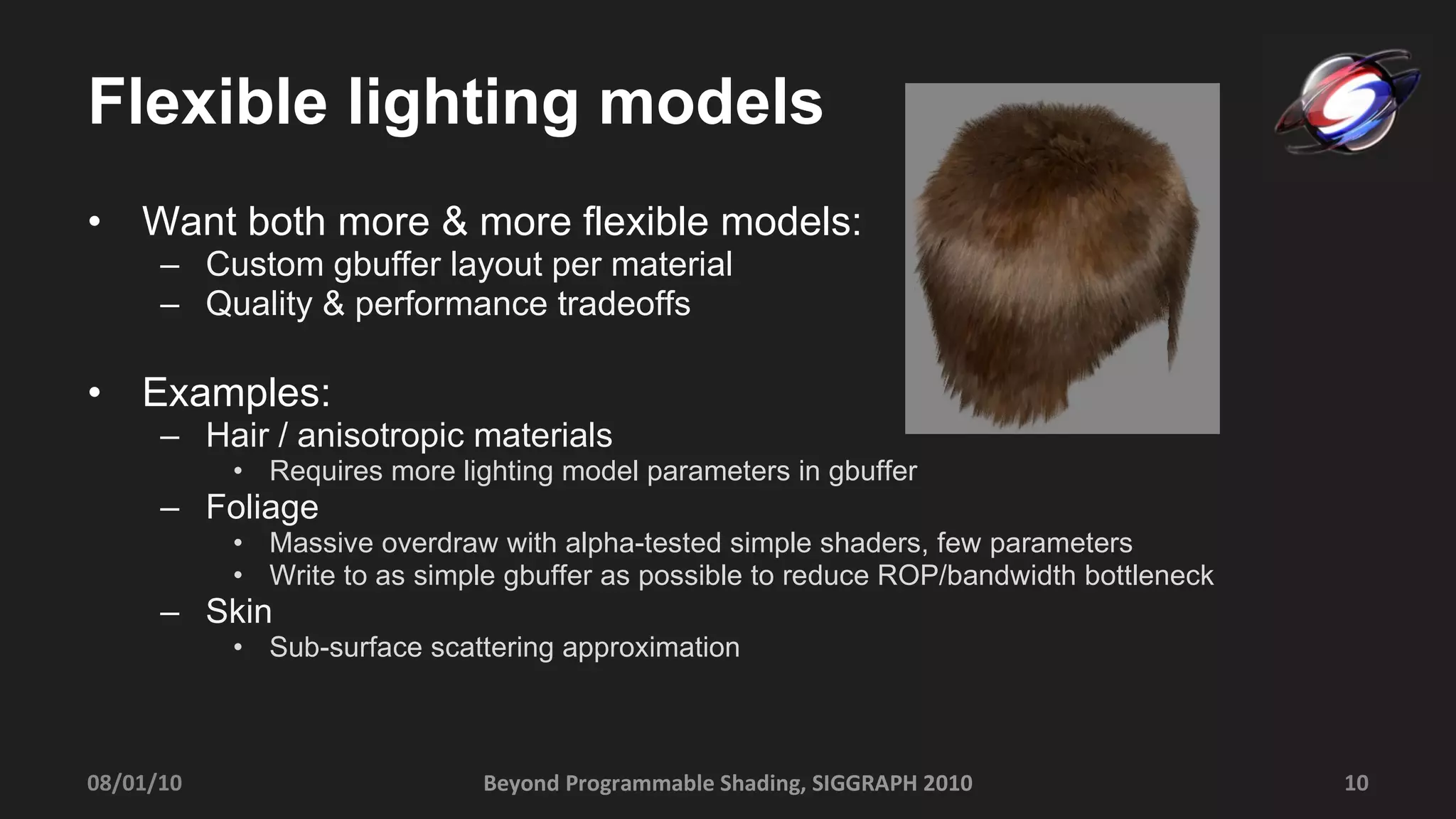
Flexible lighting models Want both more & more flexible models: Custom gbuffer layout per material Quality & performance tradeoffs Examples: Hair / anisotropic materials Requires more lighting model parameters in gbuffer Foliage  Massive overdraw with alpha-tested simple shaders, few parameters  Write to as simple gbuffer as possible to reduce ROP/bandwidth bottleneck Skin  Sub-surface scattering approximation Beyond Programmable Shading, SIGGRAPH 2010 08/01/10
The SIMD efficiency problem Lighting models through dynamic branches GPU shader model  can be problematic: Increased register pressure = overall slower shader   Requires good  screen-space   SIMD coherency for performance win Potential solutions: Reshuffle pixels to improve  coherency ? Within each tile, sort pixels by model, compute lighting & then scatter back  GRAMPS -style queing?  [Sugerman09] Attractive & powerful high-level programming model Beyond Programmable Shading, SIGGRAPH 2010 08/01/10 Alpha-tested foliage has  far from ideal coherency
Decals & deferred shading Decals blend selectively against gbuffer Include: Diffuse albedo (gbuffer1.rgb) Normal (gbuffer0.rgb) Want to include (but can’t in single pass): Specular albedo (gbuffer1.a)  Specular smoothness (gbuffer0.a) Exclude: Material id (can’t blend) Object lighting (inherit from below surface) Fixed function blending doesn’t work well Pixel shader can’t write out both alpha & blend factor! Consoles doesn’t have blend mode per MRT Linear blend doesn’t work for all components Beyond Programmable Shading, SIGGRAPH 2010 08/01/10 See  Destruction Masking in Frostbite 2 using Volume Distance Fields  [Kihl10] for more details about decal use case
Need  programmable blending Benefits: Write out gbuffer alpha channels indepenently of blend factor Treat channels & targets however you see fit  Non-linear blending & renormalizing blends Can do overlapping dependent blending  Read current normal, add bumps relative to it, write out What approach? LRB-style pixel shader framebuffer read/modify/write  [Lalonde09] Ideal general solution for developers How to hide synchronization latency? Implicit / explicit? Blend shader  Yet another stage in a fixed pipeline No R/M/W, not ideal More? Beyond Programmable Shading, SIGGRAPH 2010 08/01/10
The deferred shading + MSAA problem Huge storage & bandwidth requirements with deferred 1920 x 1080 x 5 x 4 x 4 = 165 MB Doesn’t scale! Adding 1 bit of precision = 2x more memory 4x MSAA is not enough Esp. for thin geometry in a distance Prohibitive performance and bandwidth in general with deferred shading But don’t miss Andrew Lauritzen’s talk later in the course:  Deferred Rendering for Current and Future Rendering Pipelines There are alternatives to MSAA... Beyond Programmable Shading, SIGGRAPH 2010 08/01/10
MLAA – Morphological Antialiasing Post-effect antialiasing Introduced in  [Reshetov09] Implementations: Intel CPU reference implementation  [Reshetov09] Sony PS3 SPU implementation  [Perthuis10] GPU compute?  [Biri10]   Beyond Programmable Shading, SIGGRAPH 2010 08/01/10
MLAA workings Beyond Programmable Shading, SIGGRAPH 2010 08/01/10 From  [Reshetov09]
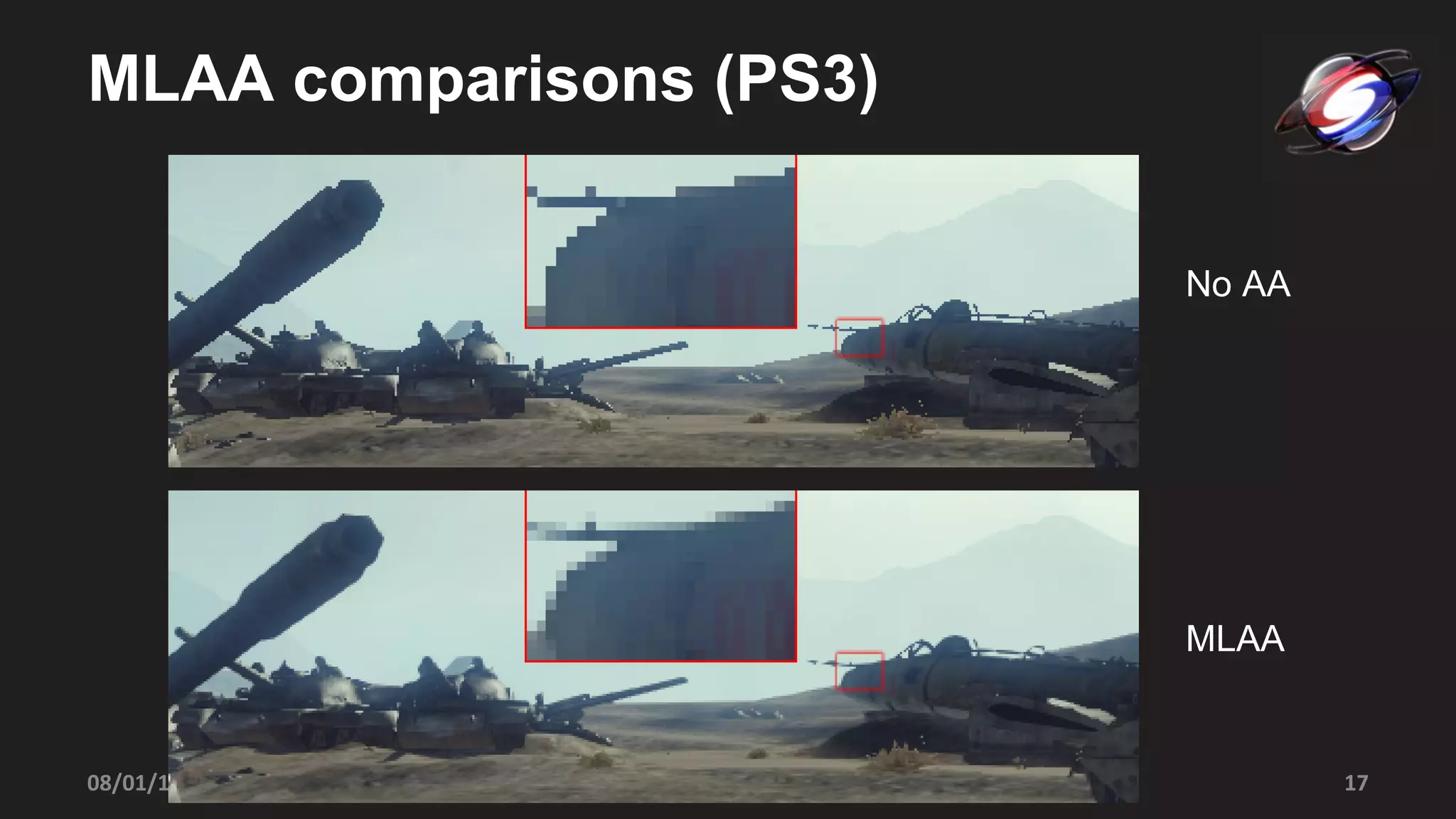
MLAA comparisons (PS3) Beyond Programmable Shading, SIGGRAPH 2010 08/01/10 No AA MLAA
MLAA takeaways Awesome AA for still pictures Moving pictures good, but: No sub-pixel information =  edges snap to pixels Doesn’t solve aliasing on  fine detail geometry Overall still a very good benefit! Focus/exclude effect  based on framebuffer alpha & thresholds Unique requirements per game/app Not good to use on some UI, mark in alpha (or apply before) Variable post-effect , trade perf vs quality! Beyond Programmable Shading, SIGGRAPH 2010 08/01/10
MLAA future (PC) GPU compute shader implementation Combine with MSAA & sub-pixel samples  Simple MSAA box filter downsampling is a big waste Sort of similar to  A Directionally Adaptive Edge Anti-Aliasing Filter   [Yang09] A must to reduce the edge snapping of pure MLAA Not fully clear how it should work (sample distribution) Beyond Programmable Shading, SIGGRAPH 2010 08/01/10
AMBIENT OCCLUSION
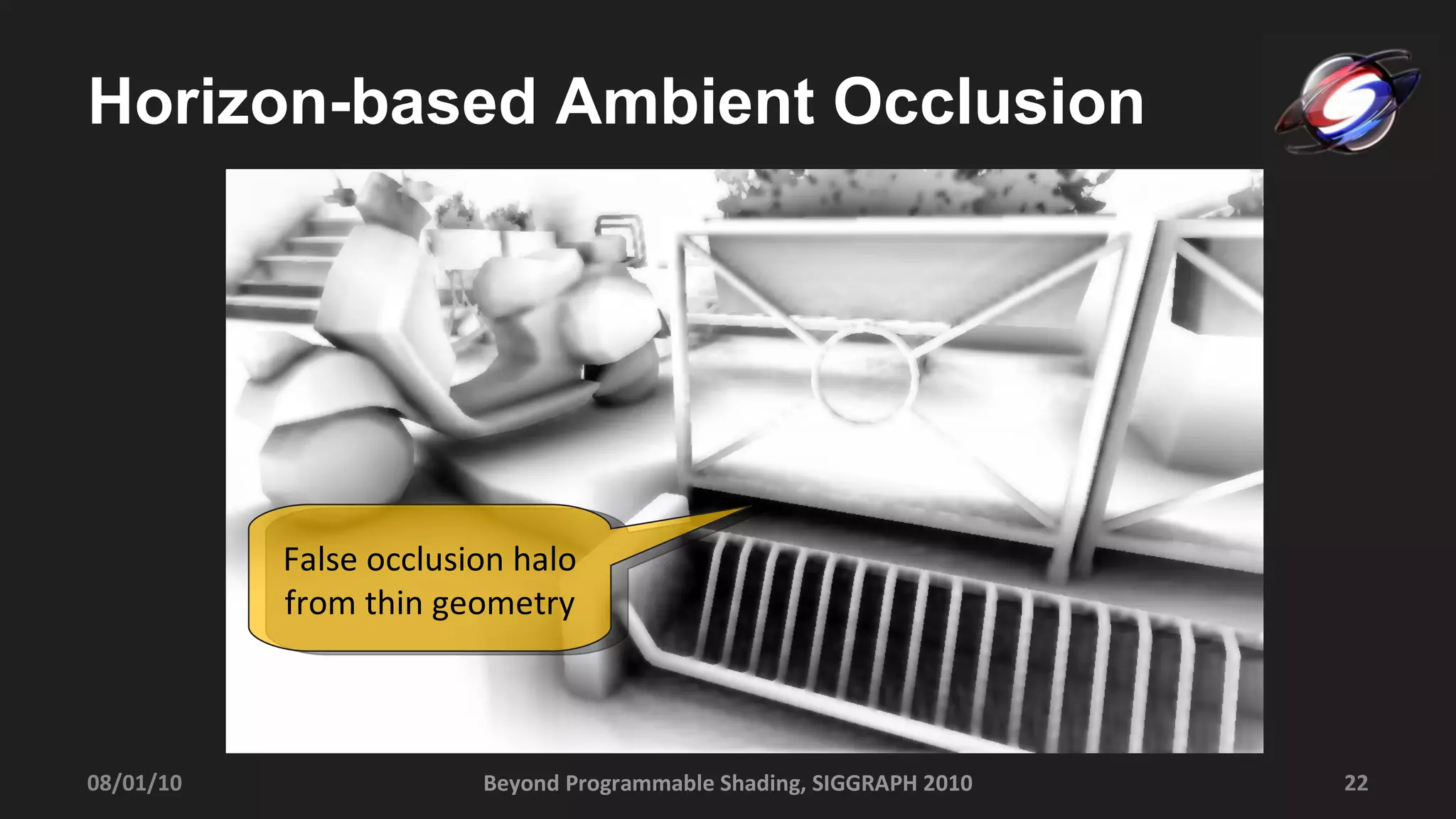
Current dynamic AO Horizon-based Ambient Occlusion   See  [Bavoil09]  for complete details Based on screen-space depth-buffer ( SSAO ) Very high quality sampling But only screen-space info is a big limitation Creates false occlusion artifacts Render in  half-res  for improved performance Bilateral upsampling  + gaussian blur  Can also do dual-resolution to reduce artifacts Beyond Programmable Shading, SIGGRAPH 2010 08/01/10
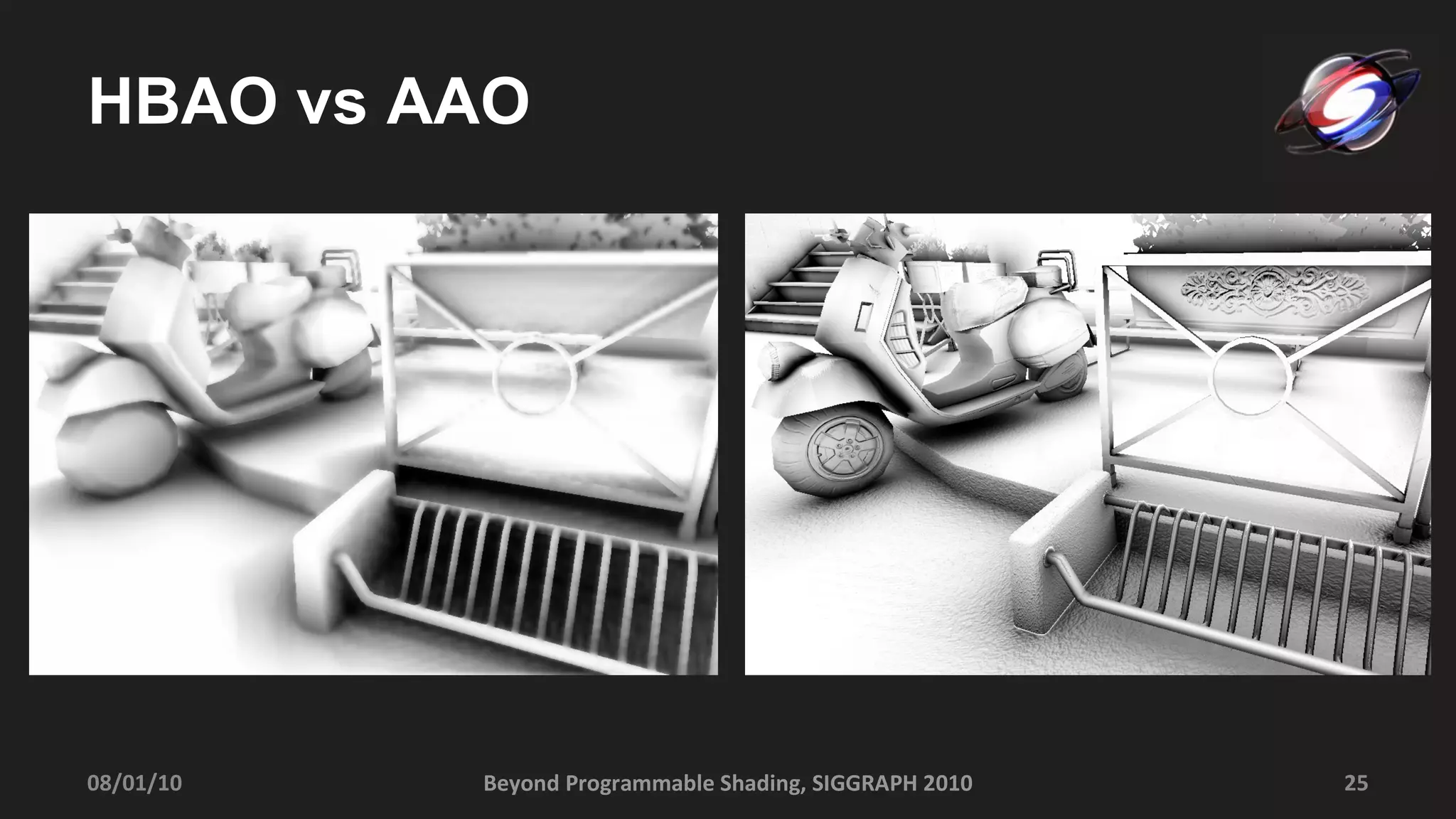
Horizon-based Ambient Occlusion Beyond Programmable Shading, SIGGRAPH 2010 08/01/10 False occlusion halo from thin geometry
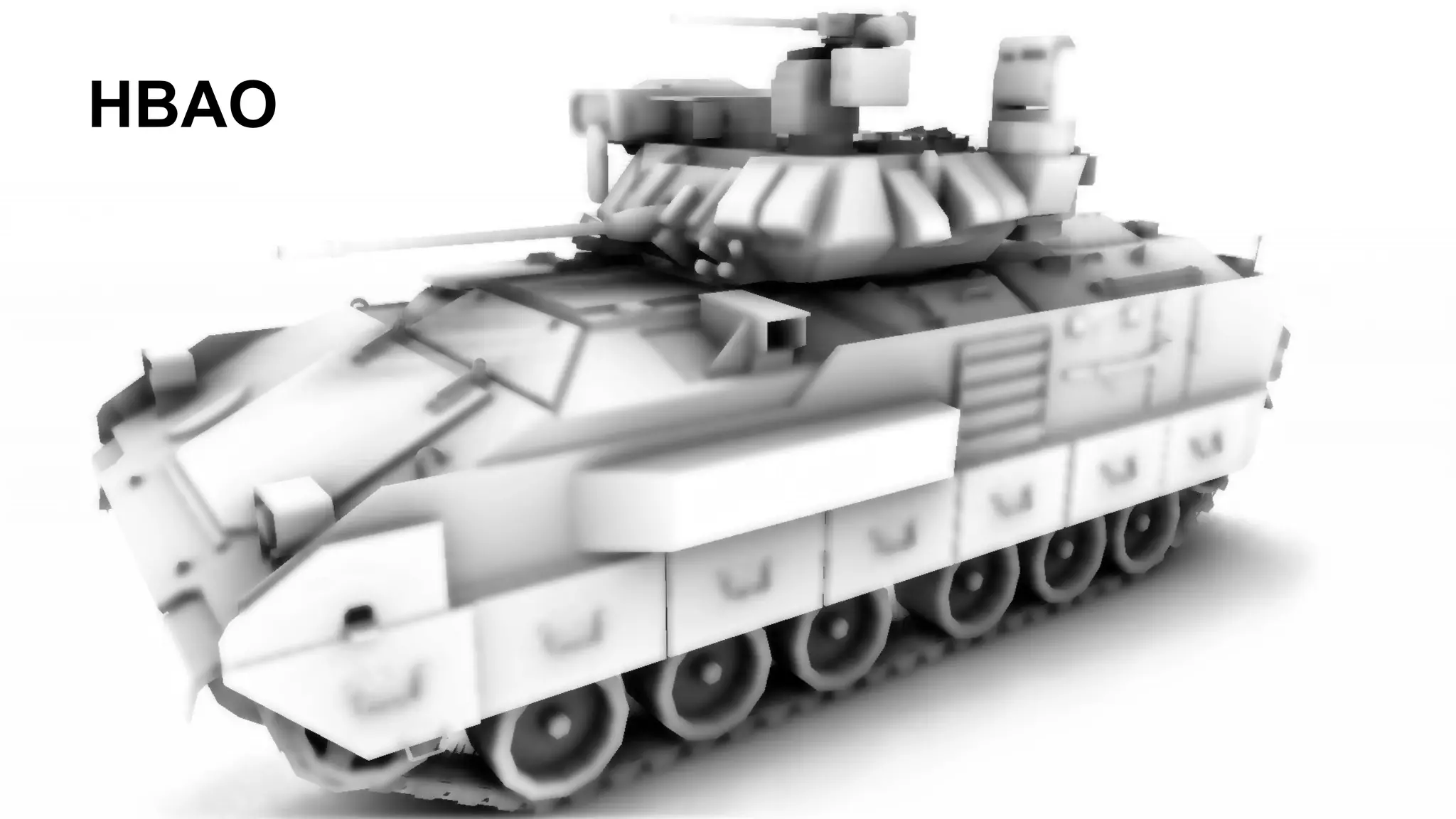
HBAO limitations False halo  occlusion artifacts around small geometry  Such as: fences & poles Extra visible when moving the camera Very  noisy sampling  for detailed zbuffers Common with alpha-tested foliage Difficult sampling problem Beyond Programmable Shading, SIGGRAPH 2010 08/01/10
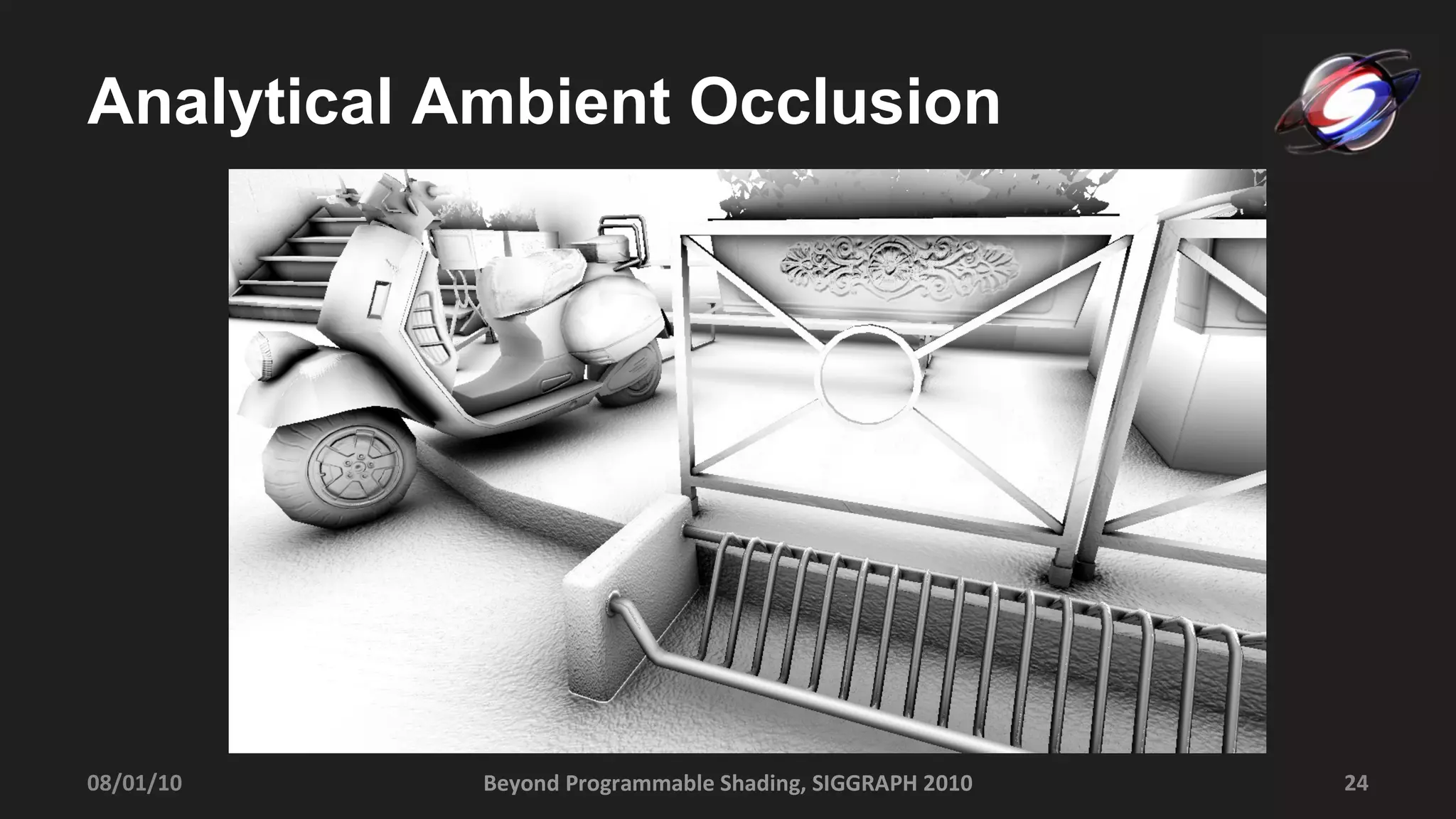
Analytical Ambient Occlusion Beyond Programmable Shading, SIGGRAPH 2010 08/01/10
HBAO vs AAO  Beyond Programmable Shading, SIGGRAPH 2010 08/01/10
Analytical Ambient Occlusion Using  Ambient Occlusion Volumes [McGuire10] Experimental implementation in  Frostbite 2 With some good help from Morgan McGuire and Louis Bavoil Geometry-based technique Not screen-space! Say what? Beyond Programmable Shading, SIGGRAPH 2010 08/01/10
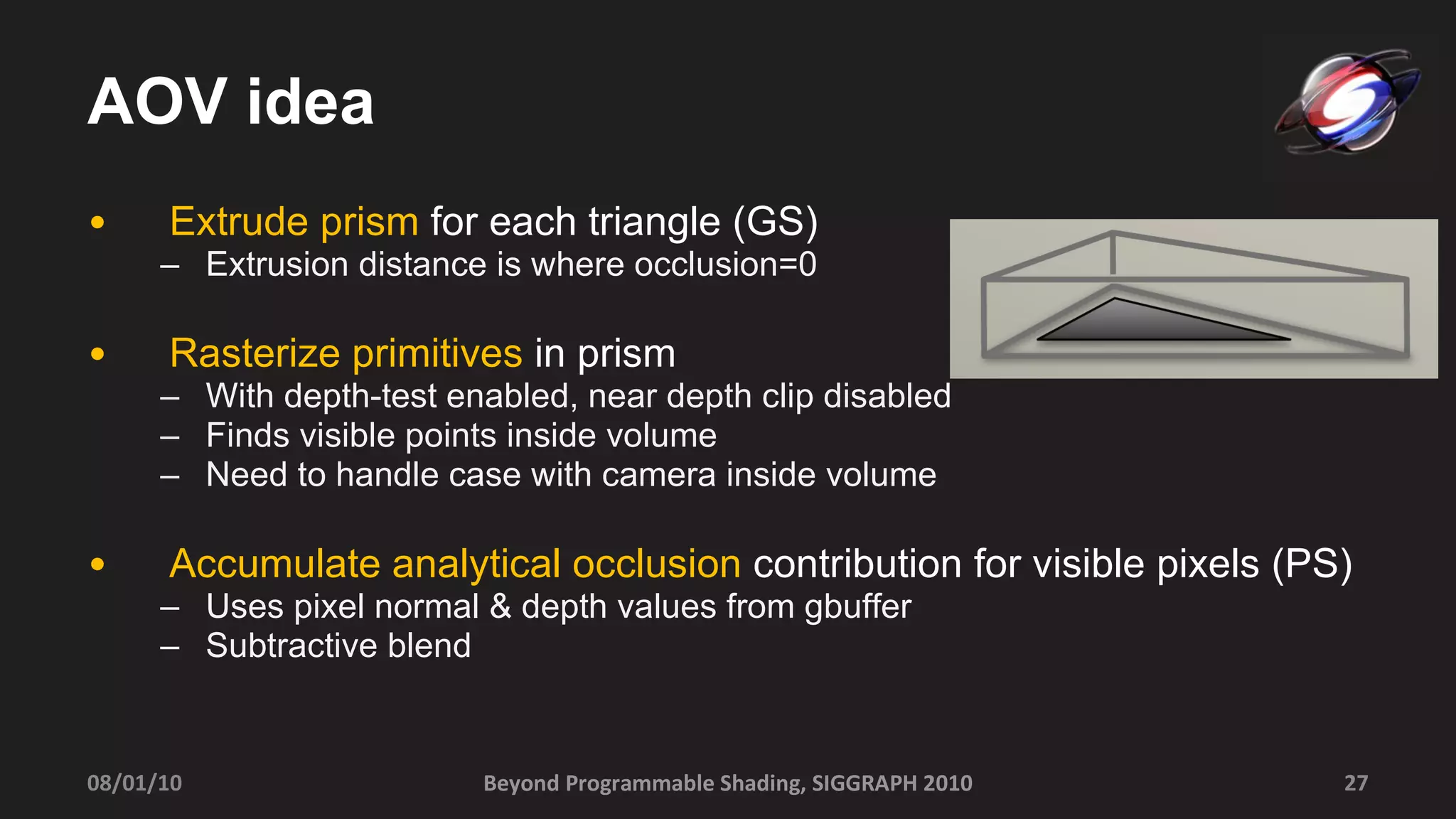
AOV idea Extrude prism  for each triangle (GS) Extrusion distance is where occlusion=0 Rasterize primitives  in prism With depth-test enabled, near depth clip disabled Finds visible points inside volume Need to handle case with camera inside volume Accumulate analytical occlusion  contribution for visible pixels (PS) Uses pixel normal & depth values from gbuffer Subtractive blend Beyond Programmable Shading, SIGGRAPH 2010 08/01/10
Beyond Programmable Shading, SIGGRAPH 2010 08/01/10 HBAO
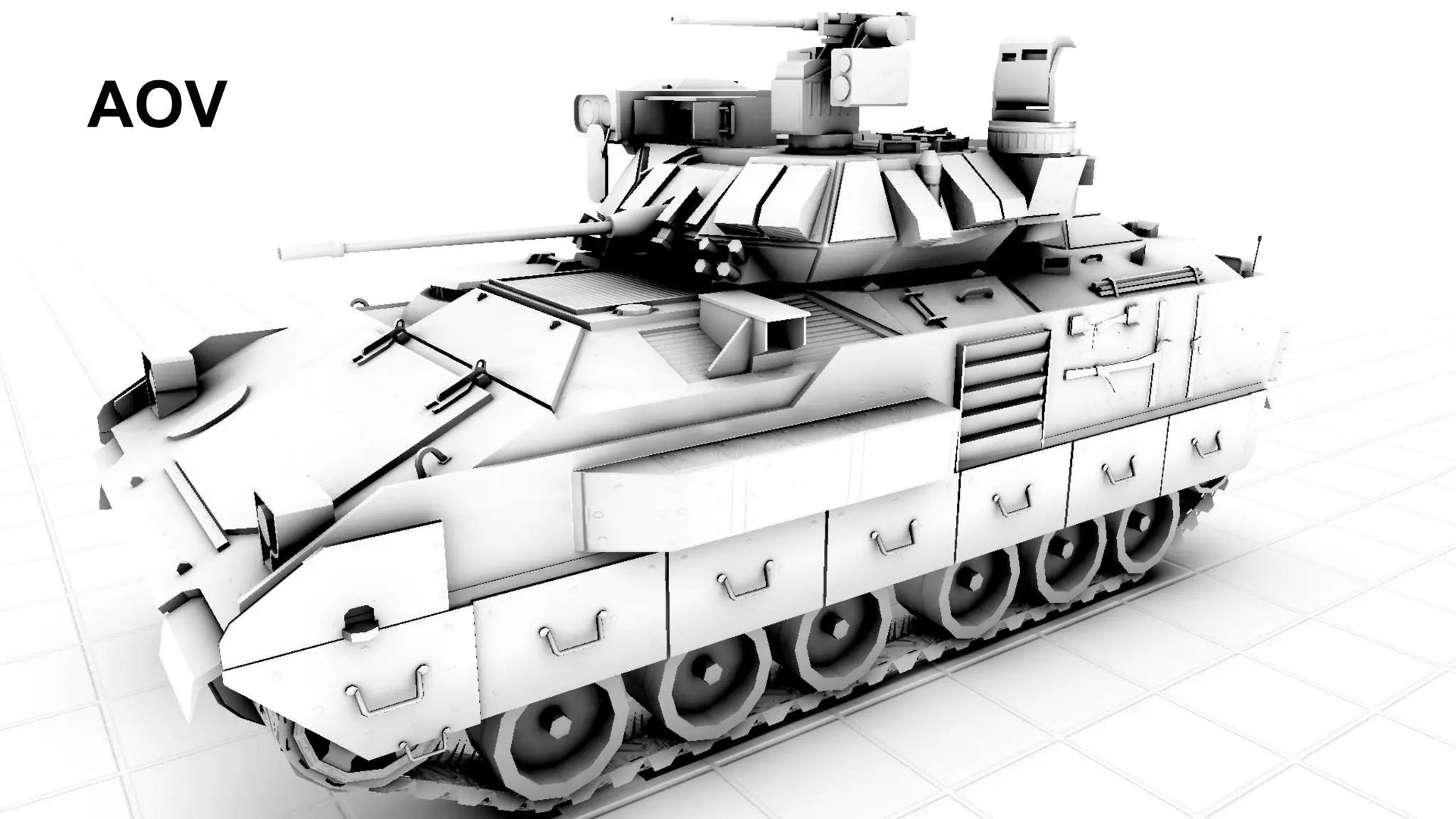
Beyond Programmable Shading, SIGGRAPH 2010 08/01/10 HBAO AOV
AOV in practice Render geometry again in  separate AO pass Uses depth & normal buffer from deferred rendering Half-res or lower  with bilateral upsampling Culling should consider extrusion distance Separate paths for dynamic & rigid objects Can  pre-compute  rigid extruded AOV & reduce overdraw Doesn’t work with  alpha-tested surfaces Simulate with per-surface or per-triangle approx. coverage factor Beyond Programmable Shading, SIGGRAPH 2010 08/01/10
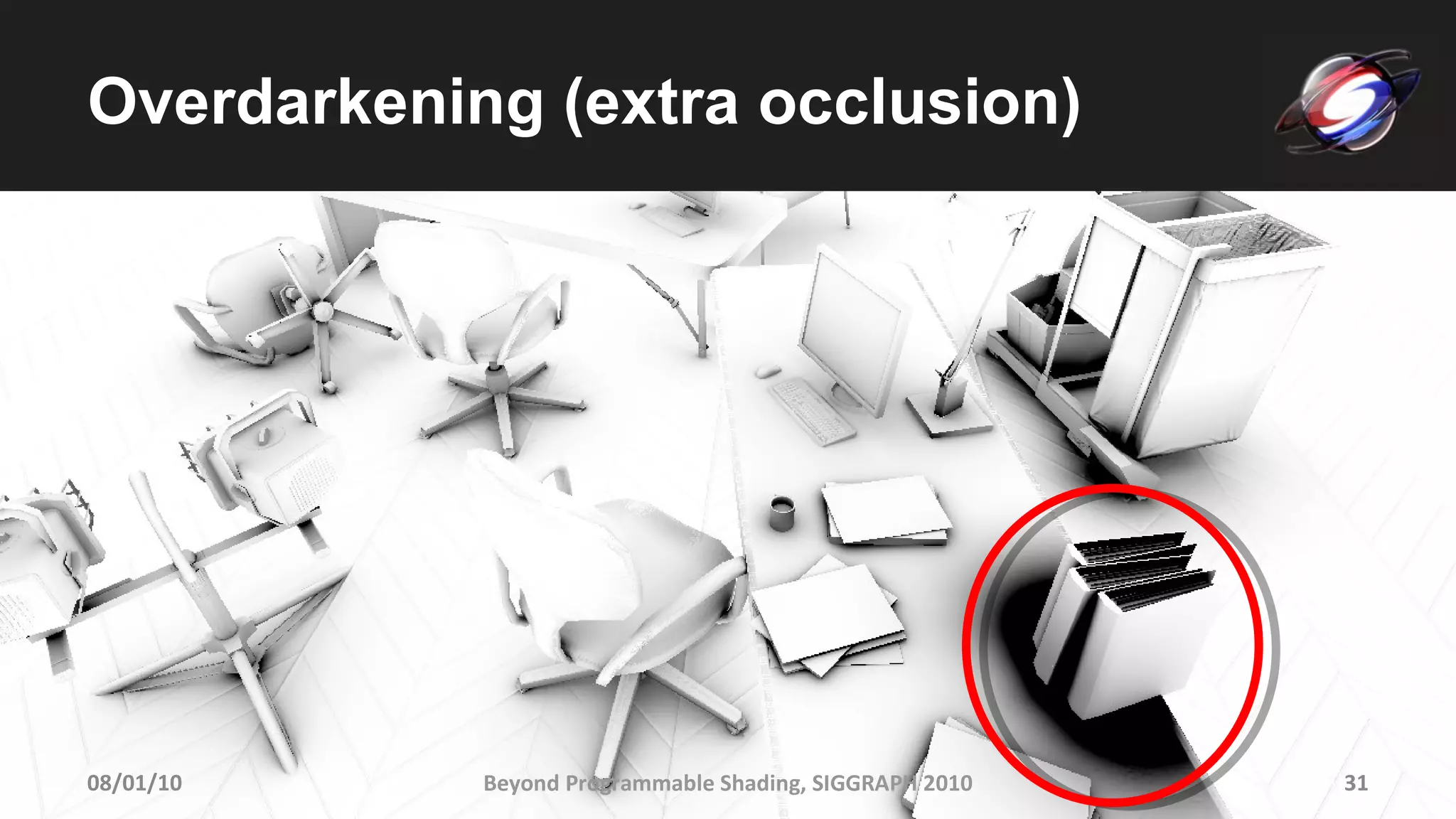
Overdarkening (extra occlusion) Beyond Programmable Shading, SIGGRAPH 2010 08/01/10
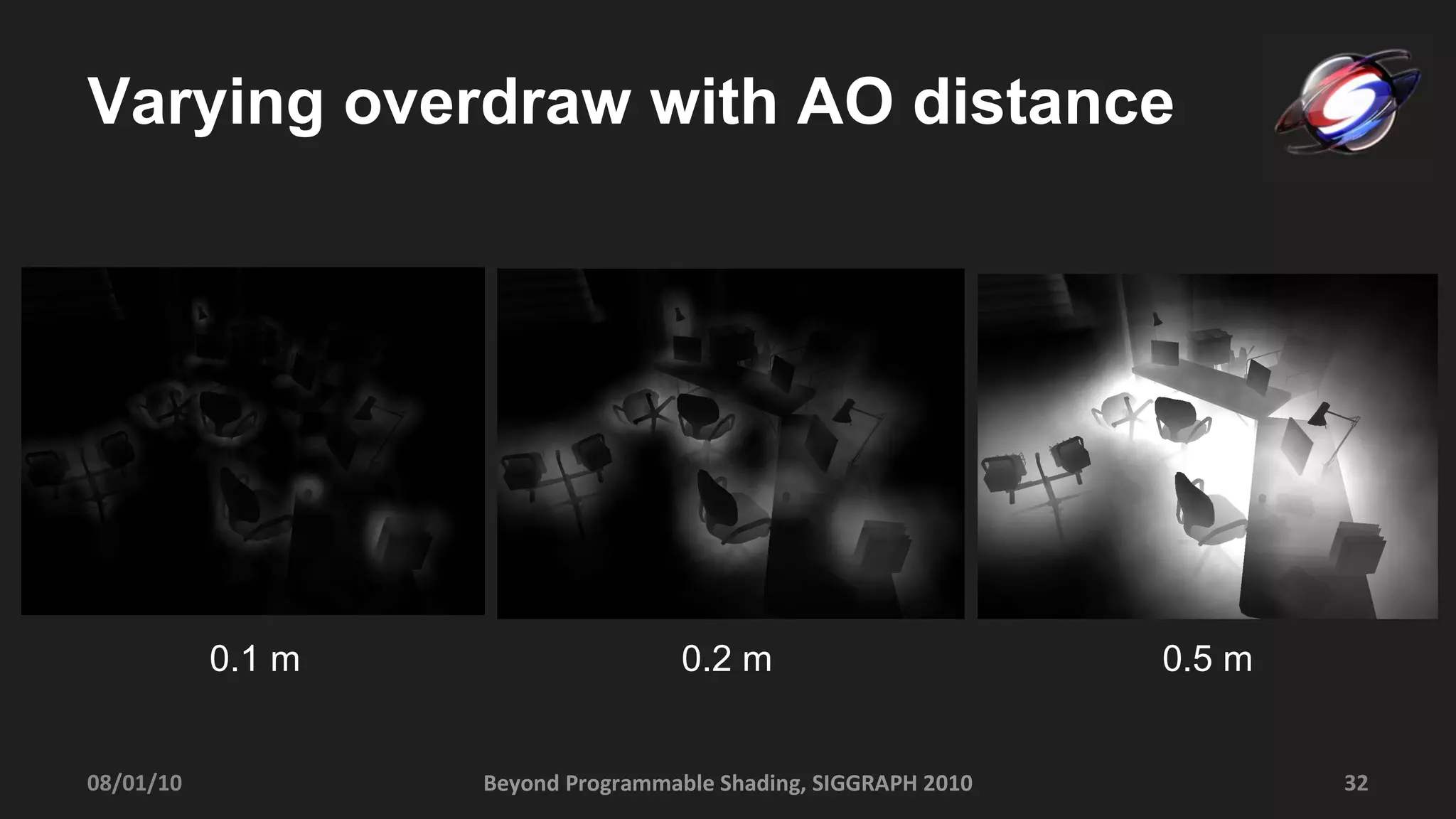
Varying overdraw with AO distance Beyond Programmable Shading, SIGGRAPH 2010 08/01/10 0.1 m 0.2 m 0.5 m
AOV pros & cons Pros: Very  high quality - close to raytracing ground truth Noise free (when full res) Perfectly stable with view changes Supports arbitrary dynamic polygon soups Cons: Requires massive fillrate Geometry cost Overdarkening, may require content tweaks Beyond Programmable Shading, SIGGRAPH 2010 08/01/10
AOV future optimizations Reduce the  massive overdraw Cull / restrict prisms that only extend out to empty air? Clamp screen-space prism size  Not correct, but practical tradeoff. HBAO does this More optimal prism geometry GS is limited to triangle strip output   Precompute using quads for rigid objects Geometry LOD / mix with higher-order geometry representations Also see AO volume texture & analytical capsule techniques  [Hill10] Beyond Programmable Shading, SIGGRAPH 2010 08/01/10
AOV takeaways Major improvement in visual quality compared to  SSAO Interesting use of geometry & rasterization pipelines Builds on existing HW-, SW- & content pipelines Quite simple brute force drop-in (but not as simple as  SSAO ) Siggraph interactive framerates™  today, but lots of potential: Performance  highly  dependent on occlusion distance Optimizations / less brute force? Use for high-end / reference / precompute / beauty shots initially Beyond Programmable Shading, SIGGRAPH 2010 08/01/10
Conclusions New graphics pipeline usages are opened up with improved HW performance Often not efficient to do with pure compute Continue to give us more performance & bandwidth! We need to continue to break down some fixed graphics pipeline barriers  08/01/10 Beyond Programmable Shading, SIGGRAPH 2010
Acknowledgments Morgan McGuire Louis Bavoil David Luebke Andrew Lauritzen Robert Kihl Christina Coffin SCEE Beyond Programmable Shading, SIGGRAPH 2010 08/01/10
Questions? email:  [email_address] blog:  http://repi.se twitter:  @repi For more DICE talks: http://publications.dice.se Beyond Programmable Shading, SIGGRAPH 2010 08/01/10
References [Andersson09] Johan Andersson, “Parallel Graphics in Frostbite - Current & Future”, Beyond Programmable Shading Course – Siggraph 2009  http://s09.idav.ucdavis.edu / [Lalonde09] Paul Lalonde “Innovating in a Software Graphics Pipeline” Beyond Programmable Shading Course – Siggraph 2009  http:// s09.idav.ucdavis.edu/ [Reshetov09] Alexander Reshetov, ”Morphological Antialiasing” [Yang09] Jason C. Yang et al, High Performance Graphics 2009, ” A Directionally Adaptive Edge Anti-Aliasing Filter” [McGuire10] Morgan McGuire, High Performance Graphics 2010, ”Ambient Occlusion Volumes”  http://graphics.cs.williams.edu/papers/AOVHPG10/ [Biri10]  Venceslas Biri et al,  Siggraph 2010, “Practical morphological antialiasing on the GPU” [Bavoil08] Louis Bavoil & Miguel Sainz, Siggraph 2008 “ Image-Space Horizon-Based Ambient Occlusion”   http://developer.nvidia.com/object/siggraph-2008-HBAO.html [Hill10] Stephen Hill, Game Developers Conference 2010 ”Rendering with Conviction” [Kihl10] Robert Kihl, Advanced in Real-time Rendering in 3D Graphics and Games, Siggraph 2010, ”Destruction Masking in Frostbite 2 using Volume Distance Fields”  http://publications.dice.se [Sugerman09]  Jeremy  Sugerman et al  -  ACM Transactions on Graphics January, 2009  ”GRAMPS: A Programming Model for Graphics Pipelines”  http://graphics.stanford.edu/papers/gramps-tog/ [Perthuis10] Cedric Perthuis, ”MLAA in God of War 3” (PS3 registered developers only) Beyond Programmable Shading, SIGGRAPH 2010 08/01/10

Bending the Graphics Pipeline

  • 1.
    Bending the GraphicsPipeline Johan Andersson DICE
  • 2.
    Overview Give ataste of a few rendering techniques we are using & experimenting with how they interact, or would like to interact, with the graphics pipeline Tile-based Deferred Shading Morphological Antialiasing Analytical Ambient Occlusion 08/01/10 Beyond Programmable Shading, SIGGRAPH 2010
  • 3.
  • 4.
    Tile-based deferred shadingTile-based culling & lighting Cull lights per screen-space tile Lighting kernel runs per tile Minimizes bandwidth/setup cost DX11: GPU compute shader Covered in the course last year [Andersson09] PS3: SPU jobs GPU renders gbuffer SPU does light culling & full lighting evaluation for each pixel 08/01/10 Beyond Programmable Shading, SIGGRAPH 2010
  • 5.
    Standard phong MetallicSkin Translucent Multiple deferred lighting models Beyond Programmable Shading, SIGGRAPH 2010 08/01/10
  • 6.
    Working with tilesTile culling optimizations Cull lights & shadows with tile normal cone Detect tile specular=0 Detect tile lighting model Tile lighting kernel permutations Specular on/off Lighting models More in the future Beyond Programmable Shading, SIGGRAPH 2010 08/01/10
  • 7.
    SPU-based Deferred ShadingPorted DX11 compute shader to SPU job Offloads PS3 GPU SPU processing in parallel with GPU rendering 32x16 pixel tiles Explicit SoA vectorization instead of implicit C/C++ on SPU - HLSL on GPU Not a problem for such a relative small kernel But not ideal data-parallel programming model Beyond Programmable Shading, SIGGRAPH 2010 08/01/10
  • 8.
    SPU vs GPUarchitecture 6 execution contexts vs 1+ million (each pixel) Explicit SIMD vs implicit SIMD C/C++ vs HLSL Explicit async DMA vs implicit latency hiding What can we learn? Beyond Programmable Shading, SIGGRAPH 2010 08/01/10
  • 9.
    Issues & challengesgoing forward More lighting models SIMD & branching efficiency Transparent decal surfaces & volumes Fixed function blending doesn’t work well with deferred Higher-quality antialiasing Beyond Programmable Shading, SIGGRAPH 2010 08/01/10
  • 10.
    Flexible lighting modelsWant both more & more flexible models: Custom gbuffer layout per material Quality & performance tradeoffs Examples: Hair / anisotropic materials Requires more lighting model parameters in gbuffer Foliage Massive overdraw with alpha-tested simple shaders, few parameters Write to as simple gbuffer as possible to reduce ROP/bandwidth bottleneck Skin Sub-surface scattering approximation Beyond Programmable Shading, SIGGRAPH 2010 08/01/10
  • 11.
    The SIMD efficiencyproblem Lighting models through dynamic branches GPU shader model can be problematic: Increased register pressure = overall slower shader Requires good screen-space SIMD coherency for performance win Potential solutions: Reshuffle pixels to improve coherency ? Within each tile, sort pixels by model, compute lighting & then scatter back GRAMPS -style queing? [Sugerman09] Attractive & powerful high-level programming model Beyond Programmable Shading, SIGGRAPH 2010 08/01/10 Alpha-tested foliage has far from ideal coherency
  • 12.
    Decals & deferredshading Decals blend selectively against gbuffer Include: Diffuse albedo (gbuffer1.rgb) Normal (gbuffer0.rgb) Want to include (but can’t in single pass): Specular albedo (gbuffer1.a) Specular smoothness (gbuffer0.a) Exclude: Material id (can’t blend) Object lighting (inherit from below surface) Fixed function blending doesn’t work well Pixel shader can’t write out both alpha & blend factor! Consoles doesn’t have blend mode per MRT Linear blend doesn’t work for all components Beyond Programmable Shading, SIGGRAPH 2010 08/01/10 See Destruction Masking in Frostbite 2 using Volume Distance Fields [Kihl10] for more details about decal use case
  • 13.
    Need programmableblending Benefits: Write out gbuffer alpha channels indepenently of blend factor Treat channels & targets however you see fit Non-linear blending & renormalizing blends Can do overlapping dependent blending Read current normal, add bumps relative to it, write out What approach? LRB-style pixel shader framebuffer read/modify/write [Lalonde09] Ideal general solution for developers How to hide synchronization latency? Implicit / explicit? Blend shader Yet another stage in a fixed pipeline No R/M/W, not ideal More? Beyond Programmable Shading, SIGGRAPH 2010 08/01/10
  • 14.
    The deferred shading+ MSAA problem Huge storage & bandwidth requirements with deferred 1920 x 1080 x 5 x 4 x 4 = 165 MB Doesn’t scale! Adding 1 bit of precision = 2x more memory 4x MSAA is not enough Esp. for thin geometry in a distance Prohibitive performance and bandwidth in general with deferred shading But don’t miss Andrew Lauritzen’s talk later in the course: Deferred Rendering for Current and Future Rendering Pipelines There are alternatives to MSAA... Beyond Programmable Shading, SIGGRAPH 2010 08/01/10
  • 15.
    MLAA – MorphologicalAntialiasing Post-effect antialiasing Introduced in [Reshetov09] Implementations: Intel CPU reference implementation [Reshetov09] Sony PS3 SPU implementation [Perthuis10] GPU compute? [Biri10] Beyond Programmable Shading, SIGGRAPH 2010 08/01/10
  • 16.
    MLAA workings BeyondProgrammable Shading, SIGGRAPH 2010 08/01/10 From [Reshetov09]
  • 17.
    MLAA comparisons (PS3)Beyond Programmable Shading, SIGGRAPH 2010 08/01/10 No AA MLAA
  • 18.
    MLAA takeaways AwesomeAA for still pictures Moving pictures good, but: No sub-pixel information = edges snap to pixels Doesn’t solve aliasing on fine detail geometry Overall still a very good benefit! Focus/exclude effect based on framebuffer alpha & thresholds Unique requirements per game/app Not good to use on some UI, mark in alpha (or apply before) Variable post-effect , trade perf vs quality! Beyond Programmable Shading, SIGGRAPH 2010 08/01/10
  • 19.
    MLAA future (PC)GPU compute shader implementation Combine with MSAA & sub-pixel samples Simple MSAA box filter downsampling is a big waste Sort of similar to A Directionally Adaptive Edge Anti-Aliasing Filter [Yang09] A must to reduce the edge snapping of pure MLAA Not fully clear how it should work (sample distribution) Beyond Programmable Shading, SIGGRAPH 2010 08/01/10
  • 20.
  • 21.
    Current dynamic AOHorizon-based Ambient Occlusion See [Bavoil09] for complete details Based on screen-space depth-buffer ( SSAO ) Very high quality sampling But only screen-space info is a big limitation Creates false occlusion artifacts Render in half-res for improved performance Bilateral upsampling + gaussian blur Can also do dual-resolution to reduce artifacts Beyond Programmable Shading, SIGGRAPH 2010 08/01/10
  • 22.
    Horizon-based Ambient OcclusionBeyond Programmable Shading, SIGGRAPH 2010 08/01/10 False occlusion halo from thin geometry
  • 23.
    HBAO limitations Falsehalo occlusion artifacts around small geometry Such as: fences & poles Extra visible when moving the camera Very noisy sampling for detailed zbuffers Common with alpha-tested foliage Difficult sampling problem Beyond Programmable Shading, SIGGRAPH 2010 08/01/10
  • 24.
    Analytical Ambient OcclusionBeyond Programmable Shading, SIGGRAPH 2010 08/01/10
  • 25.
    HBAO vs AAO Beyond Programmable Shading, SIGGRAPH 2010 08/01/10
  • 26.
    Analytical Ambient OcclusionUsing Ambient Occlusion Volumes [McGuire10] Experimental implementation in Frostbite 2 With some good help from Morgan McGuire and Louis Bavoil Geometry-based technique Not screen-space! Say what? Beyond Programmable Shading, SIGGRAPH 2010 08/01/10
  • 27.
    AOV idea Extrudeprism for each triangle (GS) Extrusion distance is where occlusion=0 Rasterize primitives in prism With depth-test enabled, near depth clip disabled Finds visible points inside volume Need to handle case with camera inside volume Accumulate analytical occlusion contribution for visible pixels (PS) Uses pixel normal & depth values from gbuffer Subtractive blend Beyond Programmable Shading, SIGGRAPH 2010 08/01/10
  • 28.
    Beyond Programmable Shading,SIGGRAPH 2010 08/01/10 HBAO
  • 29.
    Beyond Programmable Shading,SIGGRAPH 2010 08/01/10 HBAO AOV
  • 30.
    AOV in practiceRender geometry again in separate AO pass Uses depth & normal buffer from deferred rendering Half-res or lower with bilateral upsampling Culling should consider extrusion distance Separate paths for dynamic & rigid objects Can pre-compute rigid extruded AOV & reduce overdraw Doesn’t work with alpha-tested surfaces Simulate with per-surface or per-triangle approx. coverage factor Beyond Programmable Shading, SIGGRAPH 2010 08/01/10
  • 31.
    Overdarkening (extra occlusion)Beyond Programmable Shading, SIGGRAPH 2010 08/01/10
  • 32.
    Varying overdraw withAO distance Beyond Programmable Shading, SIGGRAPH 2010 08/01/10 0.1 m 0.2 m 0.5 m
  • 33.
    AOV pros &cons Pros: Very high quality - close to raytracing ground truth Noise free (when full res) Perfectly stable with view changes Supports arbitrary dynamic polygon soups Cons: Requires massive fillrate Geometry cost Overdarkening, may require content tweaks Beyond Programmable Shading, SIGGRAPH 2010 08/01/10
  • 34.
    AOV future optimizationsReduce the massive overdraw Cull / restrict prisms that only extend out to empty air? Clamp screen-space prism size Not correct, but practical tradeoff. HBAO does this More optimal prism geometry GS is limited to triangle strip output  Precompute using quads for rigid objects Geometry LOD / mix with higher-order geometry representations Also see AO volume texture & analytical capsule techniques [Hill10] Beyond Programmable Shading, SIGGRAPH 2010 08/01/10
  • 35.
    AOV takeaways Majorimprovement in visual quality compared to SSAO Interesting use of geometry & rasterization pipelines Builds on existing HW-, SW- & content pipelines Quite simple brute force drop-in (but not as simple as SSAO ) Siggraph interactive framerates™ today, but lots of potential: Performance highly dependent on occlusion distance Optimizations / less brute force? Use for high-end / reference / precompute / beauty shots initially Beyond Programmable Shading, SIGGRAPH 2010 08/01/10
  • 36.
    Conclusions New graphicspipeline usages are opened up with improved HW performance Often not efficient to do with pure compute Continue to give us more performance & bandwidth! We need to continue to break down some fixed graphics pipeline barriers 08/01/10 Beyond Programmable Shading, SIGGRAPH 2010
  • 37.
    Acknowledgments Morgan McGuireLouis Bavoil David Luebke Andrew Lauritzen Robert Kihl Christina Coffin SCEE Beyond Programmable Shading, SIGGRAPH 2010 08/01/10
  • 38.
    Questions? email: [email_address] blog: http://repi.se twitter: @repi For more DICE talks: http://publications.dice.se Beyond Programmable Shading, SIGGRAPH 2010 08/01/10
  • 39.
    References [Andersson09] JohanAndersson, “Parallel Graphics in Frostbite - Current & Future”, Beyond Programmable Shading Course – Siggraph 2009 http://s09.idav.ucdavis.edu / [Lalonde09] Paul Lalonde “Innovating in a Software Graphics Pipeline” Beyond Programmable Shading Course – Siggraph 2009 http:// s09.idav.ucdavis.edu/ [Reshetov09] Alexander Reshetov, ”Morphological Antialiasing” [Yang09] Jason C. Yang et al, High Performance Graphics 2009, ” A Directionally Adaptive Edge Anti-Aliasing Filter” [McGuire10] Morgan McGuire, High Performance Graphics 2010, ”Ambient Occlusion Volumes” http://graphics.cs.williams.edu/papers/AOVHPG10/ [Biri10] Venceslas Biri et al, Siggraph 2010, “Practical morphological antialiasing on the GPU” [Bavoil08] Louis Bavoil & Miguel Sainz, Siggraph 2008 “ Image-Space Horizon-Based Ambient Occlusion” http://developer.nvidia.com/object/siggraph-2008-HBAO.html [Hill10] Stephen Hill, Game Developers Conference 2010 ”Rendering with Conviction” [Kihl10] Robert Kihl, Advanced in Real-time Rendering in 3D Graphics and Games, Siggraph 2010, ”Destruction Masking in Frostbite 2 using Volume Distance Fields” http://publications.dice.se [Sugerman09] Jeremy Sugerman et al - ACM Transactions on Graphics January, 2009 ”GRAMPS: A Programming Model for Graphics Pipelines” http://graphics.stanford.edu/papers/gramps-tog/ [Perthuis10] Cedric Perthuis, ”MLAA in God of War 3” (PS3 registered developers only) Beyond Programmable Shading, SIGGRAPH 2010 08/01/10

Editor's Notes

  • #9 Register pressure not an issue for SPU
  • #11 Foliage: Can’t switch render targets for each draw call to fewer gbuffers, flushes GPU pipeline
  • #17 Detect separation lines, detect feature patterns and based on those blend in the ideal coverage
  • #19 Standard MSAA box filter resolve is naive
  • #20 Standard MSAA box filter resolve is naive
  • #32 Artists that are aware of the algorithm and this problem should be able to work around it in the content in most cases. Could potentially also have them select ór paint which triangles & vertices that should contribute and/or the actual extrusion length on them
  • #37 Deferred shading hits a major memory / BW wall with MSAA and OIT