DATA COMMUNICATION
 A Computer network is a number if computers
interconnected by one or more transmission paths.
 The transmission path often is the telephone line, due to its
convenience and universal preserve.
DATA COMMUNICATION
 Data Communication is the exchange of data (in the form
of O’s and 1s) between two devices via some form of
transmission medium (such as a wire cable).
TYPES OF DATA COMMUNICATION
Data Communication is considered
 Local – if the communicating device are in the same
building.
 Remote – if the device are farther apart.
THE DIFFERENCE BETWEEN DATA
AND INFORMATION
 Data: is a representation of facts, concepts and instructions presented
in a formalized manner suitable for communication, interpretation or
processing by human beings or by automatic means.
 Information: is currently assigned to data by means by the
conventions applied to those data.
FUNDAMENTAL CHARACTERISTICS OF
DATA COMMUNICATION
The effectiveness of a data communication system depends on three characteristics.
 Delivery: The system must deliver data to the correct destination.
 Accuracy: The system must deliver data accurately.
 Timeliness: The system must deliver data in a timely manner.
 Jitter : Jitter refers to the variation in packet arrival time.
COMPONENTS OF DATA
COMMUNICATION
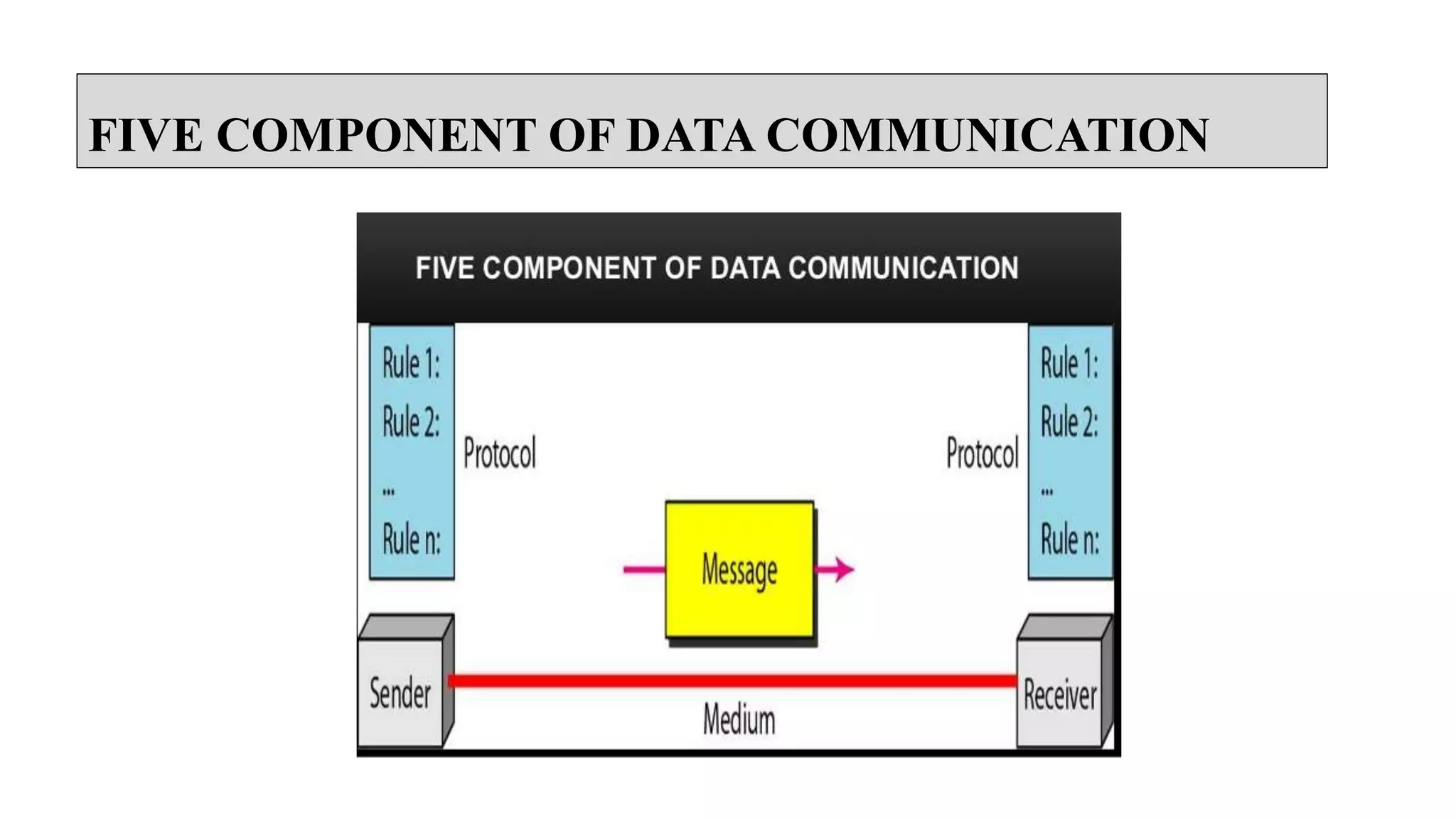
FIVE COMPONENT OF DATA COMMUNICATION
THE MESSAGE
 This is the information (Data)to be communicated; it may
be an image, text, number, Audio, or Video.
THE SENDER
The sender is device or person that sends the data. It can be
sent using a computer, telephone, or camera.
THE RECEIVER
 The receiver is device or person that receives the data. It
can be received whether by using a telephone, computer,
television.
TRANSMISSION MEDIA
 The physical path by which massage travel from source to
destination(sender to receiver) example –twisted pair,
coaxial cable, fiber optic, radio waves.
PROTOCOL
 A protocol is set of rules that govern data communication.
 It provide agreement between sender and receiver devices
DATA FLOW
1. Simplex : Communication is unidirectional i.e. TV signal
2. Half Duplex : Either direction but only one way at a time
i.e. waki toki
3. Full Duplex : Both direction at same time. i.e. Phone
IN DATA COMMUNICATION FOUR BASIC TERMS
ARE FREQUENTLY USED
In data communication four basic terms are frequently used. They are:
 Data : A collection of facts in raw forms that become information after
processing.
 Signals : Electric or electromagnetic encoding of data.
 Signaling : Propagation of signals across a communication medium.
Transmission : Communication of data achieved by the processing of signals.
THANK YOU

Basic introduction on data communication

  • 1.
  • 2.
     A Computernetwork is a number if computers interconnected by one or more transmission paths.  The transmission path often is the telephone line, due to its convenience and universal preserve.
  • 3.
    DATA COMMUNICATION  DataCommunication is the exchange of data (in the form of O’s and 1s) between two devices via some form of transmission medium (such as a wire cable).
  • 4.
    TYPES OF DATACOMMUNICATION Data Communication is considered  Local – if the communicating device are in the same building.  Remote – if the device are farther apart.
  • 5.
    THE DIFFERENCE BETWEENDATA AND INFORMATION  Data: is a representation of facts, concepts and instructions presented in a formalized manner suitable for communication, interpretation or processing by human beings or by automatic means.  Information: is currently assigned to data by means by the conventions applied to those data.
  • 6.
    FUNDAMENTAL CHARACTERISTICS OF DATACOMMUNICATION The effectiveness of a data communication system depends on three characteristics.  Delivery: The system must deliver data to the correct destination.  Accuracy: The system must deliver data accurately.  Timeliness: The system must deliver data in a timely manner.  Jitter : Jitter refers to the variation in packet arrival time.
  • 7.
  • 8.
    FIVE COMPONENT OFDATA COMMUNICATION
  • 9.
    THE MESSAGE  Thisis the information (Data)to be communicated; it may be an image, text, number, Audio, or Video.
  • 10.
    THE SENDER The senderis device or person that sends the data. It can be sent using a computer, telephone, or camera.
  • 11.
    THE RECEIVER  Thereceiver is device or person that receives the data. It can be received whether by using a telephone, computer, television.
  • 12.
    TRANSMISSION MEDIA  Thephysical path by which massage travel from source to destination(sender to receiver) example –twisted pair, coaxial cable, fiber optic, radio waves.
  • 13.
    PROTOCOL  A protocolis set of rules that govern data communication.  It provide agreement between sender and receiver devices
  • 14.
    DATA FLOW 1. Simplex: Communication is unidirectional i.e. TV signal 2. Half Duplex : Either direction but only one way at a time i.e. waki toki 3. Full Duplex : Both direction at same time. i.e. Phone
  • 15.
    IN DATA COMMUNICATIONFOUR BASIC TERMS ARE FREQUENTLY USED In data communication four basic terms are frequently used. They are:  Data : A collection of facts in raw forms that become information after processing.  Signals : Electric or electromagnetic encoding of data.  Signaling : Propagation of signals across a communication medium. Transmission : Communication of data achieved by the processing of signals.
  • 16.