Download to read offline

![BACKEND STORIES 13
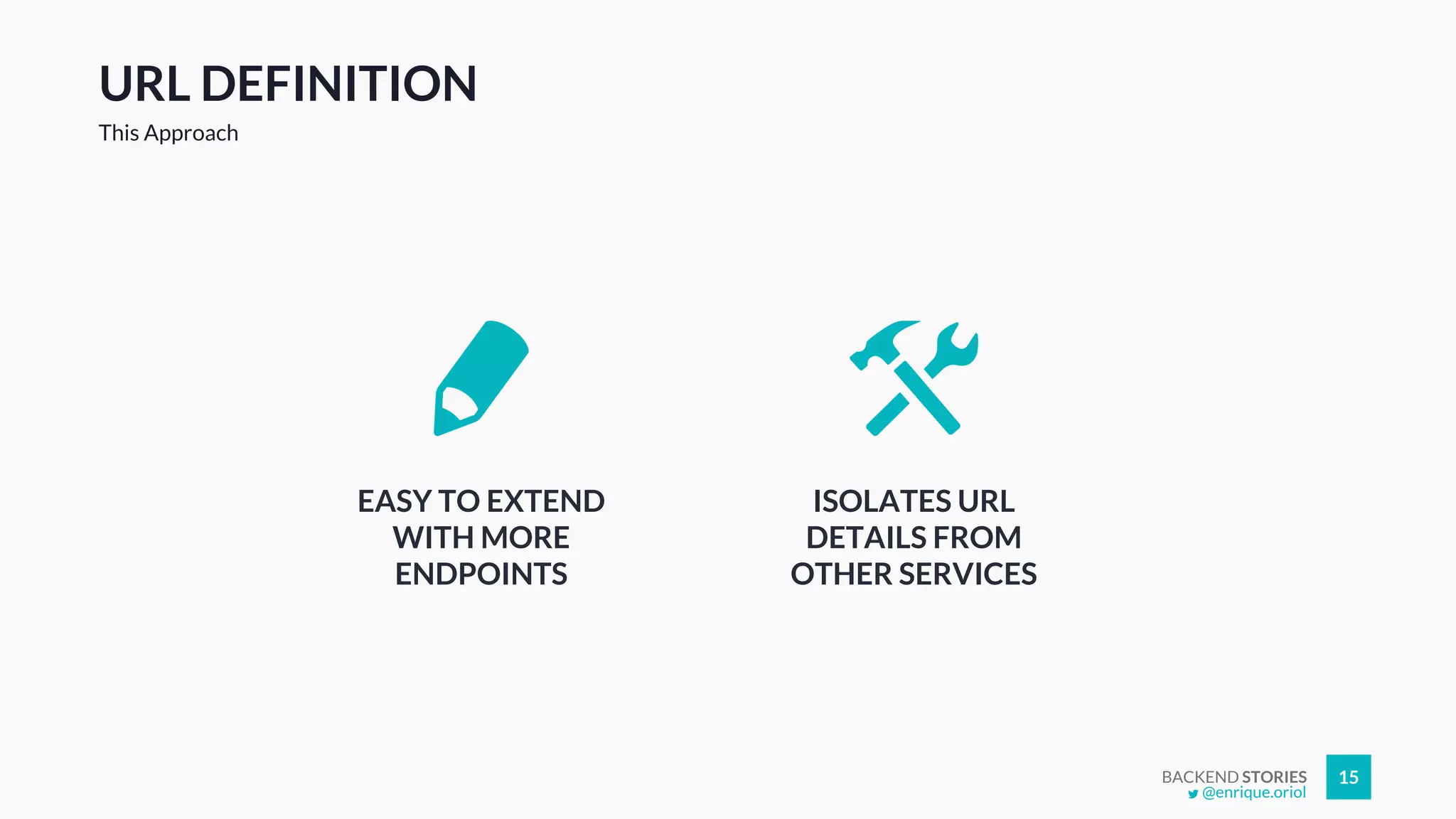
URL DEFINITION
app/services/url/URLModule.js
angular.module('userRanking.urlsModule', [])
.constant('urlConst', (function(){
var protocol = 'http://';
var domain = 'www.userRanking.com';
var base = '/api';
var version = '/v1';
var placeholders = {
userId: '[userId]'
}
return {
user: protocol + domain + base + version + '/user/' + placeholders.userId,
users: protocol + domain + base + version + '/users',
placeholders: placeholders
};
})())
@enrique.oriol](https://image.slidesharecdn.com/backend-without-backend-160225180002/75/How-to-build-an-AngularJS-backend-ready-app-WITHOUT-BACKEND-13-2048.jpg)
![BACKEND STORIES 14
URL DEFINITION
app/services/url/URLModule.js
.factory('urls', ['urlConst', function(urlConst){
var urls = angular.copy(urlConst);
var replacePlaceholders = function(url, placeholders){
for(var key in placeholders){
url = url.replace(urlConst.placeholders[key], placeholders[key]);
}
return url;
};
//generate dinamic urls here
urls.user = function(id){
return replacePlaceholders(urlConst.user, {userId: id});
};
return urls;
}]);
@enrique.oriol](https://image.slidesharecdn.com/backend-without-backend-160225180002/75/How-to-build-an-AngularJS-backend-ready-app-WITHOUT-BACKEND-14-2048.jpg)

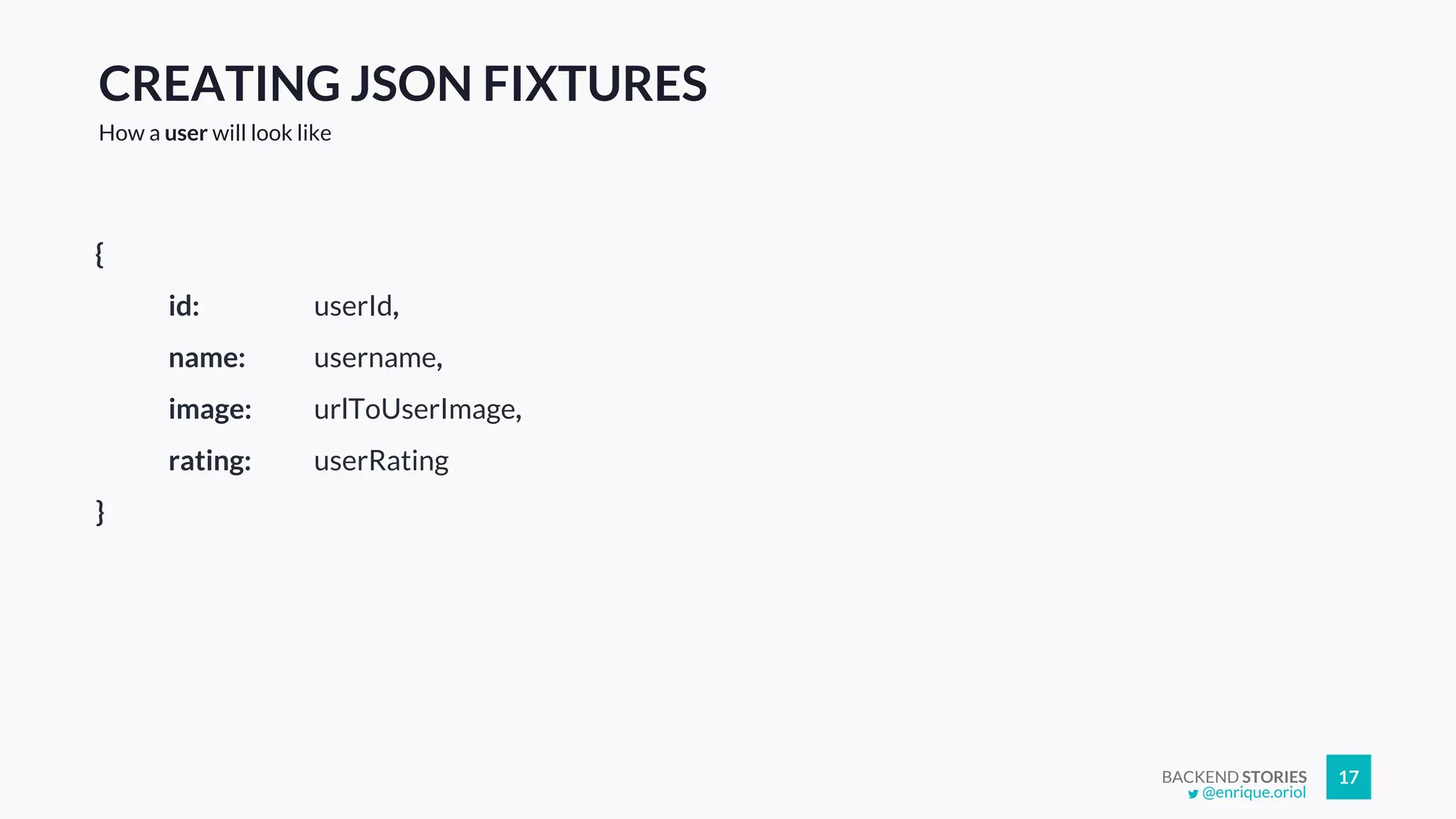
![BACKEND STORIES 18
CREATING JSON FIXTURES
app/fixtures/users.json
[
{
"id": "1",
"name": "Peter",
"image": "user1.png",
"points": 150
},
.
.
.
{
"id": "6",
"name": "Travis",
"image": "user6.png",
"points": 100
}
]
@enrique.oriol](https://image.slidesharecdn.com/backend-without-backend-160225180002/75/How-to-build-an-AngularJS-backend-ready-app-WITHOUT-BACKEND-18-2048.jpg)
![BACKEND STORIES 20
e2e $httpBackend
https://docs.angularjs.org/api/ngMockE2E/service/$httpBackend
1. download
Installation
$ bower install angular-mocks
2. include source
<!-- mock server -->
<script src="bower_components/angular-mocks/angular-mocks.js"></script>
3. include module
angular.module('app', ['ngMockE2E']);
@enrique.oriol](https://image.slidesharecdn.com/backend-without-backend-160225180002/75/How-to-build-an-AngularJS-backend-ready-app-WITHOUT-BACKEND-20-2048.jpg)
![BACKEND STORIES 21
e2e $httpBackend
https://docs.angularjs.org/api/ngMockE2E/service/$httpBackend
When URL: return object with responds & passthrough methods
Basics
when( method, url, [data], [headers], [keys] );
Responds
Passthrough
$httpBackend.when(‘GET’, url).respond({} / [])
$httpBackend.when(‘GET’, url).respond(function(method, url, data, headers, params){})
$httpBackend.when(‘GET’, url).passThrough()
@enrique.oriol](https://image.slidesharecdn.com/backend-without-backend-160225180002/75/How-to-build-an-AngularJS-backend-ready-app-WITHOUT-BACKEND-21-2048.jpg)
![BACKEND STORIES 22
e2e $httpBackend
app/services/mock/MockServerModule.js
angular.module('userRanking.mockServerModule', ['ngMockE2E', 'userRanking.urlsModule'])
.run(['$httpBackend', 'urls', function($httpBackend, urls){
/*mocked data*/
$httpBackend.whenGET(urls.users)
.respond([
{ "id":"5", "name":"Alex", "image":"user5.png", "points": 210},
{ "id":"6", "name":"Travis", "image":"user6.png", "points": 100}
]);
}])
@enrique.oriol](https://image.slidesharecdn.com/backend-without-backend-160225180002/75/How-to-build-an-AngularJS-backend-ready-app-WITHOUT-BACKEND-22-2048.jpg)
![BACKEND STORIES 24
$resource
https://docs.angularjs.org/api/ngResource/service/$resource
1. download
Installation
$ bower install angular-resource
2. include source
<!-- mock server -->
<script src="bower_components/angular-resource/angular-resource.js"></script>
3. include module
angular.module('app', ['ngResource']);
@enrique.oriol](https://image.slidesharecdn.com/backend-without-backend-160225180002/75/How-to-build-an-AngularJS-backend-ready-app-WITHOUT-BACKEND-24-2048.jpg)
![BACKEND STORIES 25
$resource: return object with different methods, that populates async
Usage
$resource(url, [paramDefaults], [actions], options)
Returned object methods
$resource
https://docs.angularjs.org/api/ngResource/service/$resource
{ 'get': {method:'GET'},
'save': {method:'POST'},
'query': {method:'GET', isArray:true},
'remove': {method:'DELETE'},
'delete': {method:'DELETE'}
};
@enrique.oriol](https://image.slidesharecdn.com/backend-without-backend-160225180002/75/How-to-build-an-AngularJS-backend-ready-app-WITHOUT-BACKEND-25-2048.jpg)
![BACKEND STORIES 26
$resource
app/services/mock/MockServerModule.js
angular.module('userRanking.mockServerModule', ['ngMockE2E','ngResource', 'userRanking.urlsModule'])
.constant('fixturePaths', {
"users": "fixtures/users.json"
})
.run(['$httpBackend', 'urls', 'fixturePaths', '$resource', function($httpBackend, urls, fixturePaths, $resource){
/* allow local calls */
$httpBackend.whenGET(/fixtures/.*/).passThrough();
/*mocked data*/
$httpBackend.whenGET(urls.users).respond( $resource(fixturePaths.users).query() );
}])
@enrique.oriol](https://image.slidesharecdn.com/backend-without-backend-160225180002/75/How-to-build-an-AngularJS-backend-ready-app-WITHOUT-BACKEND-26-2048.jpg)
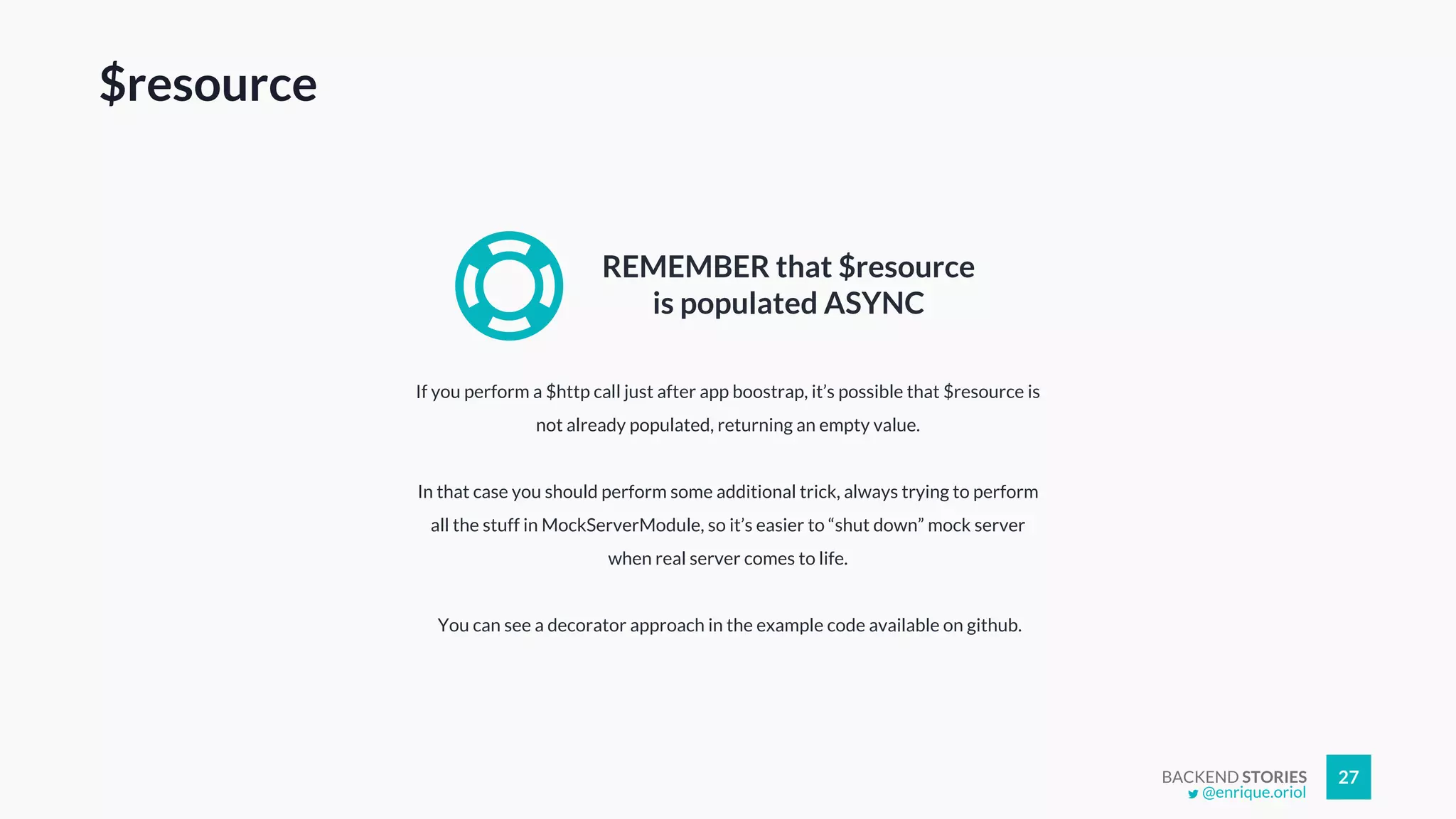
![BACKEND STORIES 29
Dynamic responses
Using function inside $httpBackend.respond
<!-- mocked data -->
$httpBackend.whenGET(urls.users).respond( $resource(fixturePaths.users).query() );
/*mocked data*/
var usersResource = $resource(fixturePaths.users).query();
$httpBackend.whenGET(urls.users).respond(function(method, url, data, headers){
return [200, usersResource, {}];
});
Changing this:
Into this:
Gives us access to url, data and headers, so our response can be dynamic
@enrique.oriol](https://image.slidesharecdn.com/backend-without-backend-160225180002/75/How-to-build-an-AngularJS-backend-ready-app-WITHOUT-BACKEND-29-2048.jpg)
![BACKEND STORIES 30
Dynamic responses
We can perform data validation, and return custom headers
.run(['$httpBackend', 'urls', 'fixturePaths', '$resource', function($httpBackend, urls, fixturePaths, $resource){
/*...previous stuff...*/
/* regex allowing any user id in user url*/
var anyUserUrl = new RegExp(urls.user('.*'));
/*mock POST rx of a new user, and return auth token*/
$httpBackend.whenPOST(anyUserUrl).respond(function(method, url, data, headers){
data = angular.fromJson(data);
if(data.name === undefined || !angular.isString(data.name) || data.name.length === 0){ return [400, null, null]; }
else{
var user = {
"id": "7",
"name": data.name,
"points": 0
};
return [200, user, {Authorization: "1234567890asdfghjklzxcvbnm"}];
}
});
}])
@enrique.oriol](https://image.slidesharecdn.com/backend-without-backend-160225180002/75/How-to-build-an-AngularJS-backend-ready-app-WITHOUT-BACKEND-30-2048.jpg)
![BACKEND STORIES 31
Dynamic responses
We lack persistence
.run(['$httpBackend', 'urls', 'fixturePaths', '$resource', function($httpBackend, urls, fixturePaths, $resource){
/*...previous stuff...*/
/*mock POST rx of a new user, and return auth token*/
$httpBackend.whenPUT(anyUserUrl).respond(
function(method, url, data, headers){
data = angular.fromJson(data);
if(headers['Authorization'] !== "Token 1234567890asdfghjklzxcvbnm"){
return [401, null, null];
}
else if(data.name === undefined && data.points === undefined && data.image ===undefined){
return [400, null, null];
}
else{
/*here we need to return updated data, so our app can reflect changes*/
var user = {...};
return [200, user, {}];
}
});
}])
@enrique.oriol](https://image.slidesharecdn.com/backend-without-backend-160225180002/75/How-to-build-an-AngularJS-backend-ready-app-WITHOUT-BACKEND-31-2048.jpg)
![BACKEND STORIES 33
Write in LS
$window.localStorage['myKey'] = angular.toJson(myData);
Read from LS
var data = angular.fromJson($window.localStorage['myKey']);
Usage
Backend persistence
Local Storage
@enrique.oriol](https://image.slidesharecdn.com/backend-without-backend-160225180002/75/How-to-build-an-AngularJS-backend-ready-app-WITHOUT-BACKEND-33-2048.jpg)
![BACKEND STORIES 34
.constant('lsMock', {
"users": "ls-cached-users"
})
.factory('mockedUsers', ['$window', '$resource', 'fixturePaths', 'lsMock',
function($window, $resource, fixturePaths, lsMock){
var service = {};
service.list = angular.fromJson($window.localStorage[lsMock.users]);
if(!service.list || service.list.length === 0){
service.list = $resource(fixturePaths.users).query();
}
service.save = function(){
$window.localStorage[lsMock.users] = angular.toJson(service.list);
};
service.add = function(user){
service.list.push(user);
service.save();
};
Backend persistence
Define a service to handle with cached users
service.update = function(user){
for(var i=0; i<service.list.length; i++){
if(service.list[i].id == user.id){
service.list[i].points = user.points;
service.save();
return;
}
}
};
service.getById = function(userId){
for(var i=0; i<service.list.length; i++){
if(service.list[i].id == userId){
return service.list[i];
}
}
return null;
};
return service;
}])
@enrique.oriol](https://image.slidesharecdn.com/backend-without-backend-160225180002/75/How-to-build-an-AngularJS-backend-ready-app-WITHOUT-BACKEND-34-2048.jpg)
![BACKEND STORIES 35
.run(['$httpBackend', '$resource', 'urls', 'mockedUsers', function($httpBackend, $resource, urls, mockedUsers){
/* local calls */
$httpBackend.whenGET(/fixtures/.*/).passThrough();
/* regex allowing any user id in user url*/
var anyUserUrl = new RegExp(urls.user('.*'));
/*mocked users list*/
$httpBackend.whenGET(urls.users).respond(function(method, url, data, headers){
return [200, mockedUsers.list];
});
Backend persistence
Using our service in mock server - whenGET
@enrique.oriol](https://image.slidesharecdn.com/backend-without-backend-160225180002/75/How-to-build-an-AngularJS-backend-ready-app-WITHOUT-BACKEND-35-2048.jpg)
![BACKEND STORIES 36
/* mock update user*/
$httpBackend.whenPUT(anyUserUrl).respond(
function(method, url, data, headers){
data = angular.fromJson(data);
var userId = url.replace(urls.user(''), '');
if(!data.id) {data.id = userId;}
if(headers['Authorization'] !== "Token 1234567890asdfghjklzxcvbnm"){
return [401, null, null];
}
else if(data.name === undefined && data.points === undefined && data.image ===undefined){
return [400, null, null];
}
else{
mockedUsers.update(data);
data = mockedUsers.getById(userId);
return [200, data, {}];
}
});
Backend persistence
Using our service in mock server - - whenPUT
@enrique.oriol](https://image.slidesharecdn.com/backend-without-backend-160225180002/75/How-to-build-an-AngularJS-backend-ready-app-WITHOUT-BACKEND-36-2048.jpg)
![BACKEND STORIES 37
/* mock new user*/
$httpBackend.whenPOST(anyUserUrl).respond(
function(method, url, data, headers){
data = angular.fromJson(data);
if(data.name === undefined || !angular.isString(data.name) || data.name.length === 0){
return [400, null, null];
}
else{
var user = {
"id": ''+ mockedUsers.list.length,
"name": data.name,
"points": 0
};
mockedUsers.add(user);
return [200, user, {Authorization: "1234567890asdfghjklzxcvbnm"}];
}
});
}])
Backend persistence
Using our service in mock server - - whenPOST
@enrique.oriol](https://image.slidesharecdn.com/backend-without-backend-160225180002/75/How-to-build-an-AngularJS-backend-ready-app-WITHOUT-BACKEND-37-2048.jpg)


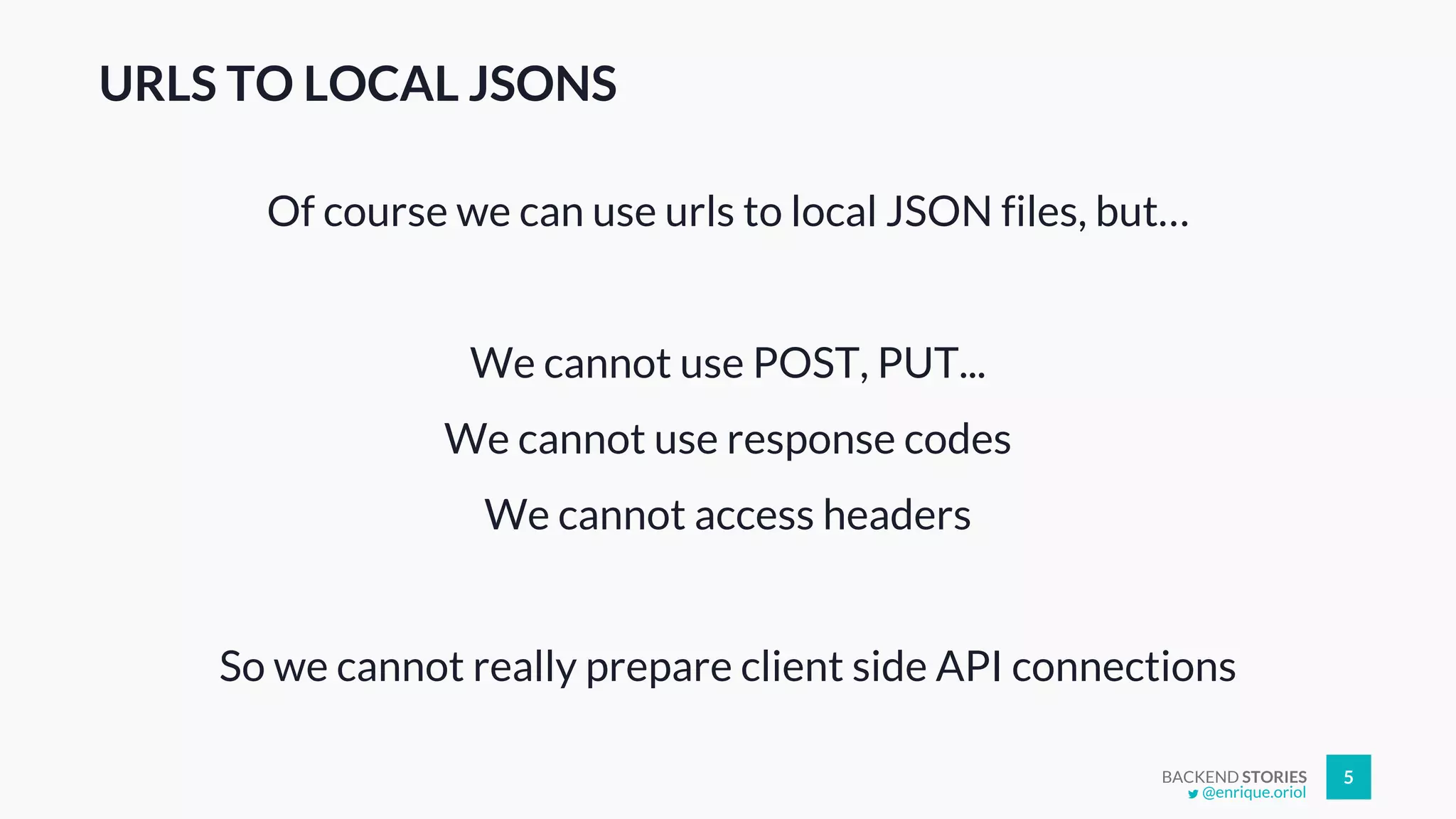
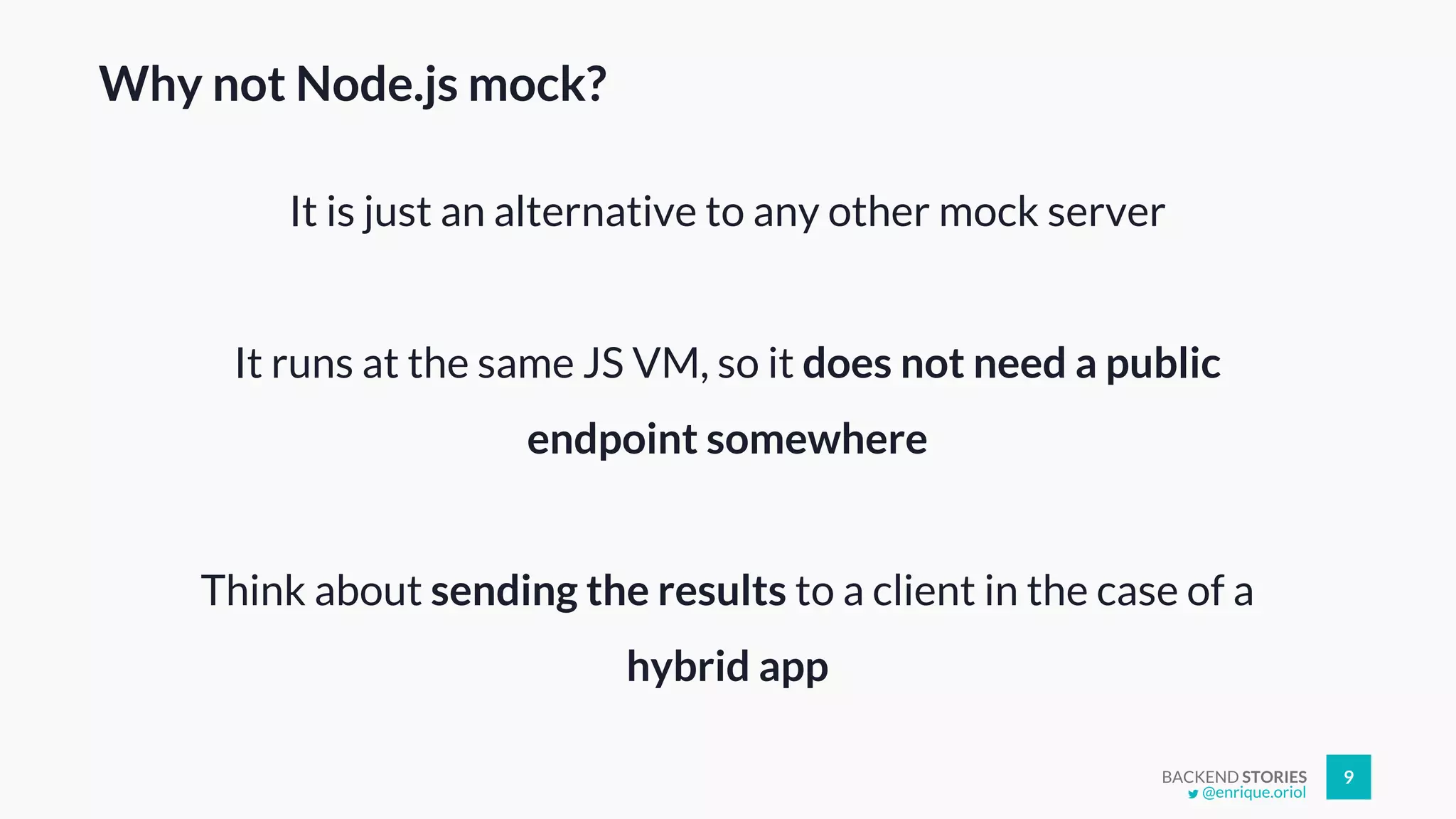
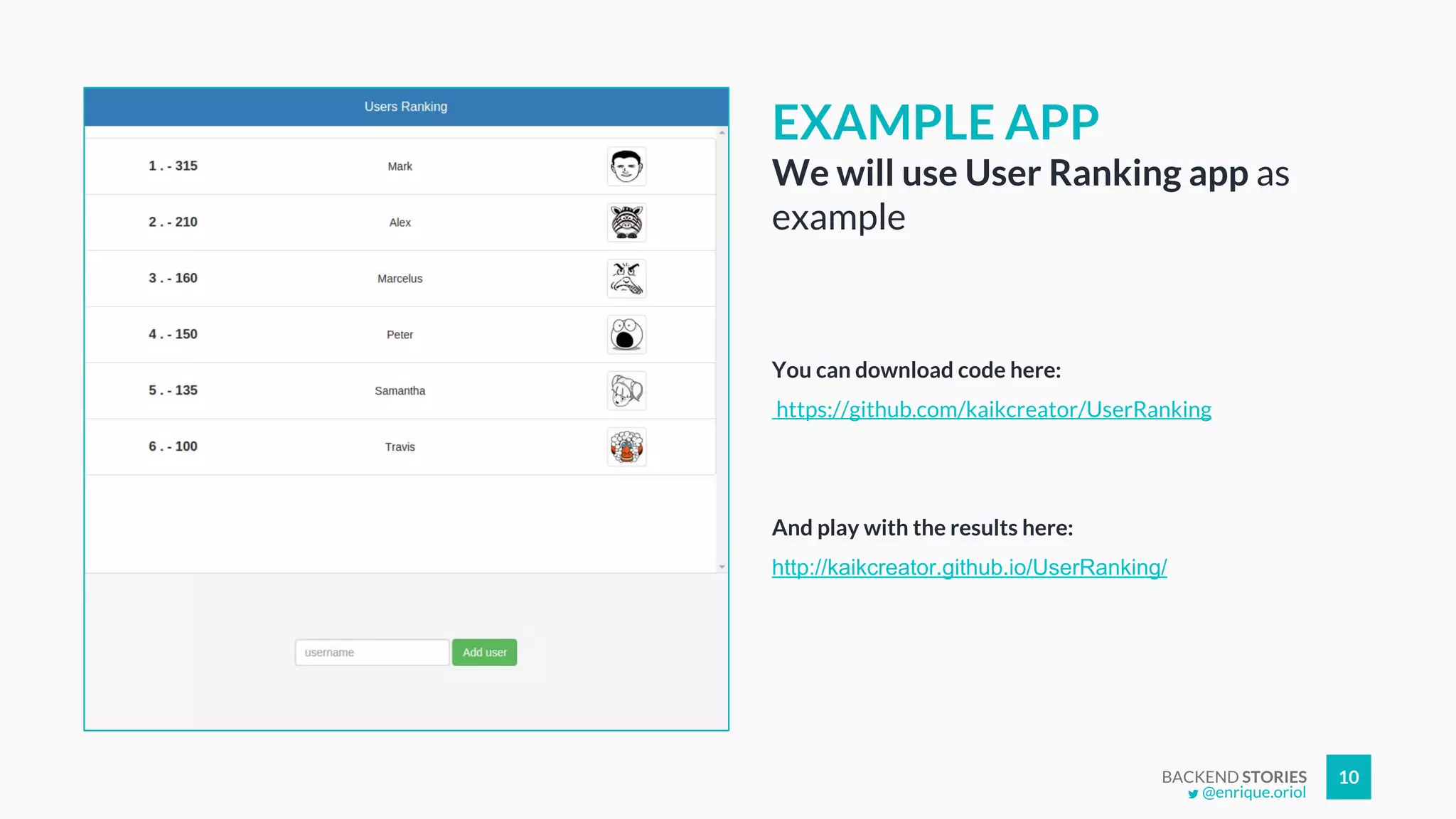
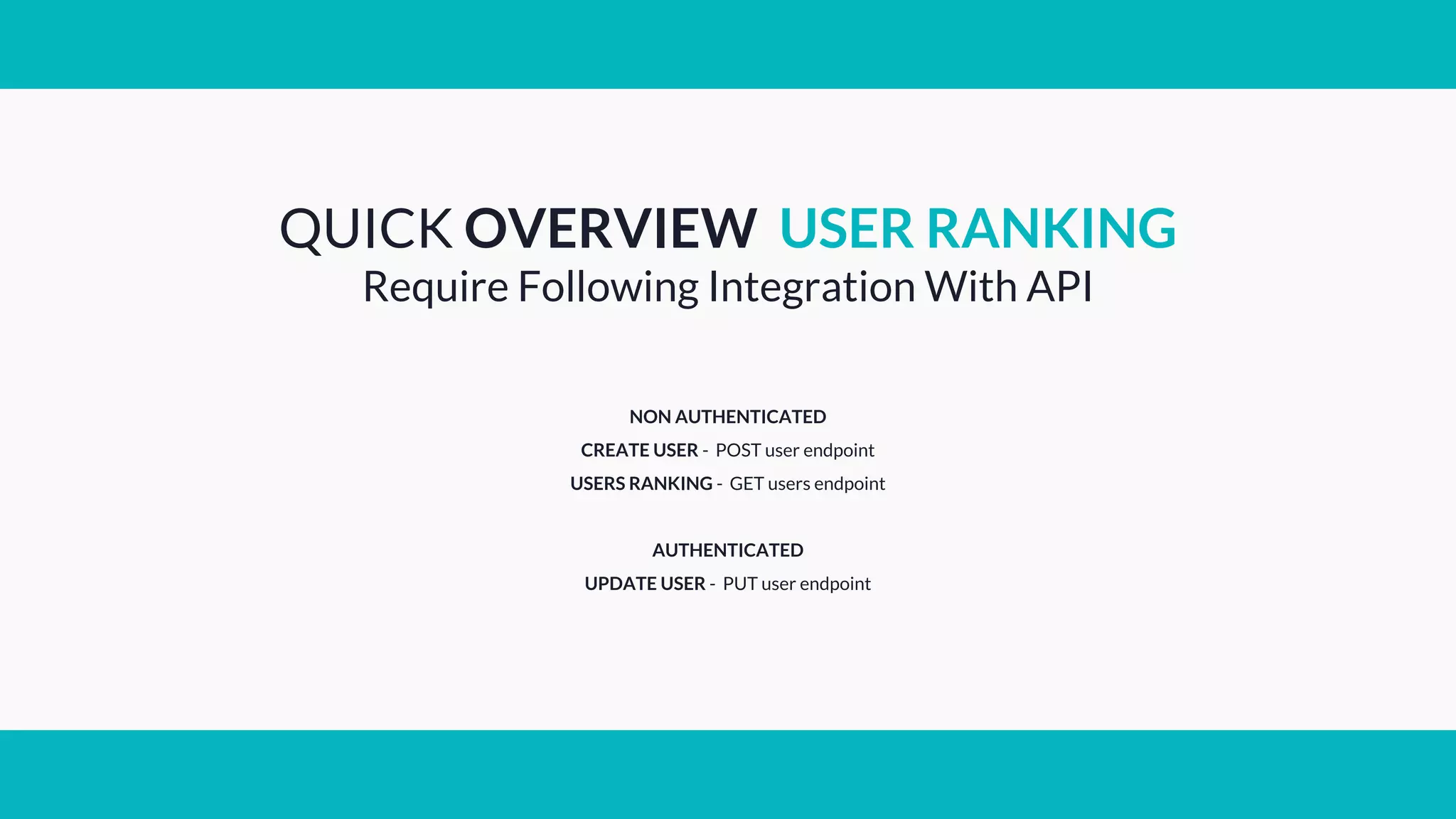
This document discusses how to mock a backend for an AngularJS application without a real backend. It recommends organizing URL definitions, creating JSON fixture files to represent mock data, using $httpBackend to mock server responses, and $resource to load local JSON files. It emphasizes using $httpBackend's dynamic response capabilities to validate requests and return custom headers. It also recommends persisting mock data using localStorage and a service to represent cached data, completing the backend simulation experience. The document provides code examples for implementing these techniques to mock CRUD operations on a user resource as part of a user ranking application.


