API-First Architecture inFinancial Systems
Presenter Introduction
Welcome to our presentation on API-First Architecture in
Financial Systems. Our company Alltick is at the forefront of
financial technology innovation, and today I will guide you
through how APIs are transforming the financial landscape.
Presentation Overview
In this session, we will explore the significance of APIs in
modern finance, delve into the concept of API-First
Architecture, discuss its benefits, and examine real-world
applications. By the end, you will understand why APIs are
essential for building agile and competitive financial platforms.
5.
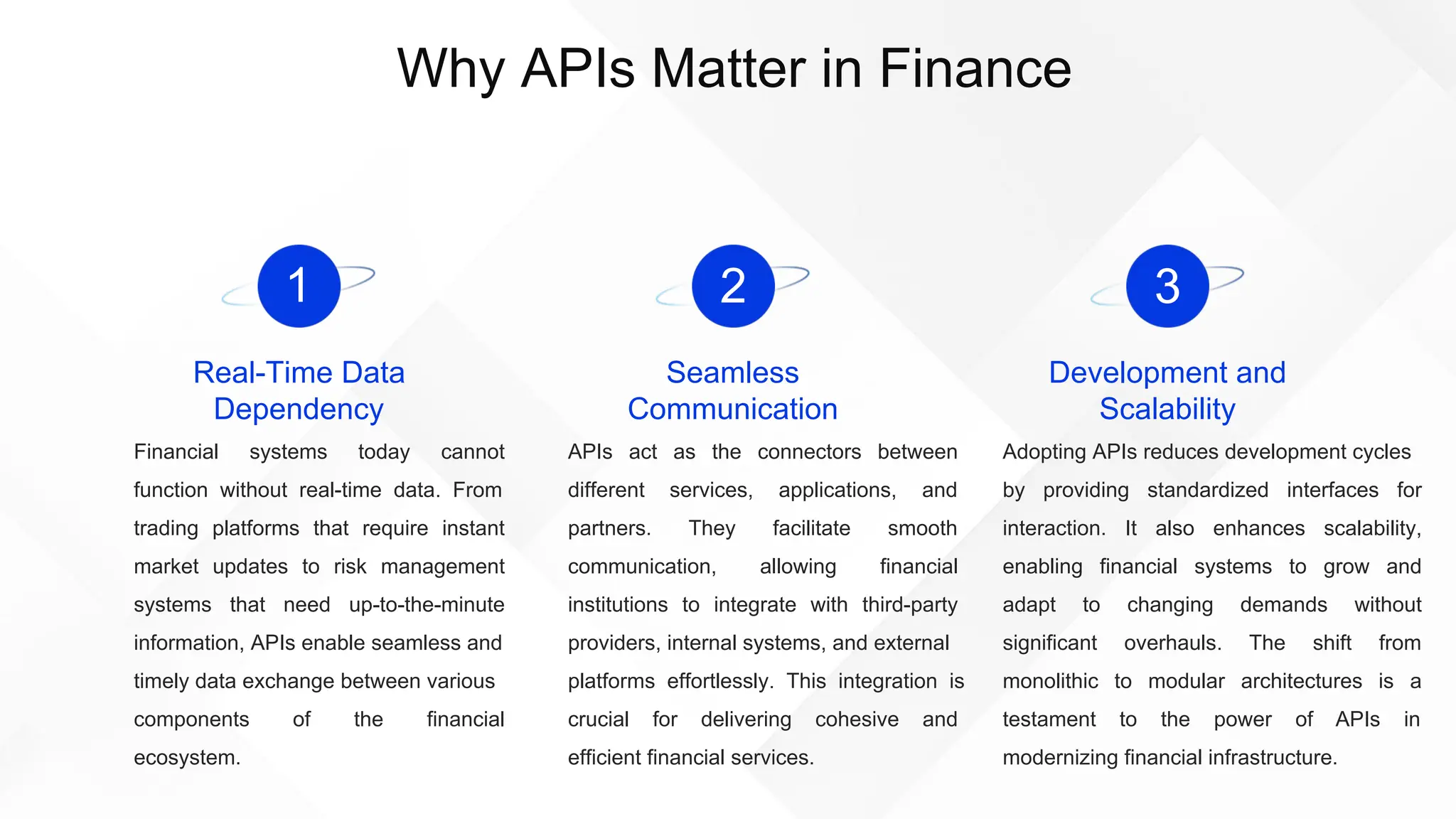
Why APIs Matterin Finance
1
Real-Time Data
Dependency
Financial systems today cannot
function without real-time data. From
trading platforms that require instant
market updates to risk management
systems that need up-to-the-minute
information, APIs enable seamless and
timely data exchange between various
components of the financial
ecosystem.
2
Seamless
Communication
APIs act as the connectors between
different services, applications, and
partners. They facilitate smooth
communication, allowing financial
institutions to integrate with third-party
providers, internal systems, and external
platforms effortlessly. This integration is
crucial for delivering cohesive and
efficient financial services.
3
Development and
Scalability
Adopting APIs reduces development cycles
by providing standardized interfaces for
interaction. It also enhances scalability,
enabling financial systems to grow and
adapt to changing demands without
significant overhauls. The shift from
monolithic to modular architectures is a
testament to the power of APIs in
modernizing financial infrastructure.
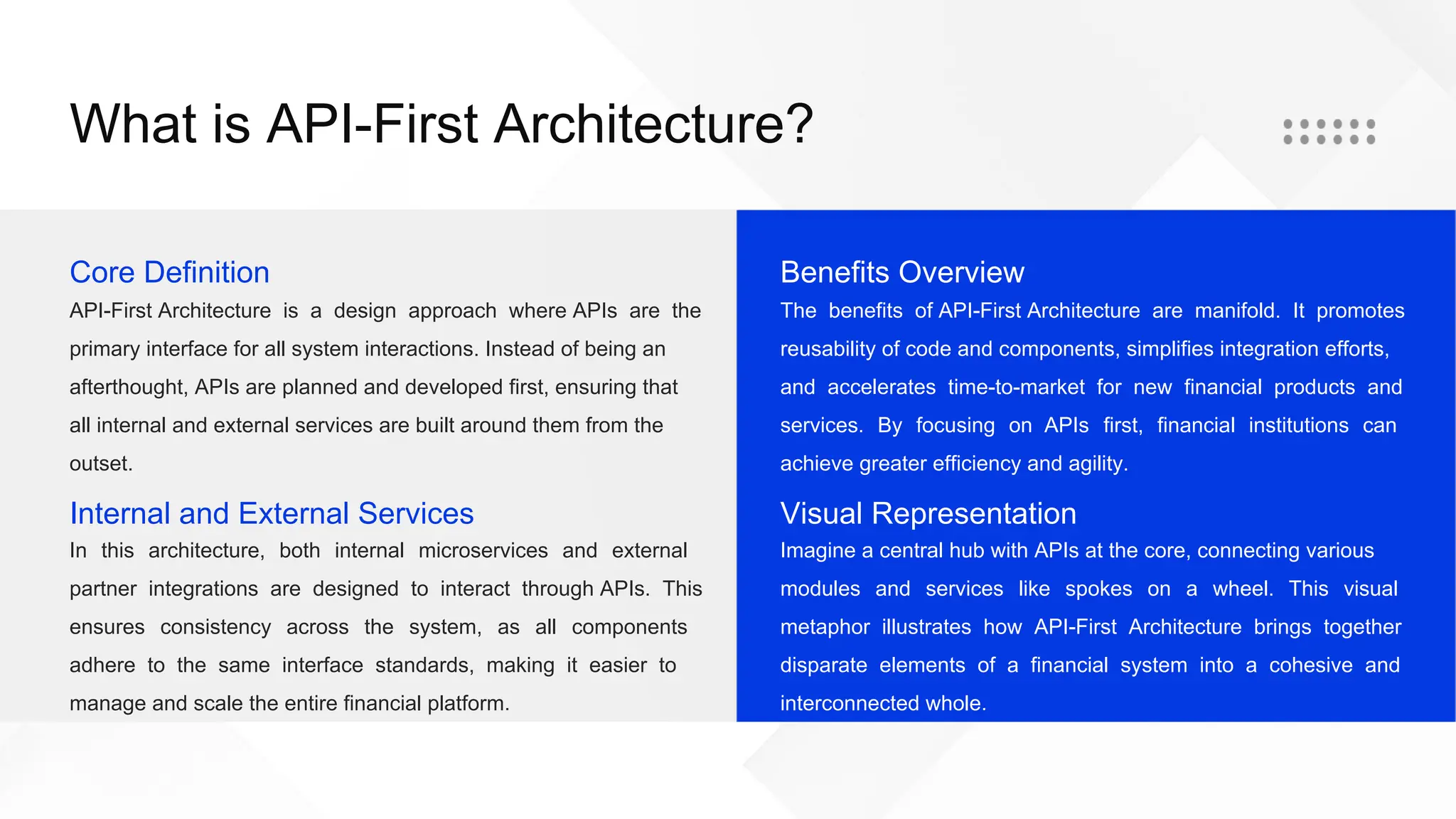
What is API-FirstArchitecture?
Core Definition
API-First Architecture is a design approach where APIs are the
primary interface for all system interactions. Instead of being an
afterthought, APIs are planned and developed first, ensuring that
all internal and external services are built around them from the
outset.
Internal and External Services
In this architecture, both internal microservices and external
partner integrations are designed to interact through APIs. This
ensures consistency across the system, as all components
adhere to the same interface standards, making it easier to
manage and scale the entire financial platform.
Benefits Overview
The benefits of API-First Architecture are manifold. It promotes
reusability of code and components, simplifies integration efforts,
and accelerates time-to-market for new financial products and
services. By focusing on APIs first, financial institutions can
achieve greater efficiency and agility.
Visual Representation
Imagine a central hub with APIs at the core, connecting various
modules and services like spokes on a wheel. This visual
metaphor illustrates how API-First Architecture brings together
disparate elements of a financial system into a cohesive and
interconnected whole.
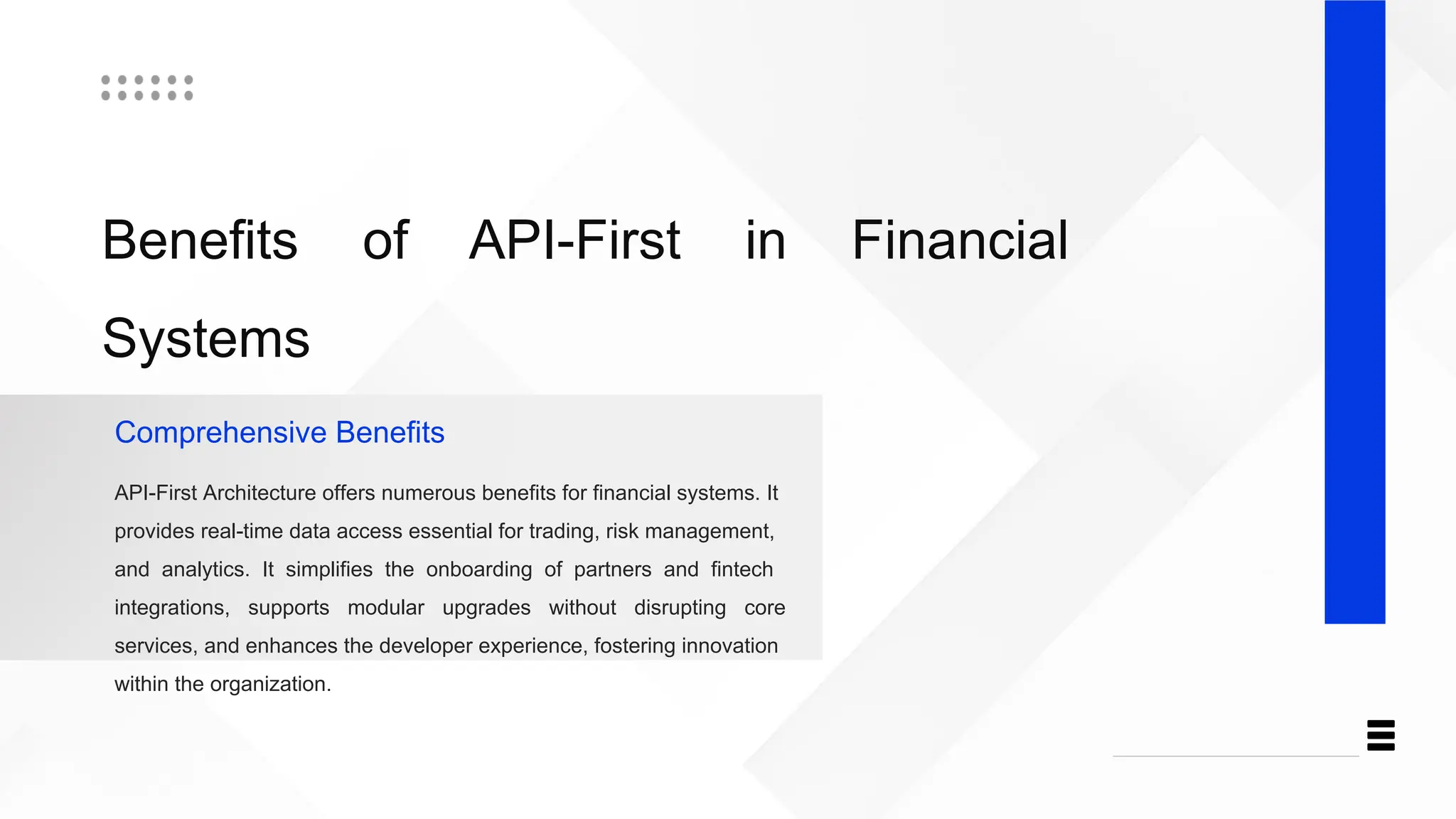
Benefits of API-Firstin Financial
Systems
Comprehensive Benefits
API-First Architecture offers numerous benefits for financial systems. It
provides real-time data access essential for trading, risk management,
and analytics. It simplifies the onboarding of partners and fintech
integrations, supports modular upgrades without disrupting core
services, and enhances the developer experience, fostering innovation
within the organization.
10.
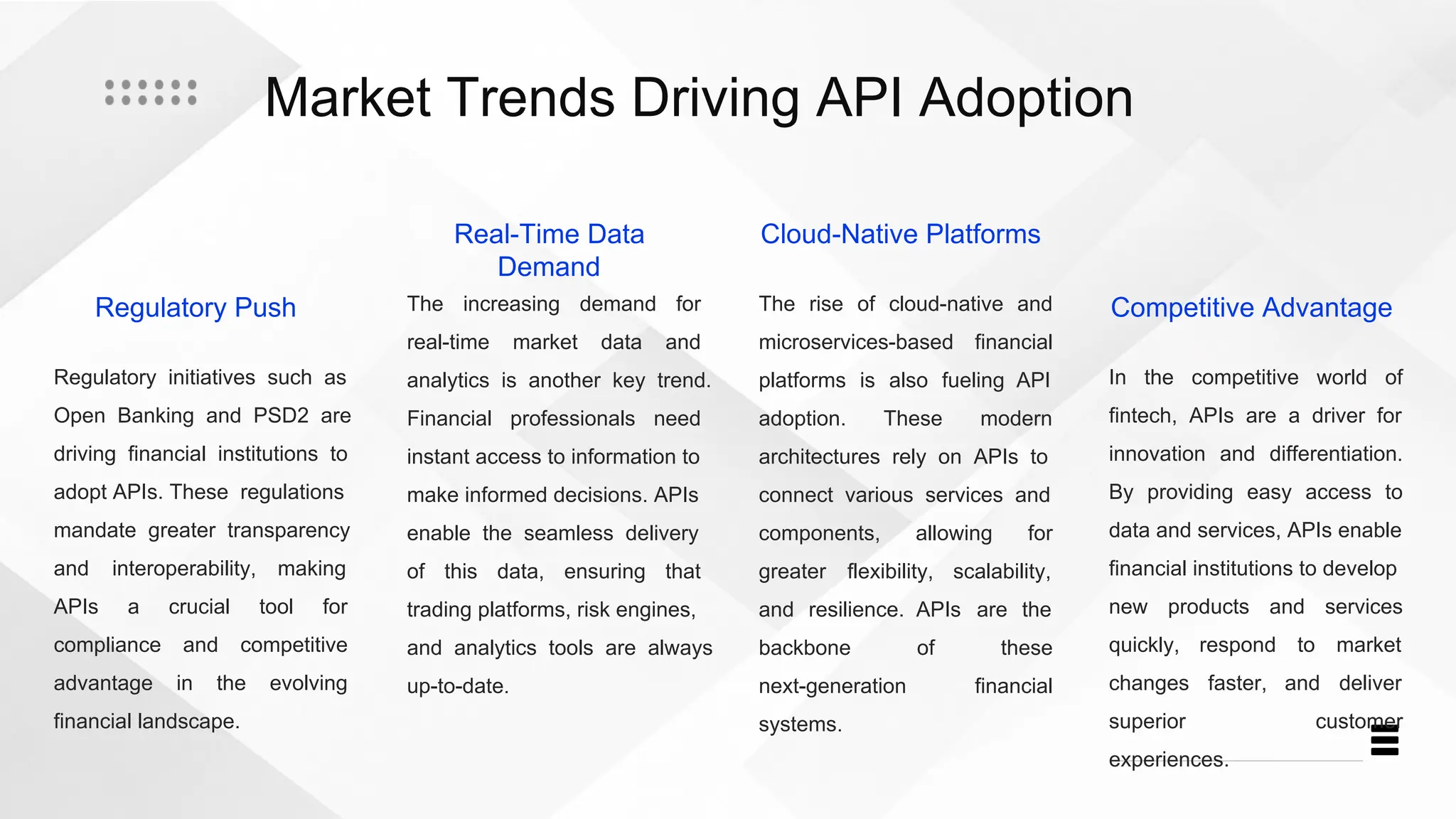
Market Trends DrivingAPI Adoption
Regulatory Push
Regulatory initiatives such as
Open Banking and PSD2 are
driving financial institutions to
adopt APIs. These regulations
mandate greater transparency
and interoperability, making
APIs a crucial tool for
compliance and competitive
advantage in the evolving
financial landscape.
Real-Time Data
Demand
The increasing demand for
real-time market data and
analytics is another key trend.
Financial professionals need
instant access to information to
make informed decisions. APIs
enable the seamless delivery
of this data, ensuring that
trading platforms, risk engines,
and analytics tools are always
up-to-date.
Cloud-Native Platforms
The rise of cloud-native and
microservices-based financial
platforms is also fueling API
adoption. These modern
architectures rely on APIs to
connect various services and
components, allowing for
greater flexibility, scalability,
and resilience. APIs are the
backbone of these
next-generation financial
systems.
Competitive Advantage
In the competitive world of
fintech, APIs are a driver for
innovation and differentiation.
By providing easy access to
data and services, APIs enable
financial institutions to develop
new products and services
quickly, respond to market
changes faster, and deliver
superior customer
experiences.
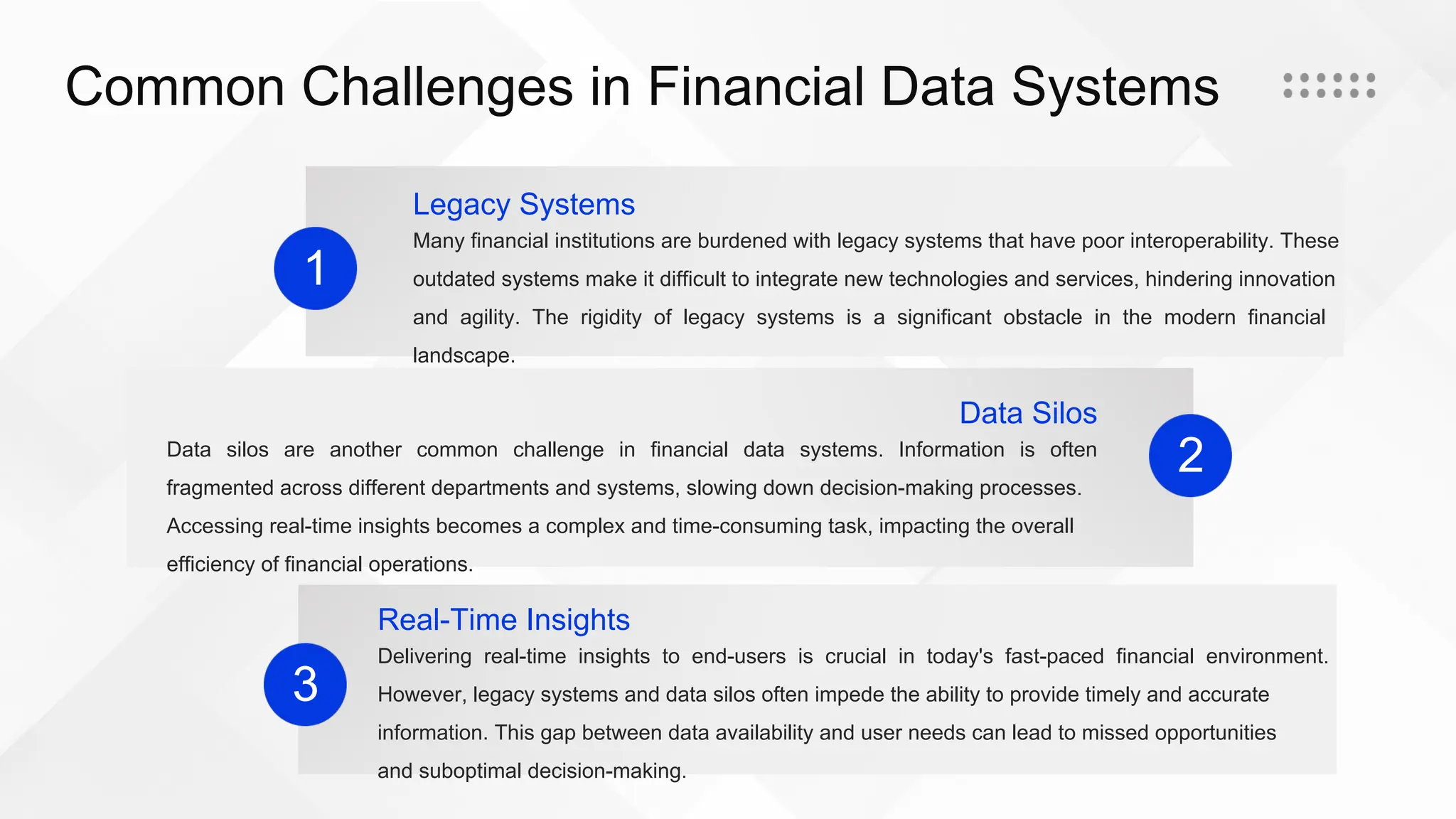
Common Challenges inFinancial Data Systems
1
Legacy Systems
Many financial institutions are burdened with legacy systems that have poor interoperability. These
outdated systems make it difficult to integrate new technologies and services, hindering innovation
and agility. The rigidity of legacy systems is a significant obstacle in the modern financial
landscape.
2
Data Silos
Data silos are another common challenge in financial data systems. Information is often
fragmented across different departments and systems, slowing down decision-making processes.
Accessing real-time insights becomes a complex and time-consuming task, impacting the overall
efficiency of financial operations.
3
Real-Time Insights
Delivering real-time insights to end-users is crucial in today's fast-paced financial environment.
However, legacy systems and data silos often impede the ability to provide timely and accurate
information. This gap between data availability and user needs can lead to missed opportunities
and suboptimal decision-making.
13.
How API-First SolvesThese Challenges
Single Source of Truth
API-First Architecture addresses the issue of data silos by providing a single source of truth.
Standardized APIs ensure that all data is accessible through a unified interface, making it
easier to aggregate and analyze information. This consistency is vital for real-time
decision-making and operational efficiency.
Faster Integration and Innovation
With APIs at the core, financial institutions can achieve faster integration with trading
platforms, dashboards, and analytics tools. The developer-friendly interfaces of APIs
promote innovation by allowing teams to build and deploy new solutions more quickly. This
agility is essential for staying competitive in the rapidly evolving financial industry.
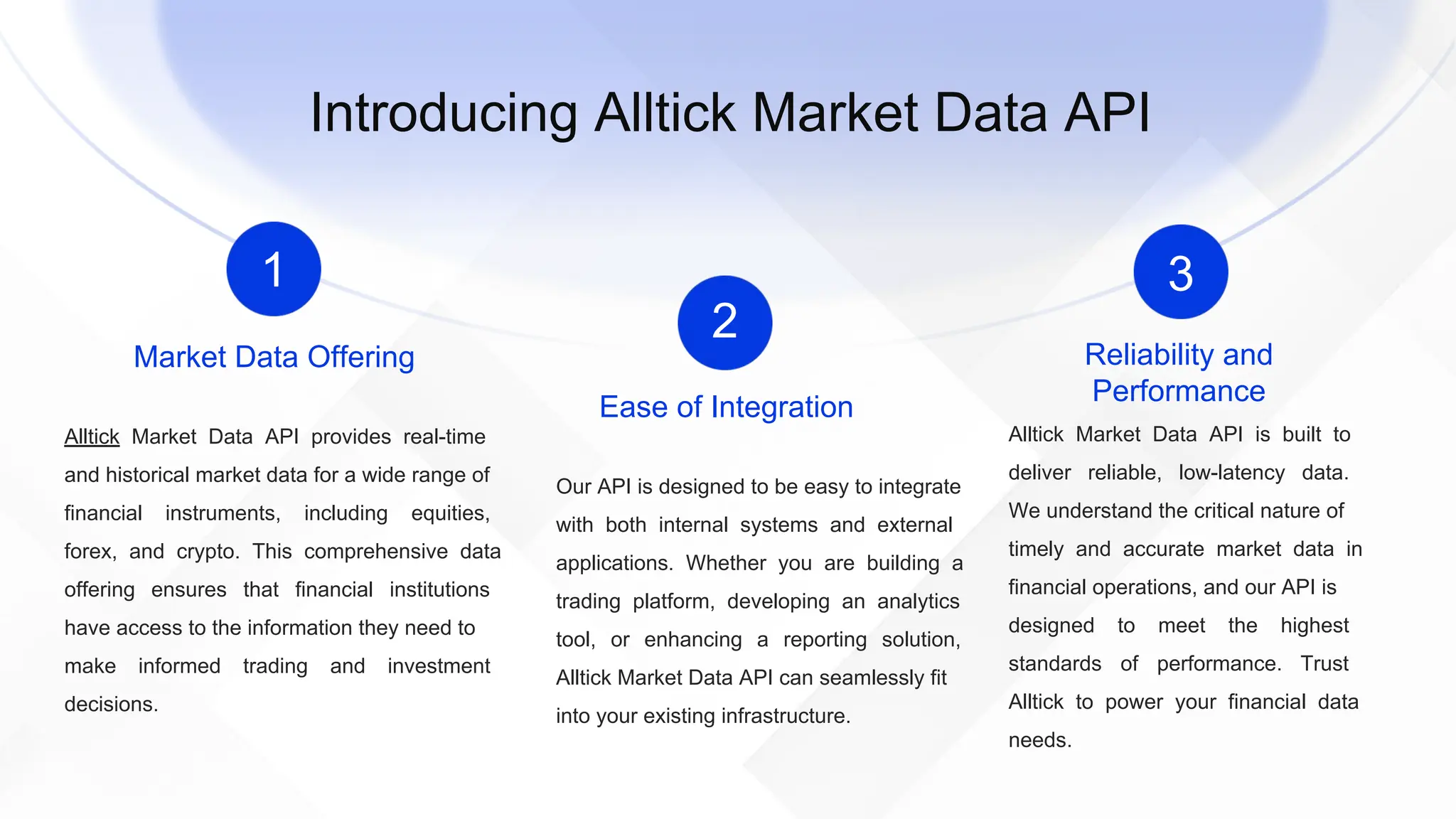
Introducing Alltick MarketData API
1
Market Data Offering
Alltick Market Data API provides real-time
and historical market data for a wide range of
financial instruments, including equities,
forex, and crypto. This comprehensive data
offering ensures that financial institutions
have access to the information they need to
make informed trading and investment
decisions.
2
Ease of Integration
Our API is designed to be easy to integrate
with both internal systems and external
applications. Whether you are building a
trading platform, developing an analytics
tool, or enhancing a reporting solution,
Alltick Market Data API can seamlessly fit
into your existing infrastructure.
3
Reliability and
Performance
Alltick Market Data API is built to
deliver reliable, low-latency data.
We understand the critical nature of
timely and accurate market data in
financial operations, and our API is
designed to meet the highest
standards of performance. Trust
Alltick to power your financial data
needs.
16.
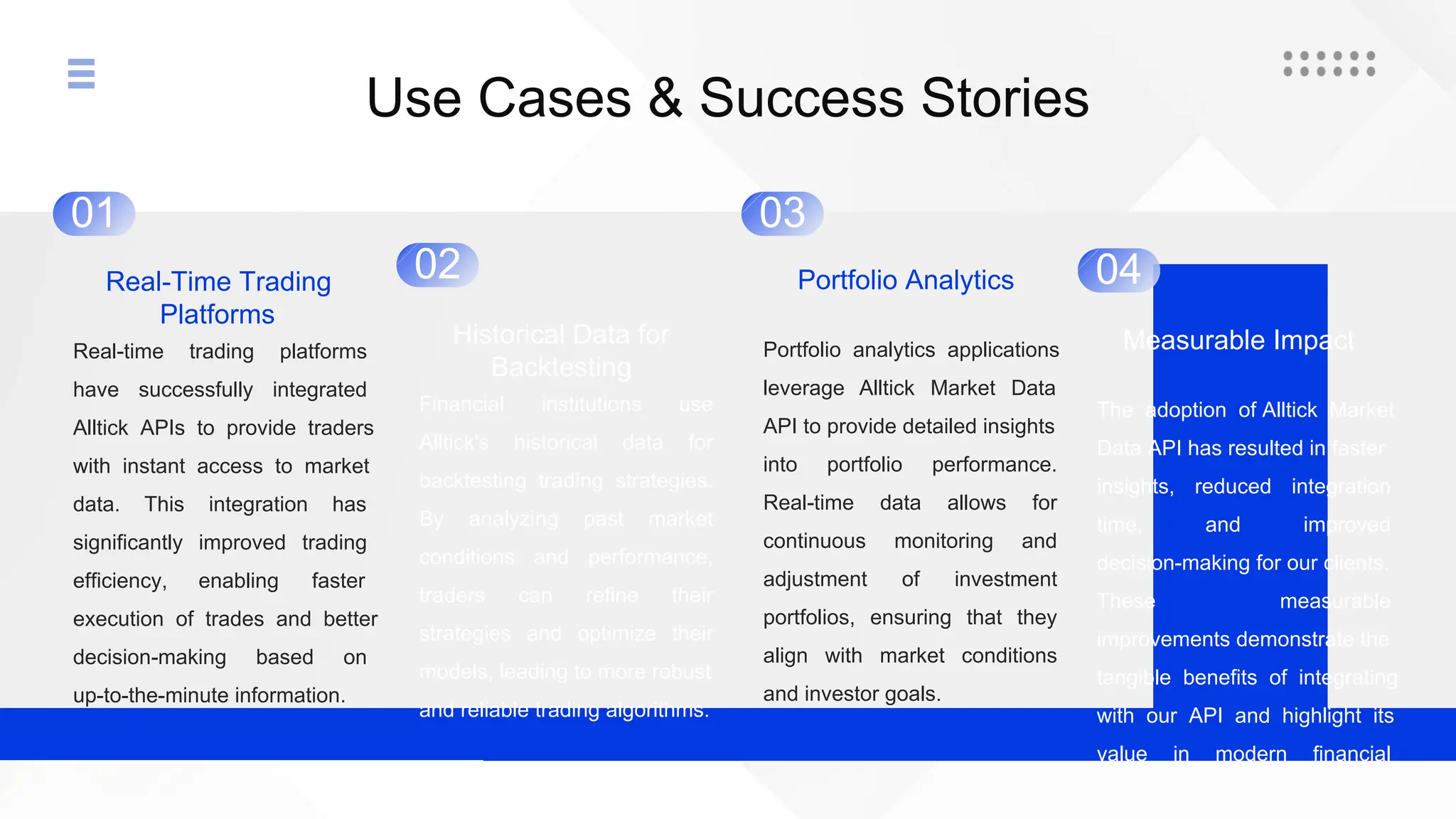
Use Cases &Success Stories
01
Real-Time Trading
Platforms
Real-time trading platforms
have successfully integrated
Alltick APIs to provide traders
with instant access to market
data. This integration has
significantly improved trading
efficiency, enabling faster
execution of trades and better
decision-making based on
up-to-the-minute information.
02
Historical Data for
Backtesting
Financial institutions use
Alltick's historical data for
backtesting trading strategies.
By analyzing past market
conditions and performance,
traders can refine their
strategies and optimize their
models, leading to more robust
and reliable trading algorithms.
03
Portfolio Analytics
Portfolio analytics applications
leverage Alltick Market Data
API to provide detailed insights
into portfolio performance.
Real-time data allows for
continuous monitoring and
adjustment of investment
portfolios, ensuring that they
align with market conditions
and investor goals.
04
Measurable Impact
The adoption of Alltick Market
Data API has resulted in faster
insights, reduced integration
time, and improved
decision-making for our clients.
These measurable
improvements demonstrate the
tangible benefits of integrating
with our API and highlight its
value in modern financial
systems.






![Coded Agents – with UiPath SDK + LangGraph [Virtual Hands-on Workshop]](https://cdn.slidesharecdn.com/ss_thumbnails/codedagentsdeck-251215155422-5497c599-thumbnail.jpg?width=640&height=640&fit=bounds)


