Agile Fundamentals
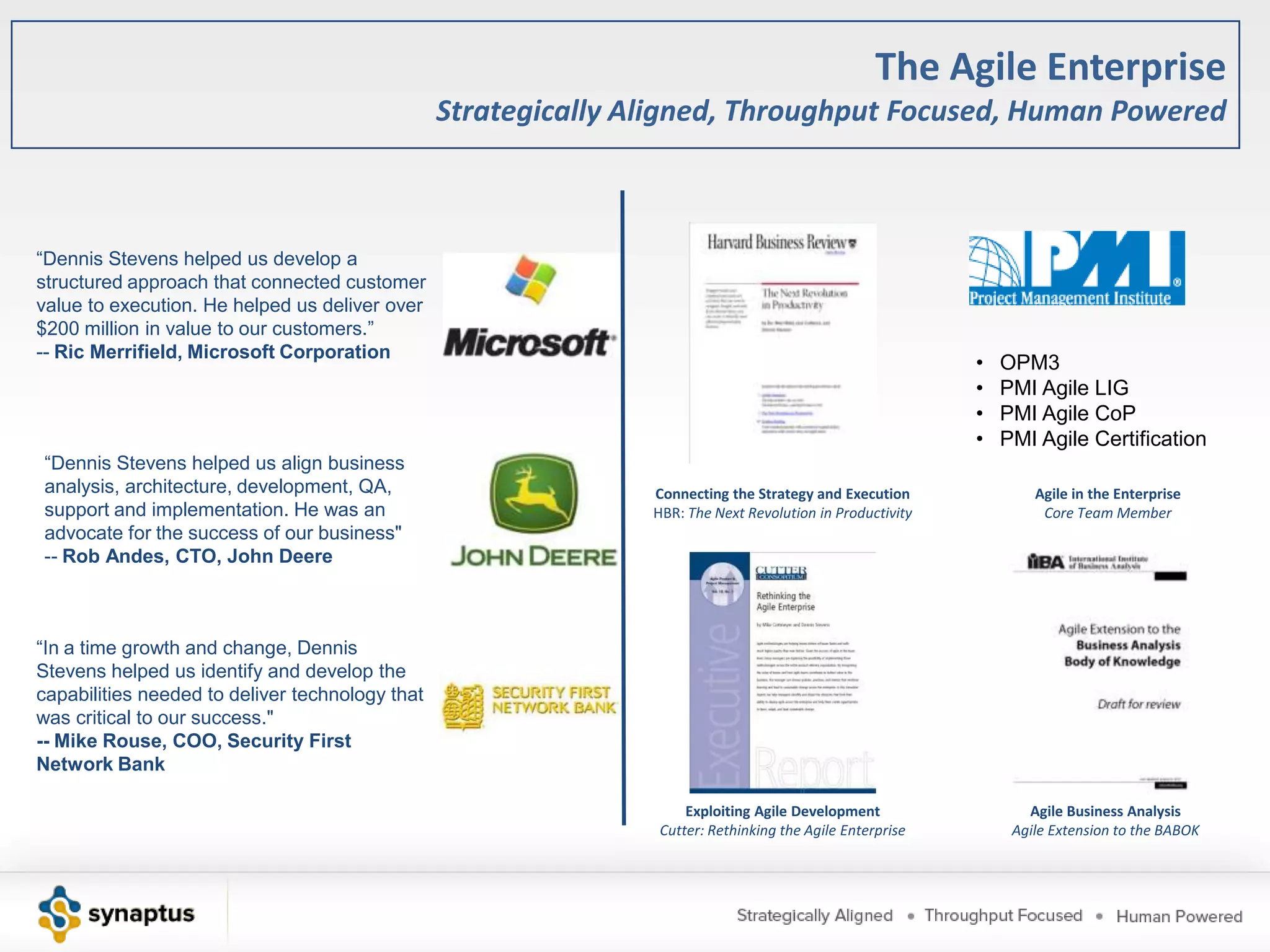
The Agile EnterpriseStrategically Aligned, Throughput Focused, Human Powered“Dennis Stevens helped us develop a structured approach that connected customer value to execution. He helped us deliver over $200 million in value to our customers.” -- Ric Merrifield, Microsoft CorporationOPM3
PMI Agile LIG
PMI Agile CoP
PMI Agile Certification“Dennis Stevens helped us align business analysis, architecture, development, QA, support and implementation. He was an advocate for the success of our business" -- Rob Andes, CTO, John DeereConnecting the Strategy and ExecutionHBR: The Next Revolution in ProductivityAgile in the EnterpriseCore Team Member“In a time growth and change, Dennis  Stevens helped us identify and develop the capabilities needed to deliver technology that was critical to our success." -- Mike Rouse, COO, Security First Network BankExploiting Agile DevelopmentCutter: Rethinking the Agile EnterpriseAgile Business AnalysisAgile Extension to the BABOK
AgendaRoots of AgileAgile ManifestoAgile FlavorsAgile RolesAgile CeremoniesAgile Fundamental IdeasQ&A
AgendaRoots of Agile
What is Agile?Agile:(adj.) Characterized by quickness, lightness, and ease of movement; nimble.(adj.) Mentally quick or alert.(n.) A group of product development methodologies based on iterative and incremental development, where requirements emerge through feedback with the customer and solutions evolvethrough collaboration between members of self-organizing, cross-functional teams.
Predictive ApproachThe way Traditional, or Predictive Approach, shapes thedefinition of Scope, control of Project Schedule and Cost, and management of the software development process based on roots in scientific management, plan driven management, and manufacturing
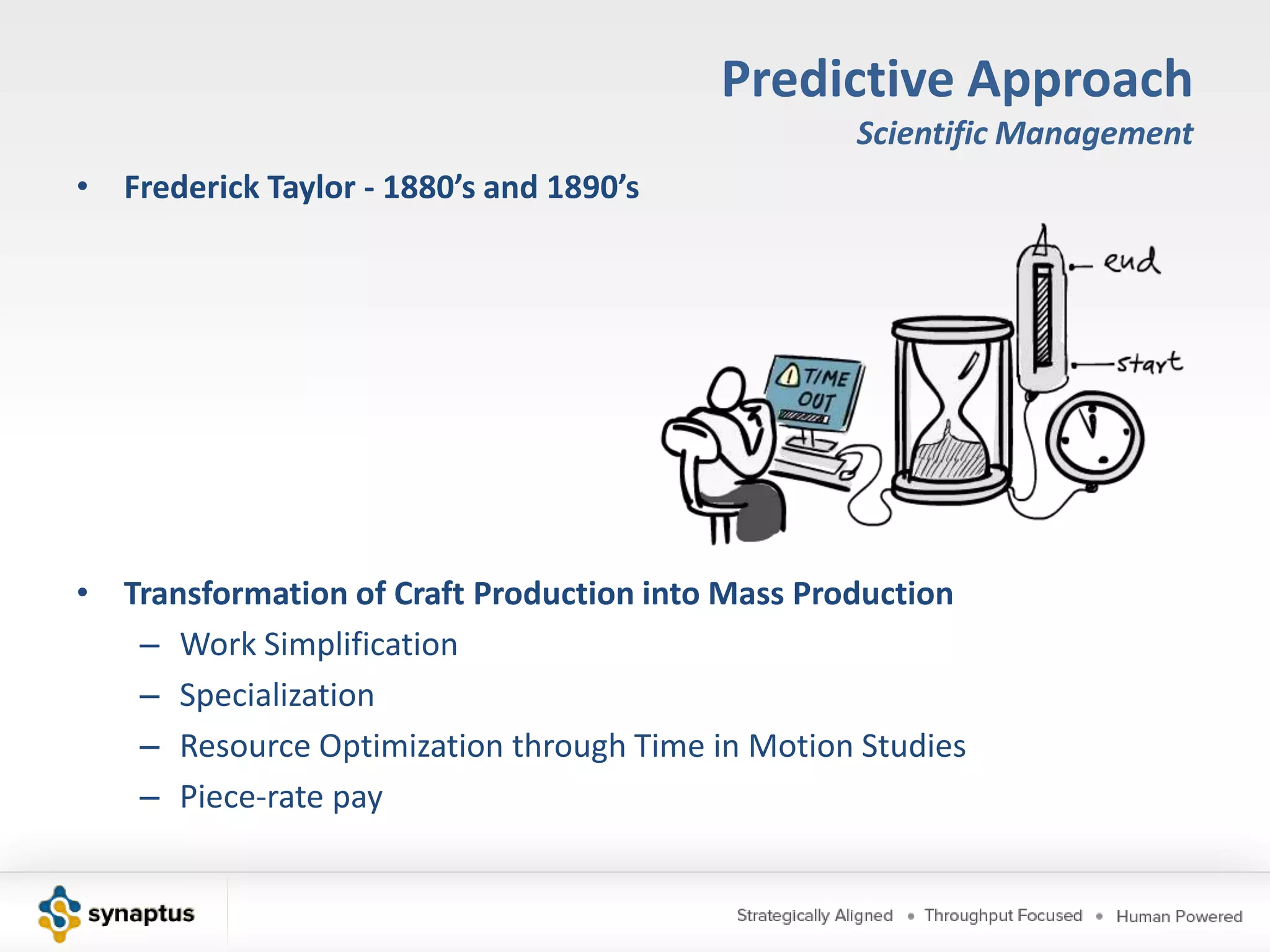
Predictive ApproachScientific ManagementFrederick Taylor - 1880’s and 1890’s Transformation of Craft Production into Mass ProductionWork SimplificationSpecializationResource Optimization through Time in Motion StudiesPiece-rate pay
Initial Benefits in ManufacturingSignificant reduction in per unit labor costsTransfer of unskilled agrarian workforce into productive manufacturing resourcesStandards in productivityResult of Scientific Management in Knowledge WorkLow intrinsic value for the skilled workerLow job satisfaction for everyone over timeDeskilling and dehumanizing work conditionsIncrease in management to worker ratioReduction in innovationPredictive ApproachScientific Management
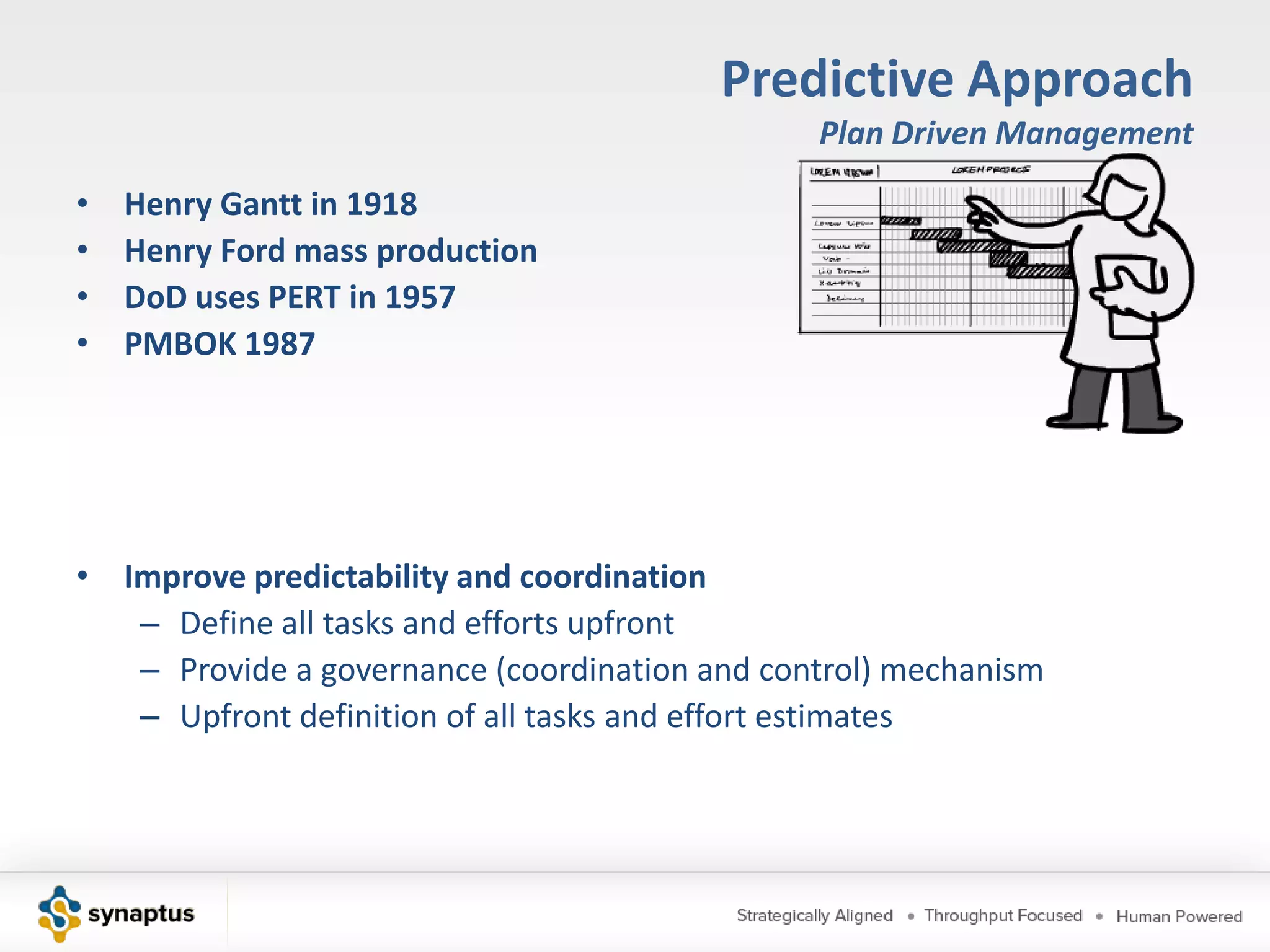
Predictive ApproachPlan Driven ManagementHenry Gantt in 1918Henry Ford mass productionDoD uses PERT in 1957PMBOK 1987Improve predictability and coordination Define all tasks and efforts upfrontProvide a governance (coordination and control) mechanismUpfront definition of all tasks and effort estimates
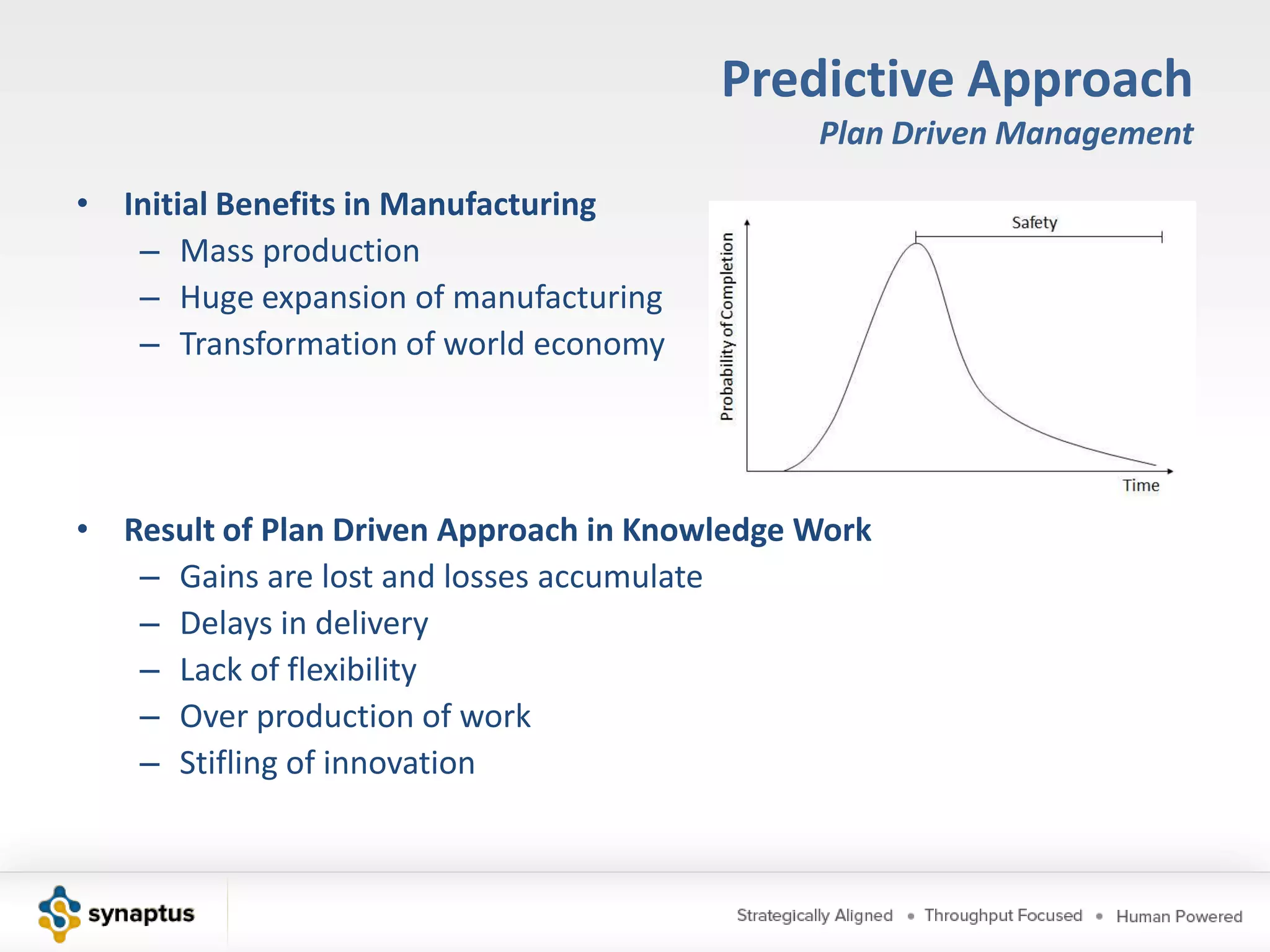
Predictive ApproachPlan Driven ManagementInitial Benefits in ManufacturingMass productionHuge expansion of manufacturingTransformation of world economyResult of Plan Driven Approach in Knowledge WorkGains are lost and losses accumulateDelays in deliveryLack of flexibilityOver production of workStifling of innovation
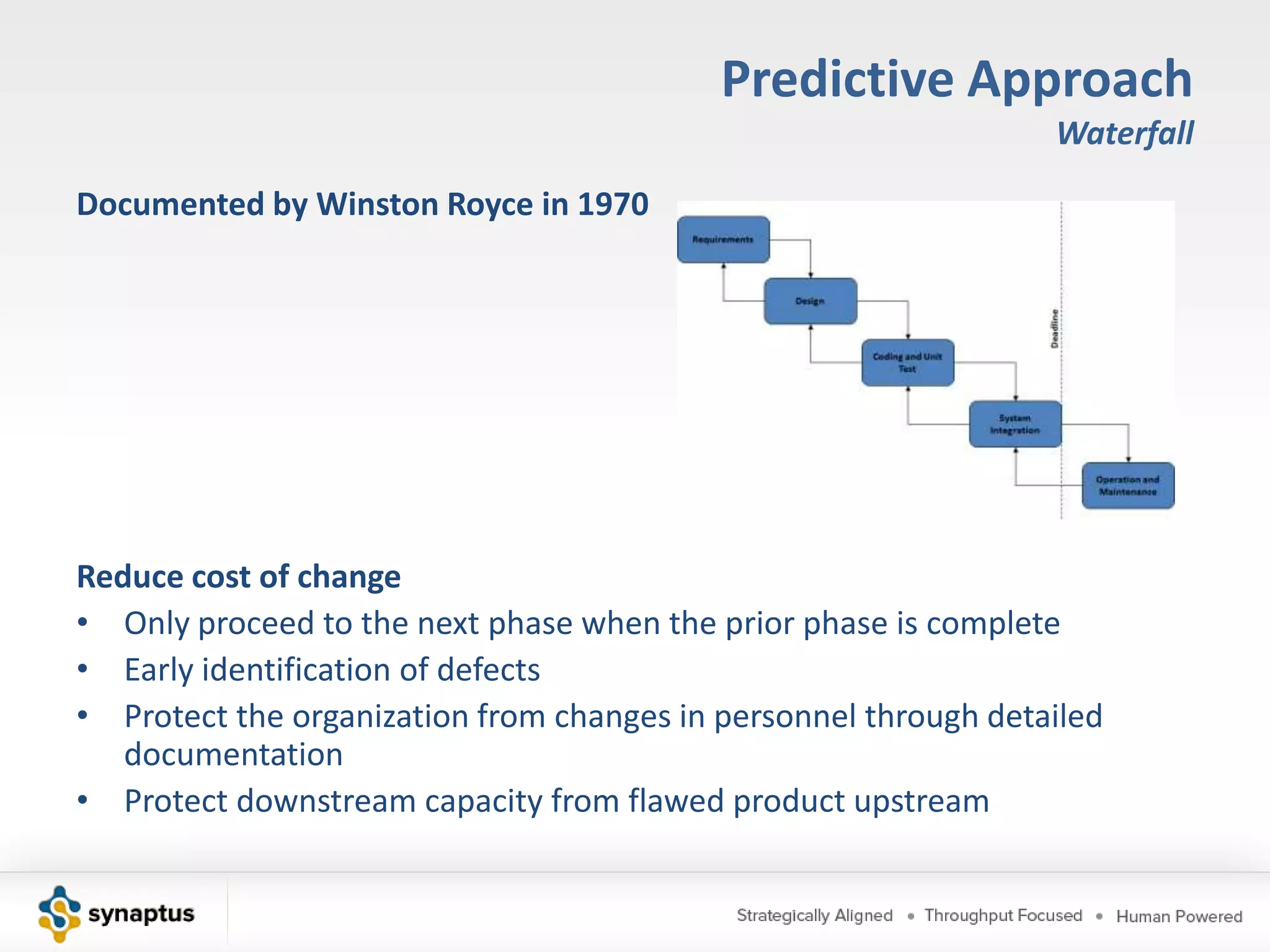
Predictive ApproachWaterfallDocumented by Winston Royce in 1970Reduce cost of changeOnly proceed to the next phase when the prior phase is completeEarly identification of defectsProtect the organization from changes in personnel through detailed documentationProtect downstream capacity from flawed product upstream
Predictive ApproachWaterfallInitial Benefits of Waterfall
Thorough design of the plant saves costs from miscues
Quality control at each step protects downstream capacity
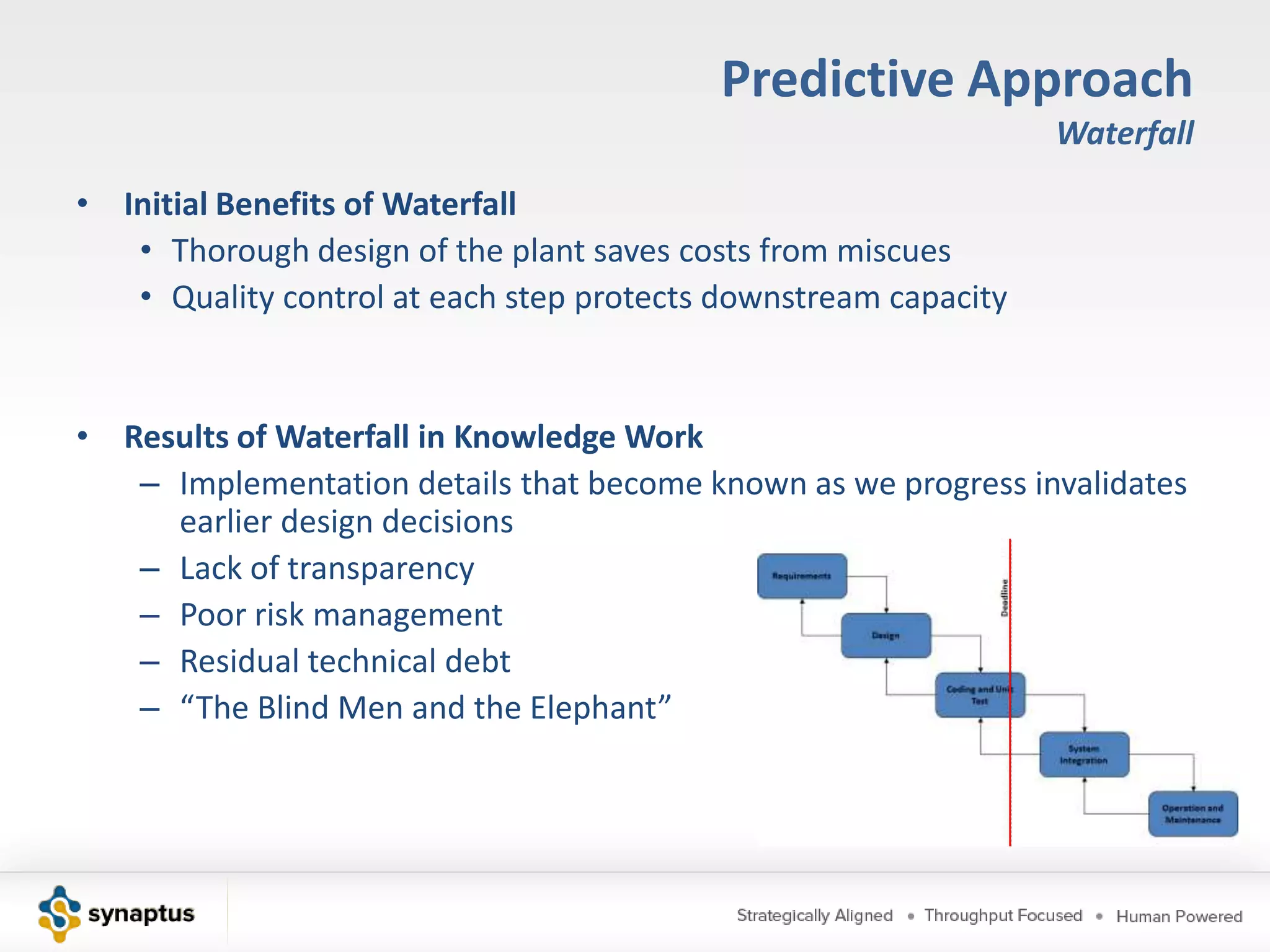
Results of Waterfall in Knowledge WorkImplementation details that become known as we progress invalidates earlier design decisionsLack of transparencyPoor risk managementResidual technical debt“The Blind Men and the Elephant”
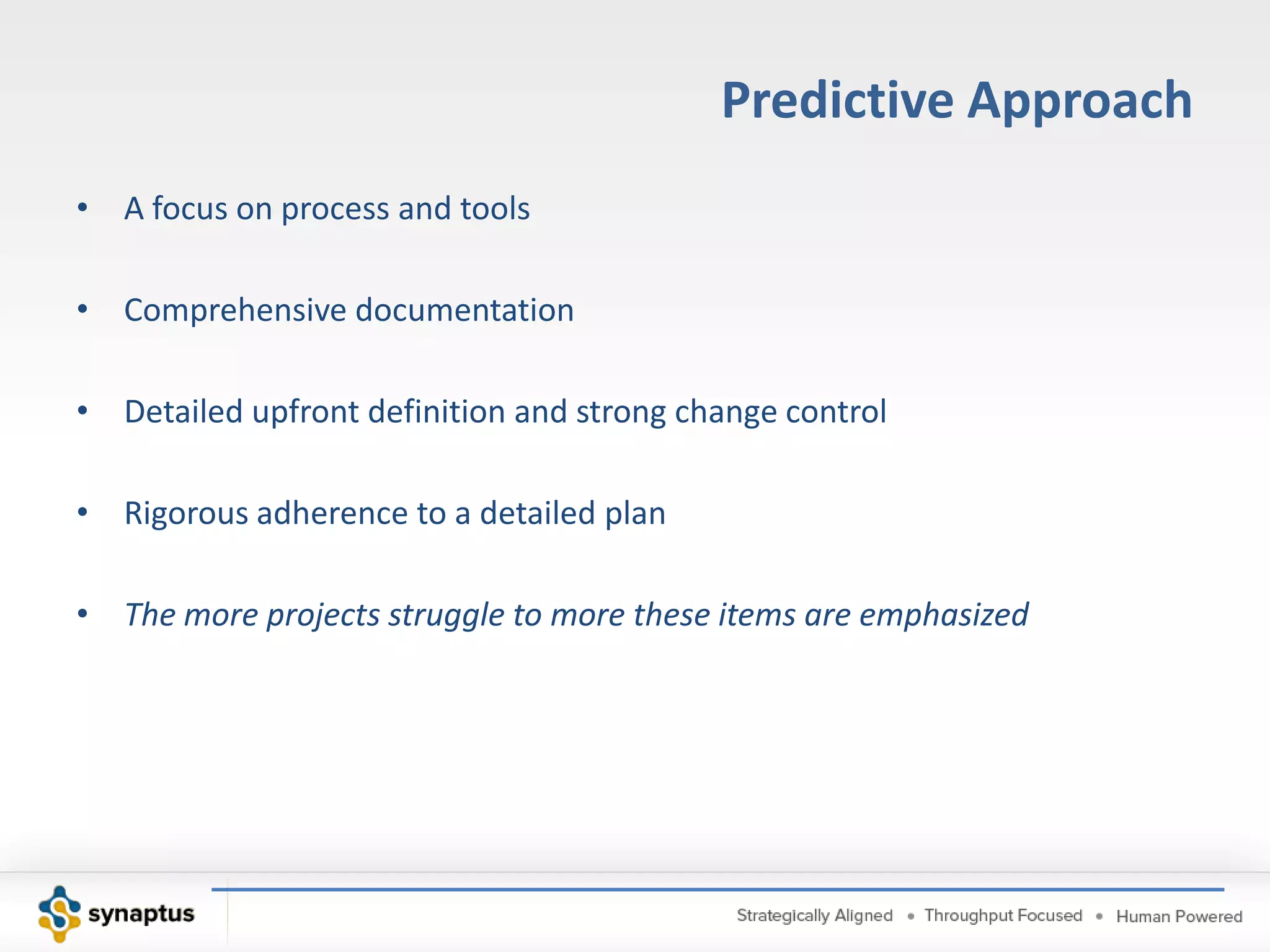
Predictive ApproachA focus on process and toolsComprehensive documentation Detailed upfront definition and strong change controlRigorous adherence to a detailed planThe more projects struggle to more these items are emphasized
AgendaRoots of AgileAgile Manifesto
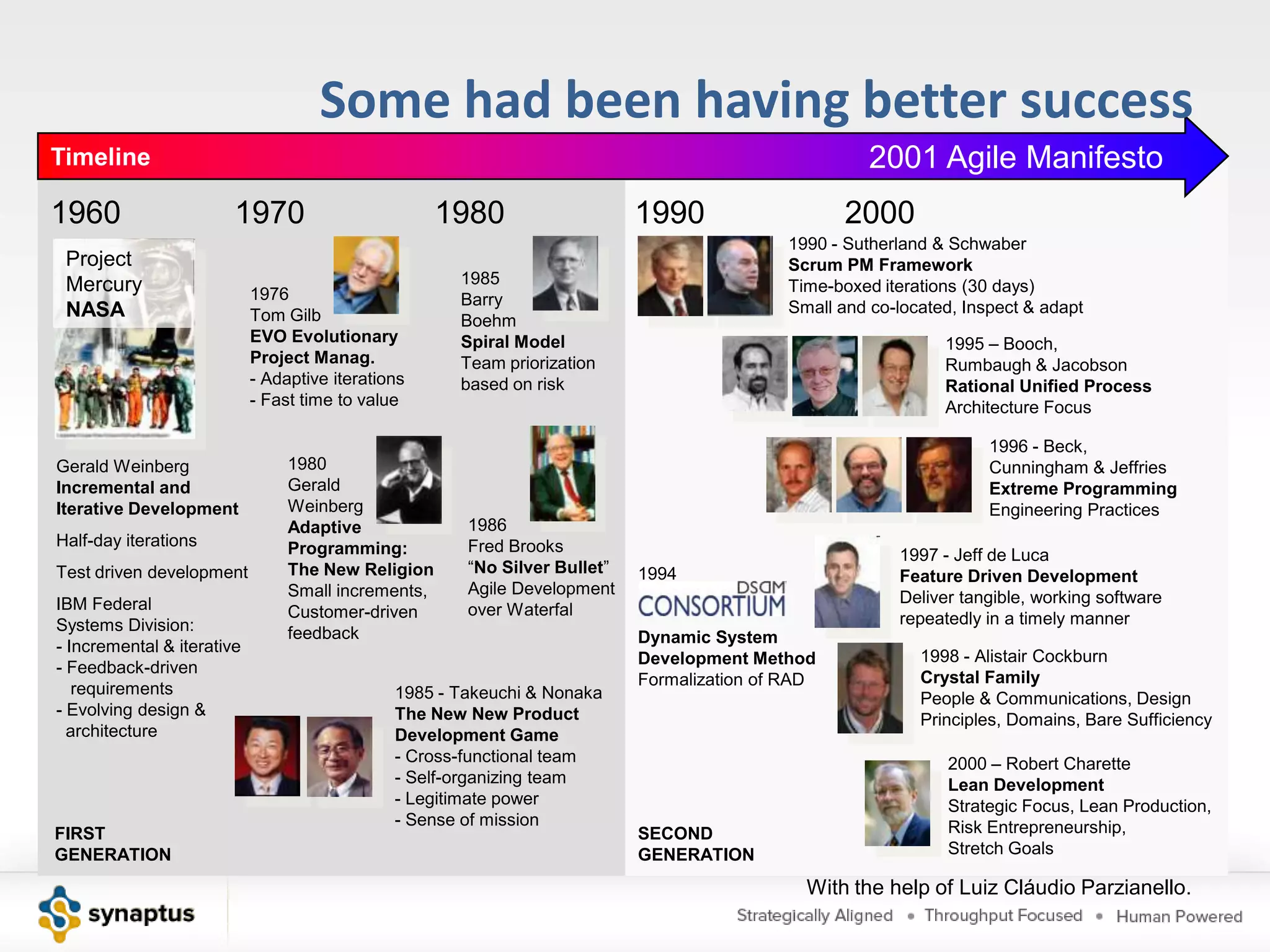
1994Dynamic SystemDevelopment MethodFormalization of RADSome had been having better successTimeline2001 Agile Manifesto196019701980199020001990 - Sutherland & SchwaberScrum PM FrameworkTime-boxed iterations (30 days)Small and co-located, Inspect & adaptProject MercuryNASA1985BarryBoehmSpiral ModelTeam priorizationbased on risk1976Tom GilbEVO EvolutionaryProject Manag.- Adaptive iterations- Fast time to value1995 – Booch,Rumbaugh & JacobsonRational Unified ProcessArchitecture Focus1996 - Beck,Cunningham & JeffriesExtreme ProgrammingEngineering Practices1980GeraldWeinbergAdaptiveProgramming:The New ReligionSmall increments,Customer-drivenfeedbackGerald WeinbergIncremental andIterative DevelopmentHalf-day iterationsTest driven developmentIBM FederalSystems Division:- Incremental & iterative- Feedback-driven   requirements- Evolving design &  architecture1986Fred Brooks“No Silver Bullet”Agile Developmentover Waterfal1997 - Jeff de LucaFeature Driven DevelopmentDeliver tangible, working softwarerepeatedly in a timely manner1998 - Alistair CockburnCrystal FamilyPeople & Communications, DesignPrinciples, Domains, Bare Sufficiency1985 - Takeuchi & NonakaThe New New ProductDevelopment Game- Cross-functional team- Self-organizing team- Legitimate power- Sense of mission2000 – Robert CharetteLean DevelopmentStrategic Focus, Lean Production,Risk Entrepreneurship,Stretch GoalsFIRSTGENERATIONSECONDGENERATIONWith the help of LuizCláudioParzianello.
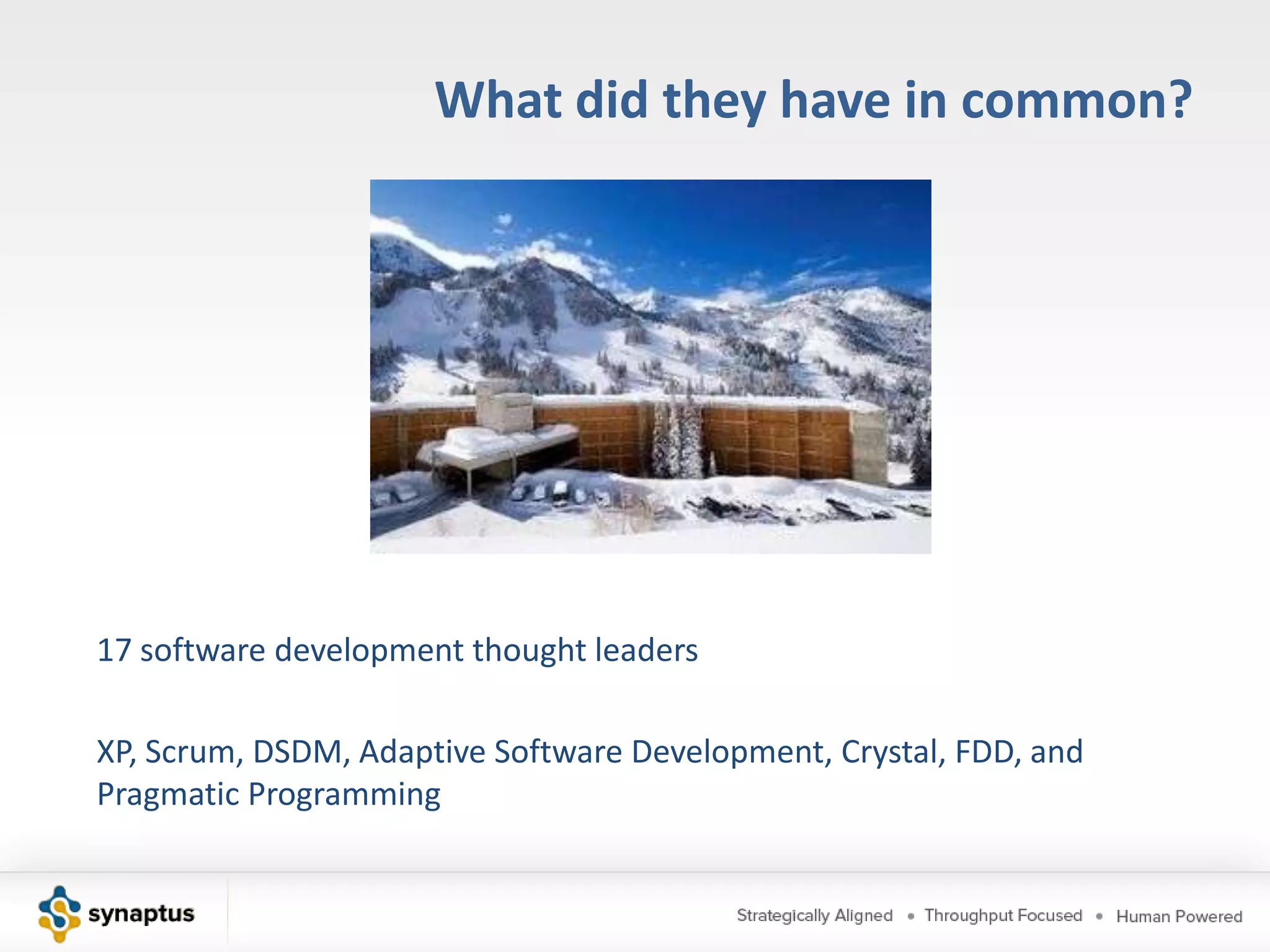
What did they have in common?17 software development thought leadersXP, Scrum, DSDM, Adaptive Software Development, Crystal, FDD, and Pragmatic Programming
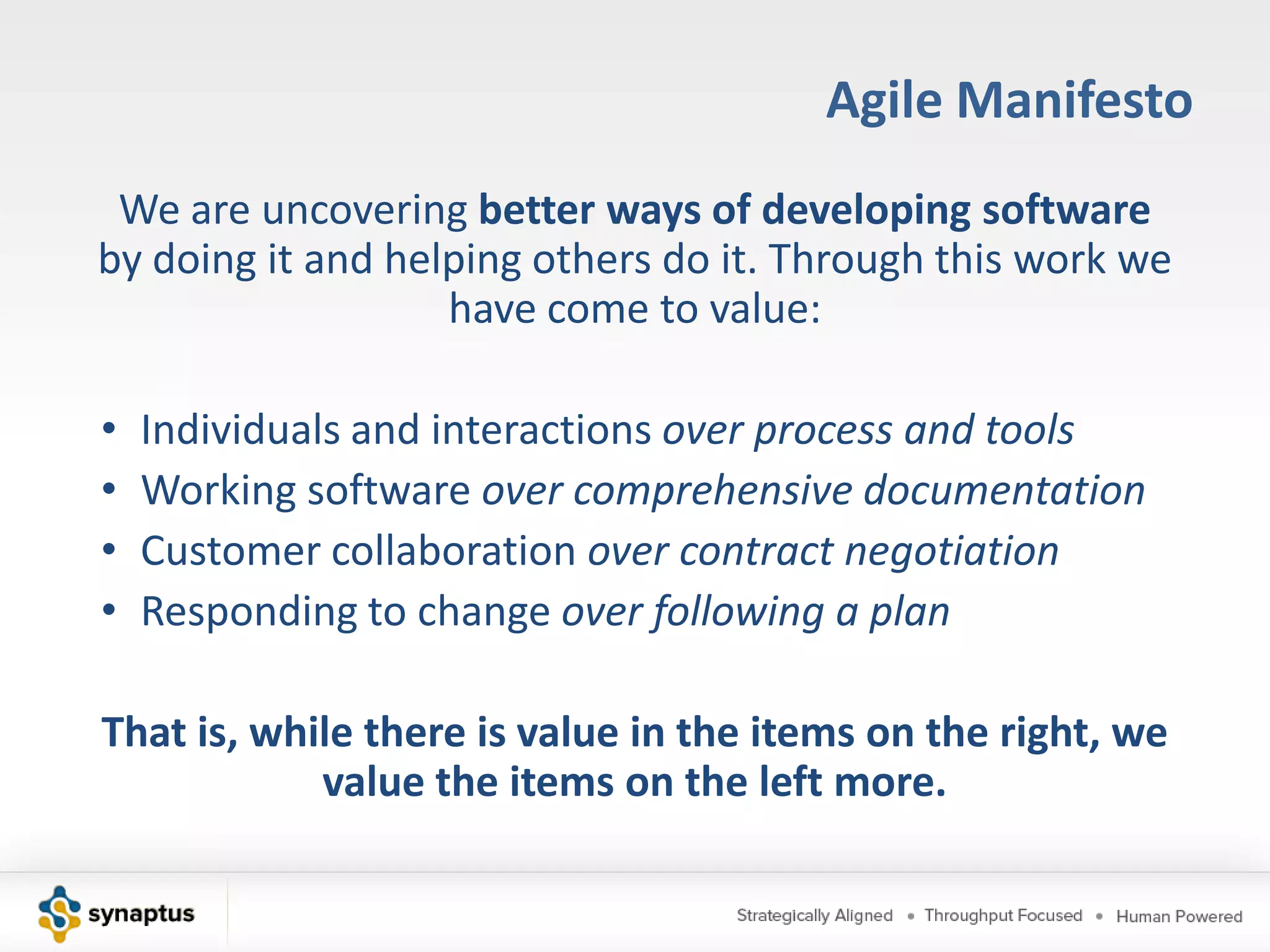
Agile ManifestoWe are uncovering better ways of developing software by doing it and helping others do it. Through this work we have come to value:Individuals and interactionsover process and toolsWorking software over comprehensive documentationCustomer collaboration over contract negotiationResponding to change over following a planThat is, while there is value in the items on the right, we value the items on the left more.
Declaration of InterdependenceIn 2005, 15 Software Development Project Managers got together to discuss how to Project Management must focus to help deliver value from agile teams.
Declaration of InterdependenceAgile and adaptive approaches for linking people, projects and valueWe are a community of project leaders that are highly successful at delivering results. To achieve these results:We increase return on investment by making continuous flow of value our focus.We deliver reliable results by engaging customers in frequent interactions and shared ownership. We expect uncertainty and manage for it through iterations, anticipation, and adaptation. We unleash creativity and innovation by recognizing that individuals are the ultimate source of value, and creating an environment where they can make a difference. We boost performance through group accountability for results and shared responsibility for team effectiveness. We improve effectiveness and reliability through situationally specific strategies, processes and practices.
AgendaRoots of AgileAgile ManifestoAgile Flavors
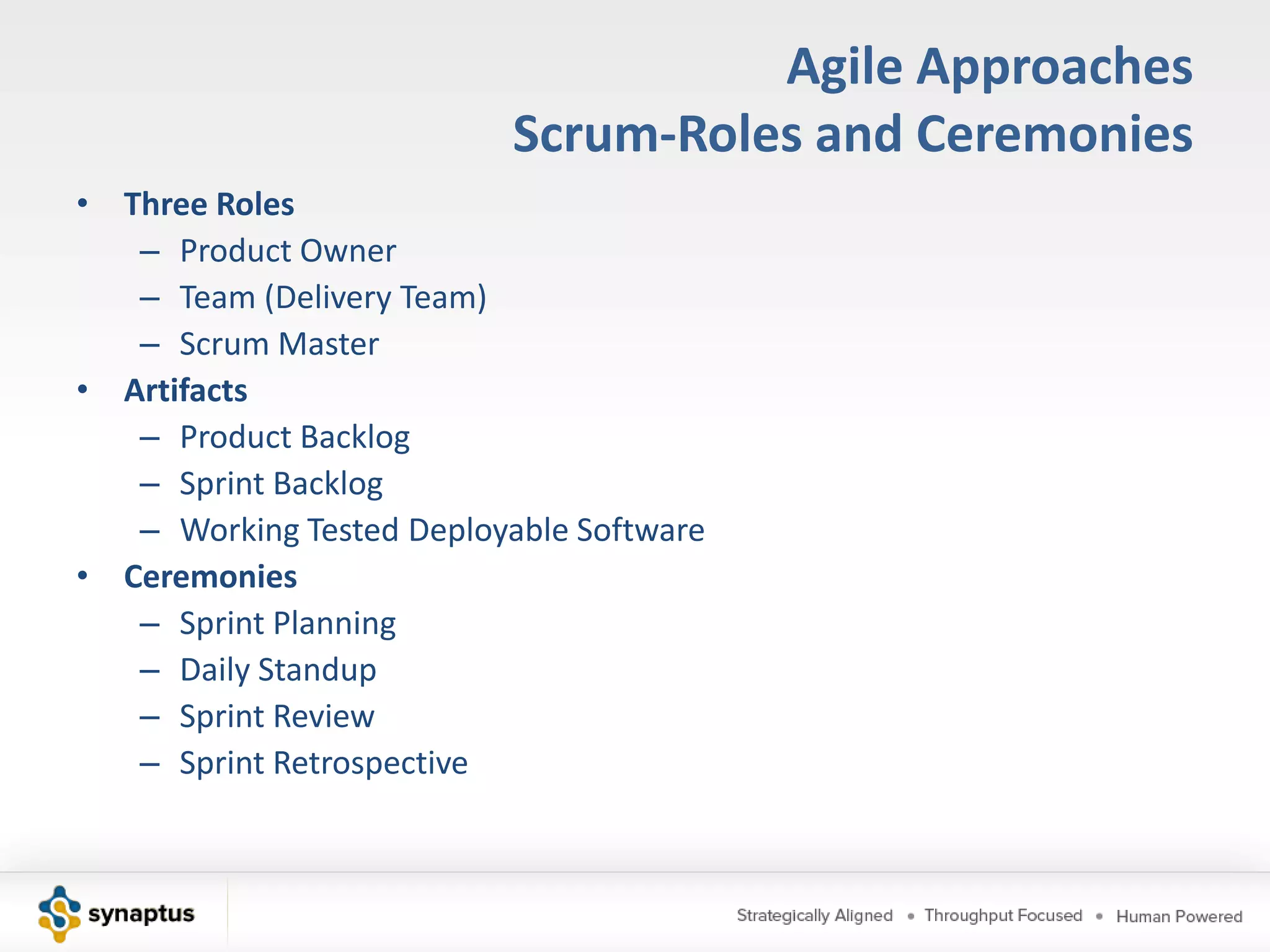
Agile ApproachesScrum-Roles and CeremoniesThree RolesProduct OwnerTeam (Delivery Team)Scrum MasterArtifactsProduct BacklogSprint BacklogWorking Tested Deployable SoftwareCeremoniesSprint PlanningDaily StandupSprint ReviewSprint Retrospective
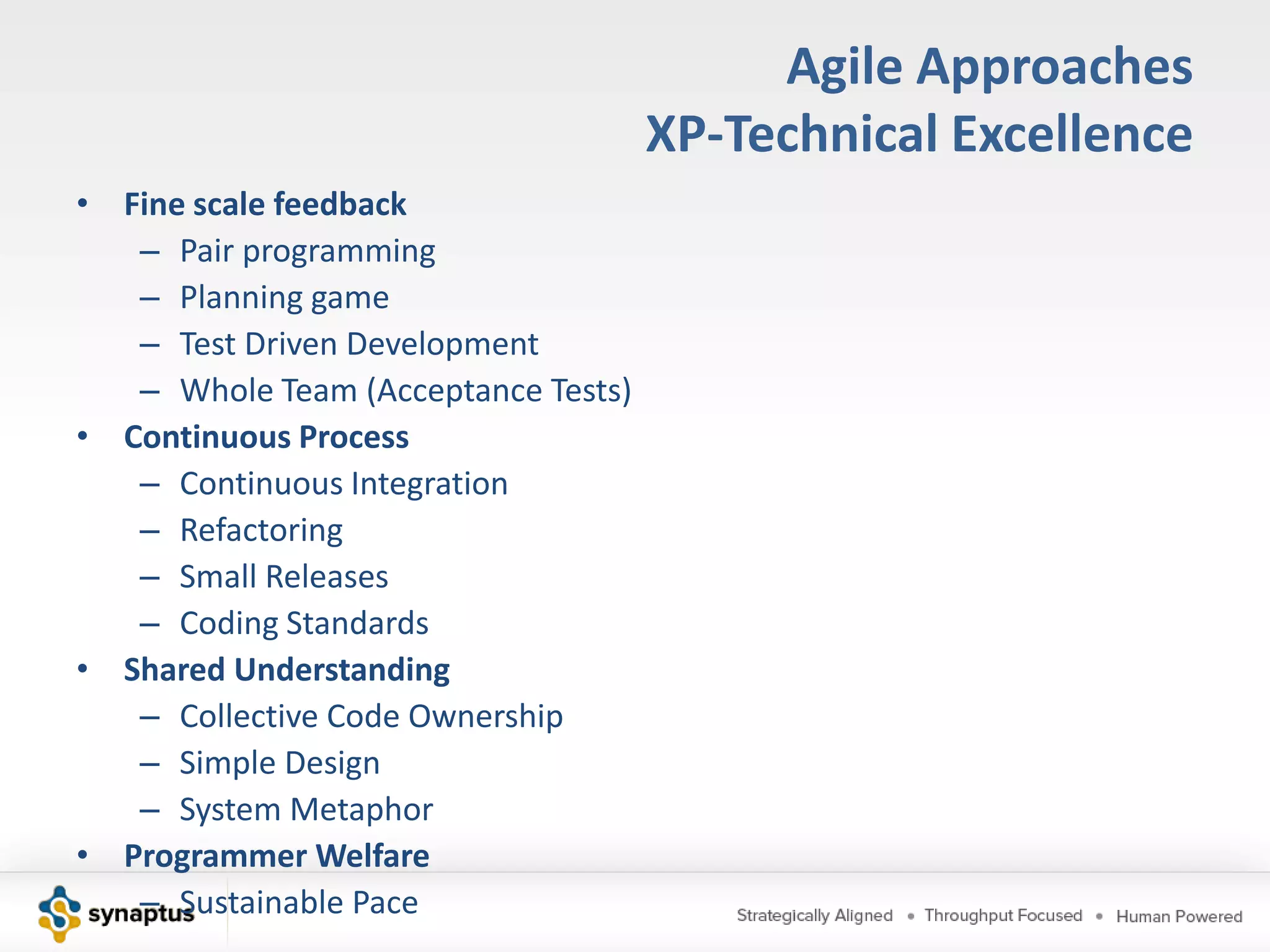
Agile ApproachesXP-Technical ExcellenceFine scale feedbackPair programmingPlanning gameTest Driven DevelopmentWhole Team (Acceptance Tests)Continuous ProcessContinuous IntegrationRefactoringSmall ReleasesCoding StandardsShared UnderstandingCollective Code OwnershipSimple DesignSystem MetaphorProgrammer WelfareSustainable Pace
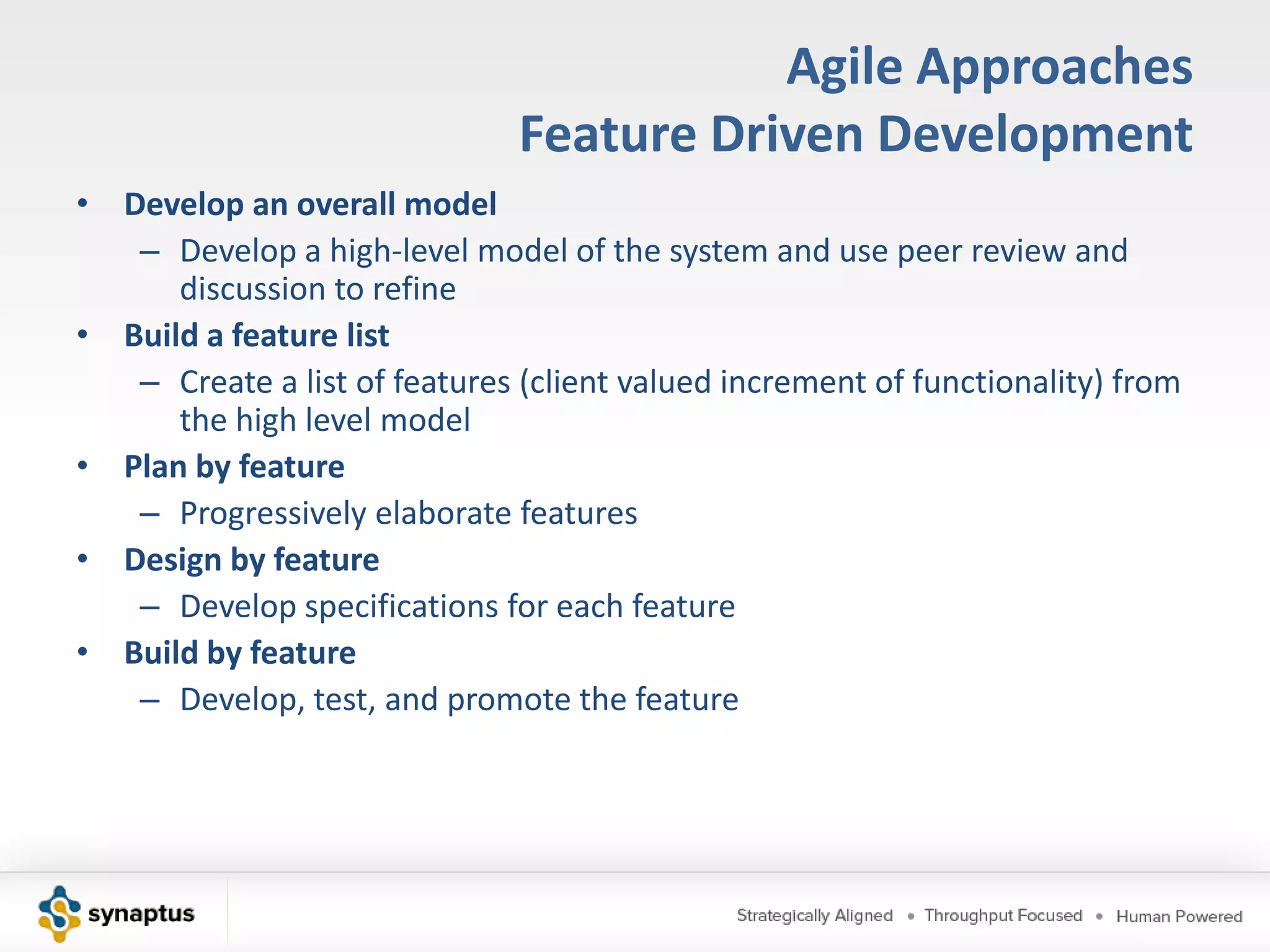
Agile ApproachesFeature Driven DevelopmentDevelop an overall modelDevelop a high-level model of the system and use peer review and discussion to refineBuild a feature listCreate a list of features (client valued increment of functionality) from the high level modelPlan by featureProgressively elaborate features Design by featureDevelop specifications for each featureBuild by featureDevelop, test, and promote the feature
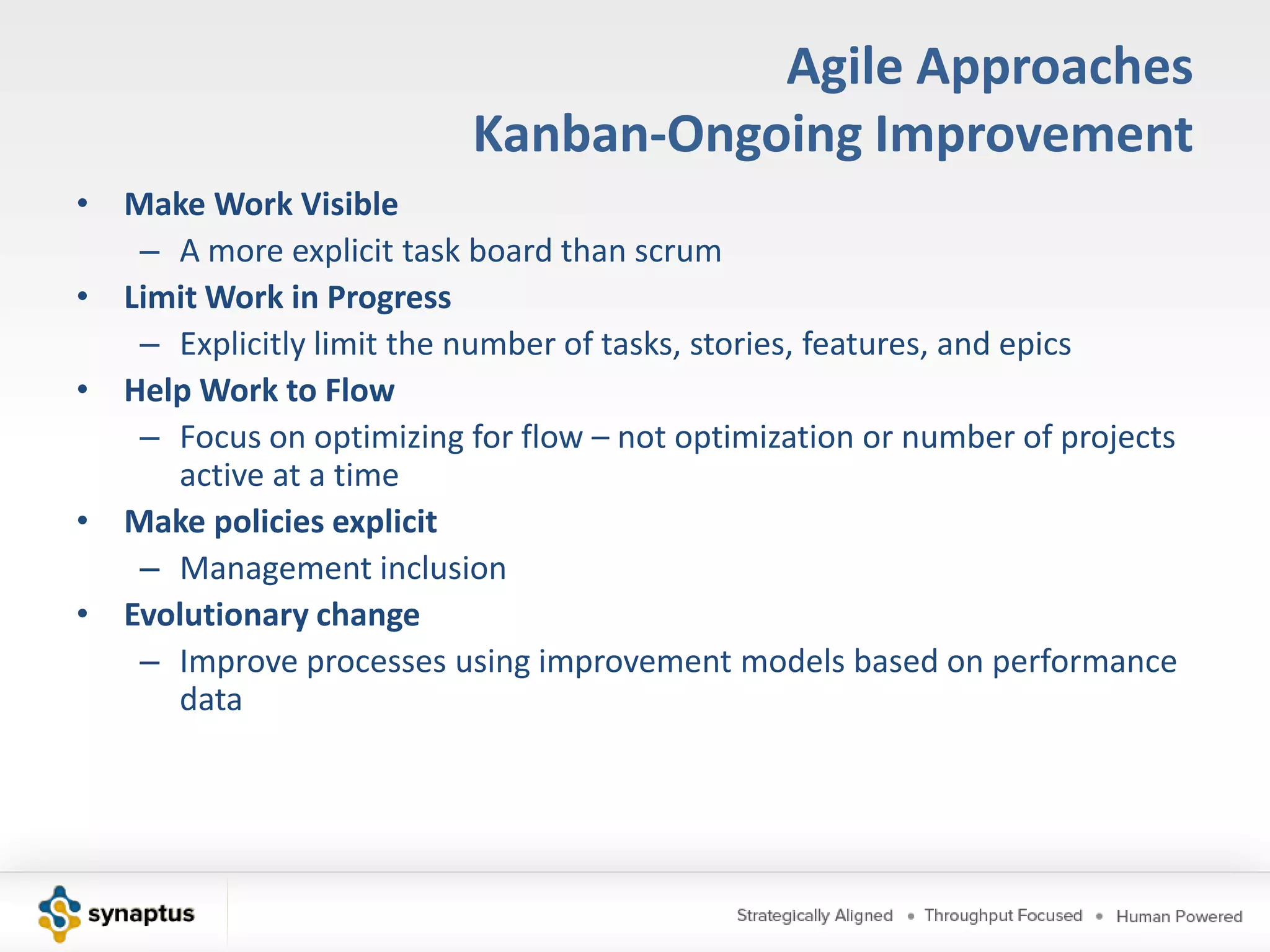
Agile ApproachesKanban-Ongoing ImprovementMake Work VisibleA more explicit task board than scrumLimit Work in ProgressExplicitly limit the number of tasks, stories, features, and epicsHelp Work to FlowFocus on optimizing for flow – not optimization or number of projects active at a timeMake policies explicitManagement inclusionEvolutionary changeImprove processes using improvement models based on performance data
AgendaRoots of AgileAgile ManifestoAgile FlavorsAgile Roles
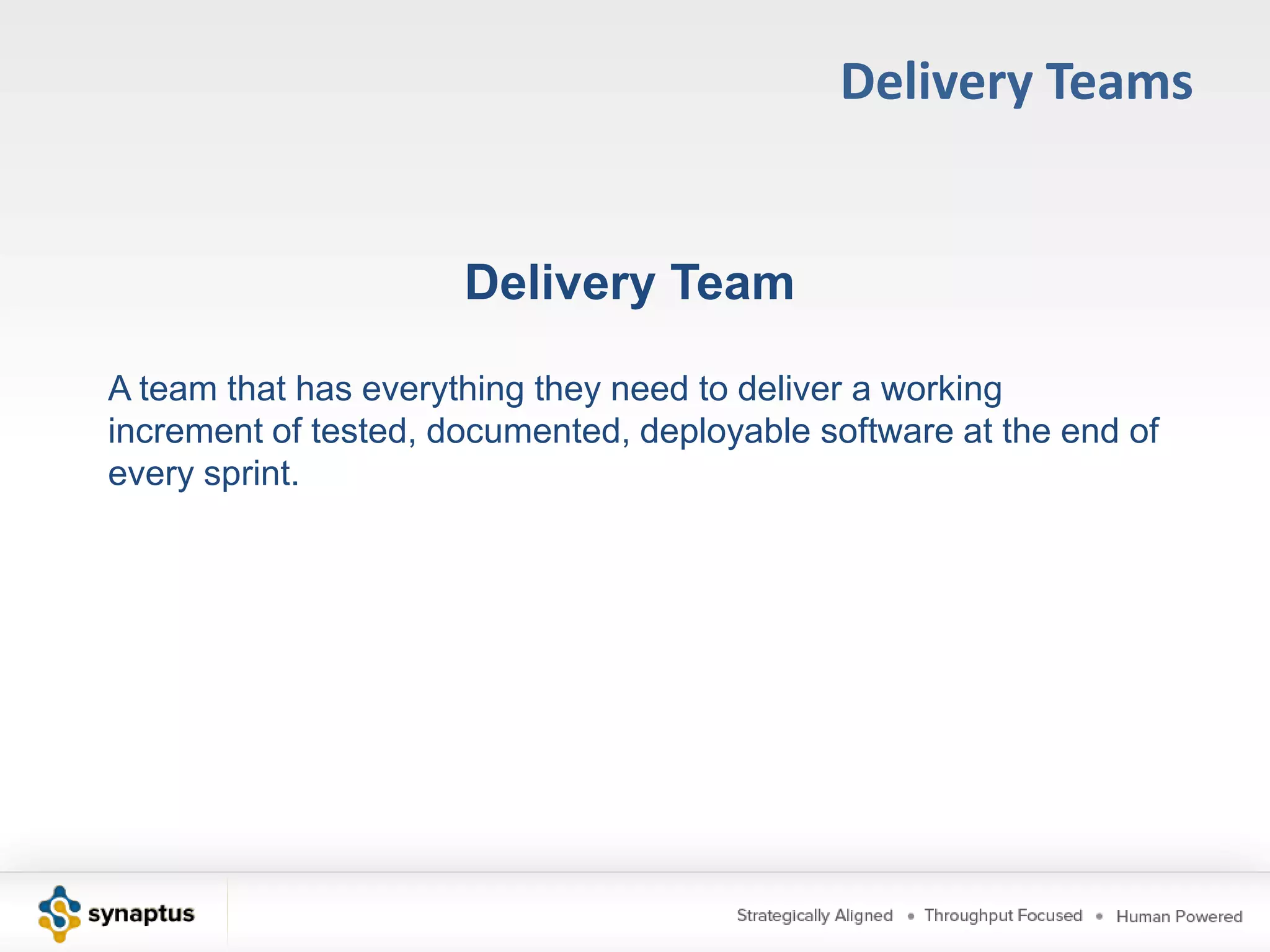
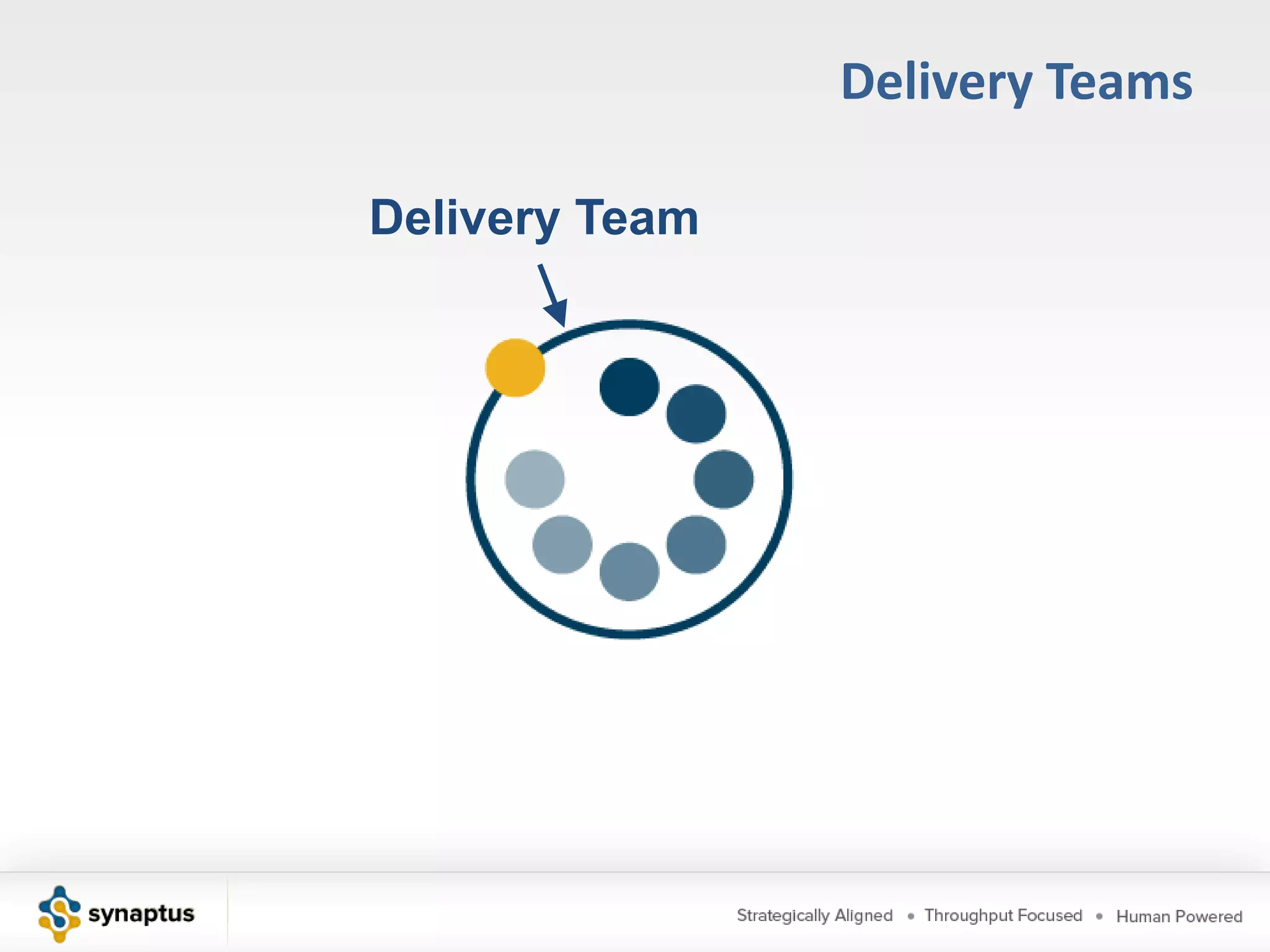
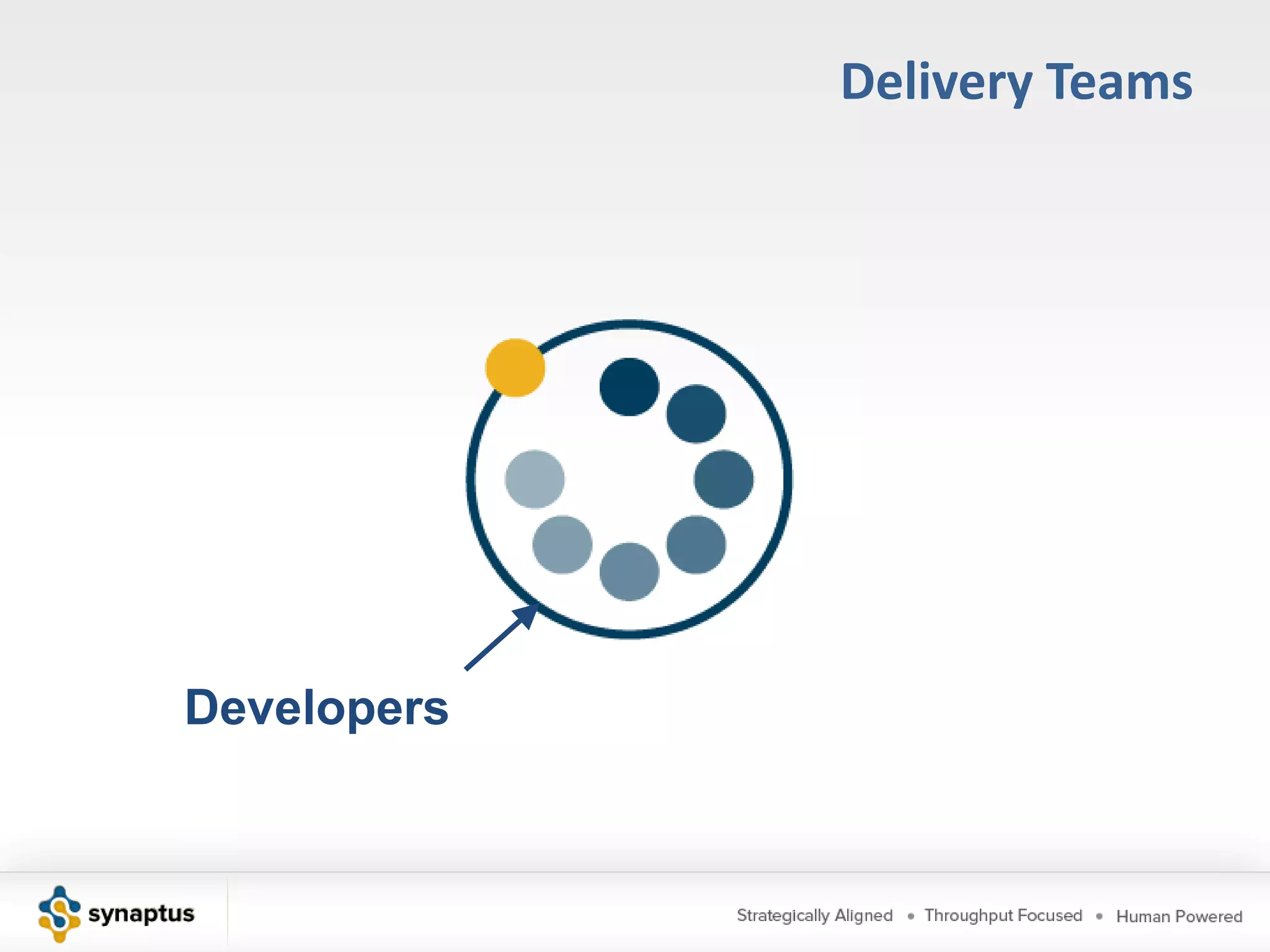
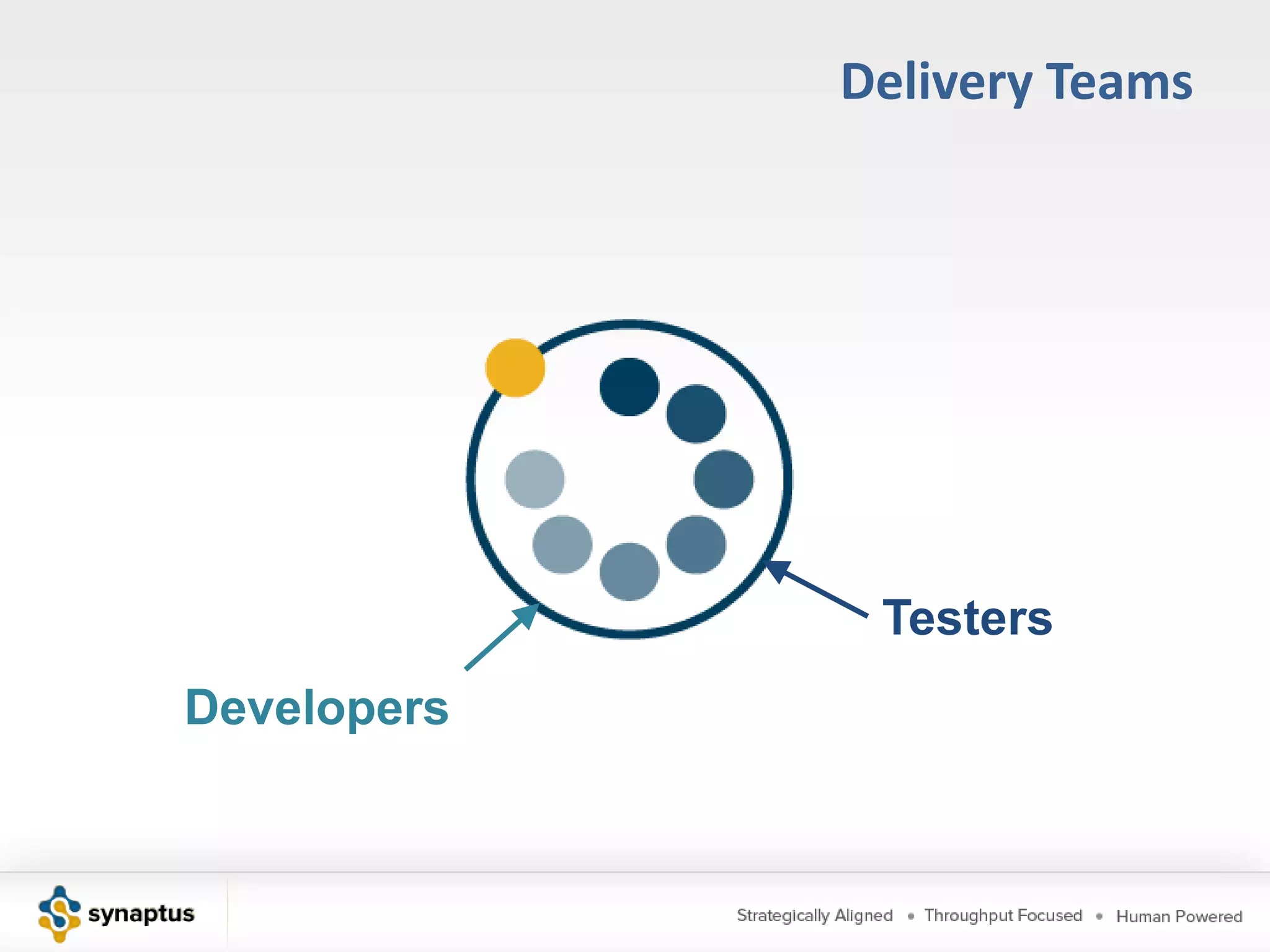
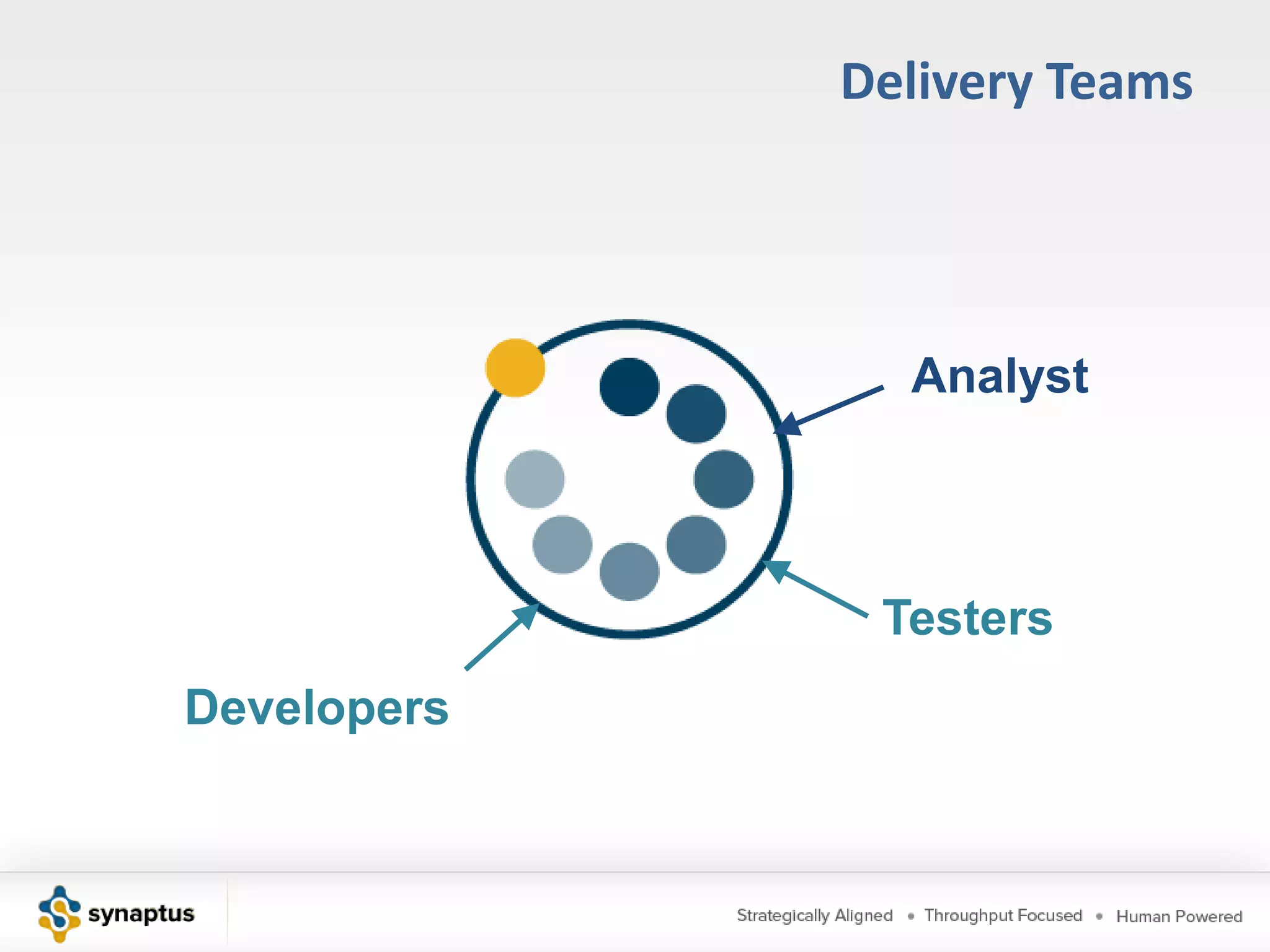
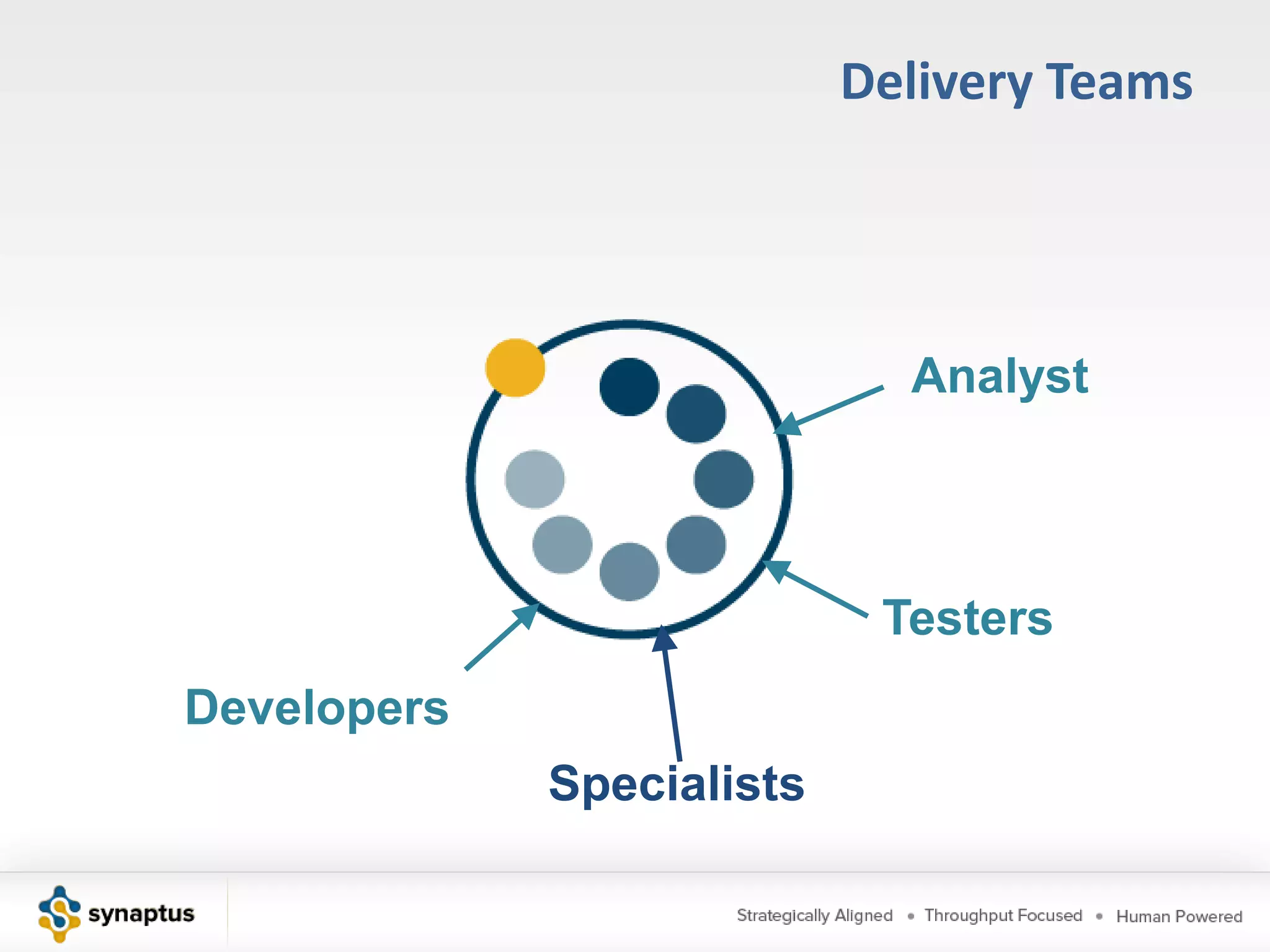
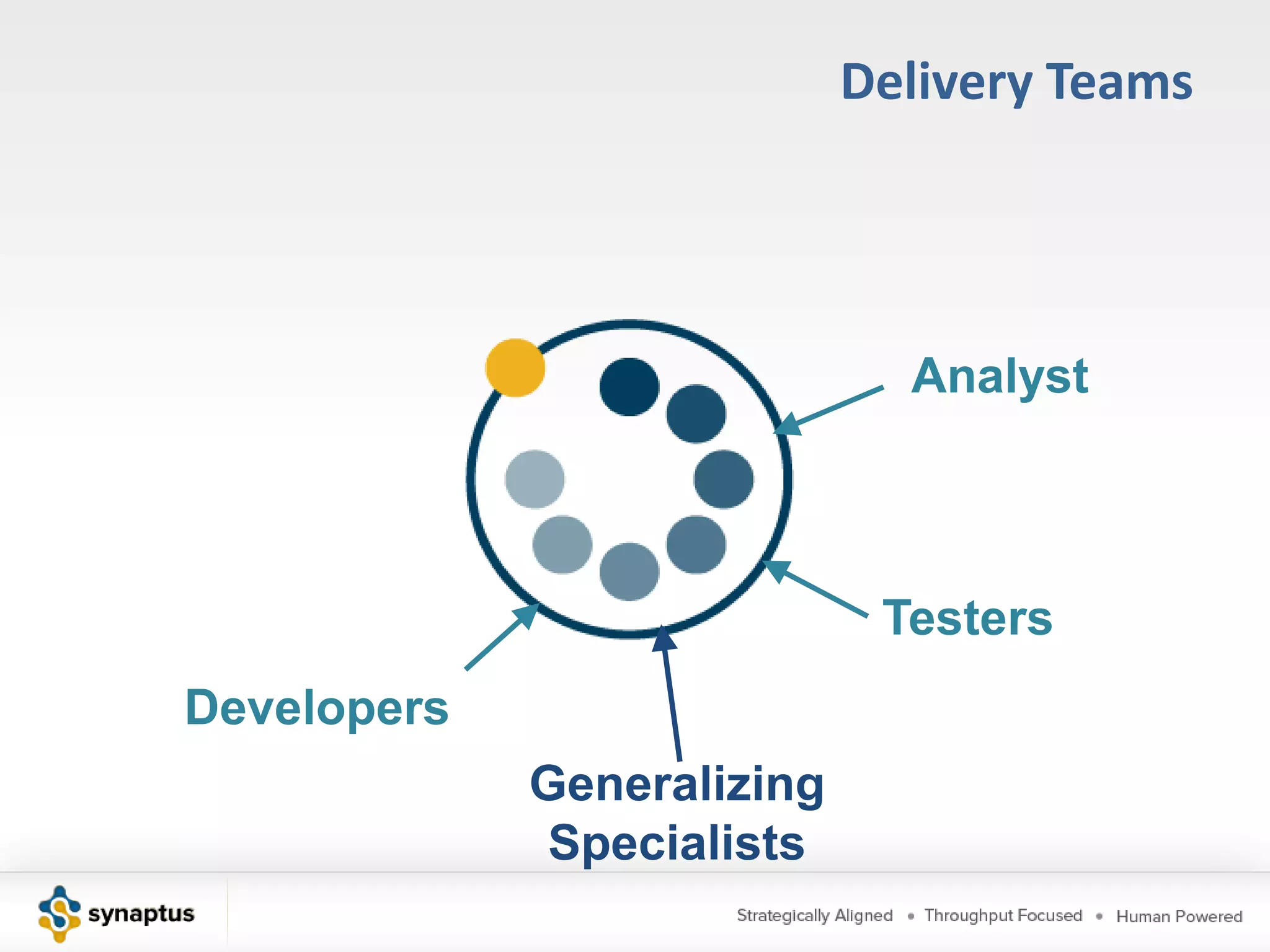
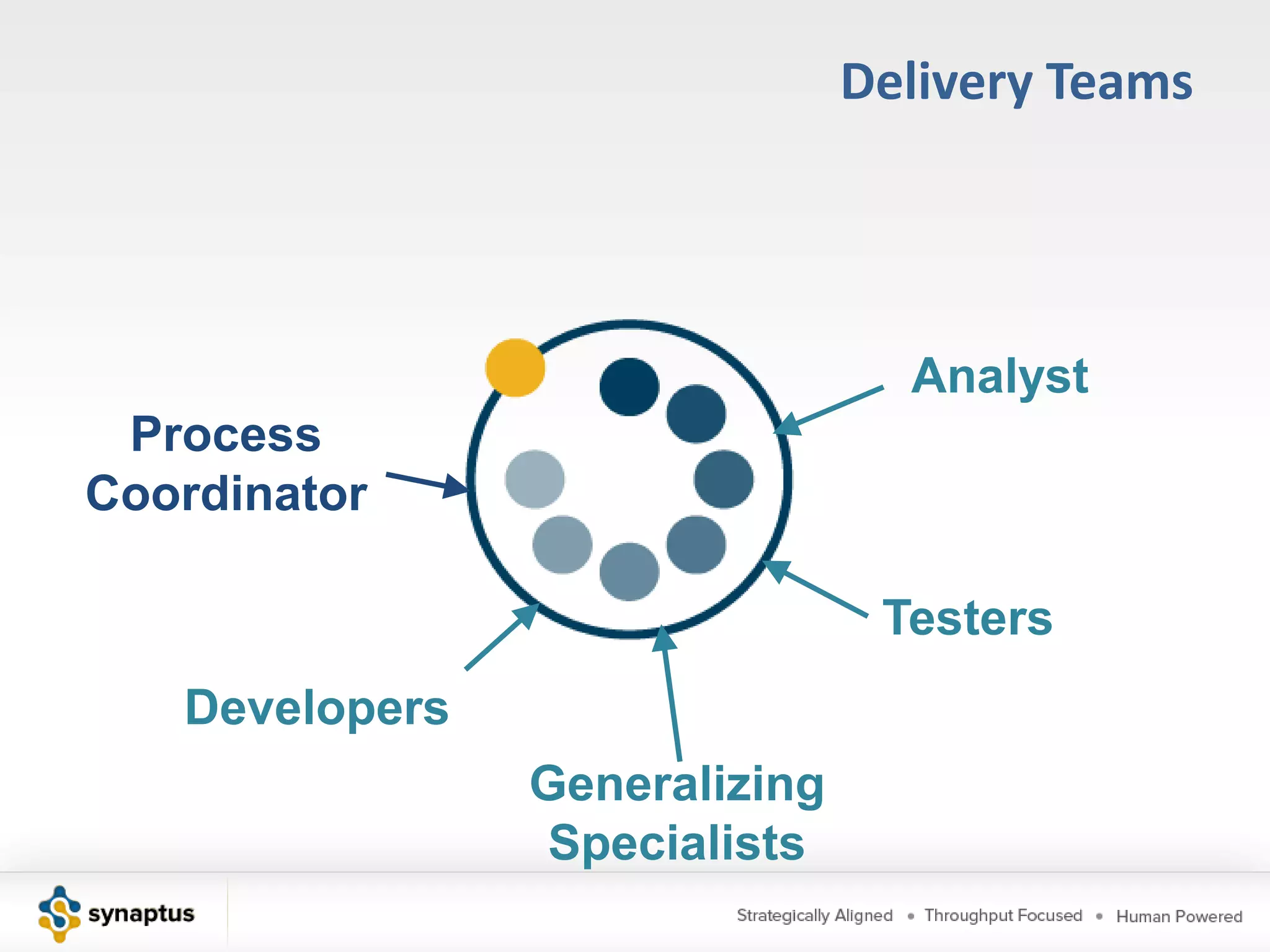
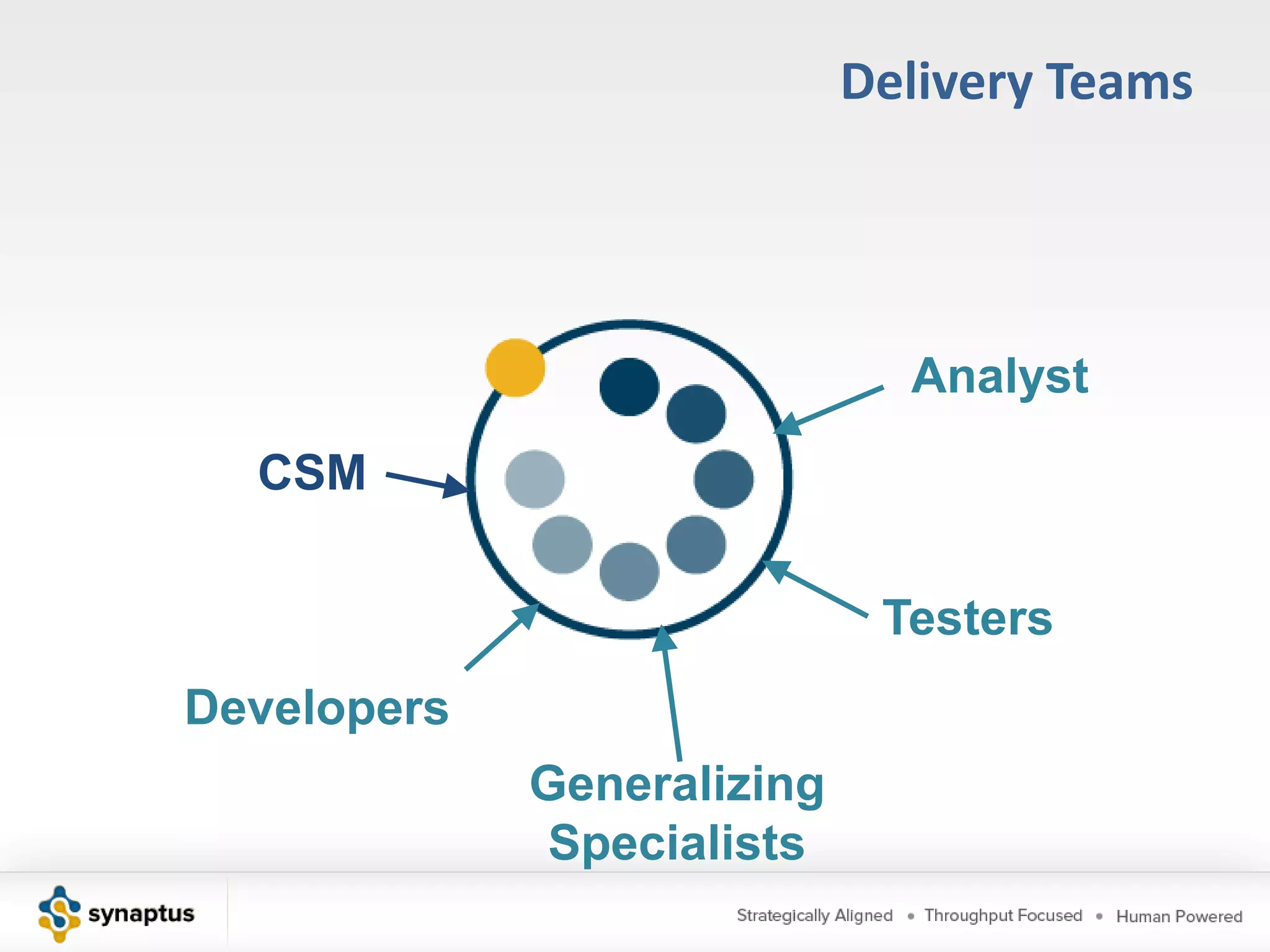
Delivery TeamsDelivery TeamA team that has everything they need to deliver a working increment of tested, documented, deployable software at the end of every sprint.
Delivery TeamsDelivery Team
Delivery TeamsDevelopers
Delivery TeamsTestersDevelopers
Delivery TeamsAnalystTestersDevelopers
Delivery TeamsAnalystTestersDevelopersSpecialists
Delivery TeamsAnalystTestersDevelopersGeneralizing Specialists
Delivery TeamsAnalystProcessCoordinatorTestersDevelopersGeneralizing Specialists
Delivery TeamsAnalystCSMTestersDevelopersGeneralizing Specialists
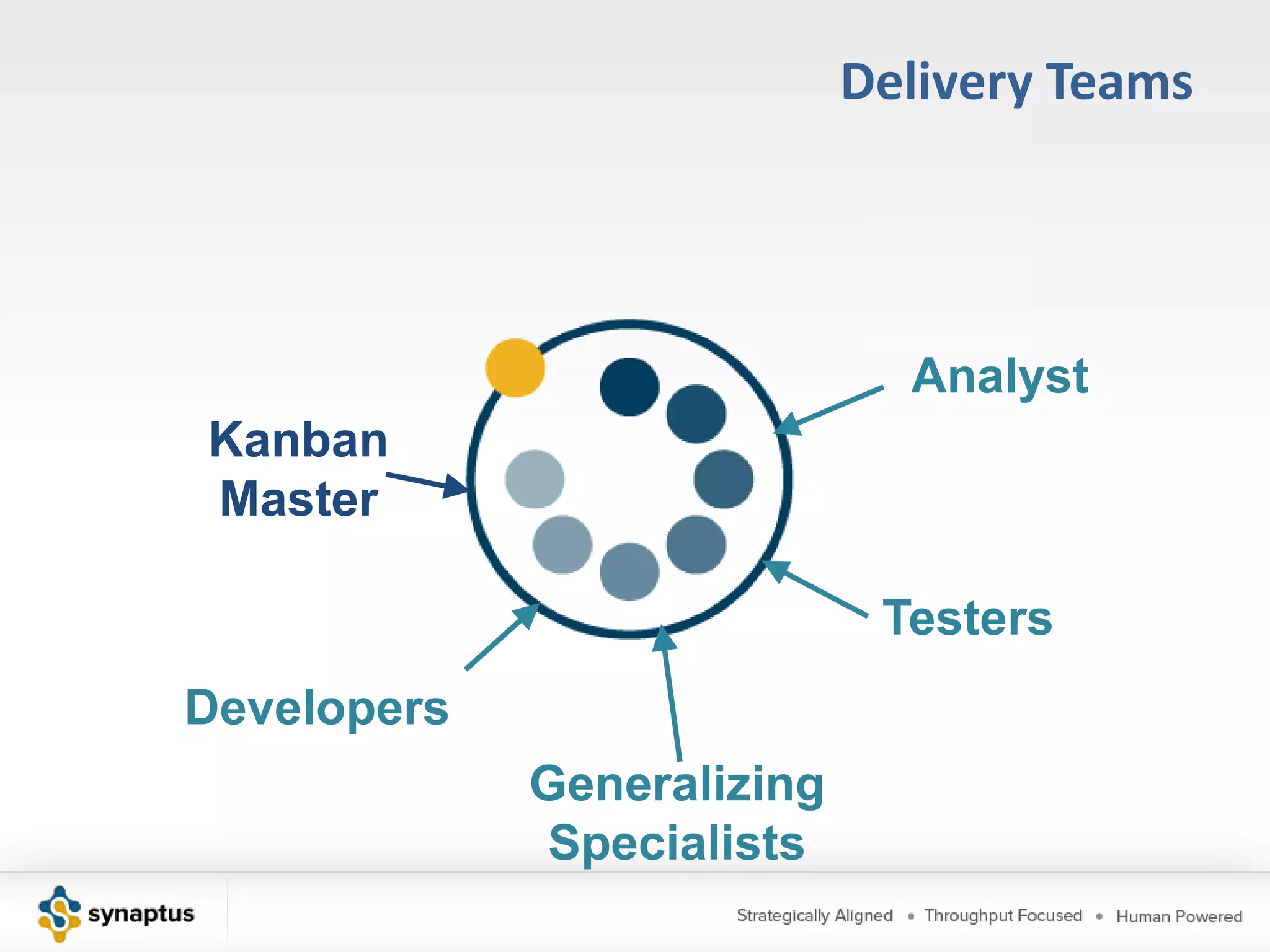
Delivery TeamsAnalystKanbanMasterTestersDevelopersGeneralizing Specialists
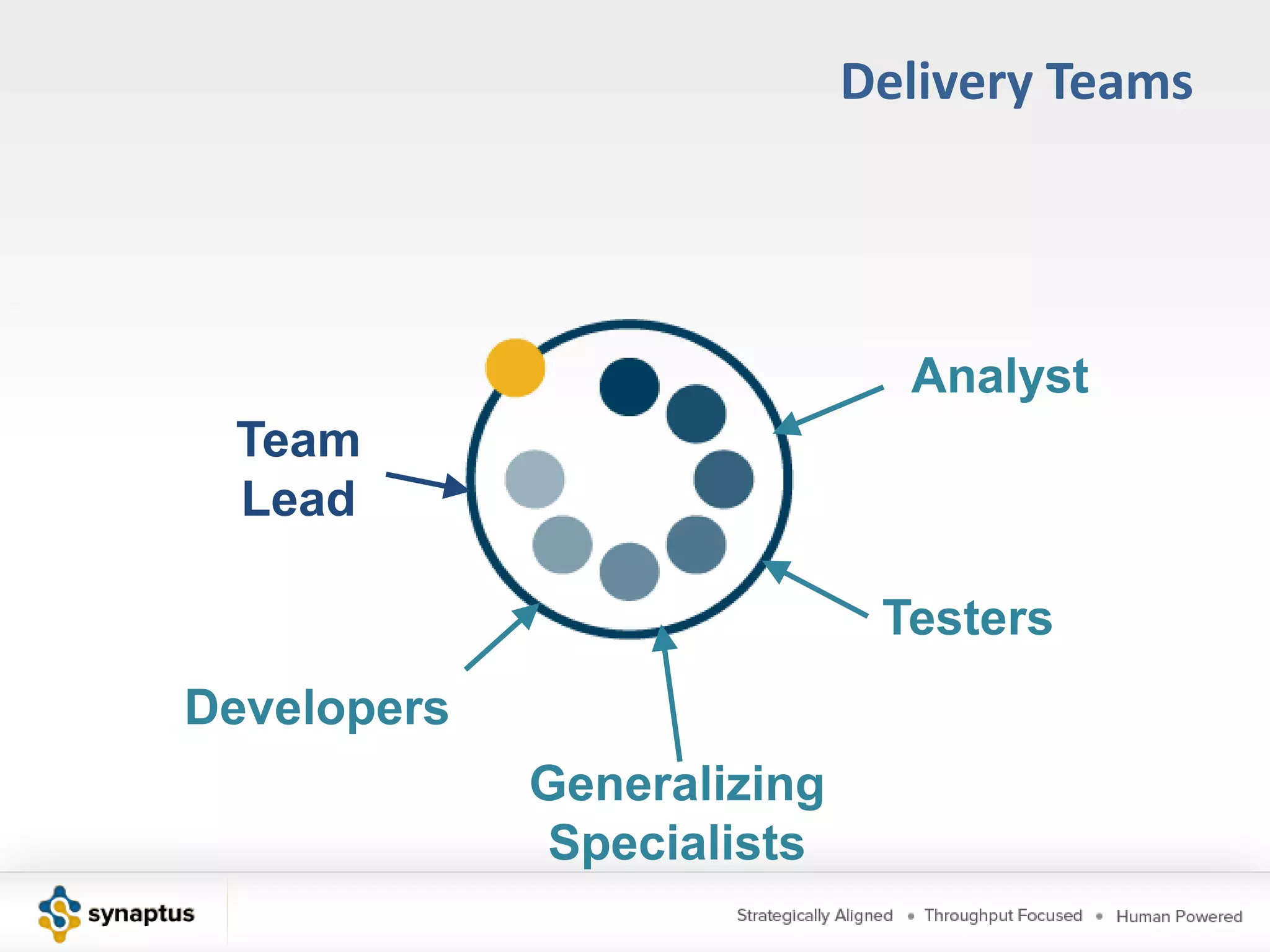
Delivery TeamsAnalystTeamLeadTestersDevelopersGeneralizing Specialists
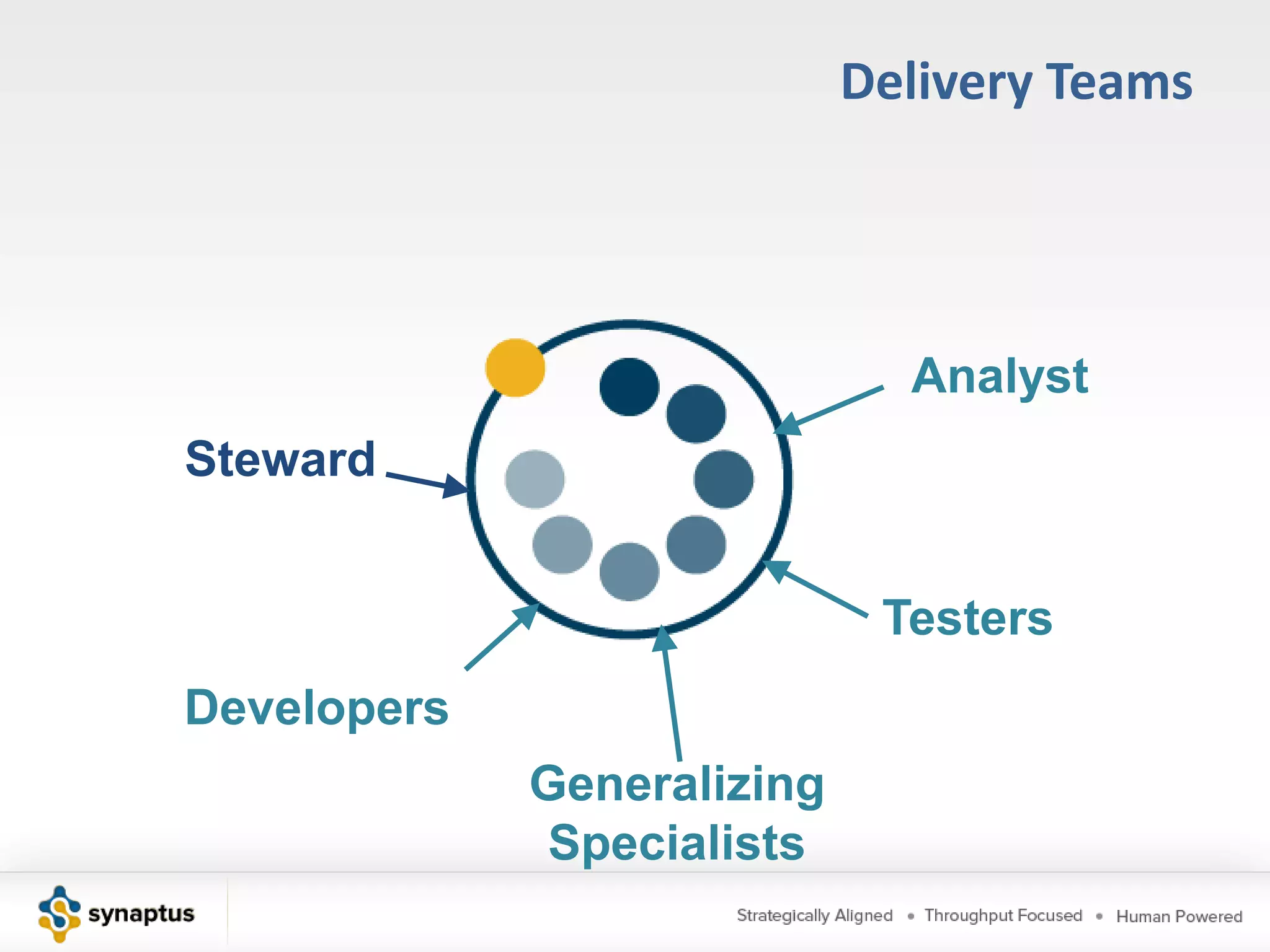
Delivery TeamsAnalystStewardTestersDevelopersGeneralizing Specialists
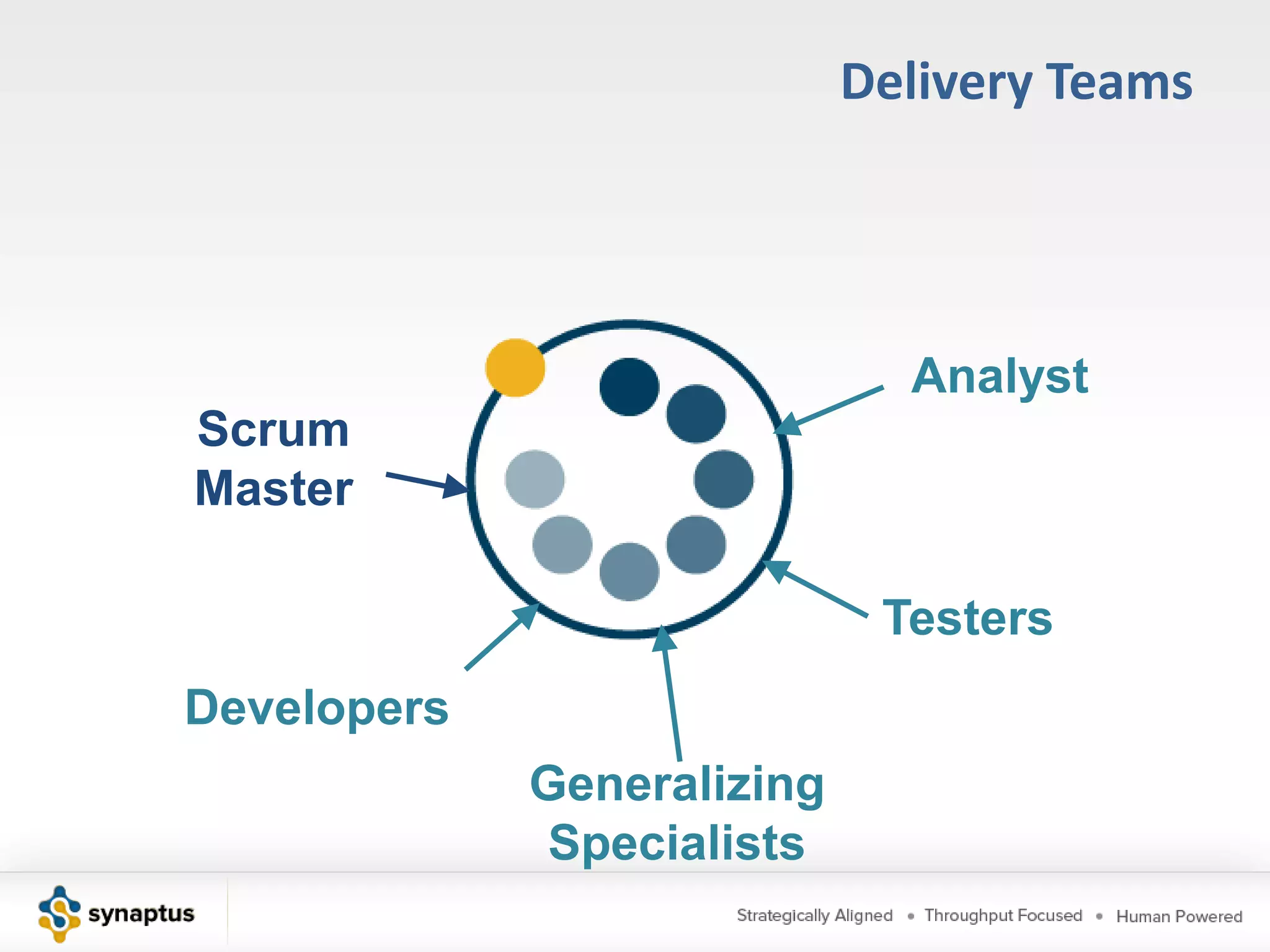
Delivery TeamsAnalystScrum MasterTestersDevelopersGeneralizing Specialists
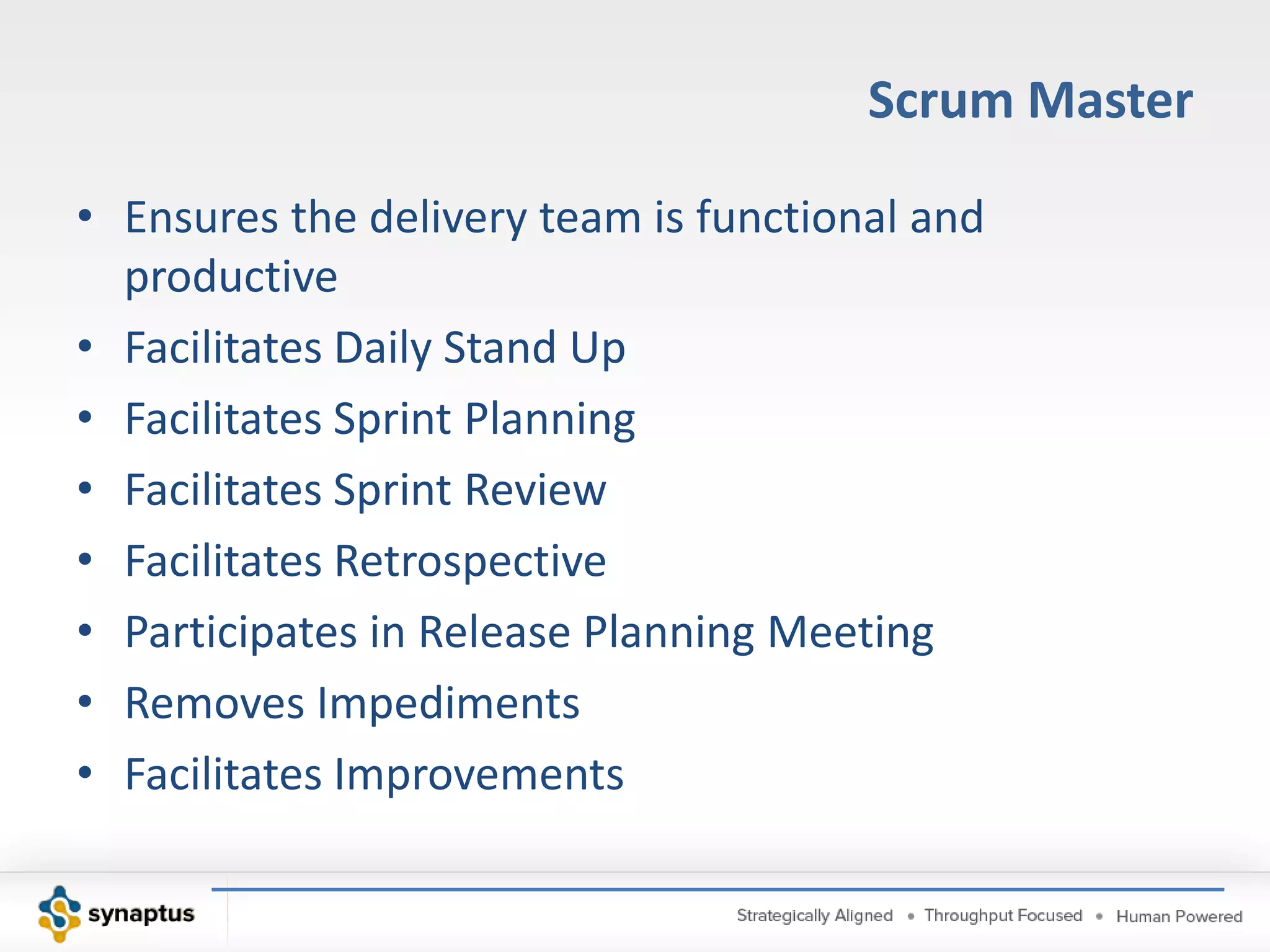
Scrum MasterEnsures the delivery team is functional and productiveFacilitates Daily Stand UpFacilitates Sprint PlanningFacilitates Sprint ReviewFacilitates RetrospectiveParticipates in Release Planning MeetingRemoves ImpedimentsFacilitates Improvements
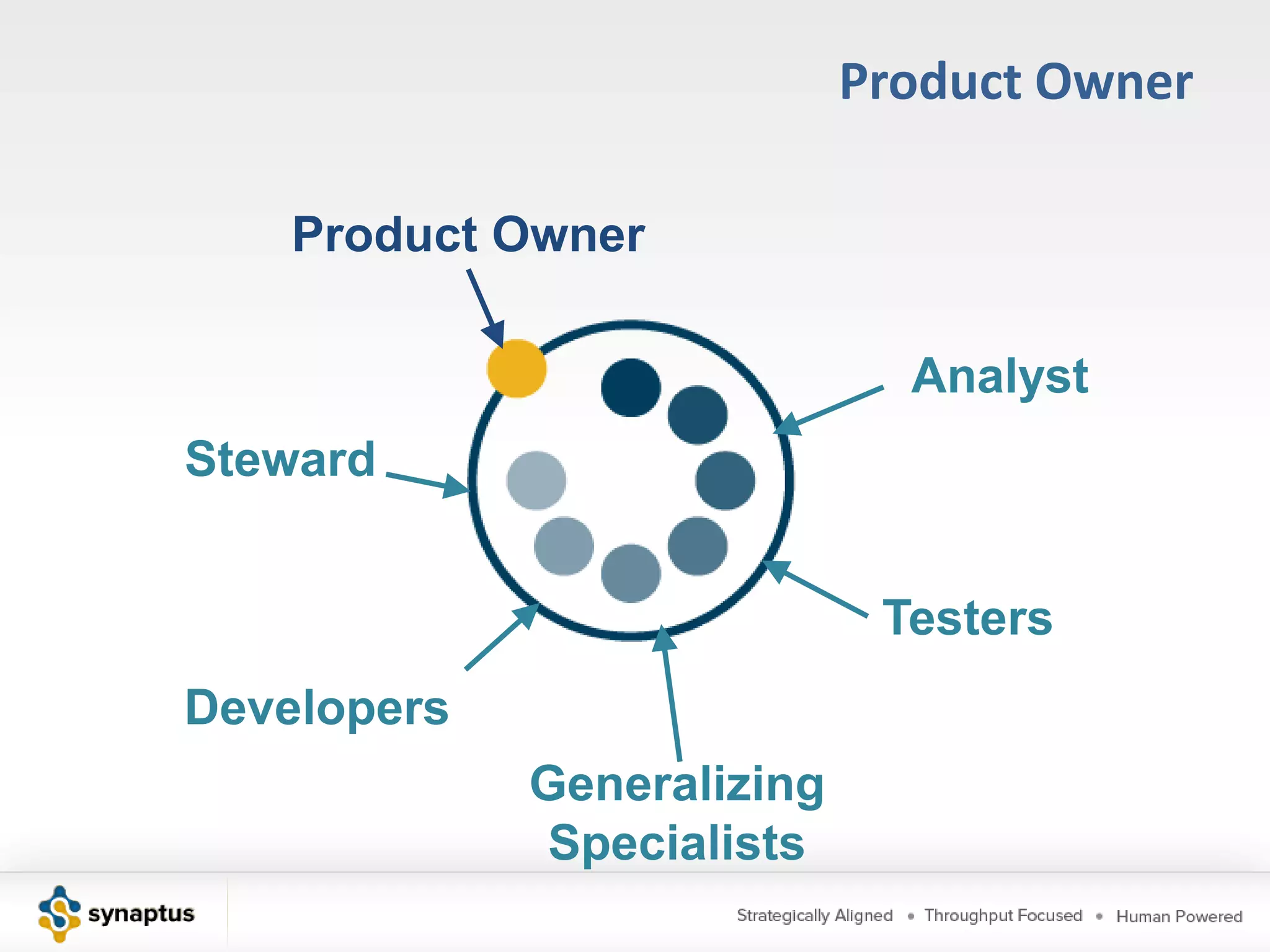
Product OwnerProduct OwnerAnalystStewardTestersDevelopersGeneralizing Specialists
Product OwnerResponsible for the business value of the projectEnsures the product owner team is functional and productivePO Steward/ rep(s) optionally participate in Daily Stand UpPO Steward and rep(s) prepare for and participate in Sprint PlanningPO Steward and rep(s) participate in Sprint ReviewPO Steward/ rep(s) optionally participate in RetrospectivePrepares for and Facilitates Release Planning MeetingFacilitates Product Owner Improvements
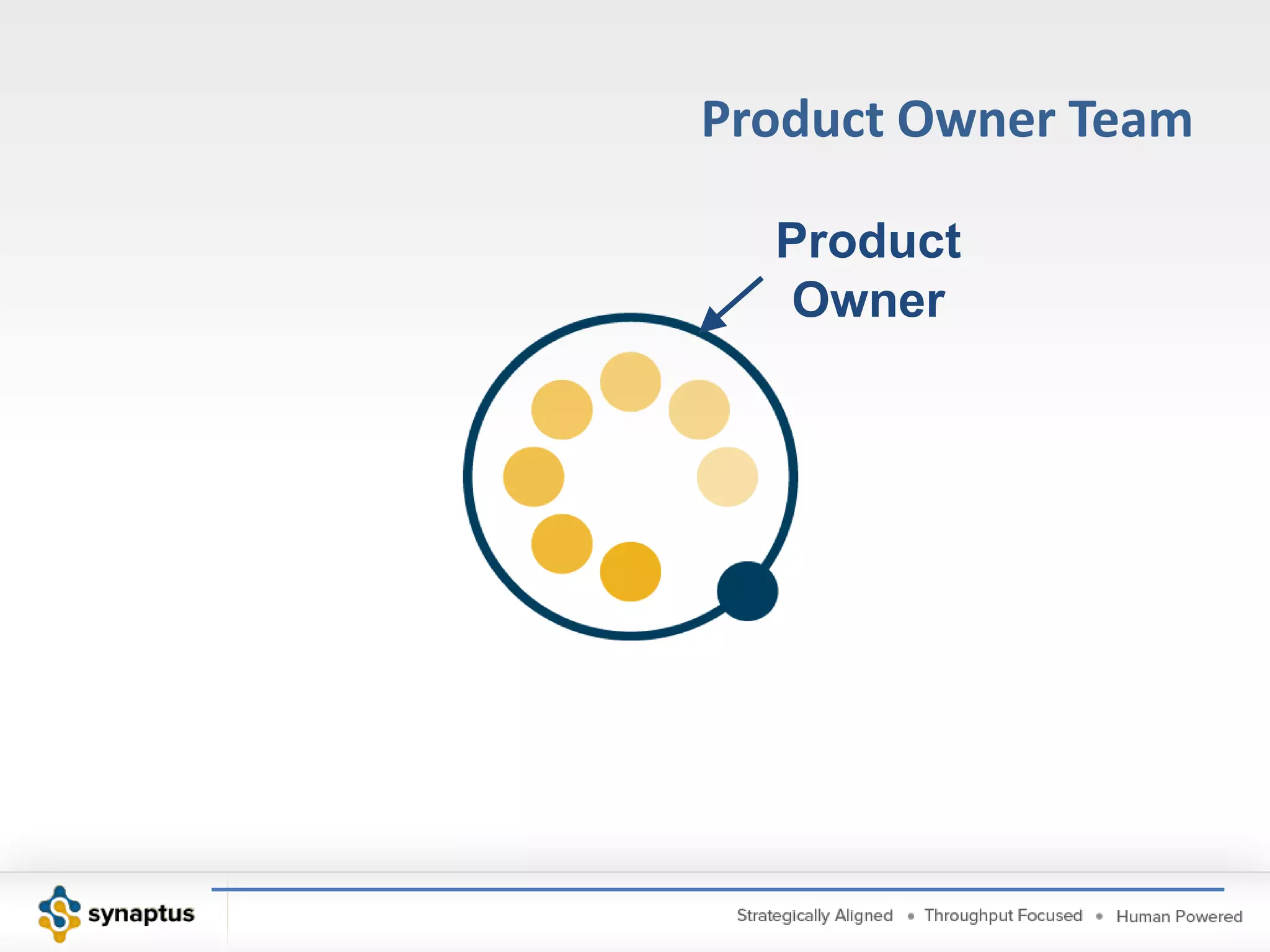
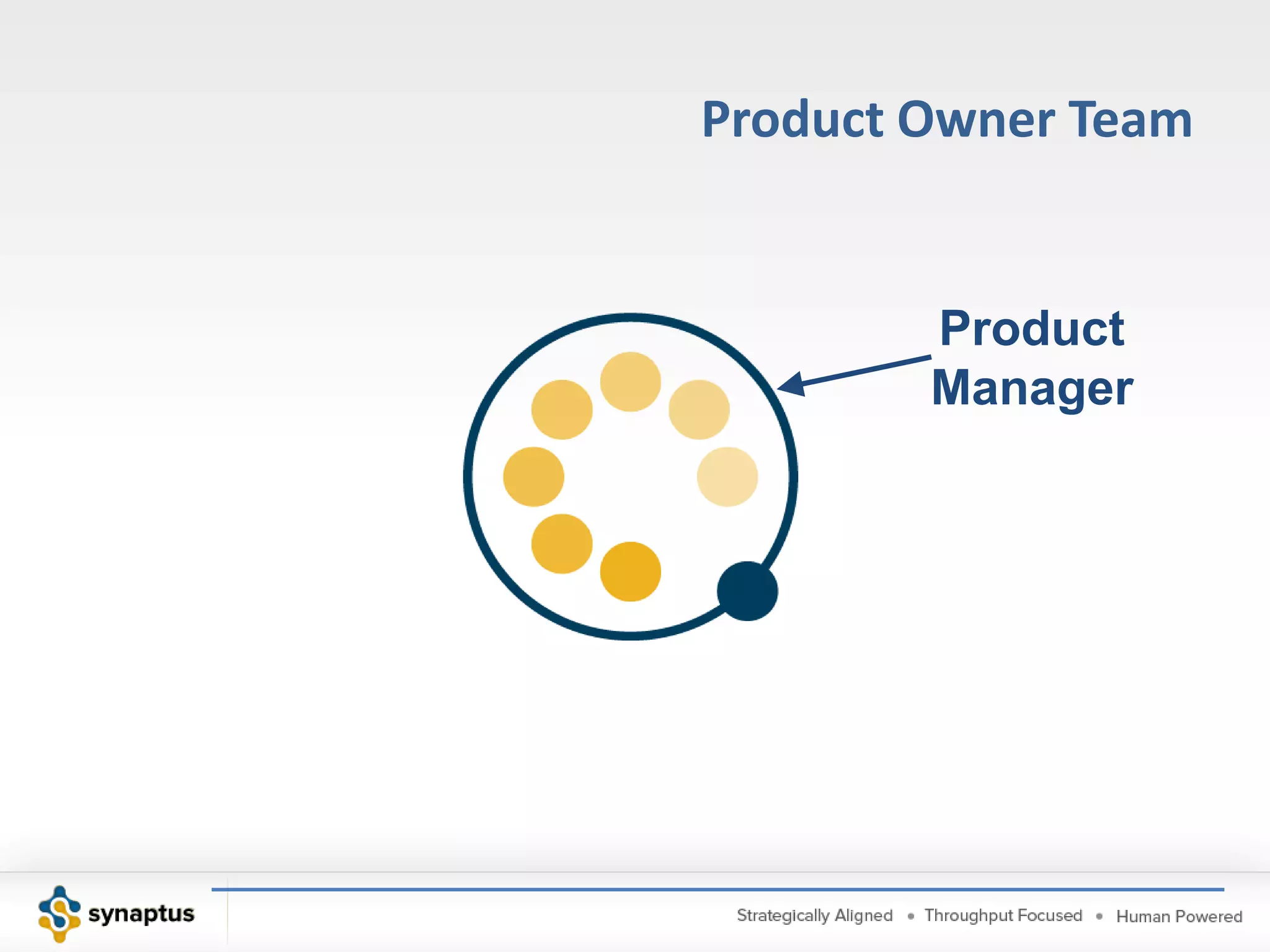
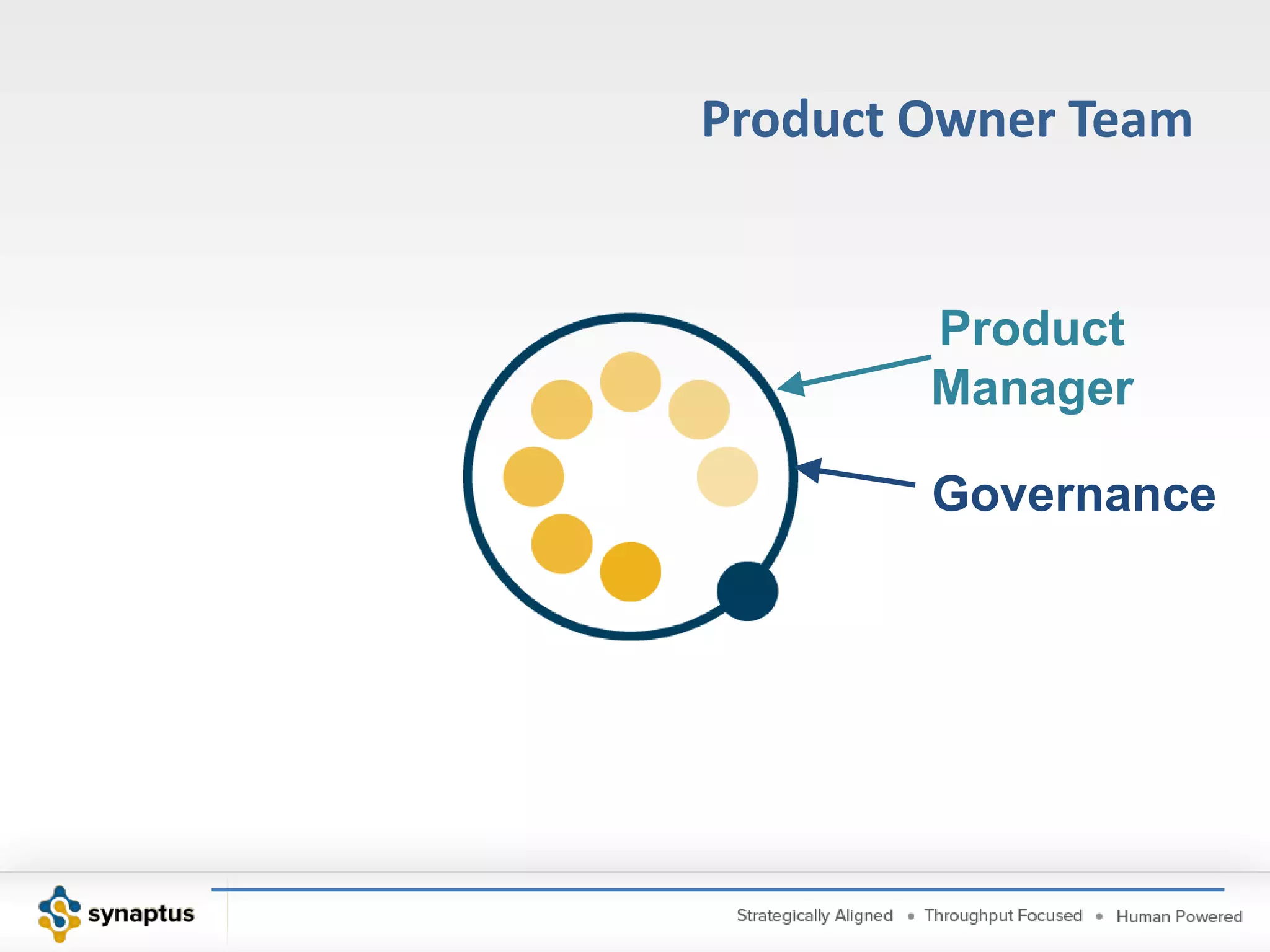
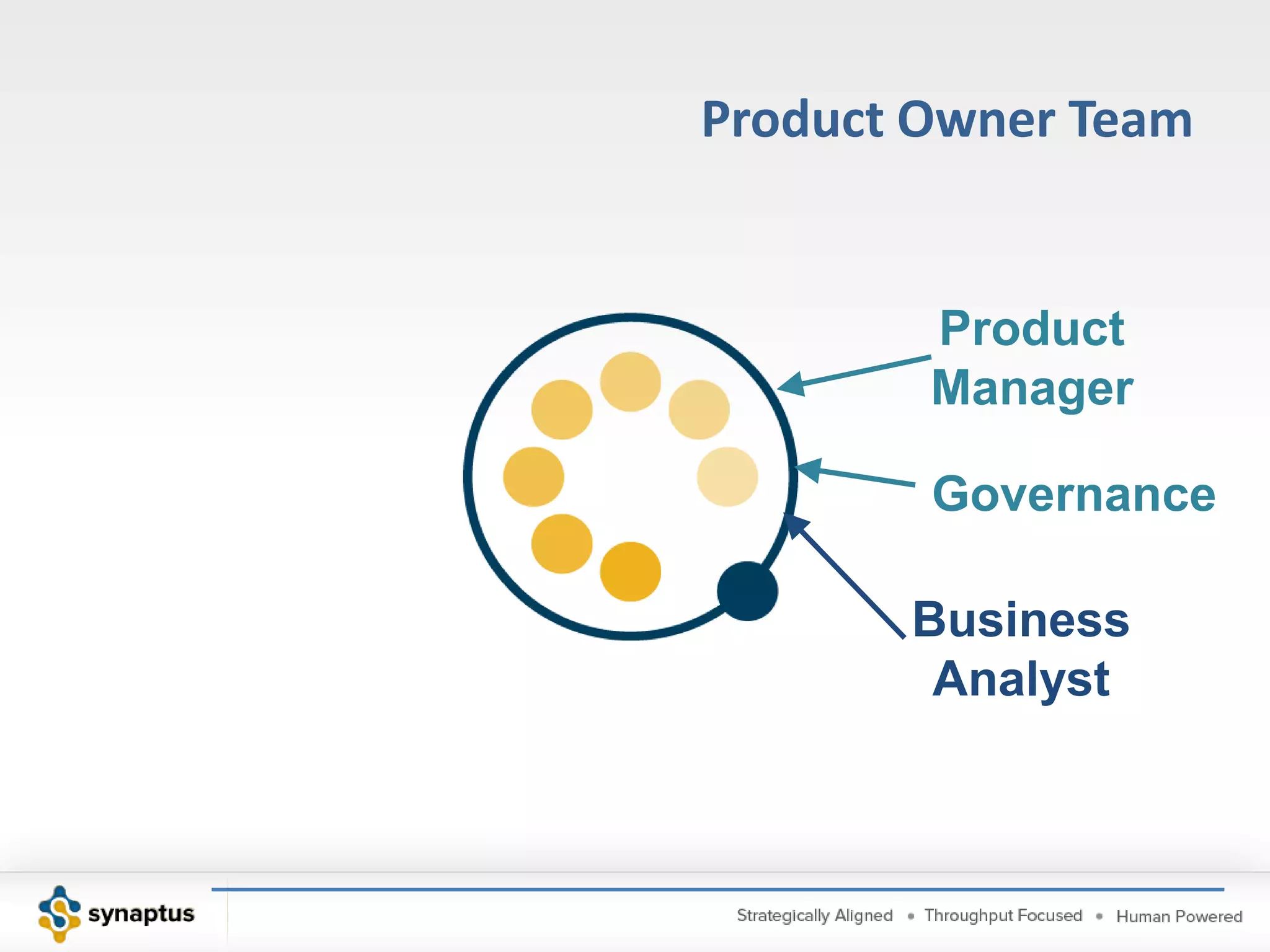
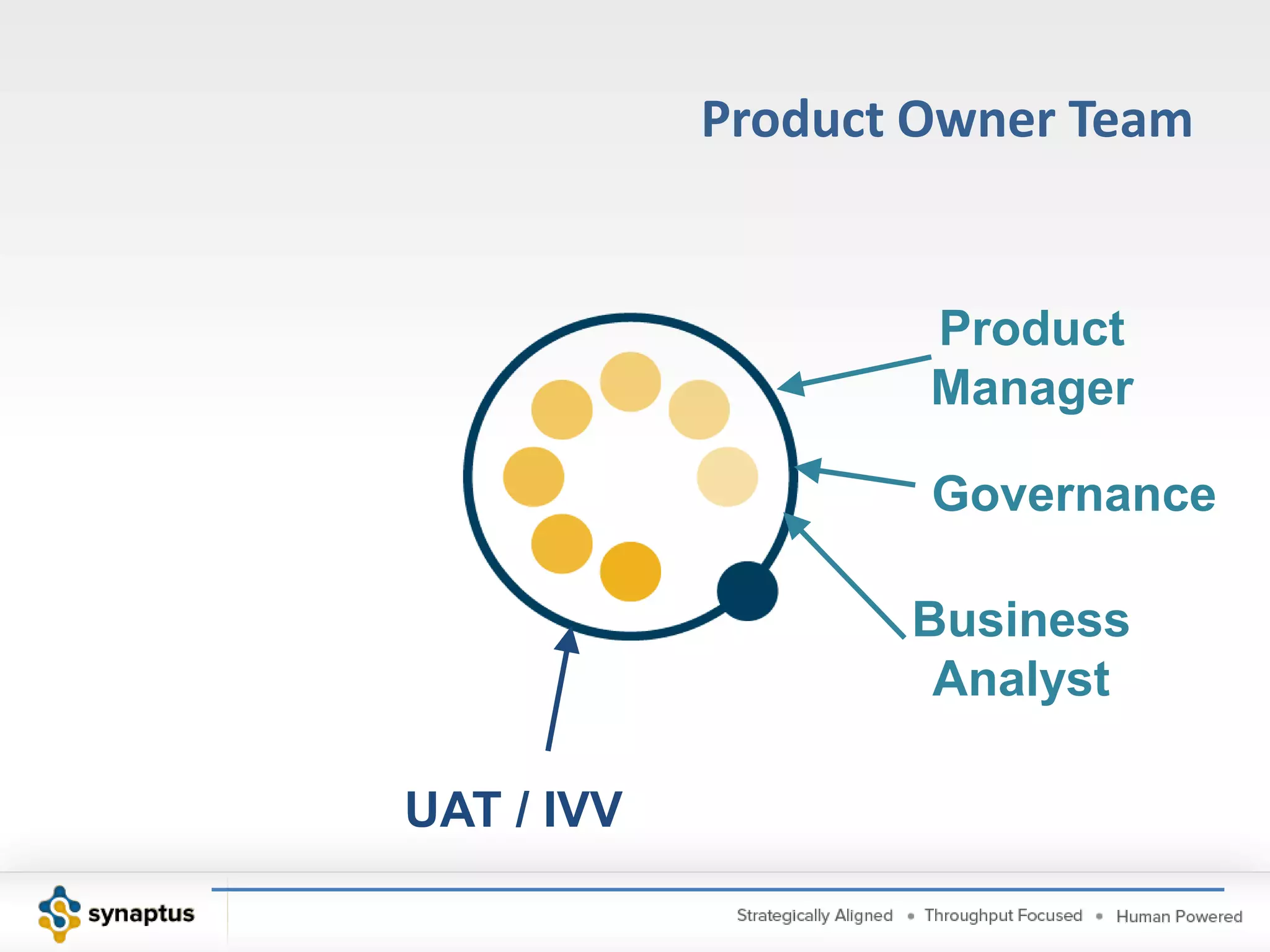
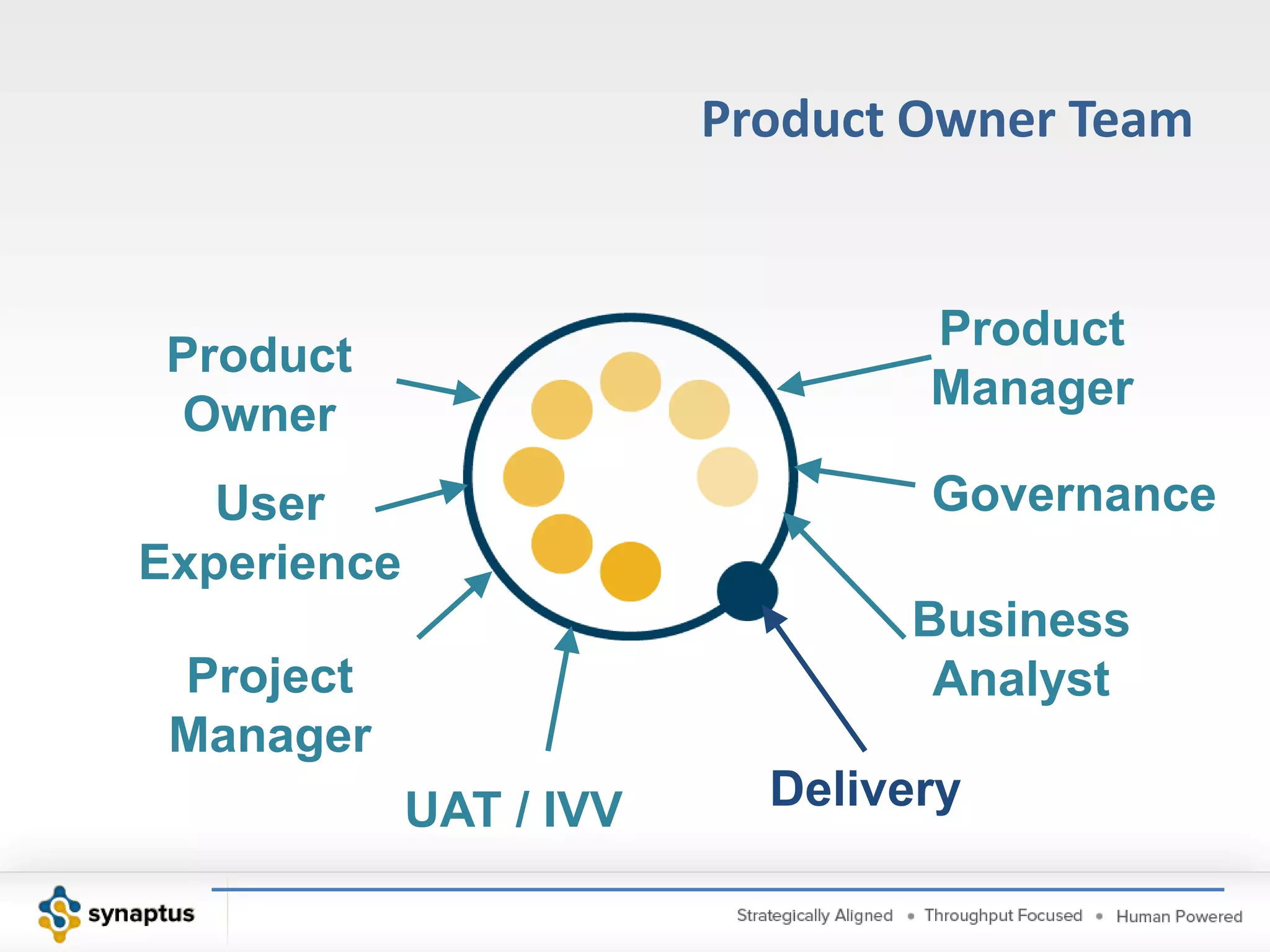
Product Owner TeamProduct Owner
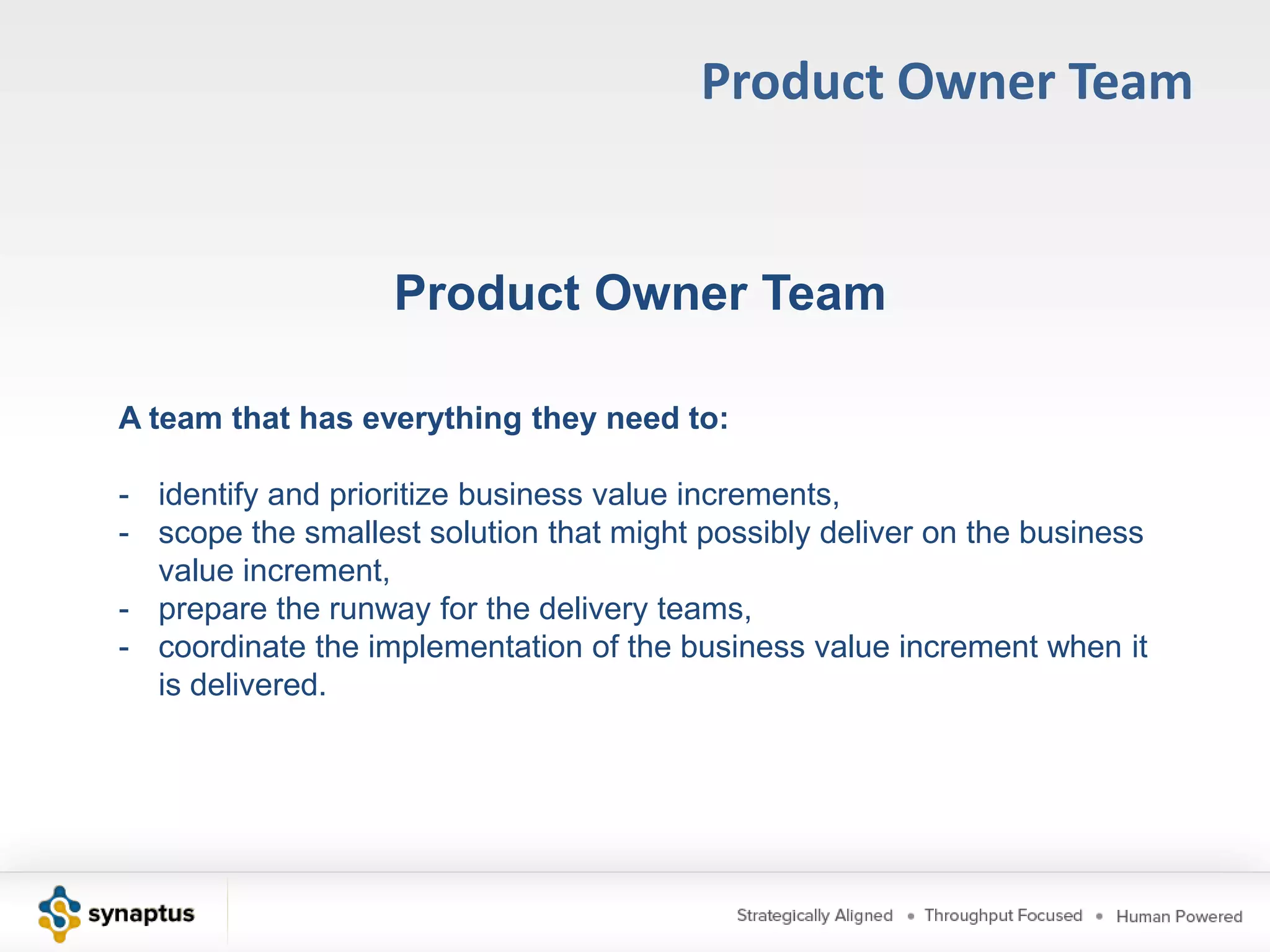
Product Owner TeamProduct Owner TeamA team that has everything they need to:identify and prioritize business value increments,
scope the smallest solution that might possibly deliver on the business value increment,
prepare the runway for the delivery teams,
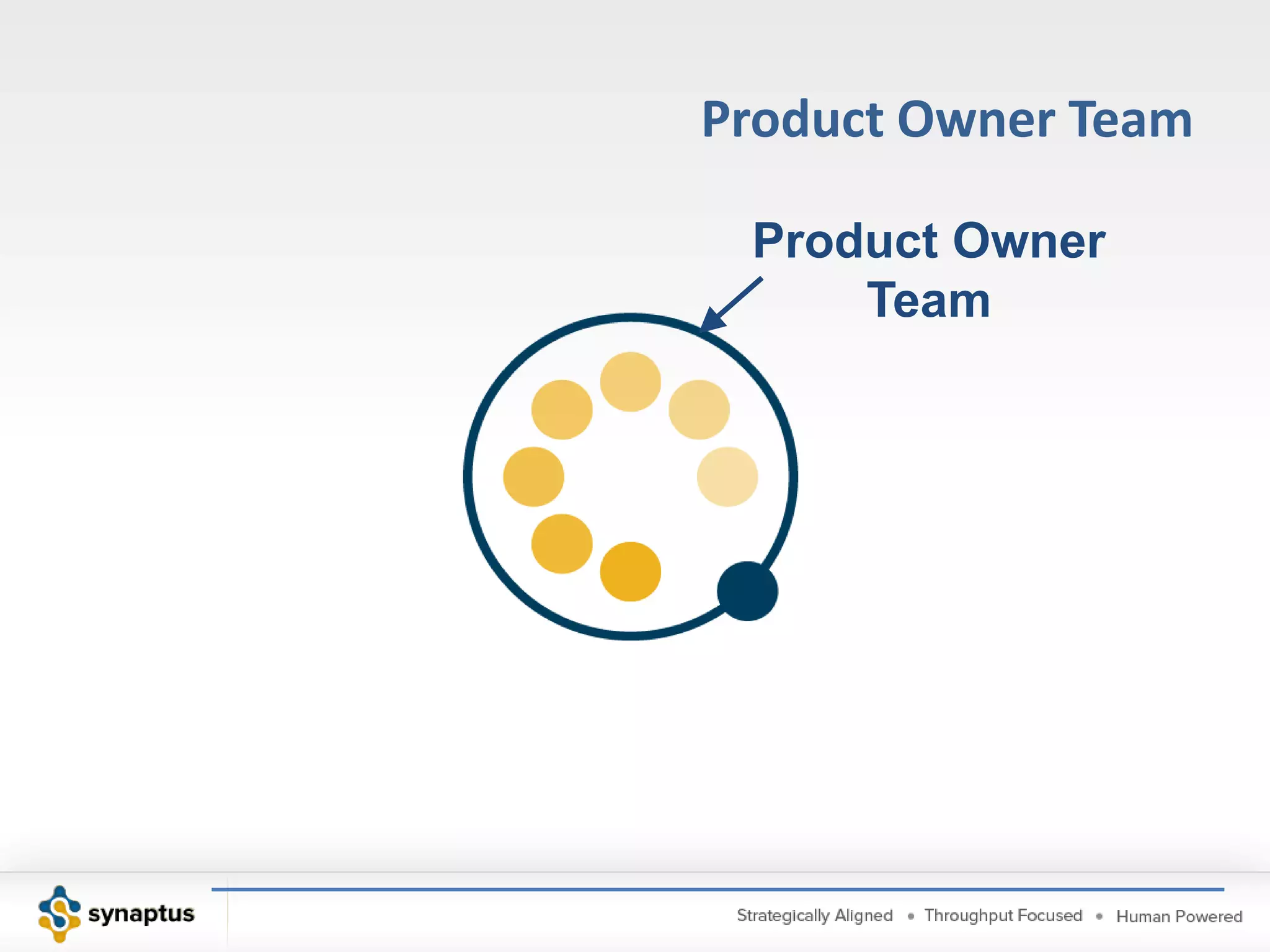
coordinate the implementation of the business value increment when it is delivered.Product Owner TeamProduct OwnerTeam
Product Owner TeamProduct Manager
Product Owner TeamProduct ManagerGovernance
Product Owner TeamProduct ManagerGovernanceBusiness Analyst
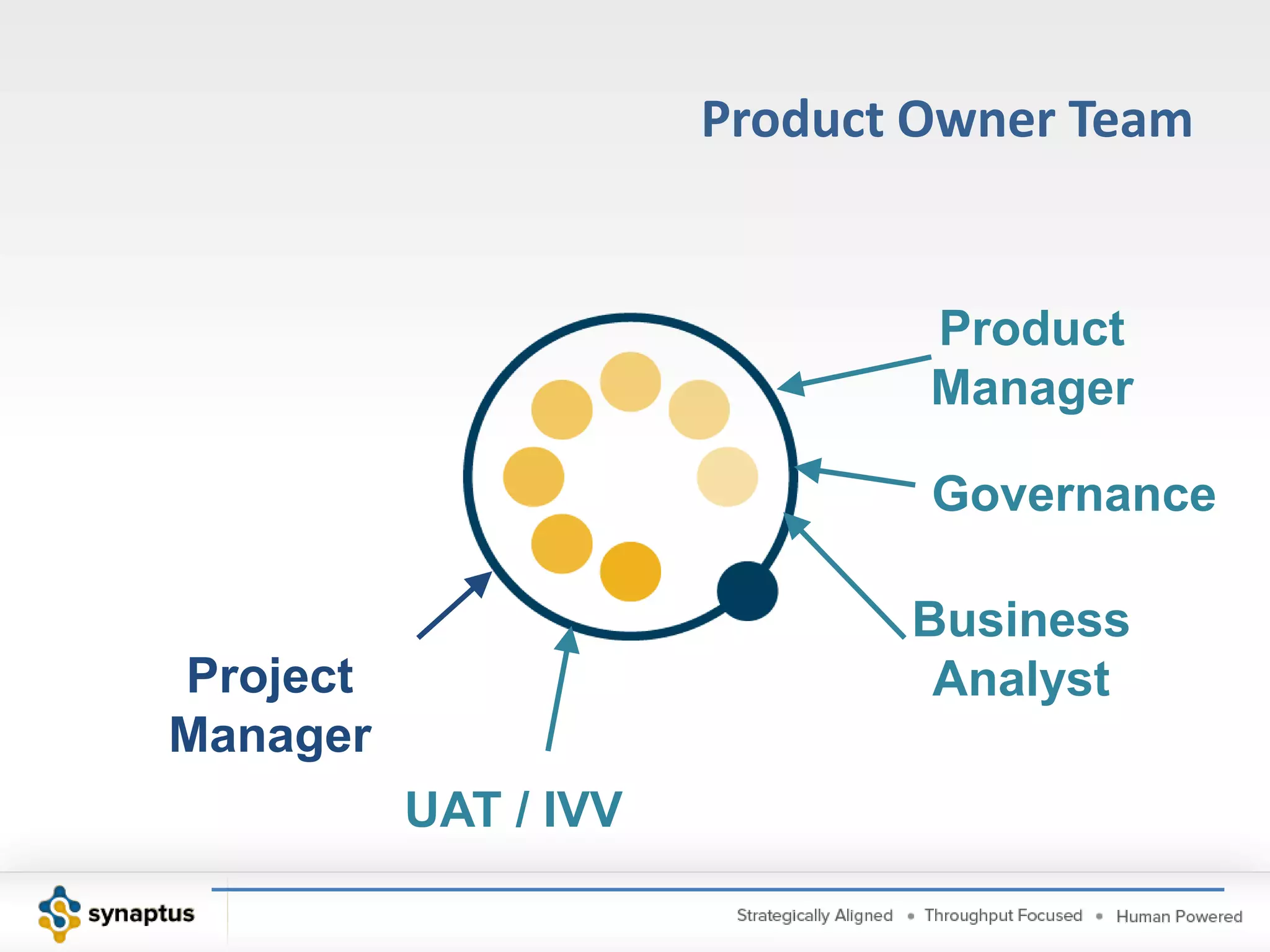
Product Owner TeamProduct ManagerGovernanceBusiness AnalystUAT / IVV
Product Owner TeamProduct ManagerGovernanceBusiness AnalystProject ManagerUAT / IVV
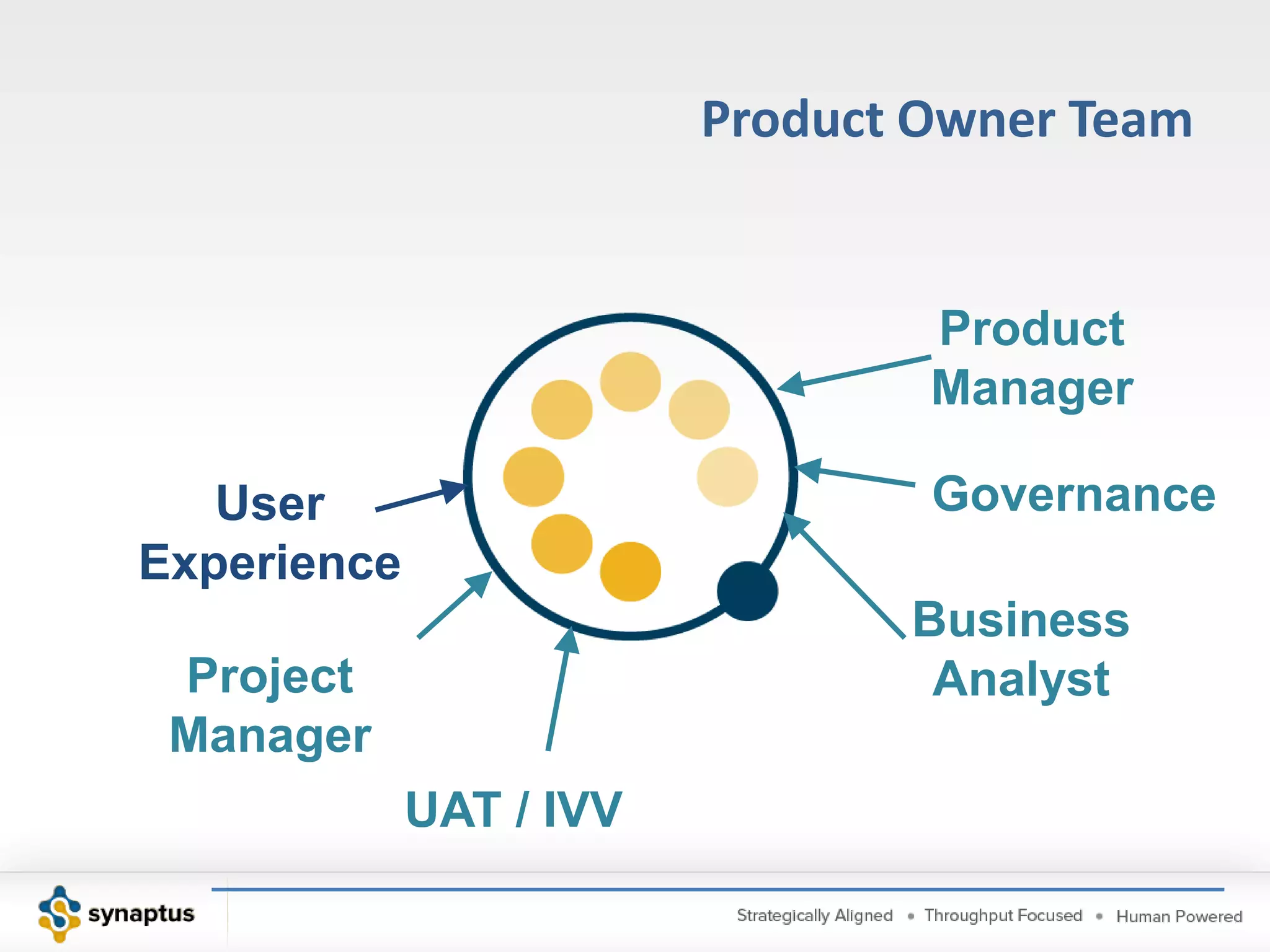
Product Owner TeamProduct ManagerGovernanceUser ExperienceBusiness AnalystProject ManagerUAT / IVV
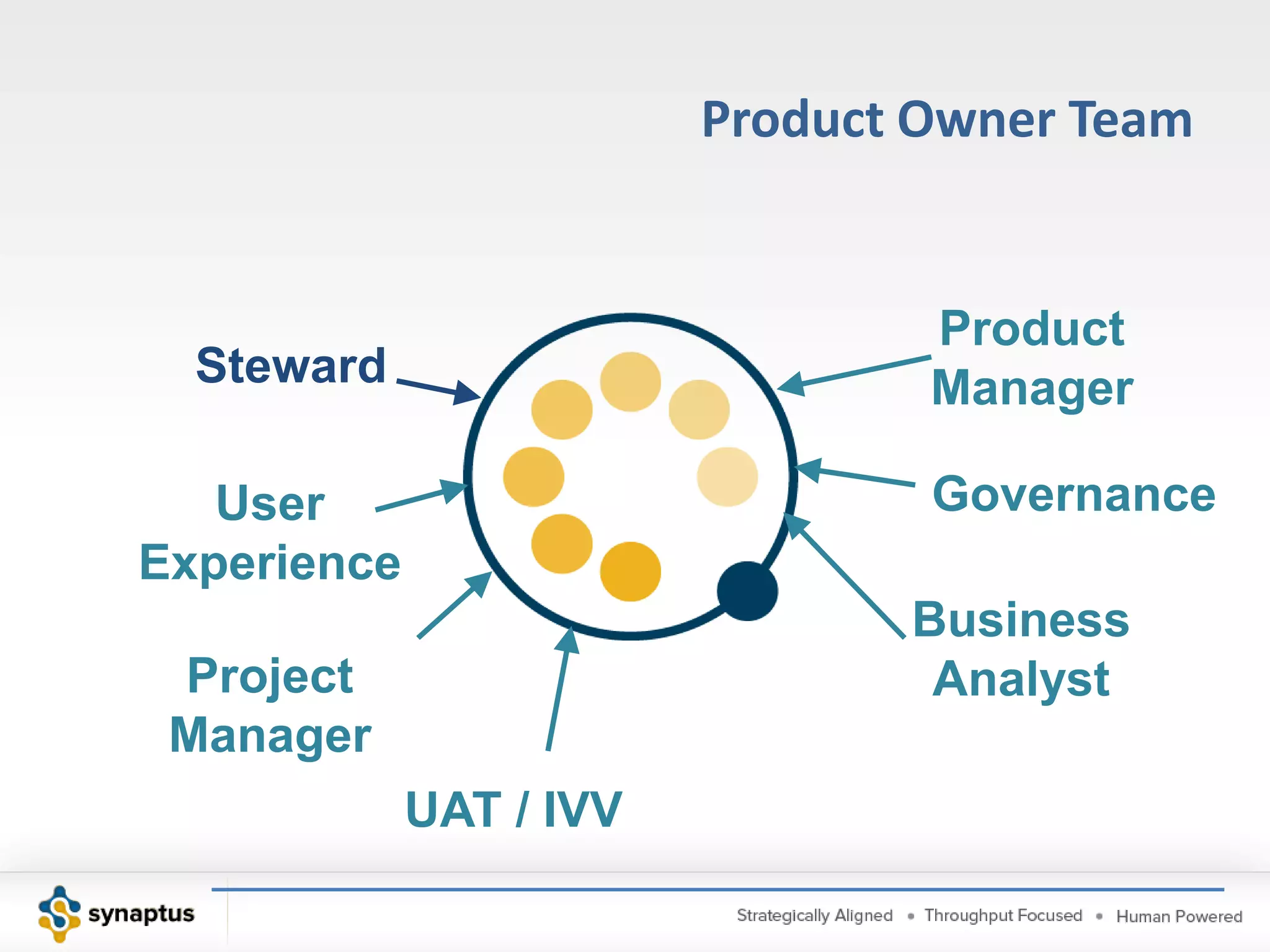
Product Owner TeamProduct ManagerStewardGovernanceUser ExperienceBusiness AnalystProject ManagerUAT / IVV
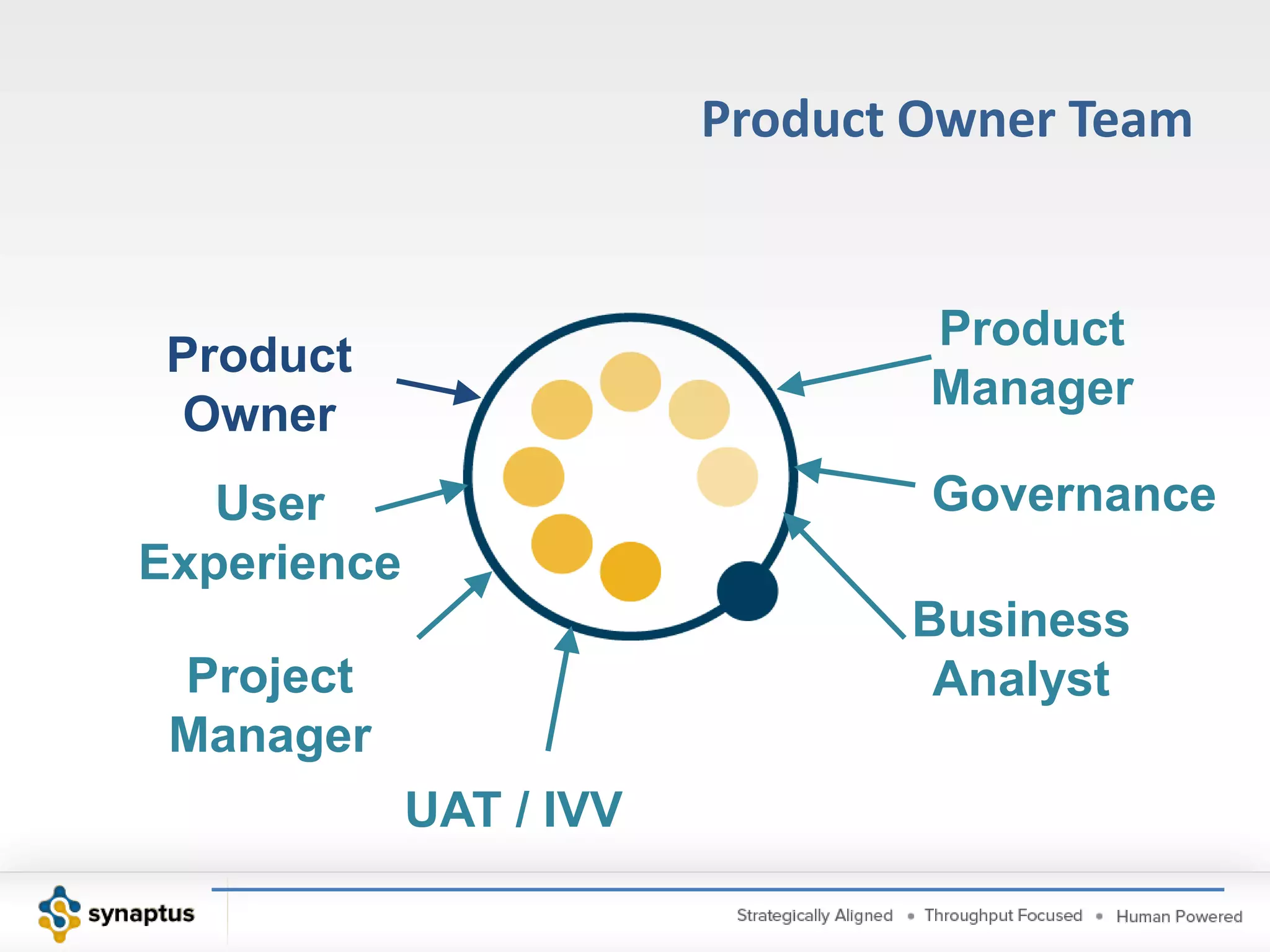
Product Owner TeamProduct ManagerProduct OwnerGovernanceUser ExperienceBusiness AnalystProject ManagerUAT / IVV
Product Owner TeamProduct ManagerProduct OwnerGovernanceUser ExperienceBusiness AnalystProject ManagerDeliveryUAT / IVV
AgendaRoots of AgileAgile ManifestoAgile FlavorsAgile RolesAgile Ceremonies
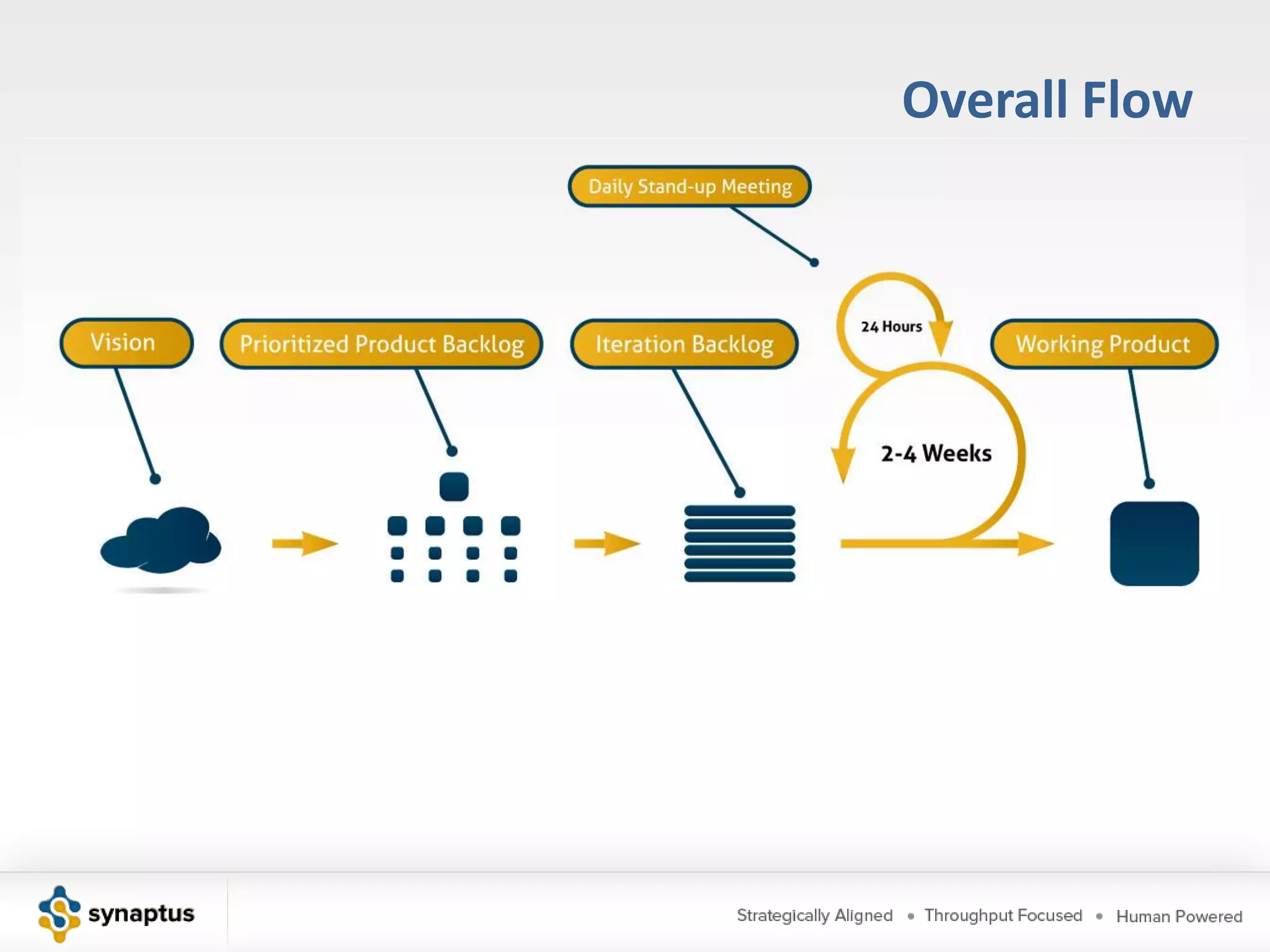
Overall Flow
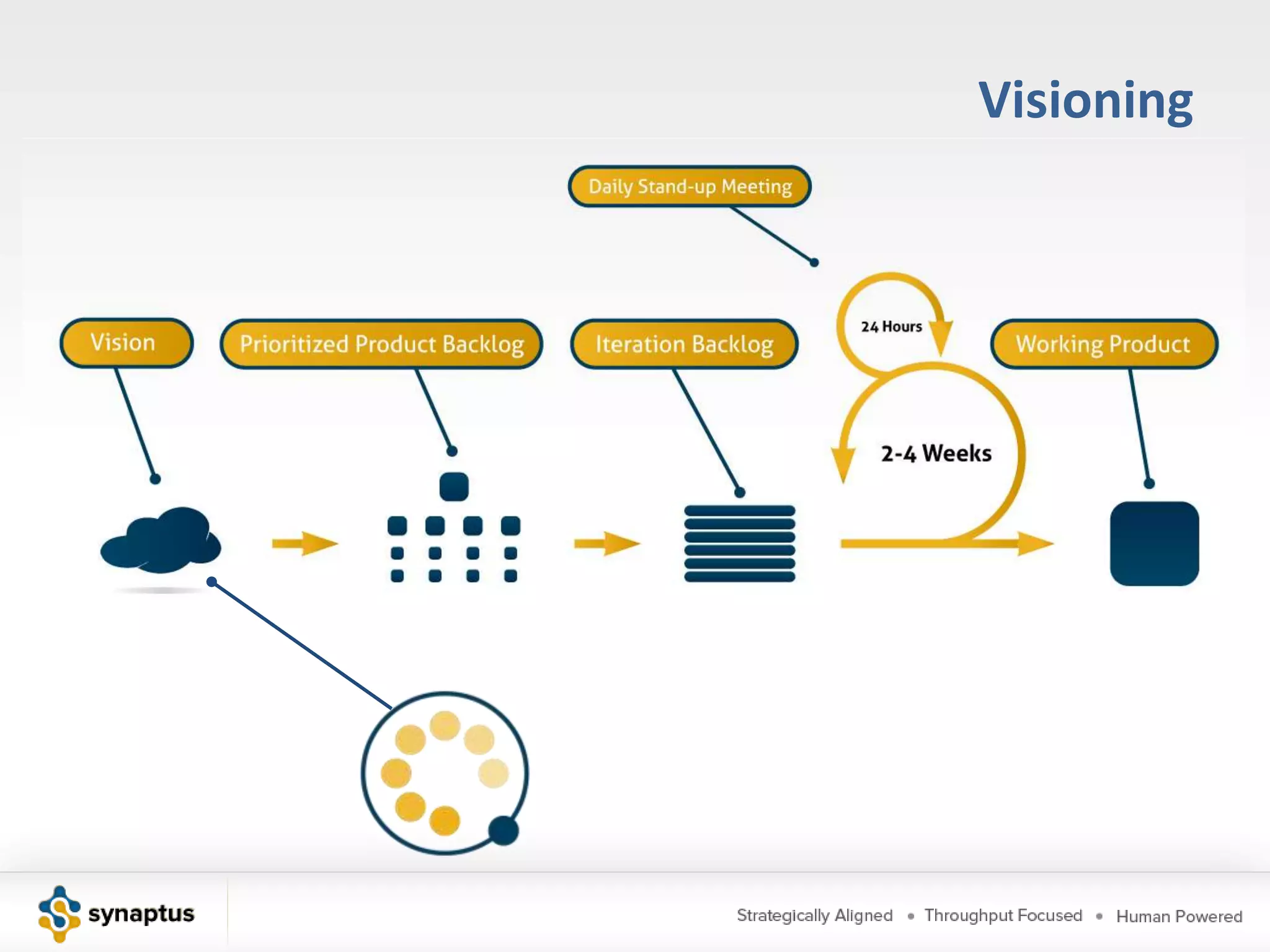
Visioning
VisioningProduct ownerPrepares product vision, strategy and goalsParticipants as neededEveryone proposes a set of Product StoriesNot by architecture layer – a discrete set of valueCustomer value and frequency and business priorityDefine risks associated stories with the product storiesOrganizational risk: Does the delivery team do itTechnical risk: Do we have the technology to do itBusiness risk: Do we have clear business outcomesArchitecture, UX, and DesignDefine Architecturally significant storiesPerform sufficient design to provide roadmap
Release Planning
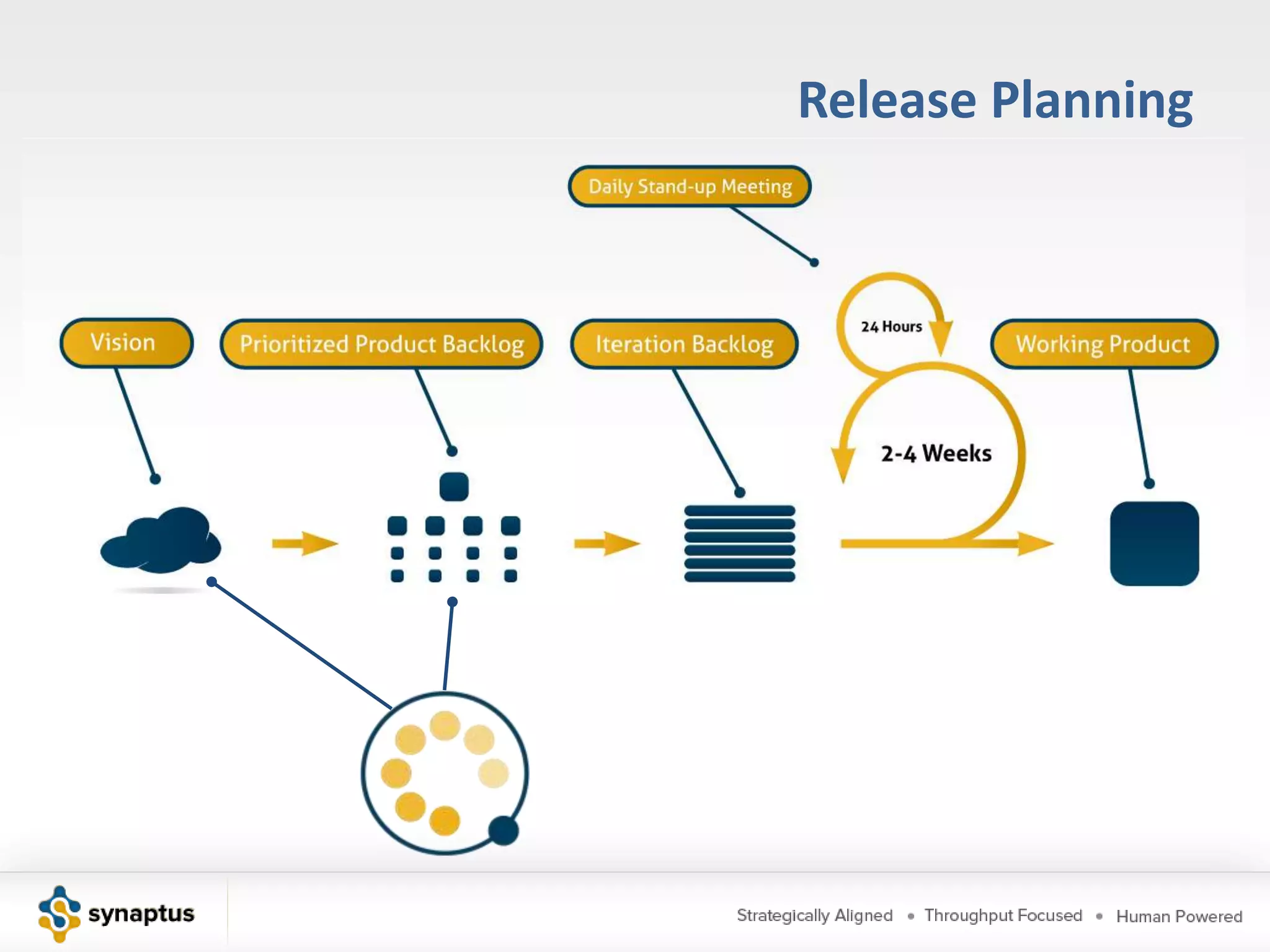
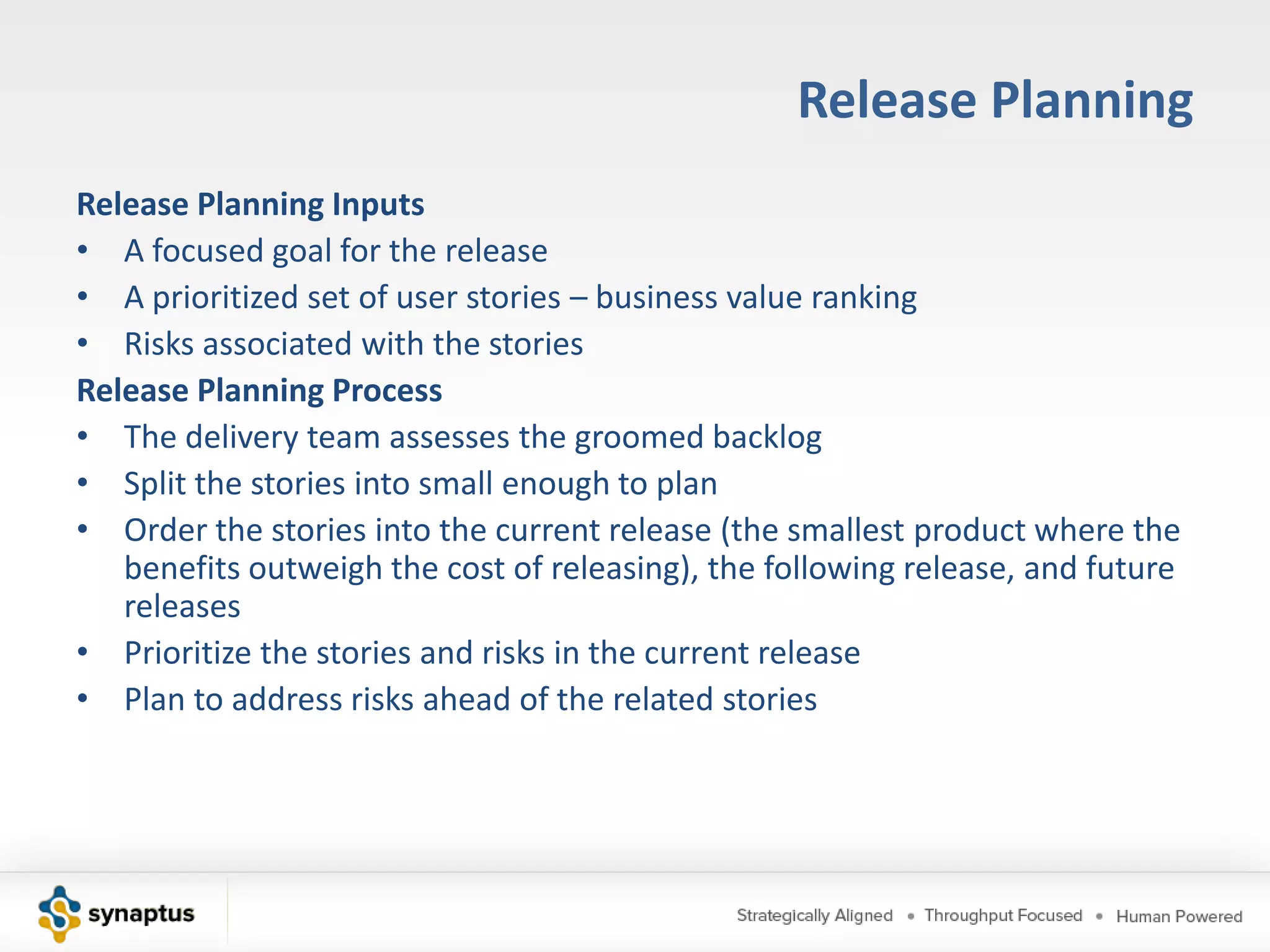
Release PlanningRelease Planning InputsA focused goal for the releaseA prioritized set of user stories – business value rankingRisks associated with the storiesRelease Planning ProcessThe delivery team assesses the groomed backlogSplit the stories into small enough to planOrder the stories into the current release (the smallest product where the benefits outweigh the cost of releasing), the following release, and future releasesPrioritize the stories and risks in the current releasePlan to address risks ahead of the related stories
Specification
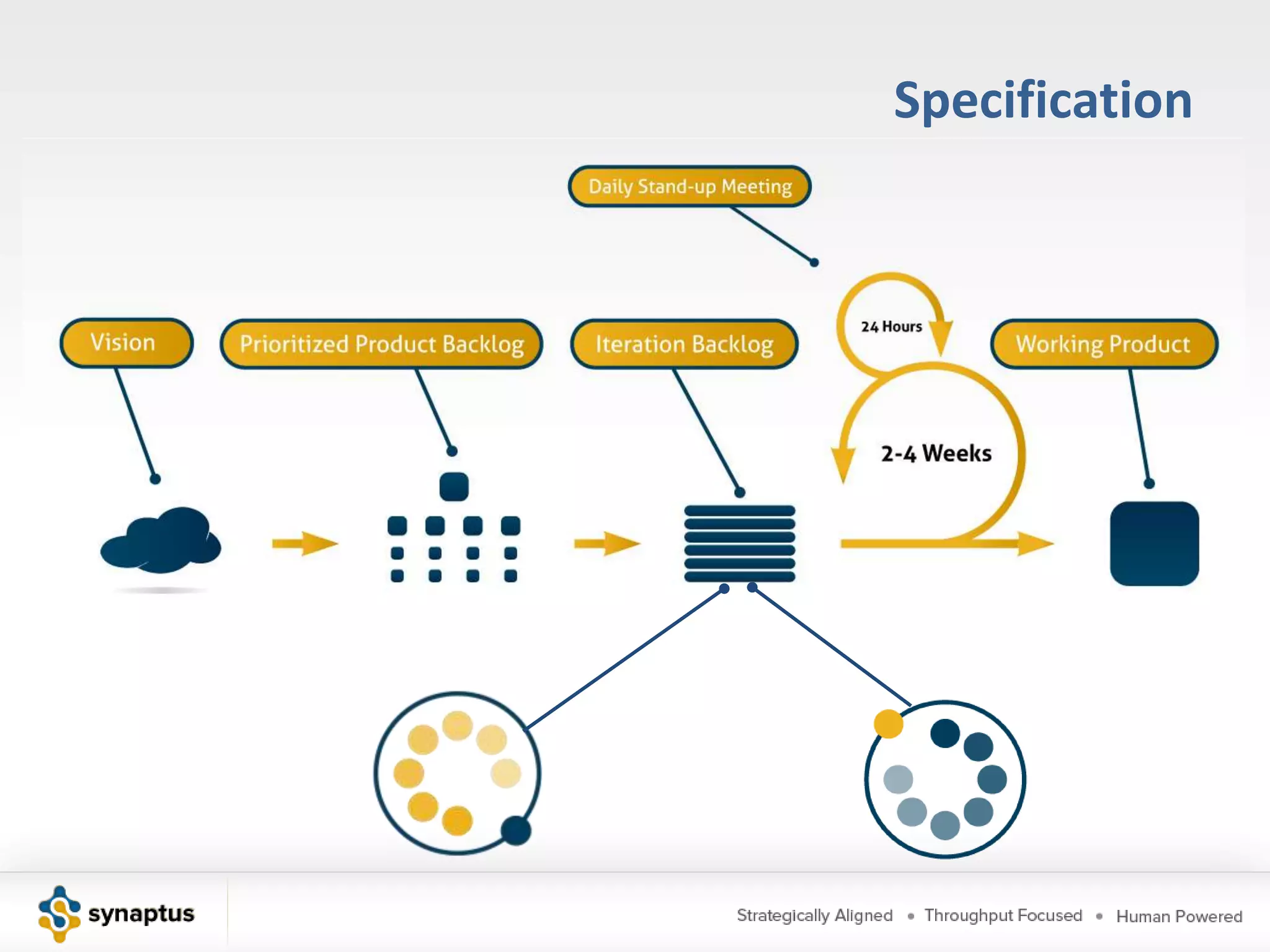
SpecificationGroom the Backlog
Product Owner Team works with Delivery Team to prepare Specifications (Acceptance Criteria, Screenshots, Mock-Ups, Use Case Updates, etc.) for Sprint Planning
Stories will have sufficient specification to allow teams to adequately plan and commit to the Sprint
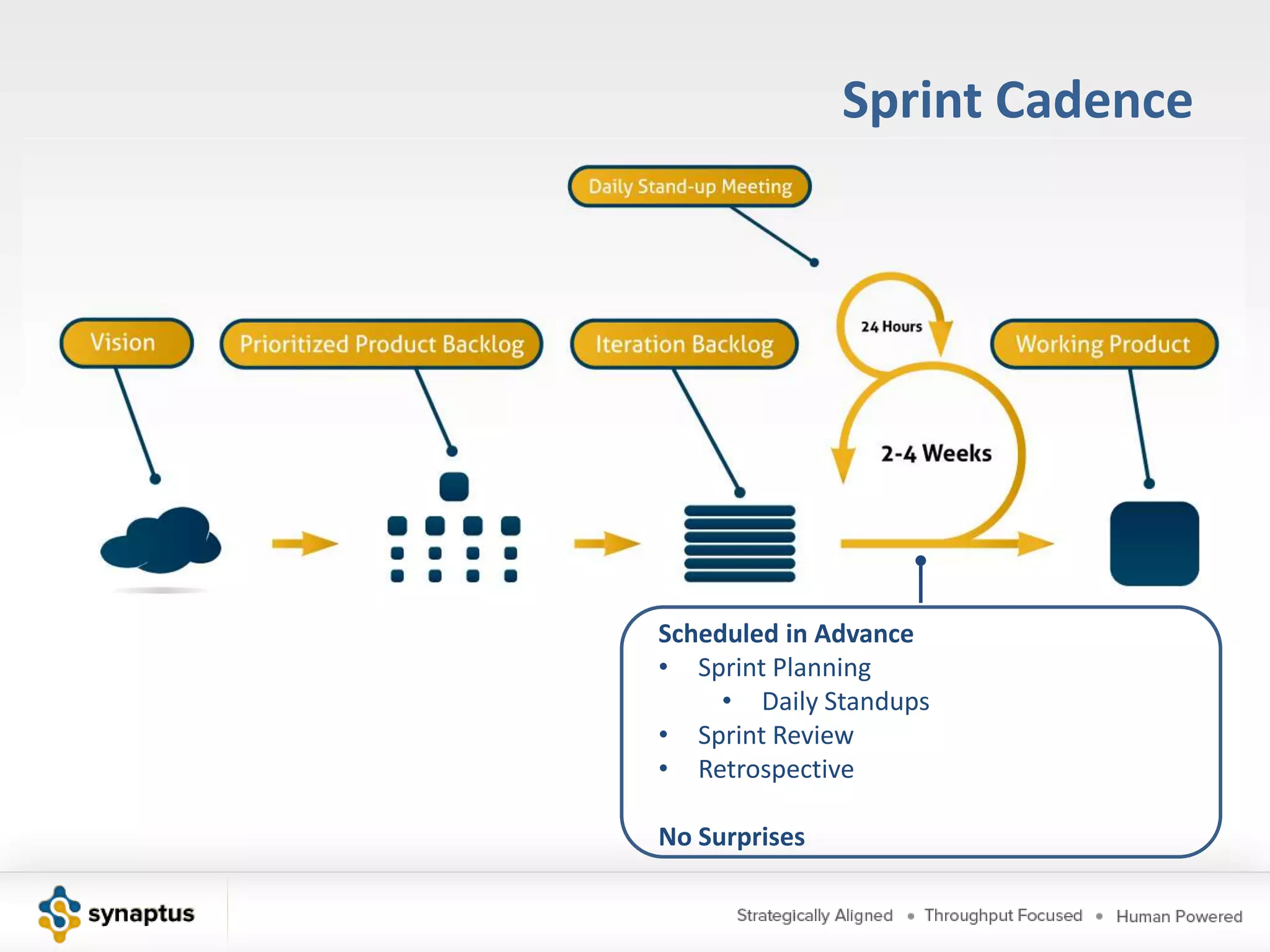
The delivery team will have sufficient insight prior to the Sprint Planning to responsibly participate in Sprint planningSprint CadenceScheduled in AdvanceSprint Planning
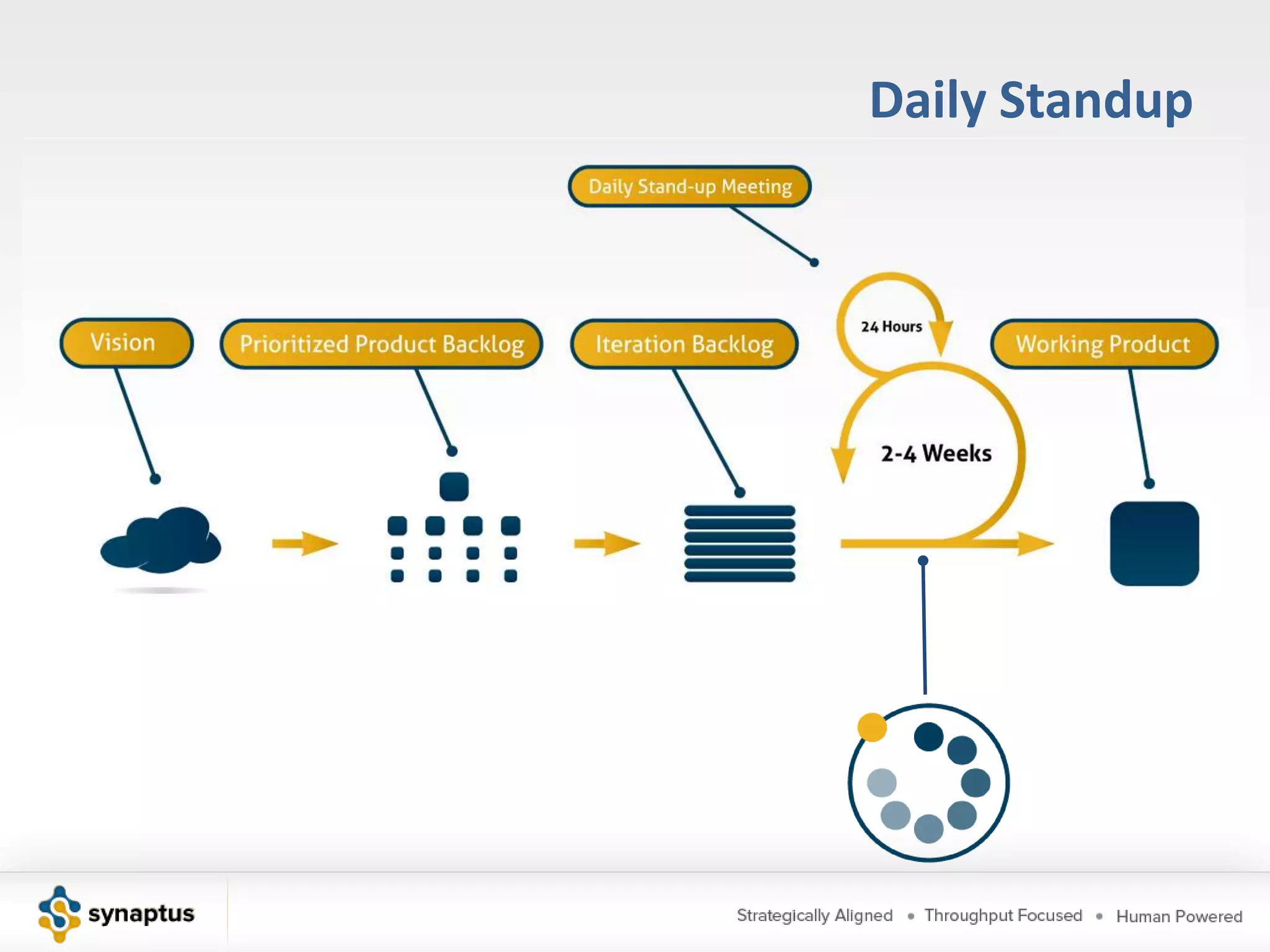
Daily Standups
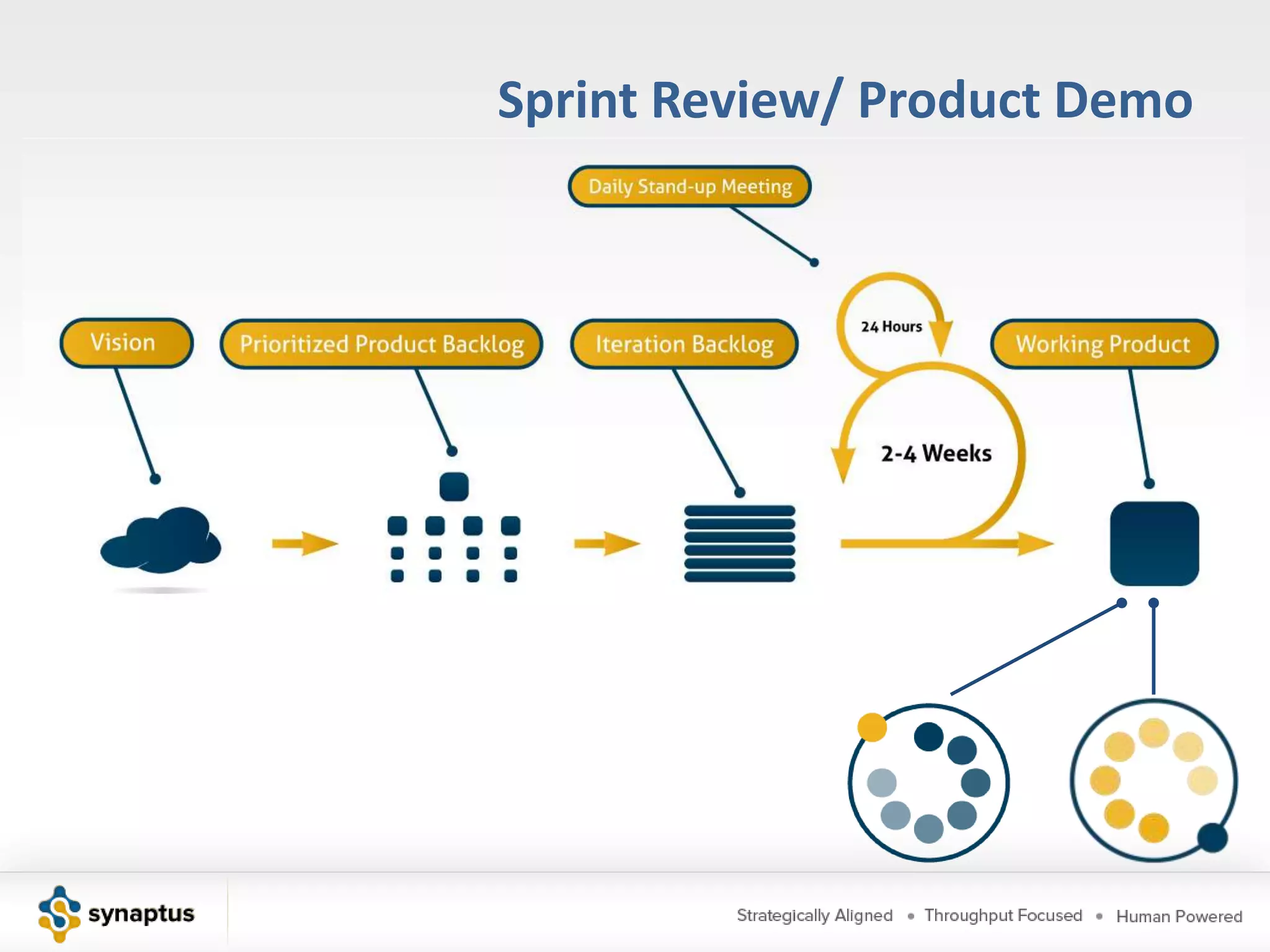
Sprint Review
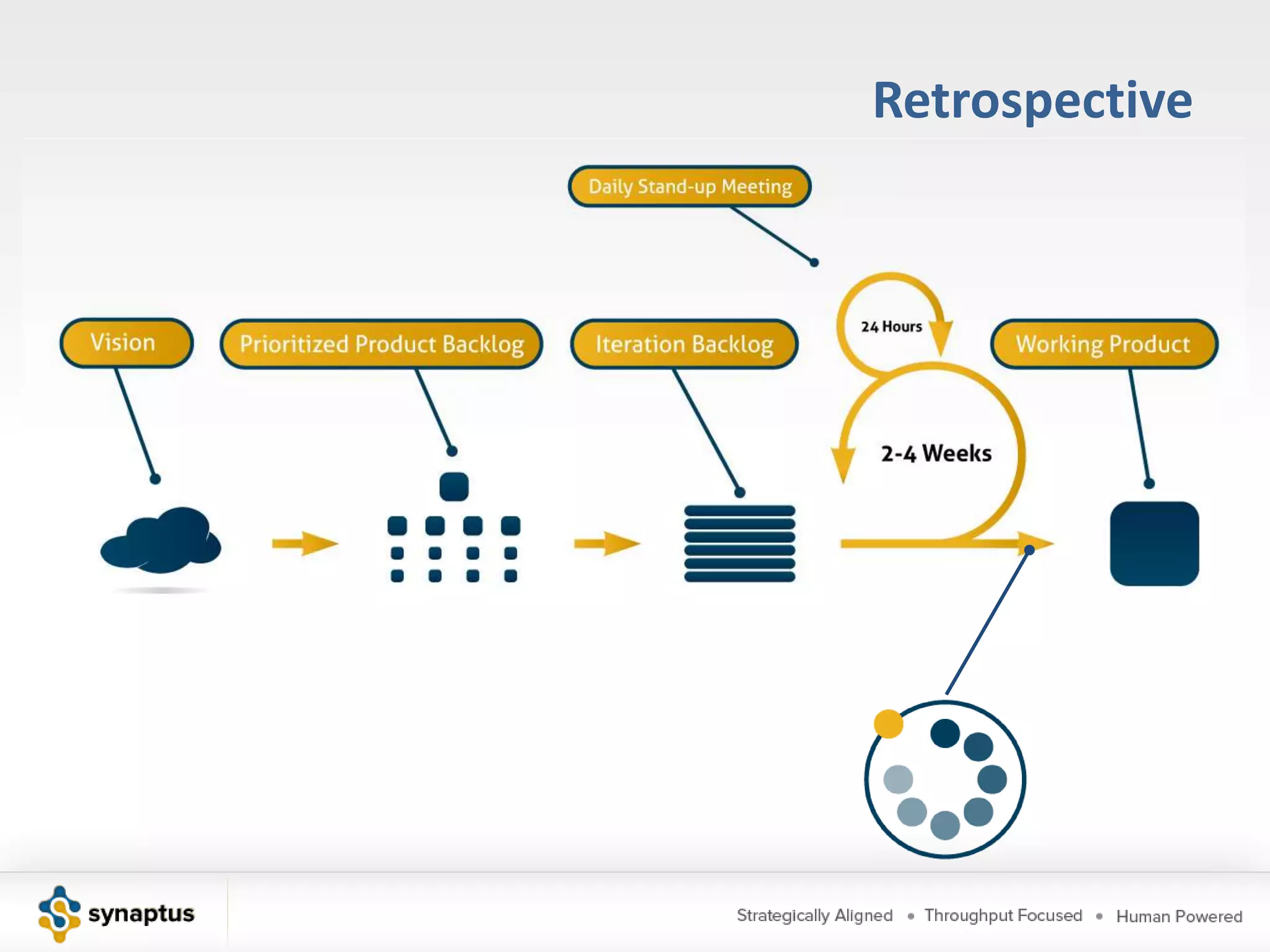
RetrospectiveNo Surprises
Sprint Planning
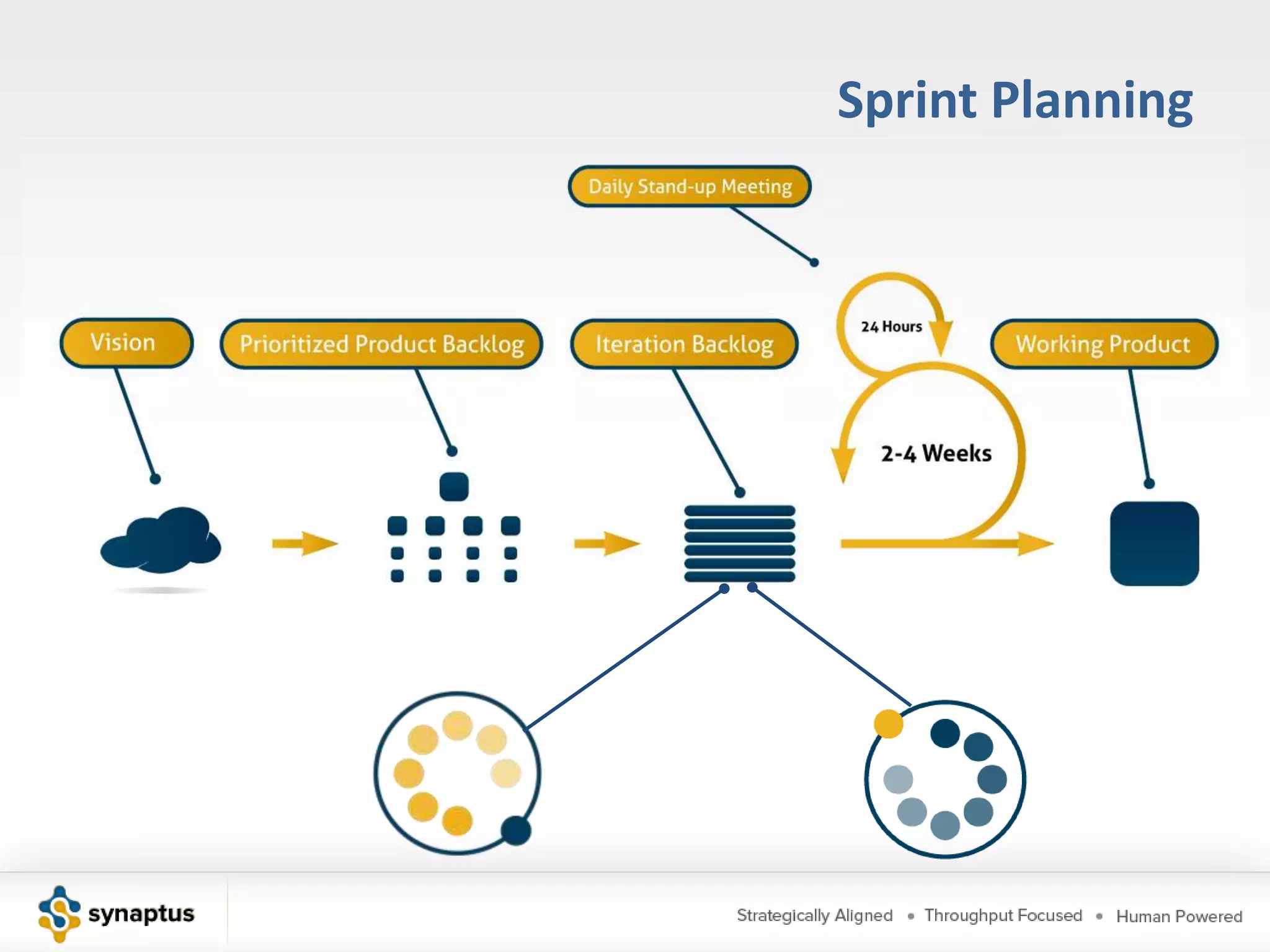
Sprint PlanningReview the highest priority stories in backlog
Make sure stories are “ready” to be delivered – identify sufficient stories to fill the next sprint

Agile Fundamentals

  • 1.
  • 2.
    The Agile EnterpriseStrategicallyAligned, Throughput Focused, Human Powered“Dennis Stevens helped us develop a structured approach that connected customer value to execution. He helped us deliver over $200 million in value to our customers.” -- Ric Merrifield, Microsoft CorporationOPM3
  • 3.
  • 4.
  • 5.
    PMI Agile Certification“DennisStevens helped us align business analysis, architecture, development, QA, support and implementation. He was an advocate for the success of our business" -- Rob Andes, CTO, John DeereConnecting the Strategy and ExecutionHBR: The Next Revolution in ProductivityAgile in the EnterpriseCore Team Member“In a time growth and change, Dennis Stevens helped us identify and develop the capabilities needed to deliver technology that was critical to our success." -- Mike Rouse, COO, Security First Network BankExploiting Agile DevelopmentCutter: Rethinking the Agile EnterpriseAgile Business AnalysisAgile Extension to the BABOK
  • 6.
    AgendaRoots of AgileAgileManifestoAgile FlavorsAgile RolesAgile CeremoniesAgile Fundamental IdeasQ&A
  • 7.
  • 8.
    What is Agile?Agile:(adj.)Characterized by quickness, lightness, and ease of movement; nimble.(adj.) Mentally quick or alert.(n.) A group of product development methodologies based on iterative and incremental development, where requirements emerge through feedback with the customer and solutions evolvethrough collaboration between members of self-organizing, cross-functional teams.
  • 9.
    Predictive ApproachThe wayTraditional, or Predictive Approach, shapes thedefinition of Scope, control of Project Schedule and Cost, and management of the software development process based on roots in scientific management, plan driven management, and manufacturing
  • 10.
    Predictive ApproachScientific ManagementFrederickTaylor - 1880’s and 1890’s Transformation of Craft Production into Mass ProductionWork SimplificationSpecializationResource Optimization through Time in Motion StudiesPiece-rate pay
  • 11.
    Initial Benefits inManufacturingSignificant reduction in per unit labor costsTransfer of unskilled agrarian workforce into productive manufacturing resourcesStandards in productivityResult of Scientific Management in Knowledge WorkLow intrinsic value for the skilled workerLow job satisfaction for everyone over timeDeskilling and dehumanizing work conditionsIncrease in management to worker ratioReduction in innovationPredictive ApproachScientific Management
  • 12.
    Predictive ApproachPlan DrivenManagementHenry Gantt in 1918Henry Ford mass productionDoD uses PERT in 1957PMBOK 1987Improve predictability and coordination Define all tasks and efforts upfrontProvide a governance (coordination and control) mechanismUpfront definition of all tasks and effort estimates
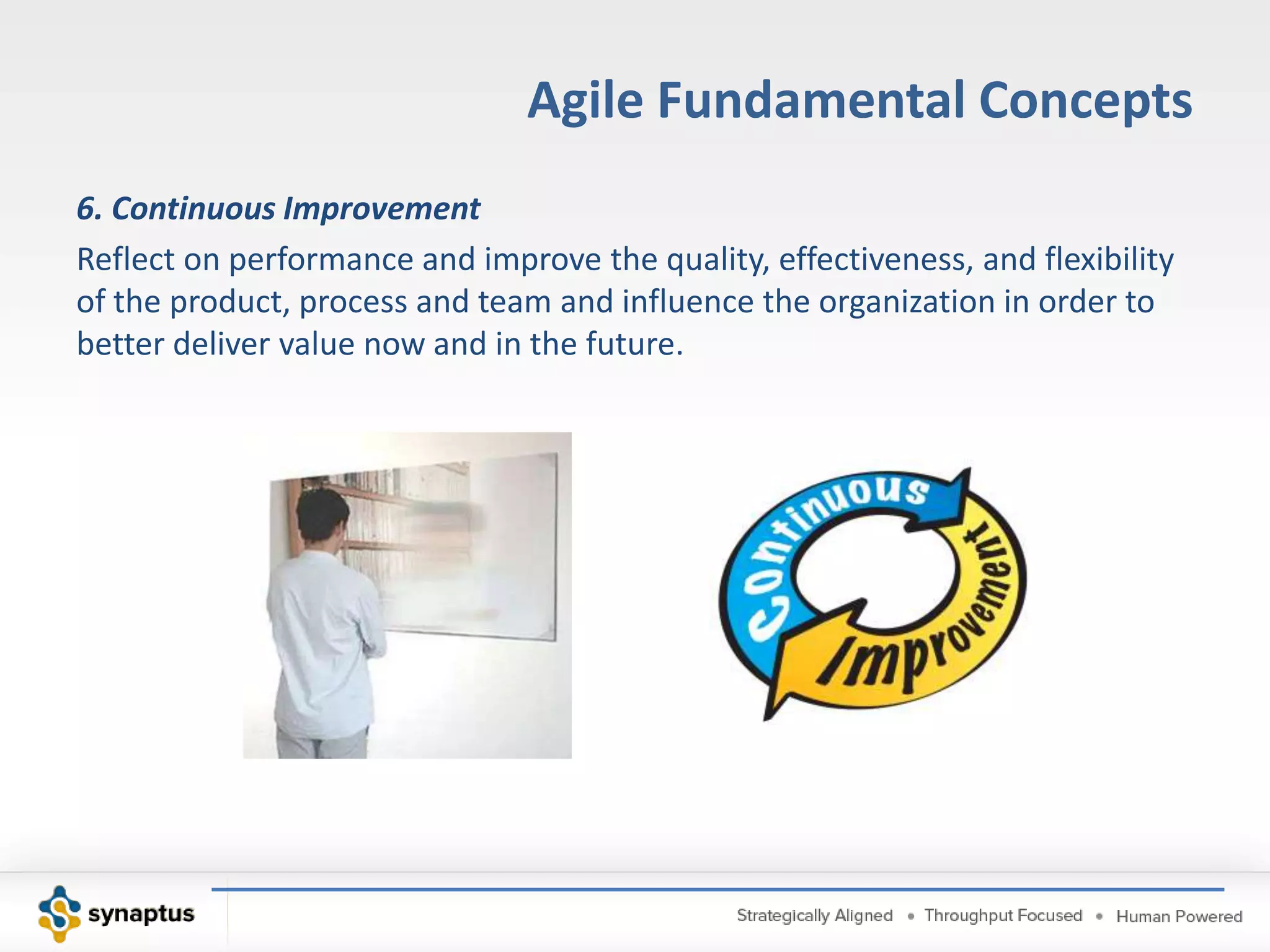
  • 13.
    Predictive ApproachPlan DrivenManagementInitial Benefits in ManufacturingMass productionHuge expansion of manufacturingTransformation of world economyResult of Plan Driven Approach in Knowledge WorkGains are lost and losses accumulateDelays in deliveryLack of flexibilityOver production of workStifling of innovation
  • 14.
    Predictive ApproachWaterfallDocumented byWinston Royce in 1970Reduce cost of changeOnly proceed to the next phase when the prior phase is completeEarly identification of defectsProtect the organization from changes in personnel through detailed documentationProtect downstream capacity from flawed product upstream
  • 15.
  • 16.
    Thorough design ofthe plant saves costs from miscues
  • 17.
    Quality control ateach step protects downstream capacity
  • 18.
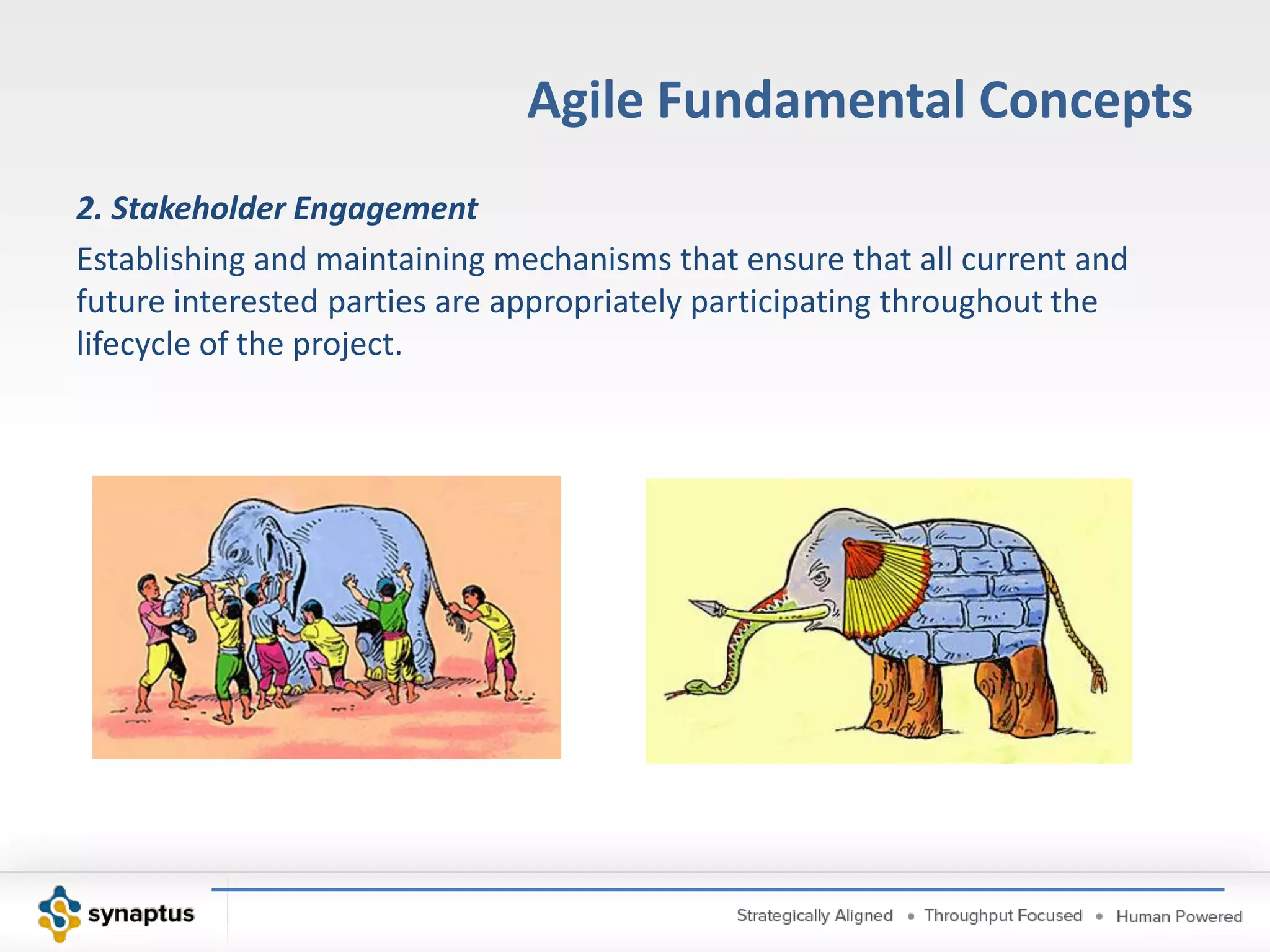
    Results of Waterfallin Knowledge WorkImplementation details that become known as we progress invalidates earlier design decisionsLack of transparencyPoor risk managementResidual technical debt“The Blind Men and the Elephant”
  • 19.
    Predictive ApproachA focuson process and toolsComprehensive documentation Detailed upfront definition and strong change controlRigorous adherence to a detailed planThe more projects struggle to more these items are emphasized
  • 20.
  • 21.
    1994Dynamic SystemDevelopment MethodFormalizationof RADSome had been having better successTimeline2001 Agile Manifesto196019701980199020001990 - Sutherland & SchwaberScrum PM FrameworkTime-boxed iterations (30 days)Small and co-located, Inspect & adaptProject MercuryNASA1985BarryBoehmSpiral ModelTeam priorizationbased on risk1976Tom GilbEVO EvolutionaryProject Manag.- Adaptive iterations- Fast time to value1995 – Booch,Rumbaugh & JacobsonRational Unified ProcessArchitecture Focus1996 - Beck,Cunningham & JeffriesExtreme ProgrammingEngineering Practices1980GeraldWeinbergAdaptiveProgramming:The New ReligionSmall increments,Customer-drivenfeedbackGerald WeinbergIncremental andIterative DevelopmentHalf-day iterationsTest driven developmentIBM FederalSystems Division:- Incremental & iterative- Feedback-driven requirements- Evolving design & architecture1986Fred Brooks“No Silver Bullet”Agile Developmentover Waterfal1997 - Jeff de LucaFeature Driven DevelopmentDeliver tangible, working softwarerepeatedly in a timely manner1998 - Alistair CockburnCrystal FamilyPeople & Communications, DesignPrinciples, Domains, Bare Sufficiency1985 - Takeuchi & NonakaThe New New ProductDevelopment Game- Cross-functional team- Self-organizing team- Legitimate power- Sense of mission2000 – Robert CharetteLean DevelopmentStrategic Focus, Lean Production,Risk Entrepreneurship,Stretch GoalsFIRSTGENERATIONSECONDGENERATIONWith the help of LuizCláudioParzianello.
  • 22.
    What did theyhave in common?17 software development thought leadersXP, Scrum, DSDM, Adaptive Software Development, Crystal, FDD, and Pragmatic Programming
  • 23.
    Agile ManifestoWe areuncovering better ways of developing software by doing it and helping others do it. Through this work we have come to value:Individuals and interactionsover process and toolsWorking software over comprehensive documentationCustomer collaboration over contract negotiationResponding to change over following a planThat is, while there is value in the items on the right, we value the items on the left more.
  • 24.
    Declaration of InterdependenceIn2005, 15 Software Development Project Managers got together to discuss how to Project Management must focus to help deliver value from agile teams.
  • 25.
    Declaration of InterdependenceAgileand adaptive approaches for linking people, projects and valueWe are a community of project leaders that are highly successful at delivering results. To achieve these results:We increase return on investment by making continuous flow of value our focus.We deliver reliable results by engaging customers in frequent interactions and shared ownership. We expect uncertainty and manage for it through iterations, anticipation, and adaptation. We unleash creativity and innovation by recognizing that individuals are the ultimate source of value, and creating an environment where they can make a difference. We boost performance through group accountability for results and shared responsibility for team effectiveness. We improve effectiveness and reliability through situationally specific strategies, processes and practices.
  • 26.
    AgendaRoots of AgileAgileManifestoAgile Flavors
  • 27.
    Agile ApproachesScrum-Roles andCeremoniesThree RolesProduct OwnerTeam (Delivery Team)Scrum MasterArtifactsProduct BacklogSprint BacklogWorking Tested Deployable SoftwareCeremoniesSprint PlanningDaily StandupSprint ReviewSprint Retrospective
  • 28.
    Agile ApproachesXP-Technical ExcellenceFinescale feedbackPair programmingPlanning gameTest Driven DevelopmentWhole Team (Acceptance Tests)Continuous ProcessContinuous IntegrationRefactoringSmall ReleasesCoding StandardsShared UnderstandingCollective Code OwnershipSimple DesignSystem MetaphorProgrammer WelfareSustainable Pace
  • 29.
    Agile ApproachesFeature DrivenDevelopmentDevelop an overall modelDevelop a high-level model of the system and use peer review and discussion to refineBuild a feature listCreate a list of features (client valued increment of functionality) from the high level modelPlan by featureProgressively elaborate features Design by featureDevelop specifications for each featureBuild by featureDevelop, test, and promote the feature
  • 30.
    Agile ApproachesKanban-Ongoing ImprovementMakeWork VisibleA more explicit task board than scrumLimit Work in ProgressExplicitly limit the number of tasks, stories, features, and epicsHelp Work to FlowFocus on optimizing for flow – not optimization or number of projects active at a timeMake policies explicitManagement inclusionEvolutionary changeImprove processes using improvement models based on performance data
  • 31.
    AgendaRoots of AgileAgileManifestoAgile FlavorsAgile Roles
  • 32.
    Delivery TeamsDelivery TeamAteam that has everything they need to deliver a working increment of tested, documented, deployable software at the end of every sprint.
  • 33.
  • 34.
  • 35.
  • 36.
  • 37.
  • 38.
  • 39.
  • 40.
  • 41.
  • 42.
  • 43.
  • 44.
  • 45.
    Scrum MasterEnsures thedelivery team is functional and productiveFacilitates Daily Stand UpFacilitates Sprint PlanningFacilitates Sprint ReviewFacilitates RetrospectiveParticipates in Release Planning MeetingRemoves ImpedimentsFacilitates Improvements
  • 46.
  • 47.
    Product OwnerResponsible forthe business value of the projectEnsures the product owner team is functional and productivePO Steward/ rep(s) optionally participate in Daily Stand UpPO Steward and rep(s) prepare for and participate in Sprint PlanningPO Steward and rep(s) participate in Sprint ReviewPO Steward/ rep(s) optionally participate in RetrospectivePrepares for and Facilitates Release Planning MeetingFacilitates Product Owner Improvements
  • 48.
  • 49.
    Product Owner TeamProductOwner TeamA team that has everything they need to:identify and prioritize business value increments,
  • 50.
    scope the smallestsolution that might possibly deliver on the business value increment,
  • 51.
    prepare the runwayfor the delivery teams,
  • 52.
    coordinate the implementationof the business value increment when it is delivered.Product Owner TeamProduct OwnerTeam
  • 53.
  • 54.
    Product Owner TeamProductManagerGovernance
  • 55.
    Product Owner TeamProductManagerGovernanceBusiness Analyst
  • 56.
    Product Owner TeamProductManagerGovernanceBusiness AnalystUAT / IVV
  • 57.
    Product Owner TeamProductManagerGovernanceBusiness AnalystProject ManagerUAT / IVV
  • 58.
    Product Owner TeamProductManagerGovernanceUser ExperienceBusiness AnalystProject ManagerUAT / IVV
  • 59.
    Product Owner TeamProductManagerStewardGovernanceUser ExperienceBusiness AnalystProject ManagerUAT / IVV
  • 60.
    Product Owner TeamProductManagerProduct OwnerGovernanceUser ExperienceBusiness AnalystProject ManagerUAT / IVV
  • 61.
    Product Owner TeamProductManagerProduct OwnerGovernanceUser ExperienceBusiness AnalystProject ManagerDeliveryUAT / IVV
  • 62.
    AgendaRoots of AgileAgileManifestoAgile FlavorsAgile RolesAgile Ceremonies
  • 63.
  • 64.
  • 65.
    VisioningProduct ownerPrepares productvision, strategy and goalsParticipants as neededEveryone proposes a set of Product StoriesNot by architecture layer – a discrete set of valueCustomer value and frequency and business priorityDefine risks associated stories with the product storiesOrganizational risk: Does the delivery team do itTechnical risk: Do we have the technology to do itBusiness risk: Do we have clear business outcomesArchitecture, UX, and DesignDefine Architecturally significant storiesPerform sufficient design to provide roadmap
  • 66.
  • 67.
    Release PlanningRelease PlanningInputsA focused goal for the releaseA prioritized set of user stories – business value rankingRisks associated with the storiesRelease Planning ProcessThe delivery team assesses the groomed backlogSplit the stories into small enough to planOrder the stories into the current release (the smallest product where the benefits outweigh the cost of releasing), the following release, and future releasesPrioritize the stories and risks in the current releasePlan to address risks ahead of the related stories
  • 68.
  • 69.
  • 70.
    Product Owner Teamworks with Delivery Team to prepare Specifications (Acceptance Criteria, Screenshots, Mock-Ups, Use Case Updates, etc.) for Sprint Planning
  • 71.
    Stories will havesufficient specification to allow teams to adequately plan and commit to the Sprint
  • 72.
    The delivery teamwill have sufficient insight prior to the Sprint Planning to responsibly participate in Sprint planningSprint CadenceScheduled in AdvanceSprint Planning
  • 73.
  • 74.
  • 75.
  • 76.
  • 77.
    Sprint PlanningReview thehighest priority stories in backlog
  • 78.
    Make sure storiesare “ready” to be delivered – identify sufficient stories to fill the next sprint
  • 79.
    The delivery teamwill decompose the stories into the tasks required to deliver on the sprint
  • 80.
    The tasks willbe estimated in ideal hours by the delivery team with no task being greater than 6-8 hours
  • 81.
    The delivery teamwill include tasks to address risks associated with the stories committed in the sprint
  • 82.
    Stories may befurther split for future sprints by explicitly identifying the acceptance criteria for the current sprint (dirt road, gravel road, etc)Daily Standup
  • 83.
    Daily Standup MeetingDailyStand-ups are where the team self organizes
  • 84.
    These follow thesame pattern of drive risk down early and deliver value
  • 85.
    Everyone commits toattending the daily standup, being “present” during the standup, and engaging to support the team
  • 86.
    Tasks are pulled– not assigned – in the daily standup
  • 87.
    Problems are notresolved in the daily standup. After meetings are scheduled at the daily standup – these are placed on a meeting roster or as tasks on the boardSprint Review/ Product Demo
  • 88.
    Sprint Review/ ProductDemoThe delivery team reviews the stories delivered against the agreed upon acceptance criteria with the product owner team
  • 89.
    The product ownerteam provides feedback on the product and the success of the delivery team
  • 90.
    Only 100% completedstories (delivered, tested, deployable, and documented) are presented
  • 91.
    Demonstrate completed functionalityto interested stakeholders and/or customersRetrospective
  • 92.
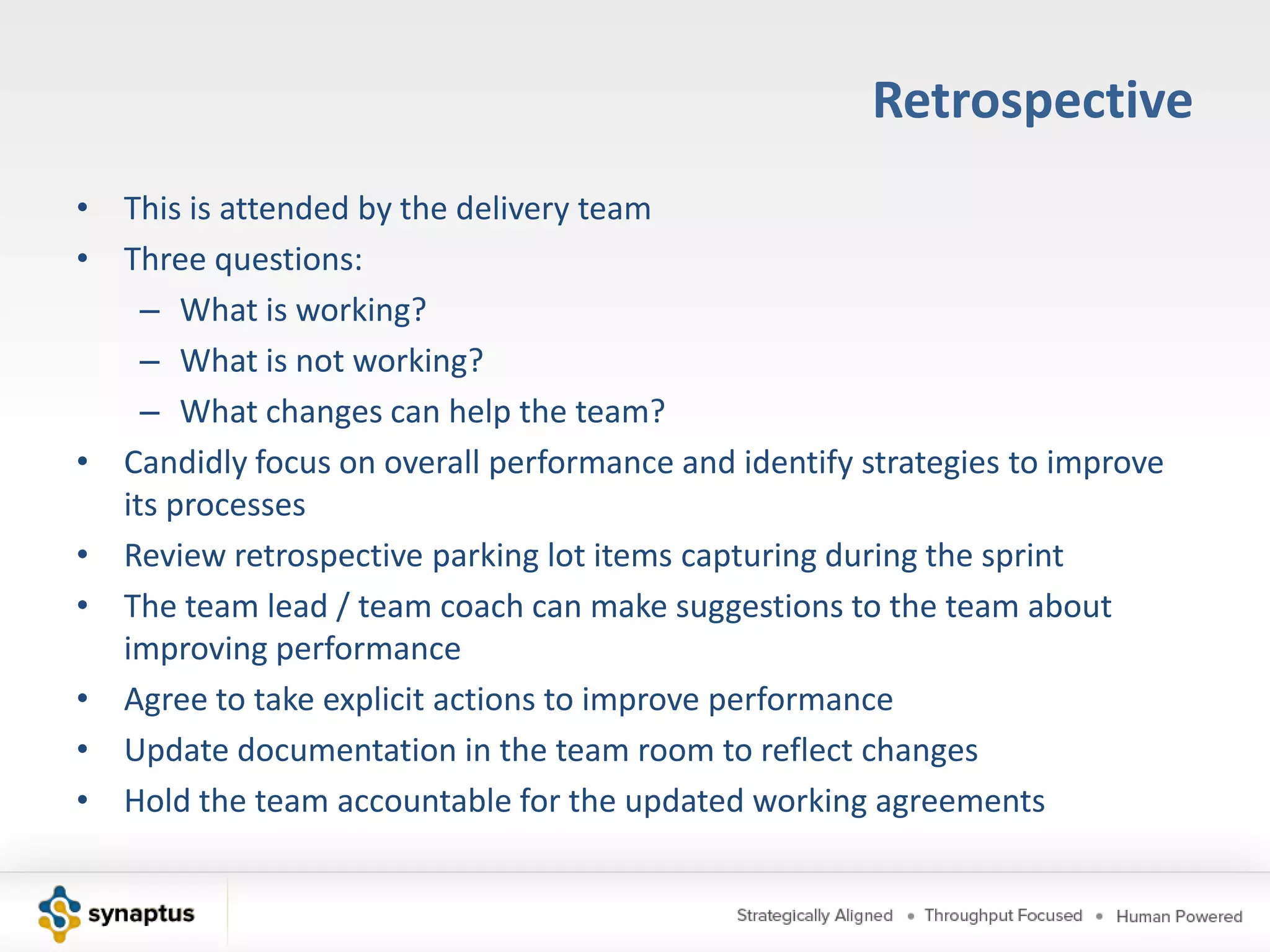
    RetrospectiveThis is attendedby the delivery teamThree questions:What is working?What is not working?What changes can help the team?Candidly focus on overall performance and identify strategies to improve its processesReview retrospective parking lot items capturing during the sprintThe team lead / team coach can make suggestions to the team about improving performanceAgree to take explicit actions to improve performanceUpdate documentation in the team room to reflect changesHold the team accountable for the updated working agreements
  • 93.
    AgendaRoots of AgileAgileManifestoAgile FlavorsAgile RolesAgile CeremoniesAgile Fundamental Concepts
  • 94.
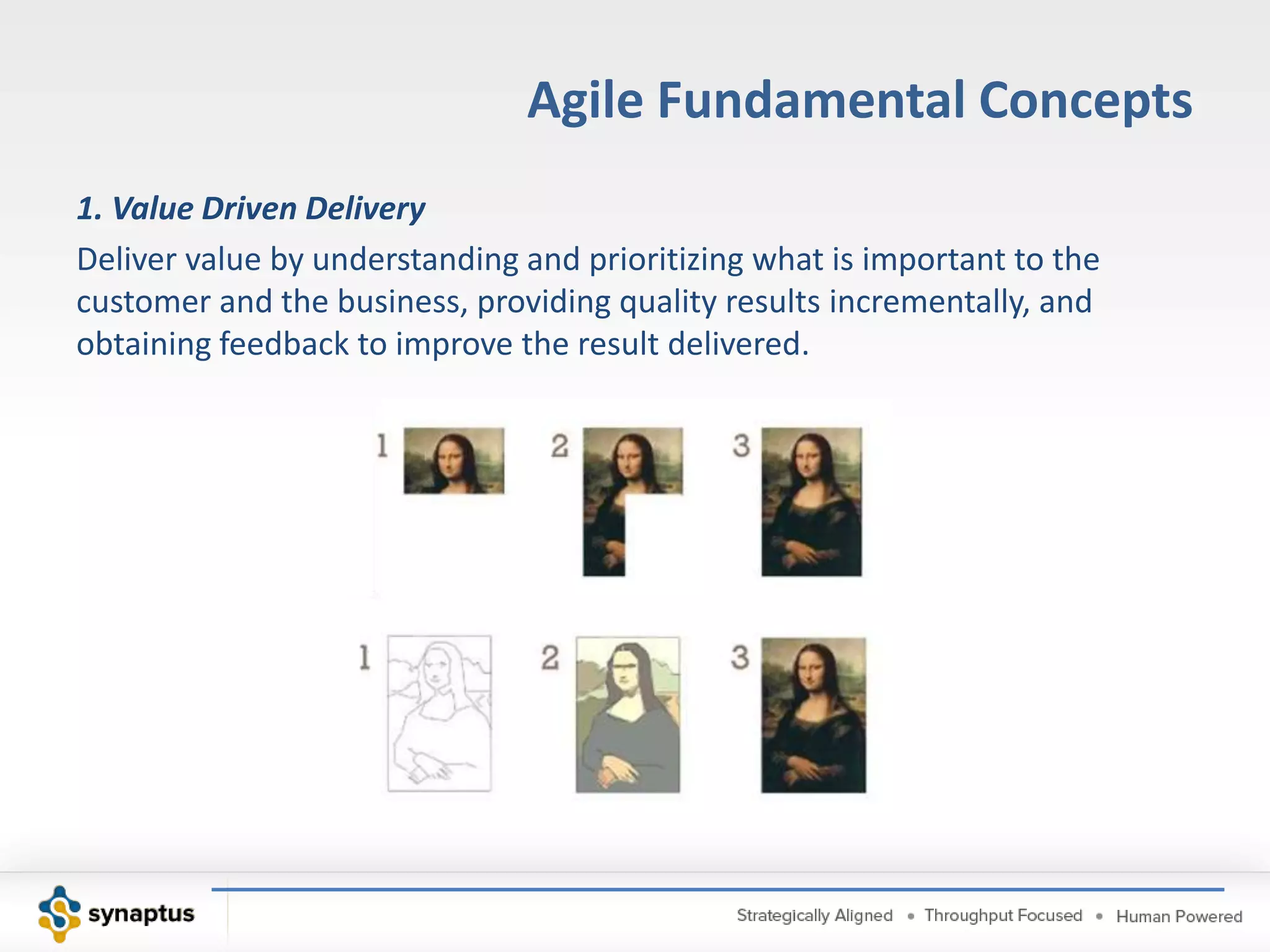
    Agile Fundamental Concepts1.Value Driven DeliveryDeliver value by understanding and prioritizing what is important to the customer and the business, providing quality results incrementally, and obtaining feedback to improve the result delivered.
  • 95.
    Agile Fundamental Concepts2.Stakeholder EngagementEstablishing and maintaining mechanisms that ensure that all current and future interested parties are appropriately participating throughout the lifecycle of the project.
  • 96.
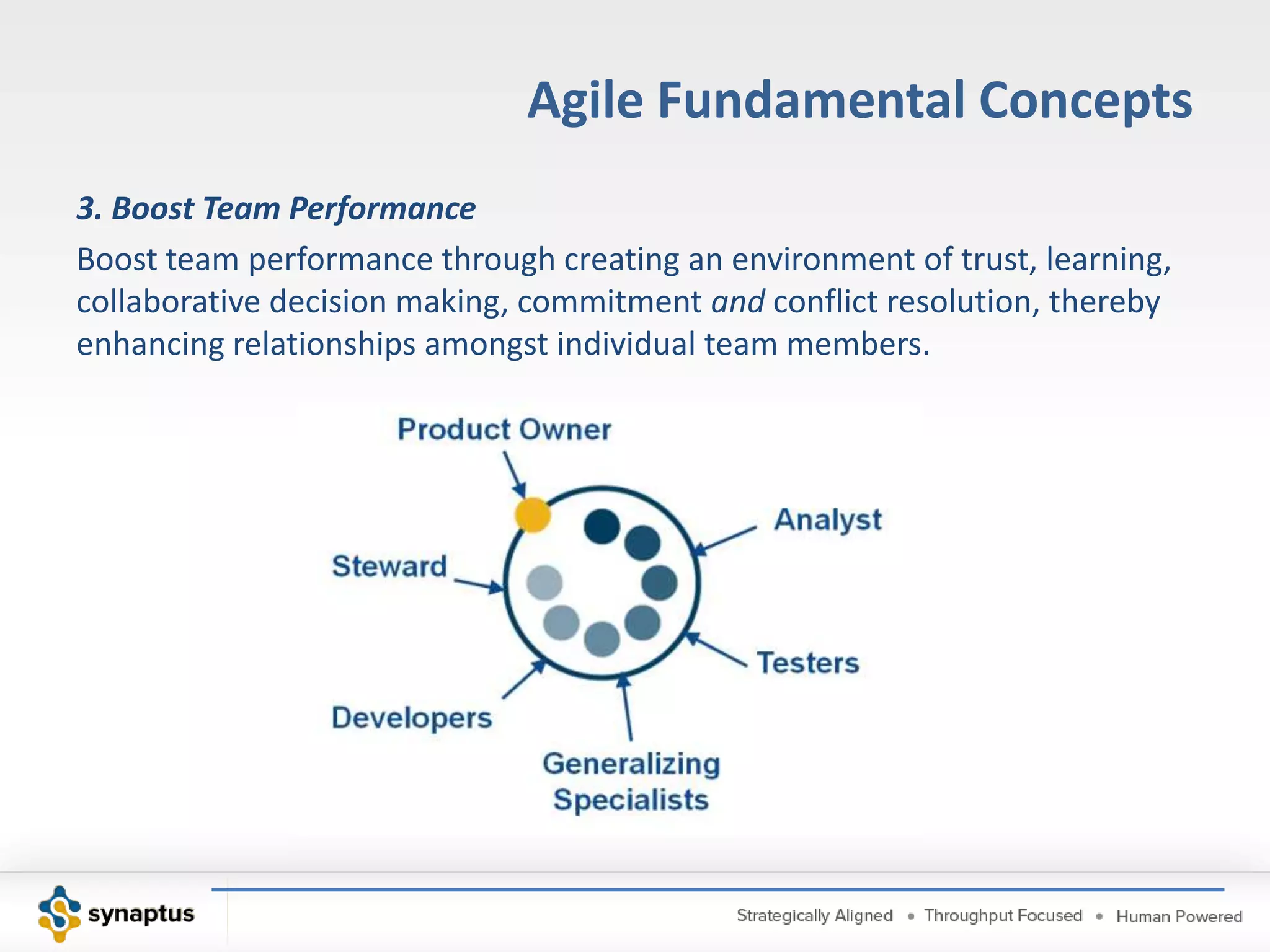
    Agile Fundamental Concepts3.Boost Team PerformanceBoost team performance through creating an environment of trust, learning, collaborative decision making, commitment and conflict resolution, thereby enhancing relationships amongst individual team members.
  • 97.
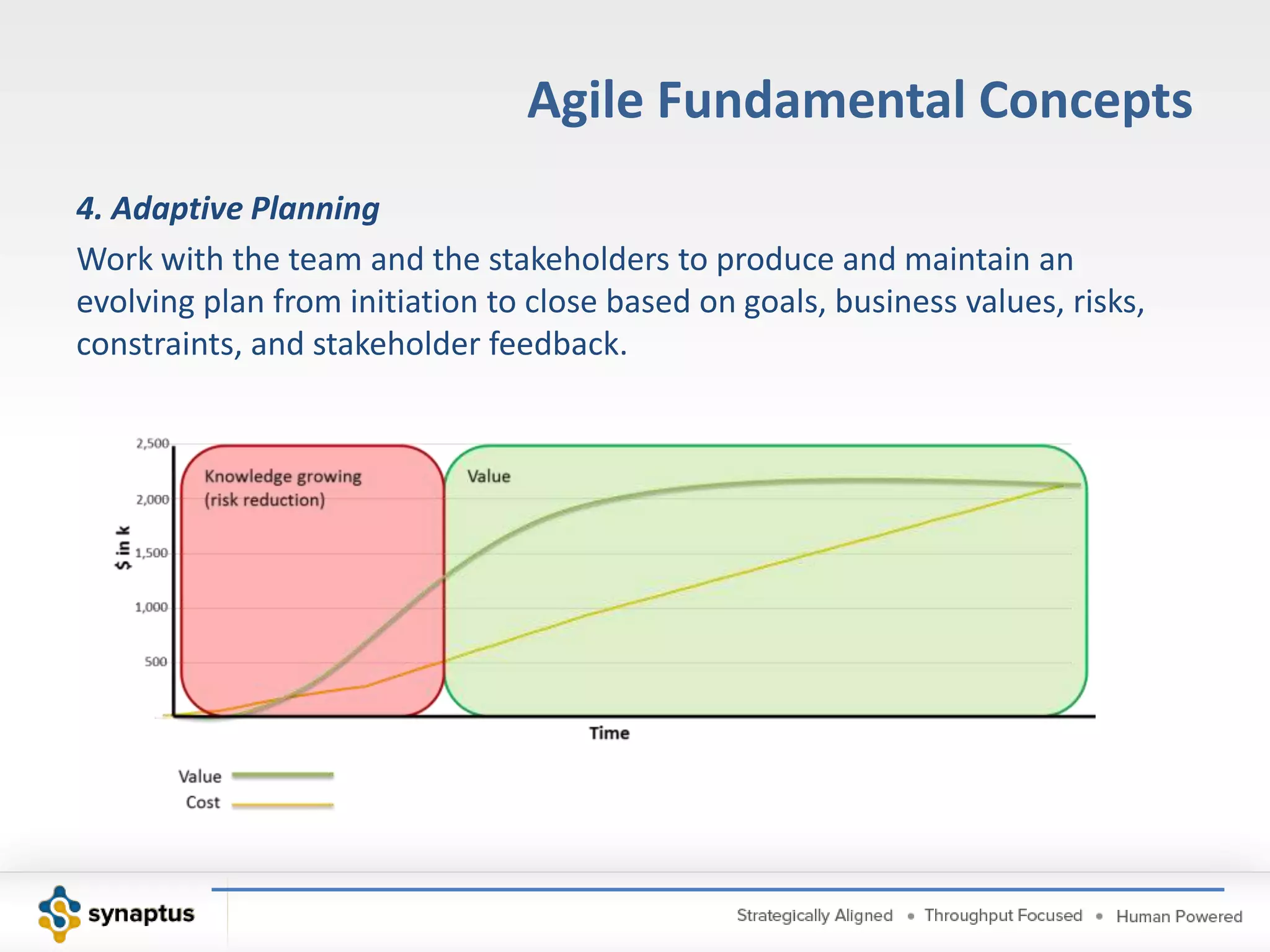
    Agile Fundamental Concepts4.Adaptive PlanningWork with the team and the stakeholders to produce and maintain an evolving plan from initiation to close based on goals, business values, risks, constraints, and stakeholder feedback.
  • 98.
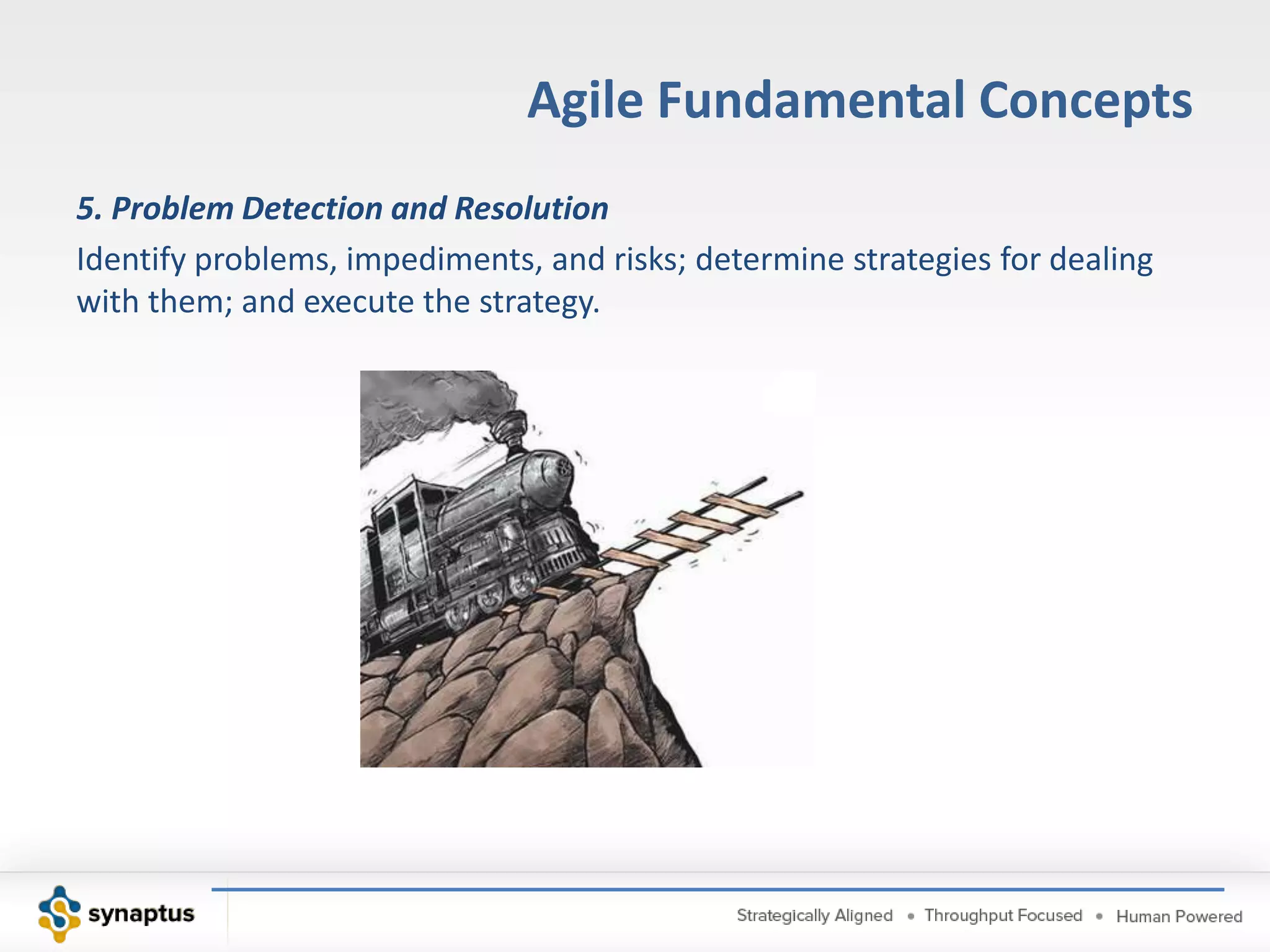
    Agile Fundamental Concepts5.Problem Detection and ResolutionIdentify problems, impediments, and risks; determine strategies for dealing with them; and execute the strategy.
  • 99.
    Agile Fundamental Concepts6.Continuous ImprovementReflect on performance and improve the quality, effectiveness, and flexibility of the product, process and team and influence the organization in order to better deliver value now and in the future.
  • 100.
    AgendaRoots of AgileAgileManifestoAgile FlavorsAgile RolesAgile CeremoniesAgile Fundamental IdeasQ&A
  • 101.
    PMI Agile LIGToparticipate in the Atlanta Agile CommunityPMI Atlanta Chapter Agile LIG http://www.pmiatlanta.orgScrum Meet-up http://www.meetup.com/agile-38/Agile Atlantahttp://www.agileatlanta.orgParticipate in the Agile PMI Virtual Community http://www.agile.vc.pmi.orgInformation about certification including reference bookshttp://www.pmi.org/Agile
  • 102.
    Q&AWhat questions doyou have about Agile?

Editor's Notes

  • #7 Observed that lathe workers across organizations had wide differences in productivity – with most shops falling to the productivity of the lowest worker in the shop.Goals: Transformation of Knowledge work into Tools, Processes, and Documentation
  • #9 The WBS is defined up front – with 100% of the project scope and all deliverables defined up frontThe WBS is used to show all work and dependencies for a projectEstimating the WBS provides an accurate schedule for the projectHolding people to these detailed upfront plans ensures projects are delivered on timeCreating detailed deliverables at the front of the project that resulted in rework and confusion
  • #11 Demonstrated common practice that had been adopted from the manufacturing and construction industriesRoyce actually documented it as a flawed model – although it was and still is common in software development
  • #16 We are uncovering better ways of developing software by doing it and helping others do it.Through this work we have come to value: