Scope of Topics - User Story Workshop
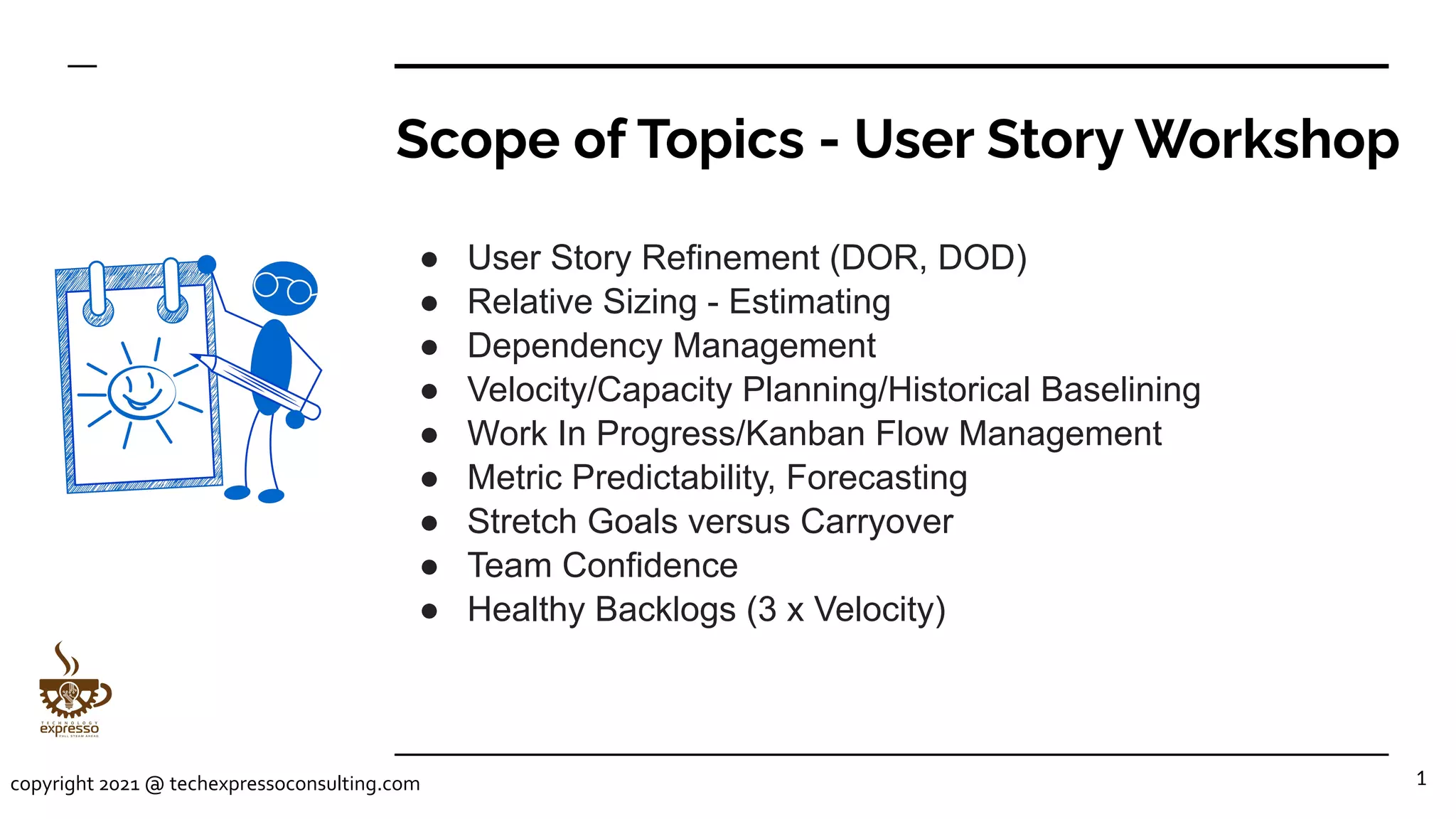
● User Story Refinement (DOR, DOD)
● Relative Sizing - Estimating
● Dependency Management
● Velocity/Capacity Planning/Historical Baselining
● Work In Progress/Kanban Flow Management
● Metric Predictability, Forecasting
● Stretch Goals versus Carryover
● Team Confidence
● Healthy Backlogs (3 x Velocity)
1
copyright 2021 @ techexpressoconsulting.com
2
3
copyright 2021 @ techexpressoconsulting.com
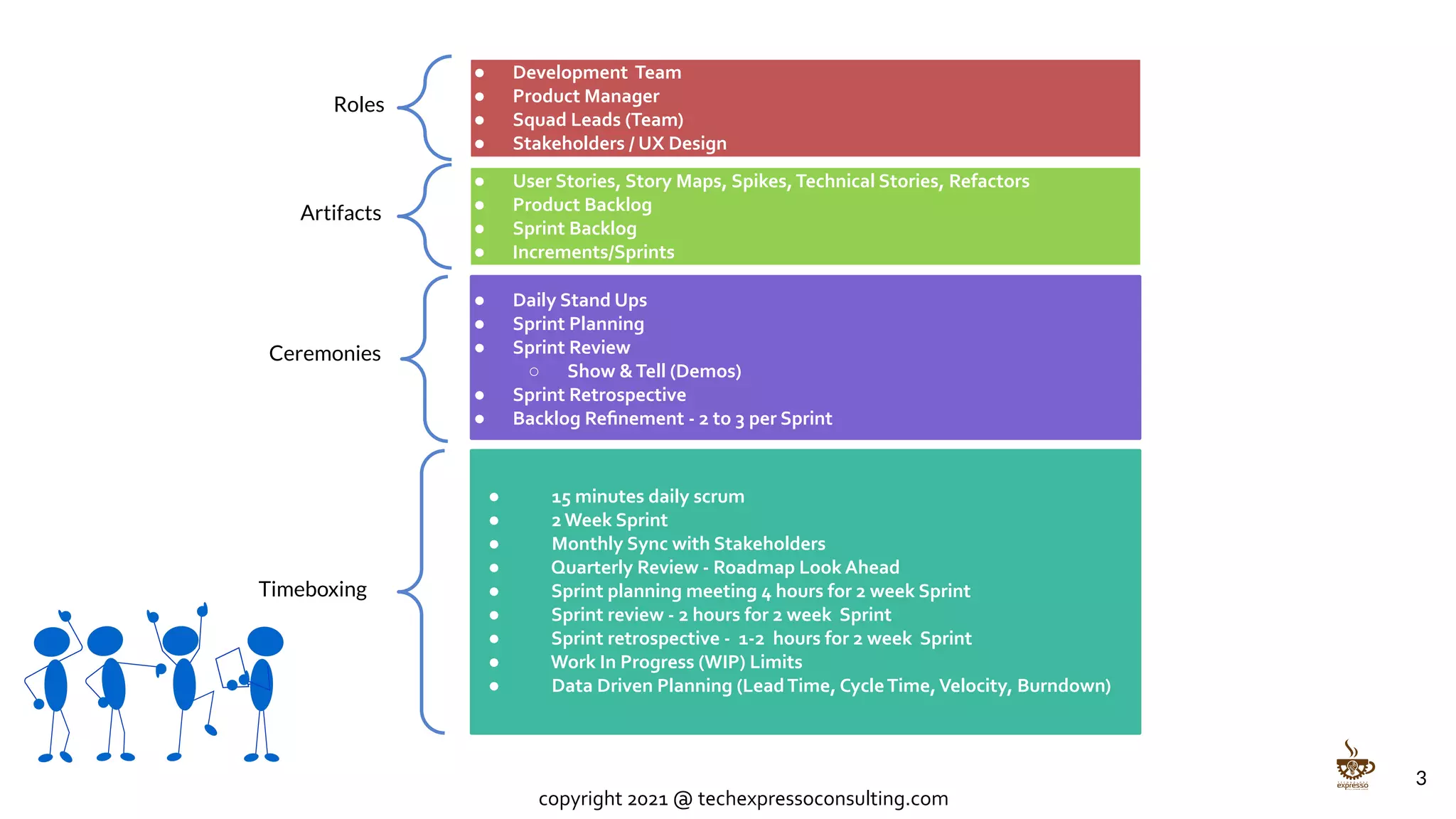
Roles
Artifacts
Ceremonies
Timeboxing
● Development Team
● Product Manager
● Squad Leads (Team)
● Stakeholders / UX Design
● User Stories, Story Maps, Spikes,Technical Stories, Refactors
● Product Backlog
● Sprint Backlog
● Increments/Sprints
● Daily Stand Ups
● Sprint Planning
● Sprint Review
○ Show &Tell (Demos)
● Sprint Retrospective
● Backlog Refinement - 2 to 3 per Sprint
● 15 minutes daily scrum
● 2 Week Sprint
● Monthly Sync with Stakeholders
● Quarterly Review - Roadmap Look Ahead
● Sprint planning meeting 4 hours for 2 week Sprint
● Sprint review - 2 hours for 2 week Sprint
● Sprint retrospective - 1-2 hours for 2 week Sprint
● Work In Progress (WIP) Limits
● Data Driven Planning (LeadTime, CycleTime,Velocity, Burndown)
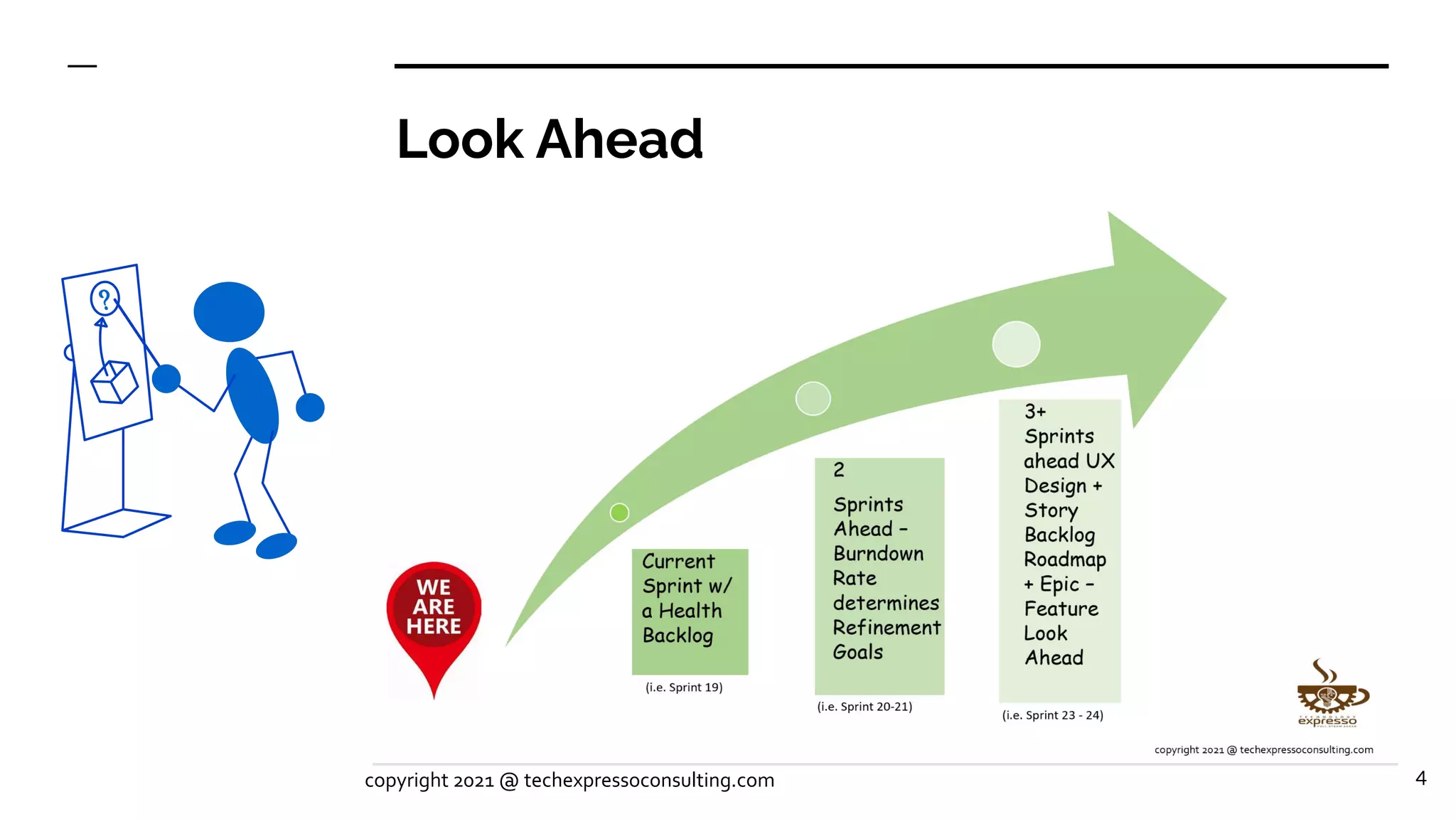
Look Ahead
4
copyright 2021 @ techexpressoconsulting.com
5
copyright 2021 @ techexpressoconsulting.com
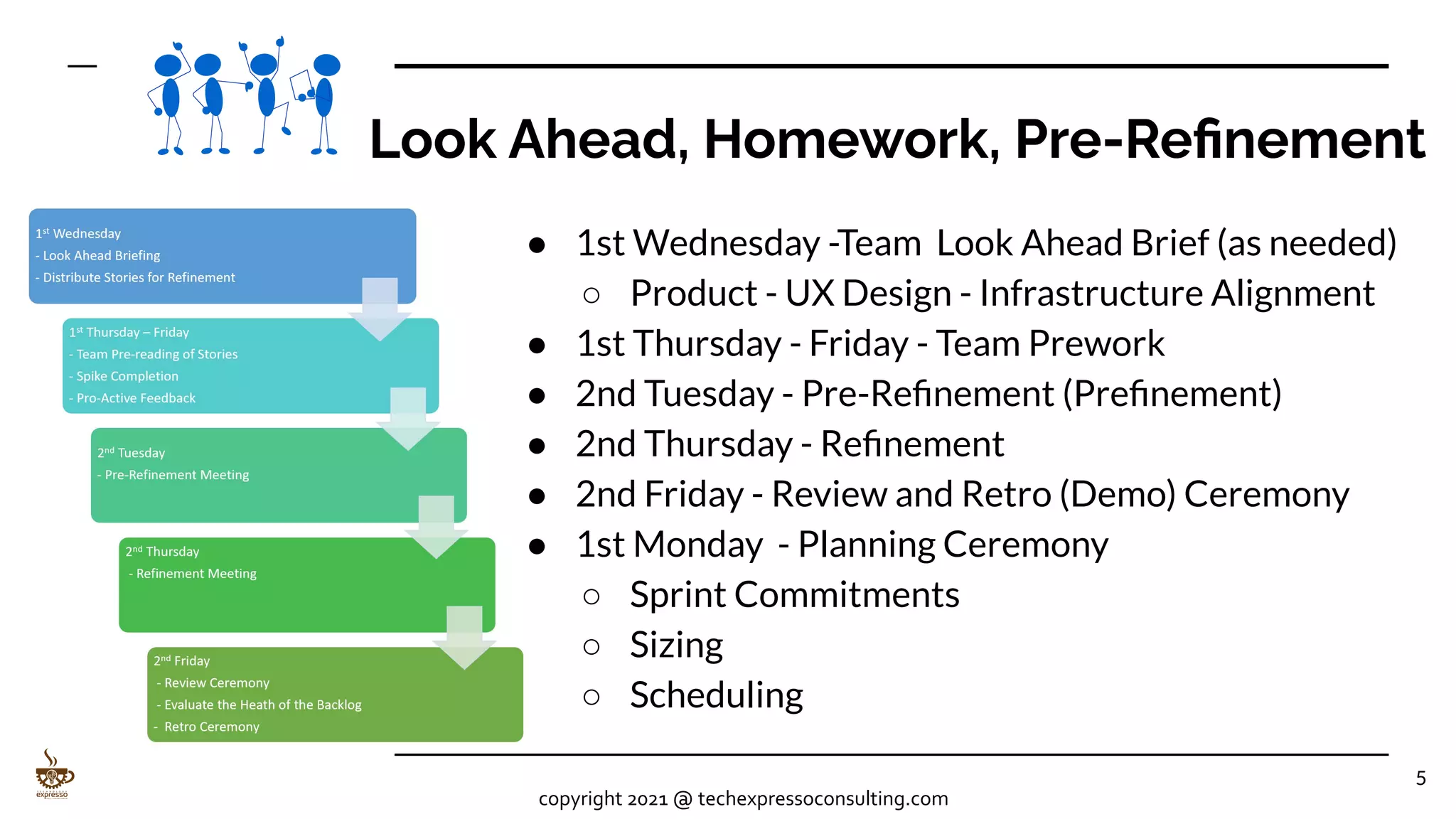
Look Ahead, Homework, Pre-Refinement
● 1st Wednesday -Team Look Ahead Brief (as needed)
○ Product - UX Design - Infrastructure Alignment
● 1st Thursday - Friday - Team Prework
● 2nd Tuesday - Pre-Refinement (Prefinement)
● 2nd Thursday - Refinement
● 2nd Friday - Review and Retro (Demo) Ceremony
● 1st Monday - Planning Ceremony
○ Sprint Commitments
○ Sizing
○ Scheduling
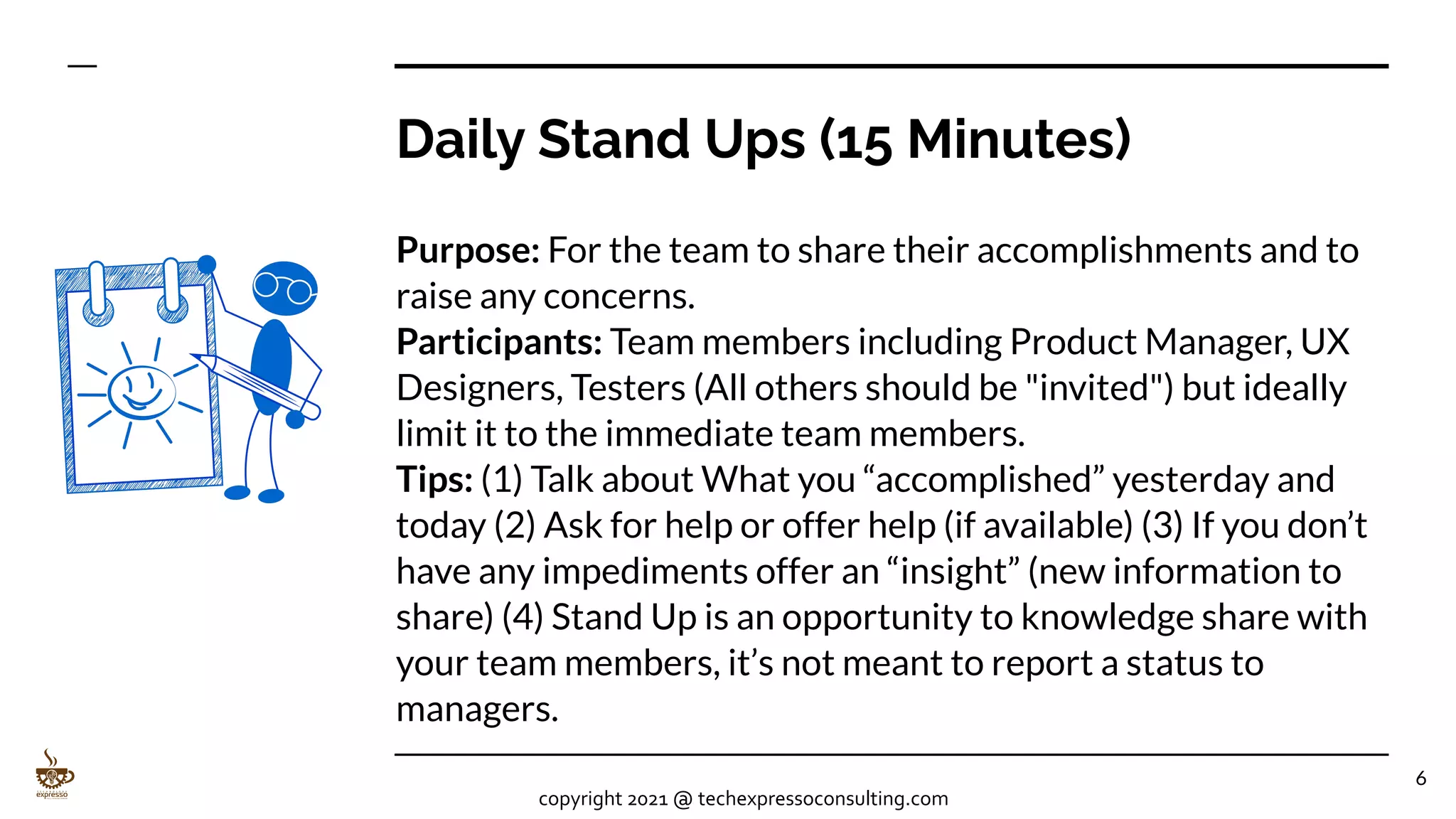
Daily Stand Ups (15 Minutes)
Purpose: For the team to share their accomplishments and to
raise any concerns.
Participants: Team members including Product Manager, UX
Designers, Testers (All others should be "invited") but ideally
limit it to the immediate team members.
Tips: (1) Talk about What you “accomplished” yesterday and
today (2) Ask for help or offer help (if available) (3) If you don’t
have any impediments offer an “insight” (new information to
share) (4) Stand Up is an opportunity to knowledge share with
your team members, it’s not meant to report a status to
managers.
6
copyright 2021 @ techexpressoconsulting.com
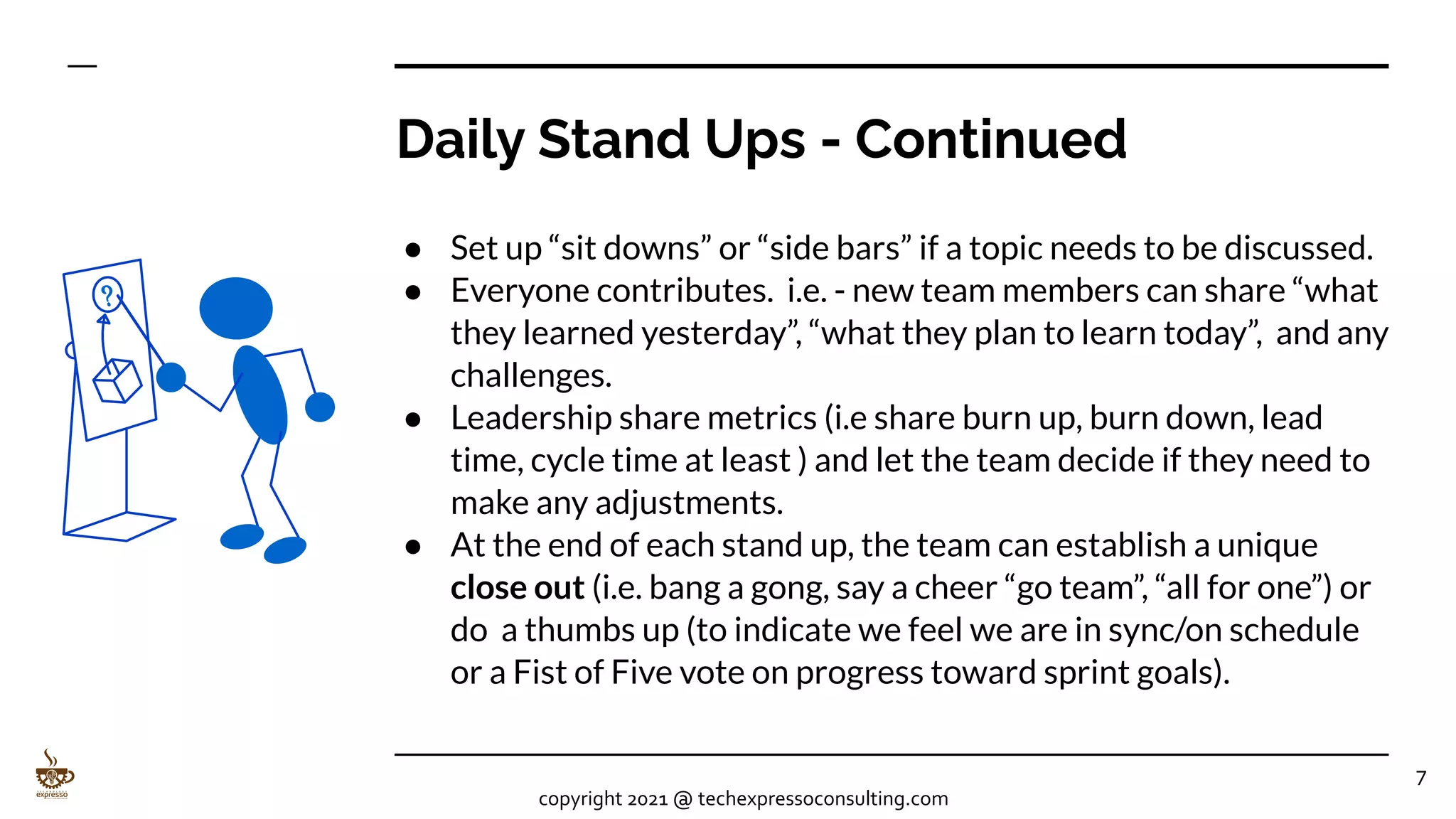
Daily Stand Ups - Continued
● Set up “sit downs” or “side bars” if a topic needs to be discussed.
● Everyone contributes. i.e. - new team members can share “what
they learned yesterday”, “what they plan to learn today”, and any
challenges.
● Leadership share metrics (i.e share burn up, burn down, lead
time, cycle time at least ) and let the team decide if they need to
make any adjustments.
● At the end of each stand up, the team can establish a unique
close out (i.e. bang a gong, say a cheer “go team”, “all for one”) or
do a thumbs up (to indicate we feel we are in sync/on schedule
or a Fist of Five vote on progress toward sprint goals).
7
copyright 2021 @ techexpressoconsulting.com
Backlog Refinement (1 - 4
Hours/Sprint)
Purpose: For the team to share and collectively identify what belongs in a
user story and to help find the gaps. The outcome is refined user stories
that are ready to be assigned to a sprint to be worked.
Participants: Team members including Product Manager, UX Designers,
Testers (All others should be "invited" as needed).
Tips: (1) A healthy backlog should have 2 - 3 sprints worth of stories in
the ‘ready’ state (2) The team should have an established Definition of
Ready (DOR) and Definition of Done (DOD) (3) Pre-Work or
“Prefinement” helps cut down long refinement and planning meetings. (4)
The task/subtask are not the focus, they should only be a part of the
discussion to help clarify the Level of Effort.
8
copyright 2021 @ techexpressoconsulting.com
Backlog Refinement - continued
1. Raw stories should have rough acceptance criteria and the team
should have a period of time to preview and submit questions.
2. Refinement sessions are used to reconcile and capture the
agreed upon acceptance criteria.
3. When the team feels the AC is “good enough” then the team
votes on the relative size. During sizing it may become
necessary to vertically split/slice stories.
4. Business value can also be defined (optional).
5. Other Backlog Items (Refactor, Technical /Non-Functional
Stories, Spikes) may also come out of the Refinement Session.
9
copyright 2021 @ techexpressoconsulting.com
Sprint Planning (1 Hour w/ Refinement)
Purpose: Is to define and commit to what can be delivered in the sprint.
The outcome is consensus on a commitment to the current sprint and a
forecast for the next two sprints.
Participants: Team members including Product Manager, UX Designers,
Testers (All others should be "invited" as needed).
Tips: (1) A prerequisite is that spikes have been resolved, the stories have
been estimated and the dependencies have been negotiated (2) Planning
has two parts: Part 1 - the Product Manager/Owner collaborates with the
team to outline the objective and goals; Part 2 - the team comes up with a
plan (3) Conclude the meeting with a Fist of Five to ensure there is team
consensus (4) Look ahead to determine that the backlog is “healthy,”
schedule refinement activities to get or keep the backlog healthy.
10
copyright 2021 @ techexpressoconsulting.com
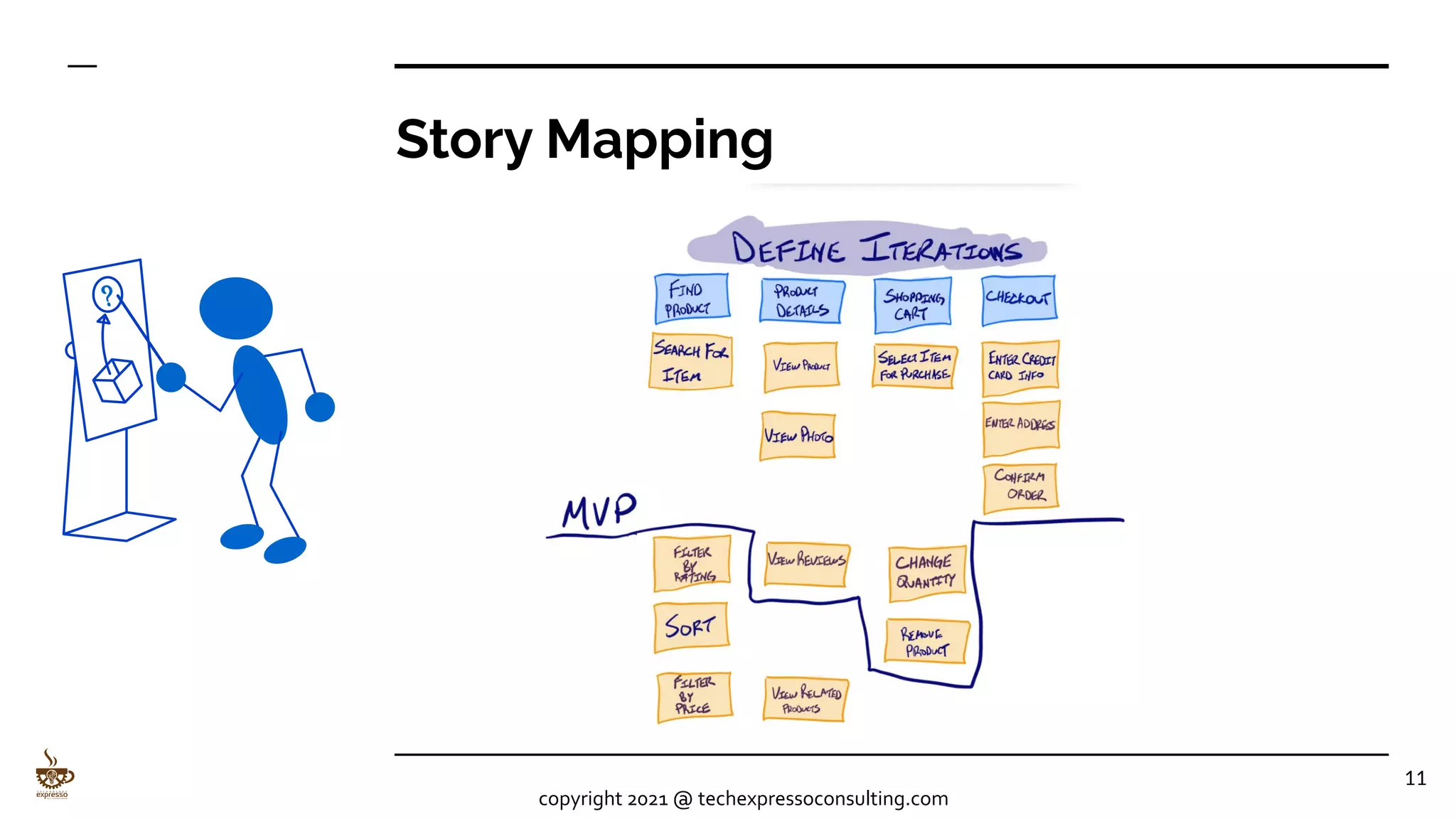
Story Mapping
11
copyright 2021 @ techexpressoconsulting.com
Sprint Review (1 Hours with Demo)
Purpose: Is an opportunity for the team to demo the sprint
accomplishments. The outcome is to determine if the solution is on
track and to get feedback to incorporate into future backlog items.
Participants: Team members including Product Manager, UX
Designers, Testers (Product Managers should Invite stakeholders)
Tips: (1) Display the Sprint Goals and then completely demo the
committed stories. (2) Encourage and capture feedback -
continuous improvement is a part of Agile (3) Demos do NOT have
to be polished (do not spend more than 1 hour prep) - It’s a
work-in-progress in line with Progressive Elaboration (4) Spike
outcomes/results/research conclusion.
12
copyright 2021 @ techexpressoconsulting.com
Sprint Review (1 Hour with Demo)
● At the conclusion of the demo, discuss (a) Is the solution on
track (functionality, scope and timeline)? (b) Have we reach
our objective/goal - are we done? Is it shippable / ready
for release? (c )Should we release this portion of the
solution? (d) What is the next most important thing with
the highest value functionality? (e) The team discusses and
reorders the backlog priorities based on any new
changes/enhancements.
● Remember to always target the least amount to achieve
the maximum value. Expect some stories to be descoped.
13
copyright 2021 @ techexpressoconsulting.com
Spontaneous Demos / Show and Tell
● Spontaneous Demo - throughout the sprint iterations the
development team should share impromptu/spontaneous demos to
share stories in progress to help ensure they are on the right track
and that the criteria has been correctly interpreted. The bigger or
more complex the story the more impromptu demos should be held.
● Sprint Demos - at the end of the demo this should include
stakeholders.
● Quarterly Show & Tell - this is typically to show a shippable
end-to-end part of the solution which includes work from multiple
teams/squads, domains and shared services. This is usually open for
all domains.
14
copyright 2021 @ techexpressoconsulting.com
Sprint Retrospective - 1 - 2 Hours
Purpose: This ceremony is used to discuss how well the plan
and approach to the team’s Way of Working (WOW) went as
well as how to continuously improve upon it.
Participants: Team members including Product Manager, UX
Designers, Testers (All others should be "invited" as needed)
Tips: (1) It’s important to look for healthy and sustainable
Ways of Working. (2) The Way of Working should align with
the Agile Manifesto Values and Principles.
15
copyright 2021 @ techexpressoconsulting.com
Sprint Retrospective “Extended” Agenda
● Look Back
○ Velocity, Burn Down, Carryover, Committed/Completed, WIP
○ Value Delivered
○ Unplanned Work, Bug Fix/Quality Indicators
○ Lead Time, Turn Around Time/Cycle Time, Hold Time
● Look Ahead (You can do this as part of the Planning and not the Retro)
○ 2 - 3 Sprint Feature Preview/Updates
○ 2 - 3 Month New Epic/Initiative Preview
○ Market Trends/Customer Analytics/Targets and Predictions
○ Technical Debt
● Team Health (Monthly/Quarterly) - Team Building (Ice Breaker)
● Areas of Improvement - First Ask: What did we improve since the last
retrospective? Then go into the (Start, Stop, Continue) or What Went Well,
What Didn't Go Well....)
● Action Items - Assigned and Target Date
16
copyright 2021 @ techexpressoconsulting.com
Scaled Agile Topics
17
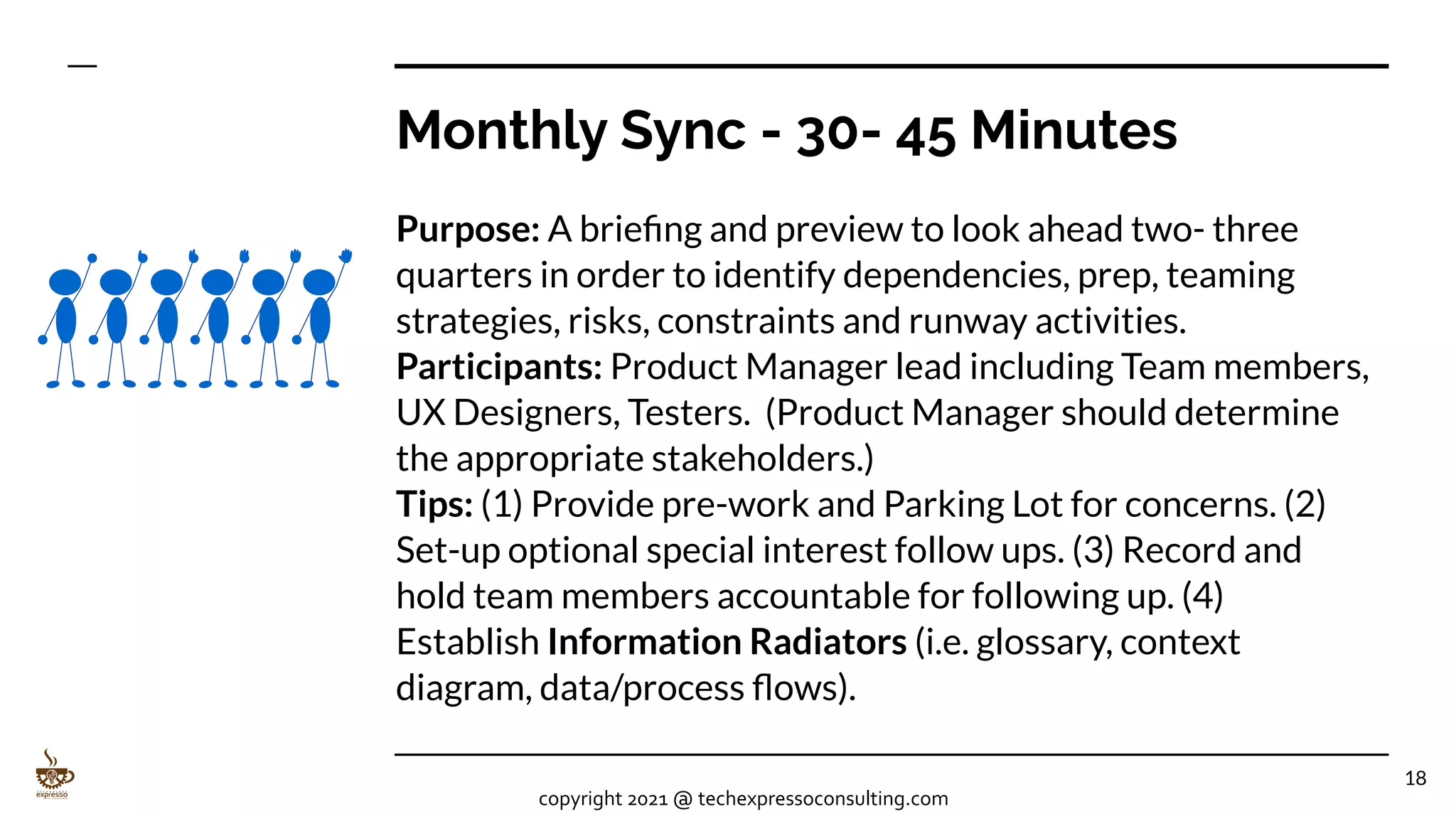
Monthly Sync - 30- 45 Minutes
Purpose: A briefing and preview to look ahead two- three
quarters in order to identify dependencies, prep, teaming
strategies, risks, constraints and runway activities.
Participants: Product Manager lead including Team members,
UX Designers, Testers. (Product Manager should determine
the appropriate stakeholders.)
Tips: (1) Provide pre-work and Parking Lot for concerns. (2)
Set-up optional special interest follow ups. (3) Record and
hold team members accountable for following up. (4)
Establish Information Radiators (i.e. glossary, context
diagram, data/process flows).
18
copyright 2021 @ techexpressoconsulting.com
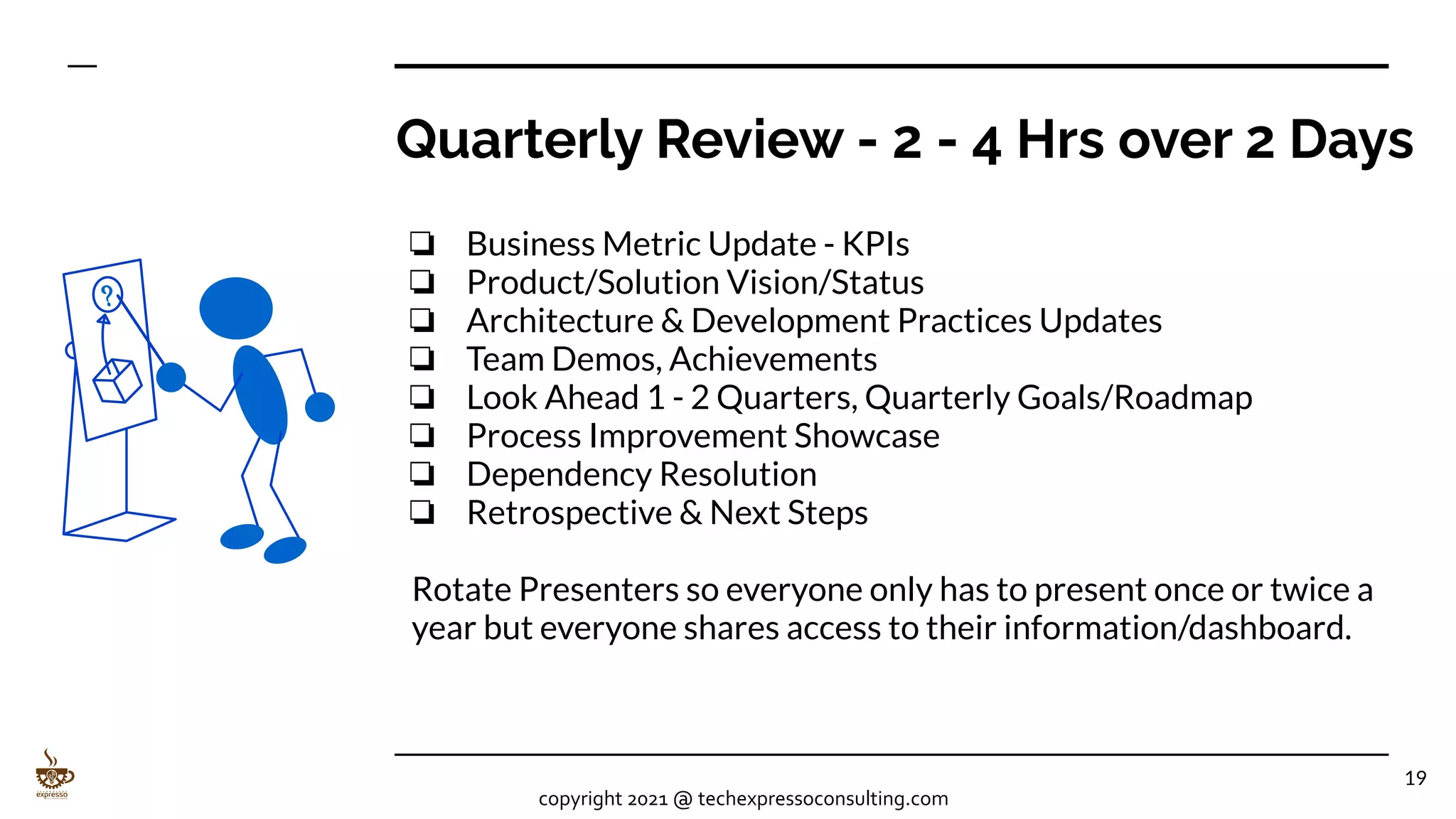
Quarterly Review - 2 - 4 Hrs over 2 Days
❏ Business Metric Update - KPIs
❏ Product/Solution Vision/Status
❏ Architecture & Development Practices Updates
❏ Team Demos, Achievements
❏ Look Ahead 1 - 2 Quarters, Quarterly Goals/Roadmap
❏ Process Improvement Showcase
❏ Dependency Resolution
❏ Retrospective & Next Steps
Rotate Presenters so everyone only has to present once or twice a
year but everyone shares access to their information/dashboard.
19
copyright 2021 @ techexpressoconsulting.com
Transitioning & Start - Ups
20
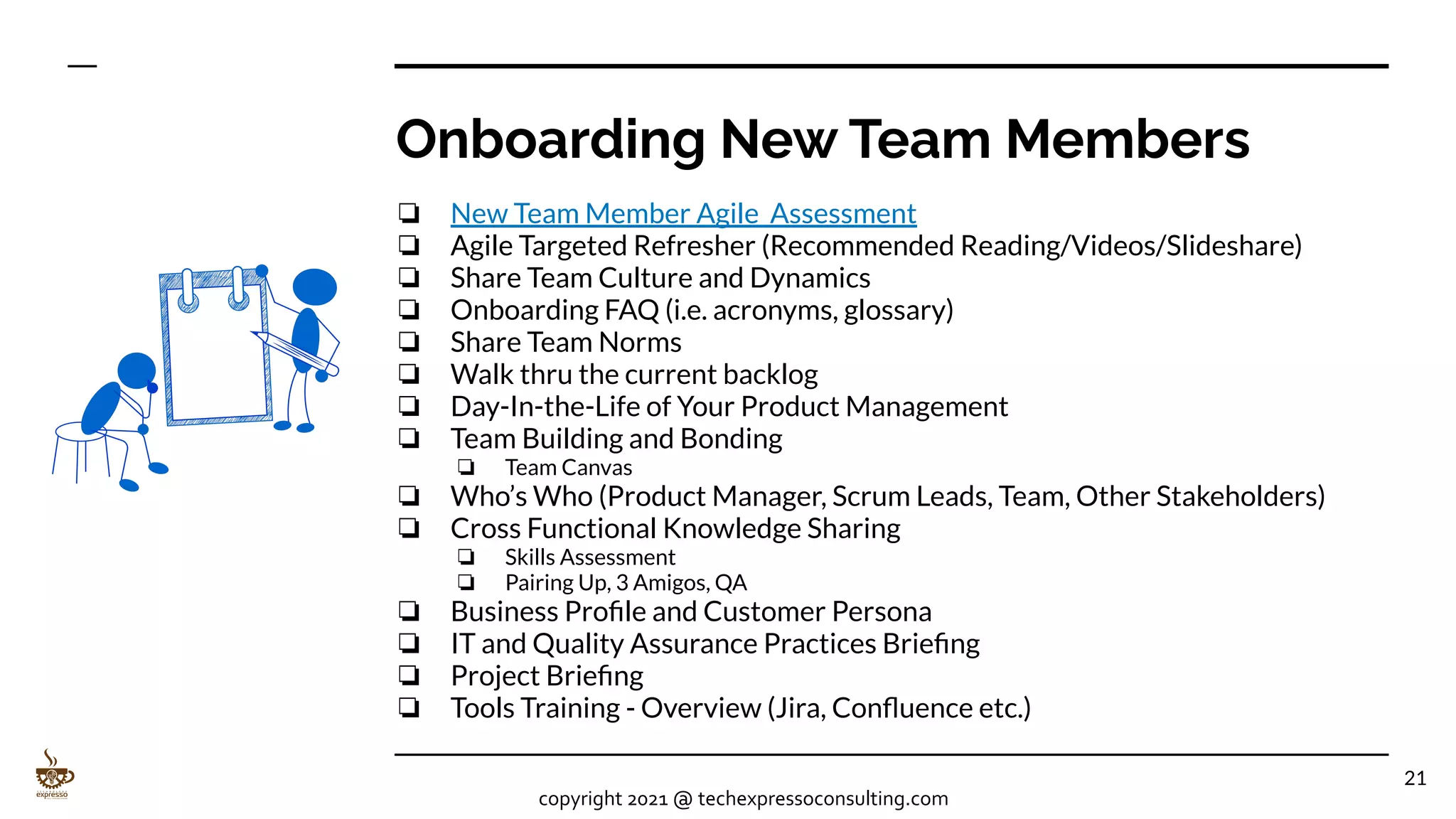
Onboarding New Team Members
❏ New Team Member Agile Assessment
❏ Agile Targeted Refresher (Recommended Reading/Videos/Slideshare)
❏ Share Team Culture and Dynamics
❏ Onboarding FAQ (i.e. acronyms, glossary)
❏ Share Team Norms
❏ Walk thru the current backlog
❏ Day-In-the-Life of Your Product Management
❏ Team Building and Bonding
❏ Team Canvas
❏ Who’s Who (Product Manager, Scrum Leads, Team, Other Stakeholders)
❏ Cross Functional Knowledge Sharing
❏ Skills Assessment
❏ Pairing Up, 3 Amigos, QA
❏ Business Profile and Customer Persona
❏ IT and Quality Assurance Practices Briefing
❏ Project Briefing
❏ Tools Training - Overview (Jira, Confluence etc.)
21
copyright 2021 @ techexpressoconsulting.com
Onboarding A New Team
❏ New Team Assessment
❏ Agile Targeted Refresher
❏ Team Culture and Dynamics
❏ Set Up Team Norms
❏ Team Building and Bonding
❏ Outline Roles (Product Manager, Scrum Leads, Team, Other
Stakeholders)
❏ Set Up Cross Functional Knowledge Sharing
❏ Skills Gap Analysis
❏ Pairing Up, 3 Amigos
❏ Provide Agile Pre-Reading, References
❏ Business and IT Practices Briefing
❏ Project Kick Off and Set Up Spike Research
❏ Baseline Team Health Survey
❏ Identify Tools and Schedule Tools Training
22
copyright 2021 @ techexpressoconsulting.com
Timing and Timelines
23
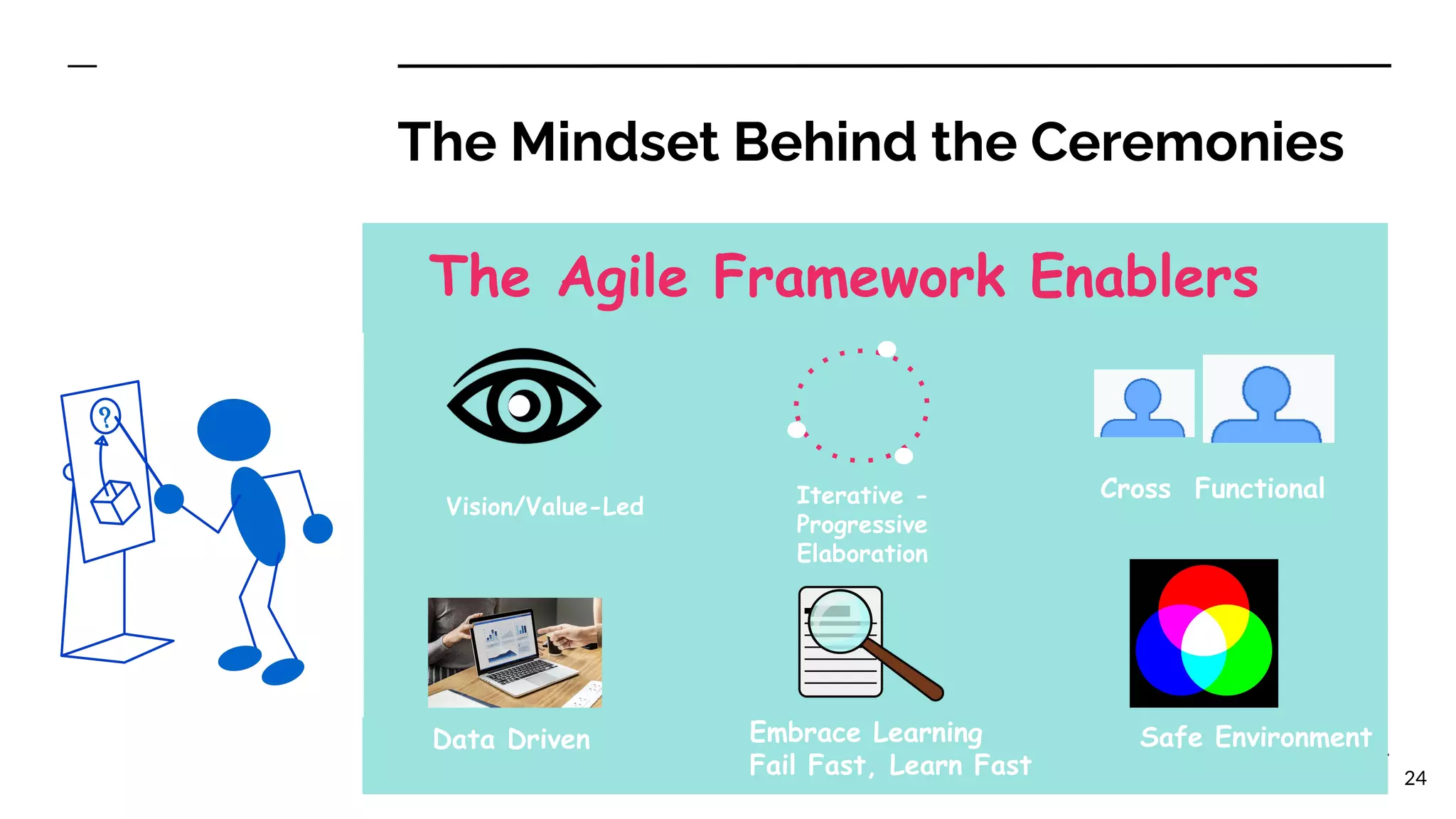
The Mindset Behind the Ceremonies
24
The Agile Framework Enablers
Vision/Value-Led
Data Driven Embrace Learning
Fail Fast, Learn Fast
Safe Environment
Cross Functional
Iterative -
Progressive
Elaboration
25
copyright 2021 @ techexpressoconsulting.com
For Further Insight and Help
Technology Expresso BlogTalk Radio
Technology Expresso Slideshare
26
copyright 2021 @ techexpressoconsulting.com

Agile Framework Recommendations and Refreshers

  • 1.
    Scope of Topics- User Story Workshop ● User Story Refinement (DOR, DOD) ● Relative Sizing - Estimating ● Dependency Management ● Velocity/Capacity Planning/Historical Baselining ● Work In Progress/Kanban Flow Management ● Metric Predictability, Forecasting ● Stretch Goals versus Carryover ● Team Confidence ● Healthy Backlogs (3 x Velocity) 1 copyright 2021 @ techexpressoconsulting.com
  • 2.
  • 3.
    3 copyright 2021 @techexpressoconsulting.com Roles Artifacts Ceremonies Timeboxing ● Development Team ● Product Manager ● Squad Leads (Team) ● Stakeholders / UX Design ● User Stories, Story Maps, Spikes,Technical Stories, Refactors ● Product Backlog ● Sprint Backlog ● Increments/Sprints ● Daily Stand Ups ● Sprint Planning ● Sprint Review ○ Show &Tell (Demos) ● Sprint Retrospective ● Backlog Refinement - 2 to 3 per Sprint ● 15 minutes daily scrum ● 2 Week Sprint ● Monthly Sync with Stakeholders ● Quarterly Review - Roadmap Look Ahead ● Sprint planning meeting 4 hours for 2 week Sprint ● Sprint review - 2 hours for 2 week Sprint ● Sprint retrospective - 1-2 hours for 2 week Sprint ● Work In Progress (WIP) Limits ● Data Driven Planning (LeadTime, CycleTime,Velocity, Burndown)
  • 4.
    Look Ahead 4 copyright 2021@ techexpressoconsulting.com
  • 5.
    5 copyright 2021 @techexpressoconsulting.com Look Ahead, Homework, Pre-Refinement ● 1st Wednesday -Team Look Ahead Brief (as needed) ○ Product - UX Design - Infrastructure Alignment ● 1st Thursday - Friday - Team Prework ● 2nd Tuesday - Pre-Refinement (Prefinement) ● 2nd Thursday - Refinement ● 2nd Friday - Review and Retro (Demo) Ceremony ● 1st Monday - Planning Ceremony ○ Sprint Commitments ○ Sizing ○ Scheduling
  • 6.
    Daily Stand Ups(15 Minutes) Purpose: For the team to share their accomplishments and to raise any concerns. Participants: Team members including Product Manager, UX Designers, Testers (All others should be "invited") but ideally limit it to the immediate team members. Tips: (1) Talk about What you “accomplished” yesterday and today (2) Ask for help or offer help (if available) (3) If you don’t have any impediments offer an “insight” (new information to share) (4) Stand Up is an opportunity to knowledge share with your team members, it’s not meant to report a status to managers. 6 copyright 2021 @ techexpressoconsulting.com
  • 7.
    Daily Stand Ups- Continued ● Set up “sit downs” or “side bars” if a topic needs to be discussed. ● Everyone contributes. i.e. - new team members can share “what they learned yesterday”, “what they plan to learn today”, and any challenges. ● Leadership share metrics (i.e share burn up, burn down, lead time, cycle time at least ) and let the team decide if they need to make any adjustments. ● At the end of each stand up, the team can establish a unique close out (i.e. bang a gong, say a cheer “go team”, “all for one”) or do a thumbs up (to indicate we feel we are in sync/on schedule or a Fist of Five vote on progress toward sprint goals). 7 copyright 2021 @ techexpressoconsulting.com
  • 8.
    Backlog Refinement (1- 4 Hours/Sprint) Purpose: For the team to share and collectively identify what belongs in a user story and to help find the gaps. The outcome is refined user stories that are ready to be assigned to a sprint to be worked. Participants: Team members including Product Manager, UX Designers, Testers (All others should be "invited" as needed). Tips: (1) A healthy backlog should have 2 - 3 sprints worth of stories in the ‘ready’ state (2) The team should have an established Definition of Ready (DOR) and Definition of Done (DOD) (3) Pre-Work or “Prefinement” helps cut down long refinement and planning meetings. (4) The task/subtask are not the focus, they should only be a part of the discussion to help clarify the Level of Effort. 8 copyright 2021 @ techexpressoconsulting.com
  • 9.
    Backlog Refinement -continued 1. Raw stories should have rough acceptance criteria and the team should have a period of time to preview and submit questions. 2. Refinement sessions are used to reconcile and capture the agreed upon acceptance criteria. 3. When the team feels the AC is “good enough” then the team votes on the relative size. During sizing it may become necessary to vertically split/slice stories. 4. Business value can also be defined (optional). 5. Other Backlog Items (Refactor, Technical /Non-Functional Stories, Spikes) may also come out of the Refinement Session. 9 copyright 2021 @ techexpressoconsulting.com
  • 10.
    Sprint Planning (1Hour w/ Refinement) Purpose: Is to define and commit to what can be delivered in the sprint. The outcome is consensus on a commitment to the current sprint and a forecast for the next two sprints. Participants: Team members including Product Manager, UX Designers, Testers (All others should be "invited" as needed). Tips: (1) A prerequisite is that spikes have been resolved, the stories have been estimated and the dependencies have been negotiated (2) Planning has two parts: Part 1 - the Product Manager/Owner collaborates with the team to outline the objective and goals; Part 2 - the team comes up with a plan (3) Conclude the meeting with a Fist of Five to ensure there is team consensus (4) Look ahead to determine that the backlog is “healthy,” schedule refinement activities to get or keep the backlog healthy. 10 copyright 2021 @ techexpressoconsulting.com
  • 11.
    Story Mapping 11 copyright 2021@ techexpressoconsulting.com
  • 12.
    Sprint Review (1Hours with Demo) Purpose: Is an opportunity for the team to demo the sprint accomplishments. The outcome is to determine if the solution is on track and to get feedback to incorporate into future backlog items. Participants: Team members including Product Manager, UX Designers, Testers (Product Managers should Invite stakeholders) Tips: (1) Display the Sprint Goals and then completely demo the committed stories. (2) Encourage and capture feedback - continuous improvement is a part of Agile (3) Demos do NOT have to be polished (do not spend more than 1 hour prep) - It’s a work-in-progress in line with Progressive Elaboration (4) Spike outcomes/results/research conclusion. 12 copyright 2021 @ techexpressoconsulting.com
  • 13.
    Sprint Review (1Hour with Demo) ● At the conclusion of the demo, discuss (a) Is the solution on track (functionality, scope and timeline)? (b) Have we reach our objective/goal - are we done? Is it shippable / ready for release? (c )Should we release this portion of the solution? (d) What is the next most important thing with the highest value functionality? (e) The team discusses and reorders the backlog priorities based on any new changes/enhancements. ● Remember to always target the least amount to achieve the maximum value. Expect some stories to be descoped. 13 copyright 2021 @ techexpressoconsulting.com
  • 14.
    Spontaneous Demos /Show and Tell ● Spontaneous Demo - throughout the sprint iterations the development team should share impromptu/spontaneous demos to share stories in progress to help ensure they are on the right track and that the criteria has been correctly interpreted. The bigger or more complex the story the more impromptu demos should be held. ● Sprint Demos - at the end of the demo this should include stakeholders. ● Quarterly Show & Tell - this is typically to show a shippable end-to-end part of the solution which includes work from multiple teams/squads, domains and shared services. This is usually open for all domains. 14 copyright 2021 @ techexpressoconsulting.com
  • 15.
    Sprint Retrospective -1 - 2 Hours Purpose: This ceremony is used to discuss how well the plan and approach to the team’s Way of Working (WOW) went as well as how to continuously improve upon it. Participants: Team members including Product Manager, UX Designers, Testers (All others should be "invited" as needed) Tips: (1) It’s important to look for healthy and sustainable Ways of Working. (2) The Way of Working should align with the Agile Manifesto Values and Principles. 15 copyright 2021 @ techexpressoconsulting.com
  • 16.
    Sprint Retrospective “Extended”Agenda ● Look Back ○ Velocity, Burn Down, Carryover, Committed/Completed, WIP ○ Value Delivered ○ Unplanned Work, Bug Fix/Quality Indicators ○ Lead Time, Turn Around Time/Cycle Time, Hold Time ● Look Ahead (You can do this as part of the Planning and not the Retro) ○ 2 - 3 Sprint Feature Preview/Updates ○ 2 - 3 Month New Epic/Initiative Preview ○ Market Trends/Customer Analytics/Targets and Predictions ○ Technical Debt ● Team Health (Monthly/Quarterly) - Team Building (Ice Breaker) ● Areas of Improvement - First Ask: What did we improve since the last retrospective? Then go into the (Start, Stop, Continue) or What Went Well, What Didn't Go Well....) ● Action Items - Assigned and Target Date 16 copyright 2021 @ techexpressoconsulting.com
  • 17.
  • 18.
    Monthly Sync -30- 45 Minutes Purpose: A briefing and preview to look ahead two- three quarters in order to identify dependencies, prep, teaming strategies, risks, constraints and runway activities. Participants: Product Manager lead including Team members, UX Designers, Testers. (Product Manager should determine the appropriate stakeholders.) Tips: (1) Provide pre-work and Parking Lot for concerns. (2) Set-up optional special interest follow ups. (3) Record and hold team members accountable for following up. (4) Establish Information Radiators (i.e. glossary, context diagram, data/process flows). 18 copyright 2021 @ techexpressoconsulting.com
  • 19.
    Quarterly Review -2 - 4 Hrs over 2 Days ❏ Business Metric Update - KPIs ❏ Product/Solution Vision/Status ❏ Architecture & Development Practices Updates ❏ Team Demos, Achievements ❏ Look Ahead 1 - 2 Quarters, Quarterly Goals/Roadmap ❏ Process Improvement Showcase ❏ Dependency Resolution ❏ Retrospective & Next Steps Rotate Presenters so everyone only has to present once or twice a year but everyone shares access to their information/dashboard. 19 copyright 2021 @ techexpressoconsulting.com
  • 20.
  • 21.
    Onboarding New TeamMembers ❏ New Team Member Agile Assessment ❏ Agile Targeted Refresher (Recommended Reading/Videos/Slideshare) ❏ Share Team Culture and Dynamics ❏ Onboarding FAQ (i.e. acronyms, glossary) ❏ Share Team Norms ❏ Walk thru the current backlog ❏ Day-In-the-Life of Your Product Management ❏ Team Building and Bonding ❏ Team Canvas ❏ Who’s Who (Product Manager, Scrum Leads, Team, Other Stakeholders) ❏ Cross Functional Knowledge Sharing ❏ Skills Assessment ❏ Pairing Up, 3 Amigos, QA ❏ Business Profile and Customer Persona ❏ IT and Quality Assurance Practices Briefing ❏ Project Briefing ❏ Tools Training - Overview (Jira, Confluence etc.) 21 copyright 2021 @ techexpressoconsulting.com
  • 22.
    Onboarding A NewTeam ❏ New Team Assessment ❏ Agile Targeted Refresher ❏ Team Culture and Dynamics ❏ Set Up Team Norms ❏ Team Building and Bonding ❏ Outline Roles (Product Manager, Scrum Leads, Team, Other Stakeholders) ❏ Set Up Cross Functional Knowledge Sharing ❏ Skills Gap Analysis ❏ Pairing Up, 3 Amigos ❏ Provide Agile Pre-Reading, References ❏ Business and IT Practices Briefing ❏ Project Kick Off and Set Up Spike Research ❏ Baseline Team Health Survey ❏ Identify Tools and Schedule Tools Training 22 copyright 2021 @ techexpressoconsulting.com
  • 23.
  • 24.
    The Mindset Behindthe Ceremonies 24 The Agile Framework Enablers Vision/Value-Led Data Driven Embrace Learning Fail Fast, Learn Fast Safe Environment Cross Functional Iterative - Progressive Elaboration
  • 25.
    25 copyright 2021 @techexpressoconsulting.com
  • 26.
    For Further Insightand Help Technology Expresso BlogTalk Radio Technology Expresso Slideshare 26 copyright 2021 @ techexpressoconsulting.com