A Taste of Functional
Programming with Haskell
Mohammad Ghabboun Functional→
Programming
Functional Programming
Languages
● Haskell
● Standard ML
● OCaml
● Scheme
● Clojure
● F#
● Scala
● Erlange
What is a Function ?
What is a function?
● Functions that fail (Null, exceptions...)
● Functions that go into infinite loop
● Functions that do IO
● Function that have side effects (change state)
● ...
What is a function?
● Functions that fail (Null, exceptions...)
● Functions that go into infinite loop
● Functions that do IO
● Function that have side effects (change state)
● Those are not functions but actually procedures
● So...
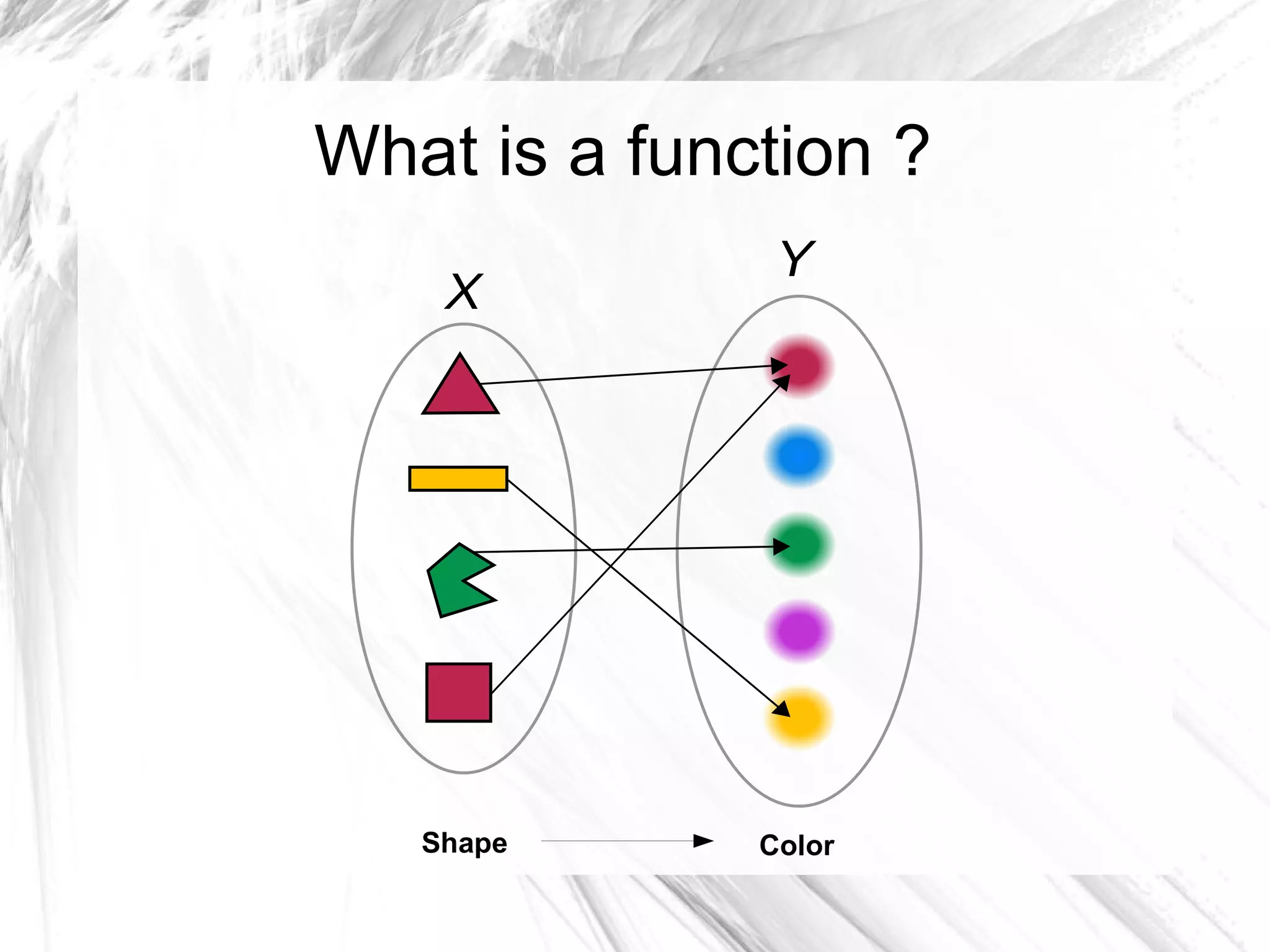
What is a function ?
X
Y
Shape Color
What is a function ?
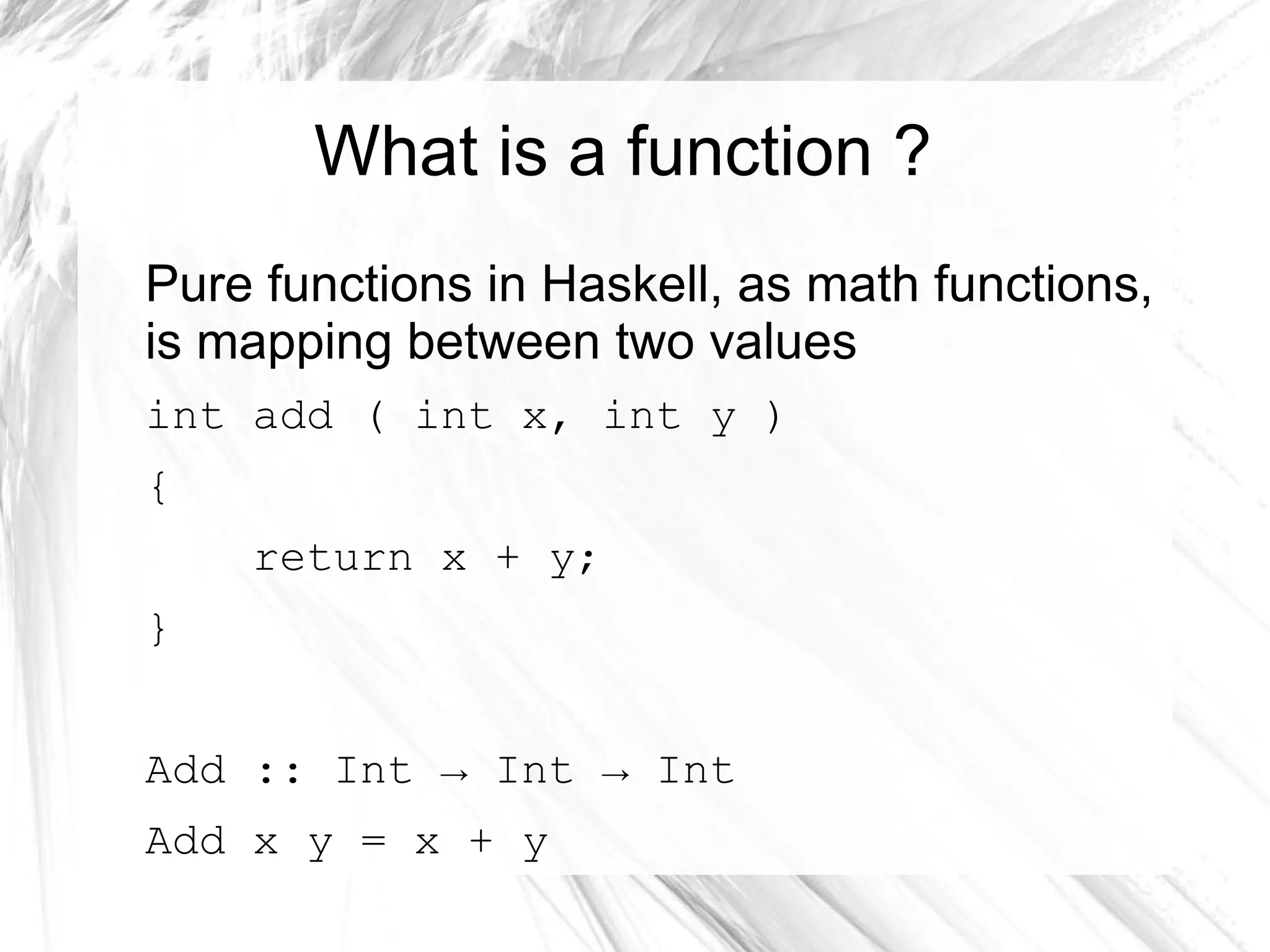
Pure functions in Haskell, as math functions,
is mapping between two values
int add ( int x, int y )
{
return x + y;
}
Add :: Int → Int → Int
Add x y = x + y
No assignments, only equality!
● Let x = 4
● x = 6 (error!)
● x is 4 it cannot be changed
● Left equals Right
● Let y = 5
● y = y + 1 (error!)
● (y-y) = 1
● 0 = 1 wrong!!
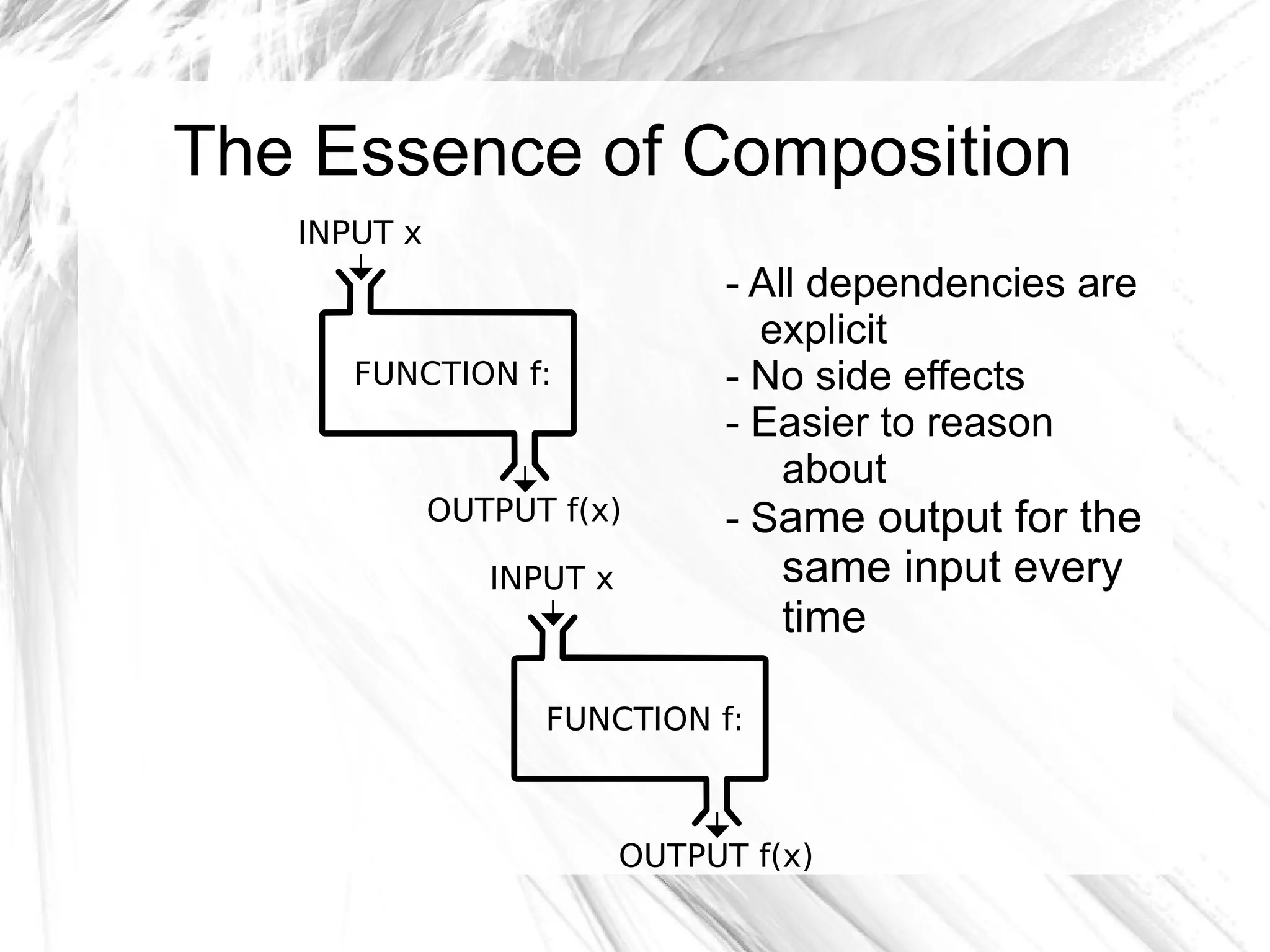
The Essence of Composition
INPUT x
FUNCTION f:
OUTPUT f(x)
INPUT x
FUNCTION f:
OUTPUT f(x)
- All dependencies are
explicit
- No side effects
- Easier to reason
about
- Same output for the
same input every
time
What is Functional
Programming (FP) ?
FP is about focusing on the
solution
It's about computing results and not
performing actions..
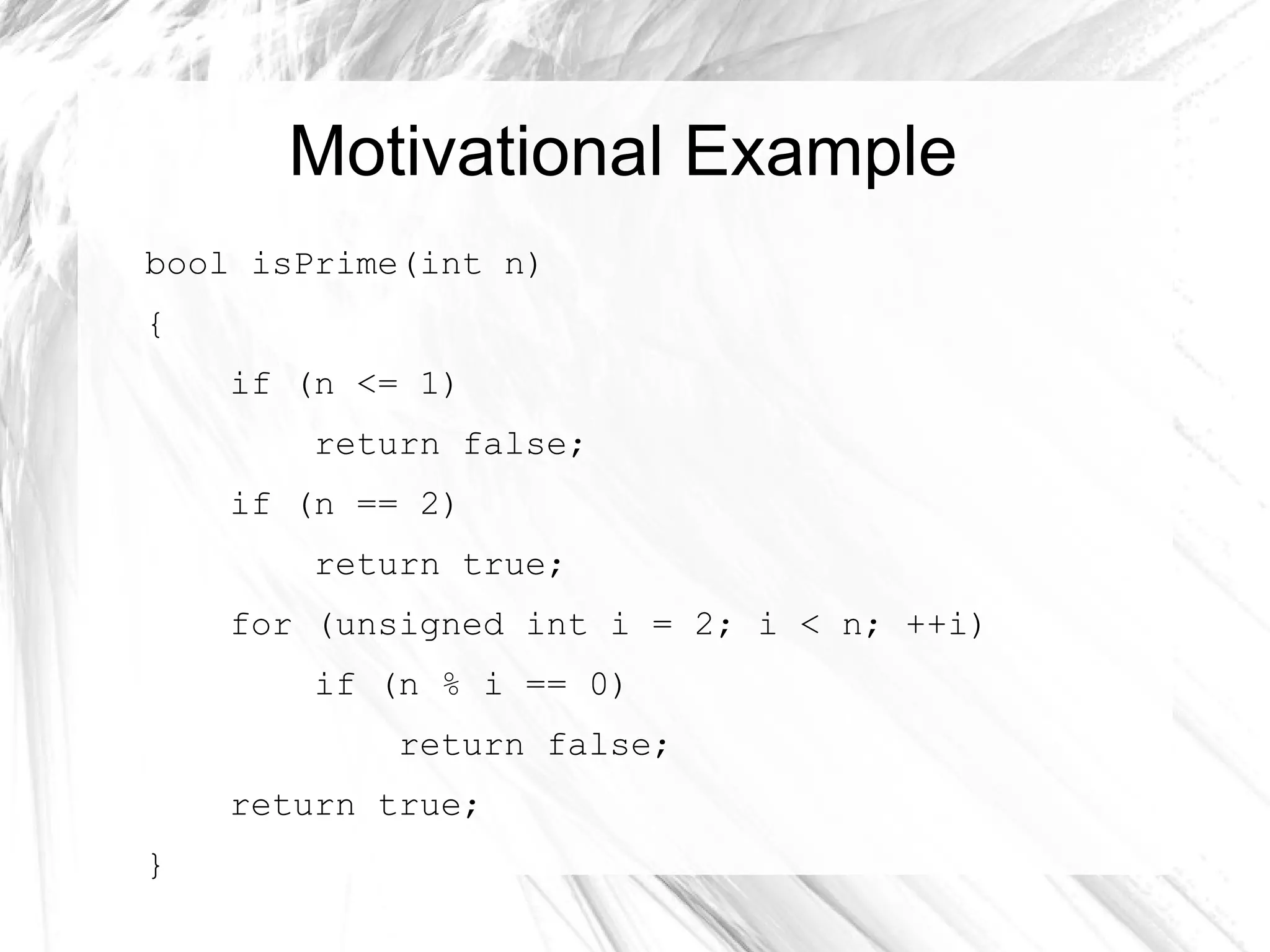
Motivational Example
bool isPrime(int n)
{
if (n <= 1)
return false;
if (n == 2)
return true;
for (unsigned int i = 2; i < n; ++i)
if (n % i == 0)
return false;
return true;
}
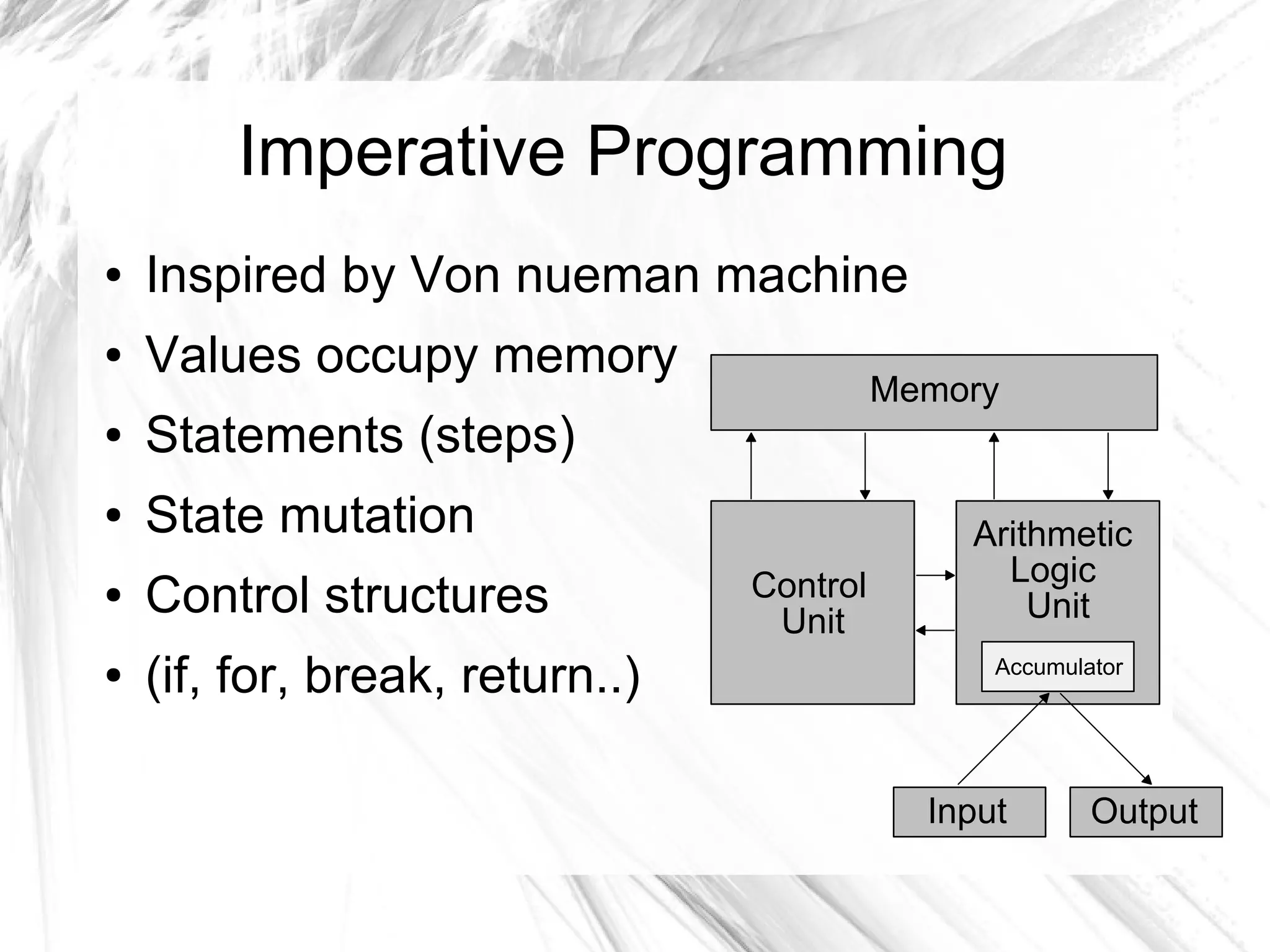
Imperative Programming
● Inspired by Von nueman machine
● Values occupy memory
● Statements (steps)
● State mutation
● Control structures
● (if, for, break, return..)
Arithmetic
Logic
Unit
Control
Unit
Memory
Input Output
Accumulator
Motivational Example
● isPrime :: Int → Bool
● isPrime n = not (any (divides n) [2..n-1])
● A prime number is a natural number greater than 1 that has no
positive divisors other than 1 and itself. - wikipedia
Functional Programming (Haskell)
● Haskell is the purest FP language
● General purpose
● Functions as first class values
● Strongly Typed
● Based on Lambda Calculus and Category
Theory
Real World Applications of FP
● Haxl Project (Facebook)
● Financial Applications (Standard Chartered )
● Algebird Library for Big Data Patterns (e.g.
Map, Reduce, Monoids, Monads )
● Compilers (Perl Compiler and many DSLs)
● Static Analysis (Galois)
Quick, Sort, Example
● sort [] = []
● sort (x:xs) = sort (filter (<x) xs) ++ [x] ++
sort (filter (>=x) xs)
FP Is Building Higher Level
Abstractions
Less boilerplate code Less bugs→
There is a pattern hiding
somewhere...
int Sum ( array<int> v )
{
int sum = 0;
for (int i = 0; i < v.size(); ++i )
{
sum += v[i];
}
return sum;
}
How can we transform it into pure
function ?
int Sum ( array<int> v )
{
int sum = 0;
for (int i = 0; i < v.size(); ++i )
{
sum += v[i];
}
return sum;
}
Recursion ?
int Sum ( vector<int> v, int i )
{
if ( i >= v.size())
return 0;
return v[i] + Sum ( v, i+1 );
}
Recursion ?
int Sum ( vector<int> v, int i )
{
if ( i >= v.size())
return 0;
return v[i] + Sum ( v, i+1 );
}
sum :: [Int] → Int
sum [] = 0
sum (head:rest) = head + sum rest
Recursion ?
sum :: [Int] → Int
sum [] = 0
sum (x:xs) = x + sum xs
Recursion ?
sum :: [Int] → Int
sum [] = 0
sum (x:xs) = x + sum xs
product :: [Int] → Int
product [] = 0
product (x:xs) = x * product xs
Higher Order Functions
fold :: [Int] → Int
fold [] = 0
fold (x:xs) = x + fold xs
Higher Order Functions
fold :: [Int] → Int
fold [] = 0
fold (x:xs) = x + fold xs
fold :: (b → a → b) → b → [a] → b
fold f acc [] = acc
fold f acc (x:xs) = f acc (fold f x xs)
We just introduced a universal
operator
● sum :: [Int] → Int
● sum = foldl (+) 0
● product :: [Int] → Int
● product = foldl (*) 1
● length :: [Int] → Int
● length = foldl (x → x+1) []
Quick Look at Maps
● Maps are very popular operator in programming languages and
especially functional languages
● It applies a function on every element of a list
● map (x → x*2) [0,1,2,3,4,5]
● [0,2,4,6,8,10]
Quick Look at Maps
● map :: (a → b) → [a] → [b]
● map _ [] = []
● map f (x:xs) = f x : map f xs
● Do you recognize this pattern ?
Quick Look at Maps
● map :: (a → b) → [a] → [b]
● map _ [] = []
● map f (x:xs) = f x : map f xs
● Do you recognize this pattern ?
● It turns out this is a Fold pattern
● map f = foldl (x xs → f x : xs) []
FP Is about Controlling Effects
Everytime I see a Null I kill a cat
-Anonymous
“Null is the billion dollar mistake”
-Tony Hoare
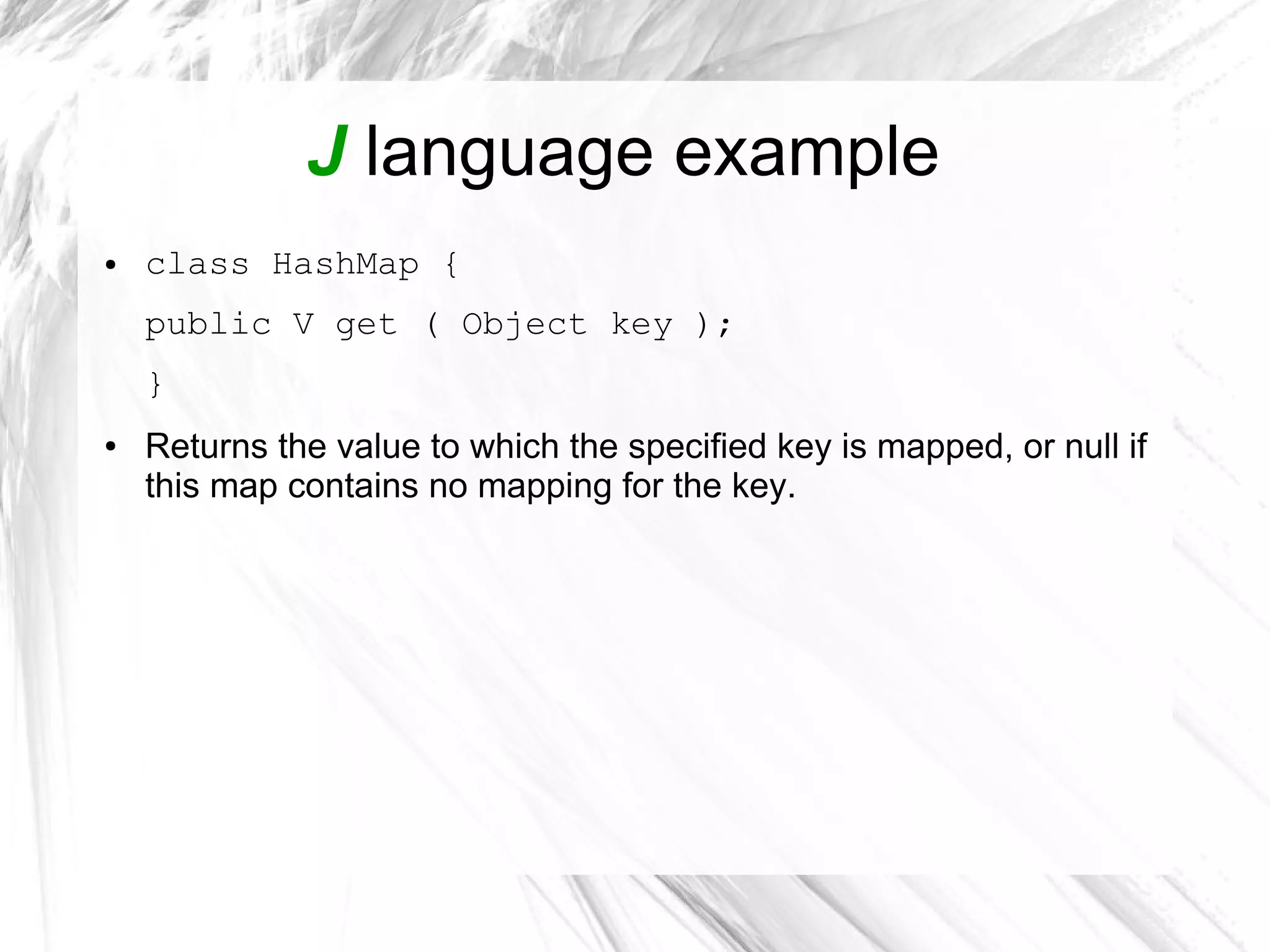
J language example
● class HashMap {
public V get ( Object key );
}
J language example
● class HashMap {
public V get ( Object key );
}
● Returns the value to which the specified key is mapped, or null if
this map contains no mapping for the key.
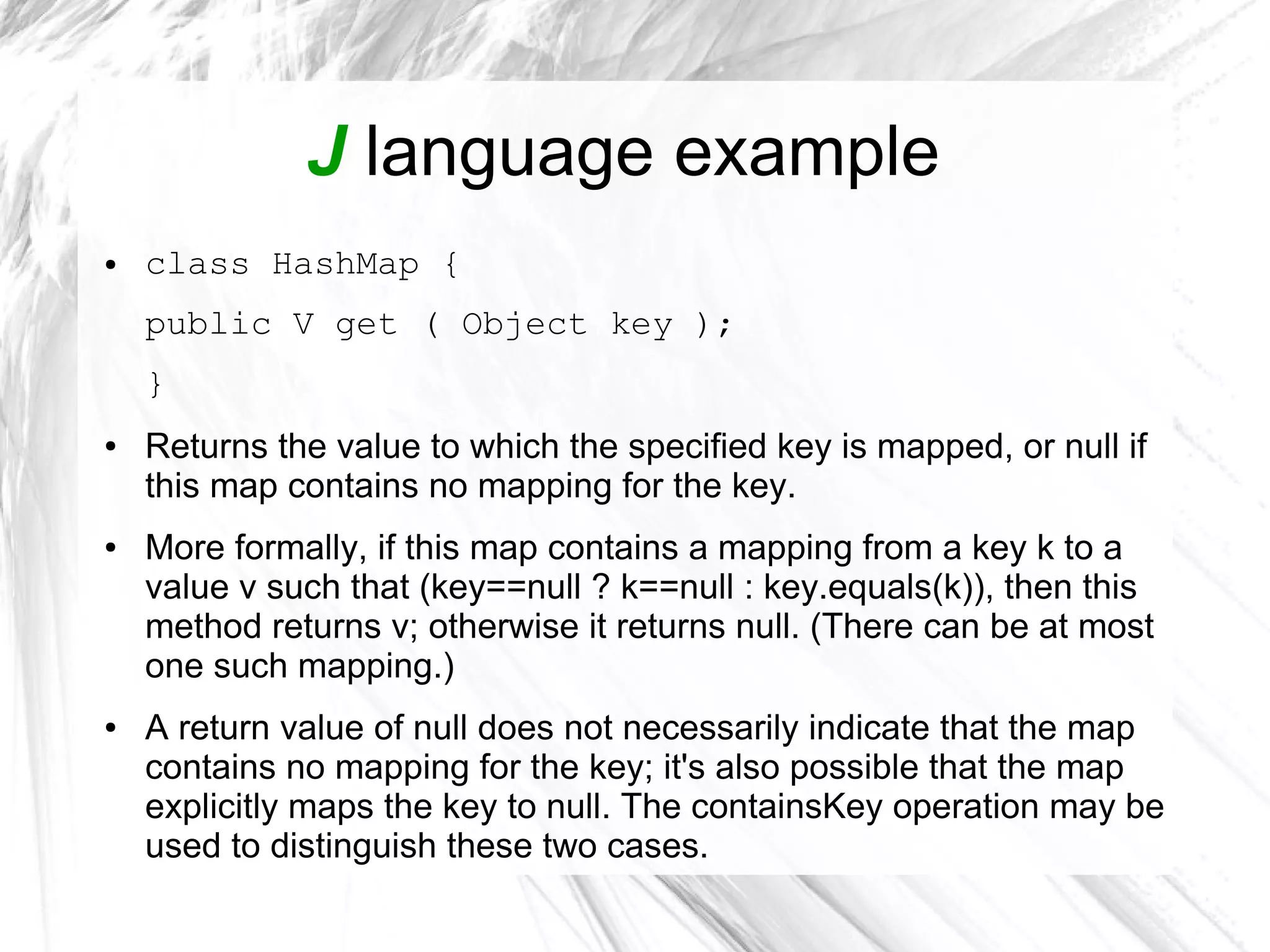
J language example
● class HashMap {
public V get ( Object key );
}
● Returns the value to which the specified key is mapped, or null if
this map contains no mapping for the key.
● More formally, if this map contains a mapping from a key k to a
value v such that (key==null ? k==null : key.equals(k)), then this
method returns v; otherwise it returns null. (There can be at most
one such mapping.)
● A return value of null does not necessarily indicate that the map
contains no mapping for the key; it's also possible that the map
explicitly maps the key to null. The containsKey operation may be
used to distinguish these two cases.
How to capture effects ?
● If all we have is pure function
● Type Type→
● How can we capture effects..
– Failure?
– Returning multiple values?
– IO ??
– States ???
Capturing Effects
● lookup :: a -> [(a, b)] -> b
●
But this function can't capture failure if a was not in the dictionary
● Let's solve this problem...
Algebraic Data Types
● But First...
● Let's define some data types
● data Bool = True | False
● data Point = (Float,Float)
Algebraic Data Types
● But First...
● Let's define some data types
● data Bool = True | False
● data Point = (Float,Float)
● Let's introduce a type that capture failures
● data Maybe a = Nothing | Just a
Capturing Effects
● lookup :: a -> [(a, b)] -> Maybe b
● Now failure is captured by type
● Your code have to check for failure
● Failure is explicit
● Problem solved...
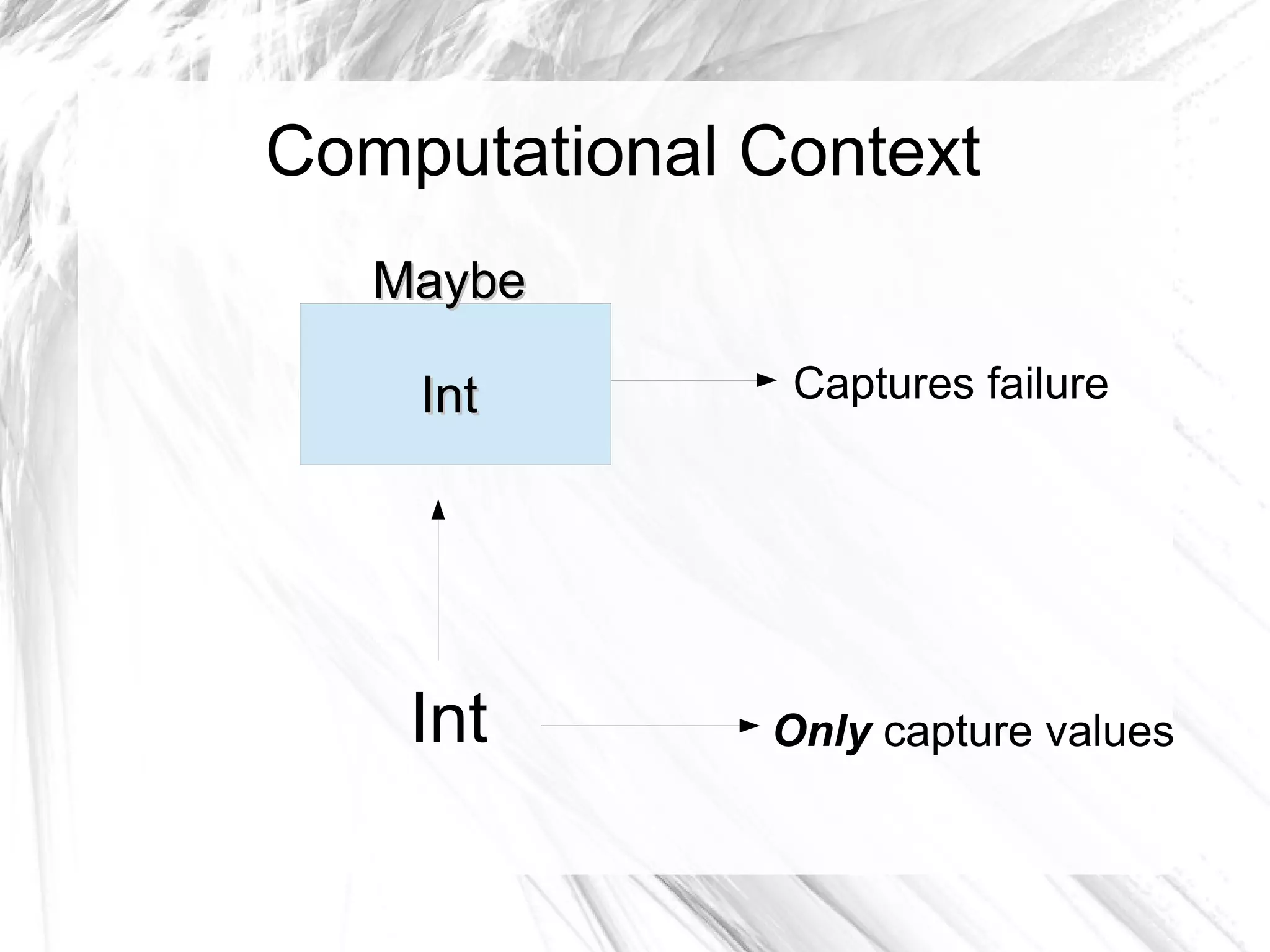
Computational Context
Int
MaybeMaybe
IntInt
Only capture values
Captures failure
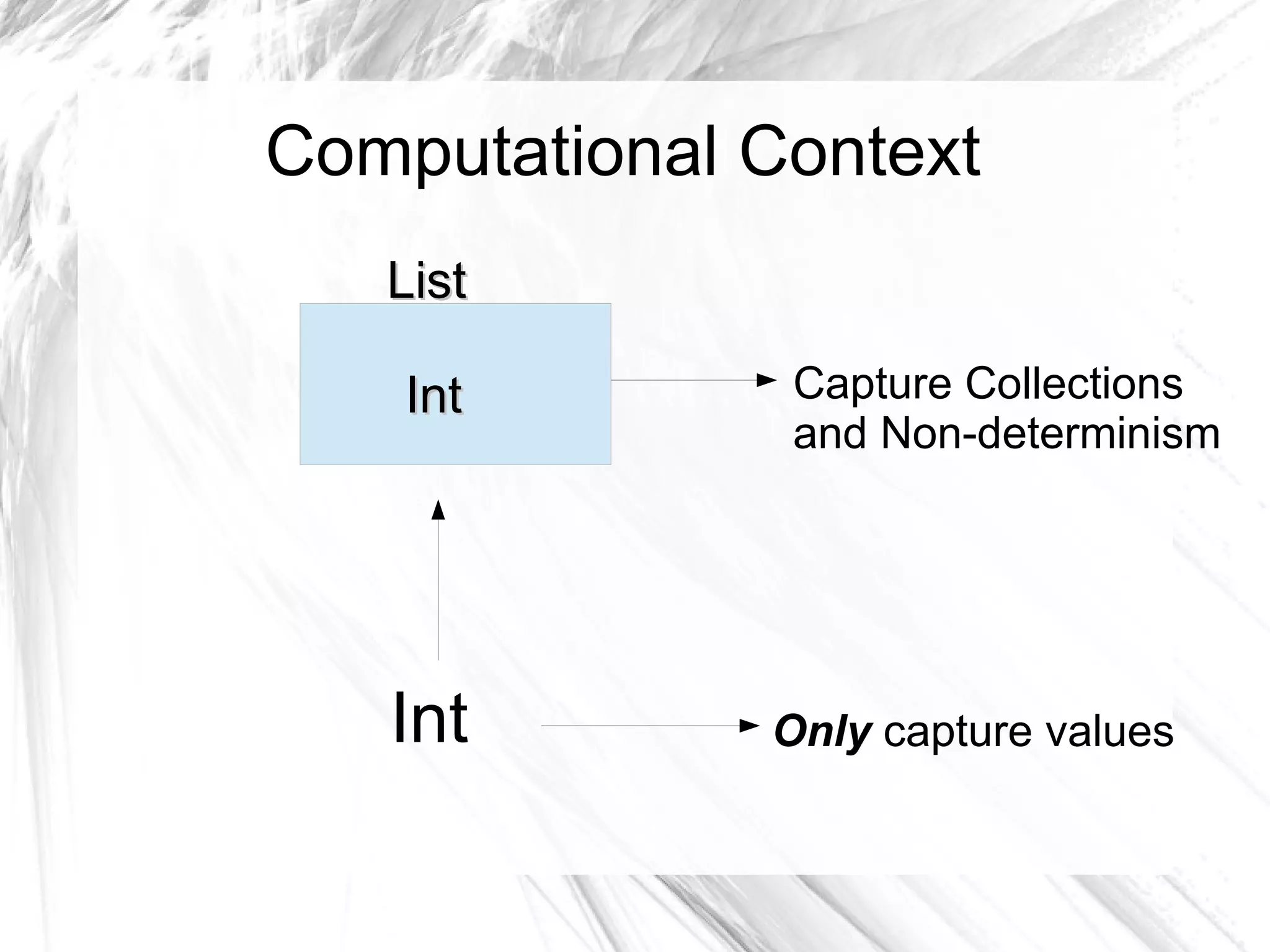
Computational Context
Int
ListList
IntInt
Only capture values
Capture Collections
and Non-determinism
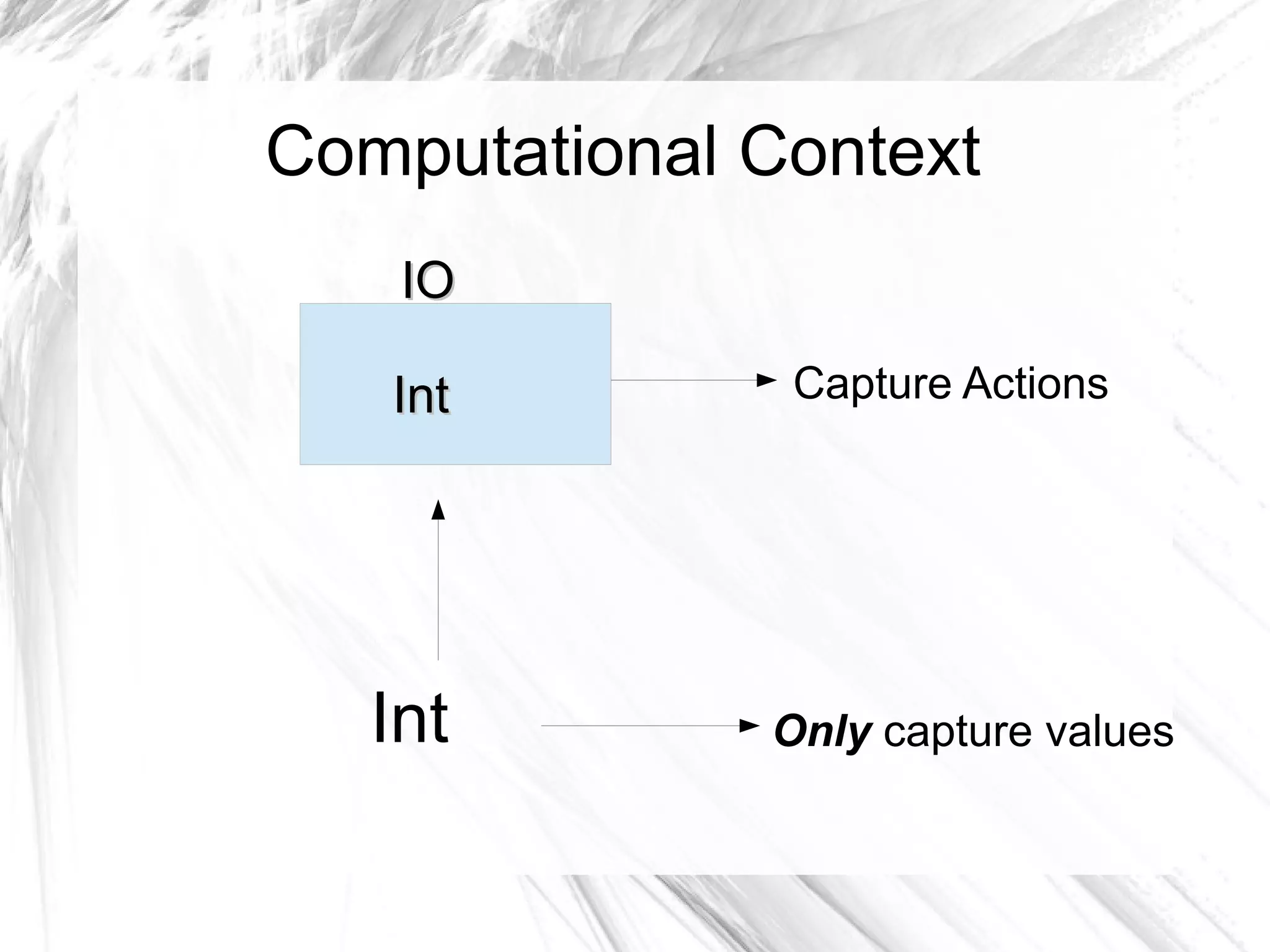
Computational Context
Int
IOIO
IntInt
Only capture values
Capture Actions
Map and Lifting
● There is more to map than meets the eye..
● map (x → x*x) [1,2,3,4]
● [1,4,9,16]
● map :: (a → b) → [a] → [b]
● map :: (a → b) → ([a] → [b])
Map Generalization
● Map took a function that works on Int
● returned a function that works on [Int]
● map :: (a → b) → ([a] → [b])
● fmap :: (a → b) → (t a → t b)
Map Generalization
● Map took a function that works on Int
● returned a function that works on T<Int>
● map :: (a → b) → ([a] → [b])
● fmap :: (a → b) → (t a → t b)
● So what is this t we are talking about ?
● t is any computational context we talked about
(Maybe, IO, Lists)
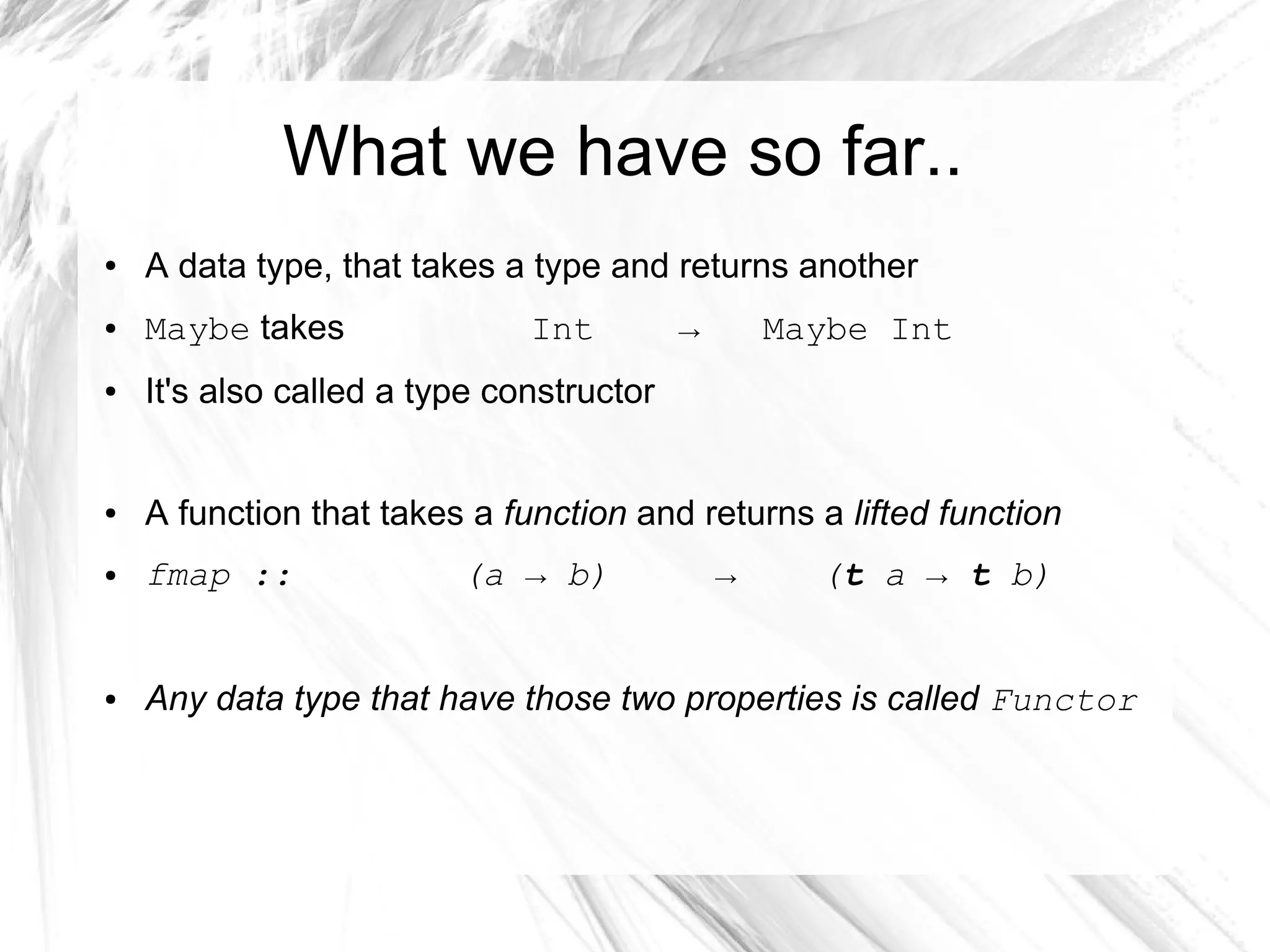
What we have so far..
● A data type, that takes a type and returns another
● Maybe takes Int → Maybe Int
● It's also called a type constructor
● A function that takes a function and returns a lifted function
● fmap :: (a → b) → (t a → t b)
● Any data type that have those two properties is called Functor
Solving Real Problems With Lifting
array< pair<int,int> > CartesianProduct ( array<int> a,
array<int> b )
{
array result;
for (int i=0; i < a.size(); ++i)
{
for (int j=0; j < b.size(); ++j)
{
result.add( make_pair(a[i],b[j]) );
}
}
return result;
}
Solving Real Problems With Functors
● (,) :: a -> b -> (a,b)
● We want to apply it on lists..
● We can lift it to work on lists
● let lifterPair = fmap (,) [1,2,3,4]
● :t lifterPair :: [b -> (Integer, b)]
● lifterPair <*> [5,6,7,8]
Solving Real Problems With Functors
● Even better
● cartProd :: [a] -> [b] -> [(a, b)]
● cartProd = liftA2 (,)
Conclusion
● FP is about focusing on the problems
● FP is about higher level abstractions
● FP is about reducing bugs
● FP is about precise thinking

A taste of Functional Programming

  • 1.
    A Taste ofFunctional Programming with Haskell Mohammad Ghabboun Functional→ Programming
  • 2.
    Functional Programming Languages ● Haskell ●Standard ML ● OCaml ● Scheme ● Clojure ● F# ● Scala ● Erlange
  • 3.
    What is aFunction ?
  • 4.
    What is afunction? ● Functions that fail (Null, exceptions...) ● Functions that go into infinite loop ● Functions that do IO ● Function that have side effects (change state) ● ...
  • 5.
    What is afunction? ● Functions that fail (Null, exceptions...) ● Functions that go into infinite loop ● Functions that do IO ● Function that have side effects (change state) ● Those are not functions but actually procedures ● So...
  • 6.
    What is afunction ? X Y Shape Color
  • 7.
    What is afunction ? Pure functions in Haskell, as math functions, is mapping between two values int add ( int x, int y ) { return x + y; } Add :: Int → Int → Int Add x y = x + y
  • 8.
    No assignments, onlyequality! ● Let x = 4 ● x = 6 (error!) ● x is 4 it cannot be changed ● Left equals Right ● Let y = 5 ● y = y + 1 (error!) ● (y-y) = 1 ● 0 = 1 wrong!!
  • 9.
    The Essence ofComposition INPUT x FUNCTION f: OUTPUT f(x) INPUT x FUNCTION f: OUTPUT f(x) - All dependencies are explicit - No side effects - Easier to reason about - Same output for the same input every time
  • 10.
  • 11.
    FP is aboutfocusing on the solution It's about computing results and not performing actions..
  • 12.
    Motivational Example bool isPrime(intn) { if (n <= 1) return false; if (n == 2) return true; for (unsigned int i = 2; i < n; ++i) if (n % i == 0) return false; return true; }
  • 13.
    Imperative Programming ● Inspiredby Von nueman machine ● Values occupy memory ● Statements (steps) ● State mutation ● Control structures ● (if, for, break, return..) Arithmetic Logic Unit Control Unit Memory Input Output Accumulator
  • 14.
    Motivational Example ● isPrime:: Int → Bool ● isPrime n = not (any (divides n) [2..n-1]) ● A prime number is a natural number greater than 1 that has no positive divisors other than 1 and itself. - wikipedia
  • 15.
    Functional Programming (Haskell) ●Haskell is the purest FP language ● General purpose ● Functions as first class values ● Strongly Typed ● Based on Lambda Calculus and Category Theory
  • 16.
    Real World Applicationsof FP ● Haxl Project (Facebook) ● Financial Applications (Standard Chartered ) ● Algebird Library for Big Data Patterns (e.g. Map, Reduce, Monoids, Monads ) ● Compilers (Perl Compiler and many DSLs) ● Static Analysis (Galois)
  • 17.
    Quick, Sort, Example ●sort [] = [] ● sort (x:xs) = sort (filter (<x) xs) ++ [x] ++ sort (filter (>=x) xs)
  • 18.
    FP Is BuildingHigher Level Abstractions Less boilerplate code Less bugs→
  • 19.
    There is apattern hiding somewhere... int Sum ( array<int> v ) { int sum = 0; for (int i = 0; i < v.size(); ++i ) { sum += v[i]; } return sum; }
  • 20.
    How can wetransform it into pure function ? int Sum ( array<int> v ) { int sum = 0; for (int i = 0; i < v.size(); ++i ) { sum += v[i]; } return sum; }
  • 21.
    Recursion ? int Sum( vector<int> v, int i ) { if ( i >= v.size()) return 0; return v[i] + Sum ( v, i+1 ); }
  • 22.
    Recursion ? int Sum( vector<int> v, int i ) { if ( i >= v.size()) return 0; return v[i] + Sum ( v, i+1 ); } sum :: [Int] → Int sum [] = 0 sum (head:rest) = head + sum rest
  • 23.
    Recursion ? sum ::[Int] → Int sum [] = 0 sum (x:xs) = x + sum xs
  • 24.
    Recursion ? sum ::[Int] → Int sum [] = 0 sum (x:xs) = x + sum xs product :: [Int] → Int product [] = 0 product (x:xs) = x * product xs
  • 25.
    Higher Order Functions fold:: [Int] → Int fold [] = 0 fold (x:xs) = x + fold xs
  • 26.
    Higher Order Functions fold:: [Int] → Int fold [] = 0 fold (x:xs) = x + fold xs fold :: (b → a → b) → b → [a] → b fold f acc [] = acc fold f acc (x:xs) = f acc (fold f x xs)
  • 27.
    We just introduceda universal operator ● sum :: [Int] → Int ● sum = foldl (+) 0 ● product :: [Int] → Int ● product = foldl (*) 1 ● length :: [Int] → Int ● length = foldl (x → x+1) []
  • 28.
    Quick Look atMaps ● Maps are very popular operator in programming languages and especially functional languages ● It applies a function on every element of a list ● map (x → x*2) [0,1,2,3,4,5] ● [0,2,4,6,8,10]
  • 29.
    Quick Look atMaps ● map :: (a → b) → [a] → [b] ● map _ [] = [] ● map f (x:xs) = f x : map f xs ● Do you recognize this pattern ?
  • 30.
    Quick Look atMaps ● map :: (a → b) → [a] → [b] ● map _ [] = [] ● map f (x:xs) = f x : map f xs ● Do you recognize this pattern ? ● It turns out this is a Fold pattern ● map f = foldl (x xs → f x : xs) []
  • 31.
    FP Is aboutControlling Effects Everytime I see a Null I kill a cat -Anonymous “Null is the billion dollar mistake” -Tony Hoare
  • 32.
    J language example ●class HashMap { public V get ( Object key ); }
  • 33.
    J language example ●class HashMap { public V get ( Object key ); } ● Returns the value to which the specified key is mapped, or null if this map contains no mapping for the key.
  • 34.
    J language example ●class HashMap { public V get ( Object key ); } ● Returns the value to which the specified key is mapped, or null if this map contains no mapping for the key. ● More formally, if this map contains a mapping from a key k to a value v such that (key==null ? k==null : key.equals(k)), then this method returns v; otherwise it returns null. (There can be at most one such mapping.) ● A return value of null does not necessarily indicate that the map contains no mapping for the key; it's also possible that the map explicitly maps the key to null. The containsKey operation may be used to distinguish these two cases.
  • 35.
    How to captureeffects ? ● If all we have is pure function ● Type Type→ ● How can we capture effects.. – Failure? – Returning multiple values? – IO ?? – States ???
  • 36.
    Capturing Effects ● lookup:: a -> [(a, b)] -> b ● But this function can't capture failure if a was not in the dictionary ● Let's solve this problem...
  • 37.
    Algebraic Data Types ●But First... ● Let's define some data types ● data Bool = True | False ● data Point = (Float,Float)
  • 38.
    Algebraic Data Types ●But First... ● Let's define some data types ● data Bool = True | False ● data Point = (Float,Float) ● Let's introduce a type that capture failures ● data Maybe a = Nothing | Just a
  • 39.
    Capturing Effects ● lookup:: a -> [(a, b)] -> Maybe b ● Now failure is captured by type ● Your code have to check for failure ● Failure is explicit ● Problem solved...
  • 40.
  • 41.
    Computational Context Int ListList IntInt Only capturevalues Capture Collections and Non-determinism
  • 42.
  • 43.
    Map and Lifting ●There is more to map than meets the eye.. ● map (x → x*x) [1,2,3,4] ● [1,4,9,16] ● map :: (a → b) → [a] → [b] ● map :: (a → b) → ([a] → [b])
  • 44.
    Map Generalization ● Maptook a function that works on Int ● returned a function that works on [Int] ● map :: (a → b) → ([a] → [b]) ● fmap :: (a → b) → (t a → t b)
  • 45.
    Map Generalization ● Maptook a function that works on Int ● returned a function that works on T<Int> ● map :: (a → b) → ([a] → [b]) ● fmap :: (a → b) → (t a → t b) ● So what is this t we are talking about ? ● t is any computational context we talked about (Maybe, IO, Lists)
  • 46.
    What we haveso far.. ● A data type, that takes a type and returns another ● Maybe takes Int → Maybe Int ● It's also called a type constructor ● A function that takes a function and returns a lifted function ● fmap :: (a → b) → (t a → t b) ● Any data type that have those two properties is called Functor
  • 47.
    Solving Real ProblemsWith Lifting array< pair<int,int> > CartesianProduct ( array<int> a, array<int> b ) { array result; for (int i=0; i < a.size(); ++i) { for (int j=0; j < b.size(); ++j) { result.add( make_pair(a[i],b[j]) ); } } return result; }
  • 48.
    Solving Real ProblemsWith Functors ● (,) :: a -> b -> (a,b) ● We want to apply it on lists.. ● We can lift it to work on lists ● let lifterPair = fmap (,) [1,2,3,4] ● :t lifterPair :: [b -> (Integer, b)] ● lifterPair <*> [5,6,7,8]
  • 49.
    Solving Real ProblemsWith Functors ● Even better ● cartProd :: [a] -> [b] -> [(a, b)] ● cartProd = liftA2 (,)
  • 50.
    Conclusion ● FP isabout focusing on the problems ● FP is about higher level abstractions ● FP is about reducing bugs ● FP is about precise thinking