
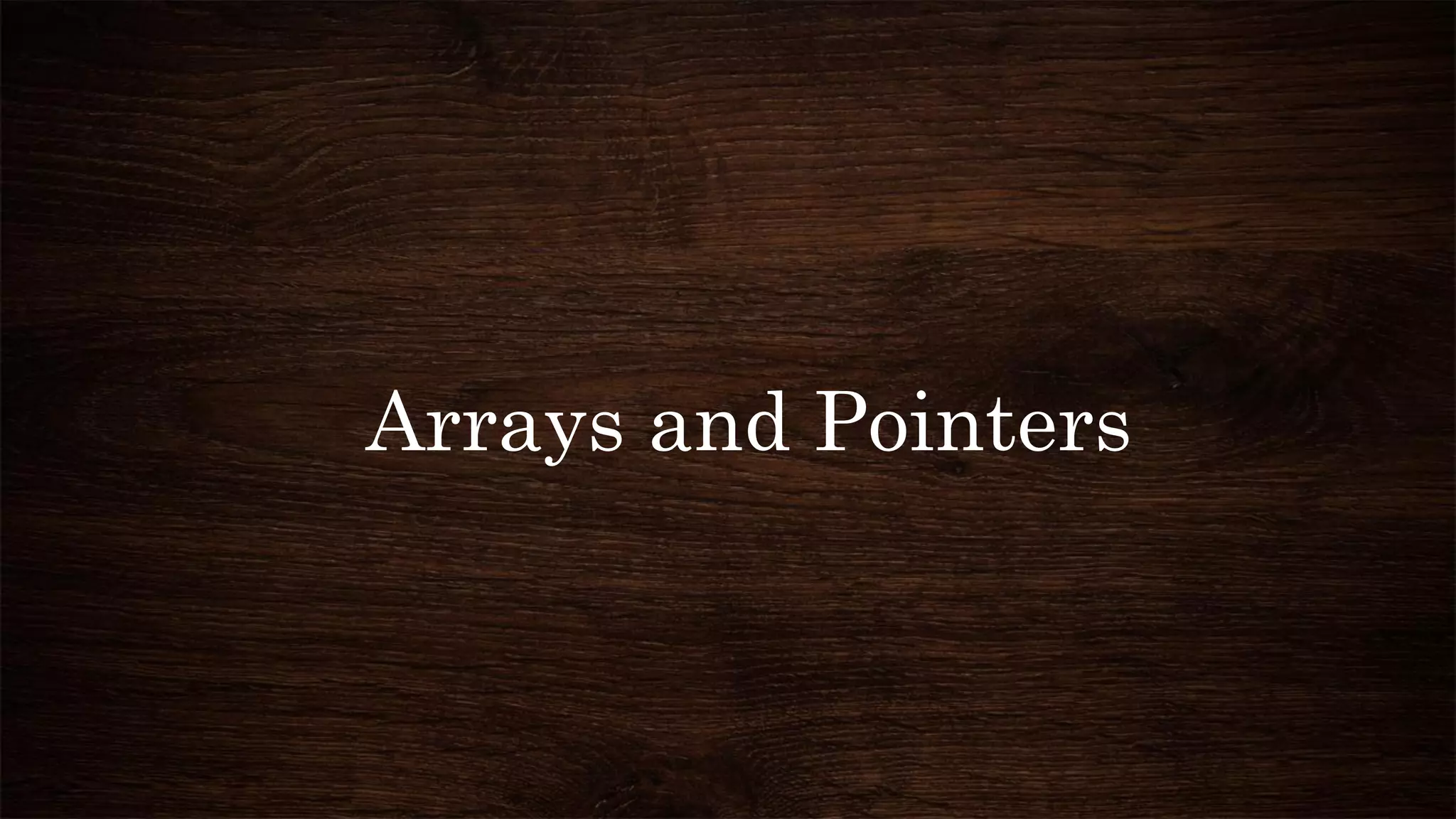
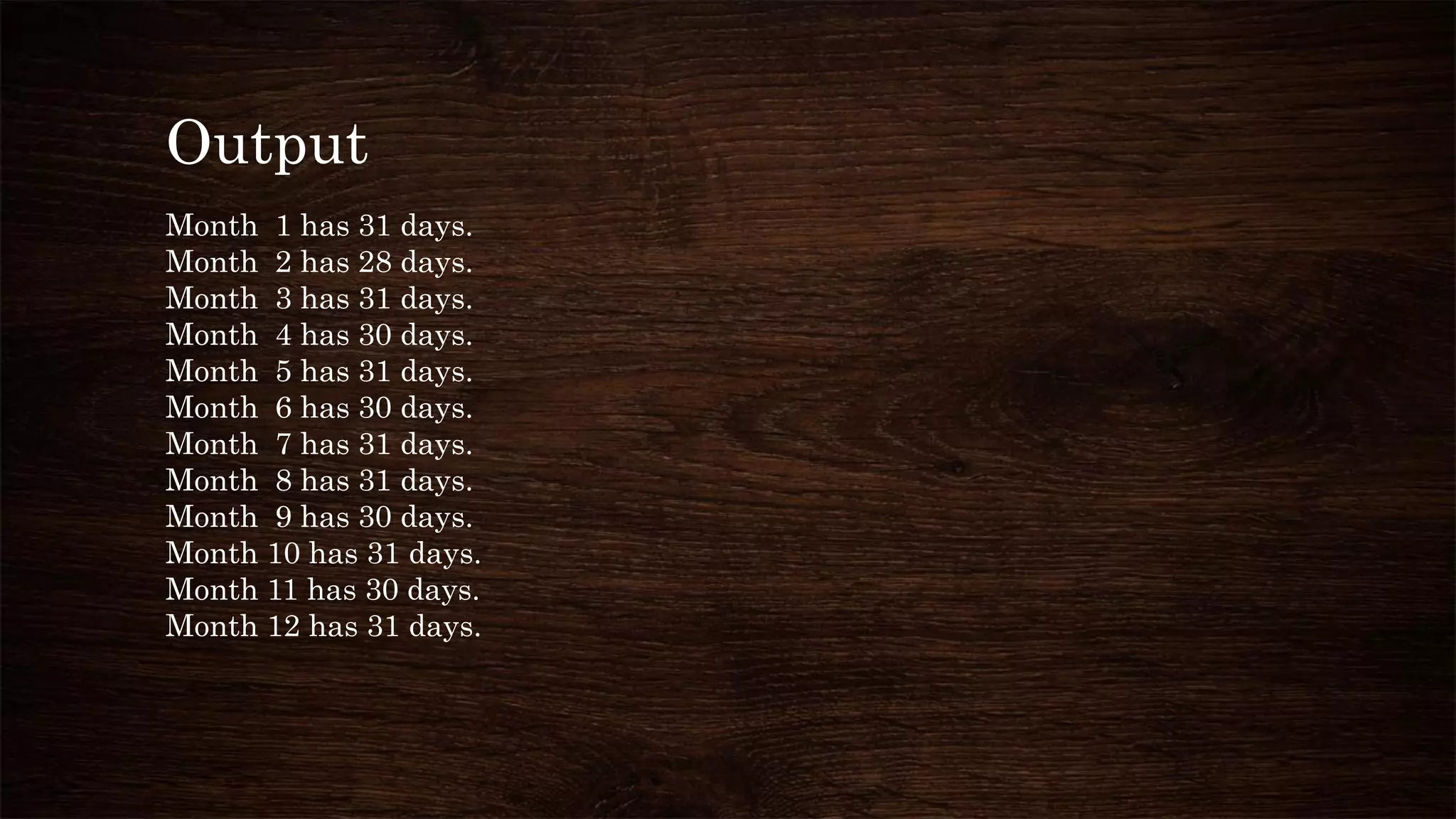
![#include <stdio.h>
#define MONTHS 12
int main(void)
{
int days[MONTHS] = {31,28,31,30,31,30,31,31,30,31,30,31};
int index;
for (index = 0; index < MONTHS; index++)
printf("Month %d has %2d days.n", index +1,
days[index]);
return 0;
}](https://image.slidesharecdn.com/8-arraysandpointers-170718034728/75/8-arrays-and-pointers-3-2048.jpg)
![#include <stdio.h>
#define SIZE 4
int main(void)
{
int some_data[SIZE] = {1492, 1066};
int i;
printf("%2s%14sn", i, some_data[i]);
for (i = 0; i < SIZE; i++)
printf("%2d%14dn", i, some_data[i]);
return 0;
}](https://image.slidesharecdn.com/8-arraysandpointers-170718034728/75/8-arrays-and-pointers-5-2048.jpg)
![Output
i some_data[i]
0 1492
1 1066
2 0
3 0](https://image.slidesharecdn.com/8-arraysandpointers-170718034728/75/8-arrays-and-pointers-6-2048.jpg)
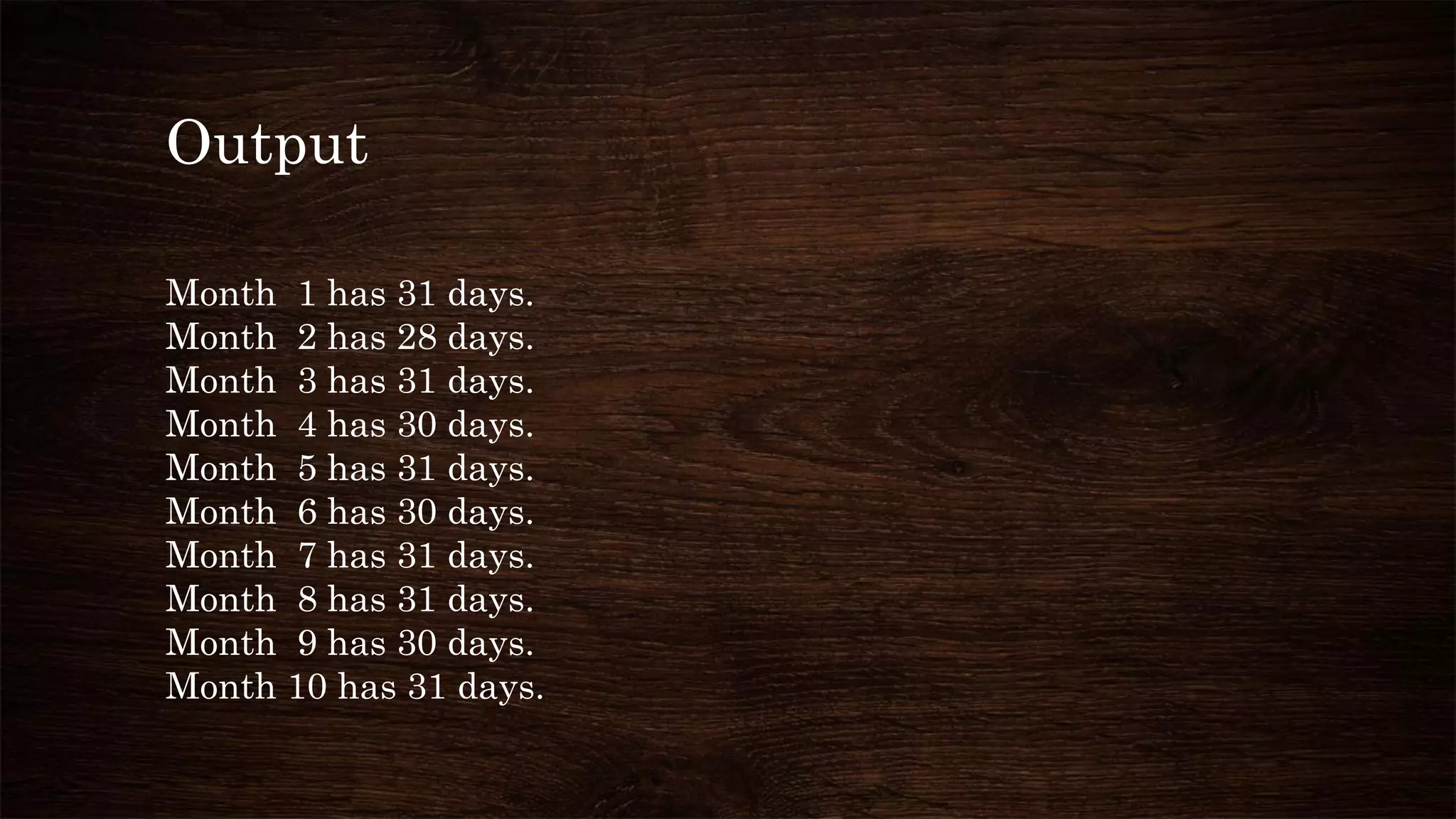
![#include <stdio.h>
int main(void)
{
const int days[] = {31,28,31,30,31,30,31,31,30,31};
int index;
for (index = 0; index < sizeof days / sizeof days[0]; index++)
printf("Month %2d has %d days.n", index +1,
days[index]);
return 0;
}](https://image.slidesharecdn.com/8-arraysandpointers-170718034728/75/8-arrays-and-pointers-7-2048.jpg)
![Designated Initializers (C99)
C99 has added a new capability—designated initializers. This feature allows you to
pick and
choose which elements are initialized. Suppose, for example, that you just want to
initialize the
last element in an array. With traditional C initialization syntax, you also have to
initialize every
element preceding the last one:
int arr[6] = {0,0,0,0,0,212}; // traditional syntax
With C99, you can use an index in brackets in the initialization list to specify a
particular
element:
int arr[6] = {[5] = 212}; // initialize arr[5] to 212](https://image.slidesharecdn.com/8-arraysandpointers-170718034728/75/8-arrays-and-pointers-9-2048.jpg)
![Array Bounds
You have to make sure you use array indices that are within bounds; that is, you
have to make
sure they have values valid for the array. For instance, suppose you make the
following
declaration:
int doofi[20];
Then it's your responsibility to make sure the program uses indices only in the range
0 through
19, because the compiler won't check for you.](https://image.slidesharecdn.com/8-arraysandpointers-170718034728/75/8-arrays-and-pointers-10-2048.jpg)
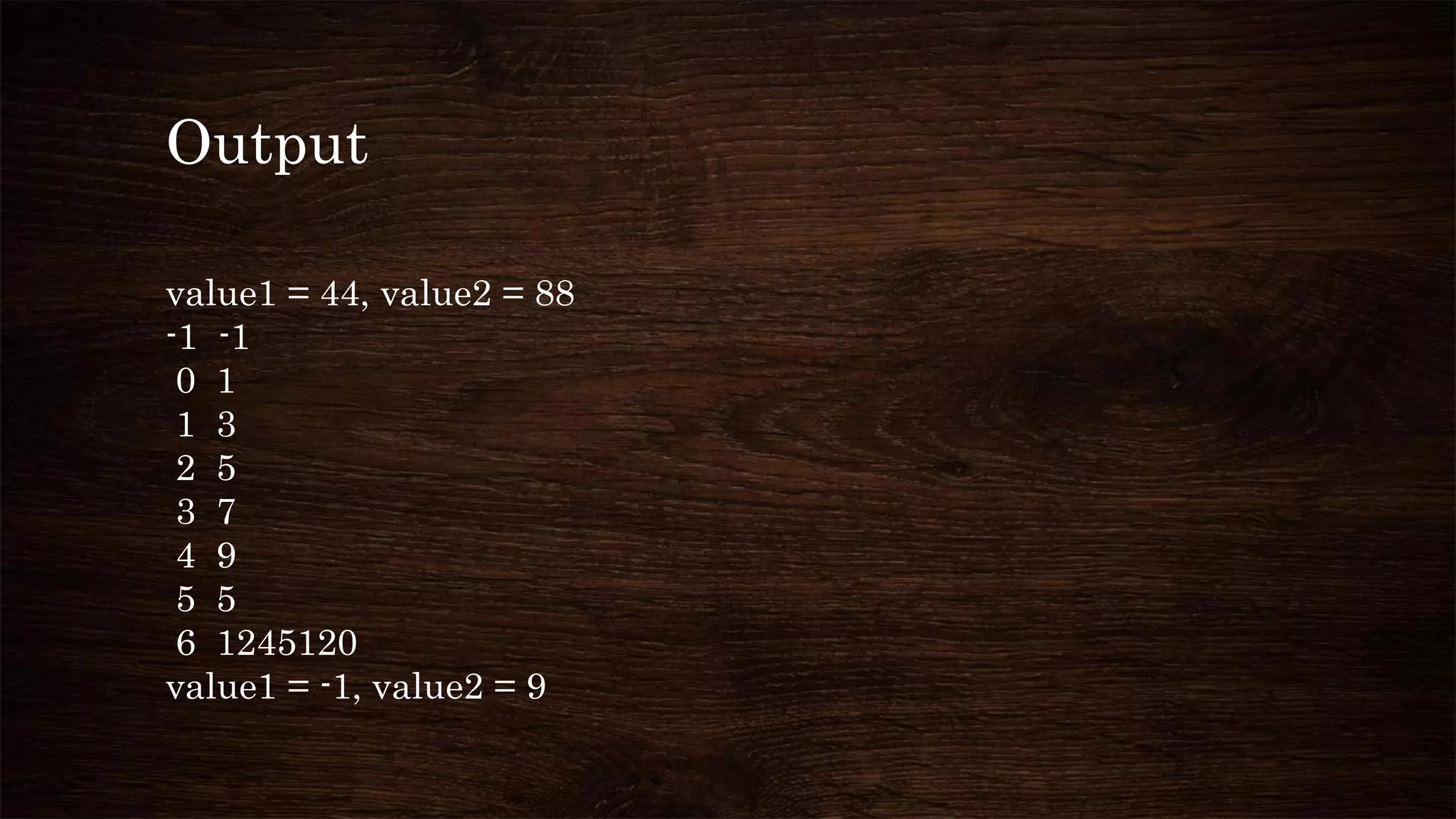
![#include <stdio.h>
#define SIZE 4
int main(void)
{
int value1 = 44;
int arr[SIZE];
int value2 = 88;
int i;
printf("value1 = %d, value2 = %dn", value1, value2);
for (i = -1; i <= SIZE; i++)
arr[i] = 2 * i + 1;
for (i = -1; i < 7; i++)
printf("%2d %dn", i , arr[i]);
printf("value1 = %d, value2 = %dn", value1, value2);
return 0;
}](https://image.slidesharecdn.com/8-arraysandpointers-170718034728/75/8-arrays-and-pointers-11-2048.jpg)
![Multidimensional Arrays [Array of arrays]
A multidimensional array is an array which every element in it is an array.
float rain[5] [12]; // an array of 12 floats
This tells us that each element is of type float[12]; that is, each of the five elements
of rain is, in itself, an array of 12 float values.](https://image.slidesharecdn.com/8-arraysandpointers-170718034728/75/8-arrays-and-pointers-13-2048.jpg)
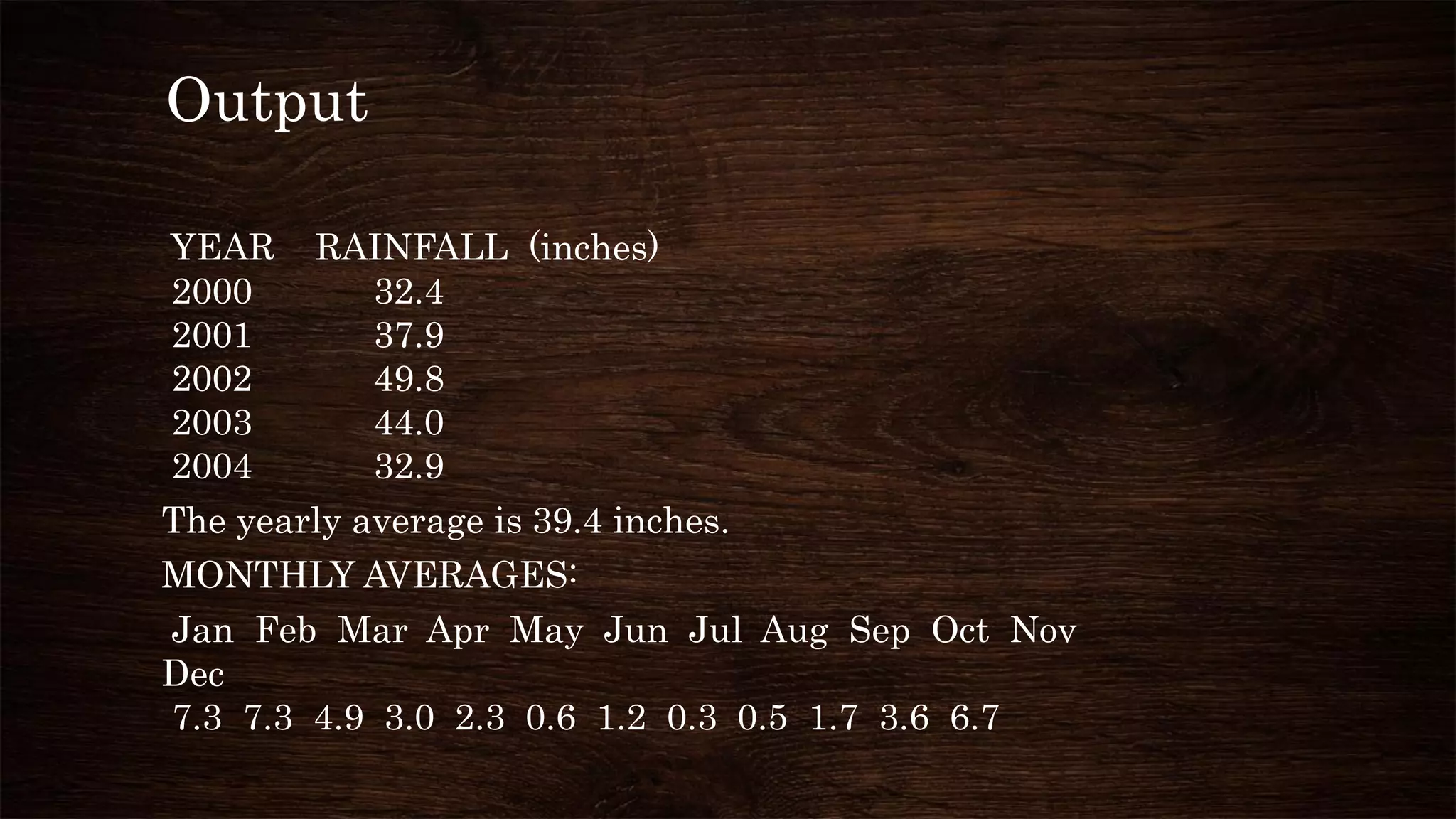
![#include <stdio.h>
#define MONTHS 12 // number of months in a year
#define YEARS 5 // number of years of data
int main(void)
{
// initializing rainfall data for 2000 - 2004
const float rain[YEARS][MONTHS] = {
{4.3,4.3,4.3,3.0,2.0,1.2,0.2,0.2,0.4,2.4,3.5,6.6},
{8.5,8.2,1.2,1.6,2.4,0.0,5.2,0.9,0.3,0.9,1.4,7.3},
{9.1,8.5,6.7,4.3,2.1,0.8,0.2,0.2,1.1,2.3,6.1,8.4},
{7.2,9.9,8.4,3.3,1.2,0.8,0.4,0.0,0.6,1.7,4.3,6.2},
{7.6,5.6,3.8,2.8,3.8,0.2,0.0,0.0,0.0,1.3,2.6,5.2}
};
int year, month;
float subtot, total;
printf(" YEAR RAINFALL (inches)n");](https://image.slidesharecdn.com/8-arraysandpointers-170718034728/75/8-arrays-and-pointers-14-2048.jpg)
![for (year = 0, total = 0; year < YEARS; year++)
{ // for each year, sum rainfall for each month
for (month = 0, subtot = 0; month < MONTHS; month++)
subtot += rain[year][month];
printf("%5d %15.1fn", 2000 + year, subtot);
total += subtot; // total for all years
}
printf("nThe yearly average is %.1f inches.nn", total/YEARS);
printf("MONTHLY AVERAGES:nn");
printf(" Jan Feb Mar Apr May Jun Jul Aug Sep Oct ");
printf(" Nov Decn");
for (month = 0; month < MONTHS; month++)
{ // for each month, sum rainfall over years
for (year = 0, subtot =0; year < YEARS; year++)
subtot += rain[year][month];
printf("%4.1f ", subtot/YEARS);
}
printf("n");
return 0;
}](https://image.slidesharecdn.com/8-arraysandpointers-170718034728/75/8-arrays-and-pointers-15-2048.jpg)
![Pointers and Arrays
Array notation is simply a disguised use of pointers.
An example of this disguised use is that an array name is also the address of the
first element of the array. That is, if flizny is an array, the following is true:
flizny == &flizny[0]; // name of array is the address of the first element
Both flizny and &flizny[0] represent the memory address of that first element.](https://image.slidesharecdn.com/8-arraysandpointers-170718034728/75/8-arrays-and-pointers-17-2048.jpg)
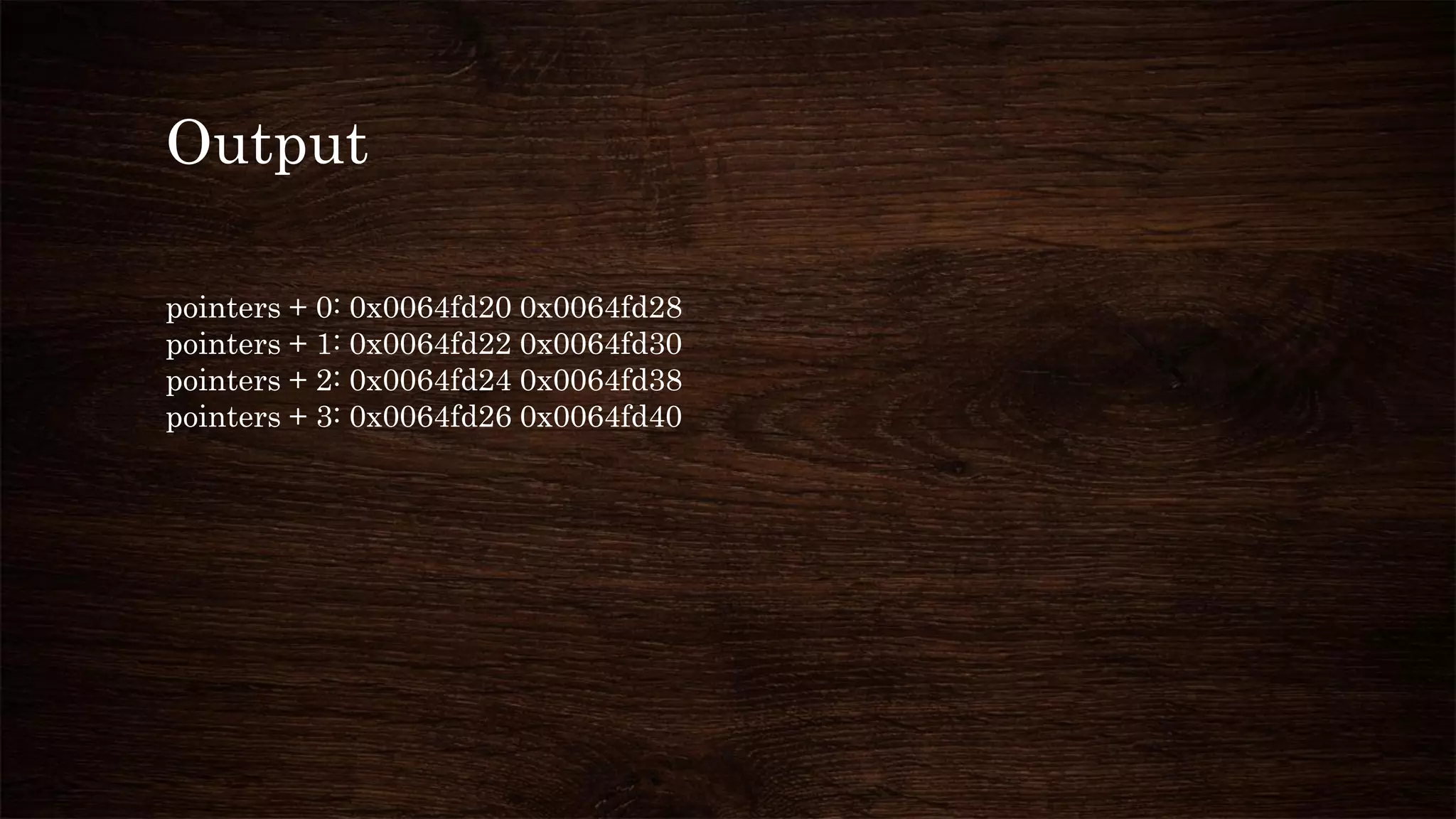
![#include <stdio.h>
#define SIZE 4
int main(void)
{
short dates [SIZE];
short * pti;
short index;
double bills[SIZE];
double * ptf;
pti = dates; // assign address of array to pointer
ptf = bills;
printf("%23s %10sn", "short", "double");
for (index = 0; index < SIZE; index ++)
printf("pointers + %d: %10p %10pn", index, pti + index, ptf + index);
return 0;
}](https://image.slidesharecdn.com/8-arraysandpointers-170718034728/75/8-arrays-and-pointers-18-2048.jpg)
![Some conventions
dates +2 == &date[2] /* same address */
*(dates + 2) == dates[2] /* same value */
*(dates +2) /* value of the 3rd element of dates */
*dates +2 /* 2 added to the value of the 1st element */](https://image.slidesharecdn.com/8-arraysandpointers-170718034728/75/8-arrays-and-pointers-20-2048.jpg)
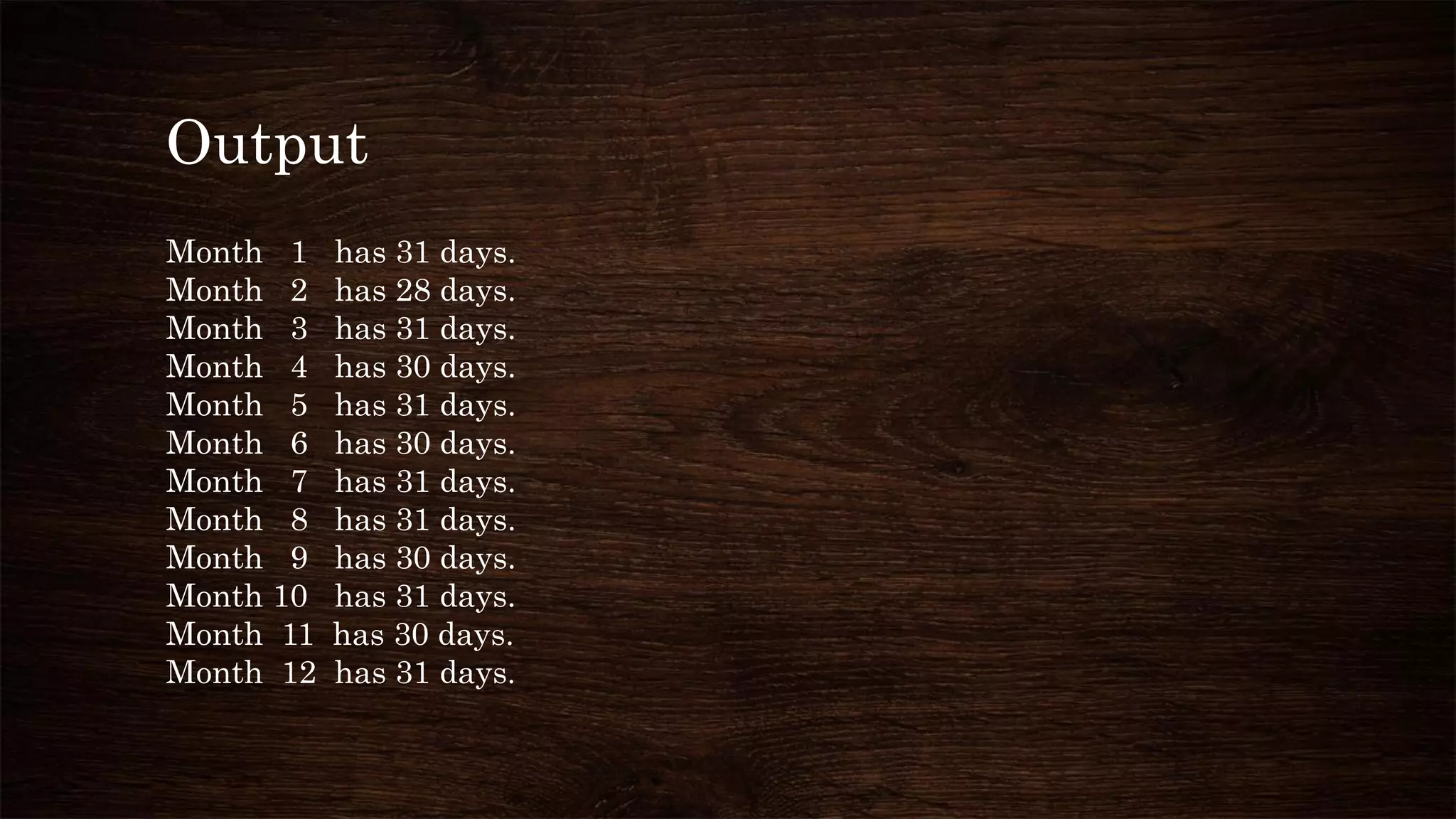
![#include <stdio.h>
#define MONTHS 12
int main(void)
{
int days[MONTHS] = {31,28,31,30,31,30,31,31,30,31,30,31};
int index;
for (index = 0; index < MONTHS; index++)
printf("Month %2d has %d days.n", index +1,
*(days + index)); // same as days[index]
return 0;
}](https://image.slidesharecdn.com/8-arraysandpointers-170718034728/75/8-arrays-and-pointers-21-2048.jpg)
![Functions, Arrays, and Pointers
Suppose you want to write a function that operates on an array. For
example, suppose you want a function that returns the sum of the
elements of an array. Suppose marbles is the name of an
array of int. What would the function call look like? A reasonable
guess would be this:
total = sum(marbles); // possible function call
// function prototypes
int sum(int *ar, int n);
int sum(int *, int);
int sum(int ar[], int n);
int sum(int [], int);](https://image.slidesharecdn.com/8-arraysandpointers-170718034728/75/8-arrays-and-pointers-23-2048.jpg)
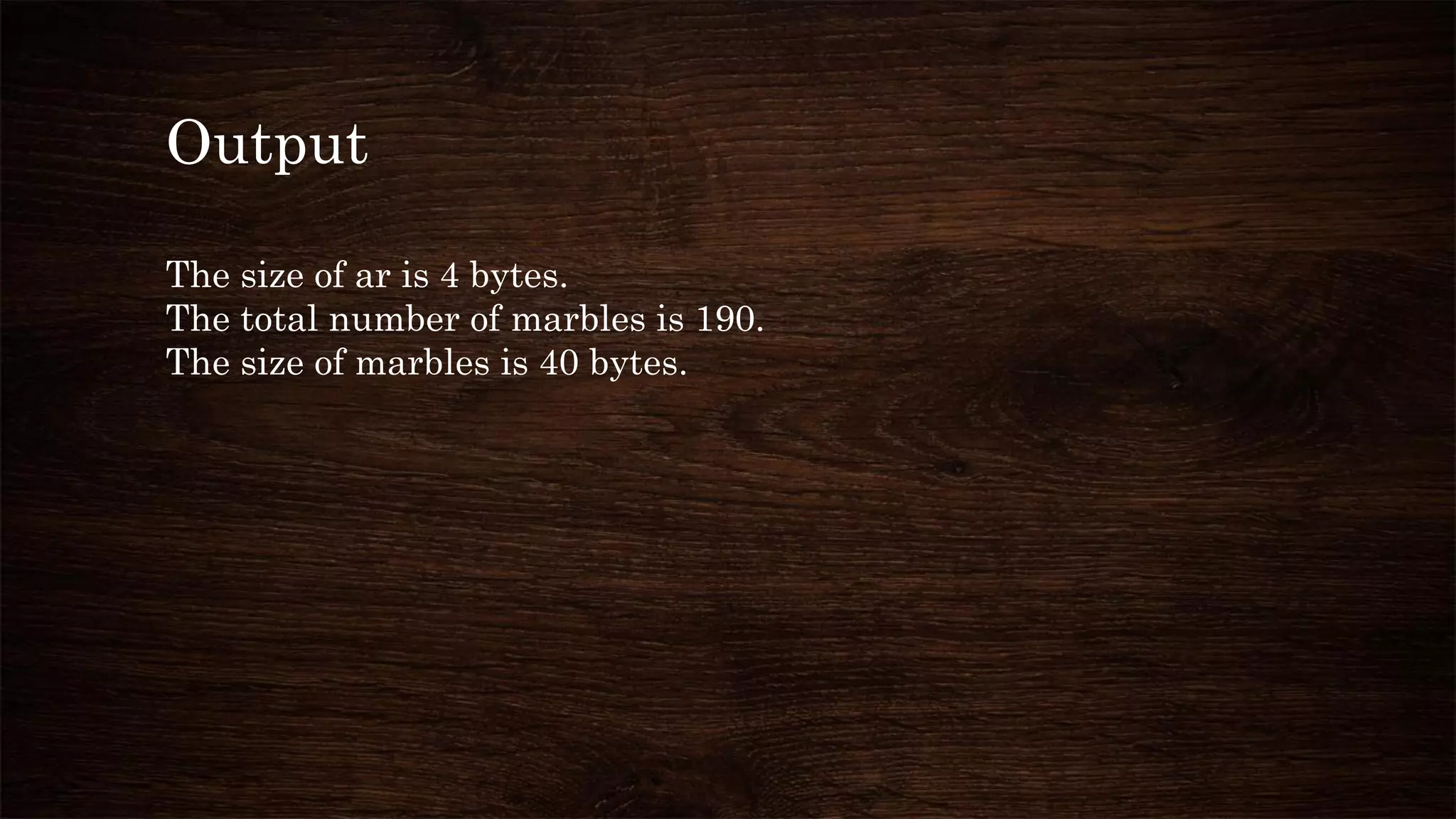
![// sum_arr1.c -- sums the elements of an array
// use %u or %lu if %zd doesn't work
#include <stdio.h>
#define SIZE 10
int sum(int ar[], int n);
int main(void)
{
int marbles[SIZE] = {20,10,5,39,4,16,19,26,31,20};
long answer;
answer = sum(marbles, SIZE);
printf("The total number of marbles is %ld.n", answer);
printf("The size of marbles is %zd bytes.n",
sizeof (marbles));
return 0;
}](https://image.slidesharecdn.com/8-arraysandpointers-170718034728/75/8-arrays-and-pointers-24-2048.jpg)
![int sum(int ar[], int n) // how big an array?
{
int i;
int total = 0;
for( i = 0; i < n; i++)
total += ar[i];
printf("The size of ar is %zd bytes.n", sizeof (ar));
return total;
}](https://image.slidesharecdn.com/8-arraysandpointers-170718034728/75/8-arrays-and-pointers-25-2048.jpg)
![#include <stdio.h>
#define SIZE 10
int sump(int * start, int * end);
int main(void)
{
int marbles[SIZE] = {20,10,5,39,4,16,19,26,31,20};
long answer;
answer = sump(marbles, marbles + SIZE);
printf("The total number of marbles is %ld.n", answer);
return 0;
}](https://image.slidesharecdn.com/8-arraysandpointers-170718034728/75/8-arrays-and-pointers-27-2048.jpg)
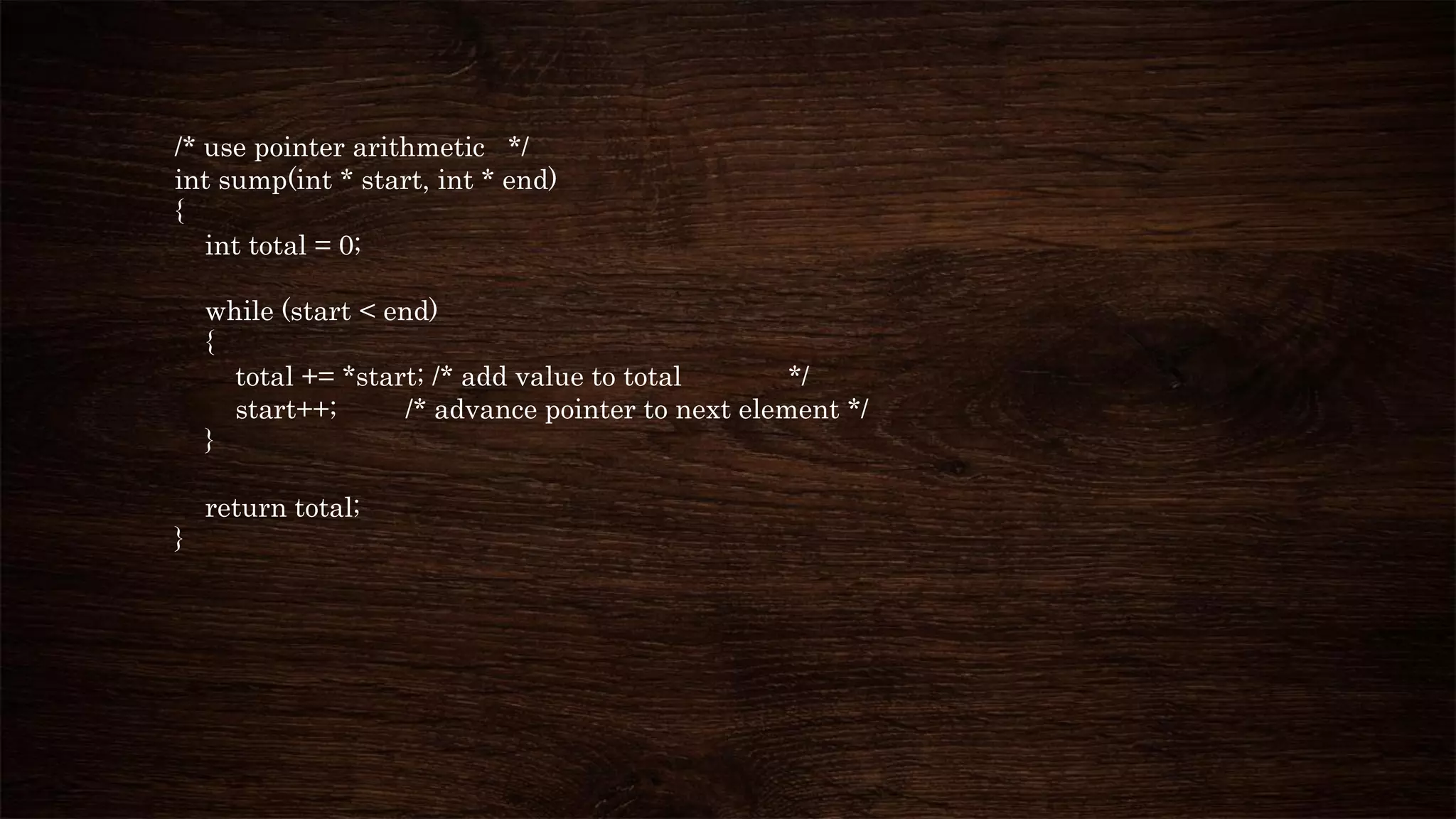
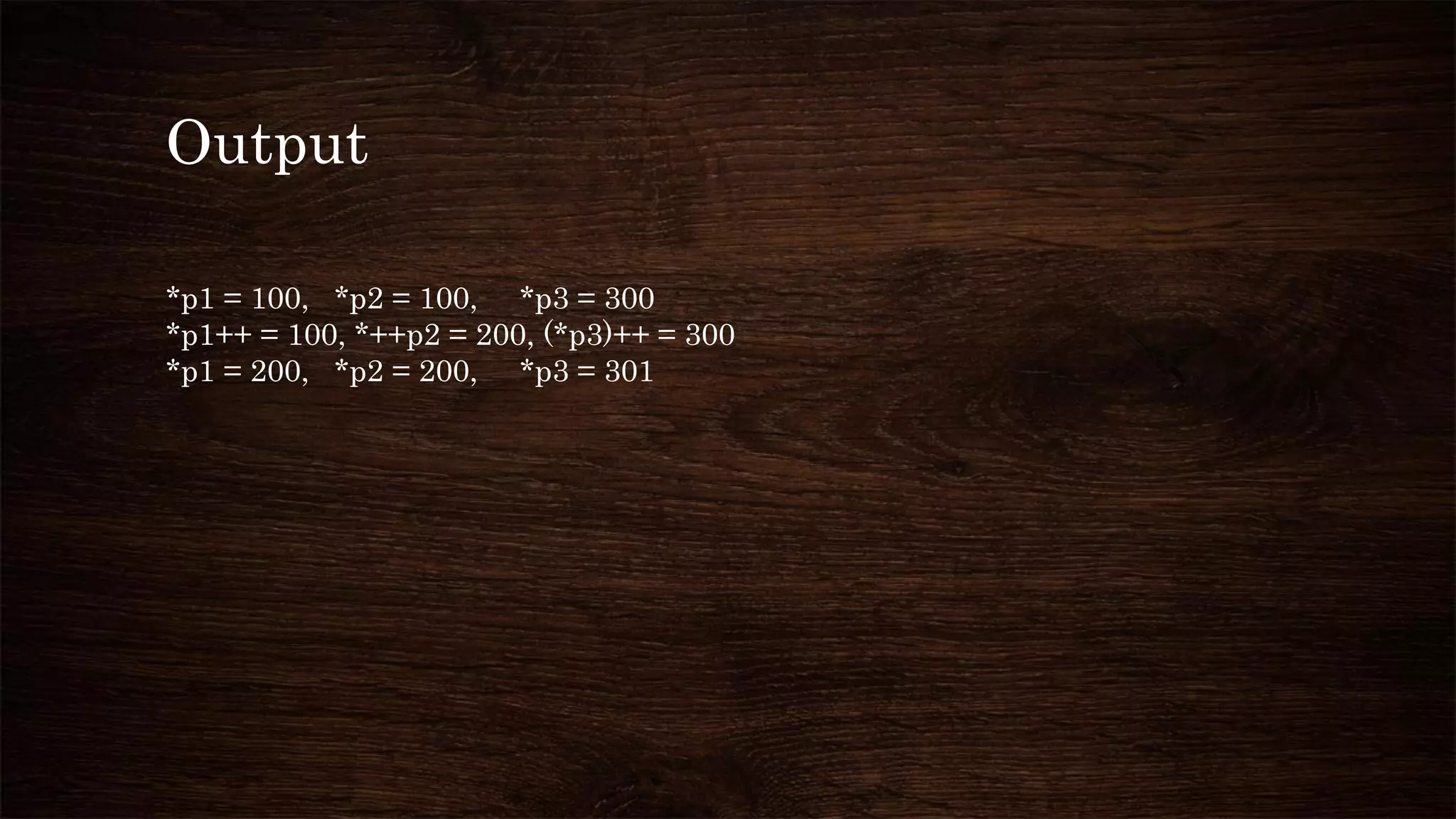
![/* order.c -- precedence in pointer operations */
#include <stdio.h>
int data[2] = {100, 200};
int moredata[2] = {300, 400};
int main(void)
{
int * p1, * p2, * p3;
p1 = p2 = data;
p3 = moredata;
printf(" *p1 = %d, *p2 = %d, *p3 = %dn",
*p1, *p2, *p3);
printf("*p1++ = %d, *++p2 = %d, (*p3)++ = %dn",
*p1++, *++p2, (*p3)++);
printf(" *p1 = %d, *p2 = %d, *p3 = %dn",
*p1, *p2, *p3);
return 0;
}](https://image.slidesharecdn.com/8-arraysandpointers-170718034728/75/8-arrays-and-pointers-29-2048.jpg)
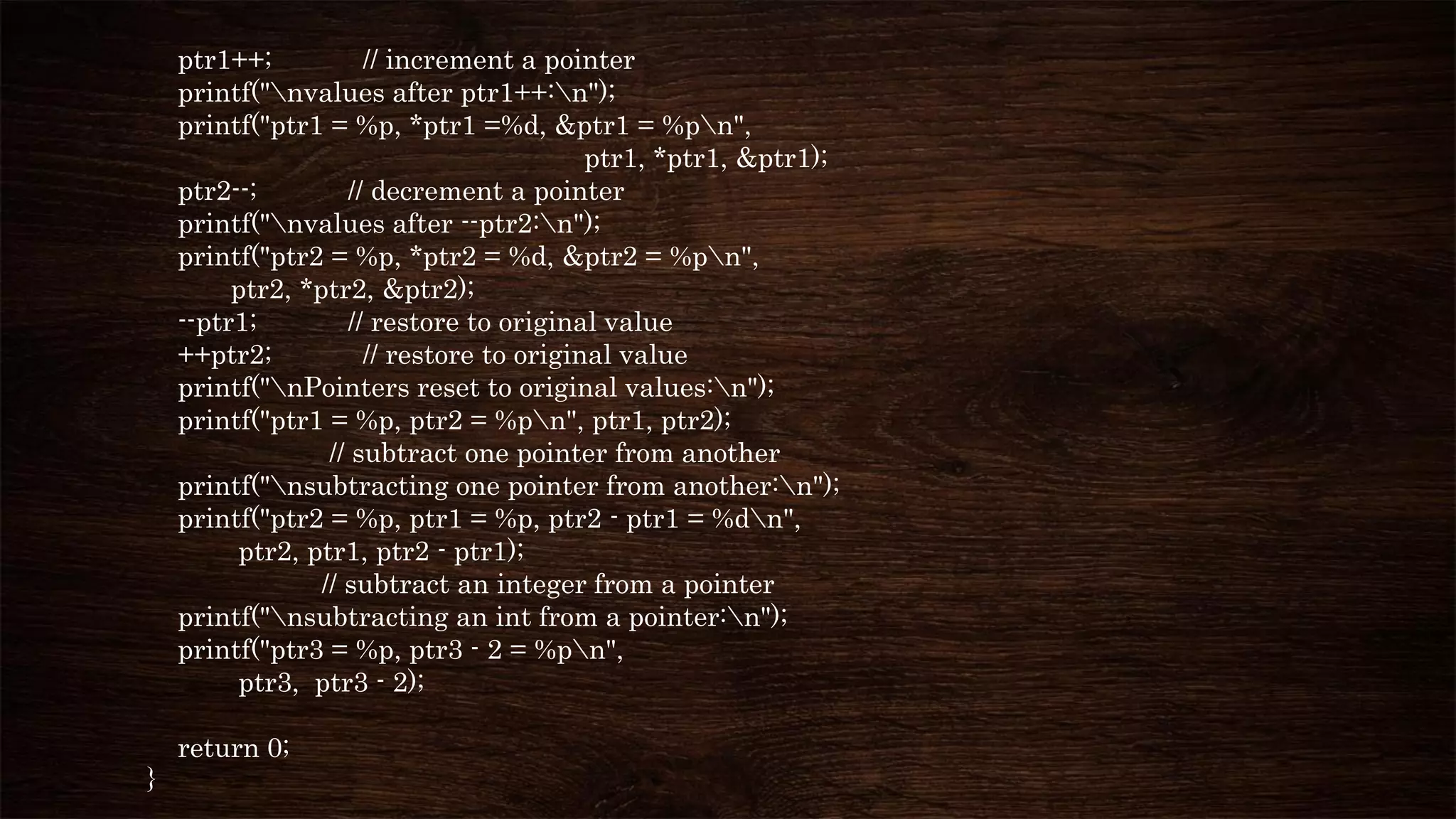
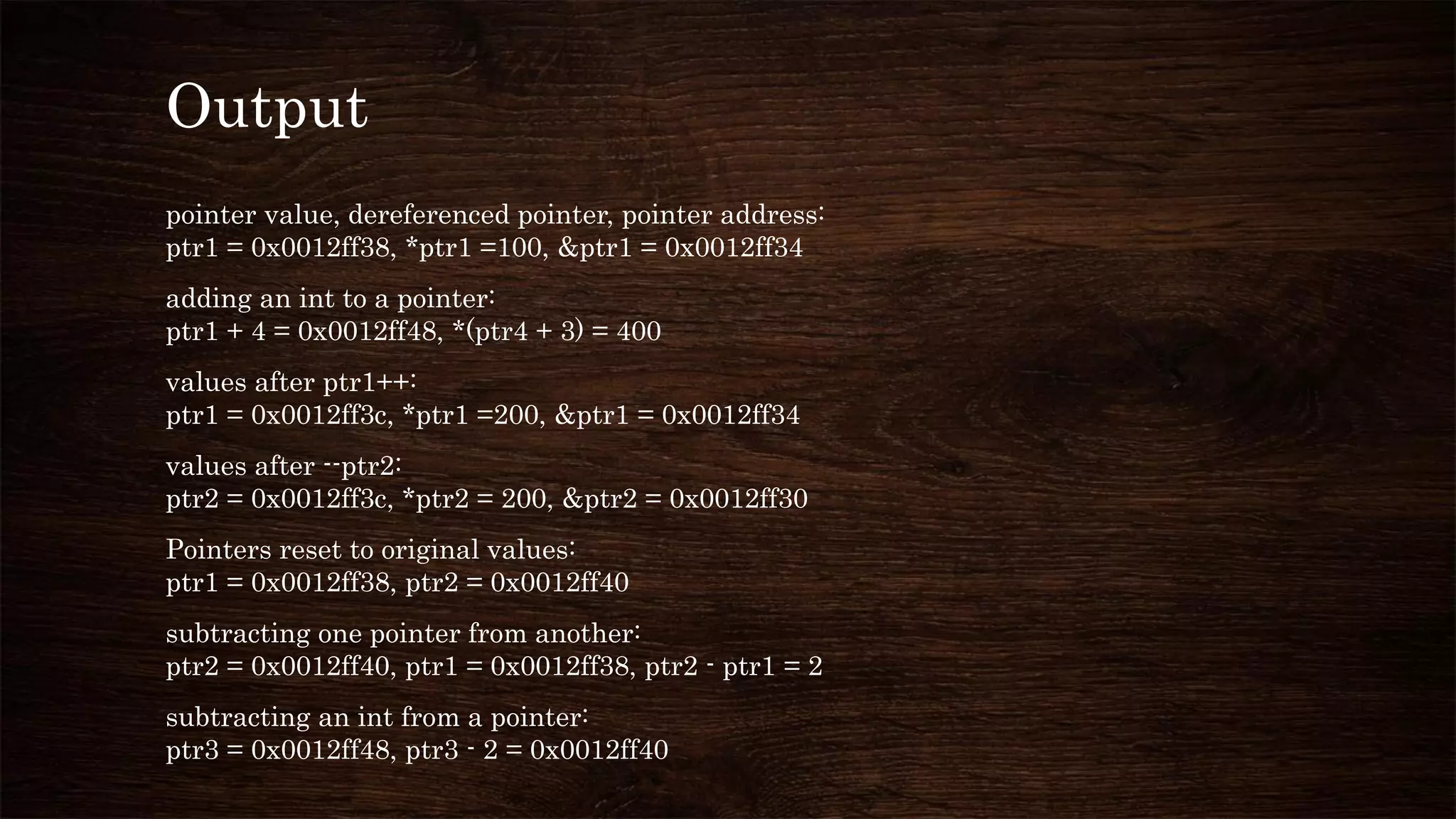
![#include <stdio.h>
int main(void)
{
int urn[5] = {100,200,300,400,500};
int * ptr1, * ptr2, *ptr3;
ptr1 = urn; // assign an address to a pointer
ptr2 = &urn[2]; // ditto
// dereference a pointer and take
// the address of a pointer
printf("pointer value, dereferenced pointer, pointer address:n");
printf("ptr1 = %p, *ptr1 =%d, &ptr1 = %pn",
ptr1, *ptr1, &ptr1);
// pointer addition
ptr3 = ptr1 + 4;
printf("nadding an int to a pointer:n");
printf("ptr1 + 4 = %p, *(ptr1 + 3) = %dn",
ptr1 + 4, *(ptr1 + 3));](https://image.slidesharecdn.com/8-arraysandpointers-170718034728/75/8-arrays-and-pointers-31-2048.jpg)
![#include <stdio.h>
#define SIZE 5
void show_array(const double ar[], int n);
void mult_array(double ar[], int n, double mult);
int main(void)
{
double dip[SIZE] = {20.0, 17.66, 8.2, 15.3, 22.22};
printf("The original dip array:n");
show_array(dip, SIZE);
mult_array(dip, SIZE, 2.5);
printf("The dip array after calling mult_array():n");
show_array(dip, SIZE);
return 0;
}](https://image.slidesharecdn.com/8-arraysandpointers-170718034728/75/8-arrays-and-pointers-34-2048.jpg)
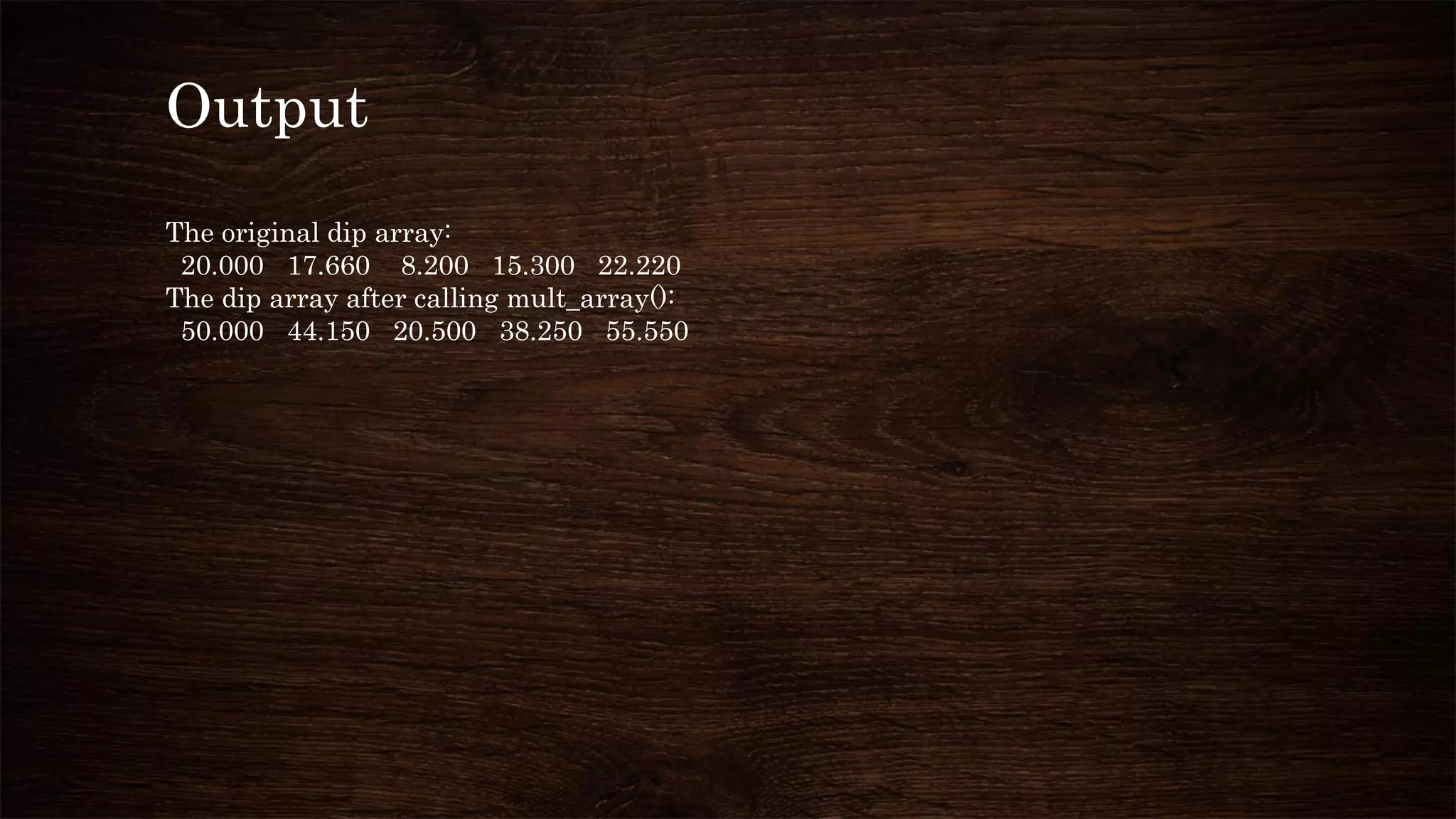
![/* displays array contents */
void show_array(const double ar[], int n)
{
int i;
for (i = 0; i < n; i++)
printf("%8.3f ", ar[i]);
putchar('n');
}
/* multiplies each array member by the same multiplier */
void mult_array(double ar[], int n, double mult)
{
int i;
for (i = 0; i < n; i++)
ar[i] *= mult;
}](https://image.slidesharecdn.com/8-arraysandpointers-170718034728/75/8-arrays-and-pointers-35-2048.jpg)
![int zippo[4][2]; /* an array of arrays of ints */
Then zippo, being the name of an array, is the address of the first element of the
array. In this case, the first element of zippo is itself an array of two ints, so zippo is
the address of an array of two ints.
Pointers and Multidimensional Arrays](https://image.slidesharecdn.com/8-arraysandpointers-170718034728/75/8-arrays-and-pointers-37-2048.jpg)
![#include <stdio.h>
int main(void)
{
int zippo[4][2] = { {2,4}, {6,8}, {1,3}, {5, 7} };
printf(" zippo = %p, zippo + 1 = %pn",
zippo, zippo + 1);
printf("zippo[0] = %p, zippo[0] + 1 = %pn",
zippo[0], zippo[0] + 1);
printf(" *zippo = %p, *zippo + 1 = %pn",
*zippo, *zippo + 1);
printf("zippo[0][0] = %dn", zippo[0][0]);
printf(" *zippo[0] = %dn", *zippo[0]);
printf(" **zippo = %dn", **zippo);
printf(" zippo[2][1] = %dn", zippo[2][1]);
printf("*(*(zippo+2) + 1) = %dn", *(*(zippo+2) + 1));
return 0;
}](https://image.slidesharecdn.com/8-arraysandpointers-170718034728/75/8-arrays-and-pointers-38-2048.jpg)
![Output
zippo = 0x0064fd38, zippo + 1 = 0x0064fd40
zippo[0] = 0x0064fd38, zippo[0] + 1 = 0x0064fd3c
*zippo = 0x0064fd38, *zippo + 1 = 0x0064fd3c
zippo[0][0] = 2
*zippo[0] = 2
**zippo = 2
zippo[1][2] = 3
*(*(zippo+1) + 2) = 3](https://image.slidesharecdn.com/8-arraysandpointers-170718034728/75/8-arrays-and-pointers-39-2048.jpg)
![Zippo the address of the first two-int element .
Zippo+2 the address of the third two-int element.
*(zippo+2) the third element, a two-int array, hence the address of its
first element, an int.
*(zippo+2) + 1 the address of the second element of the two-int array, also
an int.
*(*(zippo+2) + 1) the value of the second int in the third row (zippo[2][1]).](https://image.slidesharecdn.com/8-arraysandpointers-170718034728/75/8-arrays-and-pointers-40-2048.jpg)
![How would you declare a pointer variable pz that can point to a two-dimensional array
such as zippo? Such a pointer could be used, for example, in writing a function to deal
with zippo-like arrays. Will the type pointer-to-int suffice? No. That type is compatible
with zippo[0], which points to a single int. But zippo is the address of its first element,
which is an array of two ints. Hence, pz must point to an array of two ints, not to a
single int. Here is what you can do:
int (* pz)[2]; // pz points to an array of 2 ints
This statement says that pz is a pointer to an array of two ints. Why the parentheses?
Well, [ ] has a higher precedence than *.
Pointers to Multidimensional Arrays](https://image.slidesharecdn.com/8-arraysandpointers-170718034728/75/8-arrays-and-pointers-41-2048.jpg)
![#include <stdio.h>
int main(void)
{
int zippo[4][2] = { {2,4}, {6,8}, {1,3}, {5, 7} };
int (*pz)[2];
pz = zippo;
printf(" pz = %p, pz + 1 = %pn",
pz, pz + 1);
printf("pz[0] = %p, pz[0] + 1 = %pn",
pz[0], pz[0] + 1);
printf(" *pz = %p, *pz + 1 = %pn",
*pz, *pz + 1);
printf("pz[0][0] = %dn", pz[0][0]);
printf(" *pz[0] = %dn", *pz[0]);
printf(" **pz = %dn", **pz);
printf(" pz[2][1] = %dn", pz[2][1]);
printf("*(*(pz+2) + 1) = %dn", *(*(pz+2) + 1));
return 0;
}](https://image.slidesharecdn.com/8-arraysandpointers-170718034728/75/8-arrays-and-pointers-42-2048.jpg)
![Output
pz = 0x0064fd38, pz + 1 = 0x0064fd40
pz[0] = 0x0064fd38, pz[0] + 1 = 0x0064fd3c
*pz = 0x0064fd38, *pz + 1 = 0x0064fd3c
pz[0][0] = 2
*pz[0] = 2
**pz = 2
pz[2][1] = 3
*(*(pz+2) + 1) = 3](https://image.slidesharecdn.com/8-arraysandpointers-170718034728/75/8-arrays-and-pointers-43-2048.jpg)
![#include <stdio.h>
#define ROWS 3
#define COLS 4
void sum_rows(int ar[][COLS], int rows);
void sum_cols(int [][COLS], int ); // ok to omit names
int sum2d(int (*ar)[COLS], int rows); // another syntax
int main(void)
{
int junk[ROWS][COLS] = {
{2,4,6,8},
{3,5,7,9},
{12,10,8,6}
};
sum_rows(junk, ROWS);
sum_cols(junk, ROWS);
printf("Sum of all elements = %dn", sum2d(junk, ROWS));
return 0;
}](https://image.slidesharecdn.com/8-arraysandpointers-170718034728/75/8-arrays-and-pointers-45-2048.jpg)
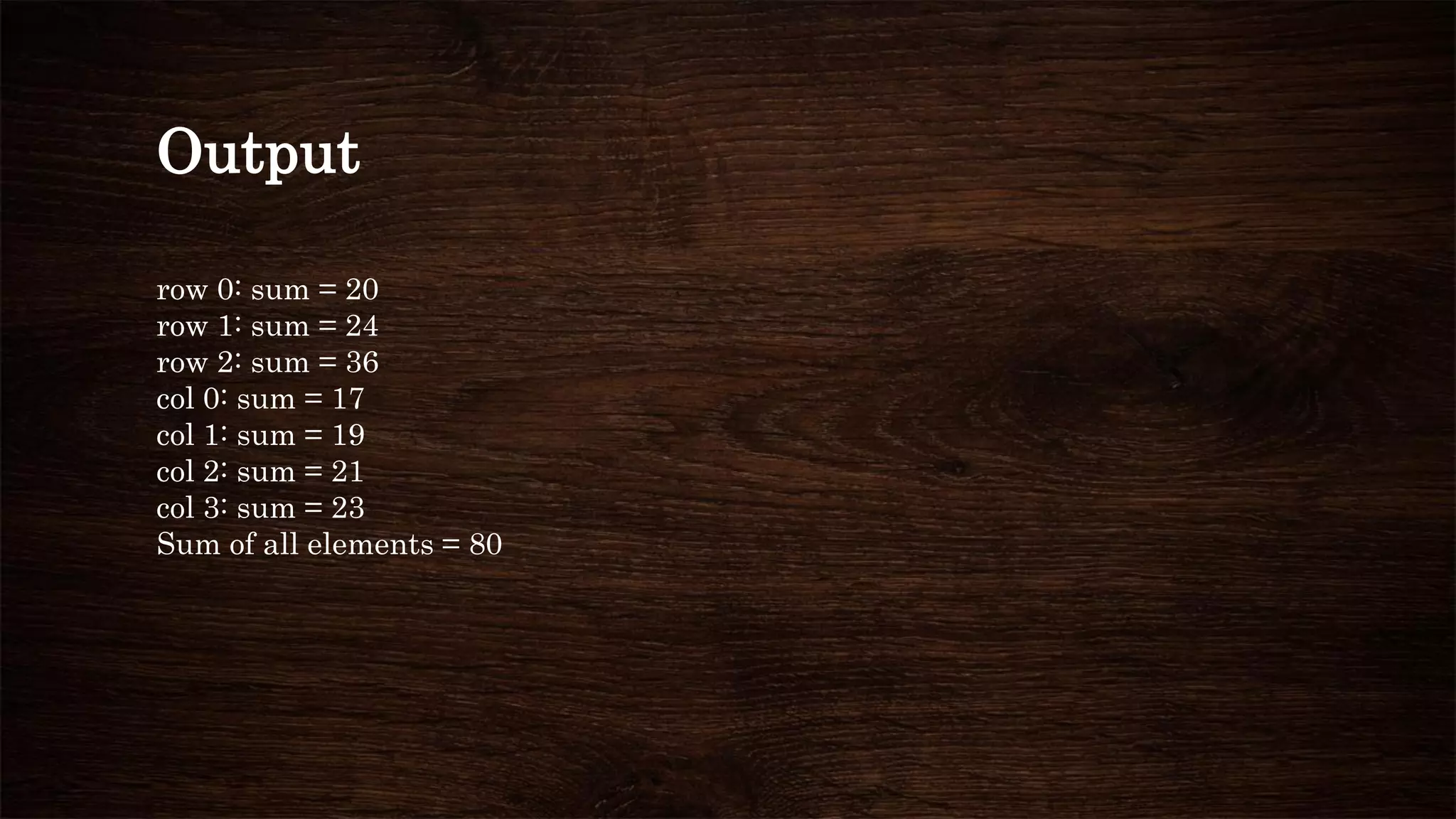
![void sum_rows(int ar[][COLS], int rows)
{
int r;
int c;
int tot;
for (r = 0; r < rows; r++)
{
tot = 0;
for (c = 0; c < COLS; c++)
tot += ar[r][c];
printf("row %d: sum = %dn", r, tot);
}
}
void sum_cols(int ar[][COLS], int rows)
{
int r;
int c;
int tot;](https://image.slidesharecdn.com/8-arraysandpointers-170718034728/75/8-arrays-and-pointers-46-2048.jpg)
![for (c = 0; c < COLS; c++)
{
tot = 0;
for (r = 0; r < rows; r++)
tot += ar[r][c];
printf("col %d: sum = %dn", c, tot);
}
}
int sum2d(int ar[][COLS], int rows)
{
int r;
int c;
int tot = 0;
for (r = 0; r < rows; r++)
for (c = 0; c < COLS; c++)
tot += ar[r][c];
return tot;
}](https://image.slidesharecdn.com/8-arraysandpointers-170718034728/75/8-arrays-and-pointers-47-2048.jpg)

This document contains information about arrays and pointers in C programming. It includes code examples demonstrating how to declare and initialize arrays, access array elements using indexes and pointers, pass arrays to functions, and perform operations on arrays such as summing elements. Multidimensional arrays and pointer arithmetic are also discussed. The examples output the results of operations on sample data arrays.


![C programming & data structure [arrays & pointers]](https://cdn.slidesharecdn.com/ss_thumbnails/cprogrammingdatastructure-arrayspointers-150709231015-lva1-app6892-thumbnail.jpg?width=640&height=640&fit=bounds)


![Pointers [compatibility mode]](https://cdn.slidesharecdn.com/ss_thumbnails/pointerscompatibilitymode-170805133557-thumbnail.jpg?width=640&height=640&fit=bounds)


![C programming & data structure [character strings & string functions]](https://cdn.slidesharecdn.com/ss_thumbnails/cprogrammingdatastructure-characterstringsstringfunctions-150709232537-lva1-app6891-thumbnail.jpg?width=640&height=640&fit=bounds)


