Scala basics
;
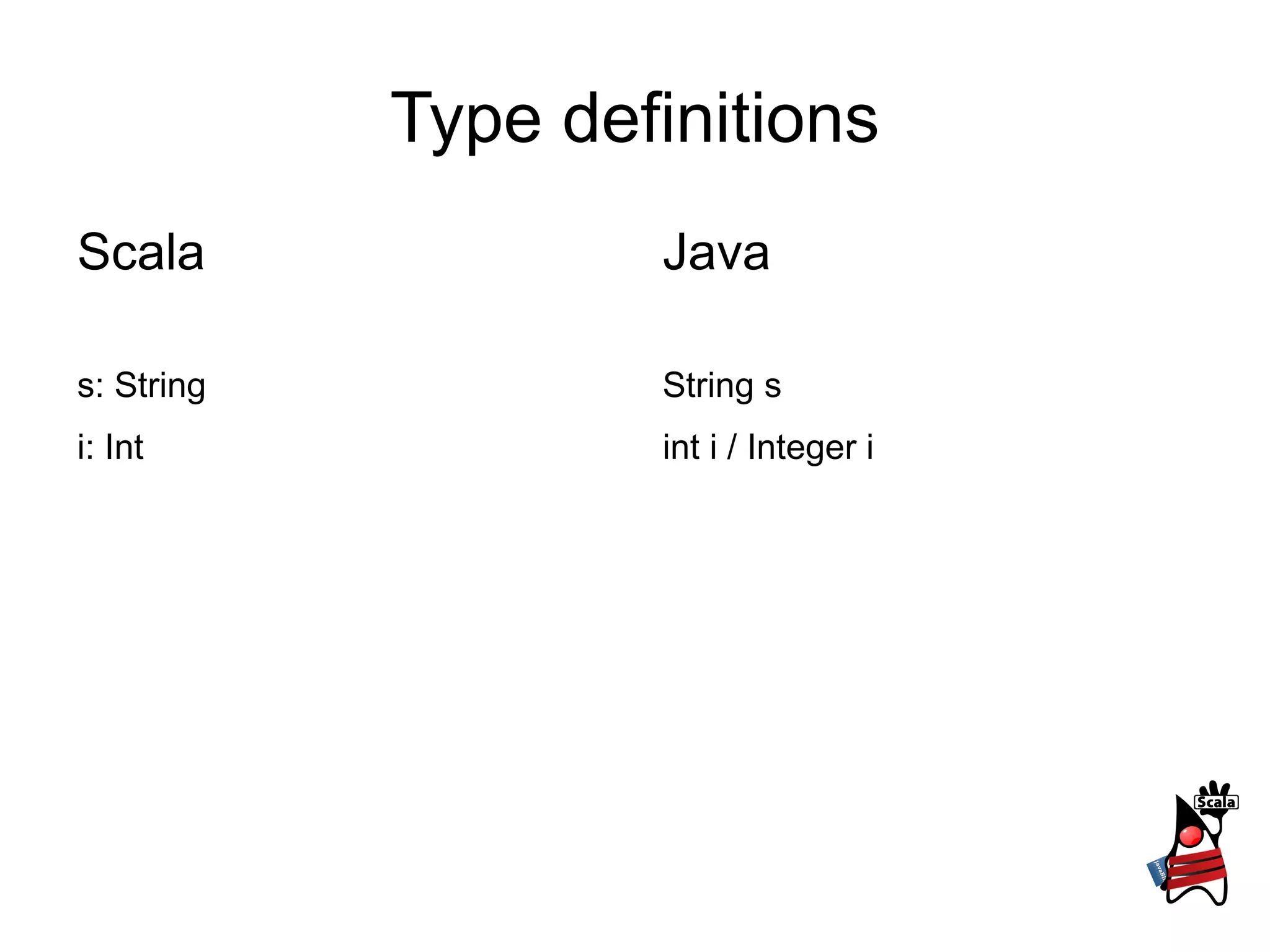
Type definitions Scala s: String i: Int Java String s int i / Integer i
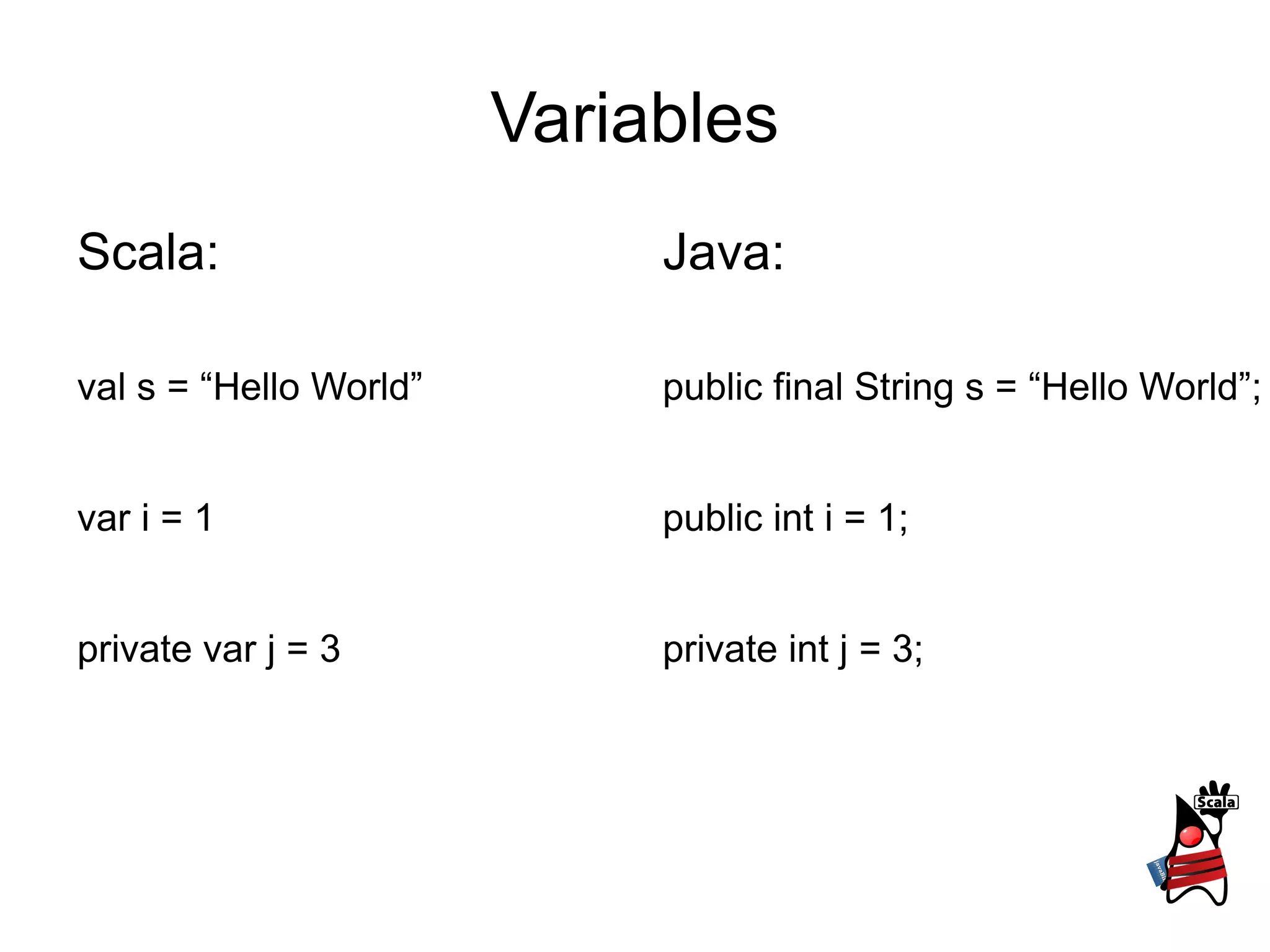
Variables Scala: val s = “Hello World” var i = 1 private var j = 3 Java: public final String s = “Hello World”; public int i = 1; private int j = 3;
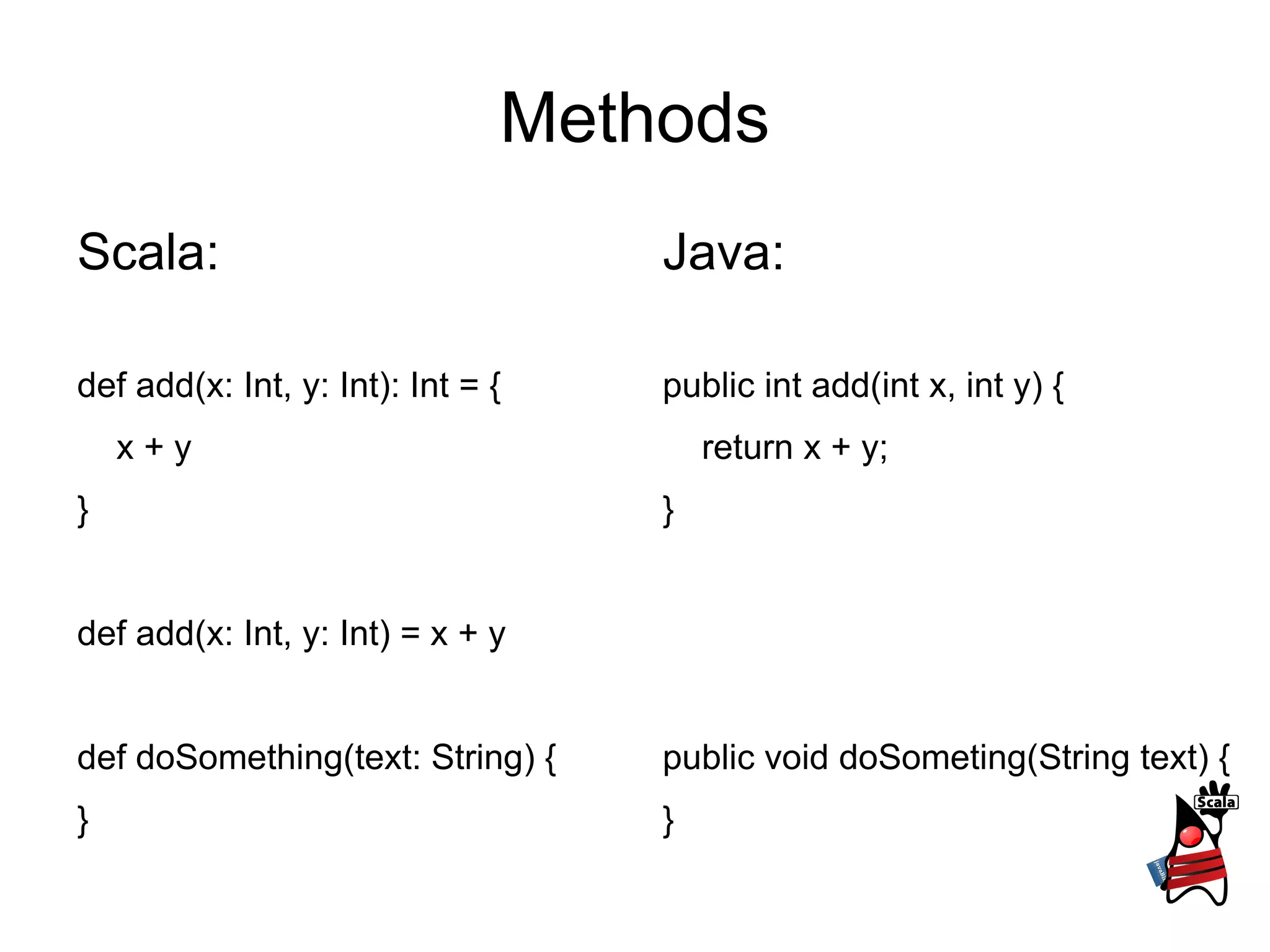
Methods Scala: def add(x: Int, y: Int): Int = { x + y } def add(x: Int, y: Int) = x + y def doSomething(text: String) { } Java: public int add(int x, int y) { return x + y; } public void doSometing(String text) { }
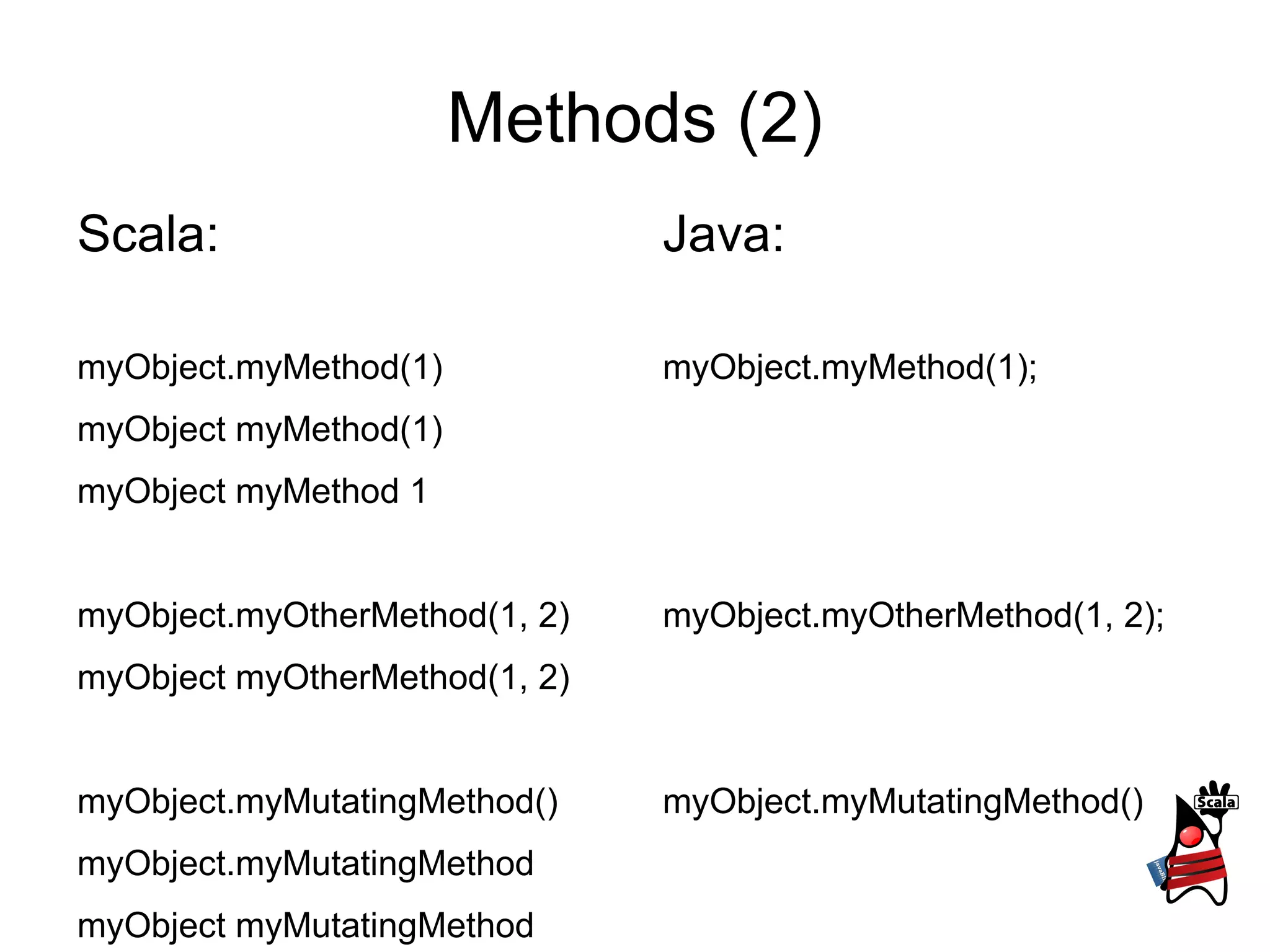
Methods (2) Scala: myObject.myMethod(1) myObject myMethod(1) myObject myMethod 1 myObject.myOtherMethod(1, 2) myObject myOtherMethod(1, 2) myObject.myMutatingMethod() myObject.myMutatingMethod myObject myMutatingMethod Java: myObject.myMethod(1); myObject.myOtherMethod(1, 2); myObject.myMutatingMethod()
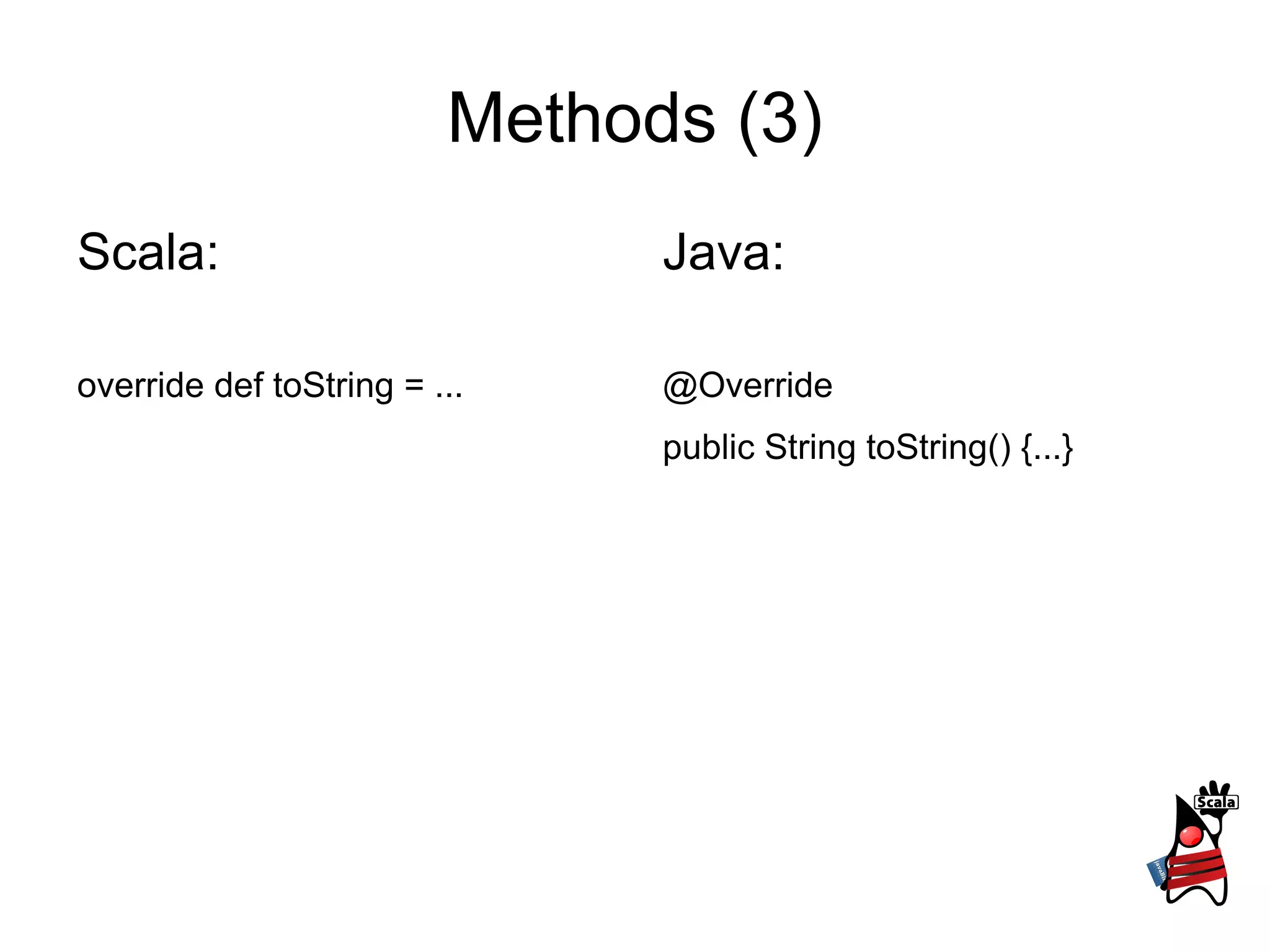
Methods (3) Scala: override def toString = ... Java: @Override public String toString() {...}
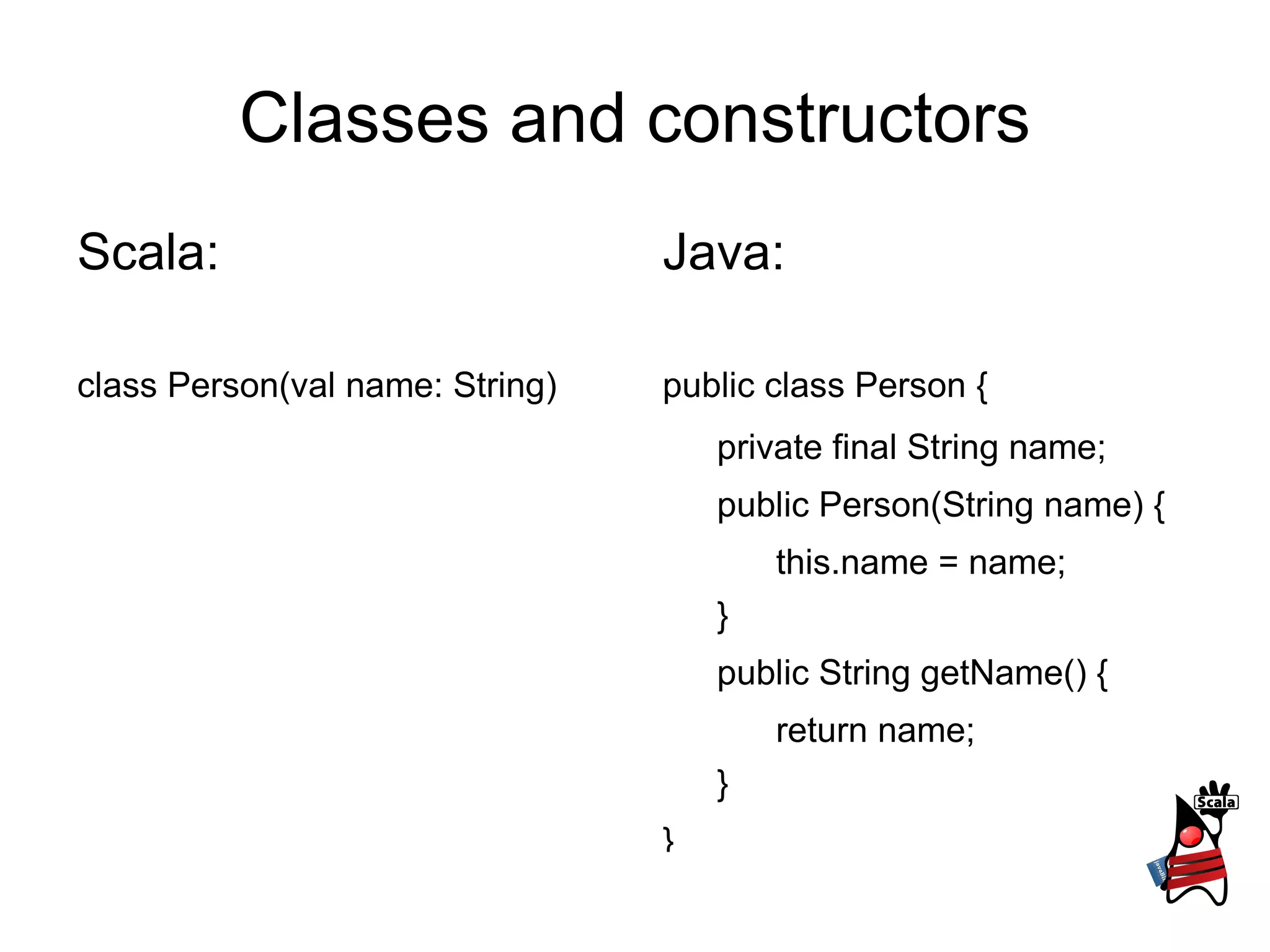
Classes and constructors Scala: class Person(val name: String) Java: public class Person { private final String name; public Person(String name) { this.name = name; } public String getName() { return name; } }
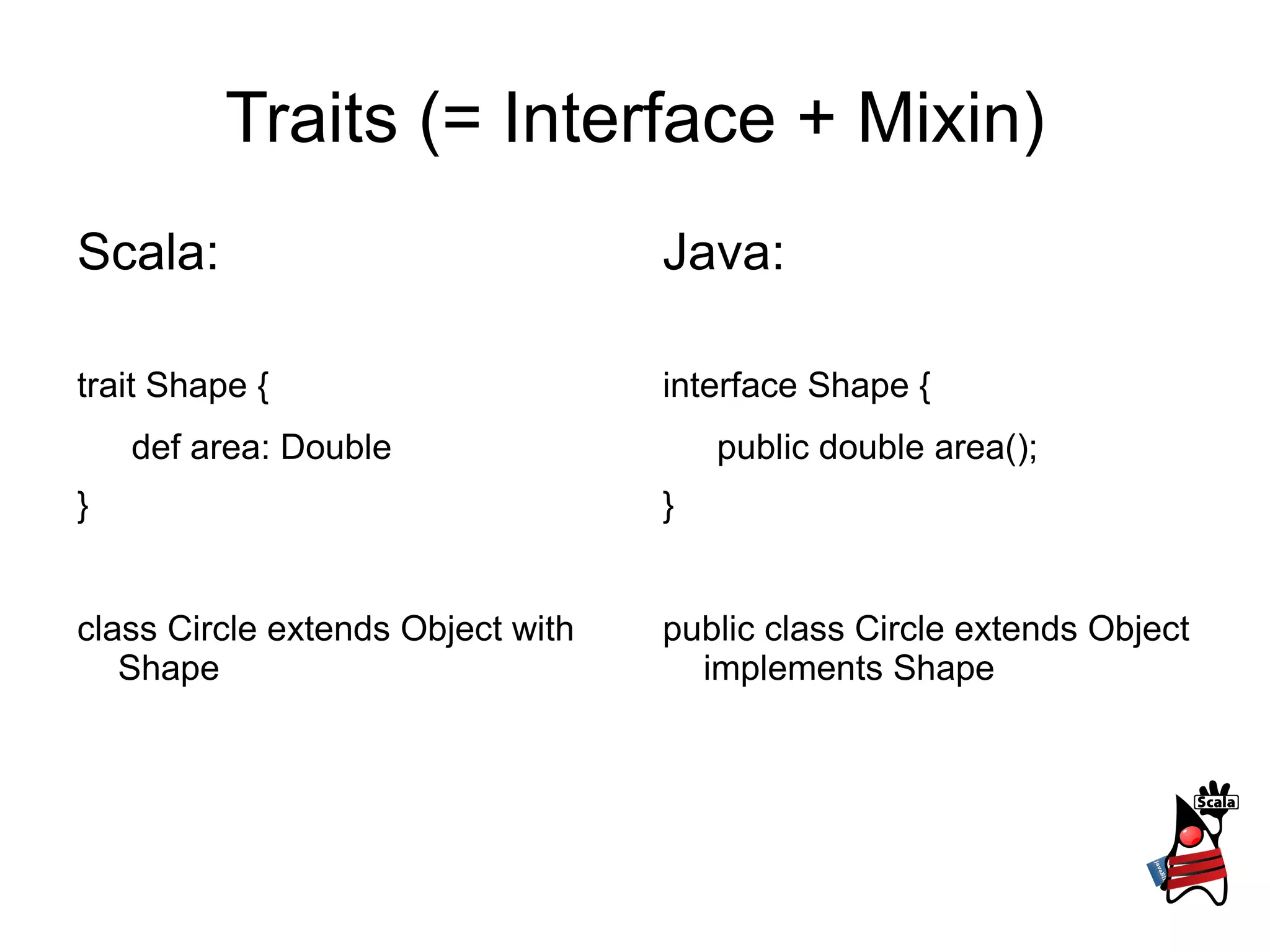
Traits (= Interface + Mixin) Scala: trait Shape { def area: Double } class Circle extends Object with Shape Java: interface Shape { public double area(); } public class Circle extends Object implements Shape
No “static” in Scala Scala: object PersonUtil { val AgeLimit = 18 def countPersons(persons: List[Person]) = ... } Java: public class PersonUtil { public static final int AGE_LIMIT = 18; public static int countPersons(List<Person>  persons) { ... } }
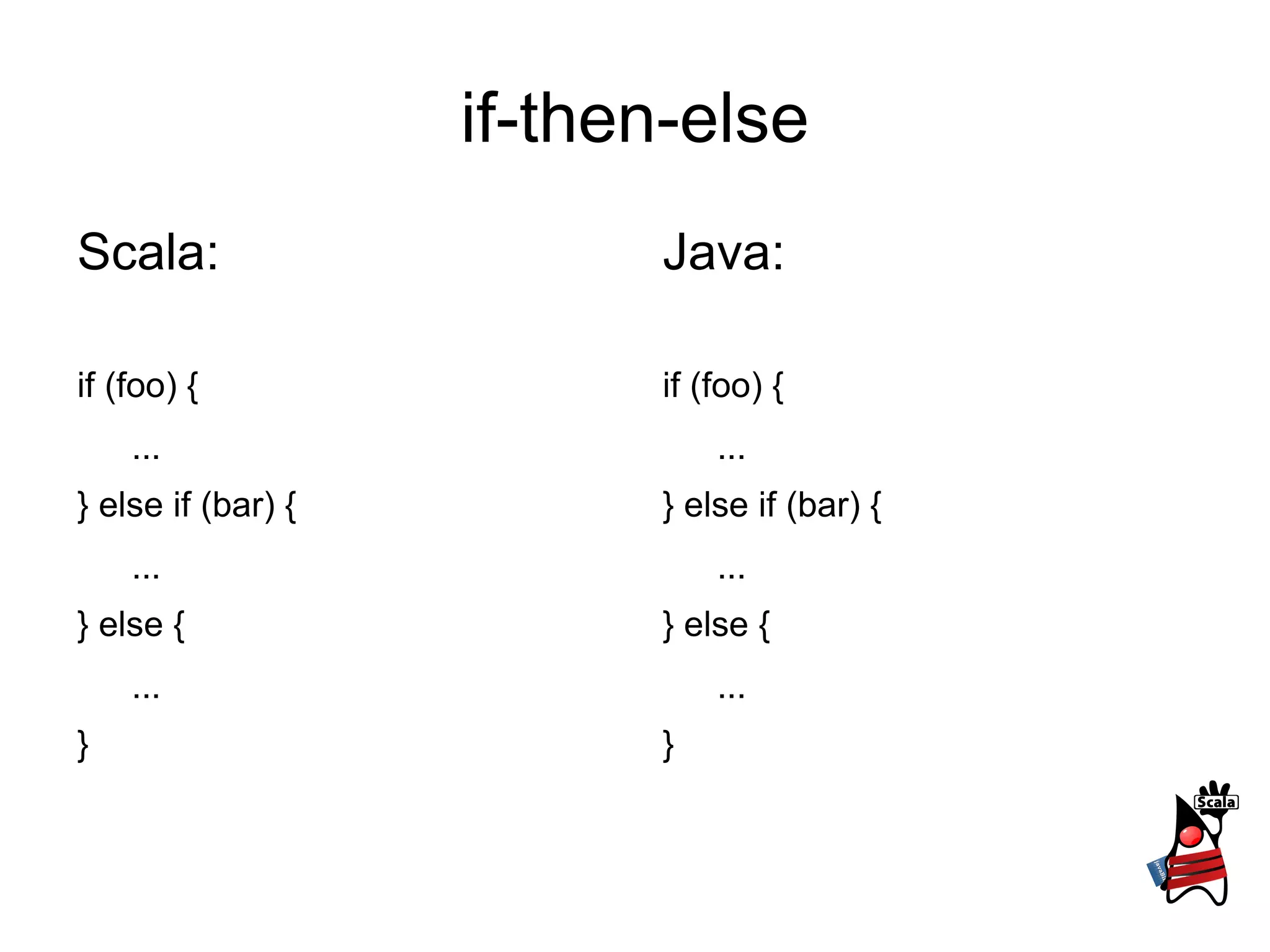
if-then-else Scala: if (foo) { ... } else if (bar) { ... } else { ... } Java: if (foo) { ... } else if (bar) { ... } else { ... }
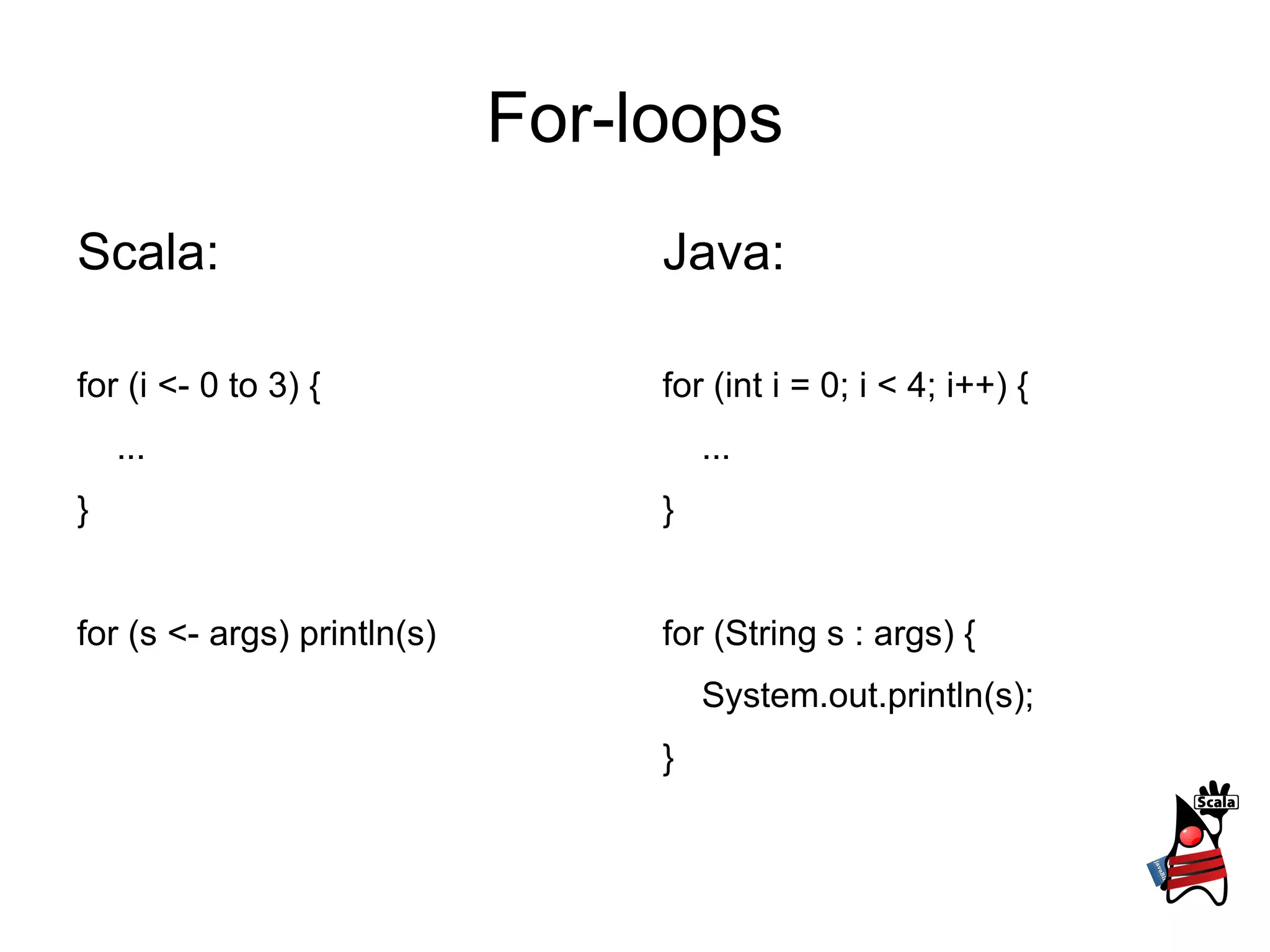
For-loops Scala: for (i <- 0 to 3) { ... } for (s <- args) println(s) Java: for (int i = 0; i < 4; i++) { ... } for (String s : args) { System.out.println(s); }
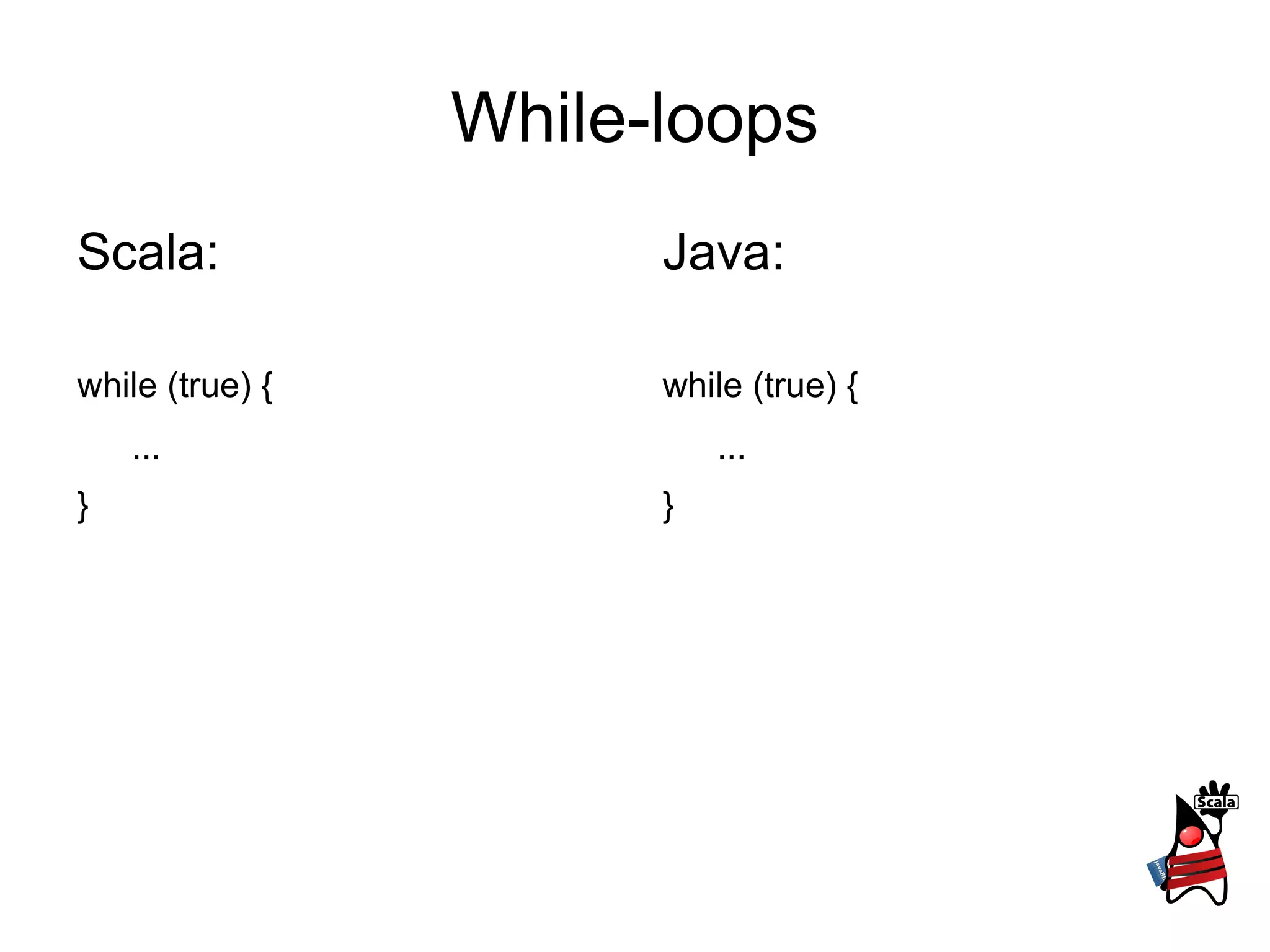
While-loops Scala: while (true) { ... } Java: while (true) { ... }
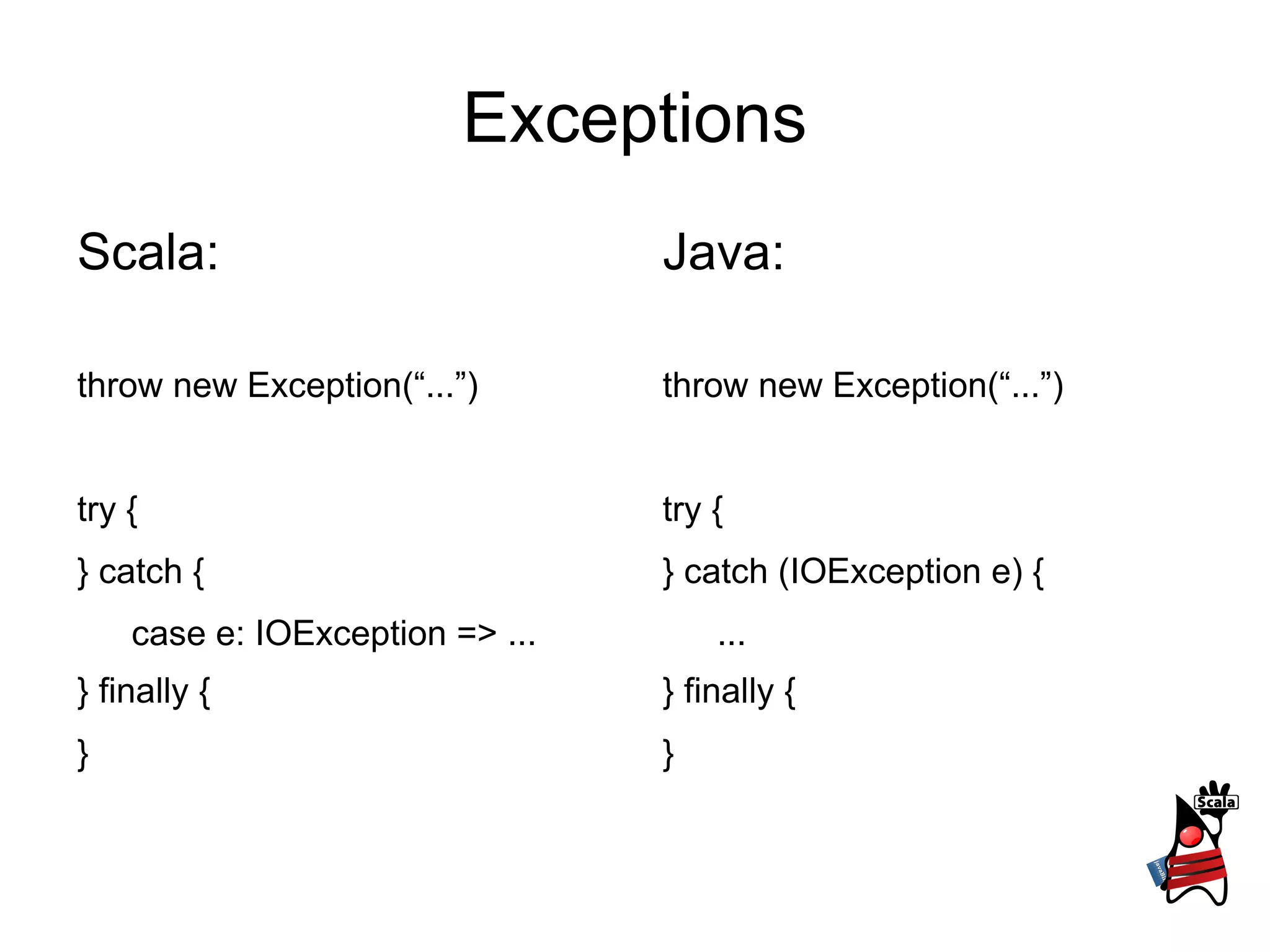
Exceptions Scala: throw new Exception(“...”) try { } catch { case e: IOException => ... } finally { } Java: throw new Exception(“...”) try { } catch (IOException e) { ... } finally { }
Varargs def foo(values: String*){ } foo(&quot;bar&quot;, &quot;baz&quot;) val arr = Array(&quot;bar&quot;, &quot;baz&quot;) foo(arr: _*) public void foo(String... values){ } foo(&quot;bar&quot;, &quot;baz&quot;); String[] arr = new String[]{&quot;bar&quot;, &quot;baz&quot;} foo(arr);
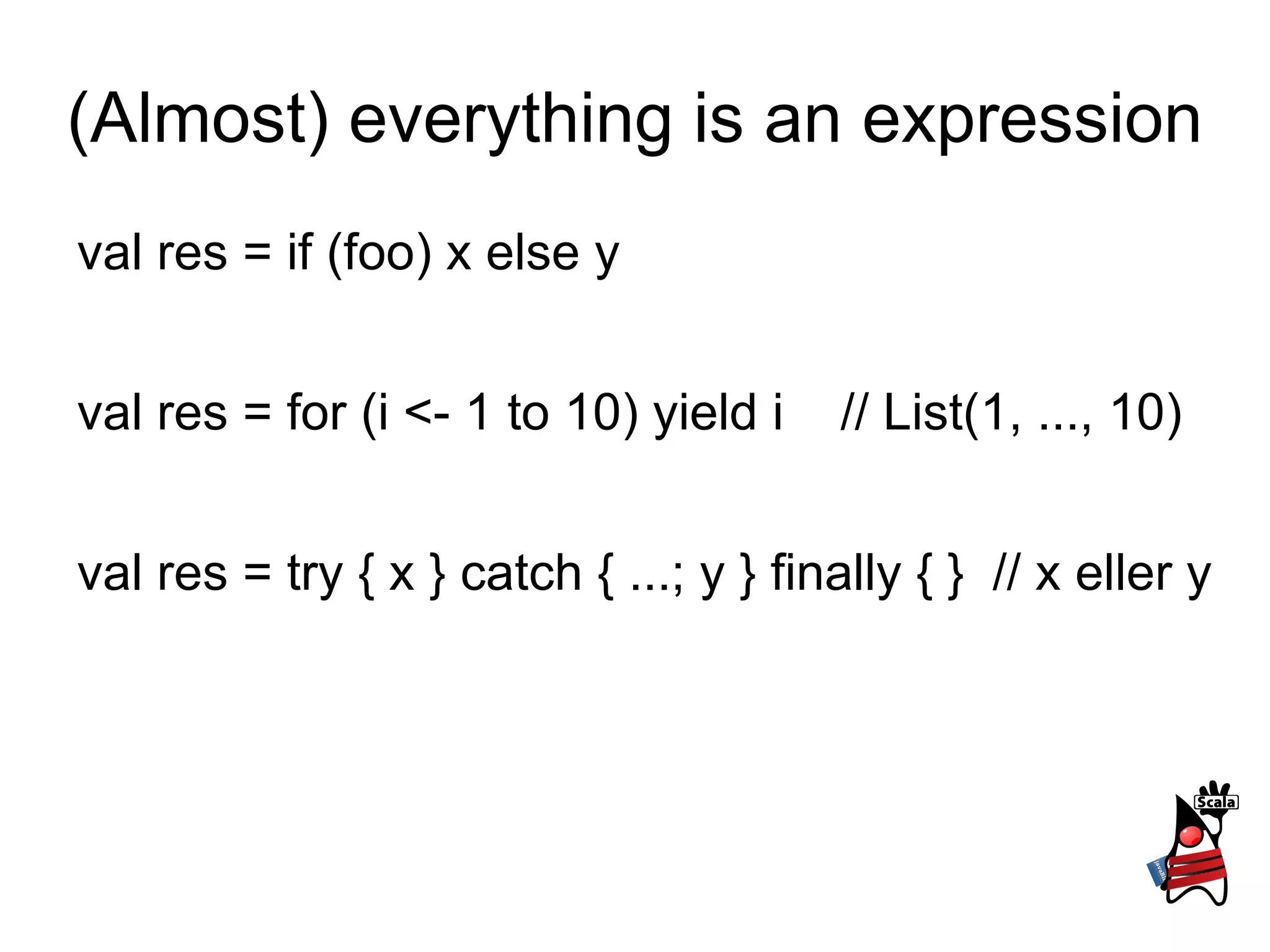
(Almost) everything is an expression val res = if (foo) x else y val res = for (i <- 1 to 10) yield i  // List(1, ..., 10) val res = try { x } catch { ...; y } finally { }  // x eller y
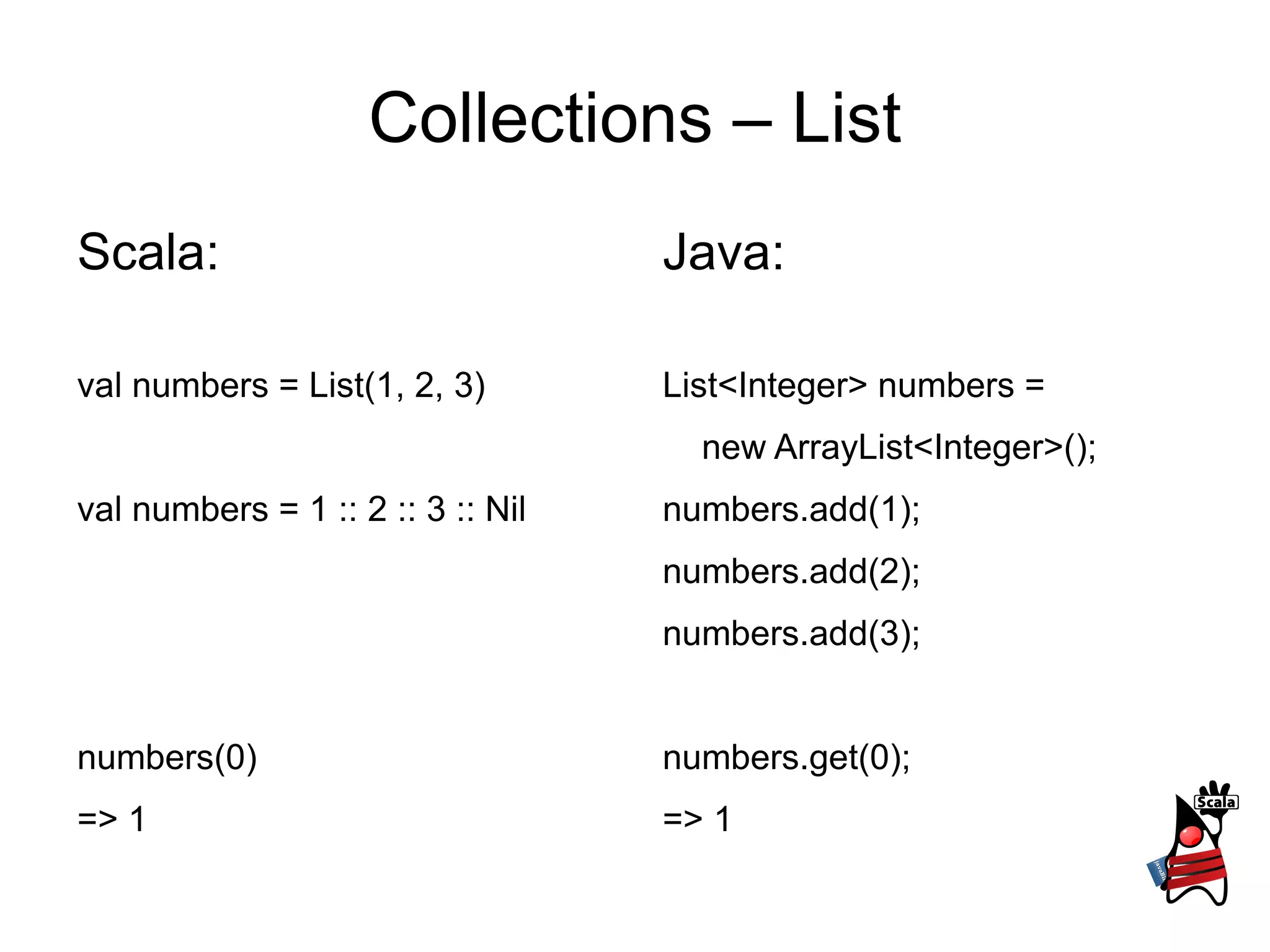
Collections – List Scala: val numbers = List(1, 2, 3) val numbers = 1 :: 2 :: 3 :: Nil numbers(0) => 1 Java: List<Integer> numbers =  new ArrayList<Integer>(); numbers.add(1); numbers.add(2); numbers.add(3); numbers.get(0); => 1
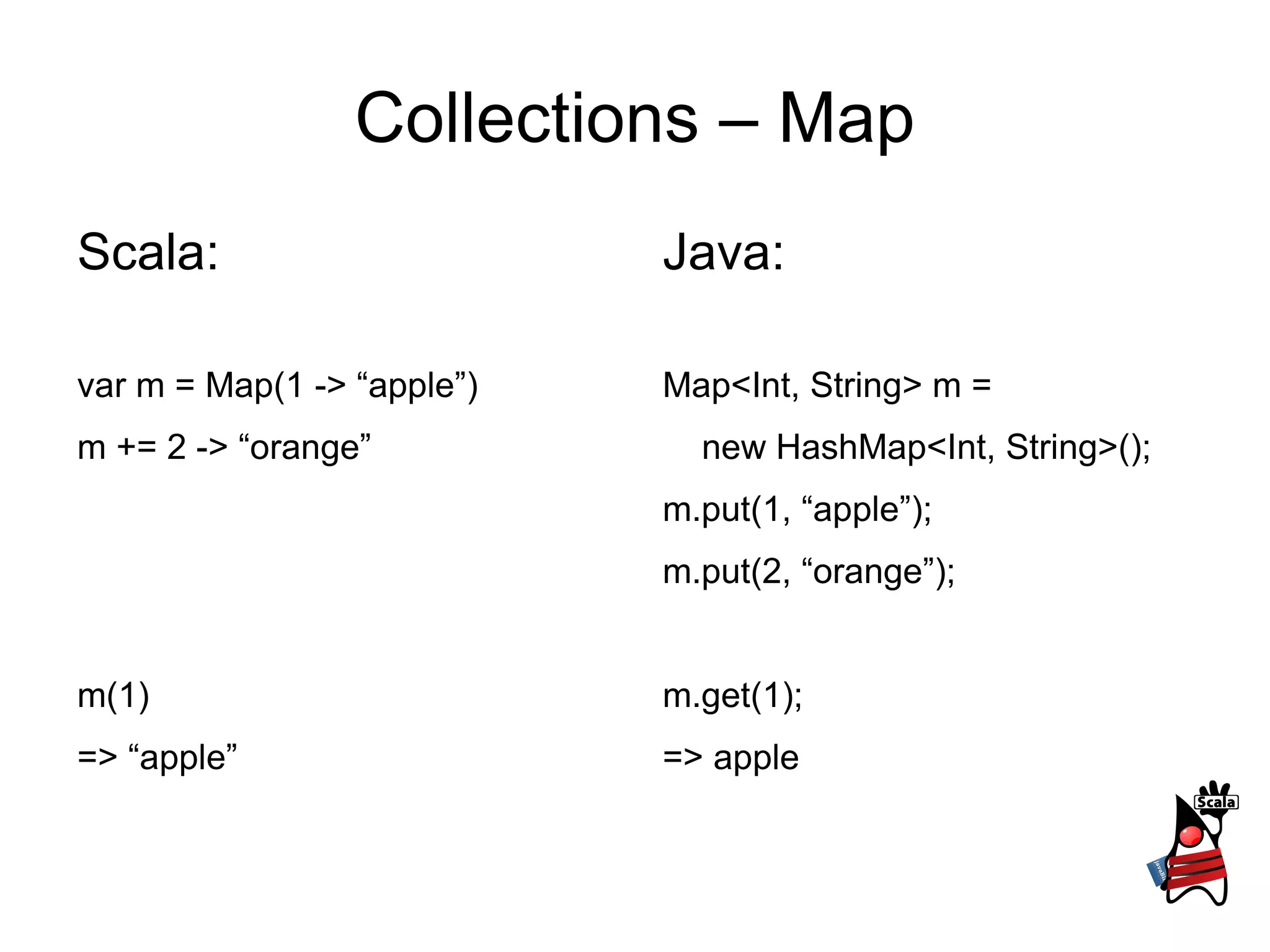
Collections – Map Scala: var m = Map(1 -> “apple”) m += 2 -> “orange” m(1) => “apple” Java: Map<Int, String> m =  new HashMap<Int, String>(); m.put(1, “apple”); m.put(2, “orange”); m.get(1); => apple
Generics Scala: List[String] Java: List<String>
Tuples Scala: val tuple: Tuple2[Int, String] =  (1, “apple”) val quadruple =  (2, “orange”, 0.5d, false) Java: Pair<Integer, String> tuple =  new Pair<Integer, String>(1, “apple”) ... yeah right... ;-)
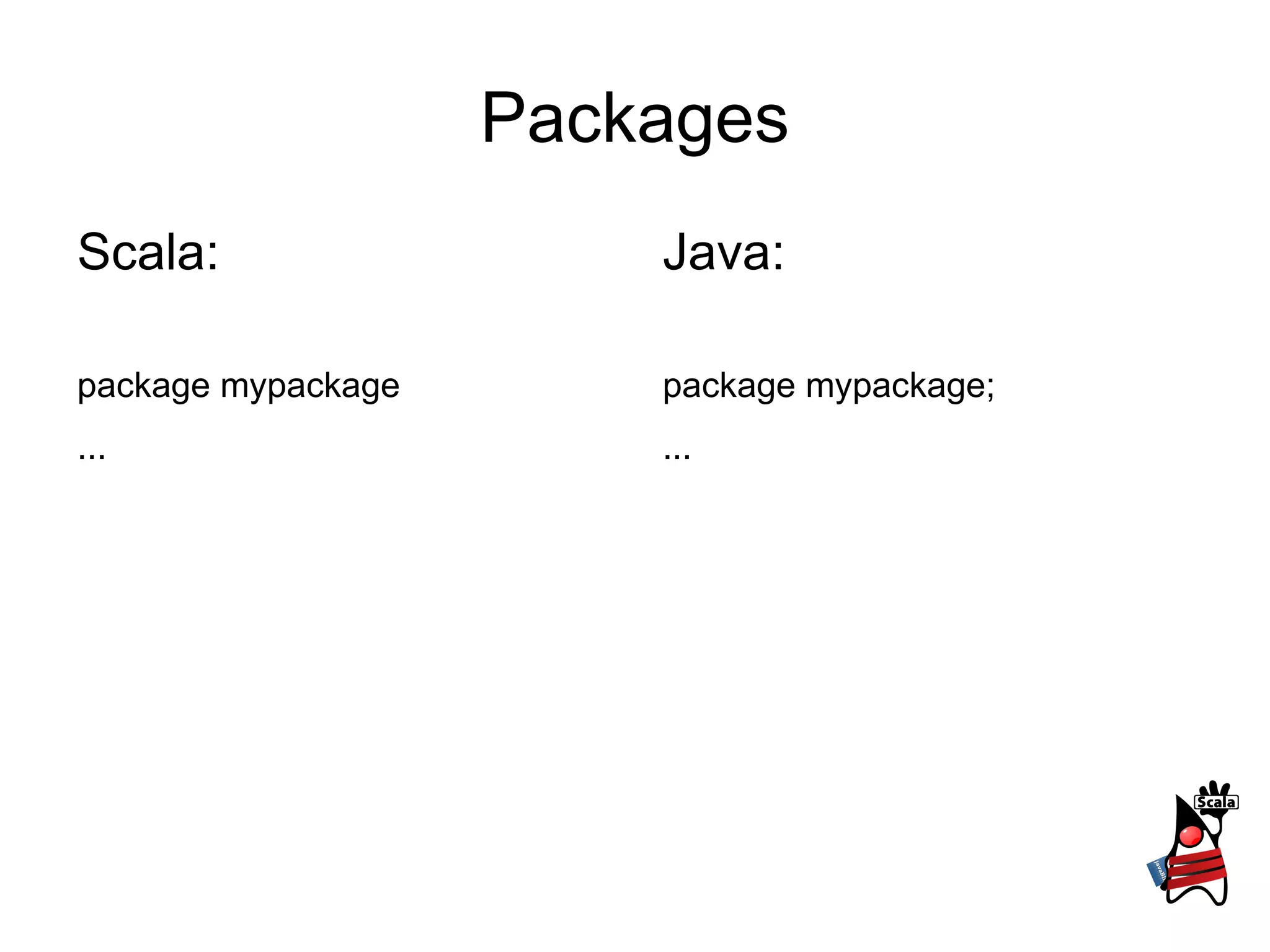
Packages Scala: package mypackage ... Java: package mypackage; ...
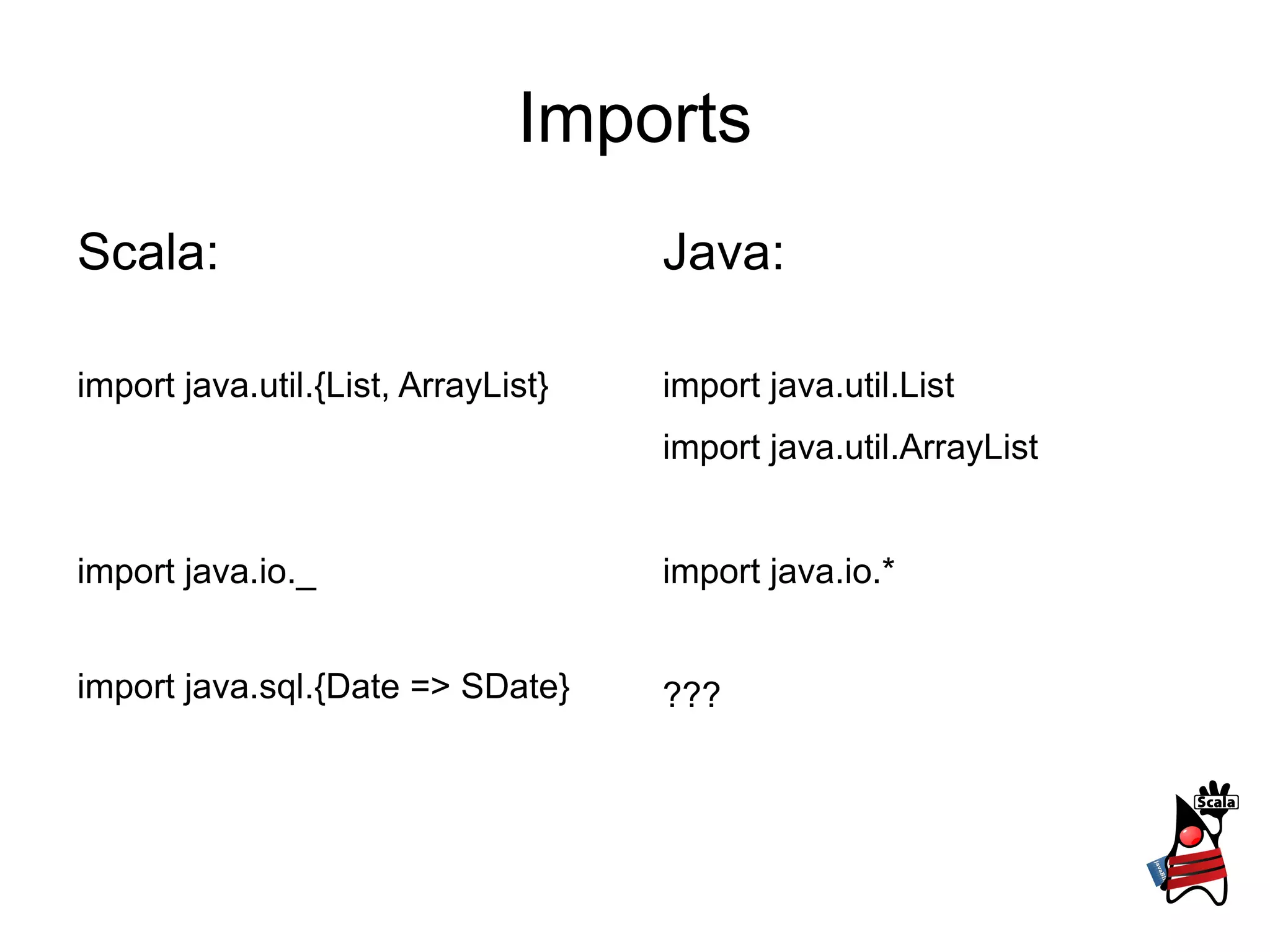
Imports Scala: import java.util.{List, ArrayList} import java.io._ import java.sql.{Date => SDate} Java: import java.util.List import java.util.ArrayList import java.io.* ???
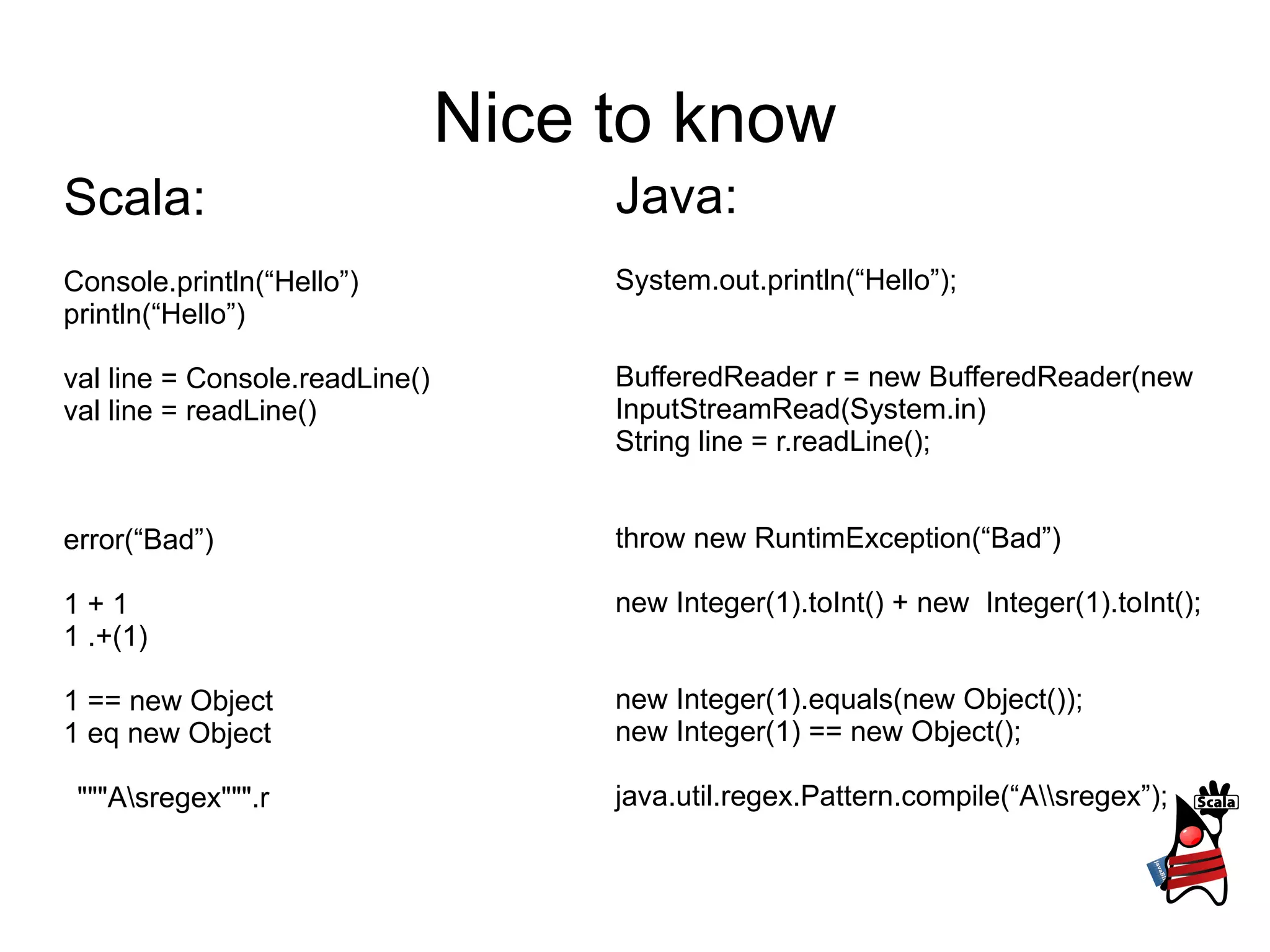
Nice to know Scala: Console.println(“Hello”) println(“Hello”) val line = Console.readLine() val line = readLine() error(“Bad”) 1 + 1 1 .+(1) 1 == new Object 1 eq new Object &quot;&quot;&quot;A\sregex&quot;&quot;&quot;.r Java: System.out.println(“Hello”); BufferedReader r = new BufferedReader(new InputStreamRead(System.in) String line = r.readLine(); throw new RuntimException(“Bad”) new Integer(1).toInt() + new  Integer(1).toInt(); new Integer(1).equals(new Object()); new Integer(1) == new Object(); java.util.regex.Pattern.compile(“A\\sregex”);

1.2 Scala Basics

  • 1.
  • 2.
  • 3.
    Type definitions Scalas: String i: Int Java String s int i / Integer i
  • 4.
    Variables Scala: vals = “Hello World” var i = 1 private var j = 3 Java: public final String s = “Hello World”; public int i = 1; private int j = 3;
  • 5.
    Methods Scala: defadd(x: Int, y: Int): Int = { x + y } def add(x: Int, y: Int) = x + y def doSomething(text: String) { } Java: public int add(int x, int y) { return x + y; } public void doSometing(String text) { }
  • 6.
    Methods (2) Scala:myObject.myMethod(1) myObject myMethod(1) myObject myMethod 1 myObject.myOtherMethod(1, 2) myObject myOtherMethod(1, 2) myObject.myMutatingMethod() myObject.myMutatingMethod myObject myMutatingMethod Java: myObject.myMethod(1); myObject.myOtherMethod(1, 2); myObject.myMutatingMethod()
  • 7.
    Methods (3) Scala:override def toString = ... Java: @Override public String toString() {...}
  • 8.
    Classes and constructorsScala: class Person(val name: String) Java: public class Person { private final String name; public Person(String name) { this.name = name; } public String getName() { return name; } }
  • 9.
    Traits (= Interface+ Mixin) Scala: trait Shape { def area: Double } class Circle extends Object with Shape Java: interface Shape { public double area(); } public class Circle extends Object implements Shape
  • 10.
    No “static” inScala Scala: object PersonUtil { val AgeLimit = 18 def countPersons(persons: List[Person]) = ... } Java: public class PersonUtil { public static final int AGE_LIMIT = 18; public static int countPersons(List<Person> persons) { ... } }
  • 11.
    if-then-else Scala: if(foo) { ... } else if (bar) { ... } else { ... } Java: if (foo) { ... } else if (bar) { ... } else { ... }
  • 12.
    For-loops Scala: for(i <- 0 to 3) { ... } for (s <- args) println(s) Java: for (int i = 0; i < 4; i++) { ... } for (String s : args) { System.out.println(s); }
  • 13.
    While-loops Scala: while(true) { ... } Java: while (true) { ... }
  • 14.
    Exceptions Scala: thrownew Exception(“...”) try { } catch { case e: IOException => ... } finally { } Java: throw new Exception(“...”) try { } catch (IOException e) { ... } finally { }
  • 15.
    Varargs def foo(values:String*){ } foo(&quot;bar&quot;, &quot;baz&quot;) val arr = Array(&quot;bar&quot;, &quot;baz&quot;) foo(arr: _*) public void foo(String... values){ } foo(&quot;bar&quot;, &quot;baz&quot;); String[] arr = new String[]{&quot;bar&quot;, &quot;baz&quot;} foo(arr);
  • 16.
    (Almost) everything isan expression val res = if (foo) x else y val res = for (i <- 1 to 10) yield i // List(1, ..., 10) val res = try { x } catch { ...; y } finally { } // x eller y
  • 17.
    Collections – ListScala: val numbers = List(1, 2, 3) val numbers = 1 :: 2 :: 3 :: Nil numbers(0) => 1 Java: List<Integer> numbers = new ArrayList<Integer>(); numbers.add(1); numbers.add(2); numbers.add(3); numbers.get(0); => 1
  • 18.
    Collections – MapScala: var m = Map(1 -> “apple”) m += 2 -> “orange” m(1) => “apple” Java: Map<Int, String> m = new HashMap<Int, String>(); m.put(1, “apple”); m.put(2, “orange”); m.get(1); => apple
  • 19.
    Generics Scala: List[String]Java: List<String>
  • 20.
    Tuples Scala: valtuple: Tuple2[Int, String] = (1, “apple”) val quadruple = (2, “orange”, 0.5d, false) Java: Pair<Integer, String> tuple = new Pair<Integer, String>(1, “apple”) ... yeah right... ;-)
  • 21.
    Packages Scala: packagemypackage ... Java: package mypackage; ...
  • 22.
    Imports Scala: importjava.util.{List, ArrayList} import java.io._ import java.sql.{Date => SDate} Java: import java.util.List import java.util.ArrayList import java.io.* ???
  • 23.
    Nice to knowScala: Console.println(“Hello”) println(“Hello”) val line = Console.readLine() val line = readLine() error(“Bad”) 1 + 1 1 .+(1) 1 == new Object 1 eq new Object &quot;&quot;&quot;A\sregex&quot;&quot;&quot;.r Java: System.out.println(“Hello”); BufferedReader r = new BufferedReader(new InputStreamRead(System.in) String line = r.readLine(); throw new RuntimException(“Bad”) new Integer(1).toInt() + new Integer(1).toInt(); new Integer(1).equals(new Object()); new Integer(1) == new Object(); java.util.regex.Pattern.compile(“A\\sregex”);