Developing Mobile
Application
Ios : session # 2
By : Amr Elghadban
AMR
ELGHADBAN
ABOUT ME
———————————
SOFTWARE ENGINEER
FCI - HELWAN 2010
ITI INTAKE 32
WORKED BEFORE IN
- Tawasol IT
- Etisalat Masr
- NTG Clarity
Introduction to Objective C
Contents :
• Language Concepts
• How Objective C works- Basics
• Data Types
• NSInteger
• NSNumber
• Operators
• Loop
• Inheritance
• Method Overloading
• Mutable and Immutable Strings
• Mutable and Immutable Arrays
What Is Objective C ?
Objective-C is the primary programming language you use when writing
software for OS X and iOS. It’s a superset of the C programming language
and provides object-oriented capabilities and a dynamic runtime.
Objective-C inherits the syntax, primitive types, and adds syntax for
defining classes and methods.
Objective – C Characteristics
The class is defined in two different sections
namely @interface and @implementation.
Almost everything is in form of objects, what is object ???
every thing around us is consider as Object of Class
Object : Building, House, watch, Ahmed , etc…
Class : architecture of buildings , etc…
Class Object
Objects receive messages and objects are often referred as receivers.
by Calling it method “behaviours” Like Ahmed is an oBject receive an message to
eat, sleep, walk etc…
Objects contain instance variables.
Ahmed Have , Eyes, Hands , legs , Head etc …
Objects and instance variables have scope.
Classes hide an object's implementation.
Properties are used to provide access to class instance variables in other classes.
Language Concepts:
Fully supports object-oriented programming, including the
following concepts of object-oriented development:
Encapsulation , Data hiding
Inheritance
Polymorphism
Data Encapsulation
Encapsulation is an Object-Oriented Programming concept that
binds together the data and functions that manipulate the data and
that keeps both safe from outside interference and misuse.
Data encapsulation is a mechanism of bundling the data and the
functions that use them.
like Setter and getters
Inheritance
Inheritance allows us to define a class in terms of another class which
makes it easier to create and maintain an application. This also provides an
opportunity to reuse the code functionality and fast implementation time.
you inherit from your father , and ur father super class / parent class
Mammals.
This existing class is called the base class, and the new class is referred to as
the derived class.
Objective-C allows only one level of inheritance, i.e., it can have only one
base class but allows multilevel inheritance for it’s own implementation. All
classes in Objective-C is derived from the superclass NSObject.
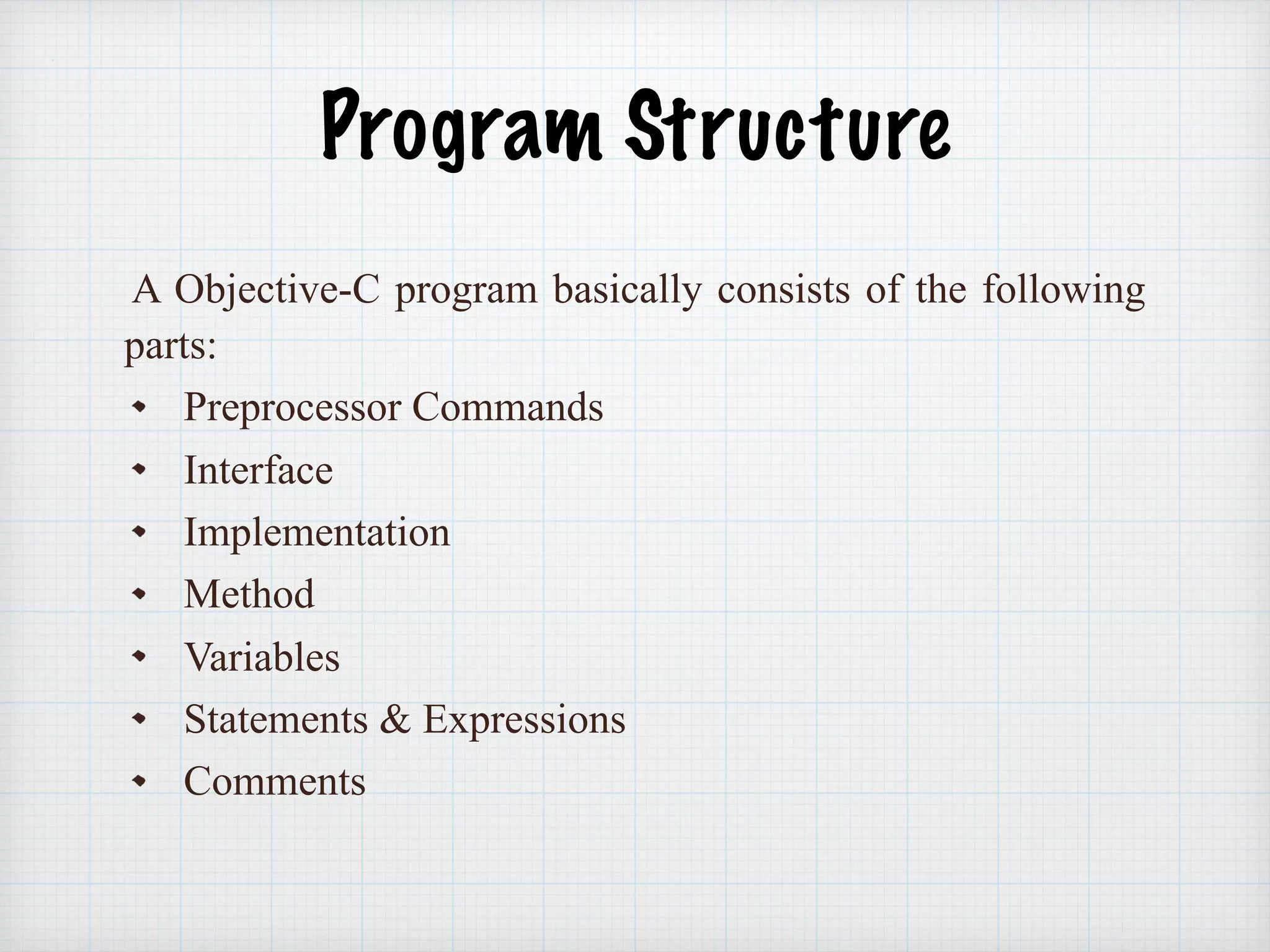
Program Structure
A Objective-C program basically consists of the following
parts:
Preprocessor Commands
Interface
Implementation
Method
Variables
Statements & Expressions
Comments
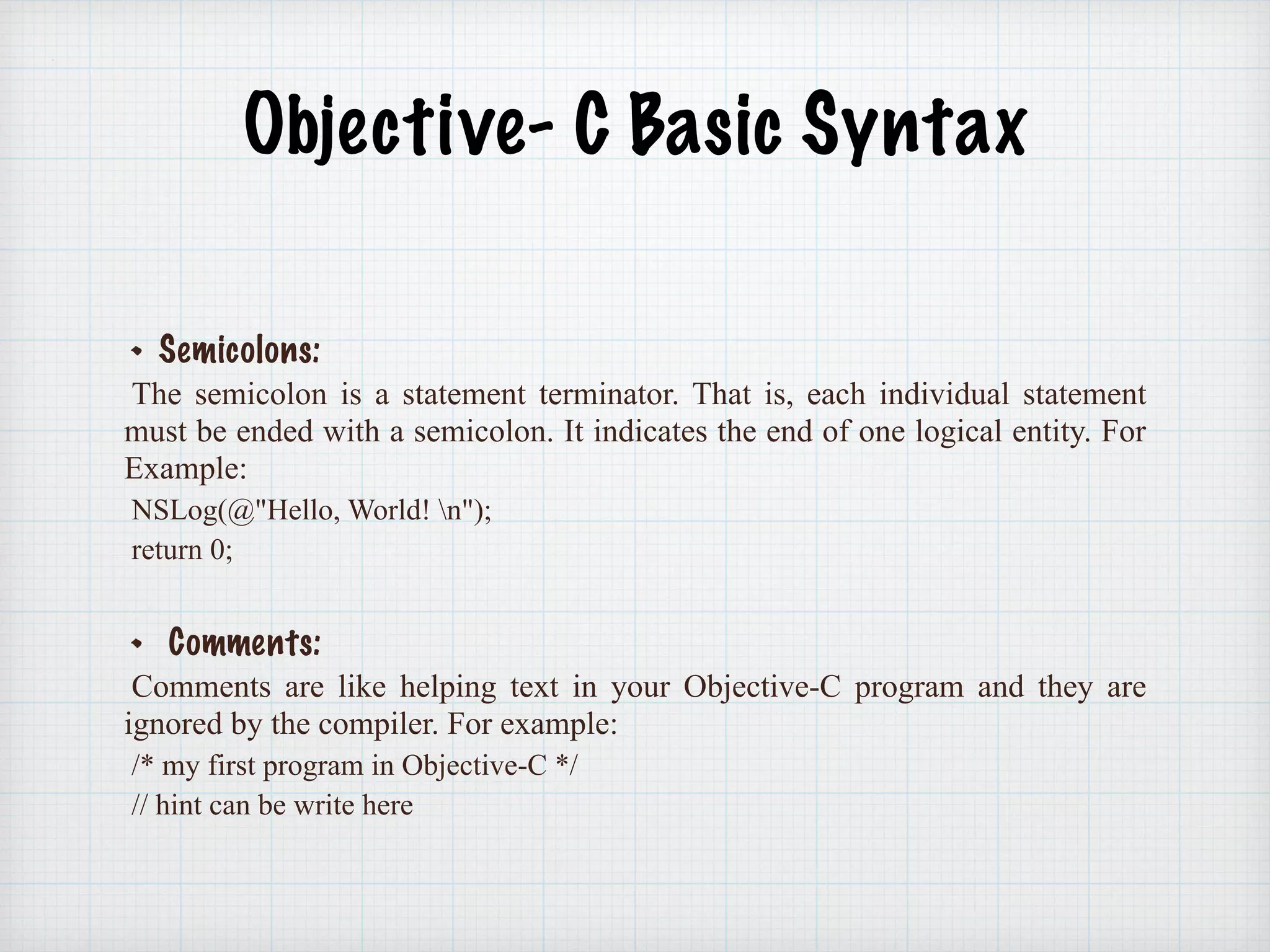
Objective- C Basic Syntax
Semicolons:
The semicolon is a statement terminator. That is, each individual statement
must be ended with a semicolon. It indicates the end of one logical entity. For
Example:
NSLog(@"Hello, World! n");
return 0;
Comments:
Comments are like helping text in your Objective-C program and they are
ignored by the compiler. For example:
/* my first program in Objective-C */
// hint can be write here
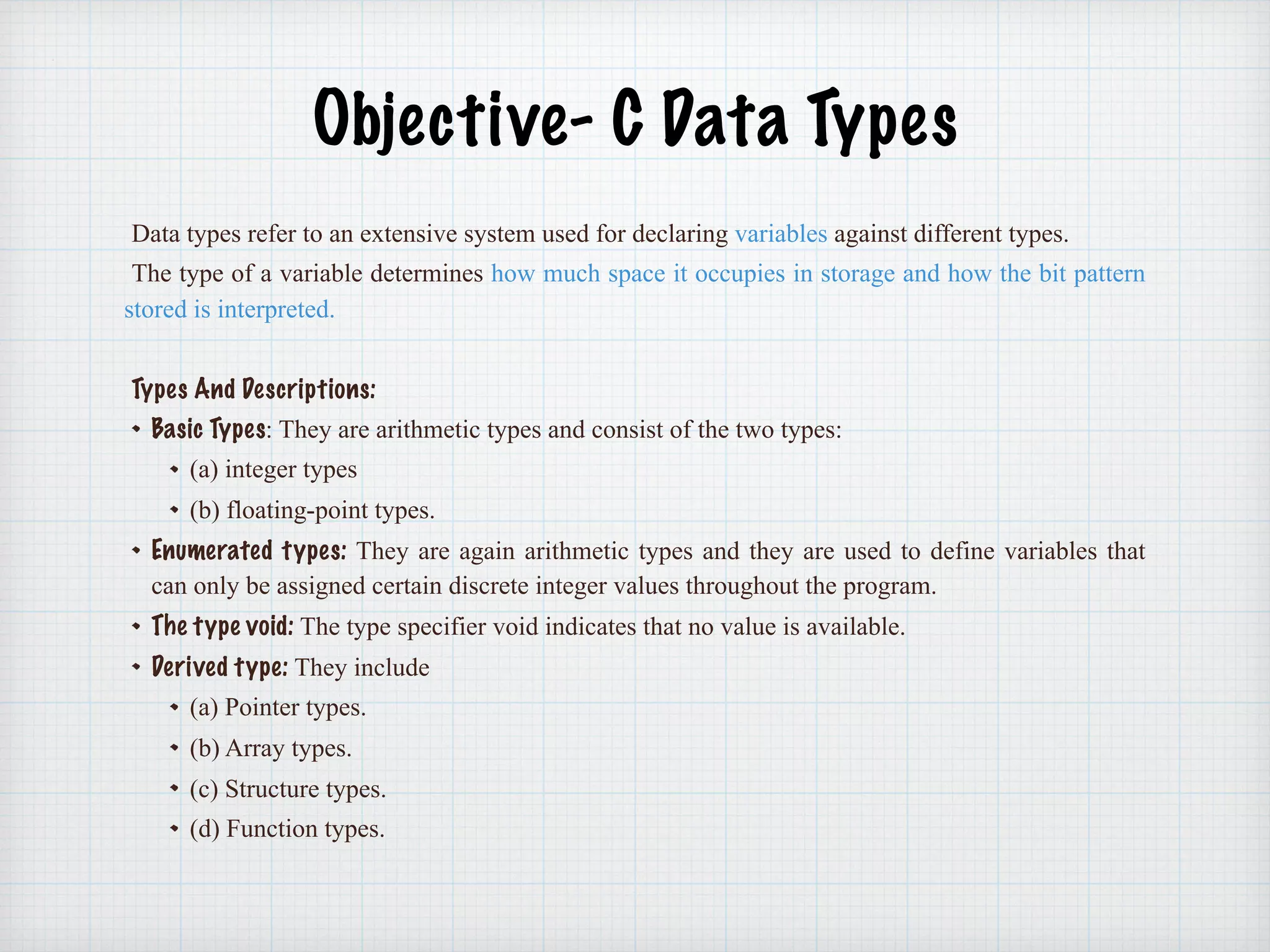
Objective- C Data Types
Data types refer to an extensive system used for declaring variables against different types.
The type of a variable determines how much space it occupies in storage and how the bit pattern
stored is interpreted.
Types And Descriptions:
Basic Types: They are arithmetic types and consist of the two types:
(a) integer types
(b) floating-point types.
Enumerated types: They are again arithmetic types and they are used to define variables that
can only be assigned certain discrete integer values throughout the program.
The type void: The type specifier void indicates that no value is available.
Derived type: They include
(a) Pointer types.
(b) Array types.
(c) Structure types.
(d) Function types.
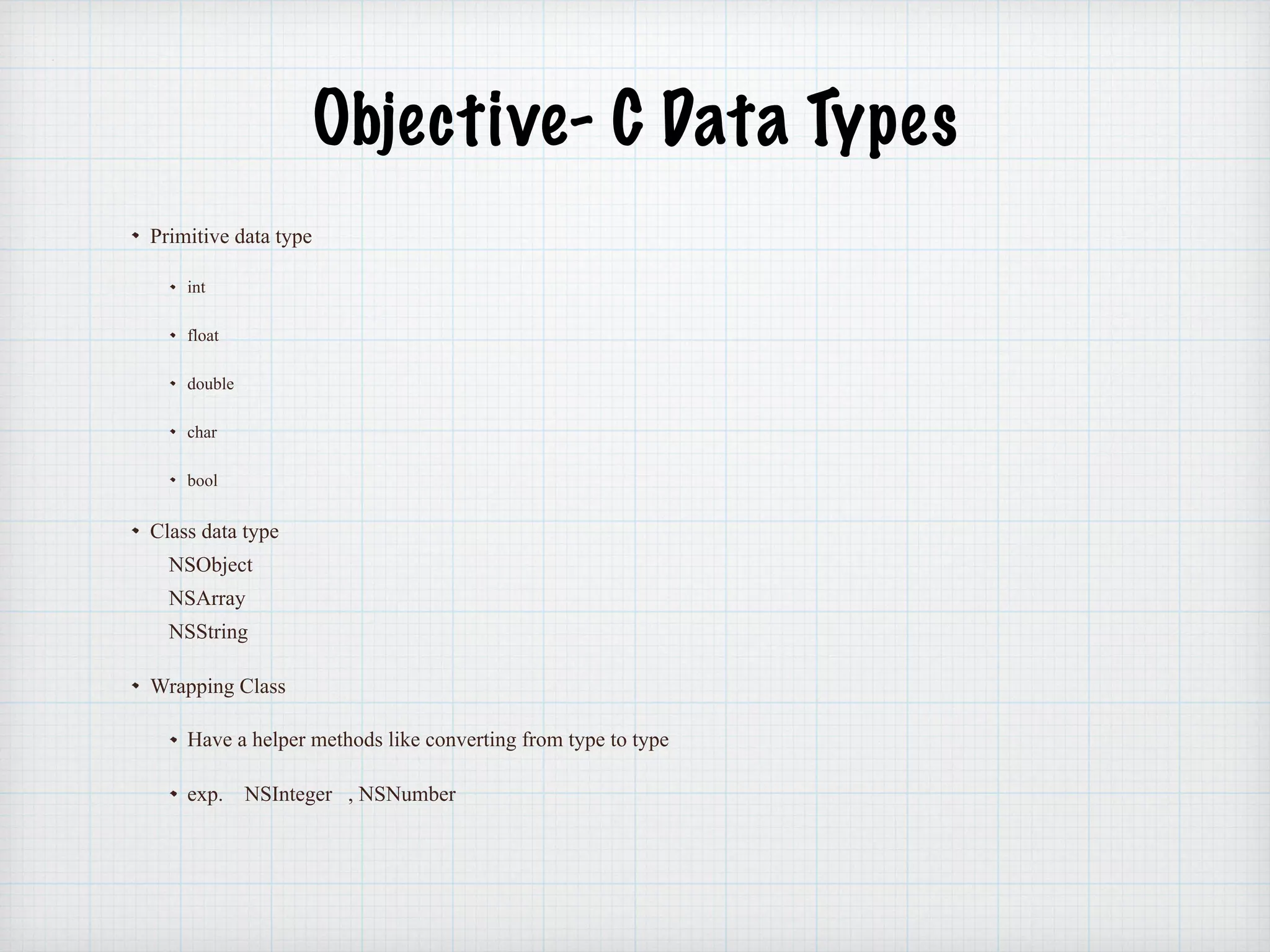
Objective- C Data Types
Primitive data type
int
float
double
char
bool
Class data type
NSObject
NSArray
NSString
Wrapping Class
Have a helper methods like converting from type to type
exp. NSInteger , NSNumber
NSInteger & NSNumber
You usually want to use NSInteger when you don't know what kind of processor
architecture your code might run on, so you may for some reason want the largest
possible int type, which on 32 bit systems is just an int, while on a 64-bit system it's
a long.
The NSNumber class is a lightweight, object-oriented wrapper around C’s numeric
primitives. It’s main job is to store and retrieve primitive values, and it comes with
dedicated methods for each data type:
NSNumber *aBool = [NSNumber numberWithBool:NO];
NSNumber *aChar = [NSNumber numberWithChar:'z'];
NSNumber *aUChar = [NSNumber numberWithUnsignedChar:255];
NSLog(@"%@", [aBool boolValue] ? @"YES" : @"NO");
NSLog(@"%c", [aChar charValue]);


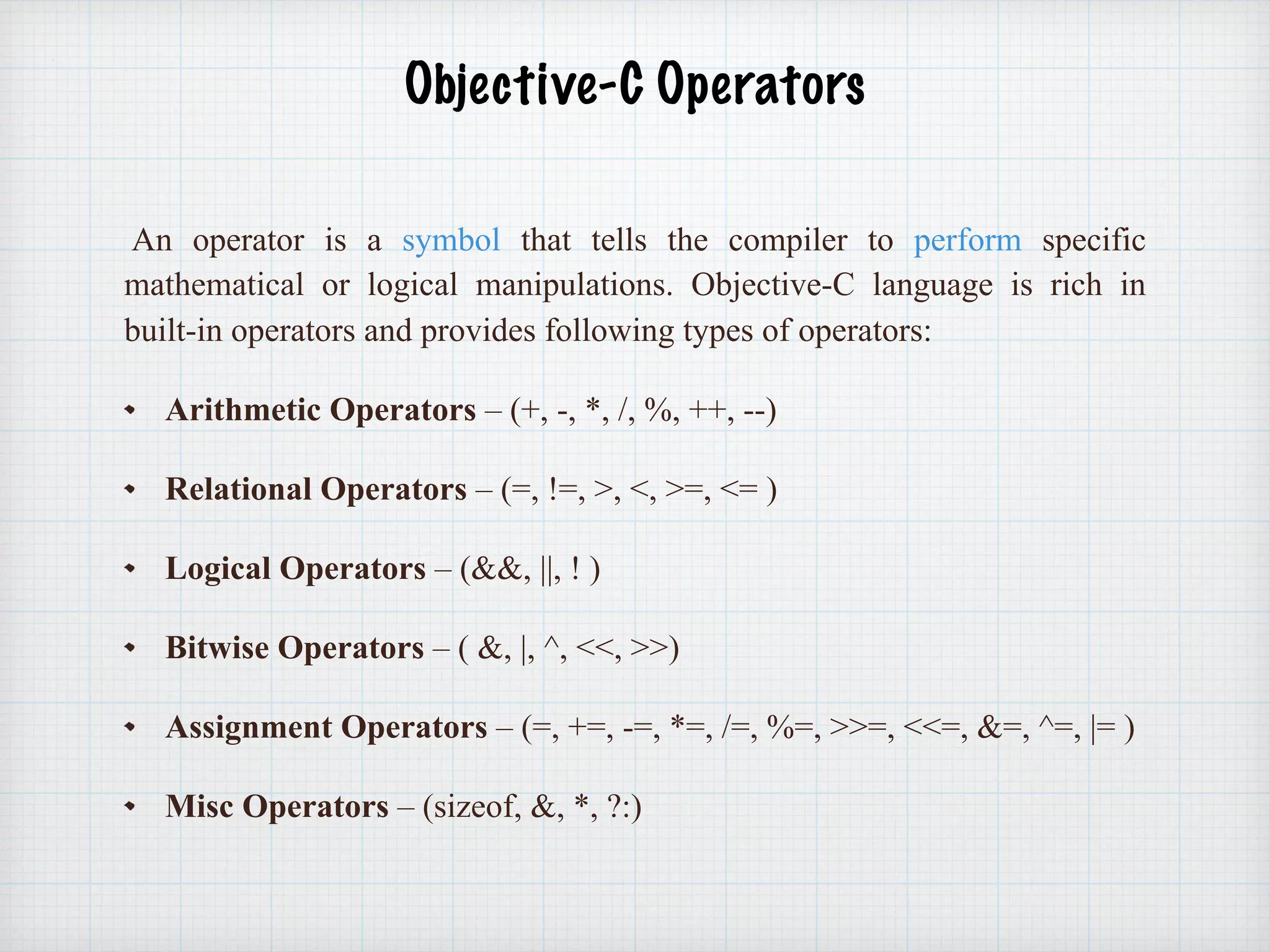
Objective-C Operators

An operator is a symbol that tells the compiler to perform specific
mathematical or logical manipulations. Objective-C language is rich in
built-in operators and provides following types of operators:
Arithmetic Operators – (+, -, *, /, %, ++, --)
Relational Operators – (=, !=, >, <, >=, <= )
Logical Operators – (&&, ||, ! )
Bitwise Operators – ( &, |, ^, <<, >>)
Assignment Operators – (=, +=, -=, *=, /=, %=, >>=, <<=, &=, ^=, |= )
Misc Operators – (sizeof, &, *, ?:)


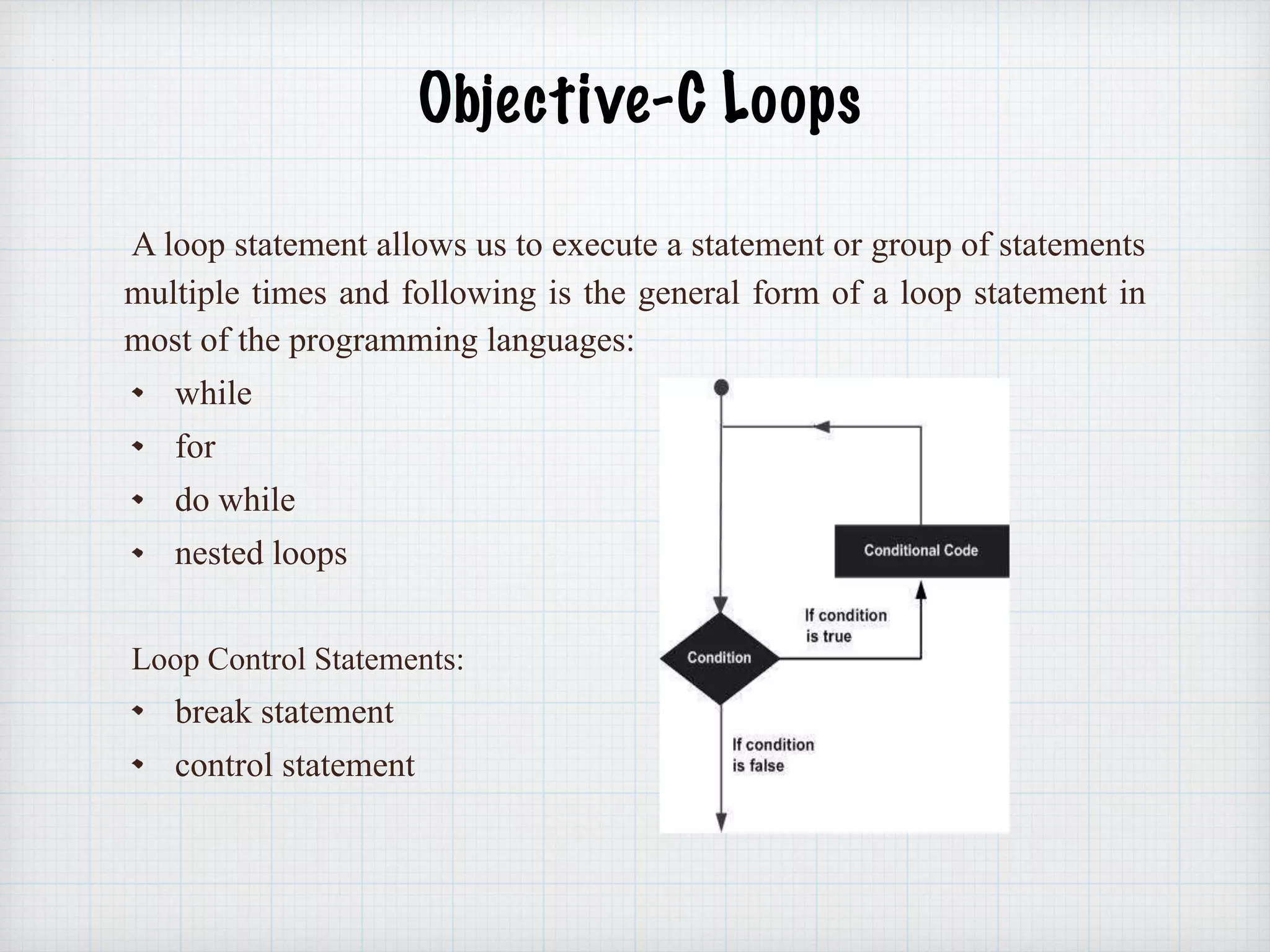
Objective-C Loops

A loop statement allows us to execute a statement or group of statements
multiple times and following is the general form of a loop statement in
most of the programming languages:
while
for
do while
nested loops
Loop Control Statements:
break statement
control statement
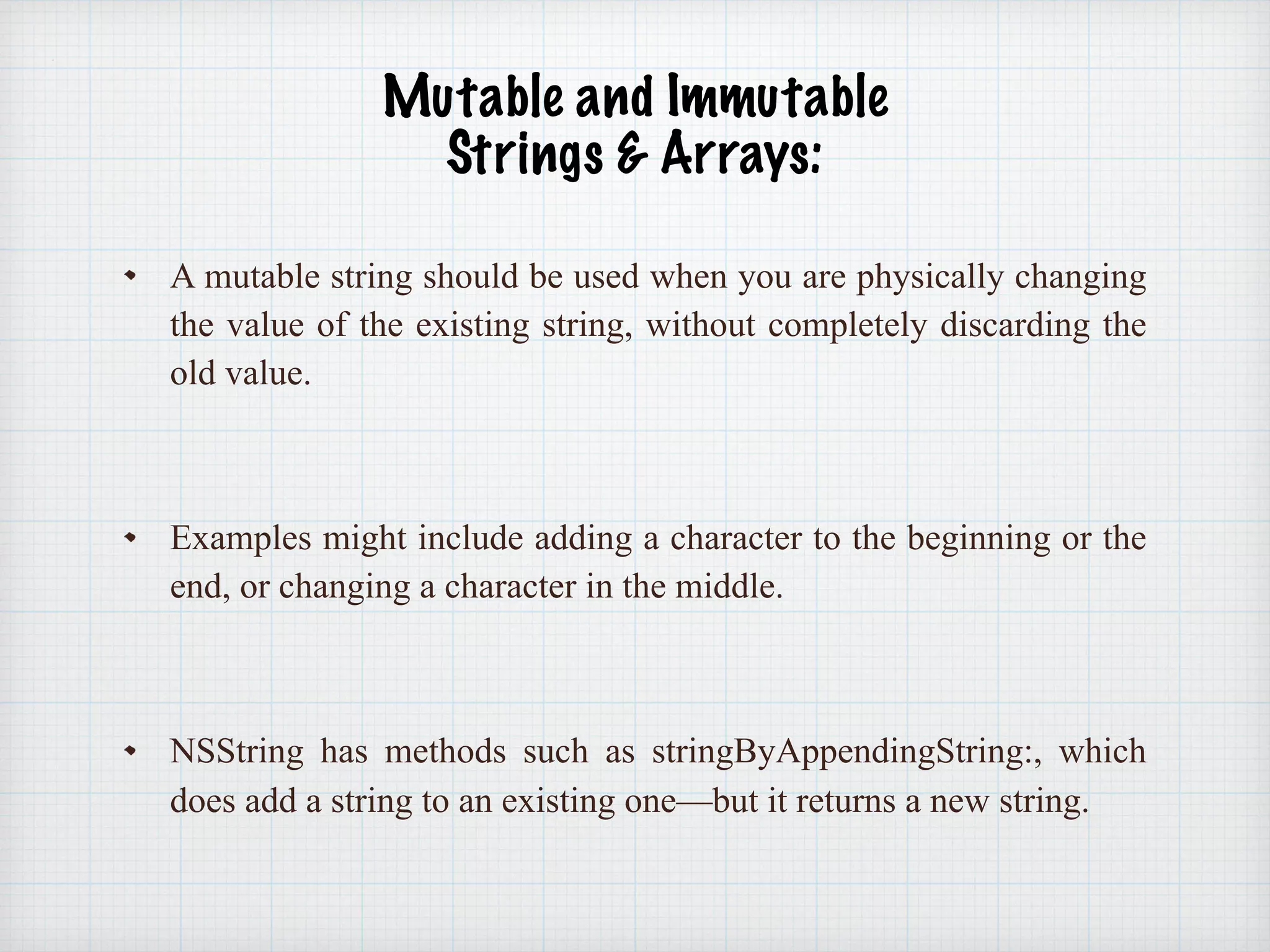
Mutable and Immutable 

Strings & Arrays:

A mutable string should be used when you are physically changing
the value of the existing string, without completely discarding the
old value.
Examples might include adding a character to the beginning or the
end, or changing a character in the middle.
NSString has methods such as stringByAppendingString:, which
does add a string to an existing one—but it returns a new string.
A mutable object can be mutated or changed. An immutable object cannot. For
example, while you can add or remove objects from an NSMutableArray, you
cannot do either with an NSArray.
Mutable objects can have elements changed, added to, or removed, which
cannot be achieved with immutable objects. Immutable objects are stuck with
whatever input you gave them in their [[object alloc] initWith...] initializer.
The advantages of your mutable objects is obvious, but they should only be
used when necessary (which is a lot less often than you think) as they take up
more memory than immutable objects.
Mutable objects can be modified, immutable objects can't.
Eg: NSMutableArray has addObject: removeObject: methods (and more), but
NSArray doesn’t.
Modifying strings:
NSString *myString = @"hello";
myString = [myString stringByAppendingString:@" world"];
Vs
NSMutableString *myString = @"hello";
[myString appendString:@" world”];
•Mutable objects are particularly useful when dealing with arrays.
Eg: if you have an NSArray of NSMutableStrings you can do:
[myArray makeObjectsPerformSelector:@selector(appendString:)
withObject:@“!!!"];
which will add 3 ! to the end of each string in the array.
But if you have an NSArray of NSStrings (therefore immutable), you can't do this (at
least it's a lot harder, and more code, than using NSMutableString)
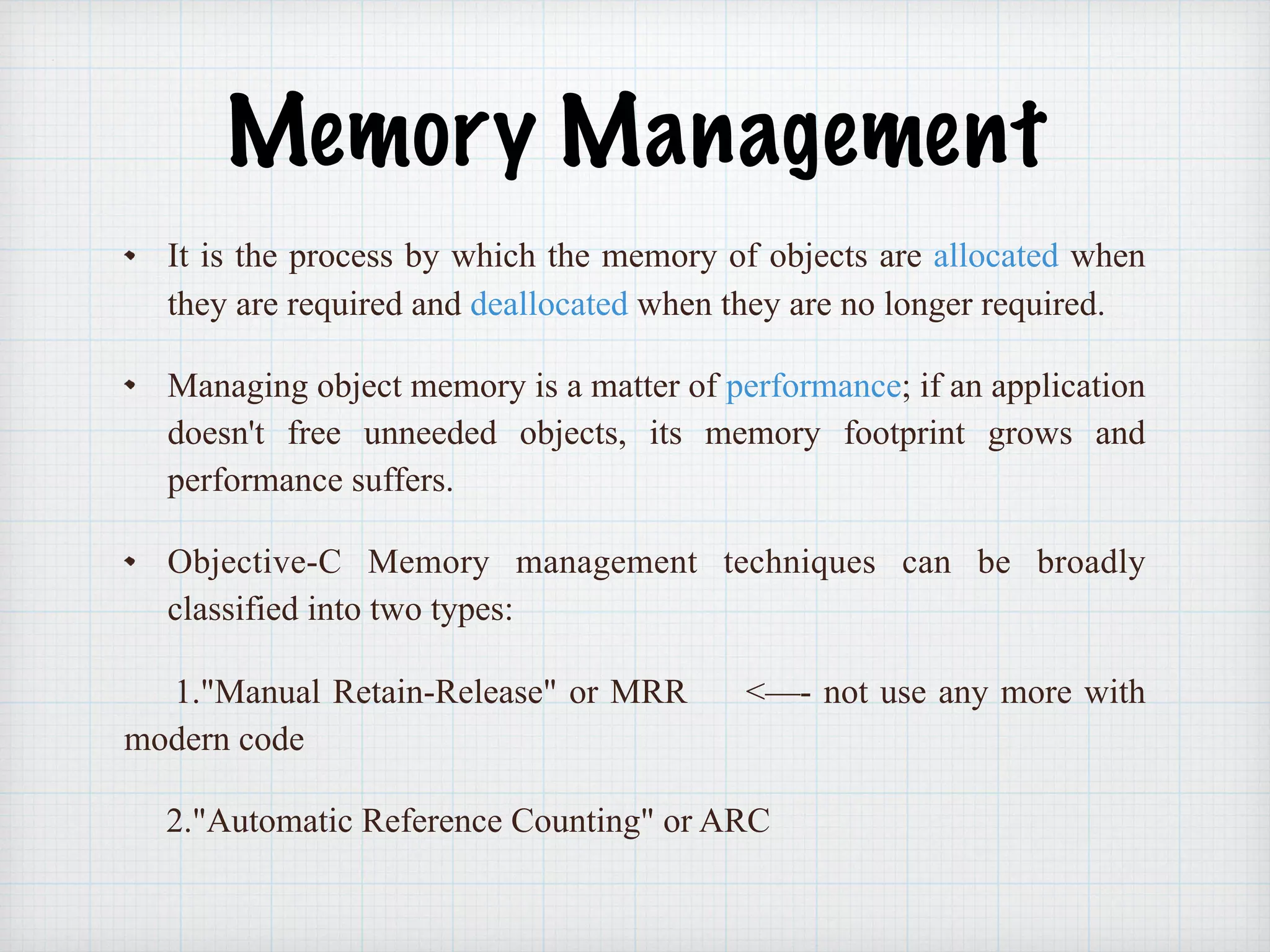
Memory Management
It is the process by which the memory of objects are allocated when
they are required and deallocated when they are no longer required.
Managing object memory is a matter of performance; if an application
doesn't free unneeded objects, its memory footprint grows and
performance suffers.
Objective-C Memory management techniques can be broadly
classified into two types:
1."Manual Retain-Release" or MRR <—- not use any more with
modern code
2."Automatic Reference Counting" or ARC
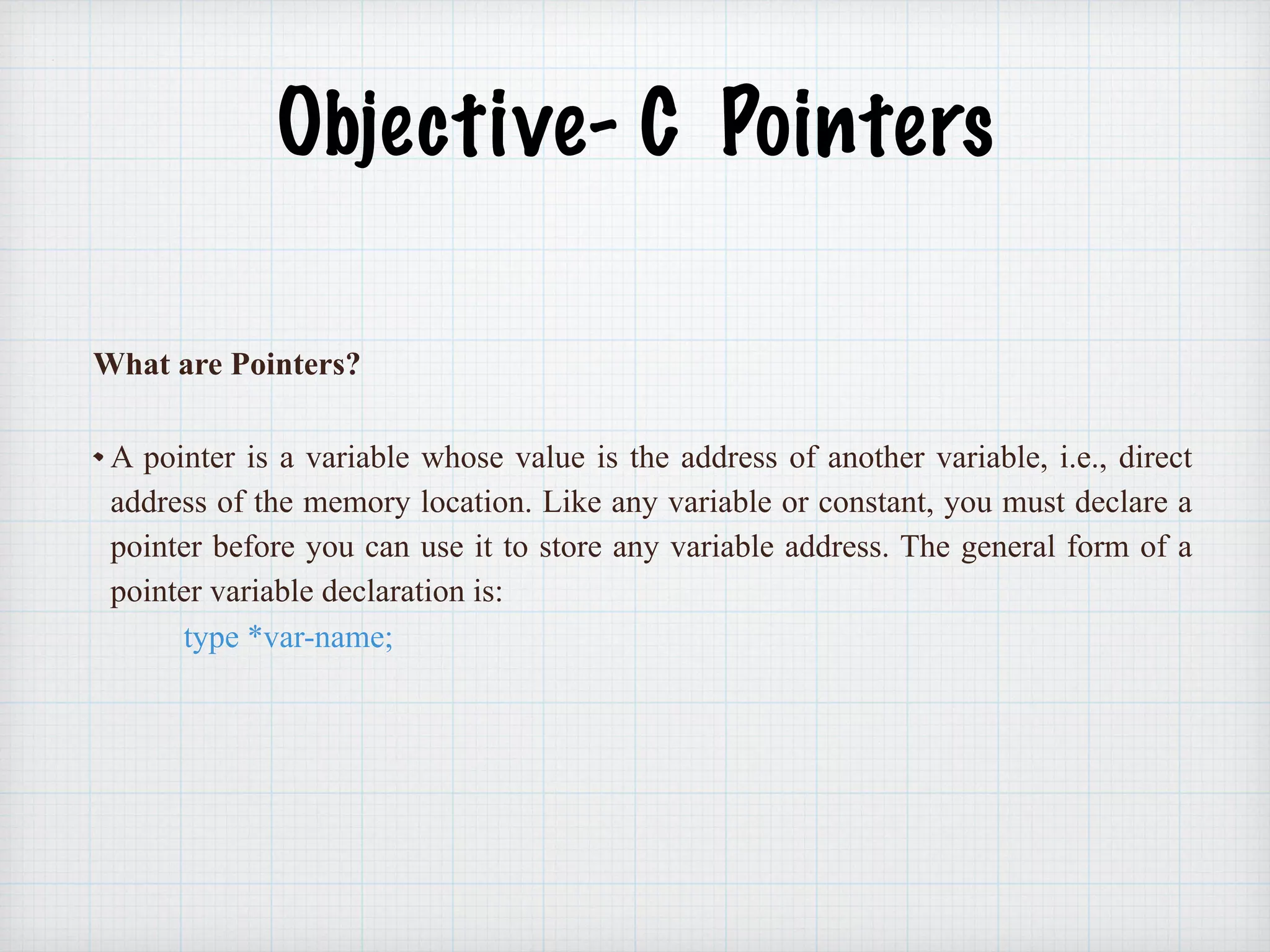
Objective- C Pointers
What are Pointers?
A pointer is a variable whose value is the address of another variable, i.e., direct
address of the memory location. Like any variable or constant, you must declare a
pointer before you can use it to store any variable address. The general form of a
pointer variable declaration is:
type *var-name;


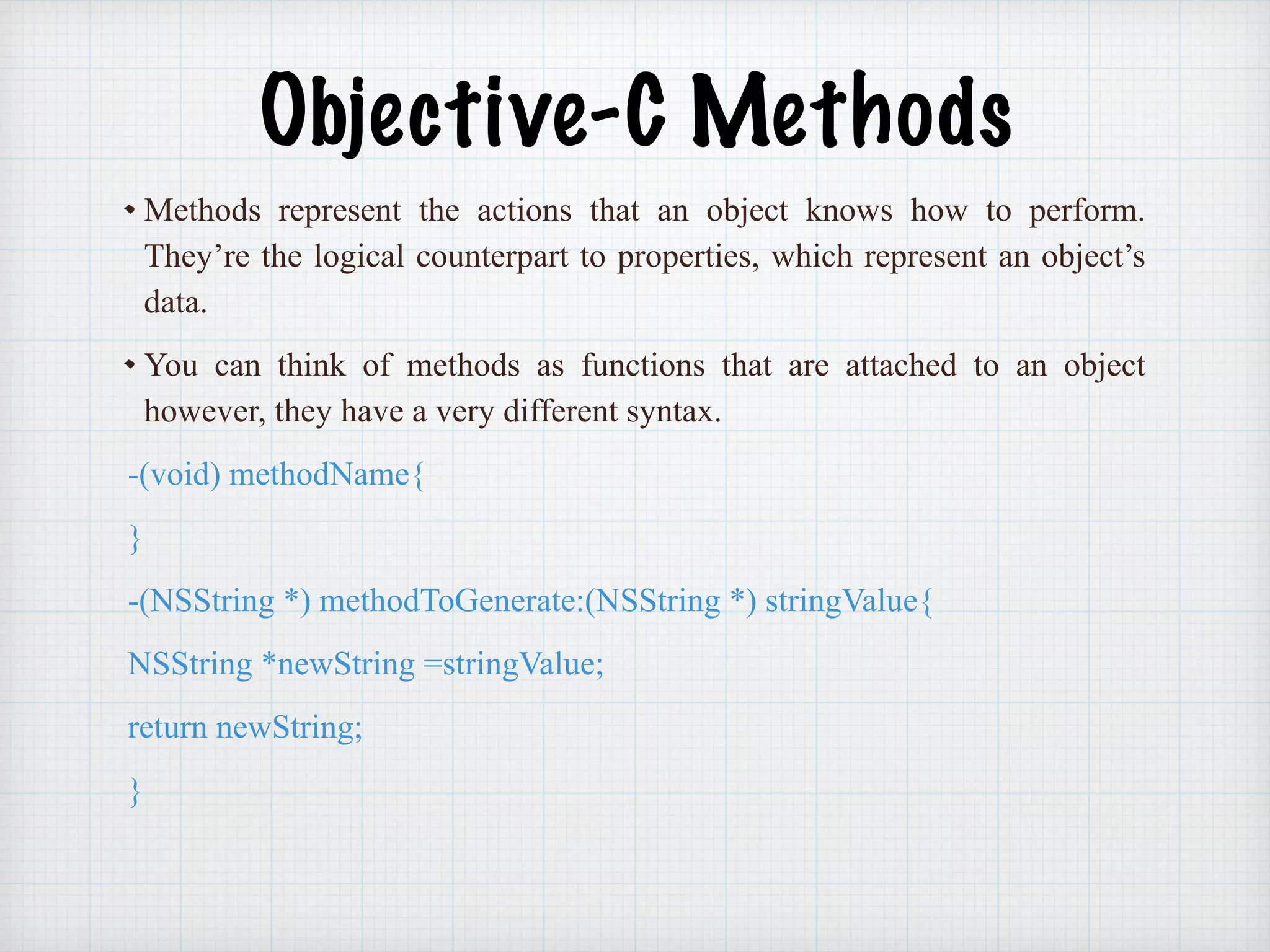
Objective-C Methods
Methods represent the actions that an object knows how to perform.
They’re the logical counterpart to properties, which represent an object’s
data.
You can think of methods as functions that are attached to an object
however, they have a very different syntax.
-(void) methodName{
}
-(NSString *) methodToGenerate:(NSString *) stringValue{
NSString *newString =stringValue;
return newString;
}
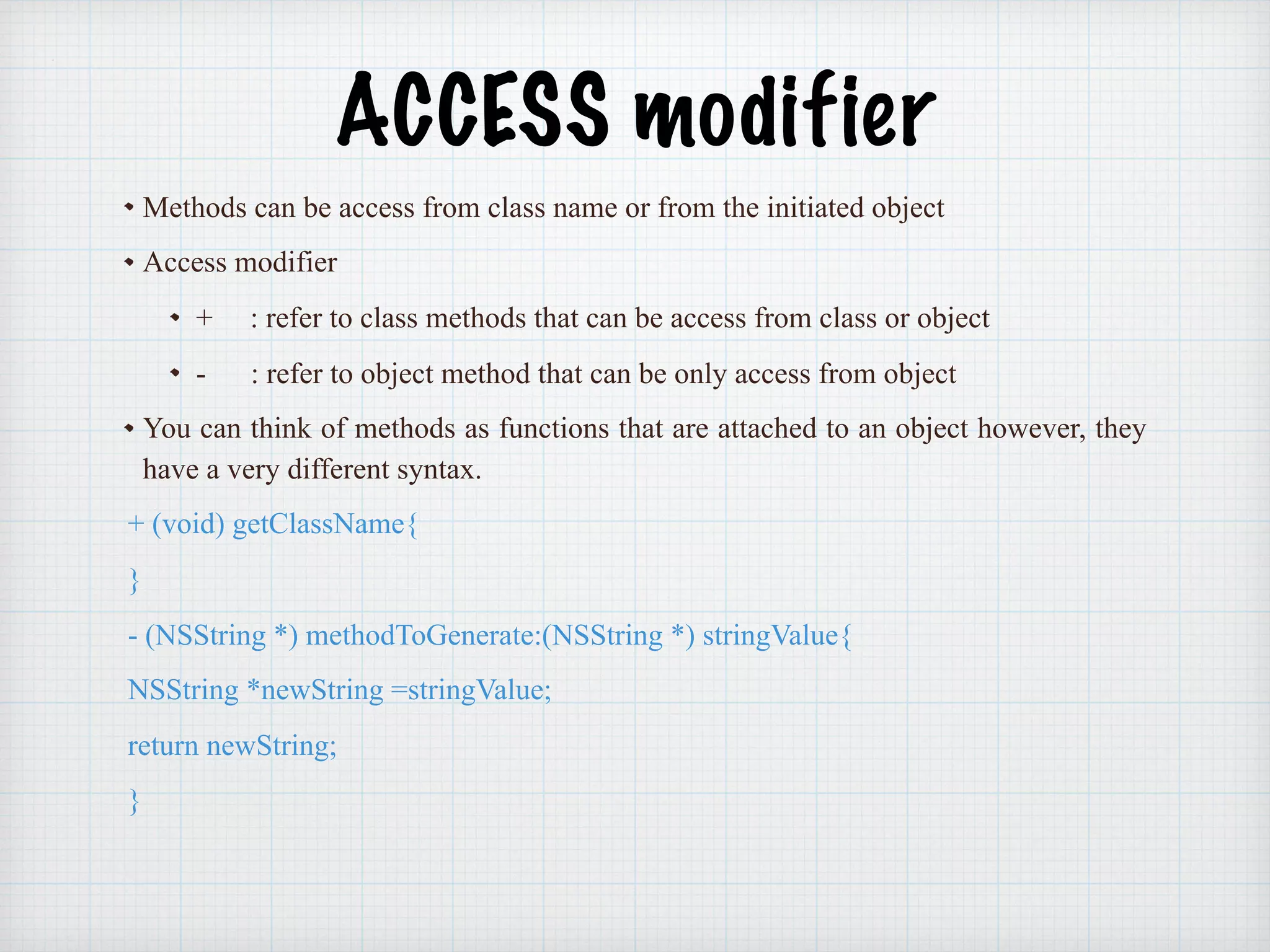
ACCESS modifier
Methods can be access from class name or from the initiated object
Access modifier
+ : refer to class methods that can be access from class or object
- : refer to object method that can be only access from object
You can think of methods as functions that are attached to an object however, they
have a very different syntax.
+ (void) getClassName{
}
- (NSString *) methodToGenerate:(NSString *) stringValue{
NSString *newString =stringValue;
return newString;
}
Naming Convention
Naming Conventions:
Objective-C methods are designed to remove all ambiguities from an API.
Three simple rules for naming Objective-C methods:
1.Don’t abbreviate anything.
2.Explicitly state parameter names in the method itself.
3.Explicitly describe the return value of the method.
- (int) returnIntValueForString: (NSString *) stringToBeOperated{
return [stringToBeOperated intValue];
}
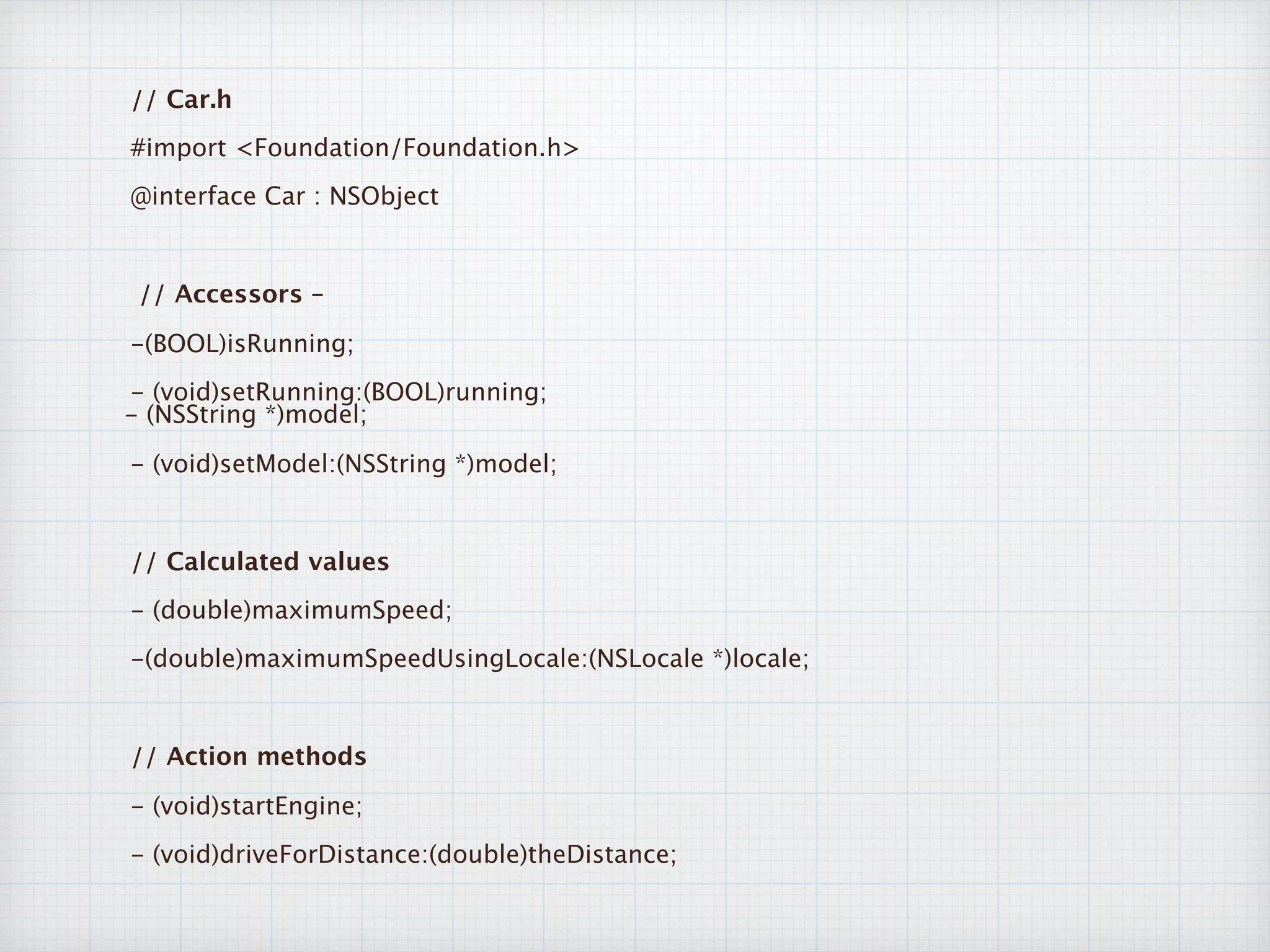
// Car.h
#import <Foundation/Foundation.h>
@interface Car : NSObject
// Accessors –
-(BOOL)isRunning;
- (void)setRunning:(BOOL)running; 

- (NSString *)model;
- (void)setModel:(NSString *)model;
// Calculated values
- (double)maximumSpeed;
-(double)maximumSpeedUsingLocale:(NSLocale *)locale;
// Action methods
- (void)startEngine;
- (void)driveForDistance:(double)theDistance;
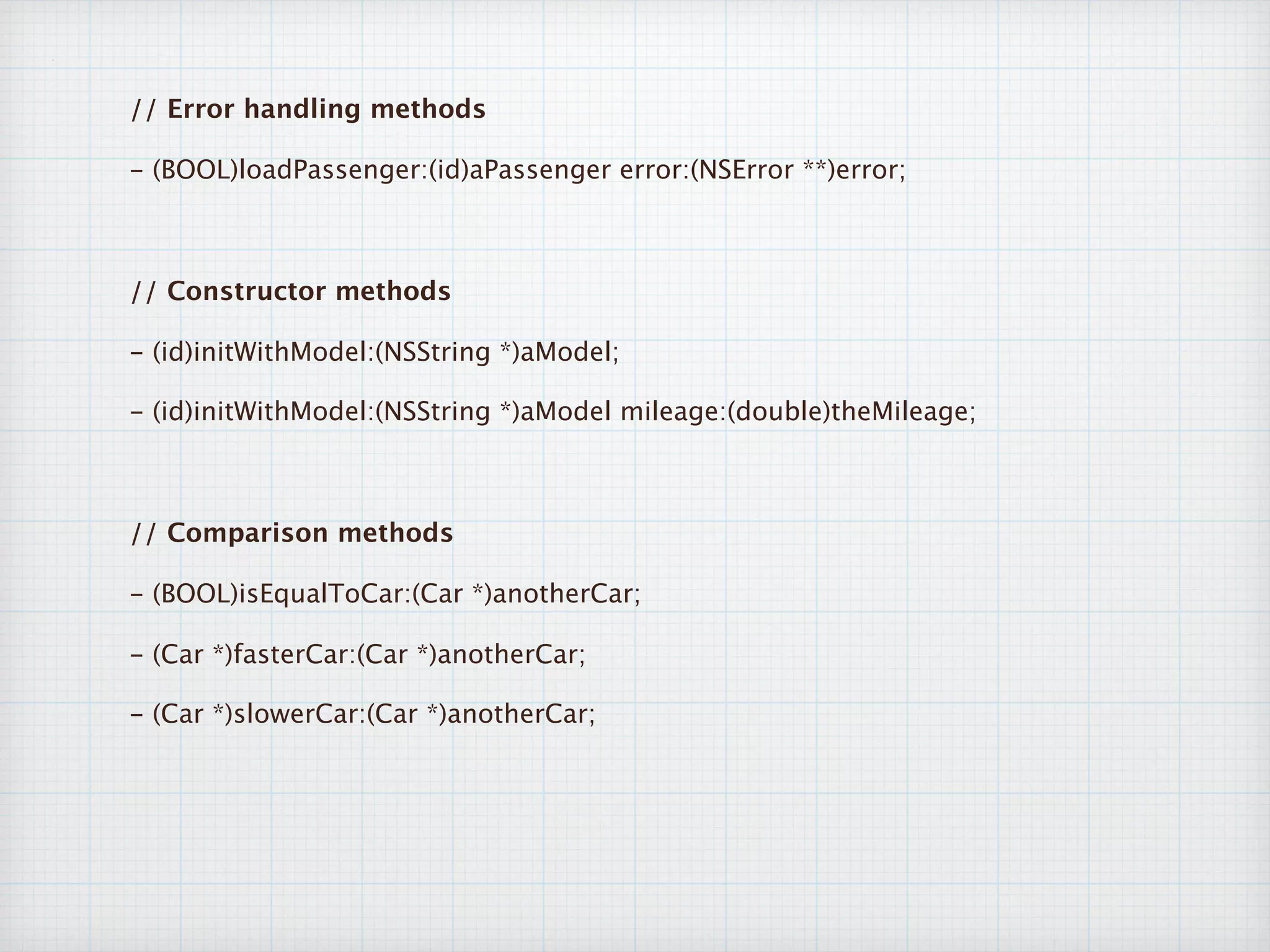
// Error handling methods
- (BOOL)loadPassenger:(id)aPassenger error:(NSError **)error;
// Constructor methods
- (id)initWithModel:(NSString *)aModel;
- (id)initWithModel:(NSString *)aModel mileage:(double)theMileage;
// Comparison methods
- (BOOL)isEqualToCar:(Car *)anotherCar;
- (Car *)fasterCar:(Car *)anotherCar;
- (Car *)slowerCar:(Car *)anotherCar;


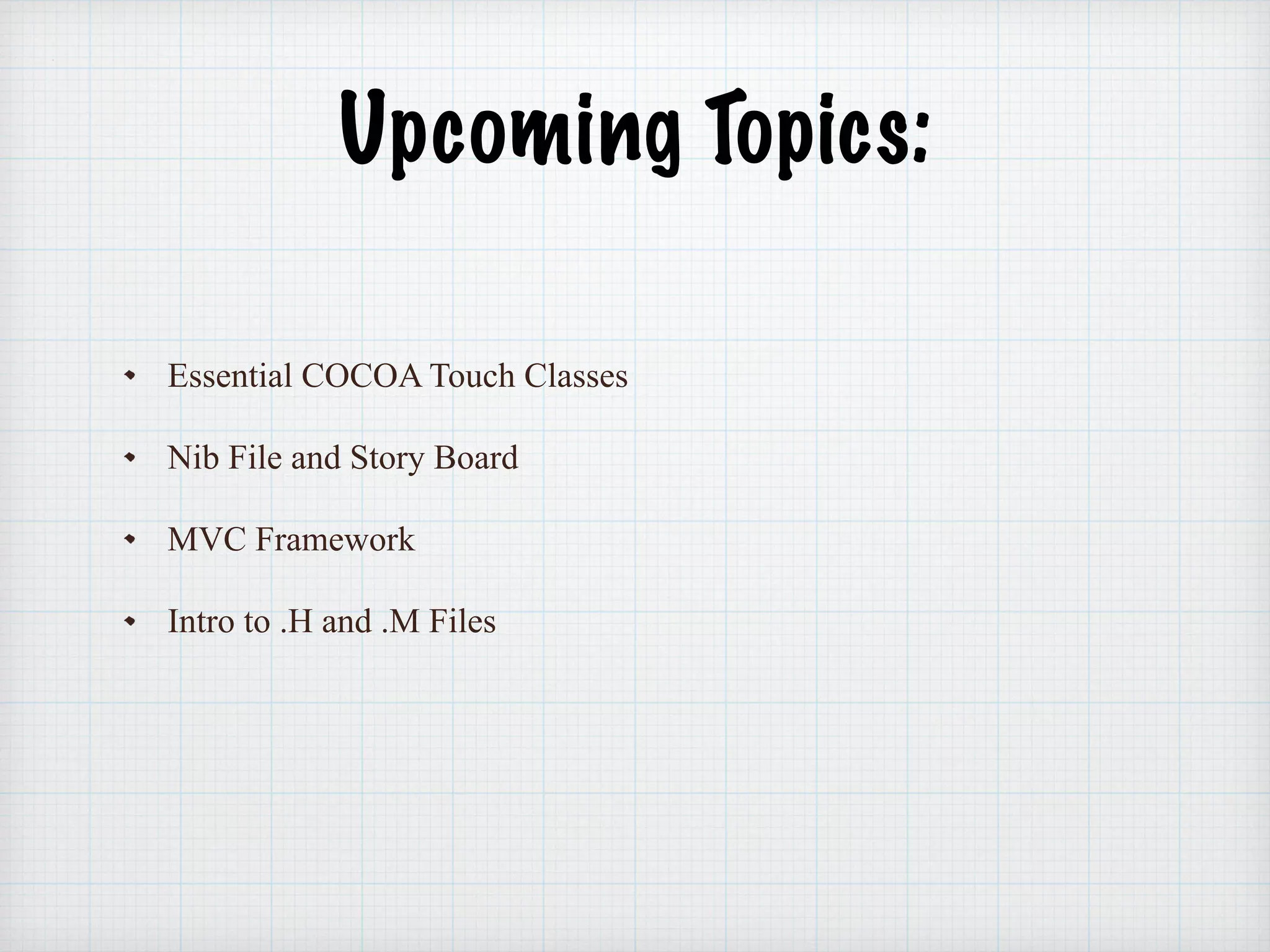
Upcoming Topics:
Essential COCOA Touch Classes
Nib File and Story Board
MVC Framework
Intro to .H and .M Files
THANKS
▸ Skype : amr_elghadban
▸ Email : amr.elghadban@gmail.com
▸ Phone : (+20) 1098558500
▸ Fb/amr.elghadban
▸ Linkedin/amr_elghadban
▸ ios_course facebook group : https://www.facebook.com/groups/
1161387897317786/
WISH YOU WONDERFUL DAY

01 objective-c session 1

  • 1.
    Developing Mobile Application Ios :session # 2 By : Amr Elghadban
  • 2.
    AMR ELGHADBAN ABOUT ME ——————————— SOFTWARE ENGINEER FCI- HELWAN 2010 ITI INTAKE 32 WORKED BEFORE IN - Tawasol IT - Etisalat Masr - NTG Clarity
  • 3.
    Introduction to ObjectiveC Contents : • Language Concepts • How Objective C works- Basics • Data Types • NSInteger • NSNumber • Operators • Loop • Inheritance • Method Overloading • Mutable and Immutable Strings • Mutable and Immutable Arrays
  • 4.
    What Is ObjectiveC ? Objective-C is the primary programming language you use when writing software for OS X and iOS. It’s a superset of the C programming language and provides object-oriented capabilities and a dynamic runtime. Objective-C inherits the syntax, primitive types, and adds syntax for defining classes and methods.
  • 5.
    Objective – CCharacteristics The class is defined in two different sections namely @interface and @implementation. Almost everything is in form of objects, what is object ??? every thing around us is consider as Object of Class Object : Building, House, watch, Ahmed , etc… Class : architecture of buildings , etc… Class Object
  • 6.
    Objects receive messagesand objects are often referred as receivers. by Calling it method “behaviours” Like Ahmed is an oBject receive an message to eat, sleep, walk etc… Objects contain instance variables. Ahmed Have , Eyes, Hands , legs , Head etc … Objects and instance variables have scope. Classes hide an object's implementation. Properties are used to provide access to class instance variables in other classes.
  • 7.
    Language Concepts: Fully supportsobject-oriented programming, including the following concepts of object-oriented development: Encapsulation , Data hiding Inheritance Polymorphism
  • 8.
    Data Encapsulation Encapsulation isan Object-Oriented Programming concept that binds together the data and functions that manipulate the data and that keeps both safe from outside interference and misuse. Data encapsulation is a mechanism of bundling the data and the functions that use them. like Setter and getters
  • 9.
    Inheritance Inheritance allows usto define a class in terms of another class which makes it easier to create and maintain an application. This also provides an opportunity to reuse the code functionality and fast implementation time. you inherit from your father , and ur father super class / parent class Mammals. This existing class is called the base class, and the new class is referred to as the derived class. Objective-C allows only one level of inheritance, i.e., it can have only one base class but allows multilevel inheritance for it’s own implementation. All classes in Objective-C is derived from the superclass NSObject.
  • 10.
    Program Structure A Objective-Cprogram basically consists of the following parts: Preprocessor Commands Interface Implementation Method Variables Statements & Expressions Comments
  • 11.
    Objective- C BasicSyntax Semicolons: The semicolon is a statement terminator. That is, each individual statement must be ended with a semicolon. It indicates the end of one logical entity. For Example: NSLog(@"Hello, World! n"); return 0; Comments: Comments are like helping text in your Objective-C program and they are ignored by the compiler. For example: /* my first program in Objective-C */ // hint can be write here
  • 12.
    Objective- C DataTypes Data types refer to an extensive system used for declaring variables against different types. The type of a variable determines how much space it occupies in storage and how the bit pattern stored is interpreted. Types And Descriptions: Basic Types: They are arithmetic types and consist of the two types: (a) integer types (b) floating-point types. Enumerated types: They are again arithmetic types and they are used to define variables that can only be assigned certain discrete integer values throughout the program. The type void: The type specifier void indicates that no value is available. Derived type: They include (a) Pointer types. (b) Array types. (c) Structure types. (d) Function types.
  • 13.
    Objective- C DataTypes Primitive data type int float double char bool Class data type NSObject NSArray NSString Wrapping Class Have a helper methods like converting from type to type exp. NSInteger , NSNumber
  • 14.
    NSInteger & NSNumber Youusually want to use NSInteger when you don't know what kind of processor architecture your code might run on, so you may for some reason want the largest possible int type, which on 32 bit systems is just an int, while on a 64-bit system it's a long. The NSNumber class is a lightweight, object-oriented wrapper around C’s numeric primitives. It’s main job is to store and retrieve primitive values, and it comes with dedicated methods for each data type: NSNumber *aBool = [NSNumber numberWithBool:NO]; NSNumber *aChar = [NSNumber numberWithChar:'z']; NSNumber *aUChar = [NSNumber numberWithUnsignedChar:255]; NSLog(@"%@", [aBool boolValue] ? @"YES" : @"NO"); NSLog(@"%c", [aChar charValue]);
  • 15.
    
 Objective-C Operators
 An operatoris a symbol that tells the compiler to perform specific mathematical or logical manipulations. Objective-C language is rich in built-in operators and provides following types of operators: Arithmetic Operators – (+, -, *, /, %, ++, --) Relational Operators – (=, !=, >, <, >=, <= ) Logical Operators – (&&, ||, ! ) Bitwise Operators – ( &, |, ^, <<, >>) Assignment Operators – (=, +=, -=, *=, /=, %=, >>=, <<=, &=, ^=, |= ) Misc Operators – (sizeof, &, *, ?:)
  • 16.
    
 Objective-C Loops
 A loopstatement allows us to execute a statement or group of statements multiple times and following is the general form of a loop statement in most of the programming languages: while for do while nested loops Loop Control Statements: break statement control statement
  • 17.
    Mutable and Immutable
 Strings & Arrays:
 A mutable string should be used when you are physically changing the value of the existing string, without completely discarding the old value. Examples might include adding a character to the beginning or the end, or changing a character in the middle. NSString has methods such as stringByAppendingString:, which does add a string to an existing one—but it returns a new string.
  • 18.
    A mutable objectcan be mutated or changed. An immutable object cannot. For example, while you can add or remove objects from an NSMutableArray, you cannot do either with an NSArray. Mutable objects can have elements changed, added to, or removed, which cannot be achieved with immutable objects. Immutable objects are stuck with whatever input you gave them in their [[object alloc] initWith...] initializer. The advantages of your mutable objects is obvious, but they should only be used when necessary (which is a lot less often than you think) as they take up more memory than immutable objects.
  • 19.
    Mutable objects canbe modified, immutable objects can't. Eg: NSMutableArray has addObject: removeObject: methods (and more), but NSArray doesn’t. Modifying strings: NSString *myString = @"hello"; myString = [myString stringByAppendingString:@" world"]; Vs NSMutableString *myString = @"hello"; [myString appendString:@" world”]; •Mutable objects are particularly useful when dealing with arrays. Eg: if you have an NSArray of NSMutableStrings you can do: [myArray makeObjectsPerformSelector:@selector(appendString:) withObject:@“!!!"]; which will add 3 ! to the end of each string in the array. But if you have an NSArray of NSStrings (therefore immutable), you can't do this (at least it's a lot harder, and more code, than using NSMutableString)
  • 20.
    Memory Management It isthe process by which the memory of objects are allocated when they are required and deallocated when they are no longer required. Managing object memory is a matter of performance; if an application doesn't free unneeded objects, its memory footprint grows and performance suffers. Objective-C Memory management techniques can be broadly classified into two types: 1."Manual Retain-Release" or MRR <—- not use any more with modern code 2."Automatic Reference Counting" or ARC
  • 21.
    Objective- C Pointers Whatare Pointers? A pointer is a variable whose value is the address of another variable, i.e., direct address of the memory location. Like any variable or constant, you must declare a pointer before you can use it to store any variable address. The general form of a pointer variable declaration is: type *var-name; 

  • 22.
    Objective-C Methods Methods representthe actions that an object knows how to perform. They’re the logical counterpart to properties, which represent an object’s data. You can think of methods as functions that are attached to an object however, they have a very different syntax. -(void) methodName{ } -(NSString *) methodToGenerate:(NSString *) stringValue{ NSString *newString =stringValue; return newString; }
  • 23.
    ACCESS modifier Methods canbe access from class name or from the initiated object Access modifier + : refer to class methods that can be access from class or object - : refer to object method that can be only access from object You can think of methods as functions that are attached to an object however, they have a very different syntax. + (void) getClassName{ } - (NSString *) methodToGenerate:(NSString *) stringValue{ NSString *newString =stringValue; return newString; }
  • 24.
    Naming Convention Naming Conventions: Objective-Cmethods are designed to remove all ambiguities from an API. Three simple rules for naming Objective-C methods: 1.Don’t abbreviate anything. 2.Explicitly state parameter names in the method itself. 3.Explicitly describe the return value of the method. - (int) returnIntValueForString: (NSString *) stringToBeOperated{ return [stringToBeOperated intValue]; }
  • 25.
    // Car.h #import <Foundation/Foundation.h> @interfaceCar : NSObject // Accessors – -(BOOL)isRunning; - (void)setRunning:(BOOL)running; 
 - (NSString *)model; - (void)setModel:(NSString *)model; // Calculated values - (double)maximumSpeed; -(double)maximumSpeedUsingLocale:(NSLocale *)locale; // Action methods - (void)startEngine; - (void)driveForDistance:(double)theDistance;
  • 26.
    // Error handlingmethods - (BOOL)loadPassenger:(id)aPassenger error:(NSError **)error; // Constructor methods - (id)initWithModel:(NSString *)aModel; - (id)initWithModel:(NSString *)aModel mileage:(double)theMileage; // Comparison methods - (BOOL)isEqualToCar:(Car *)anotherCar; - (Car *)fasterCar:(Car *)anotherCar; - (Car *)slowerCar:(Car *)anotherCar; 

  • 27.
    Upcoming Topics: Essential COCOATouch Classes Nib File and Story Board MVC Framework Intro to .H and .M Files
  • 28.
    THANKS ▸ Skype :amr_elghadban ▸ Email : amr.elghadban@gmail.com ▸ Phone : (+20) 1098558500 ▸ Fb/amr.elghadban ▸ Linkedin/amr_elghadban ▸ ios_course facebook group : https://www.facebook.com/groups/ 1161387897317786/ WISH YOU WONDERFUL DAY