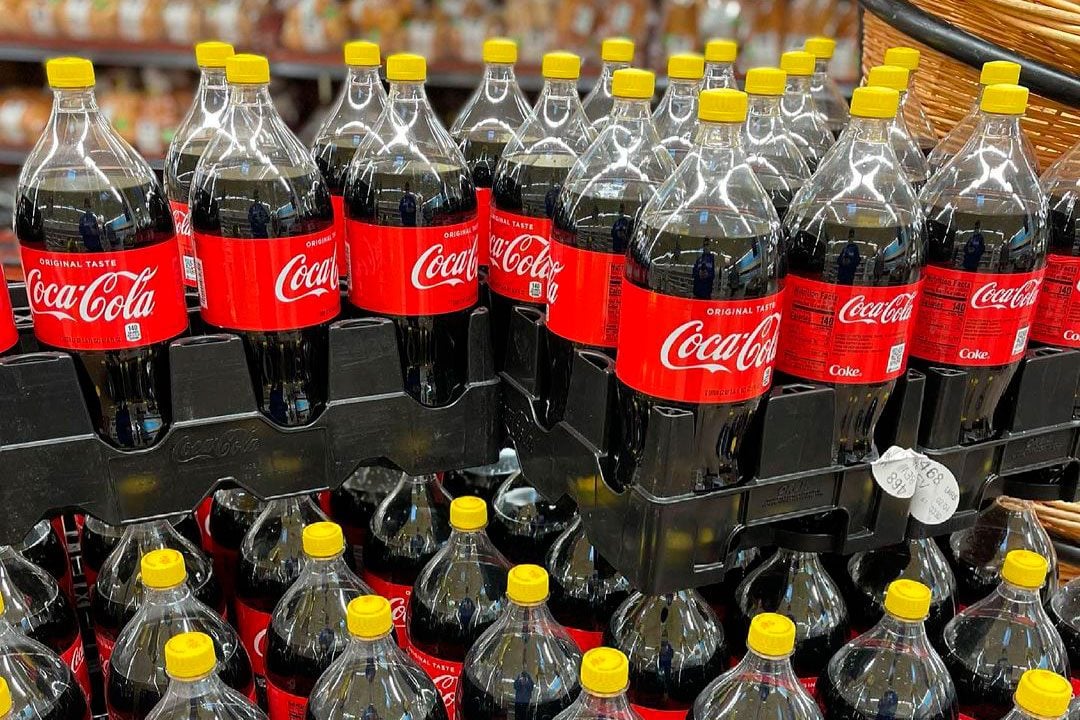
No, those yellow caps on Coke bottles aren't a mistake or a fluke. And no, you didn't win a contest either.
We do so much of our weekly grocery shopping on autopilot. Up and down the same aisles, picking up the same pantry staples and tasty foods. So when something looks different from the way it normally does, it makes us pause. Like when we’re walking down the soft-drink aisle and spy a Coca-Cola yellow cap instead of the normal red cap that matches the red logo. What’s the deal with that? Did they just run out of red caps at the factory and decide to mix it up, or does it mean something more?
We spoke to an expert on the subject, and it’s fascinating! If you’ve been scratching your head over why some Cokes look different than others, we have all the details coming right up. Keep reading for a deep dive on the Coca-Cola yellow cap mystery.
Get Reader’s Digest’s Read Up newsletter for more fun facts, humor, cleaning, travel and tech all week long.
Why do some Coke bottles have yellow caps?
If you see Coca-Cola in your grocery store with a yellow cap, it means that the sip is kosher for Passover. Passover is a Jewish holiday that takes place in the spring and celebrates when Moses liberated the Jews from slavery in Egypt.
Like other Jewish holidays, there are specific dietary requirements associated with Passover. The version of the story that they teach in Hebrew school is that when the Jews fled Egypt, they could not wait for their bread to rise. So they packed unleavened bread for their journey, which is why Jews eat matzo during Passover and don’t eat any leavened bread products.
What does kosher mean?
“For traditional kosher certification, there are rules prescribed in the Bible, biblical law and oral tradition about which types of animal by-product can be eaten, which mixtures would not be allowed, which wines are not allowed and others,” according to Rabbi Zvi Nussbaum, the consumer hotline operator at the Orthodox Union (OU) Kosher Certification Agency.
According to the OU, pork, rabbit, eagle, owl, catfish, sturgeon, most insects and any shellfish or reptiles are not kosher. What’s more, kosher animals must be slaughtered in a specific manner, and meat and dairy products may not be manufactured or consumed together.
For a product to be certified kosher, it needs to abide by all these rules. “Depending on what is going on at the company, if they are producing kosher and non-kosher products side by side, that will determine how much oversight we need in the company to ensure there’s no question of non-kosher ingredients mixing into the kosher product,” says Nussbaum.
Is Passover kosher different from traditional kosher?
Yes. The restrictions regarding what you can and can’t eat during Passover and what foods are considered kosher for Passover are different from the rules that govern what foods are kosher for the rest of the year.
“For Passover, there’s another special restriction: anything that is derived from the five grains,” Nussbaum says. “Wheat, barley, spelt, rye and oats that have come in contact with any type of liquid are not permitted for Passover use.”
To ensure these restrictions are being met, there is a different certification process that kosher-for-Passover products have to go through. (More on that below.)
What are the problematic ingredients in Coke?
In short, it’s the high-fructose corn syrup in Coca-Cola that is not kosher for Passover. But why is this, if corn is not derived from one of the five grains above? Nussbaum explains that the majority of Jews have adopted additional customs during Passover, including not consuming foods that were traditionally grown alongside grains (thus risking cross contamination), such as legumes, or foods that can be used in the same way as a wheat product.
“Corn can be milled,” says Nussbaum, “so the high-fructose corn syrup has to be substituted to make it acceptable for Passover.” He adds that aspartame, an artificial sweetener used in some Coca-Cola products, can be derived from beans or legumes, so it’s also out for the Coca-Cola with a yellow cap. Instead, the soft-drink maker uses cane sugar to sweeten this soda.
How does Coca-Cola ensure that these drinks are kosher?
It comes down to oversight. “We have to set up a system where the product is produced with an overseer on [site] at the time of production,” Nussbaum says. “To be certified for Passover, it can’t be produced without a designated agent of the OU at the facility. Whether it’s a fish and it’s being cooked in Alaska or if it’s something produced in China, it doesn’t make a difference.”
The result of this oversight is that the end product will have a symbol on it that includes the letter P. In the past, it has been on the yellow cap itself, but if it was certified by the OU, which works with Coca-Cola, you’ll see OU-P on the bottle. There are hundreds of kosher certification agencies in the United States, according to the Chicago Rabbinical Council, all of which use a slightly different symbol. But, in general, the symbol will likely have a K in it somewhere, and then the addition of a P for Passover products.
Does Coke with a yellow cap taste any different than regular Coke?
Since they are replacing the high-fructose corn syrup with cane sugar, most people would say yes, it does. It tastes more like Mexican Coke and the new Coke that Coca-Cola is going to be launching this fall, both of which are made with cane sugar.
Not only does it taste different, but many people also think it tastes better. “It tickles people’s taste buds in a different way, and some like it better than the year-round product,” says Nussbaum. Plus, it is sold for the same price as regular Coke, while Mexican-made Coke that’s sold in the U.S. typically costs more, according to MarketWatch.
“Stock them up as much as you can, they are ‘Mexican’ coke for the price of normal coke,” wrote one Reddit user in response to a post from someone asking why some Coca-Cola in his store had yellow caps. Meanwhile, a Jewish woman quoted by MarketWatch said that she buys about 10 bottles of yellow-cap Coke during Passover because she just likes it better than regular Coke.
Nussbaum says that depending on where you live and where the Coke is being made, you may see classic Coca-Cola and/or Diet Coke with a yellow cap on your grocery store shelves.
Can you find Coke with a yellow cap year-round?
Unfortunately, no. Coca-Cola sends it out to stores only in the spring, around Passover. While the timing of the holiday shifts slightly every year, it usually lands somewhere in April, so that’s around the time you’ll be most likely to find Coke with a yellow cap.
But Coca-Cola doesn’t send kosher-for-Passover Coke to every grocery store around the country. You’re more likely to find it in cities and towns with a larger Jewish population, “where the bottlers have decided to seek certification,” according to a statement from Coca-Cola published on Medium.
While you can’t order it online, if you order groceries from your local supermarket to be picked up or delivered to your home (and your store is stocked with Coca-Cola with a yellow cap), you should be able to get it that way. Although that would involve trusting your shopper to slow down enough to check the color of the cap on the bottle they pick up!
Who else might want to buy Coke with a yellow cap?
In addition to Jewish people who are keeping kosher during Passover, fans of Mexican Coke and those who are trying to cut back on processed ingredients like high-fructose corn syrup may want to pick up a few liters.
Do any other products offer kosher alternatives?
Yes, there are a variety of products that are made kosher for Passover available around the holiday. The most numerous are those that are produced by companies that make Jewish foods year-round, like Manischewitz, Streit’s, Yehuda Matzos and Joyva.
Grocery stores tend to make these easy to find, grouping them all together in a table display or on an aisle endcap, so if one of your favorite brands is making a kosher-for-Passover product, you should be able to find it there as well. Or you can always look for the kosher symbol with the P.
About the expert
|
Why trust us
At Reader’s Digest, we’re committed to producing high-quality content by writers with expertise and experience in their field in consultation with relevant, qualified experts. We rely on reputable primary sources, including government and professional organizations and academic institutions as well as our writers’ personal experiences where appropriate. For this piece on the Coca-Cola yellow cap, Alyssa Sybertz tapped her decades of experience as a food writer and editor. We verify all facts and data, back them with credible sourcing and revisit them over time to ensure they remain accurate and up to date. Read more about our team, our contributors and our editorial policies.
Sources:
- Rabbi Zvi Nussbaum, consumer hotline operator at the Orthodox Union (OU) Kosher Certification Agency; interviewed, August 2025
- Orthodox Union: “What Is Kosher Certification?”
- Chicago Rabbinical Council: “Acceptable Kashrus Agencies”
- MarketWatch: “Why this kosher-for-Passover Coke with the yellow cap is going viral”
- Reddit: “Yellow Cap 2Liter”
- Medium: “The Delicious but Complicated Story of Kosher for Passover Coke”