

















Getting the Most Out of Older Sails
Efficient windward work requires sails with a good lift-to-drag ratio. Mylar laminate sails hold their shape throughout their useful life, well enough for all...
Getting a Clue for the Blown-Out Clew
How do you manage major sail repairs in remote locations? By using whatever you have onboard to get you home—or beyond.
After an easy three-day...
What Color Bimini Top is Best for Summer?
So you want to build the awning described on page 7 of this issue, and were wondering what material to use. We’ve been using...
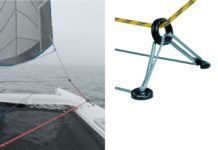
Try a Barber Hauler for Better Sail Trim
If you can't position the jib clew exactly where you want it on all courses and in all weather, a barber hauler should be in your future, for even the most laid-back sailor. Here are some options.
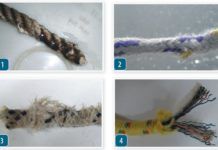
Verifying Material of Mystery Ropes
Using the wrong rope for the job is a recipe for failure. Fortunately, with a trained eye and a little knowledge of physical properties, making a rough identification is simple enough.
Online Help for Autumn
Its getting to be that time of year, when many skippers haul out or head south. Fall also heralds the beginning of boat show season. Here are some PS articles from the online archives that are suited for the season.
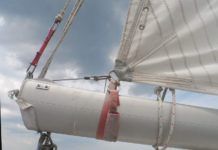
A Custom-fitted Clew Strap
After settling on the material, one of the most basic mainsail design questions is whether to have an attached foot or loose-foot. A sail with an attached foot, secured to the boom with a bolt rope or sail slugs, has a small advantage in area, while a loose footed sail is easier to adjust (flat for windward work and smooth seas, fuller for reaching and rough seas), slightly cheaper to fabricate, and much easier to take off the boom for storage. Both are used on both high performance and cruising boats. Most new mainsails are loose footed.
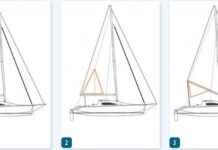
Make Your Own Over-the-Boom Riding Sail
Delighted with the performance of the over-the-boom riding sail, we decided to make our own.
Rest Easy with a Riding Sail
Even when your anchor is well designed and ideally matched to your boat, there are four common factors that can cause an anchor to drag: poor bottom, short scope, insufficient shock absorption, and yawing. Each of these reduces the holding capacity of the anchor, and they are additive. That is to say that any one of them can ruin your day, solving only one or two of them does not ensure good holding, and the more problems you solve, the better youll sleep.
Sails and Summer Projects
While most of us are-hopefully-out sailing this summer, we know that many sailors are busy with system upgrades, do-it-yourself projects, and the usual marine maintenance adventures. Here are some archive articles we think will help you tick off the tasks on your to-do list.

Why This $1M+ Sailboat Might Be The Best Bluewater Cruiser in...
The Bluewater 56 is one of the most misunderstood offshore cruisers in the sailing world — and today we’re diving deep into what makes...


Latest Sailboat Review

Rethinking Sailboat Structure
When it comes to describing a sailboats most valuable attribute, its surprising how varied opinions can be. Staying afloat should be our first priority, and although you seldom read or hear much about it at boat shows, the structural elements that hold a sailboat together are an all-important consideration.